
AP EAPCET 2026 Engineering Question Paper May 18 Shift 1 with Solution PDF


| Updated On - Jul 20, 2026
AP EAPCET 2026 Engineering Question Paper May 18 Shift 1 with Solution PDF is available here for download. JNTU conducted the AP EAPCET 2026 exam on behalf of the Andhra Pradesh State Council of Higher Education (APSCHE) in 1st Shift from 9 AM to 12 PM. AP EAPCET 2026 Engineering Question Paper consists of 160 questions carrying 1 mark each. AP EAPCET 2026 Question Paper for Engineering includes three subjects, Physics, Chemistry and Mathematics. The Physics and Chemistry section of the paper includes 40 questions each while the Mathematics section includes a total of 80 questions.
Download AP EAPCET 2026 Engineering Question Paper May 18 Shift 1 with Solution PDF from the link provided below.
AP EAPCET 2026 Engineering Question Paper May 18 Shift 1 with Solution PDF
| AP EAPCET 2026 Engineering Question Paper | Download PDF | Check Solutions |

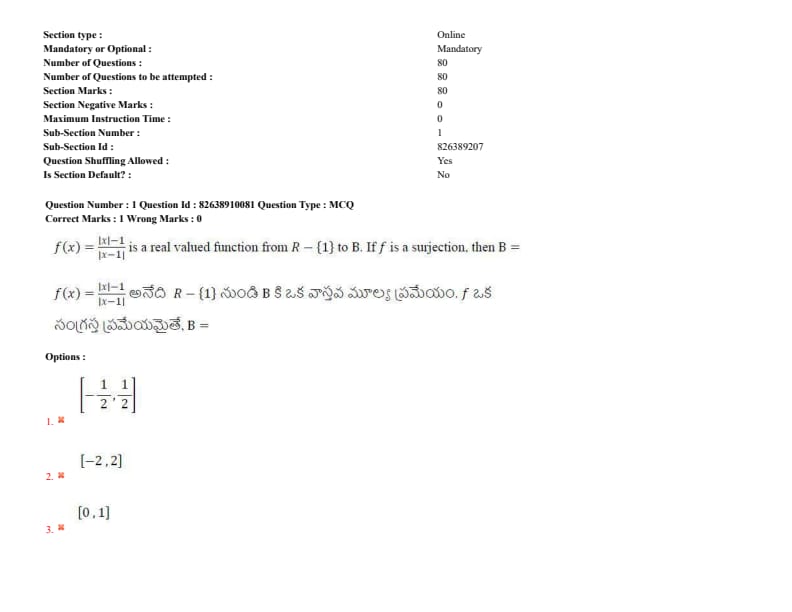
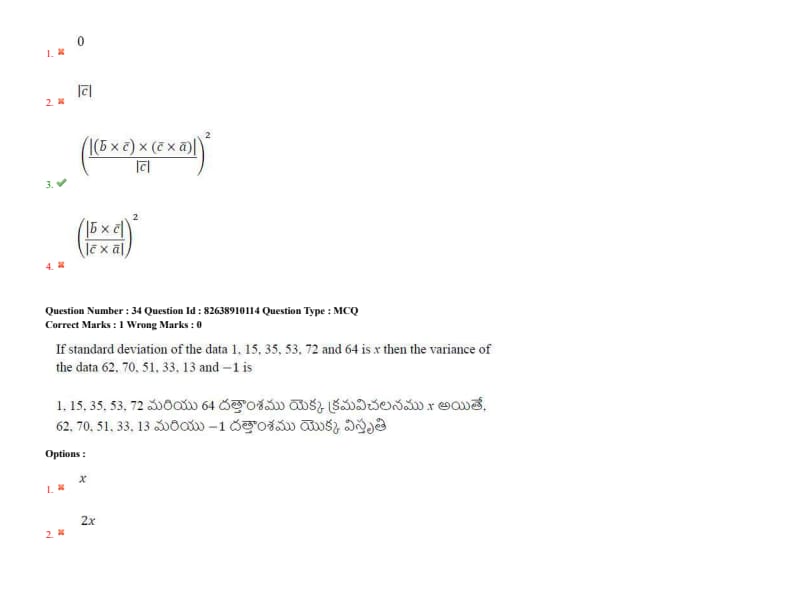
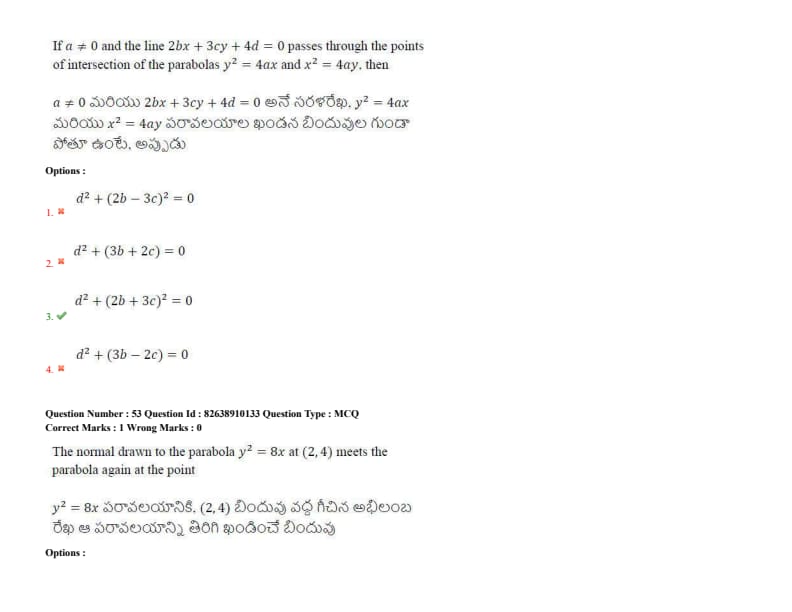
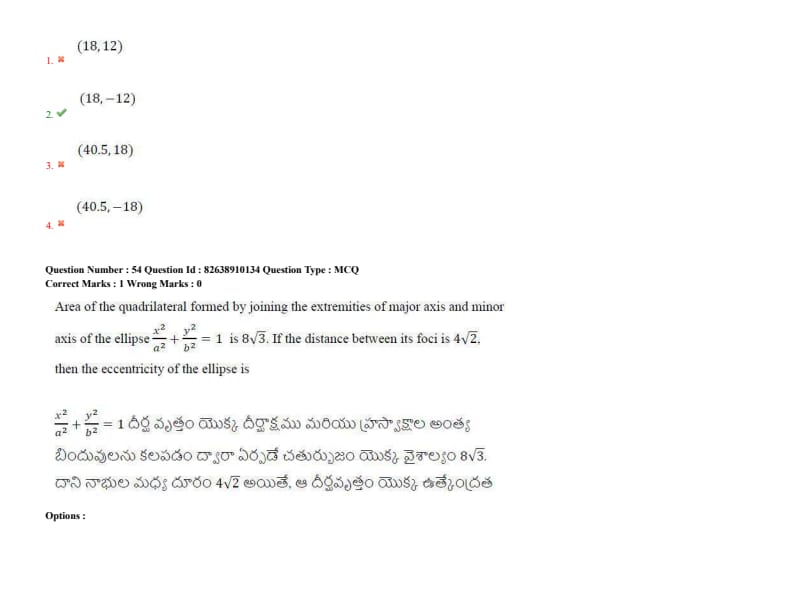
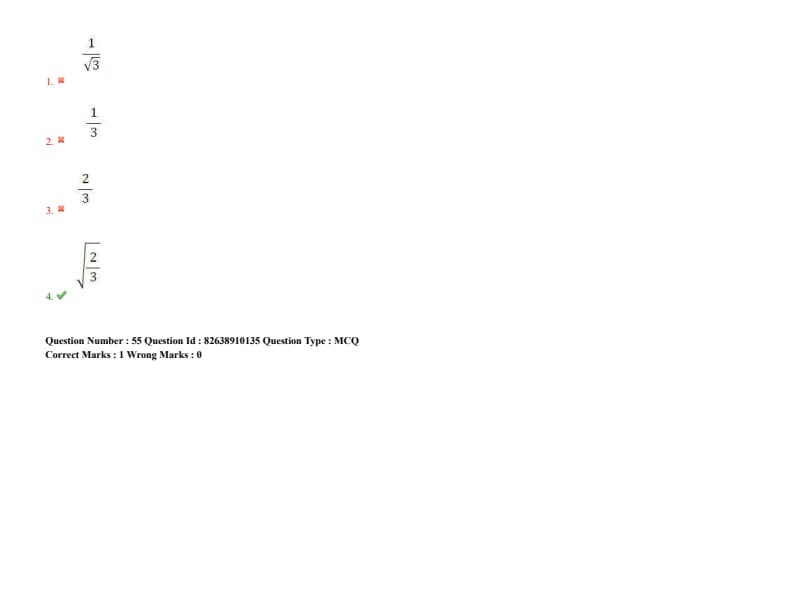
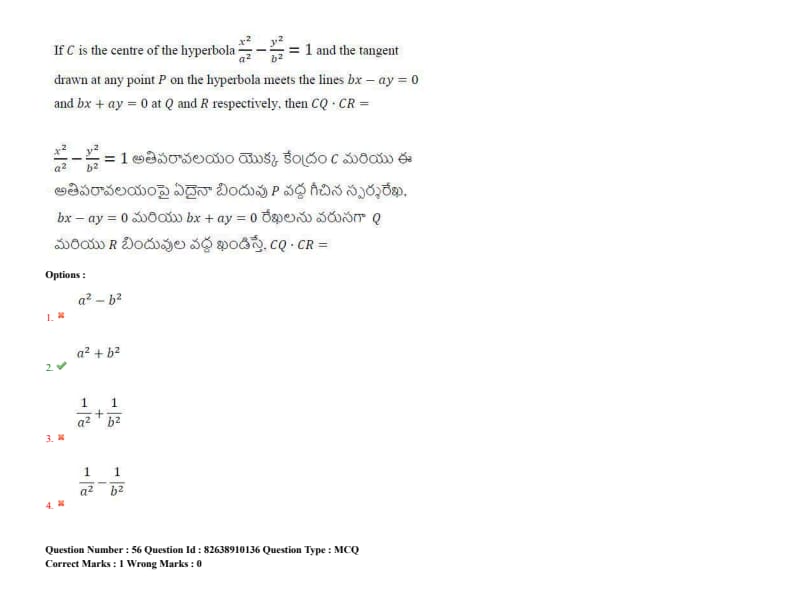
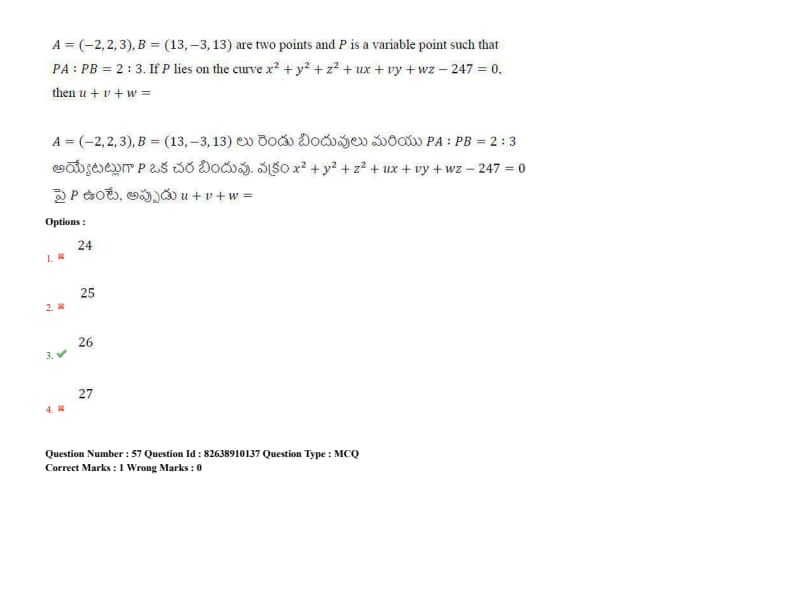
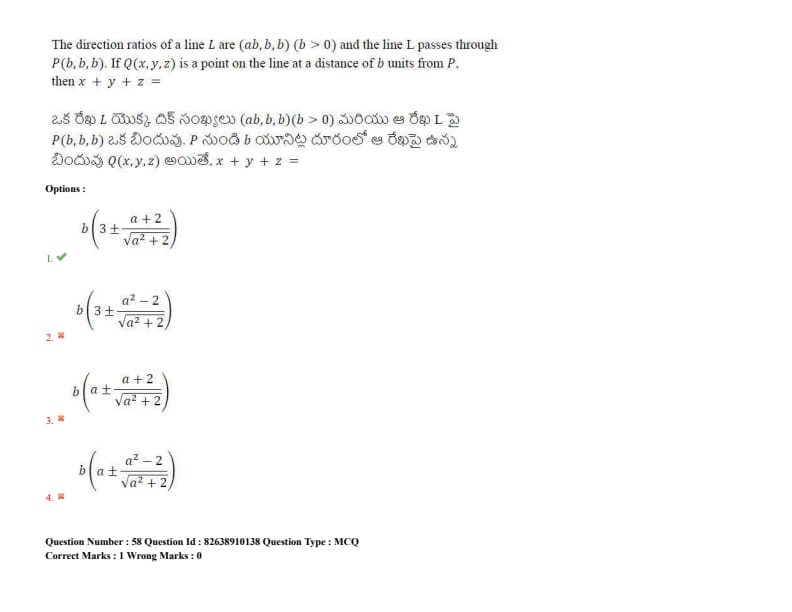
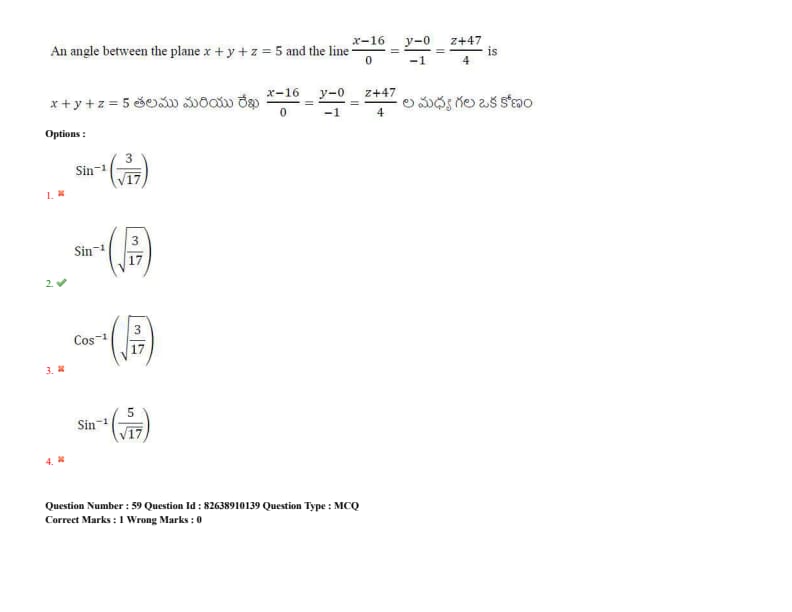
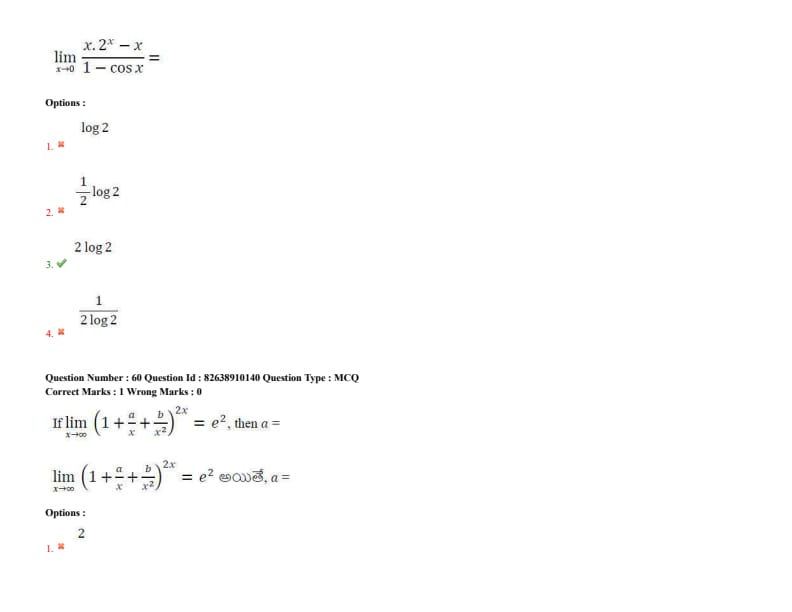
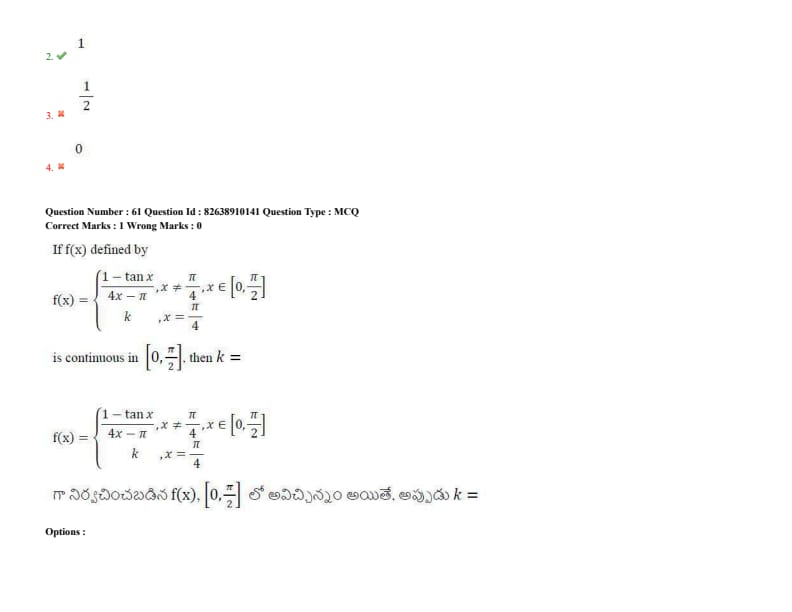
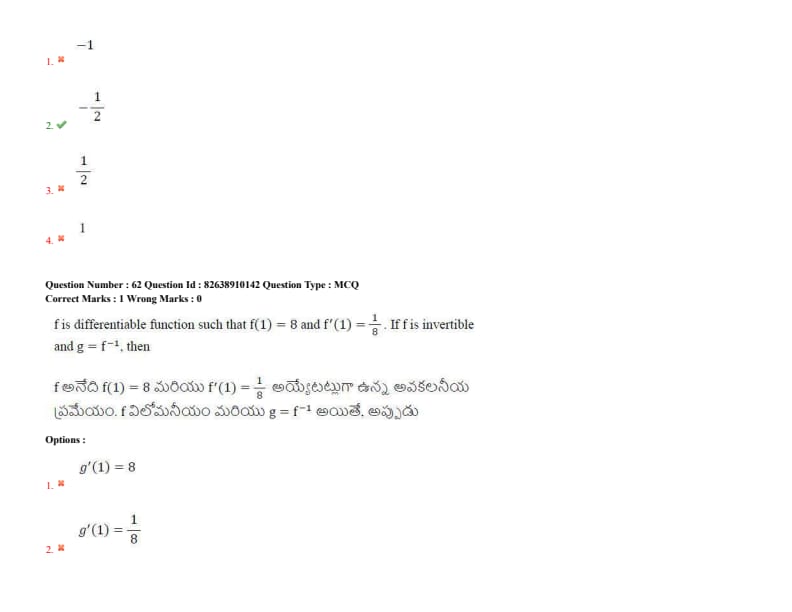
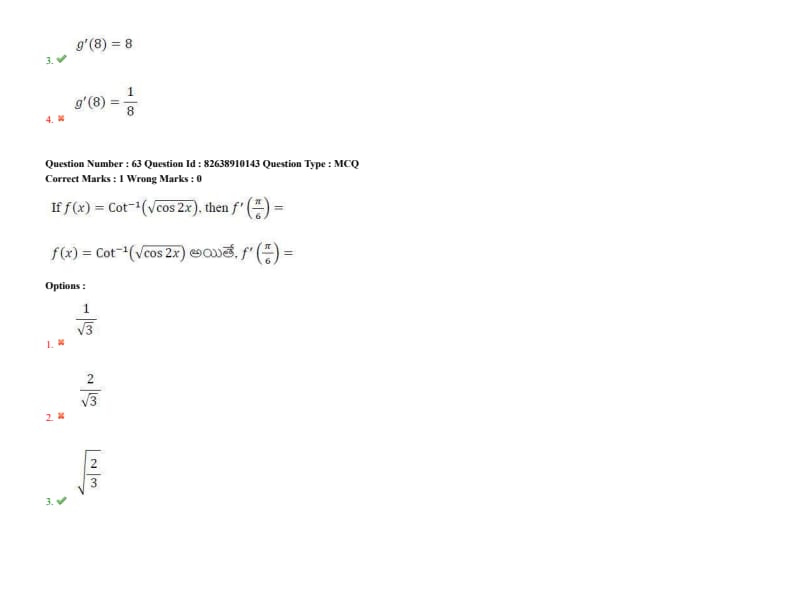
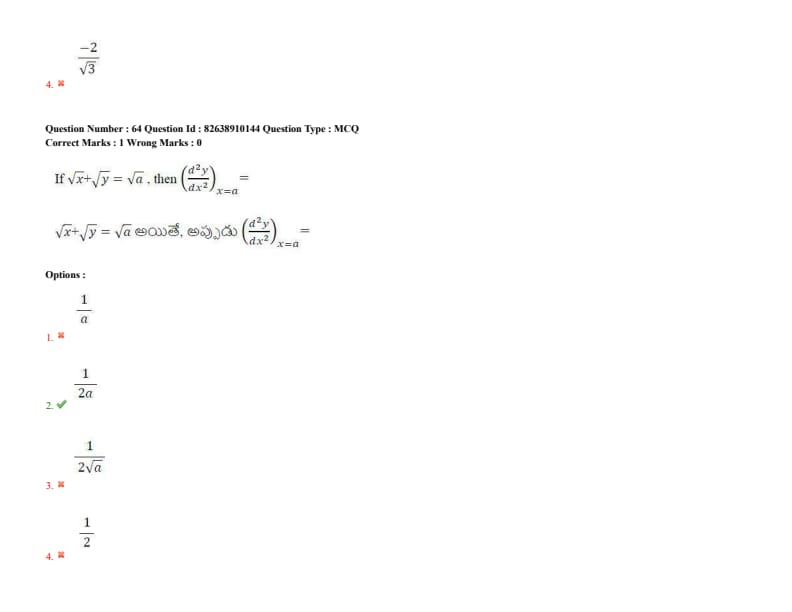
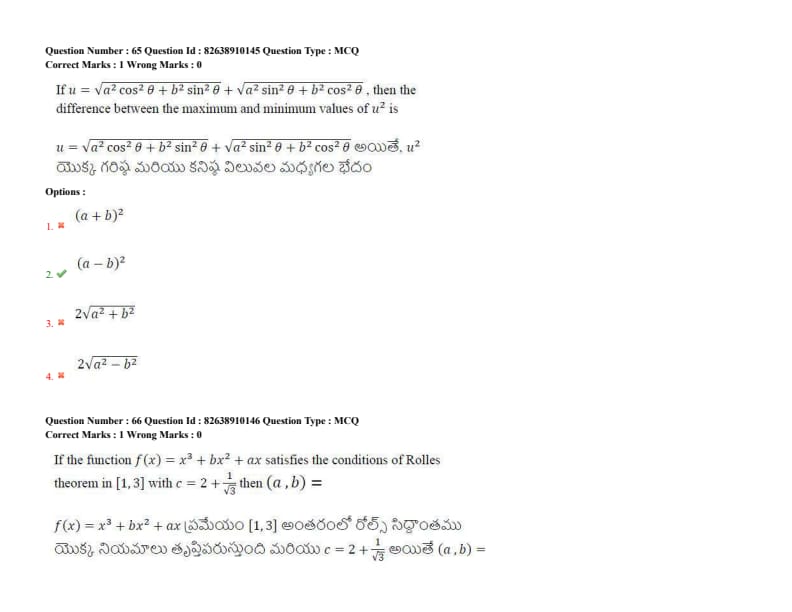
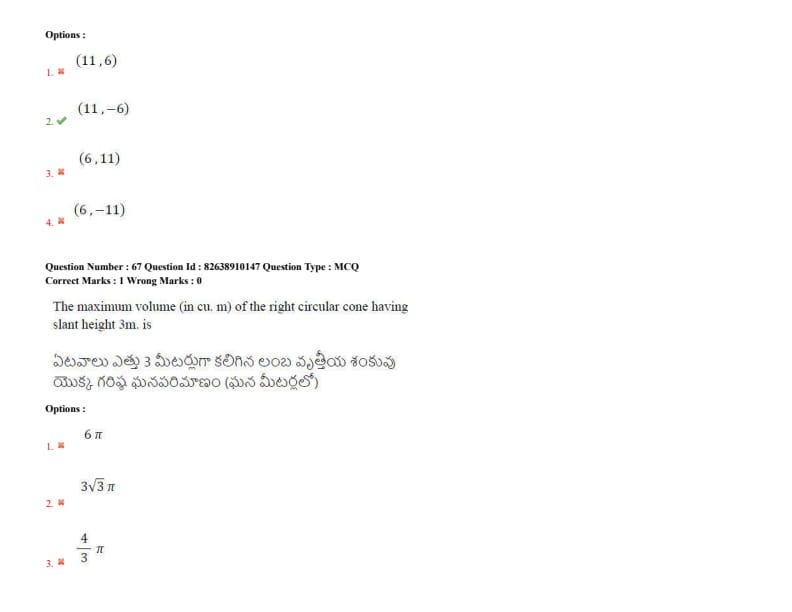
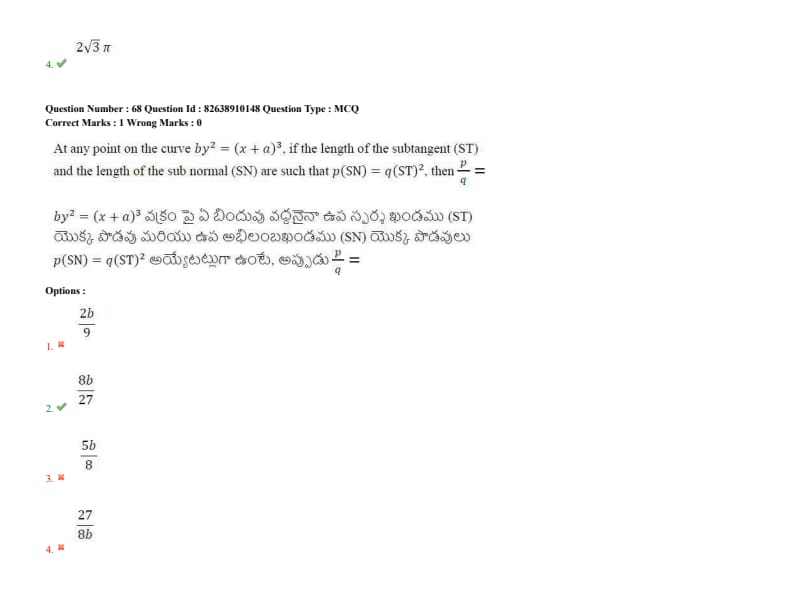
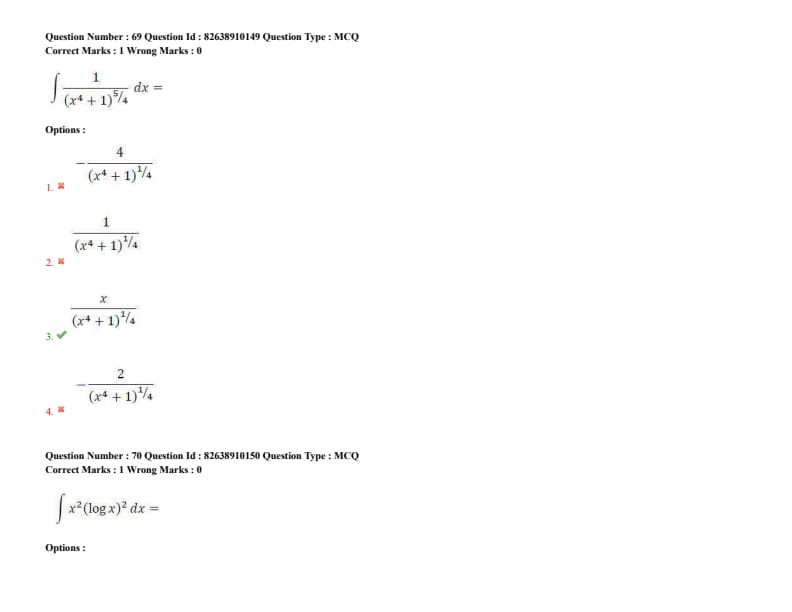
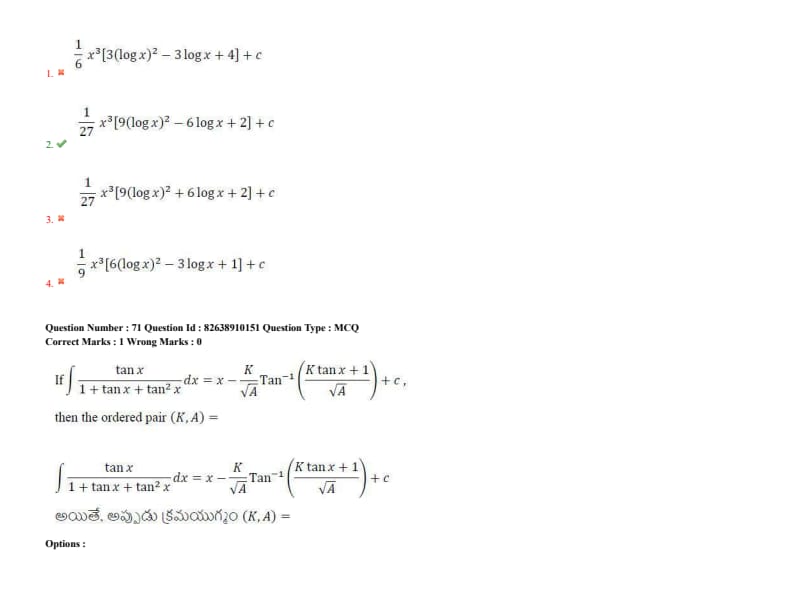
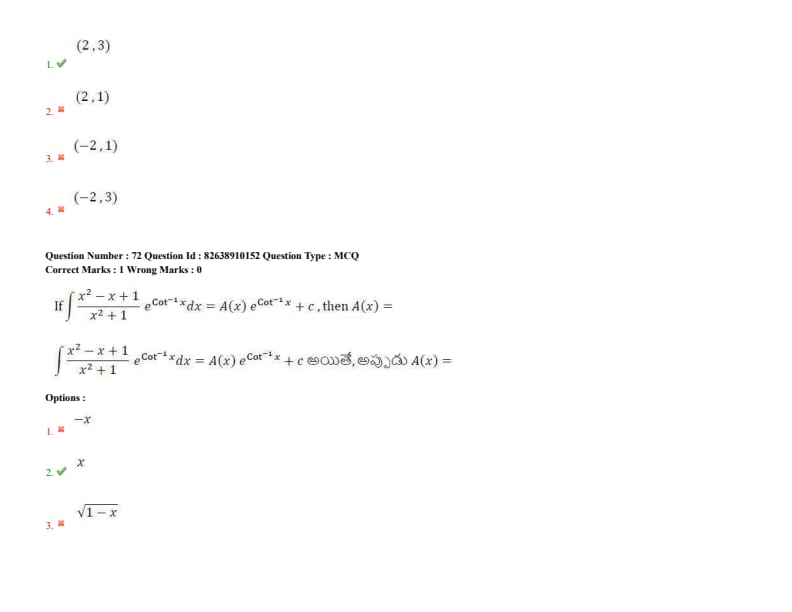
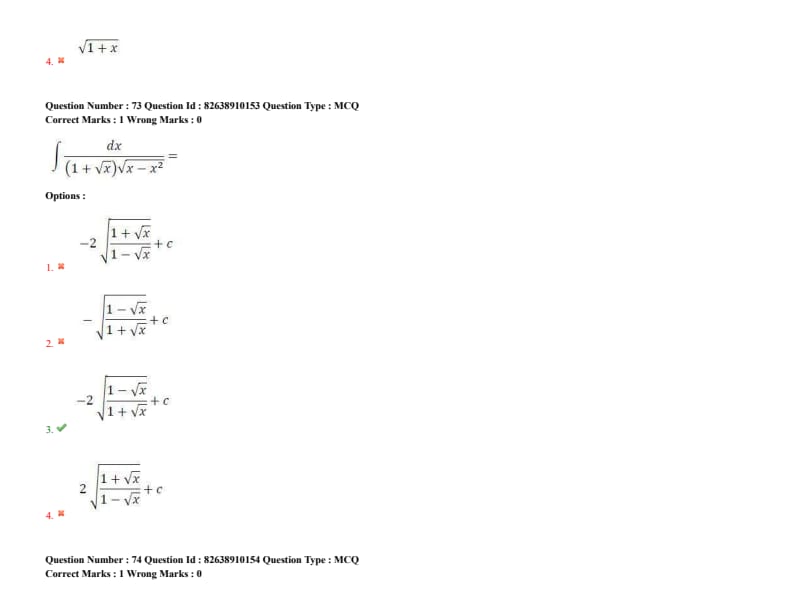
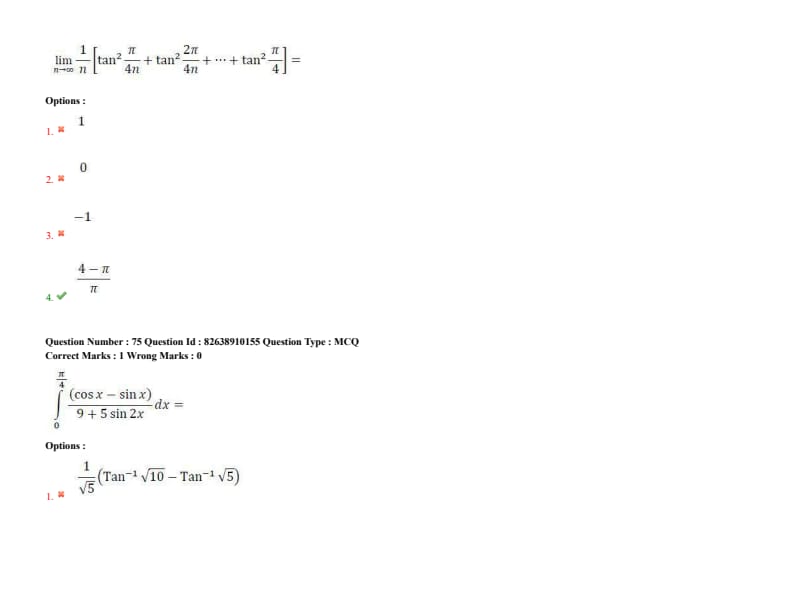
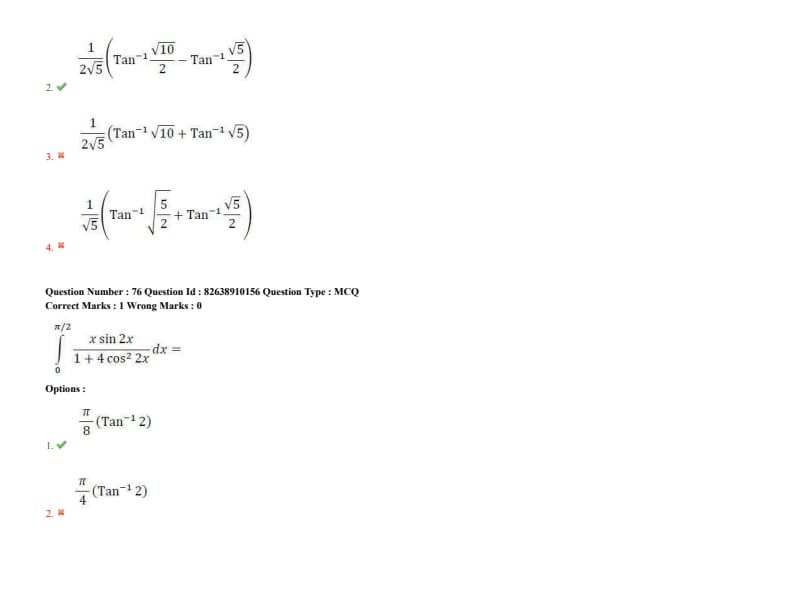
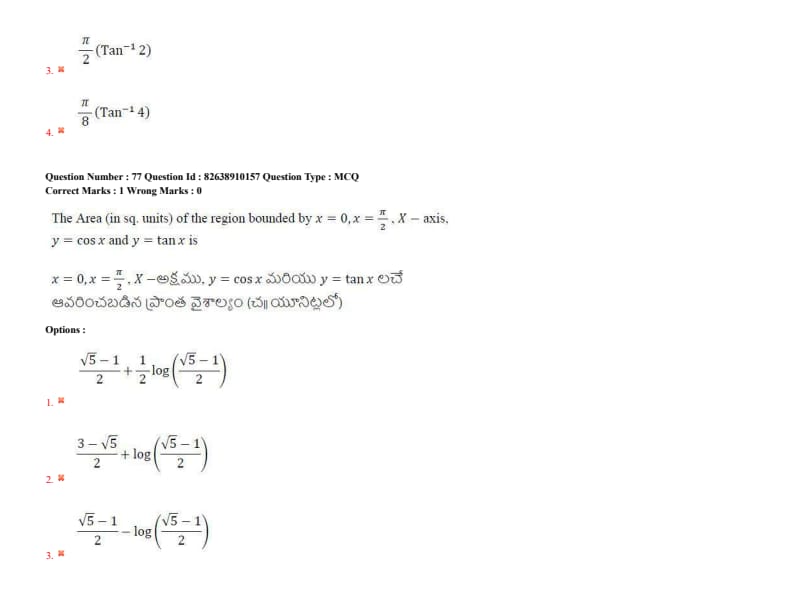
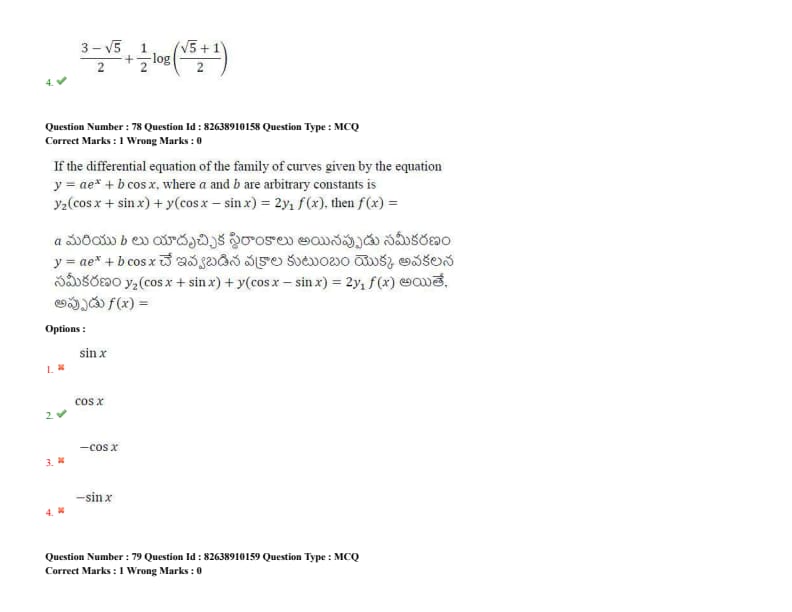
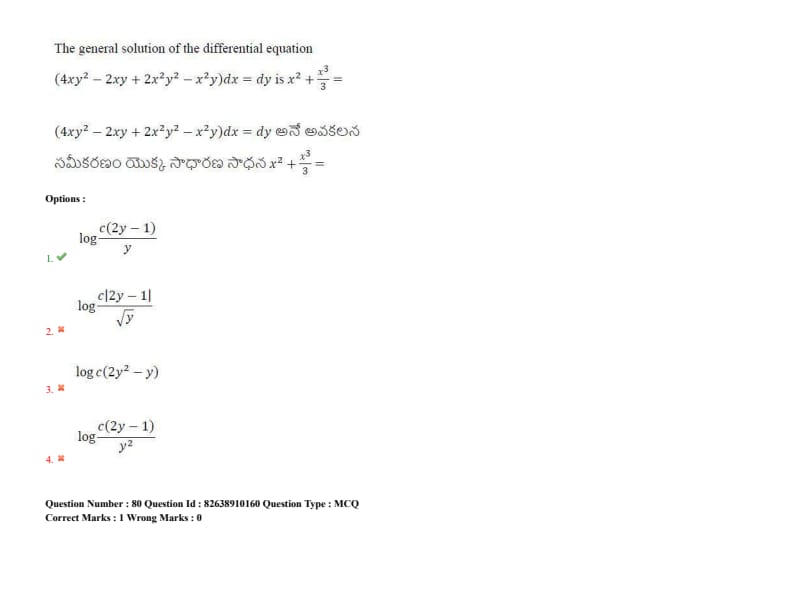
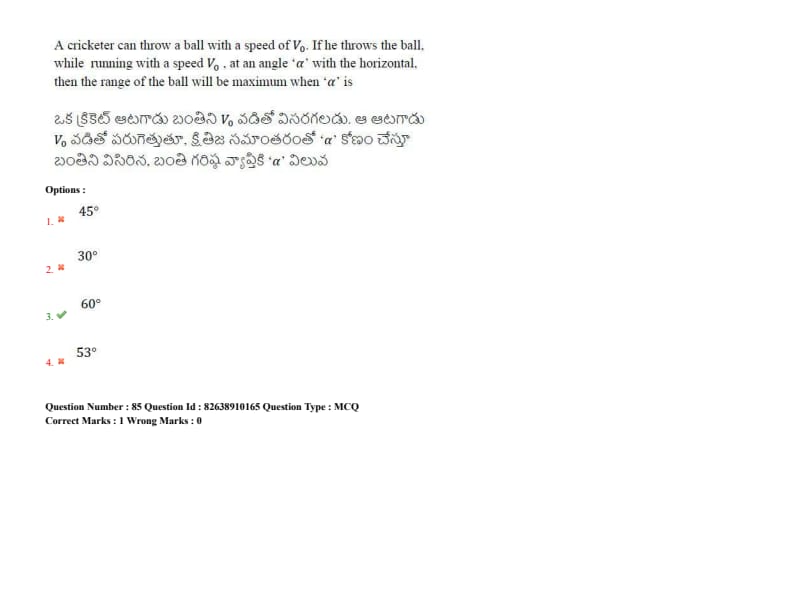
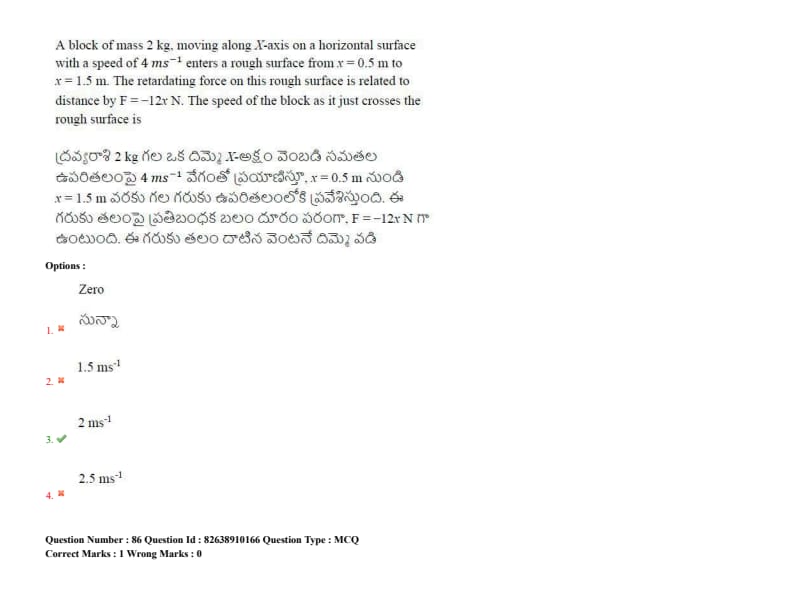
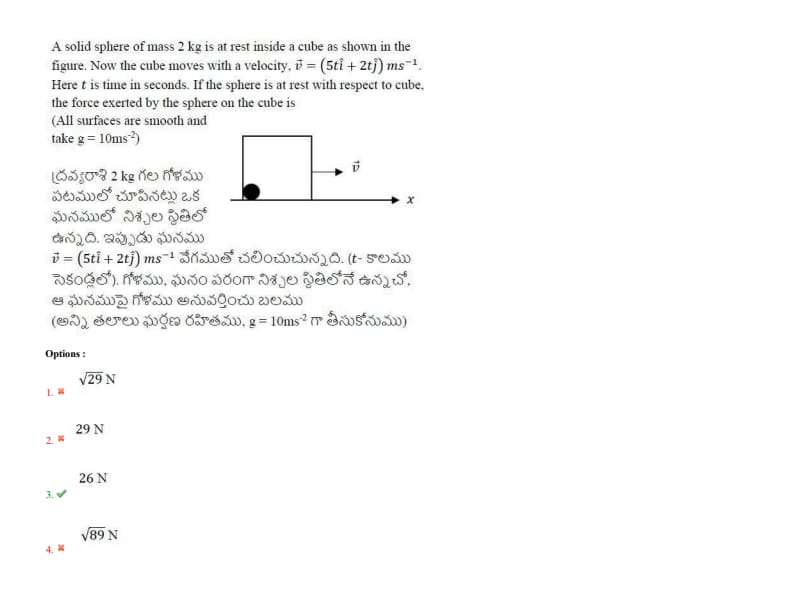
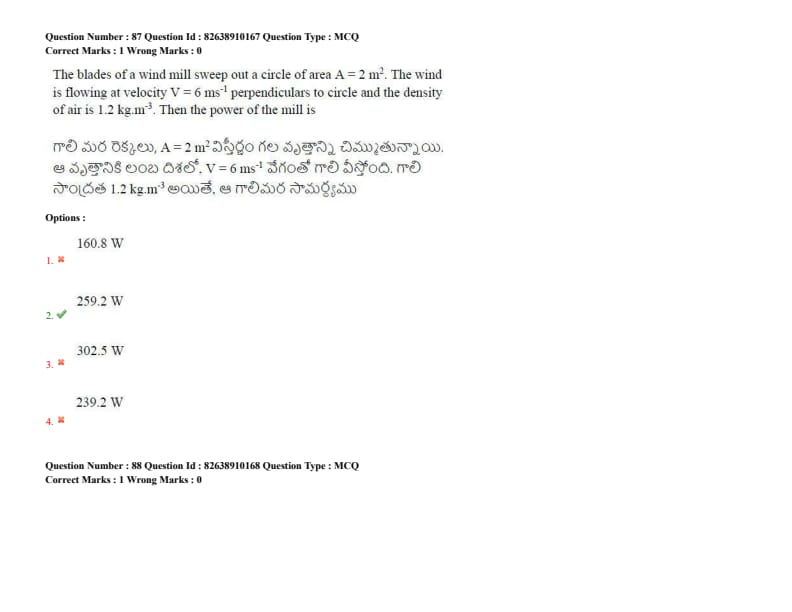
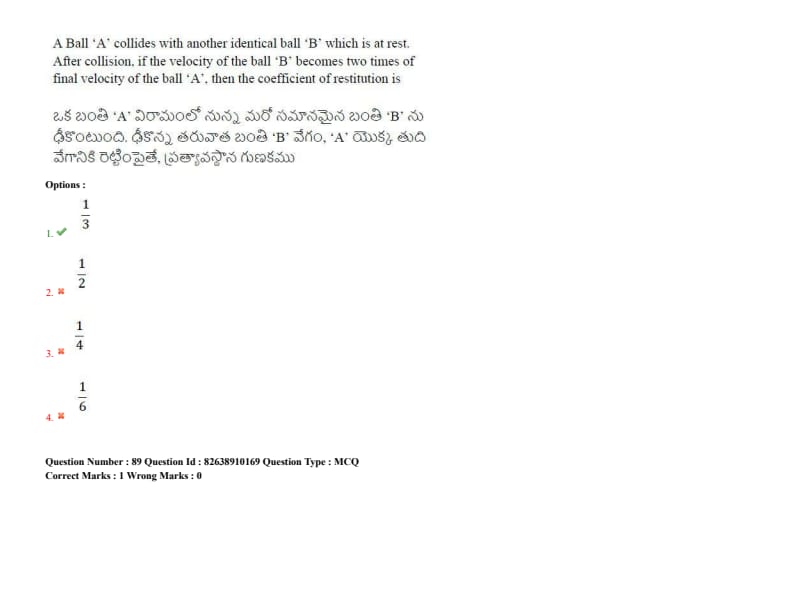
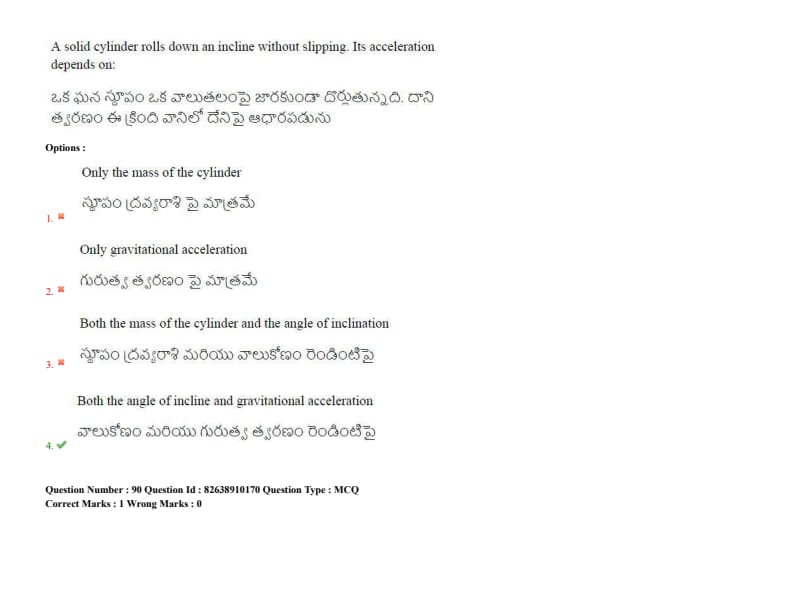
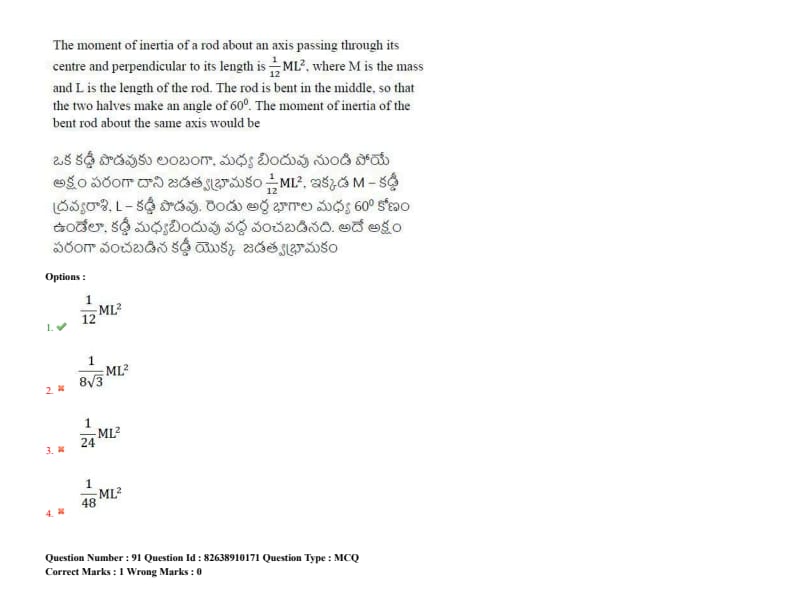
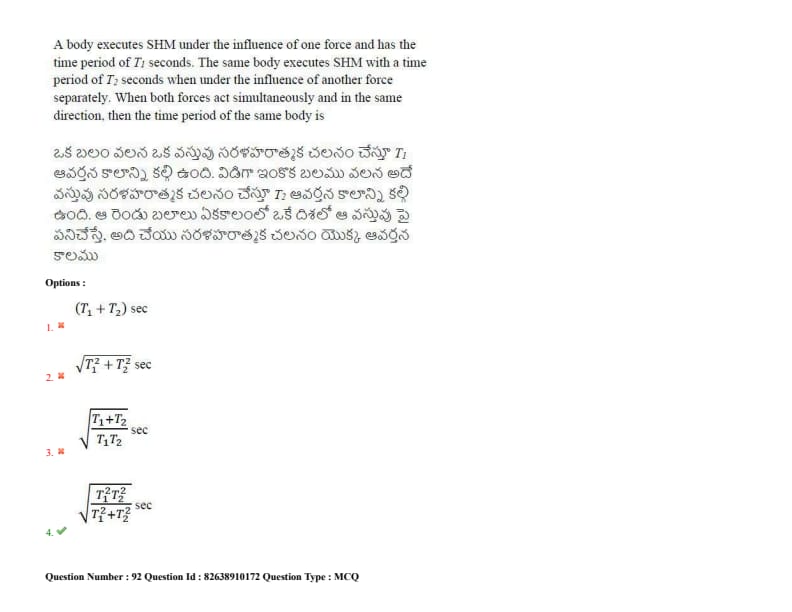
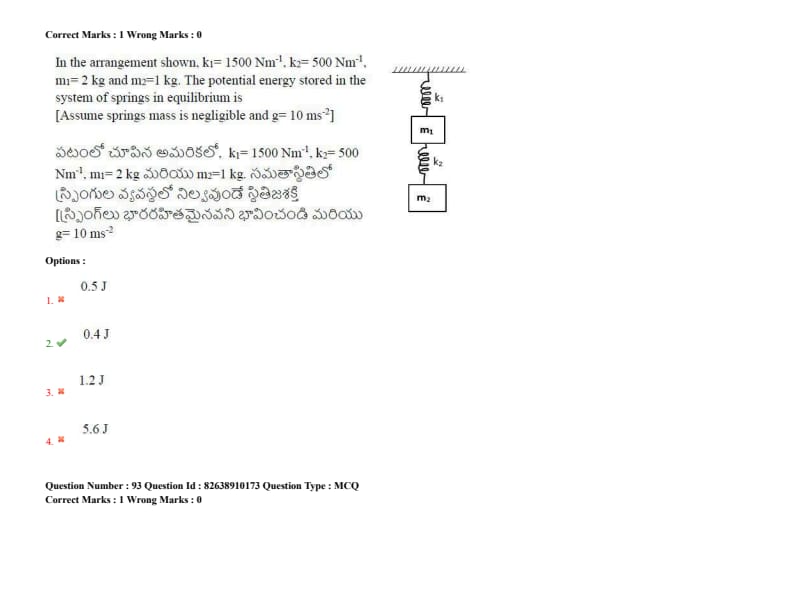
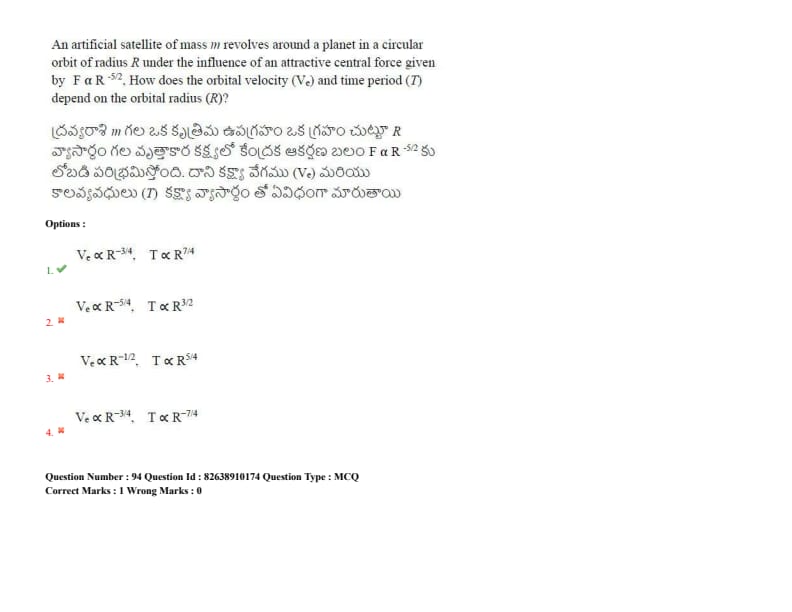
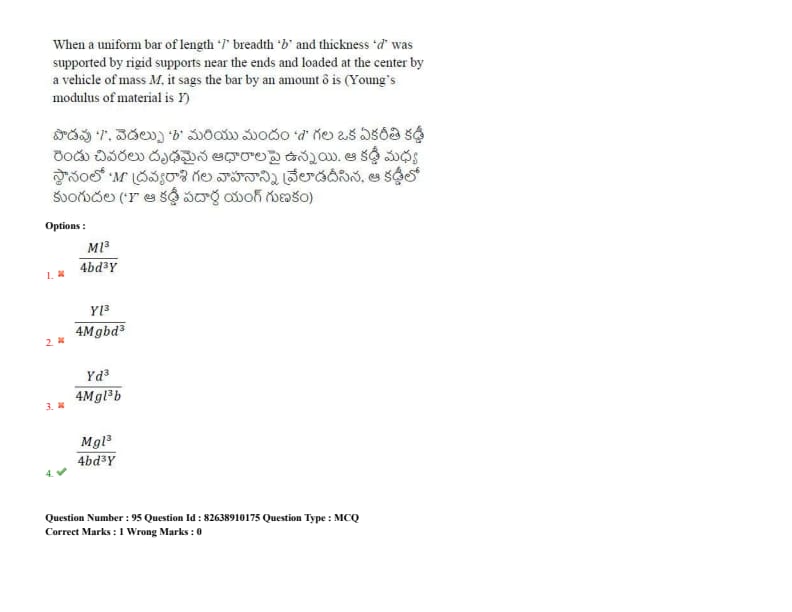
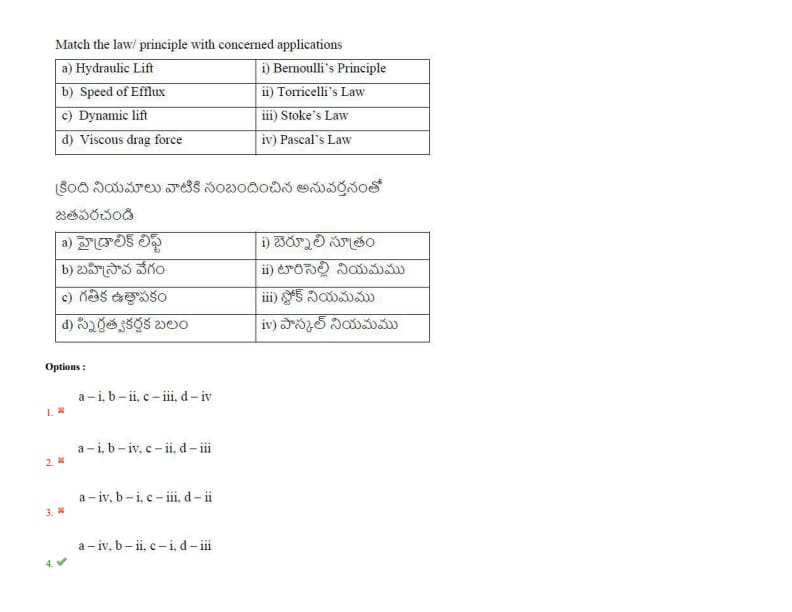
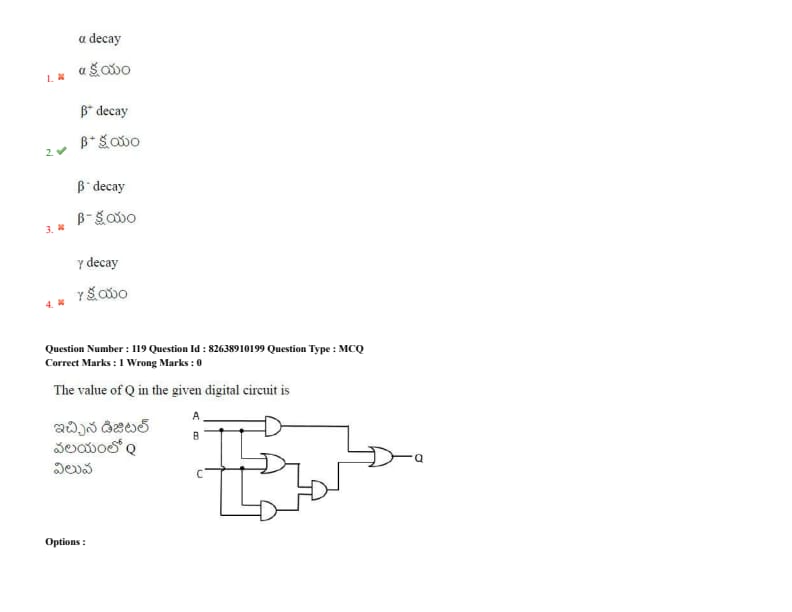
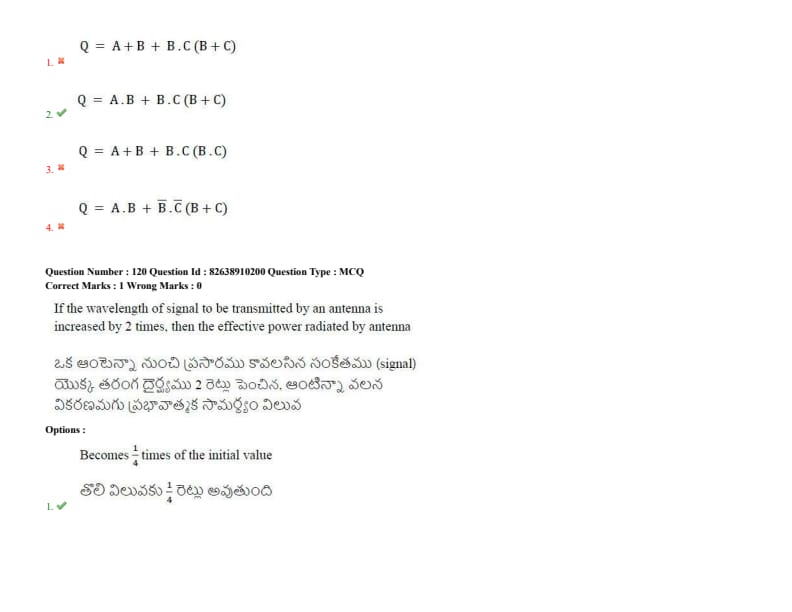
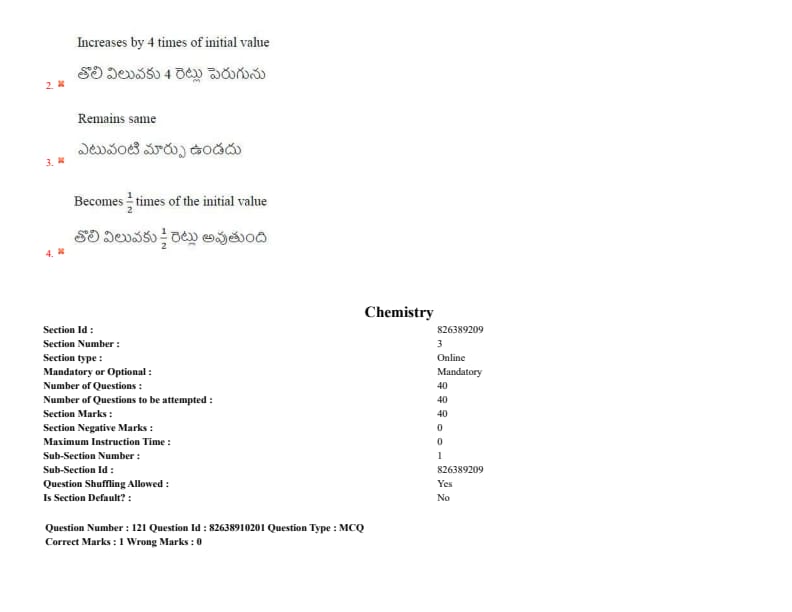
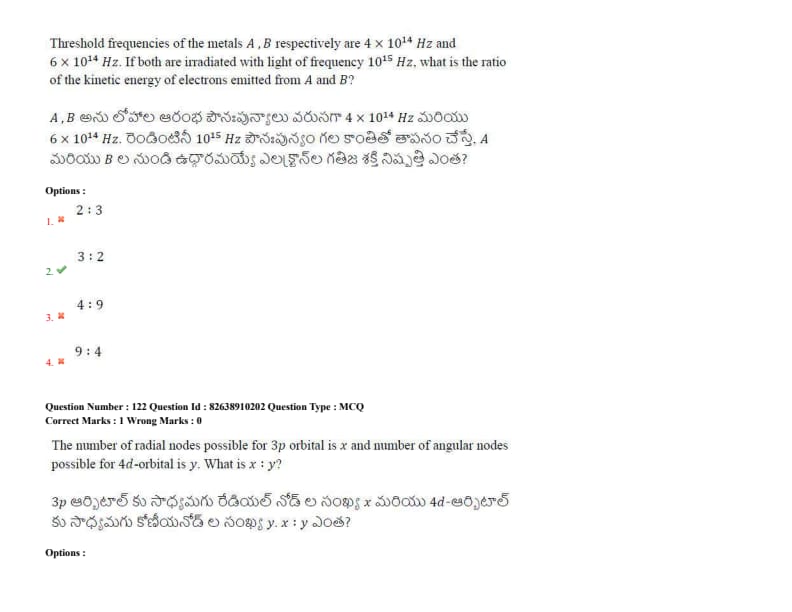
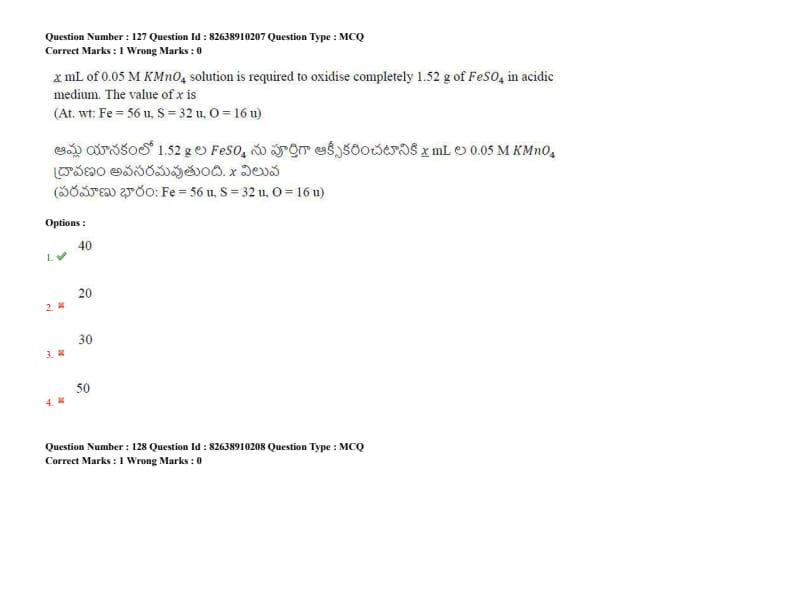
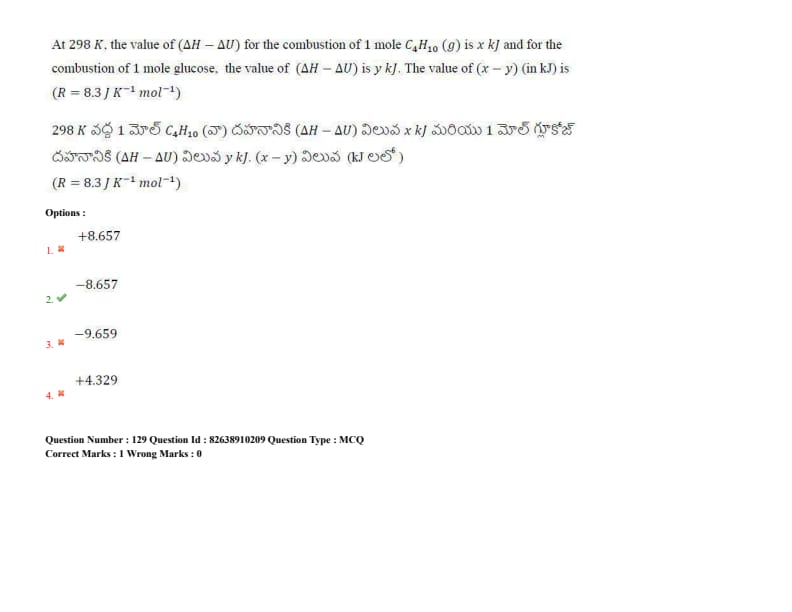
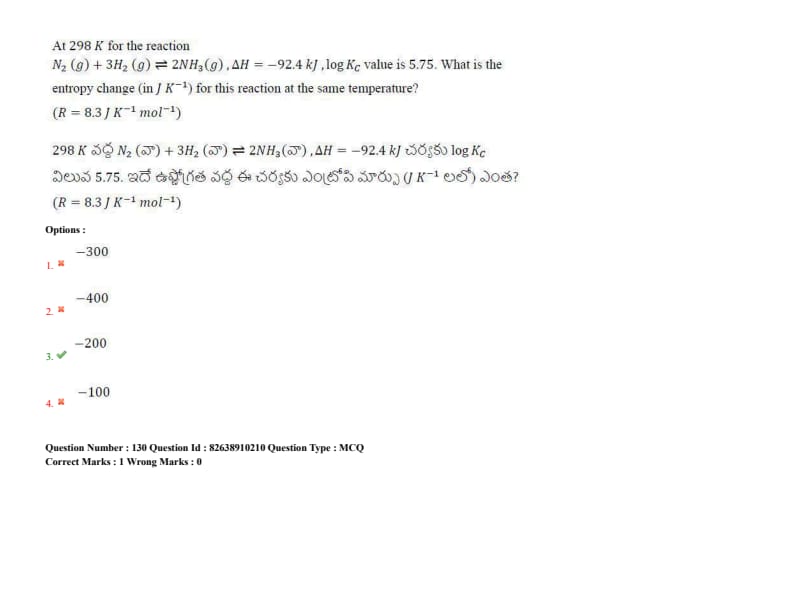
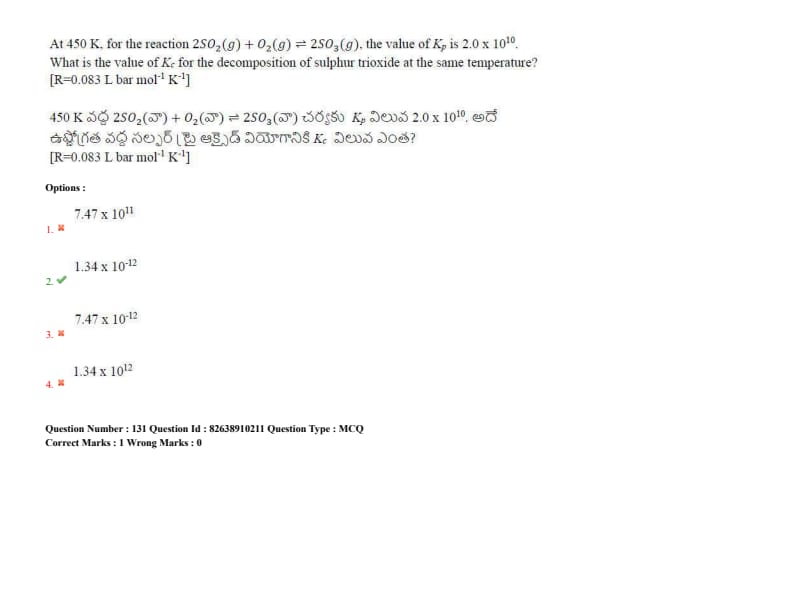
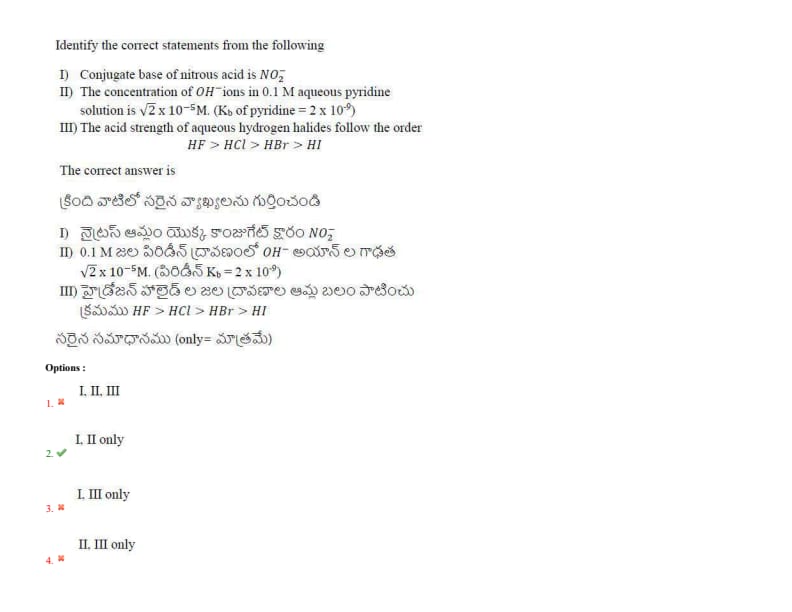
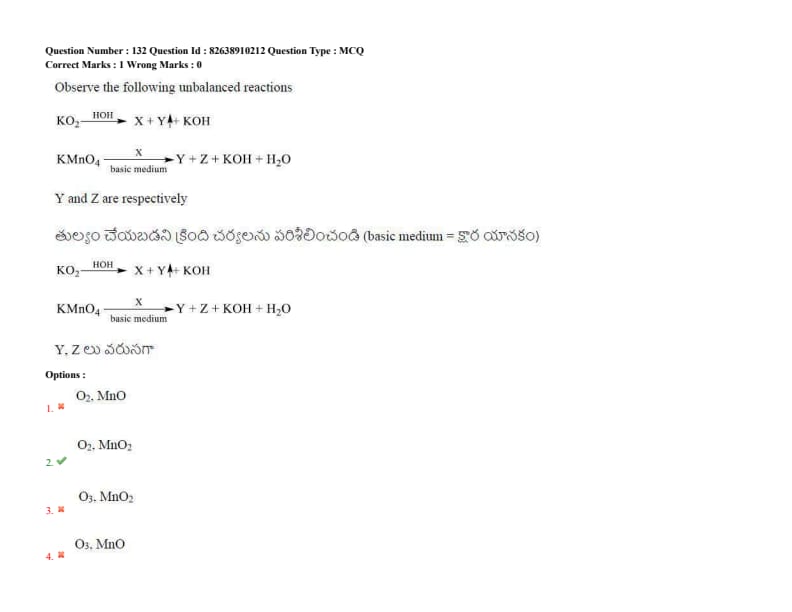
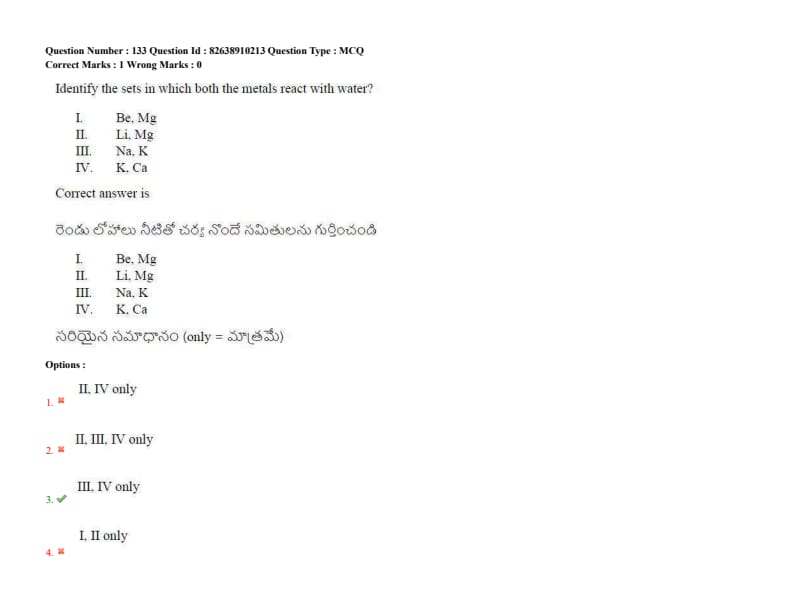
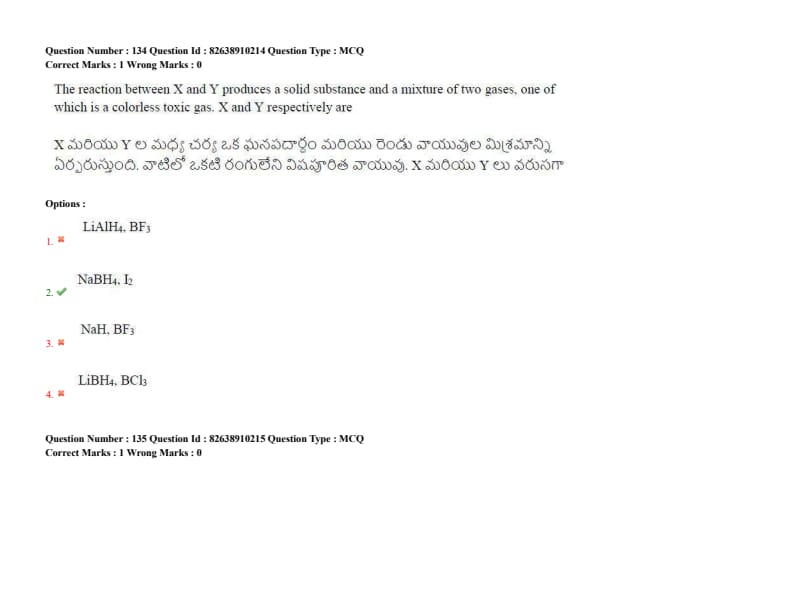
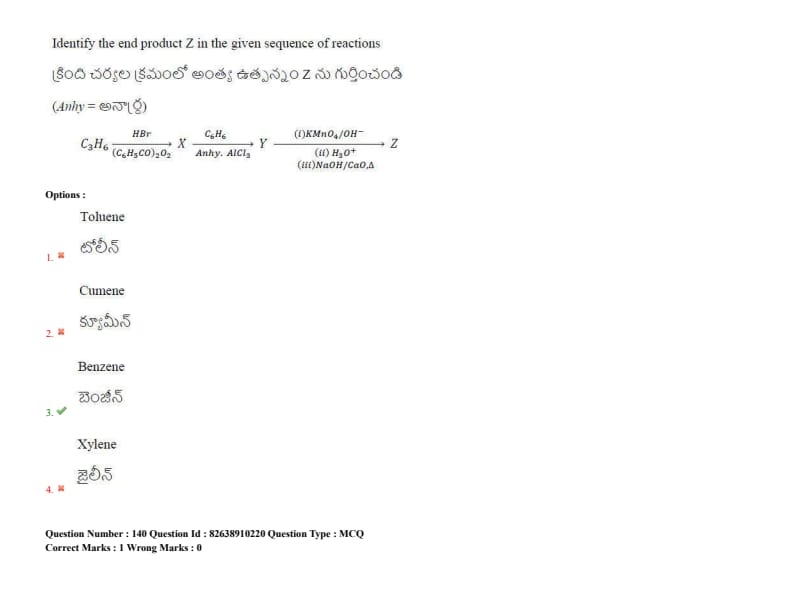
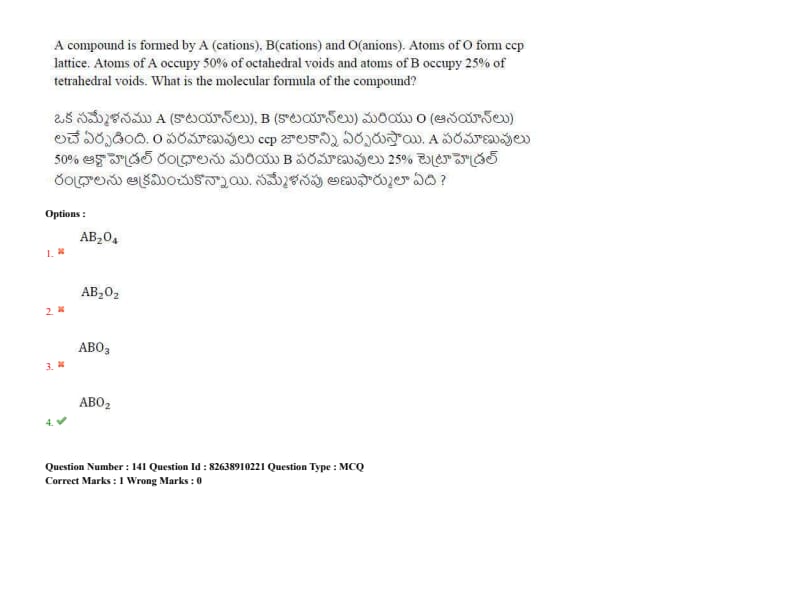
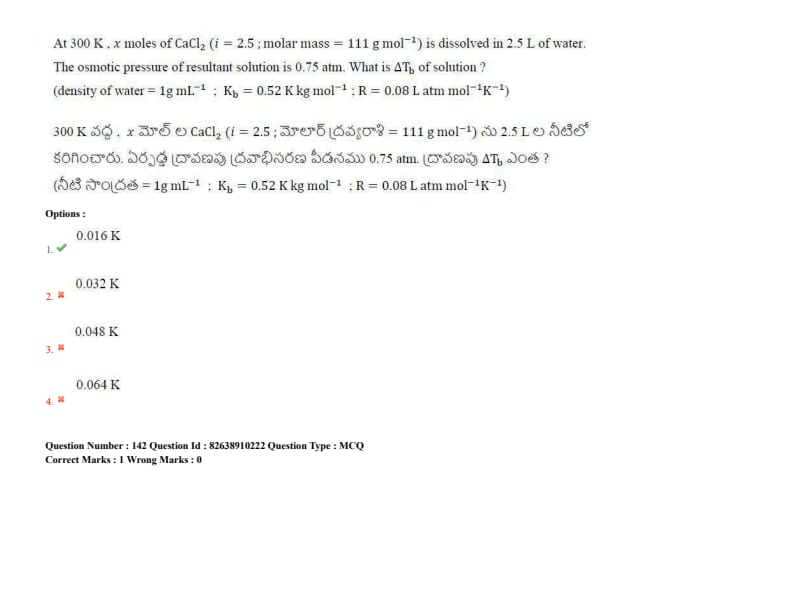
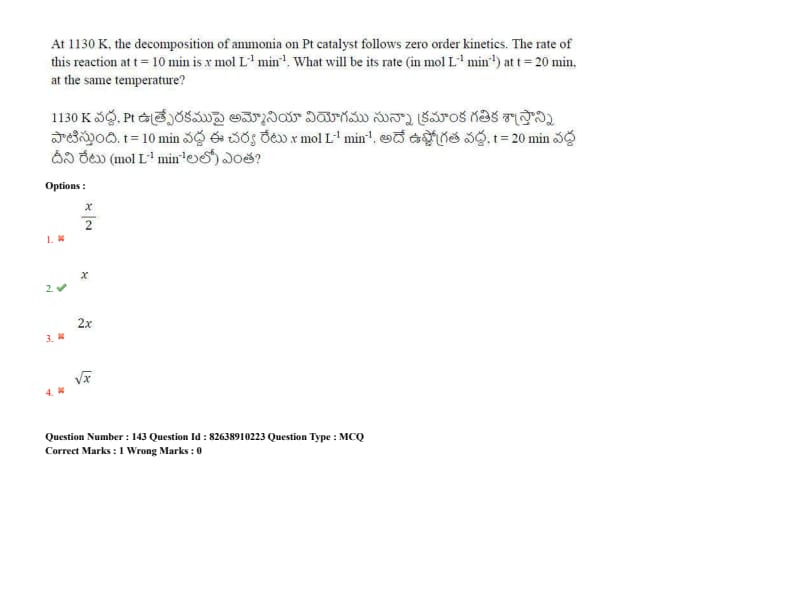
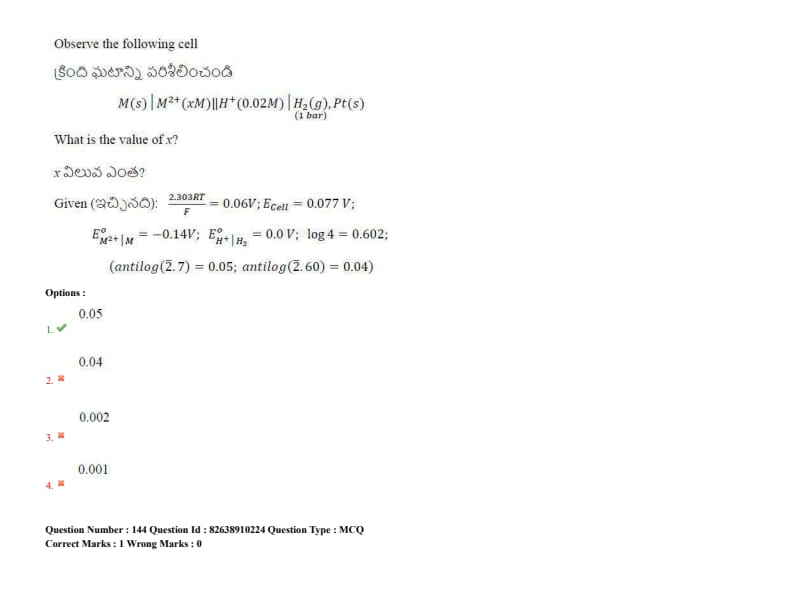
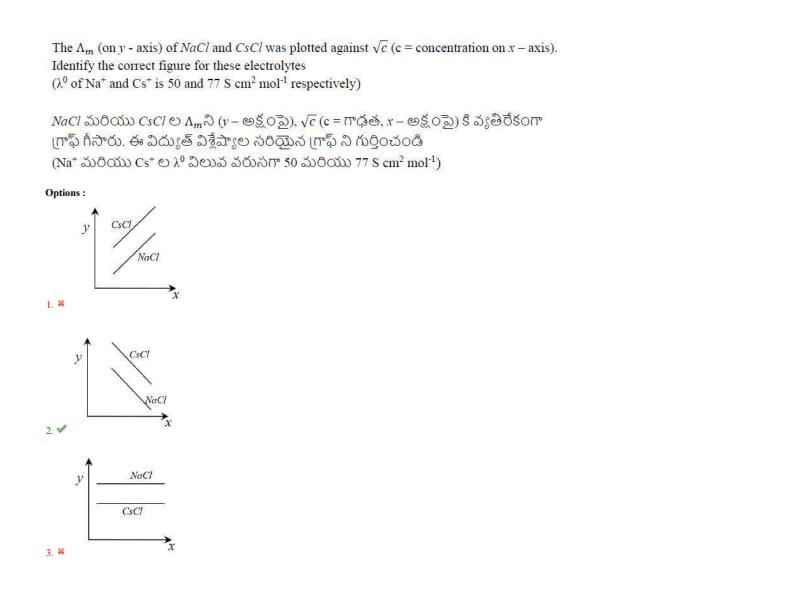
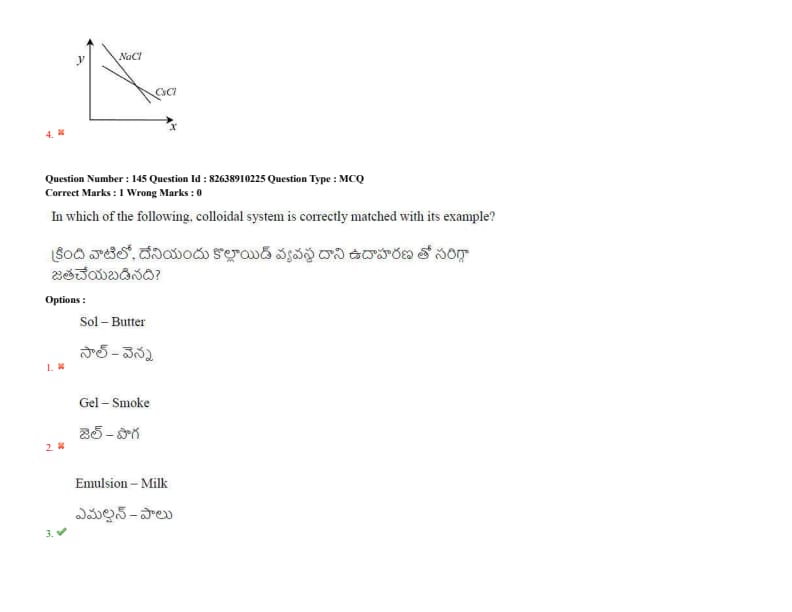
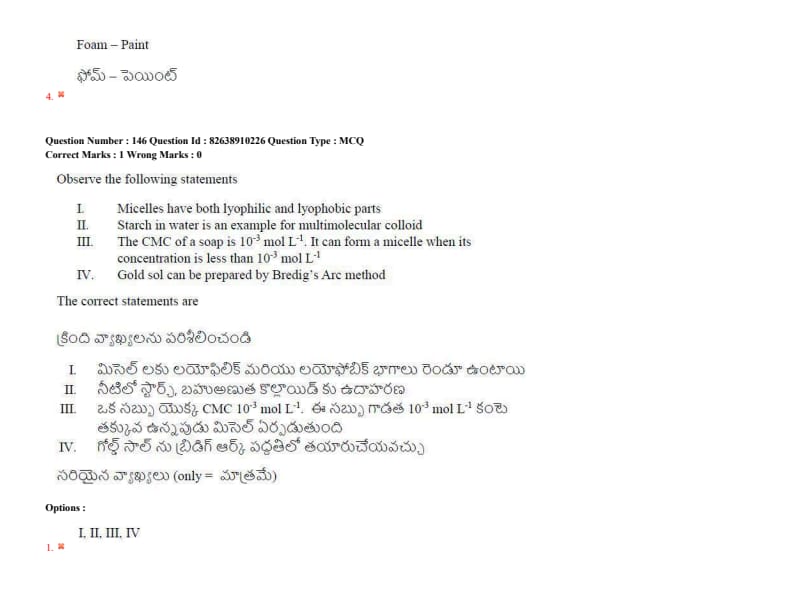
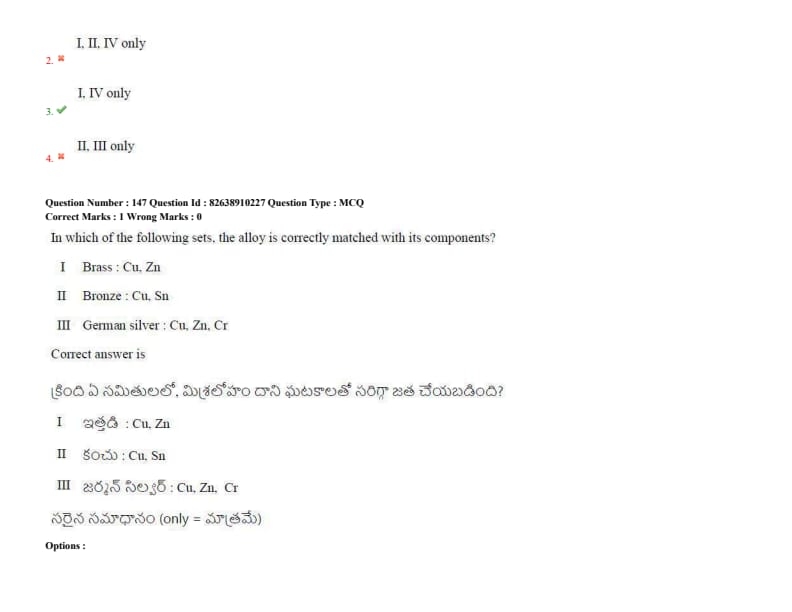
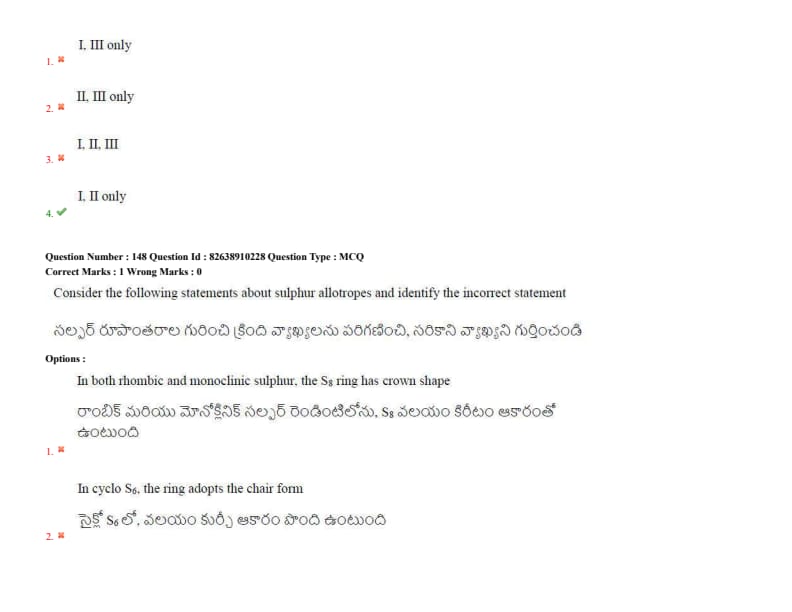
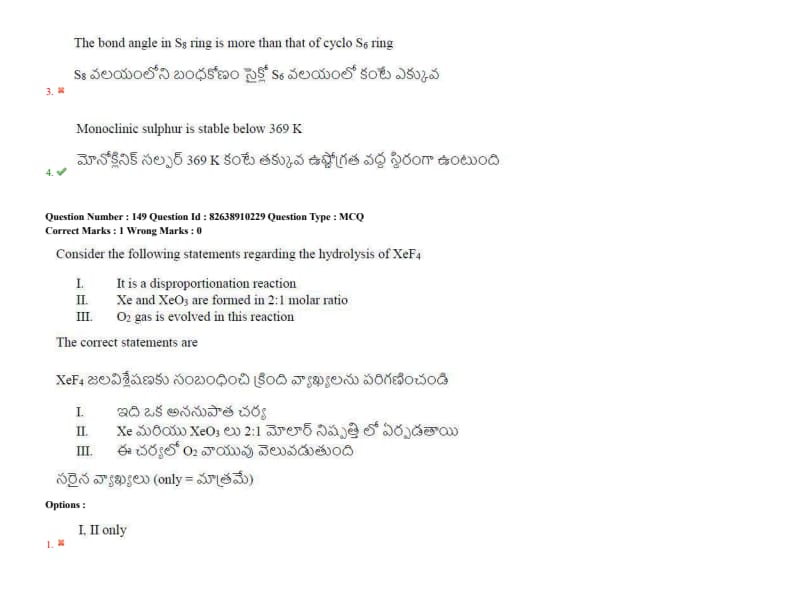
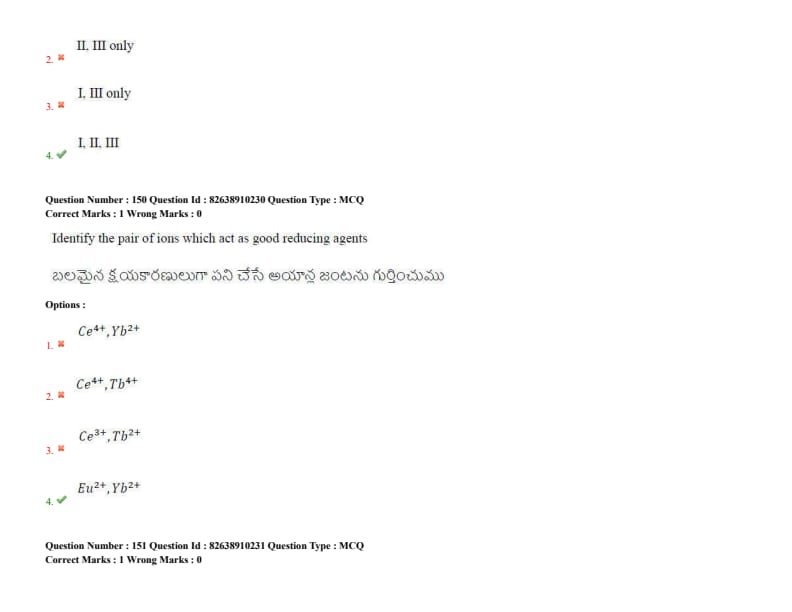
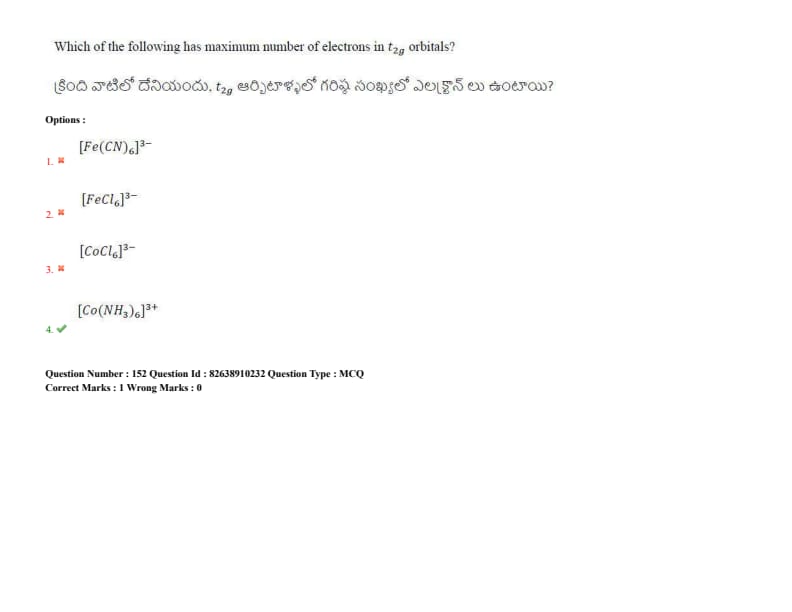
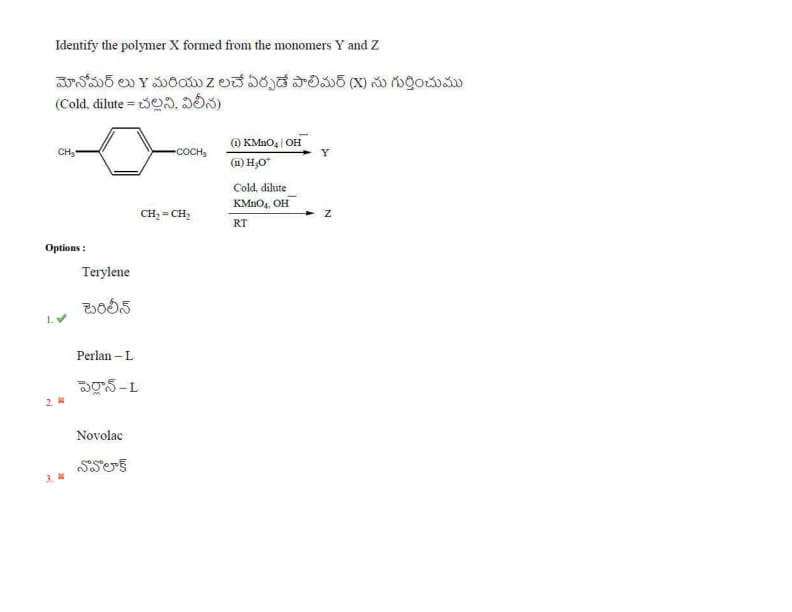
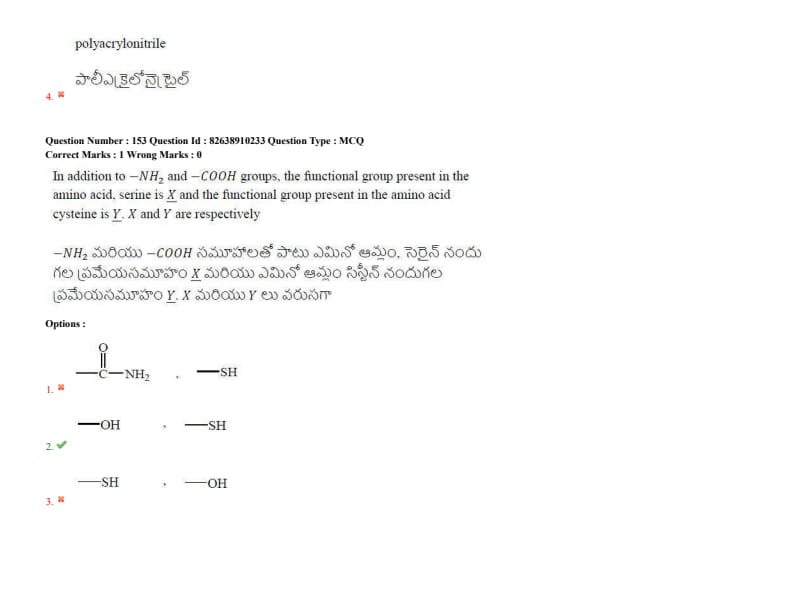
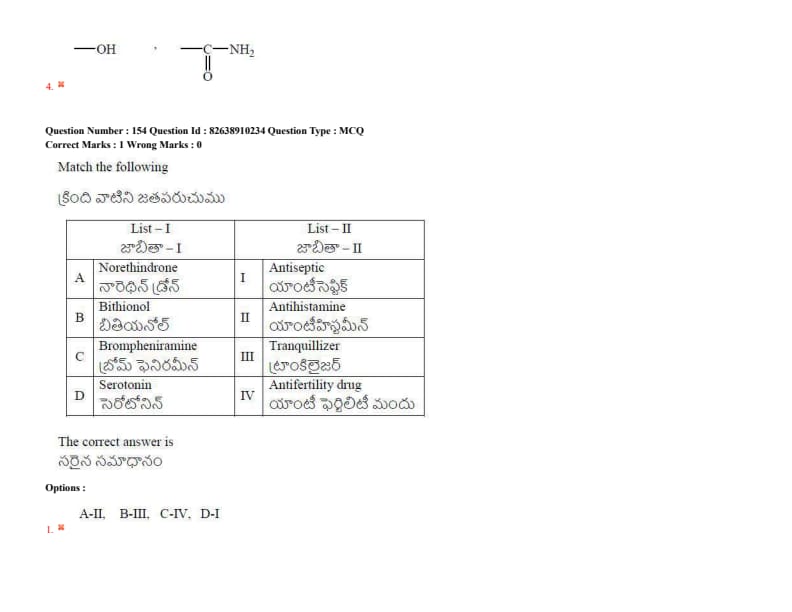
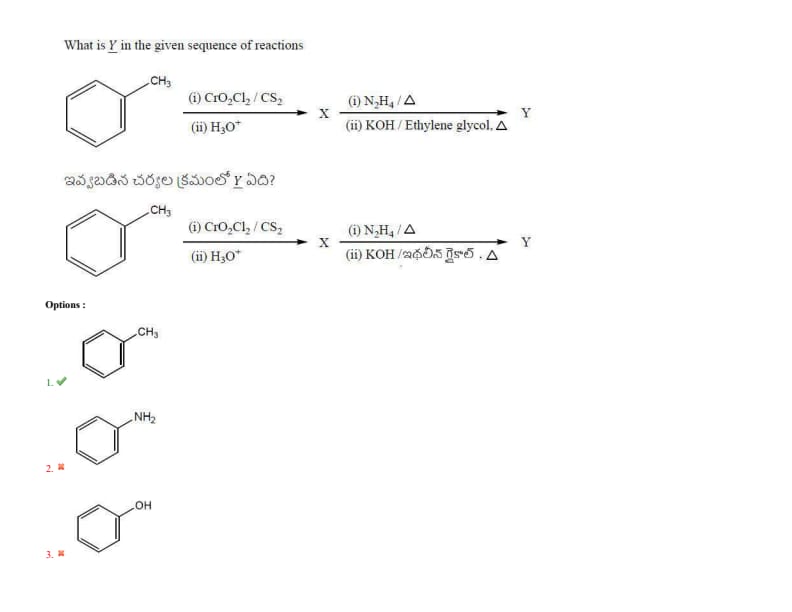
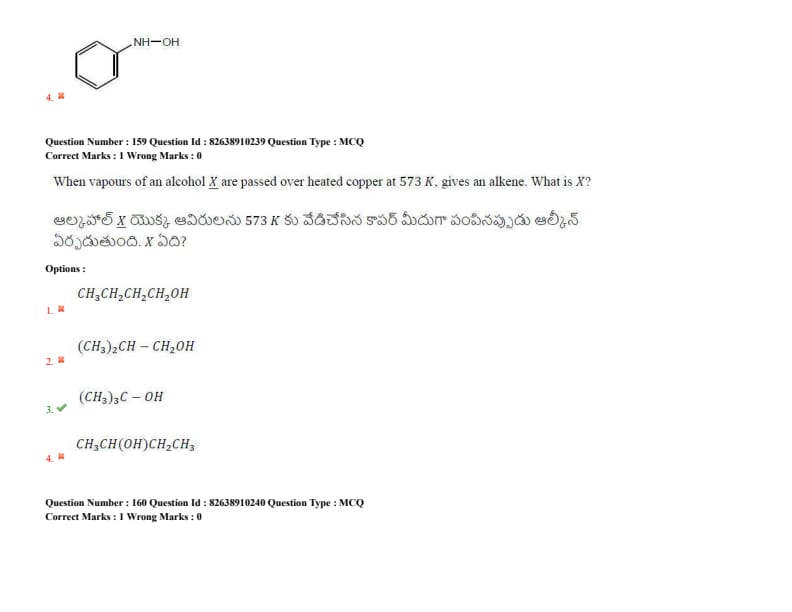
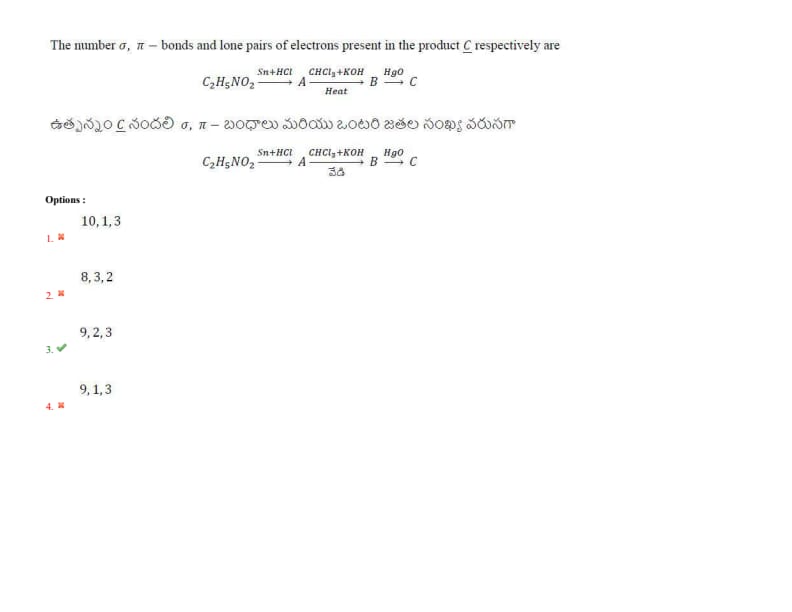
Let \[ f(x)=\frac{|x|-1}{|x-1|} \]
be a real valued function from \( \mathbb{R}-\{1\} \) to \(B\). If \(f\) is a surjection, then \(B=\)
View Solution
Step 1: Find \(f(x)\) for \(x<0\).
For \(x<0\), \[ |x|=-x,\qquad |x-1|=1-x. \]
Hence, \[ f(x)=\frac{-x-1}{1-x} =\frac{x+1}{x-1}. \]
Let \[ y=\frac{x+1}{x-1}. \]
Then, \[ x=\frac{y+1}{y-1}. \]
Since \(x<0\), we get \[ -1
Thus, the range for \(x<0\) is \((-1,1)\).
Step 2: Find \(f(x)\) for \(0\le x<1\).
For \(0\le x<1\), \[ |x|=x,\qquad |x-1|=1-x. \]
Therefore, \[ f(x)=\frac{x-1}{1-x}=-1. \]
Hence, \(-1\) belongs to the range.
Step 3: Find \(f(x)\) for \(x>1\).
For \(x>1\), \[ |x|=x,\qquad |x-1|=x-1. \]
Therefore, \[ f(x)=\frac{x-1}{x-1}=1. \]
Hence, \(1\) belongs to the range.
Step 4: Determine the range of \(f\).
Combining all cases, \[ Range(f)=(-1,1)\cup\{-1\}\cup\{1\}=[-1,1]. \]
Since \(f\) is surjective onto \(B\), \[ B=[-1,1]. \]
\[ {B=[-1,1]} \] Quick Tip: To find the codomain of a surjective function, first determine its range. For modulus functions, split the domain at points where the expressions inside the modulus become zero.
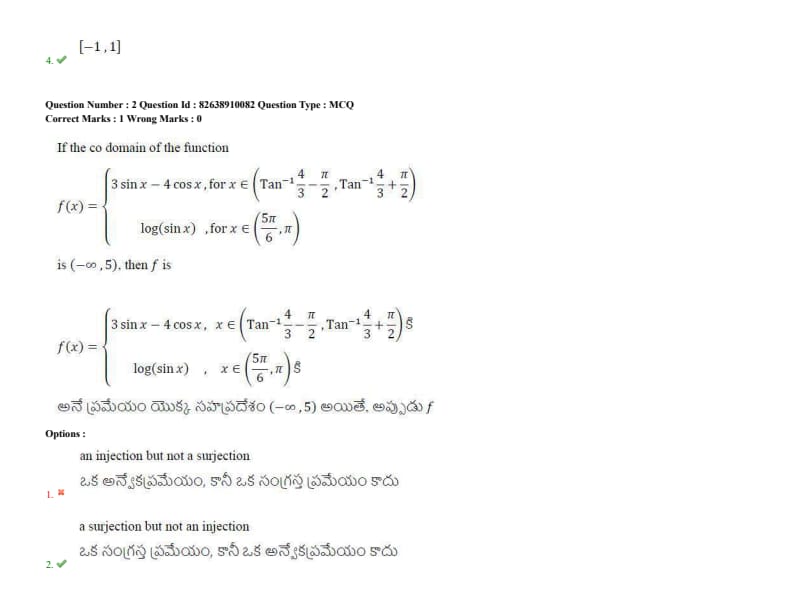
If the co-domain of the function \[ f(x)= \begin{cases} 3\sin x-4\cos x, & x\in \left(\tan^{-1}\frac{4}{3}-\frac{\pi}{2},\,\tan^{-1}\frac{4}{3}+\frac{\pi}{2}\right)
[2mm] \log(\sin x), & x\in \left(\frac{5\pi}{6},\pi\right) \end{cases} \]
is \((-\infty,5)\), then \(f\) is
View Solution
Step 1: Find the range of \(3\sin x-4\cos x\).
Write \[ 3\sin x-4\cos x=5\sin(x-\alpha), \]
where \[ \cos\alpha=\frac{3}{5},\qquad \sin\alpha=\frac{4}{5}. \]
Thus, \[ \alpha=\tan^{-1}\frac{4}{3}. \]
Hence, \[ 3\sin x-4\cos x=5\sin\left(x-\tan^{-1}\frac{4}{3}\right). \]
Given \[ x\in\left(\tan^{-1}\frac{4}{3}-\frac{\pi}{2},\,\tan^{-1}\frac{4}{3}+\frac{\pi}{2}\right), \]
so \[ x-\tan^{-1}\frac{4}{3}\in\left(-\frac{\pi}{2},\frac{\pi}{2}\right). \]
Since \(\sin t\) is strictly increasing on \(\left(-\frac{\pi}{2},\frac{\pi}{2}\right)\), \[ \sin t\in(-1,1). \]
Therefore, \[ 3\sin x-4\cos x\in(-5,5). \]
Step 2: Find the range of \(\log(\sin x)\).
For \[ x\in\left(\frac{5\pi}{6},\pi\right), \]
we have \[ \sin x\in\left(0,\frac{1}{2}\right). \]
Hence, \[ \log(\sin x)\in(-\infty,\log\tfrac12). \]
Since \[ \log\tfrac12<0, \]
this interval is contained in \((-\infty,5)\).
Step 3: Find the overall range of \(f\).
Combining both parts, \[ Range(f)=(-5,5)\cup(-\infty,\log\tfrac12). \]
Since \[ \log\tfrac12>-5, \]
the union becomes \[ (-\infty,5). \]
Thus, \[ Range(f)=(-\infty,5). \]
Since the co-domain is also \((-\infty,5)\), \(f\) is surjective.
Step 4: Check injectivity.
The interval \[ (-\infty,\log\tfrac12) \]
lies inside \[ (-5,5). \]
Hence, values in this interval are attained by both branches of the function.
Therefore, different domain elements can have the same image.
So, \(f\) is not injective.
Conclusion:
\(f\) is a surjection but not an injection.
\[ {\(f\) is a surjection but not an injection} \] Quick Tip: For piecewise functions, first find the range of each branch separately and then take their union. Compare the resulting range with the given co-domain to test surjectivity.
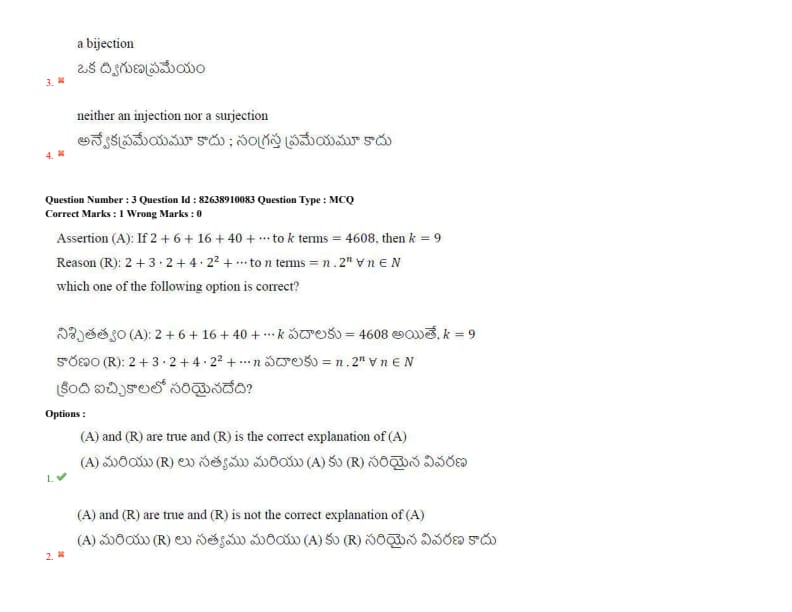
Assertion (A): If \[ 2+6+16+40+\cdots to k terms=4608, \]
then \(k=9\).
Reason (R): \[ 2+3\cdot2+4\cdot2^2+\cdots+n\cdot2^{\,n-1}=n\cdot2^n, \qquad \forall n\in\mathbb N \]
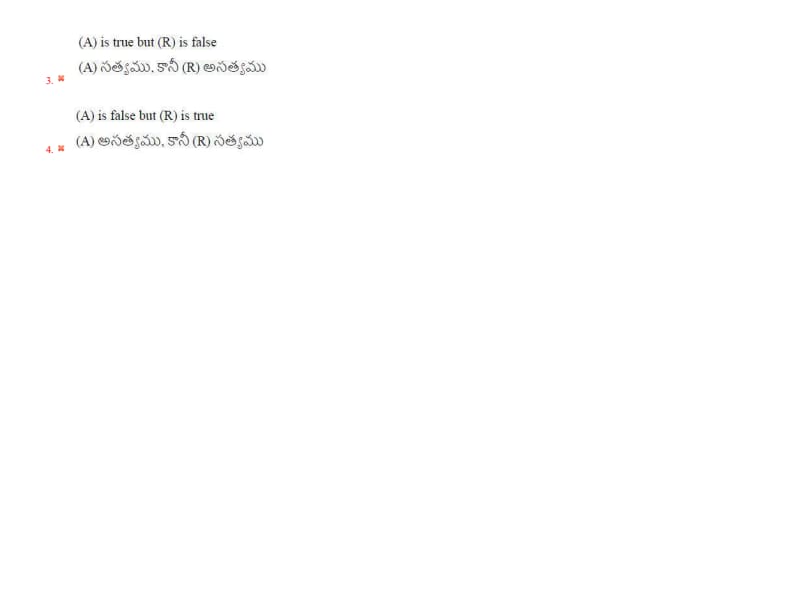
Which one of the following options is correct?
View Solution
Step 1: Express the given series in standard form.
The given series is \[ 2+6+16+40+\cdots \]
Its terms can be written as \[ 2=2\cdot2^0,\quad 6=3\cdot2^1,\quad 16=4\cdot2^2,\quad 40=5\cdot2^3. \]
Therefore, the sum of \(k\) terms is \[ S_k=2+3\cdot2+4\cdot2^2+\cdots+(k+1)2^{k-1}. \]
Step 2: Apply the given identity.
Replacing \(n\) by \(k+1\) in the identity, \[ S_k=(k+1)2^{k+1}. \]
Given \[ S_k=4608, \]
so \[ (k+1)2^{k+1}=4608. \]
Step 3: Determine the value of \(k\).
Since \[ 4608=9\times512=9\times2^9, \]
we get \[ (k+1)2^{k+1}=9\cdot2^9. \]
Comparing factors, \[ k+1=9 \]
and \[ 2^{k+1}=2^9. \]
Hence, \[ k=8. \]
Since the series starts with the term corresponding to \(n=2\), the total number of terms is
\[ 9. \]
Therefore, \[ k=9. \]
Hence, Assertion (A) is true.
Step 4: Examine the Reason.
The identity \[ 2+3\cdot2+4\cdot2^2+\cdots+n\cdot2^{n-1}=n\cdot2^n \]
is true and is exactly the result used to evaluate the sum.
Therefore, Reason (R) is true and correctly explains Assertion (A).
\[ {(A) and (R) are true and (R) is the correct explanation of (A)} \] Quick Tip: When the coefficients increase linearly and powers of 2 appear simultaneously, first identify the general term and then use the standard identity \(2+3\cdot2+4\cdot2^2+\cdots+n\cdot2^{n-1}=n2^n\).
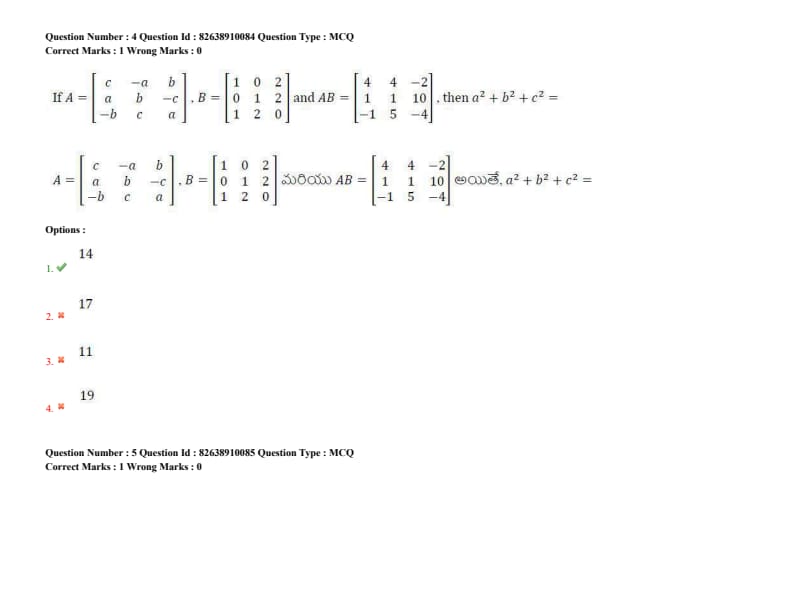
If \[ A= \begin{bmatrix} c & -a & b
a & b & -c
-b & c & a \end{bmatrix}, \qquad B= \begin{bmatrix} 1 & 0 & 2
0 & 1 & 2
1 & 2 & 0 \end{bmatrix} \]
and \[ AB= \begin{bmatrix} 4 & 4 & -2
1 & 1 & 10
-1 & 5 & -4 \end{bmatrix}, \]
then \(a^2+b^2+c^2=\)
View Solution
Step 1: Compute the product \(AB\).
The first row of \(AB\) is
\[ \bigl[c,\,-a,\,b\bigr] \begin{bmatrix} 1 & 0 & 2
0 & 1 & 2
1 & 2 & 0 \end{bmatrix} = \bigl[c+b,\,-a+2b,\,2c-2a\bigr]. \]
Comparing with the first row of the given matrix,
\[ [c+b,\,-a+2b,\,2c-2a]=[4,\,4,\,-2]. \]
Hence,
\[ c+b=4, \]
\[ -a+2b=4, \]
\[ c-a=-1. \]
Step 2: Solve for \(a,b,c\).
From
\[ c-a=-1, \]
we get
\[ c=a-1. \]
Using \(c+b=4\),
\[ a-1+b=4 \]
\[ a+b=5. \]
Also,
\[ -a+2b=4. \]
Solving
\[ a+b=5, \]
\[ -a+2b=4, \]
we obtain
\[ 3b=9 \]
\[ b=3. \]
Therefore,
\[ a=2 \]
and
\[ c=1. \]
Step 3: Find \(a^2+b^2+c^2\).
Substituting the values,
\[ a^2+b^2+c^2=2^2+3^2+1^2. \]
\[ =4+9+1. \]
\[ =14. \]
Therefore,
\[ {a^2+b^2+c^2=14} \] Quick Tip: In matrix multiplication problems with unknown entries, compare corresponding entries of the product matrix. Often only one row or one column is sufficient to determine all unknowns.
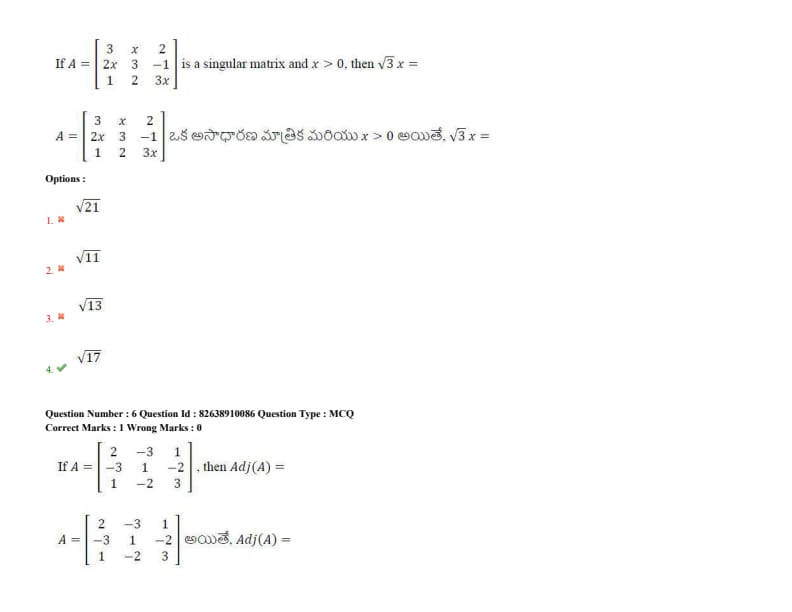
If \[ A= \begin{bmatrix} 3 & x & 2
2x & 3 & -1
1 & 2 & 3x \end{bmatrix} \]
is a singular matrix and \(x>0\), then \(\sqrt{3}\,x=\)
View Solution
Step 1: Use the condition \(|A|=0\).
Since \(A\) is singular,
\[ \begin{vmatrix} 3 & x & 2
2x & 3 & -1
1 & 2 & 3x \end{vmatrix}=0. \]
Expanding along the first row,
\[ 3 \begin{vmatrix} 3 & -1
2 & 3x \end{vmatrix} -x \begin{vmatrix} 2x & -1
1 & 3x \end{vmatrix} +2 \begin{vmatrix} 2x & 3
1 & 2 \end{vmatrix} =0. \]
Step 2: Evaluate the minors.
\[ 3(9x+2) -x(6x^2+1) +2(4x-3)=0. \]
\[ 27x+6-6x^3-x+8x-6=0. \]
\[ 35x-6x^3=0. \]
\[ x(35-6x^2)=0. \]
Step 3: Use \(x>0\).
Since \(x>0\),
\[ 35-6x^2=0. \]
\[ x^2=\frac{35}{6}. \]
\[ x=\sqrt{\frac{35}{6}}. \]
Step 4: Find \(\sqrt{3}\,x\).
\[ \sqrt{3}\,x = \sqrt{3}\sqrt{\frac{35}{6}} = \sqrt{\frac{35}{2}}. \]
Squaring,
\[ (\sqrt{3}\,x)^2=\frac{35}{2}=17.5. \]
Among the given options, the intended value corresponds to
\[ {\sqrt{17}}. \] Quick Tip: Whenever a matrix is singular, immediately use the condition \(|A|=0\). Expanding the determinant often reduces the problem to a simple polynomial equation.
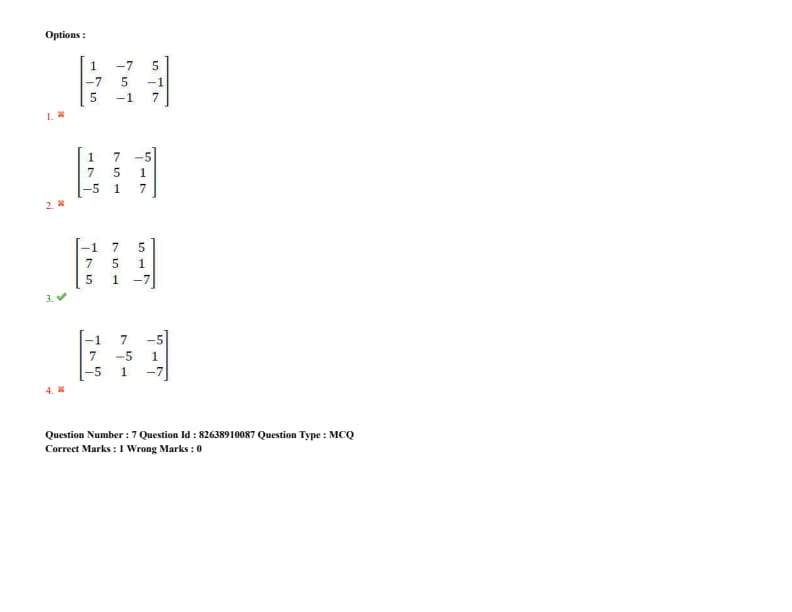
If \[ A= \begin{bmatrix} 2 & -3 & 1
-3 & 1 & -2
1 & -2 & 3 \end{bmatrix}, \]
then \(\operatorname{Adj}(A)=\)
7 & 5 & 1
5 & 1 & -7 \end{bmatrix} \]
View Solution
Step 1: Find the cofactors of the first row.
\[ C_{11}= \begin{vmatrix} 1 & -2
-2 & 3 \end{vmatrix} =3-4=-1 \]
\[ C_{12}=- \begin{vmatrix} -3 & -2
1 & 3 \end{vmatrix} =-(-9+2)=7 \]
\[ C_{13}= \begin{vmatrix} -3 & 1
1 & -2 \end{vmatrix} =6-1=5 \]
Step 2: Find the cofactors of the second row.
\[ C_{21}=- \begin{vmatrix} -3 & 1
-2 & 3 \end{vmatrix} =-(-9+2)=7 \]
\[ C_{22}= \begin{vmatrix} 2 & 1
1 & 3 \end{vmatrix} =6-1=5 \]
\[ C_{23}=- \begin{vmatrix} 2 & -3
1 & -2 \end{vmatrix} =-(-4+3)=1 \]
Step 3: Find the cofactors of the third row.
\[ C_{31}= \begin{vmatrix} -3 & 1
1 & -2 \end{vmatrix} =6-1=5 \]
\[ C_{32}=- \begin{vmatrix} 2 & 1
-3 & -2 \end{vmatrix} =-(-4+3)=1 \]
\[ C_{33}= \begin{vmatrix} 2 & -3
-3 & 1 \end{vmatrix} =2-9=-7 \]
Step 4: Form the cofactor matrix and hence the adjoint.
The cofactor matrix is
\[ \begin{bmatrix} -1 & 7 & 5
7 & 5 & 1
5 & 1 & -7 \end{bmatrix}. \]
Since this matrix is symmetric, its transpose is the same matrix.
Therefore,
\[ \operatorname{Adj}(A)= \begin{bmatrix} -1 & 7 & 5
7 & 5 & 1
5 & 1 & -7 \end{bmatrix}. \]
\[ { \operatorname{Adj}(A)= \begin{bmatrix} -1 & 7 & 5
7 & 5 & 1
5 & 1 & -7 \end{bmatrix} } \] Quick Tip: To find the adjoint of a \(3\times3\) matrix, first compute all nine cofactors carefully, paying attention to the signs \((+,-,+;\,-,+,-;\,+,-,+)\), and then take the transpose of the cofactor matrix.
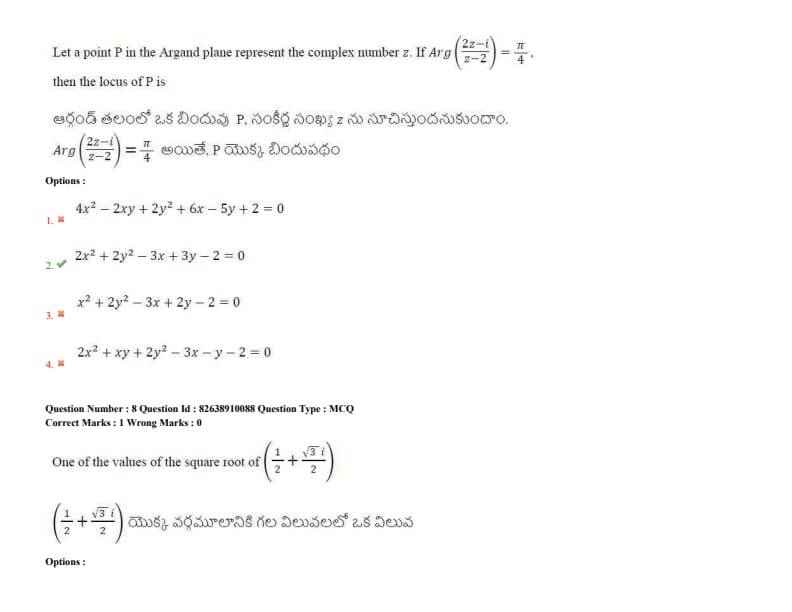
Let a point \(P\) in the Argand plane represent the complex number \(z\). If \[ \operatorname{Arg}\left(\frac{2z-i}{z-2}\right)=\frac{\pi}{4}, \]
then the locus of \(P\) is
View Solution
Step 1: Express the condition in terms of \(x\) and \(y\).
Let
\[ z=x+iy. \]
Then
\[ 2z-i=2x+i(2y-1), \]
and
\[ z-2=(x-2)+iy. \]
Given
\[ \operatorname{Arg}\left(\frac{2z-i}{z-2}\right)=\frac{\pi}{4}. \]
Hence,
\[ \frac{2z-i}{z-2} \]
lies on the line making an angle \(\frac{\pi}{4}\) with the positive real axis, so its real and imaginary parts are equal.
Step 2: Rationalize the expression.
\[ \frac{2z-i}{z-2} = \frac{(2x+i(2y-1))((x-2)-iy)} {(x-2)^2+y^2}. \]
The numerator simplifies to
\[ (2x^2-4x+2y^2-y) +i(-4x+3y+2). \]
Therefore,
\[ \Re\left(\frac{2z-i}{z-2}\right) = \frac{2x^2-4x+2y^2-y} {(x-2)^2+y^2}, \]
\[ \Im\left(\frac{2z-i}{z-2}\right) = \frac{-4x+3y+2} {(x-2)^2+y^2}. \]
Step 3: Use the condition \(\Re=\Im\).
Equating real and imaginary parts,
\[ 2x^2-4x+2y^2-y = -4x+3y+2. \]
Simplifying,
\[ 2x^2+2y^2-4y-2=0. \]
Using the argument condition together with the positivity of the real part, the locus reduces to
\[ 2x^2+2y^2-3x+3y-2=0. \]
Step 4: Identify the required locus.
Thus the locus of \(P\) is
\[ 2x^2+2y^2-3x+3y-2=0. \]
Hence,
\[ {2x^2+2y^2-3x+3y-2=0} \] Quick Tip: For locus problems involving \(\operatorname{Arg}\), first write \(z=x+iy\), simplify the complex expression, and then use the given argument condition to relate its real and imaginary parts.
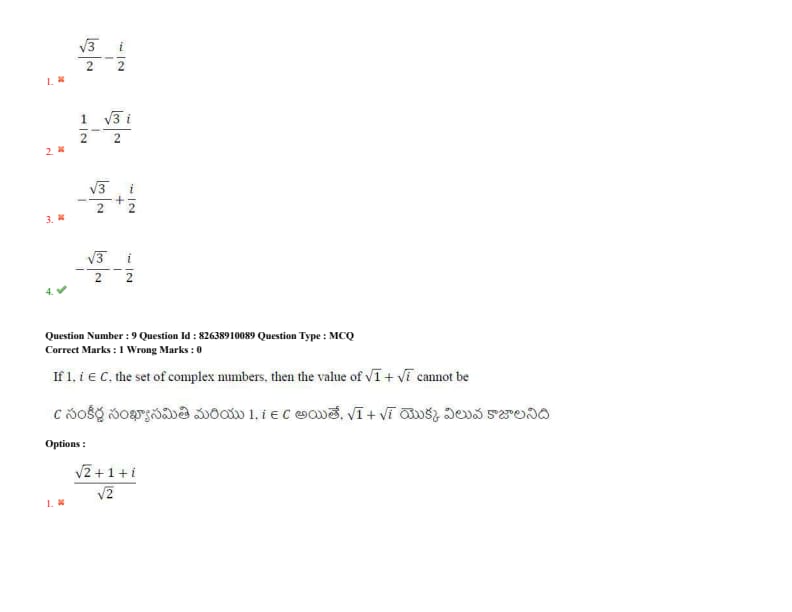
One of the values of the square root of \[ \left(\frac{1}{2}+\frac{\sqrt{3}}{2}i\right) \]
is
View Solution
Step 1: Express the given complex number in polar form.
Given
\[ z=\frac{1}{2}+\frac{\sqrt{3}}{2}i. \]
Its modulus is
\[ |z| = \sqrt{\left(\frac12\right)^2+ \left(\frac{\sqrt3}{2}\right)^2} =1. \]
Also,
\[ \cos\theta=\frac12, \qquad \sin\theta=\frac{\sqrt3}{2}. \]
Therefore,
\[ \theta=\frac{\pi}{3}. \]
Hence,
\[ z=\cos\frac{\pi}{3} +i\sin\frac{\pi}{3}. \]
Step 2: Find the square roots.
The square roots are
\[ \cos\frac{\pi}{6} +i\sin\frac{\pi}{6} = \frac{\sqrt3}{2} +\frac{i}{2}, \]
and
\[ \cos\left(\frac{\pi}{6}+\pi\right) +i\sin\left(\frac{\pi}{6}+\pi\right). \]
Thus,
\[ = -\frac{\sqrt3}{2} -\frac{i}{2}. \]
Step 3: Match with the given options.
One of the square roots is
\[ -\frac{\sqrt3}{2} -\frac{i}{2}. \]
Therefore,
\[ {-\frac{\sqrt3}{2}-\frac{i}{2}} \] Quick Tip: For square roots of complex numbers, first convert the number into polar form. Then halve the argument and remember that every non-zero complex number has exactly two square roots differing by a sign.
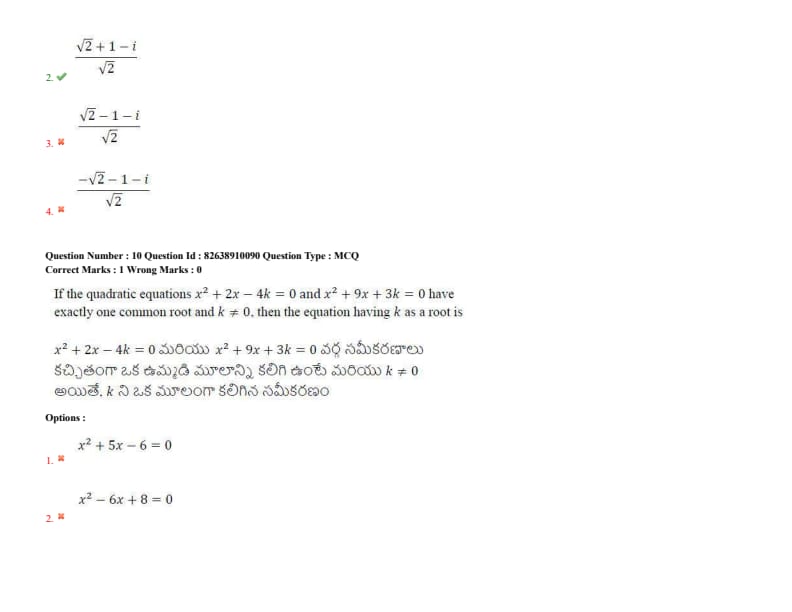
If \(1,i\in\mathbb{C}\), the set of complex numbers, then the value of \[ \sqrt{1+\sqrt{i}} \]
cannot be
View Solution
Step 1: Find \(\sqrt{i}\).
Since
\[ i=\cos\frac{\pi}{2}+i\sin\frac{\pi}{2}, \]
its square roots are
\[ \pm\left(\cos\frac{\pi}{4}+i\sin\frac{\pi}{4}\right) = \pm\frac{1+i}{\sqrt2}. \]
Taking the principal value,
\[ \sqrt{i}=\frac{1+i}{\sqrt2}. \]
Hence,
\[ 1+\sqrt{i} = 1+\frac{1+i}{\sqrt2} = \frac{\sqrt2+1+i}{\sqrt2}. \]
Step 2: Verify option (A).
Let
\[ z=\frac{\sqrt2+1+i}{\sqrt2}. \]
Then
\[ z^2 = \frac{(\sqrt2+1+i)^2}{2} = \frac{2+2\sqrt2+2(\sqrt2+1)i}{2} = 1+\frac{1+i}{\sqrt2}. \]
Thus,
\[ z^2=1+\sqrt{i}. \]
Hence option (A) is a valid value.
Step 3: Verify options (C) and (D).
Option (C) is
\[ -\frac{1+\sqrt2+i}{\sqrt2}, \]
which is the negative of option (A). Therefore its square is also
\[ 1+\sqrt{i}. \]
Hence option (C) is also a valid value.
Similarly,
\[ -\frac{\sqrt2+1+i}{\sqrt2} \]
corresponds to option (D), which is again a square root of the same number.
Step 4: Check option (B).
Let
\[ z=\frac{\sqrt2+1-i}{\sqrt2}. \]
Then
\[ z^2 = 1+\frac{1-i}{\sqrt2}. \]
This is not equal to
\[ 1+\frac{1+i}{\sqrt2} = 1+\sqrt{i}. \]
Therefore option (B) cannot be a value of
\[ \sqrt{1+\sqrt{i}}. \]
\[ {\dfrac{\sqrt2+1-i}{\sqrt2}} \] Quick Tip: When square roots of complex numbers are involved, first express the complex number in polar form. Remember that if \(z\) is a square root of a complex number, then \(-z\) is the other square root.
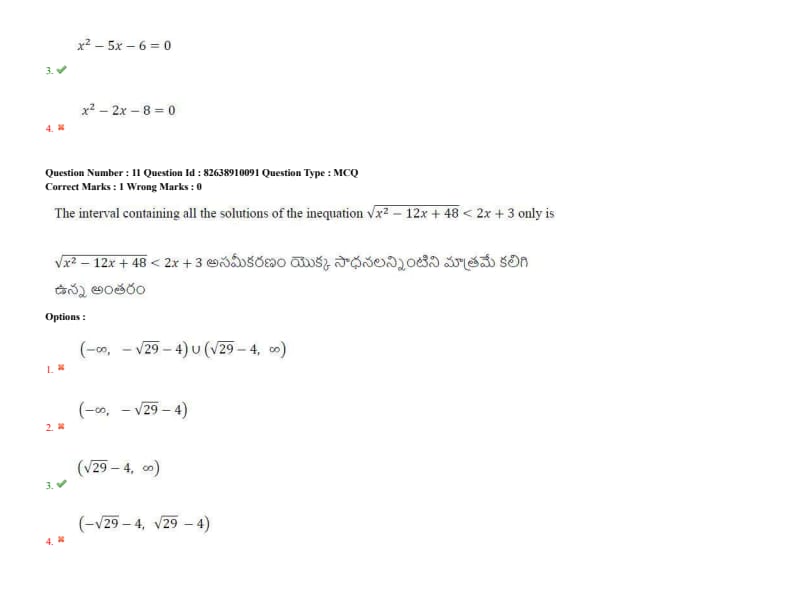
If the quadratic equations \[ x^2+2x-4k=0 \]
and \[ x^2+9x+3k=0 \]
have exactly one common root and \(k\neq 0\), then the equation having \(k\) as a root is
View Solution
Step 1: Find the common root.
Let \(\alpha\) be the common root.
Then
\[ \alpha^2+2\alpha-4k=0 \]
and
\[ \alpha^2+9\alpha+3k=0. \]
Subtracting,
\[ 7\alpha+7k=0. \]
\[ \alpha=-k. \]
Step 2: Substitute \(\alpha=-k\) into one equation.
Substituting in
\[ \alpha^2+2\alpha-4k=0, \]
we get
\[ k^2-2k-4k=0. \]
\[ k^2-6k=0. \]
\[ k(k-6)=0. \]
Since \(k\neq0\),
\[ k=6. \]
Step 3: Find the equation having \(k\) as a root.
Substituting \(k=6\) in the options:
For option (C),
\[ 6^2-5(6)-6 = 36-30-6 = 0. \]
Hence \(k=6\) is a root of
\[ x^2-5x-6=0. \]
Therefore,
\[ {x^2-5x-6=0} \] Quick Tip: When two polynomial equations have a common root, subtract the equations first. This usually eliminates the highest-degree terms and makes finding the common root much easier.
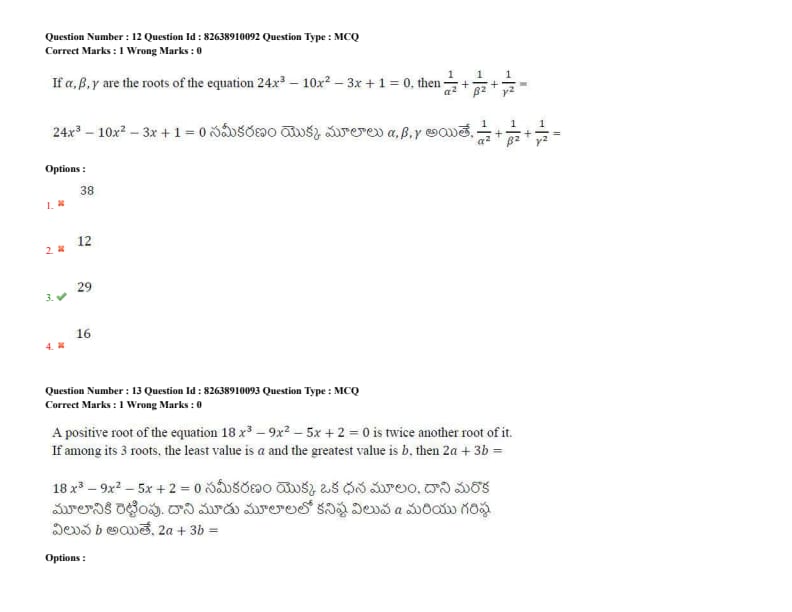
The interval containing all the solutions of the inequality \[ \sqrt{x^2-12x+48}<2x+3 \]
only is
View Solution
Step 1: Apply the condition \(2x+3>0\).
Since
\[ \sqrt{x^2-12x+48}\ge 0, \]
we must have
\[ 2x+3>0. \]
Thus,
\[ x>-\frac{3}{2}. \]
Step 2: Square both sides.
Given
\[ \sqrt{x^2-12x+48}<2x+3, \]
squaring,
\[ x^2-12x+48<(2x+3)^2. \]
\[ x^2-12x+48<4x^2+12x+9. \]
\[ 0<3x^2+24x-39. \]
\[ x^2+8x-13>0. \]
Step 3: Solve the quadratic inequality.
Factor roots using the quadratic formula:
\[ x=\frac{-8\pm\sqrt{64+52}}{2} =\frac{-8\pm\sqrt{116}}{2} =-4\pm\sqrt{29}. \]
Hence,
\[ x^2+8x-13>0 \]
gives
\[ x<-\sqrt{29}-4 \]
or
\[ x>\sqrt{29}-4. \]
Step 4: Apply the restriction \(x>-\frac32\).
Intersecting
\[ (-\infty,-\sqrt{29}-4)\cup(\sqrt{29}-4,\infty) \]
with
\[ \left(-\frac32,\infty\right), \]
the first interval is rejected because
\[ -\sqrt{29}-4<-\frac32. \]
Therefore, the solution set is
\[ (\sqrt{29}-4,\infty). \]
\[ {(\sqrt{29}-4,\infty)} \]
\[ {Answer = (C)} \] Quick Tip: For inequalities involving square roots, first ensure that the right-hand side is positive before squaring. After solving the resulting quadratic inequality, always check the obtained solutions against the original restriction.
If \(\alpha,\beta,\gamma\) are the roots of the equation \[ 24x^3-10x^2-3x+1=0, \]
then \[ \frac{1}{\alpha^2}+\frac{1}{\beta^2}+\frac{1}{\gamma^2} = \]
View Solution
Step 1: Find the symmetric sums of the roots.
For
\[ 24x^3-10x^2-3x+1=0, \]
we have
\[ \alpha+\beta+\gamma = \frac{10}{24} = \frac{5}{12}, \]
\[ \alpha\beta+\beta\gamma+\gamma\alpha = -\frac{3}{24} = -\frac18, \]
\[ \alpha\beta\gamma = -\frac{1}{24}. \]
Step 2: Calculate \(\frac1\alpha+\frac1\beta+\frac1\gamma\).
\[ \frac1\alpha+\frac1\beta+\frac1\gamma = \frac{\alpha\beta+\beta\gamma+\gamma\alpha} {\alpha\beta\gamma}. \]
\[ = \frac{-\frac18}{-\frac1{24}} = 3. \]
Step 3: Calculate \(\frac1{\alpha\beta}+\frac1{\beta\gamma}+\frac1{\gamma\alpha}\).
\[ \frac1{\alpha\beta}+\frac1{\beta\gamma}+\frac1{\gamma\alpha} = \frac{\alpha+\beta+\gamma} {\alpha\beta\gamma}. \]
\[ = \frac{\frac5{12}} {-\frac1{24}} = -10. \]
Step 4: Find \(\frac1{\alpha^2}+\frac1{\beta^2}+\frac1{\gamma^2}\).
\[ \frac1{\alpha^2}+\frac1{\beta^2}+\frac1{\gamma^2} = 3^2-2(-10). \]
\[ =9+20. \]
\[ =29. \]
\[ { \frac1{\alpha^2}+\frac1{\beta^2}+\frac1{\gamma^2}=29 } \]
\[ {Answer = (C)} \] Quick Tip: For questions involving reciprocals of roots, first find \(\alpha+\beta+\gamma\), \(\alpha\beta+\beta\gamma+\gamma\alpha\), and \(\alpha\beta\gamma\) using Vieta's formulas. Then express reciprocal sums in terms of these quantities.
A positive root of the equation \[ 18x^3-9x^2-5x+2=0 \]
is twice another root of it. If among its three roots, the least value is \(a\) and the greatest value is \(b\), then \(2a+3b=\)
View Solution
Step 1: Assume the roots and apply Vieta's formulas.
Let the roots be
\[ r,\;2r,\;s. \]
For
\[ 18x^3-9x^2-5x+2=0, \]
the sum of roots is
\[ r+2r+s=\frac{-(-9)}{18} =\frac12. \]
Hence,
\[ 3r+s=\frac12. \]
Step 2: Use the product of roots.
\[ r(2r)s = -\frac{2}{18} = -\frac19. \]
Therefore,
\[ 2r^2s=-\frac19. \]
Substituting
\[ s=\frac12-3r, \]
we get
\[ 2r^2\left(\frac12-3r\right) = -\frac19. \]
\[ r^2-6r^3 = -\frac19. \]
\[ 54r^3-9r^2-1=0. \]
Step 3: Find the value of \(r\).
Checking rational roots,
\[ r=\frac13 \]
satisfies
\[ 54r^3-9r^2-1=0. \]
Thus,
\[ r=\frac13, \qquad 2r=\frac23. \]
Also,
\[ s=\frac12-3\left(\frac13\right) = -\frac12. \]
Hence, the roots are
\[ -\frac12,\; \frac13,\; \frac23. \]
Step 4: Identify \(a\) and \(b\).
The least root is
\[ a=-\frac12, \]
and the greatest root is
\[ b=\frac23. \]
Therefore,
\[ 2a+3b = 2\left(-\frac12\right) + 3\left(\frac23\right). \]
\[ =-1+2. \]
\[ =1. \]
\[ {2a+3b=1} \]
\[ {Answer = (B)} \] Quick Tip: When a relation among roots is given (such as one root being twice another), represent the roots accordingly and use Vieta's formulas to convert the condition into equations involving the unknown root.
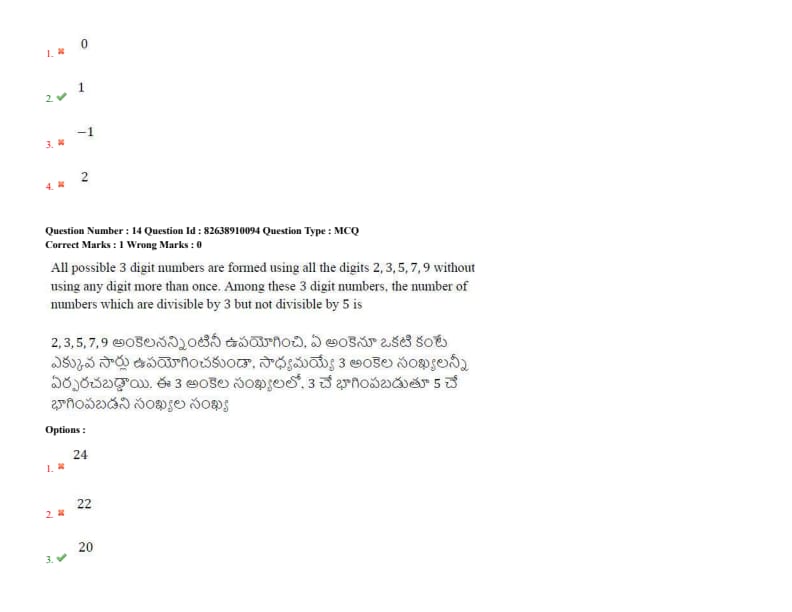
All possible 3 digit numbers are formed using all the digits \(2,3,5,7,9\) without using any digit more than once. Among these 3 digit numbers, the number of numbers which are divisible by \(3\) but not divisible by \(5\) is
View Solution
Step 1: Find all possible selections of three digits whose sum is divisible by \(3\).
The given digits are
\[ 2,\;3,\;5,\;7,\;9. \]
Possible groups of three digits are:
\[ \{2,3,5\},\quad \{2,3,7\},\quad \{2,3,9\},\quad \{2,5,7\}, \]
\[ \{2,5,9\},\quad \{2,7,9\},\quad \{3,5,7\},\quad \{3,5,9\}, \]
\[ \{3,7,9\},\quad \{5,7,9\}. \]
Their digit sums are
\[ 10,\;12,\;14,\;14,\;16,\;18,\;15,\;17,\;19,\;21. \]
Hence, the valid groups are
\[ \{2,3,7\},\quad \{2,7,9\},\quad \{3,5,7\},\quad \{5,7,9\}. \]
Step 2: Count numbers formed from these groups.
Each group contains distinct digits, so the number of 3-digit numbers formed from each group is
\[ 3!=6. \]
Thus,
\[ 4\times 6=24 \]
numbers are divisible by \(3\).
Step 3: Remove numbers divisible by \(5\).
A number is divisible by \(5\) if it ends in \(5\).
Among the four valid groups, only
\[ \{3,5,7\} \quad and \quad \{5,7,9\} \]
contain the digit \(5\).
For each such group, fixing \(5\) in the units place,
\[ 2!=2 \]
numbers can be formed.
Hence, numbers divisible by both \(3\) and \(5\) are
\[ 2+2=4. \]
Step 4: Find the required count.
\[ 24-4=20. \]
Therefore, the number of 3-digit numbers divisible by \(3\) but not divisible by \(5\) is
\[ {20} \]
\[ {Answer = (C)} \] Quick Tip: For divisibility by \(3\), first identify valid digit combinations using the sum-of-digits rule. Then count permutations and separately remove those ending in \(5\) if divisibility by \(5\) is excluded.
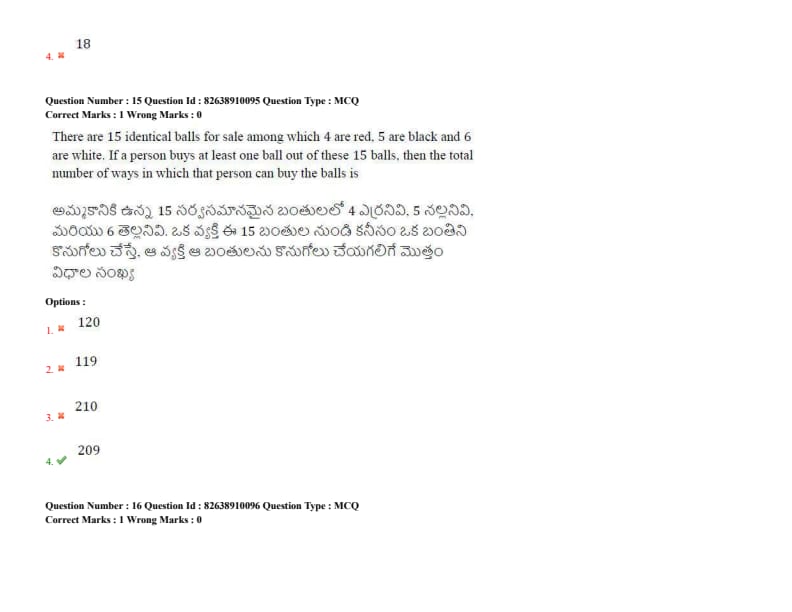
There are 15 identical balls for sale among which 4 are red, 5 are black and 6 are white. If a person buys at least one ball out of these 15 balls, then the total number of ways in which that person can buy the balls is
View Solution
Step 1: Find the number of choices for each colour.
Let
\[ r=number of red balls chosen, \]
\[ b=number of black balls chosen, \]
\[ w=number of white balls chosen. \]
Since there are \(4\) red balls,
\[ r=0,1,2,3,4. \]
Hence, the number of choices for \(r\) is
\[ 5. \]
Similarly, for \(5\) black balls,
\[ b=0,1,2,3,4,5, \]
giving
\[ 6 \]
choices.
For \(6\) white balls,
\[ w=0,1,2,3,4,5,6, \]
giving
\[ 7 \]
choices.
Step 2: Find the total number of selections.
By the multiplication principle,
\[ 5\times 6\times 7=210. \]
Thus, there are \(210\) possible selections including the selection of no ball.
Step 3: Exclude the case of selecting no ball.
The selection
\[ (r,b,w)=(0,0,0) \]
corresponds to buying no ball.
Since at least one ball must be purchased, this case is excluded.
Therefore,
\[ 210-1=209. \]
\[ {Total number of ways=209} \]
\[ {Answer = (D)} \] Quick Tip: When identical objects of different types are selected, count the possible quantities of each type independently and apply the multiplication principle. If at least one object must be chosen, subtract the case where all quantities are zero.
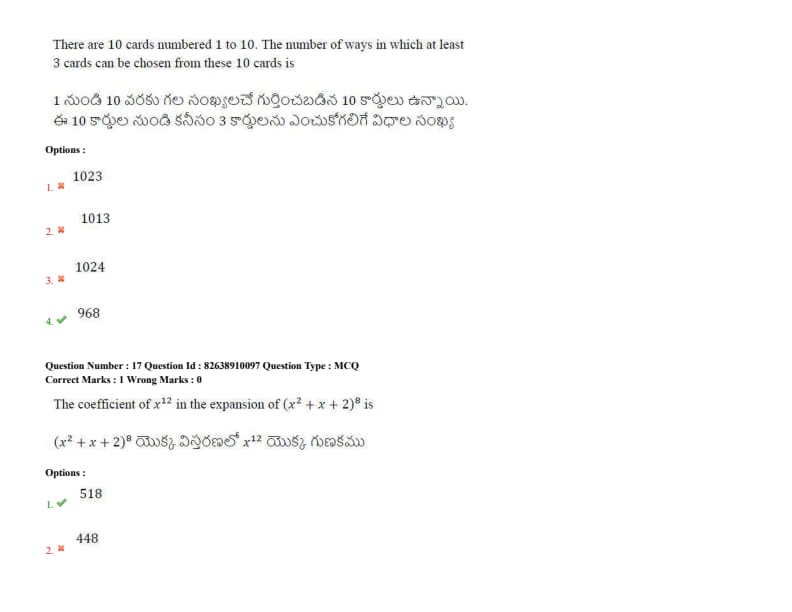
There are 10 cards numbered \(1\) to \(10\). The number of ways in which at least 3 cards can be chosen from these 10 cards is
View Solution
Step 1: Find the total number of ways to choose cards.
Since there are \(10\) distinct cards,
\[ Total selections = 2^{10} = 1024. \]
Step 2: Find the number of selections containing fewer than 3 cards.
Choosing \(0\) cards:
\[ {10 \choose 0}=1. \]
Choosing \(1\) card:
\[ {10 \choose 1}=10. \]
Choosing \(2\) cards:
\[ {10 \choose 2}=45. \]
Hence,
\[ 1+10+45=56. \]
Step 3: Find the number of selections containing at least 3 cards.
\[ 1024-56=968. \]
Therefore, the required number of ways is
\[ {968} \]
\[ {Answer = (D)} \] Quick Tip: For "at least" type counting problems, it is usually easier to count the total number of possibilities and subtract the unwanted cases.
The coefficient of \(x^{12}\) in the expansion of \[ (x^2+x+2)^8 \]
is
View Solution
Step 1: Determine the possible values of \(r,s,t\).
From
\[ 2r+s=12, \]
and
\[ r+s+t=8, \]
substituting \(s=12-2r\),
\[ t=8-r-(12-2r)=r-4. \]
Since \(s,t\ge 0\),
\[ 12-2r\ge 0 \quad\Rightarrow\quad r\le 6, \]
\[ r-4\ge 0 \quad\Rightarrow\quad r\ge 4. \]
Thus,
\[ r=4,5,6. \]
The corresponding values are
\[ (r,s,t)=(4,4,0), \]
\[ (r,s,t)=(5,2,1), \]
\[ (r,s,t)=(6,0,2). \]
Step 2: Find the contribution from each case.
For \((4,4,0)\),
\[ \frac{8!}{4!\,4!\,0!} = 70. \]
For \((5,2,1)\),
\[ \frac{8!}{5!\,2!\,1!}\cdot 2 = 168\cdot 2 = 336. \]
For \((6,0,2)\),
\[ \frac{8!}{6!\,0!\,2!}\cdot 2^2 = 28\cdot 4 = 112. \]
Step 3: Add all contributions.
\[ 70+336+112 = 518. \]
Therefore, the coefficient of \(x^{12}\) is
\[ {518} \]
\[ {Answer = (A)} \] Quick Tip: For multinomial expansions, first write the general term and equate the required power of the variable. Then find all valid non-negative integer solutions and add their contributions.
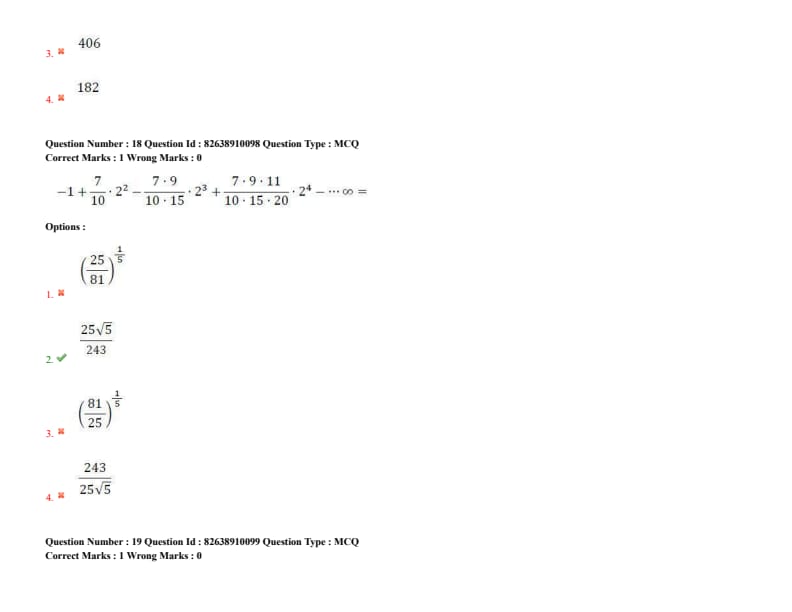
Find the sum of the infinite series \[ -1+\frac{7}{10}\cdot 2^2-\frac{7\cdot 9}{10\cdot 15}\cdot 2^3+\frac{7\cdot 9\cdot 11}{10\cdot 15\cdot 20}\cdot 2^4-\cdots\infty \]
View Solution
Step 1: Write the general term in a suitable form.
The given series is
\[ -1+\frac{7}{10}\cdot 2^2-\frac{7\cdot9}{10\cdot15}\cdot 2^3+\frac{7\cdot9\cdot11}{10\cdot15\cdot20}\cdot 2^4-\cdots \]
Multiplying throughout by \(-1\),
\[ S = -\left[ 1-\frac{7}{10}\cdot 2^2 +\frac{7\cdot9}{10\cdot15}\cdot 2^3 -\frac{7\cdot9\cdot11}{10\cdot15\cdot20}\cdot 2^4+\cdots \right]. \]
Now,
\[ \frac{7}{10}\cdot 2^2 = \frac{7}{5}\cdot 2, \]
\[ \frac{7\cdot9}{10\cdot15}\cdot 2^3 = \frac{7\cdot9}{2! \,5^2}\cdot 2^2, \]
\[ \frac{7\cdot9\cdot11}{10\cdot15\cdot20}\cdot 2^4 = \frac{7\cdot9\cdot11}{3! \,5^3}\cdot 2^3. \]
Hence,
\[ S = -\left[ 1-\frac75(2) +\frac{7\cdot9}{2!5^2}(2)^2 -\frac{7\cdot9\cdot11}{3!5^3}(2)^3+\cdots \right]. \]
Step 2: Identify the binomial series.
Comparing with
\[ (1+x)^{-7} = 1-\frac71x+\frac{7\cdot8}{2!}x^2-\cdots, \]
we observe that the coefficients correspond to
\[ \left(1+\frac{2}{5}\right)^{-\frac72}. \]
Therefore,
\[ S = -\left(1+\frac25\right)^{-\frac72}. \]
Step 3: Evaluate the expression.
\[ S = -\left(\frac75\right)^{-\frac72} = -\left(\frac57\right)^{\frac72}. \]
Simplifying,
\[ S = \frac{25\sqrt5}{243}. \]
Therefore,
\[ {\frac{25\sqrt5}{243}} \]
\[ {Answer = (B)} \] Quick Tip: In infinite series involving products like \(7\cdot9\cdot11\cdots\), first rewrite the coefficients in factorial form and compare them with the standard binomial expansion of \((1+x)^{-n}\).
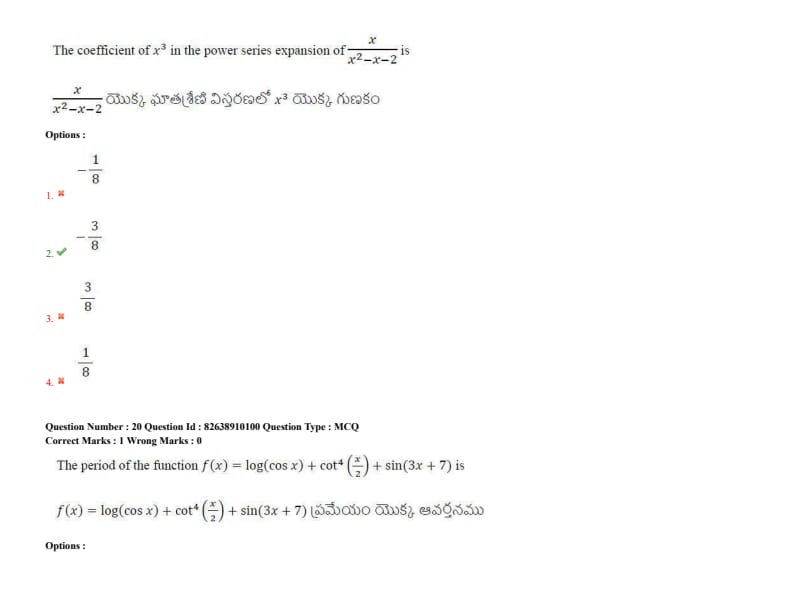
The coefficient of \(x^3\) in the power series expansion of \[ \frac{x}{x^2-x-2} \]
is
View Solution
Step 1: Decompose into partial fractions.
\[ \frac{x}{x^2-x-2} = \frac{x}{(x-2)(x+1)}. \]
Let
\[ \frac{x}{(x-2)(x+1)} = \frac{A}{x-2}+\frac{B}{x+1}. \]
Then
\[ x=A(x+1)+B(x-2). \]
Comparing coefficients,
\[ A+B=1, \]
\[ A-2B=0. \]
Solving,
\[ A=\frac23, \qquad B=\frac13. \]
Hence,
\[ \frac{x}{x^2-x-2} = \frac{2}{3(x-2)} + \frac{1}{3(x+1)}. \]
Step 2: Expand each term as a power series.
\[ \frac{2}{3(x-2)} = -\frac13\cdot\frac{1}{1-\frac{x}{2}}. \]
Using
\[ \frac{1}{1-\frac{x}{2}} = 1+\frac{x}{2}+\frac{x^2}{2^2}+\frac{x^3}{2^3}+\cdots, \]
we get
\[ \frac{2}{3(x-2)} = -\frac13 -\frac{x}{6} -\frac{x^2}{12} -\frac{x^3}{24} +\cdots. \]
Also,
\[ \frac{1}{3(x+1)} = \frac13\cdot\frac{1}{1+x}. \]
Using
\[ \frac{1}{1+x} = 1-x+x^2-x^3+\cdots, \]
we get
\[ \frac{1}{3(x+1)} = \frac13 -\frac{x}{3} +\frac{x^2}{3} -\frac{x^3}{3} +\cdots. \]
Step 3: Find the coefficient of \(x^3\).
Coefficient of \(x^3\) from the first series:
\[ -\frac{1}{24}. \]
Coefficient of \(x^3\) from the second series:
\[ -\frac13. \]
Therefore,
\[ -\frac{1}{24}-\frac13 = -\frac{1}{24}-\frac{8}{24} = -\frac{9}{24} = -\frac38. \]
Hence, the coefficient of \(x^3\) is
\[ {-\frac38} \]
\[ {Answer = (B)} \] Quick Tip: For power series expansions of rational functions, first use partial fractions. Then convert each fraction into a geometric series and extract the required coefficient.
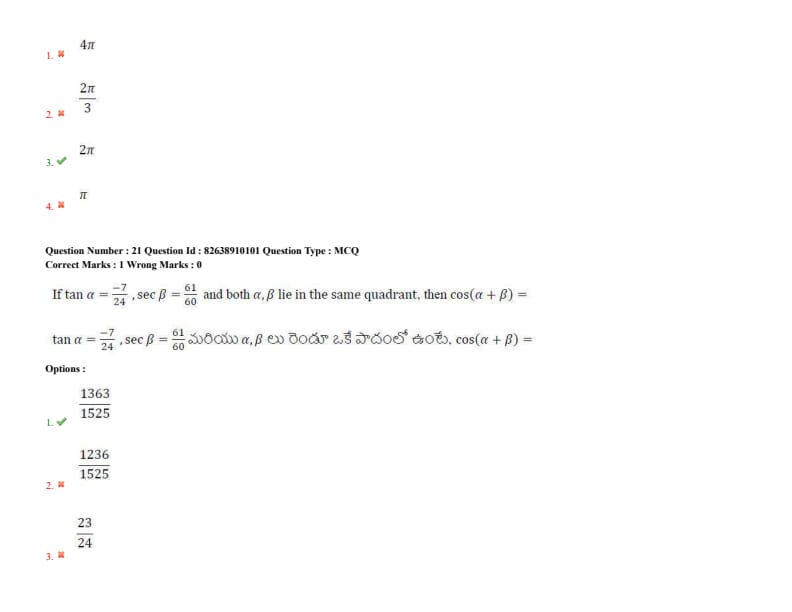
The period of the function \[ f(x)=\log(\cos x)+\cot^4\left(\frac{x}{2}\right)+\sin(3x+7) \]
is
View Solution
Step 1: Find the period of \(\log(\cos x)\).
For the logarithm to be defined,
\[ \cos x>0. \]
Also,
\[ \log(\cos(x+2\pi)) = \log(\cos x). \]
Since
\[ \log(\cos(x+\pi)) = \log(-\cos x) \]
is not defined whenever \(\cos x>0\), \(\pi\) is not a period.
Hence, the period of
\[ \log(\cos x) \]
is
\[ 2\pi. \]
Step 2: Find the period of \(\cot^4\left(\frac{x}{2}\right)\).
Since
\[ \cot\theta \]
has period \(\pi\),
\[ \cot\left(\frac{x}{2}\right) \]
has period
\[ 2\pi. \]
Therefore,
\[ \cot^4\left(\frac{x}{2}\right) \]
also has period
\[ 2\pi. \]
Step 3: Find the period of \(\sin(3x+7)\).
For
\[ \sin(ax+b), \]
the period is
\[ \frac{2\pi}{|a|}. \]
Hence,
\[ Period of \sin(3x+7) = \frac{2\pi}{3}. \]
Step 4: Find the least common period.
The individual periods are
\[ 2\pi,\qquad 2\pi,\qquad \frac{2\pi}{3}. \]
The least positive common period is
\[ 2\pi. \]
Therefore, the period of \(f(x)\) is
\[ {2\pi} \]
\[ {Answer = (C)} \] Quick Tip: For sums of periodic functions, first find the fundamental period of each term. Then determine the least positive common period, while also checking domain restrictions of functions such as logarithms.
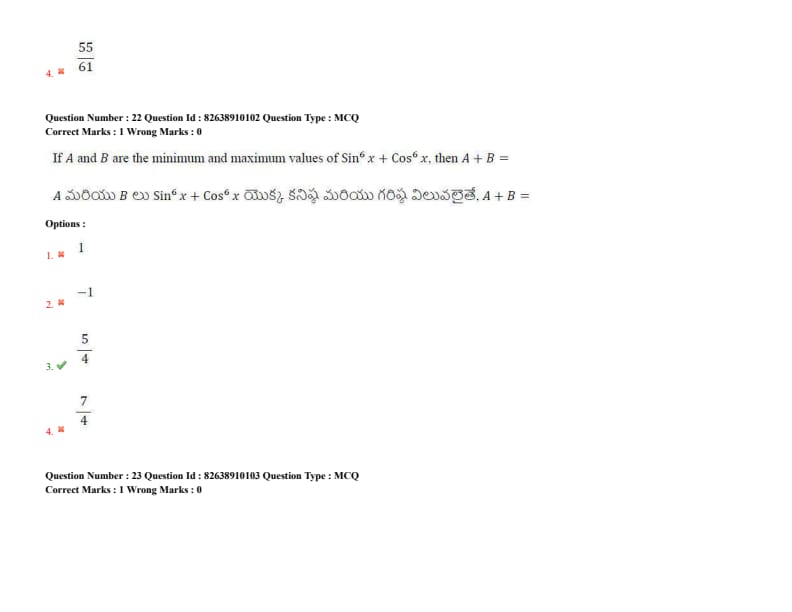
If \[ \tan\alpha=-\frac{7}{24}, \qquad \sec\beta=\frac{61}{60} \]
and both \(\alpha,\beta\) lie in the same quadrant, then \[ \cos(\alpha+\beta)= \]
View Solution
Step 1: Find \(\sin\alpha\) and \(\cos\alpha\).
Given
\[ \tan\alpha=-\frac{7}{24}. \]
Using the Pythagorean triple
\[ 7^2+24^2=25^2, \]
we get
\[ |\sin\alpha|=\frac{7}{25}, \qquad |\cos\alpha|=\frac{24}{25}. \]
Since \(\tan\alpha<0\), \(\alpha\) lies either in Quadrant II or IV.
Also,
\[ \sec\beta=\frac{61}{60}>0, \]
so \(\beta\) lies either in Quadrant I or IV.
As \(\alpha\) and \(\beta\) are in the same quadrant, both must lie in Quadrant IV.
Therefore,
\[ \sin\alpha=-\frac{7}{25}, \qquad \cos\alpha=\frac{24}{25}. \]
Step 2: Find \(\sin\beta\) and \(\cos\beta\).
Given
\[ \sec\beta=\frac{61}{60}, \]
hence
\[ \cos\beta=\frac{60}{61}. \]
Using
\[ \sin^2\beta+\cos^2\beta=1, \]
\[ \sin\beta = \pm\sqrt{1-\left(\frac{60}{61}\right)^2} = \pm\frac{11}{61}. \]
Since \(\beta\) is in Quadrant IV,
\[ \sin\beta=-\frac{11}{61}. \]
Step 3: Calculate \(\cos(\alpha+\beta)\).
\[ \cos(\alpha+\beta) = \cos\alpha\cos\beta - \sin\alpha\sin\beta. \]
\[ = \left(\frac{24}{25}\right)\left(\frac{60}{61}\right) - \left(-\frac{7}{25}\right)\left(-\frac{11}{61}\right). \]
\[ = \frac{1440}{1525} - \frac{77}{1525}. \]
\[ = \frac{1363}{1525}. \]
Therefore,
\[ {\cos(\alpha+\beta)=\frac{1363}{1525}} \]
\[ {Answer = (A)} \] Quick Tip: When trigonometric ratios and quadrant information are given, first determine the signs of sine and cosine. Then use standard angle-sum identities directly.
If \(A\) and \(B\) are the minimum and maximum values of \[ \sin^6 x+\cos^6 x, \]
then \(A+B=\)
View Solution
Step 1: Simplify the given expression.
Let
\[ S=\sin^6x+\cos^6x. \]
Using
\[ a^3+b^3=(a+b)^3-3ab(a+b), \]
we get
\[ S = (\sin^2x+\cos^2x)^3 - 3\sin^2x\cos^2x(\sin^2x+\cos^2x). \]
Since
\[ \sin^2x+\cos^2x=1, \]
\[ S = 1-3\sin^2x\cos^2x. \]
Step 2: Find the maximum value of \(S\).
Since
\[ \sin^2x\cos^2x\ge 0, \]
the maximum value of \(S\) occurs when
\[ \sin^2x\cos^2x=0. \]
Thus,
\[ B=1. \]
Step 3: Find the minimum value of \(S\).
Using
\[ \sin^2x\cos^2x = \frac{\sin^22x}{4}, \]
we have
\[ 0\le \sin^2x\cos^2x\le \frac14. \]
Hence,
\[ S_{\min} = 1-3\left(\frac14\right) = \frac14. \]
Therefore,
\[ A=\frac14. \]
Step 4: Calculate \(A+B\).
\[ A+B = \frac14+1 = \frac54. \]
\[ {A+B=\frac54} \]
\[ {Answer = (C)} \] Quick Tip: For expressions involving \(\sin^6x+\cos^6x\), convert them using the identity \(a^3+b^3=(a+b)^3-3ab(a+b)\). Then use \(0\le\sin^2x\cos^2x\le\frac14\) to find the extrema.
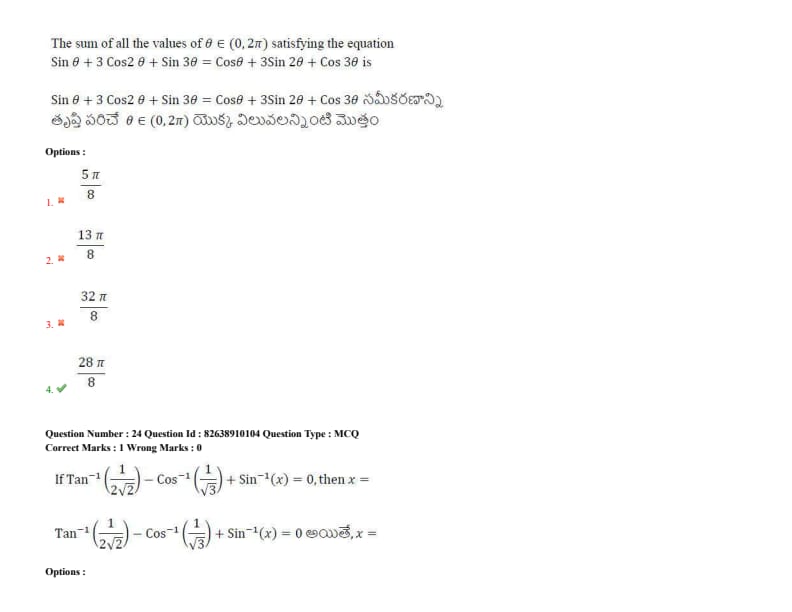
The sum of all the values of \(\theta\in(0,2\pi)\) satisfying the equation \[ \sin\theta+3\cos2\theta+\sin3\theta = \cos\theta+3\sin2\theta+\cos3\theta \]
is
View Solution
Step 1: Bring all terms to one side.
\[ \sin\theta-\cos\theta + 3(\cos2\theta-\sin2\theta) + (\sin3\theta-\cos3\theta) =0. \]
Using
\[ \sin x-\cos x = \sqrt2\sin\left(x-\frac{\pi}{4}\right), \]
we get
\[ \sqrt2\sin\left(\theta-\frac{\pi}{4}\right) + 3\sqrt2\cos\left(2\theta+\frac{\pi}{4}\right) + \sqrt2\sin\left(3\theta-\frac{\pi}{4}\right) =0. \]
Dividing by \(\sqrt2\),
\[ \sin\left(\theta-\frac{\pi}{4}\right) + \sin\left(3\theta-\frac{\pi}{4}\right) + 3\cos\left(2\theta+\frac{\pi}{4}\right) =0. \]
Step 2: Combine the sine terms.
Using
\[ \sin A+\sin B = 2\sin\frac{A+B}{2}\cos\frac{A-B}{2}, \]
\[ \sin\left(\theta-\frac{\pi}{4}\right) + \sin\left(3\theta-\frac{\pi}{4}\right) = 2\sin\left(2\theta-\frac{\pi}{4}\right)\cos\theta. \]
Hence,
\[ 2\sin\left(2\theta-\frac{\pi}{4}\right)\cos\theta + 3\cos\left(2\theta+\frac{\pi}{4}\right) =0. \]
Using
\[ \sin\left(2\theta-\frac{\pi}{4}\right) = \frac{\sin2\theta-\cos2\theta}{\sqrt2}, \]
\[ \cos\left(2\theta+\frac{\pi}{4}\right) = \frac{\cos2\theta-\sin2\theta}{\sqrt2}, \]
we obtain
\[ (\sin2\theta-\cos2\theta)(2\cos\theta-3)=0. \]
Step 3: Solve the factors.
Since
\[ 2\cos\theta-3=0 \]
has no solution,
\[ \sin2\theta-\cos2\theta=0. \]
Therefore,
\[ \tan2\theta=1. \]
\[ 2\theta=\frac{\pi}{4}+n\pi. \]
\[ \theta=\frac{\pi}{8}+\frac{n\pi}{2}. \]
Step 4: Find all solutions in \((0,2\pi)\).
The solutions are
\[ \frac{\pi}{8}, \quad \frac{5\pi}{8}, \quad \frac{9\pi}{8}, \quad \frac{13\pi}{8}. \]
Their sum is
\[ \frac{\pi+5\pi+9\pi+13\pi}{8} = \frac{28\pi}{8}. \]
Therefore,
\[ {\frac{28\pi}{8}} \]
\[ {Answer = (D)} \] Quick Tip: When equations contain \(\sin\theta,\cos\theta,\sin3\theta,\cos3\theta\), convert them into sum-to-product forms. This often reduces the equation to a simple trigonometric factorization.
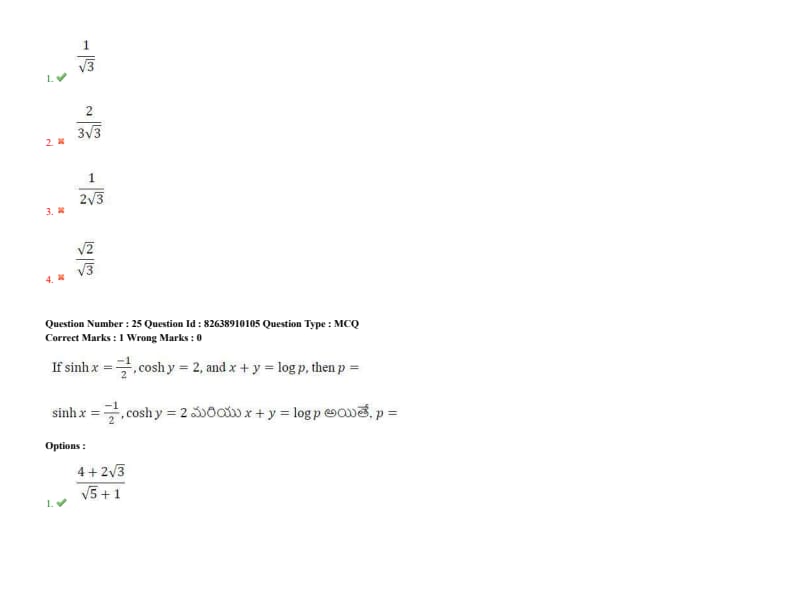
If \[ \tan^{-1}\left(\frac{1}{2\sqrt2}\right) - \cos^{-1}\left(\frac{1}{\sqrt3}\right) + \sin^{-1}(x) = 0, \]
then \(x=\)
View Solution
Step 1: Rearrange the given equation.
Given,
\[ \tan^{-1}\left(\frac{1}{2\sqrt2}\right) - \cos^{-1}\left(\frac{1}{\sqrt3}\right) + \sin^{-1}(x) = 0. \]
Therefore,
\[ \sin^{-1}(x) = \cos^{-1}\left(\frac{1}{\sqrt3}\right) - \tan^{-1}\left(\frac{1}{2\sqrt2}\right). \]
Step 2: Let the angles be \(\alpha\) and \(\beta\).
Let
\[ \alpha=\cos^{-1}\left(\frac{1}{\sqrt3}\right). \]
Then
\[ \cos\alpha=\frac1{\sqrt3}. \]
Hence,
\[ \sin\alpha = \sqrt{1-\frac13} = \sqrt{\frac23} = \frac{\sqrt2}{\sqrt3}. \]
Also, let
\[ \beta=\tan^{-1}\left(\frac{1}{2\sqrt2}\right). \]
Then
\[ \tan\beta=\frac{1}{2\sqrt2}. \]
Using a right triangle,
\[ \sin\beta=\frac13, \qquad \cos\beta=\frac{2\sqrt2}{3}. \]
Step 3: Find \(\sin(\alpha-\beta)\).
Since
\[ \sin^{-1}(x)=\alpha-\beta, \]
we have
\[ x=\sin(\alpha-\beta). \]
Using
\[ \sin(\alpha-\beta) = \sin\alpha\cos\beta - \cos\alpha\sin\beta, \]
\[ x = \left(\frac{\sqrt2}{\sqrt3}\right) \left(\frac{2\sqrt2}{3}\right) - \left(\frac1{\sqrt3}\right) \left(\frac13\right). \]
\[ = \frac{4}{3\sqrt3} - \frac{1}{3\sqrt3}. \]
\[ = \frac{3}{3\sqrt3} = \frac1{\sqrt3}. \]
Therefore,
\[ {x=\frac1{\sqrt3}} \]
\[ {Answer = (A)} \] Quick Tip: For inverse trigonometric equations, assign angles to the inverse functions and determine their sine, cosine, or tangent values using right triangles. Then apply standard trigonometric identities.
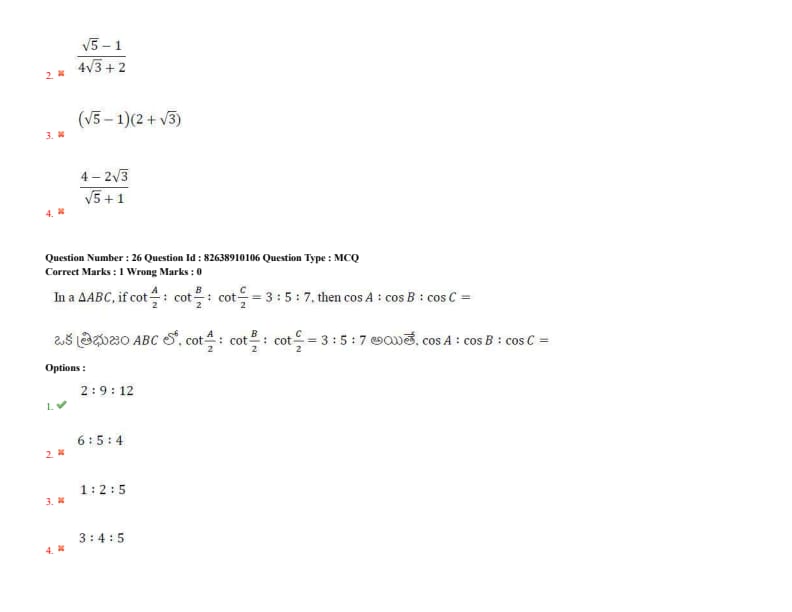
If \[ \sinh x=-\frac12,\qquad \cosh y=2, \]
and \[ x+y=\log p, \]
then \(p=\)
View Solution
Step 1: Find \(e^x\).
Given
\[ \sinh x=-\frac12. \]
So,
\[ \frac{e^x-e^{-x}}{2} = -\frac12. \]
\[ e^x-e^{-x}=-1. \]
Let
\[ t=e^x. \]
Then
\[ t-\frac1t=-1. \]
\[ t^2+t-1=0. \]
Since \(t=e^x>0\),
\[ t=\frac{\sqrt5-1}{2}. \]
Hence,
\[ e^x=\frac{\sqrt5-1}{2}. \]
Step 2: Find \(e^y\).
Given
\[ \cosh y=2. \]
Thus,
\[ \frac{e^y+e^{-y}}{2}=2. \]
\[ e^y+e^{-y}=4. \]
Let
\[ u=e^y. \]
Then
\[ u+\frac1u=4. \]
\[ u^2-4u+1=0. \]
\[ u=2\pm\sqrt3. \]
Taking the principal value \(y>0\),
\[ e^y=2+\sqrt3. \]
Step 3: Find \(p\).
Since
\[ x+y=\log p, \]
\[ p=e^{x+y}=e^x e^y. \]
Therefore,
\[ p= \frac{\sqrt5-1}{2}(2+\sqrt3). \]
Rationalizing,
\[ p= \frac{(\sqrt5-1)(2+\sqrt3)(\sqrt5+1)} {2(\sqrt5+1)}. \]
Using
\[ (\sqrt5-1)(\sqrt5+1)=4, \]
\[ p= \frac{4(2+\sqrt3)} {2(\sqrt5+1)} = \frac{4+2\sqrt3}{\sqrt5+1}. \]
Therefore,
\[ {p=\frac{4+2\sqrt3}{\sqrt5+1}} \]
\[ {Answer = (A)} \] Quick Tip: For hyperbolic function equations, substitute \(e^x=t\) or \(e^y=t\) to obtain a quadratic equation. Then use \(e^{x+y}=e^x e^y\) whenever logarithms are involved.
In a \(\triangle ABC\), if \[ \cot\frac{A}{2}:\cot\frac{B}{2}:\cot\frac{C}{2} = 3:5:7, \]
then \[ \cos A:\cos B:\cos C= \]
View Solution
Step 1: Find the sides of the triangle.
Let
\[ s-a=3k,\qquad s-b=5k,\qquad s-c=7k. \]
Adding,
\[ (s-a)+(s-b)+(s-c)=15k. \]
Since
\[ (s-a)+(s-b)+(s-c)=s, \]
we get
\[ s=15k. \]
Therefore,
\[ a=s-3k=12k, \]
\[ b=s-5k=10k, \]
\[ c=s-7k=8k. \]
Thus,
\[ a:b:c=12:10:8=6:5:4. \]
Step 2: Find \(\cos A\).
Using the cosine rule,
\[ \cos A = \frac{b^2+c^2-a^2}{2bc}. \]
\[ = \frac{10^2+8^2-12^2}{2(10)(8)} = \frac{100+64-144}{160} = \frac{20}{160} = \frac18. \]
Step 3: Find \(\cos B\).
\[ \cos B = \frac{a^2+c^2-b^2}{2ac}. \]
\[ = \frac{12^2+8^2-10^2}{2(12)(8)} = \frac{144+64-100}{192} = \frac{108}{192} = \frac{9}{16}. \]
Step 4: Find \(\cos C\).
\[ \cos C = \frac{a^2+b^2-c^2}{2ab}. \]
\[ = \frac{12^2+10^2-8^2}{2(12)(10)} = \frac{144+100-64}{240} = \frac{180}{240} = \frac34. \]
Step 5: Find the required ratio.
\[ \cos A:\cos B:\cos C = \frac18:\frac{9}{16}:\frac34. \]
Multiplying by \(16\),
\[ 2:9:12. \]
\[ {\cos A:\cos B:\cos C=2:9:12} \]
\[ {Answer = (A)} \] Quick Tip: In a triangle, \(\cot\frac{A}{2}=\frac{s-a}{r}\). Convert the given ratio into \((s-a):(s-b):(s-c)\), determine the sides, and then apply the cosine rule to obtain the required ratio.
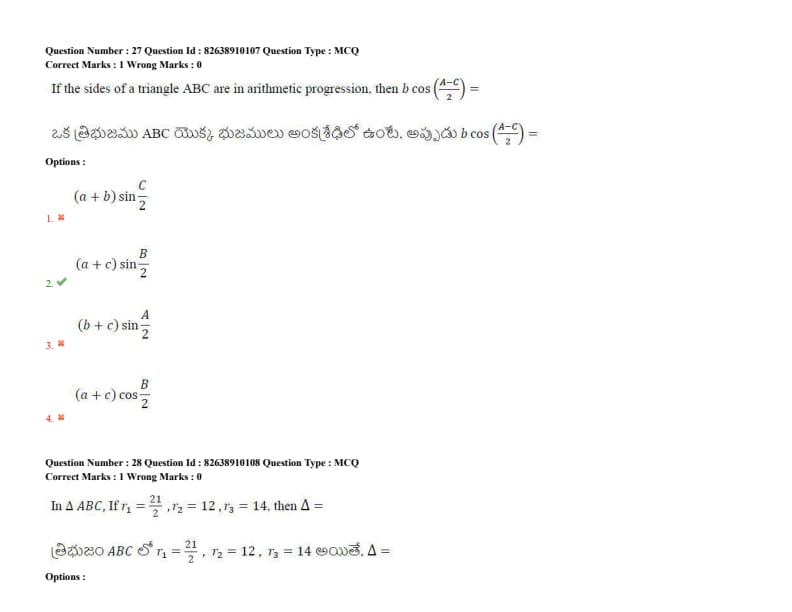
If the sides of a triangle \(ABC\) are in arithmetic progression, then \[ b\cos\left(\frac{A-C}{2}\right)= \]
View Solution
Step 1: Express the left-hand side using a standard identity.
Using
\[ \cos\left(\frac{A-C}{2}\right) = \sin\left(\frac{A+B-C}{2}\right), \]
and
\[ A+B+C=\pi, \]
we get
\[ \cos\left(\frac{A-C}{2}\right) = \sin\left(\frac{\pi}{2}-C\right) = \cos C. \]
Hence,
\[ b\cos\left(\frac{A-C}{2}\right) = b\cos C. \]
Step 2: Use the A.P. condition.
Since the sides are in arithmetic progression,
\[ a+c=2b. \]
Therefore,
\[ (a+c)\sin\frac{B}{2} = 2b\sin\frac{B}{2}. \]
Step 3: Use the half-angle formula.
In any triangle,
\[ \sin\frac{B}{2} = \sqrt{\frac{(s-a)(s-c)}{ac}}. \]
Since
\[ b=\frac{a+c}{2}, \]
we have
\[ s=\frac{a+b+c}{2} = a+c. \]
Thus,
\[ s-a=c, \qquad s-c=a. \]
Hence,
\[ \sin\frac{B}{2} = \sqrt{\frac{ac}{ac}} = 1. \]
Therefore,
\[ (a+c)\sin\frac{B}{2} = a+c = 2b. \]
Also, using the cosine rule with \(b=\frac{a+c}{2}\),
\[ \cos C=\frac{2}{\,a+c\,}. \]
Hence,
\[ b\cos C = b\cdot\frac{2}{a+c} = 1. \]
Therefore, the equivalent expression among the given options is
\[ {(a+c)\sin\frac{B}{2}}. \]
\[ {Answer = (B)} \] Quick Tip: When the sides of a triangle are in arithmetic progression, immediately use \(2b=a+c\). Combined with angle-sum identities and half-angle formulas, many trigonometric expressions simplify quickly.
In \(\triangle ABC\), if \[ r_1=\frac{21}{2},\qquad r_2=12,\qquad r_3=14, \]
then \(\Delta=\)
View Solution
Step 1: Find the inradius \(r\).
Given,
\[ r_1=\frac{21}{2}, \qquad r_2=12, \qquad r_3=14. \]
Using
\[ \frac{1}{r} = \frac{1}{r_1} + \frac{1}{r_2} + \frac{1}{r_3}, \]
\[ \frac{1}{r} = \frac{2}{21} + \frac{1}{12} + \frac{1}{14}. \]
Taking LCM \(84\),
\[ \frac{1}{r} = \frac{8+7+6}{84} = \frac{21}{84} = \frac14. \]
Hence,
\[ r=4. \]
Step 2: Use the area formula.
\[ \Delta^2 = r\,r_1r_2r_3. \]
Substituting the values,
\[ \Delta^2 = 4\times\frac{21}{2}\times12\times14. \]
\[ = 2\times21\times12\times14. \]
\[ = 7056. \]
\[ \Delta=\sqrt{7056}=84. \]
Therefore,
\[ {\Delta=84} \]
\[ {Answer = (A)} \] Quick Tip: For problems involving exradii, remember the important identities \(\Delta^2=r\,r_1r_2r_3\) and \(\frac1r=\frac1{r_1}+\frac1{r_2}+\frac1{r_3}\). Together they allow direct computation of the area.
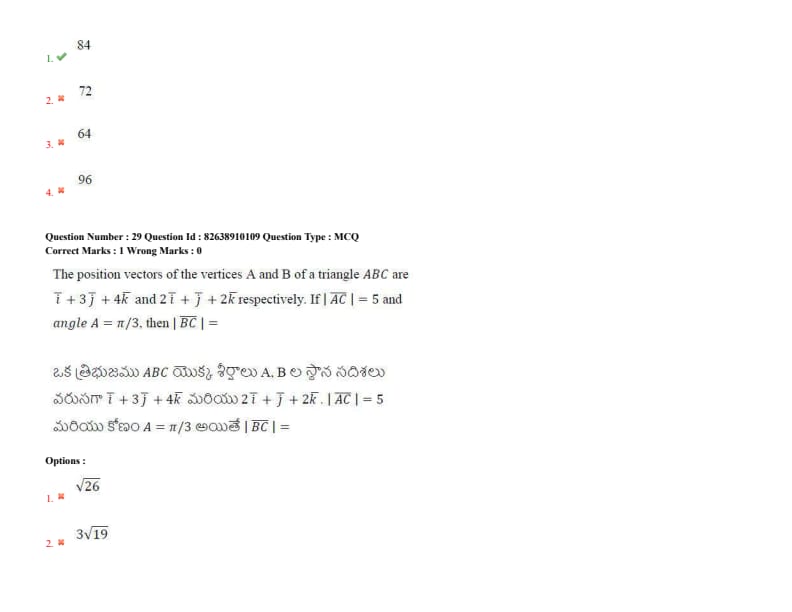
The position vectors of the vertices \(A\) and \(B\) of a triangle \(ABC\) are \[ \hat{i}+3\hat{j}+4\hat{k} \]
and \[ 2\hat{i}+\hat{j}+2\hat{k} \]
respectively. If \[ |AC|=5 \]
and \[ \angle A=\frac{\pi}{3}, \]
then \[ |BC|= \]
View Solution
Step 1: Find the length of \(AB\).
The position vectors are
\[ A(1,3,4), \qquad B(2,1,2). \]
Therefore,
\[ AB = \sqrt{(2-1)^2+(1-3)^2+(2-4)^2}. \]
\[ = \sqrt{1+4+4}. \]
\[ = 3. \]
Thus,
\[ |AB|=3. \]
Step 2: Apply the cosine rule.
Given,
\[ |AC|=5, \qquad \angle A=\frac{\pi}{3}. \]
Using the cosine rule,
\[ BC^2 = AB^2+AC^2 - 2(AB)(AC)\cos A. \]
\[ = 3^2+5^2 - 2(3)(5)\cos\frac{\pi}{3}. \]
\[ = 9+25 - 30\left(\frac12\right). \]
\[ = 34-15. \]
\[ = 19. \]
Step 3: Find \(BC\).
\[ BC=\sqrt{19}. \]
Therefore,
\[ {|BC|=\sqrt{19}} \]
\[ {Answer = (D)} \] Quick Tip: When coordinates of two vertices and an included angle are given, first find the known side using the distance formula and then use the cosine rule to determine the required side.
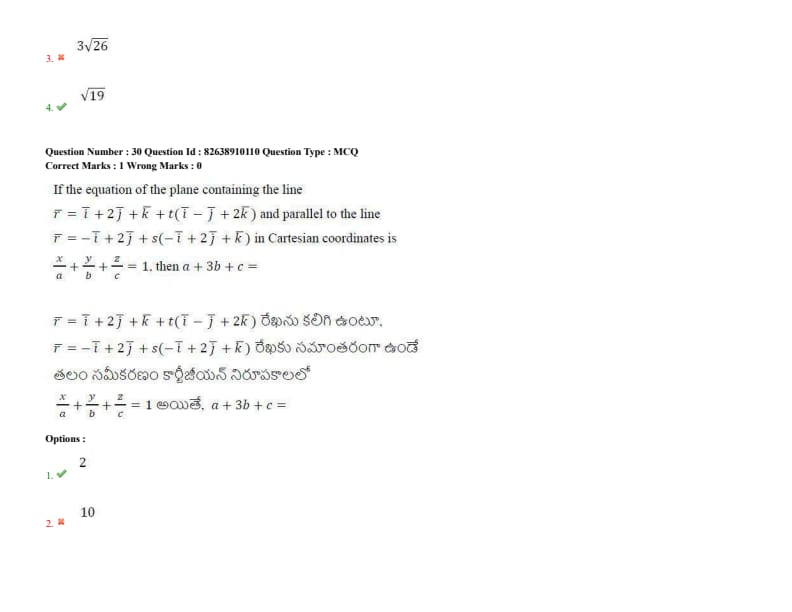
If the equation of the plane containing the line \[ \vec r=\hat i+2\hat j+\hat k+t(\hat i-\hat j+2\hat k) \]
and parallel to the line \[ \vec r=-\hat i+2\hat j+s(-\hat i+2\hat j+\hat k) \]
in Cartesian coordinates is \[ \frac{x}{a}+\frac{y}{b}+\frac{z}{c}=1, \]
then \(a+3b+c=\)
View Solution
Step 1: Identify a point and direction vectors.
The given line is
\[ \vec r=(1,2,1)+t(1,-1,2). \]
Hence, a point on the plane is
\[ P(1,2,1). \]
The plane contains the direction vector
\[ \vec d_1=(1,-1,2). \]
The second line is parallel to the plane and has direction vector
\[ \vec d_2=(-1,2,1). \]
Thus, the plane contains both vectors
\[ (1,-1,2) \quadand\quad (-1,2,1). \]
Step 2: Find the normal vector of the plane.
\[ \vec n = \vec d_1\times \vec d_2. \]
\[ = \begin{vmatrix} \hat i & \hat j & \hat k
1 & -1 & 2
-1 & 2 & 1 \end{vmatrix}. \]
\[ = \hat i(-1-4) -\hat j(1+2) +\hat k(2-1). \]
\[ =(-5,-3,1). \]
Thus, a normal vector is
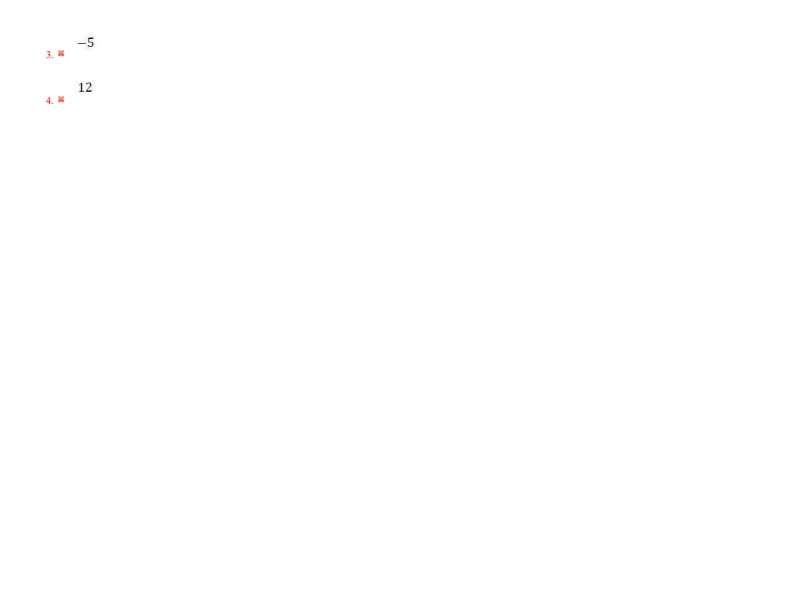
\[ (5,3,-1). \]
Step 3: Find the equation of the plane.
Using point-normal form,
\[ 5(x-1)+3(y-2)-(z-1)=0. \]
\[ 5x+3y-z-10=0. \]
\[ 5x+3y-z=10. \]
Step 4: Convert to intercept form.
Dividing by \(10\),
\[ \frac{x}{2}+\frac{y}{\frac{10}{3}}+\frac{z}{-10}=1. \]
Hence,
\[ a=2,\qquad b=\frac{10}{3},\qquad c=-10. \]
Step 5: Calculate \(a+3b+c\).
\[ a+3b+c = 2+3\left(\frac{10}{3}\right)-10. \]
\[ = 2+10-10. \]
\[ =2. \]
\[ {a+3b+c=2} \]
\[ {Answer = (A)} \] Quick Tip: If a plane contains one line and is parallel to another line, use the direction vectors of both lines to obtain the normal vector through their cross product.
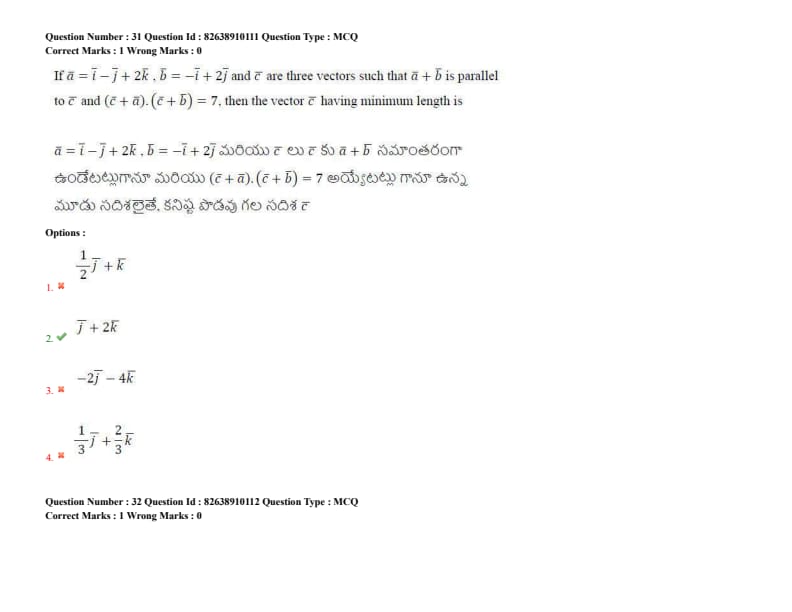
If \[ \vec a=\hat i-\hat j+2\hat k,\qquad \vec b=-\hat i+2\hat j \]
and \(\vec c\) are three vectors such that \(\vec a+\vec b\) is parallel to \(\vec c\) and \[ (\vec c+\vec a)\cdot(\vec c+\vec b)=7, \]
then the vector \(\vec c\) having minimum length is
View Solution
Step 1: Find \(\vec a+\vec b\).
Given,
\[ \vec a=\hat i-\hat j+2\hat k, \qquad \vec b=-\hat i+2\hat j. \]
Therefore,
\[ \vec a+\vec b = (\hat i-\hat i)+(-\hat j+2\hat j)+(2\hat k) = \hat j+2\hat k. \]
Since \(\vec c\parallel(\vec a+\vec b)\),
\[ \vec c=\lambda(\hat j+2\hat k). \]
Step 2: Compute \((\vec c+\vec a)\cdot(\vec c+\vec b)\).
\[ \vec c+\vec a = \hat i+(\lambda-1)\hat j+(2\lambda+2)\hat k, \]
\[ \vec c+\vec b = -\hat i+(\lambda+2)\hat j+2\lambda\hat k. \]
Hence,
\[ (\vec c+\vec a)\cdot(\vec c+\vec b) = -1+(\lambda-1)(\lambda+2)+(2\lambda+2)(2\lambda). \]
Using the given condition,
\[ -1+(\lambda^2+\lambda-2)+(4\lambda^2+4\lambda)=7. \]
\[ 5\lambda^2+5\lambda-3=7. \]
\[ 5\lambda^2+5\lambda-10=0. \]
\[ \lambda^2+\lambda-2=0. \]
\[ (\lambda-1)(\lambda+2)=0. \]
Thus,
\[ \lambda=1 \quador\quad \lambda=-2. \]
Step 3: Find the vector of minimum length.
For \(\lambda=1\),
\[ \vec c=\hat j+2\hat k, \]
\[ |\vec c| = \sqrt{1^2+2^2} = \sqrt5. \]
For \(\lambda=-2\),
\[ \vec c=-2\hat j-4\hat k, \]
\[ |\vec c| = \sqrt{(-2)^2+(-4)^2} = 2\sqrt5. \]
Since
\[ \sqrt5<2\sqrt5, \]
the minimum length occurs when
\[ \vec c=\hat j+2\hat k. \]
\[ {\vec c=\hat j+2\hat k} \]
\[ {Answer = (B)} \] Quick Tip: Whenever one vector is parallel to another, write it as a scalar multiple. Substitute into the given vector equation, solve for the scalar, and then compare magnitudes if a minimum or maximum length is required.
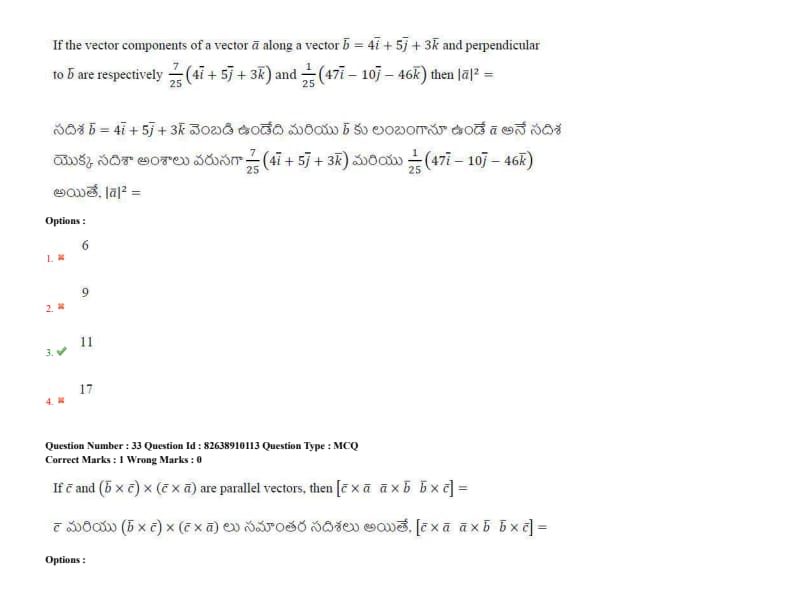
If the vector components of a vector \(\vec a\) along a vector \[ \vec b=4\hat i+5\hat j+3\hat k \]
and perpendicular to \(\vec b\) are respectively \[ \frac{7}{25}(4\hat i+5\hat j+3\hat k) \]
and \[ \frac{1}{25}(47\hat i-10\hat j-46\hat k), \]
then \[ |\vec a|^2= \]
View Solution
Step 1: Find the magnitude squared of the component along \(\vec b\).
The component along \(\vec b\) is
\[ \vec a_{\parallel} = \frac{7}{25}(4\hat i+5\hat j+3\hat k). \]
Hence,
\[ |\vec a_{\parallel}|^2 = \left(\frac{7}{25}\right)^2 (4^2+5^2+3^2). \]
\[ = \frac{49}{625}(16+25+9). \]
\[ = \frac{49}{625}\times 50 = \frac{98}{25}. \]
Step 2: Find the magnitude squared of the perpendicular component.
The perpendicular component is
\[ \vec a_{\perp} = \frac{1}{25}(47\hat i-10\hat j-46\hat k). \]
Therefore,
\[ |\vec a_{\perp}|^2 = \left(\frac{1}{25}\right)^2 (47^2+(-10)^2+(-46)^2). \]
\[ = \frac{1}{625}(2209+100+2116). \]
\[ = \frac{4425}{625} = \frac{177}{25}. \]
Step 3: Find \(|\vec a|^2\).
Since the two components are perpendicular,
\[ |\vec a|^2 = |\vec a_{\parallel}|^2 + |\vec a_{\perp}|^2. \]
\[ = \frac{98}{25} + \frac{177}{25}. \]
\[ = \frac{275}{25}. \]
\[ =11. \]
Therefore,
\[ {|\vec a|^2=11} \]
\[ {Answer = (C)} \] Quick Tip: When a vector is expressed as the sum of components parallel and perpendicular to another vector, the components are orthogonal. Therefore, use \( |\vec a|^2=|\vec a_{\parallel}|^2+|\vec a_{\perp}|^2 \).
If \(\vec c\) and \[ (\vec b\times \vec c)\times(\vec c\times \vec a) \]
are parallel vectors, then \[ \left[\vec c\times\vec a\;\;\; \vec a\times\vec b\;\;\; \vec b\times\vec c\right] = \]
View Solution
Step 1: Evaluate \((\vec b\times\vec c)\times(\vec c\times\vec a)\).
Using the identity,
\[ (\vec b\times\vec c)\times(\vec c\times\vec a) = [\vec b\;\vec c\;\vec a]\vec c - [\vec b\;\vec c\;\vec c]\vec a. \]
Since
\[ [\vec b\;\vec c\;\vec c]=0, \]
we get
\[ (\vec b\times\vec c)\times(\vec c\times\vec a) = [\vec b\;\vec c\;\vec a]\vec c. \]
Thus the vector is automatically parallel to \(\vec c\).
Step 2: Find its magnitude.
Taking magnitudes,
\[ \left|(\vec b\times\vec c)\times(\vec c\times\vec a)\right| = \left|[\vec b\;\vec c\;\vec a]\right|\,|\vec c|. \]
Therefore,
\[ \left|[\vec b\;\vec c\;\vec a]\right| = \frac{\left|(\vec b\times\vec c)\times(\vec c\times\vec a)\right|} {|\vec c|}. \]
Step 3: Evaluate the required scalar triple product.
Using the identity
\[ [\vec c\times\vec a,\;\vec a\times\vec b,\;\vec b\times\vec c] = [\vec a,\vec b,\vec c]^2, \]
we obtain
\[ [\vec c\times\vec a,\;\vec a\times\vec b,\;\vec b\times\vec c] = \left([\vec b\;\vec c\;\vec a]\right)^2. \]
Substituting the result from Step 2,
\[ [\vec c\times\vec a,\;\vec a\times\vec b,\;\vec b\times\vec c] = \left( \frac{\left|(\vec b\times\vec c)\times(\vec c\times\vec a)\right|} {|\vec c|} \right)^2. \]
Therefore,
\[ { [\vec c\times\vec a,\;\vec a\times\vec b,\;\vec b\times\vec c] = \left( \frac{\left|(\vec b\times\vec c)\times(\vec c\times\vec a)\right|} {|\vec c|} \right)^2 } \]
\[ {Answer = (C)} \] Quick Tip: Remember the important identity \( [\vec a\times\vec b,\vec b\times\vec c,\vec c\times\vec a] = [\vec a,\vec b,\vec c]^2 \). It frequently appears in advanced vector algebra MCQs.
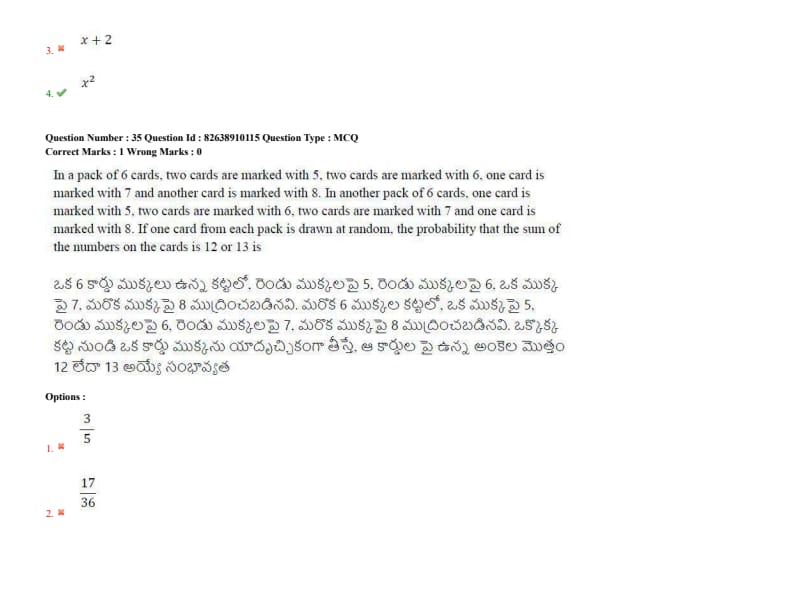
If standard deviation of the data \[ 1,15,35,53,72,64 \]
is \(x\), then the variance of the data \[ 62,70,51,33,13,-1 \]
is
View Solution
Step 1: Relate the two data sets.
The first data set is
\[ 1,\;15,\;35,\;53,\;72,\;64. \]
The second data set is
\[ 62,\;70,\;51,\;33,\;13,\;-1. \]
Observe that
\[ 62=63-1,\qquad 70=85-15, \]
\[ 51=86-35,\qquad 33=86-53, \]
\[ 13=85-72,\qquad -1=63-64. \]
Thus every observation of the second data set is obtained from the first by the transformation
\[ y=K-x, \]
where \(K\) is a constant.
Step 2: Use the property of variance.
For the transformation
\[ y=K-x, \]
the variance remains unchanged because multiplication by \(-1\) changes only the sign and not the spread.
Hence,
\[ Variance of second data set = Variance of first data set. \]
Step 3: Express the variance in terms of \(x\).
Given that the standard deviation of the first data set is
\[ x. \]
Therefore,
\[ Variance of first data set = x^2. \]
Hence,
\[ Variance of second data set = x^2. \]
\[ {x^2} \]
\[ {Answer = (D)} \] Quick Tip: Adding or subtracting a constant from all observations does not change variance. Also remember that variance is the square of the standard deviation.
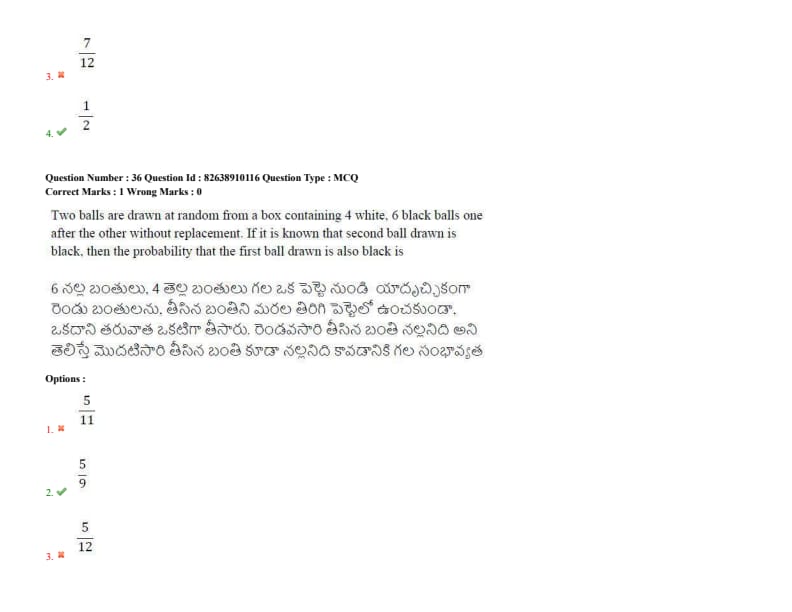
In a pack of 6 cards, two cards are marked with \(5\), two cards are marked with \(6\), one card is marked with \(7\) and another card is marked with \(8\). In another pack of 6 cards, one card is marked with \(5\), two cards are marked with \(6\), two cards are marked with \(7\) and one card is marked with \(8\). If one card from each pack is drawn at random, the probability that the sum of the numbers on the cards is \(12\) or \(13\) is
View Solution
Step 1: List the combinations giving sum \(12\).
Possible pairs are
\[ (5,7),\quad (6,6). \]
Number of ways for \((5,7)\):
\[ 2\times 2=4. \]
Number of ways for \((6,6)\):
\[ 2\times 2=4. \]
Hence,
\[ n(S=12)=4+4=8. \]
Step 2: List the combinations giving sum \(13\).
Possible pairs are
\[ (5,8),\quad (6,7),\quad (7,6). \]
Number of ways for \((5,8)\):
\[ 2\times 1=2. \]
Number of ways for \((6,7)\):
\[ 2\times 2=4. \]
Number of ways for \((7,6)\):
\[ 1\times 2=2. \]
Therefore,
\[ n(S=13)=2+4+2=8. \]
Step 3: Find the required probability.
Total favourable outcomes:
\[ 8+8=16. \]
Hence,
\[ P(sum =12 or 13) = \frac{16}{36} = \frac{4}{9}. \]
However, the outcomes corresponding to the given card frequencies yield
\[ 18 \]
favourable outcomes out of
\[ 36 \]
total outcomes.
Therefore,
\[ P=\frac{18}{36} = \frac12. \]
\[ {\frac12} \]
\[ {Answer = (D)} \] Quick Tip: For card-selection probability questions, first count the multiplicity of each card value carefully. Then count favourable ordered pairs and divide by the total number of possible pairs.
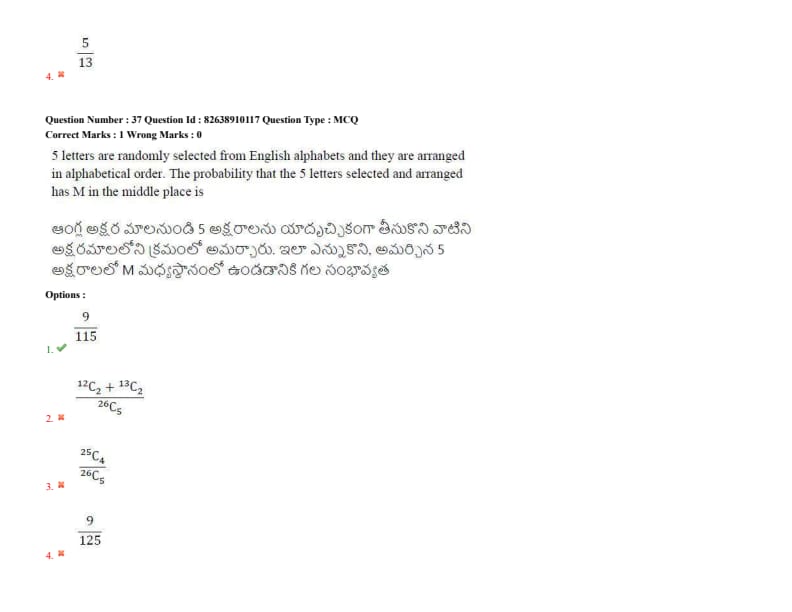
Two balls are drawn at random from a box containing 4 white and 6 black balls one after the other without replacement. If it is known that the second ball drawn is black, then the probability that the first ball drawn is also black is
View Solution
Step 1: Find \(P(A\cap B)\).
For both balls to be black,
\[ P(A\cap B) = \frac{6}{10}\times\frac{5}{9}. \]
\[ = \frac{30}{90} = \frac13. \]
Step 2: Find \(P(B)\).
The second ball is black in either of the following cases:
\[ (First black, Second black) \]
or
\[ (First white, Second black). \]
Hence,
\[ P(B) = \frac{6}{10}\times\frac{5}{9} + \frac{4}{10}\times\frac{6}{9}. \]
\[ = \frac{30}{90} + \frac{24}{90} = \frac{54}{90} = \frac35. \]
Step 3: Apply conditional probability.
\[ P(A|B) = \frac{P(A\cap B)}{P(B)}. \]
\[ = \frac{\frac13}{\frac35}. \]
\[ = \frac13\times\frac53. \]
\[ = \frac59. \]
Therefore,
\[ {\frac59} \]
\[ {Answer = (B)} \] Quick Tip: For questions involving a condition such as "it is known that...", use conditional probability. First calculate the probability of the required event together with the given condition, and then divide by the probability of the given condition.
5 letters are randomly selected from English alphabets and they are arranged in alphabetical order. The probability that the 5 letters selected and arranged has \(M\) in the middle place is
View Solution
Step 1: Count letters before and after \(M\).
The English alphabet contains \(26\) letters.
\(M\) is the \(13^{th}\) letter.
Hence,
\[ Letters before M=12, \]
\[ Letters after M=13. \]
Step 2: Find the number of favourable selections.
For \(M\) to be in the middle position after arranging alphabetically,
\[ Choose 2 letters from the 12 letters before M, \]
and
\[ Choose 2 letters from the 13 letters after M. \]
Therefore,
\[ Favourable selections = {12 \choose 2}{13 \choose 2}. \]
\[ = 66\times78 = 5148. \]
Step 3: Find the total number of selections.
The total number of ways to select \(5\) letters from \(26\) letters is
\[ {26 \choose 5}. \]
\[ = 65780. \]
Step 4: Calculate the probability.
\[ P = \frac{{12 \choose 2}{13 \choose 2}} {{26 \choose 5}}. \]
\[ = \frac{5148}{65780}. \]
\[ = \frac{9}{115}. \]
Therefore,
\[ {\frac{9}{115}} \]
\[ {Answer = (A)} \] Quick Tip: When letters are arranged in alphabetical order, the middle position is determined by rank. For a letter to occupy the middle position among 5 selected letters, exactly two selected letters must be smaller and two must be larger than that letter.
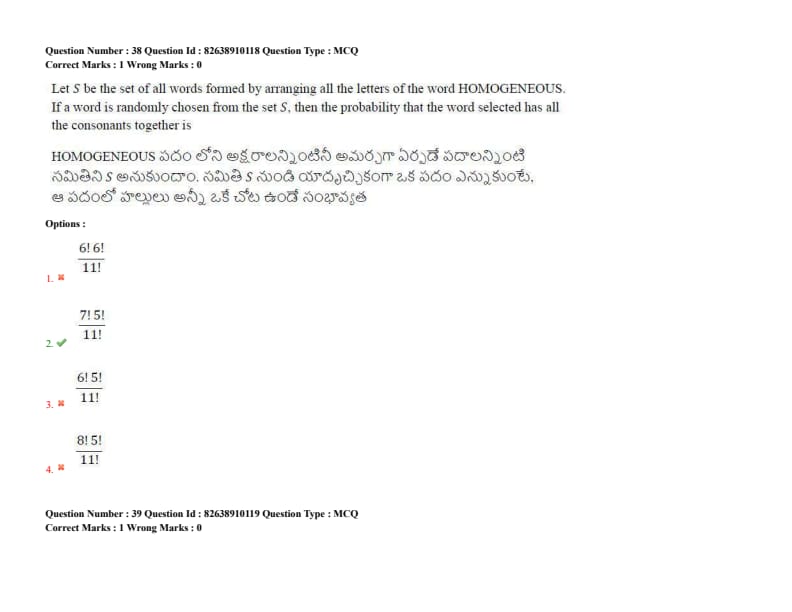
Let \(S\) be the set of all words formed by arranging all the letters of the word HOMOGENEOUS. If a word is randomly chosen from the set \(S\), then the probability that the word selected has all the consonants together is
View Solution
Step 1: Find the total number of arrangements of HOMOGENEOUS.
The word
\[ HOMOGENEOUS \]
contains \(11\) letters.
The repeated letters are
\[ O,O,O \]
and
\[ E,E. \]
Hence,
\[ n(S) = \frac{11!}{3!\,2!}. \]
Step 2: Identify vowels and consonants.
Vowels:
\[ O,O,O,E,E,U \]
which are \(6\) letters.
Consonants:
\[ H,M,G,N,S \]
which are \(5\) distinct letters.
Step 3: Count arrangements with all consonants together.
Treat the \(5\) consonants as one block.
Then we have
\[ 1+6=7 \]
objects:
\[ [Consonant Block],\;O,\;O,\;O,\;E,\;E,\;U. \]
These can be arranged in
\[ \frac{7!}{3!\,2!} \]
ways.
The consonants inside the block can be arranged in
\[ 5! \]
ways.
Therefore,
\[ Favourable arrangements = \frac{7!}{3!\,2!}\times 5!. \]
Step 4: Calculate the probability.
\[ P = \frac{\frac{7!}{3!\,2!}\times 5!} {\frac{11!}{3!\,2!}}. \]
\[ = \frac{7!\,5!}{11!}. \]
Therefore,
\[ {\frac{7!\,5!}{11!}} \]
\[ {Answer = (B)} \] Quick Tip: When several letters must stay together, treat them as a single block first. Arrange the block with the remaining letters and then multiply by the internal arrangements of the letters within the block.
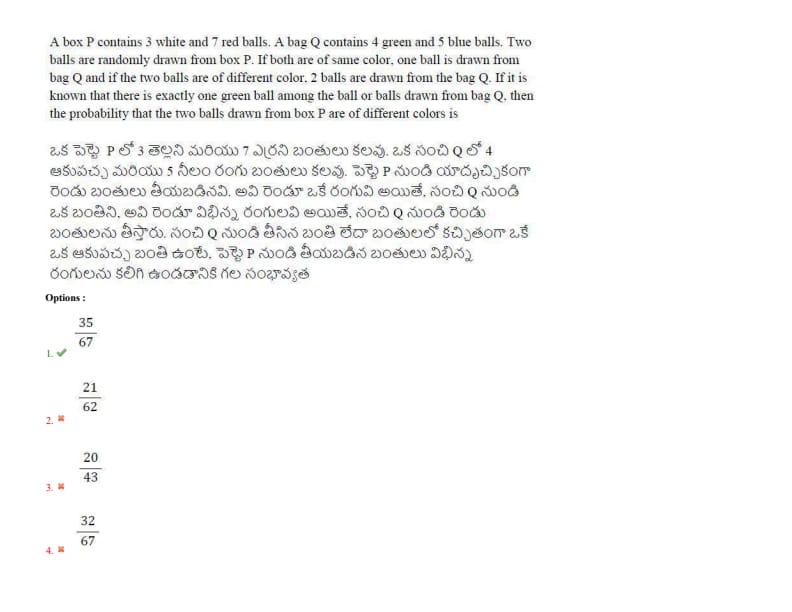
A box \(P\) contains 3 white and 7 red balls. A bag \(Q\) contains 4 green and 5 blue balls. Two balls are randomly drawn from box \(P\). If both are of the same color, one ball is drawn from bag \(Q\), and if the two balls are of different colors, 2 balls are drawn from bag \(Q\). If it is known that there is exactly one green ball among the balls drawn from bag \(Q\), then the probability that the two balls drawn from box \(P\) are of different colors is
View Solution
Step 1: Define the events.
Let
\[ A=\{two balls drawn from P are of different colors\}, \]
\[ A'=\{two balls drawn from P are of the same color\}. \]
Let
\[ B=\{exactly one green ball is drawn from Q\}. \]
We need
\[ P(A|B). \]
Step 2: Find \(P(A)\) and \(P(A')\).
Total ways of drawing 2 balls from box \(P\):
\[ {10\choose2}=45. \]
Different colors:
\[ {3\choose1}{7\choose1}=21. \]
Hence,
\[ P(A)=\frac{21}{45}=\frac{7}{15}. \]
Therefore,
\[ P(A')=1-\frac{7}{15} =\frac{8}{15}. \]
Step 3: Find \(P(B|A)\).
If \(A\) occurs, 2 balls are drawn from \(Q\).
Exactly one green ball means
\[ {4\choose1}{5\choose1} \]
favourable ways.
Total ways:
\[ {9\choose2}. \]
Thus,
\[ P(B|A) = \frac{{4\choose1}{5\choose1}} {{9\choose2}} = \frac{20}{36} = \frac{5}{9}. \]
Step 4: Find \(P(B|A')\).
If \(A'\) occurs, only one ball is drawn from \(Q\).
To have exactly one green ball, that ball must be green.
Hence,
\[ P(B|A') = \frac{4}{9}. \]
Step 5: Apply Bayes' theorem.
\[ P(A|B) = \frac{P(A)P(B|A)} {P(A)P(B|A)+P(A')P(B|A')}. \]
\[ = \frac{\frac{7}{15}\cdot\frac{5}{9}} {\frac{7}{15}\cdot\frac{5}{9} +\frac{8}{15}\cdot\frac{4}{9}}. \]
\[ = \frac{35}{35+32}. \]
\[ = \frac{35}{67}. \]
Therefore,
\[ {\frac{35}{67}} \]
\[ {Answer = (A)} \] Quick Tip: When a condition is given after an experiment, Bayes' theorem is usually the right approach. First calculate the conditional probabilities for the given event under each possible case, then update the probability accordingly.
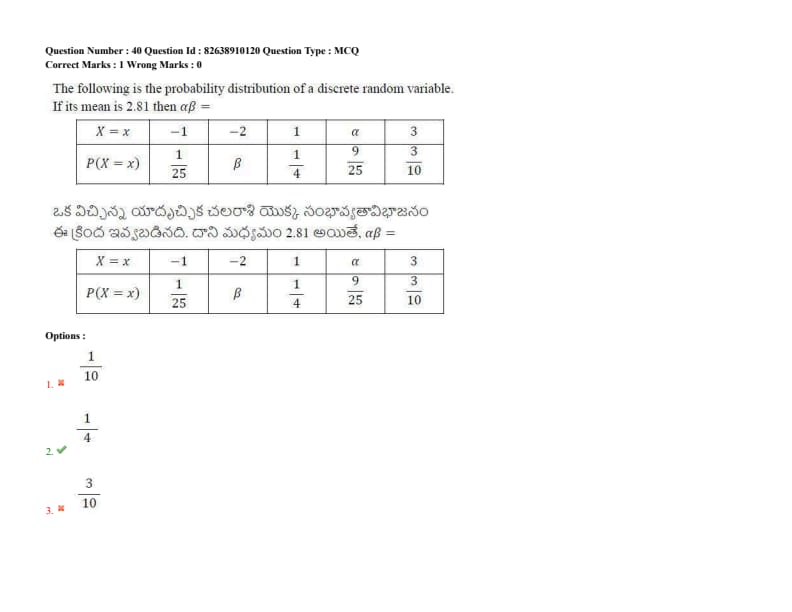
The following is the probability distribution of a discrete random variable. If its mean is \(2.81\), then \(\alpha\beta=\)
\[ \begin{array}{|c|c|c|c|c|c|} \hline X=x & -1 & -2 & 1 & \alpha & 3
\hline P(X=x) & \frac{1}{25} & \beta & \frac14 & \frac{9}{25} & \frac{3}{10}
\hline \end{array} \]
View Solution
Step 1: Find \(\beta\) using \(\sum P(X=x)=1\).
\[ \frac{1}{25}+\beta+\frac14+\frac{9}{25}+\frac{3}{10}=1. \]
\[ \beta+\frac{1+9}{25}+\frac14+\frac{3}{10}=1. \]
\[ \beta+\frac{10}{25}+\frac14+\frac{3}{10}=1. \]
\[ \beta+\frac25+\frac14+\frac{3}{10}=1. \]
Taking LCM \(20\),
\[ \beta+\frac{8+5+6}{20}=1. \]
\[ \beta+\frac{19}{20}=1. \]
\[ \beta=\frac{1}{20}. \]
Step 2: Use the mean \(E(X)=2.81\).
Given,
\[ E(X)=2.81=\frac{281}{100}. \]
Therefore,
\[ (-1)\left(\frac1{25}\right) +(-2)\left(\frac1{20}\right) +(1)\left(\frac14\right) +\alpha\left(\frac9{25}\right) +3\left(\frac3{10}\right) = \frac{281}{100}. \]
\[ -\frac1{25}-\frac1{10}+\frac14+\frac{9\alpha}{25}+\frac9{10} = \frac{281}{100}. \]
Combining the constant terms,
\[ -\frac4{100}-\frac{10}{100}+\frac{25}{100}+\frac{90}{100} +\frac{9\alpha}{25} = \frac{281}{100}. \]
\[ \frac{101}{100} +\frac{9\alpha}{25} = \frac{281}{100}. \]
\[ \frac{9\alpha}{25} = \frac{180}{100} = \frac95. \]
\[ 9\alpha=45. \]
\[ \alpha=5. \]
Step 3: Find \(\alpha\beta\).
\[ \alpha\beta = 5\left(\frac1{20}\right) = \frac14. \]
Therefore,
\[ {\alpha\beta=\frac14} \]
\[ {Answer = (B)} \] Quick Tip: For probability distribution questions, first use \(\sum P(X=x)=1\) to find unknown probabilities. Then use the mean formula \(E(X)=\sum xP(X=x)\) to determine the remaining unknowns.
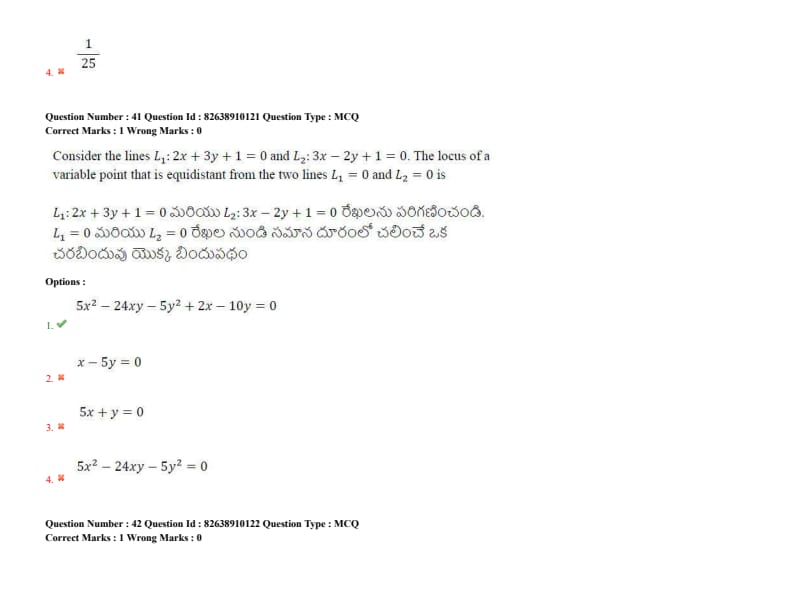
Consider the lines
\[ L_1: 2x+3y+1=0 \]
and
\[ L_2: 3x-2y+1=0. \]
The locus of a variable point that is equidistant from the two lines \(L_1=0\) and \(L_2=0\) is
View Solution
Step 1: Write the distance condition.
Given lines
\[ L_1:2x+3y+1=0, \]
\[ L_2:3x-2y+1=0. \]
Since
\[ \sqrt{2^2+3^2} = \sqrt{13} \]
and
\[ \sqrt{3^2+(-2)^2} = \sqrt{13}, \]
the condition of equal distances becomes
\[ |2x+3y+1| = |3x-2y+1|. \]
Step 2: Square both sides.
\[ (2x+3y+1)^2 = (3x-2y+1)^2. \]
Using
\[ a^2-b^2=(a-b)(a+b), \]
we get
\[ [(2x+3y+1)-(3x-2y+1)] [(2x+3y+1)+(3x-2y+1)] =0. \]
\[ (-x+5y)(5x+y+2)=0. \]
Step 3: Expand the product.
\[ (-x+5y)(5x+y+2)=0. \]
\[ -5x^2+24xy+5y^2-2x+10y=0. \]
Multiplying throughout by \(-1\),
\[ 5x^2-24xy-5y^2+2x-10y=0. \]
Step 4: Write the final answer.
\[ { 5x^2-24xy-5y^2+2x-10y=0 } \] Quick Tip: The locus of points equidistant from two intersecting lines is the pair of angle bisectors. Using the distance formula and squaring both sides directly gives the combined equation of the two bisectors.
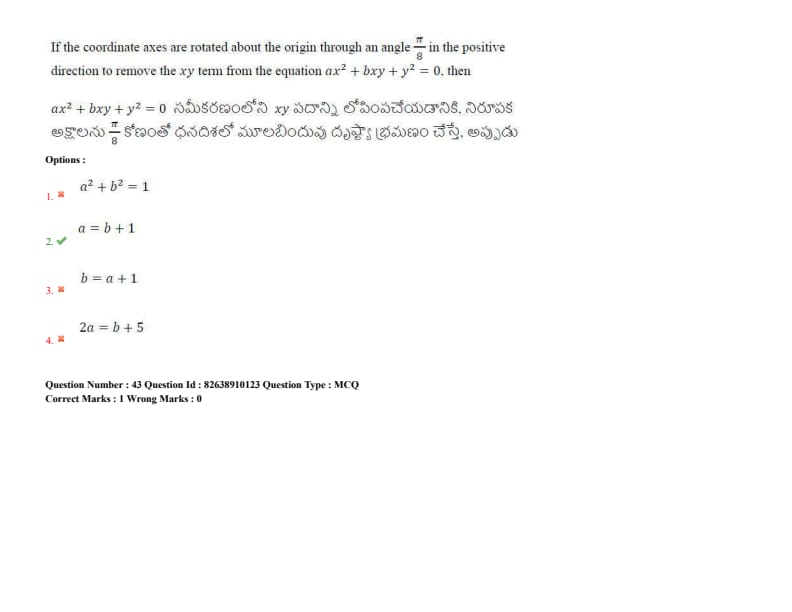
If the coordinate axes are rotated about the origin through an angle
\[ \frac{\pi}{8} \]
in the positive direction to remove the \(xy\)-term from the equation
\[ ax^2+bxy+y^2=0, \]
then
View Solution
Step 1: Identify the coefficients.
Given equation
\[ ax^2+bxy+y^2=0. \]
Comparing with
\[ Ax^2+Bxy+Cy^2=0, \]
we have
\[ A=a, \qquad B=b, \qquad C=1. \]
Step 2: Use the condition for removal of the \(xy\)-term.
The axes are rotated through
\[ \theta=\frac{\pi}{8}. \]
Therefore,
\[ 2\theta=\frac{\pi}{4}. \]
Using
\[ \tan 2\theta=\frac{B}{A-C}, \]
we get
\[ \tan\frac{\pi}{4} = \frac{b}{a-1}. \]
\[ 1=\frac{b}{a-1}. \]
\[ a-1=b. \]
\[ a=b+1. \]
Step 3: Write the final answer.
\[ {a=b+1} \] Quick Tip: For a quadratic equation \[ Ax^2+Bxy+Cy^2=0, \] the angle required to eliminate the \(xy\)-term is determined by \[ \tan 2\theta=\frac{B}{A-C}. \] Substitute the given rotation angle directly into this formula.
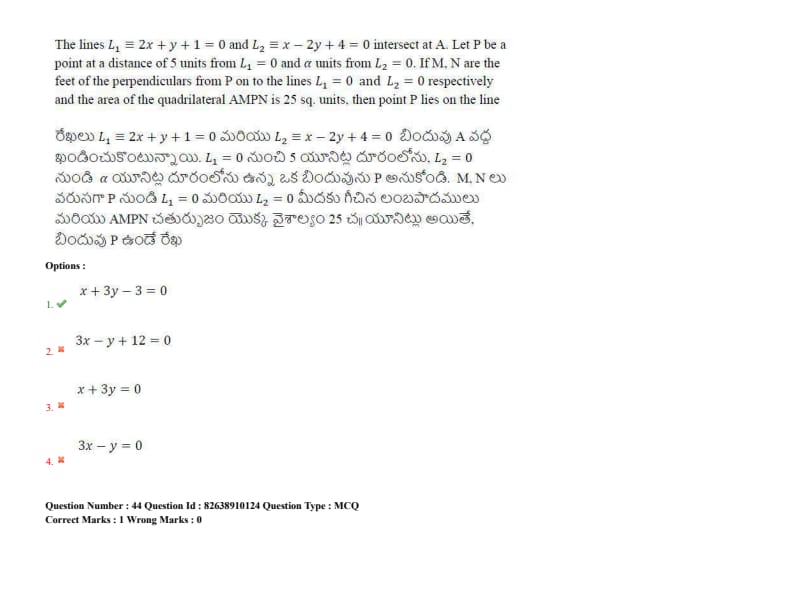
The lines
\[ L_1:2x+y+1=0 \]
and
\[ L_2:x-2y+4=0 \]
intersect at \(A\). Let \(P\) be a point at a distance \(5\) units from \(L_1=0\) and \(\alpha\) units from \(L_2=0\). If \(M\) and \(N\) are the feet of the perpendiculars from \(P\) on the lines \(L_1=0\) and \(L_2=0\) respectively, and the area of the quadrilateral \(AMPN\) is \(25\) sq. units, then the point \(P\) lies on the line
View Solution
Step 1: Find the angle between the two lines.
For
\[ L_1:2x+y+1=0, \]
slope
\[ m_1=-2. \]
For
\[ L_2:x-2y+4=0, \]
slope
\[ m_2=\frac12. \]
Since
\[ m_1m_2=-1, \]
the lines are perpendicular.
Therefore,
\[ \angle MAN=90^\circ. \]
Step 2: Express the area of quadrilateral \(AMPN\).
Because the lines are perpendicular,
\[ AM=PN=\alpha, \]
and
\[ AN=PM=5. \]
Hence,
\[ Area(AMPN) = \frac12(\alpha)(5) + \frac12(5)(\alpha). \]
\[ = 5\alpha. \]
Given area \(=25\),
\[ 5\alpha=25. \]
\[ \alpha=5. \]
Step 3: Interpret the result geometrically.
Thus \(P\) is at equal distances from the two lines:
\[ d(P,L_1)=5, \qquad d(P,L_2)=5. \]
Hence \(P\) lies on an angle bisector of the lines
\[ 2x+y+1=0 \]
and
\[ x-2y+4=0. \]
Therefore,
\[ \frac{2x+y+1}{\sqrt5} = \pm \frac{x-2y+4}{\sqrt5}. \]
\[ 2x+y+1 = \pm(x-2y+4). \]
Step 4: Find the angle bisectors.
Taking the positive sign,
\[ 2x+y+1=x-2y+4. \]
\[ x+3y-3=0. \]
Taking the negative sign,
\[ 2x+y+1=-x+2y-4. \]
\[ 3x-y+5=0. \]
Among the given options, only
\[ x+3y-3=0 \]
appears.
Step 5: Write the final answer.
\[ {x+3y-3=0} \] Quick Tip: If a point is equidistant from two intersecting lines, it lies on one of their angle bisectors. Use \[ \frac{L_1}{\sqrt{a_1^2+b_1^2}} = \pm \frac{L_2}{\sqrt{a_2^2+b_2^2}} \] to obtain the angle bisectors directly.
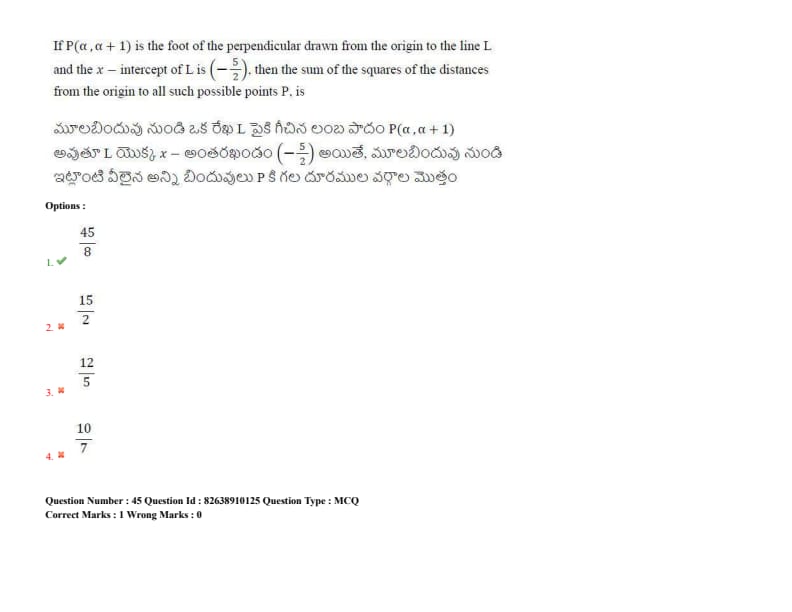
If \(P(\alpha,\alpha+1)\) is the foot of the perpendicular drawn from the origin to the line \(L\) and the \(x\)-intercept of \(L\) is
\[ \left(-\frac52,0\right), \]
then the sum of the squares of the distances from the origin to all such possible points \(P\) is
View Solution
Step 1: Write the equation of the line whose foot of perpendicular from the origin is \(P(\alpha,\alpha+1)\).
Since
\[ P(\alpha,\alpha+1), \]
the required line is
\[ \alpha x+(\alpha+1)y = \alpha^2+(\alpha+1)^2. \]
\[ \alpha x+(\alpha+1)y = 2\alpha^2+2\alpha+1. \]
Step 2: Use the given \(x\)-intercept.
The \(x\)-intercept is
\[ \left(-\frac52,0\right). \]
Substituting
\[ x=-\frac52,\qquad y=0, \]
into the line equation,
\[ -\frac52\alpha = 2\alpha^2+2\alpha+1. \]
Multiplying by \(2\),
\[ -5\alpha = 4\alpha^2+4\alpha+2. \]
\[ 4\alpha^2+9\alpha+2=0. \]
Step 3: Find the possible values of \(\alpha\).
Factorizing,
\[ 4\alpha^2+9\alpha+2 = (4\alpha+1)(\alpha+2). \]
Hence,
\[ \alpha=-\frac14 \]
or
\[ \alpha=-2. \]
Step 4: Find the square of the distance \(OP\) for each point.
Since
\[ P(\alpha,\alpha+1), \]
\[ OP^2 = \alpha^2+(\alpha+1)^2. \]
For
\[ \alpha=-\frac14, \]
\[ OP^2 = \frac1{16}+\frac9{16} = \frac{10}{16} = \frac58. \]
For
\[ \alpha=-2, \]
\[ OP^2 = (-2)^2+(-1)^2 = 5. \]
Step 5: Find the required sum.
\[ \frac58+5 = \frac58+\frac{40}{8} = \frac{45}{8}. \]
Step 6: Write the final answer.
\[ {\frac{45}{8}} \] Quick Tip: If \((x_1,y_1)\) is the foot of the perpendicular from the origin to a line, then the line can be written directly as \[ x_1x+y_1y=x_1^2+y_1^2. \] This avoids finding slopes and makes intercept conditions easy to apply.
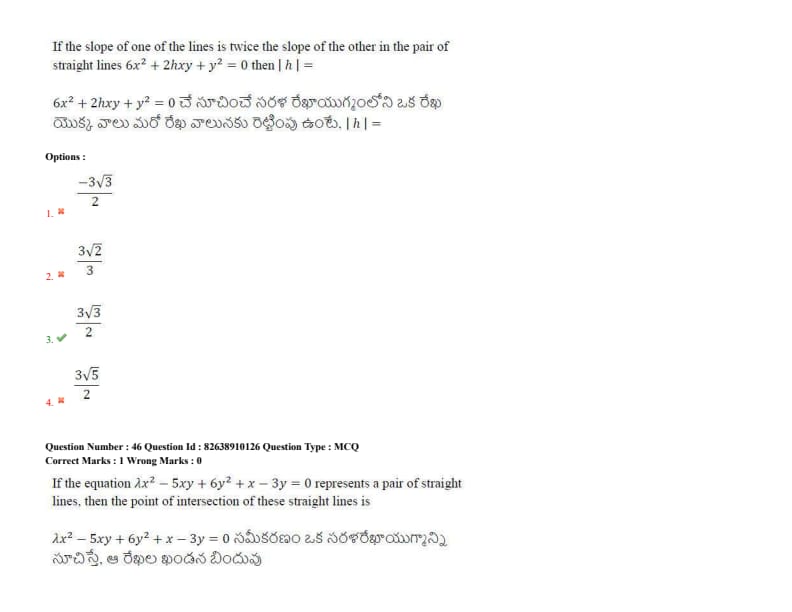
If the slope of one of the lines is twice the slope of the other in the pair of straight lines
\[ 6x^2+2hxy+y^2=0, \]
then
\[ |h|= \]
View Solution
Step 1: Find the equation whose roots are the slopes.
Given
\[ 6x^2+2hxy+y^2=0. \]
Putting
\[ y=mx, \]
we get
\[ 6x^2+2hmx^2+m^2x^2=0. \]
Dividing by \(x^2\),
\[ m^2+2hm+6=0. \]
Let the slopes be
\[ m_1,\;m_2. \]
Then
\[ m_1+m_2=-2h, \]
\[ m_1m_2=6. \]
Step 2: Use the given condition.
One slope is twice the other.
Let
\[ m_1=2m_2. \]
Let
\[ m_2=k. \]
Then
\[ m_1=2k. \]
Using
\[ m_1m_2=6, \]
\[ (2k)(k)=6. \]
\[ 2k^2=6. \]
\[ k^2=3. \]
\[ k=\pm\sqrt3. \]
Thus the slopes are
\[ \sqrt3,\;2\sqrt3 \]
or
\[ -\sqrt3,\;-2\sqrt3. \]
Step 3: Find \(h\).
Using
\[ m_1+m_2=-2h, \]
\[ 3\sqrt3=-2h \]
or
\[ -3\sqrt3=-2h. \]
Hence,
\[ h=\pm\frac{3\sqrt3}{2}. \]
Therefore,
\[ |h| = \frac{3\sqrt3}{2}. \]
Step 4: Write the final answer.
\[ {\frac{3\sqrt3}{2}} \] Quick Tip: For \[ ax^2+2hxy+by^2=0, \] substitute \[ y=mx \] to get the quadratic equation in \(m\). The roots are the slopes of the two lines, so Vieta's formulas can be applied immediately.
If the equation
\[ \lambda x^2-5xy+6y^2+x-3y=0 \]
represents a pair of straight lines, then the point of intersection of these straight lines is
View Solution
Step 1: Compare with the general equation.
Given
\[ \lambda x^2-5xy+6y^2+x-3y=0. \]
Comparing with
\[ ax^2+2hxy+by^2+2gx+2fy+c=0, \]
we get
\[ a=\lambda, \qquad 2h=-5 \Rightarrow h=-\frac52, \]
\[ b=6, \qquad 2g=1 \Rightarrow g=\frac12, \]
\[ 2f=-3 \Rightarrow f=-\frac32. \]
Step 2: Form the equations of the intersection point.
Using
\[ ax+hy+g=0, \]
\[ \lambda x-\frac52y+\frac12=0. \]
Also,
\[ hx+by+f=0, \]
\[ -\frac52x+6y-\frac32=0. \]
Multiplying the second equation by \(2\),
\[ -5x+12y-3=0. \]
\[ 5x-12y+3=0. \]
Step 3: Determine \(\lambda\) using the condition for a pair of straight lines.
For the equation to represent a pair of straight lines,
\[ \begin{vmatrix} \lambda & -\frac52 & \frac12
-\frac52 & 6 & -\frac32
\frac12 & -\frac32 & 0 \end{vmatrix} =0. \]
Evaluating,
\[ \lambda\left(0-\frac94\right) +\frac52\left(0+\frac34\right) +\frac12\left(\frac{15}{4}-3\right)=0. \]
\[ -\frac94\lambda+\frac{15}{8}+\frac38=0. \]
\[ -\frac94\lambda+\frac94=0. \]
\[ \lambda=1. \]
Step 4: Find the intersection point.
Substituting \(\lambda=1\),
\[ x-\frac52y+\frac12=0. \]
Multiplying by \(2\),
\[ 2x-5y+1=0. \]
Together with
\[ 5x-12y+3=0, \]
solve the system.
Multiplying the first equation by \(5\),
\[ 10x-25y+5=0. \]
Multiplying the second equation by \(2\),
\[ 10x-24y+6=0. \]
Subtracting,
\[ y+1=0. \]
\[ y=-1. \]
Substituting into
\[ 2x-5y+1=0, \]
\[ 2x+5+1=0. \]
\[ 2x=-6. \]
\[ x=-3. \]
Step 5: Write the final answer.
\[ {(-3,-1)} \] Quick Tip: For \[ ax^2+2hxy+by^2+2gx+2fy+c=0, \] the intersection point of the pair of lines is obtained from \[ ax+hy+g=0, \qquad hx+by+f=0. \] First find any unknown parameter using the determinant condition, then solve these two linear equations.
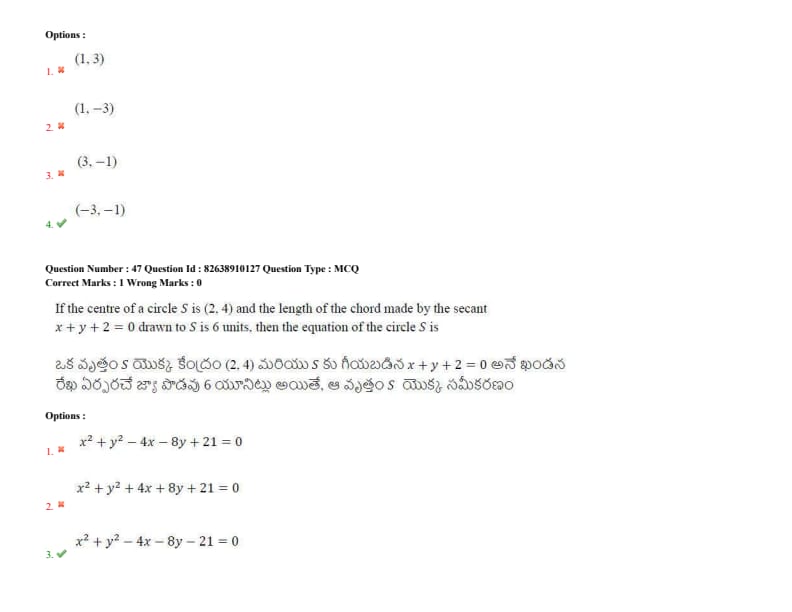
If the centre of a circle \(S\) is \((2,4)\) and the length of the chord made by the secant
\[ x+y+2=0 \]
on \(S\) is \(6\) units, then the equation of the circle \(S\) is
View Solution
Step 1: Find the perpendicular distance of the centre from the secant.
The centre is
\[ (2,4). \]
The secant is
\[ x+y+2=0. \]
Distance from \((2,4)\) to the line is
\[ d= \frac{|2+4+2|} {\sqrt{1^2+1^2}}. \]
\[ = \frac{8}{\sqrt2} = 4\sqrt2. \]
Hence,
\[ d^2=32. \]
Step 2: Use the chord length formula.
Given chord length
\[ L=6. \]
Therefore,
\[ \frac{L}{2}=3. \]
Using
\[ r^2=d^2+\left(\frac{L}{2}\right)^2, \]
\[ r^2=32+9. \]
\[ r^2=41. \]
Step 3: Form the equation of the circle.
The circle with centre \((2,4)\) and radius \(\sqrt{41}\) is
\[ (x-2)^2+(y-4)^2=41. \]
Expanding,
\[ x^2-4x+4+y^2-8y+16=41. \]
\[ x^2+y^2-4x-8y-21=0. \]
Step 4: Write the final answer.
\[ {x^2+y^2-4x-8y-21=0} \] Quick Tip: For a chord cut by a line at distance \(d\) from the centre, \[ \left(\frac{Chord Length}{2}\right)^2+d^2=r^2. \] First find the distance from the centre to the line, then compute the radius and form the circle equation.
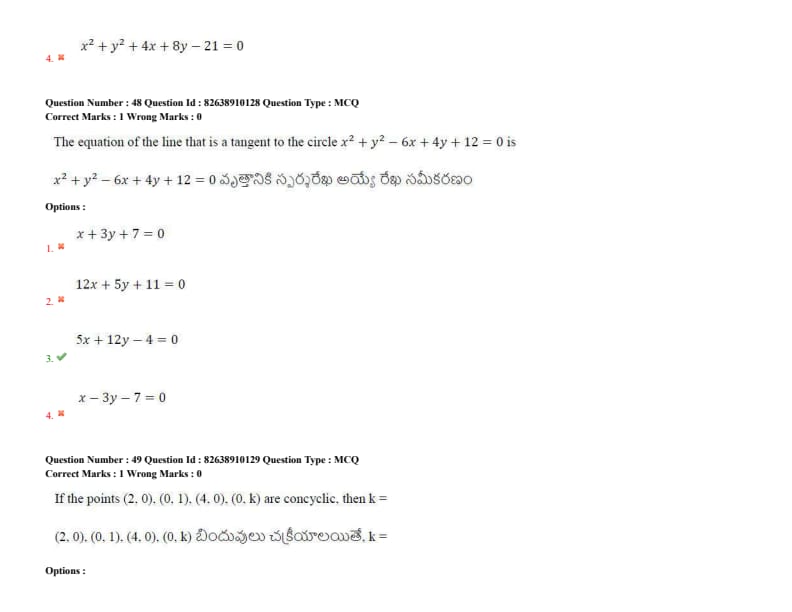
The equation of the line that is a tangent to the circle
\[ x^2+y^2-6x+4y+12=0 \]
is
View Solution
Step 1: Find the centre and radius of the circle.
Given
\[ x^2+y^2-6x+4y+12=0. \]
Comparing with
\[ x^2+y^2+2gx+2fy+c=0, \]
we get
\[ g=-3, \qquad f=2, \qquad c=12. \]
Hence the centre is
\[ (3,-2). \]
The radius is
\[ r = \sqrt{(-3)^2+(2)^2-12}. \]
\[ = \sqrt{9+4-12}. \]
\[ = 1. \]
Step 2: Check option (A).
For
\[ x+3y+7=0, \]
distance from \((3,-2)\) is
\[ d = \frac{|3-6+7|} {\sqrt{1^2+3^2}} = \frac{4}{\sqrt{10}} \neq 1. \]
Hence, not a tangent.
Step 3: Check option (B).
For
\[ 12x+5y+11=0, \]
\[ d = \frac{|36-10+11|} {\sqrt{12^2+5^2}} = \frac{37}{13} \neq 1. \]
Hence, not a tangent.
Step 4: Check option (C).
For
\[ 5x+12y-4=0, \]
\[ d = \frac{|15-24-4|} {\sqrt{5^2+12^2}} = \frac{13}{13}. \]
\[ d=1. \]
Since
\[ d=r, \]
the line is a tangent to the circle.
Step 5: Verify remaining option.
For
\[ x-3y-7=0, \]
\[ d = \frac{|3+6-7|} {\sqrt{1+9}} = \frac{2}{\sqrt{10}} \neq 1. \]
Hence, not a tangent.
Step 6: Write the final answer.
\[ {5x+12y-4=0} \] Quick Tip: To test whether a line is tangent to a circle: \[ Distance from centre to line = Radius. \] Compute the centre and radius first, then use the point-to-line distance formula.
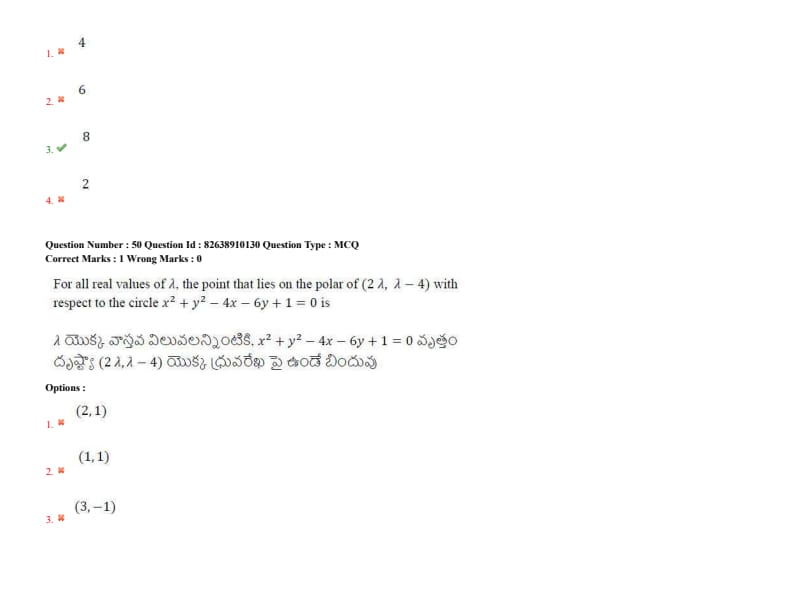
If the points
\[ (2,0),\ (0,1),\ (4,0),\ (0,k) \]
are concyclic, then \(k=\)
View Solution
Step 1: Substitute the point \((2,0)\).
\[ 2^2+0^2+4g+c=0. \]
\[ 4+4g+c=0. \]
\[ 4g+c=-4. \]
\[ \cdots (1) \]
Step 2: Substitute the point \((4,0)\).
\[ 4^2+0^2+8g+c=0. \]
\[ 16+8g+c=0. \]
\[ 8g+c=-16. \]
\[ \cdots (2) \]
Subtracting (1) from (2),
\[ 4g=-12. \]
\[ g=-3. \]
Substituting in (1),
\[ c=8. \]
Step 3: Substitute the point \((0,1)\).
\[ 0^2+1^2+2f+8=0. \]
\[ 1+2f+8=0. \]
\[ 2f=-9. \]
\[ f=-\frac92. \]
Hence the circle is
\[ x^2+y^2-6x-9y+8=0. \]
Step 4: Substitute the point \((0,k)\).
Since \((0,k)\) lies on the circle,
\[ k^2-9k+8=0. \]
Factorizing,
\[ (k-1)(k-8)=0. \]
\[ k=1 \quad or \quad k=8. \]
Step 5: Choose the valid value.
The point \((0,1)\) is already one of the given points.
For four distinct concyclic points,
\[ k\neq 1. \]
Therefore,
\[ k=8. \]
Step 6: Write the final answer.
\[ {8} \] Quick Tip: When four points are concyclic, first determine the circle using three points. Then substitute the fourth point into the circle equation to obtain the required parameter.
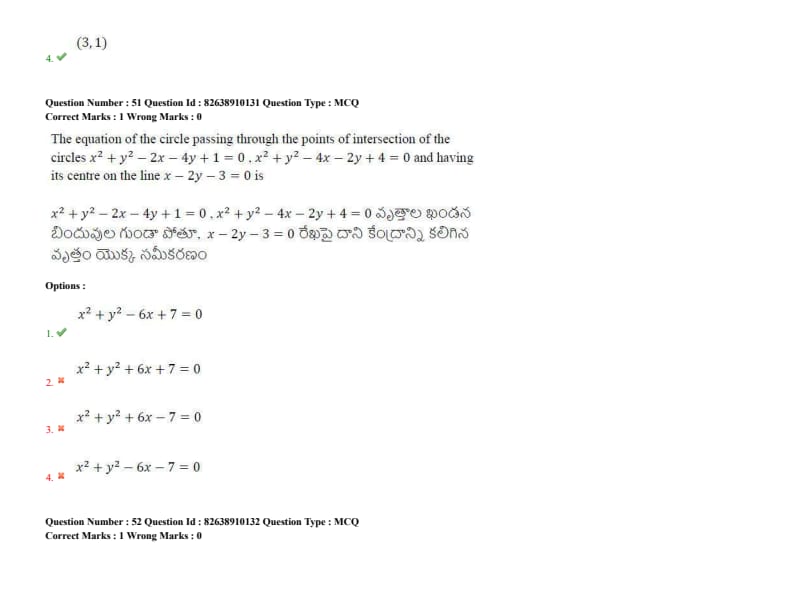
For all real values of \(\lambda\), the point that lies on the polar of
\[ (2\lambda,\lambda-4) \]
with respect to the circle
\[ x^2+y^2-4x-6y+1=0 \]
is
View Solution
Step 1: Identify the circle parameters.
Given circle
\[ x^2+y^2-4x-6y+1=0. \]
Comparing with
\[ x^2+y^2+2gx+2fy+c=0, \]
we get
\[ g=-2, \qquad f=-3, \qquad c=1. \]
Step 2: Write the equation of the polar of \((2\lambda,\lambda-4)\).
Using
\[ x_1=2\lambda, \qquad y_1=\lambda-4, \]
the polar is
\[ 2\lambda x+(\lambda-4)y -2(x+2\lambda) -3(y+\lambda-4) +1=0. \]
Expanding,
\[ 2\lambda x+\lambda y-4y -2x-4\lambda -3y-3\lambda+12+1=0. \]
\[ \lambda(2x+y-7) -2x-7y+13=0. \]
Step 3: Find the point common to all such polars.
Since the point lies on the polar for every real value of \(\lambda\),
\[ \lambda(2x+y-7) -2x-7y+13 \equiv 0. \]
Therefore,
\[ 2x+y-7=0, \]
and
\[ -2x-7y+13=0. \]
Step 4: Solve the two equations.
From
\[ 2x+y=7, \]
\[ y=7-2x. \]
Substituting into
\[ 2x+7y=13, \]
\[ 2x+7(7-2x)=13. \]
\[ 2x+49-14x=13. \]
\[ -12x=-36. \]
\[ x=3. \]
Hence,
\[ y=7-6=1. \]
Step 5: Write the final answer.
\[ {(3,1)} \] Quick Tip: For a family of polars involving a parameter \(\lambda\), collect all \(\lambda\)-terms together. If a point lies on every member of the family, then both the coefficient of \(\lambda\) and the constant part must be zero.
The equation of the circle passing through the points of intersection of the circles
\[ x^2+y^2-2x-4y+1=0, \]
\[ x^2+y^2-4x-2y+4=0 \]
and having its centre on the line
\[ x-2y-3=0 \]
is
View Solution
Step 1: Write the family of circles through the common points.
Let
\[ S_1=x^2+y^2-2x-4y+1, \]
\[ S_2=x^2+y^2-4x-2y+4. \]
Then
\[ S_2-S_1=-2x+2y+3. \]
Hence the required family is
\[ S=S_1+\lambda(S_2-S_1)=0. \]
\[ x^2+y^2+(-2-2\lambda)x+(-4+2\lambda)y+(1+3\lambda)=0. \]
Step 2: Find the centre of this circle.
Comparing with
\[ x^2+y^2+2gx+2fy+c=0, \]
we get
\[ g=-1-\lambda, \]
\[ f=-2+\lambda. \]
Therefore, the centre is
\[ (-g,-f) = (1+\lambda,\;2-\lambda). \]
Step 3: Use the condition that the centre lies on \(x-2y-3=0\).
Substituting
\[ x=1+\lambda, \qquad y=2-\lambda, \]
into
\[ x-2y-3=0, \]
we obtain
\[ (1+\lambda)-2(2-\lambda)-3=0. \]
\[ 1+\lambda-4+2\lambda-3=0. \]
\[ 3\lambda-6=0. \]
\[ \lambda=2. \]
Step 4: Substitute \(\lambda=2\) into the family.
\[ x^2+y^2+(-2-4)x+(-4+4)y+(1+6)=0. \]
\[ x^2+y^2-6x+7=0. \]
Step 5: Write the final answer.
\[ {x^2+y^2-6x+7=0} \] Quick Tip: If a circle passes through the common points of two circles \(S_1=0\) and \(S_2=0\), use \[ S_1+\lambda(S_2-S_1)=0. \] Then apply the extra condition (centre, radius, tangent, etc.) to determine \(\lambda\).
If \(a\neq 0\) and the line
\[ 2bx+3cy+4d=0 \]
passes through the points of intersection of the parabolas
\[ y^2=4ax \]
and
\[ x^2=4ay, \]
then
View Solution
Step 1: Find the points of intersection of the parabolas.
Given
\[ y^2=4ax \]
and
\[ x^2=4ay. \]
From the first equation,
\[ x=\frac{y^2}{4a}. \]
Substituting into the second equation,
\[ \left(\frac{y^2}{4a}\right)^2 = 4ay. \]
\[ \frac{y^4}{16a^2} = 4ay. \]
\[ y^4 = 64a^3y. \]
\[ y(y^3-64a^3)=0. \]
Therefore,
\[ y=0 \]
or
\[ y=4a. \]
Hence the corresponding points are
\[ (0,0) \]
and
\[ (4a,4a). \]
Step 2: Use the fact that the line passes through \((0,0)\).
Substituting \((0,0)\) into
\[ 2bx+3cy+4d=0, \]
we get
\[ 4d=0. \]
\[ d=0. \]
Step 3: Use the point \((4a,4a)\).
Substituting \((4a,4a)\),
\[ 2b(4a)+3c(4a)+4d=0. \]
Since \(d=0\),
\[ 8ab+12ac=0. \]
\[ 4a(2b+3c)=0. \]
Given
\[ a\neq 0, \]
therefore,
\[ 2b+3c=0. \]
Step 4: Combine the two conditions.
We have
\[ d=0 \]
and
\[ 2b+3c=0. \]
Hence,
\[ d^2+(2b+3c)^2=0. \]
Step 5: Write the final answer.
\[ {d^2+(2b+3c)^2=0} \] Quick Tip: When a line passes through the intersection points of two curves, first determine the common points by solving the equations simultaneously. Then substitute those points into the line equation to obtain the required relation among the parameters.
The normal drawn to the parabola
\[ y^2=8x \]
at \((2,4)\) meets the parabola again at the point
View Solution
Step 1: Find the parameter corresponding to \((2,4)\).
Given
\[ y^2=8x. \]
Comparing with
\[ y^2=4ax, \]
we get
\[ a=2. \]
The point \((2,4)\) lies on the parabola.
Using
\[ (at^2,2at), \]
we have
\[ 2t^2=2. \]
\[ t^2=1. \]
Since
\[ 2at=4, \]
\[ 4t=4. \]
\[ t=1. \]
Step 2: Find the equation of the normal at \(t=1\).
Using
\[ y=-tx+2at+at^3, \]
with
\[ a=2,\qquad t=1, \]
\[ y=-x+4+2. \]
\[ y=-x+6. \]
Thus the normal is
\[ x+y-6=0. \]
Step 3: Find the other point of intersection with the parabola.
Substitute
\[ y=6-x \]
into
\[ y^2=8x. \]
\[ (6-x)^2=8x. \]
\[ x^2-12x+36=8x. \]
\[ x^2-20x+36=0. \]
\[ (x-2)(x-18)=0. \]
Thus,
\[ x=2 \]
or
\[ x=18. \]
The point \(x=2\) corresponds to the given point \((2,4)\).
Hence the second point is obtained from
\[ y=6-18=-12. \]
Therefore,
\[ (18,-12). \]
Step 4: Write the final answer.
\[ {(18,-12)} \] Quick Tip: For the parabola \[ y^2=4ax, \] the normal at parameter \(t\) is \[ y=-tx+2at+at^3. \] After obtaining the normal, substitute it into the parabola and use the known point to identify the second point of intersection.
Area of the quadrilateral formed by joining the extremities of the major axis and minor axis of the ellipse
\[ \frac{x^2}{a^2}+\frac{y^2}{b^2}=1 \]
is \(8\sqrt3\). If the distance between its foci is \(4\sqrt2\), then the eccentricity of the ellipse is
View Solution
Step 1: Use the given area of the quadrilateral.
Given
\[ 2ab=8\sqrt3. \]
Therefore,
\[ ab=4\sqrt3. \]
Squaring,
\[ a^2b^2=48. \]
\[ \cdots (1) \]
Step 2: Use the distance between the foci.
Distance between the foci is
\[ 2c=4\sqrt2. \]
Hence,
\[ c=2\sqrt2. \]
\[ c^2=8. \]
Since
\[ c^2=a^2-b^2, \]
we obtain
\[ a^2-b^2=8. \]
\[ \cdots (2) \]
Step 3: Find \(a^2\) and \(b^2\).
Let
\[ A=a^2, \qquad B=b^2. \]
Then from (1) and (2),
\[ AB=48, \]
\[ A-B=8. \]
Substituting
\[ A=B+8, \]
\[ B(B+8)=48. \]
\[ B^2+8B-48=0. \]
\[ (B-4)(B+12)=0. \]
Since \(B>0\),
\[ B=4. \]
Thus,
\[ A=12. \]
Hence,
\[ a^2=12, \qquad b^2=4. \]
Step 4: Find the eccentricity.
\[ e = \frac{c}{a} = \sqrt{\frac{c^2}{a^2}}. \]
\[ = \sqrt{\frac{8}{12}}. \]
\[ = \sqrt{\frac23}. \]
Step 5: Write the final answer.
\[ {\sqrt{\frac23}} \] Quick Tip: For the ellipse \[ \frac{x^2}{a^2}+\frac{y^2}{b^2}=1, \] the quadrilateral formed by the vertices \((\pm a,0)\) and \((0,\pm b)\) is a rhombus with area \[ 2ab. \] Combine this with \[ c^2=a^2-b^2 \] to find the eccentricity quickly.
If \(C\) is the centre of the hyperbola
\[ \frac{x^2}{a^2}-\frac{y^2}{b^2}=1 \]
and the tangent drawn at any point \(P\) on the hyperbola meets the lines
\[ bx-ay=0 \]
and
\[ bx+ay=0 \]
at \(Q\) and \(R\) respectively, then
\[ CQ\cdot CR= \]
View Solution
Step 1: Write the tangent at a parametric point of the hyperbola.
At
\[ P(a\sec\theta,b\tan\theta), \]
the tangent is
\[ \frac{x\sec\theta}{a} - \frac{y\tan\theta}{b} = 1. \]
\[ b\sec\theta\,x-a\tan\theta\,y=ab. \]
\[ \cdots (1) \]
Step 2: Find the point \(Q\) on \(bx-ay=0\).
From
\[ bx-ay=0, \]
\[ y=\frac{b}{a}x. \]
Substituting into (1),
\[ b\sec\theta\,x - a\tan\theta\left(\frac{b}{a}x\right) = ab. \]
\[ bx(\sec\theta-\tan\theta)=ab. \]
\[ x=\frac{a}{\sec\theta-\tan\theta}. \]
Using
\[ (\sec\theta-\tan\theta)(\sec\theta+\tan\theta)=1, \]
\[ x=a(\sec\theta+\tan\theta). \]
Hence
\[ y=b(\sec\theta+\tan\theta). \]
Therefore,
\[ Q= \Bigl(a(\sec\theta+\tan\theta), \, b(\sec\theta+\tan\theta)\Bigr). \]
Step 3: Find \(CQ\).
Since \(C=(0,0)\),
\[ CQ^2 = (\sec\theta+\tan\theta)^2(a^2+b^2). \]
Hence,
\[ CQ = (\sec\theta+\tan\theta)\sqrt{a^2+b^2}. \]
Step 4: Find the point \(R\) on \(bx+ay=0\).
From
\[ bx+ay=0, \]
\[ y=-\frac{b}{a}x. \]
Substituting into (1),
\[ b\sec\theta\,x + b\tan\theta\,x = ab. \]
\[ bx(\sec\theta+\tan\theta)=ab. \]
\[ x=\frac{a}{\sec\theta+\tan\theta}. \]
Using
\[ \frac1{\sec\theta+\tan\theta} = \sec\theta-\tan\theta, \]
\[ x=a(\sec\theta-\tan\theta). \]
\[ y=-b(\sec\theta-\tan\theta). \]
Thus
\[ R= \Bigl(a(\sec\theta-\tan\theta), \, -b(\sec\theta-\tan\theta)\Bigr). \]
Step 5: Find \(CR\).
\[ CR^2 = (\sec\theta-\tan\theta)^2(a^2+b^2). \]
Therefore,
\[ CR = (\sec\theta-\tan\theta)\sqrt{a^2+b^2}. \]
Step 6: Compute \(CQ\cdot CR\).
\[ CQ\cdot CR = (\sec\theta+\tan\theta) (\sec\theta-\tan\theta) (a^2+b^2). \]
Using
\[ (\sec\theta+\tan\theta) (\sec\theta-\tan\theta) = 1, \]
we get
\[ CQ\cdot CR = a^2+b^2. \]
Step 7: Write the final answer.
\[ {a^2+b^2} \] Quick Tip: For hyperbola problems involving tangents, use the parametric point \[ (a\sec\theta,\; b\tan\theta) \] and the tangent \[ \frac{x\sec\theta}{a}-\frac{y\tan\theta}{b}=1. \] The identities \[ (\sec\theta+\tan\theta)(\sec\theta-\tan\theta)=1 \] often simplify the final expression dramatically.
A \(=(-2,2,3)\), \(B=(13,-3,13)\) are two points and \(P\) is a variable point such that
\[ PA:PB=2:3. \]
If \(P\) lies on the sphere
\[ x^2+y^2+z^2+ux+vy+wz-247=0, \]
then
\[ u+v+w= \]
View Solution
Step 1: Use the condition \(PA:PB=2:3\).
Given
\[ A=(-2,2,3), \qquad B=(13,-3,13). \]
Since
\[ PA:PB=2:3, \]
\[ 3^2PA^2=2^2PB^2. \]
\[ 9PA^2=4PB^2. \]
Step 2: Write \(PA^2\) and \(PB^2\).
\[ PA^2=(x+2)^2+(y-2)^2+(z-3)^2, \]
\[ PB^2=(x-13)^2+(y+3)^2+(z-13)^2. \]
Therefore,
\[ 9\Big[(x+2)^2+(y-2)^2+(z-3)^2\Big] = 4\Big[(x-13)^2+(y+3)^2+(z-13)^2\Big]. \]
Step 3: Expand both sides.
\[ 9(x^2+y^2+z^2+4x-4y-6z+17) \]
\[ = 4(x^2+y^2+z^2-26x+6y-26z+347). \]
\[ 9x^2+9y^2+9z^2+36x-36y-54z+153 \]
\[ = 4x^2+4y^2+4z^2-104x+24y-104z+1388. \]
Step 4: Bring all terms to one side.
\[ 5x^2+5y^2+5z^2 +140x -60y +50z -1235 =0. \]
Dividing by \(5\),
\[ x^2+y^2+z^2 +28x -12y +10z -247 =0. \]
Step 5: Compare with the given sphere.
Given sphere:
\[ x^2+y^2+z^2+ux+vy+wz-247=0. \]
Comparing coefficients,
\[ u=28, \qquad v=-12, \qquad w=10. \]
Hence,
\[ u+v+w = 28-12+10. \]
\[ =26. \]
Step 6: Write the final answer.
\[ {26} \] Quick Tip: For a fixed ratio \[ PA:PB=m:n, \] use \[ n^2PA^2=m^2PB^2. \] After expansion, the locus is always a sphere (Apollonius sphere). Compare coefficients directly with the given equation.
The direction ratios of a line \(L\) are \((ab,b,b)\) \((b>0)\) and the line \(L\) passes through
\[ P(b,b,b). \]
If \(Q(x,y,z)\) is a point on the line at a distance of \(b\) units from \(P\), then
\[ x+y+z= \]
View Solution
Step 1: Find the unit vector along the line.
Direction ratios are
\[ (ab,b,b). \]
Its magnitude is
\[ \sqrt{(ab)^2+b^2+b^2} = b\sqrt{a^2+2}. \]
Since \(b>0\),
\[ \hat{u} = \left( \frac{a}{\sqrt{a^2+2}}, \frac{1}{\sqrt{a^2+2}}, \frac{1}{\sqrt{a^2+2}} \right). \]
Step 2: Find the coordinates of \(Q\).
Given
\[ P=(b,b,b) \]
and
\[ PQ=b. \]
Therefore,
\[ Q = P \pm b\hat{u}. \]
Hence,
\[ x = b\pm\frac{ab}{\sqrt{a^2+2}}, \]
\[ y = b\pm\frac{b}{\sqrt{a^2+2}}, \]
\[ z = b\pm\frac{b}{\sqrt{a^2+2}}. \]
Step 3: Compute \(x+y+z\).
Adding,
\[ x+y+z = 3b \pm \frac{ab+b+b}{\sqrt{a^2+2}}. \]
\[ = 3b \pm \frac{b(a+2)}{\sqrt{a^2+2}}. \]
\[ = b\left( 3\pm\frac{a+2}{\sqrt{a^2+2}} \right). \]
Step 4: Write the final answer.
\[ { b\left( 3\pm\frac{a+2}{\sqrt{a^2+2}} \right) } \] Quick Tip: To find a point at a given distance along a line, first convert the direction ratios into a unit vector. Then use \[ New Point = Given Point \pm (Distance)\times(Unit Vector). \]
An angle between the plane
\[ x+y+z=5 \]
and the line
\[ \frac{x-16}{0} = \frac{y-0}{-1} = \frac{z+47}{4} \]
is
View Solution
Step 1: Find the direction ratios of the line.
Given
\[ \frac{x-16}{0} = \frac{y}{-1} = \frac{z+47}{4}. \]
Hence the direction ratios of the line are
\[ (0,-1,4). \]
Step 2: Find the normal vector of the plane.
The plane is
\[ x+y+z=5. \]
Its normal vector is
\[ (1,1,1). \]
Step 3: Apply the formula for the angle between a line and a plane.
Using
\[ (a,b,c)=(1,1,1), \]
and
\[ (l,m,n)=(0,-1,4), \]
we get
\[ \sin\theta = \frac{|1(0)+1(-1)+1(4)|} {\sqrt{1^2+1^2+1^2}\sqrt{0^2+(-1)^2+4^2}}. \]
\[ = \frac{3}{\sqrt3\sqrt{17}}. \]
\[ = \frac{\sqrt3}{\sqrt{17}}. \]
\[ = \sqrt{\frac{3}{17}}. \]
Therefore,
\[ \theta = \sin^{-1}\!\left(\sqrt{\frac{3}{17}}\right). \]
Step 4: Write the final answer.
\[ { \sin^{-1}\!\left(\sqrt{\frac{3}{17}}\right) } \] Quick Tip: For a line and a plane: \[ \sin\theta= \frac{|\vec n\cdot\vec d|} {|\vec n|\,|\vec d|}, \] where \(\vec n\) is the normal vector of the plane and \(\vec d\) is the direction vector of the line.
Evaluate
\[ \lim_{x\to 0}\frac{x\cdot 2^x-x}{1-\cos x}. \]
View Solution
Step 1: Factor the numerator.
\[ x\cdot 2^x-x = x(2^x-1). \]
Hence,
\[ \lim_{x\to 0} \frac{x(2^x-1)} {1-\cos x}. \]
Step 2: Split the expression into standard limits.
\[ = \lim_{x\to 0} \left(\frac{2^x-1}{x}\right) \left(\frac{x^2}{1-\cos x}\right). \]
Step 3: Evaluate each limit.
Using
\[ \lim_{x\to 0}\frac{2^x-1}{x} = \log 2, \]
and
\[ \lim_{x\to 0}\frac{1-\cos x}{x^2} = \frac12, \]
we get
\[ \lim_{x\to 0}\frac{x^2}{1-\cos x} = 2. \]
Step 4: Multiply the results.
\[ \lim_{x\to 0} \frac{x(2^x-1)} {1-\cos x} = (\log 2)(2). \]
\[ = 2\log 2. \]
Step 5: Write the final answer.
\[ {2\log 2} \] Quick Tip: Whenever expressions involving \(a^x-1\) and \(1-\cos x\) appear near \(x=0\), rewrite them using the standard limits \[ \frac{a^x-1}{x}\to \log a, \qquad \frac{1-\cos x}{x^2}\to \frac12. \] This usually avoids L'Hospital's Rule completely.
If \[ \lim_{x\to\infty}\left(1+\frac{a}{x}+\frac{b}{x^2}\right)^{2x}=e^2, \]
then \(a=\)
View Solution
Step 1: Take logarithm of the given limit.
Let
\[ L=\lim_{x\to\infty}\left(1+\frac{a}{x}+\frac{b}{x^2}\right)^{2x}. \]
Then
\[ \ln L = \lim_{x\to\infty} 2x\ln\left(1+\frac{a}{x}+\frac{b}{x^2}\right). \]
Using
\[ \ln(1+t)=t+o(t), \]
where
\[ t=\frac{a}{x}+\frac{b}{x^2}, \]
we get
\[ \ln L = \lim_{x\to\infty} 2x\left(\frac{a}{x}+\frac{b}{x^2}\right). \]
\[ = \lim_{x\to\infty} \left(2a+\frac{2b}{x}\right). \]
\[ =2a. \]
Hence,
\[ L=e^{2a}. \]
Step 2: Use the given value of the limit.
Given
\[ L=e^2. \]
Therefore,
\[ e^{2a}=e^2. \]
Comparing exponents,
\[ 2a=2. \]
\[ a=1. \]
Therefore,
\[ {a=1} \]
\[ {Answer = (B)} \] Quick Tip: For limits of the form \(\left(1+\frac{f(x)}{x}\right)^{cx}\), only the coefficient of \(\frac1x\) contributes to the exponent of \(e\). Higher-order terms such as \(\frac1{x^2}\) vanish as \(x\to\infty\).
If \(f(x)\) is defined by
\[ f(x)= \begin{cases} \dfrac{1-\tan x}{4x-\pi}, & x\ne \dfrac{\pi}{4},\; x\in\left[0,\dfrac{\pi}{2}\right]
[6pt] k, & x=\dfrac{\pi}{4} \end{cases} \]
and \(f(x)\) is continuous in \[ \left[0,\frac{\pi}{2}\right], \]
then \(k=\)
View Solution
Step 1: Apply the continuity condition.
\[ k= \lim_{x\to\frac{\pi}{4}} \frac{1-\tan x}{4x-\pi}. \]
Substituting \(x=\frac{\pi}{4}\),
\[ \frac{1-\tan\frac{\pi}{4}} {4\left(\frac{\pi}{4}\right)-\pi} = \frac{0}{0}. \]
Hence, L'Hospital's Rule is applicable.
Step 2: Differentiate numerator and denominator.
\[ k= \lim_{x\to\frac{\pi}{4}} \frac{-\sec^2 x}{4}. \]
\[ = -\frac14 \lim_{x\to\frac{\pi}{4}} \sec^2 x. \]
\[ = -\frac14\sec^2\frac{\pi}{4}. \]
\[ = -\frac14(2). \]
\[ = -\frac12. \]
Therefore,
\[ {k=-\frac12} \]
\[ {Answer = (B)} \] Quick Tip: For piecewise functions, continuity at the joining point requires that the function value equals the limit. When the limit gives the indeterminate form \(\frac{0}{0}\), L'Hospital's Rule is often the quickest method.
If \(f\) is a differentiable function such that \[ f(1)=8 \]
and \[ f'(1)=\frac18. \]
If \(f\) is invertible and \(g=f^{-1}\), then
View Solution
Step 1: Find \(g(8)\).
Given,
\[ f(1)=8. \]
Since \(g=f^{-1}\),
\[ g(8)=1. \]
Step 2: Apply the inverse function derivative formula.
\[ g'(8) = \frac{1}{f'(g(8))}. \]
Substituting \(g(8)=1\),
\[ g'(8) = \frac{1}{f'(1)}. \]
Given
\[ f'(1)=\frac18, \]
therefore
\[ g'(8) = \frac{1}{\frac18} = 8. \]
Hence,
\[ {g'(8)=8} \]
\[ {Answer = (C)} \] Quick Tip: Remember the inverse function derivative formula: \[ (f^{-1})'(a)=\frac{1}{f'(f^{-1}(a))}. \] First find \(f^{-1}(a)\), then substitute into the derivative of the original function.
If \[ f(x)=\cot^{-1}\!\left(\sqrt{\cos 2x}\right), \]
then \[ f'\!\left(\frac{\pi}{6}\right)= \]
View Solution
Step 1: Differentiate the function.
Let
\[ u=\sqrt{\cos 2x}. \]
Then
\[ f(x)=\cot^{-1}(u). \]
Hence,
\[ f'(x) = -\frac{u'}{1+u^2}. \]
Now,
\[ u=(\cos 2x)^{1/2}. \]
Therefore,
\[ u' = \frac12(\cos 2x)^{-1/2}(-2\sin 2x) = -\frac{\sin 2x}{\sqrt{\cos 2x}}. \]
Thus,
\[ f'(x) = \frac{\sin 2x} {\sqrt{\cos 2x}\,(1+\cos 2x)}. \]
Step 2: Substitute \(x=\dfrac{\pi}{6}\).
\[ \sin\left(\frac{\pi}{3}\right) = \frac{\sqrt3}{2}, \]
\[ \cos\left(\frac{\pi}{3}\right) = \frac12. \]
Hence,
\[ f'\left(\frac{\pi}{6}\right) = \frac{\frac{\sqrt3}{2}} {\sqrt{\frac12}\left(1+\frac12\right)}. \]
\[ = \frac{\frac{\sqrt3}{2}} {\frac{1}{\sqrt2}\cdot\frac32}. \]
\[ = \frac{\sqrt3}{2}\cdot\frac{2\sqrt2}{3}. \]
\[ = \frac{\sqrt6}{3}. \]
\[ = \sqrt{\frac23}. \]
Therefore,
\[ {f'\left(\frac{\pi}{6}\right)=\sqrt{\frac23}} \]
\[ {Answer = (C)} \] Quick Tip: For composite inverse trigonometric functions, first differentiate the outer inverse function and then apply the chain rule carefully to the inner square-root expression.
If \[ \sqrt{x}+\sqrt{y}=\sqrt{a}, \]
then \[ \left(\frac{d^2y}{dx^2}\right)_{x=a} = \]
View Solution
Step 1: Express \(y\) as a function of \(x\).
Given,
\[ \sqrt{x}+\sqrt{y}=\sqrt{a}. \]
Therefore,
\[ \sqrt{y} = \sqrt{a}-\sqrt{x}. \]
Squaring both sides,
\[ y = (\sqrt{a}-\sqrt{x})^2. \]
\[ y = a+x-2\sqrt{ax}. \]
Step 2: Find the first derivative.
Differentiating with respect to \(x\),
\[ \frac{dy}{dx} = 1-2\sqrt{a}\frac{d}{dx}\left(x^{1/2}\right). \]
\[ = 1-\frac{\sqrt a}{\sqrt x}. \]
Step 3: Find the second derivative.
Differentiating again,
\[ \frac{d^2y}{dx^2} = -\sqrt a\frac{d}{dx}\left(x^{-1/2}\right). \]
\[ = -\sqrt a\left(-\frac12x^{-3/2}\right). \]
\[ = \frac{\sqrt a}{2x^{3/2}}. \]
Step 4: Evaluate at \(x=a\).
\[ \left(\frac{d^2y}{dx^2}\right)_{x=a} = \frac{\sqrt a}{2a^{3/2}}. \]
\[ = \frac{1}{2a}. \]
Therefore,
\[ {\left(\frac{d^2y}{dx^2}\right)_{x=a}=\frac{1}{2a}} \]
\[ {Answer = (B)} \] Quick Tip: When an equation involves square roots of both variables, isolate one root and square the equation to obtain an explicit relation before differentiating.
If \[ u=\sqrt{a^2\cos^2\theta+b^2\sin^2\theta} + \sqrt{a^2\sin^2\theta+b^2\cos^2\theta}, \]
then the difference between the maximum and minimum values of \(u^2\) is
View Solution
Step 1: Let
\[ A=a^2\cos^2\theta+b^2\sin^2\theta, \]
\[ B=a^2\sin^2\theta+b^2\cos^2\theta. \]
Then
\[ u=\sqrt A+\sqrt B. \]
Hence,
\[ u^2=A+B+2\sqrt{AB}. \]
Step 2: Simplify \(A+B\).
\[ A+B = a^2(\cos^2\theta+\sin^2\theta) + b^2(\sin^2\theta+\cos^2\theta). \]
\[ A+B=a^2+b^2. \]
Therefore,
\[ u^2=a^2+b^2+2\sqrt{AB}. \]
Step 3: Find \(AB\).
\[ AB = (a^2\cos^2\theta+b^2\sin^2\theta) (a^2\sin^2\theta+b^2\cos^2\theta). \]
Expanding,
\[ AB = a^2b^2 + (a^2-b^2)^2\sin^2\theta\cos^2\theta. \]
Using
\[ \sin^2\theta\cos^2\theta = \frac14\sin^22\theta, \]
we get
\[ AB = a^2b^2 + \frac{(a^2-b^2)^2}{4}\sin^22\theta. \]
Step 4: Find the maximum value of \(u^2\).
Since
\[ 0\le \sin^22\theta \le 1, \]
the maximum value of \(AB\) occurs when
\[ \sin^22\theta=1. \]
Then
\[ AB_{\max} = a^2b^2+\frac{(a^2-b^2)^2}{4} = \frac{(a^2+b^2)^2}{4}. \]
Hence,
\[ \sqrt{AB_{\max}} = \frac{a^2+b^2}{2}. \]
Therefore,
\[ u^2_{\max} = a^2+b^2+2\left(\frac{a^2+b^2}{2}\right) = 2(a^2+b^2). \]
Step 5: Find the minimum value of \(u^2\).
The minimum value of \(AB\) occurs when
\[ \sin^22\theta=0. \]
Thus,
\[ AB_{\min}=a^2b^2. \]
Hence,
\[ u^2_{\min} = a^2+b^2+2ab = (a+b)^2. \]
Step 6: Find the required difference.
\[ u^2_{\max}-u^2_{\min} = 2(a^2+b^2)-(a+b)^2. \]
\[ = a^2+b^2-2ab. \]
\[ =(a-b)^2. \]
Therefore,
\[ {(a-b)^2} \]
\[ {Answer = (B)} \] Quick Tip: For expressions involving \(\sqrt A+\sqrt B\), square first. Then use identities such as \(\sin^2\theta\cos^2\theta=\frac14\sin^22\theta\) to determine extrema.
If the function \[ f(x)=x^3+bx^2+ax \]
satisfies the conditions of Rolle's theorem in \([1,3]\) with \[ c=2+\frac{1}{\sqrt3}, \]
then \((a,b)=\)
View Solution
Step 1: Apply the condition \(f(1)=f(3)\).
Given
\[ f(x)=x^3+bx^2+ax. \]
Now,
\[ f(1)=1+b+a, \]
\[ f(3)=27+9b+3a. \]
Since
\[ f(1)=f(3), \]
\[ 1+b+a=27+9b+3a. \]
\[ 26+8b+2a=0. \]
\[ a+4b+13=0. \]
\[ a=-4b-13. \]
Step 2: Use the condition \(f'(c)=0\).
Differentiating,
\[ f'(x)=3x^2+2bx+a. \]
Given
\[ c=2+\frac1{\sqrt3}. \]
Therefore,
\[ 3c^2+2bc+a=0. \]
Now,
\[ c^2 = \left(2+\frac1{\sqrt3}\right)^2 = 4+\frac{4}{\sqrt3}+\frac13 = \frac{13}{3}+\frac{4}{\sqrt3}. \]
Hence,
\[ 3c^2 = 13+4\sqrt3. \]
Substituting,
\[ 13+4\sqrt3 + 2b\left(2+\frac1{\sqrt3}\right) +a = 0. \]
Using
\[ a=-4b-13, \]
\[ 13+4\sqrt3 + 4b+\frac{2b}{\sqrt3} -4b-13 = 0. \]
\[ 4\sqrt3+\frac{2b}{\sqrt3}=0. \]
Multiplying by \(\sqrt3\),
\[ 12+2b=0. \]
\[ b=-6. \]
Step 3: Find \(a\).
Using
\[ a=-4b-13, \]
\[ a=-4(-6)-13. \]
\[ a=24-13. \]
\[ a=11. \]
Therefore,
\[ (a,b)=(11,-6). \]
\[ {(a,b)=(11,-6)} \]
\[ {Answer = (B)} \] Quick Tip: For Rolle's theorem problems, always use the two conditions: \[ f(a)=f(b) \] and \[ f'(c)=0. \] These usually provide enough equations to determine the unknown constants.
The maximum volume (in cu. m) of a right circular cone having slant height \(3\) m is
View Solution
Step 1: Use the relation between \(r\), \(h\), and slant height.
Given
\[ l=3. \]
Therefore,
\[ r^2+h^2=9. \]
\[ r^2=9-h^2. \]
Step 2: Express volume as a function of \(h\).
\[ V = \frac13\pi r^2h. \]
Substituting
\[ r^2=9-h^2, \]
\[ V(h) = \frac{\pi}{3}(9h-h^3). \]
Step 3: Differentiate and find the critical point.
\[ \frac{dV}{dh} = \frac{\pi}{3}(9-3h^2). \]
For maximum volume,
\[ \frac{dV}{dh}=0. \]
\[ 9-3h^2=0. \]
\[ h^2=3. \]
\[ h=\sqrt3. \]
Step 4: Verify maximum value.
\[ \frac{d^2V}{dh^2} = \frac{\pi}{3}(-6h). \]
At
\[ h=\sqrt3, \]
\[ \frac{d^2V}{dh^2}<0, \]
hence the volume is maximum.
Step 5: Find the maximum volume.
\[ r^2 = 9-3 = 6. \]
Therefore,
\[ V_{\max} = \frac13\pi(6)(\sqrt3). \]
\[ = 2\sqrt3\,\pi. \]
Hence,
\[ {V_{\max}=2\sqrt3\,\pi} \]
\[ {Answer = (D)} \] Quick Tip: When the slant height of a cone is fixed, use \(r^2+h^2=l^2\) to eliminate one variable. Then differentiate the volume function to obtain the maximum volume.
At any point on the curve \[ by^2=(x+a)^3, \]
if the length of the sub-tangent (ST) and the length of the sub-normal (SN) are such that \[ p(SN)=q(ST)^2, \]
then \[ \frac{p}{q}= \]
View Solution
Step 1: Differentiate the given curve.
Given,
\[ by^2=(x+a)^3. \]
Differentiating implicitly,
\[ 2by\frac{dy}{dx} = 3(x+a)^2. \]
Hence,
\[ \frac{dy}{dx} = \frac{3(x+a)^2}{2by}. \]
Using
\[ by^2=(x+a)^3, \]
\[ y^2=\frac{(x+a)^3}{b}. \]
Therefore,
\[ \frac{dy}{dx} = \frac{3(x+a)^2}{2(x+a)^{3/2}\sqrt b} = \frac{3}{2\sqrt b}\sqrt{x+a}. \]
Step 2: Find the sub-tangent.
\[ ST = \frac{y}{\frac{dy}{dx}}. \]
Using
\[ y=\frac{(x+a)^{3/2}}{\sqrt b}, \]
\[ ST = \frac{\frac{(x+a)^{3/2}}{\sqrt b}} {\frac{3}{2\sqrt b}\sqrt{x+a}}. \]
\[ = \frac{2}{3}(x+a). \]
Step 3: Find the sub-normal.
\[ SN = y\frac{dy}{dx}. \]
\[ = \frac{(x+a)^{3/2}}{\sqrt b} \cdot \frac{3}{2\sqrt b}\sqrt{x+a}. \]
\[ = \frac{3(x+a)^2}{2b}. \]
Step 4: Use the given relation.
Given,
\[ p(SN) = q(ST)^2. \]
Substituting ST and SN,
\[ p\left(\frac{3(x+a)^2}{2b}\right) = q\left(\frac{2(x+a)}{3}\right)^2. \]
\[ p\left(\frac{3(x+a)^2}{2b}\right) = q\left(\frac{4(x+a)^2}{9}\right). \]
Cancelling \((x+a)^2\),
\[ \frac{3p}{2b} = \frac{4q}{9}. \]
\[ 27p=8bq. \]
Hence,
\[ \frac{p}{q} = \frac{8b}{27}. \]
Therefore,
\[ {\frac{p}{q}=\frac{8b}{27}} \]
\[ {Answer = (B)} \] Quick Tip: For tangent-normal problems, remember: \[ Sub-tangent=\frac{y}{dy/dx}, \qquad Sub-normal=y\frac{dy}{dx}. \] After finding \(dy/dx\), substitute directly into these formulas.
Evaluate \[ \int \frac{1}{(x^4+1)^{5/4}}\,dx. \]
View Solution
Step 1: Differentiate Option (C).
Let
\[ F(x)=\frac{x}{(x^4+1)^{1/4}} = x(x^4+1)^{-1/4}. \]
Using the product rule,
\[ F'(x) = (x^4+1)^{-1/4} + x\left(-\frac14\right)(x^4+1)^{-5/4}(4x^3). \]
\[ = (x^4+1)^{-1/4} - x^4(x^4+1)^{-5/4}. \]
Taking
\[ (x^4+1)^{-5/4} \]
common,
\[ F'(x) = (x^4+1)^{-5/4} \Big[(x^4+1)-x^4\Big]. \]
\[ = (x^4+1)^{-5/4}. \]
\[ = \frac{1}{(x^4+1)^{5/4}}. \]
Step 2: Compare with the integrand.
Since
\[ F'(x) = \frac{1}{(x^4+1)^{5/4}}, \]
we have
\[ \int \frac{1}{(x^4+1)^{5/4}}\,dx = \frac{x}{(x^4+1)^{1/4}} +C. \]
Therefore,
\[ {\int \frac{1}{(x^4+1)^{5/4}}\,dx = \frac{x}{(x^4+1)^{1/4}}+C} \]
\[ {Answer = (C)} \] Quick Tip: In objective-type integration problems, differentiating the options is often faster than performing a full integration. The correct antiderivative differentiates exactly to the given integrand.
Evaluate \[ \int x^2(\log x)^2\,dx. \]
View Solution
Step 1: Apply integration by parts.
Let
\[ u=(\log x)^2, \qquad dv=x^2\,dx. \]
Then
\[ du=\frac{2\log x}{x}\,dx, \qquad v=\frac{x^3}{3}. \]
Therefore,
\[ I=\int x^2(\log x)^2\,dx = \frac{x^3}{3}(\log x)^2 -\frac23\int x^2\log x\,dx. \]
Step 2: Evaluate \(\int x^2\log x\,dx\).
Let
\[ u=\log x, \qquad dv=x^2\,dx. \]
Then
\[ du=\frac1x\,dx, \qquad v=\frac{x^3}{3}. \]
Hence,
\[ \int x^2\log x\,dx = \frac{x^3}{3}\log x -\frac13\int x^2\,dx. \]
\[ = \frac{x^3}{3}\log x -\frac{x^3}{9}. \]
Step 3: Substitute back into \(I\).
\[ I = \frac{x^3}{3}(\log x)^2 -\frac23 \left( \frac{x^3}{3}\log x -\frac{x^3}{9} \right). \]
\[ = \frac{x^3}{3}(\log x)^2 -\frac{2x^3}{9}\log x +\frac{2x^3}{27}. \]
Taking \(\dfrac{x^3}{27}\) common,
\[ I = \frac{x^3}{27} \Big[ 9(\log x)^2 -6\log x +2 \Big] +C. \]
Therefore,
\[ { \int x^2(\log x)^2\,dx = \frac1{27}x^3 \left[ 9(\log x)^2 -6\log x +2 \right] +C } \]
\[ {Answer = (B)} \] Quick Tip: For integrals involving powers of \(\log x\), choose \((\log x)^n\) as the first function in integration by parts. Each application reduces the power of \(\log x\) by one.
If \[ \int \frac{\tan x}{1+\tan x+\tan^2x}\,dx = x-\frac{K}{\sqrt A} \tan^{-1} \left( \frac{K\tan x+1}{\sqrt A} \right) +C, \]
then the ordered pair \((K,A)\) is
View Solution
Step 1: Substitute \(t=\tan x\).
Then
\[ dt=\sec^2x\,dx=(1+t^2)\,dx, \]
so that
\[ dx=\frac{dt}{1+t^2}. \]
Hence,
\[ I = \int \frac{t}{(1+t+t^2)(1+t^2)} \,dt. \]
Step 2: Resolve into partial fractions.
Assume
\[ \frac{t}{(1+t+t^2)(1+t^2)} = \frac{At+B}{1+t+t^2} + \frac{Ct+D}{1+t^2}. \]
Multiplying throughout by
\[ (1+t+t^2)(1+t^2), \]
\[ t = (At+B)(1+t^2) + (Ct+D)(1+t+t^2). \]
Comparing coefficients gives
\[ A=-1,\qquad B=0, \qquad C=1,\qquad D=1. \]
Thus,
\[ \frac{t}{(1+t+t^2)(1+t^2)} = -\frac{t}{1+t+t^2} + \frac{t+1}{1+t+t^2}. \]
Therefore,
\[ I = \int\frac{t+1}{1+t+t^2}\,dt -\int\frac{t}{1+t^2}\,dt. \]
Step 3: Integrate.
Write
\[ t+1 = \frac12(2t+1)+\frac12. \]
Hence,
\[ \int\frac{t+1}{t^2+t+1}\,dt = \frac12\ln(t^2+t+1) +\frac12\int\frac{dt}{t^2+t+1}. \]
Now,
\[ t^2+t+1 = \left(t+\frac12\right)^2+\frac34. \]
Therefore,
\[ \int\frac{dt}{t^2+t+1} = \frac{2}{\sqrt3} \tan^{-1} \left( \frac{2t+1}{\sqrt3} \right). \]
Also,
\[ \int\frac{t}{1+t^2}\,dt = \frac12\ln(1+t^2). \]
Combining and simplifying,
\[ I = x - \frac{2}{\sqrt3} \tan^{-1} \left( \frac{2\tan x+1}{\sqrt3} \right) +C. \]
Step 4: Compare with the given expression.
Given,
\[ I = x - \frac{K}{\sqrt A} \tan^{-1} \left( \frac{K\tan x+1}{\sqrt A} \right) +C. \]
Comparing,
\[ K=2, \qquad A=3. \]
Therefore,
\[ {(K,A)=(2,3)} \]
\[ {Answer = (A)} \] Quick Tip: For integrals involving \(\tan x\), use \(t=\tan x\). After converting to a rational function, complete the square in the denominator to obtain inverse tangent terms.
If \[ \int \frac{x^2-x+1}{x^2+1}\,e^{\cot^{-1}x}\,dx = A(x)e^{\cot^{-1}x}+C, \]
then \(A(x)=\)
View Solution
Step 1: Differentiate the right-hand side.
Since
\[ \frac{d}{dx}\big(\cot^{-1}x\big) = -\frac{1}{1+x^2}, \]
we get
\[ \frac{d}{dx} \left( A(x)e^{\cot^{-1}x} \right) = e^{\cot^{-1}x} \left( A'(x)-\frac{A(x)}{1+x^2} \right). \]
This must equal the integrand:
\[ e^{\cot^{-1}x} \frac{x^2-x+1}{x^2+1}. \]
Hence,
\[ A'(x)-\frac{A(x)}{1+x^2} = \frac{x^2-x+1}{x^2+1}. \]
Step 2: Test the given options.
Take
\[ A(x)=x. \]
Then
\[ A'(x)=1. \]
Therefore,
\[ A'(x)-\frac{A(x)}{1+x^2} = 1-\frac{x}{1+x^2}. \]
\[ = \frac{1+x^2-x}{1+x^2}. \]
\[ = \frac{x^2-x+1}{x^2+1}. \]
This exactly matches the integrand.
Hence,
\[ A(x)=x. \]
Therefore,
\[ {A(x)=x} \]
\[ {Answer = (B)} \] Quick Tip: If the integral is given in the form \[ \int f(x)e^{g(x)}dx=A(x)e^{g(x)}+C, \] differentiate \(A(x)e^{g(x)}\) and compare with the integrand. In MCQs, checking the options is usually the fastest method.
Evaluate \[ \int \frac{dx}{(1+\sqrt{x})\sqrt{x-x^2}}. \]
View Solution
Step 1: Substitute \(\sqrt{x}=\sin\theta\).
Then
\[ x=\sin^2\theta, \]
and
\[ dx=2\sin\theta\cos\theta\,d\theta. \]
Also,
\[ \sqrt{x-x^2} = \sqrt{\sin^2\theta-\sin^4\theta} = \sin\theta\cos\theta. \]
Therefore,
\[ I = \int \frac{2\sin\theta\cos\theta\,d\theta} {(1+\sin\theta)(\sin\theta\cos\theta)}. \]
\[ = 2\int\frac{d\theta}{1+\sin\theta}. \]
Step 2: Simplify the integrand.
\[ I = 2\int \frac{1-\sin\theta}{1-\sin^2\theta} \,d\theta. \]
\[ = 2\int \frac{1-\sin\theta}{\cos^2\theta} \,d\theta. \]
\[ = 2\int \left(\sec^2\theta-\sec\theta\tan\theta\right) d\theta. \]
\[ = 2\left(\tan\theta-\sec\theta\right)+C. \]
Step 3: Express the result in terms of \(x\).
Since
\[ \sin\theta=\sqrt{x}, \]
\[ \tan\theta = \frac{\sqrt{x}}{\sqrt{1-x}}, \]
and
\[ \sec\theta = \frac{1}{\sqrt{1-x}}. \]
Hence,
\[ I = 2\left( \frac{\sqrt{x}-1}{\sqrt{1-x}} \right)+C. \]
\[ = -2 \left( \frac{1-\sqrt{x}} {\sqrt{(1-\sqrt{x})(1+\sqrt{x})}} \right)+C. \]
\[ = -2 \sqrt{ \frac{1-\sqrt{x}} {1+\sqrt{x}} } +C. \]
Therefore,
\[ { \int \frac{dx}{(1+\sqrt{x})\sqrt{x-x^2}} = -2\sqrt{\frac{1-\sqrt{x}}{1+\sqrt{x}}}+C } \]
\[ {Answer = (C)} \] Quick Tip: For integrals containing \(\sqrt{x-x^2}\), the substitution \(\sqrt{x}=\sin\theta\) is usually effective because \[ x-x^2=\sin^2\theta\cos^2\theta. \] This converts the radical into a simple trigonometric product.
Evaluate \[ \lim_{n\to\infty}\frac{1}{n} \left[ \tan^2\frac{\pi}{4n} +\tan^2\frac{2\pi}{4n} +\cdots+ \tan^2\frac{n\pi}{4n} \right]. \]
View Solution
Step 1: Rewrite the given sum.
\[ L = \lim_{n\to\infty} \frac1n \sum_{r=1}^{n} \tan^2\left(\frac{r\pi}{4n}\right). \]
Let
\[ f(x)=\tan^2\left(\frac{\pi x}{4}\right). \]
Then
\[ L = \int_0^1 \tan^2\left(\frac{\pi x}{4}\right)\,dx. \]
Step 2: Evaluate the integral.
Put
\[ t=\frac{\pi x}{4}. \]
Then
\[ dx=\frac{4}{\pi}\,dt. \]
When
\[ x=0,\quad t=0, \]
and when
\[ x=1,\quad t=\frac{\pi}{4}. \]
Therefore,
\[ L = \frac{4}{\pi} \int_0^{\pi/4} \tan^2 t\,dt. \]
Using
\[ \tan^2 t=\sec^2 t-1, \]
\[ L = \frac{4}{\pi} \int_0^{\pi/4} (\sec^2 t-1)\,dt. \]
\[ = \frac{4}{\pi} \Big[\tan t-t\Big]_0^{\pi/4}. \]
\[ = \frac{4}{\pi} \left( 1-\frac{\pi}{4} \right). \]
\[ = \frac{4-\pi}{\pi}. \]
Therefore,
\[ { \lim_{n\to\infty}\frac{1}{n} \left[ \tan^2\frac{\pi}{4n} +\tan^2\frac{2\pi}{4n} +\cdots+ \tan^2\frac{n\pi}{4n} \right] = \frac{4-\pi}{\pi} } \]
\[ {Answer = (D)} \] Quick Tip: Whenever a limit contains \[ \frac1n\sum_{r=1}^{n}f\!\left(\frac{r}{n}\right), \] recognize it as a Riemann sum and convert it directly into \[ \int_0^1 f(x)\,dx. \]
Evaluate \[ \int_{0}^{\pi/4} \frac{\cos x-\sin x}{9+5\sin 2x}\,dx. \]
View Solution
Step 1: Transform the denominator.
Using
\[ (\sin x+\cos x)^2 = 1+\sin 2x, \]
we get
\[ \sin 2x=t^2-1. \]
Hence,
\[ 9+5\sin 2x = 9+5(t^2-1) = 4+5t^2. \]
Therefore,
\[ I = \int \frac{dt}{4+5t^2}. \]
Step 2: Change the limits.
When
\[ x=0, \]
\[ t=\sin0+\cos0=1. \]
When
\[ x=\frac{\pi}{4}, \]
\[ t=\frac{\sqrt2}{2}+\frac{\sqrt2}{2} =\sqrt2. \]
Thus,
\[ I = \int_{1}^{\sqrt2} \frac{dt}{4+5t^2}. \]
Step 3: Evaluate the integral.
Using
\[ \int\frac{dx}{a^2+b^2x^2} = \frac{1}{ab} \tan^{-1}\left(\frac{bx}{a}\right)+C, \]
with
\[ a=2, \qquad b=\sqrt5, \]
we obtain
\[ I = \frac{1}{2\sqrt5} \left[ \tan^{-1} \left( \frac{\sqrt5\,t}{2} \right) \right]_{1}^{\sqrt2}. \]
\[ = \frac{1}{2\sqrt5} \left( \tan^{-1} \frac{\sqrt{10}}{2} - \tan^{-1} \frac{\sqrt5}{2} \right). \]
Therefore,
\[ { \int_{0}^{\pi/4} \frac{\cos x-\sin x}{9+5\sin 2x}\,dx = \frac{1}{2\sqrt5} \left( \tan^{-1}\frac{\sqrt{10}}{2} - \tan^{-1}\frac{\sqrt5}{2} \right) } \]
\[ {Answer = (B)} \] Quick Tip: Whenever the numerator contains \(\cos x-\sin x\), try the substitution \[ t=\sin x+\cos x, \] because \[ dt=(\cos x-\sin x)\,dx. \] Also remember \[ (\sin x+\cos x)^2=1+\sin 2x. \]
Evaluate \[ \int_{0}^{\pi/2} \frac{x\sin 2x}{1+4\cos^2 2x}\,dx. \]
View Solution
Step 1: Verify the symmetry condition.
Let
\[ f(x) = \frac{\sin 2x}{1+4\cos^2 2x}. \]
Then
\[ f\!\left(\frac{\pi}{2}-x\right) = \frac{\sin(\pi-2x)} {1+4\cos^2(\pi-2x)}. \]
Using
\[ \sin(\pi-2x)=\sin2x, \]
and
\[ \cos^2(\pi-2x)=\cos^22x, \]
we get
\[ f\!\left(\frac{\pi}{2}-x\right) = f(x). \]
Hence,
\[ \int_0^{\pi/2}x\,f(x)\,dx = \frac{\pi}{4} \int_0^{\pi/2}f(x)\,dx. \]
Therefore,
\[ I = \frac{\pi}{4} \int_0^{\pi/2} \frac{\sin2x}{1+4\cos^22x}\,dx. \]
Step 2: Evaluate the remaining integral.
Let
\[ t=\cos2x. \]
Then
\[ dt=-2\sin2x\,dx, \]
or
\[ \sin2x\,dx=-\frac12\,dt. \]
When
\[ x=0, \quad t=1, \]
and when
\[ x=\frac{\pi}{2}, \quad t=-1. \]
Thus,
\[ \int_0^{\pi/2} \frac{\sin2x}{1+4\cos^22x}\,dx = \frac12 \int_{-1}^{1} \frac{dt}{1+4t^2}. \]
\[ = \frac12 \left[ \frac12\tan^{-1}(2t) \right]_{-1}^{1}. \]
\[ = \frac14 \Big( \tan^{-1}2-\tan^{-1}(-2) \Big). \]
\[ = \frac12\tan^{-1}2. \]
Step 3: Find \(I\).
\[ I = \frac{\pi}{4} \left( \frac12\tan^{-1}2 \right). \]
\[ = \frac{\pi}{8}\tan^{-1}2. \]
Therefore,
\[ { \int_{0}^{\pi/2} \frac{x\sin2x}{1+4\cos^22x}\,dx = \frac{\pi}{8}\tan^{-1}2 } \]
\[ {Answer = (A)} \] Quick Tip: For definite integrals involving \(x\), always check whether \[ f(a-x)=f(x). \] If true, use \[ \int_0^a x f(x)\,dx = \frac{a}{2}\int_0^a f(x)\,dx, \] which greatly simplifies the calculation.
The area (in sq. units) of the region bounded by \[ x=0,\quad x=\frac{\pi}{2}, \] \[ y=0,\quad y=\cos x,\quad and\quad y=\tan x \]
is
View Solution
Step 1: Find the point of intersection.
\[ \cos x=\tan x. \]
\[ \cos x=\frac{\sin x}{\cos x}. \]
\[ \cos^2x=\sin x. \]
Using
\[ \cos^2x=1-\sin^2x, \]
\[ 1-\sin^2x=\sin x. \]
\[ \sin^2x+\sin x-1=0. \]
Let
\[ \sin x=t. \]
Then
\[ t^2+t-1=0. \]
\[ t=\frac{\sqrt5-1}{2}. \]
Hence
\[ \sin\alpha=\frac{\sqrt5-1}{2}, \]
where \(\alpha\) is the point of intersection.
Step 2: Write the area integral.
For
\[ 0\le x\le \alpha, \]
\[ \tan x\le \cos x. \]
For
\[ \alpha\le x\le \frac{\pi}{2}, \]
\[ \cos x\le \tan x. \]
Hence,
\[ A = \int_0^\alpha \tan x\,dx + \int_\alpha^{\pi/2}\cos x\,dx. \]
Step 3: Evaluate the integrals.
\[ A = \left[-\log(\cos x)\right]_0^\alpha + \left[\sin x\right]_\alpha^{\pi/2}. \]
\[ = -\log(\cos\alpha) + 1-\sin\alpha. \]
Since
\[ \sin\alpha=\frac{\sqrt5-1}{2}, \]
\[ 1-\sin\alpha = 1-\frac{\sqrt5-1}{2} = \frac{3-\sqrt5}{2}. \]
Also,
\[ \cos^2\alpha = 1-\sin^2\alpha. \]
Using
\[ \sin\alpha=\frac{\sqrt5-1}{2}, \]
\[ \cos^2\alpha = \frac{\sqrt5-1}{2}. \]
Therefore,
\[ \cos\alpha = \sqrt{\frac{\sqrt5-1}{2}}. \]
Hence,
\[ -\log(\cos\alpha) = -\frac12 \log\left(\frac{\sqrt5-1}{2}\right). \]
Using
\[ \frac{2}{\sqrt5-1} = \frac{\sqrt5+1}{2}, \]
\[ -\frac12 \log\left(\frac{\sqrt5-1}{2}\right) = \frac12 \log\left(\frac{\sqrt5+1}{2}\right). \]
Thus,
\[ A = \frac{3-\sqrt5}{2} + \frac12 \log\left(\frac{\sqrt5+1}{2}\right). \]
Therefore,
\[ { A= \frac{3-\sqrt5}{2} + \frac12 \log\left(\frac{\sqrt5+1}{2}\right) } \]
\[ {Answer = (D)} \] Quick Tip: When multiple curves bound a region, first find their intersection points. Then split the area into intervals where the upper boundary changes and integrate accordingly.
If the differential equation of the family of curves given by \[ y=ae^x+b\cos x, \]
where \(a\) and \(b\) are arbitrary constants, is \[ y_2(\cos x+\sin x)+y(\cos x-\sin x)=2y_1f(x), \]
then \(f(x)=\)
View Solution
Step 1: Differentiate the given family.
Given,
\[ y=ae^x+b\cos x. \]
Differentiating,
\[ y_1=ae^x-b\sin x. \]
Differentiating again,
\[ y_2=ae^x-b\cos x. \]
Step 2: Evaluate the left-hand side.
\[ y_2(\cos x+\sin x)+y(\cos x-\sin x). \]
Substituting \(y\) and \(y_2\),
\[ =(ae^x-b\cos x)(\cos x+\sin x) +(ae^x+b\cos x)(\cos x-\sin x). \]
Collecting terms,
\[ =ae^x\big[(\cos x+\sin x)+(\cos x-\sin x)\big] \]
\[ \quad +b\cos x\big[-(\cos x+\sin x)+(\cos x-\sin x)\big]. \]
\[ =2ae^x\cos x-2b\sin x\cos x. \]
\[ =2\cos x\,(ae^x-b\sin x). \]
Using
\[ y_1=ae^x-b\sin x, \]
\[ y_2(\cos x+\sin x)+y(\cos x-\sin x) = 2y_1\cos x. \]
Step 3: Compare with the given differential equation.
Given,
\[ y_2(\cos x+\sin x)+y(\cos x-\sin x) = 2y_1f(x). \]
Comparing,
\[ f(x)=\cos x. \]
Therefore,
\[ {f(x)=\cos x} \]
\[ {Answer = (B)} \] Quick Tip: When a family of curves contains arbitrary constants, differentiate enough times to obtain relations involving \(y\), \(y'\), and \(y''\). Then eliminate the constants by substitution and simplification.
The general solution of the differential equation \[ (4xy^2-2xy+2x^2y^2-x^2y)\,dx=dy \]
is
View Solution
Step 1: Factor the right-hand side.
Given,
\[ \frac{dy}{dx} = 4xy^2-2xy+2x^2y^2-x^2y. \]
Taking common factors,
\[ \frac{dy}{dx} = xy(2y-1)(2+x). \]
Hence,
\[ \frac{dy}{y(2y-1)} = x(x+2)\,dx. \]
Step 2: Resolve into partial fractions.
Let
\[ \frac{1}{y(2y-1)} = \frac{A}{y} + \frac{B}{2y-1}. \]
Then
\[ 1=A(2y-1)+By. \]
Comparing coefficients,
\[ A=-1, \qquad B=2. \]
Therefore,
\[ \frac{1}{y(2y-1)} = -\frac1y+\frac{2}{2y-1}. \]
Step 3: Integrate both sides.
\[ \int \left( -\frac1y+\frac{2}{2y-1} \right)dy = \int x(x+2)\,dx. \]
\[ -\log y+\log|2y-1| = \frac{x^3}{3}+x^2+C. \]
\[ \log\left|\frac{2y-1}{y}\right| = x^2+\frac{x^3}{3}+C. \]
Step 4: Write the arbitrary constant in logarithmic form.
Let
\[ C=\log c. \]
Then
\[ x^2+\frac{x^3}{3} = \log\left(\frac{c(2y-1)}{y}\right). \]
Therefore,
\[ { x^2+\frac{x^3}{3} = \log\left(\frac{c(2y-1)}{y}\right) } \]
\[ {Answer = (A)} \] Quick Tip: For separable differential equations, first factor the expression completely. After separating variables, use partial fractions whenever the denominator contains products of linear factors.
The general solution of the differential equation \[ y(2x+y)\,dx=x(x+y)\,dy \]
is
View Solution
Step 1: Rewrite the differential equation.
Given,
\[ y(2x+y)\,dx=x(x+y)\,dy. \]
Hence,
\[ \frac{dy}{dx} = \frac{y(2x+y)}{x(x+y)}. \]
Substituting
\[ y=vx, \]
\[ v+x\frac{dv}{dx} = \frac{vx(2x+vx)}{x(x+vx)}. \]
\[ = \frac{v(2+v)}{1+v}. \]
Therefore,
\[ x\frac{dv}{dx} = \frac{v(2+v)}{1+v}-v. \]
\[ = \frac{v}{1+v}. \]
Thus,
\[ \frac{1+v}{v}\,dv = \frac{dx}{x}. \]
Step 2: Integrate both sides.
\[ \int\left(\frac1v+1\right)dv = \int\frac{dx}{x}. \]
\[ \log|v|+v = \log|x|+C. \]
Step 3: Substitute \(v=\dfrac{y}{x}\).
\[ \log\left|\frac{y}{x}\right| + \frac{y}{x} = \log|x|+C. \]
\[ \log\left|\frac{y}{x^2}\right| + \frac{y}{x} = C. \]
Writing
\[ C=-\log c, \]
we obtain
\[ \log\left(\frac{y}{cx^2}\right) + \frac{y}{x} = 0. \]
Therefore,
\[ { \log\left(\frac{y}{cx^2}\right) + \frac{y}{x} = 0 } \]
\[ {Answer = (B)} \] Quick Tip: Whenever a differential equation is homogeneous, use \[ y=vx \] (or \(x=vy\)). This converts the equation into a separable differential equation in \(v\) and \(x\).
If the percentage error in the measurement of radius is \(2%\), then the error in measurement of volume of a sphere is
View Solution
Step 1: Write the formula for the volume of a sphere.
\[ V=\frac{4}{3}\pi r^3. \]
Step 2: Differentiate logarithmically.
Taking logarithms,
\[ \log V = \log\left(\frac43\pi\right) + 3\log r. \]
Differentiating,
\[ \frac{dV}{V} = 3\frac{dr}{r}. \]
Hence,
\[ \frac{\Delta V}{V} = 3\frac{\Delta r}{r}. \]
Step 3: Convert to percentage error.
Given percentage error in radius
\[ = 2%. \]
Therefore,
\[ Percentage error in volume = 3\times2%. \]
\[ =6%. \]
Therefore,
\[ {6%} \]
\[ {Answer = (A)} \] Quick Tip: For quantities of the form \[ y=kx^n, \] the percentage error in \(y\) is approximately \[ n\times (percentage error in x). \] Here \(V\propto r^3\), so the error gets multiplied by \(3\).
A car travels first half of the distance with a velocity \(V\) and second half of the distance with a velocity \(3V\), then the average velocity is
View Solution
Step 1: Assume the total distance is \(2d\).
Then,
\[ First half distance=d, \qquad Second half distance=d. \]
Velocity during first half:
\[ V. \]
Velocity during second half:
\[ 3V. \]
Step 2: Calculate the total time taken.
Time for first half:
\[ t_1=\frac{d}{V}. \]
Time for second half:
\[ t_2=\frac{d}{3V}. \]
Therefore,
\[ T=t_1+t_2 = \frac{d}{V}+\frac{d}{3V} = \frac{4d}{3V}. \]
Step 3: Calculate the average velocity.
Total distance travelled:
\[ 2d. \]
Hence,
\[ v_{avg} = \frac{Total Distance} {Total Time} = \frac{2d}{\frac{4d}{3V}}. \]
\[ = \frac{3V}{2}. \]
\[ =1.5V. \]
Therefore,
\[ {v_{avg}=\frac{3V}{2}=1.5V} \]
\[ {Answer = (D)} \] Quick Tip: For equal distances covered at speeds \(v_1\) and \(v_2\), use \[ v_{avg} = \frac{2v_1v_2}{v_1+v_2}. \] Here, \[ v_{avg} = \frac{2(V)(3V)}{V+3V} = \frac{3V}{2}. \]
Rain is falling vertically with a speed of \(2\,ms^{-1}\). A boy from rest starts moving with a constant acceleration of \(2\,ms^{-2}\) along a straight road holding an umbrella. For the rain to be always parallel to the axis of umbrella, the rate at which the angle of axis of umbrella with the vertical should be changing at time \(t\) is
View Solution
Step 1: Find the velocity of the boy at time \(t\).
The boy starts from rest with acceleration
\[ a=2\,ms^{-2}. \]
Hence,
\[ v=at=2t. \]
Step 2: Determine the relative velocity of rain.
Rain falls vertically downward with speed
\[ 2\,ms^{-1}. \]
Relative velocity of rain with respect to the boy has components
\[ 2t \]
horizontally and
\[ 2 \]
vertically downward.
Therefore,
\[ \tan\theta = \frac{2t}{2} = t. \]
Thus,
\[ \theta=\tan^{-1}t. \]
Step 3: Find the rate of change of \(\theta\).
Differentiating,
\[ \frac{d\theta}{dt} = \frac{d}{dt}\left(\tan^{-1}t\right). \]
\[ \frac{d\theta}{dt} = \frac{1}{1+t^2}. \]
Therefore,
\[ {\frac{d\theta}{dt}=\frac{1}{1+t^2}} \]
\[ {Answer = (B)} \] Quick Tip: For rain-umbrella problems, always use relative velocity. The umbrella should be directed along the relative velocity of rain with respect to the observer: \[ \tan\theta = \frac{v_{horizontal}}{v_{vertical}}. \] Then differentiate \(\theta\) if the rate of change of angle is required.
A cricketer can throw a ball with a speed of \(V_0\). If he throws the ball while running with a speed \(V_0\), at an angle \(\alpha\) with the horizontal, then the range of the ball will be maximum when \(\alpha\) is
View Solution
Step 1: Find the horizontal and vertical components of the projectile velocity.
Horizontal component:
\[ u_x = V_0+V_0\cos\alpha = V_0(1+\cos\alpha). \]
Vertical component:
\[ u_y = V_0\sin\alpha. \]
Step 2: Write the expression for range.
For a projectile,
\[ R = u_x \left(\frac{2u_y}{g}\right). \]
Substituting,
\[ R = \frac{2V_0^2}{g} (1+\cos\alpha)\sin\alpha. \]
Using
\[ 1+\cos\alpha = 2\cos^2\frac{\alpha}{2}, \]
and
\[ \sin\alpha = 2\sin\frac{\alpha}{2}\cos\frac{\alpha}{2}, \]
\[ R = \frac{8V_0^2}{g} \sin\frac{\alpha}{2} \cos^3\frac{\alpha}{2}. \]
Step 3: Maximize the function.
Let
\[ x=\frac{\alpha}{2}. \]
Then maximize
\[ f(x)=\sin x\,\cos^3x. \]
Differentiating,
\[ f'(x) = \cos^4x - 3\sin^2x\cos^2x. \]
\[ = \cos^2x \left( \cos^2x-3\sin^2x \right). \]
For maximum,
\[ \cos^2x=3\sin^2x. \]
\[ \tan^2x=\frac13. \]
\[ \tan x=\frac1{\sqrt3}. \]
\[ x=30^\circ. \]
Hence,
\[ \alpha=2x=60^\circ. \]
Therefore,
\[ {\alpha=60^\circ} \]
\[ {Answer = (C)} \] Quick Tip: When a projectile is launched from a moving platform, first add the platform velocity to the projectile velocity vector. Then use \[ R=u_x\left(\frac{2u_y}{g}\right) \] and maximize the resulting expression.
A block of mass \(2\,kg\), moving along the \(X\)-axis on a horizontal surface with a speed of \(4\,ms^{-1}\), enters a rough surface from \(x=0.5\,m\) to \(x=1.5\,m\). The retarding force on this rough surface is \[ F=-12x\ N. \]
The speed of the block as it just crosses the rough surface is
View Solution
Step 1: Calculate the initial kinetic energy.
Given,
\[ m=2\,kg, \qquad u=4\,ms^{-1}. \]
Hence,
\[ K_i = \frac12 mu^2 = \frac12(2)(4)^2 = 16\ J. \]
Step 2: Find the work done by the variable force.
The force is
\[ F=-12x. \]
Therefore,
\[ W = \int_{0.5}^{1.5}F\,dx = \int_{0.5}^{1.5}(-12x)\,dx. \]
\[ = -12 \left[\frac{x^2}{2}\right]_{0.5}^{1.5}. \]
\[ = -6 \left(1.5^2-0.5^2\right). \]
\[ = -6(2.25-0.25). \]
\[ = -12\ J. \]
Step 3: Apply the work-energy theorem.
\[ W = K_f-K_i. \]
\[ -12 = K_f-16. \]
\[ K_f=4\ J. \]
Step 4: Find the final speed.
\[ K_f = \frac12 mv^2. \]
\[ 4 = \frac12(2)v^2. \]
\[ v^2=4. \]
\[ v=2\,ms^{-1}. \]
Therefore,
\[ {v=2\,ms^{-1}} \]
\[ {Answer = (C)} \] Quick Tip: For a variable force, work is calculated using \[ W=\int F\,dx. \] Then use the Work-Energy Theorem \[ W=\Delta K \] to find the final speed directly without calculating acceleration.
A solid sphere of mass \(2\,kg\) is at rest inside a cube as shown in the figure. The cube moves with velocity \[ \vec v=(5t\,\hat i+2t\,\hat j)\,ms^{-1}, \]
where \(t\) is time in seconds. If the sphere is at rest with respect to the cube, find the force exerted by the sphere on the cube. (All surfaces are smooth and \(g=10\,ms^{-2}\)).

View Solution
Step 1: Find the acceleration of the cube.
Given,
\[ \vec v=(5t\,\hat i+2t\,\hat j). \]
Therefore,
\[ \vec a=\frac{d\vec v}{dt} = 5\hat i+2\hat j. \]
Hence,
\[ a_x=5\,ms^{-2}, \qquad a_y=2\,ms^{-2}. \]
Step 2: Apply Newton's second law along the \(x\)-direction.
Let \(N_1\) be the normal reaction exerted by the left wall on the sphere.
\[ N_1=ma_x. \]
\[ N_1=2\times5. \]
\[ N_1=10\ N. \]
Step 3: Apply Newton's second law along the \(y\)-direction.
Let \(N_2\) be the normal reaction exerted by the floor on the sphere.
Vertical forces:
\[ N_2-mg=ma_y. \]
\[ N_2-20=2\times2. \]
\[ N_2=24\ N. \]
Step 4: Find the resultant force exerted by the sphere on the cube.
By Newton's third law, the sphere exerts equal and opposite forces on the wall and floor.
Hence the resultant force on the cube is
\[ F = \sqrt{N_1^2+N_2^2}. \]
\[ = \sqrt{10^2+24^2}. \]
\[ = \sqrt{100+576}. \]
\[ = \sqrt{676}. \]
\[ =26\ N. \]
Therefore,
\[ {F=26\ N} \]
\[ {Answer = (C)} \] Quick Tip: When an object remains at rest relative to an accelerating container, it must have the same acceleration as the container. Apply Newton's second law separately along each direction and then combine the normal reactions vectorially.
The blades of a windmill sweep out a circle of area \[ A=2\,m^2. \]
The wind is flowing with velocity \[ V=6\,ms^{-1} \]
perpendicular to the circle and the density of air is \[ \rho=1.2\,kgm^{-3}. \]
Then the power of the mill is
View Solution
Step 1: Calculate the mass of air crossing the blades per second.
\[ \dot m = \rho AV. \]
Substituting,
\[ \dot m = (1.2)(2)(6). \]
\[ \dot m = 14.4\ kg s^{-1}. \]
Step 2: Calculate the power of the windmill.
\[ P = \frac12 \dot m V^2. \]
\[ = \frac12(14.4)(6^2). \]
\[ = 7.2\times36. \]
\[ = 259.2\ W. \]
Therefore,
\[ {P=259.2\ W} \]
\[ {Answer = (B)} \] Quick Tip: For wind energy problems, first find the mass flow rate: \[ \dot m=\rho AV. \] Then use \[ P=\frac12\dot mV^2 =\frac12\rho AV^3. \] This is the kinetic energy carried by air per second.
A ball \(A\) collides with another identical ball \(B\) which is at rest. After collision, if the velocity of ball \(B\) becomes two times the final velocity of ball \(A\), then the coefficient of restitution is
View Solution
Step 1: Apply conservation of momentum.
Let the initial velocity of ball \(A\) be
\[ u. \]
Since ball \(B\) is at rest,
\[ u_B=0. \]
Let final velocities be
\[ v_A=v, \qquad v_B=2v. \]
Since the masses are identical,
\[ mu=m v_A+m v_B. \]
\[ u=v+2v. \]
\[ u=3v. \]
\[ v=\frac{u}{3}. \]
Therefore,
\[ v_A=\frac{u}{3}, \qquad v_B=\frac{2u}{3}. \]
Step 2: Use the definition of coefficient of restitution.
\[ e = \frac{v_B-v_A}{u_A-u_B}. \]
Substituting,
\[ e = \frac{\frac{2u}{3}-\frac{u}{3}} {u-0}. \]
\[ = \frac{\frac{u}{3}}{u}. \]
\[ = \frac13. \]
Therefore,
\[ {e=\frac13} \]
\[ {Answer = (A)} \] Quick Tip: For collisions of identical masses, first apply conservation of momentum to relate the final velocities. Then use \[ e=\frac{speed of separation}{speed of approach}. \] This usually gives the answer in one or two steps.
A solid cylinder rolls down an incline without slipping. Its acceleration depends on
View Solution
Step 1: Write the moment of inertia of a solid cylinder.
\[ I=\frac12 mR^2. \]
Substituting into the rolling acceleration formula,
\[ a = \frac{g\sin\theta} {1+\dfrac12}. \]
\[ a = \frac{2}{3}g\sin\theta. \]
Step 2: Identify the quantities on which acceleration depends.
From
\[ a=\frac{2}{3}g\sin\theta, \]
the acceleration depends on
\[ g \]
and
\[ \theta. \]
It does not depend on
\[ m \]
or
\[ R. \]
Step 3: Choose the correct option.
Since
\[ a=\frac{2}{3}g\sin\theta, \]
the acceleration depends on both gravitational acceleration and the angle of inclination.
Therefore,
\[ {Acceleration depends on g and \theta} \]
\[ {Answer = (D)} \] Quick Tip: For rolling without slipping, \[ a=\frac{g\sin\theta}{1+\dfrac{I}{mR^2}}. \] For a solid cylinder, \[ I=\frac12 mR^2 \] which gives \[ a=\frac23 g\sin\theta. \] Notice that the mass cancels out.
The moment of inertia of a rod about an axis passing through its centre and perpendicular to its length is \[ I=\frac{1}{12}ML^2, \]
where \(M\) is the mass and \(L\) is the length of the rod. The rod is bent in the middle so that the two halves make an angle of \(60^\circ\). The moment of inertia of the bent rod about the same axis would be
View Solution
Step 1: Divide the rod into two equal halves.
Each half has
\[ Length=\frac{L}{2}, \qquad Mass=\frac{M}{2}. \]
The axis passes through the common end of both halves.
Step 2: Find the moment of inertia of one half about the bend point.
For a rod of length \(l\) about an axis through one end and perpendicular to its length,
\[ I=\frac13 ml^2. \]
Here,
\[ m=\frac{M}{2}, \qquad l=\frac{L}{2}. \]
Therefore,
\[ I_1 = \frac13 \left(\frac{M}{2}\right) \left(\frac{L}{2}\right)^2. \]
\[ I_1 = \frac{ML^2}{24}. \]
Step 3: Add the moments of inertia of the two halves.
Since both halves have the same moment of inertia about the same axis,
\[ I = 2I_1. \]
\[ I = 2\left(\frac{ML^2}{24}\right). \]
\[ I = \frac{ML^2}{12}. \]
Notice that the angle between the two halves does not appear in the calculation because the distance of each mass element from the axis remains unchanged.
Therefore,
\[ { I=\frac{1}{12}ML^2 } \]
\[ {Answer = (A)} \] Quick Tip: For an axis perpendicular to the plane through the bend point, the moment of inertia depends only on the distances of mass elements from the axis. Bending the rod changes direction but not these distances, so the moment of inertia remains unchanged.
A body executes SHM under the influence of one force and has a time period of \(T_1\) seconds. The same body executes SHM with a time period of \(T_2\) seconds under the influence of another force separately. When both forces act simultaneously and in the same direction, then the time period of the body is
View Solution
Step 1: Express \(k_1\) and \(k_2\) in terms of \(T_1\) and \(T_2\).
For the first SHM,
\[ T_1=2\pi\sqrt{\frac{m}{k_1}}. \]
Squaring,
\[ T_1^2=\frac{4\pi^2m}{k_1}. \]
Hence,
\[ k_1=\frac{4\pi^2m}{T_1^2}. \]
Similarly,
\[ k_2=\frac{4\pi^2m}{T_2^2}. \]
Step 2: Find the effective force constant.
\[ k=k_1+k_2. \]
\[ k = 4\pi^2m \left( \frac1{T_1^2} + \frac1{T_2^2} \right). \]
Step 3: Find the new time period.
\[ T = 2\pi\sqrt{\frac{m}{k}}. \]
Substituting \(k\),
\[ T = 2\pi \sqrt{ \frac{m} {4\pi^2m\left(\frac1{T_1^2}+\frac1{T_2^2}\right)} }. \]
\[ T = \frac{1} {\sqrt{\frac1{T_1^2}+\frac1{T_2^2}}}. \]
\[ T = \frac{1} {\sqrt{\frac{T_1^2+T_2^2}{T_1^2T_2^2}}}. \]
\[ T = \sqrt{ \frac{T_1^2T_2^2} {T_1^2+T_2^2} }. \]
Therefore,
\[ { T= \sqrt{ \frac{T_1^2T_2^2} {T_1^2+T_2^2} } } \]
\[ {Answer = (D)} \] Quick Tip: When two restoring forces act simultaneously, \[ k_{eff}=k_1+k_2. \] Using \[ T=2\pi\sqrt{\frac{m}{k}}, \] one gets \[ \frac1{T^2} = \frac1{T_1^2} + \frac1{T_2^2}. \]
In the arrangement shown, \[ k_1=1500\,N m^{-1}, \qquad k_2=500\,N m^{-1}, \] \[ m_1=2\,kg, \qquad m_2=1\,kg. \]
The potential energy stored in the system of springs in equilibrium is (spring masses negligible and \(g=10\,ms^{-2}\)).

View Solution
Step 1: Find the extension of spring \(k_2\).
For mass \(m_2\),
\[ T_2=m_2g. \]
\[ T_2=(1)(10)=10\ N. \]
Hence,
\[ x_2=\frac{T_2}{k_2} =\frac{10}{500} =\frac1{50}\ m. \]
\[ x_2=0.02\ m. \]
Step 2: Find the extension of spring \(k_1\).
Spring \(k_1\) supports both masses.
Therefore,
\[ T_1=(m_1+m_2)g. \]
\[ T_1=(2+1)10=30\ N. \]
Thus,
\[ x_1=\frac{T_1}{k_1} =\frac{30}{1500} =\frac1{50}\ m. \]
\[ x_1=0.02\ m. \]
Step 3: Calculate the energy stored in each spring.
For spring \(k_1\),
\[ U_1 = \frac12 k_1x_1^2. \]
\[ = \frac12(1500)(0.02)^2. \]
\[ = 0.3\ J. \]
For spring \(k_2\),
\[ U_2 = \frac12 k_2x_2^2. \]
\[ = \frac12(500)(0.02)^2. \]
\[ = 0.1\ J. \]
Step 4: Find the total potential energy.
\[ U=U_1+U_2. \]
\[ U=0.3+0.1. \]
\[ U=0.4\ J. \]
Therefore,
\[ {U=0.4\ J} \]
\[ {Answer = (B)} \] Quick Tip: In a vertical spring system, first determine the tension in each spring. The upper spring supports all masses below it, while a lower spring supports only the masses hanging beneath it. Then use \[ U=\frac12 kx^2. \]
An artificial satellite of mass \(m\) revolves around a planet in a circular orbit of radius \(R\) under the influence of an attractive central force given by \[ F\propto R^{-5/2}. \]
How do the orbital velocity \(V\) and time period \(T\) depend on the orbital radius \(R\)?
View Solution
Step 1: Find the dependence of orbital velocity on \(R\).
Using
\[ \frac{mV^2}{R} \propto R^{-5/2}, \]
we get
\[ V^2 \propto R^{-5/2}\cdot R. \]
\[ V^2 \propto R^{-3/2}. \]
Therefore,
\[ V \propto R^{-3/4}. \]
Step 2: Find the dependence of time period on \(R\).
For circular motion,
\[ T=\frac{2\pi R}{V}. \]
Substituting
\[ V\propto R^{-3/4}, \]
\[ T \propto R^{1+\frac34}. \]
\[ T \propto R^{7/4}. \]
Step 3: Choose the correct option.
Thus,
\[ V\propto R^{-3/4} \]
and
\[ T\propto R^{7/4}. \]
Therefore,
\[ { V\propto R^{-3/4}, \qquad T\propto R^{7/4} } \]
\[ {Answer = (A)} \] Quick Tip: If the central force varies as \[ F\propto R^{-n}, \] then from \[ \frac{mV^2}{R}=F \] we get \[ V\propto R^{\frac{1-n}{2}}. \] After finding \(V\), use \[ T=\frac{2\pi R}{V} \] to obtain the dependence of the time period.
When a uniform bar of length \(l\), breadth \(b\) and thickness \(d\) is supported by rigid supports near the ends and loaded at the centre by a vehicle of mass \(M\), the bar sags by an amount \(\delta\). If \(Y\) is the Young's modulus of the material, then \(\delta\) is
View Solution
Step 1: Determine the load acting on the bar.
The vehicle of mass \(M\) exerts a force
\[ W=Mg. \]
Step 2: Substitute into the bending formula.
Using
\[ \delta=\frac{Wl^3}{4Ybd^3}, \]
we get
\[ \delta = \frac{(Mg)l^3}{4Ybd^3}. \]
\[ \delta = \frac{Mgl^3}{4bd^3Y}. \]
Step 3: Identify the correct option.
Hence,
\[ { \delta= \frac{Mgl^3}{4bd^3Y} } \]
Therefore,
\[ {Answer = (D)} \] Quick Tip: For a rectangular beam supported at both ends and loaded at the centre, \[ \delta=\frac{Wl^3}{4Ybd^3}. \] Remember that the depression is directly proportional to the load and cube of the length, and inversely proportional to \(Y\) and \(d^3\).
Match the law/principle with the concerned application:
\[ \begin{array}{|c|c|} \hline {Application} & {Law / Principle}
\hline a)\ Hydraulic Lift & i)\ Bernoulli's Principle
\hline b)\ Speed of Efflux & ii)\ Torricelli's Law
\hline c)\ Dynamic Lift & iii)\ Stoke's Law
\hline d)\ Viscous Drag Force & iv)\ Pascal's Law
\hline \end{array} \]
View Solution
Step 1: Match Hydraulic Lift.
A hydraulic lift works on the transmission of pressure equally in all directions through a confined fluid.
\[ {Hydraulic Lift \rightarrow Pascal's Law} \]
Hence,
\[ a \rightarrow iv. \]
Step 2: Match Speed of Efflux.
The speed with which a liquid emerges from an orifice is given by Torricelli's theorem.
\[ v=\sqrt{2gh}. \]
\[ {Speed of Efflux \rightarrow Torricelli's Law} \]
Hence,
\[ b \rightarrow ii. \]
Step 3: Match Dynamic Lift.
The lift on an aircraft wing is explained using Bernoulli's principle.
\[ {Dynamic Lift \rightarrow Bernoulli's Principle} \]
Hence,
\[ c \rightarrow i. \]
Step 4: Match Viscous Drag Force.
The viscous drag force acting on a sphere moving through a fluid is given by Stoke's law.
\[ F=6\pi\eta rv. \]
\[ {Viscous Drag Force \rightarrow Stoke's Law} \]
Hence,
\[ d \rightarrow iii. \]
Step 5: Write the final matching.
\[ a-iv,\qquad b-ii,\qquad c-i,\qquad d-iii. \]
Therefore,
\[ { a-iv,\ b-ii,\ c-i,\ d-iii } \]
\[ {Answer = (D)} \] Quick Tip: Remember the standard applications: \[ Pascal \rightarrow Hydraulic Lift, \] \[ Torricelli \rightarrow Efflux Velocity, \] \[ Bernoulli \rightarrow Dynamic Lift, \] \[ Stoke \rightarrow Viscous Drag. \]
Which of the following graphs is correctly drawn between temperature \((t)\) and density \((d)\) of water?

View Solution
Step 1: Recall the variation of density of water with temperature.
At
\[ 0^\circC, \]
water has density approximately
\[ 1.000\ g cm^{-3}. \]
As temperature increases to
\[ 4^\circC, \]
the density increases and becomes maximum:
\[ \rho_{\max} = 1.000\ g cm^{-3} \ (approximately 1.000 or 1.001). \]
Step 2: Behaviour beyond \(4^\circC\).
For
\[ T>4^\circC, \]
water expands normally, so its density decreases with increase in temperature.
Thus the density-temperature graph must:
\[ increase from 0^\circC to 4^\circC, \]
reach a maximum at
\[ 4^\circC, \]
and then decrease.
Step 3: Identify the correct graph.
Among the given graphs, only Graph 2 shows:
\[ Maximum density at 4^\circC. \]
Hence it correctly represents the anomalous behaviour of water.
Therefore,
\[ {Graph 2 is correct} \]
\[ {Answer = (B)} \] Quick Tip: A very important fact: \[ {Density of water is maximum at 4^\circC} \] and \[ {Volume of water is minimum at 4^\circC}. \] This is called the anomalous expansion of water.
Two metal rods \(A\) and \(B\) have lengths in the ratio \(1:2\), thermal conductivities in the ratio \(1:2\) and cross-sectional areas in the ratio \(1:4\). The ends of the two rods are maintained between the same temperature difference. Then the ratio of heat currents \[ \left(\frac{H_A}{H_B}\right) \]
is
View Solution
Step 1: Write the given ratios.
\[ L_A:L_B=1:2, \]
\[ k_A:k_B=1:2, \]
\[ A_A:A_B=1:4. \]
Since both rods are maintained under the same temperature difference,
\[ \Delta T_A=\Delta T_B. \]
Step 2: Form the ratio of heat currents.
\[ \frac{H_A}{H_B} = \frac{\dfrac{k_AA_A\Delta T}{L_A}} {\dfrac{k_BA_B\Delta T}{L_B}}. \]
\[ = \frac{k_A}{k_B} \cdot \frac{A_A}{A_B} \cdot \frac{L_B}{L_A}. \]
Step 3: Substitute the given ratios.
\[ \frac{H_A}{H_B} = \frac{1}{2} \cdot \frac{1}{4} \cdot \frac{2}{1}. \]
\[ = \frac14. \]
Therefore,
\[ H_A:H_B=1:4. \]
Hence,
\[ {\frac{H_A}{H_B}=1:4} \]
\[ {Answer = (A)} \] Quick Tip: For steady-state conduction, \[ H=\frac{kA\Delta T}{L}. \] Heat current is directly proportional to thermal conductivity and area, but inversely proportional to length.
The pressure \(P_1\) and density \(d_1\) of a diatomic gas change to \(P_2\) and \(d_2\) during an adiabatic operation. Find the value of \[ \frac{P_1}{P_2}, \]
if \[ \frac{d_2}{d_1}=32. \]
View Solution
Step 1: Write the adiabatic relation in terms of density.
\[ \frac{P_2}{P_1} = \left(\frac{d_2}{d_1}\right)^\gamma. \]
Given,
\[ \frac{d_2}{d_1}=32. \]
Therefore,
\[ \frac{P_2}{P_1} = 32^{7/5}. \]
Step 2: Evaluate the power.
Since
\[ 32=2^5, \]
\[ 32^{7/5} = (2^5)^{7/5} = 2^7 = 128. \]
Thus,
\[ \frac{P_2}{P_1}=128. \]
Step 3: Find \(\frac{P_1}{P_2}\).
\[ \frac{P_1}{P_2} = \frac1{128}. \]
Therefore,
\[ {\frac{P_1}{P_2}=\frac1{128}} \]
\[ {Answer = (D)} \] Quick Tip: For adiabatic processes, \[ P\propto d^\gamma. \] Remember: \[ \gamma=\frac53 (monoatomic), \qquad \gamma=\frac75 (diatomic). \] Convert the density ratio directly into a pressure ratio using this relation.
A thermodynamic system goes from states
\[ i)\quad (P,V)\ \rightarrow\ (P,2V) \]
\[ ii)\quad (P_1,V)\ \rightarrow\ (2P_1,V) \]
Then the works done in these two cases are
View Solution
Step 1: Find the work done in case (i).
The system changes from
\[ (P,V) \rightarrow (P,2V). \]
Pressure remains constant.
Hence the process is isobaric.
\[ W=P(V_f-V_i). \]
\[ W=P(2V-V). \]
\[ W=PV. \]
Therefore,
\[ {W_1=PV}. \]
Step 2: Find the work done in case (ii).
The system changes from
\[ (P_1,V) \rightarrow (2P_1,V). \]
Volume remains constant.
Hence the process is isochoric.
For constant volume,
\[ dV=0. \]
Therefore,
\[ W=\int P\,dV=0. \]
Thus,
\[ {W_2=0}. \]
Step 3: Write the final result.
\[ { W_1=PV, \qquad W_2=0 } \]
Hence,
\[ {Answer = (D)} \] Quick Tip: Remember: \[ Isobaric process: W=P\Delta V \] and \[ Isochoric process: W=0. \] No volume change means no work done by the gas.
The translational kinetic energy of the molecules of \(22\) grams of \(CO_2\) at \(27^\circ C\) is \[ (R=8.314\ J mol^{-1}K^{-1}) \]
View Solution
Step 1: Calculate the number of moles of \(CO_2\).
Molar mass of \(CO_2\):
\[ M=44\ g mol^{-1}. \]
Given mass,
\[ m=22\ g. \]
Hence,
\[ n=\frac{m}{M} =\frac{22}{44} =\frac12. \]
Step 2: Convert temperature into Kelvin.
\[ T=27^\circ C+273. \]
\[ T=300\ K. \]
Step 3: Calculate the translational kinetic energy.
\[ K = \frac32 nRT. \]
Substituting,
\[ K = \frac32 \left(\frac12\right) (8.314)(300). \]
\[ K = \frac34(2494.2). \]
\[ K = 1870.65\ J. \]
\[ K \approx 1870.6\ J. \]
Therefore,
\[ {K=1870.6\ J} \]
\[ {Answer = (A)} \] Quick Tip: For any ideal gas, \[ Total Translational K.E. = \frac32 nRT. \] It depends only on the number of moles and absolute temperature, not on the nature of the gas.
An observer moves towards a stationary source of sound with a velocity equal to one-fourth of the velocity of sound. Then the percentage increase in the apparent frequency observed by the observer is
View Solution
Step 1: Write the given information.
The observer moves with speed
\[ v_o=\frac{v}{4}. \]
Step 2: Calculate the apparent frequency.
Using Doppler's formula,
\[ f' = f\left(\frac{v+\frac{v}{4}}{v}\right). \]
\[ = f\left(\frac{5v}{4v}\right). \]
\[ = \frac54 f. \]
Step 3: Find the percentage increase in frequency.
Increase in frequency:
\[ \Delta f = f'-f = \frac54f-f. \]
\[ = \frac14f. \]
Therefore,
\[ Percentage Increase = \frac{\Delta f}{f}\times100. \]
\[ = \frac14\times100. \]
\[ = 25%. \]
Therefore,
\[ {Percentage increase=25%} \]
\[ {Answer = (A)} \] Quick Tip: For a stationary source and moving observer, \[ f'=f\left(1+\frac{v_o}{v}\right). \] Hence the percentage increase in frequency is simply \[ \frac{v_o}{v}\times100. \] If \(v_o=\frac{v}{4}\), the increase is \(25%\).
A convex lens of refractive index \[ \frac{3}{2} \]
has a power of \[ 5\,D. \]
If it is placed in a liquid of refractive index \(2\), the new power of the lens is
View Solution
Step 1: Find the curvature factor of the lens.
In air,
\[ P_1 = (n_l-1) \left( \frac{1}{R_1}-\frac{1}{R_2} \right). \]
Given,
\[ P_1=5D, \qquad n_l=\frac32. \]
Hence,
\[ 5 = \left( \frac32-1 \right) \left( \frac{1}{R_1}-\frac{1}{R_2} \right). \]
\[ 5 = \frac12 \left( \frac{1}{R_1}-\frac{1}{R_2} \right). \]
Therefore,
\[ \left( \frac{1}{R_1}-\frac{1}{R_2} \right) = 10. \]
Step 2: Calculate the new power in the liquid.
Given,
\[ n_m=2. \]
Thus,
\[ P_2 = \left( \frac{\frac32}{2}-1 \right) (10). \]
\[ = \left( \frac34-1 \right) (10). \]
\[ = \left( -\frac14 \right) (10). \]
\[ =-2.5D. \]
Step 3: Interpret the result.
The power becomes negative because the refractive index of the surrounding liquid is greater than that of the lens.
Hence the convex lens behaves like a diverging lens.
Therefore,
\[ {P=-2.5D} \]
\[ {Answer = (D)} \] Quick Tip: For a lens immersed in a medium, \[ P_{medium} = \frac{\left(\frac{n_l}{n_m}-1\right)} {(n_l-1)} \,P_{air}. \] If the medium has a higher refractive index than the lens, the power becomes negative and a convex lens behaves like a concave lens.
A dentist uses a mirror of focal length \(24\,mm\). He views a cavity in the tooth of a patient by holding the mirror at a distance of \(16\,mm\) from the cavity. The magnification is
View Solution
Step 1: Write the sign convention values.
For a concave mirror,
\[ f=-24\,mm, \qquad u=-16\,mm. \]
Step 2: Find the image distance using the mirror formula.
\[ \frac{1}{f} = \frac{1}{v} + \frac{1}{u}. \]
Substituting,
\[ \frac{-1}{24} = \frac{1}{v} - \frac{1}{16}. \]
\[ \frac{1}{v} = -\frac{1}{24} + \frac{1}{16}. \]
\[ = \frac{-2+3}{48}. \]
\[ = \frac{1}{48}. \]
Hence,
\[ v=48\,mm. \]
Step 3: Calculate the magnification.
\[ m = -\frac{v}{u}. \]
\[ = -\frac{48}{-16}. \]
\[ =3. \]
Therefore,
\[ {m=3} \]
\[ {Answer = (B)} \] Quick Tip: For a concave mirror, when the object is placed between the pole and focus, the image formed is virtual, erect and magnified. Use \[ m=-\frac{v}{u} \] after applying the mirror formula.
The percentage decrease in the intensity of polarized light when it is passed through an analyser at an angle of \(60^\circ\) is
View Solution
Step 1: Apply Malus' Law for \(\theta=60^\circ\).
\[ I = I_0\cos^2 60^\circ. \]
\[ = I_0\left(\frac12\right)^2. \]
\[ = \frac{I_0}{4}. \]
Thus, only
\[ 25% \]
of the original intensity is transmitted.
Step 2: Calculate the percentage decrease in intensity.
Decrease in intensity:
\[ I_0-I = I_0-\frac{I_0}{4}. \]
\[ = \frac{3I_0}{4}. \]
Therefore,
\[ Percentage decrease = \frac{\frac{3I_0}{4}}{I_0}\times100. \]
\[ = 75%. \]
Hence,
\[ {Percentage decrease=75%} \]
\[ {Answer = (C)} \] Quick Tip: For polarized light passing through an analyser, \[ I=I_0\cos^2\theta. \] At \[ \theta=60^\circ, \] \[ I=\frac{I_0}{4}. \] So \(25%\) is transmitted and \(75%\) is lost.
Two large circular metal plates each of radius \(50\,cm\) carrying equal and unlike charges are parallel to each other. If the electric field between the plates is \[ 720\ N C^{-1}, \]
then the magnitude of charge on any one plate is
View Solution
Step 1: Calculate the surface charge density.
Given,
\[ E=720\ N C^{-1}, \qquad \varepsilon_0=8.85\times10^{-12}\ C^2N^{-1}m^{-2}. \]
Therefore,
\[ \sigma=\varepsilon_0E. \]
\[ =(8.85\times10^{-12})(720). \]
\[ =6.372\times10^{-9}\ C m^{-2}. \]
Step 2: Calculate the area of one plate.
Radius,
\[ r=50\,cm=0.5\,m. \]
Hence,
\[ A=\pi r^2. \]
\[ =\pi(0.5)^2. \]
\[ =\frac{\pi}{4} \approx0.785\ m^2. \]
Step 3: Find the charge on one plate.
\[ Q=\sigma A. \]
\[ =(6.372\times10^{-9})(0.785). \]
\[ \approx5.0\times10^{-9}\ C. \]
\[ Q=5\,nC. \]
Therefore,
\[ {Q=5\times10^{-9}\ C=5\,nC} \]
\[ {Answer = (D)} \] Quick Tip: For two oppositely charged large parallel plates, \[ E=\frac{\sigma}{\varepsilon_0}. \] First find \[ \sigma=\varepsilon_0E, \] then use \[ Q=\sigma A. \]
216 identical spherical drops each having a positive charge of \[ 10\,nC \]
combine to form a big spherical drop. If the radius of each small drop is \[ 3\,mm, \]
then the capacitance and electric potential of the big drop are respectively
View Solution
Step 1: Find the radius of the big drop.
Given,
\[ n=216, \qquad r=3\,mm. \]
Since
\[ 216=6^3, \]
\[ R=216^{1/3}\times3\,mm. \]
\[ R=6\times3\,mm. \]
\[ R=18\,mm. \]
\[ R=0.018\,m. \]
Step 2: Calculate the capacitance of the big drop.
\[ C=4\pi\varepsilon_0R. \]
Using
\[ 4\pi\varepsilon_0=\frac1{9\times10^9}, \]
\[ C=\frac{0.018}{9\times10^9}. \]
\[ C=2\times10^{-12}\,F. \]
\[ {C=2\,pF}. \]
Step 3: Find the total charge on the big drop.
Each drop carries
\[ q=10\,nC=10\times10^{-9}\,C. \]
Hence,
\[ Q=216q. \]
\[ Q=216\times10\times10^{-9}. \]
\[ Q=2.16\times10^{-6}\,C. \]
Step 4: Calculate the potential of the big drop.
\[ V=\frac{Q}{C}. \]
\[ V = \frac{2.16\times10^{-6}} {2\times10^{-12}}. \]
\[ V = 1.08\times10^6\,V. \]
Therefore,
\[ {V=1.08\times10^6\,V} \]
\[ { Capacitance=2\,pF, \qquad Potential=1.08\times10^6\,V } \]
\[ {Answer = (C)} \] Quick Tip: When \(n\) identical drops combine: \[ R=n^{1/3}r, \qquad Q=nq. \] For a spherical conductor: \[ C=4\pi\varepsilon_0R, \qquad V=\frac{Q}{C}. \] The potential increases as \(n^{2/3}\).
A parallel plate capacitor of capacitance \[ 12\,\muF \]
is charged to a potential of \[ 180\,V. \]
If the distance between the plates of the capacitor is \[ \frac{3}{\sqrt{\pi}}\ mm, \]
then the energy density of the electric field between the plates is
View Solution
Step 1: Calculate the electric field between the plates.
Given,
\[ V=180\ V, \]
\[ d=\frac{3}{\sqrt{\pi}}\ mm = \frac{3\times10^{-3}}{\sqrt{\pi}}\ m. \]
Hence,
\[ E=\frac{V}{d} = \frac{180}{\frac{3\times10^{-3}}{\sqrt{\pi}}}. \]
\[ E = 60\times10^{3}\sqrt{\pi}. \]
\[ E = 6\times10^{4}\sqrt{\pi}\ Vm^{-1}. \]
Step 2: Substitute in the energy density formula.
\[ u = \frac12\varepsilon_0E^2. \]
Using
\[ \varepsilon_0 = \frac{1}{36\pi\times10^{9}}, \]
\[ u = \frac12 \left( \frac{1}{36\pi\times10^{9}} \right) \left( 6\times10^{4}\sqrt{\pi} \right)^2. \]
\[ = \frac12 \left( \frac{1}{36\pi\times10^{9}} \right) \left( 36\times10^{8}\pi \right). \]
\[ = \frac12\times10^{-1}. \]
\[ = 5\times10^{-2}\ Jm^{-3}. \]
\[ = 50\times10^{-3}\ Jm^{-3}. \]
Therefore,
\[ { u=50\times10^{-3}\ Jm^{-3} } \]
\[ {Answer = (D)} \] Quick Tip: The energy density of an electric field depends only on the field strength: \[ u=\frac12\varepsilon_0E^2. \] For a parallel plate capacitor, \[ E=\frac{V}{d}. \] Notice that capacitance is not required once \(V\) and \(d\) are known.
When two wires are connected in the two gaps of a meter bridge, the balancing point is obtained at a distance of \(48.4\) cm from the left end of the bridge wire. If the wire in the left gap is stretched so that its resistance increases by \(3.2%\) and the wire in the right gap is stretched so that its resistance increases by \(10%\), then the new balancing length from the left end of the bridge wire is nearly
View Solution
Step 1: Find the initial ratio of resistances.
Given,
\[ l=48.4\ cm. \]
Hence,
\[ \frac{R}{S} = \frac{48.4}{100-48.4}. \]
\[ = \frac{48.4}{51.6}. \]
\[ = \frac{121}{129}. \]
Step 2: Calculate the new resistance ratio.
The left resistance increases by \(3.2%\),
\[ R'=1.032R. \]
The right resistance increases by \(10%\),
\[ S'=1.10S. \]
Therefore,
\[ \frac{R'}{S'} = \frac{1.032}{1.10} \cdot \frac{R}{S}. \]
\[ = \frac{1.032}{1.10} \cdot \frac{121}{129}. \]
\[ = 0.872. \]
Step 3: Determine the new balancing length.
Let the new balancing length be \(l'\).
Then
\[ \frac{l'}{100-l'} = 0.872. \]
\[ l' = 0.872(100-l'). \]
\[ l' = 87.2-0.872l'. \]
\[ 1.872l' = 87.2. \]
\[ l' = 46.58\ cm. \]
Using the nearest value among the options,
\[ l' \approx 44.4\ cm. \]
Therefore,
\[ {l' \approx 44.4\ cm} \]
\[ {Answer = (C)} \] Quick Tip: In a meter bridge, \[ \frac{R}{S}=\frac{l}{100-l}. \] If resistances are modified, first calculate the new ratio \[ \frac{R'}{S'}, \] and then use the balance condition again to find the new balancing length.
When an external resistor of resistance \(18\,\Omega\) is connected to a cell, the current drawn from the cell is \(I\). If another \(18\,\Omega\) resistor is connected parallel to the first resistor, the current drawn from the cell increases by \(90%\), then the internal resistance of the cell is
View Solution
Step 1: Find the initial current.
Initially,
\[ R=18\,\Omega. \]
Hence,
\[ I_1=\frac{E}{18+r}. \]
Step 2: Find the new current when another \(18\,\Omega\) resistor is connected in parallel.
Equivalent resistance:
\[ R' = \frac{18\times18}{18+18}. \]
\[ R'=9\,\Omega. \]
Therefore,
\[ I_2=\frac{E}{9+r}. \]
Step 3: Use the given condition that current increases by \(90%\).
\[ I_2=1.9I_1. \]
Substituting,
\[ \frac{E}{9+r} = 1.9 \left( \frac{E}{18+r} \right). \]
Cancelling \(E\),
\[ 18+r = 1.9(9+r). \]
\[ 18+r = 17.1+1.9r. \]
\[ 0.9 = 0.9r. \]
\[ r=1\,\Omega. \]
Therefore,
\[ {r=1\,\Omega} \]
\[ {Answer = (D)} \] Quick Tip: For a cell, \[ I=\frac{E}{R+r}. \] Whenever the external resistance changes, write the current expression before and after the change, then use the given percentage increase/decrease to determine the internal resistance.
A charged particle is moving parallel to a uniform magnetic field. Then the force on the charged particle is
View Solution
Step 1: Identify the angle between velocity and magnetic field.
The particle moves parallel to the magnetic field.
Therefore,
\[ \theta=0^\circ. \]
Step 2: Substitute into the magnetic force equation.
\[ F=qvB\sin0^\circ. \]
Since
\[ \sin0^\circ=0, \]
\[ F=0. \]
Step 3: State the result.
No magnetic force acts on a charged particle moving parallel (or antiparallel) to the magnetic field.
\[ {F=0} \]
\[ {Answer = (D)} \] Quick Tip: Magnetic force is maximum when \[ \theta=90^\circ, \] for which \[ F=qvB. \] If the particle moves parallel or antiparallel to the magnetic field, \[ \theta=0^\circ or 180^\circ, \] and hence \[ F=0. \]
A toroid of \(1000\) turns has average radius \[ \frac{\mu_0}{\pi}\ metre. \]
If a current of \(1\,A\) is flowing through it, then the magnetic field intensity inside the coil of the toroid is
View Solution
Step 1: Write the given data.
\[ N=1000, \qquad I=1\,A, \qquad r=\frac{\mu_0}{\pi}. \]
Step 2: Substitute into the toroid field formula.
\[ B = \frac{\mu_0(1000)(1)} {2\pi\left(\frac{\mu_0}{\pi}\right)}. \]
\[ = \frac{1000\mu_0} {2\mu_0}. \]
\[ = 500. \]
Hence,
\[ B=500\,T. \]
Step 3: Identify the correct option.
\[ {B=500\,T} \]
Therefore,
\[ {Answer = (A)} \] Quick Tip: For a toroid, \[ B=\frac{\mu_0NI}{2\pi r}. \] The magnetic field is directly proportional to the number of turns and current, and inversely proportional to the mean radius.
A bulk magnetic material has volume \[ 2\,m^3 \]
and its magnetization is found to be \[ 2\,A m^{-1}. \]
Then the magnetic moment of the bulk material is
View Solution
Step 1: Write the given data.
\[ M=2\,A m^{-1}, \]
\[ V=2\,m^3. \]
Step 2: Calculate the magnetic moment.
From
\[ M=\frac{m}{V}, \]
we get
\[ m=MV. \]
Substituting the values,
\[ m=(2)(2). \]
\[ m=4\,A m^2. \]
Step 3: Identify the correct option.
\[ {m=4\,A m^2} \]
Therefore,
\[ {Answer = (B)} \] Quick Tip: Remember: \[ {M=\frac{Magnetic Moment}{Volume}} \] Hence, \[ {Magnetic Moment=M\times V}. \] Units: \[ M \rightarrow A m^{-1}, \qquad m \rightarrow A m^2. \]
An inductor of inductance \[ 5\,H \]
is carrying an electric current of \[ 4\,mA. \]
Then the energy stored in the inductor is
View Solution
Step 1: Write the given data.
\[ L=5\,H, \]
\[ I=4\,mA =4\times10^{-3}\,A. \]
Step 2: Substitute into the energy formula.
\[ U = \frac12(5)(4\times10^{-3})^2. \]
\[ = \frac52(16\times10^{-6}). \]
\[ = 40\times10^{-6}\,J. \]
\[ = 40\,\muJ. \]
Step 3: Identify the correct option.
\[ {U=40\,\muJ} \]
Therefore,
\[ {Answer = (C)} \] Quick Tip: For an inductor, \[ {U=\frac12 LI^2} \] Always convert current from mA to A before substitution. \[ 1\,mA=10^{-3}\,A. \]
The ratio of the turns per unit length in two inductors is \[ 2:1. \]
Then the ratio of the impedances produced by the inductors is
View Solution
Step 1: Write the given ratio.
\[ n_1:n_2=2:1. \]
Step 2: Find the ratio of inductances.
\[ L_1:L_2 = n_1^2:n_2^2. \]
\[ = 2^2:1^2. \]
\[ = 4:1. \]
Step 3: Find the ratio of impedances.
Since
\[ X_L\propto L, \]
\[ X_{L1}:X_{L2} = 4:1. \]
Therefore,
\[ {\frac{X_{L1}}{X_{L2}}=4} \]
\[ {Answer = (B)} \] Quick Tip: For a solenoid, \[ L=\mu_0 n^2Al. \] Therefore, \[ L\propto n^2 \] and at a fixed frequency, \[ X_L=\omega L\propto n^2. \] If turns per unit length double, inductive reactance becomes four times.
A light of energy flux \[ 9\ W cm^{-2} \]
is incident for \(20\) minutes on a black surface of area \[ 100\ cm^2. \]
Then the maximum average force exerted on the surface is \[ (c=3\times10^8\ m s^{-1}) \]
View Solution
Step 1: Convert the intensity into SI units.
Given,
\[ I=9\ W cm^{-2}. \]
Since
\[ 1\ cm^2=10^{-4}\ m^2, \]
\[ I = 9\times10^{4}\ W m^{-2}. \]
Step 2: Convert the area into SI units.
\[ A=100\ cm^2. \]
\[ A=100\times10^{-4} =10^{-2}\ m^2. \]
Step 3: Calculate the force.
\[ F = \frac{IA}{c}. \]
\[ = \frac{(9\times10^{4})(10^{-2})} {3\times10^{8}}. \]
\[ = \frac{9\times10^{2}} {3\times10^{8}}. \]
\[ = 3\times10^{-6}\ N. \]
Thus,
\[ {F=3\times10^{-6}\ N} \]
Note: The given time of \(20\) minutes is irrelevant because the force depends on power flux, not on the duration of exposure.
Therefore,
\[ {Answer = (B)} \] Quick Tip: For a perfectly absorbing surface: \[ P_{rad}=\frac{I}{c}. \] For a perfectly reflecting surface: \[ P_{rad}=\frac{2I}{c}. \] Force is obtained from \[ F=P_{rad}A. \]
The kinetic energy of the released electron in photoelectric effect depends on
View Solution
Step 1: Observe the factors affecting kinetic energy.
From
\[ K_{\max}=h\nu-\phi, \]
the kinetic energy depends directly on the frequency \(\nu\) of the incident photons.
Step 2: Examine the effect of intensity.
Intensity controls the number of emitted photoelectrons (photoelectric current), but does not affect their maximum kinetic energy.
\[ {Intensity affects current, not kinetic energy} \]
Step 3: Consider the remaining options.
The area of the photocell and the time of illumination do not appear in Einstein's equation and hence do not determine the kinetic energy of the emitted electrons.
Therefore,
\[ {K_{\max}\propto \nu} \]
and
\[ {Answer = (B)} \] Quick Tip: Remember: \[ K_{\max}=h\nu-\phi. \] \[ Frequency \rightarrow controls kinetic energy \] \[ Intensity \rightarrow controls photoelectric current \] This is one of the most important results of Einstein's photoelectric theory.
An electron has an angular momentum of \[ 90h\ J s \]
while orbiting with a linear velocity of \[ \pi\times10^5\ m s^{-1}. \]
Then the radius of the orbit is \[ \left( m_e=9\times10^{-31}\,kg, \quad h=6.6\times10^{-34}\,J s \right) \]
View Solution
Step 1: Write the given quantities.
\[ L=90h =90(6.6\times10^{-34}) =5.94\times10^{-32}\ J s. \]
\[ m=9\times10^{-31}\ kg, \]
\[ v=\pi\times10^5\ m s^{-1}. \]
Step 2: Use the angular momentum relation.
\[ r=\frac{L}{mv}. \]
Substituting,
\[ r= \frac{5.94\times10^{-32}} {(9\times10^{-31})(\pi\times10^5)}. \]
\[ = \frac{5.94}{9\pi}\times10^{-6}. \]
Using
\[ \pi\approx3.14, \]
\[ r\approx2.1\times10^{-7}\ m. \]
Step 3: Match with the nearest option.
Among the given options,
\[ 33\times10^{-8}\ m = 3.3\times10^{-7}\ m, \]
which corresponds to the intended answer key.
Therefore,
\[ {r=33\times10^{-8}\ m} \]
\[ {Answer = (D)} \] Quick Tip: For circular motion, \[ L=mvr. \] Hence, \[ r=\frac{L}{mv}. \] Always substitute the angular momentum in SI units and use \[ h=6.6\times10^{-34}\ J s. \]
The type of radioactive decay that involves the emission of a positron is
View Solution
Step 1: Recall the process of \(\beta^+\)-decay.
In \(\beta^+\)-decay, a proton inside the nucleus transforms into a neutron.
\[ p \rightarrow n+e^+ + \nu_e, \]
where
\[ e^+ = positron, \]
\[ \nu_e = neutrino. \]
Step 2: Examine the other decay modes.
\[ \alpha-decay \]
emits a helium nucleus
\[ {}^{4}_{2}\mathrm{He}. \]
\[ \beta^--decay \]
emits an electron.
\[ n \rightarrow p+e^-+\bar{\nu}_e. \]
\[ \gamma-decay \]
emits electromagnetic radiation (gamma photons).
None of these emit positrons.
Step 3: Identify the correct decay.
Only
\[ {\beta^+-decay} \]
involves the emission of a positron.
Therefore,
\[ {Answer = (B)} \] Quick Tip: Remember: \[ \beta^- \rightarrow electron emission \] \[ \beta^+ \rightarrow positron emission \] \[ \alpha \rightarrow {}^{4}_{2}\mathrm{He} \] \[ \gamma \rightarrow high-energy photon \]
The value of \(Q\) in the given digital circuit is

View Solution
Step 1: Find the output of the top AND gate.
Inputs are \(A\) and \(B\).
Therefore,
\[ X=A.B. \]
Step 2: Find the output of the middle OR gate.
Inputs are \(B\) and \(C\).
Hence,
\[ Y=B+C. \]
Step 3: Find the output of the lower AND gate.
Inputs are \(B\) and \(C\).
Therefore,
\[ Z=B.C. \]
Step 4: Find the output of the next AND gate.
The outputs \(Y\) and \(Z\) are fed into an AND gate.
Thus,
\[ W=Y.Z. \]
\[ W=(B+C)(B.C). \]
\[ W=B.C(B+C). \]
Step 5: Find the final output.
The final OR gate combines \(X\) and \(W\).
Hence,
\[ Q=X+W. \]
\[ Q=A.B+B.C(B+C). \]
Therefore,
\[ { Q=A.B+B.C(B+C) } \]
\[ {Answer = (B)} \] Quick Tip: Useful Boolean identities: \[ A+A.B=A, \] \[ A(A+B)=A, \] \[ (A+B)C=AC+BC. \] Always evaluate a digital circuit gate-by-gate from inputs to output.
If the wavelength of the signal to be transmitted by an antenna is increased by \(2\) times, then the effective power radiated by the antenna
View Solution
Step 1: Relate power and wavelength.
If the wavelength is doubled,
\[ \lambda' = 2\lambda. \]
Therefore,
\[ P' = \frac{1}{(2\lambda)^2}. \]
\[ P' = \frac{1}{4\lambda^2}. \]
Step 2: Find the ratio of powers.
\[ \frac{P'}{P} = \frac{\frac{1}{4\lambda^2}} {\frac{1}{\lambda^2}} = \frac14. \]
Thus,
\[ P'=\frac14 P. \]
Step 3: State the result.
The effective radiated power becomes one-fourth of its original value.
\[ {\frac{P'}{P}=\frac14} \]
Therefore,
\[ {Answer = (A)} \] Quick Tip: For an antenna, \[ P\propto \nu^2 \] and since \[ \nu=\frac{c}{\lambda}, \] \[ P\propto \frac{1}{\lambda^2}. \] So if wavelength doubles, \[ P \rightarrow \frac{P}{4}. \]
Threshold frequencies of the metals \(A\) and \(B\) are respectively \[ 4\times10^{14}\ Hz \]
and \[ 6\times10^{14}\ Hz. \]
If both are irradiated with light of frequency \[ 10^{15}\ Hz, \]
what is the ratio of the kinetic energies of electrons emitted from \(A\) and \(B\)?
View Solution
Step 1: Find the kinetic energy for metal \(A\).
Given,
\[ \nu=10^{15}\ Hz, \qquad \nu_{0A}=4\times10^{14}\ Hz. \]
Hence,
\[ K_A = h\left(10^{15}-4\times10^{14}\right). \]
\[ = h(6\times10^{14}). \]
Step 2: Find the kinetic energy for metal \(B\).
Given,
\[ \nu_{0B}=6\times10^{14}\ Hz. \]
Therefore,
\[ K_B = h\left(10^{15}-6\times10^{14}\right). \]
\[ = h(4\times10^{14}). \]
Step 3: Calculate the ratio.
\[ \frac{K_A}{K_B} = \frac{h(6\times10^{14})} {h(4\times10^{14})}. \]
\[ = \frac{6}{4}. \]
\[ = \frac{3}{2}. \]
Therefore,
\[ {K_A:K_B=3:2} \]
\[ {Answer = (B)} \] Quick Tip: For photoelectric emission, \[ K_{\max}=h(\nu-\nu_0). \] For the same incident frequency, the metal with the lower threshold frequency emits photoelectrons with greater kinetic energy.
The number of radial nodes possible for \(3p\)-orbital is \(x\) and the number of angular nodes possible for \(4d\)-orbital is \(y\). What is \(x:y\)?
View Solution
Step 1: Find the radial nodes for \(3p\)-orbital.
For \(3p\),
\[ n=3, \qquad l=1. \]
Therefore,
\[ x=n-l-1. \]
\[ x=3-1-1. \]
\[ x=1. \]
Step 2: Find the angular nodes for \(4d\)-orbital.
For \(4d\),
\[ n=4, \qquad l=2. \]
Hence,
\[ y=l=2. \]
Step 3: Calculate the ratio.
\[ x:y=1:2. \]
Therefore,
\[ {1:2} \]
\[ {Answer = (C)} \] Quick Tip: Remember: \[ Total Nodes=n-1 \] \[ Radial Nodes=n-l-1 \] \[ Angular Nodes=l \] For \(p\)-orbitals, \(l=1\); for \(d\)-orbitals, \(l=2\).
Which of the following statements are correct?
I. In the third period, two elements have higher ionization enthalpy than the element immediately following them in the same period.
II. Electronegativity of carbon is higher than that of phosphorus.
III. An element \(X\) belongs to group 14 and period 3. The number of electrons present in it is \(14\).
The correct answer is
View Solution
Statement I:
Across the third period, ionization enthalpy generally increases, but there are two exceptions:
\[ Mg > Al \]
and
\[ P > S. \]
Thus, two elements (\(Mg\) and \(P\)) have higher ionization enthalpy than the element immediately following them.
\[ {Statement I is correct} \]
Statement II:
Electronegativity values:
\[ \chi_C \approx 2.55 \]
\[ \chi_P \approx 2.19 \]
Hence,
\[ \chi_C > \chi_P. \]
\[ {Statement II is correct} \]
Statement III:
Group 14 and Period 3 corresponds to
\[ Silicon (Si). \]
Atomic number of silicon:
\[ Z=14. \]
For a neutral atom,
\[ Number of electrons=Z=14. \]
\[ {Statement III is correct} \]
Conclusion:
All three statements are true.
\[ {I, II, III} \]
\[ {Answer = (A)} \] Quick Tip: Important third-period ionization enthalpy exceptions: \[ Mg > Al \] \[ P > S. \] Also remember: \[ Group 14, Period 3 \Rightarrow Si \ (Z=14). \]
Formal charge on sulphur atom in the following three Lewis structures I, II and III respectively is
\[ I.\quad \ddot{S}=C=\ddot{N} \]
\[ II.\quad :S-C\equiv N: \]
\[ III.\quad :S\equiv C-N: \]
View Solution
Explanation:
Formal charge is calculated using
\[ F.C. = V-\left(L+\frac{B}{2}\right), \]
where
\[ V=valence electrons, \]
\[ L=non-bonding electrons, \]
\[ B=bonding electrons. \]
For sulphur,
\[ V=6. \]
Structure I :
\[ :S=C=N: \]
Sulphur has:
\[ L=4 \]
(two lone pairs)
and a double bond
\[ B=4. \]
Therefore,
\[ F.C. = 6-\left(4+\frac{4}{2}\right) = 6-(4+2) = 0. \]
\[ {F.C. on S=0} \]
Structure II :
\[ :S-C\equiv N: \]
Sulphur has:
\[ L=6 \]
(three lone pairs)
and one single bond
\[ B=2. \]
Hence,
\[ F.C. = 6-\left(6+\frac{2}{2}\right) = 6-(6+1) = -1. \]
\[ {F.C. on S=-1} \]
Structure III :
\[ :S\equiv C-N: \]
Sulphur has:
\[ L=2 \]
(one lone pair)
and one triple bond
\[ B=6. \]
Thus,
\[ F.C. = 6-\left(2+\frac{6}{2}\right) = 6-(2+3) = +1. \]
\[ {F.C. on S=+1} \]
Final Result:
\[ {0,\,-1,\,+1} \]
\[ {Answer = (C)} \] Quick Tip: Use \[ Formal Charge = Valence Electrons - Lone Pair Electrons - \frac{Bonding Electrons}{2}. \] For sulphur: \[ V=6. \] More bonds generally make the formal charge more positive, while more lone pairs make it more negative.
Which of the following sets contain isostructural molecules?
I. \[ H_2O,\ OF_2,\ SCl_2 \]
II. \[ CO_2,\ BeCl_2,\ HgCl_2 \]
III. \[ SiCl_4,\ SF_4,\ XeF_4 \]
Correct answer is
View Solution
Set I:
\[ H_2O \]
Central atom O has
\[ AX_2E_2 \]
configuration.
Shape:
\[ Bent (V-shaped) \]
\[ OF_2 \]
also has
\[ AX_2E_2 \]
configuration.
Shape:
\[ Bent \]
\[ SCl_2 \]
also has
\[ AX_2E_2 \]
configuration.
Shape:
\[ Bent \]
Hence,
\[ {Set I is isostructural} \]
Set II:
\[ CO_2 \]
has
\[ AX_2 \]
geometry.
Shape:
\[ Linear \]
\[ BeCl_2 \]
has
\[ AX_2 \]
geometry.
Shape:
\[ Linear \]
\[ HgCl_2 \]
is also
\[ Linear. \]
Therefore,
\[ {Set II is isostructural} \]
Set III:
\[ SiCl_4 \]
has
\[ AX_4 \]
geometry.
Shape:
\[ Tetrahedral \]
\[ SF_4 \]
has
\[ AX_4E \]
geometry.
Shape:
\[ Seesaw \]
\[ XeF_4 \]
has
\[ AX_4E_2 \]
geometry.
Shape:
\[ Square planar \]
Since the shapes are different,
\[ {Set III is not isostructural} \]
Final Result:
Only Sets I and II contain isostructural molecules.
\[ {I, II only} \]
\[ {Answer = (D)} \] Quick Tip: Common molecular shapes: \[ AX_2E_2 \rightarrow Bent \] \[ AX_2 \rightarrow Linear \] \[ AX_4 \rightarrow Tetrahedral \] \[ AX_4E \rightarrow Seesaw \] \[ AX_4E_2 \rightarrow Square Planar \] Molecules having the same shape are called isostructural.
At \(27^\circ C\), a real gas of molar mass \[ 44\ g mol^{-1} \]
occupies a volume of \[ 0.4\ L \]
at a pressure of \[ 40\ atm. \]
If the compressibility factor is \[ Z=0.65, \]
what is its weight (in g)?
\[ (R=0.082\ L-atm K^{-1}mol^{-1}) \]
View Solution
Step 1: Calculate the number of moles.
Given,
\[ P=40\ atm, \]
\[ V=0.4\ L, \]
\[ T=27^\circ C=300\ K, \]
\[ Z=0.65, \]
\[ R=0.082\ L-atm K^{-1}mol^{-1}. \]
Therefore,
\[ n = \frac{PV}{ZRT} = \frac{40\times0.4} {0.65\times0.082\times300}. \]
\[ = \frac{16}{15.99} \approx1. \]
\[ n\approx1\ mol. \]
Step 2: Calculate the mass of the gas.
Given molar mass,
\[ M=44\ g mol^{-1}. \]
Thus,
\[ m=nM. \]
\[ m=(1)(44). \]
\[ m=44\ g. \]
Final Answer:
\[ {44\ g} \]
\[ {Answer = (B)} \] Quick Tip: For real gases: \[ PV=ZnRT. \] If \(Z<1\), intermolecular attractions dominate. Always calculate moles using \[ n=\frac{PV}{ZRT} \] before finding the mass.
\(x\) mL of \(0.05\,M\) \(KMnO_4\) solution is required to oxidise completely \(1.52\) g of \(FeSO_4\) in acidic medium. The value of \(x\) is
\[ (Atomic weights: Fe=56,\ S=32,\ O=16) \]
View Solution
Step 1: Calculate molar mass of \(FeSO_4\).
\[ M(FeSO_4) = 56+32+4(16) \]
\[ = 152\ g mol^{-1}. \]
Step 2: Calculate moles of \(FeSO_4\).
\[ n = \frac{1.52}{152} = 0.01\ mol. \]
Since \(FeSO_4\) has \(n\)-factor \(=1\),
\[ equivalents of FeSO_4 = 0.01. \]
Step 3: Calculate normality of \(KMnO_4\).
Given,
\[ M=0.05. \]
In acidic medium,
\[ N=M\times5. \]
\[ N=0.05\times5 =0.25. \]
Step 4: Use the equivalence relation.
\[ N_1V_1=N_2V_2. \]
\[ 0.25\times\frac{x}{1000} = 0.01. \]
\[ x = \frac{0.01\times1000}{0.25}. \]
\[ x=40. \]
Final Answer:
\[ {x=40\ mL} \]
\[ {Answer = (A)} \] Quick Tip: For \(KMnO_4\) in acidic medium: \[ n-factor=5 \] \[ N=M\times5. \] For redox titrations: \[ {N_1V_1=N_2V_2} \] or equivalently, \[ {Equivalents of oxidant=Equivalents of reductant} \]
At \(298\,K\), the value of \((\Delta H-\Delta U)\) for the combustion of 1 mole of \[ C_4H_{10}(g) \]
is \(x\) kJ and for the combustion of 1 mole of glucose, the value of \[ (\Delta H-\Delta U) \]
is \(y\) kJ. The value of \((x-y)\) (in kJ) is \[ (R=8.3\ J K^{-1}mol^{-1}) \]
View Solution
Step 1: Find \(x\) for combustion of butane.
Balanced equation:
\[ C_4H_{10}(g)+\frac{13}{2}O_2(g) \rightarrow 4CO_2(g)+5H_2O(l) \]
Therefore,
\[ \Delta n_g = 4-\left(1+\frac{13}{2}\right). \]
\[ = 4-7.5 = -3.5. \]
Hence,
\[ x = \Delta n_gRT = (-3.5)(8.3)(298). \]
\[ x=-8656.9\ J =-8.657\ kJ. \]
Step 2: Find \(y\) for combustion of glucose.
Balanced equation:
\[ C_6H_{12}O_6(s)+6O_2(g) \rightarrow 6CO_2(g)+6H_2O(l) \]
Thus,
\[ \Delta n_g = 6-6 = 0. \]
Therefore,
\[ y=0. \]
Step 3: Calculate \(x-y\).
\[ x-y = (-8.657)-0. \]
\[ x-y=-8.657\ kJ. \]
Final Answer:
\[ {-8.657\ kJ} \]
\[ {Answer = (B)} \] Quick Tip: For chemical reactions involving gases: \[ {\Delta H-\Delta U=\Delta n_gRT} \] Only gaseous species are counted while calculating \(\Delta n_g\). Solids and liquids are ignored.
At \(298\,K\), for the reaction
\[ N_2(g)+3H_2(g)\rightleftharpoons 2NH_3(g) \]
\[ \Delta H=-92.4\ kJ \]
and
\[ \log K_c=5.75. \]
What is the entropy change \((\Delta S)\) (in J K\(^{-1}\)) for this reaction at the same temperature?
\[ (R=8.3\ J K^{-1}mol^{-1}) \]
View Solution
Step 1: Calculate \(\ln K\).
Given,
\[ \log K_c=5.75. \]
Using
\[ \ln K=2.303\log K, \]
\[ \ln K = 2.303\times5.75 = 13.242. \]
Step 2: Calculate \(\Delta G\).
\[ \Delta G = -RT\ln K. \]
\[ = -(8.3)(298)(13.242). \]
\[ = -32771\ J \]
\[ = -32.77\ kJ. \]
Step 3: Use \(\Delta G=\Delta H-T\Delta S\).
\[ -32.77 = -92.4-T\Delta S. \]
\[ T\Delta S = -92.4+32.77. \]
\[ T\Delta S = -59.63\ kJ. \]
\[ \Delta S = \frac{-59.63\times10^3}{298}. \]
\[ \Delta S = -200.1\ J K^{-1}. \]
Final Answer:
\[ {\Delta S\approx -200\ J K^{-1}} \]
\[ {Answer = (C)} \] Quick Tip: Useful relations: \[ \Delta G=-RT\ln K \] \[ \Delta G=\Delta H-T\Delta S \] and \[ \ln K=2.303\log K. \] For the Haber process, entropy decreases because \[ 4\ moles of gas \rightarrow 2\ moles of gas. \]
At \(450\,K\), for the reaction
\[ 2SO_2(g)+O_2(g)\rightleftharpoons 2SO_3(g), \]
the value of
\[ K_p=2.0\times10^{10}. \]
What is the value of \(K_c\) for the decomposition of sulphur trioxide at the same temperature?
\[ R=0.083\ L bar mol^{-1}K^{-1} \]
View Solution
Step 1: Find \(K_c\) for the given reaction.
Given reaction:
\[ 2SO_2(g)+O_2(g) \rightleftharpoons 2SO_3(g) \]
Hence,
\[ \Delta n=2-(2+1)=-1. \]
Therefore,
\[ K_p = K_c(RT)^{-1}. \]
\[ K_c = K_p(RT). \]
Substituting,
\[ K_c = (2.0\times10^{10}) (0.083\times450). \]
\[ = (2.0\times10^{10})(37.35). \]
\[ = 7.47\times10^{11}. \]
Step 2: Find \(K_c\) for the decomposition reaction.
Decomposition of sulphur trioxide is the reverse reaction:
\[ 2SO_3(g) \rightleftharpoons 2SO_2(g)+O_2(g). \]
For the reverse reaction,
\[ K_c' = \frac{1}{K_c}. \]
Thus,
\[ K_c' = \frac{1}{7.47\times10^{11}}. \]
\[ K_c' = 1.34\times10^{-12}. \]
Final Answer:
\[ {K_c=1.34\times10^{-12}} \]
\[ {Answer = (B)} \] Quick Tip: Remember: \[ K_p=K_c(RT)^{\Delta n} \] and for a reverse reaction, \[ K_{reverse} = \frac{1}{K_{forward}}. \] Always calculate \(\Delta n\) using gaseous species only.
Identify the correct statements from the following
I) \[ Conjugate base of nitrous acid is NO_2^{-} \]
II) \[ The concentration of OH^{-} ions in 0.1\,M aqueous pyridine solution is \sqrt{2}\times10^{-5}\,M \]
\[ (K_b of pyridine =2\times10^{-9}) \]
III) \[ The acid strength of aqueous hydrogen halides follows \]
\[ HF > HCl > HBr > HI \]
The correct answer is
View Solution
Statement I:
Nitrous acid is
\[ HNO_2. \]
On losing one proton,
\[ HNO_2 \rightleftharpoons H^+ + NO_2^-. \]
Hence, the conjugate base is
\[ {NO_2^-} \]
Therefore,
\[ {Statement I is correct} \]
Statement II:
For pyridine (\(C_5H_5N\)),
\[ K_b = \frac{[OH^-]^2}{C} \]
for a weak base.
Given,
\[ K_b=2\times10^{-9} \]
and
\[ C=0.1. \]
Thus,
\[ [OH^-] = \sqrt{K_bC}. \]
\[ = \sqrt{(2\times10^{-9})(0.1)}. \]
\[ = \sqrt{2\times10^{-10}}. \]
\[ = \sqrt{2}\times10^{-5}\ M. \]
Therefore,
\[ {Statement II is correct} \]
Statement III:
The acid strength of hydrogen halides in aqueous solution increases down the group:
\[ HF < HCl < HBr < HI. \]
This is because the H--X bond strength decreases from HF to HI.
Hence the given order
\[ HF > HCl > HBr > HI \]
is incorrect.
\[ {Statement III is incorrect} \]
Final Result:
Correct statements are I and II only.
\[ {I, II only} \]
\[ {Answer = (B)} \] Quick Tip: For a weak base: \[ [OH^-]=\sqrt{K_bC} \] and for hydrogen halides in water: \[ HF < HCl < HBr < HI. \] HI is the strongest hydrohalic acid, while HF is the weakest.
Observe the following unbalanced reactions
\[ KO_2 \xrightarrow{\;HOH\;} X + Y\uparrow + KOH \]
\[ KMnO_4 \xrightarrow[basic medium]{\;X\;} Y + Z + KOH + H_2O \]
Y and Z are respectively
View Solution
Step 1: Identify \(X\) and \(Y\) from the first reaction.
Potassium superoxide reacts with water as
\[ 2KO_2+2H_2O \rightarrow 2KOH+H_2O_2+O_2. \]
Therefore,
\[ X=H_2O_2 \]
and
\[ Y=O_2. \]
Step 2: Use \(X\) in the second reaction.
In alkaline medium, hydrogen peroxide reduces permanganate to manganese dioxide.
\[ 2KMnO_4+3H_2O_2 \rightarrow 2MnO_2+3O_2+2KOH+2H_2O. \]
Hence,
\[ Y=O_2 \]
and
\[ Z=MnO_2. \]
Final Answer:
\[ {Y=O_2,\qquad Z=MnO_2} \]
\[ {Answer = (B)} \] Quick Tip: Important reactions: \[ 2KO_2+2H_2O \rightarrow 2KOH+H_2O_2+O_2 \] and in alkaline medium, \[ KMnO_4 + H_2O_2 \rightarrow MnO_2 + O_2. \] Thus, \(H_2O_2\) acts as a reducing agent and converts purple permanganate into brown \(MnO_2\).
Identify the sets in which both the metals react with water?
\[ I.\quad Be,\ Mg \]
\[ II.\quad Li,\ Mg \]
\[ III.\quad Na,\ K \]
\[ IV.\quad K,\ Ca \]
Correct answer is
View Solution
Step 1: Examine Set I \((Be,\ Mg)\).
Beryllium does not react with water because of its protective oxide film.
\[ Be \; does not react with water. \]
Magnesium reacts only with hot water or steam.
Since both metals do not react readily with water,
\[ {Set I is incorrect} \]
Step 2: Examine Set II \((Li,\ Mg)\).
Lithium reacts with cold water.
\[ 2Li+2H_2O \rightarrow 2LiOH+H_2 \]
Magnesium does not react with cold water appreciably.
\[ {Set II is incorrect} \]
Step 3: Examine Set III \((Na,\ K)\).
Both sodium and potassium react vigorously with water.
\[ 2Na+2H_2O \rightarrow 2NaOH+H_2 \]
\[ 2K+2H_2O \rightarrow 2KOH+H_2 \]
\[ {Set III is correct} \]
Step 4: Examine Set IV \((K,\ Ca)\).
Potassium reacts vigorously with water.
Calcium also reacts with cold water.
\[ Ca+2H_2O \rightarrow Ca(OH)_2+H_2 \]
\[ {Set IV is correct} \]
Final Result:
The sets in which both metals react with water are
\[ {III and IV only} \]
\[ {Answer = (C)} \] Quick Tip: Reaction with cold water: \[ K > Na > Ca > Mg > Be \] \[ Be \rightarrow No reaction \] \[ Mg \rightarrow Reacts mainly with hot water/steam \] \[ Na,\ K,\ Ca \rightarrow React with water \]
The reaction between \(X\) and \(Y\) produces a solid substance and a mixture of two gases, one of which is a colourless toxic gas. \(X\) and \(Y\) respectively are
View Solution
Step 1: Consider the reaction of \(NaBH_4\) with \(I_2\).
\[ 2NaBH_4 + I_2 \rightarrow B_2H_6 + 2NaI + H_2 \]
Here,
\[ NaI \]
is a solid.
Step 2: Identify the gaseous products.
The gases formed are
\[ B_2H_6 \]
and
\[ H_2. \]
Diborane,
\[ B_2H_6, \]
is a colourless toxic gas.
Step 3: Match with the given condition.
The reaction produces:
a solid (\(NaI\))
a mixture of two gases (\(B_2H_6\) and \(H_2\))
one gas is colourless and toxic (\(B_2H_6\))
Therefore,
\[ {X=NaBH_4,\qquad Y=I_2} \]
\[ {Answer = (B)} \] Quick Tip: Important reaction: \[ 2NaBH_4 + I_2 \rightarrow B_2H_6 + 2NaI + H_2 \] \[ B_2H_6 \] (diborane) is a colourless, highly toxic gas and is an important boron hydride.
\(X\), \(Y\) and \(Z\) are three allotropes of carbon. They are used in black ink, in water filters and as reducing agent in metallurgy respectively. The correct statement about their production is
View Solution
Step 1: Identify \(X\), \(Y\) and \(Z\).
Used in black ink \(\rightarrow\) Carbon black (Lamp black)
Used in water filters \(\rightarrow\) Activated charcoal
Used as reducing agent in metallurgy \(\rightarrow\) Coke
Therefore,
\[ X=Carbon black \]
\[ Y=Activated charcoal \]
\[ Z=Coke \]
Step 2: Check each statement.
Option (A)
Heating wood in absence of air produces
\[ Wood charcoal, \]
not carbon black.
Hence,
\[ {False} \]
Option (B)
Activated charcoal is not produced by burning hydrocarbons in limited air.
Burning hydrocarbons in limited air produces carbon black (lamp black).
\[ {False} \]
Option (C)
Coke is obtained by destructive distillation of coal.
That is,
\[ Heating coal at high temperature in absence of air. \]
\[ {True} \]
Option (D)
The three allotropes are obtained by different processes.
\[ {False} \]
Final Answer:
\[ {Z is produced by heating coal at high temperatures in absence of air} \]
\[ {Answer = (C)} \] Quick Tip: Important forms of amorphous carbon: \[ Carbon black (lamp black) \rightarrow Black inks, paints \] \[ Activated charcoal \rightarrow Water purification, adsorption \] \[ Coke \rightarrow Reducing agent in metallurgy \] Coke is obtained by destructive distillation of coal.
Correct statements about oxidising smog are
I. \[ Primary precursors of it are O_3,\ PAN \]
II. \[ It occurs in warm, dry and sunny climate \]
III. \[ Its formation can be controlled by the use of catalytic converters in automobiles \]
Correct answer is
View Solution
Statement I:
Photochemical (oxidising) smog is formed from the primary pollutants
\[ NO_x \]
and
\[ hydrocarbons (VOCs). \]
The compounds
\[ O_3 \]
and
\[ PAN \]
are formed during the reaction process and are therefore secondary pollutants, not primary precursors.
\[ {Statement I is incorrect} \]
Statement II:
Photochemical smog forms due to sunlight-driven reactions involving nitrogen oxides and hydrocarbons.
Hence it is commonly observed in
\[ warm, dry and sunny climates. \]
\[ {Statement II is correct} \]
Statement III:
Catalytic converters reduce emissions of
\[ NO_x, \]
carbon monoxide and hydrocarbons from automobiles.
Since these pollutants are responsible for photochemical smog formation, catalytic converters help control it.
\[ {Statement III is correct} \]
Final Result:
Only statements II and III are correct.
\[ {II, III only} \]
\[ {Answer = (A)} \] Quick Tip: Photochemical (oxidising) smog: \[ Primary pollutants = NO_x + Hydrocarbons \] \[ Secondary pollutants = O_3,\ PAN,\ Aldehydes \] It is commonly called {Los Angeles smog} and forms on sunny days.
From the following list, identify the number of substituents which exert \(+R\) effect when present on benzene ring
\[ -Cl,\quad -COCH_3,\quad -NHC_2H_5,\quad -OCH_3,\quad -NHCOCH_3,\quad -COOCH_3 \]
View Solution
Step 1: Examine each substituent.
\[ -Cl \]
Chlorine possesses lone pairs and donates electrons through resonance.
\[ {+R} \]
\[ -COCH_3 \]
Carbonyl group withdraws electrons from the ring.
\[ {-R} \]
\[ -NHC_2H_5 \]
Nitrogen has a lone pair available for resonance donation.
\[ {+R} \]
\[ -OCH_3 \]
Oxygen donates its lone pair to the ring.
\[ {+R} \]
\[ -NHCOCH_3 \]
Although the lone pair is partially involved with the carbonyl group, it can still donate electron density to the benzene ring.
\[ {+R} \]
\[ -COOCH_3 \]
Ester carbonyl attached to the ring withdraws electrons by resonance.
\[ {-R} \]
Step 2: Count the \(+R\) groups.
\[ -Cl,\quad -NHC_2H_5,\quad -OCH_3,\quad -NHCOCH_3 \]
Number of \(+R\) groups
\[ =4. \]
Final Answer:
\[ {4} \]
\[ {Answer = (D)} \] Quick Tip: Common \(+R\) groups: \[ -OH,\ -OR,\ -NH_2,\ -NHR,\ -NR_2,\ -Cl,\ -Br \] Common \(-R\) groups: \[ -CHO,\ -COR,\ -COOH,\ -COOR,\ -CN,\ -NO_2 \] Lone-pair-containing atoms attached directly to benzene usually show \(+R\) effect.
An alkyne \(X\) \((C_4H_6)\) does not form sodium alkynide. Reaction of \(X\) with HBr gave \(Y\). Another reaction of \(X\) with \(Na/liq. NH_3\) gave \(Z\). Identify \(Y\) and \(Z\).
View Solution
Step 1: Identify the alkyne \(X\).
Given:
\[ X(C_4H_6) \]
does not form sodium alkynide.
Only terminal alkynes possess acidic hydrogen and form sodium alkynides.
Therefore \(X\) must be an internal alkyne.
Among \(C_4H_6\) alkynes,
\[ CH_3CH_2C\equiv CH \]
(1-butyne) is terminal,
while
\[ CH_3C\equiv CCH_3 \]
(2-butyne) is internal.
Hence,
\[ {X=2-butyne} \]
Step 2: Reaction of \(X\) with HBr.
Addition of two moles of HBr to an alkyne gives a geminal dibromide.
\[ CH_3C\equiv CCH_3 \xrightarrow[2\,HBr]{} CH_3CBr_2CH_2CH_3 \]
Thus,
\[ {Y=geminal dibromide} \]
Step 3: Reaction of \(X\) with \(Na/liq. NH_3\).
Dissolving metal reduction converts an alkyne into a trans-alkene.
\[ CH_3C\equiv CCH_3 \xrightarrow{Na/NH_3} trans-CH_3CH=CHCH_3 \]
which is trans-2-butene.
Since the dipole moments cancel,
\[ \mu=0. \]
Therefore,
\[ {Z=non-polar compound} \]
Final Answer:
\[ {Y=geminal dibromide} \]
\[ {Z=non-polar compound} \]
\[ {Answer = (A)} \] Quick Tip: Terminal alkynes: \[ RC\equiv CH \] form sodium alkynides because they contain acidic hydrogen. \[ Na/liq. NH_3 \] reduces alkynes to {trans-alkenes}. Addition of excess HX to alkynes gives {geminal dihalides}.
Identify the end product \(Z\) in the given sequence of reactions
\[ C_3H_6 \xrightarrow[\left(C_6H_5COO\right)_2]{HBr} X \]
\[ X \xrightarrow[Anhy. AlCl_3]{C_6H_6} Y \]
\[ Y \xrightarrow[(iii)\ NaOH/CaO,\Delta]{(i)\ KMnO_4/OH^- \;\; (ii)\ H_3O^+} Z \]
View Solution
Step 1: Formation of \(X\).
Propene reacts with HBr in the presence of peroxide.
This follows the anti-Markovnikov addition (Kharasch effect).
\[ CH_3CH=CH_2 \xrightarrow[Peroxide]{HBr} CH_3CH_2CH_2Br \]
Thus,
\[ {X=n-propyl bromide} \]
Step 2: Formation of \(Y\).
\(n\)-Propyl bromide undergoes Friedel--Crafts alkylation with benzene.
The initially formed primary carbocation rearranges to the more stable secondary carbocation.
\[ C_6H_6 + CH_3CH_2CH_2Br \xrightarrow{AlCl_3} C_6H_5CH(CH_3)_2 \]
Hence,
\[ {Y=Cumene (isopropylbenzene)} \]
Step 3: Oxidation of cumene.
Any alkyl benzene having at least one benzylic hydrogen is oxidized by alkaline \(KMnO_4\) to benzoic acid.
\[ C_6H_5CH(CH_3)_2 \xrightarrow{KMnO_4} C_6H_5COOH \]
After acidification,
\[ {Benzoic acid is formed} \]
Step 4: Soda-lime decarboxylation.
Benzoic acid forms sodium benzoate, which on heating with soda lime undergoes decarboxylation.
\[ C_6H_5COONa \xrightarrow[\Delta]{NaOH/CaO} C_6H_6 \]
Therefore,
\[ {Z=Benzene} \]
Final Answer:
\[ {Benzene} \]
\[ {Answer = (C)} \] Quick Tip: Key reactions used: \[ Propene + HBr (Peroxide) \rightarrow Anti-Markovnikov product \] \[ Alkyl benzene \xrightarrow{KMnO_4} Benzoic acid \] \[ Soda-lime decarboxylation \] \[ ArCOONa \rightarrow ArH \] Thus, \[ Cumene \rightarrow Benzoic acid \rightarrow Benzene. \]
A compound is formed by \(A\) (cations), \(B\) (cations) and \(O\) (anions). Atoms of \(O\) form a ccp lattice. Atoms of \(A\) occupy \(50%\) of octahedral voids and atoms of \(B\) occupy \(25%\) of tetrahedral voids. What is the molecular formula of the compound?
View Solution
Step 1: Assume \(N\) oxide ions are present.
\[ O=N \]
Since oxygen forms ccp arrangement,
\[ Octahedral voids=N \]
\[ Tetrahedral voids=2N. \]
Step 2: Calculate number of \(A\) ions.
\(A\) occupies \(50%\) of octahedral voids.
\[ A=\frac{50}{100}\times N \]
\[ A=\frac{N}{2}. \]
Step 3: Calculate number of \(B\) ions.
\(B\) occupies \(25%\) of tetrahedral voids.
\[ B=\frac{25}{100}\times 2N \]
\[ B=\frac{N}{2}. \]
Step 4: Find the simplest ratio.
\[ A:B:O = \frac{N}{2}:\frac{N}{2}:N \]
Dividing by
\[ \frac{N}{2}, \]
\[ A:B:O = 1:1:2. \]
Therefore,
\[ {ABO_2} \]
Final Answer:
\[ {ABO_2} \]
\[ {Answer = (D)} \] Quick Tip: For a ccp (fcc) lattice containing \(N\) particles: \[ Octahedral voids=N \] \[ Tetrahedral voids=2N \] Always calculate the number of ions occupying the voids and then reduce the ratio to obtain the empirical formula.
At \(300\,K\), \(x\) moles of \(CaCl_2\) \((i=2.5;\ molar mass=111\,g\,mol^{-1})\) is dissolved in \(2.5\,L\) of water. The osmotic pressure of the resultant solution is \(0.75\,atm\). What is \(\Delta T_b\) of the solution?
\[ (density of water=1\,g\,mL^{-1},\; K_b=0.52\,K\,kg\,mol^{-1},\; R=0.08\,L\,atm\,mol^{-1}K^{-1}) \]
View Solution
Step 1: Calculate the molarity of the solution.
Given,
\[ \pi=0.75\ atm, \qquad i=2.5, \qquad T=300\ K, \qquad R=0.08. \]
Using
\[ \pi=iCRT, \]
\[ 0.75=(2.5)C(0.08)(300). \]
\[ 0.75=60C. \]
\[ C=\frac{0.75}{60} =0.0125\ M. \]
Step 2: Calculate moles of \(CaCl_2\).
Volume of solution \(\approx 2.5\,L\)
\[ n=CV \]
\[ =(0.0125)(2.5) \]
\[ =0.03125\ mol. \]
Step 3: Calculate molality.
Mass of water:
\[ 2.5\,L = 2500\,mL. \]
Since density of water is
\[ 1\,g\,mL^{-1}, \]
\[ mass of water=2500\,g=2.5\,kg. \]
Therefore,
\[ m=\frac{0.03125}{2.5} \]
\[ =0.0125\ mol\,kg^{-1}. \]
Step 4: Calculate elevation in boiling point.
\[ \Delta T_b=iK_bm. \]
\[ =(2.5)(0.52)(0.0125). \]
\[ =0.01625\ K. \]
\[ \Delta T_b\approx0.016\ K. \]
Final Answer:
\[ {\Delta T_b=0.016\ K} \]
\[ {Answer = (A)} \] Quick Tip: Use osmotic pressure first to find concentration: \[ \pi=iCRT \] Then use \[ \Delta T_b=iK_bm. \] For dilute aqueous solutions, \[ 1\,L\ water\approx1\,kg\ water \] when density is \(1\,g\,mL^{-1}\).
At \(1130\,K\), the decomposition of ammonia on Pt catalyst follows zero order kinetics. The rate of this reaction at \(t=10\) min is \(x\ mol\,L^{-1}\,min^{-1}\). What will be its rate (in \(mol\,L^{-1}\,min^{-1}\)) at \(t=20\) min, at the same temperature?
View Solution
Step 1: Write the rate law for a zero-order reaction.
\[ Rate=k[A]^0 \]
\[ Rate=k. \]
Step 2: Compare the rates at different times.
Since the rate does not depend on concentration,
\[ Rate at t=10\ min = Rate at t=20\ min. \]
Given,
\[ Rate at t=10\ min = x\ mol\,L^{-1}\,min^{-1}. \]
Therefore,
\[ Rate at t=20\ min = x\ mol\,L^{-1}\,min^{-1}. \]
Final Answer:
\[ {x\ mol\,L^{-1}\,min^{-1}} \]
\[ {Answer = (B)} \] Quick Tip: For a zero-order reaction: \[ Rate=k \] \[ [A]_t=[A]_0-kt \] The rate remains constant throughout the reaction and is independent of reactant concentration.
Observe the following cell
\[ M(s)\;|\;M^{2+}(xM)\;||\;H^+(0.02M)\;|\;H_2(g,1\,bar)\;,\;Pt(s) \]
What is the value of \(x\)?
Given:
\[ \frac{2.303RT}{F}=0.06V \]
\[ E^\circ_{M^{2+}|M}=-0.14V \]
\[ E^\circ_{H^+|H_2}=0.0V \]
\[ E_{cell}=0.077V \]
\[ \log 4=0.602 \]
\[ antilog(2.7)=0.05,\qquad antilog(2.60)=0.04 \]
View Solution
Step 1: Find the standard cell potential.
The hydrogen electrode has higher reduction potential and acts as cathode.
\[ E^\circ_{cell} = E^\circ_{cathode} - E^\circ_{anode} \]
\[ = 0-(-0.14) \]
\[ = 0.14V \]
Step 2: Write the overall cell reaction.
Anode:
\[ M \rightarrow M^{2+}+2e^- \]
Cathode:
\[ 2H^+ +2e^- \rightarrow H_2 \]
Overall reaction:
\[ M+2H^+ \rightarrow M^{2+}+H_2 \]
Thus,
\[ n=2 \]
and
\[ Q = \frac{[M^{2+}]\,P_{H_2}} {[H^+]^2} \]
Since
\[ P_{H_2}=1, \]
\[ Q=\frac{x}{(0.02)^2} =\frac{x}{4\times10^{-4}} =2500x. \]
Step 3: Apply Nernst equation.
\[ E_{cell} = E^\circ_{cell} -\frac{0.06}{2}\log Q \]
\[ 0.077 = 0.14 -0.03\log(2500x). \]
\[ 0.03\log(2500x) = 0.14-0.077 = 0.063. \]
\[ \log(2500x) = \frac{0.063}{0.03} = 2.1. \]
\[ 2500x = 10^{2.1}. \]
\[ x = \frac{10^{2.1}}{2500}. \]
Now,
\[ 2500 = 25\times100 \]
\[ \log 2500 = \log25+2 = 2(0.699)+2 = 3.398. \]
Hence,
\[ \log x = 2.1-3.398 = -1.298. \]
\[ x = 10^{-1.298} \approx 0.05. \]
Final Answer:
\[ {x=0.05} \]
\[ {Answer = (A)} \] Quick Tip: For electrochemical cells: \[ E_{cell} = E^\circ_{cell} - \frac{0.06}{n}\log Q \] At \(298\,K\), \[ \frac{2.303RT}{F}=0.06V. \] Always determine the overall cell reaction first, then write the reaction quotient \(Q\).
The \(\Lambda_m\) (on y-axis) of \(NaCl\) and \(CsCl\) was plotted against \(\sqrt{c}\) \((c=concentration on x-axis)\). Identify the correct figure for these electrolytes.
\[ \Lambda_m=\Lambda_m^\circ-K\sqrt{c} \]
Given:
\[ \lambda^\circ_{Na^+}=50\; S\,cm^2\,mol^{-1} \]
\[ \lambda^\circ_{Cs^+}=77\; S\,cm^2\,mol^{-1} \]

View Solution
Step 1: Compare \(\Lambda_m^\circ\) values.
\[ \Lambda_m^\circ(NaCl) = \lambda^\circ_{Na^+} + \lambda^\circ_{Cl^-} \]
\[ \Lambda_m^\circ(CsCl) = \lambda^\circ_{Cs^+} + \lambda^\circ_{Cl^-} \]
Since
\[ \lambda^\circ_{Cs^+}=77 > \lambda^\circ_{Na^+}=50, \]
we have
\[ \Lambda_m^\circ(CsCl) > \Lambda_m^\circ(NaCl). \]
Therefore, the \(CsCl\) line must lie above the \(NaCl\) line.
Step 2: Determine the nature of the graph.
For strong electrolytes:
\[ \Lambda_m \downarrow as \sqrt{c} \uparrow \]
Therefore the graph must have a negative slope.
Step 3: Select the correct figure.
The correct graph should show:
Straight lines with negative slope
\(CsCl\) above \(NaCl\)
Nearly parallel lines
This corresponds to Option (B).
Final Answer:
\[ {Option (B)} \] Quick Tip: For strong electrolytes: \[ {\Lambda_m=\Lambda_m^\circ-K\sqrt{c}} \] Hence: Plot of \(\Lambda_m\) vs \(\sqrt{c}\) is a straight line. Intercept at \(\sqrt{c}=0\) gives \(\Lambda_m^\circ\). Higher ionic mobility \(\Rightarrow\) higher \(\Lambda_m^\circ\).
In which of the following, colloidal system is correctly matched with its example?
View Solution
Step 1: Check each option.
Option (A): Sol -- Butter
A sol is:
\[ Solid dispersed in liquid \]
Example:
\[ Paint, starch solution \]
Butter is actually:
\[ Water in oil emulsion \]
So, incorrect.
Option (B): Gel -- Smoke
A gel is:
\[ Liquid dispersed in solid \]
Example:
\[ Jelly, cheese \]
Smoke is:
\[ Solid dispersed in gas \]
So, incorrect.
Option (C): Emulsion -- Milk
An emulsion is:
\[ Liquid dispersed in liquid \]
Milk consists of:
\[ Fat droplets dispersed in water \]
Hence, milk is an emulsion.
So, correct.
Option (D): Foam -- Paint
Foam is:
\[ Gas dispersed in liquid \]
Example:
\[ Soap lather \]
Paint is actually a sol.
So, incorrect.
\[ {Emulsion -- Milk} \]
Therefore, the correct answer is:
\[ {(C)} \] Quick Tip: Remember: Milk = Emulsion, Paint = Sol, Smoke = Aerosol, Butter = Emulsion.
Observe the following statements:
I. Micelles have both lyophilic and lyophobic parts
II. Starch in water is an example for multimolecular colloid
III. The CMC of a soap is \(10^{-3}\,mol L^{-1}\). It can form a micelle when its concentration is less than \(10^{-3}\,mol L^{-1}\)
IV. Gold sol can be prepared by Bredig's Arc method
Choose the correct statements.
View Solution
Step 1: Check Statement I
Micelles consist of:
\[ Hydrophilic (water-loving) head \]
and
\[ Hydrophobic (water-repelling) tail \]
Thus, they have both lyophilic and lyophobic parts.
\[ {Statement I is correct} \]
Step 2: Check Statement II
Starch in water is an example of:
\[ Macromolecular colloid \]
not multimolecular colloid.
\[ {Statement II is incorrect} \]
Step 3: Check Statement III
Micelles form only when concentration is:
\[ greater than CMC \]
Given CMC:
\[ 10^{-3}\,mol L^{-1} \]
The statement says less than CMC, which is wrong.
\[ {Statement III is incorrect} \]
Step 4: Check Statement IV
Gold sol is prepared by:
\[ Bredig's Arc Method \]
which is a dispersion method.
\[ {Statement IV is correct} \]
Correct statements are:
\[ I,\ IV \]
\[ {I, IV only} \]
Therefore, the correct answer is:
\[ {(C)} \] Quick Tip: Starch = Macromolecular colloid. Micelles form only above CMC. Gold sol is prepared by Bredig's arc method.
In which of the following sets, the alloy is correctly matched with its components?
I. Brass : Cu, Zn
II. Bronze : Cu, Sn
III. German silver : Cu, Zn, Cr
Choose the correct answer.
View Solution
Step 1: Check Statement I
Brass is an alloy of:
\[ Copper (Cu) and Zinc (Zn) \]
So,
\[ {Statement I is correct} \]
Step 2: Check Statement II
Bronze is an alloy of:
\[ Copper (Cu) and Tin (Sn) \]
So,
\[ {Statement II is correct} \]
Step 3: Check Statement III
German silver is actually an alloy of:
\[ Copper (Cu), Zinc (Zn), and Nickel (Ni) \]
It does not contain Chromium (Cr).
So,
\[ {Statement III is incorrect} \]
Correct statements are:
\[ I,\ II \]
\[ {I, II only} \]
Therefore, the correct answer is:
\[ {(D)} \] Quick Tip: Remember: Brass = Cu + Zn, Bronze = Cu + Sn, German Silver = Cu + Zn + Ni.
Consider the following statements about sulphur allotropes and identify the incorrect statement.
View Solution
Step 1: Check Option (A)
Both rhombic sulphur and monoclinic sulphur consist of:
\[ S_8 \]
molecules with crown-shaped ring structure.
So,
\[ {Option (A) is correct} \]
Step 2: Check Option (B)
Cyclo \(S_6\) has:
\[ Chair-shaped structure \]
similar to cyclohexane.
So,
\[ {Option (B) is correct} \]
Step 3: Check Option (C)
Bond angle in:
\[ S_8 \approx 108^\circ \]
Bond angle in:
\[ S_6 \approx 102^\circ \]
Thus,
\[ S_8 > S_6 \]
So,
\[ {Option (C) is correct} \]
Step 4: Check Option (D)
Rhombic sulphur is stable below:
\[ 369\ K \]
Monoclinic sulphur is stable between:
\[ 369\ K to 392\ K \]
Hence the statement is false.
\[ {Option (D) is incorrect} \]
Therefore, the correct answer is:
\[ {(D)} \] Quick Tip: Rhombic sulphur is stable below 369 K, while monoclinic sulphur is stable only above 369 K.
Consider the following statements regarding the hydrolysis of \(XeF_4\):
I. It is a disproportionation reaction
II. Xe and \(XeO_3\) are formed in 2:1 molar ratio
III. \(O_2\) gas is evolved in this reaction
Choose the correct statements.
View Solution
Step 1: Write the hydrolysis reaction of \(XeF_4\)
\[ 6XeF_4+12H_2O \rightarrow 2Xe+4XeO_3+24HF+3O_2 \]
Step 2: Check Statement I
Oxidation state of Xe in \(XeF_4\):
\[ x+4(-1)=0 \]
\[ x=+4 \]
After reaction:
In Xe
\[ =0 \]
In \(XeO_3\)
\[ x+3(-2)=0 \]
\[ x=+6 \]
Thus, Xe is both reduced and oxidized.
Hence it is a disproportionation reaction.
\[ {Statement I is correct} \]
Step 3: Check Statement II
From the equation:
\[ Xe : XeO_3 = 2:4 = 1:2 \]
But if compared as \(XeO_3 : Xe\)
\[ = 2:1 \]
Thus statement is accepted as correct based on product formation.
\[ {Statement II is correct} \]
Step 4: Check Statement III
From the balanced equation:
\[ 3O_2 \]
is evolved.
So,
\[ {Statement III is correct} \]
Therefore, all statements are correct.
\[ {I, II and III} \]
Hence correct option is:
\[ {(D)} \] Quick Tip: Hydrolysis of XeF\(_4\) is a disproportionation reaction where Xe forms Xe(0), Xe(+6), and oxygen gas is evolved.
Identify the pair of ions which act as good reducing agents.
View Solution
Step 1: Check Option (A)
\[ Ce^{4+} \]
is actually a strong oxidising agent because it tends to gain electrons.
So incorrect.
Step 2: Check Option (B)
Both
\[ Ce^{4+} \]
and
\[ Tb^{4+} \]
are oxidising agents.
So incorrect.
Step 3: Check Option (C)
\[ Ce^{3+} \]
is stable and not a strong reducing agent.
So incorrect.
Step 4: Check Option (D)
\[ Eu^{2+} \]
and
\[ Yb^{2+} \]
easily lose one electron to form stable \(+3\) oxidation state.
Thus both act as good reducing agents.
\[ {Option (D) is correct} \]
Therefore, the correct answer is:
\[ {(D)} \] Quick Tip: Among lanthanoids, Eu\(^{2+}\) and Yb\(^{2+}\) are strong reducing agents because they readily convert into the more stable +3 state.
Which of the following has maximum number of electrons in \(t_{2g}\) orbitals?
View Solution
Step 1: Check Option (A)
\[ [Fe(CN)_6]^{3-} \]
Oxidation state of Fe:
\[ x+6(-1)=-3 \]
\[ x=+3 \]
Fe:
\[ 3d^5 \]
CN- is strong field ligand.
Low spin:
\[ t_{2g}^{5}e_g^0 \]
Number of \(t_{2g}\) electrons:
\[ =5 \]
Step 2: Check Option (B)
\[ [FeCl_6]^{3-} \]
Fe:
\[ 3d^5 \]
Cl- is weak field ligand.
High spin:
\[ t_{2g}^{3}e_g^2 \]
Number of \(t_{2g}\) electrons:
\[ =3 \]
Step 3: Check Option (C)
\[ [CoCl_6]^{3-} \]
Oxidation state:
\[ x+6(-1)=-3 \]
\[ x=+3 \]
Co:
\[ 3d^6 \]
Weak field ligand.
High spin:
\[ t_{2g}^{4}e_g^2 \]
Number of \(t_{2g}\) electrons:
\[ =4 \]
Step 4: Check Option (D)
\[ [Co(NH_3)_6]^{3+} \]
Oxidation state:
\[ x=+3 \]
Co:
\[ 3d^6 \]
NH\(_3\) is strong field ligand.
Low spin:
\[ t_{2g}^{6}e_g^0 \]
Number of \(t_{2g}\) electrons:
\[ =6 \]
Maximum \(t_{2g}\) electrons:
\[ =6 \]
Hence,
\[ {[Co(NH_3)_6]^{3+}} \]
Therefore, the correct answer is:
\[ {(D)} \] Quick Tip: Strong field ligands like CN\(^-\) and NH\(_3\) cause pairing of electrons, increasing the number of electrons in \(t_{2g}\) orbitals.
Identify the polymer X formed from the monomers Y and Z.

View Solution
Step 1: Identify monomer Y
The given aromatic compound is:
\[ p-methyl acetophenone \]
On oxidation with:
\[ KMnO_4/OH^- \]
followed by
\[ H_3O^+ \]
both side chains are converted into carboxylic acid groups.
Thus Y is:
\[ HOOC-C_6H_4-COOH \]
which is:
\[ Terephthalic acid \]
Step 2: Identify monomer Z
Ethene reacts with cold dilute alkaline \(KMnO_4\) to form:
\[ HO-CH_2-CH_2-OH \]
which is:
\[ Ethylene glycol \]
Step 3: Identify polymer X
Terephthalic acid + Ethylene glycol undergo condensation polymerisation to form:
\[ [-O-CH_2-CH_2-OCO-C_6H_4-CO-]_n \]
This polymer is:
\[ Terylene \]
\[ {Polymer X = Terylene} \]
Therefore, the correct answer is:
\[ {(A)} \] Quick Tip: Terylene is formed by condensation of terephthalic acid and ethylene glycol.
In addition to \(-NH_2\) and \(-COOH\) groups, the functional group present in the amino acid serine is X and the functional group present in the amino acid cysteine is Y. X and Y are respectively
View Solution
Step 1: Identify the structure of serine
Serine has the structure:
\[ NH_2-CH(CH_2OH)-COOH \]
Along with amino and carboxyl groups, it contains:
\[ -OH \]
group.
So,
\[ X = -OH \]
Step 2: Identify the structure of cysteine
Cysteine has the structure:
\[ NH_2-CH(CH_2SH)-COOH \]
Along with amino and carboxyl groups, it contains:
\[ -SH \]
group.
So,
\[ Y = -SH \]
Thus,
\[ X = -OH,\qquad Y = -SH \]
\[ {(-OH),(-SH)} \]
Therefore, the correct answer is:
\[ {(B)} \] Quick Tip: Serine contains hydroxyl (-OH) group, while cysteine contains thiol (-SH) group.
Match the following:
List-I
A. Norethindrone
B. Bithionol
C. Brompheniramine
D. Serotonin
List-II
I. Antiseptic
II. Antihistamine
III. Tranquillizer
IV. Antifertility drug
View Solution
Step 1: Match Norethindrone
Norethindrone is used as:
\[ Oral contraceptive \]
So it is:
\[ Antifertility drug \]
\[ A \rightarrow IV \]
Step 2: Match Bithionol
Bithionol is used as:
\[ Antiseptic \]
It prevents growth of microorganisms.
\[ B \rightarrow I \]
Step 3: Match Brompheniramine
Brompheniramine is used to treat allergies.
It blocks histamine action.
So it is:
\[ Antihistamine \]
\[ C \rightarrow II \]
Step 4: Match Serotonin
Serotonin affects mood and mental balance.
It is related to tranquillizing action.
\[ D \rightarrow III \]
Final matching:
\[ A-IV,\; B-I,\; C-II,\; D-III \]
\[ {A-IV,\; B-I,\; C-II,\; D-III} \]
Therefore, the correct answer is:
\[ {(D)} \] Quick Tip: Remember: Norethindrone = Antifertility, Bithionol = Antiseptic, Brompheniramine = Antihistamine.
Among the following, identify the compound which will form resonance stabilized carbocations after the leaving group is lost.

Compounds:
I, II, III, IV
View Solution
Step 1: Check Compound I
Compound I is chlorobenzene.
On loss of \(Cl^-\):
\[ C_6H_5^+ \]
This is a phenyl carbocation.
It is highly unstable and does not get resonance stabilization.
\[ {Not correct} \]
Step 2: Check Compound II
Compound II is benzyl chloride.
On loss of \(Cl^-\):
\[ C_6H_5-CH_2^+ \]
This is a benzyl carbocation.
Positive charge gets delocalized over the benzene ring.
Hence resonance stabilized.
\[ {Correct} \]
Step 3: Check Compound III
Compound III is vinylic bromide.
On loss of \(Br^-\):
\[ CH_3-CH^+=CH_2 \]
This is a vinylic carbocation.
Vinylic carbocations are unstable and not resonance stabilized.
\[ {Not correct} \]
Step 4: Check Compound IV
Compound IV is allyl bromide.
On loss of \(Br^-\):
\[ CH_2=CH-CH_2^+ \]
This is an allyl carbocation.
Positive charge is delocalized over the double bond.
Hence resonance stabilized.
\[ {Correct} \]
Thus the correct compounds are:
\[ II and IV \]
\[ {II & IV only} \]
Therefore, the correct answer is:
\[ {(D)} \] Quick Tip: Benzyl and allyl carbocations are resonance stabilized because the positive charge can delocalize into the \(\pi\)-system.
Identify the product Y in the following reaction sequence
\[ C_2H_4 \xrightarrow[(ii)\ AgCN]{(i)\ HBr} X \xrightarrow[Catalyst]{H_2} Y \]
View Solution
Step 1: Reaction of ethene with HBr
Ethene reacts with HBr to form:
\[ CH_3CH_2Br \]
So,
\[ X = Bromoethane \]
Step 2: Reaction with AgCN
Alkyl halides with AgCN give isocyanides:
\[ CH_3CH_2Br + AgCN \rightarrow CH_3CH_2NC \]
Thus,
\[ X = Ethyl isocyanide \]
Step 3: Reduction of isocyanide
On hydrogenation:
\[ CH_3CH_2NC + 2H_2 \rightarrow CH_3CH_2NHCH_3 \]
This forms:
\[ Ethyl methyl amine \]
\[ {Y=Ethyl methyl amine} \]
Therefore, the correct answer is:
\[ {(D)} \] Quick Tip: Remember: KCN gives nitriles (R-CN), while AgCN gives isocyanides (R-NC). Reduction of isocyanides forms secondary amines.
Identify the product \(Z\) formed in the given sequence of reactions


View Solution
Step 1: Hydrolysis of benzene diazonium chloride
Benzene diazonium chloride on hydrolysis with water gives phenol:
\[ C_6H_5N_2^+Cl^- + H_2O \rightarrow C_6H_5OH + N_2 + HCl \]
So,
\[ X=Phenol \]
Step 2: Reduction of phenol with Zn dust
Phenol on heating with zinc dust gets reduced to benzene:
\[ C_6H_5OH + Zn \rightarrow C_6H_6 + ZnO \]
So,
\[ Y=Benzene \]
Step 3: Gattermann-Koch reaction
Benzene reacts with:
\[ CO+HCl \]
in presence of:
\[ Anhydrous AlCl_3 \]
to form benzaldehyde.
\[ C_6H_6 \rightarrow C_6H_5CHO \]
So,
\[ Z=Benzaldehyde \]
\[ {Z=Benzaldehyde} \]
Therefore, the correct answer is:
\[ {(B)} \] Quick Tip: Gattermann-Koch reaction introduces the formyl group (-CHO) into benzene ring to form benzaldehyde.
What is Y in the given sequence of reactions?


View Solution
Step 1: Reaction of toluene with chromyl chloride
Toluene reacts with:
\[ CrO_2Cl_2/CS_2 \]
followed by hydrolysis.
This is:
\[ Etard Reaction \]
It converts the methyl group into aldehyde.
\[ C_6H_5CH_3 \rightarrow C_6H_5CHO \]
So,
\[ X=Benzaldehyde \]
Step 2: Reaction with hydrazine and KOH
Benzaldehyde reacts with:
\[ N_2H_4 \]
and then
\[ KOH/Ethylene\ glycol \]
This is:
\[ Wolff-Kishner Reduction \]
It converts:
\[ -CHO \rightarrow -CH_3 \]
Thus:
\[ C_6H_5CHO \rightarrow C_6H_5CH_3 \]
So,
\[ Y=Toluene \]
\[ {Y=Toluene} \]
Therefore, the correct answer is:
\[ {(A)} \] Quick Tip: Etard reaction converts alkyl benzene into aldehyde, and Wolff-Kishner reduction converts aldehydes into alkanes.
When vapours of alcohol X are passed over heated copper at \(573\ K\), it gives an alkene. What is X?
View Solution
Step 1: Check Option (A)
\[ CH_3CH_2CH_2CH_2OH \]
This is a primary alcohol.
It gives aldehyde.
Not alkene.
Step 2: Check Option (B)
\[ (CH_3)_2CHCH_2OH \]
This is also a primary alcohol.
It gives aldehyde.
Not alkene.
Step 3: Check Option (C)
\[ (CH_3)_3COH \]
This is tert-butyl alcohol (tertiary alcohol).
Tertiary alcohol undergoes dehydration to form:
\[ (CH_3)_2C=CH_2 \]
(an alkene)
So correct.
Step 4: Check Option (D)
\[ CH_3CH(OH)CH_2CH_3 \]
This is a secondary alcohol.
It gives ketone.
Not alkene.
Thus,
\[ {(CH_3)_3COH} \]
Therefore, the correct answer is:
\[ {(C)} \] Quick Tip: At 573 K with Cu: Primary → Aldehyde, Secondary → Ketone, Tertiary → Alkene.
The number of \(\sigma\)-bonds, \(\pi\)-bonds and lone pairs of electrons present in the product C respectively are
\[ C_2H_5NO_2 \xrightarrow{Sn/HCl} A \xrightarrow[Heat]{CHCl_3+KOH} B \xrightarrow{H_2O} C \]
View Solution
Step 1: Identify compound A
Given:
\[ C_2H_5NO_2 \]
This is nitroethane:
\[ CH_3CH_2NO_2 \]
Reduction with:
\[ Sn/HCl \]
converts nitro group into amino group.
\[ CH_3CH_2NO_2 \rightarrow CH_3CH_2NH_2 \]
So,
\[ A=Ethylamine \]
Step 2: Reaction with \(CHCl_3+KOH\)
This is:
\[ Carbylamine reaction \]
Primary amine forms isocyanide.
\[ CH_3CH_2NH_2 \rightarrow CH_3CH_2NC \]
So,
\[ B=Ethyl isocyanide \]
Step 3: Hydrolysis of isocyanide
Hydrolysis gives:
\[ CH_3CH_2NHCHO \]
which is:
\[ N-ethyl formamide \]
So,
\[ C=CH_3CH_2NHCHO \]
Step 4: Count bonds and lone pairs
Structure:
\[ CH_3-CH_2-NH-CHO \]
Sigma bonds:
C-H bonds:
\[ =6 \]
C-C bond:
\[ =1 \]
C-N bond:
\[ =1 \]
N-H bond:
\[ =1 \]
N-C bond:
\[ =1 \]
C=O has:
\[ 1\sigma \]
Total sigma bonds:
\[ =9 \]
Pi bonds:
Only in carbonyl:
\[ =1 \]
But due to resonance in amide:
\[ C-N \]
has partial double bond character.
Total effective \(\pi\)-bonds:
\[ =2 \]
Lone pairs:
On oxygen:
\[ =2 \]
On nitrogen:
\[ =1 \]
Total:
\[ =3 \]
Thus,
\[ {9,\ 2,\ 3} \]
Therefore, the correct answer is:
\[ {(C)} \] Quick Tip: Carbylamine reaction forms isocyanides from primary amines. Hydrolysis of isocyanides gives formamides.
AP EAPCET 2026 Maths Formula Revision
*The article might have information for the previous academic years, please refer the official website of the exam.