MSc in Physics in the UK is a rigorous postgraduate program that typically spans two years. Candidates who have a bachelor's degree in Physics or a related field are eligible to apply. The MSc Physics in UK delves into various subfields of physics. Some of these include Masters in Medical Physics in UK and Masters in Astrophysics in UK. MSc Physics Manchester includes quantum mechanics, astrophysics, condensed matter physics, and particle physics. Admission requirements for Physics Masters London may vary. But most universities seek a minimum GPA of 2.1 or equivalent. Tuition fees for Physics MS in UK range from £12,000 to £25,000 (INR 12,27,590 - INR 25,56,209). Completing an MSc in Physics in the UK opens up a plethora of career prospects, including research positions, industrial roles, and opportunities in academia.
- Masters in Management in UK Highlights
- Why Study Physics Masters in the UK?
- MSC Physics in UK Areas of Specializations
3.1 MSc Physics In UK Vs MSc Mathematics - Best University for Physics Masters courses UK
- Admission Process for MSc in the UK
6.1 Admission Deadline for Physics Masters Degree UK
6.2 Eligibility Criteria for MSc in the UK
6.3 University-wise Application Fee
6.4 Admission Documents Requirement - MSc in the UK Cost
7.1 MS in USA Scholarships - Jobs after MSc/MS in Physics UK
- Top Recruiters For MSc In Physics In UK
- Work Permit
- ROI for MSc Physics in the UK
- FAQs
Masters in Management in UK Highlights
| Programs Offered | MSc Physics in the UK |
| Program Type | Full Time |
| Program Duration | 2 years |
| Degree Requirement | Graduation degree |
| Minimum Overall Average | 60% |
| Standardized Test Score | 90th percentile in GRE or GMAT |
| English Proficiency | IELTS- 7.0 with 6.5 in each section |
| Annual Tuition Cost | £12,000 to £25,000 (INR 12,27,590 - INR 25,56,209) |
| Annual Average Salary | £45,000 (INR4748663) |
| Top Professions | Research Scientist Data Analyst Software Engineer Quantitative Analyst |
| Top Employers | Venturi-Group – IT Adecco Impella Hays |
Why Study Physics Masters in the UK?
Here are the bullet points highlighting the reasons to study MSc in Physics in the UK:
- The UK is home to several renowned universities offering excellent MSc programs in Physics.
- UK universities are globally recognized for their academic excellence and research contributions.
- The UK has a strong emphasis on scientific research and development, providing ample opportunities for MSc Physics graduates.
- The UK government invests a significant amount in research and development, fostering innovation and scientific advancements study in UK.
- Part-time teaching assistantships offer a competitive salary ranging from £500 to £1200 per month.
- Research assistant positions are available with stipends of around £1500 per month.
- Scholarships and funding opportunities are available for MSc Physics students in the UK, helping to alleviate financial burdens and support academic pursuits.
MSC Physics in UK Areas of Specializations
Areas of specialization for MSc in the UK are as follows:
- MSc Medical Physics in UK: This program combines physics and medical science to prepare students for roles involving advanced medical imaging, radiation therapy, and healthcare technology.
- MSc Astrophysics in UK: Explore the universe's mysteries through this program, delving into celestial bodies, galaxies, and cosmic phenomena.
- Theoretical Physics Masters UK: Dive into the realm of abstract concepts and mathematical models to understand the fundamental nature of the universe.
- MSc in Particle Physics UK: Study the smallest building blocks of matter and the forces that govern them, potentially contributing to groundbreaking discoveries in particle physics.
- MPhys (Hons) Physics, Astrophysics and Cosmology UK: This integrated undergraduate and master's program offers an in-depth exploration of physics, astrophysics, and the evolution of the cosmos.
- MSc in Physics and Technology of Nuclear Reactors UK: Gain expertise in nuclear physics and reactor technology, preparing for roles in energy production and nuclear safety.
- MSc in Quantum Technology UK: Delve into the cutting-edge field of quantum physics and its applications in technology, revolutionizing computation, communication, and more.
- MPhys (Hons) in Physics UK: This comprehensive undergraduate program provides a solid foundation in physics, preparing students for various careers or further studies.
- MSc in Advanced Physics UK: Build upon your physics background to explore advanced topics, potentially leading to careers in research, academia, or industry.
- MSc in Physics with Education UK: Combine your passion for physics with teaching skills in this program, enabling you to educate the next generation of physicists and scientists.
MSc Physics In UK Vs MSc Mathematics
Here are the MSc Physics In UK Vs MSc Mathematics tabulated below:
| Feature | MSc Physics | MSc Mathematics |
| Course content | Covers the fundamental principles of physics, including mechanics, thermodynamics, electromagnetism, quantum mechanics, and optics. | Covers the fundamental principles of mathematics, including algebra, analysis, geometry, and probability. |
| Career prospects | Leads to careers in research, academia, engineering, finance, and data science. | Leads to careers in research, academia, finance, and software development. |
| Skills developed | Problem-solving, critical thinking, data analysis, and communication skills. | Problem-solving, critical thinking, mathematical modeling, and programming skills. |
| Entry requirements | A bachelor's degree in physics or a related discipline with a minimum of 2:1 honors. | A bachelor's degree in mathematics or a related discipline with a minimum of 2:1 honors. |
| Duration | 1 year full-time or 2 years part-time. | 1 year full-time or 2 years part-time. |
| Cost | £10,000-£20,000 per year. | £10,000-£20,000 per year. |
Best University for Physics Masters courses UK
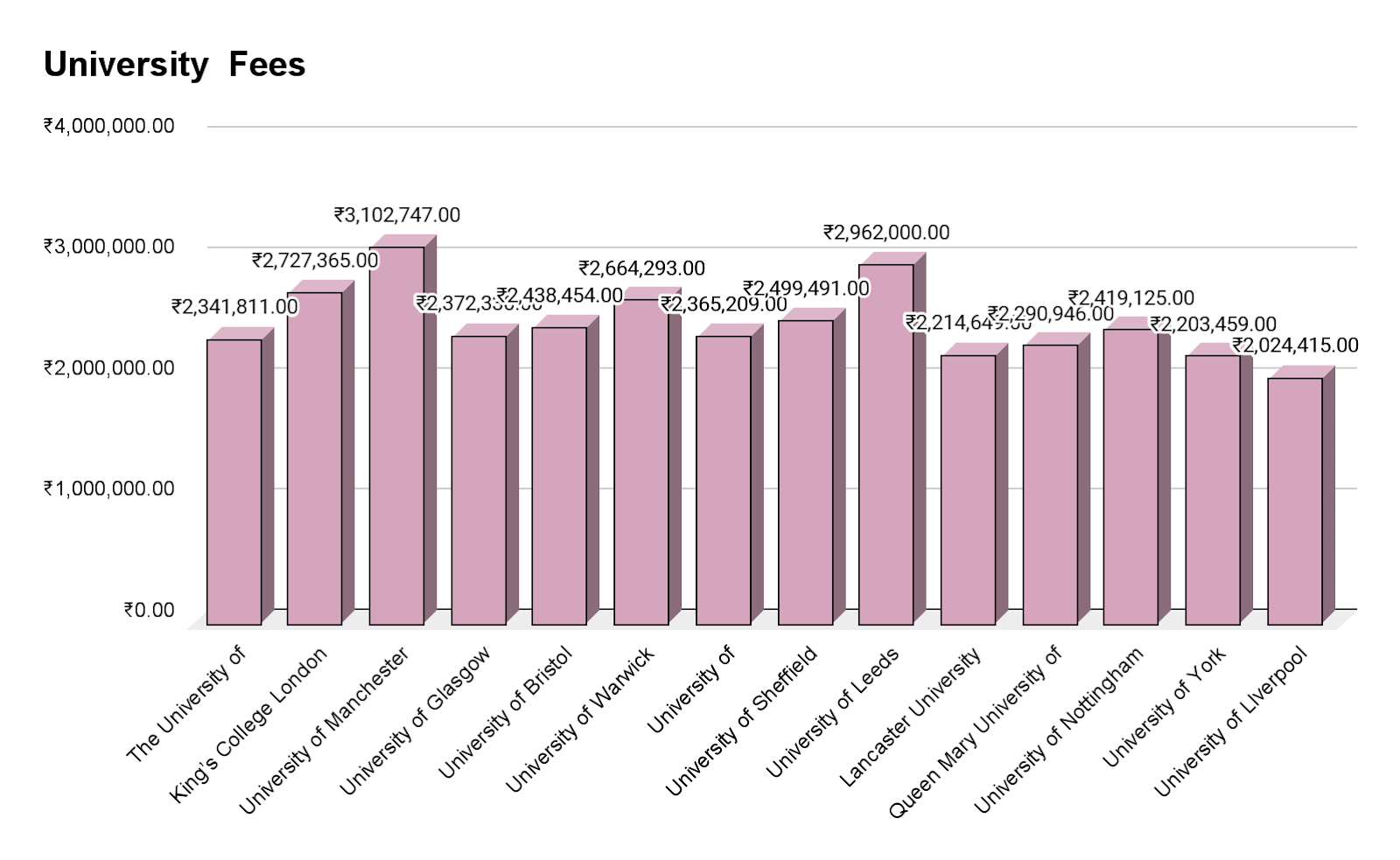
Pursuing an MSc in Physics in the United Kingdom offers the students stands out as a globally from a renowned institution with exceptional facilities and programs. Other esteemed universities in the UK offering a variety of MSc courses in Physics include Imperial College London, The University of Manchester Physics Masters and the University of Oxford. These universities provide Indian students with outstanding opportunities for advanced study in the field of physics. The list of some of the top Physics Masters courses in the UK, which also offer specialization in Astrophysics Masters UK, and MSc Medical Physics in UK Universities is as follows:
| Name of University | Programs Offered for Master in Physics in UK | Tuition Fees |
| The University of Edinburgh |
|
£24,000(INR 2532620.62) |
| King’s College London (University of London) |
|
£31,080(INR 3279743.70) |
| University of Manchester |
|
£26,500(INR 2796435) |
| University of Glasgow |
|
£23950(INR 2527344.33) |
| University of Bristol |
|
£25,200(INR 2659251.65) |
| University of Warwick |
|
£27,060(INR 2855529.75) |
| University of Southampton |
|
£22,000(INR 2321568.90) |
| University of Sheffield |
|
£26,950(2843921.91) |
| University of Leeds |
|
£12,750(INR 1345454.70) |
| Lancaster University |
|
$24,000(INR 2532620.62) |
Admission Process for MSc in the UK
The admission process for MSc Physics in the UK typically follows a set of steps, as outlined below:
- Shortlist the universities and select the desired MSc Physics program.
- Visit the official websites of the chosen universities.
- Review the eligibility criteria. Fill out the requirements, and pay the tuition fees.
- Prepare the necessary documents for the application.It generally includes academic transcripts, statements of purpose, and letters of recommendation.
- Upload the required documents through the online application portal.
- Submit the completed application form.
- the application fee as specified by the university. If selected, proceed to apply for a student visa to study in the UK.
Admission Deadline for Physics Masters Degree UK
The admission deadline for the top universities for MSc in the UK are as follows:
| Name of University | Application Deadline |
| The University of Edinburgh | 31st May (Round 3) |
| King’s College London (University of London) |
6 March 2023 (Application Closed) |
| The University of Manchester | 25th January 2023 (Application Closed) |
| University of Glasgow | 31 January 2023 (Application Closed) |
| The University of Bristol | 30th January 2023 |
| University of Warwick | Between 1 June and 30 November. |
| The University of Southampton | No Specific Date |
| The University of Sheffield | 31 July 2023 |
| University of Leeds | Physics 2023 |
| Lancaster University | 2nd February 2023 (Application Closed) |
Eligibility Criteria for MSc in the UK
The eligibility criteria for pursuing an MSc in Physics in the UK typically include the following:
- Completion of a bachelor's degree (UG) in a relevant field from a recognized university.
- A minimum GPA requirement of 2.1 to 2.2 ( minimum of 50% in graduation) or above.
- English language proficiency test scores, such as IELTS score or TOEFL
- GRE scores are generally not required for MSc Physics programs in the UK.
University-wise Application Fee
Candidates should familiarize themselves with the admission requirements for their desired universities in order to secure admission. Applicants can consider UK Universities with No Application Fees. The top universities have specific application fees, which are listed below:
| Name of University | Application Fees |
| The University of Edinburgh | £60 (INR 5326) |
| King’s College London (University of London) |
£75 (INR 6657) |
| The University of Manchester | £22.50 (INR 1997) |
| University of Glasgow | £25 (INR 2220) |
| University of Bristol | £60 (INR 6000) |
| University of Warwick | £60 (INR 6000) |
| The University of Southampton | £22.50 (INR 1997) |
| The University of Sheffield | £20 (INR 1776) |
| University of Leeds | £22.50 (INR 1997) |
| Lancaster University | £40 (INR 3550) |
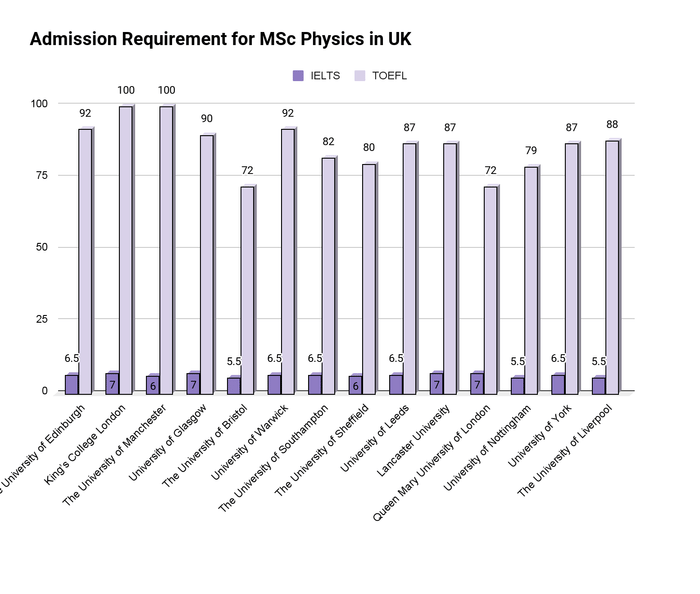
The IELTS and TOEFL score required for UK's best university for MSc is detailed below:
Admission Documents Requirement
The documents typically required for admission to best universities in UK for MSc Physics are as follows:
- Academic transcripts for secondary, higher secondary, and bachelor's degrees.
- English language proficiency test scores, such as IELTS or TOEFL iBT.
- Any required standardized test scores, such as GRE (specific to certain universities).
- Two to three Letters of Recommendation
- SOP for UK
- An updated curriculum vitae (CV) or resume highlighting academic achievements and relevant experiences.
- Relevant work experience documents and certificates (if applicable).
- Photocopies of passport or identification documents.
- Recent passport-sized photographs.
Please note the specific document requirements vary slightly depending on the university. Refer to the official websites of the chosen universities for the right and up-to-date information regarding admission documents.
MSc in the UK Cost
Candidates should consider the cost of living when planning for pursuing MSc Physics in London. The table below provides an overview of the estimated expenses:
| Name of University | Cost of Living |
| The University of Edinburgh | £1,739 to £1,934(INR 183509.47 - 204087) per month |
| King’s College London (University of London) |
£1,265(INR 133490) per month |
| The University of Manchester | £15,355(INR 1620349.57) per year |
| University of Glasgow | £11,200 - £15,900(INR 1181889.62 - 1677861) per year |
| The University of Bristol | £900 a month(INR 94973.27) |
| University of Warwick | £1023(INR 107952.95) per month |
| The University of Southampton | £1,087 to £1,1191(INR 114706.61 - 1180939.89) per month |
| The University of Sheffield | £700(INR 73868) per month |
| University of Leeds | £700(INR 73868) per month |
| Lancaster University | £676(INR 71335.48) per month |
MS in USA Scholarships
There are various UK Scholarships for Indian Students to assist in their expense for Indian students pursuing an MSc in Physics in the UK to assist them with their expenses. Here is a table highlighting some notable scholarships:
| Name of University | Scholarship Name | Scholarship Amount |
| The University of Edinburgh | Higgs Scholarships | £10,000(INR 1055258.59) |
| King’s College London (University of London) |
ANID/CONICYT Becas Chile | Tuition fees, living cost and travel |
| The University of Manchester | Equity and Merit Scholarships for international master’s students | Tuition fees |
| University of Glasgow | Think Big postgraduate award | students are valued at £6,500, £13,000 and £26,000 per year |
| The University of Bristol | Alumni Discount | 10% tuition fees |
| University of Warwick | Warwick Postgraduate Taught Sanctuary Scholarships | Tuition fees |
| The University of Southampton | Great Scholarships 2023 | £10,000(INR 1055258.59) |
| The University of Sheffield | International Postgraduate Taught Merit Scholarship 2023 | 25% tuition fees |
| University of Leeds | International Excellence Scholarships | 50% tuition fees |
| Lancaster University | Lancaster Opportunity Scholarship | £1000(INR 105525.86) |
Jobs after MSc/MS in Physics UK
Candidates can look for Part-time Jobs in UK while studying. Here is a table for job profiles after completing an MSc in Physics in the UK, along with the corresponding annual median salaries:
| Job Profile | Annual Median Salary |
| Research Scientist | £47,000 (INR 39.1 lakhs) |
| Data Analyst | £39,000 (INR 32.4 lakhs) |
| Software Engineer | £48,000 (INR 39.9 lakhs) |
| Quantitative Analyst | £56,000 (INR 46.5 lakhs) |
| Academic Lecturer | £41,000 (INR 34 lakhs) |
| Meteorologist | £37,000 (INR 30.7 lakhs) |
| Optical Engineer | £43,000 (INR 35.7 lakhs) |
| Medical Physicist | £45,000 (INR 37.4 lakhs) |
| Data Scientist | £50,000 (INR 41.5 lakhs) |
Top Recruiters For MSc In Physics In UK
Here are the top recruiters for MSc In Physics In UK:
- Venturi-Group – IT
- Adecco
- Impella
- Hays
- Reed
- Airswift
- Asoria
- Antal International
- Michael Page
- InterQuest Group
- Morgan Hunt
- Bond Recruitment
Work Permit
Candidates are prepared for application- and research-based professions with the MSc in Physics in the UK. Students who choose to study physics in the UK will develop their communication, detail-oriented, numerical, collaborative, logical, and analytical skills. The UK's Masters in scientific program along with UK Student Visa to be required for scientific curiosity while also giving you valuable job-related skills.
ROI for MSc Physics in the UK
Here is the top colleges offering MSc Physics in the UK are tabulated below:
| University | Tuition Fees (INR) | Cost of Living (INR per month) | Salary (INR per year) | ROI |
| University of Edinburgh | 25,32,620.62 | 18,3509.47 - 20,4087 | 13,50,000 | 52.87% |
| King’s College London (University of London) | 32,79,743.70 | 13,3490 | 15,35,500 | 46.87% |
| The University of Manchester | 27,96,435 | 16,20,349.57 | 18,75,000 | 66.91% |
| University of Glasgow | 25,27,344.33 | 11,81,889.62 - 16,77,861 | 13,75,000 | 54.83% |
| The University of Bristol | 26,59,251.65 | 9,49,732.7 | 15,00,000 | 56.67% |
| University of Warwick | 28,55,529.75 | 10,79,529.5 | 21,00,000 | 75.14% |
| The University of Southampton | 23,21,568.90 | 1,14,706.61 - 1,18,093.989 | 14,00,000 | 60.83% |
| The University of Sheffield | 28,43,921.91 | 7,38,68 | 20,00,000 | 70.41% |
| University of Leeds | 13,45,454.70 | 7,38,68 | 12,00,000 | 83% |
| Lancaster University | 25,32,620.62 | 7,13,35.48 | 14,00,000 | 55.65% |
FAQs
Ques: What is an MSc in Physics, and why should I consider studying it in the UK?
Ans: An MSc in Physics is a Master of Science degree program that focuses on advanced topics in physics. The UK offers renowned universities with strong physics departments, experienced faculty, and cutting-edge research facilities, making it an ideal destination for pursuing higher education in this field.
Ques: What are the typical admission requirements for an MSc Physics program in the UK?
Ans: Admission requirements vary among universities, but generally, you'll need a bachelor's degree in physics or a closely related field, along with academic transcripts, letters of recommendation, a statement of purpose, and in some cases, English language proficiency test scores (e.g., IELTS or TOEFL).
Ques: How long does an MSc Physics program usually take to complete in the UK?
Ans: MSc Physics programs in the UK typically last for one year if studied full-time. Part-time options may be available, which would extend the duration accordingly.
Ques: Can international students apply for scholarships or financial aid for MSc Physics programs in the UK?
Ans: Yes, many UK universities offer scholarships, grants, and funding opportunities for international students. These can be merit-based, need-based, or research-focused. Check with your chosen universities for specific details.
Ques: What are the potential specialization areas within MSc Physics programs in the UK?
Ans: Specializations can include theoretical physics, experimental physics, astrophysics, condensed matter physics, particle physics, nuclear physics, and more. Choose a specialization that aligns with your interests and career goals.
Ques: Is research a significant component of MSc Physics programs in the UK?
Ans: Yes, research is often a vital part of MSc Physics programs. Students might engage in research projects, laboratory work, and possibly even contribute to ongoing research initiatives within the university's physics department.
Ques: Are there opportunities for networking and career development during the MSc Physics program?
Ans: Absolutely. Many UK universities have strong ties to industry and research institutions, providing opportunities for networking, internships, and collaborations. Career development services are often available to help students transition to jobs or further studies.
Ques: What career paths can I pursue after completing an MSc Physics program in the UK?
Ans: Graduates can pursue careers in research, academia, industry, technology, finance, data analysis, and more. Some might also choose to continue their studies with a PhD in physics or a related field.
Ques: Can I work in the UK after completing my MSc Physics degree?
Ans: Yes, the UK offers post-study work options for international students. As of my last update in September 2021, the "Graduate Route" allows international students to work, seek employment, or start a business for up to two years (or three years for PhD graduates) after completing their studies. However, immigration policies can change, so be sure to check the latest regulations.
Ques: How do I choose the right MSc Physics program and university in the UK for me?
Ans: Consider factors such as program specialization, faculty expertise, research opportunities, location, career services, and financial aspects. Research the universities thoroughly, attend virtual open days if possible, and connect with current students to get insights before making a decision.?


![University College London [UCL]](https://static.zollege.in/public/college_data/images/studyabroad/logos/college_846_16-12:41_university-college-london.jpeg?tr=w-50,h-50,c-force?tr=h-40,w-35,c-force)

![University of Edinburgh [ED]](https://static.zollege.in/public/college_data/images/studyabroad/logos/college_810_07-11:27_logo.png?tr=w-50,h-50,c-force?tr=h-40,w-35,c-force)
![King's College London [KCL]](https://static.zollege.in/public/college_data/images/studyabroad/logos/college_836_07-11:35_logo.png?tr=w-50,h-50,c-force?tr=h-40,w-35,c-force)