US Education System is one of the most flexible academic systems for students coming from different regions of the world. The American study system is managed by independent groups of people rather than US Central Government. The admissions for US Education Systems is offered in three intakes in USA- Fall(September-December), Spring(January-May), and Summer(May to August).
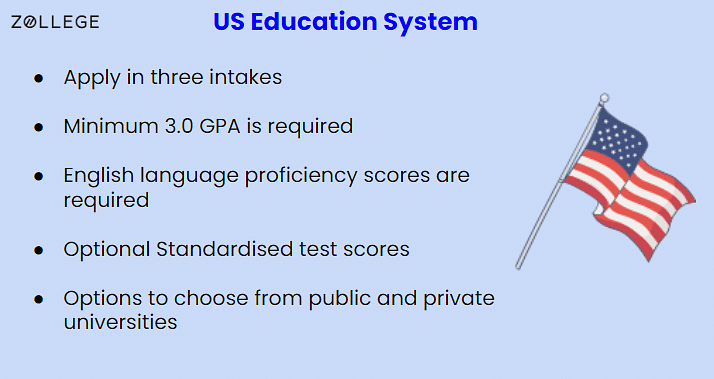
US education system for International students are graded in GPA, and a minimum of 3.0-3.5 GPA is required by majority of universities. The English Language Proficiency score range of IELTS: 6.0-7.5 and the TOEFL score of 80-110 are required as US Education System. Standardized tests like SAT, ACT, GMAT, GRE are also considered for the educational system in USA.
The US system offers both public universities in USA and private universities. Public schools are the most common option, enrolling around 85% of students. Standardized tests are prevalent, with scores used for evaluating schools, student placement, and sometimes teacher performance. This emphasis on testing can create pressure and limit the curriculum. You can choose from a wide range of educational approaches, including magnet schools, charter schools, and homeschooling. This allows for personalization to some extent
|
Table of Contents |
Advantages of the US Education System
Many international students choose to study in USA at different levels of study. International students can check some of the below-mentioned benefits of USA study system:
- One of the positive side of education system in USA is the diversity and inclusion. Students from different diverse backgrounds and communities appear to study in USA.
- The US education system comes with wide range of flexibility and can choose from wide range of areas of specializations like, BS, MS in USA
- The universities of USA are globally recognized for education with well-maintained labs, infrastructures, and research facilities.
- International students also gets a chance to get guidance from renowned scholars.
- The career counseling program, internships and part-time jobs in USA is also another perk of the education system in USA.
Disadvantages of US Education System
International students can check some of the below-mentioned disadvantages of US education systems:
- The tuition fee of majority of the USA universities are very expensive. Students are somehow required to avail various financial assistance for continuing education. So, check the cost of studying in USA before applying.
- The admission process in most of the USA universities is very much competitive than other study abroad destinations.
- International students will have limited access to social benefits and services of USA while domestic students can avail of those opportunities.
US Education System Vs Indian Education System
The education systems of the United States and India represent two distinct approaches, shaped by their respective historical, cultural, and societal contexts. In India, standardised tests like ACT, SAT are not required. A brief comparison of the education system of both USA and India is tabulated below:
| Parameters | US Education System | Indian Education System |
|---|---|---|
| Choosing Subjects Options | Flexible subject choosing options | Strict on the means of subject choosing |
| Technology | Top-notch technological, lab facilities | Education system is developing |
| Tuition Fees | The tuition fee is expensive in comparison to Indian education system | Cost-effective education for students coming from middle-class backgrounds |
| Focus | Priorities and focus is given in both academic, extracurricular and recreational activities | Priorities is given mainly on education |
| Government Role | Government plays no role in academic decisions and focuses on financial assistance | Government plays a vital role in terms of educational system |
US Education System Levels
At USA, you can choose to study UG, PG, or MBA programs. International students can check the below-mentioned table of US education system structure:
| Qualifications Offered in USA | Duration | Description |
|---|---|---|
| Associate Degree | 2 years | Job-based program taken at an undergraduate level and is equivalent to first two years of a 4 year-undergraduate degree |
| Bachelors Degree | 3-4 years | It is an undergraduate degree of including core courses, majors, minors, and electives of a subject. The four years are identified as Freshman, Sophomore, Junior, and Senior. |
| Professional Masters Degree | 1-3 years | It contains advanced graduate level coursework, and leads a candidate to a particular professional depending on the study areas |
| Academic Masters Degree | 2 years | Awarded in study disciplines of arts, sciences, and humanities and also lead students towards doctoral programs |
| PhD or Doctorate | 5-8 years | Research and theis-based study on a particular subject under the guidance of a professor or faculty advisor. |
Mention the study levels and qualifications offered in USA
Types of USA Educational Universities
Under the US education system, there are public universities, private universities in USA, community colleges that accept international students. A list of different type of educational universities along with names present in USA are as follows:
| Types of Colleges/Universities | Description | Names of University |
|---|---|---|
| Public Universities | A type of universities which are mostly run by state government of USA and is also referred as state universities | University of California Berkeley, University of California Los Angeles, University of Michigan Ann Arbor, University of Florida, Georgia Institute of Technology, Purdue University, University of Washington, Arizona State University, The University of Utah, Stony Brook University, Oregon State University, University of Kansas, Iowa State University |
| Private Universities | A type of universities runs as a non-profit organizations | Massachusetts Institue of Technology, Stanford Univesity, Harvard University, Yale Univeristy, Princeton University, Brown University, Duke University, University of Pennsylvania, Columbia University, Johns Hopkins University, Rice University, Vanderbilt University, Northwestern University, Emory University, Tulane University |
| Ivy League Colleges and Universities | It is an American athletic conference type colleges better in terms of employability, education system than other types of colleges | Yale University, Columbia University, Duke University, Columbia Business School, Colgate University, Dartmouth College, California Institute of Technology |
| Public Ivies | It is a type of public colleges offering a collegiate experience like an Ivy league university | University of North Carolina Chapel Hill, University of Virginia, Miami University, University of Delaware, Binghamton University, University of Michigan Ann Arbor |
| Specialist Institution | It is a type of universities specializes in certain popular subject areas | Harvard University, Stanford University, University of Chicago, Carnegie Mellon University, Georgia Institute of Technology, University of Maryland College Park, Massachusetts Institute of Technology |
| Land-Grant Universities and Colleges | A type of universities offered as a grant for running by the state in USA | Texas A&M University, Oregon State University, Virginia Tech University, University of New Hampshire, Utah State University, University of Minnesota, Clemson University, Purdue University, South Dakota State University, Louisiana State University, University of Idaho, Colorado State University |
| Research Intensive Universities | A type of universities well-known for research and thesis-based works | University of Chicago, University of Illinois Urbana Champaign, Michigan State University, University of Southern California, University of California San Diego, University of Washington |
Grading System of USA Colleges and Universities
The US grading system is differentiated in numeric and alphabetical gradings. International students can check the below-mentioned grading of US education system structure as follows:
| Grade Points | GPA | Percentage |
|---|---|---|
| A+ | 4.0 | 97-100% |
| A | 4.0 | 93-96% |
| A- | 3.7 | 90-92% |
| B+ | 3.3 | 87-89% |
| B | 3.0 | 83-86% |
| B- | 2.7 | 80-82% |
| C+ | 2.3 | 77-79% |
| C | 2.0 | 73-76% |
| C- | 1.7 | 70-72% |
| D+ | 1.3 | 67-69% |
| D | 1.0 | 65-66% |
| E and F | 0.0 | Below 60-65% |
Fees Structure of US Education System
The fee structure of the U.S. education system can vary significantly depending on various factors such as the type of institution (public or private), geographical location, program of study, and residency status of the student. An estimated tuition fees structure of top universities in USA is tabulated below:
| Type of Programs | Tuition Fees |
|---|---|
| English Language Studies | USD 700-2,000 (INR 57,447-1,64,136) per month |
| Community Colleges | USD 6,000-20,000 (INR 4,92,408-16,41,363) per year |
| Bachelor or Undergraduate Degrees | USD 20,000-40,000 (INR 16,41,363-32,82,726) per year |
| Graduate Degrees | USD 20,000-45,000 (INR 16,41,363-36,93,066) per year |
| Doctoral Degrees | USD 28,000-55,000 (INR 22,97,908-45,13,748) per year |
| MBA | USD 58,597-84,941 (INR 48,08,947-69,70,950) per year |
Financial Aid Available for US Education System
International students can check some of the below-mentioned types of financial aids and scholarships to study in USA available for students:
- Need-Based Financial Aid: It is given to the candidates based on financial needs to waive off the tuition, living and other expenses in USA
- Athletic Scholarships: Type of scholarship programs are much competitive than other scholarships regulated by NAIA, NJCAA, and NCAA and awarded to international student athletes.
- Tuition Waivers: It generally deducts the tuition fees partially or fully.
- Fellowship: It is generally a merit-based scholarship for advanced study of an academic discipline
- Research Assistantship: It is a type of financial support or stipend offered to doctoral students in exchange of academic work.
- Education loans to study in USA
International students can check some of the above-mentioned insights about the education system of USA. The US education system is growing on a rapid pace due to its excellent faculty, and employability options.
FAQs
Ques: How is the US education system?
Ans: US Education System is one of the most flexible academic systems.
Ques: What is 12th grade called in USA?
Ans: The secondary school consists of two programs: the first is “middle school” or “junior high school”.
Ques: Is USA a good education system?
Ans: The education system in the US is referred as one of the finest academic systems in the world.
Ques: What is 10th class called in USA?
Ans: The tenth grade in USA is referred to as sophomore year and generally is the second year of a high school.
Ques: What grade is a 17 year old in USA?
Ans: A 17 year old candidate in USA is in grade 12.
Ques: What is Class 11 called in USA?
Ans: The class 11 as per US education system is referred as a junior.
Ques: Is US education system better than India?
Ans: US education system is better than India for its employability rate and infrastructures.
Ques: What are the disadvantages of studying in USA?
Ans: High tuition expenses, competitive admission process are some of the major disadvantages of the education system in USA.
Ques: What are the benefits of studying in USA?
Ans: Academic growth, career opportunities, flexible education system, diversity are some pros of studying in USA.
Ques: What exams are accepted in US?
Ans: USA education system accepts the test scores of IELTS, TOEFL, PTE, Duolingo English Test, SAT, ACT, GMAT, GRE.
Ques: What is the structure of the US education system?
Ques: How does the grading system work in the US education system?
Ques: What are the major standardized tests used in the US education system?
Ques: How does the US education system accommodate students with disabilities?
Ques: What options are available for higher education in the US?


![Massachusetts Institute of Technology [MIT]](https://static.zollege.in/public/college_data/images/studyabroad/logos/college_1087_29-14:42_download.png?tr=w-50,h-50,c-force?tr=h-40,w-35,c-force)
![University of California [UC Berkeley]](https://static.zollege.in/public/college_data/images/studyabroad/logos/college_982_24-16:13_download.png?tr=w-50,h-50,c-force?tr=h-40,w-35,c-force)

![University of Chicago [UChicago]](https://static.zollege.in/public/college_data/images/studyabroad/logos/college_1129_06-15:23_logo.png?tr=w-50,h-50,c-force?tr=h-40,w-35,c-force)