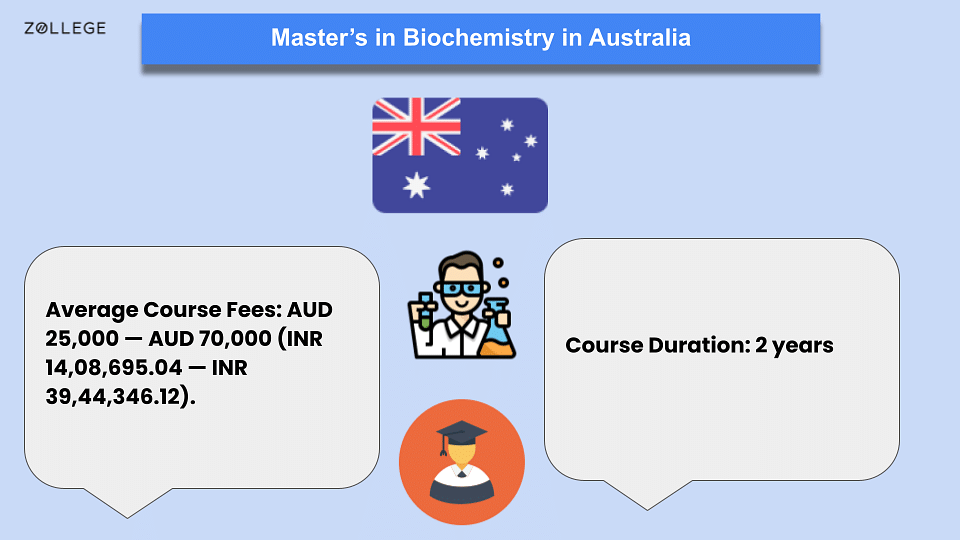
Master’s in Biochemistry in Australia is a 2 years program available to international students on the basis of their merit. The average course fees for study biochemistry in Australia ranges around AUD 25,000 — AUD 70,000 (INR 14,08,695.04 — INR 39,44,346.12). We suggest that you must understand the course requirements properly in the University you are applying and then proceed for admissions.
The popular Universities which offer Master’s in Biochemistry in Australia include University of Western Australia, University of Tasmania, University of Sydney, etc. The course specialization for biochemistry in Australia include nutritional science, molecular biology, laboratory medicine, etc.
This course also yields attractive salaries in the job market. You can get job roles such as Medical Scientist, Research Assistant, Laboratory Supervisor, etc. The average salary offered to the candidates can be approximately AUD 83,000 (INR 46,76,867.54). However, placements highly depend upon your academic performance, your interview performance and the availability of jobs in the particular year.
Reasons to Pursue Masters in Biochemistry in Australia
You can study for biochemistry in Australia as it involves scientific and medical discovery in fields such as pharmaceuticals, forensics and nutrition. This course will also enable you to conduct original research projects. For admissions to this course, you must provide scores of PTE, IELTS or TOEFL. Some notable reasons to pursue Master’s in Biochemistry Australia are given below:
- With a degree in Biochemistry, you can earn up to AUD 1,794 (INR 1,01,087.96) per week.
- The job roles are not for biochemistry courses in Australia are not limited to healthcare industry. You can also work in sectors like education and training centers, manufacturing industries, technical services sector, etc.
- The occupation of biochemist has been included in the latest revision of the skilled occupation list. This implies that now you can apply for skilled migration to Australia.
Master’s in Biochemistry in Australia Areas of Specialization
You can apply for a variety of specializations in biochemistry such as molecular biology, nutritional science, dietetics, etc. However, you have to meet certain eligibility requirements and exams to study for biochemistry in the top Universities. The specializations offered may be subjected according to their availability. Below-mentioned are some specializations to study biochemistry courses in Australia:
- Molecular Biology: This area deals with the biomedical challenges such as obesity, cancer, neurological diseases and cardiovascular disease. You can apply for this specialization from February 2024 in popular Universities.
- Dietetics: In this study, you will get to know about topics such as nutrition, physiology and biochemistry, etc. Dietetics is a significant specialization in biochemistry as it provides students with a wholesome knowledge about the importance of a balanced diet and healthy internal system.
- Laboratory Medicine: This branch of study focuses on the diagnostic procedures in a particular clinical pathology laboratory. You will land prestigious jobs such as laboratory assistant, physician associate, research assistant, etc. This specialization is expected to start from February 2025 in Australia.
Master’s in Biochemistry in Australia vs India
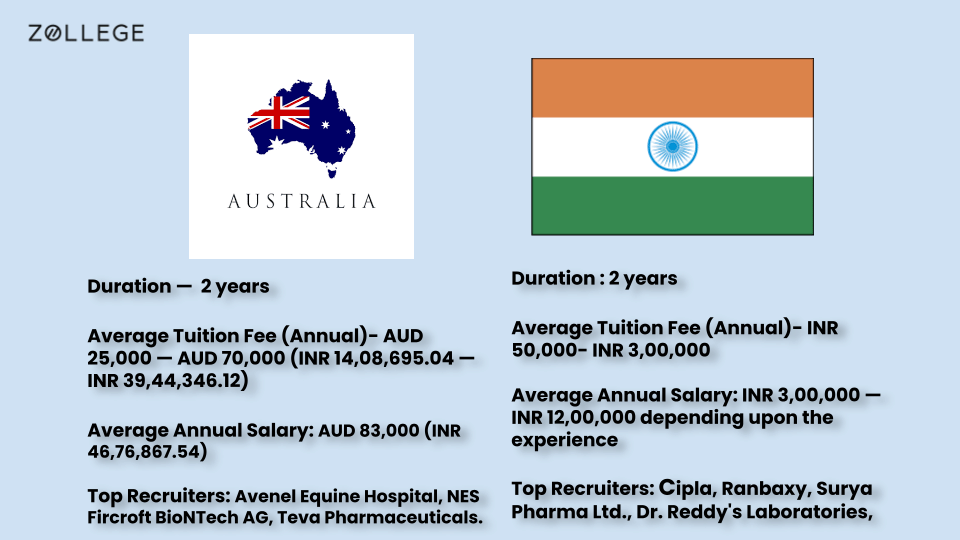
You can pursue biochemistry course from Australia as well as India too. The amount of fees required to study biochemistry in India is very less as compared to Australia. However, if you compare the average annual salary after study in Australia and India, the difference is huge. The below image illustrates the major differences in Master’s in Biochemistry program:
Top Universities for Masters in Biochemistry in Australia
You can apply to some of the top Universities in Australia for biochemistry courses. The annual fees may vary according to the University. Australia accepts applications from international students twice a year. MSc in Biochemistry is worth it as it provides a deep insight into the health sector and its workings. It will also help you to achieve advanced scientific or research-based positions. The below table shows the top Universities for Master’s degrees in biochemistry:
| University | Annual Fees | Application Deadline/ Intake Months |
| University of Western Australia | AUD 1,131 (INR 63,729.36) per credit | 31 October 2024 for 2024 (Closed) |
| James Cook University | AUD 33,741 (INR 19,01,231.18) | February and July |
| University of Queensland | AUD 24,080 (INR 13,56,855.06) | Semester 1: 30 November of the previous year; Semester 2: 31 May of the same year. |
| Deakin University | AUD 37,600 (INR 21,18,677.34) | Applications are now open for Trimester 1, 2024. |
| University of Tasmania | AUD 79,263 (INR 44,66,295.80) | Apply at least 3 months before the course starts |
AUD 1 = INR 56.35 as on 3rd January 2024
Master’s in Biochemistry in Australia Application Process
The application process for intakes in Australian Universities must be followed very carefully. You must not forget to provide relevant information about your academics, profession (if any) as well personal. Master’s in biochemistry requires you to have a bachelor’s degree in related discipline. We have listed down the important steps to apply of biochemistry courses in Australia:
- Shortlist a University
- Select the mode of study (Online/ On-campus)
- Submit personal and academic details
- Work experience may be required in some Universities
- Submit English Proficiency test scores IELTS, TOEFL, PTE.
- Pay the application fee of the University
- Submit the application
- Check the status of your application regularly in the official website
Documents Required for Master’s in Biochemistry
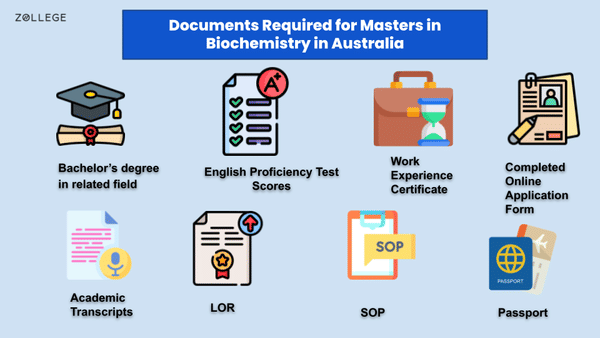
You have to submit certain documents such as academic transcripts, English proficiency test scores report, LOR, SOP, etc. for availing admissions in Australian Universities. You also need to get an Australian student visa after your letter of confirmation arrives from the University. The eligibility required to study Master’s in Biochemistry in Australia is a bachelor’s degree in a related discipline. The below image shows the documents required for studying Master’s in Biochemistry in Australia:
Master’s in Biochemistry in Australia Application Fee
You will be asked to pay an application fee at the time of submission of your application for MSc biochemistry in Australia. The application fee varies according to type of application and University opted for. However, you must know the proper application process in Australian Universities before submitting your application. We recommend that you must check the status of your submitted application regularly at the University’s official website. We have given down below the application fee charged by different Universities for Biochemistry master’s program:
| University | Application Fee |
| University of Western Australia | AUD 125 (INR 7,043.48) |
| James Cook University | No fee required |
| University of Queensland | AUD 100 (INR 5634.78) |
| Deakin University | AUD 55 (INR 3099.13) |
| University of Tasmania | No fee required |
AUD 1 = INR 56.35 as on 3rd January 2024
Master’s in Biochemistry in Australia Score Requirements
Biochemistry master’s requirements from international students are scores of PTE, IELTS, TOEFL, GMAT, GRE, etc. The submission of these test scores is mandatory for admissions. A GPA of minimum 3.5-4.0 may be also be required for admission. Below given are the scores required in the top Universities for biochemistry courses:
| University | ELP Requirements | GRE/GMAT Requirments |
| University of Western Australia | PTE Score:64 TOEFL Score: 82 IELTS Score:6.5 |
GMAT Score: 650 GRE Score: Equivalent Score |
| James Cook University | PTE Score: 46–65 TOEFL Score: 56–94 IELTS Score: 5.5–7.0 |
GMAT Score: Not required GRE Score: Not required |
| University of Queensland | PTE Score: 64 TOEFL Score: 87 IELTS Score: 6.5 |
GMAT Score: 550 GRE Score: Equivalent score |
| Deakin University | PTE Score: 58 TOEFL Score: 79 IELTS Score: 6.5 |
GMAT Score: Not compulsory GRE Score: Not compulsory |
| University of Tasmania | PTE Score: 50 TOEFL Score: 72 IELTS Score: 6.0 |
GMAT Score: Optional GRE Score: Optional |
Master’s in Biochemistry in Australia Living Expenses
You must carefully understand the cost of living in Australia along with the course fees and then plan your stay here. The living expense in Australia ranges around AUD 20,000 (INR 11,26,956.03) — AUD 41,122.92 (INR 23,17,186.14). However, it varies according to the location and lifestyle of a candidate. Below given are the approximate costs of living in different Universities for Master’s in Biochemistry in Australia:
| University | Cost of Living |
| University of Western Australia | AUD 41,122.92 (INR 23,17,186.14) |
| James Cook University | AUD 28,980 (INR 16,32,959.29) |
| University of Queensland | AUD 48,720 (INR 27,45,264.90) |
| Deakin University | AUD 21,041 (INR 11,85,614.09) |
| University of Tasmania | AUD 21,617.4 (INR 12,18,092.97) |
AUD 1 = INR 56.35 as on 3rd January 2024
Scholarships for Master’s in Biochemistry in Australia
The financially weaker students can also apply for different scholarships available in the University or Government’s site for funding their education or stay of living. These scholarships may cover your tuition fees or accommodation expenses. However, you must demonstrate proper academic merit or financial crisis proof to avail these scholarships. The below table shows the scholarships for international students in Australia for pursuing Master’s in Biochemistry in Australia:
| Scholarship | Eligibility | Amount |
| University of Western Australia (Global Excellence Scholarship) | Academic achievement | Up to AUD 48,000 (INR 27,04,694.48) |
| James Cook University (JCU International Excellence Scholarship) | Maintain a strong GPA in each semester | Covers 25% tuition fee |
| University of Queensland (Destination Australia Scholarship) | Academic excellence Financial need Professional experience | AUD 15,000 (INR 8,45,217.02) |
| Deakin University (Deakin Vice-Chancellor’s International Scholarship) | Academic merit Secured at least 85% marks in previous studies. | 50% reduction on tuition fees or full tuition fee coverage |
| University of Tasmania (Tasmanian International Scholarship) | Academic merit | 25% reduction in registered tuition fees |
AUD 1 = INR 56.35 as on 3rd January 2024
Jobs after Master’s in Biochemistry in Australia
After pursuing a degree in biochemistry program, you can get job offers from the healthcare industry or in other industries as medical scientist, research assistant, laboratory supervisor, etc. To work after completing your master’s in Australia, you need to get a work permit. There are 3 types of work permit available which are Temporary Graduate Visa Subclass 485, Temporary Graduate Visa Subclass 485, Skilled Recognized Graduate Visa Subclass 476. The average salary for biochemistry courses in Australia is around AUD 83,000 (INR 46,76,867.54). However, the salary you get offered ultimately depends upon your academic performance in the University. Below-mentioned are biochemistry jobs in Australia for international students along with their average salaries:
| Job | Average Salary |
| Medical Scientist Grade 1 | AUD 63,000 (INR 35,49,911.50) — AUD 91,000 (INR 51,27,649.95) |
| Research Assistant | AUD 70,000 (INR 39,44,346.12) |
| QC Analyst | AUD 93,000 (INR 52,40,345.55) |
| Medical Laboratory Scientist | AUD 71,000 (INR 40,00,693.92) |
| Laboratory Supervisor | AUD 1,03,000 (INR 58,03,823.57) |
AUD 1 = INR 56.35 as on 3rd January 2024
Return on Investment for Master’s in Biochemistry in Australia
Return on Investment is the monetary value that you get in return for all the expenses you have incurred during your course tenure in Australia. It is calculated by subtracting all the expenses from the salary that you have been offered. Here, in the case of biochemistry we can see some Universities such as University of Tasmania, Sydney, Melbourne are not yielding positive returns to the candidates. A detailed information about ROI is given under the table below:
| University | Tuition Fee | Cost of Living | Total Expense | Average Annual Salary | ROI |
| University of Western Australia | AUD 1,131 (INR 63,729.36) per credit | AUD 41,122.92 (INR 23,17,186.14) | AUD 42,253.92 (INR 23,80,915.50) | AUD 83,000 (INR 46,76,867.54) | 96.43% |
| James Cook University | AUD 33,741 (INR 19,01,231.18) | AUD 28,980 (INR 16,32,959.29) | AUD 62,721 (INR 35,34,190.47) | 32.33% | |
| University of Queensland | AUD 24,080 (INR 13,56,855.06) | AUD 48,720 (INR 27,45,264.90) | AUD 72,800 (INR 41,02,119.96) | 14.01% | |
| Deakin University | AUD 37,600 (INR 21,18,677.34) | AUD 21,041 (INR 11,85,614.09) | AUD 58,641 (INR 33,04,291.44) | 41.54% | |
| University of Tasmania | AUD 79,263 (INR 44,66,295.80) | AUD 21,617.4 (INR 12,18,092.97) | AUD 1,00,880.4 (INR 56,84,388.77) | -17.72% |
You can also opt for online master’s in biochemistry course in some Universities. However, in that case, you must ensure that the mode of study should not deprive you of any course specializations or modules. Make sure that you talk to the University authorities and admissions department before proceeding with online mode of study for biochemistry courses in Australia.
FAQs
Ques. What is the program duration of Master’s in Biochemistry in Australia?
Ans. The program duration for Master’s in Biochemistry in Australia is 2 years. It may vary according to the University.
Ques. What is the average course fees for biochemistry in Australia?
Ans. The average course fees for biochemistry in Australia ranges around AUD 25,000 — AUD 70,000 (INR 14,08,695.04 — INR 39,44,346.12).
Ques. What do you need for biochemistry courses in Australia?
Ans. You need to have a bachelor’s degree in a related discipline for pursuing Masters in Biochemistry in Australia.
Ques. What are tha Universities that I can apply for biochemistry courses in Australia?
Ans. The popular Universities which offer Master’s in Biochemistry in Australia include University of Western Australia, University of Tasmania, University of Sydney, etc
Ques. Do I need to submit English Proficiency test scores for admissions?
Ans. The submission of English Proficiency test scores of PTE, IELTS or TOEFL is mandatory for admissions to biochemistry courses.
Ques. Where can I apply for Biochemistry in Australia?
Ans. You must apply in the official website or portal of your selected University. You can also consult an educational agent if you are facing issues in applying.
Ques. What do I need for admission to Master’s in Biochemistry in Australia?
Ans. You will need to submit your completed application form to the University. Documents that need to be submitted include academic transcripts, ID proof, LOR, SOP, Work Experience certificate, etc.
Ques. What is the PTE score required?
Ans. The average PTE score required for admissions ranges around 50–64.
Ques. Can I request for an application fee waiver?
Ans. You can request for an application fee waiver at the University. However, there are some Universities which do not charge any application fee from the candidate. You can check out those.
Ques. What GPA do I need to have for Master’s in Australia?
Ans. A GPA of minimum 3.5-4.0 may be also be required for admission. It may vary according to the year you are applying.
Ques. What is the average cost of living in Australia?
Ans. The living expense in Australia ranges around AUD 20,000 (INR 11,26,956.03) — AUD 41,122.92 (INR 23,17,186.14). However, it varies according to the location and lifestyle of a candidate.
Ques. Can I get scholarships for Master’s in Biochemistry in Australia?
Ans. There are a number of scholarships available for biochemistry courses in Australia such as Global Excellence Scholarship, JCU International Excellence Scholarship, Destination Australia Scholarship, etc. You can apply for these scholarships in the University official website.
Ques. What compensation can I get from scholarships?
Ans. Scholarships available in Australian Universities mainly grant you aid or cover your tuition and accommodation expenses.
Ques. Are jobs available for biochemistry courses in Australia?
Ans. After pursuing a degree in biochemistry program, you can get job offers from the healthcare industry or in other industries as medical scientist, research assistant, laboratory supervisor, etc.
Ques. What does a biochemist do in Australia?
Ans. A biochemist is responsible for investigating the chemical structure of living cells, organs, and tissues in the human body. It involves an intensive course of study of human anatomy.
Ques. Can M.Sc. biochemistry work in hospital?
Ans. Yes. M.Sc. biochemists can work in hospital and health sectors as a part of a medical team. They will have the duty to analyze the patient’s health reports and condition.
Ques. What is the average salary that I can get after pursuing my degree in biochemistry?
Ans. The average salary for biochemistry courses in Australia is around AUD 83,000 (INR 46,76,867.54). However, the salary you get offered ultimately depends upon your academic performance in the University.
Ques. What are the top recruiters for Biochemistry in Australia?
Ans. The top recruiters for biochemistry in Australia include Avenel Equine Hospital, NES Fircroft BioNTech AG, Teva Pharmaceuticals.
Ques. What job roles can I get after Master’s in Biochemistry Australia?
Ans. You can get job roles such as Medical Scientist, Research Assistant, Laboratory Supervisor, etc. However, placements highly depend upon your academic performance, your interview performance and the availability of jobs in the particular year.
Ques. Do I need a work permit for working in Australia?
Ans. Yes. To work after completing your master’s in Australia, you need to get a work permit. There are 3 types of work permit available which are Temporary Graduate Visa Subclass 485, Temporary Graduate Visa Subclass 485, Skilled Recognized Graduate Visa Subclass 476.
![Australian National University [ANU]](https://static.zollege.in/public/college_data/images/studyabroad/logos/college_597_12-11:31_anu_logo_fb_350.png?tr=w-50,h-50,c-force?tr=h-40,w-35,c-force)
![The University of Melbourne [unimelb]](https://static.zollege.in/public/college_data/images/studyabroad/logos/college_609_20-15:00_mel-Logo.jpeg?tr=w-50,h-50,c-force?tr=h-40,w-35,c-force)
![University of New South Wales [UNSW]](https://static.zollege.in/public/college_data/images/studyabroad/logos/college_603_29-10:36_logo.jpeg?tr=w-50,h-50,c-force?tr=h-40,w-35,c-force)
![The University of Sydney [USYD]](https://static.zollege.in/public/college_data/images/studyabroad/logos/college_620_29-11:04_logo.jpeg?tr=w-50,h-50,c-force?tr=h-40,w-35,c-force)
![The University of Queensland [UQ]](https://static.zollege.in/public/college_data/images/studyabroad/logos/college_596_29-11:20_queensland_Logo.jpeg?tr=w-50,h-50,c-force?tr=h-40,w-35,c-force)