Masters in Finance in Australia is a postgraduate program that equips students with advanced knowledge and skills in finance. Master of financial technology Australia program prepares students for a variety of careers in the finance industry, including roles in investment banking. Many top universities in Australia offer master of fintech Australia, such as the University of Melbourne, the University of Sydney, and Monash University. The duration of masters in finance in Australia can range from one to two years, depending on the university and program chosen. The ROI of the top colleges offering this course are presented below
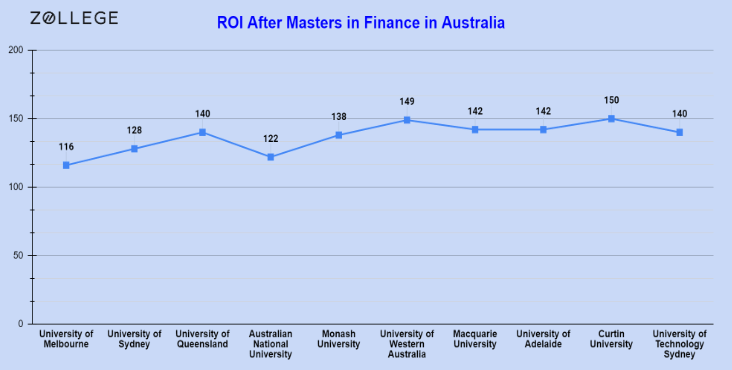
As the graph suggest, al the universities are offering more than 120% ROI. University of Western Australia, Curtin University are two universities, offering maximum ROI or 150%. So, check the admission requirements and apply to any of these universities for maximum return on investment. The tuition fees for a MSc finance Australia is AUD 30,000 to AUD 50,000 (INR 16,21,140 to INR 27,02,100 approximately) per year. Candidates in order to enrol for the course Masters in Finance in Australia are required to submit language proficiency scores like IELTS or TOEFL. However, there are various scholarships, grants, and bursaries available to students to help cover tuition fees and living expenses. These scholarships are awarded based on academic merit, financial need, and other criteria and can range from partial to full tuition coverage.
As per Raghav Krishnan (pursuing MSc Finance from Australian National University), “you must be sure of what you want to be. Set a proper goal, and apply to best universities as per your requirements. Do not go for the sake of going and study abroad. Because, it is not that easy to settle and continue to study all alone. You have to take a lot of responsibility and do hardwork to study in Australia”.
|
Table of Contents |
Why Pursue a Masters in Finance in Australia
Australia, Canada, are some of the study abroad destinations known for offering quality education at comparatively lower tuition fees than UK or USA. Many universities also welcome you to study in Australia without IELTS as well. But, why will you choose the study Masters in Finance in Australia? Below, we have curated some reasons that you might consider while choosing this course.
- Australia is home to some top ranked universities globally. A degree from any of these universities are widely recognized.
- It is one of the popular streams among students due to the immense job opportunities and continuously increasing salaries
- The average annual income of an accounting and finance graduate in Australia is AUD 81,000
- Last year the unemployment rate in Australia was 3.7%, indicating numerous job opportunities for graduates.
- You can get more than 120% return on investment within 1 year after completing your graduation.
Top Universities for Masters in Finance in Australia
University of Melbourne, University of Adelaide, Australian National University are some of the top universities in Australia. You can study this program in some of the cheapest universities in Australia as well. In most universities, the annual tuition fees range from AUD 34,000 to 70,000. The table below shown the Masters in Finance Australia fees of the universities:
| University | Tuition (AUD) |
|---|---|
| University of Melbourne | AUD 48,720 |
| University of Sydney | AUD 42,000 |
| University of Queensland | AUD 36,688 |
| Australian National University | AUD 45,600 |
| Monash University | AUD 37,600 |
| University of Western Australia | AUD 33,200 |
| Macquarie University | AUD 36,000 |
| University of Adelaide | AUD 36,000 |
| Curtin University | AUD 33,000 |
| University of Technology Sydney | AUD 36,450 |
Note: AUD 1= INR 54.95 as of March 21, 2024
Admission Deadline for Masters in Accounting and Finance in Australia
Universities accept international students in multiple semester-wise intakes in Australia. The July intake is usually between late July/ early August to November. The November intake is from late October/early November to February and the February intake is from late February/ early March to late/ early June. The table below shows the deadline for Master of Financial Engineering Australia:
| University | Admission Deadline |
|---|---|
| University of Melbourne | 30 April 2024 |
| University of Sydney | 15 July 2024 |
| University of Queensland | 31 May 2024 |
| Australian National University | 3 August 2024 |
| Monash University | Rolling admissions |
| University of Western Australia | 30 June 2024 |
| Macquarie University | 8 July 2024 |
| University of Adelaide | Closed |
| Curtin University | 25 August 2024 |
| University of Technology Sydney | 30 August 2024 |
Eligibility Criteria for Best Universities For Masters in Finance in Australia
You need a Bachelor's degree in commerce, finance or related discipline to be eligible for masters in Finance in Australia. Many universities offer this degree under MA (Master of Arts) or MS in Australia (Master of Science). Some common eligibility criteria for MSc accounting and finance in Australia are:
- A bachelor's degree from an accredited institution, ideally in a relevant subject like business, finance, accounting, or economics.
- A 3.0 GPA or higher is required for the undergraduate degree.
- Minimum scores for English language proficiency exams like the TOEFL or IELTS differ from institution to university.
- Work experience in finance or similar fields may be required by some colleges.
- To fulfil the requirements for studying in Australia, international students would need to present supplementary papers, such as a study permit, visa, or health insurance.
Admission Requirement For Master in Finance in Australia
Apart from academic requirements, you need to have qualifying scores in exams to study in Australia to be eligible for admission to this porgram. Some common Admission Requirement for university of Adelaide master of finance:
- IELTS for Australia (International English Language Testing System): An overall score of 6.5, with no individual band less than 6.0, is generally required for admission to the program.
- TOEFL score (Test of English as a Foreign Language): A minimum overall score of 79 on the internet-based test, with a minimum score of 21 in the writing section and 18 in the other sections, is typically required.
- PTE (Pearson Test of English): A minimum overall score of 58, with no communicative skill score below 50, is generally required.
Admission Documents For Best Universities in Australia For Masters in Finance
To apply to Australian universities, you need to submit some documents with the online application. Some essential documents typically required for admission to a Master of applied finance Australia include:
- Completed application form
- Academic transcripts from all previously attended universities and colleges
- Standardized test scores, such as GMAT or GRE (if required by the program and institution)
- English language proficiency test scores, such as IELTS or TOEFL (if required for non-native English speakers)
- Letters of recommendation from professors or professional contacts
- Personal statement outlining the applicant's academic and career goals
- Resume or curriculum vitae highlighting relevant work or volunteer experience
- Application fee (amount varies by program and institution)
Masters in Finance in Australia Cost of Living
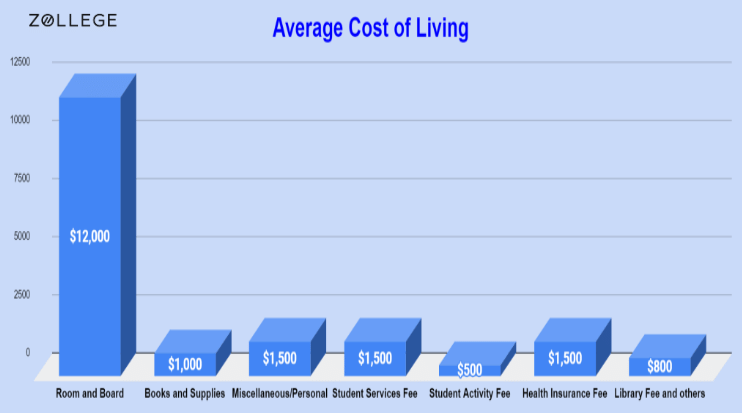
The cost of living in Sydney includes grocery bills, lifestyle expenses, accommodation costs, health insurance costs, and transportation costs. It is difficult to calculated the exact cost of living as it depends on location, type of accommodation, and personal lifestyle. However, the estimated annual cost of living in Australia is around AUD 21,041 in which majority of the amount will go for room and board. The graph below shows the cost of master of applied finance Melbourne:
Note: AUD 1= INR 54.95 as of March 21, 2024
Master of Finance in Australia Scholarships
Scholarships are a great way to get rid of financial burden and helps to paytimely tuition fees. There are a range of scholarships in Australia for international students you can apply. In Australia, you have the opportunity to get a 100% scholarship in Australia Awards scholarships. The table below shown the Scholarships of master of finance online Australia:
| Scholarship Name | Eligibility | Amount |
|---|---|---|
| Australia Awards Scholarship | Citizens of participating countries in the Asia-Pacific, the Middle East, Europe, and the Americas | Full tuition, travel, and living allowance |
| International Postgraduate Research Scholarships (IPRS) | International students applying for research programs | Full tuition and health coverage, living expenses |
| Research Training Program (RTP) | Domestic and international students pursuing research programs | Full or partial tuition, living expenses |
| Endeavour Postgraduate Scholarships | International students from participating countries | Full tuition and travel allowance, living expenses |
| Australian Government Research Training Program (AGRTP) International Scholarships | International students applying for research programs | Full tuition and health coverage, living expenses |
| University-specific scholarships | Varies by institution | Varies |
Note: AUD 1= INR 54.95 as of March 21, 2024
Jobs After Master in Finance in Australia
After a Masters in Finance in Australia, you can get jobs in Australia as Financial Analyst, Investment Banker, Assest Manager and more. The table below shown the jobs for masters in financial technology Australia:
| Designation | Annual Salary for Freshers (AUD) | Average Yearly Pay (AUD) |
|---|---|---|
| Financial Analyst | 62,000 - 85,000 | 75,000 - 110,000 |
| Investment Banker | 80,000 - 120,000 | 110,000 - 200,000 |
| Asset Manager | 70,000 - 90,000 | 90,000 - 130,000 |
| Financial Advisor | 50,000 - 70,000 | 70,000 - 100,000 |
| Risk Manager | 70,000 - 100,000 | 90,000 - 130,000 |
Note: AUD 1= INR 54.95 as of March 21, 2024
Top Recruiters for Masters in finance in Australia
To get hired by companies, you need a Australian work visa. Properly check the requirements and documents needed and apply to the embassy. The table belows the top recruiters for masters in fintech Australia:
| Recruiters | Annual Fresher Salary (AUD) | Annual Base Salary (AUD) |
|---|---|---|
| Big Four Accounting Firms | 55,000 - 80,000 | $80,000 - $150,000 |
| Investment Banks | 80,000 - 120,000 | 110,000 - 200,000 |
| Commercial Banks | 50,000 - 75,000 | 75,000 - 120,000 |
| Asset Management Firms | 60,000 - 80,000 | 80,000 - 150,000 |
| Financial Consulting Firms | 60,000 - 80,000 | 80,000 - 130,000 |
| Insurance Companies | 50,000 - 70,000 | 70,000 - 100,000 |
Note: AUD 1= INR 54.95 as of March 21, 2024
Work Permit
International students who wish to pursue a master in banking and finance in Australia will need to obtain a Australian student visa before entering the country. In order to be eligible for a student visa, students must meet certain requirements, stated below. Note, this visa will not allow you to work legally in Australia. You need a work visa for that. However, the requirements for student visa are:
- Provide proof of acceptance into a registered Masters in Finance program in Australia
- Demonstrate sufficient funds to cover living expenses and tuition fees for the duration of the program
- Purchase Overseas Student Health Cover (OSHC)
- Meet the English language proficiency requirements for the program
International students can consider the aforementioned details while looking to study Masters in Finance in Australia. The country offers a range of prestigious universities with diverse programs, experienced faculty, and innovative teaching methods. International students can also benefit from Australia's welcoming culture, high standard of living, and diverse communities.
FAQs
Ques: What are the entry requirements for a Masters in Finance in Australia?
Ans: Entry requirements vary among universities. Applicants need a bachelor's degree in finance, economics, or a related field. Some universities may require relevant work experience, English language proficiency (e.g., IELTS or TOEFL scores), and a competitive GMAT or GRE score.
Ques: How long does it take to complete a Masters in Finance in Australia?
Ans: A Master's in Finance in Australia takes one to two years for full-time students. Part-time options are available, which may extend the duration to two to three years.
Ques: What are the career prospects after completing a Masters in Finance in Australia?
Ans: Graduates can pursue various career paths in finance, such as investment banking, corporate finance, financial analysis, risk management, and asset management. Australia offers opportunities in both domestic and international finance sectors.
Ques: Are there opportunities for internships during a Masters in Finance program?
Ans: Many universities in Australia collaborate with financial institutions to offer internship opportunities. These internships provide valuable hands-on experience and networking opportunities, enhancing students' employability upon graduation.
Ques: Can international students apply for a Masters in Finance in Australia?
Ans: Yes, international students are welcome to apply. They must meet the academic and English language proficiency requirements and obtain the necessary visas to study in Australia.
Ques: What is the tuition fee for a Masters in Finance in Australia?
Ans: Tuition fees vary depending on the university, program duration, and whether the student is domestic or international. On average, international students can expect to pay between AUD 30,000 to AUD 50,000 per year for tuition, while domestic students may pay less.
Ques: Are scholarships available for Masters in Finance programs in Australia?
Ans: Yes, many universities offer scholarships and financial aid to both domestic and international students based on academic merit, financial need, or specific criteria set by the institution. Applicants are encouraged to explore scholarship options offered by universities and external organizations.
Ques: What specializations are available within Masters in Finance programs in Australia?
Ans: Common specializations include corporate finance, investment management, financial analysis, banking, risk management, and financial technology (FinTech). Students can choose a specialization based on their career interests and goals.
Ques: How does the curriculum of a Masters in Finance program in Australia typically look like?
Ans: The curriculum usually comprises core courses covering topics such as financial theory, quantitative methods, financial modeling, and investment analysis. Elective courses allow students to delve deeper into specific areas of finance, and many programs include a capstone project or thesis.
Ques: Can students work part-time while pursuing a Masters in Finance in Australia?
Ans: Yes, international students with valid student visas are allowed to work part-time during their studies. However, there are restrictions on the number of hours they can work per week, typically around 20 hours while classes are in session.
Ques: Are there opportunities for networking and professional development in Masters in Finance programs?
Ans: Yes, universities often organize networking events, guest lectures by industry professionals, career workshops, and alumni networking sessions to help students build connections and enhance their professional skills.
Ques: Is it hard to get into Masters in Finance programs in Australia?
Ans: Admission can be competitive, especially for prestigious universities and programs. Applicants are evaluated based on their academic background, standardized test scores, work experience, recommendation letters, and statement of purpose.
Ques: Is it possible to transfer credits from another institution to a Masters in Finance program in Australia?
Ans: Some universities may allow credit transfer for relevant coursework completed at recognized institutions, subject to evaluation and approval by the respective academic departments.
Ques: What support services are available for studying Masters in Finance in Australia?
Ans: International student support services typically include assistance with visa applications, accommodation options, academic advising, orientation programs, and access to health services and counseling.
Ques: What are the job prospects after completing a Masters in Finance in Australia?
Ans: International students with a Master's in Finance from Australia are well-positioned to pursue careers globally, including in Australia's thriving finance industry. The skills and knowledge acquired during the program equip them for roles in various sectors, enhancing their employability and career advancement opportunities.
![Australian National University [ANU]](https://static.zollege.in/public/college_data/images/studyabroad/logos/college_597_12-11:31_anu_logo_fb_350.png?tr=w-50,h-50,c-force?tr=h-40,w-35,c-force)
![The University of Melbourne [unimelb]](https://static.zollege.in/public/college_data/images/studyabroad/logos/college_609_20-15:00_mel-Logo.jpeg?tr=w-50,h-50,c-force?tr=h-40,w-35,c-force)
![University of New South Wales [UNSW]](https://static.zollege.in/public/college_data/images/studyabroad/logos/college_603_29-10:36_logo.jpeg?tr=w-50,h-50,c-force?tr=h-40,w-35,c-force)
![The University of Sydney [USYD]](https://static.zollege.in/public/college_data/images/studyabroad/logos/college_620_29-11:04_logo.jpeg?tr=w-50,h-50,c-force?tr=h-40,w-35,c-force)
![The University of Queensland [UQ]](https://static.zollege.in/public/college_data/images/studyabroad/logos/college_596_29-11:20_queensland_Logo.jpeg?tr=w-50,h-50,c-force?tr=h-40,w-35,c-force)