
MBA in Germany without work experience is offered to students who wish to continue their PG right after their bachelor's. There are certain pros and cons of an MBA without work experience in Germany. The biggest advantage involved is that students get to save time. However, students with just an MBA have fewer job options in comparison with applicants who have both work experience and an MBA degree. Students will also find more jobs in Germany with a job experience along with an MBA.
Top MBA colleges in Germany without work experience are the Technical University of Munich, Ludwig Maximilian University Munich, University of Stuttgart, Technical University Dresden, etc. Admission to these universities would help students get a German Student Visa. To be eligible for an MBA without work experience in Germany students need to have their German and English language proficiency certificates. GMAT/GRE score certificate submission is also a mandatory eligibility criterion for a few universities.
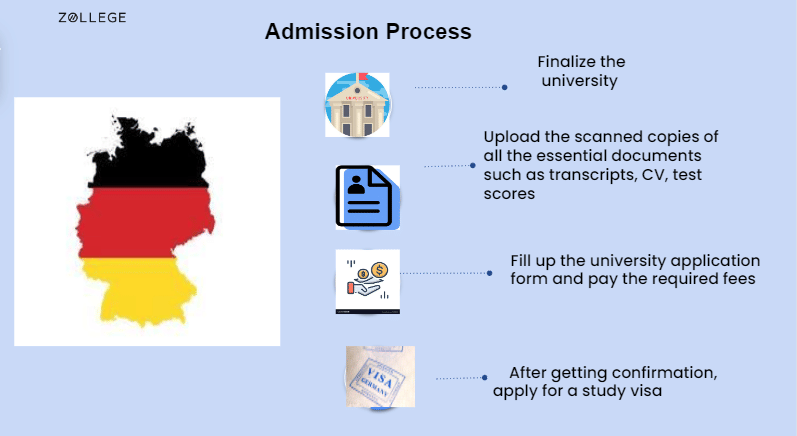
The admission process involves uploading all relevant academic documents and transcripts, after finalizing the university. Students also need to submit SOP, CV, test scores, etc. After completing the admission process, students need to wait for their confirmation letter from the university in Germany. The confirmation letter would help the student apply for a student visa, and this would help them to get into the top MBA universities in Germany.
Public Universities in Germany for MBA without Work Experience
Several public universities in Germany for MBA without work experience options to international students. Students have to submit essential documents like academic transcripts, submission of GMAT, and GRE score certificates to get into one of the cheapest MBA in Germany. Students also need to prove their English and German proficiency levels. A letter of motivation has to be submitted along with other documents for admission to MBA courses. Listed below are some of the best universities in Germany for MBA without work experience. You can also apply for several MBA scholarships in Germany while studying at these universities.
| University Name | Eligibility Criteria |
| Technical University of Munich |
Degree Certificate and Diploma or Subject and Grade Transcript of Studies to Date |
| Ludwig Maximilian University Munich | Curriculum vitae in tabular form Copy of the degree certificate from the first degree with a professionally qualifying university degree in a degree program in economics Proof of a completed English -language test, such as a TOEFL- 100 Proof of a completed German language test GMAT score - 600 |
| University of Stuttgart |
Submission of Bachelor of Science (B.Sc.) degree or similar, e.g. BTech, BE, BCS, BCA but not B.A. |
| Technical University Dresden | Academic transcripts English and German proficiency score |
| University of Bremen | GPA of 2.5 or equivalent Academic Transcripts GMAT- 600 GRE- 310 IELTS- 6.5 TOEFL score- 80 |
| University of Ulm | Academic transcripts English and German proficiency score |
| RWTH Aachen University | University degree English and German proficiency score Standardized score submission |
Admission Process of MBA in Germany without Work Experience
Applicants before deciding whether they would opt for MBA without work experience in Germany must be aware of the admission process of German universities. MBA in Germany cost and other prerequisites should be first checked. Shown below is the admission process of MBA colleges in Germany without work experience. If accepted, you can apply to stay in student accommodation in Germany, offered by the universities.
Pros and Cons of MBA in Germany without Work Experience
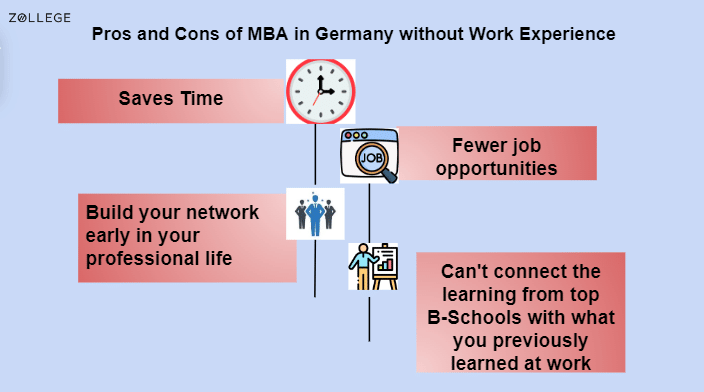
MBA without work experience in Germany has several pros and cons. The biggest advantage of it is students get to directly enroll at a university after their bachelor's, saving time. Work experience allows students to understand their roles in MBA jobs in Germany better and also learn about work ethics. Students to gather more experience, can also enroll for several part-time jobs in Germany. Tabulated below are some pros and cons of MBA in Germany without Work Experience for student reference.
| Pros | Cons |
| This will enable you to embark on your career path sooner and avoid taking time off from work because it will provide you with knowledge and skills related to business management | You can't connect the learning from top B-Schools with what you previously learned at work if you have no work experience or practical knowledge |
| Studying for an MBA at one of the best universities gives you the chance to build your network early in your professional life | Those with an MBA have slightly fewer job opportunities than those with some work experience |
| This could improve your college experiences in terms of academics, cultures, and careers | Additionally, your chances of landing a summer internship that could lead to a job Offer from a prestigious company are reduced |
Students will find detailed information about the best universities in Germany for MBA without work experience in the highlighted tables above. Also mentioned are the admission process and the pros and cons of an MBA in Germany without work experience. Eligibility criteria and a list of public universities in Germany for MBA without work experience are also shared to provide students with more information.
FAQs
Ques: Can I study MBA in Germany without work experience?
Ans: The country's world-class infrastructure, innovative curriculum, and reasonably priced tuition fees allow you to pursue an MBA degree without prior work experience.
Ques: Is it possible to get into MBA without work experience?
Ans: While it's true that many elite programs require several years of experience before acceptance, there are alternatives. When submitting an MBA application, if you don't have any professional work experience, make sure your leadership and academic skills are demonstrated elsewhere in the application.
Ques: What is the eligibility for an MBA in Germany?
Ans: a master's or bachelor's degree in pertinent fields. In Germany, very few universities will accept a three-year bachelor's degree for MBA study. Valid GMAT/GRE scores may be required by certain German business schools. Without a GMAT, it is possible to apply for an MBA in Germany as the majority of German universities only require a TOEFL score.
Ques: Is work experience necessary for Master's in Germany?
Ans: To be admitted into German universities, students who want to pursue an MS in Germany must pass the proficiency exams and have at least two years of work experience.
Ques: Can I get a job after doing an MBA from Germany?
Ans: A variety of industries, including consulting, finance, marketing, and management, are open to Indian students studying for an MBA in Germany. Indian and foreign students find Germany to be a desirable destination due to its excellent work culture and work-life balance.
Ques: Is Germany good for MBA for Indian students?
Ans: Modern universities, first-rate facilities, and a curriculum that blends theoretical and practical knowledge have made Germany one of the top MBA destinations for Indian students.
Ques: Which countries offer an MBA without work experience?
Ans: Numerous nations allow students to pursue an MBA without prior work experience, allowing them to advance in their studies. MBAs without experience are available to students in many nations, including the USA, Sweden, the UK, France, Germany, Ireland, and Australia. These MBAs are valuable as long as the applicant's overall resume is strong.
Ques: Can I get PR in Germany after my MBA?
Ans: Graduates from German universities are allowed to remain in the country for a maximum of 1.5 years to look for and secure employment. They could be qualified to apply for a settlement permit after two years of employment.
Ques: Can I go to Germany without work experience?
Ans: To study for an MBA in Germany without prior work experience, applicants must apply for a residence permit and a visa. It is advised that applicants begin the visa application process as soon as possible to avoid any delays, as it may take some time.
Ques: Which master's degree is most in demand in Germany?
Ans: International and domestic students alike are drawn to pursuing a management master's degree in Germany. You can choose to specialize in engineering or human resources, for example, or you can choose general management courses. A master's degree in management studies will prepare you for executive positions at prosperous German businesses in both scenarios.
Ques: Is it easy to do an MBA in Germany?
Ans: While the majority of universities in Germany provide an English-language MBA program, only some of them have language proficiency requirements. For Indian students, having a strong academic record can be defined as having an aggregate academic score of at least 60%.
Ques: Which exam is required for an MBA in Germany?
Ans: GMAT or GRE scores must be submitted with an application for any MBA program in Germany. A standardized test called the GMAT or GRE assesses verbal, quantitative, and analytical abilities.
Ques: Which country is easier to get a job after an MBA?
Ans: The UK, Germany, Canada, and Australia are countries with exceptionally lenient post-graduation and student visa policies that may buy you valuable time to hunt for employment.
Ques: Which is better MBA with or without work experience?
Ans: Since you have no work experience to draw from, you have a lot more to learn from an MBA program as a recent graduate. If you have previous work experience, you will learn a great deal more and get a better return on investment in terms of non-tangible skills like personality, work ethic, time management, communication, confidence, and many more.
Ques: Can I do an MBA without work experience in Europe?
Ans: Yes, students can do an MBA in Europe without work experience. The following European universities offer MBA programs without requiring prior work experience: INSEAD, ESADE Business School, SDA Bocconi School of Management, and Erasmus University's Rotterdam School of Management.

![Humboldt University of Berlin [HU]](https://static.zollege.in/public/college_data/images/studyabroad/logos/college_632_29-15:02_6.png?tr=w-50,h-50,c-force?tr=h-40,w-35,c-force)
![Technical University Munich [TUM]](https://static.zollege.in/public/college_data/images/studyabroad/logos/college_691_02-13:08_691.png?tr=w-50,h-50,c-force?tr=h-40,w-35,c-force)
![Ludwig Maximilian University of Munich [LMU]](https://static.zollege.in/public/college_data/images/studyabroad/logos/college_690_02-13:05_690.png?tr=w-50,h-50,c-force?tr=h-40,w-35,c-force)
![Free University of Berlin [FU]](https://static.zollege.in/public/college_data/images/studyabroad/logos/college_631_29-15:01_5.png?tr=w-50,h-50,c-force?tr=h-40,w-35,c-force)
.png?tr=w-50,h-50,c-force?tr=h-40,w-35,c-force)


