
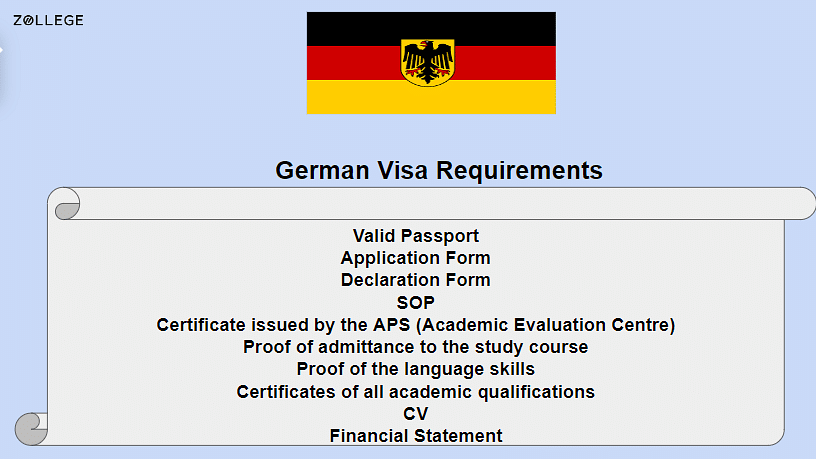
German student visa is a mandatory requirement for international students who wish to study in Germany. Students can also directly contact the consulate in their respective countries for additional information on the visa process. German student visa requirements include submission of the application form, a declaration form, SOP, proof of language skills, etc. For students who wish to study an English language course in Germany, they need to submit an IELTS score or TOEFL/PTE score certificate. The German student visa application form is available online on the visa application website.
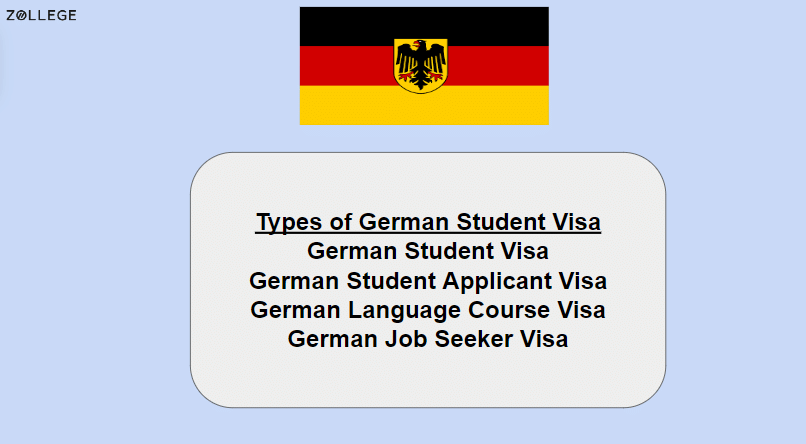
Germany has a 95% visa acceptance rate, which is higher than many other well-known nations like the USA and the UK. This allows students to immigrate to Germany much more easily. Available visa types for international students are German Student Visa, German Student Applicant Visa, German Language Course Visa, and German Job Seeker Visa. A German student visa costs EUR 75 for students above 18, and EUR 37.5 for students who are minors. The payment must be made by students in local currency. Regarding the payment options, these differ from nation to nation.
To process a student visa, students need a blocked account for German student visa of EUR 11,208. This blocked account is to show proof of financial stability. The sum of money can be used by students to pay their cost of living in Germany. This is the reason why a blocked account is mandatory. All German Student Visa applicants must have a blocked account. Other documents required for German student visa include submission of valid ID, confirmation letter from university, etc.
Types of German Student Visa
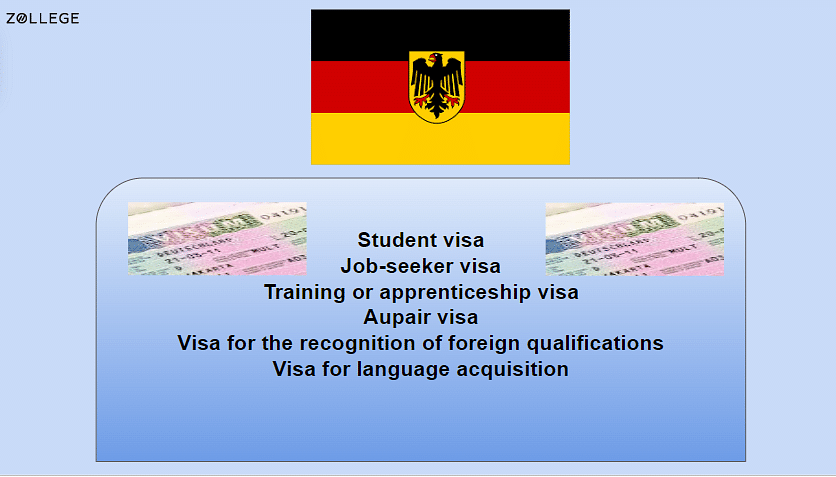
If you are from India and would like to study in Germany, you will require a specific kind of visa to make that happen. We are aware that this process, entails a great deal of bureaucracy, and it also worries a lot of potential Indian students. Students visas are also requiered to get into any student accommodation in Germany. Listed below are the different types of German student visa that applicants can enroll for to immigrate to Germany.
| Visa Type | Visa Features |
| German Student Visa | To pursue a Bachelor's or a Master's degree in Germany. One of the key preconditions for getting this visa is that you have a letter of admission from a German study program. |
| German Student Applicant Visa | If a prospective Indian student has applied for a German study program but does not have an official letter of admission yet, s/he should be able to apply for a German Student Applicant Visa. |
| German Language Course Visa | Indian students who desire to attend an intensive German language course in Germany can also apply for a German Language Visa |
| German Job Seeker Visa | Indian students, who pursued a degree at a German university, can apply for a job-seeker visa immediately after they graduate. This visa gives them 18 months to find a suitable job in Germany and, hence, to stay in the country |
German Student Visa Application Process
As per regulations, the German Embassy or Consulate in your nation is the appropriate location for you to submit your visa application. You must first arrange a time for the visa interview. On the day of the interview, you should present the documentation for your visa application. In addition to asking you personal questions, the officer will also ask you questions regarding your application, which you must carefully and honestly respond to. If all the documents including the motivation letter for German student visa requirements are met, then there would be no further issue of German student visa rejection. The consular officer will also prepare interview questions for you to answer to assess your candidacy for a visa thoroughly. Soon after, you will be able to arrange your departure time. Written below is the application process for German student visa only, and it is different from a work permit visa in Germany
- Check the available dates and schedule an appointment
- A visa interview between a visa applicant and a consular officer
- Provide all the documentation needed for your visa
- Provide an SOP for German Student Visa
- Submit an application fee of EUR 75 (for students above 18), and EUR 37.5 (for students who are minors)
Documents Required for German Student Visa
Applicants must be aware of all the documents for German student visa. Furthermore, they must also provide documentation of their Blocked Account (Sperrkonto). You can open a blocked bank account as proof that you can cover your living expenses when you apply for a visa. Scores of exams to study in Germany like PTE or IELTS/ TOEFL certificates are also needed during German Student visa document submission. If you are applying for any of the following German visas, and if you are not from a European Union or Schengen Member State, you will need to have your account blocked for Germany:
- Valid passport
- German student visa application form
- Declaration (for additional contact and legal representation information)
- Copy of your passport’s data page
- Statement of purpose
- Certificate issued by the APS (Academic Evaluation Centre)
- Proof of admittance to the study course/preparatory college (original and 2 copies) including information on the language of instruction
- Proof of the language skills in the language of instruction for the study course or the preparatory course like IELTS/TOEFL/PTE (original and 2 copies)
- Certificates of all academic qualifications you have previously obtained (original and 2 copies)
- Curriculum vitae
- Proof of financial means to cover the costs for the time of your studies
Blocked Account for German Student Visa
When foreign students or jobseekers apply for a German visa, German authorities require them to show proof of their financial stability through a specific type of bank account called a blocked account. You have to transfer EUR 11,208 into a bank account with German registration before moving to Germany. This amount will be frozen, and once you get there, your monthly withdrawal limit will be limited to EUR 934 for living expenses. It is also one of requirments to study free in Germany. If you are applying for any of the following German visas listed below, and you are not from a European Union or Schengen Member State, you must have a blocked account for German student visa.
When it comes to low-cost studies, research infrastructure, teaching strategies, career perspectives, and high-quality higher education, Germany is the place to be. For this reason, a lot of foreigners still think that Germany is the greatest country in which to continue their higher education. All relevant German Student Visa-related queries have been highlighted in the article above to assist students better in their visa application journey.
FAQs
Ques: Is a German student visa easy to get?
Ans: A German student visa is easier to get in comparison with a US student visa, or even an Australian student visa. If all of your paperwork is in order, your application is complete, and you have credible evidence of your ability to pay the required fees, there is still a very slim chance that your request for a German study visa will be denied.
Ques: How do I get a student visa for Germany?
Ans: To get a German Student Visa students have to first apply for a study program in Germany, then make an appointment for visa submission, and gather all documents.
Ques: How much bank balance is required for a German student visa?
Ans: To apply for a student visa, you have to prove to the German Embassy that you make at least EUR 11,208 (INR 994,864.96) a year. Most of the time, you have to transfer the funds to a German bank and open a blocked bank account there. The second most popular approach is to be awarded a scholarship.
Ques: How long is a student visa for Germany?
Ans: This visa, which is also known as the Prospective Student Visa, enables students to enter and remain in Germany while they are applying to German universities. A student applicant visa is valid for three months, with the possibility of an extension for up to nine months, in contrast to a student visa, which can be granted for up to four years.
Ques: Can I get PR in Germany after study?
Ans: International students are not permitted to apply for a PR in Germany; instead, they may do so only after completing their studies there and after working there for a minimum of two to four years.
Ques: Is IELTS required in Germany?
Ans: Indeed, to be admitted to undergraduate and graduate programs in Germany, one must take the IELTS exam. Undergraduate programs require an IELTS band score of 6.0, while postgraduate courses require a score between 6.0 and 6.5.
Ques: What is the success rate of German visas?
Ans: Germany has a 95% visa acceptance rate, which is higher than many other well-known nations like the USA and the UK.
Ques: Which exam is required for Germany?
Ans: The Goethe-Zertifikat/DSH/TestDaf for German language proficiency, the GRE/GMAT for certain academic programs, and the IELTS/TOEFL for English language proficiency are the main entrance exams for studying in Germany.
Ques: Is education in Germany free?
Ans: In conclusion, given that education in Germany is free for both domestic and foreign students, studying there can be a great opportunity for Indian students. Every student can take advantage of a wide range of course options, even though they still need to pay for their living expenses.
Ques: How much percentage is required to study in Germany?
Ans: To be eligible to apply for a bachelor's degree, students must have earned at least 60% to 65% in their previous degree from one of the many German universities.
Ques: Which is better Germany or Canada?
Ans: Canada offers an easy application process for permanent residency, as well as a good public health system and high-quality healthcare system. On the other hand, Germany provides good healthcare, pleasant weather, an inexpensive cost of living, and an excellent education system.
Ques: Which language is spoken in Germany?
Ans: German is the official language of Germany, where more than 95% of the population speaks Standard German or a German dialect as their first language.
Ques: Is Germany good for Indian students?
Ans: Compared to Canada, Germany is an incredibly attractive study-abroad option for Indian students. The cheap or nonexistent tuition at many of its public universities is one of its most alluring benefits.
Ques: Can a student work 40 hours in Germany?
Ans: A full day is eight hours in Germany, and a full working week is forty hours. During the academic year, students are permitted to work 2.5 full days per week. Full-time employment outside of school hours is acceptable as long as you keep the annual total in mind.

![Humboldt University of Berlin [HU]](https://static.zollege.in/public/college_data/images/studyabroad/logos/college_632_29-15:02_6.png?tr=w-50,h-50,c-force?tr=h-40,w-35,c-force)
![Technical University Munich [TUM]](https://static.zollege.in/public/college_data/images/studyabroad/logos/college_691_02-13:08_691.png?tr=w-50,h-50,c-force?tr=h-40,w-35,c-force)
![Ludwig Maximilian University of Munich [LMU]](https://static.zollege.in/public/college_data/images/studyabroad/logos/college_690_02-13:05_690.png?tr=w-50,h-50,c-force?tr=h-40,w-35,c-force)
![Free University of Berlin [FU]](https://static.zollege.in/public/college_data/images/studyabroad/logos/college_631_29-15:01_5.png?tr=w-50,h-50,c-force?tr=h-40,w-35,c-force)
.png?tr=w-50,h-50,c-force?tr=h-40,w-35,c-force)


