
How to study free in Germany for international students is a common question of candidates opting to study in Germany for higher studies. In 1976, the no tuition fee policy of the public universities in Germany was legalized for domestic as well as international students. This was done as the German believed that education should not be a money making business. They believe in the growth and well-being of every individual by providing them higher education.
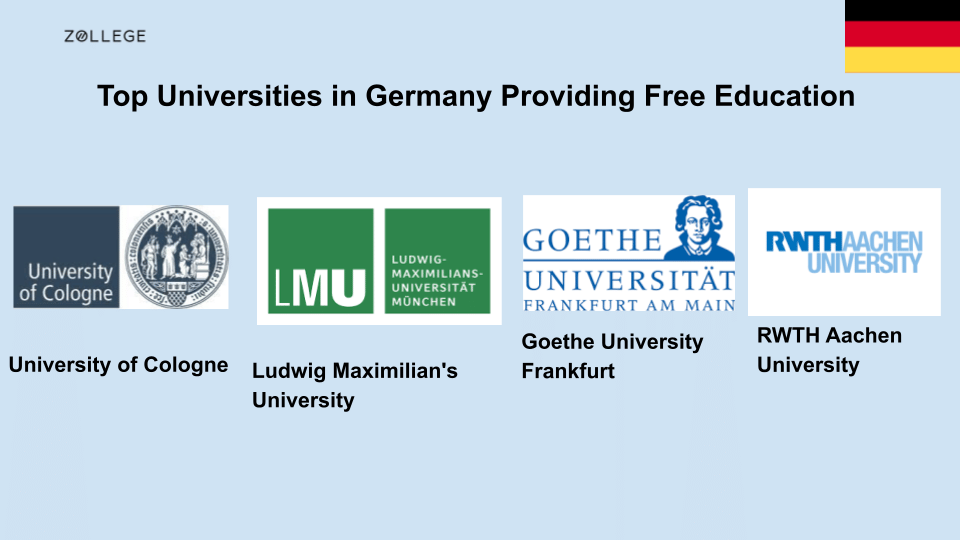
The popular public universities which offer free education to undergraduate students include University of Cologne, Ludwig Maximilian's University Munich, Goethe University Frankfurt, RWTH Aachen University, etc. As an international student, you are required to submit scores of IELTS, TOEFL or PTE for admissions in Germany. You must ensure that these score reports are recent and are submitted to the university along with the application form.
For the universities in Germany, however, there are extra costs that you would have to incur apart from the tuition fees. A substantial fee of Euro 290 (INR 25,918.93) is charged for admissions related enrollment, confirmation and administrative purposes. You will also be charged a semester fee of Euro 450 (INR 40,219.02) per semester if your academic journey exceeds for more than 4 semesters. A semester ticket will also be given to you for transportation purposes. The fee for a semester ticket depends on the semester and type of ticket you have applied for. Majority of the universities have two intakes in Germany in Winter and Summer for international students.
Free Education in Germany
The concept of how to study free in Germany started way back in the year 1971. Germany's social authorities abolished the system of tuition fees by instituting a state-funded financial assistance system. By 1976, this is no fee policy was legalized at higher educational institutions. As a result, all students be it domestic or international can now study at no tuition fees, decreasing the cost of MS in Germany. However, a minor fee is charged to cover the administrative and other expenses in each semester.
Top Universities offering Free Education in Germany
As an international student, you can study in any public universities in Germany for free. You can visit the official website of these universities to understand how to study in Germany for free from India. The process of apply to German universities for free or any other higher education course might differ according to the university. Given below are the top university in Germany free for international students:
- University of Cologne
- Ludwig Maximilians University of Munich
- Goethe University Frankfurt
- RWTH Aachen University
- University of Münster
- Ruhr University Bochum
- University of Duisburg-Essen
- University of Hamburg
- FAU Erlangen-Nürnberg
- Technical University of Munich
You can apply to several scholarships in Germany for international students while studying at any of these universities. Few renowned scholarships include ERASMUS+, Heinrich Böll Scholarships, Humboldt Research Fellowships, DAAD scholarships and many more.
How to Apply for Free Study in Germany
It is important to understand the correct application process of how to study free in Germany in UG and PG level programs. The application must be submitted within the mentioned deadline of the university. The score reports of IELTS, TOEFL or PTE must also be attached with the application form. Given below are the steps to understand how to study free in Germany:
- Shortlist a university
- Select a course
- Fill up the application form
- Provide the academic and personal information
- Submit the English Proficiency test scores of IELTS, TOEFL, PTE
- Pay the application fee if asked for
- Submit the application
- Apply for a German student visa if the offer letter is received
Hidden Costs for Study in Germany
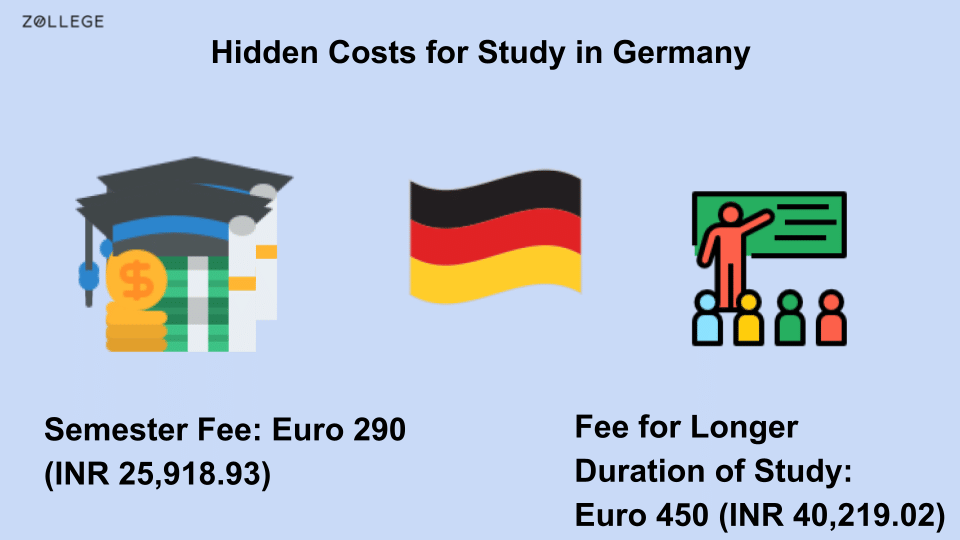
Although there are no tuition fees charged at the public universities, some semester wise contributional costs are always there whenever you apply to any university via Uni Assist. A fee is charged per semester for enrollment, confirmation, and administrative purposes which does not exceed more than Euro 290 (INR 25,918.93). You will also be given a “Semester Ticket” for transportation expenses. The cost of the ticket will depend on the specific semester and type of ticket chosen. In case your academic journey exceeds more than 4 semesters, you may be charged a long term fee. This fee could be a maximum Euro 450 (INR 40,219.02) per semester. Remember, the cost of MBA in Germany is not free, as many universities charge tuition fee for the same.
Cost of Living in Germany
Besides tuition or any other educational costs, an international candidate would also have to incur the living expenses to stay in Germany. The cost of living in Germany may vary according to the location and lifestyle of a candidate. The on campus accommodation facilities might vary with the private accommodation of Germany. Given below are the estimated costs and expenses for an international student living in Germany:
| Particulars | Average Cost |
| Rent and Utilities | Euro 500 (INR 44,687.80) |
| Food and Drink | Euro 250 (INR 22,343.90) |
| Health Insurance | Euro 100 (INR 8,937.56) |
| Phone and Internet | Euro 30 (INR 2,681.27) |
| Extra personal expenses | Euro 100 (INR 8,937.56) |
Euro 1 = INR 89.38 as dated on 20th February 2024
Eligibility Required to Study Free in Germany
There are certain eligibility criteria that you require to understand how to study in Germany for free after 12th. The level of requirements may vary depending on the university you are applying for as well, the mode of study. To study in Germany in the top universities, proper immigration documents must also be there. The below list shows the important eligibility criteria required to met for free study in Germany:
- Meet the program specific requirements of your course
- Provide the English Proficiency test scores as asked by the university
- Check your health insurance policy
- Maintain proper immigration documents
- Provide valid financial proof
It is recommended that you must consult the admissions department to know if there is any application fee. If, there is an application fee, you would have to pay it when you submit the application to the university. However, submitting the application after the deadline can result in the rejection of your application.
FAQs
Ques. When was the no fee policy introduced in Germany?
Ans. In 1976, the no fee policy was legalized at higher educational institutions. After that, tuition fees were not charged from students, be it domestic or international, enrolling in any public university of Germany.
Ques. What are the popular free universities in Germany?
Ans. The popular public universities which offer free education to undergraduate students include University of Cologne, Ludwig Maximilians University, Munich, Goethe University Frankfurt, RWTH Aachen University, etc.
Ques. What do I need as an international student to study in Germany?
Ans. As an international student, you are required to submit scores of IELTS, TOEFL or PTE for admissions in Germany.
Ques. When will I submit the English Proficiency test score reports?
Ans. You must ensure that the score reports are recent and are submitted to the university along with the application form.
Ques. Are all international students exempted from paying the tuition fees?
Ans. Yes, tuition fees are waved off in maximum public universities in Germany. However, if you are enrolling for a masters program, you must enquire about it before applying.
Ques. Do I need to incur any other charges in German Universities?
Ans. In German universities, however, there are extra costs that you would have to incur apart from the tuition fees.
Ques. What are the other incurring costs to study in Germany?
Ans. A substantial fee of Euro 290 (INR 25,918.93) is charged for admissions related enrollment, confirmation and administrative purposes.
Ques. Is there any semester fee in the universities of Germany?
Ans. Yes, you will also be charged a semester fee of Euro 450 (INR 40,219.02) per semester if your academic journey exceeds for more than 4 semesters.
Ques. What is a semester ticket?
Ans. A semester ticket will also be given to you for transportation purposes. The fee for a semester ticket depends on the semester and type of ticket you have applied for.
Ques. When was the concept of free education introduced in Germany?
Ans. The concept of how to study free in Germany started way back in the year 1971. Germany's society abolished the system of tuition fees by instituting a state-funded financial assistance system.
Ques. What are living expenses in Germany?
Ans. Besides tuition or any other educational costs, an international candidate would also have to incur the living expenses to stay in Germany.
Ques. What is the approximate cost of rent in Germany?
Ans. It depends on the location you are staying. The average approximate cost of living in Germany is around Euro 500 (INR 44,687.80) for rent.
Ques. How much is the food expenses in Germany?
Ans. The average approximate cost for meals is around Euro 250 (INR 22,343.90). It may vary according to your choice.
Ques. Do I require health insurance to study in Germany?
Ans. Yes, you would require health insurance to study in Germany. The average cost of health insurance would be around Euro 100 (INR 8,937.56).
Ques. What is the eligibility required to study in Germany?
Ques. Is schooling free in Germany?
Ans. Most of the schools are run by the state and there is no requirement for fees. However, there are private and international schools which charge fees.
Ques. Is Germany free for Indian students?
Ans. Germany provides free education to students from across all nationalities and regions. However, you would have to pay for your accommodation, traveling expenses, food, and other necessities.
Ques. Which language is spoken in Germany?
Ans. The official language which is spoken in Germany is German. More than 95 percent of the country speaks Standard German or a dialect of German as their first language.
Ques. What are Germany's top 3 languages?
Ans. Germany’s top 3 languages include German, English, English, French, etc. More than 95% of the country speaks German.
Ques. Is it ok to speak English in Germany?
Ans. English is reportedly the official language of business in Germany. More than 56% of the population speak English for official purposes.

![Humboldt University of Berlin [HU]](https://static.zollege.in/public/college_data/images/studyabroad/logos/college_632_29-15:02_6.png?tr=w-50,h-50,c-force?tr=h-40,w-35,c-force)
![Technical University Munich [TUM]](https://static.zollege.in/public/college_data/images/studyabroad/logos/college_691_02-13:08_691.png?tr=w-50,h-50,c-force?tr=h-40,w-35,c-force)
![Ludwig Maximilian University of Munich [LMU]](https://static.zollege.in/public/college_data/images/studyabroad/logos/college_690_02-13:05_690.png?tr=w-50,h-50,c-force?tr=h-40,w-35,c-force)
![Free University of Berlin [FU]](https://static.zollege.in/public/college_data/images/studyabroad/logos/college_631_29-15:01_5.png?tr=w-50,h-50,c-force?tr=h-40,w-35,c-force)
.png?tr=w-50,h-50,c-force?tr=h-40,w-35,c-force)


