
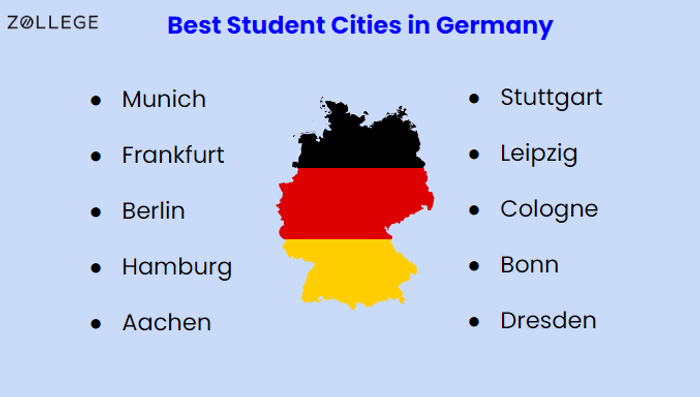
Cost of living in Germany for international students is quite reasonable compared to other European cities. As a single person, you will need a minimum of EUR 949 without rent per month to cover your living expenses. A family of four, on the other hand, can expect to spend around EUR 3,203 per month, excluding rent. Cost of living in Germany is, on average, 182.3% higher than in India. Rent in Germany is, on average, 323.3% higher than in India. The rent of 1 bedroom apartments in the city center is EUR 943 and outside city center is EUR 1,715. Some of the best student cities to study in Germany include the following
Many top universities in Germany like Humboldt University of Berlin, Ludwig Maximilian University of Munich, offer tuition-free education, alleviating concerns about tuition costs. While private colleges may have tuition fees, the overall cost of studying in Germany remains highly affordable compared to many other countries. Although tuition fees are reasonable, you can still exert considerable influence over the overall expenses, including food, accommodation, bills, clothing, and entertainment cost of living in Germany cities. These are relatively comparable to those in other European nations and that is why international students travel in Germany.
Average Cost of Living in Germany for International Students
The cost of living in Germany has witnessed a consistent upward trend in recent years. Since 2007, the price of food and beverages has risen by 23%, while petrol has surged by 30%. Since 2010 electricity costs have soared by approximately 63%. Despite these increases, earnings and salaries for jobs in Germany have not kept pace, resulting in more individuals adopting frugal lifestyles as they become old. Here, we have tabulated all the parameters for the cost of living in Germany for Indian students.
Accommodation Cost in Germany
The accommodation cost is the most expensive part of the average cost of living in Germany for international students. Your expenses as a student can fluctuate based on the housing type and the region you select. The average cost of student accommodation in Germany is EUR 350 per month for university halls. Munich and Stuttgart rank as the most expensive cities for living in Germany, whereas Dortmund offers a more budget-friendly option. On average, the monthly cost of rented accommodation in top German cities is given below
| Cities | 1 bedroom apartment near city center | 1 bedroom apartment outside city center | 3 bedroom apartment in city center | 3 bedroom apartment outside city center |
| Munich | EUR 1,386 | EUR 1,089 | EUR 2,495 | EUR 1,947 |
| Frankfurt | EUR 1,203 | EUR 836 | EUR 2,165 | EUR 1,488 |
| Berlin | EUR 1,307 | EUR 949 | EUR 2,458 | EUR 1,778 |
| Hamburg | EUR 980 | EUR 736 | EUR 1,870 | EUR 1,377 |
| Aachen | EUR 602 | EUR 508 | EUR 1,400 | EUR 1,153 |
| Stuttgart | EUR 1,053 | EUR 744 | EUR 1,927 | EUR 1,438 |
| Leipzig | EUR 751 | EUR 499 | EUR 1,300 | EUR 908 |
| Cologne | EUR 927 | EUR 716 | EUR 1,836 | EUR 1,239 |
| Bonn | EUR 900 | EUR 639 | EUR 1,600 | EUR 1,400 |
| Dresden | EUR 728 | EUR 458 | EUR 1,364 | EUR 1,007 |
Note: EUR 1= INR 89.43 as of February 19, 2024
Transportation Cost of Living in Germany Per Month
Germany is known for its well-organized and interconnected public transportation systems, including trains and buses. By joining part-time jobs in Germany, you can fund your studies as well. The monthly cost of different transportation modes in Germany is tabulated below
| Mode | Monthly Cost |
| Bus | EUR 70 |
| Train | EUR 19-50 |
| Taxi | EUR 3-50 |
| Monthly pass | EUR 60 |
Note: EUR 1= INR 89.43 as of February 19, 2024
Utilities and Bills Cost of Living in Germany
Utility costs such as water, electricity, heating, garbage, internet, and mobile plan are encompassed in the monthly bills in Germany. In specific cases, these utility expenses may already be integrated into the rent, negating the necessity for separate payments. Candidates get an average salary of EUR 67,000 in MBA jobs in Germany, so the job market is ready to offer you enough to cover the cost of living. The average cost of living in Germany per month for these utilities is tabulated below
| Expense type | Monthly Cost |
| Basic (Electricity, heating, cooling, water, garbage) for 915 sq. ft apartment | EUR 290 |
| Internet (60 Mbps or more, unlimited data) | EUR 45.70 |
| Mobile phone monthly plan with calls and 10GB + Data | EUR 25.55 |
Note: EUR 1= INR 89.43 as of February 19, 2024
Food and Groceries Cost of Living in Germany
Food and grocery expenses come second in the list of monthly living costs, following rent. In recent years, it's also noted that the rates have been consistently rising. There can be many reasons for your German student visa rejection. So, check properly before applying The following table describes the monthly expenses for food and groceries in Germany:
| Expense | Cost |
| Milk | EUR 1.08 |
| Loaf of Fresh White Bread (500g) | EUR 1.19 |
| Rice (white), (1kg) | EUR 2.70 |
| Eggs (regular) (12) | EUR 3.28 |
| Local Cheese (1kg) | EUR 12.18 |
| Chicken Filets (1kg) | EUR 15.15 |
| Beef Round (1kg) (or Equivalent Back Leg Red Meat) | EUR 14.90 |
| Apples (1kg) | EUR 2.37 |
| Banana (1kg) | EUR 1.34 |
| Oranges (1kg) | EUR 2.08 |
| Tomato (1kg) | EUR 1.72 |
| Potato (1kg) | EUR 1.53 |
| Onion (1kg) | EUR 1.82 |
| Lettuce (1 head) | EUR 1.74 |
| Water (1.5 liter bottle) | EUR 0.69 |
| Bottle of Wine (Mid-Range) | EUR 4.99 |
| Domestic Beer (0.5 liter bottle) | EUR 0.92 |
| Imported Beer (0.33 liter bottle) | EUR 1.61 |
| Cigarettes 20 Pack (Marlboro) | EUR 8.20 |
Note: EUR 1= INR 89.43 as of February 19, 2024
Cost of Healthcare in Germany
International students aspiring to study in Germany must have mandatory health insurance. Germany offers two types of health insurance programs: public and private health insurance, both accessible to students under the age of 30. Additionally, students can qualify for a special discount on public health insurance. Overseas students can secure private insurance plans for as low as EUR 70-EUR 80 per month. Students on a German student visa are mandatorily required a health insurance. However, private health insurance is the exclusive option for students above the age of 30, those engaged in language and preparation courses, PhD students, and visiting scientists. Public health insurance, priced between EUR 103.94 and EUR 111.75 per month, encompasses basic healthcare and long-term care insurance. Meanwhile, private health insurance in Germany commences at around EUR 33 per month, with costs increasing based on chosen additional services and if the plan is intended for a stay of 18 months or longer.
Average Cost of Living in Germany vs US Vs UK Vs Australia
The average cost of living in Germany tends to be lower than in the US and the UK, offering a balance between affordability and quality of life. While the United States generally has a higher cost of living, it varies significantly between cities, with coastal cities being more expensive compared to the Midwest. The cost of living in the UK, particularly in cities like London, is generally higher than in Germany, but it varies regionally across the country. Australia, known for its high standard of living, has a relatively higher cost of living, particularly in major cities like Sydney and Melbourne, compared to Germany, with housing being a significant expense in both countries. The below table describes the cost of living for these countries
| Country | Single person estimated monthly cost | Family of four estimated monthly cost | Rent |
| Germany | INR 84,875 | INR 2,86,912 | 63142 to 1,53,384 |
| US | INR 97,062 | INR 3,45,658 | INR 1,20,445 to 2,46,053 |
| UK | INR 84,800 | INR 2,86,217 | INR 92,011 to 1,86,08,969 |
| Australia | INR 93,718 | INR 3,30,423 | INR 1,01,173 to 2,06,716 |
Tips to Save Money in Germany
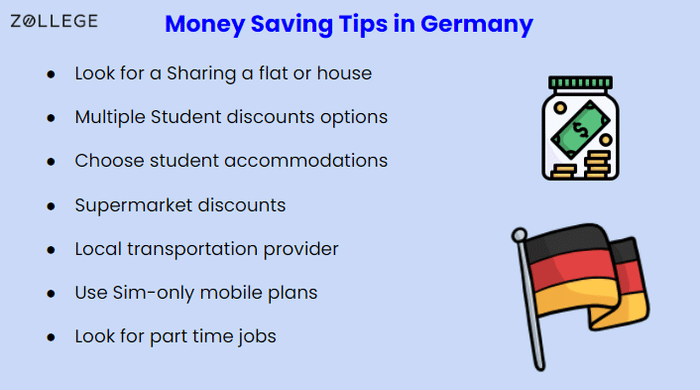
Living affordably in Germany is achievable when you're familiar with money-saving strategies. Some of the tips to save money for the cost of living in Germany as a student are the following:
You can consider the above-mentioned details while moving to Germany for your further studies. All the estimated cost of living in Germany is discussed above. Cost of living in Germany for single person depends on the person’s choice of accommodations. There is a 50% difference between the cost of living in Germany vs India.
FAQs
Ques: Is the cost of living in Germany high?
Ans: The cost of living in Germany is generally moderate, especially when compared to many other Western European countries. While certain aspects, such as housing, can be relatively high in major cities, overall, it offers a reasonable balance between affordability and quality of life.
Ques: How much is rent in Germany on average?
Ans: Rent costs in Germany vary based on location, with major cities like Berlin or Munich being more expensive. On average, you can expect to pay around EUR 800 to EUR 1,200 per month for a one-bedroom apartment. However, rental prices in smaller towns or rural areas are considerably lower.
Ques: Are groceries expensive in Germany?
Ans: Grocery prices in Germany are generally reasonable. On average, a single person may spend between EUR 150 to EUR 250 per month on groceries. Exploring local markets and discount stores can help individuals manage their food expenses more efficiently.
Ques: What about transportation costs in Germany?
Ans: Public transportation in Germany is well-developed and cost-effective. Monthly transportation passes in cities typically range from EUR 70 to EUR 100. Additionally, many cities offer discounts for students, making it an affordable option for daily commuting.
Ques: Do I need health insurance in Germany?
Ans: Yes, health insurance is mandatory for all residents in Germany, including international students. Students under 30 can opt for public insurance with a special discount, ensuring access to comprehensive healthcare coverage during their stay.
Ques: How much is private health insurance for students?
Ans: Private health insurance for students in Germany can start at EUR 70-EUR 80 per month. The cost varies based on individual plans, coverage, and the specific needs of the student, providing flexibility in choosing a suitable health insurance option.
Ques: What is the cost of dining out in Germany?
Ans: Dining out in Germany is reasonably priced, offering a variety of options to fit different budgets. On average, a meal at a mid-range restaurant can cost between EUR 10 to EUR 20, making it accessible for both residents and visitors.
Ques: Are there ways to save on living costs in Germany?
Ans: Yes, there are several ways to save on living costs in Germany. Students, for example, can benefit from discounted rates on public transportation, and exploring local markets for groceries can significantly contribute to managing overall expenses.
Ques: How much does the internet cost in Germany?
Ans: Monthly internet costs in Germany typically range from EUR 20 to EUR 40, depending on the provider and the desired speed of the connection. Comparing different providers can help individuals find a cost-effective option that suits their needs.
Ques: Is it expensive to study in Germany?
Ans: The cost of studying in Germany is generally affordable, especially at public universities where tuition fees are often low or nonexistent. This makes education in Germany a cost-effective option for international students seeking quality higher education.
Ques: What is the average cost of childcare in Germany?
Ans: Childcare costs in Germany vary depending on factors such as location and the type of childcare facility. On average, parents can expect to pay around EUR 150 to EUR 300 per month for preschool or daycare services.
Ques: Are there affordable options for entertainment in Germany?
Ans: Yes, Germany offers a wide range of affordable cultural and recreational activities. Many cities provide discounted tickets for students, allowing them to enjoy museums, theaters, and other forms of entertainment without breaking the bank.
Ques: How much do utilities cost in Germany?
Ans: Monthly utility costs, covering water, electricity, and heating, can range from EUR 150 to EUR 250, depending on the size of the apartment and individual consumption. It's essential to factor in these costs when planning a budget.
Ques: Are there affordable housing options for students in Germany?
Ans: Students in Germany often have access to affordable housing options, including student dormitories and shared apartments. Rent for such accommodations may range from EUR 300 to EUR 600 per month, making it more budget-friendly for students.
Ques: How much does it cost to obtain a driver's license in Germany?
Ans: The cost of obtaining a driver's license in Germany can vary, encompassing expenses for driving lessons, theoretical exams, and practical tests. On average, individuals may spend between EUR 1,000 to EUR 2,000 to obtain a driver's license.
Ques: Can I work part-time as a student in Germany to cover living expenses?
Ans: Yes, many international students in Germany work part-time to supplement their income. Germany has regulations allowing students to work during their studies, providing an opportunity to cover living expenses and gain valuable work experience.

![Humboldt University of Berlin [HU]](https://static.zollege.in/public/college_data/images/studyabroad/logos/college_632_29-15:02_6.png?tr=w-50,h-50,c-force?tr=h-40,w-35,c-force)
![Technical University Munich [TUM]](https://static.zollege.in/public/college_data/images/studyabroad/logos/college_691_02-13:08_691.png?tr=w-50,h-50,c-force?tr=h-40,w-35,c-force)
![Ludwig Maximilian University of Munich [LMU]](https://static.zollege.in/public/college_data/images/studyabroad/logos/college_690_02-13:05_690.png?tr=w-50,h-50,c-force?tr=h-40,w-35,c-force)
![Free University of Berlin [FU]](https://static.zollege.in/public/college_data/images/studyabroad/logos/college_631_29-15:01_5.png?tr=w-50,h-50,c-force?tr=h-40,w-35,c-force)
.png?tr=w-50,h-50,c-force?tr=h-40,w-35,c-force)


