
Germany is famous among the intenational students for it’s world class education. Most universities in Germany are free of cost. In private universities, candidates have to pay nominal amount as semester fees. To study, a German student visa is required as an official document to enter and staying in the country.

The popular courses in Germany include computer science, engineering, management, IT, etc. Each course may have its own set of entry requirements as per the university. As an international student, you would have to submit your English Proficiency test scores of IELTS, PTE or TOEFL scores, etc. These score reports must be submitted along with your application form to the university before the admission's deadline.
Besides the cost of tuition fees to study in Germany, an international candidate must also calculate the cost of living in Germany for international students. For studying and staying in Germany, you would require documents such as ID proof, student health insurance, financial proof, proper immigration documents, etc. The university officials will thoroughly check your documents and can contact you in case of any verification.
Top Universities to Study in Germany
As an international student, you must know the rankings achieved by the top universities in Germany to study in Germany. The annual fees for each university may change depending on the academic year you are applying. However, it is reported that the average cost to study in Germany is relatively low as compared to other countries. The below given table shows the top universities in Germany to study.
| University/College | QS Ranking 2024 |
| Technical University of Munich | 37 |
| Ludwig Maximilian University of Munich (Ludwig-Maximilian-Universität München) | 54 |
| Universität Heidelberg | 87 |
| RWTH Aachen University | 106 |
| Humboldt University of Berlin (Humboldt-Universität zu Berlin) | 120 |
Popular Courses in Germany
As an international student, you must apply to the popular and job oriented courses to study in Germany. The popular courses include computer science and IT, engineering, social sciences, management, humanities, etc. Each university may have different course structure and tuition fees. Even some public universities in Germany do not charge any tuition fees. You can also apply to these specializations to study in Germany after diploma courses. You must check the relevant and required details from the university official page as the data keeps changing annually. Given below are some best course to study in Germany:
- Computer Science and Information Technology (IT)
- Engineering Studies
- Social Sciences
- Management Studies
- Humanities and creative arts
Fee Structure to Study in Germany
The annual fee structure for the study in Germany may vary as per the level you are applying for. Make sure to meet the course specific requirements for apply to German universities. In some colleges, you can also pay the tuition fees in installments. Given below are the approximate fee range in different levels to apply for study in Germany:
| Course | Annual Fees (Approximate Range) |
| Undergraduate | Euro 500 — Euro 20,000 (INR 44,733.69–17,89,347.43) |
| Graduate | Euro 5,000 — Euro 30,000 (INR 4,47,336.86–26,84,021.15) |
| PhD | Euro 300 — Euro 3000 (INR 26,840.21-INR 2,68,402.12) |
Euro 1 = INR 89.47 as dated on 19th February 2024
Intakes to Study in Germany
There are usually two intakes in Germany for international students. It is recommended that you must apply as early as possible to understand the benefits of study in Germany. The intake starting months may vary according to the university. Given below are the intakes for the best course to study in Germany:
| Semester | Starting Period |
| Summer Semester | Starts in March/April |
| Winter Semester | Starts in October/November |
| Rolling Admissions | As applications are received |
How to Apply to Study in Germany
It is important to know the correct application process in order to apply for the universities in Germany. Make sure you include all your details such as academic, personal, and professional in your application form. We suggest that you can also consult an educational agent in the process of how to study free in Germany. Given below are some steps to apply for study in Germany:
- Shortlist a University
- Select a course
- Fill up the application form of the University
- Provide your academic, personal, and professional details
- Include your English Proficiency test scores of IELTS, TOEFL or PTE
- Pay the application fee (if required)
- Submit the application
- Try to keep a track of your application
- Accept the offer of admission, if received
- Pay the tuition fee to confirm your seat in the University
- Apply for a German Student Visa
Eligibility Criteria for Study in Germany
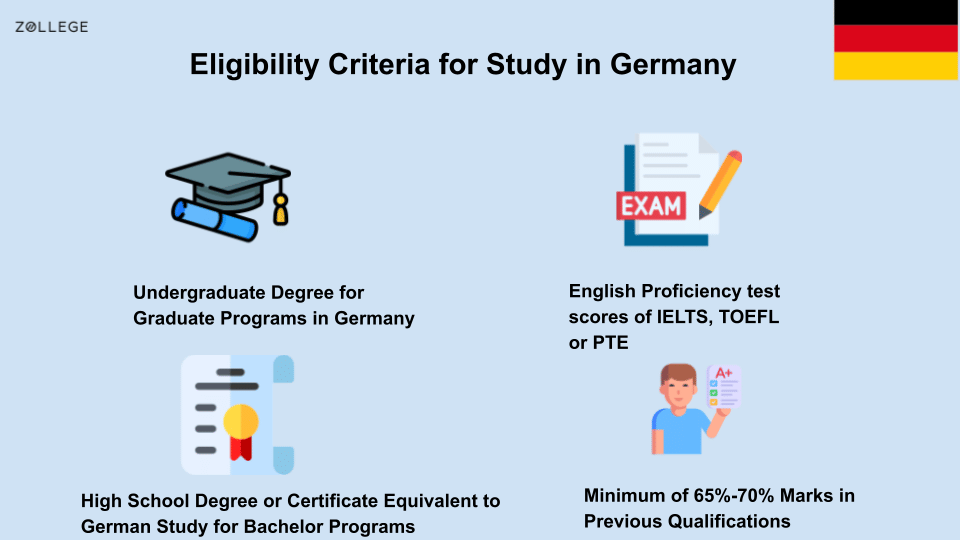
The eligibility criteria for study in Germany includes a minimum percentage of 65%-70% marks in previous qualifications. The age limit to study in Germany involves no strict regulations. Some universities may also ask you to appear for an entrance examination before admissions. Your application may be rejected if you fail to meet these eligibility requirements for MBA in Germany or other courses. The data given below shows the requirements to study in Germany for international students:
Documents Required for Study in Germany
Apart from the academic requirements, you would also have to submit certain documents such as academic transcripts, financial proof, ID proof, LOR for Germany etc. These documents must be submitted along with the application form. However, some universities may also have an extended documents submission deadline. Given below are the documents requirements to study in Germany for international students:
- Previous academic certificates and degrees
- English Proficiency test scores report
- Source of funds (Financial proof)
- Academic Transcripts
- Student Health Insurance
- Letters of Recommendation
- SOP for Germany
- Student Visa
- ID Proof (Passport)
As an international student, you can also study in Germany for free. In 2014, Germany's 16 states abolished tuition fees for undergraduate students at all public German universities. However, there are also certain scholarships to study in Germany which are awarded on merit basis. Some universities also provide the option of work and study in Germany simultaneously through their programs.
FAQs
Ques. How to study in Germany for international students?
Ans. Study in Germany involves international candidates to have a past qualification equivalent to German mode of study as well as it level.
Ques. What are the top universities in Germany for international students?
Ques. What is the average cost of studying in Germany for international students?
Ans. The average cost to study in Germany in these universities may vary according to the level you are applying for.
Ques. What are the popular courses to study in Germany?
Ans. The popular courses in Germany include computer science, engineering, management, IT, etc. Each course may have its own set of entry requirements as per the university.
Ques. Does Germany require IELTS?
Ans. As an international student, you would have to submit your English Proficiency test scores of IELTS, PTE or TOEFL scores, etc. These scores must be submitted along with the application form.
Ques. What documents are required to study in Germany?
Ans. For studying and staying in Germany, you would require documents such as ID proof, student health insurance, financial proof, proper immigration documents, etc.
Ques. What is the approximate fee structure for undergraduate courses in Germany?
Ans. The approximate fee structure for undergraduate courses in Germany Euro 500 — Euro 20,000 (INR 44,733.69–17,89,347.43)
Ques. What is the approximate fee structure for graduate courses in Germany?
Ans. The approximate fee structure for graduate courses in Germany Euro 5,000 — Euro 30,000 (INR 4,47,336.86–26,84,021.15).
Ques. What is the approximate fee structure for PhD courses in Germany?
Ans. The approximate fee structure for graduate courses in Germany Euro 300 — Euro 3000 (INR 26,840.21-INR 2,68,402.12).
Ques. How many intakes are offered in German Universities?
Ans. There are usually two intakes in Germany for international students. It is recommended that you must apply as early as possible to the German Universities to avoid any last minute issue.
Ques. What are the intake months in German Universities?
Ans. The intake months might vary as per the university calendar. However, in common, the summer semester often starts in March/April and the winter semester starts in October/November.
Ques. What is the percentage of marks required to study in Germany?
Ques. What do I need for studying undergraduate programs in Germany?
Ans. To study for studying undergraduate programs in Germany, you would require a high School degree or certificate equivalent to German study for bachelor programs.
Ques. Do I have to submit the documents along with the application form?
Ans. The documents must be submitted along with the application form. However, some universities may also have an extended documents submission deadline.
Ques. How can I apply to German Universities for higher education?
Ques. How can Indian students study in Germany?
Ans. Indian students can study in Germany with a proper student visa. After the letter of offer arrives from the university, immediately apply for a visa.
Ques. Can I study Germany for free?
Ans. Yes, you can study in free at all the public universities of Germany. In 2014, Germany's 16 states abolished tuition fees for undergraduate students at all public German universities.
Ques. What is the number 1 university in Germany?
Ans. The best universities of Germany include Munich (with Ludwig Maximilians University, LMU, and the Technical University of Munich, TUM) and Berlin (with the HU, the FU and the TU).
Ques. Which study is famous in Germany?
Ans. The study which is famous in Germany includes research-based degrees in the natural sciences and industry. You can apply for these degrees in any top university.
Ques. Which degree pays the most in Germany?
Ans. The degrees which pays the most in Germany includes Medicine and Healthcare. The programs of health and medicine are available in almost all top universities of Germany.

![Humboldt University of Berlin [HU]](https://static.zollege.in/public/college_data/images/studyabroad/logos/college_632_29-15:02_6.png?tr=w-50,h-50,c-force?tr=h-40,w-35,c-force)
![Technical University Munich [TUM]](https://static.zollege.in/public/college_data/images/studyabroad/logos/college_691_02-13:08_691.png?tr=w-50,h-50,c-force?tr=h-40,w-35,c-force)
![Ludwig Maximilian University of Munich [LMU]](https://static.zollege.in/public/college_data/images/studyabroad/logos/college_690_02-13:05_690.png?tr=w-50,h-50,c-force?tr=h-40,w-35,c-force)
![Free University of Berlin [FU]](https://static.zollege.in/public/college_data/images/studyabroad/logos/college_631_29-15:01_5.png?tr=w-50,h-50,c-force?tr=h-40,w-35,c-force)
.png?tr=w-50,h-50,c-force?tr=h-40,w-35,c-force)


