
Highlights
- After Master in Physics in Germany, you can extend your residence permit for 18 months to get jobs there.
- With 5 years of experience, a Physicist in Germany can earn around EUR 75,000 (INR 66,79,672) per year.
- MSc in Physics in German costs are comparatively lower. You can study the program with a semester fee of EUR 285.93 (INR 25,470) per year.
- Unemployment rate in Germany is fixed at 5.9% in 2024, which unlocks a wide range of career opportunities for Physicists.
Do you have a strong interest in the diverse fields of Physics? Master in Physics in Germany will broaden your concepts in experimental and theoretical physics. This 2-year program does not charge any fees for public universities in Germany like RWTH Aachen University, Free University of Berlin etc. Are you worried about not knowing the German language to pursue the program? You may learn MS in Physics in Germany in the English language. You must have:
- 2.5 GPA in bachelor degree in Physics or related fields
- IELTS score of 5.5 or TOEFL score of 72
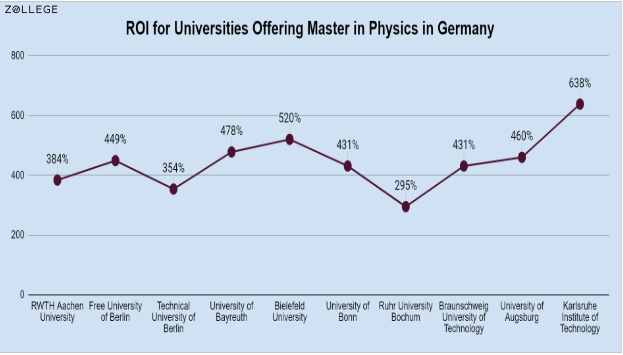
How much do you budget to pursue a Physics Master in Germany? If you want to immigrate to Germany to pursue higher studies, you require an annual living expense of EUR 5,301.60-17,280. Annual tuition fees may charge you around EUR 1000-3000 (INR 89,090-2,67,270) per year for the coursework. You must shortlist the universities depending on the ROI offered to study the program. As shown in the graph, Karlsruhe Institute of Technology has the highest ROI. At KIT, you spent an expense of around EUR 8,302 (INR 7,39,982) per year. The ROI declined at Ruhr University Bochum, offering the most expensive annual expense of EUR 17,980 (INR 16,02,610).
Get a wide opportunity in Aerospace industry, Medical technology and IT industry after Master of Physics in Germany. If you return after the coursestudy, your salary in India after MS in Germany will range between INR 10 LPA-INR 60 LPA. What are the job roles after MSc Physics in Germany for Indian students?
- You can be assigned as a Physicist, Data Engineer or Data Scientist.
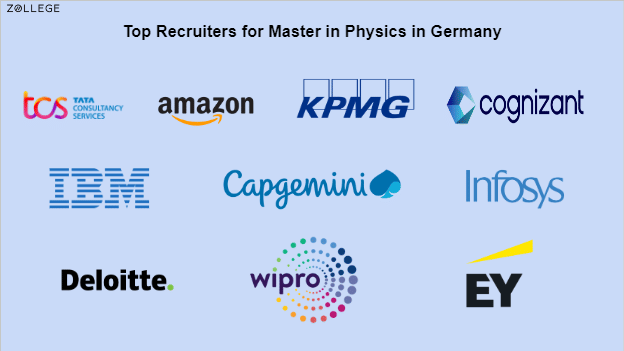
- Leading sectors for Germany MSc Physics graduates are TCS, KPMG and Cognizant
- Seeking an MSc in Physics degree lets you earn EUR 53000 (INR 47,19,862) in Germany.
Why Choose to Study Master in Physics in Germany?
You can study in Germany for Master in Physics for several reasons. For MSc Physics, you can do various specializations like Medical Physics, Quantum Physics, Mathematical Physics etc. The reasons to get into university in Germany for Physics are as follows:
- The IT industry in Germany will attain an annual growth of 6.30% by 2028. This will open a wide job scope for Physicists in Germany.
- In Germany, the IT market will get a revenue of EUR 61.95 billion in 2024.
- Physicists in Germany may get a bonus of around EUR 1000-6000 (INR 89,090-5,34,762) each year.
- You can get free coursework to study in Germany. MS in Physics requires a semester fee of EUR 285.93-EUR 700 (INR 25,470-62,363) per year.
Top Universities for Master in Physics in Germany
Are you uncertain about what to invest in tuition fees for MSc in Physics in Germany? Cost for MS in Germany for Physics may range between EUR 1000 (INR 89,090) and EUR 3000 (INR 2,67,270) per year. To get into university in Germany for Physics, you must have German language skills at B2 level. If you do not have German language skills, you can attain the program in English. You must have English proficiency with a good IELTS or TOEFL score. The table below states the tuition fees and requirements for MS in Physics in Germany:
| Top Universities | Annual Tuition Fees | Score Requirements |
| RWTH Aachen University | EUR 606.98 (INR 54,091) | TOEFL: 100 IELTS: 7.0 PTE: 70 German language skills are not required |
| Free University of Berlin | EUR 590.98 (INR 52,665) | IELTS: 5.5 TOEFL: 72-94 PTE: 75 – 59 German language skills are not required |
| Technical University of Berlin | EUR 580.88 (INR 51,776) | DSH 2 Goethe Certificate C2 DSD 2 TestDAF 4 Telc C1 English language skills are not required |
| University of Bayreuth | EUR 285.93 (INR 25,470) | German B2 level is required English language skills are not required |
| Bielefeld University | EUR 600 (INR 53,478) |
TOEFL: 87 |
| University of Bonn | EUR 647.92 (INR 57,744) | English skills at B1 level are required |
| Ruhr University Bochum | EUR 700 (INR 62,363) | IELTS score: 6.0 TOEFL: 79 German language skills are not required |
| Braunschweig University of Technology | EUR 1000 (INR 89,090) | TestDaF 4 DSH 2 Goethe Certificate C2 Telc C1 English language skills are not required |
| University of Augsburg | EUR 301.26 (INR 26,851) | DSH1 TestDAF 3 DSD II Goethe Certificate/ TELC / ÖSD at B2 level is required English language skills are not required |
| Karlsruhe Institute of Technology | EUR 3,000 (INR 2,67,270) | IELTS: 6.5 TOEFL score: 90 |
Entry Requirements
To study Master in Physics German, you require a German Student Visa permit. For applying to the best universities in Germany for Masters in Physics, secure a 2.5 GPA or higher. Submit transcripts, SOP and LOR to pursue the program. Check below the entry requirements for Master in Physics in Germany:
- 3 years of bachelor’s degree or equivalent in a related discipline
- Transcript of records
- School leaving certificate
- Statement of purpose
- CV
- Work Experience
- GRE score (optional)
- German language proficiency scores
- English language proficiency scores
- Letters of reference
- Passport size photo
- APS certificate
Master in Physics in Germany Application Deadline and Fees
Login through the website of the university or via uni-assist to apply to German universities for Physics Master. For directly registering, you do not need to pay any admission fees for most universities. Pay roughly EUR 75 (INR 6,678) to apply to MS in Physics in Germany via uni-assist. The table below illustrates the deadline and application fees for Master in Physics in Germany:
| Top Universities | Application Deadline | Application Fee |
| RWTH Aachen University | 1 March 2024 (Winter) 1 September 2024 (Summer) |
Not required |
| Free University of Berlin | 15 August 2024 (winter) 15 February 2025 (summer) |
EUR 100 (INR 8,904) |
| Technical University of Berlin | 1 June 2024 (winter) 1 December 2024 (summer) |
EUR 75 (INR 6,678) |
| University of Bayreuth | 15 July 2024 (winter) 15 January 2025 (summer) |
Not required |
| Bielefeld University | 31 March 2024 (Summer) 30 September 2024 (Winter) |
EUR 75 (INR 6,678) |
| University of Bonn | 15 July 2024 (winter) 15 January 2025 (summer) |
Not required |
| Ruhr University Bochum | 15 July 2024 (winter) 15 January 2025 (summer) |
Not required |
| Braunschweig University of Technology | 15 July 2024 (winter) 15 January 2025 (summer) |
EUR 75 (INR 6,678) |
| University of Augsburg | 15 July 2024 (Winter) 15 February 2025 (Summer) |
Not required |
| Karlsruhe Institute of Technology | 15 January 2025 | Not required |
Cost of Living in Germany
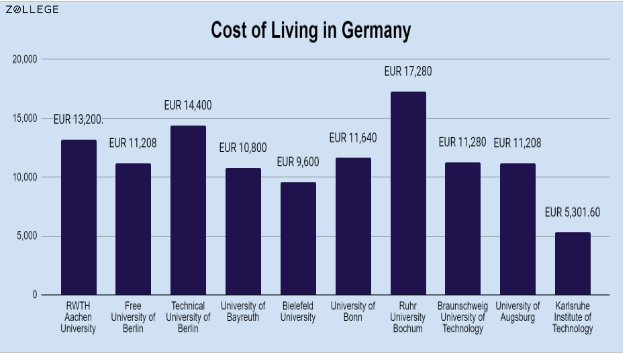
The graph shows that Karlsruhe Institute of Technology has the lowest living cost in Germany. At Karlsruhe, the monthly cost of student accommodation in Germany is EUR 355 (INR 31,608), which is cheaper than in other cities. The graph shows Ruhr University Bochum has the highest cost of living. The rent at Bochum, Germany is highly expensive, varying from EUR 350-700 (INR 31,163-62,338) per month. The graph shows the cost of living for pursuing MS in Physics in Germany:
Scholarships for Master in Physics in Germany
Want to make a fruitful financial plan to afford the fees in Germany? Get around 20-50% financial help, if you apply for scholarships in Germany. The table below shows the eligibility and awards offered by scholarships for Master in Physics in Germany:
| Top Universities | Scholarship Name | Eligibility | Award Amount |
| RWTH Aachen University | High Potential Student Grant | If you have outstanding qualifications, you are eligible | 25% of tuition fees |
| Free University of Berlin | Deutschlandstipendium | Students with high talents and qualifications are eligible | EUR 300 (INR 26,712) per month |
| Technical University of Berlin | Heinrich Böll Stiftung | You must have high qualifications and strong merits | Varies |
| University of Bayreuth | DAAD scholarships | You must show strong merits and good grades | Varies |
| Bielefeld University | Friedrich Ebert Stiftung | You must demonstrate strong academic qualifications | Varies |
| University of Bonn | Deutschlandstipendium | High academic qualifications with a 2.3 GPA or higher are required | EUR 300 (INR 26,712) per month |
| Ruhr University Bochum | Deutschlandstipendium | Highly qualified students having social commitment are eligible | EUR 300 (INR 26,712) per month |
| Braunschweig University of Technology | Deutschlandstipendium | Students having strong academic performance are eligible | EUR 300 (INR 26,712) per month |
| University of Augsburg | Oskar Karl Forster Scholarship | If you have high talents, you are eligible | EUR 100-500 (INR 8,904-44,519) |
| Karlsruhe Institute of Technology | DAAD scholarships | High meritorious students are eligible | Varies |
Master in Physics in Germany Job Outcomes
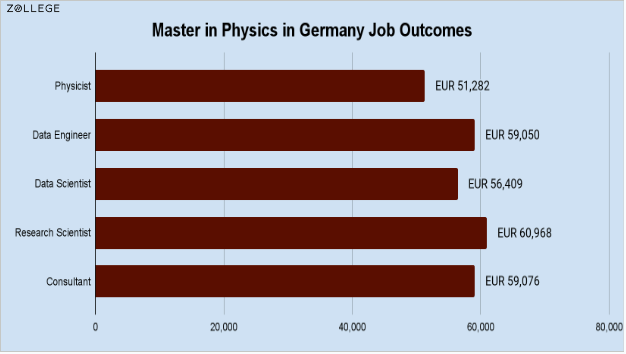
After Master in Physics Germany, you can be a Physicist, Engineer and Consultant. You can get a salary ranging from EUR 51,282 (INR 45,71,636) to EUR 60,968 (INR 54,34,792) annually. In Germany, you can get the chance to do part-time jobs for 20 hours a week. You can receive an average monthly salary of EUR 520 (INR 46,353) by availing part-time jobs in Germany. Here, are detailed job prospects for pursuing Masters in Physics in Germany:
Top Recruiters for Master in Physics in Germany
Graduates holding Physics Masters in Germany can get jobs in Aerospace Industry, Medical Technology, Energy Industry, IT Industry and Management Consultancy. You can receive EUR 53000 (INR 47,19,862) average salary with a Masters in Physics Germany. The leading organizations to offer jobs in Germany after MS Physics in Germany are detailed below:
Work Permit
Are you concerned with work permits in Germany and visa requirements? To find and attend a job in Germany, hold a General work permit visa Germany or an EU Blue Card. To get an EU Blue Card, you must get a minimum salary of EUR 45,300 (INR 40,38,090) per year. Check below the requirements for applying for a visa:
- Employment offer letter
- Health insurance documents
- Bank statement
- Passport
- Transcripts
- Resume
- SOP for work permit visa
- Passport size pictures
Do you have any doubts about the prerequisites for Physics Masters Germany? Don't worry. You can check the above information to get into the program. You must hold a minimum undergraduate degree in related disciplines for the program. To manage the expenses, you can get a chance to attend part-time jobs and avail help from scholarships in Germany.
FAQs
Ques: Can I do MSC in Physics in Germany?
Ans: Yes, you can pursue an MSc in Physics in Germany if you hold a bachelor degree in related fields. To get the master degree in Physics, secure at least a 2.5 GPA or higher.
Ques: Is Germany good for physics?
Ans: In Germany, there are wide career opportunities after MSc in Physics. The IT industry in Germany is expected to achieve an annual growth of 6.30% by 2028.
Ques: Which country is best for MS in physics?
Ans: You can apply for MS in Physics in USA, UK, Canada, Australia and Germany. To pursue the program, you must be a bachelor's degree holder in a related field.
Ques: Who is eligible for MSc Physics in Germany?
Ans: For MSc Physics in Germany, you require a bachelor's degree in related disciplines. Secure a minimum GPA of 2.5 or higher to get into the program.
Ques: Are physicists in demand in Germany?
Ans: Yes, Physicists are in great demand in Germany as the IT market has a target to attain a revenue of EUR 61.95 billion in 2024. As a Physicist, you can earn a salary of EUR 51,282 per year in Germany.
Ques: What is the scope of physics in Germany?
Ans: You can witness a wide career scope like Physicist, Data Engineer and Consultant after MSc in Physics in Germany. With a MSc degree in Physics in Germany, earn an average annual salary of EUR 53000.
Ques: Which branch of physics has more scope?
Ans: You can apply for astrophysics and nuclear physics to get more career scope. To attain this program abroad, you must secure good academic qualifications and English language skills.
Ques: What is the future scope of MSc physics?
Ans: MSc Physics offers a wide career prospects. You can get hired in different job roles like Physicist, Data Engineer and Consultant.
Ques: What is the salary after MS in Germany?
Ans: After MS in Germany, you can earn a salary ranging from EUR 46,000-110,000 per year. You can get hired by top companies like IBM, EY, Deloitte, Cognizant etc.
Ques: Can I study physics in Germany in English?
Ans: Yes, you can study Physics in Germany in English language at Ruhr University Bochum and Bielefeld University. For that, you must have good English skills to attain the coursework.
Ques: What is the salary of MSC physics in Germany?
Ans: You get jobs in Aerospace Industry, Medical Technology and IT Industry after an MSc Physics in Germany. With an MSc degree in Germany, you can earn an average salary of EUR 53000 per year.
Ques: Is studying physics in Germany hard?
Ans: Physics is indeed a difficult subject. You must have a concept of mathematics and must devote 2 years to pursue Masters in Physics in Germany.
Ques: Which branch of physics is difficult?
Ans: The most difficult part of physics is Quantum mechanics. You are required to achieve a GPA of 2.5 or higher to pursue the coursestudy.
Ques: How long is a physics masters in Germany?
Ans: Physics Masters in Germany is a 4-semester program that requires 2 years to complete the program. You can apply to top universities in Germany like RWTH Aachen University, Free University of Berlin and TU Berlin to attain the program.
Ques: Is doing Masters in Physics in Germany free?
Ans: Yes, you can study Masters in Physics in Germany free of cost at universities like RWTH Aachen University, Free University of Berlin and TU Berlin. Pay a semester fee of EUR 285.93-EUR 700 per year to pursue at these universities for the program.

![Humboldt University of Berlin [HU]](https://static.zollege.in/public/college_data/images/studyabroad/logos/college_632_29-15:02_6.png?tr=w-50,h-50,c-force?tr=h-40,w-35,c-force)
![Technical University Munich [TUM]](https://static.zollege.in/public/college_data/images/studyabroad/logos/college_691_02-13:08_691.png?tr=w-50,h-50,c-force?tr=h-40,w-35,c-force)
![Ludwig Maximilian University of Munich [LMU]](https://static.zollege.in/public/college_data/images/studyabroad/logos/college_690_02-13:05_690.png?tr=w-50,h-50,c-force?tr=h-40,w-35,c-force)
![Free University of Berlin [FU]](https://static.zollege.in/public/college_data/images/studyabroad/logos/college_631_29-15:01_5.png?tr=w-50,h-50,c-force?tr=h-40,w-35,c-force)
.png?tr=w-50,h-50,c-force?tr=h-40,w-35,c-force)


