
Thinking about pursuing a Masters in Computer Science in Germany? It is a 2-year postgraduate program. Germany comes first in mind when it comes to technology, innovation, and brilliant ideas. What is exceptional is that Germany is known for its affordable education, especially for international students. Many public universities in Germany offer tuition-free Master's programs in Computer Science. Yes, you heard that right — tuition-free! It is like hitting the jackpot for those seeking quality education without breaking the bank. Now, here is the thing: while most undergraduate programs are taught in German, you can enroll for a Masters in Computer Science in Germany in English too. That opens up a whole world of opportunities for you to specialize in areas like artificial intelligence, machine learning, software engineering, cybersecurity, data science, and more.
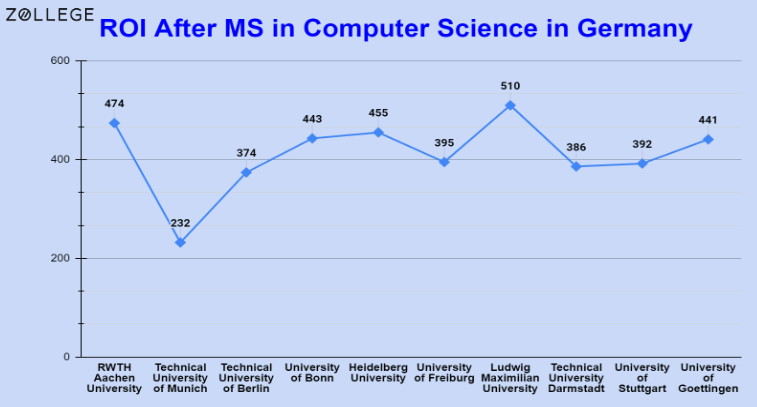
Think of your Master's as an investment in your future. The relatively low masters in Computer Science in Germany fees compared to other countries mean you're not breaking the bank upfront. Plus, with those high German salaries after graduation, your investment pays off fast. The ROI is calculated by dividing your annual salary with the total expense. As the graph suggests, the average ROI of this course is around 410%. Ludwig Maximilian University is offering maximum ROI at 510%.
So, what do you need to get in? Well, you will need a bachelor's degree from a recognized university. For your program, you will also need to prove your German or English language proficiency through exams like TestDaf, DSH, Goethe Certificate, Telc, IELTS for Germany, or TOEFL. There might be a semester fee, but it is a small price to pay for the quality education you will receive. You can apply to this program in winter and summer semester intakes in Germany.
Let's talk about the job market. Germany is a hotbed for innovation and technology, which means there is a strong demand for skilled computer scientists. With a Master's degree from a German university, you will be well-equipped to thrive in the job market, both in Germany and globally. You can earn an average annual salary of EUR 56,000 after completing the program. Companies like Allianz, SAP, Siemens, and Deloitte are always on the lookout for top-notch computer science grads like yourself. Many of the students immigrate to Germany to benefit from these job prospects.
Why Study this Program?
Germany is known for its free-education and higher ROI offerings. But why should you choose this program to study in Germany? Is it worth doing masters in computer science in Germany? Below, we have given some points to consider behind studying this subject
- Affordability: Public universities in Germany are renowned for their low or non-existent tuition fees, making a master degree a financially attractive option
- Scholarship opportunities: Confused with the additional expenses? You can avail scholarship for Masters in Computer Science in Germany from various sources, including the German Academic Exchange Service (DAAD), easing the financial burden for international students
- High demand: Germany is known for its demand in IT, computer science and data science, followed by a 97% employment rate.
- Attractive salary: Entry level tech grads earn EUR 56,000 on average per year.
- Higher ROI: 410% is the average ROI after completing a Masters in Computer Science in Germany for Indian students
- Post study options: After meeting specific requirements like work experience and salary level, you may be eligible for an EU Blue Card, simplifying your path to permanent residency in Germany
Best Universities
Germany holds several universities consistently ranked among the best globally for computer science, offering a world-class education. Technical University Berlin, Ludwig Maximilian University, University of Hamburg are some of them. The cost of MS in Germany is very low as universities do not charge any hefty tuition fees. Below we have added a table summarizing the fees, and entry requirements to get admission into the best universities for Masters in Computer Science in Germany
| Universities | Annual program fees | Entry Requirements |
| RWTH Aachen University | EUR 606.98 (INR 54,649) | IELTS: 5.5 TOEFL: 95 DSH 2 TestDAF 4 Telc C1 |
| Technical University of Munich | EUR 12000 (INR 10,80,420)+ EUR 175 (INR 15,756) semester fee |
IELTS: 6.5 TOEFL: 88 PTE: 65 DSH 2 Telc C1 TestDAF: 4 Goethe Certificate C2 |
| Technical University of Berlin | EUR 580.88 (INR 52,300) | IELTS for Germany: 6.0 TOEFL: 79 DSH 2 TestDAF 4 |
| University of Bonn | EUR 647.92 (INR 58,335) | University degree (German or non-German) in a relevant discipline English language proficiency (CEFR level B2) |
| Heidelberg University | EUR 302.10 (INR 27,200) | IELTS or TOEFL required DSH 2 TestDAF 4 Goethe Certificate C2 |
| University of Freiburg | EUR 3,360 (INR 3,02,517) | IELTS score: 4.0 PTE: 43 TOEFL: 42 TestDAF 4 or 5 DSH 2 or 3 Goethe Certificate C2 |
| Ludwig Maximilian University | EUR 170 (INR 15,306) |
IELTS: 5.5 |
| Technical University Darmstadt | EUR 440 (INR 39,615) | Goethe Certificate B2 DSH 1 ÖSD Zertifikat B2 TELC B2 TestDaf TDN 14 or TDN 15 UNICert 2 |
| University of Stuttgart | EUR 1,500 (INR 1,35,052)+ EUR 569 (INR 51,230) semester fee |
TOEFL score 95 IELTS 7.0 Bachelor degree in English |
| University of Goettingen | EUR 688.50 (INR 61,989) | CEFR C1 CEFR C2 with DSH 2 |
Note: EUR 1= INR 90.05 as of March 19, 2024
Application Deadlines and Fees
Most universities accept international students in two intakes in Germany: Winter and Summer. The winter semester in Germany spans between October to March, and the summer semester is between April to September. It is advisable to apply for admissions as soon as possible. In Germany, applying to universities is usually free. Except for a couple of places, they might charge a small application fee, like somewhere between EUR 70 and 80. But that's a one-time thing, so not a huge deal. You can apply via Uni Assist Germany or directly to the university. The application deadlines and fees are tabulated below for your convenience
| Universities | Application deadlines | Application fees |
| RWTH Aachen University | Winter: March 1 (closed) Summer: September 1, 2024 |
No application fee |
| Technical University of Munich | Winter semester: May 31, 2024 | No application fee |
| Technical University of Berlin | Winter semester: August 31, 2024 | EUR 75 (INR 6,753) |
| University of Bonn | No application deadlines | No application fee |
| Heidelberg University | Winter: May 15, 2024 Summer: closed for 2024 |
No application fee |
| University of Freiburg | Winter: May 31, 2024 Summer: December 15, 2024 |
No application fee |
| Ludwig Maximilian University | Winter: July 15 each year Summer: January 15 each year |
No application fees |
| Technical University Darmstadt | Winter: 30 April, 2024 Summer: 30 November, 2024 |
No application fees |
| University of Stuttgart | Winter: January 15 (closed) Summer: July 15, 2024 |
EUR 70 (INR 6,302) |
| University of Goettingen | Winter: April 15, 2024 | Not required |
Note: EUR 1= INR 90.05 as of March 19, 2024
Documents Required
To apply to German universities, you need to submit some documents with your online application. These documents ensure that all the information you submit in the application are correct and true. The required documents are
- Academic transcripts
- Some universities need certificates for university entrance tests like GRE, GATE etc.
- SOP for Germany or letter or motivation
- Proof of Language Proficiency of English and German
- Updated resume
- Valid passport
- Proof of financial support
- Letters of recommendation or LOR for Germany
Cost of Living
Compared to some other European countries, Germany is easier on the wallet. Think of it as a sweet spot between, say, France and Poland. As you might expect, cities like Munich or Frankfurt will have pricier rents and dining than, Leipzig or Dresden. Housing is the biggest chunk of your expenses. Finding roommates (Wohngemeinschaft or WG in German means paying guests) is a popular way to keep rent manageable in student cities. So, all these suggest that the cost of living in Germany is dependent on the individuals’ lifestyle and spending habits. For an estimate, you can refer to graph below
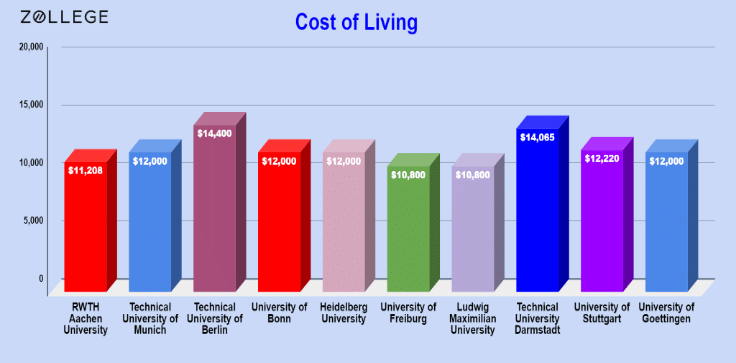
Note: EUR 1= INR 90.05 as of March 19, 2024
Scholarships Available for MS in Computer Science in Germany
The DAAD (German Academic Exchange Service) is the king of scholarships in Germany. They offer a bunch of programs for international students, including some specifically for computer science. Not only academic merit, some scholarships in Germany for international students consider your background, volunteer work, or even your commitment to making the world a better place. Lots of foundations and universities in Germany offer their own scholarships also. Check with the specific program you're interested in. Refer to the below table to know about getting scholarship for Masters in Computer Science in Germany
| University | Scholarship | Eligibility | Award value |
| RWTH Aachen University | High Potential Student Grant | High-qualified students enrolled in master's programs are eligible to apply | 25% tuition fee discount |
| Technical University of Munich | TUM awards scholarships | Students enrolled in the course must have strong academic records. | EUR 500-1800 per semester |
| Technical University of Berlin | Heinrich Böll scholarship | Candidates with outstanding academic records. | Varies |
| University of Bonn | Ließem scholarship | Especially talented students who have lived in the Bonn/Rhein-Sieg region for at least five years, will not be older than 27 | EUR 3,600 per year |
| Heidelberg University | Hans-Peter Wild Talent Scholarships | Candidates applying for masters programs in mathematics, computer science, natural science and technology are eligible. | EUR 1,000 per month |
| University of Freiburg | Deutschland Stipendium Program | Students enrolled in bachelor and master programs | EUR 300 per month |
| Ludwig Maximilian University | SIST LMU Study Scholarship | International students registered in full-time course study are eligible | Varies |
| Technical University Darmstadt | Graduation Scholarship for international students | Students can apply for the performance based scholarship if they are in the final phase of their studies | Varies |
| University of Stuttgart | Beihilfe | Students currently enrolled in at least their third or fourth semester (Bachelor's or Master’s degree) find themselves in a temporary situation of financial emergency | Varies on a case-by-case study |
| University of Goettingen | DAAD Scholarships | Students pursuing graduate or undergraduate programs with strong academic records | Varies |
Note: EUR 1= INR 90.05 as of March 19, 2024
Jobs For Computer Engineers in Germany
Germany's tech industry is booming, and skilled CS professionals are in high demand. The job market is diverse, with openings in all sorts of cool areas. Want to work on cutting-edge AI? Develop mind-blowing video games? The possibilities are endless. Many companies have set English as their working language. So, you can focus on acing your coding skills and rocking those interviews. The average salary after MS in Computer Science in Germany is EUR 56,000 per year. So, what are you waiting for? Fasten your seatbelts and apply for a work permit visa in Germany today to get hired. Here, we have added average annual salaries of Computer science graduates.
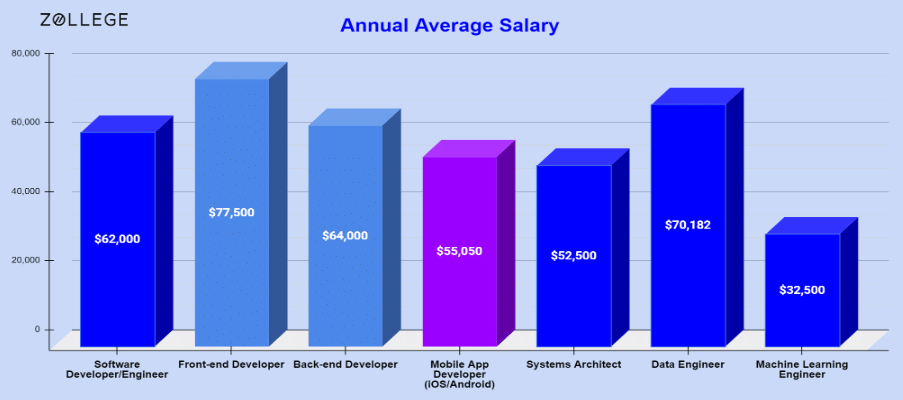
Note: EUR 1= INR 90.05 as of March 19, 2024
Top Recruiters and Work Permit
Global giants like Google, Amazon, and Microsoft all have offices in Germany, constantly on the hunt for brilliant minds. Brush up on your interview skills and get ready to innovate with the best. Germany's auto industry is legendary, and they need top CS grads too! Some top hiring companies include: Allianz, SAP, Siemens, Deloitte etc. To get into these jobs in Germany, you have to apply for a post study work permit by submitting the below-mentioned documents with your application
- Employment offer letter
- Bank statement
- Resume
- SOP for work permit visa
- Health insurance documents
- Passport
- Passport size pictures
- Transcripts
You can consider the aforementioned information for MS in CS in Germany. So, to wrap it all up, a Master's in CS from Germany is basically a win-win situation. German companies are actively seeking skilled CS grads, so you'll be in high demand with a bright career future. You can expect to get an average ROI of 410% from the best universities for masters in Computer Science in Germany.
FAQs
Ques: What are the admission requirements for a Master's in Computer Science in Germany?
Ans: Admission requirements typically include a Bachelor's degree in a related field, proficiency in English (with TOEFL or IELTS scores), GRE or GATE scores (sometimes), and fulfilling specific prerequisites set by the university.
Ques: Are there scholarships available for international students pursuing a Master's in Computer Science in Germany?
Ans: Yes, there are various scholarships available for international students, including DAAD scholarships, Erasmus Mundus scholarships, and university-specific scholarships. It's advisable to research and apply for these well in advance.
Ques: How long does it take to complete a Master's in Computer Science in Germany?
Ans: The duration is usually two years for a standard Master's program. However, some universities offer accelerated programs that can be completed in 18 months.
Ques: Are German language skills necessary for studying a Master's in Computer Science in Germany?
Ans: While many programs are taught in English, having basic German language skills can be beneficial for daily life in Germany. Some universities may also require or offer German language courses.
Ques: What is the average cost of studying for a Master's in Computer Science in Germany?
Ans: Tuition fees are relatively low or nonexistent at public universities in Germany, but students need to cover living expenses. On average, monthly expenses range from €700 to €1000, including accommodation, food, transportation, and health insurance.
Ques: How competitive is admission to Master's in Computer Science programs in Germany?
Ans: Admission can be competitive due to the high quality of education and the popularity of German universities among international students. Strong academic records, relevant experience, and well-prepared application documents are crucial.
Ques: Can I work while studying for a Master's in Computer Science in Germany?
Ans: Yes, international students in Germany are allowed to work part-time during their studies (up to 20 hours per week) and full-time during semester breaks. This can help cover living expenses and gain valuable work experience.
Ques: What are the job prospects like after completing a Master's in Computer Science in Germany?
Ans: Germany has a strong demand for skilled professionals in the field of computer science. Graduates with a Master's degree often find opportunities in areas such as software development, data analysis, cybersecurity, artificial intelligence, and research.
Ques: Is it possible to pursue a Ph.D. after completing a Master's in Computer Science in Germany?
Ans: Yes, many universities in Germany offer opportunities for further research and academic advancement through Ph.D. programs in computer science and related fields.
Ques: How can I find accommodation while studying for a Master's in Computer Science in Germany?
Ans: Students can find accommodation through university housing services, private rentals, or shared apartments. It's advisable to start searching for accommodation early, especially in cities with high demand like Berlin, Munich, or Hamburg.
Ques: Are there opportunities for internships during a Master's in Computer Science in Germany?
Ans: Yes, many universities have partnerships with companies, offering students opportunities for internships to gain practical experience in the industry. Additionally, students can explore internships independently through job portals and networking.
Ques: Can international students apply for a work visa after completing their Master's in Computer Science in Germany?
Ans: Yes, Germany offers a post-study work visa option, allowing international graduates to stay in the country for up to 18 months to search for employment related to their field of study.
Ques: What are some reputable universities in Germany offering Master's programs in Computer Science?
Ans: Some top-ranked universities offering Master's programs in Computer Science include Technical University of Munich, RWTH Aachen University, University of Heidelberg, Humboldt University of Berlin, and University of Freiburg.
Ques: How can I open a bank account as an international student in Germany?
Ans: Most major banks in Germany offer special accounts for students. To open an account, you typically need your passport, proof of enrollment at a German university, and sometimes proof of address.
Ques: Are there any specific health insurance requirements for international students in Germany?
Ans: Yes, international students are required to have health insurance coverage in Germany. This can be either through public health insurance (if under 30 and enrolled in a public university) or private health insurance.
Ques: What is the academic calendar like for Master's programs in Computer Science in Germany?
Ans: The academic year is typically divided into two semesters: winter semester (October to March) and summer semester (April to September). Each semester includes lecture periods, exam periods, and breaks.
Ques: How can I adapt to the German education system as an international student pursuing a Master's in Computer Science?
Ans: It's essential to familiarize yourself with the German education system's structure, teaching methods, and academic expectations. Universities often offer orientation programs and support services for international students to help with this transition.
Ques: Can I bring my family with me while pursuing a Master's in Computer Science in Germany?
Ans: Yes, international students can bring their family members (spouse and children) to Germany. However, there are specific visa and residency requirements that need to be fulfilled, including proof of financial means to support them.
Ques: Are there networking opportunities available for Master's students in Computer Science in Germany?
Ans: Yes, universities organize various events, workshops, and seminars where students can network with industry professionals, alumni, and fellow students. Additionally, joining student organizations and participating in conferences can also provide networking opportunities.
Ques: How can I make the most of my Master's experience in Computer Science in Germany?
Ans: Take advantage of all opportunities available, including internships, research projects, networking events, and extracurricular activities. Engage with professors, classmates, and industry professionals to broaden your knowledge and enhance your skills for a successful career ahead.

![Humboldt University of Berlin [HU]](https://static.zollege.in/public/college_data/images/studyabroad/logos/college_632_29-15:02_6.png?tr=w-50,h-50,c-force?tr=h-40,w-35,c-force)
![Technical University Munich [TUM]](https://static.zollege.in/public/college_data/images/studyabroad/logos/college_691_02-13:08_691.png?tr=w-50,h-50,c-force?tr=h-40,w-35,c-force)
![Ludwig Maximilian University of Munich [LMU]](https://static.zollege.in/public/college_data/images/studyabroad/logos/college_690_02-13:05_690.png?tr=w-50,h-50,c-force?tr=h-40,w-35,c-force)
![Free University of Berlin [FU]](https://static.zollege.in/public/college_data/images/studyabroad/logos/college_631_29-15:01_5.png?tr=w-50,h-50,c-force?tr=h-40,w-35,c-force)
.png?tr=w-50,h-50,c-force?tr=h-40,w-35,c-force)


