
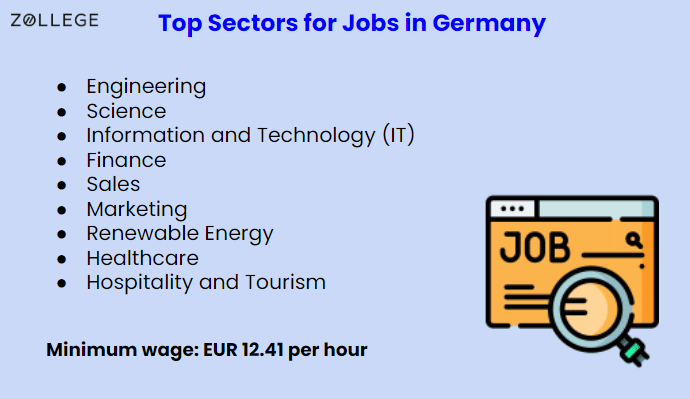
Jobs in Germany are renowned for its robust economy and technological advancements. It offers a diverse and dynamic market with job opportunities spanning various industries, making it an attractive destination for professionals seeking innovative and well-compensated career paths. The scope of English speaking Jobs in Germany is limited and can be challenging, especially if you solely speak English. However, if you have completed education in German, the chances of landing a high-paying job are increased. As of January 2024, the minimum wage in Germany is EUR 12.41 (INR 11,101) per hour. You need a work permit visa in Germany to get into one of the jobs.
According to the Federal Statistical Office of Germany (Destatis), in April 2022 the average gross annual salary was EUR 49,260, or UER 4,105 per month. Individual salaries can vary greatly from this figure, as they are affected by factors such as age, seniority, industry, experience, working hours and geographical location. You can get the access to apply for several part-time jobs in Germany as bookkeeping assistant, lab assistant, babysitter, bartender, waiter etc.
Ranked as the world's fifth-largest economy and with an impressively low unemployment rate, Germany emerges as a fertile terrain for global job seekers, particularly those equipped with advanced skills and a university education. The average annual salary of MBA jobs in Germany is EUR 67,000 (INR 59,94,490), portraying a secure career outcome.
Jobs in Germany for International Students
Germany presents a diverse array of employment opportunities for international workers, particularly in sectors such as engineering, science, IT, finance, sales, marketing, renewable energy, healthcare, and hospitality and tourism. These are the highest paying Jobs in Germany. Many international students immigrate to Germany to join these high paying jobs. Your gross salary (Bruttogehalt) is your monthly or annual salary before deductions. The amount will usually be detailed in your employment contract. Your net salary, or Nettogehalt in German, represents the monthly amount deposited into your bank account after accounting for deductions such as taxes, social security contributions, and other associated costs. Altogether, income taxes and social security contributions will take up around 35% of your gross salary. For example, if your gross monthly salary is EUR 3,000, then after deductions you can expect to take home around EUR 1,950 per month.
Jobs in Germany by Degrees
How to get jobs in Germany from India? Indian nationals require a work visa to begin their professional journey in Germany. The visa application process is layered and can take 3-4 months. Germany is known to offer quality education at an affordable cost. Some of the top universities in Germany also offer free education to international students. The below table shows how people with higher educational qualifications generally receive higher salaries in Germany:
| Degrees | Average Monthly Salary |
| Doctorate | EUR 8,687 |
| Master's degree | EUR 6,188 |
| Master craftsperson / technician / technical school qualification | EUR 4,826 |
| Bachelor's degree | EUR 4,551 |
| Vocational training qualification | EUR 3,521 |
| No vocational training | EUR 2,817 |
Note: EUR 1= INR 89.43 as of February 19, 2024
Average Salary of Jobs in Germany by Profession
You can also look for jobs in Germany for foreigners with visa sponsorship. Medical advisor, Doctor, Pilot, Lawyer are among the top highest paying jobs in Germany. If you are looking for jobs and salary in India after MS in Germany, you can expect to earn in the range of INR 10 LPA to INR 60 LPA. The average salaries across a range of different occupations in Germany is tabulated below.
| Job Roles | Average Salary | Salary Range |
| Medical Advisor | EUR 86,000 | EUR 61,700 to 137,700 |
| Doctor | EUR 85,100 | EUR 47,400 to 142,200 |
| Pilot | EUR 83,330 | EUR 27,600 to 160,900 |
| Lawyer | EUR 82,900 | EUR 38,000 and 146,000 |
| Management consultant | EUR 82,000 | EUR 40,200 and 141,700 |
| Software architect | EUR 81,500 | EUR 58,100 and 123,700 |
| Portfolio Manager | EUR 81,000 | EUR 46,300 to 137,800 |
| Program Project Manager | EUR 79,900 | EUR 53,800 to 132,500 |
| Legal Counsel | EUR 78,900 | EUR 50,600 to 123,800 |
| Service Delivery Manager | EUR 78,000 | EUR 47,200 to 130,600 |
Note: EUR 1= INR 89.43 as of February 19, 2024
Average Salary in Germany by Federal State
The location within Germany can influence your expected salary, with larger cities often providing higher compensation to offset increased cost of living in Germany. Conversely, jobs in eastern Germany typically come with lower salaries. The subsequent table illustrates the variations in average annual salaries across different federal states in Germany
| States | Average Annual Salary |
| Hamburg | EUR 48,132 |
| Baden-Württemberg | EUR 47,962 |
| Bremen | EUR 43,434 |
| Berlin | EUR 43,179 |
| Rhineland-Palatinate | EUR 41,972 |
| Brandenburg | EUR 36,607 |
| Thuringia | EUR 36,588 |
| Schleswig-Holstein | EUR 40,820 |
Note: EUR 1= INR 89.43 as of February 19, 2024
How to Find Jobs in Germany for Foreigners
In Germany, there are many large and small job portals where you can find jobs. Remember, some people get confused with Uni-Assist while applying for admissions and jobs in Germany. Uni-Assist does not allow you to apply for jobs, it is only for admissions or academic purposes. Among the multitude of job aggregator websites, we are confident that the five mentioned job boards will offer a comprehensive overview, encompassing the majority of suitable job opportunities in Germany. Some of the large job boards include
- Arbeitnow
- Indeed
- Stepstone
- Jobbird
- Jooble.org
Although major job boards provide a comprehensive overview of available opportunities in Germany, navigating through their extensive listings can be overwhelming. As a result, many candidates opt to explore job opportunities on smaller, specialized job boards. Here are some excellent starting points for your job search:
- GermanTechJobs (IT and tech jobs)
- Landing.Jobs (IT and tech jobs)
- English Jobs Germany (English-speaking jobs)
- Berlin Startup Jobs (startup jobs)
- Good Jobs (social and sustainable jobs)
- Absolventa (graduates and young professionals)
- Dasauge (creative jobs)
- JobVector (engineers, IT workers, doctors and scientists)
- Experteer (executive positions)
While utilizing job boards is a prevalent method for discovering suitable openings, there are also several top-notch job platforms where you can create a profile. Potential employers review these profiles and may contact you if your qualifications align with their requirements. These platforms include
- Talent.io
- Honeypot
- Moberries
You can consider the above-mentioned details while looking for jobs in Germany and salary. To get jobs in Germany for Indian students, create a German-style CV, learn some German, carefully tailor each job application. On your interview days for jobs in Germany for Indians, be punctual, pick the right outfit, and have realistic salary expectations.
FAQs
Ques: What is the job market like in Germany?
Ans: Germany's job market is vibrant and diverse, owing to its strong economy. The country's renowned manufacturing sector, technology-driven industries, and a thriving service sector contribute to a multitude of job opportunities. The low unemployment rate and a commitment to innovation make Germany an attractive destination for professionals across various fields.
Ques: Do I need to speak German to work in Germany?
Ans: While many international companies conduct business in English, having a proficient command of German can significantly enhance your job prospects. Local companies and certain industries, such as healthcare and legal services, often require German language skills for effective communication and collaboration.
Ques: What is the typical working culture in Germany?
Ans: Germany is known for its well-defined working culture, emphasizing punctuality, efficiency, and a healthy work-life balance. The standard workweek is around 38 to 40 hours, and overtime is generally discouraged. Clear communication and a focus on results contribute to a collaborative and productive work environment.
Ques: Are qualifications earned outside Germany recognized by employers?
Ans: Yes, many German employers recognize and value international qualifications. However, it is advisable to have your qualifications officially evaluated by the appropriate authorities in Germany. This process helps employers understand the equivalence of your education and ensures a smoother integration into the German job market.
Ques: How do I find job opportunities in Germany as a foreigner?
Ans: Job seekers can explore various avenues, including online job portals, company websites, and networking events. Platforms like LinkedIn can be powerful tools for building professional connections. Additionally, contacting the German Federal Employment Agency (Bundesagentur für Arbeit) can provide valuable insights and assistance in navigating the job market. Persistent and strategic job hunting is key to success.
Ques: What is the significance of the Blue Card for foreign workers?
Ans: The Blue Card is a special residence and work permit designed to attract highly skilled non-EU citizens to Germany. It streamlines the immigration process for qualified professionals, making it easier for them to live and work in Germany. The Blue Card also facilitates movement within the European Union for work purposes.
Ques: Are there any industries in high demand for skilled workers?
Ans: Certain industries in Germany experience a high demand for skilled workers. Information technology, engineering, healthcare, and renewable energy are among the sectors actively seeking qualified professionals. Job seekers with expertise in these areas may find abundant opportunities and competitive salaries in the German job market.
Ques: What are the average working hours in Germany?
Ans: The standard working week in Germany typically ranges from 38 to 40 hours. However, working hours can vary based on the industry, company policies, and collective bargaining agreements. Maintaining a healthy work-life balance is a cultural priority, contributing to overall job satisfaction and well-being.
Ques: Is it common to negotiate salaries in Germany?
Ans: Yes, negotiating salaries is a common and accepted practice in Germany, particularly for higher-skilled positions. Job seekers are encouraged to research industry standards and market trends to ensure fair compensation. Demonstrating your skills, qualifications, and the value you bring to the organization can strengthen your position during salary negotiations.
Ques: How important is networking for job hunting in Germany?
Ans: Networking plays a crucial role in job hunting in Germany. Attending industry events, joining professional associations, and actively participating in online platforms like LinkedIn can help build valuable connections. Establishing a strong professional network enhances visibility within your industry and increases the likelihood of discovering relevant job opportunities.
Ques: Are there any government support programs for job seekers?
Ans: Yes, the German government provides support programs for job seekers, including "Arbeitslosengeld" (unemployment benefits) and integration courses. Unemployment benefits offer financial assistance during periods of job search, while integration courses help newcomers learn the language and cultural nuances, facilitating a smoother transition into the German workforce.
Ques: What are the key documents required to work in Germany as a foreigner?
Ans: Essential documents include a valid passport, a visa or residence permit (depending on your nationality), and potentially a work permit. Specific requirements can vary, so it's advisable to check with German authorities and embassies to ensure you have the necessary documentation for legal employment in Germany.

![Humboldt University of Berlin [HU]](https://static.zollege.in/public/college_data/images/studyabroad/logos/college_632_29-15:02_6.png?tr=w-50,h-50,c-force?tr=h-40,w-35,c-force)
![Technical University Munich [TUM]](https://static.zollege.in/public/college_data/images/studyabroad/logos/college_691_02-13:08_691.png?tr=w-50,h-50,c-force?tr=h-40,w-35,c-force)
![Ludwig Maximilian University of Munich [LMU]](https://static.zollege.in/public/college_data/images/studyabroad/logos/college_690_02-13:05_690.png?tr=w-50,h-50,c-force?tr=h-40,w-35,c-force)
![Free University of Berlin [FU]](https://static.zollege.in/public/college_data/images/studyabroad/logos/college_631_29-15:01_5.png?tr=w-50,h-50,c-force?tr=h-40,w-35,c-force)
.png?tr=w-50,h-50,c-force?tr=h-40,w-35,c-force)


