
Germany has become one of the most sought-after study abroad destinations among international students. When it comes to technology and innovation, Germany is the pioneer in it. There are around 1,45,707 engineering graduates in Germany. If you are considering a technology degree, then BTech in Germany can be a good choice. It is a 3-4 year long undergraduate degree program, often given as BS (Bachelor of Science), BEng (Bachelor of Engineering). Mechanical Engineering, Electrical Engineering, Civil Engineering, Computer Engineering are the most popular specializations of BTech from Germany. There are many top universities in Germany that offer this course to international students. Now, let’s take a look at the ROI offered by the best colleges for BTech in Germany.
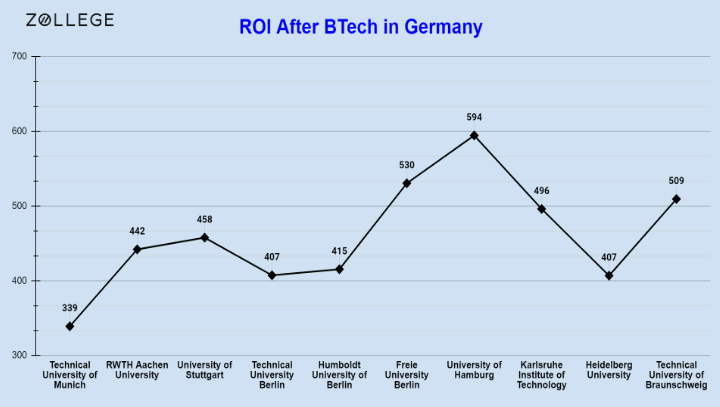
All the universities are offering higher ROI after this course. University of Hamburg is offering the highest ROI of 594%, followed by Freie University of Berlin’s 530%. Most universities conduct this program in German. However, you can also study BTech in Germany in English from universities like Technical University of Munich. For German language proficiency, you should have qualifying scores in exams to study in Germany. TestDaf, DSH, Goethe Certificate are some of the exams. For programs taught in English, you need to submit IELTS or TOEFL scores. You can apply for this program in Winter and Summer intakes.
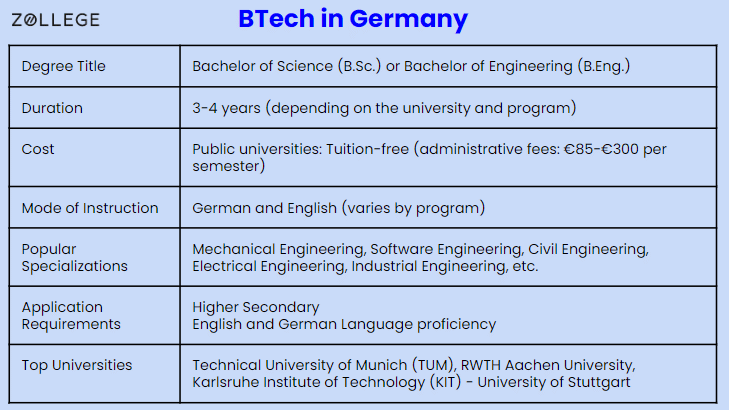
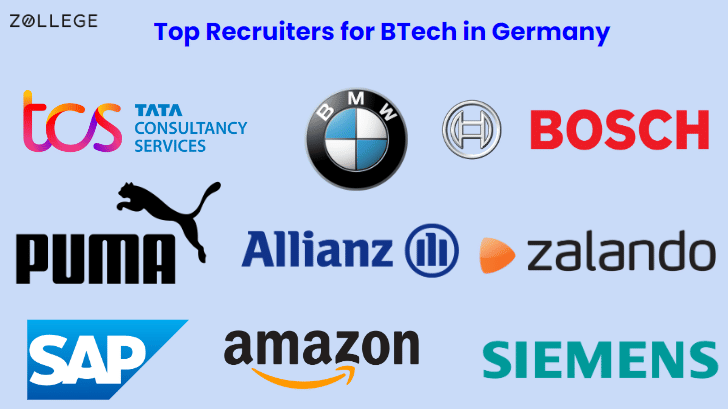
BTech courses in Germany are a highly popular course, with almost one-third of international students opting for it. The job market is also demanding for IT and tech professionals. After studying at BTech colleges in Germany, students earn EUR 61,000 (INR 55,05,616) per year. Tech giants like Siemens, Robert Bosch, BMW are the top recruiters for BTech graduates. Companies like Amazon, Cognizant, SAP, Allianz are also some of the companies that give jobs in Germany to BTech graduates.
Why Study BTech from Germany
Germany is a hotbed for innovation and technologies. For the continuing technological advancements, more tech graduates are required. But, is BTech a good option to study in Germany? We have curated a few reasons just for you to consider studying this course. The reasons are
- The German government invests nearly 3% of its economy in the development of the IT sector.
- Option to study BTech in Germany after diploma
- Approximately 40,000 students graduate as engineers from Germany.
- Germany allocates 2.8% of its GDP to research and development, specifically in the IT and Engineering sectors
- You can study BTech in Germany for free in many of the public universities. So, affordability is a significant advantage.
- Option to work 120 days full time and 240 days in part-time jobs in Germany while studying
- Germany offers various financing choices allowing international students to choose from hundreds of scholarships and loans
- Recent reports suggest Germany has one of the lowest unemployment rates within the EU of 3%. So, more job opportunities are there.
Best Colleges for BTech in Germany
In QS world university rankings 2024, many German universities are ranked higher. Technical University of Munich, Humboldt University of Berlin, Heidelberg University are some of the public universities in Germany. These universities do not charge tuition fees for BTech in Germany. Is BTech free in Germany? However, private universities can charge EUR 9,000 - EUR 13,000 per year for your course. Check the below table to know about the BTech in Germany cost and entry requirements for international students.
| University | Fees per year | Entry Requirements |
| Technical University of Munich | EUR 6,000 (INR 5,41,828) | Higher education entrance qualification DSH level 2 TELC C1 TestDaF level 4 C2 in Goethe certificate C2 in OSD certificate IELTS: 6.5 TOEFL: 88 PTE: 65 |
| RWTH Aachen University | EUR 606.98 (INR 54,813) | IELTS: 5.5 TOEFL: 95 DSH 2 TestDAF 4 Telc C1 |
| University of Stuttgart | EUR 3,000 (INR 2,70,914) | Higher secondary from a recognized board DSD II: Second level TestDaf: Level 4 DSH: Level 2 |
| Technical University Berlin | EUR 580.88 (INR 52,456) | Subject-specific university entrance qualification DSH-2 or DSH-3 Level 4 in TestDaf DSD level 2 Goethe Certificate C2 Telc level 1 OSD level 2 |
| Humboldt University of Berlin | EUR 291 (INR 26,279) | Higher secondary diploma or equivalent Level 3 in TestDaf DSH 2 or DSH 3 |
| Freie University Berlin | EUR 295.49 (INR 26,684) | Higher secondary education IELTS: 5.0 TOEFL: 71 PTE: 58 Telc B1 Certificate |
| University of Hamburg | EUR 664 (INR 59,962) | Completed higher secondary education DSH 2 or 3 Telc C1 Level 4 in TestDaf Goethe Certificate C1 or C2 |
| Karlsruhe Institute of Technology | EUR 1,500 (INR 1,35,457) | University entrance qualifications DSH 2 certificate or an accepted equivalent |
| Heidelberg University | EUR 3,000 (INR 2,70,914) | Completed higher education DSH level 2 Goethe- Certificate C2 OSD C2 Telc C1 Level 4 in TestDaf |
| Technical University of Braunschweig | EUR 700 (INR 63,213) | Completed secondary education DSH 2 Telc C1 Goethe certificate C2 TestDaf 4 |
Note: EUR 1= INR 90.21 as of March 27, 2024
Application Deadlines and Fees
Most universities accept international students in two intakes in Germany: Winter and Summer. You must enter the relevant educational qualifications and other details in the online application. You can either apply directly to the university or via Uni Assist. An application fee of EUR 75 is required for Uni Assist application while most universities do not charge any fee for direct applications. The below table represents BTech in Germany fees for application.
| Universities | Application deadlines | Application fee |
| Technical University of Munich | Winter: July 15, 2024 | No application fee |
| RWTH Aachen University | Summer: April 15, 2024 | Not required |
| University of Stuttgart | September 15, 2024 | No application fee |
| Technical University Berlin | Winter: August 31, 2024 Summer: February 28, 2024 |
EUR 75 (INR 6,773) |
| Humboldt University of Berlin | Winter: July 15, 2024 | EUR 75 (INR 6,773) |
| Freie University Berlin | May 31, 2024 | EUR 100 (INR 9,030) |
| University of Hamburg | Winter: July 15, 2024 | EUR 75 (INR 6,773) |
| Karlsruhe Institute of Technology | July 15, 2024 | Not required |
| Heidelberg University | July 15, 2024 | No application fee |
| Technical University of Braunschweig | July 15, 2024 | EUR 75 (INR 6,773) |
Note: EUR 1= INR 90.21 as of March 27, 2024
Eligibility Criteria for BTech in Germany
To be eligible for BTech in Germany, you need to have a higher secondary school certificate or equivalent diploma. This also enables you to study free in Germany. Some other BTech in Germany eligibility are
- Applicants must have passed high school with above a GPA of 3.0
- German Language in TestDaf, DSH, Telc or others
- English Proficiency such as IELTS, TOEFL iBT or PTE
- Letter of motivation or SOP for Germany
- Copy of certificate as well as grades of all lectures in the pre-study
- LOR for Germany
Documents Required for BTech in Germany
You must be wondering how to get admission in Germany for BTech? You just have to submit an online application with some documents attached to it. To apply to German Universities, you need to submit the following documents with your online application. The documents include
- Academic transcripts
- German language certificate
- English language certificate
- Updated Resume
- 2 Letters of recommendation
- 1 Letter of Motivation
- Proof of relevant work experience
- Copy of identification document
- German student visa
Cost of Living in Germany
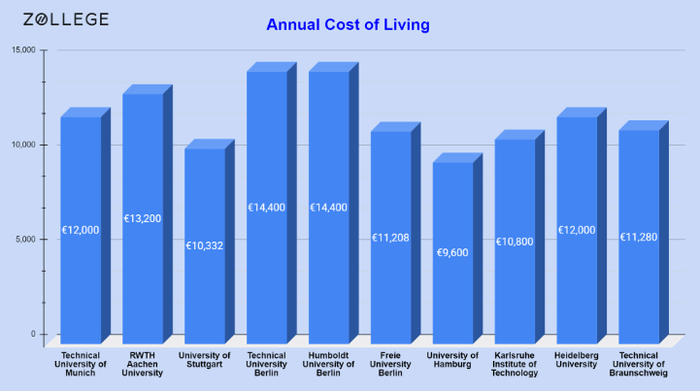
Germany is considered one of the more affordable countries in Western Europe, with an average cost of living of EUR 12,000 per year. Rent is the biggest expense, with major cities like Munich and Berlin having higher costs compared to smaller towns. You can find resources online to compare rental prices in different German cities. The cost of living in Germany varies from student to student. The university-wise estimated cost of living is presented below
Note: EUR 1= INR 90.21 as of March 27, 2024
Scholarships for BTech in Germany
Scholarships are a great way to pay the timely cost of BTech in Germany for Indian students and other living expenses. These scholarships in Germany are often merit based and need based. However, the scholarships after BTech in Germany are tabulated below
| Universities | Scholarships | Eligibility | Award Value |
| Technical University of Munich | Scholarships for international students | Students with high academic merit and financial need | EUR 500 to 1500 per semester (INR 45,152 to 1,35,457) |
| RWTH Aachen University | DAAD scholarships | Students with university entrance qualification at a school outside Germany, except German schools abroad 2.5 GPA | Varies |
| University of Stuttgart | DAAD scholarships | International students have received good grades and going to be graduate from this university | Varies |
| Technical University Berlin | Deutschlandstipendium | High-performing, socially committed students from different disciplines and all nationalities receive support for their education | EUR 300 (INR 27,091) per month |
| Humboldt University of Berlin | Deutschland Stipendium program | International students studying at German Universities | EUR 300 (INR 27,091) |
| Freie University Berlin | DAAD scholarships | Students with a refugee background | EUR 250 (INR 22,576) over a 10-month period from March to December 2024 |
| University of Hamburg | Merit scholarships | Have been enrolled in your subject at Universität Hamburg for at least 2 semesters and are pursuing a degree | EUR 850 (INR 76,759) |
| Karlsruhe Institute of Technology | Internships for foreign students of natural sciences, engineering, agriculture and forestry (IAESTE) | Students of natural sciences, engineering, agriculture and forestry | EUR 934 (INR 84,345) |
| Heidelberg University | Hans-Peter Wild Talent Scholarships | Prospective students of all nationalities who want to pursue a degree at Heidelberg University | Varies |
| Technical University of Braunschweig | Scholarships for International Students | Students enrolled to any program at this university | Varies |
Note: EUR 1= INR 90.21 as of March 27, 2024
Jobs After BTech in Germany
The best way to get motivated is to know about the career prospects associated with the field. As a BTech graduate, you can expect to earn high-paying jobs in Germany in multiple sectors. You need a work permit visa in Germany to work legally. Average annual salary after graduation are as follows
| Top Recruiters | Average Annual Salary |
| Zalando | EUR 69,000 (INR 62,27,664) |
| SAP | EUR 61,125 (INR 55,16,898) |
| Hello Fresh | EUR 75,000 (INR 67,69,200) |
| Siemens | EUR 61,402 (INR 55,41,899) |
| Robert Bosch | EUR 88,799 (INR 80,14,643) |
| Allianz | EUR 50,000 (INR 45,12,800) |
| Cognizant | EUR 80,000 (INR 72,20,480) |
| Cyient | EUR 53,479 (INR 48,26,801) |
| Amazon | EUR 70,000 (INR 63,17,920) |
| Cognex Corporation | EUR 51,456 (INR 46,44,213) |
| TCS | EUR 74,000 (INR 66,78,944) |
| Luxoft | EUR 74,000 (INR 66,78,944) |
| Puma | EUR 65,700 (INR 59,29,819) |
Note: EUR 1= INR 90.21 as of March 27, 2024
Work Permit in Germany
You can live and work in Germany even if you are not an EU citizen, provided that you meet the set eligibility criteria. To be allowed to live and work there legally, you must have a German work and residence permit. If you choose to immigrate to Germany, then working there becomes seamless. You can obtain both your German work permit and residence permit simultaneously by submitting a single application at the German Immigration Authority Office (Ausländerbehörde). Additionally, most non-EU workers will need to obtain a visa from a German Embassy or Consulate abroad. The four categories of work permit in Germany are
- General Work Permit – You can apply for this type of German work permit if you have found a job in Germany.
- Highly Skilled Worker Permit – You can apply for this type of work permit if you are a highly skilled worker with a lot of experience and a high income.
- The EU Blue Card for Germany – You can apply for an EU Blue Card if your salary will be at least €56,400 per year or €43,992 per year if you are in a shortage occupation.
- Work Permit for Freelancers – You can apply for this type of permit if you are a freelancer or self-employed individual, and you can prove you have prospective clients.
BTech in Germany duration is 3-4 years depending on your study mode selection and university. Is BSc and BTech same in Germany? BTech in Germany is usually referred to as Bachelor of Science in Engineering (BS/B.Sc.) or Bachelor of Engineering (B. Eng.). There is no program exactly named BTech in Germany. You can choose to study masters or PhD courses after BTech in Germany. You can consider the aforementioned details while looking for this program.
FAQs
Ques: Is BTech free in Germany?
Ans: BTech is not free in Germany. However, public universities do not charge any tuition fee, you still have to pay for semester fees and cost of living. So, it is not free: there are tuition fees exemptions only.
Ques: Can I do BTech in Germany after 12th?
Ans: BTech in Germany is an undergraduate program that can be pursued after high school completion. So, yes you can do BTech in Germany after completing 12th from any country.
Ques: How many years is BTech in Germany?
Ans: BTech in Germany is a 3-4 year program. It is an undergraduate program with specializations like Electrical Engineering, Civil Engineering, Software Engineering, Computer Engineering and more.
Ques: What is BTech cse called in Germany?
Ans: In India. BTech CSE is Bachelor of Technology in Computer Science Engineering. But there is no such degree called BTech in Germany. BS in Engineering or B.Eng carries the same weightage.
Ques: Which is the cheapest country to study BTech?
Ans: Germany provides the best and the most cost-effective study options for overseas students as most colleges are state-funded and do not require hefty tuition fees from students. So yes, Germany can be a good option.
Ques: What is the salary of BTech in Germany?
Ans: The salary of BTech in Germany is EUR 61,000 per year. With specific eligibility and work experience this can go up to EUR 89,000.
Ques: Is it worth doing BTech from Germany?
Ans: Students can easily get attractive jobs which can pay them up to EUR 10,000 per month. During the BTech course, students can learn to solve various engineering problems, develop analytical skills and research skills. So yes, it is worth doing BTech from Germany.
Ques: Can I study BTech in Germany in English?
Ans: Most universities in Germany teach undergraduate programs in German. However, there are few universities that use English as their mode of communication. Check the program requirements from the official website thoroughly.
Ques: How can I get admission in Germany after 12th?
Ans: To get admission in Germany after 12th, you need to apply online via Uni Assist by paying an application fee. Else, you can also choose to apply directly to the universities.
Ques: Is IELTS enough for BTech in Germany?
Ans: IELTS is not enough for BTech in Germany as universities require you to have German language skills. You need to have qualifying scores in TestDaf, telc, OSD, or Goethe certificate etc to be eligible.
Ques: When can I apply for BTech in Germany?
Ans: You can apply for BTech in Germany in summer and winter intakes. Application deadlines end about 4-6 months before the start of semesters.
Ques: Are B.Tech. programs in Germany affordable?
Ans: Public universities in Germany typically have very low tuition fees, sometimes even free for international students. However, living expenses need to be factored in. Research scholarships and work opportunities to ease the financial burden.
Ques: What are the admission requirements for a B.Tech. in Germany?
Ans: Requirements vary, but generally include a strong high school diploma with a focus on science and math. Some programs might require standardized tests. Check the university website for specific details.
Ques: How competitive are B.Tech. programs in Germany?
Ans: Admission can be competitive, especially for top universities. Highlight your academic achievements, relevant skills, and strong motivation in your application package.
Ques: Do I need a German visa to study B.Tech. in Germany?
Ans: International students need a student visa to study BTech in Germany. The application process typically involves submitting your acceptance letter, proof of financial support, and health insurance. Research visa requirements well in advance.
Ques: Is a B.Tech. from Germany recognized internationally?
Ans: German universities are highly respected worldwide. A German B.Tech. (officially called a Bachelor of Science or "Bachelor of Engineering") is a valuable qualification for international careers.
Ques: Is there a probationary period for international students in B.Tech. programs?
Ans: Some universities might have a probationary period (usually 1-2 semesters) where your academic performance is closely monitored. Meeting specific grade requirements is crucial to continue your studies.
Ques: What are the scholarships for BTech in Germany?
Ans: Germany offers multiple scholarships to international students. It has scholarship programs like DAAD, Deutschlandstipendium, in which students can enroll to find the suitable scholarships
Ques: Who hires BTech graduates in Germany?
Ans: BTech graduates are in high demand in Germany. Amazon, SAP, Siemens, Bosch, BMW are some of the top recruiters for BTech graduates in Germany.
Ques: Who is eligible to study BTech in Germany?
Ans: Students having a higher secondary education with good grades are eligible to study Btech in Germany. Not only this, they also need to satisfy university specific language requirements. Some universities require candidates to have both German and English language proficiency while some require German only.?

![Humboldt University of Berlin [HU]](https://static.zollege.in/public/college_data/images/studyabroad/logos/college_632_29-15:02_6.png?tr=w-50,h-50,c-force?tr=h-40,w-35,c-force)
![Technical University Munich [TUM]](https://static.zollege.in/public/college_data/images/studyabroad/logos/college_691_02-13:08_691.png?tr=w-50,h-50,c-force?tr=h-40,w-35,c-force)
![Ludwig Maximilian University of Munich [LMU]](https://static.zollege.in/public/college_data/images/studyabroad/logos/college_690_02-13:05_690.png?tr=w-50,h-50,c-force?tr=h-40,w-35,c-force)
![Free University of Berlin [FU]](https://static.zollege.in/public/college_data/images/studyabroad/logos/college_631_29-15:01_5.png?tr=w-50,h-50,c-force?tr=h-40,w-35,c-force)
.png?tr=w-50,h-50,c-force?tr=h-40,w-35,c-force)


