
MBBS in Germany is very popular among students as a total of 35 universities in Germany offer degrees in medicine. Most MBBS admissions for students are done through Uni Assist Germany. In Germany, admissions to medical schools typically take place in two stages, that is January 15, 2024, for the summer intake and July 15, 2024, for the winter intake. Some of the best MBBS Colleges in Germany include Heidelberg University, Humboldt University, University of Munich (LMU), University of Freiburg, University of Cologne, etc. “Is MBBS in Germany good?” is a majorly asked question among students. There is a big shortage of doctors in Germany, which is one of the major why many students choose Germany for their MBBS. Another major reason for pursuing MBBS in Germany is the possibility of aquiring a German Blue Card. A Blue Card is a PR card which a a medical professional can apply for if they have a yearly income of EUR 45,300 (INR 4,025,629.80)
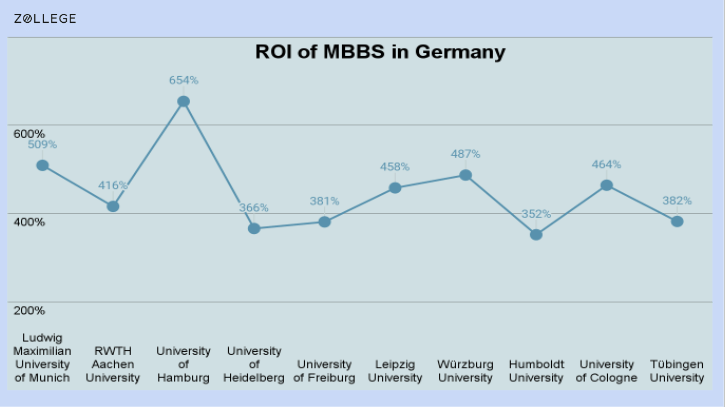
We have also shown an ROI graph for further clarity. This graph shows any prospective student that pursuing an MBBS in Germany will only be advantageous for them. The ROI is highest at 654% if students study at University of Hamburg, and next at 509% at LMU. This is because Germany provides free education to even international candidates. We also have to add that students need to submit IELTS/TOEFL/PTE scores along with their German scores for admission to top universities. Verification of German language proficiency through tests such as TestDaF or DSH is required by all top universities in Germany. Candidates must have DSH level 2 score, and TestDaF TDN 4 to TDN 5 on all four parts for admission. As per rules set by the Medical Council of India's Gazette Notification a student must be eligible for the NEET exam to be eligible to study in Germany.
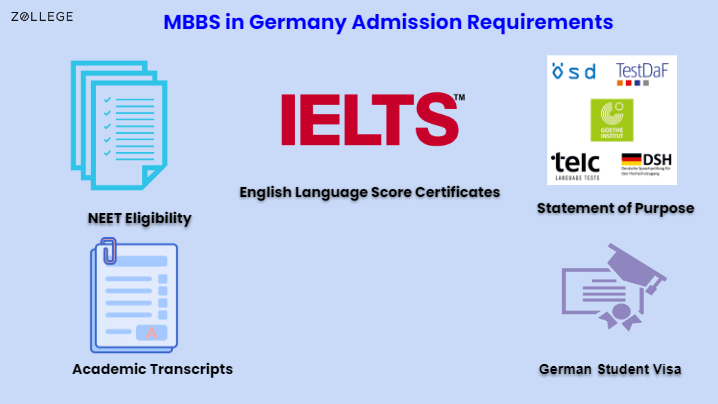
Most German universities provide students the chance to study tuition free at their top universities, also for students pursuing MBBS. But be ready to apply for a German student visa, when you apply for any university. If you want to immigrate to Germany permanently then apply for a PR after course completion, if you have secured a job in Germany.
Are you worried about finding good employment opportunities in Germany? Don’t be worried as there are various jobs available to students once they complete their MBBS in Germany. Not just that you can pursue various healthcare related subjects for Masters or PhD at top universities in Germany. Remember that the average annual salary of MBBS in Germany or Physicians is EUR 54,667 (INR 4926371.07) in their first year of practice.
Reasons to Study MBBS in Germany
Leading medical research universities in Germany give students the chance to take part in scientific studies, clinical trials, and research projects. Students who conduct research benefit both academically and professionally. International students can choose to apply for a residence permit to remain and work in Germany after completing their studies. Because there is a high demand for qualified healthcare workers in the nation, it is simpler for graduates to obtain employment or pursue additional education and specialization. Given below are a few points that will help any applicant understand further as to why MBBS in Germany is a great choice and why choose to study in Germany.
- Most universities do not ask for any tuition fees from international students
- 421,300 doctors were employed in Germany in 2022, and the demand is growing
- Internship and several job opportunities after graduation
- Training for patient care and research
- 19% of Doctors under the age of 25
- 198 inhabitants for every Doctor in Germany
- 59,883 employed international Doctors in Germany
- The average salary range is between EUR 48,000 (INR 4324042.29) – and EUR 55, 000 (INR 4954631.79) for assistant physicians
- Scholarship for MBBS in Germany available like DAAD, and Deutschlandstipendium
Best Universities for MBBS in Germany
Top universities offering MBBS degrees in Germany include universities like Ludwig Maximilian University of Munich, RWTH Aachen University, Heidelberg University, etc. Is NEET required for MBBS in Germany? Yes, students have to submit their NEET eligibility scores as part of the admission requirement for MBBS in Germany. As we can see nearly all the universities require students to submit their German proficiency score certificates and other exams to study in Germany, like TOEFL/IELTS. It is mandatory to secure DSH level 2 for most universities. Students need to pay tuition fees if only they enroll at University of Heidelberg, University of Freiburg, and T?bingen University. Rest, all universities listed below are tuition-free for international candidates. Students can go through the table below for more information on the best universities providing MBBS courses, and also about free MBBS in Germany for Indian students.
| Top Universities | Average Tuition Fees | Score Requirements |
| Ludwig Maximilian University of Munich | As of the winter semester 2013/14, no tuition fees are charged | Goethe certificate (B2: TDN 3) TestDaF- TDN 4 DSH- Level 2 TOEFL- 90 IELTS score - 7.0 |
| RWTH Aachen University | There are no tuition fees at RWTH Aachen University | TestDaF (in all four sections at level 4 minimum) DSH- Level 2 Goethe-Zertifikat C1 or higher IELTS - 6.0 TOEFL score- 90 PTE- 60 |
| University of Hamburg | No Tuition fee | DSH 2- 67% + TestDaF- Level 4 IELTS- 6.5 TOEFL- 90 |
| University of Heidelberg | EUR 1500 per semester (INR 135126.32) | TOEFL- 79 IELTS- 6.5 SAT- 560 on Evidence-Based Reading & Writing section PTE score- 53 DSH- Level 2 Goethe-Zertifikat C2 Telc Deutsch C1 Hochschule certificate |
| University of Freiburg | EUR 1,500 euros per semester (INR 135126.32) |
DSH 2 or 3 TestDaF 4 or 5 |
| Leipzig University | No Tuition Fee | TOEFL- 78 IELTS- 6.0 DSH- Level 2 TestDaF- TDN 4 Goethe-Zertifikat C2 |
| Würzburg University | No Tuition Fee | TOEFL- 95 IELTS- 6.5 DSH- Level 2 or 3 TestDaF- TDN 4 |
| Humboldt University of Berlin | No Tuition Fees | Goethe-Zertifikat C1 Telc C1 Hochschule DSH-1 TestDaF- TDN 3 IELTS – 5.5 TOEFL – 72 |
| University of Cologne | No Tuition Fees | TOEFL- 95 IELTS- 7 PTE- 76 DSH- Level 2 or 3 TestDaF- TDN 4 to TDN 5 |
| Tuebingen University | EUR 1,500 (INR 135126.32) | DSH- Level 2 or 3 TestDaF- TDN 4 to TDN 5 Telc Deutsch C1 Hochschule- Passed the exam |
EUR 1 = INR 88.87 as dated on 15th April 2024
Application Deadline and Fees
The deadlines for applying to German universities can change based on several variables, including the program, the university, and your status as an international or EU/EEA citizen student. Students must note that the application deadline for the winter semester, which begins in September or October, is usually in the middle of July or early August. The application deadline for the MBBS program beginning in the summer semester, which begins in March or April, is typically in the middle of January or early February. Most universities also do not require any application fee during the application period. Listed below are all the information on the top universities about their application deadlines or intakes in Germany and their application fees.
| Top Universities | Application Deadline | Application Fee |
| Ludwig Maximilian University of Munich | Winter Semester- 15 July Summer Semester- 15 January |
Not required |
| RWTH Aachen University | Summer Semester- January 15 Winter Semester- July 21 |
Not required |
| University of Hamburg | Winter Semester- 1 June to 15 July Summer Semester- 1 December to 15 January |
EUR 75 (INR 6756.32) |
| University of Heidelberg | Winter Semester- 01.06. - 15.07 Summer Semester- 01.12. - 15.01 |
Not required |
| University of Freiburg | Summer Semester- January 15th to February 15th Winter Semester- June 1st to August 15th |
Not required |
| Leipzig University |
First semesters of study: |
EUR 75 (INR 6756.32) |
| Würzburg University | Winter Semester possible from the end of May Summer Semester possible from the end of November |
Not required |
| Humboldt University of Berlin | Registration and application period for an online application directly at HU Berlin and UNi Assist: Summer Semester- 01 December 2023- 15 January 2024 |
EUR 75 (INR 6756.32) |
| University of Cologne | Application deadline for the winter semester: July 15th Application deadline for the Summer Semester: January 15th |
Not required |
| Tuebingen University | Winter Semester (starting in October) July 15th Summer Semester (starting in April) January 15th |
Not required |
EUR 1 = INR 88.87 as dated on 15th April 2024
Cost of Living
Depending on your lifestyle choices, preferred type of housing, the city or region you live in, and other variables, the cost of living in Germany can change. In general, Germany's cost of living is thought to be moderate when compared to certain other Western European nations. The cost of living is typically higher in major cities like Munich, Cologne, and Leipzig than in smaller towns or rural areas. Furthermore, there might be student discounts and benefits available for specific costs like public transportation and cultural events. The graph below gives applicants a clear picture about the expenses or cost of MBBS in Germany for Indian students as part of their living costs in Germany.
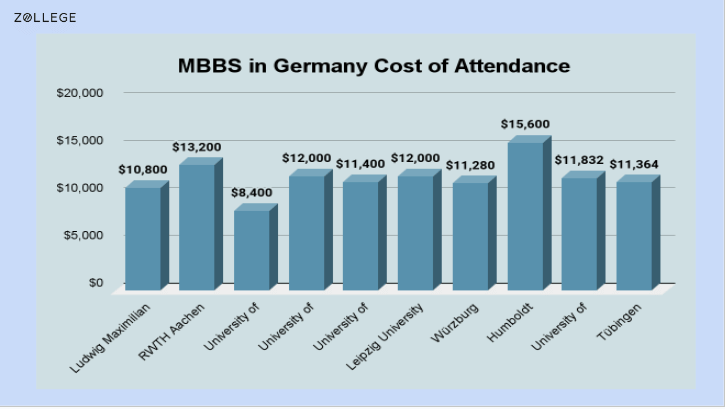
EUR 1 = INR 88.87 as dated on 15th April 2024
Scholarships for MBBS in Germany
Germany provides both domestic and foreign students with a range of scholarships to help with their academic and research needs. Universities, private foundations, governmental agencies, and other organizations offer these scholarships. For international students, one of the main sources of scholarships is the German Academic Exchange Service (DAAD). They provide a large selection of research stays, internships, and scholarships for doctoral, postgraduate, and undergraduate studies in Germany. A government-funded scholarship program called Deutschlandstipendium, or Germany Scholarship, assists deserving students from both abroad and domestically who are enrolled in German universities. Listed below are all the scholarships in Germany for international students for the MBBS program.
| Top Universities | Scholarship Name | Eligibility | Award |
| Ludwig Maximilian University of Munich | Deutschlandstipendium | Candidates are required to demonstrate excellent academic performance and above-average commitment | EUR 300 (INR 27025.26) each month |
| RWTH Aachen University | DAAD | These scholarships are targeted towards international students at RWTH Aachen, who distinguish themselves through involvement with an international context in their course of study and/or at the university. | EUR 300 (INR 27025.26) each month |
| University of Hamburg | Merit Scholarship Program | Universität Hamburg supports outstanding international students and doctoral researchers in all subjects and at all degree levels who have been socially committed and actively involved in an international context. | EUR 930 (INR 27025.26) per month |
| University of Heidelberg | AMIRANA SCHOLARSHIP | Amirana Scholarship is a funding program exclusively for international medical and dental students from low and middle-income countries | Varies |
| University of Freiburg | Deutschlandstipendium (Germany Scholarship) | Candidates are required to demonstrate excellent academic performance and above-average commitment | EUR 300 (INR 27025.26) each month |
| Leipzig University | German Academic Scholarship Foundation | Awards scholarships to outstanding students, irrespective of their political, ideological, or religious convictions and affiliations | Varies |
| Würzburg University | DAAD | These scholarships are targeted towards international students with exceptional scores | EUR 300 (INR 27025.26) each month |
| Humboldt University of Berlin | StipendiumPlus | For all students enrolled at Humboldt University | Varies |
| University of Cologne | Sozialstipendium | This kind of scholarship is awarded to students who need financial support | EUR 300 (INR 27025.26) each month |
| Tuebingen University | Max Weber Foundation Scholarship | For international and domestic candidates | Varies |
EUR 1 = INR 88.87 as dated on 15th April 2024
Job Outcomes
Germany has a large number of doctors who work in clinics and hospitals. Physicians can work in a variety of departments, including internal medicine, pediatrics, psychiatry, emergency medicine, and surgery. A lot of Physicians can open their private practices as specialists or as general practitioners. Applicants can search for a variety of career options in the German healthcare industry, after graduation and also work in part-time jobs in Germany. It is advised that international students network with healthcare professionals, join professional associations, and stay informed about job openings through the websites of hospitals, medical associations, and job portals. Tabulated below are some job roles that MBBS degree holders usually take up after completion of their course.
| Job Roles | Average Annual Salary |
| General Physician | EUR 51,589 (INR 4647354.54) |
| Head Physician | EUR 100,000 (INR 9008421.44) – EUR 280,000 (INR 25223580.04) |
| Assistant Medical Director | EUR 100,000 (INR 9008421.44) – EUR130,000 (INR 11710947.87) |
| Specialist | EUR 65,000 (INR 5855473.94) – EUR 85,000 (INR 7657158.23) |
| Assistant Doctor | EUR 48,000 (INR 4324042.29) – EUR 55, 000 (INR 4954631.79) |
EUR 1 = INR 90.12 as dated on 19th March 2024
Top Recruiters
Physicians are in high demand in Germany in a variety of healthcare settings, such as private practices, hospitals, clinics, and research facilities jobs in Germany. Top employers and recruiters are actively looking for qualified physicians to fill positions in various specialties. Listed below are some of the top recruiters of MBBS graduates in Germany.
- Schwarzwaldklinik Bad Krozingen GmbH & Co. KG
- Klinikum Werra-Meißner GmbH
- STIFTUNGSKLINIK WEISSENHORN
- Approbatio UG
- MOG Ärztevermittlung
- Dr. Meindl & Collegen AG
- Sachsenklinik Fachklinik für Geriatrie GmbH
- Arzt für Allgemeinmedizin Dr. Alois Welsch
- Elbe-Jeetzel-Klinik Dannenberg GmbH
Work Permit
If you are a non-EU/EEA citizen and want to work in Germany, you usually need a work permit visa, which is also called an employment-related residence permit (Aufenthaltserlaubnis zur Erwerbstätigkeit). In your home country, you must apply for a work visa at the German embassy or consulate. In Europe, doctors can apply for a Blue Card. To facilitate and encourage the immigration of highly qualified professionals from non-EU nations into the European Union, the Blue Card EU is a residence title for university graduates. It seeks to address the well-known scarcity of professionals in the EU, especially in Germany, including doctors, engineers, mathematicians, natural scientists, and IT specialists. An EU Blue Card issued in Germany may be valid for up to four years after it has been processed, which could take up to three months. In Germany, the application fee for an EU Blue Card is EUR 140 (INR 12611.79). The documents required to get a work permit visa Germany or a Blue Card in Germany are as follows:
- Offer of employment letter
- A bank statement
- An annual gross salary of EUR 44,304 (INR 3991091.04) for Doctors
- SOP for a work permit resume
- Health insurance records
- Passport Size Photographs Transcripts
- LOR
It's crucial to check out universities, and fully understand language proficiency tests, admission requirements, and any unique requirements for international applicants before applying. To make sure your degree is recognized in your home country or the nation in which you intend to practice medicine in the future, you should also speak with the appropriate authorities. Remember that becoming eligible for NEET is a prerequisite for studying medicine in Germany. All other major information required for MBBS in Germany for Indian students are shared in the article.
FAQs
Ques: Is MBBS taught in English in Germany?
Ans: While most medical programs at German universities are taught in German, some also offer English instruction. Verifying each university's instruction language is crucial.
Ques: What are the eligibility criteria for studying MBBS in Germany?
Ans: Universities may have different requirements for admission, but generally speaking, candidates must have completed high school or its equivalent, be fluent in German (for programs offered in that language), and occasionally take specialized entrance exams like the TMS (Test für Medizinische Studiengänge).
Ques: Are there tuition fees for MBBS programs in Germany?
Ans: Even for foreign students, tuition-free education is provided by numerous public universities in Germany. But living expenses, health insurance, books, and other necessities still come with a price.
Ques: What is the duration of an MBBS program in Germany?
Ans: In Germany, an MBBS program usually lasts six years, encompassing both didactic coursework and clinical practicums.
Ques: Is there an entrance exam for MBBS in Germany?
Ans: Test für Medizinische Studiengänge (TMS) is one of the specialized entrance exams required by certain universities, particularly for programs that use the Numerus Clausus (NC) system.
Ques: Do international students need to pass the German language proficiency test for MBBS programs?
Ans: Yes, particularly for programs taught in German, foreign students must prove their language proficiency through tests like the DSH or TestDaF.
Ques: What is the Numerus Clausus (NC) system for MBBS programs in Germany?
Ans: With the Numerus Clausus system, admission to certain programs—including MBBS—is restricted to a set number of spots. Academic standing, entrance exams, and other factors are taken into consideration for admission.
Ques: Can international students work part-time while studying MBBS in Germany?
Ans: Yes, foreign students studying in Germany are permitted to work part-time, usually up to 120 full days or 240 half days annually.
Ques: Are there scholarships available for international students studying MBBS in Germany?
Ans: Indeed, there are numerous scholarships available to students from abroad, including those enrolled in MBBS programs. Scholarships for academic achievement and financial need are provided by agencies such as the German Academic Exchange Service (DAAD).
Ques: What are the career prospects after completing MBBS in Germany?
Ans: The career prospects for graduates of German MBBS programs are very good. They can pursue additional specialization and training, or they can work as doctors in private practices, hospitals, clinics, research facilities, and other settings.
Ques: Do international students need health insurance while studying MBBS in Germany?
Ans: Indeed, all students in Germany, including those from abroad, must have health insurance. Pupils may choose between private health insurance that satisfies German regulations and public health insurance.
Ques: Can international students apply for residency and work as doctors in Germany after completing MBBS?
Ans: Yes, after completing their MBBS program, international students who meet the requirements and pass the medical licensing exams can apply for residency (approbation) to practice medicine in Germany.
Ques: What is the process for obtaining a medical license in Germany?
Ans: Completing medical coursework, passing medical licensing examinations (including the knowledge and language tests), finishing a practical year, and meeting additional requirements established by the state medical boards are all part of the process.
Ques: What are the popular universities in Germany offering MBBS programs?
Ans: Heidelberg University, University of Munich (LMU), University of Freiburg, and University of Cologne are a few well-known universities in Germany that provide MBBS programs or related medical studies.
Ques: Are there internship opportunities during MBBS programs in Germany?
Ans: Indeed, clinical rotations and practical training in hospitals and healthcare settings are common components of MBBS programs in Germany, giving students invaluable real-world experience.
Ques: Is it easy to find accommodation for international students studying MBBS in Germany?
Ans: Depending on the city and region, finding lodging in Germany can be different. In addition to the many universities that help students find housing, students can look into options like dorms, shared apartments, and private rentals.
Ques: What are the living costs for international students studying MBBS in Germany?
Ans: Depending on the city and way of life, living expenses can change significantly in Germany. International students should typically set aside money for things like housing, food, travel, health insurance, books, and personal expenses.
Ques: Are there support services for international students studying MBBS in Germany?
Ans: Yes, international offices and student support services are common in German universities. They offer help with visa applications, housing, language classes, cultural integration, and academic counseling.
Ques: Can international students apply for permanent residency or citizenship after studying MBBS in Germany?
Ans: International students who fulfill certain residency requirements, such as possessing a residence permit, a steady income, and fluency in German, are eligible to apply for citizenship (Einbürgerung) or permanent residency (Niederlassungserlaubnis) in Germany.
Ques: What advice do you have for international students planning to study MBBS in Germany?
Ans: It's critical to thoroughly investigate universities, and comprehend admission standards, language proficiency tests, and visa application processes well in advance. Consult government agencies, make use of the resources provided by the university, and get ready for a fruitful academic and career journey in Germany.

![Humboldt University of Berlin [HU]](https://static.zollege.in/public/college_data/images/studyabroad/logos/college_632_29-15:02_6.png?tr=w-50,h-50,c-force?tr=h-40,w-35,c-force)
![Technical University Munich [TUM]](https://static.zollege.in/public/college_data/images/studyabroad/logos/college_691_02-13:08_691.png?tr=w-50,h-50,c-force?tr=h-40,w-35,c-force)
![Ludwig Maximilian University of Munich [LMU]](https://static.zollege.in/public/college_data/images/studyabroad/logos/college_690_02-13:05_690.png?tr=w-50,h-50,c-force?tr=h-40,w-35,c-force)
![Free University of Berlin [FU]](https://static.zollege.in/public/college_data/images/studyabroad/logos/college_631_29-15:01_5.png?tr=w-50,h-50,c-force?tr=h-40,w-35,c-force)
.png?tr=w-50,h-50,c-force?tr=h-40,w-35,c-force)


