
Level up your finance career with a postgraduate degree in Europe. Earn a Master of Finance in Germany from any of the private or public universities. It is a 2-year-long program with specializations like Actuarial Science, Financial Economics, Financial Mathematics and more. Most public universities in Germany do not require tuition fees: it makes this country exceptional. A Masters in Finance from Germany can get you quality education at less tuition fees than UK, USA, or Canada. The language of instruction is English. You can take German language courses as well.
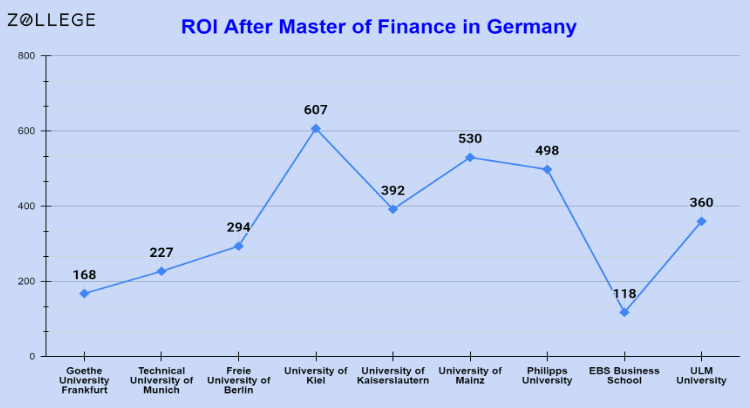
It is evident that universities without any hefty tuition fees can get you maximum ROI. Same is with University of Kiel. With an annual semester fee of EUR 574 only, this university is offering a maximum ROI of 607%. University of Mainz and Philipps University are no less with 530% and 498% return, respectively. So what are you waiting for? Apply to any of these universities in Germany to elevate your dreams.
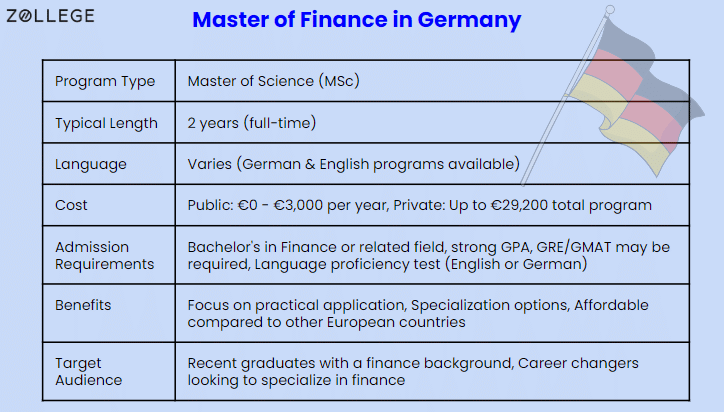
What are the Master in Finance in Germany requirements? You need a bachelor degree with more than 80% marks. Apart from this you need to have language proficiency skills in both English and German. For English, you submit IELTS, TOEFL scores. To prove German language proficiency, you have to submit any of the TestDaf, DSH, Goethe Certificate, Telc scores. You can apply for this program in Winter and Summer intakes. You also get the chance to study a Masters in Finance in Germany for free. But, you have to pay the semester fees and cost of living.
The career after a Master in Finance in Germany can also be flourishing. Financial Manager, Investment Banker, Financial Analyst, Financial Advisor are some of the most sought after job roles. You can expect to earn EUR 54,000 per year upon degree completion. This salary can be varied upon skills and experience in their field of work. Adidas, Allianz, Amazon, Deutsche Bank are among the top recruiters for finance graduates. You need a work permit visa in Germany to stay and work legally in Germany.
Why Study a Master Degree in Finance in Germany
A masters of finance in Germany is not only limited to a finance degree, but having a wide range of disciplines. For its free education and higher ROI offerings, Germany is regarded as one of the better study abroad destinations for Indian students. But why should you choose a master of finance degree to study in Germany? What is the scope of Finance in Germany? We have curated a list of reasons that may guide you to make the best decision.
- As the top public universities do not charge any tuition fees, you can expect to spend less as compared to other countries.
- You get the access to the state-of-the-art universities that combine knowledge with practical training
- You are allowed to work a total of 120 full or 240 half days per year in part-time jobs in Germany.
- Opportunity to avail huge discounts in scholarships
- The yearly average salary of female master of Finance graduates can range from EUR 33,000 to 149,000. This is higher than male graduates, who earn in the range of EUR 39,000 to 82,000.
Best Universities in Germany for Masters in Finance
Germany has some of the best and top ranked universities in Europe. From Technical University of Berlin to University of Kiel, all the well known universities in Germany. Though there is no tuition fee in public universities, you should also consider the additional cost of MS in Germany for Indian students. For the semester fees and admission requirements, you can refer to the below-mentioned table
| University | Annual program fees | Admission requirements |
| Goethe University Frankfurt | EUR 22,500 (INR 20,34,405) | Bachelor degree Minimum one year of finance related work experience IELTS: 6.0 TOEFL iBT: 94 PTE: 75 |
| Technical University of Munich | EUR 12,000 (INR 10,85,016)+ EUR 170 (INR 15,371) semester fees | A bachelor degree 65% in GMAT focus edition or classic edition TOEFL: 88 IELTS: 6.5 PTE: 65 |
| Freie University of Berlin | EUR 8,200 (INR 7,41,428) | Bachelor’s degree in economics or law English language proficiency level B2 CEFR or equivalent DSH level 2 |
| University of Kiel | EUR 498 (INR 45,028) | Bachelor degree with 2.5 GPA IELTS for Germany: 6.5 TOEFL: 90 DSH level 2 TestDaf 4 Telc C1 |
| University of Kaiserslautern | EUR 574 (INR 51,900) | B2 English level (CEFR) Bachelor Degree in Economics or Business Administration |
| University of Mainz | EUR 715 (INR 64,649) | A bachelor-level degree in business, economics, or a related field TOEFL score: 72 IELTS: 5.5 PTE: 59–75 B2 in TelC English |
| Philipps University | EUR 772 (INR 69,803) | A subject-relevant bachelor program with a 2.8 GPA DSH level 2 5.5 to 6.5 in IELTS 72-94 in TOEFL iBT PTE: 59-75 telc B2-certificate |
| EBS Business School | EUR 33,780 (INR 30,54,320) | Bachelor Degree in related field TOEFL: 95 IELTS: 7.0 1 year work experience GRE or GMAT score |
| ULM University | EUR 3,000 (INR 2,71,254) | Bachelor degree TOEFL: 72 IELTS: 5.5 |
Note: EUR 1= INR 90.36 as of March 26, 2024
Application Deadlines and Fees
There are two intakes in Germany in which you can apply for admission. The application deadline for the winter semester, which begins in September or October, is usually in the middle of July or early August. And the summer semester starts in March or April with the application deadline in the middle of January or early February. Most universities do not require any application fee for master finance in Germany. Few universities accept direct applications while others accept via Uni Assist. Refer to the below table for application deadlines and application fees.
| University | Application deadlines | Application fees |
| Goethe University Frankfurt | Next intake: April, 2024 (no specific deadline) |
Not required |
| Technical University of Munich | May 31, 2024 | No application fee |
| Freie University of Berlin | Winter semester: May 31, 2024 |
No application fee |
| University of Kiel | Winter semester: July 15, 2024 |
EUR 75 (INR 6,781) |
| University of Kaiserslautern | Winter: May 31, 2024 | No application fees |
| University of Mainz | Winter: May 15, 2024 | Not required |
| Philipps University | Winter: August 23, 2024 | EUR 75 (INR 6,781) |
| EBS Business School | Fall Term: 1 May. Spring Term: 1 October |
No application fee |
| ULM University | March 15, 2025 | EUR 75 (INR 6,781) |
Note: EUR 1= INR 90.36 as of March 26, 2024
Documents Required for Master of Finance in Germany
To apply to German universities, you must submit some documents with your online application. These documents work as an official certificate in correspondence with the marks submitted in the application. The list of documents are
- Academic transcripts
- Bachelor degree certificate with minimum 2.8 GPA
- Work experience
- Short yet updated CV
- Letter of motivation or SOP for Germany
- Current passport
- GRE or GMAT score card
- German language proficiency score
- English language proficiency score
- German student visa
Cost of Attendance
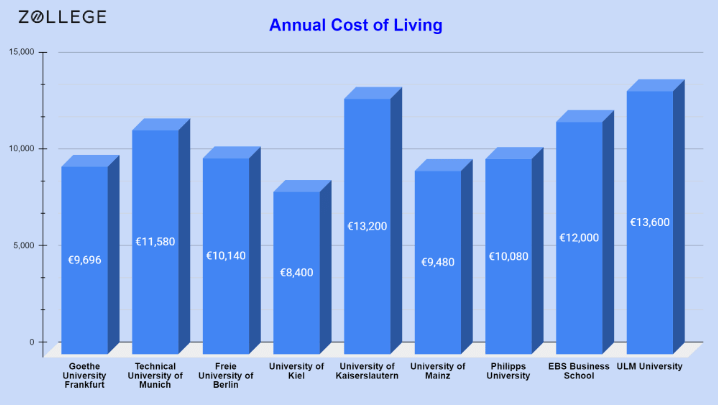
Cost of attendance is a crucial factor in your study abroad experience. If you have the estimated cost of living in Germany, it will be easier on your wallet. But what would be the exact cost of living? It is difficult to calculate the exact cost of living as we all have different lifestyles and spending habits. Cities like Munich or Frankfurt will have pricier rents and dining than, Leipzig or Dresden. Housing rent is going to be the maximum spend. However, for an estimate you can expect EUR 12,000 as your annual cost of living in Germany. Refer to the below graph for more information about the living costs for the best masters in finance in Germany
Note: EUR 1= INR 90.36 as of March 26, 2024
Scholarships for Master of Finance in Germany
Germany is a hotbed for scholarships. From DAAD to Deutschland scholarships, you can apply to multiple scholarships to study in Germany. Scholarships are not required for how to study masters in Germany for free as there is no tuition fee. Besides, these scholarships/ grants can save your additional living expenses. Refer to the below table to know about the Masters in Finance in Germany for international students.
| University | Scholarship | Eligibility | Award value |
| Goethe University Frankfurt | GBS Diversity in Business Scholarship | Talented, dedicated students are eligible | EUR 5,000 (INR 4,52,090) |
| Technical University of Munich | Scholarship for international students | Students with good academic performance and low income are eligible | EUR 500 to 1,500 per semester (INR 45,209 to 1,35,627) |
| Freie University of Berlin | Deutschland Scholarship program | Letter of acceptance to start a degree program at this university | Varies |
| University of Kiel | DAAD Scholarships | Candidates pursuing masters programs must have good academic scores | EUR 934 per month (INR 84,450) |
| University of Kaiserslautern | Deutschland scholarship program | Candidates with academic merit | Varies |
| University of Mainz | Deutschlandstipendium | Academic merit | EUR 300 (INR 27,125) per month for 1 year |
| Philipps University | DAAD scholarships | Candidates enrolled to masters programs at the university | EUR 934 per month (INR 84,450) |
| EBS Business School | Deutschland scholarship program | Candidates with academic merit | Varies |
Note: EUR 1= INR 90.36 as of March 26, 2024
Jobs After Master of Finance in Germany
Germany has booming industries in the finance, technology and engineering sector. Not only automobile industry, Fintech industry is also seeing a hike in this country. Finance and accounting are in-demand occupations not only in Germany but across the globe. Germany was predicted to face a deficit of 1.2 million skilled workers in 2020, which would increase to 2.5 million by 2030. More the demand= more the financial analysts required. So, you can have an excellent career in finance related jobs in Germany. You can excel your career as Investment banker, Financial strategist, Risk Manager, Financial Broker or others. Master in finance salary in Germany is given below
| Job roles | Average annual salary |
| Investment Banking | EUR 70,000- 90,000 (INR 63,29,260 to 81,37,620) |
| Corporate Finance | EUR 60,000, 80,000 (INR 54,25,080 to 72,33,440) |
| Financial Consulting | EUR 65,000 to 85,000 (INR 58,77,170 to 76,85,530) |
| Risk Management | EUR 60,000, 80,000 (INR 54,25,080 to 72,33,440) |
| Private Equity and Venture Capital | EUR 70,000 to 90,000 (INR 63,29,260 to 81,37,620) |
| Financial Technology | EUR 65,000 to 85,000 (INR 58,77,170 to 76,85,530) |
Note: EUR 1= INR 90.36 as of March 26, 2024
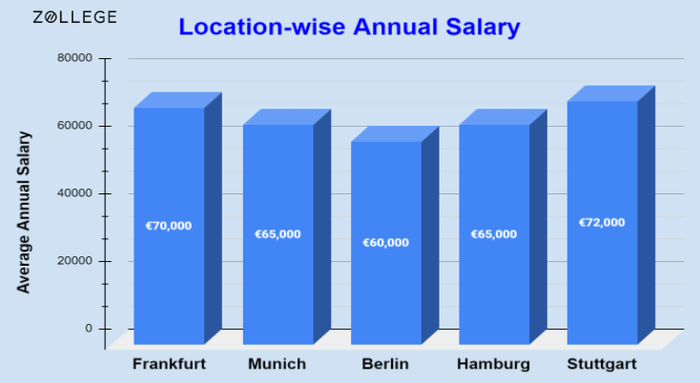
Location wise salary of Master of Finance in Germany are given below
Note: EUR 1= INR 90.36 as of March 26, 2024
Top Recruiters and Work Permit
A post study work permit enables you to work legally in Germany. Remember, a student visa is for studying only. It does not allow you to stay and work. Adidas, Allianz, Amazon, Deutsche Bank are among the top recruiters for MFin grad in Germany. There are several German student visa rejection reasons that you must consider before applying. To apply for work permit visa, you need to submit the following documents
- Offer letter or employment letter
- Bank statement
- SOP for a work permit resume
- Health insurance records
- Passport Size Photographs Transcripts
- LOR for Germany
Masters in Finance Germany public universities can get you the maximum return on investment. International aspirants can consider the aforementioned details while looking to apply for Master of Finance in Germany. Not only in German, but you can study a master of finance in Germany in English also.
FAQs
Ques: Is Germany good for masters in finance?
Ans: Pursuing a Master's in Finance in Germany can be a lucrative choice. Salary prospects may vary based on factors like university reputation, specialization, location, and experience.
Ques: How much does it cost to do a Masters of Finance in Germany?
Ans: Public universities do not charge any tuition fee while private universities charge some. The estimated annual cost of living in Germany is EUR 12,000. Hence, the cost to do a masters in Finance in Germany can vary upon universities, accommodation choices and some other factors.
Ques: Which finance course is best in Germany?
Ans: Finance sector is a budding sector in Germany. Any degree in this sector can be beneficial for yourself.
Ques: Which country is best for masters in finance?
Ans: Germany, UK, USA, Canada are among the best study abroad destinations. As most universities in Germany do not require tuition fees, this country can be a better option.
Ques: Who is eligible for MSC finance in Germany?
Ans: Students with a bachelor degree in a related field with 2.8 GPA are eligible for MSC Finance in Germany. Apart from this, you need to have English and German language proficiency.
Ques: Which city in Germany is best for finance?
Ans: Frankfurt has become synonymous with finance, to an even greater extent since the exodus of talent from London after Brexit. It is regarded as The Financial Centre of Germany.
Ques: Is Finance in demand in Germany?
Ans: Finance sector in Germany is in high demand. By 2030, the demand for skilled workers would increase to 2.5 million.
Ques: Is IELTS required for Germany?
Ans: Most undergraduate programs are taught in German, while some masters programs are taught in English and German both. For an English taught masters program, IELTS is required.
Ques: Which course is highly paid in Germany?
Ans: Germany is known for its automobile and technology industries. Degrees related to these industries are well paid. Besides, the finance sector is also seeing a boom with high average annual salaries.
Ques: Is a Master's in Finance in Germany worth it?
Ans: Absolutely! German programs are known for their strong mix of theory and real-world application. Plus, Germany is a financial powerhouse in Europe, so a degree here holds weight.
Ques: What's the difference between public and private universities?
Ans: Public universities are super affordable (often free), but may have stricter admission requirements. Private universities offer more flexibility and potentially faster programs, but come with a higher price tag.
Ques: Do I need to speak German?
Ans: Many universities offer Masters of Finance in Germany in English programs. However, learning basic German is a plus for daily life and future job prospects.
Ques: What are the admission requirements?
Ans: You'll mainly need a strong Bachelor's degree in Finance or a related field, good grades, and proof of English or German proficiency. Some programs require a GRE/GMAT score and work experience also. So, check the entry requirements thoroughly before applying.
Ques: Can I specialize in a specific area?
Ans: Many programs offer specializations like risk management, financial engineering, or fintech. Choose something that aligns with your career goals. So, yes, scholarship opportunities are there.
Ques: Is there financial aid available for international students?
Ans: There are scholarships available from the German government, DAAD (German Academic Exchange Service), and individual universities. Start your research early!
Ques: How long does a Master's in Finance take?
Ans: Most programs are full-time and last for 2 years. While part-time programs can take up to 3-4 years to complete. Hence, it depends from student to student.
Ques: What are the job prospects after graduation?
Ans: Germany has a strong financial sector with many international companies. A Master's in Finance opens doors to exciting careers in banking, investment, or financial consulting.
Ques: Do I need work experience to apply?
Ans: Some programs may prefer applicants with some relevant work experience. Look for internships or entry-level jobs in finance before applying.
Ques: How can I prepare for a Master's in Finance program?
Ans: Brush up on your math and finance skills. Research specific programs and professors. Start building your network by connecting with professionals in Germany.
Ques: Is there a big difference between a Master's in Finance and an MBA in Germany?
Ans: Both degrees are valuable, but they cater to slightly different goals. An MBA offers a broader business education, while a Master's in Finance is more specialized. Choose an MBA if you want to develop leadership and general management skills alongside finance expertise.

![Humboldt University of Berlin [HU]](https://static.zollege.in/public/college_data/images/studyabroad/logos/college_632_29-15:02_6.png?tr=w-50,h-50,c-force?tr=h-40,w-35,c-force)
![Technical University Munich [TUM]](https://static.zollege.in/public/college_data/images/studyabroad/logos/college_691_02-13:08_691.png?tr=w-50,h-50,c-force?tr=h-40,w-35,c-force)
![Ludwig Maximilian University of Munich [LMU]](https://static.zollege.in/public/college_data/images/studyabroad/logos/college_690_02-13:05_690.png?tr=w-50,h-50,c-force?tr=h-40,w-35,c-force)
![Free University of Berlin [FU]](https://static.zollege.in/public/college_data/images/studyabroad/logos/college_631_29-15:01_5.png?tr=w-50,h-50,c-force?tr=h-40,w-35,c-force)
.png?tr=w-50,h-50,c-force?tr=h-40,w-35,c-force)


