
NATA 2025 Question Paper with Solutions Pdf


Content Writer | Updated On - Nov 24, 2025
NATA 2025 Question Paper with Solutions is now available for download. The Council of Architecture (CoA) conducted the National Aptitude Test in Architecture (NATA) for candidates seeking admission to undergraduate architecture programs across the country. The exam was held in an online, computer-based mode and assessed a wide range of abilities including architectural aptitude, logical reasoning, visual perception, and drawing interpretation. The total duration of the examination was 3 hours, and the question paper carried a comprehensive marking scheme designed to evaluate both conceptual understanding and creative skills.
NATA 2025 Question Paper with Solutions
| NATA 2025 Question Paper | Download PDF | Check Solutions |

Mantri Mandir - Where is it located?
View Solution
Step 1: Understanding the Concept:
The question asks for the location of "Mantri Mandir". This is a question of general knowledge, specifically about important government buildings in India.
Step 2: Detailed Explanation:
"Mantri Mandir" is not a public temple but the official residence of the Chief Minister of the state of Gujarat.
The capital of Gujarat is Gandhinagar.
Therefore, the Mantri Mandir is located in Gandhinagar. The other options are incorrect as they are capitals or major cities of other states (Chandigarh for Punjab and Haryana, Jaipur for Rajasthan) or a tourist location (Mount Abu).
Step 3: Final Answer:
Based on the information, Mantri Mandir is located in Gandhinagar, the capital city of Gujarat.
Quick Tip: For general knowledge questions, it's helpful to associate key government buildings (like Chief Minister's or Governor's residences) with their respective state capitals. This helps in quickly eliminating incorrect options.
"Bullain" – What is the meaning of this word?
View Solution
Step 1: Understanding the Concept:
This question tests vocabulary, possibly from a regional language or a specific cultural context. The word "Bullain" is not a common English word.
Step 2: Detailed Explanation:
The word "Bullain" or "Bulla" is often associated with the renowned Sufi poet and saint, Bulleh Shah. His poetry and teachings are considered a source of spiritual wisdom and blessings in Sufi tradition.
In this context, invoking the name or teachings of such a revered figure implies seeking or receiving a blessing.
While the word itself can have different meanings in various dialects (like 'to call' in Punjabi - 'bulana'), in a spiritual or poetic context related to figures like Bulleh Shah, it carries a positive and sacred connotation, making "Blessing" the most appropriate meaning among the given choices.
The other options like Curse, Prayer, or Donation are less directly associated with the term in its likely cultural context.
Step 3: Final Answer:
Given the probable association with the Sufi saint Bulleh Shah, the most fitting meaning for "Bullain" in this context is Blessing.
Quick Tip: When faced with an unfamiliar word in an exam, try to think of any cultural, literary, or historical contexts you might know. Sometimes, the name of a famous person, place, or text can give a clue to the word's connotation (positive or negative).
What was the venue for the G-20 summit in India?
View Solution
Step 1: Understanding the Concept:
The question asks for the primary venue of the G-20 (Group of Twenty) leaders' summit hosted by India. This is a current affairs question related to international relations.
Step 2: Detailed Explanation:
India held the presidency of the G-20 from December 1, 2022, to November 30, 2023.
The main event, the 2023 G-20 Summit, where the heads of state and government of the member nations convened, was held in New Delhi.
The specific venue for the summit was the Bharat Mandapam International Exhibition-Convention Centre, located at Pragati Maidan, New Delhi. The summit took place on September 9-10, 2023.
While other G-20 related meetings (ministerial, working groups) were held across various cities in India, including Mumbai, Bengaluru, and Hyderabad, the main leaders' summit was exclusively in New Delhi.
Step 3: Final Answer:
The main venue for the G-20 summit in India was New Delhi.
Quick Tip: For major international events, always remember the host city of the main summit, not just the host country. Exam questions often distinguish between the main summit venue and locations of other related meetings.
What is the angle between the hour and minute hands at 4:30?
View Solution
Step 1: Understanding the Concept:
This problem requires calculating the angle between the two hands of a clock at a specific time. We need to find the exact position of both the hour and minute hand and then find the difference in their angles relative to the 12 o'clock position.
Step 2: Key Formula or Approach:
The angle \( \theta \) between the hour hand (H) and the minute hand (M) can be calculated using the formula: \[ \theta = \left| \frac{11}{2}M - 30H \right| \]
Where H is the hour (4) and M is the minute (30).
Step 2: Detailed Explanation:
Let's apply the values H = 4 and M = 30 to the formula.
\[ \theta = \left| \frac{11}{2}(30) - 30(4) \right| \]
First, calculate the term for the minute hand: \[ \frac{11}{2} \times 30 = 11 \times 15 = 165 \]
Next, calculate the term for the hour hand: \[ 30 \times 4 = 120 \]
Now, find the absolute difference: \[ \theta = |165 - 120| \] \[ \theta = 45^\circ \]
Alternative Method (Logical Calculation):
1. Position of the minute hand: At 30 minutes past the hour, the minute hand is exactly at the '6', which is \( 30 \times 6^\circ = 180^\circ \) from the '12'.
2. Position of the hour hand: At 4:30, the hour hand has moved past '4' and is exactly halfway to '5'.
The angle for '4' is \( 4 \times 30^\circ = 120^\circ \).
In 30 minutes, the hour hand moves an additional \( 30 \times 0.5^\circ = 15^\circ \).
So, the total angle of the hour hand from '12' is \( 120^\circ + 15^\circ = 135^\circ \).
3. Angle between hands: The difference between the two positions is \( |180^\circ - 135^\circ| = 45^\circ \).
Step 3: Final Answer:
The angle between the hour and minute hands at 4:30 is 45°.
Quick Tip: Memorizing the formula \( \theta = | \frac{11}{2}M - 30H | \) is the fastest way to solve clock angle problems in competitive exams. It saves time and reduces calculation errors compared to the logical method.
How many possible words can be created from the letters R, A, N, D (with repetition)?
View Solution
Step 1: Understanding the Concept:
The question asks for the number of words that can be created from the letters R, A, N, D. There is an ambiguity in the question's wording. While it says "with repetition", the options provided suggest the question intends to ask for the number of arrangements of the four distinct letters \textit{without repetition. If repetition were allowed for a 4-letter word, the answer would be \(4^4 = 256\), which is not an option. Therefore, we will solve for the number of permutations of the given letters.
Step 2: Key Formula or Approach:
The number of permutations (arrangements) of 'n' distinct objects is given by n! (n-factorial). \[ n! = n \times (n-1) \times (n-2) \times \dots \times 1 \]
Step 2: Detailed Explanation:
We are given four distinct letters: R, A, N, D. So, n = 4.
We need to find the number of ways to arrange these four letters. This is a permutation problem.
Using the factorial formula: \[ 4! = 4 \times 3 \times 2 \times 1 \] \[ 4! = 24 \]
This means there are 24 different possible arrangements (or "words") that can be formed using each of the letters R, A, N, D exactly once. For example, RAND, RDNA, DARN, etc. This matches option (C).
Step 3: Final Answer:
Assuming the question is asking for the number of unique arrangements of the four letters, the answer is 24.
Quick Tip: In competitive exams, if a question's wording seems contradictory (like asking for arrangements "with repetition" when options match "without repetition"), check if one interpretation leads to an answer in the options. Here, 4! = 24 is an option, while \(4^4 = 256\) is not, guiding you to the intended question.
Brass alloy is made of which metals?
View Solution
Step 1: Understanding the Concept:
This question tests knowledge of metallurgy, specifically the composition of common alloys. An alloy is a mixture of metals or a metal combined with one or more other elements.
Step 2: Detailed Explanation:
Let's analyze the options:
(A) Copper and Zinc: This combination forms the alloy known as Brass. Brass is known for its acoustic properties and is used in musical instruments, as well as for its low friction in fittings and locks.
(B) Copper and Tin: This combination forms the alloy known as Bronze. Bronze is harder than copper and was historically significant (the Bronze Age). It's used for sculptures, medals, and bearings.
(C) Iron and Carbon: This combination forms Steel. The amount of carbon determines the properties of the steel. It is one of the most common materials in construction and manufacturing.
(D) Aluminium and Zinc: This combination can form various alloys used in die-casting and other industrial applications, but it is not Brass.
Step 3: Final Answer:
Brass is an alloy made primarily of copper and zinc.
Quick Tip: Create a small table to memorize the composition of important alloys. For example: Brass = Copper + Zinc Bronze = Copper + Tin Steel = Iron + Carbon Solder = Lead + Tin This will help you answer such questions quickly and accurately.
Which of the following is a sedimentary rock?
View Solution
Step 1: Understanding the Concept:
The question asks to identify a sedimentary rock from the given options. Rocks are broadly classified into three types based on their formation: Igneous, Sedimentary, and Metamorphic.
- Igneous rocks are formed from the cooling and solidification of magma or lava.
- Sedimentary rocks are formed from the accumulation and cementation of sediments (like sand, mud, and organic matter) over time.
- Metamorphic rocks are formed when existing rocks are changed by heat, pressure, or chemical reactions.
Step 2: Detailed Explanation:
Let's classify each rock type in the options:
(A) Marble: This is a metamorphic rock, formed when limestone is subjected to heat and pressure.
(B) Sandstone: This is a classic example of a sedimentary rock. It is formed from the compaction and cementation of sand-sized grains of mineral, rock, or organic material.
(C) Granite: This is an igneous rock (intrusive type), formed from the slow cooling of magma beneath the Earth's surface.
(D) Basalt: This is an igneous rock (extrusive type), formed from the rapid cooling of lava on the Earth's surface.
Step 3: Final Answer:
Among the given options, Sandstone is the sedimentary rock.
Quick Tip: Remember the key formation process for each rock type: Igneous = from molten magma/lava; Sedimentary = from layered sediments; Metamorphic = from transformation (change) of other rocks. Linking examples like Sandstone to "sand" helps recall its sedimentary origin.
"Kick the bucket" - Select the correct phrase meaning
View Solution
Step 1: Understanding the Concept:
This question tests the knowledge of English idioms. An idiom is a phrase or expression that typically presents a figurative, non-literal meaning attached to the phrase.
Step 2: Detailed Explanation:
The phrase "kick the bucket" is a common, informal, and euphemistic idiom in the English language.
Its figurative meaning is "to die".
The origin of the phrase is uncertain, but one theory suggests it refers to the bucket on which a person stood with a noose around their neck, which was kicked away. Another theory relates it to the bucket of holy water at the feet of a deceased person in Catholic tradition.
Regardless of its origin, its established meaning is death.
Step 3: Final Answer:
The correct meaning of the idiom "kick the bucket" is "to die".
Quick Tip: Learning common idioms is crucial for language proficiency tests. Create flashcards or lists of idioms with their meanings and an example sentence to improve retention. For example: "The old man finally kicked the bucket at the age of 95."
What material is commonly used for doors and windows?
View Solution
Step 1: Understanding the Concept:
The question asks to identify the most common and suitable material for making doors and windows from the given options. The key factors for this application are durability, strength, resistance to weather (moisture), and resistance to pests like termites.
Step 2: Detailed Explanation:
Let's evaluate the given materials:
(A) Deodar: A strong and durable softwood, but it is less resistant to moisture compared to Teak. It is used in construction but is not the most preferred choice for exterior doors and windows in all climates.
(B) Rosewood (Sheesham): A very hard and durable wood with a beautiful grain. It is a premium material, often used for high-end furniture and decorative items. While it can be used for doors, its high cost makes it less common than Teak.
(C) Teak (Sagwan): A tropical hardwood that is extremely famous for its high durability, strength, and natural resistance to water and termites (due to its high oil content). These properties make it an ideal and very common material for outdoor furniture, boats, and especially doors and windows.
(D) Plywood: An engineered wood sheet made from layers of wood veneer. It is widely used for making doors (especially flush doors for interiors) but is generally not suitable for window frames or exterior doors unless it is marine-grade and properly finished, as it is susceptible to water damage.
Comparing the options, Teak is the most renowned and widely used material for doors and windows due to its superior natural properties.
Step 3: Final Answer:
Teak is the most commonly used and suitable material for doors and windows among the choices given.
Quick Tip: When questions ask about the "best" or "most common" material for a specific use, think about the functional requirements. For doors and windows, the primary needs are weather and pest resistance. Teak wood is famous for exactly these qualities.
Identify the location shown in the picture

View Solution
Step 1: Understanding the Concept:
This question requires identifying a historical site from an image and locating it within one of the given Indian states.
Step 2: Detailed Explanation:
The image displays a landscape of ancient ruins characterized by unique stone structures, pillars, and large boulders on hills in the background.
This architectural style is characteristic of the Vijayanagara Empire.
The site shown is Hampi, which was the capital of the Vijayanagara Empire. The long pillared structures and the general landscape are iconic features of the Hampi Bazaar street in front of the Virupaksha Temple.
Hampi is a UNESCO World Heritage Site and is located in the state of Karnataka.
Therefore, the location shown in the picture is in Karnataka.
Step 3: Final Answer:
The historical site shown in the picture is Hampi, which is located in the state of Karnataka.
Quick Tip: Familiarize yourself with the visual appearance of major UNESCO World Heritage Sites in India, such as Hampi, Taj Mahal, Ajanta & Ellora Caves, and the temples of Khajuraho. Questions with images of these sites are common in competitive exams.
If A is the mother of D, and B is the sister of A, and C is the father of B, then what is the relation of D to C?
View Solution
Step 1: Understanding the Concept:
This is a logical reasoning problem focusing on blood relations. The best way to solve such problems is to break down the statements and build a family tree or relationship diagram.
Step 2: Detailed Explanation:
Let's analyze the information step-by-step:
1. A is the mother of D. This establishes a parent-child relationship.
\[ C(?) \leftrightarrow B(f) - A(f) \]
\[ | \]
\[ D(?) \]
(where 'f' denotes female, and '?' denotes unknown gender)
2. B is the sister of A. This means A and B are siblings, and both are female.
\[ A and B are sisters. \]
3. C is the father of B. Since A and B are sisters, C must also be the father of A.
\[ C is the father of both A and B. \]
Combining these points: C is the father of A, and A is the mother of D.
This means that C is the maternal grandfather of D.
Therefore, D is the grandchild of C.
The options are Grandson, Granddaughter, and Grandchild. Since the gender of D is not mentioned in the question, we cannot determine if D is male (grandson) or female (granddaughter). The term "Grandchild" is gender-neutral and correctly describes the relationship regardless of D's gender.
Step 3: Final Answer:
D is the grandchild of C.
Quick Tip: For blood relation questions, always draw a simple family tree. Use symbols like squares for males, circles for females, and lines to show relationships. This visual aid prevents confusion and helps in arriving at the correct answer quickly. Always look for the most accurate, gender-neutral term if the gender of a person is not specified.
What type of color scheme is it? (Refer to the color wheel showing violet and yellow highlighted)

View Solution
Step 1: Understanding the Concept:
This question tests basic knowledge of color theory, specifically the definitions of different color schemes based on a color wheel. The image shows a color wheel with two colors, violet and yellow, highlighted and connected through the center.
Step 2: Detailed Explanation:
Let's define the color schemes given in the options:
(A) Analogous: An analogous color scheme uses colors that are next to each other on the color wheel. For example, yellow, yellow-green, and green.
(B) Monochromatic: A monochromatic color scheme uses variations in lightness and saturation of a single color (one hue). For example, different shades of blue.
(C) Complementary: A complementary color scheme uses two colors that are directly opposite each other on the color wheel. These pairs create high contrast. Examples include Red-Green, Blue-Orange, and Yellow-Violet. The image clearly shows Yellow and Violet on opposite sides.
(D) Triadic: A triadic color scheme uses three colors that are evenly spaced around the color wheel, forming a triangle. For example, the primary colors Red, Yellow, and Blue.
The image highlights yellow and violet, which are located directly across from each other on the color wheel. This relationship defines a complementary color scheme.
Step 3: Final Answer:
The color scheme showing highlighted violet and yellow is a complementary color scheme.
Quick Tip: To remember color schemes, visualize the color wheel: \textbf{Complementary:} A straight line across the center. \textbf{Analogous:} A small slice of the wheel (like a pizza slice). \textbf{Triadic:} An equilateral triangle connecting three colors. This visual memory aid is very effective for answering color theory questions.
The ratio of ages of Rahul and Neha is 3:4. After 5 years, the ratio becomes 4:5. What are their current ages?
View Solution
Step 1: Understanding the Concept:
This is a problem based on ratios and ages. We can solve this by setting up linear equations based on the information provided.
Step 2: Key Formula or Approach:
Let the current ages of Rahul and Neha be \(3x\) and \(4x\) respectively, based on the initial ratio of 3:4.
After 5 years, their ages will be \((3x + 5)\) and \((4x + 5)\).
The new ratio is given as 4:5, which we can write as an equation: \[ \frac{3x + 5}{4x + 5} = \frac{4}{5} \]
Step 2: Detailed Explanation:
We now solve the equation for \(x\).
Cross-multiply the terms: \[ 5(3x + 5) = 4(4x + 5) \]
Expand both sides of the equation: \[ 15x + 25 = 16x + 20 \]
Rearrange the terms to solve for \(x\): \[ 25 - 20 = 16x - 15x \] \[ 5 = x \]
Now that we have the value of \(x\), we can find their current ages.
Rahul's current age = \(3x = 3 \times 5 = 15\) years.
Neha's current age = \(4x = 4 \times 5 = 20\) years.
Step 3: Final Answer:
The current ages of Rahul and Neha are 15 and 20.
Quick Tip: A faster method is to test the options. Take option (A) 15 and 20. The ratio is 15:20, which simplifies to 3:4. After 5 years, their ages will be 20 and 25. The new ratio is 20:25, which simplifies to 4:5. Both conditions are met, so this is the correct answer.
What architectural structure balances the bridge weight? (Refer to the image of a truss bridge)

View Solution
Step 1: Understanding the Concept:
The question asks to identify the architectural structure shown in the image of the bridge. The image shows a framework of interconnected triangles.
Step 2: Detailed Explanation:
(A) Beam Bridge: A simple structure consisting of horizontal beams supported by abutments at each end.
(B) Arch Bridge: Uses an arch as its main structural component, transferring weight to abutments at either end of the arch.
(C) Truss Bridge: The bridge in the image is composed of a series of triangles linked together. This framework is called a truss. A truss is a rigid structure that distributes the load efficiently through its members, which are subjected to tension and compression forces. This design provides great strength over long spans.
(D) Column: A vertical structural element that transmits compressive loads. Columns support beams or arches but are not the primary structure that balances the weight in this bridge design.
The structure shown is clearly a truss.
Step 3: Final Answer:
The architectural structure shown is a truss, which balances the bridge's weight.
Quick Tip: Remember the key visual cues for bridge types: a flat, straight line is a beam; a curve is an arch; a network of triangles is a truss. This will help you quickly identify structures in images.
How many numbers are divisible by 3 between 50 and 500?
View Solution
Step 1: Understanding the Concept:
This problem asks for the count of multiples of 3 within a given range. This can be solved using the properties of an Arithmetic Progression (AP).
Step 2: Key Formula or Approach:
The sequence of numbers divisible by 3 forms an AP with a common difference \(d = 3\).
We need to find the first term (\(a\)), the last term (\(a_n\)), and then use the formula for the n-th term to find the number of terms (\(n\)). \[ a_n = a + (n-1)d \]
Step 2: Detailed Explanation:
1. Find the first term (a): The first integer greater than 50 that is divisible by 3 is 51. So, \(a = 51\).
2. Find the last term (\(a_n\)): The last integer less than 500 that is divisible by 3 is 498 (since 500 divided by 3 gives a remainder of 2, 500-2 = 498). So, \(a_n = 498\).
3. Apply the formula: We have \(a = 51\), \(a_n = 498\), and \(d = 3\). \[ 498 = 51 + (n-1)3 \]
Subtract 51 from both sides: \[ 498 - 51 = (n-1)3 \] \[ 447 = (n-1)3 \]
Divide by 3: \[ \frac{447}{3} = n-1 \] \[ 149 = n-1 \]
Add 1 to both sides: \[ n = 150 \]
There are 150 such numbers.
Step 3: Final Answer:
There are 150 numbers divisible by 3 between 50 and 500.
Quick Tip: A quick method is to find the count of multiples up to the limits.
Number of multiples of 3 up to 499 = \(\lfloor \frac{499}{3} \rfloor = 166\).
Number of multiples of 3 up to 50 = \(\lfloor \frac{50}{3} \rfloor = 16\).
The count between 50 and 500 is \(166 - 16 = 150\).
The age ratio of two friends is 4:5. The difference in their ages is 6 years. What is the age of the younger friend?
View Solution
Step 1: Understanding the Concept:
This is a word problem involving ratios. We can represent the ages using a common multiplier and form an equation based on the given difference.
Step 2: Key Formula or Approach:
Let the ages of the two friends be \(4x\) and \(5x\), according to the ratio 4:5.
The difference in their ages is given as 6 years. So, we can write the equation: \[ 5x - 4x = 6 \]
Step 2: Detailed Explanation:
First, solve the equation for \(x\): \[ 5x - 4x = 6 \] \[ x = 6 \]
Now we have the value of the common multiplier. We can find the ages of the two friends.
Age of the younger friend = \(4x = 4 \times 6 = 24\) years.
Age of the older friend = \(5x = 5 \times 6 = 30\) years.
The question asks for the age of the younger friend.
Step 3: Final Answer:
The age of the younger friend is 24 years.
Quick Tip: In a ratio problem, the difference between the parts of the ratio corresponds to the actual difference. Here, the difference in the ratio is \(5-4 = 1\) part. If 1 part equals 6 years, then 4 parts (the younger friend) equals \(4 \times 6 = 24\) years.
What is the next number in the sequence? 2, 6, 12, 20, 30, ?
View Solution
Step 1: Understanding the Concept:
This question requires identifying the pattern in a given number sequence to determine the next term.
Step 2: Detailed Explanation:
Method 1: Difference between consecutive terms
Let's find the difference between each pair of consecutive numbers: \[ 6 - 2 = 4 \] \[ 12 - 6 = 6 \] \[ 20 - 12 = 8 \] \[ 30 - 20 = 10 \]
The differences are 4, 6, 8, 10. This is a simple arithmetic progression where each difference increases by 2.
The next difference in the series should be \(10 + 2 = 12\).
So, the next number in the main sequence will be \(30 + 12 = 42\).
Method 2: Pattern based on multiplication
Let's observe the terms themselves: \[ 2 = 1 \times 2 \] \[ 6 = 2 \times 3 \] \[ 12 = 3 \times 4 \] \[ 20 = 4 \times 5 \] \[ 30 = 5 \times 6 \]
The pattern is \(n \times (n+1)\). The next term in this pattern would be for \(n=6\).
Next term = \(6 \times 7 = 42\).
Step 3: Final Answer:
Both methods lead to the same result. The next number in the sequence is 42.
Quick Tip: When you see a number sequence, first check the differences between terms. If the first differences are not constant, check the second differences (the difference of the differences). This often reveals the pattern.
What is the sum of interior angles of a polygon with 10 sides?
View Solution
Step 1: Understanding the Concept:
The question asks for the sum of all interior angles of a polygon with a specific number of sides (a decagon). There is a standard formula in geometry for this calculation.
Step 2: Key Formula or Approach:
The sum of the interior angles of a polygon with \(n\) sides is given by the formula: \[ Sum of angles = (n - 2) \times 180^\circ \]
Step 2: Detailed Explanation:
In this problem, the polygon has 10 sides, so \(n = 10\).
Substitute \(n = 10\) into the formula: \[ Sum of angles = (10 - 2) \times 180^\circ \] \[ Sum of angles = 8 \times 180^\circ \]
Now, we perform the multiplication: \[ 8 \times 180 = 1440 \]
So, the sum of the interior angles is 1440°.
Step 3: Final Answer:
The sum of the interior angles of a polygon with 10 sides is 1440°.
Quick Tip: The formula \((n-2) \times 180^\circ\) is fundamental. You can remember it by thinking that an n-sided polygon can be divided into \(n-2\) triangles from one vertex, and each triangle has an angle sum of 180°. For a decagon (10 sides), that's 8 triangles.
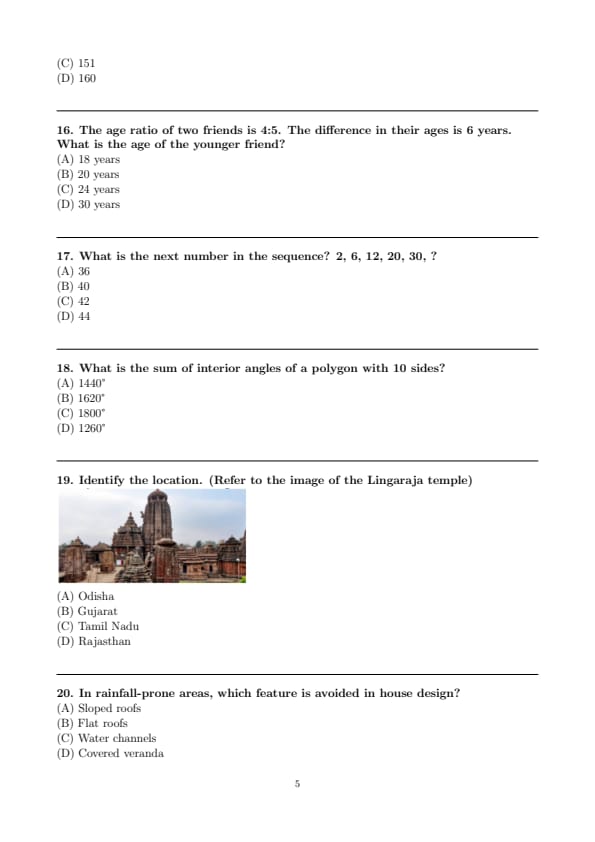
Identify the location. (Refer to the image of the Lingaraja temple)

View Solution
Step 1: Understanding the Concept:
The question requires identifying the state in which the monument shown in the image is located. This tests knowledge of famous Indian temples and their architectural styles.
Step 2: Detailed Explanation:
The temple shown in the picture is the Lingaraja Temple.
This temple is a prime example of the Kalinga style of architecture, which is native to the ancient region of Kalinga, corresponding to modern-day Odisha and parts of Andhra Pradesh.
The Lingaraja Temple is one of the most prominent landmarks of Bhubaneswar, the capital city of the state of Odisha.
The other states are known for different architectural styles: Gujarat for Solanki style, Tamil Nadu for Dravidian style, and Rajasthan for its forts and havelis.
Step 3: Final Answer:
The location of the Lingaraja Temple is in Odisha.
Quick Tip: Associate major temples with their locations: Lingaraja and Konark Sun Temple are in Odisha. Meenakshi Temple is in Madurai, Tamil Nadu. Somnath Temple is in Gujarat. Recognizing the distinct tower (shikhara) style can help identify the region.
In rainfall-prone areas, which feature is avoided in house design?
View Solution
Step 1: Understanding the Concept:
This question asks about architectural design principles related to climate. Specifically, it focuses on features that are suitable or unsuitable for areas with heavy rainfall.
Step 2: Detailed Explanation:
Let's analyze the functionality of each option in a rainy climate:
(A) Sloped roofs: These are highly desirable in rainy areas because the slope allows rainwater to drain off quickly, preventing water accumulation, stagnation, and leakage.
(B) Flat roofs: These are generally avoided in areas with high rainfall. Water can easily pool on a flat surface, increasing the risk of structural damage and leakages if the waterproofing and drainage systems are not perfect. They are more suitable for arid or dry climates.
(C) Water channels (Gutters and downspouts): These are essential components in rainy areas. They collect the water runoff from the roof and direct it away from the building's foundation.
(D) Covered veranda: This is a beneficial feature as it provides a sheltered outdoor space, protecting the walls and openings of the house from direct rain.
Step 3: Final Answer:
Flat roofs are the feature that should be avoided in the design of houses in rainfall-prone areas.
Quick Tip: Think functionally about architecture. For rain, you need to shed water. Slopes are good. Flat surfaces are bad. For sun, you need shade. Verandas are good. Large, unshaded glass walls are bad. Matching the design feature to the climatic challenge is key.
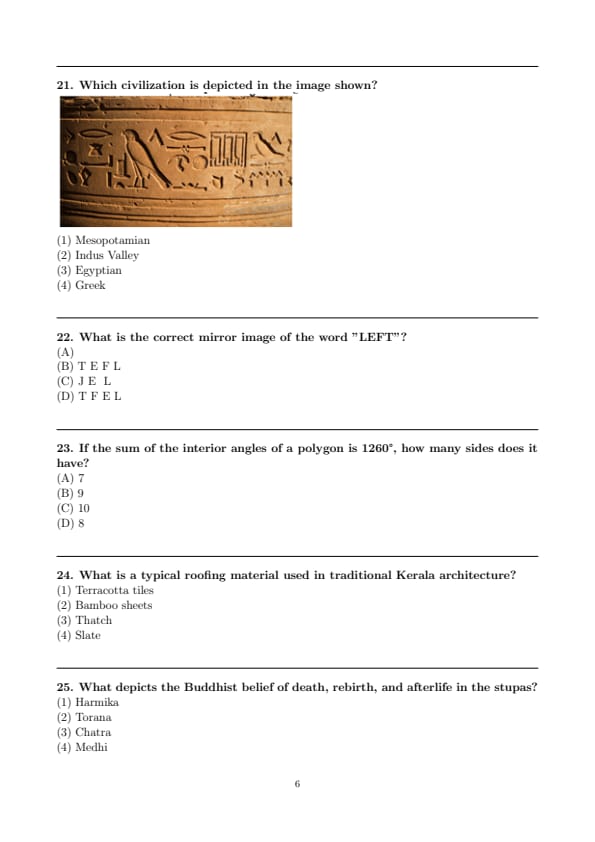
Which civilization is depicted in the image shown?

View Solution
Step 1: Understanding the Concept:
The question requires identifying an ancient civilization based on a picture of its writing system carved on stone.
Step 2: Detailed Explanation:
The image displays a set of symbols that include stylized figures of birds, people, and objects. This form of pictorial writing is known as hieroglyphics.
Hieroglyphic script is the formal writing system used in Ancient Egypt. It was used for monumental inscriptions on temples and tombs.
Let's look at the other options:
(1) Mesopotamian: This civilization, particularly the Sumerians, developed a wedge-shaped script called cuneiform.
(2) Indus Valley: This civilization used a script with symbols found on seals, but it has not yet been deciphered and looks different from the image.
(4) Greek: This civilization used an alphabetic script derived from Phoenician script.
Step 3: Final Answer:
The hieroglyphic writing in the image is characteristic of the Ancient Egyptian civilization.
Quick Tip: Visually associate ancient civilizations with their writing systems: Egypt with picture-like hieroglyphs, Mesopotamia with wedge-shaped cuneiform, and Greece with its familiar alphabet (Alpha, Beta, Gamma, etc.).
What is the correct mirror image of the word "LEFT"?
View Solution
Step 1: Understanding the Concept:
This question tests spatial reasoning. A mirror image involves two transformations: lateral inversion (left becomes right) and reversal of order.
Step 2: Detailed Explanation:
Let's find the mirror image of the word "LEFT" assuming a mirror is placed vertically to the right.
1. Reversal of order: The sequence of letters will be reversed. The letter 'T' which is last will appear first in the reflection, followed by 'F', 'E', and 'L'. So the order is T-F-E-L.
2. Lateral inversion of each letter:
- The mirror image of 'L' is '⅃'.
- The mirror image of 'E' is 'Ǝ'.
- The mirror image of 'F' is 'Ⅎ'.
- The mirror image of 'T' is 'T' (as it is vertically symmetrical).
3. Combine them in the new order: The correct mirror image would look like TℲƎ⅃.
Now let's examine the options provided, which use Cyrillic or stylized characters to represent the inverted letters:
(A) ТЧЕЛ: 'Т' is T. 'Ч' resembles a mirrored 'F'. 'Е' resembles a mirrored 'E'. 'Л' resembles a mirrored 'L'. This option correctly shows both the reversal of order and the lateral inversion of each letter.
(B) T E F L: This shows the letters uninverted and in the wrong order.
(C) J E Ⅎ L: Incorrect letters and order.
(D) T F E L: This shows the letters in the correct reversed order but without lateral inversion.
Step 3: Final Answer:
Based on the representation, option (A) is the correct mirror image.
Quick Tip: To solve mirror image problems quickly, focus on two things: the first letter of the reflection will be the mirror image of the last letter of the original word. Then, check for any non-symmetrical letters and ensure they are flipped correctly.
If the sum of the interior angles of a polygon is 1260°, how many sides does it have?
View Solution
Step 1: Understanding the Concept:
This problem is the reverse of question 18. We are given the sum of the interior angles and need to find the number of sides (\(n\)) of the polygon.
Step 2: Key Formula or Approach:
We use the same formula for the sum of the interior angles of a polygon with \(n\) sides: \[ Sum of angles = (n - 2) \times 180^\circ \]
Step 2: Detailed Explanation:
We are given that the sum of the angles is 1260°. Let's plug this into the formula: \[ 1260^\circ = (n - 2) \times 180^\circ \]
To find \(n\), we need to isolate it. First, divide both sides by 180°: \[ \frac{1260}{180} = n - 2 \]
The division can be simplified: \[ \frac{126}{18} = 7 \]
So, the equation becomes: \[ 7 = n - 2 \]
Now, add 2 to both sides to solve for \(n\): \[ n = 7 + 2 \] \[ n = 9 \]
The polygon has 9 sides (it is a nonagon).
Step 3: Final Answer:
The polygon has 9 sides.
Quick Tip: To quickly find the number of sides from the sum of interior angles, always perform this two-step calculation: (1) Divide the sum by 180. (2) Add 2 to the result. This is a direct reversal of the formula.
What is a typical roofing material used in traditional Kerala architecture?
View Solution
Step 1: Understanding the Concept:
This question requires knowledge of regional architectural traditions in India, specifically the materials used in Kerala.
Step 2: Detailed Explanation:
Traditional Kerala architecture is designed to withstand the heavy monsoon rains and humid climate of the region. This has led to distinctive features, most notably complex, steeply sloped wooden roofs.
While materials like thatch and bamboo have been used for simpler structures, the most durable and characteristic roofing material for permanent buildings like temples, palaces, and traditional homes (\textit{tharavadu) is terracotta tiles. These baked clay tiles are laid in an overlapping pattern to ensure excellent water runoff and ventilation. Slate is not commonly used in Kerala's traditional architecture.
Step 3: Final Answer:
Terracotta tiles are the typical roofing material used in traditional Kerala architecture.
Quick Tip: Associate architectural styles with local climate and materials. Kerala's heavy rainfall necessitates sloped roofs, and the abundance of clay led to the widespread use of terracotta tiles as a durable, waterproof covering.
What depicts the Buddhist belief of death, rebirth, and afterlife in the stupas?
View Solution
Step 1: Understanding the Concept:
The question asks to identify the part of a Buddhist stupa that symbolizes the concepts of death, rebirth, and afterlife. Each part of a stupa has a deep cosmological and philosophical meaning.
Step 2: Detailed Explanation:
A stupa is a hemispherical structure that functions as a Buddhist commemorative monument. It symbolizes the enlightened mind of the Buddha as well as the universe. The entire structure represents the path to enlightenment.
(1) Harmika: The square railing on top of the dome, symbolizing the celestial palace or the abode of gods, a sacred space.
(2) Torana: The ornate gateways that depict scenes from the life of the Buddha and Jataka tales, guiding the devotee.
(3) Chatra: The ceremonial umbrella on top, symbolizing royalty, protection, and the sacred Bodhi tree.
(4) Medhi: This is the raised circular terrace or path at the base of the stupa's dome. Devotees perform pradakshina (circumambulation) on the medhi. This ritual walk around the stupa, a representation of the cosmos and the Buddha's final passing (Parinirvana), symbolizes the endless cycle of birth, death, and rebirth (\textit{samsara) from which Buddhists seek liberation. The path itself represents the journey through this cycle.
Step 3: Final Answer:
The Medhi, as the circumambulatory path, is most directly associated with the ritual that symbolizes the cycle of death and rebirth.
Quick Tip: Remember the core ritual associated with a stupa: walking around it (circumambulation). This physical act represents the spiritual journey through the cycle of life (\textit{samsara). The path for this ritual is the Medhi.
What is the Ashoka Pillar according to ancient Buddhist architecture?
View Solution
Step 1: Understanding the Concept:
The question asks for the definition and purpose of the pillars erected by the Mauryan Emperor Ashoka.
Step 2: Detailed Explanation:
The pillars of Ashoka are a series of monolithic columns dispersed throughout the Indian subcontinent, erected during his reign in the 3rd century BCE.
Their primary purpose was to spread the teachings of the Buddha, known as the Dharma. The pillars were inscribed with Ashoka's edicts on morality, ethics, and his administration.
A defining feature of these pillars is the ornate capital that sits on top. These capitals are typically carved in the shape of animals, most famously the four lions of the Sarnath pillar, which is now the National Emblem of India. These were not victory towers celebrating military conquest (in fact, they were often erected after Ashoka renounced war), nor were they functional structures for water storage or residence. They were primarily religious and administrative monuments.
Step 3: Final Answer:
An Ashoka Pillar is a religious monument, often inscribed with edicts, and topped with an animal capital.
Quick Tip: The most famous image of an Ashoka Pillar is the Lion Capital of Sarnath. Remembering this single image helps you recall that these pillars are monuments topped with animal sculptures and associated with religious edicts.
What is not a part of a window?
View Solution
Step 1: Understanding the Concept:
This question tests knowledge of basic architectural terminology related to openings in a wall, specifically a window.
Step 2: Detailed Explanation:
Let's define the terms:
(1) Sill: The horizontal member forming the bottom of a window frame. It is an integral part of the window unit.
(2) Mullion: A vertical bar between the panes of glass in a window. It is part of the window assembly.
(3) Jamb: The vertical side post or lining of a doorway or window. It is part of the window frame.
(4) Lintel beam: A horizontal structural beam placed across the top of an opening (like a window or door) in a wall. Its function is to support the weight of the wall above the opening. While it is essential for the existence of the window opening, it is considered part of the building's primary structure (the wall), not part of the window unit itself which is installed into the opening beneath the lintel.
Step 3: Final Answer:
A lintel beam is part of the wall's structure, not a part of the window assembly.
Quick Tip: Think of a window as a pre-fabricated unit. The sill, jamb, and mullion are components of that unit. The lintel is part of the rough opening in the wall that the window unit fits into.
Name the building in Dubai shaped like a sail.
View Solution
Step 1: Understanding the Concept:
This question tests general knowledge about iconic modern architectural landmarks.
Step 2: Detailed Explanation:
Let's identify each building:
(1) Burj Khalifa: The world's tallest building, known for its slender, tapering spire-like design.
(2) Burj Al Arab: A luxury hotel located on an artificial island. Its shape is famously designed to mimic the billowing spinnaker sail of a J-class yacht, or a traditional Arabian dhow. It is globally recognized for this sail shape.
(3) Dubai Frame: An architectural landmark in Dubai, shaped like a giant picture frame.
(4) Marina 101: A supertall skyscraper in the Dubai Marina district.
Step 3: Final Answer:
The building in Dubai that is shaped like a sail is the Burj Al Arab.
Quick Tip: Create visual associations for famous buildings. Burj Al Arab = Sail. Burj Khalifa = Needle/Spire. Sydney Opera House = Shells. The Gherkin (London) = Pickle/Bullet. These simple mnemonics are very effective.
What is the capital of Andhra Pradesh?
View Solution
Step 1: Understanding the Concept:
This question tests knowledge of Indian geography and current affairs, specifically the state capitals.
Step 2: Detailed Explanation:
Following the bifurcation of the original state of Andhra Pradesh in 2014, the former capital, Hyderabad, became the capital of the new state of Telangana.
The Andhra Pradesh government designated Amaravati as the new legislative capital for the state. While there have been proposals and political discussions about having three different capitals (Visakhapatnam as the executive capital, Amaravati as the legislative capital, and Kurnool as the judicial capital), for the purpose of a standard general knowledge question, Amaravati is recognized as the designated capital. Vijayawada and Visakhapatnam are major cities within the state but are not the official capital.
Step 3: Final Answer:
The capital of Andhra Pradesh is Amaravati.
Quick Tip: State capitals, especially for newly formed or reorganized states, are a common topic in general knowledge tests. Always keep up-to-date with any changes. The bifurcation of Andhra Pradesh and Telangana is a key event to remember.
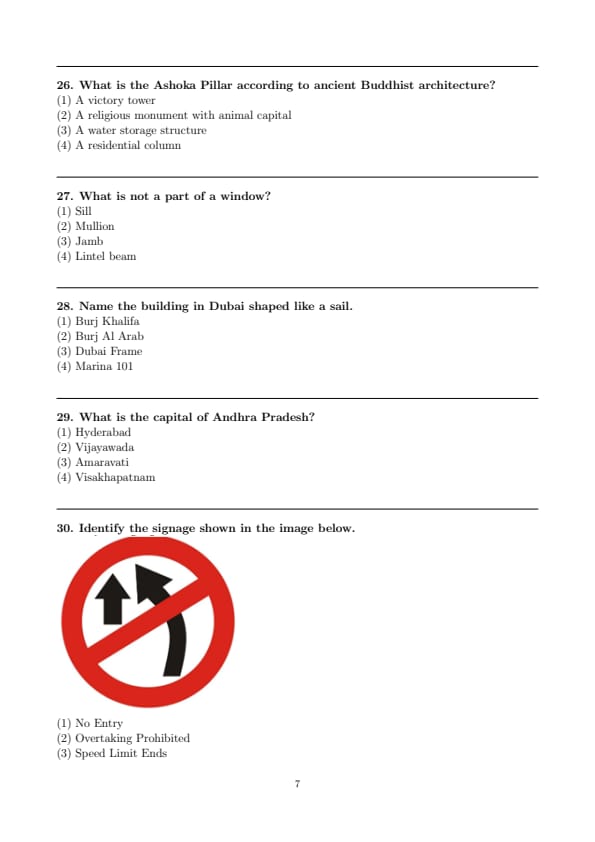
Identify the signage shown in the image below.

View Solution
Step 1: Understanding the Concept:
The question requires the identification of a standard traffic sign. This tests awareness of road safety and regulations.
Step 2: Detailed Explanation:
The image shows a prohibitory traffic sign, indicated by its circular shape and red border.
Inside the circle, there are two symbols of cars, one black and one red (or in this case, a straight arrow and a curving arrow). The visual depicts one vehicle in the act of passing or overtaking another. The red circle and border signify that this action is prohibited.
Therefore, the sign means "Overtaking Prohibited".
Let's consider other signs:
(1) No Entry: A solid red circle with a horizontal white bar inside.
(3) Speed Limit Ends: A white circle with a black number and a black diagonal slash across it.
(4) Horn Prohibited: A sign showing a horn symbol inside the red prohibitory circle.
Step 3: Final Answer:
The signage shown in the image indicates that overtaking is prohibited.
Quick Tip: Remember the language of traffic signs. A red circle is almost always a "Do Not" or "Prohibited" sign. The symbol inside tells you what action is prohibited. This simple rule helps in deciphering most regulatory signs.
Identify the correct statement for the Logo

View Solution
Step 1: Understanding the Concept:
The question asks to identify the correct slogan or tagline associated with the brand whose logo is shown. The logo is for Coca-Cola.
Step 2: Detailed Explanation:
We need to match the given slogans with their respective brands to find the one that belongs to Coca-Cola.
(1) Taste the Thunder: This is the long-running and famous slogan for the brand Thums Up.
(2) Taste the Feeling: This was a global marketing slogan used by Coca-Cola from 2016 to 2021. It is a valid statement for the logo.
(3) Fresh and Juicy: This is a generic descriptive phrase, often associated with fruit juice brands like Tropicana or Real. It is not a slogan for Coca-Cola.
(4) Lime n Lemoni: This is the well-known tagline for the lemon-lime drink Limca, which is also a product of The Coca-Cola Company, but not for the flagship Coca-Cola brand itself.
Step 3: Final Answer:
Among the given options, "Taste the Feeling" is a correct slogan associated with the Coca-Cola brand.
Quick Tip: Brand taglines are a common topic in general awareness sections. It's helpful to remember the slogans of major global and national brands, especially competitors in the same market (e.g., Coca-Cola vs. Pepsi, Nike vs. Adidas).
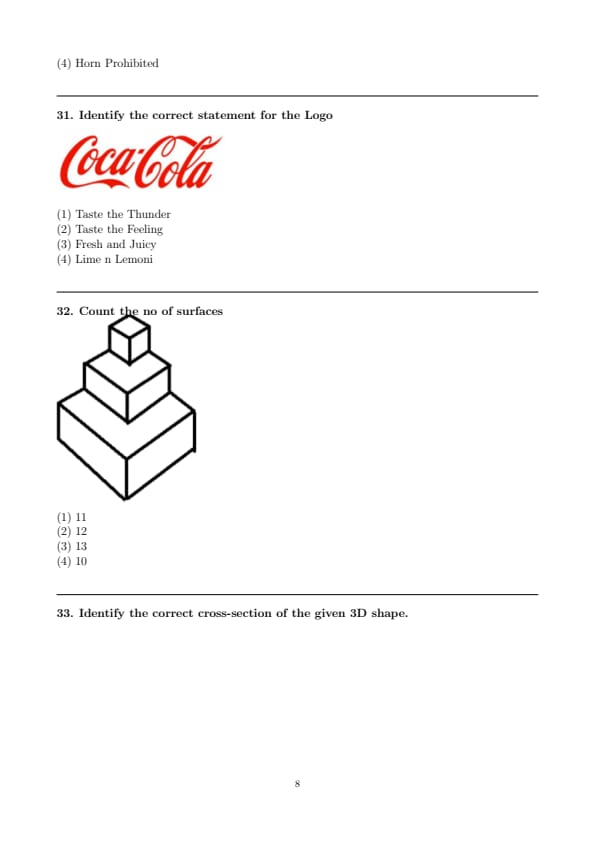
Count the no of surfaces

View Solution
Step 1: Understanding the Concept:
This question is a test of spatial reasoning and observation. It asks to count the number of surfaces of the 3D object shown. The phrasing can be ambiguous in such puzzles. It could mean the total number of surfaces (including hidden ones) or only the visible surfaces in the given projection.
Step 2: Detailed Explanation:
Let's first try to calculate the total number of surfaces. The object consists of 4 stacked square prisms.
- Top Surfaces: There is the top face of the smallest prism, plus the exposed top 'ring' of the three prisms below it. This gives 4 distinct top surfaces.
- Side Surfaces: Each of the 4 prisms has 4 side surfaces. So, there are \(4 \times 4 = 16\) side surfaces.
- Bottom Surface: There is 1 bottom surface for the entire object.
The total would be \(4 + 16 + 1 = 21\). This is not among the options.
This indicates that the question is likely asking for the number of visible surfaces in the provided isometric view. Let's count these:
- Top-most prism: We can see 1 top surface and 2 side surfaces (front and right). Total = 3.
- Second prism from top: We can see 1 top ring surface and 2 side surfaces. Total = 3.
- Third prism from top: We can see 1 top ring surface and 2 side surfaces. Total = 3.
- Bottom-most prism: We can see 1 top ring surface and 2 side surfaces. Total = 3.
The total number of visible surfaces is \(3 + 3 + 3 + 3 = 12\).
Step 3: Final Answer:
By counting the number of visible surfaces in the given drawing, we get a total of 12.
Quick Tip: In spatial reasoning puzzles, if calculating the total theoretical number of faces doesn't match the options, the question is often simpler. Try counting only the distinct faces (polygons) you can see in the 2D representation of the 3D object.
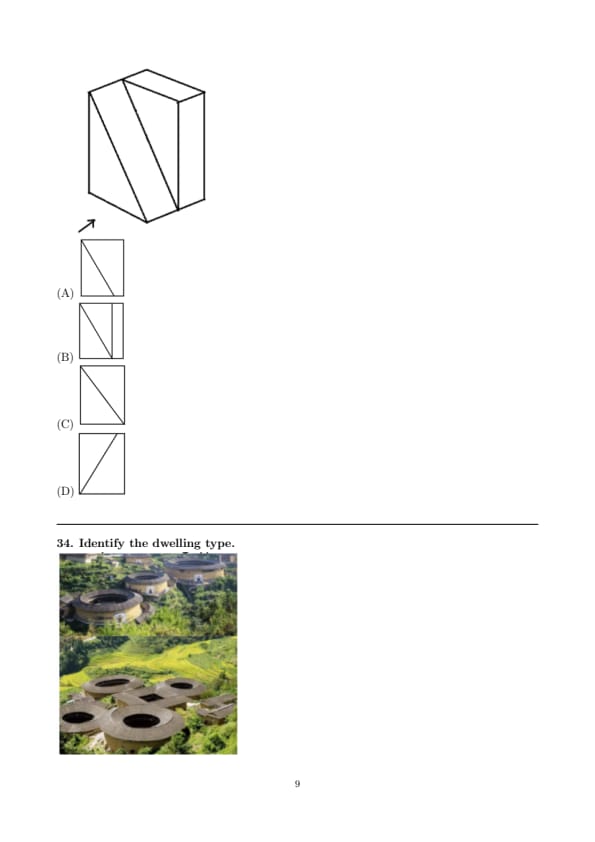
Identify the correct cross-section of the given 3D shape.

- (A)
![]()
- (B)
![]()
- (C)
![]()
- (D)
![]()


View Solution
Step 1: Understanding the Concept:
A cross-section is the two-dimensional shape that is exposed when a three-dimensional object is sliced through by a plane. The question asks to identify a possible cross-section of the given object. The arrow's meaning is ambiguous, but the options show simple shapes, suggesting a simple cut.
Step 2: Detailed Explanation:
The 3D shape is a rectangular prism with a diagonal band cut into it. The options, however, show very simple cross-sections, like a rectangle with a single diagonal line. Such a cross-section is obtained when a simple rectangular prism is cut by a plane from one edge to the opposite edge.
Let's analyze the options:
Option A/C: A rectangle with a diagonal line running from the top-left corner to the bottom-right corner. This shape would be the result of slicing a rectangular block with a plane that passes through its top-back edge and its bottom-front edge.
Option B: A complex shape not typically formed by a single planar cut.
Option D: A rectangle with a diagonal from bottom-left to top-right. This would be formed by a plane passing through the bottom-back edge and top-front edge.
The most prominent visual feature of the 3D object is the diagonal band that runs in a direction from top-left to bottom-right on its visible faces. A cross-section that reflects this dominant directional feature is the most plausible answer in a visual reasoning test. Option A and C both show this diagonal direction. Let's assume the question is asking to identify a plausible planar cross-section that relates to the object's form. Slicing a rectangular block in a manner that creates a diagonal internal plane is a standard operation. The visual characteristics of the given object align with the cross-section shown in A.
Step 3: Final Answer:
Option (A) is the most plausible cross-section, as its diagonal feature matches the main diagonal element of the 3D object.
Quick Tip: In ambiguous cross-section problems, look for the most dominant feature of the 3D object (like an angle or direction) and find the option that reflects that feature most simply. A diagonal feature on the object often corresponds to a diagonal line in the cross-section.
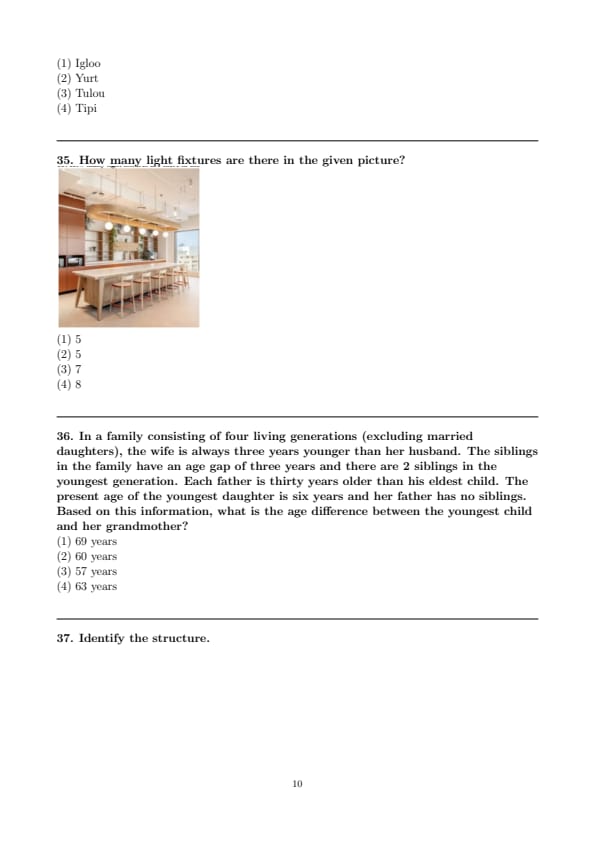
Identify the dwelling type.

View Solution
Step 1: Understanding the Concept:
This question requires the identification of a specific type of vernacular architecture from an image.
Step 2: Detailed Explanation:
The image shows large, multi-story, circular, fortress-like buildings made of earth, set in a rural, hilly landscape. These are characteristic features of the Fujian Tulou.
Let's examine the options:
(1) Igloo: A dome-shaped dwelling built from blocks of snow, used by the Inuit people. This is incorrect.
(2) Yurt: A portable, circular tent used by nomadic groups in Central Asia. It is not a large, permanent earthen structure. This is incorrect.
(3) Tulou: These are unique Chinese rural dwellings of the Hakka people in the mountainous regions of southeastern Fujian, China. They are large, enclosed, and fortified earth buildings, most commonly in a circular or rectangular configuration. The image is a perfect match for the Fujian Tulou, a UNESCO World Heritage Site.
(4) Tipi: A conical tent used by indigenous peoples of the Great Plains in North America. This is incorrect.
Step 3: Final Answer:
The dwellings shown in the picture are Tulou.
Quick Tip: Familiarize yourself with iconic examples of vernacular (traditional and regional) architecture from around the world. Visual recognition is often tested in architecture and design entrance exams.
How many light fixtures are there in the given picture?

View Solution
Step 1: Understanding the Concept:
This is an observation-based question that requires carefully counting the number of individual light sources or fixtures visible in an image of a room.
Step 2: Detailed Explanation:
Let's systematically count the light fixtures in the picture:
1. Pendant Lights: Hanging over the central island is a large fixture composed of multiple individual spherical bulbs. Counting these bulbs, we find there are 6 of them.
2. Recessed Ceiling Lights (Downlights): Looking at the ceiling in the background, we can clearly identify small, circular lights set into the ceiling. One is very clear, and a second one is visible further back, in line with the first one. This indicates a row of such lights. We can confidently count 2 visible ceiling lights.
3. Under-Cabinet Lights: There is a glow from under the upper cabinets on the left, but these are often strip lights and may be considered a single fixture. However, counting the distinct, individual light sources is a more common approach for such questions.
Adding the most distinct and visible light sources: \[ Total Lights = (Pendant Bulbs) + (Ceiling Lights) \] \[ Total Lights = 6 + 2 = 8 \]
This total matches one of the options.
Step 3: Final Answer:
There are 8 visible light fixtures in the given picture.
Quick Tip: For counting objects in an image, be methodical. Scan the image from top to bottom or left to right. Categorize the objects you are counting (e.g., pendant lights, ceiling lights) and count each category separately before adding them up.
In a family consisting of four living generations (excluding married daughters), the wife is always three years younger than her husband. The siblings in the family have an age gap of three years and there are 2 siblings in the youngest generation. Each father is thirty years older than his eldest child. The present age of the youngest daughter is six years and her father has no siblings. Based on this information, what is the age difference between the youngest child and her grandmother?
View Solution
Step 1: Understanding the Concept:
This is a complex logical deduction problem involving ages and family relationships. The best approach is to work systematically from the known information (the age of the youngest child) up through the generations.
Step 2: Detailed Explanation:
Let's denote the generations as G4 (youngest), G3 (parents), G2 (grandparents), and G1 (great-grandparents).
Generation 4 (G4):
- The youngest child is a daughter, and her age is 6 years.
- There are 2 siblings in her generation with a 3-year age gap.
- Her elder sibling's age is \(6 + 3 = \textbf{9 years}\). This is the eldest child in G4.
Generation 3 (G3 - Parents):
- The father (let's call him Father3) is 30 years older than his eldest child.
- Father3's age = \(9 + 30 = \textbf{39 years}\).
- The wife (Mother3) is 3 years younger than her husband.
- Mother3's age = \(39 - 3 = \textbf{36 years}\).
Generation 2 (G2 - Grandparents):
- The father of Father3 is the grandfather (Grandfather2). The problem states Father3 has no siblings, so he is the eldest (and only) child of his parents.
- Grandfather2's age = Father3's age + 30 = \(39 + 30 = \textbf{69 years}\).
- The grandmother (Grandmother2) is the wife of Grandfather2. She is 3 years younger.
- Grandmother2's age = \(69 - 3 = \textbf{66 years}\).
Final Calculation:
The question asks for the age difference between the youngest child (6 years) and her grandmother (66 years).
- Age Difference = Grandmother's Age - Youngest Child's Age
- Age Difference = \(66 - 6 = \textbf{60 years}\).
Step 3: Final Answer:
The age difference between the youngest child and her grandmother is 60 years.
Quick Tip: For multi-step word problems, list all the given rules and pieces of information first. Then, build the solution step-by-step, starting from the most concrete piece of data. Don't try to solve it all at once in your head.
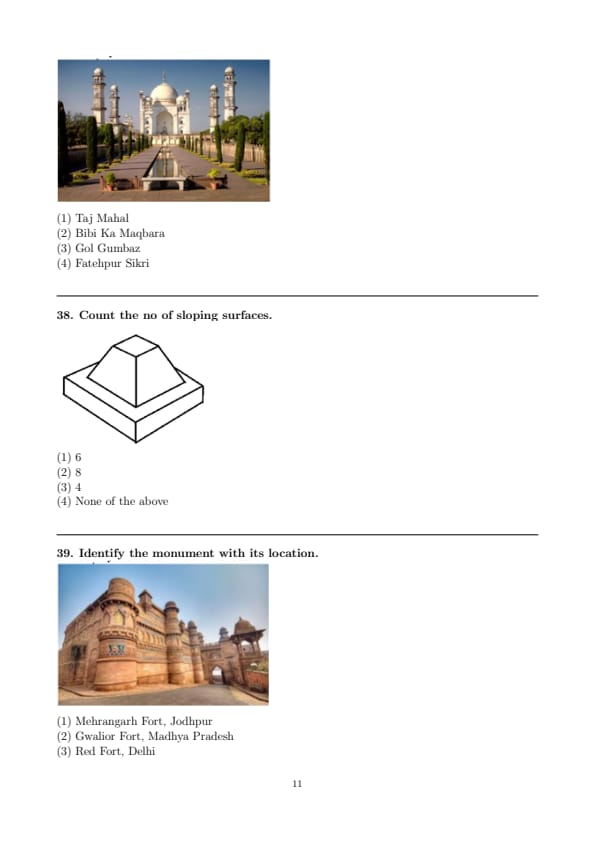
Identify the structure.

View Solution
Step 1: Understanding the Concept:
The question requires the identification of a famous historical monument from a photograph. This tests knowledge of Indian architecture and heritage sites.
Step 2: Detailed Explanation:
The structure in the image is a mausoleum built in the Mughal architectural style, characterized by a large central dome, four minarets at the corners, and an entrance archway. It bears a very strong resemblance to the Taj Mahal. However, there are notable differences.
(1) Taj Mahal: Located in Agra, it is made of pristine white marble and is known for its perfect proportions and exquisite inlay work. The structure in the image, while similar, has different proportions (e.g., the minarets are heavier, and the dome is more bulbous) and is constructed from marble and plaster, giving it a less luminous appearance.
(2) Bibi Ka Maqbara: Located in Aurangabad, Maharashtra, this monument is famously known as the "Taj of the Deccan" because it was intentionally modeled on the Taj Mahal. It was commissioned by Emperor Aurangzeb for his wife, Dilras Banu Begum. The visual details in the photograph—the specific shape of the dome, the design of the minarets, and the overall composition—perfectly match the Bibi Ka Maqbara.
(3) Gol Gumbaz: Located in Vijayapura (Bijapur), Karnataka, this is a massive mausoleum with a single, colossal dome and is architecturally very different from the structure in the image.
(4) Fatehpur Sikri: This is a fortified city complex near Agra, containing a collection of palaces, halls, and mosques, not a single tomb of this design.
Step 3: Final Answer:
The structure shown in the image is the Bibi Ka Maqbara.
Quick Tip: Many famous monuments have well-known replicas or inspired buildings. Being able to distinguish between the original and its prominent copies, like the Taj Mahal and the Bibi Ka Maqbara, is a common check of detailed knowledge in history and culture questions.
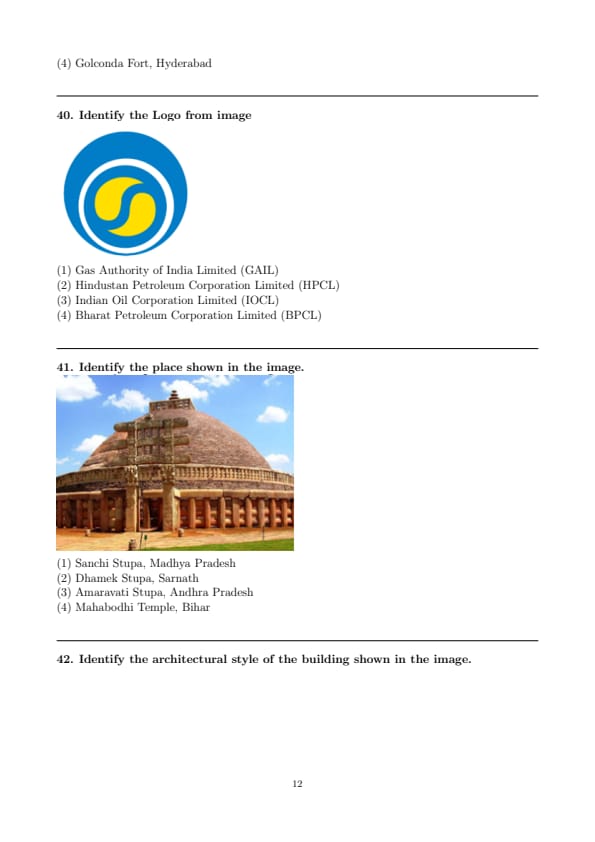
Count the no of sloping surfaces.

View Solution
Step 1: Understanding the Concept:
The question asks to count the number of surfaces on the given 3D object that are "sloping". In geometry, a sloping surface is one that is inclined at an angle, i.e., it is neither horizontal nor vertical.
Step 2: Detailed Explanation:
Let's break down the object into its components:
1. The Base: The bottom part is a rectangular prism (or cuboid). It has one top horizontal surface (partially covered), one bottom horizontal surface (hidden), and four vertical side surfaces. None of these are sloping.
2. The Top: The top part is a frustum of a square pyramid. A frustum is the portion of a pyramid that lies between two parallel planes. This part has:
- One small horizontal square surface at the very top.
- Four trapezoidal surfaces on the sides. These surfaces are inclined and connect the top square to the larger square base of the frustum. These are the sloping surfaces.
By analyzing the shape, we can see that only the four side faces of the top pyramid-like structure are inclined.
Step 3: Final Answer:
There are exactly 4 sloping surfaces on the object.
Quick Tip: When analyzing a 3D shape, mentally separate it into its basic geometric parts (cubes, prisms, pyramids, cylinders, etc.). This makes it easier to count faces, edges, or vertices with specific properties like being horizontal, vertical, or sloped.
Identify the monument with its location.

View Solution
Step 1: Understanding the Concept:
This question requires the identification of a famous Indian fort from its photograph. Knowledge of key architectural features of these monuments is necessary.
Step 2: Detailed Explanation:
The fort in the image has several distinctive features:
- It is built on a hill with imposing ramparts made of sandstone.
- The bastions (the rounded towers) have a specific design.
- Most importantly, the palace structure visible on the walls is adorned with blue ceramic tiles, a unique characteristic of the Man Singh Palace (or Man Mandir Palace) which is a part of the Gwalior Fort.
Let's compare this with the other options:
- Mehrangarh Fort, Jodhpur: Is an immense fort, but lacks this specific style of blue tile decoration.
- Red Fort, Delhi: Is built with red sandstone and has a different architectural style, characteristic of the peak of Mughal architecture.
- Golconda Fort, Hyderabad: Has a distinct Deccani style of architecture and is mostly in ruins.
Step 3: Final Answer:
The monument shown, with its characteristic blue tile work, is the Gwalior Fort in Madhya Pradesh.
Quick Tip: When identifying forts and palaces, look for unique decorative elements. The blue tiles of Gwalior, the red sandstone of Delhi's Red Fort, or the blue-painted houses around Mehrangarh Fort are key visual clues that help in quick identification.
Identify the Logo from image

View Solution
Step 1: Understanding the Concept:
The question asks to identify the company to which the given logo belongs. This tests general awareness of corporate branding, particularly of major public sector undertakings (PSUs) in India.
Step 2: Detailed Explanation:
The logo shown is a blue circle containing a stylized, dynamic 'S' shape in yellow or gold. This design is the official logo of Bharat Petroleum Corporation Limited (BPCL). The logo is meant to represent energy and the flow of oil.
The logos of the other companies listed are different:
- GAIL: Has a logo with a flame-like shape.
- HPCL: Has a circular logo with a red background and a white oil drop shape.
- IOCL: Has a saffron circle with a blue inner circle containing the name "IndianOil".
Step 3: Final Answer:
The logo shown belongs to Bharat Petroleum Corporation Limited (BPCL).
Quick Tip: It's beneficial to be familiar with the logos of major national companies, especially Navratnas and Maharatnas like IOCL, BPCL, ONGC, and GAIL, as they are frequently featured in general knowledge questions.
Identify the place shown in the image.

View Solution
Step 1: Understanding the Concept:
The question requires the identification of a famous Buddhist monument in India from its image.
Step 2: Detailed Explanation:
The image shows a large, hemispherical dome-like structure made of stone, which is a Buddhist Stupa. The key features that identify this specific stupa are:
- The massive and simple hemispherical dome (\textit{anda).
- The stone railing or fence (\textit{vedika) that encloses it.
- A highly decorated gateway (\textit{torana) visible at the entrance.
These are the iconic features of the Great Stupa at Sanchi, located in Madhya Pradesh. It is one of the oldest and most important Buddhist monuments in India.
The other options are different:
- Dhamek Stupa, Sarnath: Is a tall, cylindrical stupa made of brick and stone.
- Amaravati Stupa, Andhra Pradesh: Is now largely in ruins, and its ornate carved marble panels are housed in museums.
- Mahabodhi Temple, Bihar: Is a tall pyramidal temple, not a stupa with a dome.
Step 3: Final Answer:
The place shown in the image is the Sanchi Stupa in Madhya Pradesh.
Quick Tip: To differentiate between major stupas, remember their shapes: Sanchi = large, simple dome with famous gateways; Sarnath (Dhamek) = tall, cylindrical tower; Amaravati = known for its intricate marble carvings (now mostly in museums).
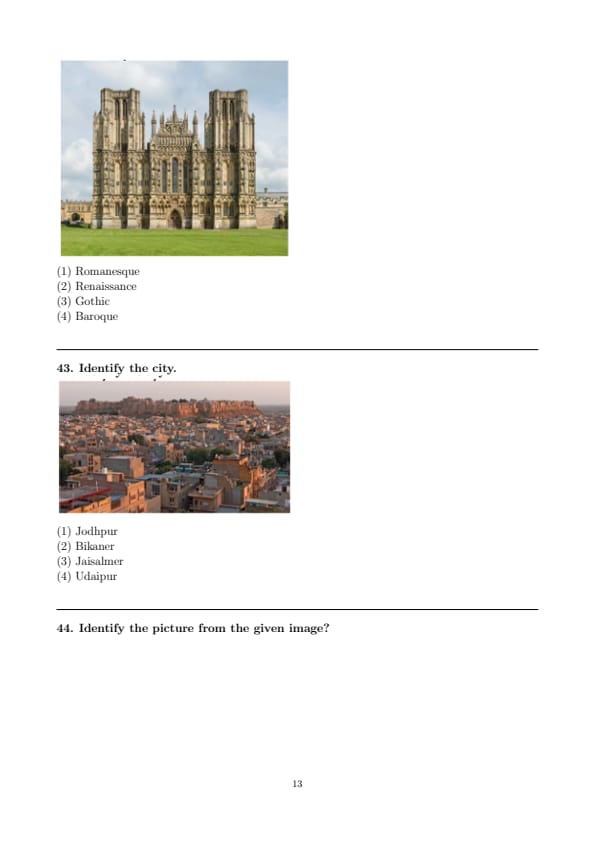
Identify the architectural style of the building shown in the image.

View Solution
Step 1: Understanding the Concept:
The question asks to identify the European architectural style of the building shown, which is a cathedral.
Step 2: Detailed Explanation:
The building in the image exhibits several key features that are hallmarks of the Gothic architectural style, which flourished in Europe during the High and Late Middle Ages. These features include:
- Pointed Arches: The windows and structural elements use pointed arches, which allowed for taller buildings and larger windows compared to the rounded arches of the preceding Romanesque style.
- Emphasis on Height and Light: The building is very tall and has large windows with intricate stone tracery, designed to fill the interior with light.
- Flying Buttresses: Though not perfectly clear, the complex exterior structure with supports indicates the use of buttresses to support the high walls.
- Ornate Facade: The front of the cathedral is highly decorated with sculptures and detailed stonework.
The other styles are incorrect:
- Romanesque: Characterized by thick walls, small windows, and rounded arches.
- Renaissance: Emphasized symmetry, proportion, and classical elements like domes and columns.
- Baroque: Was even more ornate and dramatic than Gothic, with a focus on curves, grandeur, and opulence.
Step 3: Final Answer:
The architectural style shown in the image is Gothic.
Quick Tip: The quickest way to identify Gothic architecture is to look for pointed arches. If you see them, especially in a tall, stone cathedral with large windows, it's almost certainly Gothic.
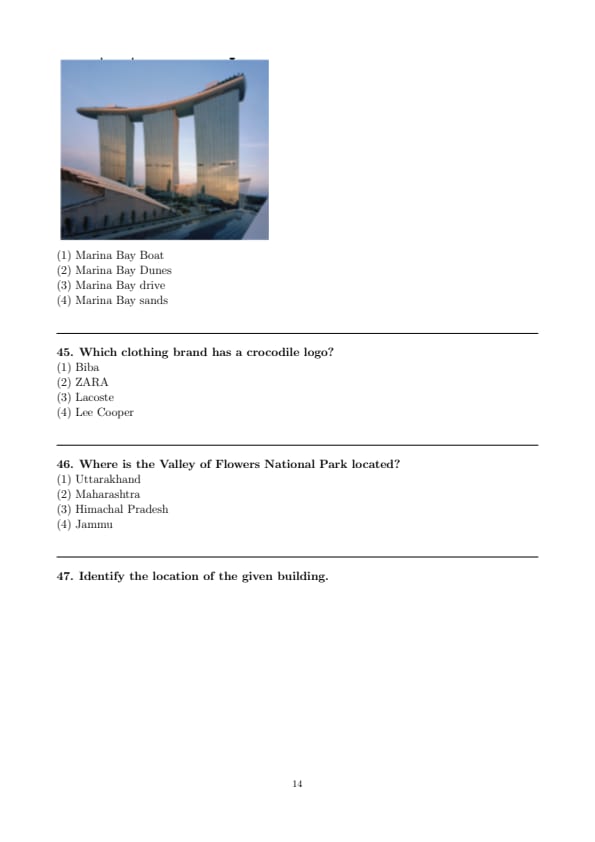
Identify the city.

View Solution
Step 1: Understanding the Concept:
The question asks to identify a city in Rajasthan from a photograph of its cityscape and fort.
Step 2: Detailed Explanation:
The image shows a cityscape where almost all the buildings are constructed from a distinct golden-yellow sandstone. This gives the entire city a uniform, monochromatic golden hue. In the background, a massive fort, also made of the same stone, rises above the city.
This unique visual characteristic is the reason why Jaisalmer is famously known as the "Golden City". The fort is the Jaisalmer Fort, also called Sonar Qila (the Golden Fort).
The other cities have different characteristics:
- Jodhpur: Known as the "Blue City" for the blue-painted houses around the Mehrangarh Fort.
- Bikaner: Known for its red sandstone fort (Junagarh Fort) and havelis.
- Udaipur: Known as the "City of Lakes" and the "White City" for its beautiful lakes and white marble palaces.
Step 3: Final Answer:
The city shown in the image is Jaisalmer.
Quick Tip: Remember the colorful nicknames of Rajasthan's cities: Jaipur is the Pink City, Jodhpur is the Blue City, Jaisalmer is the Golden City, and Udaipur is the White City. These names are based on their dominant architectural colors and are a great memory aid.
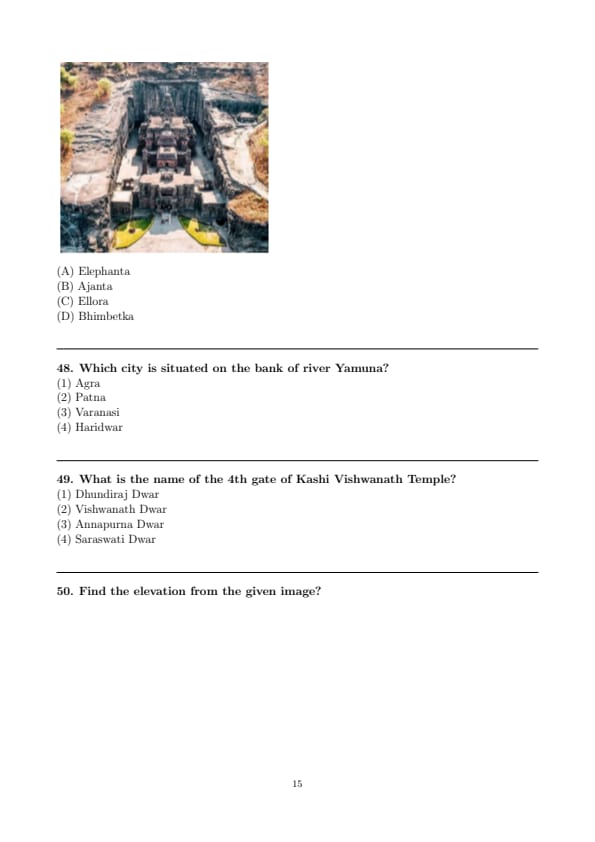
Identify the picture from the given image?

View Solution
Step 1: Understanding the Concept:
This question requires the identification of a world-famous modern architectural landmark.
Step 2: Detailed Explanation:
The image shows an iconic integrated resort in Singapore. The building is famous for its unique design, which consists of three 55-story hotel towers connected at the top by a 340-meter-long SkyPark. This rooftop structure has gardens, an observation deck, and an infinity pool, and its shape is often compared to a ship or a boat.
The official name of this landmark building is Marina Bay Sands. The other options are incorrect descriptions or names.
Step 3: Final Answer:
The building in the picture is Marina Bay Sands.
Quick Tip: For questions about modern landmarks, it's important to know their precise names, not just what they look like. While the top of Marina Bay Sands resembles a boat, its official name is the key to the answer.
Which clothing brand has a crocodile logo?
View Solution
Step 1: Understanding the Concept:
This is a general knowledge question that tests awareness of popular international clothing brands and their logos.
Step 2: Detailed Explanation:
The green crocodile logo is one of the most recognized logos in the fashion industry. It belongs to the French company Lacoste, which sells clothing, footwear, and accessories.
The logo's origin is tied to the brand's founder, tennis player René Lacoste, who was nicknamed "The Crocodile" by the press in the 1920s because of his tenacity on the court. He had a crocodile embroidered on his blazer, and it became the symbol of his brand. The other brands listed do not use a crocodile logo.
Step 3: Final Answer:
The clothing brand with a crocodile logo is Lacoste.
Quick Tip: Many brand logos are based on animals (Puma, Ferrari's prancing horse, Jaguar, etc.). Associating the brand with its animal symbol is an easy way to remember them for general knowledge questions.
Where is the Valley of Flowers National Park located?
View Solution
Step 1: Understanding the Concept:
This question tests geographical knowledge about the locations of important National Parks and UNESCO World Heritage Sites in India.
Step 2: Detailed Explanation:
The Valley of Flowers National Park is a high-altitude Himalayan valley renowned for its stunning meadows of diverse alpine flowers and outstanding natural beauty. It is located in the Chamoli district in the state of Uttarakhand. It is part of the larger Nanda Devi Biosphere Reserve, a UNESCO World Heritage Site. While Himachal Pradesh also has beautiful valleys, the specific "Valley of Flowers National Park" is in Uttarakhand.
Step 3: Final Answer:
The Valley of Flowers National Park is located in Uttarakhand.
Quick Tip: It is highly recommended to learn the list of major National Parks, Tiger Reserves, and UNESCO World Heritage sites along with the states they are located in. This is a very common topic in the general knowledge section of competitive exams.
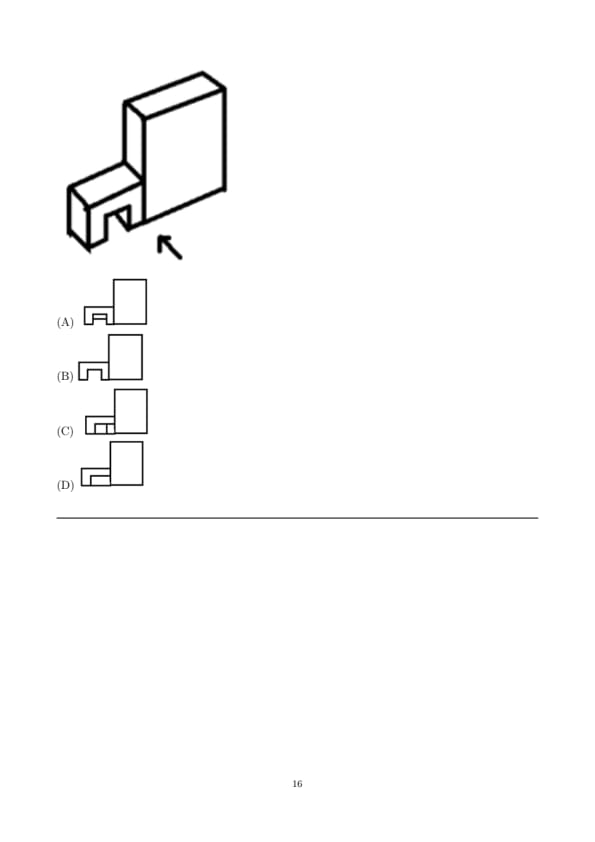
Identify the location of the given building.

View Solution
Step 1: Understanding the Concept:
The question asks to identify the location of the monument shown in the aerial photograph. The monument is a temple complex carved from rock.
Step 2: Detailed Explanation:
The image displays a unique architectural marvel: a massive temple complex that has been carved downwards from a single, solid rock cliff. This method of creation is known as monolithic rock-cut architecture. The structure shown is the world-famous Kailasa Temple (Cave 16).
This temple is the largest monolithic structure in the world and is the centerpiece of the Ellora Caves, a UNESCO World Heritage site in Maharashtra.
The other sites are different:
- Elephanta Caves: Located on an island near Mumbai, famous for its large sculptures, not a monolithic temple of this scale.
- Ajanta Caves: Famous for their rock-cut Buddhist caves with well-preserved mural paintings.
- Bhimbetka Rock Shelters: Known for prehistoric cave paintings.
Step 3: Final Answer:
The location of the given building (Kailasa Temple) is Ellora.
Quick Tip: A key distinction for memory: Ajanta = Paintings, Ellora = Sculpture and Architecture (especially the monolithic Kailasa Temple). Remembering this primary difference helps in correctly identifying images from these two famous sites.
Which city is situated on the bank of river Yamuna?
View Solution
Step 1: Understanding the Concept:
This is a straightforward geography question about the location of major Indian cities in relation to major rivers.
Step 2: Detailed Explanation:
Let's check the river for each city:
- Agra: The city of Agra, famous for the Taj Mahal, is located on the banks of the Yamuna River. The Taj Mahal itself is situated on the right bank of the Yamuna.
- Patna: The capital of Bihar is situated on the southern bank of the Ganga River.
- Varanasi: One of the most famous holy cities, it is situated on the banks of the Ganga River.
- Haridwar: An important pilgrimage site where the Ganga River enters the plains.
Therefore, out of the given options, only Agra is on the bank of the Yamuna.
Step 3: Final Answer:
Agra is situated on the bank of the river Yamuna.
Quick Tip: Creating a two-column list of "Major Cities" and "Rivers" is an excellent study aid for geography. Key cities on the Yamuna are Delhi and Agra. Key cities on the Ganga include Haridwar, Kanpur, Prayagraj, Varanasi, and Patna.
What is the name of the 4th gate of Kashi Vishwanath Temple?
View Solution
Step 1: Understanding the Concept:
This question pertains to the specifics of the recently inaugurated Kashi Vishwanath Dham Corridor in Varanasi. It tests knowledge of current affairs and religious-cultural sites.
Step 2: Detailed Explanation:
The renovated Kashi Vishwanath Corridor has four monumental gates (Dwars) providing access to the temple complex from different directions. These gates are named after important deities and landmarks. While the numbering can vary depending on the reference point, the four principal gates are:
- Vishwanath Dwar: Also known as the Ganga Dwar, as it provides a direct pathway from the Lalita Ghat on the River Ganga.
- Annapurna Dwar: Named after the Annapurna Temple located nearby.
- Saraswati Dwar: Named after the Goddess of knowledge.
- Dhundiraj Dwar: Named after Dhundiraj Ganesh, a form of Lord Ganesha whose temple is located near this entrance. This gate is considered one of the main and historical entrances to the complex, often referred to as Gate D or Gate 4 in modern layouts.
Step 3: Final Answer:
Based on common designations for the new corridor, the 4th gate is the Dhundiraj Dwar.
Quick Tip: Major national projects, especially those of cultural and religious significance like the Kashi Vishwanath Corridor or the Ram Mandir, are very important for current affairs. Pay attention to specific details like names, architects, and key features when studying them.
Find the elevation from the given image?

- (A)
![]()
- (B)
![]()
- (C)
![]()
- (D)
![]()


View Solution
Step 1: Understanding the Concept:
The question asks to find the "elevation" of the given 3D object. In architectural and engineering drawing, an elevation is a two-dimensional view of an object as seen from one side (front, back, left, or right). The arrow in the image indicates the direction of the front view. We need to determine what the object looks like when viewed directly from the direction of the arrow.
Step 2: Detailed Explanation:
Let's analyze the 3D object from the perspective indicated by the arrow:
1. Identify the components: The object consists of a large, tall rectangular block on the right and a smaller, lower structure attached to its left side.
2. Analyze the smaller structure: This structure has a horizontal beam supported by two short vertical legs, creating an archway or an inverted 'U' shape underneath the beam.
3. Project the view: When we look at the object from the front, we will see the 2D outlines of all the faces that are directly facing us.
- The large block will appear as a simple large rectangle on the right.
- The smaller structure will appear on the left. We will see the front face of its horizontal beam and the front faces of its two legs. The archway underneath will be visible as an empty space between the legs.
- The top edge of the smaller structure is lower than the top edge of the larger block.
- The combined view will show these two parts side-by-side.
4. Evaluate the options against this projection:
- Option (A): This drawing correctly shows the large rectangle on the right and the smaller structure on the left. It accurately depicts the horizontal beam, the two legs, and the archway underneath. The relative heights are correct. This is the correct elevation.
- Option (B): This drawing shows the smaller structure with only one leg. This is incorrect, as the 3D image clearly has two legs.
- Option (C): This drawing adds a vertical line that suggests the front face of the larger block is visible through the archway of the smaller structure. Looking at the 3D view, the larger block is behind the smaller structure's beam, so this line should not be visible.
- Option (D): This drawing is incomplete. It doesn't correctly represent the shape of the smaller structure.
Step 3: Final Answer:
Based on the analysis, Option (A) is the only accurate representation of the front elevation of the given 3D object.
Quick Tip: When determining an elevation view, imagine you are standing directly in front of the object (in the direction of the arrow) and can only see in 2D (no depth). Trace the outline of every face you can see from that exact angle. Pay close attention to how different parts of the object align vertically and horizontally.
*The article might have information for the previous academic years, please refer the official website of the exam.