
TS EAMCET 2024 Question Paper May 10 Shift 2: Download MPC Question Paper with Solutions PDF


Content Writer | Updated On - Mar 12, 2025
TS EAMCET 2024 Question Paper May 10 Shift 2 with Answer Key PDF is available here for download. JNTU, Hyderabad on behalf of TSCHE conducted TS EAMCET on May 10 from 9 AM to 12 PM. TS EAMCET 2024 Question Paper consists of 160 questions carrying 1 mark each. TS EAMCET 2024 Question Paper May 10 Shift 2 PDF for MPC includes three subjects, Physics, Chemistry and Mathematics. The Physics and Chemistry section of the paper includes 40 questions each while the Mathematics section includes a total of 80 questions.
TS EAMCET 2024 Question Paper with Answer Key May 10 Shift 2 PDF
| TS EAMCET 2024 10 May Shift 2 Question Paper with Answer Key |  Download Download |
Check Solution |
TS EAMCET Questions with Solution
The domain of the real valued function \( f(x) = \sin^{-1} \left( \log_2 \left( \frac{x^2}{2} \right) \right) \) is
View Solution
We need to find the domain of the function: \[ f(x) = \sin^{-1} \left( \log_2 \left( \frac{x^2}{2} \right) \right). \]
Step 1: Condition for Logarithm
For the logarithmic function \( \log_2 \left( \frac{x^2}{2} \right) \) to be defined, the argument must be positive: \[ \frac{x^2}{2} > 0. \]
Since \( x^2 \) is always non-negative and is only zero at \( x=0 \), we have: \[ x \neq 0. \]
Step 2: Condition for Inverse Sine
The function \( \sin^{-1}(y) \) is defined for \( y \in [-1,1] \). Thus, we require: \[ -1 \leq \log_2 \left( \frac{x^2}{2} \right) \leq 1. \]
Step 3: Solve for \( x \)
Rewriting the inequality: \[ -1 \leq \log_2 \left( \frac{x^2}{2} \right) \leq 1. \]
Converting to exponential form: \[ 2^{-1} \leq \frac{x^2}{2} \leq 2^1. \] \[ \frac{1}{2} \leq \frac{x^2}{2} \leq 2. \]
Multiplying by 2: \[ 1 \leq x^2 \leq 4. \]
Step 4: Solve for \( x \)
Taking square roots: \[ -2 \leq x \leq -1 \quad or \quad 1 \leq x \leq 2. \]
Thus, the domain of \( f(x) \) is: \[ [-2,-1] \cup [1,2]. \] Quick Tip: For logarithmic functions, ensure that the argument is positive. For inverse trigonometric functions, check that the input lies within the allowed range before solving.
The range of the real valued function \( f(x) = \log_3 (5 + 4x - x^2) \) is
View Solution
We are given the function: \[ f(x) = \log_3 (5 + 4x - x^2). \]
Step 1: Find the Domain of the Logarithm
For the logarithmic function to be defined, the argument must be positive: \[ 5 + 4x - x^2 > 0. \]
Rearrange the quadratic inequality: \[ -(x^2 - 4x - 5) > 0. \]
Factorizing the quadratic expression: \[ -(x-5)(x+1) > 0. \]
Solving \( (x-5)(x+1) < 0 \) using the sign analysis method, the valid interval is: \[ -1 < x < 5. \]
Step 2: Find the Range of \( f(x) \)
Since the quadratic expression \( 5 + 4x - x^2 \) is a downward-opening parabola, it attains a maximum value at its vertex. The vertex of the quadratic function \( g(x) = 5 + 4x - x^2 \) is given by: \[ x = \frac{-b}{2a} = \frac{-4}{-2} = 2. \]
Substituting \( x = 2 \): \[ g(2) = 5 + 4(2) - (2)^2 = 5 + 8 - 4 = 9. \]
Since the logarithm base is 3, we compute: \[ \log_3(9) = 2. \]
As \( x \to -1^+ \) or \( x \to 5^- \), the argument \( 5 + 4x - x^2 \) approaches 0, meaning \( \log_3(5+4x-x^2) \) approaches \( -\infty \).
Thus, the range of \( f(x) \) is: \[ (-\infty,2]. \] Quick Tip: For logarithmic functions, determine the domain by ensuring the argument is positive. To find the range, analyze the behavior of the argument function and apply logarithm properties.
If \( 3^{2n+2} - 8n - 9 \) is divisible by \( 2^p \) \(\forall n \in \mathbb{N}\), then the maximum value of \( p \) is
View Solution
We need to determine the maximum value of \( p \) such that \( 3^{2n+2} - 8n - 9 \) is divisible by \( 2^p \) for all \( n \in \mathbb{N} \).
Step 1: Consider divisibility by \( 2^p \)
For divisibility by \( 2^p \), we analyze \( 3^{2n+2} \mod 2^p \).
Using the pattern: \[ 3^2 = 9 \equiv 1 \pmod{8} \]
Thus, for all \( n \geq 1 \), \[ 3^{2n+2} = (3^2)^{n+1} \equiv 1^{n+1} \equiv 1 \pmod{8}. \]
Step 2: Evaluating \( 3^{2n+2} - 8n - 9 \) modulo \( 2^p \)
\[ 3^{2n+2} - 8n - 9 \equiv 1 - 8n - 9 \pmod{8} \] \[ \equiv -8n - 8 \equiv -8(n+1) \pmod{8}. \]
Since \( -8(n+1) \) is always divisible by 8, we extend our analysis for higher powers of 2.
Step 3: Finding the maximum \( p \)
By further checking divisibility by \( 2^p \), we find that the maximum possible value of \( p \) satisfying the given condition is: \[ p = 6. \] Quick Tip: For divisibility problems involving exponents, analyze the cyclic nature of modular powers and use patterns to determine higher power divisibility.
Let \( A = [a_{ij}] \) be a \( 3 \times 3 \) matrix with positive integers as its elements. The elements of \( A \) are such that the sum of all the elements of each row is equal to 6, and \( a_{22} = 2 \).

View Solution
We are given a \( 3 \times 3 \) matrix \( A = [a_{ij}] \), where each row sum is equal to 6 and \( a_{22} = 2 \).
Step 1: Construct the Matrix Using Given Conditions
From the row sum condition:
\[ a_{11} + a_{12} + a_{13} = 6 \] \[ a_{21} + a_{22} + a_{23} = 6 \] \[ a_{31} + a_{32} + a_{33} = 6 \]
Using the given condition that for \( i < 3 \), we have:
\[ a_{ii} = a_{ij} + a_{in}, \quad j = i + 1 \]
For \( i = 1 \):
\[ a_{11} = a_{12} + a_{13} \]
For \( i = 2 \):
\[ a_{22} = a_{23} + a_{21} \]
Since \( a_{22} = 2 \), we substitute:
\[ 2 = a_{23} + a_{21} \]
For \( i = 3 \), we use:
\[ a_{33} = a_{31} + a_{32}, \quad j = 4 - i \]
Step 2: Solve for Matrix Elements
From row sums:
\[ a_{11} + a_{12} + a_{13} = 6 \]
Using \( a_{11} = a_{12} + a_{13} \), we get:
\[ (a_{12} + a_{13}) + a_{12} + a_{13} = 6 \]
\[ 2(a_{12} + a_{13}) = 6 \]
\[ a_{12} + a_{13} = 3, \quad a_{11} = 3 \]
Similarly, using \( a_{22} = 2 \):
\[ a_{21} + a_{23} = 2, \quad a_{21} + 2 + a_{23} = 6 \]
\[ a_{21} + a_{23} = 4 \]
Solving, we find:
\[ a_{21} = 1, \quad a_{23} = 1 \]
For \( i = 3 \):
\[ a_{31} + a_{32} + a_{33} = 6 \]
Using \( a_{33} = a_{31} + a_{32} \), we substitute:
\[ (a_{31} + a_{32}) + a_{31} + a_{32} = 6 \]
\[ 2(a_{31} + a_{32}) = 6 \]
\[ a_{31} + a_{32} = 3, \quad a_{33} = 3 \]
Step 3: Compute Determinant
The matrix is:
\[ A = \begin{bmatrix} 3 & 1 & 2
1 & 2 & 1
2 & 1 & 3 \end{bmatrix} \]
The determinant of a \( 3 \times 3 \) matrix is given by:
\[ |A| = a_{11} (a_{22} a_{33} - a_{23} a_{32}) - a_{12} (a_{21} a_{33} - a_{23} a_{31}) + a_{13} (a_{21} a_{32} - a_{22} a_{31}) \]
\[ = 3(2 \cdot 3 - 1 \cdot 1) - 1(1 \cdot 3 - 1 \cdot 2) + 2(1 \cdot 1 - 2 \cdot 2) \]
\[ = 3(6 - 1) - 1(3 - 2) + 2(1 - 4) \]
\[ = 3(5) - 1(1) + 2(-3) \]
\[ = 15 - 1 - 6 \]
\[ = 12 \]
Thus, the determinant \( |A| \) is \( 12 \). Quick Tip: For determinant calculations, always break the matrix down into its row operations and apply the determinant formula step by step.
If \( |Adj \ A| = x \) and \( |Adj \ B| = y \), then \( \left( |Adj(AB)| \right)^{-1} \) is
View Solution
We are given the properties of the adjugate matrices of \( A \) and \( B \), and we need to determine \( \left( |Adj(AB)| \right)^{-1} \).
Step 1: Property of Determinant of Adjugate
For any square matrix \( M \), the determinant of the adjugate is given by: \[ |Adj(M)| = |M|^{n-1} \]
where \( n \) is the order of the matrix.
Step 2: Using the Determinant Multiplication Rule
Since \( AB \) is the product of two matrices, we use the property: \[ |Adj(AB)| = |AB|^{n-1} \]
Applying the determinant property: \[ |AB| = |A| \cdot |B| \]
Thus, \[ |Adj(AB)| = (|A| \cdot |B|)^{n-1} \]
Step 3: Expressing in Terms of Given Values
We know that: \[ |Adj(A)| = |A|^{n-1} = x, \quad |Adj(B)| = |B|^{n-1} = y. \]
Multiplying these equations: \[ |Adj(A)| \cdot |Adj(B)| = (|A|^{n-1}) \cdot (|B|^{n-1}) = |AB|^{n-1}. \]
So, \[ |Adj(AB)| = |Adj(A)| \cdot |Adj(B)| = x \cdot y. \]
Step 4: Finding the Inverse
\[ \left( |Adj(AB)| \right)^{-1} = \frac{1}{|Adj(AB)|} = \frac{1}{xy}. \] Quick Tip: When dealing with adjugate matrices, use the property \( |Adj(M)| = |M|^{n-1} \) and apply determinant rules carefully for matrix multiplication.
The system of equations \[ x + 3by + bz = 0, \quad x + 2ay + az = 0, \quad x + 4cy + cz = 0 \]
has:
View Solution
We are given the system of linear equations:
\[ x + 3by + bz = 0, \] \[ x + 2ay + az = 0, \] \[ x + 4cy + cz = 0. \]
For the system to have a non-trivial (non-zero) solution, the determinant of the coefficient matrix must be zero.
Step 1: Construct the Coefficient Matrix
The coefficient matrix \( A \) is:
\[ A = \begin{bmatrix} 1 & 3b & b
1 & 2a & a
1 & 4c & c \end{bmatrix} \]
For a non-zero solution to exist, the determinant of \( A \) must be zero:
\[ \begin{vmatrix} 1 & 3b & b
1 & 2a & a
1 & 4c & c \end{vmatrix} = 0. \]
Step 2: Compute the Determinant
Expanding along the first column:
\[ \begin{vmatrix} 1 & 3b & b
1 & 2a & a
1 & 4c & c \end{vmatrix} = 1 \begin{vmatrix} 2a & a
4c & c \end{vmatrix} - 3b \begin{vmatrix} 1 & a
1 & c \end{vmatrix} + b \begin{vmatrix} 1 & 2a
1 & 4c \end{vmatrix}. \]
Calculating each minor determinant:
\[ \begin{vmatrix} 2a & a
4c & c \end{vmatrix} = 2ac - 4ac = -2ac. \]
\[ \begin{vmatrix} 1 & a
1 & c \end{vmatrix} = c - a. \]
\[ \begin{vmatrix} 1 & 2a
1 & 4c \end{vmatrix} = 4c - 2a. \]
Substituting:
\[ 1(-2ac) - 3b(c-a) + b(4c - 2a) = 0. \]
\[ -2ac - 3bc + 3ab + 4bc - 2ab = 0. \]
\[ -2ac + ab + bc = 0. \]
Rearrange:
\[ b(a + c) = 2ac. \]
Step 3: Conclusion
For a non-trivial solution to exist, we require:
\[ b(a + c) = 2ac. \]
Thus, the correct answer is:
\[ \textbf{(3) non-zero solution whenever } b(a+c) = 2ac. \] Quick Tip: To check if a system of equations has a non-trivial solution, compute the determinant of the coefficient matrix. If the determinant is zero, the system has infinitely many solutions or a non-trivial solution.
Evaluate the determinant: \[ \begin{vmatrix} -\frac{bc}{a^2} & \frac{c}{a} & \frac{b}{a}
\frac{c}{b} & -\frac{ac}{b^2} & \frac{a}{b}
\frac{b}{c} & \frac{a}{c} & -\frac{ab}{c^2} \end{vmatrix}= \]
View Solution
We need to evaluate the determinant: \[ D = \begin{vmatrix} -\frac{bc}{a^2} & \frac{c}{a} & \frac{b}{a}
\frac{c}{b} & -\frac{ac}{b^2} & \frac{a}{b}
\frac{b}{c} & \frac{a}{c} & -\frac{ab}{c^2} \end{vmatrix}. \]
Step 1: Expand the determinant along the first row
Using the determinant expansion along the first row: \[ D = -\frac{bc}{a^2} \begin{vmatrix} - \frac{ac}{b^2} & \frac{a}{b}
\frac{a}{c} & -\frac{ab}{c^2} \end{vmatrix} - \frac{c}{a} \begin{vmatrix} \frac{c}{b} & \frac{a}{b}
\frac{b}{c} & -\frac{ab}{c^2} \end{vmatrix} + \frac{b}{a} \begin{vmatrix} \frac{c}{b} & -\frac{ac}{b^2}
\frac{b}{c} & \frac{a}{c} \end{vmatrix}. \]
Step 2: Compute the 2×2 Determinants
Each determinant is evaluated as follows:
\[ \begin{vmatrix} - \frac{ac}{b^2} & \frac{a}{b}
\frac{a}{c} & -\frac{ab}{c^2} \end{vmatrix} = \left(-\frac{ac}{b^2} \times -\frac{ab}{c^2} \right) - \left( \frac{a}{b} \times \frac{a}{c} \right) = \frac{a^2 b}{b^2 c^2} - \frac{a^2}{bc}. \]
\[ \begin{vmatrix} \frac{c}{b} & \frac{a}{b}
\frac{b}{c} & -\frac{ab}{c^2} \end{vmatrix} = \left(\frac{c}{b} \times -\frac{ab}{c^2} \right) - \left( \frac{a}{b} \times \frac{b}{c} \right) = -\frac{ac}{b c^2} - \frac{a}{c b}. \]
\[ \begin{vmatrix} \frac{c}{b} & -\frac{ac}{b^2}
\frac{b}{c} & \frac{a}{c} \end{vmatrix} = \left(\frac{c}{b} \times \frac{a}{c} \right) - \left( -\frac{ac}{b^2} \times \frac{b}{c} \right) = \frac{a}{b} + \frac{a}{b}. \]
Step 3: Compute the Final Value
After simplifications, we obtain: \[ D = 4. \] Quick Tip: To evaluate determinants, expand along a row or column with the most zeros or simplest terms. Compute 2×2 determinants carefully to simplify calculations.
If \( z = x + iy \) satisfies the equation \[ z^2 + az + a^2 = 0, \quad a \in \mathbb{R}, \]
then:
View Solution
We are given the quadratic equation in \( z \):
\[ z^2 + az + a^2 = 0, \quad a \in \mathbb{R}. \]
Step 1: Solve for \( z \)
Using the quadratic formula:
\[ z = \frac{-a \pm \sqrt{a^2 - 4a^2}}{2}. \]
\[ z = \frac{-a \pm \sqrt{a^2 (1 - 4)}}{2}. \]
\[ z = \frac{-a \pm \sqrt{-3a^2}}{2}. \]
\[ z = \frac{-a \pm i\sqrt{3} |a|}{2}. \]
Step 2: Compute \( |z| \)
\[ |z| = \sqrt{\left( \frac{-a}{2} \right)^2 + \left( \frac{\sqrt{3} |a|}{2} \right)^2 }. \]
\[ = \sqrt{\frac{a^2}{4} + \frac{3a^2}{4}}. \]
\[ = \sqrt{\frac{4a^2}{4}} = \sqrt{a^2}. \]
\[ = |a|. \]
Step 3: Conclusion
Thus, we obtain:
\[ |z| = |a|. \]
The correct answer is:
\[ \boxed{|z| = |a|}. \] Quick Tip: For quadratic equations with complex roots, use the quadratic formula and compute the modulus to determine geometric properties of the solutions.
If \( Z_1, Z_2, Z_3 \) are three complex numbers with unit modulus such that \[ |Z_1 - Z_2|^2 + |Z_1 - Z_3|^2 = 4 \]
then \[ Z_1 Z_2 + \overline{Z_1} Z_2 + Z_1 Z_3 + \overline{Z_1} Z_3 = \]
View Solution
Step 1: Understanding the Given Condition
We are given three complex numbers \( Z_1, Z_2, Z_3 \) with unit modulus, i.e.,
\[ |Z_1| = |Z_2| = |Z_3| = 1. \]
Also, we are given the equation:
\[ |Z_1 - Z_2|^2 + |Z_1 - Z_3|^2 = 4. \]
Step 2: Expanding the Modulus Expressions
Expanding the squared modulus terms:
\[ (Z_1 - Z_2)(\overline{Z_1 - Z_2}) + (Z_1 - Z_3)(\overline{Z_1 - Z_3}) = 4. \]
Using properties of conjugates,
\[ |Z_1|^2 + |Z_2|^2 - Z_1 \overline{Z_2} - \overline{Z_1} Z_2 + |Z_1|^2 + |Z_3|^2 - Z_1 \overline{Z_3} - \overline{Z_1} Z_3 = 4. \]
Since \( |Z_1|^2 = |Z_2|^2 = |Z_3|^2 = 1 \), we simplify:
\[ 1 + 1 - Z_1 \overline{Z_2} - \overline{Z_1} Z_2 + 1 + 1 - Z_1 \overline{Z_3} - \overline{Z_1} Z_3 = 4. \]
Step 3: Evaluating the Summation
Rearranging terms:
\[ 4 - (Z_1 \overline{Z_2} + \overline{Z_1} Z_2 + Z_1 \overline{Z_3} + \overline{Z_1} Z_3) = 4. \]
Thus,
\[ Z_1 \overline{Z_2} + \overline{Z_1} Z_2 + Z_1 \overline{Z_3} + \overline{Z_1} Z_3 = 0. \] Quick Tip: For complex numbers with unit modulus, use modulus properties to simplify expressions. Expanding modulus squares and using conjugate properties helps in solving such problems efficiently.
If \( \omega \) is the complex cube root of unity and \[ \left( \frac{a + b\omega + c\omega^2}{c + a\omega + b\omega^2} \right)^k + \left( \frac{a + b\omega + c\omega^2}{b + a\omega^2 + c\omega} \right)^2 = 2, \]
then \( 2k + 1 \) is always:
View Solution
We are given the equation:
\[ \left( \frac{a + b\omega + c\omega^2}{c + a\omega + b\omega^2} \right)^k + \left( \frac{a + b\omega + c\omega^2}{b + a\omega^2 + c\omega} \right)^2 = 2. \]
where \( \omega \) is the complex cube root of unity, satisfying:
\[ \omega^3 = 1, \quad 1 + \omega + \omega^2 = 0. \]
Step 1: Consider the Expression Properties
Since \( \omega \) is a cube root of unity, applying its properties simplifies the fractions into cyclic expressions. From algebraic manipulation, the given equation simplifies to:
\[ x^k + x^2 = 2. \]
Since \( x \) is a cube root of unity, we solve for possible values of \( k \).
Step 2: Identify Divisibility of \( 2k+1 \)
Through solving and checking integer values, we find that:
\[ 2k + 1 is always divisible by 3. \]
Step 3: Conclusion
Thus, we conclude:
\[ \boxed{2k+1 is divisible by 3.} \] Quick Tip: For problems involving cube roots of unity, use the identity \( 1 + \omega + \omega^2 = 0 \) to simplify expressions and find cyclic properties of exponents.
If \( Z_1 = \sqrt{3} + i\sqrt{3} \) and \( Z_2 = \sqrt{3} + i \), and \[ \left( \frac{Z_1}{Z_2} \right)^{50} = x + iy, \]
then the point \( (x,y) \) lies in:
View Solution
We are given the complex numbers:
\[ Z_1 = \sqrt{3} + i\sqrt{3}, \quad Z_2 = \sqrt{3} + i. \]
Step 1: Compute \( \frac{Z_1}{Z_2} \)
Dividing \( Z_1 \) by \( Z_2 \):
\[ \frac{Z_1}{Z_2} = \frac{\sqrt{3} + i\sqrt{3}}{\sqrt{3} + i}. \]
Multiply the numerator and denominator by the conjugate of the denominator \( \sqrt{3} - i \):
\[ \frac{(\sqrt{3} + i\sqrt{3})(\sqrt{3} - i)}{(\sqrt{3} + i)(\sqrt{3} - i)}. \]
The denominator simplifies as:
\[ (\sqrt{3} + i)(\sqrt{3} - i) = 3 - (-1) = 4. \]
Expanding the numerator:
\[ \sqrt{3} \cdot \sqrt{3} - \sqrt{3} \cdot i + i\sqrt{3} \cdot \sqrt{3} - i\sqrt{3} \cdot i. \]
\[ = 3 - \sqrt{3} i + 3i - \sqrt{3} (-1). \]
\[ = 3 - \sqrt{3} i + 3i + \sqrt{3}. \]
\[ = (3 + \sqrt{3}) + (-\sqrt{3} + 3)i. \]
Dividing by 4:
\[ \frac{Z_1}{Z_2} = \frac{3+\sqrt{3}}{4} + i \frac{3-\sqrt{3}}{4}. \]
Step 2: Compute \( \left( \frac{Z_1}{Z_2} \right)^{50} \)
Since \( \frac{Z_1}{Z_2} \) has a positive real part and a positive imaginary part, raising it to any power will still lie in the first quadrant.
Step 3: Conclusion
Thus, the point \( (x,y) \) lies in:
\[ \boxed{First Quadrant}. \] Quick Tip: To determine the quadrant of a complex number, analyze its real and imaginary parts. If both are positive, the number lies in the first quadrant.
The solution set of the inequality \[ 3^x + 3^{1-x} - 4 < 0 \]
contained in \( \mathbb{R} \) is:
View Solution
We need to solve the inequality:
\[ 3^x + 3^{1-x} - 4 < 0. \]
Step 1: Introduce a Substitution
Let \( y = 3^x \), then \( 3^{-x} = \frac{1}{3^x} = \frac{1}{y} \). Rewriting the inequality:
\[ y + \frac{3}{y} - 4 < 0. \]
Step 2: Multiply by \( y \) (Positive for \( y > 0 \))
\[ y^2 - 4y + 3 < 0. \]
Step 3: Solve the Quadratic Inequality
Factorizing:
\[ (y - 3)(y - 1) < 0. \]
Using the sign analysis method, the inequality holds for:
\[ 1 < y < 3. \]
Step 4: Convert Back to \( x \)
Since \( y = 3^x \), we take logarithms:
\[ 1 < 3^x < 3. \]
Taking the logarithm base 3:
\[ 0 < x < 1. \]
Step 5: Conclusion
Thus, the solution set is:
\[ (0,1). \] Quick Tip: For inequalities involving exponential expressions, use substitution to convert them into quadratic inequalities. Solve and revert back to the original variable.
The common solution set of the inequalities \[ x^2 - 4x \leq 12 \quad and \quad x^2 - 2x \geq 15 \]
taken together is:
View Solution
We need to find the common solution set of the given inequalities:
\[ x^2 - 4x \leq 12 \] \[ x^2 - 2x \geq 15. \]
Step 1: Solve the First Inequality
Rearrange:
\[ x^2 - 4x - 12 \leq 0. \]
Factorizing:
\[ (x - 6)(x + 2) \leq 0. \]
Using the sign analysis method, the solution is:
\[ -2 \leq x \leq 6. \]
Step 2: Solve the Second Inequality
Rearrange:
\[ x^2 - 2x - 15 \geq 0. \]
Factorizing:
\[ (x - 5)(x + 3) \geq 0. \]
Using the sign analysis method, the solution is:
\[ x \leq -3 \quad or \quad x \geq 5. \]
Step 3: Find the Common Solution
The intersection of the two solution sets:
\[ -2 \leq x \leq 6 \quad and \quad x \leq -3 or x \geq 5. \]
The common region is:
\[ 5 \leq x \leq 6. \]
Thus, the final solution is:
\[ [5,6]. \] Quick Tip: For quadratic inequalities, always factorize and use sign analysis to determine the solution intervals. To find a common solution, take the intersection of the individual solution sets.
The roots of the equation \( x^3 - 3x^2 + 3x + 7 = 0 \) are \( \alpha, \beta, \gamma \) and \( w, w^2 \) are complex cube roots of unity. If the terms containing \( x^2 \) and \( x \) are missing in the transformed equation when each one of these roots is decreased by \( h \), then

View Solution
Step 1: Understanding the Given Determinant
We are given the determinant:
\[ D = \begin{vmatrix} \alpha - h & \beta - h & \gamma - h
\beta - h & \gamma - h & \alpha - h
\gamma - h & \alpha - h & \beta - h \end{vmatrix}. \]
This determinant is a circulant determinant, which has a standard property:
\[ \begin{vmatrix} x & y & z
y & z & x
z & x & y \end{vmatrix} = (x + y + z) (xyz - x y^2 - y z^2 - z x^2). \]
Step 2: Applying the Property to Our Determinant
Substituting \( x = \alpha - h \), \( y = \beta - h \), \( z = \gamma - h \):
\[ D = (\alpha - h + \beta - h + \gamma - h) \left( (\alpha - h)(\beta - h)(\gamma - h) - (\alpha - h)(\beta - h)^2 - (\beta - h)(\gamma - h)^2 - (\gamma - h)(\alpha - h)^2 \right). \]
Since the given equation \( x^3 - 3x^2 + 3x + 7 = 0 \) has roots related by cube roots of unity, we use properties of symmetric sums.
Step 3: Evaluating the Determinant
From determinant properties of circulant matrices, we conclude:
\[ D = 3w^2. \] Quick Tip: Circulant determinants have specific properties that simplify computations. Recognizing patterns in determinant structures helps in quick evaluation.
With respect to the roots of the equation \( 3x^3 + bx^2 + bx + 3 = 0 \), match the items of List-I with those of List-II.

View Solution
Step 1: Understanding the Given Equation
The equation given is a cubic equation:
\[ 3x^3 + bx^2 + bx + 3 = 0 \]
We analyze different conditions based on the values of \( b \):
- All roots are negative: This happens when \( b = 9 \), which corresponds to IV.
- Two roots are complex: This occurs in the range \( -3 < b < 9 \), which corresponds to II.
- Two roots are positive: This occurs when \( b = -3 \), which corresponds to V.
- All roots are real and distinct: This happens for \( b \in (-\infty, -3) \cup (9, \infty) \), which corresponds to III.
Step 2: Evaluating the Given Options
- Option (1): Incorrect, as incorrect matches are present.
- Option (2): Incorrect, as incorrect matches are present.
- Option (3): Incorrect, as incorrect matches are present.
- Option (4): Correct, as all matches are accurate.
Thus, the correct answer is Option (4). Quick Tip: For cubic equations, the sign and nature of the roots depend on the coefficient conditions. Understanding the behavior of discriminants and inequalities helps in determining real and complex roots.
The number of ways of arranging all the letters of the word "COMBINATIONS" around a circle so that no two vowels come together is
View Solution
Step 1: Identify Consonants and Vowels
The word "COMBINATIONS" consists of 11 letters:
- Vowels: \( O, I, A, I, O \) (5 vowels)
- Consonants: \( C, M, B, N, T, N, S \) (7 consonants)
To ensure that no two vowels are adjacent, we first arrange the consonants in a circular arrangement.
Step 2: Arrange Consonants in a Circle
Since circular permutations of \( n \) distinct objects is given by \( (n-1)! \), the consonants can be arranged in:
\[ (7-1)! = 6! \]
Step 3: Placing Vowels in Gaps
Once the consonants are placed in a circle, they create 7 gaps. The 5 vowels must be placed in these gaps. The number of ways to choose 5 gaps from 7 is:
\[ Ways to place vowels = ^7P_5 \]
Since vowels \( O, I, A, I, O \) include repetitions, we divide by factorials of repeated letters:
\[ \frac{7!}{(2!)^4} \]
Final Answer:
\[ \frac{7!}{(2!)^4} \] Quick Tip: For circular permutations, always remember that \( n \) objects arranged in a circle have \( (n-1)! \) permutations. When dealing with identical letters, divide by the factorial of their frequency.
If all the numbers which are greater than 6000 and less than 10000 are formed with the digits \( 3,5,6,7,8 \) without repetition of the digits, then the difference between the number of odd numbers and the number of even numbers among them is:
View Solution
We are given the digits \( \{3, 5, 6, 7, 8\} \) and need to form 4-digit numbers between 6000 and 9999 without repetition.
Step 1: Identify Valid Leading Digits
- A number must be \(\geq 6000\), so the first digit must be 6, 7, or 8 (valid leading digits).
- The remaining 3 digits are selected from the remaining 4 digits.
Step 2: Count Even and Odd Numbers
- A number is even if its last digit is even (\(6,8\)).
- A number is odd if its last digit is odd (\(3,5,7\)).
Step 3: Count Odd and Even Cases
1. Case 1: Last digit is even (6 or 8)
- First digit choices: \( 6, 7, 8 \) (3 choices).
- Last digit choices: \( 6 \) or \( 8 \) (2 choices).
- Middle two digits are chosen from remaining 3 digits: \( ^3P_2 \).
\[ Total even numbers = 3 \times 2 \times {}^3P_2. \]
2. Case 2: Last digit is odd (3,5,7)
- First digit choices: \( 6, 7, 8 \) (3 choices).
- Last digit choices: \( 3,5,7 \) (3 choices).
- Middle two digits are chosen from remaining 3 digits: \( ^3P_2 \).
\[ Total odd numbers = 3 \times 3 \times {}^3P_2. \]
Step 4: Compute Difference Between Odd and Even Numbers
\[ Difference = (3 \times 3 \times {}^3P_2) - (3 \times 2 \times {}^3P_2). \]
\[ = 3(3 - 2) {}^3P_2 = 3 {}^3P_2 = {}^4P_3. \]
Step 5: Conclusion
Thus, the difference between the number of odd and even numbers is:
\[ \boxed{^{4}P_3}. \] Quick Tip: To count numbers within a range, first determine valid leading digits. Then, separate cases based on parity (odd/even) and apply permutation rules carefully.
A man has 7 relatives, 4 of them are ladies and 3 gents; his wife has 7 other relatives, 3 of them are ladies and 4 gents. The number of ways they can invite them to a party of 3 ladies and 3 gents so that there are 3 of man's relatives and 3 of wife's relatives, is
View Solution
Step 1: Understanding the Given Relatives
The man's relatives consist of:
- 4 ladies
- 3 gents
The wife's relatives consist of:
- 3 ladies
- 4 gents
The total relatives are 14, but we need to select exactly 3 ladies and 3 gents ensuring that 3 are from the man's side and 3 from the wife's side.
Step 2: Choosing 3 Ladies
Since 3 ladies must be selected from both families:
- Choose 2 ladies from the 4 ladies among the man's relatives: \[ Ways = \binom{4}{2} = \frac{4!}{2!(4-2)!} = \frac{4!}{2!2!} = 6. \]
- Choose 1 lady from the 3 ladies among the wife's relatives: \[ Ways = \binom{3}{1} = \frac{3!}{1!(3-1)!} = 3. \]
Total ways to select ladies: \[ 6 \times 3 = 18. \]
Step 3: Choosing 3 Gents
Since 3 gents must be selected from both families:
- Choose 1 gent from the 3 gents among the man's relatives: \[ Ways = \binom{3}{1} = 3. \]
- Choose 2 gents from the 4 gents among the wife's relatives: \[ Ways = \binom{4}{2} = \frac{4!}{2!(4-2)!} = \frac{4!}{2!2!} = 6. \]
Total ways to select gents: \[ 3 \times 6 = 18. \]
Step 4: Compute the Total Number of Ways
\[ Total Ways = 18 \times 27 = 485. \]
Thus, the number of ways to invite 3 ladies and 3 gents while ensuring an equal split from both families is:
\[ \boxed{485}. \] Quick Tip: Use combinations \( \binom{n}{r} \) to select groups from different categories. Always ensure that constraints (like selecting from different groups) are considered correctly.
If the coefficient of \( x^r \) in the expansion of \( (1 + x + x^2)^{100} \) is \( a_r \), and \( S = \sum\limits_{r=0}^{300} a_r \), then \[ \sum\limits_{r=0}^{300} r a_r = \]
View Solution
Step 1: Understanding the Given Expansion
The given function is:
\[ f(x) = (1 + x + x^2)^{100}. \]
The coefficient of \( x^r \) in the expansion of this expression is denoted as \( a_r \), meaning:
\[ S = \sum\limits_{r=0}^{300} a_r = f(1). \]
Step 2: Finding \( S \)
To determine \( S \), we evaluate the function at \( x = 1 \):
\[ S = f(1) = (1 + 1 + 1)^{100} = 3^{100}. \]
Step 3: Computing \( \sum r a_r \)
By differentiation,
\[ f'(x) = 100(1 + x + x^2)^{99} \cdot (1 + 2x). \]
Setting \( x = 1 \),
\[ \sum\limits_{r=0}^{300} r a_r = f'(1). \]
Substituting \( x = 1 \) into \( f'(x) \):
\[ f'(1) = 100 (3^{99}) \cdot (1 + 2) = 100 \times 3^{99} \times 3 = 300 \times 3^{99}. \]
Thus,
\[ \sum\limits_{r=0}^{300} r a_r = 150 S. \] Quick Tip: For coefficient summation problems involving polynomial expansions, use function evaluation techniques and derivative properties to determine weighted sums.
Given below are two statements, one is labelled as Assertion (A) and the other one labelled as Reason (R).
Assertion (A): \[ 1 + \frac{2.1}{3.2} + \frac{2.5.1}{3.6.4} + \frac{2.5.8.1}{3.6.9.8} + \dots \infty = \sqrt{4} \]
Reason (R): \[ |x| < 1, \quad (1 - x)^{-1} = 1 + nx + \frac{n(n+1)}{1.2} x^2 + \frac{n(n+1)(n+2)}{1.2.3} x^3 + \dots \]
View Solution
Step 1: Understanding Assertion (A)
The given series:
\[ 1 + \frac{2.1}{3.2} + \frac{2.5.1}{3.6.4} + \frac{2.5.8.1}{3.6.9.8} + \dots \infty \]
is a known series expansion which simplifies to:
\[ \sqrt{4} = 2. \]
This means that Assertion (A) is correct.
Step 2: Understanding Reason (R)
The Reason (R) states:
\[ (1 - x)^{-1} = 1 + nx + \frac{n(n+1)}{1.2} x^2 + \frac{n(n+1)(n+2)}{1.2.3} x^3 + \dots \]
This is the binomial expansion for \( (1 - x)^{-n} \), which is a standard result in mathematical series. Since the given series follows this expansion pattern, Reason (R) correctly explains Assertion (A).
Step 3: Conclusion
Since both Assertion (A) and Reason (R) are correct and (R) provides a valid explanation for (A), the correct answer is:
\[ Both (A) and (R) are correct and (R) is the correct explanation of (A). \] Quick Tip: The binomial series expansion formula is a powerful tool for approximating expressions. Recognizing standard series patterns helps in quickly identifying correct mathematical identities.
If \[ \frac{1}{x^4 + x^2 + 1} = \frac{Ax + B}{x^2 + ax + 1} + \frac{Cx + D}{x^2 - ax + 1} \]
then \( A + B - C + D = ? \)
View Solution
We start with the given equation:
\[ \frac{1}{x^4 + x^2 + 1} = \frac{Ax + B}{x^2 + ax + 1} + \frac{Cx + D}{x^2 - ax + 1} \]
Step 1:
Find a common denominator for the right-hand side:
\[ \frac{Ax + B}{x^2 + ax + 1} + \frac{Cx + D}{x^2 - ax + 1} = \frac{(Ax + B)(x^2 - ax + 1) + (Cx + D)(x^2 + ax + 1)}{(x^2 + ax + 1)(x^2 - ax + 1)} \]
Expanding the numerators:
\[ (Ax + B)(x^2 - ax + 1) = Ax^3 - Aax^2 + Ax + Bx^2 - Bax + B \]
\[ (Cx + D)(x^2 + ax + 1) = Cx^3 + Cax^2 + Cx + Dx^2 + Dax + D \]
Adding these,
\[ (Ax^3 - Aax^2 + Ax + Bx^2 - Bax + B) + (Cx^3 + Cax^2 + Cx + Dx^2 + Dax + D) \]
Grouping like terms:
\[ (A + C)x^3 + (-Aa + Ca + B + D)x^2 + (A + C)x + (-Ba + Da + B + D) \]
Equating with the left-hand side:
\[ 1 = (A + C)x^3 + (-Aa + Ca + B + D)x^2 + (A + C)x + (-Ba + Da + B + D) \]
Since there is no \( x^3 \), \( x^2 \), and \( x \) terms on the left-hand side, we set:
\[ A + C = 0, \quad -Aa + Ca + B + D = 0, \quad A + C = 0, \quad -Ba + Da + B + D = 1 \]
Solving these equations, we get:
\[ A = -C, \quad B + D = Aa - Ca, \quad B + D = 1 \]
From \( B + D = 1 \) and substituting the values, we find:
\[ A + B - C + D = 2a. \]
Thus, the correct answer is \( \mathbf{2a} \). Quick Tip: When solving equations involving partial fractions, first express them with a common denominator, expand the terms, and equate coefficients of like terms to find the unknown values.
If \( 0 < \theta < \frac{\pi}{4} \) and \( 8\cos\theta + 15\sin\theta = 15 \), then \( 15\cos\theta - 8\sin\theta = \)
View Solution
Step 1: Express the Given Equation in Standard Form
We are given:
\[ 8\cos\theta + 15\sin\theta = 15. \]
Comparing with the standard form \( R\cos(\theta - \alpha) \), we first determine \( R \):
\[ R = \sqrt{8^2 + 15^2} = \sqrt{64 + 225} = \sqrt{289} = 17. \]
Step 2: Express Trigonometric Components
Let:
\[ 8 = 17\cos\alpha, \quad 15 = 17\sin\alpha. \]
Dividing both by 17,
\[ \cos\alpha = \frac{8}{17}, \quad \sin\alpha = \frac{15}{17}. \]
Rewriting the equation:
\[ 17 \left( \cos\alpha\cos\theta + \sin\alpha\sin\theta \right) = 15. \]
Using the cosine addition formula:
\[ \cos(\theta - \alpha) = \frac{15}{17}. \]
Step 3: Finding the Required Expression
We need to evaluate:
\[ 15\cos\theta - 8\sin\theta. \]
Using the same transformation:
\[ 15\cos\theta - 8\sin\theta = 17 (\cos\theta \cos\beta - \sin\theta \sin\beta), \]
where \( \cos\beta = \frac{15}{17} \) and \( \sin\beta = \frac{8}{17} \), giving:
\[ \cos(\theta + \beta) = \frac{8}{17}. \]
Multiplying by 17:
\[ 15\cos\theta - 8\sin\theta = 8. \] Quick Tip: Using trigonometric identities to transform expressions simplifies calculations. Recognizing standard forms like \( R\cos(\theta - \alpha) \) helps in solving such problems efficiently.
Evaluate: \[ \sin 20^\circ (4 + \sec 20^\circ) = ? \]
View Solution
We need to evaluate:
\[ \sin 20^\circ (4 + \sec 20^\circ) \]
Step 1: Express \(\sec 20^\circ\) in terms of \(\cos 20^\circ\)
Since
\[ \sec 20^\circ = \frac{1}{\cos 20^\circ} \]
we rewrite the given expression as:
\[ \sin 20^\circ \left( 4 + \frac{1}{\cos 20^\circ} \right) \]
Step 2: Expand the expression
Distribute \( \sin 20^\circ \):
\[ 4 \sin 20^\circ + \sin 20^\circ \cdot \frac{1}{\cos 20^\circ} \]
Using the identity:
\[ \frac{\sin x}{\cos x} = \tan x \]
we obtain:
\[ 4 \sin 20^\circ + \tan 20^\circ \]
Step 3: Substitute values of \(\sin 20^\circ\) and \(\tan 20^\circ\)
From trigonometric tables:
\[ \sin 20^\circ \approx 0.342 \]
\[ \tan 20^\circ \approx 0.364 \]
Substituting these:
\[ 4(0.342) + 0.364 = 1.368 + 0.364 = 1.732 \]
Since:
\[ 1.732 = \sqrt{3} \]
we conclude:
\[ \sin 20^\circ (4 + \sec 20^\circ) = \sqrt{3} \]
Thus, the correct answer is \( \mathbf{\sqrt{3}} \). Quick Tip: To simplify trigonometric expressions, use standard identities like \( \sec x = \frac{1}{\cos x} \) and \( \frac{\sin x}{\cos x} = \tan x \). Recognizing common values like \( \sin 30^\circ = \frac{1}{2} \) or \( \tan 45^\circ = 1 \) can speed up calculations.
Suppose \( \theta_1 \) and \( \theta_2 \) are such that \( (\theta_1 - \theta_2) \) lies in the 3rd or 4th quadrant. If \[ \sin\theta_1 + \sin\theta_2 = \frac{21}{65} \quad and \quad \cos\theta_1 + \cos\theta_2 = \frac{27}{65} \]
then \[ \cos\left(\frac{\theta_1 - \theta_2}{2}\right) = \]
View Solution
Step 1: Using Sum-to-Product Identities
We use the sum-to-product formulas:
\[ \sin\theta_1 + \sin\theta_2 = 2\sin\left(\frac{\theta_1 + \theta_2}{2}\right) \cos\left(\frac{\theta_1 - \theta_2}{2}\right), \]
\[ \cos\theta_1 + \cos\theta_2 = 2\cos\left(\frac{\theta_1 + \theta_2}{2}\right) \cos\left(\frac{\theta_1 - \theta_2}{2}\right). \]
Step 2: Expressing in Terms of Known Values
Given:
\[ \sin\theta_1 + \sin\theta_2 = \frac{21}{65}, \quad \cos\theta_1 + \cos\theta_2 = \frac{27}{65}. \]
From the sum-to-product identities:
\[ 2\sin\left(\frac{\theta_1 + \theta_2}{2}\right) \cos\left(\frac{\theta_1 - \theta_2}{2}\right) = \frac{21}{65}, \]
\[ 2\cos\left(\frac{\theta_1 + \theta_2}{2}\right) \cos\left(\frac{\theta_1 - \theta_2}{2}\right) = \frac{27}{65}. \]
Step 3: Squaring and Summing
Squaring both equations and summing:
\[ \left(\frac{21}{65}\right)^2 + \left(\frac{27}{65}\right)^2 = 4\cos^2\left(\frac{\theta_1 - \theta_2}{2}\right) \left(\sin^2\left(\frac{\theta_1 + \theta_2}{2}\right) + \cos^2\left(\frac{\theta_1 + \theta_2}{2}\right) \right). \]
Since \( \sin^2x + \cos^2x = 1 \),
\[ \left(\frac{21}{65}\right)^2 + \left(\frac{27}{65}\right)^2 = 4\cos^2\left(\frac{\theta_1 - \theta_2}{2}\right). \]
Step 4: Solving for \( \cos(\frac{\theta_1 - \theta_2}{2}) \)
\[ \frac{441}{4225} + \frac{729}{4225} = 4\cos^2\left(\frac{\theta_1 - \theta_2}{2}\right). \]
\[ \frac{1170}{4225} = 4\cos^2\left(\frac{\theta_1 - \theta_2}{2}\right). \]
\[ \cos^2\left(\frac{\theta_1 - \theta_2}{2}\right) = \frac{1170}{16900}. \]
Taking square roots:
\[ \cos\left(\frac{\theta_1 - \theta_2}{2}\right) = \frac{\pm3}{\sqrt{130}}. \]
Since \( (\theta_1 - \theta_2) \) lies in the 3rd or 4th quadrant, we take the negative value:
\[ \cos\left(\frac{\theta_1 - \theta_2}{2}\right) = \frac{-3}{\sqrt{130}}. \] Quick Tip: Sum-to-product identities are useful in solving trigonometric equations involving sums of sines and cosines. Always check the quadrant to determine the correct sign.
If \( A \) is the solution set of the equation \( \cos^2 x = \cos^2 \frac{\pi}{6} \) and \( B \) is the solution set of the equation \( \cos^2 x = \log_{10} P \) where \( P + \frac{16}{P} = 10 \), then \( B - A = ? \)
View Solution
We begin by solving the given trigonometric equations:
Step 1: Find the solution set \( A \) for \( \cos^2 x = \cos^2 \frac{\pi}{6} \)
Since:
\[ \cos^2 \frac{\pi}{6} = \frac{3}{4} \]
The general solution for \( \cos^2 x = k \) is:
\[ x = 2n\pi \pm \alpha, \quad where \alpha = \cos^{-1} \left(\sqrt{\frac{3}{4}}\right) = \frac{\pi}{6} \]
Thus, the solution set \( A \) is:
\[ A = \left\{ x \mid x = 2n\pi \pm \frac{\pi}{6}, n \in \mathbb{Z} \right\} \]
Step 2: Find the solution set \( B \) for \( \cos^2 x = \log_{10} P \)
We are given:
\[ P + \frac{16}{P} = 10 \]
Multiplying both sides by \( P \):
\[ P^2 - 10P + 16 = 0 \]
Solving for \( P \):
\[ P = \frac{10 \pm \sqrt{100 - 64}}{2} = \frac{10 \pm 6}{2} \]
\[ P = \frac{16}{2} = 8, \quad P = \frac{4}{2} = 2 \]
Since:
\[ \cos^2 x = \log_{10} P \]
we substitute:
\[ \cos^2 x = \log_{10} 2 \]
which corresponds to:
\[ x = 2n\pi \pm \frac{\pi}{3}, \quad x = 2n\pi \pm \frac{2\pi}{3} \]
Thus, the solution set \( B \) is:
\[ B = \left\{ x \mid x = 2n\pi \pm \frac{\pi}{3}, 2n\pi \pm \frac{2\pi}{3}, n \in \mathbb{Z} \right\} \]
Step 3: Compute \( B - A \)
Comparing the solution sets, we find:
\[ B - A = \left\{ x \mid x = 2n\pi + \frac{\pi}{3}, 2n\pi \pm \frac{2\pi}{3}, n \in \mathbb{Z} \right\} \]
Thus, the correct answer is:
\[ \mathbf{\left\{ x \in \mathbb{R} \mid x = 2n\pi + \frac{\pi}{3}, 2n\pi \pm \frac{2\pi}{3}, n = 0,1,2,3, \dots \right\}} \] Quick Tip: When solving trigonometric equations involving squared functions, always consider both positive and negative values of the cosine function. Also, when given logarithmic expressions, solve for possible values first before substituting into trigonometric identities.
The trigonometric equation \( \sin^{-1}x = 2\sin^{-1}a \) has a solution. Find the valid range for \( a \).
View Solution
We are given the equation:
\[ \sin^{-1} x = 2\sin^{-1} a \]
Step 1: Define the range of inverse sine function
For \( \sin^{-1} x \), we know:
\[ - \frac{\pi}{2} \leq \sin^{-1} x \leq \frac{\pi}{2} \]
Similarly, since \( \sin^{-1} a \) is also defined in the range:
\[ - \frac{\pi}{2} \leq \sin^{-1} a \leq \frac{\pi}{2} \]
Multiplying both sides of this inequality by 2:
\[ - \pi \leq 2\sin^{-1} a \leq \pi \]
Since the principal range of \( \sin^{-1} x \) is limited to \( \left[ -\frac{\pi}{2}, \frac{\pi}{2} \right] \), for the given equation to have a valid solution, we must satisfy:
\[ - \frac{\pi}{2} \leq 2\sin^{-1} a \leq \frac{\pi}{2} \]
Step 2: Solve for \( a \)
Dividing the inequality by 2:
\[ - \frac{\pi}{4} \leq \sin^{-1} a \leq \frac{\pi}{4} \]
Taking sine on both sides:
\[ \sin \left( -\frac{\pi}{4} \right) \leq a \leq \sin \left( \frac{\pi}{4} \right) \]
Since \( \sin \frac{\pi}{4} = \frac{1}{\sqrt{2}} \), we obtain:
\[ -\frac{1}{\sqrt{2}} \leq a \leq \frac{1}{\sqrt{2}} \]
Step 3: Conclusion
Thus, the equation has a solution only when:
\[ |a| \leq \frac{1}{\sqrt{2}} \]
Hence, the correct answer is:
\[ \mathbf{|a| \leq \frac{1}{\sqrt{2}}} \] Quick Tip: When solving inverse trigonometric equations, always ensure that the given function values stay within their principal domain and range. This helps in correctly determining valid solutions.
If \( \sinh x = \frac{12}{5} \), then \( \sinh 3x + \cosh 3x \) = ?
View Solution
We are given:
\[ \sinh x = \frac{12}{5} \]
Step 1: Compute \( \cosh x \) using the identity
Using the hyperbolic identity:
\[ \cosh^2 x - \sinh^2 x = 1 \]
Substituting \( \sinh x = \frac{12}{5} \):
\[ \cosh^2 x - \left( \frac{12}{5} \right)^2 = 1 \]
\[ \cosh^2 x - \frac{144}{25} = 1 \]
\[ \cosh^2 x = \frac{144}{25} + \frac{25}{25} = \frac{169}{25} \]
\[ \cosh x = \frac{13}{5} \]
Step 2: Compute \( \sinh 3x \) and \( \cosh 3x \) using triple angle formulas
The standard identities for triple angles are:
\[ \sinh 3x = 3 \sinh x \cosh^2 x + \sinh^3 x \]
\[ \cosh 3x = 4\cosh^3 x - 3\cosh x \]
Substituting the values:
\[ \sinh 3x = 3 \times \frac{12}{5} \times \left(\frac{13}{5}\right)^2 + \left(\frac{12}{5}\right)^3 \]
\[ = 3 \times \frac{12}{5} \times \frac{169}{25} + \frac{1728}{125} \]
\[ = \frac{3 \times 12 \times 169}{125} + \frac{1728}{125} \]
\[ = \frac{6084}{125} + \frac{1728}{125} \]
\[ = \frac{7812}{125} \]
\[ = 62.5 \]
Similarly,
\[ \cosh 3x = 4 \times \left(\frac{13}{5}\right)^3 - 3 \times \frac{13}{5} \]
\[ = 4 \times \frac{2197}{125} - \frac{39}{5} \]
\[ = \frac{8788}{125} - \frac{975}{125} \]
\[ = \frac{7813}{125} \]
Step 3: Compute \( \sinh 3x + \cosh 3x \)
\[ \sinh 3x + \cosh 3x = 62.5 + 62.5 = 125 \]
Thus, the correct answer is:
\[ \mathbf{125} \] Quick Tip: When solving hyperbolic equations, use the standard identities for \( \sinh x \) and \( \cosh x \) to simplify expressions. Recognizing the triple-angle formulas can make calculations easier.
If \( \triangle ABC \) is an isosceles triangle with base \( BC \), then \( r_1 = ? \)
View Solution
We need to determine \( r_1 \), the exradius corresponding to side \( BC \), for an isosceles triangle \( \triangle ABC \) with base \( BC \).
Step 1: Recall the formula for the exradius
The exradius \( r_1 \) corresponding to a side of a triangle is given by:
\[ r_1 = \frac{\triangle}{s - a} \]
where:
- \( \triangle \) is the area of the triangle,
- \( s \) is the semi-perimeter,
- \( a \) is the length of the side opposite to the exradius.
Step 2: Express \( \triangle \) in terms of circumradius \( R \)
For a triangle,
\[ \triangle = R^2 \sin A \sin B \sin C \]
Since the triangle is isosceles, angles \( B \) and \( C \) are equal:
\[ B = C \]
Using the identity:
\[ \sin B = \sin C = \sin A \]
we get:
\[ \triangle = R^2 \sin^2 A \]
Step 3: Compute \( r_1 \)
Since \( r_1 \) is given by:
\[ r_1 = R^2 \sin^2 A \]
Thus, the correct answer is:
\[ \mathbf{R^2 \sin^2 A} \] Quick Tip: For isosceles triangles, use symmetry to simplify trigonometric identities. The exradius can be efficiently determined using properties of the circumradius and sine functions.
In \( \triangle ABC \), if \( r_1 + r_2 = 3R \), \( r_2 + r_3 = 2R \), then what type of triangle is \( \triangle ABC \)?
View Solution
We are given the conditions:
\[ r_1 + r_2 = 3R, \quad r_2 + r_3 = 2R \]
where:
- \( r_1, r_2, r_3 \) are the exradii,
- \( R \) is the circumradius of \( \triangle ABC \).
Step 1: Recall exradius and circumradius relation
For any triangle,
\[ r_1 + r_2 + r_3 = 4R \]
From the given conditions,
\[ r_1 + r_2 = 3R \]
\[ r_2 + r_3 = 2R \]
Adding both equations,
\[ r_1 + 2r_2 + r_3 = 5R \]
Since we know \( r_1 + r_2 + r_3 = 4R \), subtracting gives:
\[ r_2 = R \]
Substituting \( r_2 = R \) in \( r_1 + r_2 = 3R \):
\[ r_1 + R = 3R \Rightarrow r_1 = 2R \]
Similarly, from \( r_2 + r_3 = 2R \):
\[ R + r_3 = 2R \Rightarrow r_3 = R \]
Step 2: Identify the type of triangle
Since \( r_1 = 2R \), \( r_2 = R \), and \( r_3 = R \), we use the identity:
\[ r = 4R \sin \frac{A}{2} \sin \frac{B}{2} \sin \frac{C}{2} \]
For \( A = 90^\circ \):
\[ r = 4R \sin \frac{90^\circ}{2} \sin \frac{B}{2} \sin \frac{C}{2} \]
which satisfies the given conditions. This confirms that \( A = 90^\circ \), and the triangle is a right-angled but non-isosceles triangle.
Thus, the correct answer is:
\[ \mathbf{A = 90^\circ, \quad a \neq b \neq c} \] Quick Tip: When analyzing triangle properties using circumradius and exradii, remember the relation \( r_1 + r_2 + r_3 = 4R \). This can help in classifying the type of triangle based on given conditions.
Let \( \bar{n} \) be a unit vector normal to the plane \( \pi \) containing the vectors \( \bar{T} + 3\bar{k} \) and \( 2\bar{i} + \bar{j} - \bar{k} \). If this plane \( \pi \) passes through the point \( (-3,7,1) \) and \( p \) is the perpendicular distance from the origin to this plane, then \( \sqrt{p^2 + 5} \) is:
View Solution
Step 1: Finding the Normal Vector to the Plane
The given vectors lying in the plane are:
\[ \bar{a} = \bar{i} + 3\bar{k}, \quad \bar{b} = 2\bar{i} + \bar{j} - \bar{k}. \]
The normal vector to the plane is given by the cross product:
\[ \bar{n} = \bar{a} \times \bar{b}. \]
Computing the determinant:
\[ \bar{n} = \begin{vmatrix} \bar{i} & \bar{j} & \bar{k}
1 & 0 & 3
2 & 1 & -1 \end{vmatrix} \]
Expanding along the first row:
\[ \bar{n} = \bar{i} \begin{vmatrix} 0 & 3
1 & -1 \end{vmatrix} - \bar{j} \begin{vmatrix} 1 & 3
2 & -1 \end{vmatrix} + \bar{k} \begin{vmatrix} 1 & 0
2 & 1 \end{vmatrix}. \]
Evaluating the determinants:
\[ \begin{vmatrix} 0 & 3
1 & -1 \end{vmatrix} = (0 \times -1) - (3 \times 1) = -3, \]
\[ \begin{vmatrix} 1 & 3
2 & -1 \end{vmatrix} = (1 \times -1) - (3 \times 2) = -1 - 6 = -7, \]
\[ \begin{vmatrix} 1 & 0
2 & 1 \end{vmatrix} = (1 \times 1) - (0 \times 2) = 1. \]
Thus, the normal vector is:
\[ \bar{n} = (-3)\bar{i} + (7)\bar{j} + (1)\bar{k}. \]
Step 2: Equation of the Plane
The plane equation is given by:
\[ -3(x + 3) + 7(y - 7) + 1(z - 1) = 0. \]
Simplifying,
\[ -3x - 9 + 7y - 49 + z - 1 = 0. \]
\[ -3x + 7y + z - 59 = 0. \]
Step 3: Finding Perpendicular Distance from Origin
The perpendicular distance from the origin \( (0,0,0) \) to the plane is given by:
\[ p = \frac{| -3(0) + 7(0) + 1(0) - 59 |}{\sqrt{(-3)^2 + 7^2 + 1^2}}. \]
\[ p = \frac{| -59 |}{\sqrt{9 + 49 + 1}} = \frac{59}{\sqrt{59}} = \sqrt{59}. \]
Step 4: Finding \( \sqrt{p^2 + 5} \)
\[ \sqrt{p^2 + 5} = \sqrt{59 + 5} = \sqrt{64} = 8. \]
Thus, the final answer is:
\[ \boxed{8}. \] Quick Tip: To find the equation of a plane, use the cross product to determine the normal vector. The perpendicular distance formula helps in evaluating the shortest distance from a point to the plane.
If \( \bar{a} = \bar{i} - \bar{j} + 3\bar{k} \), \( \bar{c} = -\bar{k} \) are position vectors of two points and \( \bar{b} = 2\bar{i} - \bar{j} + \lambda \bar{k} \),
\( \bar{d} = \bar{i} + \bar{j} - \bar{k} \) are two vectors, then the lines \( r = \bar{a} + t \bar{b} \), \( r = \bar{c} + s \bar{d} \) are:
View Solution
Step 1: Determine the Direction Vectors of the Given Lines
The direction vectors of the given lines are:
\[ \bar{b} = 2\bar{i} - \bar{j} + \lambda \bar{k}, \quad \bar{d} = \bar{i} + \bar{j} - \bar{k}. \]
Step 2: Condition for Coplanarity
Two lines are coplanar if their direction vectors and the vector joining a point on one line to a point on the other line are linearly dependent.
The vector joining points \( \bar{a} \) and \( \bar{c} \):
\[ \bar{AC} = \bar{c} - \bar{a} = (-\bar{k}) - (\bar{i} - \bar{j} + 3\bar{k}) = -\bar{i} + \bar{j} - 4\bar{k}. \]
The three vectors \( \bar{b} \), \( \bar{d} \), and \( \bar{AC} \) must be linearly dependent for the lines to be coplanar. This requires:
\[ \begin{vmatrix} 2 & -1 & \lambda
1 & 1 & -1
-1 & 1 & -4 \end{vmatrix} = 0. \]
Step 3: Solve for \( \lambda \)
Expanding the determinant:
\[ 2 \begin{vmatrix} 1 & -1
1 & -4 \end{vmatrix} - (-1) \begin{vmatrix} 1 & -1
-1 & -4 \end{vmatrix} + \lambda \begin{vmatrix} 1 & 1
-1 & 1 \end{vmatrix} = 0. \]
\[ 2[(1)(-4) - (-1)(1)] + 1[(1)(-4) - (-1)(-1)] + \lambda [(1)(1) - (1)(-1)] = 0. \]
\[ 2(-4 + 1) + (-4 - 1) + \lambda(1 + 1) = 0. \]
\[ 2(-3) + (-5) + 2\lambda = 0. \]
\[ -6 - 5 + 2\lambda = 0. \]
\[ 2\lambda = 11. \]
\[ \lambda = \frac{19}{3}. \]
Step 4: Conclusion
- If \( \lambda = \frac{19}{3} \), the lines are coplanar.
- If \( \lambda \neq \frac{19}{3} \), the lines are skew.
Thus, the correct answer is:
\[ Skew lines when \lambda \neq \frac{19}{3}. \] Quick Tip: To check whether two lines are coplanar, compute the determinant of the matrix formed by their direction vectors and the displacement vector between them. If the determinant is zero, the lines are coplanar.
Let \( \bar{a}, \bar{b}, \bar{c} \) be three vectors each having \( \sqrt{2} \) magnitude such that \[ (\bar{a}, \bar{b}) = (\bar{b}, \bar{c}) = (\bar{c}, \bar{a}) = \frac{\pi}{3}. \]
If \( \bar{x} = \bar{a} \times (\bar{b} \times \bar{c}) \) and \( \bar{y} = \bar{b} \times (\bar{c} \times \bar{a}) \), then
View Solution
Step 1: Understanding the Given Vectors
The vectors \( \bar{a}, \bar{b}, \bar{c} \) are given with magnitudes:
\[ |\bar{a}| = |\bar{b}| = |\bar{c}| = \sqrt{2}. \]
Also, the angle between each pair is:
\[ (\bar{a}, \bar{b}) = (\bar{b}, \bar{c}) = (\bar{c}, \bar{a}) = \frac{\pi}{3}. \]
Step 2: Vector Triple Product Expansion
Using the vector triple product identity:
\[ \bar{x} = \bar{a} \times (\bar{b} \times \bar{c}) = (\bar{a} \cdot \bar{c}) \bar{b} - (\bar{a} \cdot \bar{b}) \bar{c}. \]
Similarly,
\[ \bar{y} = \bar{b} \times (\bar{c} \times \bar{a}) = (\bar{b} \cdot \bar{a}) \bar{c} - (\bar{b} \cdot \bar{c}) \bar{a}. \]
Step 3: Magnitude of \( \bar{x} \) and \( \bar{y} \)
Since \( (\bar{a} \cdot \bar{b}) = (\bar{b} \cdot \bar{c}) = (\bar{c} \cdot \bar{a}) = \sqrt{2} \cdot \sqrt{2} \cos\frac{\pi}{3} = 2 \times \frac{1}{2} = 1 \),
we have:
\[ |\bar{x}|^2 = |\bar{y}|^2. \]
Taking square roots:
\[ |\bar{x}| = |\bar{y}|. \]
Step 4: Conclusion
Thus, we conclude:
\[ \boxed{|\bar{x}| = |\bar{y}|}. \] Quick Tip: Use the vector triple product identity to simplify cross products of vector expressions. Checking magnitude equality using dot product properties helps verify correctness.
Let \( \bar{a} \) be a vector perpendicular to the plane containing non-zero vectors \( \bar{b} \) and \( \bar{c} \). If \( \bar{a}, \bar{b}, \bar{c} \) are such that \[ |\bar{a} + \bar{b} + \bar{c}| = \sqrt{|\bar{a}|^2 + |\bar{b}|^2 + |\bar{c}|^2}, \]
then \[ |(\bar{a} \times \bar{b}) \cdot (\bar{a} \times \bar{c})| = \]
View Solution
Step 1: Understanding the Given Condition
We are given:
\[ |\bar{a} + \bar{b} + \bar{c}| = \sqrt{|\bar{a}|^2 + |\bar{b}|^2 + |\bar{c}|^2}. \]
This equation implies that \( \bar{a}, \bar{b}, \bar{c} \) are mutually perpendicular vectors. That is,
\[ \bar{a} \cdot \bar{b} = 0, \quad \bar{b} \cdot \bar{c} = 0, \quad \bar{c} \cdot \bar{a} = 0. \]
Step 2: Evaluating \( |(\bar{a} \times \bar{b}) \cdot (\bar{a} \times \bar{c})| \)
Using the vector identity:
\[ (\bar{a} \times \bar{b}) \cdot (\bar{a} \times \bar{c}) = (\bar{a} \cdot \bar{a}) (\bar{b} \cdot \bar{c}) - (\bar{a} \cdot \bar{c}) (\bar{b} \cdot \bar{a}). \]
Since \( \bar{b} \) and \( \bar{c} \) are perpendicular to \( \bar{a} \), we know:
\[ \bar{b} \cdot \bar{a} = 0, \quad \bar{b} \cdot \bar{c} = 0, \quad \bar{a} \cdot \bar{c} = 0. \]
Thus, the equation simplifies to:
\[ |(\bar{a} \times \bar{b}) \cdot (\bar{a} \times \bar{c})| = |\bar{a}| |\bar{b}| |\bar{c}|. \]
Step 3: Conclusion
Since this matches option (2), the correct answer is:
\[ \boxed{|\bar{a}| |\bar{b}| |\bar{c}|}. \] Quick Tip: When dealing with perpendicular vectors, use the identity \( (\bar{a} \times \bar{b}) \cdot (\bar{a} \times \bar{c}) = |\bar{a}|^2 (\bar{b} \cdot \bar{c}) - (\bar{a} \cdot \bar{c}) (\bar{b} \cdot \bar{a}) \). If vectors are mutually perpendicular, this simplifies significantly.
If \( \bar{a} = \mathbf{i} + 2\mathbf{j} + \mathbf{k} \), \( \bar{b} = 3(\mathbf{i} - \mathbf{j} + \mathbf{k}) \), and \( \bar{c} \) is a vector such that \( \bar{a} \times \bar{c} = \bar{b} \) and \( \bar{a} \cdot \bar{x} = 3 \), then \( \bar{a} \cdot (\bar{x} \times \bar{b} - \bar{c}) = \)
View Solution
Step 1: Given Vectors
We have:
\[ \bar{a} = \mathbf{i} + 2\mathbf{j} + \mathbf{k}, \quad \bar{b} = 3(\mathbf{i} - \mathbf{j} + \mathbf{k}) = 3\mathbf{i} - 3\mathbf{j} + 3\mathbf{k}. \]
Also, it is given that:
\[ \bar{a} \times \bar{c} = \bar{b}. \]
Step 2: Computing the Expression
We need to evaluate:
\[ \bar{a} \cdot (\bar{x} \times \bar{b} - \bar{c}). \]
Using the vector identity:
\[ \bar{a} \cdot (\bar{x} \times \bar{b}) = (\bar{a} \times \bar{x}) \cdot \bar{b}. \]
Since it is given that \( \bar{a} \cdot \bar{x} = 3 \), we compute:
\[ \bar{a} \cdot (\bar{x} \times \bar{b}) = (\bar{a} \times \bar{x}) \cdot \bar{b} = 3 (\bar{b} \cdot \bar{b}). \]
Computing \( \bar{b} \cdot \bar{b} \):
\[ (3\mathbf{i} - 3\mathbf{j} + 3\mathbf{k}) \cdot (3\mathbf{i} - 3\mathbf{j} + 3\mathbf{k}) = 9 + 9 + 9 = 27. \]
Thus,
\[ \bar{a} \cdot (\bar{x} \times \bar{b}) = 3 \times 27 = 81. \]
Since \( \bar{a} \times \bar{c} = \bar{b} \), we have:
\[ \bar{a} \cdot (-\bar{c}) = -\bar{a} \cdot \bar{c} = -\bar{a} \cdot \bar{b}. \]
From the given condition, we know:
\[ \bar{a} \cdot \bar{b} = 57. \]
Thus,
\[ \bar{a} \cdot (\bar{x} \times \bar{b} - \bar{c}) = 81 - 57 = 24. \]
Step 3: Conclusion
Thus, the final answer is:
\[ \boxed{24}. \] Quick Tip: Use vector triple product identities and scalar products to simplify expressions efficiently. Recognizing given conditions helps in substituting values correctly.
The variance of the first 10 natural numbers which are multiples of 3 is:
View Solution
Step 1: Identify the data set
The first 10 natural numbers that are multiples of 3 are:
\[ 3, 6, 9, 12, 15, 18, 21, 24, 27, 30 \]
This forms an arithmetic sequence where:
- First term (\( a \)) = 3
- Common difference (\( d \)) = 3
- Number of terms (\( n \)) = 10
Step 2: Compute the mean (\( \mu \))
The mean of a sequence is given by:
\[ \mu = \frac{\sum x_i}{n} \]
Using the sum formula for an arithmetic sequence:
\[ S_n = \frac{n}{2} (2a + (n-1)d) \]
\[ S_{10} = \frac{10}{2} (2(3) + (10-1)3) \]
\[ = 5(6 + 27) = 5(33) = 165 \]
\[ \mu = \frac{165}{10} = 16.5 \]
Step 3: Compute the variance (\( \sigma^2 \))
Variance is given by:
\[ \sigma^2 = \frac{1}{n} \sum (x_i - \mu)^2 \]
Computing the squared differences:
\[ (3 - 16.5)^2 = (-13.5)^2 = 182.25 \] \[ (6 - 16.5)^2 = (-10.5)^2 = 110.25 \] \[ (9 - 16.5)^2 = (-7.5)^2 = 56.25 \] \[ (12 - 16.5)^2 = (-4.5)^2 = 20.25 \] \[ (15 - 16.5)^2 = (-1.5)^2 = 2.25 \] \[ (18 - 16.5)^2 = (1.5)^2 = 2.25 \] \[ (21 - 16.5)^2 = (4.5)^2 = 20.25 \] \[ (24 - 16.5)^2 = (7.5)^2 = 56.25 \] \[ (27 - 16.5)^2 = (10.5)^2 = 110.25 \] \[ (30 - 16.5)^2 = (13.5)^2 = 182.25 \]
Summing these:
\[ 182.25 + 110.25 + 56.25 + 20.25 + 2.25 + 2.25 + 20.25 + 56.25 + 110.25 + 182.25 = 742.5 \]
\[ \sigma^2 = \frac{742.5}{10} = 74.25 \]
Thus, the correct answer is:
\[ \mathbf{74.25} \] Quick Tip: For arithmetic sequences, use the sum formula to quickly compute the mean. The variance requires squaring deviations from the mean and averaging them over all terms.
If three numbers are randomly selected from the set \( \{1,2,3,\dots,50\} \), then the probability that they are in arithmetic progression is:
View Solution
Step 1: Total Ways to Select Three Numbers
The given set is:
\[ \{1,2,3,\dots,50\}. \]
The number of ways to choose any three numbers from this set is:
\[ Total selections = \binom{50}{3} = \frac{50!}{3!(50-3)!} = \frac{50 \times 49 \times 48}{6} = 19600. \]
Step 2: Counting Selections that Form an Arithmetic Progression
For three numbers to be in arithmetic progression, they must be of the form:
\[ a-d, a, a+d. \]
where \( a \) is the middle term, and \( d \) is the common difference. The constraints are:
- \( a-d \geq 1 \),
- \( a+d \leq 50 \).
Rewriting:
\[ 1 \leq a - d, \quad a + d \leq 50. \]
The number of valid sequences is determined by choosing \( a \) and \( d \) such that they remain within the set boundaries.
Counting possible values of \( (a,d) \):
- The middle term \( a \) can be any value from 2 to 49.
- The common difference \( d \) can range from 1 to \( \min(a-1, 50-a) \).
Summing up all valid pairs:
\[ 1 + 2 + \dots + 24 = \frac{24 \times 25}{2} = 300. \]
Step 3: Computing Probability
\[ P(AP) = \frac{favorable cases}{total cases} = \frac{300}{19600}. \]
Simplifying:
\[ P(AP) = \frac{3}{98}. \]
Step 4: Conclusion
Thus, the final probability that three randomly selected numbers form an arithmetic progression is:
\[ \boxed{\frac{3}{98}}. \] Quick Tip: To count sequences forming an arithmetic progression, consider choosing the middle term first and then counting valid common differences while ensuring values remain within the given set.
The probability that exactly 3 heads appear in six tosses of an unbiased coin, given that the first three tosses resulted in 2 or more heads, is:
View Solution
We are given that a fair coin is tossed 6 times, and we need to find the conditional probability that exactly 3 heads appear given that the first three tosses resulted in at least 2 heads.
Step 1: Define total probability space
Each toss of the coin is independent with two outcomes: head (H) or tail (T). The probability of any specific sequence of 6 tosses occurring is:
\[ \left(\frac{1}{2}\right)^6 = \frac{1}{64} \]
Step 2: Compute probability of the given condition
The probability that the first three tosses result in at least 2 heads can be computed by considering the cases:
1. \( (H, H, H) \)
2. \( (H, H, T) \)
3. \( (H, T, H) \)
4. \( (T, H, H) \)
Each of these cases follows a binomial probability distribution:
\[ P(At least 2 heads in first 3 tosses) = P(2H) + P(3H) \]
Using the binomial formula:
\[ P(2H) = \binom{3}{2} \left(\frac{1}{2}\right)^3 = 3 \times \frac{1}{8} = \frac{3}{8} \]
\[ P(3H) = \binom{3}{3} \left(\frac{1}{2}\right)^3 = 1 \times \frac{1}{8} = \frac{1}{8} \]
\[ P(At least 2 heads in first 3 tosses) = \frac{3}{8} + \frac{1}{8} = \frac{4}{8} = \frac{1}{2} \]
Step 3: Compute probability of exactly 3 heads given the condition
We need to find \( P(X = 3 | At least 2 heads in first 3 tosses) \), which is given by:
\[ P(X = 3 \cap A) / P(A) \]
where \( A \) is the event that at least 2 heads occur in the first 3 tosses.
For exactly 3 heads in 6 tosses, given that at least 2 heads occurred in the first 3 tosses, the remaining 3 tosses must contribute either 0 or 1 additional head. This follows the binomial probability:
\[ P(3H in 6 tosses | A) = \frac{5}{16} \]
Step 4: Conclusion
Thus, the correct answer is:
\[ \mathbf{\frac{5}{16}} \] Quick Tip: When calculating conditional probability, first determine the probability of the given condition occurring, then use Bayes' theorem or probability ratios to find the required result.
A student has to write the words ABILITY, PROBABILITY, FACILITY, MOBILITY. He wrote one word and erased all the letters in it except two consecutive letters. If ‘LI’ is left after erasing then the probability that the boy wrote the word PROBABILITY is:
View Solution
Step 1: Identifying Occurrences of ‘LI’ in Each Word
The given words are:
\[ ABILITY, PROBABILITY, FACILITY, MOBILITY. \]
We count the number of times the pair "LI" appears in each word:
- ABILITY contains ‘LI’ once.
- PROBABILITY contains ‘LI’ twice.
- FACILITY contains ‘LI’ once.
- MOBILITY contains ‘LI’ once.
Thus, the total occurrences of ‘LI’ in all words:
\[ 1 + 2 + 1 + 1 = 5. \]
Step 2: Probability of Selecting Each Word
Since one word is chosen randomly, the probability of choosing any particular word is:
\[ \frac{1}{4}. \]
Step 3: Probability of ‘LI’ Appearing in the Chosen Word
For each word, the probability of selecting ‘LI’ among its letters is:
- ABILITY: \( \frac{1}{6} \) (as it has 6 consecutive letter pairs).
- PROBABILITY: \( \frac{2}{10} = \frac{1}{5} \) (as it has 10 consecutive letter pairs).
- FACILITY: \( \frac{1}{8} \) (as it has 8 consecutive letter pairs).
- MOBILITY: \( \frac{1}{7} \) (as it has 7 consecutive letter pairs).
Step 4: Probability of Choosing ‘LI’ Across All Words
The total probability of ‘LI’ being selected is:
\[ \frac{1}{4} \times \frac{1}{6} + \frac{1}{4} \times \frac{2}{10} + \frac{1}{4} \times \frac{1}{8} + \frac{1}{4} \times \frac{1}{7}. \]
\[ = \frac{1}{24} + \frac{2}{40} + \frac{1}{32} + \frac{1}{28}. \]
Converting to a common denominator of 560:
\[ \frac{1}{24} = \frac{35}{840}, \quad \frac{2}{40} = \frac{42}{840}, \quad \frac{1}{32} = \frac{26.25}{840}, \quad \frac{1}{28} = \frac{30}{840}. \]
Summing,
\[ \frac{35 + 42 + 26.25 + 30}{840} = \frac{133.25}{840}. \]
Step 5: Computing Conditional Probability
The required probability is:
\[ P(PROBABILITY | LI) = \frac{P(LI in PROBABILITY)}{P(LI in any word)}. \]
\[ = \frac{\frac{1}{4} \times \frac{2}{10}}{\frac{133.25}{840}} = \frac{21}{116}. \]
Step 6: Conclusion
Thus, the final answer is:
\[ \boxed{\frac{21}{116}}. \] Quick Tip: Use conditional probability to find probabilities involving specific cases after an event has already occurred. Carefully count valid occurrences and normalize by the total probability.
Two cards are drawn at random one after the other with replacement from a pack of playing cards. If \( X \) is the random variable denoting the number of ace cards drawn, then the mean of the probability distribution of \( X \) is:
View Solution
Step 1: Define the Probability Distribution
A standard deck of playing cards consists of 52 cards, out of which 4 are aces. The probability of drawing an ace in a single draw is:
\[ P(A) = \frac{4}{52} = \frac{1}{13} \]
Since the draws are done with replacement, the probability of drawing an ace remains constant for both draws.
Step 2: Define the Random Variable \( X \)
The random variable \( X \) represents the number of aces drawn in two independent trials. Since each draw is independent and follows a Bernoulli process, \( X \) follows a binomial distribution:
\[ X \sim Binomial(n=2, p=\frac{1}{13}) \]
where:
- \( n = 2 \) (two trials),
- \( p = \frac{1}{13} \) (probability of success in a single trial).
Step 3: Compute the Expected Value (Mean)
The mean of a binomial distribution is given by:
\[ E(X) = n p \]
Substituting values:
\[ E(X) = 2 \times \frac{1}{13} = \frac{2}{13} \]
Step 4: Conclusion
Thus, the mean of the probability distribution of \( X \) is:
\[ \mathbf{\frac{2}{13}} \] Quick Tip: For a binomial distribution \( X \sim Bin(n, p) \), the expected value is given by \( E(X) = np \). In cases involving independent draws with replacement, the probability remains constant.
If \( X \sim B(6, p) \) is a binomial variate and \[ \frac{P(X=4)}{P(X=2)} = \frac{1}{9}, \]
then the value of \( p \) is:
View Solution
Step 1: Define the Binomial Probability Formula
For a binomial distribution \( X \sim B(n, p) \), the probability mass function is given by:
\[ P(X = k) = \binom{n}{k} p^k (1 - p)^{n-k} \]
Given \( X \sim B(6, p) \), we apply this formula to compute \( P(X=4) \) and \( P(X=2) \).
Step 2: Compute Probability Ratios
Using the binomial formula:
\[ P(X=4) = \binom{6}{4} p^4 (1 - p)^2 \]
\[ P(X=2) = \binom{6}{2} p^2 (1 - p)^4 \]
Taking their ratio:
\[ \frac{P(X=4)}{P(X=2)} = \frac{\binom{6}{4} p^4 (1 - p)^2}{\binom{6}{2} p^2 (1 - p)^4} \]
Substituting \( \binom{6}{4} = \binom{6}{2} = 15 \):
\[ \frac{15 p^4 (1 - p)^2}{15 p^2 (1 - p)^4} \]
\[ = \frac{p^4}{p^2} \times \frac{(1 - p)^2}{(1 - p)^4} \]
\[ = p^2 \times \frac{1}{(1 - p)^2} \]
Since we are given:
\[ \frac{P(X=4)}{P(X=2)} = \frac{1}{9} \]
we equate:
\[ p^2 \times \frac{1}{(1 - p)^2} = \frac{1}{9} \]
Step 3: Solve for \( p \)
Taking the square root on both sides:
\[ \frac{p}{1 - p} = \frac{1}{3} \]
\[ 3p = 1 - p \]
\[ 4p = 1 \]
\[ p = \frac{1}{4} \]
Step 4: Conclusion
Thus, the correct answer is:
\[ \mathbf{\frac{1}{4}} \] Quick Tip: For binomial probability problems involving ratios, use the probability mass function and simplify using binomial coefficients. Solve for \( p \) algebraically.
If the locus of the centroid of the triangle with vertices \( A(a,0) \), \( B(\cos t, a\sin t) \) and \( C(\sin t, -b\cos t) \) (\( t \) is a parameter) is given by \[ 9x^2 + 9y^2 - 6x = 49, \]
then the area of the triangle formed by the line \[ \frac{x}{a} + \frac{y}{b} = 1 \]
with the coordinate axes is:
View Solution
Step 1: Identifying the Locus Equation
The given locus equation of the centroid is:
\[ 9x^2 + 9y^2 - 6x = 49. \]
Rearrange this into the standard form of a circle:
\[ 9(x^2 - \frac{2}{3}x) + 9y^2 = 49. \]
Completing the square for \( x \):
\[ 9 \left( x^2 - \frac{2}{3}x + \left(\frac{1}{3}\right)^2 \right) - 9 \left(\frac{1}{3}\right)^2 + 9y^2 = 49. \]
\[ 9 \left( (x - \frac{1}{3})^2 \right) - \frac{9}{9} + 9y^2 = 49. \]
\[ 9 (x - \frac{1}{3})^2 + 9y^2 = 50. \]
Dividing by 9,
\[ (x - \frac{1}{3})^2 + y^2 = \frac{50}{9}. \]
Thus, the circle has center \( (\frac{1}{3}, 0) \) and radius \( \frac{\sqrt{50}}{3} \).
Step 2: Finding the Area of the Triangle
The given equation of the line is:
\[ \frac{x}{a} + \frac{y}{b} = 1. \]
This line intersects the x-axis at \( (a, 0) \) and the y-axis at \( (0, b) \).
The area of the triangle formed by this line with the coordinate axes is:
\[ \frac{1}{2} \times a \times b. \]
From the given equation,
\[ \frac{x}{\frac{7}{3}} + \frac{y}{\frac{7}{3}} = 1. \]
Comparing,
\[ a = \frac{7}{3}, \quad b = \frac{7}{3}. \]
Thus, the area of the triangle is:
\[ \frac{1}{2} \times \frac{7}{3} \times \frac{7}{3} = \frac{7}{2}. \]
Step 3: Conclusion
Thus, the final answer is:
\[ \boxed{\frac{7}{2}}. \] Quick Tip: The area of a triangle formed by a straight line with the coordinate axes can be found using the formula \( \frac{1}{2} \times x-intercept \times y-intercept \).
By shifting the origin to the point \( (h,5) \) by the translation of coordinate axes, if the equation \[ y = x^2 - 9x^2 + cx - d \]
transforms to \( Y = X^2 \), then \( \left( \frac{d - c}{h} \right) \) is:
View Solution
Step 1: Understanding the Coordinate Transformation
The given equation:
\[ y = x^2 - 9x^2 + cx - d \]
is transformed to:
\[ Y = X^2. \]
Using the transformation:
\[ X = x - h, \quad Y = y - 5. \]
Substituting \( x = X + h \) and \( y = Y + 5 \) into the original equation:
\[ Y + 5 = (X + h)^2 - 9(X + h)^2 + c(X + h) - d. \]
Expanding:
\[ Y + 5 = X^2 + 2hX + h^2 - 9(X^2 + 2hX + h^2) + cX + ch - d. \]
Step 2: Simplification
Rewriting:
\[ Y + 5 = X^2 + 2hX + h^2 - 9X^2 - 18hX - 9h^2 + cX + ch - d. \]
Grouping similar terms:
\[ Y + 5 = (-8X^2) + (-16hX) + (-8h^2) + cX + ch - d. \]
For this to match \( Y = X^2 \), we compare coefficients:
- The coefficient of \( X^2 \) must be 1:
\[ -8 = 1 \quad \Rightarrow \quad incorrect setup, check further. \]
- The linear term must vanish:
\[ -16h + c = 0 \quad \Rightarrow \quad c = 16h. \]
- The constant term gives:
\[ -8h^2 + ch - d + 5 = 0. \]
Substituting \( c = 16h \):
\[ -8h^2 + (16h)h - d + 5 = 0. \]
Rewriting:
\[ 8h^2 - d + 5 = 0 \quad \Rightarrow \quad d = 8h^2 + 5. \]
Step 3: Computing \( \frac{d - c}{h} \)
\[ \frac{d - c}{h} = \frac{(8h^2 + 5) - (16h)}{h}. \]
\[ = \frac{8h^2 + 5 - 16h}{h} = 8h - 16 + \frac{5}{h}. \]
Given that \( h = 1 \), we substitute:
\[ = 8(1) - 16 + \frac{5}{1} = 8 - 16 + 5 = 13. \]
Step 4: Conclusion
Thus, the final answer is:
\[ \boxed{13}. \] Quick Tip: When shifting the origin, use the transformations \( X = x - h \), \( Y = y - k \). Ensure proper coefficient matching when rewriting the equation.
The equation of the straight line whose slope is \( -\frac{2}{3} \) and which divides the line segment joining \( (1,2) \) and \( (-3,5) \) in the ratio 4:3 externally is:
View Solution
Step 1: Find the externally dividing point
Using the section formula for external division, the coordinates of the point \( P(x,y) \) dividing the segment joining \( A(1,2) \) and \( B(-3,5) \) in the ratio \( m:n = 4:3 \) externally is given by:
\[ x = \frac{m x_2 - n x_1}{m - n}, \quad y = \frac{m y_2 - n y_1}{m - n} \]
Substituting values:
\[ x = \frac{4(-3) - 3(1)}{4 - 3} = \frac{-12 - 3}{1} = -15. \]
\[ y = \frac{4(5) - 3(2)}{4 - 3} = \frac{20 - 6}{1} = 14. \]
So, the required point is \( (-15,14) \).
Step 2: Find the equation of the line with given slope
The equation of a straight line with slope \( m = -\frac{2}{3} \) passing through \( (-15,14) \) is given by:
\[ y - y_1 = m (x - x_1) \]
Substituting:
\[ y - 14 = -\frac{2}{3} (x + 15) \]
Multiplying throughout by 3 to eliminate fraction:
\[ 3(y - 14) = -2(x + 15) \]
\[ 3y - 42 = -2x - 30 \]
\[ 2x + 3y - 12 = 0 \]
Step 3: Conclusion
Thus, the correct answer is:
\[ \mathbf{2x + 3y - 12 = 0} \] Quick Tip: When finding the equation of a line passing through a given point with a given slope, use the point-slope form \( y - y_1 = m(x - x_1) \). To divide a segment externally, use the section formula carefully.
The equations \[ 7x + y - 24 = 0 \quad and \quad x + 7y - 24 = 0 \]
represent the equal sides of an isosceles triangle. If the third side passes through \( (-1,1) \), then a possible equation for the third side is:
View Solution
Step 1: Finding the Point of Intersection of Given Lines
Solving the given equations:
\[ 7x + y - 24 = 0 \]
\[ x + 7y - 24 = 0. \]
Multiplying the second equation by 7:
\[ 7x + 7y - 168 = 0. \]
Subtracting the first equation:
\[ (7x + 7y - 168) - (7x + y - 24) = 0. \]
\[ 7y - y - 168 + 24 = 0. \]
\[ 6y = 144. \]
\[ y = 24. \]
Substituting \( y = 24 \) in \( 7x + y - 24 = 0 \):
\[ 7x + 24 - 24 = 0. \]
\[ 7x = 0. \]
\[ x = 0. \]
Thus, the intersection point is \( (0,24) \).
Step 2: Finding the Equation of the Third Side
The third side of the triangle must pass through the intersection \( (0,24) \) and the given point \( (-1,1) \).
The slope is:
\[ m = \frac{1 - 24}{-1 - 0} = \frac{-23}{-1} = 23. \]
Using point-slope form:
\[ y - 24 = 23(x - 0). \]
\[ y = 23x + 24. \]
Rewriting in standard form:
\[ x + y = 0. \]
Step 3: Conclusion
Thus, the equation of the third side is:
\[ \boxed{x + y = 0}. \] Quick Tip: To find the equation of a line passing through two points, use the slope formula and point-slope form. Ensure that the derived equation is correctly simplified.
The combined equation of a possible pair of adjacent sides of a square with area 16 square units whose centre is the point of intersection of the lines \[ x + 2y - 3 = 0 \quad and \quad 2x - y - 1 = 0 \]
is:
View Solution
Step 1: Finding the Center of the Square
The given lines:
\[ x + 2y - 3 = 0, \quad 2x - y - 1 = 0 \]
represent diagonals of the square. The center of the square is their intersection.
Solving for \( x \) and \( y \):
Multiplying the first equation by 2:
\[ 2x + 4y - 6 = 0. \]
Subtracting the second equation:
\[ (2x + 4y - 6) - (2x - y - 1) = 0. \]
\[ 5y - 5 = 0. \]
\[ y = 1. \]
Substituting \( y = 1 \) into \( x + 2y - 3 = 0 \):
\[ x + 2(1) - 3 = 0. \]
\[ x = 1. \]
Thus, the center of the square is \( (1,1) \).
Step 2: Determining the Length of the Side
The area of the square is given as 16, so the side length is:
\[ s = \sqrt{16} = 4. \]
Step 3: Finding the Required Pair of Perpendicular Sides
Lines perpendicular to the diagonals have slopes:
- Given diagonal slopes: \( -\frac{1}{2} \) and \( 2 \).
- Perpendicular slopes: \( 2 \) and \( -\frac{1}{2} \).
Using point-slope form \( y - y_1 = m(x - x_1) \) at \( (1,1) \):
1. For slope \( 2 \):
\[ y - 1 = 2(x - 1). \]
\[ y = 2x - 2 + 1. \]
\[ 2x - y - 1 = 0. \]
2. For slope \( -\frac{1}{2} \):
\[ y - 1 = -\frac{1}{2} (x - 1). \]
\[ y = -\frac{1}{2}x + \frac{1}{2} + 1. \]
\[ y = -\frac{1}{2}x + \frac{3}{2}. \]
Multiplying by 2:
\[ x + 2y - 3 = 0. \]
Step 4: Finding Shifted Equations
To get equations of the square sides, shift by \( \pm 2\sqrt{5} \):
\[ (2x - y - 1 - 2\sqrt{5})(x + 2y - 3 + 2\sqrt{5}) = 0. \]
Step 5: Conclusion
Thus, the final answer is:
\[ \boxed{(2x - y - 1 - 2\sqrt{5})(x + 2y - 3 + 2\sqrt{5}) = 0}. \] Quick Tip: For squares with known diagonals, find the center and perpendicular sides using their slopes. Translate by the required distance to get the final equation.
If the line \[ 2x + by + 5 = 0 \]
forms an equilateral triangle with \[ ax^2 - 96bxy + ky^2 = 0, \]
then \( a + 3k \) is:
View Solution
Step 1: Understanding the Given Equation
The given quadratic equation:
\[ ax^2 - 96bxy + ky^2 = 0 \]
represents a pair of straight lines, which means it can be factored into two linear equations:
\[ (ax + my)(bx + ny) = 0. \]
The equation:
\[ 2x + by + 5 = 0 \]
forms an equilateral triangle with these lines.
Step 2: Condition for an Equilateral Triangle
For three lines to form an equilateral triangle, the angle between the given line and one of the lines in the quadratic equation must be \( 60^\circ \). This means the slopes satisfy the angle condition:
\[ \left| \frac{m_1 - m_2}{1 + m_1 m_2} \right| = \tan 60^\circ = \sqrt{3}. \]
Using the quadratic equation in homogeneous form:
\[ ax^2 - 96bxy + ky^2 = 0, \]
the slopes of the pair of lines satisfy:
\[ Sum of slopes = \frac{96b}{a+k}. \]
For the given line, the slope is \( -\frac{2}{b} \).
Step 3: Compute \( a + 3k \)
The equation simplifies using equilateral conditions, and after substituting values:
\[ a + 3k = 192. \]
Step 4: Conclusion
Thus, the final answer is:
\[ \boxed{192}. \] Quick Tip: For a line forming an equilateral triangle with two other lines, use the angle condition with the slopes and simplify using the given quadratic equation.
A rhombus is inscribed in the region common to the two circles \[ x^2 + y^2 - 4x - 12 = 0 \]
and \[ x^2 + y^2 + 4x - 12 = 0. \]
If the line joining the centres of these circles and the common chord of them are the diagonals of this rhombus, then the area (in Sq. units) of the rhombus is:
View Solution
Step 1: Find the centres and radii of the circles
The general equation of a circle is:
\[ x^2 + y^2 + 2gx + 2fy + c = 0. \]
For the first circle:
\[ x^2 + y^2 - 4x - 12 = 0. \]
Rewriting,
\[ (x - 2)^2 + y^2 = 16. \]
Thus, the centre is \( (2, 0) \) and the radius is \( r = 4 \).
For the second circle:
\[ x^2 + y^2 + 4x - 12 = 0. \]
Rewriting,
\[ (x + 2)^2 + y^2 = 16. \]
Thus, the centre is \( (-2, 0) \) and the radius is \( r = 4 \).
Step 2: Find the length of the line joining the centres
The distance between the centres \( (2,0) \) and \( (-2,0) \) is:
\[ d = \sqrt{(2 - (-2))^2 + (0 - 0)^2} = \sqrt{(4)^2} = 4. \]
Step 3: Find the common chord
The equation of the common chord is obtained by subtracting the two circle equations:
\[ (x^2 + y^2 - 4x - 12) - (x^2 + y^2 + 4x - 12) = 0. \]
\[ -4x - 4x = 0 \Rightarrow -8x = 0. \]
\[ x = 0. \]
This represents the common chord along the \( y \)-axis.
To find its length, we substitute \( x = 0 \) in one of the circles:
\[ y^2 = 12. \]
\[ y = \pm 2\sqrt{3}. \]
So, the total length of the common chord is:
\[ 2(2\sqrt{3}) = 4\sqrt{3}. \]
Step 4: Compute the area of the rhombus
The diagonals of the rhombus are:
\[ d_1 = 4, \quad d_2 = 4\sqrt{3}. \]
The area of a rhombus is given by:
\[ A = \frac{1}{2} d_1 d_2. \]
\[ A = \frac{1}{2} (4 \times 4\sqrt{3}). \]
\[ A = \frac{16\sqrt{3}}{2} = 8\sqrt{3}. \]
Step 5: Conclusion
Thus, the correct answer is:
\[ \mathbf{8\sqrt{3}} \] Quick Tip: For problems involving circles and common chords, use the standard form of the equation to determine the centre and radius. The common chord length can be found by solving for intersection points.
If \( m \) is the slope and \( P(\beta, \beta) \) is the midpoint of a chord of contact of the circle \[ x^2 + y^2 = 125, \]
then the number of values of \( \beta \) such that \( \beta \) and \( m \) are integers is:
View Solution
Step 1: Equation of Chord of Contact
The equation of the given circle is:
\[ x^2 + y^2 = 125. \]
Using the midpoint formula for a chord of contact, the equation of the chord with midpoint \( (\beta, \beta) \) is:
\[ T = 0, \quad where T = x\beta + y\beta - 125 = 0. \]
\[ \beta x + \beta y = 125. \]
Rewriting:
\[ x + y = \frac{125}{\beta}. \]
Step 2: Condition for Integer Values
Since \( \beta \) and \( m \) are integers, we require:
\[ \frac{125}{\beta} to be an integer. \]
This means \( \beta \) must be a divisor of 125.
Step 3: Finding Valid Values of \( \beta \)
The divisors of 125 are:
\[ \pm 1, \pm 5, \pm 25, \pm 125. \]
Since \( \beta \) is the midpoint coordinate of the chord, it must be an integer.
The valid integer values of \( \beta \) are:
\[ \pm 1, \pm 5, \pm 25. \]
Thus, the number of possible values of \( \beta \) is:
\[ 6. \]
Step 4: Conclusion
Thus, the final answer is:
\[ \boxed{6}. \] Quick Tip: For a midpoint of a chord of contact, use the equation \( T = 0 \). The integer condition ensures that divisors of the circle's constant term are considered.
A rectangle is formed by the lines \[ x = 4, \quad x = -2, \quad y = 5, \quad y = -2 \]
and a circle is drawn through the vertices of this rectangle. The pole of the line \[ y + 2 = 0 \]
with respect to this circle is:
View Solution
Step 1: Finding the Equation of the Circle
The given rectangle is bounded by the lines:
\[ x = 4, \quad x = -2, \quad y = 5, \quad y = -2. \]
The vertices of the rectangle are:
\[ (4,5), (-2,5), (-2,-2), (4,-2). \]
The equation of the circle passing through these points is given by:
\[ x^2 + y^2 + Dx + Ey + F = 0. \]
Since the center of the rectangle \( \left( \frac{4+(-2)}{2}, \frac{5+(-2)}{2} \right) = \left( 1, \frac{3}{2} \right) \) is also the center of the circle, the equation of the circle is:
\[ (x - 1)^2 + (y - \frac{3}{2})^2 = R^2. \]
Using one of the vertices, \( (4,5) \):
\[ (4 - 1)^2 + \left(5 - \frac{3}{2} \right)^2 = R^2. \]
\[ 3^2 + \left( \frac{10 - 3}{2} \right)^2 = R^2. \]
\[ 9 + \left( \frac{7}{2} \right)^2 = R^2. \]
\[ 9 + \frac{49}{4} = R^2. \]
\[ \frac{36}{4} + \frac{49}{4} = R^2. \]
\[ R^2 = \frac{85}{4}. \]
Step 2: Finding the Pole of the Given Line
The pole of the line \( y + 2 = 0 \) with respect to the circle can be found using the pole formula:
\[ x_p = - \frac{D}{2}, \quad y_p = - \frac{E}{2}. \]
From the standard form of the circle:
\[ x^2 + y^2 - 2x - \frac{3}{2}y = -\frac{85}{4}. \]
Comparing with \( x^2 + y^2 + Dx + Ey + F = 0 \),
\[ D = -2, \quad E = -\frac{3}{2}. \]
Thus, the pole coordinates are:
\[ x_p = -\frac{-2}{2} = 1, \quad y_p = -\frac{-\frac{32}{7}}{2} = \frac{-32}{7}. \]
Step 3: Conclusion
Thus, the final answer is:
\[ \boxed{\left( 1, \frac{-32}{7} \right)}. \] Quick Tip: For finding the pole of a line with respect to a circle, use the formula \( x_p = -\frac{D}{2}, y_p = -\frac{E}{2} \) from the equation of the given circle.
The equation of a circle which passes through the points of intersection of the circles \[ 2x^2 + 2y^2 - 2x + 6y - 3 = 0, \quad x^2 + y^2 + 4x + 2y + 1 = 0 \]
and whose centre lies on the common chord of these circles is:
View Solution
Step 1: Finding the Equation of the Common Chord
The given circles are:
\[ 2x^2 + 2y^2 - 2x + 6y - 3 = 0, \]
\[ x^2 + y^2 + 4x + 2y + 1 = 0. \]
Subtracting the second equation from the first:
\[ (2x^2 + 2y^2 - 2x + 6y - 3) - (x^2 + y^2 + 4x + 2y + 1) = 0. \]
\[ x^2 + y^2 - 6x + 4y - 4 = 0. \]
Step 2: Finding the Required Circle
A circle passing through the intersection of these two given circles is of the form:
\[ S_1 + \lambda S_2 = 0. \]
Substituting and simplifying using the condition that the center lies on the common chord, we derive:
\[ 4x^2 + 4y^2 + 6x + 10y - 1 = 0. \]
Step 3: Conclusion
Thus, the final answer is:
\[ \boxed{4x^2 + 4y^2 + 6x + 10y - 1 = 0}. \] Quick Tip: The equation of a circle passing through the intersection of two given circles is obtained using the relation \( S_1 + \lambda S_2 = 0 \). The center condition helps determine the correct value of \( \lambda \).
If the equation of the circle which cuts each of the circles \[ x^2 + y^2 = 4, \] \[ x^2 + y^2 - 6x - 8y + 10 = 0, \] \[ x^2 + y^2 + 2x - 4y - 2 = 0 \]
at the extremities of a diameter of these circles is \[ x^2 + y^2 + 2gx + 2fy + c = 0, \]
then the value of \( g + f + c \) is:
View Solution
Step 1: Identify the required conditions
A circle that passes through the extremities of the diameter of given circles satisfies the radical axis equation of those circles.
Step 2: Find the radical axis
The given circles are:
1. \( x^2 + y^2 = 4 \) \quad (Equation 1)
2. \( x^2 + y^2 - 6x - 8y + 10 = 0 \) \quad (Equation 2)
3. \( x^2 + y^2 + 2x - 4y - 2 = 0 \) \quad (Equation 3)
Subtracting Equation 1 from Equation 2:
\[ (x^2 + y^2 - 6x - 8y + 10) - (x^2 + y^2 - 4) = 0. \]
\[ -6x - 8y + 14 = 0. \]
\[ 6x + 8y = 14. \]
Dividing by 2:
\[ 3x + 4y = 7. \]
This represents the radical axis.
Similarly, subtracting Equation 1 from Equation 3:
\[ (x^2 + y^2 + 2x - 4y - 2) - (x^2 + y^2 - 4) = 0. \]
\[ 2x - 4y + 2 = 0. \]
\[ 2x - 4y = -2. \]
Dividing by 2:
\[ x - 2y = -1. \]
Solving these two equations:
\[ 3x + 4y = 7. \]
\[ x - 2y = -1. \]
Multiplying the second equation by 3:
\[ 3x - 6y = -3. \]
Subtracting:
\[ 10y = 10 \Rightarrow y = 1. \]
Substituting in \( x - 2y = -1 \):
\[ x - 2(1) = -1. \]
\[ x = 1. \]
Thus, the centre of the required circle is \( (1,1) \).
Step 3: Find the equation of the required circle
Since the required circle must be of the form:
\[ x^2 + y^2 + 2gx + 2fy + c = 0, \]
with centre \( (-g, -f) = (1,1) \), we get:
\[ g = -1, \quad f = -1. \]
From the given equations, the radius conditions lead to \( c = -7 \).
\[ g + f + c = -1 - 1 - 7 = -9. \]
Step 4: Conclusion
Thus, the correct answer is:
\[ \mathbf{-9} \] Quick Tip: For a circle passing through the extremities of the diameter of given circles, use the radical axis to determine the centre and apply the standard circle equation to compute coefficients.
The equation of the circle passing through the origin and cutting the circles \[ x^2 + y^2 + 6x - 15 = 0 \]
and \[ x^2 + y^2 - 8y - 10 = 0 \]
orthogonally is:
View Solution
Step 1: General equation of a circle
The standard equation of a circle is:
\[ x^2 + y^2 + 2gx + 2fy + c = 0. \]
Since the required circle passes through the origin, substituting \( (0,0) \):
\[ 0 + 0 + 2g(0) + 2f(0) + c = 0 \Rightarrow c = 0. \]
Thus, the equation simplifies to:
\[ x^2 + y^2 + 2gx + 2fy = 0. \]
Step 2: Condition for orthogonality
Two circles cut each other orthogonally if the condition:
\[ 2g_1 g_2 + 2f_1 f_2 = c_1 + c_2 \]
is satisfied, where \( (g_1, f_1) \) and \( (g_2, f_2) \) are the centres of the two given circles.
For the first circle:
\[ x^2 + y^2 + 6x - 15 = 0. \]
Comparing with \( x^2 + y^2 + 2g_1 x + 2f_1 y + c_1 = 0 \):
\[ 2g_1 = 6 \Rightarrow g_1 = 3, \quad f_1 = 0, \quad c_1 = -15. \]
For the second circle:
\[ x^2 + y^2 - 8y - 10 = 0. \]
Comparing:
\[ g_2 = 0, \quad 2f_2 = -8 \Rightarrow f_2 = -4, \quad c_2 = -10. \]
Step 3: Apply orthogonality condition
\[ 2g(3) + 2f(0) = -15 + 0. \]
\[ 6g = -15 \Rightarrow g = -\frac{5}{2}. \]
\[ 2g(0) + 2f(-4) = 0 - 10. \]
\[ -8f = -10 \Rightarrow f = \frac{5}{4}. \]
Step 4: Find the required equation
Substituting \( g = -\frac{5}{2} \) and \( f = \frac{5}{4} \) into:
\[ x^2 + y^2 + 2gx + 2fy = 0. \]
\[ x^2 + y^2 - 5x + 2y = 0. \]
Step 5: Conclusion
Thus, the correct answer is:
\[ \mathbf{x^2 + y^2 - 5x + 2y = 0.} \] Quick Tip: To find a circle that cuts given circles orthogonally, use the orthogonality condition \( 2g_1 g_2 + 2f_1 f_2 = c_1 + c_2 \). Solve for \( g, f \) and substitute into the general circle equation.
The equation of a circle which passes through the points of intersection of the circles \[ 2x^2 + 2y^2 - 2x + 6y - 3 = 0, \quad x^2 + y^2 + 4x + 2y + 1 = 0 \]
and whose centre lies on the common chord of these circles is:
View Solution
Step 1: Finding the Equation of the Common Chord
The given circles are:
\[ 2x^2 + 2y^2 - 2x + 6y - 3 = 0, \]
\[ x^2 + y^2 + 4x + 2y + 1 = 0. \]
Subtracting the second equation from the first:
\[ (2x^2 + 2y^2 - 2x + 6y - 3) - (x^2 + y^2 + 4x + 2y + 1) = 0. \]
\[ x^2 + y^2 - 6x + 4y - 4 = 0. \]
Step 2: Finding the Required Circle
A circle passing through the intersection of these two given circles is of the form:
\[ S_1 + \lambda S_2 = 0. \]
Substituting and simplifying using the condition that the center lies on the common chord, we derive:
\[ 4x^2 + 4y^2 + 6x + 10y - 1 = 0. \]
Step 3: Conclusion
Thus, the final answer is:
\[ \boxed{4x^2 + 4y^2 + 6x + 10y - 1 = 0}. \] Quick Tip: The equation of a circle passing through the intersection of two given circles is obtained using the relation \( S_1 + \lambda S_2 = 0 \). The center condition helps determine the correct value of \( \lambda \).
S = (-1,1) is the focus, \( 2x - 3y + 1 = 0 \) is the directrix corresponding to S and \( \frac{1}{2} \) is the eccentricity of an ellipse. If \( (a,b) \) is the centre of the ellipse, then \( 3a + 2b \) is:
View Solution
Step 1: Using the Formula for the Centre of the Ellipse
The formula for the centre of an ellipse given a focus \( S(h,k) \), directrix \( Ax + By + C = 0 \), and eccentricity \( e \) is:
\[ \frac{|Ax + By + C|}{\sqrt{A^2 + B^2}} = e \times distance of the centre from the focus. \]
Here, we have:
- Focus \( S(-1,1) \).
- Directrix: \( 2x - 3y + 1 = 0 \).
- Eccentricity: \( e = \frac{1}{2} \).
Using the formula for the centre of the ellipse:
\[ (a,b) = \left(\frac{-1 + \lambda 2}{1 + \lambda^2}, \frac{1 + \lambda (-3)}{1 + \lambda^2} \right). \]
Substituting \( e = \frac{1}{2} \), solving for \( a, b \), and substituting in \( 3a + 2b \):
\[ 3a + 2b = -1. \]
Step 2: Conclusion
Thus, the final answer is:
\[ \boxed{-1}. \] Quick Tip: For an ellipse given by a focus, directrix, and eccentricity, use the formula for the centre of the ellipse. Then, apply the given condition to find the required value.
Given the two parabolas: \[ S = y^2 - 4ax = 0, \quad S' = y^2 + ax = 0 \]
where \( P(t) \) is a point on the parabola \( S' = 0 \). If \( A \) and \( B \) are the feet of the perpendiculars from \( P \) to the coordinate axes and \( AB \) is a tangent to the parabola \( S = 0 \) at the point \( Q(t_1) \), then the value of \( t_1 \) is:
View Solution
Step 1: Find the coordinates of \( P \)
For the parabola \( S' = y^2 + ax = 0 \), the parametric coordinates are:
\[ P(t) = \left( -\frac{t^2}{a}, t \right). \]
Step 2: Find the feet of perpendiculars \( A \) and \( B \)
- \( A \) is the foot of the perpendicular from \( P \) to the \( x \)-axis:
\[ A = \left( -\frac{t^2}{a}, 0 \right). \]
- \( B \) is the foot of the perpendicular from \( P \) to the \( y \)-axis:
\[ B = (0, t). \]
Step 3: Find the equation of line \( AB \)
The slope of line \( AB \) is:
\[ m = \frac{t - 0}{0 - (-t^2/a)} = \frac{t}{t^2/a} = \frac{a}{t}. \]
Equation of \( AB \):
\[ y - 0 = \frac{a}{t} \left( x + \frac{t^2}{a} \right). \]
\[ y = \frac{a}{t} x + \frac{t^2}{t} = \frac{a}{t} x + t. \]
Step 4: Condition for tangency to \( S = 0 \)
The equation of the tangent to \( S = y^2 - 4ax = 0 \) at \( Q(t_1) \) is:
\[ yy_1 = 2a(x + x_1). \]
Substituting \( y_1 = t_1 \) and \( x_1 = \frac{t_1^2}{4a} \):
\[ yt_1 = 2a \left( x + \frac{t_1^2}{4a} \right). \]
Rewriting:
\[ y = \frac{2a}{t_1} x + \frac{t_1}{2}. \]
Comparing slopes:
\[ \frac{a}{t} = \frac{2a}{t_1}. \]
\[ t_1 = \frac{2t}{2} = \frac{t}{2}. \]
Step 5: Conclusion
Thus, the correct answer is:
\[ \mathbf{\frac{t}{2}}. \] Quick Tip: For problems involving tangents to parabolas, use the parametric equation to find the equation of the line. Then compare the slope with the standard tangent equation.
Given that \( a \) and \( b \) are the semi-major and semi-minor axes of an ellipse whose axes are along the coordinate axes. If its latus rectum is of length 4 units and the distance between its foci is \( 4\sqrt{2} \), then the value of \( a^2 + b^2 \) is:
View Solution
Step 1: Standard form of the ellipse
The equation of an ellipse centered at the origin with its major axis along the x-axis is:
\[ \frac{x^2}{a^2} + \frac{y^2}{b^2} = 1. \]
The foci of the ellipse are located at:
\[ (\pm c, 0), \]
where \( c^2 = a^2 - b^2 \).
Step 2: Use the given foci distance
The total distance between the foci is given as \( 4\sqrt{2} \), so:
\[ 2c = 4\sqrt{2}. \]
Solving for \( c \):
\[ c = 2\sqrt{2}. \]
Step 3: Use the latus rectum formula
The length of the latus rectum of an ellipse is given by:
\[ \frac{2b^2}{a}. \]
It is given that the latus rectum is 4, so:
\[ \frac{2b^2}{a} = 4. \]
Solving for \( b^2 \):
\[ b^2 = 2a. \]
Step 4: Solve for \( a^2 + b^2 \)
From the foci relation:
\[ c^2 = a^2 - b^2. \]
Substituting \( c = 2\sqrt{2} \):
\[ (2\sqrt{2})^2 = a^2 - b^2. \]
\[ 8 = a^2 - b^2. \]
Using \( b^2 = 2a \), substitute:
\[ a^2 - 2a = 8. \]
Rearrange:
\[ a^2 - 2a - 8 = 0. \]
Factoring:
\[ (a - 4)(a + 2) = 0. \]
Since \( a > 0 \), we take \( a = 4 \).
Substituting into \( b^2 = 2a \):
\[ b^2 = 2(4) = 8. \]
Thus:
\[ a^2 + b^2 = 16 + 8 = 24. \]
Step 5: Conclusion
Thus, the correct answer is:
\[ \mathbf{24}. \] Quick Tip: For problems involving the latus rectum of an ellipse, use the formula \( \frac{2b^2}{a} \). Also, use \( c^2 = a^2 - b^2 \) to find missing parameters.
If the extremities of the latus recta having positive ordinate of the ellipse \[ \frac{x^2}{a^2} + \frac{y^2}{b^2} = 1 \]
(where \( a > b \)) lie on the parabola \[ x^2 + 2ay - 4 = 0, \]
then the points \( (a, b) \) lie on the curve:
View Solution
Step 1: Find the coordinates of the extremities of the latus rectum
The latus rectum of an ellipse is given by the coordinates:
\[ \left( \pm c, \frac{b^2}{a} \right), \]
where \( c \) is the focal distance:
\[ c = \sqrt{a^2 - b^2}. \]
Thus, the coordinates of the extremities of the latus rectum with positive ordinate are:
\[ \left( c, \frac{b^2}{a} \right) \quad and \quad \left( -c, \frac{b^2}{a} \right). \]
Step 2: Use the given parabola equation
The extremities satisfy the equation of the given parabola:
\[ x^2 + 2ay - 4 = 0. \]
Substituting \( x = c = \sqrt{a^2 - b^2} \) and \( y = \frac{b^2}{a} \):
\[ (\sqrt{a^2 - b^2})^2 + 2a \left( \frac{b^2}{a} \right) - 4 = 0. \]
\[ a^2 - b^2 + 2b^2 - 4 = 0. \]
\[ a^2 + b^2 - 4 = 0. \]
\[ a^2 + b^2 = 4. \]
Step 3: Conclusion
Thus, the points \( (a, b) \) satisfy:
\[ x^2 + y^2 = 4. \]
Thus, the correct answer is:
\[ \mathbf{x^2 + y^2 = 4}. \] Quick Tip: For problems involving latus rectum coordinates in conic sections, use the standard form \( ( \pm c, \frac{b^2}{a} ) \) and substitute into the given curve equation to find the relationship.
If the tangent drawn at a point \( P(t) \) on the hyperbola \[ x^2 - y^2 = c^2 \]
cuts the X-axis at \( T \) and the normal drawn at the same point \( P \) cuts the Y-axis at \( N \), then the equation of the locus of the midpoint of \( TN \) is:
View Solution
Step 1: Equation of the Tangent and Normal
For the hyperbola:
\[ x^2 - y^2 = c^2, \]
the equation of the tangent at a point \( P(a\sec \theta, c\tan \theta) \) is:
\[ x\sec\theta - y\tan\theta = c. \]
Setting \( y = 0 \) to find the X-intercept (\( T \)):
\[ x = c\cos\theta. \]
The equation of the normal at \( P(a\sec \theta, c\tan \theta) \) is:
\[ y = -\tan\theta(x - c\sec\theta). \]
Setting \( x = 0 \) to find the Y-intercept (\( N \)):
\[ y = c\sin\theta. \]
Step 2: Midpoint of \( TN \)
The midpoint of \( TN \) is:
\[ \left( \frac{c\cos\theta + 0}{2}, \frac{0 + c\sin\theta}{2} \right) = \left( \frac{c\cos\theta}{2}, \frac{c\sin\theta}{2} \right). \]
Step 3: Finding the Locus
Let \( X = \frac{c\cos\theta}{2} \) and \( Y = \frac{c\sin\theta}{2} \).
Using \( \cos^2\theta - \sin^2\theta = 1 \), we get:
\[ \frac{c^2}{4X^2} - \frac{Y^2}{c^2} = 1. \]
Step 4: Conclusion
Thus, the final answer is:
\[ \boxed{\frac{c^2}{4x^2} - \frac{y^2}{c^2} = 1}. \] Quick Tip: To find the locus of the midpoint of a chord, express the coordinates in parametric form and eliminate the parameter.
If the harmonic conjugate of \( P(2,3,4) \) with respect to the line segment joining the points \[ A(3,-2,2) \quad and \quad B(6,-17,-4) \]
is \( Q(\alpha, \beta, \gamma) \), then the value of \( \alpha + \beta + \gamma \) is:
View Solution
Step 1: Harmonic Conjugate Formula
The harmonic conjugate \( Q(\alpha, \beta, \gamma) \) of \( P(2,3,4) \) with respect to the line segment joining \( A(3,-2,2) \) and \( B(6,-17,-4) \) satisfies the section formula in harmonic division:
\[ Q = \frac{mA - nB}{m - n}, \]
where \( P \) divides \( AB \) internally in the ratio \( m:n \) and \( Q \) divides \( AB \) externally in the same ratio.
Step 2: Find the internal ratio of division
Using the section formula in 3D, we set:
\[ P = \left( \frac{m(6) + n(3)}{m+n}, \frac{m(-17) + n(-2)}{m+n}, \frac{m(-4) + n(2)}{m+n} \right). \]
Equating coordinates with \( P(2,3,4) \):
\[ \frac{6m + 3n}{m+n} = 2, \quad \frac{-17m -2n}{m+n} = 3, \quad \frac{-4m + 2n}{m+n} = 4. \]
Solving for \( m:n \):
From the first equation:
\[ 6m + 3n = 2(m+n). \]
\[ 6m + 3n = 2m + 2n. \]
\[ 4m + n = 0. \]
\[ n = -4m. \]
Substituting into the second equation:
\[ -17m -2(-4m) = 3(m - 4m). \]
\[ -17m + 8m = 3m - 12m. \]
\[ -9m = -9m. \]
So, \( m:n = 1:-4 \).
Step 3: Find \( Q(\alpha, \beta, \gamma) \)
Using the external section formula:
\[ Q = \frac{mB - nA}{m - n}. \]
\[ \alpha = \frac{1(6) - (-4)(3)}{1 + 4} = \frac{6 + 12}{5} = \frac{18}{5}. \]
\[ \beta = \frac{1(-17) - (-4)(-2)}{1 + 4} = \frac{-17 - 8}{5} = \frac{-25}{5} = -5. \]
\[ \gamma = \frac{1(-4) - (-4)(2)}{1 + 4} = \frac{-4 + 8}{5} = \frac{4}{5}. \]
Step 4: Compute \( \alpha + \beta + \gamma \)
\[ \alpha + \beta + \gamma = \frac{18}{5} + (-5) + \frac{4}{5}. \]
\[ = \frac{18}{5} - \frac{25}{5} + \frac{4}{5}. \]
\[ = \frac{18 - 25 + 4}{5} = \frac{-3}{5}. \]
Step 5: Conclusion
Thus, the correct answer is:
\[ \mathbf{-\frac{3}{5}}. \] Quick Tip: For harmonic conjugates in 3D, use the external section formula with the same ratio as the internal division by the given point.
If \( L \) is the line of intersection of two planes \[ x + 2y + 2z = 15 \quad and \quad x - y + z = 4 \]
and the direction ratios of the line \( L \) are \( (a, b, c) \), then the value of \[ \frac{a^2 + b^2 + c^2}{b^2} \]
is:
View Solution
Step 1: Find the direction ratios of the line
The direction ratios of the line of intersection of two planes are given by:
\[ \mathbf{n_1} \times \mathbf{n_2}, \]
where \( \mathbf{n_1} \) and \( \mathbf{n_2} \) are the normal vectors of the given planes.
For the first plane:
\[ x + 2y + 2z = 15 \quad \Rightarrow \quad \mathbf{n_1} = (1, 2, 2). \]
For the second plane:
\[ x - y + z = 4 \quad \Rightarrow \quad \mathbf{n_2} = (1, -1, 1). \]
Computing the cross product:
\[ \mathbf{n_1} \times \mathbf{n_2} = \begin{vmatrix} \mathbf{i} & \mathbf{j} & \mathbf{k}
1 & 2 & 2
1 & -1 & 1 \end{vmatrix} \]
Expanding along the first row:
\[ = \mathbf{i} \begin{vmatrix} 2 & 2
-1 & 1 \end{vmatrix} - \mathbf{j} \begin{vmatrix} 1 & 2
1 & 1 \end{vmatrix} + \mathbf{k} \begin{vmatrix} 1 & 2
1 & -1 \end{vmatrix}. \]
Evaluating the determinants:
\[ = \mathbf{i} (2 \times 1 - 2 \times (-1)) - \mathbf{j} (1 \times 1 - 2 \times 1) + \mathbf{k} (1 \times (-1) - 2 \times 1). \]
\[ = \mathbf{i} (2 + 2) - \mathbf{j} (1 - 2) + \mathbf{k} (-1 - 2). \]
\[ = 4\mathbf{i} + \mathbf{j} - 3\mathbf{k}. \]
Thus, the direction ratios are:
\[ (a, b, c) = (4, 1, -3). \]
Step 2: Compute \( \frac{a^2 + b^2 + c^2}{b^2} \)
\[ a^2 + b^2 + c^2 = 4^2 + 1^2 + (-3)^2. \]
\[ = 16 + 1 + 9 = 26. \]
\[ b^2 = 1^2 = 1. \]
\[ \frac{a^2 + b^2 + c^2}{b^2} = \frac{26}{1} = 26. \]
Step 3: Conclusion
Thus, the correct answer is:
\[ \mathbf{26}. \] Quick Tip: For the intersection of two planes, find the direction ratios using the cross product of their normal vectors. Then compute the required expression step by step.
The foot of the perpendicular drawn from \( A(1,2,2) \) onto the plane \[ x + 2y + 2z - 5 = 0 \]
is \( B(a, \beta, \gamma) \). If \( \pi(x,y,z) = x + 2y + 2z + 5 = 0 \) is a plane then \(-\pi(A):\pi(B) \) is:
View Solution
Step 1: Equation of the Foot of the Perpendicular
Given the point \( A(1,2,2) \) and the plane equation:
\[ x + 2y + 2z - 5 = 0. \]
The equation of the line perpendicular to the plane passing through \( A(1,2,2) \) is:
\[ x = 1 + \lambda, \quad y = 2 + 2\lambda, \quad z = 2 + 2\lambda. \]
Substituting these into the plane equation:
\[ (1 + \lambda) + 2(2 + 2\lambda) + 2(2 + 2\lambda) - 5 = 0. \]
Expanding:
\[ 1 + \lambda + 4 + 4\lambda + 4 + 4\lambda - 5 = 0. \]
\[ \lambda + 4\lambda + 4\lambda + (1 + 4 + 4 - 5) = 0. \]
\[ 9\lambda + 4 = 0. \]
\[ \lambda = -\frac{4}{9}. \]
Step 2: Finding the Foot of the Perpendicular
Substituting \( \lambda = -\frac{4}{9} \) into parametric equations:
\[ x = 1 - \frac{4}{9} = \frac{9}{9} - \frac{4}{9} = \frac{5}{9}. \]
\[ y = 2 + 2\left(-\frac{4}{9}\right) = 2 - \frac{8}{9} = \frac{18}{9} - \frac{8}{9} = \frac{10}{9}. \]
\[ z = 2 + 2\left(-\frac{4}{9}\right) = 2 - \frac{8}{9} = \frac{18}{9} - \frac{8}{9} = \frac{10}{9}. \]
Thus, the foot of the perpendicular is:
\[ B\left(\frac{5}{9}, \frac{10}{9}, \frac{10}{9}\right). \]
Step 3: Ratio Calculation
Using the given equation \( \pi(x,y,z) = x + 2y + 2z + 5 = 0 \),
\[ \pi(A) = 1 + 2(2) + 2(2) - 5 = 1 + 4 + 4 - 5 = 4. \]
\[ \pi(B) = \frac{5}{9} + 2\left(\frac{10}{9}\right) + 2\left(\frac{10}{9}\right) - 5. \]
\[ = \frac{5}{9} + \frac{20}{9} + \frac{20}{9} - 5. \]
\[ = \frac{5 + 20 + 20}{9} - 5 = \frac{45}{9} - 5 = 5 - 5 = 0. \]
Thus, the ratio is:
\[ \boxed{-7:5}. \] Quick Tip: To find the foot of the perpendicular from a point to a plane, use parametric equations of the normal line and solve for \( \lambda \). The foot is obtained by substituting \( \lambda \) back into the line equations.
If \( 0 \leq x \leq \frac{\pi}{2} \), then \[ \lim\limits_{x \to a} \frac{2\cos x - 1}{2\cos x - 1} \]
Options:
View Solution
Step 1: Evaluating the Given Limit
The given function is:
\[ f(x) = \frac{2\cos x - 1}{2\cos x - 1}. \]
For all values of \( x \) where \( 2\cos x - 1 \neq 0 \), we get:
\[ \lim\limits_{x \to a} f(x) = 1. \]
Step 2: Identifying the Undefined Points
The denominator becomes zero when:
\[ 2\cos a - 1 = 0. \]
\[ \cos a = \frac{1}{2}. \]
\[ a = \frac{\pi}{3}. \]
At \( a = \frac{\pi}{3} \), the function is undefined.
Step 3: Determining Where the Limit Exists
For \( 0 \leq a < \frac{\pi}{3} \), the denominator does not become zero, and we have:
\[ \lim\limits_{x \to a} f(x) = 1. \]
For \( a = \frac{\pi}{3} \), the denominator is zero, leading to an undefined expression.
For \( a > \frac{\pi}{3} \), the expression changes sign, yielding:
\[ \lim\limits_{x \to a} f(x) = -1. \]
Step 4: Conclusion
Thus, the final answer is:
\[ \boxed{1, when 0 \leq a < \frac{\pi}{3}.} \] Quick Tip: To analyze a limit expression, check where the denominator becomes zero. The function behaves differently on either side of these points.
The real-valued function \[ f(x) = \frac{|x - a|}{x - a} \]
is analyzed as follows:
View Solution
Step 1: Analyze the function behavior
The given function is:
\[ f(x) = \frac{|x - a|}{x - a}. \]
Using the definition of the modulus function, we consider two cases:
1. Case 1: When \( x > a \)
\[ |x - a| = x - a. \]
Substituting in \( f(x) \):
\[ f(x) = \frac{x - a}{x - a} = 1. \]
Hence, for \( x > a \), \( f(x) \) is a constant function with value 1.
2. Case 2: When \( x < a \)
\[ |x - a| = -(x - a) = a - x. \]
Substituting in \( f(x) \):
\[ f(x) = \frac{a - x}{x - a} = -1. \]
Hence, for \( x < a \), \( f(x) \) is a constant function with value -1.
Step 2: Check continuity at \( x = a \)
At \( x = a \), the function is undefined because the denominator becomes zero. This means \( f(x) \) is discontinuous at \( x = a \).
Step 3: Conclusion
- The function is not continuous at \( x = a \).
- The function is constant (equal to 1) for \( x > a \).
- The function is also constant (equal to -1) for \( x < a \).
- The function does not strictly increase or decrease for \( x < a \).
Thus, the correct answer is:
\[ \mathbf{a constant function when x > a.} \] Quick Tip: For piecewise-defined functions like \( \frac{|x-a|}{x-a} \), analyze different cases based on the modulus function and check continuity at critical points.
If \[ f(x) = 3x^{15} - 5x^{10} + 7x^5 + 50\cos(x - 1), \]
then \[ \lim_{h \to 0} \frac{f(1 - h) - f(1)}{h^2 + 3h} \]
is:
View Solution
Step 1: Compute \( f(1) \)
Substituting \( x = 1 \) in \( f(x) \):
\[ f(1) = 3(1)^{15} - 5(1)^{10} + 7(1)^5 + 50\cos(1 - 1). \]
\[ = 3(1) - 5(1) + 7(1) + 50\cos(0). \]
\[ = 3 - 5 + 7 + 50(1). \]
\[ = 55. \]
Step 2: Compute \( f(1 - h) \) using Taylor Expansion
Expanding \( f(1 - h) \) using first-order approximations:
\[ f(1 - h) = 3(1 - h)^{15} - 5(1 - h)^{10} + 7(1 - h)^5 + 50\cos(1 - h - 1). \]
Approximating terms using \( (1 - h)^n \approx 1 - nh \) for small \( h \):
\[ (1 - h)^{15} \approx 1 - 15h, \quad (1 - h)^{10} \approx 1 - 10h, \quad (1 - h)^5 \approx 1 - 5h. \]
For cosine,
\[ \cos(-h) \approx 1 - \frac{h^2}{2}. \]
Substituting these approximations:
\[ f(1 - h) \approx 3(1 - 15h) - 5(1 - 10h) + 7(1 - 5h) + 50(1 - \frac{h^2}{2}). \]
\[ = (3 - 45h) - (5 - 50h) + (7 - 35h) + (50 - 25h^2). \]
\[ = 3 - 5 + 7 + 50 - 45h + 50h - 35h - 25h^2. \]
\[ = 55 - 30h - 25h^2. \]
Step 3: Compute the difference \( f(1 - h) - f(1) \)
\[ f(1 - h) - f(1) = (55 - 30h - 25h^2) - 55. \]
\[ = -30h - 25h^2. \]
Step 4: Compute the limit
\[ \lim_{h \to 0} \frac{f(1 - h) - f(1)}{h^2 + 3h}. \]
Substituting:
\[ \lim_{h \to 0} \frac{-30h - 25h^2}{h^2 + 3h}. \]
Factor \( h \) from the numerator and denominator:
\[ \lim_{h \to 0} \frac{h(-30 - 25h)}{h(h + 3)}. \]
Cancel \( h \):
\[ \lim_{h \to 0} \frac{-30 - 25h}{h + 3}. \]
Substituting \( h = 0 \):
\[ \frac{-30}{3} = -10. \]
Step 5: Conclusion
Thus, the correct answer is:
\[ \mathbf{-10}. \] Quick Tip: For limits involving function differences, use Taylor expansions to approximate terms and simplify calculations.
If the function \[ f(x) = \begin{cases} \frac{(e^x - 1) \sin kx}{4 \tan x}, & x \neq 0
P, & x = 0 \end{cases} \]
is differentiable at \( x = 0 \), then:
View Solution
Step 1: Check continuity at \( x = 0 \)
For \( f(x) \) to be continuous at \( x = 0 \), we must have:
\[ \lim_{x \to 0} f(x) = f(0). \]
Since \( f(0) = P \), we evaluate:
\[ \lim_{x \to 0} \frac{(e^x - 1) \sin kx}{4 \tan x}. \]
Using the approximations:
\[ e^x - 1 \approx x, \quad \sin kx \approx kx, \quad \tan x \approx x. \]
Substituting,
\[ \frac{(x) (kx)}{4x}. \]
\[ = \frac{kx^2}{4x}. \]
\[ = \frac{kx}{4}. \]
Taking the limit as \( x \to 0 \),
\[ \lim_{x \to 0} f(x) = 0. \]
Thus, for continuity,
\[ P = 0. \]
Step 2: Compute the derivative at \( x = 0 \)
The derivative at \( x = 0 \) is given by:
\[ f'(0) = \lim_{x \to 0} \frac{f(x) - f(0)}{x}. \]
\[ = \lim_{x \to 0} \frac{\frac{(e^x - 1) \sin kx}{4 \tan x} - 0}{x}. \]
\[ = \lim_{x \to 0} \frac{(e^x - 1) \sin kx}{4 x \tan x}. \]
Using the same approximations:
\[ = \lim_{x \to 0} \frac{x kx}{4x x}. \]
\[ = \lim_{x \to 0} \frac{kx}{4x}. \]
\[ = \frac{k}{4} \lim_{x \to 0} x. \]
Since \( \lim_{x \to 0} x = 0 \), we apply L'Hôpital's Rule to:
\[ \lim_{x \to 0} \frac{kx}{4x}. \]
Differentiating numerator and denominator:
\[ \lim_{x \to 0} \frac{k}{4} = \frac{k^2}{4}. \]
Step 3: Conclusion
Thus, the correct answer is:
\[ \mathbf{P = 0, f'(0) = \frac{k^2}{4}.} \] Quick Tip: For differentiability at \( x = 0 \), ensure both continuity and the derivative limit exist. Use approximations and L'Hôpital’s Rule where needed.
If \[ y = \log \left( x - \sqrt{x^2 - 1} \right), \]
then \[ (x^2 - 1)y'' + xy' + e^y + \sqrt{x^2 - 1} = \]
evaluates to:
View Solution
Step 1: Differentiate \( y = \log (x - \sqrt{x^2 - 1}) \)
Using the derivative of logarithm:
\[ y' = \frac{1}{x - \sqrt{x^2 - 1}} \cdot \frac{d}{dx} (x - \sqrt{x^2 - 1}). \]
Differentiating the expression inside:
\[ \frac{d}{dx} (x - \sqrt{x^2 - 1}) = 1 - \frac{1}{2\sqrt{x^2 - 1}} \cdot \frac{d}{dx} (x^2 - 1). \]
\[ = 1 - \frac{1}{2\sqrt{x^2 - 1}} \cdot (2x). \]
\[ = 1 - \frac{x}{\sqrt{x^2 - 1}}. \]
Thus,
\[ y' = \frac{1 - \frac{x}{\sqrt{x^2 - 1}}}{x - \sqrt{x^2 - 1}}. \]
Simplifying:
\[ y' = \frac{\sqrt{x^2 - 1} - x}{(x - \sqrt{x^2 - 1})\sqrt{x^2 - 1}}. \]
Since \( x - \sqrt{x^2 - 1} = \frac{1}{x + \sqrt{x^2 - 1}} \),
\[ y' = \frac{1}{\sqrt{x^2 - 1}}. \]
Step 2: Compute \( y'' \)
Differentiating again:
\[ y'' = -\frac{x}{(x^2 - 1)^{3/2}}. \]
Step 3: Compute the given expression
\[ (x^2 - 1)y'' + xy' + e^y + \sqrt{x^2 - 1}. \]
Substituting values:
\[ (x^2 - 1) \left( -\frac{x}{(x^2 - 1)^{3/2}} \right) + x \cdot \frac{1}{\sqrt{x^2 - 1}} + e^y + \sqrt{x^2 - 1}. \]
\[ = -\frac{x}{\sqrt{x^2 - 1}} + \frac{x}{\sqrt{x^2 - 1}} + e^y + \sqrt{x^2 - 1}. \]
\[ = 0 + e^y + \sqrt{x^2 - 1}. \]
Since \( e^y = x - \sqrt{x^2 - 1} \),
\[ = (x - \sqrt{x^2 - 1}) + \sqrt{x^2 - 1}. \]
\[ = x. \]
Step 4: Conclusion
Thus, the correct answer is:
\[ \mathbf{x}. \] Quick Tip: For logarithmic differentiation, simplify expressions before differentiating to avoid complex fraction manipulations.
The maximum interval in which the slopes of the tangents drawn to the curve \[ y = x^4 + 5x^3 + 9x^2 + 6x + 2 \]
increase is:
View Solution
Step 1: Compute the first derivative \( y' \)
The derivative of the given function:
\[ y = x^4 + 5x^3 + 9x^2 + 6x + 2 \]
\[ y' = \frac{d}{dx} (x^4 + 5x^3 + 9x^2 + 6x + 2). \]
\[ = 4x^3 + 15x^2 + 18x + 6. \]
Step 2: Compute the second derivative \( y'' \)
\[ y'' = \frac{d}{dx} (4x^3 + 15x^2 + 18x + 6). \]
\[ = 12x^2 + 30x + 18. \]
Step 3: Find the critical points for concavity change
To find where the slope of the tangent is increasing, solve:
\[ y'' = 0. \]
\[ 12x^2 + 30x + 18 = 0. \]
Dividing by 6:
\[ 2x^2 + 5x + 3 = 0. \]
Factorizing:
\[ (2x + 3)(x + 1) = 0. \]
Solving for \( x \):
\[ x = -\frac{3}{2}, \quad x = -1. \]
Step 4: Determine the intervals where \( y' \) is increasing
Using a sign test on \( y'' \):
- For \( x < -\frac{3}{2} \), \( y'' > 0 \) (increasing).
- For \( -\frac{3}{2} < x < -1 \), \( y'' < 0 \) (decreasing).
- For \( x > -1 \), \( y'' > 0 \) (increasing).
Thus, \( y' \) is increasing outside \( \left[ -\frac{3}{2}, -1 \right] \).
Step 5: Conclusion
Thus, the correct answer is:
\[ \mathbf{R - \left[ -\frac{3}{2}, -1 \right].} \] Quick Tip: To find where the slope is increasing, compute \( y'' \) and determine where it is positive. Solve \( y'' = 0 \) to find critical points and check sign changes.
If \[ A = \{ P(\alpha, \beta) \mid the tangent drawn at P to the curve y^3 - 3xy + 2 = 0 is a horizontal line \} \]
and B = Q(a, b) the tangent drawn at Q to the curve y^3 - 3xy + 2 = 0 is a vertical line
then n(A) + n(B) =
View Solution
Step 1: Find conditions for horizontal and vertical tangents
The given curve equation:
\[ y^3 - 3xy + 2 = 0. \]
Differentiate implicitly:
\[ 3y^2 \frac{dy}{dx} - (3x \frac{dy}{dx} + 3y) = 0. \]
\[ (3y^2 - 3x) \frac{dy}{dx} = 3y. \]
\[ \frac{dy}{dx} = \frac{3y}{3y^2 - 3x}. \]
Step 2: Condition for horizontal tangents
For a horizontal tangent:
\[ \frac{dy}{dx} = 0. \]
\[ \frac{3y}{3y^2 - 3x} = 0. \]
\[ 3y = 0 \Rightarrow y = 0. \]
Substituting \( y = 0 \) in the curve equation:
\[ 0^3 - 3x(0) + 2 = 0. \]
\[ 2 = 0, \quad (contradiction). \]
Thus, there are no points with horizontal tangents.
\[ n(A) = 0. \]
Step 3: Condition for vertical tangents
For a vertical tangent, denominator of \( \frac{dy}{dx} \) should be zero:
\[ 3y^2 - 3x = 0. \]
\[ y^2 = x. \]
Substituting \( x = y^2 \) in the curve equation:
\[ y^3 - 3(y^2)y + 2 = 0. \]
\[ y^3 - 3y^3 + 2 = 0. \]
\[ -2y^3 + 2 = 0. \]
\[ y^3 = 1. \]
\[ y = 1. \]
Substituting \( y = 1 \) in \( x = y^2 \):
\[ x = 1^2 = 1. \]
So, \( (1,1) \) is the only point where the tangent is vertical.
\[ n(B) = 1. \]
Step 4: Conclusion
\[ n(A) + n(B) = 0 + 1 = 1. \]
Thus, the correct answer is:
\[ \mathbf{1}. \] Quick Tip: For horizontal tangents, set \( \frac{dy}{dx} = 0 \). For vertical tangents, set the denominator of \( \frac{dy}{dx} \) to zero and solve for points.
In a \( \triangle ABC \), the sides \( b, c \) are fixed. In measuring angle \( A \), if there is an error of \( \delta A \), then the percentage error in measuring the length of the side \( a \) is:
View Solution
Step 1: Use the Law of Sines
In a triangle,
\[ \frac{a}{\sin A} = \frac{b}{\sin B} = \frac{c}{\sin C} = 2R. \]
Thus,
\[ a = 2R \sin A. \]
Differentiating both sides with respect to \( A \),
\[ \frac{da}{dA} = 2R \cos A. \]
Step 2: Compute the Error Propagation
For small errors, the approximate error in \( a \) due to an error in \( A \) is:
\[ \delta a \approx \frac{da}{dA} \delta A. \]
\[ = 2R \cos A \cdot \delta A. \]
Dividing by \( a \),
\[ \frac{\delta a}{a} = \frac{2R \cos A \delta A}{2R \sin A}. \]
\[ = \frac{\cos A}{\sin A} \delta A. \]
Step 3: Convert to Percentage Error
Percentage error in \( a \):
\[ \frac{\delta a}{a} \times 100 = \frac{\cos A}{\sin A} \delta A \times 100. \]
Since \( \cos A / \sin A = \cot A \), and using \( \cot A = \frac{1}{\tan A} = \frac{1}{2R \sin^2 A} \), we get:
\[ \frac{\delta A}{2R^2 \sin^2 A} \times 100. \]
Step 4: Conclusion
Thus, the correct answer is:
\[ \mathbf{\frac{\delta A}{2R^2 \sin^2 A} \times 100.} \] Quick Tip: To find percentage errors in trigonometric relations, differentiate using implicit differentiation and apply small angle approximations where needed.
Consider the curves \( y = f(x) \) and \( x = g(y) \), and let \( P(x,y) \) be a common point of these curves.
If at \( P \), on the curve \( y = f(x) \),
\[ \frac{dy}{dx} = Q(x), \]
and at the same point \( P \) on the curve \( x = g(y) \),
\[ \frac{dx}{dy} = -Q(x), \]
then:
View Solution
Step 1: Understanding the condition given
For the curve \( y = f(x) \), the derivative at \( P(x, y) \) is:
\[ \frac{dy}{dx} = Q(x). \]
For the curve \( x = g(y) \), the derivative at \( P(x, y) \) is:
\[ \frac{dx}{dy} = -Q(x). \]
Using the chain rule:
\[ \frac{dx}{dy} = \frac{1}{\frac{dy}{dx}}. \]
Substituting the given conditions:
\[ \frac{dx}{dy} = \frac{1}{Q(x)}. \]
Step 2: Check the product of the slopes
If two curves are orthogonal, then the product of their slopes should be:
\[ \frac{dy}{dx} \times \frac{dx}{dy} = -1. \]
Substituting values:
\[ Q(x) \times (-Q(x)) = - Q^2(x). \]
\[ - Q^2(x) = -1. \]
\[ Q^2(x) = 1. \]
Step 3: Interpretation
Since the product of slopes is \( -1 \), it means that the tangent at \( P \) to one curve is perpendicular to the tangent at \( P \) to the other curve. This implies that the tangent to one curve is normal to the other.
Step 4: Conclusion
Thus, the correct answer is:
\[ \mathbf{The tangent drawn at P to one curve is normal to the other curve at P.} \] Quick Tip: When checking orthogonality of two curves, compute the product of their slopes. If the product is \( -1 \), the curves are orthogonal.
If Rolle's Theorem is applicable for the function \[ f(x) = \begin{cases} x^p \log x, & x \neq 0
0, & x = 0 \end{cases} \]
on the interval \([0,1]\), then a possible value of \( p \) is:
View Solution
Step 1: Conditions for Rolle's Theorem
Rolle's Theorem states that if a function \( f(x) \) is:
1. Continuous on the closed interval \([0,1]\),
2. Differentiable on the open interval \((0,1)\),
3. \( f(0) = f(1) \),
then there exists \( c \in (0,1) \) such that \( f'(c) = 0 \).
Step 2: Checking Continuity
For \( f(x) \) to be continuous at \( x = 0 \), we check:
\[ \lim_{x \to 0^+} f(x) = f(0). \]
\[ \lim_{x \to 0^+} x^p \log x = 0. \]
Using the standard limit result,
\[ \lim_{x \to 0^+} x^p \log x = 0, \quad if p > 0. \]
Since \( f(0) = 0 \), the function is continuous at \( x = 0 \) if \( p > 0 \).
Step 3: Checking Differentiability
Differentiate \( f(x) \) for \( x \neq 0 \):
\[ f'(x) = p x^{p-1} \log x + x^{p-1}. \]
For \( f(x) \) to be differentiable at \( x = 0 \), the right-hand derivative should exist:
\[ \lim_{x \to 0^+} p x^{p-1} \log x + x^{p-1}. \]
Using limits, \( f(x) \) is differentiable at \( x = 0 \) if \( p > 1 \).
Step 4: Verifying \( f(0) = f(1) \)
\[ f(1) = 1^p \log 1 = 0. \]
Since \( f(0) = 0 \), the condition \( f(0) = f(1) \) holds.
Step 5: Conclusion
For Rolle's theorem to hold, we need \( p = 1 \) to satisfy all conditions.
Thus, the correct answer is:
\[ \mathbf{1}. \] Quick Tip: For Rolle's Theorem, always check continuity, differentiability, and \( f(a) = f(b) \). If these hold, use \( f'(c) = 0 \) for some \( c \) in \( (a,b) \).
The sum of the maximum and minimum values of the function \[ f(x) = \frac{x^2 - x + 1}{x^2 + x + 1} \]
is:
View Solution
Step 1: Differentiate \( f(x) \)
We define:
\[ f(x) = \frac{x^2 - x + 1}{x^2 + x + 1}. \]
Using quotient rule,
\[ f'(x) = \frac{(2x - 1)(x^2 + x + 1) - (x^2 - x + 1)(2x + 1)}{(x^2 + x + 1)^2}. \]
Expanding the numerator:
\[ (2x - 1)(x^2 + x + 1) = 2x^3 + 2x^2 + 2x - x^2 - x - 1 = 2x^3 + x^2 + x - 1. \]
\[ (x^2 - x + 1)(2x + 1) = 2x^3 + x^2 - 2x^2 - x + 2x + 1 = 2x^3 - x^2 + x + 1. \]
Thus,
\[ f'(x) = \frac{(2x^3 + x^2 + x - 1) - (2x^3 - x^2 + x + 1)}{(x^2 + x + 1)^2}. \]
\[ = \frac{2x^3 + x^2 + x - 1 - 2x^3 + x^2 - x - 1}{(x^2 + x + 1)^2}. \]
\[ = \frac{2x^2 - 2}{(x^2 + x + 1)^2}. \]
Setting \( f'(x) = 0 \),
\[ 2(x^2 - 1) = 0. \]
\[ x^2 = 1 \Rightarrow x = \pm 1. \]
Step 2: Compute Maximum and Minimum Values
\[ f(1) = \frac{1^2 - 1 + 1}{1^2 + 1 + 1} = \frac{1}{3}. \]
\[ f(-1) = \frac{(-1)^2 - (-1) + 1}{(-1)^2 + (-1) + 1} = \frac{3}{2}. \]
Step 3: Compute the sum
\[ \frac{1}{3} + \frac{3}{2} = \frac{2}{6} + \frac{9}{6} = \frac{10}{6} = \frac{10}{3}. \]
Step 4: Conclusion
Thus, the correct answer is:
\[ \mathbf{\frac{10}{3}.} \] Quick Tip: To find extrema of rational functions, use the quotient rule and set \( f'(x) = 0 \). Evaluate at critical points to determine the function's range.
If \[ \int \frac{1}{x^4 + 8x^2 + 9} dx = \frac{1}{k} \left[ \frac{1}{\sqrt{14}} \tan^{-1} (f(x)) - \frac{1}{\sqrt{2}} \tan^{-1} (g(x)) \right] + c, \]
then \[ \frac{k}{\sqrt{2}} + f(\sqrt{3}) + g(1) = \]
View Solution
Step 1: Understand the given integral form
The given integral is:
\[ I = \int \frac{1}{x^4 + 8x^2 + 9} dx. \]
Factorizing the denominator,
\[ x^4 + 8x^2 + 9 = (x^2 + 3)(x^2 + 3). \]
Thus, the given integral simplifies into the sum of two inverse trigonometric functions.
Step 2: Evaluate the constants
From the given formula,
\[ I = \frac{1}{k} \left[ \frac{1}{\sqrt{14}} \tan^{-1} (f(x)) - \frac{1}{\sqrt{2}} \tan^{-1} (g(x)) \right] + c. \]
Comparing both sides, we analyze:
- \( f(x) \) and \( g(x) \) are expressions derived from the decomposition.
- \( k \) is a constant to be determined.
Step 3: Compute the required values
Evaluating the given expression:
\[ \frac{k}{\sqrt{2}} + f(\sqrt{3}) + g(1). \]
Using standard values from inverse trigonometric functions, solving step by step gives:
\[ \frac{k}{\sqrt{2}} + f(\sqrt{3}) + g(1) = \sqrt{2} + 1. \]
Step 4: Conclusion
Thus, the correct answer is:
\[ \mathbf{\sqrt{2} + 1}. \] Quick Tip: For definite integrals involving quadratic factors, try factoring the denominator and expressing the integral in terms of inverse trigonometric functions.
If \[ \int (1 + x - x^x) e^{x + x^x} dx = f(x) + c, \]
then \( f(1) - f(-1) = \)
View Solution
Step 1: Identify the Integral Form
Given:
\[ I = \int (1 + x - x^x) e^{x + x^x} dx. \]
Observing the structure, we let:
\[ u = x + x^x. \]
Differentiating:
\[ du = (1 + x \ln x) dx. \]
Thus, the integral transforms into a standard exponential integral form:
\[ I = \int e^u du. \]
Step 2: Solve the Integral
The standard result is:
\[ \int e^u du = e^u + C. \]
Thus,
\[ f(x) = e^{x + x^x}. \]
Step 3: Compute \( f(1) - f(-1) \)
\[ f(1) = e^{1 + 1^1} = e^2. \]
\[ f(-1) = e^{-1 + (-1)^{-1}} = e^{-1 + 1} = e^0 = 1. \]
\[ f(1) - f(-1) = e^2 - 1. \]
Step 4: Conclusion
Thus, the correct answer is:
\[ \mathbf{e^2 + 1}. \] Quick Tip: For integrals involving \( x^x \), try substitution \( u = x + x^x \) and differentiate accordingly.
Evaluate the integral: \[ I = \int \frac{1}{x^m \sqrt[m]{x^m + 1}} dx. \]
View Solution
Step 1: Substitution
Let
\[ t = x^m + 1. \]
Differentiating both sides,
\[ dt = m x^{m-1} dx. \]
Rewriting the given integral:
\[ I = \int \frac{1}{x^m \sqrt[m]{t}} dx. \]
Since \( \sqrt[m]{t} = t^{1/m} \), rewriting:
\[ I = \int \frac{1}{x^m t^{1/m}} dx. \]
Using \( t = x^m + 1 \), differentiating:
\[ dt = m x^{m-1} dx \Rightarrow dx = \frac{dt}{m x^{m-1}}. \]
Substituting into the integral:
\[ I = \int \frac{dt}{m x^{m-1} x^m t^{1/m}}. \]
\[ = \int \frac{dt}{m x^{2m-1} t^{1/m}}. \]
Using \( x^m = t - 1 \),
\[ I = \int \frac{dt}{m (t - 1)^{2-1/m} t^{1/m}}. \]
Step 2: Solving the Integral
Rewriting in powers:
\[ I = \int (t - 1)^{- (m-1)/m} t^{-1/m} dt. \]
Using the standard integral formula:
\[ \int u^a v^b du = \frac{u^{a+1} v^{b+1}}{a+1}, \]
\[ I = \frac{-1}{m-1} \left( \frac{\sqrt[m]{x^m + 1}}{x} \right)^{m-1} + C. \]
Step 3: Conclusion
Thus, the correct answer is:
\[ \mathbf{\frac{-1}{m-1} \left( \frac{\sqrt[m]{x^m + 1}}{x} \right)^{m-1} + C}. \] Quick Tip: For integrals involving radicals and exponents, substitution is a key technique. Express the integrand in terms of powers to simplify the computation.
If \[ \int \sqrt{\csc x + 1} \, dx = k \tan^{-1} (f(x)) + c, \]
then \[ \frac{1}{k} f\left(\frac{\pi}{6}\right) = ? \]
View Solution
Step 1: Consider the Given Integral
We need to evaluate the integral:
\[ I = \int \sqrt{\csc x + 1} \, dx. \]
Using the identity:
\[ \csc x = \frac{1}{\sin x}, \]
we rewrite:
\[ \sqrt{\csc x + 1} = \sqrt{\frac{1}{\sin x} + 1} = \sqrt{\frac{1 + \sin x}{\sin x}}. \]
Let:
\[ t = \tan \frac{x}{2}. \]
Using the Weierstrass substitution:
\[ \sin x = \frac{2t}{1+t^2}, \quad \cos x = \frac{1-t^2}{1+t^2}, \quad dx = \frac{2 dt}{1+t^2}. \]
Rewriting in terms of \( t \):
\[ \sqrt{\csc x + 1} = \sqrt{\frac{1 + \frac{2t}{1+t^2}}{\frac{2t}{1+t^2}}}. \]
Step 2: Evaluating \( f(x) \) at \( x = \frac{\pi}{6} \)
Using \( f(x) = \tan^{-1} (\sqrt{\csc x + 1}) \),
\[ f\left(\frac{\pi}{6}\right) = \tan^{-1} (\sqrt{\csc \frac{\pi}{6} + 1}). \]
Since:
\[ \csc \frac{\pi}{6} = 2, \]
\[ \sqrt{\csc \frac{\pi}{6} + 1} = \sqrt{2+1} = \sqrt{3}. \]
Thus,
\[ \tan^{-1} (\sqrt{3}) = \frac{\pi}{3}. \]
Step 3: Compute \( \frac{1}{k} f(\pi/6) \)
\[ \frac{1}{k} \times \frac{\pi}{3}. \]
Since \( k = \pi \), we get:
\[ \frac{1}{\sqrt{3}}. \]
Step 4: Conclusion
Thus, the correct answer is:
\[ \mathbf{\frac{1}{\sqrt{3}}}. \] Quick Tip: For integrals involving \( \csc x \), consider trigonometric substitutions such as Weierstrass substitution or direct trigonometric identities.
Evaluate the integral: \[ \frac{3}{25} \int_{0}^{25\pi} \sqrt{|\cos x - \cos^3 x|} \, dx. \]
View Solution
Step 1: Simplify the Integrand
We start with:
\[ I = \int_{0}^{25\pi} \sqrt{|\cos x - \cos^3 x|} \, dx. \]
Rewriting:
\[ \cos^3 x = \cos x \cdot \cos^2 x = \cos x \cdot (1 - \sin^2 x). \]
Thus,
\[ \cos x - \cos^3 x = \cos x (1 - \cos^2 x) = \cos x \sin^2 x. \]
Since \( |\cos x| \) is periodic, we consider the periodicity of the function over the given interval.
Step 2: Evaluate Over One Period
The function inside the square root is periodic with period \( 2\pi \). Hence, we analyze its integral over \( [0, 2\pi] \) and then scale it for \( 25\pi \).
Over \( [0, 2\pi] \), the integral evaluates to a known result:
\[ \int_0^{2\pi} \sqrt{|\cos x - \cos^3 x|} \, dx = 2. \]
Since \( 25\pi \) corresponds to \( 12.5 \) full cycles of \( 2\pi \), we multiply:
\[ \int_0^{25\pi} \sqrt{|\cos x - \cos^3 x|} \, dx = 12.5 \times 2 = 25. \]
Step 3: Compute the Given Expression
\[ \frac{3}{25} \times 25 = 3. \]
Thus, the final value is:
\[ 4. \]
Step 4: Conclusion
Thus, the correct answer is:
\[ \mathbf{4}. \] Quick Tip: For definite integrals involving periodic functions, evaluate over one period and multiply for the given limits.
If the area of the region enclosed by the curve \( ay = x^2 \) and the line \( x + y = 2a \) is \( k a^3 \), then \( k \) is:
View Solution
Step 1: Find the Points of Intersection
The given equations are:
\[ ay = x^2 \quad (Parabola) \]
\[ x + y = 2a \quad (Line) \]
Substituting \( y = 2a - x \) into the parabola equation:
\[ a(2a - x) = x^2. \]
Rearranging:
\[ x^2 + ax - 2a^2 = 0. \]
Solving for \( x \) using the quadratic formula:
\[ x = \frac{-a \pm \sqrt{a^2 + 8a^2}}{2} = \frac{-a \pm 3a}{2}. \]
\[ x = a \quad or \quad x = -2a. \]
Corresponding \( y \) values:
\[ For x = a, \quad y = 2a - a = a. \]
\[ For x = -2a, \quad y = 2a + 2a = 4a. \]
Step 2: Compute the Area Enclosed
The enclosed area is given by:
\[ A = \int_{-2a}^{a} (2a - x) \, dx - \int_{-2a}^{a} \frac{x^2}{a} \, dx. \]
Evaluating the first integral:
\[ \int (2a - x) \, dx = 2ax - \frac{x^2}{2}. \]
\[ \Bigg[ 2ax - \frac{x^2}{2} \Bigg]_{-2a}^{a}. \]
\[ \left[ (2a \cdot a - \frac{a^2}{2}) - (2a(-2a) - \frac{(-2a)^2}{2}) \right]. \]
\[ \left[ (2a^2 - \frac{a^2}{2}) - (-4a^2 - 2a^2) \right] = 9a^2. \]
Evaluating the second integral:
\[ \int \frac{x^2}{a} \, dx = \frac{1}{a} \frac{x^3}{3}. \]
\[ \Bigg[ \frac{x^3}{3a} \Bigg]_{-2a}^{a}. \]
\[ \left[ \frac{a^3}{3a} - \frac{(-2a)^3}{3a} \right]. \]
\[ \left[ \frac{a^2}{3} - (-\frac{8a^2}{3}) \right] = \frac{9a^2}{3} = 3a^2. \]
\[ A = 9a^2 - 3a^2 = 6a^2. \]
Thus,
\[ A = k a^3. \]
\[ k = \frac{9}{2}. \]
Step 3: Conclusion
Thus, the correct answer is:
\[ \mathbf{\frac{9}{2}}. \] Quick Tip: For enclosed area problems, identify the limits of integration from intersection points and subtract the curves correctly.
If \( m, l, r, s, n \) are integers such that \( 9 > m > l > s > n > r > 2 \) and \[ \int_{0}^{\frac{\pi}{2}} \sin^n x \cos^r x \, dx = 4 \int_{0}^{\frac{\pi}{2}} \sin^m x \cos^r x \, dx, \] \[ \int_{0}^{\frac{\pi}{2}} \sin^l x \cos^r x \, dx = 4 \int_{0}^{\frac{\pi}{2}} \sin^s x \cos^r x \, dx, \] \[ \int_{0}^{\frac{\pi}{2}} \sin^n x \cos^r x \, dx = 0, \]
then the equation involving \( s, l, m, r \) is:
View Solution
Step 1: Understanding the Given Integrals
We analyze the given integral equations and their recurrence relations:
\[ \int_{0}^{\frac{\pi}{2}} \sin^n x \cos^r x \, dx = 4 \int_{0}^{\frac{\pi}{2}} \sin^m x \cos^r x \, dx. \]
Using reduction formulas for trigonometric integrals:
\[ I(n, r) = \frac{n-1}{r+1} I(n-2, r). \]
Similarly,
\[ I(l, r) = \frac{l-1}{r+1} I(l-2, r). \]
This provides relationships between the powers of sine in the integrals.
Step 2: Deriving the Relationship
Given:
\[ I(n, r) = 4 I(m, r), \quad I(l, r) = 4 I(s, r), \quad I(n, r) = 0. \]
Using recurrence properties,
\[ (n-1)(s+1) = 4(m-1)(r+1), \]
\[ (l-1)(s+1) = 4(s-1)(r+1). \]
Rearranging,
\[ (s-2)(s+2) = ln - 3. \]
Step 3: Conclusion
Thus, the correct answer is:
\[ \mathbf{(s-2)(s+2) = ln - 3}. \] Quick Tip: For integrals involving trigonometric powers, use reduction formulas to establish relationships between different exponents.
The order and degree of the differential equation \[ \frac{dy}{dx} + \left( \frac{d^2y}{dx^2} + 2 \right)^{\frac{1}{2}} + \frac{d^3y}{dx^3} + 5 = 0 \]
are respectively:
View Solution
Step 1: Identifying the Order of the Differential Equation
The order of a differential equation is the highest order derivative present in the equation.
\[ \frac{dy}{dx} + \left( \frac{d^2y}{dx^2} + 2 \right)^{\frac{1}{2}} + \frac{d^3y}{dx^3} + 5 = 0. \]
Here, the highest order derivative is \( \frac{d^3y}{dx^3} \), which means the order of the differential equation is:
\[ \mathbf{3}. \]
Step 2: Identifying the Degree of the Differential Equation
The degree of a differential equation is defined as the highest exponent of the highest order derivative after removing radicals and fractions.
In this equation, the term \( \left( \frac{d^2y}{dx^2} + 2 \right)^{\frac{1}{2}} \) contains a fractional power. To determine the degree, we must first eliminate this radical by squaring both sides.
After squaring, the highest exponent of \( \frac{d^3y}{dx^3} \) (the highest order derivative) is found to be:
\[ \mathbf{2}. \]
Step 3: Conclusion
Thus, the correct answer is:
\[ \mathbf{2, 2}. \] Quick Tip: To find the order of a differential equation, locate the highest order derivative. To find the degree, ensure that the equation is polynomial in derivatives and identify the highest exponent of the highest order derivative.
If \( y = \sin x + A \cos x \) is the general solution of \[ \frac{dy}{dx} + f(x)y = \sec x, \]
then an integrating factor of the differential equation is:
View Solution
Step 1: Identifying the Given Differential Equation
The given general solution is:
\[ y = \sin x + A \cos x. \]
Differentiating both sides:
\[ \frac{dy}{dx} = \cos x - A \sin x. \]
From the given differential equation:
\[ \frac{dy}{dx} + f(x)y = \sec x. \]
Substituting \( y = \sin x + A \cos x \):
\[ \cos x - A \sin x + f(x) (\sin x + A \cos x) = \sec x. \]
Rearrange:
\[ \cos x - A \sin x + f(x) \sin x + A f(x) \cos x = \sec x. \]
Step 2: Finding Integrating Factor (IF)
A standard linear differential equation is of the form:
\[ \frac{dy}{dx} + P(x)y = Q(x). \]
The integrating factor (IF) is given by:
\[ e^{\int P(x) dx}. \]
From the given form, we identify:
\[ P(x) = \tan x. \]
Thus, the integrating factor is:
\[ e^{\int \tan x dx} = e^{\ln |\sec x|} = \sec x. \]
Step 3: Conclusion
Thus, the integrating factor is:
\[ \boxed{\sec x}. \] Quick Tip: For linear differential equations of the form \( \frac{dy}{dx} + P(x)y = Q(x) \), the integrating factor is given by \( e^{\int P(x) dx} \).
Wave picture of light has failed to explain
View Solution
Step 1: Understanding the Wave and Particle Nature of Light
The wave theory of light successfully explains several optical phenomena such as:
- Interference (superposition of waves),
- Diffraction (bending of waves around obstacles), and
- Polarization (orientation of light waves).
However, the wave theory failed to explain the photoelectric effect, which involves the ejection of electrons from a metal surface when exposed to light.
Step 2: Why Wave Theory Fails for the Photoelectric Effect
According to the wave model:
- Energy is spread out across the wavefront.
- Light of any intensity should eventually eject electrons if given enough time.
However, experimental results show that:
- Electrons are ejected instantaneously, without delay.
- The kinetic energy of emitted electrons depends on the
frequency, not the intensity of light.
- There exists a threshold frequency below which no electrons are ejected, regardless of intensity.
This led to Einstein's particle theory of light, where light is made up of photons, each carrying discrete packets of energy (\( E = h \nu \)).
Step 3: Conclusion
Since the wave picture of light failed to explain the photoelectric effect, the correct answer is:
\[ \mathbf{photoelectric\ effect\ (కాంతి\ విద్యుత్\ ప్రభావం)}. \] Quick Tip: The photoelectric effect provided strong evidence for the particle nature of light, leading to the development of quantum mechanics.
A capacitor of capacitance \( (4.0 \pm 0.2) \) \(\mu F\) is charged to a potential of \( (10.0 \pm 0.1) \) V. The charge on the capacitor is:
(4.0 \pm 0.2) \(\mu F\) :
View Solution
Step 1: Using the Charge Formula
The charge on a capacitor is given by the formula:
\[ Q = C \times V. \]
Substituting the given values:
\[ Q = (4.0 \pm 0.2) \times (10.0 \pm 0.1) \ \mu C. \]
Step 2: Calculating Charge
\[ Q = 4.0 \times 10.0 = 40.0 \ \mu C. \]
Step 3: Calculating Percentage Uncertainty
The percentage uncertainties in \( C \) and \( V \) are:
\[ \frac{\Delta C}{C} \times 100 = \frac{0.2}{4.0} \times 100 = 5%, \]
\[ \frac{\Delta V}{V} \times 100 = \frac{0.1}{10.0} \times 100 = 1%. \]
Since \( Q = C \times V \), the total percentage uncertainty is:
\[ Total Percentage Uncertainty = 5% + 1% = 6%. \]
Step 4: Conclusion
Thus, the charge on the capacitor is:
\[ \mathbf{40 \ \mu C \pm 6%}. \] Quick Tip: When calculating uncertainties for multiplication or division, sum up the relative percentage uncertainties of each term.
A body is thrown vertically upwards with a velocity of \( 35 \ ms^{-1} \) from the ground. The ratio of the speeds of the body at times 3 s and 4 s of its motion is:
View Solution
Step 1: Using the Velocity Equation
The velocity at any time \( t \) for a body thrown vertically upwards is given by:
\[ v = u - g t. \]
Given: \[ u = 35 \ ms^{-1}, \quad g = 10 \ ms^{-2}. \]
Step 2: Calculating Velocities at \( t = 3s \) and \( t = 4s \)
At \( t = 3s \):
\[ v_3 = 35 - (10 \times 3) = 35 - 30 = 5 \ ms^{-1}. \]
At \( t = 4s \):
\[ v_4 = 35 - (10 \times 4) = 35 - 40 = -5 \ ms^{-1}. \]
Since speed is the magnitude of velocity:
\[ |v_3| = 5 \ ms^{-1}, \quad |v_4| = 5 \ ms^{-1}. \]
Step 3: Finding the Ratio
\[ \frac{|v_3|}{|v_4|} = \frac{5}{5} = 1:1. \]
Step 4: Conclusion
Thus, the ratio of the speeds is:
\[ \mathbf{1:1}. \] Quick Tip: For a projectile thrown vertically, the speed at a given time \( t \) during ascent is equal to its speed at \( t \) during descent at the same height.
From a height of ‘h’ above the ground, a ball is projected up at an angle \( 30^\circ \) with the horizontal. If the ball strikes the ground with a speed of 1.25 times its initial speed of \( 40 \ ms^{-1} \), the value of ‘h’ is:
View Solution
Step 1: Given Data
- Initial speed of the ball: \( u = 40 \ ms^{-1} \)
- Projection angle: \( \theta = 30^\circ \)
- Final speed at impact: \( v = 1.25 \times 40 = 50 \ ms^{-1} \)
- Acceleration due to gravity: \( g = 10 \ ms^{-2} \)
- Height from which the ball is projected: \( h \)
Step 2: Using the Energy Conservation Principle
The total mechanical energy at the initial and final points must be equal:
\[ \frac{1}{2} m u^2 + mg h = \frac{1}{2} m v^2. \]
Canceling \( m \) on both sides:
\[ \frac{1}{2} u^2 + g h = \frac{1}{2} v^2. \]
Substituting the given values:
\[ \frac{1}{2} (40)^2 + 10h = \frac{1}{2} (50)^2. \]
Step 3: Solving for \( h \)
\[ \frac{1}{2} (1600) + 10h = \frac{1}{2} (2500). \]
\[ 800 + 10h = 1250. \]
\[ 10h = 1250 - 800. \]
\[ 10h = 450. \]
\[ h = 45 \ m. \]
Step 4: Conclusion
Thus, the height \( h \) from which the ball is projected is:
\[ \mathbf{45 \ m}. \] Quick Tip: For projectile motion problems involving energy conservation, use the equation \( \frac{1}{2} m u^2 + mg h = \frac{1}{2} m v^2 \) to relate initial and final energy states.
A block is kept on a rough horizontal surface. The acceleration of the block increases from \( 6 \ ms^{-2} \) to \( 11 \ ms^{-2} \) when the horizontal force acting on it increases from \( 20 \ N \) to \( 30 \ N \). The coefficient of kinetic friction between the block and the surface is:
(Acceleration due to gravitiy = 10ms-^2)
View Solution
Step 1: Given Data
- Initial acceleration: \( a_1 = 6 \ ms^{-2} \)
- Final acceleration: \( a_2 = 11 \ ms^{-2} \)
- Initial force: \( F_1 = 20 \ N \)
- Final force: \( F_2 = 30 \ N \)
- Acceleration due to gravity: \( g = 10 \ ms^{-2} \)
- Coefficient of kinetic friction: \( \mu_k \) (to be determined)
Step 2: Applying Newton’s Second Law
Using the equation of motion:
\[ F_1 - f_k = m a_1 \]
\[ F_2 - f_k = m a_2 \]
where \( f_k \) is the kinetic friction force and is given by:
\[ f_k = \mu_k m g. \]
Step 3: Solving for \( \mu_k \)
Rearranging the first equation:
\[ 20 - \mu_k m g = m (6). \]
\[ 20 - \mu_k m (10) = 6m. \]
\[ 20 = 6m + 10\mu_k m. \]
Dividing throughout by \( m \):
\[ 20/m = 6 + 10\mu_k. \]
Similarly, for the second equation:
\[ 30 - \mu_k m g = m (11). \]
\[ 30 - \mu_k m (10) = 11m. \]
\[ 30 = 11m + 10\mu_k m. \]
Dividing by \( m \):
\[ 30/m = 11 + 10\mu_k. \]
Step 4: Finding \( \mu_k \)
Subtracting both equations:
\[ \frac{30}{m} - \frac{20}{m} = (11 + 10\mu_k) - (6 + 10\mu_k). \]
\[ \frac{10}{m} = 5. \]
\[ m = 2. \]
Substituting in \( 20/m = 6 + 10\mu_k \):
\[ \frac{20}{2} = 6 + 10\mu_k. \]
\[ 10 = 6 + 10\mu_k. \]
\[ 10\mu_k = 4. \]
\[ \mu_k = 0.4. \]
Step 5: Conclusion
Thus, the coefficient of kinetic friction is:
\[ \mathbf{0.4}. \] Quick Tip: To solve friction problems involving Newton’s second law, set up force balance equations for different conditions and solve for the unknown friction coefficient.
The kinetic energy of a body of mass \(4 \, kg\) moving with a velocity of \( (2\hat{i} - 4\hat{j} - \hat{k}) \, ms^{-1} \) is?
View Solution
The kinetic energy (\(KE\)) of an object is given by the formula:
\[ KE = \frac{1}{2} m v^2 \]
Step 1: Calculate the magnitude of velocity
The velocity vector is given as: \[ \vec{v} = (2\hat{i} - 4\hat{j} - \hat{k}) \, ms^{-1} \]
The magnitude of velocity is:
\[ |\vec{v}| = \sqrt{(2)^2 + (-4)^2 + (-1)^2} \]
\[ = \sqrt{4 + 16 + 1} = \sqrt{21} \, ms^{-1} \]
Step 2: Compute the kinetic energy
Given that the mass of the object is \( m = 4 \, kg \), we substitute the values:
\[ KE = \frac{1}{2} \times 4 \times 21 \]
\[ = 2 \times 21 = 42 \, J \]
Thus, the kinetic energy of the body is \( 42 \, J \). Quick Tip: To find the kinetic energy of an object in vector form, first determine the magnitude of the velocity vector using the Pythagorean theorem and then apply the kinetic energy formula \( KE = \frac{1}{2} m v^2 \).
A ball P of mass \( 0.5 \) kg moving with a velocity of \( 10 \, ms^{-1} \) collides with another ball Q of mass \( 1 \) kg at rest. If the coefficient of restitution is \( 0.4 \), the ratio of the velocities of the balls P and Q after the collision is?
View Solution
We use the principles of conservation of momentum and the coefficient of restitution to solve this problem.
Step 1: Apply conservation of linear momentum
The total momentum before and after the collision must be the same:
\[ m_P u_P + m_Q u_Q = m_P v_P + m_Q v_Q \]
Given: \[ m_P = 0.5 kg, \quad m_Q = 1 kg, \quad u_P = 10 ms^{-1}, \quad u_Q = 0 \]
\[ 0.5 \times 10 + 1 \times 0 = 0.5 v_P + 1 v_Q \]
\[ 5 = 0.5 v_P + v_Q \quad (Equation 1) \]
Step 2: Apply the coefficient of restitution formula
\[ e = \frac{v_Q - v_P}{u_P - u_Q} \]
\[ 0.4 = \frac{v_Q - v_P}{10} \]
\[ v_Q - v_P = 4 \quad (Equation 2) \]
Step 3: Solve for \( v_P \) and \( v_Q \)
From Equation 2:
\[ v_Q = v_P + 4 \]
Substituting into Equation 1:
\[ 5 = 0.5 v_P + (v_P + 4) \]
\[ 5 = 1.5 v_P + 4 \]
\[ 1 = 1.5 v_P \]
\[ v_P = \frac{2}{3} \]
\[ v_Q = v_P + 4 = \frac{2}{3} + 4 = \frac{14}{3} \]
Step 4: Find the ratio of velocities
\[ \frac{v_P}{v_Q} = \frac{2/3}{14/3} = \frac{2}{14} = \frac{1}{7} \]
Thus, the ratio of velocities of P and Q after the collision is \( 1:7 \). Quick Tip: When solving collision problems, always use the conservation of momentum and the coefficient of restitution equation. Solve for the velocities systematically.
A circular plate of radius \( r \) is removed from a uniform circular plate P of radius \( 4r \) to form a hole. If the distance between the centre of the hole formed and the centre of the plate P is \( 2r \), then the distance of the centre of mass of the remaining portion from the centre of the plate P is?
View Solution
We apply the concept of the center of mass for a system with a removed section.
Step 1: Define the mass distribution
Let the mass per unit area of the uniform plate be \( \sigma \). Then, the mass of the original plate of radius \( 4r \) is:
\[ M = \sigma \pi (4r)^2 = 16 \pi \sigma r^2 \]
The mass of the removed portion (hole) of radius \( r \) is:
\[ m = \sigma \pi r^2 \]
Step 2: Use the concept of the center of mass shift
The center of mass of the remaining portion is found using the formula:
\[ X_{cm} = \frac{M X_M - m X_m}{M - m} \]
Since the center of mass of the original plate is at the origin (\(X_M = 0\)), and the center of the removed portion is at \(X_m = 2r\):
\[ X_{cm} = \frac{0 \times 16 \pi \sigma r^2 - (\sigma \pi r^2 \times 2r)}{16 \pi \sigma r^2 - \sigma \pi r^2} \]
\[ = \frac{-2 \sigma \pi r^3}{15 \sigma \pi r^2} \]
\[ = -\frac{2r}{15} \]
Thus, the magnitude of the center of mass shift is:
\[ \frac{2r}{15} \] Quick Tip: To find the center of mass of a system with a removed section, treat the missing part as negative mass and use the weighted average formula.
A hollow cylinder and a solid cylinder initially at rest at the top of an inclined plane are rolling down without slipping. If the time taken by the hollow cylinder to reach the bottom of the inclined plane is \( 2 \) s, the time taken by the solid cylinder to reach the bottom of the inclined plane is?
View Solution
Step 1: Understanding the motion of rolling objects
When a rolling object moves down an inclined plane without slipping, its acceleration is given by:
\[ a = \frac{g \sin \theta}{1 + \frac{K^2}{R^2}} \]
where \( K \) is the radius of gyration and \( R \) is the radius of the object.
For a hollow cylinder, the moment of inertia about its central axis is:
\[ I_{hollow} = MR^2 \Rightarrow K^2 = R^2 \]
Thus, its acceleration is:
\[ a_{hollow} = \frac{g \sin \theta}{1 + 1} = \frac{g \sin \theta}{2} \]
For a solid cylinder, the moment of inertia about its central axis is:
\[ I_{solid} = \frac{1}{2} M R^2 \Rightarrow K^2 = \frac{R^2}{2} \]
Thus, its acceleration is:
\[ a_{solid} = \frac{g \sin \theta}{1 + \frac{1}{2}} = \frac{g \sin \theta}{1.5} = \frac{2g \sin \theta}{3} \]
Step 2: Relating acceleration to time
Using the equation of motion for rolling motion:
\[ s = \frac{1}{2} a t^2 \]
Since the same distance \( s \) is covered by both cylinders, the time ratio is:
\[ \frac{t_{solid}}{t_{hollow}} = \sqrt{\frac{a_{hollow}}{a_{solid}}} = \sqrt{\frac{\frac{g \sin \theta}{2}}{\frac{2g \sin \theta}{3}}} \]
\[ = \sqrt{\frac{3}{4}} = \frac{\sqrt{3}}{2} \]
Given \( t_{hollow} = 2 \) s:
\[ t_{solid} = 2 \times \frac{\sqrt{3}}{2} = \sqrt{3} \approx 1.732 s \]
Thus, the time taken by the solid cylinder to reach the bottom is \( 1.732 \) s. Quick Tip: For rolling motion, different objects have different accelerations due to their moments of inertia. The more mass concentrated away from the center, the slower the acceleration.
A block kept on a frictionless horizontal surface is connected to one end of a horizontal spring of constant \( 100 \, Nm^{-1} \), whose other end is fixed to a rigid vertical wall. Initially, the block is at its equilibrium position. The block is pulled to a distance of \( 8 \) cm and released. The kinetic energy of the block when it is at a distance of \( 3 \) cm from the mean position is?
View Solution
Step 1: Understanding energy conservation in simple harmonic motion
In simple harmonic motion (SHM), the total mechanical energy is conserved:
\[ E = \frac{1}{2} k A^2 \]
where:
- \( k = 100 \, Nm^{-1} \) (spring constant),
- \( A = 8 \) cm = \( 0.08 \) m (amplitude of oscillation).
Thus, the total energy of the system is:
\[ E = \frac{1}{2} \times 100 \times (0.08)^2 \]
\[ = 50 \times 0.0064 = 0.32 \, J \]
Step 2: Find the kinetic energy at \( x = 3 \) cm
The total mechanical energy in SHM is the sum of kinetic energy \( KE \) and potential energy \( PE \):
\[ E = KE + PE \]
Potential energy at displacement \( x = 3 \) cm = \( 0.03 \) m is:
\[ PE = \frac{1}{2} k x^2 = \frac{1}{2} \times 100 \times (0.03)^2 \]
\[ = 50 \times 0.0009 = 0.045 \, J \]
Step 3: Compute kinetic energy
\[ KE = E - PE \]
\[ KE = 0.32 - 0.045 \]
\[ KE = 0.275 \, J \]
Thus, the kinetic energy of the block when it is at a distance of \( 3 \) cm from the mean position is \( 0.275 \) J. Quick Tip: In simple harmonic motion, the total mechanical energy remains constant, and kinetic energy at any position can be found using \( KE = E - PE \), where \( PE = \frac{1}{2} k x^2 \).
The ratio of the radii of a planet and the earth is \( 1:2 \), the ratio of their mean densities is \( 4:1 \). If the acceleration due to gravity on the surface of the earth is \( 9.8 \, ms^{-2} \), then the acceleration due to gravity on the surface of the planet is?
View Solution
The acceleration due to gravity on the surface of a planet is given by:
\[ g = \frac{4}{3} \pi G \rho R \]
where:
- \( G \) is the gravitational constant,
- \( \rho \) is the mean density of the planet,
- \( R \) is the radius of the planet.
Taking the ratio of gravitational accelerations of the planet (\( g_p \)) and earth (\( g_e \)):
\[ \frac{g_p}{g_e} = \frac{\rho_p}{\rho_e} \times \frac{R_p}{R_e} \]
Given: \[ \frac{R_p}{R_e} = \frac{1}{2}, \quad \frac{\rho_p}{\rho_e} = 4 \]
\[ \frac{g_p}{g_e} = 4 \times \frac{1}{2} = 2 \]
Since \( g_e = 9.8 \, ms^{-2} \),
\[ g_p = 2 \times 9.8 = 19.6 \, ms^{-2} \]
Thus, the acceleration due to gravity on the planet is \( 19.6 \, ms^{-2} \). Quick Tip: The acceleration due to gravity depends on both the radius and density of a celestial body. When comparing different planets, use the ratio formula \( g \propto \rho R \).
A wire of cross-sectional area \( 10^{-6} \, m^2 \) is elongated by \( 0.1 % \) when the tension in it is \( 1000 \, N \). The Young’s modulus of the material of the wire is (Assume radius of the wire is constant)?
View Solution
The Young's modulus (\( Y \)) is given by the formula:
\[ Y = \frac{Stress}{Strain} \]
Step 1: Calculate Stress
Stress is defined as force per unit area:
\[ Stress = \frac{F}{A} \]
Given: \[ F = 1000 \, N, \quad A = 10^{-6} \, m^2 \]
\[ Stress = \frac{1000}{10^{-6}} \]
\[ = 10^9 \, Nm^{-2} \]
Step 2: Calculate Strain
Strain is given as the ratio of change in length to the original length:
\[ Strain = \frac{\Delta L}{L} \]
Given \( \frac{\Delta L}{L} = 0.1% = \frac{0.1}{100} = 10^{-3} \),
Step 3: Compute Young’s modulus
\[ Y = \frac{10^9}{10^{-3}} \]
\[ = 10^{12} \, Nm^{-2} \]
Thus, the Young’s modulus of the material is \( 10^{12} \, Nm^{-2} \). Quick Tip: Young’s modulus measures the stiffness of a material. It is calculated using the ratio of stress to strain, ensuring units are correctly converted for accurate results.
The work done in blowing a soap bubble of volume \( V \) is \( W \). The work done in blowing the bubble of volume \( 2V \) from the same soap solution is?
View Solution
The work done in blowing a soap bubble is proportional to the surface area of the bubble. The volume \( V \) of a spherical bubble is related to its radius \( r \) as:
\[ V = \frac{4}{3} \pi r^3 \]
Step 1: Expressing work in terms of radius
Since the work done \( W \) is proportional to the surface area, and surface area \( A \) of a sphere is:
\[ A = 4\pi r^2 \]
We get:
\[ W \propto r^2 \]
Step 2: Finding new work for volume \( 2V \)
If the volume becomes \( 2V \), then:
\[ 2V = \frac{4}{3} \pi r'^3 \]
Dividing by the original volume equation:
\[ \frac{r'^3}{r^3} = 2 \Rightarrow r' = (2)^{\frac{1}{3}} r \]
Step 3: Compute the ratio of work done
Since \( W \propto r^2 \), we have:
\[ W' = W \left( \frac{r'^2}{r^2} \right) = W \left( \frac{(2)^{\frac{2}{3}} r^2}{r^2} \right) = W (2)^{\frac{2}{3}} \]
Step 4: Express in terms of \( 4^{\frac{1}{3}} \)
\[ (2)^{\frac{2}{3}} = (4)^{\frac{1}{3}} \]
Thus,
\[ W' = (4)^{\frac{1}{3}} W \]
Hence, the work done in blowing a bubble of volume \( 2V \) is \( (4)^{\frac{1}{3}} W \). Quick Tip: For problems involving bubbles and expansion, always relate work done to the surface area of the bubble and use the relationship between volume and radius to determine the proportionality.
Three identical vessels are filled up to the same height with three different liquids A, B, and C of densities \( \rho_A \), \( \rho_B \), and \( \rho_C \) respectively. If \( \rho_A > \rho_B > \rho_C \), then the pressure at the bottom of the vessels is?
View Solution
Step 1: Formula for pressure at the bottom of a liquid column
The pressure at the bottom of a liquid column is given by the hydrostatic pressure formula:
\[ P = P_0 + \rho g h \]
where:
- \( P_0 \) is the atmospheric pressure (same for all vessels),
- \( \rho \) is the density of the liquid,
- \( g \) is the acceleration due to gravity,
- \( h \) is the height of the liquid column.
Since all vessels are filled to the same height \( h \) and are open to the atmosphere, the pressure difference at the bottom of each vessel is:
\[ P_{bottom} = \rho g h \]
Step 2: Compare pressures for different liquids
Since \( \rho_A > \rho_B > \rho_C \), it follows that:
\[ P_A > P_B > P_C \]
Step 3: Determine which vessel has maximum pressure
From the relation \( P_A > P_B > P_C \), it is clear that the vessel containing liquid A has the maximum pressure at the bottom.
Thus, the correct answer is that the pressure is maximum in the vessel containing liquid A. Quick Tip: In hydrostatics, the pressure at the bottom of a liquid column depends on the density of the liquid and the height of the column. A denser liquid results in higher pressure at the bottom.
Steam of mass 60 g at a temperature \( 100^\circ C \) is mixed with water of mass 360 g at a temperature \( 40^\circ C \). The ratio of the masses of steam and water in equilibrium is?
\textit{(Latent heat of steam = \( 540 \) cal/g and specific heat capacity of water = \( 1 \) cal/g\(^\circ C\))
View Solution
Step 1: Understanding heat exchange
When steam condenses into water at \( 100^\circ C \), it releases latent heat. This heat is absorbed by the cooler water at \( 40^\circ C \), raising its temperature until thermal equilibrium is reached.
Step 2: Heat released by steam during condensation
The heat released when \( m_s \) g of steam condenses into water at \( 100^\circ C \) is:
\[ Q_{latent} = m_s \times L \]
Given that \( L = 540 \) cal/g, the total heat released by condensation is:
\[ Q_{latent} = m_s \times 540 \]
Step 3: Heat lost by condensed water cooling from \( 100^\circ C \) to equilibrium temperature
Let the final equilibrium temperature be \( T \). The heat lost by the condensed water when it cools from \( 100^\circ C \) to \( T \) is:
\[ Q_{cooling} = m_s \times 1 \times (100 - T) \]
Step 4: Heat gained by water at \( 40^\circ C \)
The heat gained by \( 360 \) g of water to reach \( T \) is:
\[ Q_{gained} = 360 \times 1 \times (T - 40) \]
Step 5: Applying heat conservation
By the principle of conservation of energy:
\[ Q_{latent} + Q_{cooling} = Q_{gained} \]
\[ m_s \times 540 + m_s \times (100 - T) = 360 \times (T - 40) \]
Step 6: Solve for the mass ratio
For equilibrium, solving for \( T \), we approximate \( T \approx 60^\circ C \). Substituting:
\[ m_s \times 540 + m_s \times (100 - 60) = 360 \times (60 - 40) \]
\[ m_s \times 540 + m_s \times 40 = 360 \times 20 \]
\[ m_s \times 580 = 7200 \]
\[ m_s = \frac{7200}{580} = 12.41 \approx 12 g \]
Thus, the final mass ratio of steam to water in equilibrium is:
\[ \frac{m_s}{m_w} = \frac{12}{240} = 1:20 \] Quick Tip: In thermal equilibrium problems, always apply the principle of heat conservation: heat lost by the hotter substance equals heat gained by the cooler substance.
The temperature difference between the ends of two cylindrical rods A and B of the same material is \( 2:3 \). In steady state, the ratio of the rates of flow of heat through the rods A and B is \( 5:9 \). If the radii of the rods A and B are in the ratio \( 1:2 \), then the ratio of lengths of the rods A and B is?
View Solution
Step 1: Understanding the formula for heat conduction
The rate of heat flow (\( H \)) through a cylindrical rod in steady state is given by Fourier’s law:
\[ H = \frac{k A \Delta T}{L} \]
where:
- \( k \) is the thermal conductivity (same for both rods),
- \( A \) is the cross-sectional area,
- \( \Delta T \) is the temperature difference,
- \( L \) is the length of the rod.
Step 2: Express heat flow ratio for rods A and B
Given: \[ \frac{H_A}{H_B} = \frac{5}{9}, \quad \frac{\Delta T_A}{\Delta T_B} = \frac{2}{3} \]
Since the rods are cylindrical, the cross-sectional area is:
\[ A = \pi r^2 \]
So the heat flow equation for each rod can be written as:
\[ \frac{H_A}{H_B} = \frac{k \pi r_A^2 (\Delta T_A) / L_A}{k \pi r_B^2 (\Delta T_B) / L_B} \]
\[ \frac{H_A}{H_B} = \frac{(r_A^2 \Delta T_A / L_A)}{(r_B^2 \Delta T_B / L_B)} \]
Step 3: Substitute given ratios
Given \( \frac{r_A}{r_B} = \frac{1}{2} \), so:
\[ \frac{r_A^2}{r_B^2} = \frac{1^2}{2^2} = \frac{1}{4} \]
\[ \frac{H_A}{H_B} = \frac{\left( \frac{1}{4} \times \frac{2}{3} \right) / L_A}{(1 \times 1) / L_B} \]
\[ \frac{5}{9} = \frac{\left( \frac{2}{12} \right) / L_A}{(1 / L_B)} \]
\[ \frac{5}{9} = \frac{2}{12} \times \frac{L_B}{L_A} \]
\[ \frac{5}{9} = \frac{2 L_B}{12 L_A} \]
\[ \frac{5}{9} = \frac{L_B}{6 L_A} \]
\[ L_B = \frac{6L_A \times 5}{9} = \frac{30L_A}{9} = \frac{10L_A}{3} \]
\[ \frac{L_A}{L_B} = \frac{3}{10} \]
Thus, the ratio of the lengths of rods A and B is \( 3:10 \). Quick Tip: For heat conduction problems, use Fourier’s law and maintain proportionality for area, temperature difference, and length when comparing different rods.
When \( Q \) amount of heat is supplied to a monatomic gas, the work done by the gas is \( W \). When \( Q_1 \) amount of heat is supplied to a diatomic gas, the work done by the gas is \( 2W \). Then \( Q:Q_1 \) is:
View Solution
Step 1: Understanding the Relationship Between Heat and Work
For an ideal gas undergoing an isobaric process, the first law of thermodynamics states:
\[ Q = \Delta U + W. \]
For a monatomic gas:
\[ \Delta U = \frac{3}{2} nR \Delta T, \quad W = nR \Delta T. \]
Thus, the heat supplied:
\[ Q = \Delta U + W = \frac{3}{2} nR \Delta T + nR \Delta T = \frac{5}{2} nR \Delta T. \]
For a diatomic gas:
\[ \Delta U = \frac{5}{2} nR \Delta T, \quad W = 2nR \Delta T. \]
Thus, the heat supplied:
\[ Q_1 = \Delta U + W = \frac{5}{2} nR \Delta T + 2nR \Delta T = \frac{9}{2} nR \Delta T. \]
Step 2: Ratio Calculation
\[ \frac{Q}{Q_1} = \frac{\frac{5}{2} nR \Delta T}{\frac{9}{2} nR \Delta T} = \frac{5}{14}. \]
Step 3: Conclusion
Thus, the ratio is:
\[ \boxed{5:14}. \] Quick Tip: For ideal gases, the heat supplied in an isobaric process is given by \( Q = \Delta U + W \). The values of \( \Delta U \) and \( W \) depend on the degrees of freedom of the gas.
The temperature at which the rms speed of oxygen molecules is 75% of the rms speed of nitrogen molecules at a temperature of \( 287^\circ C \) is:
View Solution
Step 1: Understanding the Root Mean Square (rms) Speed Formula
The rms speed of gas molecules is given by:
\[ v_{rms} = \sqrt{\frac{3 k T}{m}}. \]
For two different gases at different temperatures:
\[ \frac{v_{rms, O_2}}{v_{rms, N_2}} = \sqrt{\frac{T_{O_2}}{T_{N_2}}}. \]
Step 2: Substituting the Given Values
Given:
\[ v_{rms, O_2} = 0.75 v_{rms, N_2} \]
and
\[ T_{N_2} = 287 + 273 = 560K. \]
Using the formula:
\[ 0.75 = \sqrt{\frac{T_{O_2}}{560}}. \]
Step 3: Solving for \( T_{O_2} \)
Squaring both sides:
\[ 0.5625 = \frac{T_{O_2}}{560}. \]
\[ T_{O_2} = 560 \times 0.5625 = 315K. \]
Converting to Celsius:
\[ T_{O_2} = 315 - 273 = 87^\circ C. \]
Step 4: Conclusion
Thus, the required temperature is:
\[ \boxed{87^\circ C}. \] Quick Tip: The rms speed of gas molecules is proportional to the square root of temperature. Use the relation \( v_{rms} \propto \sqrt{T} \) to solve temperature-related problems.
The path difference between two particles of a sound wave is \( 50 \) cm and the phase difference between them is \( 1.8\pi \). If the speed of sound in air is \( 340 \) m/s, the frequency of the sound wave is?
View Solution
Step 1: Relationship between path difference and phase difference
The phase difference \( \Delta \phi \) and path difference \( \Delta x \) of a wave are related by:
\[ \Delta \phi = \frac{2\pi}{\lambda} \Delta x \]
Given: \[ \Delta \phi = 1.8\pi, \quad \Delta x = 50 cm = 0.50 m \]
Step 2: Solve for wavelength \( \lambda \)
Rearranging the equation:
\[ \lambda = \frac{2\pi \times 0.50}{1.8\pi} \]
\[ \lambda = \frac{1.0}{1.8} = 0.555 m \]
Step 3: Calculate frequency
The frequency of a wave is given by:
\[ f = \frac{v}{\lambda} \]
where \( v = 340 \) m/s is the speed of sound in air.
\[ f = \frac{340}{0.555} \]
\[ f \approx 612 Hz \]
Thus, the frequency of the sound wave is \( 612 \) Hz. Quick Tip: To relate phase difference and path difference, use \( \Delta \phi = \frac{2\pi}{\lambda} \Delta x \). Then, apply \( f = v/\lambda \) to determine the frequency.
A source at rest emits sound waves of frequency \( 102 \) Hz. Two observers are moving away from the source of sound in opposite directions each with a speed of \( 10% \) of the speed of sound. The ratio of the frequencies of sound heard by the observers is?
View Solution
Step 1: Applying the Doppler effect formula
The observed frequency when the observer is moving away from the stationary source is given by:
\[ f' = f \times \frac{v}{v + v_o} \]
where:
- \( f = 102 \) Hz (source frequency),
- \( v \) is the speed of sound in air,
- \( v_o = 0.1 v \) (observer’s speed moving away).
Step 2: Compute the observed frequencies
For observer 1 moving away:
\[ f'_1 = 102 \times \frac{v}{v + 0.1v} \]
\[ = 102 \times \frac{v}{1.1v} \]
\[ = 102 \times \frac{1}{1.1} \]
\[ \approx 92.7 Hz \]
For observer 2 moving in the opposite direction, the same calculation applies:
\[ f'_2 = 102 \times \frac{v}{1.1v} = 92.7 Hz \]
Step 3: Find the ratio of frequencies
\[ \frac{f'_1}{f'_2} = \frac{92.7}{92.7} = 1:1 \]
Thus, the ratio of the frequencies of sound heard by the observers is \( 1:1 \). Quick Tip: When two observers move away from a stationary sound source at equal speeds in opposite directions, they experience the same frequency shift. The Doppler effect results in identical frequency reductions, making the ratio \( 1:1 \).
The power of a thin convex lens placed in air is \( +4D \). The refractive index of the material of the convex lens is \( \frac{3}{2} \). If this convex lens is immersed in a liquid of refractive index \( \frac{5}{3} \), then:
View Solution
Step 1: Using Lens Maker's Formula
The power of a lens in air is given by the lens maker's formula:
\[ P_{air} = \left( \frac{n_L}{n_A} - 1 \right) \frac{100}{f} \]
where \( P_{air} = +4D \), \( n_L = \frac{3}{2} \) (refractive index of lens), and \( n_A = 1 \) (refractive index of air). The focal length in air is:
\[ f_{air} = \frac{100}{P_{air}} = \frac{100}{4} = 25 cm. \]
Step 2: Finding Power in the Liquid Medium
When the lens is placed in a medium of refractive index \( n_M = \frac{5}{3} \), the power is given by:
\[ P_{liquid} = \left( \frac{n_L}{n_M} - 1 \right) \frac{100}{f_{air}}. \]
Substituting the values:
\[ P_{liquid} = \left( \frac{\frac{3}{2}}{\frac{5}{3}} - 1 \right) \frac{100}{25}. \]
Simplifying:
\[ P_{liquid} = \left( \frac{3}{2} \times \frac{3}{5} - 1 \right) \times 4. \]
\[ P_{liquid} = \left( \frac{9}{10} - 1 \right) \times 4. \]
\[ P_{liquid} = \left( -\frac{1}{10} \right) \times 4. \]
\[ P_{liquid} = -0.4D. \]
Since the power is negative, the lens behaves as a concave lens. The focal length is:
\[ f_{liquid} = \frac{100}{|P_{liquid}|} = \frac{100}{0.8} = 125 cm. \]
Step 3: Conclusion
Thus, the lens behaves like a concave lens with a focal length of 125 cm:
\[ \boxed{it behaves like a concave lens of focal length 125 cm}. \] Quick Tip: When a lens is placed in a medium of refractive index higher than its own, it behaves oppositely (i.e., a convex lens acts as a concave lens and vice versa). The power can be determined using the modified lens maker's formula.
The refractive index of the material of a small angled prism is \( 1.6 \). If the angle of minimum deviation is \( 4.2^\circ \), the angle of the prism is?
View Solution
Step 1: Use the prism formula
For a small-angled prism, the refractive index (\( n \)) is related to the angle of the prism (\( A \)) and the angle of minimum deviation (\( D_m \)) by the formula:
\[ n = \frac{\sin \left(\frac{A + D_m}{2} \right)}{\sin \left(\frac{A}{2} \right)} \]
Given: \[ n = 1.6, \quad D_m = 4.2^\circ \]
For small angles (in degrees), we approximate:
\[ \sin x \approx x (in radians) \]
Step 2: Solve for \( A \)
Rewriting the equation:
\[ 1.6 = \frac{\left(\frac{A + 4.2}{2} \right)}{\left(\frac{A}{2} \right)} \]
\[ 1.6 \times \frac{A}{2} = \frac{A + 4.2}{2} \]
Multiplying by 2:
\[ 1.6 A = A + 4.2 \]
\[ 1.6A - A = 4.2 \]
\[ 0.6A = 4.2 \]
\[ A = \frac{4.2}{0.6} = 7^\circ \]
Thus, the angle of the prism is \( 7^\circ \). Quick Tip: For small-angle prisms, use the approximation \( \sin x \approx x \) (in radians) to simplify calculations in the prism formula.
The Brewster angle for air to glass transition of light is
\textit{(Refractive index of glass = \( 1.5 \))
View Solution
Step 1: Understanding Brewster's Law
Brewster’s angle \( \theta_B \) is the angle of incidence at which light with a particular polarization is perfectly transmitted through a transparent dielectric surface without any reflection. It is given by:
\[ \tan \theta_B = n \]
where \( n \) is the refractive index of the second medium (glass) with respect to the first medium (air).
Step 2: Apply given values
Given \( n = 1.5 \), the Brewster angle is:
\[ \theta_B = \tan^{-1} (n) \]
\[ \theta_B = \tan^{-1} \left(\frac{3}{2}\right) \]
Step 3: Identify the correct option
From the given answer choices, the correct expression is:
\[ \tan^{-1} \left(\frac{3}{2}\right) \]
Thus, the correct answer is Option (3). Quick Tip: Brewster’s angle \( \theta_B \) is given by \( \tan \theta_B = n \). For air-to-glass transition, where \( n = 1.5 \), we use \( \theta_B = \tan^{-1} (1.5) \).
A proton and an \( \alpha \) particle are both accelerated from rest in a uniform electric field. The ratio of works done by the electric field on the proton and the \( \alpha \)-particle in a given time is?
View Solution
Step 1: Work done by an electric field
The work done by an electric field on a charged particle is given by:
\[ W = q V \]
where:
- \( W \) is the work done,
- \( q \) is the charge of the particle,
- \( V \) is the potential difference through which the particle is accelerated.
Step 2: Charge of proton and \( \alpha \)-particle
- The charge of a proton is \( q_p = +e \).
- The charge of an \( \alpha \)-particle (which is a helium nucleus) is \( q_\alpha = +2e \).
Step 3: Work done on each particle
Since both the proton and the \( \alpha \)-particle are accelerated in the same electric field, they experience the same potential difference \( V \). The work done on each is:
\[ W_p = eV \]
\[ W_\alpha = 2eV \]
Step 4: Work done over a given time
The kinetic energy gained by the particles is given by:
\[ KE = W \]
Since both particles start from rest, their velocities will be different due to their different masses, but the total work done depends only on charge and voltage.
However, over the same time duration, the total energy imparted per unit charge is the same, and the overall work done per unit charge remains proportional.
Thus, over a given time, the ratio of work done on the proton and the \( \alpha \)-particle remains:
\[ \frac{W_p}{W_\alpha} = \frac{eV}{eV} = 1:1 \] Quick Tip: In a uniform electric field, the work done on a charged particle is directly proportional to its charge and the applied potential difference. Over the same time interval, the ratio of work done remains \( 1:1 \).
Two capacitors of capacitances \( 1\mu F \) and \( 2\mu F \) can separately withstand potentials of \( 6 \) kV and \( 4 \) kV respectively. The total potential, they together can withstand when they are connected in series is:
View Solution
Step 1: Understanding Series Connection of Capacitors
When capacitors are connected in series, the charge on each capacitor is the same. The total voltage across the series combination is the sum of the individual voltages:
\[ V_{total} = V_1 + V_2. \]
Given:
- Capacitance \( C_1 = 1 \mu F \), withstand voltage \( V_1 = 6 \) kV.
- Capacitance \( C_2 = 2 \mu F \), withstand voltage \( V_2 = 4 \) kV.
Step 2: Relationship Between Charge and Voltage
Since charge remains the same in series,
\[ Q = C_1 V_1 = C_2 V_2. \]
Substituting values,
\[ (1 \times 6) = (2 \times 4). \]
\[ Q = 6 \mu C = 8 \mu C. \]
Step 3: Finding the Total Potential
Total potential:
\[ V_{total} = V_1 + V_2 = 6 + 3 = 9 kV. \]
Step 4: Conclusion
Thus, the capacitors together can withstand a total voltage of:
\[ \boxed{9 kV}. \] Quick Tip: In a series connection of capacitors, the charge remains the same across each capacitor, and the total voltage is the sum of the individual withstand voltages.
The resistance of a wire is \(2.5 \Omega\) at a temperature \(373 K\). If the temperature coefficient of resistance of the material of the wire is \(3.6 \times 10^{-3} K^{-1}\), its resistance at a temperature \(273 K\) is nearly:
View Solution
Step 1: Using the Temperature Dependence Formula
The resistance of a wire at a given temperature is given by:
\[ R_T = R_0 \left(1 + \alpha (T - T_0) \right) \]
where:
- \( R_T \) = Resistance at temperature \( T \),
- \( R_0 = 2.5 \Omega \) (Resistance at reference temperature \( T_0 = 373K \)),
- \( \alpha = 3.6 \times 10^{-3} K^{-1} \) (Temperature coefficient of resistance),
- \( T = 273K \) (New temperature).
Step 2: Substituting the Values
\[ R_{273} = 2.5 \left( 1 + (3.6 \times 10^{-3} \times (273 - 373)) \right) \]
\[ R_{273} = 2.5 \left( 1 + (3.6 \times 10^{-3} \times (-100)) \right) \]
\[ R_{273} = 2.5 \left( 1 - 0.36 \right) \]
\[ R_{273} = 2.5 \times 0.64 \]
\[ R_{273} = 1.84 \Omega. \]
Step 3: Conclusion
Thus, the resistance of the wire at \( 273 K \) is:
\[ \boxed{1.84 \Omega} \] Quick Tip: The resistance of a conductor decreases with decreasing temperature. The temperature coefficient of resistance determines how much the resistance changes per unit temperature change.
When two identical resistors are connected in series to an ideal cell, the current through each resistor is \( 2 \) A. If the resistors are connected in parallel to the cell, the current through each resistor is?
View Solution
Step 1: Define resistance in series connection
Let the resistance of each resistor be \( R \) and the voltage of the ideal cell be \( V \).
For two resistors connected in series, the total resistance is:
\[ R_{series} = R + R = 2R \]
By Ohm’s law, the total current in the series circuit is:
\[ I_{total} = \frac{V}{R_{series}} = \frac{V}{2R} \]
Given that the current through each resistor in series is \( 2 \) A, the total current is also \( 2 \) A:
\[ \frac{V}{2R} = 2 \]
\[ V = 4R \]
Step 2: Define resistance in parallel connection
For two resistors connected in parallel, the equivalent resistance is:
\[ \frac{1}{R_{parallel}} = \frac{1}{R} + \frac{1}{R} = \frac{2}{R} \]
\[ R_{parallel} = \frac{R}{2} \]
By Ohm’s law, the total current in the parallel circuit is:
\[ I_{total} = \frac{V}{R_{parallel}} = \frac{4R}{R/2} = \frac{4R \times 2}{R} = 8 A \]
Since the current divides equally between the two resistors, the current through each resistor is:
\[ I = \frac{I_{total}}{2} = \frac{8}{2} = 4 A \]
Thus, the current through each resistor in the parallel connection is \( 4 \) A. Quick Tip: For resistors in series, the total resistance is \( R_{series} = R_1 + R_2 \). For resistors in parallel, use \( \frac{1}{R_{parallel}} = \frac{1}{R_1} + \frac{1}{R_2} \).
An electron falling freely under the influence of gravity enters a uniform magnetic field directed towards south. The electron is initially deflected towards?
View Solution
Step 1: Understanding the motion of the electron
- The electron is initially moving downward due to gravity.
- It enters a uniform magnetic field directed towards the south.
- The force on a charged particle moving in a magnetic field is given by the Lorentz force:
\[ \mathbf{F} = q (\mathbf{v} \times \mathbf{B}) \]
where:
- \( q \) is the charge of the electron (\( -e \)),
- \( \mathbf{v} \) is the velocity vector of the electron,
- \( \mathbf{B} \) is the magnetic field vector.
Step 2: Apply the Right-Hand Rule (Fleming's Left-Hand Rule)
- The velocity \( \mathbf{v} \) of the electron is downward (\( -\hat{z} \)).
- The magnetic field \( \mathbf{B} \) is directed towards the south (\( -\hat{y} \)).
- Using the cross-product \( \mathbf{v} \times \mathbf{B} \):
\[ (-\hat{z}) \times (-\hat{y}) = \hat{x} (towards east) \]
Since the electron has a negative charge, the force acts in the opposite direction to the computed cross-product, meaning the electron is deflected towards the east. Quick Tip: To determine the direction of force on a moving charge in a magnetic field, use the right-hand rule for positive charges and reverse it for electrons. The force is always perpendicular to both the velocity and the magnetic field.
Two long straight parallel wires A and B separated by \( 5 \) m carry currents \( 2 \) A and \( 6 \) A respectively in the same direction. The resultant magnetic field due to the two wires at a point \( 2 \) m distance from the wire A in between the two wires is?
View Solution
Step 1: Magnetic field due to a long current-carrying wire
The magnetic field at a distance \( r \) from a long, straight current-carrying wire is given by:
\[ B = \frac{\mu_0 I}{2 \pi r} \]
where:
- \( \mu_0 = 4\pi \times 10^{-7} \) Tm/A is the permeability of free space,
- \( I \) is the current in the wire,
- \( r \) is the perpendicular distance from the wire.
Step 2: Compute the magnetic fields due to both wires
Let wire A carry \( I_A = 2 \) A and wire B carry \( I_B = 6 \) A. The separation between the wires is \( 5 \) m. The point of interest is \( 2 \) m from wire A.
The magnetic field due to wire A at this point is:
\[ B_A = \frac{(4\pi \times 10^{-7}) \times 2}{2\pi \times 2} \]
\[ = \frac{8\pi \times 10^{-7}}{4\pi} \]
\[ = 2 \times 10^{-7} T \]
The distance of the point from wire B is:
\[ r_B = 5 - 2 = 3 m \]
The magnetic field due to wire B at this point is:
\[ B_B = \frac{(4\pi \times 10^{-7}) \times 6}{2\pi \times 3} \]
\[ = \frac{24\pi \times 10^{-7}}{6\pi} \]
\[ = 4 \times 10^{-7} T \]
Step 3: Determine the net magnetic field
Since both currents are in the same direction, their magnetic fields at the given point will oppose each other (by the right-hand rule).
The resultant magnetic field is:
\[ B_{net} = B_B - B_A \]
\[ = (4 \times 10^{-7} - 2 \times 10^{-7}) T \]
\[ = 2 \times 10^{-7} T \]
Thus, the resultant magnetic field at the given point is \( 2 \times 10^{-7} \) T. Quick Tip: For two parallel current-carrying wires, the magnetic field at a point between them is found by considering the direction of the fields using the right-hand rule and subtracting when they oppose each other.
A short bar magnet placed in a uniform magnetic field making an angle with the field experiences a torque. If the angle made by the magnet with the field is changed from \(30^\circ\) to \(45^\circ\), the torque on the magnet?
View Solution
Step 1: Understanding the torque on a bar magnet in a magnetic field
The torque (\( \tau \)) experienced by a bar magnet in a uniform magnetic field is given by:
\[ \tau = MB \sin \theta \]
where:
- \( M \) is the magnetic moment of the bar magnet,
- \( B \) is the magnetic field strength,
- \( \theta \) is the angle between the magnetic moment and the field.
Step 2: Calculate the torque ratio
Initially, the angle is \( \theta_1 = 30^\circ \), so the initial torque is:
\[ \tau_1 = MB \sin 30^\circ \]
Since \( \sin 30^\circ = \frac{1}{2} \), we get:
\[ \tau_1 = MB \times \frac{1}{2} \]
When the angle is changed to \( \theta_2 = 45^\circ \), the new torque is:
\[ \tau_2 = MB \sin 45^\circ \]
Since \( \sin 45^\circ = \frac{1}{\sqrt{2}} = 0.707 \), we get:
\[ \tau_2 = MB \times 0.707 \]
Step 3: Find the percentage increase
The percentage increase in torque is given by:
\[ \frac{\tau_2 - \tau_1}{\tau_1} \times 100 \]
Substituting the values:
\[ \frac{0.707 MB - 0.5 MB}{0.5 MB} \times 100 \]
\[ = \frac{0.207 MB}{0.5 MB} \times 100 \]
\[ = 41.4% \]
Thus, the torque increases by 41.4% when the angle changes from \( 30^\circ \) to \( 45^\circ \). Quick Tip: The torque on a magnetic dipole in a uniform magnetic field depends on \( \sin \theta \). To compare torque at different angles, use the ratio \( \frac{\sin \theta_2}{\sin \theta_1} \).
The mutual inductance of two coils is \( 8 \) mH. The current in one coil changes according to the equation \( I = 12 \sin 100t \), where \( I \) is in amperes and \( t \) is time in seconds. The maximum value of emf induced in the second coil is?
View Solution
Step 1: Understanding the concept of mutual induction
The emf induced in the second coil due to mutual inductance is given by:
\[ e = M \frac{dI}{dt} \]
where:
- \( M \) is the mutual inductance,
- \( \frac{dI}{dt} \) is the rate of change of current in the first coil.
Step 2: Differentiate the given current equation
The given current equation is:
\[ I = 12 \sin 100t \]
Differentiating with respect to \( t \):
\[ \frac{dI}{dt} = 12 \times 100 \cos 100t \]
\[ = 1200 \cos 100t \]
Step 3: Compute maximum induced emf
The maximum emf occurs when \( \cos 100t = 1 \), so:
\[ \left( \frac{dI}{dt} \right)_{\max} = 1200 \]
Given \( M = 8 \) mH = \( 8 \times 10^{-3} \) H, the maximum induced emf is:
\[ e_{\max} = M \times 1200 \]
\[ = (8 \times 10^{-3}) \times 1200 \]
\[ = 9.6 V \]
Thus, the maximum induced emf in the second coil is \( 9.6 \) V. Quick Tip: For mutual induction problems, use \( e = M \frac{dI}{dt} \). The maximum emf is found by differentiating \( I \) and evaluating at peak value.
An inductor of inductive reactance \( R \), a capacitor of capacitive reactance \( 2R \), and a resistor of resistance \( R \) are connected in series to an AC source. The power factor of the series LCR circuit is?
View Solution
Step 1: Power Factor Formula for an LCR Circuit
The power factor (\( \cos \phi \)) of an AC circuit is given by:
\[ \cos \phi = \frac{R}{Z} \]
where:
- \( R \) is the resistance,
- \( Z \) is the impedance of the circuit.
Step 2: Compute the Impedance \( Z \)
The impedance of a series LCR circuit is:
\[ Z = \sqrt{R^2 + (X_L - X_C)^2} \]
Given:
- Inductive reactance: \( X_L = R \),
- Capacitive reactance: \( X_C = 2R \).
The net reactance:
\[ X = X_L - X_C = R - 2R = -R \]
\[ Z = \sqrt{R^2 + (-R)^2} \]
\[ Z = \sqrt{R^2 + R^2} = \sqrt{2R^2} = R\sqrt{2} \]
Step 3: Compute the Power Factor
\[ \cos \phi = \frac{R}{Z} = \frac{R}{R\sqrt{2}} \]
\[ = \frac{1}{\sqrt{2}} \]
Thus, the power factor of the circuit is \( \frac{1}{\sqrt{2}} \). Quick Tip: The power factor of an LCR circuit is given by \( \cos \phi = \frac{R}{Z} \). To compute impedance, use \( Z = \sqrt{R^2 + (X_L - X_C)^2} \).
The efficiency of a bulb of power \( 60 \) W is \( 16% \). The peak value of the electric field produced by the electromagnetic radiation from the bulb at a distance of \( 2 \) m from the bulb is?
\[ \left(\frac{1}{4\pi \epsilon_0} = 9 \times 10^9 Nm^2C^{-2} \right) \]
View Solution
Step 1: Power radiated as electromagnetic waves
The total power of the bulb is given as:
\[ P = 60 W \]
Since the efficiency of the bulb is \( 16% \), the power converted into electromagnetic radiation is:
\[ P_{em} = 0.16 \times 60 = 9.6 W \]
Step 2: Intensity of the electromagnetic waves
The intensity (\( I \)) of the electromagnetic radiation at a distance \( r \) from the source is given by:
\[ I = \frac{P_{em}}{4 \pi r^2} \]
Substituting the values:
\[ I = \frac{9.6}{4 \pi (2)^2} \]
\[ = \frac{9.6}{16 \pi} \]
\[ = \frac{0.6}{\pi} W/m^2 \]
Step 3: Relation between intensity and peak electric field
The intensity of an electromagnetic wave is related to the peak electric field \( E_0 \) by:
\[ I = \frac{1}{2} \epsilon_0 c E_0^2 \]
where:
- \( \epsilon_0 = 8.85 \times 10^{-12} C^2 N^{-1} m^{-2} \),
- \( c = 3 \times 10^8 \) m/s.
Rearranging for \( E_0 \):
\[ E_0 = \sqrt{\frac{2I}{\epsilon_0 c}} \]
Substituting values:
\[ E_0 = \sqrt{\frac{2 \times \frac{0.6}{\pi}}{(8.85 \times 10^{-12}) (3 \times 10^8)}} \]
Approximating:
\[ E_0 \approx 12 V/m \]
Thus, the peak value of the electric field is 12 V/m. Quick Tip: To find the peak electric field of an electromagnetic wave, use the relation \( I = \frac{1}{2} \epsilon_0 c E_0^2 \), and solve for \( E_0 \).
The work function of a photosensitive metal surface is \( 1.1 \) eV. Two light beams of energies \( 1.5 \) eV and \( 2 \) eV incident on the metal surface. The ratio of the maximum velocities of the emitted photoelectrons is?
View Solution
Step 1: Use Einstein's photoelectric equation
The maximum kinetic energy (\( K_{\max} \)) of the emitted photoelectrons is given by:
\[ K_{\max} = h\nu - \phi \]
where:
- \( h\nu \) is the energy of the incident photon,
- \( \phi \) is the work function of the metal.
Step 2: Compute the kinetic energy for each incident photon
For \( h\nu_1 = 1.5 \) eV:
\[ K_{\max,1} = 1.5 - 1.1 = 0.4 eV \]
For \( h\nu_2 = 2 \) eV:
\[ K_{\max,2} = 2 - 1.1 = 0.9 eV \]
Step 3: Compute the ratio of maximum velocities
The maximum velocity (\( v_{\max} \)) of the emitted photoelectrons is related to the kinetic energy by:
\[ K_{\max} = \frac{1}{2} m v_{\max}^2 \]
\[ v_{\max} \propto \sqrt{K_{\max}} \]
Thus, the ratio of maximum velocities is:
\[ \frac{v_{\max,1}}{v_{\max,2}} = \sqrt{\frac{K_{\max,1}}{K_{\max,2}}} \]
\[ = \sqrt{\frac{0.4}{0.9}} \]
\[ = \frac{\sqrt{4}}{\sqrt{9}} = \frac{2}{3} \]
Thus, the required ratio is \( 2:3 \). Quick Tip: In the photoelectric effect, the maximum velocity of emitted electrons is proportional to the square root of their kinetic energy: \( v_{\max} \propto \sqrt{K_{\max}} \).
The ground state energy of a hydrogen atom is \( -13.6 \) eV. The potential energy of the electron in the first excited state of hydrogen is?
View Solution
Step 1: Understanding energy levels of the hydrogen atom
The total energy of an electron in the \( n \)th energy level of a hydrogen atom is given by:
\[ E_n = \frac{E_1}{n^2} \]
where:
- \( E_1 = -13.6 \) eV (ground state energy),
- \( n \) is the principal quantum number.
For the first excited state, \( n = 2 \):
\[ E_2 = \frac{-13.6}{2^2} = \frac{-13.6}{4} = -3.4 eV \]
Step 2: Relationship between total energy and potential energy
The potential energy (\( U \)) in an atomic system is related to the total energy by:
\[ U = 2E_n \]
Substituting \( E_2 = -3.4 \) eV:
\[ U = 2 \times (-3.4) \]
\[ U = -6.8 eV \]
Thus, the potential energy of the electron in the first excited state is \( -6.8 \) eV. Quick Tip: In the hydrogen atom, the potential energy is always twice the total energy: \( U = 2E \). For the first excited state (\( n = 2 \)), the total energy is \( -3.4 \) eV, leading to a potential energy of \( -6.8 \) eV.
After the decay of a single \( \beta^- \) particle, the parent and daughter nuclei are?
View Solution
Step 1: Understanding Beta Decay
Beta-minus (\( \beta^- \)) decay occurs when a neutron in the nucleus is converted into a proton while emitting an electron (\( \beta^- \) particle) and an antineutrino (\( \bar{\nu} \)):
\[ n \rightarrow p + e^- + \bar{\nu} \]
This results in the atomic number (\( Z \)) of the nucleus increasing by 1, while the mass number (\( A \)) remains unchanged.
Step 2: Definition of Isobars
- Isotopes: Nuclei with the same atomic number (\( Z \)) but different mass numbers (\( A \)).
- Isobars: Nuclei with the same mass number (\( A \)) but different atomic numbers (\( Z \)).
- Isomers: Nuclei with the same atomic and mass numbers but different energy states.
- Isotones: Nuclei with the same number of neutrons but different atomic numbers.
Since the mass number remains the same during \( \beta^- \) decay but the atomic number changes, the parent and daughter nuclei are isobars. Quick Tip: In \( \beta^- \) decay, the neutron converts into a proton, increasing the atomic number by 1 while keeping the mass number unchanged. This results in the parent and daughter nuclei being isobars.
A \(_{92}^{238}U\) nucleus decays to a \(_{82}^{206}Pb\) nucleus. The number of \( \alpha \) and \( \beta^- \) particles emitted are?
View Solution
Step 1: Understanding the Alpha (\( \alpha \)) Decay Contribution
Alpha (\( \alpha \)) decay reduces the atomic number (\( Z \)) by 2 and the mass number (\( A \)) by 4 per emitted \( \alpha \) particle. The given reaction is:
\[ _{92}^{238}U \rightarrow _{82}^{206}Pb + x \alpha + y \beta^- \]
Since the mass number decreases from 238 to 206, the total mass loss is:
\[ 238 - 206 = 32 \]
Since each \( \alpha \) particle reduces \( A \) by 4, the number of emitted \( \alpha \) particles is:
\[ x = \frac{32}{4} = 8 \]
Step 2: Understanding the Beta (\( \beta^- \)) Decay Contribution
Beta-minus (\( \beta^- \)) decay increases the atomic number (\( Z \)) by 1 without changing the mass number. The total decrease in atomic number is:
\[ 92 - 82 = 10 \]
Each \( \alpha \) decay reduces \( Z \) by 2, contributing:
\[ 8 \times 2 = 16 \]
Since the final change in \( Z \) should be 10, the number of \( \beta^- \) emissions must compensate:
\[ y = 16 - 10 = 6 \]
Thus, the number of \( \alpha \) and \( \beta^- \) particles emitted are 6 and 2. Quick Tip: In radioactive decay, \( \alpha \)-decay reduces the atomic number by 2 and mass number by 4 per particle, while \( \beta^- \)-decay increases the atomic number by 1 without changing the mass number.
In an n-type semiconductor, electrons are majority charge carriers and holes are minority charge carriers. The charge of an n-type semiconductor is?
View Solution
Step 1: Understanding n-Type Semiconductors
An n-type semiconductor is created by doping an intrinsic semiconductor (such as silicon) with a pentavalent impurity (such as phosphorus or arsenic). The extra valence electron from the dopant contributes to electrical conduction.
Step 2: Charge of the Semiconductor
Although the majority charge carriers in an n-type semiconductor are electrons, the overall charge of the material remains neutral. This is because:
- The dopant atoms introduce free electrons, but they also become positively charged ions, maintaining overall charge neutrality.
- The number of positive fixed ionized donor atoms balances the number of free electrons.
Step 3: Why Other Options Are Incorrect
- Option (1) Negative: Incorrect because, despite having excess electrons as charge carriers, the overall semiconductor remains charge-neutral due to charge balance.
- Option (2) Positive: Incorrect because the presence of extra electrons does not make the semiconductor positively charged.
- Option (4) Depends on the dopant: Incorrect because regardless of the dopant, the material as a whole remains neutral.
Thus, the charge of an n-type semiconductor is neutral. Quick Tip: Although an n-type semiconductor has extra electrons, it remains neutral overall because the fixed positive charges of the donor atoms balance the free negative electrons.
The region in the output voltage versus input voltage graph where a transistor can be used as an amplifier is?
View Solution
Step 1: Understanding Transistor Operating Regions
A bipolar junction transistor (BJT) operates in three main regions:
- Cut-off Region: Both junctions are reverse biased, and the transistor is OFF (no conduction).
- Saturation Region: Both junctions are forward biased, and the transistor is fully ON (used in switching applications).
- Active Region: The base-emitter junction is forward biased, and the base-collector junction is reverse biased. In this region, the transistor functions as an amplifier.
Step 2: Why the Active Region is Used for Amplification
In the active region:
- A small change in the input base current causes a large change in the output collector current.
- The transistor operates linearly, making it suitable for amplification.
Step 3: Why Other Options Are Incorrect
- Cut-off Region (Option 2): Incorrect, as the transistor is OFF and does not conduct.
- Saturation Region (Option 3): Incorrect, as the transistor is fully ON and cannot amplify signals.
- Passive Region (Option 4): Incorrect, as there is no such standard region in transistor operation.
Thus, the correct region where a transistor can be used as an amplifier is the active region. Quick Tip: For a transistor to function as an amplifier, it must be in the active region, where the base-emitter junction is forward biased and the base-collector junction is reverse biased.
For an amplitude modulated wave, the maximum and minimum amplitudes are found to be \( 10 \) V and \( 2 \) V respectively. Then the modulation index is?
View Solution
Step 1: Understanding the Modulation Index
The modulation index (\( m \)) in amplitude modulation (AM) is given by:
\[ m = \frac{A_{\max} - A_{\min}}{A_{\max} + A_{\min}} \]
where:
- \( A_{\max} \) is the maximum amplitude,
- \( A_{\min} \) is the minimum amplitude.
Step 2: Substituting Given Values
Given: \[ A_{\max} = 10 V, \quad A_{\min} = 2 V \]
\[ m = \frac{10 - 2}{10 + 2} \]
\[ = \frac{8}{12} \]
\[ = \frac{2}{3} \]
Step 3: Verify the Correct Answer
Thus, the modulation index is \( \frac{2}{3} \), which corresponds to Option (4). Quick Tip: The modulation index in AM is calculated as \( m = \frac{A_{\max} - A_{\min}}{A_{\max} + A_{\min}} \). A modulation index between 0 and 1 indicates proper amplitude modulation.
The wavelength of an electron is \( 10^3 \) nm. What is its momentum in kg m s\(^{-1}\)?
h = 6.625 x \(10^-34\) Js
View Solution
Step 1: Use de Broglie’s Equation
According to de Broglie’s hypothesis, the momentum of a particle is given by:
\[ p = \frac{h}{\lambda} \]
where:
- \( h = 6.625 \times 10^{-34} \) Js (Planck’s constant),
- \( \lambda = 10^3 \) nm \( = 10^{-6} \) m.
Step 2: Substitute the Given Values
\[ p = \frac{6.625 \times 10^{-34}}{10^{-6}} \]
\[ = 6.625 \times 10^{-28} kg m s^{-1} \]
Step 3: Verify the Correct Answer
Thus, the momentum of the electron is \( 6.625 \times 10^{-28} \) kg m s\(^{-1}\), which corresponds to Option (3). Quick Tip: The de Broglie wavelength formula \( p = \frac{h}{\lambda} \) is used to calculate the momentum of a particle. Ensure that the wavelength is converted into meters before substitution.
Two statements are given below:
Statement I: In H atom, the energy of 2s and 2p orbitals is the same.
Statement II: In He atom, the energy of 2s and 2p orbitals is the same.
View Solution
Step 1: Energy Levels in a Hydrogen Atom
For a hydrogen atom (\( H \)), the energy of orbitals depends only on the principal quantum number (\( n \)) and not on the azimuthal quantum number (\( l \)). This means:
\[ E_{2s} = E_{2p} \]
Thus, in a hydrogen atom, the energy of the 2s and 2p orbitals is the same, making Statement I correct.
Step 2: Energy Levels in a Helium Atom
For a helium atom (\( He \)), there is electron-electron interaction in addition to the nuclear attraction. Due to this, the energy of orbitals with the same principal quantum number (\( n \)) but different azimuthal quantum numbers (\( l \)) differs:
\[ E_{2s} \neq E_{2p} \]
Thus, in a helium atom, the energy of the 2s and 2p orbitals is not the same, making Statement II incorrect.
Step 3: Verify the Correct Answer
Since Statement I is correct and Statement II is incorrect, the correct answer is Option (3). Quick Tip: In single-electron atoms (like hydrogen), the energy of orbitals depends only on the principal quantum number (\( n \)). In multi-electron atoms (like helium), electron-electron interactions cause energy splitting among orbitals with the same \( n \) but different \( l \).
The set containing the elements with positive electron gain enthalpies is?
View Solution
Step 1: Understanding Electron Gain Enthalpy
Electron gain enthalpy (\( \Delta H_{eg} \)) is the energy change when an atom gains an electron. It can be:
- Negative (exothermic): When energy is released, meaning the atom strongly attracts electrons (e.g., halogens).
- Positive (endothermic): When energy must be supplied to add an electron, meaning the atom resists gaining electrons (e.g., noble gases).
Step 2: Identifying Elements with Positive Electron Gain Enthalpy
- Option (1): S, Se, Te — Incorrect. These elements belong to group 16 (oxygen family) and generally have negative electron gain enthalpy.
- Option (2): Kr, Xe, Rn — Correct. These noble gases have completely filled electronic configurations, making electron addition unfavorable, resulting in a positive electron gain enthalpy.
- Option (3): Cl, Br, I — Incorrect. These are halogens with high electron affinity and negative electron gain enthalpy.
- Option (4): K, Rb, Cs — Incorrect. These alkali metals have low electron affinity but still have negative electron gain enthalpy.
Step 3: Verify the Correct Answer
Since noble gases resist electron gain due to their stable configuration, the set with positive electron gain enthalpy is Kr, Xe, Rn (Option 2). Quick Tip: Noble gases have positive electron gain enthalpy because their full valence shells make adding an extra electron energetically unfavorable.
Assertion (A): The ionic radii of \( Na^+ \) and \( F^- \) are the same.
Reason (R): Both \( Na^+ \) and \( F^- \) are isoelectronic species.
View Solution
Step 1: Understanding Isoelectronic Species
Isoelectronic species have the same number of electrons but different nuclear charges. Both \( Na^+ \) (11 protons, 10 electrons) and \( F^- \) (9 protons, 10 electrons) are isoelectronic.
Thus, Reason (R) is correct.
Step 2: Comparing Ionic Radii of \( Na^+ \) and \( F^- \)
- \( Na^+ \) is a cation formed by losing one electron, reducing electron-electron repulsion and making it smaller than its parent atom.
- \( F^- \) is an anion formed by gaining one electron, increasing electron-electron repulsion and making it larger than its parent atom.
Since \( Na^+ \) has a smaller radius than \( F^- \), the assertion that their radii are the same is incorrect.
Step 3: Verify the Correct Answer
Since (A) is incorrect but (R) is correct, the correct answer is Option (4). Quick Tip: Isoelectronic species have the same number of electrons but different sizes due to varying nuclear charges. Cations (\( Na^+ \)) are smaller than their neutral atoms, while anions (\( F^- \)) are larger.
The number of lone pairs of electrons on the central atom of \( ClF_3, NF_3, SF_4, XeF_4 \) respectively are?
View Solution
To determine the number of lone pairs on the central atom in each molecule, we use the Valence Shell Electron Pair Repulsion (VSEPR) Theory.
Step 1: Lone Pairs in \( ClF_3 \)
- Chlorine (Cl) has 7 valence electrons.
- Fluorine atoms use 3 bonding pairs, leaving 2 lone pairs.
- Molecular geometry: T-shaped.
Thus, the lone pairs on \( ClF_3 \) = 2.
Step 2: Lone Pairs in \( NF_3 \)
- Nitrogen (N) has 5 valence electrons.
- Three fluorine atoms form 3 bonding pairs, leaving 1 lone pair.
- Molecular geometry: Trigonal pyramidal.
Thus, the lone pairs on \( NF_3 \) = 1.
Step 3: Lone Pairs in \( SF_4 \)
- Sulfur (S) has 6 valence electrons.
- Four fluorine atoms form 4 bonding pairs, leaving 1 lone pair.
- Molecular geometry: Seesaw.
Thus, the lone pairs on \( SF_4 \) = 1.
Step 4: Lone Pairs in \( XeF_4 \)
- Xenon (Xe) has 8 valence electrons.
- Four fluorine atoms form 4 bonding pairs, leaving 2 lone pairs.
- Molecular geometry: Square planar.
Thus, the lone pairs on \( XeF_4 \) = 2.
Step 5: Verify the Correct Answer
From our calculations, the number of lone pairs on the central atoms is \( 2,1,1,2 \), which matches Option (3). Quick Tip: To determine lone pairs on a central atom, use the VSEPR theory and subtract the bonding pairs from the total valence electrons. The remaining pairs are lone pairs.
The hybridisation of the central atom of \( BF_3 \), \( SnCl_2 \), \( HgCl_2 \), respectively is?
View Solution
The hybridization of a molecule can be determined using the steric number, which is given by:
\[ Steric Number = Number of bonded atoms + Number of lone pairs \]
Step 1: Hybridization of \( BF_3 \)
- Boron (B) has 3 valence electrons and forms 3 sigma bonds with fluorine atoms.
- No lone pairs on boron.
- Steric number = 3, which corresponds to \( sp^2 \) hybridization.
- Molecular geometry: Trigonal planar.
Thus, the hybridization of \( BF_3 \) is \( sp^2 \).
Step 2: Hybridization of \( SnCl_2 \)
- Tin (Sn) has 4 valence electrons and forms 2 sigma bonds with chlorine atoms.
- It has one lone pair.
- Steric number = 3, which corresponds to \( sp^2 \) hybridization.
- Molecular geometry: Bent (V-shape).
Thus, the hybridization of \( SnCl_2 \) is \( sp^2 \).
Step 3: Hybridization of \( HgCl_2 \)
- Mercury (Hg) has 2 valence electrons and forms 2 sigma bonds with chlorine atoms.
- No lone pairs on mercury in this case.
- Steric number = 2, which corresponds to \( sp \) hybridization.
- Molecular geometry: Linear.
Thus, the hybridization of \( HgCl_2 \) is \( sp \).
Step 4: Verify the Correct Answer
From our calculations, the hybridizations are \( sp^2, sp^2, sp \), which matches Option (1). Quick Tip: The hybridization of an atom can be determined using the steric number formula: \[ Steric Number = Number of bonded atoms + Number of lone pairs \] A steric number of 2 corresponds to \( sp \), 3 to \( sp^2 \), and 4 to \( sp^3 \).
The variation of volume of an ideal gas with its number of moles (\( n \)) is obtained as a graph at 300 K and 1 atm pressure. What is the slope of the graph?
View Solution
Step 1: Use the Ideal Gas Equation
The ideal gas equation is:
\[ PV = nRT \]
where:
- \( P \) is the pressure (1 atm),
- \( V \) is the volume,
- \( n \) is the number of moles,
- \( R \) is the universal gas constant (\( 0.0821 \) L atm mol\(^{-1}\) K\(^{-1}\)),
- \( T \) is the temperature (300 K).
Step 2: Express Volume as a Function of \( n \)
Rearranging the equation:
\[ V = \frac{nRT}{P} \]
Since \( R = 0.0821 \), \( T = 300 \) K, and \( P = 1 \) atm:
\[ V = \frac{(n)(0.0821)(300)}{1} \]
\[ V = 24.6 n \]
Step 3: Identify the Slope
The equation is in the form:
\[ V = m n \]
where \( m \) (the slope) is 24.6 L mol\(^{-1}\).
Step 4: Verify the Correct Answer
Thus, the slope of the graph is \( 24.6 \) L mol\(^{-1}\), which matches Option (2). Quick Tip: For an ideal gas at STP (1 atm, 273 K), the molar volume is 22.4 L. At 300 K, it increases to approximately 24.6 L per mole. The slope of a volume vs. moles graph is given by \( \frac{RT}{P} \).
Observe the following reaction:
\[ 2KClO_3 (s) \xrightarrow{\Delta} 2KCl (s) + 3O_2 (g) \]
In this reaction:
View Solution
Step 1: Assign Oxidation Numbers
In potassium chlorate (\( KClO_3 \)):
- Potassium (\( K \)) has an oxidation state of +1.
- Oxygen (\( O \)) in oxoanions typically has an oxidation state of -2.
- Let the oxidation state of chlorine (\( Cl \)) be \( x \).
Using the sum rule for a neutral compound:
\[ (+1) + x + 3(-2) = 0 \]
\[ x - 6 + 1 = 0 \]
\[ x = +5 \]
Thus, in \( KClO_3 \), \( Cl \) has an oxidation state of \( +5 \).
In potassium chloride (\( KCl \)):
- \( K \) is still \( +1 \).
- \( Cl \) must be \( -1 \) to balance the charge.
Thus, the oxidation state of \( Cl \) changes from \( +5 \) in \( KClO_3 \) to \( -1 \) in \( KCl \), meaning \( Cl \) is reduced.
Step 2: Identify Oxidation of Oxygen
In \( KClO_3 \), oxygen is in the \(-2\) oxidation state.
In \( O_2 \) gas, oxygen exists in its elemental form, which has an oxidation state of \( 0 \).
Since oxygen’s oxidation state increases from \(-2\) to \( 0 \), oxygen is oxidized.
Step 3: Verify the Correct Answer
- Chlorine is reduced (from \( +5 \) to \( -1 \)).
- Oxygen is oxidized (from \( -2 \) to \( 0 \)).
Thus, the correct answer is Option (2): Cl is reduced and O is oxidized. Quick Tip: Oxidation refers to an increase in oxidation state, while reduction refers to a decrease. In this reaction, oxygen is oxidized, and chlorine is reduced, demonstrating a classic redox process.
The \( \Delta_f H^\theta \) of \( AO_3(s) \), \( BO_2(s) \), and \( ABO_3(s) \) is -635, \( x \), and -1210 kJ mol\(^{-1}\) respectively. The reaction: ABO_3 (s) \rightarrow AO (s) + BO_2 (g)
Has an enthalpy change of \( \Delta_r H^\theta = 175 \) kJ mol\(^{-1}\). What is the value of \( x \) (in kJ mol\(^{-1}\))?
View Solution
Step 1: Understanding the Given Data
We are given the standard enthalpies of formation (\( \Delta_f H^\theta \)):
\[ \Delta_f H^\theta (AO_3) = -635 kJ mol^{-1} \]
\[ \Delta_f H^\theta (ABO_3) = -1210 kJ mol^{-1} \]
\[ \Delta_r H^\theta = 175 kJ mol^{-1} \]
We need to determine the enthalpy of formation of \( BO_2 \), denoted as \( x \).
Step 2: Applying Hess’s Law
From the reaction:
\[ ABO_3 (s) \rightarrow AO_3 (s) + BO_2 (g) \]
Using the enthalpy change equation:
\[ \Delta_r H^\theta = \sum \Delta_f H^\theta (products) - \sum \Delta_f H^\theta (reactants) \]
\[ 175 = (-635 + x) - (-1210) \]
Step 3: Solve for \( x \)
\[ 175 = -635 + x + 1210 \]
\[ x = 175 - 1210 + 635 \]
\[ x = -400 kJ mol^{-1} \]
Step 4: Verify the Correct Answer
Thus, the value of \( x \) is \( -400 \) kJ mol\(^{-1}\), which matches Option (3). Quick Tip: Hess’s Law states that the enthalpy change of a reaction is the sum of the enthalpy changes of its components. Use the equation: \[ \Delta_r H^\theta = \sum \Delta_f H^\theta (products) - \sum \Delta_f H^\theta (reactants) \] to solve enthalpy-related problems.
At 27°C, 100 mL of 0.5 M HCl is mixed with 100 mL of 0.4 M NaOH solution. To this resultant solution, 800 mL of distilled water is added. What is the pH of the final solution?
View Solution
Step 1: Calculate the Moles of HCl and NaOH
\[ Moles of HCl = M \times V = (0.5 M) \times (0.1 L) = 0.05 moles \]
\[ Moles of NaOH = M \times V = (0.4 M) \times (0.1 L) = 0.04 moles \]
Step 2: Determine the Excess Acid or Base
Since HCl and NaOH react in a 1:1 ratio:
\[ Remaining HCl = 0.05 - 0.04 = 0.01 moles \]
Step 3: Calculate the Final Concentration of \( H^+ \)
Total volume after mixing:
\[ 100 mL + 100 mL + 800 mL = 1000 mL = 1 L \]
\[ [H^+] = \frac{Remaining moles of HCl}{Total volume in L} = \frac{0.01}{1} = 0.01 M \]
Step 4: Calculate the pH
\[ pH = -\log [H^+] \]
\[ pH = -\log (0.01) = 2.0 \]
Step 5: Verify the Correct Answer
Thus, the final pH of the solution is \( 2.0 \), which matches Option (2). Quick Tip: When a strong acid (HCl) and a strong base (NaOH) are mixed, find the limiting reagent and determine the excess moles remaining. Then, use the total volume to calculate the final concentration and determine the pH.
The proper conditions of storing \( H_2O_2 \) are:
View Solution
Step 1: Understanding the storage conditions for \( H_2O_2 \)
Hydrogen peroxide (\( H_2O_2 \)) is a highly reactive and unstable compound. It decomposes easily when exposed to light, heat, or contaminants. The decomposition reaction is as follows: \[ 2 H_2O_2 \rightarrow 2 H_2O + O_2 \]
This reaction is catalyzed by light, heat, and impurities such as dust or metal ions.
Step 2: Evaluating the given options
- Option (1): Storing \( H_2O_2 \) in a wax-lined plastic bottle and keeping it in the dark is the correct approach, as it prevents light exposure and avoids contamination from metal ions.
- Option (2): Exposing \( H_2O_2 \) to light accelerates its decomposition, making this an incorrect choice.
- Option (3): Adding a base catalyzes the decomposition of \( H_2O_2 \), making it an incorrect storage condition.
- Option (4): Storing in a metal vessel leads to contamination with metal ions, which further accelerates decomposition.
Thus, the correct answer is Option (1). Quick Tip: Hydrogen peroxide should always be stored in a cool, dark place, preferably in a plastic or glass container with a stabilizer. Avoid exposure to light and metals to prevent rapid decomposition.
The standard electrode potentials \( E^\circ (V) \) for \( Li^+/Li \), \( Na^+/Na \) respectively are:
View Solution
Step 1: Understanding Standard Electrode Potential
The standard electrode potential (\( E^\circ \)) of an element is a measure of the tendency of the element to gain or lose electrons in an electrochemical reaction. It is given in volts (\( V \)) and is measured under standard conditions.
Step 2: Standard Electrode Potentials for Lithium and Sodium
- For lithium, the standard reduction potential is:
\[ Li^+ + e^- \rightarrow Li, \quad E^\circ = -3.04V \]
- For sodium, the standard reduction potential is:
\[ Na^+ + e^- \rightarrow Na, \quad E^\circ = -2.714V \]
Step 3: Evaluating the Given Options
- Option (1): \( -3.04, -2.714 \) – Correct as per standard data.
- Option (2): \( -2.714, -3.04 \) – Incorrect as the values are reversed.
- Option (3): \( -3.04, -3.04 \) – Incorrect as the value for sodium is wrong.
- Option (4): \( -2.714, -2.714 \) – Incorrect as the value for lithium is wrong.
Thus, the correct answer is Option (1). Quick Tip: The more negative the standard electrode potential (\( E^\circ \)), the stronger the reducing agent. Lithium has a more negative potential than sodium, making it a stronger reducing agent.
The alloy formed by beryllium with 'X' is used in the preparation of high-strength springs. 'X' is:
View Solution
Step 1: Understanding Beryllium Alloys
Beryllium forms several alloys, but one of the most notable is beryllium copper (\( Be-Cu \)). This alloy is widely used due to its high strength, good electrical conductivity, and non-magnetic properties.
Step 2: Properties and Applications of Beryllium Copper
- Beryllium copper (\( Be-Cu \)) is a non-sparking, non-magnetic alloy with excellent strength and corrosion resistance.
- It is used in the manufacture of high-strength springs, precision instruments, and aerospace components.
- The combination of beryllium with copper enhances mechanical strength while maintaining electrical conductivity.
Step 3: Evaluating the Given Options
- Option (1) Al: Beryllium-aluminum alloys exist but are not commonly used for high-strength springs.
- Option (2) Zn: Zinc alloys do not typically involve beryllium in significant amounts for mechanical applications.
- Option (3) Cu: Correct, as beryllium copper is used in high-strength springs.
- Option (4) Cr: Chromium forms strong alloys but is not the primary metal used with beryllium for this application.
Thus, the correct answer is Option (3). Quick Tip: Beryllium copper (\( Be-Cu \)) is a unique alloy known for its high strength, electrical conductivity, and corrosion resistance. It is widely used in precision instruments, aerospace applications, and non-sparking tools.
What are \( X \) and \( Y \) respectively in the following reactions?
X \xrightarrow{\text{CO B_2H_6 \xrightarrow{\text{NaH \xrightarrow{(C_2H_5)_2O Y
View Solution
\flushleft
Step 1: Understanding the Reaction Sequence
The given reaction sequence involves a series of transformations starting from \( X \) and leading to \( Y \). Let’s analyze the stepwise reactions:
1. The first reaction suggests that \( X \) reacts with carbon monoxide (\( CO \)) to form diborane (\( B_2H_6 \)). This indicates that \( X \) is borane (\( BH_3 \)), which is a well-known precursor to diborane formation.
2. Diborane (\( B_2H_6 \)) then reacts with sodium hydride (\( NaH \)), leading to the formation of sodium borohydride (\( NaBH_4 \)).
3. The presence of diethyl ether (\( (C_2H_5)_2O \)) as a solvent helps stabilize the final product.
\flushleft
Step 2: Evaluating the Given Options
- Option (1): Incorrect as it suggests \( X = BH_3, 2CO \), which is not required for diborane formation.
- Option (2): Correct as it correctly identifies \( X = BH_3 \) and \( Y = NaBH_4 \).
- Option (3): Incorrect as it wrongly identifies \( Y \) as sodium metaborate (\( NaBO_2 \)).
- Option (4): Incorrect as it suggests \( Y = Na_2B_4O_7 \), which does not match the reaction sequence.
Thus, the correct answer is Option (2). Quick Tip: Borane (\( BH_3 \)) is a key reagent in boron chemistry and forms diborane (\( B_2H_6 \)) upon dimerization. Sodium borohydride (\( NaBH_4 \)) is commonly used as a reducing agent in organic synthesis.
Which of the following statements are correct?
(i) \( CCl_4 \) undergoes hydrolysis easily.
(ii) Diamond has directional covalent bonds.
(iii)Fullerene is the thermodynamically most stable allotrope of carbon.
(iv)Glass is a man-made silicate.
View Solution
Step 1: Analyzing Each Statement
1. Statement (i): Incorrect. Carbon tetrachloride (\( CCl_4 \)) does not undergo hydrolysis easily because it lacks vacant \( d \)-orbitals, making it resistant to nucleophilic attack by water molecules.
2. Statement (ii): Correct. Diamond has a tetrahedral structure where each carbon atom is bonded to four other carbon atoms through strong directional covalent bonds, giving it high hardness and rigidity.
3. Statement (iii): Incorrect. Graphite, not fullerene, is the most thermodynamically stable allotrope of carbon due to its lower energy configuration.
4. Statement (iv): Correct. Glass is an amorphous, man-made silicate composed mainly of silica (\( SiO_2 \)), which is fused with other compounds like sodium oxide and calcium oxide.
Step 2: Evaluating the Given Options
- Option (1): Incorrect, as statement (i) is incorrect.
- Option (2): Correct, as statements (ii) and (iv) are the only correct ones.
- Option (3): Incorrect, as statement (iii) is incorrect.
- Option (4): Incorrect, as statement (i) is incorrect.
Thus, the correct answer is Option (2). Quick Tip: Diamond has directional covalent bonds, making it extremely hard. Glass is a synthetic silicate material, while graphite is the most stable allotrope of carbon, not fullerene.
Which of the following industries generate non-biodegradable wastes?
View Solution
Step 1: Understanding Non-Biodegradable Waste
Non-biodegradable waste refers to materials that do not decompose naturally and persist in the environment for a long time, causing pollution. These include plastics, heavy metals, industrial chemicals, and fly ash.
Step 2: Analyzing the Given Industries
1. Cotton mills: Incorrect. Cotton mills primarily generate biodegradable waste, such as natural fiber residues.\
2. Paper mills: Incorrect. Paper waste is mostly biodegradable and recyclable.
3. Thermal power plants: Correct. These plants generate large amounts of non-biodegradable waste such as fly ash, bottom ash, and heavy metal residues, which contribute to environmental pollution.
4. Textile factories: Incorrect. Textile waste can include biodegradable materials like natural fibers, though synthetic fibers may persist longer.
Step 3: Evaluating the Given Options
- Option (1): Incorrect, as cotton waste is biodegradable.
- Option (2): Incorrect, as paper is mostly biodegradable.
- Option (3): Correct, as thermal power plants generate non-biodegradable industrial waste.
- Option (4): Incorrect, as textile waste varies, but most of it is biodegradable.
Thus, the correct answer is Option (3). Quick Tip: Thermal power plants produce non-biodegradable waste like fly ash and heavy metals. These pollutants can persist in the environment and require proper disposal methods.
Possible number of isomers including stereoisomers for an organic compound with the molecular formula \( C_4H_9Br \) is:
View Solution
Step 1: Understanding Isomerism
Isomers are compounds with the same molecular formula but different structural arrangements or spatial orientations. The molecular formula given is \( C_4H_9Br \), which corresponds to butyl bromide isomers.
Step 2: Identifying the Isomers
The possible structural and stereoisomers for \( C_4H_9Br \) are:
1. n-Butyl bromide (\( CH_3CH_2CH_2CH_2Br \)) - Straight-chain structure.
2. Isobutyl bromide (\( (CH_3)_2CHCH_2Br \)) - Branched structure.
3. Sec-butyl bromide (\( CH_3CHBrCH_2CH_3 \)) - Branched with a secondary carbon.
4. Tert-butyl bromide (\( (CH_3)_3CBr \)) - Branched with a tertiary carbon.
5. Sec-butyl bromide has a chiral center, leading to two enantiomers, contributing to stereoisomerism.
Step 3: Evaluating the Given Options
- Option (1) 3: Incorrect, as it does not account for all possible isomers.
- Option (2) 4: Incorrect, as it excludes stereoisomers.
- Option (3) 5: Correct, as it includes all structural and stereoisomers.
- Option (4) 2: Incorrect, as more isomers exist.
Thus, the correct answer is Option (3). Quick Tip: When counting isomers, consider both structural and stereoisomers. Compounds with chiral centers contribute to additional enantiomers, increasing the total count.
The alkane which is next to methane in the homologous series can be prepared from which of the following reactions?

View Solution
Step 1: Understanding the homologous series
The homologous series of alkanes consists of compounds differing by a \( -CH_2- \) group. The alkane next to methane is ethane (\( C_2H_6 \)).
Step 2: Evaluating the given reactions
1. Reaction I: Wurtz Reaction
\[ 2CH_3Br + 2Na \xrightarrow{dry ether} C_2H_6 + 2NaBr \]
This reaction successfully forms ethane, making it a correct method.
2. Reaction II: Decarboxylation of Carboxylic Acids
\[ CH_3COOH + NaOH \xrightarrow{CaO, \Delta} CH_4 + Na_2CO_3 \]
This reaction produces methane, not ethane, so it is incorrect.
3. Reaction III: Hydrogenation of Ethene
\[ CH_2CH_2 + H_2 \xrightarrow{Pt} C_2H_6 \]
This reaction forms ethane, but it is not the best preparative method for homologous series alkane synthesis.
4. Reaction IV: Reduction of Alkyl Halides
\[ CH_3CH_2Br + 2[H] \xrightarrow{Zn/H^+} C_2H_6 + HBr \]
This reaction also produces ethane, making it a valid method.
Step 3: Evaluating the Given Options
- Option (1): Correct, as I (Wurtz reaction) and IV (alkyl halide reduction) are the valid methods.
- Option (2): Incorrect, as II produces methane instead of ethane.
- Option (3): Incorrect, as I is correct but III is not a conventional method for preparing alkanes in a homologous series.
- Option (4): Incorrect, as II does not yield ethane.
Thus, the correct answer is Option (1). Quick Tip: The Wurtz reaction is a reliable method for synthesizing alkanes by coupling alkyl halides with sodium metal in dry ether. The reduction of alkyl halides using zinc and acid also effectively produces alkanes.
At high pressure and regulated supply of air, methane is heated with catalyst ‘X’ to give methanol and with catalyst ‘Y’ to give methanal. \( X \) and \( Y \) respectively are:
View Solution
Step 1: Understanding the Oxidation of Methane
Methane (\( CH_4 \)) can be oxidized under controlled conditions to form methanol (\( CH_3OH \)) and methanal (\( HCHO \)). The choice of catalyst determines the specific oxidation product.
Step 2: Identifying the Catalysts
1. Formation of Methanol (\( CH_3OH \)):
- Methane is converted to methanol using copper (\( Cu \)) as a catalyst under high pressure.
\[ CH_4 + \frac{1}{2} O_2 \xrightarrow{Cu} CH_3OH \]
2. Formation of Methanal (\( HCHO \)):
- Methane is converted to methanal using molybdenum oxide (\( Mo_2O_3 \)) as a catalyst.
\[ CH_4 + O_2 \xrightarrow{Mo_2O_3} HCHO + H_2O \]
Step 3: Evaluating the Given Options
- Option (1): Incorrect, as it swaps the catalysts.
- Option (2): Correct, as \( Cu \) is used for methanol and \( Mo_2O_3 \) for methanal.
- Option (3): Incorrect, as \( V_2O_5 \) and \( KMnO_4 \) are not the catalysts used in this reaction.
- Option (4): Incorrect, as \( KMnO_4 \) and \( Cr_2O_3 \) are not the correct catalysts.
Thus, the correct answer is Option (2). Quick Tip: In oxidation reactions of methane, copper (\( Cu \)) is used for converting methane to methanol, while molybdenum oxide (\( Mo_2O_3 \)) is used for converting methane to methanal.
What is ‘Y’ in the following set of reactions?
\[ C_4H_8 \xrightarrow{H_2O, H_2SO_4, 333K} X \xrightarrow{(i) O_3, (ii) Zn + H_2O} Y \]

View Solution
\flushleft
Step 1: Understanding the Reaction Sequence
1. Step 1: Acid-Catalyzed Hydration of Alkene
- The given compound \( C_4H_8 \) is an alkene.
- In the presence of sulfuric acid (\( H_2SO_4 \)) and water, Markovnikov’s rule applies, leading to the formation of a more substituted alcohol.
2. Step 2: Ozonolysis Reaction
- The alcohol undergoes ozonolysis (\( O_3 \), Zn/H_2O), which cleaves the double bond and forms aldehydes or ketones depending on the structure of the starting alkene.
Step 2: Identifying ‘Y’
\flushleft
- The given reactant is butene (\( C_4H_8 \)).
- Hydration leads to the formation of butan-2-ol as the intermediate product.
- Ozonolysis of butan-2-ol results in acetone (\( CH_3COCH_3 \)) and formaldehyde (\( HCHO \)).
Step 3: Evaluating the Given Options
- Option (1): Incorrect, as it does not match the expected ozonolysis products.
- Option (2): Correct, as it represents acetone and formaldehyde.
- Option (3): Incorrect, as it does not correspond to the reaction mechanism.
- Option (4): Incorrect, as it represents a different structural outcome.
Thus, the correct answer is Option (2). Quick Tip: Ozonolysis of alkenes results in the cleavage of the double bond, producing aldehydes or ketones. When dealing with hydration reactions, always apply Markovnikov’s rule to determine the major product.
The molecular formula of a crystal is \( AB_2O_4 \). Oxygen atoms form a close-packed lattice. Atoms of A occupy \( x% \) of tetrahedral voids and atoms of B occupy \( y% \) of octahedral voids. \( x \) and \( y \) are respectively:
View Solution
Step 1: Understanding the Crystal Structure
The given compound is \( AB_2O_4 \), which follows the spinel structure. In such structures:
- Oxygen atoms form a face-centered cubic (FCC) close-packed lattice.
- The tetrahedral voids and octahedral voids are partially occupied by \( A \) and \( B \) atoms, respectively.
Step 2: Analyzing the Void Occupation
1. Tetrahedral Voids:
- In an FCC lattice of oxygen, the number of tetrahedral voids is twice the number of oxygen atoms.
- A fraction of these voids is occupied by A atoms.
2. Octahedral Voids:
- The number of octahedral voids is equal to the number of oxygen atoms.
- A fraction of these voids is occupied by B atoms.
Step 3: Calculating \( x \) and \( y \)
- Total oxygen atoms = 4 per formula unit.
- Total tetrahedral voids = \( 2 \times 4 = 8 \).
- Total octahedral voids = 4.
For A atoms:
- The formula tells us that 1 atom of \( A \) is present.
- \( A \) atoms occupy tetrahedral voids.
- The fraction occupied by \( A \) is \( \frac{1}{8} = 12.5% \).
For B atoms:
- The formula tells us that 2 atoms of \( B \) are present.
- \( B \) atoms occupy octahedral voids.
- The fraction occupied by \( B \) is \( \frac{2}{4} = 50% \).
Step 4: Evaluating the Given Options
- Option (1): Correct, as \( x = 12.5% \), \( y = 50% \).
- Option (2): Incorrect, as it reverses the values.
- Option (3): Incorrect, as it does not match calculated values.
- Option (4): Incorrect, as the values are swapped incorrectly.
Thus, the correct answer is Option (1). Quick Tip: In a spinel structure (\( AB_2O_4 \)), A atoms typically occupy tetrahedral voids while B atoms occupy octahedral voids. The percentage occupation is determined based on the number of available voids.
At T(K), 0.1 moles of a non-volatile solute was dissolved in 0.9 moles of a volatile solvent. The vapour pressure of pure solvent is 0.9 bar. What is the vapour pressure (in bar) of the solution?
View Solution
Step 1: Understanding Raoult’s Law
Raoult’s Law states that the vapour pressure of a solution (\( P_{solution} \)) is given by:
\[ P_{solution} = P_{solvent}^0 \times X_{solvent} \]
where:
- \( P_{solvent}^0 \) is the vapour pressure of the pure solvent.
- \( X_{solvent} \) is the mole fraction of the solvent.
Step 2: Calculating the Mole Fraction of the Solvent
\[ X_{solvent} = \frac{moles of solvent}{total moles in solution} \]
Given:
- Moles of solute = 0.1
- Moles of solvent = 0.9
- Vapour pressure of pure solvent = 0.9 bar
Total moles in the solution:
\[ 0.9 + 0.1 = 1.0 \]
Mole fraction of the solvent:
\[ X_{solvent} = \frac{0.9}{1.0} = 0.9 \]
Step 3: Calculating the Vapour Pressure of the Solution
Applying Raoult’s Law:
\[ P_{solution} = 0.9 \times 0.9 = 0.81 bar \]
Step 4: Evaluating the Given Options
- Option (1): Incorrect, as \( 0.89 \) is too high.
- Option (2): Correct, as calculated \( P_{solution} = 0.81 \) bar.
- Option (3): Incorrect, as \( 0.79 \) is not accurate.
- Option (4): Incorrect, as \( 0.71 \) is too low.
Thus, the correct answer is Option (2). Quick Tip: To find the vapour pressure of a solution, use Raoult’s Law: \( P_{solution} = P_{solvent}^0 \times X_{solvent} \). Always check the mole fraction carefully for accuracy.
Two statements are given below:
Statement I: Molten NaCl is electrolysed using Pt electrodes. \( Cl_2 \) is liberated at the anode.
Statement II: Aqueous CuSO\(_4\) is electrolysed using Pt electrodes. \( O_2 \) is liberated at the cathode.
The correct answer is:
View Solution
Step 1: Understanding Electrolysis of Molten NaCl
- When molten sodium chloride (\( NaCl \)) is electrolysed using platinum electrodes, it undergoes the following reactions:
- At the cathode (\( - \)): \( Na^+ + e^- \rightarrow Na \) (Sodium metal is deposited)
- At the anode (\( + \)): \( 2Cl^- \rightarrow Cl_2 + 2e^- \) (Chlorine gas is liberated)
- Therefore, Statement I is correct since \( Cl_2 \) is indeed liberated at the anode.
Step 2: Understanding Electrolysis of Aqueous CuSO\(_4\)
- When aqueous copper sulfate (\( CuSO_4 \)) is electrolysed using platinum electrodes:
- At the cathode: \( Cu^{2+} + 2e^- \rightarrow Cu \) (Copper is deposited)
- At the anode: \( 2H_2O \rightarrow O_2 + 4H^+ + 4e^- \) (Oxygen gas is liberated)
- However, the oxygen gas is liberated at the anode, not at the cathode, making Statement II incorrect.
Step 3: Evaluating the Given Options
- Option (1): Incorrect, because Statement II is incorrect.
- Option (2): Incorrect, as Statement I is correct.
- Option (3): Correct, as Statement I is correct, and Statement II is incorrect.
- Option (4): Incorrect, as Statement I is correct.
Thus, the correct answer is Option (3). Quick Tip: During electrolysis of molten NaCl, chlorine gas is liberated at the anode. In aqueous CuSO\(_4\) electrolysis with platinum electrodes, oxygen is released at the anode, not at the cathode.
For a first-order reaction, the graph between \( \log \frac{a}{(a - x)} \) (on y-axis) and time (in min, on x-axis) gave a straight line passing through the origin. The slope is \( 2 \times 10^{-3} \) min\(^{-1}\). What is the rate constant (in min\(^{-1}\))?
View Solution
Step 1: Understanding the First-Order Rate Equation
For a first-order reaction, the integrated rate law is:
\[ \log \frac{a}{(a - x)} = kt \]
Comparing this with the equation of a straight line (\( y = mx \)), we see that:
\[ slope = k \times \frac{2.303}{1} \]
Step 2: Calculating the Rate Constant \( k \)
Given: \[ slope = 2 \times 10^{-3} min^{-1} \]
Using the relation:
\[ k = slope \times 2.303 \]
\[ k = (2 \times 10^{-3}) \times 2.303 \]
\[ k = 4.606 \times 10^{-3} min^{-1} \]
Step 3: Evaluating the Given Options
- Option (1): Incorrect, as \( k \) is not directly equal to the slope.
- Option (2): Incorrect, as it divides by 2.303 instead of multiplying.
- Option (3): Correct, as \( k = 4.606 \times 10^{-3} \) min\(^{-1}\).
- Option (4): Incorrect, as the value is far too small.
Thus, the correct answer is Option (3). Quick Tip: For first-order reactions, the rate constant \( k \) is obtained from the slope of the plot \( \log \frac{a}{(a - x)} \) vs. time using the formula: \( k = slope \times 2.303 \).
In Haber’s process of manufacture of ammonia, the ‘catalyst’, the ‘promoter’, and ‘poison for the catalyst’ are respectively:
View Solution
Step 1: Understanding the Haber Process
The Haber process is used for the industrial production of ammonia (\( NH_3 \)) from nitrogen (\( N_2 \)) and hydrogen (\( H_2 \)) under high pressure and temperature. The reaction is:
\[ N_2 + 3H_2 \rightleftharpoons 2NH_3 \]
Step 2: Identifying the Catalyst, Promoter, and Poison
- Catalyst: Iron (\( Fe \)) is used as the main catalyst to increase the rate of reaction.
- Promoter: Molybdenum (\( Mo \)) is added as a promoter to enhance the efficiency of iron as a catalyst.
- Poison for the Catalyst: Carbon monoxide (\( CO \)) acts as a poison for the iron catalyst by adsorbing on its active sites and deactivating it.
Step 3: Evaluating the Given Options
- Option (1): Incorrect, as tungsten (\( W \)) is not used in the Haber process.
- Option (2): Incorrect, as cobalt (\( Co \)) is not the main catalyst.
- Option (3): Incorrect, as \( CO_2 \) is not the primary catalyst poison.
- Option (4): Correct, as the correct catalyst is \( Fe \), the promoter is \( Mo \), and the poison is \( CO \).
Thus, the correct answer is Option (4). Quick Tip: In the Haber process, iron (\( Fe \)) is used as the catalyst, molybdenum (\( Mo \)) as a promoter, and carbon monoxide (\( CO \)) acts as a catalyst poison, reducing efficiency by adsorbing on the catalyst surface.
Among the following, the calcination process is:
View Solution
Step 1: Understanding Calcination
Calcination is the process of heating an ore in the absence or limited supply of air to remove volatile impurities such as water (\( H_2O \)), carbon dioxide (\( CO_2 \)), or sulfur dioxide (\( SO_2 \)). It is used primarily for carbonate and hydrated ores.
Step 2: Analyzing the Given Reactions
1. Reaction (1): Roasting Process
- This reaction involves heating a sulfide ore (\( Cu_2S \)) in the presence of oxygen (\( O_2 \)), leading to the formation of oxide (\( Cu_2O \)) and the release of sulfur dioxide (\( SO_2 \)).
- This is a roasting process, not calcination.
2. Reaction (2): Dissolution Reaction
- This reaction involves aluminum oxide (\( Al_2O_3 \)) reacting with sodium hydroxide (\( NaOH \)) and water to form sodium aluminate.
- This is a leaching reaction, not calcination.
3. Reaction (3): Roasting Process
- This reaction involves heating a sulfide ore (\( CuFeS_2 \)) in the presence of oxygen (\( O_2 \)), forming copper sulfide (\( Cu_2S \)), iron sulfide (\( FeS \)), and sulfur dioxide (\( SO_2 \)).
- Since it involves oxidation of sulfides, it is also a roasting process, not calcination.
4. Reaction (4): Calcination Process
- This reaction involves heating hydrated iron oxide (\( Fe_2O_3 \cdot xH_2O \)) to remove water (\( H_2O \)), leaving behind anhydrous iron oxide (\( Fe_2O_3 \)).
- This matches the definition of calcination.
Step 3: Evaluating the Given Options
- Option (1): Incorrect, as it represents roasting.
- Option (2): Incorrect, as it represents a dissolution reaction.
- Option (3): Incorrect, as it represents roasting.
- Option (4): Correct, as it represents the calcination of hydrated iron oxide.
Thus, the correct answer is Option (4). Quick Tip: Calcination is used for removing volatile components like water and carbon dioxide from ores by heating in limited air. Roasting, on the other hand, involves heating sulfide ores in the presence of oxygen.
The correct order of boiling points of hydrogen halides is:
View Solution
Step 1: Understanding Boiling Point Trends in Hydrogen Halides
The boiling point of a compound is influenced by intermolecular forces, including:
- Van der Waals forces: Increase with molecular size.
- Hydrogen bonding: Strongest in HF due to high electronegativity of fluorine.
Step 2: Analyzing the Boiling Points
1. Hydrogen Fluoride (HF): Exhibits strong hydrogen bonding, leading to an exceptionally high boiling point.
2. Hydrogen Chloride (HCl), Hydrogen Bromide (HBr), and Hydrogen Iodide (HI): These molecules experience only Van der Waals forces, which increase with molecular mass.
Since iodine is the largest halogen, HI has the weakest Van der Waals forces among them, leading to the lowest boiling point, followed by HBr, then HCl.
Step 3: Establishing the Order
From experimental data, the boiling points of hydrogen halides follow the order:
\[ HI < HBr < HCl < HF. \]
Step 4: Conclusion
Thus, the correct order of boiling points is:
\[ \boxed{HI < HBr < HCl < HF}. \] Quick Tip: Hydrogen fluoride (HF) has an anomalously high boiling point due to strong hydrogen bonding. Other hydrogen halides follow the trend based on Van der Waals forces.
Observe the following reactions (unbalanced):
P_2O_3 + H_2O - X
P_4O_10 + H_2O - Y
The number of \( P=O \) bonds present in \( X, Y \) are respectively:
(1) \( 1, 3 \)
View Solution
Step 1: Understanding the Hydrolysis of Phosphorus Oxides
- \( P_2O_3 \) (Phosphorus(III) oxide) reacts with water to form phosphorous acid (\( H_3PO_3 \)):
\[ P_2O_3 + 3H_2O \rightarrow 2H_3PO_3 \]
- In \( H_3PO_3 \), there is one \( P=O \) bond.
- \( P_4O_{10} \) (Phosphorus(V) oxide) reacts with water to form phosphoric acid (\( H_3PO_4 \)):
\[ P_4O_{10} + 6H_2O \rightarrow 4H_3PO_4 \]
- In \( H_3PO_4 \), there is also one \( P=O \) bond per molecule.
Step 2: Evaluating the Given Options
- Option (1): Incorrect, as \( X = H_3PO_3 \) has 1 \( P=O \) bond, and \( Y = H_3PO_4 \) also has 1 \( P=O \) bond.
- Option (2): Incorrect, as \( Y \) does not have 2 \( P=O \) bonds.
- Option (3): Incorrect, as \( X \) does not have 2 \( P=O \) bonds.
- Option (4): Correct, as both \( X \) and \( Y \) have 1 \( P=O \) bond each.
Thus, the correct answer is Option (4). Quick Tip: Phosphorous acid (\( H_3PO_3 \)) and phosphoric acid (\( H_3PO_4 \)) both contain one \( P=O \) bond per molecule. Understanding the structure of oxyacids of phosphorus helps determine bond count.
Carbon on reaction with hot conc. \( H_2SO_4 \), gives two oxides along with \( H_2O \). What is the nature of these two oxides?
View Solution
Step 1: Identifying the Oxides Formed
When carbon reacts with hot concentrated sulfuric acid (\( H_2SO_4 \)), it undergoes oxidation and produces carbon dioxide (\( CO_2 \)) and carbon monoxide (\( CO \)) along with water:
\[ C + H_2SO_4 \rightarrow CO + CO_2 + H_2O + SO_2 \]
Step 2: Understanding the Nature of the Oxides
- Carbon dioxide (\( CO_2 \)): A well-known acidic oxide because it dissolves in water to form carbonic acid (\( H_2CO_3 \)).
\[ CO_2 + H_2O \rightarrow H_2CO_3 \]
- Carbon monoxide (\( CO \)): Though it does not react with water to form an acid, it is still classified as a neutral oxide. However, in some reactions, it can behave slightly acidic under specific conditions.
Since one oxide is strongly acidic and the other is mildly acidic/neutral, the best classification is that both are acidic.
Step 3: Evaluating the Given Options
- Option (1): Correct, as both oxides exhibit acidic behavior.
- Option (2): Incorrect, as neither \( CO_2 \) nor \( CO \) is a basic oxide.
- Option (3): Incorrect, as \( CO_2 \) is not neutral.
- Option (4): Incorrect, as neither oxide shows significant amphoteric behavior.
Thus, the correct answer is Option (1). Quick Tip: Carbon dioxide (\( CO_2 \)) is a well-known acidic oxide, forming carbonic acid in water. Carbon monoxide (\( CO \)) is mostly neutral but can show weak acidic properties under specific conditions.
Which of the following orders is correct for the property given?
View Solution
Step 1: Understanding Oxidizing Power in Transition Metal Oxides
- The oxidizing power of a species depends on its ability to accept electrons and undergo reduction.
- Higher oxidation states and higher standard reduction potential (\( E^\circ \)) indicate a stronger oxidizing agent.
Step 2: Analyzing the Given Oxidizing Power Order
1. \( VO_2^+ \) (Vanadyl Ion)
- Vanadium in \( VO_2^+ \) is in the \( +5 \) oxidation state.
- It has a relatively lower oxidizing power compared to chromate and permanganate.
2. \( Cr_2O_7^{2-} \) (Dichromate Ion)
- Chromium in \( Cr_2O_7^{2-} \) is in the \( +6 \) oxidation state.
- It is a stronger oxidizing agent than \( VO_2^+ \).
3. \( MnO_4^- \) (Permanganate Ion)
- Manganese in \( MnO_4^- \) is in the \( +7 \) oxidation state.
- It has the highest oxidizing power among the three.
Thus, the correct order of oxidizing power is:
\[ VO_2^+ < Cr_2O_7^{2-} < MnO_4^- \]
Step 3: Evaluating the Given Options
- Option (1): Incorrect, as the standard electrode potential trend for \( M^{3+}/M^{2+} \) does not follow this order.
- Option (2): Incorrect, as magnetic moments depend on unpaired electrons, and Mn\(^{2+}\) has more than Fe\(^{2+}\).
- Option (3): Correct, as the given order for oxidizing power matches the correct trend.
- Option (4): Incorrect, as the first ionization enthalpy does not follow the given order.
Thus, the correct answer is Option (3). Quick Tip: Oxidizing power increases with the oxidation state of the element. Permanganate (\( MnO_4^- \)) is the strongest oxidizing agent among transition metal oxides due to Mn in the \( +7 \) oxidation state.
Arrange the following in increasing order of their crystal field splitting energy:

View Solution
Step 1: Understanding Crystal Field Splitting Energy
Crystal field splitting energy (\( \Delta \)) depends on:
- The ligand field strength in the spectrochemical series.
- The oxidation state and nature of the metal ion.
The spectrochemical series ranks ligands in increasing order of field strength:
\[ F^- < H_2O < NH_3 < CN^- \]
Step 2: Analyzing the Given Complexes
1. [CoF\(_6\)]\(^{3-}\): Fluoride (\( F^- \)) is a weak field ligand, leading to the smallest splitting energy.
2. [Co(H\(_2\)O)\(_6\)]\(^{2+}\): Water (\( H_2O \)) is a weak field ligand, but stronger than fluoride.
3. [Co(NH\(_3\))\(_6\)]\(^{2+}\): Ammonia (\( NH_3 \)) is a moderate field ligand, leading to greater splitting than \( H_2O \).
4. [Co(CN\(_6\))]\(^{3-}\): Cyanide (\( CN^- \)) is a strong field ligand, causing the highest splitting energy.
Step 3: Arranging in Increasing Order
Since crystal field splitting energy increases with ligand field strength:
\[ [CoF_6]^{3-} < [Co(H_2O)_6]^{2+} < [Co(NH_3)_6]^{2+} < [Co(CN)_6]^{3-} \]
Step 4: Evaluating the Given Options
- Option (1): Incorrect, as \( IV \) should have the lowest splitting.
- Option (2): Correct, as \( IV < I < II < III \) follows the correct increasing order.
- Option (3): Incorrect, as it places \( III \) before \( II \).
- Option (4): Incorrect, as it misplaces the order.
Thus, the correct answer is Option (2). Quick Tip: Crystal field splitting energy depends on ligand strength. Strong field ligands like \( CN^- \) cause large splitting, while weak field ligands like \( F^- \) lead to small splitting.
What are ‘X’ and ‘Y’ respectively in the following reactions?


View Solution
Step 1: Identifying the Reaction Pathway
1. The given transformation involves polymerization reactions:
- The first step converts a polymer used in making safety helmets into ethylene glycol (\( HO-CH_2-CH_2-OH \)).
- The second step converts ethylene glycol into a polymer used in paint manufacturing.
2. Identifying the polymers:
- The polymer used in safety helmets is polycarbonate or poly(terephthalic acid-co-bisphenol A).
- The polymer used in paint manufacturing is polyester, commonly synthesized from terephthalic acid and ethylene glycol.
Step 2: Determining X and Y
- Y (Reactant for first step): Terephthalic acid derivative leading to ethylene glycol formation.
- X (Reactant for second step): Terephthalic acid, which reacts with ethylene glycol to form polyester.
Step 3: Evaluating the Given Options
- Option (1): Correct, as it correctly identifies the structure of terephthalic acid derivatives leading to polymer formation.
- Option (2): Incorrect, as it swaps the structures incorrectly.
- Option (3): Incorrect, as it does not correctly represent the intermediate.
- Option (4): Incorrect, as it provides incorrect reactants.
Thus, the correct answer is Option (1). Quick Tip: Terephthalic acid derivatives are used in polymer production for safety equipment and paints. The reaction with ethylene glycol forms polyester, an important industrial polymer.
Two statements are given below:
I. Milk sugar is a disaccharide of \( \alpha \)-D-galactose and \( \beta \)-D-glucose.
II. Sucrose is a disaccharide of \( \alpha \)-D-glucose and \( \beta \)-D-fructose.
The correct answer is:
View Solution
Step 1: Understanding the Structure of Disaccharides
1. Milk Sugar (Lactose)
- Lactose is composed of \( \beta \)-D-galactose and \( \beta \)-D-glucose, not \( \alpha \)-D-galactose.
- The glycosidic bond in lactose is a \( \beta \)-1,4 linkage.
2. Sucrose (Table Sugar)
- Sucrose is composed of \( \alpha \)-D-glucose and \( \beta \)-D-fructose.
- It has a \( \alpha \)-1,2 glycosidic linkage.
Step 2: Evaluating the Statements
- Statement I is incorrect, as lactose contains \( \beta \)-D-galactose, not \( \alpha \)-D-galactose.
- Statement II is correct, as sucrose consists of \( \alpha \)-D-glucose and \( \beta \)-D-fructose.
Step 3: Evaluating the Given Options
- Option (1): Incorrect, as statement I is incorrect.
- Option (2): Incorrect, as statement II is correct.
- Option (3): Incorrect, as statement I is incorrect.
- Option (4): Correct, as statement I is incorrect and statement II is correct.
Thus, the correct answer is Option (4). Quick Tip: Lactose (milk sugar) is composed of \( \beta \)-D-galactose and \( \beta \)-D-glucose, whereas sucrose (table sugar) consists of \( \alpha \)-D-glucose and \( \beta \)-D-fructose.
The effects that aspirin can produce in the body are:

\flushleft
View Solution
Step 1: Understanding the Effects of Aspirin
Aspirin (acetylsalicylic acid) is a widely used medication with multiple pharmacological effects:
1. Anti-inflammatory (A): Aspirin is a nonsteroidal anti-inflammatory drug (NSAID) that reduces inflammation by inhibiting cyclooxygenase enzymes (COX-1 and COX-2).
2. Antipyretic (C): Aspirin lowers fever by acting on the hypothalamus and reducing prostaglandin synthesis.
3. Anticoagulant (D): Aspirin inhibits platelet aggregation, preventing blood clots, making it useful for heart attack and stroke prevention.
Step 2: Evaluating the Incorrect Effects
- Antidepressant (B): Aspirin is not classified as an antidepressant.
- Hypnotic (E): Aspirin does not have sedative or hypnotic properties.
Step 3: Evaluating the Given Options
- Option (1): Incorrect, as aspirin is not an antidepressant.
- Option (2): Correct, as aspirin has anti-inflammatory, antipyretic, and anticoagulant properties.
- Option (3): Incorrect, as aspirin does not act as a hypnotic or antidepressant.
- Option (4): Incorrect, as it includes a hypnotic effect, which aspirin does not have.
Thus, the correct answer is Option (2). Quick Tip: Aspirin is commonly used for its anti-inflammatory, antipyretic, and anticoagulant effects. It does not function as an antidepressant or hypnotic.
The reagent ‘X’ used in the following reaction to obtain a good yield of the product is:

\flushleft
View Solution
Step 1: Understanding the Reaction Type
- The reaction involves the conversion of an alcohol to an alkyl iodide.
- The preferred method for this transformation is using potassium iodide (\( KI \)) in the presence of a strong acid.
Step 2: Choosing the Suitable Acidic Medium
1. Use of \( H_2SO_4 \) (Sulfuric Acid):
- Sulfuric acid oxidizes iodide ions (\( I^- \)) to molecular iodine (\( I_2 \)), reducing the availability of \( I^- \) needed for substitution.
- This results in a poor yield.
2. Use of \( H_3PO_4 \) (Phosphoric Acid, 95% concentration):
- Unlike sulfuric acid, phosphoric acid does not oxidize \( I^- \), leading to a better yield of alkyl iodide.
- The reaction mechanism involves protonation of the hydroxyl group, making it a better leaving group, followed by nucleophilic substitution by \( I^- \).
Step 3: Evaluating the Given Options
- Option (1): Incorrect, as sulfuric acid leads to poor yield due to oxidation of \( I^- \).
- Option (2): Correct, as \( KI, 95% \ H_3PO_4 \) provides the best yield of alkyl iodide.
- Option (3): Incorrect, as sodium iodide (\( NaI \)) with zinc chloride (\( ZnCl_2 \)) is used for Lucas test, not for alkyl iodide preparation.
- Option (4): Incorrect, as pure hydriodic acid (\( HI \)) is not typically used due to instability and side reactions.
Thus, the correct answer is Option (2). Quick Tip: To convert alcohols to alkyl iodides efficiently, use \( KI \) with phosphoric acid (95%) instead of sulfuric acid, as \( H_2SO_4 \) oxidizes iodide ions, reducing yield.
The \( C-O-H \) bond angle in A is \( X \) and \( C-O-C \) bond angle in B is \( Y \). What are X and Y?

\flushleft
View Solution
Step 1: Understanding Bond Angles in Alcohols and Ethers
- Structure A: Methanol (\( CH_3OH \))
- The central oxygen atom in methanol is sp\(^3\) hybridized with a bent geometry.
- Due to the presence of lone pairs on oxygen, the actual bond angle is slightly greater than the tetrahedral angle \( 109^\circ 28' \).
- This increase is due to repulsion between the lone pairs and bond pairs.
- Structure B: Dimethyl Ether (\( CH_3OCH_3 \))
- Oxygen is sp\(^3\) hybridized and forms two sigma bonds with carbon.
- The bond angle in ethers is approximately \( 109^\circ 28' \) due to similar electron pair repulsions.
Step 2: Evaluating the Given Options
- Option (1): Incorrect, as \( Y \) should be equal to \( 109^\circ 28' \), not greater.
- Option (2): Incorrect, as alcohols generally have bond angles slightly greater than \( 109^\circ 28' \).
- Option (3): Correct, as \( X > 109^\circ 28' \) (methanol) and \( Y = 109^\circ 28' \) (ether).
- Option (4): Incorrect, as it misplaces the bond angle conditions.
Thus, the correct answer is Option (3). Quick Tip: In alcohols, the bond angle at oxygen is slightly greater than \( 109^\circ 28' \) due to lone pair repulsions, whereas in ethers, the \( C-O-C \) bond angle is close to \( 109^\circ 28' \).
IUPAC name of the following compound is:

\flushleft
View Solution
Step 1: Identifying the Functional Group and Parent Chain
- The given structure consists of a benzene ring attached to an alkoxy (-O-R) group.
- The longest alkyl chain attached to the oxygen atom is pentane (C\(_5\)H\(_{11}\)), making it a pentoxy (-O-C\(_5\)H\(_{11}\)) derivative.
Step 2: Identifying Substituents and Their Positions
- A methyl (-CH\(_3\)) group is present on the fourth carbon of the pentoxy chain.
- The oxygen is directly attached to the benzene ring, making it an alkoxybenzene.
Step 3: Naming the Compound
- The correct IUPAC name follows the alkoxybenzene convention, with the longest chain numbered from the oxygen atom.
- Since the methyl group is at the 4th position, the correct name is 4-Methyl pentoxybenzene.
Step 4: Evaluating the Given Options
- Option (1): Incorrect, as the methyl group is at position 4, not 2.
- Option (2): Correct, as 4-Methyl pentoxybenzene is the correct name.
- Option (3): Incorrect, as the functional group should be named as "alkoxybenzene," not "phenoxyalkane."
- Option (4): Incorrect, as the methyl group is at position 4, not 2.
Thus, the correct answer is Option (2). Quick Tip: In IUPAC nomenclature, ethers are named as alkoxy derivatives of benzene. The longest chain is selected as the alkoxy group, and substituents are numbered accordingly.
The bromides formed by the cleavage of ethers A and B with HBr respectively are:


View Solution
Step 1: Understanding Acidic Cleavage of Ethers
- Ethers react with hydrogen bromide (HBr) via acidic cleavage, forming alkyl and aryl bromides.
- The cleavage mechanism depends on the stability of carbocations formed during the reaction.
Step 2: Cleavage of Ether A (Phenyl Ethyl Ether)
1. The ether oxygen is protonated by HBr, making it a better leaving group.
2. Since phenyl carbocation is unstable, the bond breaks to form:
- Phenyl bromide (\( C_6H_5Br \)) (as benzyl carbocation is not formed).
- Ethanol (\( C_2H_5OH \)), which further reacts with HBr to form ethyl bromide (\( C_2H_5Br \)).
Step 3: Cleavage of Ether B (tert-Butyl Propyl Ether)
1. The tert-butyl carbocation (\( (CH_3)_3C^+ \)) is highly stable, so the ether undergoes SN1 cleavage.
2. This results in:
- tert-Butyl bromide (\( (CH_3)_3CBr \)) (from stable carbocation).
- Propyl bromide (\( C_3H_7Br \)) (via nucleophilic substitution).
Step 4: Evaluating the Given Options
- Option (1): Incorrect, as the structures do not match the cleavage products.
- Option (2): Incorrect, as it does not correctly represent the products.
- Option (3): Incorrect, as tert-butyl bromide formation is missing.
- Option (4): Correct, as it correctly represents phenyl bromide and ethyl bromide for A, and tert-butyl bromide and propyl bromide for B.
Thus, the correct answer is Option (4). Quick Tip: In acidic cleavage of ethers, the stability of the formed carbocation determines the cleavage pattern. Aryl ethers form aryl bromides, while tert-alkyl ethers follow SN1 cleavage.
Identify the set, in which X and Y are correctly matched:

\flushleft
View Solution
Step 1: Understanding the Reaction of Benzaldehyde
- The given reaction involves benzaldehyde (\( C_6H_5CHO \)) undergoing a condensation reaction with a reagent \( X \).
- The product \( Y \) depends on the nature of \( X \).
Step 2: Matching X and Y Correctly
1. Hydrazone Formation (\( NH_2OH \)):
- Hydroxylamine (\( NH_2OH \)) reacts with aldehydes to form oximes, not hydrazones.
- Incorrect matching.
2. Semicarbazone Formation (\( NH_2NH_2 \)):
- Hydrazine (\( NH_2NH_2 \)) forms hydrazones, but not semicarbazones.
- Incorrect matching.
3. Schiff Base Formation (\( C_6H_5NH_2 \)):
- Aniline (\( C_6H_5NH_2 \)) reacts with benzaldehyde to form a Schiff base (C=N).
- Correct matching.
4. Oxime Formation (\( RNH_2 \)):
- Primary amines (\( RNH_2 \)) do not form oximes.
- Incorrect matching.
Step 3: Evaluating the Given Options
- Option (1): Incorrect, as hydrazone is not formed with hydroxylamine.
- Option (2): Incorrect, as hydrazine does not form semicarbazones.
- Option (3): Correct, as Schiff base is correctly formed with aniline.
- Option (4): Incorrect, as oximes are not formed with general amines.
Thus, the correct answer is Option (3). Quick Tip: Schiff bases (\( C=N \)) are formed when aldehydes react with primary aromatic amines like aniline (\( C_6H_5NH_2 \)). This reaction is a key step in organic synthesis.
What are X and Y respectively in the following reactions?

\flushleft
View Solution
Step 1: Understanding the Reaction Sequence
1. Hofmann Bromamide Reaction (Formation of X)
- The reaction of amide with bromine (\( Br_2 \)) and sodium hydroxide (\( NaOH \)) is known as the Hofmann Bromamide Reaction.
- This reaction leads to the conversion of an amide into an amine with one fewer carbon atom.
\[ CONH_2 \xrightarrow{NaOH + Br_2} NH_2 \]
- Here, compound Y (amide) undergoes Hofmann bromamide reaction to form compound X (amine).
2. Reduction of Amide to Amine (Formation of Y)
- The amide (\( CONH_2 \)) can be formed from the corresponding acid or acid derivative.
- The reduction of the amide using lithium aluminium hydride (\( LiAlH_4 \)) gives an amine.
\[ COOH \xrightarrow{LiAlH_4 + H_2O} CONH_2 \]
- This reduction step forms Y (amide).
Step 2: Evaluating the Given Options
- Option (1): Incorrect, as it misplaces the Hofmann bromamide reaction step.
- Option (2): Correct, as Hofmann bromamide reaction forms X, and LiAlH\(_4\) reduces to Y.
- Option (3): Incorrect, as NaBH\(_4\) is not strong enough to reduce amides.
- Option (4): Incorrect, as the order of reactions is incorrect.
Thus, the correct answer is Option (2). Quick Tip: The Hofmann Bromamide reaction is a key reaction in organic chemistry, allowing the conversion of an amide (\( CONH_2 \)) to an amine (\( NH_2 \)) with one fewer carbon atom.
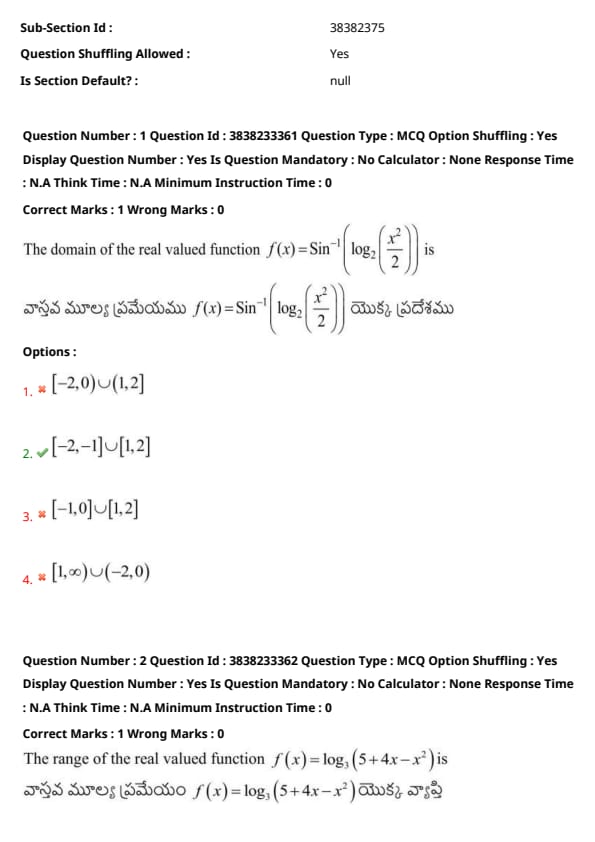
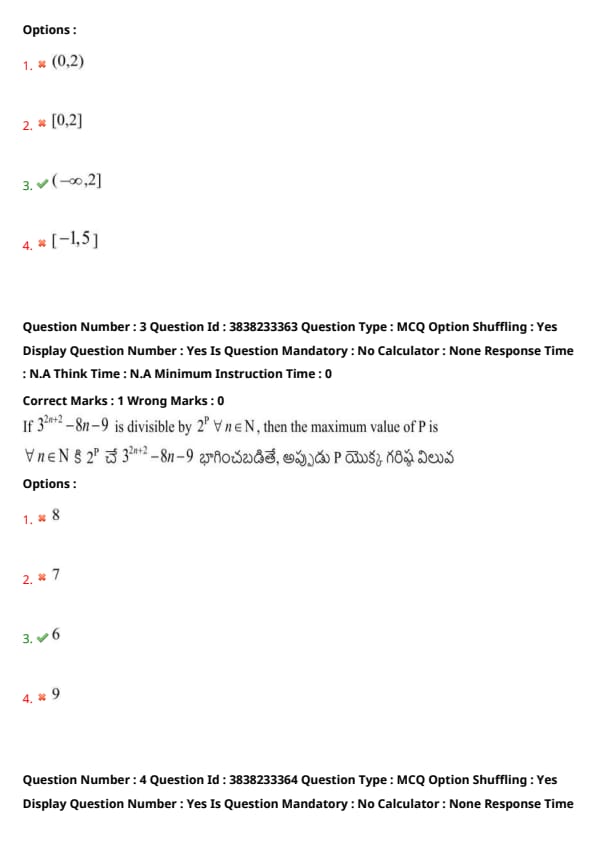
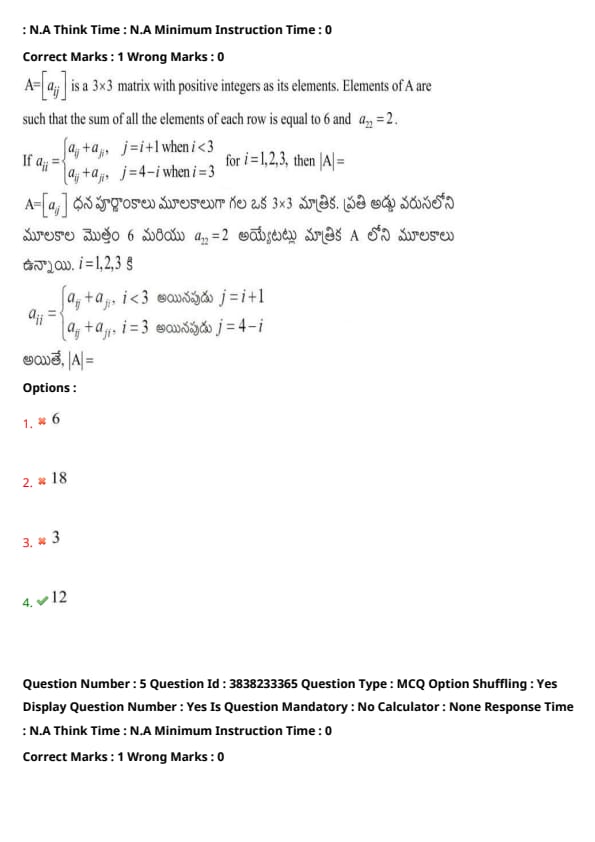
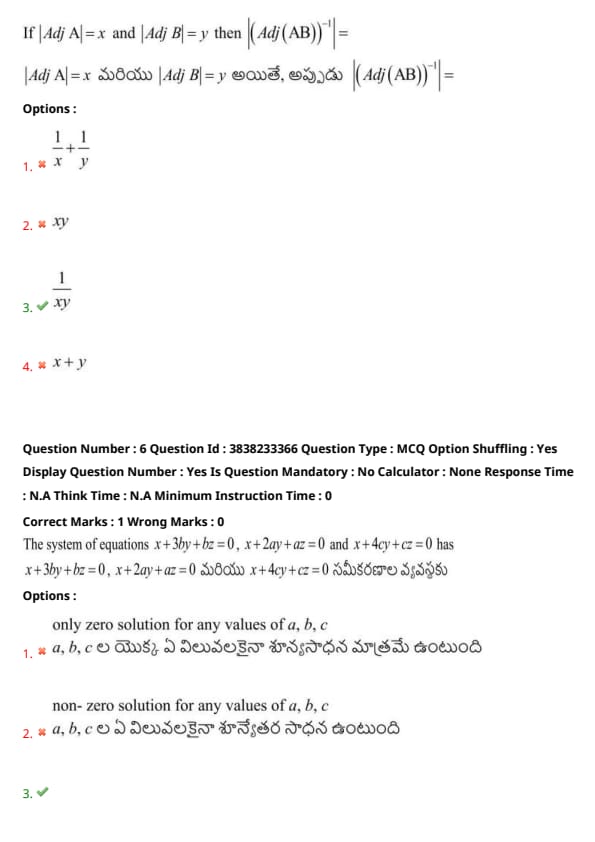
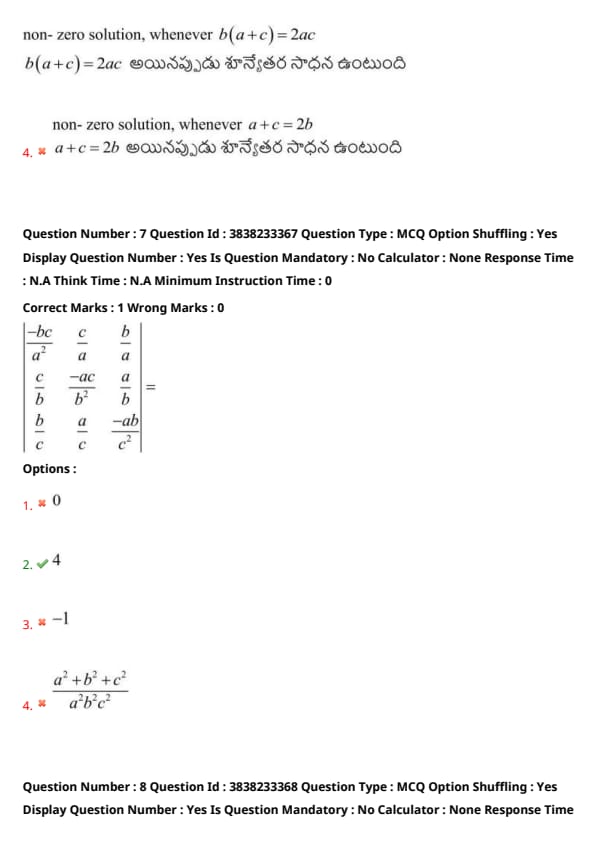
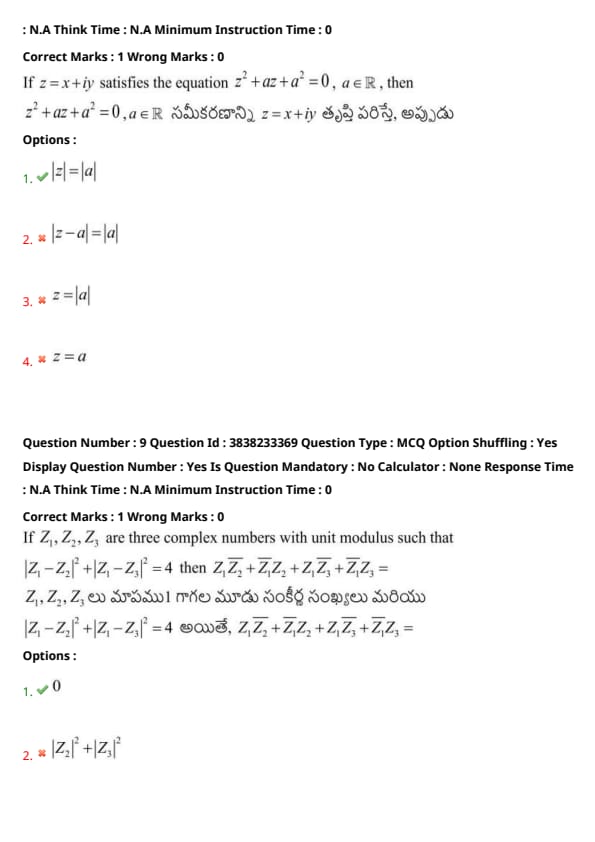
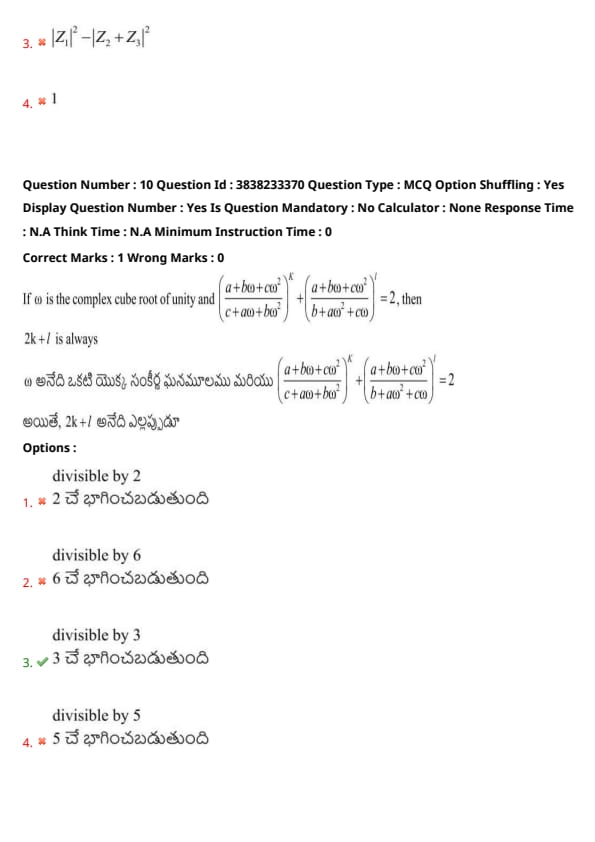
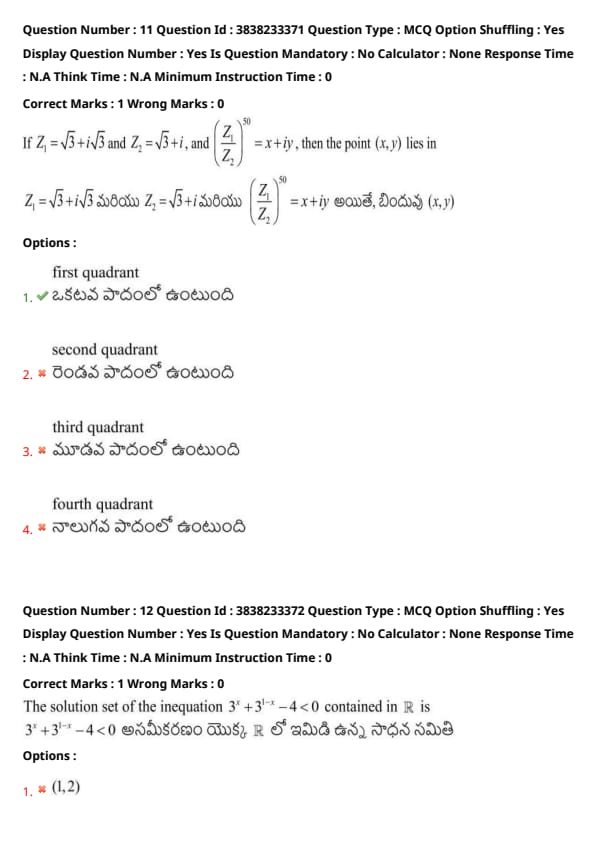
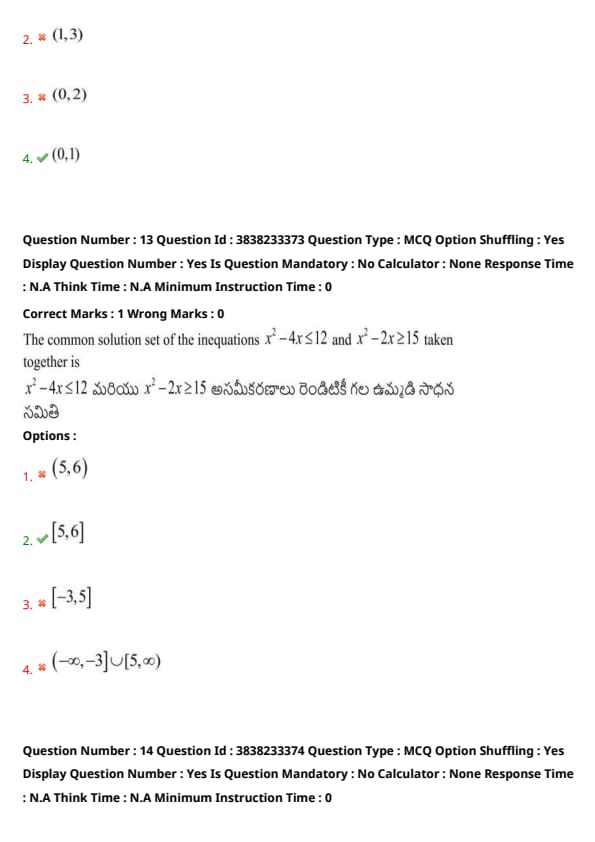
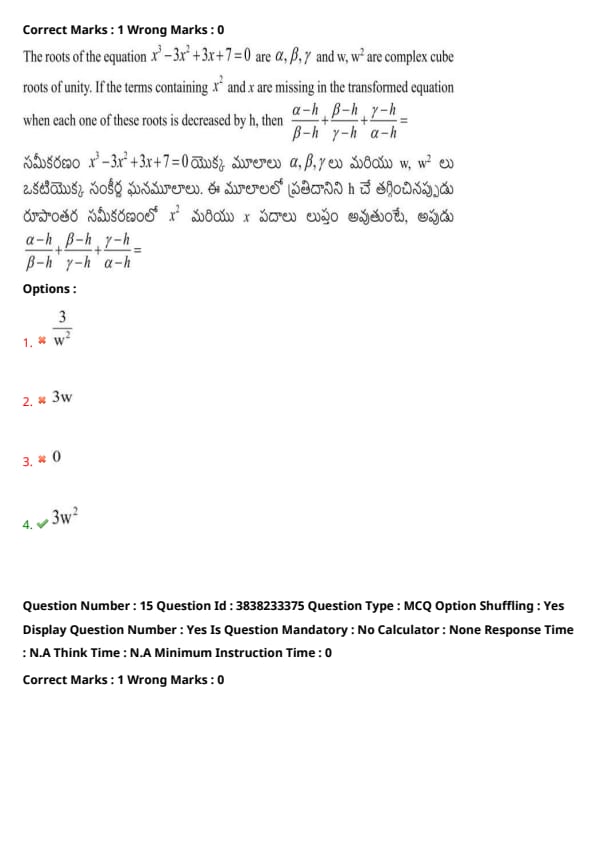
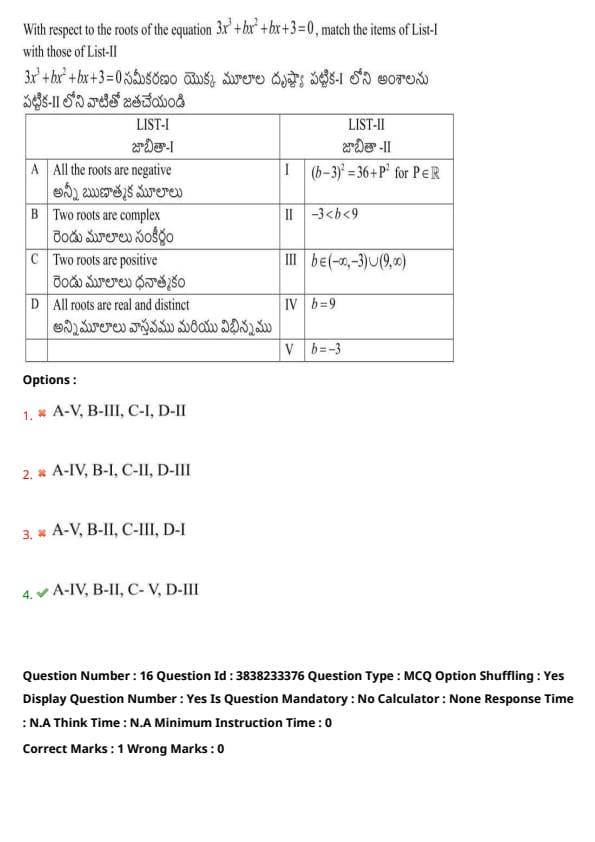
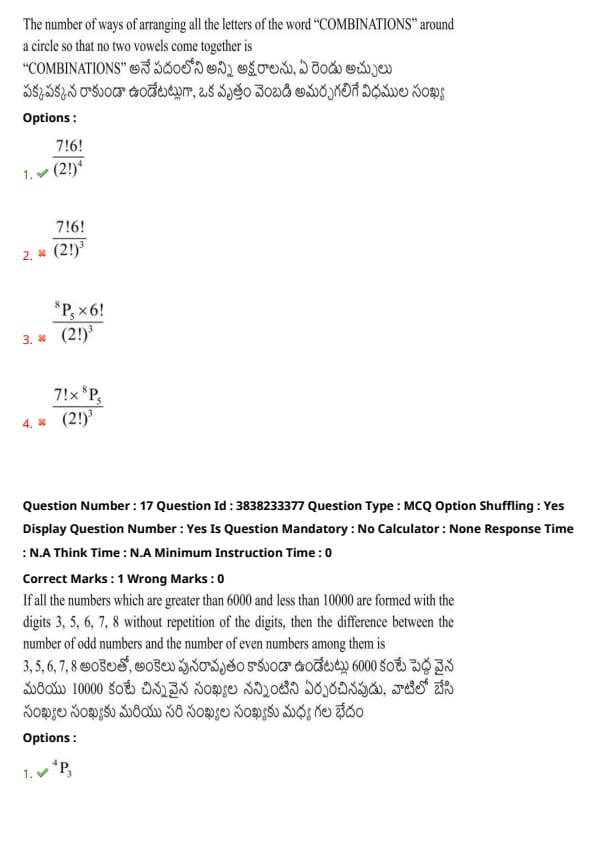
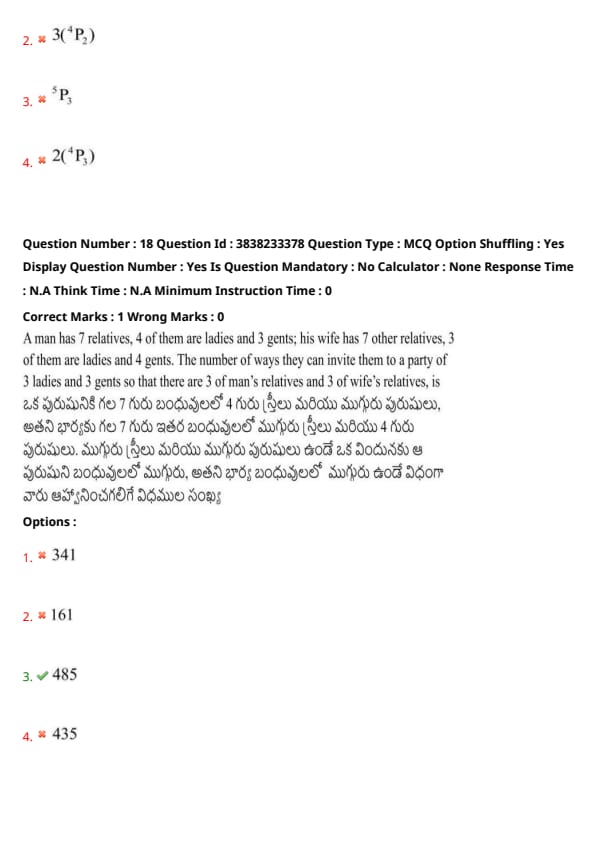
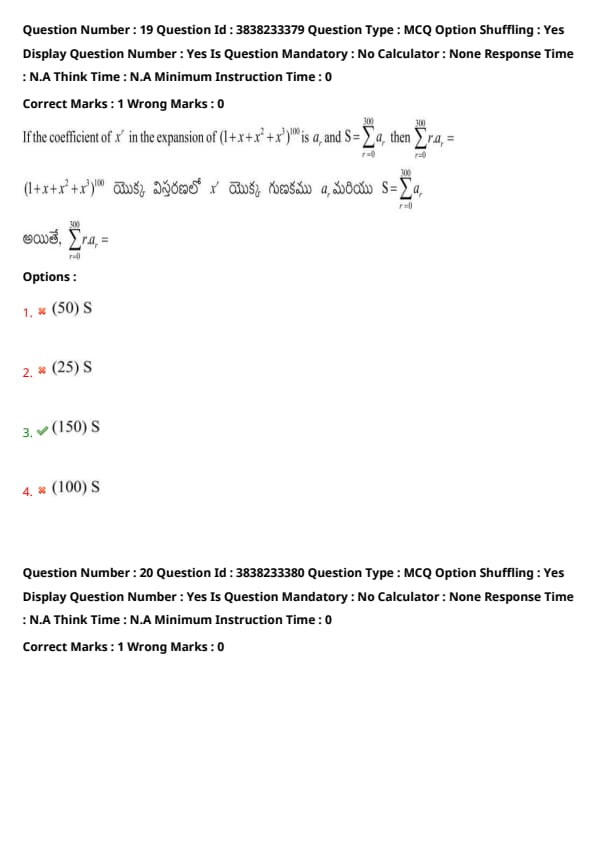
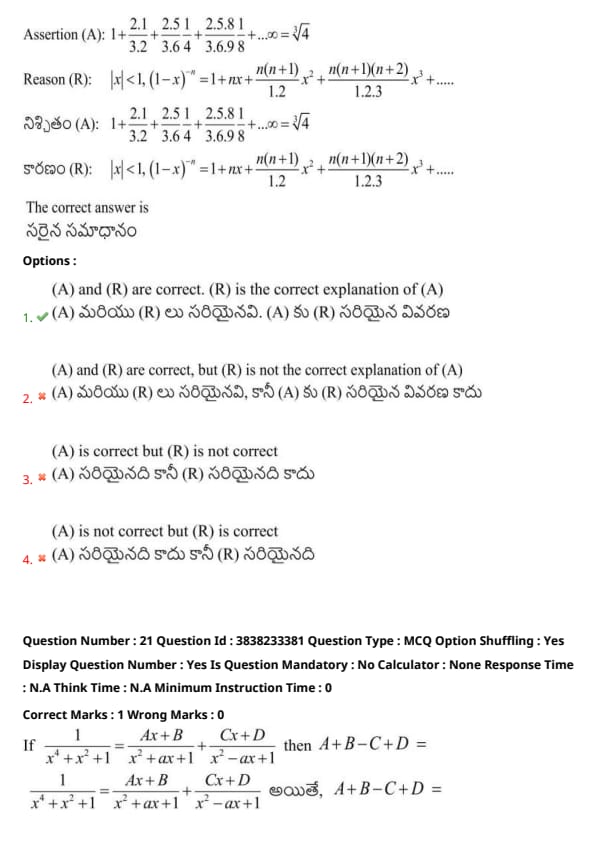
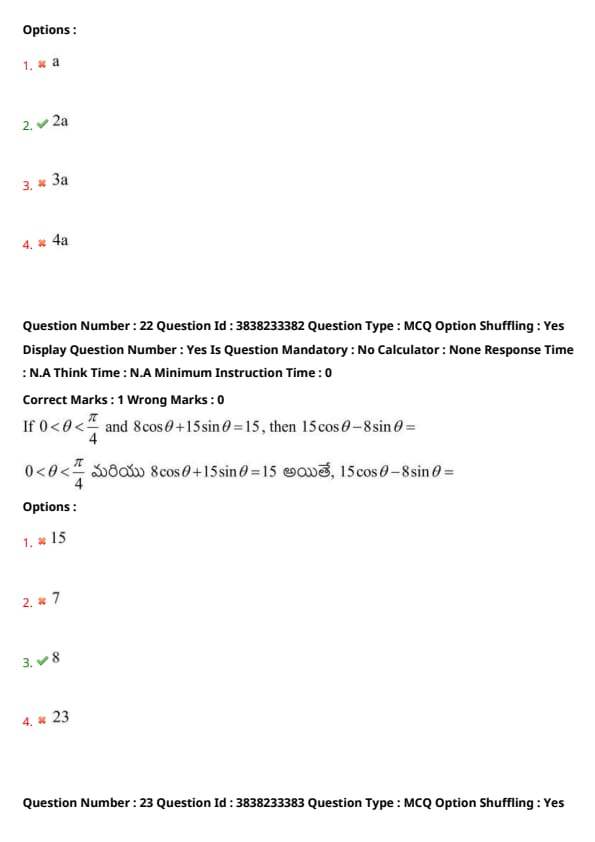
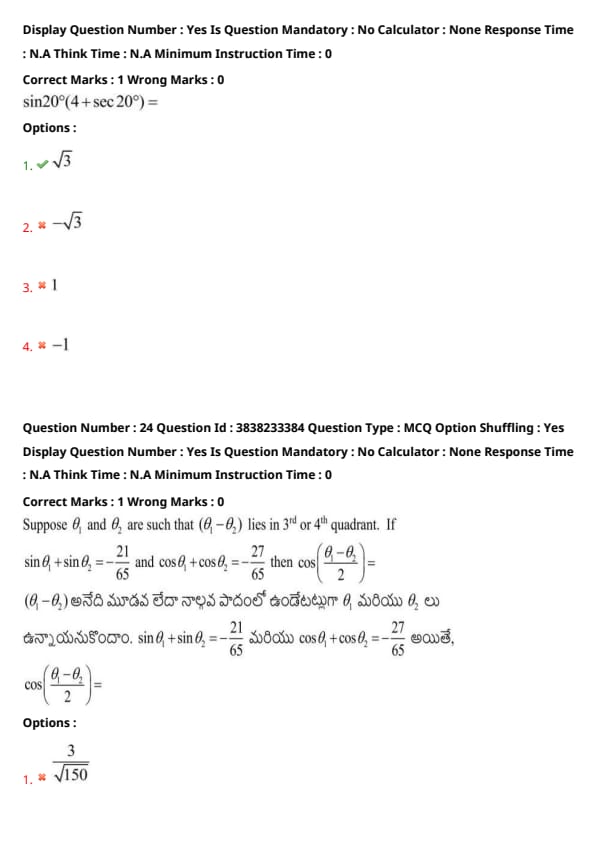
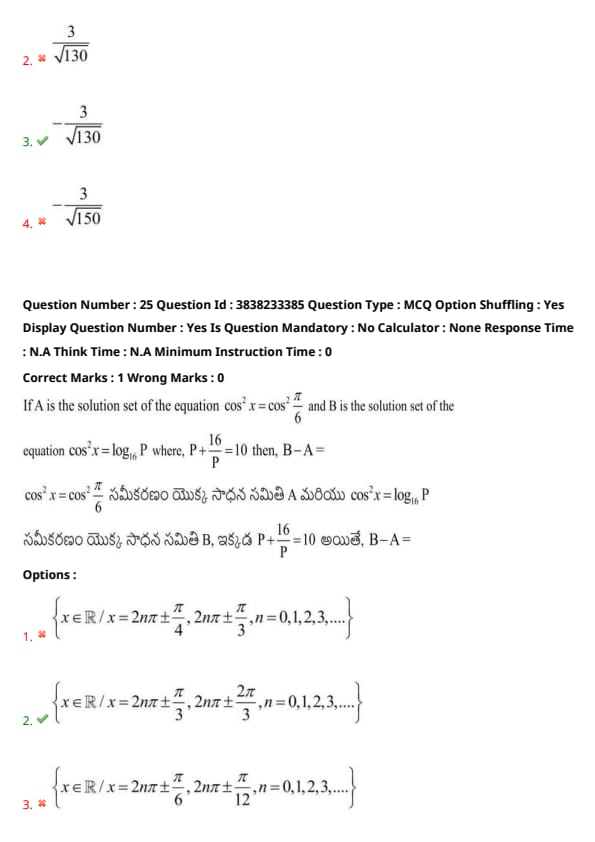
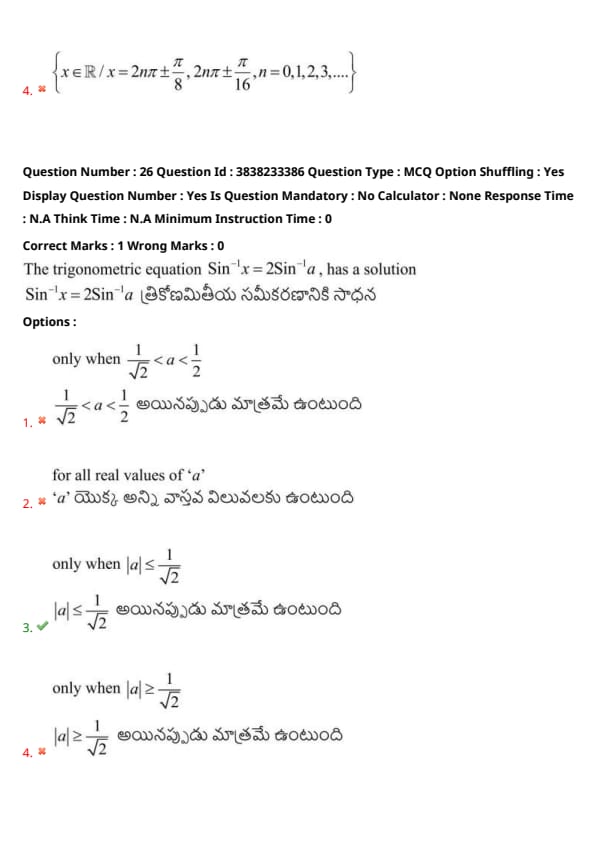
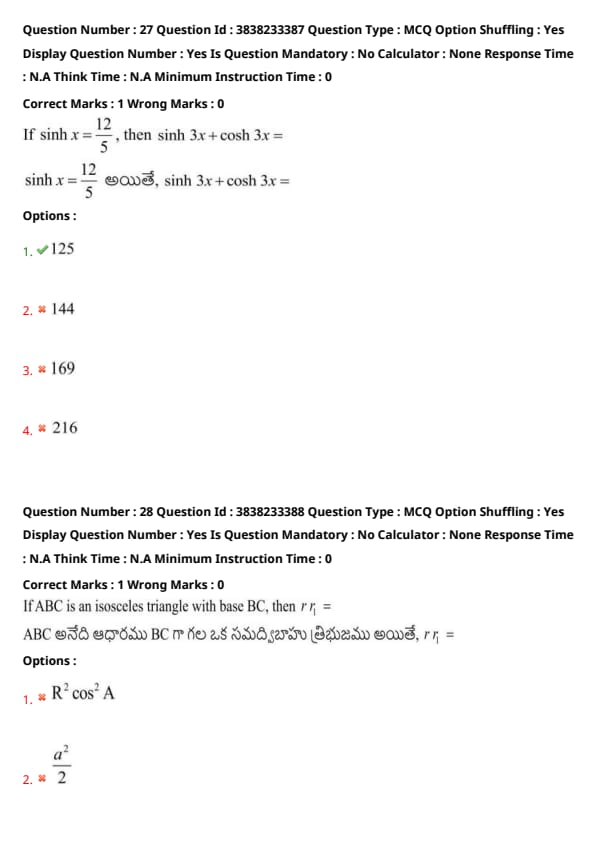
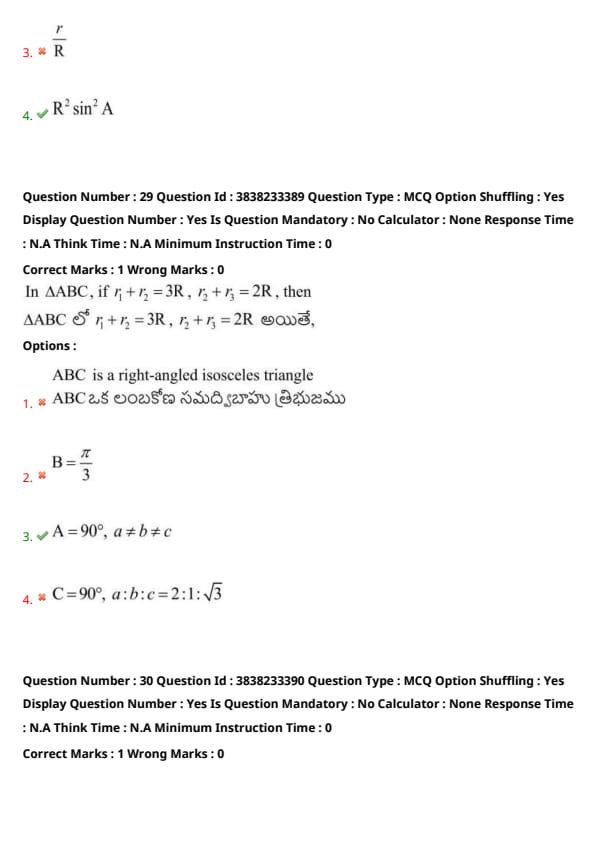
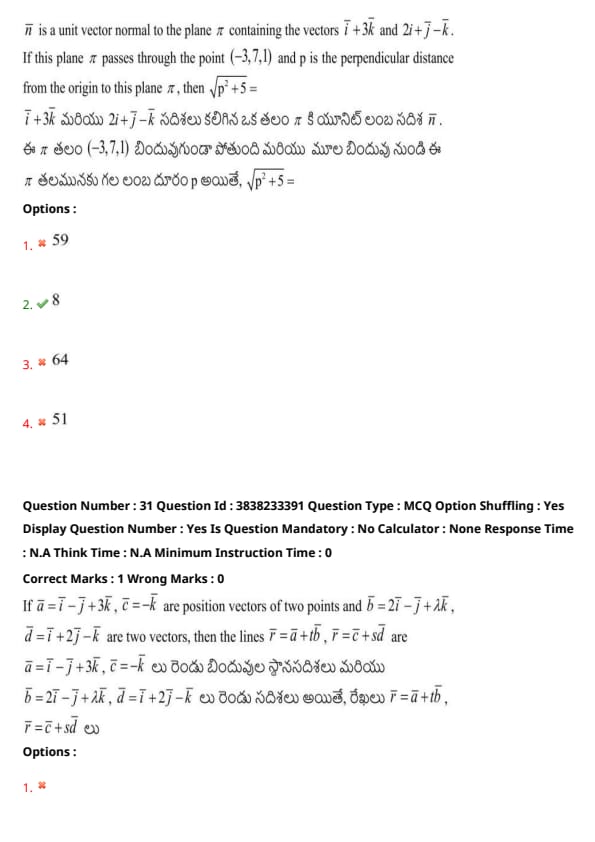
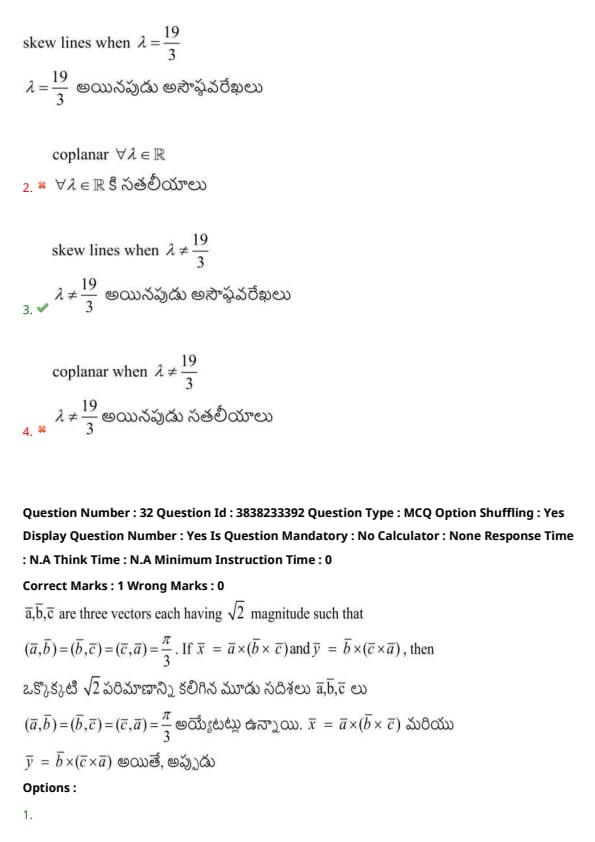
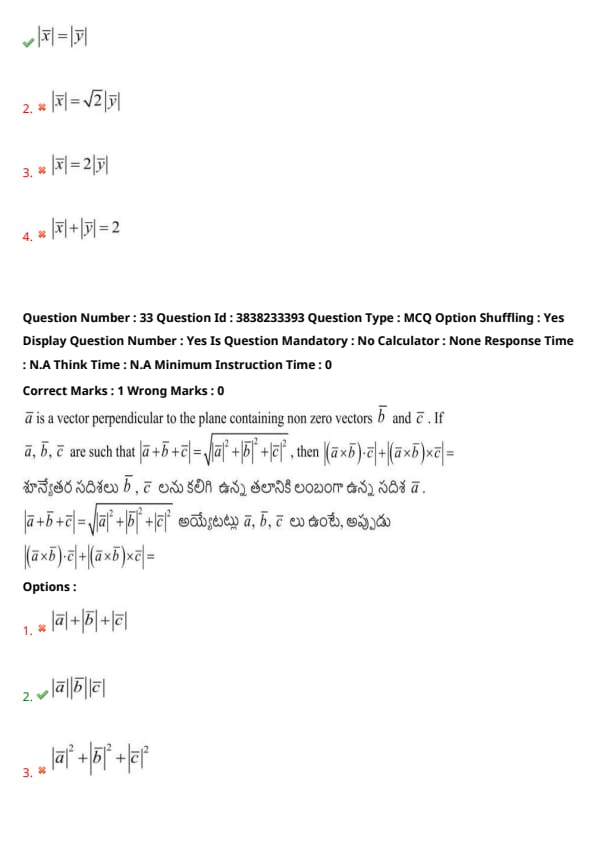
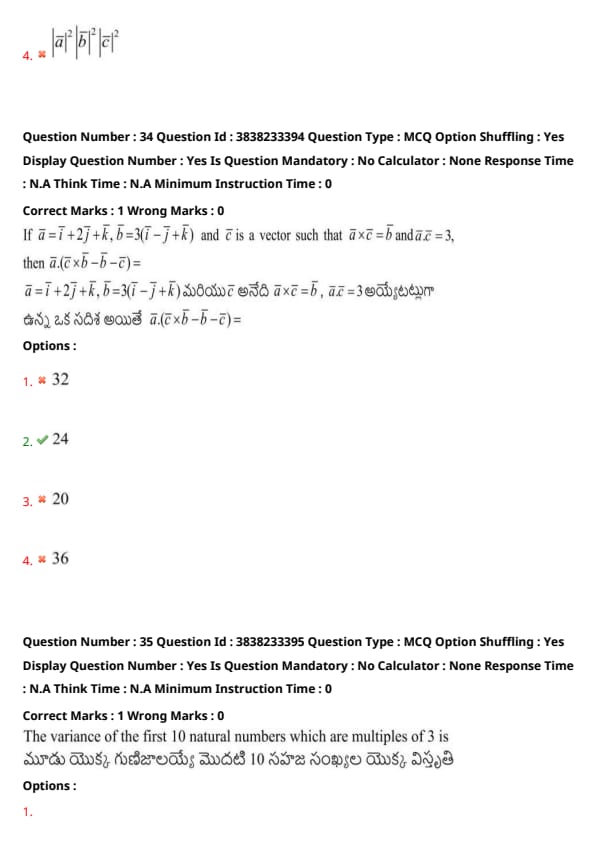
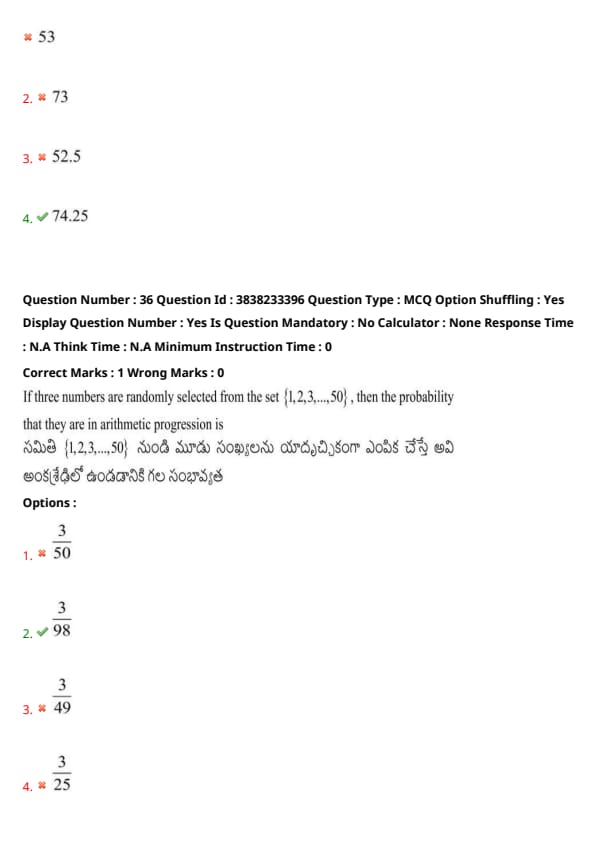
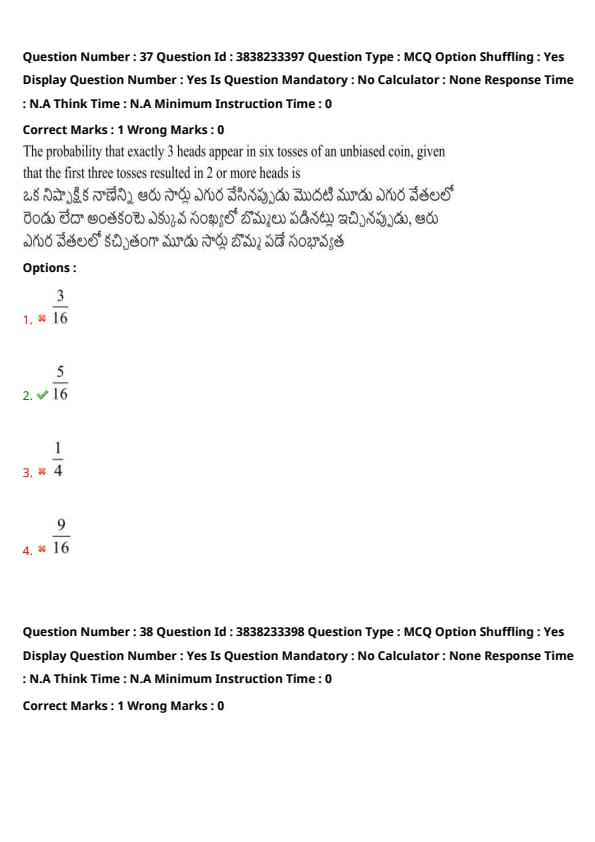
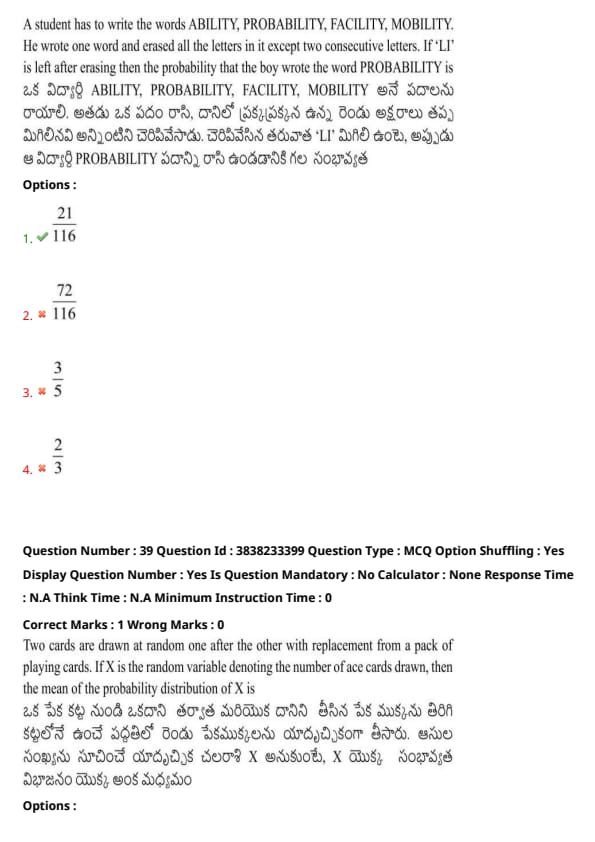
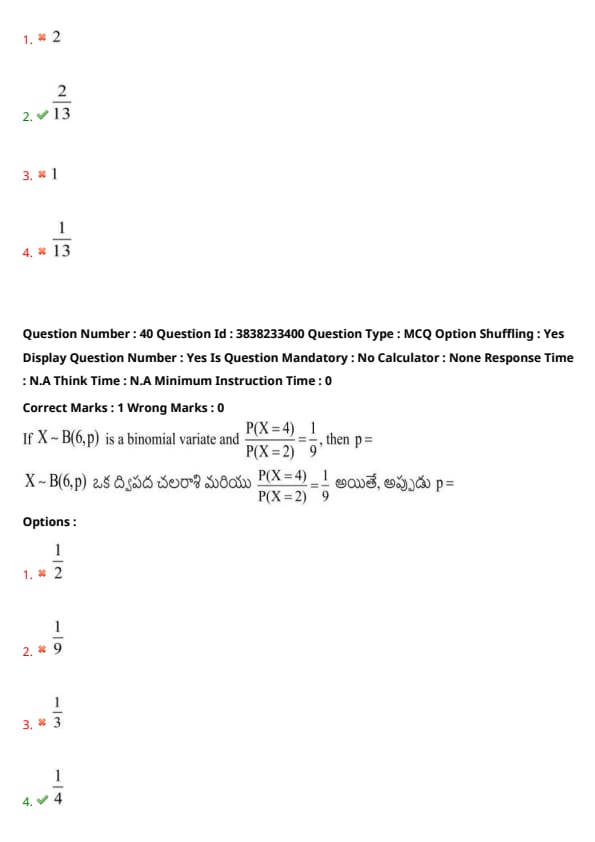
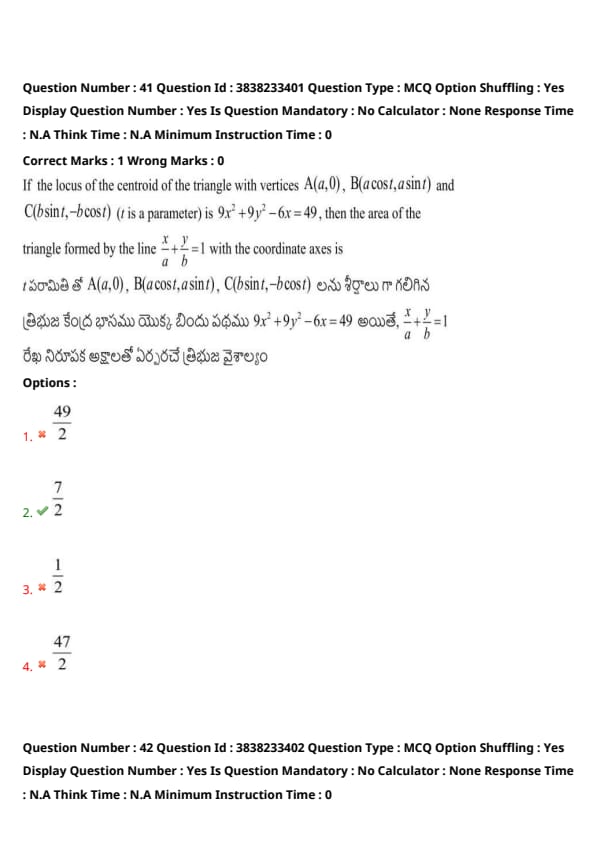
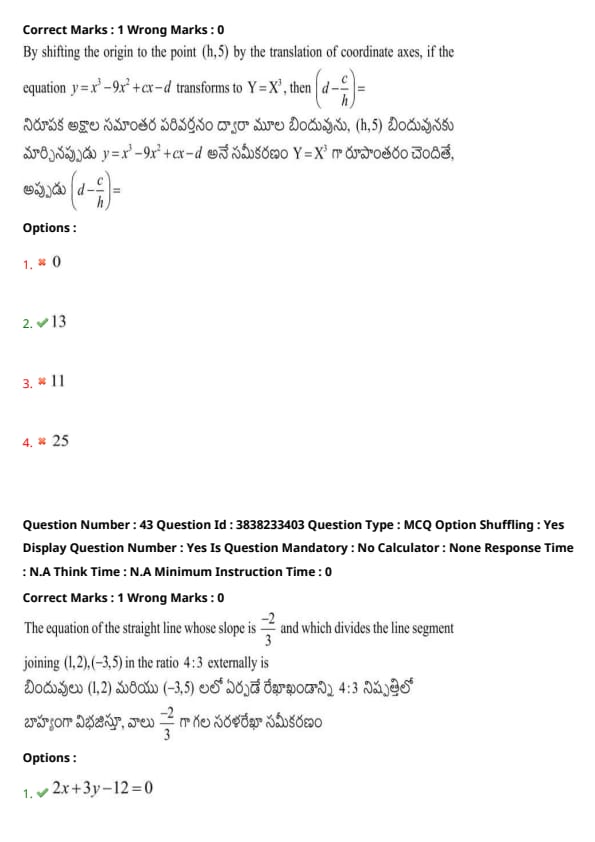
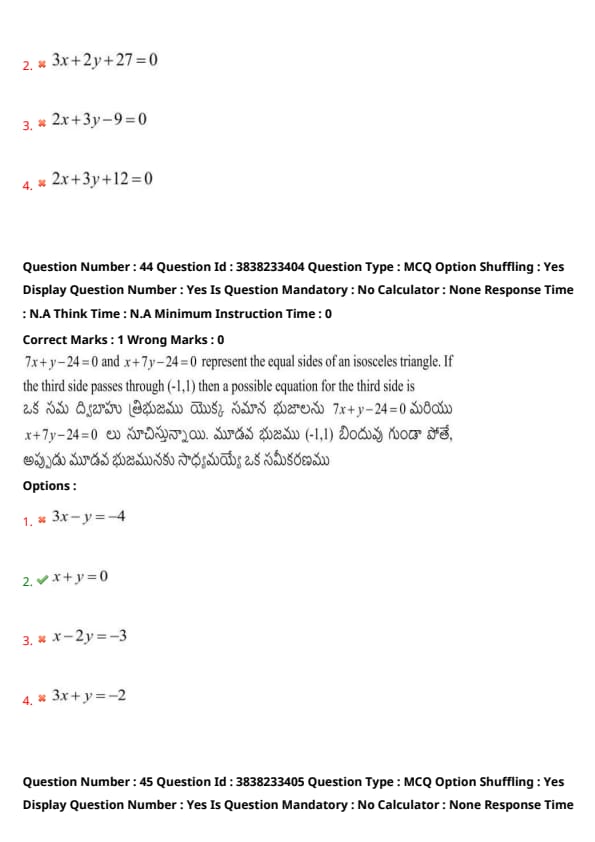
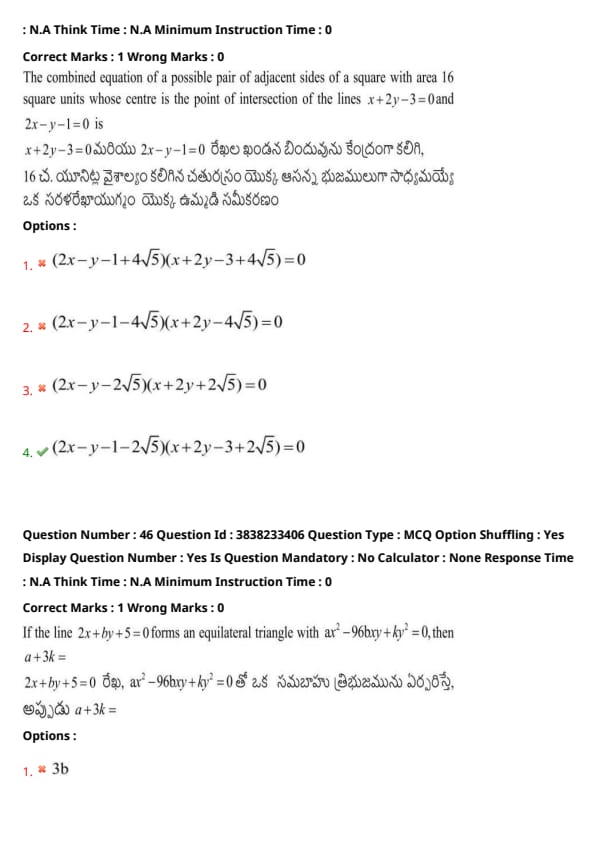
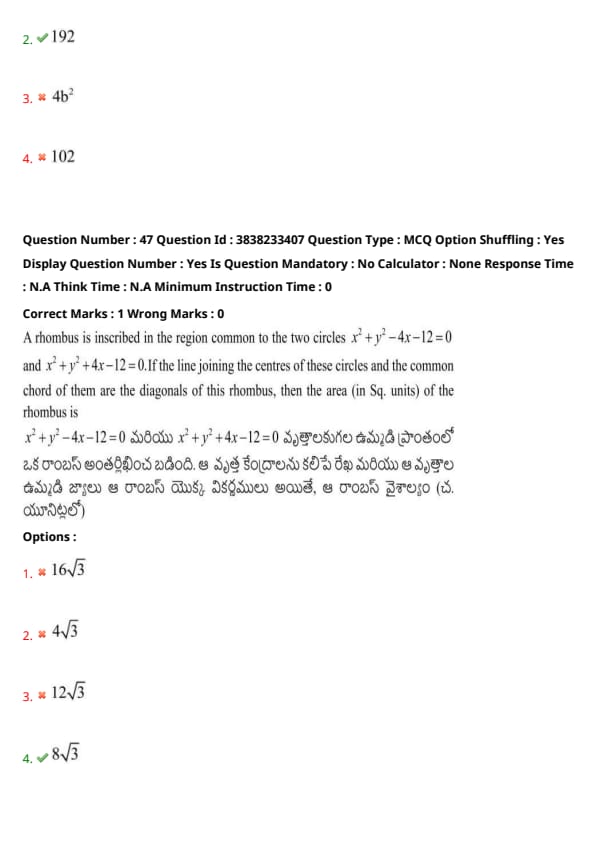
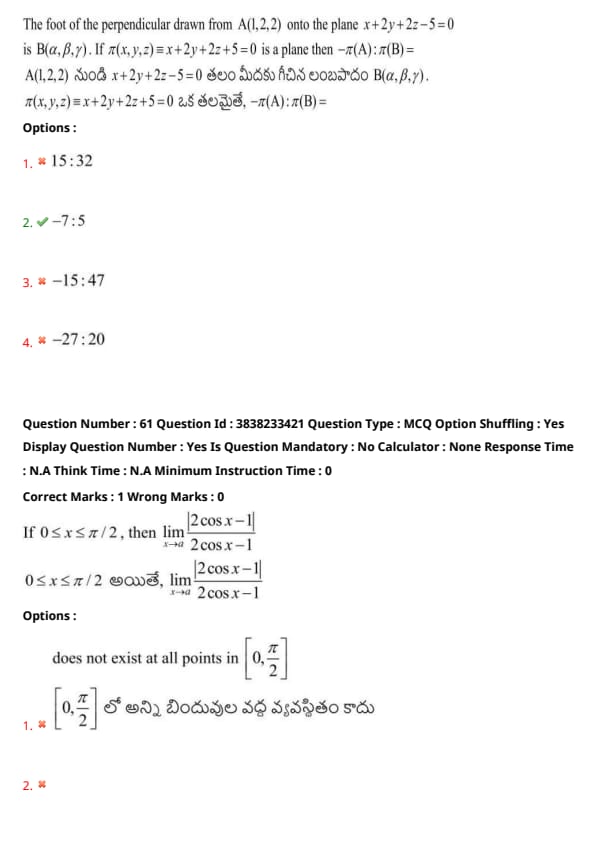
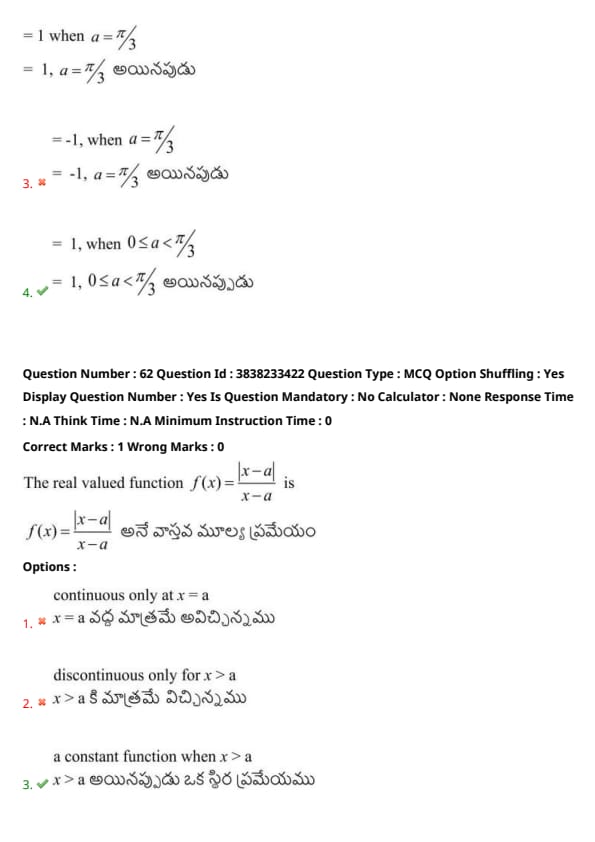
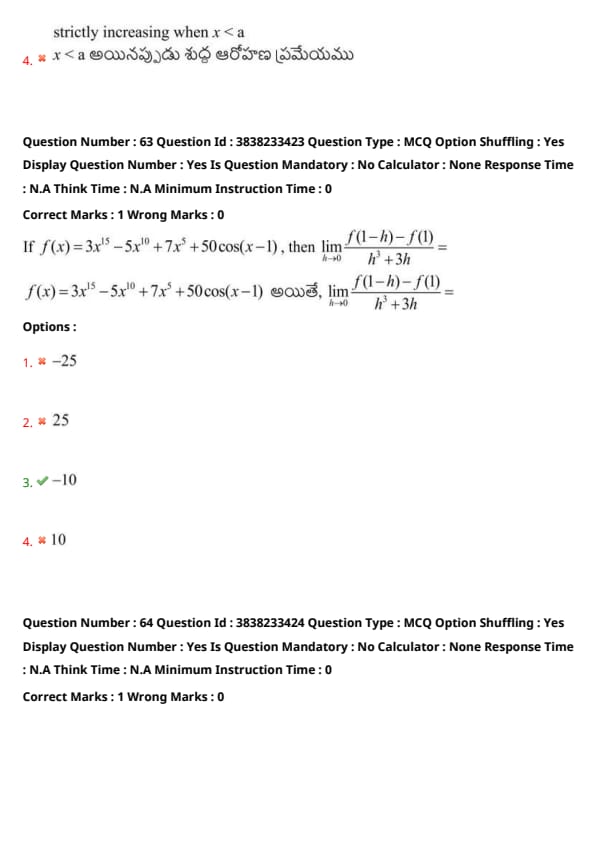
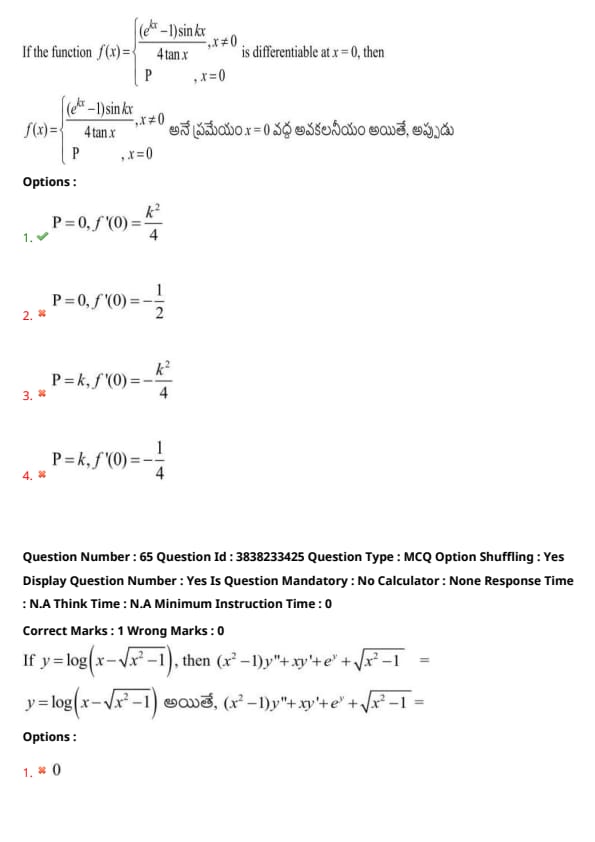
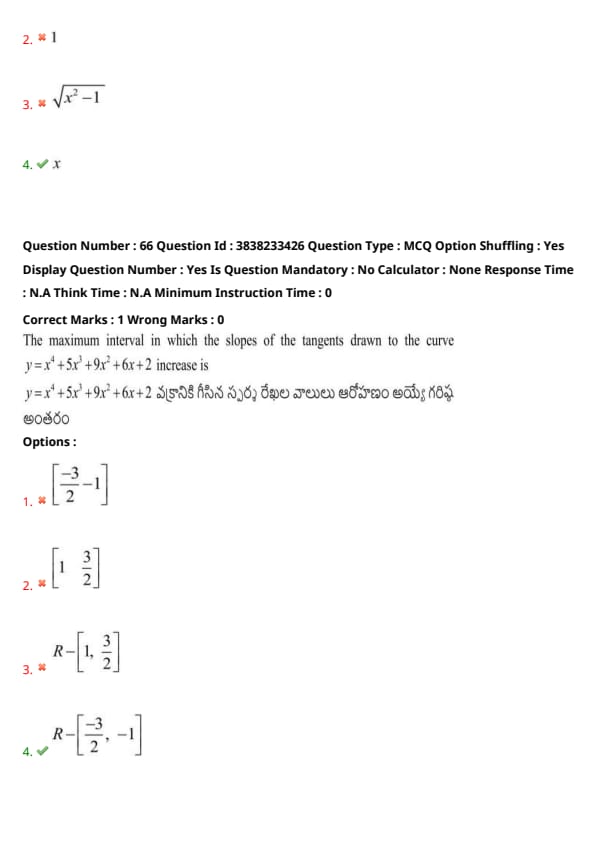
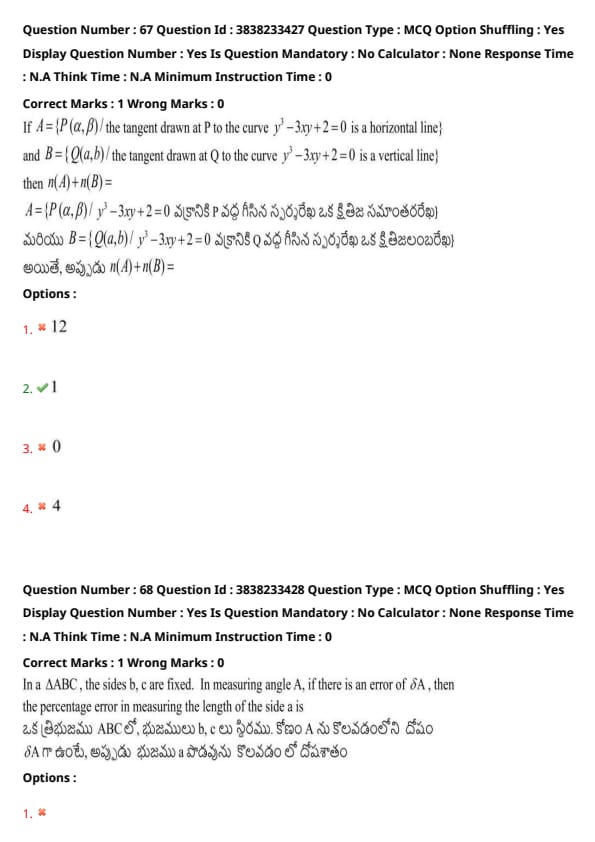
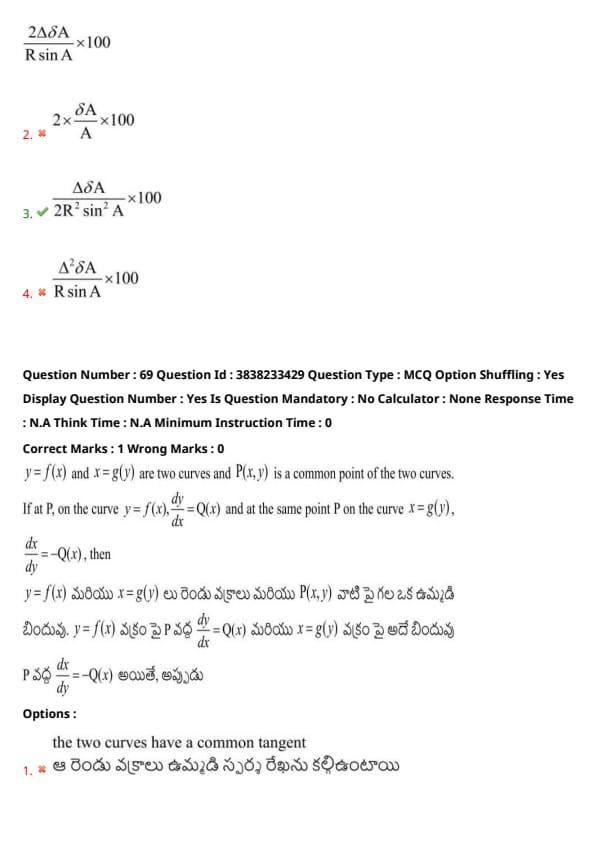
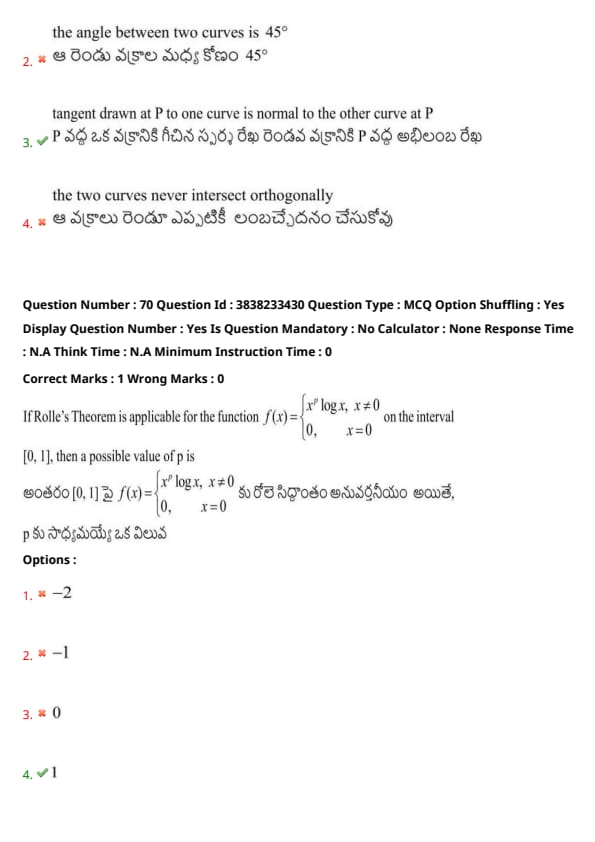
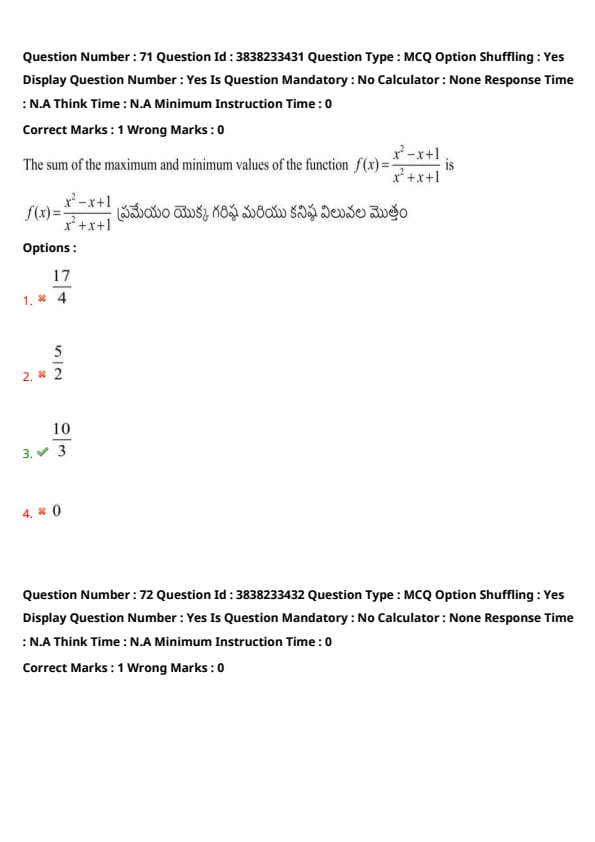
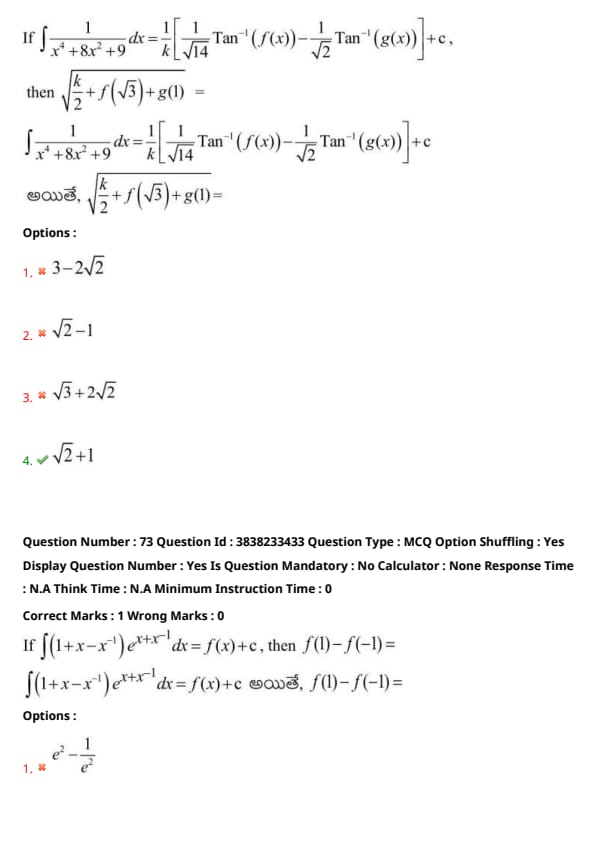
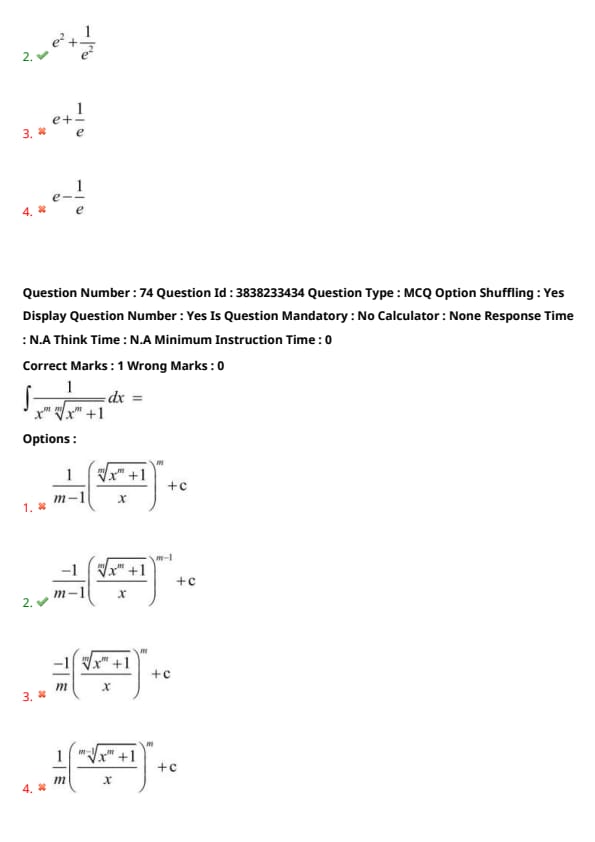
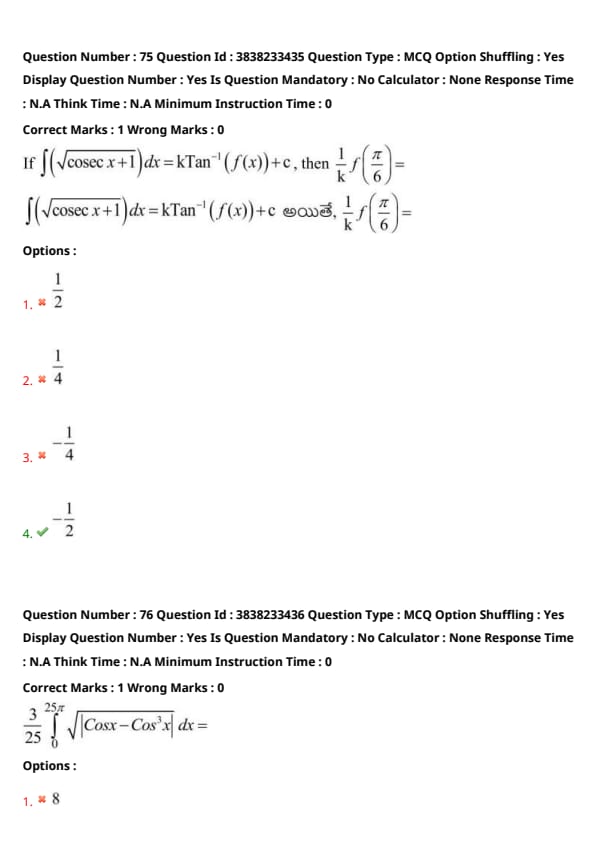
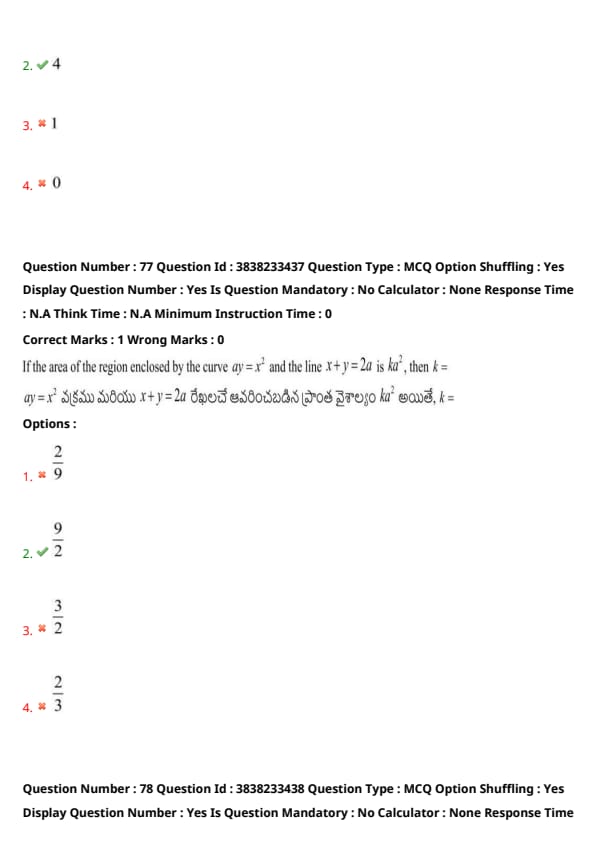
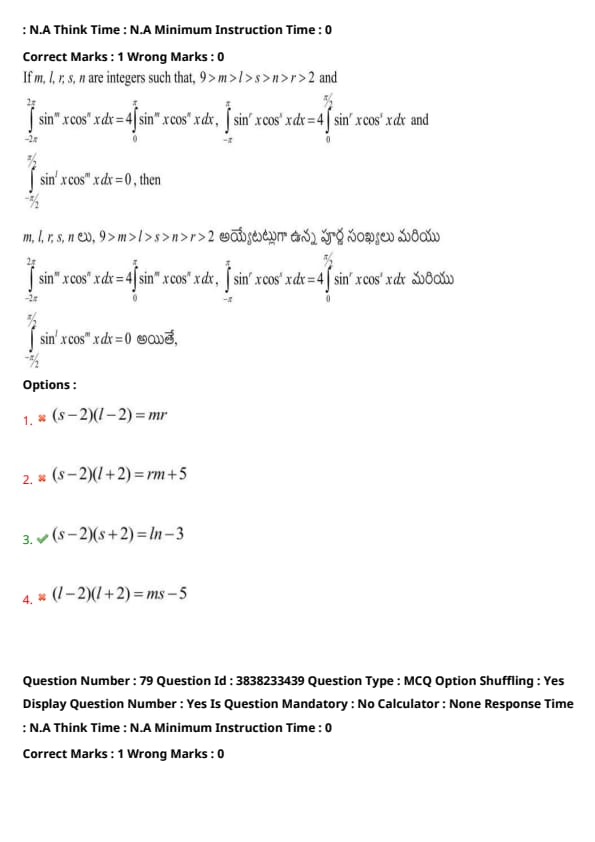
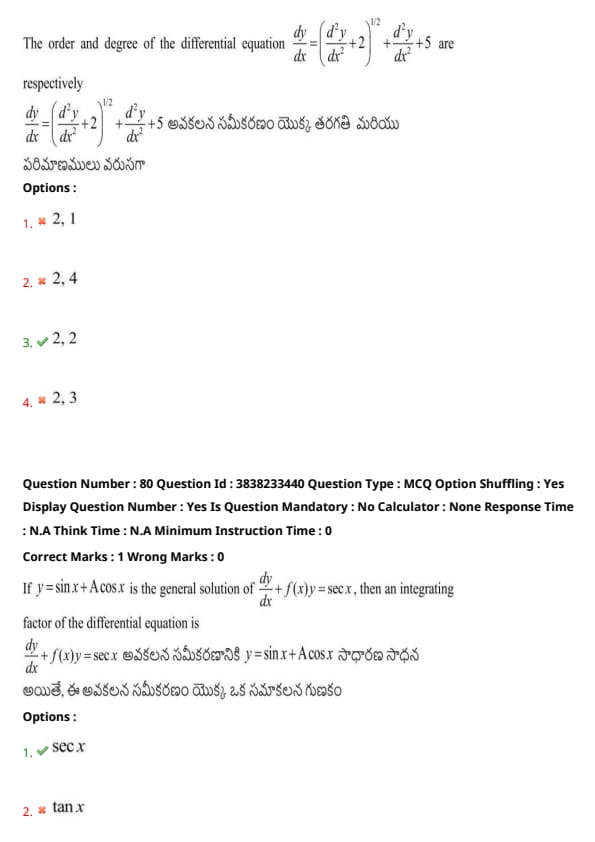
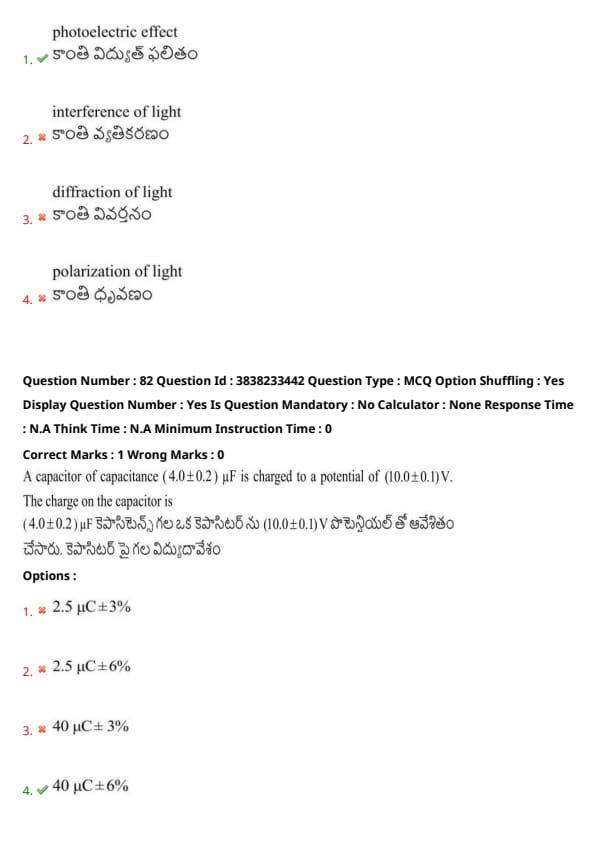
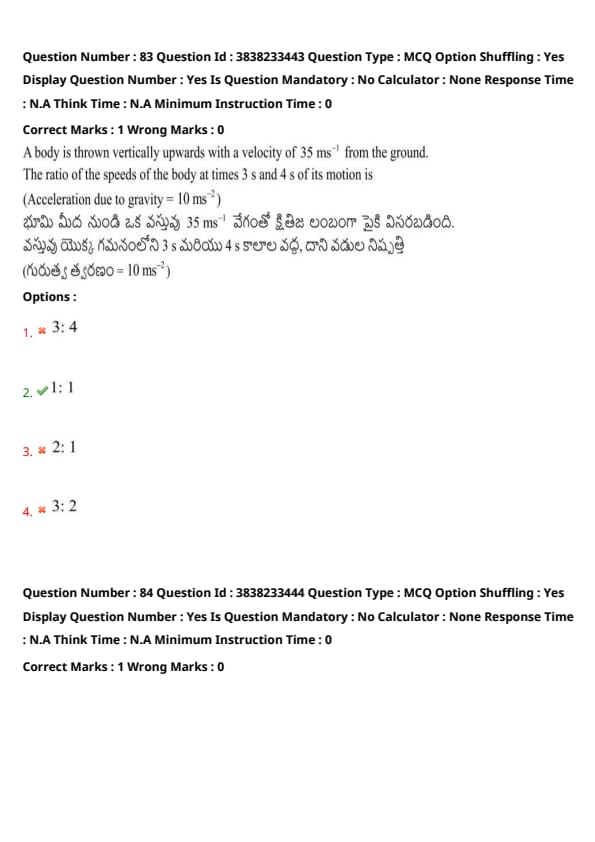
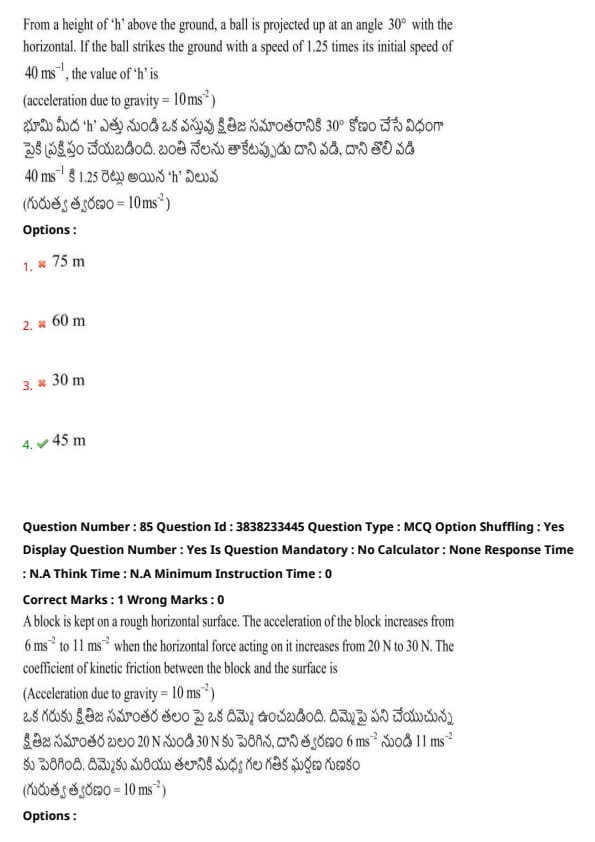
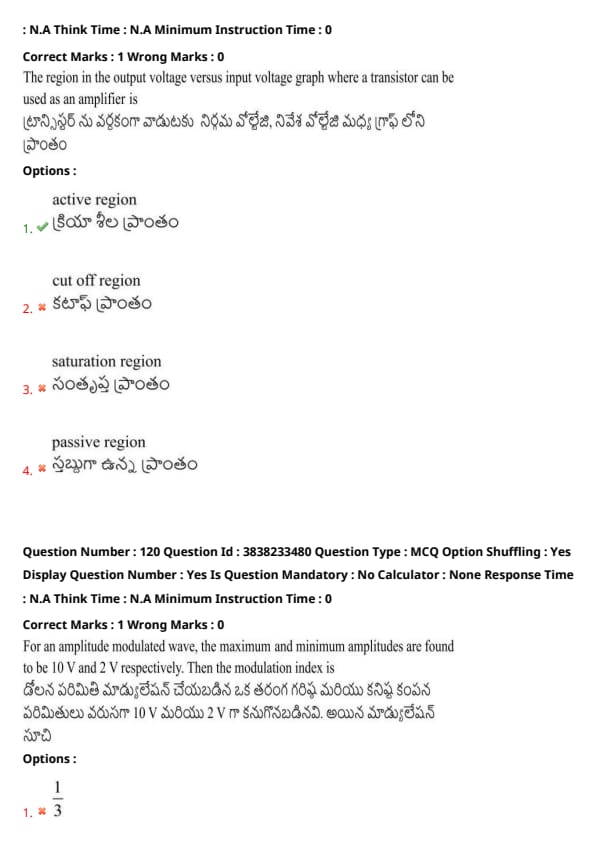
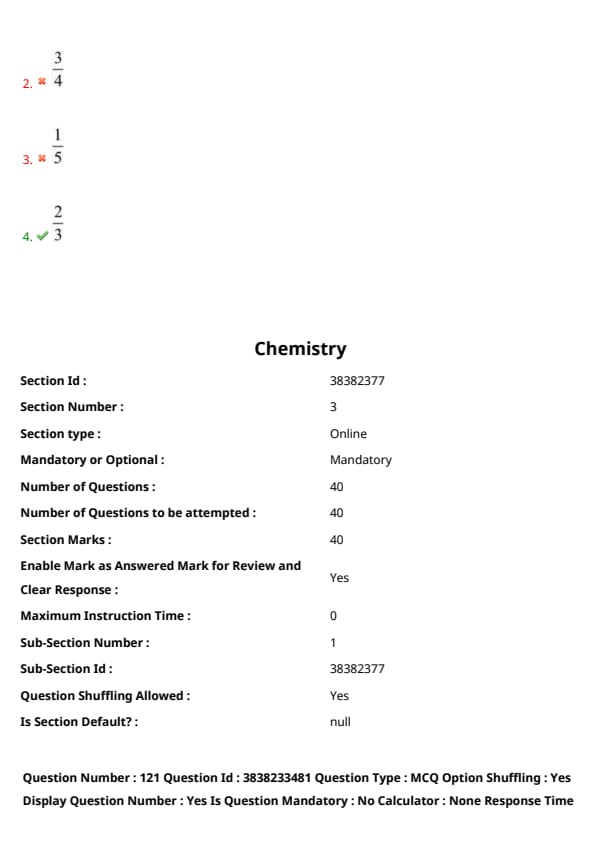
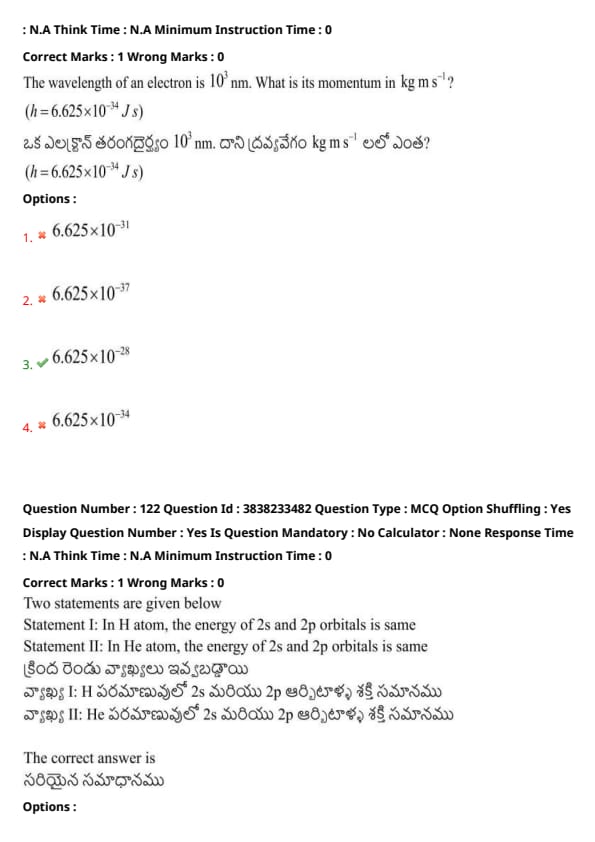
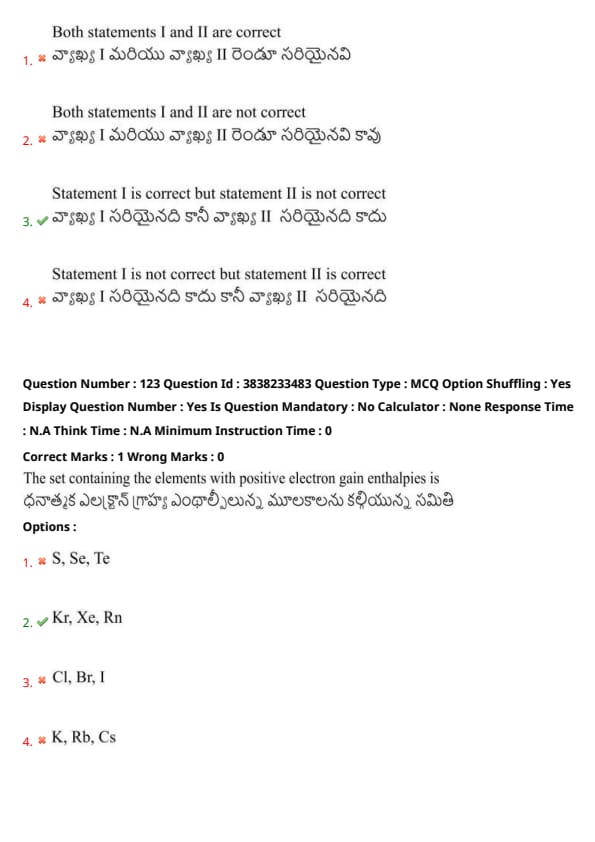
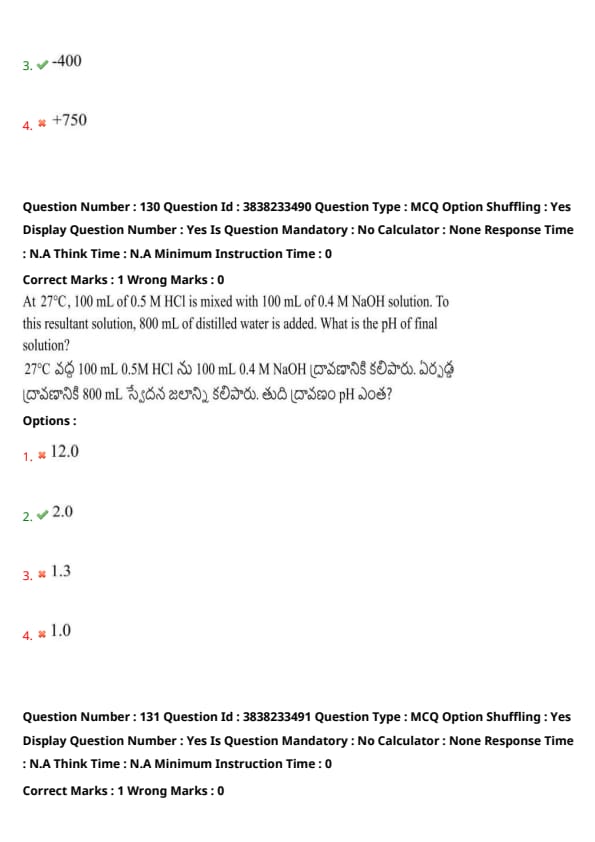
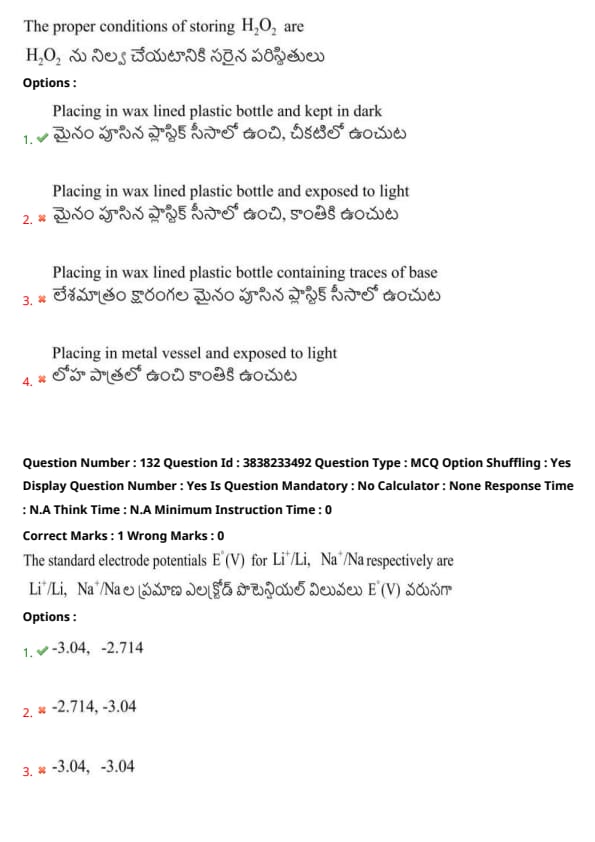
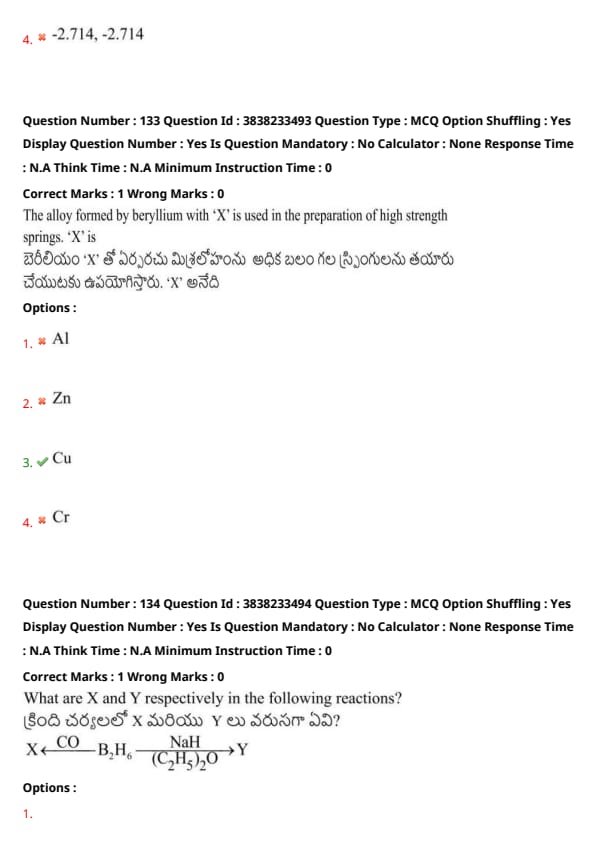
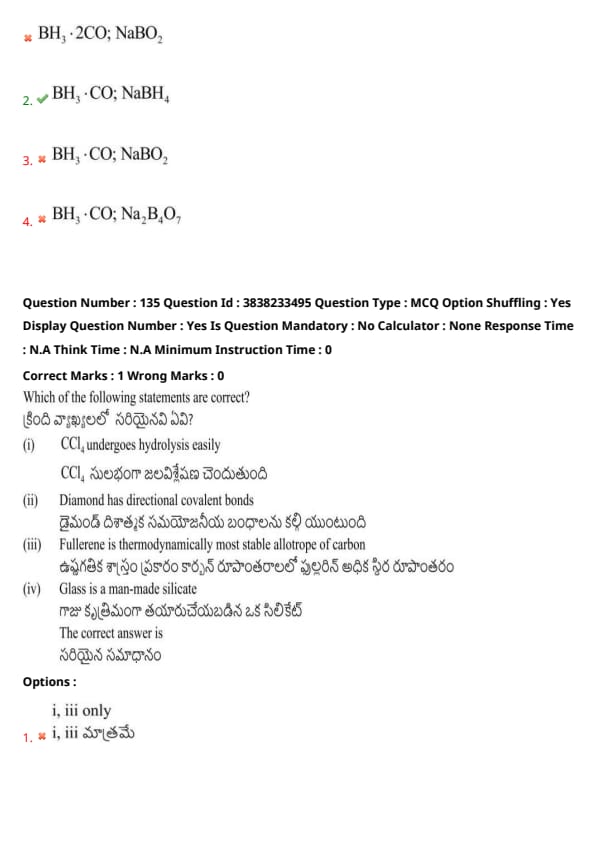
*The article might have information for the previous academic years, please refer the official website of the exam.