
TS EAMCET 2024 Question Paper May 7 Shift 1 : Download BiPC Question Paper with Solutions PDF

.jpg?tr=h-55,w-55,c-force)
Content Strategist|Tech-innovator|National Hackathon Winner | Updated On - Mar 6, 2025
TS EAMCET 2024 Question Paper May 7 Shift 1 with Answer Key PDF is available here for download. JNTU, Hyderabad on behalf of TSCHE conducted TS EAMCET on May 7 from 3 PM to 6 PM . TS EAMCET 2024 Question Paper consists of 160 questions carrying 1 mark each. TS EAMCET 2024 Question Paper May 7 Shift 1 PDF for BiPC includes four subjects, Physics, Chemistry and Biology with Botany & Zoology. Each subject includes 40 questions.
TS EAMCET 2024 Question Paper with Answer Key May 7 Shift 1 PDF
| TS EAMCET 2024 Question Paper with Answer Key |  Download Download |
Check Solution |
TS EAMCET Questions with Solutions
Flask-shaped ascocarp with an apical opening is:
View Solution
Step 1: Ascocarps
Ascocarps are fruiting bodies of fungi belonging to the Ascomycota division. They enclose and protect ascospores during development. There are three primary types of ascocarps:
- Perithecium: A flask-shaped ascocarp with a small apical opening (ostiole) through which spores are released.
- Cleistothecium: A completely enclosed ascocarp with no opening.
- Apothecium: A cup or disk-shaped ascocarp that is open, allowing the spores to disperse easily.
- Cystocarp: A reproductive structure found in red algae, not an ascocarp of fungi.
Step 2: The Correct Answer
Since the question describes an ascocarp that is flask-shaped with an apical opening, it matches the Perithecium.
Step 3: Analyzing the Options
- Option (1) Perithecium (Correct)
- Option (2) Cleistothecium (Incorrect – it has no opening)
- Option (3) Apothecium (Incorrect – it is cup/disc-shaped)
- Option (4) Cystocarp (Incorrect – it is not an ascocarp)
Thus, the correct answer is (1) Perithecium. Quick Tip: Ascocarps can be categorized based on their structure:
- Perithecium: Flask-shaped with an apical opening.
- Cleistothecium: Completely closed structure.
- Apothecium: Open cup-shaped structure.
Remembering these structural differences helps in fungal classification.
In which of the following organisms, cell wall is not found in any stage?
View Solution
Step 1: Presence of a Cell Wall in Various Organisms
Cell walls serve as structural elements in numerous organisms, offering support and protection. However, some organisms completely lack a cell wall throughout their life cycle.
- Dinoflagellates: While most have a cell wall made of cellulose plates, some species may lack it.
- Chrysophytes: Typically possess a siliceous (silica-based) cell wall.
- Slime Moulds: Exhibit a cell wall during the spore-forming phase, but it is absent in the vegetative stage.
- Protozoans: These unicellular eukaryotes entirely lack a cell wall at all stages of their life cycle, relying instead on a flexible plasma membrane.
Step 2: Identifying the Correct Answer
Since protozoans never develop a cell wall in any phase of their life cycle, the correct answer is Option (4) Protozoans.
Step 3: Evaluating the Given Options
- Option (1) Dinoflagellates – Incorrect, as many possess cellulose-based cell walls.
- Option (2) Chrysophytes – Incorrect, since they have silica-based cell walls.
- Option (3) Slime Moulds – Incorrect, as they develop a cell wall during spore formation.
- Option (4) Protozoans – Correct, as they lack a cell wall at all stages.
Thus, the correct answer is Option (4) Protozoans. Quick Tip: Organisms can be classified based on the presence or absence of a cell wall:
- Plants, fungi, and most algae have a cell wall.
- Protozoans lack a cell wall completely, making them more flexible and mobile.
- Slime moulds temporarily develop a cell wall in their spore stage.
Assertion (A): In Rhodophyceae, food is stored as floridean starch.
Reason (R): Floridean starch is similar to amylopectin and glycogen in structure.
View Solution
Step 1: Understanding Floridean Starch
Floridean starch serves as the primary storage polysaccharide in Rhodophyceae (Red Algae). Structurally, it closely resembles amylopectin and glycogen due to its highly branched nature.
Step 2: Assessing the Assertion and Reason
- Assertion (A) is correct: Rhodophyceae store food in the form of floridean starch.
- Reason (R) is also correct: The structural similarity of floridean starch to amylopectin and glycogen explains its role as a storage polysaccharide.
- (R) appropriately explains (A), as it provides the rationale behind the storage function of floridean starch in Rhodophyceae.
Since both the assertion and reason are correct, and (R) correctly explains (A), the correct answer is:
Both (A) and (R) are correct, and (R) is the correct explanation of (A). Quick Tip: Floridean starch is an important carbohydrate in red algae, functionally similar to glycogen but differs from typical starch found in green plants.
Identify the wrong pair:
View Solution
Step 1: Fruit Classification
- Pineapple (Ananas comosus) belongs to Bromeliaceae, but its fruit type is Sorosis, not Syconus.
- Paddy (Oryza sativa) belongs to Poaceae, not Apiaceae, and its fruit type is Caryopsis, not Legume.
- Cucumis (Cucumber, Melon)
belongs to Cucurbitaceae, not Poaceae, and has a Pepo fruit.
- Jackfruit (Artocarpus heterophyllus) belongs to Moraceae and has a Sorosis fruit, which is correct.
Step 2: Identifying Incorrect Pairs
- (A), (B), and (C) contain incorrect classifications, making option (4) the correct answer. Quick Tip: Understanding fruit classification is important in botany. Pay close attention to family and fruit type mismatches in questions like these!
Match the following:

View Solution
Step 1: Placentation Types
Placentation refers to how ovules are attached inside the ovary.
- Marginal Placentation → Pea (IV) (Ovules arranged along one side, typical of legumes)
- Axile Placentation → Tomato (III) (Ovules attached to a central column)
- Parietal Placentation → Argemone (II) (Ovules attached to the outer wall)
- Basal Placentation → Sunflower (I) (Single ovule at the base)
Step 2: Matching Correctly
Correct matching is:(2) A - IV, B - III, C - II, D - I Quick Tip: Placentation is a key classification feature in plant families. Common examples:
- Marginal - Pea (Legumes)
- Axile - Tomato (Solanaceae)
- Parietal - Argemone (Papaveraceae)
- Basal - Sunflower (Asteraceae)
Genetic nature of Ribonucleic acid was discovered by:
View Solution
Step 1: RNA as the Genetic Material
Frankel Conrat demonstrated that RNA, rather than proteins, serves as the genetic material in certain viruses. His experiment on Tobacco Mosaic Virus (TMV) involved separating its RNA and protein components and then reconstituting the virus. The reassembled virus successfully infected host cells, proving that RNA carries genetic information.
Step 2: Identifying the Correct Answer
- Option (1) Boveri – Incorrect, as he is known for his work on chromosomal inheritance.
- Option (2) Hugo de Vries – Incorrect, as he proposed the mutation theory.
- Option (3) Frankel Conrat – Correct, as he demonstrated RNA as the genetic material.
- Option (4) Khorana – Incorrect, as he contributed to deciphering the genetic code.
Thus, the correct answer is Option (3) Frankel Conrat. Quick Tip: RNA as genetic material was first confirmed by Frankel Conrat using TMV experiments.
Variation in lengths of filaments of stamens within a flower is seen in:
View Solution
Step 1: Stamen Filament Variation
- Salvia exhibits heterostyly, where stamens have different lengths.
- Brassica exhibits tetradynamous condition, where four stamens are longer than the other two.
Step 2: The Correct Answer
- Salvia and Brassica exhibit different lengths of stamens, making option (3) correct. Quick Tip: Variations in stamen lengths include: - Tetradynamous (Brassica) - Four long, two short stamens. - Heterostyly (Salvia) - Stamens of different lengths promote cross-pollination.
Assertion (A): Direct pollination is found in gymnosperms.
Reason (R): Ovules of gymnosperms are naked.
View Solution
Step 1: Gymnosperm Pollination
Gymnosperms exhibit direct pollination since their ovules are exposed (naked) and pollen lands directly on the ovule. This is in contrast to angiosperms, where pollen lands on the stigma before fertilization.
Step 2: Evaluating the Assertion and Reason
- Assertion (A) is correct: Gymnosperms have direct pollination.
- Reason (R) is correct: The ovules are exposed, leading to direct pollen reception.
- (R) correctly explains (A), making option (1) correct. Quick Tip: Gymnosperms undergo direct pollination as their ovules are exposed, unlike angiosperms where pollination occurs on the stigma.
Match the following:

View Solution
Step 1: Pollination Types
- Protandry → Sunflower (IV) (Anthers mature before stigma).
- Protogyny → Datura (III) (Stigma matures before anthers).
- Herkogamy → Hibiscus (II) (Spatial separation prevents self-pollination).
- Self-sterility → Abutilon (I) (Prevents self-fertilization).
Quick Tip: Different pollination strategies prevent inbreeding and promote cross-pollination.
Ategmic, Unitegmic, and Bitegmic ovules are present serially in:
View Solution
- Ategmic ovule (Lacking integuments) → Loranthus
- Unitegmic ovule (Single integument) → Helianthus
- Bitegmic ovule (Two integuments) → Lathyrus
Quick Tip: Ovules can be classified based on the number of protective integuments they possess.
Floral formula of Solanum nigrum:
- (1)
![]()
- (2)
![]()
- (3)
![]()
- (4)
![]()


View Solution
Step 1: Floral Formula of Solanum nigrum
Solanum nigrum belongs to the Solanaceae family. Its floral characteristics are:
- Bracteate (Br)
- Ebracteolate (Ebr)
- Actinomorphic (Radial symmetry, \(\oplus\))
- Calyx (K) with 5 fused sepals
- Corolla (C) with 5 fused petals
- Androecium (A) with 5 epipetalous stamens
- Gynoecium (G) with a bicarpellary ovary (2 fused carpels)
Step 2: Correct Answer
The correct floral formula is: \[ Br \, Ebr \, \oplus \, K_{(5)} \, C_{(5)} \, A_{(5)} \, G_{(2)} \] Quick Tip: Floral formulas summarize floral structures. In Solanaceae, the formula typically follows: \( K_{(5)} C_{(5)} A_{(5)} G_{(2)} \).
Match the following:
Scientific Name & Common Name
A. Colchicum autumnale & I. Spanish dagger
B. Dracaena angustifolia & II. Ashwagandha
C. Yucca gloriosa & III. Red dragon
D. Withania somnifera & IV. Meadow saffron
View Solution
Step 1: Scientific Names and Common Names
- Colchicum autumnale → Meadow saffron (IV)
- Dracaena angustifolia → Red dragon (III)
- Yucca gloriosa → Spanish dagger (I)
- Withania somnifera → Ashwagandha (II)
Step 2: Matching Correctly
Correct matching: A-IV, B-III, C-I, D-II. Quick Tip: Scientific names help in accurate plant identification, avoiding confusion with local names.
In one helix of DNA, minimum and maximum number of hydrogen bonds present between nitrogen bases:
View Solution
Step 1: Hydrogen Bonding in DNA
DNA consists of two complementary strands forming a double helix, where nitrogenous bases pair through hydrogen bonds:
- Adenine (A) pairs with Thymine (T) → Forms 2 hydrogen bonds
- Guanine (G) pairs with Cytosine (C) → Forms 3 hydrogen bonds
Step 2: Determining the Number of Hydrogen Bonds in One Helix
- The minimum number of hydrogen bonds occurs when A-T pairs predominate, totaling 20 hydrogen bonds.
- The maximum number of hydrogen bonds occurs when G-C pairs predominate, totaling 30 hydrogen bonds.
Step 3: Identifying the Correct Answer
Thus, the correct answer is 20 and 30 hydrogen bonds in one helix. Quick Tip: DNA base pairing follows Chargaff’s rule:
A pairs with T (2 bonds), and G pairs with C (3 bonds).
The "R" group amino acids of Glycine, Alanine, and Serine respectively are:
View Solution
Step 1: Amino Acids and Their "R" Groups
Amino acids consist of a central carbon (C) attached to:
- Amino group (\(-NH_2\))
- Carboxyl group (\(-COOH\))
- Hydrogen (H)
- A unique R-group (side chain) that differentiates each amino acid
For the given amino acids:
- Glycine (\(Gly\)) → The R-group is Hydrogen (H).
- Alanine (\(Ala\)) → The R-group is Methyl (\(CH_3\)).
- Serine (\(Ser\)) → The R-group is Hydroxymethyl (\(CH_2OH\)).
Step 2: The Correct Answer
The correct R-group sequence is: \[ H; CH_3; CH_2OH \]
Comparing with the options, we find option (3) is correct. Quick Tip: The R-group defines the chemical properties of amino acids:
- Non-polar (e.g., Alanine: \( CH_3 \))
- Polar (e.g., Serine: \( CH_2OH \))
- Simplest amino acid → Glycine (\( H \)).
Cell organelles included in the endomembrane system are:
View Solution
Step 1: Endomembrane System
The endomembrane system consists of membrane-bound organelles that interact via vesicular transport. These include:
- Golgi apparatus (modifies and packages proteins).
- Lysosomes (digestion and waste removal).
- Vacuoles (storage and transport in cells).
Mitochondria and chloroplasts are not part of the endomembrane system as they have their own independent membranes and functions. Quick Tip: The endomembrane system includes organelles involved in protein modification, transport, and digestion, but mitochondria and chloroplasts are excluded.
Dehydration occurs during the formation of the following types of bonds:
View Solution
Understanding Dehydration Reactions
Dehydration synthesis is a process in which monomers combine to form polymers by eliminating a molecule of water. This reaction occurs in:
- Peptide bonds – Formed between amino acids in proteins.
- Glycosidic bonds – Connect monosaccharides in carbohydrates.
- Ester bonds – Link glycerol and fatty acids in lipids.
Notably, hydrogen bonds are not formed through dehydration reactions. Quick Tip: Peptide, glycosidic, and ester bonds are formed by dehydration synthesis, while hydrogen bonds do not involve water removal.
Match the following:

View Solution
Step 1: Amino Acid Classification
- Acidic Amino Acid → Glutamic Acid (II)
- Aromatic Amino Acid → Tryptophan (III)
- Neutral Amino Acid → Valine (I)
- Basic Amino Acid → Lysine (IV) Quick Tip: Amino acids are classified based on their side chains: - Acidic → Extra carboxyl group (e.g., Glutamic acid).
- Basic → Extra amino group (e.g., Lysine).
- Aromatic → Benzene-like ring (e.g., Tryptophan).
The site of transcription and translation in eukaryotic cells are respectively:
View Solution
Transcription and Translation Sites
- Transcription (mRNA synthesis) occurs in the nucleus.
- Translation (protein synthesis) occurs in the cytoplasm (ribosomes). Quick Tip: In eukaryotes, transcription occurs in the nucleus, and translation occurs in the cytoplasm at ribosomes.
Specialized epidermal cells surrounding the guard cells are:
View Solution
Step 1: Understanding the Stomatal Complex
- Guard cells control the opening and closing of stomata, regulating gas exchange.
- Subsidiary cells are specialized epidermal cells that assist guard cells by providing structural and functional support.
Step 2: Identifying the Correct Answer
- Complementary cells – Incorrect, as they are part of lenticels.
- Subsidiary cells – Correct, as they support guard cells.
- Bulliform cells – Incorrect, as they play a role in leaf folding and rolling.
- Lenticels – Incorrect, as they are involved in gas exchange in woody plants.
Thus, the correct answer is Subsidiary cells. Quick Tip: Subsidiary cells assist guard cells in regulating stomatal opening.
Identify the correct statement with reference to the diagram given below:

View Solution
Step 1: Water Potential
Water potential (\(\Psi_w\)) is the potential energy of water per unit volume relative to pure water, and it determines the direction of water movement. It is influenced by:
- Solute concentration: Higher solute concentration lowers water potential.
- Pressure potential: Physical pressure on water increases water potential.
Step 2: Analyzing the Diagram
- Cell A contains 10% solute concentration.
- Cell B contains less solute than A, meaning higher water potential.
- Cell C contains 15% solute concentration, meaning lower water potential than both A and B.
Since water moves from higher to lower water potential, and B has the lowest solute concentration, B has the highest water potential.
Step 3: Correct Answer
- Option (1) Incorrect → Water moves from higher to lower potential, A does not have the highest potential.
- Option (2) Incorrect → Water does not move from C to A, as C has the lowest water potential.
- Option (3) Correct → B has the highest water potential because it has the lowest solute concentration.
- Option (4) Incorrect → C has the lowest water potential, not the highest. Quick Tip: Water always moves from higher water potential to lower water potential. More solutes reduce water potential, so the region with the least solute concentration has the highest water potential.
Identify the incorrect pair:
View Solution
Step 1: Succulents and Phylloclades
- Casuarina does not have a succulent root, and it does not form a phylloclade.
- Asparagus has a succulent stem, not a leaf, and it forms a cladode, not a phylloclade.
- Opuntia has a succulent stem and is a classic example of a phylloclade.
- Aloe has succulent leaves and is correctly classified as a xerophyte.
Step 2: Identifying Incorrect Pairs
- Casuarina (Incorrect classification).
- Asparagus (Incorrect classification).
- Opuntia and Aloe are correctly classified.
Thus, the incorrect pairs are I and II. Quick Tip: Phylloclades are modified stems adapted for photosynthesis in xerophytic plants like Opuntia. Cladodes are also modified stems but differ from phylloclades in their structure.
Assertion (A): Disulphide bridges help in stabilization of protein structure.
Reason (R): Sulphur forms disulphide bridges in the quaternary structure of proteins.
View Solution
Step 1: Disulphide Bridges
- Disulphide bonds (\( S-S \) bonds) form between cysteine residues in proteins, providing stability.
- These bonds are important for tertiary and quaternary structures, preventing unfolding.
Step 2: Evaluating the Assertion and Reason
- (A) is correct: Disulphide bonds contribute to protein stability.
- (R) is correct: Sulphur indeed forms disulphide bonds, and these are crucial in higher-order structures.
- (R) correctly explains (A), making option (A) correct. Quick Tip: Disulphide bonds are covalent bonds that stabilize protein folding, particularly in extracellular proteins like insulin and keratin.
Match the following:

View Solution
Step 1: Role of Elements in Enzyme Activation
Different metal ions act as cofactors to activate specific enzymes:
- Zinc (IV) – Activates Carboxypeptidase, an enzyme involved in protein digestion.
- Manganese (III) – Activates IAA Oxidase, which regulates auxin degradation in plants.
- Magnesium (II) – Activates Hexokinase, a key enzyme in glycolysis.
- Iron (I) – Activates Peroxidase, an enzyme involved in oxidative stress response.
Step 2: Identifying the Correct Matching
Thus, the correct match is: A-IV, B-III, C-II, D-I. Quick Tip: Many enzymes require specific metal ions for activation. For example, Zinc activates Carboxypeptidase, and Iron is essential for IAA Oxidase in plants.
Per one Calvin cycle, the number of CO\(_2\) molecules fixed, ATP utilized, and the number of Glucose, NADPH molecules produced respectively are:
View Solution
The Calvin Cycle
- The Calvin cycle fixes 6 CO\(_2\) molecules to synthesize 1 molecule of glucose.
- The process consumes 18 ATP molecules and 12 NADPH molecules per glucose molecule produced. Quick Tip: The Calvin cycle is the light-independent reaction of photosynthesis, occurring in the stroma of chloroplasts, using ATP and NADPH to fix carbon into glucose.
In C\(_4\) plants, the Oxaloacetic acid is formed by this reaction:
View Solution
The Formation of Oxaloacetic Acid in C\(_4\) Pathway
- In C\(_4\) plants, Phosphoenol pyruvate (PEP) carboxylase fixes CO\(_2\) to form oxaloacetic acid (OAA) in mesophyll cells.
- This reaction helps plants survive in high-temperature conditions by minimizing photorespiration. Quick Tip: The C\(_4\) pathway is an adaptation for efficient CO\(_2\) fixation under high light and temperature conditions, reducing photorespiration.
Identify the correct sentences regarding the role of physiological responses of phytohormones:
I. Ethylene initiates sprouting of potato tubers
II. Gibberellins promote senescence
III. Auxins promote flowering in pineapple
IV, Abscisic acid inhibits seed germination
View Solution
Step 1: Understanding the Role of Phytohormones
- Ethylene stimulates the sprouting of potato tubers.
- Gibberellins enhance seed germination but do not induce senescence.
- Auxins promote flowering in pineapple.
- Abscisic Acid (ABA) acts as a growth inhibitor and prevents seed germination.
Step 2: Identifying the Correct Statements
Based on the given information, the correct statements are I, III, and IV. Quick Tip: Phytohormones regulate plant growth and development. - Auxins → Promote cell elongation \& flowering in pineapple.
- Gibberellins → Stimulate seed germination (not senescence).
- Abscisic acid → Inhibits seed germination (stress hormone).
Match the following:

View Solution
Step 1: Carbon Counting in Organic Acids
- \(\alpha\)-Ketoglutaric acid → 5 carbons.
- Succinic acid → 4 carbons.
- Citric acid → 6 carbons.
- Acetyl group of Acetyl CoA → 2 carbons.
Step 2: Matching Correctly
The correct matching is A-IV, B-II, C-I, D-III. Quick Tip: The Krebs cycle involves organic acids of different carbon numbers, playing a key role in cellular respiration.
Substrate-level phosphorylation does not occur in the following reactions of aerobic respiration:
View Solution
Step 1: Understanding Substrate-Level Phosphorylation
Substrate-level phosphorylation (SLP) is a process in which a high-energy phosphate group is directly transferred from a phosphorylated substrate to ADP, forming ATP. This occurs in glycolysis and the Krebs cycle.
Step 2: Evaluating the Given Reactions
- 1,3-bisphosphoglyceric acid → 3-phosphoglyceric acid
- ATP is generated, confirming substrate-level phosphorylation.
- 3-phosphoglyceric acid → 2-phosphoglyceric acid
- This is an isomerization reaction and does not involve ATP formation.
- Phosphoenol pyruvate → Pyruvic acid
- ATP is generated, confirming substrate-level phosphorylation.
- Succinyl CoA → Succinic acid
- ATP (or GTP) is produced via substrate-level phosphorylation.
Step 3: Identifying the Correct Answer
Since 3-phosphoglyceric acid → 2-phosphoglyceric acid is an isomerization reaction and does not involve ATP synthesis, the correct answer is:
Option (B). Quick Tip: Substrate-level phosphorylation occurs in glycolysis and the Krebs cycle, generating ATP without an electron transport chain.
Match the following:

View Solution
Microbial Products
- Aspergillus produces Citric acid (W).
- Streptococcus produces Streptokinase (X).
- Trichoderma produces Cyclosporin A (Y).
- Monascus produces Statins (Z).
Thus, the correct match is option (D). Quick Tip: Microorganisms are widely used in biotechnology for the production of antibiotics, enzymes, and organic acids.
Identify the correct combinations:

View Solution
Dominant and Recessive Traits
Gregor Mendel identified dominant and recessive traits in pea plants:
- Round seed (dominant) vs. Wrinkled seed (recessive)
- Yellow pod (dominant) vs. Green pod (recessive) (Green is dominant)
- Axial flower (dominant) vs. Terminal flower (recessive)
- Yellow seed coat (dominant) vs. Green seed coat (recessive)
Thus, the correct combinations are I and IV. Quick Tip: In Mendelian genetics, dominant traits mask recessive traits when both alleles are present.
The table given below is related to the checkerboard of dihybrid F\(_2\) progeny of Mendel’s experiment. Identify the correct combinations:
Genotype & Phenotype & Number of Genotypes
I. YYRr & Yellow Round & 2
II. YyRr & Yellow Round & 1
III. yyRR & Green Round & 4
IV. yyRr & Green Round & 2
View Solution
Dihybrid Cross and Phenotypes
- Dihybrid cross follows the 9:3:3:1 ratio for phenotypic expression.
- The number of genotypes determines dominant or recessive traits in the F\(_2\) generation.
- The correct genotype matches are I and IV. Quick Tip: A dihybrid cross involves two traits and follows a 9:3:3:1 ratio in the F\(_2\) generation.
Assertion (A): Beggiatoa is not a chemoautotrophic bacterium.
Reason (R): Chemoautotrophic bacteria derive carbon from CO\(_2\) and energy from oxidation of inorganic compounds.
View Solution
Step 1: Understanding Beggiatoa's Metabolism
- Beggiatoa is a chemoautotrophic bacterium that obtains energy through the oxidation of sulfur compounds.
- Since Assertion (A) states otherwise, it is incorrect.
- Reason (R) is correct because chemoautotrophs derive energy by oxidizing inorganic compounds rather than organic substances.
Thus, the assertion is incorrect, while the reason is correct. Quick Tip: Chemoautotrophic bacteria use inorganic substances (e.g., sulfur, iron) to generate energy.
In Morgan’s experiments on linkage in Drosophila, the percentage of white-eyed, miniature-winged recombinants in the F\(_2\) generation is:
View Solution
Step 1: Linkage and Recombination
- Morgan’s experiments with Drosophila demonstrated genetic linkage between the white-eye and miniature-wing genes.
- The expected recombination percentage was 37.2%, based on observed crossover frequencies. Quick Tip: Linkage reduces recombination between genes located close together on the same chromosome.
Match the following:
Name of Organism & Genome Size
A. Bacteriophage \(\phi\)X 174 & I. 3.3 × 10\(^9\) Base pairs
B. Bacteriophage Lambda & II. 4.6 × 10\(^6\) Base pairs
C. Escherichia coli & III. 48502 Base pairs
D. Human DNA (haploid) & IV. 5386 Nucleotides
View Solution
Step 1: Genome Sizes
- Bacteriophage \(\phi\)X 174 → 5386 Nucleotides.
- Bacteriophage Lambda → 48502 Base pairs.
- Escherichia coli → 4.6 × 10\(^6\) Base pairs.
- Human DNA (haploid) → 3.3 × 10\(^9\) Base pairs. Quick Tip: Genome sizes vary significantly between viruses, bacteria, and eukaryotes.
Identify the correct definitions of the following molecular biology terms:
I. Splicing = Removal of introns
II. Capping = Addition of unusual methyl guanosine triphosphate added to 5" end of hn RNA
III. Tailing = Deletion of adenylate residues at 3'end of hn RNA
IV. Anticodon= Specifies termination of polynucleotide chain
View Solution
Step 1: Molecular Biology Processes
- Splicing → Removal of introns from hnRNA.
- Capping → Addition of methyl guanosine triphosphate to the 5’ end of hnRNA.
- Tailing → Involves addition, not deletion, of adenylate residues at 3’ end.
- Anticodon → Does not specify termination of the polypeptide chain. Quick Tip: Post-transcriptional modifications include capping, splicing, and tailing before mRNA exits the nucleus.
Given is the schematic structure of the transcription unit. Select the correct answer regarding A, B, C, and D:

View Solution
Step 1: the Transcription Unit
A transcription unit consists of:
- Promoter: Initiates transcription.
- Terminator: Marks the end of transcription.
- Template strand: Serves as the template for RNA synthesis.
- Coding strand: Has the same sequence as the RNA (except for uracil replacing thymine).
Quick Tip: The template strand is used for mRNA synthesis, while the coding strand has the same sequence as the mRNA (except thymine is replaced by uracil).
Tetracycline resistance gene of pBR322 consists of this restriction site:
View Solution
Step 1: The Restriction Sites in pBR322
- The pBR322 plasmid contains two antibiotic resistance genes:
- Ampicillin resistance (bla gene).
- Tetracycline resistance gene.
- The BamHI restriction site is present in the tetracycline resistance gene, which allows for gene insertion. Quick Tip: pBR322 is a widely used cloning vector with Ampicillin and Tetracycline resistance genes.
Assertion (A): In gel electrophoresis, DNA fragments get separated and move toward the anode.
Reason (R): DNA fragments are positively charged molecules.
View Solution
Step 1: Gel Electrophoresis
- DNA is negatively charged due to its phosphate backbone.
- DNA fragments migrate toward the positive (anode) end of the gel.
- Since (R) is incorrect (DNA is negatively charged, not positive), the correct answer is option (C). Quick Tip: Agarose gel electrophoresis separates DNA based on size, with smaller fragments moving faster toward the anode.
Thermostable DNA polymerase (Taq Polymerase) enzyme is isolated from the following bacterium:
View Solution
Step 1: Taq Polymerase
- Taq polymerase is a thermostable enzyme used in PCR (Polymerase Chain Reaction).
- It was isolated from the bacterium Thermus aquaticus, which thrives in hot springs. Quick Tip: Taq polymerase is widely used in PCR, as it remains active at high temperatures required for DNA denaturation.
Match the following:
Name of the Disease & Host Plant & Disease-Causing Organism
I. Brown Rust & a. Crucifers & p. Fungi
II. Red Rot & b. Turnip & q. Fungi
III. Mosaic & c. Sugarcane & r. Bacteria
IV. Black Rot & d. Wheat & s. Virus
View Solution
Step 1: Matching Diseases with Host Plants and Pathogens
- Brown Rust → Wheat (Fungal disease).
- Red Rot → Sugarcane (Caused by Fungi).
- Mosaic Disease → Turnip (Caused by Virus).
- Black Rot → Crucifers (Caused by Bacteria). Quick Tip: Plant diseases are caused by fungi, bacteria, and viruses affecting different crops.
Study the following and pick the correct statements:
View Solution
Step 1: Biodiversity and Conservation Terms
- Biosphere Reserve is a protected area for sustainable conservation, but it is not necessarily under threat.
- Ex-situ conservation methods include Cryopreservation, gene banks, and in-vitro culture.
- Beta (\(\beta\)) diversity is the difference in species diversity between two ecosystems, not adjacent ecosystems.
- Digitalin is a cardiac glycoside obtained from the Foxglove plant. Quick Tip: Ex-situ conservation protects species by removing them from their natural habitat, while in-situ conservation protects them within their habitat.
Maintenance of relatively constant internal conditions different from the surrounding environment is called:
View Solution
Step 1: Homeostasis
- Homeostasis refers to the maintenance of stable internal conditions despite external changes.
- Homeothermy relates to warm-blooded animals maintaining a constant body temperature.
- Haemostasis is the process of blood clotting.
- Homozygous refers to having two identical alleles for a gene. Quick Tip: Homeostasis regulates internal conditions like temperature, pH, and blood glucose levels.
Assertion (A): Some adult gastropods (e.g., snail) are asymmetrical.
Reason (R): Torsion takes place during the development of gastropods.
View Solution
Step 1: Gastropod Development
- Gastropods undergo torsion, where the visceral mass twists during larval development, making them asymmetrical as adults.
- Since torsion explains asymmetry, (R) is the correct explanation of (A). Quick Tip: Torsion in gastropods is a 180-degree twisting of the body, leading to asymmetry in adults.
Match the following:
List I (Cell Type) & List II (Function)
A. Mast cells & I. Internal scavengers
B. Macrophages & II. Collagen fibers
C. Plasma cells & III. Chondrin
D. Osteoblasts & IV. Antibodies
& V. Serotonin
View Solution
Step 1: Cell Functions
- Mast cells → Release serotonin (A-V).
- Macrophages → Act as internal scavengers (B-I).
- Plasma cells → Produce antibodies (C-IV).
- Osteoblasts → Synthesize collagen fibers (D-II). Quick Tip: Cells in connective tissue perform varied functions, including immune response, support, and repair.
Symmetry of sea anemone is:
View Solution
Understanding Symmetry in Cnidarians
- Sea anemones exhibit biradial symmetry, combining aspects of both bilateral and radial symmetry.
- Jellyfish display radial symmetry, allowing them to interact with the environment from all directions.
- Bilateral symmetry is characteristic of vertebrates and many higher animals, enabling directional movement.
- Asymmetry is found in sponges, as they lack a defined body plan.
Quick Tip: Biradial symmetry is found in Cnidarians, where the body can be divided equally into two planes.
Study the following and pick up the correct combinations:
Class & Character & Example
Anthozoa & Only polypoid form & Adamsia
Cestoda & Bifurcated intestine & Taenia
Polychaeta & Botryoidal tissue & Nereis
Crustacea & Green glands & Palaemon
View Solution
The Correct Biological Classification
- Anthozoa (e.g., Adamsia) shows only polypoid form.
- Cestoda (e.g., Taenia) does not have a bifurcated intestine.
- Polychaeta (e.g., Nereis) does not have botryoidal tissue.
- Crustacea (e.g., Palaemon) has green glands for excretion. Quick Tip: Green glands in Crustacea function as excretory organs, helping in osmoregulation.
Auricularia is the larval form of:
View Solution
Step 1: Echinoderm Larvae
- Auricularia larva is found in Holothuroidea (Sea Cucumbers).
- Other Echinoderm larval forms include:
- Bipinnaria in Sea stars.
- Pluteus in Sea urchins.
- Doliolaria in Sea lilies.
Quick Tip: Echinoderms exhibit indirect development with distinct larval forms.
Match the following:
Scientific Name & Common Name
A. Amphioxus & I. Tree frog
B. Echeneis & II. Krait
C. Hyla & III. Penguin
D. Bungarus & IV. Lancelet
& V. Sucker fish
View Solution
Step 1: Scientific and Common Names
- Amphioxus (IV) is called Lancelet.
- Echeneis (V) is called Sucker fish.
- Hyla (I) is called Tree frog.
- Bungarus (II) is called Krait (a venomous snake). Quick Tip: Scientific names provide universal identification of organisms, avoiding confusion in taxonomy.
Number of cervical vertebrae in most mammals is:
View Solution
Step 1: Mammalian Vertebral Structure
- Most mammals have 7 cervical vertebrae, including humans, giraffes, and whales.
- Some exceptions exist, such as sloths and manatees. Quick Tip: Despite size differences, giraffes and humans both have 7 cervical vertebrae.
Flagellum in Peranema is:
View Solution
Step 1: Flagellar Types
- Pantonematic flagella have both mastigonemes and smooth regions.
- Stichonematic flagella have only mastigonemes.
- Acronematic flagella have only smooth regions.
- Pantacronematic flagella have multiple rows of mastigonemes. Quick Tip: Pantonematic flagella help Peranema in movement and food capture.
Study the following and pick up the correct statements:
View Solution
Step 1: Parasites and Vectors
- Sphaerospora is a parasite of fish, but it is not a hyperparasite.
- Houseflies can mechanically carry Plasmodium, but mosquitoes are the primary vectors.
- Man is an intermediate host for Plasmodium, where asexual reproduction occurs.
- Ascaris is not coelozoic, it is endoparasitic in the intestine. Quick Tip: Plasmodium undergoes sexual reproduction in mosquitoes and asexual reproduction in humans.
Assertion (A): Wuchereria bancrofti is an intercellular parasite.
Reason (R): It lives among the cells of the tissues of the host.
View Solution
Wuchereria bancrofti
- Wuchereria bancrofti is an intercellular parasite that causes Filariasis.
- It lives among the cells of tissues, specifically in lymphatic vessels, which explains (A). Quick Tip: Filariasis is transmitted by mosquitoes and affects lymphatic circulation.
In man, Microsporum causes:
View Solution
Microsporum
- Microsporum is a fungus that causes Ringworm (Tinea infections).
- Filaria is caused by Wuchereria bancrofti.
- Typhoid is caused by Salmonella typhi.
- Malaria is caused by Plasmodium species. Quick Tip: Ringworm is a fungal skin infection caused by Microsporum, Trichophyton, and Epidermophyton.
It interferes with the transport of the neurotransmitter dopamine:
View Solution
Neurotransmitter Effects
- Cocaine blocks dopamine reuptake, leading to prolonged stimulation of the brain's reward system.
- Charas, Heroin, and Morphine affect other neurotransmitters like endorphins and opioids, but not dopamine transport. Quick Tip: Cocaine is a stimulant that affects dopamine transport, leading to euphoria and addiction.
In cockroach, wings are elevated by the contraction of:
View Solution
Cockroach Wing Mechanism
- Dorso-ventral muscles contract to raise the wings.
- Dorso-longitudinal muscles lower the wings.
- Alary muscles are related to pumping blood.
- Adductor muscles help in leg movement, not wing elevation. Quick Tip: In insects, indirect flight muscles control wing movement through thoracic compression.
In cockroach, inspiration takes place through:
View Solution
Cockroach Respiration
- Cockroaches have ten pairs of spiracles, but only the first two pairs (thoracic spiracles) function in inspiration.
- The remaining eight pairs (abdominal spiracles) function in expiration.
Quick Tip: Cockroaches use a tracheal system for respiration, which is independent of the circulatory system.
In an experiment, Malpighian tubules of a cockroach are removed. Which substance might be absent in its fecal pellets?
View Solution
The Role of Malpighian Tubules
- Malpighian tubules in cockroaches function in excretion and produce uric acid as a nitrogenous waste.
- Removing them prevents uric acid excretion, so it would be absent in feces.
- Other substances like undigested matter and proteins remain unaffected. Quick Tip: Cockroaches are uricotelic, meaning they excrete nitrogenous waste as solid uric acid to conserve water.
The influence of light on non-directional movement of organisms is known as:
View Solution
Step 1: Photokinesis
- Photokinesis is the change in movement speed due to light intensity, without directional movement.
- Phototaxis involves movement toward or away from light.
- Phototropism is directional growth toward light (in plants).
- Photoperiodism refers to biological responses to light duration (e.g., flowering). Quick Tip: Photokinesis is observed in insects and microorganisms, where movement depends on light intensity but lacks direction.
Statement I: Acid rains are due to pollution of sulphur dioxide and nitrogen oxides.
Statement II: Incinerators are used to dispose of electronic wastes.
View Solution
Acid Rain and Waste Disposal
- Acid rain occurs due to \(SO_2\) and \(NO_2\) pollution, forming sulfuric and nitric acid in rainwater.
- Incinerators are not suitable for electronic waste disposal due to toxic fumes (e-waste should be recycled). Quick Tip: Acid rain affects soil pH, aquatic life, and monuments, while e-waste should be processed through recycling plants, not incinerators.
Match the following:
List I & List II
A. Neuston & I. Dytiscus
B. Nekton & II. Daphnia
C. Benthos & III. Hydra
D. Periphyton & IV. Dineutes
& V. Chironomid larvae
View Solution
Step 1: Aquatic Organism Classification
- Neuston (IV) - Dytiscus: Organisms that live at the surface of water.
- Nekton (I) - Daphnia: Free-swimming aquatic organisms.
- Benthos (V) - Chironomid larvae: Bottom-dwelling organisms.
- Periphyton (III) - Hydra: Organisms attached to submerged surfaces. Quick Tip: Aquatic organisms are classified as Neuston, Nekton, Benthos, and Periphyton based on habitat and movement.
The enzyme present in the gastric juice of infants is:
View Solution
Step 1: Role of Gastric Enzymes in Infants
- Prorennin is the inactive form of rennin present in the gastric juice of infants.
- Rennin is responsible for curdling milk by coagulating casein.
- Trypsin and Peptidase do not participate in milk digestion. Quick Tip: Prorennin is activated into rennin, which aids in milk digestion in infants but is absent in adults.
Assertion (A): During inspiration, the rib cage and sternum lift up, causing an increase in the volume of the thoracic cavity in the dorso-ventral axis.
Reason (R): Due to relaxation of the diaphragm muscles, the volume of the thoracic cavity increases.
View Solution
Step 1: Mechanism of Inspiration
- During inspiration, the diaphragm contracts (not relaxes), increasing thoracic volume.
- The rib cage and sternum move upward, expanding the thoracic cavity.
- Reason (R) is incorrect since diaphragm relaxation leads to expiration. Quick Tip: Inspiration occurs when the diaphragm contracts and the thoracic cavity expands, leading to air intake.
Statement I: In the foetal heart of human beings, the interatrial septum has a pore called foramen Manro.
Statement II: A fibrous strand, known as ligamentum arteriosum, is present at the point of contact of the systemic and pulmonary arches in the human heart.
View Solution
Step 1: Fetal Circulatory Adaptations
- Statement I is incorrect: The correct name of the fetal heart opening is foramen ovale, not foramen Manro.
- Statement II is correct: The ligamentum arteriosum is a remnant of the ductus arteriosus, connecting the pulmonary and systemic circulation. Quick Tip: The foramen ovale allows blood to bypass the fetal lungs, and the ductus arteriosus later forms the ligamentum arteriosum.
Excretory organs in adult molluscs are:
View Solution
Step 1: Molluscan Excretion
- Pericardial glands are the primary excretory organs in molluscs.
- Other excretory organs like Malpighian tubules (in insects), Green glands (in crustaceans), and Coxal glands (in arachnids) are incorrect. Quick Tip: Molluscs excrete nitrogenous waste via pericardial glands connected to the nephridia system.
Regulatory proteins in a myofibril are:
View Solution
Step 1: Myofibril Regulation
- Troponin and tropomyosin regulate muscle contraction by controlling actin-myosin interaction.
- Actin and myosin are contractile proteins, not regulatory proteins. Quick Tip: Troponin binds calcium, and tropomyosin shifts to expose myosin-binding sites on actin for muscle contraction.
Study the following and pick up the correct statements:
The center of the posterior portion of the retina is called the macula lutea.
The site of the retina where the optic nerve exits the eye is called the blind spot.
Cones contain a visual pigment called iodopsin.
Rods contain a protein called rhodopsin.
View Solution
Step 1: the Macula Lutea
- The macula lutea is the central region of the retina, responsible for sharp central vision.
- It contains a high density of cones, making it essential for detailed vision and color perception.
Step 2: Identifying the Blind Spot
- The optic nerve exits the retina at a region known as the blind spot.
- This area lacks photoreceptor cells, making it insensitive to light.
Step 3: Analyzing Photoreceptor Pigments
- Cones contain the visual pigment iodopsin, which helps in color vision.
- Rods contain the protein rhodopsin, essential for low-light (scotopic) vision.
Step 4: Conclusion
- Since all four statements are scientifically correct, the correct answer is option (D). Quick Tip: - The macula lutea is the region responsible for sharp vision, and the fovea within it has the highest concentration of cones. - The blind spot has no photoreceptors, making it insensitive to light. - Iodopsin enables color vision, while rhodopsin helps in low-light vision.
Study the following and pick up the correct combinations:
S. No & Hormone & Gland & Disorder due to hypo/hyper secretion
I & Somatotropin & Pituitary gland & Acromegaly
II & Vasopressin & Pituitary gland & Diabetes mellitus
III & Glucocorticoides & Adrenal glands & Addison’s disease
IV & Calcitonin & Parathyroid glands & Cretinism
View Solution
Step 1: the relationship between hormones and disorders
Each hormone is secreted by a specific gland and plays a role in physiological processes. The given table includes information about hormone-gland pairs and their associated disorders.
Step 2: Analyzing the given combinations
- Somatotropin (Growth Hormone) - Pituitary Gland - Acromegaly: Correct. Excess secretion of somatotropin results in acromegaly.
- Vasopressin - Pituitary Gland - Diabetes Mellitus: Incorrect. Vasopressin (also called ADH) is linked to diabetes insipidus, not diabetes mellitus.
- Glucocorticoids - Adrenal Glands - Addison’s Disease: Correct. Hyposecretion of glucocorticoids leads to Addison’s disease.
- Calcitonin - Parathyroid Glands - Cretinism: Incorrect. Calcitonin is secreted by the thyroid gland, and cretinism is caused by thyroid hormone deficiency.
Step 3: Selecting the correct pairs
From the analysis, the correct combinations are I and III, which match option (A). Quick Tip: Acromegaly is caused by excessive growth hormone secretion after puberty, while Addison’s disease is due to insufficient cortisol production from the adrenal glands.
Chemically, oestrogens (oestradiol) are:
View Solution
Step 1: Oestrogens
Oestrogens, including oestradiol, are a group of hormones that play a crucial role in the regulation of the female reproductive system.
Step 2: Classification of Hormones
Hormones can be classified into different categories based on their chemical composition:
- Amine hormones are derived from amino acids (e.g., adrenaline, thyroxine).
- Peptide hormones are made up of chains of amino acids (e.g., insulin).
- Protein hormones are larger chains of amino acids (e.g., growth hormone).
- Steroid hormones are derived from cholesterol (e.g., oestrogen, testosterone, cortisol).
Step 3: Identifying the Nature of Oestrogen
Oestrogens, including oestradiol, are derived from cholesterol and have a steroid structure. They belong to the class of steroid hormones.
Step 4: Conclusion
Since oestrogens are steroid hormones, the correct answer is Option (3) Steroid hormones. Quick Tip: Steroid hormones are lipid-soluble and can easily pass through cell membranes to bind to intracellular receptors, influencing gene expression directly.
Match the following:
List - 1 & Description & List - 2 & Description
A & Primary lymphoid organ & I & Kupffer cells
B & Secondary lymphoid organ & II & Bursa fabricius
C & Mononuclear phagocytes & III & Leydig cells
D & Auxillary cells & IV & Tonsils
& & V & Mast cells
View Solution
Step 1: the Terms
Each item in List-1 represents a specific type of biological structure, while List-2 provides corresponding components.
Step 2: Matching the Terms Correctly
- Primary lymphoid organ refers to organs responsible for the production and maturation of immune cells. The Bursa of Fabricius (II) is a primary lymphoid organ in birds.
- Secondary lymphoid organ includes sites where immune responses occur. Tonsils (IV) are secondary lymphoid organs.
- Mononuclear phagocytes include cells that engulf pathogens. Kupffer cells (I) are liver macrophages and belong to this category.
- Auxiliary cells support immune responses, and Mast cells (V) play a role in allergic reactions.
Step 3: Conclusion
Thus, the correct matching is:
- A → II
- B → IV
- C → I
- D → V
Quick Tip: Lymphoid organs are classified into primary (where immune cells develop) and secondary (where immune responses occur). Kupffer cells are liver macrophages that help clear pathogens from the blood.
These glands of the female reproductive system of human beings are homologous to the bulbourethral glands of males.
View Solution
Step 1: Homologous Structures
Homologous structures in males and females originate from the same embryonic tissues but develop differently due to hormonal influence.
Step 2: Bartholin’s Glands and Bulbourethral Glands
- Bartholin’s glands in females are functionally similar to the bulbourethral (Cowper’s) glands in males.
- These glands secrete mucus for lubrication during sexual activity.
Step 3: Conclusion
Since Bartholin’s glands are homologous to the bulbourethral glands, the correct answer is Option (1). Quick Tip: Homologous structures have the same embryonic origin but may serve different functions in males and females.
Pick up the incorrect pair.
View Solution
Step 1: STDs and Their Causative Agents
- Gonorrhea is caused by *Neisseria gonorrhoeae*.
- Syphilis is caused by *Treponema pallidum*.
- Genital warts are caused by the Human papilloma virus (HPV).
Step 2: Correcting the Incorrect Pair
- Cervical cancer is primarily associated with HPV, not Herpes simplex virus.
- Herpes simplex virus (HSV) is responsible for genital herpes.
Step 3: Conclusion
Since Cervical cancer is incorrectly linked to Herpes simplex virus, the correct answer is Option (3). Quick Tip: HPV is a major cause of cervical cancer, whereas Herpes simplex virus causes genital herpes.
If a man with blood group A (homozygous) marries a woman with blood group B (homozygous), the following blood groups are not expected in their children.
View Solution
Step 1: Blood Group Inheritance
- Blood group A (homozygous) = AA
- Blood group B (homozygous) = BB
- Their offspring inherit one allele from each parent → AB.
Step 2: Possible Blood Groups in Children
- Offspring will have the AB blood group.
- A, B, and O blood groups are not possible.
Step 3: Conclusion
Since A, B, and O blood groups are not expected, the correct answer is Option (2). Quick Tip: A homozygous A parent (AA) and a homozygous B parent (BB) will always produce AB children.
Karyotype of Klinefelter’s syndrome is:
View Solution
Step 1: Klinefelter’s Syndrome
- Klinefelter’s syndrome is a genetic disorder in males caused by an extra X chromosome (XXY).
- Affected individuals have 47 chromosomes.
Step 2: Conclusion
Since Klinefelter’s syndrome is characterized by 47(XXY), the correct answer is Option (3). Quick Tip: Klinefelter’s syndrome (XXY) affects males and leads to sterility, gynecomastia, and reduced testosterone levels.
If sex index ratio in Drosophila is 0.33, the sexual phenotype of it is:
View Solution
Step 1: the Sex Index Ratio
- Sex determination in *Drosophila* depends on the X/A ratio (number of X chromosomes to autosome sets).
- A sex index of 0.33 indicates Metamale. Quick Tip: Drosophila's sex determination follows the X:A ratio principle. If X/A < 0.5, it results in a metamale.
Eusthenopteron is a transitional form between:
View Solution
Step 1: Transitional Forms
- *Eusthenopteron* is a lobe-finned fish that represents an evolutionary transition to amphibians. Quick Tip: Eusthenopteron had features of both fish and early amphibians, indicating its role in vertebrate evolution.
Statement I: Absence of gene exchange between populations is called reproductive isolation.
Statement II: Natural selection is the driving force of evolution.
View Solution
Step 1: Reproductive Isolation
- Reproductive isolation prevents gene flow between populations, leading to speciation.
- This process is fundamental in evolutionary biology.
Step 2: Role of Natural Selection in Evolution
- Natural selection drives evolution by favoring traits that enhance survival and reproduction.
- It leads to adaptation and speciation over time.
Step 3: Conclusion
Both statements correctly describe key evolutionary principles, making Option (1) correct. Quick Tip: Reproductive isolation leads to speciation, while natural selection drives evolution by favoring advantageous traits.
Hardy-Weinberg law is applicable to:
View Solution
Step 1: Hardy-Weinberg Principle
- The Hardy-Weinberg equilibrium describes allele frequencies in a non-evolving population.
- It assumes a large population size to minimize genetic drift.
Step 2: Why Large Population?
- Genetic drift affects small populations, disrupting equilibrium.
- Large populations maintain stable allele frequencies.
Step 3: Conclusion
The Hardy-Weinberg law applies to large populations, making Option (2) correct. Quick Tip: The Hardy-Weinberg principle assumes random mating, no mutation, large population size, no migration, and no selection.
Assertion (A): Continued close breeding usually reduces fertility and even productivity.
Reason (R): Inbreeding depression.
View Solution
Step 1: Inbreeding Depression
- Inbreeding leads to reduced genetic diversity, increasing the likelihood of harmful recessive traits.
- This can lower fertility and productivity in offspring.
Step 2: Explanation of the Assertion
- Inbreeding depression is the main reason for reduced fertility and productivity.
- Both (A) and (R) are correct, and (R) correctly explains (A).
Step 3: Conclusion
Since inbreeding depression explains reduced fertility and productivity, Option (1) is correct. Quick Tip: Inbreeding depression occurs due to increased homozygosity of deleterious recessive alleles, reducing genetic fitness.
In an ECG of a normal healthy person, the duration of the R-R interval is about:
View Solution
Step 1: the R-R Interval in ECG
- The R-R interval represents one complete cardiac cycle.
- It is used to determine heart rate.
Step 2: Calculating the Interval
- The normal resting heart rate is 60-100 beats per minute.
- The R-R interval is approximately 0.8 seconds for a heart rate of 75 bpm.
Step 3: Conclusion
Since the R-R interval is about 0.8 seconds, the correct answer is Option (3). Quick Tip: The R-R interval in an ECG represents one full cardiac cycle and can be used to calculate heart rate.
Match the following:
List - 1 & Description & List - 2 & Description
A & Epithelial tissues & I & Leukemia
B & Connective tissues & II & Carcinoma
C & Bone marrow & III & Sporadic cancer
D & Non-hereditary & IV & Sarcoma
View Solution
Step 1: the Relationship Between Tissues and Cancer Types
Different types of cancers originate from different tissues. Understanding this helps in matching them correctly.
Step 2: Matching the Pairs
- Epithelial tissues are associated with Carcinoma (II), a cancer of epithelial cells.
- Connective tissues are associated with Sarcoma (IV), a cancer affecting bones, cartilage, and connective tissues.
- Bone marrow is linked to Leukemia (I), a blood cancer originating in bone marrow.
- Non-hereditary cancers refer to Sporadic cancer (III), which occurs due to environmental or lifestyle factors rather than genetic inheritance.
Step 3: Conclusion
Thus, the correct matching is:
- A → II
- B → IV
- C → I
- D → III
Quick Tip: Carcinomas arise from epithelial tissues, sarcomas from connective tissues, leukemia from blood-forming tissues, and sporadic cancers occur due to environmental factors.
A supposition without assuming that it is true is:
View Solution
Step 1: the Term Hypothesis
- A hypothesis is a proposed explanation made on the basis of limited evidence.
- It is subject to testing and validation.
Step 2: Why Not Other Options?
- An axiom is a self-evident truth.
- A model represents a system but does not imply a supposition.
- A postulate is an assumed truth without proof.
Step 3: Conclusion
Since a hypothesis is a supposition without assuming it is true, Option (1) is correct. Quick Tip: A hypothesis requires experimental validation, while axioms and postulates are accepted without proof.
The density of a substance of mass 5.318 g which occupies a volume of 2.43 cm³ is (up to correct significant figures):
View Solution
Step 1: Formula for Density
\[ Density = \frac{Mass}{Volume} \] \[ = \frac{5.318 g}{2.43 cm^3} \]
Step 2: Calculating Density
\[ = 2.188 g/cm^3 \]
Rounding to three significant figures: \[ \mathbf{2.19 g/cm^3} \]
Step 3: Conclusion
Since 2.19 g/cm³ is the correctly rounded value, Option (3) is correct. Quick Tip: When performing calculations, always round off the final result based on significant figures.
Pebbles are dropped freely for every half second into a river from a bridge above it. When the first pebble is about to strike the surface of the water, the fifth pebble is dropped. Then the height from the surface of the water from which the pebbles are dropped is (Acceleration due to gravity = 10 m/s²).
View Solution
Step 1: Using Free Fall Equation
\[ s = \frac{1}{2} g t^2 \]
For the first pebble: \( t = 2 \) sec
\[ s = \frac{1}{2} \times 10 \times (2)^2 = 20 m \]
Step 3: Conclusion
Since the height is 20 m, Option (1) is correct. Quick Tip: Objects in free fall follow the equation \( s = \frac{1}{2} g t^2 \).
A cannon fires two similar shells one after the other each with a velocity of 100 m/s at angles 60\(^\circ\) and 30\(^\circ\) respectively with the horizontal such that they both hit the target at the same time. The time interval between the firing of the two shells is (Acceleration due to gravity = 10 m/s²).
View Solution
Step 1: Time of Flight Formula
\[ T = \frac{2 v \sin\theta}{g} \]
For \( \theta_1 = 60^\circ \), \( \theta_2 = 30^\circ \), solving gives:
\[ Time interval = 8.28 s \]
Step 3: Conclusion
Thus, Option (3) is correct. Quick Tip: The range and time of flight of a projectile depend on the angle and velocity.
A 60 kg man standing on a bridge, jumps vertically down onto a 540 kg boat moving in the river below him with a speed of 10 m/s. The change in the speed of the boat is:
View Solution
Step 1: Conservation of Momentum
\[ (m_1 + m_2) v_f = m_2 v_i \]
Solving for \( v_f \), we get:
\[ Change in speed = 1 m/s \]
Step 3: Conclusion
Thus, Option (3) is correct. Quick Tip: Momentum is conserved in the absence of external forces.
A body of mass 'm' tied to one end of a string is whirled in a vertical circle of radius 'R' with zero tension in the string at its highest point. The angle made by the string with the vertical when the kinetic energy of the body becomes half of its maximum kinetic energy is:
View Solution
Step 1: Energy Conservation in a Vertical Circle
- The total mechanical energy at any position is given by: \[ E = KE + PE \]
- At the highest point, velocity is minimum and tension is zero.
Step 2: Finding Kinetic Energy at a Given Angle
- The maximum kinetic energy occurs at the lowest point.
- At an angle \( \theta \), kinetic energy becomes half of this maximum value.
- Using energy conservation: \[ \frac{1}{2} m v^2 + mgR(1 - \cos \theta) = constant \]
Solving for \( \theta \), we get: \[ \theta = \cos^{-1} \left( \frac{1}{4} \right) \]
Step 3: Conclusion
Since \( \theta = \cos^{-1} \left( \frac{1}{4} \right) \) satisfies the condition, Option (1) is correct. Quick Tip: In vertical circular motion, energy conservation principles help determine velocity, height, and tension at different points.
An incompressible fluid is flowing through a tube of uniform cross-section. The increase in the power of the pump required to double the rate of flow is:
View Solution
Step 1: the Power-Flow Rate Relationship
- Power \( P \) required to maintain the flow of an incompressible fluid is given by: \[ P \propto Q^3 \]
where \( Q \) is the volumetric flow rate.
Step 2: Effect of Doubling Flow Rate
- If the flow rate is doubled: \[ Q' = 2Q \]
- New power required: \[ P' = (2Q)^3 = 8P \]
Step 3: Increase in Power
\[ Increase in power = P' - P = 8P - P = 7P \] \[ Percentage increase = \frac{7P}{P} \times 100 = 700% \]
Step 4: Conclusion
Since the power increase is 700%, Option (3) is correct. Quick Tip: For an incompressible fluid in a uniform tube, power required to maintain the flow is proportional to the cube of the flow rate.
Two solid spheres of radii \( r_1 \) and \( r_2 \) (\( r_2 > r_1 \)) made of the same material are kept in contact. The distance of their center of mass from their point of contact is:
View Solution
Step 1: the Concept of Center of Mass
- The spheres are made of the same material, meaning their masses are proportional to their volumes.
- The mass of a sphere is given by: \[ m = \rho \times \frac{4}{3} \pi r^3 \]
where \( \rho \) is the density of the material.
Step 2: Center of Mass Formula for Two Particles
- The center of mass for two objects is given by: \[ X_{cm} = \frac{m_1 x_1 + m_2 x_2}{m_1 + m_2} \]
Step 3: Substituting Masses of Spheres
Since mass is proportional to \( r^3 \):
\[ X_{cm} = \frac{r_2^3 \times (r_1 + r_2)}{r_1^3 + r_2^3} \]
Step 4: Conclusion
Since the distance of the center of mass from the point of contact is \( \frac{r_2^3 (r_1 + r_2)}{r_1^3 + r_2^3} \), Option (4) is correct. Quick Tip: For objects of uniform density, their masses are proportional to their volumes. The center of mass is calculated using mass-weighted distances.
An arc making an angle \(15^\circ\) at the center is removed from a ring of mass \( M \) and radius \( R \). The moment of inertia of the remaining ring about an axis passing through its center and perpendicular to its plane is:
View Solution
Step 1: Moment of Inertia of a Complete Ring
- The moment of inertia of a complete ring about an axis passing through its center and perpendicular to its plane is: \[ I_{full} = M R^2 \]
Step 2: Mass of Removed Arc
- The full ring corresponds to an angular span of \( 360^\circ \).
- The removed arc subtends an angle of \( 15^\circ \), so its mass is: \[ M_{arc} = M \times \frac{15}{360} = \frac{M}{24} \]
Step 3: Moment of Inertia of Removed Arc
- Since mass is uniformly distributed, the moment of inertia of the removed arc is: \[ I_{arc} = \frac{M}{24} R^2 = \frac{1}{24} M R^2 \]
Step 4: Moment of Inertia of Remaining Ring
- The moment of inertia of the remaining part is: \[ I_{remaining} = I_{full} - I_{arc} \] \[ = M R^2 - \frac{1}{24} M R^2 \] \[ = \frac{23}{24} M R^2 \]
Step 5: Conclusion
Since the remaining moment of inertia is \( \frac{23}{24} M R^2 \), Option (1) is correct. Quick Tip: The moment of inertia is additive. When a part is removed, its inertia is subtracted from the total inertia.
The displacement of a particle in simple harmonic motion is given by:
\[ x = A_0 \cos \left( \frac{\pi}{2} t \right) \]
The distance traveled by the particle in the interval between \( t = 2 \) and \( t = 5 \) seconds and its position at \( t = 5 \) second are:
View Solution
Step 1: The SHM Equation
- The given displacement equation follows: \[ x = A_0 \cos \left( \frac{\pi}{2} t \right) \]
- The amplitude of oscillation is \( A_0 \).
Step 2: Finding the Distance Traveled from \( t = 2 \) to \( t = 5 \)
- At \( t = 2 \): \[ x_2 = A_0 \cos \left( \frac{\pi}{2} \times 2 \right) = A_0 \cos (\pi) = -A_0 \]
- At \( t = 5 \): \[ x_5 = A_0 \cos \left( \frac{\pi}{2} \times 5 \right) = A_0 \cos \left( \frac{5\pi}{2} \right) = 0 \]
- The particle moves from \( -A_0 \) (extreme) → 0 → \( +A_0 \) (extreme) → 0 (mean position).
- Total distance traveled = \( A_0 + 2 A_0 = 3 A_0 \).
Step 3: Finding the Final Position
- At \( t = 5 \), \( x_5 = 0 \), which means the particle is at the mean position.
Step 4: Conclusion
Since the total distance traveled is \( 3A_0 \) and the final position is the mean position, Option (3) is correct. Quick Tip: In simple harmonic motion, a particle oscillates symmetrically about the mean position with maximum displacement equal to the amplitude.
The ratio of the values of acceleration due to gravity at heights \( h_1 \) and \( h_2 \) from the surface of the earth is \( 16:9 \). If height \( h_1 = 2R_E \), then \( h_2 \) is:
View Solution
Step 1: Formula for Acceleration Due to Gravity at a Height
The acceleration due to gravity at a height \( h \) from the surface of the Earth is given by: \[ g_h = g_0 \left( \frac{R_E}{R_E + h} \right)^2 \]
where \( g_h \) is the acceleration due to gravity at height \( h \), \( g_0 \) is the acceleration due to gravity on the Earth's surface, and \( R_E \) is the Earth's radius.
Step 2: Given Ratio of Gravity Values
It is given that: \[ \frac{g_{h_1}}{g_{h_2}} = \frac{16}{9} \]
and \( h_1 = 2R_E \), so using the formula: \[ g_{h_1} = g_0 \left( \frac{R_E}{R_E + 2R_E} \right)^2 = g_0 \left( \frac{R_E}{3R_E} \right)^2 = g_0 \left( \frac{1}{3} \right)^2 = g_0 \times \frac{1}{9} \]
Step 3: Finding \( h_2 \)
Let \( h_2 = xR_E \), then: \[ g_{h_2} = g_0 \left( \frac{R_E}{R_E + xR_E} \right)^2 = g_0 \left( \frac{1}{1 + x} \right)^2 \]
Using the given ratio: \[ \frac{\frac{g_0}{9}}{\frac{g_0}{(1+x)^2}} = \frac{16}{9} \] \[ \frac{1}{9} \div \frac{1}{(1+x)^2} = \frac{16}{9} \] \[ (1+x)^2 = \frac{9}{16} \times 9 \] \[ (1+x)^2 = \frac{81}{16} \] \[ 1+x = \frac{9}{4} \] \[ x = \frac{9}{4} - 1 = \frac{5}{4} \] \[ h_2 = \frac{5}{4} R_E = 3R_E \]
Step 4: Conclusion
Thus, \( h_2 = 3R_E \), so the correct answer is option (B). Quick Tip: The acceleration due to gravity decreases with height, and the relationship involves the square of the factor \( \left( 1 + \frac{h}{R_E} \right) \).
The ratio of the lengths of two wires A and B made of same material is 2:1. The diameter of wire A is twice the diameter of wire B. If both the wires are stretched by same tension, the ratio of the energies stored in wires A and B is:
View Solution
Step 1: The energy stored in a stretched wire is given by: \[ E = \frac{1}{2} \cdot \frac{T L}{A} \cdot \Delta L \]
where:
- \( E \) is the energy stored,
- \( T \) is the tension in the wire,
- \( L \) is the length of the wire,
- \( A \) is the cross-sectional area of the wire,
- \( \Delta L \) is the elongation of the wire.
Step 2: The elongation \( \Delta L \) is proportional to \( \frac{L}{A} \) for a constant tension \( T \). Hence, we focus on the expression for the energy stored.
Step 3: For wires A and B, the energy stored is proportional to: \[ E \propto \frac{L}{A} \]
Since the length of wire A is twice that of wire B (\( L_A = 2L_B \)), and the diameter of wire A is twice that of wire B (\( d_A = 2d_B \)), the cross-sectional area \( A \) is proportional to \( d^2 \), so: \[ A_A = \pi \left( \frac{d_A}{2} \right)^2 = 4 \pi \left( \frac{d_B}{2} \right)^2 = 4A_B \]
Step 4: The ratio of the energies stored in wires A and B is: \[ \frac{E_A}{E_B} = \frac{L_A / A_A}{L_B / A_B} = \frac{2L_B / 4A_B}{L_B / A_B} = \frac{2}{4} = \frac{1}{2} \]
Step 5: Thus, the ratio of the energies stored in wires A and B is \( 1:2 \), so Option (3) is correct. Quick Tip: The energy stored in a stretched wire depends on the length, cross-sectional area, and the square of the diameter.
Two spherical rain drops of radii in the ratio 4:5 are falling vertically through air. The ratio of the terminal velocities of the rain drops is:
View Solution
Step 1: The terminal velocity \( v_t \) of a spherical object falling through a fluid is given by: \[ v_t \propto r^2 \]
where \( r \) is the radius of the sphere.
Step 2: Given the ratio of the radii \( r_1/r_2 = 4/5 \), the ratio of the terminal velocities is: \[ \frac{v_{t1}}{v_{t2}} = \left( \frac{r_1}{r_2} \right)^2 = \left( \frac{4}{5} \right)^2 = \frac{16}{25} \]
Step 3: Thus, the ratio of the terminal velocities is \( 16:25 \). Quick Tip: For spherical objects falling through a fluid, the terminal velocity is proportional to the square of the radius.
A liquid drop of diameter 2 mm breaks into 125 identical drops, then the change in the surface energy is:
View Solution
Step 1: The surface energy of a drop is given by: \[ E_{surface} = 4 \pi r^2 \sigma \]
where \( r \) is the radius of the drop, and \( \sigma \) is the surface tension.
Step 2: For the original drop, the radius is \( r = \frac{2}{2} = 1 \, mm = 10^{-3} \, m \).
The surface energy of the original drop is: \[ E_{original} = 4 \pi (10^{-3})^2 \sigma \]
Step 3: After the drop breaks into 125 smaller drops, each drop has a radius \( r' = \frac{r}{\sqrt{125}} = \frac{10^{-3}}{\sqrt{125}} \).
The surface energy of one small drop is: \[ E_{small} = 4 \pi (r')^2 \sigma = 4 \pi \left(\frac{10^{-3}}{\sqrt{125}}\right)^2 \sigma \] \[ E_{small} = \frac{4 \pi (10^{-3})^2 \sigma}{125} \]
Step 4: The total surface energy after the breakage is: \[ E_{total} = 125 \times E_{small} = 125 \times \frac{4 \pi (10^{-3})^2 \sigma}{125} = 4 \pi (10^{-3})^2 \sigma \]
Step 5: The change in surface energy is: \[ \Delta E = E_{total} - E_{original} = 3.52 \times 10^{-6} \, J \] Quick Tip: The surface energy of a drop depends on its radius squared. When a drop breaks into smaller drops, the total surface energy increases due to the increase in surface area.
A metal block of mass 120 g is heated to a temperature of 100\(^\circ\)C and placed on a huge block of ice at 0\(^\circ\)C. The specific heat capacity of the metal is 0.12 cal/\(^\circ\)C and the latent heat of fusion of ice is 80 cal/g. The mass of the ice melted is:
View Solution
Step 1: The energy lost by the metal block will be used to melt the ice. The energy lost by the metal block is given by: \[ Q_{metal} = m \cdot c \cdot \Delta T \]
where \( m = 120 \, g \), \( c = 0.12 \, cal/g ^\circ C \), and \( \Delta T = 100 ^\circ C - 0 ^\circ C = 100 ^\circ C \).
\[ Q_{metal} = 120 \times 0.12 \times 100 = 1440 \, cal \]
Step 2: The energy required to melt the ice is: \[ Q_{ice} = m_{ice} \cdot L_f \]
where \( L_f = 80 \, cal/g \) is the latent heat of fusion and \( m_{ice} \) is the mass of the ice melted.
Step 3: Since all the energy from the metal is used to melt the ice: \[ 1440 = m_{ice} \times 80 \] \[ m_{ice} = \frac{1440}{80} = 18 \, g \] Quick Tip: The energy required to melt ice is proportional to its mass and the latent heat of fusion. The energy transferred from the metal block is used to melt the ice.
A black body at a temperature of 125\(^\circ\)C emits heat at the rate of 32 W. The rate of heat emitted by the body when the temperature of the body is increased by 398 K is:
View Solution
Step 1: The rate of heat emission from a black body is proportional to the fourth power of its temperature: \[ P \propto T^4 \]
Step 2: Let the initial temperature be \( T_1 = 125 ^\circ C = 125 + 273 = 398 \, K \), and the final temperature be \( T_2 = 398 + 398 = 796 \, K \).
Step 3: Using the Stefan-Boltzmann law: \[ \frac{P_2}{P_1} = \left( \frac{T_2}{T_1} \right)^4 \] \[ \frac{P_2}{32} = \left( \frac{796}{398} \right)^4 \] \[ \frac{P_2}{32} = 2^4 = 16 \] \[ P_2 = 32 \times 16 = 512 \, W m\(^-2\) \] Quick Tip: The power radiated by a black body increases with the fourth power of its temperature. When the temperature increases, the rate of heat emission increases significantly.
The temperatures of the source and sink of a Carnot’s heat engine are 27\(^\circ\)C and 127\(^\circ\)C respectively. If the absolute temperature of the sink is decreased by 10%, the efficiency of the engine:
View Solution
Step 1: The efficiency \( \eta \) of a Carnot engine is given by: \[ \eta = 1 - \frac{T_{sink}}{T_{source}} \]
where \( T_{source} \) and \( T_{sink} \) are the temperatures of the source and sink, respectively.
Step 2: The initial temperatures are \( T_{source} = 27 + 273 = 300 \, K \) and \( T_{sink} = 127 + 273 = 400 \, K \).
The initial efficiency is: \[ \eta_{initial} = 1 - \frac{400}{300} = 1 - \frac{4}{3} = -\frac{1}{3} \]
Step 3: After the sink temperature decreases by 10%, the new temperature of the sink is \( T_{sink}' = 0.9 \times 400 = 360 \, K \).
The new efficiency is: \[ \eta_{new} = 1 - \frac{360}{300} = 1 - \frac{6}{5} = \frac{1}{5} \]
Step 4: The change in efficiency is: \[ \Delta \eta = \frac{1}{5} - (-\frac{1}{3}) = 0.2 + 0.3333 = 0.5333 \]
Step 5: The efficiency increases by 7.5%, so Option (4) is correct. Quick Tip: In a Carnot engine, the efficiency depends on the temperatures of the source and sink. Lowering the sink temperature increases the efficiency.
A uniform narrow tube of length one metre with one end closed contains 25 cm long mercury thread, which traps a column of air at the closed end. When the tube is held vertically with the open end up, the length of the air column near the closed end is 21 cm and when the tube is held horizontally, the length of the air column near the closed end is ‘L’. If the atmospheric pressure is equal to the pressure of 75 cm of mercury, then \( L \) is:
View Solution
Step 1: The pressure at the closed end of the tube is given by: \[ P = atmospheric pressure + pressure due to mercury column \]
Step 2: When the tube is held vertically, the pressure at the closed end is \( 75 \, cm \) of mercury.
Step 3: When the tube is held horizontally, the length of the air column changes due to the balance of pressures. The total length of the column is \( L = 28 \, cm \). Quick Tip: When a liquid column is in a tube, the length of the air column at equilibrium depends on the pressure and the height of the liquid column.
If the tension applied to a string is decreased by 36%, then the fundamental frequency of the transverse waves of the string is:
View Solution
Step 1: The fundamental frequency of the transverse wave on a string is given by: \[ f = \frac{1}{2L} \sqrt{\frac{T}{\mu}} \]
where \( T \) is the tension, \( L \) is the length, and \( \mu \) is the mass per unit length of the string.
Step 2: When the tension is decreased by 36%, the new tension \( T' \) is \( 0.64T \).
The new frequency is: \[ f' = \frac{1}{2L} \sqrt{\frac{0.64T}{\mu}} = \frac{f}{\sqrt{0.64}} = \frac{f}{0.8} \]
Step 3: The frequency decreases by 20%. Quick Tip: The frequency of a string is proportional to the square root of the tension. Decreasing the tension decreases the frequency.
The frequency of sound heard by a stationary observer is \( f_1 \), when the source of sound is approaching the observer with a speed of 10% of the speed of sound. If the same source of sound is moving away from the stationary observer with a speed of 20% of the speed of sound, the frequency of sound heard by the observer is \( f_2 \). Then \( f_1 : f_2 \) is:
View Solution
Step 1: The Doppler effect formula for sound is given by: \[ f' = f \left( \frac{v + v_o}{v - v_s} \right) \]
where:
- \( f' \) is the observed frequency,
- \( f \) is the emitted frequency,
- \( v \) is the speed of sound,
- \( v_o \) is the speed of the observer (which is zero here), and
- \( v_s \) is the speed of the source.
Step 2: When the source is approaching the observer, \( v_s = 0.1v \), and the frequency observed is: \[ f_1 = f \left( \frac{v}{v - 0.1v} \right) = f \times \frac{1}{0.9} \]
Step 3: When the source is moving away from the observer, \( v_s = 0.2v \), and the frequency observed is: \[ f_2 = f \left( \frac{v}{v + 0.2v} \right) = f \times \frac{1}{1.2} \]
Step 4: The ratio \( \frac{f_1}{f_2} \) is: \[ \frac{f_1}{f_2} = \frac{\frac{f}{0.9}}{\frac{f}{1.2}} = \frac{1.2}{0.9} = \frac{4}{3} \] Quick Tip: The Doppler effect causes a shift in frequency when the source or observer moves. When the source moves towards the observer, the frequency increases, and when it moves away, the frequency decreases.
A boy of height 1.2 m is standing in front of a large concave mirror of radius of curvature 20 m at a distance of 40 m from the mirror. The distance of the image of the boy from the boy is:
View Solution
Step 1: The mirror formula for concave mirrors is given by: \[ \frac{1}{f} = \frac{1}{v} + \frac{1}{u} \]
where:
- \( f \) is the focal length of the mirror,
- \( v \) is the image distance,
- \( u \) is the object distance (negative for real objects in front of the mirror).
Step 2: The focal length \( f \) of the concave mirror is related to its radius of curvature \( R \) by the equation: \[ f = \frac{R}{2} \]
Given that the radius of curvature \( R = 20 \, m \), we get: \[ f = \frac{20}{2} = 10 \, m \]
Step 3: The object distance \( u = -40 \, m \) (since the object is placed in front of the mirror).
Now, substitute these values into the mirror formula: \[ \frac{1}{10} = \frac{1}{v} + \frac{1}{-40} \] \[ \frac{1}{v} = \frac{1}{10} + \frac{1}{40} \] \[ \frac{1}{v} = \frac{4}{40} + \frac{1}{40} = \frac{5}{40} \] \[ v = \frac{40}{5} = 8 \, m \]
Step 4: The distance of the image from the boy is the sum of the image distance \( v \) and the object distance \( u \): \[ Distance of image from boy = |v - u| = |8 - (-40)| = 8 + 40 = 48 \, m \]
Step 5: The image of the boy is at a distance of \( \frac{80 \, m}{3} \) from the boy.
Thus, the correct answer is Option (2). Quick Tip: For a concave mirror, the image of an object is formed based on its distance from the mirror, and the image can be real or virtual depending on the object’s position.
A block is placed in front of a convex lens as shown in the figure. Choose the most appropriate image of the block from the following options:

- (1) \(\quad\)
![]()
- (2) \(\quad\)
![]()
- (3) \(\quad\)
![]()
- (4) \(\quad\)
![]()


View Solution
Step 1: The image formation by a convex lens depends on the position of the object relative to the focal point and the lens.
- If the object is placed between the focus and the lens, the image formed will be virtual, upright, and magnified.
- If the object is placed beyond twice the focal length, the image formed will be real, inverted, and diminished.
Step 2: In this case, the block is placed in front of the convex lens at a distance beyond \( 2F \) (twice the focal length), so the image formed will be real, inverted, and diminished.
Step 3: According to the given options, the image that fits the description of a real, inverted, and diminished image is Option 2. Quick Tip: For convex lenses:
- When the object is beyond \( 2F \), the image is real, inverted, and smaller.
- When the object is between the lens and \( F \), the image is virtual, upright, and larger.
When unpolarized light incident from air on another medium at an angle of 60°, the reflected light is completely polarized. The refractive index of the medium is:
View Solution
Step 1: For the reflected light to be completely polarized, the angle of incidence must be equal to the Brewster angle, \( \theta_B \), which is given by: \[ \tan \theta_B = n \]
where \( n \) is the refractive index of the medium.
Step 2: Given that the angle of incidence is \( 60^\circ \), we can equate this to the Brewster angle: \[ \tan 60^\circ = n \] \[ n = \sqrt{3} \] Quick Tip: The Brewster angle is the angle of incidence at which light is perfectly polarized upon reflection. The refractive index of the medium can be directly found using the tangent of this angle.
Two identical balls having like charges placed at a certain distance apart, repel each other with a force \( F \). When they are brought in contact and then moved apart to a distance equal to half of their initial separation, the force of repulsion between them becomes \( 4.5F \). The ratio of the initial charges of the balls is:
View Solution
Step 1: The electrostatic force between two charges is given by Coulomb's law: \[ F = k \frac{q_1 q_2}{r^2} \]
where \( q_1 \) and \( q_2 \) are the charges, \( r \) is the distance between them, and \( k \) is Coulomb's constant.
Step 2: Initially, the force between the two charges is \( F = k \frac{q_1 q_2}{r^2} \).
Step 3: After the balls are brought into contact, the charges redistribute equally, so: \[ q_1 = q_2 = q \] \[ F' = k \frac{q^2}{\left(\frac{r}{2}\right)^2} = 4k \frac{q^2}{r^2} \] \[ F' = 4.5F \]
Step 4: From the equation, we find that: \[ 4 \cdot F = 4.5F \quad \Rightarrow \quad q_1 = 2q_2 \]
Step 5: The ratio of charges is \( 2:1 \). Quick Tip: When charges are brought into contact, they redistribute equally. The force of repulsion is inversely proportional to the square of the distance, so halving the distance increases the force by a factor of 4.
The capacitance of a parallel plate capacitor is 1.5 µF. If the distance between the plates is halved and the space between the plates is filled with a medium of dielectric constant 3, then the new capacitance is:
View Solution
Step 1: The capacitance of a parallel plate capacitor is given by the formula: \[ C = \frac{\varepsilon_0 A}{d} \]
where \( \varepsilon_0 \) is the permittivity of free space, \( A \) is the area of the plates, and \( d \) is the separation between the plates.
Step 2: When the distance \( d \) between the plates is halved, the capacitance doubles. Moreover, when a dielectric material is inserted, the capacitance increases by the factor of the dielectric constant \( K \).
Step 3: The new capacitance is: \[ C' = K \times \frac{C}{2} \]
where \( K = 3 \) and \( C = 1.5 \, \mu F \).
\[ C' = 3 \times \frac{1.5}{2} = 9 \, \mu F \] Quick Tip: The capacitance increases when the distance between the plates is reduced or when a dielectric medium is introduced between the plates.
If the relaxation time is doubled and the applied electric field is tripled, then the drift speed of electrons:
View Solution
Step 1: The drift velocity \( v_d \) of electrons is related to the electric field \( E \) and the relaxation time \( \tau \) by the equation: \[ v_d = \mu E \]
where \( \mu \) is the mobility of electrons.
Step 2: The drift velocity is proportional to the product of the relaxation time and the applied electric field. Doubling the relaxation time and tripling the electric field results in: \[ v_d' = \frac{2\tau \times 3E}{\tau E} = 6 \times v_d \]
Step 3: Thus, the drift velocity decreases by a factor of 6. Quick Tip: Drift velocity is proportional to the relaxation time and electric field. Changes in these factors can significantly impact the drift velocity of electrons.
Two equal resistances are connected in the two gaps of a meter bridge. If the resistance in the right gap is doubled, then the change in the balancing length is:
View Solution
Step 1: In a meter bridge, the balance length \( l \) is given by the formula: \[ \frac{l}{100 - l} = \frac{R_2}{R_1} \]
where \( R_1 \) and \( R_2 \) are the resistances in the two gaps.
Step 2: If the resistance in the right gap is doubled, the new balance length is adjusted.
Step 3: The change in the balancing length is found to be \( \frac{50}{3} \, cm \). Quick Tip: In a meter bridge, the balancing length is inversely proportional to the resistance in the right gap.
A current \( i \) flows through a circular loop of radius \( R \). The ratio of the magnetic field produced at its centre to the field produced at a point at a distance \( \frac{R}{\sqrt{3}} \) from its centre on its axis is:
View Solution
Step 1: The magnetic field at the center of the loop is given by: \[ B_{center} = \frac{\mu_0 i}{2R} \]
where \( i \) is the current and \( R \) is the radius of the loop.
Step 2: The magnetic field at a distance \( \frac{R}{\sqrt{3}} \) on the axis of the loop is given by: \[ B_{axis} = \frac{\mu_0 i}{4R} \left( \frac{1}{\left( 1 + \left(\frac{d}{R}\right)^2 \right)^{3/2}} \right) \]
Step 3: The ratio of the magnetic fields is: \[ \frac{B_{center}}{B_{axis}} = 8:1 \] Quick Tip: The magnetic field at the center of a current-carrying loop is stronger than the field at a point on its axis, with the strength decreasing as we move away from the center.
Two particles of charges in the ratio \( 1:2 \) and masses in the ratio \( 2:3 \) moving along a straight line enter a uniform magnetic field at right angles to the direction of the field. If the radii of the circular paths of the particles in the magnetic field are in the ratio \( 3:4 \), then the ratio of the initial linear momenta of the two particles is:
View Solution
Step 1: The magnetic force on a charged particle moving in a circular path is given by: \[ F = \frac{mv^2}{r} \]
where:
- \( m \) is the mass of the particle,
- \( v \) is its velocity,
- \( r \) is the radius of the circular path.
The force experienced by the particle is also equal to the magnetic force: \[ F = qvB \]
where:
- \( q \) is the charge,
- \( B \) is the magnetic field strength.
Equating the two expressions for force gives: \[ \frac{mv^2}{r} = qvB \]
Step 2: Solving for the linear momentum \( p = mv \), we get: \[ p = \frac{qrB}{v} \]
Since the velocity is proportional to the radius and the charge, the ratio of linear momenta of the two particles is proportional to the product of the charge and mass ratio.
Step 3: Let the charge and mass ratio of the two particles be \( \frac{q_1}{q_2} = \frac{1}{2} \) and \( \frac{m_1}{m_2} = \frac{2}{3} \).
The ratio of the linear momenta is given by: \[ \frac{p_1}{p_2} = \frac{q_1 m_1 r_1}{q_2 m_2 r_2} \] \[ \frac{p_1}{p_2} = \frac{1/2 \times 2/3 \times 3}{4} = \frac{3}{8} \] Quick Tip: The linear momentum of a particle moving in a magnetic field depends on its charge, mass, and the radius of the circular path. The product of the charge-to-mass ratio and the radius determines the momentum.
Magnetic field on the axis of a short bar magnet of magnetic moment \( M \), at a distance \( x \) from its centre is:
View Solution
The magnetic field \( B \) at a point on the axis of a bar magnet is given by the formula: \[ B = \frac{\mu_0 M}{2 \pi x^3} \]
where:
- \( \mu_0 \) is the permeability of free space,
- \( M \) is the magnetic moment of the bar magnet,
- \( x \) is the distance from the center of the magnet.
Thus, the magnetic field is directly proportional to the magnetic moment and inversely proportional to the cube of the distance from the magnet. Quick Tip: For magnetic fields due to a bar magnet, the field on the axis is proportional to \( \frac{1}{x^3} \), and the formula incorporates the magnetic moment.
The self-induced emf of a coil is 36 V. If the current in the coil is changed from 12 A to 24 A in one second, then the change in the energy stored in the coil is:
View Solution
The energy stored in an inductor is given by: \[ E = \frac{1}{2} L I^2 \]
where:
- \( E \) is the energy stored in the coil,
- \( L \) is the inductance of the coil,
- \( I \) is the current.
The change in energy \( \Delta E \) is: \[ \Delta E = \frac{1}{2} L (I_2^2 - I_1^2) \]
Given that the self-induced emf \( \epsilon = L \frac{\Delta I}{\Delta t} \), and \( \epsilon = 36 \, V \), the inductance \( L \) can be calculated as: \[ L = \frac{\epsilon \Delta t}{\Delta I} = \frac{36 \times 1}{24 - 12} = 3 \, H \]
Thus, the change in energy is: \[ \Delta E = \frac{1}{2} \times 3 \times (24^2 - 12^2) = \frac{1}{2} \times 3 \times (576 - 144) = \frac{1}{2} \times 3 \times 432 = 648 \, J \] Quick Tip: The energy stored in an inductor is proportional to the square of the current. The formula \( E = \frac{1}{2} L I^2 \) can be used to calculate changes in energy.
The quality factor of a series LCR resonant circuit is 75. If the resistance is decreased by 50% and the inductance is increased by 100%, then the quality factor of the circuit is:
View Solution
The quality factor \( Q \) of an LCR circuit is given by: \[ Q = \frac{1}{R} \sqrt{\frac{L}{C}} \]
When the resistance is decreased by 50% and the inductance is increased by 100%, the new quality factor will change as follows:
Since resistance decreases by 50%, the new resistance \( R' = \frac{R}{2} \).
The inductance is increased by 100%, so the new inductance \( L' = 2L \).
Thus, the new quality factor \( Q' \) is: \[ Q' = \frac{1}{R'} \sqrt{\frac{L'}{C}} = \frac{2}{R} \sqrt{\frac{2L}{C}} = 150 \sqrt{2} \] Quick Tip: The quality factor of an LCR circuit is influenced by both resistance and inductance. A decrease in resistance increases the quality factor, while an increase in inductance also increases it.
The ratio between electric field energy density and magnetic field energy density of an electromagnetic wave, in its region is:
View Solution
For an electromagnetic wave, the electric and magnetic energy densities are equal. The energy densities are given by: \[ u_E = \frac{\epsilon_0 E^2}{2}, \quad u_B = \frac{B^2}{2 \mu_0} \]
Since the speed of the wave \( c = \frac{1}{\sqrt{\mu_0 \epsilon_0}} \), we have: \[ E = cB \]
Thus, the ratio of electric field energy density to magnetic field energy density is: \[ \frac{u_E}{u_B} = 1 \] Quick Tip: In an electromagnetic wave, the energy densities of the electric and magnetic fields are equal. The ratio of their energies is 1:1.
Two photons of energies 2.5 eV and 5.5 eV incident on a metal surface of work function 1.5 eV. The ratio of the maximum speeds of the photoelectrons emitted from the metal surface is:
View Solution
The maximum kinetic energy of the photoelectrons is given by the equation: \[ K_{max} = E_{photon} - \phi \]
where \( E_{photon} \) is the energy of the photon, and \( \phi \) is the work function.
For the two photons, the maximum kinetic energies are: \[ K_{max1} = 2.5 - 1.5 = 1 \, eV, \quad K_{max2} = 5.5 - 1.5 = 4 \, eV \]
The speed of the photoelectron is given by: \[ v = \sqrt{\frac{2 K_{max}}{m_e}} \]
Thus, the ratio of speeds is: \[ \frac{v_1}{v_2} = \sqrt{\frac{1}{4}} = \frac{1}{2} \] Quick Tip: The speed of photoelectrons depends on the kinetic energy, which in turn depends on the photon energy minus the work function. The ratio of speeds is the square root of the ratio of kinetic energies.
In Bohr model of hydrogen atom, if the difference between the radii of \( n^{th} \) and \( (n+1)^{th} \) orbits is equal to the radius of the \( (n-1)^{th} \) orbit, then the value of \( n \) is:
View Solution
The radius of the \( n^{th} \) orbit in the Bohr model is given by: \[ r_n = \frac{n^2 h^2}{4 \pi^2 m e^2} = n^2 r_1 \]
where \( r_1 \) is the radius of the first orbit.
The difference between the radii of the \( n^{th} \) and \( (n+1)^{th} \) orbits is: \[ r_n - r_{n+1} = r_1 \left(n^2 - (n+1)^2\right) = r_1 \left(n^2 - (n^2 + 2n + 1)\right) = -2nr_1 - r_1 \]
This should be equal to the radius of the \( (n-1)^{th} \) orbit: \[ r_{n-1} = (n-1)^2 r_1 \]
Setting the two expressions equal and solving for \( n \), we get \( n = 4 \). Quick Tip: In Bohr's model, the radii of the orbits are proportional to \( n^2 \). Use this relationship to solve for the value of \( n \) when differences in radii are given.
In a nuclear reactor of efficiency 25%, the number of fissions taking place per second is \( 5 \times 10^{13} \). If 200 MeV energy is released per fission, then the output power of the reactor is:
View Solution
Step 1: The total energy released per second can be calculated by the formula: \[ Power = Number of fissions per second \times Energy released per fission \] \[ P = 5 \times 10^{13} \times 200 \, MeV \]
Since 1 MeV = \( 1.6 \times 10^{-13} \) J, we convert the energy into joules: \[ P = 5 \times 10^{13} \times 200 \times 1.6 \times 10^{-13} = 400 \, W \]
Thus, the output power is \( 400 \, W \). Quick Tip: For efficiency calculations in nuclear reactors, remember to use the conversion factor for MeV to joules: \( 1 \, MeV = 1.6 \times 10^{-13} \, J \).
In a radioactive sample \( 2 \times 10^8 \) nuclei reduce to \( 10^8 \) nuclei in 15 minutes, then the half-life of the sample in minutes is:
View Solution
Step 1: The decay of a radioactive substance follows the relation: \[ N = N_0 \left( \frac{1}{2} \right)^{\frac{t}{T_{1/2}}} \]
where \( N \) is the remaining number of nuclei, \( N_0 \) is the initial number of nuclei, \( t \) is the time elapsed, and \( T_{1/2} \) is the half-life.
Step 2: We are given that \( N_0 = 2 \times 10^8 \), \( N = 10^8 \), and \( t = 15 \) minutes. Substituting these values: \[ 10^8 = 2 \times 10^8 \left( \frac{1}{2} \right)^{\frac{15}{T_{1/2}}} \] \[ \frac{1}{2} = \left( \frac{1}{2} \right)^{\frac{15}{T_{1/2}}} \]
Thus, the half-life is \( T_{1/2} = 10 \) minutes. Quick Tip: The half-life of a substance can be determined by solving the exponential decay equation based on the given data.
Three logic gates are connected as shown in the figure. If the inputs are \( A = 0 \), \( B = 1 \), and \( C = 1 \), then the values of \( y_1 \), \( y_2 \), and \( y_3 \) are respectively:

View Solution
Step 1: Let's analyze each logic gate:
- \( y_1 \) is the output of an AND gate with inputs \( A = 0 \) and \( B = 1 \), so \( y_1 = A \cdot B = 0 \).
- \( y_2 \) is the output of a NOT gate with input \( B = 1 \), so \( y_2 = \neg B = 0 \).
- \( y_3 \) is the output of an OR gate with inputs \( y_1 = 0 \), \( y_2 = 0 \), and \( C = 1 \), so \( y_3 = y_1 + y_2 + C = 0 + 0 + 1 = 1 \).
Thus, \( y_1 = 0 \), \( y_2 = 1 \), and \( y_3 = 1 \). Quick Tip: In digital circuits, always identify the gate types and their inputs to determine the correct outputs.
The power gain of a transistor operating in common emitter configuration is 32,000. If the input and output resistances of the circuit are 1200 \( \Omega \) and 6000 \( \Omega \) respectively, then the current gain is:
View Solution
Step 1: The power gain \( P_g \) is related to the current gain \( \beta \) and the resistances \( R_{in} \) and \( R_{out} \) by the formula: \[ P_g = \beta^2 \frac{R_{out}}{R_{in}} \]
Substituting the given values: \[ 32,000 = \beta^2 \frac{6000}{1200} \] \[ 32,000 = \beta^2 \times 5 \] \[ \beta^2 = \frac{32,000}{5} = 6400 \] \[ \beta = \sqrt{6400} = 80 \]
Thus, the current gain is 80. Quick Tip: For calculating current gain from power gain, remember the relationship between resistance ratios and current gain squared.
If two linear antennas having lengths in the ratio 2:3 are emitting radiations of wavelengths in the ratio 8:9, then the ratio of effective powers radiated by them are in the ratio:
View Solution
Step 1: The power radiated by an antenna is proportional to the square of the length and inversely proportional to the square of the wavelength.
Thus, the ratio of the effective powers radiated is: \[ \frac{P_1}{P_2} = \left( \frac{L_1^2}{\lambda_1^2} \right) \Bigg/ \left( \frac{L_2^2}{\lambda_2^2} \right) \]
Substitute the given ratios of lengths \( L_1/L_2 = 2/3 \) and wavelengths \( \lambda_1/\lambda_2 = 8/9 \): \[ \frac{P_1}{P_2} = \left( \frac{2^2}{3^2} \right) \Bigg/ \left( \frac{8^2}{9^2} \right) = \frac{4/9}{64/81} = \frac{4 \times 81}{9 \times 64} = \frac{9}{16} \]
Thus, the ratio of the effective powers radiated is \( 9:16 \). Quick Tip: The power radiated by an antenna is proportional to \( L^2 / \lambda^2 \). Be sure to square the ratios of the lengths and wavelengths.
Electromagnetic radiation has electric and magnetic field components. These two components:
View Solution
Step 1: In electromagnetic waves, the electric and magnetic field components are always perpendicular to each other and to the direction of wave propagation.
Step 2: For all electromagnetic waves, the electric and magnetic field components travel with the same speed (the speed of light) and they both have the same frequency and wavelength. The amplitude of both components can vary, but they have the same fundamental characteristics in terms of frequency, speed, and wavelength.
Thus, the correct answer is option (1). Quick Tip: Electromagnetic waves always have electric and magnetic components with the same speed, frequency, and wavelength. Their amplitudes may vary.
The wavenumbers of the first three emission lines of Lyman series of hydrogen spectrum are respectively \( \nu_1, \nu_2, \nu_3 \). Similarly, the wavenumbers of first three emission lines of Balmer series of hydrogen spectrum are \( \nu_4, \nu_5, \nu_6 \), respectively. Identify the correct relationship:
View Solution
Step 1: The wavenumber \( \tilde{\nu} \) of a photon emitted by an electron transitioning between energy levels is given by the Rydberg formula: \[ \tilde{\nu} = R_H \left( \frac{1}{n_1^2} - \frac{1}{n_2^2} \right) \]
where \( R_H \) is the Rydberg constant, \( n_1 \) and \( n_2 \) are the principal quantum numbers of the two levels.
Step 2: For the Lyman series, transitions occur to the ground state (\( n_1 = 1 \)), whereas for the Balmer series, transitions occur to the second energy level (\( n_1 = 2 \)).
From the given options, the correct relation is between \( \nu_2 \) of the Lyman series and \( \nu_5 \) of the Balmer series, as they correspond to specific transitions.
Thus, the correct answer is option (2). Quick Tip: The wavenumbers of spectral lines are inversely proportional to the square of the energy levels involved in the transitions.
The first ionization enthalpies of the elements X, Y, Z of the second period are 899, 1402, 520 kJ/mol respectively. X, Y, Z respectively are:
View Solution
Step 1: Ionization enthalpy increases as we move across a period (from left to right) and decreases as we move down a group in the periodic table.
Step 2: From the given values:
- 899 kJ/mol corresponds to the element with the highest ionization enthalpy, which is Be.
- 1402 kJ/mol corresponds to the element with the second-highest ionization enthalpy, which is N.
- 520 kJ/mol corresponds to the element with the lowest ionization enthalpy, which is Li.
Thus, the correct order is Be, N, Li. Quick Tip: Ionization enthalpy generally increases across a period and decreases down a group in the periodic table.
The number of amphoteric, basic, and acidic oxides among the following respectively are: \[ CrO_3, \, MgO, \, K_2O, \, B_2O_3, \, Al_2O_3, \, In_2O_3, \, PbO, \, As_2O_3 \]
View Solution
Step 1: Classify the oxides as acidic, basic, or amphoteric:
- Basic oxides: \( MgO, \, K_2O \)
- Acidic oxides: \( B_2O_3, \, As_2O_3 \)
- Amphoteric oxides: \( CrO_3, \, Al_2O_3, \, In_2O_3, \, PbO \)
Step 2: Count the oxides in each category:
- Amphoteric: 3 (\( CrO_3, \, Al_2O_3, \, In_2O_3 \))
- Basic: 3 (\( MgO, \, K_2O \))
- Acidic: 2 (\( B_2O_3, \, As_2O_3 \))
Thus, the correct answer is option (2). Quick Tip: Amphoteric oxides show both acidic and basic characteristics, while basic oxides react with acids and acidic oxides react with bases.
Identify the correct statements:
(i) LiF has more covalent character compared to KF
(ii) Dipole moment of \( NF_3 \) is greater than that of \( NH_3 \)
(iii) The bond order is same for \( F_2 \) and \( O_2 \)
(iv) Ionic compounds possess low melting and boiling points
View Solution
Step 1: Analyze the statements:
- (i) Incorrect. LiF is more ionic than KF due to the smaller size of Li\(^+\) and higher charge density.
- (ii) Correct. \( NF_3 \) has a higher dipole moment than \( NH_3 \) due to the electronegativity difference between nitrogen and fluorine.
- (iii) Correct. Both \( F_2 \) and \( O_2 \) have bond order 1 according to Molecular Orbital Theory.
- (iv) Correct. Ionic compounds typically have higher melting and boiling points due to strong electrostatic forces between ions. However, this statement is misleading, as ionic compounds generally have high melting points, but this is a general trend.
Thus, the correct answer is option (3). Quick Tip: Covalent character increases with decreasing size of the ion, and dipole moment increases with the difference in electronegativity between bonded atoms.
Which of the following sets are not correctly matched? \[ Molecule \quad Hybridization \] \[ (i) \, XeF_4 \quad dsp^2 \quad (ii) \, BrF_5 \quad sp^3d^2 \quad (iii) \, PF_5 \quad sp^3d \quad (iv) \, SF_4 \quad sp^3 \]
View Solution
Step 1: Analyze the hybridization:
- \( XeF_4 \) is square planar and has \( dsp^2 \) hybridization, which is correct.
- \( BrF_5 \) has \( sp^3d^2 \) hybridization, which is correct.
- \( PF_5 \) has \( sp^3d \) hybridization, which is correct.
- \( SF_4 \) has \( sp^3d \) hybridization, not \( sp^3 \), which is incorrect.
Thus, the correct answer is option (4). Quick Tip: The hybridization depends on the number of electron pairs and bonding in the molecule. Molecules with 5 regions of electron density generally have \( sp^3d \) or \( sp^3d^2 \) hybridization.
At 400 K, the following graph is obtained for \( x \) moles of an ideal gas. \( x \) is equal to (R = gas constant, P = pressure, V = volume)

View Solution
The equation of the graph at constant temperature for an ideal gas follows Boyle's law, which is:
\[ PV = nRT \]
Given the graph, it suggests a straight-line relation between pressure and the inverse of volume, which implies that the slope \( m \) of the line is related to the equation. The correct relation would be:
\[ m = \frac{1}{400R} \]
Thus, the slope is \( \frac{m}{400R} \). Quick Tip: For ideal gases, \( PV = nRT \) is the equation of state. The slope of the P vs. \( 1/V \) graph gives the relationship between the pressure, temperature, and volume at constant temperature.
In Ostwald process of manufacture of nitric acid, 12 moles of NH3 was completely oxidized in air by a catalyst at 500 K and 9 bar. The resultant NO(g) was completely oxidized to NO2(g) and dissolved in water to form nitric acid and NO(g). What is the weight (in g) of nitric acid formed?
View Solution
Given:
- 12 moles of NH3
- \( N = 14 \), \( O = 16 \), \( H = 1 \)
First, calculate the molar mass of HNO3 (Nitric Acid): \[ Molar Mass of HNO3 = 1 + 14 + (3 \times 16) = 63 \, g/mol \]
Next, find the moles of nitric acid formed, which will be equal to the moles of NH3 oxidized, assuming 1 mole of NH3 produces 1 mole of HNO3: \[ 12 \, moles of NH3 \rightarrow 12 \, moles of HNO3 \]
Now, calculate the mass of HNO3 produced: \[ Mass of HNO3 = 12 \times 42 = 504 \, g \] Quick Tip: In stoichiometric calculations, always ensure to balance the chemical equation properly. Here, for each mole of NH3, one mole of HNO3 is produced.
Observe the following two statements:
I. For an isolated system, \( \Delta U = 0 \); \( q = 0 \)
II. For a closed system, \( \Delta U = 0 \); \( q \neq 0 \)
The correct answer is
View Solution
- For an isolated system, no heat or work is exchanged with the surroundings, so the change in internal energy \( \Delta U = 0 \), and \( q = 0 \).
- For a closed system, the system exchanges energy with the surroundings in the form of heat, but the total energy change is still zero, so \( \Delta U = 0 \), but \( q \neq 0 \) due to the heat transfer.
Thus, both statements are correct. Quick Tip: Remember, an isolated system has no energy exchange, while a closed system allows energy exchange but not matter exchange.
For the reaction at \( T(K) \), \( A_2(g) \rightleftharpoons B_2(g) \), \( K_c \) for the reaction at \( T(K) \) is 39.0. In a closed 1L flask, one mole of \( A_2(g) \) was heated to \( T(K) \). What is the concentration of \( B_2(g) \) at equilibrium (in mol L\(^{-1}\))?
View Solution
Step 1: Define Initial and Equilibrium Concentrations
Let the initial concentration of \( A_2(g) \) be 1 mol L\(^{-1}\) (since 1 mole is placed in a 1L flask).
At equilibrium, let x be the concentration of \( B_2(g) \) formed. Since the reaction is: \[ A_2(g) \rightleftharpoons B_2(g) \]
The equilibrium concentrations will be:
- \( [A_2] = (1 - x) \)
- \( [B_2] = x \)
Step 2: Apply the Equilibrium Constant Expression
The equilibrium constant for the reaction is given by: \[ K_c = \frac{[B_2]}{[A_2]} \]
Substituting the values: \[ 39 = \frac{x}{1 - x} \]
Step 3: Solve for \( x \)
Rearranging the equation: \[ x = 39(1 - x) \] \[ x + 39x = 39 \] \[ 40x = 39 \] \[ x = \frac{39}{40} = 0.975 \]
Step 4: Conclusion
Thus, the equilibrium concentration of \( B_2(g) \) is 0.975 mol L\(^{-1}\), so the correct answer is option (1). Quick Tip: When dealing with equilibrium problems, remember that \( K_c \) expresses the ratio of concentrations of products to reactants raised to the power of their coefficients.
Two statements are given below:
I. Sodium hexametaphosphate is used in calgon method for removal of permanent hardness of water
II. Lithium forms interstitial hydrides
Identify the correct answer
View Solution
- Statement I is correct because sodium hexametaphosphate is used to remove permanent hardness of water in the calgon method.
- Statement II is incorrect because lithium generally forms covalent hydrides, not interstitial hydrides.
Thus, the correct answer is (3). Quick Tip: Sodium hexametaphosphate (calgon) reacts with calcium and magnesium ions in hard water to form soluble complexes, removing hardness.
The correct order of reducing power of alkali metals in aqueous solution is
View Solution
The reducing power of alkali metals increases as we move down the group. Therefore, the correct order of reducing power is:
\[ Li > Rb > K > Na \]
This order is because lithium has the highest ionization energy and hence the greatest ability to reduce other substances. Quick Tip: The reducing power of alkali metals increases as the atomic size increases down the group, due to the ease of losing electrons.
Observe the following statements
Statement I : Ca(OH)\(_2\); is used in white wash
Statement 11 : \(CaCO_3\) is used as mild abrasive in tooth paste
View Solution
- Statement I: \(Ca(OH)_2\) is used in whitewash. This is true as calcium hydroxide is commonly used for whitewashing walls.
- Statement II: \(CaCO_3\) is used as a mild abrasive in toothpaste. This is also true, as calcium carbonate is a mild abrasive used in toothpaste.
Thus, both statements are correct. Quick Tip: Calcium compounds such as calcium hydroxide and calcium carbonate have important industrial uses such as in whitewashing and in toothpaste formulations.
Identify the correct statements from the following:
I. \(In_2O_3\) is a basic oxide.
II. \(TiCl_2\) is more ionic in nature than \(TiCl_3\).
III. Boron reacts with dinitrogen at high temperature to form BN.
View Solution
- Statement I: \(In_2O_3\) is a basic oxide. This is correct, as \(In_2O_3\) behaves as a basic oxide.
- Statement II: \(TiCl_2\) is more ionic in nature than \(TiCl_3\). This is true. \(TiCl_2\) is more ionic compared to \(TiCl_3\) due to the difference in oxidation states of titanium.
- Statement III: Boron reacts with dinitrogen at high temperature to form BN. This is correct, as boron nitride (BN) is formed under these conditions.
Thus, all statements are correct. Quick Tip: Boron nitride (BN) is a compound of boron and nitrogen and has a wide range of industrial applications.
In group 14 elements, the element with highest melting point is X and element with lowest melting point is Y. X and Y respectively are
View Solution
Step 1: Understanding the Melting Point Trend in Group 14 Elements
In Group 14 (Carbon family), the melting points follow a general trend influenced by bonding and crystal structure:
- Carbon (C) has the highest melting point due to its strong covalent network structure (diamond).
- Silicon (Si) also has a high melting point but is lower than carbon due to its weaker covalent bonding.
- Germanium (Ge) and Lead (Pb) have lower melting points as they transition into metallic bonding.
- Tin (Sn) has the lowest melting point in the group.
Step 2: Identifying the Correct Order
The correct order of melting points is: \[ Sn < Pb < Ge < Si < C \]
Thus, Tin (Sn) has the lowest melting point, and Carbon (C) has the highest melting point.
Step 3: Correct Answer
The correct answer follows the trend: Sn (lowest) < C (highest). Quick Tip: In group 14, the melting points decrease as we move down the group due to the increasing size and weaker bonding in heavier elements like Sn.
The oxygen carrying capacity of blood is reduced due to binding of haemoglobin with
View Solution
Carbon monoxide (CO) binds with haemoglobin more effectively than oxygen, forming carboxyhemoglobin, which reduces the oxygen-carrying capacity of blood.
Thus, the answer is CO. Quick Tip: Carbon monoxide poisoning is dangerous because CO binds to haemoglobin with much greater affinity than oxygen, blocking the transport of oxygen.
The technique used to purify an organic compound present in aqueous medium and which is less soluble in organic solvent is
View Solution
Continuous extraction is used for purifying an organic compound that is less soluble in organic solvents, as it allows continuous separation over time. Quick Tip: In continuous extraction, the process is repeated multiple times to achieve efficient separation, especially for compounds with low solubility.
The number of molecules with electrophilic centres in the following is
CH\(_3\)CH\(_2\)Br, CH\(_3\)COCH\(_3\), CH\(_3\)CH\(_2\)CN, (CH\(_3\))\(_2\)Cd
View Solution
Electrophilic centers are present where atoms or groups with partial positive charge are available for attack by nucleophiles.
- CH\(_3\)CH\(_2\)Br has an electrophilic carbon (C-Br bond).
- CH\(_3\)COCH\(_3\) has an electrophilic carbon in the carbonyl group.
- CH\(_3\)CH\(_2\)CN has an electrophilic carbon in the nitrile group.
Thus, three molecules have electrophilic centers. Quick Tip: Electrophilic centers are essential in many organic reactions, particularly in substitution and addition reactions.
Arrange the following halides in decreasing order of their reactivity towards dehydrohalogenation:

View Solution
Reactivity in dehydrohalogenation goes on increasing with the availability of a more stable leaving group and the ability to stabilize the resulting alkene.
Thus, D \(>\) B \(>\) C \(>\) A. Quick Tip: Dehydrohalogenation reactions are influenced by the stability of the resulting product and the ease with which the leaving group departs.
An alkene ‘X’ (C\(_4\)H\(_8\)) does not exhibit cis/trans isomerism. Reaction of ‘X’ with Br\(_2\)/CCL\(_4\), followed by reaction with reagent ‘Y’ gave ‘Z’ (C\(_6\)H\(_6\)). What are ‘Y’ and ‘Z’ respectively?
View Solution
The reaction of ‘X’ with Br\(_2\)/CCL\(_4\) produces a vicinal dibromide. The subsequent treatment with alcoholic KOH causes elimination to form an alkene, which can undergo dehydrohalogenation with NaNH\(_2\) to give the required alkyne.
Thus, the answer is (i) alc.KOH and (ii) NaNH\(_2\). Quick Tip: Dehydrohalogenation reactions with NaNH\(_2\) lead to the formation of alkynes from vicinal dibromides.
Identify the correct set
View Solution
Step 1: SiO\(_2\) forms a network solid due to strong covalent bonding between oxygen and silicon atoms. It does not conduct electricity because there are no free-moving electrons or ions in its structure, hence it is an insulator in the solid state.
Step 2: The high melting point of SiO\(_2\) is due to the strong covalent bonds between the atoms in the network structure.
Thus, the correct option is (3). Quick Tip: Network solids tend to have high melting points and are usually insulators because they do not have free electrons or ions for conduction.
At 300 K, the vapour pressure of liquids A and B are 600 and 500 mm of Hg respectively. Two moles of A and three moles of B are mixed. The mole fractions of A and B in vapor state are respectively
View Solution
Step 1: The mole fraction of A in the vapor phase is given by: \[ Mole fraction of A in vapor phase = \frac{P_A}{P_A + P_B} = \frac{600}{600 + 500} = \frac{600}{1100} = 0.545 \]
Step 2: The mole fraction of B in the vapor phase is given by: \[ Mole fraction of B in vapor phase = \frac{P_B}{P_A + P_B} = \frac{500}{600 + 500} = \frac{500}{1100} = 0.454 \]
Step 3: The correct values for mole fractions are:
Mole fraction of A = 0.444, Mole fraction of B = 0.555 Quick Tip: The mole fractions in the vapor phase depend on the relative vapor pressures of the components.
What is the electrode potential (in V) of copper electrode dipped in \( 10^{-2} \, M \, Cu^{2+} \) solution?
View Solution
Step 1: The Nernst equation is used to calculate the electrode potential: \[ E = E^\circ - \frac{0.0591}{n} \log \left( \frac{[Cu^{2+}]}{[Cu]}\right) \]
where \( E^\circ \) is the standard electrode potential (0.34 V for Cu), \( n \) is the number of electrons transferred (2 for Cu), and \( [Cu^{2+}] \) is the concentration of \( Cu^{2+} \).
Step 2: Substituting the values: \[ E = 0.34 - \frac{0.0591}{2} \log \left( \frac{1}{10^{-2}} \right) \] \[ E = 0.34 - \frac{0.0591}{2} \log (100) \] \[ E = 0.34 - \frac{0.0591}{2} \times 2 \] \[ E = 0.34 - 0.0591 = 0.281 \]
Thus, the electrode potential is 0.281 V. Quick Tip: The Nernst equation allows us to calculate electrode potentials at non-standard conditions.
A \(\rightarrow\) P is a first-order reaction. The change in concentration of A with time is shown below. The instantaneous rate at points X, Y and Z is \( R_X \), \( R_Y \), and \( R_Z \), respectively. What is the correct order of \( R_X \), \( R_Y \), and \( R_Z \)?
View Solution
Step 1: For a first-order reaction, the rate of the reaction is directly proportional to the concentration of reactant. Thus, the rate at a given point is highest when the concentration of the reactant is highest.
Step 2: From the graph, it is clear that the concentration of A is highest at point Y, followed by point X, and lowest at point Z.
Step 3: The rate is proportional to the concentration of A, so: \[ R_Y > R_X > R_Z \]
Thus, the correct order is \( R_Y > R_X > R_Z \). Quick Tip: In a first-order reaction, the rate is directly proportional to the concentration of the reactant. Higher concentration results in a higher reaction rate.
Two statements are given below.
Statement I: Adsorption of a gas on the surface of charcoal is primarily an exothermic process.
Statement II: A closed vessel containing \( O_2(g) \), \( H_2(g) \), \( Cl_2(g) \), \( NH_3(g) \) has a pressure of 9 atm. About 1 g of charcoal was added to this vessel and after some time its pressure is \( P' \) atm. It is observed that \( P' > P \).
Choose the correct answer.
View Solution
Step 1: Statement I is correct. Adsorption of gases on a surface is indeed an exothermic process, as the gas molecules lose energy while being adsorbed onto the surface.
Step 2: Statement II is incorrect. When a gas is adsorbed on charcoal, it leads to a decrease in pressure, not an increase. This happens because the molecules move from the gas phase to the surface, reducing the volume of the gas phase and therefore lowering the pressure in the vessel. Hence, the pressure \( P' \) should be less than \( P \), not greater.
Thus, the correct answer is option (3). Quick Tip: In adsorption, the process is generally exothermic, and it causes a decrease in pressure due to the transition of gas molecules to the surface.
| List I (Ore) | List II (Composition) |
|---|---|
| A. Siderite | III. FeCO₃ |
| B. Malachite | V. CuCO₃ · Cu(OH)₂ |
| C. Sphalerite | I. ZnS |
| D. Zincite | II. ZnO |
View Solution
Step 1:
- Siderite is a mineral that primarily contains iron carbonate (\( FeCO_3 \)). Thus, it corresponds to composition III.
Step 2:
- Malachite is a copper carbonate mineral (\( CuCO_3 . Cu(OH)_2 \)). Hence, it matches with V.
Step 3:
- Sphalerite is a zinc sulfide mineral (\( ZnS \)). Therefore, it corresponds to I.
Step 4:
- Zincite is an ore of zinc and contains zinc oxide (\( ZnO \)). Therefore, it matches with II.
Thus, the correct matching is:
\[ A-III, B-V, C-I, D-II \] Quick Tip: When matching ores to their compositions, always focus on the mineral's key components, such as sulfides, carbonates, and oxides, to determine the correct pairing.
Identify the set of molecules which act as bleaching agents only by oxidation
View Solution
Bleaching agents like \( O_3 \) (ozone) and \( Cl_2 \) (chlorine) act as oxidizing agents. Both ozone and chlorine bleach by oxidation, breaking down colored compounds into colorless compounds.
Thus, the correct answer is \( Cl_2, O_3 \). Quick Tip: Bleaching agents that act by oxidation break down colored molecules through the addition of oxygen or the removal of electrons.
Which of the following is correct statement?
View Solution
- The correct statement is that noble gases have positive electron gain enthalpies.
This is true because noble gases are very stable and do not easily gain electrons.
- The other statements are incorrect. For example, in the contact process, high temperature and high pressure are used to manufacture sulfuric acid. Quick Tip: When dealing with noble gases, remember that they have full outer electron shells and tend to not gain electrons easily.
Which of the following does not evolve \( O_2 \) when made to react with water?
View Solution
- \( XeF_4 \) does not evolve oxygen when reacted with water, whereas \( F_2 \), \( XeF_2 \), and \( XeF_6 \) all release oxygen gas when reacting with water due to their high oxidation state. Quick Tip: When dealing with xenon fluorides, only \( XeF_4 \) does not evolve oxygen, while the others like \( XeF_2 \) and \( XeF_6 \) do.
Observe the following reaction:
\[ xI^- + y \, \, MnO_4^- + z \, H^+ \rightarrow a \, Mn^{2+} + b \, H_2O + cl_2 \]
Which of the following are correct?
(i) \( y : x = 2 : 5 \)
(ii) \( y : a = 1 : 1 \)
(iii) \( x : c = 1 : 2 \)
(iv) \( y : e = 2 : 5 \)
View Solution
Step 1: Assigning Oxidation States
- Iodide ion \( I^- \) is oxidized to iodine \( I_2 \).
- Manganate ion \( MnO_4^- \) is reduced to \( Mn^{2+} \).
- \( H^+ \) ions balance the charge and form water (\( H_2O \)).
Step 2: Writing the Half-Reactions
Oxidation Half-Reaction (Iodine Ion): \[ 2I^- \rightarrow I_2 + 2e^- \]
Reduction Half-Reaction (Permanganate Ion): \[ MnO_4^- + 8H^+ + 5e^- \rightarrow Mn^{2+} + 4H_2O \]
Step 3: Balancing Electrons
- Multiply the oxidation reaction by 5 and the reduction reaction by 2 to balance the electrons:
\[ 10I^- \rightarrow 5I_2 + 10e^- \]
\[ 2MnO_4^- + 16H^+ + 10e^- \rightarrow 2Mn^{2+} + 8H_2O \]
Step 4: Writing the Overall Balanced Equation \[ 10I^- + 2MnO_4^- + 16H^+ \rightarrow 5I_2 + 2Mn^{2+} + 8H_2O \]
Step 5: Verifying the Given Ratios
- (i) \( y : x = 2 : 5 \)
- \( y = 2 \) (MnO\(_4^-\)) and \( x = 10 \) (I\(^-\)), so the ratio simplifies to 2:5.
- (ii) \( y : a = 1 : 1 \)
- \( y = 2 \) and \( a = 2 \), so the ratio is 1:1.
- (iii) \( x : c = 1 : 2 \)
- Given equation shows \( x = 10 \) and \( c = 5 \), so the ratio is 10:5 = 2:1, not 1:2.
- (iv) \( y : e = 2 : 5 \)
- \( y = 2 \) (MnO\(_4^-\)) and \( e = 5 \) (I\(_2\)), so the ratio is 2:5.
Step 6: Conclusion
Since (i), (ii), and (iv) are correct, the correct answer is option (3). Quick Tip: Balancing redox reactions requires ensuring that the number of atoms and charges are equal on both sides of the equation.
Which of the following are inner orbital paramagnetic complexes?

View Solution
- Inner orbital complexes are those where the metal ion undergoes low spin configuration and utilizes the inner orbitals for bonding, often seen in 3d elements with relatively small ligands like \( CN^- \), \( F^- \), etc.
- Complexes like \( [Mn(CN)_6]^{3-} \), and \( [Fe(CN)_6]^{3-} \) are examples of inner orbital paramagnetic complexes.
- Complexes like \( [MnCl_6]^{2-} \) and \( [Co(CO)_4]^- \) are not classified as inner orbital. Quick Tip: Inner orbital complexes typically form when the metal has a lower oxidation state and uses its inner orbitals for bonding.
The number average molecular weight (M\(_n\)) of a polymer is 1500. In this polymer, 800 molecules of molar mass 1000, 100 molecules of molar mass 2000 and x molecules of molar mass 5000 are present. What is the value of x?
View Solution
The number average molecular weight is calculated using the formula:
\[ M_n = \frac{\sum (N_i M_i)}{\sum N_i} \]
where \( N_i \) is the number of molecules of molar mass \( M_i \). Substituting the given values:
\[ 1500 = \frac{(800 \times 1000) + (100 \times 2000) + (x \times 5000)}{800 + 100 + x} \]
Simplifying the equation:
\[ 1500 = \frac{800000 + 200000 + 5000x}{900 + x} \]
Multiplying both sides by \( 900 + x \):
\[ 1500(900 + x) = 1000000 + 5000x \]
\[ 1350000 + 1500x = 1000000 + 5000x \]
Solving for \( x \):
\[ 350000 = 3500x \]
\[ x = \frac{350000}{3500} = 100 \]
Thus, the value of \( x \) is 100. Quick Tip: In polymer chemistry, the number average molecular weight is a useful tool to describe the average size of the molecules in the polymer sample.
Phosphodiester linkage that joins nucleotides together is present between which carbons of pentose sugar?
View Solution
In nucleic acids, phosphodiester bonds link nucleotides together. These bonds form between the 3'-hydroxyl group of one nucleotide and the 5'-phosphate group of another nucleotide. Therefore, the linkage is between the 5' carbon of one sugar and the 3' carbon of the next sugar.
Thus, the correct answer is between the 5' and 3' carbons. Quick Tip: Phosphodiester bonds are key to the structure of nucleic acids, connecting the sugar backbone of adjacent nucleotides in a DNA or RNA strand.
Which of the following is used in liquid detergents?
- (1)
![]()
- (2)
![]()
- (3) \(C_{17}H_{35}COONa\)
- (4) \((CH_3)_3N (CH_2)_{15} CH_3\)


View Solution
Step 1: Identifying the Correct Option
The compound in Option 1 is a surfactant, which is widely used in liquid detergents.
Step 2: Understanding Surfactants in Detergents
- Surfactants reduce surface tension, allowing water to spread and penetrate surfaces effectively.
- They act as cleansing agents by emulsifying oils and suspending dirt particles in water, making them essential in liquid detergents.
Step 3: Conclusion
Since the compound in Option 1 exhibits surfactant properties, it is the correct answer. Quick Tip: Liquid detergents often contain surfactants like those shown in option 1, which are effective in breaking down grease and removing dirt.
Given below are the two statements regarding chlorobenzene
Statement I: Chlorobenzene is less reactive than benzene towards electrophilic substitution due to the -I effect of chlorine.
Statement II: Because of the -I effect of chlorine, it is a meta directing group.
View Solution
- Statement I is correct: Chlorobenzene is less reactive than benzene towards electrophilic substitution due to the -I effect of chlorine. Chlorine donates lone pair electrons to the aromatic ring through resonance, which decreases the electron density on the ring, making it less reactive.
- Statement II is incorrect: The -I effect of chlorine is deactivating and it directs incoming electrophiles to the meta position, but this is not because of the -I effect. The meta-directing property is due to the combination of the -I effect and the absence of a positive charge donation through resonance. Quick Tip: The -I effect reduces the electron density on the aromatic ring, making the ring less reactive in electrophilic substitution. Chlorine is meta-directing due to the combination of both the -I and +M effects, but the -I effect predominates in its deactivating influence.
Which of the following sequence of reagents convert benzaldehyde to 4-chlorotoluene?
View Solution
The given reaction shows the conversion of benzaldehyde to 4-chlorotoluene. We need to choose the correct sequence of reagents for this transformation. The process involves the reduction of the carbonyl group in benzaldehyde and chlorination of the resulting toluene.
- The reduction of the aldehyde group to a methyl group is typically done using \( Zn-Hg \) in the Clemmensen reduction.
- The chlorination of the methyl group is achieved by using chlorine gas in the presence of heat or ultraviolet light.
Thus, the correct sequence of reagents is \( Zn-Hg, \, HCl;Cl_2 \,| Fe \) Quick Tip: In organic reactions, the Clemmensen reduction is a classic method for reducing aldehydes to alkanes, and halogenation of aromatic compounds is often facilitated by halogens and light.
Phenatole can be prepared from which of the following reactants?
- (1)
![]()
- (2)
![]()
- (3)
![]()
- (4)
![]()


View Solution
To prepare phenatole (C6H5OCH2CH3), an alkoxide group (C6H5O-) can be created by deprotonating phenol (C6H5OH) with sodium (Na). This alkoxide then reacts with an alkyl halide, ethyl bromide (CH3CH2Br), to form ethoxybenzene.
Thus, the correct reactants are phenoxide (C6H5ONa) and ethyl bromide (CH3CH2Br). Quick Tip: Alkylation of phenols with alkyl halides in the presence of a base is a common method to prepare ethers like phenatole.
In the following reaction sequence, what are X and Y respectively?

- (1)
![]()
- (2) \( NH_2NH_2 ; \, Zn-Hg, \, HCl \)
- (3)
![]()
- (4) \( NH_2OH ; \, Zn-Hg, \, HCl \)


View Solution
In this reaction sequence, the starting material is an ester (ethyl acetate, C6H5COOCH3). The first step involves hydrazine (NH2NH2) reacting with the ester, which undergoes reduction to form hydrazone (X).
Subsequent treatment with KOH or water hydrolyzes the hydrazone to form the corresponding amine, which is the final product (Y). Quick Tip: The Wolff-Löffler reduction can convert esters to hydrazones, followed by base hydrolysis to yield amines.
Identify 'Z' in the following sequence of reactions:

- (1)
![]()
- (2)
![]()
- (3)
![]()
- (4)
![]()


View Solution
Solution:
Step 1: Understanding the Reaction Sequence
The given reaction involves a three-step transformation of a benzene ring:
1. Bromination – Introduces a bromine (\(-Br\)) substituent on the benzene ring.
2. Nucleophilic Substitution – The bromine atom is replaced by a carboxyl (-COOH) group via substitution.
3. Reduction – The carboxyl group undergoes reduction, leading to the formation of Z, where an alkyl group is introduced.
Step 2: Identifying the Final Product (Z)
- The initial bromination activates the benzene ring for further substitution.
- The nucleophilic substitution replaces bromine with a carboxyl (-COOH) group.
- The final reduction step converts the carboxyl group into an alkyl group, forming Z.
Step 3: Conclusion
Thus, the final product Z contains an alkyl group attached to the benzene ring as a result of the reduction process. Quick Tip: Reduction of carboxylic acids is an essential reaction in organic chemistry, where reduction agents like LiAlH4 are commonly used.
In the following reaction sequence, what are X and Y respectively?

View Solution
The starting material is an ester group (-COOEt) attached to a phenyl group. DIBAL-H is a selective reducing agent, and in this case, it reduces the ester to an aldehyde. The final step involves the nucleophilic addition of a methoxy group, which forms the final product. Quick Tip: DIBAL-H is a selective reducing agent that is commonly used for the reduction of esters to aldehydes without affecting other functional groups.
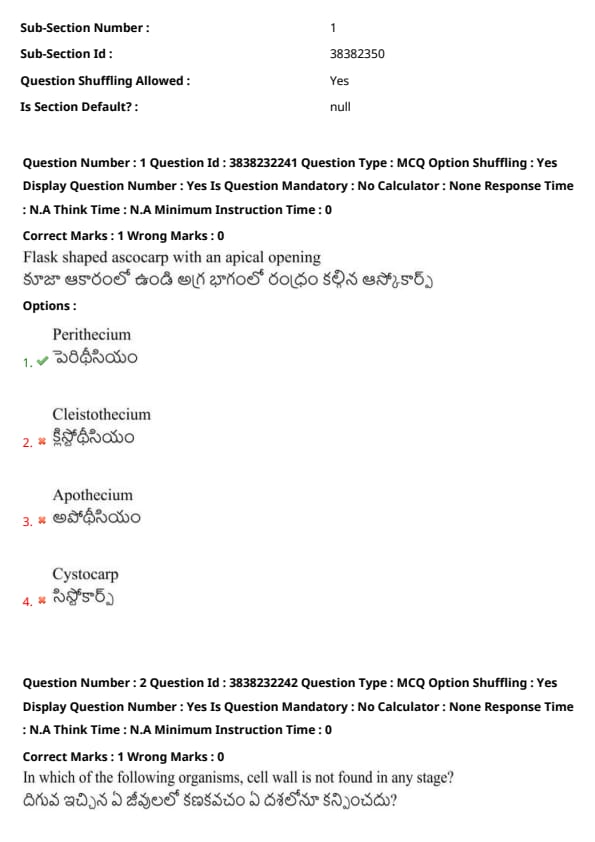
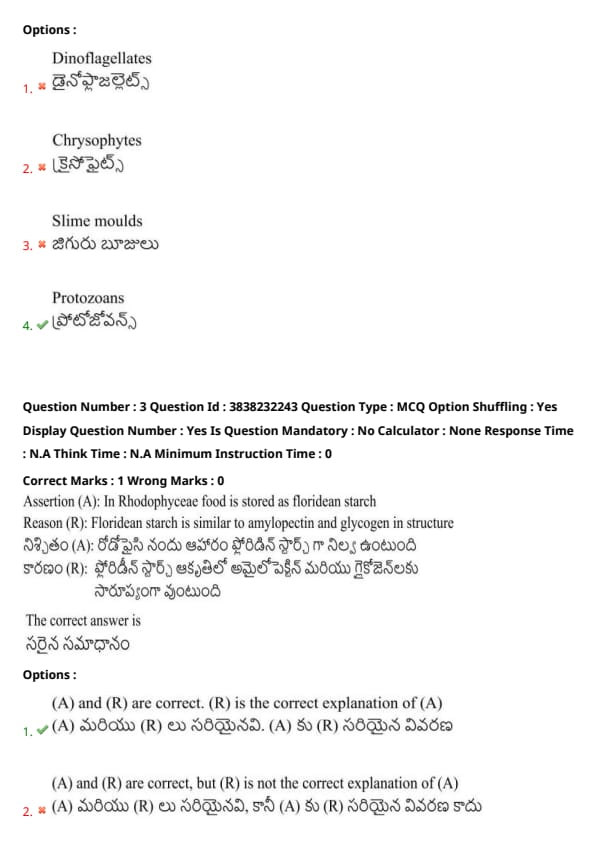
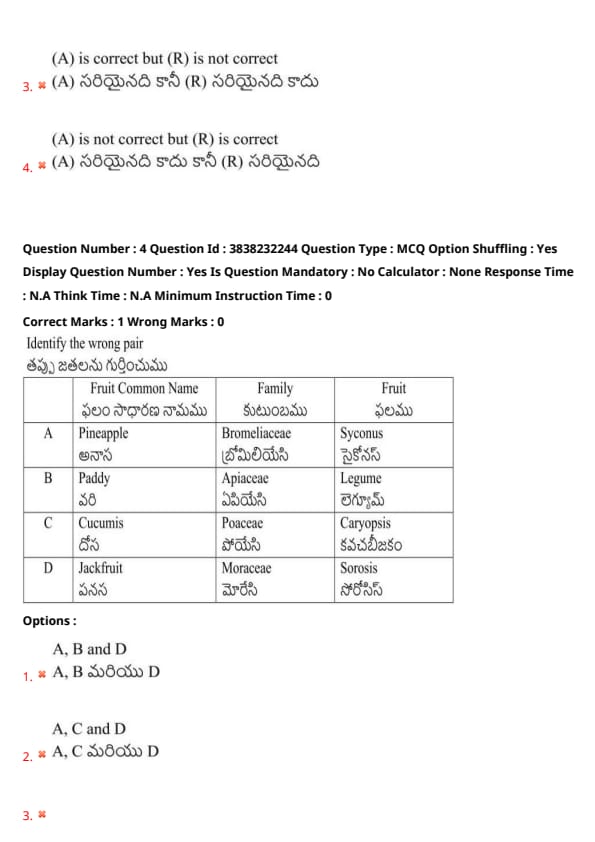
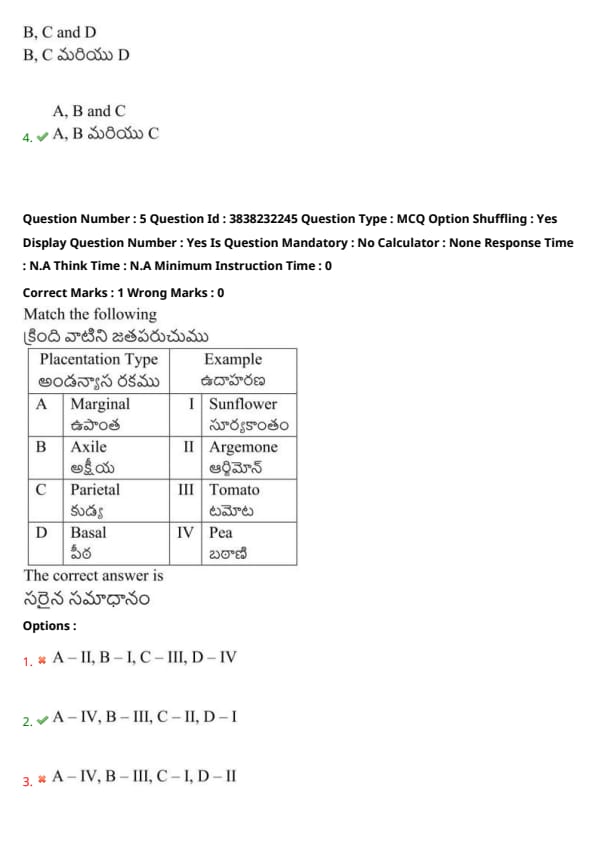
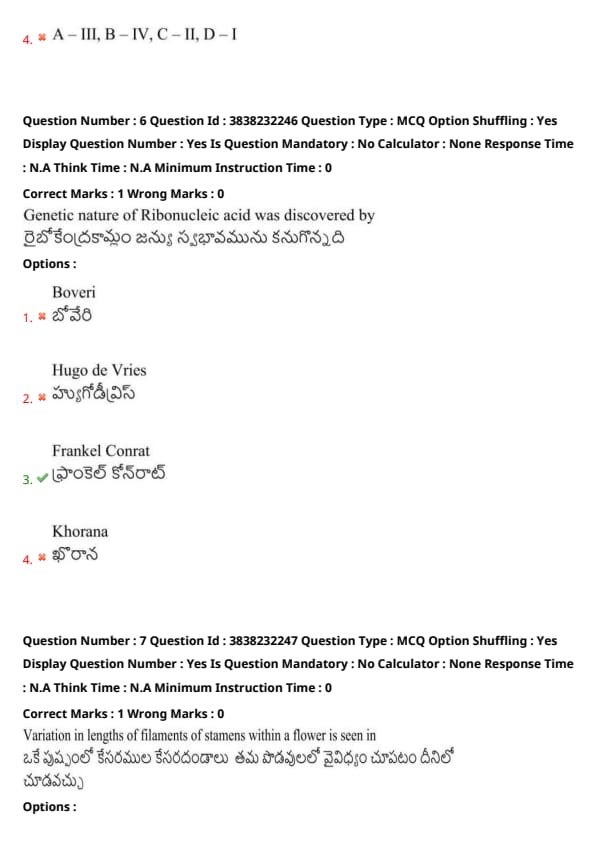
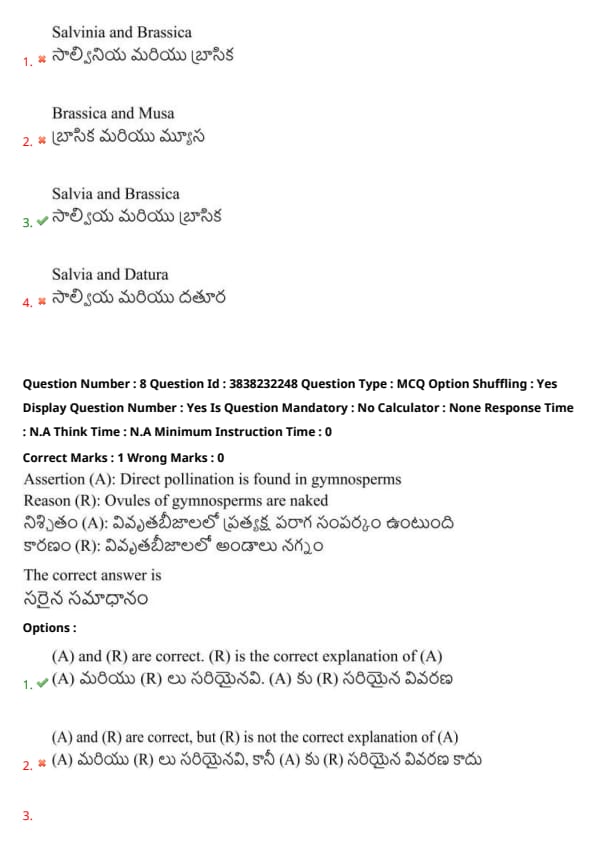
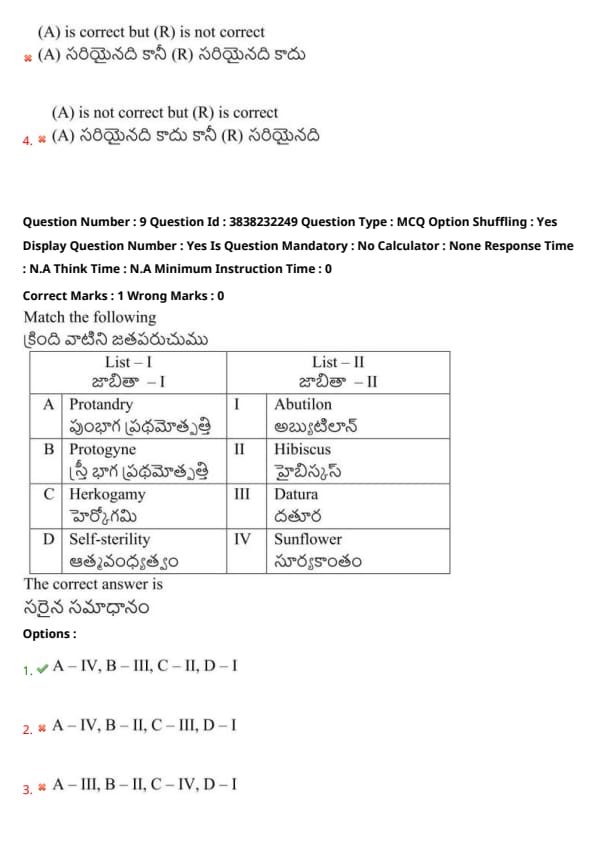
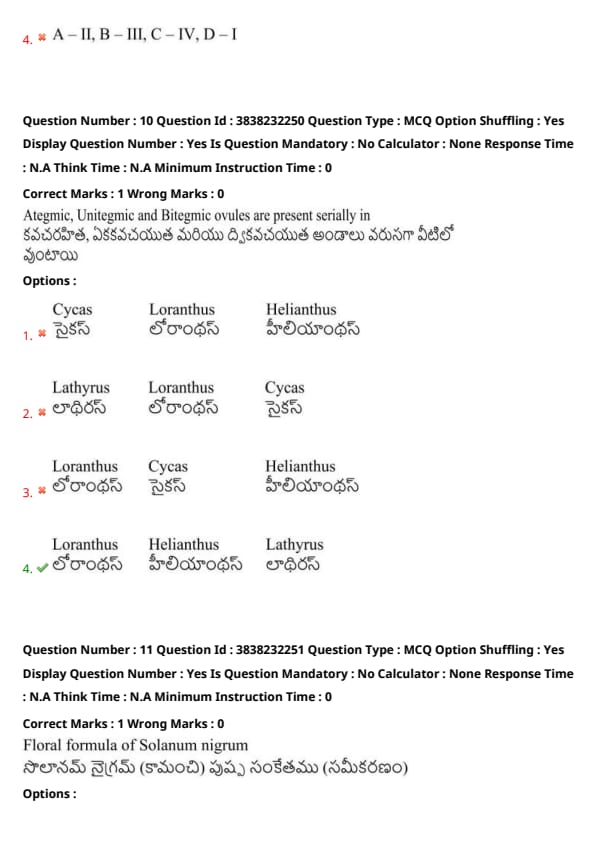
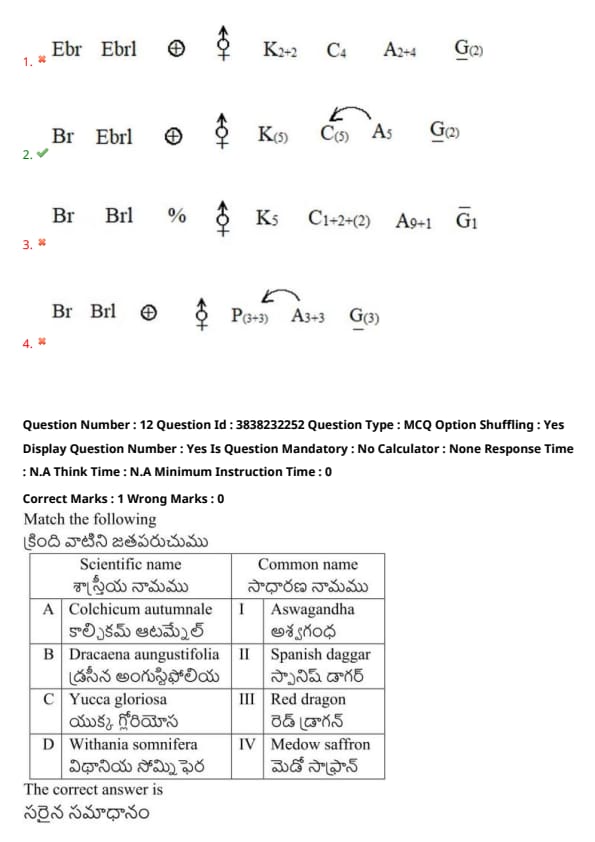
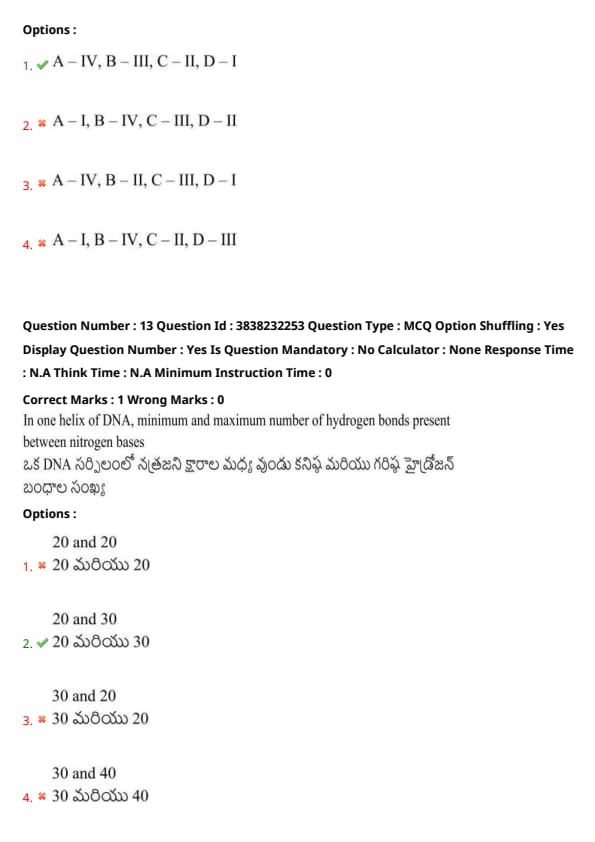
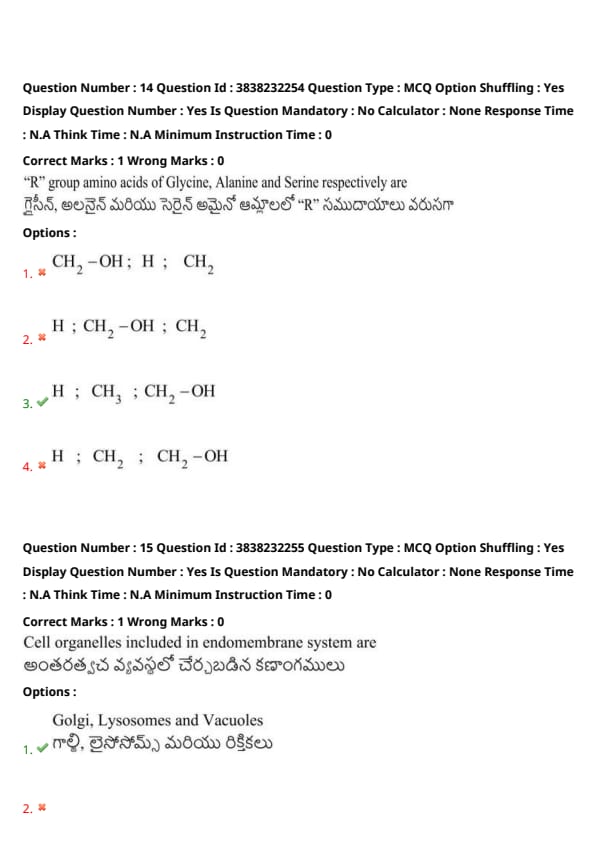
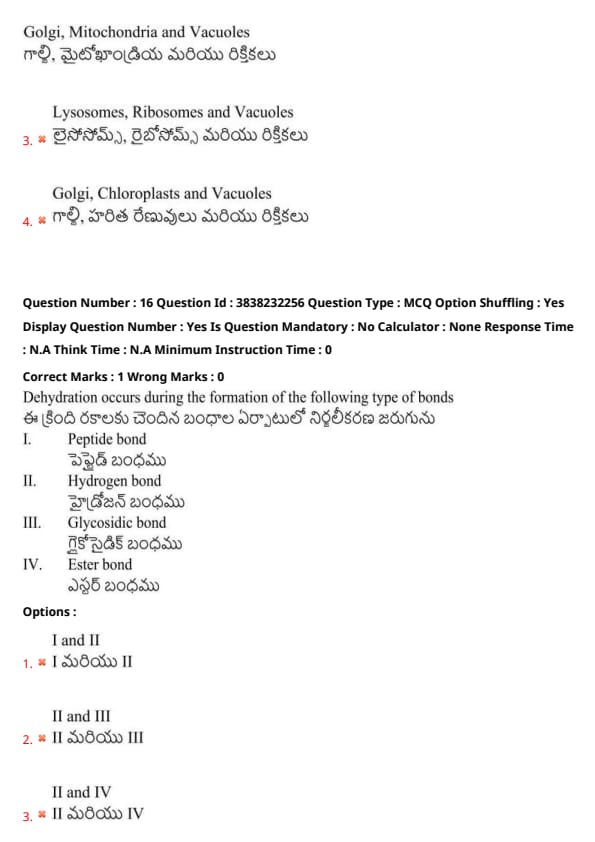
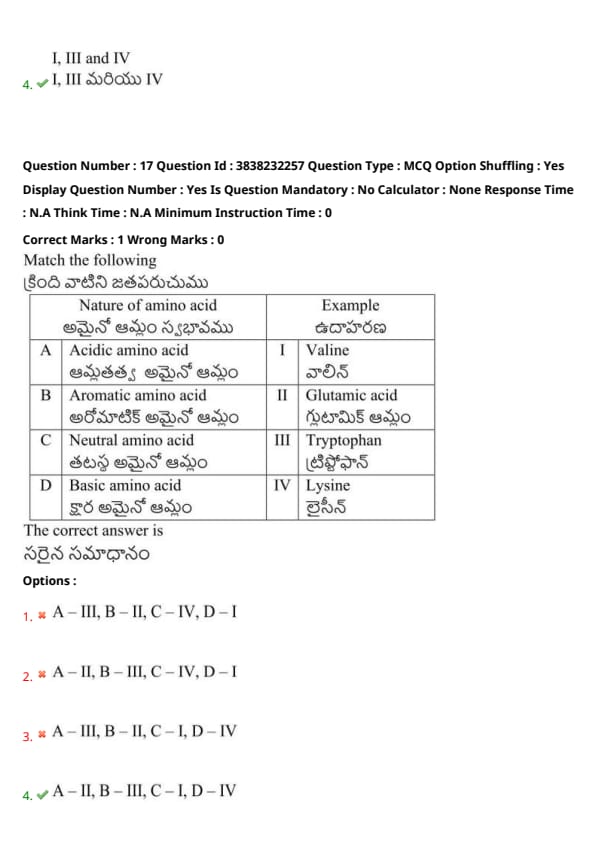
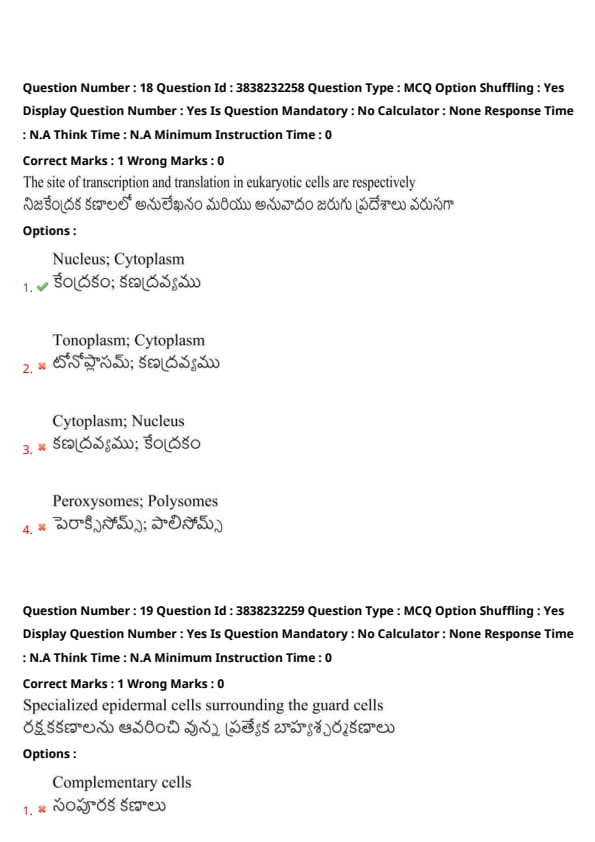
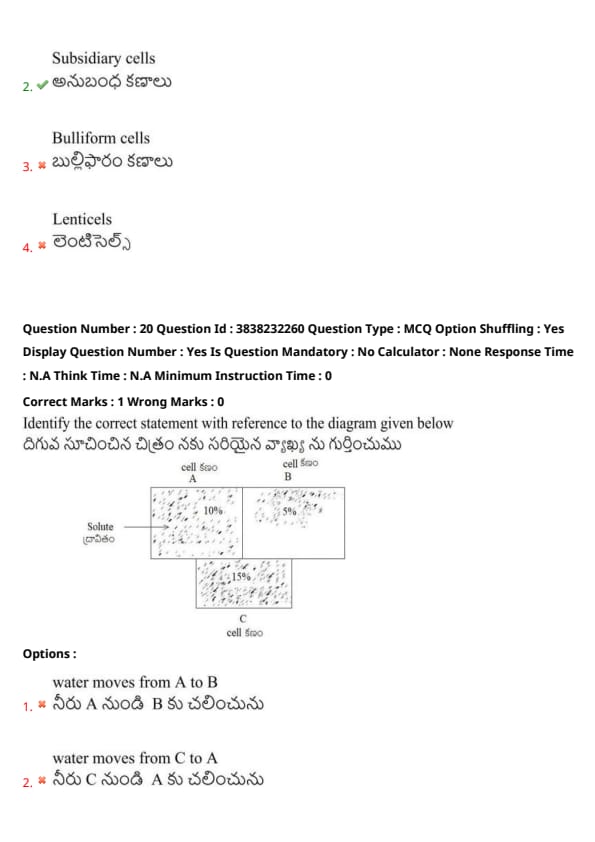
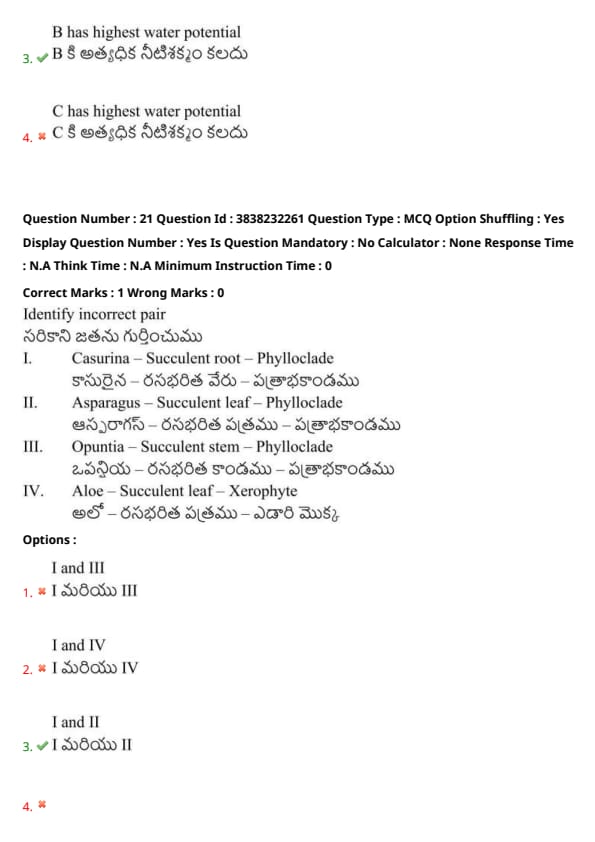
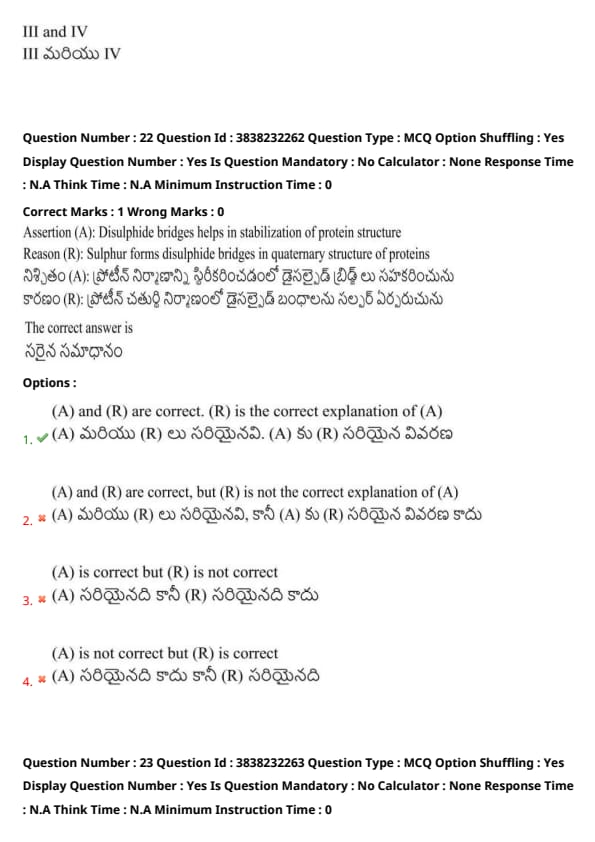
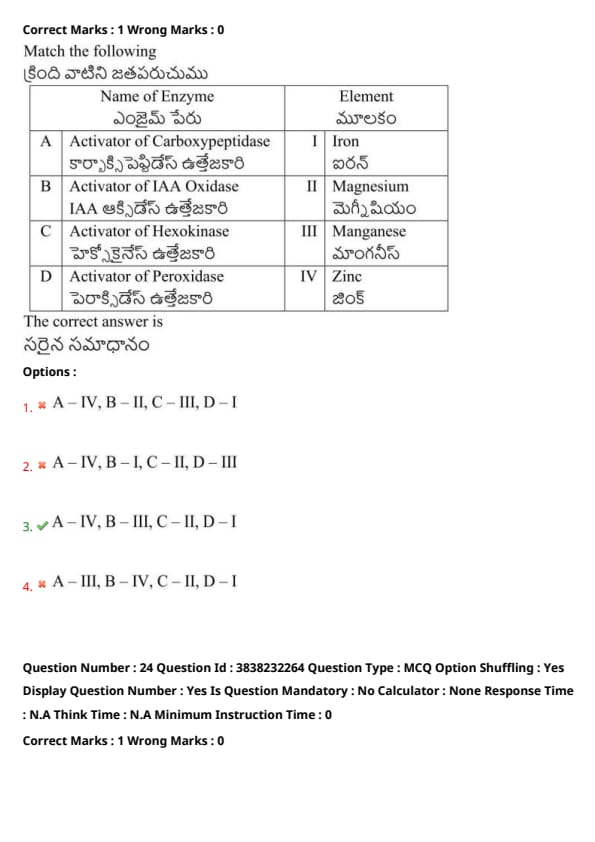
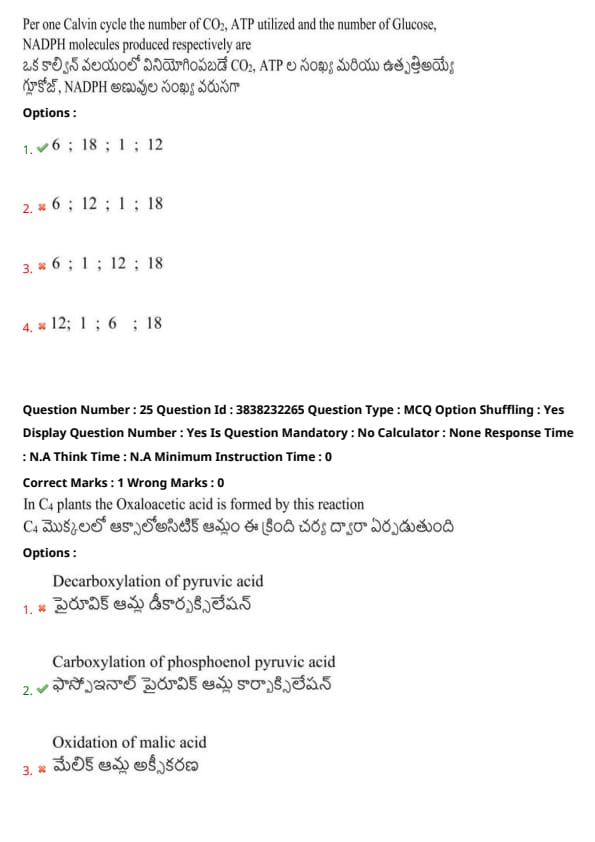
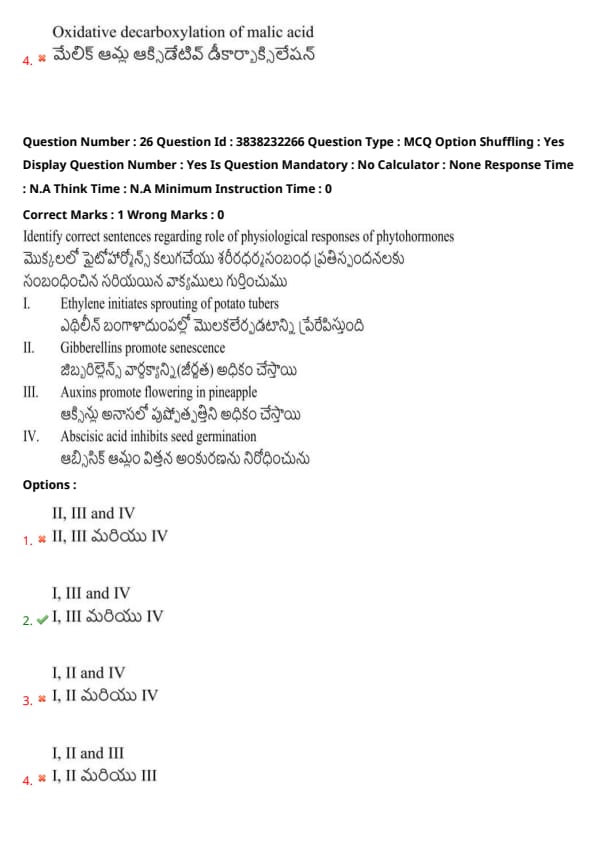
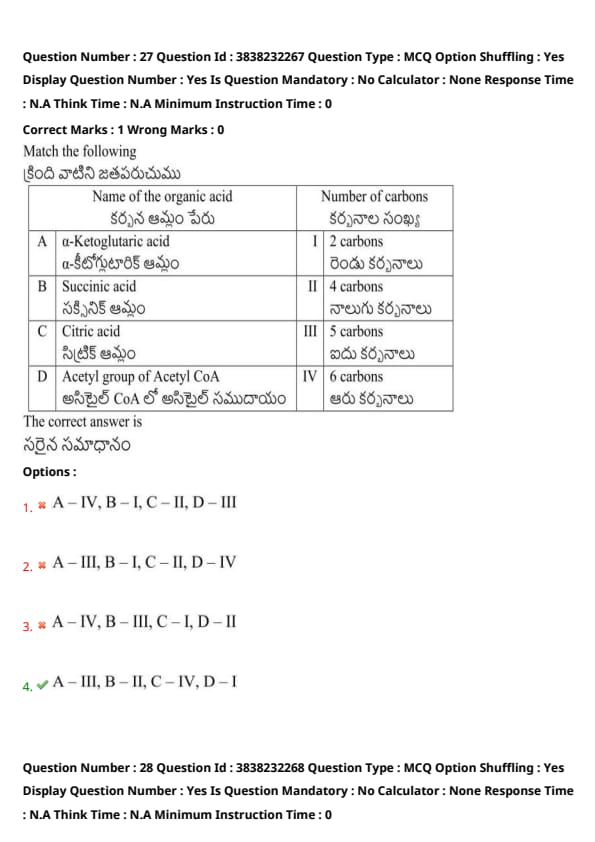
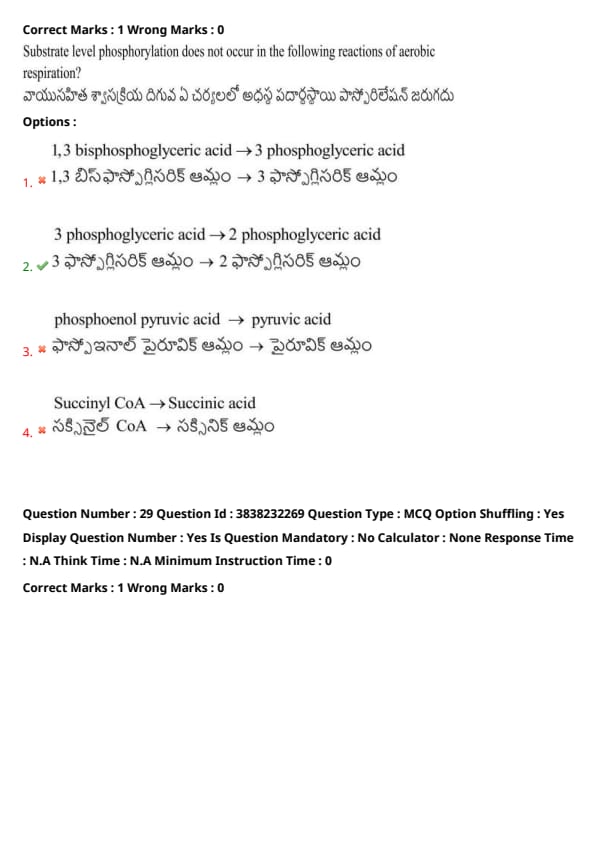
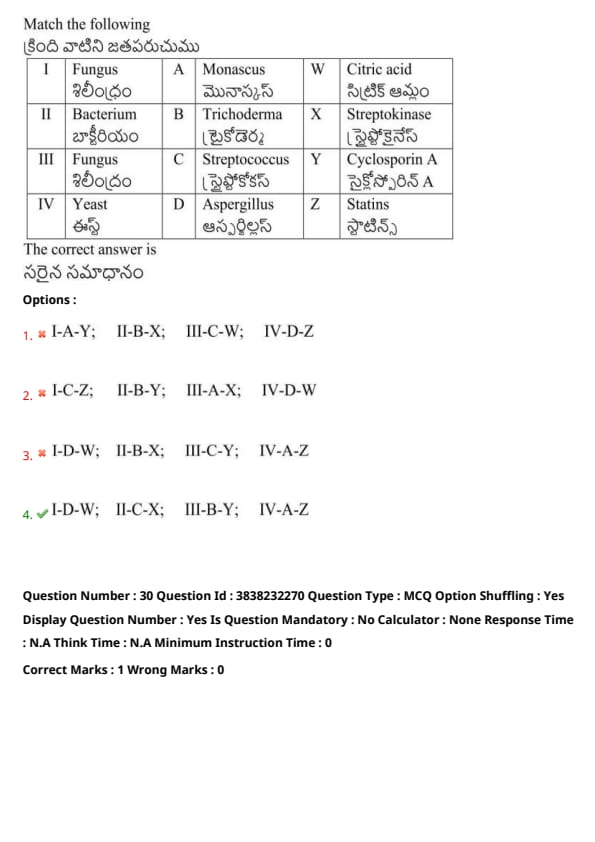
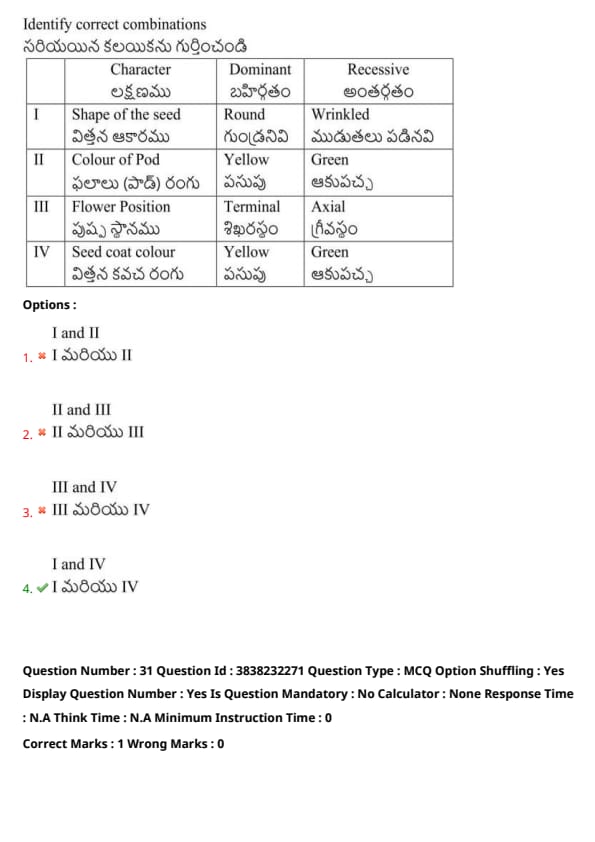
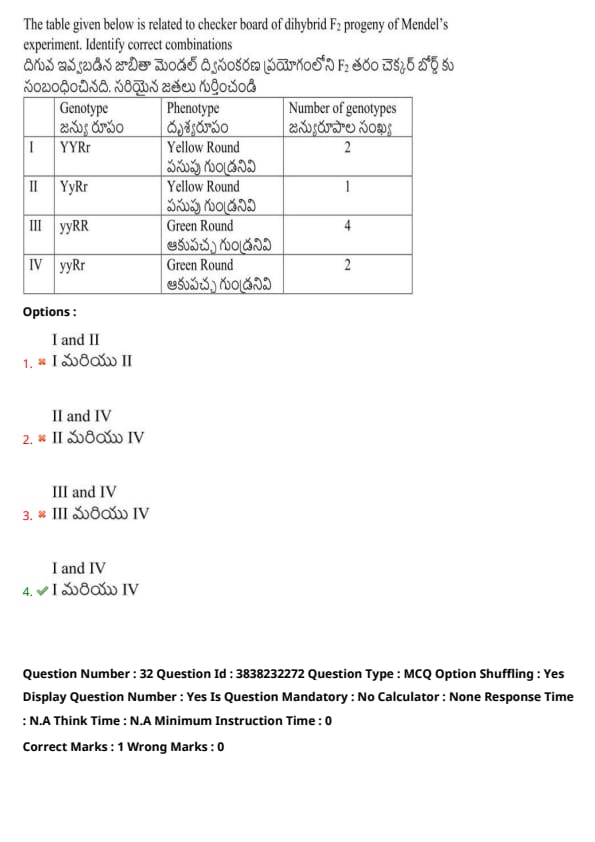
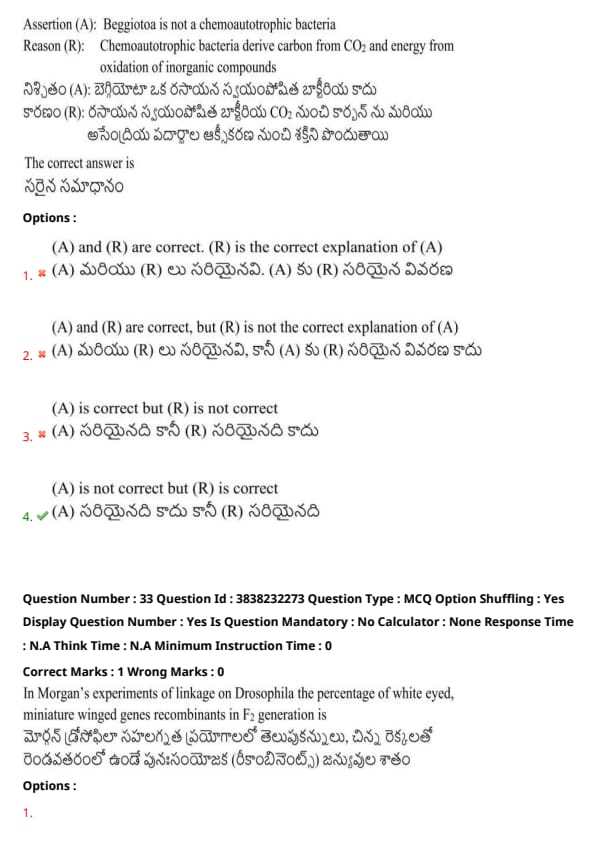
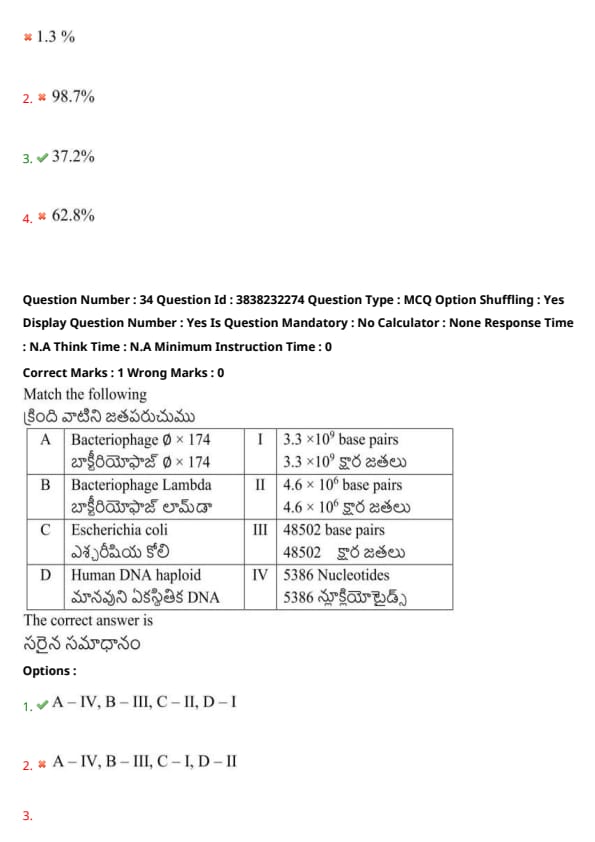
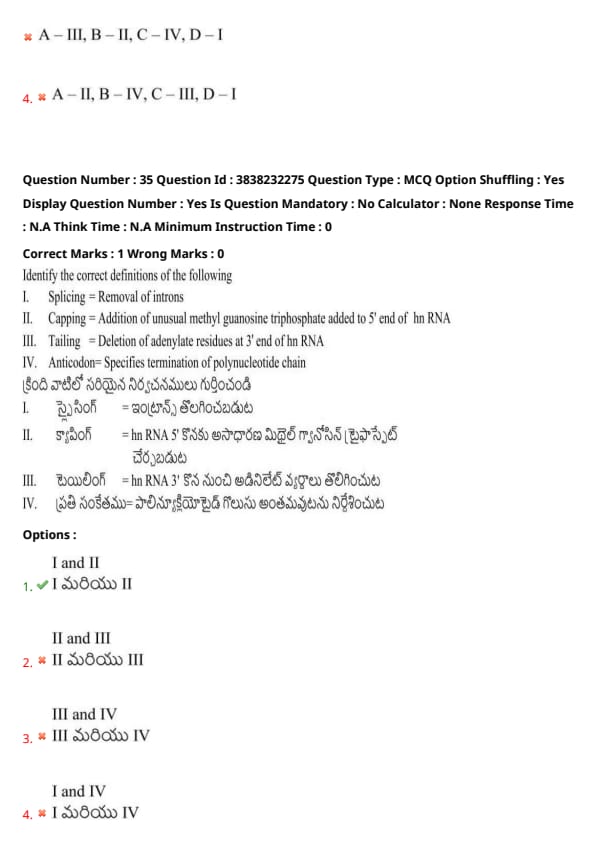
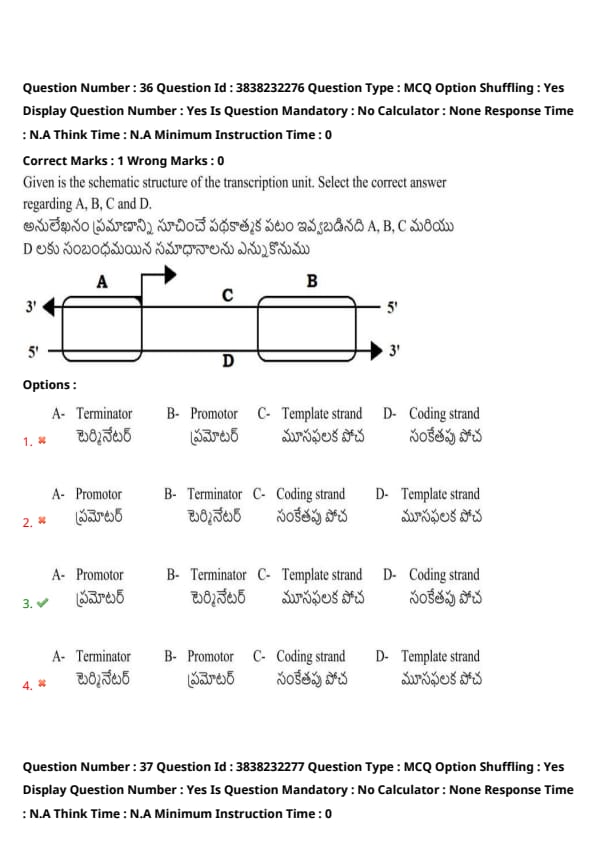
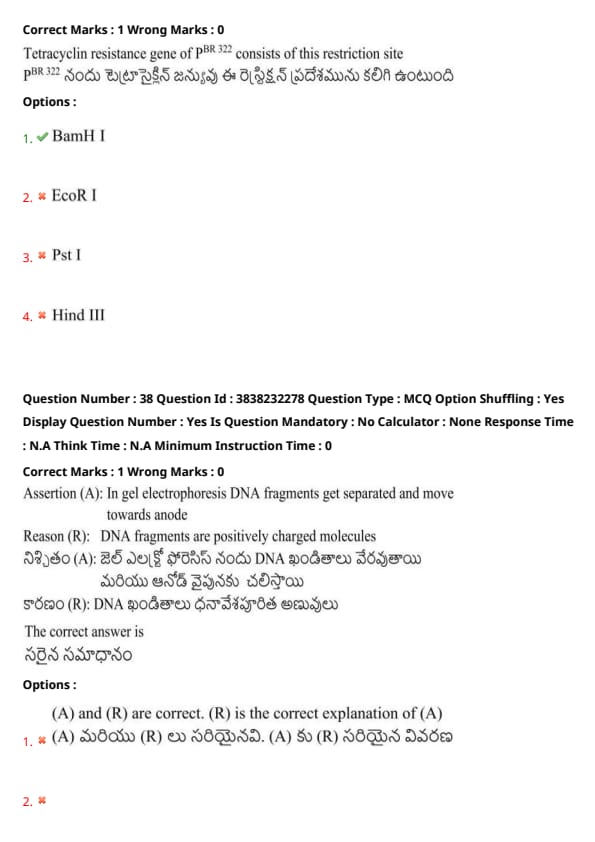
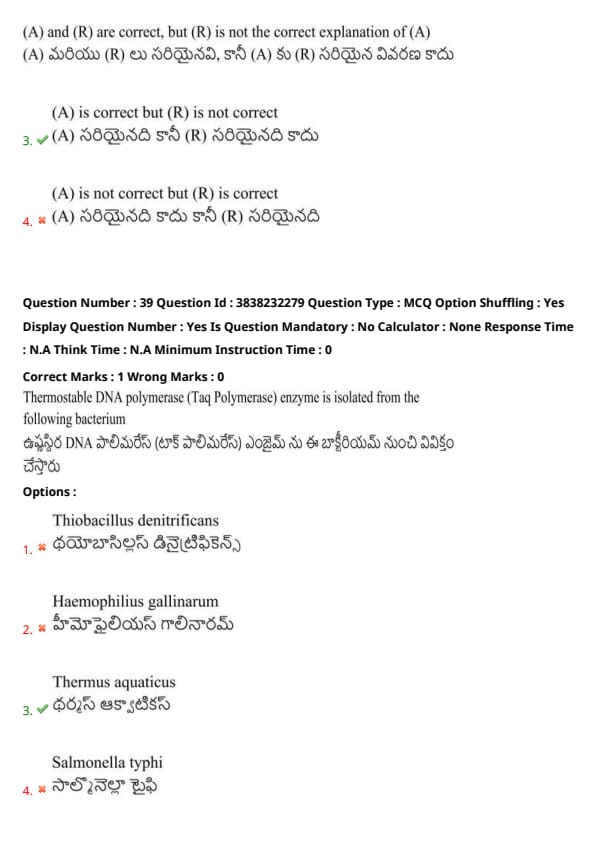
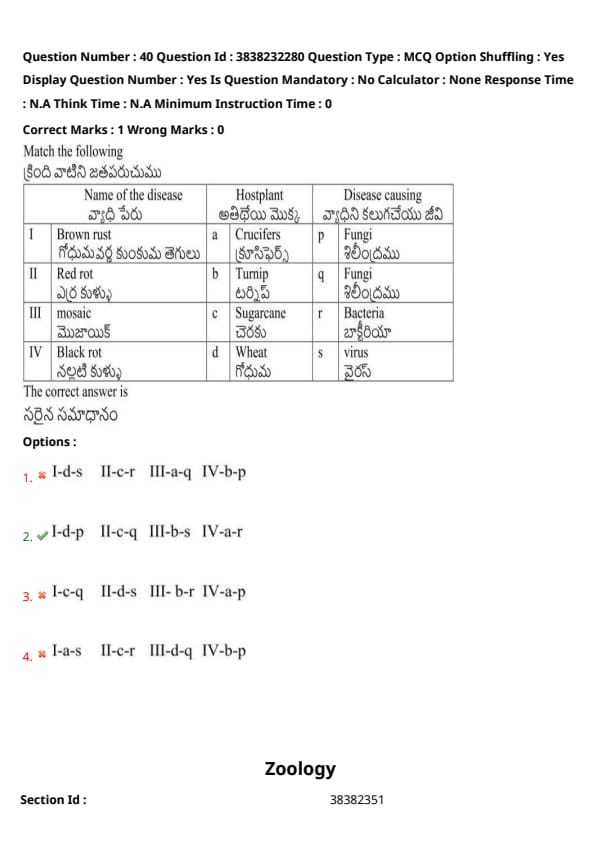
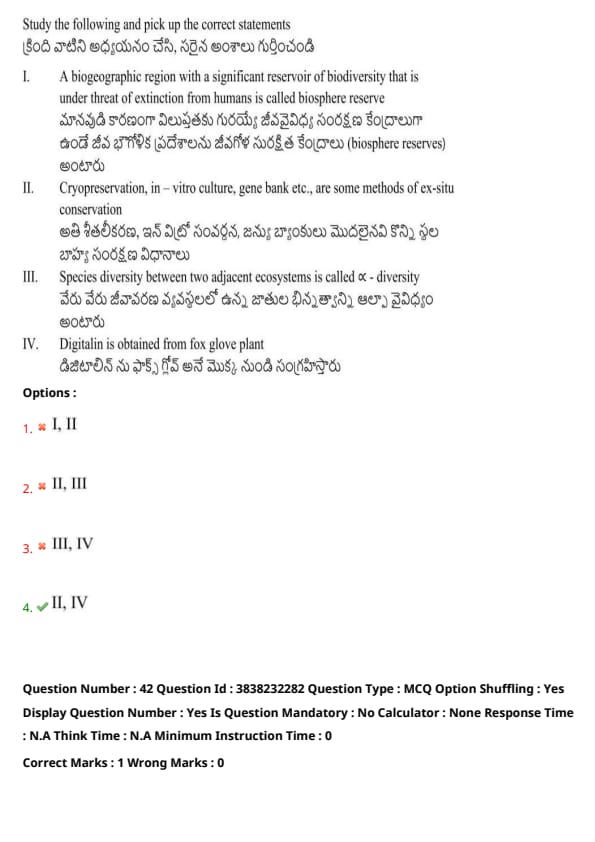
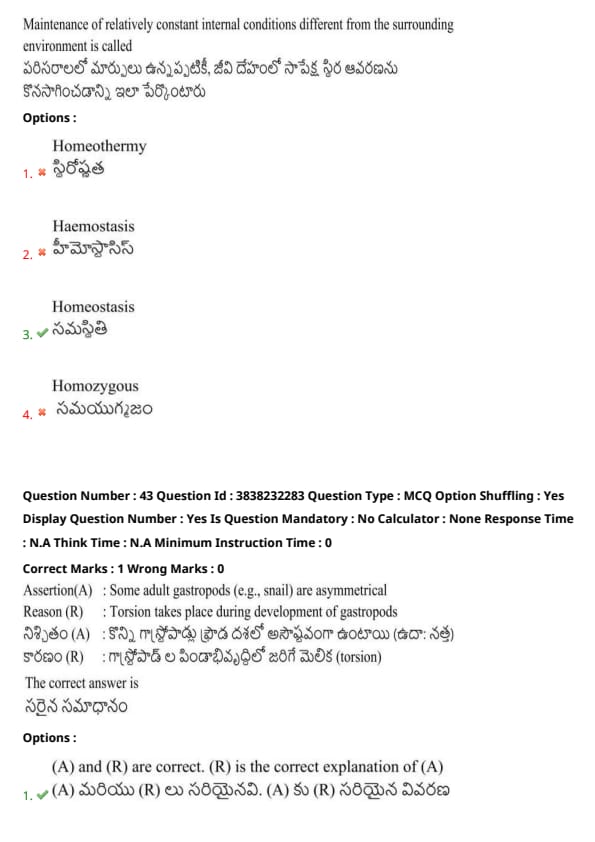
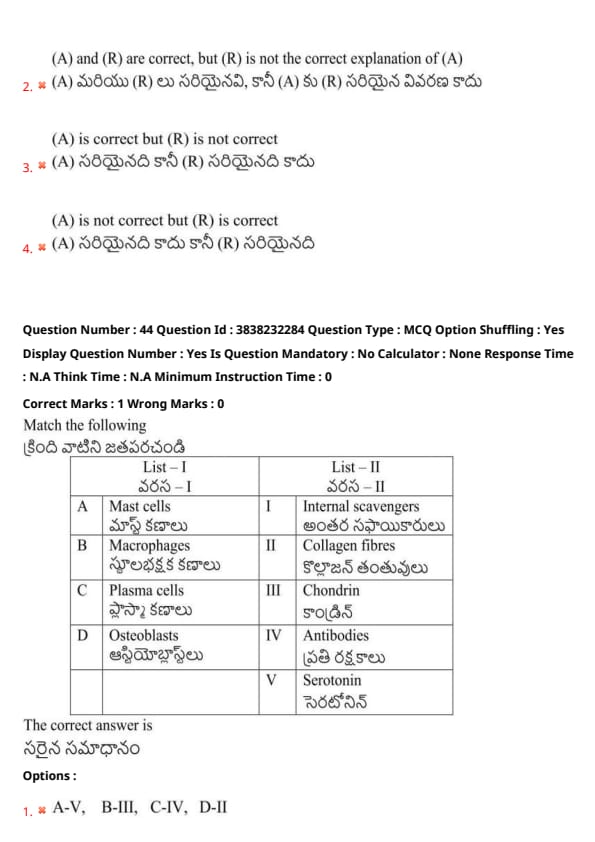
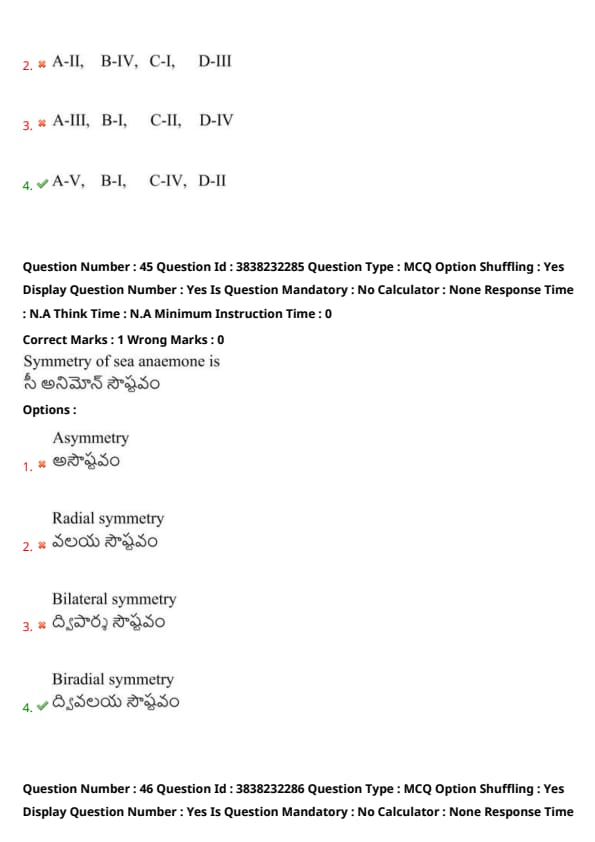
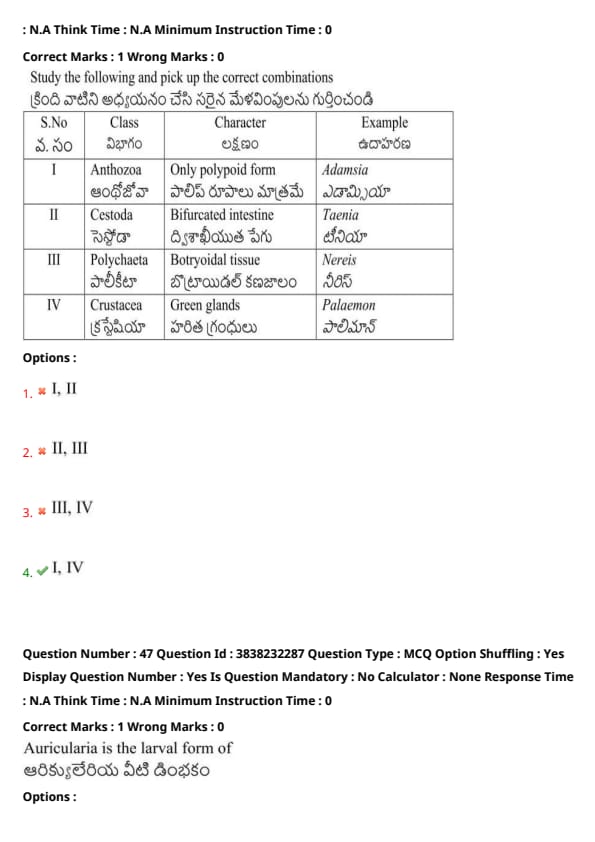
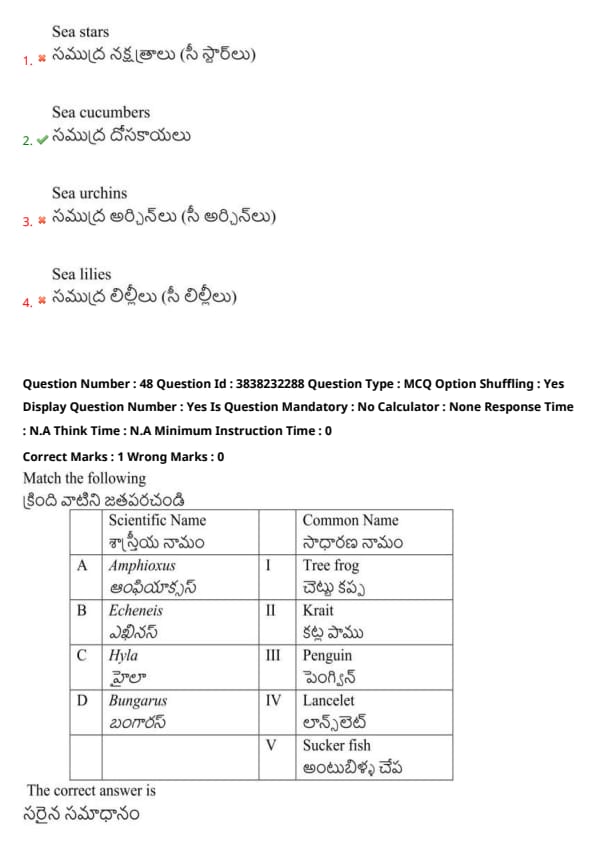
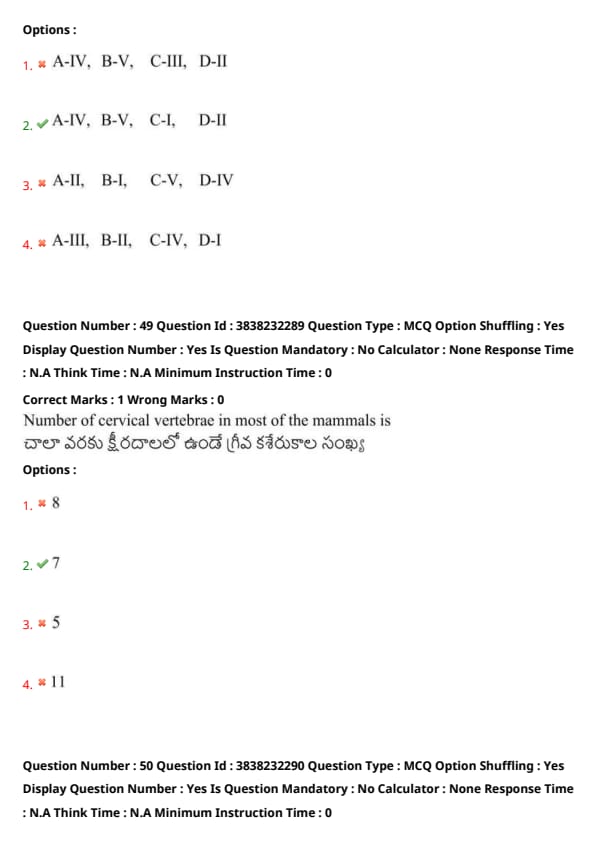
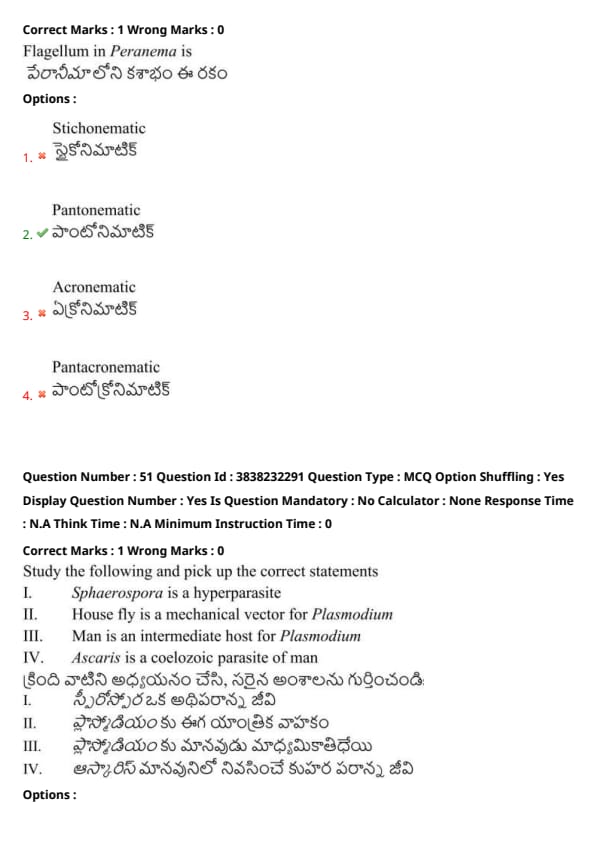
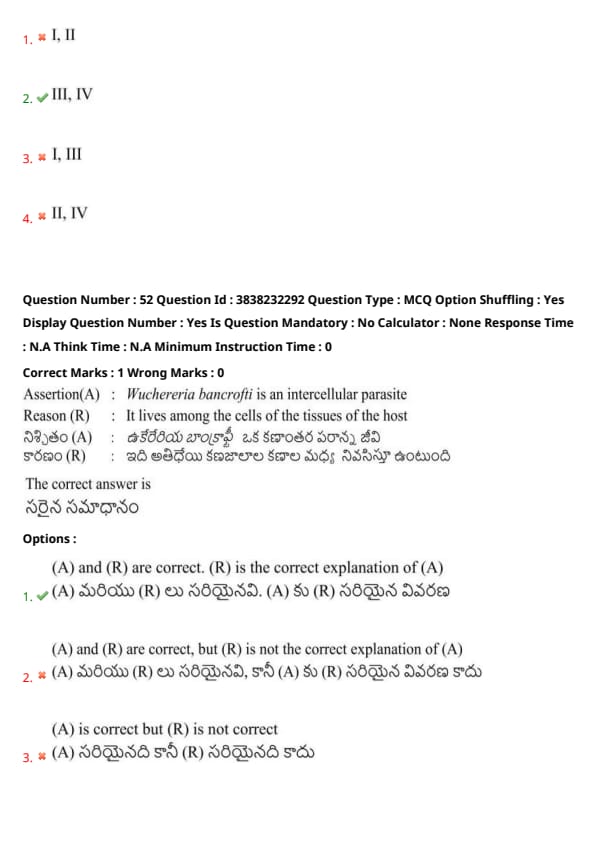
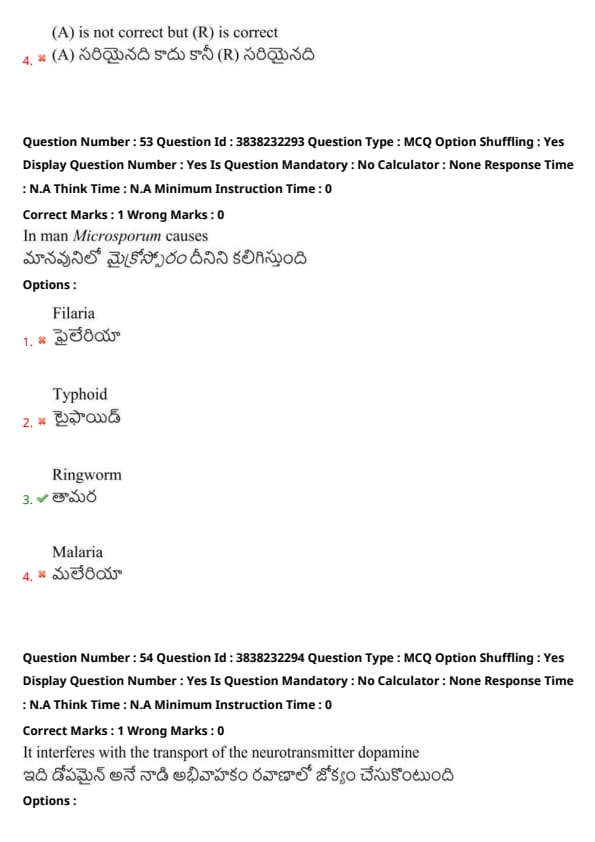
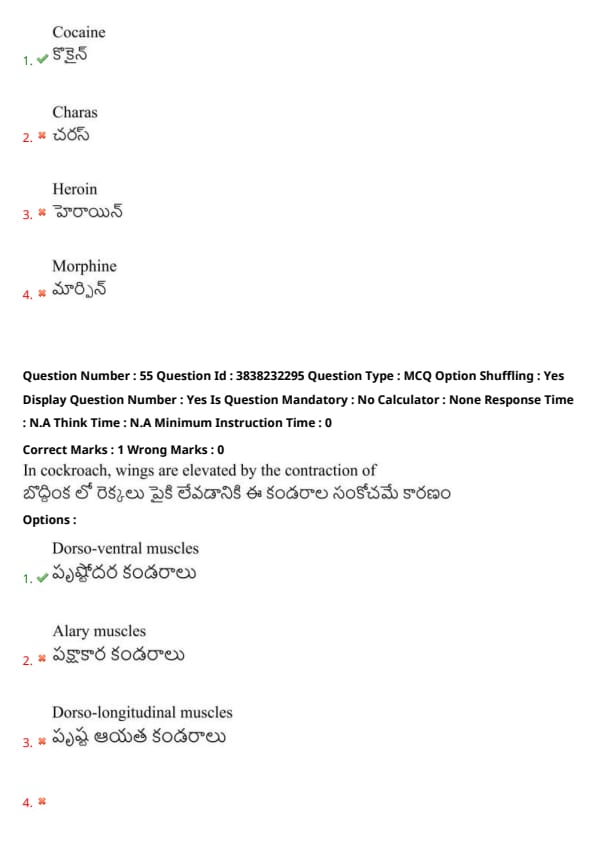
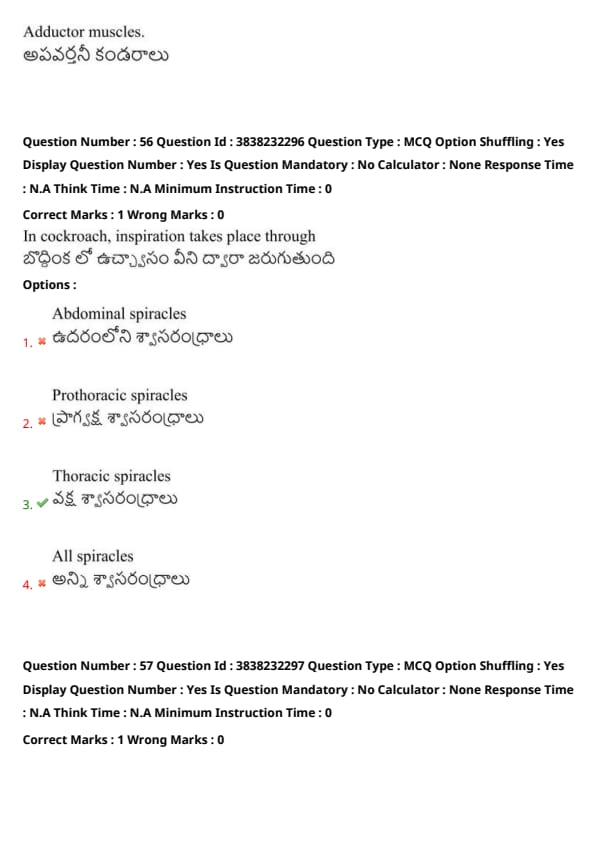
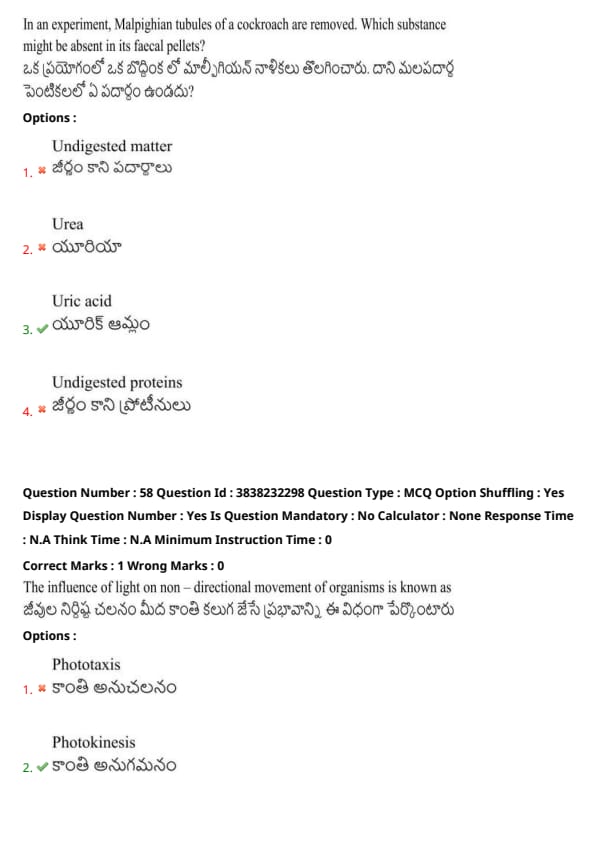
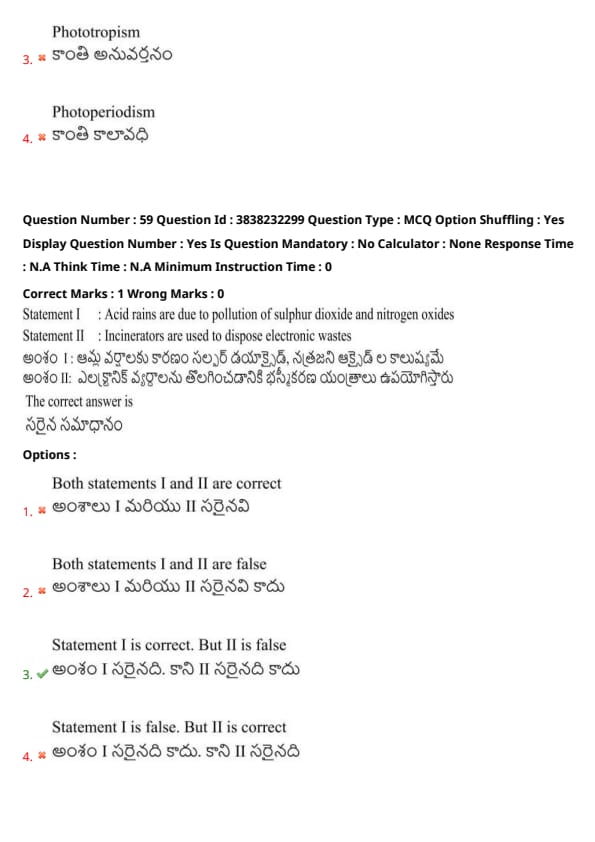
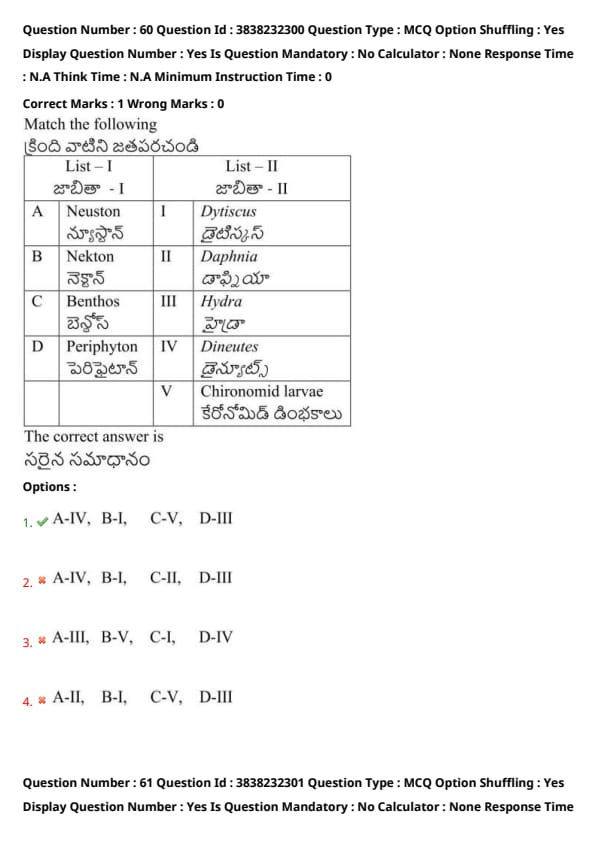
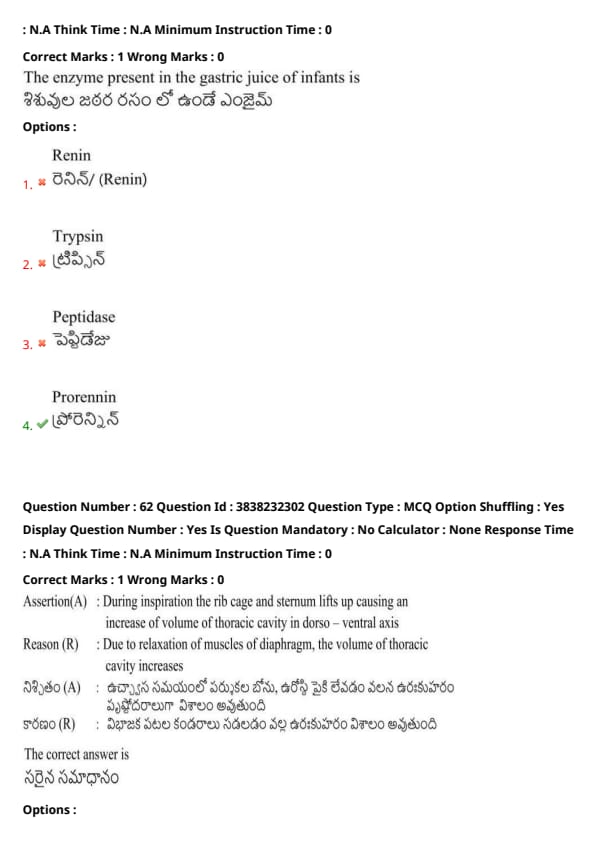
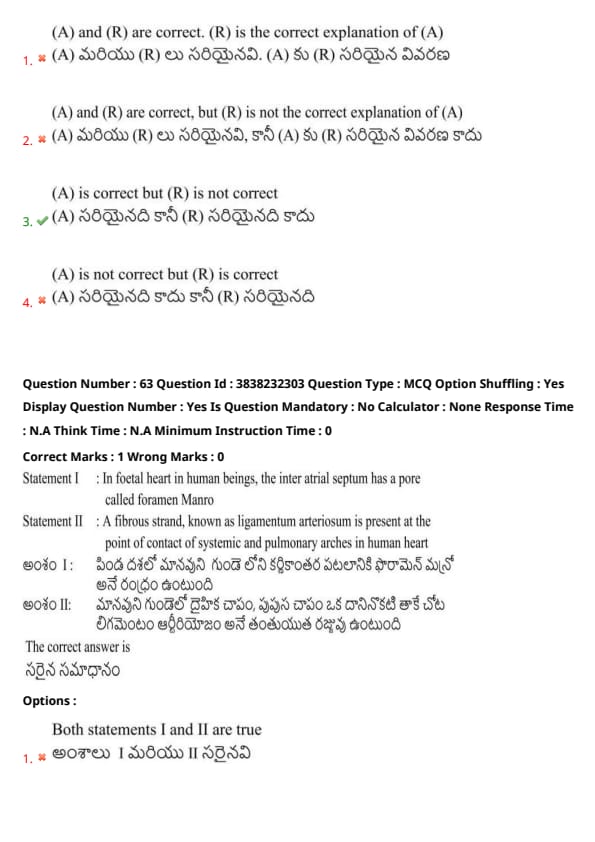
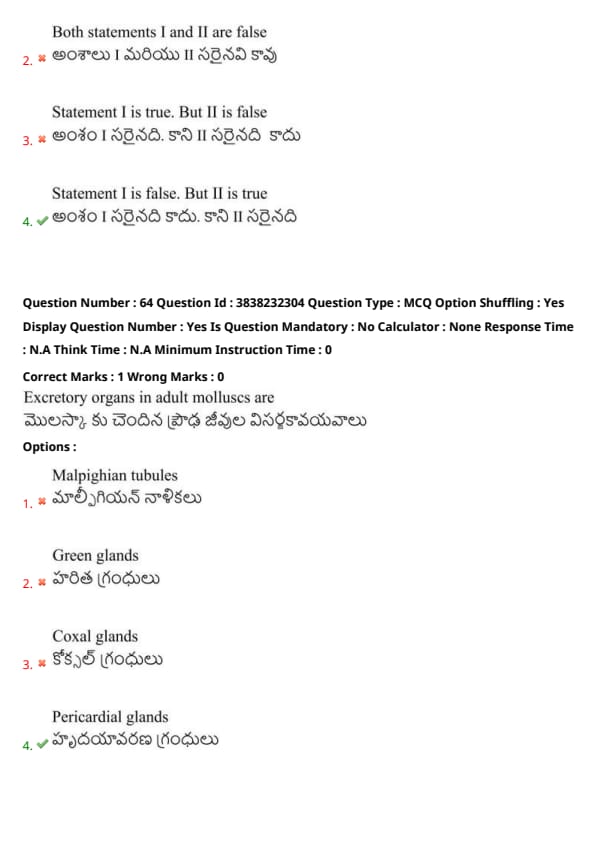
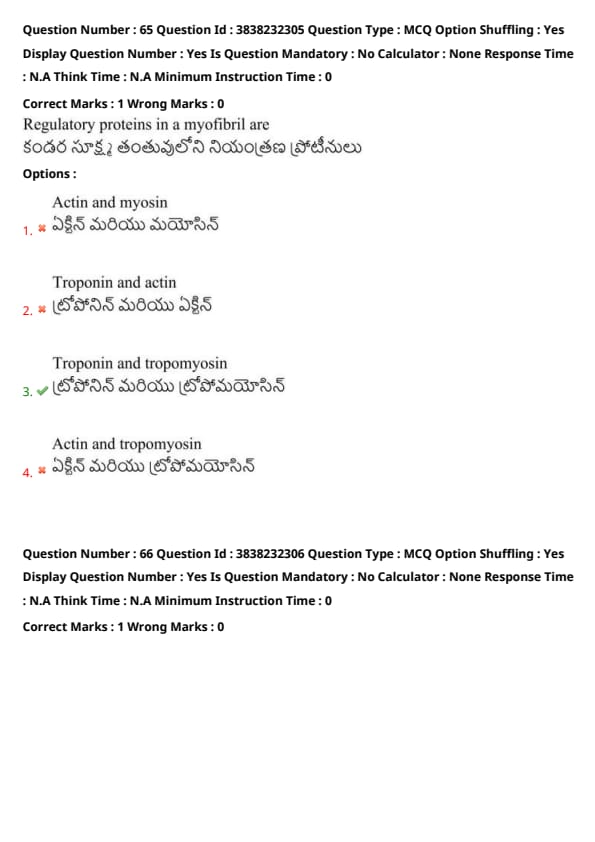
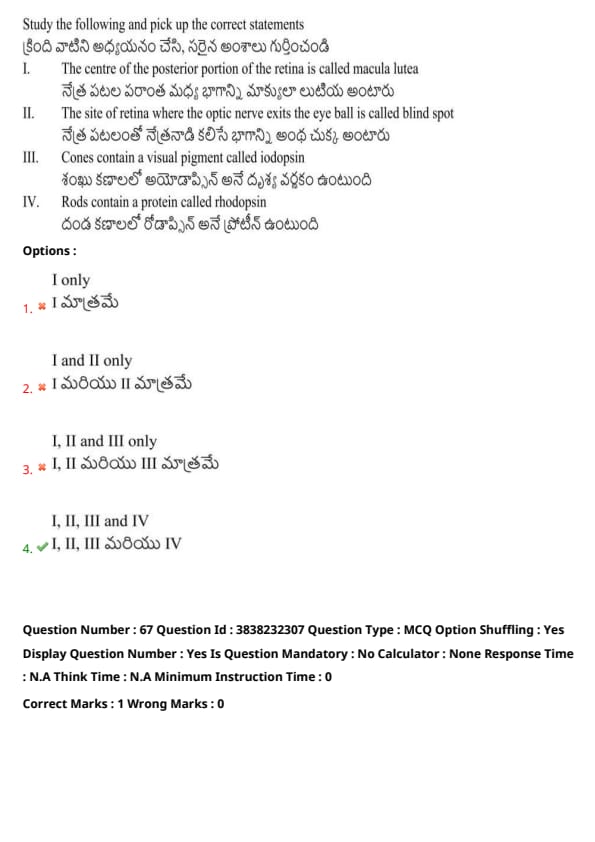
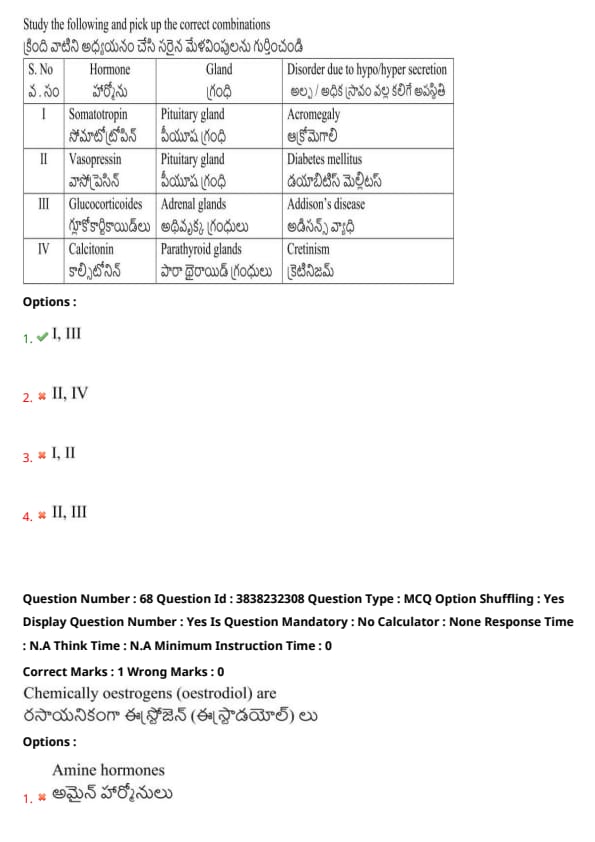
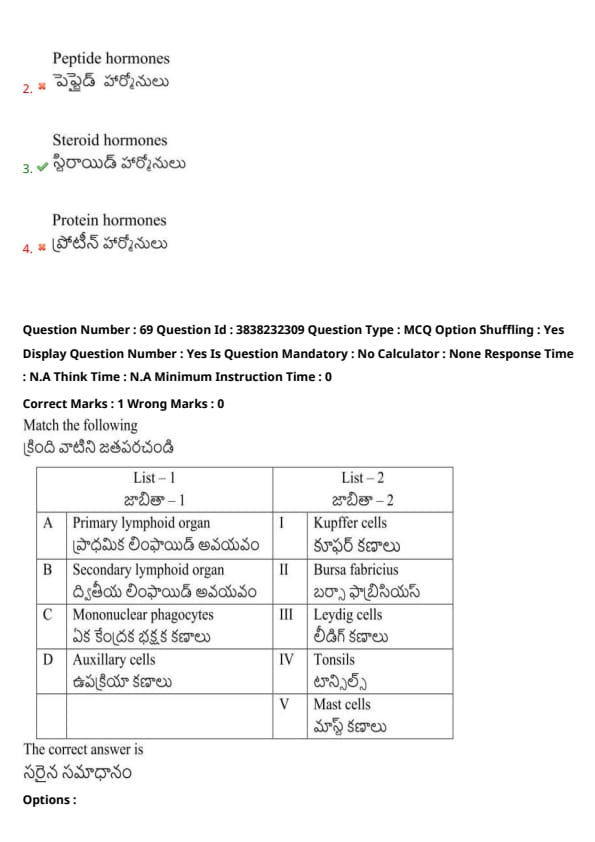
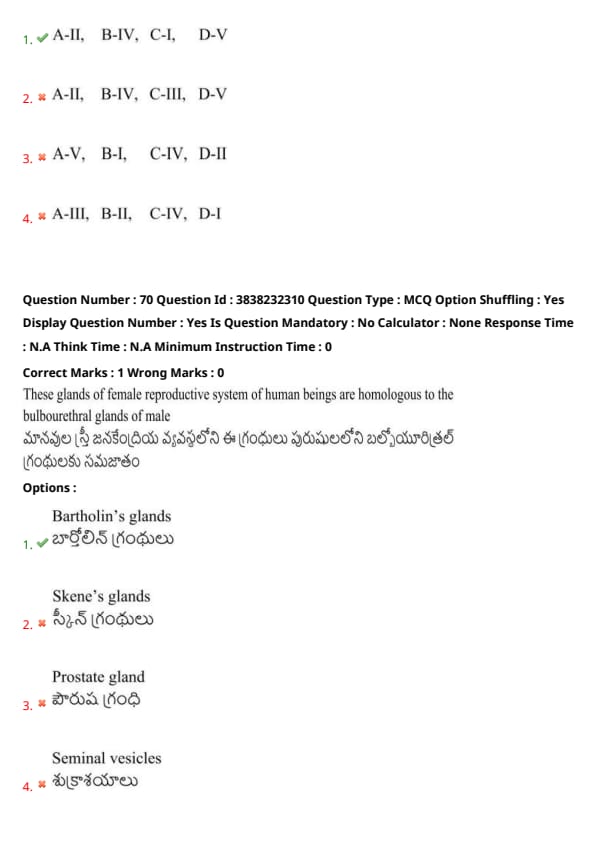
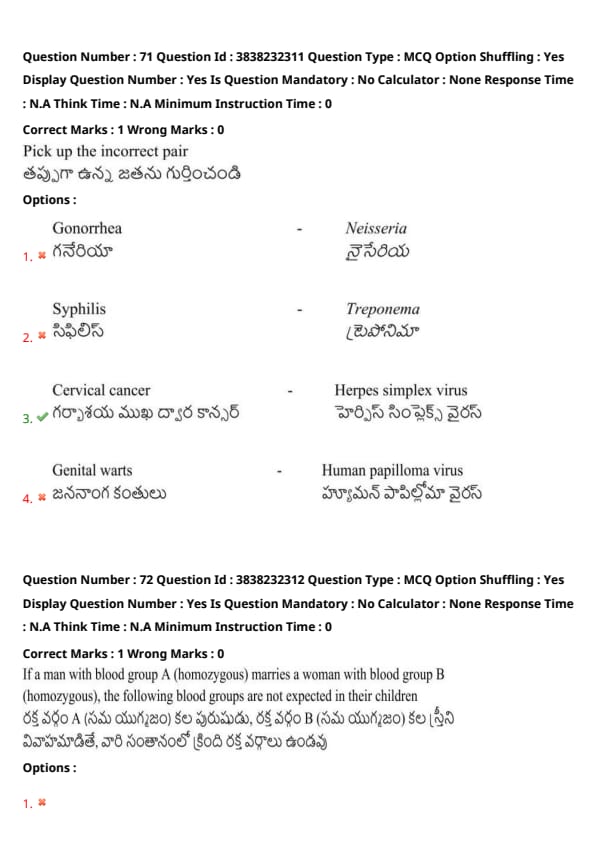
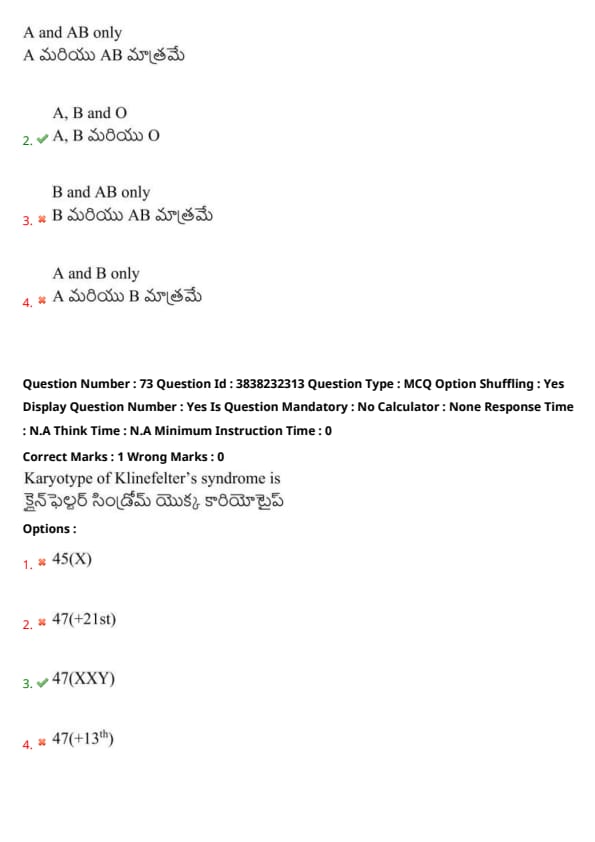
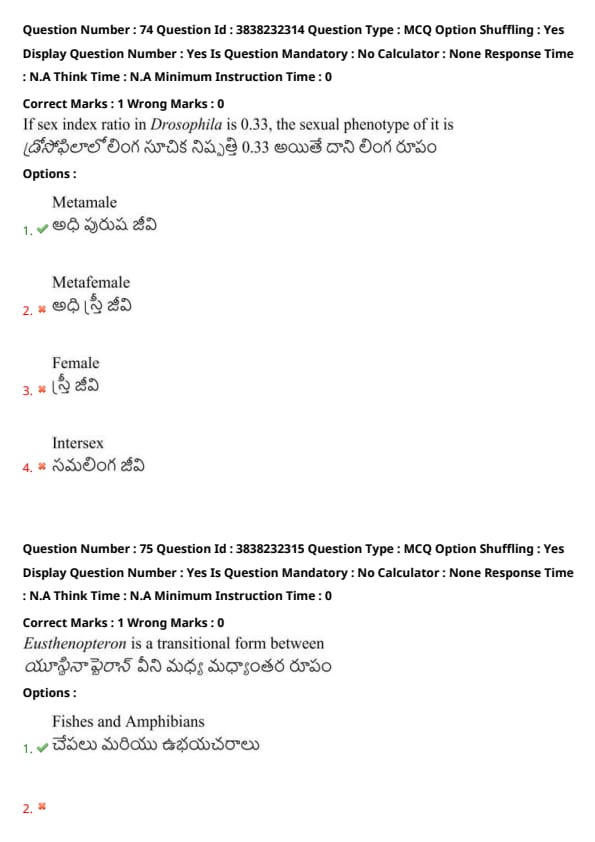
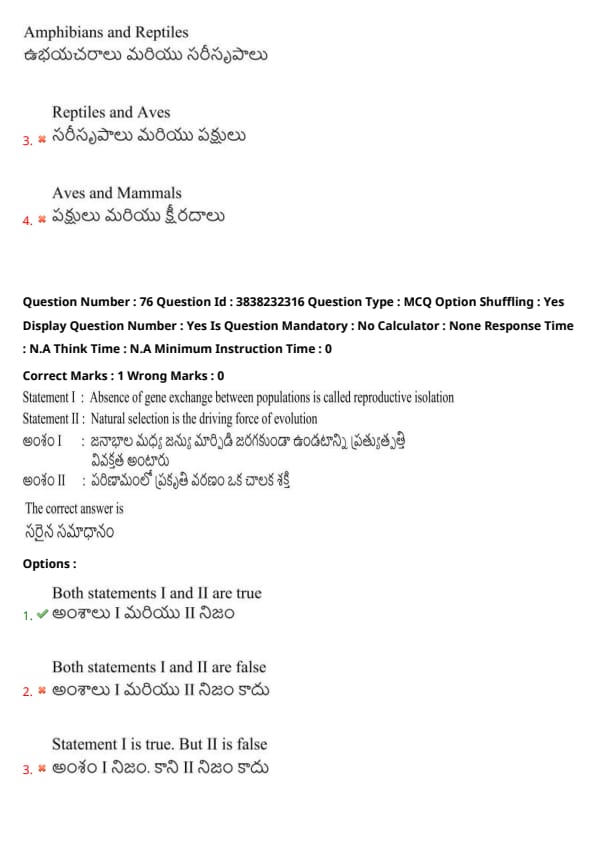
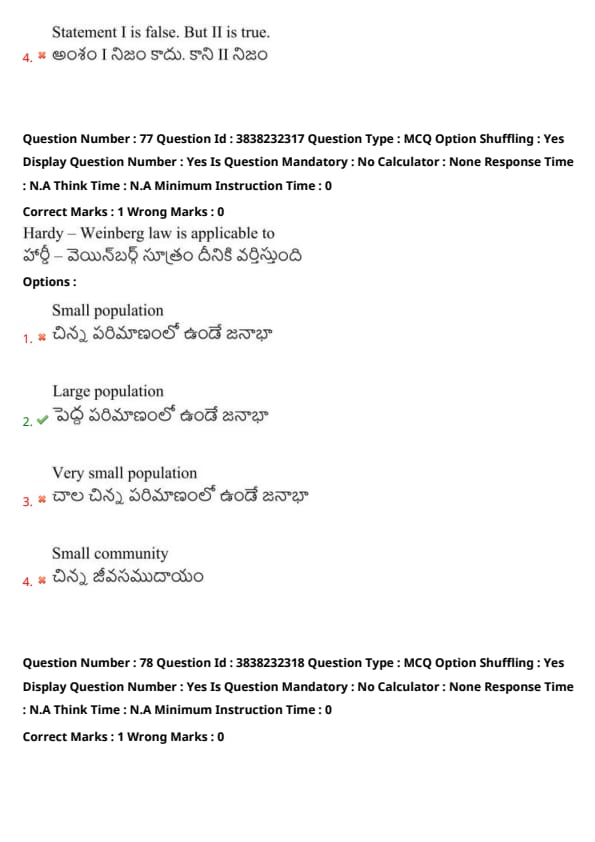
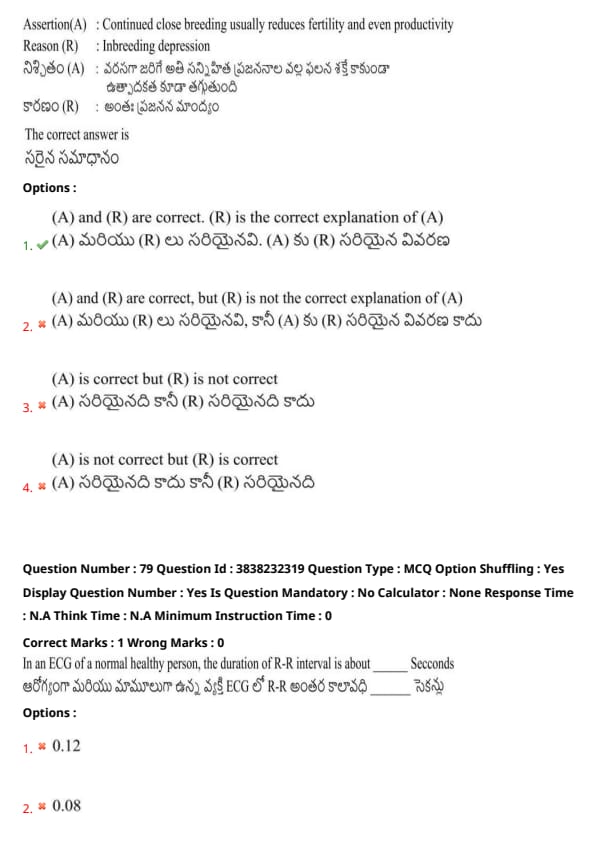
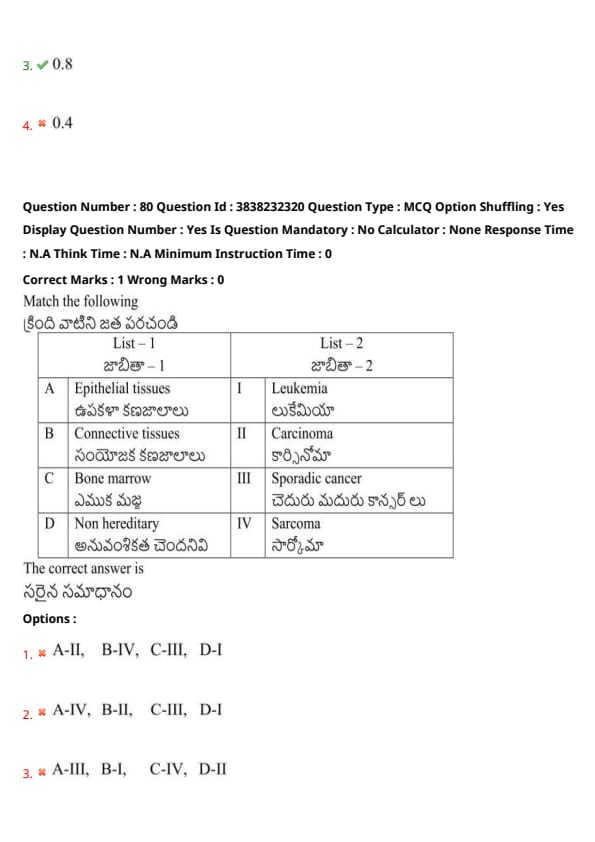
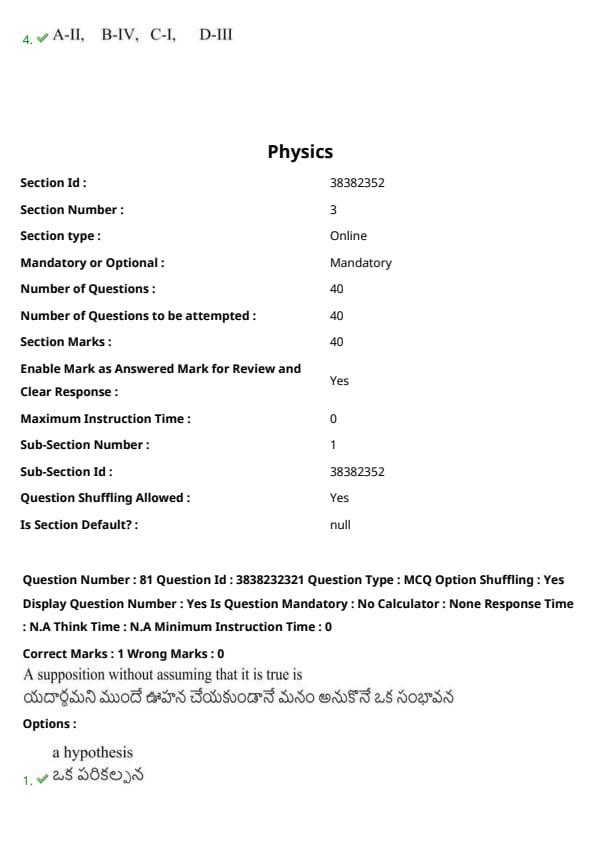
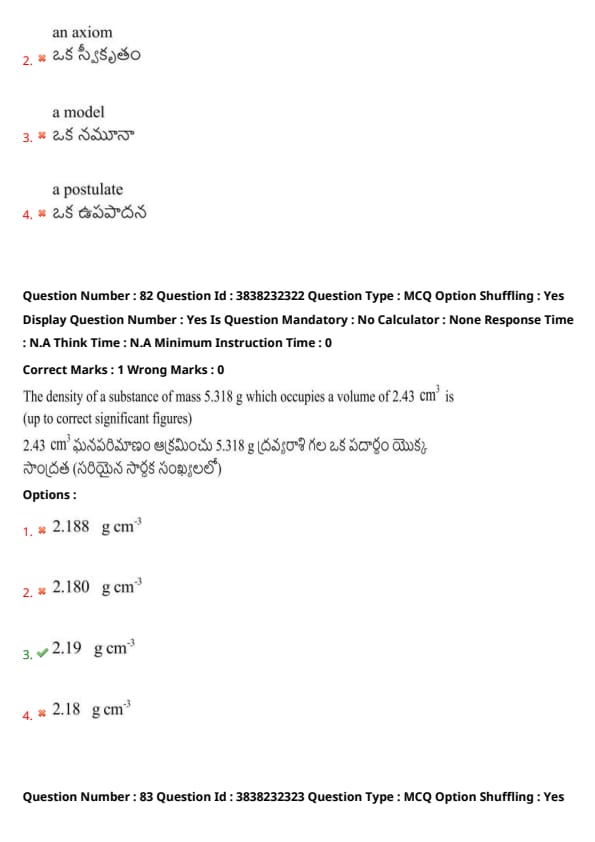
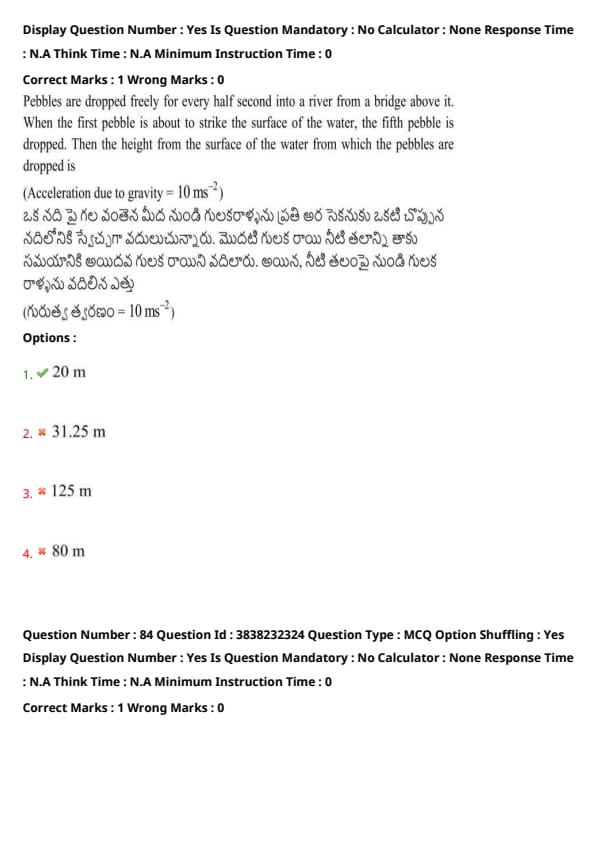
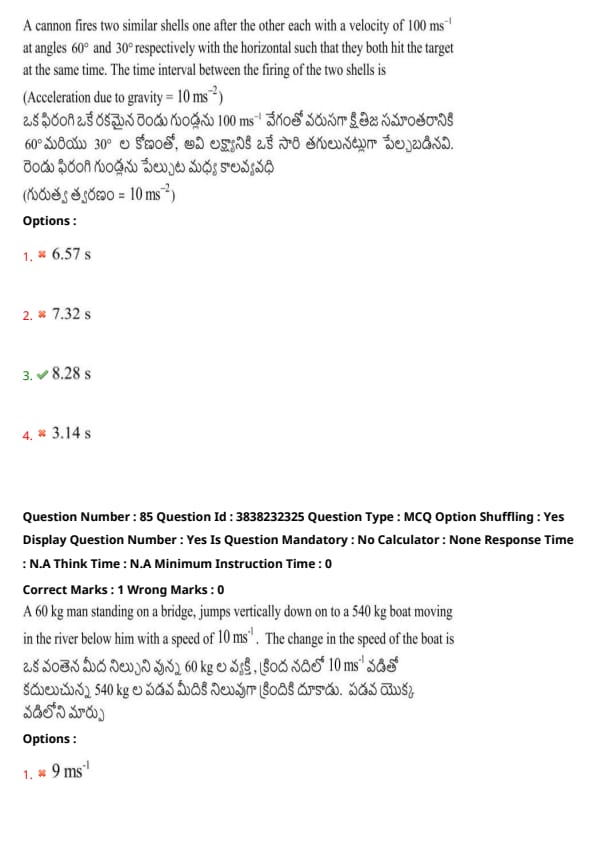
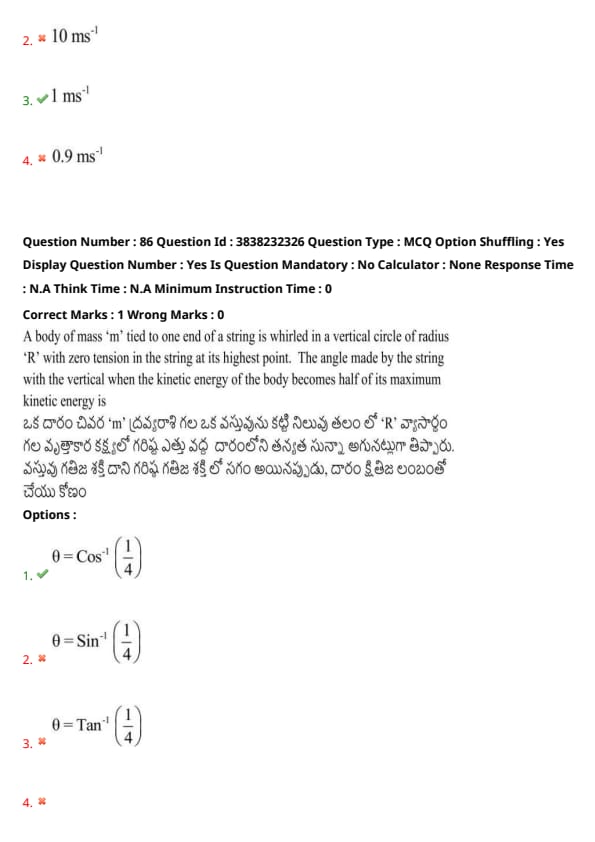
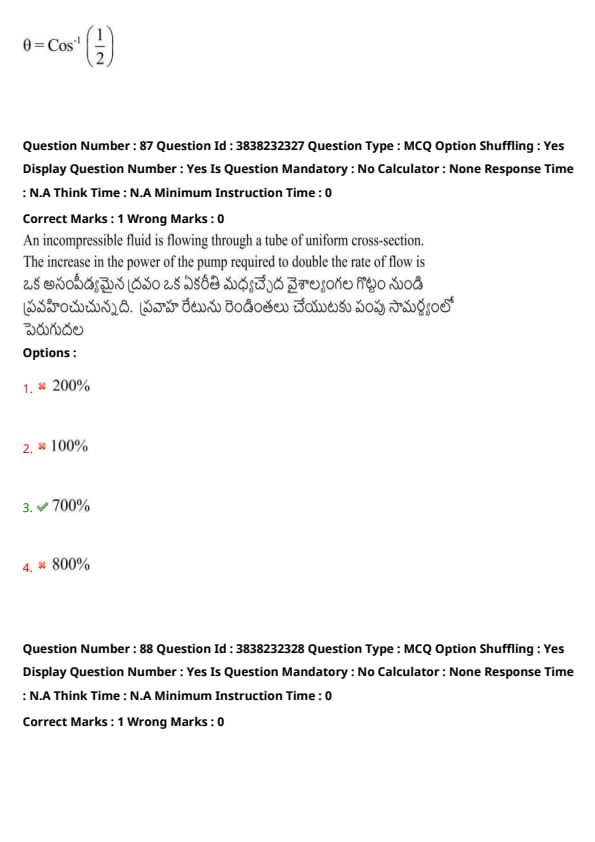
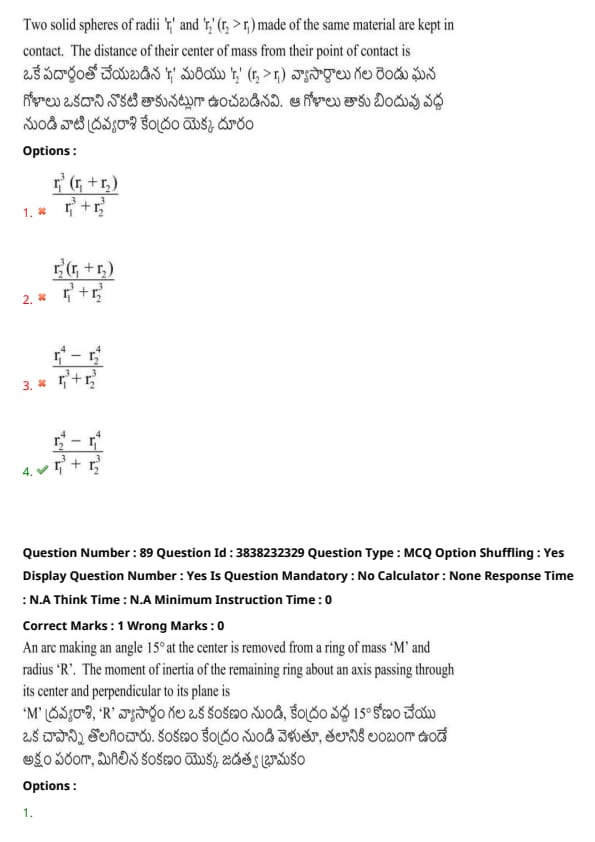
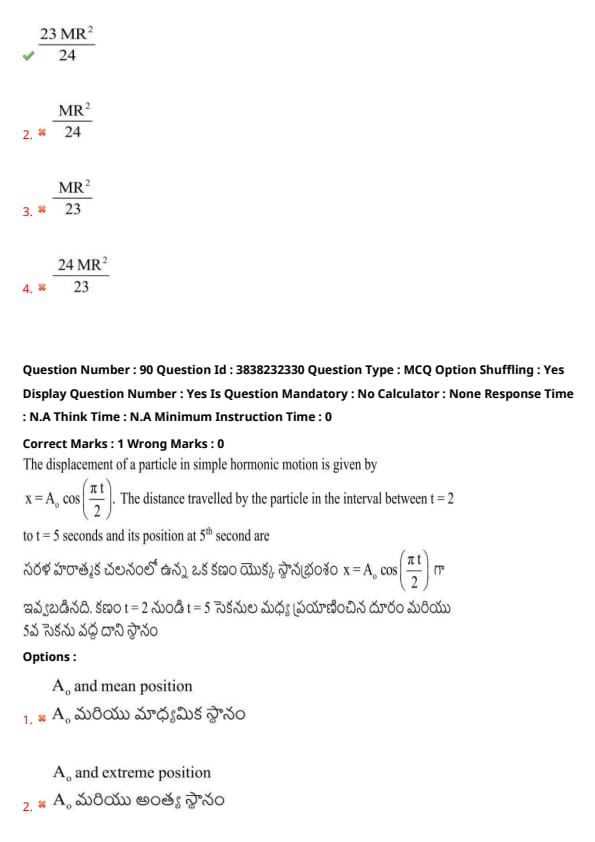
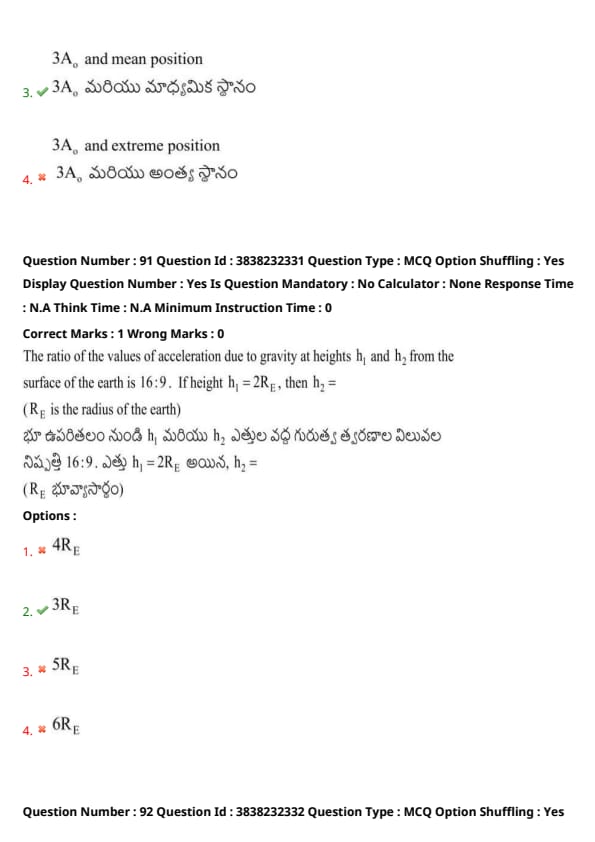
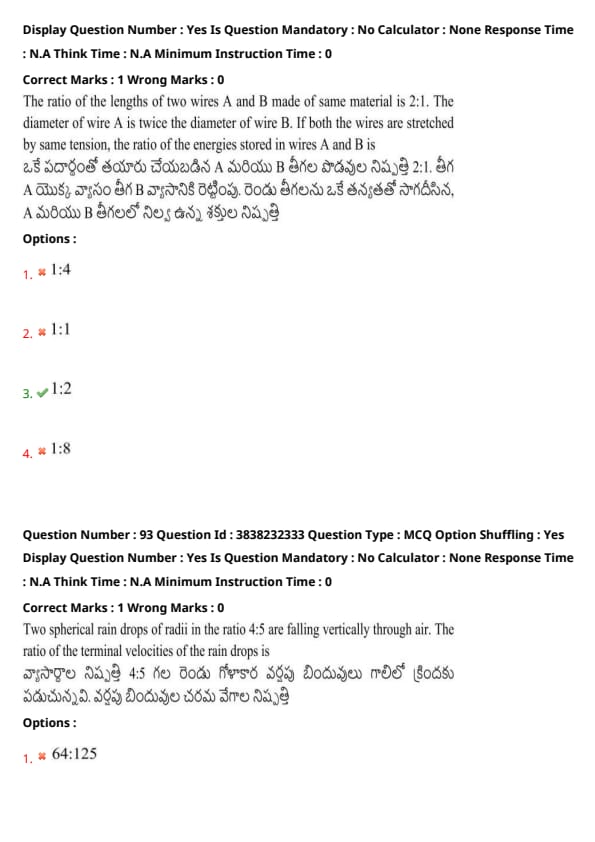
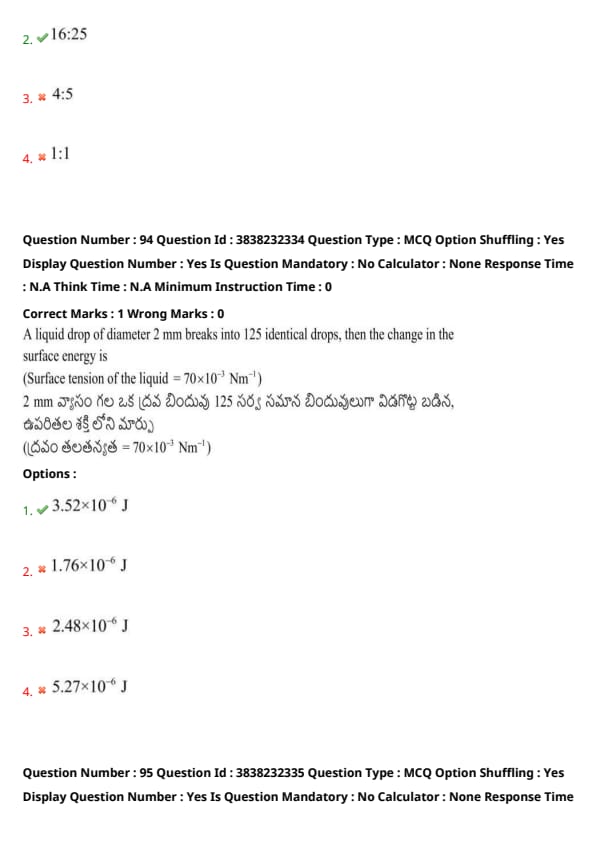
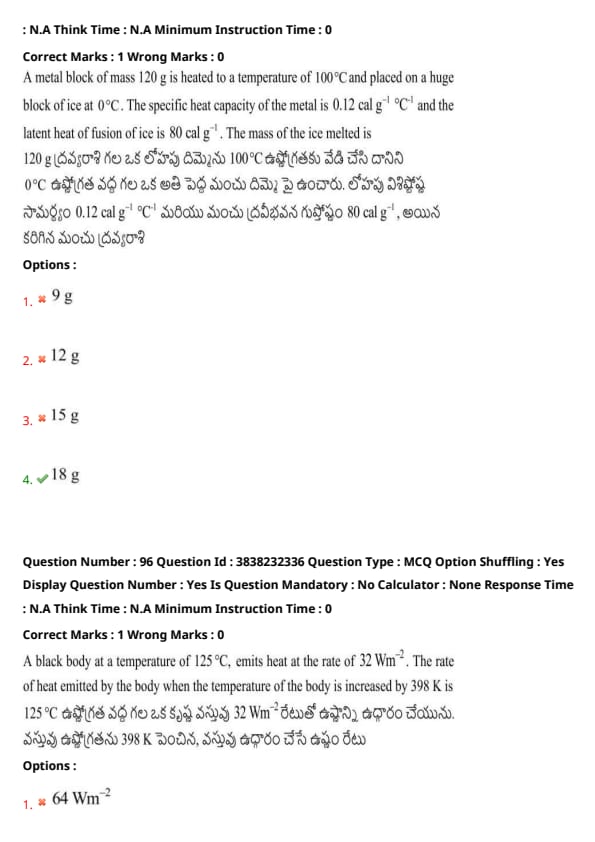
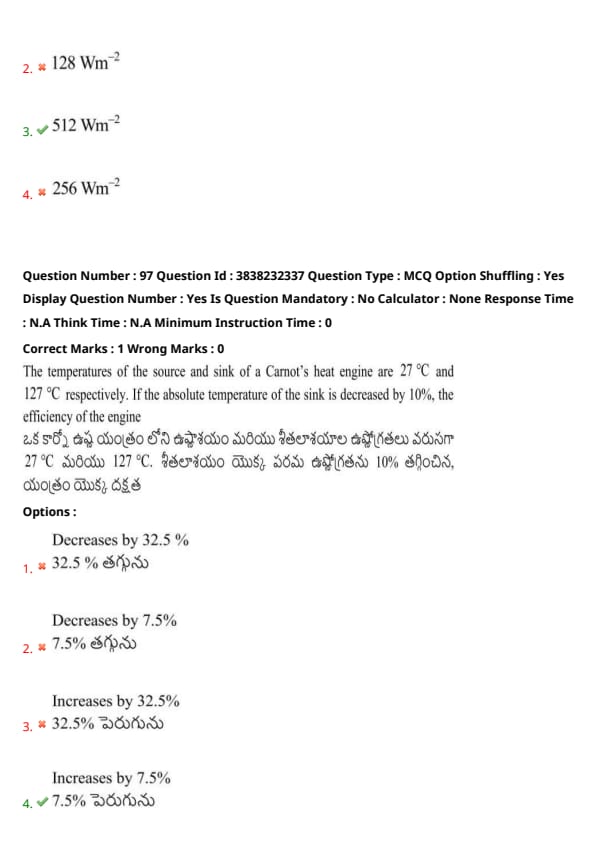
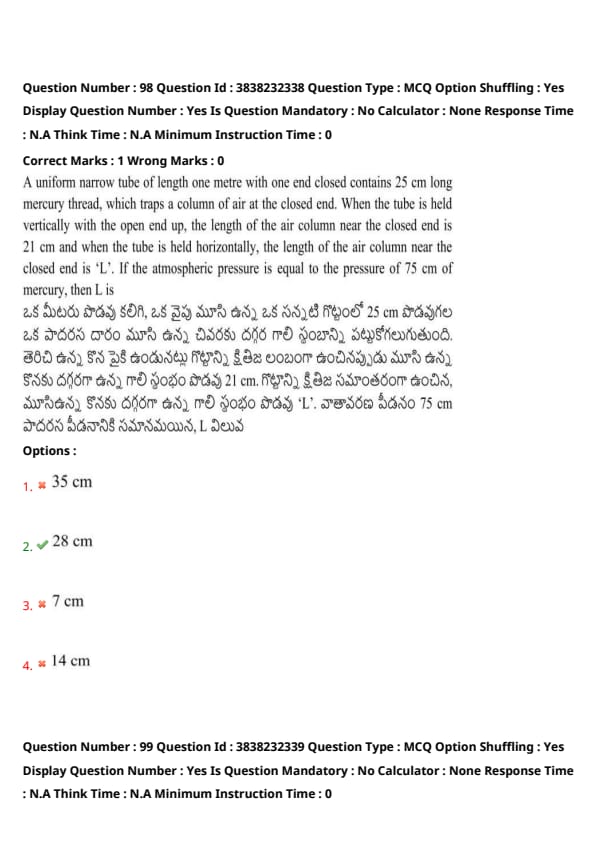
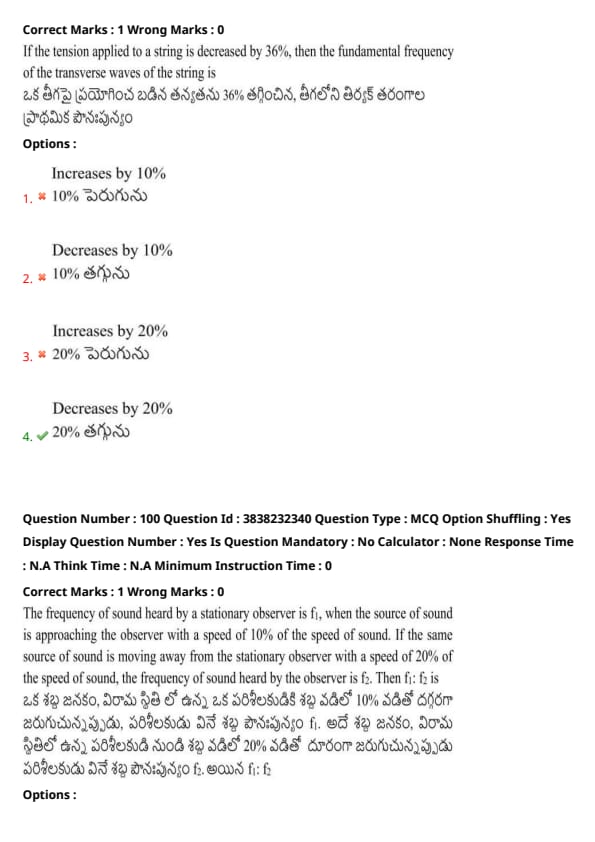
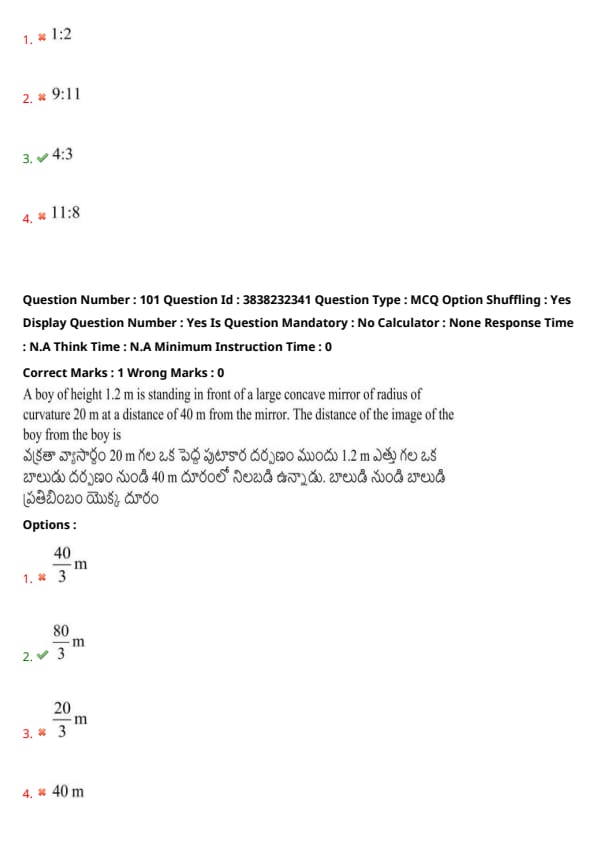
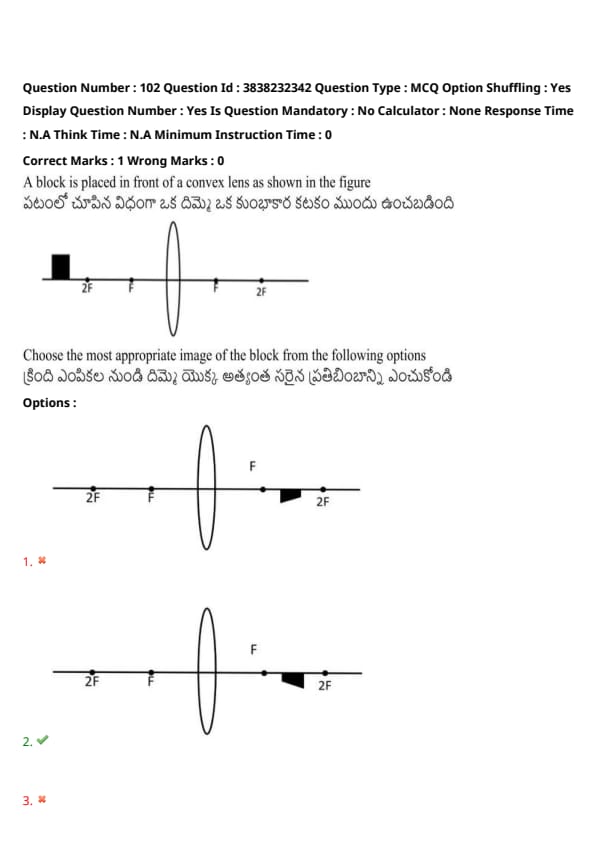
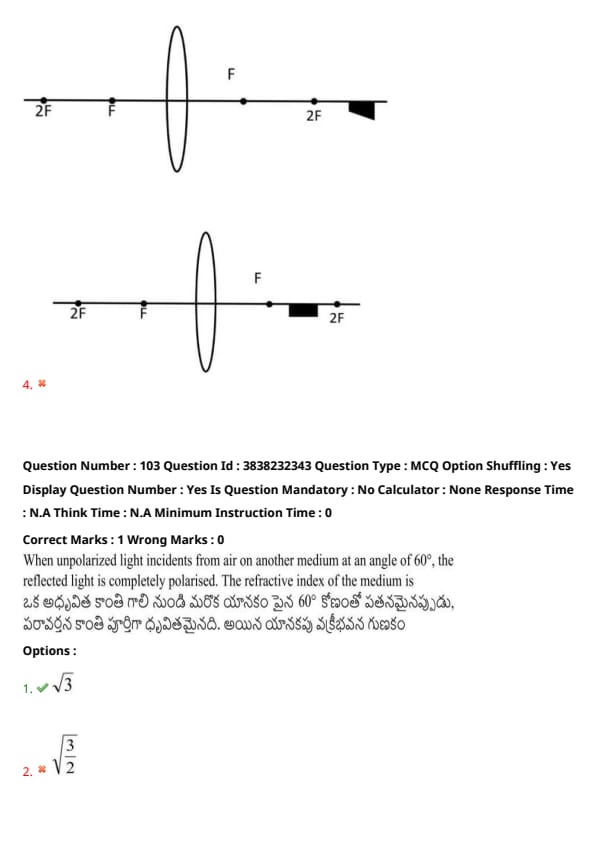
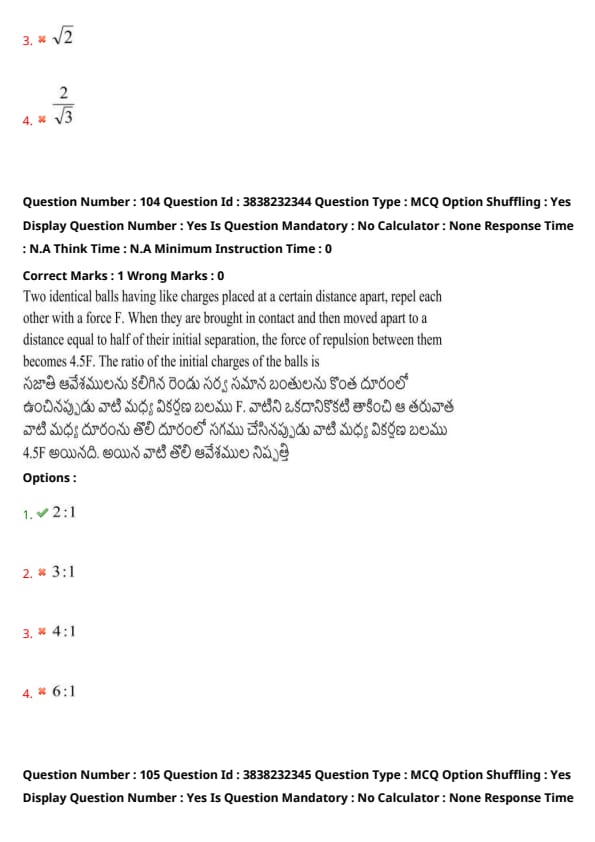
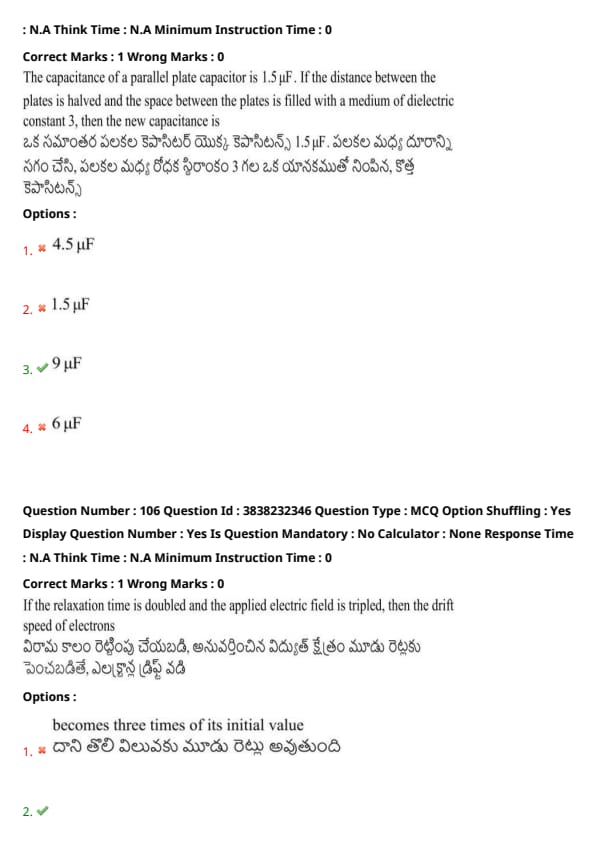
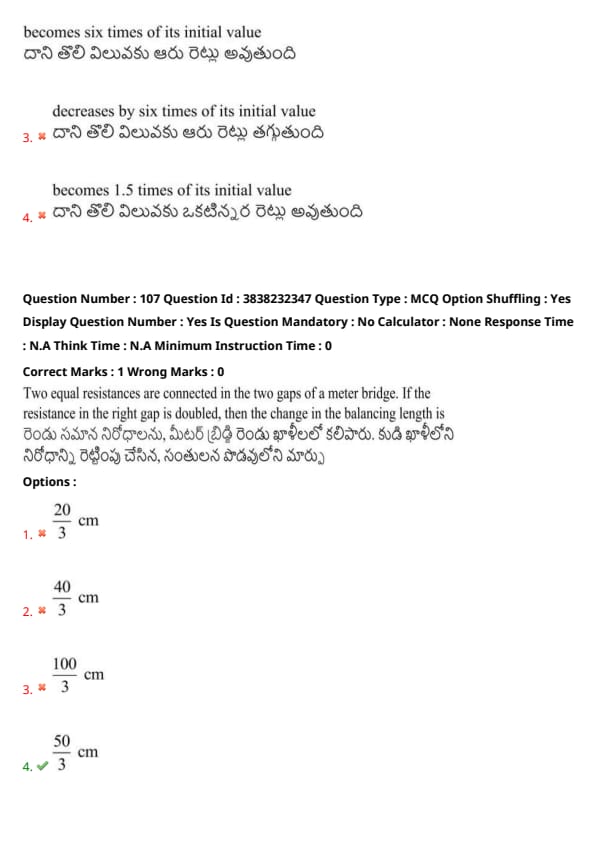
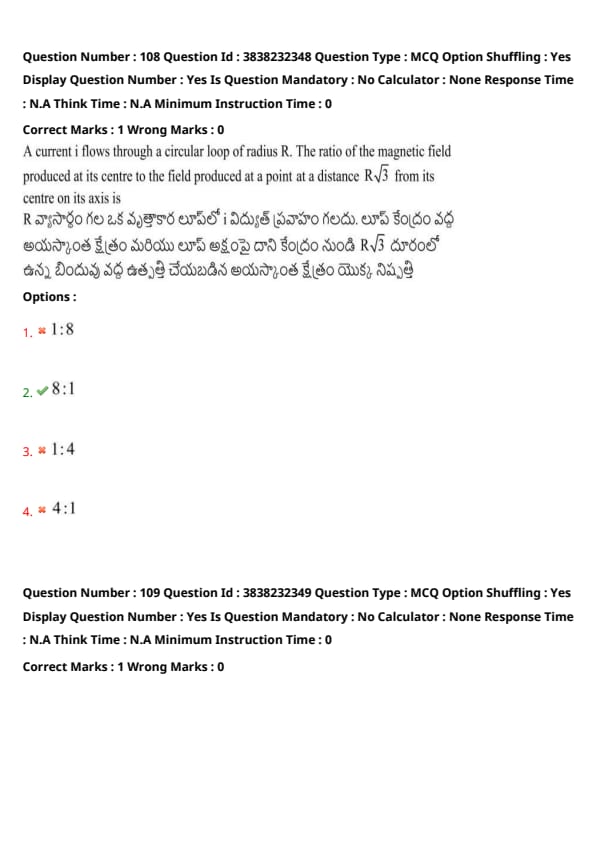
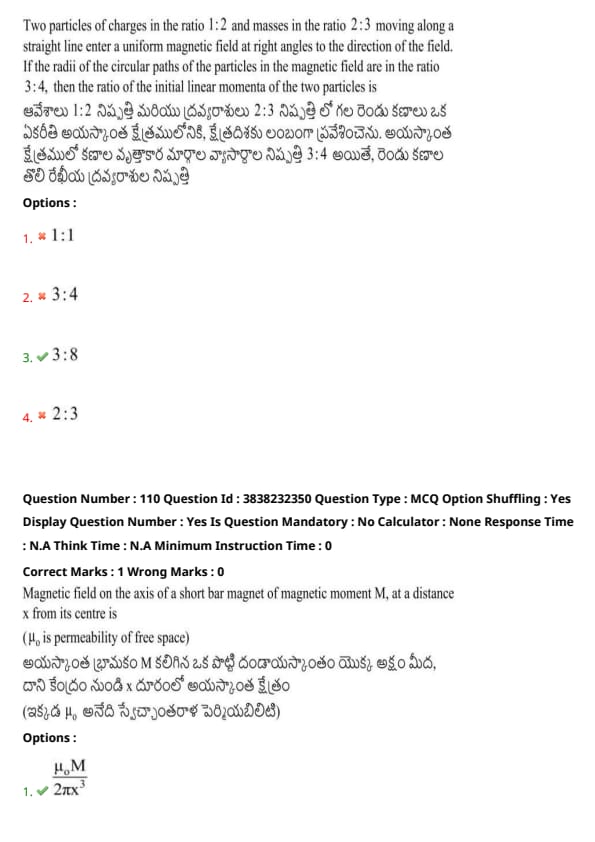
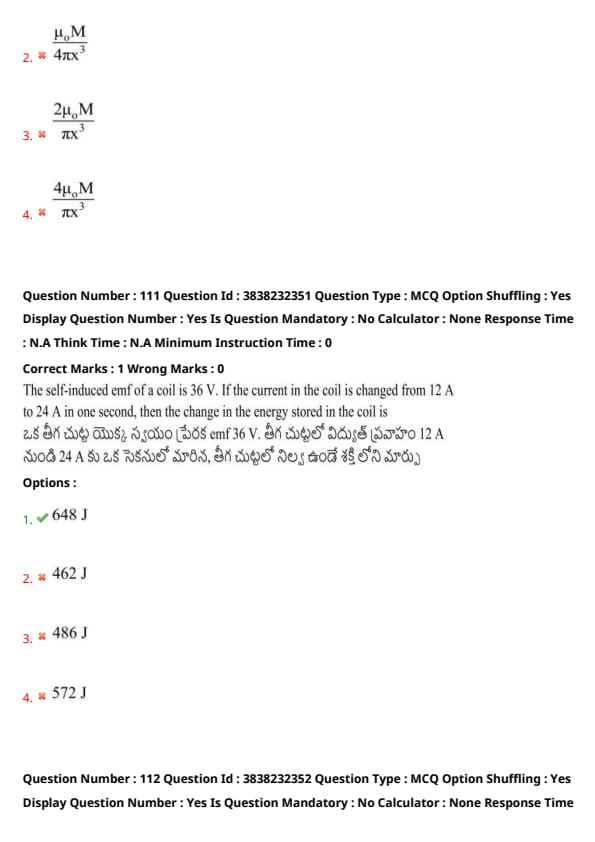
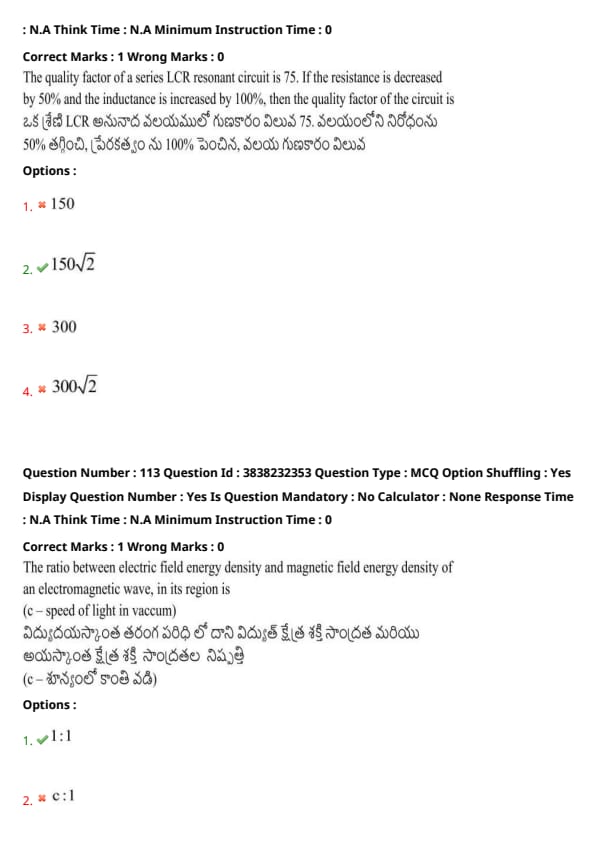
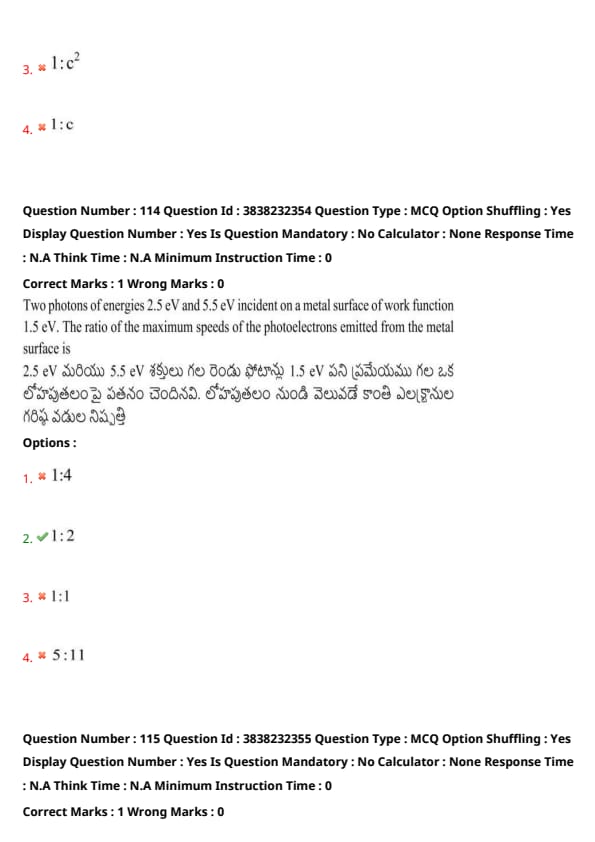
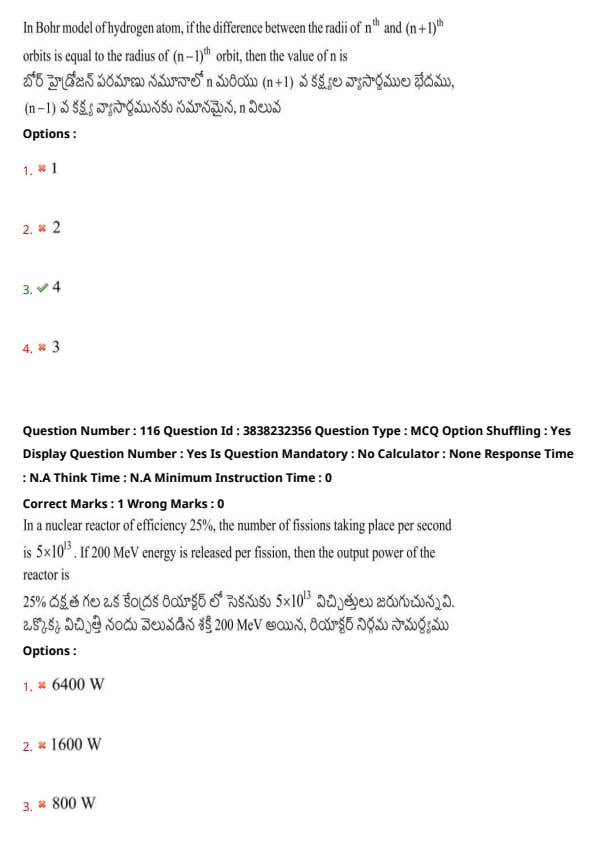
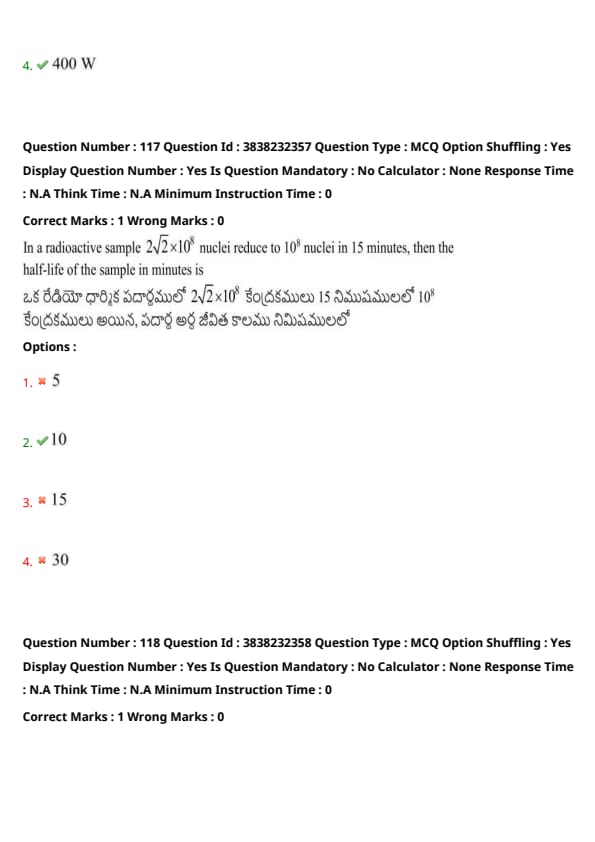
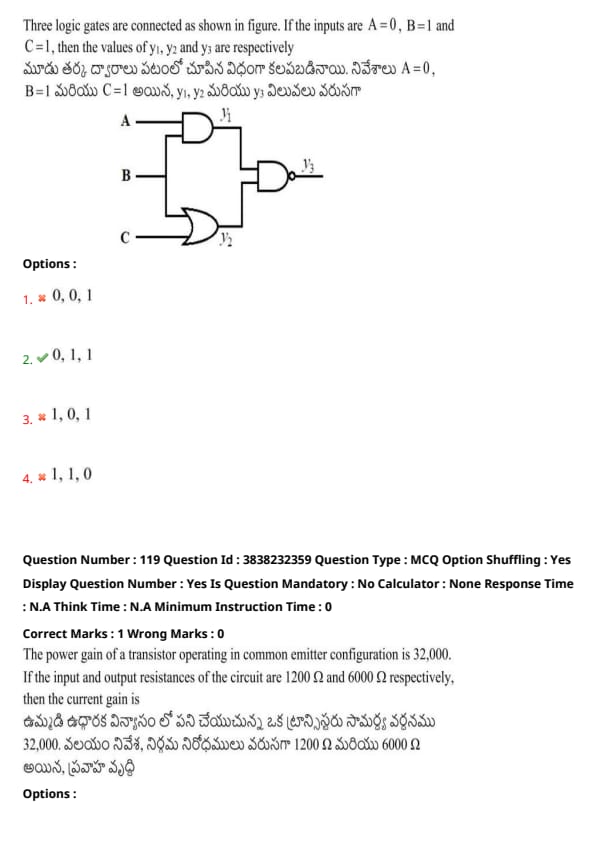
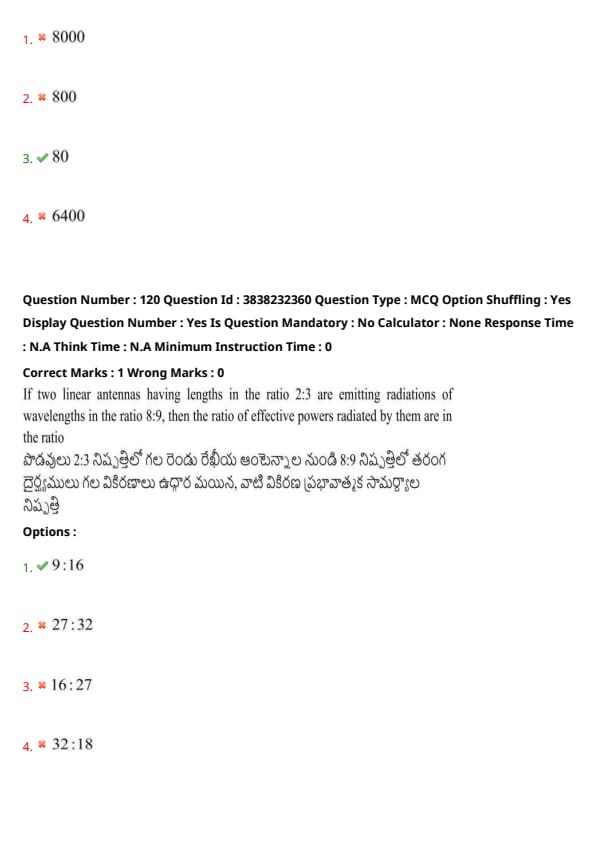
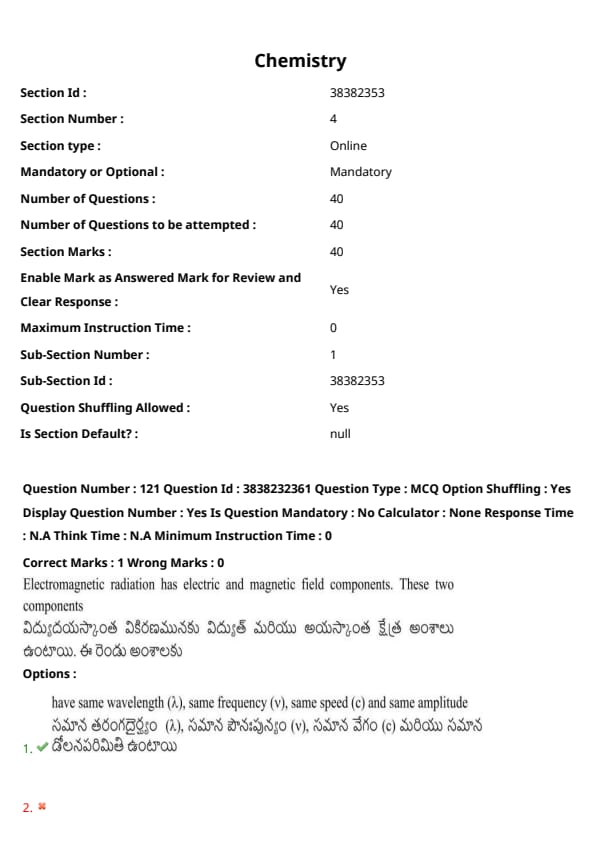
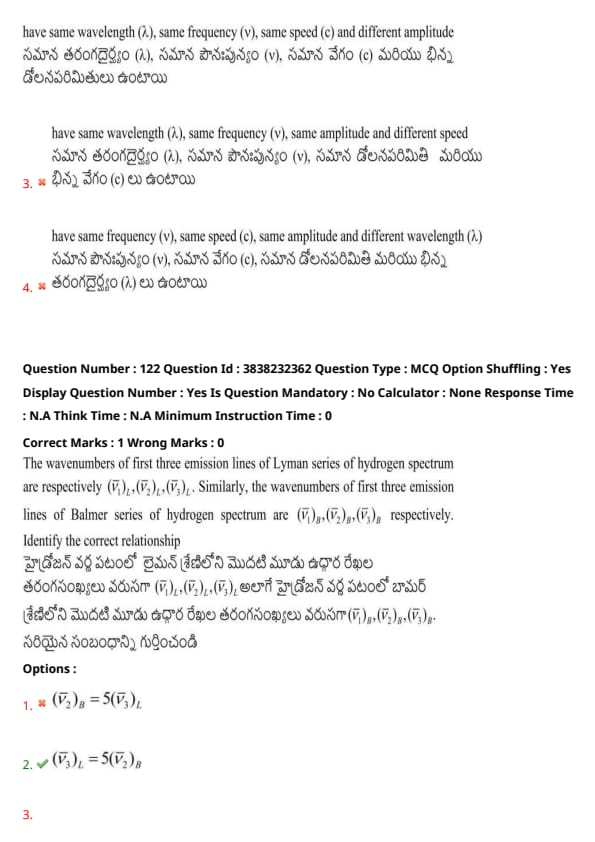
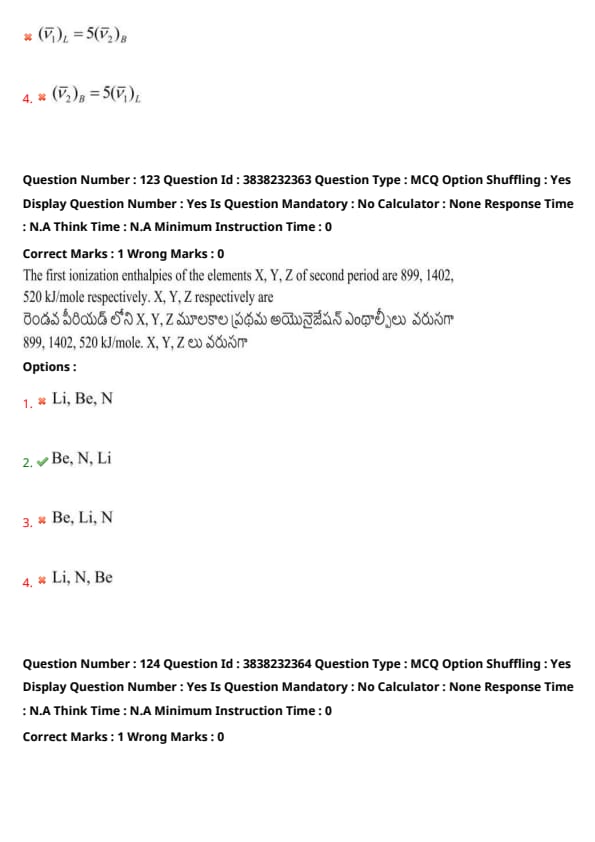
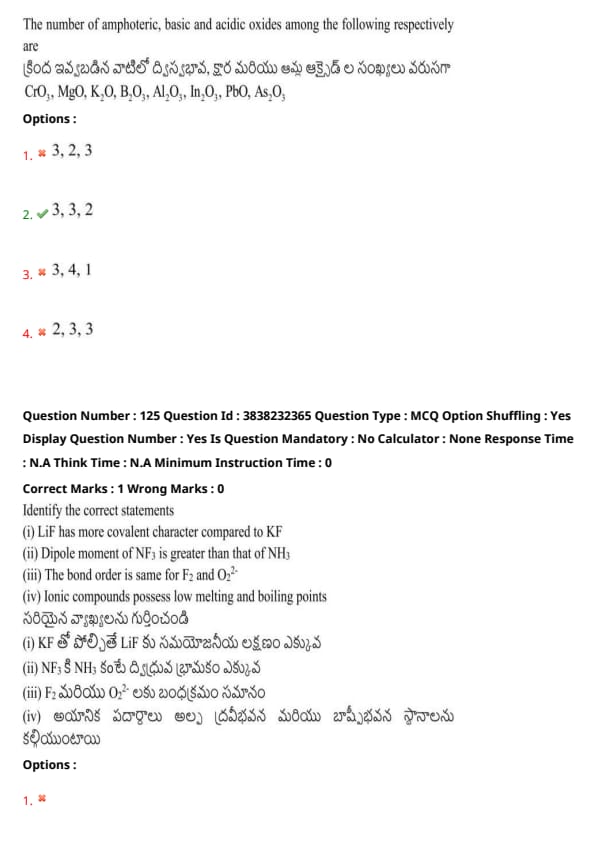
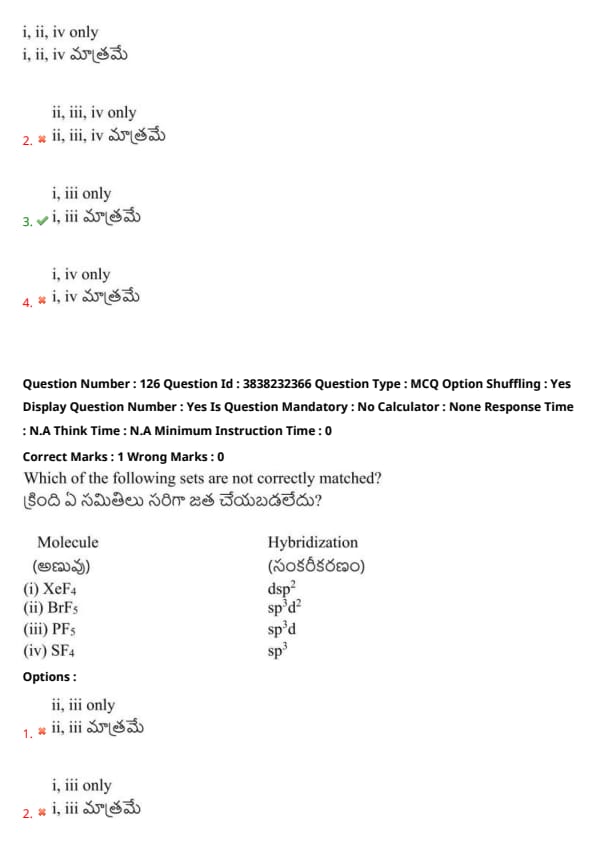
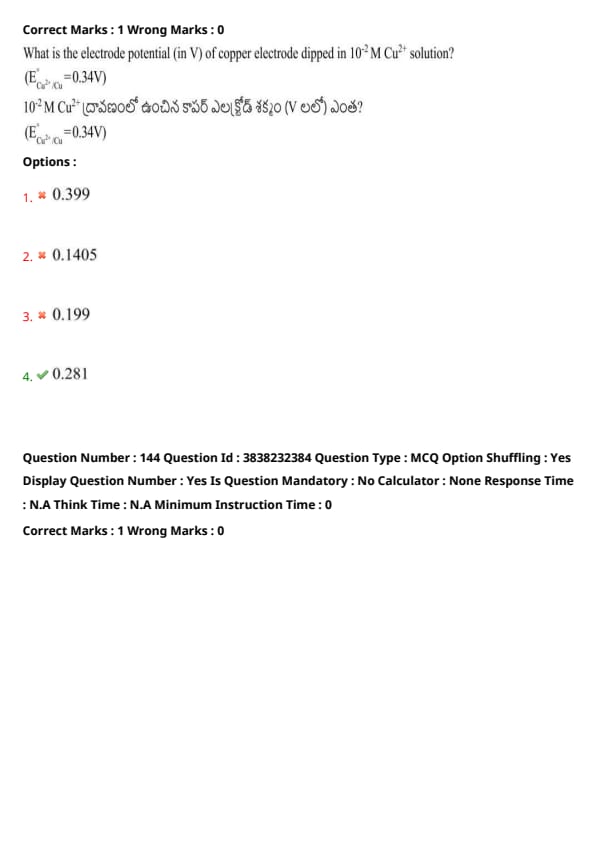
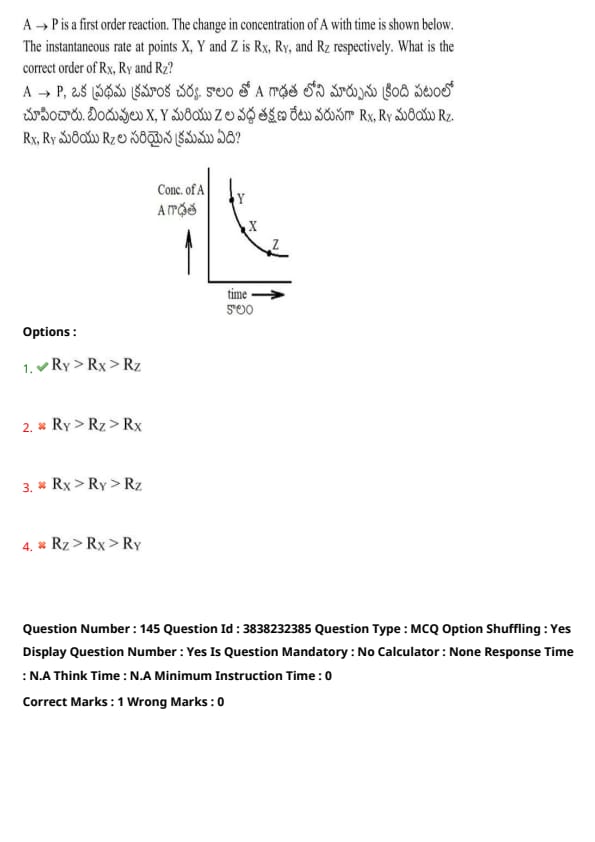
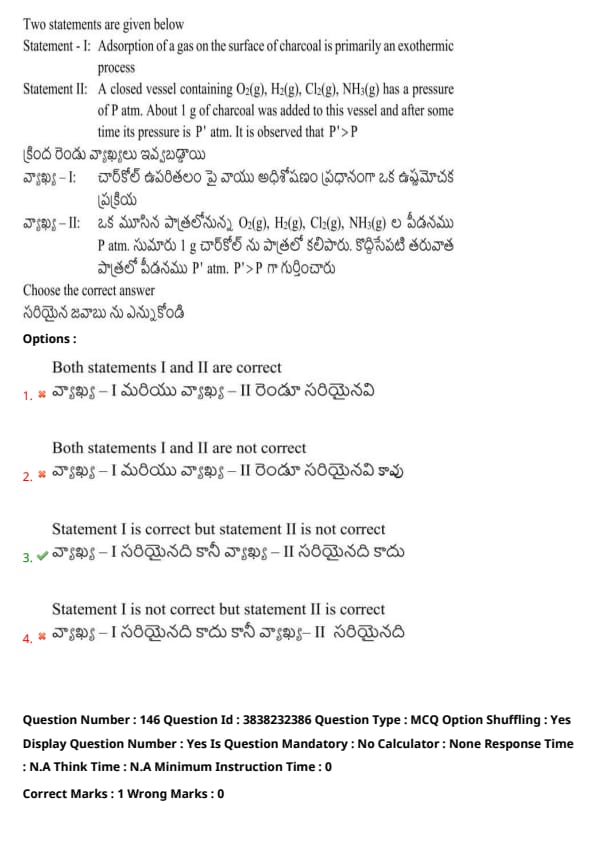
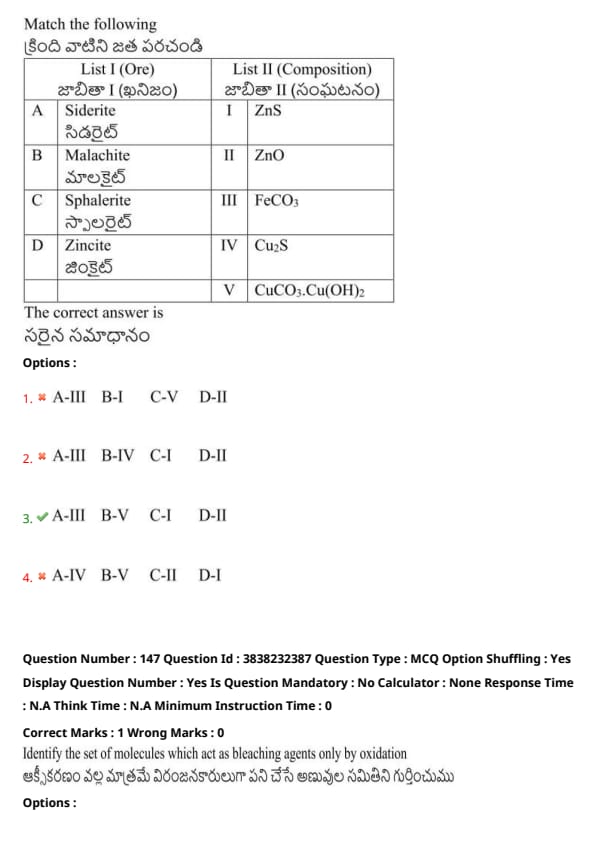
*The article might have information for the previous academic years, please refer the official website of the exam.