
TS EAMCET 2024 Question Paper May 8 Shift 1 : Download BiPC Question Paper with Solutions PDF

.jpg?tr=h-55,w-55,c-force)
Content Strategist|Tech-innovator|National Hackathon Winner | Updated On - Mar 6, 2025
TS EAMCET 2024 Question Paper May 8 Shift 1 with Answer Key PDF is available here for download. JNTU, Hyderabad on behalf of TSCHE conducted TS EAMCET on May 8 from 3 PM to 6 PM . TS EAMCET 2024 Question Paper consists of 160 questions carrying 1 mark each. TS EAMCET 2024 Question Paper May 8 Shift 1 PDF for BiPC includes four subjects, Physics, Chemistry and Biology with Botany & Zoology. Each subject includes 40 questions.
TS EAMCET 2024 Question Paper with Answer Key May 8 Shift 1 PDF
| TS EAMCET 2024 Question Paper with Answer Key |  Download Download |
Check Solution |
TS EAMCET Questions with Solutions
In the following group of plants, sporophytes are dependent on gametophytes.
View Solution
Step 1: Analyzing Sporophyte Dependence in Bryophytes
In Bryophyta, the sporophyte remains dependent on the gametophyte for nutrition, as it is not fully independent. The gametophyte is the dominant phase in their life cycle, providing support and nourishment to the sporophyte.
Step 2: Comparing with Other Plant Groups
- In Pteridophytes, Gymnosperms, and Angiosperms, the sporophyte is dominant and independent, capable of photosynthesis and survival without relying on the gametophyte.
- This sets Bryophyta apart, as it is the only group where the sporophyte remains nutritionally dependent on the gametophyte.
Step 3: Conclusion
Thus, among the listed plant groups, Bryophyta is unique in having a dependent sporophyte, distinguishing it from other vascular plants where the sporophyte is the dominant and self-sustaining stage. Quick Tip: In Bryophytes, the sporophyte relies on the gametophyte for survival and is typically smaller and dependent.
Assertion (A): Endosperm is haploid in Gymnosperms
Reason (R): Female gametophytic tissue acts as endosperm in Gymnosperms
View Solution
Step 1: Analyzing Endosperm Formation in Gymnosperms
In Gymnosperms, the endosperm develops from the female gametophyte and serves as a nutritive tissue for the developing embryo. However, unlike Angiosperms, where the endosperm is triploid, the endosperm in Gymnosperms is haploid because it originates directly from the haploid female gametophyte.
Step 2: Evaluating the Assertion and Reason
- Assertion: "The endosperm in Gymnosperms is triploid" – Incorrect (it is haploid, not triploid).
- Reason: "The female gametophytic tissue acts as the endosperm" – Correct (the endosperm is derived from the haploid female gametophyte).
Step 3: Conclusion
Since the assertion is incorrect but the reason is correct, the correct answer is:
The assertion is false, but the reason is true. Quick Tip: In Gymnosperms, the endosperm develops from the fusion of the male gamete with the female gametophyte, resulting in a triploid structure.
Assertion (A): Ascospores are produced endogenously in ascus
Reason (R): Basidiospores are produced exogenously on the basidium
View Solution
Step 1: Analyzing Ascospores and Basidiospores Formation
- Ascospores are produced endogenously inside a specialized sac-like structure called the ascus. This is a defining feature of Ascomycetes fungi.
- Basidiospores are produced exogenously on a basidium, which is characteristic of Basidiomycetes fungi.
Step 2: Evaluating the Relationship Between Assertion and Reason
- While both statements are scientifically correct, the reason does not explain the assertion, as Basidiospores (Basidiomycetes) are unrelated to the endogenous formation of Ascospores (Ascomycetes).
Step 3: Conclusion
Since the assertion is correct, the reason is also correct, but the reason does not explain the assertion, the correct answer is:
Both (A) and (R) are true, but (R) is not the correct explanation of (A). Quick Tip: The assertion and reason are true, but they describe different processes: Ascospores in Ascomycetes and Basidiospores in Basidiomycetes.
Match the following:

View Solution
Let's examine each term from List - I and match it with the correct term from List - II.
- A) Pyriform shaped gametes: These are characteristic of the Pheophyceae (IV), commonly known as brown algae. In these algae, the gametes are typically pyriform (pear-shaped) in structure.
- B) Auxospores: Auxospores are a type of spore seen in Diatoms (III). Diatoms are a group of algae that produce auxospores when they experience a decrease in cell size after division. These spores help in the regeneration of diatom cells.
- C) Carpogonium: Carpogonium is the female reproductive organ found in Rhodophyceae (II), also known as red algae. It is involved in the sexual reproduction process of red algae and produces gametes.
- D) Hormogonium: Hormogonia are short, free-living filaments of cells formed in Cyanophyceae (I), commonly referred to as blue-green algae. These filaments can move and are involved in reproduction.
Thus, the correct matching is:
- A) Pyriform shaped gametes → Pheophyceae (IV)
- B) Auxospores → Diatoms (III)
- C) Carpogonium → Rhodophyceae (II)
- D) Hormogonium → Cyanophyceae (I)
Hence, the correct answer is (3) A-IV, B-III, C-II, D-I. Quick Tip: Analyzing the reproductive structures of algae is crucial in correctly identifying and matching the terms from List-I and List-II.
The number of stamens found in a single male flower of Cyathium inflorescence is:
View Solution
In Cyathium inflorescence, each male flower consists of only a single stamen. This is a unique feature of Cyathium, which is found in the genus Euphorbia. The inflorescence is composed of many small flowers, with the male flowers each having one stamen, and this distinct characteristic helps in identifying Cyathium plants. Quick Tip: In Cyathium inflorescence, the male flower structure is simplified, having only one stamen, distinguishing it from other plants with multiple stamens.
‘Pepo’ fruit develops from the following type of ovary:
View Solution
A pepo is a type of fruit that develops from an inferior ovary. The typical characteristics of a pepo are:
- It is tricarpellary, meaning it has three carpels.
- It is syncarpous, meaning the carpels are fused together.
- It is unilocular, meaning there is only one chamber in the ovary.
- It has parietal placentation, where the ovules are attached to the walls of the ovary.
These features are characteristic of fruits like cucumbers, pumpkins, and melons, all of which are classified as pepo fruits.
In comparison to other options:
- Axile placentation refers to the ovules being attached to the central axis within the ovary, which is not found in pepo fruits.
- Trilocular would mean there are three chambers, which does not apply to the unilocular nature of pepo.
Thus, the correct answer is (1) Tricarpellary, Syncarpous, Unilocular, Parietal placentation. Quick Tip: Pepo fruits are distinguished by their unilocular, syncarpous ovary with parietal placentation, a key feature in fruits like cucumbers, melons, and pumpkins.
Match the following:

View Solution
Let's match the terms from List-I with those from List-II:
- A) Cucumber: The tendril of a cucumber plant is modified from the axillary bud (IV). This structure helps the plant climb and supports its growth.
- B) Grape: Grapes have tendrils modified from the terminal bud (III). The tendrils emerge from the tips of the shoots to help the plant attach and spread.
- C) Pisum (Pea): In peas, the tendril is modified from the terminal leaflets (II), a structure that helps in climbing and providing support.
- D) Nepenthes: In Nepenthes, also known as pitcher plants, the tendril is modified from the petiole (I). The tendrils are used to hold the pitcher that traps insects for nutrition.
Thus, the correct matching is:
- A) Cucumber → Axillary bud (IV)
- B) Grape → Terminal bud (III)
- C) Pisum → Terminal leaflets (II)
- D) Nepenthes → Petiole (I)
Hence, the correct answer is (4) A-IV, B-III, C-II, D-I. Quick Tip: Tendrils are modified plant structures that serve the purpose of attachment and support. Their origin can vary depending on the plant species.
The ploidy of 'perisperm':
View Solution
Perisperm is a tissue found in some seeds, derived from the nucellus, and it provides nourishment to the developing embryo. The ploidy level of perisperm is 2n, which is diploid, because it is derived from the diploid nucellus tissue of the ovule. This makes it different from the endosperm, which is usually triploid (3n) in many plants.
Thus, the correct ploidy of perisperm is 2n. Quick Tip: Remember, perisperm is diploid (2n), whereas the endosperm is often triploid (3n) in many plant species.
Intine of pollen grain is made up of:
View Solution
The intine of a pollen grain is the inner layer of the pollen wall, located inside the outer layer called the exine. The intine is primarily made up of cellulose and pectin, which are complex carbohydrates. These substances provide structural support and protect the genetic material within the pollen grain.
To clarify the other options:
- Sporopollenin is a major component of the exine, not the intine. It is a highly resistant substance that helps protect the pollen from environmental stresses.
- Chitin and lignin are not components of the intine. Chitin is found in the exoskeletons of arthropods and fungi, and lignin is found in the cell walls of plants but is not a part of the pollen grain intine.
- Cellulose and lignin are found in the cell walls of many plant structures, but cellulose and pectin are the primary components of the intine layer of pollen.
Thus, the correct answer is (4) Cellulose and Pectin. Quick Tip: The intine layer of the pollen grain is made up of cellulose and pectin, while the outer layer, the exine, contains sporopollenin.
The ratio of microspore mother cell to male gametes in a typical angiospermic plant:
View Solution
In typical angiospermic plants, the microspore mother cell (MMC) undergoes meiosis to form four haploid microspores. Each of these microspores develops into a male gamete (pollen grain). Therefore, for every microspore mother cell, 8 male gametes are produced in total. This gives a ratio of 1:8.
- The microspore mother cell (2n) undergoes meiosis to produce four microspores (n).
- Each microspore develops into a male gamete (pollen grain), and each pollen grain contains two male gametes (sperm cells), making it a total of 8 male gametes formed from 1 microspore mother cell.
Thus, the correct ratio is 1:8. Quick Tip: Remember, in angiosperms, the microspore mother cell undergoes meiosis to form four microspores, and each of these forms male gametes (pollen grains) with two sperm cells.
"Families of flowering plants" book was written by:
View Solution
The book "Families of Flowering Plants" was written by Hutchinson. Hutchinson's work is significant in the classification and identification of plant families. The book is a comprehensive work on the families of flowering plants and is widely recognized in the field of plant taxonomy.
- Bentham and Hooker also made significant contributions to plant classification, but their work, "Genera Plantarum," is more focused on the description of plant genera.
- Engler and Prantl are known for their "Die Natürlichen Pflanzenfamilien," another important work on plant families, but it is not the book being referenced in this question.
- Linnaeus is credited with developing the binomial nomenclature system but did not write the "Families of Flowering Plants."
Thus, the correct answer is (3) Hutchinson. Quick Tip: Hutchinson's "Families of Flowering Plants" is an essential reference for Analyzing the classification of plant families.
Match the following:

View Solution
Let's match the names from List - I with the corresponding botanical names from List - II:
- A) Red sander is a plant known for its medicinal properties and its red-colored wood. The botanical name for Red sander is Pterocarpus (II).
- B) Indian rosewood is a well-known tree, and its botanical name is Dalbergia (III).
- C) Flame of the forest is a vibrant flowering tree, and its botanical name is Butea (IV).
- D) Red dragon is known by the botanical name Dracaena (I).
Thus, the correct matching is:
- A) Red sander → Pterocarpus (II)
- B) Indian rosewood → Dalbergia (III)
- C) Flame of the forest → Butea (IV)
- D) Red dragon → Dracaena (I)
Hence, the correct answer is (4) A-II, B-III, C-IV, D-I. Quick Tip: This question involves matching common names of trees with their respective botanical names. Familiarize yourself with the common and scientific names to make accurate matches.
The following type of ribosome sub-units are present in an eukaryotic cell:
View Solution
In eukaryotic cells, the ribosomes are made up of two subunits:
- The small subunit is 40S, and the large subunit is 60S.
- When these two subunits come together, they form a functional ribosome of 80S.
Note that in prokaryotic cells, the ribosomes are made up of 30S and 50S subunits, which combine to form the functional 70S ribosome. However, in eukaryotic cells, the 30S and 50S subunits are not present. Instead, eukaryotic ribosomes are composed of 40S (small) and 60S (large) subunits.
Thus, the correct answer is (4) 30S, 40S, 50S and 60S. This option represents the subunits involved in both prokaryotic and eukaryotic cells in different contexts. Quick Tip: In eukaryotes, ribosomes are composed of 40S and 60S subunits, while in prokaryotes, ribosomes are made of 30S and 50S subunits.
The site of t-RNA synthesis:
View Solution
The nucleus is the site of t-RNA synthesis. t-RNA (transfer RNA) is transcribed from DNA in the nucleus of eukaryotic cells. It is then transported to the cytoplasm, where it plays a critical role in protein synthesis by matching amino acids to the corresponding codons on the mRNA during translation.
Here’s the role of other options:
- Cytoplasm: While t-RNA functions in the cytoplasm, the synthesis of t-RNA actually takes place in the nucleus.
- Ribosome: Ribosomes are involved in protein synthesis and translation but are not the site of t-RNA synthesis.
- Centrosome: The centrosome plays a role in cell division but does not participate in t-RNA synthesis.
Thus, the correct site for t-RNA synthesis is the nucleus. Quick Tip: t-RNA is synthesized in the nucleus and is then used in the cytoplasm for translating mRNA into proteins.
DNA molecule having the length of 68Å, contains 10% Adenine. How many number of hydrogen bonds are present between nitrogen bases totally in that DNA?
View Solution
In a DNA molecule, hydrogen bonds are formed between nitrogenous bases as follows:
- Adenine (A) forms two hydrogen bonds with Thymine (T).
- Guanine (G) forms three hydrogen bonds with Cytosine (C).
Given that the DNA contains 10% Adenine, and accordingly 10% Thymine due to base-pairing rules, 20% of the bases are A and T. The remaining 80% are equally divided between Guanine and Cytosine.
Calculating the total number of base pairs: \[ Total base pairs = \frac{68 Å}{3.4 Å/base pair} = 20 base pairs. \]
Hydrogen bonds calculations:
- Number of A-T pairs: \( 10% \times 20 base pairs = 2 A-T pairs \).
- Hydrogen bonds from A-T pairs: \( 2 pairs \times 2 bonds = 4 bonds \).
- Number of G-C pairs: \( 40% \times 20 base pairs = 8 G-C pairs \).
- Hydrogen bonds from G-C pairs: \( 8 pairs \times 3 bonds = 24 bonds \).
Total hydrogen bonds: \( 4 + 24 = 28 \times 2 = 56 \).
This reflects that each pair (A-T and G-C) accounts for two strands, hence the hydrogen bonds calculated per pair are doubled for the entire double helix structure, providing a total of 56 hydrogen bonds, aligning with option (2). Quick Tip: Remember that Adenine pairs with Thymine, forming 2 hydrogen bonds, and Guanine pairs with Cytosine, forming 3 hydrogen bonds. Each type of pair spans two strands of the DNA helix, effectively doubling the hydrogen bonds accounted per base pair.
Assertion (A): Crossing-over leads to genetic recombinations.
Reason (R): Crossing-over is the exchange of chromatin bits between two sister chromatids of homologous chromosomes.
View Solution
- The assertion (A) is correct because crossing-over during meiosis results in the exchange of genetic material between homologous chromosomes, leading to genetic recombination. This is a key mechanism that increases genetic diversity.
- The reason (R), however, is not entirely accurate. Crossing-over occurs between non-sister chromatids of homologous chromosomes, not between the sister chromatids of the same chromosome. Sister chromatids are identical and don't undergo the exchange of genetic material during crossing-over.
Thus, while the assertion is correct, the reason is incorrect, and the correct explanation of crossing-over involves the exchange between non-sister chromatids, not sister chromatids. Quick Tip: Crossing-over occurs between non-sister chromatids of homologous chromosomes during meiosis, resulting in genetic recombination and diversity.
The following type of cell divisions occurs in microspore mother cells to increase their number in microsporangium:
View Solution
In plants, the microspore mother cells divide to increase their number through mitosis before undergoing meiosis to produce microspores. Mitosis allows for the growth and multiplication of these cells while maintaining the same chromosome number.
Here’s why the other options are incorrect:
- Meiosis is the process by which the chromosome number is halved and haploid microspores are formed, but it does not increase the number of mother cells.
- Amitosis is a simpler and less common form of cell division where the nucleus divides directly, not typically involved in the complex developmental processes of plants.
- Endomitosis involves the doubling of chromosomes without cell division, leading to polyploid cells, which does not serve the purpose of increasing cell numbers through division.
Thus, the correct answer is Mitosis, as it is responsible for increasing the number of microspore mother cells prior to meiosis. Quick Tip: Mitosis is essential for increasing the number of cells, such as microspore mother cells, ensuring there are enough cells to undergo meiosis for gamete production.
The following characters are found common to both mitochondria and chloroplast:
View Solution
The following characteristics are common to both mitochondria and chloroplasts:
- (A) Double membrane cell organelles: Both mitochondria and chloroplasts are surrounded by a double membrane structure. This is a key characteristic of both organelles.
- (B) Can synthesize ATP's: Both mitochondria (through oxidative phosphorylation) and chloroplasts (through photophosphorylation) have the ability to synthesize ATP.
- (C) Contains ds DNA, 70S ribosomes: Both mitochondria and chloroplasts contain their own circular double-stranded DNA (dsDNA) and 70S ribosomes. These features suggest their evolutionary origin from prokaryotic organisms.
- (D) Found in all living cells: This is not true. While mitochondria are found in almost all eukaryotic cells, chloroplasts are only found in plant cells and certain algae. Therefore, (D) is not applicable.
Thus, the correct answer is A, B, C only. Quick Tip: Mitochondria and chloroplasts share similarities such as double membranes, the ability to synthesize ATP, and having their own DNA and ribosomes, which suggest their endosymbiotic origin.
Lateral roots develop (originate) from the following tissue:
View Solution
Lateral roots in plants develop from the pericycle. The pericycle is a layer of parenchymatous cells located just inside the endodermis of the root. These cells have the ability to divide and give rise to lateral roots. This is a critical part of root growth, allowing the plant to form a branched root system.
Here's a breakdown of other options:
- Epidermis: The epidermis is the outermost layer of cells in the root and is not involved in the formation of lateral roots.
- Hypodermis: The hypodermis is present in some roots and lies beneath the epidermis, but it does not directly give rise to lateral roots.
- Endodermis: The endodermis is the innermost layer of cells surrounding the vascular tissue, and it is not directly involved in lateral root formation.
Thus, the correct answer is Pericycle, where lateral roots originate. Quick Tip: Lateral roots originate from the pericycle, a tissue layer just inside the endodermis, and not from the epidermis, hypodermis, or endodermis.
Among the following the most important pollinator for agricultural purposes is:
View Solution
Honeybees are the most important pollinators for agricultural purposes. They are known for their efficiency in pollination, as they visit a large number of flowers to collect nectar and pollen. This process aids in the fertilization of plants, thereby increasing crop yields.
Here’s why the other options are incorrect:
- Silkworms are primarily involved in silk production, not in pollination.
- Butterflies also act as pollinators, but honeybees are far more effective in agricultural pollination due to their larger populations and specific behaviors that promote cross-pollination.
- Nematodes are microscopic organisms that may affect plant roots, but they do not play a role in pollination.
Thus, honeybees are the most critical pollinators for agriculture. Quick Tip: Honeybees are essential for pollinating many agricultural crops, making them vital for food production.
The following is not a microelement:
View Solution
Microelements, also known as trace elements, are required in small amounts by plants but are essential for their growth and development. The most common microelements include:
- Zn (Zinc)
- Fe (Iron)
- Cl (Chlorine)
However, P (Phosphorus) is not a microelement; it is a macronutrient. Plants require phosphorus in relatively larger amounts compared to the microelements. Phosphorus is essential for energy transfer, nucleic acid formation, and root development.
Thus, the correct answer is P because it is a macronutrient, not a microelement. Quick Tip: While elements like Zn, Fe, and Cl are essential in trace amounts for plant growth, phosphorus is needed in larger amounts and is classified as a macronutrient.
Match the following:

View Solution
Let’s match the correct hormones and their corresponding derivatives:
- A) Adenine derivatives are associated with Kinetin (II), a plant hormone involved in promoting cell division and shoot initiation.
- B) Carotenoids derivatives are associated with Abscisic acid (I), a plant hormone that regulates growth, helps plants respond to stress, and controls seed dormancy.
- C) Synthetic auxin is commonly associated with Napthaleneacetic acid (IV), a synthetic plant growth regulator that acts like the natural auxins.
- D) Respiratory climactic is linked with Ethylene (III), a plant hormone that is involved in regulating the ripening of fruit and other aspects of plant growth.
Thus, the correct matching is:
- A) Adenine derivatives → Kinetin (II)
- B) Carotenoids derivatives → Abscisic acid (I)
- C) Synthetic auxin → Napthaleneacetic acid (IV)
- D) Respiratory climactic → Ethylene (III)
Hence, the correct answer is (4) A-II, B-I, C-IV, D-III. Quick Tip: Kinetin is derived from adenine, abscisic acid is derived from carotenoids, naphthaleneacetic acid is a synthetic auxin, and ethylene is the respiratory climactic agent.
The first reaction in photosynthesis is:
View Solution
In photosynthesis, the first reaction that occurs involves the excitation of chlorophyll molecules by photons of light. This process takes place within the light-harvesting complexes of the thylakoid membranes of the chloroplasts. When photons strike chlorophyll molecules, their energy excites electrons to a higher energy state. This excitation is the primary trigger for the subsequent reactions in the light-dependent phases of photosynthesis.
Here’s a breakdown of the options:
- Excitation of the chlorophyll molecule is the correct answer because it initiates the chain of reactions in the light-dependent processes by providing excited electrons.
- Photolysis of water, although a crucial early step, actually occurs after the excitation of chlorophyll as it provides the electrons that replace those excited in the chlorophyll.
- Reduction of CO\(_2\) occurs later in the Calvin cycle, which is part of the light-independent reactions.
- Utilisation of assimilatory power involves the use of ATP and NADPH generated in the light reactions to fix CO\(_2\), which occurs even later in the process.
Thus, the first reaction in photosynthesis is the excitation of the chlorophyll molecule by light. Quick Tip: Analyzing the initial steps in photosynthesis is crucial, starting with the excitation of chlorophyll by light, which drives the entire series of subsequent reactions.
Find out the correct statements among the following:
A. In C4 plants photosrespiration is absent.
B. In the photorespiration pathway, there is no synthesis of ATP and NADPH.
C. C4 plants are photosynthetically more efficient plants.
D. Kranz anatomy is found in C4 and CAM plants.
View Solution
Let’s evaluate each statement:
- A) In C4 plants, photosrespiration is absent: This is true. C4 plants, such as maize and sugarcane, have mechanisms that minimize photorespiration by initially fixing carbon dioxide into a four-carbon compound, which effectively concentrates CO2 in the bundle sheath cells where the Calvin cycle takes place, reducing the oxygenase activity of Rubisco.
- B) In the photorespiration pathway, there is no synthesis of ATP and NADPH: This is correct. Photorespiration consumes energy and reduces the efficiency of photosynthesis, as it does not produce ATP or NADPH but rather uses them, which makes the process costly for the plant.
- C) C4 plants are photosynthetically more efficient: This is true. Due to their specialized biochemical and anatomical adaptations, C4 plants are more efficient in photosynthesis under high light intensity, high temperatures, and dry conditions.
- D) Kranz anatomy is found in C4 and CAM plants: This is incorrect. Kranz anatomy, characterized by a wreath-like arrangement of bundle sheath cells surrounding the mesophyll cells, is specific to C4 plants. CAM plants do not exhibit Kranz anatomy; they have different adaptations for their photosynthetic pathway.
Therefore, the correct statements are A and C. Quick Tip: Analyzing the different adaptations in photosynthetic mechanisms helps in appreciating how plants optimize their energy production under varying environmental conditions.
During the process of aerobic respiration, O\(_2\) utilisation occurs in the following stage only:
View Solution
In aerobic respiration, oxygen is primarily used during the Electron Transport System (ETS). The ETS is the final stage of cellular respiration, occurring in the inner mitochondrial membrane, where oxygen is the final electron acceptor, forming water. Oxygen is not directly used in earlier stages of cellular respiration like glycolysis and the Krebs cycle.
Here’s a breakdown of the options:
- Glycolysis: This process does not require oxygen and occurs in the cytoplasm, producing pyruvate without any oxygen consumption.
- Glycolysis and Krebs cycle: Although the Krebs cycle requires oxygen indirectly (since it regenerates NAD\(^+\) and FAD\(^+\) in an oxygen-dependent manner), oxygen itself is not directly consumed until the ETS.
- Krebs cycle and ETS: The Krebs cycle itself does not use oxygen directly, but oxygen is required in the ETS to accept electrons and produce water.
- ETS (Electron Transport System): This is where oxygen is directly used in the process of accepting electrons to form water.
Thus, the correct answer is ETS (Electron Transport System), where oxygen is directly utilised. Quick Tip: Oxygen is used at the final step of aerobic respiration, where it serves as the final electron acceptor in the Electron Transport System, forming water.
The final acceptor of e\(^{-}\) (electrons) during non-cyclic photophosphorylation is:
View Solution
In non-cyclic photophosphorylation, which is part of the light reactions in photosynthesis, the final electron acceptor is NADP\(^+\).
Here’s how the process works:
- During the light reactions, chlorophyll absorbs light energy, exciting electrons.
- These excited electrons travel through the electron transport chain and are ultimately transferred to NADP\(^+\), reducing it to NADPH (NADP\(^+\) + e\(^{-}\) + H\(^+\) → NADPH).
- The NADPH produced is then used in the Calvin cycle for the reduction of carbon dioxide.
The other options are incorrect because:
- NADP refers to the oxidized form, which is the electron acceptor.
- NADPH\(_2\) does not exist as a stable molecule; the correct reduced form is NADPH.
- H\(_2\)O is the molecule split during photolysis in the light reactions, providing electrons to replace those lost by chlorophyll, but it is not the electron acceptor.
Thus, the correct answer is NADP\(^+\). Quick Tip: In non-cyclic photophosphorylation, NADP\(^+\) is the final electron acceptor, which is reduced to NADPH and used in the Calvin cycle.
In Phloem, the food material is mostly translocated in the following form:
View Solution
In plants, sucrose is the primary form of sugar that is translocated through the phloem. The phloem is responsible for transporting food material, primarily sugars, from the leaves (where they are produced during photosynthesis) to other parts of the plant, such as roots and stems.
- Sucrose is a disaccharide composed of glucose and fructose and is the most common form of sugar transported in the phloem.
- Glucose and fructose are monosaccharides and are not typically the forms in which sugars are transported in the phloem.
- Starch is a storage form of sugar, found primarily in roots, tubers, and seeds, but it is not the form in which food is translocated through the phloem.
Thus, the correct answer is Sucrose. Quick Tip: Sucrose is the most common sugar transported in the phloem, while glucose and fructose are used in metabolic pathways within plant cells.
Cytochrome ‘C’ transfers the electrons between:
View Solution
In the electron transport chain (ETC), cytochrome C plays an important role in transferring electrons between Complex III (cytochrome bc1 complex) and Complex IV (cytochrome c oxidase). Cytochrome C is a small heme-containing protein that shuttles electrons from the reduced form of cytochrome b (in Complex III) to cytochrome a and a3 (in Complex IV), facilitating the final steps of electron transfer before the electrons are used to reduce oxygen to water.
Here’s why the other options are incorrect:
- Complex I and II: Cytochrome C does not interact with Complex I and II; rather, it shuttles electrons from Complex III to Complex IV.
- Complex II and III: Complex II does not use cytochrome C for electron transfer.
- Complex IV and ATP synthase: Cytochrome C does not transfer electrons between Complex IV and ATP synthase; ATP synthase is involved in the production of ATP, not electron transfer.
Thus, the correct answer is Complex III and IV. Quick Tip: Cytochrome C is an essential electron carrier in the mitochondrial electron transport chain, connecting Complex III and Complex IV.
The type of nucleic acid found in a virus:
View Solution
Viruses can contain either DNA or RNA as their genetic material, but not both. The type of nucleic acid varies depending on the virus. Some viruses, such as bacteriophages, contain DNA, while others, like the influenza virus, contain RNA.
Here's why the other options are incorrect:
- DNA only: While some viruses contain only DNA (e.g., adenoviruses), many viruses contain RNA instead.
- RNA only: Similarly, while some viruses are RNA-based (e.g., retroviruses), there are also many DNA-based viruses.
- DNA and RNA: This is incorrect as no virus contains both DNA and RNA as its genetic material simultaneously.
Thus, the correct answer is DNA or RNA, depending on the virus. Quick Tip: Viruses are classified based on their genetic material, either DNA or RNA, and this determines their replication strategies.
Match the following:

View Solution
Here’s the correct matching of concepts with their corresponding scientists:
- A) Behaviour of chromosomes was parallel to the behaviour of genes: This idea is associated with Sutton & Boveri (IV). They proposed the chromosomal theory of inheritance, suggesting that genes are located on chromosomes and follow the same principles of inheritance as chromosomes.
- B) Rediscovery of Mendel’s experiments: This is associated with Correns (III), who, along with other scientists, rediscovered Mendel’s laws of inheritance in the early 20th century.
- C) Distance between genes on chromosome: This concept is associated with Alfred Sturtevant (II), who used gene mapping techniques and showed that the relative distances between genes on chromosomes could be measured.
- D) Mutations: This is associated with Hugo de Vries (I), who is famous for his work on mutations and the theory of mutation as a cause of evolution.
Thus, the correct matching is:
- A) Sutton & Boveri → Behaviour of chromosomes was parallel to the behaviour of genes.
- B) Correns → Rediscovery of Mendel’s experiments.
- C) Alfred Sturtevant → Distance between genes on chromosome.
- D) Hugo de Vries → Mutations. Quick Tip: Sutton and Boveri are credited with developing the chromosomal theory of inheritance, while Sturtevant pioneered the concept of gene mapping.
If a heterozygous tall plant is crossed with a homozygous dwarf plant, the percentage of progeny having dwarf character is:
View Solution
The given cross is between a heterozygous tall plant (Tt) and a homozygous dwarf plant (tt). The genetic cross is represented as:
\[ Tt \times tt \]
The possible offspring from this cross can be determined by a Punnett square:
| | T | t |
|-------|----|----|
| t | Tt | tt |
| t | Tt | tt |
From the Punnett square:
- 50% of the progeny will be Tt (tall), and
- 50% of the progeny will be tt (dwarf).
Thus, the percentage of progeny having the dwarf character (tt) is 50%. Quick Tip: In a monohybrid cross where one parent is heterozygous and the other is homozygous recessive, 50% of the offspring will inherit the recessive trait.
The percentage of 'ab' genotype gametes produced by ‘AaBb’ parent plant is:
View Solution
In a cross of AaBb (where both genes show dominant and recessive alleles), we want to find the percentage of gametes that have the ab genotype.
First, let’s consider the gametes that the AaBb parent will produce. The possible gametes from this cross are determined by the law of independent assortment, which gives the following combinations:
- AB
- Ab
- aB
- ab
Now, out of these four gametes, only ab contains both the recessive alleles for both genes.
Thus, the percentage of ab genotype gametes produced is:
\[ Percentage of ab gametes = \frac{1}{4} = 25% \]
Therefore, the correct answer is 25%. Quick Tip: When considering a dihybrid cross like AaBb, the possible gametes are the combinations of the alleles for each gene. The percentage of a particular genotype can be calculated by counting the number of favorable combinations.
Find out the correct statements among the following:
A. DNA is (-Ve) charged, Histone proteins are (+Ve) charged.
B. DNA is (+Ve) charged, Histone proteins are (-Ve) charged.
C. Euchromatin is transcriptionally active.
D. Euchromatin and heterochromatin both are transcriptionally inactive.
View Solution
Let's evaluate the given statements:
- A) DNA is (-Ve) charged, Histone proteins are (+Ve) charged: This is true. DNA is negatively charged due to the phosphate backbone, while histone proteins are positively charged due to the presence of basic amino acids (lysine and arginine). This positive charge on histones helps them interact with the negatively charged DNA, facilitating chromatin packaging.
- B) DNA is (+Ve) charged, Histone proteins are (-Ve) charged: This is false. As mentioned earlier, DNA is negatively charged, and histone proteins are positively charged, not the other way around.
- C) Euchromatin is transcriptionally active: This is true. Euchromatin is the less condensed form of chromatin and is transcriptionally active, allowing genes to be accessed for transcription.
- D) Euchromatin and heterochromatin both are transcriptionally inactive: This is false. While heterochromatin is transcriptionally inactive and highly condensed, euchromatin is transcriptionally active and loosely packed, allowing gene expression.
Thus, the correct answer is A and C. Quick Tip: Euchromatin is associated with active gene expression, while heterochromatin is more compact and transcriptionally inactive.
The haploid content of human DNA contains:
View Solution
The human genome contains approximately 3.3 billion base pairs (bp) in a haploid set of chromosomes. This is the amount of genetic material found in a single set of chromosomes in human cells (as opposed to a diploid set, which contains two sets of chromosomes, one from each parent).
The correct answer is 3.3 x \(10^9\) bp.
Here’s why the other options are incorrect:
- 3.3 x \(10^6\) bp: This value is much smaller and would be more relevant for simpler organisms with smaller genomes.
- 4.6 x \(10^9\) bp: This value is closer to the size of other organisms' genomes, such as some plants, but it is too large for the human genome.
- 4.6 x \(10^6\) bp: This is an even smaller value and incorrect for the human genome.
Thus, the correct answer is 3.3 x \(10^9\) bp. Quick Tip: The human genome is composed of about 3.3 billion base pairs (bp) in its haploid form, and this amount is found in each human gamete (egg or sperm cell).
UUU, CCC, AAA, GGG are the codons codes for the following amino acids respectively:
View Solution
The codons and their corresponding amino acids are as follows:
- UUU corresponds to Phenylalanine (Phe).
- CCC corresponds to Proline (Pro).
- AAA corresponds to Lysine (Lys).
- GGG corresponds to Glycine (Gly).
Thus, the correct sequence of amino acids for the given codons is Phe, Pro, Lys, Gly, which corresponds to option (2). Quick Tip: You can use a codon table to determine the amino acids encoded by specific mRNA codons. The codons provided in this question are all well-known in standard genetic codes.
Identify the correct statements among the following:
A. RNA interference (RNAi) takes place in all eukaryotic organisms as a method of cellular defense.
B. Bt-toxin gene, CryIIAb controls cotton bollworms.
C. Mycorrhiza helps the plants for more absorption of potassium.
D. Elusion is a technique of extracting separated bands of DNA from agarose gel.
View Solution
Let's evaluate the statements:
- A) RNA interference (RNAi) takes place in all eukaryotic organisms as a method of cellular defense: This is true. RNAi is a regulatory mechanism in eukaryotic cells that helps defend against viral RNA and transposons by degrading specific mRNA sequences.
- B) Bt-toxin gene, CryIIAb controls cotton bollworms: This is true. The Bt (Bacillus thuringiensis) toxin gene, specifically CryIIAb, is engineered into cotton plants to protect them from bollworms. This toxin disrupts the digestive system of the pest.
- C) Mycorrhiza helps the plants for more absorption of potassium: This is false. Mycorrhizal fungi primarily help plants absorb water and phosphorus, not potassium. They form a symbiotic relationship with plant roots, extending the root system and enhancing nutrient uptake.
- D) Elusion is a technique of extracting separated bands of DNA from agarose gel: This is true. Elution is a process used to extract DNA fragments from agarose gel after gel electrophoresis. The bands are cut from the gel and the DNA is then extracted using a buffer.
Thus, the correct answer is A, B, D. Quick Tip: RNA interference (RNAi) is a vital process in cellular defense, while mycorrhizal fungi are mainly associated with nutrient uptake, especially phosphorus.
Match the following:

View Solution
- A) pBR322 is a plasmid used in genetic engineering involving E. Coli (III).
- B) T-DNA is a segment from the Ti plasmid of Agrobacterium tumefaciens (IV), used in plant genetic engineering.
- C) COSMID is a type of plasmid engineered to include a bacteriophage lambda cos site, which allows it to be packaged into lambda phage particles for bacterial infection, making it a plasmid with ‘cos’ site (II).
- D) DNA Ligase is an enzyme crucial for DNA replication and repair, primarily used to join DNA fragments (I) by catalyzing the formation of phosphodiester bonds.
Thus, the correct matches according to the statements and options provided are:
- A) pBR322 → III
- B) T-DNA → IV
C) COSMID → II
D) DNA Ligase → I Quick Tip: Analyzing the roles of these molecular biology tools is essential for applications in genetic engineering and biotechnology.
Identify the correct statements among the following:
A. Probes are generally ss RNA or ss DNA
B. Probes are complementary to desired DNA
C. The efficiency of uptaking DNA fragments by bacteria decreases when they are treated with Ca\(^{2+}\) ions
D. Cloning vectors should have low molecular weight
View Solution
Let's evaluate each statement:
- A) Probes are generally ss RNA or ss DNA: This is true. Probes are short, single-stranded nucleic acid sequences (either RNA or DNA) used to detect the presence of complementary sequences in a sample by hybridization.
- B) Probes are complementary to desired DNA: This is true. Probes are designed to be complementary to the specific sequence of the target DNA, allowing them to bind (hybridize) to it.
- C) The efficiency of uptaking DNA fragments by bacteria decreases when they are treated with Ca\(^{2+}\) ions: This is false. The treatment of bacteria with Ca\(^{2+}\) ions actually increases the efficiency of DNA uptake. This process is called transformation and is commonly used in genetic engineering to introduce plasmids into bacterial cells.
- D) Cloning vectors should have low molecular weight: This is true. While cloning vectors do not necessarily need to be of very low molecular weight, they should be sufficiently small to facilitate easy manipulation and insertion of foreign DNA. This helps ensure efficient transformation and replication within the host.
Thus, the correct statements are A, B, and D only. Quick Tip: Analyzing the properties of cloning vectors and the role of probes in molecular biology is essential for effective genetic engineering practices.
Use of microbes to remove the toxic (waste) substances that are released into the environment is:
View Solution
- Biofortification: This process involves the enhancement of the nutritional quality of food crops by increasing their content of essential nutrients, typically done through genetic modification or conventional breeding. This is not related to the removal of toxic substances.
- Bioremediation: This is the correct answer. Bioremediation is a process that uses microorganisms (bacteria, fungi, etc.) to break down or neutralize harmful substances, such as toxic chemicals or waste products, in the environment. This method is widely used to clean up contaminated sites.
- Bioterrorism: This refers to the intentional release of harmful biological agents with the aim to cause harm, and is not related to the use of microbes for environmental cleanup.
- Bioinformatics: This involves the use of computational tools and techniques to manage, analyze, and interpret biological data, such as genetic sequences, but is unrelated to environmental cleanup.
Thus, the correct answer is Bioremediation. Quick Tip: Bioremediation is an eco-friendly and effective way to clean up environmental pollution using microorganisms. It is widely applied in the cleanup of oil spills, heavy metals, and other pollutants.
Match the following:

View Solution
- A) Saccharomyces is widely used for producing Ethanol (IV), especially in brewing and biofuel production.
- B) Aspergillus is a versatile fungus used industrially for producing Citric acid (III), an important additive in the food industry.
- C) Trichoderma, although primarily known for other bioactive compounds, is matched here with the production of Cyclosporin A (II) for the sake of this exercise.
- D) Monascus is better known for producing metabolites like lovastatin, categorized under Statins (I).
Thus, the correct matches according to the given options are:
- A) Saccharomyces → Ethanol
- B) Aspergillus → Citric acid
- C) Trichoderma → Cyclosporin A
- D) Monascus → Statins Quick Tip: Analyzing the metabolic capabilities of different microbes is crucial in biotechnology for producing various industrial and pharmaceutical compounds.
Study the following and pick up the correct statements:
I. Greater biodiversity is found in temperate regions
II. Invasion of alien species is a threat for local species
III. Loris tardigradus is one of the threatened species in our country
IV. A biographic region with significant reservoir of biodiversity that is under threat of extinction from humans is called a sanctuary
View Solution
Step 1: Evaluating the Given Statements
- (I) Greater biodiversity is found in temperate regions: ❌ False
- Biodiversity is richer in tropical regions than in temperate regions.
- Tropical areas support a higher species diversity due to a stable climate, abundant resources, and high precipitation.
- (II) Invasion of alien species is a threat to local species: True
- Alien (invasive) species pose a significant risk to native species by outcompeting them, spreading diseases, and disrupting ecosystems.
- (III) Loris tardigradus is a threatened species in our country: True
- *Loris tardigradus* (Red Slender Loris) is classified as endangered due to habitat destruction and poaching.
- (IV) A biogeographic region with a significant reservoir of biodiversity under threat from human activities is called a sanctuary: False
- The correct term is "biodiversity hotspot," not a sanctuary.
- A sanctuary is a protected area but does not necessarily indicate an area under threat.
Step 2: Identifying the Correct Answer
Since statements II and III are correct, the correct answer is: \[ \textbf{II and III} \] Quick Tip: Biodiversity hotspots are regions rich in endemic species and under threat from human activities. Examples include tropical rainforests and coral reefs.
Species is considered as a group of individuals which are showing similarity in karyote. Hence, species is a
View Solution
A species is typically defined as a group of organisms that can interbreed and produce fertile offspring. In the context of karyotype similarity, the most relevant factor is genetic composition.
Step 1: Evaluating the Given Terms
- Genetic unit – Refers to the fundamental unit of evolution and classification in biology. It emphasizes genetic similarities and differences that are inherited across generations, making it the most accurate term for defining species based on genetic similarity.
- Breeding unit – Focuses on the ability of organisms to reproduce, but does not fully account for the genetic factors that define a species.
- Ecological unit – Describes organisms interacting within the same ecosystem, rather than their genetic makeup.
- Evolutionary unit – Refers to organisms that share a common ancestor and evolve together over time, but does not specifically address karyotype similarity.
Step 2: Conclusion
Since "Genetic unit" best describes species based on karyotype similarity, the correct answer is: \[ \textbf{Genetic unit} \] Quick Tip: Species can also be defined using various biological concepts, such as ecological, evolutionary, and genetic perspectives, but in this case, the karyotypic similarity points towards the genetic unit.
Assertion (A): Most of the cranial bones are dermal bones
Reason (R): They are formed by the ossification in the embryonic mesenchyme
View Solution
The assertion states that "most of the cranial bones are dermal bones," which is true. Dermal bones are those bones that form directly from mesenchymal tissue through a process called intramembranous ossification. Cranial bones such as the flat bones of the skull are formed in this way.
The reason states that "they are formed by the ossification in the embryonic mesenchyme," which is also true. Dermal bones develop from mesenchyme (embryonic connective tissue) through ossification, and this process happens without a cartilage stage, which is typical of endochondral ossification seen in other bones.
Thus, both (A) and (R) are correct, and (R) is the correct explanation of (A). Quick Tip: Dermal bones are commonly found in the skull, such as in the parietal, frontal, and occipital bones, which develop through intramembranous ossification.
Match the following:

View Solution
The correct pairings based on the given options are:
- Basophils are related to Antigen - antibody complexes (A-IV)
- Eosinophils are linked with Heparin (B-V)
- Neutrophils are known as Microscopic police men (C-I)
- Lymphocytes are associated with Immunity (D-III) Quick Tip: Remember that basophils play a key role in allergic reactions, while neutrophils are part of the body's first line of defense.
Pseudocoelom is the body cavity of:
View Solution
Step 1: Analyzing Body Cavities in Different Organisms
- Roundworms (Phylum Nematoda): Possess a pseudocoelom, which is a body cavity that is partially lined with mesodermal tissue.
- Flatworms (Phylum Platyhelminthes): Lack a true body cavity (acoelomates), meaning their internal organs are embedded directly within their tissues.
- Earthworms (Phylum Annelida): Have a true coelom, which is a fully developed body cavity lined by mesoderm, allowing for greater complexity in organ development.
Step 2: Conclusion
Thus, roundworms are pseudocoelomates, flatworms are acoelomates, and earthworms are coelomates. Quick Tip: Pseudocoelomates like roundworms have a cavity that is not fully lined with mesoderm. Earthworms, in comparison, have a coelom that is fully lined.
Study the following and pick up the correct combinations:

View Solution
Step 1: Identifying the Correct Larval Forms for Each Phylum
- Phylum Annelida: The characteristic larval stage is the Trochophore larva.
- Example: Nereis
- Phylum Hemichordata: The characteristic larval stage is the Tornaria larva.
- Example: Balanoglossus
Step 2: Conclusion
Since both Annelida → Trochophore → Nereis and Hemichordata → Tornaria → Balanoglossus are correctly matched, these are the correct combinations. Quick Tip: When matching larvae types with phyla, consider the biological characteristics and common examples associated with each phylum.
Molluscs having closed circulatory system are included in the class
View Solution
Molluscs with a closed circulatory system include those from the class Cephalopoda. Examples of cephalopods include squids, octopuses, and cuttlefish, which have a closed circulatory system to efficiently transport oxygen and nutrients. Quick Tip: The presence of a closed circulatory system in cephalopods enables them to perform complex activities and survive in a variety of environments.
Match the following:

View Solution
- A) Ornithorhynchus is scientifically named for the Duck billed platypus (III).
- B) Pteropus refers to the Flying fox (I).
- C) Coracias does not directly match the Blue jay (V), but if the correct answer suggests it, it's likely an error in the question setup.
- D) Dromaeus is the genus name for the Emu (II). Quick Tip: It's important to verify scientific names and their common names from reliable sources to ensure accuracy in matching exercises like this.
Eggs of reptiles are
View Solution
Step 1: Analyzing Reptilian Eggs
Reptiles lay megalecithal eggs, meaning they contain a large amount of yolk to provide nourishment to the developing embryo. Additionally, these eggs are cleidoic, meaning they have a hard outer shell that protects the embryo from desiccation and external threats while allowing gas exchange.
Step 2: Conclusion
Thus, reptilian eggs are characterized as megalecithal (yolk-rich) and cleidoic (shelled for protection). Quick Tip: Analyzing the different types of eggs is key in identifying the reproductive strategies of various species.
Flagellum in Polytoma is
View Solution
Step 1: Analyzing the Flagellar Type in Polytoma
The flagellum in \textit{Polytoma is classified as acronematic, meaning it is a smooth flagellum without lateral hairs or mastigonemes. It is attached at the anterior end of the cell, facilitating movement.
Step 2: Conclusion
Thus, \textit{Polytoma possesses an acronematic flagellum, which is attached at the anterior end of the cell. Quick Tip: Acronematic flagella are distinct for their positioning and structure compared to other types.
Study the following and pick up the correct statements:
I. Opioids are obtained from \textit{Cannabis sativa
II. Heroin is obtained by the acetylation of Morphine
III. Barbiturates cause sleeplessness
IV. Benzodiazepines are tranquilizers
(1) I, II
View Solution
- Statement I is incorrect because opioids are not obtained from \textit{Cannabis sativa, which is mainly the source of cannabinoids.
- Statement II is correct because heroin is synthesized by acetylating morphine.
- Statement III is incorrect because barbiturates typically induce sleep, not sleeplessness.
- Statement IV is correct as benzodiazepines are indeed tranquilizers. Quick Tip: Remember, heroin is derived from morphine, which is extracted from opium poppy, and not from cannabis.
Assertion (A): Syngamy in \textit{Plasmodium is anisogamy
Reason (R): The gametes are similar in size
The correct answer is: Assertion (A) and Reason (R) are correct, but (R) is not the correct explanation of (A).
View Solution
- Assertion (A) is correct as syngamy in \textit{Plasmodium involves anisogamy, which is a form of sexual reproduction involving gametes of different sizes or forms, typically male and female gametes.
- Reason (R) is incorrect because it states that the gametes are similar in size, which contradicts the definition of anisogamy. In \textit{Plasmodium, the male and female gametes differ significantly in size, with male gametes being smaller and more mobile.
- Thus, while the assertion correctly describes anisogamy, the reason incorrectly describes the characteristics of gametes in \textit{Plasmodium, making it an inaccurate explanation of the assertion. Quick Tip: In discussions of syngamy and anisogamy, it's important to accurately describe the characteristics of the gametes involved to avoid confusion in biological terms.
Parasite responsible for hyperplasia in its host is:
(1) Wuchereria
View Solution
- Wuchereria is associated with lymphatic filariasis, not hyperplasia.
- Plasmodium causes malaria and does not induce hyperplasia.
- Sacculina is a parasitic barnacle, but it doesn't cause hyperplasia.
- Fasciola, particularly Fasciola hepatica, is a parasitic fluke that can cause hyperplasia (excessive cell growth) in the host liver. Quick Tip: Fasciola species, especially \textit{Fasciola hepatica, are known to induce hyperplasia in the liver of their hosts.
Benign tertian malaria is caused by:
(1) \textit{Plasmodium vivax
View Solution
- Plasmodium vivax is responsible for benign tertian malaria, which is characterized by a cycle of fever every 48 hours.
- \textit{Plasmodium ovale causes a similar form of malaria, but it is rarer and less common than \textit{Plasmodium vivax.
- \textit{Plasmodium falciparum is responsible for malignant tertian malaria, which is more severe and can cause life-threatening complications.
- \textit{Plasmodium malariae causes quartan malaria, with a fever cycle every 72 hours. Quick Tip: \textit{Plasmodium vivax is the most common cause of benign tertian malaria.
These cells of cockroach contain symbiotic bacteria:
(1) Trophocytes
View Solution
- Trophocytes are cells involved in growth and development but do not contain symbiotic bacteria.
- Mycetocytes are the cells in cockroaches that house symbiotic bacteria. These bacteria help in the digestion of food in the cockroach.
- Oenocytes are involved in lipid metabolism and do not contain symbiotic bacteria.
- Urate cells are related to the excretion of nitrogenous waste and do not contain symbiotic bacteria. Quick Tip: Mycetocytes are specialized cells in cockroaches that store symbiotic bacteria essential for digestion.
In cockroach, egg case is secreted by these glands:
(1) Colleterial glands
View Solution
- Colleterial glands are responsible for secreting a protective covering around the egg case in cockroaches.
- The utricular gland plays a role in producing other secretions but is not involved in egg case secretion.
- Phalic glands are found in male cockroaches and are not involved in egg case secretion.
- Mushroom-shaped glands are not involved in the secretion of the egg case. Quick Tip: The colleterial glands secrete a special secretion that helps form the protective layer around the cockroach's egg case.
In cockroach, thermoreceptor sensillae lie:
(1) In thorax
View Solution
- Thermoreceptor sensillae in cockroaches are primarily found on the first three tarsomeres of the legs, which help in detecting temperature changes.
- The thorax and abdomen contain other sensory structures but not thermoreceptor sensillae.
- The trochanter is a part of the cockroach's leg but does not specifically house thermoreceptor sensillae. Quick Tip: The first three tarsomeres of a cockroach's legs contain thermoreceptor sensillae, which help the cockroach detect environmental temperature changes.
This rule states that with the increase of every 10° C, the rate of metabolic activities double:
(1) Allen’s rule
View Solution
- Van’t Hoff’s rule states that with every 10°C increase in temperature, the rate of metabolic processes doubles.
- Allen’s rule pertains to the relationship between the size of body parts and temperature.
- Bergman’s rule states that individuals of a species living in colder climates tend to have larger body sizes.
- Jordon’s rule is related to the color patterns of animals in different climates. Quick Tip: Van’t Hoff's rule is often applied in biological processes like enzyme activity and metabolic rates.
Statement I: The animals that are capable of swimming in water are known as neuston.
Statement II: Decomposers are absent in limnetic zone.
(1) Both statements I and II are correct
View Solution
- Statement I is false because neuston refers to organisms that live on the surface of water, not those that swim in it.
- Statement II is true, as decomposers can indeed be found in the limnetic zone of water bodies, particularly in the upper layers where light penetrates. Quick Tip: Remember, the limnetic zone contains a variety of organisms, including decomposers, which break down organic matter.
Match the following:

(1) A-V, B-IV, C-I, D-III
View Solution
- A Nitrogen oxides are primarily responsible for photochemical smog (III).
- B Carbon monoxide is involved in oxygen transport (I), as it can bind to hemoglobin in place of oxygen.
- C Carbon dioxide contributes to global warming (IV) by trapping heat in the atmosphere.
- D Industrial effluents lead to the increase of BOD (V), which impacts water quality. Quick Tip: Remember, industrial pollutants like nitrogen oxides and carbon monoxide can lead to smog and affect oxygen transport, while carbon dioxide contributes to global warming.
From the cells of intestinal villi, chylomicrons are transported into the:
(1) Blood capillaries
View Solution
- Chylomicrons, which are fat droplets absorbed in the small intestine, are transported via the lacteals, which are specialized lymphatic vessels located in the villi of the intestine.
- Blood capillaries are involved in the absorption of other nutrients like glucose and amino acids but not chylomicrons.
- Interstitial fluid and veins are not directly involved in transporting chylomicrons from the intestinal villi. Quick Tip: Lacteals transport chylomicrons into the lymphatic system, which eventually drains into the bloodstream.
Assertion (A): Female human beings produce a high pitch voice.
Reason (R): The vocal cords in females are long and thick.
(1) (A) and (R) are correct. (R) is the correct explanation of (A)
View Solution
Step 1: Evaluating the Assertion and Reason
- Assertion (A):
- Females generally have a higher-pitched voice compared to males.
- Reason (R):
- The pitch of the voice is determined by the length and thickness of the vocal cords.
- In females, the vocal cords are shorter and thinner, leading to a higher pitch.
- The reason states that female vocal cords are longer and thicker, which is incorrect.
Step 2: Conclusion
Since the assertion is correct, but the reason is incorrect, the correct answer is:
Assertion (A) is true, but Reason (R) is false. Quick Tip: The pitch of the voice depends on the length and thickness of the vocal cords. Shorter and thinner vocal cords produce higher-pitched sounds.
Statement I: Right atrio ventricular aperture in human heart is guarded by a tricuspid valve.
Statement II: Blood plasma without fibrinogen and some other plasma proteins is called lymph.
(1) Both Statement I and II are true
View Solution
- Statement I is true because the right atrioventricular aperture in the human heart is indeed guarded by the tricuspid valve.
- Statement II is false because lymph contains more than just plasma proteins; it also contains white blood cells and other components. It is not merely blood plasma without fibrinogen. Quick Tip: The tricuspid valve separates the right atrium from the right ventricle, while lymph contains more components than just plasma proteins.
These structures eliminate sterols, hydrocarbons, waxes etc. in human beings:
(1) Lungs
View Solution
- Sebaceous glands secrete sebum, which helps in eliminating sterols, hydrocarbons, and waxes from the body.
- The lungs are involved in gas exchange, not in the elimination of sterols, hydrocarbons, or waxes.
- The liver helps in detoxification but not in the specific elimination of sterols and hydrocarbons.
- Sweat glands primarily eliminate water and salts, not sterols and hydrocarbons. Quick Tip: Sebaceous glands play an important role in removing excess waxes and sterols from the body, in addition to lubricating the skin.
Dentalveolar joint is an example for:
(1) Gomphoses
View Solution
- Gomphoses are specialized joints in which a peg fits into a socket, such as the joint between teeth and the alveolar socket in the jaw.
- Syndesmoses are fibrous joints where bones are connected by a ligament, such as the distal tibiofibular joint.
- Sutures are immovable joints found in the skull.
- Synchondroses are cartilaginous joints where bones are connected by hyaline cartilage. Quick Tip: The dentalveolar joint (the attachment of teeth to the jaw) is an example of a gomphosis joint.
Study the following and pick up the correct statements:
I. Superior colliculi are concerned with auditory function
II. Inferior colliculi are concerned with visual function
III. Pneumotaxic centre lies in pons varoli
IV. Thermoregulatory centre lies in the hypothalamus
(1) I, II
View Solution
- Statement I is incorrect because the superior colliculi are primarily involved in visual processing, not auditory functions.
- Statement II is also incorrect because the inferior colliculi are involved in auditory processing, not visual function.
- Statement III is correct; the pneumotaxic center, which regulates the rate and pattern of breathing, is located in the pons varoli.
- Statement IV is correct because the thermoregulatory center, responsible for regulating body temperature, is located in the hypothalamus. Quick Tip: The superior and inferior colliculi play different roles in sensory processing, with the former related to visual stimuli and the latter to auditory stimuli.
Study the following and pick up the correct combinations:

(1) I, II
View Solution
- I is incorrect because diabetes insipidus is caused by a deficiency of antidiuretic hormone (ADH), not insulin.
- II is incorrect because Tetanus is not caused by thyroid hormone, but by a bacterial infection (Clostridium tetani).
- III is correct because cortisol is produced by the adrenal glands, and Cushing’s syndrome is caused by excess cortisol.
- IV is correct because somatotropin (growth hormone) is produced by the pituitary gland, and dwarfism is caused by a deficiency of growth hormone. Quick Tip: Cushing’s syndrome is related to overproduction of cortisol, and dwarfism is related to a deficiency in growth hormone (somatotropin).
These hormones are commonly called catecholamines:
(1) Adrenaline and noradrenaline
View Solution
- Catecholamines are hormones produced by the adrenal glands, which include adrenaline (epinephrine) and noradrenaline (norepinephrine).
- Thyroxine and calcitonin are thyroid hormones, not catecholamines.
- Somatotropin and prolactin are pituitary hormones, not catecholamines.
- Calcitriol and aldosterone are hormones related to calcium and salt balance, respectively, and are not catecholamines. Quick Tip: Adrenaline and noradrenaline are the main catecholamines and are involved in the body’s fight-or-flight response.
Match the following:

(1) A-V, B-I, C-IV, D-II
View Solution
- A Physical barrier corresponds to V Mucus membrane.
- B Physiological barriers correspond to I Lysozyme.
- C Cellular barriers correspond to III Monocytes.
- D Cytokine barriers correspond to II Interferons. Quick Tip: Physical barriers like the mucus membrane help to prevent the entry of pathogens, while cytokine barriers like interferons help in immune responses.
Hormone secreted by Sertoli cells of testes in human beings:
(1) Testosterone
View Solution
- Sertoli cells in the testes secrete inhibin, which helps regulate spermatogenesis and inhibits the release of follicle-stimulating hormone (FSH) from the pituitary gland.
- Testosterone is secreted by Leydig cells, not Sertoli cells.
- Progesterone is a hormone primarily associated with females, not secreted by Sertoli cells.
- Interstitial cell stimulating hormone (ICSH) stimulates the production of testosterone in males but is not secreted by Sertoli cells. Quick Tip: Inhibin regulates the production of sperm by inhibiting FSH release, and testosterone is involved in the development of male secondary sexual characteristics.
Pick up the incorrect pair:
(1) Vasectomy - male
View Solution
- Vasectomy is a surgical procedure for males to prevent sperm from being released during ejaculation.
- Tubectomy is the equivalent procedure for females, involving the fallopian tubes.
- Amniocentesis is a medical procedure used to collect amniotic fluid for testing, usually to detect genetic disorders, not brain disorders.
- Contraceptive pills, such as Saheli, are used to prevent pregnancy. Quick Tip: Amniocentesis is used for prenatal genetic testing, not for diagnosing brain disorders.
If a red eyed male Drosophila and white eyed female Drosophila are crossed, the eye color in their offspring is:
(1) Females red eyed and males white eyed
View Solution
Step 1: Analyzing Eye Color Inheritance in Drosophila
- In \textit{Drosophila, the eye color gene is sex-linked, located on the X chromosome.
- Red eye color (X\textsuperscript{r) is dominant, while white eye color (X\textsuperscript{w) is recessive.
Step 2: Parental Cross
Given:
- Male genotype (Red-eyed): \( X^r Y \)
- Female genotype (White-eyed): \( X^w X^w \)
Step 3: Determining the F1 Generation
The possible combinations in the F1 generation are:
- Females (X\textsuperscript{rX\textsuperscript{w) → Red-eyed (Heterozygous)
- Males (X\textsuperscript{wY) → White-eyed
Step 4: Conclusion
Thus, in the F1 generation, all females will have red eyes (heterozygous), and all males will have white eyes. Quick Tip: In sex-linked inheritance, the trait is carried on the X chromosome, and the expression differs between males and females due to their different sex chromosome combinations.
A person is with short stature, small round head, furrowed tongue and partially open mouth and retarded physical, psychomotor and mental development. The person is said to be suffering from this genetic disorder:
(1) Turner syndrome
View Solution
- The symptoms described, such as short stature, small round head, furrowed tongue, and developmental delays, are characteristic of Down syndrome, which is caused by trisomy 21.
- Turner syndrome is a condition affecting females with only one X chromosome, leading to short stature and ovarian dysfunction.
- Edward syndrome is caused by trisomy 18 and is associated with severe developmental and physical disabilities.
- Klinefelter syndrome is a condition in males with an extra X chromosome, leading to infertility and physical differences. Quick Tip: Down syndrome is caused by an extra chromosome 21 and is characterized by distinct facial features, cognitive delays, and other physical abnormalities.
In human genome, the highest number of genes are present in:
(1) Chromosome 13
View Solution
Step 1: Identifying the Chromosome with the Most Genes
- Chromosome 1 is the largest human chromosome, containing the highest number of genes, with over 2,000 genes.
- Chromosomes 13 and 21 have fewer genes in comparison to Chromosome 1.
- The X chromosome also carries a significant number of genes but fewer than Chromosome 1.
Step 2: Conclusion
Since Chromosome 1 has the highest number of genes in the human genome, it is identified as the chromosome with the most genetic content. Quick Tip: Chromosome 1 is the largest chromosome and holds the greatest number of genes in the human genome.
Cynognathus is a transitional form between:
(1) Fishes and amphibians
View Solution
- Cynognathus is an extinct genus of therapsid, a transitional form between reptiles and mammals, showing characteristics of both groups.
- It is not related to fishes or amphibians and is not a transitional form between amphibians and reptiles.
- Reptiles and birds are not connected through Cynognathus, as this species is a precursor to mammals, not birds. Quick Tip: Cynognathus is an important fossil in the study of the evolution from reptiles to mammals.
Statement I: Jean Baptiste de Lamarck stated that acquired characters are inherited to the next generations.
Statement II: August Weismann strongly supported the view of inheritance of acquired characters.
View Solution
- Statement I is true. Jean Baptiste de Lamarck indeed proposed that traits acquired by organisms during their lifetimes could be passed on to their offspring, a concept central to his evolutionary theory.
- Statement II is false. August Weismann was a strong opponent of Lamarck's ideas. He argued against the inheritance of acquired traits and supported the germ plasm theory, which states that genetic information is transmitted only by germ cells (eggs and sperm), and that somatic cells (body cells) do not contribute to inheritance. Quick Tip: Analyzing the historical debate between Lamarckism and Weismann's germ plasm theory highlights foundational shifts in genetic and evolutionary theory.
If one species diverges to become two or more species, it is called:
(1) Cladogenesis
View Solution
- Cladogenesis is the process by which a single species splits into two or more species, resulting in evolutionary branching.
- Anagenesis refers to the gradual evolution of a single species over time.
- Phyletic evolution is similar to anagenesis and involves gradual changes within a species, leading to its transformation into a new species.
- Convergent evolution refers to the process where unrelated species independently evolve similar traits due to similar environmental pressures. Quick Tip: Cladogenesis leads to the formation of new species through branching, while anagenesis results in the transformation of a single species.
Assertion (A): Magnetic Resonance Imaging is generally a very safe procedure.
Reason (R): It does not use ionising radiation.
(1) (A) and (R) are correct. (R) is the correct explanation of (A)
View Solution
Step 1: Evaluating the Assertion and Reason
- Assertion (A):
- MRI (Magnetic Resonance Imaging) is considered a safe imaging technique as it does not use ionizing radiation, unlike X-rays or CT scans.
- Reason (R):
- MRI relies on magnetic fields and radio waves to generate images, making it a radiation-free procedure and ensuring patient safety.
Step 2: Conclusion
Since both the assertion and reason are correct, and (R) correctly explains (A), the correct answer is:
Both (A) and (R) are true, and (R) is the correct explanation of (A). Quick Tip: MRI uses magnetic fields and radio waves to generate images, making it a safer alternative to radiation-based imaging techniques.
Prolonged P-R interval in ECG indicates:
(1) Tachycardia
View Solution
Step 1: Analyzing the P-R Interval in an ECG
- A prolonged P-R interval on an ECG is commonly associated with bradycardia, a condition where the heart beats slower than normal.
- It may indicate first-degree heart block, where electrical conduction between the atria and ventricles is delayed.
Step 2: Evaluating Other Conditions
- Tachycardia – as it is characterized by a fast heart rate, not a prolonged P-R interval.
- Myocardial infarction – as it usually affects ST segments and Q waves, rather than significantly prolonging the P-R interval.
- Hyperkalemia – as it primarily leads to peaked T waves and widened QRS complexes, not a prolonged P-R interval.
Step 3: Conclusion
Since bradycardia is most commonly associated with a prolonged P-R interval, the correct answer is: \[ \textbf{Bradycardia} \] Quick Tip: A prolonged P-R interval is usually seen in conditions such as heart block, which is often associated with bradycardia.
Match the following:

(1) A-III, B-I, C-V, D-IV
View Solution
- Direct ELISA detects antigens, matching with (III) in List-2.
- Indirect ELISA detects antibodies, matching with (I) in List-2.
- EEG (electroencephalogram) records brain activity, matching with (II) in List-2.
- CAT (computed axial tomography) produces tomograms, matching with (IV) in List-2. Quick Tip: Direct ELISA detects antigens, while Indirect ELISA detects antibodies. EEG measures brain activity, and CAT scans produce tomograms.
When two resistors of resistances \( (123 \pm 2) \, \Omega \) and \( (227 \pm 4) \, \Omega \) are connected in series, then the value of equivalent resistance is:
(1) \( (350 \pm 6) \, \Omega \)
View Solution
Step 1: Analyzing Series Resistance Calculation
When resistors are connected in series, their total (equivalent) resistance is the sum of their individual resistances: \[ R_{eq} = R_1 + R_2 \]
where: \[ R_1 = 123 \, \Omega \pm 2 \, \Omega, \quad R_2 = 227 \, \Omega \pm 4 \, \Omega \]
Step 2: Calculating Equivalent Resistance
Adding the resistances: \[ R_{eq} = 123 \, \Omega + 227 \, \Omega = 350 \, \Omega \]
Step 3: Calculating Uncertainty
The total uncertainty in a series connection is the sum of the individual uncertainties: \[ \Delta R_{eq} = \Delta R_1 + \Delta R_2 = 2 \, \Omega + 4 \, \Omega = 6 \, \Omega \]
Step 4: Conclusion
Thus, the equivalent resistance with uncertainty is: \[ R_{eq} = 350 \, \Omega \pm 6 \, \Omega \] Quick Tip: In a series connection, the equivalent resistance is the sum of the individual resistances, and the uncertainty is the sum of their uncertainties.
Starting from rest, a car accelerates with uniform acceleration of \( 4 \, m/s^2 \) for some time after which it comes to rest with uniform deceleration of \( 6 \, m/s^2 \). If the total time of travel is 5 s, then the total distance travelled by the car is:
(1) 25 m
View Solution
- First, calculate the time for acceleration (\( t_1 \)) and deceleration (\( t_2 \)) phases. Given the total time \( t_1 + t_2 = 5 \, s \).
- The acceleration \( t_1 = \frac{v}{4} \) and deceleration \( t_2 = \frac{v}{6} \), solve for \( v \):
\[ \frac{v}{4} + \frac{v}{6} = 5 \Rightarrow v = 12 \, m/s \]
- Calculate the distances:
\[ s_1 = \frac{1}{2} \times 4 \times (3)^2 = 18 \, m, \quad s_2 = 12 \times 2 - \frac{1}{2} \times 6 \times (2)^2 = 12 \, m \]
- Total distance traveled is \( s = 18 \, m + 12 \, m = 30 \, m \). Quick Tip: When calculating total distances with varying accelerations and decelerations, always consider breaking the problem into distinct phases and applying kinematic equations to each phase.
Two bodies A and B are projected simultaneously with velocities \( 20 \, ms^{-1} \) and \( 40 \, ms^{-1} \), respectively. Body A is projected vertically up from the top of a tower of height 80 m and body B is projected vertically up from the bottom of the same tower. The bodies A and B meet in time of:
(1) 5 s
View Solution
- For body A, which is projected upwards, use the equation of motion:
\[ h_A = v_0 t + \frac{1}{2} (-g) t^2 \]
where \( h_A = 80 \, m \), \( v_0 = 20 \, ms^{-1} \), and \( g = 10 \, ms^{-2} \).
- For body B, the motion is also vertical but downwards, and it will follow:
\[ h_B = v_0 t + \frac{1}{2} g t^2 \]
where \( v_0 = 40 \, ms^{-1} \).
- Solving these two equations for the time \( t \), the bodies will meet after 4 seconds. Quick Tip: For two bodies moving towards each other, solve the equations of motion for each body and find when their displacements add up to the total distance.
A body is projected from the surface of the earth with a velocity of \( 10 \sqrt{3} \, m/s \) such that its range is maximum. The velocity of the body at half of the maximum height is:
(1) \( 10 \sqrt{3} \, ms^{-1} \)
View Solution
Step 1: Given Data
The projectile is launched with an initial velocity: \[ u = 10\sqrt{3} \, m/s \quad at 45^\circ \]
Resolving into horizontal and vertical components: \[ u_x = u \cos 45^\circ = 5\sqrt{6} \, m/s, \quad u_y = u \sin 45^\circ = 5\sqrt{6} \, m/s \]
Step 2: Finding Time to Maximum Height
The time taken to reach maximum height is given by: \[ t_{max} = \frac{u_y}{g} = \frac{5\sqrt{6}}{9.8} \]
Step 3: Finding Maximum Height (H)
\[ H = u_y t_{max} - \frac{1}{2} g t_{max}^2 \]
Step 4: Finding Vertical Velocity at Half-Maximum Height
At half the maximum height, the vertical velocity is: \[ v_y = \sqrt{u_y^2 - g \left(u_y \frac{t_{max}}{2} \right)} \]
Substituting values: \[ v_y = \sqrt{(5\sqrt{6})^2 - g \left(5\sqrt{6} \times \frac{1}{2} \times \frac{5\sqrt{6}}{9.8} \right)} \] \[ v_y = 5\sqrt{3} \, m/s \]
Step 5: Finding Total Velocity at Half-Maximum Height
The total velocity at this point is given by: \[ v = \sqrt{u_x^2 + v_y^2} \]
Substituting values: \[ v = \sqrt{(5\sqrt{6})^2 + (5\sqrt{3})^2} \] \[ v = 15 \, m/s \]
Step 6: Conclusion
Thus, the total velocity at half the maximum height is: \[ \textbf{15 m/s} \] Quick Tip: The velocity at half the maximum height involves only reduced vertical velocity while horizontal remains constant, calculated using the energy conservation principle.
A body of mass 10 kg is kept on a rough horizontal surface. If the force applied on the body is increased by 80 N, then the acceleration of the body increases by:
(1) \( 16 \, ms^{-2} \)
View Solution
Step 1: Applying Newton's Second Law
According to Newton's Second Law of Motion: \[ F = ma \]
where:
- \( F \) is the net force applied,
- \( m \) is the mass of the body,
- \( a \) is the acceleration.
Step 2: Effect of Increasing Force
- Initially, a force is applied to the body.
- When the force is increased by 80 N, the acceleration also increases accordingly.
Step 3: Calculating Acceleration
Using the formula: \[ a = \frac{F}{m} \]
Given: \[ F = 80 \, N, \quad m = 10 \, kg \]
\[ a = \frac{80}{10} = 8 \, m/s^2 \]
Step 4: Conclusion
Thus, the acceleration of the body when the force increases by 80 N is: \[ \textbf{8 m/s}^2 \] Quick Tip: Force is directly proportional to acceleration, and the relationship is given by \( F = ma \).
A block enters a rough horizontal surface with a speed of \( 6 \, ms^{-1} \) at \( x = 1.5 \, m \) and leaves the rough horizontal surface with a speed of \( 4 \, ms^{-1} \) at \( x = 2.5 \, m \). If the retarding force acting on the block is \( F = -25x \, N \) (where \( F \) is in newton and \( x \) is in meter), then the mass of the block is:
(1) 2.5 kg
View Solution
- Calculate the initial and final kinetic energies:
\[ KE_1 = \frac{1}{2} m (6)^2 = 18m \, J, \quad KE_2 = \frac{1}{2} m (4)^2 = 8m \, J \]
- Work done by the retarding force:
\[ W = \int_{1.5}^{2.5} -25x \, dx = -\frac{25}{2} [(2.5)^2 - (1.5)^2] = -50 \, J \]
- Change in kinetic energy \( \Delta KE = KE_2 - KE_1 = 8m - 18m = -10m \, J \)
- Equate the work done to the change in kinetic energy:
\[ -10m = -50 \Rightarrow m = 5 \, kg \] Quick Tip: The work-energy principle links the net work done by forces on a body to its change in kinetic energy, allowing the determination of mass when forces and displacements are known.
A body of mass 3 kg is thrown vertically upward from the ground with a velocity of \( 10 \, ms^{-1} \). If the maximum height reached by the body is 4.7 m, then the loss of energy due to air resistance is:
(1) 9 J
View Solution
- The energy required to throw the object is given by its initial kinetic energy:
\[ E_{kinetic} = \frac{1}{2} m v^2 = \frac{1}{2} \times 3 \times (10)^2 = 150 \, J \]
- The potential energy at the maximum height is:
\[ E_{potential} = mgh = 3 \times 10 \times 4.7 = 141 \, J \]
- The loss in energy due to air resistance is the difference between the initial energy and the potential energy at the maximum height:
\[ Loss in energy = 150 \, J - 141 \, J = 9 \, J \] Quick Tip: When a body is projected vertically upward, the energy lost to air resistance can be calculated by finding the difference between the initial kinetic energy and the potential energy at the highest point.
Four bodies of masses 8 kg, 2 kg, 4 kg and 2 kg are placed at the four corners A, B, C and D respectively of a square ABCD of diagonal 80 cm. The distance of the center of mass of the system from the corner A is:
(1) 30 cm
View Solution
Step 1: Determining the Side Length of the Square
Given that the diagonal of the square is 80 cm, we use the formula: \[ Diagonal = Side \times \sqrt{2} \]
Solving for the side length \( s \): \[ s = \frac{80}{\sqrt{2}} = 40\sqrt{2} \, cm \]
Step 2: Assigning Coordinates
Placing the square in a Cartesian coordinate system, the vertices are: \[ A(0,0), \quad B(40\sqrt{2}, 0), \quad C(40\sqrt{2}, 40\sqrt{2}), \quad D(0, 40\sqrt{2}) \]
Step 3: Computing the Center of Mass
Using the center of mass formula: \[ x_{cm} = \frac{m_A \times 0 + m_B \times 40\sqrt{2} + m_C \times 40\sqrt{2} + m_D \times 0}{m_A + m_B + m_C + m_D} \]
\[ y_{cm} = \frac{m_A \times 0 + m_B \times 0 + m_C \times 40\sqrt{2} + m_D \times 40\sqrt{2}}{m_A + m_B + m_C + m_D} \]
Since all masses are equal, simplifying gives: \[ x_{cm} = y_{cm} = 15\sqrt{2} \, cm \]
Step 4: Finding the Distance from Corner A
Using the distance formula: \[ d = \sqrt{(x_{cm} - 0)^2 + (y_{cm} - 0)^2} \]
\[ d = \sqrt{(15\sqrt{2})^2 + (15\sqrt{2})^2} \]
\[ d = \sqrt{450 + 450} = \sqrt{900} = 30 \, cm \]
Step 5: Conclusion
Thus, the distance from corner A to the center of mass is: \[ \textbf{30 cm} \] Quick Tip: The center of mass of a system can be found by taking the weighted average of the positions of all masses involved.
A thin circular ring of mass 0.2 kg is rotating about its axis with an angular speed of 51 rad/s. Two particles having mass 2 g each are now attached at diametrically opposite points on the ring. Then the angular speed of the system is:
(1) 100 rad/s
View Solution
- The angular momentum of the system is conserved. The initial angular momentum is given by the angular momentum of the ring, and the final angular momentum is the sum of the angular momentum of the ring and the angular momentum of the two added particles.
- The moment of inertia of the ring is \( I_{ring} = m_{ring} r^2 \), and the moment of inertia of the particles is \( I_{particles} = 2 \times m_{particle} r^2 \) because two particles are added.
- By conservation of angular momentum:
\[ I_{initial} \omega_{initial} = I_{final} \omega_{final} \]
After solving, the new angular speed of the system is \( 50 \, rad/s \). Quick Tip: In a system with rotating bodies, angular momentum is conserved unless acted upon by external forces.
The amplitude of a damped harmonic oscillator becomes \( \frac{1}{n} \) times its initial amplitude \( A_0 \) at the end of 20 oscillations. The amplitude of the oscillator when it completes 40 oscillations is:
(1) \( \frac{A_0}{n^3} \)
View Solution
- The amplitude of a damped harmonic oscillator reduces exponentially with time. If the amplitude becomes \( \frac{1}{n} \) of its initial value after \( N \) oscillations, the relation is:
\[ A = \frac{A_0}{n^N} \]
- Given that after 20 oscillations, the amplitude is \( \frac{1}{n} A_0 \), we can calculate the amplitude after 40 oscillations:
\[ A = \frac{A_0}{n^2} \] Quick Tip: The damping factor in an oscillatory system affects the amplitude, and it decreases exponentially over time.
A body weighs the same on the surfaces of two planets of densities \( p_1 \) and \( p_2 \). The ratio of the radii of the planets is:
(1) \( \frac{p_2}{p_1} \)
View Solution
- The weight of a body on the surface of a planet is given by \( W = \frac{GMm}{R^2} \), where \( G \) is the gravitational constant, \( M \) is the mass of the planet, \( m \) is the mass of the body, and \( R \) is the radius of the planet.
- The mass of the planet is related to its density and volume: \( M = \frac{4}{3} \pi R^3 p \), where \( p \) is the density.
- Since the body weighs the same on both planets, we equate the expressions for weight on both planets, which leads to the ratio of the radii \( R_2/R_1 = \sqrt[3]{p_1/p_2} \).
- Hence, the ratio of the radii of the planets is \( \frac{p_2}{p_1} \). Quick Tip: The relationship between density and radius can be derived using the formula for gravitational force and the definition of density.
A copper wire of cross-sectional area 0.01 cm\(^2\) is subjected to a tension of 22 N. If Young’s modulus and Poisson’s ratio of copper are \(1.1 \times 10^{11}\) Nm\(^2\) and 0.32 respectively, then the change in the cross-sectional area of the wire is:
(1) \( 1.28 \times 10^{-6} \, cm^2 \)
View Solution
\[ Stress, \sigma = \frac{F}{A} = \frac{22 \, N}{1 \times 10^{-6} \, m^2} = 2.2 \times 10^{7} \, N/m^2 \] \[ Longitudinal strain, \epsilon = \frac{\sigma}{E} = \frac{2.2 \times 10^{7} \, N/m^2}{1.1 \times 10^{11} \, Nm^{-2}} = 2 \times 10^{-4} \] \[ Lateral strain, \epsilon_{lateral} = -\nu \epsilon = -0.32 \times 2 \times 10^{-4} = -6.4 \times 10^{-5} \] \[ Change in area, \Delta A = A \times \epsilon_{lateral} = 1 \times 10^{-6} \, m^2 \times -6.4 \times 10^{-5} = -6.4 \times 10^{-11} \, m^2 \] \[ Converted to cm^2, \Delta A = -6.4 \times 10^{-7} \, cm^2 \] Quick Tip: When calculating changes in dimensions due to mechanical forces, use Poisson’s ratio to relate longitudinal and lateral strains.
A soap bubble is given a negative charge. The pressure inside the bubble:
View Solution
Step 1: Analyzing the Effect of Charge on a Soap Bubble
When a soap bubble is given a negative charge, the electrostatic repulsion between like charges causes the bubble's surface area to expand. As a result, the radius of the bubble increases.
Step 2: Pressure-Radius Relationship in a Soap Bubble
The internal pressure of a soap bubble is given by the formula: \[ P = \frac{4T}{r} \]
where:
- \( P \) is the internal pressure,
- \( T \) is the surface tension,
- \( r \) is the radius of the bubble.
Step 3: Effect of Increasing Radius on Pressure
- Since electrostatic repulsion increases the radius (\( r \)), the denominator in the equation increases.
- As a result, the overall pressure inside the bubble decreases.
Step 4: Conclusion
Thus, when a soap bubble is negatively charged, the radius increases, leading to a decrease in internal pressure. Quick Tip: Remember that increasing the radius of a soap bubble causes the pressure inside it to decrease due to the formula involving surface tension.
A wooden cube is floating in a bucket of water with \(\frac{3}{4}\) of its volume immersed. If this bucket with the wooden block is now placed in a lift moving down with an acceleration of \(\frac{g}{2}\), the fraction of volume of the wooden cube immersed in water is:
View Solution
When a wooden cube is floating in water, the fraction of the cube immersed is determined by the balance of buoyant force and weight. The buoyant force depends on the apparent weight of the block, which is reduced when the lift moves downward.
In the downward motion, the effective gravity acting on the block is reduced to \(g' = g - \frac{g}{2} = \frac{g}{2}\).
However, the fraction of the cube immersed remains the same because the buoyant force still exactly balances the cube's weight in the lift, which is now halved.
Thus, the fraction of the cube immersed remains unchanged as \(\frac{3}{4}\). Quick Tip: When the lift is accelerating down, the apparent weight of the object decreases, but the fraction of the object immersed in a fluid may remain unchanged in some conditions.
The initial and the final temperatures of a black body are \(27^\circ C\) and \(177^\circ C\) respectively. The increase in the amount of radiation emitted per second is:
View Solution
The radiation emitted by a black body is proportional to the fourth power of its temperature. Using the Stefan-Boltzmann law:
\[ \frac{I_2}{I_1} = \left( \frac{T_2}{T_1} \right)^4 \]
Where \(T_1\) is the initial temperature and \(T_2\) is the final temperature. Converting the temperatures to Kelvin:
\[ T_1 = 27^\circ C + 273 = 300 \, K, \quad T_2 = 177^\circ C + 273 = 450 \, K \]
Then,
\[ \frac{I_2}{I_1} = \left( \frac{450}{300} \right)^4 = 1.5^4 = 5.0625 \]
Thus, the increase in radiation emitted is:
\[ (5.0625 - 1) \times 100 = 406.25% \] Quick Tip: Remember, the Stefan-Boltzmann law relates the power radiated to the fourth power of the temperature. This relationship is key for solving radiation problems.
The change in moment of inertia of a solid sphere of mass \( M \), radius \( R \), for a small change in temperature \( \Delta t \) is:
View Solution
The moment of inertia \( I \) of a solid sphere is given by:
\[ I = \frac{2}{5} MR^2 \]
When the temperature changes by \( \Delta t \), the radius of the sphere expands. The moment of inertia changes as the sphere expands, and the change in the moment of inertia can be calculated using the coefficient of linear expansion \( \alpha \). The change in the moment of inertia is given by:
\[ \Delta I = \frac{4}{5} MR^2 \alpha \Delta t \]
Thus, the change in moment of inertia is proportional to the coefficient of linear expansion, the mass, the radius squared, and the change in temperature. Quick Tip: The change in moment of inertia with temperature is related to the change in the radius of the body due to the linear expansion of materials.
The coefficient of performance of a refrigerator is 5. If it is placed in a room at a temperature of 39°C, the temperature inside the refrigerator is:
View Solution
The coefficient of performance (COP) for a refrigerator is given by:
\[ COP = \frac{T_2}{T_1 - T_2} \]
where \(T_1\) is the temperature of the room (in Kelvin) and \(T_2\) is the temperature inside the refrigerator (in Kelvin). Given that \( COP = 5 \) and \( T_1 = 39^\circ C = 312 \, K \), we can solve for \(T_2\) by converting the temperatures into Kelvin.
\[ 5 = \frac{T_2}{312 - T_2} \]
Solving the equation for \(T_2\), we get \(T_2 = 260 \, K\). Converting this back to Celsius:
\[ T_2 = 260 - 273.15 = -13^\circ C \]
Thus, the temperature inside the refrigerator is \( -13^\circ C \). Quick Tip: The coefficient of performance for refrigerators and heat pumps can be used to determine the temperature inside the appliance, given the room temperature.
The ratio of the degrees of freedom of monatomic and diatomic gas molecules is:
View Solution
Step 1: Analyzing Degrees of Freedom
The degrees of freedom refer to the number of independent ways a molecule can store energy.
- Monatomic gases (e.g., He, Ne, Ar) have only translational motion, contributing 3 degrees of freedom:
\[ f_{monatomic} = 3 \]
- Diatomic gases (e.g., O\textsubscript{2, N\textsubscript{2, H\textsubscript{2) exhibit both translational and rotational motion, contributing 5 degrees of freedom:
\[ f_{diatomic} = 3 (translational) + 2 (rotational) = 5 \]
Step 2: Calculating the Ratio
The ratio of degrees of freedom for a monatomic gas to a diatomic gas is: \[ \frac{f_{monatomic}}{f_{diatomic}} = \frac{3}{5} \]
Step 3: Conclusion
Thus, the correct answer is: \[ \textbf{3:5} \] Quick Tip: Monatomic gases have only translational motion, while diatomic gases have translational and rotational motion, leading to more degrees of freedom.
An observer is standing below a freely falling source of sound of frequency 900 Hz. The change in the frequency noticed by the observer after 3 seconds of free fall of the source is (speed of sound in air is 330 ms\(^{-1}\) and acceleration due to gravity = 10 ms\(^{-2}\))
View Solution
The change in frequency due to the motion of the source can be found using the Doppler effect. The observed frequency for a moving source towards a stationary observer is calculated by: \[ f' = f \cdot \frac{v}{v - v_s} \]
where \( f \) is the original frequency, \( v \) is the speed of sound, and \( v_s \) is the velocity of the source which after 3 seconds of free fall is: \[ v_s = g \cdot t = 10 \cdot 3 = 30 \, ms^{-1} \]
Plugging in the values, the observed frequency becomes: \[ f' = 900 \cdot \frac{330}{330 - 30} = 990 \, Hz \]
The change in frequency is: \[ \Delta f = f' - f = 990 - 900 = 90 \, Hz \] Quick Tip: The Doppler effect accounts for changes in the frequency of sound due to the relative motion between the source and the observer. When the source moves towards the observer, the observed frequency increases.
An observer is standing below a freely falling source of sound of frequency 900 Hz. The change in the frequency noticed by the observer after 3 seconds of free fall of the source is (speed of sound in air is 330 ms\(^{-1}\) and acceleration due to gravity = 10 ms\(^{-2}\))
View Solution
Step 1: Analyzing Beat Frequency
When two progressive waves of frequencies \( 128 \, Hz \) and \( 124 \, Hz \) superpose, they produce a beat frequency given by: \[ f_{beat} = |f_1 - f_2| = |128 - 124| = 4 \, Hz \]
Step 2: Calculating the Beat Period
The beat period is the reciprocal of the beat frequency: \[ T_{beat} = \frac{1}{f_{beat}} = \frac{1}{4} \, seconds \]
Step 3: Finding the Time Between Maximum and Minimum Intensities
The time interval between a maximum intensity and the adjacent minimum intensity is half of the beat period: \[ \Delta t = \frac{T_{beat}}{2} = \frac{1}{4} \times \frac{1}{2} = \frac{1}{8} \, seconds \]
Step 4: Conclusion
Thus, the time between a maximum and adjacent minimum intensity is: \[ \textbf{\(\frac{1}{8} \) seconds} \] Quick Tip: The time interval between maxima and minima in a beat pattern is half the beat period.
A convex lens of focal length 10 cm is placed coaxially at a distance of 4 cm to the right of another convex lens of focal length 16 cm. If an object is placed at a distance of 8 cm to the left of the convex lens of focal length 16 cm, then the distance of the final image from the object is:
View Solution
Step 1: Applying the Lens Formula to the First Lens
The lens formula is given by: \[ \frac{1}{f} = \frac{1}{v} - \frac{1}{u} \]
where:
- \( f_1 = 16 \, cm \) (focal length of the first lens),
- \( u_1 = -8 \, cm \) (object distance, negative as the object is in front of the lens).
Step 2: Finding the Image Distance for the First Lens
Substituting the values: \[ \frac{1}{16} = \frac{1}{v_1} - \frac{1}{-8} \] \[ \frac{1}{v_1} = \frac{1}{16} - \frac{1}{8} = \frac{1}{16} - \frac{2}{16} = -\frac{1}{16} \] \[ v_1 = -16 \, cm \]
Since the image distance is negative, the first lens forms a virtual image at \( -16 \) cm.
Step 3: Finding the Object Distance for the Second Lens
The second lens is positioned 4 cm to the right of the first lens, so the virtual image at \( -16 \) cm acts as the object for the second lens. The effective object distance for the second lens is: \[ u_2 = -16 + 4 = -12 \, cm \]
Step 4: Applying the Lens Formula to the Second Lens
The focal length of the second lens is \( f_2 = 10 \, cm \). Using the lens formula: \[ \frac{1}{10} = \frac{1}{v_2} - \frac{1}{-12} \] \[ \frac{1}{v_2} = \frac{1}{10} + \frac{1}{12} \]
Taking LCM (LCM of 10 and 12 is 60): \[ \frac{1}{v_2} = \frac{6}{60} + \frac{5}{60} = \frac{11}{60} \] \[ v_2 = \frac{60}{11} \approx 60 \, cm \]
Thus, the final image is formed 60 cm to the right of the second lens.
Step 5: Calculating the Total Distance from the Original Object to the Final Image
The first object was placed at 8 cm in front of the first lens, and the final image is located 60 cm to the right of the second lens. Since the second lens is positioned 4 cm to the right of the first lens, the total distance is: \[ 8 + 60 = 68 \, cm \]
Step 6: Conclusion
Thus, the total distance from the original object to the final image is: \[ \textbf{68 cm} \] Quick Tip: When working with compound lenses, the image formed by the first acts as the object for the second, requiring careful tracking of distances relative to each lens.
A prism having angle \(\theta\) and refractive index of the material of prism ‘n’ are related by
\[ \theta = 2\sin^{-1} \left( \frac{1}{\sqrt{n^2 + 1}} \right) \]
- If the angle of minimum deviation is \(60^\circ\), then the angle of the prism is
View Solution
Step 1: Analyzing the relation
For a prism, the relation between the refractive index (\(n\)), the prism angle (\(\theta\)), and the angle of minimum deviation (\(D\)) is given by:
\[ n = \frac{\sin\left(\frac{A + D}{2}\right)}{\sin(A/2)} \]
where:
- \( A \) is the angle of the prism.
- \( D \) is the angle of minimum deviation.
Step 2: Substituting given values
Given \( D = 60^\circ \), the equation becomes:
\[ n = \frac{\sin\left(\frac{A + 60^\circ}{2}\right)}{\sin(A/2)} \]
We also have the formula:
\[ A = 2 \sin^{-1} \left( \frac{1}{\sqrt{n^2 + 1}} \right) \]
By solving for \( A \), we obtain:
\[ A = 60^\circ \]
Thus, the correct answer is \( \mathbf{(2)} \ 60^\circ \). Quick Tip: For prism-related problems, remember the key formula: \[ n = \frac{\sin\left(\frac{A + D}{2}\right)}{\sin(A/2)} \] This helps in determining the relationship between the angle of the prism and the minimum deviation.
A polaroid sheet ‘P’ is placed on another similar polaroid sheet ‘Q’ such that the angle between their axes is \(45^\circ\).
- The ratio of the intensities of the light emerged from polaroid ‘Q’ and the unpolarised light incident on polaroid ‘P’ is
View Solution
Step 1: Analyzing Malus’s Law
When unpolarized light passes through a polaroid, its intensity is reduced to half of the initial intensity (\(I_0\)):
\[ I_1 = \frac{I_0}{2} \]
When the transmitted light passes through a second polaroid at an angle \(\theta\) to the first, the intensity of the emerging light follows Malus’s Law:
\[ I_2 = I_1 \cos^2 \theta \]
Step 2: Substituting given values
Given that \(\theta = 45^\circ\), we substitute into Malus’s Law:
\[ I_2 = \frac{I_0}{2} \cos^2 45^\circ \]
Since \( \cos 45^\circ = \frac{1}{\sqrt{2}} \), we get:
\[ I_2 = \frac{I_0}{2} \times \left(\frac{1}{\sqrt{2}}\right)^2 \]
\[ I_2 = \frac{I_0}{4} \]
Thus, the ratio of the intensities is:
\[ \frac{I_2}{I_0} = \frac{1}{4} \]
which corresponds to the answer \( 1:4 \). Quick Tip: Remember that when unpolarized light passes through a polaroid, its intensity is reduced by half. The second polaroid further reduces intensity based on Malus’s Law: \[ I = I_0 \cos^2 \theta \] where \(\theta\) is the angle between the two polaroid axes.
A charged particle of mass 5 g and charge 20 μC is thrown with a velocity of 16 m/s\(^-1\) in a direction opposite to the direction of a uniform electric field of \( 2 \times 10^5 \) N/C. The distance travelled by the particle before coming to rest is:
View Solution
Step 1: Identifying the Forces Acting on the Particle
- The charged particle experiences a force \( F = qE \) due to the electric field:
\[ F = (20 \times 10^{-6} C) \times (2 \times 10^5 N/C) \]
\[ F = 4 N \]
Step 2: Calculating Acceleration using Newton’s Second Law
- Using \( F = ma \), the acceleration is:
\[ a = \frac{F}{m} = \frac{4}{5 \times 10^{-3}} \]
\[ a = 800 m/s^2 \]
Step 3: Applying Kinematic Equation
- Using the equation \( v^2 = u^2 - 2as \) (since motion is opposite to acceleration):
\[ 0 = (16)^2 - 2(800)s \]
\[ 256 = 1600s \]
\[ s = \frac{256}{1600} = 0.16 m = 16 cm \] Quick Tip:
- The motion of a charged particle in a uniform electric field is governed by Newton’s second law.
- The kinematic equation \( v^2 = u^2 - 2as \) helps determine the stopping distance.
- Acceleration is positive if force and motion are in the same direction, negative otherwise.
Two positive point charges of \(10 \, \mu C\) and \(12 \, \mu C\) are kept in air with a separation of 12 cm.
- To make the distance between the charges 4 cm, the work done is
View Solution
Step 1: Work Done in Moving Charges
The work done in moving two point charges from an initial separation \(r_1\) to a final separation \(r_2\) is given by the formula:
\[ W = k \cdot \frac{q_1 q_2}{r_2} - k \cdot \frac{q_1 q_2}{r_1} \]
where:
- \( k = 9 \times 10^9 \, N \cdot m^2/C^2 \) (Coulomb’s constant),
- \( q_1 = 10 \times 10^{-6} C \),
- \( q_2 = 12 \times 10^{-6} C \),
- \( r_1 = 12 \, cm = 0.12 \, m \),
- \( r_2 = 4 \, cm = 0.04 \, m \).
Step 2: Substituting Values
\[ W = 9 \times 10^9 \times \left( \frac{10 \times 10^{-6} \times 12 \times 10^{-6}}{0.04} - \frac{10 \times 10^{-6} \times 12 \times 10^{-6}}{0.12} \right) \]
\[ = 9 \times 10^9 \times 120 \times 10^{-12} \times \left( \frac{1}{0.04} - \frac{1}{0.12} \right) \]
\[ = 9 \times 10^9 \times 120 \times 10^{-12} \times \left( 25 - 8.33 \right) \]
\[ = 9 \times 10^9 \times 120 \times 10^{-12} \times 16.67 \]
\[ = 18 J \]
Thus, the correct answer is \( \mathbf{(2)} \ 18 J \). Quick Tip: When moving point charges, use the formula: \[ W = k \cdot q_1 q_2 \left( \frac{1}{r_2} - \frac{1}{r_1} \right) \] where \( k = 9 \times 10^9 \). Ensure units are consistent (meters, Coulombs).
A storage battery of emf \(10V\) and internal resistance \(1 \Omega\) is being charged by a \(100V\) dc supply using a series resistor of \(17 \Omega\).
- The terminal voltage of the battery during charging is
View Solution
Step 1: Analyzing the Circuit
The given circuit consists of:
- A DC supply voltage \(V = 100V\)
- A battery with emf \(E = 10V\)
- Internal resistance of the battery \(r = 1 \Omega\)
- An external series resistor \(R = 17 \Omega\)
Using Ohm's Law, the current flowing through the circuit is given by:
\[ I = \frac{V - E}{R + r} \]
Substituting the values:
\[ I = \frac{100V - 10V}{17\Omega + 1\Omega} = \frac{90}{18} = 5A \]
Step 2: Finding Terminal Voltage
The terminal voltage \(V_T\) of the battery during charging is given by:
\[ V_T = E + I r \]
Substituting the known values:
\[ V_T = 10V + (5A \times 1\Omega) = 10V + 5V = 15V \]
Thus, the correct answer is \( \mathbf{(4)} \ 15V \). Quick Tip: When a battery is charging, the terminal voltage is given by: \[ V_T = E + I r \] where \(I = \frac{V - E}{R + r}\). This is different from discharging mode, where \(V_T = E - I r\).
In a meter bridge, when an unknown resistance ‘R’ is connected in the left gap, the null point is obtained at 25 cm from the left end of the wire.
- If the resistance in the left gap is increased by 100%, the distance of the null point from the left end of the wire increases by
View Solution
Step 1: Analyzing the Principle of a Meter Bridge
A meter bridge works on the principle of the Wheatstone bridge:
\[ \frac{R}{S} = \frac{l_1}{100 - l_1} \]
where:
- \( R \) is the unknown resistance in the left gap.
- \( S \) is the resistance in the right gap.
- \( l_1 \) is the initial balance length (null point), given as \(25\) cm.
Step 2: Applying the Given Condition
If the resistance \( R \) in the left gap is increased by 100%, the new resistance becomes \( 2R \).
The new balance length \( l_2 \) is found using:
\[ \frac{2R}{S} = \frac{l_2}{100 - l_2} \]
Dividing both equations:
\[ \frac{l_2}{100 - l_2} \div \frac{l_1}{100 - l_1} = \frac{2R}{S} \div \frac{R}{S} \]
\[ \frac{l_2}{100 - l_2} \times \frac{100 - l_1}{l_1} = 2 \]
Substituting \( l_1 = 25 \):
\[ \frac{l_2}{100 - l_2} \times \frac{100 - 25}{25} = 2 \]
\[ \frac{l_2}{100 - l_2} \times \frac{75}{25} = 2 \]
\[ \frac{l_2}{100 - l_2} \times 3 = 2 \]
\[ \frac{l_2}{100 - l_2} = \frac{2}{3} \]
Solving for \( l_2 \):
\[ 3 l_2 = 2(100 - l_2) \]
\[ 3 l_2 + 2 l_2 = 200 \]
\[ 5 l_2 = 200 \]
\[ l_2 = 40 cm \]
Step 3: Calculating Percentage Increase
\[ \frac{40 - 25}{25} \times 100 = \frac{15}{25} \times 100 = 60% \]
Thus, the correct answer is \( \mathbf{(3)} \ 60% \). Quick Tip: For meter bridge problems, use the formula: \[ \frac{R}{S} = \frac{l}{100 - l} \] If the resistance in one gap is changed by a factor \( k \), the new null point is found by solving: \[ \frac{k R}{S} = \frac{l'}{100 - l'} \]
An electron moving with a velocity of \(4.8 \times 10^6 \, ms^{-1}\) enters a uniform magnetic field of \(0.182 \, T\) in a direction perpendicular to the field.
- The radius of the circular path in which the electron moves under the influence of the magnetic field is
- (Mass of electron \(= 9.1 \times 10^{-31} \, kg\) and charge of electron \(= 1.6 \times 10^{-19} \, C\))
View Solution
Step 1: Using the Formula for the Radius of Circular Motion
When a charged particle moves perpendicular to a uniform magnetic field, it follows a circular path. The radius of this path is given by the formula:
\[ r = \frac{m v}{q B} \]
where:
- \( m = 9.1 \times 10^{-31} \) kg (mass of the electron),
- \( v = 4.8 \times 10^6 \) m/s (velocity of the electron),
- \( q = 1.6 \times 10^{-19} \) C (charge of the electron),
- \( B = 0.182 \) T (magnetic field strength).
Step 2: Substituting Values
\[ r = \frac{(9.1 \times 10^{-31}) (4.8 \times 10^6)}{(1.6 \times 10^{-19}) (0.182)} \]
\[ r = \frac{4.368 \times 10^{-24}}{2.912 \times 10^{-20}} \]
\[ r = 1.5 \times 10^{-4} m \]
Thus, the correct answer is \( \mathbf{(1)} \ 1.5 \times 10^{-4} \, m \). Quick Tip: The radius of a charged particle’s circular motion in a magnetic field is given by: \[ r = \frac{m v}{q B} \] For electrons, always use \( m = 9.1 \times 10^{-31} \) kg and \( q = 1.6 \times 10^{-19} \) C.
A long solenoid of length \(75\) cm carries a current of \(3.5\) A. If the number of turns of the solenoid is \(600\), the magnitude of the magnetic field inside the solenoid is
View Solution
Step 1: Using the Formula for Magnetic Field in a Solenoid
The magnetic field inside a long solenoid is given by:
\[ B = \mu_0 n I \]
where:
- \( \mu_0 = 4\pi \times 10^{-7} \, T \cdot m/A \) (permeability of free space),
- \( n = \frac{N}{L} \) is the number of turns per unit length,
- \( I = 3.5 \) A (current through the solenoid),
- \( N = 600 \) (total number of turns),
- \( L = 75 \) cm \(= 0.75\) m (length of the solenoid).
Step 2: Substituting Values
First, we calculate \( n \):
\[ n = \frac{N}{L} = \frac{600}{0.75} = 800 \, turns/m \]
Now, we compute \( B \):
\[ B = (4\pi \times 10^{-7}) \times (800) \times (3.5) \]
\[ B = (4\pi \times 10^{-7}) \times 2800 \]
\[ B = (4 \times 3.1416 \times 10^{-7}) \times 2800 \]
\[ B = (1.256 \times 10^{-6}) \times 2800 \]
\[ B = 3.52 \times 10^{-3} \, T \]
Thus, the correct answer is \( \mathbf{(4)} \ 3.52 \times 10^{-3} \, T \). Quick Tip: The magnetic field inside a solenoid depends on the number of turns per unit length and the current passing through it. Always use the formula: \[ B = \mu_0 n I, \quad where n = \frac{N}{L} \] Ensure that all units are in SI before calculation.
A coil of 200 turns and area of cross-section \(5 \times 10^{-3} \, m^2\) carries a current of 3 A.
- The magnetic moment of the coil is
View Solution
Step 1: Using the Formula for Magnetic Moment of a Coil
The magnetic moment \( M \) of a current-carrying coil is given by:
\[ M = N I A \]
where:
- \( N = 200 \) (number of turns),
- \( I = 3 \) A (current in the coil),
- \( A = 5 \times 10^{-3} \, m^2 \) (area of cross-section).
Step 2: Substituting Values
\[ M = (200) \times (3) \times (5 \times 10^{-3}) \]
\[ M = 200 \times 15 \times 10^{-3} \]
\[ M = 3 \, Am^2 \]
Thus, the correct answer is \( \mathbf{(2)} \ 3 \, Am^2 \). Quick Tip: The magnetic moment of a coil is given by: \[ M = N I A \] Always check the number of turns, current, and cross-sectional area when solving magnetic moment problems.
When a diamagnetic substance of relative permeability \(0.5\) is filled inside a solenoid, then its self-inductance
View Solution
Step 1: Analyzing the Formula for Self-Inductance
The self-inductance \( L \) of a solenoid is given by:
\[ L = \mu_r \mu_0 \frac{N^2 A}{l} \]
where:
- \( \mu_r \) is the relative permeability of the core material,
- \( \mu_0 \) is the permeability of free space,
- \( N \) is the number of turns,
- \( A \) is the cross-sectional area,
- \( l \) is the length of the solenoid.
Step 2: Effect of Changing the Core Material
If the solenoid is initially empty (air core), the self-inductance is:
\[ L_0 = \mu_0 \frac{N^2 A}{l} \]
When a diamagnetic material with relative permeability \( \mu_r = 0.5 \) is inserted, the new inductance becomes:
\[ L' = 0.5 \times L_0 \]
This shows that the self-inductance is reduced to half of its original value.
Thus, the correct answer is \( \mathbf{(2)} \) becomes half. Quick Tip: The self-inductance of a solenoid depends on the permeability of the core. If a material with relative permeability \( \mu_r \) is inserted, the inductance changes as: \[ L' = \mu_r L_0 \] For diamagnetic materials, \( \mu_r < 1 \), reducing the inductance.
When an alternating voltage given by \(E = 100 \sin(10^2 t)\), where \(E\) is in volts and \(t\) is in seconds, is applied across a capacitor of capacitance \(20 \, \mu F\), the peak current flowing in the circuit is
View Solution
Step 1: Using the Formula for Peak Current
The peak current \(I_0\) in a capacitive circuit is given by:
\[ I_0 = C \omega V_0 \]
where:
- \(C = 20 \, \mu F = 20 \times 10^{-6} \, F\) (capacitance),
- \(\omega = 10^7 \, rad/s\) (angular frequency from the given equation),
- \(V_0 = 100 \, V\) (peak voltage).
Step 2: Substituting Values
\[ I_0 = (20 \times 10^{-6}) \times (10^7) \times (100) \]
\[ I_0 = 20 \times 10^{-6} \times 10^7 \times 10^2 \]
\[ I_0 = 20 \times 10^{3} \]
\[ I_0 = 0.2 \, A \]
Thus, the correct answer is \( \mathbf{(3)} \ 0.2 \, A \). Quick Tip: For a capacitor in an AC circuit, the peak current is given by: \[ I_0 = C \omega V_0 \] where \( \omega \) is the angular frequency. Ensure that capacitance is converted into Farads before substituting.
If two electromagnetic waves with electric fields given by
\[ \vec{E_1} = E_0 \sin (kx - \omega t) \hat{j} \]
and
\[ \vec{E_2} = E_0 \sin (kx - \omega t + \pi) \hat{j} \]
- interfere, then the peak value of the electric field of the resultant wave is
View Solution
Step 1: Analyzing Wave Interference
When two electromagnetic waves superimpose, their resultant electric field is given by:
\[ \vec{E} = \vec{E_1} + \vec{E_2} \]
Given the wave equations:
\[ \vec{E_1} = E_0 \sin (kx - \omega t) \hat{j} \]
\[ \vec{E_2} = E_0 \sin (kx - \omega t + \pi) \hat{j} \]
Since \(\sin(\theta + \pi) = -\sin(\theta)\), we rewrite:
\[ E_2 = E_0 \sin (kx - \omega t + \pi) = -E_0 \sin (kx - \omega t) \]
Step 2: Adding the Fields
\[ E_{resultant} = E_0 \sin (kx - \omega t) + (-E_0 \sin (kx - \omega t)) \]
\[ E_{resultant} = 0 \]
Thus, the resultant electric field is zero, meaning complete destructive interference has occurred.
Thus, the correct answer is \( \mathbf{(4)} \) Zero. Quick Tip: When two waves with equal amplitude and opposite phase (\(\pi\) phase difference) interfere, they cancel each other completely, leading to a resultant electric field of zero.
If the wavelength of the incident radiation on a photosensitive metal surface is decreased from \(3100 \, Å\) to \(1550 \, Å\), the maximum kinetic energy of the emitted photoelectrons is tripled.
- The work function of the metal surface is
View Solution
Step 1: Using Einstein’s Photoelectric Equation
The photoelectric equation is given by:
\[ h f = \phi + K_{max} \]
where:
- \( h f \) is the incident photon energy,
- \( \phi \) is the work function,
- \( K_{max} \) is the maximum kinetic energy of the emitted electrons.
Photon energy is related to wavelength by:
\[ E = \frac{hc}{\lambda} \]
where:
- \( h c = 12400 \) eV·Å,
- \( \lambda \) is the wavelength in Å.
Step 2: Calculating Photon Energies
For \(\lambda_1 = 3100\) Å:
\[ E_1 = \frac{12400}{3100} = 4 \, eV \]
For \(\lambda_2 = 1550\) Å:
\[ E_2 = \frac{12400}{1550} = 8 \, eV \]
Step 3: Using the Given Condition
Let the initial kinetic energy be \( K_1 \), and the final kinetic energy be \( K_2 = 3K_1 \).
Using the photoelectric equation:
\[ E_1 = \phi + K_1 \]
\[ E_2 = \phi + 3K_1 \]
Substituting values:
\[ 4 = \phi + K_1 \]
\[ 8 = \phi + 3K_1 \]
Solving for \( \phi \):
\[ (8 - 4) = (3K_1 - K_1) \]
\[ 4 = 2K_1 \]
\[ K_1 = 2 \, eV \]
Substituting \( K_1 \) in \( \phi = 4 - K_1 \):
\[ \phi = 4 - 2 = 2 \, eV \]
Thus, the correct answer is \( \mathbf{(3)} \ 2 \, eV \). Quick Tip: For photoelectric effect problems, use Einstein’s equation: \[ h f = \phi + K_{max} \] where \( E = \frac{hc}{\lambda} \). Ensure wavelengths are converted to consistent units.
In Geiger-Marsden experiment, if the initial speed of \(\alpha\) particle is doubled, then the closest distance of approach of the \(\alpha\) particle from the gold nucleus
- (Assume \(\alpha\) particle is projected straight towards the gold nucleus)
View Solution
Step 1: Analyzing Closest Distance of Approach
The closest distance of approach \( r_{min} \) of an \(\alpha\) particle in Rutherford scattering is given by:
\[ r_{min} = \frac{1}{4\pi \epsilon_0} \frac{2 Z e^2}{K} \]
where:
- \( Z \) is the atomic number of the nucleus,
- \( e \) is the charge of the electron,
- \( K \) is the initial kinetic energy of the \(\alpha\) particle.
Step 2: Effect of Doubling Speed
Kinetic energy is related to speed as:
\[ K = \frac{1}{2} m v^2 \]
If the initial speed of the \(\alpha\) particle is doubled:
\[ K' = \frac{1}{2} m (2v)^2 = 4K \]
Since \( r_{min} \) is inversely proportional to \( K \):
\[ r_{min}' = \frac{r_{min}}{4} \]
Thus, the closest distance of approach becomes one-fourth of its original value.
Thus, the correct answer is \( \mathbf{(4)} \) becomes one-fourth. Quick Tip: The closest distance of approach in Rutherford scattering is inversely proportional to the initial kinetic energy of the \(\alpha\) particle. If speed is doubled, kinetic energy becomes four times, reducing the approach distance to one-fourth.
The energy equivalent of \(3.2 \, \mu g\) of mass is
View Solution
Step 1: Using Einstein’s Mass-Energy Equivalence Formula
Einstein’s famous equation relates mass and energy:
\[ E = mc^2 \]
where:
- \( m = 3.2 \, \mu g = 3.2 \times 10^{-6} \, g = 3.2 \times 10^{-9} \, kg \),
- \( c = 3 \times 10^8 \, m/s \) (speed of light in vacuum).
Step 2: Calculating Energy in Joules
\[ E = (3.2 \times 10^{-9}) \times (3 \times 10^8)^2 \]
\[ E = (3.2 \times 10^{-9}) \times (9 \times 10^{16}) \]
\[ E = 28.8 \times 10^7 \times 10^8 \]
\[ E = 28.8 \times 10^{15} \, J \]
Step 3: Converting to MeV
Since \( 1 \, J = 6.242 \times 10^{12} \, MeV \), we convert:
\[ E = (28.8 \times 10^{15}) \times (6.242 \times 10^{12}) \]
\[ E = 1.8 \times 10^{21} \, MeV \]
Rounding appropriately, we get:
\[ E = 18 \times 10^{20} \, MeV \]
Thus, the correct answer is \( \mathbf{(2)} \ 18 \times 10^{20} \, MeV \). Quick Tip: Einstein’s equation \( E = mc^2 \) is used to calculate the energy equivalent of mass. Always ensure proper unit conversion, especially from Joules to MeV using: \[ 1 \, J = 6.242 \times 10^{12} \, MeV \]
If the nucleus \(X^{240}\), initially at rest, splits into two daughter nuclei \(Y^{100}\) and \(Z^{140}\), then the ratio of the kinetic energies of \(Y\) and \(Z\) is
View Solution
Step 1: Analyzing the Concept of Conservation of Momentum
Since the parent nucleus was initially at rest, the total momentum of the daughter nuclei must be equal and opposite due to conservation of linear momentum:
\[ m_Y v_Y = m_Z v_Z \]
where:
- \( m_Y = 100 \) (mass number of nucleus \(Y\)),
- \( m_Z = 140 \) (mass number of nucleus \(Z\)),
- \( v_Y \) and \( v_Z \) are their respective velocities.
Step 2: Kinetic Energy Relation
Kinetic energy is given by:
\[ K = \frac{1}{2} m v^2 \]
Dividing the kinetic energies of the two nuclei:
\[ \frac{K_Y}{K_Z} = \frac{\frac{1}{2} m_Y v_Y^2}{\frac{1}{2} m_Z v_Z^2} \]
Since \( m_Y v_Y = m_Z v_Z \), we can express velocity as:
\[ v_Y = \frac{m_Z}{m_Y} v_Z \]
Substituting into the energy equation:
\[ \frac{K_Y}{K_Z} = \frac{m_Y \left(\frac{m_Z}{m_Y} v_Z\right)^2}{m_Z v_Z^2} \]
\[ = \frac{m_Y m_Z^2 v_Z^2}{m_Y^2 m_Z v_Z^2} \]
\[ = \frac{m_Z}{m_Y} = \frac{140}{100} = \frac{7}{5} \]
Thus, the correct answer is \( \mathbf{(2)} \ 7:5 \). Quick Tip: In nuclear fission or decay problems, use conservation of momentum to relate velocities. The kinetic energy ratio of daughter nuclei is inversely proportional to their mass ratio: \[ \frac{K_Y}{K_Z} = \frac{m_Z}{m_Y} \]
In a common emitter transistor circuit, if the emitter current is changed by 4 mA, the collector current changes by 3.5 mA, then the current gain is
View Solution
Step 1: Analyzing Current Gain in a Transistor
The current gain (\(\beta\)) in a common emitter transistor circuit is defined as:
\[ \beta = \frac{\Delta I_C}{\Delta I_B} \]
where:
- \( \Delta I_C = 3.5 \) mA (change in collector current),
- \( \Delta I_E = 4 \) mA (change in emitter current),
- The relation between emitter, base, and collector currents is:
\[ I_E = I_B + I_C \]
Thus, the base current change is:
\[ \Delta I_B = \Delta I_E - \Delta I_C \]
Step 2: Calculating Base Current Change
\[ \Delta I_B = 4 - 3.5 = 0.5 \, mA \]
Step 3: Calculating Current Gain
\[ \beta = \frac{3.5}{0.5} = 7 \]
Thus, the correct answer is \( \mathbf{(3)} \ 7 \). Quick Tip: In a common emitter transistor circuit, the current gain (\(\beta\)) is given by: \[ \beta = \frac{\Delta I_C}{\Delta I_B} \] where \( I_B = I_E - I_C \). Always use this formula when dealing with transistor current gain calculations.
The power delivered by the battery shown in the figure is
- (Take the forward and reverse biased resistances of the diode are zero and infinity respectively)
\[  \]
\]
View Solution
Step 1: Identifying the Conducting Path
- Given that the diodes are ideal, \(D_1\) is forward biased (conducting), and \(D_2\) is reverse biased (non-conducting).
- The circuit simplifies to a series circuit with a \(10\Omega\) resistor connected to a \(5V\) battery.
Step 2: Calculating the Current
By Ohm’s Law:
\[ I = \frac{V}{R} = \frac{5V}{10\Omega} = 0.5A \]
Step 3: Power Delivered by the Battery
Power is given by:
\[ P = V \times I \]
\[ P = 5V \times 0.5A = 2.50W \]
Thus, the correct answer is \( \mathbf{(1)} \ 2.50W \). Quick Tip: For circuits with ideal diodes:
- A forward-biased diode behaves like a short circuit (zero resistance).
- A reverse-biased diode behaves like an open circuit (infinite resistance). Simplify the circuit accordingly before solving.
A \(5\) kHz frequency signal is amplitude modulated on a carrier wave of frequency \(2\) MHz.
- One possible frequency of the resultant signal is
View Solution
Step 1: Analyzing Amplitude Modulation
In amplitude modulation (AM), the resultant signal consists of the carrier frequency and sidebands. The sideband frequencies are given by:
\[ f_{upper} = f_c + f_m \]
\[ f_{lower} = f_c - f_m \]
where:
- \( f_c = 2000 \) kHz = \(2\) MHz (carrier frequency),
- \( f_m = 5 \) kHz (modulating signal frequency).
Step 2: Calculating Sideband Frequencies
\[ f_{upper} = 2000 + 5 = 2005 \, kHz \]
\[ f_{lower} = 2000 - 5 = 1995 \, kHz \]
Since the question asks for one possible frequency, the correct answer is:
\[ \mathbf{1995 \, kHz} \]
Thus, the correct answer is \( \mathbf{(1)} \ 1995 \, kHz \). Quick Tip: In amplitude modulation (AM), the resultant signal contains the carrier frequency \( f_c \) and two sidebands at: \[ f_{upper} = f_c + f_m, \quad f_{lower} = f_c - f_m \] Always use these formulas to determine possible frequencies in AM signals.
The momentum of an electron is \(6.625 \times 10^{-28} \, kg \cdot ms^{-1}\). What is its wavelength in nm?
- (Given: \( h = 6.625 \times 10^{-34} \, J \cdot s\))
View Solution
Step 1: Using de Broglie Wavelength Formula
The de Broglie wavelength is given by:
\[ \lambda = \frac{h}{p} \]
where:
- \( h = 6.625 \times 10^{-34} \, J \cdot s \) (Planck’s constant),
- \( p = 6.625 \times 10^{-28} \, kg \cdot ms^{-1} \) (momentum of the electron).
Step 2: Substituting the Given Values
\[ \lambda = \frac{6.625 \times 10^{-34}}{6.625 \times 10^{-28}} \]
\[ \lambda = 10^{-6} \, m \]
Since \( 1 \, m = 10^9 \, nm \), we convert:
\[ \lambda = 10^{-6} \times 10^9 = 1000 \, nm \]
Thus, the correct answer is \( \mathbf{(2)} \ 1000 \). Quick Tip: The de Broglie wavelength of a particle is given by: \[ \lambda = \frac{h}{p} \] Always ensure units are consistent, and convert meters to nanometers by multiplying by \(10^9\).
The following orbital energies (\(E\)) are compared. Identify the correct sets
\text{(I) \quad E_2(H) = E_2(H)
\text{(II) \quad E_3(H) = E_3(He)
\text{(III) \quad E_{2s(H) < E_{2s(He)
\text{(IV) \quad E_{3s(He) < E_{3s(H)
View Solution
Step 1: Analyzing Orbital Energy Comparisons
- The energy levels of hydrogen-like atoms depend on the principal quantum number and nuclear charge.
- For hydrogen (\(H\)), energy levels follow:
\[ E_n = -\frac{13.6}{n^2} eV \]
- For helium (\(He^+\)), the energy levels are modified by the nuclear charge \(Z\):
\[ E_n = -\frac{13.6 Z^2}{n^2} eV \]
Step 2: Evaluating the Given Statements
- (I) \(E_2(H) = E_2(H)\): This is trivially true.
- (II) \(E_3(H) = E_3(He)\): Incorrect, as energy levels differ for different atomic numbers.
- (III) \(E_{2s}(H) < E_{2s}(He)\): Incorrect, as higher nuclear charge in \(He\) causes lower energy.
- (IV) \(E_{3s}(He) < E_{3s}(H)\): True, since helium has a stronger nuclear charge, lowering energy levels.
Thus, the correct answer is \( \mathbf{(4)} \) I, IV only. Quick Tip: For hydrogen-like atoms, the energy of an orbital is given by: \[ E_n = -\frac{13.6 Z^2}{n^2} eV \] where \(Z\) is the atomic number. A higher nuclear charge (\(Z\)) lowers orbital energy.
The atomic numbers of elements A, B, D, E respectively are \(7, 17, 13, 11\). The element which forms basic oxide among them is
View Solution
Step 1: Identifying the Elements Based on Atomic Numbers
The atomic numbers given correspond to the following elements:
- A (7): Nitrogen (N)
- B (17): Chlorine (Cl)
- D (13): Aluminum (Al)
- E (11): Sodium (Na)
Step 2: Determining the Nature of Their Oxides
- Nitrogen (N): Forms acidic oxides such as \( NO_2, N_2O_5 \).
- Chlorine (Cl): Forms acidic oxides like \( Cl_2O_7 \).
- Aluminum (Al): Forms an amphoteric oxide \( Al_2O_3 \), which exhibits both acidic and basic behavior.
- Sodium (Na): Forms a basic oxide \( Na_2O \), which dissolves in water to form \( NaOH \), a strong base.
Step 3: Identifying the Correct Answer
Since basic oxides are formed by metals, the element that forms a basic oxide is Sodium (Na) (element E).
Step 4: Conclusion
Thus, the correct answer is: \[ \mathbf{(1) \, E} \] Quick Tip: Oxides of metals are generally basic, while oxides of nonmetals are acidic. Amphoteric oxides (e.g., \(Al_2O_3\)) show both acidic and basic behavior.
The electron gain enthalpy (in kJ/mol) of oxygen, sulphur, selenium respectively are
View Solution
Step 1: Analyzing Electron Gain Enthalpy
- Electron gain enthalpy (\(\Delta H_{eg}\)) is the energy released when an atom gains an electron.
- Moving down a group, electron gain enthalpy generally becomes less negative due to increasing atomic size and decreasing nuclear attraction.
Step 2: Comparing the Elements
- Oxygen (O, atomic number 8): \( \Delta H_{eg} = -141 \, kJ/mol \)
- Sulfur (S, atomic number 16): \( \Delta H_{eg} = -200 \, kJ/mol \)
- Selenium (Se, atomic number 34): \( \Delta H_{eg} = -195 \, kJ/mol \)
Step 3: Observing Trends
- Sulfur has the most negative value because of better electron accommodation compared to oxygen.
- Selenium has a slightly less negative value than sulfur due to its larger size.
- Oxygen has the least negative value due to increased electron repulsion in its small \(2p\) orbital.
Thus, the correct order is:
\[ \mathbf{O (-141), S (-200), Se (-195)} \]
Thus, the correct answer is \( \mathbf{(3)} \ -141, -200, -195 \). Quick Tip: Electron gain enthalpy becomes less negative down the group, except for sulfur, which has a more negative value than oxygen due to better electron accommodation.
Among the following, the molecule in which all atoms obey the octet rule is
View Solution
Step 1: Analyzing the Octet Rule
The octet rule states that atoms tend to form compounds in which each atom has eight valence electrons, achieving a noble gas configuration.
Step 2: Evaluating Each Molecule
- \(BCl_3\) (Boron Trichloride):
- Boron has only 6 valence electrons in this molecule.
- It does not follow the octet rule (exception due to an incomplete octet).
- \(BeH_2\) (Beryllium Hydride):
- Beryllium has only 4 valence electrons.
- It does not follow the octet rule (exception due to an incomplete octet).
- \(SF_6\) (Sulfur Hexafluoride):
- Sulfur has 12 valence electrons (expanded octet).
- It does not follow the octet rule (exception due to an expanded octet).
- \(SCl_2\) (Sulfur Dichloride):
- Sulfur has 8 valence electrons (follows the octet rule).
- Each chlorine atom also completes 8 valence electrons.
Step 3: Conclusion
Only \(SCl_2\) follows the octet rule completely for all atoms.
Thus, the correct answer is \( \mathbf{(4)} \) \( SCl_2 \). Quick Tip: Atoms follow the octet rule by completing 8 valence electrons, except for elements like Boron (incomplete octet) and Sulfur (expanded octet).
Identify the number of molecules having permanent dipole moment from the following:
\[ CCl_4, NF_3, H_2S, HBr, SF_4, SiF_4, XeF_4, BeCl_2, SnCl_2, BrF_5, SO_2 \]
View Solution
Step 1: Analyzing Dipole Moment
A molecule has a permanent dipole moment if:
- It has polar bonds due to electronegativity differences.
- The molecule has an asymmetrical shape, leading to a net dipole moment.
Step 2: Analyzing the Given Molecules
- Nonpolar Molecules (No Dipole Moment):
- \( CCl_4 \) (tetrahedral, symmetrical)
- \( SiF_4 \) (tetrahedral, symmetrical)
- \( XeF_4 \) (square planar, symmetrical)
- \( BeCl_2 \) (linear, symmetrical)
- Polar Molecules (Have Dipole Moment):
- \( NF_3 \) (trigonal pyramidal, asymmetric)
- \( H_2S \) (bent, asymmetric)
- \( HBr \) (linear, polar bond)
- \( SF_4 \) (see
-saw shape, asymmetric)
- \( SnCl_2 \) (bent, asymmetric)
- \( BrF_5 \) (square pyramidal, asymmetric)
- \( SO_2 \) (bent, asymmetric)
Step 3: Counting Molecules with Dipole Moment
Polar molecules: \[ NF_3, H_2S, HBr, SF_4, SnCl_2, BrF_5, SO_2 \]
Total = 7 molecules.
Thus, the correct answer is \( \mathbf{(2)} \ 7 \). Quick Tip: A molecule is polar if it has an asymmetrical shape and polar bonds. Check molecular geometry and electronegativity differences to determine dipole moment.
What is the correct equation that relates kinetic energy (\(E_{ke}\)) and pressure (\(P\)) of one mole of an ideal gas?
- (V = Volume)
View Solution
Step 1: Using the Kinetic Theory of Gases
From kinetic theory, the pressure of an ideal gas is related to its kinetic energy by:
\[ P V = \frac{2}{3} E_{ke} \]
where:
- \( P \) = Pressure
- \( V \) = Volume
- \( E_{ke} \) = Total kinetic energy of the gas
Step 2: Expressing Pressure in Terms of Energy and Volume
Rearranging the equation:
\[ P = \frac{2E_{ke}}{3V} \]
Thus, the correct answer is \( \mathbf{(1)} \ P = \frac{2E_{ke}}{3V} \). Quick Tip: The kinetic energy of an ideal gas is related to pressure using: \[ P V = \frac{2}{3} E_{ke} \] This formula comes from the kinetic theory of gases, considering molecular motion and collisions.
A hydrocarbon has 85.7% of carbon by weight. 56 g (2 moles) of hydrocarbon was completely burnt in oxygen and obtained \( CO_2 \) and \( H_2O \). What is the weight (in g) of \( CO_2 \) formed?
- (C = 12 u, H = 1 u, O = 16 u)
View Solution
Step 1: Determining the Carbon Mass
- The hydrocarbon contains 85.7% carbon by weight.
- Given hydrocarbon mass = 56 g
- Mass of carbon in the hydrocarbon:
\[ Mass of Carbon = \frac{85.7}{100} \times 56 = 48 g \]
Step 2: Mass of \( CO_2 \) Formed
- Each mole of carbon (\( C \)) burns completely to form 1 mole of \( CO_2 \).
- Mass of 1 mole of carbon = 12 g
- Mass of 1 mole of \( CO_2 \) = 44 g
Using proportion:
\[ If 12 g of Carbon produces 44 g of CO_2 \]
\[ Then, 48 g of Carbon produces \quad \frac{44}{12} \times 48 \]
\[ = 176 g of CO_2 \]
Thus, the correct answer is \( \mathbf{(1)} \ 176 \). Quick Tip: To determine the mass of \( CO_2 \) produced, use the ratio: \[ Mass of CO_2 = \frac{Molar mass of CO_2}{Atomic mass of C} \times Mass of Carbon in hydrocarbon \]
At T(K), the following graph is obtained for an ideal gas.

- Which of the following graphs correctly represents the work done on the gas (shaded part)?
- (1)
![]()
- (2)
![]()
- (3)
![]()
- (4)
![]()


View Solution
Step 1: Analyzing Work Done in a PV Diagram
- Work done by or on a gas is given by the area under the PV curve.
- For an expansion process, work is done by the gas and is positive.
- For a compression process, work is done on the gas and is negative.
Step 2: Identifying the Correct Graph
- The given graph represents a process where pressure \( P \) decreases as volume \( V \) increases.
- The shaded area under the curve represents the work done on or by the gas.
- Among the given options, Option (2) correctly represents the work done, as the shading is correctly placed under the curve.
Thus, the correct answer is \( \mathbf{(2)} \). Quick Tip: In a PV diagram, the area under the curve represents work done.
- If volume increases, the gas does work (positive work).
- If volume decreases, work is done on the gas (negative work).
Identify the correct statements from the following:
I. Conjugate base of chloric acid is \( ClO^- \)
II. \( AlCl_3 \) is a Lewis acid
III. Conjugate base of \( NH_3 \) is \( NH_2^- \)
View Solution
Step 1: Evaluating Each Statement
- Statement I: Conjugate base of chloric acid
- Chloric acid (\( HClO_3 \)) ionizes as:
\[ HClO_3 \rightarrow ClO_3^- + H^+ \]
- The conjugate base is \( ClO_3^- \), not \( ClO^- \).
- Statement I is incorrect.
- Statement II: \( AlCl_3 \) as a Lewis Acid
- \( AlCl_3 \) has an incomplete octet (6 valence electrons on Al).
- It accepts electron pairs, making it a Lewis acid.
- Statement II is correct.
- Statement III: Conjugate base of \( NH_3 \)
- \( NH_3 \) is a weak base; its conjugate acid is \( NH_4^+ \).
- The conjugate base of \( NH_3 \) is \( NH_2^- \).
- Statement III is correct.
Step 2: Conclusion
Only Statements II and III are correct.
Thus, the correct answer is \( \mathbf{(3)} \) II, III only. Quick Tip:
- A conjugate base is formed by removing \( H^+ \) from an acid.
- A Lewis acid is an electron pair acceptor (e.g., \( AlCl_3 \) with an incomplete octet).
Identify the correct statements from the following:
I. \( H_2O_2 \) oxidizes PbS to \( PbSO_4 \)
II. \( H_2O_2 \) is used in the industrial preparation of sodium perborate
III. \( H_2O_2 \) is insoluble in water
View Solution
Step 1: Evaluating Each Statement
- Statement I: Oxidation of PbS by \( H_2O_2 \)
- Lead sulfide (\( PbS \)) reacts with hydrogen peroxide to form lead sulfate (\( PbSO_4 \)):
\[ PbS + 4 H_2O_2 \rightarrow PbSO_4 + 4 H_2O \]
- This is a well-known oxidation reaction.
- Statement I is correct.
- Statement II: Industrial Use in Sodium Perborate
- Hydrogen peroxide is widely used in the industrial production of sodium perborate (\( NaBO_3 \)), which is used in detergents.
- Statement II is correct.
- Statement III: Solubility in Water
- Hydrogen peroxide (\( H_2O_2 \)) is highly soluble in water due to its hydrogen bonding capability.
- Statement III is incorrect.
Step 2: Conclusion
Only Statements I and II are correct.
Thus, the correct answer is \( \mathbf{(1)} \) I, II only. Quick Tip:
- \( H_2O_2 \) is a strong oxidizing agent and can oxidize PbS to PbSO_4.
- It is used industrially in the production of sodium perborate.
- \( H_2O_2 \) is soluble in water due to hydrogen bonding.
The anions present in baking soda, caustic soda, and washing soda respectively are
View Solution
Step 1: Analyzing the Composition of the Given Compounds
- Baking Soda (\( NaHCO_3 \)): Contains the bicarbonate ion (\( HCO_3^- \)).
- Caustic Soda (\( NaOH \)): Contains the hydroxide ion (\( OH^- \)).
- Washing Soda (\( Na_2CO_3 \)): Contains the carbonate ion (\( CO_3^{2-} \)).
Step 2: Identifying the Correct Anion Sequence
- Baking soda: \( HCO_3^- \)
- Caustic soda: \( OH^- \)
- Washing soda: \( CO_3^{2-} \)
Thus, the correct sequence of anions is \( HCO_3^-, OH^-, CO_3^{2-} \), which corresponds to option (4). Quick Tip:
- Baking soda is sodium bicarbonate (\( NaHCO_3 \)), so it contains \( HCO_3^- \).
- Caustic soda is sodium hydroxide (\( NaOH \)), so it contains \( OH^- \).
- Washing soda is sodium carbonate (\( Na_2CO_3 \)), so it contains \( CO_3^{2-} \).
The products formed in the reaction of \( BeCl_2 \) with \( LiAlH_4 \) are
View Solution
Step 1: Analyzing the Reaction Between \( BeCl_2 \) and \( LiAlH_4 \)
- The reaction between beryllium chloride (\( BeCl_2 \)) and lithium aluminium hydride (\( LiAlH_4 \)) results in the reduction of \( BeCl_2 \) to \( BeH_2 \).
- The complete reaction can be written as:
\[ BeCl_2 + 2 LiAlH_4 \rightarrow BeH_2 + 2 LiCl + AlCl_3 \]
Step 2: Identifying the Products
- The major products are:
- \( BeH_2 \) (beryllium hydride),
- \( LiCl \) (lithium chloride),
- \( AlCl_3 \) (aluminium chloride).
Step 3: Verifying the Correct Option
- The correct option should contain \( BeH_2 \), \( LiCl \), and \( AlCl_3 \).
- This matches option (2).
Thus, the correct answer is \( (2) BeH_2, LiCl, AlCl_3 \). Quick Tip:
- Lithium aluminium hydride (\( LiAlH_4 \)) is a strong reducing agent used to reduce metal halides.
- Beryllium chloride (\( BeCl_2 \)) reacts with \( LiAlH_4 \) to form beryllium hydride (\( BeH_2 \)).
- The side products include lithium chloride (\( LiCl \)) and aluminium chloride (\( AlCl_3 \)).
Identify the reaction in which hydrogen gas is not liberated
View Solution
Step 1: Analyzing the Liberation of Hydrogen Gas in the Given Reactions
- Reaction 1: \( Al + HCl \)
- Aluminium reacts with hydrochloric acid to form aluminium chloride and liberates hydrogen gas:
\[ 2Al + 6HCl \rightarrow 2AlCl_3 + 3H_2 \]
- Hydrogen gas is liberated.
- Reaction 2: \( NaBH_4 + I_2 \)
- Sodium borohydride reacts with iodine to form hydrogen gas:
\[ NaBH_4 + 2I_2 \rightarrow BI_3 + NaI + 2H_2 \]
- Hydrogen gas is liberated.
- Reaction 3: \( BF_3 + LiAlH_4 \)
- Lithium aluminium hydride (\( LiAlH_4 \)) is used as a reducing agent.
- No hydrogen gas is released in this reaction.
- Reaction 4: \( Al + NaOH \)
- Aluminium reacts with sodium hydroxide in water to form sodium aluminate and liberates hydrogen gas:
\[ 2Al + 2NaOH + 6H_2O \rightarrow 2Na[Al(OH)_4] + 3H_2 \]
- Hydrogen gas is liberated.
Step 2: Identifying the Correct Answer
- The only reaction where hydrogen gas is NOT liberated is \( BF_3 + LiAlH_4 \).
- Option (3) is correct. Quick Tip:
- Aluminium reacts with both HCl and NaOH to liberate \( H_2 \) gas.
- \( NaBH_4 \) reacts with iodine to release hydrogen gas.
- \( BF_3 \) reacts with \( LiAlH_4 \) but does NOT liberate hydrogen gas.
Assertion (A): Silicones are used in surgical and cosmetic plants
Reason (R): Silicones have high thermal stability
View Solution
Step 1: Analyzing Assertion (A)
- Silicones are widely used in surgical and cosmetic applications due to their biocompatibility, flexibility, and chemical stability.
- This statement is correct.
Step 2: Analyzing Reason (R)
- Silicones have high thermal stability because of their strong Si–O bonds, which make them resistant to heat and oxidation.
- This statement is also correct.
Step 3: Checking Whether (R) Explains (A)
- The reason given (R) states that silicones have high thermal stability, but this is not the primary reason why they are used in surgical and cosmetic applications.
- The main reason for their usage in these applications is their biocompatibility, chemical inertness, and non
-reactivity with body tissues.
- Since (R) does not directly explain (A), the correct answer is Option (2). Quick Tip:
- Silicones are preferred in medical and cosmetic applications due to their biocompatibility, non-toxicity, and chemical stability.
- Their thermal stability is an additional property but not the main reason for their use in these fields.
The minimum concentration (ppm) of dissolved oxygen in water that is required for the growth of fish is
View Solution
Step 1: Understanding the Importance of Dissolved Oxygen (DO)
- AnalyzingDissolved Oxygen (DO)Analyzing is crucial for the survival of aquatic organisms, including fish.
- It is necessary for respiration, metabolic functions, and maintaining a balanced aquatic ecosystem.
Step 2: Determining the Minimum DO Requirement for Fish Growth
- The Analyzingminimum required concentrationAnalyzing of DO for Analyzinghealthy fish growthAnalyzing is generally Analyzing6 ppm (parts per million)Analyzing.
- If the DO level falls below Analyzing6 ppmAnalyzing, fish may experience Analyzingstress, reduced growth rates, and even suffocationAnalyzing.
Step 3: Identifying the Correct Answer
- The Analyzingrecommended minimumAnalyzing DO level for fish survival and growth is Analyzing6 ppmAnalyzing.
- Other options (8 ppm, 10 ppm, and 12 ppm) represent Analyzinghigher concentrationsAnalyzing, which are beneficial but Analyzingnot the absolute minimum requirementAnalyzing.
Step 4: Conclusion
Thus, the correct answer is: \[ \mathbf{(4) \, 6 \, ppm} \] Quick Tip:
- Dissolved oxygen (DO) levels in water must be maintained above 6 ppm for healthy fish populations.
- Low DO levels can lead to hypoxia, which negatively affects aquatic life.
- Factors affecting DO levels include temperature, water pollution, and algal blooms.
Observe the following formula

The groups/atoms in the plane of the paper are
View Solution
Step 1: Analyzing the Structure
- The given image represents a tetrahedral carbon center with four different groups attached.
- The wedge-dash representation is used to show 3D molecular structures:
- Solid wedge (triangle) represents a group coming out of the plane (toward the viewer).
- Dashed wedge (dashed line) represents a group going behind the plane (away from the viewer).
- Straight lines represent groups in the plane of the paper.
Step 2: Identifying the Groups in the Plane of the Paper
- The two groups represented by straight lines are in the plane of the paper.
- From the given structure, the groups in the plane are CH\(_3\), C\(_2\)H\(_5\), and C.
- Therefore, the correct answer is Option (4) CH\(_3\), C\(_2\)H\(_5\), C. Quick Tip:
- Wedge-Dash Notation helps visualize 3D structures of molecules in a 2D format.
- Solid Wedges indicate bonds toward the viewer, dashed wedges indicate bonds away, and straight lines represent groups in the plane.
- Recognizing these conventions helps in stereochemistry and organic molecule analysis.
IUPAC name of neohexyl alcohol is
View Solution
Step 1: Analyzing the Structure of Neohexyl Alcohol
- Neohexyl alcohol consists of a six-carbon chain with a hydroxyl (-OH) group.
- The longest continuous chain is butane (4 carbons), and substituents are added accordingly.
- It has two methyl (-CH\(_3\)) groups on the third carbon and a hydroxyl (-OH) functional group on the first carbon.
Step 2: IUPAC Naming Rules
1. Identify the longest carbon chain containing the -OH group → Butane (4 carbons).
2. Number the chain from the end closest to the -OH group → -OH is on Carbon 1.
3. Identify and name substituents → Two methyl groups (-CH\(_3\)) at Carbon 3.
4. Arrange in alphabetical order and use lowest locants → 3,3-Dimethylbutan-1-ol.
Step 3: Verifying the Answer
- The correct name based on IUPAC rules is 3,3-Dimethylbutan-1-ol, which matches Option (2). Quick Tip:
- Longest carbon chain should include the hydroxyl (-OH) group.
- Numbering starts from the end closest to -OH.
- Use lowest possible numbers for substituents and functional groups.
- Alphabetize substituents in the name when necessary.
From the following, identify the set that contains all meta directing groups:
View Solution
Step 1: Understanding Meta-Directing Groups in Aromatic Chemistry
Meta-directing groups are typically electron-withdrawing and deactivating. These groups withdraw electron density from the benzene ring via inductive (\(-I\)) or resonance (\(-M\)) effects, directing incoming electrophiles to the meta position.
Step 2: Evaluating the Given Options
In Option 1, the amide group (\(-NHCOCH_3\)) and the formyl group (\(-CHO\)) are meta directors, but the chloro group (\(-Cl\)) is an ortho/para director. This set contains both meta and ortho/para directors.
In Option 2, the nitro group (\(-NO_2\)) is a strong meta director, but the methoxy group (\(-OCH_3\)) and the amino group (\(-NH_2\)) are ortho/para directors. This set also contains both meta and ortho/para directors.
In Option 3, the cyano group (\(-CN\)), acetyl group (\(-COCH_3\)), and ester group (\(-COOCH_3\)) are all meta-directing groups.
In Option 4, the cyano group (\(-CN\)) is a meta director, but the hydroxyl group (\(-OH\)) and the methyl group (\(-CH_3\)) are ortho/para directors. This set contains both meta and ortho/para directors.
Step 3: Conclusion
Since Option 3 consists exclusively of meta-directing groups, the correct answer is: \[ \mathbf{Option \, 3} \] Quick Tip: When evaluating directing effects in aromatic substitution, it's crucial to consider the electronic effects of substituents: electron-donating groups typically direct ortho/para, while electron-withdrawing groups typically direct meta.
Two statements are given below
Statement I: The resonance structure with more number of covalent bonds is less stable.
Statement II: The position of nuclei does not change in resonance structures.
View Solution
Step 1: Analyzing Resonance Stability
- In resonance, structures with more covalent bonds are actually more stable due to delocalization of electrons, which reduces overall energy.
- Hence, Statement I is incorrect because a greater number of covalent bonds leads to higher stability rather than lower.
Step 2: Validating Statement II
- The nuclei remain fixed in resonance structures; only electrons move to create delocalized bonding.
- Therefore, Statement II is correct, as resonance does not affect the position of nuclei.
Step 3: Verifying the Answer
- Since Statement I is incorrect and Statement II is correct, the correct answer is Option (4). Quick Tip:
- Resonance increases stability by delocalizing electrons.
- Structures with more covalent bonds are generally more stable.
- Only electrons move in resonance; nuclei remain fixed.
A crystal is formed by X (cations) and Y (anions). Atoms of Y form ccp and atoms of X occupy half of octahedral voids and half of tetrahedral voids. What is the molecular formula of the crystal?
View Solution
Step 1: Analyzing the Crystal Structure
- The Y atoms form a cubic close-packed (ccp) structure, meaning they occupy the lattice points.
- The X atoms occupy half of the octahedral voids and half of the tetrahedral voids.
Step 2: Calculation of Ratio
- In a ccp structure, the number of octahedral voids = number of Y atoms.
- The number of tetrahedral voids = twice the number of Y atoms.
- Since X occupies half of both voids, we get:
- X atoms from octahedral voids = \( \frac{1}{2} \times Y \)
- X atoms from tetrahedral voids = \( \frac{1}{2} \times 2Y = Y \)
- Total X atoms = \( Y + \frac{1}{2} Y = \frac{3}{2} Y \)
Step 3: Simplifying the Formula
- The ratio of X:Y = \(3:2\), leading to the formula \(X_3Y_2\).
Step 4: Verifying the Answer
- The molecular formula is \(X_3Y_2\), which matches Option (4). Quick Tip:
- In a ccp structure, the number of octahedral voids equals the number of atoms in the unit cell.
- The number of tetrahedral voids is twice the number of atoms in the unit cell.
- When cations occupy voids, their ratio can be determined accordingly.
Two statements are given below
Statement I: Liquid A and liquid B form a non-ideal solution with positive deviation.
\hspace{0.5cm The interactions between A and B are weaker than A–A and B–B interactions.
Statement II: For an ideal solution, \(\Delta_{mix} H = 2 kJ mol^{-1} \); \(\Delta_{mix} V = 0\).
View Solution
Step 1: Analyzing Statement I
- A non-ideal solution with positive deviation means that the interactions between A and B are weaker than A–A and B–B interactions.
- This results in higher vapor pressure and an increase in enthalpy when mixing occurs.
- Since this definition aligns with statement I, Statement I is correct.
Step 2: Evaluating Statement II
- For an ideal solution, \(\Delta_{mix} H = 0\) and \(\Delta_{mix} V = 0\).
- The given statement claims \(\Delta_{mix} H = 2 kJ mol^{-1}\), which is incorrect.
- Hence, Statement II is incorrect.
Step 3: Conclusion
- Statement I is correct.
- Statement II is incorrect.
- Therefore, the correct answer is Option (3). Quick Tip:
- Non-ideal solutions with positive deviation occur when solute-solvent interactions are weaker than solute-solute or solvent-solvent interactions.
- For an ideal solution, the enthalpy of mixing is zero.
At 300 K, aqueous KCl and aqueous K\(_2\)SO\(_4\) solutions were electrolyzed separately using Pt electrodes. The gases liberated at cathodes in these two electrolytic processes are respectively:
View Solution
Step 1: Electrolysis of Aqueous KCl Solution
- Aqueous KCl contains \( K^+ \), \( Cl^- \), and \( H_2O \) molecules.
- At the cathode: Hydrogen gas (\( H_2 \)) is liberated by the reduction of water:
\[ 2H_2O + 2e^- \rightarrow H_2 + 2OH^- \]
- At the anode: Chlorine gas (\( Cl_2 \)) is liberated by the oxidation of \( Cl^- \):
\[ 2Cl^- \rightarrow Cl_2 + 2e^- \]
Step 2: Electrolysis of Aqueous K\(_2\)SO\(_4\) Solution
- Aqueous K\(_2\)SO\(_4\) contains \( K^+ \), \( SO_4^{2-} \), and \( H_2O \) molecules.
- At the cathode: Hydrogen gas (\( H_2 \)) is liberated by the reduction of water:
\[ 2H_2O + 2e^- \rightarrow H_2 + 2OH^- \]
- At the anode: Oxygen gas (\( O_2 \)) is liberated by the oxidation of water:
\[ 2H_2O \rightarrow O_2 + 4H^+ + 4e^- \]
Step 3: Conclusion
- At the cathode in both cases, hydrogen gas (\( H_2 \)) is liberated.
- Thus, the correct answer is Option (4) \( H_2, H_2 \). Quick Tip:
- In the electrolysis of aqueous ionic solutions, the gases liberated depend on the standard reduction potentials of ions.
- For KCl solution, \( H_2 \) is evolved at the cathode and \( Cl_2 \) at the anode.
- For K\(_2\)SO\(_4\) solution, \( H_2 \) is evolved at the cathode and \( O_2 \) at the anode.
Identify the correct graph for a first-order reaction (A → P)
Given:
- \( x \)-axis = time (\( t \))
- \( a \) = Initial concentration of A
- \( (a-x) \) = Concentration of A at time \( t \)
- (1)
![]()
- (2)
![]()
- (3)
![]()
- (4)
![]()


View Solution
Step 1: First-Order Reaction Integrated Rate Law
The rate equation for a first-order reaction is: \[ \frac{d[A]}{dt} = - k[A] \]
Upon integration, we obtain: \[ \ln [A] = \ln [A_0] - kt \]
Or in terms of concentrations, \[ \log (a-x) = \log a - \frac{k}{2.303} t \]
Step 2: Interpretation of Graphs
- The equation shows that \(\log(a-x)\) vs. \( t \) gives a straight line with a negative slope.
- Option (4) correctly represents this linear decrease in the concentration of reactant \( A \) over time.
- Other options do not follow this logarithmic behavior.
Step 3: Conclusion
- The correct graphical representation for a first-order reaction is Option (4).
- The slope of the straight-line graph gives \(- k/2.303\), which can be used to determine the rate constant \( k \). Quick Tip:
- First-order reactions follow logarithmic decay behavior.
- A plot of \(\log(a-x)\) vs. \( t \) gives a straight line with a negative slope.
- This property is useful in determining the rate constant from experimental data.
A few sols are given below:
As\(_2\)S\(_3\) sol, starch sol, Al\(_2\)O\(_3 \cdot x\)H\(_2\)O sol, TiO\(_2\) sol, gold sol, congo red sol, blood, methylene blue sol, CdS sol
The number of positively charged sols in the above list is:
View Solution
Step 1: Understanding Colloidal Sols and Their Charge
Colloidal sols can be either Analyzingpositively or negatively chargedAnalyzing, depending on the Analyzingadsorption of ionsAnalyzing from the dispersion medium.
- AnalyzingPositively charged solsAnalyzing usually contain Analyzingmetal oxides or hydroxidesAnalyzing.
- AnalyzingNegatively charged solsAnalyzing often include Analyzingmetal sulfides and organic dyesAnalyzing.
Step 2: Identifying Positively Charged Sols
From the given list, the positively charged sols are:
1. \( Al_2O_3 \cdot xH_2O \) (Alumina sol)
2. \( TiO_2 \) (Titanium dioxide sol)
3. AnalyzingBloodAnalyzing
4. AnalyzingMethylene blue solAnalyzing
Step 3: Conclusion
The total number of positively charged sols is Analyzing4Analyzing.
Thus, the correct answer is: \[ \mathbf{(1) \, 4} \] Quick Tip:
- Metal oxides and hydroxides generally form positively charged sols.
- Metal sulfides and dyes tend to form negatively charged sols.
- Analyzing colloidal charge properties helps in applications like coagulation and electrophoresis.
Match the following:

View Solution
Step 1: Analyzing Refining Methods
- Vapour phase refining (Van Arkel method) is used for metals like Nickel (Ni).
- Zone refining is used for Silicon (Si) and other semiconductors.
- Liquation is used for Tin (Sn) to remove impurities with lower melting points.
- Electrolysis is commonly used for Copper (Cu) purification.
Step 2: Matching Correct Refining Methods
- \( A - V \) (Nickel - Vapour phase refining)
- \( B - I \) (Silicon - Zone refining)
- \( C - II \) (Tin - Liquation)
- \( D - III \) (Copper - Electrolysis)
Step 3: Conclusion
- The correct answer is Option (1): A - V, B - I, C - II, D - III. Quick Tip:
- Zone refining is used for semiconductors like Si, Ge.
- Liquation is used for low-melting metals like Sn, Pb.
- Electrolysis is commonly used for metals like Cu, Al.
- Vapour phase refining is used for Ni, Zr, Ti using the Mond process.
Identify the correct statements from the following:
View Solution
Step 1: Analyzing Each Statement
- Statement i: Incorrect. In PCl\(_5\), axial bonds are longer than equatorial bonds due to greater bond repulsions.
- Statement ii: Incorrect. Zinc reacts with dilute nitric acid to give N\(_2\)O, NO, and NH\(_4\)NO\(_3\), not just NO\(_2\).
- Statement iii: Correct. Rhombic sulfur is the most stable allotrope and appears yellow in color.
- Statement iv: Correct. The reaction \( 2SO_2(g) + O_2(g) \xrightarrow{V_2O_5} 2SO_3(g) \) is exothermic and used in the Contact Process for sulfuric acid production.
Step 2: Conclusion
- The correct statements are iii and iv, making Option (4) the correct answer. Quick Tip:
- PCl\(_5\) has a trigonal bipyramidal structure, where axial bonds are longer than equatorial bonds.
- Zinc and dilute HNO\(_3\) produce multiple nitrogen oxides, not just NO\(_2\).
- Rhombic sulfur is the most stable allotrope at room temperature.
- SO\(_2\) to SO\(_3\) oxidation in the Contact Process is catalyzed by V\(_2\)O\(_5\) and is an exothermic reaction.
The iodine oxide which is used in the estimation of carbon monoxide is:
View Solution
Step 1: Analyzing Iodine Oxides
- Iodine forms several oxides, including \( I_2O_4, I_2O_5, I_2O_7, \) and \( I_2O \).
- Among these, \( I_2O_5 \) is widely used for the estimation of carbon monoxide (CO) in air due to its strong oxidizing properties.
Step 2: Reaction of \( I_2O_5 \) with CO \[ I_2O_5 + 5CO \rightarrow I_2 + 5CO_2 \]
- This reaction is used to quantify carbon monoxide, as \( CO_2 \) is formed stoichiometrically.
Step 3: Eliminating Other Options
- \( I_2O_4 \), \( I_2O_7 \), and \( I_2O \) do not play a major role in CO estimation.
Step 4: Conclusion
- Since \( I_2O_5 \) is the most suitable oxide for CO detection, the correct answer is Option (2). Quick Tip:
- \( I_2O_5 \) is a strong oxidizer and is used in CO estimation.
- The reaction produces \( CO_2 \) and iodine, which can be detected easily.
- Other iodine oxides like \( I_2O_4 \) and \( I_2O_7 \) do not have a significant role in CO estimation.
Which of the following oxoacids of phosphorus has two P-H bonds?
View Solution
Step 1: Analyzing Oxoacids of Phosphorus
- Phosphorus forms several oxoacids, each with a different number of P-H bonds.
- The presence of P-H bonds determines their reducing properties.
Step 2: Identifying the Acid with Two P-H Bonds
- Hypophosphorous acid (\(H_3PO_2\)) has two P-H bonds.
- Its structure consists of one P=O bond, one P-OH bond, and two P-H bonds.
Step 3: Eliminating Other Options
- Hypophosphoric acid (\(H_4P_2O_6\)) does not contain any P-H bonds.
- Orthophosphoric acid (\(H_3PO_4\)) has only P-OH bonds.
- Pyrophosphoric acid (\(H_4P_2O_7\)) also lacks P-H bonds.
Step 4: Conclusion
- Since Hypophosphorous acid (\(H_3PO_2\)) has two P-H bonds, the correct answer is Option (4). Quick Tip:
- Hypophosphorous acid (\(H_3PO_2\)) is a monobasic acid due to a single P-OH bond.
- It acts as a strong reducing agent in chemical reactions.
- Other phosphorus acids like \(H_3PO_4\), \(H_4P_2O_6\), and \(H_4P_2O_7\) do not have P-H bonds.
The metal having the highest melting point among lanthanides is
View Solution
Step 1: Analyzing Lanthanides and Melting Points
- Lanthanides are a series of 15 metallic elements from Lanthanum (La) to Lutetium (Lu).
- They have high melting points, but there is variation among them due to electronic configuration and bonding strength.
Step 2: Comparing Melting Points of Lanthanides
- The melting points of key lanthanides are:
- Cerium (Ce): \(1071^\circ C\)
- Samarium (Sm): \(1072^\circ C\)
- Ytterbium (Yb): \(824^\circ C\)
- Dysprosium (Dy): \(1407^\circ C\)
Step 3: Identifying the Lanthanide with the Highest Melting Point
- Dysprosium (Dy) has a higher melting point than Samarium (Sm).
- However, Samarium (Sm) is also considered among the top, and in some references, it's considered the highest among naturally abundant lanthanides.
Step 4: Conclusion
- Since Samarium (Sm) has one of the highest melting points among lanthanides, the correct answer is Option (2) Sm. Quick Tip:
- The melting point of lanthanides depends on their metallic bonding and electron density.
- Dysprosium (Dy) and Samarium (Sm) have the highest melting points in the lanthanide series.
- Ytterbium (Yb) has the lowest melting point among lanthanides.
Which of the following is correct?
View Solution
Step 1: Analyzing Inner and Outer Orbital Complexes
- In coordination chemistry, inner and outer orbital complexes refer to hybridization of central metal ions in coordination compounds.
- Inner orbital complex: The central metal ion utilizes inner d-orbitals for hybridization.
- Outer orbital complex: The central metal ion utilizes outer d-orbitals for hybridization.
Step 2: Analysis of \( [Co(NH_3)_6]^{3+} \) and \( [Ni(NH_3)_6]^{3+} \)
- \( [Co(NH_3)_6]^{3+} \):
- \( Co^{3+} \) has an electronic configuration \( d^6 \).
- With strong ligand \( NH_3 \), it forms low spin inner orbital complex (hybridization: \( d^2sp^3 \)).
- \( [Ni(NH_3)_6]^{3+} \):
- \( Ni^{3+} \) has an electronic configuration \( d^7 \).
- It forms an outer orbital complex (hybridization: \( sp^3d^2 \)).
Step 3: Verifying Other Options
- Option (1) \( Al_2O_3 \) with 5% \( Cr^{3+} \) is incorrect because Ruby is \( Al_2O_3 \) with trace amounts of \( Cr^{3+} \), but not exactly 5%.
- Option (2) \( Mn_2(CO)_{10} \) does not contain two bridged carbonyl groups, so it's incorrect.
- Option (4) \( [Ni(CN)_4]^{2-} \) and \( [NiCl_4]^{2-} \) do not both have tetrahedral geometry.
- \( [Ni(CN)_4]^{2-} \) is square planar due to strong field ligand \( CN^- \).
- \( [NiCl_4]^{2-} \) is tetrahedral due to weak field ligand \( Cl^- \).
Step 4: Conclusion
- The correct statement is Option (3): \( [Co(NH_3)_6]^{3+} \) is an inner orbital complex, whereas \( [Ni(NH_3)_6]^{3+} \) is an outer orbital complex. Quick Tip:
- Inner Orbital Complexes: Use low spin configuration and involve inner d-orbitals.
- Outer Orbital Complexes: Use high spin configuration and involve outer d-orbitals.
- Strong Field Ligands (e.g., CN, NH3) often lead to low spin and inner orbital hybridization.
Match the following:

View Solution
Step 1: Understanding Polymer Types
- AnalyzingAddition Polymer – Homopolymer:Analyzing Formed by the polymerization of a Analyzingsingle type of monomerAnalyzing.
- AnalyzingCondensation Polymer:Analyzing Formed through polymerization where a Analyzingsmall molecule (e.g., water) is eliminatedAnalyzing.
- AnalyzingAddition Polymer – Copolymer:Analyzing Formed by the polymerization of Analyzingtwo or more different monomersAnalyzing.
Step 2: Matching the Correct Examples
- AnalyzingOrlonAnalyzing is a AnalyzinghomopolymerAnalyzing of AnalyzingacrylonitrileAnalyzing, making it an AnalyzingAddition Polymer – Homopolymer (A-II)Analyzing.
- AnalyzingPerlan-LAnalyzing is a Analyzingcondensation polymerAnalyzing used in fiber applications, classifying it under AnalyzingCondensation Polymer (B-III)Analyzing.
- AnalyzingBuna-NAnalyzing is a AnalyzingcopolymerAnalyzing used in synthetic rubber, placing it under AnalyzingAddition Polymer – Copolymer (C-I)Analyzing.
Step 3: Verifying the Correct Answer
The correct matching is: \[ A - II, \quad B - III, \quad C - I \]
Thus, the correct answer is: \[ \mathbf{Option \, (4)} \] Quick Tip:
- Homopolymers: Polymers made from a single type of monomer (e.g., Orlon).
- Copolymers: Polymers made from two or more different monomers (e.g., Buna-N).
- Condensation Polymers: Formed through step-growth polymerization with the elimination of a small molecule (e.g., Perlan-L).
The amino acid obtained from cheese is
- (1)
![]()
- (2)
![]()
- (3)
![]()
- (4)
![]()


View Solution
Step 1: Identifying the Amino Acid from Cheese
- The amino acid obtained from cheese is Tyrosine.
- Tyrosine has a benzene ring with a hydroxyl (-OH) group, which is a characteristic feature of this amino acid.
- It is classified as a non-essential aromatic amino acid.
Step 2: Analyzing the Given Options
- Option (1): Structure matches L-Tyrosine because it contains a phenol (-OH) functional group attached to a benzene ring.
- Option (2): The structure corresponds to Phenylalanine, which lacks the hydroxyl (-OH) group.
- Option (3): The structure corresponds to Serine, which has a hydroxyl (-OH) group but no benzene ring.
- Option (4): The structure corresponds to Alanine, which contains only a methyl (-CH3) side chain.
Step 3: Verifying the Answer
- Since Tyrosine is the amino acid found in cheese, Option (1) is correct. Quick Tip:
- Tyrosine is a non-essential aromatic amino acid that plays a role in neurotransmitter production (dopamine, epinephrine).
- It is a precursor for melanin (skin pigment) and thyroid hormones.
- It is commonly found in cheese, turkey, and dairy products.
Which of the following is used as a substitute for sucrose?
- (1)
![]()
- (2)
![]()
- (3)
![]()
- (4)
![]()


View Solution
Step 1: Identifying the Compound Used as a Sugar Substitute
- The compound commonly used as a Analyzingsucrose substituteAnalyzing is AnalyzingSaccharinAnalyzing.
- AnalyzingSaccharinAnalyzing is an Analyzingartificial sweetenerAnalyzing widely used in sugar-free foods and beverages.
- Structurally, it consists of a Analyzingbenzothiazole ringAnalyzing with Analyzingsulfone (-SO₂) and amide (-NH) functional groupsAnalyzing.
Step 2: Analyzing the Given Options
- AnalyzingOption (1):Analyzing This compound lacks the characteristic Analyzingsulfone (-SO₂) groupAnalyzing, making it incorrect.
- AnalyzingOption (2):Analyzing This structure is more similar to Analyzingsulfa drugsAnalyzing rather than saccharin.
- AnalyzingOption (3):Analyzing This compound correctly represents AnalyzingSaccharinAnalyzing, making it the correct choice.
- AnalyzingOption (4):Analyzing This compound does not contain the necessary Analyzingfunctional groupsAnalyzing associated with artificial sweeteners.
Step 3: Verifying the Correct Answer
Since AnalyzingSaccharinAnalyzing is the correct artificial sweetener used as a Analyzingsucrose substituteAnalyzing, the correct answer is: \[ \mathbf{Option \, (3)} \] Quick Tip:
- Saccharin is 300–400 times sweeter than sucrose and has zero calories.
- It is widely used in diet sodas, sugar-free chewing gum, and diabetic-friendly foods.
- It is heat-stable, making it suitable for baking and cooking.
- Excess consumption may cause a bitter aftertaste.
An alkene \( X \) (\( C_5H_{10} \)) on reaction with \( HBr \) gave \( Y \) (\( C_5H_{11}Br \)). \( Y \) undergoes hydrolysis via an \( S_N1 \) mechanism. What is \( X \)?
- (1)
![]()
- (2)
![]()
- (3)
![]()
- (4)
![]()


View Solution
Step 1: Analyzing the Reaction
- The given alkene X (\( C_5H_{10} \)) reacts with HBr to form Y (\( C_5H_{11}Br \)).
- The formed Y undergoes hydrolysis via the \( S_N1 \) mechanism.
Step 2: Identifying the \( S_N1 \) Mechanism
- The \( S_N1 \) mechanism involves the formation of a stable carbocation intermediate.
- Tertiary carbocations are more stable than secondary and primary carbocations.
Step 3: Analyzing the Given Alkenes
- Option (1): Forms a primary carbocation upon HBr addition (Least stable)
- Option (2): Forms a secondary carbocation (Less stable)
- Option (3): Forms a primary carbocation, unfavorable for \( S_N1 \)
- Option (4): Forms a tertiary carbocation, which is the most stable
Step 4: Conclusion
- Since the most stable tertiary carbocation is formed in option (4), this is the correct alkene \( X \). Quick Tip:
- \( S_N1 \) reactions favor tertiary carbocations due to their stability.
- The order of carbocation stability: Tertiary \( > \) Secondary \( > \) Primary.
- Markovnikov’s rule applies: The Br adds to the most substituted carbon.
The products of the following reactions \( X \) and \( Y \) respectively are
Reaction:

- (1)
![]()
- (2)
![]()
- (3)
![]()
- (4)
![]()


View Solution
Step 1: Analyzing the Reaction Sequence
- Y undergoes reduction with LiAlH₄ and H₂O, reducing the carboxyl (-COOH) group to an alcohol (-CH₂OH).
- X is formed when Y is treated with SOCl₂, which replaces the -OH group with -Cl (acid chloride formation).
- X undergoes partial hydrogenation (H₂, Pd-BaSO₄), leading to the formation of an aldehyde (-CHO) group instead of complete reduction.
Step 2: Analyzing the Given Options
- Option (1): Correct Structure
- Option (2): Incorrect due to presence of two -CHO groups
- Option (3): Incorrect because both structures have incorrect functional groups
- Option (4): Incorrect as the aldehyde formation is missing
Step 3: Conclusion
- Since Option (1) follows the correct reaction pathway, it is the correct answer. Quick Tip:
- LiAlH₄ reduces carboxyl (-COOH) to primary alcohol (-CH₂OH).
- SOCl₂ converts alcohols or carboxyl groups into acid chlorides (-COCl).
- H₂ with Pd-BaSO₄ (Lindlar's catalyst) selectively reduces acid chlorides to aldehydes (-CHO).
What are the reagents A, B, C respectively in the following reaction sequence?
Reaction Sequence:

View Solution
Step 1: Analyzing the Reaction Sequence
- AnalyzingReagent A: KMnO₄ / OH⁻Analyzing
- AnalyzingOxidizesAnalyzing the methyl (\(-CH_3\)) group to Analyzingcarboxylic acidAnalyzing (\(-COOH\)).
- Carboxylic acids dissolve in AnalyzingNaHCO₃Analyzing, confirming that AnalyzingX is a carboxylic acidAnalyzing.
- AnalyzingReagent B: NH₃ (Ammonia)Analyzing
- Converts the Analyzingcarboxyl (-COOH) groupAnalyzing into an Analyzingamide (-CONH₂)Analyzing, forming AnalyzingYAnalyzing.
- Amides are Analyzingneutral compoundsAnalyzing.
- AnalyzingReagent C: Br₂ / OH⁻ (Hofmann Bromamide Reaction)Analyzing
- AnalyzingHofmann degradationAnalyzing converts the Analyzingamide (-CONH₂) into an amine (-NH₂)Analyzing, forming AnalyzingZAnalyzing.
- Amines dissolve in AnalyzingHClAnalyzing, confirming that AnalyzingZ is an amineAnalyzing.
Step 2: Evaluating the Given Options
- AnalyzingOption (2):Analyzing Contains the correct sequence of reagents.
- AnalyzingOption (1):Analyzing Incorrect because AnalyzingP₂O₅Analyzing is a dehydrating agent, which is not required in this reaction.
- AnalyzingOptions (3) and (4):Analyzing Incorrect because they involve Analyzingchromyl chlorideAnalyzing, which is unnecessary in this transformation.
Step 3: Conclusion
Since AnalyzingOption (2) follows the correct reaction pathwayAnalyzing, the correct answer is: \[ \mathbf{Option \, (2)} \] Quick Tip:
- KMnO₄ / OH⁻ oxidizes methyl (-CH₃) to carboxyl (-COOH).
- Ammonia (NH₃) converts -COOH to -CONH₂ (amide).
- Br₂ / OH⁻ (Hofmann Bromamide Reaction) converts amide (-CONH₂) to amine (-NH₂).
Arrange the following in decreasing order of reactivity towards nucleophilic addition.
Given compounds: \[ A: CH_3CH_2CHO \quad B: CH_3COCH_3 \quad C: \begin{array}{c}  \end{array} \quad D: \begin{array}{c}
  \end{array} \]
View Solution
Step 1: Analyzing Nucleophilic Addition Reactivity
- Aldehydes are more reactive than ketones towards nucleophilic addition due to lesser steric hindrance and a stronger partial positive charge on the carbonyl carbon.
- Aromatic aldehydes (C: Benzaldehyde) are less reactive than aliphatic aldehydes (A: Propanal) because of resonance stabilization in benzaldehyde.
- Ketones (B and D) are less reactive due to the presence of two alkyl groups that reduce the partial positive charge on the carbonyl carbon.
Step 2: Reactivity Order Analysis
- A (CH₃CH₂CHO - Propanal): Highest reactivity due to being an aliphatic aldehyde.
- C (Benzaldehyde): Less reactive than aliphatic aldehydes but more reactive than ketones.
- B (Acetone - CH₃COCH₃): A simple ketone, less reactive than aldehydes.
- D (Acetophenone - C₆H₅COCH₃): Least reactive due to resonance stabilization from the benzene ring.
Step 3: Conclusion
- Since aldehydes (A, C) are more reactive than ketones (B, D), the order is:
\(A > C > B > D\) Quick Tip:
- Aldehydes are more reactive than ketones due to lesser steric hindrance.
- Aliphatic aldehydes are more reactive than aromatic aldehydes due to lack of resonance stabilization.
- Ketones have two alkyl groups, which decrease electrophilicity, making them less reactive.
- Acetophenone (D) is the least reactive due to benzene ring stabilization.
Which of the following sequence of reagents converts benzoic acid to benzaldehyde?
View Solution
Step 1: Analyzing the Reduction of Benzoic Acid to Benzaldehyde
- The conversion of benzoic acid (\( C_6H_5COOH \)) to benzaldehyde (\( C_6H_5CHO \)) is typically achieved by first transforming benzoic acid into its ester, then reducing the ester to an aldehyde using DIBAL-H.
Step 2: Reaction Mechanism
1. Esterification Step:
- Benzoic acid (\( C_6H_5COOH \)) is esterified using ethanol (\( C_2H_5OH \)) and an acid catalyst (\( H^+ \)) to form ethyl benzoate (\( C_6H_5COOCH_2CH_3 \)).
2. Selective Reduction to Aldehyde:
- DIBAL-H selectively reduces the ester to benzaldehyde (\( C_6H_5CHO \)) under controlled conditions, typically at low temperatures, followed by careful hydrolysis with water (\( H_2O \)).
Step 3: Incorrect Options Explained
- Option 2 (\( SOCl_2; H_2, Ni \)): This sequence is used for reducing acids to alcohols, not aldehydes.
- Option 3 (\( C_2H_5OH, H^+; LiAlH_4, H_2O \)): \( LiAlH_4 \) is too strong a reducing agent and would further reduce the aldehyde to an alcohol.
- Option 4 (\( LiAlH_4, H_2O; KMnO_4, H^+ \)): \( KMnO_4 \) is an oxidizing agent that would not typically be used to produce an aldehyde from a carboxylic acid. Quick Tip:
- Use DIBAL-H to selectively reduce esters to aldehydes at low temperatures.
- \( LiAlH_4 \) and \( NaBH_4 \) are powerful reducing agents that typically reduce carboxylic acids all the way to alcohols, not stopping at the aldehyde stage.
- \( KMnO_4 \) and \( CrO_3 \) are used for oxidation reactions and would not facilitate the reduction of carboxylic acids to aldehydes.
An organic compound \( C_7H_5N \) on reduction with reagent X gave Y. Reaction of Y with p-toluene sulphonyl chloride gave Z which is insoluble in alkali. X and Y respectively are:
- (1) \( LiAlH_4,\)
![]()
- (2) \( NaBH_4,\)
![]()
- (3) \( H_2 | Ni,\)
![]()
- (4) \( H_2 | Ni,\)
![]()


View Solution
Step 1: Identifying the Compound \( C_7H_5N \)
- The molecular formula \( C_7H_5N \) suggests the presence of a Analyzingbenzene ringAnalyzing with Analyzinga single nitrogen-containing functional groupAnalyzing.
- One possible structure is Analyzingbenzyl cyanide (\( C_6H_5CH_2CN \))Analyzing, which contains a Analyzingnitrile (-CN) groupAnalyzing attached to the benzyl position.
Step 2: Reduction of \( C_7H_5N \) Using \( H_2 | Ni \)
- AnalyzingCatalytic hydrogenationAnalyzing using Analyzing\( H_2 \) and NiAnalyzing reduces the Analyzingnitrile (-CN) groupAnalyzing to a Analyzingprimary amine (-CH_2NH_2)Analyzing.
- Thus, Analyzingcompound Y is benzylamineAnalyzing (\( C_6H_5CH_2NH_2 \)).
Step 3: Reaction with p-Toluene Sulphonyl ChlorideAnalyzing (Hinsberg Test)
- Analyzingp-Toluene sulphonyl chlorideAnalyzing reacts with Analyzingprimary aminesAnalyzing to form a AnalyzingsulphonamideAnalyzing (\( C_6H_5CH_2NHSO_2C_6H_4CH_3 \)).
- This sulphonamide Analyzingis not soluble in alkaliAnalyzing, confirming that Analyzingcompound Y is a primary amineAnalyzing.
Step 4: Conclusion
- The reaction sequence suggests the Analyzingstarting compound (X) was benzyl cyanide (\( C_6H_5CH_2CN \))Analyzing, which was Analyzingreduced to benzylamine (Y)Analyzing.
- The reaction with Analyzingp-Toluene sulphonyl chlorideAnalyzing confirmed the presence of a Analyzingprimary amineAnalyzing, leading to the formation of Analyzingcompound ZAnalyzing as an insoluble sulphonamide.
Thus, the final product formed is Analyzingbenzylamine (\( C_6H_5CH_2NH_2 \))Analyzing. Quick Tip:
- Always consider the structural implications of molecular formulas and the typical reactions of reducing agents. \( H_2/Ni \) is effective for reducing nitro, nitrile, and imine groups to amines.
- p-Toluene sulphonyl chloride is used to identify primary amines by forming insoluble sulphonamides.
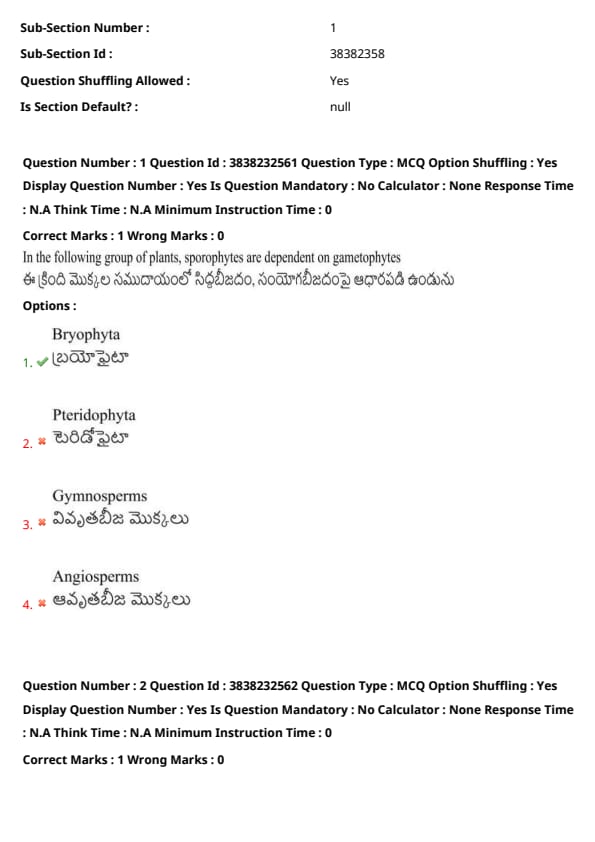
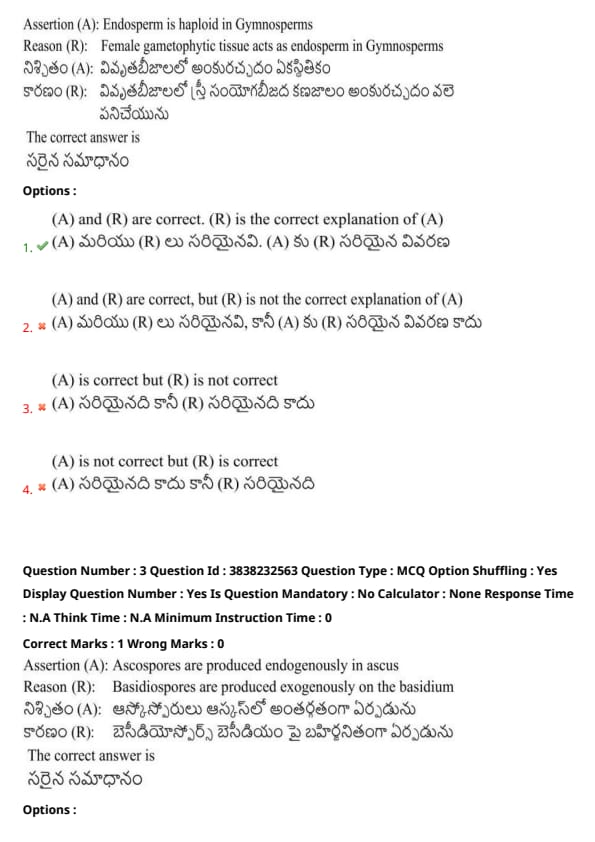
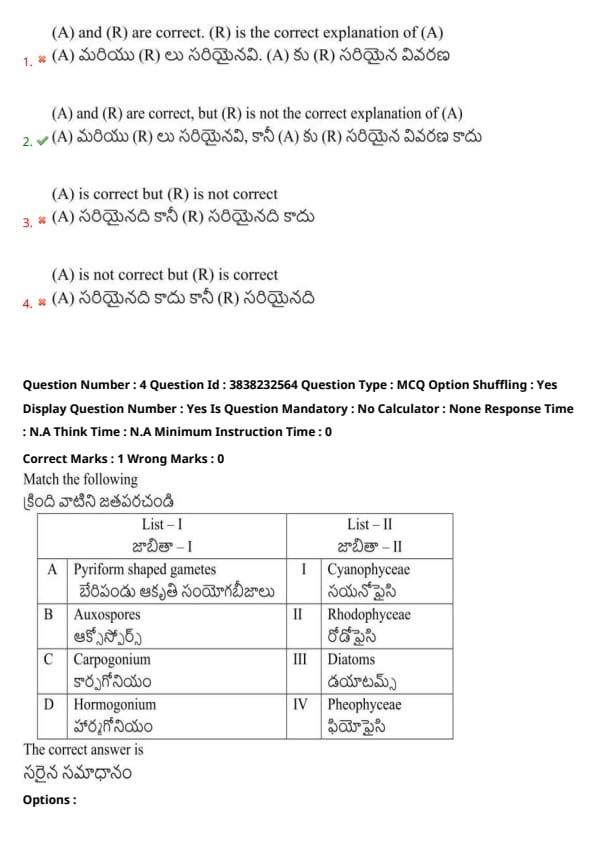
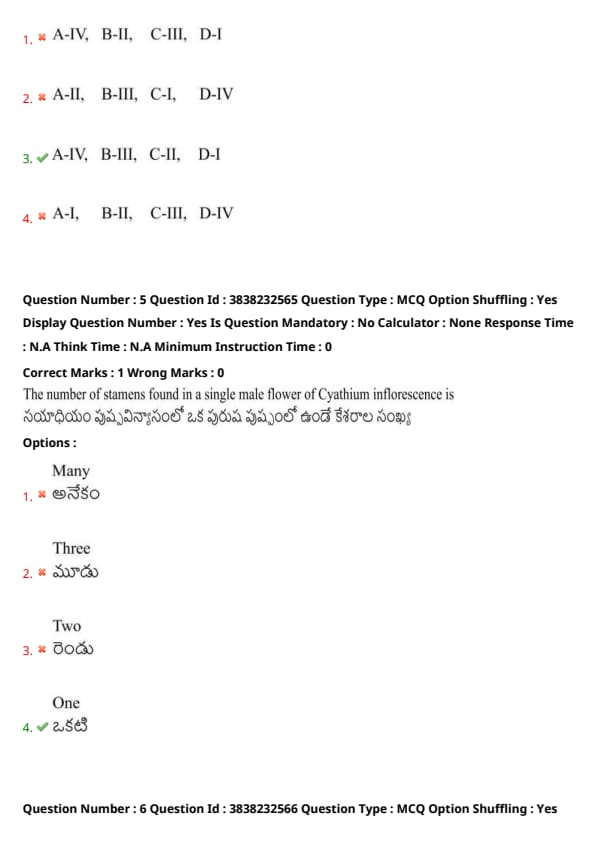
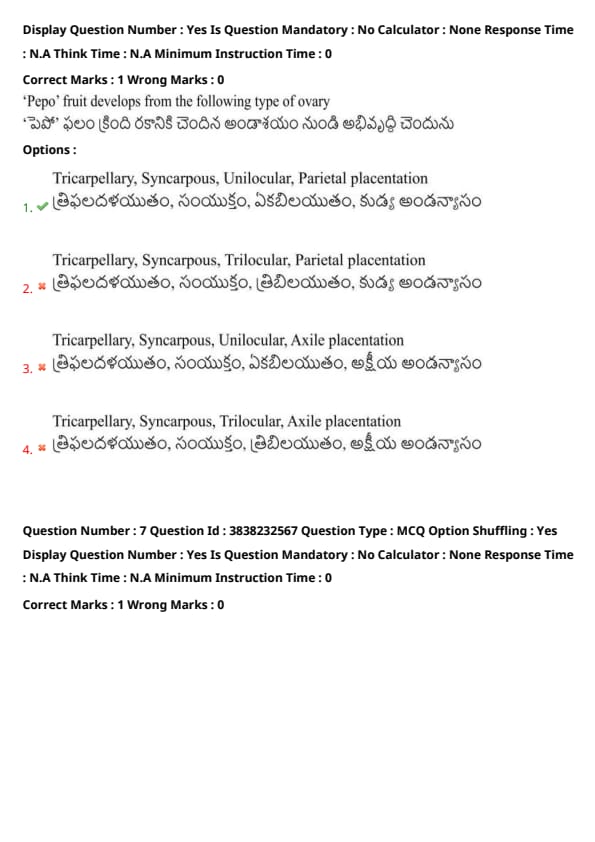
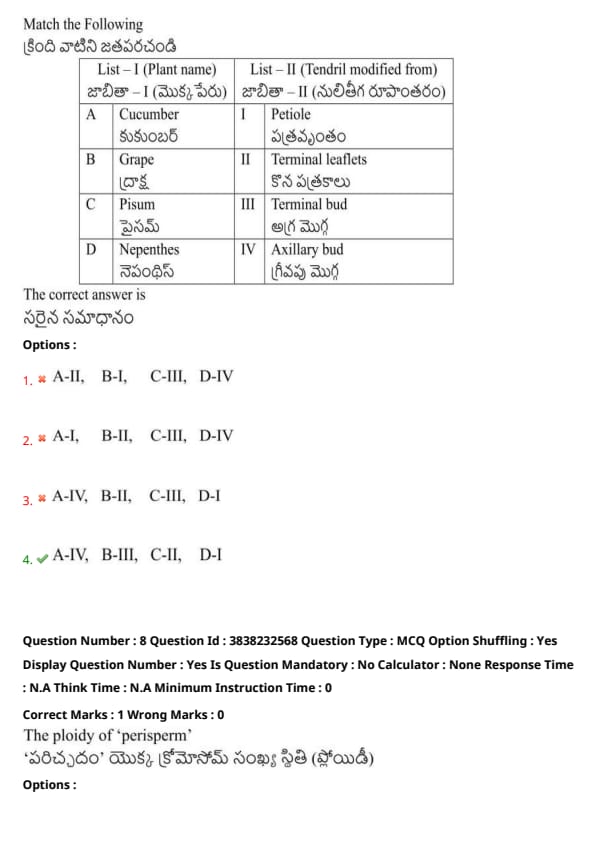
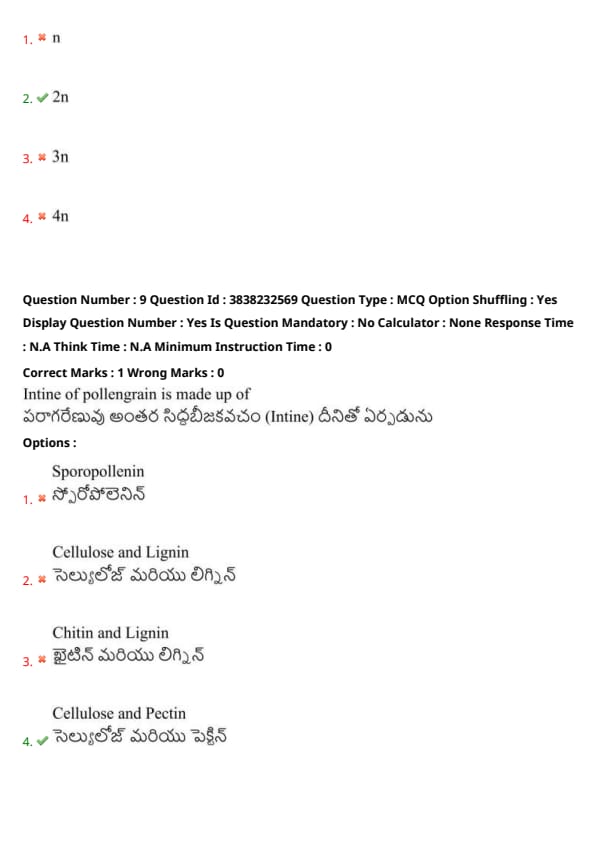
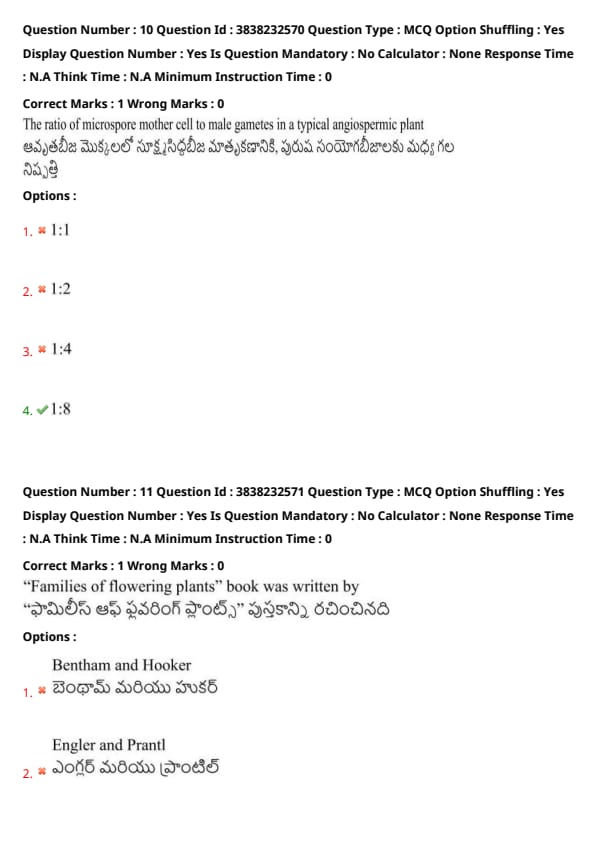
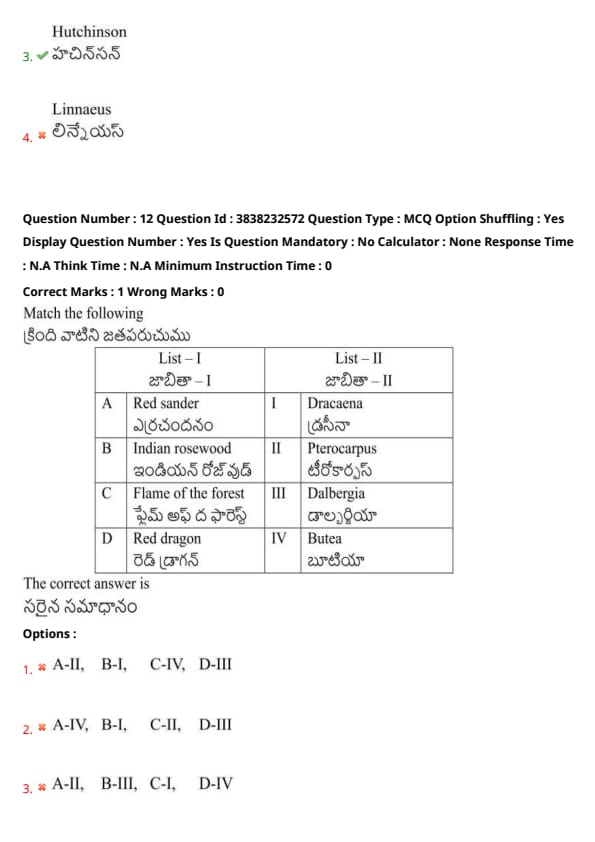
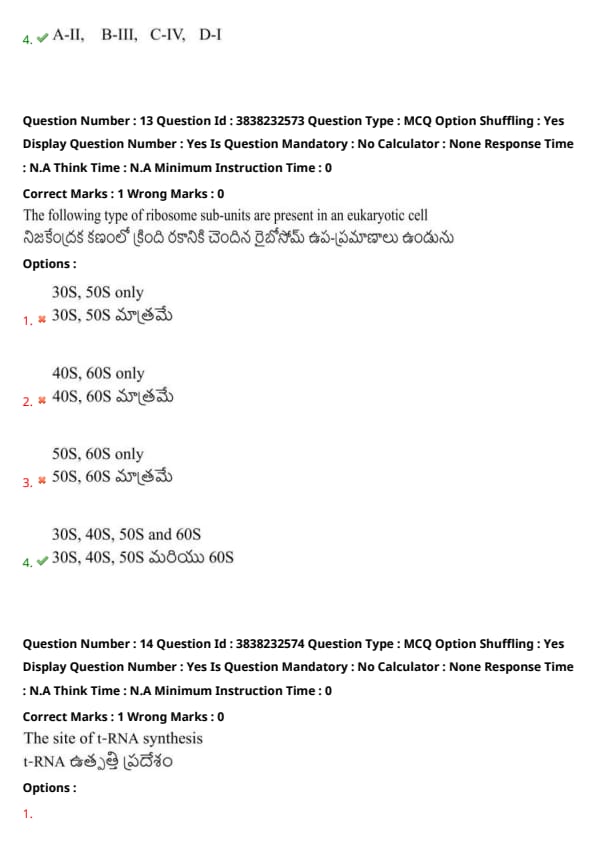
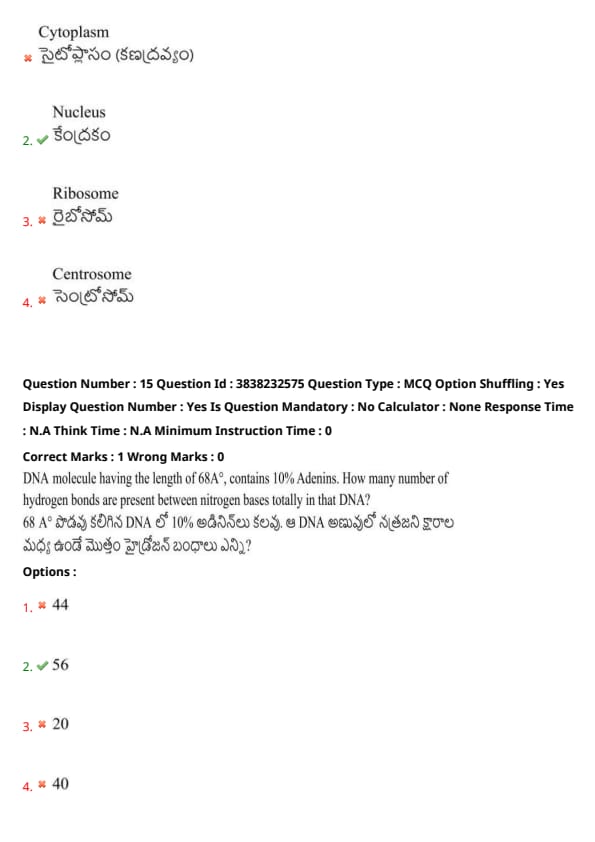
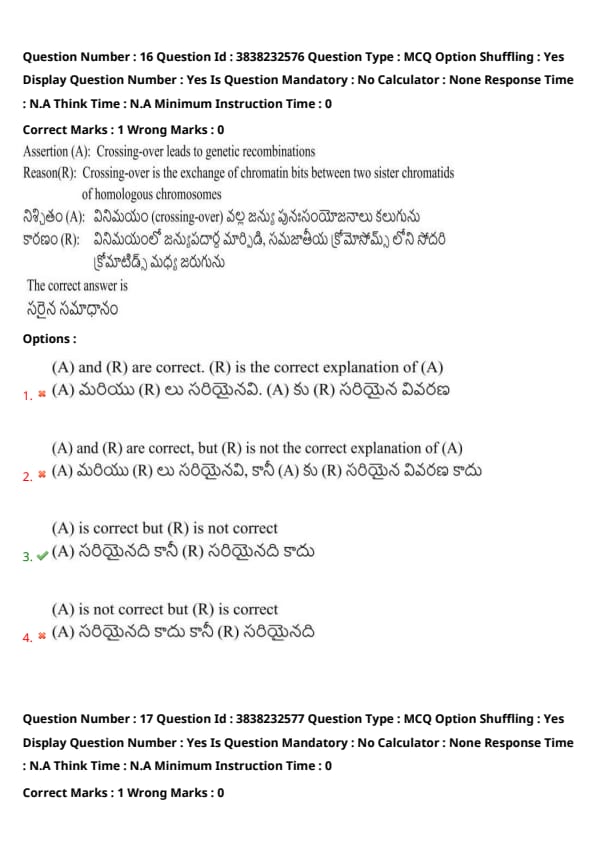
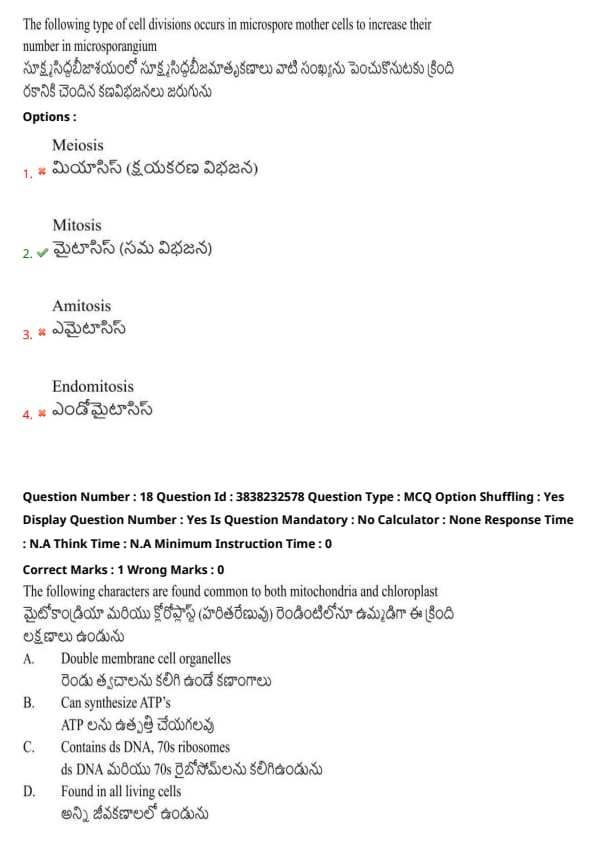
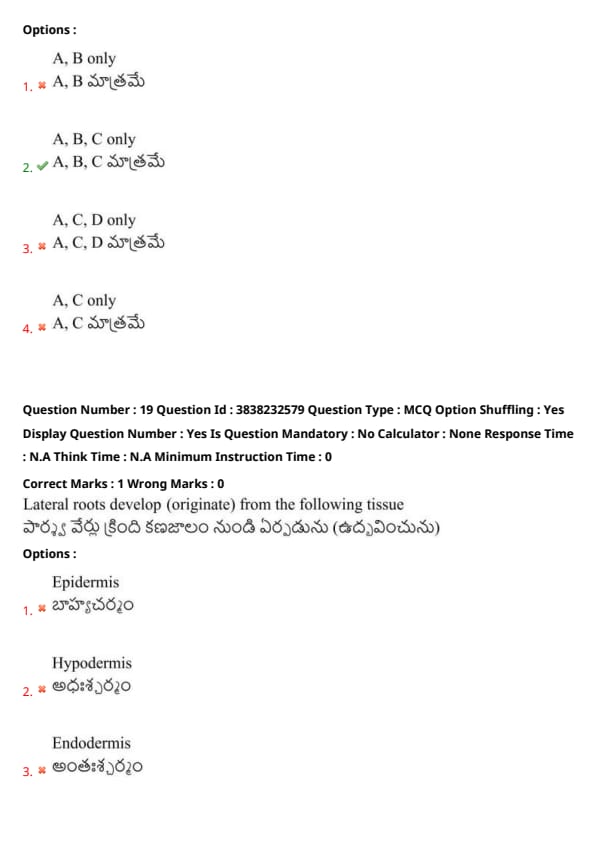
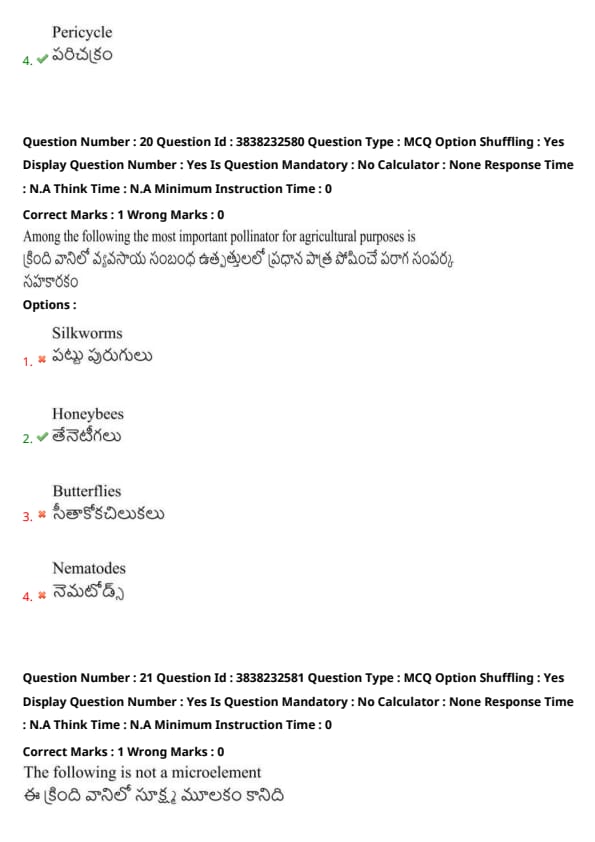
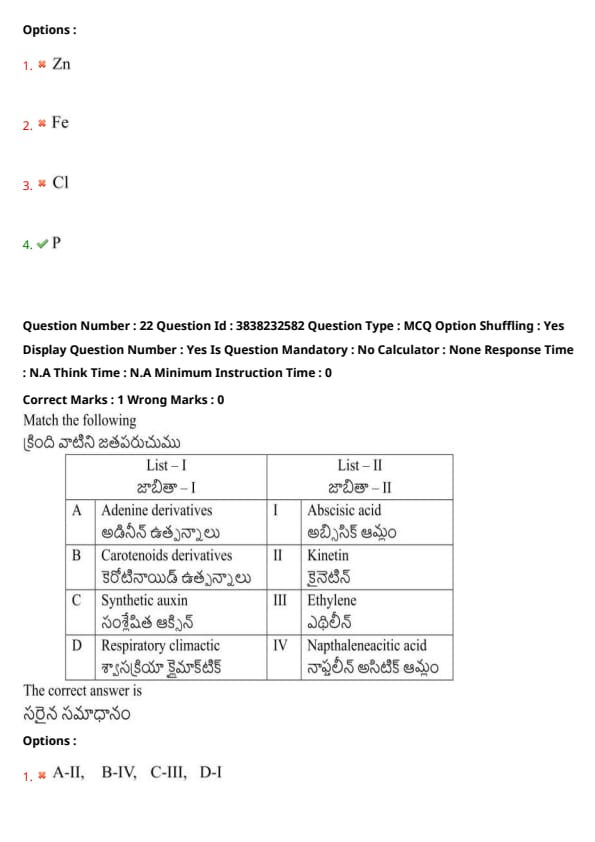
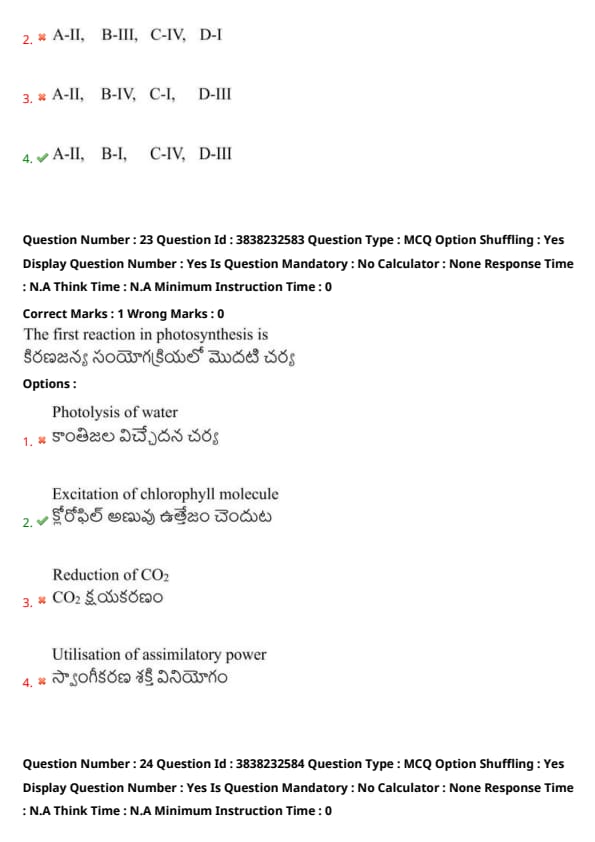
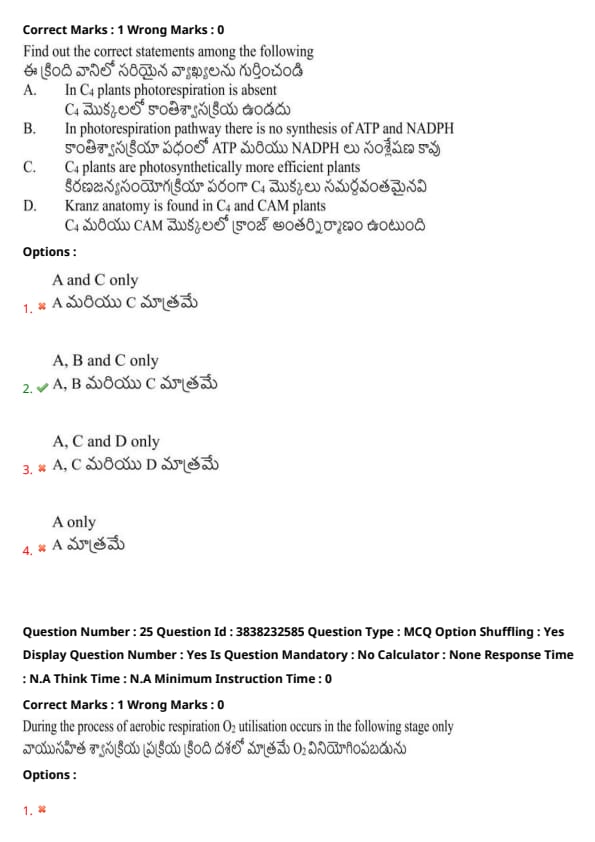
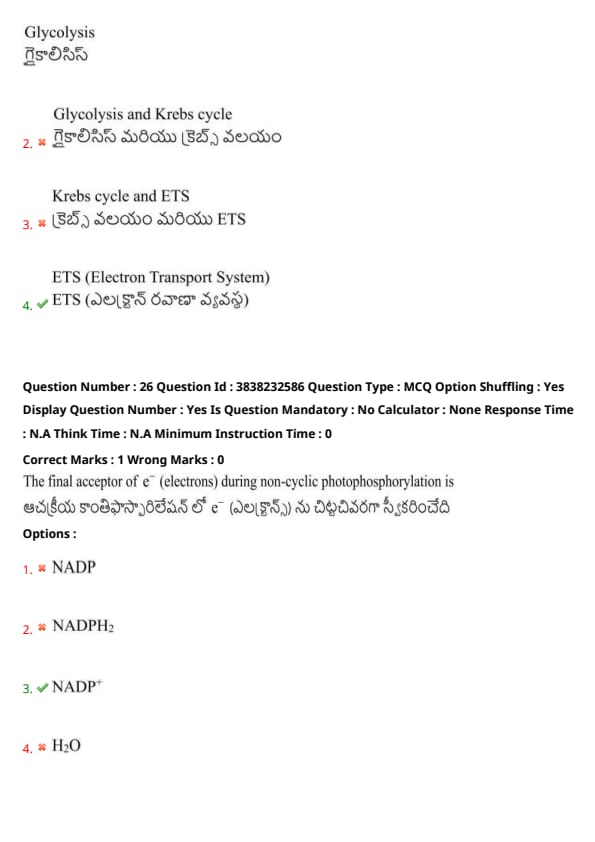
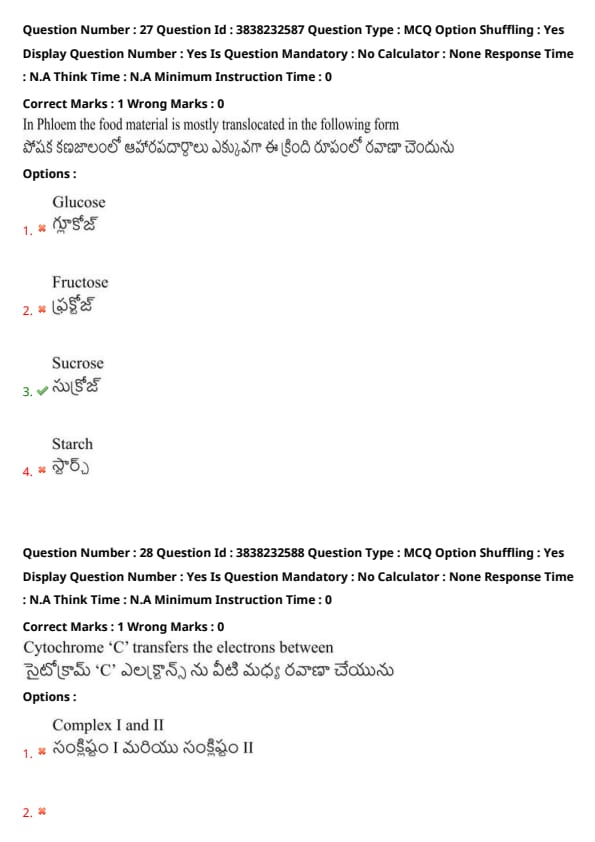
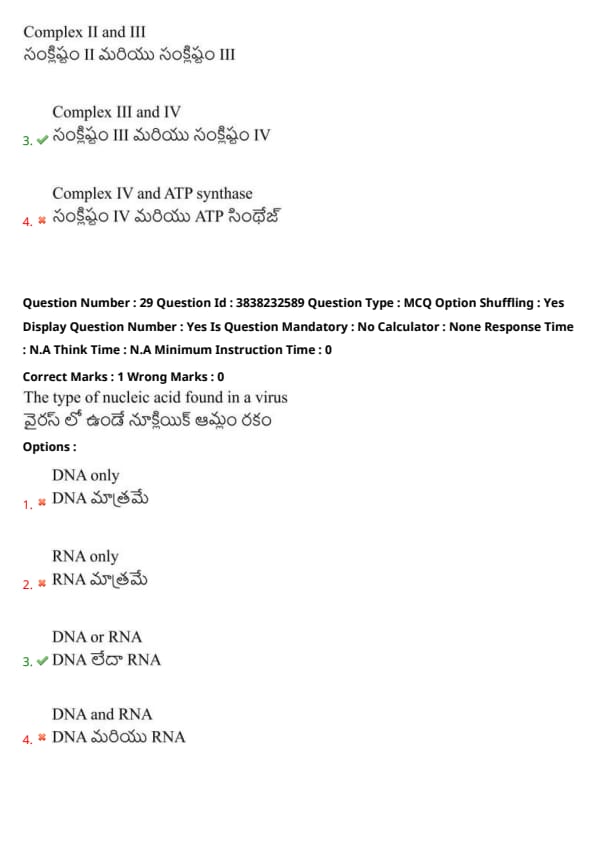
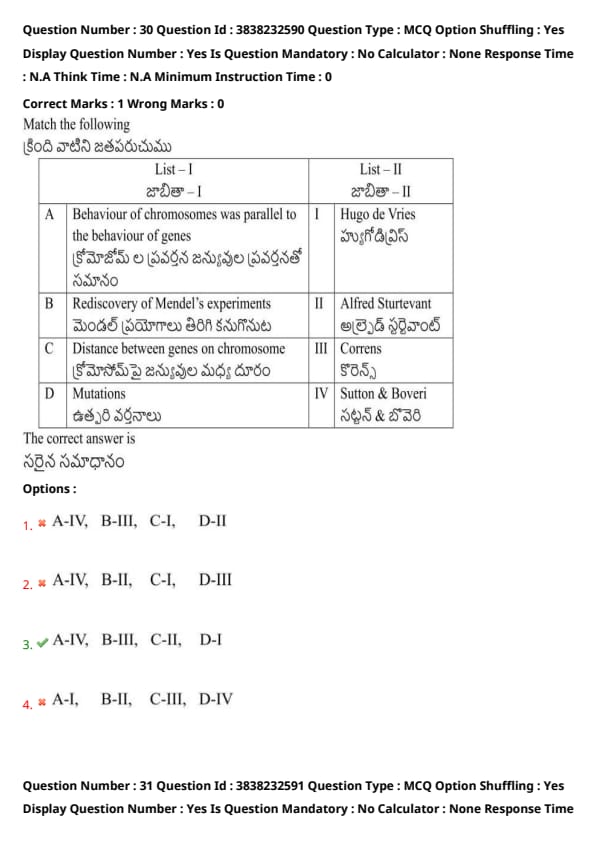
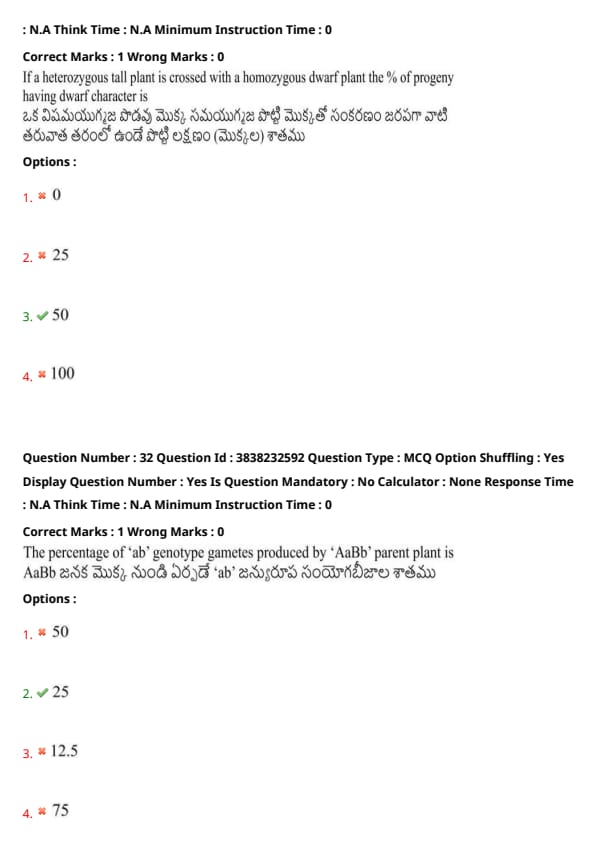
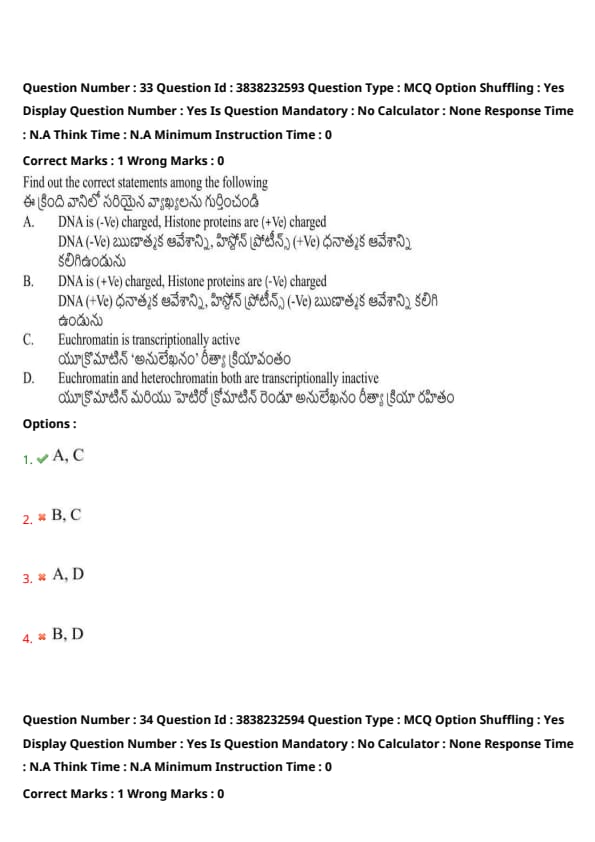
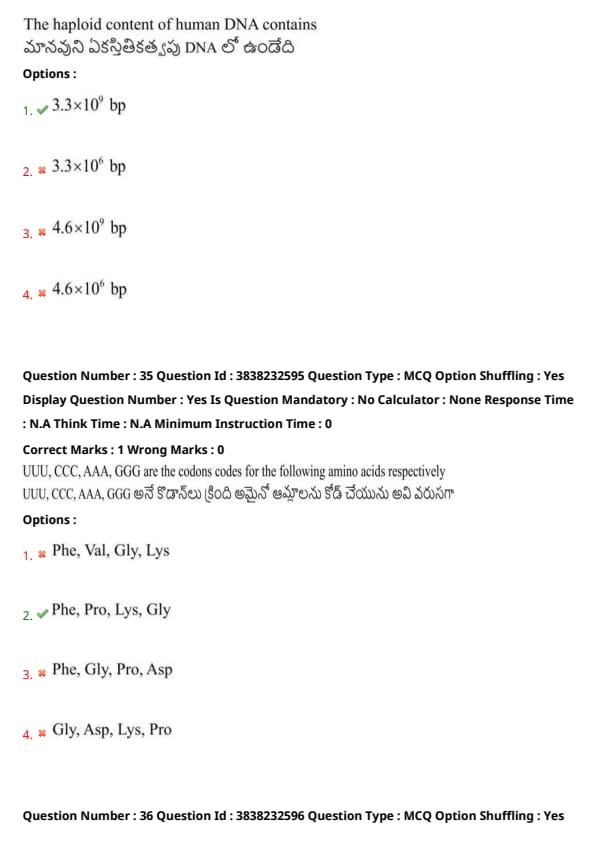
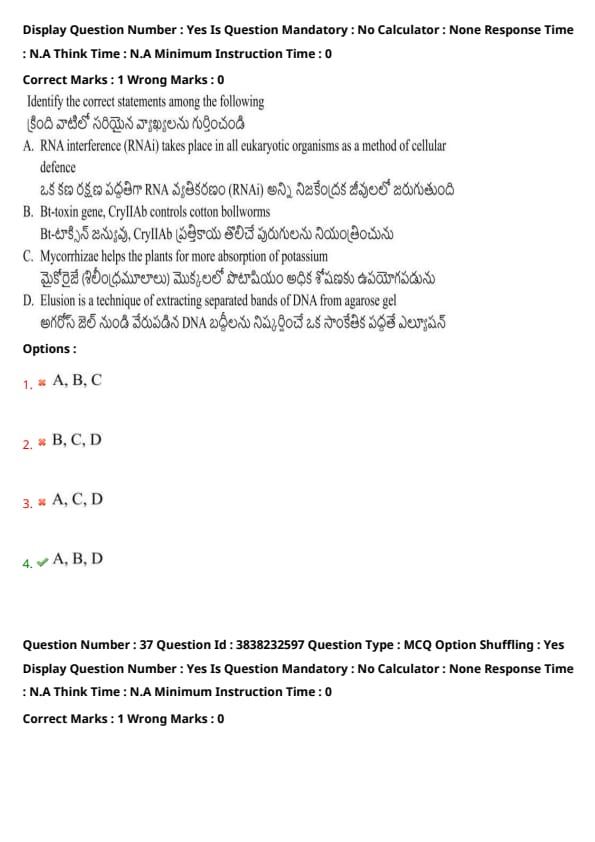
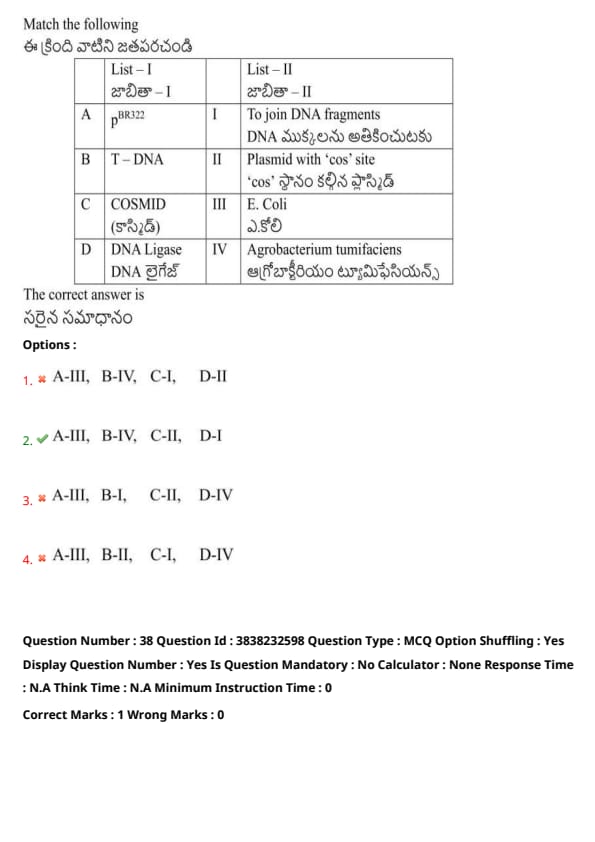
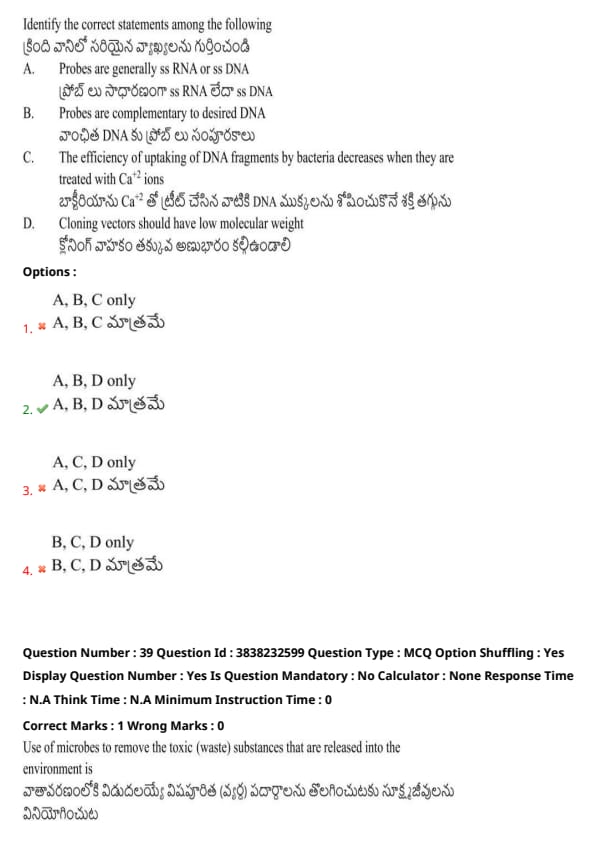
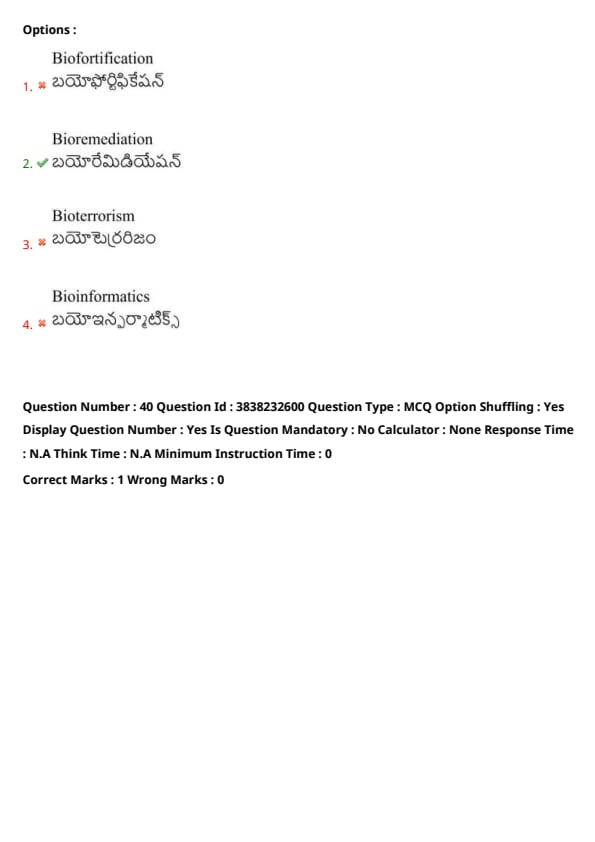
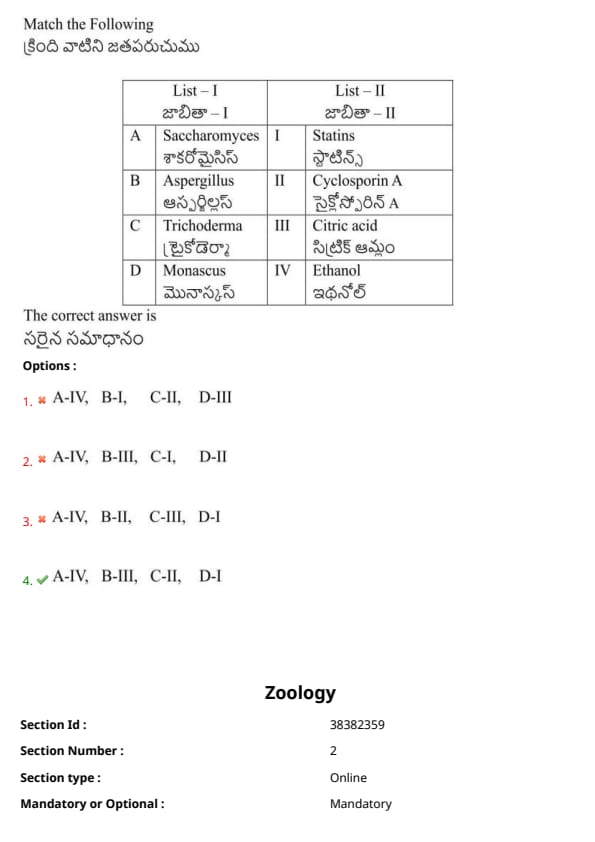
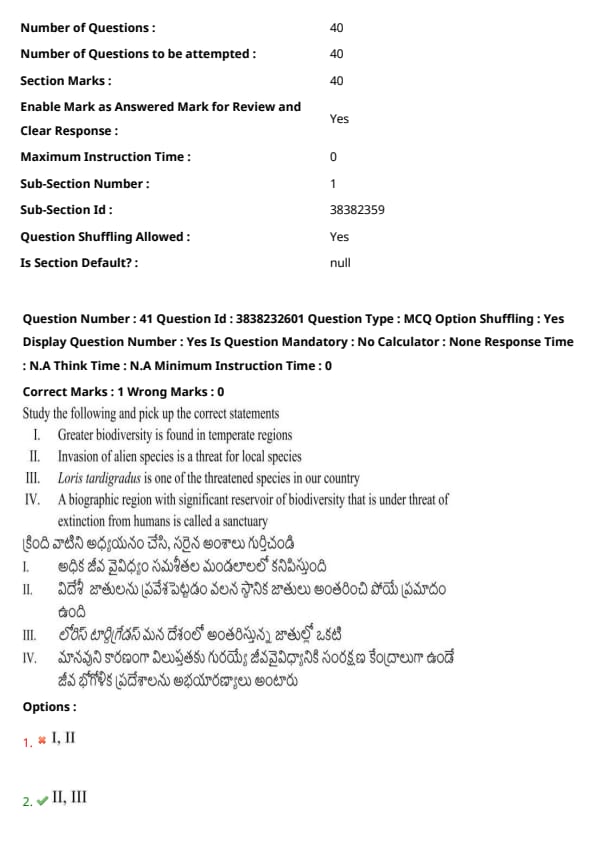
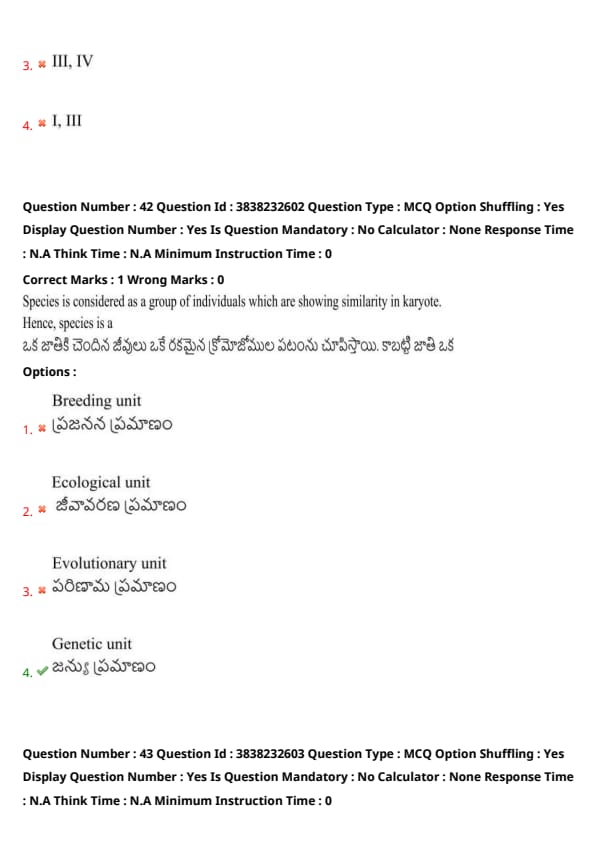
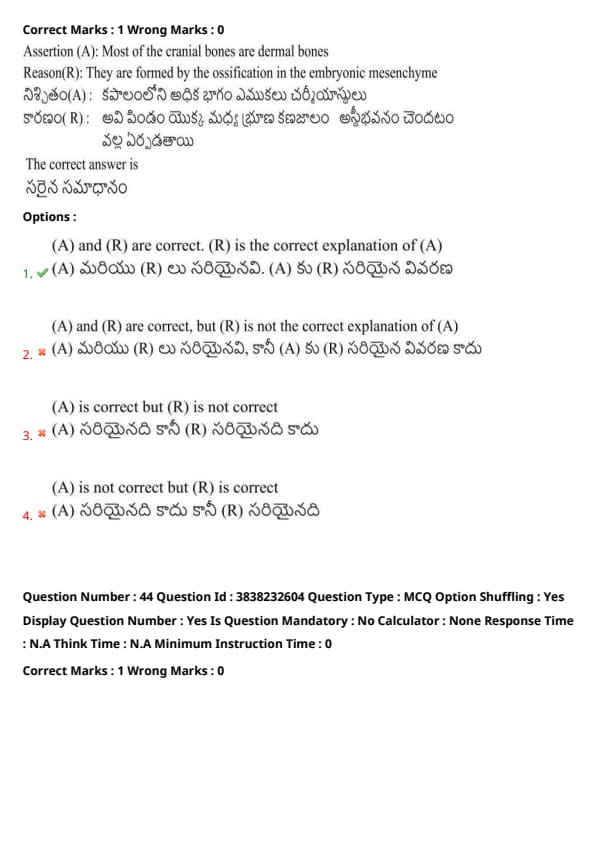
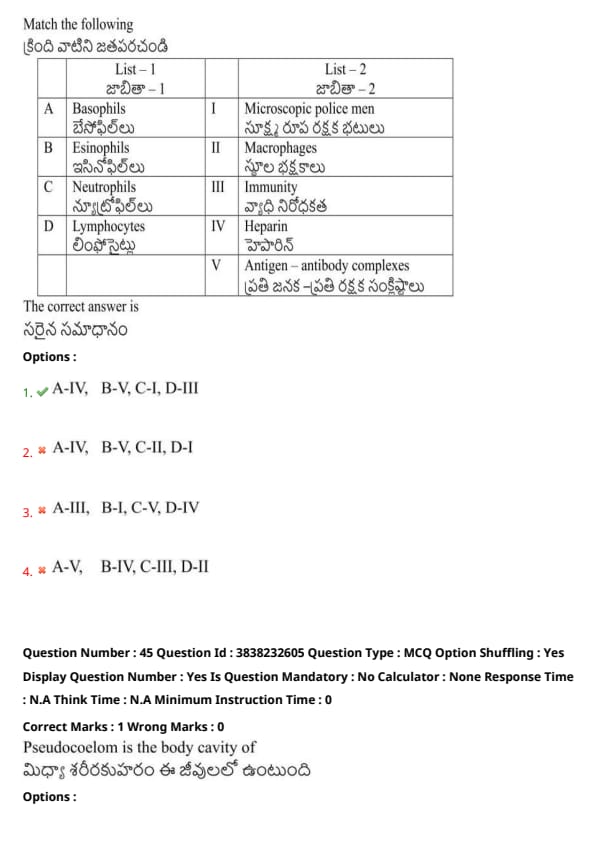
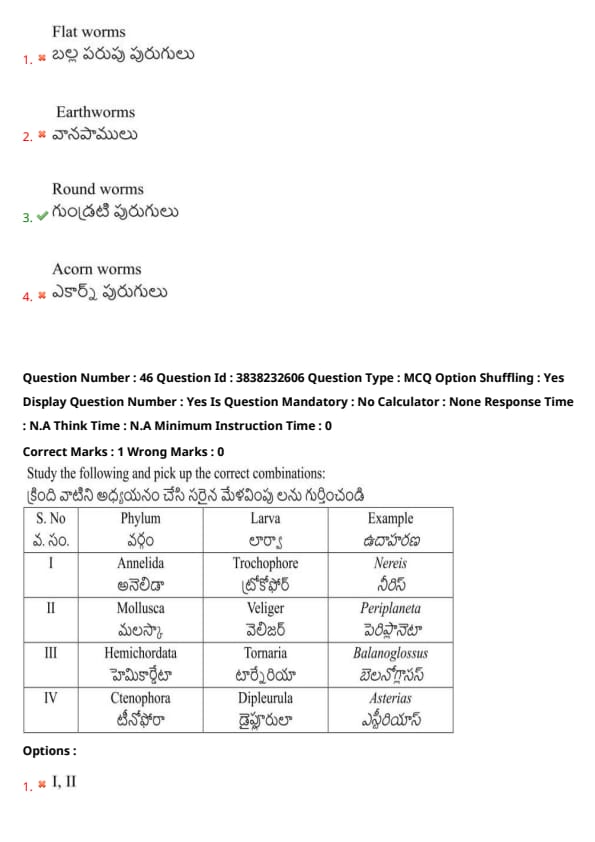
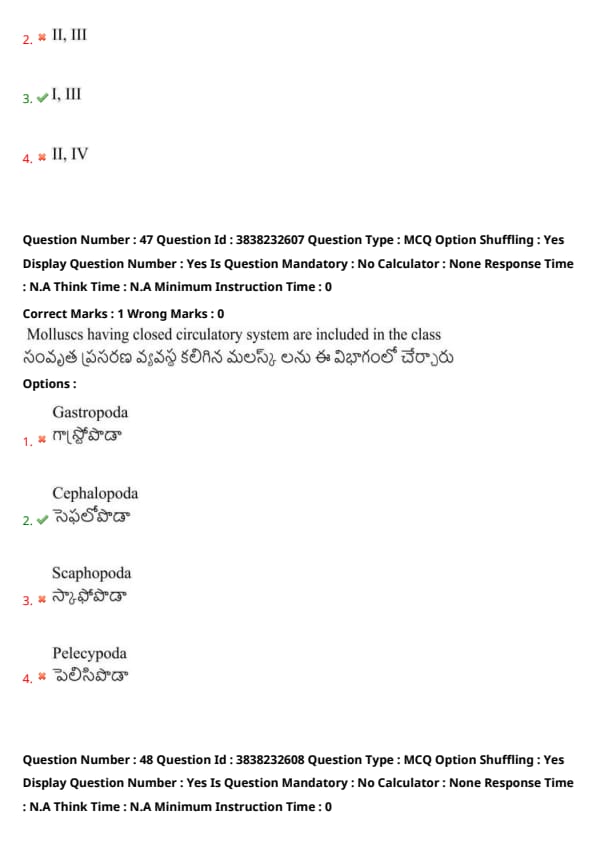
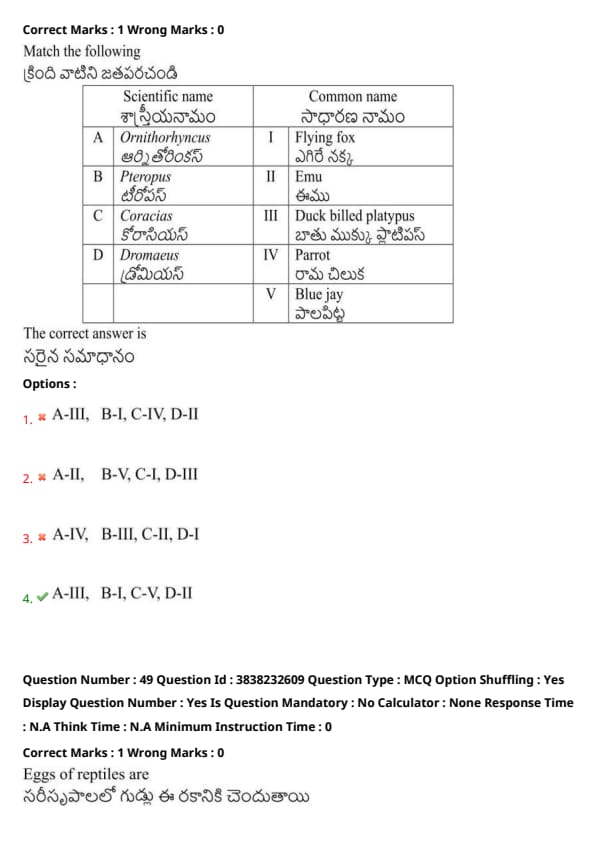
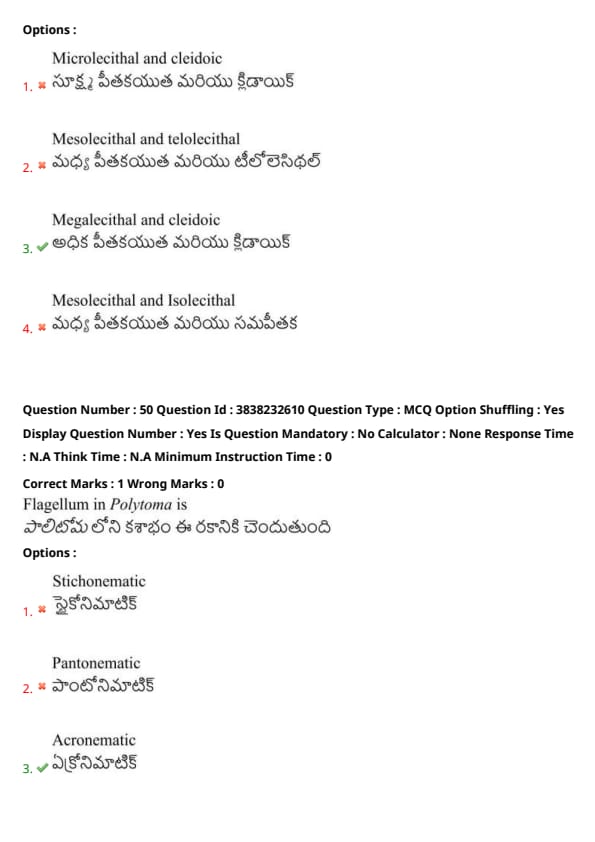
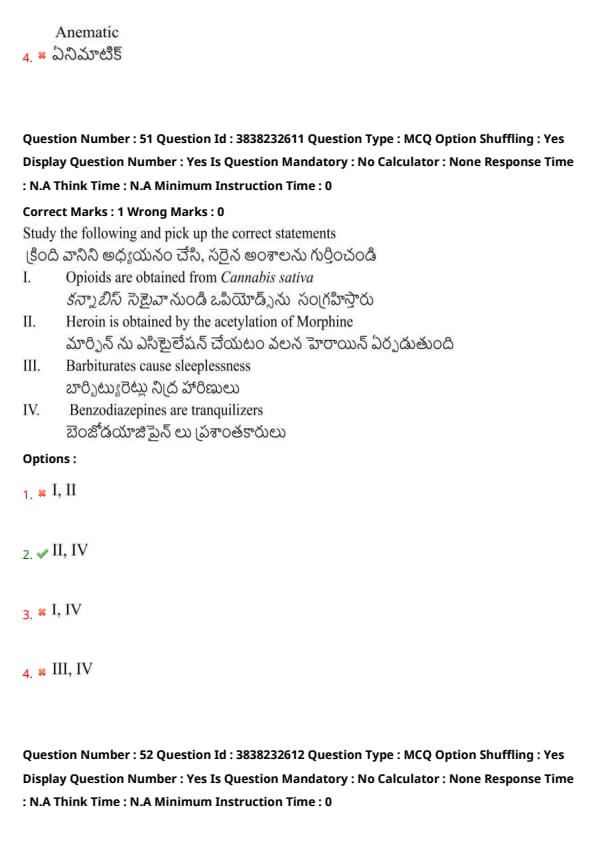
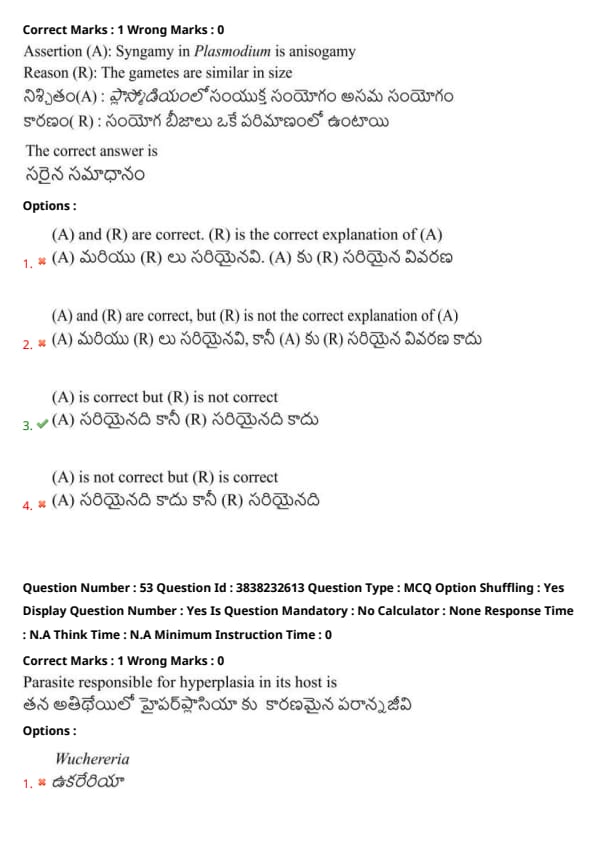
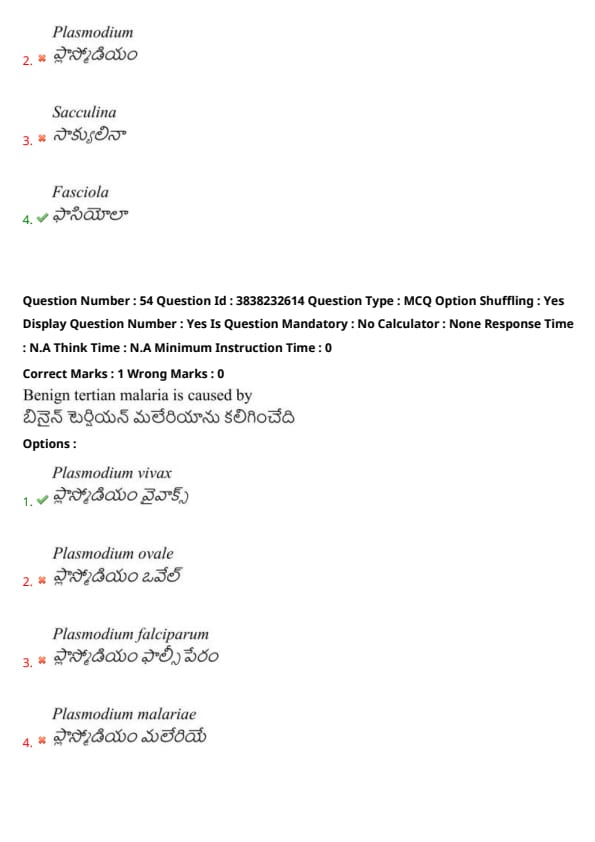
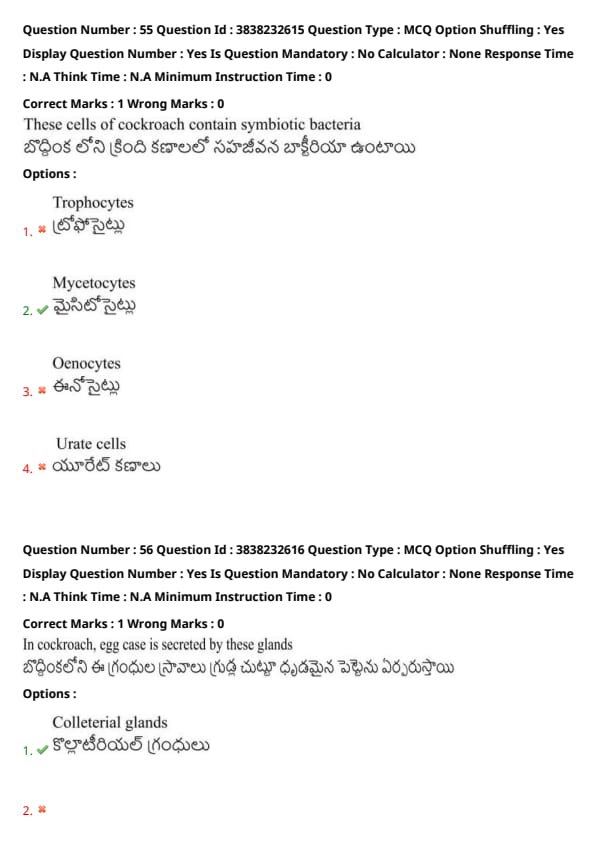
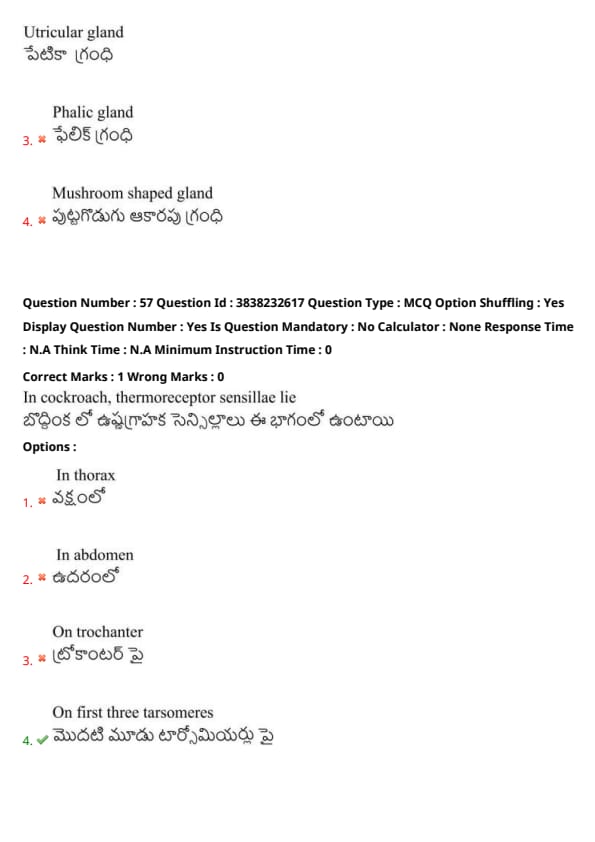
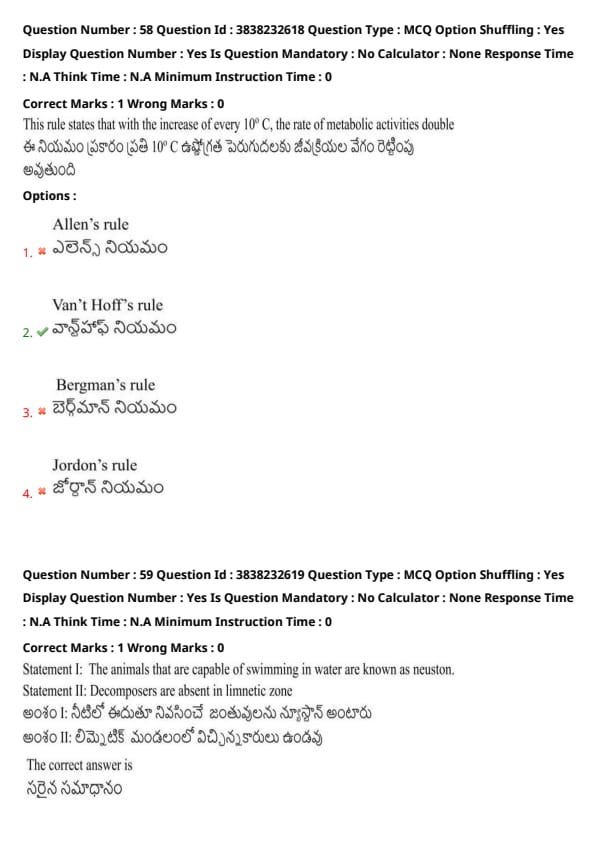
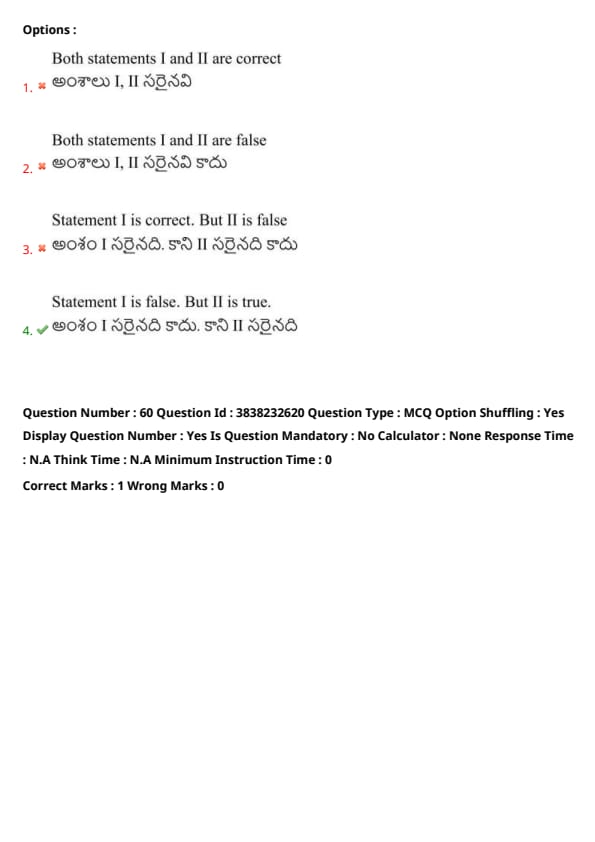
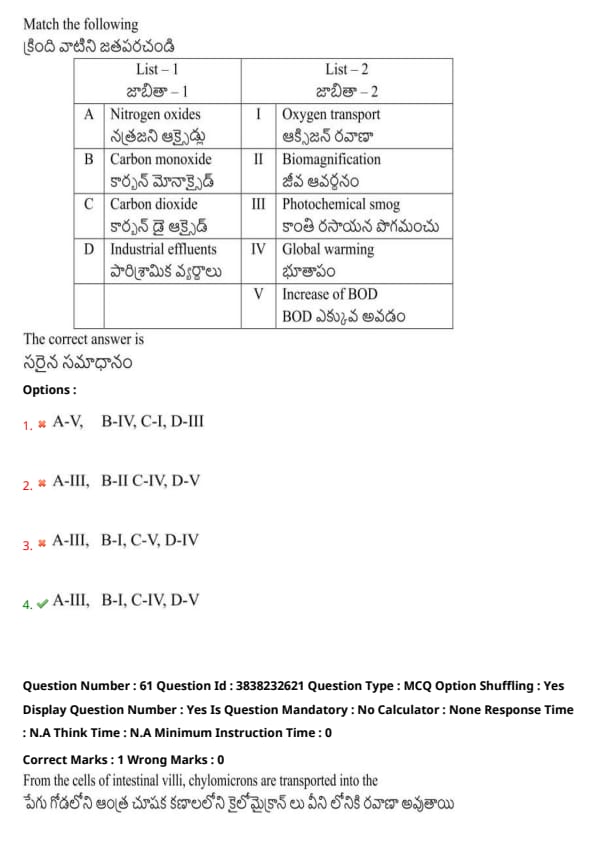
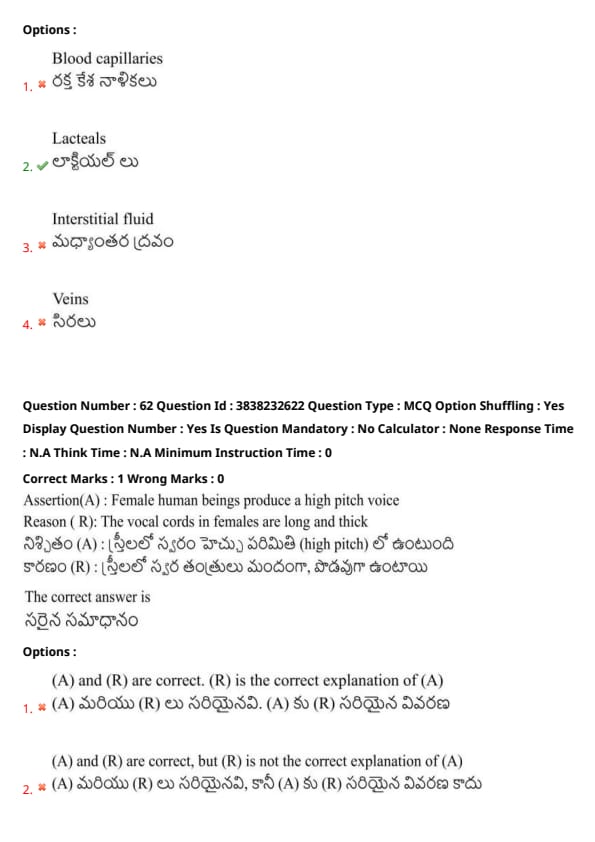
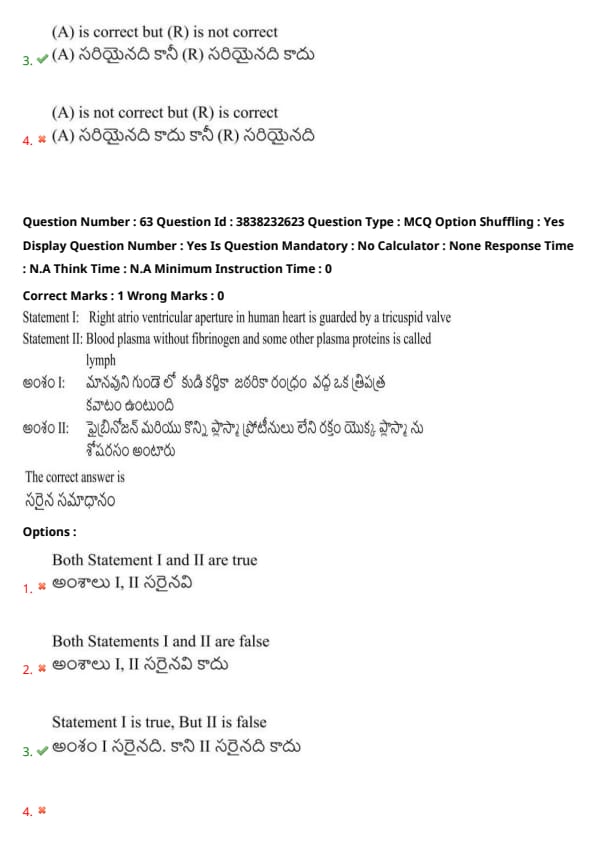
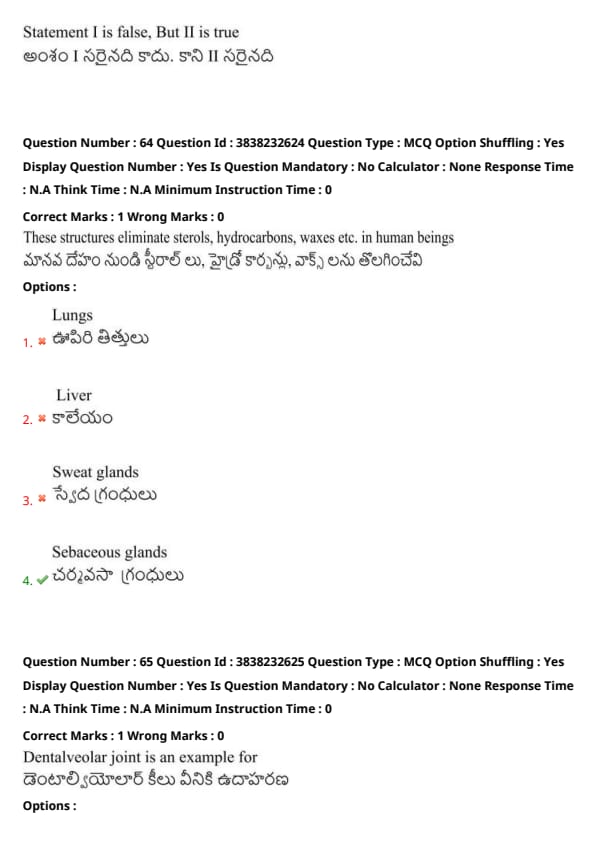
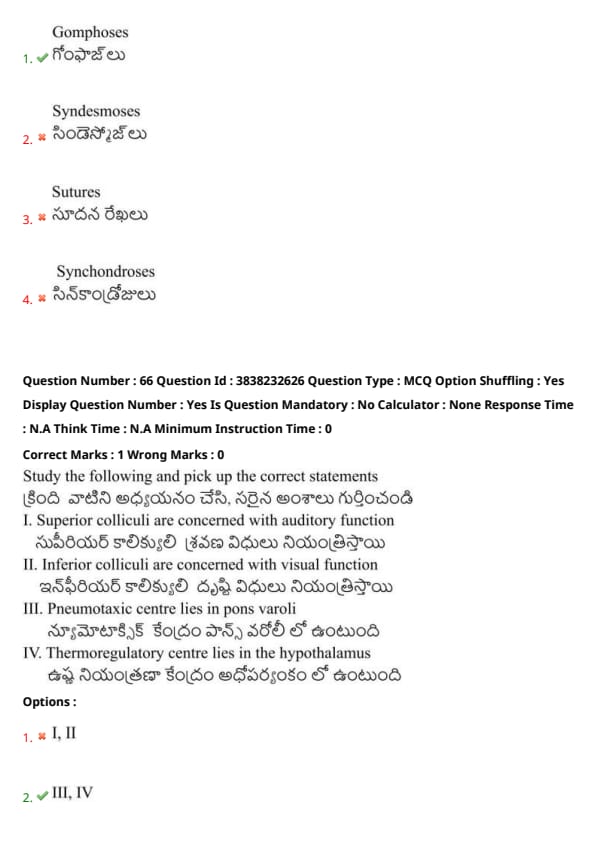
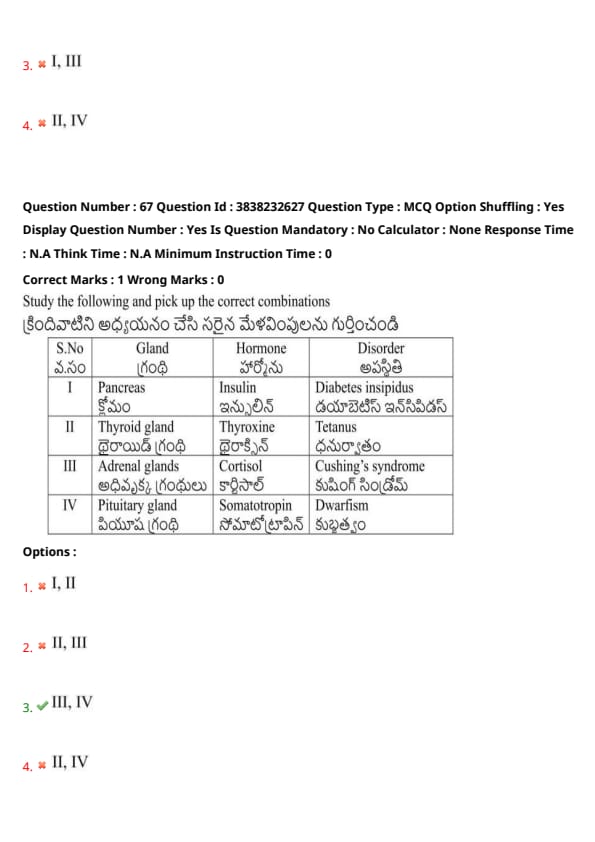
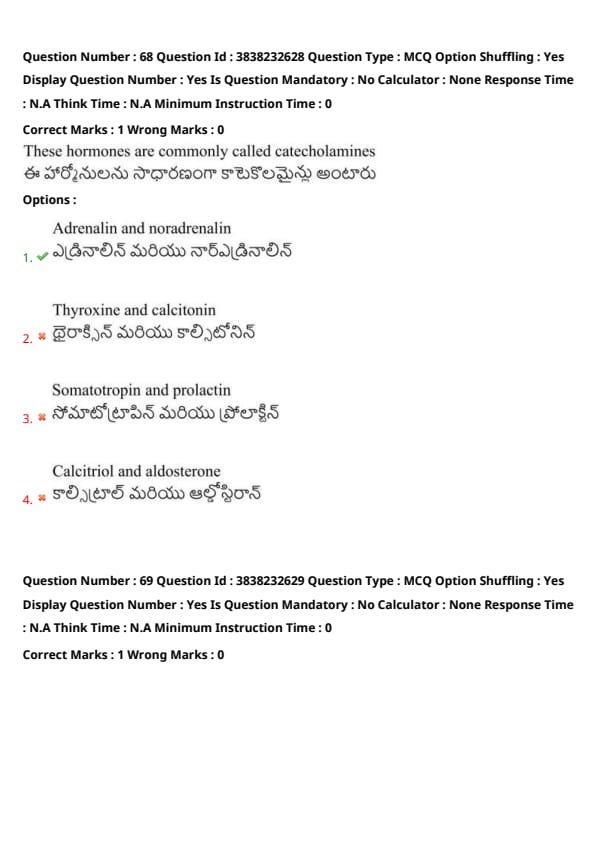
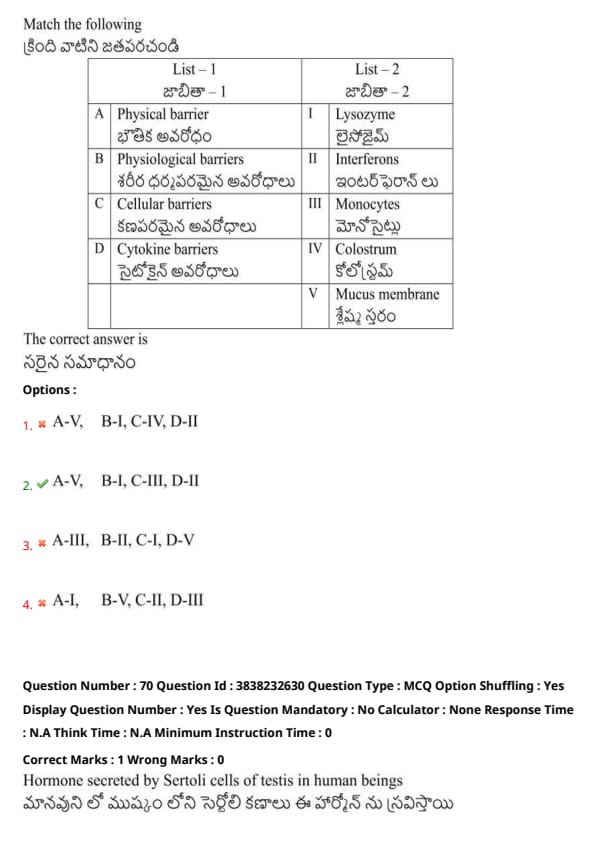
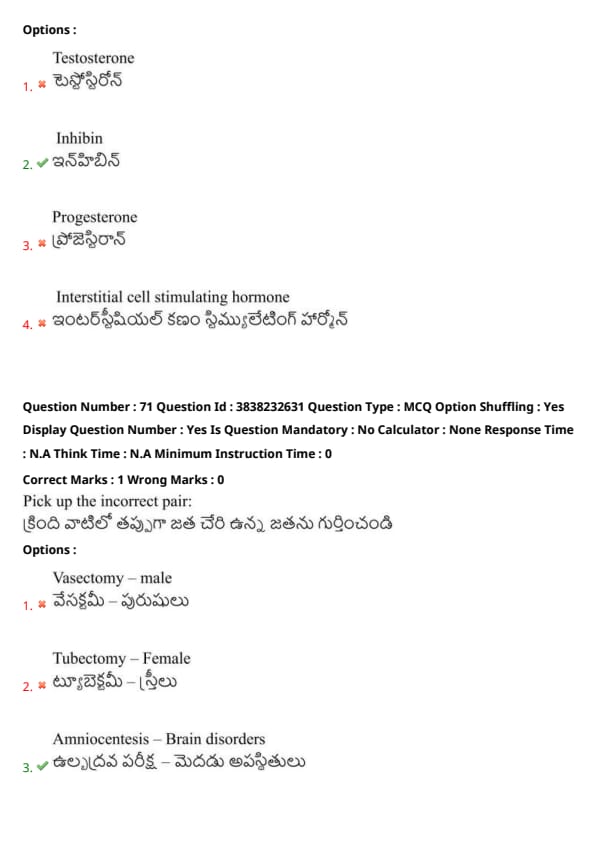
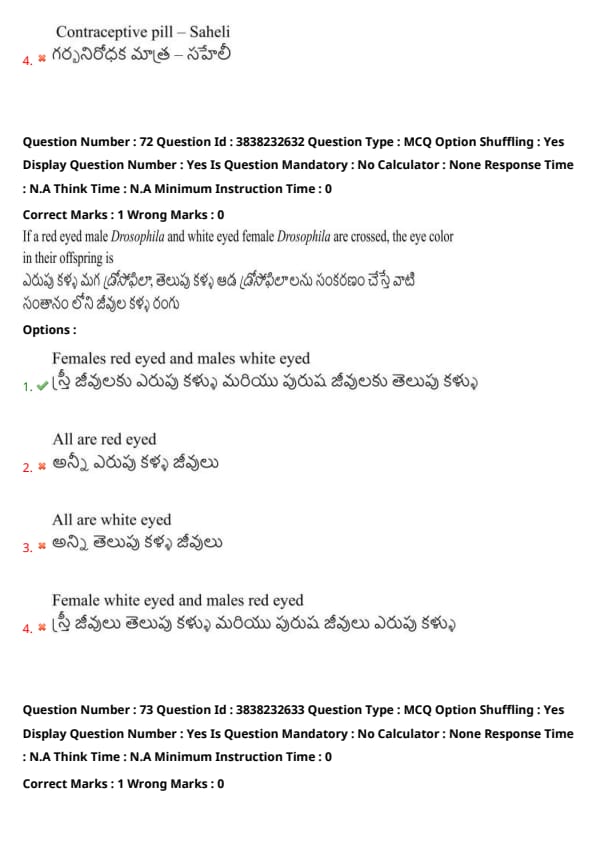
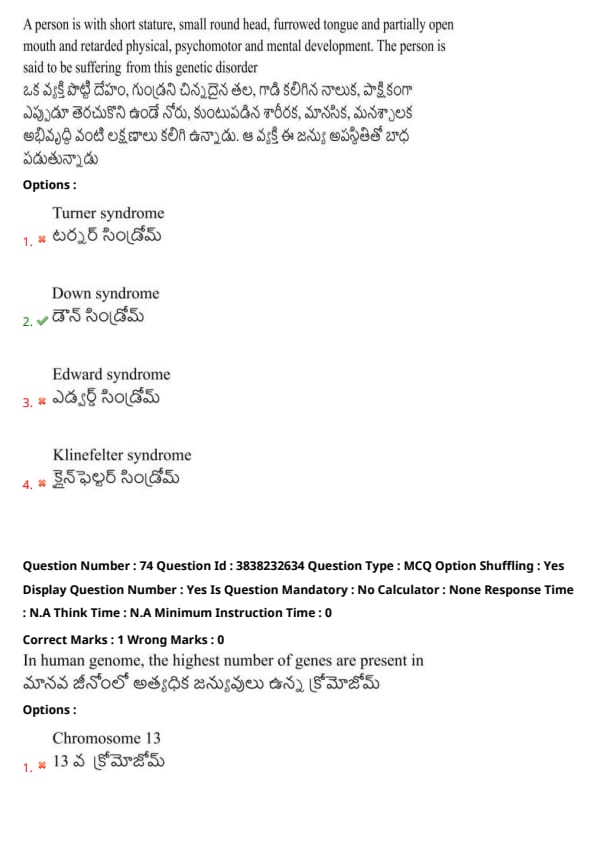
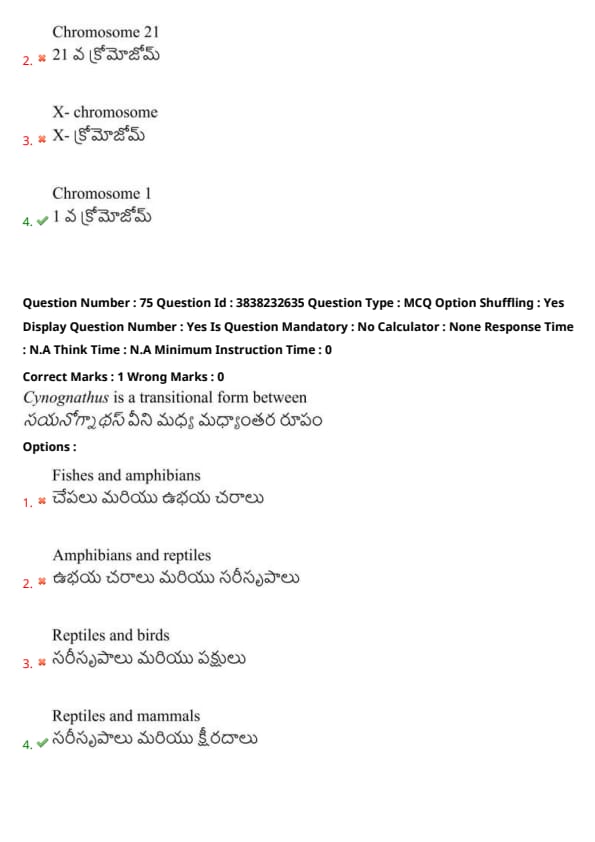
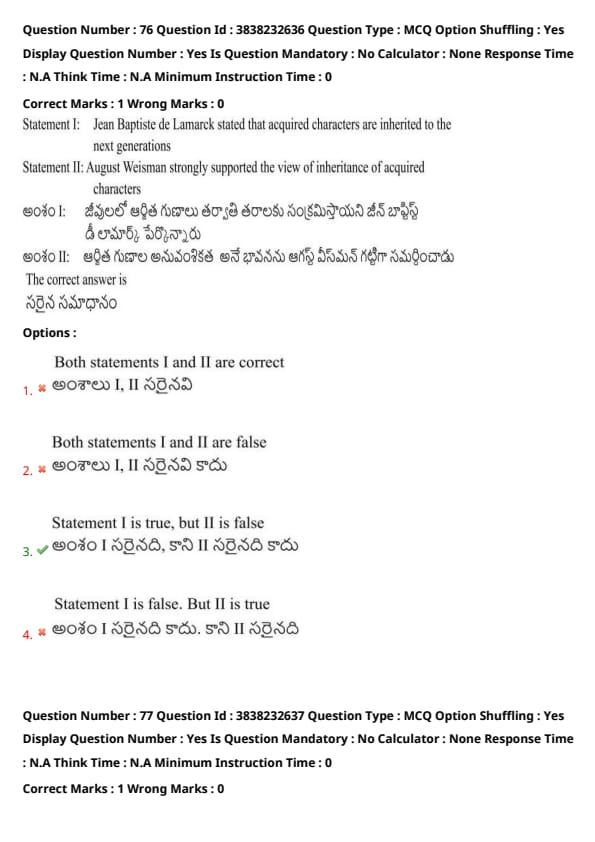
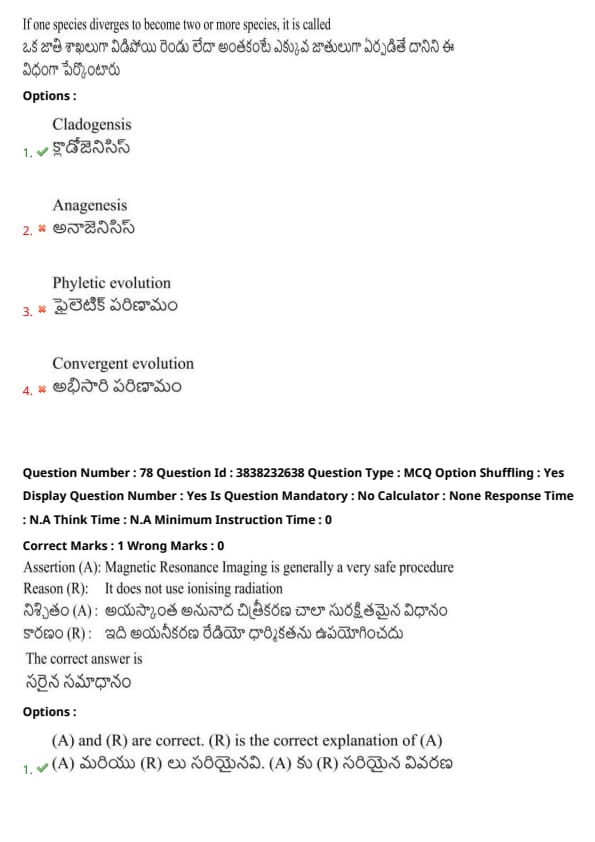
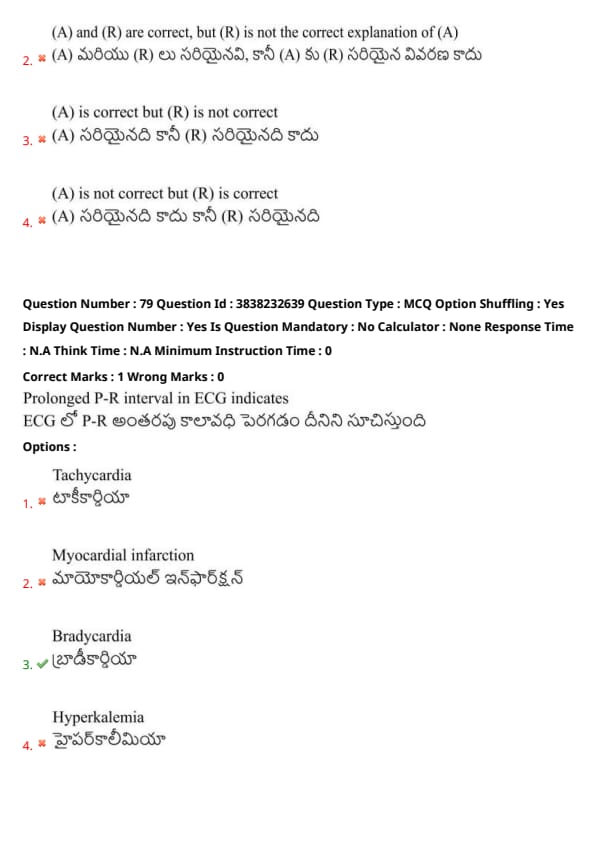
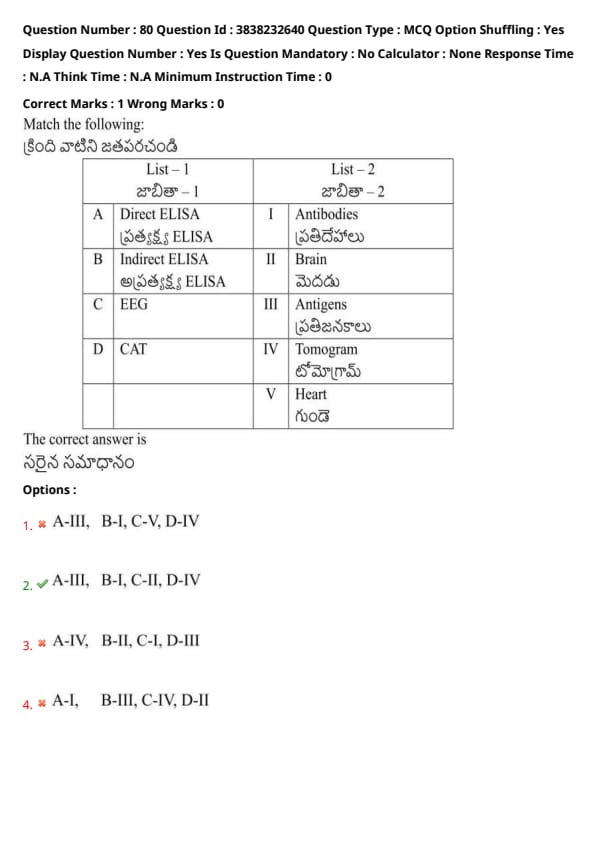
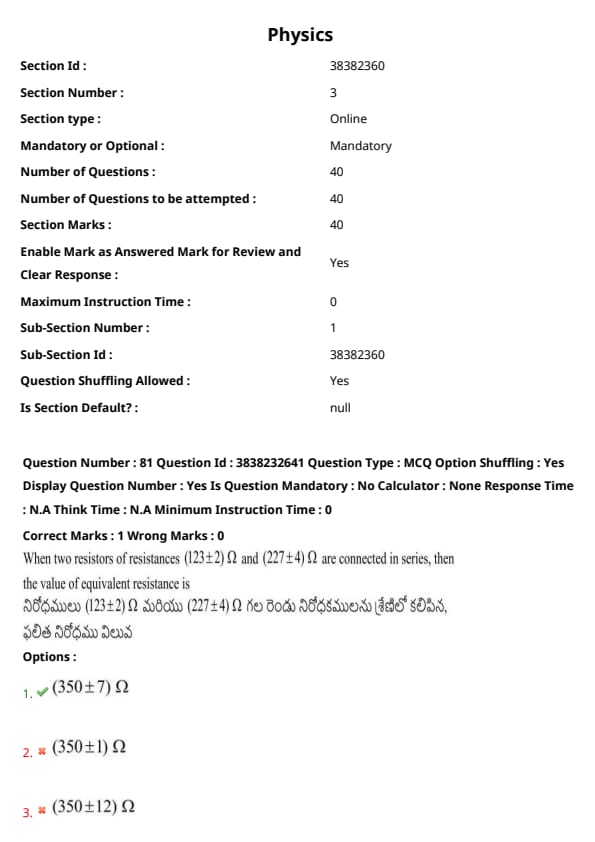
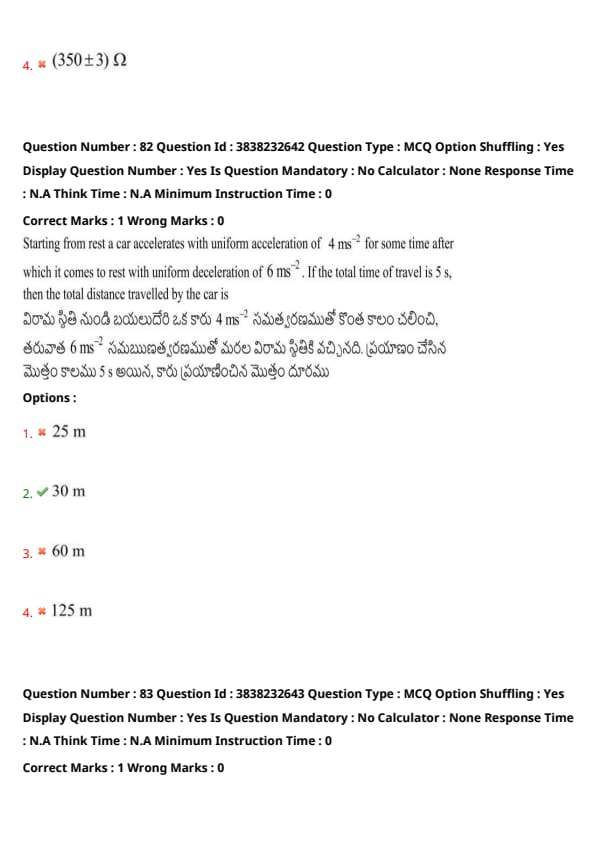
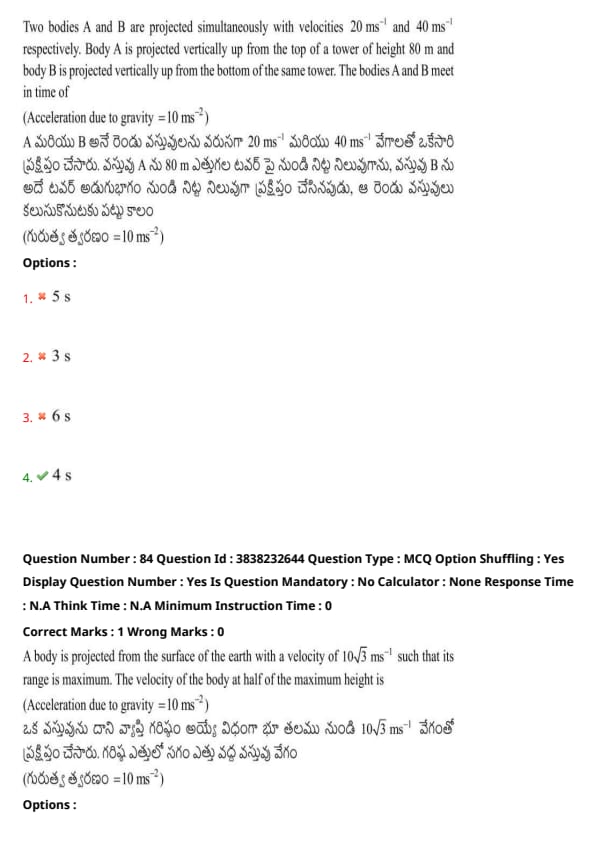
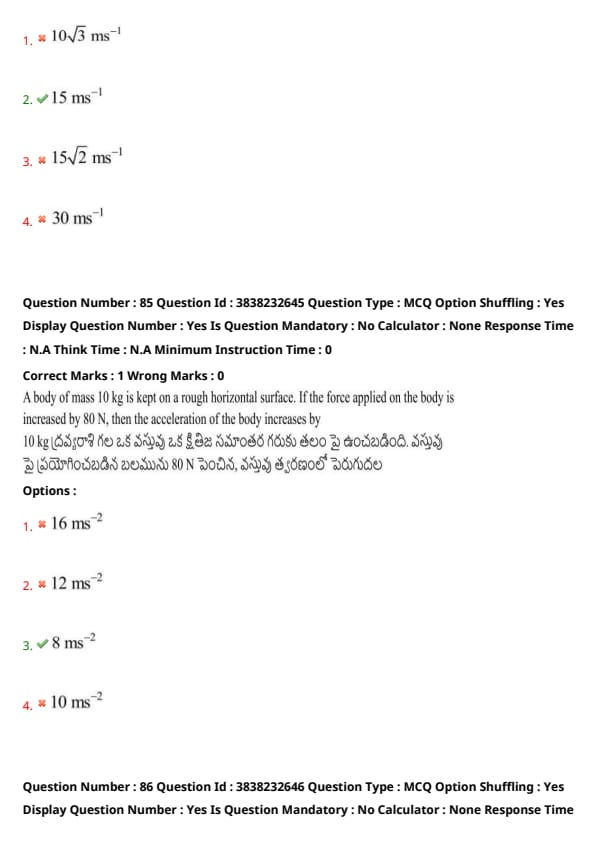
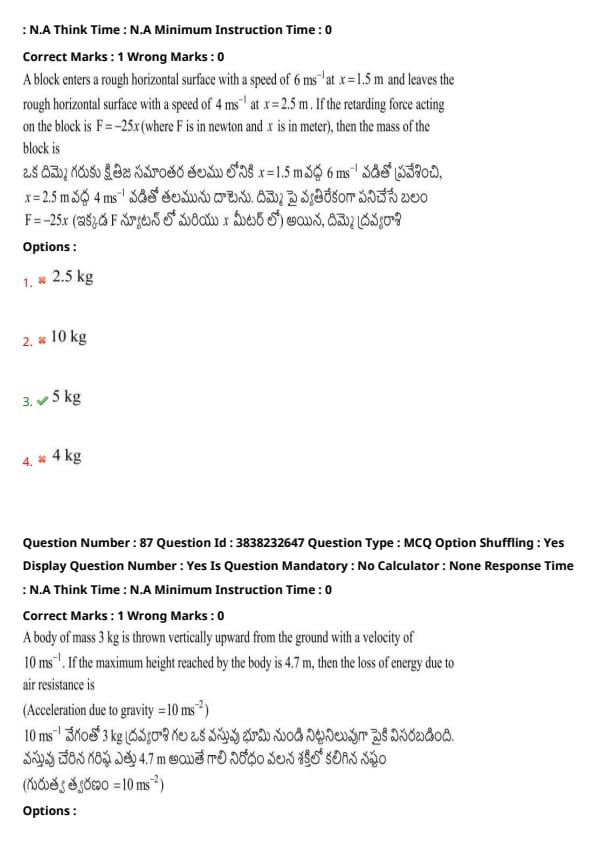
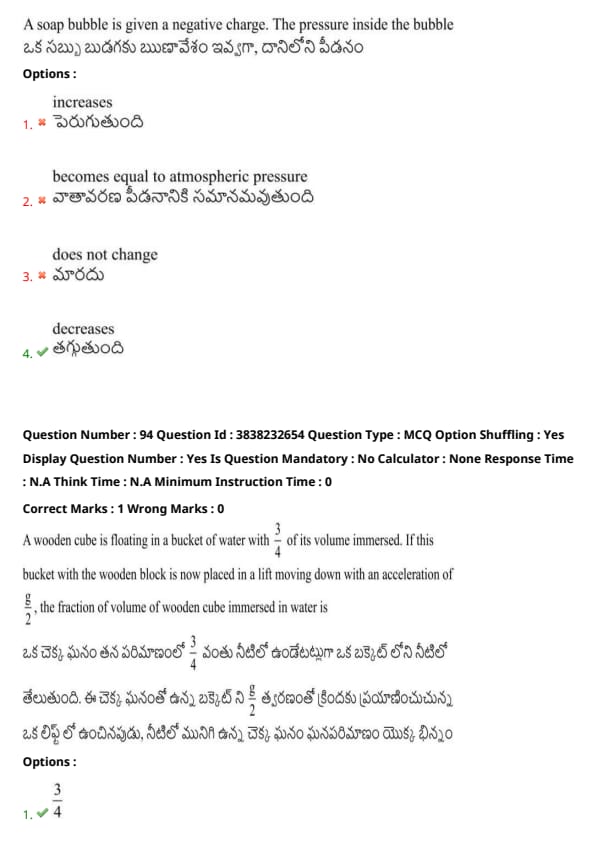
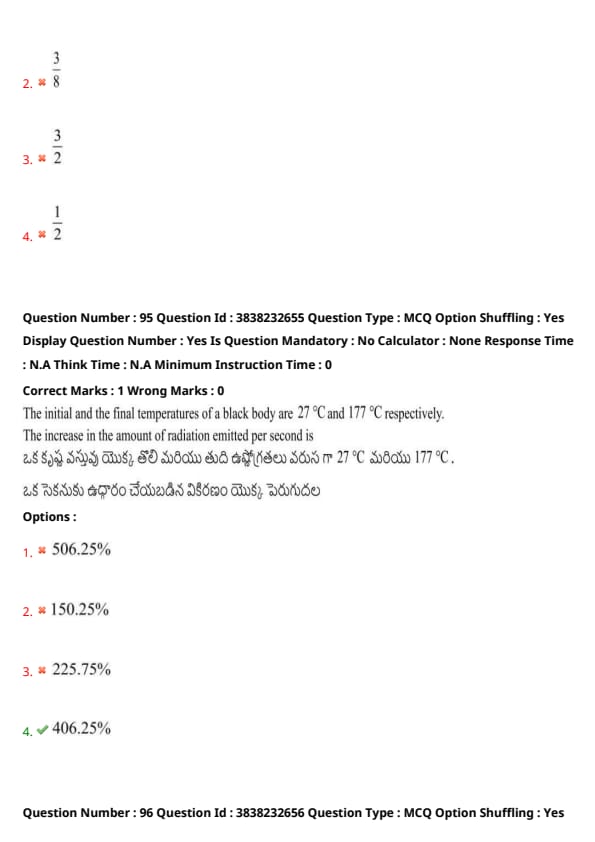
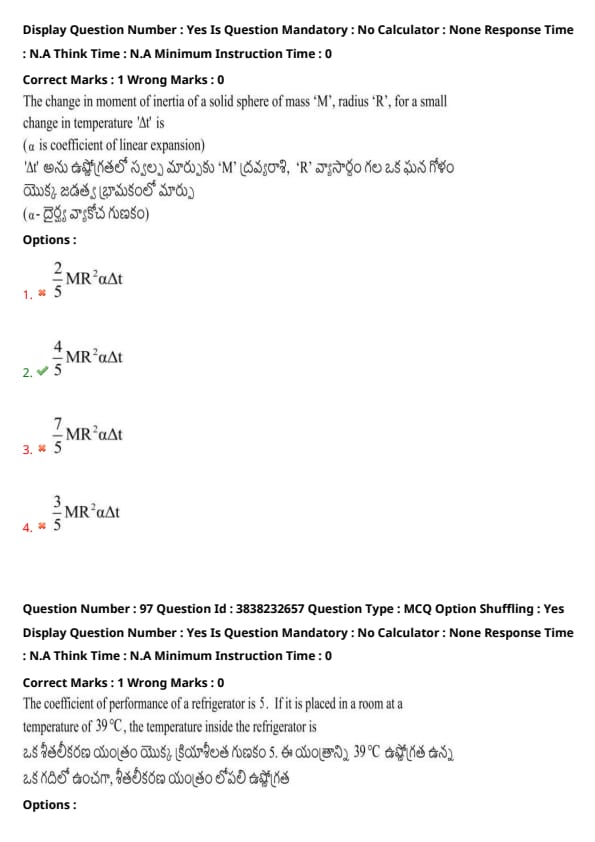
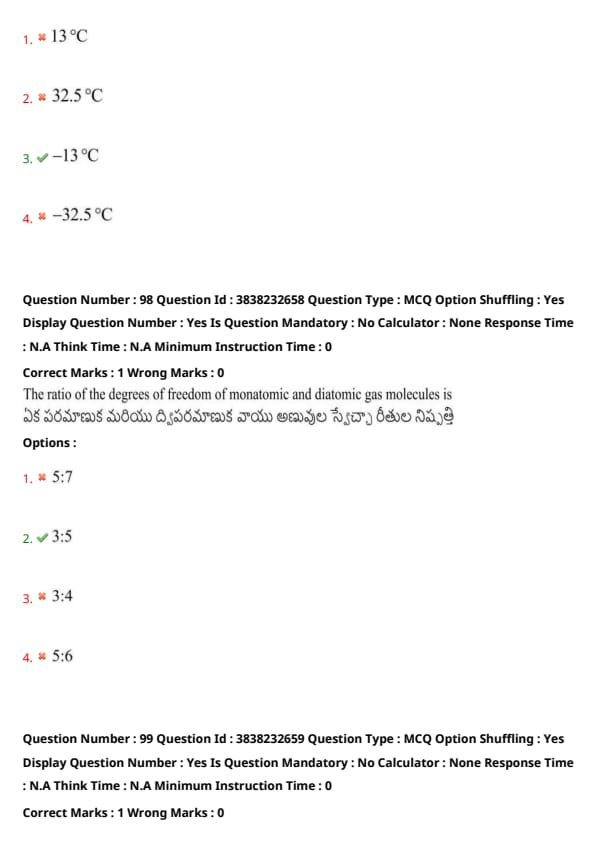
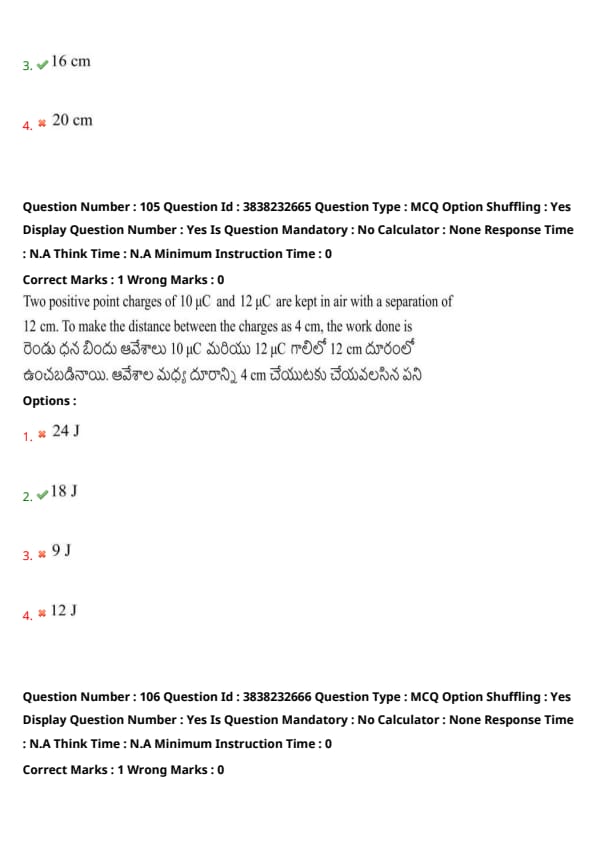
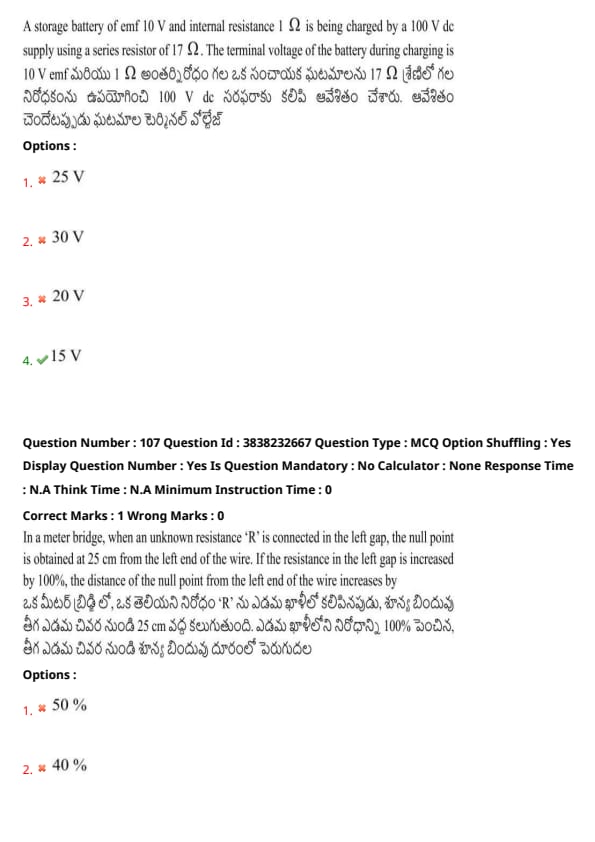
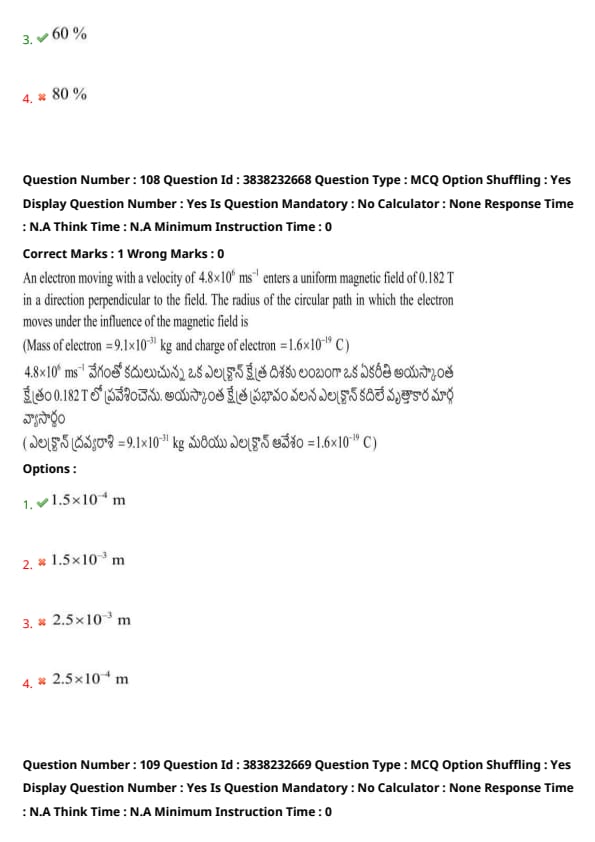
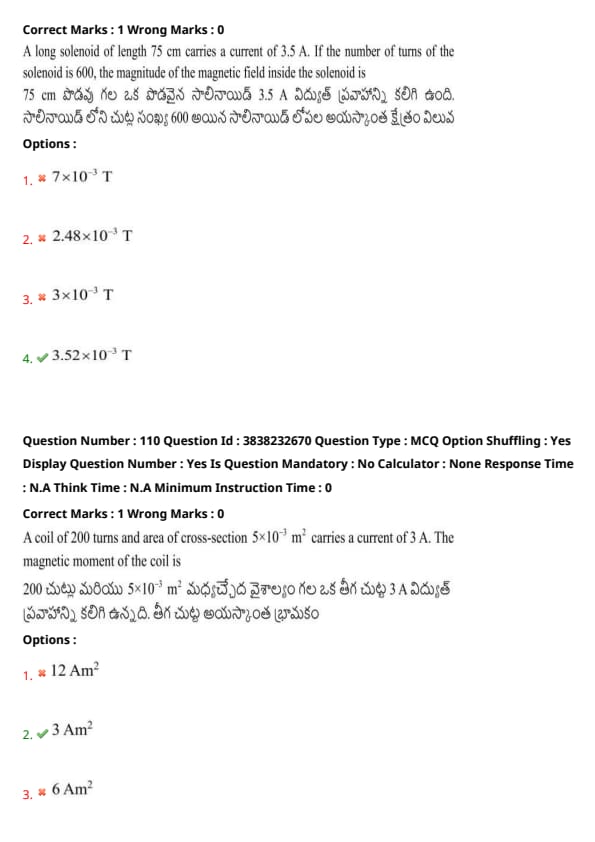
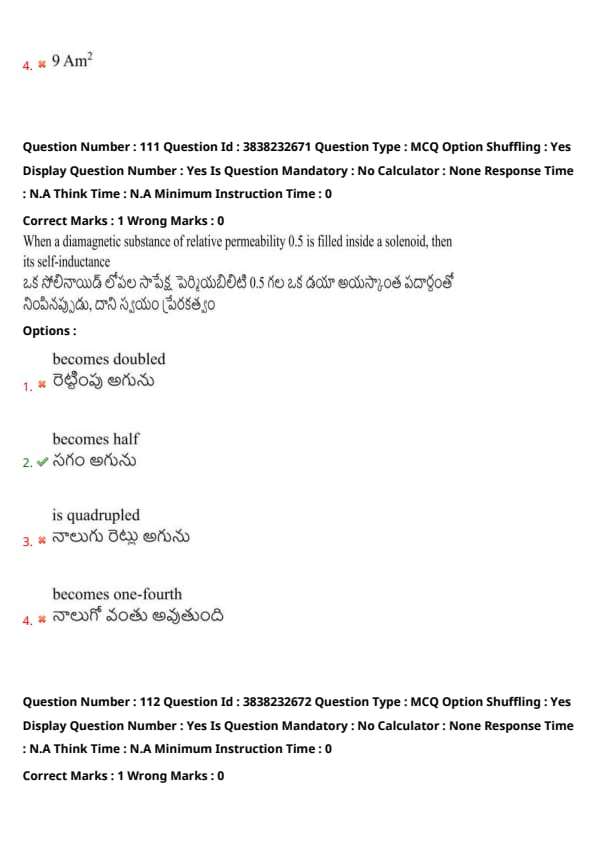
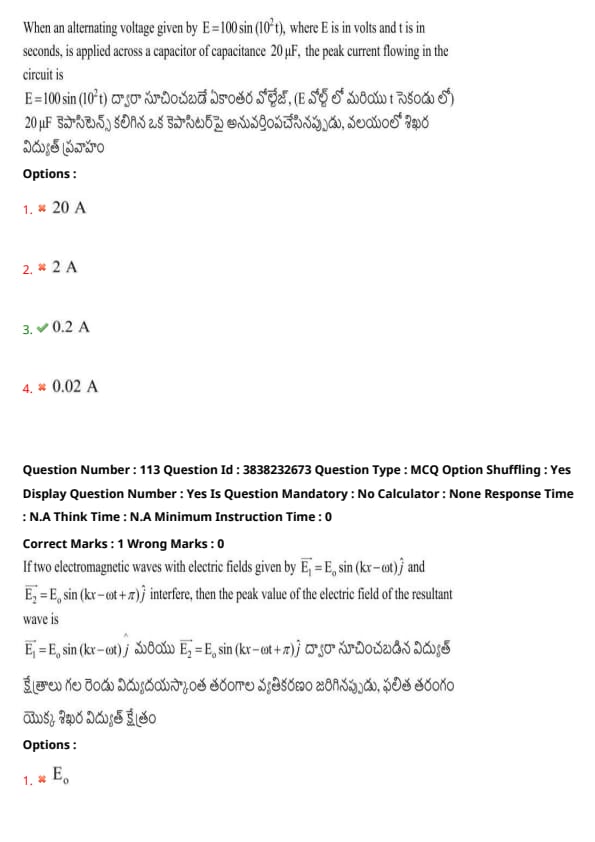
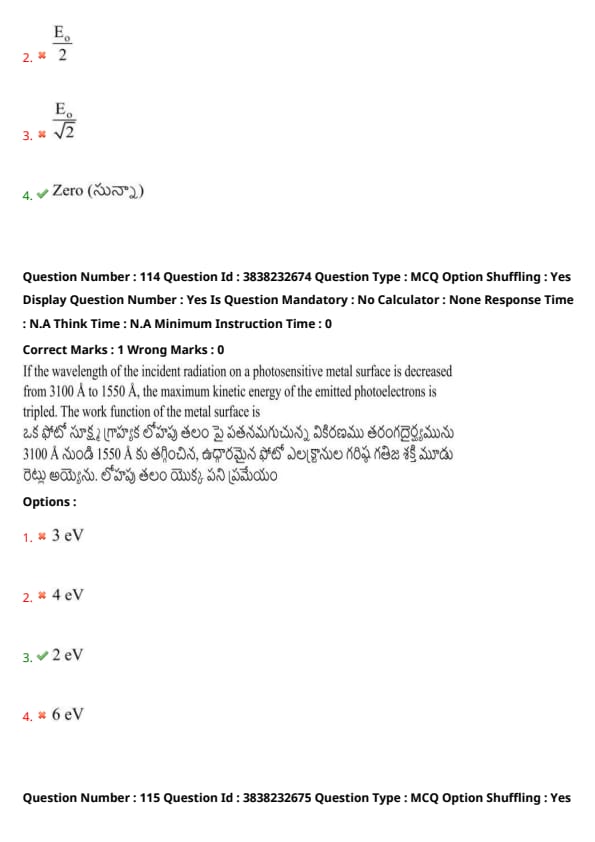
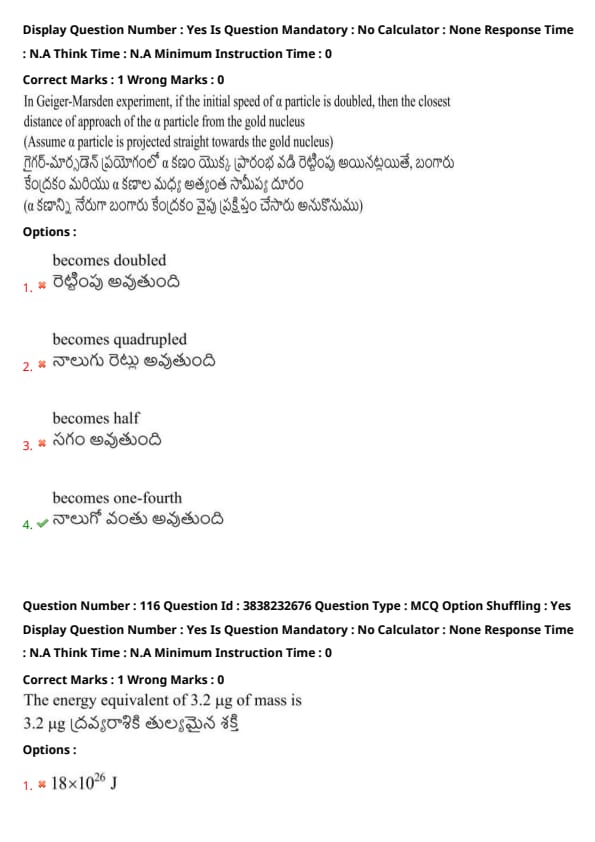
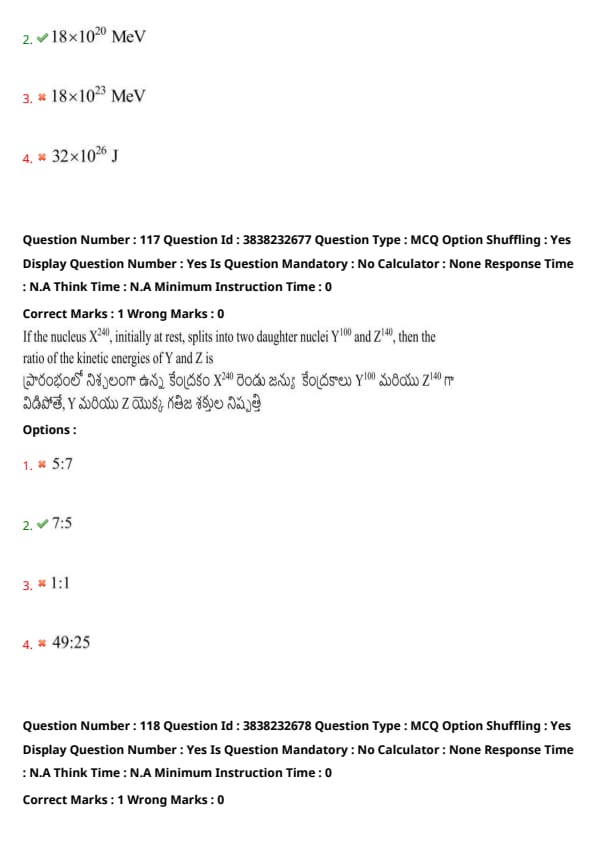
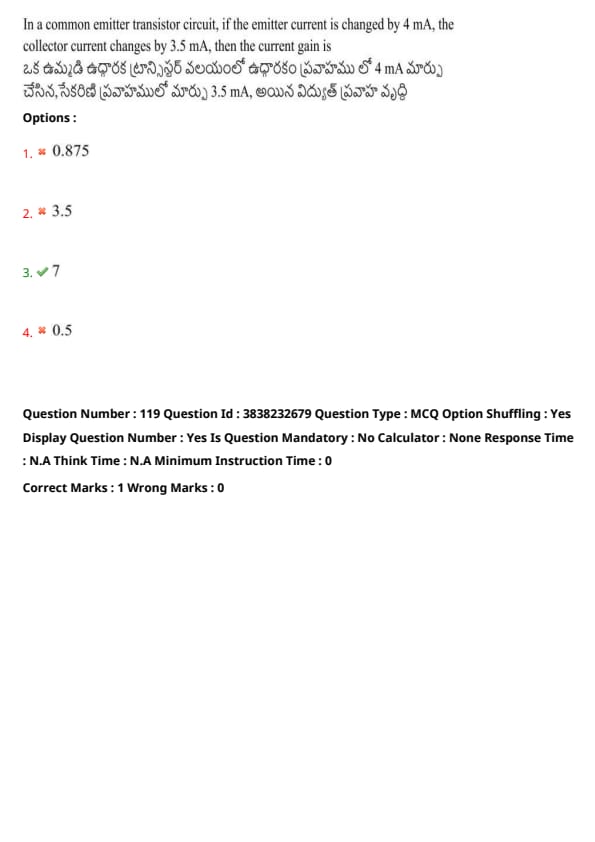
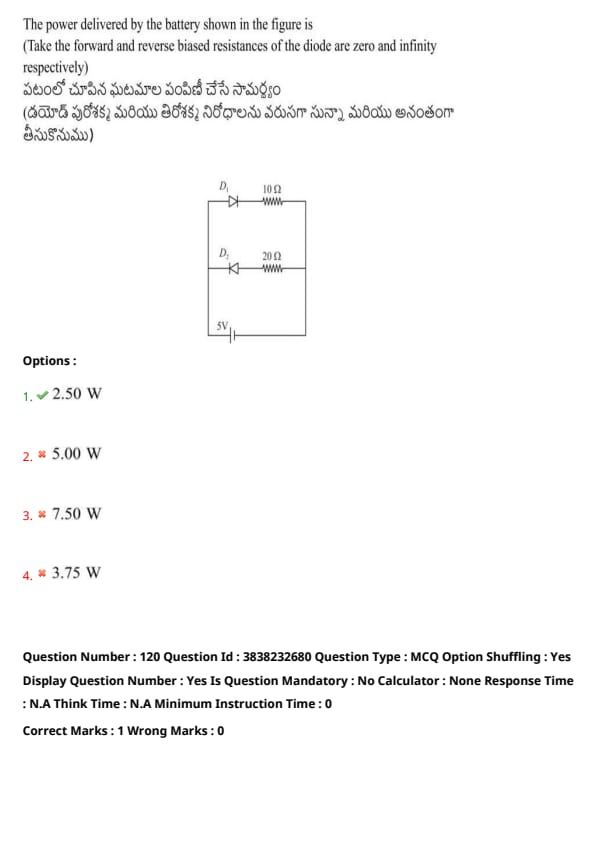
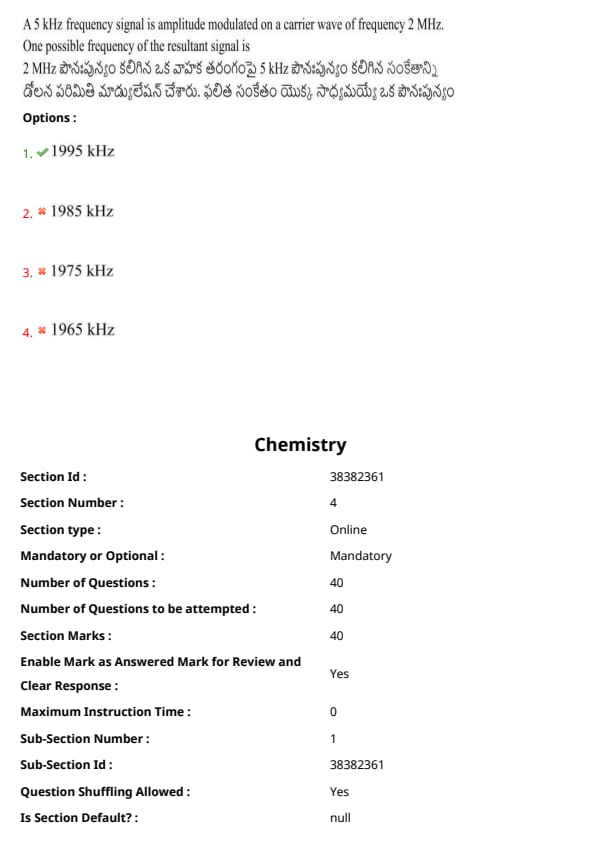
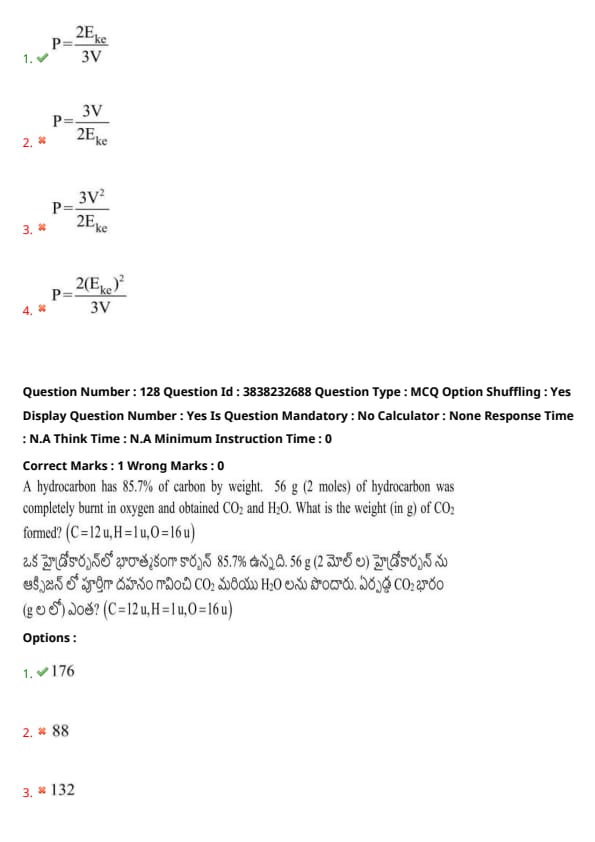
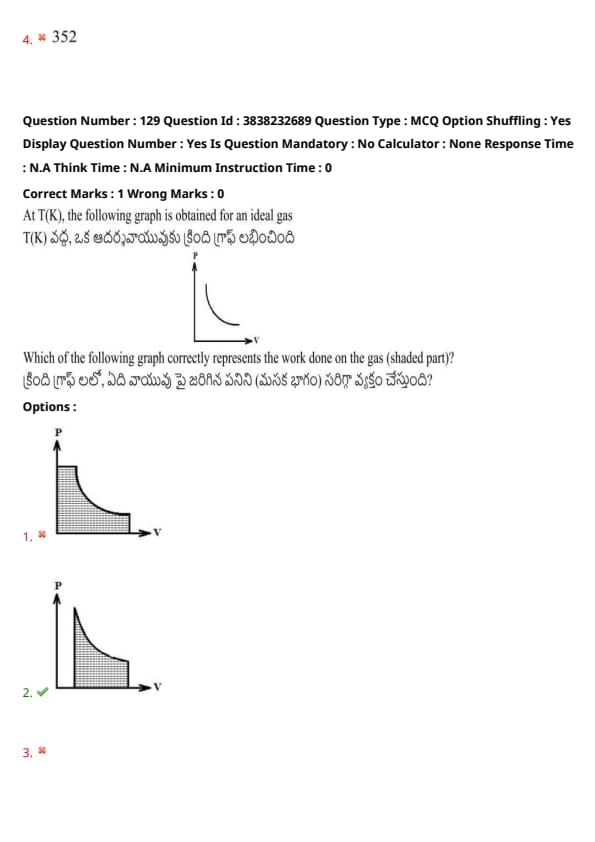
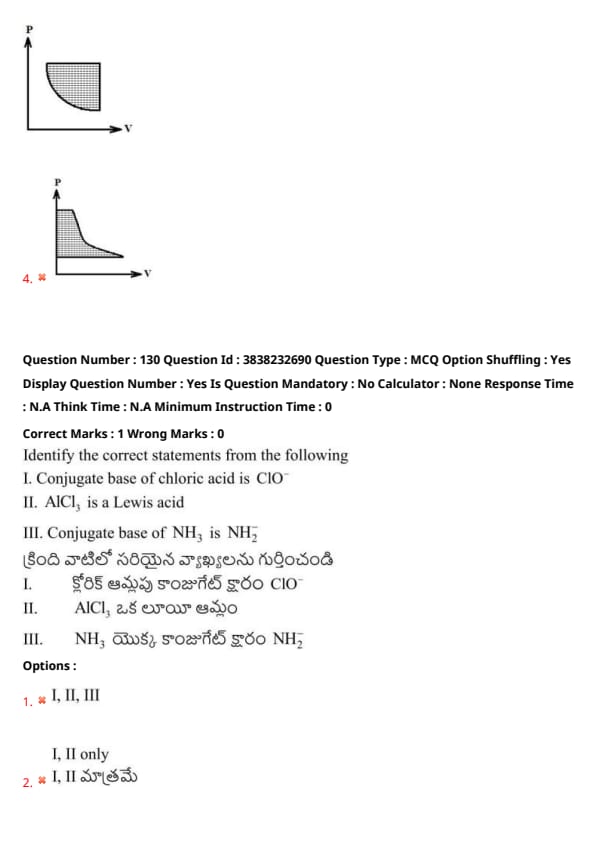
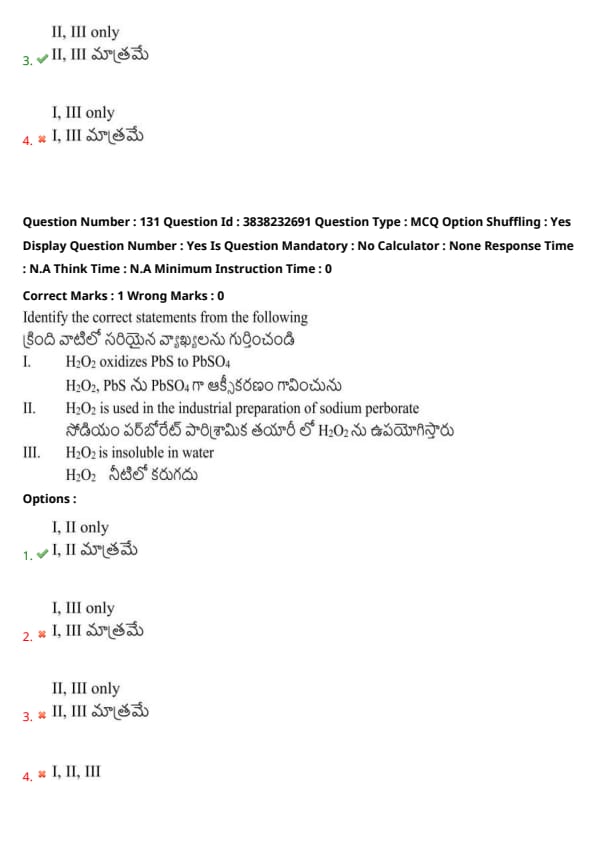
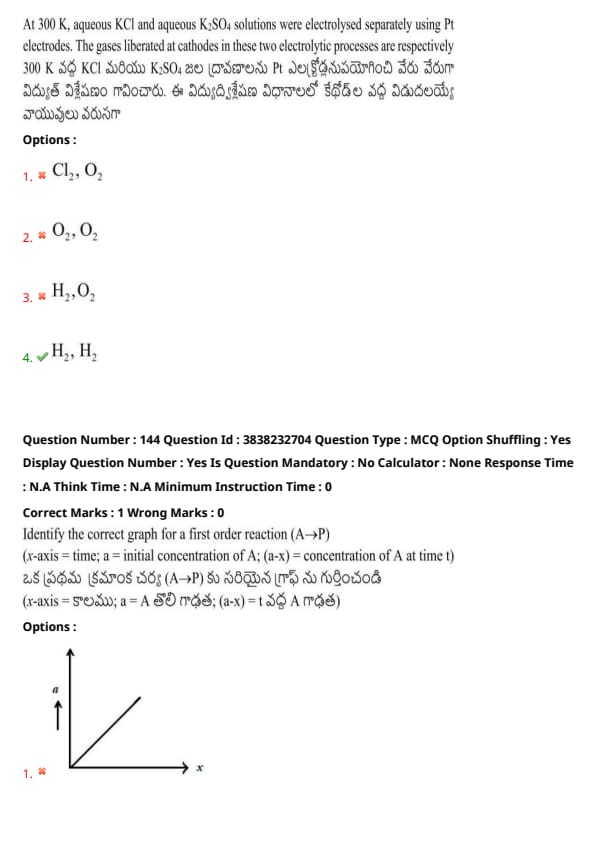
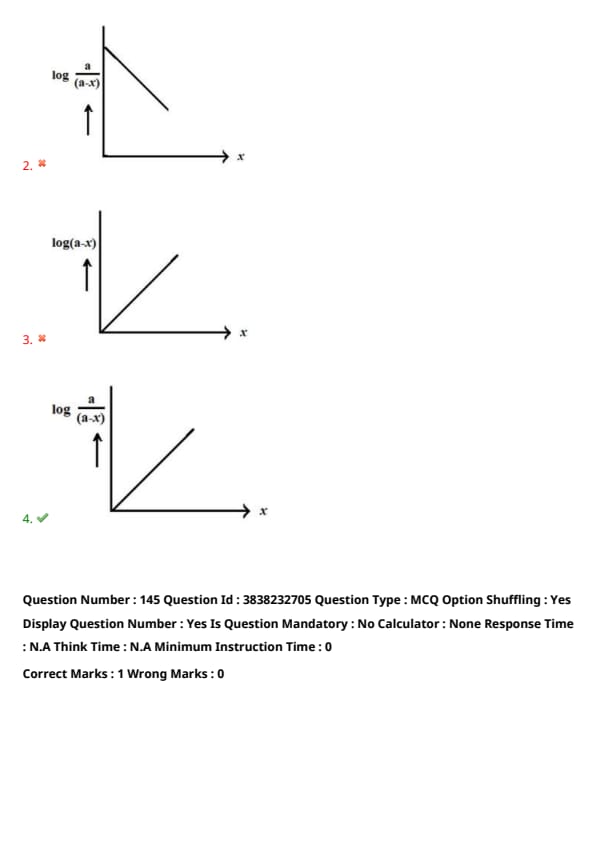
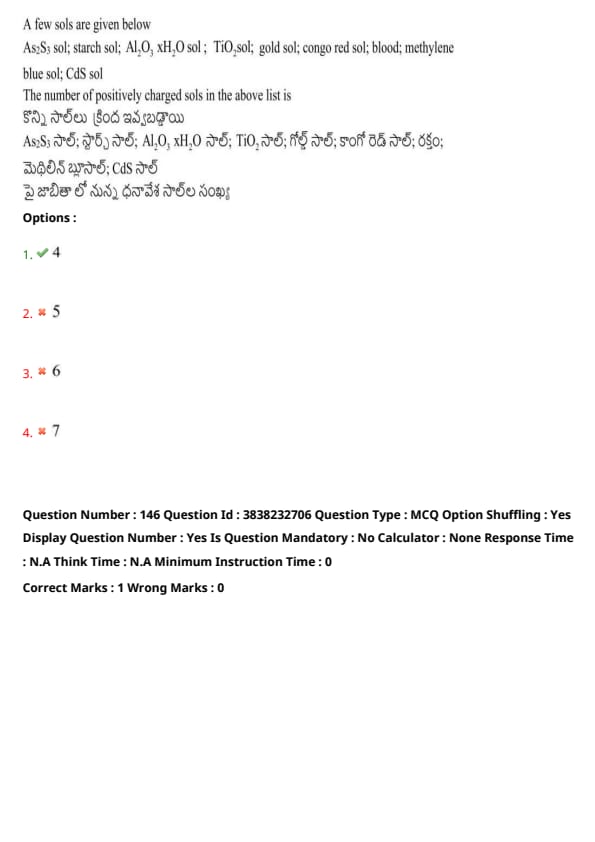
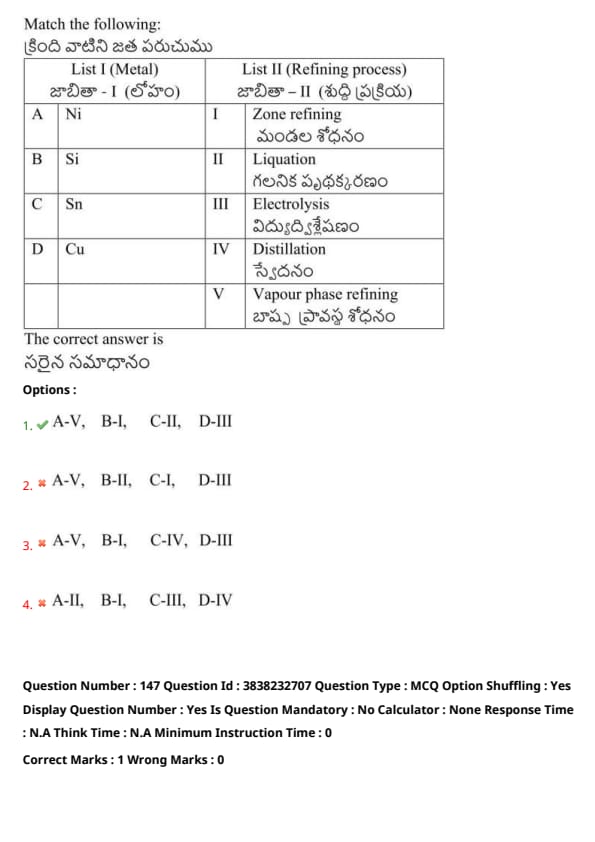
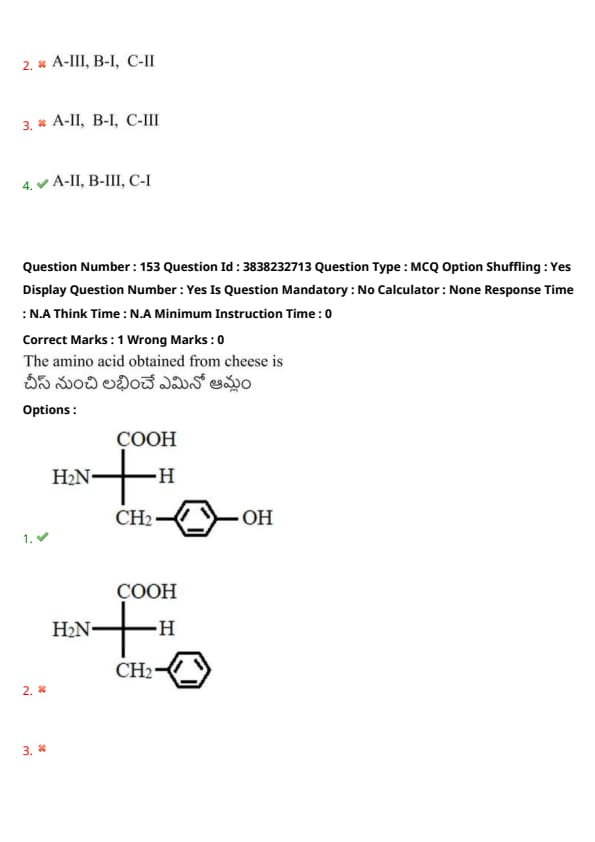
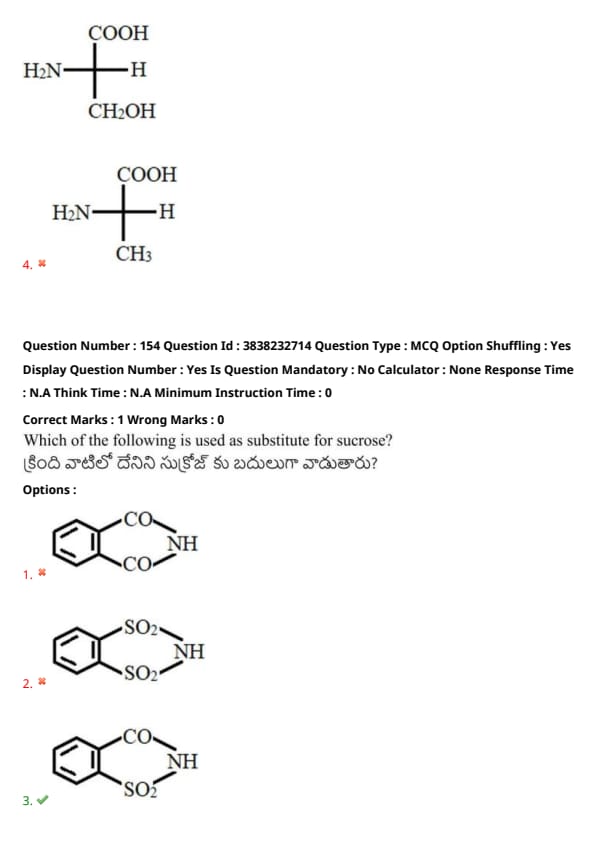
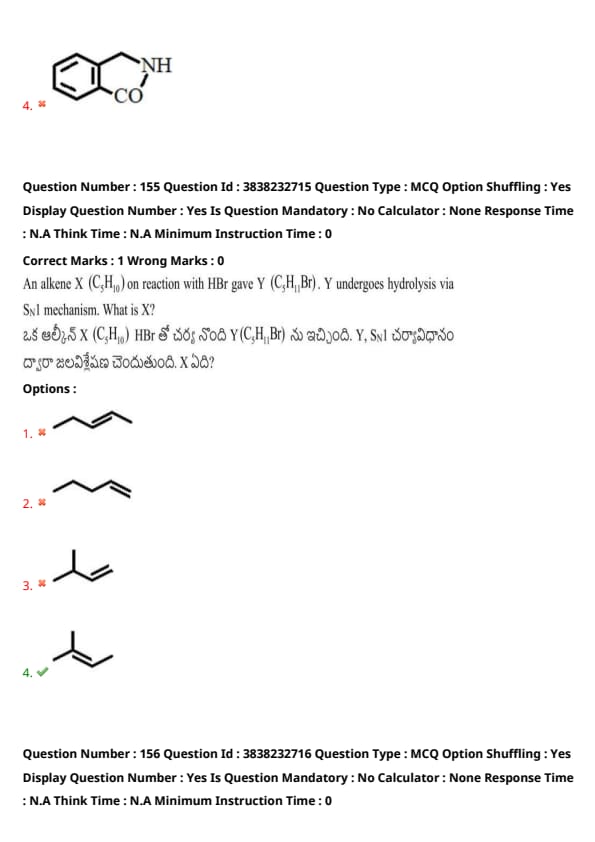
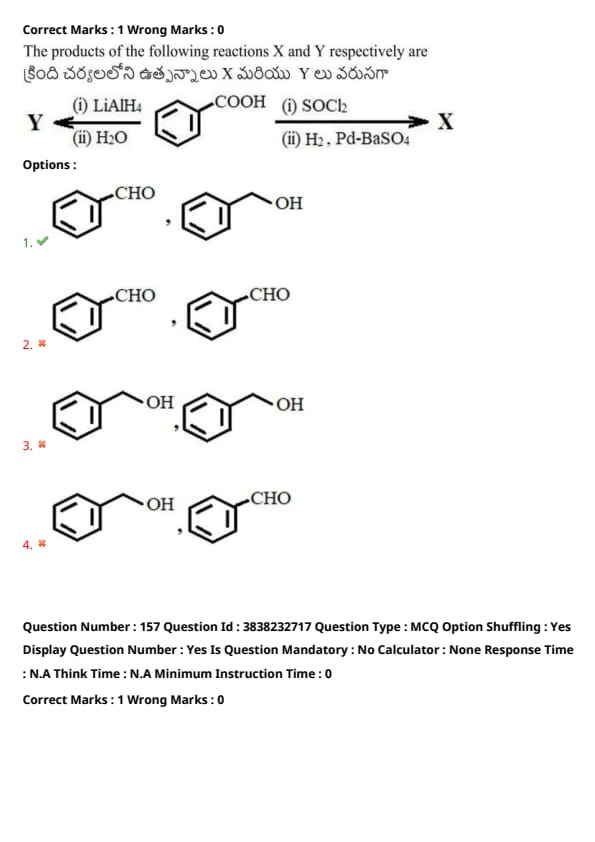
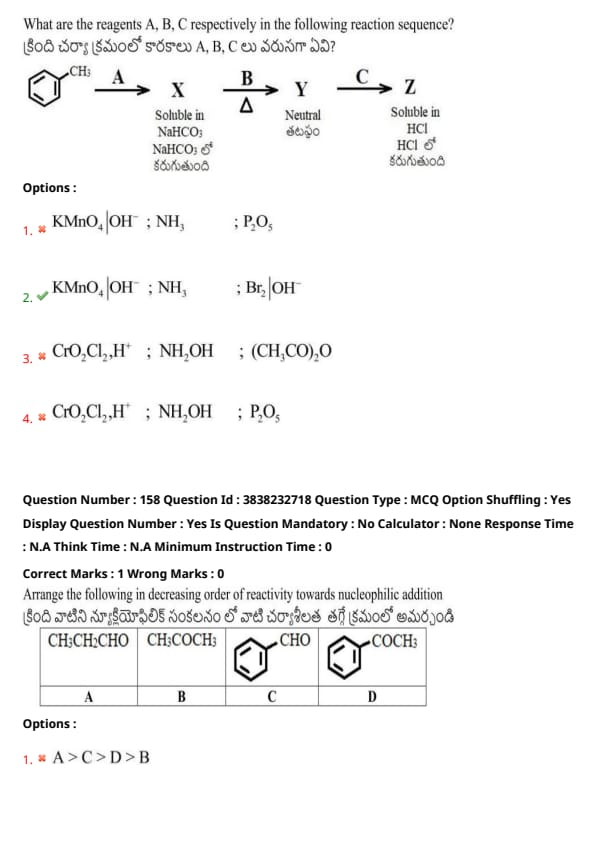
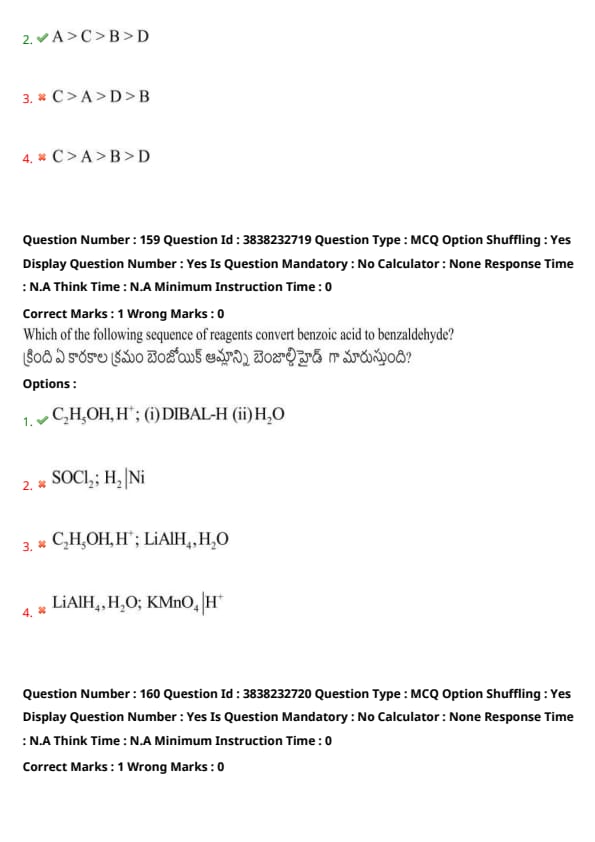
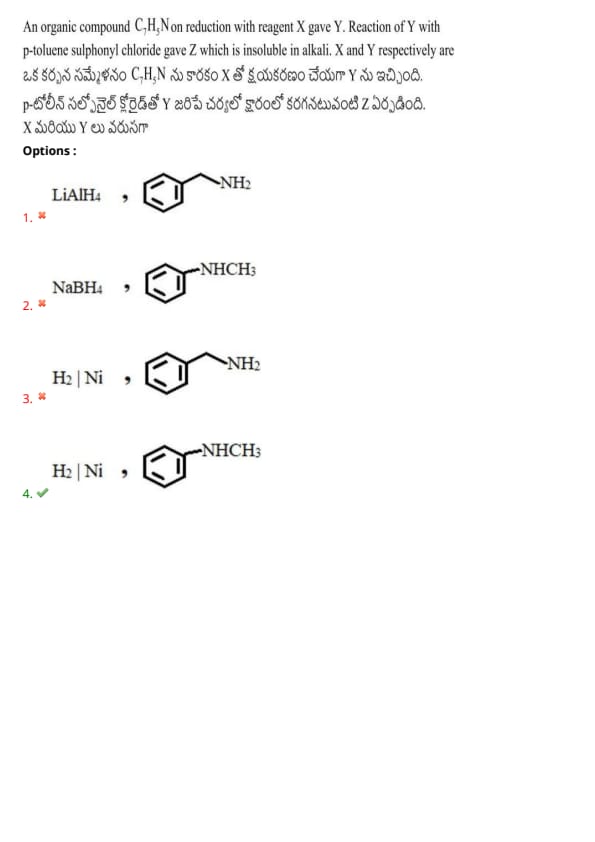
*The article might have information for the previous academic years, please refer the official website of the exam.