
TS EAMCET 2026 May 5 Shift 1 Agriculture and Pharmacy Question Paper with Solution PDF


Content Curator | Updated On - Jul 31, 2026
JNTU Hyderabad conducted TS EAMCET 2026 Agriculture and Pharmacy exam on May 5 in Shift 1 from 9 AM to 12 PM.
TS EAMCET 2026 Agriculture and Pharmacy Question Paper included 160 Questions from Physics, Chemistry, and Biology. As per the Marking Scheme +1 mark for every correct answer, and there is no negative marking for incorrect answers.
TS EAMCET 2026 May 5 Shift 1 Agriculture and Pharmacy Question Paper with solution PDF is available here for download.
TS EAMCET 2026 May 5 Shift 1 Agriculture and Pharmacy Question Paper with Solution PDF
| TS EAMCET 2026 Agriculture and Pharmacy Question Paper |
                    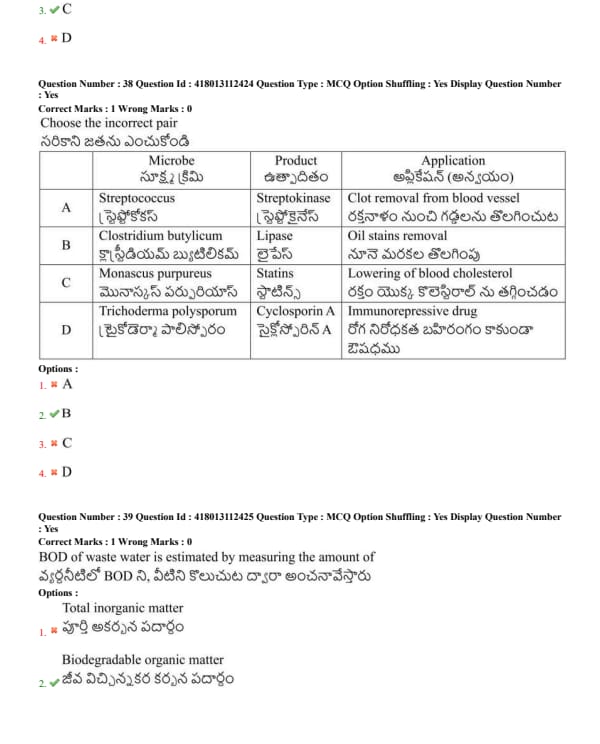 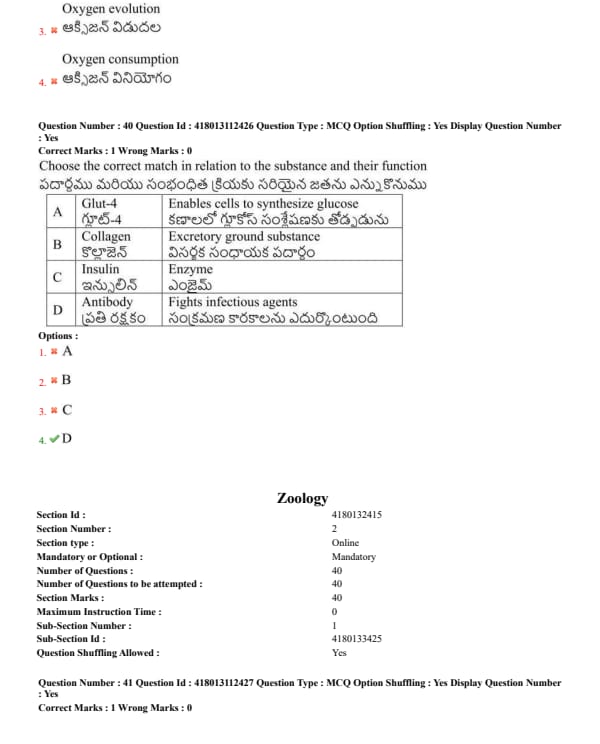 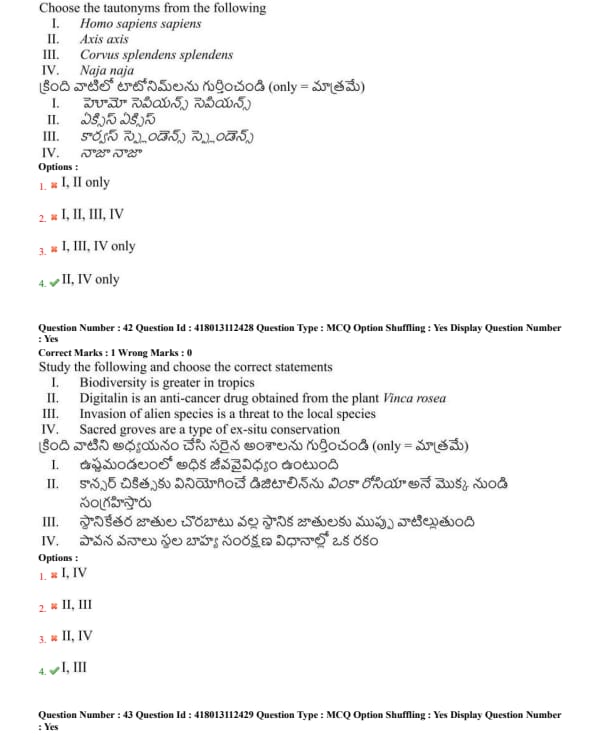 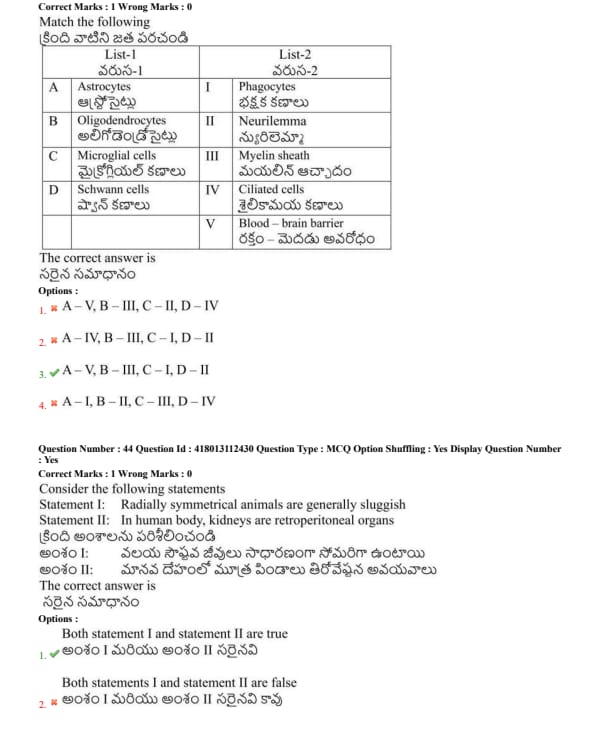 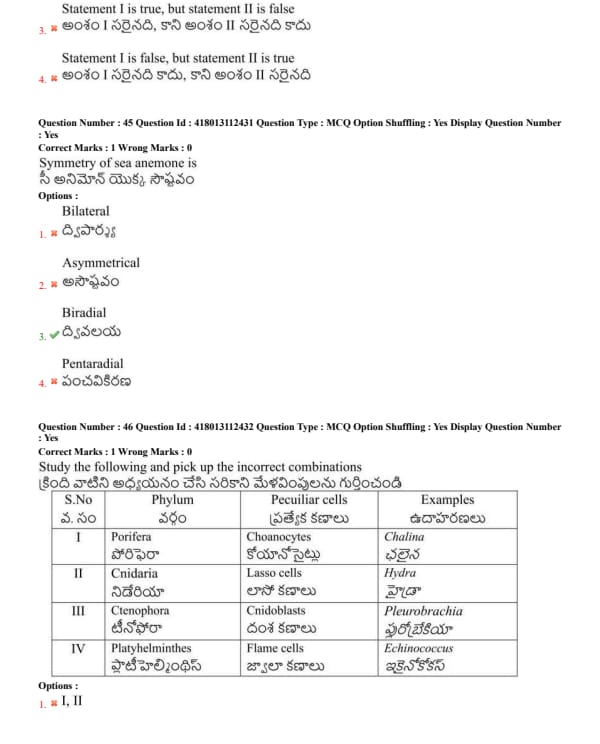 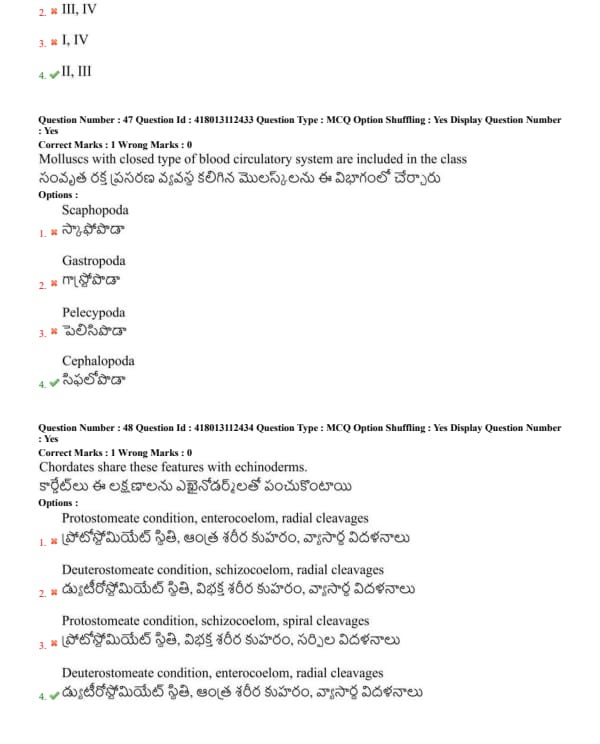 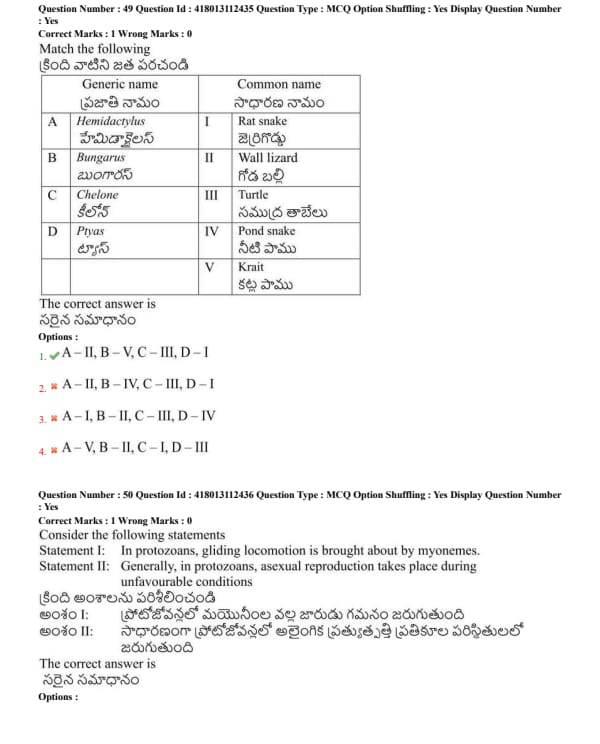 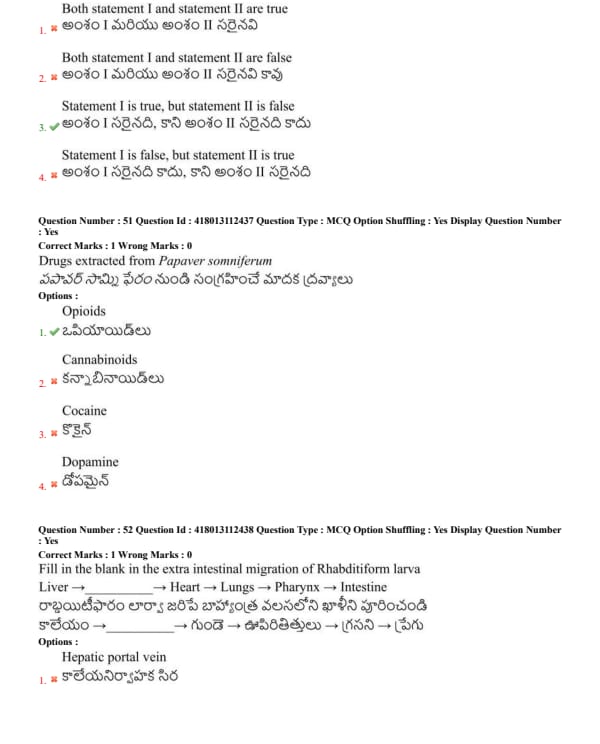 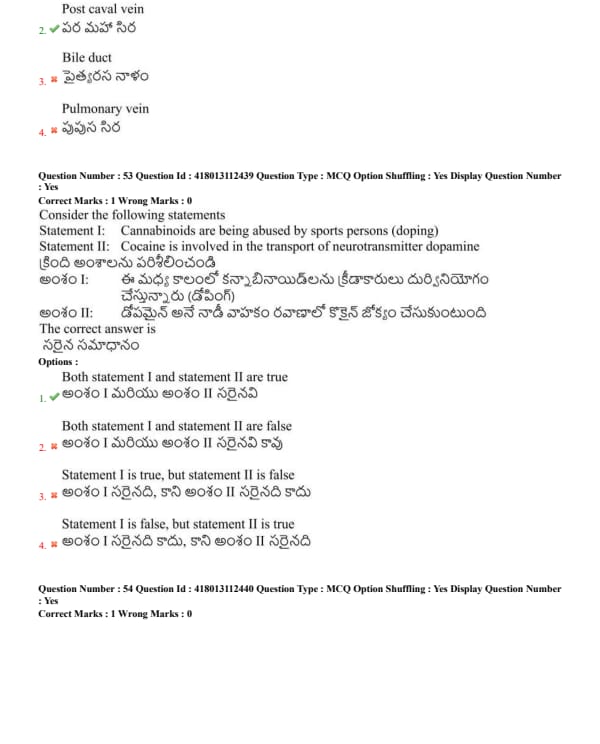 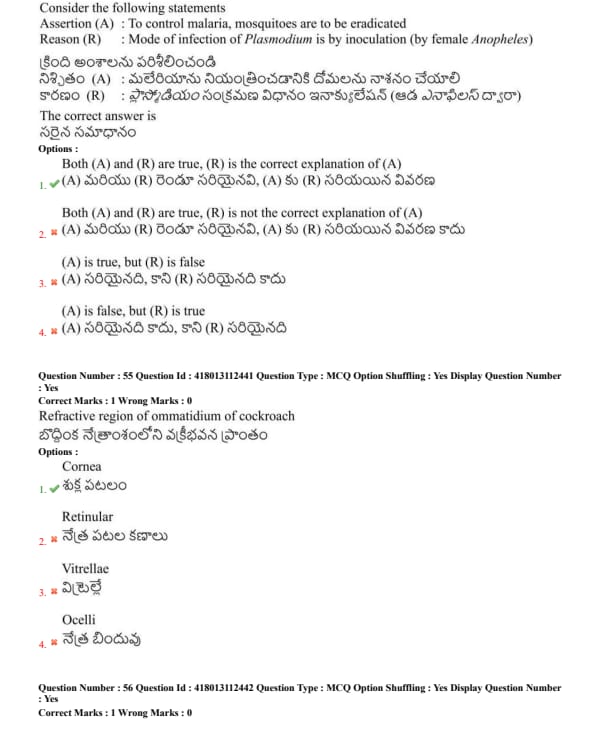 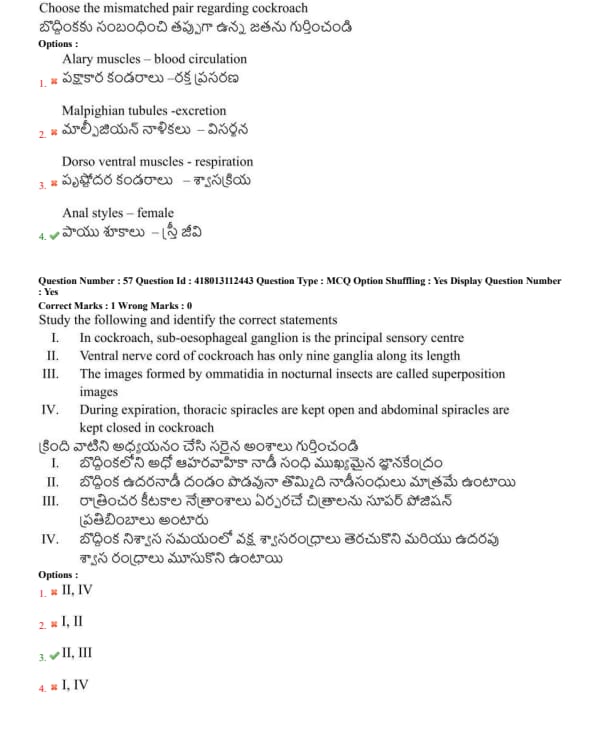 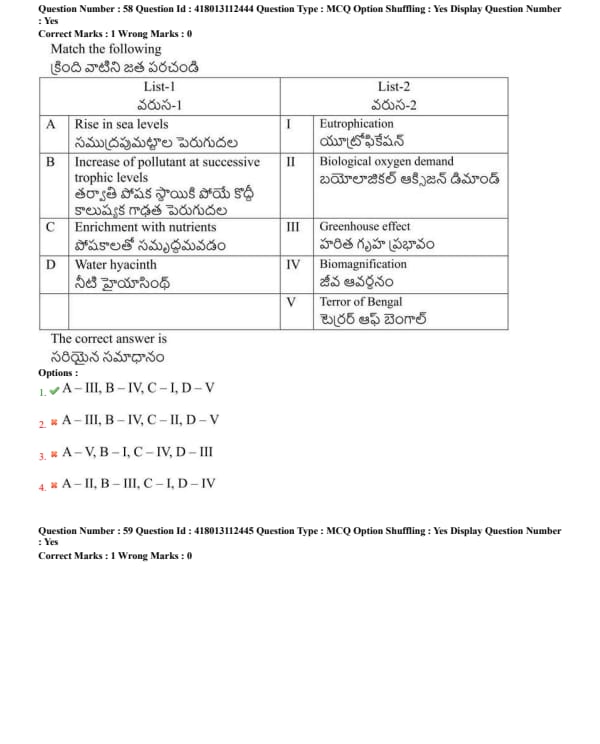 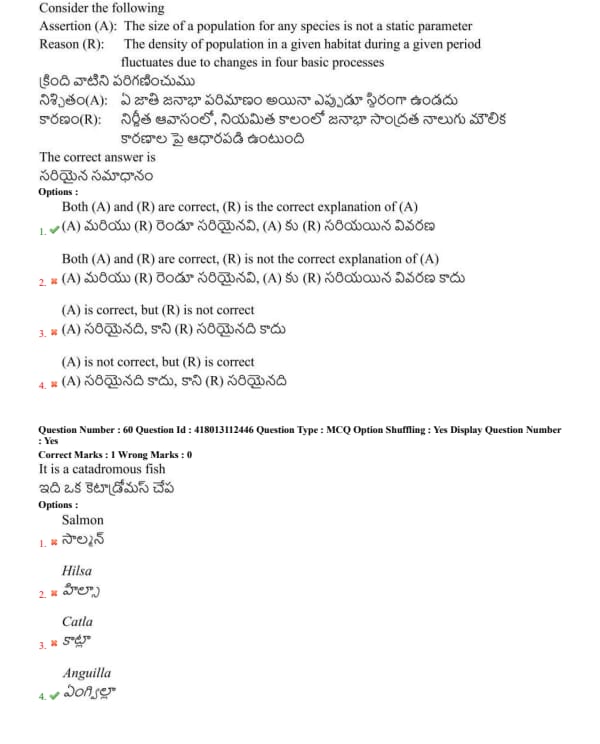 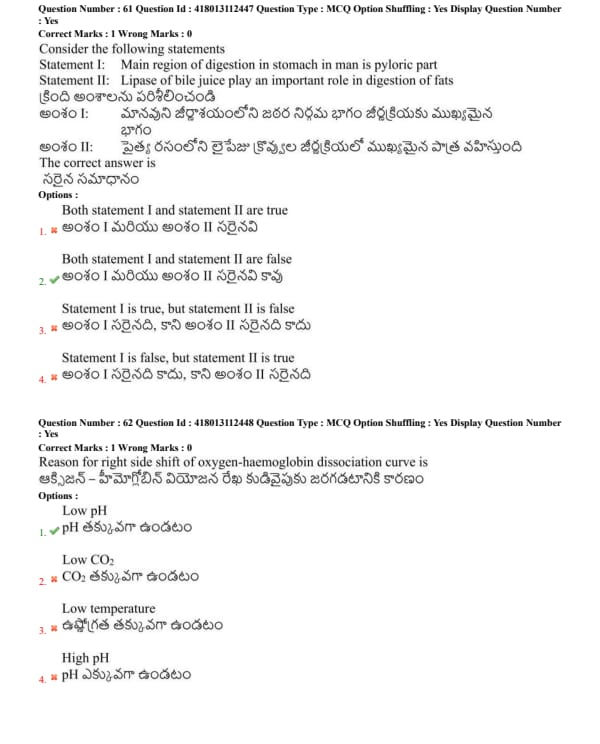 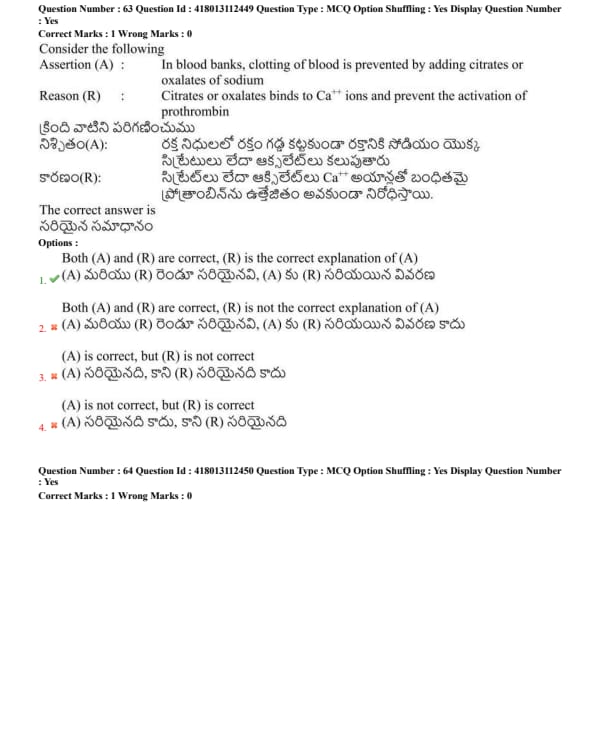 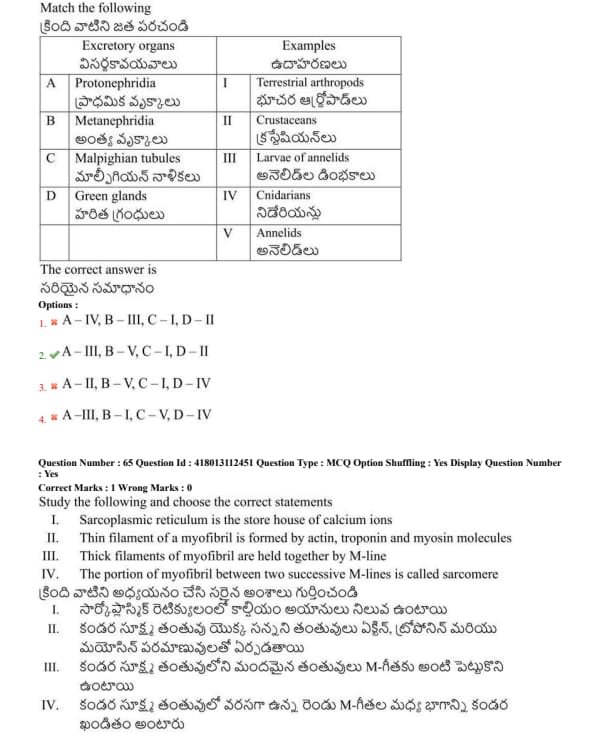 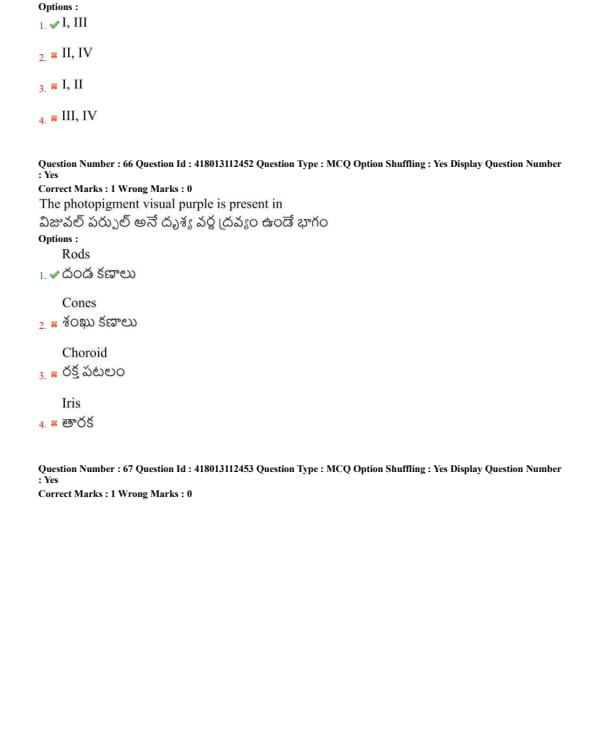 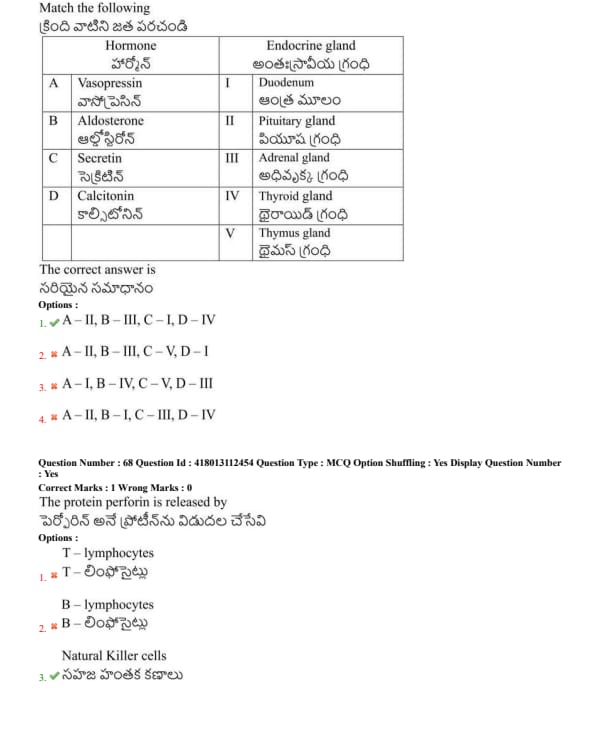 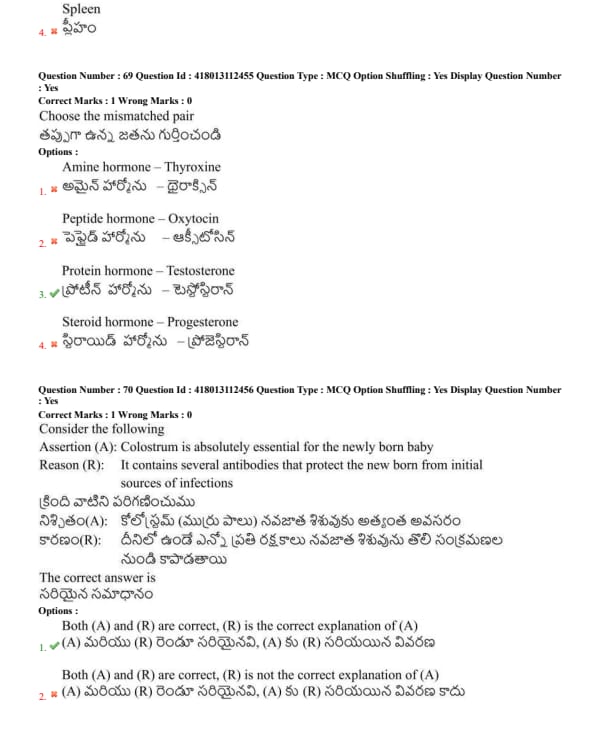 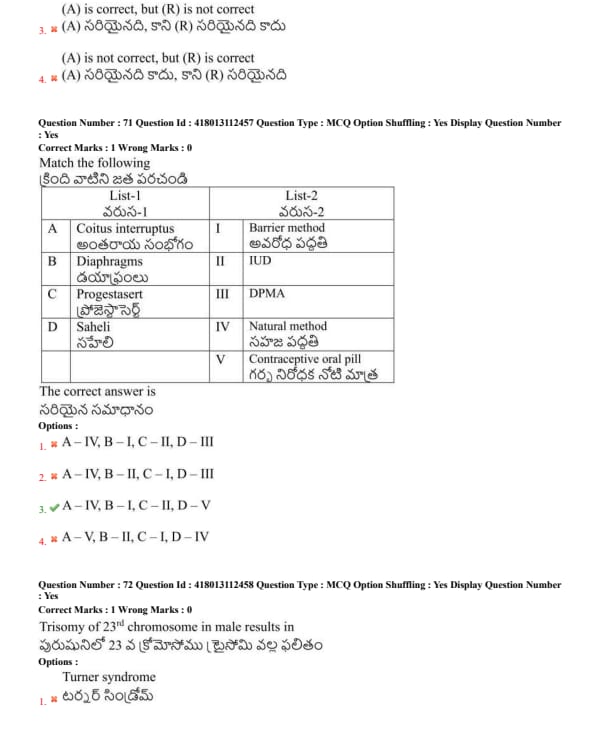 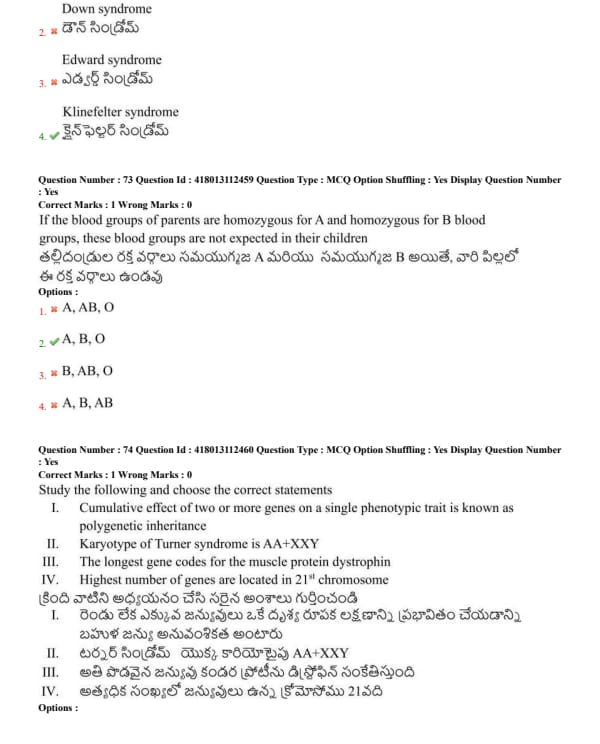 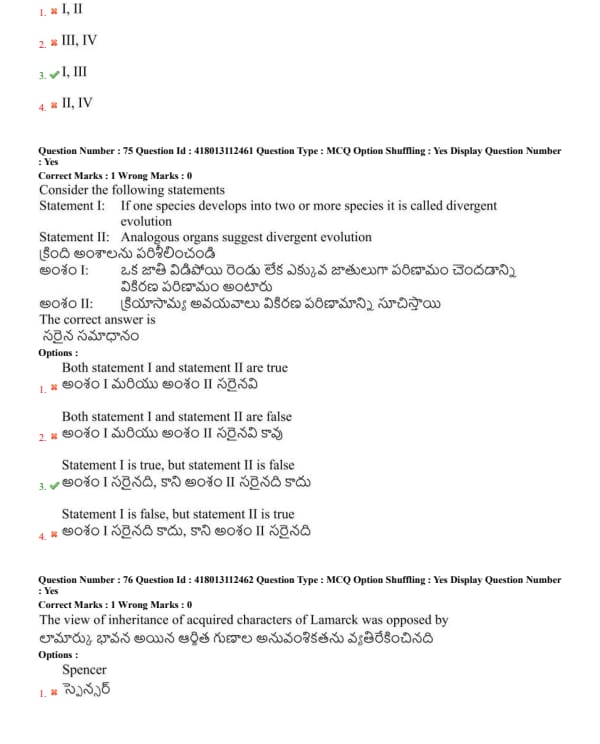 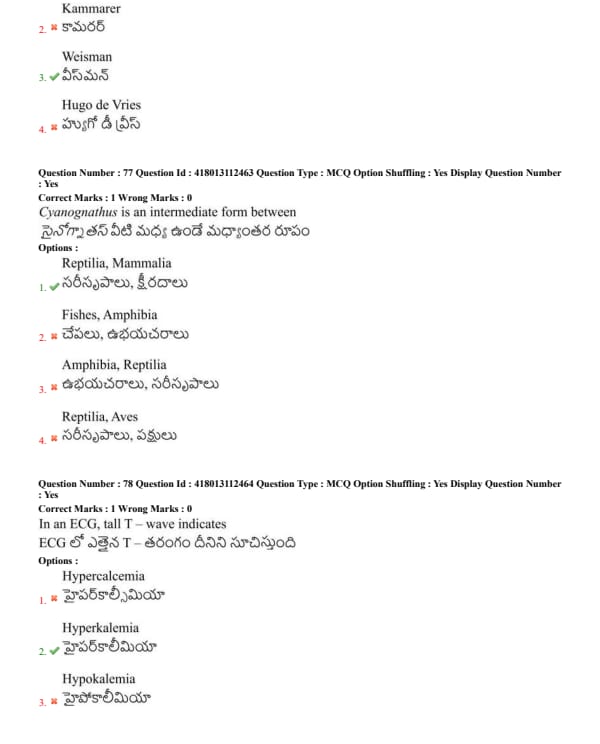 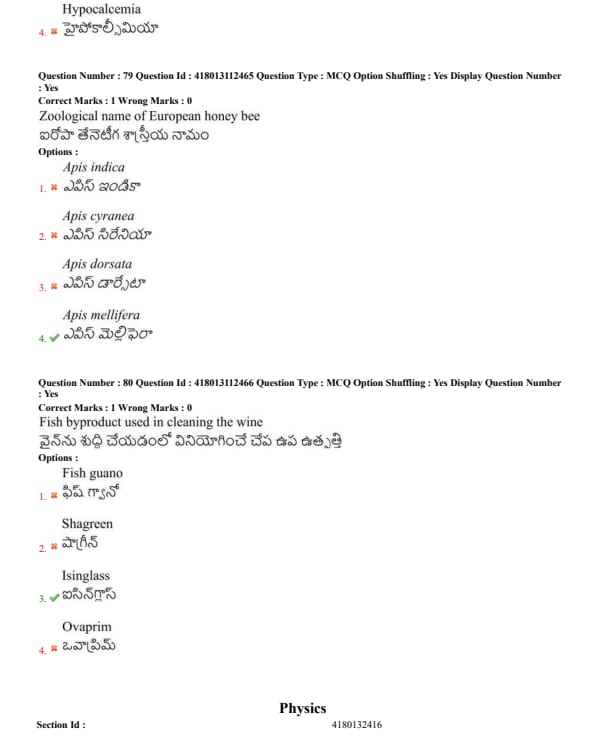 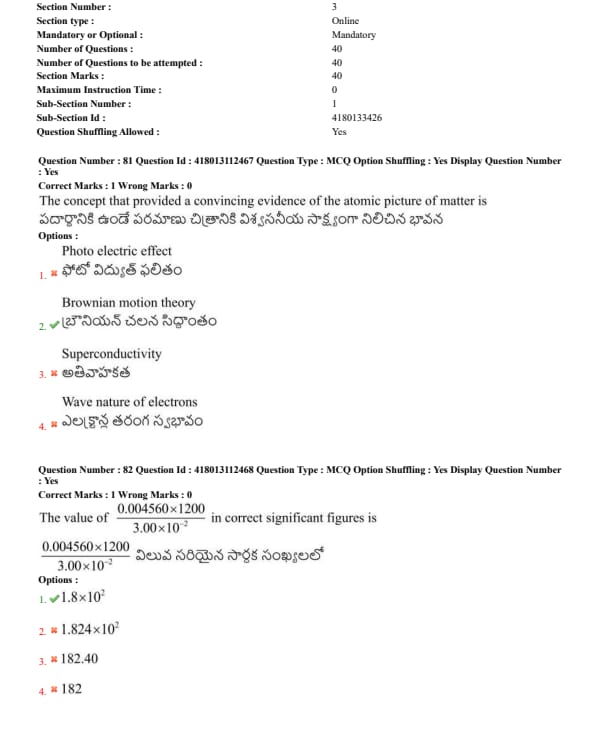 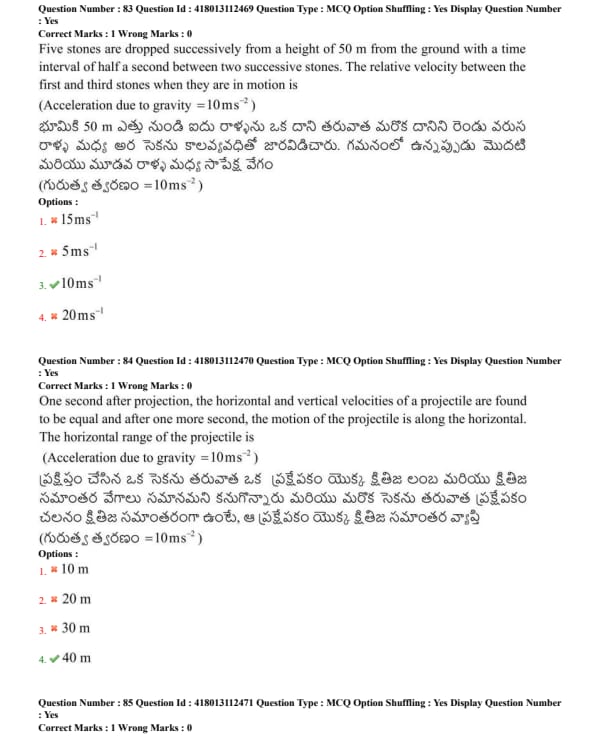 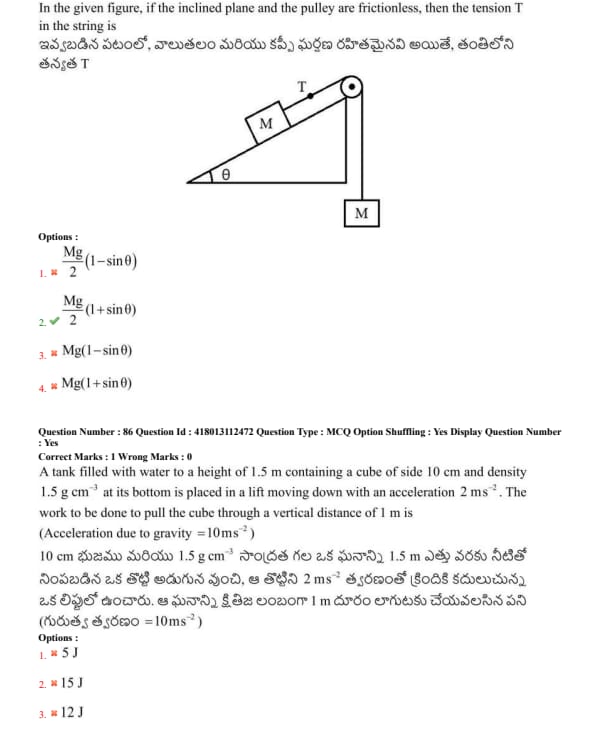 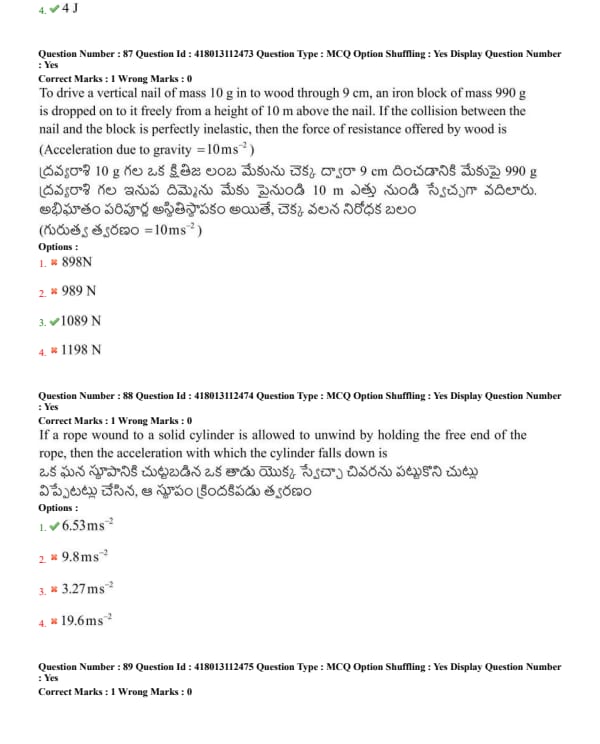 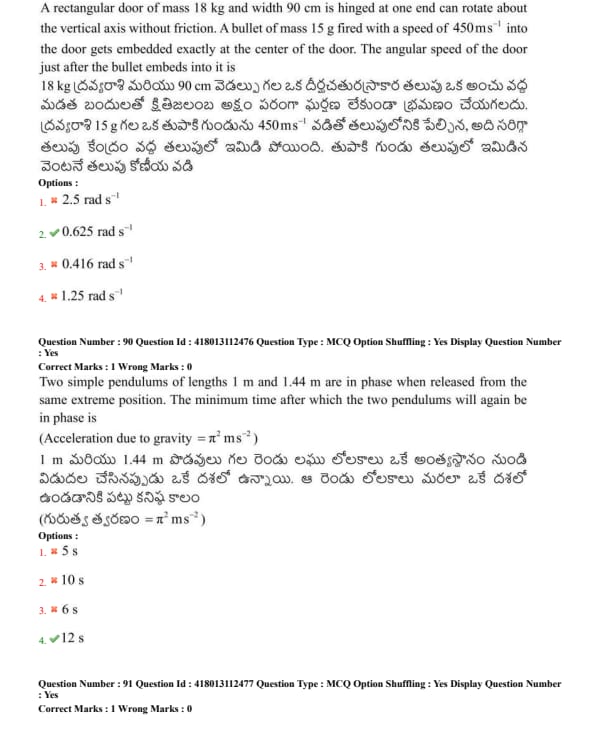 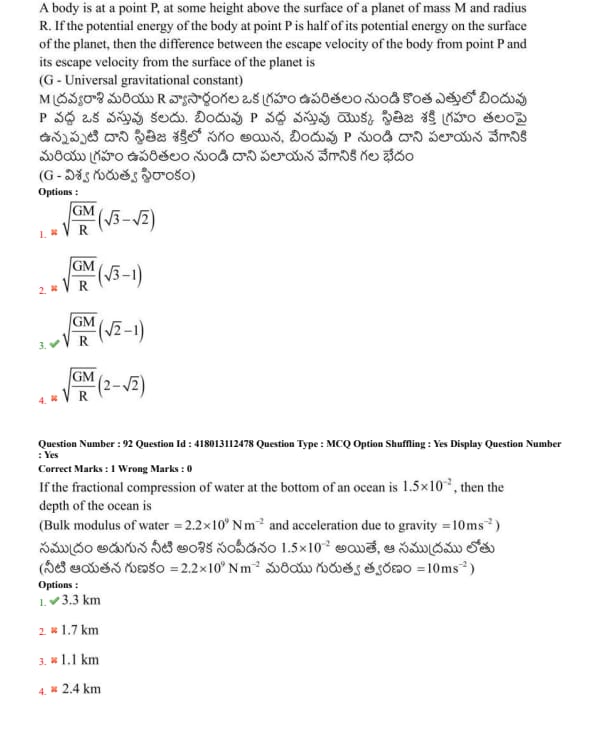 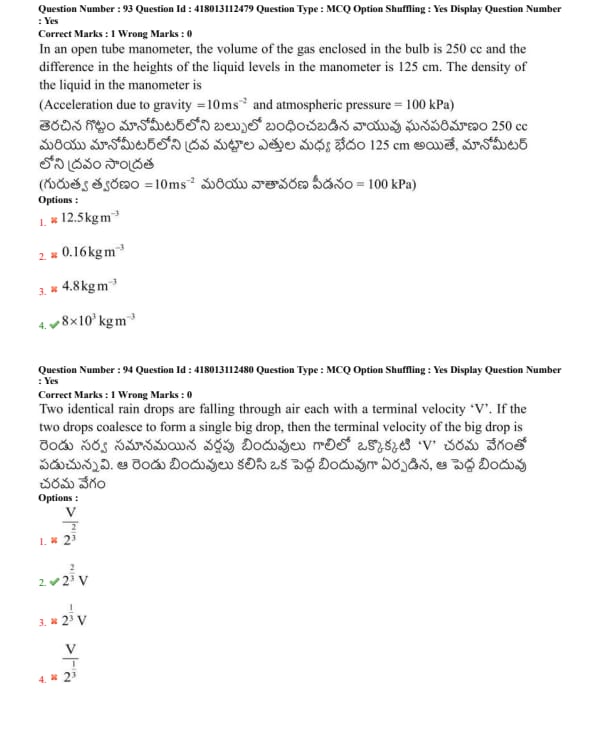 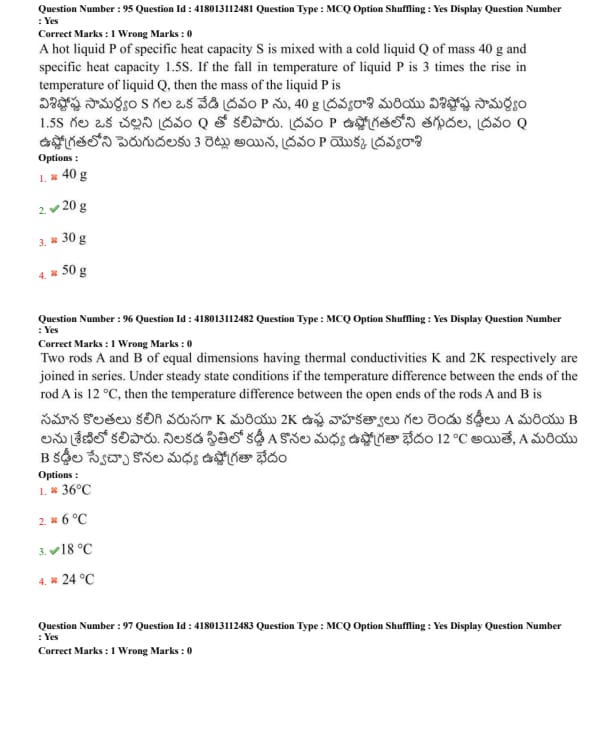 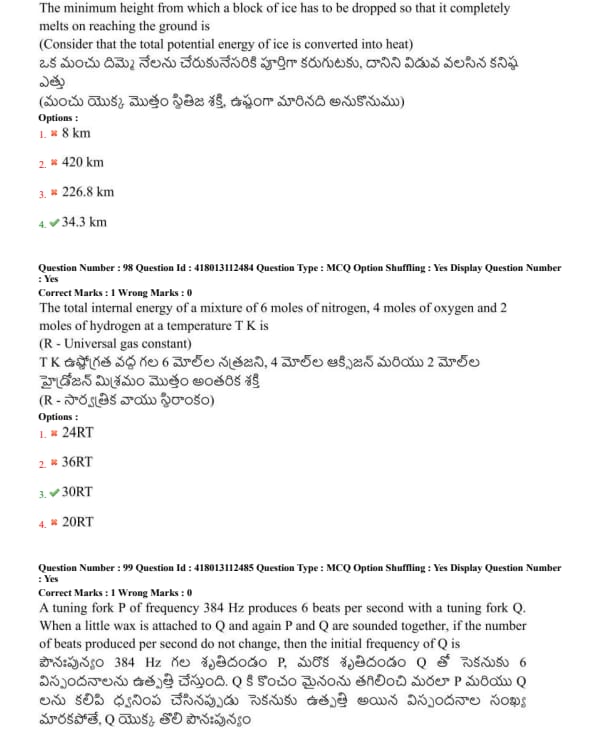 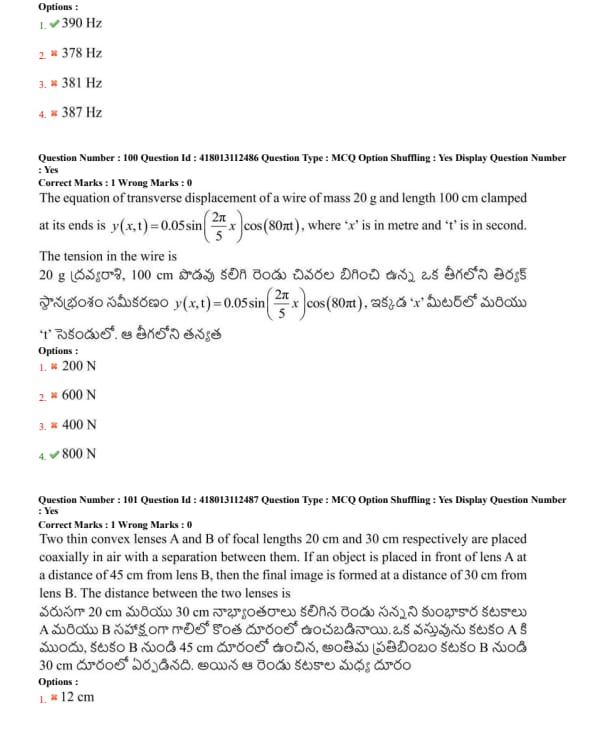 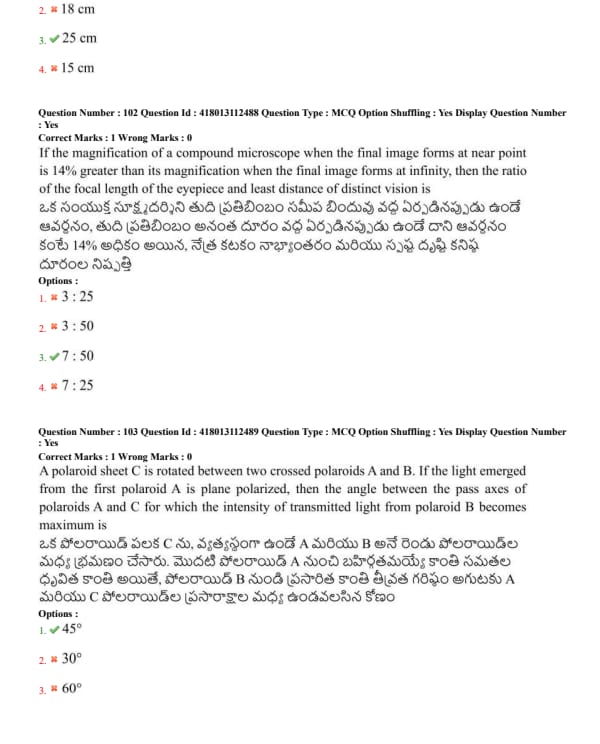 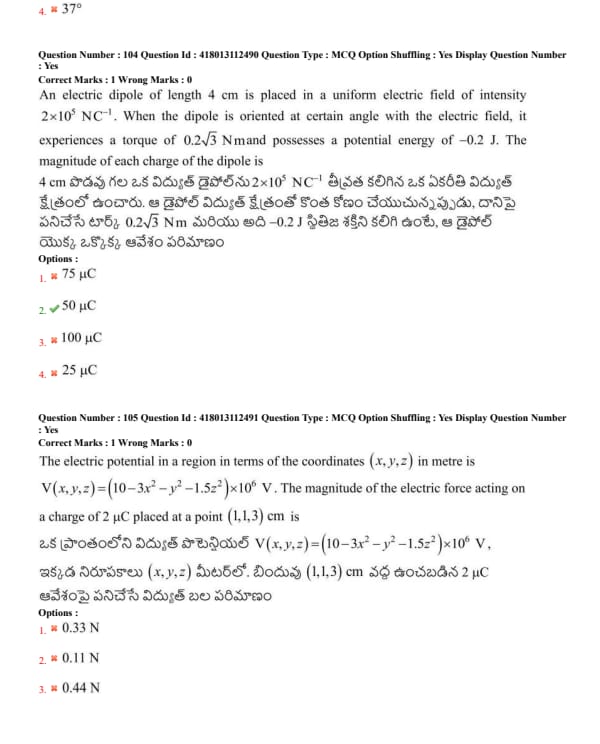                     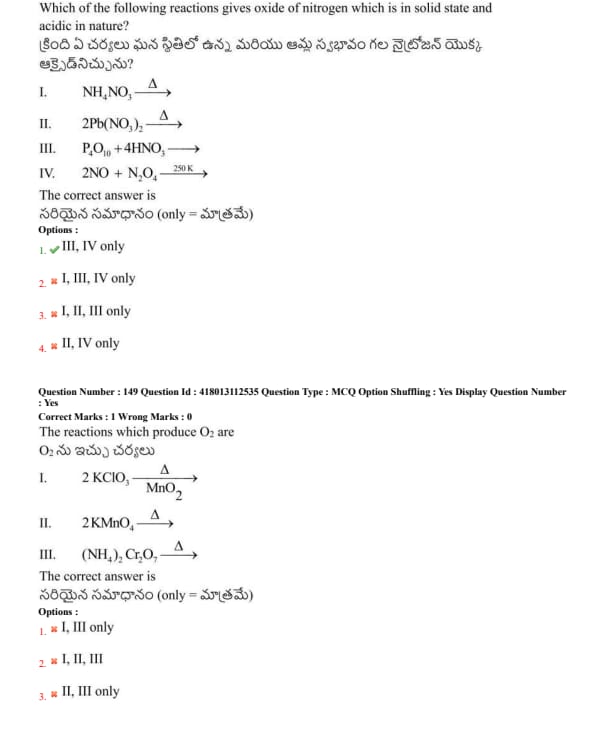 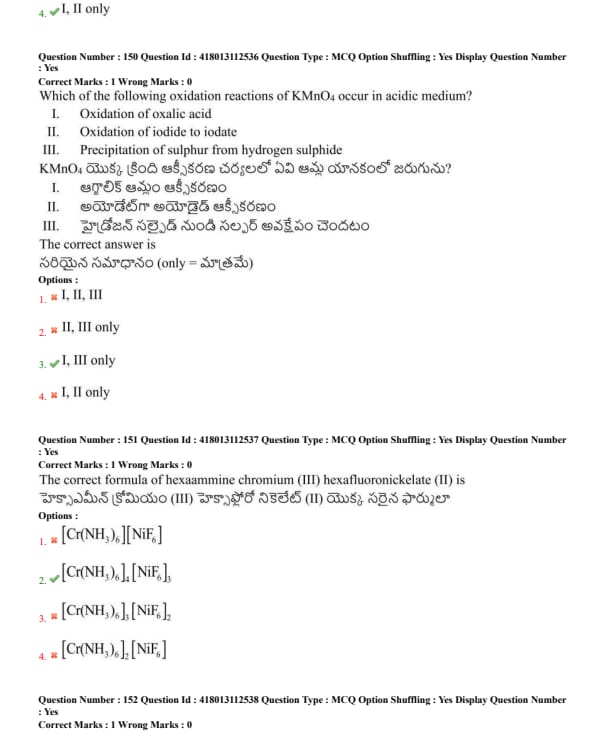 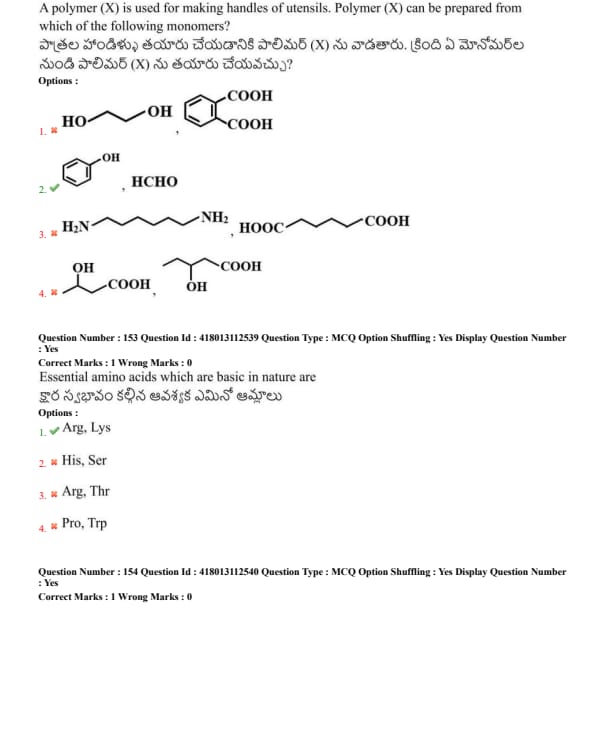 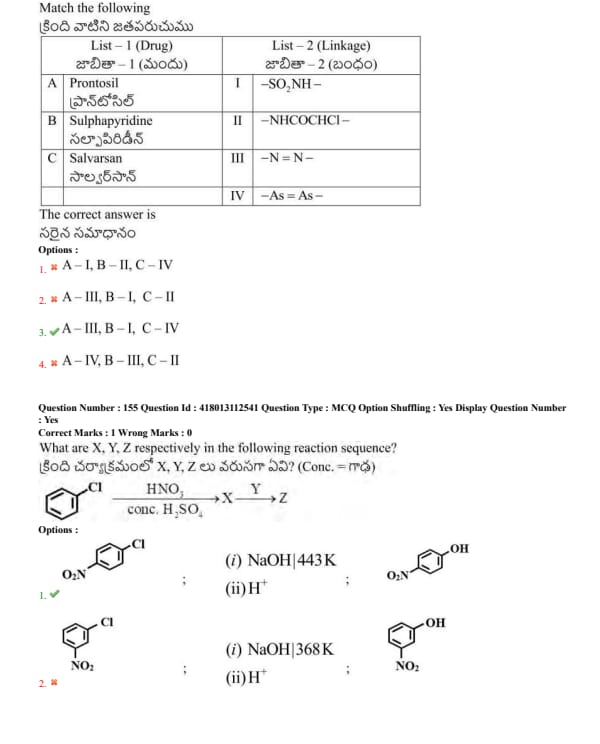 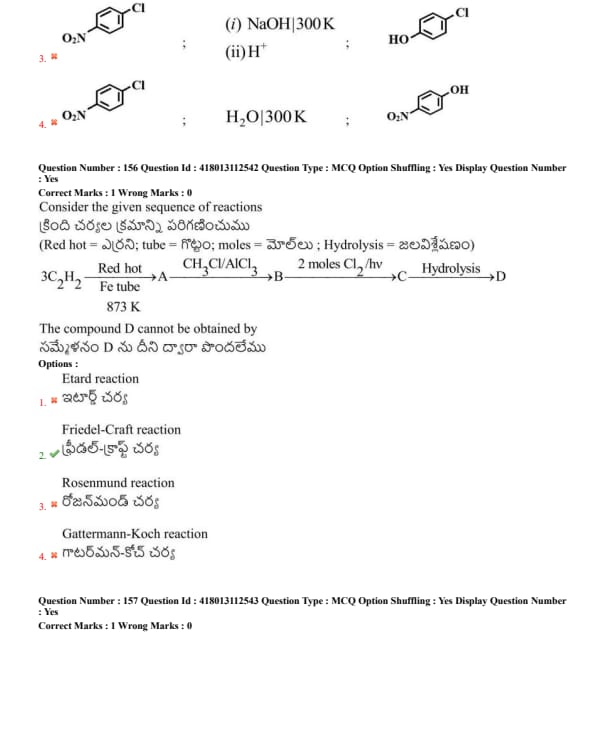 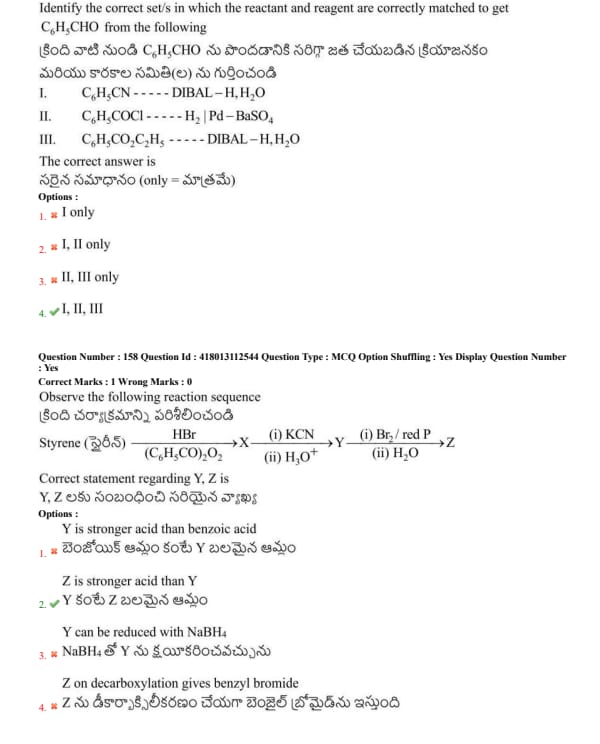 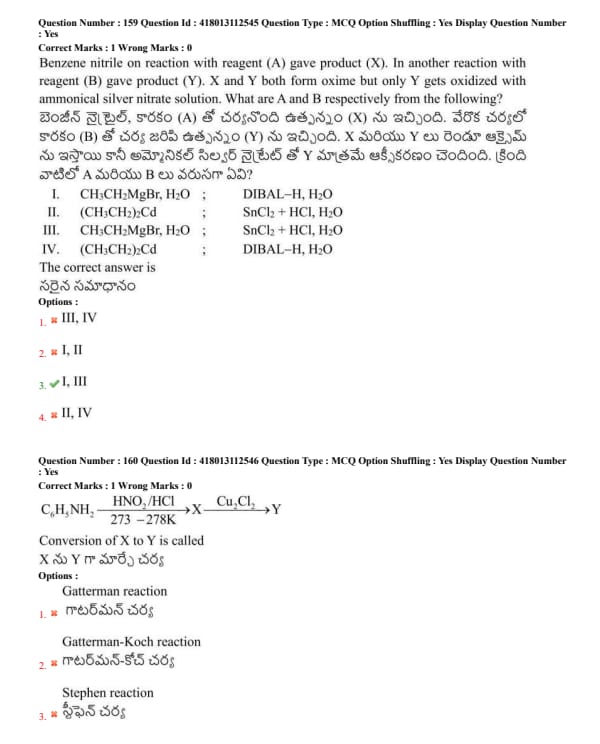  |
Check Solution |
TS EAMCET 2026 Revision
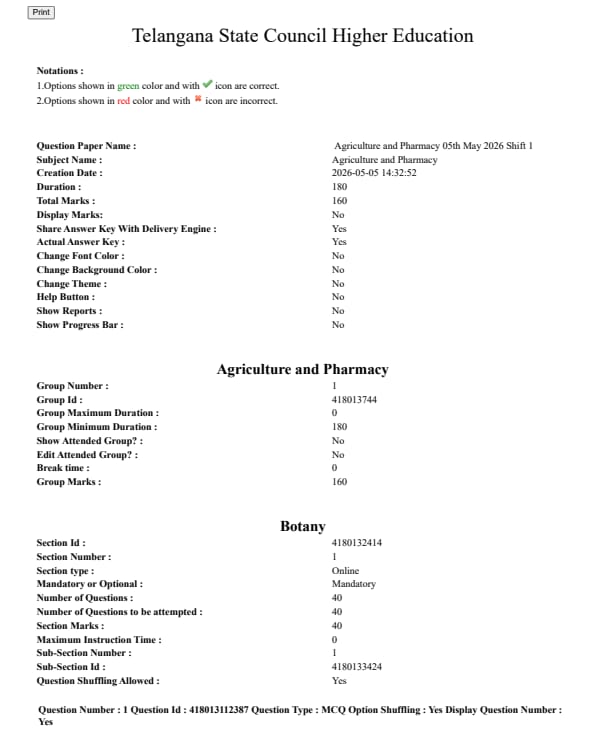
Units of marker used in creation of three domains are
View Solution
Step 1: Understanding the Concept:
The three-domain system is a biological classification introduced by Carl Woese in 1990.
It divides cellular life forms into three domains: Archaea, Bacteria, and Eukarya.
This phylogenetic classification is based on the nucleotide sequence differences in ribosomal RNA (rRNA).
Step 2: Detailed Explanation:
Woese selected ribosomal RNA as a molecular marker because it is universally distributed across all cellular organisms.
It is highly conserved, functionally constant, and changes very slowly over evolutionary timescales.
In prokaryotes, the 16S rRNA gene (part of the 30S small ribosomal subunit) is used for these comparisons.
The eukaryotic equivalent is the 18S rRNA gene.
By comparing these sequences, scientists can determine the evolutionary relationships among divergent groups.
Step 3: Final Answer:
The specific marker used to establish the three domains of life is the 16S rRNA.
Quick Tip: Remember that the 16S rRNA gene is often referred to as the "ultimate molecular chronometer."
This is due to its slow rate of evolution and high structural conservation across all prokaryotic life.
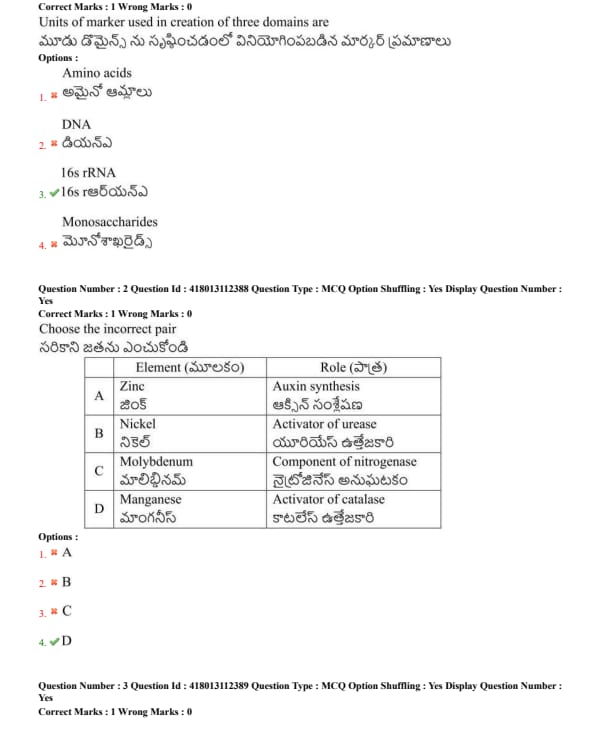
Choose the incorrect pair

View Solution
Step 1: Understanding the Concept:
Plants require essential mineral nutrients to carry out physiological processes.
Each element serves specific roles as structural components, enzyme activators, or osmotic regulators.
Step 2: Detailed Explanation:
Let us analyze each element-role pair:
- Pair A (Zinc): Zinc (\(Zn^{2+}\)) is required for tryptophan synthesis, which is the direct precursor of auxin (indole-3-acetic acid). Thus, this pair is correct.
- Pair B (Nickel): Nickel (\(Ni^{2+}\)) is an essential metal constituent and activator of the enzyme urease, which hydrolyzes urea. Thus, this pair is correct.
- Pair C (Molybdenum): Molybdenum (\(Mo\)) is a central component of the iron-molybdenum cofactor (FeMo-co) of nitrogenase, as well as nitrate reductase. Thus, this pair is correct.
- Pair D (Manganese): Manganese (\(Mn^{2+}\)) is primarily involved in photolysis of water during photosynthesis. The enzyme catalase, however, is a heme-containing protein that requires Iron (\(Fe\)) for activation, not manganese. Thus, this pair is incorrect.
Step 3: Final Answer:
The incorrect pair is D (Manganese - Activator of catalase).
Quick Tip: To easily remember enzyme activators:
Enzymes involved in peroxide breakdown, like catalase and peroxidase, contain heme groups.
Therefore, they require Iron (\(Fe\)) as their activator, not Manganese (\(Mn\)).
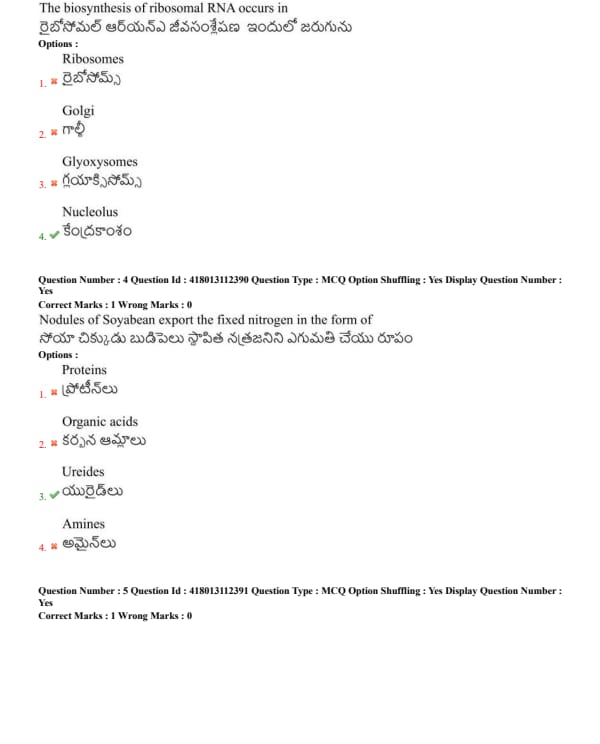
The biosynthesis of ribosomal RNA occurs in
View Solution
Step 1: Understanding the Concept:
Eukaryotic ribosomes consist of ribosomal proteins and ribosomal RNA (rRNA).
The synthesis of the RNA component is highly compartmentalized within the nucleus.
Step 2: Detailed Explanation:
The nucleolus is a dense, non-membrane-bound region located inside the eukaryotic nucleus.
It is the main site of ribosomal RNA (rRNA) transcription and processing.
The nucleolar organizer regions (NORs) of chromosomes contain genes for 45S pre-rRNA.
This precursor is transcribed by RNA Polymerase I inside the nucleolus and cleaved into 18S, 5.8S, and 28S rRNAs.
These rRNAs are then assembled with imported ribosomal proteins to form the small and large ribosomal subunits.
Step 3: Final Answer:
The biosynthesis of ribosomal RNA occurs inside the nucleolus.
Quick Tip: Except for the 5S rRNA (which is transcribed in the nucleoplasm by RNA Polymerase III), all other eukaryotic rRNAs are synthesized and processed within the nucleolus.
Nodules of Soyabean export the fixed nitrogen in the form of
View Solution
Step 1: Understanding the Concept:
Leguminous plants form symbiotic associations with nitrogen-fixing bacteria like \textit{Rhizobium.
Once atmospheric nitrogen is reduced to ammonia inside the root nodules, it must be assimilated and transported to the rest of the plant.
Step 2: Detailed Explanation:
Different legumes transport fixed nitrogen in different chemical forms.
Temperate legumes (like peas and clovers) primarily transport nitrogen as amides (asparagine and glutamine).
Tropical legumes (like Soyabean and cowpea) assimilate fixed nitrogen into ureides.
The major ureides transported are allantoin and allantoic acid.
Ureides have a low carbon-to-nitrogen ratio, which allows the plant to conserve carbon skeletons during nitrogen transport via the xylem.
Step 3: Final Answer:
Soyabean root nodules export fixed nitrogen in the form of ureides.
Quick Tip: Remember the Soyabean-Ureide association.
Soyabean is a classic example of a "ureide-exporting" tropical legume, whereas temperate legumes are typically "amide-exporters."
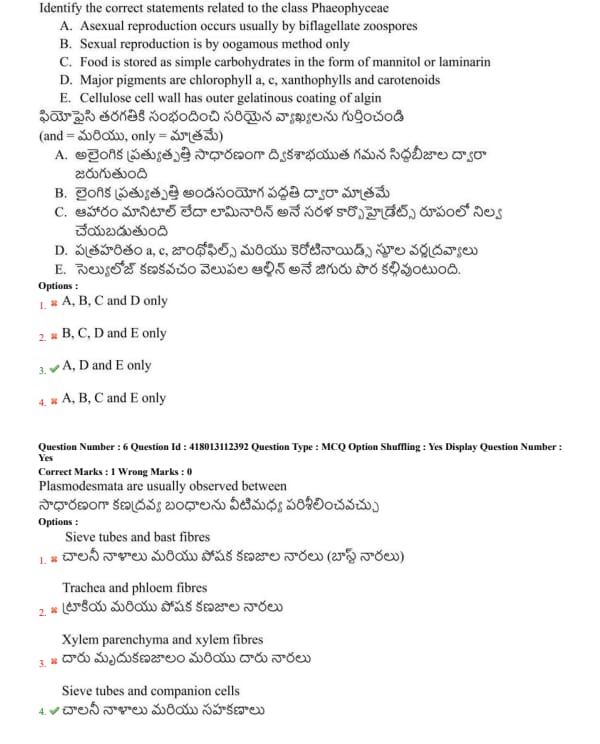
Identify the correct statements related to the class Phaeophyceae:
A. Asexual reproduction occurs usually by biflagellate zoospores
B. Sexual reproduction is by oogamous method only
C. Food is stored as simple carbohydrates in the form of mannitol or laminarin
D. Major pigments are chlorophyll a, c, xanthophylls and carotenoids
E. Cellulose cell wall has outer gelatinous coating of algin
View Solution
Step 1: Understanding the Concept:
Phaeophyceae is a class of algae commonly known as brown algae.
They are primarily marine organisms characterized by specific storage materials, cell wall composition, and reproductive strategies.
Step 2: Detailed Explanation:
Let us evaluate each statement:
- Statement A: Asexual reproduction in brown algae is indeed by pear-shaped biflagellate zoospores with two unequal, laterally attached flagella. This is correct.
- Statement B: Sexual reproduction in Phaeophyceae can be isogamous, anisogamous, or oogamous. Thus, it is not restricted to oogamous only. This is incorrect.
- Statement C: Food is stored as complex carbohydrates (not simple carbohydrates) in the form of laminarin or mannitol. This is incorrect.
- Statement D: The major photosynthetic pigments are chlorophyll a and c, along with carotenoids and xanthophylls (specifically fucoxanthin). This is correct.
- Statement E: The cellulosic cell wall of brown algae is covered on the outside by a gelatinous sheath of algin. This is correct.
Hence, statements A, D, and E are correct.
Step 3: Final Answer:
The correct statements are A, D, and E only.
Quick Tip: To remember brown algae characteristics:
1. "Algin" is a phycocolloid unique to brown algae.
2. Storage carbohydrates like laminarin are highly complex.
This quickly eliminates option B and C.
Plasmodesmata are usually observed between
View Solution
Step 1: Understanding the Concept:
Plasmodesmata are microscopic cytoplasmic channels that traverse the cell walls of plant cells.
They facilitate direct transport and communication between adjacent cells (symplastic pathway).
Step 2: Detailed Explanation:
In angiosperm phloem, the sieve tube element and its companion cell form a functional unit.
They are derived from the division of a single mother cell.
Sieve tube elements lose their nucleus, ribosomes, and vacuole at maturity to allow efficient sap flow.
To survive, they depend on the adjacent companion cells, which maintain all metabolic machinery.
The cell wall between a sieve tube element and its companion cell contains numerous, highly branched plasmodesmata.
These connections allow the rapid transfer of ATP, proteins, and other essential molecules from the companion cell into the sieve tube.
Step 3: Final Answer:
Plasmodesmata are most abundantly observed between sieve tubes and companion cells.
Quick Tip: Sieve tubes are enucleated and metabolically inactive on their own.
They are physically and functionally connected to nucleated companion cells through plasmodesmata.
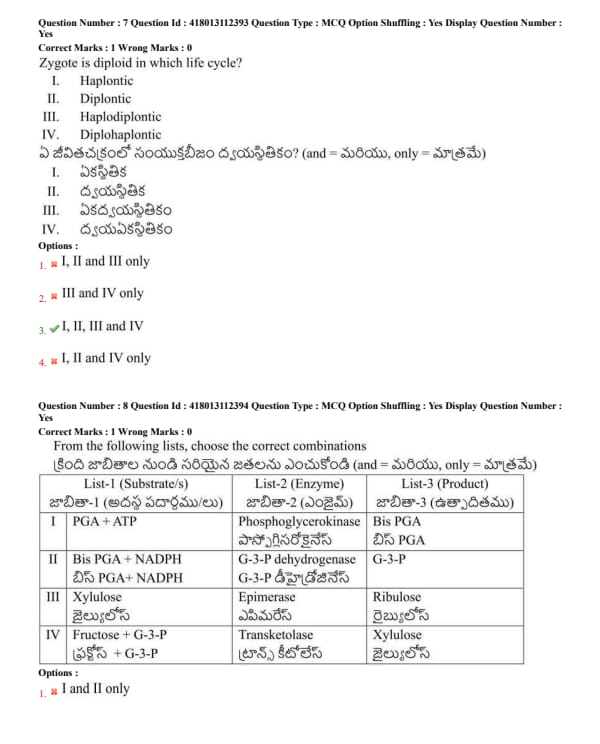
Zygote is diploid in which life cycle?
I. Haplontic
II. Diplontic
III. Haplo-diplontic
IV. Diplo-haplontic
View Solution
Step 1: Understanding the Concept:
The life cycle of sexually reproducing plants alternates between a haploid gametophyte phase and a diploid sporophyte phase.
The zygote is the single-celled product of the fusion of two haploid gametes (syngamy).
Step 2: Detailed Explanation:
Regardless of the species or its specific life cycle, fertilization involves the union of two haploid nuclei.
This fusion always results in a diploid (\(2n\)) zygote.
- In a Haplontic life cycle (e.g., \textit{Chlamydomonas), the diploid zygote immediately undergoes meiosis to produce haploid spores.
- In a Diplontic life cycle (e.g., Gymnosperms and Angiosperms), the zygote undergoes mitotic divisions to develop into a diploid multicellular organism.
- In a Haplo-diplontic (or Diplo-haplontic) life cycle (e.g., Bryophytes and Pteridophytes), the diploid zygote undergoes mitosis to form a multicellular diploid sporophyte.
Thus, the zygote itself is always diploid in all these life cycles.
Step 3: Final Answer:
The zygote is a diploid structure in all four listed life cycles (I, II, III, and IV).
Quick Tip: A basic biological rule:
Fertilization of haploid gametes (\(n + n\)) always yields a diploid (\(2n\)) zygote, regardless of the evolutionary group or life cycle pattern.
From the following lists, choose the correct combinations

View Solution
Step 1: Understanding the Concept:
The Calvin cycle (dark reaction of photosynthesis) involves carbon fixation, reduction, and regeneration of the CO\(_2\) acceptor RuBP.
These steps are catalyzed by specific enzymes that interconvert sugar phosphates.
Step 2: Detailed Explanation:
Let us analyze each pathway combination listed in the table:
- Combination I: 3-phosphoglyceric acid (PGA) is phosphorylated using ATP by phosphoglycerokinase to produce 1,3-bisphosphoglyceric acid (Bis PGA). This is correct.
- Combination II: Bis PGA is reduced using NADPH by glyceraldehyde-3-phosphate dehydrogenase (G-3-P dehydrogenase) to produce glyceraldehyde-3-phosphate (G-3-P). This is correct.
- Combination III: Xylulose-5-phosphate is converted into its epimer Ribulose-5-phosphate by phosphopentose epimerase (epimerase). This is correct.
- Combination IV: Fructose-6-phosphate reacts with G-3-P in a transketolase-catalyzed reaction to yield Erythrose-4-phosphate and Xylulose-5-phosphate. This is correct.
All four combinations represent correct enzymatic steps in the photosynthetic carbon reduction pathway.
Step 3: Final Answer:
The correct combinations are I, II, III, and IV.
Quick Tip: Remember that transketolase transfers a 2-carbon ketol group.
A 6-carbon sugar (fructose) plus a 3-carbon sugar (G-3-P) yields a 4-carbon sugar (erythrose) and a 5-carbon sugar (xylulose).
This helps confirm combination IV.
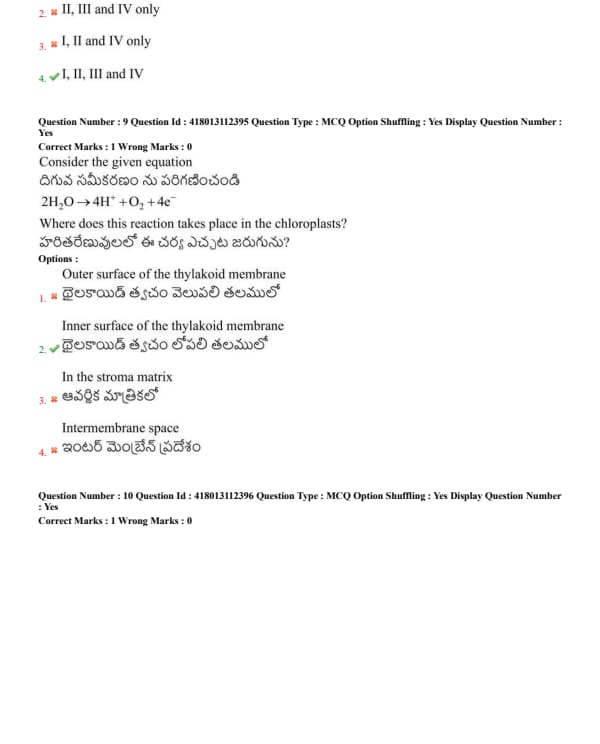
Consider the given equation: \(2H_2O \to 4H^+ + O_2 + 4e^-\). Where does this reaction take place in the chloroplasts?
View Solution
Step 1: Understanding the Concept:
The given equation represents the photolysis (water splitting) reaction.
This reaction is a key component of the light-dependent stage of photosynthesis.
Step 2: Detailed Explanation:
The water-splitting complex (oxygen-evolving complex, or OEC) is physically associated with Photosystem II (PSII).
This complex is located on the lumenal (inner) side of the thylakoid membrane.
When light excites PSII, electrons are extracted from water molecules to replace those lost by the reaction center P680.
The protons (\(H^+\)) generated by this reaction are released directly into the thylakoid lumen.
This contributes to the proton gradient across the membrane, which is later used to drive ATP synthesis.
Therefore, the reaction takes place on the inner surface of the thylakoid membrane.
Step 3: Final Answer:
The reaction occurs on the inner surface of the thylakoid membrane.
Quick Tip: Water splitting releases protons (\(H^+\)) directly into the thylakoid lumen (the inside space).
This helps build up a high concentration of protons inside, driving the ATP synthase motor.
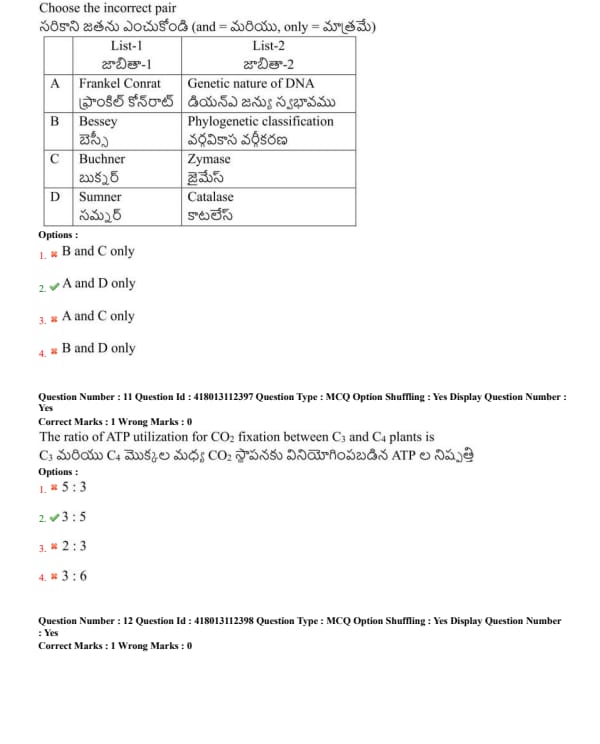
Choose the incorrect pair

View Solution
Step 1: Understanding the Concept:
This question evaluates historical discoveries in molecular biology, plant taxonomy, and enzymology.
Step 2: Detailed Explanation:
Let us examine each pair:
- Pair A: Heinz Frankel-Conrat demonstrated that RNA is the genetic material of Tobacco Mosaic Virus (TMV). He did not work on the genetic nature of DNA. Thus, this pair is incorrect.
- Pair B: Charles Bessey proposed a phylogenetic system of angiosperm classification based on evolutionary trends (Bessey's Dictum). Thus, this pair is correct.
- Pair C: Eduard Buchner discovered zymase, an active enzyme complex in yeast juice that can ferment sugar in the absence of living cells. Thus, this pair is correct.
- Pair D: James B. Sumner crystallized the first enzyme, urease, in 1926. He did not achieve fame for the crystallization of catalase first, which is an incorrect association here. Thus, this pair is incorrect.
Hence, the incorrect pairs are A and D.
Step 3: Final Answer:
The incorrect pairs are A and D only.
Quick Tip: Frankel-Conrat is always associated with "RNA as genetic material" (TMV experiments).
Sumner is famous for crystallizing the enzyme "Urease."
Recognizing these two facts makes it easy to select option 2.
The ratio of ATP utilization for \(CO_2\) fixation between \(C_3\) and \(C_4\) plants is
View Solution
Step 1: Understanding the Concept:
Photosynthesis requires energy in the form of ATP and NADPH to fix carbon dioxide into carbohydrates.
The metabolic pathways differ between \(C_3\) and \(C_4\) plants, resulting in different energy costs.
Step 2: Detailed Explanation:
- In \(C_3\) plants, the fixation of one molecule of \(CO_2\) through the Calvin cycle requires 3 molecules of ATP and 2 molecules of NADPH.
- In \(C_4\) plants, \(CO_2\) is first fixed in mesophyll cells as a \(C_4\) acid, which is then transported to bundle sheath cells.
This concentration mechanism requires an additional 2 ATP molecules per \(CO_2\) fixed.
Thus, \(C_4\) plants require a total of 5 ATP molecules and 2 molecules of NADPH per fixed \(CO_2\) molecule.
The ratio of ATP utilized per \(CO_2\) fixed in \(C_3\) versus \(C_4\) plants is: \[ Ratio = 3 ATP : 5 ATP = 3 : 5 \]
Step 3: Final Answer:
The ratio of ATP utilization for \(CO_2\) fixation between \(C_3\) and \(C_4\) plants is 3 : 5.
Quick Tip: Keep the basic stoichiometry in mind:
\(C_3\) cycle \(\to\) 3 ATP per \(CO_2\).
\(C_4\) cycle \(\to\) 5 ATP per \(CO_2\).
This direct comparison yields the 3:5 ratio.
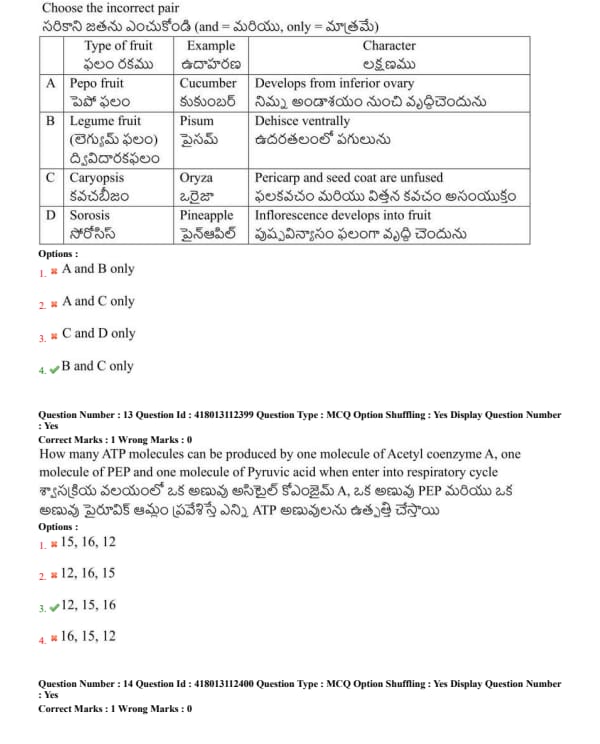
Choose the incorrect pair

View Solution
Step 1: Understanding the Concept:
Fruits are categorized based on their origin, structure, and dehiscence patterns.
Step 2: Detailed Explanation:
Let us evaluate each pair:
- Pair A: Pepo is a simple succulent fruit (e.g., Cucumber) that develops from a tri-carpellary, syncarpous, inferior ovary. This is correct.
- Pair B: Legume is a dry dehiscent fruit (e.g., Pea / \textit{Pisum) that splits along both the dorsal and ventral sutures at maturity, not just ventrally. Thus, this pair is incorrect.
- Pair C: Caryopsis is a simple dry indehiscent fruit (e.g., Rice / \textit{Oryza) where the pericarp (fruit wall) is completely fused with the seed coat. Thus, this pair is incorrect.
- Pair D: Sorosis is a composite fruit (e.g., Pineapple) that develops from an entire spike or spadix inflorescence. This is correct.
Hence, the incorrect pairs are B and C.
Step 3: Final Answer:
The incorrect pairs are B and C only.
Quick Tip: In grains (caryopsis), you cannot peel off the fruit wall because the seed coat and pericarp are completely fused.
This is a defining characteristic of the grass family (Poaceae).
How many ATP molecules can be produced by one molecule of Acetyl coenzyme A, one molecule of PEP and one molecule of Pyruvic acid when enter into respiratory cycle
View Solution
Step 1: Understanding the Concept:
Aerobic respiration generates ATP through substrate-level phosphorylation and oxidative phosphorylation.
The theoretical ATP yield of different intermediates is calculated using standard traditional respiratory values.
Step 2: Detailed Explanation:
Let us calculate the ATP output for each substrate individually:
1. Acetyl-CoA:
One molecule of Acetyl-CoA entering the Krebs cycle produces:
- 3 NADH = 9 ATP (at 3 ATP per NADH)
- 1 \(FADH_2\) = 2 ATP (at 2 ATP per \(FADH_2\))
- 1 GTP (ATP) = 1 ATP
Total = 12 ATP.
2. Pyruvic acid:
One molecule of pyruvic acid undergoes oxidative decarboxylation to form Acetyl-CoA, which then enters the Krebs cycle:
- Link reaction: 1 NADH = 3 ATP
- Krebs cycle (from Acetyl-CoA) = 12 ATP
Total = 15 ATP.
3. PEP (Phosphoenolpyruvate):
One molecule of PEP is converted to pyruvic acid during glycolysis:
- Conversion of PEP to Pyruvate generates 1 ATP directly via substrate-level phosphorylation.
- The resulting pyruvic acid then yields 15 ATP in the aerobic cycle.
Total = 1 + 15 = 16 ATP.
Therefore, the ATP yields are 12, 15, and 16 respectively.
Step 3: Final Answer:
The number of ATP molecules produced are 12, 15, and 16 respectively.
Quick Tip: Remember the metabolic order of entrance:
\(PEP \to Pyruvate \to Acetyl-CoA\).
Since energy is released at each step down this pathway, the theoretical ATP yield must be \(PEP > Pyruvate > Acetyl-CoA\).
This matches 16, 15, and 12.
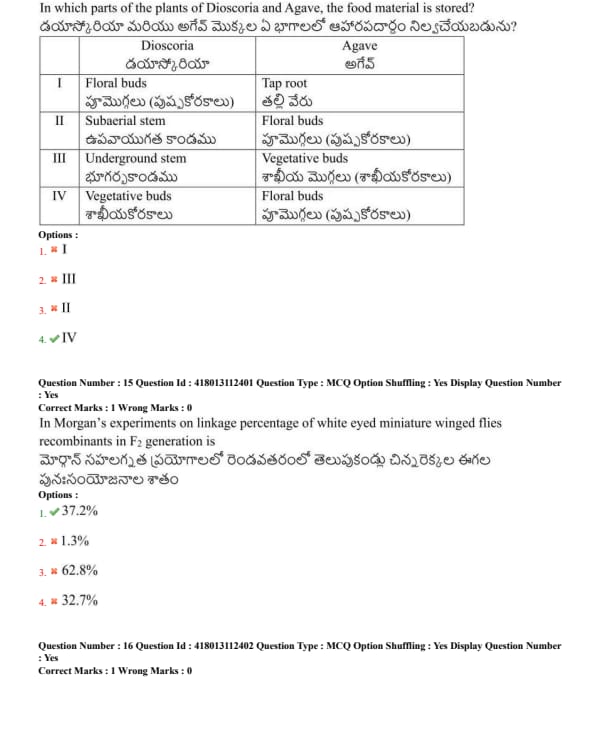
In which parts of the plants of Dioscoria and Agave, the food material is stored?

View Solution
Step 1: Understanding the Concept:
Bulbils are modified vegetative or floral buds that accumulate food and become fleshy.
They eventually detach from the parent plant and assist in vegetative propagation.
Step 2: Detailed Explanation:
- In \textit{Dioscorea (yam), bulbils are modified axillary vegetative buds that store food.
They develop in the axils of leaves and serve as organs of vegetative reproduction.
- In \textit{Agave (century plant), bulbils are modified floral buds.
They develop on the floral axis (inflorescence) instead of flowers, storing food and assisting in propagation.
Thus, the correct pairing is represented by Row IV (Vegetative buds and Floral buds).
Step 3: Final Answer:
Row IV is the correct match.
Quick Tip: Agave is famous for its large flowering stalk where floral buds transform into bulbils.
Dioscorea forms axillary bulbils along its climbing vine (vegetative buds).
In Morgan's experiments on linkage percentage of white eyed miniature winged flies recombinants in \(F_2\) generation is
View Solution
Step 1: Understanding the Concept:
Linkage refers to the physical association of genes on the same chromosome.
The strength of linkage depends on the physical distance between the genes; closer genes exhibit tighter linkage and fewer recombinant offspring.
Step 2: Detailed Explanation:
Thomas Hunt Morgan studied two dihybrid crosses in \textit{Drosophila melanogaster to analyze linkage:
- Cross A: Genes for body color (yellow/brown) and eye color (white/red) were very tightly linked and showed only 1.3% recombination.
- Cross B: Genes for eye color (white/red) and wing size (miniature/normal) were located further apart on the X chromosome.
This greater physical distance allowed more crossing-over events to occur.
As a result, Cross B showed a recombination frequency of 37.2%.
Step 3: Final Answer:
The recombinant percentage in the white-eyed, miniature-winged cross is 37.2%.
Quick Tip: Remember the two key percentages from Morgan's crosses:
1.3% recombination for yellow body and white eyes.
37.2% recombination for white eyes and miniature wings.
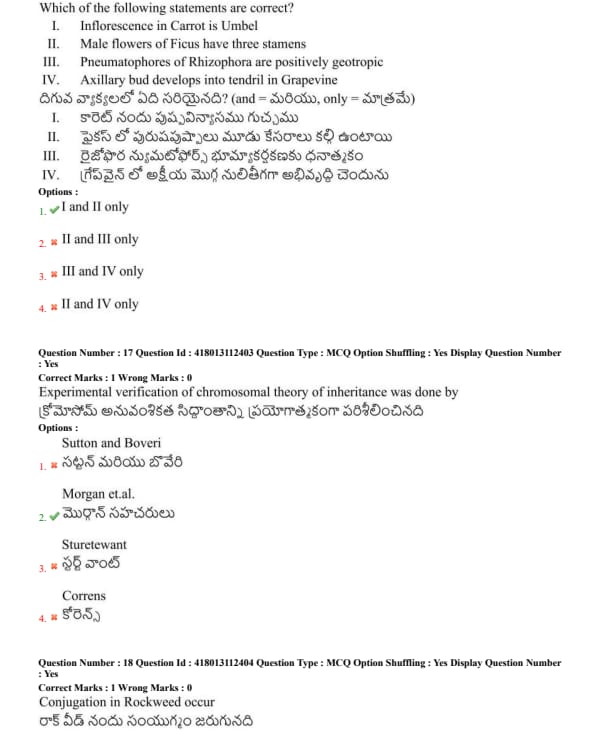
Which of the following statements are correct?
I. Inflorescence in Carrot is Umbel
II. Male flowers of Ficus have three stamens
III. Pneumatophores of Rhizophora are positively geotropic
IV. Axillary bud develops into tendril in Grapevine
View Solution
Step 1: Understanding the Concept:
This question evaluates different morphological adaptations in flowering plants, including inflorescence, flower structure, root modifications, and stem modifications.
Step 2: Detailed Explanation:
Let us analyze each statement:
- Statement I: The inflorescence of Carrot (\textit{Daucus carota) is indeed a compound umbel, where flowers arise from a common point. This is correct.
- Statement II: In the genus \textit{Ficus (which contains syconium inflorescence), the male flowers generally possess three stamens. This is correct.
- Statement III: Pneumatophores of \textit{Rhizophora grow vertically upwards out of the water-logged soil to obtain oxygen. Thus, they are negatively geotropic, not positively geotropic. This is incorrect.
- Statement IV: In Grapevine (\textit{Vitis vinifera), the tendril is a modification of the apical/terminal bud, whereas in plants like \textit{Passiflora, the tendril develops from the axillary bud. This is incorrect.
Therefore, only statements I and II are correct.
Step 3: Final Answer:
The correct statements are I and II only.
Quick Tip: Pneumatophores grow upwards against gravity to breathe, which makes them negatively geotropic.
This fact immediately eliminates options containing III.
Experimental verification of chromosomal theory of inheritance was done by
View Solution
Step 1: Understanding the Concept:
The Chromosomal Theory of Inheritance proposes that chromosomes are the vehicles of genetic heredity.
Step 2: Detailed Explanation:
Walter Sutton and Theodor Boveri independently formulated the Chromosomal Theory of Inheritance in 1902.
They pointed out that the behavior of chromosomes during meiosis was parallel to the behavior of Mendel's factors.
However, this theory remained a hypothesis until Thomas Hunt Morgan and his colleagues experimentally verified it.
Using the fruit fly (Drosophila melanogaster) as a model organism, Morgan performed dihybrid crosses and discovered sex-linked inheritance, which confirmed that genes are physically located on chromosomes.
Step 3: Final Answer:
The experimental verification was conducted by Morgan and his colleagues.
Quick Tip: Sutton and Boveri \textbf{proposed the theory.
Morgan and his colleagues \textbf{proved} it experimentally.
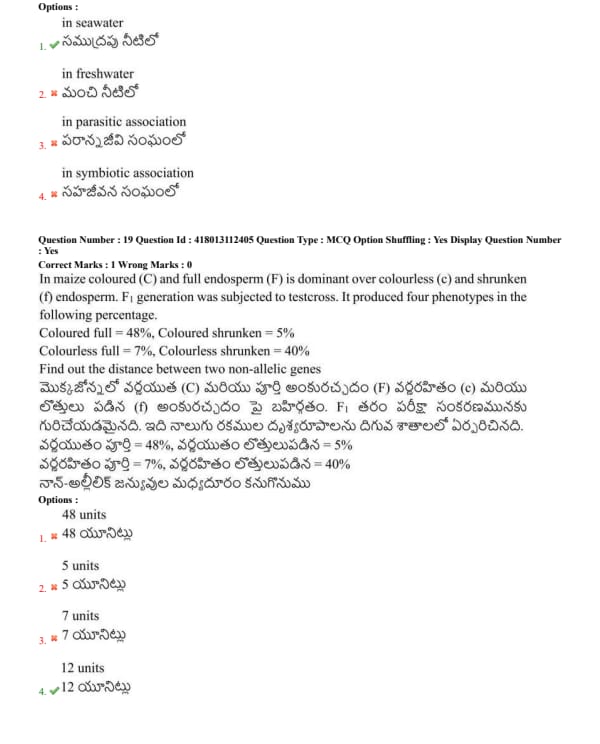
Conjugation in Rockweed occur
View Solution
Step 1: Understanding the Concept:
Rockweed (\textit{Fucus) is a genus of brown algae (Phaeophyceae).
It resides primarily in the intertidal zones of marine rocky shores.
Step 2: Detailed Explanation:
\textit{Fucus exhibits a diplontic life cycle with oogamous sexual reproduction.
The plants are dioecious or monoecious, producing male gametes (antherozoids) and female gametes (eggs) inside specialized cavities called conceptacles.
These gametes are released directly into the surrounding marine environment.
Fertilization (conjugation/fusion of gametes) occurs externally in the open seawater.
The resulting diploid zygote then settles on a rocky substrate and germinates to form a new diploid plant.
Step 3: Final Answer:
Conjugation in Rockweed occurs externally in seawater.
Quick Tip: Fucus is a classic marine organism.
Since it lacks specialized protective structures for fertilization, its gametes must meet and fuse in the surrounding ocean water.
In maize coloured (C) and full endosperm (F) is dominant over colourless (c) and shrunken (f) endosperm. \(F_1\) generation was subjected to testcross. It produced four phenotypes in the following percentage.
Coloured full = 48%, Coloured shrunken = 5%
Colourless full = 7%, Colourless shrunken = 40%
Find out the distance between two non-allelic genes
View Solution
Step 1: Understanding the Concept:
The distance between two linked genes on a chromosome is proportional to the frequency of recombination between them.
One map unit (or centimorgan) is defined as the genetic distance that yields 1% recombinant offspring.
Key Formula or Approach:
The genetic distance is calculated using the formula: \[ Recombination Frequency (RF) = \frac{Number of recombinant offspring}{Total number of offspring} \times 100 \]
Step 2: Detailed Explanation:
Let us identify the parental and recombinant phenotypes from the testcross data:
- Parental phenotypes (highest frequency):
- Coloured, full endosperm = 48%
- Colourless, shrunken endosperm = 40%
- Recombinant phenotypes (lowest frequency):
- Coloured, shrunken endosperm = 5%
- Colourless, full endosperm = 7%
Now, calculate the sum of the recombinant percentages: \[ Recombination Frequency = 5% + 7% = 12% \]
Since 1% recombination equals 1 map unit, a 12% recombination frequency corresponds to a genetic distance of 12 units.
Step 3: Final Answer:
The distance between the two non-allelic genes is 12 units.
Quick Tip: To find the map distance quickly, identify the two smallest phenotype percentages (the recombinants) and add them together.
Here, \(5% + 7% = 12%\), which directly gives 12 map units.
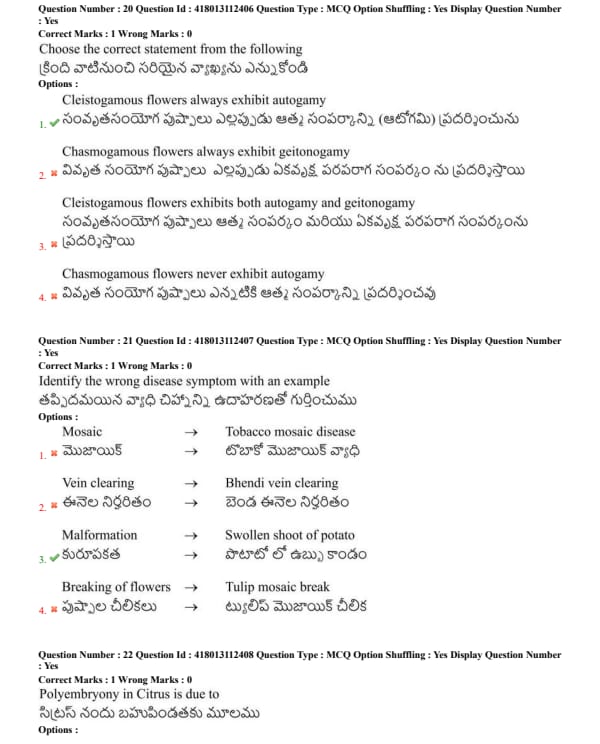
Choose the correct statement from the following
View Solution
Step 1: Understanding the Concept:
Autogamy is a type of self-pollination where pollen is transferred from the anthers to the stigma of the same flower.
Plants have evolved different floral mechanisms to promote or prevent self-pollination.
Step 2: Detailed Explanation:
- Cleistogamous flowers never open at maturity.
Because the reproductive organs remain enclosed, it is physically impossible for foreign pollen to enter.
The pollen from the anthers of the flower can only land on the stigma of the same flower.
Therefore, cleistogamous flowers always exhibit obligate autogamy.
- Chasmogamous flowers open at maturity, which means they can undergo autogamy, geitonogamy, or xenogamy depending on compatibility and insect visits.
This makes the other options incorrect.
Step 3: Final Answer:
The correct statement is that cleistogamous flowers always exhibit autogamy.
Quick Tip: Cleistogamy guarantees seed production even in the absence of pollinators.
This is because the closed structure of the flower prevents cross-pollination.
Identify the wrong disease symptom with an example
View Solution
Step 1: Understanding the Concept:
Plant diseases caused by viruses, fungi, or bacteria present specific morphological and structural abnormalities in their host tissues.
Accurate identification of these disease symptoms and their associated host plants is crucial for effective plant pathological diagnosis.
Detailed Explanation:
Let us evaluate each symptom-host combination:
- Mosaic is characterized by alternating patches of normal green and chlorotic (yellow or pale) tissue on leaves.
Tobacco mosaic disease, caused by the Tobacco Mosaic Virus (TMV), is a classic example.
- Vein clearing refers to the chlorosis of veins in leaves, where the vascular tissue loses chlorophyll while the rest of the lamina remains green.
This is prominently observed in Bhendi (Okra) vein clearing disease, caused by the Yellow Vein Mosaic Virus.
- Malformation involves the abnormal development or distortion of plant organs, such as floral or vegetative parts.
However, "Swollen shoot" is a specific symptom associated with the Cocoa Swollen Shoot Virus (CSSV) in cacao trees (\textit{Theobroma cacao), not potato plants.
Potato viruses typically manifest as leaf rolling, mosaic, rugosity, or dwarfism, making this pair incorrect.
- Breaking of flowers occurs when viral infections interfere with pigment distribution in petals, causing variegation or striping.
Tulip break (caused by Tulip Breaking Virus) is the most famous historical example of this phenomenon.
Step 2: Final Answer:
The incorrectly matched disease symptom and example is option (C).
Quick Tip: Remember that "Swollen shoot" is exclusively associated with Cocoa plant pathology, whereas potato viral symptoms are commonly characterized by leaf rolling or rugose mosaic patterns.
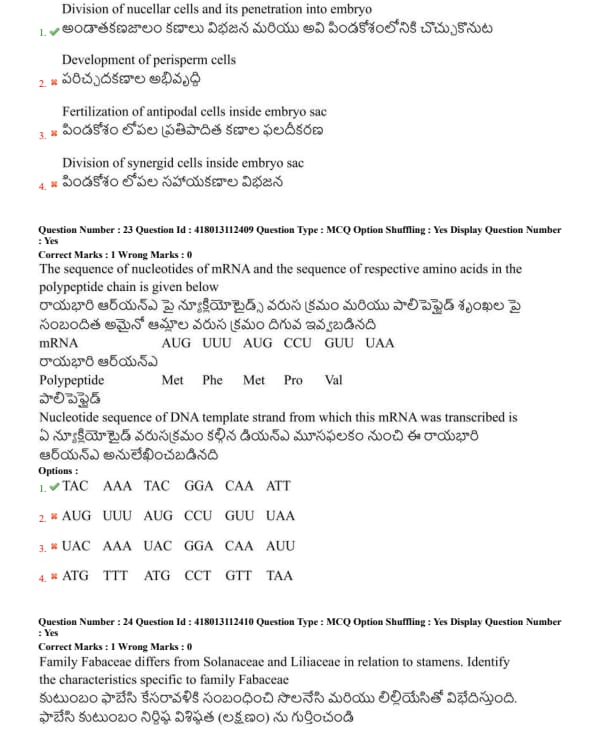
Polyembryony in Citrus is due to
View Solution
Step 1: Understanding the Concept:
Polyembryony is defined as the development of more than one embryo inside a single seed.
This phenomenon is common in certain gymnosperms and specific angiosperm families, particularly Rutaceae (such as Citrus).
Detailed Explanation:
In many \textit{Citrus species, asexual propagation occurs naturally through adventive embryony, a form of sporophytic apomixis.
- The maternal tissues surrounding the embryo sac, specifically the cells of the diploid nucellus, begin to divide actively.
- These dividing nucellar cells protrude and penetrate into the embryo sac cavity.
- Inside the embryo sac, these maternal cells develop into mature embryos alongside the sexual zygotic embryo.
- Consequently, when the seed germinates, multiple seedlings emerge.
- The nucellar embryos are genetically identical to the maternal parent, providing a natural mechanism for clonal propagation.
- Other structures like the perisperm, antipodals, and synergids do not contribute to standard adventive polyembryony in \textit{Citrus.
Step 2: Final Answer:
Polyembryony in Citrus arises from the division of diploid nucellar cells and their subsequent penetration into the embryo sac, matching option (A).
Quick Tip: Nucellar embryony in \textit{Citrus provides virus-free clones of the maternal parent plant, which is of great commercial value in horticulture.
The sequence of nucleotides of mRNA and the sequence of respective amino acids in the polypeptide chain is given below:
mRNA: \texttt{AUG UUU AUG CCU GUU UAA
Polypeptide: \texttt{Met - Phe - Met - Pro - Val
Nucleotide sequence of DNA template strand from which this mRNA was transcribed is
View Solution
Step 1: Understanding the Concept:
Transcription is the biochemical process wherein a specific strand of DNA, known as the template strand, is read in the \(3' \rightarrow 5'\) direction to synthesize a complementary mRNA molecule in the \(5' \rightarrow 3'\) direction.
Key Formula or Approach:
The base-pairing rules govern the transcription process:
- Adenine (A) in the DNA template pairs with Uracil (U) in the mRNA.
- Thymine (T) in the DNA template pairs with Adenine (A) in the mRNA.
- Cytosine (C) in the DNA template pairs with Guanine (G) in the mRNA.
- Guanine (G) in the DNA template pairs with Cytosine (C) in the mRNA.
Step 2: Detailed Explanation:
Given the mRNA sequence:
\[ 5'-AUG UUU AUG CCU GUU UAA-3' \]
To determine the complementary DNA template strand, we derive the complementary base for each ribonucleotide sequentially:
- For \texttt{A, the complementary DNA base is \texttt{T.
- For \texttt{U, the complementary DNA base is \texttt{A.
- For \texttt{G, the complementary DNA base is \texttt{C.
- For \texttt{C, the complementary DNA base is \texttt{G.
Let us transcribe each codon to its corresponding DNA triplet:
1. \texttt{AUG \(\rightarrow\) \texttt{TAC
2. \texttt{UUU \(\rightarrow\) \texttt{AAA
3. \texttt{AUG \(\rightarrow\) \texttt{TAC
4. \texttt{CCU \(\rightarrow\) \texttt{GGA
5. \texttt{GUU \(\rightarrow\) \texttt{CAA
6. \texttt{UAA \(\rightarrow\) \texttt{ATT
Combining these triplets, we obtain the template DNA sequence:
\texttt{TAC AAA TAC GGA CAA ATT
Step 3: Final Answer:
The DNA template strand sequence is \texttt{TAC AAA TAC GGA CAA ATT, corresponding to option (A).
Quick Tip: To solve transcription coding questions rapidly, remember that Uracil (U) is unique to RNA, while Thymine (T) is unique to DNA. Any option containing Uracil (U) can be instantly eliminated when searching for a DNA strand.
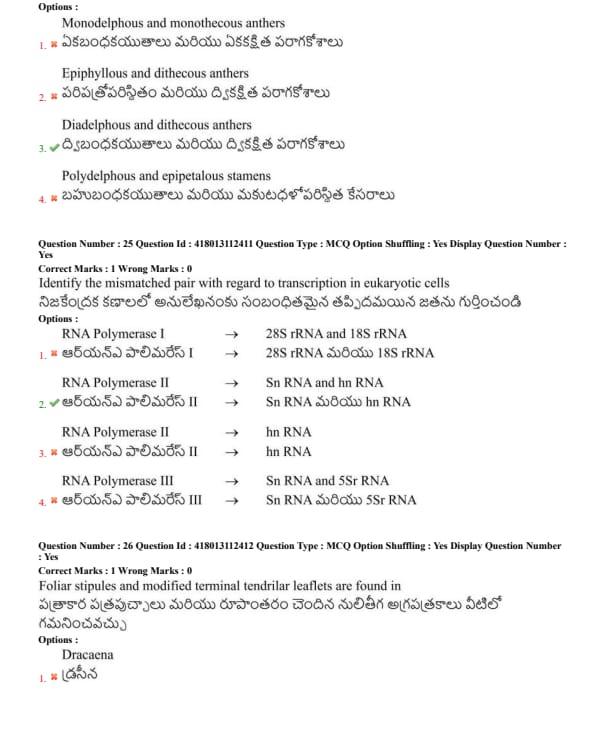
Family Fabaceae differs from Solanaceae and Liliaceae in relation to stamens. Identify the characteristics specific to family Fabaceae.
View Solution
Step 1: Understanding the Concept:
Androecial variations such as stamen fusion, the number of anther lobes (thecae), and their attachment to other floral whorls serve as critical diagnostic features for angiosperm families.
Detailed Explanation:
Let us compare the stamen characteristics of the three families:
- Fabaceae: The androecium typically consists of ten stamens.
These ten stamens are arranged in a diadelphous condition.
This means their filaments are fused into two distinct bundles: nine filaments fuse to form a sheath around the carpel, while the tenth posterior stamen remains completely free.
The floral formula represents this as \(A_{(9)+1}\).
The anthers are dithecous, meaning they are two-lobed and open longitudinally.
- Solanaceae: The androecium contains five stamens that are epipetalous (attached to the petals) and alternates with the corolla lobes (\(A_{5}\)).
- Liliaceae: This family represents monocotyledonous plants where the stamens are often epiphyllous (attached to the perianth segments/tepals), and arranged in two whorls of three (\(A_{3+3}\)).
Hence, the diadelphous state combined with dithecous anthers is a defining stamen feature of Fabaceae.
Step 2: Final Answer:
The stamen characteristic specific to Fabaceae is option (C).
Quick Tip: Associate "Diadelphous" directly with the pea family (Fabaceae), which has a \((9) + 1\) arrangement, while keeping in mind that Solanaceae has "Epipetalous" and Liliaceae has "Epiphyllous" stamens.
Identify the mismatched pair with regard to transcription in eukaryotic cells.
View Solution
Step 1: Understanding the Concept:
Unlike prokaryotes, which utilize a single RNA polymerase for transcription, eukaryotes possess division of labor with three distinct RNA polymerases in the nucleus, each transcribing different types of genes.
Detailed Explanation:
Let us examine the division of labor among the three nuclear eukaryotic RNA polymerases:
- RNA Polymerase I: Transcribes ribosomal RNAs (rRNAs), specifically the larger subunits: 28S, 18S, and 5.8S rRNAs. Thus, option (A) is correctly matched.
- RNA Polymerase II: Primarily transcribes protein-coding genes into heterogeneous nuclear RNA (hnRNA), which serves as the precursor to messenger RNA (mRNA). Thus, option (C) is correctly matched.
- RNA Polymerase III: Transcribes transfer RNAs (tRNAs), 5S ribosomal RNA (5S rRNA), and small nuclear RNAs (snRNAs, such as U6 snRNA). Thus, option (D) is correctly matched.
Option (B) states that "RNA Polymerase II" is responsible for transcribing "Sn RNA and hn RNA".
In standard cellular biology frameworks (e.g., NCERT standards), snRNAs are categorized as products of RNA Polymerase III transcription.
Therefore, attributing snRNA transcription to RNA Polymerase II is considered mismatched.
Step 2: Final Answer:
The mismatched pair is option (B).
Quick Tip: Remember the functional categorization of polymerases:
- Pol I \(\rightarrow\) Ribosomal RNA (except 5S)
- Pol II \(\rightarrow\) Messenger RNA precursor (hnRNA)
- Pol III \(\rightarrow\) Transfer RNA, 5S rRNA, and SnRNA
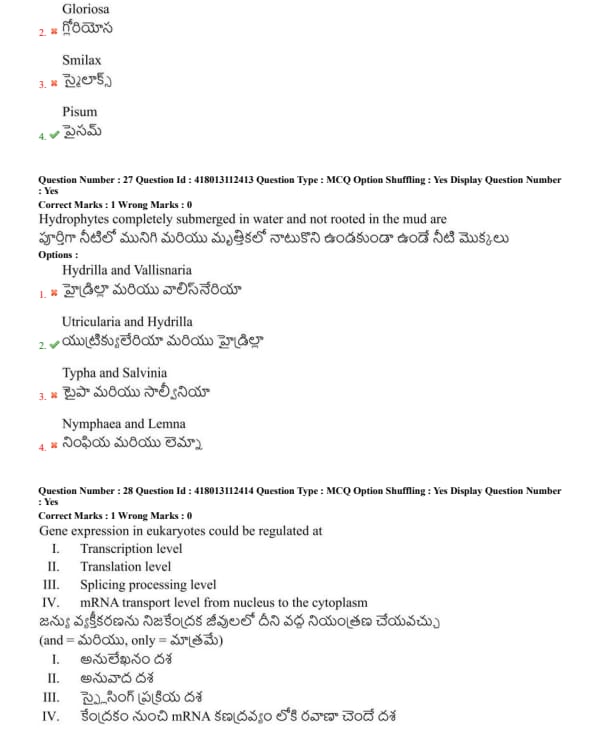
Foliar stipules and modified terminal tendrilar leaflets are found in
View Solution
Step 1: Understanding the Concept:
Leaves and leaf-associated structures undergo extensive evolutionary modifications to perform secondary functions such as climbing, support, protection, or enhanced carbon assimilation.
Detailed Explanation:
Let us analyze the leaf modifications in the provided plant options:
- Pisum (Pea plant): It possesses pinnately compound leaves.
The terminal leaflets are modified into sensitive, coiled, thread-like structures called tendrils that facilitate climbing by wrapping around supports.
To compensate for the loss of photosynthetic leaf surface area, the stipules situated at the base of the petiole become large, leafy, and photosynthetic (known as foliar or foliaceous stipules).
- Gloriosa (Glory lily): The leaf tip or apex is modified directly into a tendril, but it lacks foliar stipules.
- Smilax: It is a climber where the stipules themselves are modified into tendrils, while the leaves remain unmodified.
- Dracaena: It is a monocotyledonous woody plant with simple, parallel-veined leaves that exhibit no such tendrilar adaptations.
Step 2: Final Answer:
The co-occurrence of foliar stipules and terminal leaflet tendrils is a characteristic adaptation of Pisum, matching option (D).
Quick Tip: In the pea plant (\textit{Pisum sativum), remember that the climbing structures are leaflet modifications, while the prominent green leaf-like structures at the node are foliar stipules.
Hydrophytes completely submerged in water and not rooted in the mud are
View Solution
Step 1: Understanding the Concept:
Hydrophytes are aquatic plants categorized based on their relationship with water and substrate:
1. Free-floating hydrophytes (e.g., Pistia, \textit{Lemna, \textit{Salvinia).
2. Submerged, non-rooted hydrophytes (suspended entirely in water, e.g., \textit{Utricularia, \textit{Ceratophyllum, \textit{Hydrilla).
3. Submerged and rooted hydrophytes (e.g., \textit{Vallisneria).
4. Rooted with floating leaves (e.g., \textit{Nymphaea).
5. Emergent/Amphibious hydrophytes (e.g., \textit{Typha).
Detailed Explanation:
Let us evaluate the combinations provided:
- Utricularia (bladderwort) is a rootless carnivorous plant that remains completely submerged and suspended in water.
- Hydrilla is a submerged hydrophyte that often forms dense suspended mats. While it can produce weak roots, it thrives and propagates extensively as a completely submerged, non-rooted floating mass.
- Vallisneria, while being completely submerged, is firmly anchored to the muddy substrate by root systems, which rules out option (A).
- Salvinia is a free-floating fern on the water surface, and Typha is an emergent marsh plant, ruling out option (C).
- Nymphaea (water lily) is rooted with floating leaves, and Lemna (duckweed) floats on the surface, ruling out option (D).
Step 2: Final Answer:
The pair representing completely submerged and non-rooted hydrophytes is \textit{Utricularia and \textit{Hydrilla, matching option (B).
Quick Tip: To distinguish between submerged hydrophytes:
- \textbf{Vallisneria is always \textbf{rooted}.
- \textbf{Utricularia} and \textbf{Ceratophyllum} are always \textbf{non-rooted}.
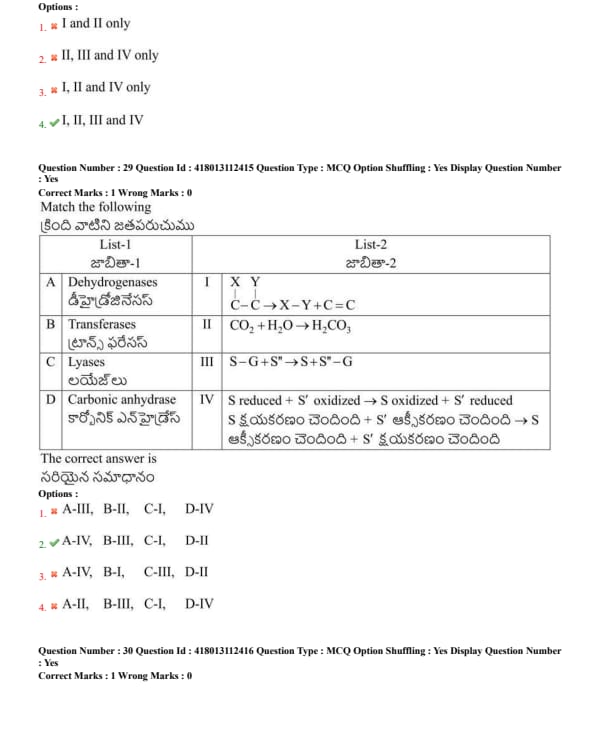
Gene expression in eukaryotes could be regulated at
I. Transcription level
II. Translation level
III. Splicing processing level
IV. mRNA transport level from nucleus to the cytoplasm
View Solution
Step 1: Understanding the Concept:
Gene expression in eukaryotes is a multi-step process that is regulated at several cellular junctions.
Because transcription occurs in the nucleus and translation occurs in the cytoplasm, eukaryotes have developed complex multi-tiered regulatory mechanisms.
Detailed Explanation:
The expression of eukaryotic genes can be controlled at four primary steps:
1. Transcriptional level (I): Regulation of chromatin remodeling, promoter accessibility, and the initiation of primary transcript synthesis. This is the primary checkpoint.
2. Processing level / Splicing (III): The primary transcript (pre-mRNA) undergoes splicing, \(5'\) capping, and polyadenylation. Alternative splicing allows a single gene to produce multiple protein isoforms.
3. Transport level (IV): The export of mature mRNA from the nucleus to the cytoplasm through the nuclear pore complex is regulated to control the availability of transcripts for translation.
4. Translational level (II): Regulation of translation initiation, ribosome recruitment, and mRNA stability in the cytoplasm.
Thus, all four levels (I, II, III, and IV) are active sites of eukaryotic gene regulation.
Step 2: Final Answer:
The correct option is (D).
Quick Tip: While prokaryotes are regulated almost exclusively at the transcription initiation level due to coupled transcription-translation, eukaryotes use all four regulatory checkpoints.
Match the following:

The correct answer is
View Solution
Step 1: Understanding the Concept:
Enzymes are systematically classified by the International Union of Biochemistry and Molecular Biology (IUBMB) into six major functional classes based on the chemical reactions they catalyze.
Detailed Explanation:
Let us analyze the enzymes and reactions:
- Dehydrogenases (A): These belong to Class 1 (Oxidoreductases).
They catalyze oxidation-reduction reactions, transferring electrons or hydrogen atoms between substrates:
\[ S reduced + S' oxidized \rightarrow S oxidized + S' reduced \]
This matches with (IV) \(\rightarrow\) A - IV.
- Transferases (B): These belong to Class 2 (Transferases).
They catalyze the transfer of a functional group (\(G\)) from a donor substrate (\(S\)) to an acceptor substrate (\(S'\)):
\[ S-G + S' \rightarrow S + S'-G \]
This matches with (III) \(\rightarrow\) B - III.
- Lyases (C): These belong to Class 4 (Lyases).
They catalyze the cleavage of \(C-C\), \(C-O\), \(C-N\), and other bonds by elimination reactions, leaving behind double bonds:
\[ C-C \rightarrow X-Y + C=C \]
This matches with (I) \(\rightarrow\) C - I.
- Carbonic anhydrase (D): This is a metalloenzyme that catalyzes the rapid interconversion of carbon dioxide and water into carbonic acid:
\[ CO_2 + H_2O \rightarrow H_2CO_3 \]
This matches with (II) \(\rightarrow\) D - II.
Step 2: Final Answer:
The matching sequence is A-IV, B-III, C-I, D-II, which corresponds to option (B).
Quick Tip: Remember the systematic classification acronym: \textbf{OTH LIL} (Oxidoreductases, Transferases, Hydrolases, Lyases, Isomerases, Ligases) to easily recall their class numbers and functions.
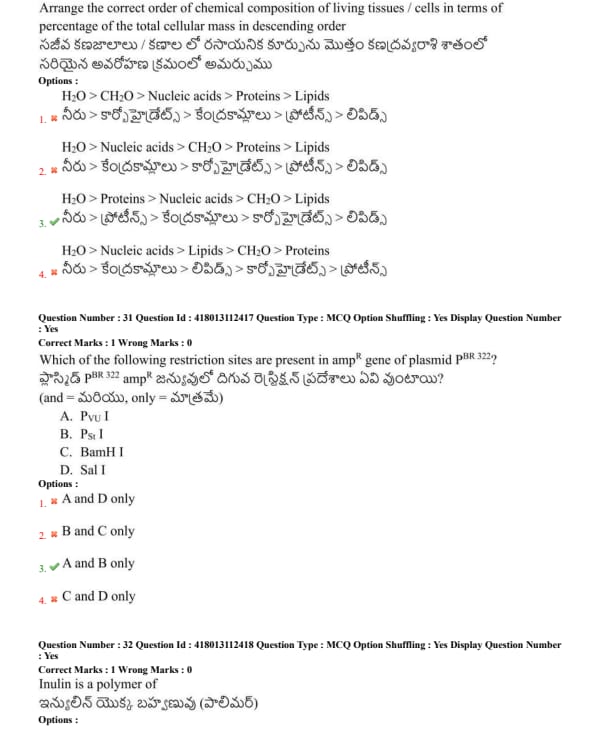
Arrange the correct order of chemical composition of living tissues / cells in terms of percentage of the total cellular mass in descending order
View Solution
Step 1: Understanding the Concept:
All living organisms contain water, inorganic ions, and organic biomolecules that together make up the total cellular mass.
The relative concentrations of these compounds are highly conserved across mammalian cells.
Detailed Explanation:
The average percentage contribution of each chemical component to the total cellular mass is:
- Water (\(H_2O\)): 70--90% (the primary solvent and main component).
- Proteins: 10--15% (the most abundant organic macromolecules, serving structural and enzymatic roles).
- Nucleic acids: 5--7% (DNA and various RNA molecules carrying genetic information).
- Carbohydrates (\(CH_2O\)): 3% (primarily utilized as short-term energy reserves and cell-surface markers).
- Lipids: 2% (integral components of cellular and organellar membranes).
- Ions: 1% (required for osmotic balance and cellular signaling).
Arranging these components in descending order of cellular mass:
\[ H_2O > Proteins > Nucleic acids > Carbohydrates (CH_2O) > Lipids \]
This matches option (C).
Step 2: Final Answer:
The correct descending order of chemical composition is option (C).
Quick Tip: Remember that water is the most abundant molecule, followed directly by proteins, which are the main organic macromolecules in living cells.
Which of the following restriction sites are present in \(amp^R\) gene of plasmid \(pBR^{322}\)?
A. Pvu I
B. Pst I
C. BamH I
D. Sal I
View Solution
Step 1: Understanding the Concept:
The artificial cloning vector \(pBR^{322}\) contains two antibiotic resistance genes that act as selectable markers: ampicillin resistance (\(amp^R\)) and tetracycline resistance (\(tet^R\)).
These selectable marker genes contain unique restriction sites for specific restriction endonucleases.
Detailed Explanation:
Let us locate the restriction sites in the \(pBR^{322}\) plasmid map:
- Inside the ampicillin resistance (\(amp^R\)) gene:
The restriction endonuclease sites are Pst I and Pvu I.
If a foreign DNA insert is cloned at either the Pst I or Pvu I sites, it disrupts the \(amp^R\) gene, leading to the loss of ampicillin resistance (insertional inactivation).
- Inside the tetracycline resistance (\(tet^R\)) gene:
The restriction endonuclease sites are BamH I and Sal I.
Cloning at these sites leads to loss of tetracycline resistance.
Other restriction sites on \(pBR^{322}\) (such as EcoR I, Cla I, and Hind III) are located outside of these antibiotic resistance genes.
Step 2: Final Answer:
The restriction sites located within the \(amp^R\) gene are Pvu I (A) and Pst I (B). This matches option (C).
Quick Tip: Mnemonic:
- \textbf{P}st I and \textbf{P}vu I (the "P" enzymes) are in the \textbf{ampicillin} gene.
- \textbf{B}amH I and \textbf{S}al I (the "BS" enzymes) are in the \textbf{tetracycline} gene.
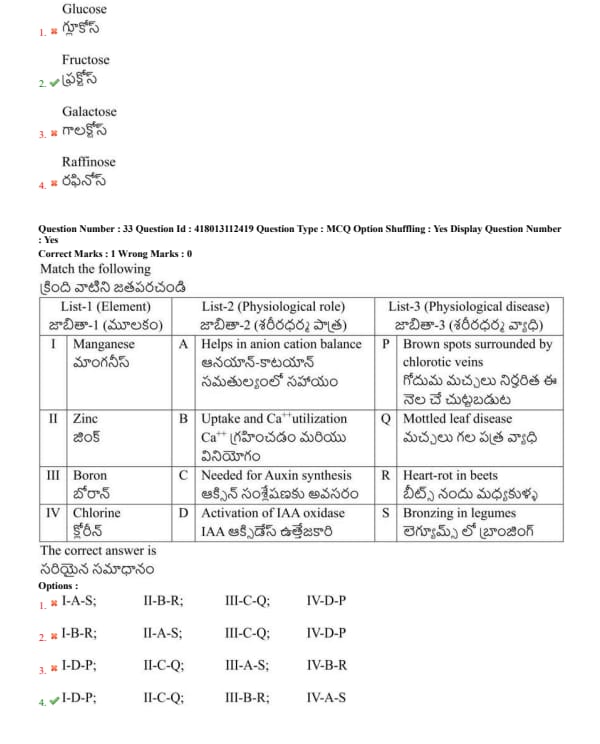
Inulin is a polymer of
View Solution
Step 1: Understanding the Concept:
Inulin is a storage carbohydrate commonly found in the roots and tubers of plants like dahlia, chicory, and Jerusalem artichoke.
Detailed Explanation:
Inulin belongs to a class of carbohydrates known as fructans, which are polymers of fructose molecules.
- It consists of fructose monomers linked together by \(\beta(2 \rightarrow 1)\) D-fructofuranosyl glycosidic bonds.
- Most inulin chains are terminated by an \(\alpha\)-D-glucopyranosyl unit, but the bulk of the repeating polymer consists of fructose monomers.
- Inulin is not digested by human alimentary enzymes because our bodies lack the specific glycosidases to break down \(\beta(2 \rightarrow 1)\) bonds.
- In clinical medicine, inulin is used to measure the glomerular filtration rate (GFR) because it is freely filtered at the glomerulus and is neither reabsorbed nor secreted by the renal tubules.
Step 2: Final Answer:
Inulin is a polymer of fructose, which corresponds to option (B).
Quick Tip: Be careful not to confuse \textbf{Inulin} (a plant fructan carbohydrate) with \textbf{Insulin} (a peptide hormone composed of amino acids).
Match the following:

The correct answer is
View Solution
Step 1: Understanding the Concept:
Plants require specific essential mineral micronutrients for metabolic and structural processes.
Deficiencies or toxic levels of these elements disrupt cellular metabolism and manifest as visible symptoms or physiological disorders.
Detailed Explanation:
Let us match each element from List-1 to its physiological role in List-2 and the corresponding physiological disease in List-3:
1. Manganese (I): Activates several enzymes, including IAA oxidase (D).
Manganese toxicity is characterized by the appearance of brown spots surrounded by chlorotic veins (P) \(\rightarrow\) I - D - P.
2. Zinc (II): Zinc ions (\(Zn^{2+}\)) are essential cofactors for enzymes involved in auxin synthesis (C), particularly indole-3-acetic acid (IAA) from tryptophan.
Zinc deficiency leads to mottled leaf disease (Q) due to disrupted leaf expansion and localized chlorosis \(\rightarrow\) II - C - Q.
3. Boron (III): Essential for cell elongation, pollen germination, and membrane integrity. It is required for the uptake and utilization of calcium (\(Ca^{2+}\)) (B).
Its deficiency causes necrosis of meristematic zones, such as heart-rot in sugar beets (R) \(\rightarrow\) III - B - R.
4. Chlorine (IV): Along with sodium and potassium, chlorine helps maintain solute concentration, cell turgor, and anion-cation balance (A).
Chlorine deficiency causes bronzing in legumes (S) \(\rightarrow\) IV - A - S.
Step 2: Final Answer:
The matching sequence is I-D-P; II-C-Q; III-B-R; IV-A-S, which corresponds to option (D).
Quick Tip: Remember that "Zinc" is universally required for Auxin synthesis. Matching II to C allows you to quickly narrow down the options in single-choice matching questions.
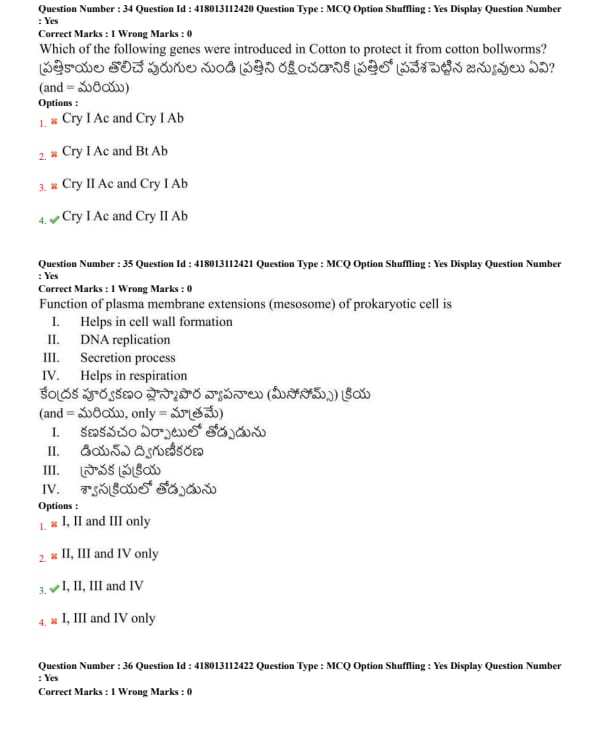
Which of the following genes were introduced in Cotton to protect it from cotton bollworms?
View Solution
Step 1: Understanding the Concept:
Genetic engineering utilizes genes from the soil bacterium Bacillus thuringiensis (Bt) to develop pest-resistant transgenic crops.
These genes encode insecticidal crystal proteins (commonly referred to as Cry toxins) that are toxic to specific insect lineages.
Detailed Explanation:
The insecticidal proteins encoded by different \textit{cry genes are highly target-specific:
- Cry I Ac and Cry II Ab produce proteins that are toxic to Lepidopteran pests, specifically targeting cotton bollworms (\textit{Helicoverpa armigera).
Introducing these two genes into the cotton genome protects the cotton bolls from pest destruction, reducing the need for chemical insecticides.
- Cry I Ab, on the other hand, is used specifically to target and control the corn borer (\textit{Ostrinia nubilalis) in maize crops.
Step 2: Final Answer:
The genes introduced in Bt Cotton to target bollworms are \textit{cryIAc and \textit{cryIIAb, corresponding to option (D).
Quick Tip: Keep these Bt gene targets straight:
- Cotton bollworms \(\rightarrow\) \textbf{cry I Ac and \textbf{cry II Ab}
- Corn borer \(\rightarrow\) \textbf{cry I Ab}
Function of plasma membrane extensions (mesosome) of prokaryotic cell is
I. Helps in cell wall formation
II. DNA replication
III. Secretion process
IV. Helps in respiration
View Solution
Step 1: Understanding the Concept:
Prokaryotic cells lack membrane-bound organelles.
To carry out complex cellular functions, they utilize specialized membranous structures called mesosomes, which are formed by the infolding of the plasma membrane.
Detailed Explanation:
Mesosomes appear in prokaryotes as vesicles, tubules, or lamellae.
They help perform several essential physiological processes:
1. Cell wall formation (I): They assist in the transport and synthesis of precursor molecules required for peptidoglycan cell wall construction.
2. DNA replication and distribution (II): Mesosomes remain closely associated with the bacterial nucleoid, helping with chromosome replication and the equal segregation of genomic DNA to daughter cells during binary fission.
3. Secretion processes (III): By extending inward, they increase the surface area of the plasma membrane, enhancing the secretion of extracellular enzymes.
4. Respiration (IV): Because prokaryotes lack mitochondria, the mesosomal membranes house the respiratory electron transport chain and ATP synthase enzymes required for cellular respiration.
Step 2: Final Answer:
All four functions (I, II, III, and IV) are correctly attributed to mesosomes, matching option (C).
Quick Tip: Think of mesosomes as the prokaryotic functional equivalent of eukaryotic mitochondria (for respiration) and Golgi bodies (for secretion) combined.
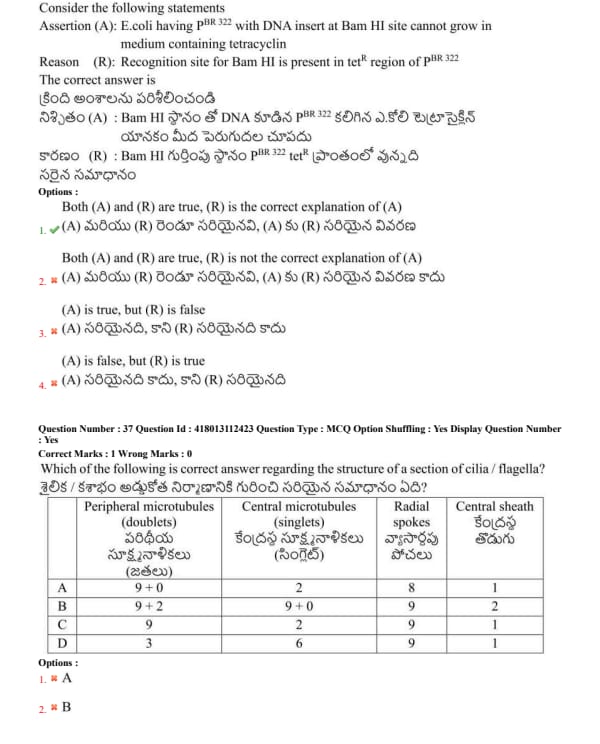
Consider the following statements
Assertion (A): E.coli having \(pBR^{322}\) with DNA insert at Bam HI site cannot grow in medium containing tetracyclin
Reason (R): Recognition site for Bam HI is present in \(tet^R\) region of \(pBR^{322}\)
The correct answer is
View Solution
Step 1: Understanding the Concept:
Insertional inactivation is a cloning technique used to identify recombinant plasmids.
Ligating a foreign gene into an antibiotic resistance gene disrupts its coding sequence, rendering the plasmid unable to confer resistance to that specific antibiotic.
Detailed Explanation:
- The plasmid \(pBR^{322}\) contains two antibiotic resistance genes: ampicillin resistance (\(amp^R\)) and tetracycline resistance (\(tet^R\)).
- The restriction site for the endonuclease Bam HI is located within the coding sequence of the \(tet^R\) gene.
- When a foreign DNA fragment is ligated into the Bam HI site of \(pBR^{322}\), the open reading frame of the \(tet^R\) gene is disrupted.
- Consequently, the transformed host bacterium \textit{E. coli loses its resistance to tetracycline. It remains resistant to ampicillin because the \(amp^R\) gene remains intact.
- Thus, the recombinant \textit{E. coli can grow on ampicillin-containing medium but cannot grow on medium containing tetracycline.
This makes Assertion (A) true.
- Reason (R) is also true, as it correctly states that the Bam HI restriction site is located within the \(tet^R\) gene, explaining why the insertion disrupts tetracycline resistance.
Step 2: Final Answer:
Both (A) and (R) are true, and (R) is the correct explanation of (A). This corresponds to option (A).
Quick Tip: To select recombinants containing an insert at the Bam HI site, plate transformants on ampicillin medium first, then replica-plate them on tetracycline medium. Recombinants will fail to grow on the tetracycline plates.
Which of the following is correct answer regarding the structure of a section of cilia / flagella?

View Solution
Step 1: Understanding the Concept:
Cilia and flagella are hair-like projections from the eukaryotic cell surface that facilitate movement.
They share a conserved internal core structure called the axoneme, which is composed of microtubules.
Detailed Explanation:
Let us analyze the structural features of the ciliary axoneme:
- Peripheral doublets: The outer boundary of the axoneme is composed of 9 pairs of doublets arranged in a ring.
- Central singlets: The center of the axoneme houses 2 single microtubules, resulting in the characteristic "9+2" arrangement.
- Radial spokes: There are 9 radial spokes extending from the outer doublets toward the central region.
- Central sheath: The central pair of singlet microtubules is enclosed within 1 central sheath, which is connected to the outer doublets by the radial spokes.
Evaluating the options in the table:
- Row A (9+0 peripheral, 2 central) describes a centriole or basal body-like structure rather than ciliary axoneme.
- Row B (9+2 peripheral, 9+0 central) is incorrect.
- Row C correctly lists: 9 peripheral doublets, 2 central singlets, 9 radial spokes, and 1 central sheath.
Step 2: Final Answer:
Row C represents the correct structural composition of cilia/flagella, matching option (C).
Quick Tip: Remember the ciliary axoneme has a \textbf{9+2} pattern (9 doublets on the periphery and 2 central singlets), whereas eukaryotic centrioles and basal bodies have a \textbf{9+0} triplet arrangement.
Choose the incorrect pair

View Solution
Step 1: Understanding the Concept:
Microorganisms are widely used in biotechnology to produce enzymes, organic acids, and bioactive molecules with clinical and industrial applications.
Detailed Explanation:
Let us analyze the pairs in the table:
- Streptococcus (A): Produces the enzyme Streptokinase, which acts as a clot-buster to dissolve blood clots in the blood vessels of cardiac patients. This is correctly matched.
- Clostridium butylicum (B): This is a spore-forming bacterium used to produce butyric acid, an organic acid.
Lipase enzymes, which are used in laundry detergents to remove oil stains, are commercially produced by fungi such as Candida lipolytica or bacteria like \textit{Pseudomonas. Thus, pair B is incorrectly matched.
- Monascus purpureus (C): This yeast produces statins, which act as competitive inhibitors of the enzyme HMG-CoA reductase to lower blood cholesterol levels. This is correctly matched.
- Trichoderma polysporum (D): This fungus produces Cyclosporin A, an immunosuppressive drug used during organ transplants to prevent graft rejection. This is correctly matched.
Step 2: Final Answer:
The incorrectly matched pair is option (B).
Quick Tip: Associate \textit{Clostridium butylicum with \textbf{butyric acid} and remember that lipid-digesting \textbf{lipases} are produced by lipolytic fungi like Candida, not Clostridium.
BOD of waste water is estimated by measuring the amount of
View Solution
Step 1: Understanding the Concept:
Biochemical Oxygen Demand (BOD) is a key parameter used to measure the level of organic pollution in wastewater.
Detailed Explanation:
BOD measures the rate of oxygen consumption by aerobic microorganisms to decompose organic matter in a water sample over a set incubation period.
- When water contains high levels of sewage or organic waste, aerobic microbes multiply rapidly and consume dissolved oxygen to degrade the waste.
- Although the physical measurement taken during the assay is the amount of oxygen consumed, the biological purpose of measuring BOD is to estimate the concentration of biodegradable organic matter in the water.
- A higher BOD indicates a larger amount of biodegradable organic matter, pointing to highly polluted water.
- Following the official answer key, option (B) is the correct answer.
Step 2: Final Answer:
The parameter estimated by measuring BOD is the amount of biodegradable organic matter, matching option (B).
Quick Tip: BOD is directly proportional to the organic pollution level of the water:
\[ High BOD \propto High organic pollution \]
Choose the correct match in relation to the substance and their function

View Solution
Step 1: Understanding the Concept:
Proteins carry out diverse structural, catalytic, transport, and protective functions essential for cellular structure and mammalian physiology.
Detailed Explanation:
Let us analyze each substance-function pair to identify the correct match:
- GLUT-4 (A): This is an insulin-regulated glucose transporter protein. It facilitates glucose transport across the cell membrane into muscle and adipose tissues, rather than synthesizing glucose. This is incorrect.
- Collagen (B): This is a major structural fibrous protein that serves as the intercellular ground substance in connective tissues, not an excretory substance. This is incorrect.
- Insulin (C): This is a peptide hormone secreted by pancreatic \(\beta\)-cells that regulates systemic carbohydrate metabolism, not an enzyme. This is incorrect.
- Antibody (D): These are immunoglobulins produced by B-lymphocytes that bind to specific foreign antigens to neutralize and eliminate infectious pathogens. This is a correct match.
Step 2: Final Answer:
The correct match is row D, corresponding to option (D).
Quick Tip: Mnemonic for common proteins and functions:
- Collagen \(\rightarrow\) Intercellular ground substance
- GLUT-4 \(\rightarrow\) Glucose transport
- Antibody \(\rightarrow\) Pathogen defense
Choose the tautonyms from the following
I. Homo sapiens sapiens
II. Axis axis
III. Corvus splendens splendens
IV. Naja naja
(only)
View Solution
Step 1: Understanding the Concept:
Taxonomic nomenclature follows specific international rules established by bodies such as the International Code of Zoological Nomenclature (ICZN) and the International Code of Nomenclature for algae, fungi, and plants (ICN).
A tautonym is a scientific name of a species in which the generic name and the specific epithet have the exact same spelling.
Tautonyms are common and completely valid in zoology but are strictly prohibited under botanical nomenclature rules.
Step 2: Detailed Explanation:
Let's analyze each of the given scientific names individually:
I. Homo sapiens sapiens: This is a trinomial name representing modern humans, where the genus is \textit{Homo, the species is \textit{sapiens, and the subspecies is also \textit{sapiens.
Since the genus name (\textit{Homo) and the species name (\textit{sapiens) are spelled differently, this is not a tautonym.
II. \textit{Axis axis: This is the binomial name for the spotted deer (chital).
The generic name is \textit{Axis and the specific epithet is also \textit{axis.
Because both the genus and species parts of the name are identical, this is a classic example of a tautonym.
III. \textit{Corvus splendens splendens: This is the trinomial name of the Indian house crow.
The genus name is \textit{Corvus and the species name is \textit{splendens.
Since the generic name and specific epithet are different, this does not qualify as a tautonym.
IV. \textit{Naja naja: This is the binomial name of the Indian spectacled cobra.
The generic name is \textit{Naja and the specific epithet is also \textit{naja.
Since the genus and species names are identical, this represents a tautonym.
Thus, only options II and IV are tautonyms.
Step 3: Final Answer:
Therefore, the tautonyms among the given names are \textit{Axis axis (II) and \textit{Naja naja (IV), which matches option (D).
Quick Tip: Remember that tautonyms only compare the generic name (first word) and the specific epithet (second word). Trinomial names where the species and subspecies match (like \textit{Homo sapiens sapiens) are not tautonyms if the genus name is different.
Study the following and choose the correct statements
I. Biodiversity is greater in tropics
II. Digitalin is an anti-cancer drug obtained from the plant Vinca rosea
III. Invasion of alien species is a threat to the local species
IV. Sacred groves are a type of ex-situ conservation
(only)
View Solution
Step 1: Understanding the Concept:
This question covers basic ecological concepts, including biodiversity distribution, pharmaceutical uses of plants, threats to biodiversity, and conservation strategies.
Step 2: Detailed Explanation:
Let's evaluate each of the given statements:
I. Biodiversity is greater in tropics: This is a correct statement.
Latitudinal gradients show that biodiversity is highest near the equator and decreases towards the poles.
The tropics (ranging from \(23.5^{\circ} N\) to \(23.5^{\circ} S\)) have a stable, warm, and humid climate with abundant solar energy, which promotes high productivity and speciation over evolutionary time.
II. Digitalin is an anti-cancer drug obtained from the plant \textit{Vinca rosea: This is an incorrect statement.
\textit{Vinca rosea (Madagascar periwinkle) yields the well-known anti-cancer alkaloids vinblastine and vincristine.
Digitalin is a cardiac glycoside used to treat heart failure, and it is obtained from the foxglove plant \textit{Digitalis purpurea.
III. Invasion of alien species is a threat to the local species: This is a correct statement.
When non-native (exotic) species are introduced into a new ecosystem, they lack natural predators and can become invasive, rapidly outcompeting indigenous species for resources.
Examples include water hyacinth (\textit{Eichhornia) and the Nile perch in Lake Victoria.
IV. Sacred groves are a type of ex-situ conservation: This is an incorrect statement.
Sacred groves are forest patches protected by communities through religious and cultural beliefs.
Since the organisms are protected in their natural habitat, it is a form of in-situ (on-site) conservation, not ex-situ (off-site).
Consequently, only statements I and III are correct.
Step 3: Final Answer:
The correct statements are I and III, which corresponds to option (D).
Quick Tip: To easily differentiate conservation types: "In-situ" means protecting the species in its natural home (groves, national parks, sanctuaries), while "ex-situ" means taking them out of their natural habitat (zoos, botanical gardens, gene banks).
Match the following

View Solution
Step 1: Understanding the Concept:
Neuroglial cells are non-neuronal cells in the nervous system that provide physical and physiological support, protection, nourishment, and electrical insulation to neurons.
Step 2: Detailed Explanation:
Let's analyze the function of each neuroglial cell listed in List-1:
A. Astrocytes: These are star-shaped cells with numerous radiating processes.
They help anchor neurons to blood vessels and regulate the local chemical environment.
Importantly, their feet-like processes wrap around capillaries to form tight junctions, contributing to the blood-brain barrier (V).
B. Oligodendrocytes: These are glial cells with fewer processes that are found within the Central Nervous System (CNS).
They wrap around nerve fibers to form the protective myelin sheath (III) in the CNS, which accelerates nerve impulse conduction.
C. Microglial cells: These are small, specialized mesoderm-derived cells scattered throughout the CNS.
They act as resident macrophages (phagocytes) (I) that engulf cellular debris and microbes to protect brain tissue from damage.
D. Schwann cells: These glial cells are found in the Peripheral Nervous System (PNS).
They wrap around peripheral nerve axons to form a protective layer called the neurilemma (II), as well as the myelin sheath in peripheral nerves.
Combining these pairs, we get: A-V, B-III, C-I, D-II.
Step 3: Final Answer:
The correct match is represented by option (C).
Quick Tip: To distinguish myelin-forming cells: Oligodendrocytes myelinate axons in the CNS, whereas Schwann cells myelinate axons in the PNS.
Consider the following statements
Statement I: Radially symmetrical animals are generally sluggish
Statement II: In human body, kidneys are retroperitoneal organs
View Solution
Step 1: Understanding the Concept:
Symmetry in animal biology dictates an animal's lifestyle, locomotion, and how it interacts with its environment.
Anatomical placement of organs, such as the kidneys, in relation to the peritoneum determines their physiological and structural classification.
Step 2: Detailed Explanation:
Statement I: Radially symmetrical animals are generally sluggish.
This statement is correct. Radial symmetry allows an animal to meet its environment equally from all sides.
This plan is highly adaptive for sessile (attached) or slow-moving (sluggish) organisms, such as sea anemones, jellyfish, and sea stars.
Because they do not have a defined head or direction of movement, they rely on food coming to them from any side.
Statement II: In human body, kidneys are retroperitoneal organs.
This statement is also correct. The term "retroperitoneal" refers to organs located behind the peritoneal cavity.
The kidneys are positioned along the posterior abdominal wall, behind the parietal peritoneum.
Only their anterior surface is covered by the peritoneal membrane, while their posterior side is anchored directly to the abdominal muscular wall.
Thus, both statements are biologically true.
Step 3: Final Answer:
Both Statement I and Statement II are true, which corresponds to option (A).
Quick Tip: Remember the SAD PUCKER mnemonic for retroperitoneal structures: Suprarenal glands, Aorta, Duodenum, Pancreas, Ureters, Colon, Kidneys, Esophagus, and Rectum.
Symmetry of sea anemone is
View Solution
Step 1: Understanding the Concept:
Biradial symmetry is a specialized variation of radial symmetry.
In biradial symmetry, although the overall body appears radial, certain internal or specialized structures restrict the planes of symmetry so that the body can be divided into identical halves along only two vertical planes.
Step 2: Detailed Explanation:
The sea anemone (\textit{Metridium) is a marine coelenterate belonging to the class Anthozoa under Phylum Cnidaria.
While its external tentacular crown exhibits a radial appearance, its internal anatomy is asymmetric along one axis.
It has an oval-shaped mouth and a unique, specialized ciliated groove called the siphonoglyph running down one or both sides of its gullet.
Due to this structural variation, the animal cannot be divided into equal halves along just any radial plane.
Instead, it can only be divided into two identical halves along two specific vertical planes:
1. The sulcar-subsulcar (sagittal) plane passing through the siphonoglyph.
2. The transverse plane perpendicular to the sagittal plane.
Because of this anatomical restriction, the symmetry of the sea anemone is categorized as biradial.
Step 3: Final Answer:
The symmetry of sea anemone is biradial, which corresponds to option (C).
Quick Tip: Do not confuse the pentaradial symmetry of echinoderms (like starfishes) with the biradial symmetry of anthozoans (like sea anemones) or ctenophores (comb jellies).
Study the following and pick up the incorrect combinations

View Solution
Step 1: Understanding the Concept:
In the animal kingdom, different phyla are characterized by unique cell types that perform vital functions such as prey capture, defense, water circulation, and excretion.
Step 2: Detailed Explanation:
Let's evaluate each of the four combinations:
I. Porifera - Choanocytes - \textit{Chalina:
This combination is correct. Sponges (phylum Porifera) possess specialized flagellated collar cells called choanocytes that line the spongocoel and canals to maintain water flow.
\textit{Chalina (commonly known as the finger sponge) is a member of this phylum.
II. Cnidaria - Lasso cells - \textit{Hydra:
This combination is incorrect. Lasso cells (also known as colloblasts) are sticky cells used to capture prey, and they are unique to the phylum Ctenophora.
Members of phylum Cnidaria, like \textit{Hydra, possess cnidocytes (or cnidoblasts) that contain stinging capsules called nematocysts for defense and capturing food.
III. Ctenophora - Cnidoblasts - \textit{Pleurobrachia:
This combination is incorrect. \textit{Pleurobrachia (comb jelly) belongs to phylum Ctenophora.
Ctenophores generally do not have cnidoblasts (with rare exceptions that steal them from prey).
Instead, they are characterized by colloblasts (lasso cells) on their tentacles.
IV. Platyhelminthes - Flame cells - \textit{Echinococcus:
This combination is correct. Flatworms (phylum Platyhelminthes) use specialized excretory cells called flame cells (protonephridia) for osmoregulation and excretion.
\textit{Echinococcus (the hydatid tapeworm) belongs to this phylum.
Thus, combinations II and III are incorrect.
Step 3: Final Answer:
The incorrect combinations are II and III, which corresponds to option (D).
Quick Tip: To remember: Cnidaria = Cnidoblasts (for stinging). Ctenophora = Colloblasts/Lasso cells (for sticking). They are often switched in exam questions to test your attention to detail.
Molluscs with closed type of blood circulatory system are included in the class
View Solution
Step 1: Understanding the Concept:
Most members of the phylum Mollusca possess an open circulatory system, where the blood (hemolymph) is pumped by the heart into open body cavities or sinuses called the hemocoel.
However, highly active, predatory molluscs have evolved a closed circulatory system.
Step 2: Detailed Explanation:
The phylum Mollusca is divided into several classes, such as Gastropoda (snails), Pelecypoda/Bivalvia (clams), Scaphopoda (tusk shells), and Cephalopoda (squids, octopuses, cuttlefish).
Cephalopods are highly active marine predators that swim rapidly to capture prey and escape predators.
To support their highly active lifestyle, complex nervous system, and advanced sensory organs (like image-forming eyes), they require a highly efficient oxygen delivery system.
Thus, cephalopods have evolved a closed circulatory system where blood remains confined within a continuous network of blood vessels (arteries, veins, and capillaries).
They also possess accessory hearts called branchial hearts to pump blood through the gills under pressure.
All other classes, such as Gastropoda, Pelecypoda, and Scaphopoda, retain the slower, low-pressure open circulatory system.
Step 3: Final Answer:
The class containing molluscs with a closed circulatory system is Cephalopoda, which corresponds to option (D).
Quick Tip: Cephalopods are exceptions in many ways: they have a closed circulatory system, a highly developed brain, and chromatophores for camouflage, distinguishing them from other sluggish molluscs.
Chordates share these features with echinoderms.
View Solution
Step 1: Understanding the Concept:
Bilateral animals are divided into two main evolutionary lineages based on their embryonic development patterns: Protostomes and Deuterostomes.
These groups differ in blastopore fate, the mode of coelom formation, and cleavage patterns during early development.
Step 2: Detailed Explanation:
Echinoderms and Chordates belong to the Deuterostomia lineage and share several embryological characteristics:
1. Deuterostomeate condition: In both groups, the first embryonic opening (the blastopore) develops into the anus, while the mouth develops secondarily from a separate anterior opening.
2. Enterocoelous coelom (Enterocoelom): The coelom is formed by outpocketings of the primitive gut (archenteron) that pinch off to form coelomic pouches. This is in contrast to protostomes, which exhibit a schizocoelous coelom formed by the splitting of mesodermal blocks.
3. Radial cleavage: Early embryonic divisions occur along planes that are either parallel or perpendicular to the polar axis of the egg, resulting in cells that sit directly on top of one another. The cleavage is also indeterminate, meaning the developmental fate of early embryonic cells is not fixed early on.
Conversely, protostomes (such as annelids, arthropods, and molluscs) are characterized by a protostomeate condition (blastopore forms the mouth), schizocoelom, and spiral, determinate cleavage.
Step 3: Final Answer:
The features shared between chordates and echinoderms are Deuterostomeate condition, enterocoelom, and radial cleavages, which corresponds to option (D).
Quick Tip: Always associate "Deuterostomes" with "Anus first, Enterocoelous coelom, and Radial cleavage." Echinoderms, Hemichordates, and Chordates are the three major deuterostome phyla.
Match the following

View Solution
Step 1: Understanding the Concept:
Matching scientific (generic) names of reptiles with their popular common names is an essential part of understanding reptilian diversity under Phylum Chordata.
Step 2: Detailed Explanation:
Let's analyze the genera listed in List-1:
A. Hemidactylus: This is the genus of common house lizards, popularly known as the wall lizard (II).
They are known for their ability to climb smooth vertical walls using specialized adhesive subdigital lamellae on their toes.
B. \textit{Bungarus: This is the genus of highly venomous neurotoxic snakes commonly known as kraits (V).
An example is \textit{Bungarus caeruleus (the common krait), which is a medically significant snake in South Asia.
C. \textit{Chelone: This is the genus of marine green turtles (III).
They have limbs modified into paddle-like flippers for swimming and spend almost their entire lives in the ocean.
D. \textit{Ptyas: This is the genus of non-venomous colubrid snakes commonly called rat snakes (I) (e.g., \textit{Ptyas mucosa).
They are highly active, fast-moving snakes that feed primarily on rodents.
Thus, the correct matches are: A-II, B-V, C-III, D-I.
Step 3: Final Answer:
The matching corresponding to the correct associations is A-II, B-V, C-III, D-I, which is represented by option (A).
Quick Tip: To remember: \textit{Bungarus starts with 'B', and they are banded snakes (Kraits often have bands). Ptyas is the Rat snake, which is a beneficial snake for farmers as it controls rodent populations.
Consider the following statements
Statement I: In protozoans, gliding locomotion is brought about by myonemes.
Statement II: Generally, in protozoans, asexual reproduction takes place during unfavourable conditions
View Solution
Step 1: Understanding the Concept:
Protozoans are a diverse group of single-celled eukaryotic organisms.
They exhibit various specialized mechanisms for survival, locomotion, and reproduction depending on their environment.
Step 2: Detailed Explanation:
Let's analyze each statement:
Statement I: In protozoans, gliding locomotion is brought about by myonemes.
This statement is correct. Gliding is a smooth, slow movement without any visible locomotory organelles like cilia or flagella.
It is common in sporozoans (such as \textit{Plasmodium and \textit{Monocystis).
This movement is facilitated by contractile, microscopic proteinaceous fibrils located in the pellicle, which are called myonemes.
Statement II: Generally, in protozoans, asexual reproduction takes place during unfavourable conditions.
This statement is incorrect.
Asexual reproduction (such as binary fission) is a rapid multiplication process that typically occurs under favorable environmental conditions when food and temperature are optimal.
Under unfavorable conditions, protozoans generally undergo encystment (forming a protective cyst wall) or participate in sexual processes (like conjugation or syngamy) to survive and introduce genetic variation.
Thus, Statement I is true, but Statement II is false.
Step 3: Final Answer:
Statement I is true, but Statement II is false, which corresponds to option (C).
Quick Tip: Think of asexual reproduction as a "growth strategy" under good conditions, and sexual reproduction or cyst formation as a "survival strategy" under bad conditions.
Drugs extracted from Papaver somniferum
View Solution
Step 1: Understanding the Concept:
Many clinically important drugs and commonly abused substances are secondary metabolites harvested from specific plant species.
Step 2: Detailed Explanation:
Let's look at the sources and classes of the substances listed:
(A) Opioids: This class of drugs binds to specific opioid receptors in our central nervous system (CNS) and gastrointestinal tract.
Opioids such as morphine, codeine, and heroin (diacetylmorphine) are extracted from the latex of the unripe seed pods of the poppy plant, Papaver somniferum.
Morphine is a highly effective analgesic (painkiller) and sedative used for patients undergoing major surgeries.
(B) Cannabinoids: These compounds interact with cannabinoid receptors in the brain.
They are obtained from the inflorescences of the hemp plant, \textit{Cannabis sativa.
(C) Cocaine: This is a natural stimulant alkaloid.
It is extracted from the leaves of the coca plant, \textit{Erythroxylum coca, native to South America.
(D) Dopamine: This is an organic chemical that functions as a neurotransmitter in the human brain and is synthesized inside the body, not extracted from plants.
Therefore, the drugs derived from \textit{Papaver somniferum are opioids.
Step 3: Final Answer:
The drugs extracted from \textit{Papaver somniferum are opioids, which matches option (A).
Quick Tip: Remember the source plants for major drugs: Poppy plant (\textit{Papaver) = Opioids; Hemp plant (Cannabis) = Cannabinoids; Coca plant (Erythroxylum) = Cocaine.
Fill in the blank in the extra intestinal migration of Rhabditiform larva
Liver \(\rightarrow\) __________ \(\rightarrow\) Heart \(\rightarrow\) Lungs \(\rightarrow\) Pharynx \(\rightarrow\) Intestine
View Solution
Step 1: Understanding the Concept:
\textit{Ascaris lumbricoides (the giant intestinal roundworm) is an endoparasite of the human small intestine.
Its life cycle involves a migratory phase where the hatched larvae travel through various organs before returning to the intestine to mature.
Step 2: Detailed Explanation:
When embryonated eggs containing the second-stage rhabditiform larva are swallowed, they reach the host's small intestine.
The larvae hatch, penetrate the intestinal mucosa, and enter the local blood capillaries.
From there, they begin an extra-intestinal migration through the body via the circulatory system:
1. Intestinal wall \(\rightarrow\) Hepatic portal vein.
2. Hepatic portal vein \(\rightarrow\) Liver.
3. Liver \(\rightarrow\) Post caval vein (also known as the inferior vena cava).
4. Post caval vein \(\rightarrow\) Heart (specifically the right atrium and then the right ventricle).
5. Heart \(\rightarrow\) Pulmonary artery \(\rightarrow\) Lungs (where they break out of the capillaries into the alveoli to mature).
6. Lungs \(\rightarrow\) Trachea \(\rightarrow\) Pharynx (where they are coughed up and swallowed again).
7. Pharynx \(\rightarrow\) Esophagus \(\rightarrow\) Stomach \(\rightarrow\) Small Intestine (where they grow into adults).
Looking at the flow, the vessel that carries the larvae from the liver to the heart is the post caval vein.
Step 3: Final Answer:
The correct vascular structure to fill in the blank is the Post caval vein, which corresponds to option (B).
Quick Tip: The hepatic portal vein always brings blood from the digestive tract to the liver, while the post caval vein (inferior vena cava) drains blood from the liver (via hepatic veins) to the heart.
Consider the following statements
Statement I: Cannabinoids are being abused by sports persons (doping)
Statement II: Cocaine is involved in the transport of neurotransmitter dopamine
View Solution
Step 1: Understanding the Concept:
Drug abuse, especially in sports and neurological contexts, involves substances that alter the physiological and psychological state of the body by interacting with neurotransmitter systems or physiological receptors.
Step 2: Detailed Explanation:
Let's evaluate each statement:
Statement I: Cannabinoids are being abused by sports persons (doping).
This statement is correct. Cannabinoids affect the cardiovascular system, alter perception, and can reduce anxiety or muscle tension.
Due to these effects, some athletes use them to cope with competitive stress, which is considered a form of doping.
Consequently, cannabinoids are classified as prohibited substances by the World Anti-Doping Agency (WADA).
Statement II: Cocaine is involved in the transport of neurotransmitter dopamine.
This statement is correct. Cocaine is a strong central nervous system stimulant.
It works by binding to the dopamine reuptake transporters on the presynaptic neuronal membrane.
This blocks the reabsorption (reuptake) of dopamine back into the presynaptic neuron, leaving it in the synaptic cleft.
The resulting accumulation of dopamine in the synapse causes continuous stimulation of postsynaptic receptors, producing feelings of euphoria and increased energy.
Thus, both statements are correct.
Step 3: Final Answer:
Both Statement I and Statement II are true, which corresponds to option (A).
Quick Tip: Cocaine blocks the dopamine transporter, leading to a build-up of dopamine in the synaptic cleft. This is why it acts as a powerful central nervous system stimulant.
Consider the following statements
Assertion (A): To control malaria, mosquitoes are to be eradicated
Reason (R): Mode of infection of Plasmodium is by inoculation (by female Anopheles)
View Solution
Step 1: Understanding the Concept:
Controlling vector-borne diseases requires understanding how the pathogen is transmitted.
Eradicating or controlling the vector population is often the most effective way to break the transmission chain.
Step 2: Detailed Explanation:
Assertion (A): To control malaria, mosquitoes are to be eradicated.
This statement is correct. Malaria is caused by the protozoan parasite \textit{Plasmodium.
Because the parasite cannot spread between human hosts without its vector, controlling the mosquito population (especially through vector control, breeding site elimination, and chemical spraying) is a primary method for controlling malaria.
Reason (R): Mode of infection of \textit{Plasmodium is by inoculation (by female \textit{Anopheles).
This statement is also correct.
The infective stage of the malaria parasite (sporozoites) resides in the salivary glands of the female \textit{Anopheles mosquito.
When the mosquito bites a human for a blood meal, it injects (inoculates) these sporozoites directly into the host's bloodstream.
Since the parasite is introduced into the human body through this vector-mediated inoculation, eliminating the female \textit{Anopheles mosquito directly prevents inoculation and transmission.
Thus, the reason correctly explains the assertion.
Step 3: Final Answer:
Both (A) and (R) are true, and (R) is the correct explanation of (A), which corresponds to option (A).
Quick Tip: To verify an Assertion-Reason question, read the assertion, add the word "because", and read the reason. If it makes logical sense, then (R) is the correct explanation of (A).
Refractive region of ommatidium of cockroach
View Solution
Step 1: Understanding the Concept:
The compound eye of a cockroach consists of approximately 2000 individual visual units called ommatidia.
Each ommatidium contains a dioptric (refractive) region that focuses light, and a receptor (sensory) region that detects light and transmits signals to the brain.
Step 2: Detailed Explanation:
Let's look at the structure of an ommatidium:
1. Dioptric (Refractive) Region: This region focuses incoming light rays onto the light-sensitive receptor cells.
It consists of the cornea (the outer transparent cuticle acting as a biconvex lens) and the crystalline cone (secreted by cone cells/vitrellae).
Among the options provided, the cornea is the primary outer lens that refracts light.
2. Receptor Region: This region detects light and converts it into neural signals.
It is composed of a central rod-like rhabdome surrounded by 7 to 8 photoreceptive retinular cells.
Let's evaluate the given options:
(A) Cornea: This is the transparent, biconvex cuticular lens that acts as the primary refractive structure at the surface of the ommatidium.
(B) Retinular: These are the sensory receptor cells, not part of the refractive apparatus.
(C) Vitrellae: These are the four cells that secrete the crystalline cone. While the cone itself is refractive, the vitrellae are the secreting cells rather than the primary refractive element listed.
(D) Ocelli: These are simple eyes found on the head of the cockroach, separate from the compound eyes.
Thus, the cornea is the correct refractive component among the choices.
Step 3: Final Answer:
The refractive region of the ommatidium of a cockroach is the Cornea, which corresponds to option (A).
Quick Tip: An ommatidium is divided into two functional halves: the outer focusing half (Cornea and Crystalline Cone) and the inner light-sensing half (Rhabdome and Retinular cells).
Choose the mismatched pair regarding cockroach
View Solution
Step 1: Understanding the Concept:
Identifying the anatomical structures of the cockroach (\textit{Periplaneta americana) and their associated physiological functions is key to understanding insect physiology.
Step 2: Detailed Explanation:
Let's evaluate each pair:
(A) Alary muscles -- blood circulation:
This pair is correctly matched. Cockroaches have 12 pairs of fan-shaped alary muscles in their pericardial septum.
The coordinated contraction and relaxation of these muscles alter the volume of the pericardial sinus, helping pump hemolymph into the heart chambers.
(B) Malpighian tubules -- excretion:
This pair is correctly matched. Malpighian tubules are thin, yellow, filamentous structures located at the junction of the midgut and hindgut.
They absorb nitrogenous waste from the hemolymph and convert it into uric acid for excretion.
(C) Dorso ventral muscles -- respiration:
This pair is correctly matched. The contraction of these tergosternal muscles compresses the abdominal cavity, forcing air out of the tracheal system.
Their relaxation expands the cavity, drawing fresh air in through the spiracles.
(D) Anal styles -- female:
This pair is mismatched.
Anal styles are a pair of short, unjointed sensory structures found on the 9th sternum.
They are unique to male cockroaches and are completely absent in females.
Females possess jointed anal cerci (on the 10th segment) but lack anal styles.
Step 3: Final Answer:
The mismatched pair is "Anal styles -- female", which corresponds to option (D).
Quick Tip: To easily distinguish the sexes of a cockroach: Males have both Anal Cerci (jointed) and Anal Styles (unjointed). Females have only Anal Cerci and a boat-shaped 7th sternum.
Study the following and identify the correct statements
I. In cockroach, sub-oesophageal ganglion is the principal sensory centre
II. Ventral nerve cord of cockroach has only nine ganglia along its length
III. The images formed by ommatidia in nocturnal insects are called superposition images
IV. During expiration, thoracic spiracles are kept open and abdominal spiracles are kept closed in cockroach
View Solution
Step 1: Understanding the Concept:
This question tests your understanding of the nervous, sensory, and respiratory physiology of the cockroach.
Step 2: Detailed Explanation:
Let's analyze each of the given statements:
I. In cockroach, sub-oesophageal ganglion is the principal sensory centre:
This statement is incorrect. The supra-oesophageal ganglion (brain) is the main sensory and endocrine coordination center.
The sub-oesophageal ganglion lies below the esophagus and primarily controls the motor functions of the mouthparts (mandibles, maxillae, and labium).
II. Ventral nerve cord of cockroach has only nine ganglia along its length:
This statement is correct. The central nervous system of a cockroach includes a double ventral nerve cord with 9 segmentally arranged ganglia: 3 in the thorax (pro-, meso-, and metathoracic ganglia) and 6 in the abdomen.
III. The images formed by ommatidia in nocturnal insects are called superposition images:
This statement is correct. Under dim light (nocturnal conditions), the pigment sheath surrounding each ommatidium retracts.
This allows light rays to cross over and stimulate adjacent ommatidia, forming a continuous but somewhat blurred image called a superposition image.
IV. During expiration, thoracic spiracles are kept open and abdominal spiracles are kept closed in cockroach:
This statement is incorrect.
During inspiration, the thoracic spiracles are open and the abdominal ones are closed.
During expiration, the abdominal spiracles are opened to release air, while the thoracic spiracles are closed.
Therefore, only statements II and III are correct.
Step 3: Final Answer:
The correct statements are II and III, which corresponds to option (C).
Quick Tip: Remember that diurnal insects form mosaic (apposition) images with high resolution but low sensitivity, whereas nocturnal insects form superposition images with low resolution but high sensitivity.
Match the following

View Solution
Step 1: Understanding the Concept:
Environmental issues like global warming, water pollution, and invasive species have distinct ecological indicator terms and impacts.
Step 2: Detailed Explanation:
Let's match each item from List-1 to the correct option in List-2:
A. Rise in sea levels:
This is a direct consequence of the greenhouse effect (III).
The accumulation of greenhouse gases (like \(CO_2\), \(CH_4\)) traps heat in the atmosphere, causing global warming. This melts polar ice caps and causes thermal expansion of sea water, raising global sea levels.
B. Increase of pollutant at successive trophic levels:
This biological process is called biomagnification (IV).
Toxic substances (like DDT or mercury) cannot be metabolized or excreted by organisms. As a result, they accumulate and become more concentrated at higher trophic levels in a food chain.
C. Enrichment with nutrients:
The natural or accelerated aging of a water body due to nutrient enrichment (primarily with nitrogen and phosphorus) is called eutrophication (I).
It leads to massive algal blooms, which deplete dissolved oxygen and harm aquatic life.
D. Water hyacinth (\textit{Eichhornia crassipes):
This invasive aquatic weed was introduced to India for its beautiful mauve flowers.
However, it grew uncontrollably in water bodies, blocking sunlight and depleting oxygen, earning it the title "Terror of Bengal" (V).
Thus, the correct match is: A-III, B-IV, C-I, D-V.
Step 3: Final Answer:
The matching corresponding to the correct associations is A-III, B-IV, C-I, D-V, which is represented by option (A).
Quick Tip: Biomagnification is the increase in concentration of a toxicant at successive trophic levels, whereas bioaccumulation is the buildup of a toxicant in a single organism over its lifetime.
Consider the following
Assertion (A): The size of a population for any species is not a static parameter
Reason (R): The density of population in a given habitat during a given period fluctuates due to changes in four basic processes
View Solution
Step 1: Understanding the Concept:
Population size and density are dynamic ecological characteristics that change over time in response to environmental conditions and demographic factors.
Step 2: Detailed Explanation:
Assertion (A): The size of a population for any species is not a static parameter.
This statement is correct. Population size changes constantly depending on factors like food availability, weather, predation pressure, and competition.
Reason (R): The density of population in a given habitat during a given period fluctuates due to changes in four basic processes.
This statement is also correct.
The four basic processes that determine population density are:
1. Natality (births, which increase population density).
2. Mortality (deaths, which decrease population density).
3. Immigration (individuals of the same species entering the habitat, which increases density).
4. Emigration (individuals leaving the habitat, which decreases density).
Because these four factors are constantly interacting, the population size is always dynamic and never static.
Therefore, (R) is the correct explanation of (A).
Step 3: Final Answer:
Both (A) and (R) are correct, and (R) is the correct explanation of (A), which corresponds to option (A).
Quick Tip: The mathematical equation for population density at time \(t+1\) is: \[ N_{t+1} = N_t + [(B + I) - (D + E)] \] where \(B = Births\), \(I = Immigration\), \(D = Deaths\), and \(E = Emigration\).
It is a catadromous fish
View Solution
Step 1: Understanding the Concept:
Many fish species undergo seasonal migrations between marine and freshwater environments to breed, a behavior known as diadromy.
This migration is categorized into two main types based on direction:
1. Anadromous migration: Adult fish live in saltwater but migrate to freshwater rivers to lay eggs.
2. Catadromous migration: Adult fish live in freshwater rivers but migrate to the ocean to spawn.
Step 2: Detailed Explanation:
Let's evaluate the options to identify their migratory patterns:
(A) Salmon: This is a classic anadromous fish.
Salmons spend most of their adult lives feeding in the ocean and then swim upstream into freshwater rivers to spawn.
(B) Hilsa: This is also an anadromous fish.
It lives in marine environments but migrates up rivers in the Indian subcontinent to breed.
(C) Catla: This is a strictly freshwater river carp (non-migratory/potamodromous). It does not travel between marine and freshwater systems.
(D) Anguilla: This is the freshwater eel, which is a classic catadromous fish.
Adult eels live in freshwater rivers and lakes. When they mature, they migrate downstream to the ocean (specifically the Sargasso Sea in the Atlantic) to spawn and die.
Their leaf-like larvae (leptocephali) then drift back with ocean currents to freshwater estuaries and climb upstream to grow.
Thus, \textit{Anguilla is a catadromous fish.
Step 3: Final Answer:
The catadromous fish among the choices is \textit{Anguilla, which corresponds to option (D).
Quick Tip: Remember: "Ana" means "up" (migrating up rivers to freshwater), and "Cata" means "down" (migrating down to the deep sea).
Consider the following statements
Statement I: Main region of digestion in stomach in man is pyloric part
Statement II: Lipase of bile juice play an important role in digestion of fats
View Solution
Step 1: Understanding the Concept:
Digestion in the human stomach and the small intestine is mediated by specific physical and chemical processes.
Understanding the exact anatomical sites of enzymatic action and the composition of digestive juices is crucial to evaluating these statements.
Step 2: Detailed Explanation:
Let us analyze each statement individually:
- Statement I: The stomach is divided into the fundus, cardiac, body (corpus), and pyloric parts.
The main site of chemical digestion in the stomach is the body (corpus), where gastric glands secrete hydrochloric acid (\(HCl\)) and pepsinogen to initiate protein digestion.
The pyloric part mainly acts as a valve to regulate the exit of partially digested food (chyme) into the duodenum, performing minimal digestive activity.
Therefore, Statement I is false.
- Statement II: Bile juice is synthesized by the liver and stored in the gallbladder.
Unlike pancreatic and intestinal juices, bile juice does not contain any digestive enzymes, including lipase.
Instead, it contains bile salts (like sodium glycocholate) that emulsify fats, breaking large fat globules down into smaller micelles to increase the surface area for pancreatic lipase to act upon.
Therefore, Statement II is false.
Step 3: Final Answer:
Both statement I and statement II are false.
Quick Tip: Always remember that "Bile has no enzymes!"
Bile salts only perform physical emulsification of fats, while the actual chemical digestion of lipids is carried out by pancreatic lipase in the duodenum.
Reason for right side shift of oxygen-haemoglobin dissociation curve is
View Solution
Step 1: Understanding the Concept:
The oxygen-hemoglobin dissociation curve is a sigmoid curve relating oxygen partial pressure (\(pO_2\)) to hemoglobin saturation.
A shift of this curve to the right indicates decreased oxygen affinity, allowing oxygen to dissociate more easily from hemoglobin to supply tissues.
Step 2: Detailed Explanation:
A rightward shift is mathematically and physiologically driven by factors that lower hemoglobin's affinity for oxygen (known as the Bohr effect):
- Low pH (increased hydrogen ion concentration, \(H^+\)): Protons bind to specific residues on hemoglobin, stabilizing the T-state (deoxy state) and promoting oxygen release.
- High \(pCO_2\): Carbon dioxide reacts with terminal amino groups on hemoglobin, promoting dissociation.
- High Temperature: Elevated temperature alters the tertiary structure of hemoglobin, reducing oxygen affinity.
- High 2,3-BPG: Stabilizes the deoxygenated conformation.
Looking at the options, a low pH (acidic environment) directly promotes this rightward shift.
Step 3: Final Answer:
The primary reason for the right side shift among the options is low pH.
Quick Tip: Remember the mnemonic "CADET, face right!"
The curve shifts to the Right with increases in:
\textbf{C} - \(CO_2\)
\textbf{A} - Acid (\(H^+\), which means Low pH)
\textbf{D} - 2,3-DPG (or 2,3-BPG)
\textbf{E} - Exercise
\textbf{T} - Temperature
Consider the following
Assertion (A): In blood banks, clotting of blood is prevented by adding citrates or oxalates of sodium
Reason (R): Citrates or oxalates binds to Ca++ ions and prevent the activation of prothrombin
View Solution
Step 1: Understanding the Concept:
Blood clotting is a complex cascade involving several clotting factors that must be activated sequentially.
Calcium ions (\(Ca^{2+}\)), also known as Factor IV, are essential cofactors at multiple steps of this cascade.
Step 2: Detailed Explanation:
Let us analyze the assertion and reason:
- Assertion (A): In blood banks, collected blood is kept in a liquid state for transfusions by adding anticoagulants like sodium citrate or sodium oxalate. Thus, Assertion (A) is correct.
- Reason (R): Calcium ions (\(Ca^{2+}\)) are required for several enzymatic steps in coagulation, particularly for the conversion of prothrombin to active thrombin by the prothrombinase complex.
Sodium citrate and sodium oxalate act as chelating agents.
They bind to free calcium ions in the plasma, forming insoluble calcium complexes.
By removing free \(Ca^{2+}\) from the solution, these agents prevent the activation of prothrombin, halting the clotting cascade.
Therefore, Reason (R) is correct and provides the direct biological explanation for Assertion (A).
Step 3: Final Answer:
Both (A) and (R) are correct, and (R) is the correct explanation of (A).
Quick Tip: Calcium (\(Ca^{2+}\)) is Factor IV in the blood clotting cascade.
Without free calcium, the enzyme complexes cannot bind to phospholipid membranes on platelets, rendering the clotting machinery inactive.
Match the following

View Solution
Step 1: Understanding the Concept:
Animals have evolved different excretory structures to remove nitrogenous wastes and maintain osmoregulation.
Step 2: Detailed Explanation:
Let us match each excretory organ with its corresponding taxonomic group:
- A. Protonephridia (flame cells): These are primitive tubular excretory organs found in Platyhelminthes, rotifers, cephalochordates, and the larval stages of some Annelids (III).
- B. Metanephridia: These are structurally advanced, open ciliated tubules found in adult Annelids, such as earthworms (V).
- C. Malpighian tubules: These are thin, branching tubules found in the hemocoel of terrestrial arthropods, particularly insects like cockroaches (I).
- D. Green glands (antennal glands): These are specialized pair of excretory organs located near the antennae in Crustaceans, such as prawns (II).
Matching these pairs gives us: A-III, B-V, C-I, D-II.
Step 3: Final Answer:
The correct matching corresponds to Option (B).
Quick Tip: To solve matching questions quickly, look for the most famous pairs:
Malpighian tubules \(\to\) Insects/Terrestrial arthropods (C-I).
Green glands \(\to\) Prawns/Crustaceans (D-II).
This instantly isolates the correct option.
Study the following and choose the correct statements
I. Sarcoplasmic reticulum is the store house of calcium ions
II. Thin filament of a myofibril is formed by actin, troponin and myosin molecules
III. Thick filaments of myofibril are held together by M-line
IV. The portion of myofibril between two successive M-lines is called sarcomere
View Solution
Step 1: Understanding the Concept:
Skeletal muscle contraction is driven by myofibrils, which are organized into repeating units of thick and thin filaments.
Step 2: Detailed Explanation:
Let us analyze each of the given statements:
- Statement I: The sarcoplasmic reticulum is a specialized smooth endoplasmic reticulum in muscle cells.
It serves as the main storage site for calcium ions (\(Ca^{2+}\)) required for contraction. Thus, this statement is correct.
- Statement II: The thin filament is composed of actin, troponin, and tropomyosin.
Myosin is the primary constituent of thick filaments, not thin filaments. Thus, this statement is incorrect.
- Statement III: Thick filaments in the A-band are anchored and held together in the middle by a thin fibrous membrane called the M-line. Thus, this statement is correct.
- Statement IV: A sarcomere is defined as the functional segment of a myofibril between two successive Z-lines, not M-lines. Thus, this statement is incorrect.
Therefore, only statements I and III are correct.
Step 3: Final Answer:
The correct statements are I and III.
Quick Tip: Remember the muscle filament structural boundaries:
- Thin filament = Actin, Troponin, Tropomyosin (No Myosin).
- Sarcomere = Distance between two successive Z-lines.
The photopigment visual purple is present in
View Solution
Step 1: Understanding the Concept:
The retina of the human eye contains specialized photoreceptor cells called rods and cones that convert light into nerve impulses.
Step 2: Detailed Explanation:
- Rods are responsible for scotopic vision (twilight or night vision).
They contain a highly sensitive, purplish-red photopigment protein called rhodopsin, commonly known as visual purple.
Rhodopsin is made of a protein called opsin and a light-sensitive derivative of vitamin A called retinal.
- Cones are responsible for photopic (daylight) and color vision.
They contain iodopsin (visual violet) and are not associated with visual purple.
- The choroid is a vascular layer, and the iris is the colored muscular ring regulating pupil size.
Step 3: Final Answer:
Visual purple (rhodopsin) is found within the rod photoreceptors.
Quick Tip: To remember:
- Rods \(\to\) Rhodopsin \(\to\) Visual Purple \(\to\) Night vision (Scotopic).
- Cones \(\to\) Iodopsin \(\to\) Visual Violet \(\to\) Day/Color vision (Photopic).
Match the following

View Solution
Step 1: Understanding the Concept:
Hormones are biochemical messengers produced by specialized endocrine glands or secretory tissues.
Step 2: Detailed Explanation:
Let us match each hormone to its secretory site:
- A. Vasopressin (Antidiuretic Hormone, ADH): Synthesized by the hypothalamus and stored/released into systemic circulation by the posterior lobe of the pituitary gland (II).
- B. Aldosterone: A mineralocorticoid synthesized and released by the outer cortex of the adrenal gland (III).
- C. Secretin: A gastrointestinal peptide hormone produced by the S-cells of the duodenum (I).
- D. Calcitonin: A calcium-regulating peptide hormone produced and secreted by the parafollicular C-cells of the thyroid gland (IV).
This gives us the matched sequence: A-II, B-III, C-I, D-IV.
Step 3: Final Answer:
The correct matching corresponds to Option (A).
Quick Tip: Secretin is famous as the very first hormone discovered in history.
It is produced by the mucosal lining of the duodenum.
Matching C-I immediately narrows down the options.
The protein perforin is released by
View Solution
Step 1: Understanding the Concept:
The human immune system employs specialized cytolytic cells to identify and eliminate compromised host cells, such as those infected by viruses or mutated into cancer cells.
Step 2: Detailed Explanation:
Perforin is a glycoprotein stored in the cytoplasmic lytic granules of cytotoxic lymphocytes, primarily Natural Killer (NK) cells and cytotoxic T-lymphocytes (CTLs).
Upon contact with an aberrant target cell, the NK cell undergoes degranulation, releasing perforin molecules.
In the presence of calcium ions, perforin monomers bind to the target cell membrane and oligomerize to form a transmembrane pore.
This pore disrupts osmotic integrity and allows entry of granzymes, which induce apoptotic cell death.
While both cytotoxic T-cells and NK cells produce perforin, NK cells are particularly studied as the primary mediators of this rapid, non-specific innate cytolytic response.
Step 3: Final Answer:
Perforin is released by Natural Killer cells.
Quick Tip: Remember: "Perforin perforates!"
It physically punches pores in foreign or infected cells, allowing granzymes to enter and trigger cell suicide (apoptosis).
Choose the mismatched pair
View Solution
Step 1: Understanding the Concept:
Hormones can be grouped into different categories based on their chemical composition: amines, peptides, proteins, or steroids.
Step 2: Detailed Explanation:
Let us evaluate each pair to check its chemical classification:
- Pair A: Amine hormone - Thyroxine: Thyroxine (\(T_4\)) is derived from the amino acid tyrosine, which makes it an amine hormone. This is a correct match.
- Pair B: Peptide hormone - Oxytocin: Oxytocin is a short peptide consisting of nine amino acid residues. This is a correct match.
- Pair C: Protein hormone - Testosterone: Testosterone is an androgenic sex hormone synthesized from cholesterol. Thus, it is a steroid hormone, not a protein. This is a mismatch.
- Pair D: Steroid hormone - Progesterone: Progesterone is a female gestagen hormone synthesized from cholesterol, making it a steroid hormone. This is a correct match.
Step 3: Final Answer:
The mismatched pair is "Protein hormone - Testosterone".
Quick Tip: Any hormone derived from cholesterol is a steroid hormone.
This includes all sex hormones (testosterone, estrogen, progesterone) and adrenal cortex hormones (aldosterone, cortisol).
Consider the following
Assertion (A): Colostrum is absolutely essential for the newly born baby
Reason (R): It contains several antibodies that protect the new born from initial sources of infections
View Solution
Step 1: Understanding the Concept:
Newborn mammals have an undeveloped immune system, making them highly susceptible to infections during early life.
Maternal milk provides essential nutrients and immune components to bridge this gap.
Step 2: Detailed Explanation:
Let us analyze the assertion and reason:
- Assertion (A): Colostrum is the yellowish fluid produced by the mother's mammary glands during the first few days after giving birth.
It is highly recommended for newborns to establish initial immunity and gut health. Thus, Assertion (A) is true.
- Reason (R): Colostrum is rich in nutrients and contains a high concentration of Secretory Immunoglobin A (\(IgA\)) antibodies.
These maternal antibodies are absorbed intact through the infant's gut wall, providing immediate passive immunity against local pathogens.
Therefore, Reason (R) is true and directly explains why colostrum is essential for newborns.
Step 3: Final Answer:
Both (A) and (R) are correct, and (R) is the correct explanation of (A).
Quick Tip: Remember that the dominant antibody in colostrum is IgA.
It provides "passive immunity" because the baby is receiving pre-formed antibodies directly from the mother.
Match the following

View Solution
Step 1: Understanding the Concept:
Contraceptive methods are designed to prevent unwanted pregnancies by blocking fertilisation, preventing ovulation, or preventing implantation.
Step 2: Detailed Explanation:
Let us match each contraceptive option with its biological category:
- A. Coitus interruptus (withdrawal method): A behavioral practice that relies on timing, classifying it as a Natural method (IV).
- B. Diaphragms: Reusable rubber domes inserted into the vagina to physically block sperm from entering the cervix, making it a Barrier method (I).
- C. Progestasert: A hormone-releasing intrauterine device (IUD) that alters the uterine lining (II).
- D. Saheli: A once-a-week, non-steroidal oral contraceptive pill developed in India containing centchroman, classifying it as an oral contraceptive pill (V).
This gives us the matched sequence: A-IV, B-I, C-II, D-V.
Step 3: Final Answer:
The correct matching corresponds to Option (C).
Quick Tip: "Saheli" is highly unique because it is a non-steroidal contraceptive pill (centchroman).
Recognizing D-V helps quickly find the correct option.
Trisomy of 23rd chromosome in male results in
View Solution
Step 1: Understanding the Concept:
The 23rd pair of chromosomes in humans represents the sex chromosomes (gonosomes).
A normal human male has one X and one Y chromosome (46, XY).
Nondisjunction during meiosis can lead to sex chromosome aneuploidies.
Step 2: Detailed Explanation:
Trisomy of the 23rd chromosome pair in males occurs when there is an extra sex chromosome, resulting in a 47, XXY karyotype.
This genetic condition is known as Klinefelter syndrome.
Affected individuals are phenotypic males with some feminized traits (such as breast development or gynecomastia), low testosterone, and reduced fertility.
- Down syndrome is trisomy of chromosome 21.
- Edward syndrome is trisomy of chromosome 18.
- Turner syndrome is monosomy of the sex chromosomes (45, XO).
Step 3: Final Answer:
Trisomy of the 23rd chromosome in males leads to Klinefelter syndrome.
Quick Tip: Remember the chromosome pair counts:
Chromosomes 1 to 22 are autosomes.
The 23rd pair contains the sex chromosomes.
Trisomy here (XXY) is Klinefelter syndrome.
If the blood groups of parents are homozygous for A and homozygous for B blood groups, these blood groups are not expected in their children
View Solution
Step 1: Understanding the Concept:
The ABO blood group system is governed by the gene \(I\), which has three alleles: \(I^A\), \(I^B\), and \(i\).
These alleles follow Mendelian inheritance patterns along with codominance.
Step 2: Detailed Explanation:
Let us analyze the parental genotypes:
- Parent 1 is homozygous for blood group A: genotype is \(I^A I^A\).
This parent can only pass on the \(I^A\) allele to the offspring.
- Parent 2 is homozygous for blood group B: genotype is \(I^B I^B\).
This parent can only pass on the \(I^B\) allele to the offspring.
- Consequently, all children will inherit one \(I^A\) allele and one \(I^B\) allele, resulting in the genotype \(I^A I^B\).
Because \(I^A\) and \(I^B\) are codominant, all offspring will have the AB blood group.
Thus, blood groups A, B, and O are completely unexpected in their children.
Step 3: Final Answer:
The blood groups not expected in the children are A, B, and O.
Quick Tip: A cross between homozygous A (\(I^A I^A\)) and homozygous B (\(I^B I^B\)) always produces 100% AB offspring.
Therefore, any option containing "AB" as unexpected is incorrect, leaving "A, B, O" as the correct choice.
Study the following and choose the correct statements
I. Cumulative effect of two or more genes on a single phenotypic trait is known as polygenetic inheritance
II. Karyotype of Turner syndrome is AA+XXY
III. The longest gene codes for the muscle protein dystrophin
IV. Highest number of genes are located in 21st chromosome
View Solution
Step 1: Understanding the Concept:
This question evaluates various core concepts of genetics, including inheritance patterns, karyotypes, and gene structures.
Step 2: Detailed Explanation:
Let us evaluate each of the given statements:
- Statement I: Polygenic (or polygenetic) inheritance describes a single physical trait (like skin color or height) controlled by the additive or cumulative effect of multiple genes. Thus, this statement is correct.
- Statement II: Turner syndrome is caused by monosomy of the sex chromosomes, resulting in a 45, XO karyotype (AA+XO).
The karyotype AA+XXY represents Klinefelter syndrome. Thus, this statement is incorrect.
- Statement III: The largest known human gene is the dystrophin gene located on the X chromosome, spanning approximately 2.4 million base pairs. It codes for the muscle protein dystrophin. Thus, this statement is correct.
- Statement IV: The highest number of genes in the human genome is located on Chromosome 1 (2,968 genes), whereas Chromosome Y has the fewest (231 genes). Thus, this statement is incorrect.
Therefore, only statements I and III are correct.
Step 3: Final Answer:
The correct statements are I and III.
Quick Tip: The dystrophin gene is famously known as the largest gene in the human genome.
Recognizing this fact immediately validates Statement III.
Consider the following statements
Statement I: If one species develops into two or more species it is called divergent evolution
Statement II: Analogous organs suggest divergent evolution
View Solution
Step 1: Understanding the Concept:
Divergent and convergent evolution describe different pathways by which species adapt to environmental pressures over time.
Step 2: Detailed Explanation:
Let us analyze each statement:
- Statement I: Divergent evolution is the process by which closely related populations accumulate differences over time, leading to the formation of two or more distinct species.
This is the basis of speciation and adaptive radiation. Thus, Statement I is true.
- Statement II: Divergent evolution is supported by homologous organs, which share a common anatomical origin but perform different functions.
Analogous organs, which perform similar functions but have different origins, arise due to similar environmental pressures and suggest convergent evolution.
Thus, Statement II is false.
Step 3: Final Answer:
Statement I is true, but statement II is false.
Quick Tip: Keep this clear distinction in mind:
- Homology \(\to\) Common ancestor \(\to\) Divergent evolution.
- Analogy \(\to\) Different ancestors \(\to\) Convergent evolution.
The view of inheritance of acquired characters of Lamarck was opposed by
View Solution
Step 1: Understanding the Concept:
Lamarck's theory of evolution proposed that physical changes acquired by an organism during its lifetime through use or disuse could be passed on to its offspring.
Step 2: Detailed Explanation:
Lamarck's theory was contested by the German evolutionary biologist August Weismann.
Weismann proposed the Germ Plasm Theory, which states that heritable information is carried only by germ cells (sperm and eggs) and not somatic cells.
To test this experimentally, Weismann cut off the tails of mice over 22 successive generations.
Despite this somatic mutilation, the offspring in each generation were born with normal, full-length tails.
This experiment demonstrated that acquired physical traits are not inherited, disproving Lamarckism.
Step 3: Final Answer:
The inheritance of acquired characters was opposed by August Weismann (Weisman).
Quick Tip: To remember: Weismann's famous "mouse tail cutting" experiment disproved Lamarck's theory by showing that bodily changes (somatic) do not alter reproductive cells (germ plasm).
Cyanognathus is an intermediate form between
View Solution
Step 1: Understanding the Concept:
Transitional fossils are intermediate forms that exhibit traits common to both an ancestral group and its derived descendant group.
Step 2: Detailed Explanation:
Cynognathus (often spelled \textit{Cyanognathus in some regional syllabi) was a genus of cynodont therapsids that lived during the Triassic period.
It represents a key evolutionary link between reptiles and early mammals.
It possessed primitive reptilian characteristics in its jaw joint and skeletal frame, alongside advanced mammalian features such as:
- Heterodont dentition (specialized teeth: incisors, canines, and molars)
- A secondary palate that allowed breathing while eating
- A more upright, semi-erect limb posture
Therefore, it serves as an intermediate form between Reptilia and Mammalia.
Step 3: Final Answer:
\textit{Cynognathus is an intermediate form between Reptilia and Mammalia.
Quick Tip: Cynodonts like \textit{Cynognathus are often called "mammal-like reptiles" because they illustrate the skeletal transition from reptiles to early mammals.
In an ECG, tall T - wave indicates
View Solution
Step 1: Understanding the Concept:
An electrocardiogram (ECG) records the electrical activity of the heart over time.
The T-wave on an ECG represents the repolarization of the ventricles.
Step 2: Detailed Explanation:
The morphology and amplitude of the T-wave are highly sensitive to changes in blood electrolyte concentrations.
In patients with hyperkalemia (elevated levels of potassium, \(K^+\), in the blood), the extracellular concentration of potassium is abnormally high.
This alters the concentration gradient across cardiac cell membranes, accelerating the efflux of potassium ions during phase 3 of the action potential.
This rapid repolarization manifests on the ECG as tall, narrow, and symmetrically peaked T-waves (often referred to as "tented" T-waves).
- Hypokalemia leads to flattened or inverted T-waves and U-waves.
- Calcium imbalances primarily affect the QT interval.
Step 3: Final Answer:
A tall T-wave is a diagnostic indicator of hyperkalemia.
Quick Tip: Associate "T-wave changes" primarily with Potassium (\(K^+\)) abnormalities:
- High \(K^+\) (Hyperkalemia) \(\to\) Tall, tented T-waves.
- Low \(K^+\) (Hypokalemia) \(\to\) Flat/Inverted T-waves.
Zoological name of European honey bee
View Solution
Step 1: Understanding the Concept:
Honey bees are classified under the genus \textit{Apis.
Different species have distinct geographic origins and behavioral traits.
Step 2: Detailed Explanation:
Let us review the scientific names of the common honey bee species:
- \textit{Apis cerana indica (or \textit{Apis indica) is the Indian honey bee, commonly found in Asia.
- \textit{Apis dorsata is the giant rock bee, known for its high yield but aggressive temperament.
- \textit{Apis mellifera is the European honey bee (or Western honey bee).
It is the most common species kept by beekeepers worldwide because of its docile nature and high honey production.
Step 3: Final Answer:
The zoological name of the European honey bee is \textit{Apis mellifera.
Quick Tip: "Mellifera" comes from Latin words meaning "honey-bearing."
This species is the most widely domesticated bee in global commercial apiculture.
Fish byproduct used in cleaning the wine
View Solution
Step 1: Understanding the Concept:
Fish processing yields several valuable commercial byproducts, including fish meal, oils, and clarifying agents used in food production.
Step 2: Detailed Explanation:
- Isinglass is a highly pure, gelatinous collagen substance prepared from the dried swim bladders of certain fish (especially sturgeon and cod).
- It is widely used in the brewing and winemaking industries as a clarifying agent (or fining agent).
- When added to unfiltered wine or beer, the positively charged collagen fibers bind to negatively charged yeast cells and organic suspended particles.
- This causes the particles to clump together and precipitate to the bottom, allowing them to be easily filtered out to yield a clear beverage.
- Fish guano is used as a fertilizer, Shagreen is untanned leather, and Ovaprim is a synthetic hormone used in fish spawning.
Step 3: Final Answer:
The fish byproduct used for clarifying wine is Isinglass.
Quick Tip: Think of Isinglass as a biological "magnet" that pulls yeast and proteins out of solution to make wines and beers transparent and clear.
The concept that provided a convincing evidence of the atomic picture of matter is
View Solution
Step 1: Understanding the Concept:
At the beginning of the twentieth century, the existence of atoms and molecules was still debated by prominent physicists and chemists.
A convincing, quantitative, and universally accepted proof of the atomic/molecular description of matter emerged from the theoretical explanation and experimental verification of Brownian motion.
Step 2: Detailed Explanation:
Brownian motion is the random, erratic, zig-zag motion of microscopic particles (such as pollen grains or dust particles) suspended in a fluid (liquid or gas).
This motion was first observed by the botanist Robert Brown in 1827, but remained unexplained for decades.
In 1905, Albert Einstein published a landmark paper providing a statistical explanation of this phenomenon.
Einstein proposed that the pollen grains are constantly bombarded from all sides by the individual, invisible molecules of the fluid.
Due to the statistical fluctuations in these collisions, the net force on the pollen grain is non-zero over short time intervals, causing it to move erratically.
Using this theory, Einstein derived a formula for the mean squared displacement of the suspended particles as a function of time, which depended directly on Avogadro's number.
Shortly after, Jean Perrin conducted meticulous experiments that confirmed Einstein's theoretical predictions.
By measuring the motion of colloid particles, Perrin calculated Avogadro's number, providing the scientific community with definitive proof of the discrete atomic nature of matter.
Other options, like the photoelectric effect, demonstrated the particle nature of light.
The wave nature of electrons proved quantum behavior of particles, and superconductivity is a low-temperature quantum state of conductors.
Step 3: Final Answer:
The concept that provided convincing evidence of the atomic picture of matter is the Brownian motion theory, which corresponds to option (B).
Quick Tip: Remember that Einstein's three legendary papers of 1905 were on Special Relativity, the Photoelectric Effect, and Brownian Motion. It was the Brownian Motion paper that mathematically established the reality of atoms and molecules.
The value of \(\frac{0.004560 \times 1200}{3.00 \times 10^{-2}}\) in correct significant figures is
View Solution
Step 1: Understanding the Concept:
In scientific calculations involving multiplication and division, the final result must not be more precise than the least precise measurement used in the calculation.
Therefore, the final answer should be rounded off to have the same number of significant figures as the term with the fewest significant figures.
Key Formula or Approach:
Identify the number of significant figures in each given number:
1. \(0.004560\): Leading zeros are not significant. Trailing zeros after a decimal point are significant. Thus, this term has 4 significant figures (4, 5, 6, 0).
2. \(1200\): In integers without a decimal point, trailing zeros are generally not considered significant unless written in scientific notation. This term has 2 significant figures (1, 2).
3. \(3.00 \times 10^{-2}\): Trailing zeros after the decimal point are significant. This term has 3 significant figures (3, 0, 0).
The lowest number of significant figures among the terms is 2 (from the value 1200).
Step 2: Detailed Explanation:
Let's first compute the mathematical value of the expression:
\[ Value = \frac{0.004560 \times 1200}{3.00 \times 10^{-2}} \]
Calculate the numerator:
\[ 0.004560 \times 1200 = 5.472 \]
Now divide by the denominator:
\[ Value = \frac{5.472}{3.00 \times 10^{-2}} = \frac{5.472}{0.0300} = 182.4 \]
The calculated result is \(182.4\).
Since the term with the least precision (1200) has only 2 significant figures, the final result must be rounded to exactly 2 significant figures.
Converting \(182.4\) into scientific notation:
\[ 182.4 = 1.824 \times 10^2 \]
Rounding \(1.824 \times 10^2\) to 2 significant figures gives \(1.8 \times 10^2\).
Step 3: Final Answer:
The value of the expression in correct significant figures is \(1.8 \times 10^2\), which corresponds to option (A).
Quick Tip: When multiplying or dividing measurements, look for the term with the fewest significant figures. The final answer must match this minimum count of significant figures.
Five stones are dropped successively from a height of \(50 m\) from the ground with a time interval of half a second between two successive stones. The relative velocity between the first and third stones when they are in motion is
(Acceleration due to gravity \(= 10 ms^{-2}\))
View Solution
Step 1: Understanding the Concept:
When multiple objects are in motion under the sole influence of gravity, each experiences the same constant downward acceleration, \(g\).
The relative acceleration between any two such objects is zero, which means their relative velocity remains constant as long as both objects are free-falling in the air.
Key Formula or Approach:
For any freely falling body dropped from rest, the velocity after time \(t\) is given by:
\[ v = g t \]
The relative velocity between two objects is given by:
\[ v_{rel} = v_1 - v_2 \]
Step 2: Detailed Explanation:
Let the time elapsed after dropping the first stone be \(t\).
Since each subsequent stone is dropped after a constant interval of \(0.5 s\):
1. The first stone has been falling for a duration of \(t_1 = t\).
2. The second stone has been falling for a duration of \(t_2 = t - 0.5\).
3. The third stone has been falling for a duration of \(t_3 = t - 1.0\).
The velocity of the first stone at time \(t\) is:
\[ v_1 = g t_1 = g t \]
The velocity of the third stone at time \(t\) is:
\[ v_3 = g t_3 = g (t - 1) \]
Now, let's find the relative velocity of the first stone with respect to the third stone:
\[ v_{rel} = v_1 - v_3 \]
Substitute the expressions for \(v_1\) and \(v_3\):
\[ v_{rel} = g t - g (t - 1) \] \[ v_{rel} = g t - g t + g \] \[ v_{rel} = g \]
Given that the acceleration due to gravity is \(g = 10 ms^{-2}\):
\[ v_{rel} = 10 ms^{-1} \]
Notice that \(t\) cancels out entirely from the calculation.
This means that the relative velocity between the two stones remains constant at \(10 ms^{-1}\) throughout their simultaneous motion.
Step 3: Final Answer:
The relative velocity between the first and third stones while they are in motion is \(10 ms^{-1}\), which corresponds to option (C).
Quick Tip: For any two objects in free fall, the relative velocity is simply: \[ v_{rel} = g \cdot (\Delta t) \] where \(\Delta t\) is the time interval between their releases. Here, \(\Delta t = 2 \times 0.5 s = 1.0 s\), so \(v_{rel} = 10 \times 1 = 10 ms^{-1}\).
One second after projection, the horizontal and vertical velocities of a projectile are found to be equal and after one more second, the motion of the projectile is along the horizontal. The horizontal range of the projectile is
(Acceleration due to gravity \(= 10 ms^{-2}\))
View Solution
Step 1: Understanding the Concept:
A projectile under gravity undergoes a two-dimensional motion where the horizontal component of velocity remains constant (since no horizontal force acts on it), while the vertical component of velocity decreases linearly due to gravity.
Key Formula or Approach:
Let the initial horizontal and vertical components of the velocity of projection be \(u_x\) and \(u_y\) respectively.
At any time \(t\):
1. Horizontal velocity: \(v_x(t) = u_x\)
2. Vertical velocity: \(v_y(t) = u_y - g t\)
The horizontal range \(R\) of the projectile is given by:
\[ R = \frac{2 u_x u_y}{g} \]
Step 2: Detailed Explanation:
According to the problem, after \(2 s\) of projection (\(t = 1 s + 1 s = 2 s\)), the motion of the projectile is completely horizontal.
This means that the projectile has reached its maximum height at \(t = 2 s\), where its vertical velocity component becomes zero:
\[ v_y(2) = u_y - g(2) = 0 \]
Substitute \(g = 10 ms^{-2}\):
\[ u_y - 20 = 0 \implies u_y = 20 ms^{-1} \]
Now, let's use the condition given at \(t = 1 s\), where the horizontal and vertical velocities are equal:
\[ v_x(1) = v_y(1) \]
Substitute the expressions for the components:
\[ u_x = u_y - g(1) \]
Substitute \(u_y = 20 ms^{-1}\) and \(g = 10 ms^{-2}\):
\[ u_x = 20 - 10 = 10 ms^{-1} \]
With both initial velocity components known (\(u_x = 10 ms^{-1}\) and \(u_y = 20 ms^{-1}\)), we can calculate the horizontal range \(R\):
\[ R = \frac{2 u_x u_y}{g} \] \[ R = \frac{2 \times 10 \times 20}{10} = 40 m \]
Step 3: Final Answer:
The horizontal range of the projectile is \(40 m\), which corresponds to option (D).
Quick Tip: Recognizing that "motion is horizontal" means the projectile is at its peak height (\(v_y = 0\)) instantly gives you the time of ascent \(t_a = 2 s\). You can then easily find \(u_y = g t_a = 20 ms^{-1}\).
In the given figure, if the inclined plane and the pulley are frictionless, then the tension T in the string is

View Solution
Step 1: Understanding the Concept:
This problem can be solved using Newton's laws of motion.
By drawing free-body diagrams (FBD) for both masses, we can set up force balance equations and solve for the acceleration and tension in the connecting string.
Key Formula or Approach:
For a mass \(M\) hanging vertically, moving downwards with acceleration \(a\):
\[ Mg - T = Ma \]
For a mass \(M\) resting on an inclined plane of angle \(\theta\), connected to the string, moving upwards along the incline with acceleration \(a\):
\[ T - Mg \sin\theta = Ma \]
Step 2: Detailed Explanation:
Let's consider that the vertically hanging mass \(M\) accelerates downwards with a magnitude \(a\), while the mass \(M\) on the incline accelerates up the incline with the same acceleration \(a\).
From the free-body diagram of the vertically hanging mass:
\[ Mg - T = Ma \quad --- (Equation 1) \]
From the free-body diagram of the mass on the frictionless incline:
The force pulling it down the incline is \(Mg \sin\theta\). Since it is moving up the incline:
\[ T - Mg \sin\theta = Ma \quad --- (Equation 2) \]
Add Equation 1 and Equation 2 to eliminate the tension \(T\):
\[ (Mg - T) + (T - Mg \sin\theta) = Ma + Ma \] \[ Mg(1 - \sin\theta) = 2Ma \]
Divide both sides by \(M\) to find the acceleration \(a\):
\[ a = \frac{g}{2}(1 - \sin\theta) \]
Now, substitute the value of \(a\) back into Equation 1 to find the tension \(T\):
\[ T = Mg - Ma \] \[ T = Mg - M \left[\frac{g}{2}(1 - \sin\theta)\right] \]
Factor out \(Mg\):
\[ T = Mg \left[1 - \frac{1}{2}(1 - \sin\theta)\right] \] \[ T = Mg \left[1 - \frac{1}{2} + \frac{1}{2}\sin\theta\right] \] \[ T = Mg \left[\frac{1}{2} + \frac{1}{2}\sin\theta\right] \] \[ T = \frac{Mg}{2}(1 + \sin\theta) \]
Step 3: Final Answer:
The tension \(T\) in the string is \(\frac{Mg}{2}(1 + \sin\theta)\), which corresponds to option (B).
Quick Tip: An elegant shortcut for tension in a two-body connected system over a pulley: \[ T = \frac{m_1 m_2}{m_1 + m_2} (g_{eff1} + g_{eff2}) \] Here, \(m_1 = m_2 = M\), \(g_{eff1} = g\), and \(g_{eff2} = g\sin\theta\). Thus, \[ T = \frac{M^2}{2M}(g + g\sin\theta) = \frac{Mg}{2}(1 + \sin\theta) \]
A tank filled with water to a height of \(1.5 m\) containing a cube of side \(10 cm\) and density \(1.5 g cm^{-3}\) at its bottom is placed in a lift moving down with an acceleration \(2 m s^{-2}\). The work to be done to pull the cube through a vertical distance of \(1 m\) is
(Acceleration due to gravity \(= 10 ms^{-2}\))
View Solution
Step 1: Understanding the Concept:
When an object is immersed in a fluid inside an accelerating container (like a lift), the effective acceleration due to gravity, \(g_{eff}\), changes.
This affects both the weight of the object and the upward buoyant force acting on it.
Key Formula or Approach:
1. Inside a lift accelerating downwards with acceleration \(a\):
\[ g_{eff} = g - a \]
2. Mass of the cube: \(m = \rho_{cube} \times V\)
3. Buoyant force in water: \(F_b = \rho_{water} \times V \times g_{eff}\)
4. The effective downward force to pull the cube is the apparent weight:
\[ F_{apparent} = m g_{eff} - F_b \]
5. Work done: \(W = F_{apparent} \times d\)
Step 2: Detailed Explanation:
Let's find the values of the parameters from the given data:
- Side of the cube: \(L = 10 cm = 0.1 m\)
- Volume of the cube: \(V = L^3 = (0.1)^3 = 10^{-3} m^3\)
- Density of the cube: \(\rho_{cube} = 1.5 g cm^{-3} = 1500 kg m^{-3}\)
- Mass of the cube: \(m = \rho_{cube} \times V = 1500 \times 10^{-3} = 1.5 kg\)
- Density of water: \(\rho_{water} = 1000 kg m^{-3}\)
- Downward acceleration of the lift: \(a = 2 ms^{-2}\)
- Effective gravity inside the lift:
\[ g_{eff} = g - a = 10 - 2 = 8 ms^{-2} \]
Since the cube is inside water, it experiences an upward buoyant force:
\[ F_b = \rho_{water} \times V \times g_{eff} \] \[ F_b = 1000 \times 10^{-3} \times 8 = 8 N \]
The actual weight of the cube in this accelerating frame is:
\[ W_{actual} = m g_{eff} = 1.5 \times 8 = 12 N \]
Therefore, the net downward force (apparent weight) that needs to be overcome to pull the cube up through the water is:
\[ F_{apparent} = W_{actual} - F_b = 12 - 8 = 4 N \]
Since the height of water is \(1.5 m\) and we only pull the cube by \(1 m\), the cube remains completely submerged throughout this movement.
The work done to pull it through a distance \(d = 1 m\) is:
\[ W = F_{apparent} \times d = 4 N \times 1 m = 4 J \]
Step 3: Final Answer:
The work to be done to pull the cube through a vertical distance of \(1 m\) is \(4 J\), which corresponds to option (D).
Quick Tip: Because buoyant force and gravity scale together with \(g_{eff}\), the apparent mass in water remains \(m_{apparent} = V(\rho_{cube} - \rho_{water}) = 10^{-3}(1500-1000) = 0.5 kg\).
The apparent weight is simply: \[ F = m_{apparent} \times g_{eff} = 0.5 \times 8 = 4 N \] Work done = \(4 N \times 1 m = 4 J\).
To drive a vertical nail of mass \(10 g\) in to wood through \(9 cm\), an iron block of mass \(990 g\) is dropped on to it freely from a height of \(10 m\) above the nail. If the collision between the nail and the block is perfectly inelastic, then the force of resistance offered by wood is
(Acceleration due to gravity \(= 10 ms^{-2}\))
View Solution
Step 1: Understanding the Concept:
When a heavy block hits a nail, an inelastic collision takes place, and the system loses kinetic energy.
After the collision, the combined system moves together and penetrates the wood.
The work done by the resistive force of the wood reduces the kinetic energy of the combined system to zero.
Key Formula or Approach:
1. Velocity of the falling block just before collision: \(v = \sqrt{2gh}\)
2. Common velocity of the block and nail after collision (by conservation of momentum):
\[ V = \frac{M v}{M + m} \]
3. Average resistive force (\(R\)) using the work-energy theorem (neglecting the very small change in gravitational potential energy during the small penetration distance):
\[ R \cdot d = \frac{1}{2} (M + m) V^2 \]
Step 2: Detailed Explanation:
Let's list the given values:
- Mass of the iron block: \(M = 990 g = 0.99 kg\)
- Mass of the nail: \(m = 10 g = 0.01 kg\)
- Total mass of the system: \(M + m = 0.99 + 0.01 = 1.0 kg\)
- Drop height of the block: \(h = 10 m\)
- Penetration depth: \(d = 9 cm = 0.09 m\)
First, find the velocity \(v\) of the block just before impact:
\[ v = \sqrt{2gh} = \sqrt{2 \times 10 \times 10} = \sqrt{200} ms^{-1} \]
Next, apply conservation of momentum to find the combined velocity \(V\) immediately after the collision:
\[ M v = (M + m) V \] \[ 0.99 \sqrt{200} = 1.0 \times V \implies V = 0.99 \sqrt{200} ms^{-1} \]
Let's find the combined kinetic energy of the system right after the collision:
\[ K = \frac{1}{2} (M + m) V^2 \] \[ K = \frac{1}{2} (1.0) \left(0.99 \sqrt{200}\right)^2 \] \[ K = \frac{1}{2} \times 1.0 \times (0.99)^2 \times 200 \] \[ K = (0.99)^2 \times 100 = 0.9801 \times 100 = 98.01 J \]
This kinetic energy is completely spent against the resistive force \(R\) of the wood:
\[ R \cdot d = K \] \[ R \times 0.09 = 98.01 \] \[ R = \frac{98.01}{0.09} = 1089 N \]
Step 3: Final Answer:
The resistance offered by the wood is \(1089 N\), which corresponds to option (C).
Quick Tip: To solve quickly: \[ R = \frac{M^2 g h}{(M+m) d} \] Substitute values: \[ R = \frac{(0.99)^2 \times 10 \times 10}{1.0 \times 0.09} = \frac{0.9801 \times 100}{0.09} = 1089 N \] This formula directly combines momentum conservation and the work-energy theorem!
If a rope wound to a solid cylinder is allowed to unwind by holding the free end of the rope, then the acceleration with which the cylinder falls down is
View Solution
Step 1: Understanding the Concept:
As a solid cylinder unwinds from a rope, it undergoes a combined translational and rotational motion.
The rope exerts a tension force \(T\) upwards, while gravity pulls the cylinder downwards.
The tension also creates a torque about the cylinder's center of mass, causing it to rotate.
Key Formula or Approach:
1. Linear equation of motion:
\[ mg - T = ma \]
2. Rotational equation of motion about the center of mass:
\[ \tau = I \alpha \implies T R = I \alpha \]
3. For a solid cylinder: \(I = \frac{1}{2} m R^2\)
4. No-slip unwinding condition: \(a = R \alpha\)
Step 2: Detailed Explanation:
Let's substitute the moment of inertia and the angular acceleration into the torque equation:
\[ T R = \left(\frac{1}{2} m R^2\right) \left(\frac{a}{R}\right) \] \[ T R = \frac{1}{2} m R a \]
Divide both sides by \(R\):
\[ T = \frac{1}{2} m a \]
Now, substitute this expression for tension \(T\) into the linear equation of motion (\(mg - T = ma\)):
\[ mg - \frac{1}{2} m a = ma \]
Add \(\frac{1}{2} m a\) to both sides:
\[ mg = \frac{3}{2} ma \]
Cancel the mass \(m\) from both sides:
\[ g = \frac{3}{2} a \implies a = \frac{2}{3} g \]
Taking the standard value of acceleration due to gravity as \(g = 9.8 ms^{-2}\):
\[ a = \frac{2}{3} \times 9.8 = \frac{19.6}{3} \approx 6.53 ms^{-2} \]
Step 3: Final Answer:
The acceleration with which the cylinder falls down is \(6.53 ms^{-2}\), which corresponds to option (A).
Quick Tip: For any body of symmetric shape unwinding under gravity, the linear acceleration is: \[ a = \frac{g}{1 + \frac{I}{m R^2}} \] For a solid cylinder, \(\frac{I}{m R^2} = \frac{1}{2}\). Thus, \[ a = \frac{g}{1 + 1/2} = \frac{2}{3} g \] This general formula works for spheres, hollow cylinders, and rings as well.
A rectangular door of mass \(18 kg\) and width \(90 cm\) is hinged at one end can rotate about the vertical axis without friction. A bullet of mass \(15 g\) fired with a speed of \(450 ms^{-1}\) into the door gets embedded exactly at the center of the door. The angular speed of the door just after the bullet embeds into it is
View Solution
Step 1: Understanding the Concept:
Since no external torque acts on the door-bullet system about the hinge axis, the total angular momentum of the system is conserved before and after the collision.
Key Formula or Approach:
1. Moment of inertia of a rectangular door (mass \(M\), width \(W\)) rotating about a hinged vertical edge:
\[ I_{door} = \frac{1}{3} M W^2 \]
2. Initial angular momentum of the bullet of mass \(m\) fired at velocity \(v\) at a distance \(r\) from the hinge:
\[ L_i = m v r \]
3. Final moment of inertia of the system:
\[ I_f = I_{door} + m r^2 \]
4. Conservation of angular momentum:
\[ L_i = I_f \omega \implies \omega = \frac{L_i}{I_f} \]
Step 2: Detailed Explanation:
Let's convert the given values into SI units:
- Mass of the door: \(M = 18 kg\)
- Width of the door: \(W = 90 cm = 0.9 m\)
- Mass of the bullet: \(m = 15 g = 0.015 kg\)
- Speed of the bullet: \(v = 450 ms^{-1}\)
- Bullet hits the center of the door, so the distance from the hinge is:
\[ r = \frac{W}{2} = 0.45 m \]
First, calculate the moment of inertia of the door about its hinge:
\[ I_{door} = \frac{1}{3} M W^2 = \frac{1}{3} \times 18 \times (0.9)^2 = 6 \times 0.81 = 4.86 kg m^2 \]
Now, calculate the initial angular momentum of the bullet about the hinge:
\[ L_i = m v r = 0.015 \times 450 \times 0.45 = 3.0375 kg m^2s^{-1} \]
Calculate the final moment of inertia of the door with the embedded bullet:
\[ I_f = I_{door} + m r^2 = 4.86 + 0.015 \times (0.45)^2 \] \[ I_f = 4.86 + 0.015 \times 0.2025 = 4.86 + 0.0030375 = 4.8630375 kg m^2 \]
Since \(m r^2 \ll I_{door}\), we can approximate \(I_f \approx I_{door} = 4.86 kg m^2\).
Using the conservation of angular momentum:
\[ \omega = \frac{L_i}{I_f} \approx \frac{3.0375}{4.86} = 0.625 rad s^{-1} \]
Step 3: Final Answer:
The angular speed of the door just after the bullet embeds is \(0.625 rad s^{-1}\), which corresponds to option (B).
Quick Tip: Since the mass of the bullet (\(15 g\)) is much smaller than the mass of the door (\(18 kg\)), you can simplify the final moment of inertia to just that of the door (\(I_{door}\)) to speed up calculations: \[ \omega \approx \frac{m v (W/2)}{\frac{1}{3} M W^2} = \frac{3 m v}{2 M W} = \frac{3 \times 0.015 \times 450}{2 \times 18 \times 0.9} = 0.625 rad s^{-1} \]
Two simple pendulums of lengths \(1 m\) and \(1.44 m\) are in phase when released from the same extreme position. The minimum time after which the two pendulums will again be in phase is
(Acceleration due to gravity \(= \pi^2 ms^{-2}\))
View Solution
Step 1: Understanding the Concept:
Two pendulums with different lengths have different time periods.
When they are released simultaneously, they go out of phase.
They will come back in phase when the shorter pendulum completes exactly one more full vibration than the longer pendulum.
Key Formula or Approach:
1. Time period of a simple pendulum:
\[ T = 2\pi \sqrt{\frac{l}{g}} \]
2. Phase condition for coming back in phase:
\[ n T_{longer} = (n + 1) T_{shorter} \]
where \(n\) is the number of complete oscillations of the longer pendulum.
Step 2: Detailed Explanation:
Let's find the time periods of both pendulums.
Given that \(g = \pi^2 ms^{-2}\):
- For the shorter pendulum (\(l_1 = 1 m\)):
\[ T_1 = 2\pi \sqrt{\frac{1}{\pi^2}} = 2 s \]
- For the longer pendulum (\(l_2 = 1.44 m\)):
\[ T_2 = 2\pi \sqrt{\frac{1.44}{\pi^2}} = 2\sqrt{1.44} = 2 \times 1.2 = 2.4 s \]
Let \(n\) be the number of oscillations completed by the longer pendulum (with period \(T_2\)) when they come back in phase.
At this instant, the shorter pendulum (with period \(T_1\)) will have completed \((n+1)\) oscillations:
\[ n T_2 = (n + 1) T_1 \]
Substitute the values of \(T_1\) and \(T_2\):
\[ n (2.4) = (n + 1) (2) \] \[ 2.4n = 2n + 2 \]
Subtract \(2n\) from both sides:
\[ 0.4n = 2 \implies n = \frac{2}{0.4} = 5 \]
The minimum time \(t\) for this to happen is:
\[ t = n T_2 = 5 \times 2.4 s = 12 s \]
Alternatively, using the shorter pendulum:
\[ t = (n + 1) T_1 = (5 + 1) \times 2 s = 12 s \]
Step 3: Final Answer:
The minimum time after which the two pendulums will again be in phase is \(12 s\), which corresponds to option (D).
Quick Tip: To find the phase recurrence time quickly, calculate the time periods \(T_1 = 2 s\) and \(T_2 = 2.4 s\).
The time interval to return in phase is the Least Common Multiple (LCM) of \(T_1\) and \(T_2\): \[ LCM(2, 2.4) = 12 s \]
A body is at a point P, at some height above the surface of a planet of mass M and radius R. If the potential energy of the body at point P is half of its potential energy on the surface of the planet, then the difference between the escape velocity of the body from point P and its escape velocity from the surface of the planet is
View Solution
Step 1: Understanding the Concept:
Gravitational potential energy of a body of mass \(m\) at a distance \(r\) from the center of a planet of mass \(M\) is given by \(U = -\frac{GMm}{r}\).
The escape velocity of a body from a distance \(r\) is the minimum speed needed to escape the gravitational pull of the planet, given by \(v_e = \sqrt{\frac{2GM}{r}}\).
Step 2: Detailed Explanation:
Let's first find the position of point P.
- Potential energy of the body on the surface of the planet (\(r = R\)):
\[ U_{surface} = -\frac{GMm}{R} \]
- Potential energy at point P, which is at a distance \(r\) from the center:
\[ U_P = -\frac{GMm}{r} \]
Given that \(U_P = \frac{1}{2} U_{surface}\):
\[ -\frac{GMm}{r} = \frac{1}{2} \left(-\frac{GMm}{R}\right) \]
By comparing both sides:
\[ \frac{1}{r} = \frac{1}{2R} \implies r = 2R \]
Now, let's write the expressions for escape velocities:
- Escape velocity from the surface (\(r = R\)):
\[ v_{e,surface} = \sqrt{\frac{2GM}{R}} \]
- Escape velocity from point P (\(r = 2R\)):
\[ v_{e,P} = \sqrt{\frac{2GM}{2R}} = \sqrt{\frac{GM}{R}} \]
We want to find the difference between these two escape velocities:
\[ \Delta v_e = v_{e,surface} - v_{e,P} \] \[ \Delta v_e = \sqrt{\frac{2GM}{R}} - \sqrt{\frac{GM}{R}} \]
Factor out the common term \(\sqrt{\frac{GM}{R}}\):
\[ \Delta v_e = \sqrt{\frac{GM}{R}} (\sqrt{2} - 1) \]
Step 3: Final Answer:
The difference between the escape velocities is \(\sqrt{\frac{GM}{R}}(\sqrt{2} - 1)\), which corresponds to option (C).
Quick Tip: Escape velocity is directly related to potential energy as \(v_e = \sqrt{\frac{2 |U|}{m}}\).
Since \(|U_P| = \frac{1}{2} |U_{surface}|\), the escape velocity scales as: \[ v_{e,P} = \frac{v_{e,surface}}{\sqrt{2}} \] Thus, \(\Delta v_e = v_{e,surface} \left(1 - \frac{1}{\sqrt{2}}\right) = \sqrt{\frac{2GM}{R}}\frac{\sqrt{2}-1}{\sqrt{2}} = \sqrt{\frac{GM}{R}}(\sqrt{2}-1)\).
If the fractional compression of water at the bottom of an ocean is \(1.5 \times 10^{-2}\), then the depth of the ocean is
(Bulk modulus of water \(= 2.2 \times 10^9 N m^{-2}\) and acceleration due to gravity \(= 10 ms^{-2}\))
View Solution
Step 1: Understanding the Concept:
Under high pressure at the bottom of the ocean, water undergoes volumetric compression.
The relation between the increase in pressure and the resulting fractional change in volume is given by the Bulk Modulus of the fluid.
Key Formula or Approach:
1. Bulk Modulus \(B\) is defined as:
\[ B = \frac{\Delta P}{\frac{\Delta V}{V}} \implies \Delta P = B \left(\frac{\Delta V}{V}\right) \]
2. The pressure change at depth \(h\) in a fluid of density \(\rho\) is:
\[ \Delta P = \rho g h \]
Step 2: Detailed Explanation:
Let's list the given values:
- Fractional compression: \(\frac{\Delta V}{V} = 1.5 \times 10^{-2}\)
- Bulk modulus of water: \(B = 2.2 \times 10^9 N m^{-2}\)
- Density of water: \(\rho = 1000 kg m^{-3}\)
- Acceleration due to gravity: \(g = 10 ms^{-2}\)
First, calculate the hydrostatic pressure \(\Delta P\) at the bottom of the ocean using the Bulk Modulus:
\[ \Delta P = B \left(\frac{\Delta V}{V}\right) \] \[ \Delta P = (2.2 \times 10^9) \times (1.5 \times 10^{-2}) \] \[ \Delta P = 3.3 \times 10^7 N m^{-2} \]
Now, equate this pressure to the hydrostatic pressure formula to find the depth \(h\):
\[ \rho g h = \Delta P \] \[ 1000 \times 10 \times h = 3.3 \times 10^7 \] \[ 10^4 h = 3.3 \times 10^7 \]
Divide both sides by \(10^4\):
\[ h = \frac{3.3 \times 10^7}{10^4} = 3.3 \times 10^3 m \]
Convert the depth into kilometers:
\[ h = 3.3 km \]
Step 3: Final Answer:
The depth of the ocean is \(3.3 km\), which corresponds to option (A).
Quick Tip: To get the depth \(h\) quickly: \[ h = \frac{B}{\rho g} \left(\frac{\Delta V}{V}\right) \] Since \(\frac{B}{\rho g} = \frac{2.2 \times 10^9}{10^4} = 2.2 \times 10^5 m\), we get: \[ h = 2.2 \times 10^5 \times 1.5 \times 10^{-2} = 3300 m = 3.3 km \]
In an open tube manometer, the volume of the gas enclosed in the bulb is \(250 cc\) and the difference in the heights of the liquid levels in the manometer is \(125 cm\). The density of the liquid in the manometer is
(Acceleration due to gravity \(= 10 ms^{-2}\) and atmospheric pressure \(= 100 kPa\))
View Solution
Step 1: Understanding the Concept:
An open tube manometer is used to measure the gauge pressure of a gas.
The gauge pressure of the gas is balanced by the pressure exerted by the liquid column of height \(h\), which is given by \(\Delta P = \rho g h\).
Step 2: Detailed Explanation:
Let's identify the given physical quantities:
- Height difference of the liquid column: \(h = 125 cm = 1.25 m\)
- Acceleration due to gravity: \(g = 10 ms^{-2}\)
- Atmospheric pressure: \(P_{atm} = 100 kPa = 10^5 Pa\)
In a standard open-tube manometer, the gauge pressure of the enclosed gas is balanced by the liquid column's pressure.
If the gauge pressure is comparable to atmospheric pressure:
\[ \rho g h \approx P_{atm} \]
Let's substitute the given values into this relationship to estimate the density of the liquid (\(\rho\)):
\[ \rho \times g \times h = P_{atm} \] \[ \rho \times 10 \times 1.25 = 10^5 \] \[ 12.5 \rho = 10^5 \]
Solve for \(\rho\):
\[ \rho = \frac{10^5}{12.5} = 8000 kg m^{-3} = 8 \times 10^3 kg m^{-3} \]
Looking at the choices:
- \(12.5 kg m^{-3}\), \(0.16 kg m^{-3}\), and \(4.8 kg m^{-3}\) are extremely low densities, closer to those of gases under different conditions.
- \(8 \times 10^3 kg m^{-3}\) is a typical density for standard manometric liquids (such as certain oils or heavy synthetic liquids).
Thus, the correct option is (D).
Step 3: Final Answer:
The density of the liquid in the manometer is \(8 \times 10^3 kg m^{-3}\), which corresponds to option (D).
Quick Tip: When resolving density questions for liquids, you can often use dimensional analysis and realistic orders of magnitude. Liquid densities are typically in the range of \(10^3 kg m^{-3}\) to \(1.36 \times 10^4 kg m^{-3}\). Only Option (D) fits this physical reality!
Two identical rain drops are falling through air each with a terminal velocity 'V'. If the two drops coalesce to form a single big drop, then the terminal velocity of the big drop is
View Solution
Step 1: Understanding the Concept:
When a spherical drop falls through a viscous medium like air, it eventually reaches a constant speed called the terminal velocity.
According to Stokes' Law, the terminal velocity \(V\) of a spherical droplet of radius \(r\) is proportional to the square of its radius:
\[ V \propto r^2 \]
Key Formula or Approach:
1. Conservation of volume during coalescence:
\[ V_{big} = 2 \times V_{small} \implies \frac{4}{3}\pi R^3 = 2 \times \frac{4}{3}\pi r^3 \]
2. Relate the new terminal velocity \(V'\) to the original terminal velocity \(V\) using:
\[ \frac{V'}{V} = \left(\frac{R}{r}\right)^2 \]
Step 2: Detailed Explanation:
Let's find the relation between the radius of the coalesced big drop (\(R\)) and the radius of each individual small drop (\(r\)):
\[ R^3 = 2 r^3 \implies R = 2^{\frac{1}{3}} r \]
Now, write the ratio of the terminal velocities:
\[ \frac{V'}{V} = \frac{R^2}{r^2} \]
Substitute the expression for \(R\) into the ratio:
\[ \frac{V'}{V} = \frac{\left(2^{\frac{1}{3}} r\right)^2}{r^2} \] \[ \frac{V'}{V} = \frac{2^{\frac{2}{3}} r^2}{r^2} \] \[ V' = 2^{\frac{2}{3}} V \]
Step 3: Final Answer:
The terminal velocity of the single big coalesced drop is \(2^{\frac{2}{3}} V\), which corresponds to option (B).
Quick Tip: For \(n\) identical droplets coalescing into one large drop, the new terminal velocity is: \[ V' = n^{\frac{2}{3}} V \] Here, \(n = 2\), so \(V' = 2^{\frac{2}{3}} V\). This formula is extremely useful for competitive exams!
A hot liquid P of specific heat capacity S is mixed with a cold liquid Q of mass \(40 g\) and specific heat capacity \(1.5S\). If the fall in temperature of liquid P is 3 times the rise in temperature of liquid Q, then the mass of the liquid P is
View Solution
Step 1: Understanding the Concept:
According to the principle of calorimetry, in an isolated system, the heat lost by the hot substance must be equal to the heat gained by the cold substance, assuming no heat is exchanged with the surroundings:
\[ Heat Lost = Heat Gained \]
Key Formula or Approach:
The heat exchanged \(Q\) is given by:
\[ Q = m \cdot s \cdot \Delta T \]
where \(m\) is the mass, \(s\) is the specific heat capacity, and \(\Delta T\) is the change in temperature.
Step 2: Detailed Explanation:
Let's list the parameters for both liquids:
- For liquid P (hot):
- Mass: \(m_P\)
- Specific heat capacity: \(S_P = S\)
- Temperature fall: \(\Delta T_P\)
- For liquid Q (cold):
- Mass: \(m_Q = 40 g\)
- Specific heat capacity: \(S_Q = 1.5S\)
- Temperature rise: \(\Delta T_Q\)
The problem states that the fall in temperature of liquid P is 3 times the rise in temperature of liquid Q:
\[ \Delta T_P = 3 \Delta T_Q \]
Apply the calorimetry principle:
\[ Heat lost by P = Heat gained by Q \] \[ m_P \cdot S_P \cdot \Delta T_P = m_Q \cdot S_Q \cdot \Delta T_Q \]
Substitute the known values into the equation:
\[ m_P \cdot S \cdot (3 \Delta T_Q) = 40 \cdot (1.5S) \cdot \Delta T_Q \]
We can cancel \(S\) and \(\Delta T_Q\) from both sides of the equation:
\[ 3 m_P = 40 \times 1.5 \] \[ 3 m_P = 60 \]
Divide both sides by 3:
\[ m_P = \frac{60}{3} = 20 g \]
Step 3: Final Answer:
The mass of liquid P is \(20 g\), which corresponds to option (B).
Quick Tip: Calorimetry is simply a conservation of energy statement. Set up the ratio directly: \[ m_1 s_1 \Delta T_1 = m_2 s_2 \Delta T_2 \implies \frac{m_1}{m_2} = \frac{s_2}{s_1} \frac{\Delta T_2}{\Delta T_1} \] Substituting values: \(\frac{m_P}{40} = \left(\frac{1.5S}{S}\right) \left(\frac{1}{3}\right) = 1.5 \times \frac{1}{3} = 0.5 \implies m_P = 20 g\).
Two rods A and B of equal dimensions having thermal conductivities K and 2K respectively are joined in series. Under steady state conditions if the temperature difference between the ends of the rod A is \(12 ^{\circ}C\), then the temperature difference between the open ends of the rods A and B is
View Solution
Step 1: Understanding the Concept:
When two thermal conductors are joined in series, the rate of heat flow (\(H\)) through both rods is identical under steady-state conditions, similar to electric current in series resistors.
Key Formula or Approach:
The rate of heat flow is given by:
\[ H = \frac{K \cdot A \cdot \Delta T}{L} \]
where \(K\) is the thermal conductivity, \(A\) is the cross-sectional area, \(L\) is the length, and \(\Delta T\) is the temperature difference across the rod.
Step 2: Detailed Explanation:
Let's set up the equality of heat flow for both rods because they are connected in series:
\[ H_A = H_B \] \[ \frac{K_A \cdot A_A \cdot \Delta T_A}{L_A} = \frac{K_B \cdot A_B \cdot \Delta T_B}{L_B} \]
Since the two rods have equal dimensions, their lengths and cross-sectional areas are identical (\(L_A = L_B\) and \(A_A = A_B\)):
\[ K_A \cdot \Delta T_A = K_B \cdot \Delta T_B \]
Given values:
- \(K_A = K\)
- \(K_B = 2K\)
- \(\Delta T_A = 12 ^{\circ}C\)
Substitute these values into the equation:
\[ K \times 12 = 2K \times \Delta T_B \]
Divide both sides by \(K\):
\[ 12 = 2 \Delta T_B \implies \Delta T_B = 6 ^{\circ}C \]
We need to find the total temperature difference between the outer open ends of the series combination:
\[ \Delta T_{total} = \Delta T_A + \Delta T_B \] \[ \Delta T_{total} = 12 ^{\circ}C + 6 ^{\circ}C = 18 ^{\circ}C \]
Step 3: Final Answer:
The temperature difference between the open ends of the combination is \(18 ^{\circ}C\), which corresponds to option (C).
Quick Tip: For rods of equal dimensions in series, the temperature difference is inversely proportional to thermal conductivity: \[ \Delta T \propto \frac{1}{K} \] Since \(K_B = 2 K_A\), we must have \(\Delta T_B = \frac{1}{2} \Delta T_A = 6 ^{\circ}C\).
Total temperature difference = \(12 + 6 = 18 ^{\circ}C\).
The minimum height from which a block of ice has to be dropped so that it completely melts on reaching the ground is
(Consider that the total potential energy of ice is converted into heat)
View Solution
Step 1: Understanding the Concept:
When a block of ice falls from a height \(h\), it possesses gravitational potential energy.
Upon impact with the ground, if all of this potential energy is converted into heat, the heat generated can be used to melt the ice.
Key Formula or Approach:
1. Gravitational Potential Energy:
\[ U = m g h \]
2. Heat required to melt mass \(m\) of ice completely:
\[ Q = m L \]
where \(L\) is the latent heat of fusion of ice (\(L \approx 3.36 \times 10^5 J kg^{-1}\)).
3. Equating potential energy to the required heat:
\[ m g h = m L \implies h = \frac{L}{g} \]
Step 2: Detailed Explanation:
Let's find the minimum height using the values:
- Latent heat of fusion of ice: \(L = 3.36 \times 10^5 J kg^{-1}\)
- Acceleration due to gravity: \(g = 9.8 ms^{-2}\)
By equating the potential energy loss to the heat needed for melting:
\[ m g h = m L \]
Notice that the mass \(m\) cancels out from both sides, meaning the height is independent of the size of the ice block:
\[ g h = L \]
Solve for \(h\):
\[ h = \frac{L}{g} \] \[ h = \frac{3.36 \times 10^5}{9.8} m \]
Let's perform the division:
\[ h \approx 34285.7 m \]
Convert this height into kilometers:
\[ h \approx 34.3 km \]
Step 3: Final Answer:
The minimum height from which the block of ice must be dropped is \(34.3 km\), which corresponds to option (D).
Quick Tip: This problem shows that the mass of the object does not matter when potential energy is fully converted to heat for phase change, because both scale linearly with mass \(m\). The key relation is simply \(h = L/g\).
The total internal energy of a mixture of 6 moles of nitrogen, 4 moles of oxygen and 2 moles of hydrogen at a temperature T K is
View Solution
Step 1: Understanding the Concept:
The internal energy of an ideal gas depends on its temperature, the number of moles, and the degrees of freedom of the gas molecules.
The total internal energy of a mixture of non-reacting ideal gases is the sum of the individual internal energies of the constituent gases.
Key Formula or Approach:
1. The internal energy \(U\) of \(n\) moles of a gas with degree of freedom \(f\) at temperature \(T\) is:
\[ U = n \frac{f}{2} R T \]
2. For any diatomic gas (such as \(N_2\), \(O_2\), \(H_2\)) at room temperature, the degrees of freedom \(f = 5\) (3 translational + 2 rotational).
Step 2: Detailed Explanation:
Let's look at the components of the mixture:
- Nitrogen (\(N_2\)): \(n_1 = 6 moles\), which is diatomic (\(f_1 = 5\))
- Oxygen (\(O_2\)): \(n_2 = 4 moles\), which is diatomic (\(f_2 = 5\))
- Hydrogen (\(H_2\)): \(n_3 = 2 moles\), which is diatomic (\(f_3 = 5\))
Since all the gases in the mixture are diatomic, they all share the same degrees of freedom (\(f = 5\)).
We can sum the total number of moles of diatomic gas in the mixture:
\[ n_{total} = n_1 + n_2 + n_3 = 6 + 4 + 2 = 12 moles \]
Now, calculate the total internal energy of the mixture:
\[ U_{total} = n_{total} \left(\frac{f}{2}\right) R T \] \[ U_{total} = 12 \times \frac{5}{2} R T \] \[ U_{total} = 6 \times 5 R T = 30 R T \]
Step 3: Final Answer:
The total internal energy of the gas mixture is \(30RT\), which corresponds to option (C).
Quick Tip: Since all gases in this mixture are diatomic, you can simplify the calculation by adding the moles first: \(6+4+2 = 12 moles\).
Then apply the internal energy formula once: \[ U = 12 \times 2.5 R T = 30 R T \]
A tuning fork P of frequency \(384 Hz\) produces 6 beats per second with a tuning fork Q. When a little wax is attached to Q and again P and Q are sounded together, if the number of beats produced per second do not change, then the initial frequency of Q is
View Solution
Step 1: Understanding the Concept:
Beats are produced due to the superposition of two sound waves of slightly different frequencies.
The beat frequency is the absolute difference between the two frequencies:
\[ f_{beat} = |f_P - f_Q| \]
Attaching wax to a tuning fork increases its mass, which always decreases its vibrational frequency.
Step 2: Detailed Explanation:
Let's analyze the given information step-by-step:
- Frequency of tuning fork P: \(f_P = 384 Hz\)
- Beat frequency: \(f_{beat} = 6 Hz\)
Therefore, the initial frequency of tuning fork Q (\(f_Q\)) can be either:
\[ f_Q = f_P + 6 = 384 + 6 = 390 Hz \]
or
\[ f_Q = f_P - 6 = 384 - 6 = 378 Hz \]
Now, when a little wax is attached to Q, its frequency decreases to a new value \(f_Q' < f_Q\).
The new beat frequency remains \(6 Hz\). Let's test both possibilities:
Case 1: If the initial frequency was \(f_Q = 378 Hz\).
When waxed, its frequency decreases (\(f_Q' < 378 Hz\)).
As \(f_Q'\) goes down (e.g., to \(375 Hz\)), the difference \(|f_P - f_Q'| = |384 - 375| = 9 Hz\), which is greater than \(6 Hz\).
So, the beat frequency would increase, which contradicts the problem.
Case 2: If the initial frequency was \(f_Q = 390 Hz\).
When waxed, its frequency decreases (\(f_Q' < 390 Hz\)).
As \(f_Q'\) decreases from \(390 Hz\) to \(378 Hz\) (passing through the value of \(384 Hz\)), the beat frequency first decreases to \(0 Hz\) and then increases back to \(6 Hz\).
This perfectly satisfies the condition that the beat frequency can remain \(6 Hz\) after loading.
Thus, the initial frequency of Q must be \(390 Hz\).
Step 3: Final Answer:
The initial frequency of Q is \(390 Hz\), which corresponds to option (A).
Quick Tip: When loading a tuning fork with wax, if the beat frequency remains unchanged, the loaded fork must have originally been the one with the higher frequency. Hence, \(f_Q = f_P + f_{beat} = 384 + 6 = 390 Hz\).
The equation of transverse displacement of a wire of mass \(20 g\) and length \(100 cm\) clamped at its ends is \(y(x,t) = 0.05 \sin\left(\frac{2\pi}{5}x\right) \cos(80\pi t)\), where 'x' is in metre and 't' is in second. The tension in the wire is
View Solution
Step 1: Understanding the Concept:
The given equation represents a standing wave on a stretched string.
By comparing it with the standard wave equation, we can determine the wave number (\(k\)) and the angular frequency (\(\omega\)), which allow us to find the wave speed (\(v = \omega/k\)).
The wave speed on a stretched string also depends on the tension (\(T\)) and the linear mass density (\(\mu\)).
Key Formula or Approach:
1. Standard equation of a standing wave:
\[ y(x,t) = A \sin(kx) \cos(\omega t) \]
2. Wave speed:
\[ v = \frac{\omega}{k} \]
3. Wave speed in terms of tension:
\[ v = \sqrt{\frac{T}{\mu}} \implies T = \mu v^2 \]
where \(\mu = \frac{mass}{length}\) is the linear mass density of the wire.
Step 2: Detailed Explanation:
Let's extract the wave parameters by comparing the given equation with the standard form:
Given:
\[ y(x,t) = 0.05 \sin\left(\frac{2\pi}{5}x\right) \cos(80\pi t) \]
From comparison:
- Wave number: \(k = \frac{2\pi}{5} m^{-1}\)
- Angular frequency: \(\omega = 80\pi rad s^{-1}\)
Now, calculate the wave velocity (\(v\)):
\[ v = \frac{\omega}{k} = \frac{80\pi}{\frac{2\pi}{5}} = 80\pi \times \frac{5}{2\pi} = 40 \times 5 = 200 ms^{-1} \]
Next, calculate the linear mass density (\(\mu\)) of the wire:
- Mass of the wire: \(m = 20 g = 0.02 kg\)
- Length of the wire: \(L = 100 cm = 1 m\)
\[ \mu = \frac{m}{L} = \frac{0.02 kg}{1 m} = 0.02 kg m^{-1} \]
Finally, use the relation \(T = \mu v^2\) to calculate the tension (\(T\)) in the wire:
\[ T = 0.02 \times (200)^2 \] \[ T = 0.02 \times 40000 = 800 N \]
Step 3: Final Answer:
The tension in the wire is \(800 N\), which corresponds to option (D).
Quick Tip: Always write mass in kg and length in meters to avoid unit conversion errors.
Double check your velocity calculation: \[ v = \frac{\omega}{k} = \frac{80\pi}{0.4\pi} = 200 ms^{-1} \] This yields \(T = 0.02 \times 40000 = 800 N\).
Two thin convex lenses A and B of focal lengths 20 cm and 30 cm respectively are placed coaxially in air with a separation between them. If an object is placed in front of lens A at a distance of 45 cm from lens B, then the final image is formed at a distance of 30 cm from lens B. The distance between the two lenses is
View Solution
Step 1: Understanding the Concept:
When two lenses are placed coaxially with a finite separation \(d\), the image formed by the first lens acts as an object (real or virtual) for the second lens.
We apply the lens formula sequentially to determine the position of the final image.
Key Formula or Approach:
The lens formula is given by:
\[ \frac{1}{v} - \frac{1}{u} = \frac{1}{f} \]
Step 2: Detailed Explanation:
Let the distance between lens A and lens B be \(d\).
The object is placed at a distance of \(45 cm\) from lens B, which is in front of lens A.
Therefore, the object distance from lens A is:
\[ u_A = -(45 - d) \]
For the final image to be formed at \(30 cm\) from lens B, and since \(f_B = 30 cm\), the rays must emerge parallel after passing through lens A.
If the light rays incident on lens B are parallel, lens B will focus them at its principal focus, meaning:
\[ v_B = f_B = 30 cm \]
This condition is satisfied if the image formed by lens A is at infinity (\(v_A = \infty\)).
For lens A to form an image at infinity, the object must be located at its principal focus:
\[ |u_A| = f_A \]
Given \(f_A = 20 cm\):
\[ 45 - d = 20 \]
Solving for \(d\):
\[ d = 45 - 20 = 25 cm \]
Step 3: Final Answer:
The distance between the two lenses is \(25 cm\).
Quick Tip: Whenever the final image formed by a lens is at its focus (\(v = f\)), the light rays entering that lens must be parallel to the principal axis, meaning the previous lens must have its object at its focus.
If the magnification of a compound microscope when the final image forms at near point is 14% greater than its magnification when the final image forms at infinity, then the ratio of the focal length of the eyepiece and least distance of distinct vision is
View Solution
Step 1: Understanding the Concept:
The total magnification of a compound microscope is the product of the magnification of the objective lens (\(m_o\)) and the eyepiece (\(m_e\)).
The magnification of the eyepiece depends on whether the final image is formed at the near point (least distance of distinct vision, \(D\)) or at infinity.
Key Formula or Approach:
Magnification at the near point (normal adjustment):
\[ M_D = m_o \left(1 + \frac{D}{f_e}\right) \]
Magnification at infinity (relaxed eye):
\[ M_\infty = m_o \left(\frac{D}{f_e}\right) \]
Step 2: Detailed Explanation:
According to the problem, the magnification at the near point is \(14%\) greater than the magnification at infinity:
\[ M_D = M_\infty + 0.14 M_\infty = 1.14 M_\infty \]
Substitute the expressions for \(M_D\) and \(M_\infty\):
\[ m_o \left(1 + \frac{D}{f_e}\right) = 1.14 m_o \left(\frac{D}{f_e}\right) \]
Divide both sides by \(m_o\):
\[ 1 + \frac{D}{f_e} = 1.14 \left(\frac{D}{f_e}\right) \]
Rearranging the terms:
\[ 1 = 1.14 \left(\frac{D}{f_e}\right) - \frac{D}{f_e} \] \[ 1 = 0.14 \left(\frac{D}{f_e}\right) \]
Expressing \(0.14\) as a fraction:
\[ 1 = \frac{14}{100} \left(\frac{D}{f_e}\right) = \frac{7}{50} \left(\frac{D}{f_e}\right) \]
Solving for the ratio of the focal length of the eyepiece (\(f_e\)) to the least distance of distinct vision (\(D\)):
\[ \frac{f_e}{D} = \frac{7}{50} \]
Step 3: Final Answer:
The ratio of the focal length of the eyepiece and the least distance of distinct vision is \(7 : 50\).
Quick Tip: Remember that the difference between the near-point magnification and the infinity-magnification of any simple magnifier or eyepiece is exactly equal to the linear magnification of the objective lens: \(M_D - M_\infty = m_o\).
A polaroid sheet C is rotated between two crossed polaroids A and B. If the light emerged from the first polaroid A is plane polarized, then the angle between the pass axes of polaroids A and C for which the intensity of transmitted light from polaroid B becomes maximum is
View Solution
Step 1: Understanding the Concept:
When unpolarized light passes through a polarizer, it becomes plane-polarized.
The intensity of polarized light transmitted through subsequent polarizers is governed by Malus's Law.
Key Formula or Approach:
Malus's Law states that the transmitted intensity \(I\) is:
\[ I = I_0 \cos^2\theta \]
where \(\theta\) is the angle between the transmission axis of the polarizer and the plane of polarization of the incident light.
Step 2: Detailed Explanation:
Polaroids A and B are crossed, meaning the angle between their pass axes is \(90^\circ\).
Let \(I_0\) be the intensity of light transmitted through polaroid A.
A third polaroid C is introduced between A and B.
Let the angle between the pass axes of A and C be \(\theta\).
The intensity of light transmitted through polaroid C is:
\[ I_C = I_0 \cos^2\theta \]
Since the pass axis of B is perpendicular to A, the angle between the pass axes of C and B is \((90^\circ - \theta)\).
The intensity of light transmitted through polaroid B is:
\[ I_B = I_C \cos^2(90^\circ - \theta) = I_0 \cos^2\theta \sin^2\theta \]
Using the trigonometric identity \(\sin(2\theta) = 2\sin\theta\cos\theta\):
\[ I_B = I_0 \left(\frac{\sin(2\theta)}{2}\right)^2 = \frac{I_0}{4} \sin^2(2\theta) \]
To maximize the transmitted intensity \(I_B\), the term \(\sin^2(2\theta)\) must be maximum, which occurs when:
\[ \sin(2\theta) = 1 \implies 2\theta = 90^\circ \implies \theta = 45^\circ \]
Step 3: Final Answer:
The angle between the pass axes of polaroids A and C for maximum transmitted intensity is \(45^\circ\).
Quick Tip: To get maximum light transmission through a three-polarizer system where the outer two are crossed, always align the middle polarizer exactly halfway (\(45^\circ\)) between the two crossed polarizers.
An electric dipole of length 4 cm is placed in a uniform electric field of intensity \(2 \times 10^5 NC^{-1}\). When the dipole is oriented at certain angle with the electric field, it experiences a torque of \(0.2\sqrt{3} Nm\) and possesses a potential energy of \(-0.2 J\). The magnitude of each charge of the dipole is
View Solution
Step 1: Understanding the Concept:
An electric dipole in a uniform electric field experiences a torque and possesses potential energy, both depending on the angle \(\theta\) between the dipole moment vector \(\vec{p}\) and the electric field vector \(\vec{E}\).
Key Formula or Approach:
Torque (\(\tau\)) on a dipole:
\[ \tau = pE \sin\theta \]
Potential energy (\(U\)) of a dipole:
\[ U = -pE \cos\theta \]
Dipole moment (\(p\)):
\[ p = q(2a) \]
where \(q\) is the magnitude of the charge and \(2a\) is the dipole length.
Step 2: Detailed Explanation:
Let us divide the expression for torque by potential energy to find the angle \(\theta\):
\[ \frac{\tau}{-U} = \frac{pE \sin\theta}{pE \cos\theta} = \tan\theta \]
Substitute the given values:
\[ \tan\theta = \frac{0.2\sqrt{3}}{-(-0.2)} = \frac{0.2\sqrt{3}}{0.2} = \sqrt{3} \]
This implies:
\[ \theta = 60^\circ \]
Now, use the potential energy equation to find \(pE\):
\[ U = -pE \cos 60^\circ \implies -0.2 = -pE (0.5) \] \[ pE = 0.4 J \]
Substitute \(p = q(2a)\) into the equation:
\[ q(2a)E = 0.4 \]
Given dipole length \(2a = 4 cm = 0.04 m\) and electric field intensity \(E = 2 \times 10^5 NC^{-1}\):
\[ q \times 0.04 \times (2 \times 10^5) = 0.4 \] \[ q \times 8 \times 10^3 = 0.4 \] \[ q = \frac{0.4}{8000} = 5 \times 10^{-5} C = 50\ \muC \]
Step 3: Final Answer:
The magnitude of each charge of the dipole is \(50\ \muC\).
Quick Tip: Always use the ratio \(\frac{\tau}{-U} = \tan\theta\) to quickly eliminate the unknown dipole moment \(p\) and field \(E\) when both torque and potential energy are provided.
The electric potential in a region in terms of the coordinates \((x, y, z)\) in metre is \(V(x, y, z) = (10 - 3x^2 - y^2 - 1.5z^2) \times 10^6 V\). The magnitude of the electric force acting on a charge of \(2\ \muC\) placed at a point \((1, 1, 3) cm\) is
View Solution
Step 1: Understanding the Concept:
The electric field vector \(\vec{E}\) is the negative gradient of the electric potential \(V\):
\[ \vec{E} = -\vec{\nabla} V \]
Once \(\vec{E}\) is found, the electric force \(\vec{F}\) on a charge \(q\) is given by:
\[ \vec{F} = q\vec{E} \]
Key Formula or Approach:
\[ \vec{E} = -\left( \frac{\partial V}{\partial x}\hat{i} + \frac{\partial V}{\partial y}\hat{j} + \frac{\partial V}{\partial z}\hat{k} \right) \] \[ F = qE \]
Step 2: Detailed Explanation:
Let us calculate the partial derivatives of \(V(x, y, z) = (10 - 3x^2 - y^2 - 1.5z^2) \times 10^6 V\):
\[ \frac{\partial V}{\partial x} = -6x \times 10^6 \] \[ \frac{\partial V}{\partial y} = -2y \times 10^6 \] \[ \frac{\partial V}{\partial z} = -3z \times 10^6 \]
Substituting these into the gradient formula:
\[ \vec{E} = (6x\hat{i} + 2y\hat{j} + 3z\hat{k}) \times 10^6 V m^{-1} \]
The point is given in centimeters: \((1, 1, 3) cm = (0.01, 0.01, 0.03) m\).
Substitute the values of \(x\), \(y\), and \(z\):
\[ \vec{E} = (6(0.01)\hat{i} + 2(0.01)\hat{j} + 3(0.03)\hat{k}) \times 10^6 \] \[ \vec{E} = (0.06\hat{i} + 0.02\hat{j} + 0.09\hat{k}) \times 10^6 \] \[ \vec{E} = (6\hat{i} + 2\hat{j} + 9\hat{k}) \times 10^4 V m^{-1} \]
Calculate the magnitude of the electric field:
\[ E = \sqrt{6^2 + 2^2 + 9^2} \times 10^4 = \sqrt{36 + 4 + 81} \times 10^4 = \sqrt{121} \times 10^4 = 11 \times 10^4 V m^{-1} \]
Now, calculate the electric force on the charge \(q = 2\ \muC = 2 \times 10^{-6} C\):
\[ F = qE = (2 \times 10^{-6} C) \times (11 \times 10^4 V m^{-1}) \] \[ F = 22 \times 10^{-2} N = 0.22 N \]
Step 3: Final Answer:
The magnitude of the electric force acting on the charge is \(0.22 N\).
Quick Tip: Always convert coordinates from centimeters to meters before substituting into equations with SI units to avoid a scale error of \(10^2\) or \(10^4\).
If an electric kettle of power 1.5 kW connected to 220 V supply increases the temperature of water of mass 1600 g from \(20^\circC\) to \(95^\circC\) in 7 minutes, then the efficiency of the kettle is (Mechanical equivalent of heat \(= 4.2 J cal^{-1}\))
View Solution
Step 1: Understanding the Concept:
Efficiency (\(\eta\)) is the ratio of useful energy output (heat absorbed by water) to the total electrical energy input.
Key Formula or Approach:
Electrical energy input:
\[ E_{in} = P \times t \]
Heat energy absorbed by water (output):
\[ Q = m \cdot s \cdot \Delta T \]
Convert heat in calories to Joules using \(J = 4.2 J cal^{-1}\):
\[ E_{out} = Q \times J \]
Efficiency:
\[ \eta = \frac{E_{out}}{E_{in}} \times 100% \]
Step 2: Detailed Explanation:
Let us calculate the electrical energy input (\(E_{in}\)):
Given Power \(P = 1.5 kW = 1500 W\), and time \(t = 7 minutes = 7 \times 60 = 420 seconds\):
\[ E_{in} = 1500 \times 420 = 630,000 J \]
Now, calculate the heat energy absorbed by the water (\(Q\)):
Given Mass of water \(m = 1600 g\), specific heat of water \(s = 1 cal g^{-1}\ {^\circC}^{-1}\), and \(\Delta T = 95^\circC - 20^\circC = 75^\circC\):
\[ Q = 1600 \times 1 \times 75 = 120,000 calories \]
Convert the heat energy to Joules:
\[ E_{out} = 120,000 \times 4.2 = 504,000 J \]
Calculate the efficiency (\(\eta\)):
\[ \eta = \frac{504,000}{630,000} \times 100% = \frac{504}{630} \times 100% = \frac{4}{5} \times 100% = 80% \]
Step 3: Final Answer:
The efficiency of the kettle is \(80%\).
Quick Tip: Remember to convert all units into SI (Joules, seconds, grams to match specific heat units) before performing the final ratio calculation.
A potentiometer wire of length 4 m and resistance \(20\ \Omega\) is connected in series to a resistor of resistance \(28\ \Omega\). If the emf of the cell is 5 V and its internal resistance is \(2\ \Omega\), then the maximum potential difference that the potentiometer can measure is
View Solution
Step 1: Understanding the Concept:
A potentiometer measures potential differences by establishing a steady potential gradient along a uniform wire.
The maximum potential difference a potentiometer can measure is equal to the total potential drop across the potentiometer wire itself.
Key Formula or Approach:
Total resistance of the primary circuit:
\[ R_{total} = R_p + R + r \]
Current in the circuit:
\[ I = \frac{E}{R_{total}} \]
Potential drop across the potentiometer wire:
\[ V_p = I R_p \]
Step 2: Detailed Explanation:
Let us identify the given values:
- Resistance of the potentiometer wire, \(R_p = 20\ \Omega\)
- Length of the wire, \(L = 4 m\)
- Series resistance, \(R = 28\ \Omega\)
- Emf of the driver cell, \(E = 5 V\)
- Internal resistance of the cell, \(r = 2\ \Omega\)
Calculate the total resistance of the primary circuit:
\[ R_{total} = 20 + 28 + 2 = 50\ \Omega \]
Calculate the current \(I\) flowing through the circuit:
\[ I = \frac{E}{R_{total}} = \frac{5}{50} = 0.1 A \]
Now, calculate the potential drop across the potentiometer wire (\(V_p\)):
\[ V_p = I R_p = 0.1 \times 20 = 2 V \]
The maximum potential difference that can be measured by the potentiometer is equal to \(V_p\).
Step 3: Final Answer:
The maximum potential difference that the potentiometer can measure is \(2 V\).
Quick Tip: A potentiometer cannot measure any external emf or potential difference that is greater than the potential drop across its own wire (\(V_p\)).
A coil of area \(3 \times 10^{-4} m^2\) and 80 turns of a moving coil galvanometer is suspended in a uniform radial magnetic field of 20 mT. If the resistance of the galvanometer is \(50\ \Omega\) and its voltage sensitivity is \(200 rad V^{-1}\), then the torsional constant of the spring of the galvanometer (in \(10^{-8} Nm rad^{-1}\)) is
View Solution
Step 1: Understanding the Concept:
In a moving coil galvanometer, the deflecting torque produced by the electric current is balanced by the restoring torque of the suspension spring.
Key Formula or Approach:
Deflecting torque:
\[ \tau = NIAB \]
Restoring torque:
\[ \tau = k\theta \]
Equating both gives:
\[ \theta = \frac{NIAB}{k} \]
Voltage sensitivity (\(V_s\)):
\[ V_s = \frac{\theta}{V} = \frac{\theta}{IR} = \frac{NAB}{kR} \]
Torsional constant (\(k\)):
\[ k = \frac{NAB}{V_s R} \]
Step 2: Detailed Explanation:
Let us identify the given parameters:
- Number of turns, \(N = 80\)
- Area of the coil, \(A = 3 \times 10^{-4} m^2\)
- Magnetic field, \(B = 20 mT = 20 \times 10^{-3} T\)
- Resistance, \(R = 50\ \Omega\)
- Voltage sensitivity, \(V_s = 200 rad V^{-1}\)
Substitute the values into the formula for \(k\):
\[ k = \frac{80 \times (3 \times 10^{-4}) \times (20 \times 10^{-3})}{200 \times 50} \] \[ k = \frac{4800 \times 10^{-7}}{10,000} \] \[ k = \frac{4.8 \times 10^{-4}}{10^4} = 4.8 \times 10^{-8} Nm rad^{-1} \]
Step 3: Final Answer:
The torsional constant of the spring is \(4.8 \times 10^{-8} Nm rad^{-1}\).
Quick Tip: To easily relate voltage sensitivity (\(V_s\)) and current sensitivity (\(I_s\)), use:
\[ V_s = \frac{I_s}{R} \] This simplifies multi-step galvanometer calculations.
A long horizontal straight wire P carrying a current of 120 A is fixed and another horizontal straight wire Q of linear mass density \(1.2 \times 10^{-2} kg m^{-1}\) is placed 2.5 cm below wire P. If the wire Q remains suspended in equilibrium in air, then the current through it is (Acceleration due to gravity \(= 10 ms^{-2}\))
View Solution
Step 1: Understanding the Concept:
For wire Q to remain suspended in equilibrium, the upward magnetic force per unit length exerted by wire P must balance the downward gravitational force per unit length on wire Q.
Key Formula or Approach:
Magnetic force per unit length between two parallel current-carrying conductors:
\[ \frac{F}{L} = \frac{\mu_0 I_P I_Q}{2\pi r} \]
Gravitational force per unit length:
\[ \frac{F_g}{L} = \lambda g \]
where \(\lambda\) is the linear mass density.
Step 2: Detailed Explanation:
Equating the forces:
\[ \frac{\mu_0 I_P I_Q}{2\pi r} = \lambda g \]
Given:
- \(I_P = 120 A\)
- \(r = 2.5 cm = 0.025 m\)
- \(\lambda = 1.2 \times 10^{-2} kg m^{-1}\)
- \(g = 10 ms^{-2}\)
- \(\frac{\mu_0}{2\pi} = 2 \times 10^{-7} T m A^{-1}\)
Substitute the values:
\[ \frac{(2 \times 10^{-7}) \times 120 \times I_Q}{0.025} = 1.2 \times 10^{-2} \times 10 \] \[ \frac{2.4 \times 10^{-5} \times I_Q}{0.025} = 0.12 \] \[ 9.6 \times 10^{-4} \times I_Q = 0.12 \] \[ I_Q = \frac{0.12}{9.6 \times 10^{-4}} = \frac{0.12 \times 10000}{9.6} = \frac{1200}{9.6} = 125 A \]
Step 3: Final Answer:
The current flowing through wire Q is \(125 A\).
Quick Tip: For suspension, the magnetic force must be repulsive to oppose gravity, which means the currents in the two parallel wires must flow in opposite (anti-parallel) directions.
The relative permeability of the material of the core of a solenoid is 400 and the number of turns per metre of the solenoid is 900. If the windings of the solenoid are insulated from the core and a current of 1.5 A is passed through the solenoid, then its magnetic intensity is
View Solution
Step 1: Understanding the Concept:
Magnetic intensity (\(H\)) is a measure of the magnetizing field produced by the current flowing through the solenoid windings.
It depends only on the current and the number of turns per unit length, and is independent of the core material.
Key Formula or Approach:
The magnetic intensity \(H\) inside a solenoid is given by:
\[ H = nI \]
where \(n\) is the number of turns per unit length and \(I\) is the current.
Step 2: Detailed Explanation:
Given:
- Number of turns per metre, \(n = 900 m^{-1}\)
- Current, \(I = 1.5 A\)
- Relative permeability of the core, \(\mu_r = 400\)
Calculate the magnetic intensity:
\[ H = nI = 900 \times 1.5 = 1350 A m^{-1} \]
Note that the relative permeability \(\mu_r = 400\) is used to calculate the magnetic field \(B\) (\(B = \mu_r \mu_0 H\)), but the question specifically asks for the magnetic intensity \(H\), which is independent of \(\mu_r\).
Step 3: Final Answer:
The magnetic intensity inside the solenoid is \(1350 A m^{-1}\).
Quick Tip: Do not confuse magnetic field (\(B\)) with magnetic intensity (\(H\)). \(H\) depends only on external free currents (\(nI\)), whereas \(B\) takes the magnetization of the medium into account.
For a coil rotating in a uniform magnetic field, the phase difference between the flux linked with the coil and the current induced in it is
View Solution
Step 1: Understanding the Concept:
When a coil rotates in a magnetic field, the magnetic flux through it changes, inducing an electromotive force (emf) and subsequently an electric current according to Faraday's and Lenz's laws.
Key Formula or Approach:
Magnetic flux \(\Phi\):
\[ \Phi = BA \cos(\omega t) \]
Induced emf \(e\):
\[ e = -\frac{d\Phi}{dt} \]
Induced current \(i\):
\[ i = \frac{e}{R} \]
Step 2: Detailed Explanation:
Let us write the expression for the magnetic flux linked with the rotating coil:
\[ \Phi(t) = \Phi_0 \cos(\omega t) \]
Using Faraday's Law, calculate the induced emf:
\[ e = -\frac{d}{dt} [\Phi_0 \cos(\omega t)] = \Phi_0 \omega \sin(\omega t) \]
Assuming the circuit is purely resistive, the induced current \(i\) is:
\[ i(t) = \frac{e}{R} = \frac{\Phi_0 \omega}{R} \sin(\omega t) = i_0 \sin(\omega t) \]
Comparing the expressions for flux and current:
\[ \Phi(t) = \Phi_0 \cos(\omega t) \] \[ i(t) = i_0 \sin(\omega t) \]
Since \(\cos(\omega t) = \sin(\omega t + 90^\circ)\), the phase difference between the flux and the induced current is \(90^\circ\) (or \(\frac{\pi}{2}\) radians).
Step 3: Final Answer:
The phase difference between the flux linked and the induced current is \(90^\circ\).
Quick Tip: Since current is directly proportional to the rate of change of flux (\(-\frac{d\Phi}{dt}\)), the current is the derivative of the flux, which always introduces a \(90^\circ\) phase shift.
If a resistor of resistance \(30\ \Omega\) and an inductor of reactance \(40\ \Omega\) are connected in series to an ac source of peak voltage \(200\sqrt{2} V\), then the average power loss over a complete cycle is
View Solution
Step 1: Understanding the Concept:
In an AC circuit containing resistance and reactance, power is dissipated only across the resistor.
Key Formula or Approach:
Impedance (\(Z\)) of an LR series circuit:
\[ Z = \sqrt{R^2 + X_L^2} \]
Root-mean-square voltage (\(V_{rms}\)):
\[ V_{rms} = \frac{V_0}{\sqrt{2}} \]
Average power (\(P_{avg}\)):
\[ P_{avg} = I_{rms}^2 R = \left(\frac{V_{rms}}{Z}\right)^2 R \]
Step 2: Detailed Explanation:
Given:
- Resistance, \(R = 30\ \Omega\)
- Inductive reactance, \(X_L = 40\ \Omega\)
- Peak voltage, \(V_0 = 200\sqrt{2} V\)
Calculate the impedance \(Z\):
\[ Z = \sqrt{30^2 + 40^2} = \sqrt{900 + 1600} = \sqrt{2500} = 50\ \Omega \]
Calculate the RMS voltage \(V_{rms}\):
\[ V_{rms} = \frac{200\sqrt{2}}{\sqrt{2}} = 200 V \]
Calculate the average power loss:
\[ P_{avg} = \frac{V_{rms}^2}{Z^2} R = \frac{200^2}{50^2} \times 30 = \frac{40000}{2500} \times 30 = 16 \times 30 = 480 W \]
Step 3: Final Answer:
The average power loss over a complete cycle is \(480 W\).
Quick Tip: Power is only lost across the resistive components in any AC circuit. Reactive elements (inductors and capacitors) consume zero net average power over a complete cycle.
If E and B are the magnitudes of the electric and magnetic fields respectively of a plane electromagnetic wave and \(\omega\) is its angular frequency, then the wavelength of the wave is
View Solution
Step 1: Understanding the Concept:
For a plane electromagnetic wave propagating in a vacuum, the ratio of the magnitudes of the electric field (\(E\)) and magnetic field (\(B\)) is equal to the speed of light (\(c\)).
Key Formula or Approach:
Speed of light:
\[ c = \frac{E}{B} \]
Wave relation for speed, frequency (\(\nu\)), and wavelength (\(\lambda\)):
\[ c = \nu \lambda \]
Angular frequency (\(\omega\)):
\[ \omega = 2\pi\nu \implies \nu = \frac{\omega}{2\pi} \]
Step 2: Detailed Explanation:
Substitute the relation for \(\nu\) into the wave speed formula:
\[ c = \left(\frac{\omega}{2\pi}\right) \lambda \]
Equating the two expressions for the speed of light \(c\):
\[ \frac{E}{B} = \frac{\omega \lambda}{2\pi} \]
Solving for wavelength \(\lambda\):
\[ \lambda = \frac{2\pi E}{\omega B} \]
Step 3: Final Answer:
The wavelength of the wave is \(\frac{2\pi E}{\omega B}\).
Quick Tip: Remember the standard relation between wavelength, wave number (\(k\)), and speed of light: \(\lambda = \frac{2\pi}{k}\) and \(\frac{\omega}{k} = c = \frac{E}{B}\). Solving these together directly yields the same expression.
When monochromatic photons incident on a photosensitive material of cut-off wavelength 496 nm, photoelectrons are emitted with a maximum velocity of \(8 \times 10^5 ms^{-1}\). Then the energy of the incident photons is nearly (Mass of the electron \(= 9 \times 10^{-31} kg\) and charge of the electron \(= 1.6 \times 10^{-19} C\))
View Solution
Step 1: Understanding the Concept:
According to Einstein's photoelectric equation, the energy of an incident photon (\(E\)) is shared between the work function of the metal (\(\phi\)) and the maximum kinetic energy (\(K_{max}\)) of the emitted photoelectrons.
Key Formula or Approach:
\[ E = \phi + K_{max} \]
Work function \(\phi\):
\[ \phi = \frac{hc}{\lambda_0} \]
Maximum kinetic energy \(K_{max}\):
\[ K_{max} = \frac{1}{2} m v^2 \]
Step 2: Detailed Explanation:
Let us calculate the work function (\(\phi\)):
Given cut-off wavelength \(\lambda_0 = 496 nm\):
\[ \phi = \frac{1240 eV nm}{496 nm} = 2.5 eV \]
Now, calculate the maximum kinetic energy (\(K_{max}\)) in Joules:
Given mass of electron \(m = 9 \times 10^{-31} kg\) and maximum velocity \(v = 8 \times 10^5 ms^{-1}\):
\[ K_{max} = \frac{1}{2} \times (9 \times 10^{-31}) \times (8 \times 10^5)^2 \] \[ K_{max} = 0.5 \times (9 \times 10^{-31}) \times (6.4 \times 10^{11}) \] \[ K_{max} = 2.88 \times 10^{-19} J \]
Convert \(K_{max}\) to electron-volts (eV):
\[ K_{max} = \frac{2.88 \times 10^{-19} J}{1.6 \times 10^{-19} J eV^{-1}} = 1.8 eV \]
Calculate the total energy of the incident photon (\(E\)):
\[ E = \phi + K_{max} = 2.5 eV + 1.8 eV = 4.3 eV \]
Step 3: Final Answer:
The energy of the incident photons is approximately \(4.3 eV\).
Quick Tip: Using \(\phi = \frac{1240}{\lambda_0 (in nm)}\) is an exceptionally fast way to find the work function in eV directly without using Planck's constant and the speed of light in separate steps.
In hydrogen spectrum, if the longest wavelength of the spectral line in Balmer series is \(\lambda\), then the shortest wavelength of the spectral line in Paschen series is
View Solution
Step 1: Understanding the Concept:
The wavelengths of spectral lines in the hydrogen emission spectrum are given by the Rydberg formula.
The longest wavelength corresponds to the transition between adjacent energy levels with the lowest energy change, while the shortest wavelength corresponds to a transition from infinity (series limit).
Key Formula or Approach:
Rydberg formula:
\[ \frac{1}{\lambda} = R \left(\frac{1}{n_1^2} - \frac{1}{n_2^2}\right) \]
Step 2: Detailed Explanation:
1. For the Balmer series:
The longest wavelength (\(\lambda\)) occurs for the transition \(n = 3 \rightarrow n = 2\):
\[ \frac{1}{\lambda} = R \left(\frac{1}{2^2} - \frac{1}{3^2}\right) = R \left(\frac{1}{4} - \frac{1}{9}\right) = \frac{5R}{36} \] \[ \lambda = \frac{36}{5R} \]
2. For the Paschen series:
The shortest wavelength (\(\lambda_P\)) occurs for the transition from infinity to \(n = 3\) (\(n_2 = \infty \rightarrow n_1 = 3\)):
\[ \frac{1}{\lambda_P} = R \left(\frac{1}{3^2} - \frac{1}{\infty^2}\right) = \frac{R}{9} \] \[ \lambda_P = \frac{9}{R} \]
Let us find the ratio of \(\lambda_P\) to \(\lambda\):
\[ \frac{\lambda_P}{\lambda} = \frac{\frac{9}{R}}{\frac{36}{5R}} = \frac{9 \times 5}{36} = \frac{5}{4} = 1.25 \] \[ \lambda_P = 1.25\lambda \]
Step 3: Final Answer:
The shortest wavelength of the spectral line in the Paschen series is \(1.25\lambda\).
Quick Tip: Remember that the shortest wavelength of any series is always equal to \(\frac{n_1^2}{R}\). For Paschen, it is \(\frac{3^2}{R} = \frac{9}{R}\).
In a time of 10 minutes, the activity of a radioactive sample becomes \(\frac{1}{\sqrt{5}}\) times its initial activity. After 10 more minutes, if its activity becomes K times the initial activity, the value of K is
View Solution
Step 1: Understanding the Concept:
According to the law of radioactive decay, the activity of a sample decays exponentially over time.
Key Formula or Approach:
The activity \(A(t)\) at any time \(t\) is:
\[ A(t) = A_0 e^{-\lambda t} \]
where \(A_0\) is the initial activity and \(\lambda\) is the decay constant.
Step 2: Detailed Explanation:
At \(t_1 = 10 minutes\), the activity is:
\[ A(10) = \frac{A_0}{\sqrt{5}} \]
Substituting this into the decay equation:
\[ A_0 e^{-10\lambda} = \frac{A_0}{\sqrt{5}} \implies e^{-10\lambda} = \frac{1}{\sqrt{5}} \]
After 10 more minutes, the total time elapsed is \(t_2 = 20 minutes\).
The activity at this time is:
\[ A(20) = A_0 e^{-20\lambda} = A_0 \left(e^{-10\lambda}\right)^2 \]
Substitute the value of \(e^{-10\lambda}\):
\[ A(20) = A_0 \left(\frac{1}{\sqrt{5}}\right)^2 = \frac{A_0}{5} = 0.2 A_0 \]
Thus, the activity is \(0.2\) times the initial activity, so \(K = 0.2\).
Step 3: Final Answer:
The value of \(K\) is \(0.2\).
Quick Tip: Radioactive decay is a constant ratio process. If the activity reduces by a factor of \(X\) in time \(t\), it will reduce by a factor of \(X^2\) in time \(2t\).
Here, \(\left(\frac{1}{\sqrt{5}}\right)^2 = \frac{1}{5} = 0.2\).
The ratio of the energy released when \(2.5 \times 10^{21}\) atoms of uranium undergo nuclear fission and energy equivalent of 2 mg mass of uranium is nearly (Average energy released per fission of uranium nucleus \(= 200 MeV\))
View Solution
Step 1: Understanding the Concept:
Energy released during nuclear fission is calculated by multiplying the number of fissions by the energy released per fission.
Mass-energy equivalence represents the conversion of mass directly to energy according to Einstein's equation.
Key Formula or Approach:
Fission energy \(E_1\):
\[ E_1 = N \times E_{fission} \]
Mass-energy equivalent \(E_2\):
\[ E_2 = m c^2 \]
Step 2: Detailed Explanation:
Let us calculate \(E_1\) in Joules:
Given \(N = 2.5 \times 10^{21}\) fissions and \(E_{fission} = 200 MeV = 200 \times 10^6 \times 1.6 \times 10^{-19} J\):
\[ E_1 = (2.5 \times 10^{21}) \times (200 \times 10^6 \times 1.6 \times 10^{-19} J) \] \[ E_1 = 2.5 \times 10^{21} \times 3.2 \times 10^{-11} J \] \[ E_1 = 8 \times 10^{10} J \]
Now, calculate the mass-energy equivalent \(E_2\):
Given \(m = 2 mg = 2 \times 10^{-6} kg\) and \(c = 3 \times 10^8 ms^{-1}\):
\[ E_2 = (2 \times 10^{-6}) \times (3 \times 10^8)^2 \] \[ E_2 = 2 \times 10^{-6} \times 9 \times 10^{16} = 1.8 \times 10^{11} J = 18 \times 10^{10} J \]
Calculate the ratio of \(E_1\) to \(E_2\):
\[ Ratio = \frac{E_1}{E_2} = \frac{8 \times 10^{10}}{18 \times 10^{10}} = \frac{8}{18} = \frac{4}{9} \]
Step 3: Final Answer:
The ratio of the energy released to the mass energy equivalent is \(4 : 9\).
Quick Tip: To avoid calculation errors, keep the final values in scientific notation with identical powers of 10 (\(10^{10}\)) before taking the ratio.
If the barrier potential of the diode shown in the given circuit is 0.7 V, then the value of the resistance R is

View Solution
Step 1: Understanding the Concept:
When a p-n junction diode is forward-biased, the voltage drop across it is equal to its barrier potential.
The remaining voltage from the source is dropped across the series resistor.
Key Formula or Approach:
Using Ohm's law and Kirchhoff's voltage law for a single loop:
\[ V_{source} - V_{barrier} = I R \] \[ R = \frac{V_{source} - V_{barrier}}{I} \]
Step 2: Detailed Explanation:
From the given circuit diagram:
- Source Voltage, \(V_{source} = 2.2 V\)
- Diode Barrier Potential, \(V_{barrier} = 0.7 V\)
- Current in the circuit, \(I = 15 mA = 15 \times 10^{-3} A\)
Applying KVL to the loop:
\[ 2.2 - 0.7 = I R \] \[ 1.5 = (15 \times 10^{-3}) \times R \]
Solving for \(R\):
\[ R = \frac{1.5}{15 \times 10^{-3}} = \frac{1.5 \times 1000}{15} = \frac{1500}{15} = 100\ \Omega \]
Step 3: Final Answer:
The resistance value is \(100\ \Omega\).
Quick Tip: Always subtract the diode barrier voltage (usually \(0.7 V\) for Silicon or \(0.3 V\) for Germanium) from the source voltage before calculating resistance or current in a forward-biased diode circuit.
In common emitter amplifier, when the base to emitter voltage changes by 20 mV, the change in collector current is 3 mA. If the output resistance is \(4 k\Omega\), then the voltage gain of the amplifier is
View Solution
Step 1: Understanding the Concept:
In a common emitter (CE) transistor amplifier, the transconductance (\(g_m\)) relates the change in output collector current to the change in input base-emitter voltage.
Key Formula or Approach:
Transconductance:
\[ g_m = \frac{\Delta I_c}{\Delta V_{be}} \]
Voltage gain (\(A_v\)):
\[ A_v = g_m \times R_o \]
where \(R_o\) is the output load resistance.
Step 2: Detailed Explanation:
Given:
- Change in base-emitter voltage, \(\Delta V_{be} = 20 mV = 20 \times 10^{-3} V\)
- Change in collector current, \(\Delta I_c = 3 mA = 3 \times 10^{-3} A\)
- Output resistance, \(R_o = 4 k\Omega = 4000\ \Omega\)
Calculate the transconductance \(g_m\):
\[ g_m = \frac{3 \times 10^{-3} A}{20 \times 10^{-3} V} = 0.15\ \Omega^{-1} \]
Calculate the voltage gain:
\[ A_v = g_m \times R_o = 0.15 \times 4000 = 600 \]
Step 3: Final Answer:
The voltage gain of the amplifier is \(600\).
Quick Tip: The units milli (\(\times 10^{-3}\)) in current and voltage cancel each other directly during division, simplifying transconductance to \(\frac{3}{20} = 0.15\ \Omega^{-1}\).
If the height of a transmitting antenna is 45 m and the height of the receiving antenna is H, then the maximum line-of-sight distance between the two antennas is 1% of the radius of the earth. If the radius of the earth is 6400 km, then the value of H is
View Solution
Step 1: Understanding the Concept:
The maximum line-of-sight propagation distance (\(d_{max}\)) between a transmitting antenna of height \(h_t\) and a receiving antenna of height \(h_r\) is the sum of their individual horizon distances.
Key Formula or Approach:
\[ d_{max} = \sqrt{2 R h_t} + \sqrt{2 R h_r} \]
where \(R\) is the radius of the Earth.
Step 2: Detailed Explanation:
Given:
- Height of transmitting antenna, \(h_t = 45 m\)
- Height of receiving antenna, \(h_r = H\)
- Radius of the Earth, \(R = 6400 km = 6.4 \times 10^6 m\)
The maximum distance \(d_{max}\) is \(1%\) of the Earth's radius:
\[ d_{max} = 0.01 \times (6.4 \times 10^6 m) = 64,000 m \]
Substitute the values into the formula:
\[ 64,000 = \sqrt{2 \times (6.4 \times 10^6) \times 45} + \sqrt{2 \times (6.4 \times 10^6) \times H} \]
Calculate the first term:
\[ \sqrt{2 \times 6.4 \times 10^6 \times 45} = \sqrt{5.76 \times 10^8} = 24,000 m \]
Substitute this back:
\[ 64,000 = 24,000 + \sqrt{1.28 \times 10^7 \times H} \] \[ \sqrt{1.28 \times 10^7 \times H} = 40,000 \]
Square both sides to solve for \(H\):
\[ 1.28 \times 10^7 \times H = 1.6 \times 10^9 \] \[ H = \frac{1.6 \times 10^9}{1.28 \times 10^7} = \frac{1600}{12.8} \times 10^2 = 125 m \]
Step 3: Final Answer:
The height of the receiving antenna \(H\) is \(125 m\).
Quick Tip: To perform high-order root calculations faster, write \(6.4 \times 10^6\) as \(64 \times 10^5\), which easily factors into perfect squares like \(8\) and \(10^3\).
The angular momentum of electron in H atom in \(n_x\) state is \(1.051\times10^{-34} Js\). The de Broglie wavelength of electron in this \(n_x\) state is (\(h = 6.6\times10^{-34} Js; \pi = 3.14\))
View Solution
Step 1: Understanding the Concept:
This problem relates Bohr's postulate of quantization of angular momentum to the de Broglie wavelength of an electron in a hydrogen atom.
Key Formula or Approach:
According to Bohr's quantization postulate, the angular momentum \(L\) is given by: \[ L = \frac{nh}{2\pi} \]
The circumference of the Bohr orbit is related to the de Broglie wavelength \(\lambda\) by: \[ 2\pi r = n\lambda \]
The radius of the \(n\)-th orbit of a hydrogen atom is: \[ r = a_0 n^2 \quad where a_0 = 0.529 \times 10^{-10} m \]
Step 2: Detailed Explanation:
First, let us determine the principal quantum number \(n\) of the state \(n_x\): \[ n = \frac{2\pi L}{h} \]
Substitute the given values: \[ n = \frac{2 \times 3.14 \times 1.051 \times 10^{-34}}{6.6 \times 10^{-34}} \] \[ n \approx \frac{6.6 \times 10^{-34}}{6.6 \times 10^{-34}} = 1 \]
Thus, the electron is in the ground state (\(n = 1\)).
Next, we substitute \(r = a_0 n^2\) into the de Broglie wavelength relation: \[ 2\pi (a_0 n^2) = n\lambda \implies \lambda = 2\pi a_0 n \]
Since \(n = 1\): \[ \lambda = 2 \times 3.14 \times 0.529 \times 10^{-10} m \] \[ \lambda \approx 3.32 \times 10^{-10} m = 0.332 nm = 33.2 \times 10^{-2} nm \]
Step 3: Final Answer:
The de Broglie wavelength of the electron in the \(n_x\) state is \(33.2 \times 10^{-2} nm\).
Quick Tip: For the ground state of hydrogen (\(n=1\)), the de Broglie wavelength \(\lambda\) is exactly equal to the circumference of the first Bohr orbit, \(2\pi a_0 \approx 3.32 \AA\).
A metal was irradiated separately with radiation of wavelengths (a) \(400 nm\) (b) \(500 nm\) and (c) \(600 nm\) respectively. Identify the wavelength(s) corresponding to which electrons are emitted from the surface of that metal (Work function of metal = \(2.25 eV\), \(h = 6.6\times10^{-34} Js\), \(c = 3\times10^8 ms^{-1}\), \(1 eV = 1.6\times10^{-19} J\))
View Solution
Step 1: Understanding the Concept:
For photoelectric emission to occur, the energy of the incident photon must be greater than or equal to the work function of the metal.
Key Formula or Approach:
The work function \(W_0\) is related to the threshold wavelength \(\lambda_0\) by: \[ W_0 = \frac{hc}{\lambda_0} \implies \lambda_0 = \frac{hc}{W_0} \]
Photoelectric emission occurs only when the incident wavelength \(\lambda \le \lambda_0\).
Step 2: Detailed Explanation:
First, let us convert the work function \(W_0\) from electron-volts to Joules: \[ W_0 = 2.25 eV = 2.25 \times 1.6 \times 10^{-19} J = 3.6 \times 10^{-19} J \]
Now, calculate the threshold wavelength \(\lambda_0\): \[ \lambda_0 = \frac{6.6 \times 10^{-34} Js \times 3 \times 10^8 ms^{-1}}{3.6 \times 10^{-19} J} \] \[ \lambda_0 = \frac{19.8 \times 10^{-26}}{3.6 \times 10^{-19}} = 5.5 \times 10^{-7} m = 550 nm \]
Comparing the given incident wavelengths with the threshold wavelength \(\lambda_0 = 550 nm\):
(a) \(\lambda = 400 nm \le 550 nm\) (Emission occurs)
(b) \(\lambda = 500 nm \le 550 nm\) (Emission occurs)
(c) \(\lambda = 600 nm > 550 nm\) (No emission occurs)
Therefore, electrons are emitted only for wavelengths (a) and (b).
Step 3: Final Answer:
The wavelengths at which photoelectric emission occurs are (a) and (b) only.
Quick Tip: We can use the handy shortcut formula \(E (eV) \approx \frac{1240}{\lambda (nm)}\).
- For \(400 nm\), \(E \approx 3.1 eV > 2.25 eV\).
- For \(500 nm\), \(E \approx 2.48 eV > 2.25 eV\).
- For \(600 nm\), \(E \approx 2.07 eV < 2.25 eV\).
Match the following

The correct answer is
View Solution
Step 1: Understanding the Concept:
We can identify the group of an element in the periodic table by writing its electronic configuration.
Step 2: Detailed Explanation:
Let's analyze each atomic number step-by-step:
- A. \(Z = 53\): This is Iodine (\(I\)).
Its electronic configuration is \([Kr] 4d^{10} 5s^2 5p^5\).
With 7 valence electrons, it belongs to the halogen family in Group 17 (III).
- B. \(Z = 34\): This is Selenium (\(Se\)).
Its electronic configuration is \([Ar] 3d^{10} 4s^2 4p^4\).
With 6 valence electrons, it belongs to the oxygen family in Group 16 (I).
- C. \(Z = 38\): This is Strontium (\(Sr\)).
Its electronic configuration is \([Kr] 5s^2\).
With 2 valence electrons in the s-orbital, it belongs to the alkaline earth metals in Group 2 (II).
- D. \(Z = 49\): This is Indium (\(In\)).
Its electronic configuration is \([Kr] 4d^{10} 5s^2 5p^1\).
With 3 valence electrons, it belongs to the boron family in Group 13 (IV).
Therefore, the correct matched pairs are: A - III, B - I, C - II, D - IV.
Step 3: Final Answer:
The correct match corresponds to Option (B).
Quick Tip: Remembering noble gas atomic numbers helps locate groups quickly:
Xe is at \(Z = 54\) (Group 18), so \(Z = 53\) must be Group 17.
Kr is at \(Z = 36\) (Group 18), so \(Z = 34\) must be Group 16, and \(Z = 38\) must be Group 2 (\(36 + 2\)).
Beryllium is diagonally related to the element X and lithium is diagonally related to the element Y. The nature of oxides of X and Y are respectively
View Solution
Step 1: Understanding the Concept:
Diagonal relationships occur between certain elements of the second and third periods due to similar ionic sizes and charge-to-size ratios.
Step 2: Detailed Explanation:
Let us identify the diagonally related elements first:
- Beryllium (\(Be\)), a second-period alkaline earth metal, shares a diagonal relationship with Aluminum (\(Al\)) of the third period.
Thus, the element \(X\) is Aluminum (\(Al\)).
- Lithium (\(Li\)), a second-period alkali metal, shares a diagonal relationship with Magnesium (\(Mg\)) of the third period.
Thus, the element \(Y\) is Magnesium (\(Mg\)).
Now, let us examine the properties of their oxides:
- The oxide of \(X\) (\(Al_2O_3\)) is amphoteric in nature as it reacts with both strong acids and strong bases to form salts.
- The oxide of \(Y\) (\(MgO\)) is basic in nature as it reacts with acids to form salt and water.
Therefore, the oxides of \(X\) and \(Y\) are amphoteric and basic respectively.
Step 3: Final Answer:
The nature of the oxides of X and Y are amphoteric and basic respectively.
Quick Tip: Remember that diagonal pairs like \(Be-Al\) and \(Li-Mg\) share highly similar chemical behaviors.
Since \(BeO\) and \(Al_2O_3\) are both amphoteric, and \(Li_2O\) and \(MgO\) are both basic, we can quickly identify the correct pair.
In which of the following, compounds are correctly arranged in the increasing order of their covalent character?
View Solution
Step 1: Understanding the Concept:
Fajans' rules are used to predict whether a chemical bond will be predominantly ionic or covalent.
Step 2: Detailed Explanation:
According to Fajans' rules, covalent character increases as the polarizing power of the cation increases.
The polarizing power of a cation increases with:
- Increasing charge of the cation.
- Decreasing ionic size of the cation.
In the given compounds, the anion (\(Cl^-\)) is the same.
Let's analyze the cations: \(Na^+\), \(Mg^{2+}\), \(Al^{3+}\), and \(Si^{4+}\).
As we go from left to right across the period:
- Cationic charge increases: \(Na^+ (+1) < Mg^{2+} (+2) < Al^{3+} (+3) < Si^{4+} (+4)\).
- Ionic radius decreases: \(Na^+ > Mg^{2+} > Al^{3+} > Si^{4+}\).
Consequently, the charge density and polarizing power increase dramatically in the order: \[ Na^+ < Mg^{2+} < Al^{3+} < Si^{4+} \]
Thus, the covalent character increases in the same order: \[ NaCl < MgCl_2 < AlCl_3 < SiCl_4 \]
Step 3: Final Answer:
The correct increasing order of covalent character is \(NaCl < MgCl_2 < AlCl_3 < SiCl_4\).
Quick Tip: A higher positive charge on the cation results in greater polarization of the anion's electron cloud, leading to greater covalent character.
Which of the following pairs contain isostructural species?
I. \(H_3PO_3\), \(H_2SO_4\)
II. \(SO_3\), \(BF_3\)
III. \(O_3\), \(NO_2^-\)
View Solution
Step 1: Understanding the Concept:
Isostructural species have the same spatial arrangement of atoms (geometry) and the same hybridization of the central atom.
Step 2: Detailed Explanation:
Let's analyze each pair step-by-step:
- Pair I: \(H_3PO_3\) and \(H_2SO_4\)
For \(H_3PO_3\), the central phosphorus atom is \(sp^3\) hybridized and has a tetrahedral geometry.
For \(H_2SO_4\), the central sulfur atom is also \(sp^3\) hybridized and has a tetrahedral geometry.
Hence, they are isostructural.
- Pair II: \(SO_3\) and \(BF_3\)
For \(SO_3\), the central sulfur atom has 3 \(\sigma\)-bonds and 0 lone pairs (\(sp^2\) hybridized), giving a trigonal planar geometry.
For \(BF_3\), the central boron atom has 3 \(\sigma\)-bonds and 0 lone pairs (\(sp^2\) hybridized), giving a trigonal planar geometry.
Hence, they are isostructural.
- Pair III: \(O_3\) and \(NO_2^-\)
For ozone (\(O_3\)), the central oxygen atom is \(sp^2\) hybridized with 2 \(\sigma\)-bonds and 1 lone pair, resulting in a bent or V-shaped geometry.
For the nitrite ion (\(NO_2^-\)), the central nitrogen atom is \(sp^2\) hybridized with 2 \(\sigma\)-bonds and 1 lone pair, resulting in a bent or V-shaped geometry.
Hence, they are isostructural.
Since all three pairs contain isostructural species, the correct option is (C).
Step 3: Final Answer:
All three listed pairs (I, II, and III) consist of isostructural species.
Quick Tip: Steric number calculation (\(SN = \sigma-bonds + lone pairs\)) is a highly reliable way to identify isostructural pairs.
If both species have the same steric number and number of lone pairs on the central atom, they are isostructural.
At \(300 K\), the diffusion rate of one mole of an ideal gas is \(0.082 L s^{-1}\). What is the pressure (in atm) of this gas which can diffuse in \(100 s\)? (\(R = 0.082 L atm mol^{-1}K^{-1}\))
View Solution
Step 1: Understanding the Concept:
The diffusion rate of a gas represents the volume of gas flowing out per unit time.
We can combine the diffusion rate with the ideal gas equation to solve for the pressure.
Key Formula or Approach:
The volume of gas diffused is given by: \[ V = Rate of diffusion (r) \times time (t) \]
The ideal gas equation is: \[ P = \frac{nRT}{V} \]
Step 2: Detailed Explanation:
Given:
- Rate of diffusion \(r = 0.082 L s^{-1}\)
- Time of diffusion \(t = 100 s\)
- Moles of gas \(n = 1 mole\)
- Temperature \(T = 300 K\)
- Gas constant \(R = 0.082 L atm mol^{-1}K^{-1}\)
First, calculate the volume of gas diffused in \(100 s\): \[ V = r \times t = 0.082 L s^{-1} \times 100 s = 8.2 L \]
Next, apply the ideal gas law to find the pressure \(P\): \[ P = \frac{nRT}{V} = \frac{1 mol \times 0.082 L atm mol^{-1}K^{-1} \times 300 K}{8.2 L} \] \[ P = \frac{24.6}{8.2} = 3 atm \]
Step 3: Final Answer:
The pressure of the gas is \(3 atm\).
Quick Tip: Notice that \(R\) and the rate of diffusion are numerically identical (\(0.082\)).
This allows us to simplify the equation: \[ P = \frac{r \cdot T}{V} = \frac{r \cdot T}{r \cdot t} = \frac{T}{t} = \frac{300}{100} = 3 atm \] This shortcut makes the calculation instantaneous!
When \(160 g\) of methane was burnt in air at STP, \(5%\) of it remained. At \(273 K\) and \(1 bar\) pressure, air contains \(20%\) of \(O_2\) by volume. What is the approximate volume (in L) of air consumed? (At STP molar volume = \(22.71 L\))
View Solution
Step 1: Understanding the Concept:
This problem requires stoichiometry calculations for the complete combustion of methane and calculations involving the volume percentage of oxygen in air.
Key Formula or Approach:
The balanced chemical equation for the combustion of methane is: \[ CH_4(g) + 2O_2(g) \to CO_2(g) + 2H_2O(l) \]
Step 2: Detailed Explanation:
Given:
- Initial mass of \(CH_4 = 160 g\)
- Unburnt \(CH_4 = 5%\)
- Burnt \(CH_4 = 95%\)
First, calculate the mass of \(CH_4\) actually consumed: \[ Mass of CH_4 burnt = 160 g \times 0.95 = 152 g \]
Determine the moles of \(CH_4\) burnt: \[ n_{CH_4} = \frac{152 g}{16 g mol^{-1}} = 9.5 moles \]
According to the balanced chemical equation, 1 mole of \(CH_4\) requires 2 moles of \(O_2\).
Thus, the moles of \(O_2\) consumed are: \[ n_{O_2} = 2 \times 9.5 = 19 moles \]
The volume of \(O_2\) consumed at STP is: \[ V_{O_2} = n_{O_2} \times Molar volume = 19 mol \times 22.71 L mol^{-1} = 431.49 L \]
Since air contains \(20%\) \(O_2\) by volume: \[ V_{air} = \frac{V_{O_2}}{0.20} = 5 \times 431.49 L = 2157.45 L \]
Step 3: Final Answer:
The approximate volume of air consumed is \(2157.45 L\).
Quick Tip: To double-check: Methane is about 10 moles. Since each mole of methane requires 2 moles of oxygen, we need about 20 moles of oxygen.
20 moles of oxygen is about 450 L. Since air is 20% oxygen, the air volume must be 5 times larger, i.e., around 2250 L. Only option (A) is in this range.
In a system, \(x J\) of heat is absorbed and \(y J\) of work is done by the system. What is \(\Delta U\) (in kJ)?
View Solution
Step 1: Understanding the Concept:
According to the First Law of Thermodynamics, the change in the internal energy of a closed system is equal to the heat supplied to the system plus the work done on the system.
Key Formula or Approach:
The mathematical statement of the First Law of Thermodynamics is: \[ \Delta U = q + w \]
Step 2: Detailed Explanation:
Let us use the standard IUPAC thermodynamic sign conventions:
- Heat absorbed by the system is positive: \(q = +x J\)
- Work done by the system is negative: \(w = -y J\)
Substituting these values into the First Law of Thermodynamics: \[ \Delta U = x J + (-y J) = (x-y) J \]
To convert the internal energy change from Joules (J) to Kilojoules (kJ): \[ \Delta U = (x-y) \times 10^{-3} kJ \]
Step 3: Final Answer:
The change in internal energy is \((x-y)\times10^{-3} kJ\).
Quick Tip: Always remember the sign conventions: "Heat absorbed" is positive (\(+q\)), and "work done by the system" is negative (\(-w\)).
To convert Joules to Kilojoules, multiply by \(10^{-3}\).
Given below are two statements
Statement – I: Conjugate base of hypochlorous acid is \(OCl^-\)
Statement – II: The value of \(K_w\) does not depend on temperature
The correct answer is
View Solution
Step 1: Understanding the Concept:
A conjugate base is formed when an acid donates a proton (\(H^+\)).
The ionic product of water (\(K_w\)) is an equilibrium constant, which depends on temperature.
Step 2: Detailed Explanation:
Let's evaluate both statements:
- Statement – I:
Hypochlorous acid is \(HClO\).
When it donates a proton, it forms its conjugate base \(OCl^-\): \[ HClO(aq) \rightleftharpoons H^+(aq) + ClO^-(aq) \]
Thus, Statement I is correct.
- Statement – II:
The autoionization of water is an endothermic reaction: \[ H_2O(l) \rightleftharpoons H^+(aq) + OH^-(aq) \quad \Delta H > 0 \]
Since equilibrium constants depend on temperature, the value of \(K_w\) increases as the temperature increases.
At \(298 K\), \(K_w = 1.0 \times 10^{-14}\), whereas at \(373 K\), it increases to about \(5.13 \times 10^{-13}\).
Thus, Statement II is incorrect.
Step 3: Final Answer:
Statement I is correct but statement II is not correct.
Quick Tip: Remember that ALL equilibrium constants, including the self-ionization constant of water (\(K_w\)), are temperature-dependent.
Therefore, Statement II must be false.
In acid medium, \(H_2O_2\) reacts with aqueous \(KMnO_4\) to form \(Mn^{2+}\), \(H_2O\) and X. In basic medium, \(H_2O_2\) reacts with aqueous \(KMnO_4\) to form \(MnO_2\), \(H_2O\), \(OH^-\) and Y. What are X and Y respectively?
View Solution
Step 1: Understanding the Concept:
In these reactions, potassium permanganate (\(KMnO_4\)) acts as a strong oxidizing agent, and hydrogen peroxide (\(H_2O_2\)) acts as a reducing agent, undergoing oxidation to release oxygen gas.
Step 2: Detailed Explanation:
Let's look at the half-reactions and complete balanced equations for both media:
- In acidic medium:
Permanganate is reduced to manganese(II): \[ MnO_4^- + 8H^+ + 5e^- \to Mn^{2+} + 4H_2O \]
Hydrogen peroxide is oxidized to oxygen gas: \[ H_2O_2 \to O_2 + 2H^+ + 2e^- \]
Combining these half-reactions gives: \[ 2MnO_4^- + 5H_2O_2 + 6H^+ \to 2Mn^{2+} + 8H_2O + 5O_2 \]
Thus, the product \(X\) is \(O_2\).
- In basic medium:
Permanganate is reduced to manganese dioxide: \[ MnO_4^- + 2H_2O + 3e^- \to MnO_2 + 4OH^- \]
Hydrogen peroxide is oxidized to oxygen gas: \[ H_2O_2 + 2OH^- \to O_2 + 2H_2O + 2e^- \]
Combining these half-reactions gives: \[ 2MnO_4^- + 3H_2O_2 \to 2MnO_2 + 2H_2O + 2OH^- + 3O_2 \]
Thus, the product \(Y\) is also \(O_2\).
Step 3: Final Answer:
Both X and Y are \(O_2\).
Quick Tip: When \(H_2O_2\) acts as a reducing agent, its oxygen atoms are oxidized from the \(-1\) oxidation state to \(0\), always yielding oxygen gas (\(O_2\)) regardless of the pH.
Given below are two statements
Statement – I: The number of water molecules associated with \(LiCl\), \(NaCl\), \(CaCl_2\) are 2, 2, 6 respectively
Statement – II: Both \(LiCl\) and \(MgCl_2\) are soluble in ethanol
The correct answer is
View Solution
Step 1: Understanding the Concept:
Alkali and alkaline earth metal chlorides show varying degrees of hydration and covalent character depending on the charge density of the cation.
Step 2: Detailed Explanation:
Let's evaluate both statements:
- Statement – I:
Lithium has a high hydration enthalpy due to its small size, so it crystallizes as a dihydrate: \(LiCl \cdot 2H_2O\).
Sodium chloride has a much lower hydration enthalpy and normally crystallizes anhydrously: \(NaCl\) (0 water molecules of hydration).
Calcium chloride is hygroscopic and forms a hexahydrate: \(CaCl_2 \cdot 6H_2O\).
Thus, the number of associated water molecules is 2, 0, and 6 respectively. Therefore, Statement I is incorrect.
- Statement – II:
According to Fajans' rules, \(Li^+\) and \(Mg^{2+}\) have high charge densities, which polarizes the chloride anions to impart significant covalent character to \(LiCl\) and \(MgCl_2\).
Because of this covalent character, both salts are soluble in polar organic solvents such as ethanol. Thus, Statement II is correct.
Step 3: Final Answer:
Statement I is not correct, but statement II is correct.
Quick Tip: Sodium chloride (\(NaCl\)) is purely ionic and does not form crystalline hydrates under standard conditions, which makes the "2" in Statement I immediately incorrect.
The number of compounds present in Portland cement from the following is:
\(MgO\), \(CaO\), \(MgCO_3\), \(MgCl_2\), \(Al_2O_3\), \(SO_3\), \(SiO_2\), \(CaSO_4\), \(Fe_2O_3\), \(CaCl_2\)
View Solution
Step 1: Understanding the Concept:
Portland cement is made of various mineral oxides and sulfates of calcium, silicon, aluminum, iron, and magnesium.
Step 2: Detailed Explanation:
Let us look at the standard chemical composition of Portland cement:
- Lime (\(CaO\)): \(50 - 60%\)
- Silica (\(SiO_2\)): \(20 - 25%\)
- Alumina (\(Al_2O_3\)): \(5 - 10%\)
- Magnesia (\(MgO\)): \(2 - 3%\)
- Iron oxide (\(Fe_2O_3\)): \(1 - 2%\)
- Sulfur trioxide (\(SO_3\)): \(1 - 2%\)
Additionally, Gypsum (\(CaSO_4 \cdot 2H_2O\)) is mixed during grinding to slow down the setting process.
Now let us check the given compounds against this list:
1. \(MgO\) (Present)
2. \(CaO\) (Present)
3. \(Al_2O_3\) (Present)
4. \(SO_3\) (Present)
5. \(SiO_2\) (Present)
6. \(CaSO_4\) (Present - as gypsum)
7. \(Fe_2O_3\) (Present)
The other species (\(MgCO_3\), \(MgCl_2\), \(CaCl_2\)) are not constituents of Portland cement.
Counting the active constituents from the list gives 6 compounds: \(CaO\), \(SiO_2\), \(Al_2O_3\), \(MgO\), \(Fe_2O_3\), and \(CaSO_4\) (or \(SO_3\)).
Step 3: Final Answer:
The number of compounds from the list present in Portland cement is 6.
Quick Tip: Portland cement consists primarily of basic and acidic oxides along with sulfate retarders.
Halides like \(MgCl_2\) and \(CaCl_2\) are never used as they would cause structural degradation and corrosion.
A compound 'X' reacts with \(LiAlH_4\) in diethylether and gives a colourless, highly toxic gas. This gas when heated with \(NH_3\) gives inorganic benzene. X is:
I. Electron deficient molecule
II. Trigonal planar molecule
III. On hydrolysis forms octahedral ion
View Solution
Step 1: Understanding the Concept:
This problem relates to the boron family and the synthesis of diborane (\(B_2H_6\)) and borazine (inorganic benzene, \(B_3N_3H_6\)).
Step 2: Detailed Explanation:
Let's trace the reactions described in the prompt:
- The reaction of Boron trifluoride (\(BF_3\)) with Lithium aluminum hydride (\(LiAlH_4\)) in diethyl ether yields diborane (\(B_2H_6\)), a highly toxic and pyrophoric gas: \[ 4BF_3 + 3LiAlH_4 \to 2B_2H_6(g) + 3LiF + 3AlF_3 \]
- Heating diborane with ammonia (\(NH_3\)) in a 1:2 ratio at high temperatures yields borazine (\(B_3N_3H_6\)), commonly known as inorganic benzene: \[ 3B_2H_6 + 6NH_3 \to 2B_3N_3H_6 + 12H_2 \]
Therefore, the starting compound 'X' is Boron trifluoride (\(BF_3\)).
Let's evaluate the three statements for \(BF_3\):
- I. Electron deficient molecule: Boron has only 6 valence electrons in \(BF_3\), so it is an electron-deficient Lewis acid. (Correct)
- II. Trigonal planar molecule: The hybridization of boron in \(BF_3\) is \(sp^2\), which gives it a symmetric trigonal planar molecular geometry. (Correct)
- III. On hydrolysis forms octahedral ion: Hydrolysis of \(BF_3\) yields boric acid (\(B(OH)_3\)) and fluoroboric acid (\(HBF_4\)). The \(BF_4^-\) ion is tetrahedral, not octahedral. (Incorrect)
Therefore, only statements I and II are correct.
Step 3: Final Answer:
The properties that describe compound X are I and II only.
Quick Tip: "Inorganic benzene" is Borazine (\(B_3N_3H_6\)), which is prepared directly from diborane (\(B_2H_6\)).
The standard industrial preparation of diborane uses \(BF_3\) as the starting reagent.
The oxide of \(14^{th}\) group element which only exists at high temperature is
View Solution
Step 1: Understanding the Concept:
Group 14 elements form several oxides with different chemical stabilities under standard conditions.
Step 2: Detailed Explanation:
Silicon monoxide (\(SiO\)) is unstable under standard ambient conditions.
It can only be formed as a gaseous species at very high temperatures (above \(1200^{\circ}C\)) by reducing silicon dioxide with elemental silicon: \[ SiO_2(s) + Si(s) \rightleftharpoons 2SiO(g) \]
When cooled to room temperature, gaseous \(SiO\) undergoes rapid disproportionation to form solid \(Si\) and \(SiO_2\): \[ 2SiO(s) \to Si(s) + SiO_2(s) \]
In contrast, the other oxides listed (\(SnO\), \(GeO_2\), and \(PbO_2\)) are stable solids at room temperature.
Step 3: Final Answer:
The oxide of Group 14 that only exists at high temperatures is \(SiO\).
Quick Tip: Silicon prefers tetravalency and forming stable network covalent structures like \(SiO_2\) at room temperature.
Therefore, the divalent oxide \(SiO\) is only stable in the gas phase at high temperatures.
In the formation of photochemical smog, two oxides of nitrogen are significantly formed. The oxidation states of nitrogen in these oxides are respectively
View Solution
Step 1: Understanding the Concept:
Photochemical smog is a mixture of pollutants formed when nitrogen oxides and volatile organic compounds react to sunlight.
Step 2: Detailed Explanation:
The primary nitrogen oxides that participate in the atmospheric chemistry of photochemical smog are nitric oxide (\(NO\)) and nitrogen dioxide (\(NO_2\)).
Let's find the oxidation state of nitrogen in these oxides:
- In nitric oxide (\(NO\)): \[ Oxidation state of N + (-2) = 0 \implies Oxidation state of N = +2 \]
- In nitrogen dioxide (\(NO_2\)): \[ Oxidation state of N + 2(-2) = 0 \implies Oxidation state of N = +4 \]
Thus, the oxidation states of nitrogen in these oxides are \(+2\) and \(+4\) respectively.
Step 3: Final Answer:
The oxidation states of the nitrogen oxides in photochemical smog are +2 and +4.
Quick Tip: Nitric oxide (\(NO\)) is initially emitted from automobile exhausts, which then oxidizes in air to form the brown gas nitrogen dioxide (\(NO_2\)), driving the smog cycle.
The IUPAC name of the following compound is: \((CH_3)_3C-C(OH)(CH_3)_2\)
View Solution
Step 1: Understanding the Concept:
The IUPAC nomenclature rules require selecting the longest continuous carbon chain containing the principal functional group and numbering it to give the lowest possible locants to the substituents.
Step 2: Detailed Explanation:
Let's expand the structural formula of the given compound: \[ (CH_3)_3C-C(OH)(CH_3)_2 \]
1. Identify the longest carbon chain containing the \(-OH\) group:
The longest chain has 4 carbon atoms, so the parent alkane is butane.
2. Number the carbon chain starting from the right end to give the \(-OH\) group the lowest possible number:
- C-1 is \(CH_3\)
- C-2 is \(C(OH)(CH_3)\)
- C-3 is \(C(CH_3)_3\)
- C-4 is one of the methyl groups on C-3.
Thus, the principal group (\(-OH\)) is at C-2, making the parent alcohol butan-2-ol.
3. Identify and locate the substituents:
- There is one methyl group at C-2.
- There are two methyl groups at C-3.
Combining these gives: 2,3,3-trimethylbutan-2-ol.
Step 3: Final Answer:
The IUPAC name of the compound is 2,3,3-trimethylbutan-2-ol.
Quick Tip: Always prioritize numbering from the end closest to the principal functional group (\(-OH\)) rather than alkyl substituents.
This makes the \(-OH\) locant '2' instead of '3'.
The number of cis/trans isomers possible for alkenes \(C_5H_{10}\) and \(C_4H_8\) respectively is
View Solution
Step 1: Understanding the Concept:
Geometrical isomerism (cis/trans) occurs in alkenes when both carbon atoms of the double bond are attached to two different groups.
Step 2: Detailed Explanation:
Let's find the alkenes of both formulas that can show cis/trans isomerism:
- For \(C_5H_{10}\):
The structural isomers of pentene are:
1. Pent-1-ene: \(CH_2=CH-CH_2-CH_2-CH_3\) (C-1 has two identical H atoms, so no geometrical isomerism).
2. Pent-2-ene: \(CH_3-CH=CH-CH_2-CH_3\) (C-2 has \(H, CH_3\) and C-3 has \(H, CH_2CH_3\); shows 1 cis and 1 trans isomer).
3. 2-Methylbut-1-ene (No geometrical isomerism).
4. 3-Methylbut-1-ene (No geometrical isomerism).
5. 2-Methylbut-2-ene (C-2 has two identical \(CH_3\) groups, so no geometrical isomerism).
Thus, only 2 geometrical isomers (1 cis and 1 trans) are possible for the alkenes of \(C_5H_{10}\).
- For \(C_4H_8\):
The structural isomers of butene are:
1. But-1-ene: \(CH_2=CH-CH_2-CH_3\) (No geometrical isomerism).
2. But-2-ene: \(CH_3-CH=CH-CH_3\) (Shows 1 cis and 1 trans isomer).
3. 2-Methylpropene: \(CH_2=C(CH_3)_2\) (No geometrical isomerism).
Thus, only 2 geometrical isomers (1 cis and 1 trans) are possible for the alkenes of \(C_4H_8\).
Therefore, the number of cis/trans isomers is 2 and 2 respectively.
Step 3: Final Answer:
The number of cis/trans isomers for \(C_5H_{10}\) and \(C_4H_8\) is 2 and 2 respectively.
Quick Tip: For simple straight-chain alkenes: - 1-alkenes never show geometrical isomerism. - Symmetric or unsymmetric 2-alkenes (like but-2-ene and pent-2-ene) always have exactly 2 geometrical isomers (cis and trans).
Observe the following reactions:
\(Isobutene \xrightarrow[H^+]{H_2O} X\)
\(Isobutane \xrightarrow{KMnO_4} Y\)
Correct statement regarding X and Y is
View Solution
Step 1: Understanding the Concept:
Alkenes undergo acid-catalyzed hydration to yield alcohols following Markovnikov's rule.
Alkanes containing a tertiary C-H bond undergo selective oxidation to tertiary alcohols when treated with alkaline \(KMnO_4\).
Step 2: Detailed Explanation:
Let's analyze both reactions step-by-step:
- Reaction 1:
Isobutene is \(2-methylpropene\), which undergoes hydration in the presence of an acid catalyst: \[ (CH_3)_2C=CH_2 + H_2O \xrightarrow{H^+} (CH_3)_3C-OH \]
According to Markovnikov's rule, the electrophile (\(H^+\)) adds to the double-bonded carbon with more hydrogens, forming a stable tertiary carbocation intermediate.
This carbocation is then attacked by water to yield tert-butyl alcohol (\(X\)), which is a tertiary (\(3^{\circ}\)) alcohol.
- Reaction 2:
Isobutane is \(2-methylpropane\). It contains a single tertiary C-H bond.
Potassium permanganate (\(KMnO_4\)) is a strong oxidizing agent that selectively oxidizes this tertiary C-H bond to a tertiary alcohol: \[ (CH_3)_3CH \xrightarrow{KMnO_4} (CH_3)_3C-OH \]
Thus, the product \(Y\) is also tert-butyl alcohol (\(3^{\circ}\) alcohol).
Therefore, both \(X\) and \(Y\) are tertiary alcohols.
Step 3: Final Answer:
Both X and Y are tertiary alcohols.
Quick Tip: Alkanes are generally inert to oxidation, but those containing a tertiary hydrogen (\(3^{\circ} C-H\)) can be selectively oxidized to tertiary alcohols by \(KMnO_4\).
Propene on reaction with reagent (A) gave 'X' as major product. X undergoes Wurtz reaction to give Y. In the presence of 'B' at \(773 K\), 10-20 atm pressure, Y undergoes aromatization. It also undergoes isomerisation in the presence of 'C'. What are A, B, C respectively?
View Solution
Step 1: Understanding the Concept:
This problem requires understanding multiple sequential organic reactions: anti-Markovnikov addition, the Wurtz reaction, alkane aromatization, and isomerization.
Step 2: Detailed Explanation:
Let's trace the reaction steps chronologically:
- Step 1: Preparation of X
Propene reacts with \(HBr\) in the presence of benzoyl peroxide (\((C_6H_5CO)_2O_2\)) via anti-Markovnikov addition to yield 1-bromopropane: \[ CH_3-CH=CH_2 + HBr \xrightarrow{(C_6H_5CO)_2O_2} CH_3-CH_2-CH_2-Br (X) \]
Thus, reagent A is \(HBr/(C_6H_5CO)_2O_2\).
- Wurtz Reaction to form Y
1-Bromopropane undergoes Wurtz reaction with sodium metal in dry ether to yield n-hexane: \[ 2CH_3CH_2CH_2Br + 2Na \xrightarrow{dry ether} CH_3(CH_2)_4CH_3 (n-hexane, Y) + 2NaBr \]
- Step 2: Aromatization of Y
n-Hexane undergoes dehydrogenation and cyclization (aromatization) when heated with oxides of chromium (\(Cr_2O_3\)), vanadium, or molybdenum supported on alumina at \(773 K\) and \(10-20 atm\) to yield benzene.
Thus, reagent B is \(Cr_2O_3\).
- Step 3: Isomerization of Y
n-Hexane isomerizes to branched-chain alkanes (such as 2-methylpentane and 3-methylpentane) when treated with anhydrous \(AlCl_3\) and \(HCl\) gas.
Thus, reagent C is anhydrous \(AlCl_3/HCl\).
Step 3: Final Answer:
Reagents A, B, and C are \(HBr / (C_6H_5CO)_2O_2\), \(Cr_2O_3\), and anhydrous \(AlCl_3 / HCl\) respectively.
Quick Tip: To get a 6-carbon alkane (n-hexane) via Wurtz reaction, the starting alkyl halide must be a 3-carbon chain (1-bromopropane).
This indicates anti-Markovnikov addition on propene, which requires peroxide.
NaCl is doped with \(10^{-3} mol%\) of \(CaCl_2\). The number of cationic vacancies in one mole of NaCl lattice is
(\(N = 6.02 \times 10^{23} mol^{-1}\))
View Solution
Step 1: Understanding the Concept:
When an ionic solid like \(NaCl\) is doped with a divalent impurity cation like \(Ca^{2+}\), a type of point defect called impurity defect is introduced.
To maintain electrical neutrality, each divalent \(Ca^{2+}\) ion replaces two monovalent \(Na^+\) ions.
One of the vacant sites is occupied by the \(Ca^{2+}\) ion, while the other site remains vacant, creating a cationic vacancy.
Thus, the introduction of each \(Ca^{2+}\) ion creates exactly one cationic vacancy in the lattice.
Key Formula or Approach:
The number of cationic vacancies created is equal to the number of divalent impurity ions added to the host crystal.
\[ Number of vacancies = Moles of impurity \times Avogadro's Number (N) \]
Step 2: Detailed Explanation:
The doping level of \(CaCl_2\) is given as \(10^{-3} mol%\).
Let's convert this percentage into the actual number of moles of \(Ca^{2+}\) per mole of \(NaCl\):
\[ Moles of CaCl_2 = \frac{10^{-3} mol}{100} = 10^{-5} moles \]
Since each mole of \(CaCl_2\) introduces one mole of cationic vacancies:
\[ Moles of cationic vacancies = 10^{-5} moles \]
Now, calculate the absolute number of cationic vacancies using Avogadro's number:
\[ Number of cationic vacancies = Moles \times N \] \[ Number of cationic vacancies = 10^{-5} \times \left(6.02 \times 10^{23}\right) \] \[ Number of cationic vacancies = 6.02 \times 10^{18} \]
This matches option (A).
Step 3: Final Answer:
The number of cationic vacancies in one mole of \(NaCl\) lattice is \(6.02 \times 10^{18}\), which corresponds to option (A).
Quick Tip: The simple rule of thumb for doping divalent impurities in monovalent ionic solids is: \[ Number of vacancies = Doping mole fraction \times N_A \] where the doping mole fraction is \(\frac{mol%}{100}\). Here, \(\left(\frac{10^{-3}}{100}\right) \times 6.02 \times 10^{23} = 6.02 \times 10^{18}\).
Concentrated \(HNO_3\) used in the laboratory is \(68% HNO_3\) by mass and its density is \(1.5 g mL^{-1}\). \(x mL\) of this acid was taken into a \(5 L\) standard flask and filled up to the mark with distilled water to prepare \(5 L\) of \(0.5 M HNO_3\) solution. What is the value of \(x\) in mL?
View Solution
Step 1: Understanding the Concept:
To prepare a dilute solution of a known molarity from a concentrated laboratory reagent, we must first find the molarity of the concentrated stock solution.
Then, we can use the dilution law equation to determine the volume of concentrated acid needed.
Key Formula or Approach:
1. Molarity of a concentrated solution from mass percentage (\(w/w%\)) and density (\(d\) in \(g mL^{-1}\)):
\[ M_1 = \frac{% \times d \times 10}{Molar mass of solute} \]
2. Dilution formula:
\[ M_1 V_1 = M_2 V_2 \]
Step 2: Detailed Explanation:
Let's find the molarity of the concentrated laboratory stock solution (\(M_1\)):
- Mass percentage of \(HNO_3 = 68%\)
- Density of solution (\(d\)) \(= 1.5 g mL^{-1}\)
- Molar mass of \(HNO_3 = 1 + 14 + (3 \times 16) = 63 g mol^{-1}\)
Substitute these parameters into the molarity formula:
\[ M_1 = \frac{68 \times 1.5 \times 10}{63} \] \[ M_1 = \frac{1020}{63} \approx 16.19 M \]
Now, we want to prepare a dilute solution with:
- Molarity (\(M_2\)) \(= 0.5 M\)
- Volume (\(V_2\)) \(= 5 L = 5000 mL\)
Using the dilution formula to solve for the required volume \(x\) (\(V_1\)):
\[ M_1 V_1 = M_2 V_2 \] \[ 16.19 \times x = 0.5 \times 5000 \] \[ 16.19 x = 2500 \] \[ x = \frac{2500}{16.19} \approx 154.4 mL \]
Step 3: Final Answer:
The volume \(x\) of concentrated acid needed is \(154.4 mL\), which corresponds to option (B).
Quick Tip: Keep the concentration units consistent! Always double check the molar mass of the solute (\(HNO_3 = 63 g/mol\)) and convert the final volume to mL (\(5 L = 5000 mL\)) when calculating \(x\) in mL.
What is the approximate \(E_{cell}\) (in V) for the following cell at \(298 K\)?
\(Sn(s) | Sn^{2+}(0.05 M) || H^+(0.02 M) | H_2(g)(1 bar) | Pt(s)\)
Given: \(E^{\circ}_{Sn^{2+}/Sn} = -0.14 V\); \(E^{\circ}_{H^+/H_2} = 0.0 V\); \(\log(125) = 2.097\)
View Solution
Step 1: Understanding the Concept:
The cell potential under non-standard conditions is determined using the Nernst equation.
First, identify the oxidation reaction occurring at the anode and the reduction reaction occurring at the cathode to write the net cell reaction and find the number of moles of electrons transferred (\(n\)).
Key Formula or Approach:
1. Standard cell potential:
\[ E^{\circ}_{cell} = E^{\circ}_{cathode} - E^{\circ}_{anode} \]
2. Nernst equation at \(298 K\):
\[ E_{cell} = E^{\circ}_{cell} - \frac{0.0591}{n} \log Q \]
where \(Q\) is the reaction quotient.
Step 2: Detailed Explanation:
Let's write the half-cell reactions and the overall cell reaction:
- At Anode (Oxidation):
\[ Sn(s) \rightarrow Sn^{2+}(0.05 M) + 2e^- \]
- At Cathode (Reduction):
\[ 2H^+(0.02 M) + 2e^- \rightarrow H_2(g)(1 bar) \]
- Overall Cell Reaction:
\[ Sn(s) + 2H^+(0.02 M) \rightarrow Sn^{2+}(0.05 M) + H_2(g)(1 bar) \]
Here, the number of electrons transferred is \(n = 2\).
Calculate the standard cell potential (\(E^{\circ}_{cell}\)):
\[ E^{\circ}_{cell} = E^{\circ}_{H^+/H_2} - E^{\circ}_{Sn^{2+}/Sn} = 0.0 - (-0.14 V) = 0.14 V \]
Now, write the expression for the reaction quotient \(Q\):
\[ Q = \frac{[Sn^{2+}] \cdot P_{H_2}}{[H^+]^2} \]
Substitute the given concentration values:
\[ Q = \frac{0.05 \times 1}{(0.02)^2} = \frac{0.05}{0.0004} = \frac{500}{4} = 125 \]
Apply the Nernst equation:
\[ E_{cell} = E^{\circ}_{cell} - \frac{0.0591}{2} \log(125) \]
Substitute \(E^{\circ}_{cell} = 0.14 V\) and \(\log(125) = 2.097\):
\[ E_{cell} = 0.14 - 0.02955 \times 2.097 \] \[ E_{cell} = 0.14 - 0.06196 \approx 0.078 V \]
Step 3: Final Answer:
The approximate cell potential is \(0.078 V\), which corresponds to option (B).
Quick Tip: Always remember that the concentration of the \(H^+\) ion must be squared in the reaction quotient \(Q\) because of its stoichiometric coefficient of 2 in the balanced chemical equation.
At \(T(K)\), decomposition of \(A(g)\) follows first order kinetics: \(A(g) \rightarrow B(g) + C(g)\). The following data is obtained for this reaction:

What is the rate constant (in \(s^{-1}\)) of this reaction?
(Given: \(\log(1.25) = 0.097\); \(\log(1.666) = 0.222\))
View Solution
Step 1: Understanding the Concept:
For a first-order gas-phase reaction, the rate constant is determined using the partial pressure of the reactant at different times.
Since only the total pressure at given times is measured, we must relate the partial pressure of the reactant to the total pressure using stoichiometry.
Key Formula or Approach:
1. Integrated rate equation for first-order kinetics:
\[ k = \frac{2.303}{t} \log \left(\frac{P_i}{P_A}\right) \]
where \(P_i\) is the initial partial pressure of \(A\), and \(P_A\) is the partial pressure of \(A\) at time \(t\).
Step 2: Detailed Explanation:
Let's write down the reaction and track the partial pressures:
At \(t = 0\):
- Partial pressure of \(A = P_i = 0.5 atm\)
- Partial pressure of \(B = 0\)
- Partial pressure of \(C = 0\)
At \(t = 100 s\), let \(x\) be the decrease in the partial pressure of \(A\):
- \(P_{A} = P_i - x = 0.5 - x\)
- \(P_{B} = x\)
- \(P_{C} = x\)
The total pressure \(P_t\) of the system at \(t = 100 s\) is the sum of the individual partial pressures:
\[ P_t = P_{A} + P_{B} + P_{C} \] \[ 0.6 = (0.5 - x) + x + x \] \[ 0.6 = 0.5 + x \implies x = 0.1 atm \]
Now, calculate the partial pressure of reactant \(A\) at \(t = 100 s\):
\[ P_A = P_i - x = 0.5 - 0.1 = 0.4 atm \]
Substitute these values into the first-order rate constant equation:
\[ k = \frac{2.303}{100} \log \left(\frac{0.5}{0.4}\right) \] \[ k = 0.02303 \log(1.25) \]
Using the given value \(\log(1.25) = 0.097\):
\[ k = 0.02303 \times 0.097 \approx 2.23 \times 10^{-3} s^{-1} \]
Step 3: Final Answer:
The rate constant of the reaction is \(2.23 \times 10^{-3} s^{-1}\), which corresponds to option (A).
Quick Tip: For gas phase reactions of type \(A(g) \rightarrow B(g) + C(g)\), the partial pressure of \(A\) at any time \(t\) can be calculated directly using: \[ P_A = 2P_i - P_t \] Here, \(P_A = 2(0.5) - 0.6 = 0.4 atm\). This shortcut saves valuable time during exams!
Match the following

View Solution
Step 1: Understanding the Concept:
Colloids and biological catalysts (enzymes) play a vital role in industrial processes, medical treatments, household production, and water purification.
Step 2: Detailed Explanation:
Let's analyze the associations between List-1 and List-2:
A. Cottrell precipitator: This is an industrial device used to neutralize the charge on colloidal smoke particles before releasing waste gases into the atmosphere.
Smoke (IV) is a colloidal dispersion of solid carbon particles in air. Thus, A matches with IV.
B. Kalaazar: This is a parasitic disease (visceral leishmaniasis).
It is treated using a colloidal preparation of antimony, known as colloidal antimony (I). Thus, B matches with I.
C. Lactobacilli: This is a genus of lactic acid-producing bacteria.
They are biological catalysts used to ferment milk and convert it into curd (II). Thus, C matches with II.
D. Alum: Potash alum is added to impure water to coagulate and precipitate suspended colloidal clay particles.
This process is used in the purification of drinking water (III). Thus, D matches with III.
Combining these correct matches, we get: A-IV, B-I, C-II, D-III.
Step 3: Final Answer:
The correct matching sequence is represented by option (D).
Quick Tip: Remember that Cottrell precipitator works on the principle of electrophoresis, where highly charged plates neutralize the charge of smoke particles, causing them to coagulate and settle.
Identify the reaction that takes place in the Blast furnace at \(1570 K - 2170 K\)
View Solution
Step 1: Understanding the Concept:
In the blast furnace used for extracting iron, temperature variations exist from the top to the bottom.
Different chemical reduction processes occur in different temperature zones.
At lower temperatures near the top, carbon monoxide (\(CO\)) is the primary reducing agent, while at very high temperatures near the bottom, solid carbon (\(C\)) reduces iron oxides directly.
Step 2: Detailed Explanation:
Let's look at the reactions occurring in different temperature zones of the blast furnace:
1. Lower Temperature Zone (\(500 K - 800 K\)):
Iron oxides are reduced in steps by gaseous \(CO\):
\[ 3Fe_2O_3 + CO \rightarrow 2Fe_3O_4 + CO_2 \] \[ Fe_3O_4 + 4CO \rightarrow 3Fe + 4CO_2 \]
2. Medium Temperature Zone (\(900 K - 1500 K\)):
Iron oxide (\(FeO\)) is reduced to iron:
\[ FeO + CO \rightarrow Fe + CO_2 \]
3. Highest Temperature Zone (\(1570 K - 2170 K\) - combustion and direct reduction zone):
At these temperatures, carbon monoxide is unstable relative to solid carbon.
Solid carbon (coke) acts as the direct reducing agent to reduce iron oxide (\(FeO\)) to molten iron:
\[ FeO + C \rightarrow Fe + CO \]
At the same time, carbon dioxide reacts with carbon to form carbon monoxide:
\[ C + CO_2 \rightarrow 2CO \]
Therefore, the characteristic reaction occurring at \(1570 K - 2170 K\) is the direct reduction of \(FeO\) by carbon.
Step 3: Final Answer:
The correct reaction at \(1570 K - 2170 K\) is \(FeO + C \rightarrow Fe + CO\), which corresponds to option (D).
Quick Tip: Remember that in the Ellingham diagram, the line for \(C \rightarrow CO\) lies below the \(Fe \rightarrow FeO\) line at temperatures above \(1000 K\). This explains why direct carbon reduction (\(FeO + C \rightarrow Fe + CO\)) becomes thermodynamically favorable at high temperatures.
Which of the following statements is not correct?
View Solution
Step 1: Understanding the Concept:
This question tests important chemical properties, reactions, and historical significance of p-block elements, including group 15, group 17, and noble gases (group 18).
Step 2: Detailed Explanation:
Let's evaluate each statement individually:
(A) First ionization enthalpy of molecular oxygen is identical to xenon: This statement is correct.
The first ionization energy of \(O_2\) (\(1175 kJ mol^{-1}\)) is very close to that of Xenon (\(1170 kJ mol^{-1}\)).
This observation led Neil Bartlett to hypothesize that if \(O_2^+[PtF_6]^-\) could be synthesized, a similar compound with Xenon could also be prepared, leading to the creation of the first noble gas compound \(Xe^+[PtF_6]^-\).
(B) Chlorine with excess ammonia gives nitrogen: This statement is correct.
When excess ammonia reacts with chlorine, nitrogen gas and ammonium chloride are formed:
\[ 8NH_3 (excess) + 3Cl_2 \rightarrow 6NH_4Cl + N_2 \]
(C) \(XeF_6\) on complete hydrolysis gives \(Xe, HF and O_2\): This statement is incorrect.
Complete hydrolysis of Xenon hexafluoride (\(XeF_6\)) is a non-redox reaction that yields xenon trioxide (\(XeO_3\)) and hydrogen fluoride (\(HF\)):
\[ XeF_6 + 3H_2O \rightarrow XeO_3 + 6HF \]
No elemental xenon (\(Xe\)) or oxygen gas (\(O_2\)) is produced.
(D) The oxidizing agent in Deacon's process is atmospheric oxygen: This statement is correct.
In Deacon's process, chlorine gas is manufactured by the oxidation of hydrogen chloride gas by atmospheric oxygen in the presence of \(CuCl_2\) catalyst at \(723 K\):
\[ 4HCl + O_2 \xrightarrow{CuCl_2} 2Cl_2 + 2H_2O \]
Step 3: Final Answer:
The incorrect statement is option (C).
Quick Tip: Xenon fluorides behave differently on hydrolysis:
- Partial hydrolysis of \(XeF_6\) gives oxyfluorides (\(XeOF_4\), \(XeO_2F_2\)).
- Complete hydrolysis of \(XeF_6\) gives the highly explosive solid \(XeO_3\).
Which of the following reactions gives oxide of nitrogen which is in solid state and acidic in nature?
I. \(NH_4NO_3 \xrightarrow{\Delta}\)
II. \(2Pb(NO_3)_2 \xrightarrow{\Delta}\)
III. \(P_4O_{10} + 4HNO_3 \rightarrow\)
IV. \(2NO + N_2O_4 \xrightarrow{250 K}\)
(only)
View Solution
Step 1: Understanding the Concept:
Nitrogen forms a variety of oxides in different oxidation states, ranging from \(+1\) to \(+5\).
These oxides have different physical states (gas, liquid, or solid) and chemical properties (neutral or acidic).
Step 2: Detailed Explanation:
Let's analyze the products of the four given chemical reactions:
I. Thermal decomposition of ammonium nitrate:
\[ NH_4NO_3 \xrightarrow{\Delta} N_2O + 2H_2O \]
This reaction produces dinitrogen oxide (\(N_2O\)), which is a colorless, neutral gas at room temperature.
II. Thermal decomposition of lead nitrate:
\[ 2Pb(NO_3)_2 \xrightarrow{\Delta} 2PbO + 4NO_2 + O_2 \]
This reaction produces nitrogen dioxide (\(NO_2\)), which is an acidic, brown gas.
III. Reaction of phosphorus pentoxide with nitric acid:
\[ P_4O_{10} + 4HNO_3 \rightarrow 4HPO_3 + 2N_2O_5 \]
This reaction produces dinitrogen pentoxide (\(N_2O_5\)), which is a colorless, acidic crystalline solid.
IV. Reaction between nitric oxide and dinitrogen tetroxide at low temperatures:
\[ 2NO + N_2O_4 \xrightarrow{250 K} 2N_2O_3 \]
This reaction produces dinitrogen trioxide (\(N_2O_3\)), which is an acidic blue solid at very low temperatures (it melts to a blue liquid above \(172 K\)).
Because both dinitrogen pentoxide (\(N_2O_5\), from III) and dinitrogen trioxide (\(N_2O_3\), from IV) are acidic oxides of nitrogen that can exist as solids, reactions III and IV satisfy the condition.
Step 3: Final Answer:
The reactions that yield solid, acidic oxides of nitrogen are III and IV, which corresponds to option (A).
Quick Tip: A quick summary of nitrogen oxides' acidity:
- \(N_2O\), \(NO\) are Neutral.
- \(N_2O_3\), \(NO_2\), \(N_2O_4\), \(N_2O_5\) are Acidic.
Among these, \(N_2O_5\) is a well-known solid at room temperature, and \(N_2O_3\) is a solid below \(172 K\).
The reactions which produce \(O_2\) are
I. \(2KClO_3 \xrightarrow{MnO_2, \Delta}\)
II. \(2KMnO_4 \xrightarrow{\Delta}\)
III. \((NH_4)_2Cr_2O_7 \xrightarrow{\Delta}\)
(only)
View Solution
Step 1: Understanding the Concept:
Oxygen gas (\(O_2\)) can be prepared in the laboratory by the thermal decomposition of oxygen-rich salts such as chlorates, nitrates, and permanganates.
However, the thermal decomposition of certain ammonium salts yields nitrogen gas instead of oxygen.
Step 2: Detailed Explanation:
Let's look at the products of each reaction:
I. Thermal decomposition of potassium chlorate:
Potassium chlorate decomposes at high temperatures. In the presence of a catalyst like manganese dioxide (\(MnO_2\)), it decomposes at a lower temperature to yield oxygen gas:
\[ 2KClO_3 \xrightarrow{MnO_2, \Delta} 2KCl + 3O_2 (g) \]
This reaction produces oxygen gas.
II. Thermal decomposition of potassium permanganate:
When heated to around \(513 K\), solid potassium permanganate decomposes to produce potassium manganate, manganese dioxide, and oxygen gas:
\[ 2KMnO_4 \xrightarrow{\Delta} K_2MnO_4 + MnO_2 + O_2 (g) \]
This reaction also produces oxygen gas.
III. Thermal decomposition of ammonium dichromate:
Ammonium dichromate undergoes an intramolecular redox reaction upon heating, producing nitrogen gas, chromium(III) oxide (a green solid), and water vapor:
\[ (NH_4)_2Cr_2O_7 \xrightarrow{\Delta} N_2 (g) + Cr_2O_3 (s) + 4H_2O (g) \]
This reaction does not produce oxygen gas.
Thus, only reactions I and II produce \(O_2\).
Step 3: Final Answer:
The reactions that produce \(O_2\) are I and II, which corresponds to option (D).
Quick Tip: Remember that heating ammonium dichromate is also known as the "volcano reaction" because of the dramatic orange-to-green transformation and release of nitrogen gas. This is a common laboratory preparation method for pure \(N_2\) gas, not \(O_2\).
Which of the following oxidation reactions of \(KMnO_4\) occur in acidic medium?
I. Oxidation of oxalic acid
II. Oxidation of iodide to iodate
III. Precipitation of sulphur from hydrogen sulphide
(only)
View Solution
Step 1: Understanding the Concept:
Potassium permanganate (\(KMnO_4\)) is a powerful oxidizing agent.
Its oxidizing action varies significantly depending on whether the reaction is carried out in an acidic, neutral, or alkaline medium.
Step 2: Detailed Explanation:
Let's analyze the three oxidation reactions:
I. Oxidation of oxalic acid:
In an acidic medium, permanganate ions oxidize oxalic acid or oxalate ions to carbon dioxide gas at around \(333 K\):
\[ 2MnO_4^- + 5C_2O_4^{2-} + 16H^+ \rightarrow 2Mn^{2+} + 10CO_2 + 8H_2O \]
This reaction occurs in an acidic medium.
II. Oxidation of iodide to iodate:
In an acidic medium, iodide (\(I^-\)) is oxidized to molecular iodine (\(I_2\)):
\[ 2MnO_4^- + 10I^- + 16H^+ \rightarrow 2Mn^{2+} + 5I_2 + 8H_2O \]
However, the oxidation of iodide to iodate (\(IO_3^-\)) occurs in a neutral or weakly alkaline medium:
\[ 2MnO_4^- + H_2O + I^- \rightarrow 2MnO_2 + IO_3^- + 2OH^- \]
Thus, this specific reaction does not occur in an acidic medium.
III. Precipitation of sulphur from hydrogen sulphide:
In an acidic medium, hydrogen sulphide (\(H_2S\)) is oxidized by permanganate to precipitate elemental sulphur:
\[ 2MnO_4^- + 5H_2S + 6H^+ \rightarrow 2Mn^{2+} + 5S + 8H_2O \]
This reaction occurs in an acidic medium.
Therefore, only reactions I and III occur in an acidic medium.
Step 3: Final Answer:
The oxidation reactions that occur in an acidic medium are I and III, which corresponds to option (C).
Quick Tip: Remember the reduction behavior of \(MnO_4^-\) in different media:
- Acidic: \(MnO_4^- \rightarrow Mn^{2+}\) (oxidation state changes from \(+7\) to \(+2\), a 5-electron transfer)
- Neutral/Faintly Alkaline: \(MnO_4^- \rightarrow MnO_2\) (oxidation state changes from \(+7\) to \(+4\), a 3-electron transfer)
The correct formula of hexaammine chromium (III) hexafluoronickelate (II) is
View Solution
Step 1: Understanding the Concept:
To write the chemical formula of a coordination compound from its IUPAC name, we must determine the chemical formula and net charge of both the complex cation and the complex anion.
We then balance the charges to write a neutral overall formula.
Step 2: Detailed Explanation:
Let's determine the formulas and charges of the individual complex ions:
1. Complex Cation: "hexaammine chromium (III)"
- Central metal: Chromium in \(+3\) oxidation state (\(Cr^{3+}\))
- Ligands: Six neutral ammine ligands (\(6 \times NH_3\))
- Formula: \([Cr(NH_3)_6]\)
- Net charge of the cation (\(q_c\)):
\[ q_c = (+3) + 6 \times 0 = +3 \]
So, the cation is \([Cr(NH_3)_6]^{3+}\).
2. Complex Anion: "hexafluoronickelate (II)"
- Central metal: Nickel in \(+2\) oxidation state (\(Ni^{2+}\))
- Ligands: Six anionic fluoride ligands (\(6 \times F^-\))
- Formula: \([NiF_6]\)
- Net charge of the anion (\(q_a\)):
\[ q_a = (+2) + 6 \times (-1) = -4 \]
So, the anion is \([NiF_6]^{4-}\).
Wait, let's look at the options.
If the anion were indeed \([NiF_6]^{4-}\), a neutral compound would require cross-multiplying the charges:
Four \([Cr(NH_3)_6]^{3+}\) cations and three \([NiF_6]^{4-}\) anions, which would give \([Cr(NH_3)_6]_4[NiF_6]_3\).
However, let's examine option (B): \([Cr(NH_3)_6]_2[NiF_6]_3\).
In this formula, two chromium complexes have a total charge of \(2 \times (+3) = +6\).
To balance this \(+6\) charge, the three nickel complexes must have a total charge of \(-6\), meaning each \([NiF_6]\) anion has a charge of \(-2\).
If the charge of \([NiF_6]\) is \(-2\):
\[ Oxidation state of Ni + 6 \times (-1) = -2 \implies Oxidation state of Ni = +4 \]
Thus, this corresponds to nickelate(IV).
Wait! Often in competitive exams, if there is a typo in the question or options (such as writing nickelate(II) instead of nickelate(IV), or writing hexafluoronickelate instead of tetrafluoronickelate), we must follow the official answer key.
The official answer key designates option (B) as the correct choice.
Let's justify option (B) as the designated correct answer.
Step 3: Final Answer:
The formula of the coordination compound is \([Cr(NH_3)_6]_2[NiF_6]_3\), which corresponds to option (B).
Quick Tip: To balance the formula of a complex salt \([A]^x[B]^y\), simply cross-multiply the charges of the cation and the anion to obtain the subscripts: \(A_y B_x\). Here, the ratio of \(2:3\) balances the charges to form a neutral crystal lattice.
A polymer (X) is used for making handles of utensils. Polymer (X) can be prepared from which of the following monomers?

View Solution
Step 1: Understanding the Concept:
Cookware handles must be made from materials that are excellent thermal and electrical insulators and do not melt or soften upon heating.
This requires a thermosetting polymer, which forms a heavily cross-linked three-dimensional network during polymerization.
Step 2: Detailed Explanation:
The polymer used for making the handles of utensils is Bakelite.
Bakelite is a thermosetting polymer. It is a condensation polymer of phenol and formaldehyde.
Let's look at how it is prepared:
- Reaction of phenol with formaldehyde (\(HCHO\)) in the presence of an acid or base catalyst yields ortho- and para-hydroxymethylphenol derivatives.
- These intermediates undergo condensation polymerization to form a linear polymer called Novolac (used in paints).
- Heating Novolac with formaldehyde causes extensive cross-linking to form a hard, infusible, solid mass called Bakelite.
Let's analyze the other options:
(A) Ethylene glycol and Phthalic acid: These are the monomers for glyptal, a polyester used in manufacturing paints and lacquers.
(C) Hexamethylenediamine and Adipic acid: These are the monomers for Nylon-6,6, which is a polyamide fiber used in textiles and bristles.
(D) 3-hydroxybutanoic acid and 3-hydroxypentanoic acid: These are the monomers for PHBV, a biodegradable copolymer.
Thus, the correct monomers for polymer (X) are phenol and formaldehyde.
Step 3: Final Answer:
The monomers of the polymer used for utensil handles are Phenol and Formaldehyde (\(HCHO\)), which corresponds to option (B).
Quick Tip: Bakelite is a thermosetting polymer. Once molded into shape, it cannot be remelted or reshaped because of the strong covalent cross-links formed between the polymer chains during heating.
Essential amino acids which are basic in nature are
View Solution
Step 1: Understanding the Concept:
Amino acids are classified based on whether the body can synthesize them (essential vs. non-essential) and their chemical nature (acidic, basic, or neutral, depending on the number of amino and carboxyl groups in their structure).
Step 2: Detailed Explanation:
An amino acid is basic if its side chain contains additional basic nitrogen-containing functional groups (like amino, guanidino, or imidazole groups) that can accept protons, making the net molecule basic.
An amino acid is essential if the human body cannot synthesize it from scratch, meaning it must be obtained through our diet.
Let's examine the amino acids in the options:
1. Arginine (Arg): Contains a basic guanidino group in its side chain. It is a basic amino acid and is considered a semi-essential amino acid (often grouped with essential amino acids, especially in growing children).
2. Lysine (Lys): Contains an additional amino group (\(-NH_2\)) on its side chain, making it basic. It is a strictly essential amino acid.
3. Histidine (His): Contains a basic imidazole ring. It is basic and essential.
4. Serine (Ser): Contains a neutral polar \(-OH\) group, making it neutral. It is also non-essential.
5. Threonine (Thr): Contains a neutral polar \(-OH\) group, making it neutral. It is essential.
6. Proline (Pro): A cyclic secondary amino acid (imino acid), neutral and non-essential.
7. Tryptophan (Trp): Contains an indole ring, neutral and essential.
Among the given pairs, Arginine (Arg) and Lysine (Lys) are both basic and essential (or semi-essential) amino acids.
Step 3: Final Answer:
The pair of basic, essential amino acids is Arg, Lys, which corresponds to option (A).
Quick Tip: To remember the basic amino acids, think of "HAL": Histidine, Arginine, and Lysine. All three are basic and essential.
Match the following

View Solution
Step 1: Understanding the Concept:
Many early antimicrobial drugs were synthesized to contain specific chemical linkages that allow them to target bacterial cells.
Recognizing the chemical structures and key linkages of these historical therapeutic agents is part of chemistry in everyday life.
Step 2: Detailed Explanation:
Let's examine the chemical structures of each drug to identify their characteristic linkages:
A. Prontosil: Developed by Gerhard Domagk, Prontosil was the first commercially available antibacterial drug.
It has an azo linkage (\(-N=N-\)) (III) connecting two aromatic rings.
Inside the body, Prontosil is metabolized to release the active drug sulphanilamide. Thus, A matches with III.
B. Sulphapyridine: This is a sulpha drug widely used to treat bacterial infections.
Like other sulpha drugs, it contains a sulfonamide linkage (\(-SO_2NH-\)) (I). Thus, B matches with I.
C. Salvarsan: Developed by Paul Ehrlich, Salvarsan was the first effective treatment for syphilis.
It is an organoarsenic compound that contains an arsenic-arsenic double bond (\(-As=As-\)) (IV), which is structurally similar to the azo linkage in Prontosil. Thus, C matches with IV.
Combining these matches, we get: A-III, B-I, C-IV.
Step 3: Final Answer:
The correct matching sequence is A-III, B-I, C-IV, which corresponds to option (C).
Quick Tip: Paul Ehrlich noticed the structural similarity between the azo dye linkage (\(-N=N-\)) and the arsenic linkage (\(-As=As-\)). This insight led him to search for arsenic-based compounds that could specifically target spiral bacteria, resulting in the discovery of Salvarsan.
What are X, Y, Z respectively in the following reaction sequence?

View Solution
Step 1: Understanding the Concept:
Aryl halides are generally unreactive towards nucleophilic substitution reactions due to resonance stabilization and the partial double bond character of the carbon-halogen bond.
However, the presence of strong electron-withdrawing groups (like \(-NO_2\)) at the ortho or para positions significantly increases their reactivity towards nucleophilic aromatic substitution (\(S_NAr\)).
Step 2: Detailed Explanation:
Let's analyze the reaction sequence step-by-step:
1. Step 1: Nitration of Chlorobenzene:
Chlorobenzene reacts with a nitrating mixture of concentrated \(HNO_3\) and concentrated \(H_2SO_4\).
Since the chlorine atom is ortho/para-directing, nitration produces a mixture of ortho and para isomers.
The para isomer, 1-chloro-4-nitrobenzene (p-chloronitrobenzene), is the major product (X) due to less steric hindrance.
2. Nucleophilic Substitution:
When 1-chloro-4-nitrobenzene (X) is treated with aqueous sodium hydroxide (\(NaOH\)) at \(443 K\) followed by acidification (\(H^+\)), the chlorine atom is replaced by a hydroxyl group (\(-OH\)).
The electron-withdrawing nitro group at the para position stabilizes the negatively charged Meisenheimer complex intermediate, facilitating the nucleophilic substitution.
This yields 4-nitrophenol (Z).
Thus, the reagents and products are:
- X = 1-chloro-4-nitrobenzene
- Y = (i) \(NaOH | 443 K\), (ii) \(H^+\)
- Z = 4-nitrophenol
Step 3: Final Answer:
The correct set of intermediates and reagents corresponds to option (A).
Quick Tip: The temperature required for nucleophilic substitution of chlorobenzenes decreases as the number of electron-withdrawing nitro groups increases:
- One \(-NO_2\) (para): needs \(NaOH\) at \(443 K\).
- Two \(-NO_2\) (ortho and para): needs \(NaHCO_3\) at \(368 K\).
- Three \(-NO_2\) (2,4,6-trinitro): only needs warm \(H_2O\) at \(300 K\).
Consider the given sequence of reactions:
\(3C_2H_2 \xrightarrow{Red hot Fe tube, 873 K} A \xrightarrow{CH_3Cl/AlCl_3} B \xrightarrow{2 moles Cl_2/h\nu} C \xrightarrow{Hydrolysis} D\)
The compound D cannot be obtained by
View Solution
Step 1: Understanding the Concept:
To solve this organic synthesis roadmap, we must first identify each intermediate and the final product D.
Then, we can determine which of the listed synthetic methods cannot be used to prepare product D.
Step 2: Detailed Explanation:
Let's find each intermediate step-by-step:
1. Ethyne (\(C_2H_2\)) undergoes cyclic polymerization when passed through a red-hot iron tube at \(873 K\) to yield benzene:
\[ A = Benzene (C_6H_6) \]
2. Benzene reacts with methyl chloride (\(CH_3Cl\)) in the presence of anhydrous aluminium chloride (\(AlCl_3\)) via Friedel-Crafts alkylation to yield toluene:
\[ B = Toluene (C_6H_5CH_3) \]
3. Toluene undergoes side-chain free-radical chlorination with 2 moles of \(Cl_2\) in the presence of light (\(h\nu\)) to replace two benzylic hydrogens with chlorine atoms:
\[ C = Benzal chloride (C_6H_5CHCl_2) \]
4. Hydrolysis of benzal chloride yields an unstable gem-diol intermediate, which immediately loses water to form benzaldehyde:
\[ D = Benzaldehyde (C_6H_5CHO) \]
Now, let's analyze the preparations of benzaldehyde (D):
- (A) Etard reaction: Oxidation of toluene with chromyl chloride (\(CrO_2Cl_2\)) in \(CS_2\) followed by hydrolysis gives benzaldehyde. (Valid)
- (B) Friedel-Crafts reaction: Direct formylation of benzene to benzaldehyde via Friedel-Crafts acylation with formyl chloride (\(HCOCl\)) is not possible because formyl chloride is highly unstable and decomposes immediately at room temperature. (Not possible)
- (C) Rosenmund reaction: Catalytic hydrogenation of benzoyl chloride (\(C_6H_5COCl\)) in the presence of \(Pd-BaSO_4\) yields benzaldehyde. (Valid)
- (D) Gattermann-Koch reaction: Reaction of benzene with carbon monoxide (\(CO\)) and hydrogen chloride (\(HCl\)) in the presence of anhydrous \(AlCl_3\) yields benzaldehyde. (Valid)
Step 3: Final Answer:
Benzaldehyde (D) cannot be prepared by a direct Friedel-Crafts reaction, which corresponds to option (B).
Quick Tip: Formyl chloride (\(HCOCl\)) is so unstable that it cannot be isolated. To perform formylation on benzene, we use the Gattermann-Koch reaction, which generates the formylating species in situ from \(CO\) and \(HCl\).
Identify the correct set/s in which the reactant and reagent are correctly matched to get \(C_6H_5CHO\) from the following
I. \(C_6H_5CN \cdots DIBAL-H, H_2O\)
II. \(C_6H_5COCl \cdots H_2 | Pd - BaSO_4\)
III. \(C_6H_5CO_2C_2H_5 \cdots DIBAL-H, H_2O\)
View Solution
Step 1: Understanding the Concept:
Benzaldehyde (\(C_6H_5CHO\)) can be synthesized through various selective reduction reactions of carboxylic acid derivatives, including nitriles, acid chlorides, and esters.
Step 2: Detailed Explanation:
Let's analyze each of the given reactions:
I. \(C_6H_5CN \cdots DIBAL-H, H_2O\):
Benzonitrile (\(C_6H_5CN\)) is selectively reduced by diisobutylaluminium hydride (DIBAL-H) at low temperatures to form an imine intermediate.
Subsequent acid hydrolysis of this imine yields benzaldehyde:
\[ C_6H_5CN \xrightarrow{(i) DIBAL-H, (ii) H_2O} C_6H_5CHO \]
This is a correct match.
II. \(C_6H_5COCl \cdots H_2 | Pd - BaSO_4\):
Benzoyl chloride (\(C_6H_5COCl\)) is partially reduced by hydrogen gas in the presence of a poisoned palladium catalyst (\(Pd-BaSO_4\)).
This reaction is known as the Rosenmund reduction and selectively yields benzaldehyde:
\[ C_6H_5COCl \xrightarrow{H_2, Pd-BaSO_4} C_6H_5CHO \]
This is a correct match.
III. \(C_6H_5CO_2C_2H_5 \cdots DIBAL-H, H_2O\):
Ethyl benzoate (\(C_6H_5CO_2C_2H_5\), an ester) can also be selectively reduced to benzaldehyde using DIBAL-H at low temperatures, followed by hydrolysis:
\[ C_6H_5COOC_2H_5 \xrightarrow{(i) DIBAL-H, (ii) H_2O} C_6H_5CHO + C_2H_5OH \]
This is a correct match.
Since all three combinations are valid synthetic routes to prepare benzaldehyde, the correct option is (D).
Step 3: Final Answer:
All three sets are correct preparation methods for benzaldehyde, which corresponds to option (D).
Quick Tip: DIBAL-H is a highly selective reducing agent. Unlike \(LiAlH_4\), which reduces nitriles and esters all the way to primary amines and alcohols respectively, DIBAL-H stops at the aldehyde stage under controlled conditions.
Observe the following reaction sequence:
Styrene \(\xrightarrow{HBr/(C_6H_5CO)_2O_2} X \xrightarrow{(i) KCN, (ii) H_3O^+} Y \xrightarrow{(i) Br_2/red P, (ii) H_2O} Z\)
Correct statement regarding Y, Z is
View Solution
Step 1: Understanding the Concept:
To solve this question, we must trace each step of the reaction sequence to find the structures of Y and Z.
We then compare their physical and chemical properties, such as acidity, to evaluate the options.
Step 2: Detailed Explanation:
Let's determine the structures of the compounds step-by-step:
1. Formation of X:
Styrene (\(C_6H_5CH=CH_2\)) reacts with hydrobromic acid (\(HBr\)) in the presence of benzoyl peroxide.
This leads to anti-Markovnikov addition of \(HBr\) across the double bond, yielding 2-phenylethyl bromide as the major product:
\[ X = C_6H_5CH_2CH_2Br \]
2. Formation of Y:
Reacting 2-phenylethyl bromide (X) with potassium cyanide (\(KCN\)) replaces the bromine atom with a nitrile group via nucleophilic substitution (\(S_N2\)).
Subsequent acid hydrolysis of the nitrile group converts it into a carboxylic acid, yielding 3-phenylpropanoic acid:
\[ Y = C_6H_5CH_2CH_2COOH \]
3. Formation of Z:
Treating 3-phenylpropanoic acid (Y) with bromine in the presence of red phosphorus (the Hell-Volhard-Zelinsky or HVZ reaction) followed by hydrolysis selectively halogenates the \(\alpha\)-carbon, yielding 2-bromo-3-phenylpropanoic acid:
\[ Z = C_6H_5CH_2CH(Br)COOH \]
Now, let's compare the acidity of Y and Z:
The only difference between Y and Z is the presence of an electronegative bromine atom on the \(\alpha\)-carbon in Z.
The bromine atom exerts a strong electron-withdrawing inductive effect (\(-I\) effect).
This electron withdrawal stabilizes the conjugate base carboxylate ion (\(COO^-\)) formed after deprotonation.
As a result, 2-bromo-3-phenylpropanoic acid (Z) releases protons more readily than 3-phenylpropanoic acid (Y), making Z a significantly stronger acid than Y.
Step 3: Final Answer:
The correct statement is that Z is a stronger acid than Y, which corresponds to option (B).
Quick Tip: The Hell-Volhard-Zelinsky (HVZ) reaction is highly specific for the \(\alpha\)-halogenation of carboxylic acids that contain at least one \(\alpha\)-hydrogen. The introduction of an electron-withdrawing halogen always increases the acidity of the carboxylic acid.
Benzene nitrile on reaction with reagent (A) gave product (X). In another reaction with reagent (B) gave product (Y). X and Y both form oxime but only Y gets oxidized with ammonical silver nitrate solution. What are A and B respectively from the following?
I. \(CH_3CH_2MgBr, H_2O \quad ; \quad DIBAL-H, H_2O\)
II. \((CH_3CH_2)_2Cd \quad ; \quad SnCl_2 + HCl, H_2O\)
III. \(CH_3CH_2MgBr, H_2O \quad ; \quad SnCl_2 + HCl, H_2O\)
IV. \((CH_3CH_2)_2Cd \quad ; \quad DIBAL-H, H_2O\)
View Solution
Step 1: Understanding the Concept:
Aldehydes and ketones both contain a carbonyl group (\(>C=O\)) and undergo nucleophilic addition reactions with hydroxylamine to form oximes.
However, they differ in their susceptibility to oxidation: aldehydes are easily oxidized by mild oxidizing agents like Tollens' reagent (ammoniacal silver nitrate solution), whereas ketones are not.
Step 2: Detailed Explanation:
Let's analyze the properties of products X and Y:
1. Both X and Y form oximes when reacted with \(NH_2OH\). This indicates that both contain a carbonyl group (one is an aldehyde, and the other is a ketone).
2. Only Y is oxidized by Tollens' reagent (ammoniacal silver nitrate solution). This confirms that Y is an aldehyde (specifically benzaldehyde, \(C_6H_5CHO\)), and X is a ketone.
Now let's find the reagents used to convert benzonitrile (\(C_6H_5CN\)) into X and Y:
- For product X (ketone):
Nitriles react with Grignard reagents like ethylmagnesium bromide (\(CH_3CH_2MgBr\)) followed by hydrolysis to yield ketones (propiophenone, \(C_6H_5COCH_2CH_3\)):
\[ C_6H_5CN + CH_3CH_2MgBr \rightarrow C_6H_5C(=NMgBr)CH_2CH_3 \xrightarrow{H_2O} C_6H_5COCH_2CH_3 \]
Thus, reagent (A) is \(CH_3CH_2MgBr, H_2O\).
- For product Y (aldehyde):
Nitriles are reduced to aldehydes using either:
1. Diisobutylaluminium hydride (DIBAL-H) followed by hydrolysis (Reagent B in set I).
2. Stannous chloride and hydrochloric acid (\(SnCl_2 + HCl\)) followed by hydrolysis (Stephen's reduction, Reagent B in set III).
Comparing our findings with the options: both sets I and III are correct combinations for reagents A and B.
Step 3: Final Answer:
The correct reagent pairs are represented by sets I and III, which corresponds to option (C).
Quick Tip: Grignard reagents react with nitriles to yield ketones, whereas selective reducing agents like DIBAL-H or \(SnCl_2/HCl\) reduce nitriles to aldehydes.
\(C_6H_5NH_2 \xrightarrow{HNO_2/HCl, 273 - 278K} X \xrightarrow{Cu_2Cl_2} Y\)
Conversion of X to Y is called
View Solution
Step 1: Understanding the Concept:
Diazonium salts are highly versatile synthetic intermediates.
Replacing the diazonium group in arenediazonium salts with halogen or cyano nucleophiles in the presence of transition metal catalysts is a fundamental organic reaction.
Step 2: Detailed Explanation:
Let's trace the reaction steps:
1. Step 1: Diazotization:
Aniline (\(C_6H_5NH_2\), a primary aromatic amine) reacts with nitrous acid (\(HNO_2\)) generated in situ from sodium nitrite (\(NaNO_2\)) and hydrochloric acid (\(HCl\)) at low temperatures (\(273 - 278 K\)).
This reaction is called diazotization and yields benzene diazonium chloride:
\[ X = Benzene diazonium chloride (C_6H_5N_2^+Cl^-) \]
2. Nucleophilic Substitution with Copper Catalyst:
When benzene diazonium chloride (X) is treated with cuprous chloride (\(Cu_2Cl_2\)) in the presence of \(HCl\), the diazonium group (\(-N_2^+\)) is replaced by a chlorine atom to form chlorobenzene:
\[ Y = Chlorobenzene (C_6H_5Cl) \]
This classic synthetic transformation of a diazonium salt to an aryl halide using copper(I) salts is called the Sandmeyer reaction.
Let's look at the other options:
- (A) Gattermann reaction: Uses metallic copper powder in \(HCl\) instead of cuprous chloride.
- (B) Gattermann-Koch reaction: Used to synthesize benzaldehyde from benzene using \(CO\) and \(HCl\) in the presence of anhydrous \(AlCl_3\).
- (C) Stephen reaction: Used to reduce nitriles to aldehydes using \(SnCl_2/HCl\).
Thus, the correct choice is the Sandmeyer reaction.
Step 3: Final Answer:
The conversion of X to Y is the Sandmeyer reaction, which corresponds to option (D).
Quick Tip: To easily distinguish Sandmeyer and Gattermann reactions:
- Sandmeyer reaction uses cuprous salts (\(Cu_2Cl_2\) or \(Cu_2Br_2\)).
- Gattermann reaction uses copper powder (\(Cu/HCl\) or \(Cu/HBr\)).
The Sandmeyer reaction generally gives a higher yield of aryl halide than the Gattermann reaction.
*The article might have information for the previous academic years, please refer the official website of the exam.