.jpg?tr=h-55,w-55,c-force)
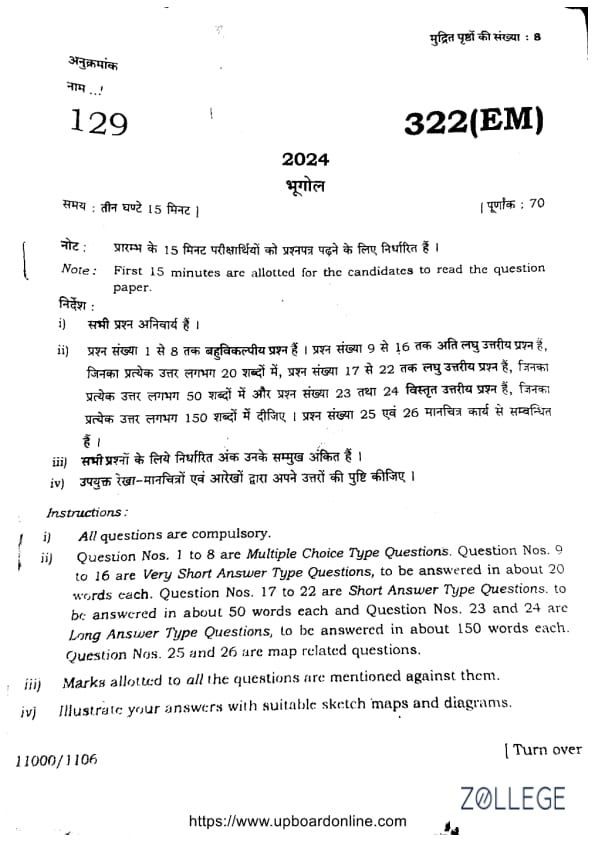
The UP Board Class 12 Geography examination for Code 322 (EM) was conducted on March 5, 2024, by the Uttar Pradesh Madhyamik Shiksha Parishad (UPMSP). The exam took place in the afternoon session from 2:00 PM to 5:15 PM. The question paper comprised a total of 26 questions, covering various topics outlined in the syllabus. As per students' initial reactions, the Geography paper was reported to be of easy to moderate difficulty. The distribution of questions was balanced, assessing both theoretical knowledge and practical understanding of geographical concepts
UP Board Class 12 Geography examination (Code 322 (EM)) 2024 Answer Key With Solution
Candidates can download the UP Board Class 12 Geography Question Paper with Solution and Answer Key PDFs for Question Paper (Code 322 (EM)) using the link below.
| UP Board Class 12 Geography examination (Code 322 (EM)) 2024 Question Paper with Answer Key |  Download Download |
Check Solution |
UP Board Class 12 Geography examination Question Paper with Solutions
Question 1:
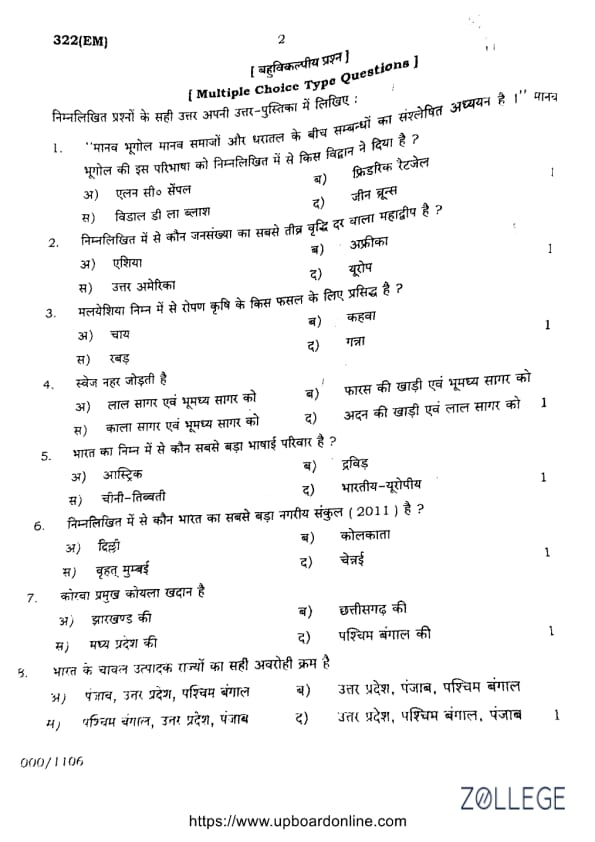
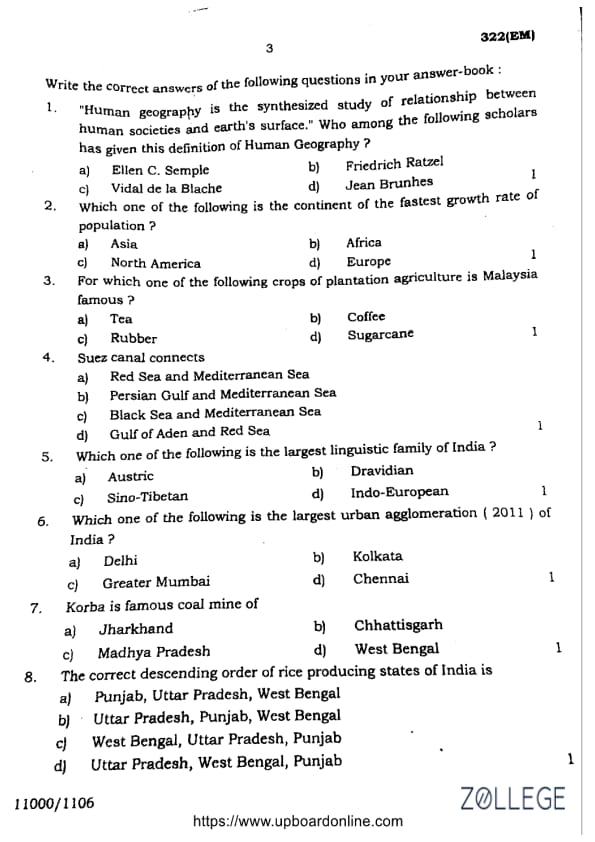
"Human geography is the synthesized study of the relationship between human societies and earth’s surface." Who among the following scholars has given this definition of Human Geography?
Correct Answer: (B) Friedrich Ratzel
View Solution
Friedrich Ratzel introduced the idea of human geography and its relationship with nature. He emphasized the interaction between societies and the earth's surface, exploring how the environment influences human activities and how humans, in turn, shape the landscape.
Question 2:
Which one of the following is the continent of the fastest growth rate of population?
Correct Answer: (B) Africa
View Solution
Africa has the highest population growth rate. This is primarily due tohigh fertility rates coupled with improvements in healthcare, leading to a decrease in mortality rates. Several factors contribute to high fertility rates, including cultural norms, limited access to family planning, and socioeconomic conditions.
Question 3:
For which one of the following crops of plantation agriculture is Malaysia famous?
Correct Answer: (C) Rubber
View Solution
Malaysia is famous for its rubber production. The country is one of the world's largest producers of natural rubber. This is facilitated by its tropical climate, which is ideal for rubber cultivation, and the widespread practice of plantation agriculture.
Question 4:
Suez Canal connects:
Correct Answer: (A) Red Sea and Mediterranean Sea
View Solution
The Suez Canal connects the Red Sea and the Mediterranean Sea. This man-made waterway is a crucial shipping route, significantly reducing the travel time between Europe and Asia compared to navigating around the Cape of Good Hope.
Question 5:
Which one of the following is the largest linguistic family of India?
Correct Answer: (D) Indo-European
View Solution
The Indo-European language family is the largest in India. It includes widely spoken languages such as Hindi, Bengali, Marathi, Gujarati, Punjabi, and many others. These languages are predominantly spoken in the northern and central parts of India.
Question 6:
Which one of the following is the largest urban agglomeration (2011) of India?
Correct Answer: (C) Greater Mumbai
View Solution
Greater Mumbai was the largest urban agglomeration in India according to the 2011 Census. An urban agglomeration includes the core city and its surrounding suburban areas.
Question 7:
Korba is a famous coal mine of:
Correct Answer: (B) Chhattisgarh
View Solution
Korba is located in Chhattisgarh. It is known for its substantial coal reserves and is a major center for coal mining and power generation in India.
Question 8:
The correct descending order of rice-producing states of India is:
Correct Answer: (D) Uttar Pradesh, West Bengal, Punjab
View Solution
The correct descending order is Uttar Pradesh, West Bengal, then Punjab. Uttar Pradesh has the highest rice production in India due to its fertile Gangetic plains and favorable climate. West Bengal follows, and then Punjab.
Question 9:
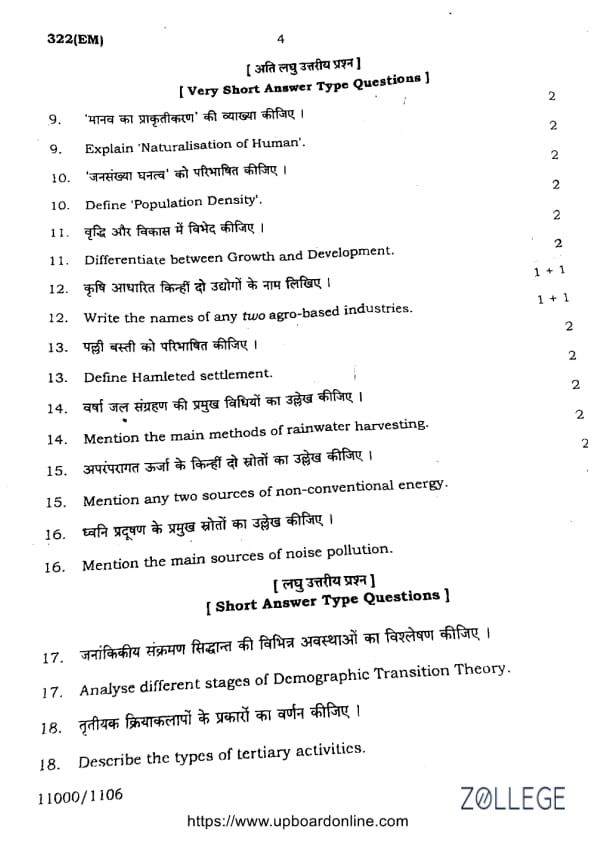
Explain ‘Naturalisation of Human’.
View Solution
Naturalization of humans refers to the process where human activities and behaviors are shaped by the natural environment. Humans adapt to the environmental limitations and opportunities without significantly altering the environment itself. This is characteristic of early human societies, where there was a greater degree of dependence on and harmony with nature. Examples include traditional farming practices dependent on monsoons and nomadic herding in response to arid conditions.
Question 10:
Define ‘Population Density’.
View Solution
Population density is a measure of how many people live in a given area. It is usually expressed as the number of people per square kilometer. A high population density suggests a large number of people living in a relatively small area, while a low density indicates fewer people spread over a larger area. It's a key metric for understanding population distribution, resource allocation, and infrastructure planning.
Question 11:
Differentiate between Growth and Development.
View Solution
Growth is a quantitative change. It refers to an increase in size, number, or value, such as an increase in population, GDP, or agricultural output. Development, on the other hand, is qualitative. It represents an improvement in the quality of life, encompassing better healthcare, education, infrastructure, and overall well-being. While growth can be a part of development, development goes beyond mere increases in quantity to focus on positive change and progress.
Question 12:
Write the names of any two agro-based industries.
View Solution
- Cotton Textile Industry: This industry uses raw cotton to produce yarn, fabrics, and clothing. It's a major source of employment and contributes significantly to a country's economy.
- Sugar Industry: This industry processes sugarcane to produce sugar and its by-products like molasses and bagasse. It plays a vital role in rural economies and the broader agro-industrial sector.
Question 13:
Define Hamleted Settlement.
View Solution
Hamleted settlements are characterized by small clusters of houses scattered across a larger area. These clusters are physically separated from each other by features like agricultural fields, forests, water bodies, or other natural barriers. While spatially dispersed, the residents of a hamleted settlement often maintain close social and economic ties.
Question 14:
Mention the main methods of rainwater harvesting.
View Solution
- Rooftop Rainwater Harvesting: This involves collecting rainwater from rooftops and channeling it through pipes and filters into storage tanks or underground recharge pits. This harvested water can be used for various non-potable purposes.
- Surface Runoff Harvesting: This method captures rainwater that flows over the ground during rainfall. It can be collected in ponds, reservoirs, or directed to underground storage tanks. This collected water can be used for irrigation and other purposes.
Question 15:
Mention any two sources of non-conventional energy.
View Solution
- Solar Energy: Energy from the sun is harnessed using photovoltaic cells (solar panels) to generate electricity. It's a clean and sustainable energy source.
- Wind Energy: Wind turbines capture the kinetic energy of the wind and convert it into electricity. Wind farms are becoming increasingly common as a source of renewable energy.
Question 16:
Mention the main sources of noise pollution.
View Solution
- Traffic Noise: The noise from vehicles, including cars, trucks, buses, and motorcycles, is a significant contributor to noise pollution, especially in urban areas.
- Industrial Noise: Machinery and processes in factories and industrial zones produce substantial noise pollution that can affect nearby communities.
- Construction Activities: The operation of heavy equipment during construction projects, such as excavators, bulldozers, and pile drivers, generates considerable noise.
- Loudspeakers and Public Events: The use of loudspeakers at public events, religious ceremonies, and for commercial advertising contributes to noise pollution.
Question 17:
Analyze different stages of Demographic Transition Theory.
View Solution
The Demographic Transition Theory describes the historical shift in birth and death rates as societies develop. It has five stages:
- Stage 1 (High Stationary): Both birth rates and death rates are high, leading to a stable but low population. This stage is characterized by pre-industrial societies with limited access to healthcare and sanitation.
- Stage 2 (Early Expanding): Death rates decline due to improvements in healthcare, sanitation, and nutrition, while birth rates remain high. This results in rapid population growth.
- Stage 3 (Late Expanding): Birth rates start to decline due to factors like increased access to education, urbanization, and family planning. Population growth continues, but at a slower rate.
- Stage 4 (Low Stationary): Both birth rates and death rates are low, leading to a stable population with little growth. This stage is characteristic of developed countries.
- Stage 5 (Declining): In some advanced societies, birth rates fall below replacement levels, resulting in a declining population. This is associated with aging populations and low fertility rates.
Question 18:
Describe the types of tertiary activities.
View Solution
Tertiary activities are service-based activities. Some key types include:
- Trade and Commerce: This involves the buying and selling of goods (retail and wholesale) and the activities that facilitate trade, like marketing and advertising.
- Transport and Communication: This includes the movement of goods and people (roads, railways, airlines, shipping) and the transmission of information (telecommunications, internet).
- Finance and Insurance: This sector deals with banking, investment, insurance, and other financial services.
- Public Services: These are services provided by the government or community organizations, such as healthcare, education, and public administration.
Question 19:
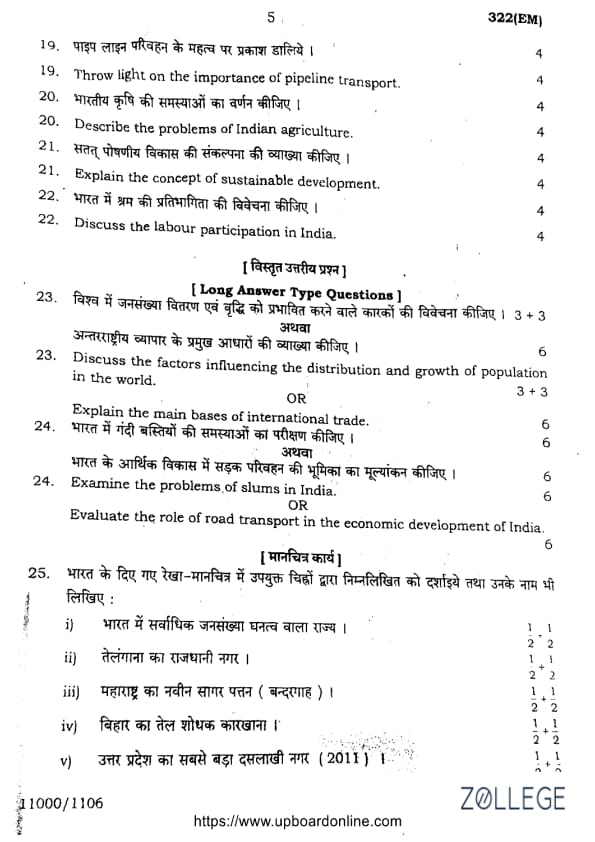
Throw light on the importance of pipeline transport.
View Solution
Pipeline transport offers several advantages:
- Efficient for Liquids and Gases: Pipelines are highly efficient for transporting liquids and gases like crude oil, natural gas, and refined petroleum products over long distances.
- Reduced Environmental Impact: Compared to other modes of transport like trucks or trains, pipelines have a lower environmental footprint due to reduced emissions and less land disruption.
- Cost-Effective: Pipeline transport can be very cost-effective, especially for bulk transport over long distances, due to lower operating and maintenance costs.
- Safe and Secure: Pipelines offer a relatively safe and secure way to transport materials, minimizing the risk of theft, accidents, and spills.
Question 20:
Describe the problems of Indian agriculture.
View Solution
Indian agriculture faces a complex set of challenges:
- Dependence on Monsoons: A significant portion of Indian agriculture relies on monsoon rainfall, making it vulnerable to unpredictable weather patterns and droughts.
- Small and Fragmented Landholdings: Many farmers have very small and fragmented plots of land, which makes it difficult to implement modern farming techniques and achieve economies of scale.
- Limited Access to Technology and Credit: Many farmers lack access to modern technology, improved seeds, and affordable credit, hindering productivity and innovation.
- Soil Degradation: Overuse of chemical fertilizers and pesticides has led to soil degradation, reducing fertility and impacting long-term sustainability.
- Market Challenges: Farmers often face challenges in accessing markets, getting fair prices for their produce, and dealing with intermediaries.
Question 21:
Explain the concept of sustainable development.
View Solution
Sustainable development is defined as "development that meets the needs of the present without compromising the ability of future generations to meet their own needs." It involves balancing economic growth with social equity and environmental protection. Key aspects include:
- Environmental Conservation: Protecting ecosystems, reducing pollution, and using resources responsibly are crucial for long-term sustainability.
- Social Equity: Ensuring that development benefits all members of society and reduces inequalities is essential.
- Economic Growth: Sustainable development aims for economic progress that doesn't deplete resources or harm the environment.
Question 22:
Discuss labor participation in India.
View Solution
Labor participation in India is a complex issue with several key characteristics:
- Large Unorganized Sector: A significant portion of the workforce is employed in the informal or unorganized sector, characterized by low wages, lack of job security, and limited social protections. This includes agriculture, small-scale industries, and domestic work.
- Low Female Participation: India has a lower rate of female labor force participation compared to many other countries. Social and cultural factors, along with limited access to education and suitable job opportunities, contribute to this.
- Regional Disparities: Labor participation rates vary significantly across different regions of India. Urban areas generally have higher participation rates due to greater employment opportunities, while rural areas rely heavily on agriculture.
- Government Initiatives (e.g., MGNREGA): Programs like the Mahatma Gandhi National Rural Employment Guarantee Act aim to improve labor participation and provide a safety net for rural workers by guaranteeing a certain number of days of paid work.
Question 23:
Discuss the factors influencing the distribution and growth of population in the world.
View Solution
Factors Influencing Population Distribution:
- Physical Factors: Climate, landforms, water availability, and soil fertility heavily influence where people settle. Favorable climates and fertile lands tend to attract higher populations.
- Economic Factors: Job opportunities, industrialization, and access to resources drive population distribution. People often migrate to areas with better economic prospects.
- Social and Political Factors: Social stability, political conditions, and government policies can influence population distribution. People are more likely to settle in areas with stable governments and supportive social structures.
Factors Influencing Population Growth:
- Birth and Death Rates: High birth rates and low death rates lead to population growth. Conversely, low birth rates and high death rates result in population decline.
- Healthcare Improvements: Advances in healthcare, sanitation, and nutrition reduce mortality rates, especially infant and child mortality, contributing to population growth.
- Socioeconomic Factors: Education, particularly women's education, often correlates with lower birth rates. Economic development and access to family planning services also influence fertility rates.
- Migration: Movement of people within and between countries affects population distribution and growth. People migrate for various reasons, including economic opportunities, social factors, and political instability.
Question 23 (OR):
Explain the main bases of international trade.
View Solution
International trade is driven by several key factors:
- Surplus Production: Countries with a surplus of goods, whether agricultural products, manufactured goods, or natural resources, engage in international trade to sell their excess production to other countries.
- Comparative Advantage: Countries specialize in producing goods and services where they have a comparative advantage – they can produce them at a lower opportunity cost than other countries. This leads to specialization and trade.
- Geographical Factors: Location and access to ports play a significant role. Countries situated along major trade routes or with well-developed port facilities have an advantage in international trade.
- Trade Agreements: Bilateral and multilateral trade agreements reduce trade barriers like tariffs and quotas, making it easier and more cost-effective for countries to trade with each other. Examples include the EU, NAFTA (now USMCA), and the WTO.
- Infrastructure: A well-developed transportation and communication infrastructure (ports, roads, railways, internet) is essential for efficient international trade. It facilitates the movement of goods and information.
- Political Relations: Strong political ties between countries can promote trade, while political instability or conflicts can disrupt trade flows.
Question 24:
Examine the problems of slums in India.
View Solution
Slums in India face a multitude of interconnected problems:
- Overcrowding and Poor Housing: Slums are densely populated, with inadequate housing and limited access to basic amenities like clean water, sanitation, and electricity.
- Unemployment and Poverty: High rates of unemployment and underemployment trap slum dwellers in a cycle of poverty, limiting their access to education, healthcare, and other essential services.
- Health Risks: Unsanitary conditions, lack of clean water, and limited healthcare access make slum dwellers vulnerable to infectious diseases and health problems.
- Lack of Infrastructure: Slums often lack proper roads, sanitation systems, waste disposal, and other essential infrastructure, making daily life challenging and exacerbating health and safety risks.
- Vulnerability to Disasters and Evictions: Slums are often located in hazardous areas prone to flooding, landslides, and other natural disasters. Residents also face the constant threat of eviction due to lack of land ownership or legal protection.
- Social Exclusion and Marginalization: Slum dwellers often face social discrimination and marginalization, limiting their opportunities for education, employment, and social mobility.
Question 23 (OR):
Evaluate the role of road transport in the economic development of India.
View Solution
Road transport is crucial for India's economic development, contributing significantly in several ways:
- Connecting Rural and Urban Areas: Road networks are essential for linking rural areas to urban centers, facilitating the movement of agricultural goods to markets and providing rural communities with access to essential services and goods. This connectivity fosters economic integration and reduces regional disparities.
- Supporting Industrial Growth: Efficient road transport is vital for industries, enabling the timely delivery of raw materials to factories and finished products to markets. This improves supply chain efficiency and lowers production costs.
- Creating Employment Opportunities: The road transport sector generates substantial employment, including drivers, mechanics, logistics personnel, and support staff. It also indirectly supports jobs in related sectors like tourism and hospitality.
- Facilitating Regional Development: Well-maintained roads connect remote areas to markets, enabling access to education, healthcare, and other vital services. This fosters economic growth and balances regional development.
Question 24 (For Visually Impaired Candidates):
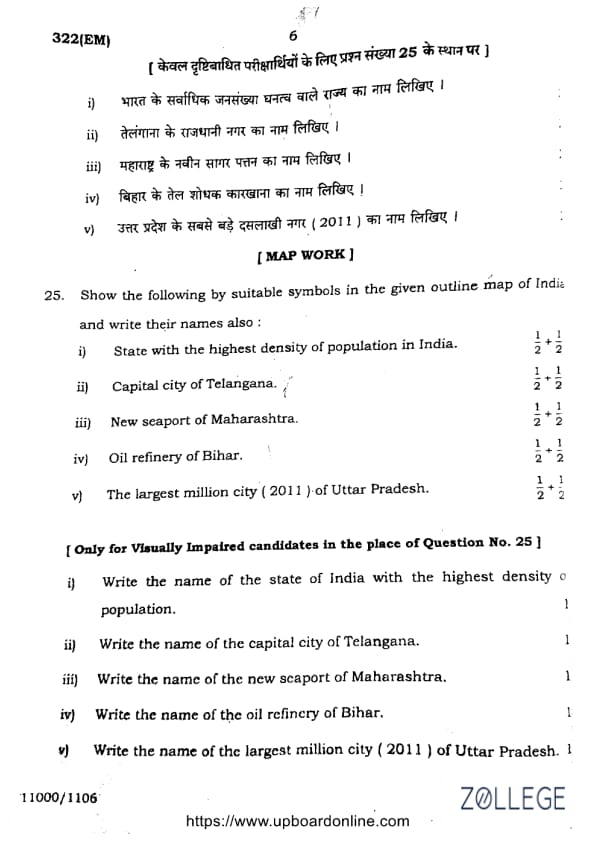
Write the name of the state of India with the highest density of population.
Correct Answer: Bihar
View Solution
Bihar has the highest population density in India. Its large population combined with a relatively small land area contributes to this high density, placing a significant strain on resources and infrastructure.
Question 25 (For Visually Impaired Candidates):
Write the name of the capital city of Telangana.
Correct Answer: Hyderabad
View Solution
Hyderabad is the capital of Telangana. It's a major economic and cultural center, blending historical significance with modern development, especially in information technology.
Question 26 (For Visually Impaired Candidates):
Write the name of the new seaport of Maharashtra.
Correct Answer: Jawaharlal Nehru Port (Nhava Sheva)
View Solution
Jawaharlal Nehru Port (Nhava Sheva), located near Mumbai, is a major seaport in Maharashtra. It's one of the busiest container ports in India and a critical gateway for the country's international trade. Its modern infrastructure facilitates efficient handling of cargo and supports trade activities.
Question 27 (For Visually Impaired Candidates):
Write the name of the oil refinery of Bihar.
Correct Answer: Barauni Refinery
View Solution
The Barauni Refinery is located in Bihar and is a key oil refinery in eastern India. It plays a vital role in meeting the energy demands of the region by processing crude oil into various petroleum products.
Question 28 (For Visually Impaired Candidates):
Write the name of the largest million city (2011) of Uttar Pradesh.
Correct Answer: Kanpur
View Solution
Based on the 2011 census, Kanpur is the largest city in Uttar Pradesh with a population exceeding one million. It is a major industrial hub known for its textile, leather, and manufacturing industries, contributing significantly to the state's economy.
Question 1 (For Visually Impaired Candidates):
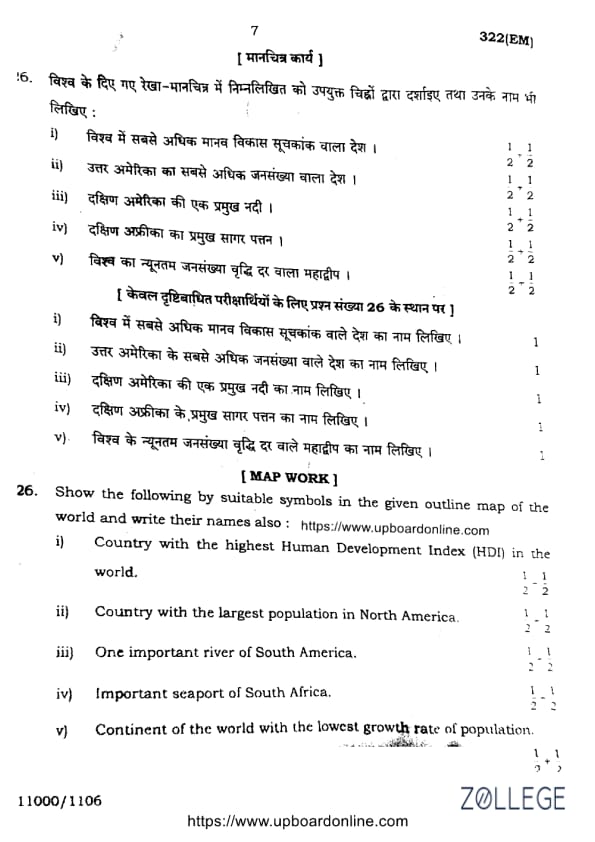
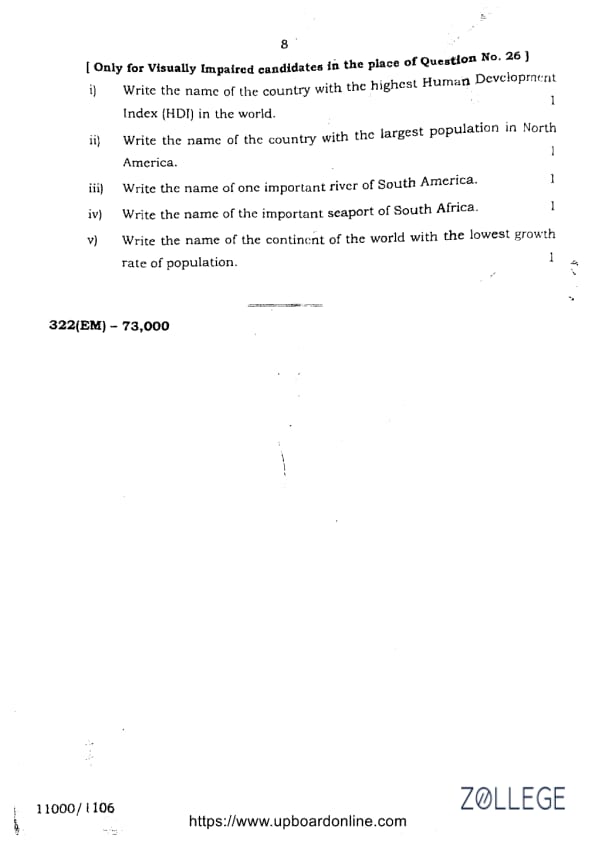
Write the name of the country with the highest Human Development Index (HDI) in the world.
Correct Answer: Norway
View Solution
Norway consistently ranks highest in the HDI due to its high standards of living, excellent healthcare and education systems, and strong social safety net. These factors contribute to a high quality of life for its citizens.
Question 2 (For Visually Impaired Candidates):
Write the name of the country with the largest population in North America.
Correct Answer: United States
View Solution
The United States has the largest population in North America, exceeding 330 million people. Factors contributing to its large population include natural growth and immigration.
Question 3 (For Visually Impaired Candidates):
Write the name of one important river of South America.
Correct Answer: Amazon River
View Solution
The Amazon River is a major river in South America, the largest by discharge volume. It plays a vital role in the region's ecosystem, climate regulation, and biodiversity.
Question 4 (For Visually Impaired Candidates):
Write the name of an important seaport of South Africa.
Correct Answer: Durban
View Solution
Durban is a significant seaport in South Africa. Located on the east coast, it is the busiest port in Africa and a key hub for international trade, handling a variety of goods such as oil, coal, and bulk products. Durban is integral to South Africa’s economy and plays a pivotal role in facilitating trade with other African nations and global markets.
Question 5 (For Visually Impaired Candidates):
Write the name of the continent of the world with the lowest growth rate of population.
Correct Answer: Europe
View Solution
Europe has the lowest population growth rate among continents. This is pri marily due to low birth rates, aging populations, and decreasing fertility rates in many European countries. In addition, several countries in Europe have seen significant outmi gration, contributing to their population stagnation or even decline. Some nations have adopted policies to address these demographic challenges, such as encouraging higher birth rates and increasing immigration