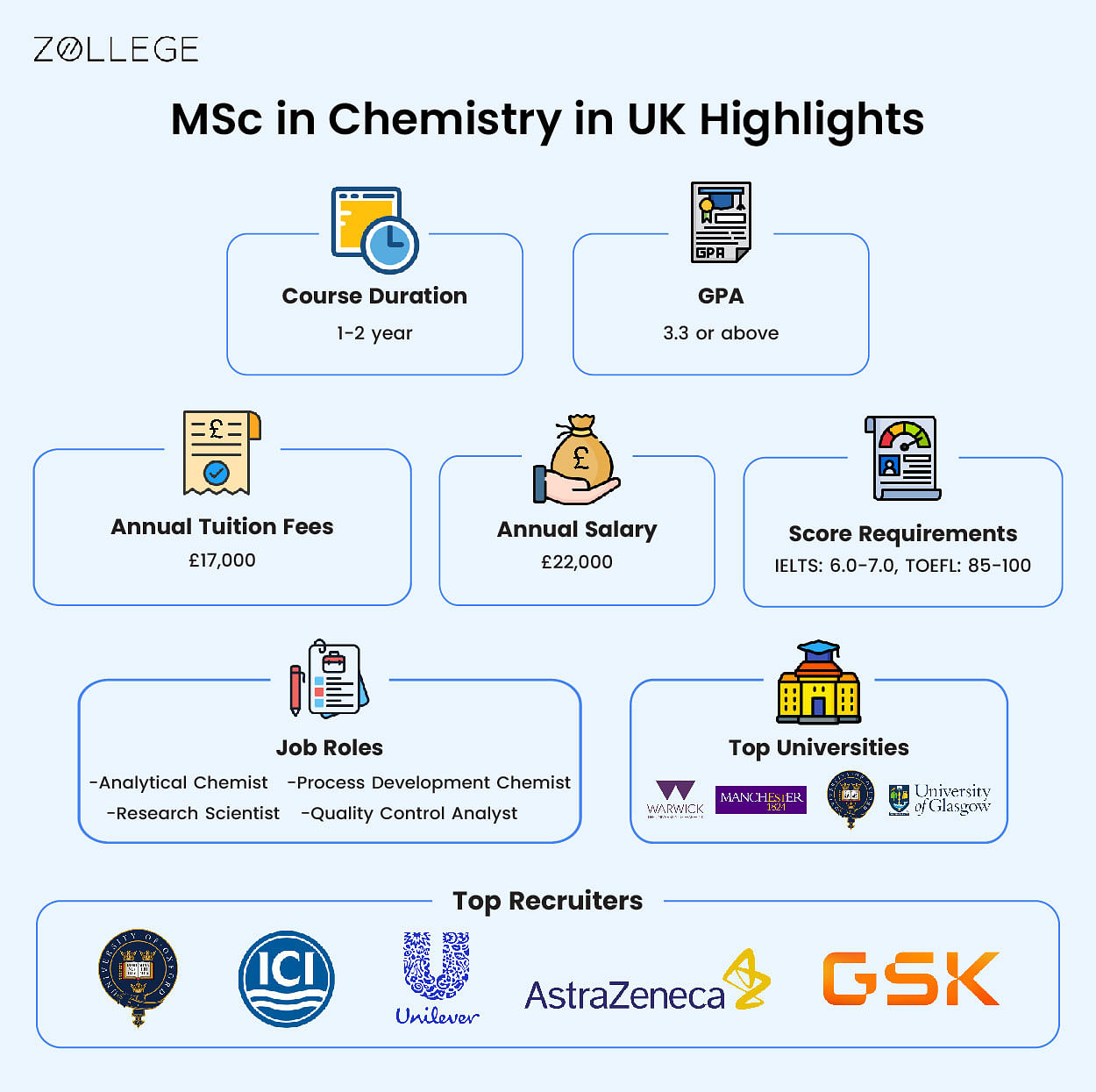
MSc in chemistry in UK is a prestigious and comprehensive postgraduate course that spans 1-2 years. MSc in chemistry in UK covers the areas such as Organic Chemistry, Inorganic Chemistry, Analytical Chemistry, Physical Chemistry, etc. This program attracts a significant number of aspiring candidates annually. Candidates to study in UK for MSc in Chemistry program hold a bachelor's degree in science with a minimum average GPA score of 3.5. International students who are interested in pursuing the MSc in chemistry in UK are need to qualify the english proficiency test scores & entrance exam scores . The average tuition fees
MSc in chemistry in UK 17,000GBP (INR 17.15 Lakhs) per year, after completing MSc in Chemistry in UK can earn around 22,000 GBP (INR 22.51) Lakhs per year.
- MSc in Chemistry in UK Highlights
- Why Study MSc in Chemistry in UK?
- MSc in Chemistry in UK Areas of Specializations
- MSc In Chemistry In UK Vs MSc Physics In UK
- Best University for MSc in chemistry in UK
- Admission Process for MSc in chemistry in UK
6.1 Admission Documents Requirement for MSc in Chemistry in UK - Admission Deadline for MSc in Chemistry in UK
- University-wise Application Fee for MSc in chemistry in UK
8.1 Eligibility Criteria for MSc in Chemistry in UK - MSc in Chemistry in UK Cost
- MSc in chemistry in UK Scholarships
- Jobs after MSc in Chemistry in UK
11.1 Top Recruiters for MSc in Chemistry in UK - Work Permit for MSc in Chemistry in UK
- ROI for the Top Colleges Providing the MSc In Chemistry in UK
- FAQs
MSc in Chemistry in UK Highlights
Why Study MSc in Chemistry in UK?
MSc in chemistry in UK is a prestigious choice that is offered by top-universities in UK.
Studying MSc in chemistry in UK offers lots of advantages and benefits, making it an attractive choice for international students.
Here are the several of reason why studying MSc in chemistry in UK
- Specialization Options: To study in MSc in chemistry in UK offers various specializations such as organic chemistry, inorganic chemistry, analytical chemistry, physical chemistry, or any other subfield, to make a career in this field.
- Industry Connections: To study MSc in chemistry in UK has a good chemical industry offering abundant opportunities for internships, industrial placements, and collaborations.
- Global Recognition: To applying to UK Universities for MSc in chemistry is highly respected worldwide. To develop your skills and knowledge in these positions you are a sought-after candidate for research positions, industry roles, and further academic endeavors.
- Careers opportunities : To study MSc in chemistry in UK gives you the best career opportunity in connections, internships, and placement opportunities, enhancing your employability and increasing your chances of securing rewarding job prospects.
MSc in Chemistry in UK Areas of Specializations
Areas of specialization for Msc in chemistry in UK are as follows:
- MSc in Organic Chemistry in UK: Explore the intricate world of carbon compounds and their diverse applications in industries ranging from pharmaceuticals to materials.
- MSc in Inorganic Chemistry in UK: Delve into the study of elements and their compounds, unlocking insights into catalysis, materials synthesis, and more.
- MSc in Analytical Chemistry in UK: Master the art of precision in chemical measurement, gaining skills crucial for quality control and analytical research.
- MSc in Physical Chemistry in UK: Uncover the fundamental principles governing chemical reactions, energy transfer, and molecular interactions through this program.
- MSc in Medicinal Chemistry in UK: Learn to design molecules that combat diseases, bridging the gap between chemistry and healthcare.
- MSc in Environmental Chemistry in UK: Contribute to a sustainable future by studying the chemical processes impacting the environment and devising solutions for pollution mitigation.
- MSc in Polymer Chemistry in UK: Explore the synthesis and properties of polymers, essential in fields like materials science, plastics, and biomaterials.
- MSc in Computational Chemistry in UK: Combine chemistry with computer modeling to simulate and predict chemical phenomena, revolutionizing research and development.
- MSc in Industrial Chemistry in UK: Gain expertise in the practical applications of chemistry across industries, from manufacturing to production optimization.
- MSc in Materials Chemistry in UK: Study the relationship between a material's structure, properties, and performance, influencing advancements in technology and innovation.
MSc In Chemistry In UK Vs MSc Physics In UK
| Characteristic | MSc in Chemistry | MSc in Physics |
| Course duration | 1-2 year | 1-2 year |
| Course structure | Core modules + elective modules | Core modules + elective modules |
| Specializations | Analytical chemistry, biochemistry, organic chemistry, physical chemistry, polymer chemistry, etc. | Astrophysics, condensed matter physics, computational physics, experimental physics, nuclear physics, etc. |
| Career prospects | Research, teaching, industry, government | Research, teaching, industry, government |
| Entry requirements | Bachelor's degree in chemistry or a related field | Bachelor's degree in physics or a related field |
| Average tuition fees | £17,000-£30,000 | £15,000-£30,000 |
| Top universities | University of Cambridge, University of Oxford, University of Manchester, University of Edinburgh, University College London | University of Manchester, University of Edinburgh, Imperial College London |
Best University for MSc in chemistry in UK
The tuition fees of best university for Msc in chemistry in UK is presented below:
| Name of University | Programs | Tuition fees |
| The University of Manchester | Msc in chemistry | £12,500 uk/ £31,000International |
| The University of Warwick Coventry | Msc in chemistry by research/ Msc in chemistry scientific writing | £ 10,430 |
| University of Oxford | Msc in chemistry by research | £8,960 uk/ £29,700 international |
| The University of Glasgow | Msc in chemistry by research | £25980 international |
| University Road, Belfast | MPhil. | £19,100 international |
| University of Liverpool | Msc in chemistry | £9,700 UK/£23,400 international |
| University of Bristol | MScR | £4,665 UK/ £25,300 international |
| University of York | Msc in chemistry by research | £9,250 UK/£22,250 international |
| University of Kent | Chemistry - MSc | £4712 UK/£21900 international |
| University of Sheffield | MScR | £12,400UK/£27,500 international |
Admission Process for MSc in chemistry in UK
Msc in chemistry in UK admission process is done via online mode.Candidates must check the deadlines of the universities to go through their admission process.
The admission process for Msc in chemistry in UK admission is listed
- Research and Choose University : Candidates must research those universities that are offering Msc in chemistry in UK. Consider factors such as program curriculum, faculty expertise, research opportunities, and university rankings.
- Eligibility Criteria : check eligibility criteria set by the universities you are interested in. Candidates must check the relevant bachelor's degree in science discipline.
Some universities may have specific grade requirements or prerequisite courses.
- Prepare Application Documents: prepare application documents the necessary application documents, which may include:
- Completed application form: candidates must have filled out the University application form accurately.
- Academic transcripts: candidates must have to provide their transcripts of your undergraduate studies, demonstrating your academic performance.
- Letters of recommendation: candidates must have to obtain reference letters from professors, supervisors, or professionals who can speak to your academic abilities.
- Curriculum vitae (CV): make an impressive CV highlighting your educational qualifications, research experience, internships, and any relevant achievements.
- English language proficiency: candidates must have to demonstrate their English language proficiency through tests such as IELTS or TOEFL.
- Submit Applications: candidates must have to submit the application along with the required documents, to the universities of your choice.
- Entrance Exams: some universities may require you to take entrance exams, such as the GRE,GATE,LNAT,BMAT,MAT or equivalent .Check the specific requirements of each university regarding entrance exams
- Interview: once you are selected , you may be called for an interview as part of the selection process. This interview may be via phone or virtual call .
- Await Admission Decisions: after submitting the all required document you have to wait for universities to review your application and make admission decisions.
- Accept Offer and Enroll: once you receive an offer from university carefully review the terms and conditions, including the deadline to accept or decline the offer. If you decide to accept, follow the enrollment instructions provided by the university.
Admission Documents Requirement for MSc in Chemistry in UK
The documents required for admission in top colleges for MSc in chemistry in UK are as follows:
- Copy of passport/visa
- All Academic Transcripts
- Certificate of English proficiency – IELTS score/TOEFL/PTE Test
- Personal statement
- Reference letters
- CV (if applicable)
- Birth certificate
- LOR (Letter of recommendation)
- SOP in UK
- Evidence of Financial Resources and capability
Admission Deadline for MSc in Chemistry in UK
The application fees vary as per different universities in London, Brighton and other cities in UK. The admission deadline of the top universities for MSc in Chemistry in UK are as follows:
| Name of University | Application Deadline |
| The University of Manchester | June 30 |
| The University of Warwick Coventry | September 5 |
| University of Oxford | 18 August |
| The University of Glasgow | September 2023 |
| University Road, Belfast | 30 June 2023. |
| University of Liverpool | 14 July 2023 |
| University of Bristol | To be announced |
| University of York | 31 July 2023 |
| University of Kent | July 15 |
| University of Sheffield | To be announced |
University-wise Application Fee for MSc in chemistry in UK
London, Scotland, Brighton etc. are considered one of the best student cities in the UK. Candidates must be aware of admission requirements to get admission to their preferred universities. The application fee of the top universities are as follows:
| Name of University | Application Fee |
| The University of Manchester | £60 (INR 6,212.45) |
| The University of Warwick Coventry | - |
| University of Oxford | £75 (INR 7909) |
| The University of Glasgow | £1000 deposit |
| University Road, Belfast | £20 for one course and £26 for multiple course |
| University of Liverpool | £65 (INR 6824.49) |
| University of Bristol | £60 (INR 6,212.45) |
| University of York | £20 for one course and £26 for multiple course |
| University of Kent | No application fee |
| University of Sheffield | No application fee |
Eligibility Criteria for MSc in Chemistry in UK
MSc in chemistry eligibility for MS in UK are different, so candidates must have to check before applying to universities. The eligibility criteria for MSc in chemistry in UK are as follows:
| Name of University | Standardized Test Scores | ELP Score Required |
| The University of Manchester | GRE- 298 | IELTS: 6.5 TOEFL iBT: 90 |
| The University of Warwick Coventry | GRE score-320 | IELTS: 6.5 |
| University of Oxford | GRE-321 | IELTS: 7.0 TOEFL iBT: 100 |
| The University of Glasgow | GRE accepted | IELTS : 6.5 TOEFL: 90 PTE: 60 |
| University Road, Belfast | GRE accepted | IELTS: 6.0 |
| University of Liverpool | - | IELTS: B International Baccalaureate : 5 TOEFL iBT: 88 |
| University of Bristol | GMAT/GRE scores are not required | IELTS: 6.0 LanguageCert SELT : B2 PTE : 64 Skills for English : C1/C2 Pass/B2 Pass with Merit |
| University of York | GMAT score 640 GRE score 321 | IELTS: 6.0 TOEFL: 79 Duolingo English Test: 115 PTE: 58-65 |
| University of Kent | GRE-295 | IELTS: 6.5 PTE : 62 CAE/CPE : 176 TOEFL iBT : 90 |
| University of Sheffield | GRE159 (minimum of 157 in each component) GMAT 600 | IELTS: 6.5 ESOL SELT C1 : 33/50 |
MSc in Chemistry in UK Cost
International students must check the requirement for UK Study Visa and also the admission requirements of top universities for MSc in Chemistry in UK. Candidates must consider Msc in chemistry in UK cost of living to settle there. The cost of living in UK is tabulated below:
| Name of University | Cost of living |
| The University of Manchester | £11,940(INR 1259146) per year |
| The University of Warwick Coventry | £1023 per month |
| University of Oxford | £1,290 - £1,840(INR 136038.46 - 194039.35) per month |
| The University of Glasgow | £11,200 - £15,900(INR 1181109 - 1676753) per year. |
| University Road, Belfast | £25,832 |
| University of Liverpool | £581 – £1,082 per month |
| University of Bristol | £70 to £200(INR 7381.93 - 21091.23) per week. |
| University of York | £924 a month. |
| University of Kent | £115 - £270 per week |
| University of Sheffield | Off-Campus £730 On-Campus £802 |
MSc in chemistry in UK Scholarships
Candidates can apply for scholarships to bear the cost of living in UK. There are various scholarships for Msc in chemistry in UK for Indian students to assist in their expense:

Jobs after MSc in Chemistry in UK
The university in UK for Msc in chemistry in UK offers various types of Job profiles to the candidates with a high package of salary. Here cited below certain roles of jobs in UK of the pursued Msc in chemistry in UK universities:
| Job Profile | Annual Median Salary |
| Analytical Chemist | £25,000 - £35,000 |
| Research Scientist | £28,000 - £40,000 |
| Quality Control Analyst | £24,000 - £35,000 |
| Process Development Chemist | £25,000 - £40,000 |
| Formulation Scientist | £28,000 - £40,000 |
| Pharmaceutical Scientist | £25,000 - £40,000 |
| Environmental Consultant | £25,000 - £40,000 |
| Chemical Engineer | £28,000 - £45,000 |
| Laboratory Manager | £30,000 - £45,000 |
Top Recruiters for MSc in Chemistry in UK
The top recruiters that offer students of MSc in chemistry jobs in UK with visa sponsorship are as follows:
| Name of University | Top Recruiters for MS in USA |
| The University of Manchester | Unilever Research; GlaxoSmithKline; Astro Zeneca; University of Oxford;ICI Pharmaceuticals. |
| The University of Warwick Coventry | BP, Syngenta, Croda, Unilever, Reckitt Benckiser |
| University of Oxford | Bradford Royal Infirmary;James Cook University Hospital;Queen Charlotte’s & Chelsea;Hospital |
| The University of Glasgow | Royal Bank of Canada, McKinsey & Co., Estee Lauder, Cobham, GKN |
| University Road, Belfast | AstraZeneca, GlaxoSmithKline, Syngenta, RB |
| University of Liverpool | HSBC, Hewlett Packard, CMI, KPMG, Liverpool FC, UEFA |
| University of Bristol | pharmaceutical sciences, green energy, polymers, coatings, agrochemicals, instrumentation manufacturers and management consultancies |
| University of York | Accenture,Aldi,ARM,Aviva,Bank of England,BT,Frontline,IBM,KPMG,Linklaters,L'Oréal |
| University of Kent | agencies, consultancies, emergency services, laboratories, research or academia. |
| University of Sheffield | Unilever and Reckitt, pharmaceutical companies such as AstraZeneca and GSK, and chemical companies such as Croda and Dow |
Work Permit for MSc in Chemistry in UK
The student who wants to study Msc in chemistry in UK must be eligible to apply for a work permit to work in the country after their studies. The work permit options for international students in UK include:
- Graduate Route (Post-Study Work Visa): international students who have completed a degree at a UK university to stay and work in UK for up to 2 years or more than 2 without requiring a job offer.
- Tier 2 (General) Visa:International UK student visa who are skilled workers with a job offer from a UK employer. The company will provide them a licensed sponsor and demonstrate that there is a need for the specific skill.
ROI for the Top Colleges Providing the MSc In Chemistry in UK
Average salaries in UK depend on the candidates' location, profession and career path. The ROI for the top colleges offering Msc in chemistry in UK are tabulated below:
| University Name | Tuition Fees | Cost of Living | Total Expense | Salary | ROI(%) |
| The University of Manchester | £31,000 | £11,940 | £42,940 | £35,000 | 1.22 |
| The University of Warwick Coventry | £10,430 | £1023/month | £20,650 | £30,000 | 1.95 |
| University of Oxford | £29,700 | £1,290-£1,840/month | £41,640-£58,140 | £35,000 | 1.45-1.98 |
| The University of Glasgow | £25,980 | £11,200-£15,900 | £37,180-£41,880 | £30,000 | 1.24-1.39 |
| University Road, Belfast | £23,850 | £25,832 | £49,682 | £30,000 | 1.65 |
| University of Liverpool | £23,400 | £581-£1,082/month | £29,280-£34,282 | £30,000 | 1.14-1.14 |
| University of Bristol | £25,300 | £70-£200/week | £32,300-£42,300 | £35,000 | 1.01-1.22 |
| University of York | £22,250 | £924/month | £31,490 | £30,000 | 1.04 |
| University of Kent | £21,900 | £115-£270/week | £23,070-£28,670 | £30,000 | 1.07-1.28 |
| University of Sheffield | £27,500 | Off-Campus £730/month, On-Campus £802/month | £34,800-£35,802 | £35,000 | 1.03-1.05 |
MSc in chemistry in UK is a prestigious and comprehensive postgraduate course that spans 1-2 years, offered in over 229+ universities in the country. The average tuition fees MSc in chemistry in UK 17,000GBP (INR 17.15 Lakhs) per year, after completing MSc in Chemistry in UK can earn around 22,000 GBP (INR 22.51) Lakhs per year. MSc in chemistry is the best choice for students who are interested in chemistry, chemicals, medicines etc.
FAQs
Ques: What is an MSc in Chemistry, and why should I consider it?
Ans:An MSc in Chemistry is a postgraduate program that provides advanced knowledge in various subfields of chemistry. It's ideal if you want to specialize in a specific area, enhance your research skills, and open up diverse career opportunities in academia, industry, and research.
Ques: Are there specific specializations available within MSc in Chemistry programs?
Ans:Yes, most MSc in Chemistry programs offer specializations such as Organic Chemistry, Inorganic Chemistry, Analytical Chemistry, Physical Chemistry, Medicinal Chemistry, Environmental Chemistry, and more. These specializations allow you to focus on a particular area of interest.
Ques: What are the entry requirements for an MSc in Chemistry in UK?
Ans:Entry requirements vary by university, but they typically include a bachelor's degree in a relevant field, often with a minimum GPA or equivalent. Some programs might also require letters of recommendation, a statement of purpose, and English language proficiency.
Ques: How long does an MSc in Chemistry program usually take to complete?
Ans:The duration of the program is typically one year if pursued full-time. Some universities might offer part-time options, which could extend the duration.
Ques: What can I expect from the curriculum of an MSc in Chemistry program?
Ans:The curriculum usually includes a mix of core courses, specialized courses, laboratory work, and possibly a research project or dissertation. The courses cover advanced topics in your chosen specialization and related areas.
Ques: What career opportunities are available after completing an MSc in Chemistry?
Ans:Graduates can pursue careers in pharmaceuticals, research and development, chemical industries, environmental agencies, quality control, academia, and more. The specific career path depends on your specialization and interests.
Ques: Can I pursue a PhD after completing an MSc in Chemistry?
Ans:Yes, an MSc in Chemistry can serve as a stepping stone to a PhD program in chemistry or a related field. The research experience gained during the MSc can be valuable for your doctoral studies.
Ques: How important is research during the MSc program?
Ans:Research is a significant component of many MSc in Chemistry programs. Engaging in research projects or a dissertation can help you apply theoretical knowledge to practical problems and develop critical research skills.
Ques: Are there scholarships or financial aid options available for international students?
Ans:Yes, many universities offer scholarships, grants, and funding opportunities for both domestic and international students. Be sure to research the options available at the universities you're interested in.
Ques: How can I choose the right university and program for my MSc in Chemistry?
Ans:Consider factors such as program reputation, faculty expertise, available specializations, research opportunities, industry connections, and location. Researching and comparing multiple universities will help you make an informed decision.?


![University College London [UCL]](https://static.zollege.in/public/college_data/images/studyabroad/logos/college_846_16-12:41_university-college-london.jpeg?tr=w-50,h-50,c-force?tr=h-40,w-35,c-force)

![University of Edinburgh [ED]](https://static.zollege.in/public/college_data/images/studyabroad/logos/college_810_07-11:27_logo.png?tr=w-50,h-50,c-force?tr=h-40,w-35,c-force)
![King's College London [KCL]](https://static.zollege.in/public/college_data/images/studyabroad/logos/college_836_07-11:35_logo.png?tr=w-50,h-50,c-force?tr=h-40,w-35,c-force)