Is studying in USA your biggest goal? Then you must be worried about securing F1 Visa for studying in USA. F1 Visa is issued to non-immigrant students like you who are willing to pursue studies in the U.S. It will only be issued after you get admitted to any academic institution in the United States. What you must know is that F1 visa is non immigrant visa for students, and you must qualify on some specific criteria during the interview. We recommend you to search for F1 visa interview questions before appearing for the interview. As per our knowledge, F1 visa fees is $185 (INR 15,273). We also recommend that you provide the proof of admission to U.S colleges and universities for the F1 Visa. There are two F1 visa types of non- immigrant visas which are: F Visa - Candidates admitted to academic institution for the academic course, M Visa - Candidates wanting to apply for vocational and technical schools, and J Visa - Candidates wanting to pursue exchange programs.
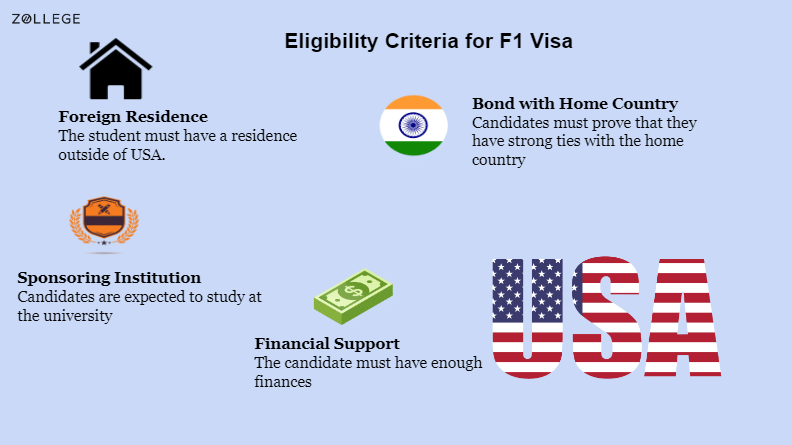
You will be eligible for F1 Visa or M1 Visa after you meet the eligibility criteria. We recommend you submit bank statements and other financial documents, as added proof of authenticity. Other than that you must prove that you intend to return to your residence after completion of the course. Students must also submit their IELTS/TOEFL certificate among other exams to study in USA to be eligible. Also know that you will be eligible for working on campus for the first year of college and off campus for the rest 3 years.
You must be ready with all the documents like prior academic records, proof of scholarships, SOP, valid passport, etc. Other than this after receiving the visa you must remain enrolled full time, and also remember you cannot work off-campus. We must also inform you that you will have 60 days on program completion to leave the United States under your F1 visa. Also there are chances of Visa rejection if you have submitted inadequate documents or have inadequately documented finances. Also prior criminal records can be a reason for rejection. All these points must be kept in mind while applying for F1 visa.
- Knowing the Visa
1.1 Types of F1 Visa - F1 Visa Application Process
2.1 F1 Visa Requirements
2.2 Processing Time of F1 Visa - F1 Visa Interview
- Port of Entry for F1 Students
4.1 Maintaining F1 Visa Validity
4.2 Tips on Maintaining F1 Visa - F1 Visa Rejection
5.1 Reasons for Rejection
5.2 Reapply for F1 Visa - FAQs:
Knowing the Visa
Candidates must be aware of the type of Visa they need before applying for the F or M Visa or any US student visa. The course of study and the type of school determines which visa is required by the candidates to study in USA.
| Visa Category Required | Study Details | Who Can Accompany |
|---|---|---|
| F Visa | University or college, High School, Elementary school (Private), Conservatory (Musical and artistic school), Seminary (School for the training of priests, ministers, or rabbis), Academic institution including a language training program | Children or spouses can also accompany the F-1 visa recipient but they have to acquire an F-2 visa for traveling. |
| M Visa | Vocational or other recognized nonacademic institution, other than a language training program | Children or spouses can also accompany the M-1 visa recipient but they have to acquire an M-2 visa for traveling. |
| J Visa | Students wanting to pursue exchange program (research fellowship or vocational training) | Children or spouses can also accompany the J-1 visa recipient but they have to acquire an J-2 visa for traveling. |
Types of F1 Visa
There are three types of F1 Visa. All of the types have their different purposes and advantages and alo they must know of the F1 student visa timelines. The following table will illustrate the details.
| Type of Visa | Eligibility Criteria | Advantages | Disadvantages |
|---|---|---|---|
| F-1 visa | Students enrolling in a full time academic course in an approved US institute | Candidates can enter in the US as a full time student. Usually valid for 5 years |
|
| F-2 visa | Family members of F-1 visa holders who are dependent on the candidate | Can stay in the US as long as the F-1 visa holder |
|
| F-3 visa |
|
Allows citizens to petition their married children to come to the US as well as their spouse and children |
|
F1 Visa Application Process
Candidates looking to get student Visa must submit their applications at the U.S. Embassy or Consulate at their home country, and the process is also same for post study work visa in USA. Students may apply for the F1 Visa at any U.S. consular office abroad out of their home country. Candidates must note that it is difficult to qualify for the F1 visa outside the country of permanent residence. The process is:
- Candidates must make sure that the college must be recognized by SEVP.
- Candidates are officially enrolled in the SEVP once they receive acceptance letter
- Students needs to show one year of tuition fees and living expenses in their bank account
- The university issues an I20 for visa form to the candidate after checking the details
- Apply for the F1 Student Visa through the DS-160 form.
- Pay the F1 visa fees of USD 185
- Schedule a Biometric appointment and Interview appointment
- Clear the interview for the F1 student visa
F1 Visa Requirements
Students willing to study in US and already have a confirmation from the university must follow the F1 Visa Application process. Students applying fro both public and private universities in USA will also submit similar documentations. The F1 Visa requirements for Indian students are:
- Valid passport.
- Form DS-160 for non-immigrant visa applications.
- Two photographs meeting the US Visa Photo Requirements.
- Proof of paid F1 visa fee.
- I20 form USA required for visa application
- Bank statements for the last 3 years
- Tax records for the last 3 years
- Pay stubs of previous employment
- Proof of scholarships, if any
- SOP for USA
- LOR for USA
- If a candidate is supported by someone else in the US, they will need to submit Form I-134, Affidavit of Support and bank statements for the last three years of that person.
- Proof of the approved loan, if applicable
- Documents of previous education and current qualifications:
- Original transcripts
- Standardized test scores (TOEFL, IELTS, GRE, GMAT, etc.)
- Acceptance letters from the educational institution in USA
- Proof of purchased health insurance for international students.
Processing Time of F1 Visa
The total processing time from application to clearing the F1 Visa interview might take 15 days to two months similar like the application processing time of all top universities in USA. In most cases, candidates will get the status on this visa immediately after the interview. The processing of this F1 student via usually happens before the interview even takes place. The interview is the last step for the US Embassy to assess whether they should issue the visa. The status of acceptance or rejection is informed immediately after the interview. On rejection, the visa officer will hand over the documents mentioning the reason for denial.
F1 Visa Interview
The F1 student Visa interview is mandatory to determine whether the candidate is qualified to receive an F1 student visa as required by US education system. Candidates must arrive at the location with all the documents required for the visa F1 interview. The questions that are usually asked and the strategies to answer are:
- Why did you choose to study in the US instead of joining the workforce in your home country?
Candidates should mention about the International exposure and opportunities that the course in US can offer. - Why did you choose this school and why is it the best school for you?
Candidates must mention about the advantages about the shool. They should also mention the positives of the subject they are choosing. - What are your test scores (GRE, GMAT, SAT, TOEFL, IELTS), your GPA, and your overall performance as a student in the past?
Students must tell the exact scores and GPA. This will make the interviewer feel that the candidate is aware about the details. - How are you funding the entire duration of your education, including tuition, room and board, transportation, and all other expenses?
Students must mention the source of the financial support for the entire duration of the course. They must also mention if they have any scholarships - After you graduate, do you plan to return home or will you stay in the United States?
This is very tricky as the interviewer tries to check the intention of the candidate. Students must answer as per the Visa rules and regulations.
Candidates must answer these questions truthfully and sincerely. Once the interviewer feels satisfied with the answers, they will approve the F1 visa request.
Port of Entry for F1 Students
The F1 Visa does not guarantee entry to the United States, neither for top Non-Ivy league universities. It is a document required to travel to a U.S. port-of-entry (generally an airport). The process for entry are:
- The Department of Homeland Security (DHS), U.S. Customs and Border Protection (CBP) officials has the authority
- The passport, visa, and i20 f1 visa visa form will be checked at the port-of-entry
- CBP official will make the decision to allow or deny the entry.
- The CBP official will provide an admission stamp or paper Form I-94 for Arrival/Departure Record.
Maintaining F1 Visa Validity
Candidates must note that getting Visa is not the only thing that they need to focus on and neither admission to US universities. The hard part comes after. They need to maintain the F1 visa. If the F1 visa is not maintained, it could result in:
- Not being allowed to return to re-enter the US if you leave
- Candidates will not be eligible for practical training (OPT or CPT)
- Not eligible for on-campus employment.
Tips on Maintaining F1 Visa
The students getting an F1 visa must keep few things in mind so that they can study and work at the same time in USA, and also to ve in best student cities in USA. They must always notify the international advisor or office if there are any changes to the address, study plans, or visa status. Few other things are:
- During The Academic Program: Candidates must remain enrolled full time. If the candidate is unable to complete the program by the date listed on Form I-20, the international advisor can request an extension.
- Working during college: F1 visa students are not allowed to work off-campus. International advisor can suggest if this is a possibility for the candidate. If a candidate tried to work without authorization, the F1 or M1 visa will be revoked and they will be forced to leave the United States.
- Upon Program Completion: Candidates have 60 days on program completion to leave the United States under your F1 visa. If they wish to stay, candidates will need to re-enroll in a higher program, transfer to another school to receive a new I-20 form, or apply to change the visa status.
F1 Visa Rejection
The F1 Visa or the M1, or J1 Visa might get rejected due to many reasons. The reason and the section under which it is denied will be informed by the visa officer. The candidate will come to know the reason right after the interview.
Reasons for Rejection
There are many reasons for which the visa might be rejected. Few top reasons for US visa rejection are:
- Country of Origin. The most decisive factor in the outcome of the student visa application is the country of nationality. Students from underdeveloped countries which does not guarantee a job might face issues with rejection.
- Ties. As discussed above, the strength of one’s ties are viewed through the prism of age. A lack of interest to travel back to their own country will lead to rejection.
- Interview Problems. Candidates gets only one chance at the interview. Any negative points can lead to rejection.
- Inadequate or Inadequately Documented Finances. Candidates must have enough bank balance to sponsor their first year. Failure to do so might result in rejection.
- Previous US Visa Denial. Previous denial is a distinct black mark but not the definite reason for denial. Candidates must improve themselves before reapplying.
- Change of Status in US. Many tourists, visitors and Summer Work Travel participants after arriving to the US decide to stay and enroll in school. This should not be done and the embassy must be informed for further process.
- Other Document Problems. If the candidate forgets to bring a needed document, such as TOEFL or GRE results or confirmation of a scholarship or bank statements of the sponsor, they may end up on the wrong side of the visa decision.
- Relatives in the United States. If the student fails to disclose the relative in the DS-160 form, it may be considered a material misrepresentation and lead to a 212(a)(6)(C)(i) decision.
Reapply for F1 Visa
The rules for reapplying the F1 visa is different as per the reason for rejection.
- If the visa is rejected under 221(g): candidate needs to submit the visa application along with the visa fee again.
- F1 visa denied visas under section 214(b): Candidates can present evidence of significant changes done in the application.
It is very important to maintain the validity of the F1 Visa. If the validity is not maintained or the visa gets expired, candidates might be send back to the home country without further entry to the US. Extending f1 visa requires candidates to follow certain norms and regulations.
FAQs
Ques. What is F1 visa for?
Ans. The F-1 Visa allows students to enter the United States at an accredited college, university, seminary, conservatory, academic high school, elementary school, or other academic institution or in a language training program.
Ques. How many years is F1 visa valid for?
Ans. An F-1 visa is issued for up to 5 years of time. The residence status (not citizenship) in the United States is valid for the entire duration of the study.
Ques. Can I work in USA with F1 visa?
Ans. Yes, students can work in USA with F1 Visa. However, the F-1 student's total work hours for all jobs cannot exceed 20 hours during the school term. The F-1 student may work full-time during those periods when school is not in session or during the student's annual break. Also, they cannot work outside the school with F1 Visa.
Ques. Who is eligible for F1 visa?
Ans. Candidates must be enrolled as a full-time student at an academic institution in the United States. Candidates must be proficient in English or be enrolled in courses leading to English proficiency. They must have proof of sufficient financial funds to support study in the United States.
Ques. How much is the F1 visa fee?
Ans. The application fee for the student visa is $185. Candidates must get the receipt, which will be required during the interview.
Ques. How many attempts are there for F1 visa?
Ans. There is no limit to apply for an F-1 visa. However, students must focus on the reason for rejection and improve themselves before reapplying.
Ques. Can I stay in USA after F1 visa?
Ans. Candidates can stay and work upto 12 months after the completion of the course.
Ques. How much is the SEVIS fee?
Ans. SEVIS fee depends on the visa. Students must note the following:
- Students, who are applying for F-1, F-3, M-1, or M-3 visa, need to pay a fee of $350
- Students, who are applying for J-1 visa, need to pay a fee of $220
- For special J-visa categories (subsidized payment), fee stands at $35
Ques. Can I Bring Family Members to the United States with F1 Visa?
Ans. No, it is not possible to bring family members. However, if there is anyone dependent on the candidate such as a spouse or unmarried children under 21 years old, they are allowed to come to the US too with f1 dependent visa. This can be done with an F2 visa.
Ques: What is the 5 month rule for F1 visa?
Ans: The 5 month rule is applied on students who miss their classes for than 5 months in USA. They miss it without getting any early withdrawal permit from their course of study. This sudden absence compromises a student’s visa status, and their F1 Visa might get revoked after 5 months.
Ques: Is F1 visa easy to get?
Ans: No, Visa of any sort is not easy to get and students are the most in number when it comes to apply for a F1 visa. USA has strict visa and immigration rules and the waiting period depends upon the authorities.
Ques: Can I get PR in USA after study?
Ans: Studying in USA does not ensure students PR as the path to getting a PR or Green Card is quite daunting, and it heavily depends on an applicants job, average annual salary, etc. So, PR is not an easy process even with an American Degree.
Ques: Can I change my F1 visa to green card?
Ans: If your end game is to achieve PR or Green Card in USA then at first you can change your F1 visa to a dual intent visa. This would allow you to work in USA till you apply later for H1B Visa or also for a Green card.
Ques: Can I buy a house in US with F1 visa?
Ans: Yes, you can buy a house, but this is done remotely even if you are not in the United States. So a students cannot essentially work in USA with a F1 visa, and in case they buy a house, they have to ensure that they have sufficient funds to buy the house.
Ques: How can I live in USA permanently?
Ans: There are different ways to live in USA permanently like sponsorship by a U.S. citizen or permanent resident relative, offer of permanent employment, asylum seeker visa, investment and employment creation, etc.


![Massachusetts Institute of Technology [MIT]](https://static.zollege.in/public/college_data/images/studyabroad/logos/college_1087_29-14:42_download.png?tr=w-50,h-50,c-force?tr=h-40,w-35,c-force)
![University of California [UC Berkeley]](https://static.zollege.in/public/college_data/images/studyabroad/logos/college_982_24-16:13_download.png?tr=w-50,h-50,c-force?tr=h-40,w-35,c-force)

![University of Chicago [UChicago]](https://static.zollege.in/public/college_data/images/studyabroad/logos/college_1129_06-15:23_logo.png?tr=w-50,h-50,c-force?tr=h-40,w-35,c-force)