Masters in Industrial Engineering is a 2 years course offered by top Universities such as Monash University, University of New South Wales, Curtin University, etc. Candidates who are proficient in mathematics and analytics may choose this course due to its reliability and easy structure. Industrial Engineering in the top Universities of Australia are considered the best for a student’s future career and growth.
Masters in Industrial Engineering provides specialization in areas of Quality and Reliability Engineering, cost engineering, production manufacturing systems, etc. The intakes for major Australian Universities happen in 3 trimesters round the year. The average Australian Industrial Engineering course fee ranges from AUD 22,000 (INR 12,00,786.84) —AUD 50,000 (INR 27,29,061). Candidates must have an undergraduate degree in a related field with 65% marks. Academic transcripts, English Proficiency test scores, visa documents, are required from international students.
The Universities in Australia also provide several scholarships to international students based on merit, need, academic performance, etc. Masters in Industrial Engineering is worth it because the job prospects of this course are plenty. Candidates can earn an average annual salary of AUD 86,000 (INR 46,93,984.92). The cons of Industrial Engineering courses in Australia can be low flexibility in jobs and minimum work-life balance.
- Industrial Engineering Highlights
- Why Study for a MS in Industrial Engineering?
- Specializations
- Masters in Industrial Engineering in Australia vs Canada
- Top Universities
- Application Deadlines
- Application Process
- Eligibility for Industrial Engineering
8.1 Documents Required - Application Fee
- Score Requirements
- Cost of Living
- Scholarships
- Job Outcomes
- Work Permit
- ROI
- FAQs
Masters in Industrial Engineering in Australia Highlights
Australia is good for Masters in Industrial Engineering as the course provides the required exposure and growth in the engineering field for graduates. Candidates should do Masters in Industrial Engineering as they can get an opportunity to combine their technical skills along with the business skills of an organization too. Candidates opting for Masters in Industrial Engineering for higher education in Australia must choose their area of specialization according to their expertise. The duration and fees however vary according to the University. The Masters in Industrial Technology highlights table is given below:
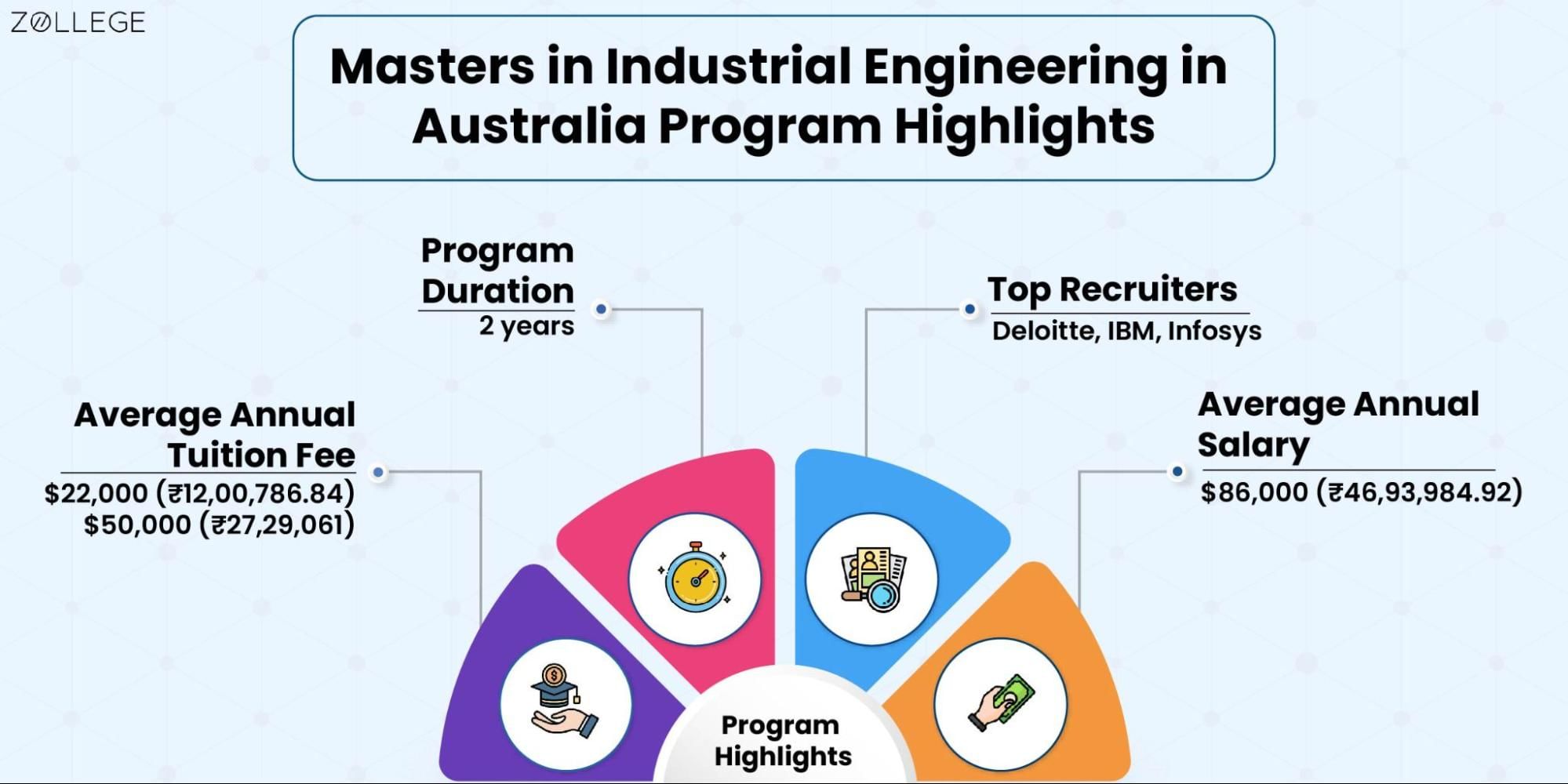
AUD 1 = 54.58 as on 22nd November 2023
Why Study for a Master's in Industrial Engineering in Australia?
The reason to pursue Masters in Industrial Engineering in Australia can be plenty such as the opportunity to work in diverse fields such as manufacturing, design, hardware, technology, etc. To study in Australia for masters, candidates need to be academically excellent and shouldn’t have many career gaps. The unique feature about Industrial Engineering is that candidates learn how to enhance the quality of life for people by proper communication with the system. The whole idea of Industrial engineering is to minimize time, resources as well as man power. Some notable reasons to study Industrial Engineering Masters Programs are given below:
- With a degree in Industrial Engineering, candidates would be open to all kinds of jobs in the engineering sector in the international market.
- Candidates can get a starting salary up to AUD 1,04,000 (INR 56,77,201.38) after pursuing Masters in Industrial Engineering.
- The return value of investment provided by the top Universities to the candidates can be above 100% for international students.
Masters in Industrial Engineering in Australia Specializations
The specializations of Masters in Industrial Engineering in Australia involve quality and reliability, cost engineering, production and manufacturing systems, etc. In Industrial Engineering, the 5 “M” are considered to be Man, Material, Machines, Methods, and Money. Industrial engineers are also responsible for maintaining the cost efficiency, risk analysis as well human factors of an organization. Candidates would have to undergo several exams to study in Australia for Industrial Engineering. The area of specializations is given below:
- Quality and Reliability Engineering: This branch of study is used to perform data analysis and curb failures before they happen. Candidates can land high paying jobs as a reliability engineer in the operating systems and be responsible for managing the various pertaining risks.
- Cost Engineering: This area is responsible for managing project cost, cost control, cost forecasting as well as risk analysis of an organization. The development and implementation of cost recording, reporting and maintaining standards of the project is the prime objective of a cost engineer.
- Operations Research and Decision Sciences: This process involves an analytical method of problem-solving and decision-making which becomes useful in the management of organizations. Operations Research Analyst rank #9 in the best business jobs according to US News.
- Human Factors/Ergonomics: This refers to the various human factors such as environmental, organizational and individual characteristics which influence the work culture in an organization. The demand for human factors engineers is expected to grow at an alarming rate of 35,600 new jobs filled by 2029.
- Production and Manufacturing Systems: This process involves the methods used in the industry to create goods and services from various sources. An overview of production engineer's future career prospects is that there will be 21% job growth by 2031. However, it is not limited to the experience of the candidates as well as his/her location of posting.
Masters in Industrial Engineering in Australia vs Canada
The countries which provide the most scope in Industrial Engineering are Canada, Australia, Germany, England are considered the best for Masters in Industrial Engineering. Masters in Industrial Engineering in Australia is considered worthy as this area of study involves high salaries along with quality exposures in industries. International candidates applying for industrial engineering masters in Australia must submit English proficiency test scores of PTE, IELTS, TOEFL for admissions in any country. The fees charged by different countries vary according to the course duration and mode. Some parameters are given below for comparison:
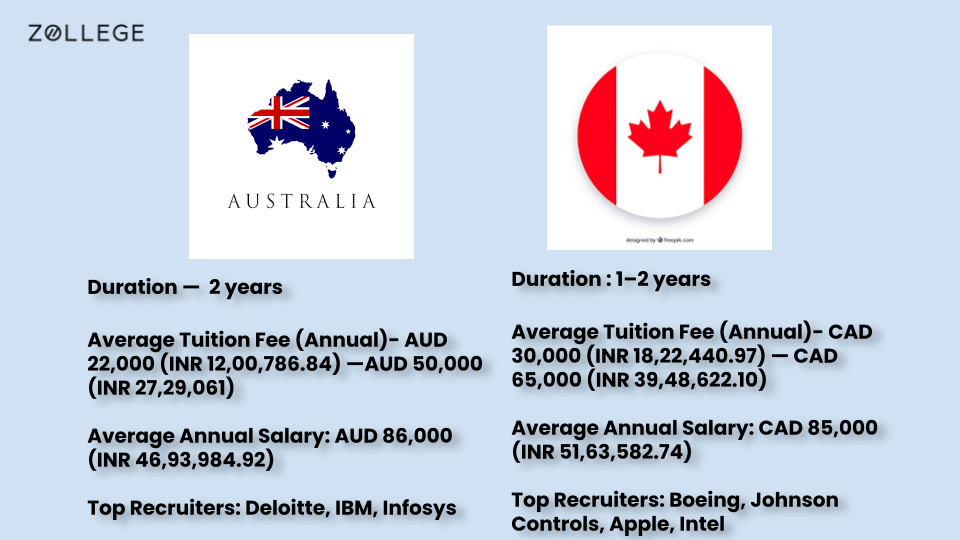
AUD 1 = 54.58 as on 22nd November 2023
Top Universities for Masters in Industrial Engineering in Australia
In Australia candidates can study for Masters in Industrial Engineering in Australia in top Universities such as University of New South Wales, Monash University, Melbourne University, etc. The University of New South Wales is considered the No.1 in Australia for engineering departments according to the QS Top Universities Ranking 2023. Candidates must keep in mind about the Masters in Industrial Engineering in Australia Fees in the particular University they are applying for. The fees vary upon the year and mode of study. The Ms In Industrial Engineering In Australia top Universities and their annual fees are given below:
| University | Program Fees |
| University of New South Wales | AUD 1,130 (INR 68,645.28) per credit |
| Queensland University of Technology | AUD 37,600 (INR 22,84,126.01) |
| University of Sydney | AUD 54,000 (INR 32,80,393.74) |
| University of South Australia | AUD 40,200 (INR 24,42,070.90) |
| Monash University | AUD 55,500 (INR 33,71,515.79) |
| University of Melbourne | AUD 40,256 (INR 24,45,472.79) |
| Curtin University | AUD 19,116 (INR 11,61,259.38) for 100 credits |
| Deakin University | AUD 38,600 (INR 23,44,874.04) |
AUD 1 = 54.58 as on 22nd November 2023
Masters in Industrial Engineering in Australia Application Deadlines
To apply for Masters in Industrial engineering in Australia, candidates must be aware of the intakes in Australia. There are normally 3 intakes in Australia in a year. For 2023–23 Universities such as Queensland, New South Wales, South Australia are open for applications in Australia. Candidates must properly check the admission intakes and deadlines of each University and then apply. The below table shows the deadlines of top Universities for Masters in Industrial Engineering:
| University | Deadline |
| University of New South Wales | Term 1: 30 November Term 2: 31 March Term 3: 31 July |
| Queensland University of Technology | 2 weeks before the course commencement |
| University of Sydney | January 15, June 25 |
| University of South Australia | For Study Period 2 (February to June, semester 1) apply by November 15th For Study Period 5 (July to November, semester 2) apply by April 15th |
| Monash University | Semester one (March) Semester two (July) |
| University of Melbourne | November 30 April 30 |
| Curtin University | February 8, 2024 |
| Deakin University | February 18, 2024 |
Masters in Industrial Engineering in Australia Application Process
The requirements to apply for Masters in Industrial Engineering in Australia are a bachelor's degree, scores of English proficiency test scores, standardized scores, etc. The maximum gap that Australia allows for Masters is 2 years. International students must properly understand the application process of a University and then proceed further. After submission of the application, candidates must keep checking the status of their application. The list of steps are given below:
- Select a University
- Select the mode of study
- Submit personal and academic details
- Work experience may be required
- Submit English Proficiency test scores IELTS, TOEFL, PTE.
- Pay the application fee of the University
- Submit the application
- Check the status of your application regularly
Eligibility for Masters in Industrial Engineering in Australia For International Students
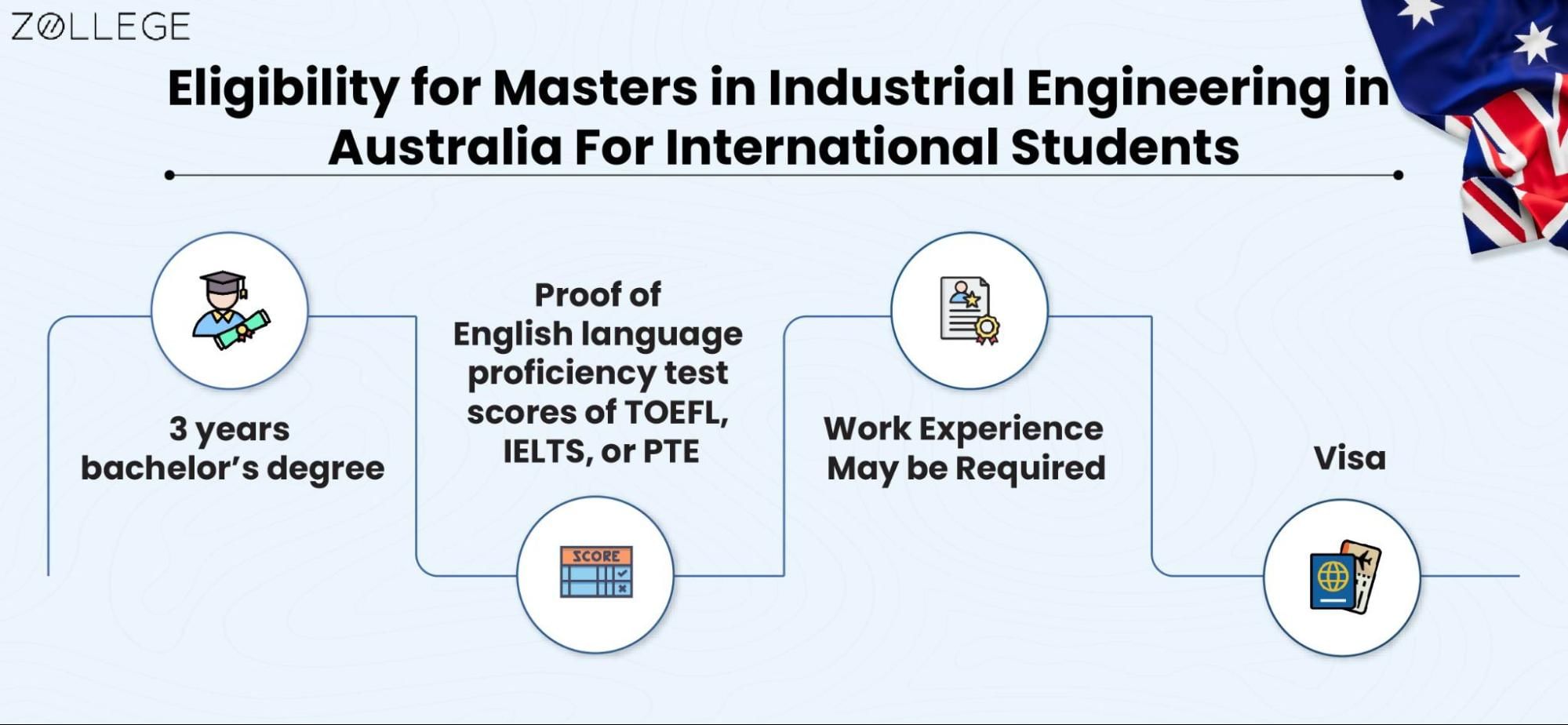
Candidates who have successfully completed their bachelor studies with minimum 65% marks can apply for Masters in Industrial Engineering in Australia. International candidates must prefer to study a bachelors degree in engineering or science field. The specializations must be in manufacturing, architecture or mechanical engineering. The eligibility criteria however can vary according to the mode of study a candidate chooses. Some general Masters In Industrial Technology Requirements are given below:
Documents Required for Masters in Industrial Engineering in Australia
International candidates need to submit certain documents such as a completed application, past academic results, as well as scores of English proficiency test scores. Candidates would require an Australian student visa after the letter of confirmation arrives via email. The documents must be attached with the application form and sent accordingly to the particular University. Some Universities also have an extended deadline for documents submission. The list of documents are as follows:
- Academic transcripts
- Passport
- LOR/SOP
- English Language Proficiency test scores
- Updated CV/Resume
- Copy of Passport
Masters in Industrial Engineering in Australia Application Fee
The application fee for Industrial Engineering masters courses varies upon the University for international students. The application fee ranges from AUD 55 (INR 3,341.14) to AUD 150 (INR 9,112.20). The course fees for Masters in Industrial Engineering ranges from AUD 22,000 (INR 12,00,786.84) —AUD 50,000 (INR 27,29,061) annually for international students. Candidates must properly have a look upon all the costs associated with admissions and then apply. The below table shows the Ms In Industrial Engineering In Australia application fees charged by the Universities:
| University | Application Fee |
| University of New South Wales | AUD 150 (INR 9,112.20) |
| Queensland University of Technology | AUD 100 (INR 6,074.80) |
| University of Sydney | AUD 150 (INR 9,112.20) |
| University of South Australia | Not required |
| Monash University | AUD 100 (INR 6,074.80) |
| University of Melbourne | AUD 120 (INR 7,289.76) |
| Curtin University | Not required |
| Deakin University | AUD 55 (INR 3,341.14) |
AUD 1 = 54.58 as on 22nd November 2023
Masters in Industrial Engineering in Australia Score Requirements
MS in Industrial Engineering can be done by candidates pursuing a deep interest in areas such as operations research, statistics, production planning, simulation, inventory control, etc. Candidates can however study in Australia without the IELTS exam in some Universities. GRE or GMAT scores are required for Masters in Industrial Engineering in Australia and are widely accepted in the top Universities. Candidates must properly submit all the scores along with the application form. The scores for best Universities for Masters In Industrial Engineering in Australia are mentioned below:
| University | ELP Score Required | GRE/GMAT Score |
| University of New South Wales | PTE score: 64 IELTS score: 6.5 TOEFL score: 90 |
GMAT score: 650 |
| Queensland University of Technology | IELTS score: 6.5 | GMAT score: 550 |
| University of Sydney | PTE score: 61 IELTS score: 6.5 TOEFL score: 85 |
GRE score: 300+ GMAT score: 630+ |
| University of South Australia | PTE score: 58 IELTS score: 6.5 TOEFL score: 79 |
Not required |
| Monash University | PTE score: 58 IELTS score: 6.5 TOEFL score: 79 |
Not required |
| University of Melbourne | PTE score: 50 IELTS score: 6.0 TOEFL score: 79 |
GRE score: 310 GMAT score: 560 |
| Curtin University | PTE score: 58 IELTS score: 6.5 TOEFL score: 79 |
GMAT score: 580 |
| Deakin University | PTE score: 42 IELTS score: 5.5 TOEFL score: 52 |
GMAT score: 590 |
Masters in Industrial Engineering in Australia Living Cost
The living expense in Australia would vary according to the city and lifestyle that a candidate is selecting. The average cost of living for international students in Australia ranges from AUD 24,505 (INR 14,88,630.53)—AUD 66,200 (INR 40,21,519.73). International students can live in Australia after their masters completion. However, they must possess a visa called Post Study Work Visa which will grant them 2 years of extra living in Australia. The below table summarizes the cost of living in different top Universities in Australia:
| University | Annual Cost of Living |
| University of New South Wales | AUD 36,478 (INR 22,15,966.72) |
| Queensland University of Technology | AUD 35,855.16 (INR 21,78,130.42) |
| University of Sydney | AUD 24,505 (INR 14,88,630.53) |
| University of South Australia | AUD 37,986 (INR 23,07,574.75) |
| Monash University | AUD 54,768 (INR 33,27,048.23) |
| University of Melbourne | AUD 46,320 (INR 28,13,848.85) |
| Curtin University | AUD 41,000 (INR 24,90,669.32) |
| Deakin University | AUD 66,200 (INR 40,21,519.73) |
AUD 1 = 54.58 as on 22nd November 2023
Scholarships for Masters in Industrial Engineering in Australia
Candidates can get a 100% scholarship for Masters in Australia on merit basis and past academic performance. These 100% free scholarships can be awarded by a few Universities. International candidates who are fixed on their budget can also apply in the cheapest Universities in Australia. The GPA required for a scholarship in Australia for Masters candidates is 4.0 on a scale of 7.0. Some scholarships for Australia Industrial Engineering are given below:
| Scholarship | Eligibility | Amount |
| University of New South Wales (International Scientia Coursework Scholarship) | Academic Merit | AUD 10,000 (INR 6,07,480.32) per year |
| Queensland University of Technology (International Merit Scholarship) | Must be an international student and satisfy the ELP requirements | 25% of tuition fee for one year |
| University of Sydney (Australian Awards Scholarship) | Meet all the admission eligibility requirements | Full course tuition fees covered |
| University of South Australia (International Merit Scholarship) | Academic merit | Varies |
| Monash University (Monash International Merit Scholarship) | Minimum a WAM of 85; Application statement of 500 words | AUD 6,923 (INR 4,20,558.63) per year |
| University of Melbourne (Graduate Scholarship) | Automatically considered upon admissions | 100% fee remission and up to AUD 135,000 (INR 82,00,984.35) |
| Curtin University (Alumni and Family Scholarship) | Available to students commencing studies at Curtin’s Western Australia campuses in 2024 | 25% of the first-year tuition fee |
| Deakin University (Deakin Vice-Chancellor’s International Scholarship) | Academic merit Secured at least 85% marks in previous studies. | 50% reduction on tuition fees or full tuition fee coverage |
AUD 1 = 54.58 as on 22nd November 2023
Masters in Industrial Engineering In Australia Jobs
Industrial engineers make around AUD 86,000 (INR 52,24,330.77) in Australia. Candidates get high paying jobs after completing Industrial Engineering Masters courses depending upon their profile and location. The scope of Industrial Engineering lies in the job opportunities in areas like manufacturing, design, hardware, technology, retail, etc. However, the salary received by an Engineering graduate varies upon the location of work. The below table shows the top cities and the Industrial Engineering Australia salary of graduates:
| Job Location | Average Salary |
| Sydney | AUD 90,000 (INR 54,67,322.90) |
| Melbourne | AUD 89,000 (INR 54,06,574.87) |
| Perth | AUD 86,000 (INR 52,24,330.77) |
| Adelaide | AUD 83,000 (INR 50,42,086.68) |
| Brisbane | AUD 86,000 (INR 52,24,330.77) |
AUD 1 = 54.58 as on 22nd November 2023
Work Permit for Masters In Industrial Engineering In Australia
Candidates would be required to obtain a work permit to stay and work in Australia. International candidates will be allowed to get a Skilled Graduate Temporary Visa (485) only if they complete the majority of the units in a two-year degree. The length of PSW visa after Masters in Australia ranges from 3 to 5 years. The work permit is essential for undertaking any types of jobs in Australia, be it full-time or part-time jobs. The candidate must have health insurance apart from the academic requirements to avail a Post Study Work Visa in Australia.
Return on Investment for Masters in Industrial Engineering in Australia
ROI in the return value that candidates receive after pursuing Masters in Industrial Engineering in Australia. The amount spent by the candidate on the course as well as the extra incurring cost sums up their total expenses for study in Australia. The average annual salary received after the completion of the course is AUD 86,000 (INR 46,93,984.92). From the table below, candidates can get an approximate idea that University of New South Wales has the most positive ROI among all the top Universities. The data is summarized below:
| University | Tuition Fee | Cost of Living | Total Expense | Average Annual Salary | ROI |
| University of New South Wales | AUD 1,130 (INR 68,645.28) per credit | AUD 36,478 (INR 22,15,966.72) | AUD 37,608 (INR 22,84,612) | AUD 86,000 (INR 46,93,984.92) | 128.67% |
| Queensland University of Technology | AUD 37,600 (INR 22,84,126.01) | AUD 35,855.16 (INR 21,78,130.42) | AUD 73,455.16 (INR 44,62,256.43) | 17.08% | |
| University of Sydney | AUD 54,000 (INR 32,80,393.74) | AUD 24,505 (INR 14,88,630.53) | AUD 78,505 (INR 47,69,024.27) | 9.55% | |
| University of South Australia | AUD 40,200 (INR 24,42,070.90) | AUD 37,986 (INR 23,07,574.75) | AUD 78,186 (INR 47,49,645.65) | 9.99% | |
| Monash University | AUD 55,500 (INR 33,71,515.79) | AUD 54,768 (INR 33,27,048.23) | AUD 1,10,268 (INR 66,98,564.02) | -22.01% | |
| University of Melbourne | AUD 40,256 (INR 24,45,472.79) | AUD 46,320 (INR 28,13,848.85) | AUD 86,576 (INR 52,59,321.64) | -0.67 | |
| Curtin University | AUD 19,116 (INR 11,61,259.38) for 100 credits | AUD 41,000 (INR 24,90,669.32) | AUD 60,116 (INR 36,51,928.71) | 43.06% | |
| Deakin University | AUD 38,600 (INR 23,44,874.04) | AUD 66,200 (INR 40,21,519.73) | AUD 1,04,800 (INR 63,66,393.78) | -17.94 |
Candidates can pursue Masters after Industrial Engineering bachelor's programs with a GPA of 4.0. Industrial engineers are responsible for the mathematical calculations and maintenance of analysis of a system. This is one of the most in- demand industries that operate in Australia. International candidates can work in different industries, provided they have a work visa along with them.
FAQs
Ques. Is a masters in industrial engineering worth it?
Ans. A masters in Industrial Engineering is highly valuable, as the job prospects of this course are plenty. Candidates can earn an average annual salary of AUD 86,000 (INR 46,93,984.92).
Ques. Is industrial engineering a good field?
Ans. Industrial Engineering in the top Universities of Australia are considered the best across multiple industries. The reasons being their ability and knowledge to uphold and improve the production process.
Ques. What are the cons of industrial engineering?
Ans. The cons of Industrial Engineering courses in Australia can be stressful work, tight deadlines, as well as limited budgets to reduce operational costs.
Ques. Is Australia good for MS in industrial engineering?
Ans. Australia is good for Masters in Industrial Engineering as the course provides the required exposure and growth in the engineering field for graduates.
Ques. Why should I do a Masters in industrial engineering?
Ans. The reason for pursuing Masters in Industrial Engineering is that candidates get an opportunity to combine their technical skills along with the business skills of an organization too. Candidates opting for Masters in Industrial Engineering for higher education in Australia must properly know about the course curriculum and duration.
Ques. Why do you want to pursue masters in industrial engineering?
Ans. The reason to pursue Masters in Industrial Engineering in Australia can be plenty such as the opportunity to work in diverse fields such as manufacturing, design, hardware, technology, etc. To study in Australia for masters, candidates need to be academically excellent and shouldn’t have many career gaps.
Ques. What is unique about industrial engineering?
Ans. The unique feature about Industrial Engineering is that candidates learn how to focus and have interaction with a system. The whole idea of Industrial engineering is to minimize time, resources as well as man power.
Ques. What is the specialization in industrial engineering?
Ans. The specializations of Masters in Industrial Engineering in Australia involve quality and reliability, cost engineering, production and manufacturing systems, etc.
Ques. What are the 5 “M” s in industrial engineering?
Ans. In Industrial Engineering, the 5 “M” are considered to be Man, Material, Machines, Methods, and Money. Industrial engineers are also responsible for maintaining the cost efficiency, risk analysis as well human factors of an organization.
Ques. Can I get PSW after 1.5 year masters in Australia?
Ans. International candidates will be allowed to get a Skilled Graduate Temporary Visa (485) only if they complete the majority of the units in a two-year degree.
![Australian National University [ANU]](https://static.zollege.in/public/college_data/images/studyabroad/logos/college_597_12-11:31_anu_logo_fb_350.png?tr=w-50,h-50,c-force?tr=h-40,w-35,c-force)
![The University of Melbourne [unimelb]](https://static.zollege.in/public/college_data/images/studyabroad/logos/college_609_20-15:00_mel-Logo.jpeg?tr=w-50,h-50,c-force?tr=h-40,w-35,c-force)
![University of New South Wales [UNSW]](https://static.zollege.in/public/college_data/images/studyabroad/logos/college_603_29-10:36_logo.jpeg?tr=w-50,h-50,c-force?tr=h-40,w-35,c-force)
![The University of Sydney [USYD]](https://static.zollege.in/public/college_data/images/studyabroad/logos/college_620_29-11:04_logo.jpeg?tr=w-50,h-50,c-force?tr=h-40,w-35,c-force)
![The University of Queensland [UQ]](https://static.zollege.in/public/college_data/images/studyabroad/logos/college_596_29-11:20_queensland_Logo.jpeg?tr=w-50,h-50,c-force?tr=h-40,w-35,c-force)