MS in Aerospace Engineering in Australia is 1-3 years of coursework depending on the course requirements of universities. Master of Science in Aerospace Engineering offers specialized technical knowledge in developing spacecraft and rockets, aerospace or aircraft equipment. The program requires a GPA of 2.5 or above or 65% of marks in UG degree to be considered for admission. You must have a bachelor degree in aerospace engineering or related fields to apply for this program. Students must have a PTE score of 58 or higher, or IELTS score of 6.5 or above to study in Australia for aerospace engineering masters.
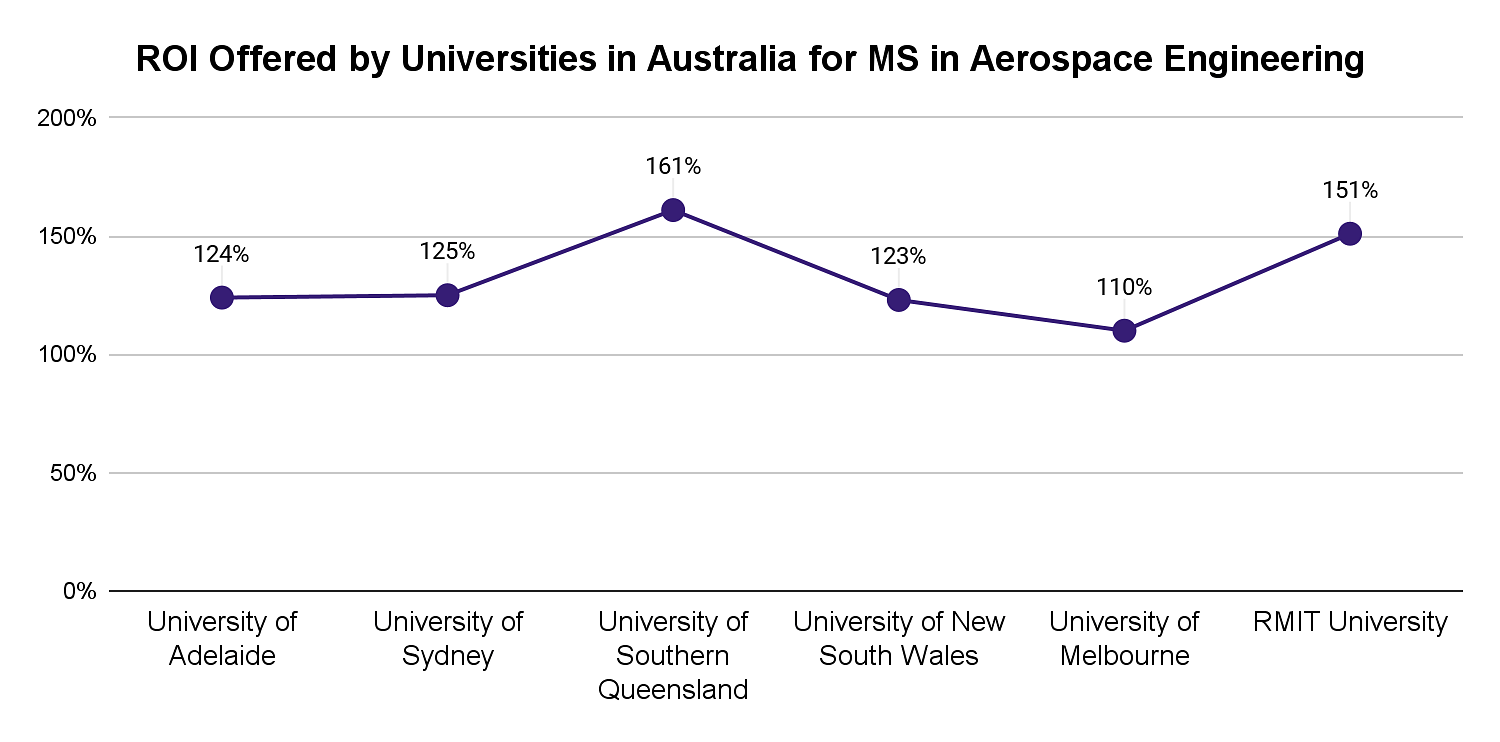
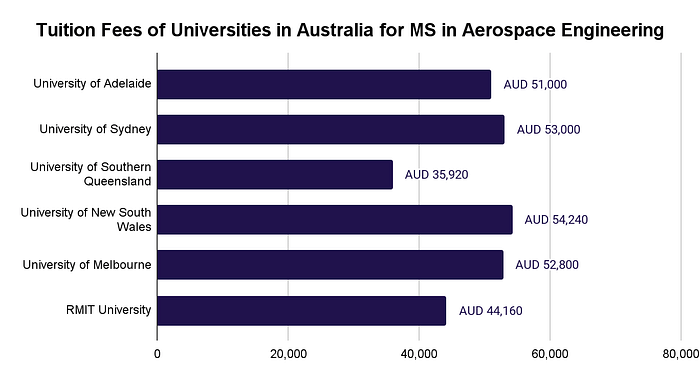
Students can attend universities like University of Adelaide, University of Sydney, RMIT University etc. for Aerospace Engineering Masters Australia. Candidates obtain an ROI of around 110-161% after completing the program. The average annual MS in Aerospace Engineering salary in Australia is AUD 97,000 (INR 52,51,588). University of Southern Queensland offers higher ROI of 161% and affordable tuition fees of AUD 35,920 (INR 19,42,079) than other universities. Students can also apply to RMIT University as it offers ROI of around 151% and tuition fees of around AUD 44,160 (INR 23,90,826). While, University of Melbourne has a low ROI of around 110% as compared to other universities. Students can verify the ROI of the universities to pursue their higher education in Australia for Aerospace Engineering courses.
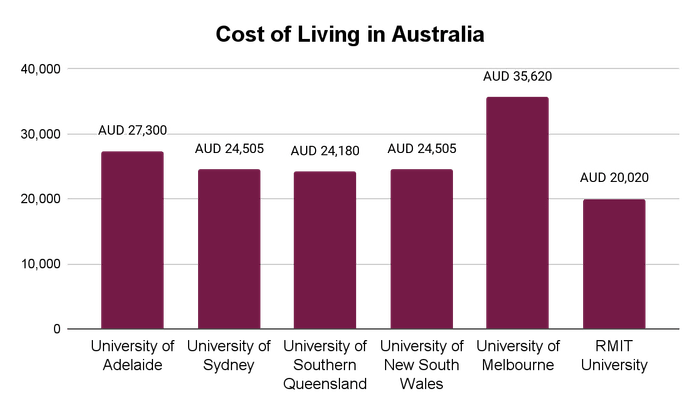
Master of Aerospace Engineering in Australia program costs vary from AUD 35,920-AUD 54,240 (INR 19,42,079-29,36,558). You need to make a budget of around AUD 20,020-AUD 35,620 (INR 10,83,884-19,28,470) to meet the living expenses in Australia. You can apply for International Student Support Scholarship, Future Leaders Scholarship and others to afford the expenses in Australia. Students must apply for Australia student visa to seek Aerospace Engineering degrees.
Why Choose MS in Aerospace Engineering in Australia?
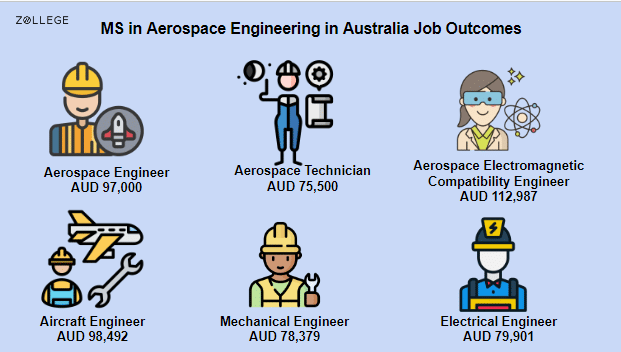
Is Aerospace Engineering demand in Australia? is the most concerning question. Students attain various jobs in Australia like Aerospace Engineer, Aerospace Technician, Electrical and Mechanical Engineer etc. after completing the program. Other reasons to apply for Masters in Aerospace in Australia are as follows:
- 93% of graduates employed in different industries of Aerospace Engineering in full-time hours.
- Students get hired in various industries like manufacturing, professional, scientific and technical services, public administration and safety etc.
- Around 1200 graduates get jobs as Aerospace Engineers in Australia with a basic pay range of AUD 78,000 -112,000 (INR 42,22,927-60,63,690) per year.
- Students get Aerospace engineering jobs in Australia in top companies like QinetiQ, Nova Group, Jacobs, EDT Networks Pty Ltd. etc.
Top Universities in Australia for MS in Aerospace Engineering
MS in Aerospace Engineering is based on specializations like advanced aerodynamics, aerospace structures and materials, propulsion systems, navigation etc. You can attend top universities in Australia like University of Sydney, RMIT University etc. for Aerospace Masters. Here, given below, is the bar graph to represent the tuition fees for top universities offering Aerospace Engineering in Australia for your reference:
MS in Aerospace Engineering in Australia Requirements
Students must meet the MS in Aerospace Engineering eligibility to apply to Australian universities. The admission requirements for the program include a bachelor degree, ELP scores, transcripts etc. The table below states the admission requirements for MS in Aerospace Engineering in Australia:
| Top Universities | Score Requirements | Entry Requirements |
| University of Adelaide | IELTS: 6.5 TOEFL: 79 PTE: 58 |
A GPA of 2.5 on a 4.0 scale is required. |
| University of Sydney | IELTS: 6.5 TOEFL: 85 PTE: 61 |
|
| University of Southern Queensland | IELTS: 6.5 PTE: 58 TOEFL: 90 |
|
| University of New South Wales |
IELTS: 6.5 |
|
| University of Melbourne |
IELTS: 6.5 |
|
| RMIT University | IELTS score: 6.5 TOEFL: 79 PTE: 58 |
MS in Aerospace Engineering in Australia Application Deadlines and Fees
Top universities in Australia for MS in Aerospace Engineering offer mainly two intakes: Semester 1 (February) and Semester 2 (July). The table below states the application fee and deadlines for Australian universities to seek Aerospace Engineering degrees Australia:
| Top Universities | Application Deadline | Application Fee |
| University of Adelaide | 5 June 2024 (July intake) | AUD 110 (INR 5,955) |
| University of Sydney | Semester 1: 15 January, 2024 (Closed) Semester 2: 25 June, 2024 |
AUD 150 (INR 8,121) |
| University of Southern Queensland | Trimester 1: 22 January, 2024 (Closed) Trimester 2: 13 May, 2024 Trimester 3: 2 September, 2024 |
Not required |
| University of New South Wales | Term 1: 30 November, 2023 (Closed) Term 2: 31 March 2024 Term 3: 31 July 2024 |
AUD 150 (INR 8,121) |
| University of Melbourne | 30 April 2024 | AUD 130 (INR 7,038) |
| RMIT University |
Semester 1: 15 November 2023 (for February start) -Closed Semester 2: 15 April, 2024 (for July start) |
AUD 100 (INR 5,414) |
AUD 1 = INR 54.14 as dated on 2nd March, 2024
MS in Aerospace Engineering in Australia Cost of Living
University of Melbourne Parkville campus is in the central Melbourne area. The university has a comparatively higher cost of living than other universities due to its expensive accommodation rate. However, RMIT University Bundoora campus in the northeastern suburbs of Melbourne has affordable student accommodation in Australia. This university offers relatively lower living costs of around AUD 20,020 (INR 10,83,884) as compared to other universities. The graph below states the cost of living for MS in Aerospace Engineering in Australia:
Scholarships for MS in Aerospace Engineering in Australia
For applying for MS Aerospace Engineering Australia, various scholarships like Future Leaders Scholarship and others offer partial funding to afford the expenses. The table below states the scholarships in Australia for international students to study MS in Aerospace Engineering:
| Top Universities | Scholarship Name | Eligibility | Award |
| University of Adelaide | Global Academic Excellence Scholarship | International students must have strong academic performance | 50% reduction in tuition fees |
| University of Sydney | Sydney Scholars India Equity Scholarship | Indian students applying to any postgraduate program | Up to AUD 100,000 (INR 54,14,009) |
| University of Southern Queensland | International Student Support Scholarship | International students enrolled in postgraduate programs with strong academic records. | 10% reduction in tuition fees |
| University of New South Wales | International Scientia Coursework Scholarship | International students pursuing postgraduate programs with strong academic merit | AUD 20,000 (INR 10,82,801) per annum |
| University of Melbourne | Engineering and IT Foundation Graduate Scholarship | International students pursuing a master degree in Faculty of Engineering and Information Technology | AUD 15,000 (INR 8,12,101) per year |
| RMIT University | Future Leaders Scholarship | Indian students enrolled in masters coursework | 20% reduction in tuition fees |
MS in Aerospace Engineering in Australia Job Outcomes
Students must apply for Australian work visa to attain graduate Aerospace Engineering jobs Australia. There are various types of work visas: Employer Nomination Scheme visa, Skilled Independent visa, Skilled Nominated visa, Temporary Graduate visa etc. To avail of these visas, you must submit relevant documents like passport, ELP score, health insurance and police verification certificate. The table below states the Aerospace Engineering scope in Australia attained by graduates:
Top Recruiters for MS in Aerospace Engineering in Australia
Around 93% of graduates get jobs in various Aerospace industries after completing the program. The top recruiting companies to offer jobs after MS in Australia to Aerospace Engineering graduates are listed below:
- QinetiQ
- Nova Group
- Jacobs
- EDT Networks Pty Ltd
- Hofmann Engineering Pty Ltd
- Egis Group
- BAE Systems
- RunTime
- Space Machines Company
- L3Harris Technologies
Pursuing MS in Aerospace Engineering in Australia will enable you to attain various job opportunities with lucrative salaries. For admission to the program, applicants must have strong academic credentials. Students must be aware of the deadlines and requirements to apply for the program. Candidates can get the benefit of scholarships to manage accommodation and other expenses in Australia.
FAQs
Ques: How long does it take to complete MS in Aerospace Engineering in Australia?
Ans: MS in Aerospace Engineering in Australia is a postgraduate course study for 1-3 years depending on the course curriculum of different universities.
Ques: What are the areas of specialization for MS in Aerospace Engineering in Australia?
Ans: The areas of specialization for MS in Aerospace Engineering in Australia are advanced aerodynamics, propulsion systems, navigation etc.
Ques: What are the admission requirements for MS in Aerospace Engineering in Australia?
Ans: Students must have a GPA of 2.5 on a 4.0 scale to apply for MS in Aerospace Engineering in Australia. The other admission requirements for MS in Aerospace Engineering in Australia are LOR, SOP, work experience certificate, passport and resume.
Ques: What are the tuition fees for MS in Aerospace Engineering in Australia?
Ans: The tuition fees for MS in Aerospace Engineering in Australia vary from AUD 35,920-AUD 54,240 as per different universities.
Ques: What are the career prospects for graduates after MS in Aerospace Engineering in Australia?
Ans: The career prospects for graduates after MS Aerospace Engineering in Australia are Aerospace Engineer, Aerospace Technician, Mechanical Engineer etc.
Ques: What is the average salary for MS in Aerospace Engineering graduates in Australia?
Ans: The graduates earn an average salary of AUD 97,000 after completing MS in Aerospace Engineering in Australia.
Ques: Do I need work experience for admission to MS in Aerospace Engineering in Australia?
Ans: It is not mandatory to submit work experience certificate for admission to MS in Aerospace Engineering in Australia. White submitting work experience will increase your chance for admission to the program.
Ques: Are there scholarships available for applying for MS in Aerospace Engineering in Australia?
Ans: Yes, you can apply for scholarships like Global Academic Excellence Scholarship, Future Leaders Scholarship etc. for admission. The scholarship offers partial funding to cover the tuition fees and living expenses for pursuing MS in Aerospace Engineering in Australia.
Ques: Which universities offer MS in Aerospace Engineering in Australia?
Ans: Various universities like University of Adelaide, University of Sydney, RMIT University etc. offer MS in Aerospace Engineering in Australia.
Ques: How can I prepare for the application process to apply for MS in Aerospace Engineering in Australia?
Ans: You must shortlist the universities and gather relevant documents like transcripts, passport, and others to apply for MS in Aerospace Engineering in Australia.
Ques: What are the English language requirements for applying to MS in Aerospace Engineering in Australia?
Ans: You must secure a PTE score of 58, IELTS score of 6.5, TOEFL score of 79 or higher to apply for MS in Aerospace Engineering in Australia.
Ques: What are documents required for admission to MS in Aerospace Engineering in Australia?
Ans: The documents required for admission to MS in Aerospace Engineering in Australia are transcripts, LOR, SOP, ELP scores and work experience certificate.
Ques: Do I need a bachelors degree in aerospace engineering to apply for MS Aerospace Engineering in Australia, or are related engineering degrees acceptable?
Ans: Yes, you can apply with a bachelor degree in aerospace engineering or related engineering disciplines for MS Aerospace Engineering in Australia.
Ques: What are the eligibility criteria to pursue MS in Aerospace Engineering in Australia?
Ans: You must have 3-4 years of bachelor degree in related fields with a minimum 2.5 GPA on a 4.0 scale to pursue MS in Aerospace Engineering in Australia.
Ques: Can I work part-time while pursuing MS in Aerospace Engineering studies in Australia?
Ans: Yes, you can work part-time while pursuing your MS in Aerospace Engineering coursework in Australia. You can attain jobs like Administrative Assistant, Driver, Mail deliverer, Delivery person etc. to earn extra money to meet the living expenses in Australia.
Ques: Is Australia a good place to study aerospace engineering?
Ans: Yes, Australia has top-class universities and excellent faculties to offer effective education. Furthermore, Australia offers great career opportunities to graduates after completing aerospace engineering programs. Around 93% of graduates get employed in different Aerospace industries in full-time hours.
Ques: Is aerospace engineering in demand in Australia?
Ans: Yes, Aerospace engineering is one of the most demanding courses in Australia. Graduates attain various job profiles like Aerospace Engineer, Aerospace Technician, Mechanical Engineer etc. after completing the program.
Ques: How much do entry-level aerospace engineers make in Australia?
Ans: Aerospace engineers get a salary of AUD 78,000 per year at entry-level positions in Australia. The average annual salary of aerospace engineers in Australia is AUD 97,000.
Ques: What are the top recruiting companies for MS in Aerospace Engineering in Australia?
Ans: Graduates get hired by top companies like QinetiQ, Nova Group, Jacobs, EDT Networks Pty Ltd. etc. after completing MS in Aerospace Engineering in Australia.
Ques: Can international students stay in Australia after completing MS Aerospace Engineering for employment?
Ans: Yes, students must apply for Australian work visas to attend jobs after completion of MS in Aerospace Engineering in Australia. Students can avail of work visas like Employer Nomination Scheme visa, Skilled Nominated visa, Skilled Independent visa etc. for employment in Australia.
![Australian National University [ANU]](https://static.zollege.in/public/college_data/images/studyabroad/logos/college_597_12-11:31_anu_logo_fb_350.png?tr=w-50,h-50,c-force?tr=h-40,w-35,c-force)
![The University of Melbourne [unimelb]](https://static.zollege.in/public/college_data/images/studyabroad/logos/college_609_20-15:00_mel-Logo.jpeg?tr=w-50,h-50,c-force?tr=h-40,w-35,c-force)
![University of New South Wales [UNSW]](https://static.zollege.in/public/college_data/images/studyabroad/logos/college_603_29-10:36_logo.jpeg?tr=w-50,h-50,c-force?tr=h-40,w-35,c-force)
![The University of Sydney [USYD]](https://static.zollege.in/public/college_data/images/studyabroad/logos/college_620_29-11:04_logo.jpeg?tr=w-50,h-50,c-force?tr=h-40,w-35,c-force)
![The University of Queensland [UQ]](https://static.zollege.in/public/college_data/images/studyabroad/logos/college_596_29-11:20_queensland_Logo.jpeg?tr=w-50,h-50,c-force?tr=h-40,w-35,c-force)