PhD in Canada is the highest level of academic degree for 3 to 6 years. The top universities in Canada for PhD provide both academic doctorate (PhD in sciences and more) and professional (Doctorate in Business Administration) courses. Candidates are required to submit IELTS, and TOEFL score. It is important to meet the PhD requirements in Canada for international students to apply to the top universities. The annual tuition fees of the best universities in Canada for PhD vary from 6,000-22,000 CAD (INR 3,67,777- 13,48,510). Candidates get huge job opportunities after completing their PhD programs in Canada. The average annual salary of the candidates who attended PhD courses in Canada is 90,000 CAD (INR 55,16,882).
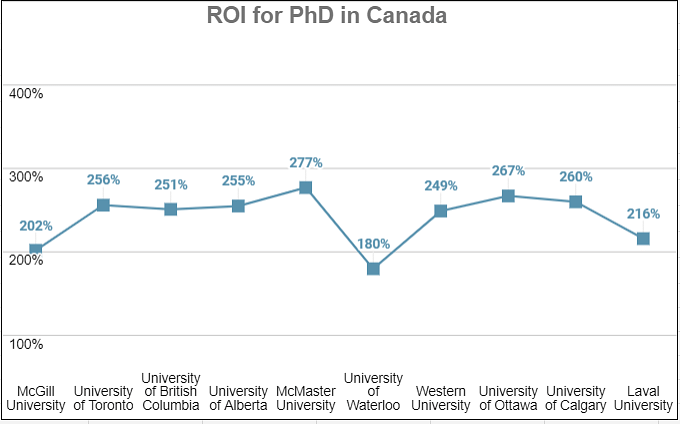
ROI for PhD in Canada is highest at 277% offered by University of Alberta, followed by University of Clagary at 267%, University of Waterloo at 260%. Positions in research, leadership, and other fields that are closed to those with less education can become available to those with a PhD. A PhD can be intellectually fulfilling and provide a sense of achievement. Students receive packages well above the average salary in Canada, with a PhD degree.
Doctorate programs in Canada have different entrance requirements for different universities and programs, but generally speaking, these include a strong academic record, research experience, scores from tests of English language proficiency (TOEFL or IELTS), GRE or GMAT results, letter of recommendation, and a research proposal.Numerous fellowships and scholarships are offered to assist with the cost of your PhD studies in Canada. Universities, private companies, and the government may all provide these.Depending on the university, the program, and your residency status, a PhD in Canada can cost different amounts. Tuition for international students is usually more than that of domestic students. On the other hand, compared to other developed nations, living expenses are generally lower in Canada.
|
Table of Contents |
Why Study PhD in Canada?
Pursuing a PhD in Canada can be a rewarding experience for many reasons. In Canada, a PhD normally takes four to six years to finish. In international comparisons, Canadian universities consistently rank highly, indicating that the country offers a top-notch educational system. In general, PhD programs in Canada are less expensive than those in the US or the UK. Furthermore, Canada has a high standard of living and is a friendly, multicultural nation. Canada has positioned itself as the best country to provide education and a supportive government for immigrants. Few universities in Canada offering GRE waiver for PhD progrma are also available. The reasons for studying in Canada are as follows:
- According to the QS World University Ranking 2023, 3 universities in Canada ranked in the top 50. These universities are McGill University (rank 31), University of Toronto (rank 34) and University of British Columbia (rank 47).
- Canada has been ranked as the 2nd largest research place in the country.
- Compared to the USA, the cost of living and tuition fee is much cheaper and more economical.
- Students can stay for about 3 years via PGWPP after completing their PhD courses in Canada. This will enable the candidates to get a Canadian PR.
- Canada provides immense scholarship opportunities for international students. Some of the scholarships for PhD students are The Pierre Elliott Trudeau Foundation Doctoral Scholarship etc. These scholarships provide an amount of 15,000 to 40,000 CAD per year.
- Students can also earn more money through part-time work in Canada during their course of study.
Listing below is an overview of studying PhD in Canada.
| Course | PhD |
| Duration | 3-6 years |
| Admission Intake Period | Fall, Winter, Spring/Summer |
| Top Universities |
|
| Average Annual Tuition Fee | 6,000 CAD – 22,000 CAD (INR 3,67,777- 13,48,510) |
| Popular PhD Courses in Canada |
PhD Psychology Canada, |
| Research Universities Offering PhD in Canada | 100+ |
| Work-Study Opportunities | 10 hours a week |
| PGWP Duration | At least 3 years |
| Average Annual Salary | 90,000 CAD (INR 55,16,882) |
CAD 1= INR 61.09, as of 2nd March 2024
Top Universities in Canada for PhD
The best university for your PhD program will depend on a number of things, such as your research interests, program offerings, faculty qualifications, funding availability, and campus culture. It's wise to conduct in-depth research and think about getting in touch with possible supervisors to talk about your research fit. There are more than 100 universities whwether among top public universities in Canada or among private universities that offer PhD programs in Canada. Here are a few of the top universities for doctoral studies with fees:
| Name of the University | Annual Tuition Fees |
|---|---|
| McGill University | 17,192 CAD (INR 10,54,421) |
| University of Toronto | 8,735 CAD (INR 5,35,735) |
| University of British Columbia | 9,312 CAD (INR 5,71,138) |
| University of Alberta | 8,874 CAD (INR 5,44,249) |
| McMaster University | 6,306 CAD (INR 3,86,752) |
| University of Waterloo | 22,188 CAD (INR 13,60,808) |
| Western University | 9,660 CAD (INR 5,92,455) |
| University of Ottawa | 7,413 CAD (INR 4,54,713) |
| University of Calgary | 8,242 CAD (INR 5,05,564) |
| Laval University | 14,703 CAD (INR 9,01,872) |
CAD 1= INR 61.09, as of 2nd March 2024
Admission Process
Candidates must follow the admission process to get a chance at the top PhD colleges in Canada, whether it is among top universities in Toronto, or Calgary. Here given below is the step to step guide to the admission process for PhD admission in Canada:
- Select the PhD programs in Canada and shortlist the universities for attaining the courses.
- Identify a supervisor to get guidance in the research programs.
- Submit the research proposal as per the guidelines of the selected university that depicts the summary of the project.
- Fill in the application form and pay the application fees.
- Submit all the required documents as asked by the university.
- Attend the interview offered by Canadian universities.
- After confirmation of application, apply for a student visa.
Admission Deadline
The deadlines for applications to Canadian universities differ based on the type of institution, the program graduate or undergraduate, and the term of admission or intakes in Canada like fall, winter, or summer.The admission deadline of the top universities for PhD admission in Canada is as follows:
| Name of the University | Application Deadline |
|---|---|
| University of Toronto | February 1st, 2024 |
| McGill University |
Fall- August 1, 2024 Summer- October 1, 2024 |
| University of British Columbia |
May 2024 Intake- 05 January 2024 July 2024 Intake- 31 March 2024 September 2024 Intake- 30 April 2024 January 2025 Intake- 15 July 2024 |
| McMaster University | April 1, 2024 |
| University of Alberta | 1 July 2024 |
| University of Ottawa | April 1st, 2024 |
| Western University | Opens Oct 1- Closes Mar 1 2024 |
| University of Calgary | Mar. 1, 2024 |
| University of Waterloo | September 1, 2024 |
| Laval University | Fall 2024- Apply by March 1, 2024 |
PhD in Canada Eligibility Criteria
Candidates can apply for full time or part time or online PhD Canada. Candidates need to follow certain criteria to apply for PhD in Canada. Listing below are the eligibility criteria of the best universities in Canada for PhD:
- A master’s degree with an excellent academic record.
- Strong GRE or GMAT score is required.
- IELTS score of 6.5 is required.
- TOEFL score of 100 is required.
- PBT score of 600 is required.
- GPA score of 3.0 or higher score.
Admission Requirements
Excellent results in pertinent coursework in order to be considered for graduate programs. Although they vary, minimum GPA requirements usually fall between 70% and 80%. Candidates must meet the admission requirements to apply to the top universities in Canada. Exams requireed to study in Canada for PhD in Canada for Indian students requirements for admission are tabulated below:
| Name of the University | Admission Requirements |
|---|---|
| University of Toronto | TOEFL: 93 IELTS: 7.0 |
| McGill University | TOEFL: 100 IELTS: 7.5 |
| University of British Columbia | TOEFL: 90 IELTS: 6.5 |
| McMaster University | TOEFL: 92 IELTS: 6.5 |
| University of Alberta | TOEFL: 100 IELTS: 7 |
| University of Ottawa | TOEFL: 100 IELTS: 7 |
| Western University | TOEFL: 86 IELTS: 7 |
| University of Calgary | TOEFL: 97 IELTS: 7 |
| University of Waterloo | TOEFL: 90 IELTS: 7 |
| Laval University | TOEFL: 86 IELTS: 6.5 |
PhD in Canada Application Fee
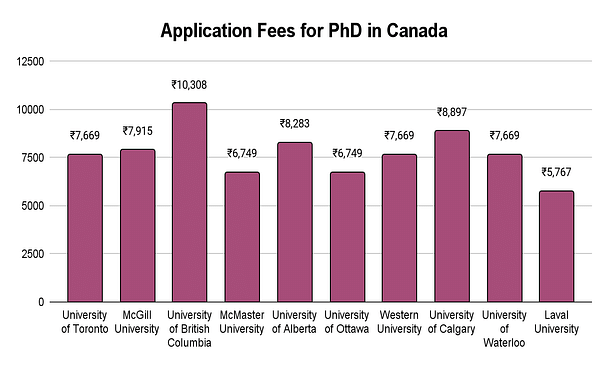
There aren't many Canadian universities that require an application fee. On their website, each university will provide details regarding their application costs. The list below does not include any universities in Canada without application fee. The graph below states the application fee of the top universities in Canada for PhD:
CAD 1= INR 61.09, as of 2nd March 2024
Admission Document Requirement
Students need to submit various documents to study in Canada.The documents required to be submitted to the universities for PhD programs in Canada are:
- Transcripts of previous degrees
- GRE/GMAT Scorecards of entrance exams
- Proficiency language scorecards such as IELTS/TOEFL
- An updated CV/Resume
- Statement of purpose/ research outline
- Writing sample
- Letters of recommendation
- Application form and fee slip
- Proof of sufficient funds
PhD in Canada Cost
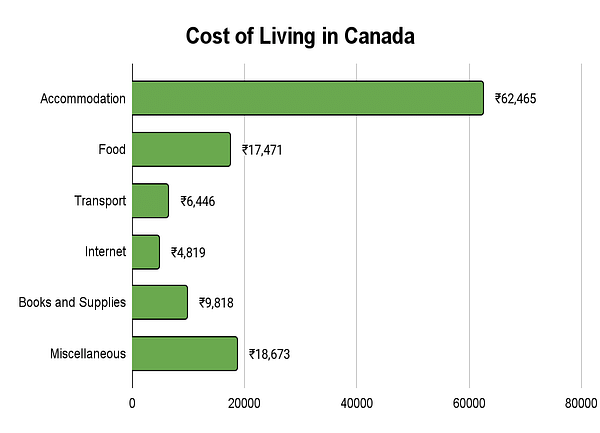
Canada is a friendly, safe nation with an excellent standard of living. There is a strong sense of community and the people are courteous and friendly. Regarding outdoor recreation and natural beauty, Canada is a great place to visit. Candidates of full time or part time PhD Canada must bear the cost of living in Canada. The cost of living for PhD in Canada for international students is detailed below in graph:
CAD 1= INR 61.09, as of 2nd March 2024
PhD Scholarship in Canada
Canadian universities offer various scholarships to students during their course of study. A fully funded PhD in Canada for Indian students usually provides 100% concession on tuition fees, accommodation fees, research, and insurance costs. Students will get benefitted by various scholarships in Canada for international students. The table below shows the eligibility details for PhD in Canada for Indian students with scholarship details:
| PhD Scholarship in Canada | Eligibility | Scholarship Amount |
|---|---|---|
| Ontario Trillium Scholarship | International students pursuing PhD at top universities in Ontario | 40,000 CAD/year (INR 24,53,635) |
| Ontario Graduate Scholarship | PhD research courses with partner universities | 5,000 CAD (INR 3,06,663) per session, 10,000 CAD (INR 6,13,423) for 2 consecutive sessions or 15,000 CAD (INR 9,19,991) for 3 consecutive sessions |
| Vanier Canada Graduate Scholarship | PhD programs specialized in the field of social science, engineering, humanities, health, or natural sciences | 50,000 CAD/year |
| Pierre Elliott Trudeau Foundation Doctoral Scholarship | PhD programs in social science or humanities | 40,000 CAD/year |
| Robert Hartog Graduate Scholarship | PhD at the University of Waterloo | 5,000 CAD/year |
CAD 1= INR 61.09, as of 2nd March 2024
Jobs after PhD in Canada
There are numerous career options after PhD in Canada for Indian students including part time job in Canada. PhD graduates can find teaching positions at many universities, particularly in fields where there is a dearth of experienced teachers. PhD graduates are hired by a number of Canadian companies for roles in research and development.The below table shows the salary for different job roles in Canada:
| Job Title | Average Annual Salary |
|---|---|
| Research Scientist | 80,920 CAD (INR 49,60,413) |
| Data Scientist | 92,008 CAD (INR 56,40,652) |
| Postdoctoral Research Associate | 47,524 CAD (INR 29,13,511) |
| Project Manager, (Unspecified Type / General) | 114,130 CAD (INR 69,96,866) |
| Medical Writer | 66,051 CAD (INR 40,48,138) |
| Physicist | 82,351 CAD (INR 50,47,134) |
| Software Engineer | 100,259 CAD (INR 61,44,681) |
CAD 1= INR 61.09, as of 2nd March 2024
Top Recruiters for PhD in Canada
There are certain limitations on working while pursuing a PhD in Canada for foreign students. Both a work permit and a valid study permit are required for high paying jobs in Canada. While working off-campus may be restricted to 20 hours per week during the semester and full-time during breaks, working on campus is normally unrestricted.The top recruiters for PhD in Canada are as follows:
- Stanford University
- Economist Intelligence Unit
- Ryerson University
- York University
- Prime Minister's Office
- Northern Illinois University
- Science & Economic Development Canada
- University of Mohamed VI Polytechnique
- Environment and Climate Change Canada
- University of Toronto
Work Permit
Canada is a country known for their supportive immigration policies. Students should have a student visa and electronic travel authorization to study and travel in Canada. PGWP stands for Post-Graduation Work Permit. It allows international students to study and work in Canada for around 3 years even after completing their course of study. Those who have a PGWP can eventually apply for Canadian PR. Candidates have to complete at least 2 years of their PhD course with a good academic record to apply for the work permit for Canada visa. Candidates should apply via a federal skilled work visa. To pursue a PhD in Canada, you must apply for a study permit. The particular requirements will change based on your country of citizenship.
Canadian universities are known for fostering a collaborative and supportive environment for graduate students. Pursuing PhD courses in Canada can lead to immense job opportunities for the candidates. Candidates must meet the eligibility condition to apply to the top universities for PhD programs in Canada. Aspirants can also apply for PhD in Canada without IELTS. There are also various scholarships for PhD programs in Canada for international students. Candidates can avail of the PhD programs in Canada with scholarship.
FAQs
Ques: What are the career prospects after completing a Ph.D. in Canada?
Ans: In Canada, doctorate holders frequently go on to work in academia, research, business, government, or entrepreneurship. The particular opportunities vary according to the field of study.
Ques: Can I transfer credits from another Ph.D. program to a Canadian university?
Ans: Program policies and the university will determine this. For detailed information on credit transfer, get in touch with the admissions office.
Ques: What are the key research strengths of Canadian universities?
Ans: Institutions differ in their strengths in research. To determine which university best suits your interests, look through the faculty research profiles of each one.
Ques: Is there support for international students in terms of adapting to Canadian culture?
Ans: In Canada, there are plenty of options for Ph.D. candidates to work as research or teaching assistants, which can offer both valuable experience and financial support.
Ques: Are there opportunities for teaching or research assistantships?
Ans: In Canada, there are plenty of options for Ph.D. candidates to work as research or teaching assistants, which can offer both valuable experience and financial support.
Ques: Can I bring my family with me during my Ph.D. studies?
Ans: You are welcome to bring your family, but make sure you are aware of the necessary visa requirements and any extra family support services.
Ques: Is health insurance included in the Ph.D. program fees?
Ans: International students can get health insurance from many universities, but it's important to check with the specific university.
Ques: What is the cost of a Ph.D. in Canada for international students?
Ans: Although tuition costs vary, international students often pay more. Verify the particular costs associated with the program and university that interest you.
Ques: How do I apply for a Ph.D. program in Canada?
Ans: Apply online via the university's admissions portal, making sure to include all necessary supporting documentation, such as transcripts, recommendation letters, and a statement of purpose.
Ques: Are there opportunities for interdisciplinary research?
Ans: Interdisciplinary research is encouraged in many Canadian universities, enabling cross-departmental collaboration among students.
Ques: What is the structure of a Canadian Ph.D. program?
Ans: Coursework, comprehensive exams, and original research culminating in a dissertation are typical components of Ph.D. programs.
Ques: Is there an age limit for starting a Ph.D. in Canada?
Ans: No, there's usually no age restriction to enroll in a Ph.D. program.
Ques: How can I find a Ph.D. supervisor?
Ans: Look up faculty biographies, go to conferences, and make direct contact with prospective mentors to convey your interest.
Ques: Is there a comprehensive exam in Canadian Ph.D. programs?
Ans: A comprehensive exam or qualifying exam is a common component of Ph.D. programs, designed to evaluate a student's knowledge in their field.
Ques: Can I work while pursuing my Ph.D. in Canada?
Ans: Yes, most doctoral students are permitted to work part-time while enrolled in classes, both on and off campus.
Ques: What is the language proficiency requirement for international students?
Ans: International students usually have to take tests like the TOEFL or IELTS to prove that they are proficient in either French or English.
Ques: Do I need a Master's degree to apply for a Ph.D. in Canada?
Ans: Depending on the program, yes. While some might require a master's degree, others might accept students with a bachelor's.
Ques: Are there scholarships available for international Ph.D. students?
Ans: Indeed, a large number of Canadian universities provide scholarships to Ph.D. candidates from both home and abroad. Investigate options such as the Vanier Canada Graduate Scholarship.
Ques: How do I choose a university for my Ph.D. studies?
Ans: Take into account elements like program reputation, research faculty, resources available, and location.
Ques: What is the duration of a Ph.D. program in Canada?
Ans: In Canada, the majority of PhD programs take four to six years to finish.
![University of Toronto [U of T]](https://static.zollege.in/public/college_data/images/studyabroad/logos/college_104_25-12:44_University_of_Toronto-logo-2417C8AF32-seeklogo.jpeg?tr=w-50,h-50,c-force?tr=h-40,w-35,c-force)
![The University of British Columbia [UBC]](https://static.zollege.in/public/college_data/images/studyabroad/logos/college_64_25-11:13_Capture.jpeg?tr=w-50,h-50,c-force?tr=h-40,w-35,c-force)

![University of Montreal [U de M]](https://static.zollege.in/public/college_data/images/studyabroad/logos/college_71_24-17:54_udem.jpeg?tr=w-50,h-50,c-force?tr=h-40,w-35,c-force)
![University of Alberta [UAlberta]](https://static.zollege.in/public/college_data/images/studyabroad/logos/college_9_24-17:46_alberta-.jpeg?tr=w-50,h-50,c-force?tr=h-40,w-35,c-force)