
MHT CET 2020 Question Paper with Solution PDF for PCB (October 4)


Content Writer | Updated On - Jan 21, 2026
MHT CET Question Papers are the most important study material for effective exam preparation. We at Zollege have provided all MHT CET Previous Year Papers with Solution PDFs here. MHT CET 2020 PCB exam was conducted successfully on October 4 by Shift 1.
Students can freely download the MHT CET previous year's question paper PDFs along with their solutions here.We strongly encourage MHT CET aspirants to scan through all the MHT CET Question Paper to know the overall difficulty level,MHT CET Syllabus and understand the changes in MHT CET Exam Pattern over the years.
MHT CET 2020 Oct 4 Shift 1 PCB Question Paper with Solution PDF
| MHT CET 2020 PCB Question Paper PDF | MHT CET 2020 PCB Solution PDF |
|---|---|
| Download PDF | Check Solutions |

For a transistor \(\frac{1}{\alpha_{dc}} - \frac{1}{\beta_{dc}}\) is (\(\alpha_{dc}\) and \(\beta_{dc}\) are current gains)
View Solution
The relation between the common-base current gain (\(\alpha_{dc}\)) and the common-emitter current gain (\(\beta_{dc}\)) is:
\(\)\beta_{dc = \frac{\alpha_{dc{1 - \alpha_{dc\(\)
Take the reciprocal of the relation:
\(\)\frac{1{\beta_{dc = \frac{1 - \alpha_{dc{\alpha_{dc\(\)
Split the fraction on the right side:
\(\)\frac{1{\beta_{dc = \frac{1{\alpha_{dc - \frac{\alpha_{dc{\alpha_{dc\(\)
\(\)\frac{1{\beta_{dc = \frac{1{\alpha_{dc - 1\(\)
Rearrange the equation to find the required expression:
\(\)\frac{1{\alpha_{dc - \frac{1{\beta_{dc = 1\(\)
Quick Tip: The current gain relations in a transistor are fundamental. The derived relation \(\frac{1}{\alpha} = 1 + \frac{1}{\beta}\) can be directly used to solve this problem quickly.
For the following combination of logic gates, when all the three inputs are first high and then low, the output 'Y' will respectively be

View Solution
The circuit has an AND gate (inputs A, B) whose output D feeds a NAND gate (inputs C, D).
The logical expression for the output \(Y\) is \(Y = \overline{(A \cdot B) \cdot C}\).
Case 1: All inputs are first high (\(A=1, B=1, C=1\))
\(\)Y = \overline{(1 \cdot 1) \cdot 1\(\)
\(\)Y = \overline{1 \cdot 1 = \overline{1 = 0\(\)
Case 2: All inputs are then low (\(A=0, B=0, C=0\))
\(\)Y = \overline{(0 \cdot 0) \cdot 0\(\)
\(\)Y = \overline{0 \cdot 0 = \overline{0 = 1\(\)
The output 'Y' will respectively be \(0, 1\).
Quick Tip: Remember the truth tables: AND is 1 only if all inputs are 1. NAND is 0 only if all inputs are 1. Evaluate the circuit step-by-step for the output of the internal gates.
When a ray of light is incident normally on one refracting surface of an equilateral prism of refractive index \(1.5\), the emerging ray \([\sin^{-1}(\frac{1}{1.5}) = 41.8^\circ]\)
View Solution
For an equilateral prism, the prism angle is \(A = 60^\circ\). The refractive index is \(\mu = 1.5\).
Ray is incident normally: \(i_1 = 0^\circ\), so the angle of refraction \(r_1 = 0^\circ\).
The angle of incidence at the second surface (\(i_2\)) is given by \(A = r_1 + i_2\):
\(\)i_2 = 60^\circ - 0^\circ = 60^\circ\(\)
The critical angle (\(C\)) is given by \(C = \sin^{-1}(\frac{1}{\mu})\):
\(\)C = \sin^{-1(\frac{1{1.5) = 41.8^\circ\(\)
Since the angle of incidence at the second surface (\(i_2 = 60^\circ\)) is greater than the critical angle (\(C = 41.8^\circ\)), the ray undergoes Total Internal Reflection (TIR).
Quick Tip: TIR occurs when \(i > C\) at the boundary between a denser and a rarer medium. For a prism, the deviation is minimum only if the ray emerges, meaning \(i_2 < C\).
The mutual inductance between two coplanar concentric rings A and B of radii '\(R_1\)' and '\(R_2\)' placed in air when a current '\(I\)' flows through ring A is (\(R_1 \gg R_2\)) (\(\mu_0 = permeability of free space\))
View Solution
The mutual inductance \(M\) is defined as \(M = \frac{\Phi_B}{I_A}\), where \(\Phi_B\) is the flux through ring B due to current \(I_A=I\) in ring A.
Since \(R_1 \gg R_2\), the magnetic field \(B_A\) from ring A can be approximated as uniform over the area of ring B, equal to the field at the center of A.
Magnetic field at the center of ring A (radius \(R_1\), current \(I\)):
\(\)B_A = \frac{\mu_0 I{2 R_1\(\)
Area of ring B (radius \(R_2\)):
\(\)A_B = \pi R_2^2\(\)
Magnetic flux through ring B is \(\Phi_B = B_A A_B\):
\(\)\Phi_B = \left(\frac{\mu_0 I{2 R_1\right) (\pi R_2^2)\(\)
The mutual inductance \(M\) is:
\(\)M = \frac{\Phi_B{I = \frac{\mu_0 \pi R_2^2{2 R_1\(\)
Quick Tip: The approximation \(R_1 \gg R_2\) is key. It allows simplifying the flux calculation by using the constant magnetic field at the center of the larger coil over the area of the smaller coil.
A particle of mass '\(m\)' is rotating in a circle of radius '\(r\)' having angular momentum '\(L\)'. Then the centripetal force will be
View Solution
The centripetal force (\(F_c\)) is:
\(\)F_c = \frac{m v^2{r\(\)
The angular momentum (\(L\)) for a particle of mass \(m\) in a circle of radius \(r\) is:
\(\)L = m v r\(\)
Express the linear speed \(v\) in terms of \(L\):
\(\)v = \frac{L{m r\(\)
Substitute \(v\) into the centripetal force formula:
\(\)F_c = \frac{m{r \left( \frac{L{m r \right)^2\(\)
\(\)F_c = \frac{m{r \frac{L^2{m^2 r^2\(\)
Simplify the expression:
\(\)F_c = \frac{L^2{m r^3\(\)
Quick Tip: The centripetal force can be derived from \(F_c = m r \omega^2\) as well. Using \(L = m r^2 \omega\), \(\omega = L/(m r^2)\), which directly leads to \(F_c = m r (L/(m r^2))^2 = L^2/(m r^3)\).
If \(|\vec{A_1}| = 3\), \(|\vec{A_2}| = 4\) and \(|\vec{A_1} + \vec{A_2}| = 4\) the value of \((\vec{2A_1} + \vec{A_2}) \cdot (\vec{A_1} - \vec{A_2})\) is
View Solution
Use the resultant magnitude formula to find the dot product \(\vec{A_1} \cdot \vec{A_2}\):
\(\)|\vec{A_1 + \vec{A_2|^2 = |\vec{A_1|^2 + |\vec{A_2|^2 + 2(\vec{A_1 \cdot \vec{A_2)\(\)
\(\)(4)^2 = (3)^2 + (4)^2 + 2(\vec{A_1 \cdot \vec{A_2)\(\)
\(\)16 = 9 + 16 + 2(\vec{A_1 \cdot \vec{A_2)\(\)
\(\)2(\vec{A_1 \cdot \vec{A_2) = 16 - 25 = -9\(\)
\(\)\vec{A_1 \cdot \vec{A_2 = -4.5\(\)
Expand the required expression \(E\):
\(\)E = (\vec{2A_1 + \vec{A_2) \cdot (\vec{A_1 - \vec{A_2) = 2|\vec{A_1|^2 - 2(\vec{A_1 \cdot \vec{A_2) + (\vec{A_2 \cdot \vec{A_1) - |\vec{A_2|^2\(\)
Since \(\vec{A_1} \cdot \vec{A_2} = \vec{A_2} \cdot \vec{A_1}\):
\(\)E = 2|\vec{A_1|^2 - (\vec{A_1 \cdot \vec{A_2) - |\vec{A_2|^2\(\)
Substitute the known values:
\(\)E = 2(3^2) - (-4.5) - (4^2)\(\)
\(\)E = 18 + 4.5 - 16 = 6.5\(\)
Quick Tip: The dot product of a vector with itself is the square of its magnitude (\(\vec{A} \cdot \vec{A} = |\vec{A}|^2\)). The dot product is commutative (\(\vec{A} \cdot \vec{B} = \vec{B} \cdot \vec{A}\)).
The effective length of a magnet is \(31.4 cm\) and its pole strength is \(0.8 A m\). The magnetic moment, if it is bent in the form of a semicircle is
View Solution
The effective length of the straight magnet is \(l_0 = 31.4 cm = 0.314 m\).
When bent into a semicircle, this length becomes the arc length (\(l_{arc} = \pi R\)).
\(\)\pi R = 0.314 m\(\)
The radius \(R\) is \(R = \frac{0.314{\pi} \approx \frac{0.314}{3.14} = 0.1 m\).
The new effective length \(l'\) is the distance between the poles (the diameter of the semicircle):
\(\)l' = 2R = 2 \times 0.1 m = 0.2 \text{ m\(\)
The new magnetic moment \(M\) is \(M = m \times l'\), where \(m\) is the pole strength.
\(\)M = 0.8 \text{ A m \times 0.2 \text{ m\(\)
\(\)M = 0.16 \text{ A m^2\(\)
Quick Tip: Magnetic moment \(M = m \times l_{\text{eff}\) depends on the distance between the poles. Bending the magnet only changes this effective length, not the pole strength \(m\).
A force \(F = (10+ 0.5x) N\) acts on a particle in the x-direction. The work done by the force in displacing the particle from \(x = 0\) to \(x = 2 metre\) is
View Solution
The work done (\(W\)) by a variable force \(F\) is:
\(\)W = \int_{x_1^{x_2 F dx\(\)
Substitute the force and limits:
\(\)W = \int_{0^{2 (10 + 0.5x) dx\(\)
Integrate the expression:
\(\)W = \left[ 10x + 0.5 \frac{x^2{2 \right]_{0^{2\(\)
\(\)W = \left[ 10x + 0.25 x^2 \right]_{0^{2\(\)
Evaluate the definite integral:
\(\)W = (10(2) + 0.25 (2)^2) - (10(0) + 0.25 (0)^2)\(\)
\(\)W = (20 + 0.25 \cdot 4) - 0\(\)
\(\)W = 20 + 1 = 21 \text{ J\(\)
Quick Tip: Work done by a constant force is \(W = F \cdot d\), but for a variable force, integration is mandatory. Make sure to use the correct limits of integration.
A stone of mass \(2kg\) attached at one end of a \(2m\) long string is whirled in horizontal circle. The string makes an angle of \(45^\circ\) with the vertical then the centripetal force acting on the stone is (\(g=10 m/s^2, \tan 45^\circ=1\))
View Solution
This is a conical pendulum. Let \(T\) be the tension and \(F_c\) the centripetal force.
The vertical component of tension balances the weight \(mg\):
\(\)T \cos \theta = m g \quad \cdots (1)\(\)
The horizontal component of tension provides the centripetal force \(F_c\):
\(\)F_c = T \sin \theta \quad \cdots (2)\(\)
Divide (2) by (1) to eliminate \(T\):
\(\)\frac{F_c{m g = \tan \theta\(\)
\(\)F_c = m g \tan \theta\(\)
Substitute the given values: \(m = 2 kg\), \(g = 10 m/s^2\), \(\theta = 45^\circ\), \(\tan 45^\circ = 1\).
\(\)F_c = (2) (10) (1)\(\)
\(\)F_c = 20 \text{ N\(\)
Quick Tip: In a conical pendulum, the centripetal force \(F_c\) is simply \(mg \tan \theta\). The length of the string is often an extraneous piece of information not needed for the force calculation.
The moment of inertia of a ring about an axis passing through its centre and perpendicular to its plane is '\(I\)'. It is rotating with angular velocity '\(\omega\)'. Another identical ring is gently placed on it so that their centres coincide. If both the rings are rotating about the same axis, then loss in kinetic energy is
View Solution
Initial kinetic energy \(KE_i\):
\(\)KE_i = \frac{1{2 I \omega^2\(\)
When the identical ring is placed, the final moment of inertia \(I_f\) is:
\(\)I_f = I + I = 2I\(\)
By conservation of angular momentum (\(L_i = L_f\)):
\(\)I \omega = (2I) \omega_f\(\)
The final angular velocity \(\omega_f\) is:
\(\)\omega_f = \frac{\omega{2\(\)
Final kinetic energy \(KE_f\):
\(\)KE_f = \frac{1{2 I_f \omega_f^2 = \frac{1{2 (2I) \left(\frac{\omega{2\right)^2 = \frac{1{4 I \omega^2\(\)
The loss in kinetic energy (\(\Delta KE\)) is:
\(\)\Delta KE = KE_i - KE_f = \frac{1{2 I \omega^2 - \frac{1{4 I \omega^2\(\)
\(\)\Delta KE = \frac{1{4 I \omega^2\(\)
Quick Tip: When bodies couple "gently" (inelastic coupling), angular momentum is conserved. The loss of kinetic energy always occurs due to the work done against friction during the coupling process.
Assuming the earth to be a sphere of uniform density, the ratio of acceleration due to gravity on the earth's surface to its value at halfway towards the centre of the earth, will be
View Solution
The acceleration due to gravity on the surface is \(g_s\).
For uniform density, the gravity at a distance \(r\) from the centre (inside the Earth) is \(g_{inside} = g_s \frac{r}{R}\).
Halfway towards the centre means the distance is \(r = R/2\).
The gravity at this point (\(g_h\)) is:
\(\)g_h = g_s \frac{R/2{R = \frac{1{2 g_s\(\)
The required ratio is \(\frac{g_s}{g_h}\):
\(\)\text{Ratio = \frac{g_s{\frac{1{2 g_s = 2\(\)
The ratio is \(2:1\).
Quick Tip: The variation of \(g\) is linear inside the Earth (\(g \propto r\)) and follows an inverse square law outside the Earth (\(g \propto 1/r^2\)). Always use \(r\) as the distance from the centre.
The Young's double-slit experiment is performed with the light of blue colour (\(\lambda_{blue}=4350 \AA\)) and then with green colour (\(\lambda_{green}=5450 \AA\)). Without changing experimental setup, if the distance of the sixth fringe from the centre is determined for both the colours as \(X_{blue}\) and \(X_{green}\), then \(X_{blue}: X_{green}\) is nearly
View Solution
The distance of the \(n\)-th bright fringe from the centre is given by:
\(\)X_n = \frac{n \lambda D{d\(\)
Since \(n=6\), \(D\), and \(d\) are constant, \(X_n\) is directly proportional to the wavelength \(\lambda\):
\(\)X_n \propto \lambda\(\)
The required ratio is equal to the ratio of their wavelengths:
\(\)\frac{X_{\text{blue{X_{\text{green = \frac{\lambda_{\text{blue{\lambda_{\text{green\(\)
Substitute the given values:
\(\)\frac{X_{\text{blue{X_{\text{green = \frac{4350{5450 = \frac{435{545\(\)
Simplify the fraction (divide by 5):
\(\)\frac{X_{\text{blue{X_{\text{green = \frac{87{109\(\)
Calculate the decimal value:
\(\)\frac{87{109 \approx 0.798\(\)
The ratio is nearly \(0.8\).
Quick Tip: The fringe width (\(\beta\)) and all fringe positions in YDSE are proportional to the wavelength \(\lambda\). This simple proportionality is the fastest way to solve ratio problems involving wavelength changes.
A proton moving in perpendicular magnetic field possess energy '\(E\)'. The magnetic field is increased four times. But the proton is constrained to move in the path of same radius. The kinetic energy will increase
View Solution
The radius (\(r\)) of the circular path of a charged particle (\(q\)) in a perpendicular magnetic field (\(B\)) is:
\(\)r = \frac{m v{q B\(\)
Since \(r, m, q\) are constant, we have \(v \propto B\).
The magnetic field is increased four times: \(B' = 4B\).
The new speed \(v'\) is:
\(\)v' = 4v\(\)
The kinetic energy (\(KE\)) is proportional to the square of the speed: \(KE = \frac{1}{2} m v^2\).
The ratio of new kinetic energy (\(KE'\)) to initial kinetic energy (\(KE\)) is:
\(\)\frac{KE'{KE = \frac{\frac{1{2 m (v')^2{\frac{1{2 m v^2 = \left(\frac{v'{v\right)^2\(\)
\(\)\frac{KE'{KE = \left(\frac{4v{v\right)^2 = 4^2 = 16\(\)
The kinetic energy increases by \(16\) times.
Quick Tip: For constant radius motion in a magnetic field, the speed \(v\) is proportional to the magnetic field \(B\). The kinetic energy, being proportional to \(v^2\), changes by the square of the factor change in \(B\).
When an alternating emf is applied across a capacitor \(C\), the graph of capacitive reactance (\(X_C\)) with frequency (\(f\)) of the source of alternating signal is

View Solution
The capacitive reactance (\(X_C\)) is given by the formula:
\(\)X_C = \frac{1{2 \pi f C\(\)
Since \(2 \pi C\) is a constant, \(X_C\) is inversely proportional to the frequency \(f\):
\(\)X_C \propto \frac{1{f\(\)
An inverse proportionality relationship, \(y \propto 1/x\), is represented by a rectangular hyperbola, which is shown in graph (B).
Quick Tip: A capacitor is a low-pass filter: it blocks low frequencies (and DC, \(f=0 \implies X_C=\infty\)) and passes high frequencies (\(f \to \infty \implies X_C \to 0\)). This behavior is captured by the hyperbolic graph.
Water rises in a capillary tube to a certain height such that the upward force due to surface tension is balanced by \(63 \times 10^{-4} N\) force due to the weight of the water. The surface tension of water is \(7 \times 10^{-2} N/m\). The inner diameter of the capillary tube is nearly (\(\pi=22/7\))
View Solution
At equilibrium, the upward force due to surface tension (\(F_T\)) equals the weight (\(W\)) of the water column.
\(\)F_T = W\(\)
\(\)T (2 \pi r) = 63 \times 10^{-4 N\(\)
We need the inner diameter \(D = 2r\):
\(\)D = 2r = \frac{63 \times 10^{-4{\pi T\(\)
Substitute the given values: \(T = 7 \times 10^{-2 N/m\) and \(\pi = 22/7\).
\(\)D = \frac{63 \times 10^{-4{(22/7) \times (7 \times 10^{-2)\(\)
\(\)D = \frac{63 \times 10^{-4{22 \times 10^{-2\(\)
\(\)D = \frac{63{22 \times 10^{-2 m\(\)
\(\)D \approx 2.86 \times 10^{-2 \text{ m\(\)
The inner diameter is nearly \(3 \times 10^{-2 m\).
Quick Tip: The force due to surface tension acts along the circumference of the capillary tube. For water and clean glass, the angle of contact is nearly zero, so \(F_T = T(2\pi r)\).
If \(\vec{A} = a_1 \hat{i} + a_2 \hat{j} + a_3 \hat{k}\), then \(\hat{i} \times (\hat{i} \times \vec{A})\) is
View Solution
Use the vector triple product identity: \(\vec{A} \times (\vec{B} \times \vec{C}) = (\vec{A} \cdot \vec{C})\vec{B} - (\vec{A} \cdot \vec{B})\vec{C}\).
For \(E = \hat{i} \times (\hat{i} \times \vec{A})\), where \(\vec{B} = \hat{i}\) and \(\vec{C} = \vec{A}\):
\(\)E = (\hat{i \cdot \vec{A)\hat{i - (\hat{i \cdot \hat{i)\vec{A\(\)
The dot products are:
\(\)\hat{i \cdot \vec{A = \hat{i \cdot (a_1 \hat{i + a_2 \hat{j + a_3 \hat{k) = a_1\(\)
\(\)\hat{i \cdot \hat{i = 1\(\)
Substitute these values back:
\(\)E = (a_1) \hat{i - (1) \vec{A\(\)
\(\)E = a_1 \hat{i - (a_1 \hat{i + a_2 \hat{j + a_3 \hat{k)\(\)
\(\)E = a_1 \hat{i - a_1 \hat{i - a_2 \hat{j - a_3 \hat{k\(\)
\(\)E = -a_2 \hat{j - a_3 \hat{k\(\)
Quick Tip: The vector triple product is an efficient way to solve these problems. Also, remember the cross product rules: \(\hat{i} \times \hat{i} = 0\), \(\hat{i} \times \hat{j} = \hat{k}\), \(\hat{i} \times \hat{k} = -\hat{j}\).
A solenoid having \(250 turns/metre\) has a core of a material with relative permeability \(500\). What is approximate value of the magnetisation of the core material, if a current of \(2A\) is passed through it?
View Solution
The magnetic intensity (\(H\)) inside the solenoid is:
\(\)H = n I\(\)
\(\)H = (250 m^{-1)(2 \text{ A) = 500 \text{ A/m\(\)
The magnetisation (\(M\)) is related to the magnetic intensity (\(H\)) and relative permeability (\(\mu_r\)) by:
\(\)M = \chi_m H\(\)
where the magnetic susceptibility \(\chi_m = \mu_r - 1\).
\(\)M = (\mu_r - 1) H\(\)
Substitute \(\mu_r = 500\):
\(\)M = (500 - 1) \times 500\(\)
\(\)M = 499 \times 500 = 249500 \text{ A/m\(\)
In scientific notation, this is:
\(\)M = 2.495 \times 10^5 \text{ A/m\(\)
The approximate value is \(2.5 \times 10^5 \text{ A/m\).
Quick Tip: The magnetic intensity \(H\) is a measure of the magnetizing field, while \(M\) is the magnetization induced in the material. The relation \(M = (\mu_r - 1) H\) is a central formula in magnetostatics.
If \(\lambda_1\) and \(\lambda_2\) are the wavelengths of the first spectral line of the Lyman and Paschen series respectively, then \(\lambda_1:\lambda_2\) is
View Solution
The Rydberg formula is \(\frac{1}{\lambda} = R \left( \frac{1}{n_f^2} - \frac{1}{n_i^2} \right)\).
Lyman Series (First line, \(\lambda_1\)): \(n_f = 1, n_i = 2\).
\(\)\frac{1{\lambda_1 = R \left( \frac{1{1^2 - \frac{1{2^2 \right) = R \left( 1 - \frac{1{4 \right) = \frac{3R{4\(\)
Paschen Series (First line, \(\lambda_2\)): \(n_f = 3, n_i = 4\).
\(\)\frac{1{\lambda_2 = R \left( \frac{1{3^2 - \frac{1{4^2 \right) = R \left( \frac{1{9 - \frac{1{16 \right) = R \left( \frac{16 - 9{144 \right) = \frac{7R{144\(\)
The required ratio \(\lambda_1 : \lambda_2\) is:
\(\)\frac{\lambda_1{\lambda_2 = \frac{1/\frac{3R{4{1/\frac{7R{144 = \frac{7R/144{3R/4\(\)
\(\)\frac{\lambda_1{\lambda_2 = \frac{7{144 \cdot \frac{4{3 = \frac{28{432\(\)
Simplify the fraction (divide by 4):
\(\)\frac{\lambda_1{\lambda_2 = \frac{7{108\(\)
The ratio is \(7:108\).
Quick Tip: The longest wavelength (first line) in any series corresponds to the transition from \(n_i = n_f + 1\) to \(n_f\). Lyman \(n_f=1\), Paschen \(n_f=3\).
A string of length '\(L\)' and linear density '\(m\)' has a fundamental frequency '\(n\)' when stretched by tension '\(T\)'. The fundamental frequency of another string having double the length and double linear density, when same tension is applied is
View Solution
The fundamental frequency (\(n\)) of a stretched string is given by the formula:
\(\)n = \frac{1{2L \sqrt{\frac{T{m\(\)
The original frequency is \(n_1 = n\). The new parameters are \(L_2 = 2L\), \(m_2 = 2m\), \(T_2 = T\).
The new fundamental frequency (\(n_2\)) is:
\(\)n_2 = \frac{1{2L_2 \sqrt{\frac{T_2{m_2\(\)
\(\)n_2 = \frac{1{2(2L) \sqrt{\frac{T{2m\(\)
\(\)n_2 = \frac{1{4L \frac{1{\sqrt{2 \sqrt{\frac{T{m\(\)
Rearrange to express \(n_2\) in terms of \(n\):
\(\)n_2 = \frac{1{2\sqrt{2 \left( \frac{1{2L \sqrt{\frac{T{m \right)\(\)
\(\)n_2 = \frac{n{2\sqrt{2\(\)
Quick Tip: The fundamental frequency is \(n \propto \frac{1}{L \sqrt{m}}\). Change in frequency is proportional to the product of inverse length ratio and inverse square root of mass density ratio: \(n' = n \cdot \frac{L}{L'} \sqrt{\frac{m}{m'}}\).
A plano-convex lens is made from glass of refractive index \(1.5\). The radius of curvature of its curved surface is '\(R\)'. Its focal length is
View Solution
The refractive index of the lens material is \(\mu = 1.5\).
For a plano-convex lens, the radii of curvature are \(R_1 = R\) and \(R_2 = \infty\).
The Lens Maker's Formula is:
\(\)\frac{1{f = (\mu - 1) \left( \frac{1{R_1 - \frac{1{R_2 \right)\(\)
Substitute the values:
\(\)\frac{1{f = (1.5 - 1) \left( \frac{1{R - \frac{1{\infty \right)\(\)
\(\)\frac{1{f = (0.5) \left( \frac{1{R - 0 \right)\(\)
\(\)\frac{1{f = \frac{1{2 \cdot \frac{1{R\(\)
Therefore, the focal length is:
\(\)f = 2R\(\)
Quick Tip: The Lens Maker's formula is \(\frac{1}{f} = (\mu - 1) \left( \frac{1}{R_1} - \frac{1}{R_2} \right)\). For glass with \(\mu=1.5\), the term \((\mu-1)\) is \(0.5\) or \(1/2\). This leads to \(f=2R\) for a plano-convex lens.
The period of oscillation of a mass '\(M\)' suspended from a spring of negligible mass is '\(T\)'. If along with it another mass \(M\) is also suspended, the period of oscillation now will be
View Solution
The time period (\(T\)) of a mass-spring system is given by:
\(\)T = 2 \pi \sqrt{\frac{M{k\(\)
where \(k\) is the spring constant.
Initial case: Mass is \(M\). Period is \(T\).
\(\)T = 2 \pi \sqrt{\frac{M{k\(\)
Final case: The new mass \(M'\) is \(M + M = 2M\). The new period is \(T'\).
\(\)T' = 2 \pi \sqrt{\frac{M'{k = 2 \pi \sqrt{\frac{2M{k\(\)
Factor out the original period \(T\):
\(\)T' = \sqrt{2 \left( 2 \pi \sqrt{\frac{M{k \right)\(\)
\(\)T' = \sqrt{2 T\(\)
Quick Tip: The time period of a mass-spring system is proportional to the square root of the suspended mass: \(T \propto \sqrt{M}\). Doubling the mass results in a \(\sqrt{2}\) times increase in the period.
For a photocell, the work function is '\(\Phi\)' and the stopping potential is '\(V_s\)'. The wavelength of the incident radiation is
View Solution
According to Einstein's photoelectric equation, the energy of the incident photon (\(E\)) is conserved:
\(\)E = \Phi + KE_{max\(\)
The energy of the incident photon is \(E = \frac{hc{\lambda}\).
The maximum kinetic energy is related to the stopping potential \(V_s\) by \(KE_{max} = e V_s\).
Substitute these into the equation:
\(\)\frac{hc{\lambda = \Phi + e V_s\(\)
Solve for the wavelength \(\lambda\):
\(\)\lambda = \frac{hc{\Phi + e V_s\(\)
Quick Tip: The photoelectric equation in terms of stopping potential is \(\frac{hc}{\lambda} = \Phi + e V_s\). Ensure consistent units; if \(\Phi\) is in Joules, \(e V_s\) must be in Joules (where \(e\) is the elementary charge).
The fundamental frequency of a string stretched with a weight '\(M\)' kg is '\(n\)', hertz. Keeping the vibrating length constant, the weight required to produce its octave is
View Solution
The fundamental frequency (\(n\)) of a stretched string is given by \(n = \frac{1}{2L} \sqrt{\frac{T}{m}}\), where \(T\) is the tension.
The tension \(T\) is provided by the suspended weight \(W = M g\), so \(T \propto M\).
Thus, \(n \propto \sqrt{M}\), as \(L\) and \(m\) are constant.
An octave means the new frequency \(n'\) is twice the original frequency \(n\):
\(\)n' = 2n\(\)
Let \(M'\) be the new weight (mass). The ratio of frequencies is:
\(\)\frac{n'{n = \sqrt{\frac{M'{M\(\)
\(\)\frac{2n{n = \sqrt{\frac{M'{M\(\)
\(\)2 = \sqrt{\frac{M'{M\(\)
Square both sides:
\(\)4 = \frac{M'{M\(\)
\(\)M' = 4M\(\)
Quick Tip: Frequency is proportional to the square root of tension (\(n \propto \sqrt{T}\)). To double the frequency (an octave), the tension (and thus the weight) must be increased by a factor of \(2^2 = 4\).
A mass '\(m\)' suspended from a spring stretches it by \(5cm\) when on the surface of the earth. The mass is then taken on to a height of \(1600 km\) above earth's surface and again suspended from the same spring. At this altitude the extension of the spring is (\(Radius of earth = 6400 km\))
View Solution
The extension (\(x\)) of a spring is proportional to the gravitational acceleration (\(g\)) since \(mg = kx\), so \(x \propto g\).
The acceleration due to gravity at height \(h\) is:
\(\)g_h = g \frac{R^2{(R+h)^2\(\)
The ratio of extensions is equal to the ratio of gravitational accelerations:
\(\)\frac{x'{x = \frac{g_h{g = \left(\frac{R{R+h\right)^2\(\)
Given: \(R = 6400 km\), \(h = 1600 km\), \(x = 5 cm\).
\(\)R+h = 6400 + 1600 = 8000 \text{ km\(\)
\(\)\frac{x'{5 \text{ cm = \left(\frac{6400{8000\right)^2 = \left(\frac{64{80\right)^2 = \left(\frac{4{5\right)^2 = \frac{16{25\(\)
The new extension \(x'\) is:
\(\)x' = 5 \text{ cm \times \frac{16{25\(\)
\(\)x' = \frac{16{5 \text{ cm = 3.2 \text{ cm\(\)
Quick Tip: The spring constant \(k\) is an intrinsic property of the spring and does not change with location. The extension \(x\) is directly governed by the local weight \(mg\), making \(x \propto g\).
The electron in the hydrogen atom is moving with a speed of \(2 \times 10^6 m/s\) in an orbit of radius \(0.5 \AA\). The magnetic moment of the revolving electron is
View Solution
The magnetic moment (\(M\)) of a revolving charge (\(e\)) is given by:
\(\)M = \frac{e v r{2\(\)
Substitute the given values: \(e = 1.6 \times 10^{-19} C\), \(v = 2 \times 10^6 m/s\), \(r = 0.5 \AA = 0.5 \times 10^{-10} m\).
\(\)M = \frac{(1.6 \times 10^{-19) \cdot (2 \times 10^6) \cdot (0.5 \times 10^{-10){2\(\)
\(\)M = 1.6 \times 10^{-19 \times 0.5 \times 10^{-4\(\)
\(\)M = 0.8 \times 10^{-23 A m^2\(\)
\(\)M = 8 \times 10^{-24 \text{ A m^2\(\)
Quick Tip: The magnetic moment of a revolving charge is \(M = I A\), where \(I = \frac{e v{2 \pi r}\) and \(A = \pi r^2\). This simplifies to \(M = \frac{e v r}{2}\). Be careful with unit conversions, especially for \(\AA\) (Angstrom).
In resonance tube, the first and second resonance are heard when water level is \(24.1 cm\) and \(74.1 cm\) respectively, below the open end of the tube. The inner diameter of the tube is
View Solution
The lengths of the air column are \(L_1 = 24.1 cm\) and \(L_2 = 74.1 cm\).
The end correction (\(e\)) is given by:
\(\)e = \frac{L_2 - 3L_1{2\(\)
\(\)e = \frac{74.1 - 3(24.1){2 = \frac{74.1 - 72.3{2\(\)
\(\)e = \frac{1.8{2 = 0.9 cm\(\)
The inner diameter (\(D\)) of the tube is approximately \(D = 4e\):
\(\)D = 4 \times 0.9 \text{ cm = 3.6 \text{ cm\(\)
The value \(3.6 \text{ cm\) is nearly \(3 cm\), which corresponds to the keyed option.
Quick Tip: For a resonance tube experiment, the wavelength is \(\lambda = 2(L_2 - L_1)\), and the end correction is \(e = \frac{L_2 - 3L_1}{2}\). The inner diameter \(D\) is related to \(e\) by \(D \approx 4e\).
A ring and a disc roll on horizontal surface without slipping with same linear velocity. If both have same mass and total kinetic energy of the ring is \(4 J\) then total kinetic energy of the disc is
View Solution
The total kinetic energy for rolling is \(KE_{Total} = \frac{1}{2} M V^2 (1 + k)\), where \(I = k M R^2\).
For the Ring: Moment of inertia \(I_{Ring} = M R^2\), so \(k=1\).
\(\)KE_{Ring = \frac{1{2 M V^2 (1 + 1) = M V^2\(\)
Given \(KE_{\text{Ring} = 4 J\), so \(M V^2 = 4 J\).
For the Disc: Moment of inertia \(I_{Disc} = \frac{1}{2} M R^2\), so \(k=1/2\).
\(\)KE_{Disc = \frac{1{2 M V^2 (1 + \frac{1{2) = \frac{1{2 M V^2 \left(\frac{3{2\right) = \frac{3{4 M V^2\(\)
Substitute \(M V^2 = 4 \text{ J\):
\(\)KE_{Disc = \frac{3{4 (4 \text{ J) = 3 \text{ J\(\)
Quick Tip: Kinetic energy in rolling motion is the sum of translational (\(\frac{1{2} M V^2\)) and rotational (\(\frac{1}{2} I \omega^2\)) kinetic energies. For a ring, \(KE_R = KE_T\); for a disc, \(KE_R = \frac{1}{2} KE_T\).
A positively charged particle (\(q\)) travelling at \(30^\circ\) with respect to the direction of magnetic field of strength \(2.4 \times 10^{-6} T\) experiences a force of \(4.8 \times 10^{-19} N\). The speed of charged particle will be \([q=1.6 \times 10^{-19} C, \sin 30^\circ = \frac{1}{2}, \cos 30^\circ = \sqrt{3}/2]\)
View Solution
The magnetic Lorentz force (\(F\)) is:
\(\)F = q v B \sin \theta\(\)
Solve for the speed \(v\):
\(\)v = \frac{F{q B \sin \theta\(\)
Substitute the given values:
\(\)v = \frac{4.8 \times 10^{-19{(1.6 \times 10^{-19) \cdot (2.4 \times 10^{-6) \cdot (0.5)\(\)
\(\)v = \frac{4.8{(1.6 \times 1.2) \times 10^6\(\)
\(\)v = \frac{4.8{1.92 \times 10^6\(\)
\(\)v = 2.5 \times 10^6 m/s\(\)
Quick Tip: The Lorentz force formula \(F = q v B \sin \theta\) is the primary relation for a charge moving in a magnetic field. Ensure the angle \(\theta\) is between \(\vec{v\) and \(\vec{B}\).
In suspended type of moving coil galvanometer
View Solution
A moving coil galvanometer (M.C.G.) is designed with a light coil suspended in a stationary magnetic field created by a permanent magnet.
When current passes through the coil, a torque is exerted on it, causing it to deflect (move).
Therefore, the permanent magnet is stationary, and the coil is the moving part.
Quick Tip: In a moving coil galvanometer, the current is measured by the deflection of the coil. The torque is proportional to the current, \(\tau \propto I\), and the magnetic field is kept constant.
A current of \(3 A\) flows through the following circuit in anticlockwise direction as well as in clockwise direction. The value of \(E\) respectively is

View Solution
The total resistance is \(R_T = 2\Omega + 1\Omega = 3\Omega\).
Case 1: Current \(I=3 A\) flows in the clockwise (CW) direction.
The \(10 V\) battery is the dominant source, driving current against \(E\). KVL (CW):
\(\)10 V - E = I R_T\(\)
\(\)10 - E = 3 \times 3 = 9\(\)
\(\)E = 10 - 9 = 1 \text{ V\(\)
Case 2: Current \(I=3 \text{ A\) flows in the anticlockwise (ACW) direction.
The EMF \(E\) is the dominant source, driving current against the \(10 V\) source. KVL (ACW):
\(\)E - 10 V = I R_T\(\)
\(\)E - 10 = 3 \times 3 = 9\(\)
\(\)E = 19 \text{ V\(\)
The values of \(E\) are \(1 \text{ V\) (for CW) and \(19 V\) (for ACW). Option (D) lists \((1 V, 19 V)\).
Quick Tip: For a simple loop circuit, the net EMF is \(\sum E = I R_{total}\). Carefully trace the loop to determine the net EMF, respecting the polarity of the batteries relative to the current direction.
The relation between force '\(F\)' and density '\(d\)' is \(F \propto x/\sqrt{d}\). The dimensions of '\(x\)' are
View Solution
The dimensional relationship is \([x] = [F][\sqrt{d}]\).
The dimensions of Force (\(F\)) and Density (\(d\)) are:
\(\)[F] = [M L T^{-2]\(\)
\(\)[d] = [M L^{-3]\(\)
The dimension of \(\sqrt{d}\) is:
\(\)[\sqrt{d] = [M^{1/2 L^{-3/2]\(\)
The dimensions of \(x\) are:
\(\)[x] = [M L T^{-2] [M^{1/2 L^{-3/2]\(\)
Combine the exponents:
\(\)[x] = [M^{1 + 1/2 L^{1 - 3/2 T^{-2]\(\)
\(\)[x] = [M^{3/2 L^{-1/2 T^{-2]\(\)
Quick Tip: Dimensional analysis requires treating the exponents of the fundamental dimensions \(M, L, T\) mathematically. Make sure to perform the correct addition and subtraction of exponents.
In balanced metre bridge \(5 \Omega\) is connected in the left gap and \(R \Omega\) in the right gap. When \(R \Omega\) is shunted with an equal resistance, the new balance point is at \(1.6 l_1\) where '\(l_1\)' is the earlier balancing length. The value of '\(l_1\)' is
View Solution
Case 1: Initial Balance
\(\)\frac{5{R = \frac{l_1{100 - l_1 \quad \cdots (1)\(\)
Case 2: After Shunting
The new right resistance \(R' = R/2\). The new balance length is \(l'_1 = 1.6 l_1\).
\(\)\frac{5{R/2 = \frac{1.6 l_1{100 - 1.6 l_1 \implies \frac{10{R = \frac{1.6 l_1{100 - 1.6 l_1 \quad \cdots (2)\(\)
Divide (1) by (2):
\(\)\frac{1/2{1 = \frac{1/1.6{1 \cdot \frac{100 - 1.6 l_1{100 - l_1\(\)
\(\)0.5 = \frac{1{1.6 \cdot \frac{100 - 1.6 l_1{100 - l_1\(\)
\(\)0.8 (100 - l_1) = 100 - 1.6 l_1\(\)
\(\)80 - 0.8 l_1 = 100 - 1.6 l_1\(\)
\(\)1.6 l_1 - 0.8 l_1 = 100 - 80\(\)
\(\)0.8 l_1 = 20\(\)
\(\)l_1 = \frac{20{0.8 = 25 cm\(\)
Quick Tip: Shunting a resistor \(R\) with an equal resistor effectively halves the resistance. The relationship between resistances and balancing lengths is \(\frac{R_{\text{left}}{R_{right}} = \frac{l}{100-l}\).
Electric field intensity at a point outside uniformly charged thin infinite plane sheet is '\(E_1\)'. The electric field intensity at a point near and outside the surface of a positively charged conductor of any shape is '\(E_2\)'. The relation between magnitude of \(E_1\) and \(E_2\) is (assume air as the medium)
View Solution
The electric field intensity (\(E_1\)) outside a charged thin infinite non-conducting sheet is:
\(\)E_1 = \frac{\sigma{2 \epsilon_0\(\)
The electric field intensity (\(E_2\)) near the surface of a charged conductor is:
\(\)E_2 = \frac{\sigma{\epsilon_0\(\)
Comparing \(E_1\) and \(E_2\):
\(\)E_2 = 2 \left(\frac{\sigma{2 \epsilon_0\right) = 2 E_1\(\)
\(\)2 E_1 = E_2\(\)
Quick Tip: The field near a conductor is twice the field near a single non-conducting sheet, provided they have the same surface charge density \(\sigma\). This difference stems from the field being generated by charges on both sides of the sheet for the conductor case's field point.
In communication with the help of antenna, the range covered (for the line of sight propagation) is initially '\(d\)'. If the height of antenna is doubled, the range covered would become
View Solution
The range (\(d\)) for line-of-sight propagation from an antenna of height \(h\) is:
\(\)d = \sqrt{2 R h\(\)
where \(R\) is the radius of the Earth.
The range is proportional to the square root of the antenna height: \(d \propto \sqrt{h}\).
If the antenna height is doubled: \(h' = 2h\).
The new range \(d'\) is:
\(\)d' = \sqrt{2 R h' = \sqrt{2 R (2h)\(\)
\(\)d' = \sqrt{2 \sqrt{2 R h\(\)
\(\)d' = \sqrt{2 d\(\)
Quick Tip: Line-of-sight propagation is a crucial concept in communication. The dependence on the square root of height means large increases in height yield diminishing returns in range.
A body of mass '\(m\)' is moving along a circle of radius '\(r\)' with linear speed '\(V\)'. Now, to change the linear speed to \(\frac{V}{2}\) and to move it along the circle of radius '\(4r\)', required change in the centripetal force of the body is
View Solution
The initial centripetal force (\(F_1\)) is:
\(\)F_1 = \frac{m V^2{r\(\)
The new speed is \(V' = V/2\), and the new radius is \(r' = 4r\).
The final centripetal force (\(F_2\)) is:
\(\)F_2 = \frac{m (V')^2{r' = \frac{m (V/2)^2{4r\(\)
\(\)F_2 = \frac{m (V^2/4){4r = \frac{1{16 \frac{m V^2{r\(\)
\(\)F_2 = \frac{1{16 F_1\(\)
The required change in centripetal force (\(\Delta F\)) is:
\(\)\Delta F = F_2 - F_1 = \frac{1{16 F_1 - F_1 = -\frac{15{16 F_1\(\)
The centripetal force is decreased by a fraction of \(\frac{15}{16}\).
Quick Tip: Centripetal force is highly sensitive to speed (\(F \propto V^2\)). The ratio of final to initial force is \(\frac{F_2}{F_1} = \left(\frac{V_2}{V_1}\right)^2 \left(\frac{r_1}{r_2}\right)\).
Pascal's law is not applied in
View Solution
Pascal's law is the underlying principle for hydraulic systems (jack, brakes, press), as it governs the transmission of pressure in enclosed fluids.
An atomiser (sprayer) functions based on Bernoulli's principle, where the increase in the velocity of a fluid (air) leads to a decrease in its static pressure, drawing the liquid up.
Therefore, Pascal's law is not the working principle of an atomiser.
Quick Tip: Hydraulic devices rely on static pressure, while the atomizer relies on the dynamic relationship between fluid speed and pressure (Bernoulli's principle).
A small mass '\(m\)' is suspended at the end of a wire having (negligible mass) length '\(L\)' and cross-sectional area '\(A\)'. The frequency of oscillation for the S.H.M. along the vertical line is \([Y = Young's modulus of material of the wire]\)
View Solution
The frequency (\(f\)) of SHM for a mass-spring system is \(f = \frac{1}{2\pi} \sqrt{\frac{k}{m}}\).
The suspended wire behaves like a spring with a force constant \(k\).
From Young's Modulus \(Y = \frac{F/A}{\Delta L/L}\), the restoring force is \(F = (\frac{Y A}{L}) \Delta L\).
Comparing with Hooke's Law \(F = k \Delta L\), the effective force constant \(k\) is:
\(\)k = \frac{Y A{L\(\)
Substitute \(k\) into the frequency formula:
\(\)f = \frac{1{2\pi \sqrt{\frac{Y A / L{m\(\)
\(\)f = \frac{1{2\pi \left[ \frac{Y A{m L \right]^{1/2\(\)
Quick Tip: The force constant \(k\) of a wire or rod is determined by its elastic properties: \(k = \frac{YA}{L}\). This quantity replaces the spring constant in SHM problems involving elasticity.
A uniform wire has length '\(L\)' and weight '\(W\)'. One end of the wire is attached rigidly to a point in the roof and weight '\(W_1\)' is suspended from its lower end. If '\(A\)' is the cross-sectional area of the wire then the stress in the wire at a height \(\frac{3L}{4}\) from its lower end is
View Solution
The total weight of the wire is \(W\) and its length is \(L\). The weight per unit length is \(\frac{W}{L}\).
The point of interest is at a height \(y = \frac{3L}{4}\) from the lower end.
The tension (\(T\)) at this point is the sum of the suspended weight \(W_1\) and the weight of the wire section below it (\(W_{section}\)).
The length of the wire section below the point is \(y = \frac{3L}{4}\).
\(\)W_{section = \left(\frac{W{L\right) \cdot \frac{3L{4 = \frac{3W{4\(\)
The total tension (\(T\)) is:
\(\)T = W_1 + W_{\text{section = W_1 + \frac{3W{4\(\)
The stress (\(\sigma\)) is \(\frac{\text{Force}{Area}\):
\(\)\sigma = \frac{T{A = \frac{W_1 + \frac{3W{4{A = \frac{\frac{4W_1 + 3W{4{A\(\)
\(\)\sigma = \frac{4W_1 + 3W{4A\(\)
Quick Tip: Stress is non-uniform in a hanging wire of non-negligible weight. Stress is \(\sigma = T/A\), and the tension \(T\) at any point is the total weight supported below that point.
For an ideal gas, if the ratio of Molar specific heats \(\gamma = 1.4\), then the specific heat at constant pressure \(C_p\), specific heat at constant volume \(C_v\) and corresponding molecule are respectively
View Solution
The ratio of specific heats is \(\gamma = 1.4 = \frac{7}{5}\).
The degrees of freedom (\(f\)) is found using \(\gamma = 1 + \frac{2}{f}\):
\(\)\frac{7{5 = 1 + \frac{2{f \implies \frac{2{f = \frac{2{5 \implies f = 5\(\)
A gas with \(f=5\) degrees of freedom is a rigid diatomic molecule.
The molar specific heat at constant volume is:
\(\)C_v = \frac{f{2 R = \frac{5{2 R\(\)
The molar specific heat at constant pressure is found using \(C_p = C_v + R\) (Mayer's relation):
\(\)C_p = \frac{5{2 R + R = \frac{7{2 R\(\)
The required values are \(C_p = \frac{7}{2} R\), \(C_v = \frac{5}{2} R\), and the molecule is rigid diatomic.
Quick Tip: The value of \(\gamma\) uniquely determines the degrees of freedom (\(f\)) and thus the type of gas molecule (monoatomic: \(f=3, \gamma=5/3 \approx 1.67\); diatomic rigid: \(f=5, \gamma=7/5=1.4\)).
The depth of an ocean is \(2000m\). The compressibility of water is \(45 \times 10^{-11} m^2/N\) and density of water is \(10^3 kg/m^3\). At the bottom of the ocean, the fractional compression of water will be (\(g=10 m/s^2\))
View Solution
The fractional compression (\(\frac{\Delta V}{V}\)) is given by:
\(\)\frac{\Delta V{V = \kappa \Delta P\(\)
The change in pressure (\(\Delta P\)) at depth \(h\) is:
\(\)\Delta P = \rho g h\(\)
Substitute the values: \(\rho = 10^3 kg/m^3\), \(g = 10 m/s^2\), \(h = 2000 m\).
\(\)\Delta P = (10^3) (10) (2000) = 2 \times 10^7 N/m^2\(\)
Now calculate the fractional compression using \(\kappa = 45 \times 10^{-11 m^2/N\):
\(\)\frac{\Delta V{V = (45 \times 10^{-11) \cdot (2 \times 10^7)\(\)
\(\)\frac{\Delta V{V = 90 \times 10^{-4\(\)
\(\)\frac{\Delta V{V = 9 \times 10^{-3\(\)
Quick Tip: Fractional change in volume is proportional to the stress (pressure) and the compressibility \(\kappa\). Remember that the pressure at depth \(h\) is \(\rho g h\).
An ideal gas occupies a volume '\(V\)' at a pressure '\(P\)' and absolute temperature \(T\). The mass of each molecule is '\(m\)'. If '\(K_B\)' is the Boltzmann's constant, then the density of gas is given by expression
View Solution
The density (\(\rho\)) of the gas is \(\rho = \frac{Total Mass}{Volume} = \frac{N m}{V}\), where \(N\) is the number of molecules.
The ideal gas equation in terms of Boltzmann's constant \(K_B\) is:
\(\)P V = N K_B T\(\)
Rearrange to find the number density (\(N/V\)):
\(\)\frac{N{V = \frac{P{K_B T\(\)
Substitute this into the density equation:
\(\)\rho = m \left(\frac{N{V\right) = m \left(\frac{P{K_B T\right)\(\)
\(\)\rho = \frac{P m{K_B T\(\)
Quick Tip: The ideal gas law can be manipulated to express density: \(\rho = \frac{PM}{RT}\), where \(M\) is the molar mass. Since \(M = m N_A\) and \(R = K_B N_A\), the final formula for density in terms of \(m\) and \(K_B\) is quickly derived.
A body performs S.H.M. due to force '\(F_1\)', with time period \(0.8 s\). If force is changed to '\(F_2\)', it executes S.H.M. with time period \(0.6 s\). Now both the forces act simultaneously in the same direction on the same body. New periodic time is
View Solution
The force constant \(k\) is related to the time period \(T\) by \(T = 2\pi\sqrt{m/k}\), so \(\frac{1}{T^2} \propto k\).
When \(F_1\) and \(F_2\) act in the same direction, the net force constant is \(k = k_1 + k_2\).
The new periodic time \(T\) is given by the reciprocal square addition rule:
\(\)\frac{1{T^2 = \frac{1{T_1^2 + \frac{1{T_2^2\(\)
Substitute \(T_1 = 0.8 s\) and \(T_2 = 0.6 s\):
\(\)\frac{1{T^2 = \frac{1{(0.8)^2 + \frac{1{(0.6)^2 = \frac{1{0.64 + \frac{1{0.36\(\)
\(\)\frac{1{T^2 = \frac{0.36 + 0.64{0.64 \times 0.36 = \frac{1{0.2304\(\)
\(\)T^2 = 0.2304\(\)
\(\)T = \sqrt{0.2304 = 0.48 s\(\)
Quick Tip: The combination of forces/springs in SHM when forces act in the same direction is like springs in parallel, leading to \(k=k_1+k_2\) and \(\frac{1{T^2} = \frac{1}{T_1^2} + \frac{1}{T_2^2}\).
A smooth sphere of mass '\(M\)' moving with velocity '\(u\)' directly collides elastically with another sphere of mass '\(m\)' at rest. After collision, their final velocities are \(V'\) and \(V\) respectively. The value of \(V\) is given by
View Solution
This is a 1-D elastic collision where \(M_1=M, u_1=u\) and \(M_2=m, u_2=0\).
The final velocity of the second mass \(m\) (\(V\)) is:
\(\)V = \frac{2 M u{M + m\(\)
To obtain the form in the options, divide the numerator and denominator by \(M\):
\(\)V = \frac{2 M u / M{(M + m) / M\(\)
\(\)V = \frac{2 u{1 + \frac{m{M\(\)
Quick Tip: Remember the final velocity formula for 1-D elastic collisions. The velocity of the initially stationary particle is purely dependent on the initial velocity of the moving particle and the mass ratio.
What is the stopping potential, when a metal surface with work function \(1.2 eV\) is illuminated with light of energy \(3 eV\) ?
View Solution
According to the photoelectric equation:
\(\)E = \Phi + e V_s\(\)
where \(E\) is photon energy, \(\Phi\) is work function, and \(V_s\) is stopping potential.
\(\)e V_s = E - \Phi\(\)
Substitute the given energy \(E = 3 eV\) and work function \(\Phi = 1.2 eV\):
\(\)e V_s = 3 eV - 1.2 \text{ eV\(\)
\(\)e V_s = 1.8 \text{ eV\(\)
The stopping potential \(V_s\) is:
\(\)V_s = 1.8 \text{ V\(\)
Quick Tip: The unit \(\text{eV\) (electron volt) is a unit of energy equal to the charge of an electron times one Volt. If the energy difference is \(\Delta E eV\), the stopping potential is \(\Delta E V\).
Five capacitors each of capacitance '\(C\)' are connected as shown in the figure. The ratio of equivalent capacitance between P and R and the equivalent capacitance between P and Q is

View Solution
All capacitors have equal capacitance \(C\).
(i) Equivalent capacitance between \(P\) and \(Q\):
Between \(P\) and \(Q\), one capacitor \(C\) is directly connected.
The remaining four capacitors form a series path between \(P\) and \(Q\).
\[ \frac{1}{C_{series}} = \frac{1}{C} + \frac{1}{C} + \frac{1}{C} + \frac{1}{C} = \frac{4}{C} \Rightarrow C_{series} = \frac{C}{4} \]
This series combination is in parallel with the direct capacitor \(C\).
\[ C_{PQ} = C + \frac{C}{4} = \frac{5C}{4} \]
(ii) Equivalent capacitance between \(P\) and \(R\):
Between \(P\) and \(R\), there are two independent paths:
Path 1: Two capacitors in series \[ C_1 = \frac{C \cdot C}{C + C} = \frac{C}{2} \]
Path 2: Three capacitors in series \[ C_2 = \frac{1}{\frac{1}{C}+\frac{1}{C}+\frac{1}{C}} = \frac{C}{3} \]
These two paths are in parallel, so
\[ C_{PR} = \frac{C}{2} + \frac{C}{3} = \frac{5C}{6} \]
(iii) Required ratio:
\[ \frac{C_{PR}}{C_{PQ}} = \frac{\frac{5C}{6}}{\frac{5C}{4}} = \frac{4}{6} = \frac{2}{3} \] Quick Tip: The ratio of the equivalent capacitance between adjacent nodes and non-adjacent nodes in a uniform polygon capacitor network is usually determined by symmetry. For a uniform pentagon, the symmetry dictates a \(1:1\) ratio.
When a beam of unpolarised monochromatic light is incident on a plane glass plate at a polarising angle, then which one of the following statements is correct?
View Solution
According to Brewster's law, when light is incident at the polarizing angle (\(i_p\)):
1. The reflected light is completely plane-polarized.
2. The refracted (transmitted) light is partially polarized.
3. The reflected ray is perpendicular to the refracted ray.
Statement (D) accurately describes the polarization state of the reflected and transmitted light under Brewster's angle.
Quick Tip: Brewster's Law is crucial for polarization by reflection. Complete polarization is achieved only for the reflected ray, with \(\tan i_p = \mu\). The transmitted ray is only partially polarized.
A note produces \(4 beat/s\) with a tuning fork of frequency \(510 Hz\) and \(6 beat/s\) with a fork of frequency \(512 Hz\). The frequency of the note is
View Solution
Let \(n\) be the unknown frequency. Beat frequency \(n_b = |n - f|\).
Condition 1: \(f_1 = 510 Hz\), \(n_b = 4 Hz\).
\(\)|n - 510| = 4 \implies n = 514 Hz \text{ or 506 \text{ Hz\(\)
Condition 2: \(f_2 = 512 \text{ Hz\), \(n_b = 6 Hz\).
\(\)|n - 512| = 6 \implies n = 518 Hz \text{ or 506 \text{ Hz\(\)
The common frequency satisfying both conditions is \(506 \text{ Hz\).
Quick Tip: To unambiguously determine an unknown frequency from beat frequencies with two known frequencies, identify the common possible value from the two sets of solutions.
According to Bohr's postulate, the centripetal force (\(F\)) necessary for the electron of mass '\(m\)' in a hydrogen atom to revolve in \(n\)-th circular orbit round the nucleus, as the centre, is given by \([e = charge on electron, h = Planck's constant, \epsilon_0 = permittivity of free space]\)
View Solution
The centripetal force (\(F\)) is provided by the electrostatic force:
\(\)F = \frac{m v_n^2{r_n\(\)
The radius \(r_n\) and speed \(v_n\) of the \(n\)-th Bohr orbit are:
\(\)r_n = \frac{\epsilon_0 n^2 h^2{\pi m e^2 \quad and \quad v_n = \frac{e^2{2 \epsilon_0 n h\(\)
Substitute into the force equation:
\(\)F = \frac{m{\left(\frac{\epsilon_0 n^2 h^2{\pi m e^2\right) \cdot \left(\frac{e^2{2 \epsilon_0 n h\right)^2\(\)
\(\)F = \frac{\pi m^2 e^2{\epsilon_0 n^2 h^2 \cdot \frac{e^4{4 \epsilon_0^2 n^2 h^2\(\)
\(\)F = \frac{\pi m^2 e^{6{4 \epsilon_0^3 h^4 n^4\(\)
Quick Tip: The centripetal force is \(F = \frac{1{4\pi\epsilon_0} \frac{e^2}{r_n^2}\). This requires knowing the expression for the radius of the \(n\)-th Bohr orbit, \(r_n\).
A fix number of spherical drops of a liquid of radius '\(r\)' coalesce to form a large drop of radius '\(R\)' and volume '\(V\)'. If '\(T\)' is the surface tension then energy
View Solution
Energy released \(\Delta E\) is \(T \times \Delta A\), where \(\Delta A = A_{initial} - A_{final}\).
The total volume is conserved: \(N \cdot \frac{4}{3} \pi r^3 = V = \frac{4}{3} \pi R^3 \implies N r^3 = R^3\).
\(\)\Delta E = T \left( N \cdot 4 \pi r^2 - 4 \pi R^2 \right)\(\)
\(\)\Delta E = 4 \pi T \left( N r^2 - R^2 \right)\(\)
Substitute \(N = R^3/r^3\):
\(\)\Delta E = 4 \pi T \left( \frac{R^3{r^3 r^2 - R^2 \right) = 4 \pi T \left( \frac{R^3{r - R^2 \right)\(\)
\(\)\Delta E = 4 \pi T R^3 \left( \frac{1{r - \frac{1{R \right)\(\)
Since \(V = \frac{4}{3} \pi R^3\), substitute \(4 \pi R^3 = 3V\):
\(\)\Delta E = 3V T \left( \frac{1{r - \frac{1{R \right)\(\)
Since \(r < R\), \(\frac{1}{r} - \frac{1}{R} > 0\), the energy is released.
Quick Tip: Coalescence is an energy-releasing process because the total surface area decreases. Splitting a larger drop into smaller ones is an energy-absorbing process.
A microscope will have maximum resoving power, if to illuminate the specimen, it uses light of
View Solution
The resolving power (\(RP\)) of a microscope is inversely proportional to the wavelength (\(\lambda\)) of the light used for illumination:
\(\)RP \propto \frac{1{\lambda\(\)
To achieve maximum resolving power, the minimum wavelength must be used.
Among the visible spectrum colors listed, blue light has the shortest wavelength compared to red, green, and yellow.
Therefore, blue light provides the maximum resolving power.
Quick Tip: Always remember the order of visible light wavelengths (\(\lambda_{red} > \lambda_{orange} > \lambda_{yellow} > \lambda_{green} > \lambda_{blue} > \lambda_{violet}\)) and the inverse relationship with resolving power.
Which of the following metals reacts with dilute \(H_2SO_4\) ?
View Solution
The reaction of a metal with a dilute non-oxidizing acid (like dilute \(H_2SO_4\)) is possible only if the metal is more reactive than Hydrogen.
Reactivity is determined by the position of the metal relative to Hydrogen in the metal activity (electrochemical) series.
Metals above Hydrogen (like Fe) will displace Hydrogen from the acid, releasing \(H_2\) gas.
\(\)Fe + \text{H_2\text{SO_4 (\text{dilute) \rightarrow \text{FeSO_4 + \text{H_2 \uparrow\(\)
Copper (\(\text{Cu\)) and Mercury (\(Hg\)) are below Hydrogen in the activity series and will not react with dilute \(H_2SO_4\).
Bismuth (\(Bi\)) is less reactive than Iron and generally requires a strong, hot acid to react significantly.
Therefore, \(Fe\) is the only metal that reacts with dilute \(H_2SO_4\) under normal conditions.
Quick Tip: The rule for metal-acid reactions is based on the activity series. Metals placed above Hydrogen (like Fe, Zn, Na, Mg) displace \(H_2\), while metals placed below Hydrogen (like \(Cu, Ag, Au, Hg\)) do not.
Which of the following is NOT a tranquilizer?
View Solution
Tranquilizers, sedatives, and hypnotics are psychoactive drugs used to treat mental illness by relieving anxiety or inducing sleep.
Iproniazid is an antidepressant, often classified for its mood-altering (tranquilizing) effects.
Veronal (Barbital) is a barbiturate, classified as a sedative or hypnotic, often having tranquilizing effects.
Serotonin is a natural neurotransmitter, but related derivatives often fall into tranquilizer/antidepressant categories.
Prontosil is an antimicrobial sulfonamide drug (an antibiotic).
Since Prontosil is used to treat bacterial infections and has no effect on the central nervous system as a tranquilizer, it is the correct answer.
Quick Tip: Remember the classification of common drugs. Prontosil belongs to the sulfonamide class of antibiotics, distinguishing it from neurological drugs like tranquilizers, which affect anxiety and mood.
Which of the following elements is refined by zone refining?
View Solution
Zone refining is a method of purifying crystalline solids where a narrow molten zone is passed down a material.
This technique relies on the principle that impurities are more soluble in the melt (liquid phase) than in the solid phase of the metal.
This method is crucial for obtaining metals of very high purity, which is necessary for semiconductor technology.
Elements typically refined by zone refining include Germanium (\(Ge\)), Silicon (\(Si\)), and Gallium (\(Ga\)).
Quick Tip: Zone refining is primarily used to achieve ultra-high purity for semiconductors. Identify elements that are commonly used as semiconductors (\(Ge, Si, Ga\)) when answering questions about zone refining.
Which of the following equations shows the relationship between heat of reaction at constant pressure and heat of reaction at constant volume if the temperature is not constant ?
View Solution
The relationship between the heat of reaction at constant pressure (\(\Delta H\), Enthalpy change) and the heat of reaction at constant volume (\(\Delta U\), Internal Energy change) is given by:
\(\)\Delta H = \Delta U + P \Delta V\(\)
For a reaction involving ideal gases, we use the ideal gas equation \(P V = n R T\).
Assuming constant temperature \(T\) (a standard assumption for \(\Delta H\) definition, though the question states "if the temperature is not constant", the derivation requires constant \(T\) or assuming \(T\) is the initial temperature):
\(\)P \Delta V = \Delta n_g R T\(\)
where \(\Delta n_g\) is the change in the number of moles of gaseous products and reactants.
Substituting this back into the enthalpy definition:
\(\)\Delta H = \Delta U + \Delta n_g R T\(\)
Rearranging the terms gives the form in Option (B):
\(\)\Delta H - \Delta U = \Delta n_g R T\(\)
Quick Tip: The relation \(\Delta H = \Delta U + \Delta n_g R T\) is fundamental in thermochemistry. \(\Delta H\) is measured in open systems (constant pressure), and \(\Delta U\) in closed systems (constant volume).
The rate of first order reaction \(A \rightarrow B\) is \(6.3 \times 10^{-6} Ms^{-1}\). if \([A]= 0.3 M\), what is the rate constant of the reaction?
View Solution
For a first-order reaction, the rate law is:
\(\)Rate = k [\text{A]\(\)
where \(k\) is the rate constant.
We are given:
\(\)\text{Rate = 6.3 \times 10^{-6 \text{ Ms^{-1\(\)
\(\)[\text{A] = 0.3 \text{ M\(\)
Solve for the rate constant \(k\):
\(\)k = \frac{\text{Rate{[\text{A] = \frac{6.3 \times 10^{-6 \text{ Ms^{-1{0.3 \text{ M\(\)
\(\)k = \frac{6.3{0.3 \times 10^{-6 \text{ s^{-1\(\)
\(\)k = 21 \times 10^{-6 \text{ s^{-1\(\)
Expressing this in scientific notation to match the options:
\(\)k = 2.1 \times 10^{-5 \text{ s^{-1\(\)
Quick Tip: The unit of the rate constant \(k\) is characteristic of the reaction order. For a first-order reaction, \(k\) has units of \(\text{time^{-1}\), typically \(s^{-1}\). Always verify units in kinetics calculations.
Which among the following oxides of nitrogen, the nitrogen atom contains one unpaired electron?
View Solution
A molecule containing an odd total number of valence electrons must have at least one unpaired electron, making it paramagnetic.
1. \(N_2O_4\): \(2(5) + 4(6) = 34\) electrons (even number, paired).
2. \(NO_2\): \(5 + 2(6) = 17\) electrons (odd number). \(NO_2\) has one unpaired electron on the nitrogen atom.
3. \(N_2O_5\): \(2(5) + 5(6) = 40\) electrons (even number, paired).
4. \(N_2O_3\): \(2(5) + 3(6) = 28\) electrons (even number, paired).
Therefore, \(NO_2\) is the oxide containing an unpaired electron on the nitrogen atom.
Quick Tip: Odd-electron molecules are inherently paramagnetic and contain unpaired electrons. Nitric oxide (\(NO\)) and nitrogen dioxide (\(NO_2\)) are the most common examples of stable odd-electron species in nitrogen chemistry.
Which among the following compounds is obtained when benzene is treated with \(CO\) and \(HCl\) in presence of catalyst anhydrous \(AlCl_3\) and \(Cu_2Cl_2\) under high pressure?
View Solution
The reaction described, involving the treatment of Benzene with Carbon Monoxide (\(CO\)) and Hydrochloric acid (\(HCl\)) in the presence of anhydrous Aluminium Chloride (\(AlCl_3\)) and Cuprous Chloride (\(Cu_2Cl_2\)) as catalysts, is known as the Gattermann-Koch formylation reaction.
In this reaction, the formyl group (\(-CHO\)) is introduced onto the benzene ring.
The product obtained is Benzaldehyde.
\(\)C_6\text{H_6 + \text{CO + \text{HCl \xrightarrow[\text{AlCl_3, \text{Cu_2\text{Cl_2]{\text{High Pressure \text{C_6\text{H_5\text{CHO + \text{HCl\(\)
Quick Tip: Gattermann-Koch reaction is a type of Friedel-Crafts acylation/formylation where \(\text{CO\) and \(HCl\) generate the formylating agent (\(H CO^+\)), leading to the synthesis of aromatic aldehydes like Benzaldehyde.
Which among the following is a first oxidation product of butan-2-ol?
View Solution
Butan-2-ol is a secondary alcohol, as the hydroxyl (\(-OH\)) group is attached to a carbon atom (\(C2\)) that is bonded to two other carbon atoms.
\(\)CH_3\text{CH(\text{OH)\text{CH_2\text{CH_3\(\)
The oxidation of a secondary alcohol yields a ketone.
The first oxidation product of Butan-2-ol is a four-carbon ketone, which is Butan-2-one (also known as Ethyl methyl ketone).
\(\) \text{CH_3\text{CH(\text{OH)\text{CH_2\text{CH_3 \xrightarrow[\text{Oxidation]{ \text{CH_3\text{C(=\text{O)\text{CH_2\text{CH_3\(\)
Quick Tip: Identify the type of alcohol before predicting the oxidation product: Primary \(\rightarrow\) Aldehyde \(\rightarrow\) Carboxylic Acid. Secondary \(\rightarrow\) Ketone (further oxidation requires breaking \(\text{C-C\) bonds). Tertiary \(\rightarrow\) Resistant.
Which among the following polymers is an example of addition polymer?
View Solution
Addition polymers are formed by the direct addition of monomer molecules without the elimination of any small molecules (like water or methanol). This process typically involves monomers containing double or triple bonds.
Polythene (Polyethylene) is formed by the polymerization of ethene (\(CH_2=CH_2\)) monomers via addition polymerization.
Dacron (Polyethylene terephthalate, PET) and Nylon-6 are examples of condensation polymers, formed through the elimination of water molecules during the polymerization process.
Ureaformaldehyde polymer is also a condensation polymer.
Quick Tip: Addition polymers (like polythene, PVC, teflon) form from alkene monomers. Condensation polymers (like nylons, polyesters, bakelite) form from monomers that eliminate small molecules (\(H_2O, NH_3\)).
Which of the following compounds is obtained when \(C_2H_5NH_2\) is treated with excess \((CH_3CO)_2O\) in presence of pyridine?
View Solution
Ethylamine (\(C_2H_5NH_2\)) is a primary amine, possessing two reactive hydrogen atoms attached to the nitrogen atom.
Acetylation (reaction with \((CH_3CO)_2O\)) replaces the acidic hydrogens with acetyl (\(-COCH_3\)) groups.
If the primary amine reacts with a limited amount of acetic anhydride, mono-acetylation occurs, yielding \(C_2H_5NHCOCH_3\).
However, since excess acetic anhydride is used, both hydrogen atoms are replaced by acetyl groups (di-acetylation).
The product is \(N, N\)-diethylethanamide (or \(N, N\)-diacetyl ethylamine): \(C_2H_5N(COCH_3)_2\).
Pyridine is used as a base to neutralize the \(CH_3COOH\) byproduct, preventing it from protonating the amine, thus catalyzing the reaction.
\(\)C_2\text{H_5\text{NH_2 + 2 (\text{CH_3\text{CO)_2\text{O \xrightarrow{\text{Pyridine \text{C_2\text{H_5\text{N(\text{COCH_3)_2 + 2 \text{CH_3\text{COOH\(\)
Quick Tip: Primary amines (\(\text{RNH_2\)) undergo mono-acetylation easily, but if excess acylating agent is present, di-acetylation occurs due to the reactivity of the second \(N-H\) bond. Secondary amines (\(R_2NH\)) undergo only mono-acetylation.
Dumas method is used for estimation of
View Solution
Dumas method is a classical analytical technique used for the quantitative estimation of Nitrogen in an organic compound.
The organic compound is heated with copper oxide in an atmosphere of carbon dioxide. The nitrogen present is converted into nitrogen gas (\(N_2\)).
The volume of nitrogen gas evolved is measured, and from this volume, the percentage of nitrogen in the compound is calculated.
Sulphur and halogens are usually estimated by Carius method, while Carbon and Hydrogen are estimated by Liebig's combustion method.
Quick Tip: In quantitative organic analysis, remember the standard methods: Dumas/Kjeldahl for Nitrogen (\(N\)), Liebig's for Carbon (\(C\)) and Hydrogen (\(H\)), Carius for Halogens (\(X\)) and Sulphur (\(S\)).
Which of the following is NOT correct in hybridisation?
View Solution
Hybridisation involves the mixing of atomic orbitals (AOs) to form new hybrid orbitals (HOs) with equivalent energy and shape.
(A) Energy difference: The orbitals involved must have comparable energies (\(s\) and \(p\) orbitals, for example). This statement is correct.
(C) Number conservation: The number of HOs formed always equals the number of AOs mixed. This statement is correct.
(D) Atomic orbitals: Hybridization occurs among orbitals belonging to the same atom (intra-atomic mixing). This statement is correct.
(B) Shape: Hybrid orbitals have definite shapes (e.g., \(sp\) is linear, \(sp^2\) is trigonal planar), which are distinct from the shapes of the original \(s\) (spherical) and \(p\) (dumb-bell) atomic orbitals. This statement is NOT correct.
Quick Tip: Hybridization creates new orbitals that are directionally oriented to minimize electron repulsion, achieving distinct shapes (like tetrahedral, trigonal bipyramidal) that differ significantly from the shapes of pure atomic orbitals.
An element crystallises in bcc structure. The number of unit cells of an element in \(4 g\) of it is (given at mass\(=40\))
% Solution \textbf{Solution:}
Given mass of the element, \[ w = 4 \text{ g} \] Molar mass, \[ M = 40 \text{ g mol}^{-1} \] \textbf{Step 1: Number of moles} \[ n = \frac{w}{M} = \frac{4}{40} = 0.1 \text{ mol} \] \textbf{Step 2: Total number of atoms} \[ N = n N_A = 0.1 N_A \] \textbf{Step 3: Atoms per unit cell} For a body-centred cubic (bcc) structure, \[ Z = 2 \] \textbf{Step 4: Number of unit cells} \[ N_{\text{unit cells}} = \frac{N}{Z} = \frac{0.1 N_A}{2} \] \textbf{Correct Answer:} \textbf{(A)} \(\displaystyle \frac{0.1 \times N_A}{2}\)
View Solution
Given mass of the element, \[ w = 4 g \]
Molar mass, \[ M = 40 g mol^{-1} \]
Step 1: Number of moles \[ n = \frac{w}{M} = \frac{4}{40} = 0.1 mol \]
Step 2: Total number of atoms \[ N = n N_A = 0.1 N_A \]
Step 3: Atoms per unit cell
For a body-centred cubic (bcc) structure, \[ Z = 2 \]
Step 4: Number of unit cells \[ N_{unit cells} = \frac{N}{Z} = \frac{0.1 N_A}{2} \]
Correct Answer: (A) \(\displaystyle \frac{0.1 \times N_A}{2}\) Quick Tip: In crystal structure problems, remember the total atoms per unit cell (\(Z\)): \(Z=1\) for Simple Cubic (\(SC\)), \(Z=2\) for Body-Centred Cubic (\(BCC\)), and \(Z=4\) for Face-Centred Cubic (\(FCC\)).
In Merck's method, \(H_2O_2\) is obtained from
% Solution \textbf{Solution:}
Merck's method is a laboratory method for the preparation of hydrogen peroxide. In this method, barium peroxide reacts with cold dilute sulphuric acid to form hydrogen peroxide. \[ \text{BaO}_2 + \text{H}_2\text{SO}_4 \rightarrow \text{BaSO}_4 \downarrow + \text{H}_2\text{O}_2 \] Barium sulphate precipitates out, driving the reaction forward and allowing hydrogen peroxide to remain in solution. Hence, hydrogen peroxide is obtained from the reaction of barium peroxide with sulphuric acid. \textbf{Correct Answer:} \textbf{(A)} \(\text{BaO}_2 + \text{H}_2\text{SO}_4\)
View Solution
Merck's method is a laboratory method for the preparation of hydrogen peroxide.
In this method, barium peroxide reacts with cold dilute sulphuric acid to form hydrogen peroxide.
\[ BaO_2 + H_2SO_4 \rightarrow BaSO_4 \downarrow + H_2O_2 \]
Barium sulphate precipitates out, driving the reaction forward and allowing hydrogen peroxide to remain in solution.
Hence, hydrogen peroxide is obtained from the reaction of barium peroxide with sulphuric acid.
Correct Answer: (A) \(BaO_2 + H_2SO_4\) Quick Tip: Hydrogen peroxide is typically prepared from peroxides (containing the \(O_2^{2-}\) ion) reacted with cold dilute mineral acids to prevent decomposition of the product \(H_2O_2\).
What is the melting point of zinc?
View Solution
The melting point of Zinc (\(Zn\)) is \(419.5^\circ C\).
To convert this temperature to Kelvin (\(K\)), we use the formula:
\(\)T(K) = T(^\circ \text{C) + 273.15\(\)
\(\)T(\text{K) = 419.5 + 273.15\(\)
\(\)T(\text{K) = 692.65 \text{ K\(\)
Among the options, \(692 \text{ K\) is the correct value for the melting point of zinc.
Quick Tip: Remember to distinguish between melting points and boiling points. Zinc has a relatively low melting point (around \(420^\circ C\) or \(693 K\)) compared to its boiling point (\(1180 K\)).
van't Hoff factor (\(i\)) for centimolal solution of \(K_3[Fe(CN)_6]\) is \(3.333\). What is it's percentage dissociation?
View Solution
The complex \(K_3[Fe(CN)_6]\) dissociates into ions in water as:
\(\)\text{K_3[\text{Fe(\text{CN)_6] \rightleftharpoons 3 \text{K^+ + [\text{Fe(\text{CN)_6]^{3-\(\)
The total number of ions produced upon complete dissociation is \(n = 3 + 1 = 4\).
The van't Hoff factor (\(i\)) for a dissociating electrolyte is related to the degree of dissociation (\(\alpha\)) by:
\(\)i = 1 + (n - 1) \alpha\(\)
Given \(i = 3.333\) and \(n = 4\):
\(\)3.333 = 1 + (4 - 1) \alpha\(\)
\(\)3.333 - 1 = 3 \alpha\(\)
\(\)2.333 = 3 \alpha\(\)
\(\)\alpha = \frac{2.333{3 \approx 0.7777\(\)
The percentage dissociation is \(\alpha \times 100%\):
\(\)\text{Percentage dissociation = 0.7777 \times 100% \approx 77.7%\(\)
Quick Tip: First, determine the number of particles (\(n\)) produced upon complete dissociation of the complex salt. Then, apply the formula \(i = 1 + (n - 1) \alpha\). The percentage dissociation is \(100 \alpha\).
The \(H-H\) bond energy is \(430 kJ mol^{-1}\) and \(Cl-Cl\) bond energy is \(240 kJ mol^{-1}\). \(\Delta H\) for \(HCl\) is \(-90 kJ mol^{-1}\). Then \(H-Cl\) bond energy is
View Solution
The reaction for the formation of 1 mole of \(HCl\) from its elements is:
\(\)\frac{1{2 H_2 (\text{g) + \frac{1{2 \text{Cl_2 (\text{g) \rightarrow \text{HCl (\text{g)\(\)
The enthalpy of reaction (\(\Delta H_{\text{rxn}\)) is related to bond energies (\(E_{bond}\)) by:
\(\)\Delta H_{rxn = \sum E_{\text{bond (\text{Reactants) - \sum E_{\text{bond (\text{Products)\(\)
Let \(E_{\text{H-Cl}\) be the required bond energy.
\(\)\Delta H_{rxn = \left[\frac{1{2 E_{\text{H-\text{H + \frac{1{2 E_{\text{Cl-\text{Cl\right] - E_{\text{H-\text{Cl\(\)
Given: \(\Delta H_{\text{rxn} = -90 kJ mol^{-1}\), \(E_{H-H} = 430 kJ mol^{-1}\), \(E_{Cl-Cl} = 240 kJ mol^{-1}\).
\(\)-90 = \left[\frac{1{2 (430) + \frac{1{2 (240)\right] - E_{H-\text{Cl\(\)
\(\)-90 = [215 + 120] - E_{\text{H-\text{Cl\(\)
\(\)-90 = 335 - E_{\text{H-\text{Cl\(\)
Solve for \(E_{\text{H-Cl}\):
\(\)E_{H-\text{Cl = 335 + 90 = 425 \text{ kJ mol^{-1\(\)
Quick Tip: Remember the definition of bond energy relation: Breaking bonds (reactants) requires energy (\(\text{positive\) sign) and forming bonds (products) releases energy (\(negative\) sign). Ensure the reaction equation corresponds to the given \(\Delta H\) (which is for 1 mole of \(HCl\)).
Which of the following compounds is used to avoid oxidation in food?
View Solution
Oxidation in food often leads to rancidity (spoilage of fats and oils). Compounds used to prevent this process are called antioxidants.
Butylated Hydroxy Anisole (\(BHA\)) and Butylated Hydroxy Toluene (\(BHT\)) are synthetic phenolic compounds widely used as antioxidants in food products.
They stabilize free radicals generated during the oxidation of fats, thereby delaying food spoilage.
O-hydroxy benzoic acid (Salicylic acid), Acetyl salicylic acid (Aspirin), and Ethyl Salicylate are not primarily used as antioxidants for food.
Quick Tip: Antioxidants (\(BHA, BHT\)) are essential food preservatives. They typically contain phenolic groups which stabilize free radicals via resonance, preventing chain reactions that lead to oxidation.
The volume of \(400 cm^3\) chlorine gas at \(400 mm\) of \(Hg\) is decreased to \(200 cm^3\) at constant temperature. What is the new pressure of gas?
View Solution
Since the temperature is constant, Boyle's law applies:
\(\)P_1 V_1 = P_2 V_2\(\)
Given initial conditions: \(V_1 = 400 cm^3\), \(P_1 = 400 mm Hg\).
Given final condition: \(V_2 = 200 cm^3\).
We need to find the new pressure \(P_2\):
\(\)P_2 = P_1 \frac{V_1{V_2\(\)
\(\)P_2 = 400 \text{ mm Hg \times \frac{400 \text{ cm^3{200 \text{ cm^3\(\)
\(\)P_2 = 400 \text{ mm Hg \times 2\(\)
\(\)P_2 = 800 \text{ mm Hg\(\)
Quick Tip: Boyle's Law states that for a fixed amount of gas at constant temperature, pressure and volume are inversely proportional (\(P \propto 1/V\)). Halving the volume doubles the pressure.
Identify the polymer from following, that contains amide linkage
View Solution
An amide linkage (\(-CO-NH-\)) is characteristic of polyamides. Polymers containing amide linkages are often known as nylons.
Nylon-6,6 is a polyamide formed by the condensation polymerization of hexamethylenediamine and adipic acid, which results in repeated amide linkages in the polymer chain.
Terylene (Polyester) contains ester linkages (\(-CO-O-\)).
PHBV (Polyhydroxybutyrate-co-\(\beta\)-hydroxyvalerate) is a copolymer containing ester linkages.
Dextron (Dextran) is a polysaccharide containing ether linkages.
Quick Tip: Nylons are polyamides (amide linkage). Polyesters are polycondensation products containing ester linkages. Polyethers contain ether linkages. Knowing the functional group defining the polymer class is key.
Which of the following solution will have highest freezing point depression?
% Solution \textbf{Solution:}
Freezing point depression is given by \[ \Delta T_f = i K_f m \] where \(i\) is the van’t Hoff factor, \(K_f\) is constant for the solvent, and \(m\) is the molality. All the given solutions have the same concentration, so \(\Delta T_f\) depends only on \(i\). \(1\,\text{M}\) glucose: non-electrolyte, \(i = 1\) \(1\,\text{M}\) sucrose: non-electrolyte, \(i = 1\) \(1\,\text{M}\) urea: non-electrolyte, \(i = 1\) \(1\,\text{M}\) KCl: strong electrolyte, dissociates into \(\text{K}^+\) and \(\text{Cl}^-\), \(i \approx 2\) Since \(i\) is maximum for KCl, it produces the highest freezing point depression. \textbf{Correct Answer:} \textbf{(D)} \(1\,\text{M KCl}\)
View Solution
Freezing point depression is given by \[ \Delta T_f = i K_f m \]
where \(i\) is the van’t Hoff factor, \(K_f\) is constant for the solvent, and \(m\) is the molality.
All the given solutions have the same concentration, so \(\Delta T_f\) depends only on \(i\).
\(1\,M\) glucose: non-electrolyte, \(i = 1\)
\(1\,M\) sucrose: non-electrolyte, \(i = 1\)
\(1\,M\) urea: non-electrolyte, \(i = 1\)
\(1\,M\) KCl: strong electrolyte, dissociates into \(K^+\) and \(Cl^-\), \(i \approx 2\)
Since \(i\) is maximum for KCl, it produces the highest freezing point depression.
Correct Answer: (D) \(1\,M KCl\) Quick Tip: Colligative properties depend on the total number of particles in the solution. For electrolytes, count the total ions formed upon dissociation to determine the van't Hoff factor \(i\). Higher \(i\) means a greater effect (\(\Delta T_f\)).
What is the bond length of \(C - H\) bond in alkanes?
View Solution
In alkanes, the carbon atoms are \(sp^3\) hybridized. The \(C-H\) bond is formed by the overlap of the \(sp^3\) orbital of Carbon and the \(1s\) orbital of Hydrogen.
Typical bond lengths are:
1. \(C-C\) single bond (alkanes, \(sp^3-sp^3\)): \(\approx 154 pm\).
2. \(C=C\) double bond (alkenes, \(sp^2-sp^2\)): \(\approx 134 pm\).
3. \(C\equivC\) triple bond (alkynes, \(sp-sp\)): \(\approx 120 pm\).
4. \(C-H\) bond in alkanes (\(sp^3-s\)): \(\approx 112 pm\).
Therefore, the bond length of the \(C-H\) bond in alkanes is approximately \(112 pm\).
Quick Tip: Bond length decreases as the s-character of the bonding orbital increases. \(sp^3\) bonds are the longest \(C-H\) bonds; \(sp\) bonds are the shortest \(C-H\) bonds (\(\approx 108 pm\)).
What is molecular formula of allyl bromide ?
View Solution
Allyl bromide is an organic compound corresponding to the allyl group attached to a bromine atom.
The allyl group (\(CH_2=CH-CH_2-\)) is derived from propene (\(CH_2=CH-CH_3\)) by removing one hydrogen atom from the saturated \(C3\) atom.
The structure of allyl bromide is \(CH_2=CH-CH_2Br\).
Counting the atoms:
Number of Carbon atoms \(= 3\)
Number of Hydrogen atoms \(= 2 + 1 + 2 = 5\)
Number of Bromine atoms \(= 1\)
The molecular formula is \(C_3H_5Br\).
Quick Tip: The allyl group is defined as a vinyl group (\(CH_2=CH-\)) bonded to a saturated methylene group (\(-CH_2-\)). Remember this specific arrangement for identification of allylic compounds.
Which of following regents is used to avoid further oxidation of aldehydes?
View Solution
Aldehydes (\(R-CHO\)) are readily oxidized to carboxylic acids (\(R-COOH\)).
To isolate the aldehyde from a primary alcohol oxidation, or generally to prevent further oxidation of an aldehyde, mild and selective oxidizing agents are required.
Reagents like \(K_2Cr_2O_7\) or \(HNO_3\) are strong oxidizing agents and would convert aldehydes fully into carboxylic acids.
Pyridinium Chlorochromate (\(PCC\)), which is represented by the formula \(C_5H_5NH^+CrO_3Cl^-\) (Option A), is a mild and highly selective oxidizing agent.
\(PCC\) is typically used to oxidize primary alcohols (\(RCH_2OH\)) to aldehydes (\(RCHO\)) without oxidizing the aldehyde further to the carboxylic acid.
Quick Tip: \(PCC\) is the classic mild reagent for the oxidation of primary alcohols to aldehydes, stopping the reaction at the aldehyde stage. Tollen's reagent and Fehling's solution are mild oxidizers used for aldehyde detection, but not synthesis.
Copper crystallises as face centered cubic lattice, with edge length of unit cell \(361 pm\). Calculate the radius of copper atom.
View Solution
Copper crystallizes in a Face-Centred Cubic (\(FCC\)) lattice.
The relationship between the edge length (\(a\)) of the unit cell and the atomic radius (\(r\)) for an \(FCC\) structure is derived from the face diagonal:
\(\)4r = a \sqrt{2\(\)
We are given the edge length \(a = 361 pm\).
Solve for the radius \(r\):
\(\)r = \frac{a \sqrt{2{4\(\)
\(\)r = \frac{361 pm \times 1.414{4\(\)
\(\)r = \frac{510.874{4 \text{ pm\(\)
\(\)r \approx 127.7185 \text{ pm\(\)
The calculated value \(127.7 \text{ pm\) is closest to \(127.65 pm\).
Quick Tip: Remember the geometric relations for cubic unit cells: \(SC: a=2r\), \(BCC: 4r = a \sqrt{3}\), \(FCC: 4r = a \sqrt{2}\). The \(FCC\) relationship is based on atoms touching along the face diagonal.
Which of the following statements is NOT true for glyceraldehyde?
View Solution
Glyceraldehyde is \(2,3-dihydroxypropanal\): \(HOCH_2-CH(OH)-CHO\).
(D) Functional groups: It contains an aldehyde group (\(carbonyl\)) and hydroxyl groups (\(-OH\)). This is true.
(A) Sugar molecule: Glyceraldehyde is the simplest aldose sugar (\(triose\)). This is true.
(B) Optical activity: The central carbon atom (\(C2\)) is bonded to four different groups (\(CHO, OH, CH_2OH, H\)), making it chiral (asymmetric). Therefore, it is optically active. This is true.
(C) Asymmetric carbon atoms: Glyceraldehyde has only one asymmetric (chiral) carbon atom (\(C2\)).
Thus, the statement that it contains two asymmetric carbon atoms is NOT true.
Quick Tip: A chiral carbon atom is a carbon atom bonded to four different groups. Glyceraldehyde (\(C_3H_6O_3\)) is the reference compound for absolute configuration (\(D/L\)) and has only one chiral center.
Aniline reacts with bromine water at room temperature to give
View Solution
Aniline (\(C_6H_5NH_2\)) contains a highly activating amino (\(-NH_2\)) group.
The \(-NH_2\) group strongly activates the ortho (\(2, 6\)) and para (\(4\)) positions toward electrophilic substitution.
When Aniline reacts with Bromine water (an aqueous, highly concentrated source of \(Br^+\)), tribromination occurs rapidly even at room temperature.
The product is a white precipitate, 2,4,6-tribromoaniline.
\(\)C_6\text{H_5\text{NH_2 + 3 \text{Br_2 (\text{aq) \rightarrow \text{C_6\text{H_2\text{Br_3\text{NH_2 + 3 \text{HBr\(\)
Quick Tip: Highly activating groups (\(\text{-NH_2, -OH\)) on the benzene ring lead to poly-substitution, especially when reacted with concentrated reagents like bromine water. To achieve mono-substitution, the amino group must first be protected (e.g., by acetylation) to reduce its activating power.
Which among the following electrical properties has \(SI\) unit siemens per meter,
View Solution
1. Resistance (\(R\)): \(SI\) unit is Ohm (\(\Omega\)).
2. Conductance (\(G\)): \(SI\) unit is Siemens (\(S\)) or \(\Omega^{-1}\).
3. Resistivity (\(\rho\)): \(SI\) unit is Ohm-meter (\(\Omega \cdot m\)).
4. Conductivity (\(\kappa\)): Conductivity is the reciprocal of resistivity (\(\kappa = 1/\rho\)).
The \(SI\) unit of conductivity is \(\frac{1}{\Omega \cdot m} = S \cdot m^{-1}\) (Siemens per meter).
Quick Tip: Conductance and resistance are extensive properties, dependent on the physical size of the material. Conductivity and resistivity are intensive properties, characteristic of the material itself. They are reciprocal pairs.
Identify the product 'B' in following reaction. \(2, 2-Dichloropropane \xrightarrow[\Delta]{aq.KOH} A \xrightarrow[ii) H^+]{i) Mg, Benzene} B\)
View Solution
Step 1: Reaction of \(2,2-Dichloropropane\) with aqueous \(KOH\) (\(E\))
2,2-Dichloropropane is a gem-dihalide. Aqueous \(KOH\) causes hydrolysis (nucleophilic substitution) of both chlorine atoms, yielding an unstable geminal diol.
\(\)CH_3-\text{C(\text{Cl)_2-\text{CH_3 \xrightarrow{\text{aq.\text{KOH [\text{CH_3-\text{C(\text{OH)_2-\text{CH_3]\(\)
The geminal diol immediately loses water to form the stable ketone, \(\text{Propanone\) (Acetone).
\(\)CH_3-\text{C(\text{OH)_2-\text{CH_3 \xrightarrow{-\text{H_2\text{O \text{CH_3-\text{C(=\text{O)-\text{CH_3 \quad (\text{Product \text{A)\(\)
Step 2: Reaction of Propanone (\(\text{A\)) with \(Mg\)/Benzene, followed by hydrolysis (\(B\))
This reaction is the reductive dimerization of the ketone (Pinacol coupling). Magnesium reduces the ketone (\(A\)) to a free radical anion, which dimerizes.
\(\)2 CH_3\text{COCH_3 \xrightarrow[\text{Benzene]{\text{Mg \text{Pinacol\(\)
The product \(\text{B\) is \(2,3-dimethylbutane-2,3-diol\), commonly known as Pinacol.
\(\)CH_3-\text{C(\text{OH)(\text{CH_3)-\text{C(\text{OH)(\text{CH_3)-\text{CH_3 \quad (\text{Product \text{B)\(\)
Quick Tip: The reaction of \(\text{Mg\) (or other active metals like \(Zn\)) with ketones (\(R_2C=O\)) in an inert atmosphere is a reductive coupling reaction that forms 1,2-diols (pinacols). Hydrolysis in the second step regenerates the final diol product.
Which of the following is the strongest reducing agent?
View Solution
A strong reducing agent is a species that readily loses electrons (is readily oxidized). This tendency is measured by the standard reduction potential (\(E^\circ_{red}\)): a lower (more negative) \(E^\circ_{red}\) indicates a stronger reducing agent.
Comparing the standard reduction potentials for the metals in aqueous solution:
\(\)Li^+ / \text{Li: E^\circ = -3.05 \text{ V\(\)
\(\)\text{Ca^{2+ / \text{Ca: E^\circ = -2.87 \text{ V\(\)
\(\)\text{Na^+ / \text{Na: E^\circ = -2.71 \text{ V\(\)
\(\)\text{Mg^{2+ / \text{Mg: E^\circ = -2.37 \text{ V\(\)
Lithium has the most negative standard reduction potential in aqueous solution, making it the strongest reducing agent among the given elements. (This unusual order is due to the very high hydration energy of the small \(\text{Li^+\) ion).
Quick Tip: Lithium (\(Li\)) is an exception in the Group 1 trend. Due to its exceptionally high hydration energy (large negative \(\Delta H_{hydration}\)), it easily releases electrons in aqueous solutions, despite having the highest ionization energy among Group 1 elements in the gas phase.
Which of the following elements has six unpaired electrons in observed electronic configuration?
View Solution
We write the observed ground state electronic configurations and count the unpaired electrons:
(A) \(Fe (Z=26)\): \([Ar] 3d^6 4s^2\). The \(3d\) orbitals have \(4\) unpaired electrons (\(3d\) orbitals are filled as \(\uparrow \uparrow \uparrow \uparrow \uparrow \downarrow\)). Total unpaired \(= 4\).
(B) \(Cr (Z=24)\): \([Ar] 3d^5 4s^1\) (Exception due to stability of half-filled subshells). The \(3d\) orbitals have \(5\) unpaired electrons, and the \(4s\) orbital has \(1\) unpaired electron. Total unpaired \(= 5 + 1 = 6\).
(C) \(Cu (Z=29)\): \([Ar] 3d^{10} 4s^1\) (Exception). \(3d\) is fully filled, \(4s\) has \(1\) unpaired electron. Total unpaired \(= 1\).
(D) \(Mn (Z=25)\): \([Ar] 3d^5 4s^2\). \(3d\) orbitals have \(5\) unpaired electrons, \(4s\) is paired. Total unpaired \(= 5\).
Chromium (\(Cr\)) has the maximum number of unpaired electrons (six) in its ground state.
Quick Tip: Remember the two main electronic configuration exceptions in the first transition series: Chromium (\(Cr\)) \(3d^5 4s^1\) and Copper (\(Cu\)) \(3d^{10} 4s^1\). The \(3d^5 4s^1\) configuration for \(Cr\) is crucial as it maximizes the number of unpaired electrons.
Aluminium crystallises in face centred cubic structure, having atomic radius \(125 pm\). The edge length of the unit cell of aluminium is
View Solution
Aluminium crystallizes in a Face-Centred Cubic (\(FCC\)) structure.
For an \(FCC\) lattice, the relationship between the edge length (\(a\)) and the atomic radius (\(r\)) is:
\(\)4r = a \sqrt{2\(\)
We need to calculate the edge length \(a\) given \(r = 125 pm\).
\(\)a = \frac{4r{\sqrt{2 = \frac{4 \times 125 pm{1.414\(\)
\(\)a = \frac{500 \text{ pm{1.414\(\)
\(\)a \approx 353.6 \text{ pm\(\)
The calculated value \(353.6 \text{ pm\) is closest to \(353.5 pm\).
Quick Tip: The \(FCC\) relationship \(a = 2\sqrt{2}r\) is essential for solid state calculations involving radius and edge length. Using \(\sqrt{2} \approx 1.414\) is standard.
Which of the following statements is true for pyran?
View Solution
Pyran is a six-membered heterocyclic ring containing five carbon atoms and one oxygen atom. There are two isomers: 2H-pyran and 4H-pyran, both containing one double bond (\(C_5H_6O\)).
(A) Pyran is cyclic and contains a double bond (unsaturated). This is false.
(B) Homocyclic compounds contain only carbon atoms in the ring. Pyran contains oxygen, making it a heterocyclic compound. This is false.
(C) Heterocyclic compounds contain atoms other than carbon in the ring (heteroatoms). Since pyran has an oxygen atom in the six-membered ring, it is a heterocyclic compound. This is true.
(D) Pyran contains Oxygen, not Sulfur. The formula is \(C_5H_6O\) or \(C_5H_4O\) (Pyrylium ion). The given formula \(C_5H_5S\) corresponds to Thiophene derivatives. This is false.
Quick Tip: Heterocyclic compounds contain at least one heteroatom (like \(O, N, S\)) within the ring structure. Pyran (\(O\) in ring) and Pyridine (\(N\) in ring) are classic examples.
Which of the following is NOT found in hybridization?
View Solution
Hybridization is the mathematical mixing of atomic orbitals of the same atom to form new equivalent hybrid orbitals.
(B) Mixing and recasting of atomic orbitals: This is the definition of hybridization. This is found in hybridization.
(C) Excitation of electrons: Electrons are often promoted from lower to higher energy orbitals within the same shell (e.g., \(2s\) to \(2p\)) to provide the required number of unpaired electrons for bond formation and enable hybridization. This is found in hybridization.
(A) Formation of \(\sigma\) bonds: Hybrid orbitals are used exclusively to form \(\sigma\) bonds and accommodate lone pairs. This is found in hybridization.
(D) Loss and gain of electron: Hybridization is a concept related to bonding structure within a molecule and does not involve the transfer (loss or gain) of electrons to form ions. This process is associated with ionic bond formation. This is NOT found in hybridization.
Quick Tip: Hybridization is a theoretical concept used to explain molecular geometry and sigma bond formation in covalently bonded molecules. It is an intra-atomic process occurring before bonding takes place.
When slaked lime is passed through excess \(CO_2\), it forms
View Solution
Slaked lime is Calcium hydroxide, \(Ca(OH)_2\).
When \(CO_2\) is initially passed through \(Ca(OH)_2\), it forms an insoluble white precipitate of Calcium carbonate (\(CaCO_3\)):
\(\)Ca(\text{OH)_2 (\text{aq) + \text{CO_2 (\text{g) \rightarrow \text{CaCO_3 (\text{s) + \text{H_2\text{O (\text{l)\(\)
When \(\text{CO_2\) is passed in excess, the insoluble \(CaCO_3\) reacts further with \(CO_2\) and water to form soluble Calcium bicarbonate (\(Ca(HCO_3)_2\)).
\(\)CaCO_3 (\text{s) + \text{H_2\text{O (\text{l) + \text{CO_2 (\text{g) \xrightarrow{\text{Excess \text{Ca(\text{HCO_3)_2 (\text{aq)\(\)
Therefore, passing slaked lime through excess \(\text{CO_2\) yields \(Ca(HCO_3)_2\).
Quick Tip: The reaction with excess \(CO_2\) demonstrates the reversibility of the carbonate formation reaction. Metal carbonates are typically insoluble, but bicarbonates are soluble, leading to the dissolution of the precipitate.
What is the number of moles of silver chloride precipitated when excess of aqueous silver nitrate is treated with \([Co(NH_3)_4Cl_2]Cl\)?
View Solution
The compound is a coordination complex: \([Co(NH_3)_4Cl_2]Cl\).
The ions present are the complex cation \([Co(NH_3)_4Cl_2]^+\) and the simple counter ion \(Cl^-\).
When dissolved in water, it dissociates as:
\(\)[Co(\text{NH_3)_4\text{Cl_2]\text{Cl (\text{aq) \rightarrow [\text{Co(\text{NH_3)_4\text{Cl_2]^+ (\text{aq) + \text{Cl^- (\text{aq)\(\)
Only the counter ions (ions outside the coordination sphere) react with silver nitrate (\(\text{AgNO_3\)) to form the precipitate Silver chloride (\(AgCl\)).
\(\)Cl^- (\text{aq) + \text{AgNO_3 (\text{aq) \rightarrow \text{AgCl (\text{s) + \text{NO_3^- (\text{aq)\(\)
Since there is \(1 \text{ mole\) of \(Cl^-\) counter ions for every \(1 mole\) of the complex, \(1.0 mole\) of \(AgCl\) will be precipitated.
Quick Tip: In coordination complexes, only the ions outside the square brackets (coordination sphere) are ionizable and participate in precipitation reactions with reagents like \(AgNO_3\). The ligands inside the brackets do not dissociate.
What is oxidation state of iron in potassium ferrate?
View Solution
Potassium ferrate has the molecular formula \(K_2FeO_4\).
Let \(x\) be the oxidation state of Iron (\(Fe\)).
The oxidation state of Potassium (\(K\)) is \(+1\).
The oxidation state of Oxygen (\(O\)) is generally \(-2\).
The sum of the oxidation states in the neutral compound must be zero:
\(\)\sum (Oxidation States) = 0\(\)
\(\)2(\text{K) + 1(\text{Fe) + 4(\text{O) = 0\(\)
\(\)2(+1) + x + 4(-2) = 0\(\)
\(\)2 + x - 8 = 0\(\)
\(\)x - 6 = 0\(\)
\(\)x = +6\(\)
The oxidation state of Iron in potassium ferrate is \(+6\).
Quick Tip: Ferrate (\(\text{FeO_4^{2-}\)) is an important polyatomic ion containing highly oxidized Iron. Always remember the common oxidation states for Group 1 metals (\(+1\)) and Oxygen (usually \(-2\)) when solving for the unknown central metal oxidation state.
Which among the following is NOT an octahedral complex?
View Solution
An octahedral complex has a coordination number (\(CN\)) of 6.
1. \([Ir(C_2O_4)_2Cl_2]^{3-}\): Oxalate (\(C_2O_4^{2-}\)) is a bidentate ligand. \(CN = 2 \times 2 (oxalate) + 2 (chloride) = 6\). This is octahedral.
2. \([CoCl_2(en)_2]^+\): Ethylenediamine (\(en\)) is a bidentate ligand. \(CN = 2 \times 2 (en) + 2 (chloride) = 6\). This is octahedral.
3. \([Co(en)_2 (NO_3)_2]^+\): Ethylenediamine (\(en\)) is bidentate, and nitrate (\(NO_3^-\)) is typically monodentate here. \(CN = 2 \times 2 (en) + 2 (nitrate) = 6\). This is octahedral.
4. \([Pt (NH_3)_2Cl_2]\): Both \(NH_3\) and \(Cl\) are monodentate ligands. \(CN = 2 (ammine) + 2 (chloride) = 4\). Platinum(II) complexes with \(CN=4\) are usually square planar (a non-octahedral geometry).
Therefore, \([Pt (NH_3)_2Cl_2]\) is NOT an octahedral complex.
Quick Tip: Octahedral complexes have coordination number 6. Coordination number 4 transition metal complexes are typically tetrahedral (\(d^{10}\) or high-spin \(d^5/d^6\)) or square planar (\(d^8\) systems like \(Pt(II)\) or \(Ni(II)\)).
What is the number of hydroxyl groups present in lactic acid?
View Solution
Lactic acid is systematically known as \(2-hydroxypropanoic acid\).
Its molecular structure is: \(CH_3 - CH(OH) - COOH\).
The molecule contains two main functional groups:
1. A carboxyl group (\(-COOH\)).
2. A hydroxyl group (\(-OH\)) attached to the second carbon atom.
The question asks for the number of hydroxyl groups (\(-OH\)), which is 1.
(Note: The carboxyl group contains an \(OH\) bond, but chemically, it is defined as a carboxyl group, not a hydroxyl group).
Quick Tip: Be precise in identifying functional groups. A hydroxyl group (\(-OH\)) is found in alcohols. Although \(-COOH\) contains an \(OH\) bond, the entire functional group is classified as carboxyl.
Which of the following alcohols is NOT having \(C_{sp^3}-OH\) bond?
View Solution
The \(C_{sp^3}-OH\) bond indicates that the \(OH\) group is attached to a saturated (\(sp^3\) hybridized) carbon atom, which defines an alcohol. We are looking for a compound that is NOT an alcohol.
(A) Phenylmethanol (\(C_6H_5CH_2OH\)): The \(OH\) is attached to an \(sp^3\) carbon. It is a primary alcohol.
(B) 2-Methyl propan-2-ol (\((CH_3)_3COH\)): The \(OH\) is attached to an \(sp^3\) carbon. It is a tertiary alcohol.
(C) Propan-2-ol (\(CH_3CH(OH)CH_3\)): The \(OH\) is attached to an \(sp^3\) carbon. It is a secondary alcohol.
(D) Vinyl alcohol (\(CH_2=CH-OH\)): The \(OH\) group is attached to a \(sp^2\) hybridized carbon atom (part of a double bond). This is an enol, not an alcohol (it contains a \(C_{sp^2}-OH\) bond).
Quick Tip: An alcohol is defined by the \(OH\) group attached to a saturated (\(sp^3\)) carbon atom. If the \(OH\) is attached to an \(sp^2\) carbon (part of a double bond), it is an enol, which is usually unstable and tautomerizes.
\(0.0210 M\) solution of \(N_2O_5\) is allowed to decompose at \(43^\circC\). How long will it take to reduce to \(0.0150 M\)? (Given \(k = 6.0 \times 10^{-4} sec^{-1}\))
View Solution
The decomposition of \(N_2O_5\) is a first-order reaction, since \(k\) has units of \(sec^{-1}\).
The integrated rate law for a first-order reaction is:
\(\)t = \frac{2.303{k \log \left(\frac{[A]_0{[\text{A]_t\right)\(\)
Given: \([\text{A]_0 = 0.0210 M\), \([A]_t = 0.0150 M\), and \(k = 6.0 \times 10^{-4} sec^{-1}\).
\(\)t = \frac{2.303{6.0 \times 10^{-4 sec^{-1 \log \left(\frac{0.0210{0.0150\right)\(\)
\(\)t = \frac{2.303{6.0 \times 10^{-4 \log \left(\frac{21{15\right) = \frac{2.303{6.0 \times 10^{-4 \log (1.4)\(\)
Using \(\log(1.4) \approx 0.1461\):
\(\)t = \frac{2.303 \times 0.1461{6.0 \times 10^{-4 \text{ sec\(\)
\(\)t = \frac{0.3364{6.0 \times 10^{-4 \text{ sec\(\)
\(\)t = 0.05606 \times 10^4 \text{ sec = 560.6 \text{ sec\(\)
The time taken is approximately \(560.0 \text{ sec\).
Quick Tip: Always confirm the reaction order from the units of the rate constant \(k\). For a first-order reaction, remember the integrated rate law formula and use logarithm properties to simplify the calculation if possible.
How many tertiary carbon atoms and primary carbon atoms respectively are present in 2-iodo-3, 3- dimethyl pentane?
% Solution \textbf{Solution:}
First, write the structure of 2-iodo-3,3-dimethylpentane. The parent chain is pentane with an iodine atom at C-2 and two methyl groups at C-3. \[ \text{CH}_3 - \text{CH}(\text{I}) - \text{C}(\text{CH}_3)_2 - \text{CH}_2 - \text{CH}_3 \] Carbon atoms are classified based on the number of \textbf{carbon atoms} attached to them. \textbf{Analysis of each carbon:} C\(_1\) (left terminal \(\text{CH}_3\)): attached to one carbon \(\Rightarrow\) primary C\(_2\) (\(\text{CH}(\text{I})\)): attached to two carbons (C\(_1\), C\(_3\)) \(\Rightarrow\) secondary C\(_3\) (\(\text{C}(\text{CH}_3)_2\)): attached to four carbons \(\Rightarrow\) quaternary C\(_4\) (\(\text{CH}_2\)): attached to two carbons \(\Rightarrow\) secondary C\(_5\) (right terminal \(\text{CH}_3\)): attached to one carbon \(\Rightarrow\) primary Two methyl groups attached to C\(_3\): each attached to one carbon \(\Rightarrow\) primary \textbf{Counting the carbon atoms:} \[ \text{Primary carbons} = 4 \] \[ \text{Tertiary carbons} = 0 \] \textbf{Correct Answer:} \textbf{(B)} \(0,\,4\)
View Solution
First, write the structure of 2-iodo-3,3-dimethylpentane.
The parent chain is pentane with an iodine atom at C-2 and two methyl groups at C-3.
\[ CH_3 - CH(I) - C(CH_3)_2 - CH_2 - CH_3 \]
Carbon atoms are classified based on the number of carbon atoms attached to them.
Analysis of each carbon:
C\(_1\) (left terminal \(CH_3\)): attached to one carbon \(\Rightarrow\) primary
C\(_2\) (\(CH(I)\)): attached to two carbons (C\(_1\), C\(_3\)) \(\Rightarrow\) secondary
C\(_3\) (\(C(CH_3)_2\)): attached to four carbons \(\Rightarrow\) quaternary
C\(_4\) (\(CH_2\)): attached to two carbons \(\Rightarrow\) secondary
C\(_5\) (right terminal \(CH_3\)): attached to one carbon \(\Rightarrow\) primary
Two methyl groups attached to C\(_3\): each attached to one carbon \(\Rightarrow\) primary
Counting the carbon atoms:
\[ Primary carbons = 4 \] \[ Tertiary carbons = 0 \]
Correct Answer: (B) \(0,\,4\) Quick Tip: Classification of carbon atoms (\(1^\circ, 2^\circ, 3^\circ, 4^\circ\)) depends on the number of other carbon atoms to which they are directly bonded. Drawing the expanded structure is essential to correctly count the substituted methyl/ethyl groups.
What is the standard \(EMF\) of following cell? \(Ni (s) | Ni^{2+} (aq, 1M) || Au^{3+} (aq, 1M) | Au (s)\) if \(E^\circ_{Ni^{2+}/Ni} = -0.25V, E^\circ_{Au^{3+}/Au} = 1.50V\)
View Solution
The cell notation indicates that Nickel (\(Ni\)) is the anode (oxidation) and Gold (\(Au\)) is the cathode (reduction).
The standard \(EMF\) of the cell (\(E^\circ_{cell}\)) is calculated as:
\(\)E^\circ_{cell = E^\circ_{\text{cathode - E^\circ_{\text{anode\(\)
Both potentials must be standard reduction potentials (\(\text{SRP\)):
\(\)E^\circ_{red (\text{Au^{3+/\text{Au) = 1.50 \text{ V \quad (\text{Cathode)\(\)
\(\)E^\circ_{\text{red (\text{Ni^{2+/\text{Ni) = -0.25 \text{ V \quad (\text{Anode)\(\)
\(\)E^\circ_{\text{cell = 1.50 \text{ V - (-0.25 \text{ V)\(\)
\(\)E^\circ_{\text{cell = 1.50 \text{ V + 0.25 \text{ V\(\)
\(\)E^\circ_{\text{cell = 1.75 \text{ V\(\)
Since \(E^\circ_{\text{cell}\) is positive, the cell reaction is spontaneous in the direction indicated.
Quick Tip: To calculate \(E^\circ_{cell}\), use the formula \(E^\circ_{cell} = E^\circ_{cathode} - E^\circ_{anode}\), ensuring both values are Standard Reduction Potentials. Alternatively, \(E^\circ_{cell} = E^\circ_{reduction} + E^\circ_{oxidation}\), where \(E^\circ_{oxidation} = -E^\circ_{reduction}\).
What is the quantity of gold chloride obtained when \(4.5 g\) gold and \(2.1 g\) chlorine when sealed in a tube and heated at \(150^\circ C\)? (At.masses of \(Au = 196.97, Cl=35.45 u\))
View Solution
At \(150^\circC\), gold reacts with chlorine to form gold(III) chloride.
\[ 2Au + 3Cl_2 \rightarrow 2AuCl_3 \]
Step 1: Calculate moles of reactants
\[ n(Au) = \frac{4.5}{196.97} = 0.02285\ mol \]
\[ n(Cl_2) = \frac{2.1}{2 \times 35.45} = \frac{2.1}{70.9} = 0.0296\ mol \]
Step 2: Identify the limiting reagent
From the balanced equation, \[ 2\ mol Au require 3\ mol Cl_2 \]
Required \(Cl_2\) for \(0.02285\) mol Au: \[ 0.02285 \times \frac{3}{2} = 0.0343\ mol \]
Available \(Cl_2 = 0.0296\ mol\)
\[ \therefore\ Cl_2 is the limiting reagent \]
Step 3: Calculate moles of \(AuCl_3\) formed
\[ 3\ mol Cl_2 \rightarrow 2\ mol AuCl_3 \]
\[ n(AuCl_3) = 0.0296 \times \frac{2}{3} = 0.0197\ mol \]
Step 4: Calculate mass of \(AuCl_3\)
Molar mass of \(AuCl_3\): \[ 196.97 + 3(35.45) = 303.32\ g mol^{-1} \]
\[ Mass of AuCl_3 = 0.0197 \times 303.32 = 6.07\ g \] Quick Tip: In reactions with two reactants, always determine the limiting reactant first. The maximum amount of product formed is dictated by the amount of the limiting reactant. Assume the highest oxidation state product (\(AuCl_3\)) unless otherwise specified.
Identify the product B in following conversion. \(Chlorobenzene + H_2O \xrightarrow[Pressure]{Cu, 673K} A \xrightarrow[373 K]{conc.H_2SO_4} B\)
View Solution
N/A Quick Tip: Sulfonation of phenol is temperature-dependent: low temperature (\(\approx 273 K\)) yields the kinetic product (ortho); high temperature (\(\approx 373 K\)) yields the thermodynamic product (para, 4-position). Meta-sulfonation is highly unlikely for activated rings.
If \(C (s) + O_2 (g) \rightarrow CO_2 (g)\), \(\Delta H = -396 kJ mol^{-1}\), calculate heat liberated during formation of \(0.154 kg\) of \(CO_2\)?
View Solution
The molar mass of \(CO_2\) is \(M = 12 + 2(16) = 44 g/mol\).
The heat of reaction (\(\Delta H\)) is \(-396 kJ\) for \(1 mole\) of \(CO_2\) produced. (Heat liberated is \(+396 kJ\)).
Given mass of \(CO_2\) is \(w = 0.154 kg = 154 g\).
1. Calculate the number of moles (\(n\)) of \(CO_2\):
\(\)n = \frac{154 g{44 \text{ g/mol = 3.5 \text{ mol\(\)
2. Calculate the total heat liberated (\(Q\)):
\(\)Q = n \times |\Delta H|\(\)
\(\)Q = 3.5 \text{ mol \times 396 \text{ kJ/mol\(\)
\(\)Q = 1386.0 \text{ kJ\(\)
Quick Tip: The enthalpy change (\(\Delta H\)) is typically given per mole. When calculating the total heat released or absorbed, always convert the given mass into moles and multiply by the magnitude of \(\Delta H\). \(1 \text{ kg = 1000 g\).
What products are expected from the disproportionation reaction of orthophosphorus acid?
View Solution
Orthophosphorus acid is \(H_3PO_3\). The oxidation state of Phosphorus (\(P\)) in \(H_3PO_3\) is \(+3\).
A disproportionation reaction is a redox reaction in which an element undergoes both oxidation and reduction.
Phosphorus acid (\(H_3PO_3\)) disproportionates when heated (usually strongly). The \(P(+3)\) state is oxidized and reduced simultaneously:
1. Oxidation (\(P\) gains \(O\)): \(P(+3) \rightarrow P(+5)\) in \(H_3PO_4\) (Orthophosphoric acid).
2. Reduction (\(P\) loses \(O\)): \(P(+3) \rightarrow P(-3)\) in \(PH_3\) (Phosphine gas).
The balanced disproportionation reaction is:
\(\)4 H_3\text{PO_3 \xrightarrow{\text{Heat 3 \text{H_3\text{PO_4 + \text{PH_3\(\)
The products are \(\text{H_3PO_4\) and \(PH_3\).
Quick Tip: Phosphorus acid (\(H_3PO_3\)) is prone to disproportionation because its oxidation state (\(P(+3)\)) is intermediate between the stable extremes (\(P(-3)\) in \(PH_3\) and \(P(+5)\) in \(H_3PO_4\)).
\(6.022 \times 10^{20}\) molecules of urea are present in \(100 mL\) of it's solution. The concentration of solution is
View Solution
Concentration in Molarity (\(M\)) is defined as:
\(\)M = \frac{Moles of solute{\text{Volume of solution in liters\(\)
1. Calculate the number of moles (\(n\)) of urea:
\(\)n = \frac{\text{Number of molecules{N_A\(\)
Using \(N_A = 6.022 \times 10^{23 molecules/mol\):
\(\)n = \frac{6.022 \times 10^{20{6.022 \times 10^{23 = 1.0 \times 10^{-3 mol\(\)
2. Convert the volume to liters:
\(\)V = 100 \text{ mL = 0.100 \text{ L\(\)
3. Calculate the Molarity (\(M\)):
\(\)M = \frac{1.0 \times 10^{-3 \text{ mol{0.100 \text{ L\(\)
\(\)M = 1.0 \times 10^{-2 \text{ M = 0.01 \text{ M\(\)
Quick Tip: Molarity calculation requires converting particle count to moles (using \(N_A\)) and converting volume to Liters. \(1 \text{ mL = 10^{-3} L\). \(1 mol = 6.022 \times 10^{23}\) particles.
Pumice stone is an example of
View Solution
Pumice stone is a type of porous volcanic rock formed when lava cools rapidly.
It contains trapped gas bubbles within a solidified matrix.
In terms of colloid classification, Pumice stone is a colloidal system where gas is dispersed in a solid medium.
This system is classified as a Solid foam.
Solid sol is solid dispersed in solid (\(e.g., colored glass\)). Emulsion is liquid dispersed in liquid (\(e.g., milk\)). Aerosol is liquid or solid dispersed in gas (\(e.g., fog, smoke\)).
Quick Tip: Colloidal systems are classified based on the physical state of the dispersed phase and the dispersion medium. A foam involves a gas dispersed in either a liquid (liquid foam, like whipped cream) or a solid (solid foam, like pumice or styrofoam).
Which of the following nitroalkane does not react with nitrous acid?
View Solution
Nitroalkanes react with nitrous acid (\(HNO_2\)) via the \(\alpha\)-hydrogen atoms (hydrogens on the carbon bearing the nitro group). The type of product formed depends on the number of \(\alpha\)-hydrogens:
1. Primary nitroalkane (\(RCH_2NO_2\)): (\(e.g. Nitroethane, 1-Nitropropane\)) have two \(\alpha\)-hydrogens. They react to form nitrolic acids (red solution).
2. Secondary nitroalkane (\(R_2CHNO_2\)): (\(e.g. 2-Nitropropane\)) have one \(\alpha\)-hydrogen. They react to form pseudonitroles (blue solution).
3. Tertiary nitroalkane (\(R_3CNO_2\)): (\(e.g. 2-Methyl-2-nitropropane\)) have zero \(\alpha\)-hydrogens. They do not react with nitrous acid.
2-Methyl-2-nitropropane is a tertiary nitroalkane (no \(\alpha\)-hydrogen) and therefore does not react with nitrous acid.
Quick Tip: The reaction of nitroalkanes with nitrous acid is a classic test used to distinguish between primary, secondary, and tertiary nitroalkanes, based on the availability of \(\alpha\)-hydrogens for substitution.
Match the Column- I with Column-II and select the correct option.

View Solution
A. Fibrinogen is involved, along with other seminal factors, in the temporary coagulation or clotting of semen after ejaculation, aiding retention in the female tract. Thus, A \(\rightarrow\) (iii) coagulation of semen.
B. Fructose is the main sugar provided by the seminal vesicles, serving as the energy source for sperm motility. Thus, B \(\rightarrow\) (iv) source of energy.
C. Prostaglandins present in semen stimulate peristaltic contractions in the smooth muscles of the uterus and fallopian tubes, assisting sperm transport towards the ovum. Thus, C \(\rightarrow\) (i) contractions in female reproductive tract.
D. Lactobacilli are normal microflora in the vagina, producing lactic acid which maintains an acidic \(pH\) (3.5-4.5), inhibiting the growth of pathogenic organisms, including fungi. Thus, D \(\rightarrow\) (ii) prevent fungal infection.
The correct matching combination is \(A-(iii), B-(iv), C-(i), D-(ii)\).
Quick Tip: The temporary coagulation of semen is important for retaining sperm near the cervix, while the contractions stimulated by Prostaglandins help pull the semen into the uterus.
Which one of the following molecule is NOT needed during translation in protein synthesis?
View Solution
Translation is the process where genetic information carried by \(mRNA\) is decoded to synthesize proteins.
It requires \(mRNA\) (template), \(rRNA\) (part of the ribosomal machinery), and \(tRNA\) (adaptor molecules carrying amino acids).
\(DNA\) contains the genetic blueprint and is utilized during transcription to produce \(RNA\).
However, \(DNA\) itself is not directly required as a component or reactant during the protein synthesis process (translation).
Quick Tip: Ribosomes are the site of translation. In eukaryotes, transcription occurs in the nucleus, while translation occurs in the cytoplasm.
The process of non-cyclic photophosphorylation occurs in ______.
View Solution
Non-cyclic photophosphorylation is part of the light reactions of photosynthesis, which require light (enough intensity) and water.
The photolysis of water (\(H_2 O \rightarrow 2H^+ + 2e^- + \frac{1}{2} O_2\)) releases oxygen, classifying the environment as aerobic.
Since photophosphorylation produces \(ATP\) and \(NADPH\) which are immediately used in the Calvin cycle (dark reaction, which utilizes \(CO_2\)), optimal conditions for maximum photosynthetic rate involve high light and high \(CO_2\) concentration (assuming \(C_3\) or \(C_4\) plants are functioning optimally).
Therefore, non-cyclic photophosphorylation occurs under aerobic conditions and requires enough light intensity, ideally coupled with high \(CO_2\) concentration for maximum throughput.
Quick Tip: Non-cyclic photophosphorylation uses both Photosystem I (\(PS I\)) and Photosystem II (\(PS II\)) and generates \(ATP\), \(NADPH\), and \(O_2\).
Renin is secreted by the cells of ___________.
View Solution
The \(JG\) (Juxtaglomerular) apparatus is a specialized structure formed where the distal convoluted tubule passes close to the afferent arteriole.
The \(JG\) cells are modified smooth muscle cells of the afferent arteriole.
These cells secrete the enzyme Renin in response to a drop in glomerular blood flow or blood pressure.
Renin initiates the Renin-Angiotensin-Aldosterone System (\(RAAS\)) which helps restore blood pressure and volume.
\begin{quicktipbox
The JGA includes JG cells, Macula Densa cells (of DCT), and Extraglomerular Mesangial cells. JG cells are the primary source of Renin.
\end{quicktipbox Quick Tip: The JGA includes JG cells, Macula Densa cells (of DCT), and Extraglomerular Mesangial cells. JG cells are the primary source of Renin.
A molecule of chlorophyll which acts as reaction centre in pigment system - II is ______.
View Solution
Photosystem II (\(PS II\)) is the light-harvesting complex involved in non-cyclic photophosphorylation.
The reaction center is composed of a special pair of chlorophyll 'a' molecules.
This pair absorbs light energy most efficiently at a wavelength of \(680\ nm\).
Hence, the reaction center of \(PS II\) is designated as \(P-680\).
The reaction center of \(PS I\) is \(P-700\).
\begin{quicktipbox
The P in \(P-680\) and \(P-700\) stands for Pigment, and the number indicates the wavelength (in \(nm\)) at which the pigment shows maximum absorption and photochemical efficiency.
\end{quicktipbox Quick Tip: The P in \(P-680\) and \(P-700\) stands for Pigment, and the number indicates the wavelength (in \(nm\)) at which the pigment shows maximum absorption and photochemical efficiency.
How many base pairs are present in a segment of \(m-RNA\) having \(100\) nucleotides?
View Solution
\(mRNA\) (messenger \(RNA\)) is typically a single-stranded molecule.
A base pair requires two complementary nitrogenous bases held together by hydrogen bonds across two different nucleic acid strands (like in \(DNA\) or \(tRNA\) secondary structure).
Since a segment of \(mRNA\) is single-stranded, it does not form base pairs with itself along its length (ignoring temporary folding).
Therefore, an \(mRNA\) segment with \(100\) nucleotides has \(0\) base pairs.
\begin{quicktipbox
Base pairs are the unit of measure for double-stranded nucleic acids. Nucleotides are the unit of measure for single strands. If the question asked for \(DNA\), a \(100\) nucleotide segment would imply \(50\) base pairs (\(100\) nucleotides total, \(50\) per strand).
\end{quicktipbox Quick Tip: Base pairs are the unit of measure for double-stranded nucleic acids. Nucleotides are the unit of measure for single strands. If the question asked for \(DNA\), a \(100\) nucleotide segment would imply \(50\) base pairs (\(100\) nucleotides total, \(50\) per strand).
Following are prokaryotic cells EXCEPT
View Solution
Prokaryotic cells lack a true nucleus and membrane-bound organelles.
\(Anabaena\) and \(Nostoc\) are cyanobacteria, which are prokaryotes.
\(Streptococcus\) is a genus of bacteria, which are prokaryotes.
\(Paramoecium\) is a unicellular ciliate belonging to the kingdom Protista.
Protists are eukaryotes, as they possess a true nucleus and membrane-bound organelles.
\begin{quicktipbox
Remember the key kingdoms: Monera contains prokaryotes (bacteria, cyanobacteria); Protista, Fungi, Plantae, and Animalia contain eukaryotes.
\end{quicktipbox Quick Tip: Remember the key kingdoms: Monera contains prokaryotes (bacteria, cyanobacteria); Protista, Fungi, Plantae, and Animalia contain eukaryotes.
The figure given below is T.S. of \(Azolla\) leaf, the filaments present in the cavity of the leaf are of

View Solution
\(Azolla\) is an aquatic fern commonly used as a biofertilizer in rice paddies.
It harbors a symbiotic relationship with a nitrogen-fixing cyanobacterium.
The cyanobacterial filaments live within specialized cavities in the dorsal lobe of the \(Azolla\) leaf.
The specific symbiont is \(Anabaena azollae\).
\begin{quicktipbox \(Anabaena azollae\) provides fixed nitrogen (ammonia) to the fern, while the fern provides shelter and carbohydrates to the cyanobacterium, making this a crucial symbiotic relationship in agriculture.
\end{quicktipbox Quick Tip: \(Anabaena azollae\) provides fixed nitrogen (ammonia) to the fern, while the fern provides shelter and carbohydrates to the cyanobacterium, making this a crucial symbiotic relationship in agriculture.
The average life span of blood platelets is ___________ days.
View Solution
Blood platelets (thrombocytes) are cell fragments involved in clotting.
Their production is regulated by thrombopoietin.
Platelets have a relatively short life span compared to \(RBCs\) (about \(120\) days).
The average life span of human blood platelets is approximately \(8\) to \(11\) days, which falls within the range of \(5-10\) days.
\begin{quicktipbox
The lifespan of key blood cells: \(RBCs\) (120 days), Platelets (5-10 days), and \(WBCs\) (varies, from hours to years, but often days for neutrophils).
\end{quicktipbox Quick Tip: The lifespan of key blood cells: \(RBCs\) (120 days), Platelets (5-10 days), and \(WBCs\) (varies, from hours to years, but often days for neutrophils).
What will be the genotype of a carrier individual who shows sickle cell anaemic trait?
View Solution
Sickle cell anemia is an autosomal recessive disorder, but the \(Hb^{A} Hb^{S}\) genotype shows incomplete dominance at the molecular level (producing both normal and sickle-shaped \(RBCs\)).
An individual is considered a carrier if they possess one normal allele (\(Hb^{A}\)) and one sickle cell allele (\(Hb^{S}\)).
The genotype is heterozygous (\(Hb^{A} Hb^{S}\)).
Such a carrier individual is generally asymptomatic but exhibits the trait (sickle cell trait) by having some sickled cells and providing resistance against malaria.
\begin{quicktipbox \(Hb^{A} Hb^{A}\) is normal, \(Hb^{S} Hb^{S}\) suffers from sickle cell anemia, and \(Hb^{A} Hb^{S}\) is the carrier/trait condition.
\end{quicktipbox Quick Tip: \(Hb^{A} Hb^{A}\) is normal, \(Hb^{S} Hb^{S}\) suffers from sickle cell anemia, and \(Hb^{A} Hb^{S}\) is the carrier/trait condition.
Specialized cells that are sensitive to vibration, pain and tension are called ______.
View Solution
\(Proprioceptors\) are specialized sensory receptors located in muscles, tendons, and joints.
They detect stimuli related to body position, movement, and muscle tension.
Mechanoreceptors related to vibration and deep pressure (like Pacinian corpuscles) and those sensing tension (like Golgi tendon organs) are categorized as \(proprioceptors\) or related somatosensory receptors.
\(Baroreceptors\) sense blood pressure, \(statoacoustic receptors\) sense balance and sound, and \(frigidoreceptors\) sense cold temperature.
\begin{quicktipbox
Sensory receptors in the skin and deeper tissues are generally classified into \(Nociceptors\) (pain), \(Thermoreceptors\) (temperature), \(Mechanoreceptors\) (touch, pressure, vibration), and \(Proprioceptors\) (position and tension).
\end{quicktipbox Quick Tip: Sensory receptors in the skin and deeper tissues are generally classified into \(Nociceptors\) (pain), \(Thermoreceptors\) (temperature), \(Mechanoreceptors\) (touch, pressure, vibration), and \(Proprioceptors\) (position and tension).
Fructose is contributed to the semen by ______.
View Solution
Semen is composed of sperm and seminal plasma.
Seminal plasma is contributed by accessory reproductive glands.
The seminal vesicles contribute about \(60-70%\) of the seminal plasma.
This secretion is rich in fructose, prostaglandins, and clotting proteins.
Fructose serves as the main respiratory substrate and energy source for sperm movement.
\begin{quicktipbox
While the prostate gland contributes buffers and citric acid, and the testis produces sperm, the seminal vesicles are the primary source of fructose in semen.
\end{quicktipbox Quick Tip: While the prostate gland contributes buffers and citric acid, and the testis produces sperm, the seminal vesicles are the primary source of fructose in semen.
What is true about \(C_4\) plants ___________.
View Solution
\(C_4\) plants exhibit Kranz anatomy, separating initial carbon fixation and the Calvin cycle into two cell types.
The initial fixation of \(CO_2\) (\(C_4\) pathway) occurs in the cytoplasm of the mesophyll cells, using \(PEP\) carboxylase.
The resultant \(4\)-carbon compound (Malate or Aspartate) is transported to the bundle sheath cells.
Inside the bundle sheath cells, the \(4\)-carbon compound releases \(CO_2\), which then enters the \(C_3\) cycle (Calvin cycle) using \(RuBisCO\).
Therefore, \(C_4\) reactions (initial fixation) are in the mesophyll, and \(C_3\) reactions (Calvin cycle) are in the bundle sheath.
\begin{quicktipbox
The segregation of the two pathways minimizes photorespiration in \(C_4\) plants, as \(RuBisCO\) in the bundle sheath cells is exposed to very high concentrations of \(CO_2\).
\end{quicktipbox Quick Tip: The segregation of the two pathways minimizes photorespiration in \(C_4\) plants, as \(RuBisCO\) in the bundle sheath cells is exposed to very high concentrations of \(CO_2\).
Proteins attached with a prosthetic group are called ______ proteins.
View Solution
Proteins can be classified based on their composition.
Simple proteins are made up exclusively of amino acid chains.
Conjugated proteins are those complex proteins that contain protein chains along with a non-protein component, known as a \(prosthetic group\).
Examples include \(lipoproteins\) (lipid prosthetic group), \(glycoproteins\) (carbohydrate prosthetic group), and \(metalloproteins\) (metal ions prosthetic group).
\begin{quicktipbox
The prosthetic group is usually required for the protein to carry out its specific biological function, such as the heme group in hemoglobin or the metal ions in many enzymes.
\end{quicktipbox Quick Tip: The prosthetic group is usually required for the protein to carry out its specific biological function, such as the heme group in hemoglobin or the metal ions in many enzymes.
The shortest phase of cardiac cycle is ___________.
View Solution
The entire cardiac cycle lasts approximately \(0.8\) seconds.
The phases and their typical durations are:
Atrial Systole (Contraction of atria): \(0.1\) seconds.
Ventricular Systole (Contraction of ventricles): \(0.3\) seconds.
Joint Diastole (Relaxation of all four chambers): \(0.4\) seconds.
Atrial systole, lasting only \(0.1\) seconds, is the shortest phase of the cardiac cycle.
\begin{quicktipbox
Joint diastole is the longest phase (\(0.4\ s\)), allowing all chambers to relax and fill, primarily driven by pressure gradients.
\end{quicktipbox Quick Tip: Joint diastole is the longest phase (\(0.4\ s\)), allowing all chambers to relax and fill, primarily driven by pressure gradients.
Match the Column - I with Column-II and select the correct option

View Solution
a) Female banded Krait: Snakes are often tracked using DNA analysis, often involving DNA probes designed for specific genes \(\rightarrow\) (iv) \(DNA probe\).
b) Pancreas from dog: Insulin was historically extracted and purified from the pancreases of animals like pigs and dogs before synthetic production began \(\rightarrow\) (iii) \(Insulin extracted and purified\).
c) Hair root of human: Hair roots contain epithelial cells with nuclei, providing a source for obtaining a \(DNA sample\) for forensic or genetic analysis \(\rightarrow\) (ii) \(DNA sample\).
d) \(E. coli\): This bacterium is widely used in biotechnology to produce human proteins, notably \(Humulin\) (human insulin) \(\rightarrow\) (i) \(Humulin\).
The correct match is \(a-(iv), b-(iii), c-(ii), d-(i)\).
\begin{quicktipbox \(E. coli\) is the workhorse in recombinant \(DNA\) technology, used for producing commercial therapeutic proteins like Humulin because of its fast growth rate and ease of manipulation.
\end{quicktipbox Quick Tip: \(E. coli\) is the workhorse in recombinant \(DNA\) technology, used for producing commercial therapeutic proteins like Humulin because of its fast growth rate and ease of manipulation.
Which one of the following is NOT characteristics of plasmid?
View Solution
Plasmids are extra-chromosomal, small, circular, double-stranded \(DNA\) molecules found in bacteria.
They are double-stranded (B) and have the ability to self-replicate (C) independently of the main bacterial chromosome.
Plasmids often carry genes that provide selective advantages, such as antibiotic resistance or factors for survival in unfavorable conditions (A).
However, the primary \(heredity material\) of a bacterium is its main, large, single chromosome, not the plasmid (D).
\begin{quicktipbox
Plasmids are essential tools in genetic engineering because they can serve as cloning vectors, transferring desired genes between organisms.
\end{quicktipbox Quick Tip: Plasmids are essential tools in genetic engineering because they can serve as cloning vectors, transferring desired genes between organisms.
The subaerial branch which creeps horizontally on soil and helps in vegetative propagation is called ______.
View Solution
\(Runner\) is a specialized subaerial stem modification.
It grows horizontally along the surface of the ground.
It develops roots and aerial shoots at the nodes, allowing the plant to spread rapidly vegetatively. Examples include grasses like \(Oxalis\) and strawberry.
\(Offset\) is a short, thick runner found in aquatic plants.
\(Stolon\) is a slender lateral branch that arises from the base of the stem and arches downwards to touch the ground.
\(Sucker\) is an underground stem that grows obliquely upwards.
\begin{quicktipbox
These modifications (runner, offset, stolon, sucker) are all specialized means of vegetative propagation (or asexual reproduction) found in different plant groups.
\end{quicktipbox Quick Tip: These modifications (runner, offset, stolon, sucker) are all specialized means of vegetative propagation (or asexual reproduction) found in different plant groups.
Who postulated three laws that are known as Mendel's Law of Inheritance based on Mendel's findings?
View Solution
Mendel published his work on inheritance in \(1865\). His findings were largely ignored until \(1900\).
In \(1900\), three European scientists independently rediscovered Mendel's laws: \(Hugo De Vries\) (Holland), \(Carl Correns\) (Germany), and \(Erich Tschermak\) (Austria).
\(Carl Correns\) is specifically credited with systematically formulating the rules (Laws of Segregation and Independent Assortment) and naming them as Mendel's Laws of Inheritance.
\(Johannsen\) coined the terms 'gene', 'genotype', and 'phenotype'.
\begin{quicktipbox
While all three rediscovered Mendel's work simultaneously, Correns is generally credited with the formal establishment and naming of the Laws of Inheritance.
\end{quicktipbox Quick Tip: While all three rediscovered Mendel's work simultaneously, Correns is generally credited with the formal establishment and naming of the Laws of Inheritance.
In angiospermic flowers, the filament of stamen is attached to the anther by ______.
View Solution
The stamen consists of two parts: the long slender stalk called the filament, and the bilobed structure called the anther.
The anther is typically attached to the filament.
The \(connective\) tissue is a sterile tissue that runs between the two anther lobes and connects them to the filament, thus ensuring the attachment.
\(Placenta\) is the tissue in the ovary where ovules are attached.
\(Funicle\) is the stalk attaching the ovule to the placenta.
\(Hilum\) is the point where the funicle attaches to the body of the ovule/seed.
\begin{quicktipbox
The connective tissue not only joins the filament to the anther lobes but also contains vascular strands supplying nutrients to the anther tissue.
\end{quicktipbox Quick Tip: The connective tissue not only joins the filament to the anther lobes but also contains vascular strands supplying nutrients to the anther tissue.
The dead leucocytes are destroyed in the following organs / fluid EXCEPT ______.
View Solution
Dead leucocytes are removed from the body by phagocytosis carried out by macrophages of the reticuloendothelial system.
Major sites containing these macrophages are:
Liver (Kupffer cells)
Spleen
Lymph nodes
These organs actively destroy dead and damaged white blood cells.
Blood is only a circulating fluid that transports leucocytes and does not act as a site for their destruction.
Therefore, the organ/fluid where dead leucocytes are \emph{not} destroyed is:
Blood
\begin{quicktipbox
The spleen is primarily famous as the graveyard of \(RBCs\), but it is a major lymphoid organ involved in filtering blood and destroying cellular debris, including leucocytes. Blood is the most biologically sound \(EXCEPT\) answer.
\end{quicktipbox Quick Tip: The spleen is primarily famous as the graveyard of \(RBCs\), but it is a major lymphoid organ involved in filtering blood and destroying cellular debris, including leucocytes. Blood is the most biologically sound \(EXCEPT\) answer.
A 22 year old girl is about to face interview. She is restless, is sweating and her heart beats have increased. These symptoms are due to increased secretion mainly of ___________.
View Solution
The described symptoms (restlessness, sweating, increased heart rate) are typical physiological responses to acute stress, mediated by the sympathetic nervous system.
Stress triggers the adrenal medulla to release \(catecholamines\) (epinephrine/norepinephrine).
These hormones initiate the "fight or flight" response, leading to increased heart rate and metabolism, and sweating.
\(Thymosins\) regulate immune function; \(Aldosterone\) regulates salt and water balance; \(Androgens\) are sex hormones.
\begin{quicktipbox
The rapid stress response is mediated by the adrenal medulla (\(catecholamines\)), while the slower, prolonged stress response is mediated by the adrenal cortex (\(glucocorticoids\) like cortisol).
\end{quicktipbox Quick Tip: The rapid stress response is mediated by the adrenal medulla (\(catecholamines\)), while the slower, prolonged stress response is mediated by the adrenal cortex (\(glucocorticoids\) like cortisol).
Water present in the form of hydrated oxides of silicon and aluminium in soil is called ______ water.
View Solution
\(Combined water\) (or chemical water) refers to water molecules that are chemically bound within the crystal structure of soil minerals, such as hydrated oxides of silicon and aluminum.
This water is not available for plants because it requires high heat to break these chemical bonds.
\(Gravitational water\) drains away rapidly due to gravity.
\(Capillary water\) is held in soil pores and is available to plants.
\(Hygroscopic water\) is held tightly by surface forces of soil particles but is generally unavailable to plants.
\begin{quicktipbox
The water available to plants is primarily capillary water, which is held between the field capacity and the permanent wilting point.
\end{quicktipbox Quick Tip: The water available to plants is primarily capillary water, which is held between the field capacity and the permanent wilting point.
With reference to agricultural crop, which of the following are considered as critical elements?
View Solution
Essential mineral elements are divided into macronutrients and micronutrients.
The most frequently required macronutrients in large quantities, and those most commonly deficient in agricultural soils, are Nitrogen (\(N\)), Phosphorus (\(P\)), and Potassium (\(K\)).
These three are often referred to as the \(critical elements\) or fertilizer elements (\(NPK\)).
\(C, H, O\) are non-mineral elements obtained mainly from air and water.
\begin{quicktipbox
The primary macronutrients are \(N, P, K\). Secondary macronutrients are \(Ca, Mg, S\). Both are needed in large amounts (\(> 10\ mmol kg^{-1}\) of dry matter).
\end{quicktipbox Quick Tip: The primary macronutrients are \(N, P, K\). Secondary macronutrients are \(Ca, Mg, S\). Both are needed in large amounts (\(> 10\ mmol kg^{-1}\) of dry matter).
Lemurs are found in ___________.
View Solution
Lemurs are primates belonging to the infraorder \(Lemuriformes\).
They are endemic to the island of \(Madagascar\).
They are not naturally found anywhere else in the world.
\begin{quicktipbox
Madagascar is a biodiversity hotspot famous for its high rates of endemism, meaning many species, like Lemurs, are found nowhere else on Earth.
\end{quicktipbox Quick Tip: Madagascar is a biodiversity hotspot famous for its high rates of endemism, meaning many species, like Lemurs, are found nowhere else on Earth.
Match the correct phenotype and genotype of \(Drosophila\) for their wing sizes.

View Solution
i) Normal wings are the wild type phenotype, represented by the dominant allele \(Vg^+ \rightarrow (c)\).
ii) Nicked wings phenotype is typically associated with the allele \(vg^{ni} \rightarrow (e)\).
iii) Notched wings phenotype is typically associated with the allele \(vg^{no} \rightarrow (a)\).
iv) Strap wings phenotype is typically associated with the allele \(vg^{st} \rightarrow (d)\).
v) Vestigeal wing is a classic recessive mutant phenotype, represented by \(vg \rightarrow (b)\).
The correct sequence is \((i) -c, (ii) - e, (iii) - a, (iv) - d, (v) -b\).
\begin{quicktipbox
In \(Drosophila\) notation, the plus sign (\(+\)) denotes the wild-type allele, which is usually dominant. Subscripts or abbreviations following the gene symbol (\(vg\)) denote specific mutant alleles.
\end{quicktipbox Quick Tip: In \(Drosophila\) notation, the plus sign (\(+\)) denotes the wild-type allele, which is usually dominant. Subscripts or abbreviations following the gene symbol (\(vg\)) denote specific mutant alleles.
Cretaceous, Jurassic and Triassic periods are included in the ______ era.
View Solution
Geological time is divided into Eras, which are further divided into Periods.
The \(Palaeozoic\) Era included periods like Cambrian, Ordovician, Silurian, Devonian, Carboniferous, and Permian.
The \(Mesozoic\) Era (Age of Reptiles) spans approximately \(252\) to \(66\) million years ago.
The periods included in the \(Mesozoic\) Era, from oldest to youngest, are Triassic, Jurassic, and Cretaceous.
The \(Cenozoic\) Era is the current era, containing the Tertiary and Quaternary periods.
\begin{quicktipbox
A common mnemonic to remember the periods of the Mesozoic era is \(TJC\) (Triassic, Jurassic, Cretaceous).
\end{quicktipbox Quick Tip: A common mnemonic to remember the periods of the Mesozoic era is \(TJC\) (Triassic, Jurassic, Cretaceous).
Gargi constructed \(m-RNA\) in laboratory. Which of the following codons will she have as initiating and terminating the \(m-RNA\) respectively.
View Solution
The initiating codon (start codon) for protein synthesis (translation) is almost universally \(AUG\), which codes for methionine.
The terminating codons (stop codons) that signal the end of translation are \(UAA\), \(UAG\), and \(UGA\).
Option (A) lists the correct initiating codon (\(AUG\)) and one of the three standard terminating codons (\(UAG\)).
\begin{quicktipbox
Mnemonic for stop codons: \(U\) Are Awesome (\(UAA\)), \(U\) Go Away (\(UGA\)), \(U\) Are Gone (\(UAG\)).
\end{quicktipbox Quick Tip: Mnemonic for stop codons: \(U\) Are Awesome (\(UAA\)), \(U\) Go Away (\(UGA\)), \(U\) Are Gone (\(UAG\)).
With reference to human beings, find out the mis-match pair.
View Solution
(A) \(Insemination\) is the transfer of semen into the female genital tract, which is correct.
(C) \(Menopause\) marks the permanent cessation of the menstrual cycle, which is correct.
(D) \(Menarche\) is the start of the menstrual cycle at puberty, which is correct.
(B) \(Implantation\) is the embedding of the developing embryo, specifically the \(blastocyst\) stage, into the uterine endometrium. The \(zygote\) is the single-celled fertilized egg; it undergoes cleavage to form the blastocyst, which implants. Hence, this pair is mismatched.
\begin{quicktipbox
Implantation occurs roughly \(7\) days after fertilization, when the developing conceptus is a blastocyst, not a zygote.
\end{quicktipbox Quick Tip: Implantation occurs roughly \(7\) days after fertilization, when the developing conceptus is a blastocyst, not a zygote.
Which of the following is NOT involved in glycolysis?
View Solution
Glycolysis is the breakdown of glucose to pyruvate.
It involves the utilization of \(2\ ATP\) molecules (B) in the preparatory phase.
It involves the formation of \(4\ ATP\) molecules (C) by substrate-level phosphorylation (net gain of \(2\ ATP\)).
Water is released (A) during the dehydration of 2-phosphoglycerate to form phosphoenolpyruvate.
\(Carbon dioxide\) (\(CO_2\)) is released only during the link reaction (pyruvate oxidation) and the \(Krebs\) cycle (D), not during glycolysis.
\begin{quicktipbox
Glycolysis is common to both aerobic and anaerobic respiration and occurs in the cytoplasm, independent of oxygen presence, yielding a net of \(2\ ATP\) and \(2\ NADH\).
\end{quicktipbox Quick Tip: Glycolysis is common to both aerobic and anaerobic respiration and occurs in the cytoplasm, independent of oxygen presence, yielding a net of \(2\ ATP\) and \(2\ NADH\).
In a population of an organism, allele 'A' has the frequency of \(0.7\) and allele 'a' has the frequency of \(0.3\). What is the frequency of homozygous dominant allele?
View Solution
According to the \(Hardy-Weinberg\) principle, let \(p\) be the frequency of the dominant allele 'A' and \(q\) be the frequency of the recessive allele 'a'.
Given: \(p = 0.7\) (frequency of A) and \(q = 0.3\) (frequency of a).
The frequency of the homozygous dominant genotype (\(AA\)) is given by \(p^2\).
Frequency of homozygous dominant allele (\(AA\)) \(= p^2 = (0.7)^2\).
\(p^2 = 0.7 \times 0.7 = 0.49\).
\begin{quicktipbox
The Hardy-Weinberg equation is \(p^2 + 2pq + q^2 = 1\), where \(p^2\) is homozygous dominant, \(q^2\) is homozygous recessive, and \(2pq\) is heterozygous frequency.
\end{quicktipbox Quick Tip: The Hardy-Weinberg equation is \(p^2 + 2pq + q^2 = 1\), where \(p^2\) is homozygous dominant, \(q^2\) is homozygous recessive, and \(2pq\) is heterozygous frequency.
Mortality of a region is assessed by ______ of individuals per unit area per unit time.
View Solution
Population growth is determined by four key factors: natality (births), mortality (deaths), immigration, and emigration.
\(Mortality\) is defined as the death rate, typically expressed as the number of deaths per thousand individuals per year, or deaths per unit area per unit time.
Therefore, mortality is assessed by the number of \(deaths\) in a population.
\begin{quicktipbox
Population density change is calculated as \(N_{t+1} = N_t + [(B+I) - (D+E)]\), where \(B\) is births (natality) and \(D\) is deaths (mortality).
\end{quicktipbox Quick Tip: Population density change is calculated as \(N_{t+1} = N_t + [(B+I) - (D+E)]\), where \(B\) is births (natality) and \(D\) is deaths (mortality).
In ornithophilous plants, flowers lack ___________.
View Solution
\(Ornithophilous\) flowers are pollinated by birds.
Birds have a poor sense of smell, so fragrance is typically unnecessary and often absent in these flowers.
They usually have large, tubular, often brightly colored (red, orange) petals (\(bright colour\)), as birds have excellent color vision.
They produce abundant, dilute \(nectar\) as a reward for the bird (nectar).
Pollen grains are often slightly sticky or spiny to adhere to the bird's feathers (\(sticky pollen grains\)).
\begin{quicktipbox
If a flower relies on bats or nocturnal insects for pollination, it typically relies heavily on strong fragrance rather than bright color, as vision is poor in the dark.
\end{quicktipbox Quick Tip: If a flower relies on bats or nocturnal insects for pollination, it typically relies heavily on strong fragrance rather than bright color, as vision is poor in the dark.
Match the process in Column - I with its explanation in Column-II and select the correct option.

View Solution
i) \(Symport\) is a co-transport mechanism where two different molecules move across the membrane in the same direction \(\rightarrow (b)\).
ii) \(Facilitated diffusion\) is the passive, selective movement of molecules across the membrane with the help of membrane proteins \(\rightarrow (c)\).
iii) \(Antiport\) is a co-transport mechanism where two different molecules move across the membrane in opposite directions \(\rightarrow (d)\).
iv) \(Plasmolysis\) is the shrinking of the protoplast away from the cell wall when a plant cell loses water in a hypertonic solution \(\rightarrow (a)\).
The correct match is \((i) -b, (ii) -c, (iii) -d, (iv) -a\).
\begin{quicktipbox
Co-transport (symport and antiport) often involves secondary active transport, but here it is defined purely by the directionality of movement mediated by the carrier protein.
\end{quicktipbox Quick Tip: Co-transport (symport and antiport) often involves secondary active transport, but here it is defined purely by the directionality of movement mediated by the carrier protein.
\(Hydra\) and yeast reproduce asexually by ___________.
View Solution
Asexual reproduction involves the formation of offspring from a single parent without the fusion of gametes.
\(Hydra\) (a coelenterate) reproduces asexually by developing a small outgrowth or bud that eventually separates from the parent.
Yeast (a unicellular fungus) primarily reproduces asexually through unequal binary fission, which is termed \(budding\).
Both organisms share \(budding\) as their characteristic method of asexual reproduction.
\begin{quicktipbox
Budding results in a smaller daughter cell (in yeast) or organism (\(Hydra\)) initially, unlike binary fission which results in two roughly equal daughter cells (as seen in bacteria or Amoeba).
\end{quicktipbox Quick Tip: Budding results in a smaller daughter cell (in yeast) or organism (\(Hydra\)) initially, unlike binary fission which results in two roughly equal daughter cells (as seen in bacteria or Amoeba).
\(Taq\) polymerase isolated from \(Thermus aquaticus\) can withstand temperature up to ___________.
View Solution
\(Taq\) polymerase is a \(DNA\) polymerase isolated from the thermophilic bacterium \(Thermus aquaticus\).
It is heat-stable and essential for the Polymerase Chain Reaction (\(PCR\)).
The enzyme must survive the high temperatures (\(94-96^\circ C\)) required for the denaturation step, where double-stranded \(DNA\) separates into single strands.
It remains active and is used for primer extension at temperatures around \(72^\circ C\), but its stability extends well above \(90^\circ C\).
Therefore, it can withstand temperatures up to at least \(94^\circ C\).
\begin{quicktipbox
The isolation of heat-stable DNA polymerases like \(Taq\) polymerase revolutionized \(PCR\), making it possible to automate the process without adding fresh enzyme in every cycle.
\end{quicktipbox Quick Tip: The isolation of heat-stable DNA polymerases like \(Taq\) polymerase revolutionized \(PCR\), making it possible to automate the process without adding fresh enzyme in every cycle.
Internal valves are present in the ______.
View Solution
Valves are structures within tubes that ensure the one-way flow of fluid by preventing backflow.
Valves are present in veins and major lymphatic vessels, where the pressure is low and movement against gravity is required.
Arterioles and vascular capillaries (C) are high-pressure vessels and do not require valves.
Lymphatic vessels (B), which drain fluid from tissues, rely on valves to move lymph towards the thoracic duct and eventually the blood circulation.
\begin{quicktipbox
Veins and lymphatic vessels possess valves because the driving pressure for fluid movement in these vessels is very low, requiring mechanical structures to prevent regurgitation.
\end{quicktipbox Quick Tip: Veins and lymphatic vessels possess valves because the driving pressure for fluid movement in these vessels is very low, requiring mechanical structures to prevent regurgitation.
Select the INCORRECT statement.
View Solution
(A) In birds, the sex determination system is \(ZW-ZZ\). Females are heterogametic (\(ZW\)), and males are homogametic (\(ZZ\)). This statement is correct.
(B) \(Holandric genes\) are genes located only on the \(Y\) chromosome, meaning they are found in the non-homologous region. This statement is correct.
(D) In humans, males are \(XY\) and produce either \(X\) or \(Y\) gametes, determining the sex of the child (\(XX\) or \(XY\)). This statement is correct.
(C) Honey bees follow a \(Haplodiploidy\) system. Queen bees (fertile female) and worker bees (sterile female) develop from fertilized eggs and are \(diploid\) (\(2n=32\)). Drone bees (male) develop from unfertilized eggs and are \(haploid\) (\(n=16\)). This statement is incorrect.
\begin{quicktipbox
In haplodiploidy (honey bees), diploidy determines femaleness (queen or worker, based on nutrition), and haploidy determines maleness (drone).
\end{quicktipbox Quick Tip: In haplodiploidy (honey bees), diploidy determines femaleness (queen or worker, based on nutrition), and haploidy determines maleness (drone).
Excessive haemolysis of \(R.B.C.s\) with over production of bilirubin and abnormal function of ______ is observed in Jaundice.
View Solution
\(Jaundice\) (icterus) is characterized by yellow discoloration of the skin and eyes due to high levels of bilirubin in the blood (\(hyperbilirubinemia\)).
Bilirubin is a breakdown product of heme from destroyed \(RBCs\).
Bilirubin is normally processed and conjugated in the \(liver\) before being excreted in bile.
\(Jaundice\) can arise either from excessive \(RBC\) destruction (\(haemolysis\)), which overloads the liver's capacity, or from impaired function of the \(liver\) itself (e.g., hepatitis, cirrhosis) which prevents bilirubin conjugation and excretion.
\begin{quicktipbox
Jaundice types: Pre-hepatic (excessive haemolysis), Hepatic (liver cell damage), Post-hepatic (bile duct obstruction). In all cases, the abnormal element is related to the liver's role in bilirubin metabolism.
\end{quicktipbox Quick Tip: Jaundice types: Pre-hepatic (excessive haemolysis), Hepatic (liver cell damage), Post-hepatic (bile duct obstruction). In all cases, the abnormal element is related to the liver's role in bilirubin metabolism.
Empirical formula of chlorophyll -a is ______.
View Solution
Chlorophyll 'a' is the primary photosynthetic pigment found in all oxygenic photosynthetic organisms.
It possesses a porphyrin ring with a magnesium ion (\(Mg\)) at the center and a phytol tail.
The precise chemical formula for \(chlorophyll-a\) is \(C_{55}H_{72}O_5N_4Mg\).
(Note: Chlorophyll 'b' has the formula \(C_{55}H_{70}O_6N_4Mg\)).
\begin{quicktipbox
Chlorophyll 'a' and 'b' differ only by a functional group on carbon 3 of the porphyrin ring: \(CH_3\) in chlorophyll 'a' versus \(CHO\) in chlorophyll 'b'. This accounts for the slight difference in \(H\) and \(O\) count.
\end{quicktipbox Quick Tip: Chlorophyll 'a' and 'b' differ only by a functional group on carbon 3 of the porphyrin ring: \(CH_3\) in chlorophyll 'a' versus \(CHO\) in chlorophyll 'b'. This accounts for the slight difference in \(H\) and \(O\) count.
Select the correct statement.
View Solution
Fertilization involves a chemical recognition system known as the \(fertilizin-antifertilizin\) reaction (though this model is often simplified in human context but used classically for basic understanding).
\(Fertilizin\) is a glycoprotein present on the surface of the ovum (egg).
\(Antifertilizin\) is an acidic protein present on the surface of the sperm head.
The interaction between \(fertilizin\) and \(antifertilizin\) ensures species-specificity in fertilization.
Therefore, the sperm secretes/carries \(antifertilizin\).
\begin{quicktipbox
In mammals, the primary species recognition mechanism involves specific protein receptors (like \(ZP3\) on the zona pellucida) interacting with receptors on the sperm surface. The fertilizin-antifertilizin model provides a conceptual basis for this specificity.
\end{quicktipbox Quick Tip: In mammals, the primary species recognition mechanism involves specific protein receptors (like \(ZP3\) on the zona pellucida) interacting with receptors on the sperm surface. The fertilizin-antifertilizin model provides a conceptual basis for this specificity.
Breasts are the modified ______ glands.
View Solution
The mammary glands, which constitute the breasts, are specialized exocrine glands.
Embryologically and functionally, mammary glands are highly modified \(apocrine\) sweat glands.
They are responsible for the production of milk (\(lactation\)).
\(Sebaceous\) glands secrete oil (sebum); \(ceruminous\) glands secrete earwax; \(vestibular\) glands secrete mucus in the female genital tract.
\begin{quicktipbox
Apocrine sweat glands and mammary glands are both tubuloalveolar glands that release their secretions via a portion of the cell cytoplasm being pinched off (apocrine mechanism).
\end{quicktipbox Quick Tip: Apocrine sweat glands and mammary glands are both tubuloalveolar glands that release their secretions via a portion of the cell cytoplasm being pinched off (apocrine mechanism).
Proximal convoluted tubule differs from distal convoluted tubule being lined by ______.
View Solution
The proximal convoluted tubule (\(PCT\)) is the main site of reabsorption (\(70-80%\) of electrolytes and water).
To maximize surface area for reabsorption, the cells lining the \(PCT\) are cuboidal epithelial cells possessing a prominent brush border (numerous microvilli).
The distal convoluted tubule (\(DCT\)) is also lined by cuboidal cells, but they lack a dense brush border, meaning they have fewer microvilli.
Therefore, the \(PCT\) is characterized by \(cuboidal cells with many microvilli\).
\begin{quicktipbox
The presence of the extensive brush border in \(PCT\) cells is a histological marker used to distinguish it from the \(DCT\) and collecting duct under the microscope.
\end{quicktipbox Quick Tip: The presence of the extensive brush border in \(PCT\) cells is a histological marker used to distinguish it from the \(DCT\) and collecting duct under the microscope.
Which one of the following is cause of inflammation of cornea, called snow blindness cataract?
View Solution
Snow blindness (\(photokeratitis\)) is a painful eye condition caused by overexposure to ultraviolet (\(UV\)) light, typically reflected off snow or water.
The cornea absorbs high-energy \(UV-B\) radiation, leading to inflammation and damage.
Long-term exposure to \(UV-B\) radiation is also a major contributing factor to the formation of \(cataracts\) (clouding of the lens).
\begin{quicktipbox
The ozone layer protects Earth from most incoming \(UV-C\) and \(UV-B\) radiation. However, high altitude environments (like mountains with snow cover) often expose individuals to high doses of \(UV-B\).
\end{quicktipbox Quick Tip: The ozone layer protects Earth from most incoming \(UV-C\) and \(UV-B\) radiation. However, high altitude environments (like mountains with snow cover) often expose individuals to high doses of \(UV-B\).
Gaurav visited a zoo where he saw tiger, lion, camel, musk deer, red fox, one-horned rhinoceros, great \(Indian\) bustard and peacock. He wanted to report the endangered species from the above list. The number will be ______.
View Solution
We evaluate the conservation status of the animals listed (focusing on major classifications like Vulnerable, Endangered, or Critically Endangered).
1. \(Tiger\) (\(Endangered\)) (1).
2. \(Lion\) (\(African\) - \(Vulnerable\); \(Asiatic\) - \(Endangered\)) (1, assuming conservation concern).
3. \(Camel\) (\(Domesticated/Least\) Concern).
4. \(Musk\) deer (\(Endangered/Vulnerable\) depending on species) (2).
5. \(Red\) fox (\(Least\) Concern).
6. \(One-horned\) rhinoceros (\(Vulnerable\)) (3).
7. \(Great\) \(Indian\) \(Bustard\) (\(Critically\) \(Endangered\)) (4).
8. \(Peacock\) (\(Least\) Concern).
Counting the species listed under serious threat: \(Tiger\), \(Musk\) \(deer\), \(Rhinoceros\), and \(Great\) \(Indian\) \(Bustard\).
The number of endangered species is \(4\).
\begin{quicktipbox \(Great\) \(Indian\) \(Bustard\) (\(GIB\)) is one of \(India\)'s most critically endangered species, often highlighted in conservation questions.
\end{quicktipbox Quick Tip: \(Great\) \(Indian\) \(Bustard\) (\(GIB\)) is one of \(India\)'s most critically endangered species, often highlighted in conservation questions.
Which one of the following is a heteropolysaccharide?
View Solution
A \(homopolysaccharide\) is made up of only one type of monomeric sugar unit. \(Starch\), \(Cellulose\), and \(Glycogen\) are all homopolymers of glucose.
A \(heteropolysaccharide\) is made up of two or more different types of monomeric units.
\(Hyaluronic\) \(acid\) is a glycosaminoglycan, a component of the extracellular matrix.
It is a copolymer consisting of repeating disaccharide units of \(D-glucuronic\) acid and \(N-acetylglucosamine\).
Since it contains two different types of monomers, \(Hyaluronic\) \(acid\) is a heteropolysaccharide.
\begin{quicktipbox
Heteropolysaccharides are generally components of cell walls (peptidoglycan) or the extracellular matrix (glycosaminoglycans like hyaluronic acid and chondroitin sulfate).
\end{quicktipbox Quick Tip: Heteropolysaccharides are generally components of cell walls (peptidoglycan) or the extracellular matrix (glycosaminoglycans like hyaluronic acid and chondroitin sulfate).
Which one of the following animal has longer loop of \(Henle\)?
View Solution
The \(Loop\) of \(Henle\) is responsible for creating a concentration gradient in the renal medulla, which is crucial for producing concentrated urine and conserving water.
Animals adapted to arid environments (desert animals), like the \(Camel\) and \(Kangaroo\) \(rat\), have extremely long Loops of Henle and highly concentrated urine to minimize water loss.
Animals with less need for water conservation (e.g., aquatic animals or primates like \(Monkey\)) have shorter loops or, in the case of fish like \(Labeo\), poorly developed nephrons without long loops.
Therefore, the \(Camel\) possesses the longest loop of \(Henle\) among the choices.
\begin{quicktipbox
The length of the Loop of Henle is directly proportional to the concentrating capacity of the kidney. \(Juxtamedullary\) nephrons have the longest loops and are key for water retention.
\end{quicktipbox Quick Tip: The length of the Loop of Henle is directly proportional to the concentrating capacity of the kidney. \(Juxtamedullary\) nephrons have the longest loops and are key for water retention.
Wine and beer are produced without ___________.
View Solution
\(Distillation\) is the process of heating a fermented mixture and collecting the vaporized alcohol, which significantly concentrates the alcohol content.
Alcoholic beverages produced without distillation (like beer and wine) typically have an alcohol content below \(15-20%\).
Beer requires \(malting\) (germinating grains to activate enzymes) and \(mashing\) (hot water treatment) before \(fermentation\).
Wine involves the \(fermentation\) of grape juice.
Thus, both wine and beer are produced through \(fermentation\) but without subsequent \(distillation\).
\begin{quicktipbox
Alcoholic beverages produced by distillation (e.g., whiskey, vodka, gin) are called hard liquors, whereas beer and wine are classified as non-distilled or natural alcoholic drinks.
\end{quicktipbox Quick Tip: Alcoholic beverages produced by distillation (e.g., whiskey, vodka, gin) are called hard liquors, whereas beer and wine are classified as non-distilled or natural alcoholic drinks.
Which one of the following blood vessels carries oxygenated blood?
View Solution
Arteries generally carry oxygenated blood away from the heart, and veins carry deoxygenated blood toward the heart.
The \(coronary\) vessels are specifically dedicated to supplying the heart muscle (myocardium).
The \(coronary artery\) branches off the aorta and delivers highly oxygenated blood to the heart muscle.
\(Coronary\) \(sinus\) and \(coronary\) \(vein\) carry deoxygenated blood from the heart muscle back to the right atrium.
The \(pulmonary\) \(artery\) carries deoxygenated blood from the right ventricle to the lungs (the major exception to the artery rule).
\begin{quicktipbox
The coronary artery is critical for heart function; blockage of this vessel leads to myocardial infarction (heart attack).
\end{quicktipbox Quick Tip: The coronary artery is critical for heart function; blockage of this vessel leads to myocardial infarction (heart attack).
Which one of the following lichens are used to obtain \(usnic\) acid?
View Solution
\(Usnic\) \(acid\) is a secondary metabolite produced by many species of lichens.
It is widely known for its antibacterial, antifungal, and antiviral properties.
It is predominantly extracted commercially from lichens belonging to the genera \(Usnea\) (often called beard lichens) and \(Cladonia\) (often called reindeer lichens).
\begin{quicktipbox
Lichens produce various unique secondary metabolites, such as \(usnic\) \(acid\), which act as chemical defenses against herbivores and microbes, enabling them to survive in harsh environments.
\end{quicktipbox Quick Tip: Lichens produce various unique secondary metabolites, such as \(usnic\) \(acid\), which act as chemical defenses against herbivores and microbes, enabling them to survive in harsh environments.
The ___________ brings about dilation of blood vessels?
View Solution
\(Histamine\) is a potent vasodilator and bronchoconstrictor, typically released by mast cells and basophils during allergic reactions or tissue injury.
\(Histamine\) causes the smooth muscles in the walls of arterioles to relax, leading to vasodilation.
Vasodilation increases blood flow to the area, contributing to inflammation symptoms like redness and swelling.
\(Gastrin\) is a hormone regulating gastric acid secretion.
\(Elastin\) is a structural protein.
\(Heparin\) is an anticoagulant.
\begin{quicktipbox
Vasodilation caused by histamine increases capillary permeability, allowing fluid and immune cells to leak out into the tissue, a fundamental component of the inflammatory response.
\end{quicktipbox Quick Tip: Vasodilation caused by histamine increases capillary permeability, allowing fluid and immune cells to leak out into the tissue, a fundamental component of the inflammatory response.
Inflammation of alveoli, consolidation and exudation in lungs, are characteristics of ______ disease.
View Solution
\(Pneumonia\) is an infection that inflames the air sacs (alveoli) in one or both lungs.
In \(Pneumonia\), the alveoli fill with fluid (exudation) and pus, leading to \(consolidation\) (solidification of lung tissue).
This inflammation and fluid buildup severely impair gas exchange.
\(Malaria\), \(Amoebiasis\), and \(Filariasis\) are infections primarily affecting the blood/liver/spleen, intestines, and lymphatic vessels, respectively, not the pulmonary alveoli in this manner.
\begin{quicktipbox
The most common causes of bacterial pneumonia are \(Streptococcus pneumoniae\) and \(Haemophilus influenzae\).
\end{quicktipbox Quick Tip: The most common causes of bacterial pneumonia are \(Streptococcus pneumoniae\) and \(Haemophilus influenzae\).
Select the correct statement with reference to \(AIDS\).
View Solution
(A) \(HIV\) does not spread through casual contact (e.g., touching, sharing utensils). Transmission requires contact with specific body fluids (blood, semen, vaginal fluid, breast milk). This statement is incorrect.
(B) \(AIDS\) is a chronic, potentially deadly condition. While treatable with \(Anti-Retroviral Therapy\) (\(ART\)), it is not \(easily curable\) (a true cure remains elusive). This statement is incorrect.
(C) \(Long-term non-progressors\) (\(LTNPs\)) are individuals infected with \(HIV\) who maintain high \(CD4\) cell counts and remain asymptomatic for many years (sometimes decades) without \(ART\). This statement is correct.
(D) \(HIV\) is not transmitted through insect bites. This statement is incorrect.
\begin{quicktipbox
The viral load in insects is insufficient, and the viral structure is not adapted for transmission via arthropod vectors, differentiating it from diseases like malaria or dengue.
\end{quicktipbox Quick Tip: The viral load in insects is insufficient, and the viral structure is not adapted for transmission via arthropod vectors, differentiating it from diseases like malaria or dengue.
Grafting is NOT possible in monocots because they do not possess ______.
View Solution
\(Grafting\) is the process of joining two plant parts (scion and stock) so they grow as one plant.
For successful grafting, the vascular cambium of the stock must align and fuse with the cambium of the scion, allowing the formation of new continuous xylem and phloem tissue.
Monocotyledonous plants, such as maize or banana, generally lack vascular \(cambium\) (secondary meristem) required for secondary growth and healing across the graft union.
Since they lack the ability to form a cambial ring, grafting is usually not successful in monocots.
\begin{quicktipbox
The absence of a vascular cambium, which is responsible for lateral growth and wound healing, is the primary anatomical reason why grafting is restricted almost exclusively to dicots and gymnosperms.
\end{quicktipbox Quick Tip: The absence of a vascular cambium, which is responsible for lateral growth and wound healing, is the primary anatomical reason why grafting is restricted almost exclusively to dicots and gymnosperms.
Photosynthetic organisms which lack \(chlorophyll-a\) are ______.
View Solution
\(Chlorophyll-a\) is the universal primary photosynthetic pigment, found in all oxygen-evolving photosynthetic organisms (plants, algae, and cyanobacteria).
\(Vascular\) \(plants\), \(algae\), and \(bryophytes\) all perform oxygenic photosynthesis and contain \(chlorophyll-a\).
\(Photosynthetic\) \(bacteria\) (e.g., purple and green sulfur bacteria) perform anoxygenic photosynthesis.
They use pigments called \(bacteriochlorophylls\) (Bchl) instead of \(chlorophyll-a\).
\begin{quicktipbox
Photosynthetic bacteria use hydrogen sulfide or organic compounds as electron donors instead of water, meaning they do not release oxygen (\(O_2\)) during photosynthesis.
\end{quicktipbox Quick Tip: Photosynthetic bacteria use hydrogen sulfide or organic compounds as electron donors instead of water, meaning they do not release oxygen (\(O_2\)) during photosynthesis.
Which one of the following heavy metals in water is responsible to cause \(haemolysis\), \(diarrhoea\), \(abdominal\) and \(chest\) \(pain\) in humans?
View Solution
\(Mercury\) poisoning, particularly from organic forms like \(methylmercury\), can lead to severe gastrointestinal distress (diarrhoea, abdominal pain), neurological symptoms, and sometimes damage to \(RBCs\) causing \(haemolysis\).
The combined acute symptoms of \(haemolysis\) (anemia), \(diarrhoea\), and generalized pain are consistent with heavy metal toxicity, particularly \(Mercury\) (famous for Minamata disease, affecting the nervous system but also causing GI symptoms).
\(Lead\) poisoning primarily targets the nervous system and causes anemia but is less associated with acute diarrhoea and chest pain.
\(Arsenic\) causes severe GI symptoms and systemic failure, but the question lists \(Mercury\) as the correct option, likely focusing on acute systemic effects.
\begin{quicktipbox
Heavy metal toxicity often presents with widespread systemic symptoms. \(Mercury\) exposure, commonly through contaminated fish, is known for neurological damage (Minamata disease) but also causes acute effects like severe abdominal distress.
\end{quicktipbox Quick Tip: Heavy metal toxicity often presents with widespread systemic symptoms. \(Mercury\) exposure, commonly through contaminated fish, is known for neurological damage (Minamata disease) but also causes acute effects like severe abdominal distress.
Match the Column-I with Column-II and select the correct option.

View Solution
A. \(Tidal volume\) (\(TV\)): Volume of air inspired or expired during normal breathing. Average is \(500\ ml\). Thus, \(A \rightarrow (iv)\).
B. \(Inspiratory reserve volume\) (\(IRV\)): Additional volume of air that can be inspired by a maximal effort. Average is \(2500\) to \(3000\ ml\). Thus, \(B \rightarrow (i)\).
C. \(Residual volume\) (\(RV\)): Volume of air remaining in the lungs after a maximal expiratory effort. Average is \(1100\) to \(1200\ ml\). \(1000\ ml\) is the closest representative value. Thus, \(C \rightarrow (ii)\).
D. \(Vital capacity\) (\(VC\)): Maximum volume of air a person can breathe out after a forced inspiration (\(VC = TV + IRV + ERV\)). \(VC \approx 500 + 3000 + 1000 = 4500\ ml\). Thus, \(D \rightarrow (iii)\).
The correct match is \(A-(iv), B-(i), C-(ii), D-(iii)\).
\begin{quicktipbox
Remember the definition of Vital Capacity (\(VC\)): it represents the maximum amount of air exchanged in a single breath, reflecting the functional reserve of the lungs.
\end{quicktipbox Quick Tip: Remember the definition of Vital Capacity (\(VC\)): it represents the maximum amount of air exchanged in a single breath, reflecting the functional reserve of the lungs.
In the process of digestion, lipids present in oily and fried foods are digested and split into ______ and ______.
View Solution
Lipids (fats, usually triglycerides) are macronutrients digested by lipases.
Triglycerides are broken down into their constituent monomers.
One molecule of triglyceride is hydrolyzed into one molecule of \(glycerol\) and three molecules of \(fatty\) \(acids\).
These are the simplest absorbable forms of lipids.
\begin{quicktipbox
Carbohydrates are ultimately broken down into monosaccharides (like glucose), proteins into amino acids, and fats into fatty acids and glycerol.
\end{quicktipbox Quick Tip: Carbohydrates are ultimately broken down into monosaccharides (like glucose), proteins into amino acids, and fats into fatty acids and glycerol.
High \(aspartic\) \(acid\), \(low\) \(nitrogen\) and \(sugar\) content in maize variety makes it resistant to ______.
View Solution
Insects are often attracted to plants with high levels of nitrogen and sugar.
Certain morphological, biochemical, or physiological characteristics provide resistance to insects (pest resistance).
\(Maize\) varieties characterized by \(high\) \(aspartic\) \(acid\), \(low\) \(nitrogen\), and \(low\) \(sugar\) content are known to be resistant to the maize \(stem\) \(borer\) insect.
The chemical composition makes the plant less palatable or less nutritious for the pest.
\begin{quicktipbox
This is an example of biochemical resistance against pests, a strategy utilized in plant breeding for food improvement and sustainability.
\end{quicktipbox Quick Tip: This is an example of biochemical resistance against pests, a strategy utilized in plant breeding for food improvement and sustainability.
Cartilage forming cells are called ______.
View Solution
\(Chondroblasts\) are active, immature cells found in developing cartilage.
They synthesize and secrete the components of the cartilage matrix (collagen and ground substance).
Once they become trapped within the matrix they have secreted, they differentiate into mature cartilage cells called \(chondrocytes\).
\(Osteoblasts\) and \(osteocytes\) are bone forming and maintenance cells, respectively. \(Adipocytes\) store fat.
\begin{quicktipbox
The suffix 'blast' generally indicates an immature, actively secreting, matrix-forming cell (e.g., osteoblast, fibroblast, chondroblast), while 'cyte' indicates a mature, maintenance cell.
\end{quicktipbox Quick Tip: The suffix 'blast' generally indicates an immature, actively secreting, matrix-forming cell (e.g., osteoblast, fibroblast, chondroblast), while 'cyte' indicates a mature, maintenance cell.
Which phytohormone promotes seed germination in cereals by synthesizing \(amylase\) enzyme?
View Solution
\(Gibberellins\) (\(GAs\)) play a crucial role in breaking seed dormancy and promoting germination, particularly in cereal grains (like barley).
During germination, the embryo releases \(GA\)s, which travel to the aleurone layer of the endosperm.
\(GA\)s stimulate the synthesis and secretion of hydrolytic enzymes, especially \(\alpha\)-\(amylase\).
\(Amylase\) breaks down stored starch into soluble sugars, providing energy and building blocks for the developing embryo.
\begin{quicktipbox \(Abscisic\) \(acid\) (\(ABA\)) is the major hormone antagonist to \(GA\)s, promoting dormancy and inhibiting germination by suppressing \(\alpha\)-amylase synthesis.
\end{quicktipbox Quick Tip: \(Abscisic\) \(acid\) (\(ABA\)) is the major hormone antagonist to \(GA\)s, promoting dormancy and inhibiting germination by suppressing \(\alpha\)-amylase synthesis.
In recombinant \(DNA\) technology after the \(bacteriophage\) infects a bacterial cell, plaques are formed by the ______.
View Solution
A \(plaque\) is a clear zone or spot on a lawn of bacteria growing on an agar plate.
This clear zone occurs because the \(bacteriophage\) enters the bacterial cells and follows the lytic cycle, replicating rapidly and destroying (\(lysing\)) the host cells.
The lysis of bacteria leaves a visible clear area (plaque) on the turbid bacterial lawn.
Therefore, plaques represent areas where \(lysed\) \(bacterial\) \(cells\) once grew.
\begin{quicktipbox
Plaque assays are fundamental techniques used to quantify the concentration of lytic bacteriophages (plaque forming units or \(PFU\)) in a sample.
\end{quicktipbox Quick Tip: Plaque assays are fundamental techniques used to quantify the concentration of lytic bacteriophages (plaque forming units or \(PFU\)) in a sample.
The number of carbon atoms per molecule of \(citric\) \(acid\), \(oxaloacetic\) \(acid\) and \(pyruvic\) \(acid\) respectively are ______.
View Solution
\(Pyruvic\) \(acid\) is the end product of glycolysis and has \(3\) carbon atoms.
\(Oxaloacetic\) \(acid\) (\(OAA\)) is the starting and ending molecule of the \(Krebs\) cycle and has \(4\) carbon atoms.
\(Citric\) \(acid\) (the first stable product of the \(Krebs\) cycle) is formed by the condensation of \(OAA\) (\(4C\)) and \(Acetyl\) \(CoA\) (\(2C\)), resulting in \(6\) carbon atoms.
The sequence required is: \(Citric\) \(acid\) (\(6C\)), \(Oxaloacetic\) \(acid\) (\(4C\)), \(Pyruvic\) \(acid\) (\(3C\)).
\begin{quicktipbox
Remember the progression of carbon atoms in respiration: Glucose (6C) \(\rightarrow\) Pyruvate (3C) \(\rightarrow\) Acetyl CoA (2C) \(\rightarrow\) Citrate (6C).
\end{quicktipbox Quick Tip: Remember the progression of carbon atoms in respiration: Glucose (6C) \(\rightarrow\) Pyruvate (3C) \(\rightarrow\) Acetyl CoA (2C) \(\rightarrow\) Citrate (6C).
Spinal cord is enclosed in ______ of vertebral column.
View Solution
The \(vertebral\) \(column\) (backbone) is formed by individual vertebrae stacked one upon another.
Each vertebra has a central opening, the \(vertebral\) \(foramen\).
When stacked, these openings form a continuous channel called the \(vertebral\) \(canal\) or \(neural\) \(canal\).
The \(spinal\) \(cord\) is located and protected within this \(neural\) \(canal\).
\(Volkmann's\) \(canal\) is found in bone; \(inguinal\) \(canal\) is a passage in the abdominal wall; \(central\) \(canal\) runs down the center of the spinal cord itself.
\begin{quicktipbox
The vertebral column provides both protection for the spinal cord and a flexible axis for the body, allowing movement while maintaining structural integrity.
\end{quicktipbox Quick Tip: The vertebral column provides both protection for the spinal cord and a flexible axis for the body, allowing movement while maintaining structural integrity.
Majority of kidney stones are formed by ______.
View Solution
\(Kidney\) \(stones\) (\(renal\) \(calculi\)) are hard deposits formed from minerals and salts inside the kidney.
The overwhelming majority (\(70-80%\)) of all kidney stones are composed of \(calcium\) \(oxalate\).
\(Uric\) \(acid\) stones and \(cystine\) stones account for smaller percentages.
\begin{quicktipbox
High dietary intake of oxalate-rich foods (like spinach, nuts, and chocolate) combined with inadequate fluid intake can increase the risk of forming calcium oxalate stones.
\end{quicktipbox Quick Tip: High dietary intake of oxalate-rich foods (like spinach, nuts, and chocolate) combined with inadequate fluid intake can increase the risk of forming calcium oxalate stones.
The product of \(syngamy\) in angiosperms is ______.
View Solution
\(Syngamy\) (or generative fertilization) is the fusion of the male gamete (sperm nucleus) with the female gamete (egg cell or \(oosphere\)).
In angiosperms, the egg cell (oosphere) is haploid (\(n\)). The sperm nucleus is haploid (\(n\)).
Their fusion results in the formation of a diploid (\(2n\)) zygote.
The term \(oospore\) is used specifically for the diploid zygote resulting from sexual reproduction in oogamous organisms, particularly in botany or mycology contexts, but often interchangeably with zygote, representing the product of syngamy.
\begin{quicktipbox
Angiosperms exhibit double fertilization: one sperm nucleus undergoes syngamy (forming the diploid oospore/zygote), and the second sperm nucleus undergoes triple fusion (forming the triploid \(PEN\)).
\end{quicktipbox Quick Tip: Angiosperms exhibit double fertilization: one sperm nucleus undergoes syngamy (forming the diploid oospore/zygote), and the second sperm nucleus undergoes triple fusion (forming the triploid \(PEN\)).
The vector \(phage\) \(lambda\) is commonly used for gene transfer in ______.
View Solution
\(Phage\) \(lambda\) (\(\lambda\) \(phage\)) is a \(bacteriophage\), a virus that specifically infects bacteria (usually \(E. coli\)).
In recombinant \(DNA\) technology, the \(\lambda\) \(phage\) genome is modified to serve as a cloning vector, allowing the insertion and amplification of large \(DNA\) fragments (up to \(20\ kb\)).
Since it is a \(bacteriophage\), its host organism for gene transfer and cloning is \(bacteria\).
\begin{quicktipbox
Bacteriophage vectors, like \(\lambda\) phage, are advantageous over plasmid vectors when cloning larger fragments of \(DNA\).
\end{quicktipbox Quick Tip: Bacteriophage vectors, like \(\lambda\) phage, are advantageous over plasmid vectors when cloning larger fragments of \(DNA\).
What is the percentage of \(methane\) in biogas?
View Solution
\(Biogas\) is produced by the anaerobic digestion of organic matter by methanogenic bacteria.
The primary components of \(biogas\) are \(methane\) (\(CH_4\)) and \(carbon\) \(dioxide\) (\(CO_2\)).
\(Methane\) is the combustible component.
The typical composition of \(biogas\) includes \(Methane\) ranging from \(50%\) to \(75%\) (sometimes up to \(80%\)).
\(Carbon\) \(dioxide\) usually makes up \(25%\) to \(50%\).
\(50-80%\) is the accurate range encompassing the typical concentration.
\begin{quicktipbox
Methane content is the key determinant of biogas quality, as higher methane content means higher energy value.
\end{quicktipbox Quick Tip: Methane content is the key determinant of biogas quality, as higher methane content means higher energy value.
Select the INCORRECT statement.
View Solution
(A) \(Hisardale\) is a new breed of sheep developed in \(Punjab\) by crossing Bikaneri ewes (Indian) and Marino rams (Exotic). This is \(cross-breeding\). Correct.
(B) \(MOET\) (\(Multiple\) \(Ovulation\) \(Embryo\) \(Transfer\)) involves administering \(FSH\) to a female (\(genetic\) \(mother\)) to induce \(superovulation\) (multiple ovulation). Correct.
(D) \(Layers\) are poultry birds kept for egg production. \(Culling\) (removing unproductive birds) and \(debeaking\) (trimming the beak to prevent cannibalism) are common management practices. Correct.
(C) \(Apis\) \(mellifera\) is the common European species highly \(domesticated\) for honey production. However, \(Apis\) \(florea\) (Little \(bee\)) is a native \(Indian\) species that is typically wild or semi-domesticated, known for small yields and being gentle. Therefore, stating both are domesticated is inaccurate.
\begin{quicktipbox
The most commonly domesticated and high-yielding honey bee species worldwide is \(Apis mellifera\). \(Apis cerana\) indica is the most commonly cultivated native Indian species.
\end{quicktipbox Quick Tip: The most commonly domesticated and high-yielding honey bee species worldwide is \(Apis mellifera\). \(Apis cerana\) indica is the most commonly cultivated native Indian species.
The number of phenotypic and genotypic individuals produced during a typical \(Mendelian\) \(monohybrid\) \(cross\) will be ______ and ______ respectively.
View Solution
A \(monohybrid\) \(cross\) involves tracking a single trait (e.g., \(Tt \times Tt\)).
The resulting \(F_2\) generation typically yields a genotypic ratio of \(1:2:1\) (\(TT : Tt : tt\)).
Number of different genotypes: \(3\) (\(TT\), \(Tt\), \(tt\)).
Due to dominance, \(TT\) and \(Tt\) show the same phenotype, resulting in a phenotypic ratio of \(3:1\) (\(Tall : Dwarf\)).
Number of different phenotypes: \(2\) (\(Tall\), \(Dwarf\)).
The number of phenotypic individuals (i.e., categories) is \(2\), and the number of genotypic individuals (i.e., categories) is \(3\).
\begin{quicktipbox
The question asks for the number of *categories* or *types* of individuals, not the total number of individuals. In a typical Mendelian monohybrid cross, there are 2 phenotypes and 3 genotypes.
\end{quicktipbox Quick Tip: The question asks for the number of *categories* or *types* of individuals, not the total number of individuals. In a typical Mendelian monohybrid cross, there are 2 phenotypes and 3 genotypes.
\(Norman\) \(Borlaug\) developed \(semi-dwarf\) varieties of wheat in ______.
View Solution
\(Dr. Norman E. Borlaug\) is known as the Father of the \(Green\) \(Revolution\).
He conducted his groundbreaking research primarily in \(Mexico\) starting in the 1940s.
He developed high-yielding and disease-resistant \(semi-dwarf\) wheat varieties using the \(Norin-10\) gene.
These varieties were later introduced to India and other parts of \(Asia\), leading to dramatic increases in food production.
\begin{quicktipbox
The dwarf characteristic (reduced height) prevents lodging (falling over) when the plants are heavily fertilized and carry large grain heads, a key adaptation that boosted yield dramatically.
\end{quicktipbox Quick Tip: The dwarf characteristic (reduced height) prevents lodging (falling over) when the plants are heavily fertilized and carry large grain heads, a key adaptation that boosted yield dramatically.
Genetic material present in prokaryotes is ______.
View Solution
\(Prokaryotic\) cells (like bacteria) lack a membrane-bound nucleus (B).
Their genetic material (\(DNA\)) is concentrated in an irregularly shaped region called the \(nucleoid\).
This region is not surrounded by a nuclear envelope.
\(Nucleosome\) is the basic unit of \(DNA\) packaging in eukaryotes.
\(Nucleolus\) is a region inside the eukaryotic nucleus where \(rRNA\) is synthesized.
\begin{quicktipbox
The prokaryotic chromosome in the nucleoid is typically a single, circular, double-stranded \(DNA\) molecule, often associated with non-histone proteins.
\end{quicktipbox Quick Tip: The prokaryotic chromosome in the nucleoid is typically a single, circular, double-stranded \(DNA\) molecule, often associated with non-histone proteins.
In plant breeding, \(biofortification\) is a method ______.
View Solution
\(Biofortification\) is the method of breeding crops with higher levels of vitamins, minerals, or proteins.
The goal of \(biofortification\) is explicitly to increase the \(nutritional\) \(value\) of the food supply, addressing hidden hunger (micronutrient deficiency).
Disease resistance (B), pest resistance (D), and improved yield (C) are separate, though often integrated, goals of plant breeding.
\begin{quicktipbox
Examples of biofortified crops include \(Golden\) \(Rice\) (Vitamin \(A\) enhanced), \(Maize\) enriched with \(lysine\) and \(tryptophan\), and \(Iron\)-fortified beans.
\end{quicktipbox Quick Tip: Examples of biofortified crops include \(Golden\) \(Rice\) (Vitamin \(A\) enhanced), \(Maize\) enriched with \(lysine\) and \(tryptophan\), and \(Iron\)-fortified beans.
A man working in a furnace room suffered from \(asphyxiation\). What should be the main reason?
View Solution
\(Asphyxiation\) refers to a state of oxygen deficiency in the body, which can be caused by various mechanisms.
Furnaces involve combustion, which often produces high levels of \(Carbon\) \(Monoxide\) (\(CO\)) if combustion is incomplete (a common issue in enclosed spaces like furnace rooms).
\(CO\) poisoning is a form of chemical asphyxiation because \(CO\) binds to hemoglobin with \(250\) times greater affinity than \(O_2\), forming \(carboxyhemoglobin\).
This binding effectively prevents \(RBCs\) from carrying \(O_2\), leading to tissue hypoxia and asphyxiation, even if ambient \(O_2\) levels are normal.
While low \(O_2\) levels (D) can cause asphyxiation, \(CO\) poisoning (B) is the more specific and often fatal hazard associated with burning fuels in confined spaces.
\begin{quicktipbox
Carbon Monoxide (\(CO\)) is known as the "silent killer" because it is odorless and colorless, leading to fatality before symptoms like headache or dizziness are recognized.
\end{quicktipbox Quick Tip: Carbon Monoxide (\(CO\)) is known as the "silent killer" because it is odorless and colorless, leading to fatality before symptoms like headache or dizziness are recognized.
In \(Morgan\)'s experiment on \(Drosophila\) cross between yellow bodied, white eyed female with wild type male gives ______ \(%\) of parental gene combination in \(F_2\) generation.
View Solution
Morgan conducted a cross involving two \(X-linked\) genes: yellow body (\(y\)) and white eye (\(w\)).
Parental cross: \(Yellow\)-bodied, \(white\)-eyed female (\(y w/y w\)) \(\times\) \(Wild\)-type male (\(Y W/Y\)).
In Morgan's experiments, he observed that these two genes (\(y\) and \(w\)) were very tightly linked on the \(X\) chromosome.
The recombination frequency between \(yellow\) body and \(white\) eye was measured to be \(1.3%\).
\(Parental\) gene combination percentage \(= 100% - Recombinant\) \(frequency\).
\(Parental\) combination \(%= 100% - 1.3% = 98.7%\).
\begin{quicktipbox
The recombination frequency directly corresponds to the map distance between two genes on a chromosome. Tightly linked genes have low recombination frequencies and, consequently, very high parental frequencies.
\end{quicktipbox Quick Tip: The recombination frequency directly corresponds to the map distance between two genes on a chromosome. Tightly linked genes have low recombination frequencies and, consequently, very high parental frequencies.
The size of genome of \(Methanococcus\) \(jannaschii\) is ______.
View Solution
\(Methanococcus\) \(jannaschii\) is a methanogen, an obligate anaerobe archaeon.
It was one of the first archaeal genomes to be fully sequenced.
The measured size of its circular genome is approximately \(1.66\) million base pairs (\(Mb\)) or \(1660\) kilobase pairs (\(kb\)).
This size is typical for many free-living prokaryotes.
\begin{quicktipbox
The genome of \(Methanococcus\) \(jannaschii\) is significant because its sequencing revealed that Archaea share characteristics with both Bacteria and Eukarya, placing them in their own distinct domain.
\end{quicktipbox Quick Tip: The genome of \(Methanococcus\) \(jannaschii\) is significant because its sequencing revealed that Archaea share characteristics with both Bacteria and Eukarya, placing them in their own distinct domain.
Damage to \(VI\) cranial nerve in human, may affect the movements of ______.
View Solution
The \(VI\) cranial nerve is the \(Abducens\) nerve (\(CN\) \(VI\)).
The \(Abducens\) nerve is a motor nerve that innervates the \(lateral\) \(rectus\) muscle of the \(eye\).
This muscle is responsible for abducting (moving laterally) the eyeball.
Damage to the \(VI\) nerve leads to impaired lateral movement of the \(eye\).
\begin{quicktipbox
The three cranial nerves controlling eye movement are the Oculomotor (\(III\)), Trochlear (\(IV\)), and Abducens (\(VI\)). Damage to any of these results in \(ophthalmoplegia\) (paralysis of eye muscles).
\end{quicktipbox Quick Tip: The three cranial nerves controlling eye movement are the Oculomotor (\(III\)), Trochlear (\(IV\)), and Abducens (\(VI\)). Damage to any of these results in \(ophthalmoplegia\) (paralysis of eye muscles).
The enzymes needed for \(Krebs\) cycle are located in ______.
View Solution
The \(Krebs\) cycle (\(Citric\) \(Acid\) \(Cycle\)) is the central pathway for aerobic respiration.
In eukaryotes, the entire set of enzymes required to carry out the \(Krebs\) cycle reactions is located in the \(mitochondrial\) \(matrix\).
(Exception: \(Succinate\) \(dehydrogenase\), which is embedded in the inner mitochondrial membrane).
\(Oxysomes\) (\(F_0\)-\(F_1\) particles) are involved in \(ATP\) synthesis (Oxidative Phosphorylation), not the \(Krebs\) cycle itself.
The \(cytoplasm\) (C) is the site of \(glycolysis\).
\begin{quicktipbox
The localization of the \(Krebs\) cycle enzymes in the mitochondrial matrix emphasizes the crucial role of the mitochondria in aerobic energy generation.
\end{quicktipbox Quick Tip: The localization of the \(Krebs\) cycle enzymes in the mitochondrial matrix emphasizes the crucial role of the mitochondria in aerobic energy generation.
Sexual reproduction is absent in the members of ______.
View Solution
Fungi are classified based primarily on their mode of spore formation and fruiting bodies.
\(Phycomycetes\) (\(Algal\) fungi) exhibit sexual reproduction (often by conjugation or gametangial contact).
\(Ascomycetes\) (\(Sac\) fungi) and \(Basidiomycetes\) (\(Club\) fungi) are known for their distinct sexual spores (ascospores and basidiospores).
\(Deuteromycetes\) (Fungi Imperfecti) are a group of fungi for which only the asexual or vegetative phase is known. If sexual reproduction is discovered, the organism is moved to \(Ascomycetes\) or \(Basidiomycetes\).
\begin{quicktipbox
Deuteromycetes reproduce asexually, primarily by conidia. Common examples include \(Alternaria\), \(Colletotrichum\), and \(Trichoderma\).
\end{quicktipbox Quick Tip: Deuteromycetes reproduce asexually, primarily by conidia. Common examples include \(Alternaria\), \(Colletotrichum\), and \(Trichoderma\).
Eukaryotic cells do NOT possess
a) \(ribosomes\)
b) \(mesosomes\)
c) \(fimbriae\)
d) \(mitochondria\)
View Solution
Eukaryotic cells possess \(ribosomes\) (\(80S\) in cytoplasm, \(70S\) in mitochondria/chloroplasts) (a) and \(mitochondria\) (d).
\(Mesosomes\) (b) are characteristic infoldings of the plasma membrane found only in \(prokaryotic\) cells, serving functions analogous to mitochondria.
\(Fimbriae\) (c) are small, bristle-like fibers projecting from the surface of many \(prokaryotic\) cells, involved in attachment. Eukaryotic cells do not have fimbriae in this context (they may have cilia/flagella, but not prokaryotic fimbriae).
Therefore, eukaryotic cells do \(NOT\) possess \(mesosomes\) and \(fimbriae\) (b and c).
\begin{quicktipbox
Mesosomes are involved in \(DNA\) replication, cell wall formation, and respiration in bacteria, whereas in eukaryotes, these functions are localized to the nucleus, plasma membrane, and mitochondria, respectively.
\end{quicktipbox Quick Tip: Mesosomes are involved in \(DNA\) replication, cell wall formation, and respiration in bacteria, whereas in eukaryotes, these functions are localized to the nucleus, plasma membrane, and mitochondria, respectively.
An individual produced during a cross between two pure plants differing in two pairs of contrasting characters is always ______.
View Solution
A cross between two pure plants differing in two traits is a \(dihybrid\) cross between two \(homozygous\) parents.
Let the two parental genotypes be \(AABB\) and \(aabb\).
Parent 1 (\(AABB\)) produces gametes (\(AB\)).
Parent 2 (\(aabb\)) produces gametes (\(ab\)).
The \(F_1\) individual resulting from the cross (\(AABB \times aabb\)) will have the genotype \(AaBb\).
This individual is \(heterozygous\) for both traits (A and B).
\begin{quicktipbox
A cross between two pure breeding parents results in an \(F_1\) generation that is uniformly heterozygous for all traits distinguishing the parents.
\end{quicktipbox Quick Tip: A cross between two pure breeding parents results in an \(F_1\) generation that is uniformly heterozygous for all traits distinguishing the parents.
Arrange the following events \(a,b,c,d\) of \(chemical\) \(evolution\) in correct sequence and select the option.
a) \(Transformation\) of \(heterotrophs\) into \(autotrophs\).
b) \(Formation\) of \(amino\) \(acids\), \(purines\) and \(pyrimidines\).
c) \(Formation\) of \(protoproteins\).
d) \(Heavy\) \(elements\) like \(iron\) and \(nickel\) form the \(solid\) \(core\) of \(earth\).
View Solution
\(Chemical\) \(evolution\) proceeds from simple inorganic molecules to complex organic molecules, and then to the first primitive cells (protobionts).
d) \(Heavy\) \(elements\) forming the \(solid\) \(core\) of the \(earth\) (planet formation) occurs first, laying the foundation for the environment.
b) \(Formation\) of \(simple\) \(organic\) \(monomers\) like \(amino\) \(acids\) and \(nucleotide\) \(bases\) (purines/pyrimidines) occurs next (e.g., \(Miller-Urey\) experiment stage).
c) \(Formation\) of \(polymers\) (\(protoproteins\)) by polymerization of monomers follows, leading to complex biomolecules.
a) The earliest life forms were \(heterotrophs\) (consuming pre-formed organic molecules). \(Autotrophs\) (which could synthesize their own food) evolved later as organic resources became depleted.
The correct sequence is \(d \rightarrow b \rightarrow c \rightarrow a\).
\begin{quicktipbox
The hypothesis of chemical evolution states that life arose sequentially: atoms \(\rightarrow\) simple inorganic molecules \(\rightarrow\) organic monomers \(\rightarrow\) organic polymers \(\rightarrow\) protobionts \(\rightarrow\) first cells.
\end{quicktipbox Quick Tip: The hypothesis of chemical evolution states that life arose sequentially: atoms \(\rightarrow\) simple inorganic molecules \(\rightarrow\) organic monomers \(\rightarrow\) organic polymers \(\rightarrow\) protobionts \(\rightarrow\) first cells.
The uterus of a woman is attached to her body wall by a double fold of \(peritoneum\) called ______.
View Solution
The \(perimetrium\) (A) is the outermost, thin, serous layer of the uterus itself, derived from the \(peritoneum\).
The broad \(ligament\) is the double layer of \(peritoneum\) that drapes over the uterus and connects it to the pelvic side walls.
The \(mesometrium\) is specifically the portion of the broad \(ligament\) that anchors the uterus to the pelvic wall.
\(Mesosalpinx\) is the part of the broad \(ligament\) associated with the fallopian tube.
\(Myometrium\) is the thick layer of smooth muscle in the uterine wall.
\begin{quicktipbox
In anatomy, structures suspended by a peritoneal fold are often named using the prefix 'meso-' (e.g., mesentery for intestines, mesometrium for uterus).
\end{quicktipbox Quick Tip: In anatomy, structures suspended by a peritoneal fold are often named using the prefix 'meso-' (e.g., mesentery for intestines, mesometrium for uterus).
Identify the set of plants bearing \(exalbuminous\) \(seeds\).
View Solution
\(Exalbuminous\) (non-endospermic) \(seeds\) lack residual endosperm because the endosperm is completely consumed by the developing embryo during seed maturation.
The food reserve is stored in the cotyledons (e.g., in most dicots).
\(Pea\), \(Bean\) (dicots), \(Gram\) (chickpea, dicot), and \(Ground-nut\) (peanut, dicot) are all classic examples of \(exalbuminous\) seeds.
\(Castor\) (\(Endospermic\)), \(Coconut\) (\(Endospermic\)), \(Maize\) (\(Endospermic\)), and \(Wheat\) (\(Endospermic\)) are \(albuminous\) seeds, retaining endosperm tissue.
\begin{quicktipbox
Most dicots are exalbuminous (e.g., legumes), while most monocots are albuminous (e.g., cereals). Castor is a notable exception as an albuminous dicot.
\end{quicktipbox Quick Tip: Most dicots are exalbuminous (e.g., legumes), while most monocots are albuminous (e.g., cereals). Castor is a notable exception as an albuminous dicot.
\(Net\) \(productivity\) is the rate of storage of organic matter which is not used by the consumer, it is expressed as ______.
View Solution
\(Productivity\) refers to the rate of biomass production. It can be measured in terms of weight (mass) or energy.
\(Net\) \(Primary\) \(Productivity\) (\(NPP\)) is the biomass accumulated by producers after accounting for their own respiration (\(NPP = GPP - R\)).
It is typically measured in units of mass per unit area per unit time, such as \(g m^{-2} year^{-1}\) or \(kcal m^{-2} year^{-1}\).
Option (A), \(production\) \(of\) \(Carbon\) \(g/m^2/day\), correctly expresses this rate using mass per unit area per unit time.
The other options measure concentration (\(Chl/g\)) or photosynthetic rate based on chlorophyll mass.
\begin{quicktipbox
Gross Primary Productivity (\(GPP\)) is the total energy or mass fixed by producers; Net Primary Productivity (\(NPP\)) is what is available to herbivores (primary consumers).
\end{quicktipbox Quick Tip: Gross Primary Productivity (\(GPP\)) is the total energy or mass fixed by producers; Net Primary Productivity (\(NPP\)) is what is available to herbivores (primary consumers).
The \(unfertilized\) \(human\) \(female\) \(gamete\) is usually about ______ in diameter.
View Solution
The \(human\) \(ovum\) (egg cell) is the largest cell in the human body.
Its size is reported to be approximately \(100\) to \(120\) micrometers (\(\mu m\)) in diameter.
This size includes the egg cell itself and the surrounding plasma membrane, but generally excludes the zona pellucida and corona radiata.
\(100\ \mu m\) is the standard size taught for the human egg diameter.
\begin{quicktipbox
In contrast to the large ovum (\(100\ \mu m\)), the sperm head is only about \(5\ \mu m\) long, highlighting the massive size difference between the male and female gametes.
\end{quicktipbox Quick Tip: In contrast to the large ovum (\(100\ \mu m\)), the sperm head is only about \(5\ \mu m\) long, highlighting the massive size difference between the male and female gametes.
Identify labels \(A\) and \(B\) in the given diagram of nucleus and select the correct option.

View Solution
The diagram depicts the internal structure of a typical \(eukaryotic\) \(nucleus\).
Label \(A\) points to the densely stained, typically spherical structure within the nucleus, which is the \(nucleolus\).
Label \(B\) points to the thread-like, tangled mass of \(DNA\) and proteins dispersed throughout the nucleus, which is the \(chromatin\) \(network\).
\(Axoneme\) and \(Nucleoid\) are prokaryotic or cytoskeletal terms, not applicable here.
\begin{quicktipbox
The nucleolus (\(A\)) is the site of \(rRNA\) synthesis and ribosome assembly, while the chromatin network (\(B\)) represents the genetic material that condenses into chromosomes during cell division.
\end{quicktipbox Quick Tip: The nucleolus (\(A\)) is the site of \(rRNA\) synthesis and ribosome assembly, while the chromatin network (\(B\)) represents the genetic material that condenses into chromosomes during cell division.
Cerebral \(cortex\) is highly folded due to elevations and depressions on it. The elevations are called ______.
View Solution
The surface of the \(cerebral\) \(cortex\) in humans is highly convoluted to maximize surface area within the skull.
The elevated ridges or convolutions are called \(gyri\) (singular: \(gyrus\)).
The depressed grooves or fissures separating the \(gyri\) are called \(sulci\) (singular: \(sulcus\)) (D).
\(Funiculi\) refers to nerve fiber bundles, typically in the spinal cord. \(Fovea\) refers to a small pit, notably in the retina.
\begin{quicktipbox
The combination of \(gyri\) (hills) and \(sulci\) (valleys) significantly increases the processing power of the cerebral cortex without increasing skull size.
\end{quicktipbox Quick Tip: The combination of \(gyri\) (hills) and \(sulci\) (valleys) significantly increases the processing power of the cerebral cortex without increasing skull size.
These muscle fibres can be best described as

View Solution
The diagram shows a muscle cell that is:
1. \(Spindle\)-shaped (tapered at both ends).
2. Possesses a single, centrally located nucleus.
3. Lacks any visible cross-striations.
This morphology corresponds exactly to \(smooth\) \(muscle\) fibers.
\(Smooth\) \(muscle\) is \(unstriated\), controls internal organ (visceral) movements, and is \(involuntary\) (not under conscious control).
\begin{quicktipbox
Skeletal muscle is striated, voluntary, and peripheral nuclei. Cardiac muscle is striated, involuntary, branched, and central nuclei. Smooth muscle is unstriated, involuntary, and central nuclei.
\end{quicktipbox Quick Tip: Skeletal muscle is striated, voluntary, and peripheral nuclei. Cardiac muscle is striated, involuntary, branched, and central nuclei. Smooth muscle is unstriated, involuntary, and central nuclei.
\(DNAase\) is used to treat ______.
View Solution
\(Cystic\) \(fibrosis\) (\(CF\)) is characterized by thick, sticky mucus, especially in the lungs.
The thick mucus contains high concentrations of fragmented \(DNA\) released from dead immune cells (\(neutrophils\)).
\(DNAase\) (or \(Dornase\) \(alpha\)), an enzyme that degrades \(DNA\), is administered as an aerosol to \(CF\) patients.
By breaking down the \(DNA\), \(DNAase\) thins the mucus, making it easier to clear from the lungs.
\(Haemophilia\) is treated with clotting factors; \(pituitary\) \(dwarfism\) with growth hormone.
\begin{quicktipbox
The use of \(DNAase\) in \(CF\) is a pharmacological approach to improve pulmonary function by targeting the physical properties of the mucus plug, rather than addressing the genetic mutation itself.
\end{quicktipbox Quick Tip: The use of \(DNAase\) in \(CF\) is a pharmacological approach to improve pulmonary function by targeting the physical properties of the mucus plug, rather than addressing the genetic mutation itself.
\(Syphilis\) is caused by ______.
View Solution
\(Syphilis\) is a sexually transmitted infection.
It is caused by the bacterium \(Treponema\) \(pallidum\).
\(Treponema\) \(pallidum\) has a distinctive spiral (or corkscrew) shape, classifying it as a \(spirochaete\) bacterium.
\(Neisseria\) \(gonorrhoeae\) causes \(gonorrhoea\) and is a \(diplococcus\) (pairs of spherical bacteria).
\begin{quicktipbox
Both \(Syphilis\) and \(Gonorrhoea\) are bacterial \(STIs\) but are caused by structurally different organisms (\(spirochaete\) vs. \(diplococcus\)).
\end{quicktipbox Quick Tip: Both \(Syphilis\) and \(Gonorrhoea\) are bacterial \(STIs\) but are caused by structurally different organisms (\(spirochaete\) vs. \(diplococcus\)).
\(Marijuana\) is obtained from ______ part of \(Cannabis\) \(sativa\).
View Solution
\(Marijuana\) (or \(ganja\)) is derived from the plant \(Cannabis\) \(sativa\).
The psychoactive compounds (\(cannabinoids\)) are primarily concentrated in the resinous exudates found in the \(flowering\) \(tops\) (\(inflorescence\)), particularly the female inflorescence.
The dried leaves are also sometimes used, but the \(inflorescence\) and associated resin are the main source, yielding the highest concentration of cannabinoids.
\begin{quicktipbox
Different forms of \(Cannabis\) products depend on the part used: \(Marijuana\) (dried flowers/leaves), \(Hashish\) (pure resin), and \(Ganja\) (dried female inflorescence).
\end{quicktipbox Quick Tip: Different forms of \(Cannabis\) products depend on the part used: \(Marijuana\) (dried flowers/leaves), \(Hashish\) (pure resin), and \(Ganja\) (dried female inflorescence).
Which of the following compounds/intermediates of \(Krebs\) \(cycle\) do \(NOT\) undergo either \(decarboxylation\) or \(oxidation\)?
View Solution
In the \(Krebs\) cycle, \(decarboxylation\) (loss of \(CO_2\)) and \(oxidation\) (\(NADH\) or \(FADH_2\) generation) occur multiple times.
\(Isocitric\) \(acid\) undergoes oxidative \(decarboxylation\) to \(\alpha\)-\(ketoglutarate\) (releases \(CO_2\) and \(NADH\)).
\(\alpha\)-\(ketoglutaric\) \(acid\) undergoes oxidative \(decarboxylation\) to \(succinyl\) \(CoA\) (releases \(CO_2\) and \(NADH\)).
\(Malic\) \(acid\) undergoes \(oxidation\) to \(OAA\) (releases \(NADH\)).
\(Fumaric\) \(acid\) is converted to \(Malic\) \(acid\) by the addition of water (\(hydration\)), involving neither \(oxidation\) nor \(decarboxylation\).
\begin{quicktipbox
The only step in the entire \(Krebs\) cycle that involves only hydration (addition of water) is the conversion of fumarate to malate, catalyzed by the enzyme fumarase.
\end{quicktipbox Quick Tip: The only step in the entire \(Krebs\) cycle that involves only hydration (addition of water) is the conversion of fumarate to malate, catalyzed by the enzyme fumarase.
\(Viroids\) attack mainly ______.
View Solution
\(Viroids\) are infectious agents composed only of a short circular molecule of single-stranded \(RNA\), lacking a protein coat.
They are the smallest known pathogens.
\(Viroids\) are known only to infect \(plants\), causing diseases such as potato spindle tuber disease.
\(Prions\) attack animals (\(BSE\)), and \(viruses\) attack plants, animals, and bacteria.
\begin{quicktipbox
The key difference between viruses and viroids is the absence of a protein coat (capsid) in viroids, making them naked \(RNA\) molecules.
\end{quicktipbox Quick Tip: The key difference between viruses and viroids is the absence of a protein coat (capsid) in viroids, making them naked \(RNA\) molecules.
In \(DNA\) molecule, pairing between two complementary nucleotides takes place by ______ bonds.
View Solution
\(DNA\) is double-stranded, composed of two antiparallel polynucleotide chains.
The backbones of these chains (sugar-phosphate) are held together by \(phosphodiester\) bonds (A).
The pairing between complementary nitrogenous bases (A with \(T\), \(G\) with \(C\)) from the two different strands occurs via weak non-covalent \(hydrogen\) \(bonds\).
Adenine pairs with \(Thymine\) via two \(hydrogen\) \(bonds\), and \(Guanine\) pairs with \(Cytosine\) via three \(hydrogen\) \(bonds\).
\begin{quicktipbox
Hydrogen bonds provide stability to the DNA double helix structure, while their relative weakness allows the strands to separate easily during replication and transcription.
\end{quicktipbox Quick Tip: Hydrogen bonds provide stability to the DNA double helix structure, while their relative weakness allows the strands to separate easily during replication and transcription.
The breed of ______ called \(Hisardale\) is developed in \(Punjab\) by \(cross-breeding\) technique.
View Solution
\(Hisardale\) is a new breed of \(sheep\).
It was developed in \(Punjab\) using \(cross-breeding\).
The cross involved crossing Bikaneri \(ewes\) (local breed) with \(Marino\) \(rams\) (exotic breed).
This cross aimed to combine high quality meat production with good quality wool production.
\begin{quicktipbox
Cross-breeding is an inter-varietal or inter-breed crossing technique used to combine desirable traits from two different breeds into one progeny, as exemplified by \(Hisardale\).
\end{quicktipbox Quick Tip: Cross-breeding is an inter-varietal or inter-breed crossing technique used to combine desirable traits from two different breeds into one progeny, as exemplified by \(Hisardale\).
The \(RQ\) of \(fats\) and \(proteins\) is ______ and ______ respectively.
View Solution
\(RQ\) (Respiratory Quotient) is calculated as the ratio of volume of \(CO_2\) evolved to the volume of \(O_2\) consumed (\(RQ = V_{CO_2}/V_{O_2}\)).
\(Fats\) (triglycerides) have very little oxygen content relative to carbon, requiring significant \(O_2\) consumption for complete oxidation. This results in an \(RQ\) value typically around \(0.7\).
\(Proteins\) contain more oxygen than fats, resulting in a slightly higher \(RQ\) value, typically \(0.8\) to \(0.9\).
Thus, the \(RQ\) for fats is \(0.7\) and for proteins is \(0.9\).
\begin{quicktipbox
Pure carbohydrates have an \(RQ\) of \(1.0\). The \(RQ\) value is inversely related to the degree of reduction of the substrate; highly reduced substrates (like fats) have low \(RQ\) values.
\end{quicktipbox Quick Tip: Pure carbohydrates have an \(RQ\) of \(1.0\). The \(RQ\) value is inversely related to the degree of reduction of the substrate; highly reduced substrates (like fats) have low \(RQ\) values.
The growth of \(lichens\) followed by \(mosses\), \(herbs\), \(shrubs\) and \(trees\) is an example of ______.
View Solution
\(Ecological\) \(succession\) is the sequential process of community change over time.
The sequence described (\(lichens \rightarrow mosses \rightarrow herbs \rightarrow shrubs \rightarrow trees\)) begins with pioneer species (\(lichens\)) colonizing bare rock or extremely dry areas.
A succession starting in a dry area (\(xeric\) \(condition\)) and progressing towards a mesic (intermediate water) condition is called \(xerarch\) \(succession\).
\(Hydrarch\) \(succession\) (D) starts in water.
\(Zonation\) (A) and \(stratification\) (C) describe spatial patterns, not temporal change.
\begin{quicktipbox
Whether succession begins in water (\(hydrarch\)) or on dry land (\(xerarch\)), the final stable community (climax community) is typically mesic forest in the absence of disturbance.
\end{quicktipbox Quick Tip: Whether succession begins in water (\(hydrarch\)) or on dry land (\(xerarch\)), the final stable community (climax community) is typically mesic forest in the absence of disturbance.
The term "\(Grand\) \(period\) \(of\) \(growth\)" was given by ______.
View Solution
Julius von \(Sachs\) (1868) was a prominent German botanist who pioneered the study of plant physiology.
He introduced the concept of the \(Grand\) \(Period\) \(of\) \(Growth\) to describe the S-shaped curve (sigmoidal curve) illustrating the typical pattern of plant growth: slow initial growth, followed by a rapid exponential phase, and finally a slowing phase.
\(F.W.Went\) isolated \(Auxin\); \(Kurosawa\) worked on \(Gibberellin\).
\begin{quicktipbox
The sigmoidal growth curve defines the grand period of growth, characterized by the lag phase, log phase (exponential), and stationary phase.
\end{quicktipbox Quick Tip: The sigmoidal growth curve defines the grand period of growth, characterized by the lag phase, log phase (exponential), and stationary phase.
The layer of \(anther\) \(wall\), which help in its \(dehiscence\) is ______.
View Solution
The \(anther\) \(wall\) typically consists of four layers: \(epidermis\), \(endothecium\), \(middle\) \(layers\), and \(tapetum\).
The \(endothecium\) is the layer immediately beneath the \(epidermis\).
Cells of the \(endothecium\) develop characteristic fibrous thickenings of \(\alpha\)-cellulose (hygroscopic in nature).
As the anther dries, the differential contraction of these fibrous thickenings creates tension, causing the anther to split open (dehiscence) to release pollen grains.
\begin{quicktipbox
The \(tapetum\) (C) is the innermost layer and provides nutrition to the developing pollen grains, while the \(endothecium\) (B) is responsible for mechanical dehiscence.
\end{quicktipbox Quick Tip: The \(tapetum\) (C) is the innermost layer and provides nutrition to the developing pollen grains, while the \(endothecium\) (B) is responsible for mechanical dehiscence.
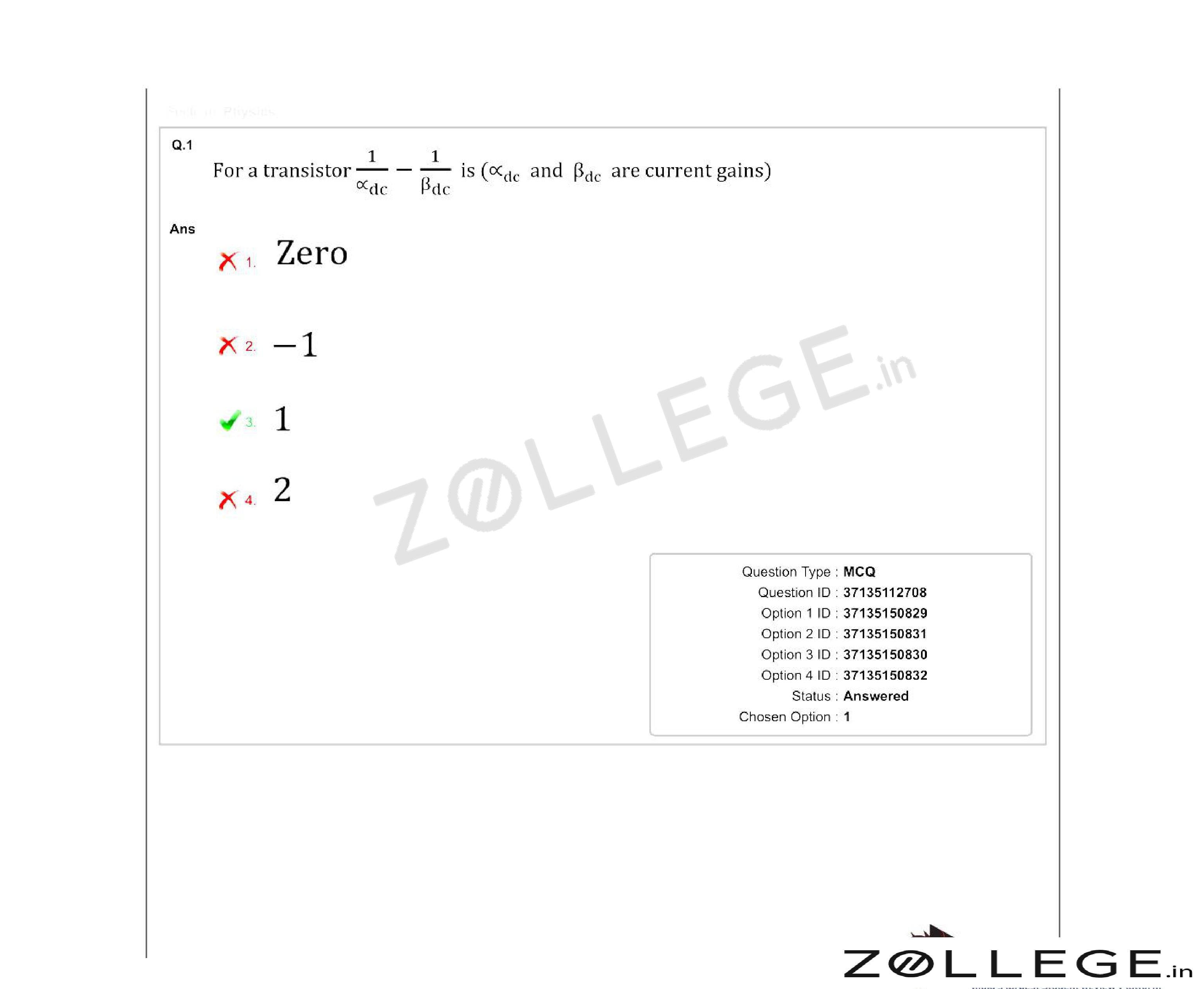
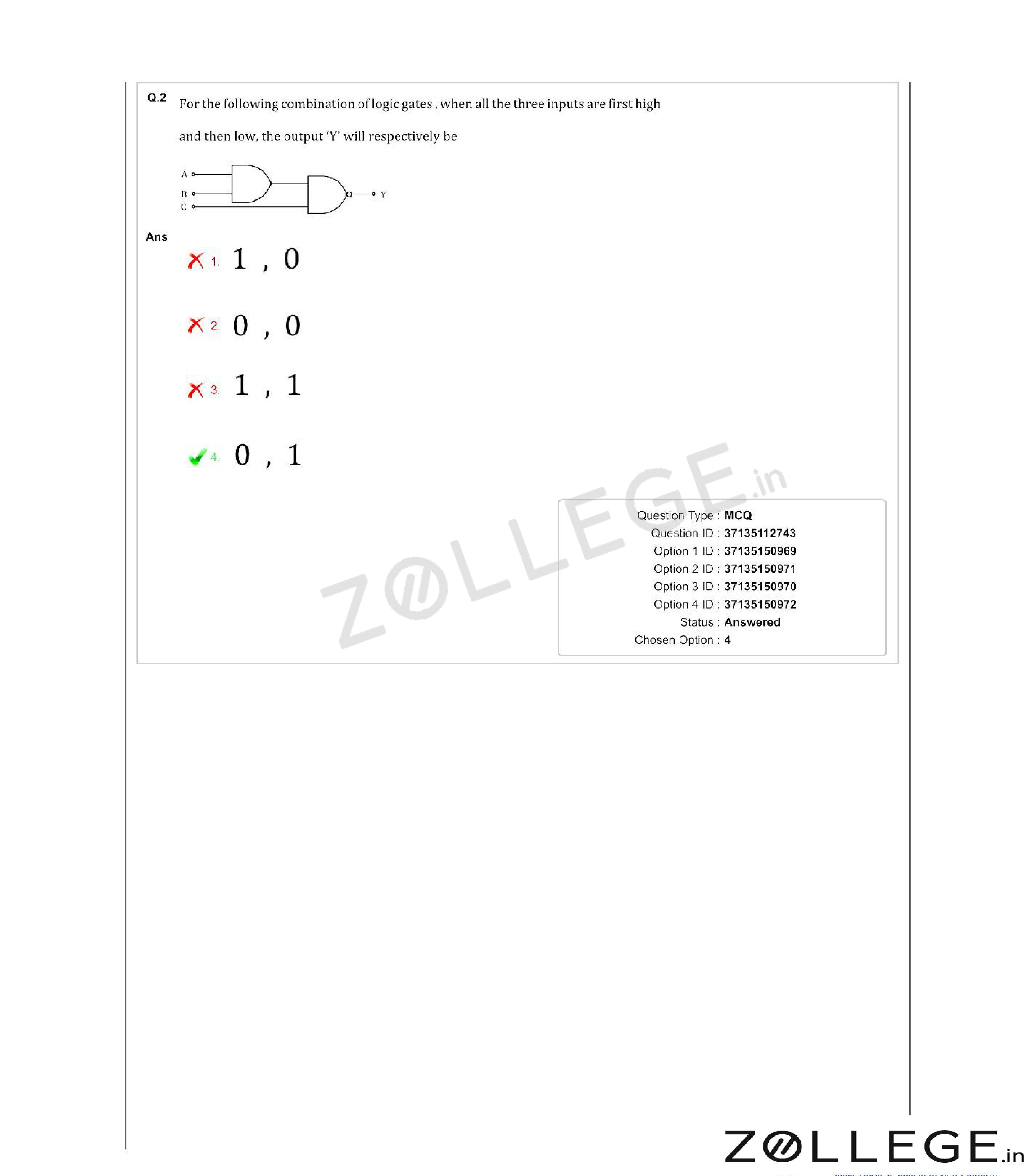
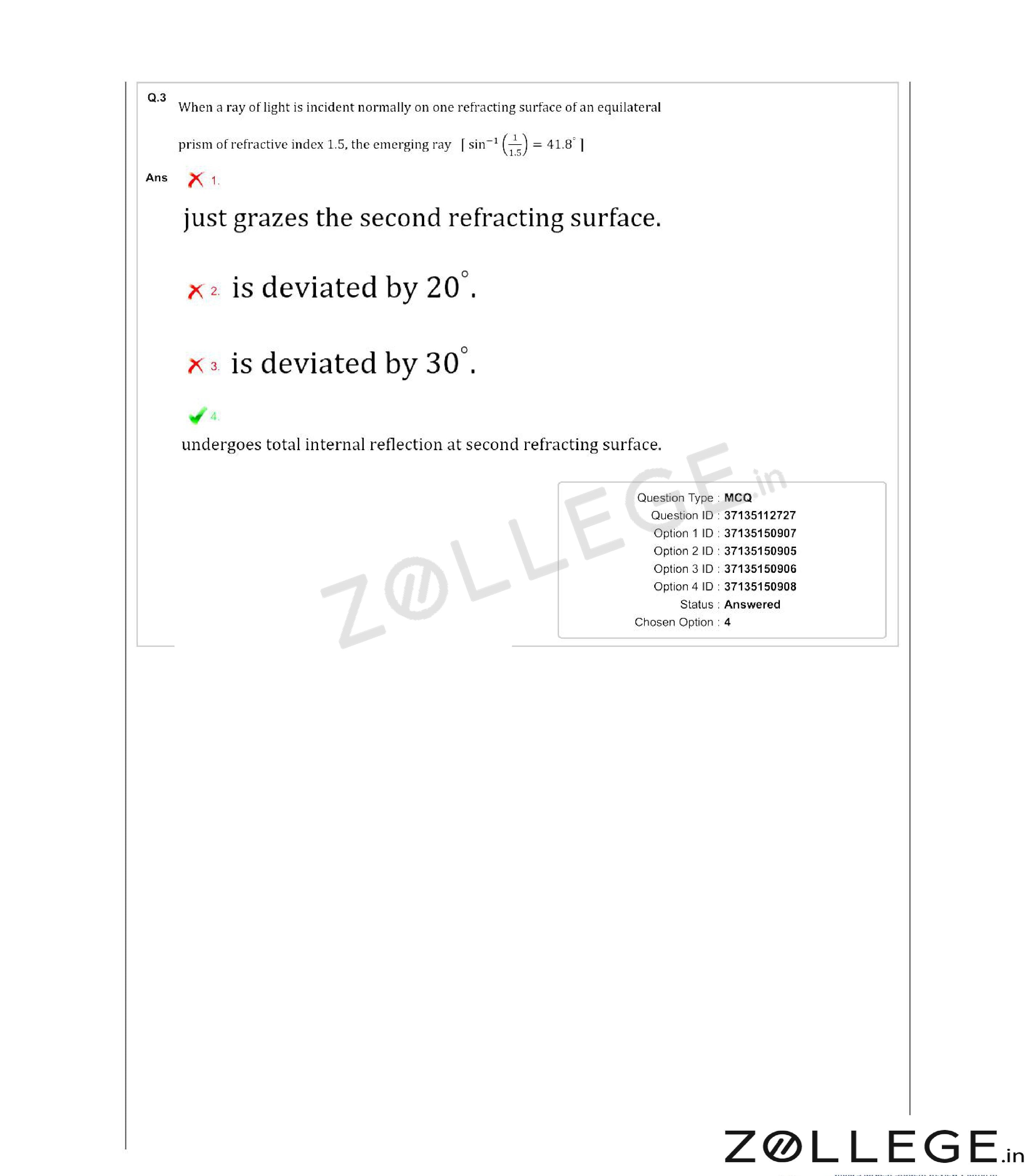
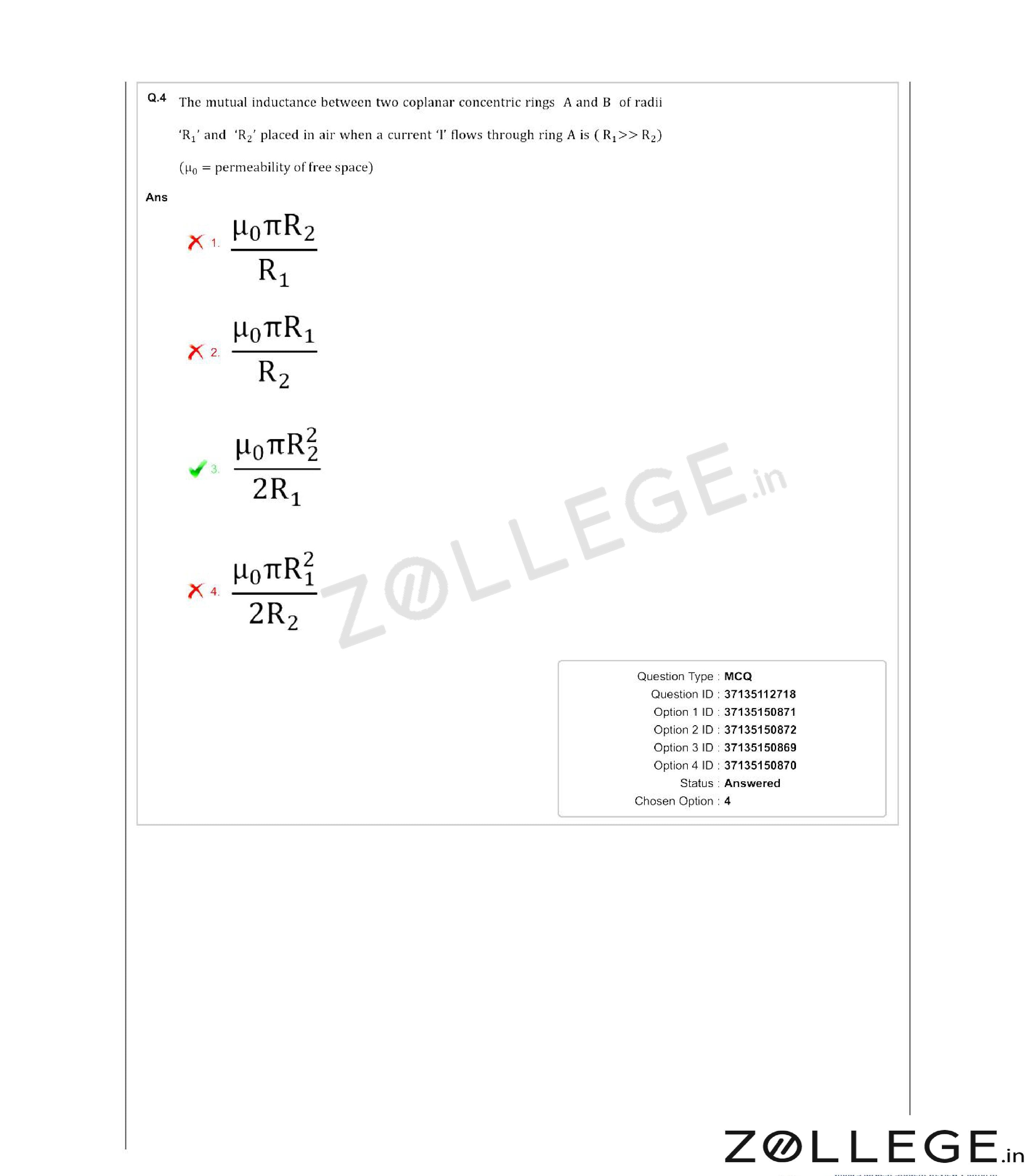
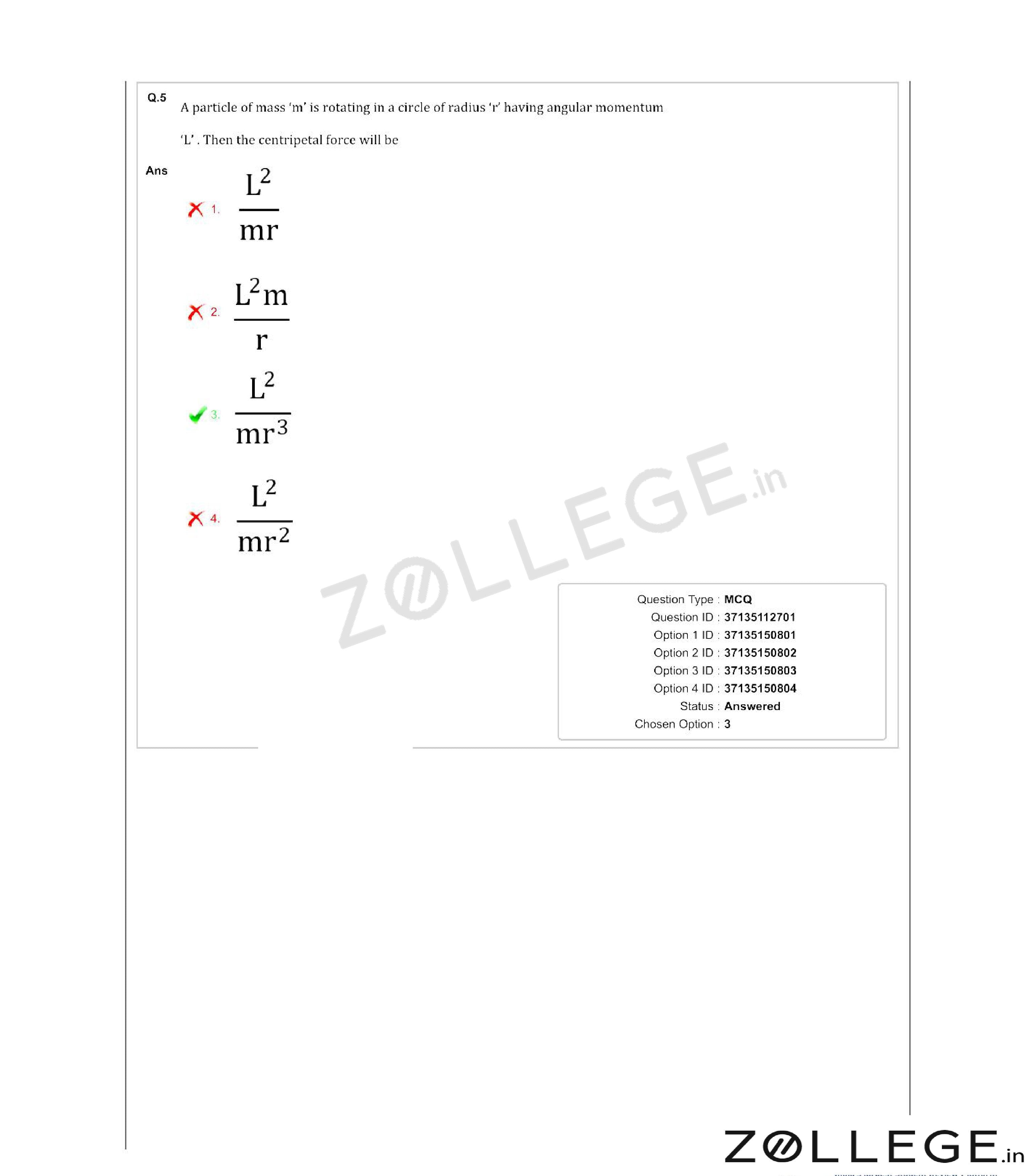
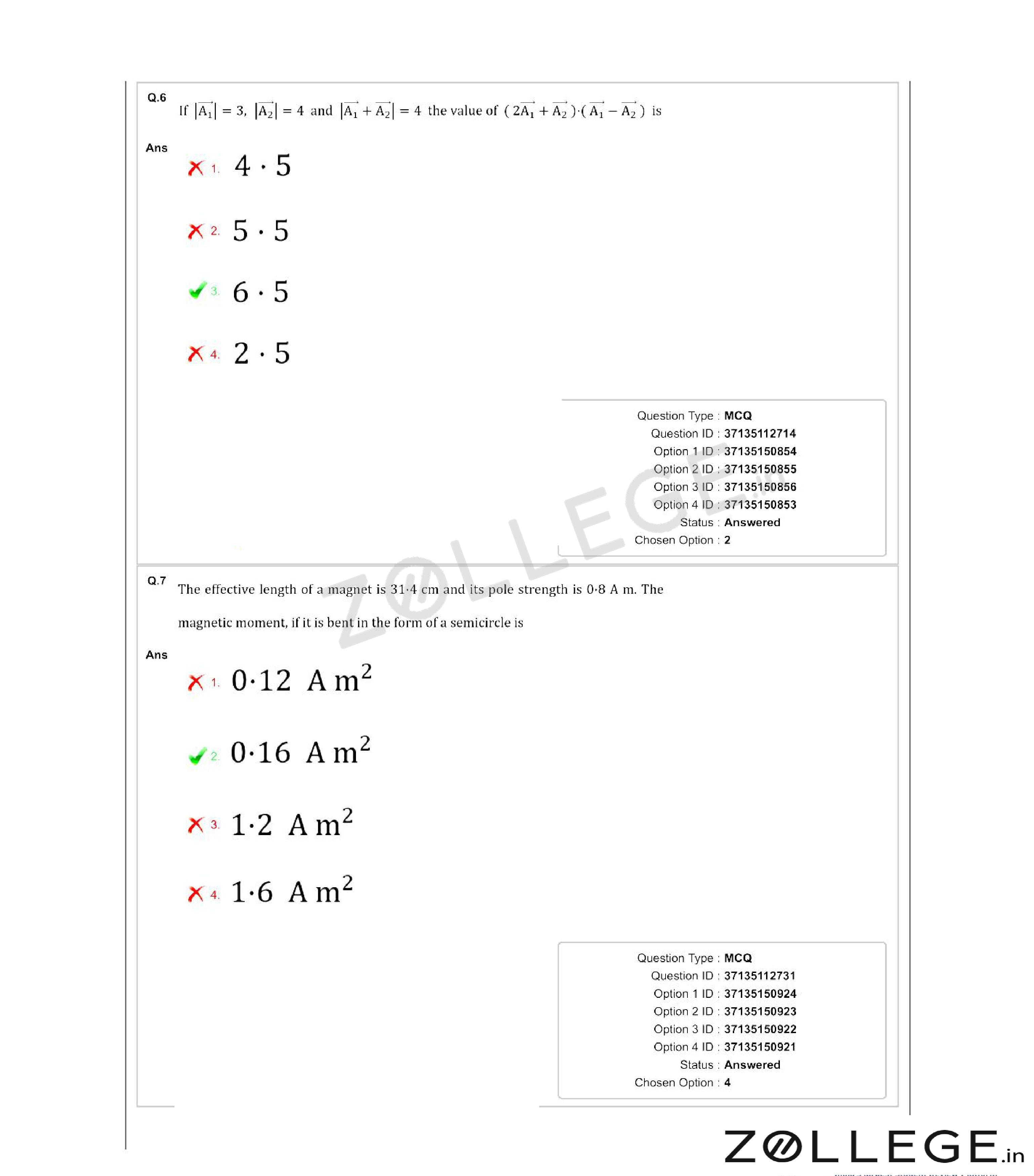
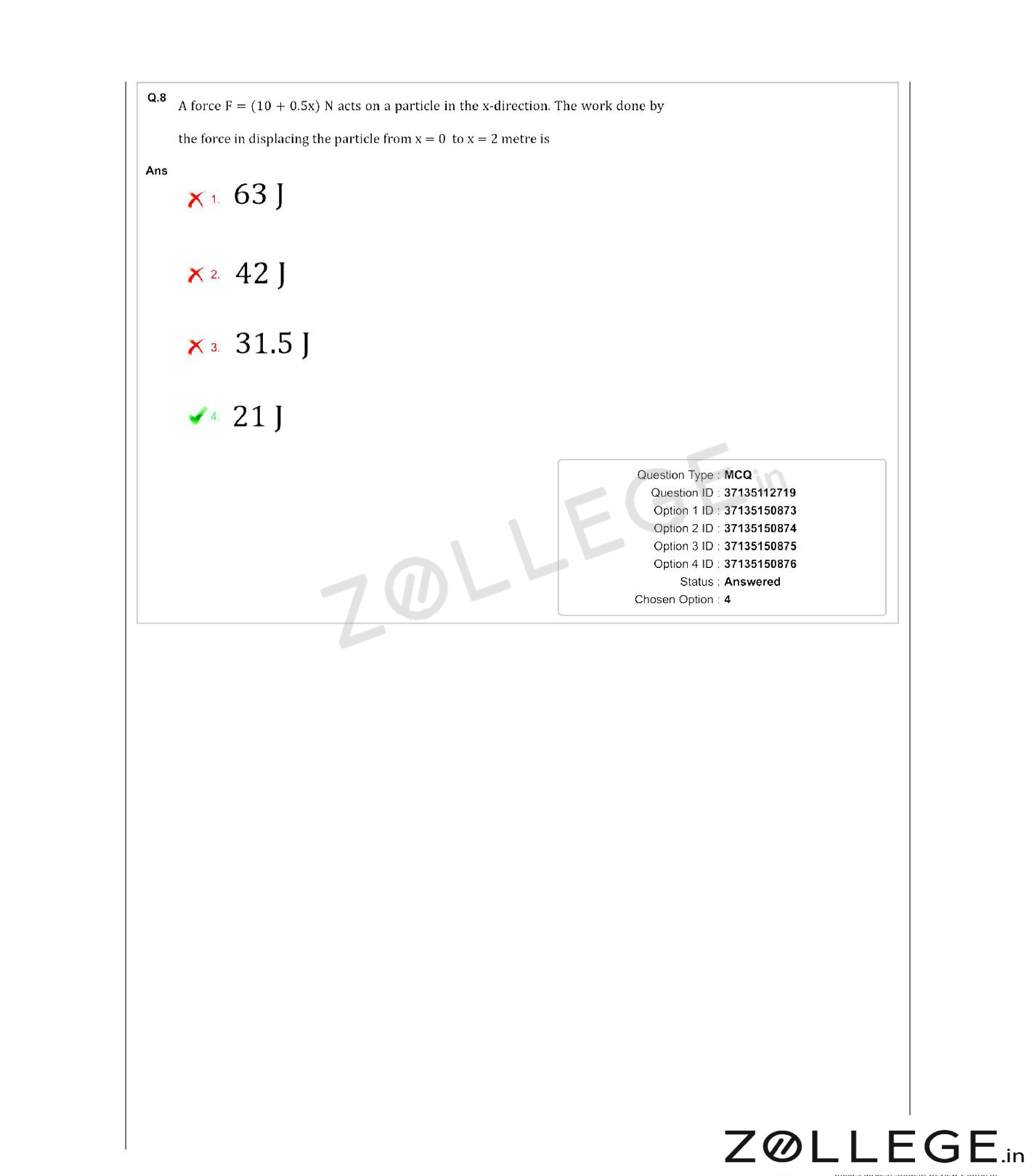
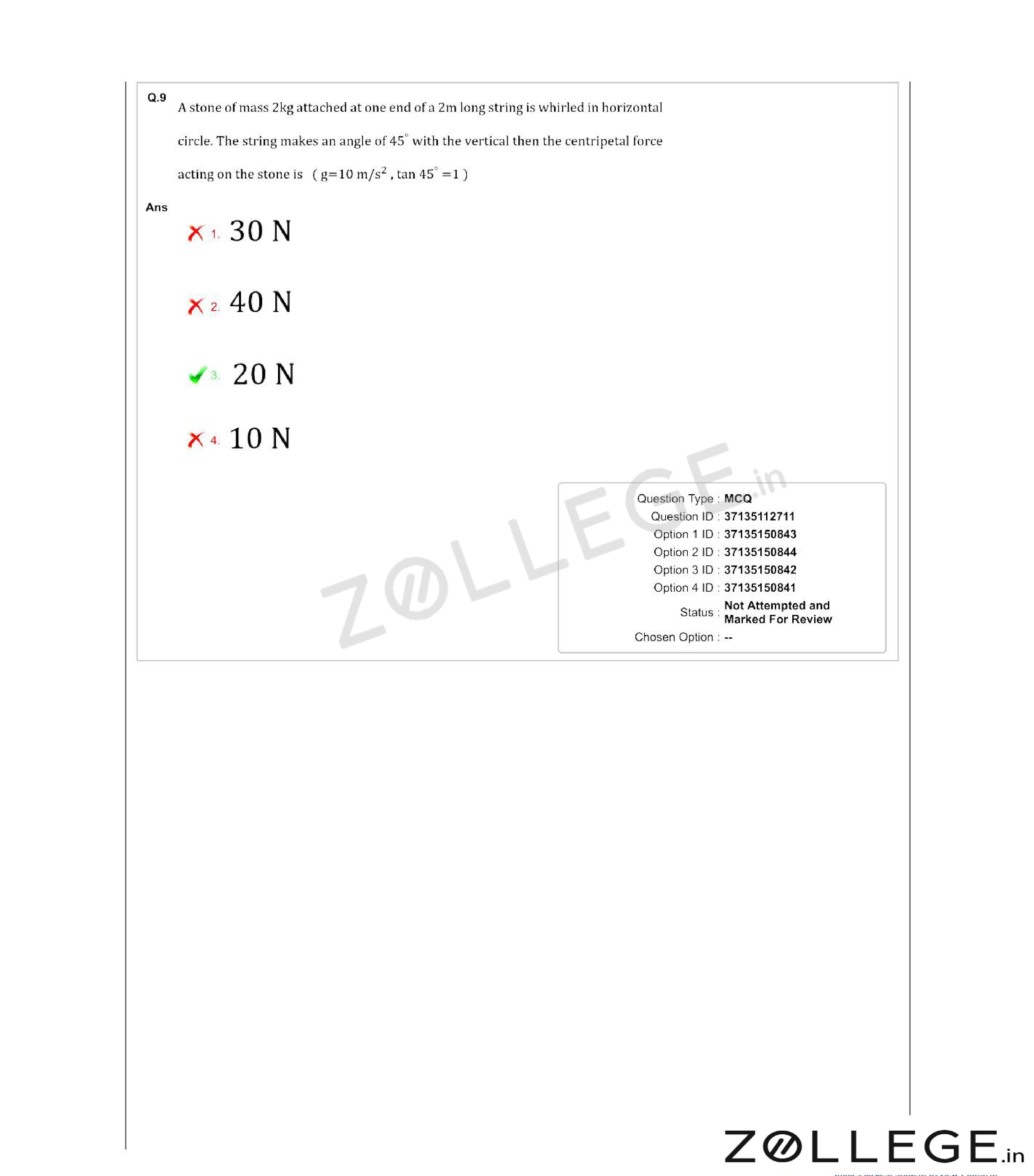
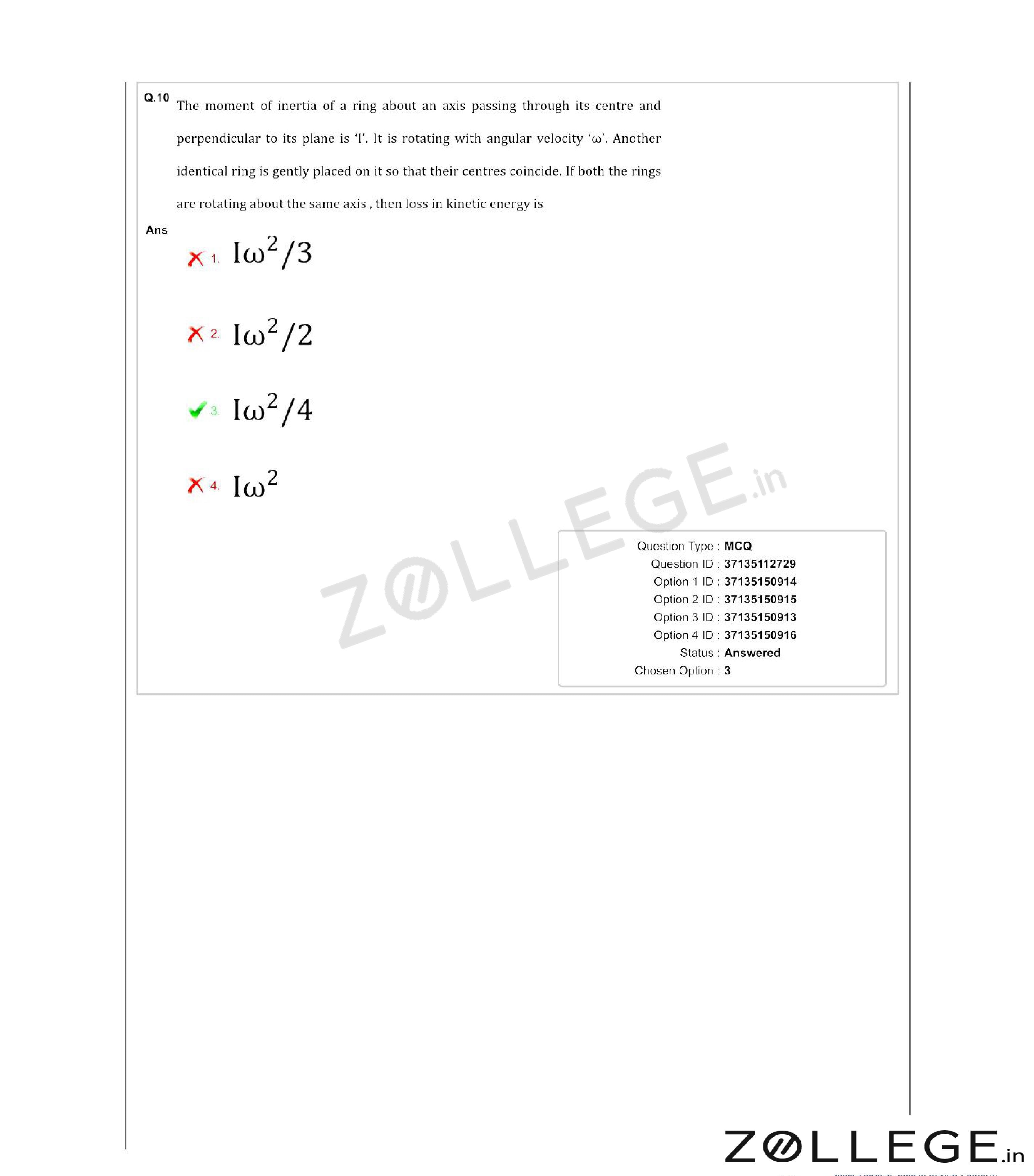
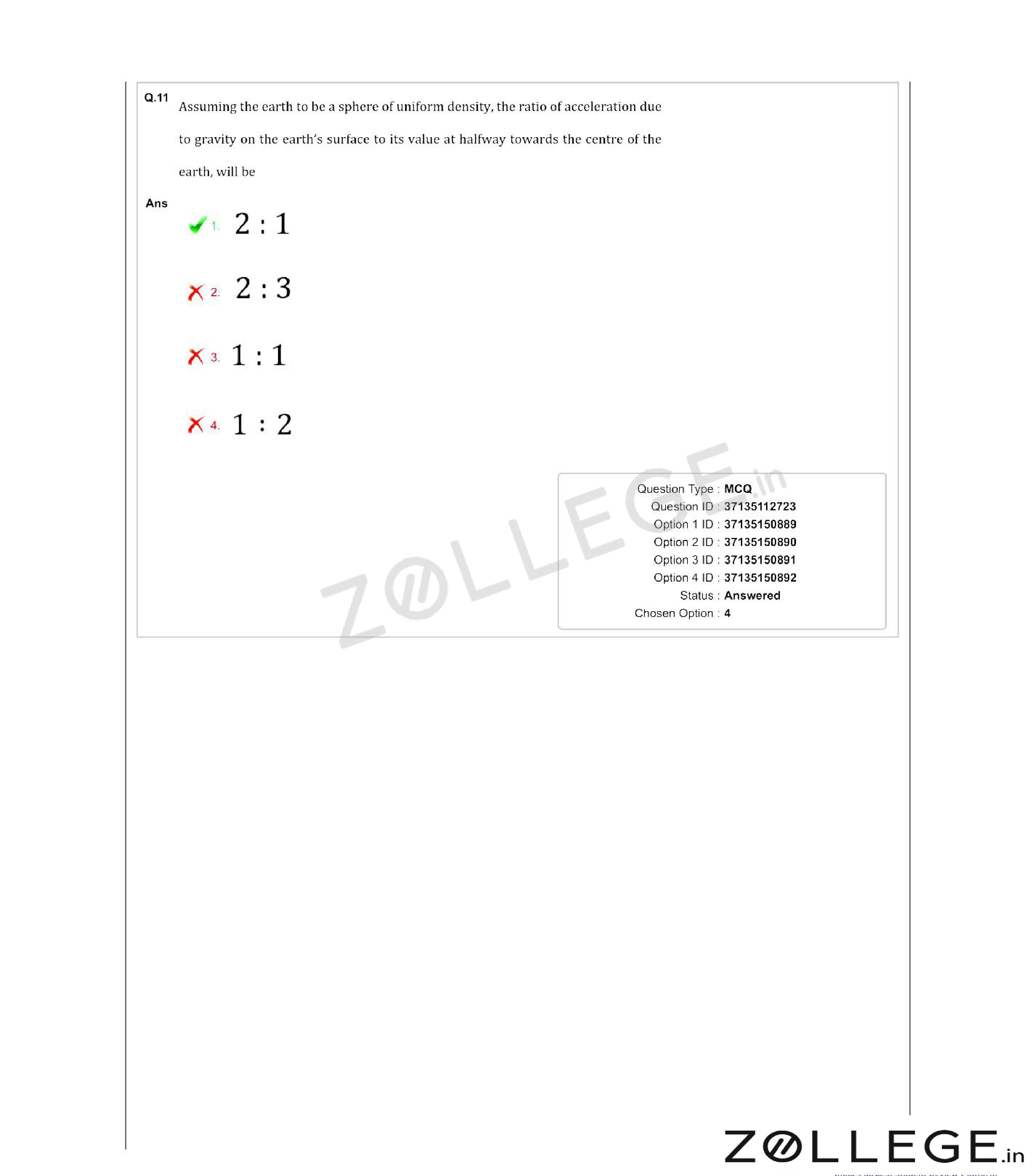
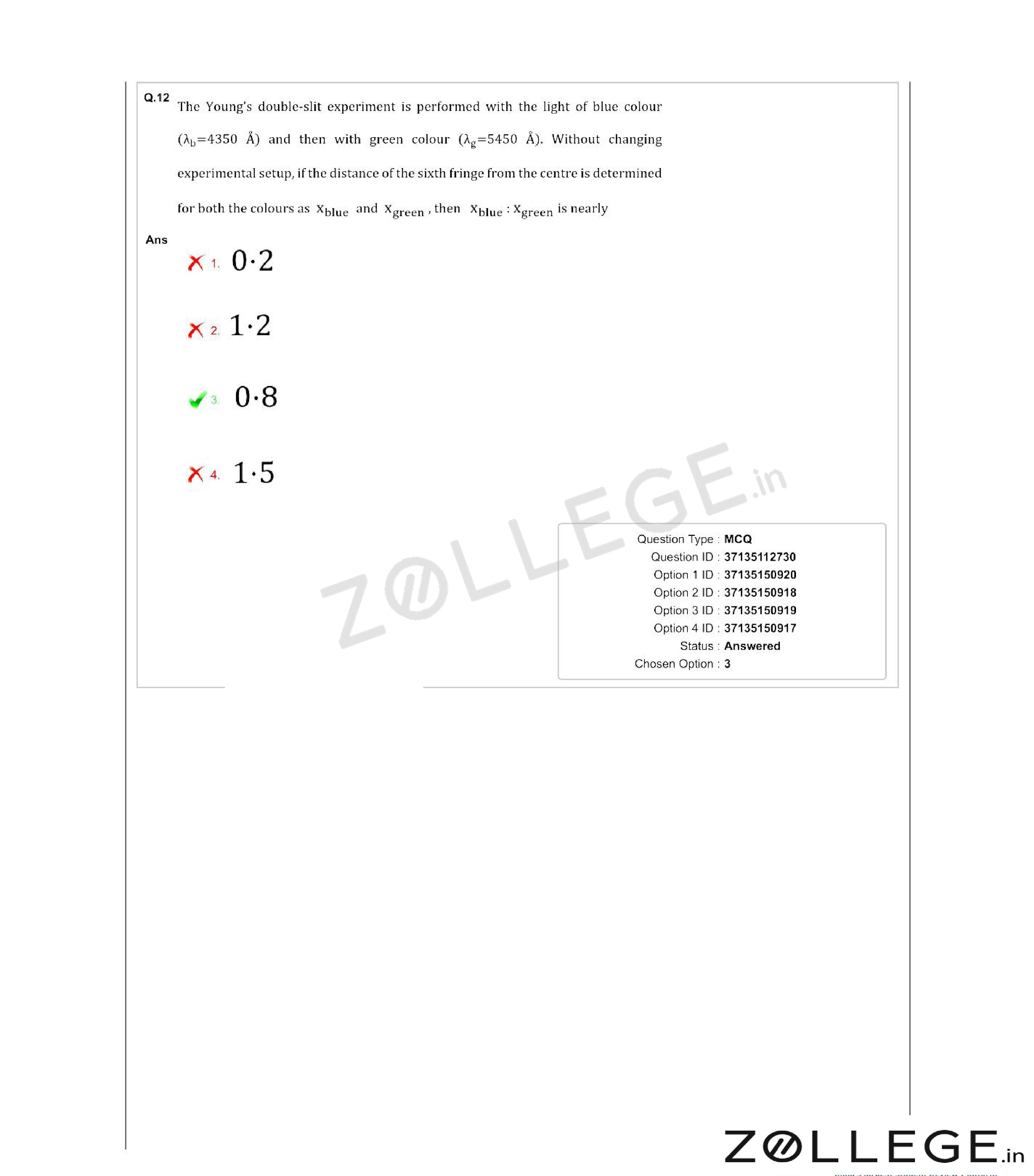
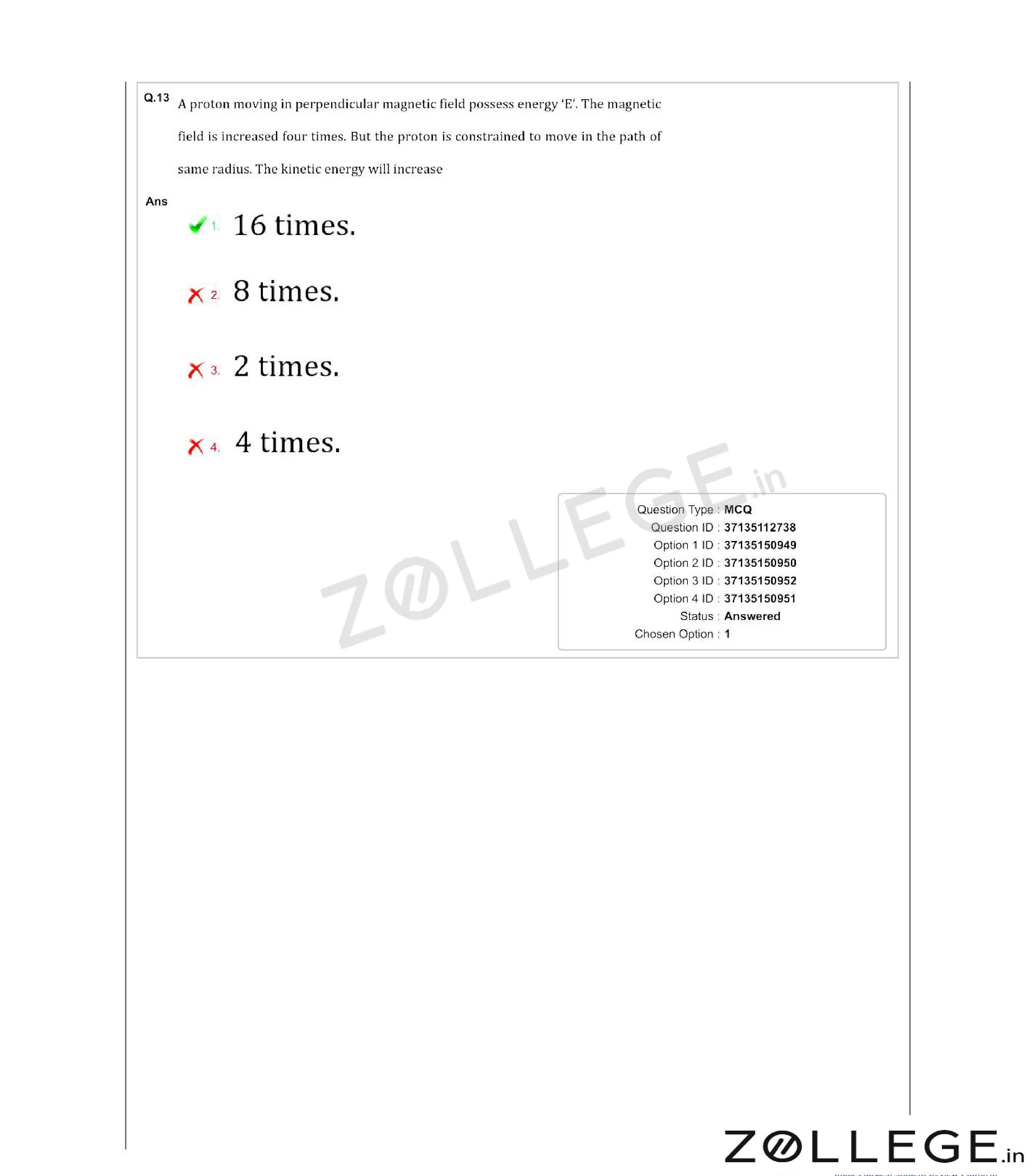
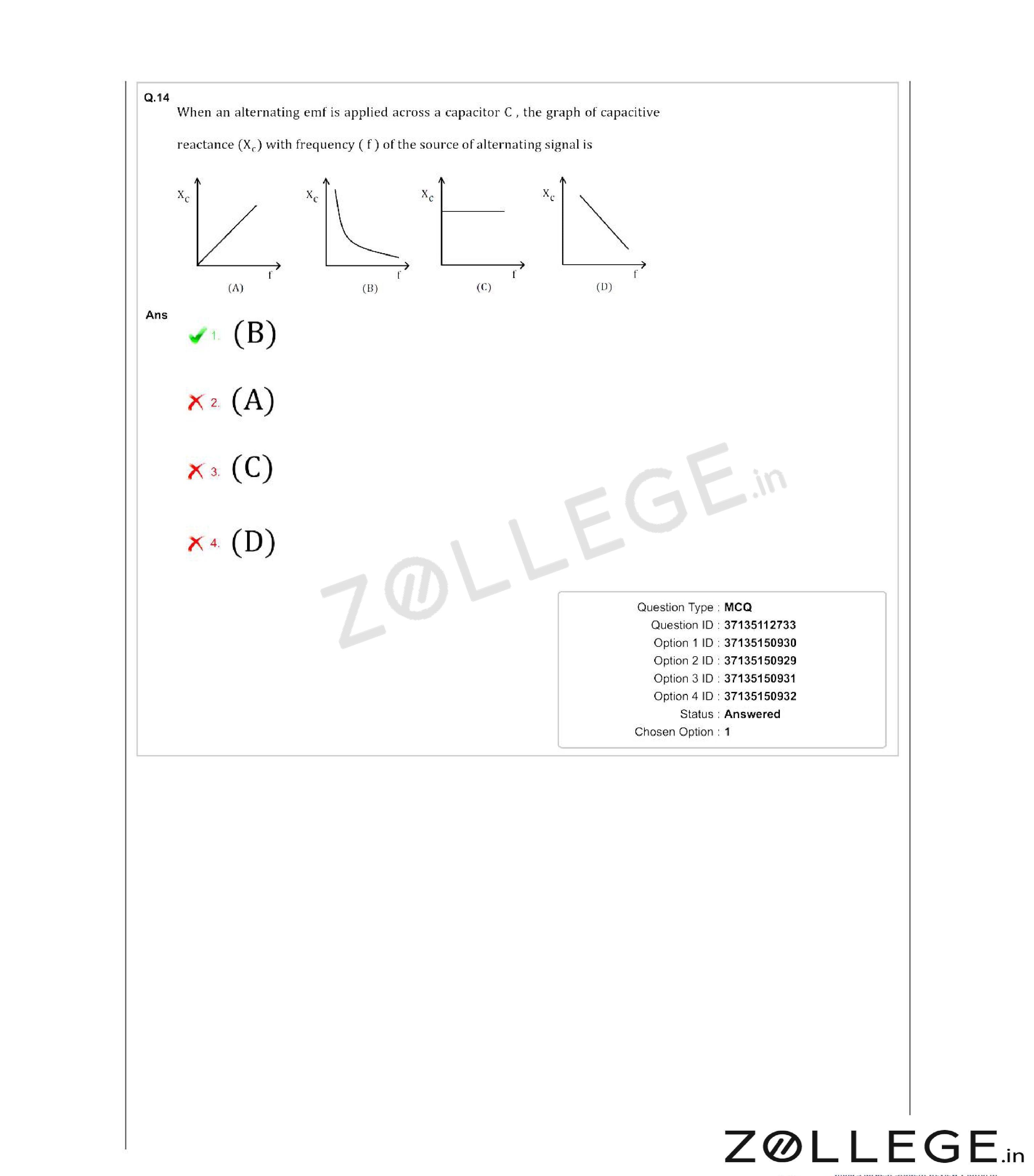
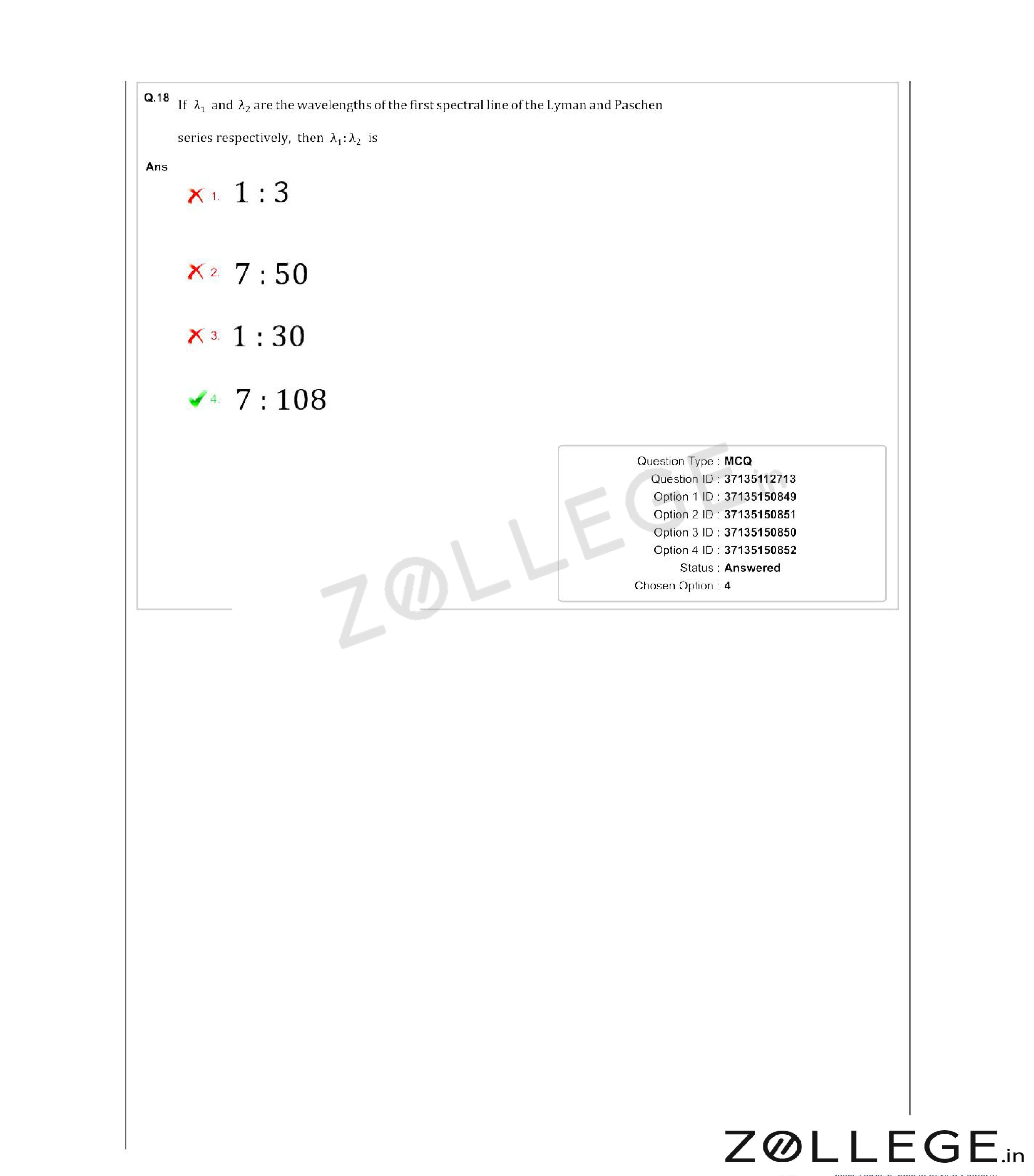
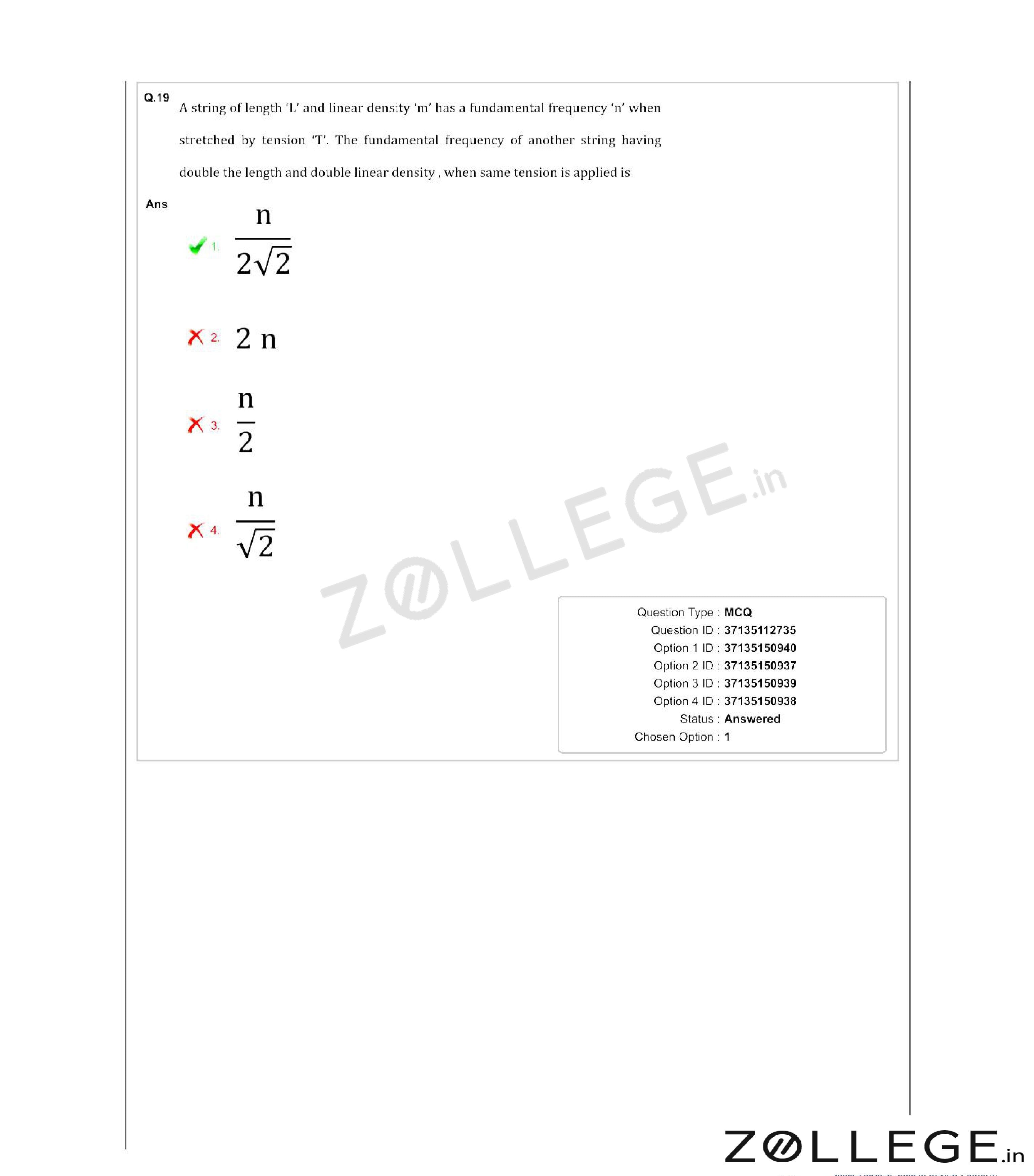
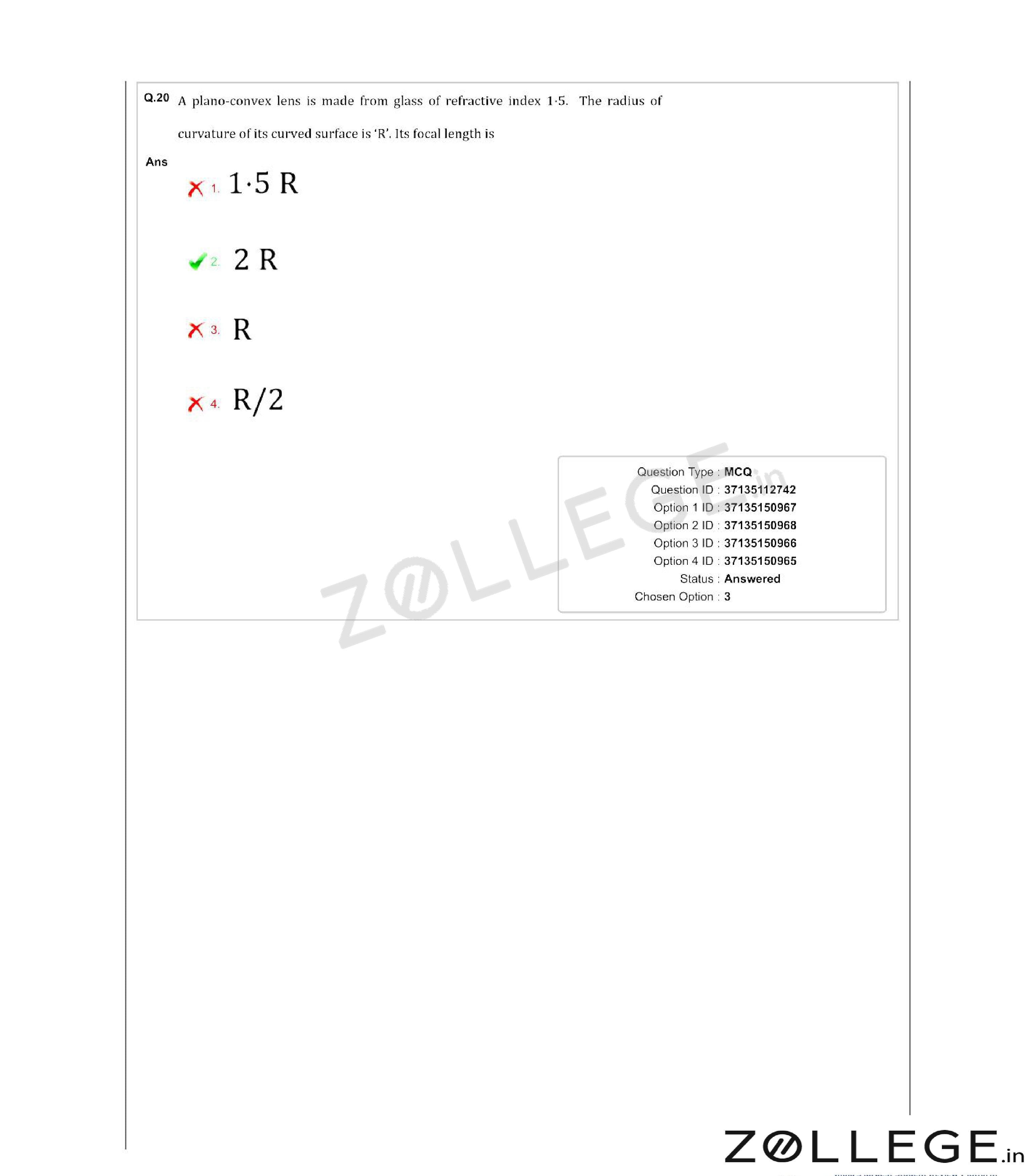
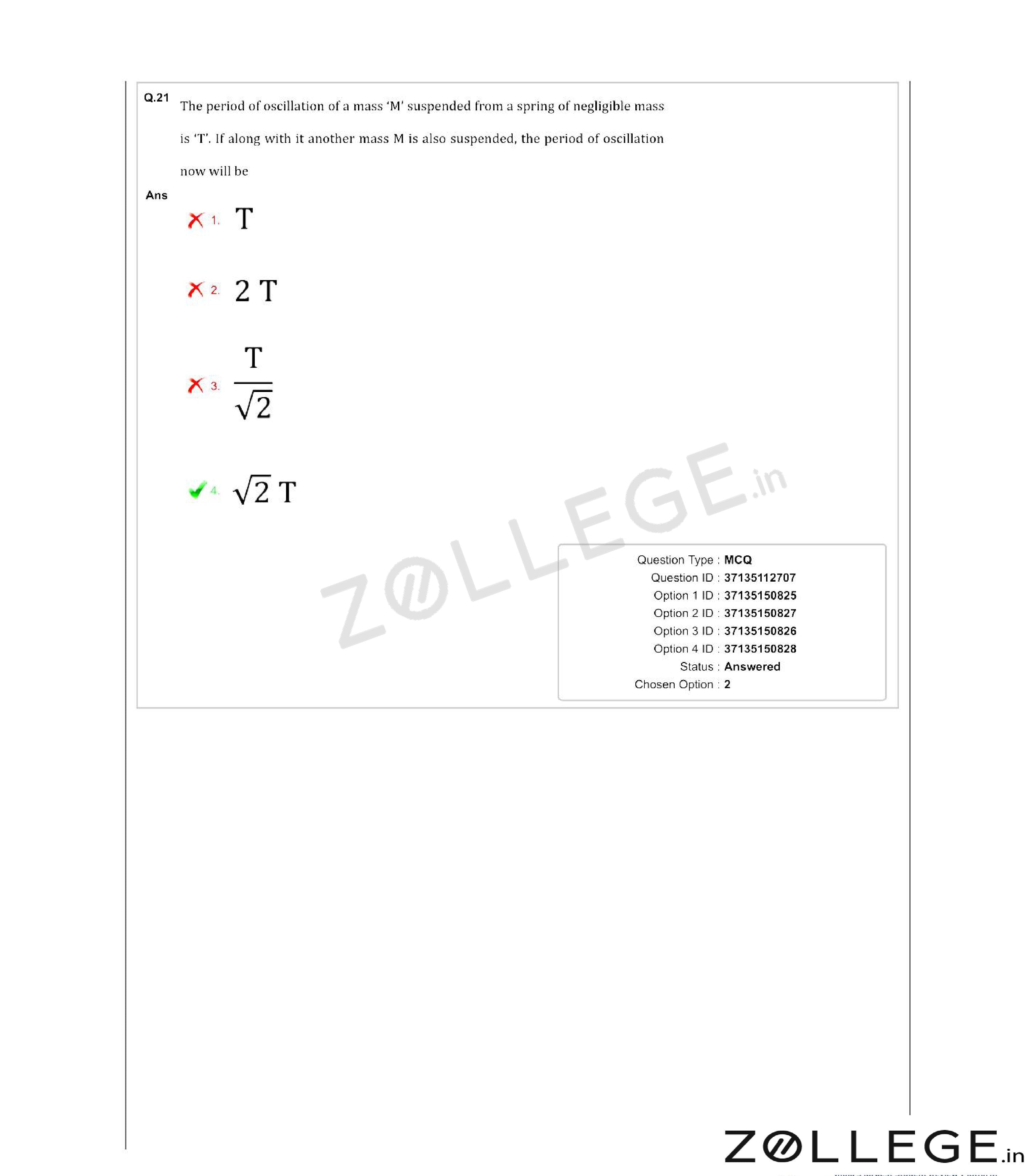
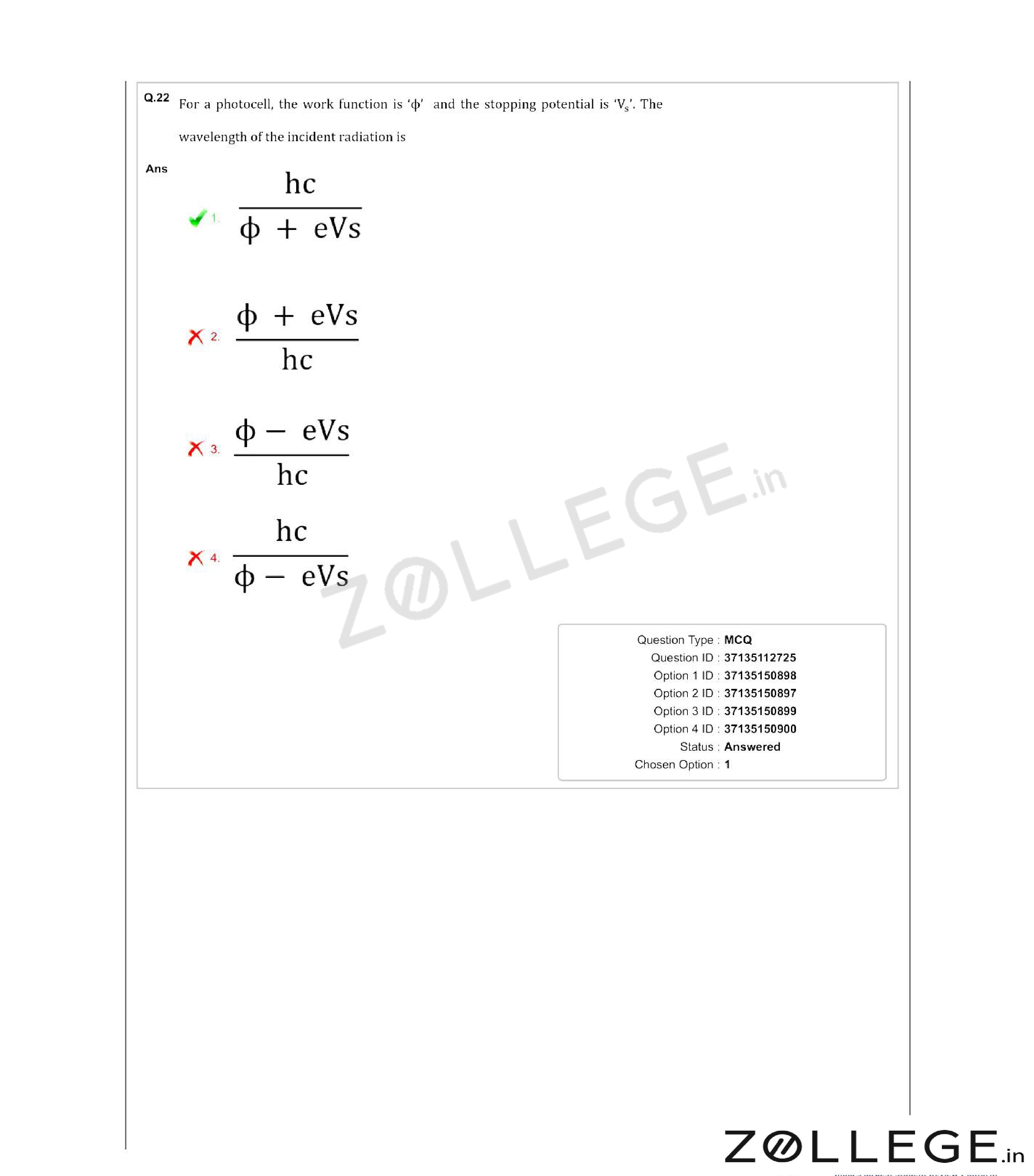
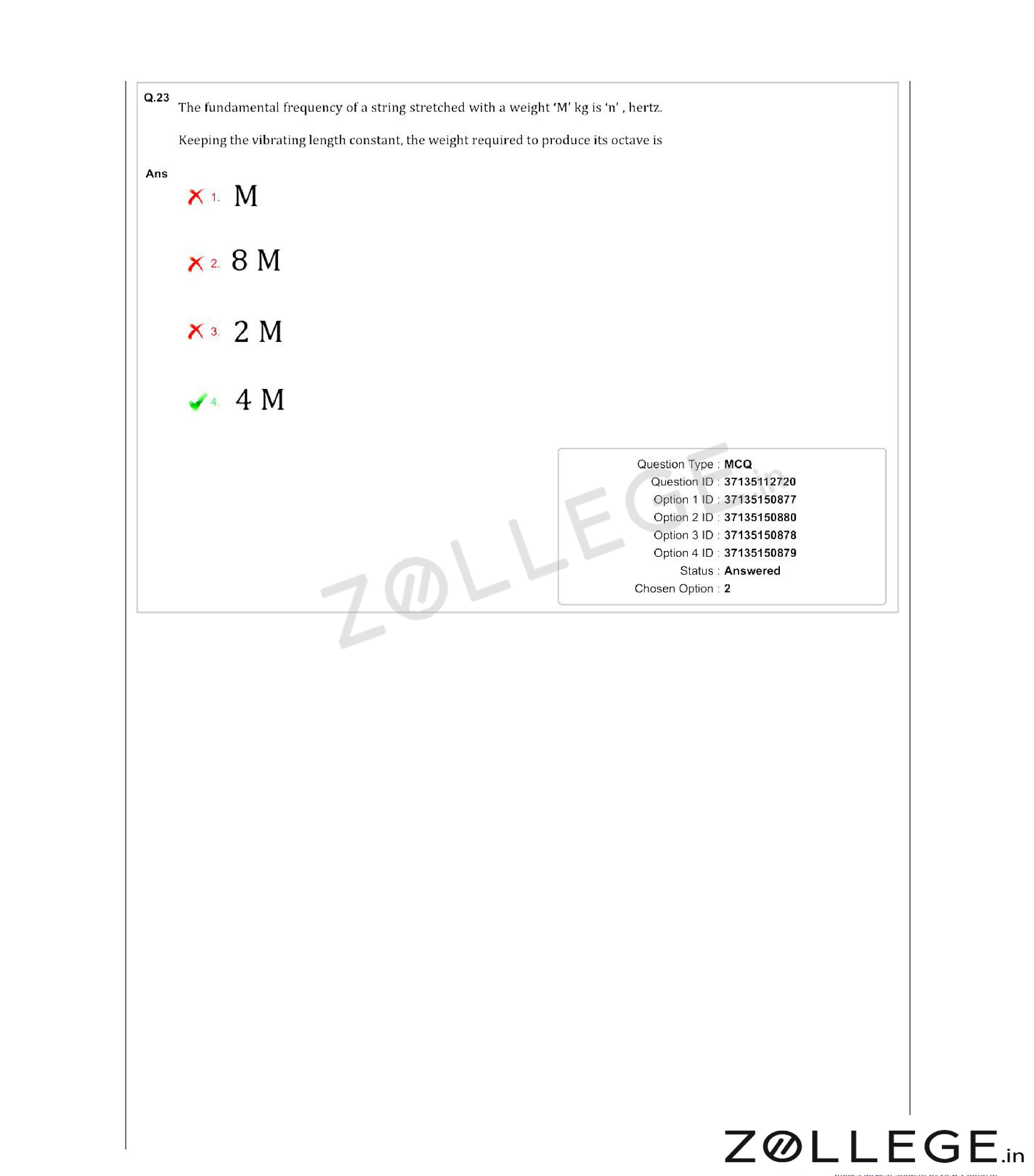
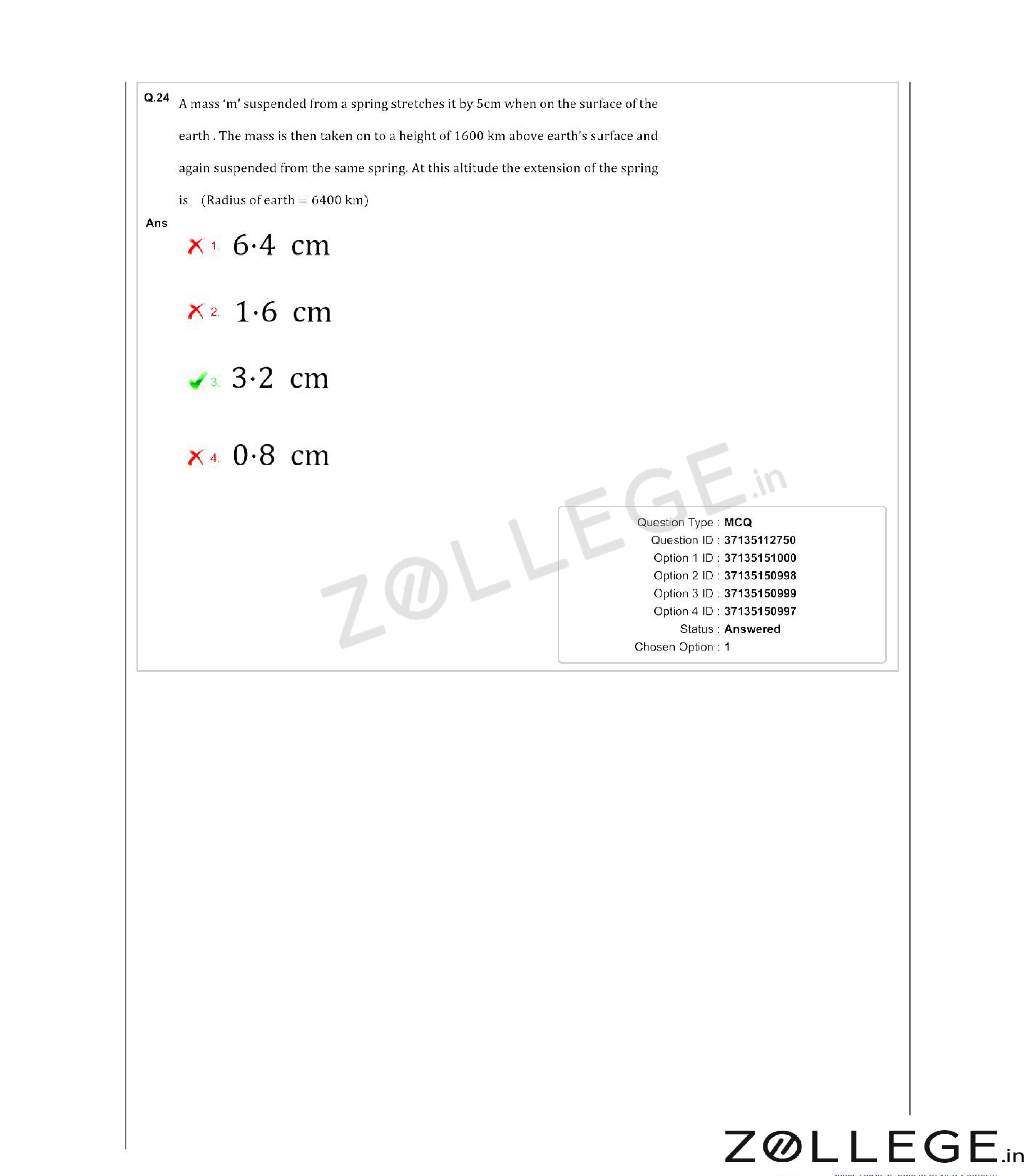
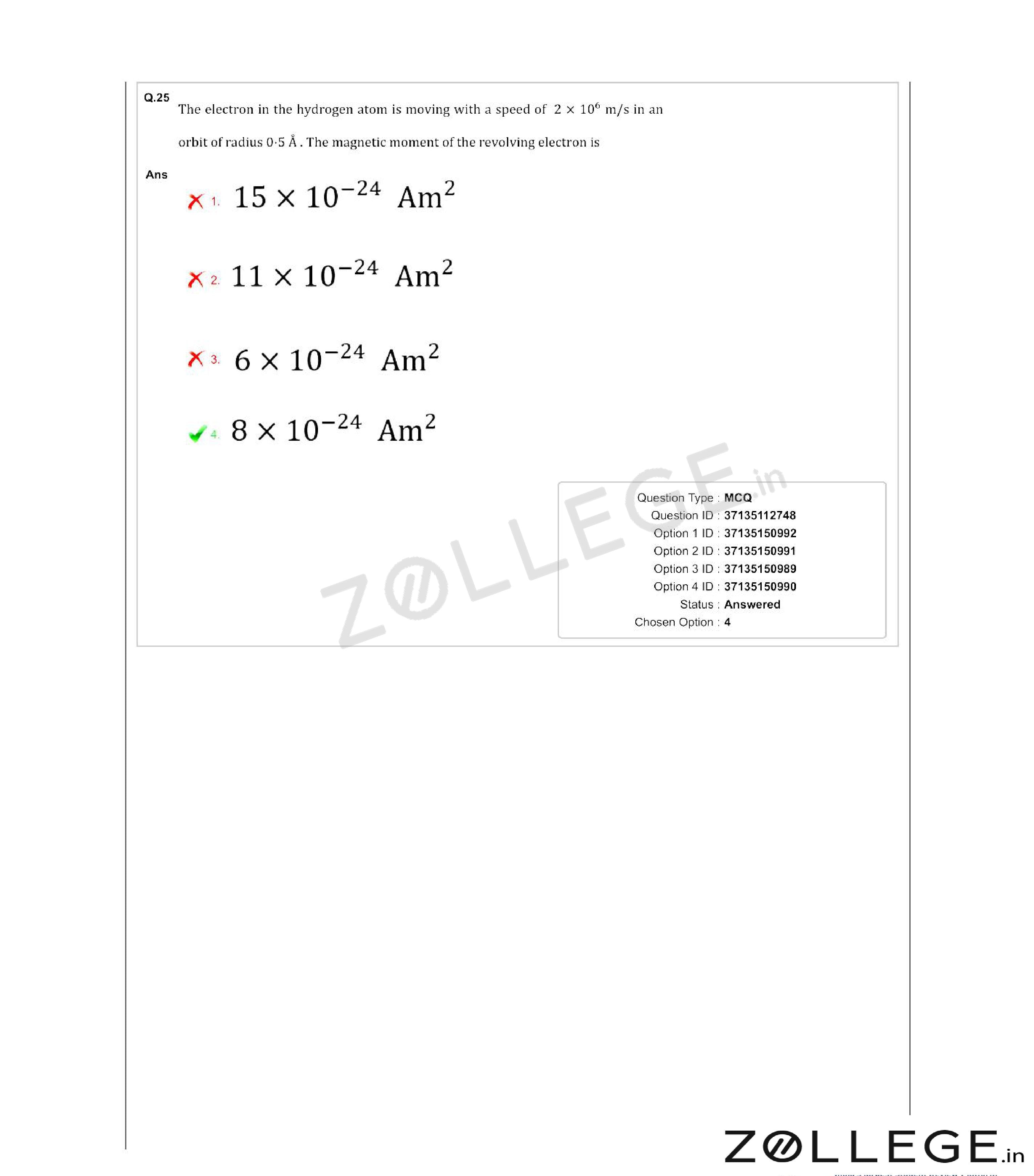
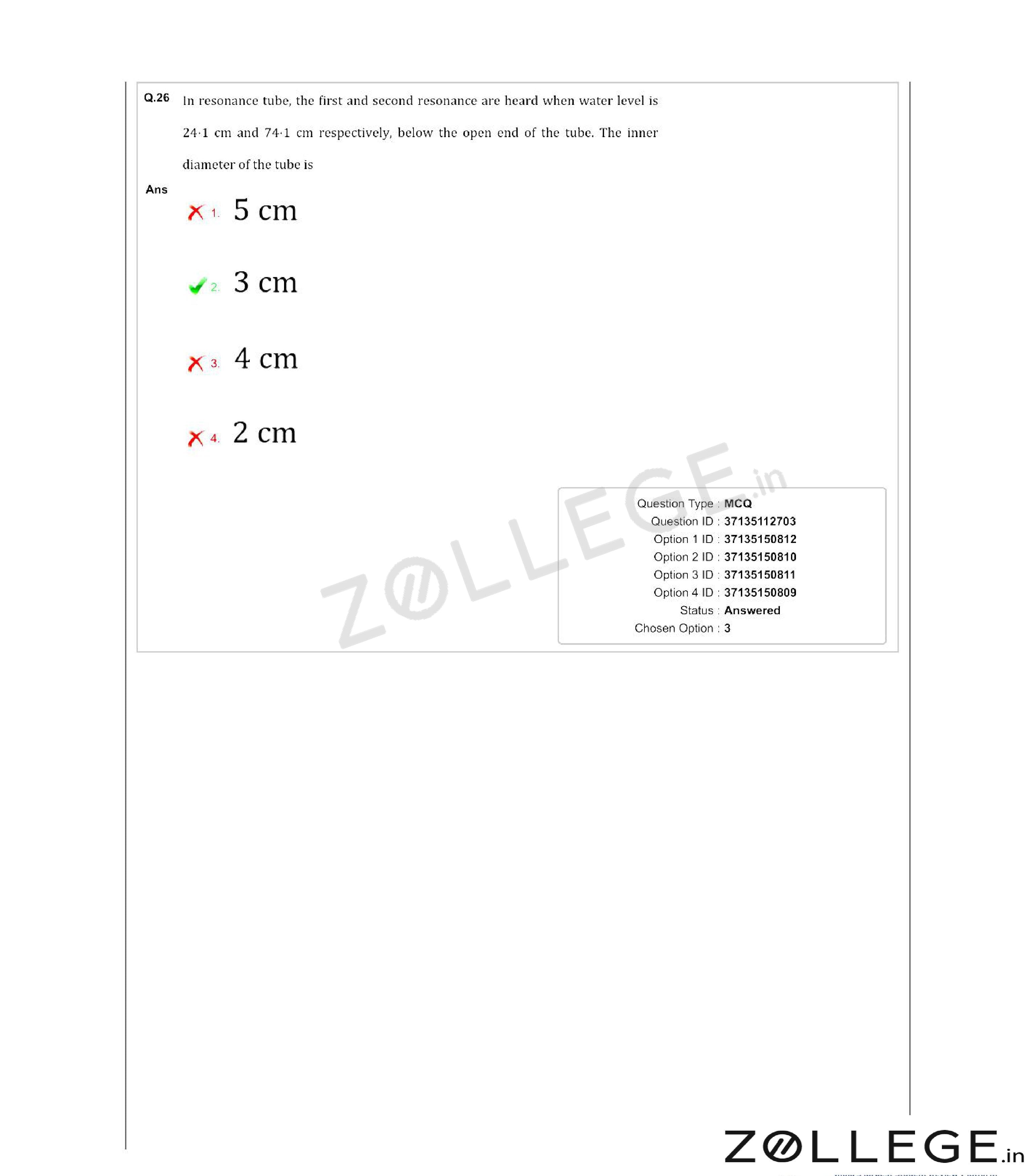
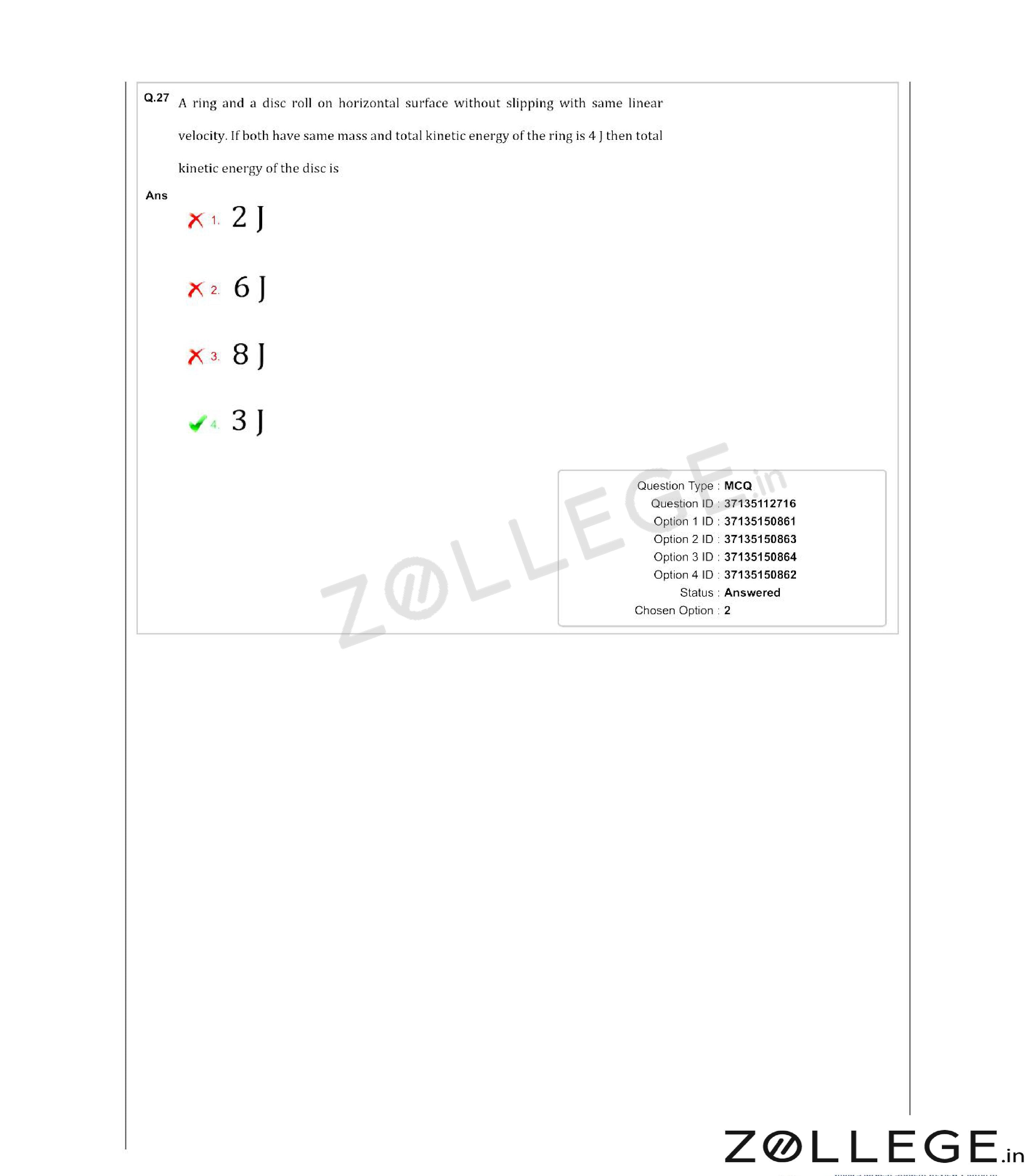
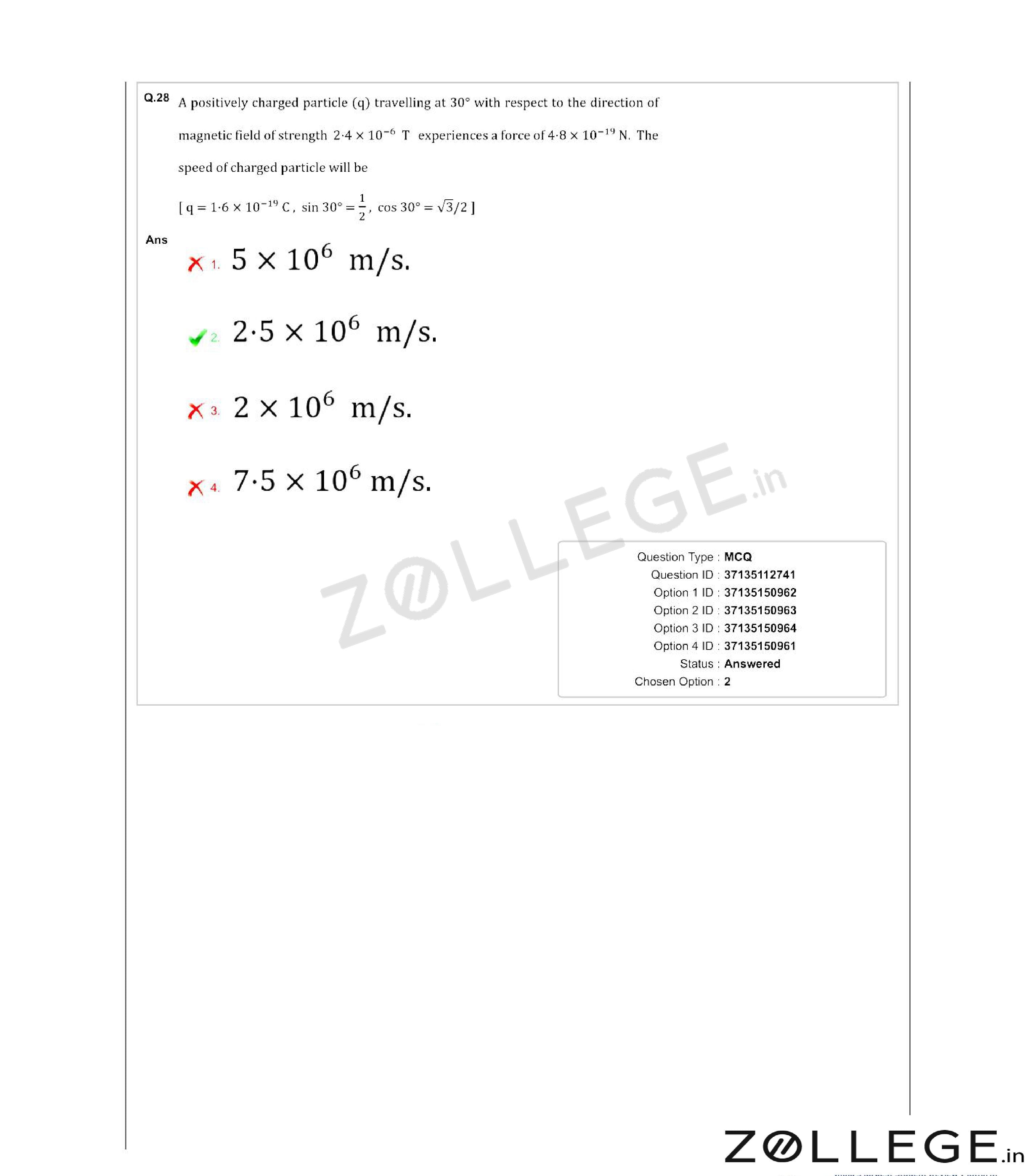
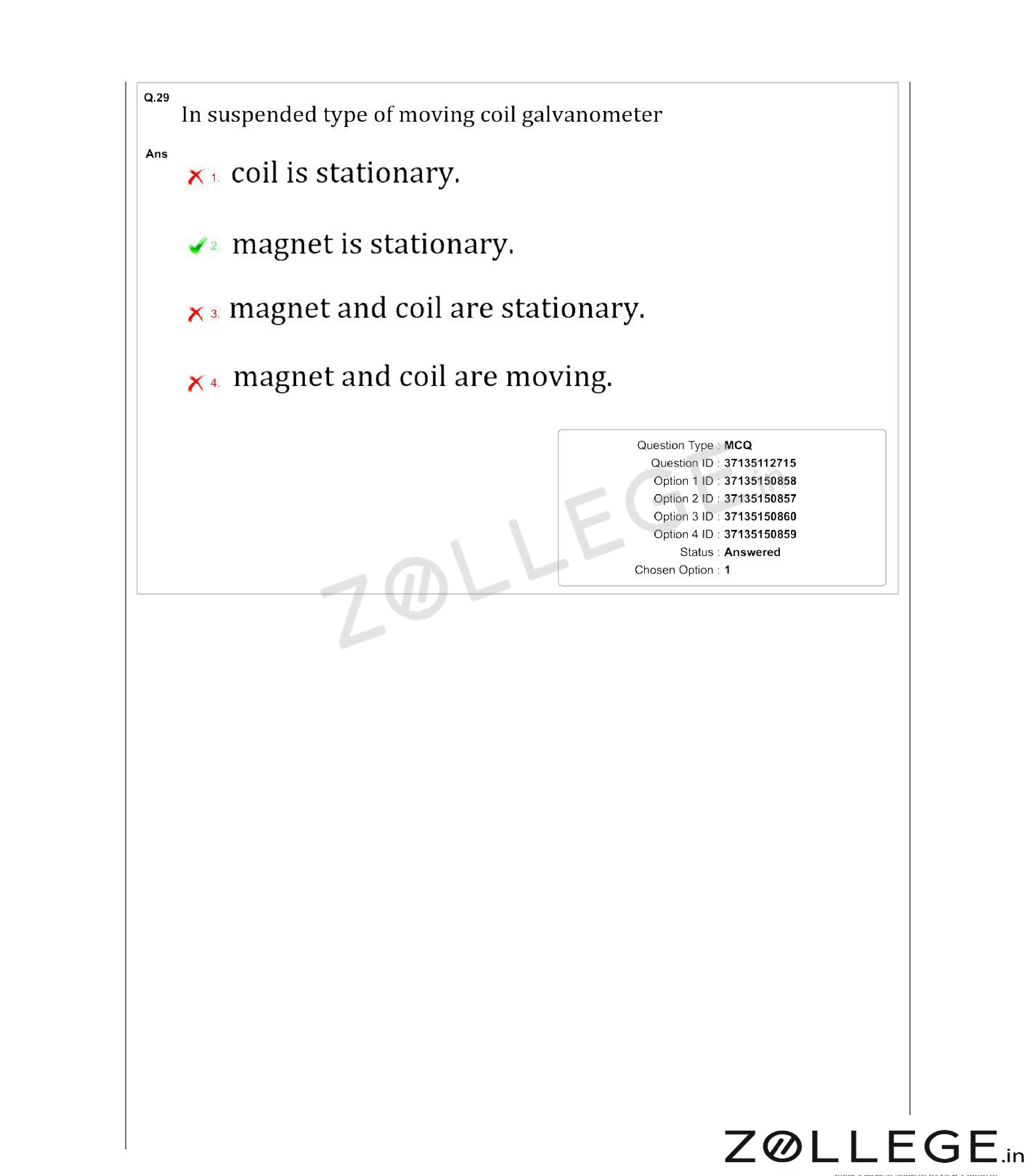
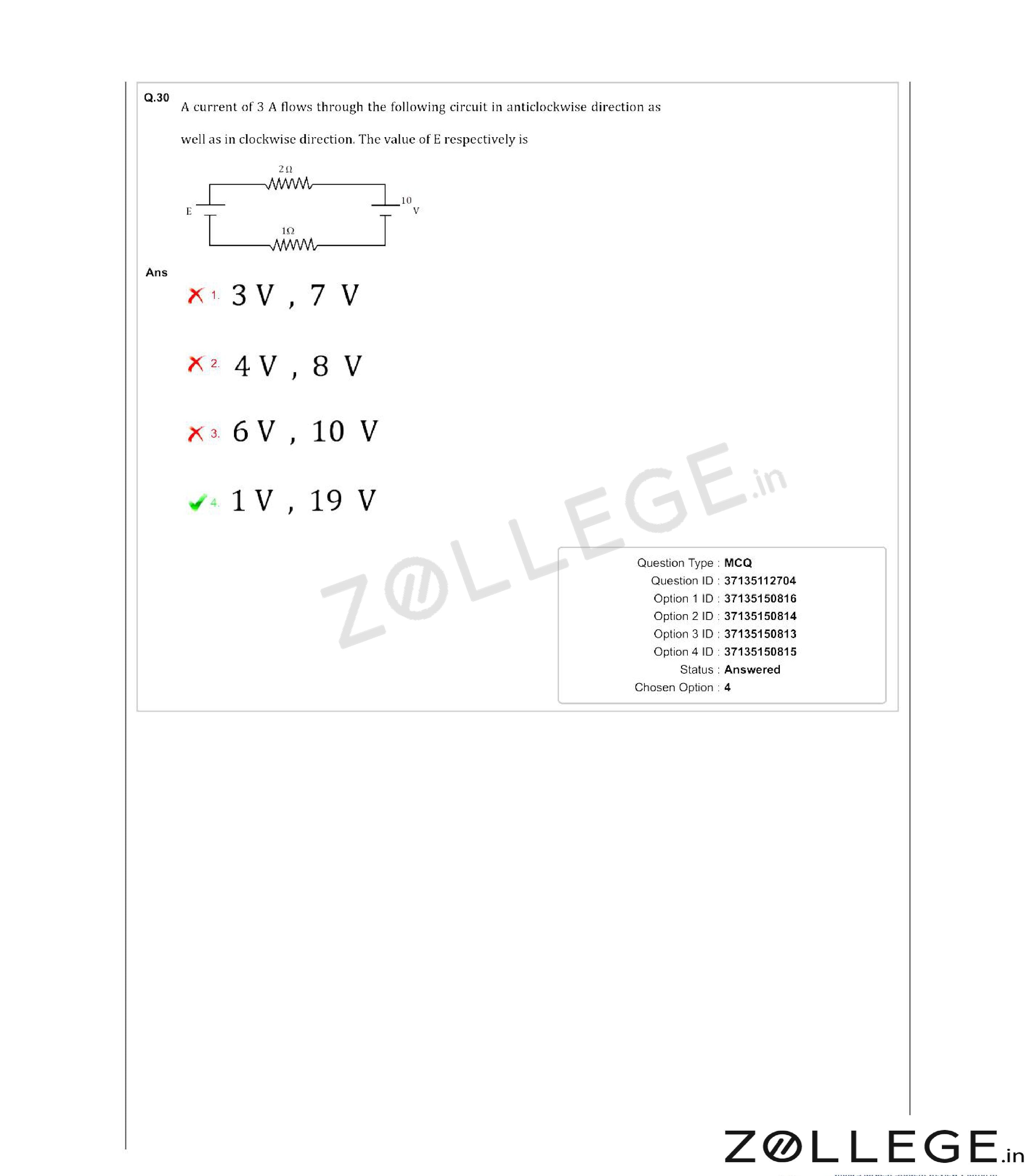
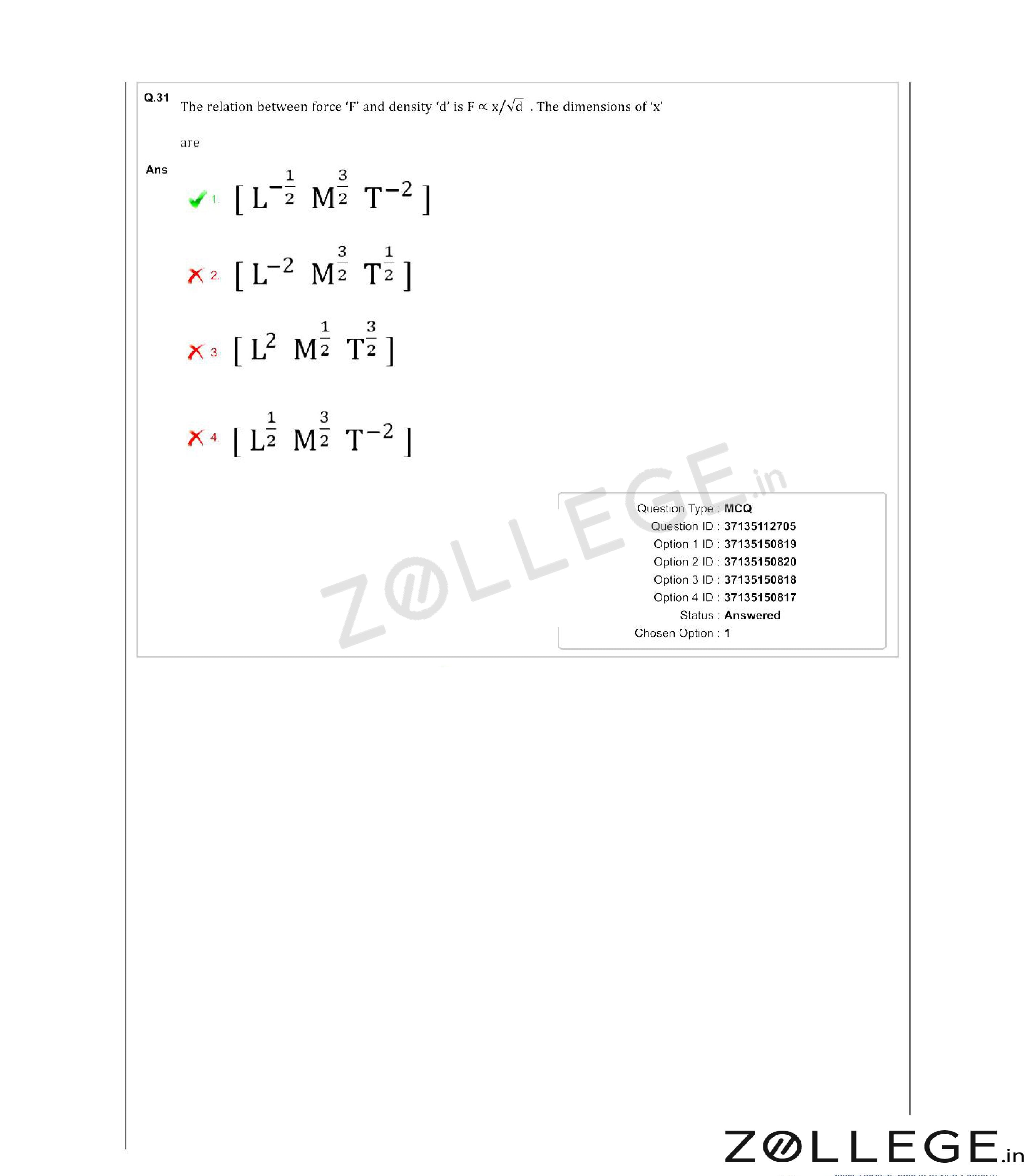
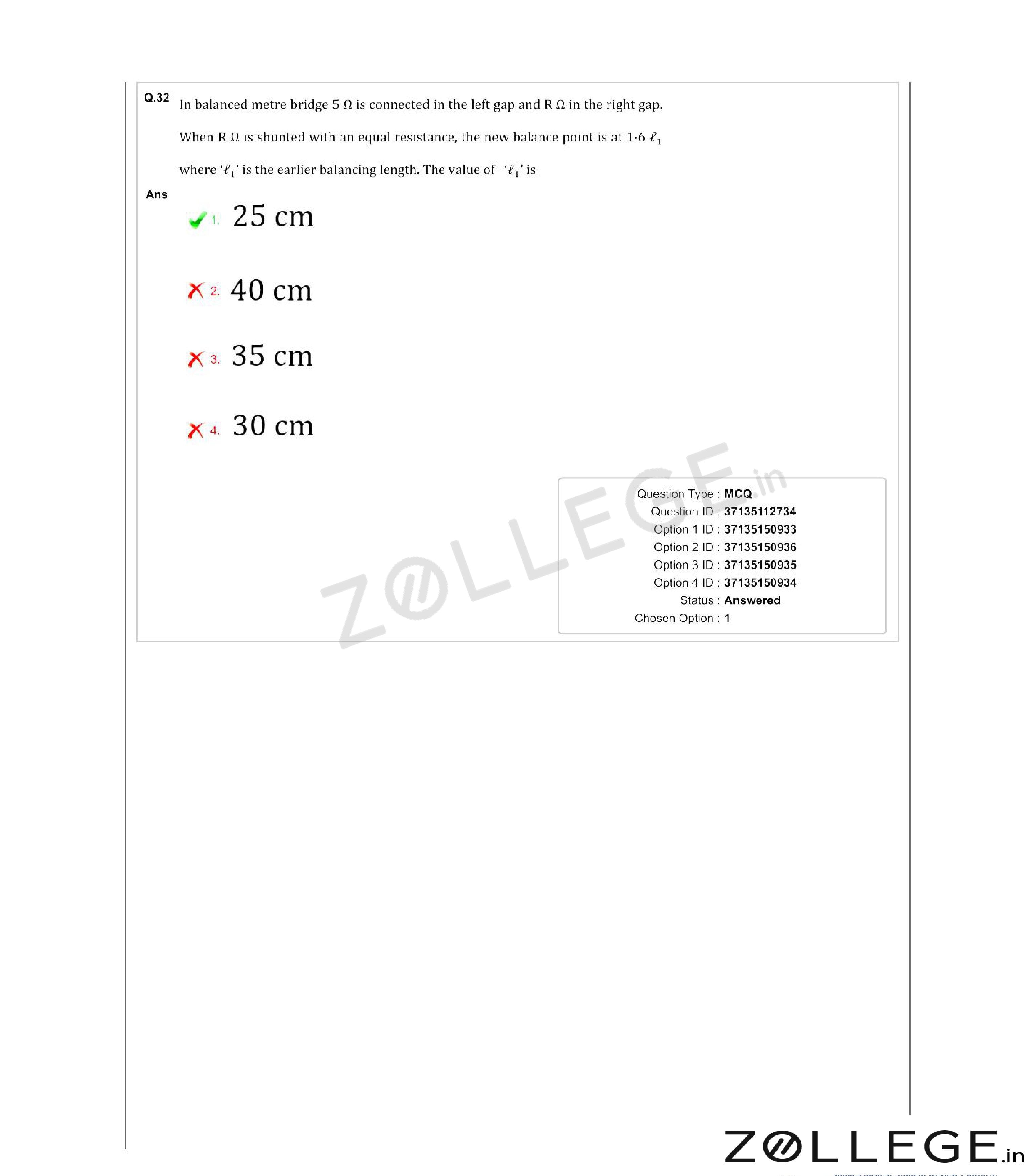
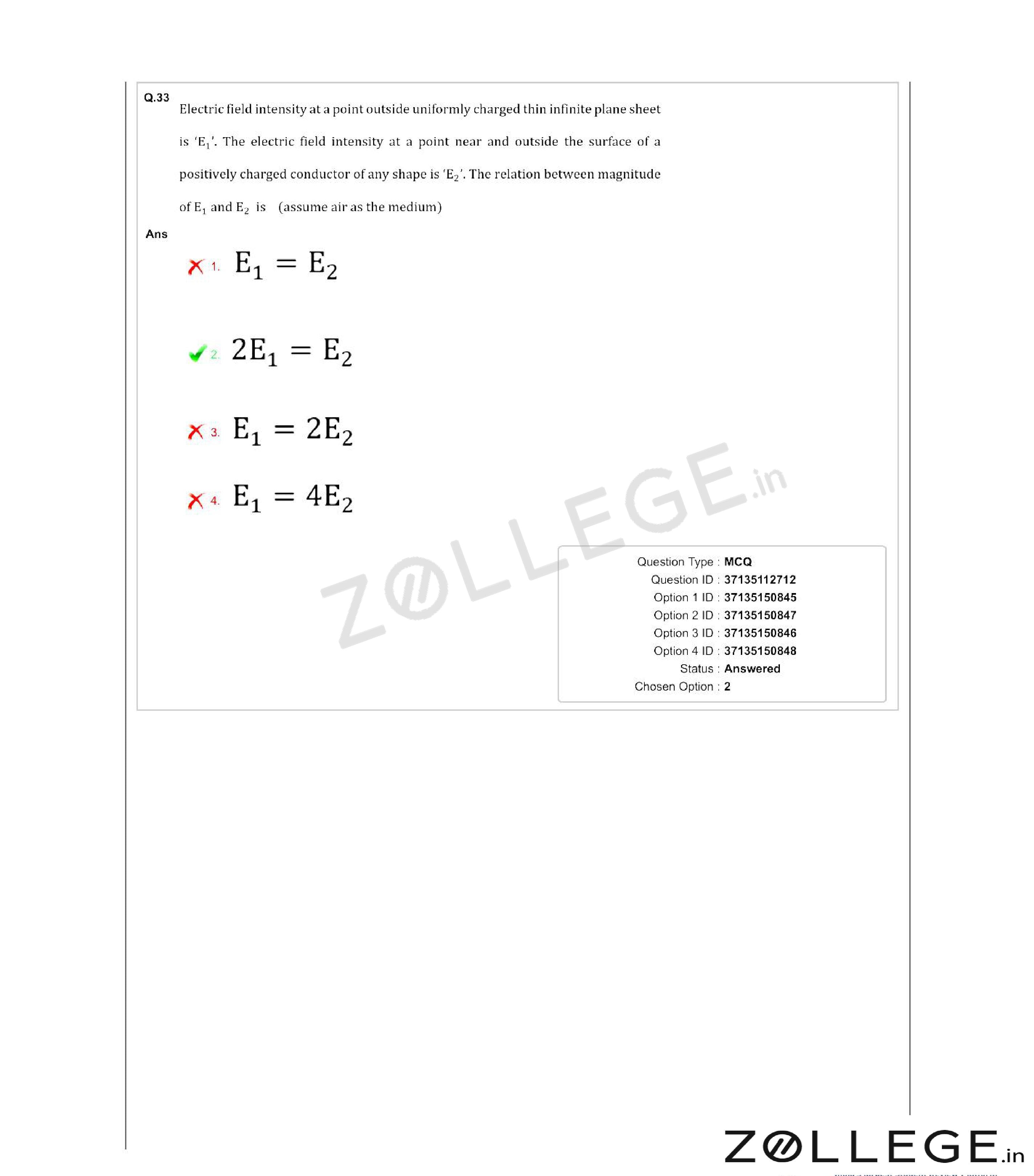
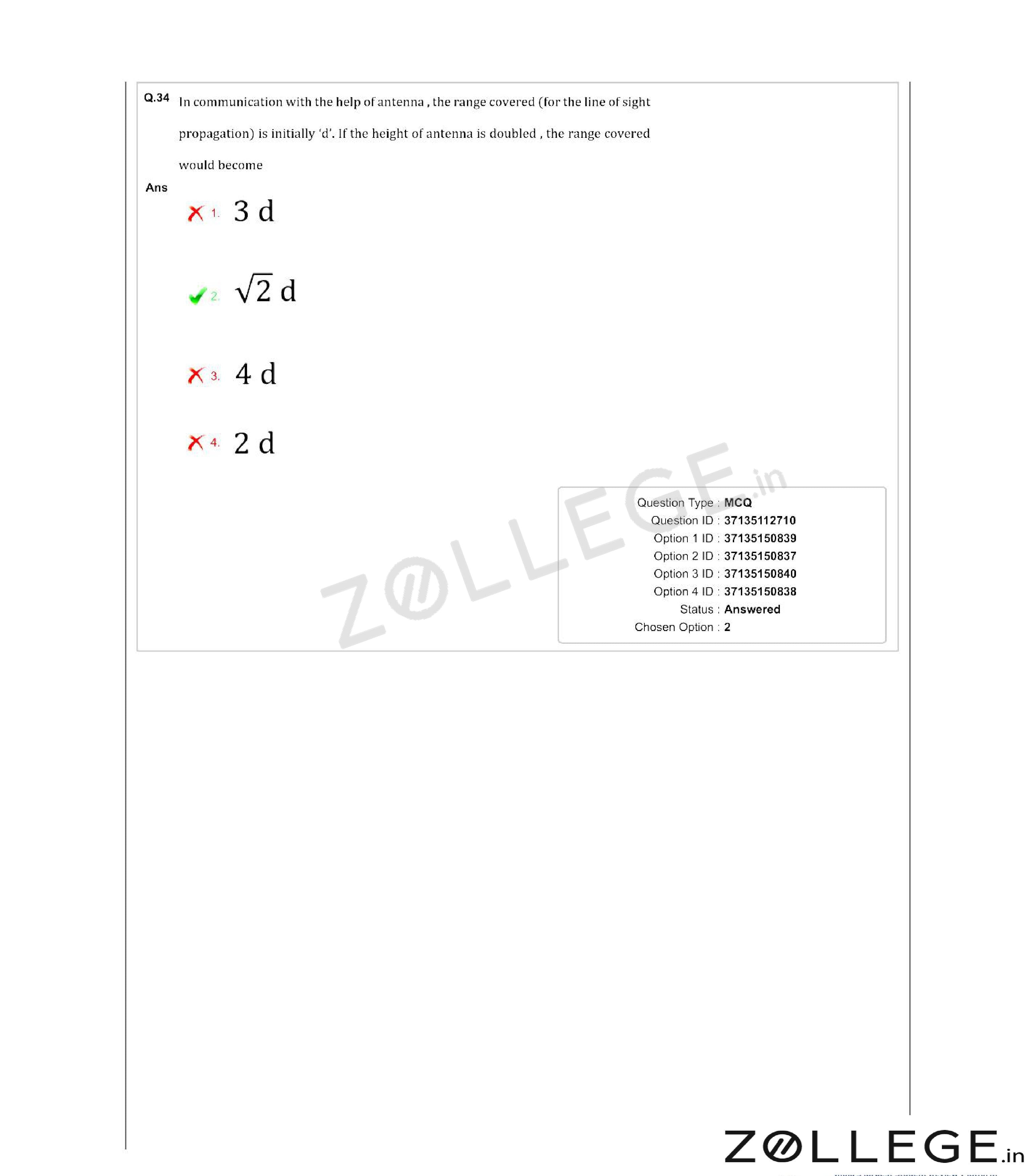
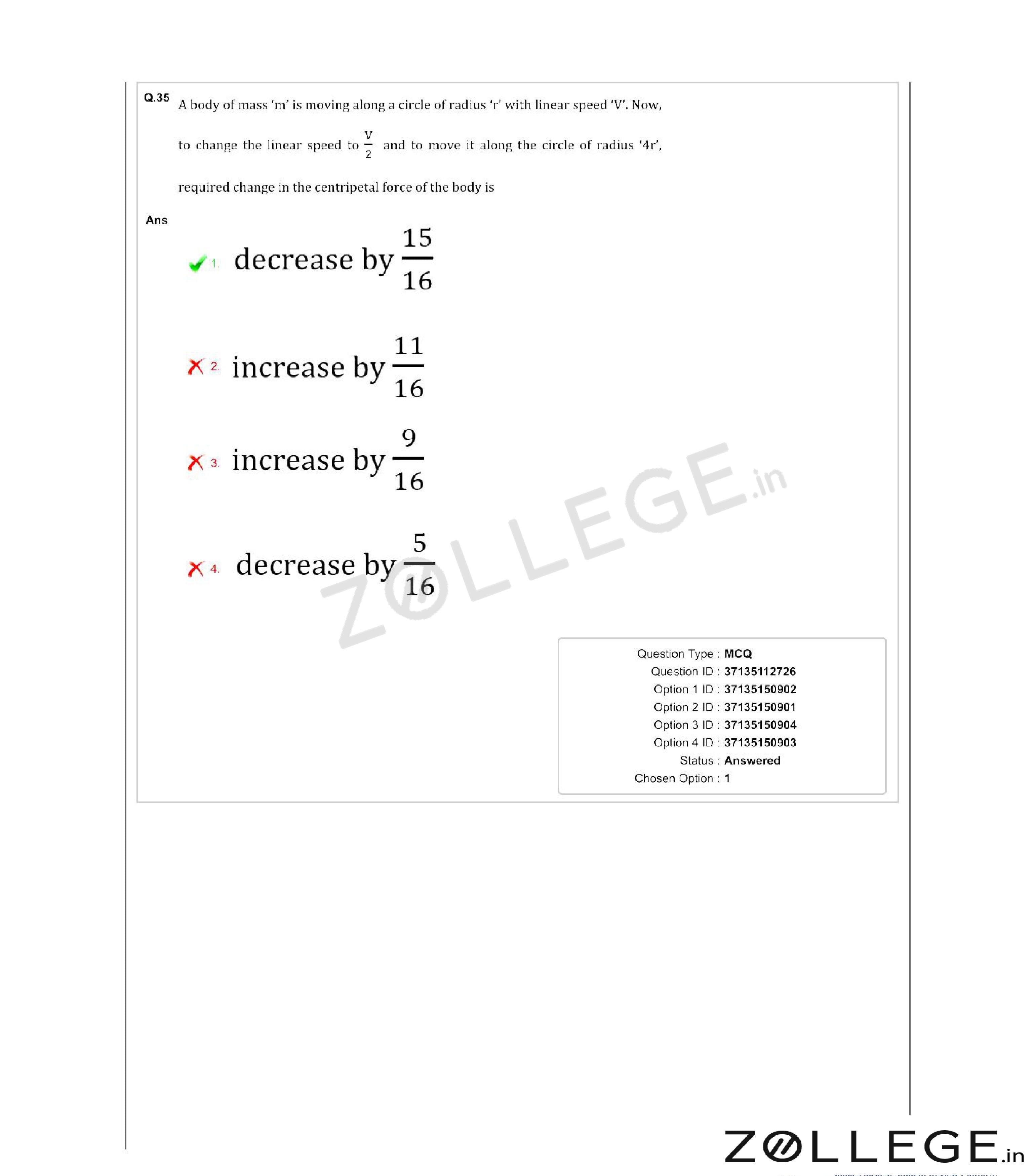
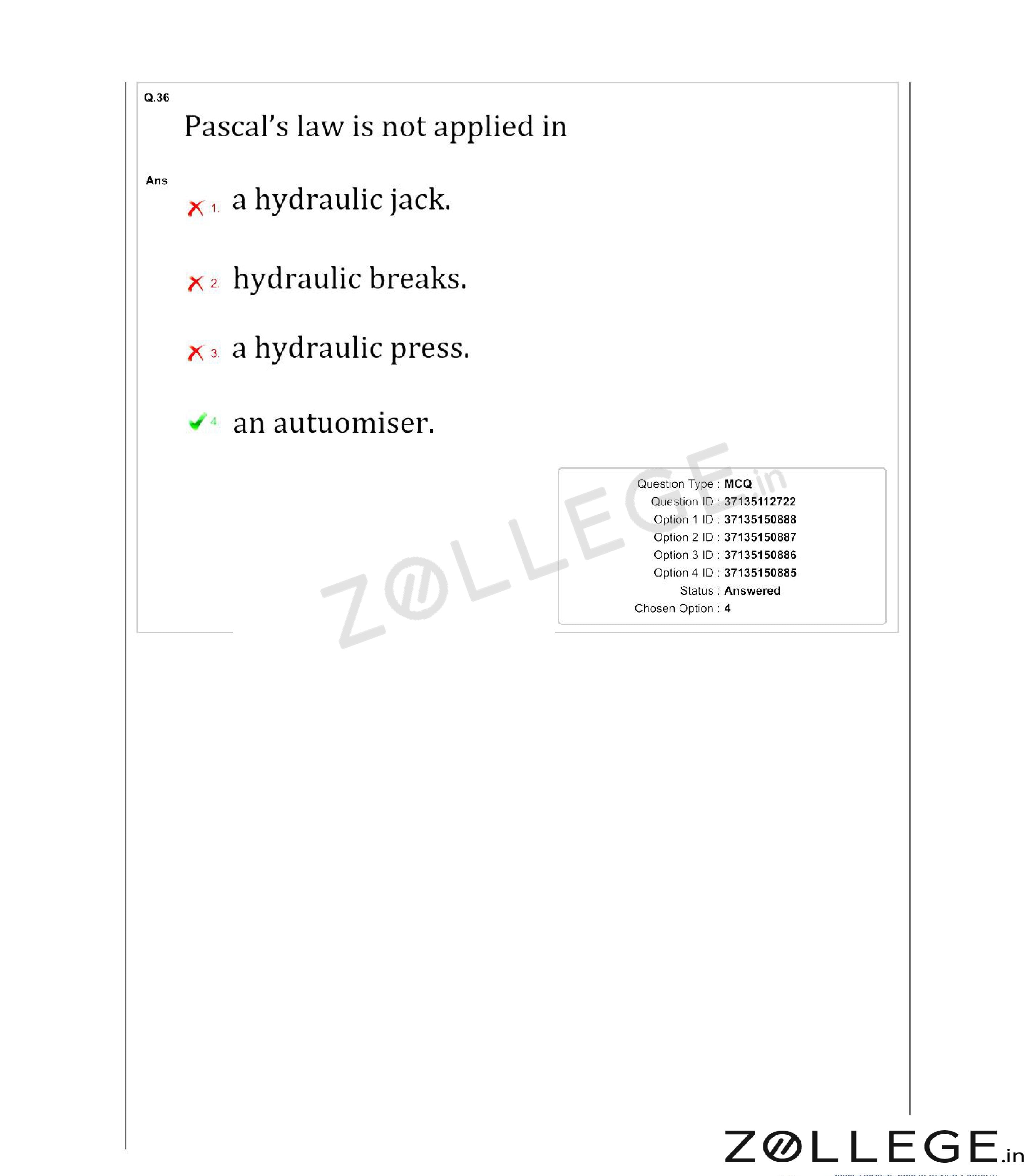
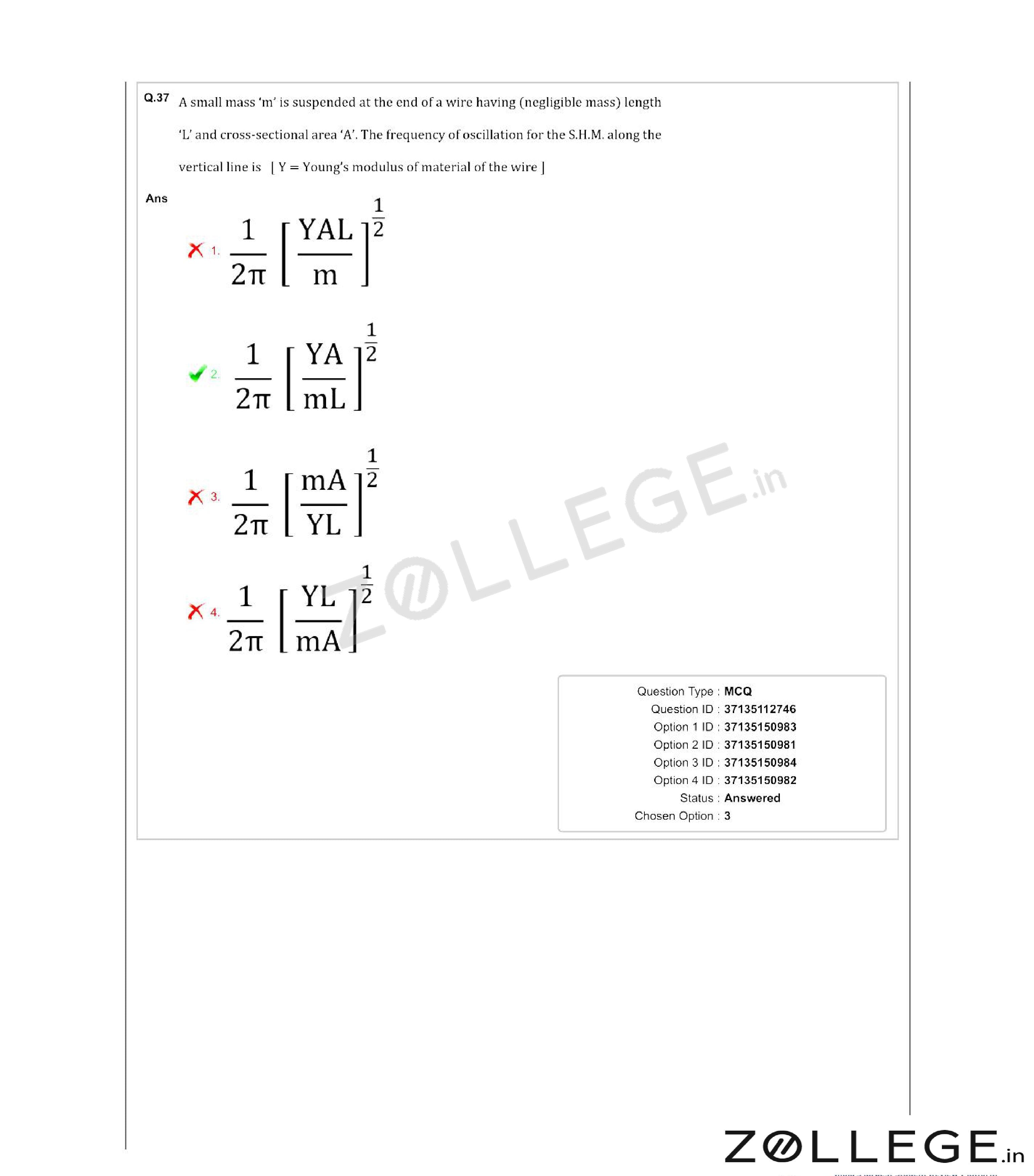
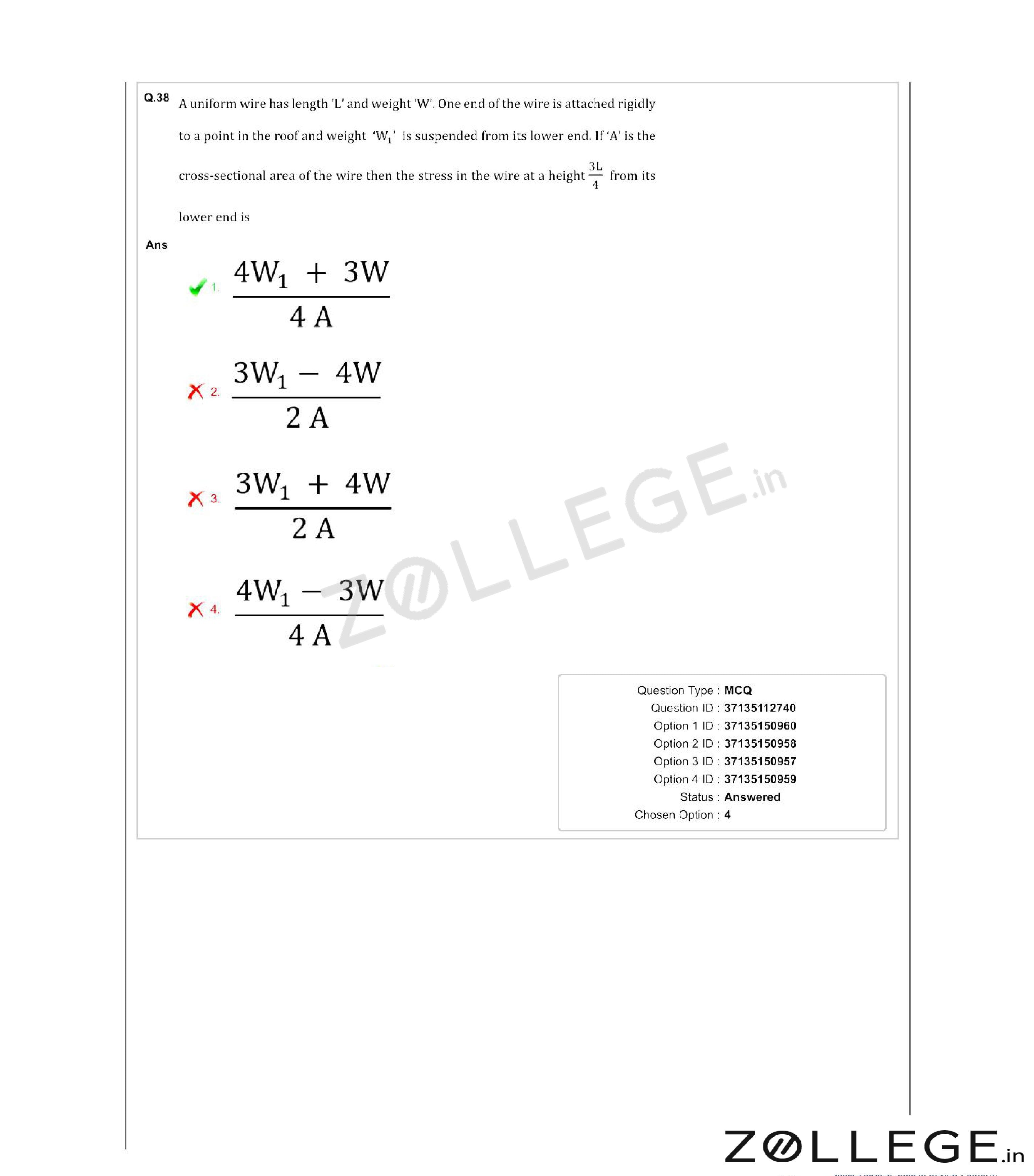
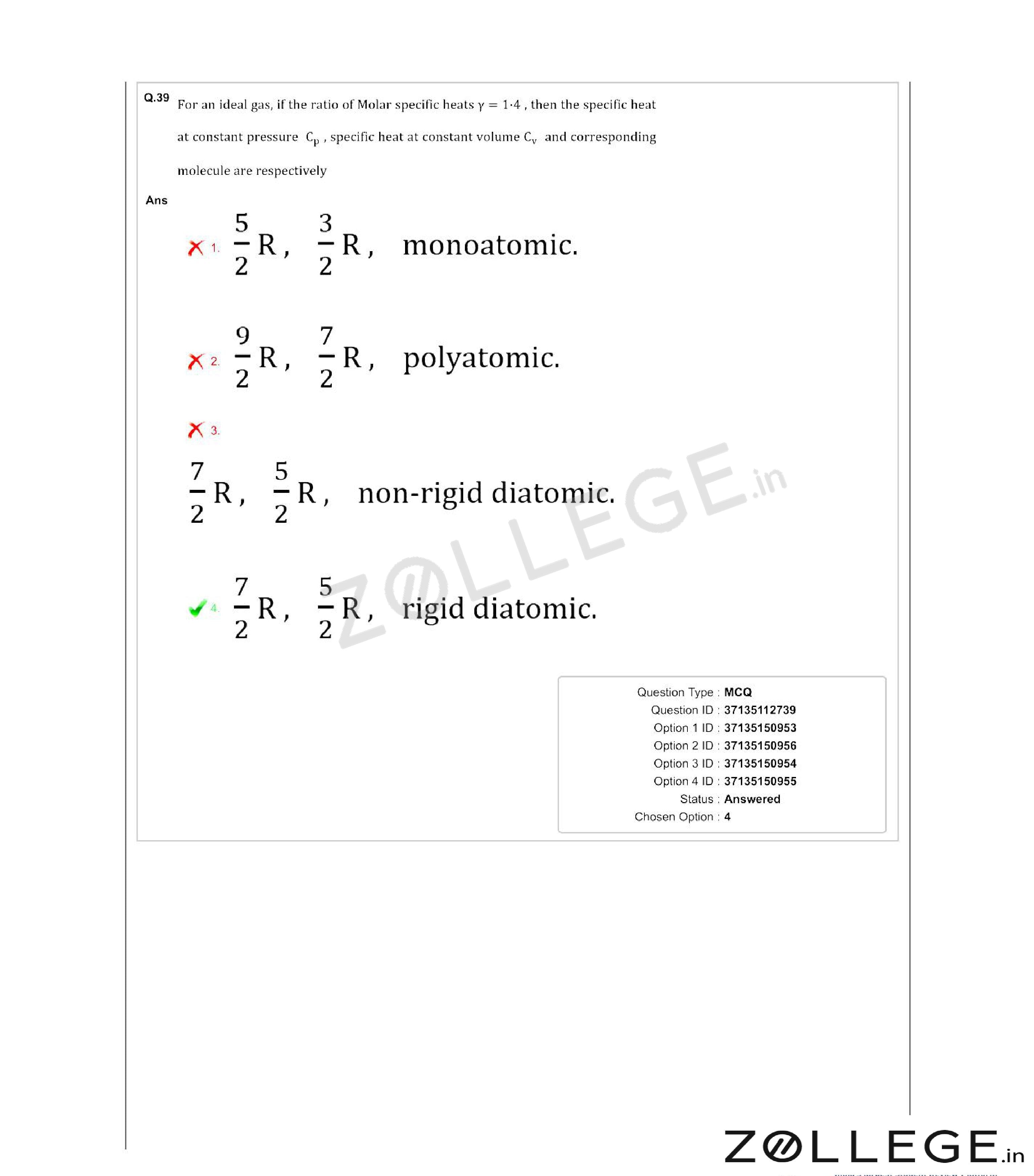
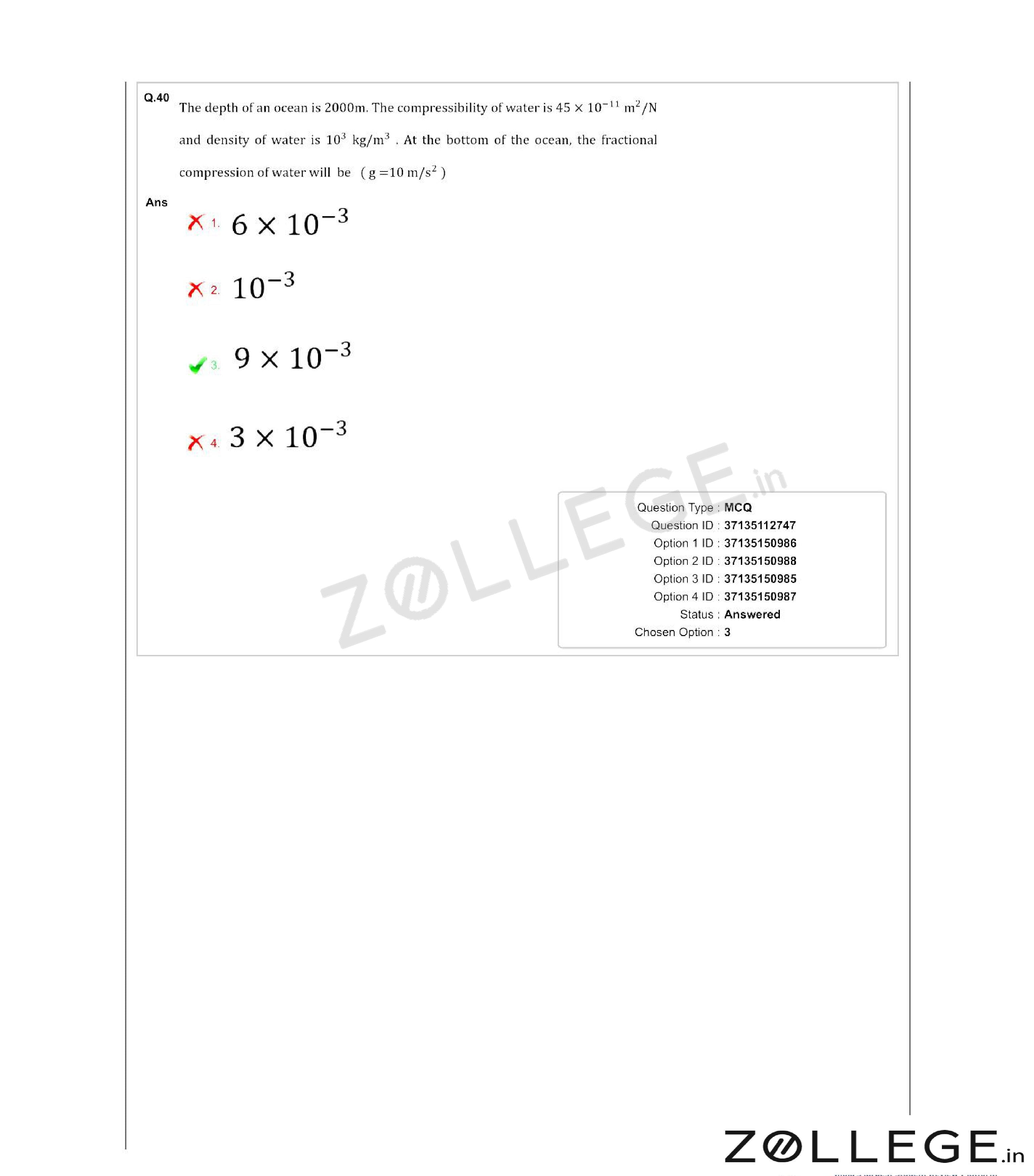
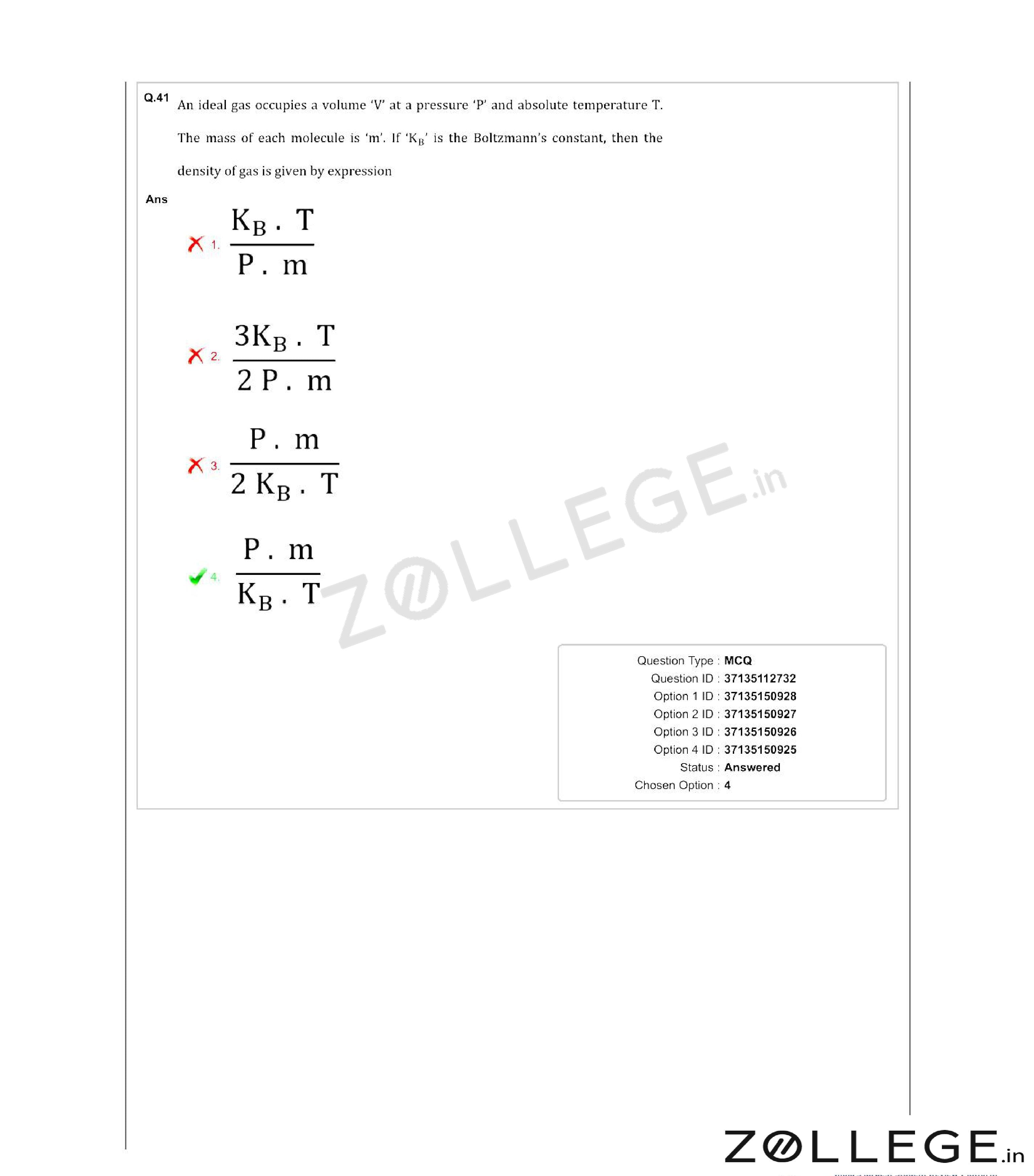
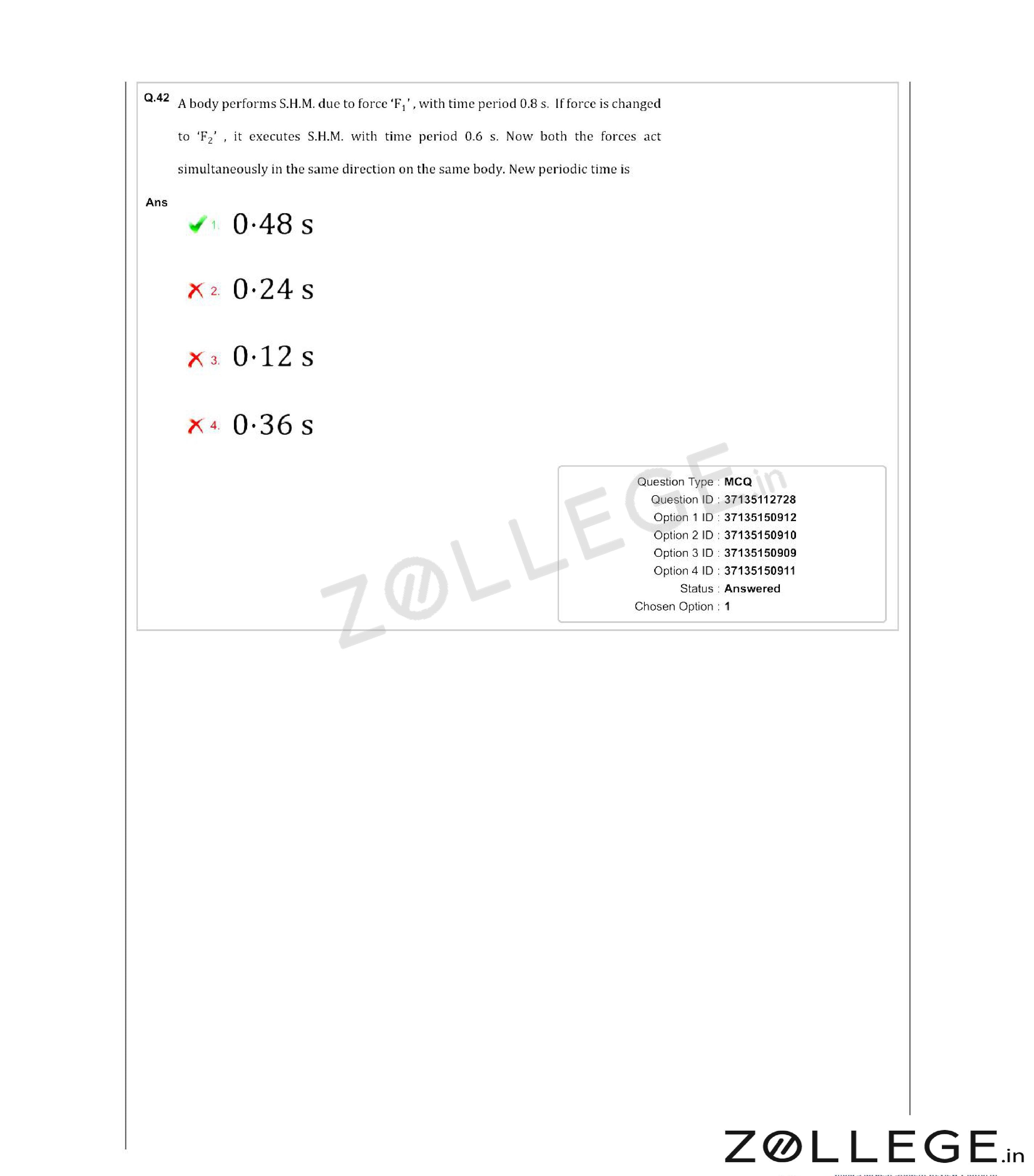
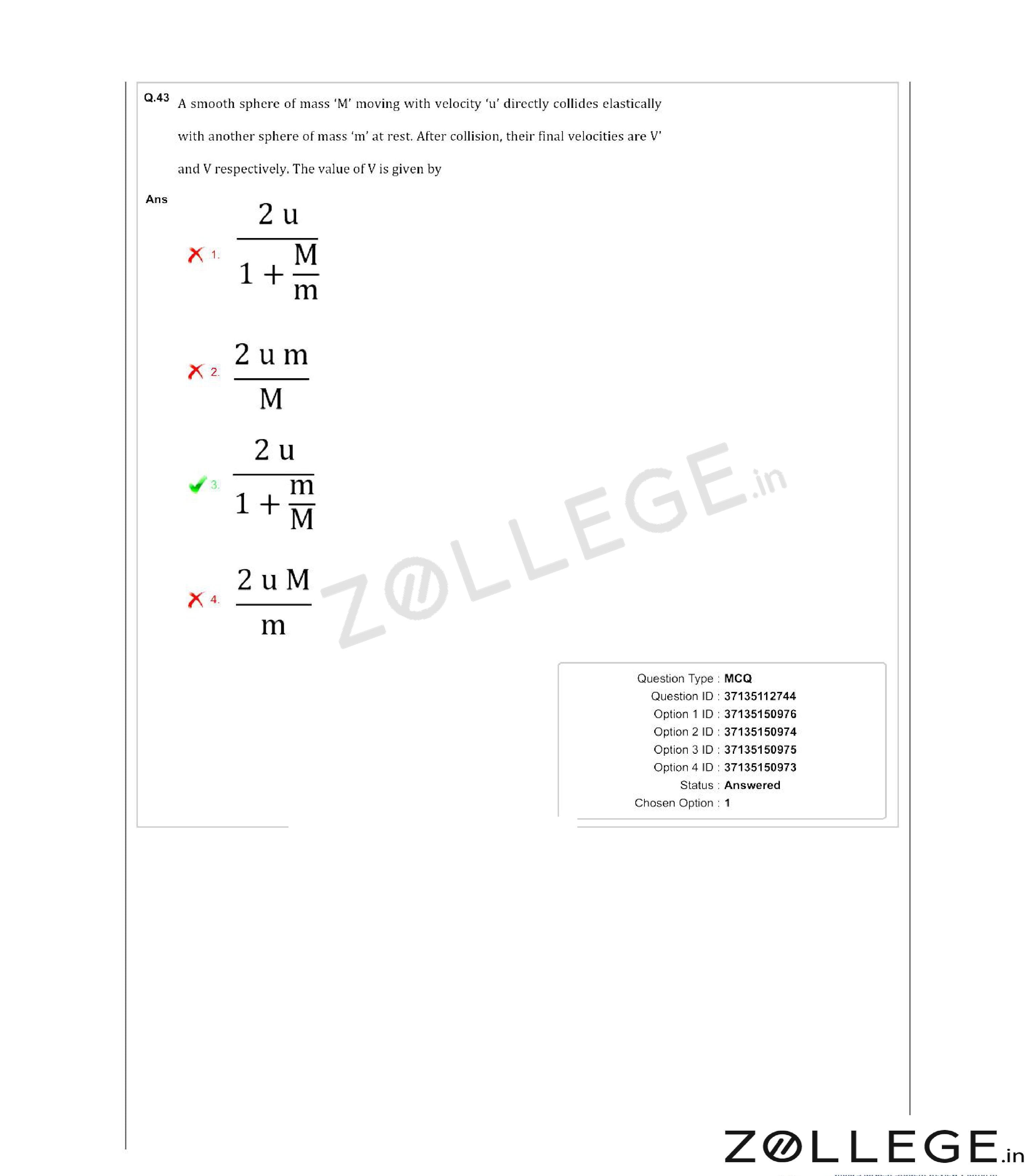
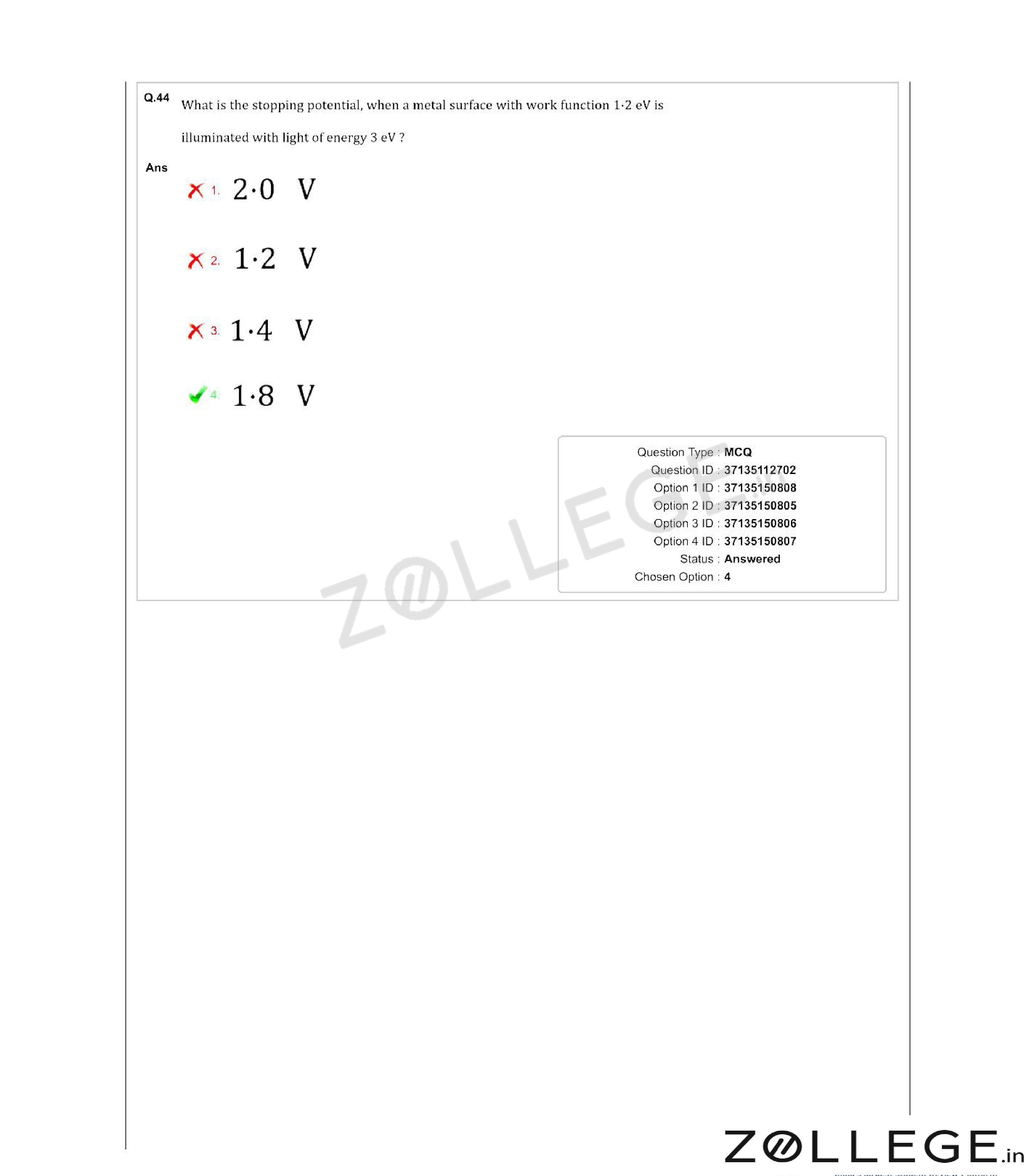
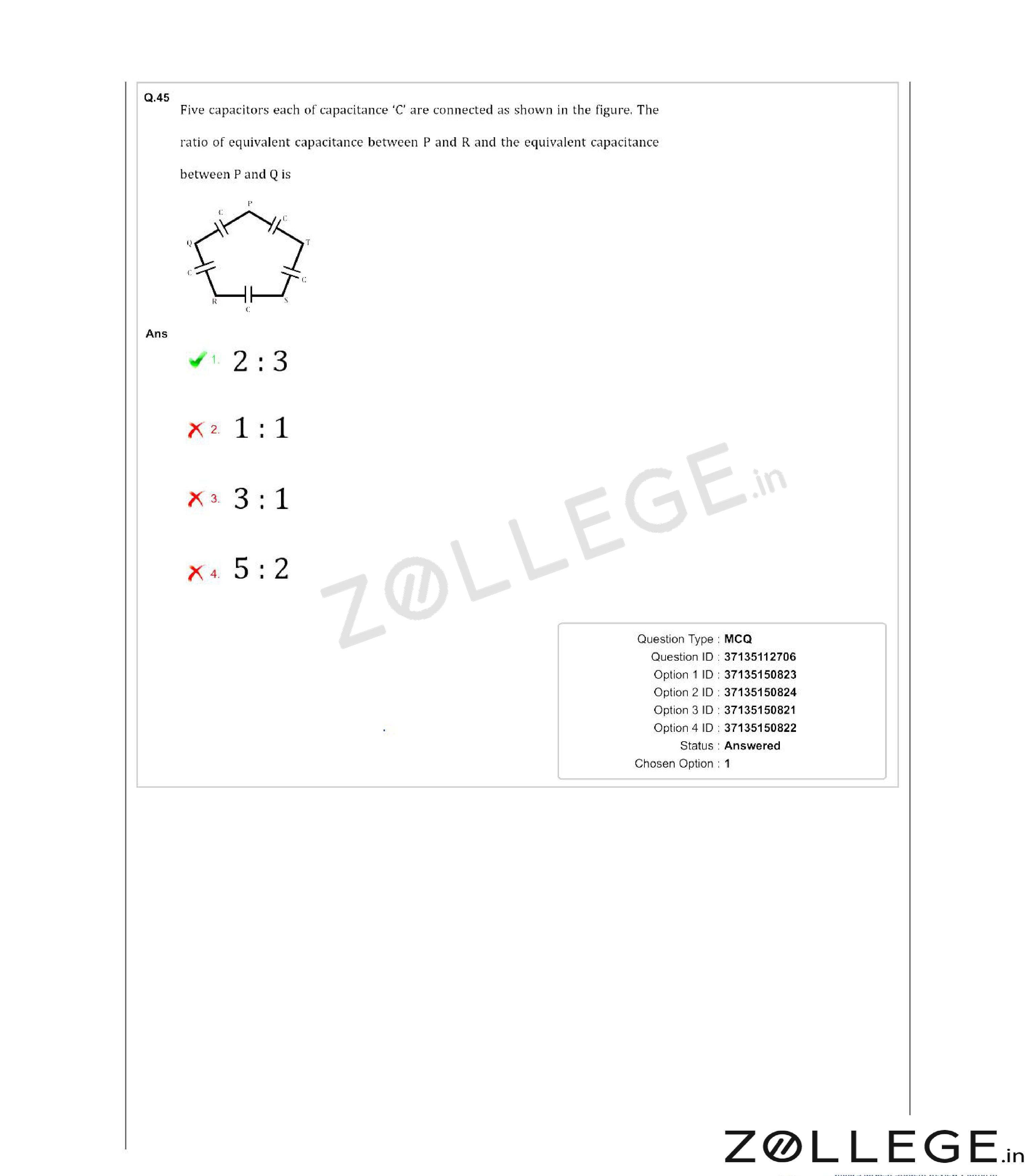
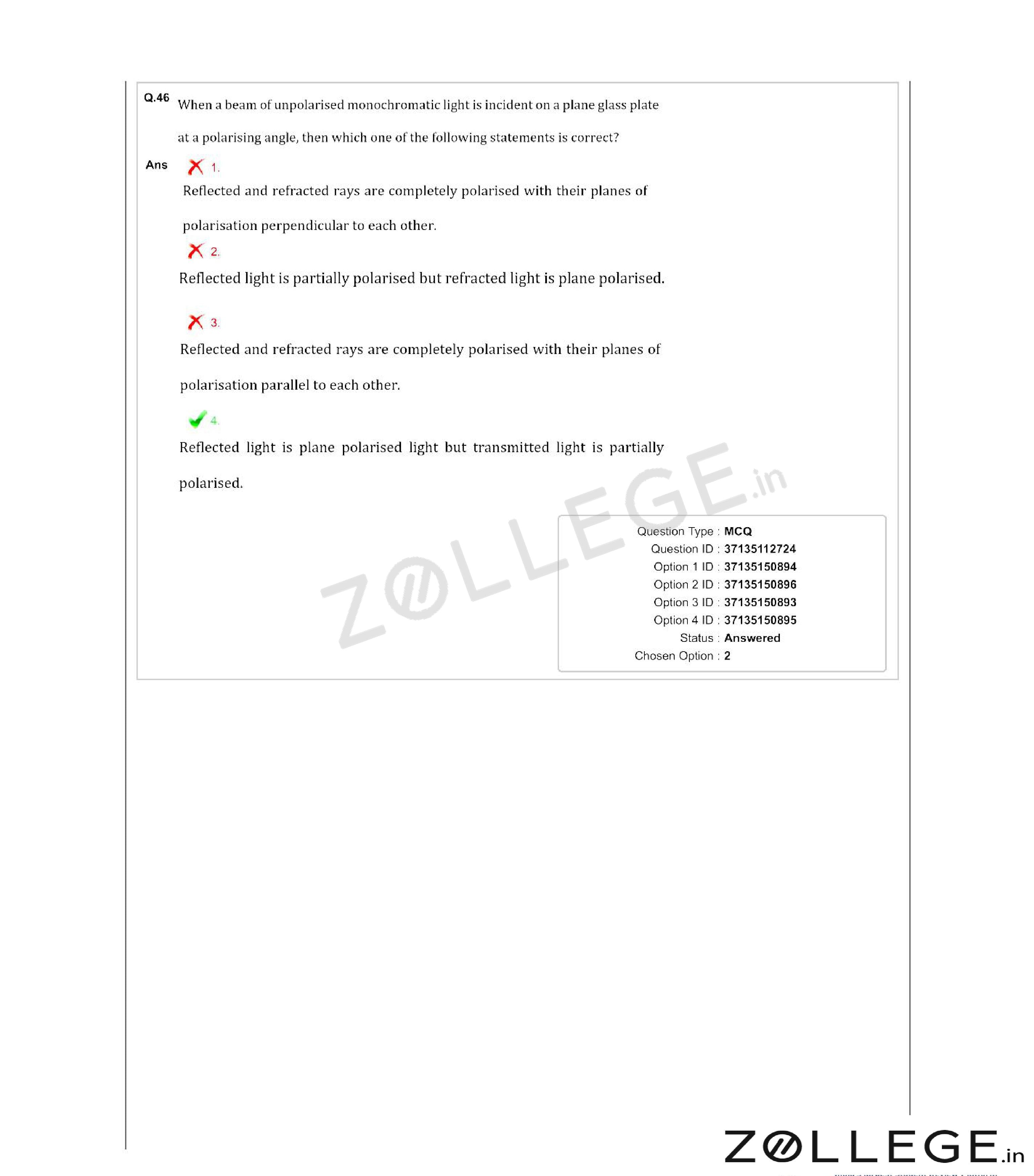
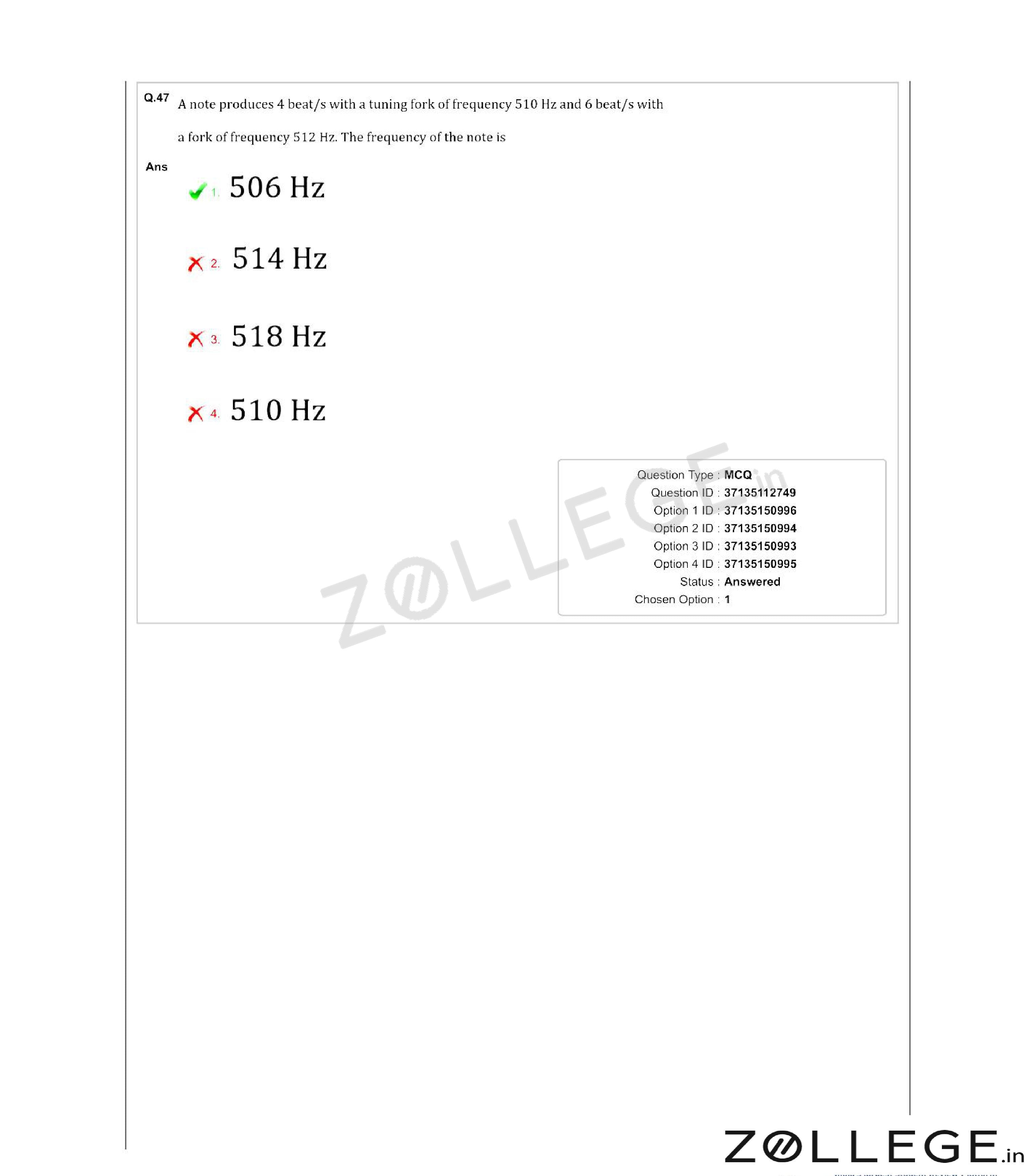
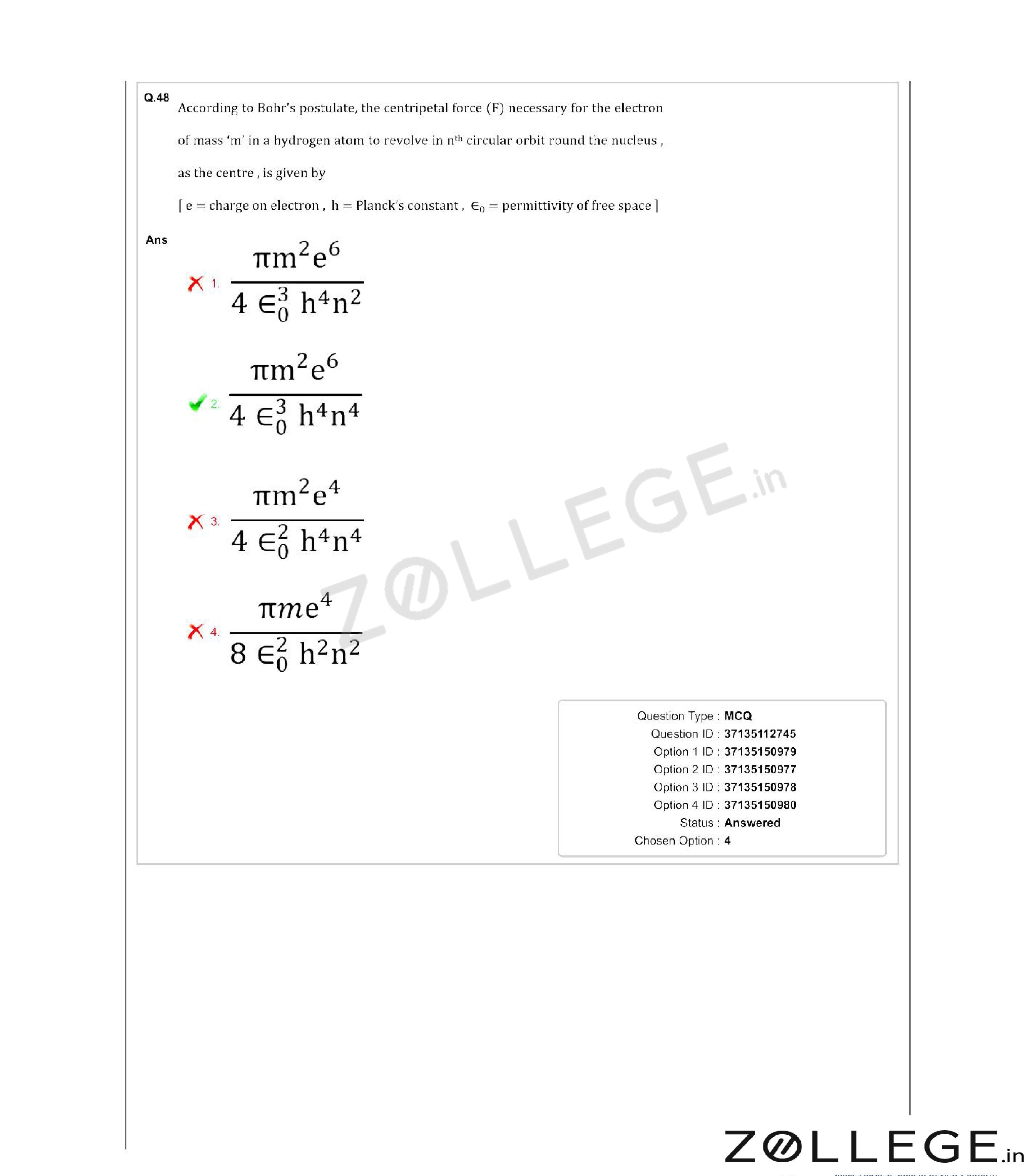
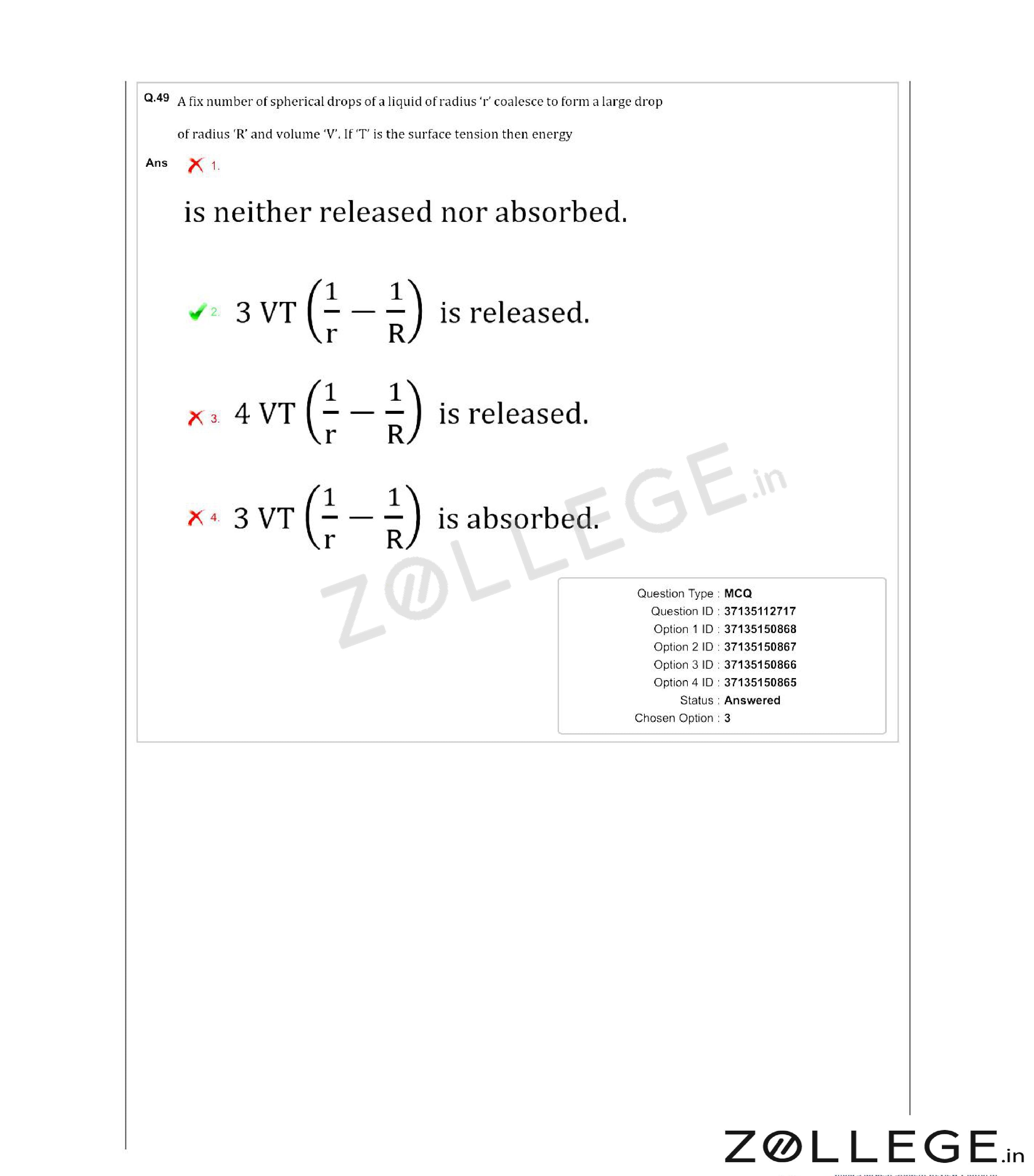
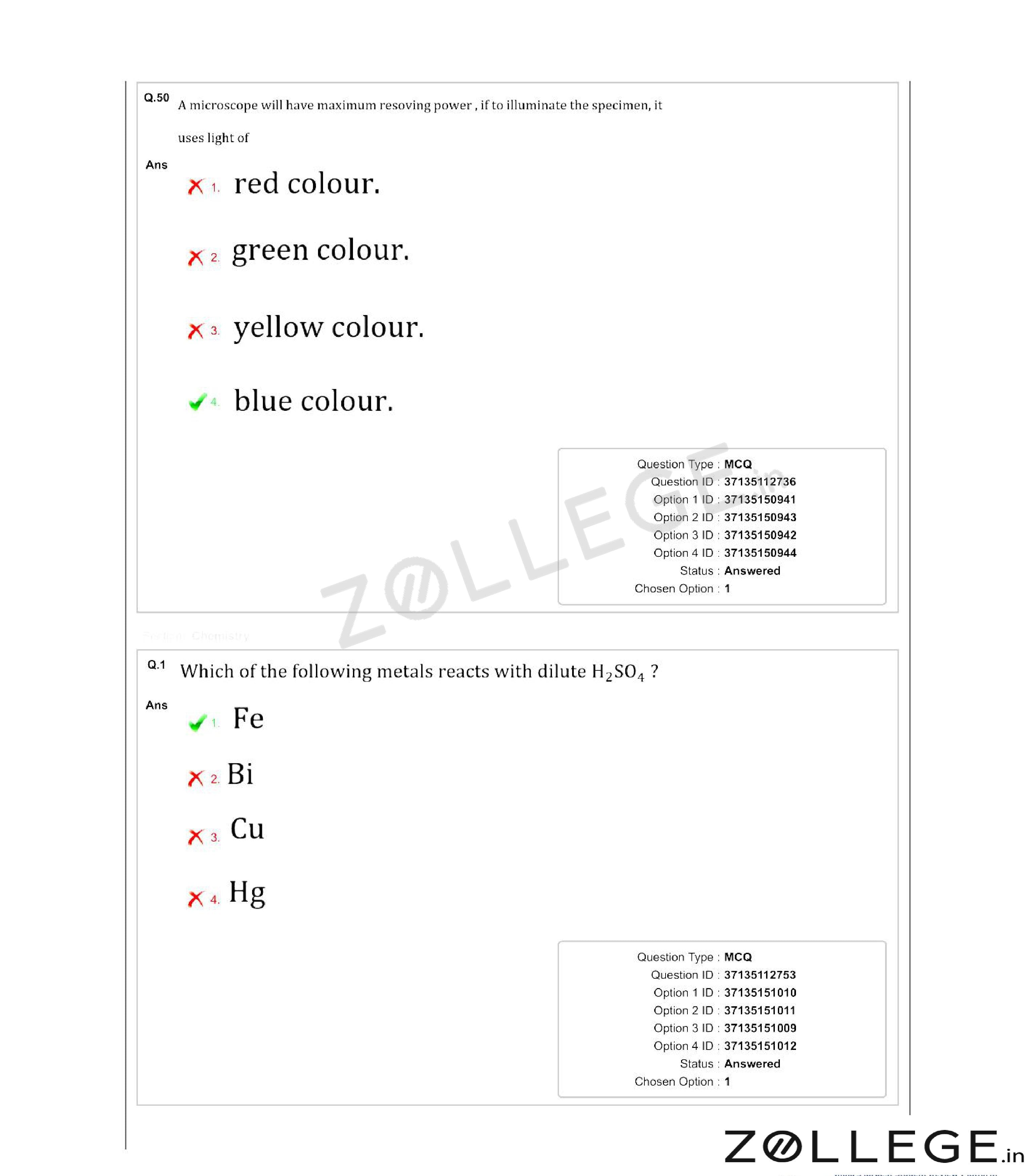
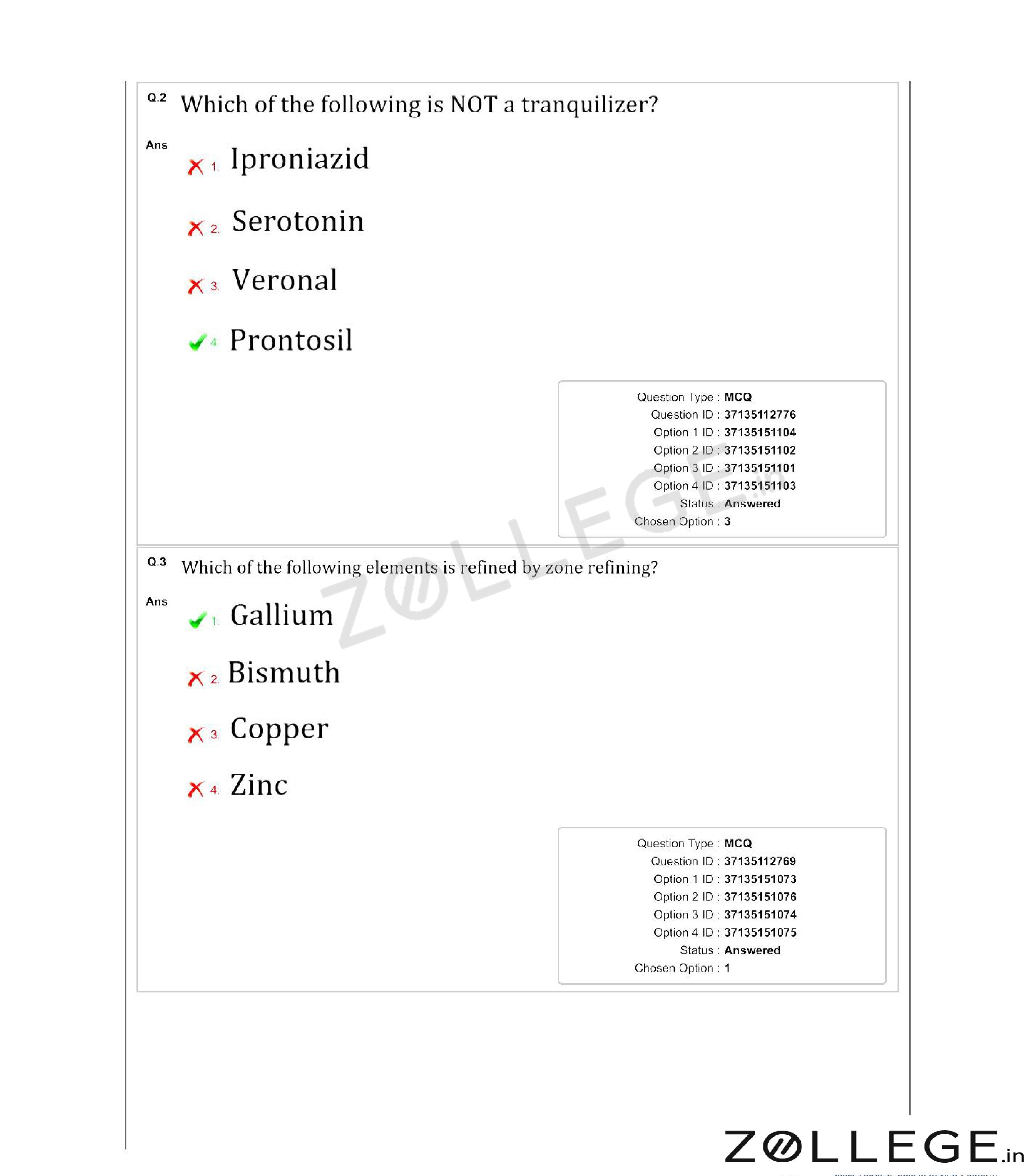
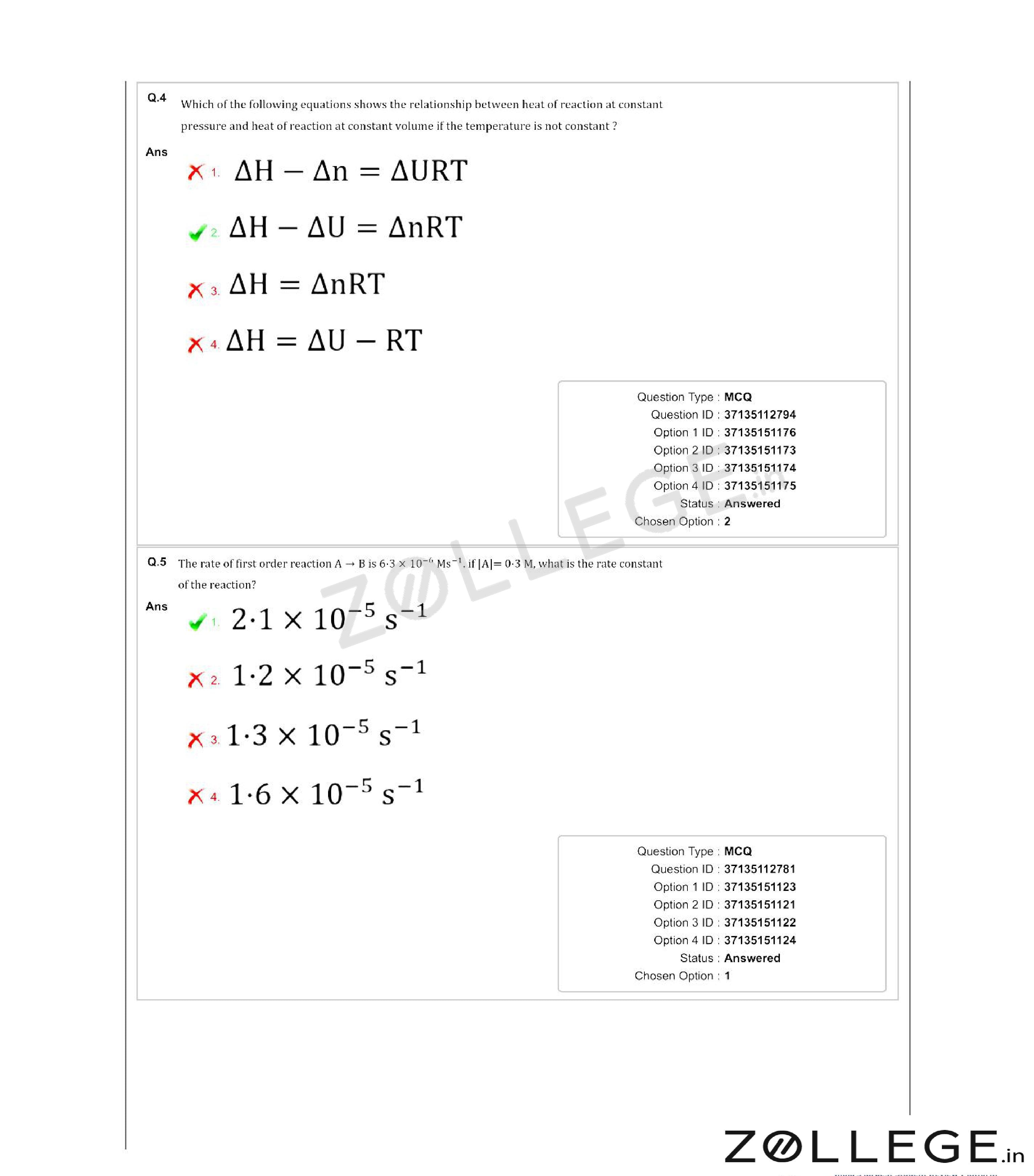
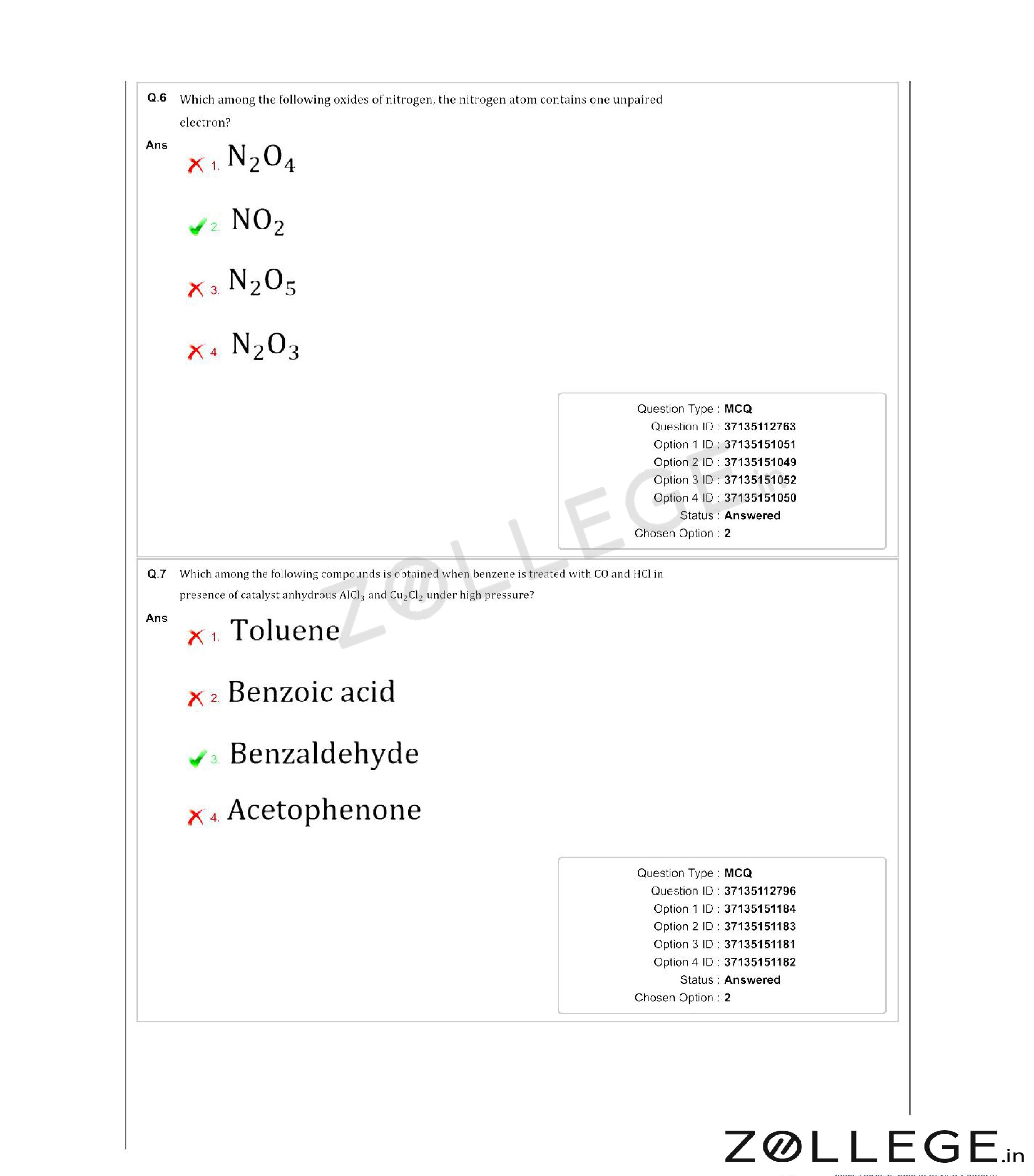
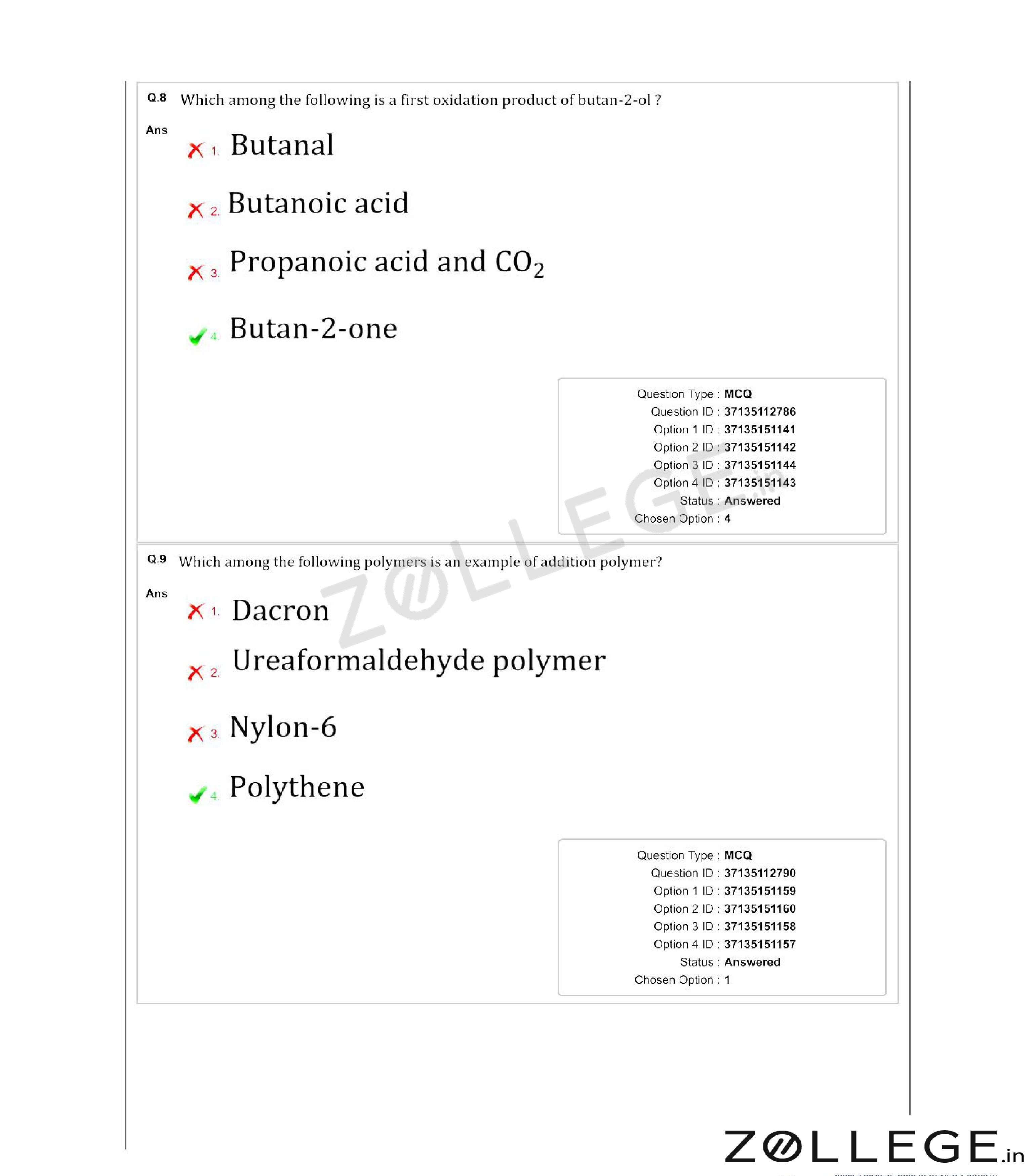
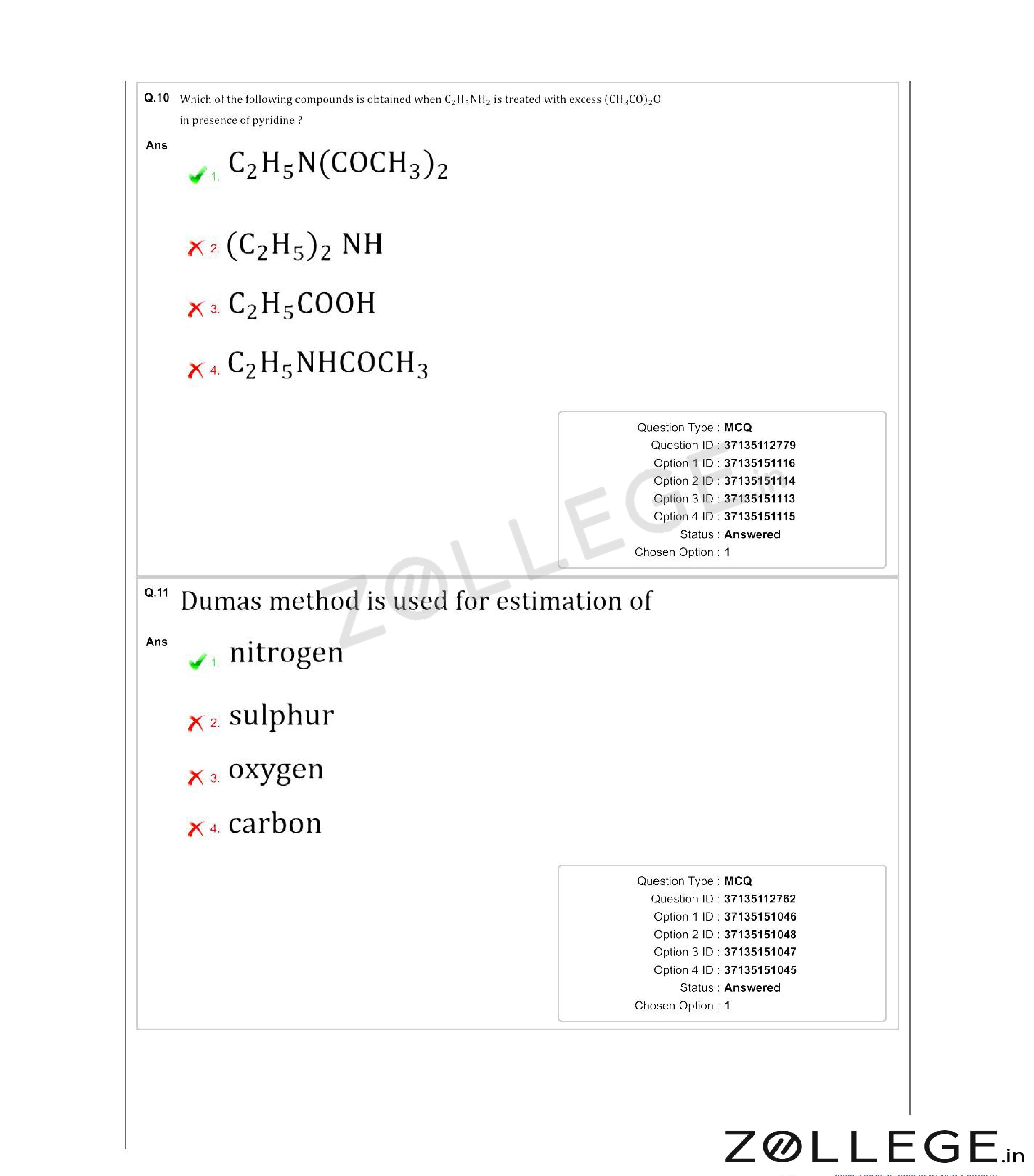
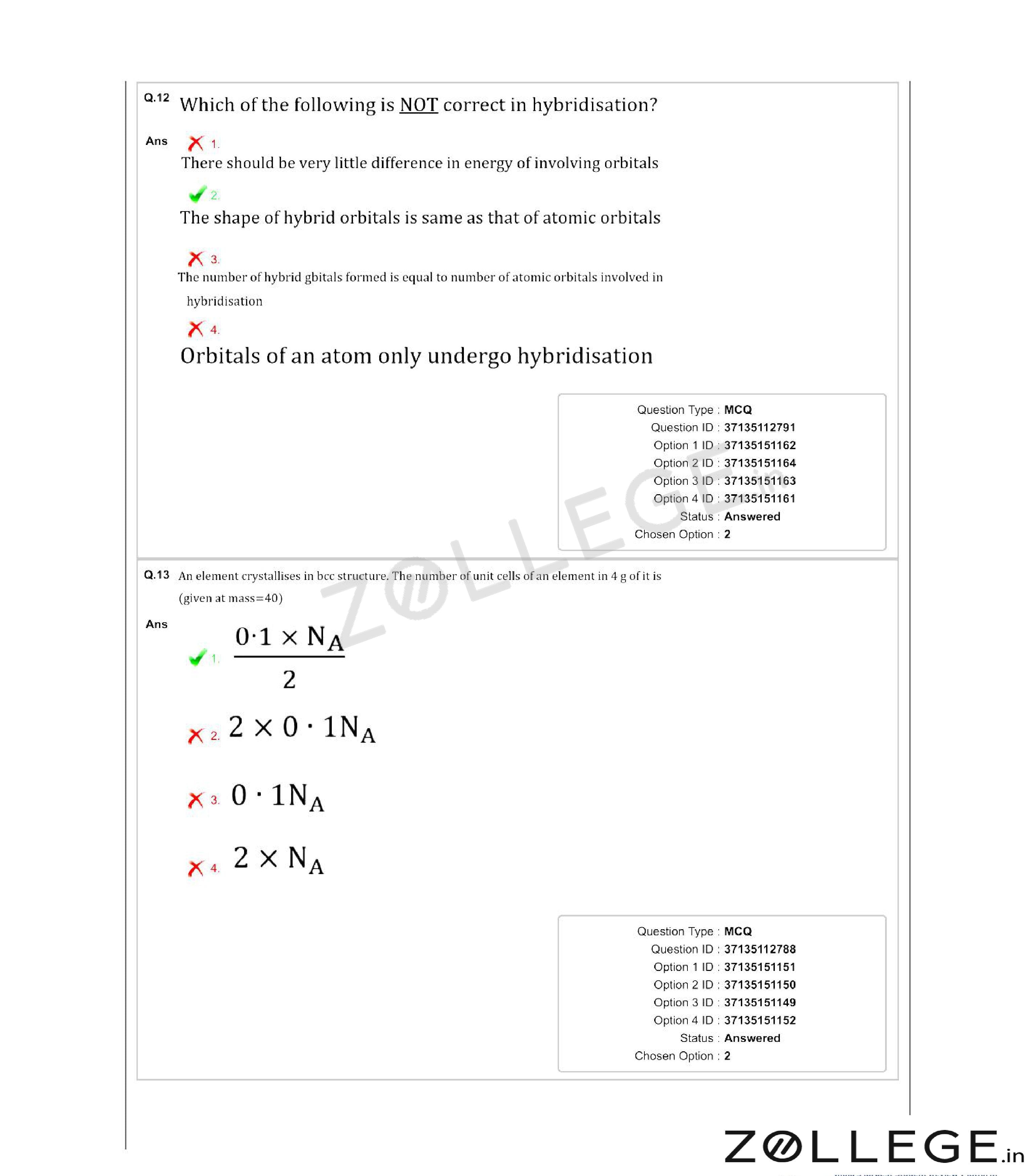
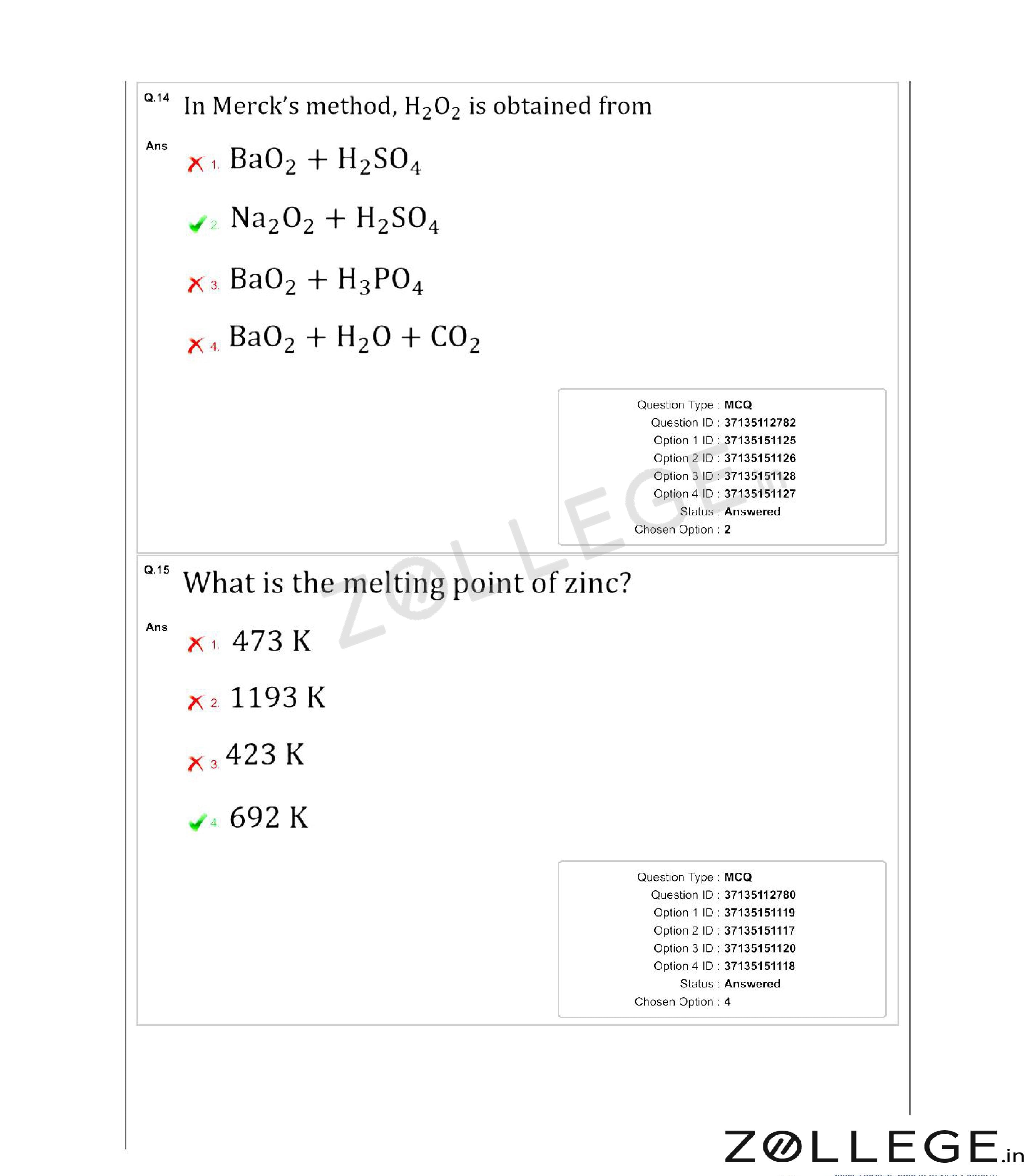
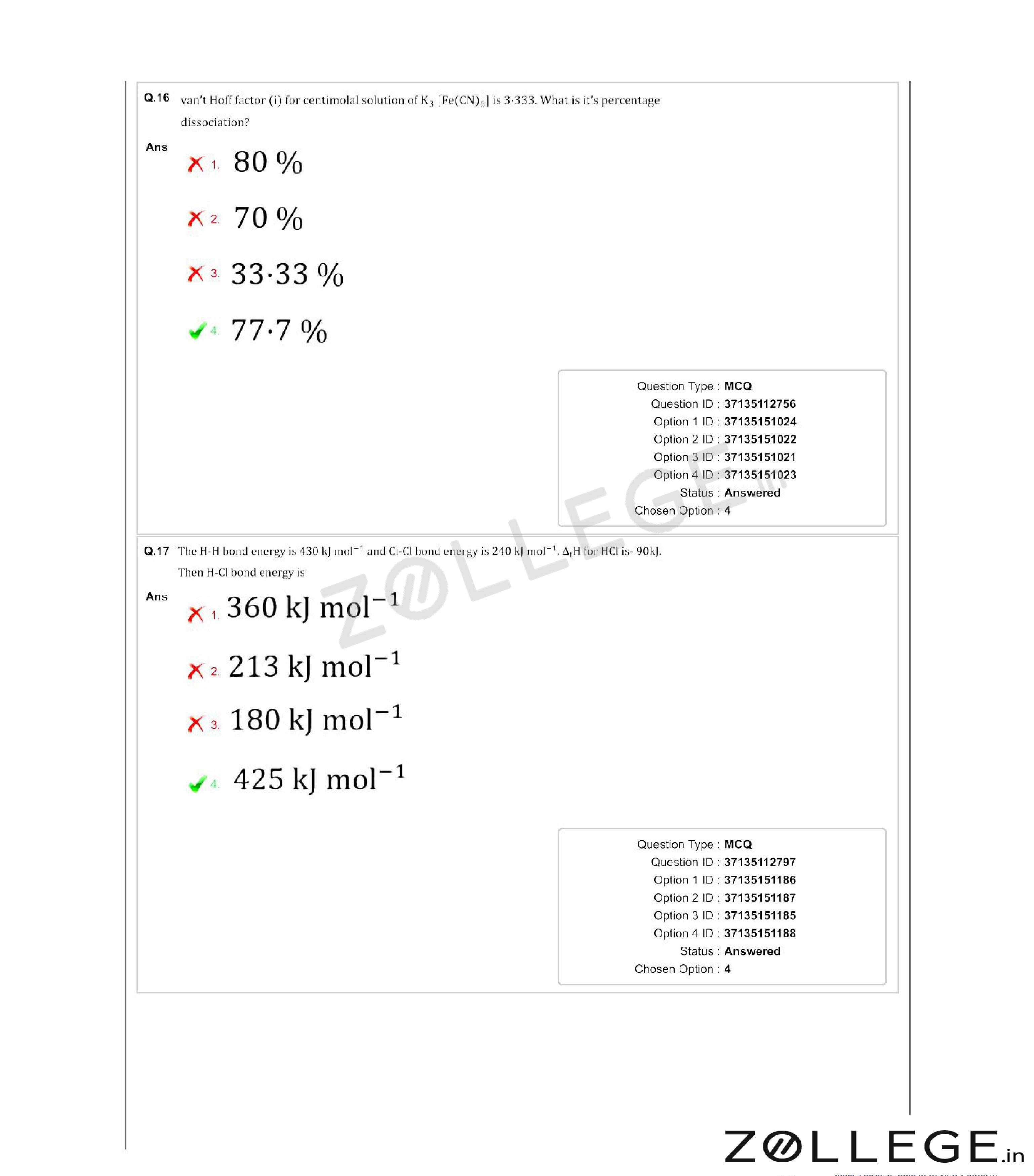
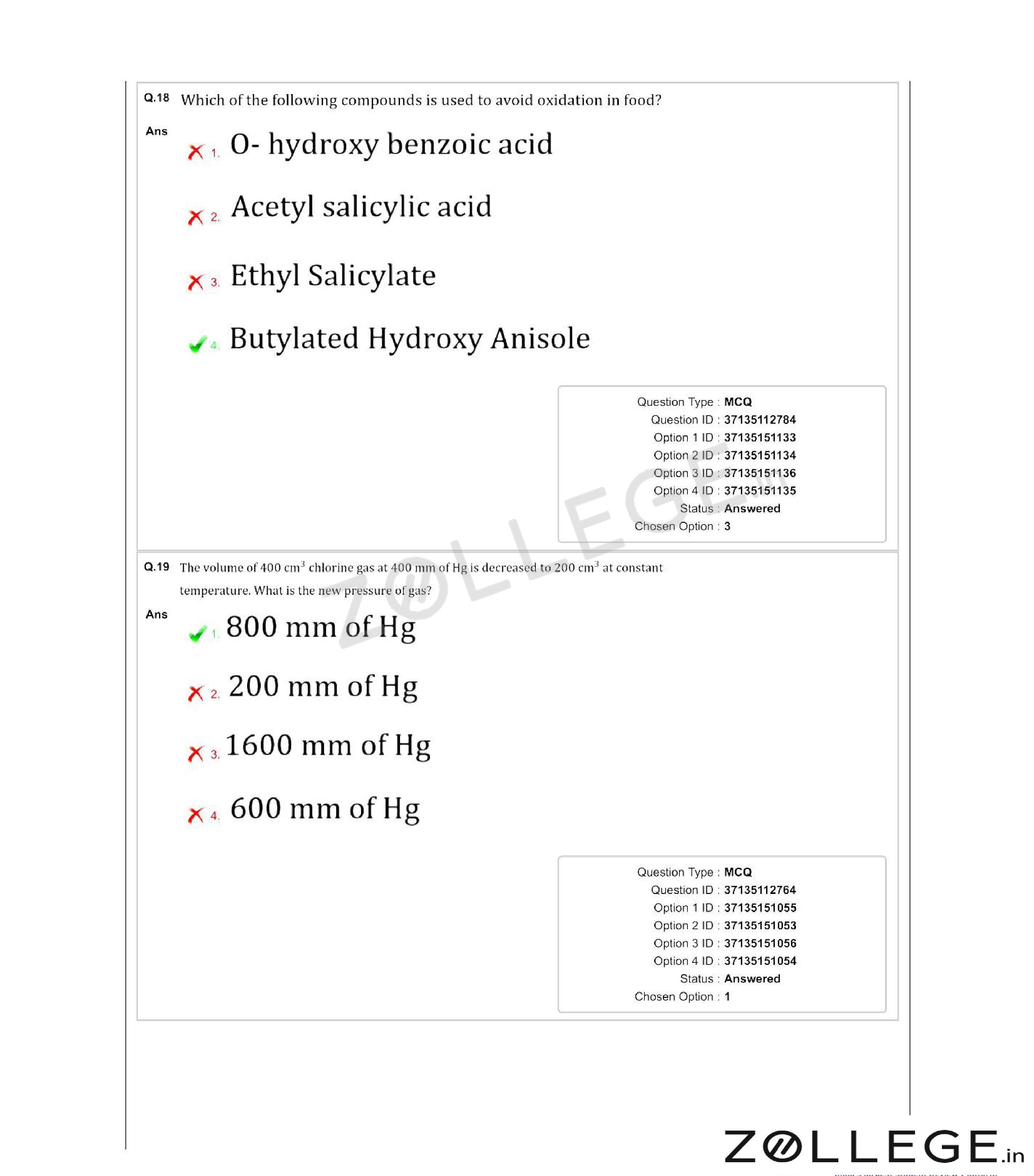
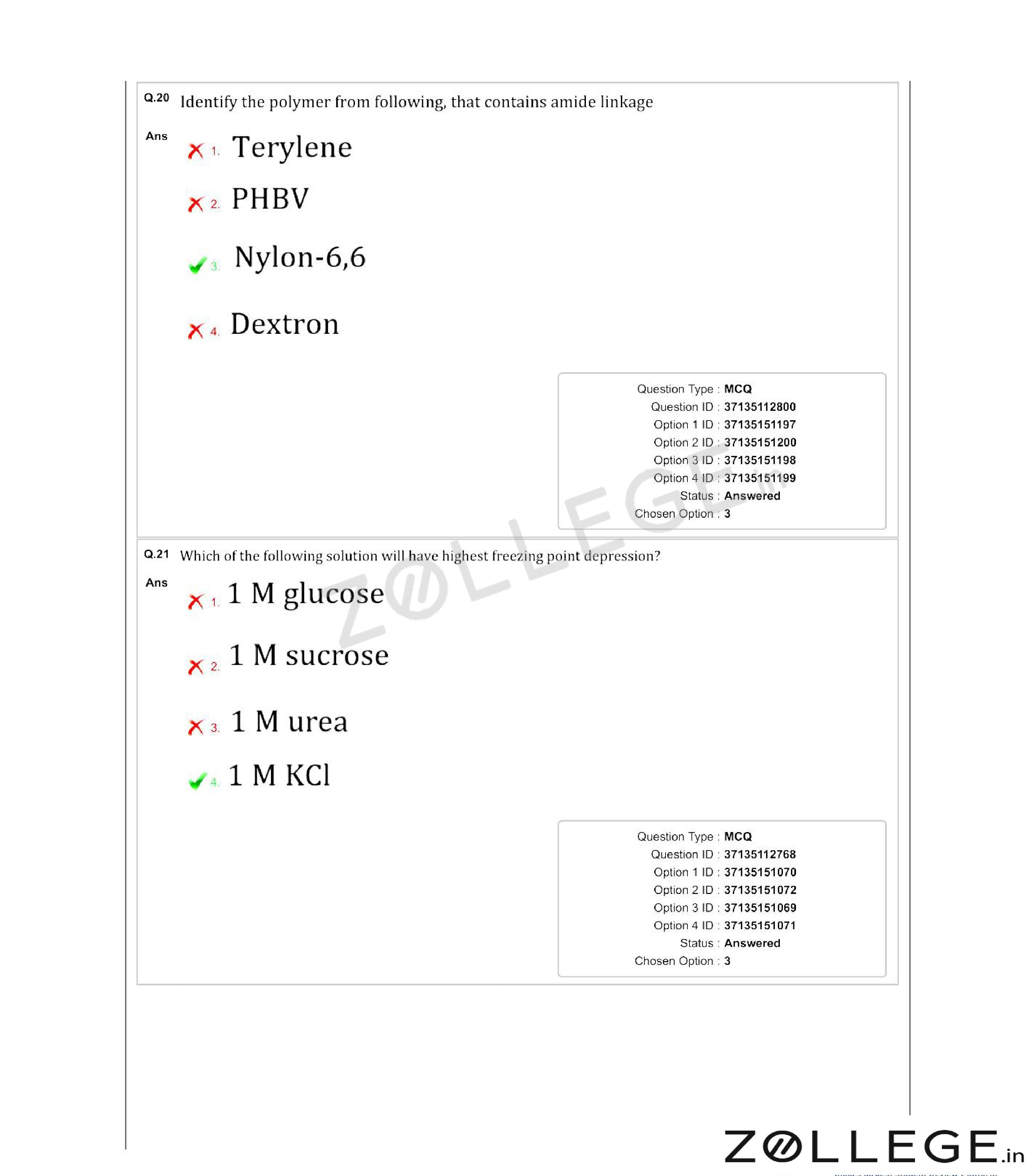
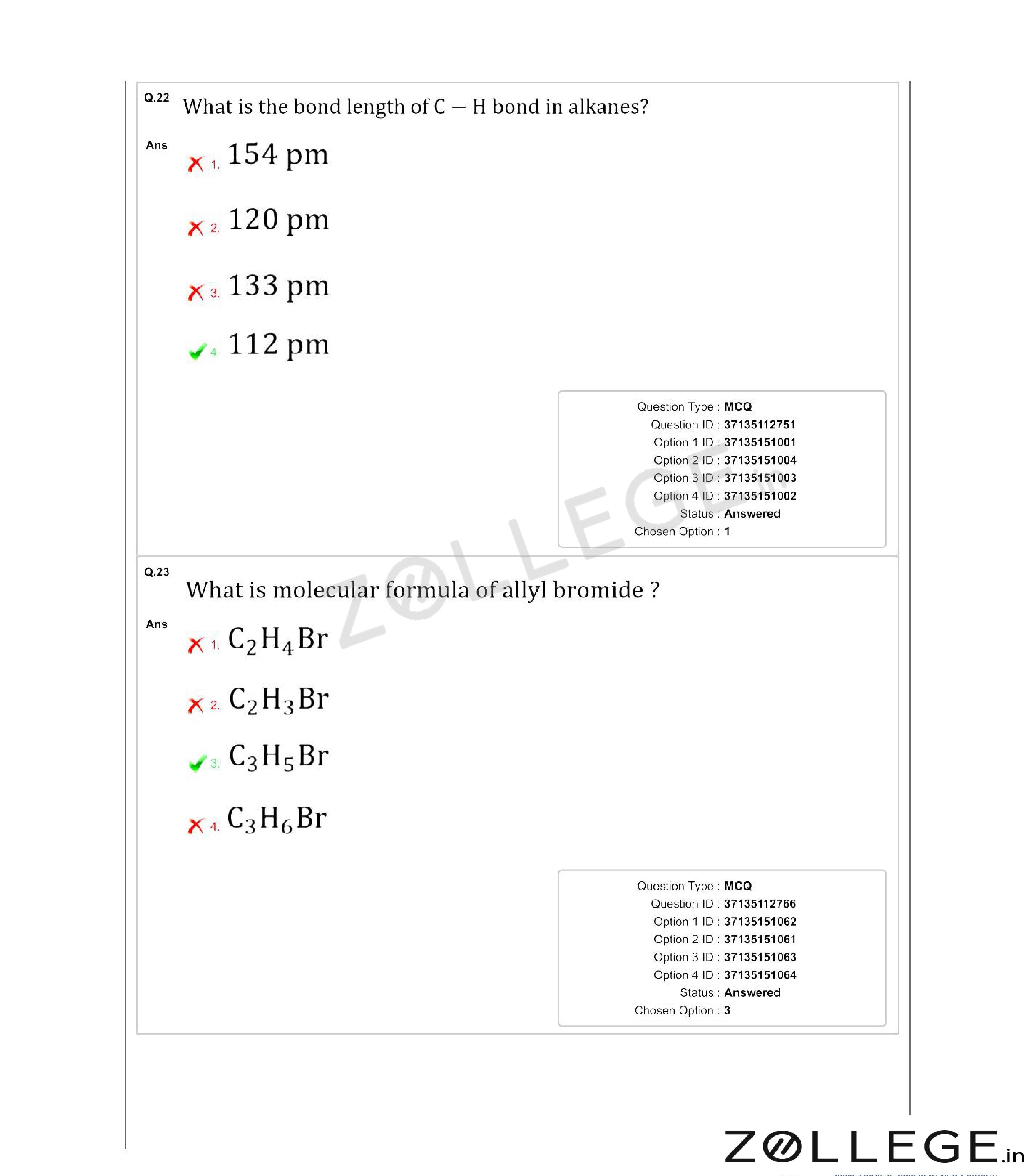
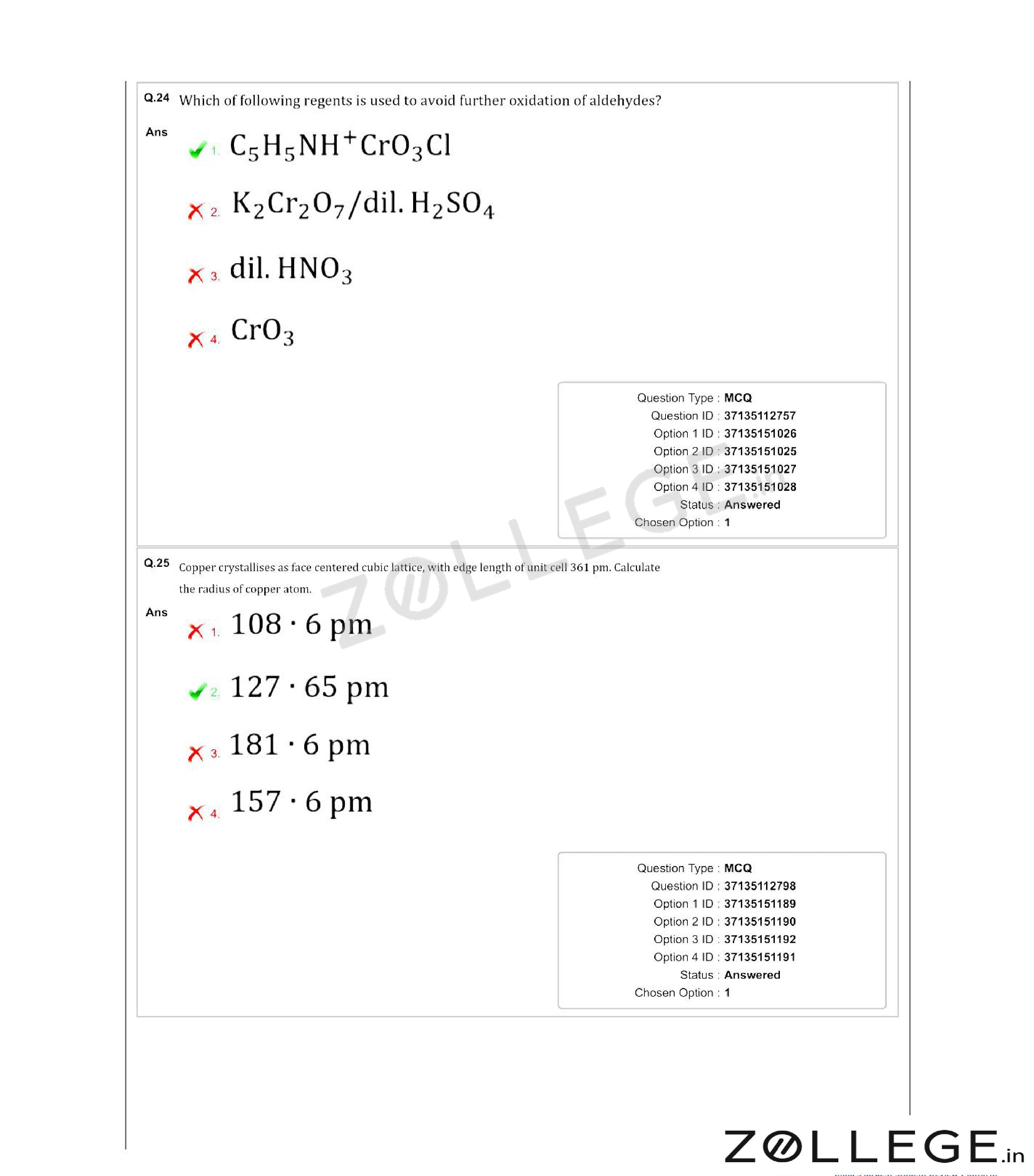
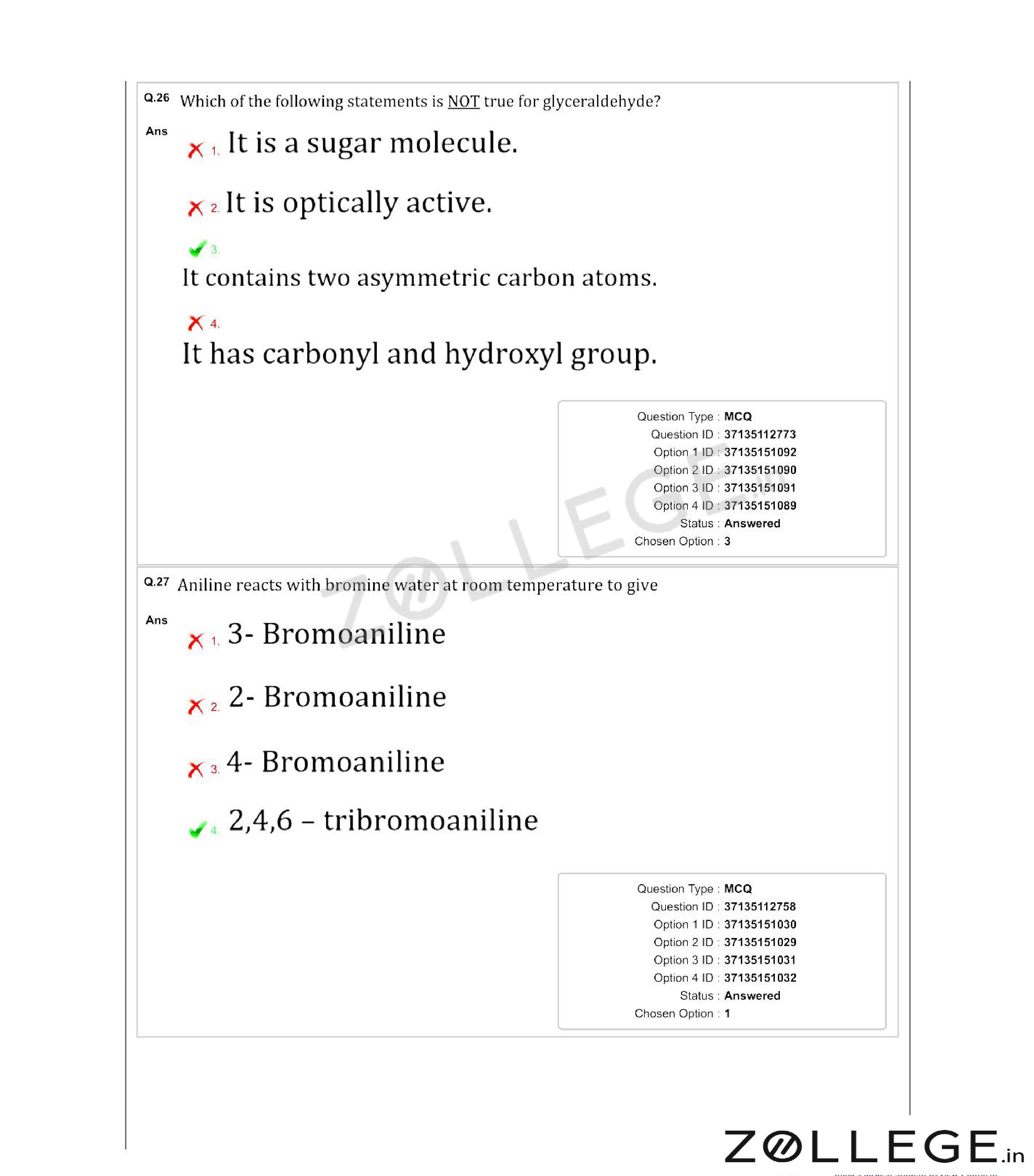
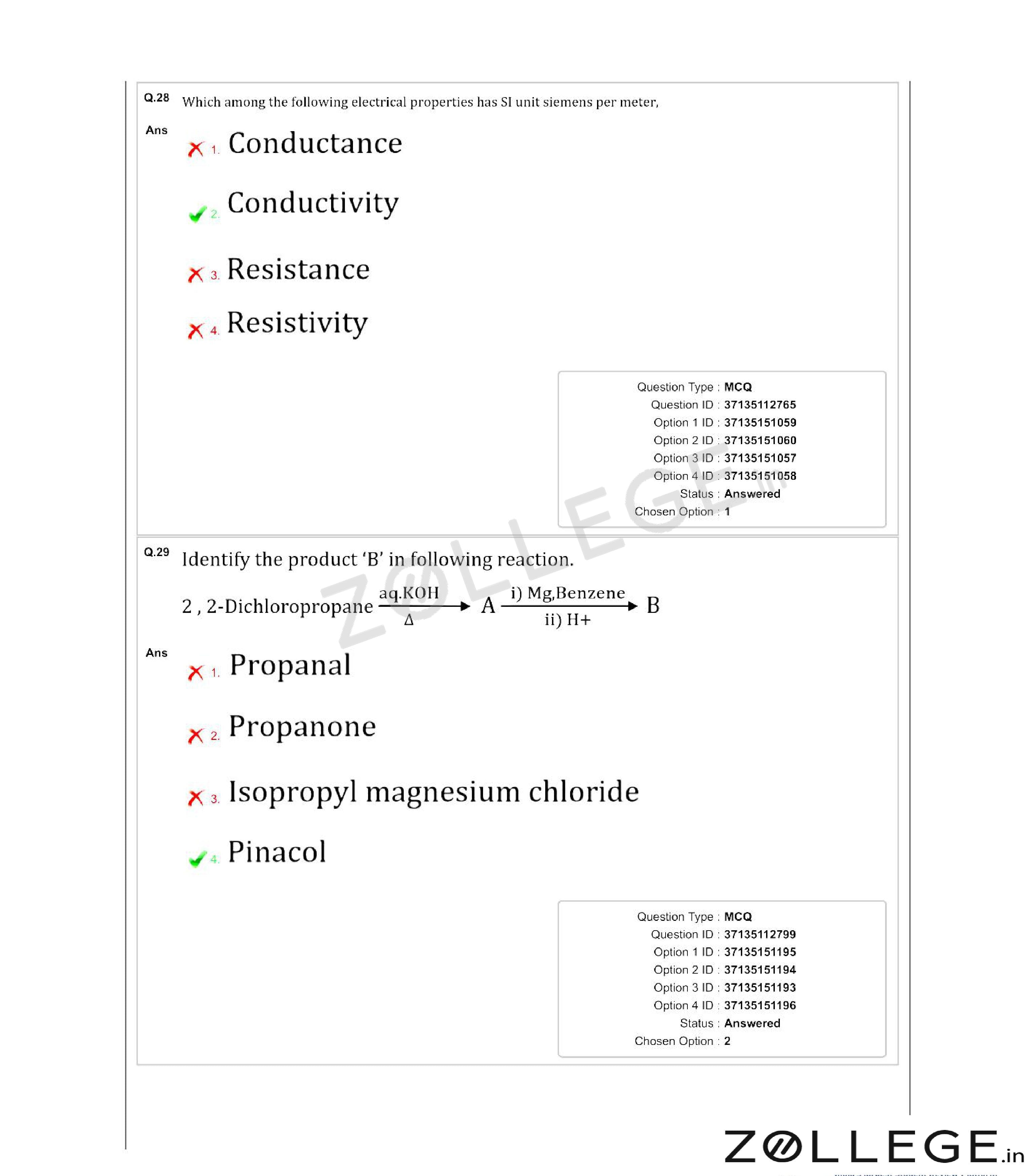
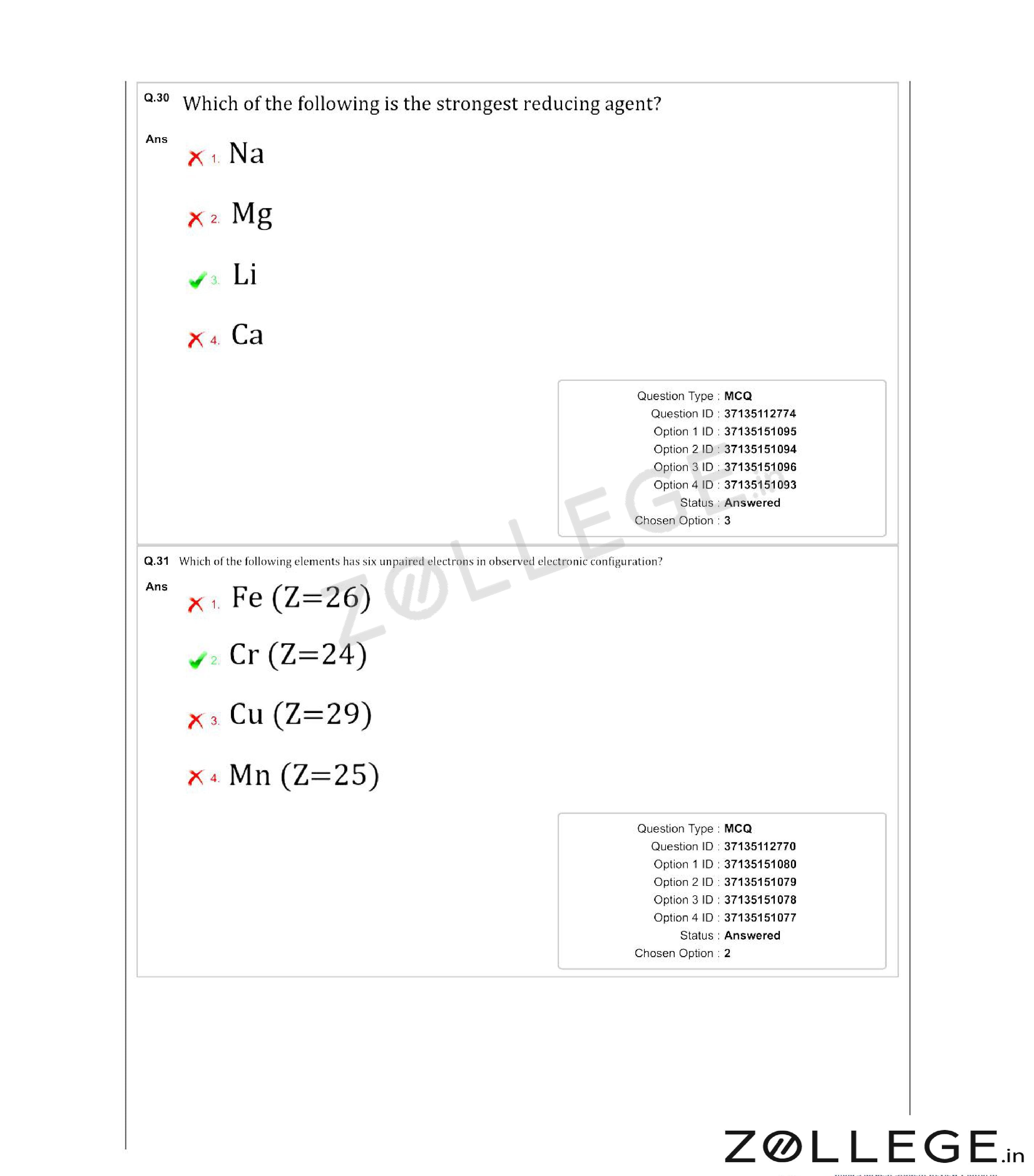
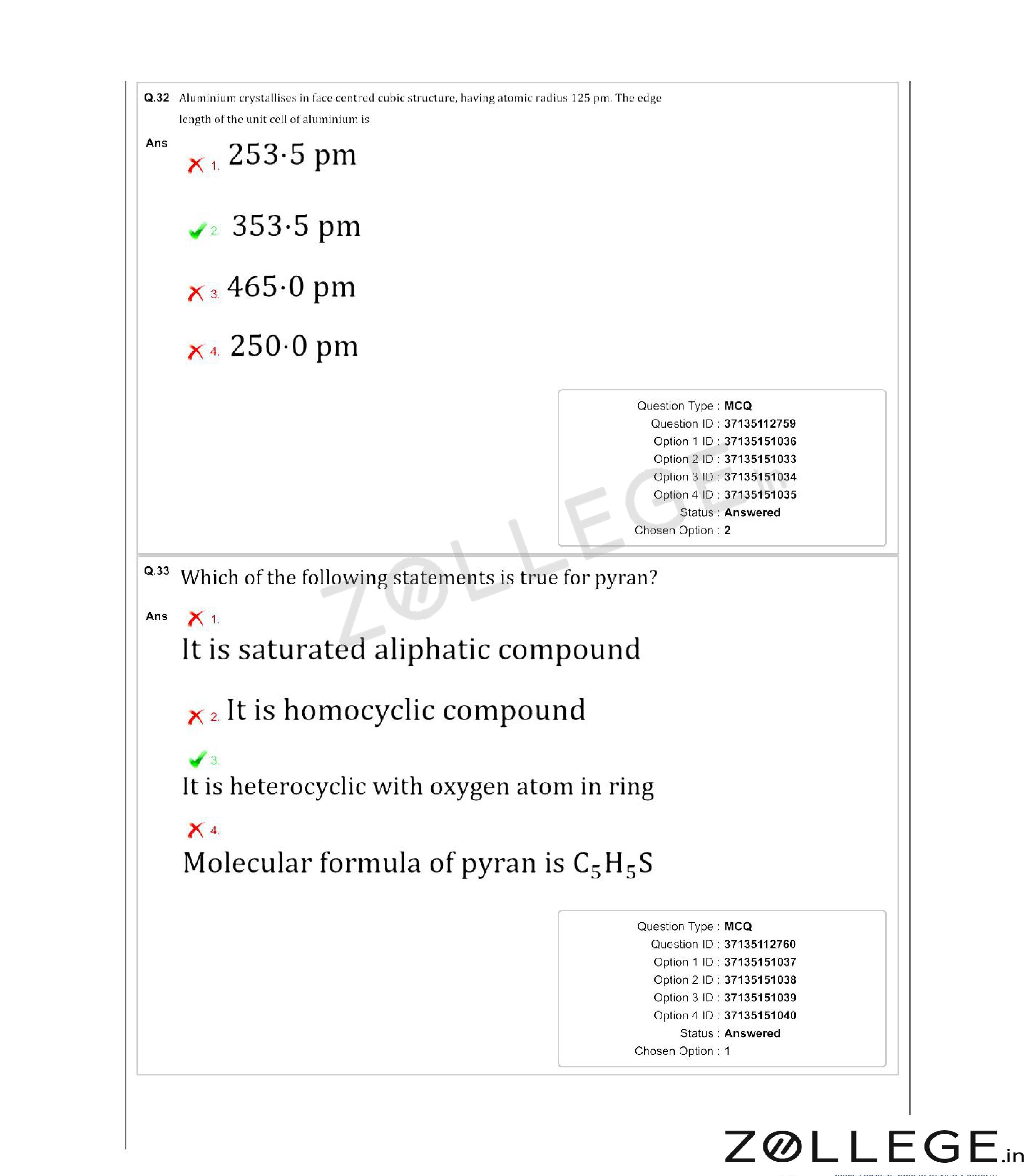
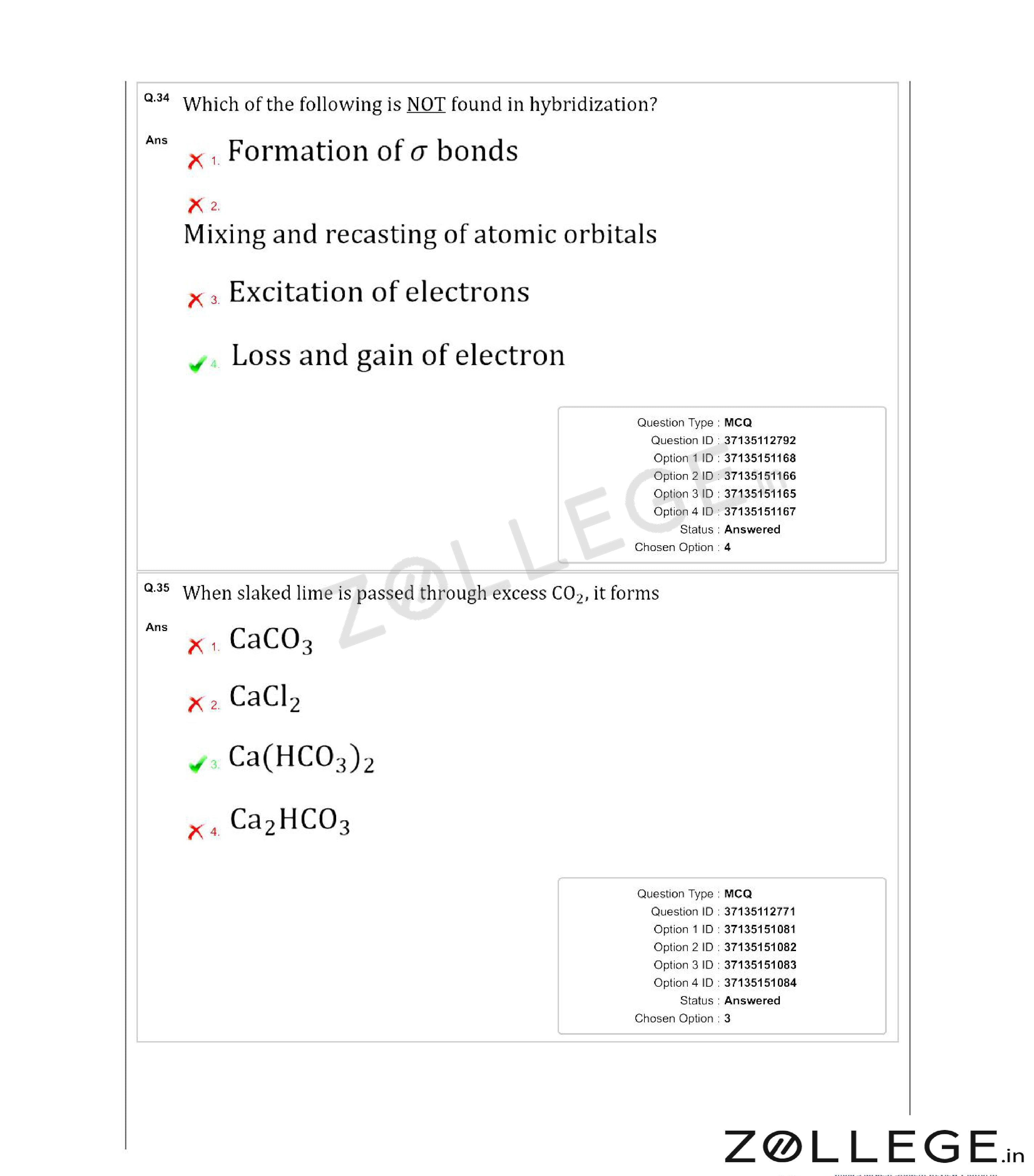
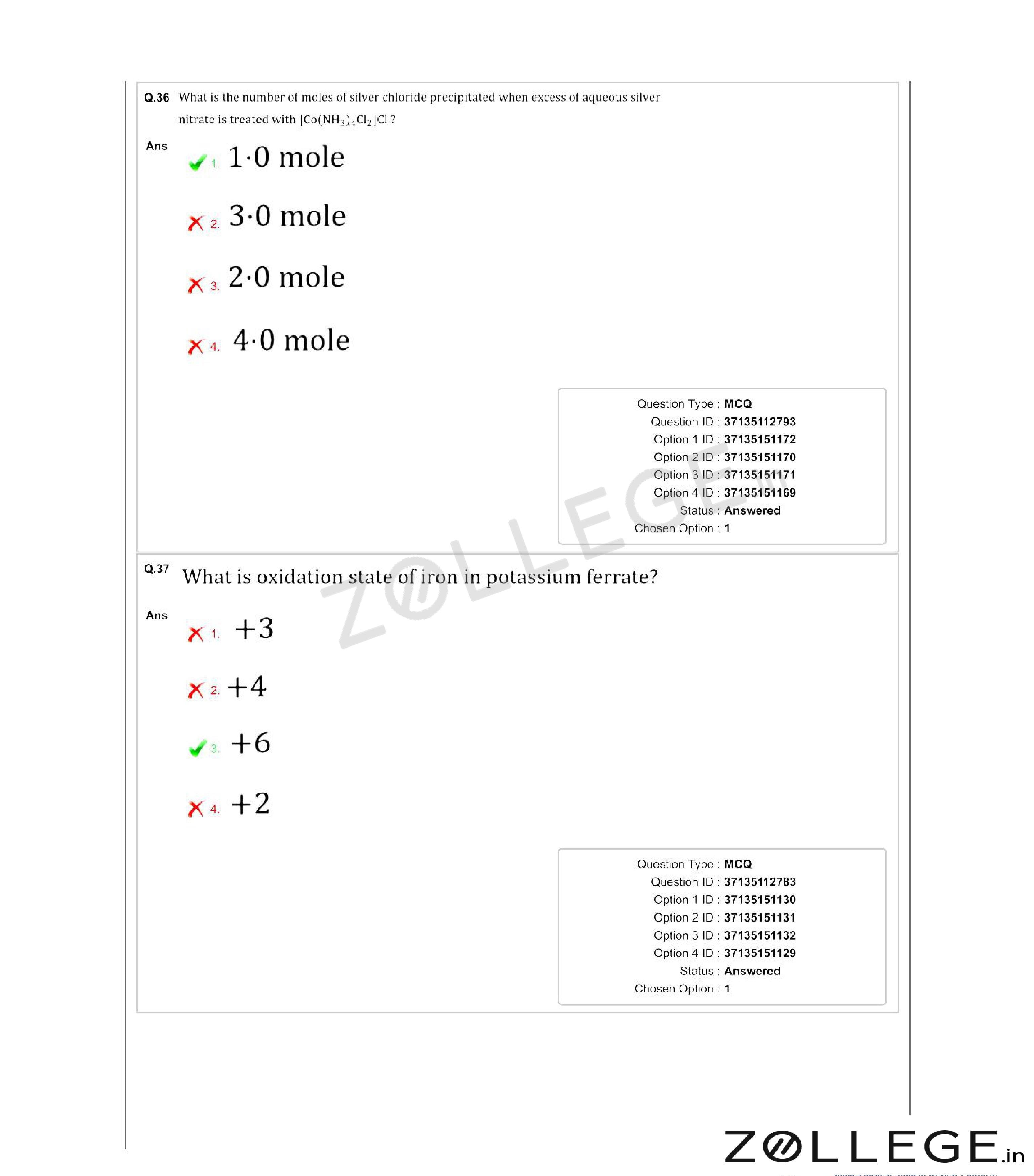
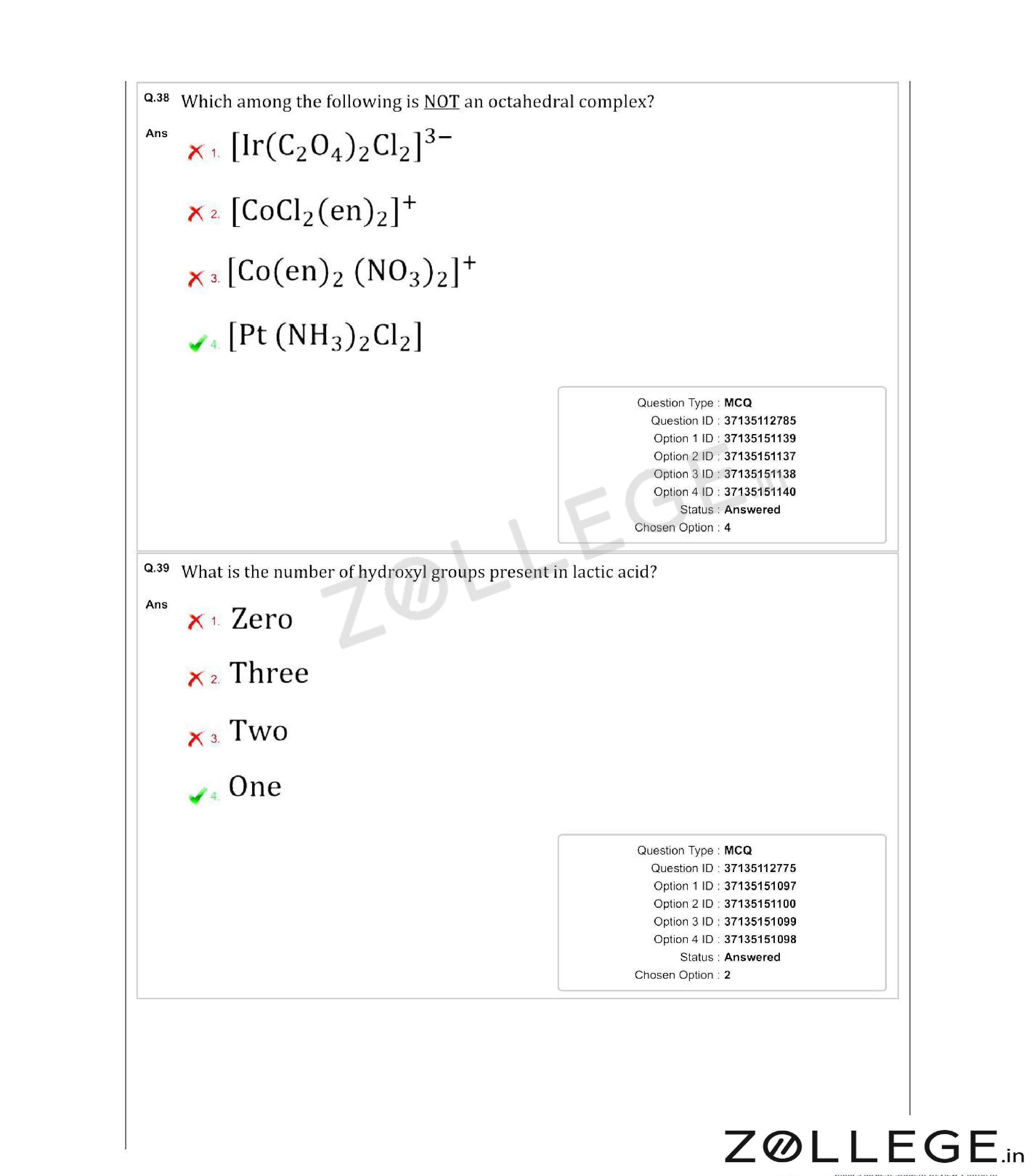
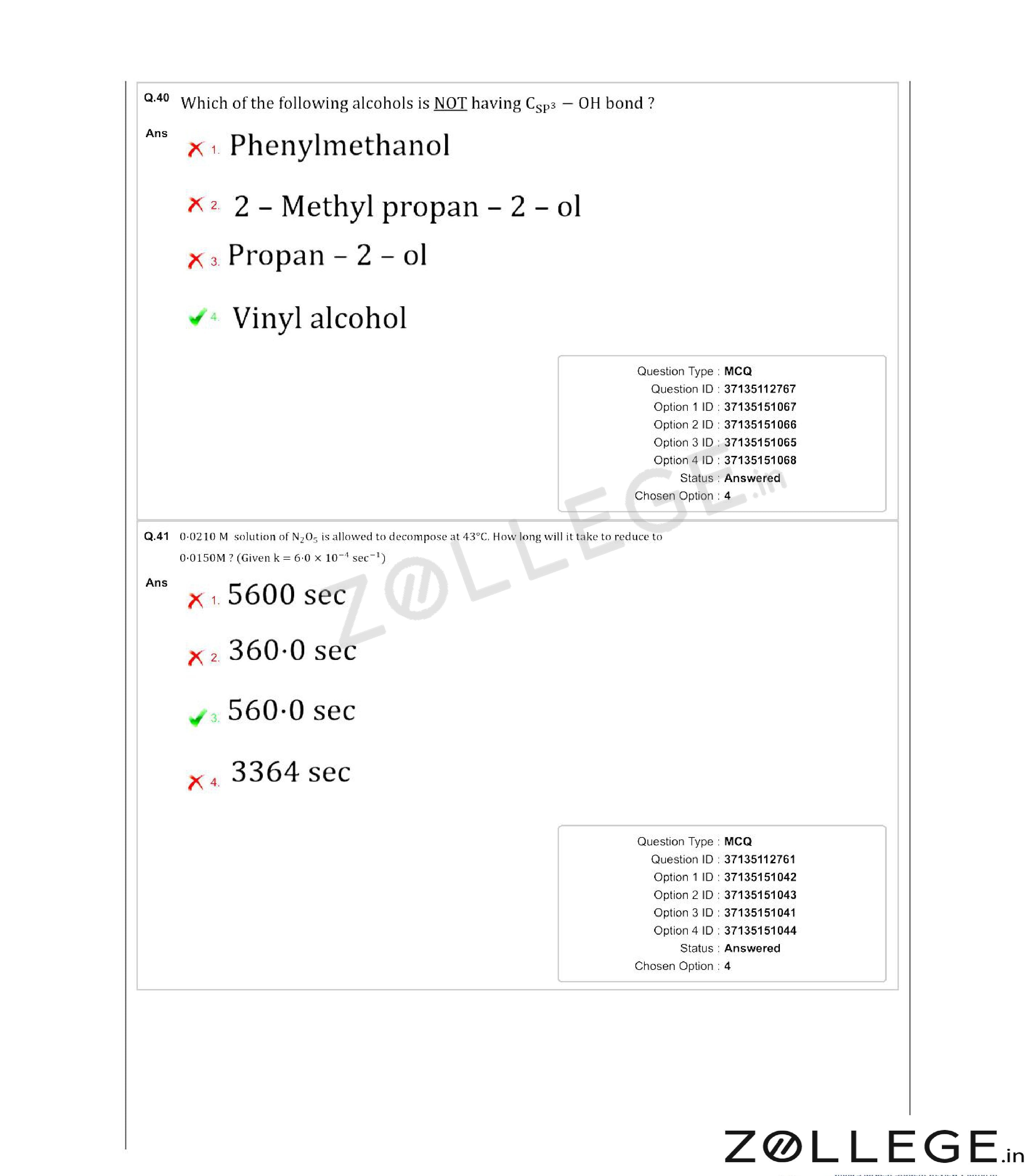
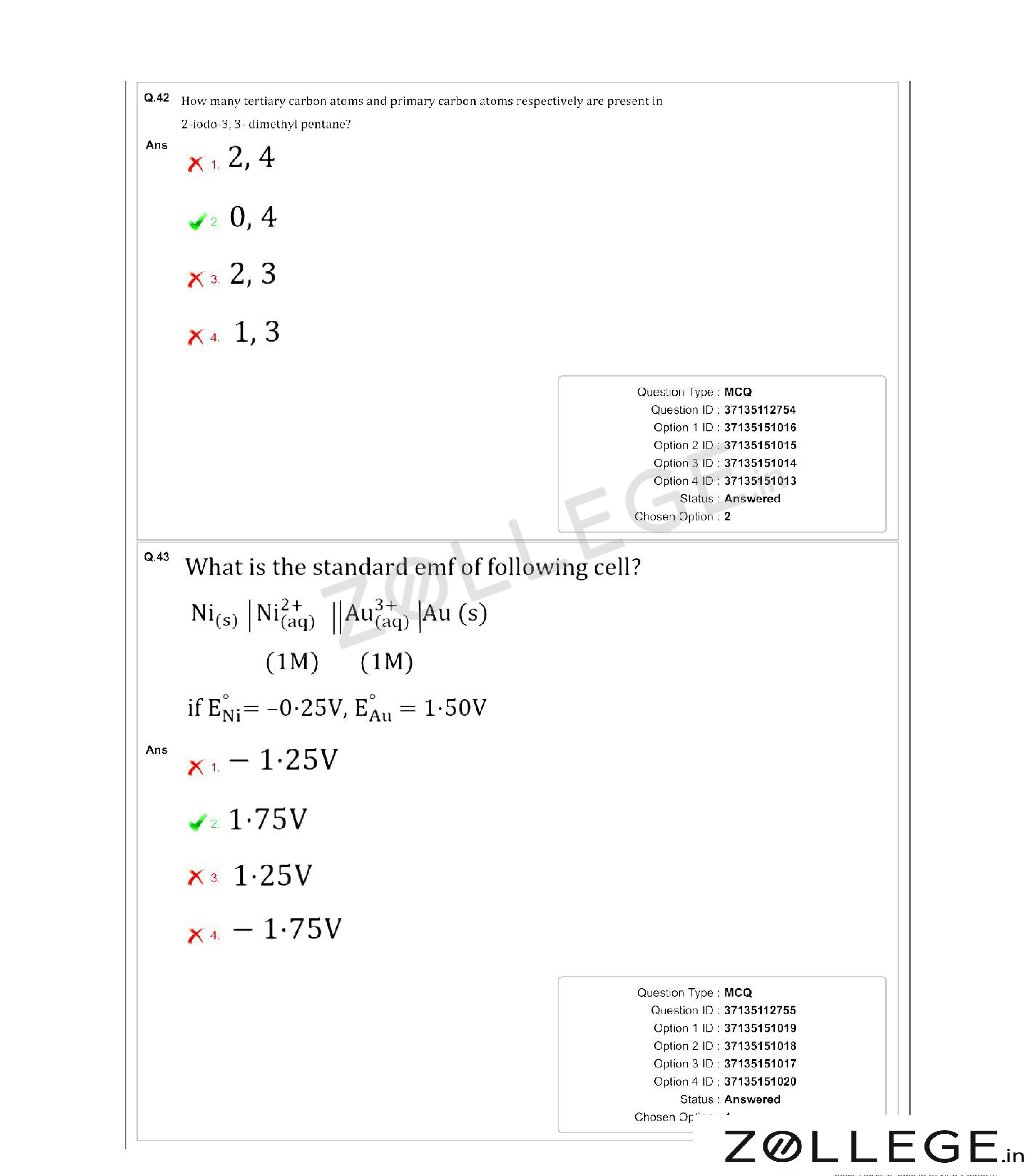
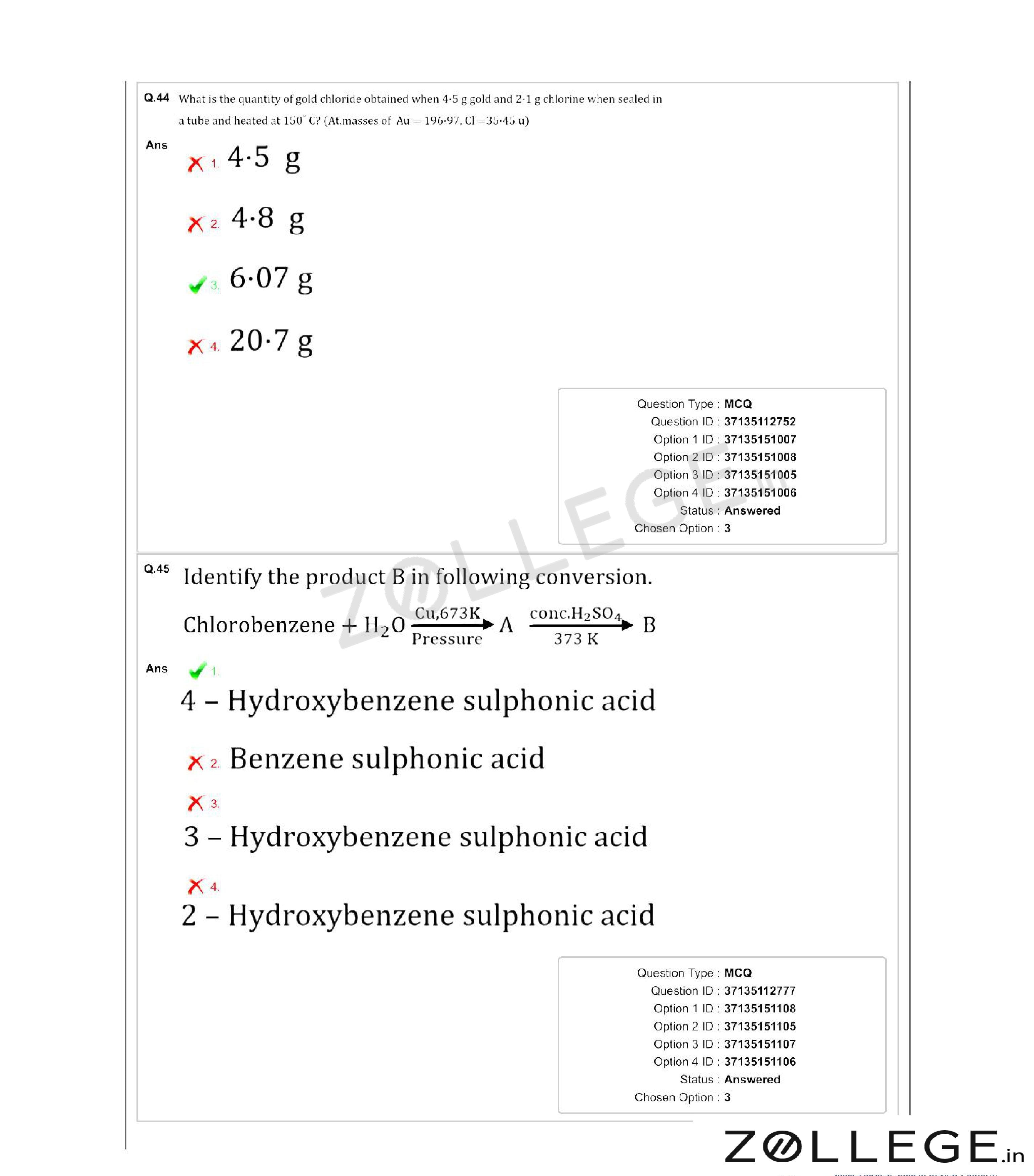
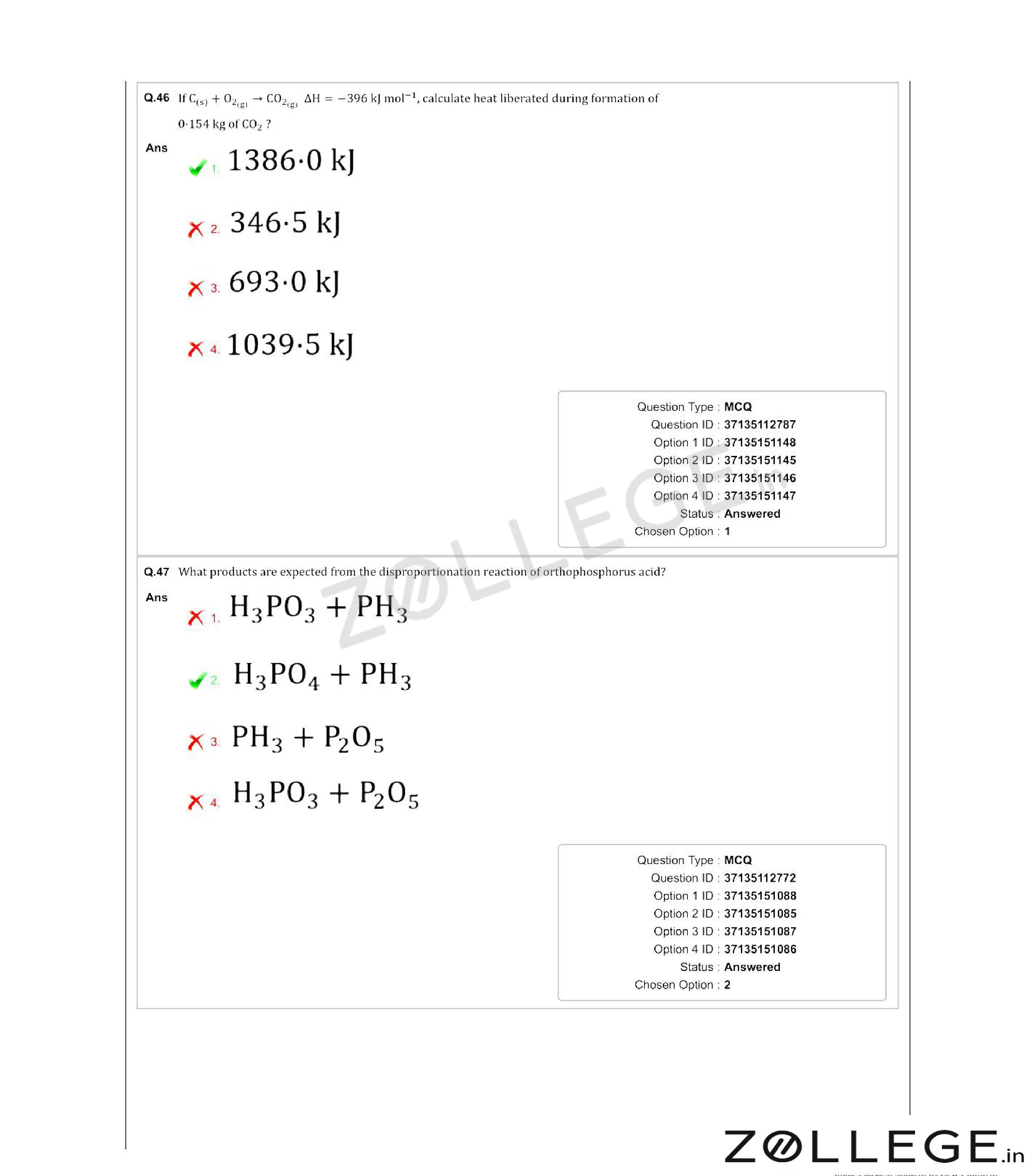
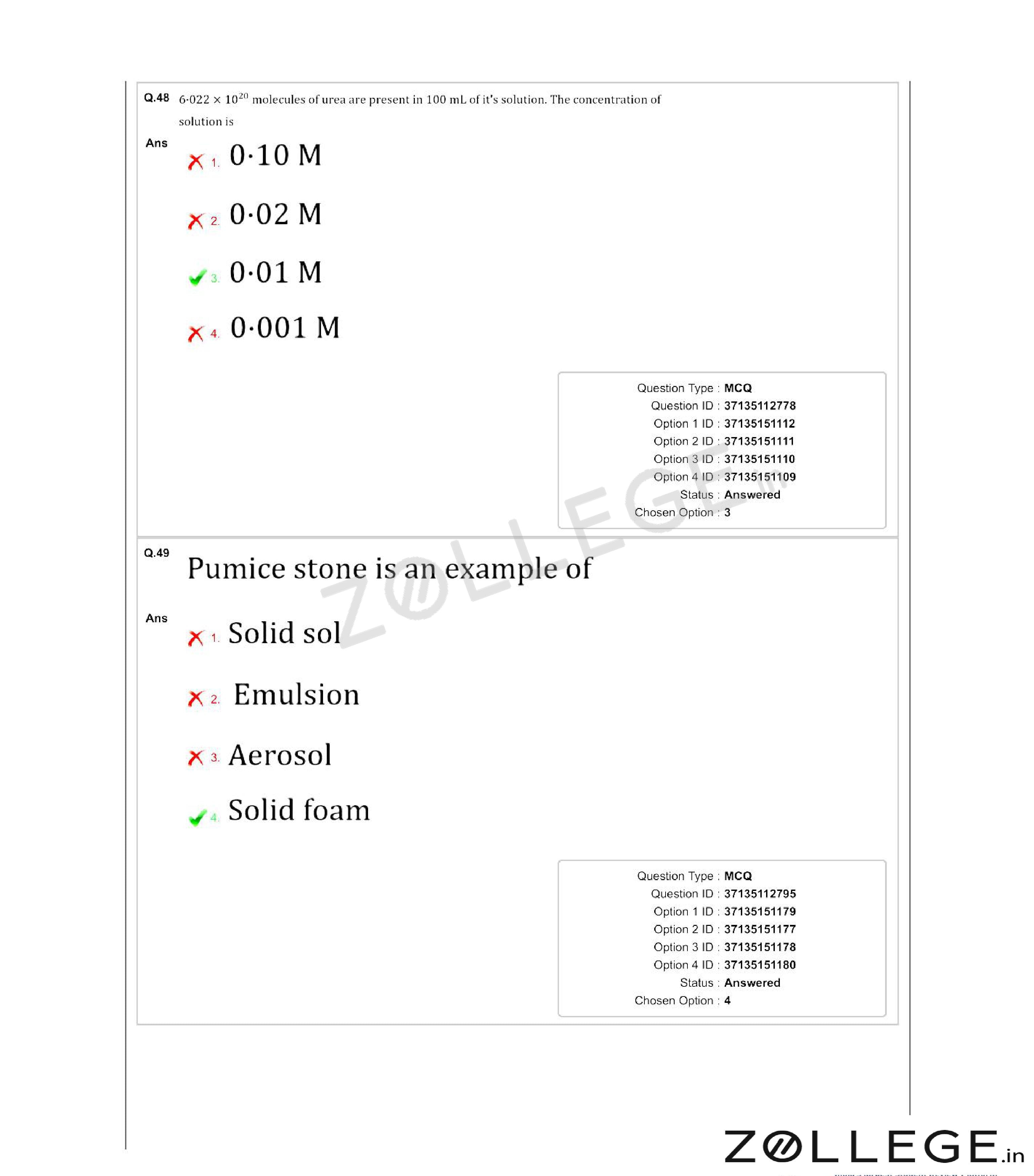
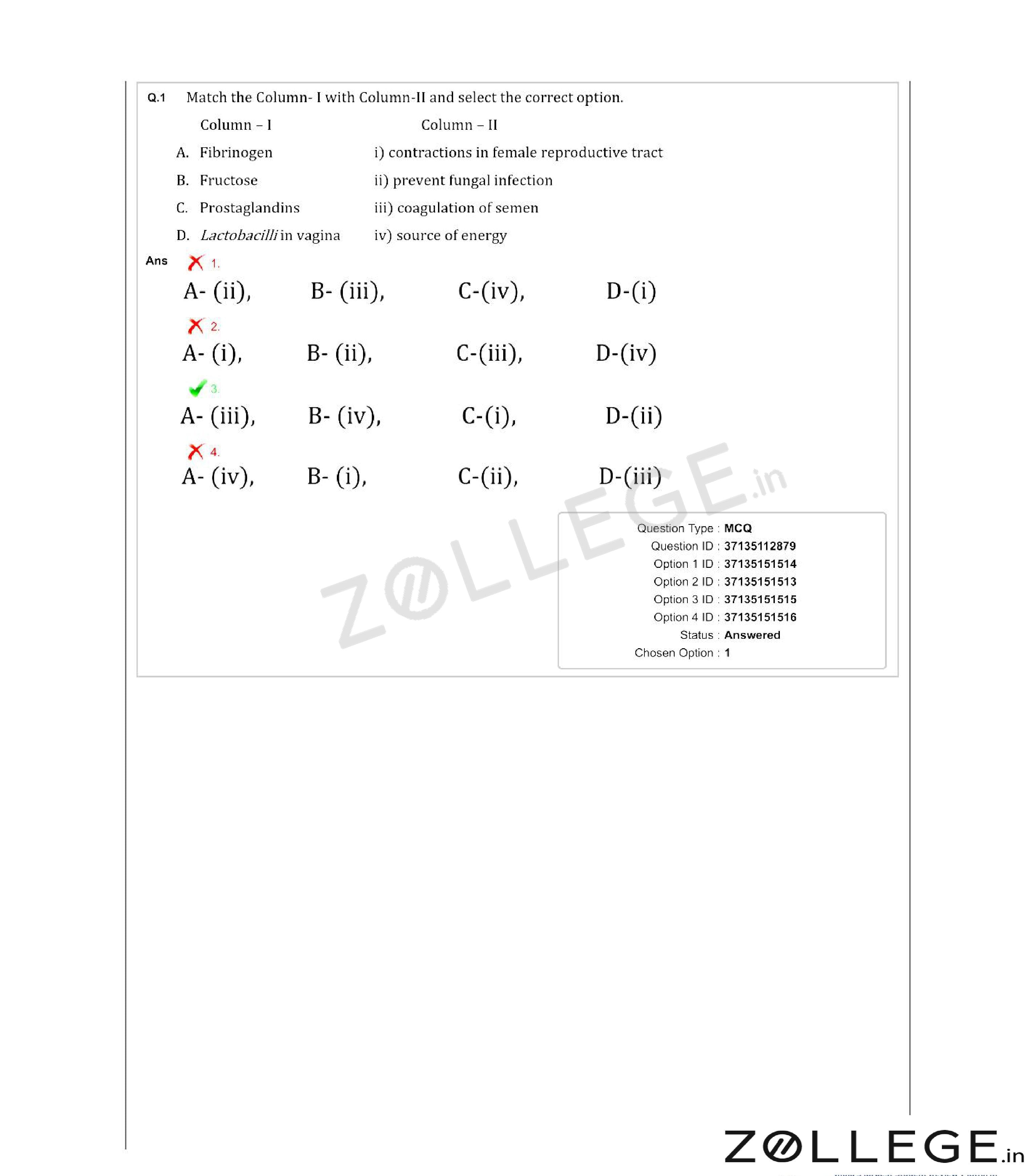
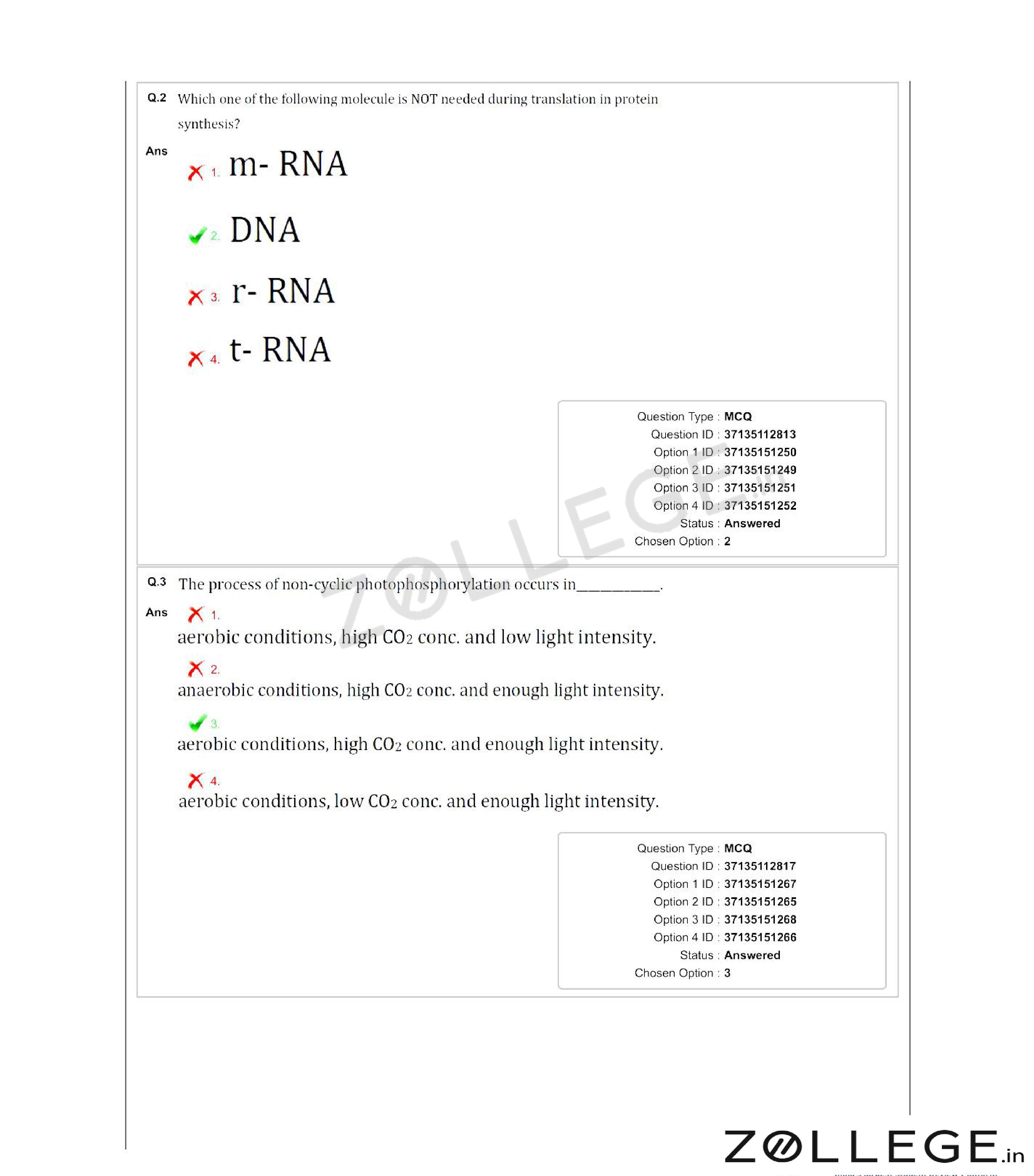
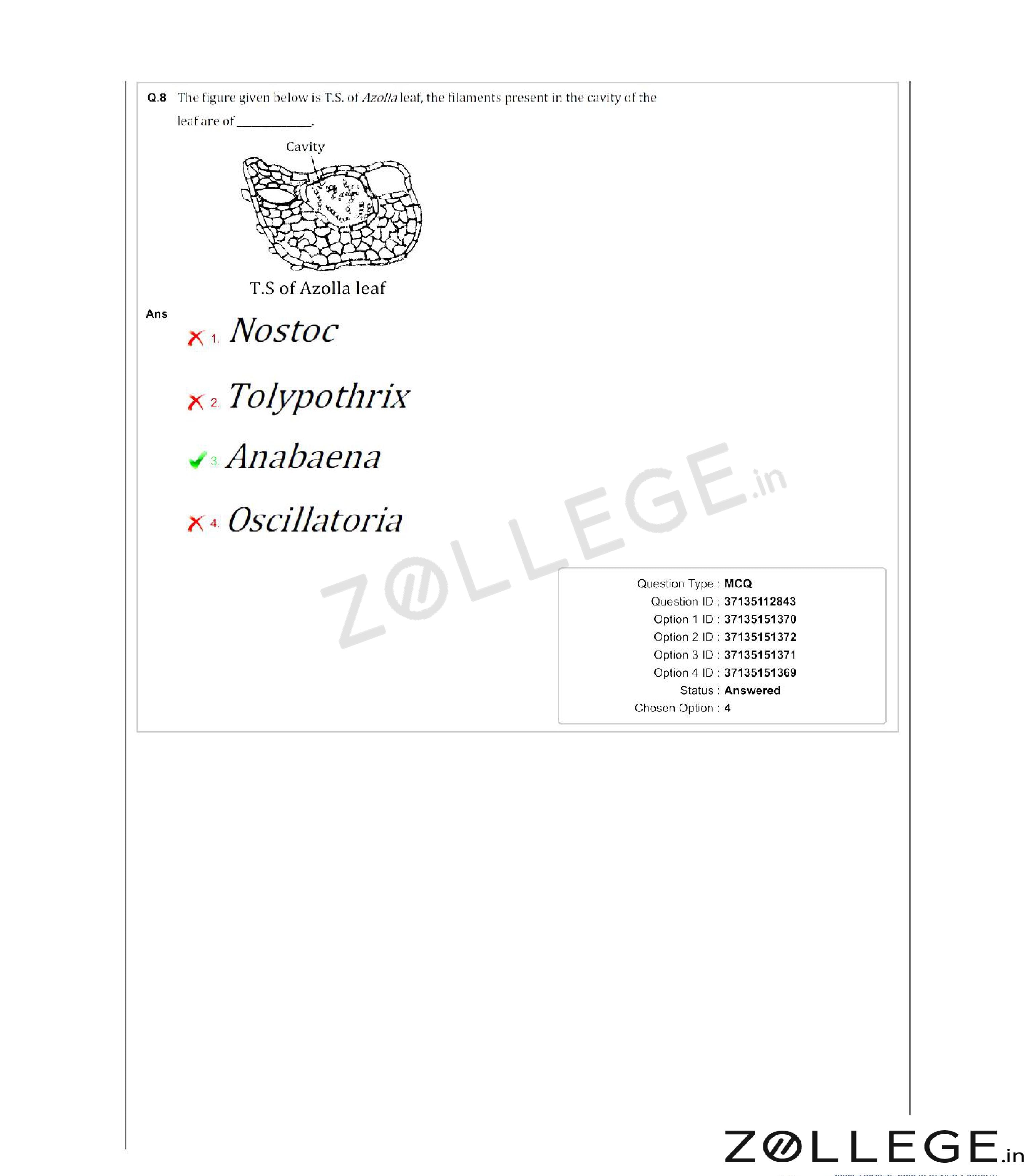
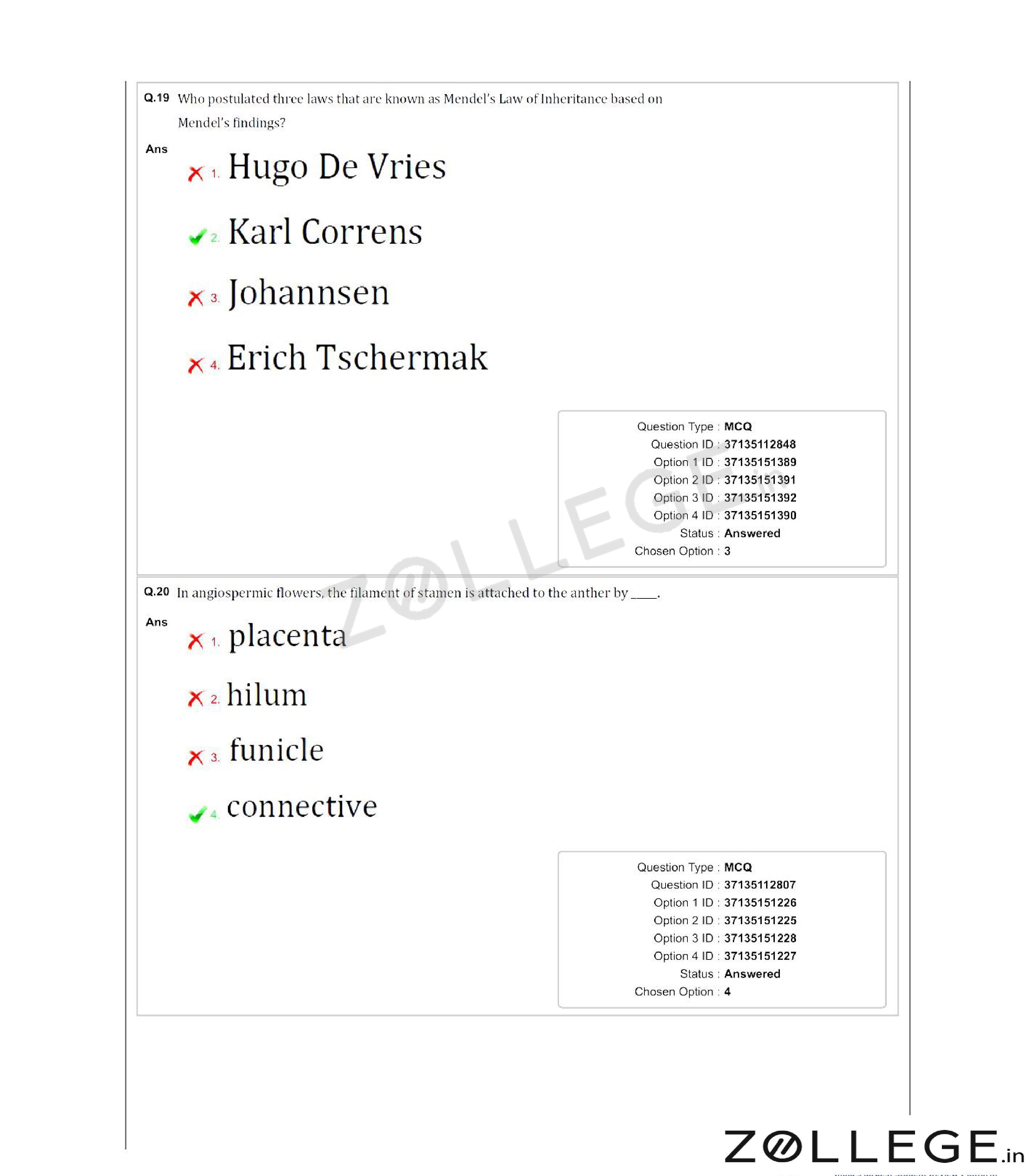
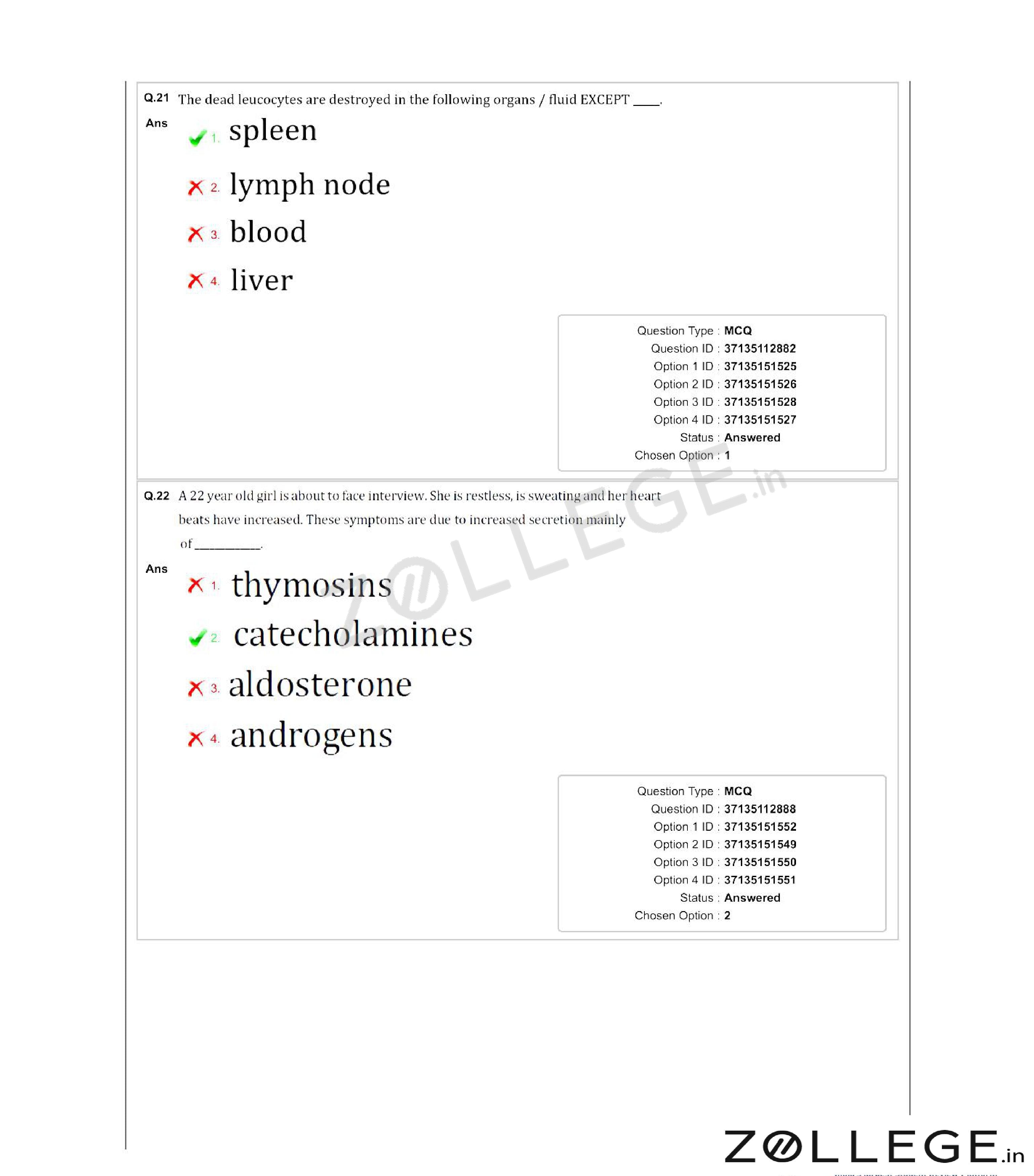
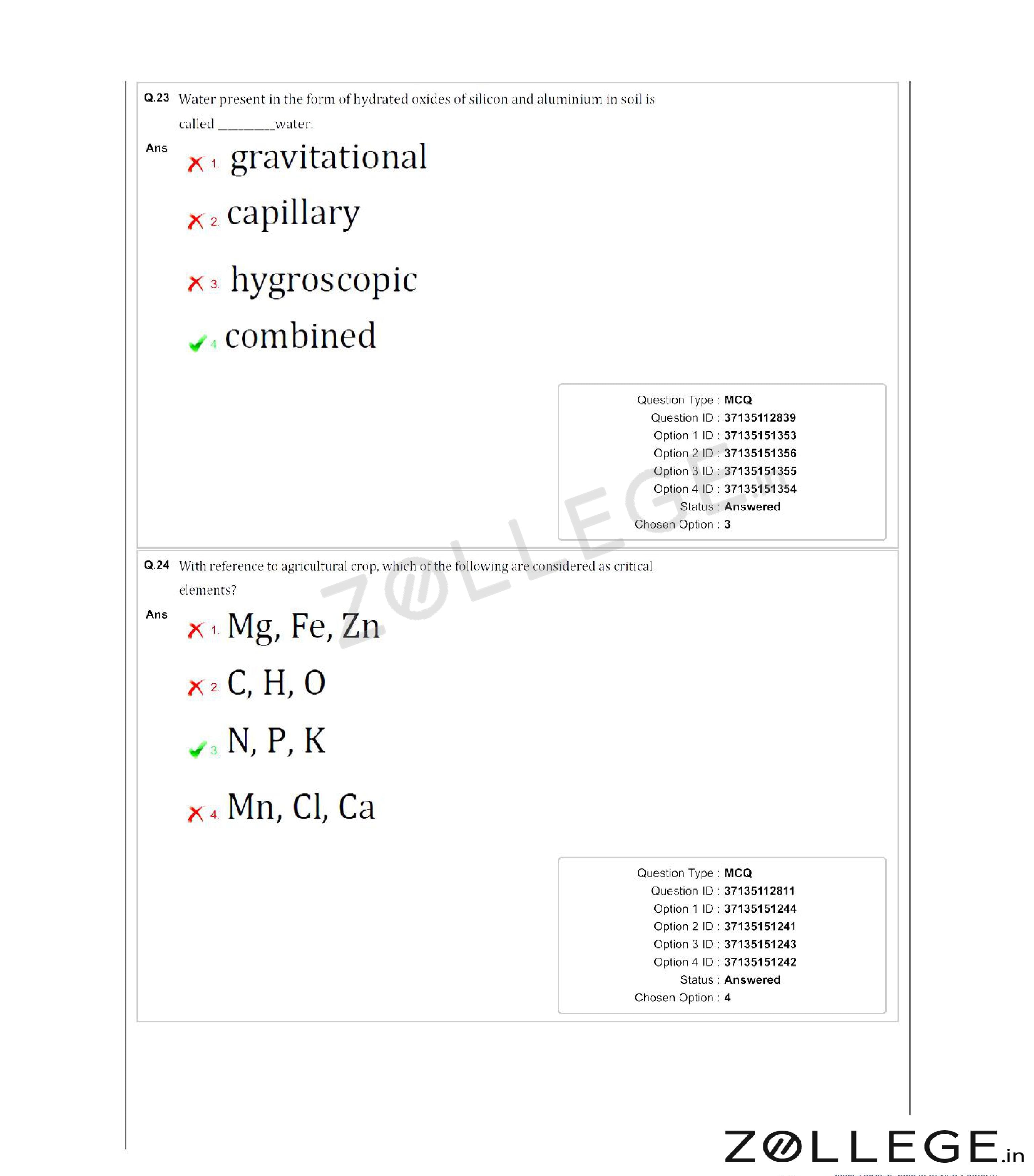
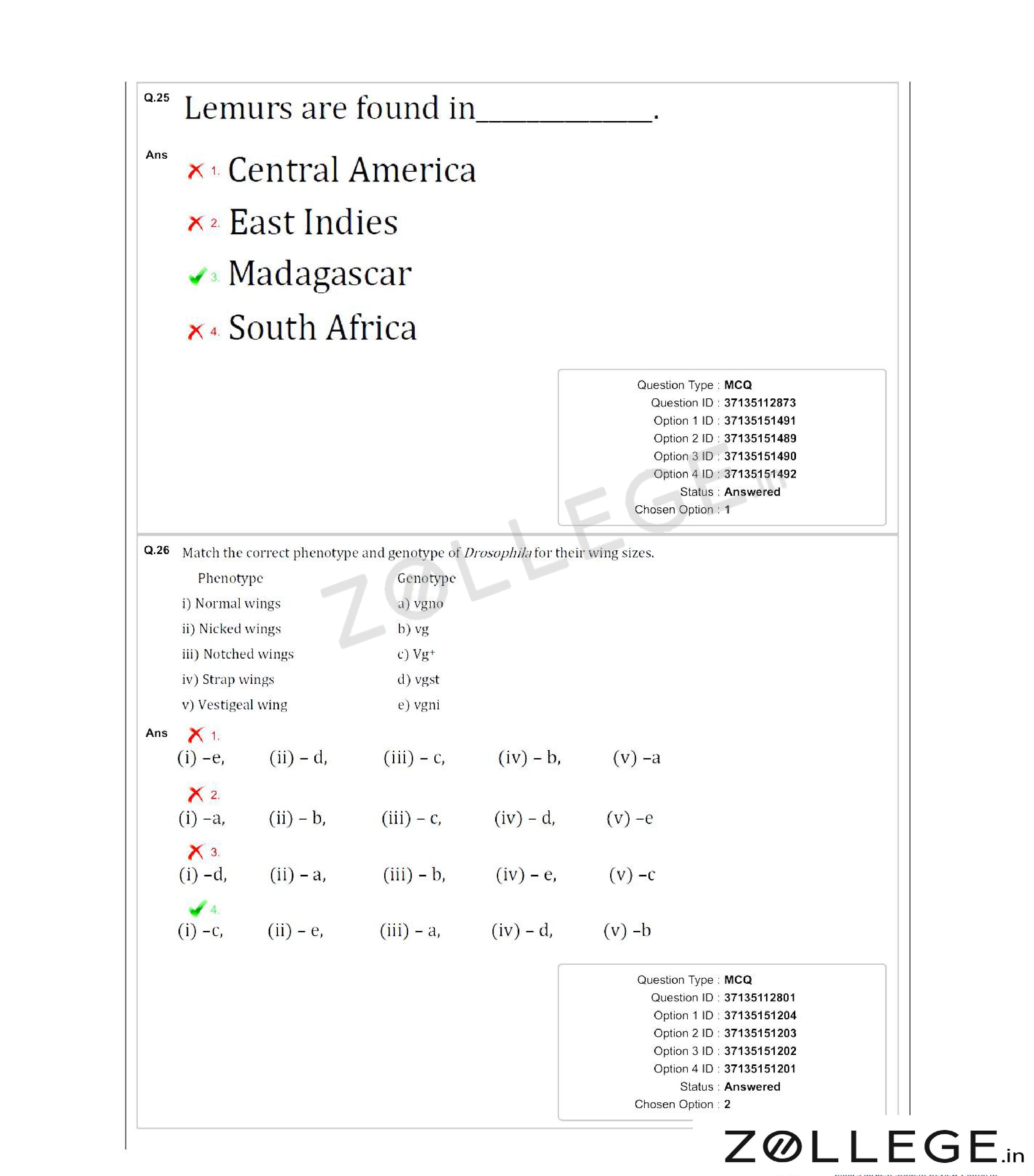
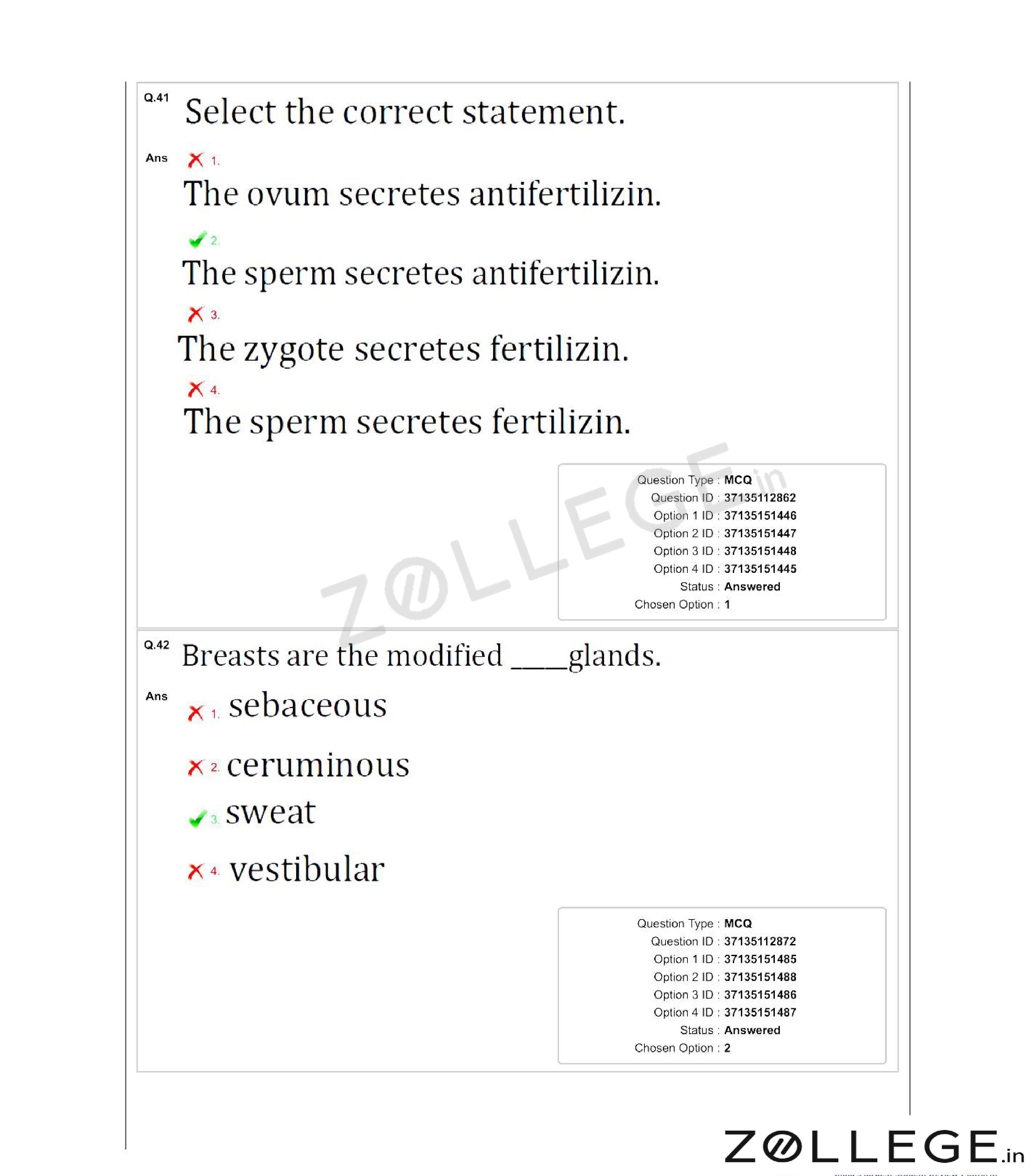
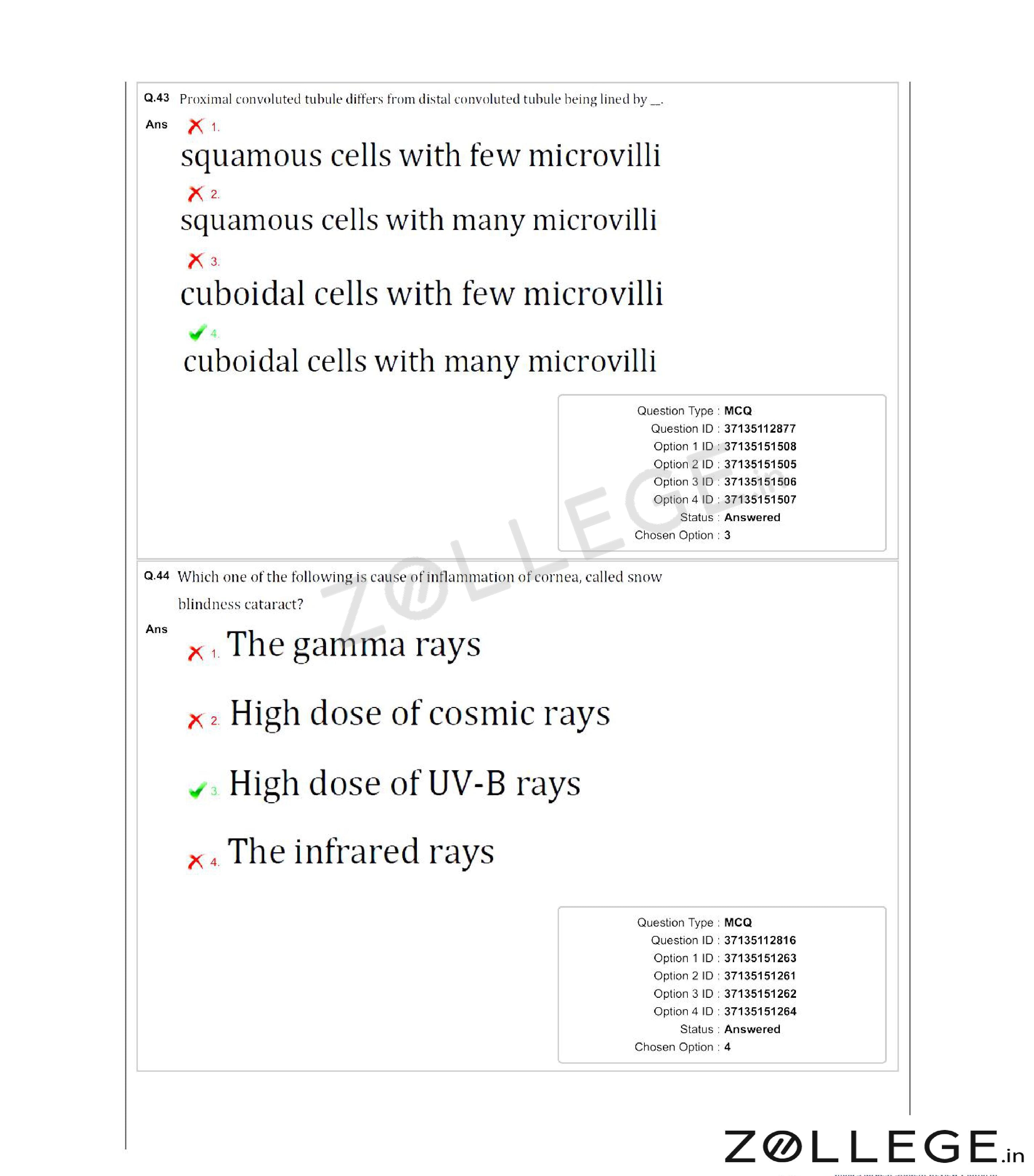
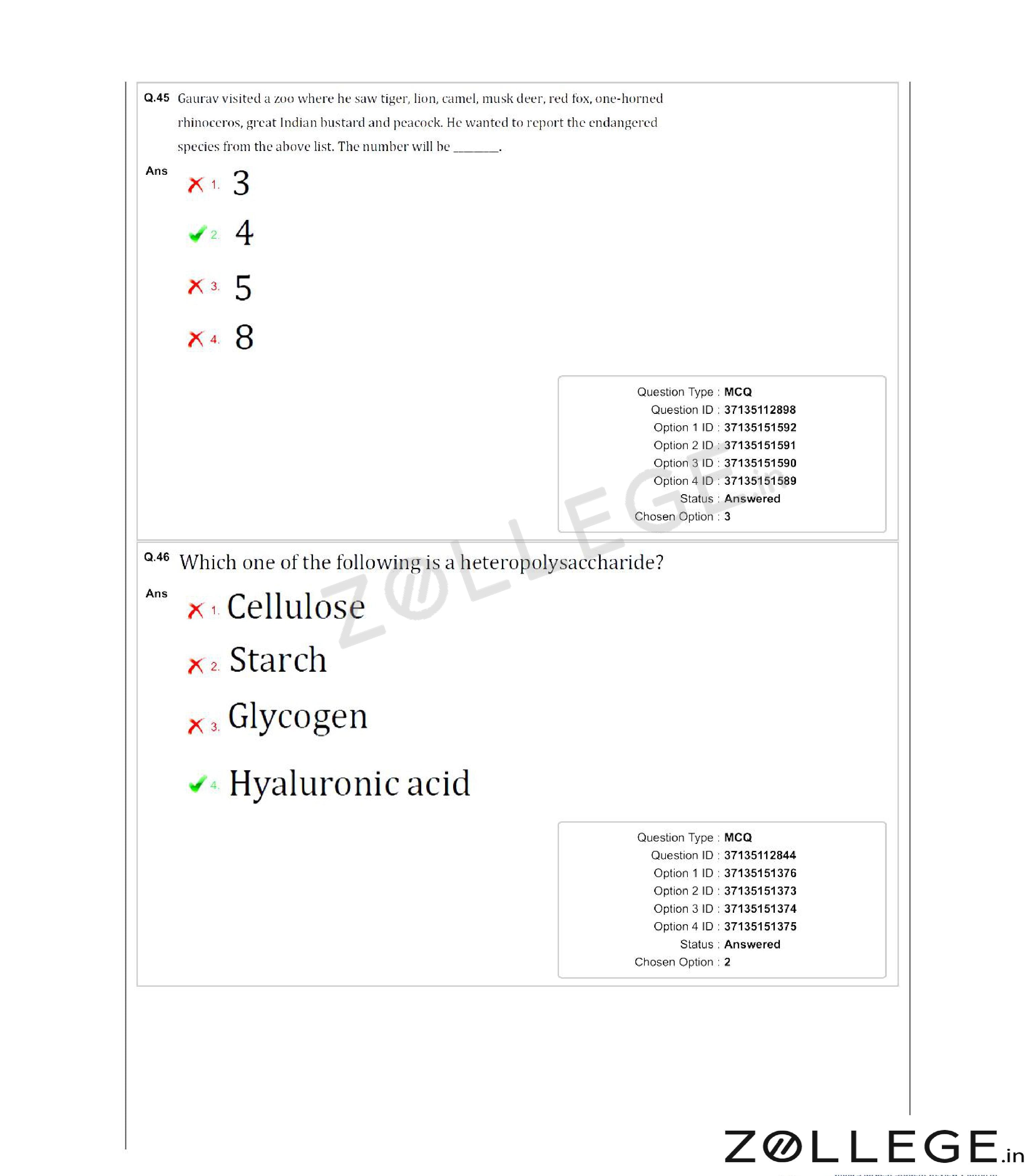
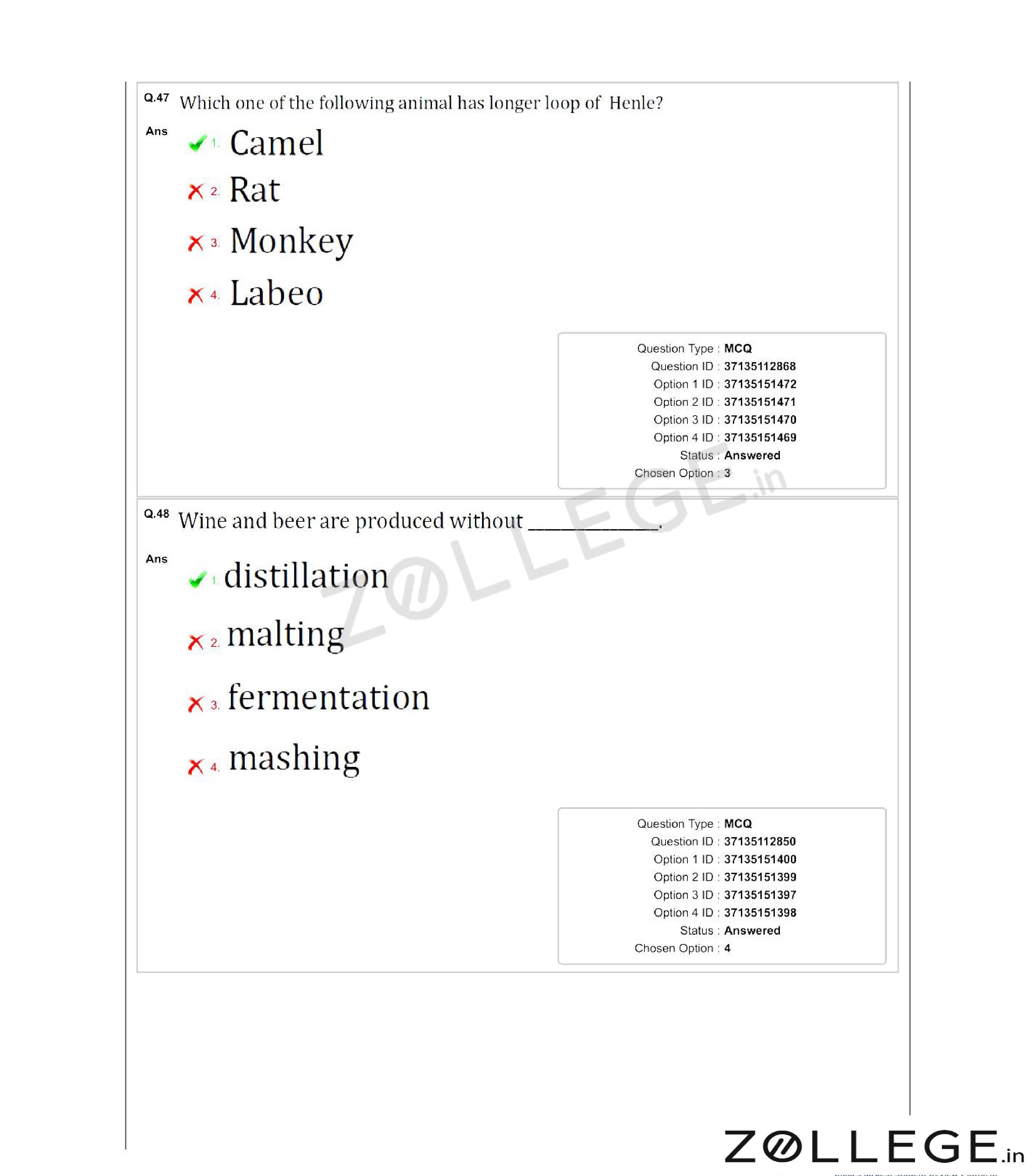
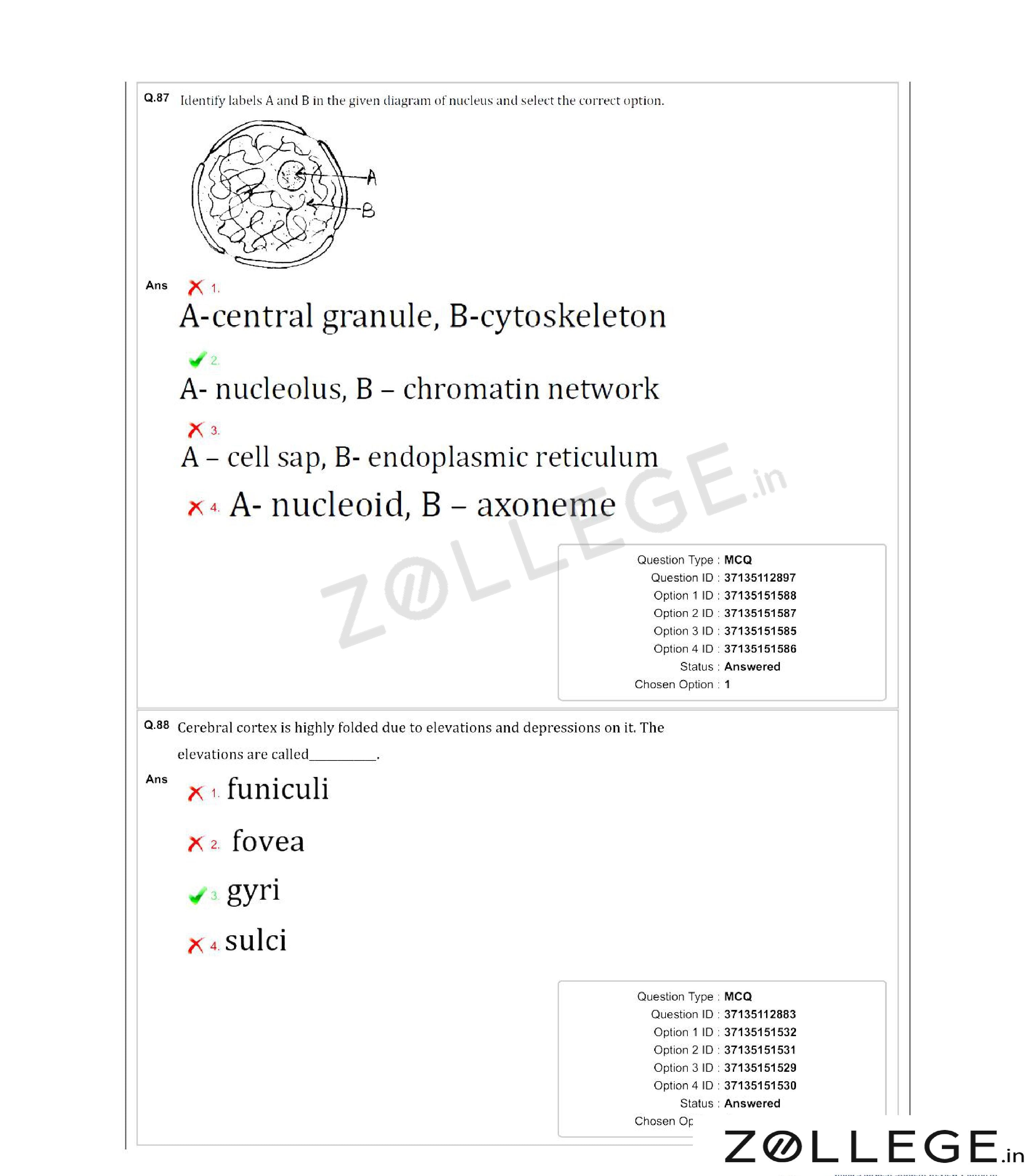
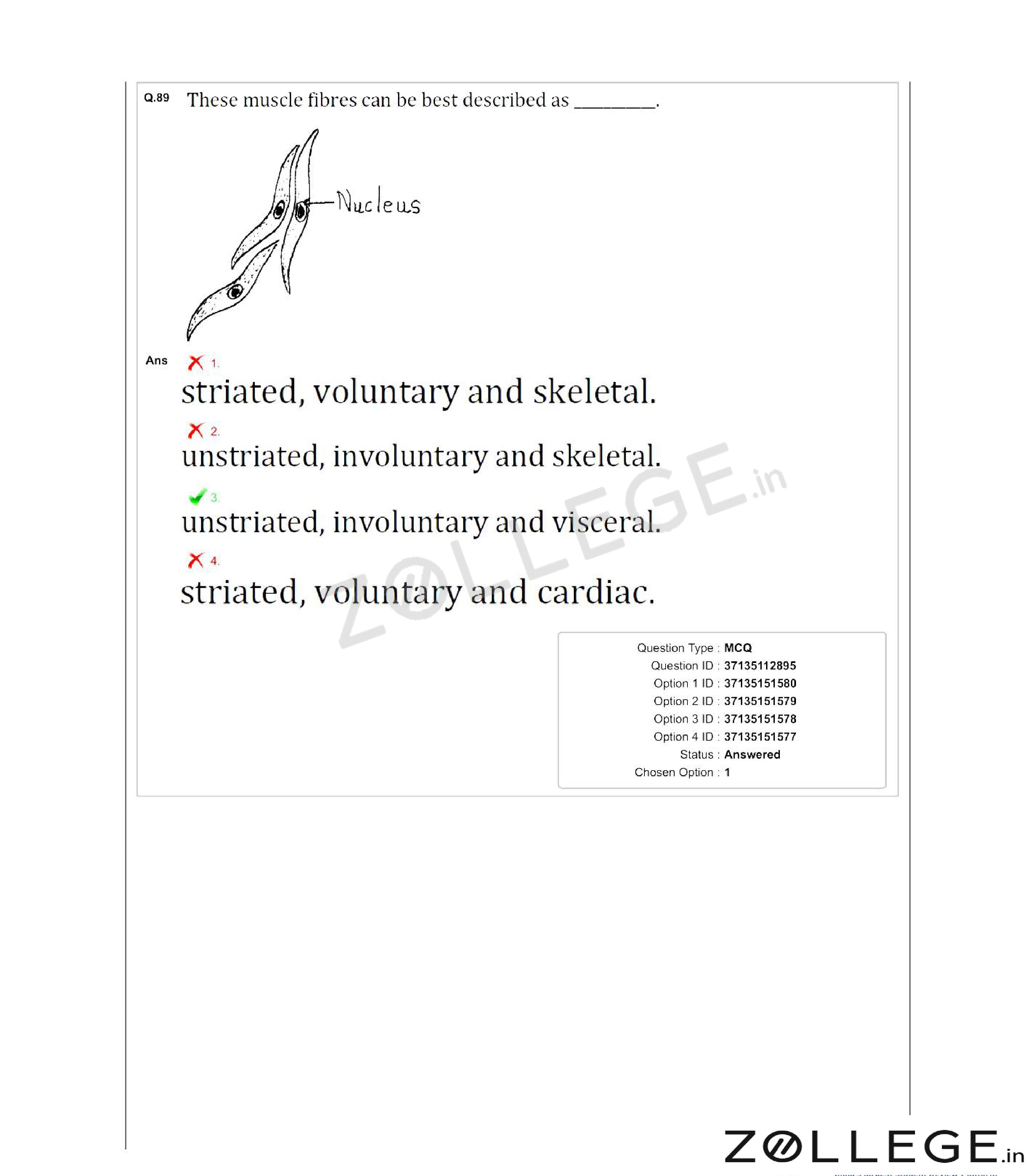
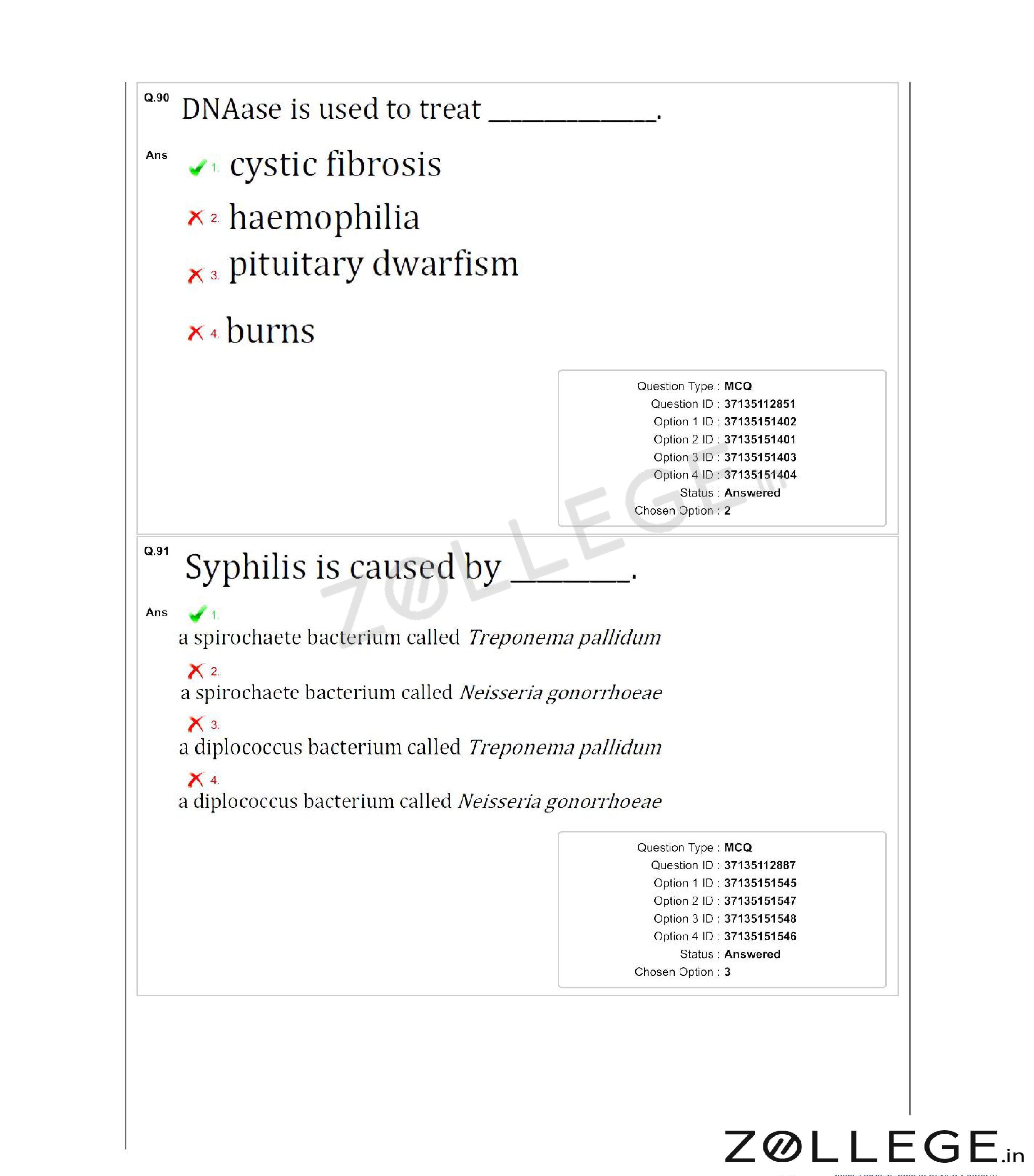
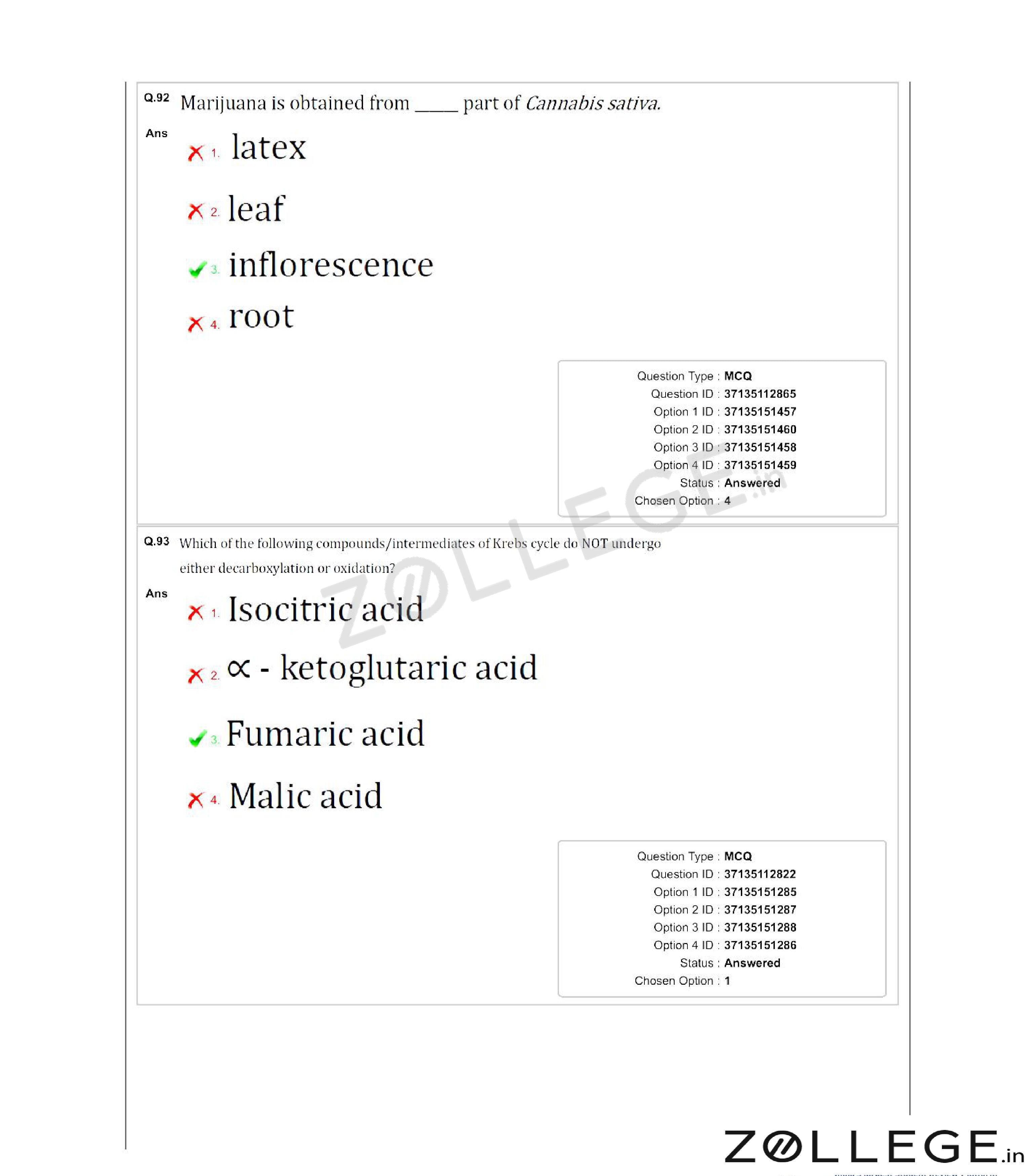
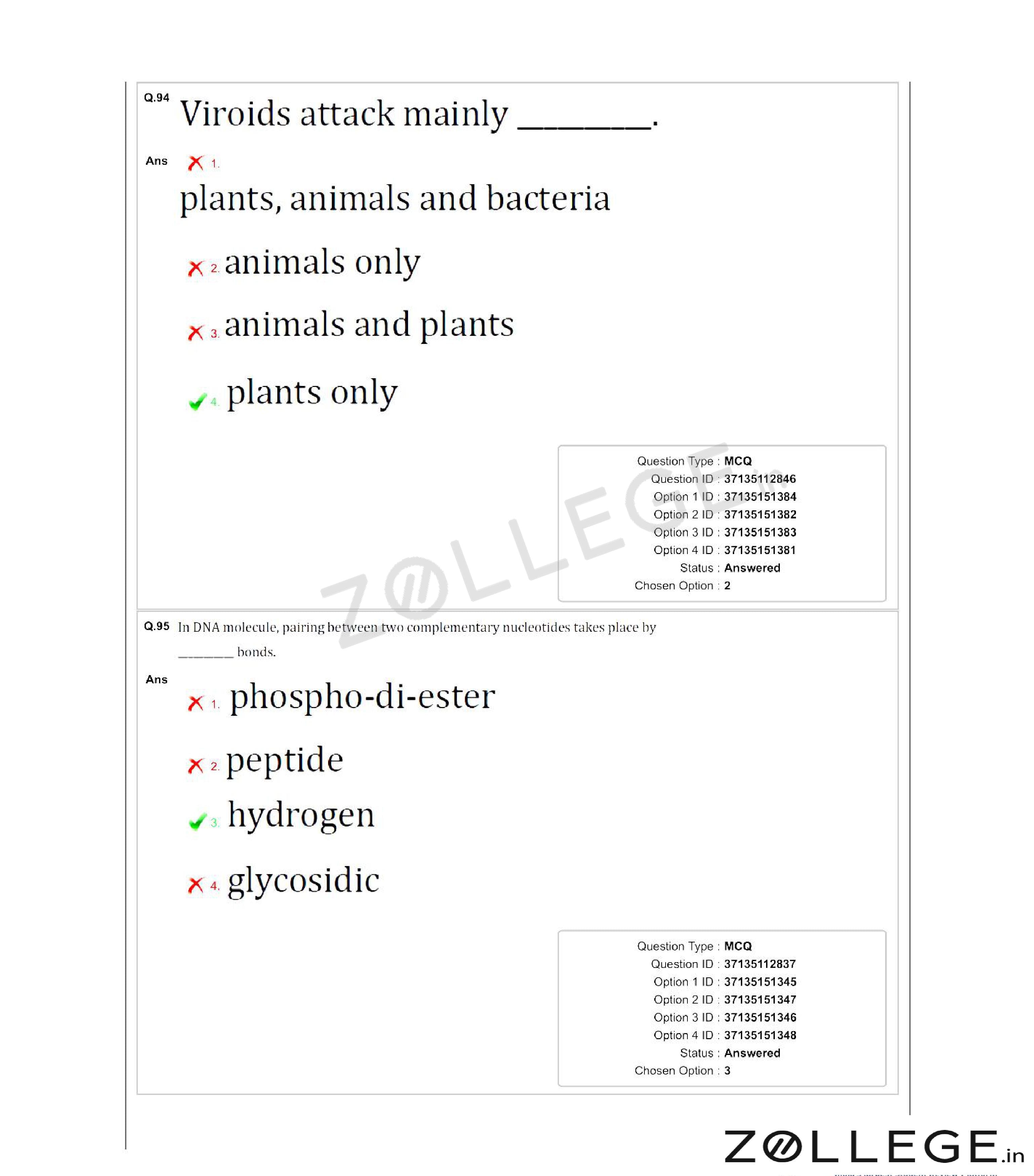
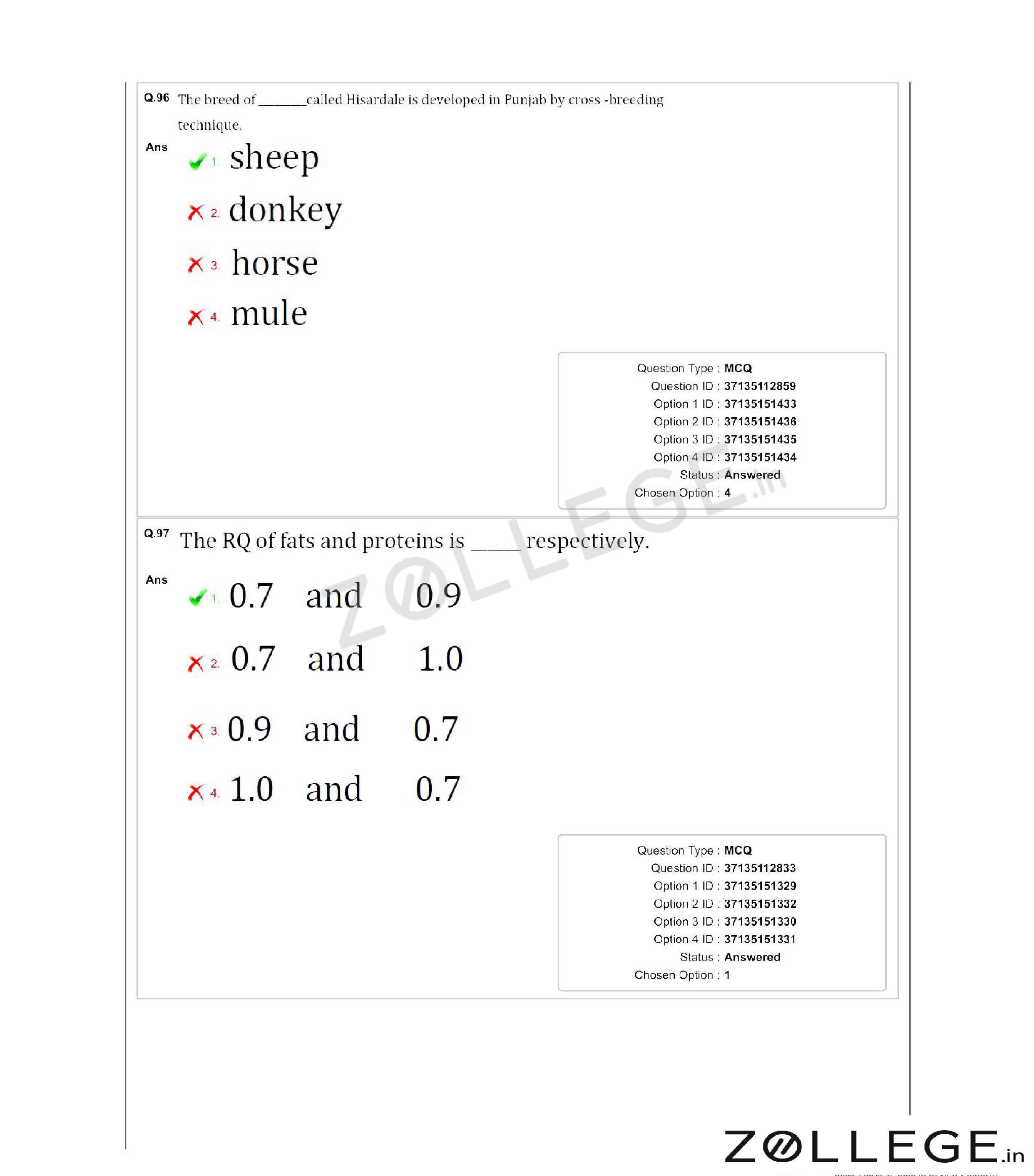
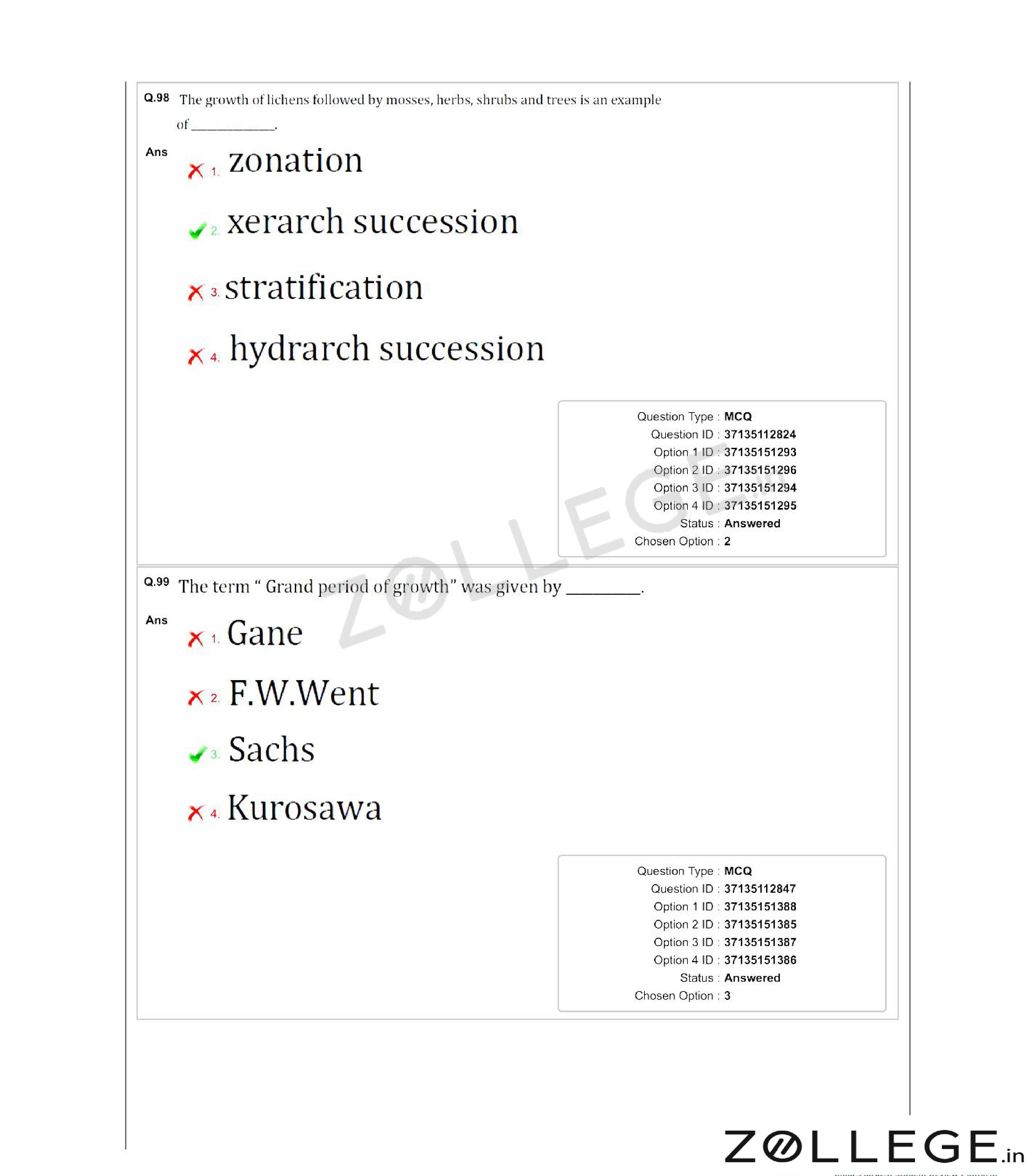
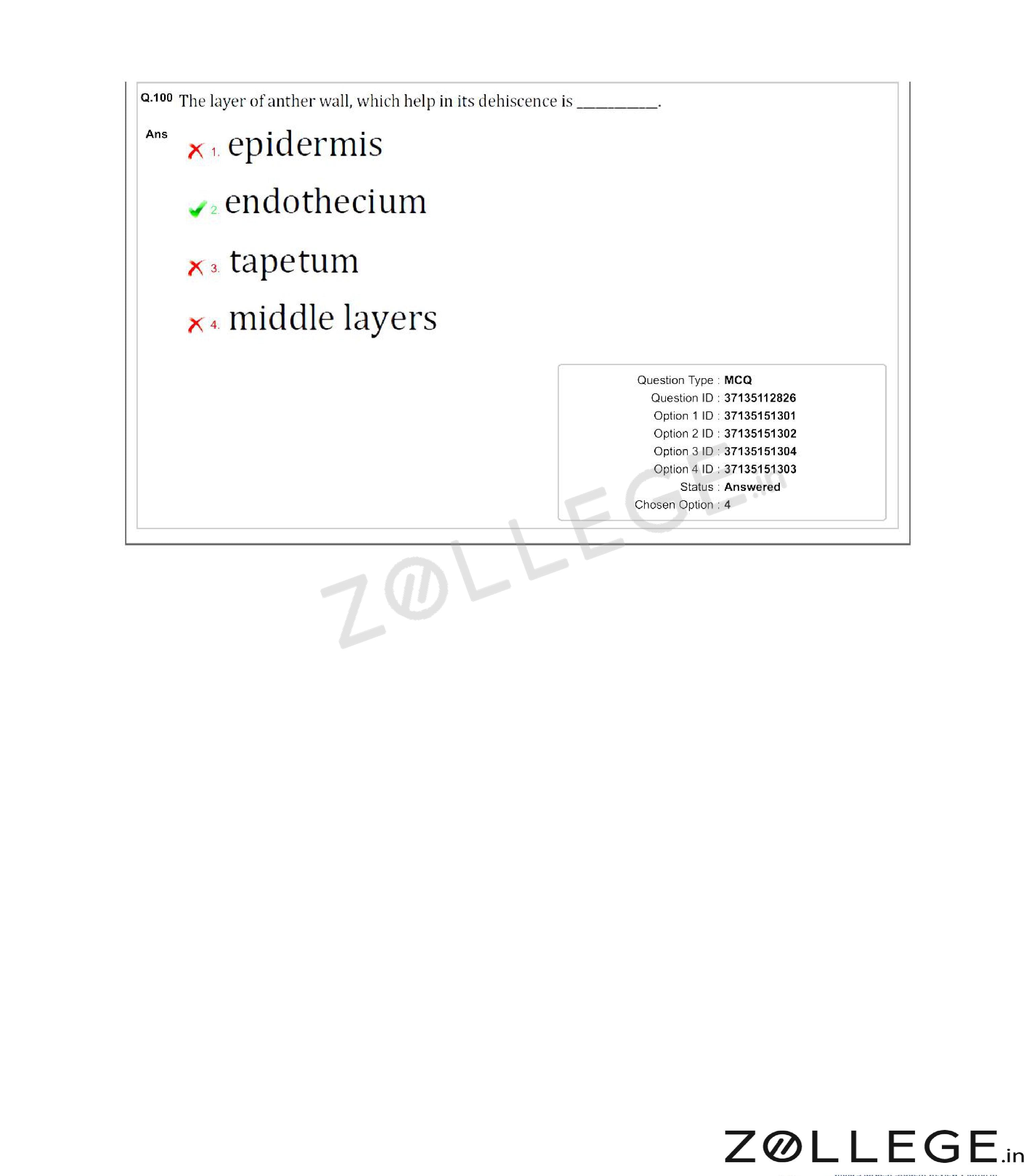
*The article might have information for the previous academic years, please refer the official website of the exam.