
MHT CET 2020 Question Paper with Solution PDF for PCM (October 15)


Content Writer | Updated On - Jan 20, 2026
MHT CET Question Papers are the most important study material for effective exam preparation. We at Zollege have provided all MHT CET Previous Year Papers with Solution PDFs here. MHT CET 2020 PCM exam was conducted successfully on October 15 by Shift 2.
Students can freely download the MHT CET previous year's question paper PDFs along with their solutions here.We strongly encourage MHT CET aspirants to scan through all the MHT CET Question Paper to know the overall difficulty level,MHT CET Syllabus and understand the changes in MHT CET Exam Pattern over the years.
MHT CET 2020 Oct 15 Shift 2 PCM Question Paper with Solution PDF
| MHT CET 2020 PCM Question Paper PDF | MHT CET 2020 PCM Solution PDF |
|---|---|
| Download PDF | Check Solutions |

Two galvanometers '\(G_1\)' and '\(G_2\)' require 2 mA and 3 mA respectively to produce the same deflection. Then
View Solution
Current sensitivity (\(S\)) is defined as the deflection produced per unit current (\(S = \frac{\theta}{I}\)).
We are given that both galvanometers produce the same deflection \(\theta\).
For \(G_1\), the current required is \(I_1 = 2 mA\), so sensitivity \(S_1 = \frac{\theta}{2}\).
For \(G_2\), the current required is \(I_2 = 3 mA\), so sensitivity \(S_2 = \frac{\theta}{3}\).
Comparing the two, since the denominator \(2 < 3\), the fraction \(\frac{\theta}{2} > \frac{\theta}{3}\).
Therefore, \(S_1 > S_2\), which means \(G_1\) is more sensitive than \(G_2\).
Quick Tip: Sensitivity is inversely proportional to the current required for a given deflection. A smaller current requirement indicates a more sensitive instrument.
When a photosensitive surface is irradiated by lights of wavelengths \(\lambda_1\) and \(\lambda_2\), kinetic energies of emitted photoelectrons are \(E_1\) and \(E_2\) respectively. The work function of the photosensitive surface is
View Solution
Using Einstein's photoelectric equation: \(K.E. = \frac{hc}{\lambda} - \phi\), where \(\phi\) is the work function.
This gives us the relation \(hc = \lambda(E + \phi)\).
For the first condition: \(hc = \lambda_1(E_1 + \phi)\). \quad ...(i)
For the second condition: \(hc = \lambda_2(E_2 + \phi)\). \quad ...(ii)
Since \(hc\) is constant, equate (i) and (ii): \(\lambda_1(E_1 + \phi) = \lambda_2(E_2 + \phi)\).
Expanding the terms: \(\lambda_1 E_1 + \lambda_1 \phi = \lambda_2 E_2 + \lambda_2 \phi\).
Rearranging to solve for \(\phi\): \(\lambda_1 \phi - \lambda_2 \phi = \lambda_2 E_2 - \lambda_1 E_1\).
\(\phi(\lambda_1 - \lambda_2) = \lambda_2 E_2 - \lambda_1 E_1\).
\(\phi = \frac{\lambda_2 E_2 - \lambda_1 E_1}{\lambda_1 - \lambda_2}\).
Multiplying the numerator and denominator by -1 to match the options:
\(\phi = \frac{\lambda_1 E_1 - \lambda_2 E_2}{\lambda_2 - \lambda_1}\).
Quick Tip: When two instances of the photoelectric effect are given for the same metal, eliminate \(hc\) or \(\phi\) by setting up simultaneous equations.
The unknown resistances are connected in two gaps of a metre bridge. The null point is at 20 cm from zero end. A resistance of \(15\Omega\) is connected in series with the smaller of the two. The null point shifts to 40 cm. The smaller resistance is
View Solution
Let the two resistances be \(R_1\) and \(R_2\). The balance condition is \(\frac{R_1}{R_2} = \frac{l}{100-l}\).
In the first case, \(l = 20\) cm: \(\frac{R_1}{R_2} = \frac{20}{100-20} = \frac{20}{80} = \frac{1}{4}\).
This implies \(R_2 = 4R_1\). Since \(R_2 > R_1\), \(R_1\) is the smaller resistance.
Now, \(15\Omega\) is added in series to the smaller resistance (\(R_1\)), so the new resistance is \(R_1 + 15\).
The new null point is \(l' = 40\) cm: \(\frac{R_1 + 15}{R_2} = \frac{40}{100-40} = \frac{40}{60} = \frac{2}{3}\).
Substitute \(R_2 = 4R_1\) into the second equation:
\(\frac{R_1 + 15}{4R_1} = \frac{2}{3}\).
Cross-multiplying: \(3(R_1 + 15) = 2(4R_1)\).
\(3R_1 + 45 = 8R_1\).
\(5R_1 = 45 \implies R_1 = 9 \Omega\).
Quick Tip: Always determine which resistance is smaller using the initial ratio before setting up the second equation.
If a gas is compressed isothermally then the r.m.s. velocity of the molecules
View Solution
The root mean square velocity (\(v_{rms}\)) is given by \(v_{rms} = \sqrt{\frac{3RT}{M}}\).
In an isothermal process, the temperature (\(T\)) remains constant.
Since \(R\) and \(M\) are constants for a given gas, \(v_{rms}\) depends only on \(T\).
Therefore, during isothermal compression, the r.m.s. velocity remains unchanged.
Quick Tip: Kinetic energy and molecular speed in an ideal gas are functions of temperature only.
A circular and a square coil is prepared from two identical metal wires and a current is passed through them. Ratio of magnetic dipole moment associated with circular coil to that with square coil is
View Solution
Let the length of the wire be \(L\).
For the circular coil, circumference \(2\pi r = L \implies r = \frac{L}{2\pi}\).
Area of circle \(A_c = \pi r^2 = \pi \left(\frac{L}{2\pi}\right)^2 = \frac{L^2}{4\pi}\).
For the square coil, perimeter \(4a = L \implies a = \frac{L}{4}\).
Area of square \(A_s = a^2 = \left(\frac{L}{4}\right)^2 = \frac{L^2}{16}\).
Magnetic moment \(M = I \times A\). The ratio is \(\frac{M_c}{M_s} = \frac{A_c}{A_s}\).
\(\frac{M_c}{M_s} = \frac{L^2/4\pi}{L^2/16} = \frac{16}{4\pi} = \frac{4}{\pi}\).
Quick Tip: For a fixed perimeter, the circle encloses the largest area, so it will always have the largest magnetic moment for the same current.
Light of incident frequency 2 times the threshold frequency is incident on a photosensitive material. If the incident frequency is made \((\frac{1}{3})^{rd}\) and intensity is doubled then the photoelectric current will
View Solution
Let the threshold frequency be \(\nu_0\).
Initial frequency \(\nu_1 = 2\nu_0\). Since \(\nu_1 > \nu_0\), photoelectric effect occurs.
New frequency \(\nu_2 = \frac{1}{3} \nu_1 = \frac{1}{3}(2\nu_0) = \frac{2}{3}\nu_0\).
For photoelectric emission to take place, the incident frequency must be greater than the threshold frequency (\(\nu > \nu_0\)).
Here, \(\nu_2 = 0.67\nu_0\), which is less than \(\nu_0\).
Therefore, no photoelectrons are emitted, and the current becomes zero, regardless of the intensity.
Quick Tip: Intensity only determines the magnitude of current *if* emission occurs. Frequency determines *if* emission occurs.
The polarising angle for a transparent medium is '\(\theta\)' and 'V' is the speed of light in that medium, then relation between '\(\theta\)' and 'V' is (\(c=\) velocity of light)
View Solution
According to Brewster's Law, \(\tan \theta = \mu\), where \(\theta\) is the polarizing angle.
Refractive index \(\mu = \frac{c}{V}\).
So, \(\tan \theta = \frac{c}{V}\).
Taking the reciprocal, \(\cot \theta = \frac{V}{c}\).
Therefore, \(\theta = \cot^{-1}\left(\frac{V}{c}\right)\).
Quick Tip: Brewster's angle relation is \(\tan \theta_p = \mu\). Always check the options for inverse tan or inverse cot forms.
In energy band diagram of insulators, a band gap and the conduction band is respectively
View Solution
In insulators, there is a large energy gap (\(E_g > 3\) eV) between the valence band and the conduction band.
At ordinary temperatures, electrons in the valence band do not have enough thermal energy to cross this gap.
Consequently, the conduction band remains empty.
Quick Tip: Insulators: Large gap, empty conduction band. Conductors: No gap, overlapping bands. Semiconductors: Small gap.
An alternating e.m.f. is given by \(e = e_0 \sin \omega t\). In what time the e.m.f. will have half its maximum value, if 'e' starts from zero? (\(T=\) Time period)
View Solution
We are given \(e = e_0 \sin \omega t\). We need to find \(t\) when \(e = \frac{e_0}{2}\).
\(\frac{e_0}{2} = e_0 \sin \omega t \implies \sin \omega t = \frac{1}{2}\).
The smallest positive phase angle satisfying this is \(\omega t = \frac{\pi}{6}\) (since \(\sin 30^\circ = 0.5\)).
Substitute \(\omega = \frac{2\pi}{T}\):
\(\frac{2\pi}{T} t = \frac{\pi}{6}\).
\(t = \frac{\pi}{6} \times \frac{T}{2\pi} = \frac{T}{12}\).
Quick Tip: Remember the time fractions for sinusoidal waves: Half max is at \(T/12\), max is at \(T/4\).
Due to surface tension, the excess pressure inside a smaller drop is 9 units. If 27 smaller drops combine, then the excess pressure inside the bigger drop is
View Solution
Excess pressure inside a drop of radius \(r\) is \(P = \frac{2T}{r}\). Given \(P_1 = 9\).
Let 27 drops of radius \(r\) combine to form a drop of radius \(R\). By conservation of volume:
\(27 \times \frac{4}{3}\pi r^3 = \frac{4}{3}\pi R^3 \implies 27r^3 = R^3 \implies R = 3r\).
Excess pressure in the bigger drop is \(P_2 = \frac{2T}{R}\).
Substituting \(R = 3r\): \(P_2 = \frac{2T}{3r} = \frac{1}{3} \left(\frac{2T}{r}\right)\).
\(P_2 = \frac{1}{3} P_1 = \frac{1}{3} \times 9 = 3\) units.
Quick Tip: When \(n\) drops combine, radius scales as \(n^{1/3}\), and excess pressure scales as \(n^{-1/3}\).
The \(3^{rd}\) overtone of a closed organ pipe is in unison with \(3^{rd}\) overtone of an open pipe. The ratio of the length of the closed pipe to length of open pipe is
View Solution
For a closed pipe, frequencies are odd harmonics: \(f = (2n-1)\frac{v}{4L}\).
The 3rd overtone corresponds to the 4th resonant mode (\(n=4\)), which is the 7th harmonic.
\(f_{closed} = \frac{7v}{4L_c}\).
For an open pipe, frequencies are all harmonics: \(f = n\frac{v}{2L}\).
The 3rd overtone corresponds to the 4th harmonic (\(n=4\)).
\(f_{open} = \frac{4v}{2L_o} = \frac{2v}{L_o}\).
Given they are in unison (equal frequency): \(\frac{7v}{4L_c} = \frac{2v}{L_o}\).
\(\frac{7}{4L_c} = \frac{2}{L_o}\).
\(\frac{L_c}{L_o} = \frac{7}{4 \times 2} = \frac{7}{8}\).
Quick Tip: Map overtones to harmonics carefully: Open pipe \(n^{th}\) overtone = \((n+1)^{th}\) harmonic. Closed pipe \(n^{th}\) overtone = \((2n+1)^{th}\) harmonic.
What should be the velocity of earth due to rotation about its own axis so that the weight at equator becomes \((\frac{3}{5})^{th}\) of initial value? (Radius of earth on equator \(= 6400\) km, \(g=10 \frac{m}{s^2}\), \(\cos 0^\circ = 1\))
View Solution
Effective gravity at the equator is \(g' = g - \omega^2 R\).
The weight is \(mg'\), and we are given \(mg' = \frac{3}{5}mg \implies g' = \frac{3}{5}g\).
Substitute this into the first equation: \(\frac{3}{5}g = g - \omega^2 R\).
\(\omega^2 R = g - \frac{3}{5}g = \frac{2}{5}g\).
\(\omega = \sqrt{\frac{2g}{5R}}\).
Given \(g=10\) and \(R=6400 km = 6.4 \times 10^6 m\).
\(\omega = \sqrt{\frac{2 \times 10}{5 \times 6.4 \times 10^6}} = \sqrt{\frac{20}{32 \times 10^6}} = \sqrt{\frac{4}{6.4}} \times 10^{-3} = \sqrt{0.625} \times 10^{-3}\).
\(\sqrt{0.625} \approx 0.7905\).
\(\omega \approx 0.791 \times 10^{-3} = 7.91 \times 10^{-4} rad/s\).
Quick Tip: Centrifugal force reduces the effective weight at the equator. The formula is \(g' = g - \omega^2 R \cos^2 \lambda\) (where \(\lambda\) is latitude).
Two identical parallel plate air capacitors are connected in series to a battery of e.m.f. V. If one of the capacitor is inserted in liquid of dielectric constant 'K', then potential difference of the other capacitor will become
View Solution
Let the capacitance of each air capacitor be \(C\).
When one is filled with dielectric \(K\), its capacitance becomes \(C' = KC\). The other remains \(C\).
Total equivalent capacitance in series: \(C_{eq} = \frac{C \times KC}{C + KC} = \frac{K}{K+1}C\).
Total charge supplied by battery: \(Q = C_{eq}V = \frac{K}{K+1}CV\).
Since capacitors are in series, the charge \(Q\) is the same on both.
The potential difference across the other capacitor (capacitance \(C\)) is \(V_{other = \frac{Q}{C}\).
\(V_{other} = \frac{1}{C} \left( \frac{K}{K+1}CV \right) = \frac{KV}{K+1}\).
Quick Tip: In a series circuit, voltage distributes inversely proportional to capacitance (\(V \propto 1/C\)).
From a disc of mass 'M' and radius 'R' a circular hole of diameter R is cut whose rim passes through the centre. The moment of inertia of the remaining part of the disc about perpendicular axis passing through the centre is
View Solution
Moment of inertia (MOI) of the complete disc about its center \(O\) is \(I_1 = \frac{1}{2}MR^2\).
The cut-out hole has diameter \(R\), so radius \(r = R/2\). Area is \(1/4\) of the original, so mass \(m = M/4\).
Distance of the hole's center from \(O\) is \(d = R/2\).
MOI of the cut-out part about its own center is \(I_{cm} = \frac{1}{2}mr^2 = \frac{1}{2}(\frac{M}{4})(\frac{R}{2})^2 = \frac{MR^2}{32}\).
Using Parallel Axis Theorem, MOI of the cut-out part about \(O\) is \(I_2 = I_{cm} + md^2\).
\(I_2 = \frac{MR^2}{32} + \frac{M}{4}(\frac{R}{2})^2 = \frac{MR^2}{32} + \frac{MR^2}{16} = \frac{3MR^2}{32}\).
MOI of the remaining part is \(I_{rem} = I_1 - I_2\).
\(I_{rem} = \frac{1}{2}MR^2 - \frac{3}{32}MR^2 = \frac{16MR^2 - 3MR^2}{32} = \frac{13MR^2}{32}\).
Quick Tip: Use the principle of superposition (subtraction) for moments of inertia: \(I_{remaining} = I_{total} - I_{removed}\).
A glass convex lens is of refractive index 1.55 with both faces of same radius of curvature. What will be the radius of curvature if focal length is to be 20 cm?
View Solution
Using the Lens Maker's Formula: \(\frac{1}{f} = (\mu - 1)\left(\frac{1}{R_1} - \frac{1}{R_2}\right)\).
For an equiconvex lens, \(R_1 = +R\) and \(R_2 = -R\).
So, \(\frac{1}{f} = (\mu - 1)\left(\frac{1}{R} - \frac{1}{-R}\right) = (\mu - 1)\frac{2}{R}\).
Given \(f = 20 cm\) and \(\mu = 1.55\).
\(\frac{1}{20} = (1.55 - 1)\frac{2}{R} = 0.55 \times \frac{2}{R} = \frac{1.1}{R}\).
\(R = 20 \times 1.1 = 22 cm\).
Quick Tip: For an equiconvex lens made of glass with \(\mu=1.5\), \(R=f\). Since \(\mu=1.55 > 1.5\), \(R\) must be slightly larger than \(f\).
In communication system, the range for line of sight propagation in case of earth is 'd', for the height of antenna (h). If 'h' is doubled then the new range is
View Solution
The radio horizon range \(d\) is given by \(d = \sqrt{2Rh}\), where \(R\) is the radius of the earth.
Initially, \(d = \sqrt{2Rh}\).
If the height is doubled, \(h' = 2h\).
The new range is \(d' = \sqrt{2R(2h)} = \sqrt{2} \cdot \sqrt{2Rh}\).
Therefore, \(d' = \sqrt{2} d\).
Quick Tip: Range \(d \propto \sqrt{h}\). If \(h\) increases by factor \(x\), \(d\) increases by factor \(\sqrt{x}\).
A uniform metal wire of length 'L', mass 'M' and density 'q' is under a tension 'T'. If the speed of transverse wave along the wire is 'V', then area of cross-section of the wire is
View Solution
Wave velocity \(V = \sqrt{\frac{T}{\mu}}\), where \(\mu\) is mass per unit length.
We know \(\mu = \frac{M}{L}\).
Also, density \(q = \frac{M}{Volume} = \frac{M}{A \times L}\).
From the density equation, \(M = qAL\).
Substitute \(M\) into the expression for \(\mu\): \(\mu = \frac{qAL}{L} = qA\).
Substitute \(\mu\) into the velocity equation: \(V = \sqrt{\frac{T}{qA}}\).
Squaring both sides: \(V^2 = \frac{T}{qA}\).
Solving for area \(A\): \(A = \frac{T}{V^2 q}\).
Quick Tip: \(\mu = \rho A\) is a standard substitution relating linear density and volume density.
A cylindrical magnetic rod has length 5 cm and diameter 1 cm. It has uniform magnetization \(5.3 \times 10^3 \frac{A}{m}\). Its net magnetic dipole moment is nearly (\(\pi = \frac{22}{7}\))
View Solution
Magnetization \(I = \frac{Magnetic Moment (M)}{Volume (V)}\). Therefore, \(M = I \times V\).
Radius \(r = \frac{d}{2} = 0.5 cm = 0.5 \times 10^{-2} m\). Length \(L = 5 cm = 5 \times 10^{-2} m\).
Volume \(V = \pi r^2 L = \frac{22}{7} (0.5 \times 10^{-2})^2 (5 \times 10^{-2})\).
\(V = \frac{22}{7} \times 0.25 \times 10^{-4} \times 5 \times 10^{-2} = \frac{22}{7} \times 1.25 \times 10^{-6}\).
\(M = (5.3 \times 10^3) \times \left(\frac{22}{7} \times 1.25 \times 10^{-6}\right)\).
Approximation: \(\frac{22}{7} \approx 3.14\). \(5.3 \times 1.25 = 6.625\).
\(M \approx 6.625 \times 3.14 \times 10^{-3} \approx 20.8 \times 10^{-3} Am^2 (or J/T)\).
\(M \approx 2.08 \times 10^{-2} J/T\). The closest option is \(2 \times 10^{-2}\).
Quick Tip: Magnetization is simply the magnetic moment density. Just multiply \(I\) by volume.
A uniform rod AB of mass 'm' and length '\(\ell\)' is at rest on a smooth horizontal surface. An impulse 'P' is applied to the end B. The time taken by the rod to turn through a right angle is
View Solution
Impulse \(P\) applied at end B creates an angular impulse about the center of mass (CM).
Angular Impulse \(J = P \times distance = P \times \frac{\ell}{2}\).
Change in angular momentum \(\Delta L = I_{cm} \omega\).
For a rod about its center, \(I_{cm} = \frac{m\ell^2}{12}\).
Equating impulse to change in momentum: \(P \frac{\ell}{2} = \frac{m\ell^2}{12} \omega\).
\(\omega = \frac{P \ell / 2}{m \ell^2 / 12} = \frac{6P}{m \ell}\).
Time \(t\) to rotate angle \(\theta = \frac{\pi}{2}\) is \(t = \frac{\theta}{\omega}\).
\(t = \frac{\pi / 2}{6P / m \ell} = \frac{\pi m \ell}{12 P}\).
Quick Tip: Angular impulse equals change in angular momentum (\(\tau \Delta t = \Delta L = I\omega\)).
The magnitude of total energy and angular momentum of an electron in the \(n^{th}\) orbit of a Bohr atom is denoted by \(E_n\) and \(L_n\) respectively. Then
View Solution
In the Bohr model, angular momentum is quantized: \(L_n = \frac{nh}{2\pi}\). Therefore, \(L_n \propto n\).
The total energy of the electron in the \(n^{th}\) orbit is \(E_n \propto -\frac{1}{n^2}\).
Since \(n \propto L_n\), we can substitute \(n\) with a term proportional to \(L_n\) in the energy equation.
\(|E_n| \propto \frac{1}{(L_n)^2}\).
Thus, \(E_n \propto \frac{1}{L_n^2}\).
Quick Tip: Relate all Bohr parameters (\(r, v, E, L\)) to the principal quantum number \(n\) to find relationships between them.
A ray of light passes through equilateral prism such that the angle of incidence is equal to angle of emergence and each of these angles is equal to \((3/4)^{th}\) the angle of prism. The angle of deviation is
View Solution
For an equilateral prism, the angle of prism \(A = 60^{\circ}\).
The problem states that the angle of incidence \(i\) is equal to the angle of emergence \(e\).
Also, \(i = e = \frac{3}{4}A\).
Substituting the value of \(A\): \(i = \frac{3}{4} \times 60^{\circ} = 45^{\circ}\).
When \(i = e\), the prism is in the position of minimum deviation.
The formula for deviation is \(\delta = i + e - A\).
Substituting the values: \(\delta = 45^{\circ} + 45^{\circ} - 60^{\circ}\).
\(\delta = 90^{\circ} - 60^{\circ} = 30^{\circ}\).
Quick Tip: For minimum deviation, the ray passes symmetrically through the prism (\(i=e\)). The deviation formula \(\delta = i + e - A\) becomes \(\delta_{min} = 2i - A\).
A pipe closed at one end has length 0.8 cm. At its open end a 0.5 m long uniform string is vibrating in its second harmonic and it resonates with the fundamental frequency of the pipe. If the tension in the wire is 50 N and the speed of sound is 320 m/s, the mass of the string is
View Solution
Note: Assuming the pipe length is 0.8 m (standard for such problems) as 0.8 cm yields unrealistic frequencies. Let \(L_p = 0.8\) m.
The fundamental frequency of a closed pipe is \(f_p = \frac{v}{4L_p}\).
\(f_p = \frac{320}{4 \times 0.8} = \frac{320}{3.2} = 100\) Hz.
The string vibrates in its second harmonic. For a string fixed at both ends, \(f_s = \frac{n}{2L_s} \sqrt{\frac{T}{\mu}}\).
For \(n=2\): \(f_s = \frac{2}{2L_s} \sqrt{\frac{T}{\mu}} = \frac{1}{L_s} \sqrt{\frac{T}{\mu}}\).
Given resonance, \(f_s = f_p = 100\) Hz. Length of string \(L_s = 0.5\) m. Tension \(T = 50\) N.
\(100 = \frac{1}{0.5} \sqrt{\frac{50}{\mu}}\).
\(50 = \sqrt{\frac{50}{\mu}}\).
Squaring both sides: \(2500 = \frac{50}{\mu}\).
\(\mu = \frac{50}{2500} = \frac{1}{50} = 0.02\) kg/m.
Mass of the string \(m = \mu \times L_s = 0.02 \times 0.5 = 0.01\) kg.
Converting to grams: \(m = 10\) grams.
Quick Tip: Resonance between two systems means their frequencies are equal. Always equate the specific harmonic frequencies described (\(f_{pipe} = f_{string}\)).
Photodiode is a device
View Solution
A photodiode is a semiconductor device that converts light into an electrical current.
It is designed to operate in reverse bias.
In reverse bias, the depletion region width increases, and the current is dominated by minority carriers generated by incident photons.
The fractional change in minority carrier current due to light is much larger than the change in majority carrier current in forward bias, making detection easier.
Quick Tip: Photodiodes \(\rightarrow\) Reverse Bias (for detection). LEDs \(\rightarrow\) Forward Bias (for emission). Solar Cells \(\rightarrow\) No Bias (power generation).
Two cars of masses \(m_1\) and \(m_2\) are moving in circles of radii \(r_1\) and \(r_2\) respectively. Their speeds are such that they make complete circles in the same time t. The ratio of their centripetal force is
View Solution
The centripetal force is given by \(F = m \omega^2 r\).
The cars complete the circles in the same time \(t\), so their angular velocity \(\omega = \frac{2\pi}{t}\) is the same.
\(F_1 = m_1 \omega^2 r_1\).
\(F_2 = m_2 \omega^2 r_2\).
Taking the ratio: \(\frac{F_1}{F_2} = \frac{m_1 \omega^2 r_1}{m_2 \omega^2 r_2}\).
Canceling \(\omega^2\): \(\frac{F_1}{F_2} = \frac{m_1 r_1}{m_2 r_2}\).
Quick Tip: Use \(F = m \omega^2 r\) when time period (or angular velocity) is constant. Use \(F = \frac{mv^2}{r}\) when linear speed is constant.
A circular current carrying coil has radius R. At what distance from the centre of the coil on the axis, the magnetic induction will become \(1/8^{th}\) of its value at the centre of the coil?
View Solution
The magnetic field on the axis of a circular coil at distance \(x\) is \(B_x = \frac{\mu_0 I R^2}{2(R^2 + x^2)^{3/2}}\).
The magnetic field at the center (\(x=0\)) is \(B_c = \frac{\mu_0 I}{2R}\).
We are given \(B_x = \frac{1}{8} B_c\).
\(\frac{\mu_0 I R^2}{2(R^2 + x^2)^{3/2}} = \frac{1}{8} \left( \frac{\mu_0 I}{2R} \right)\).
Simplifying: \(\frac{R^2}{(R^2 + x^2)^{3/2}} = \frac{1}{16R}\).
Actually, note the denominator: \(2(R^2+x^2)^{3/2}\) vs \(16R\). Let's restart the simplification carefully.
\(\frac{1}{(R^2+x^2)^{3/2}} = \frac{1}{8 R^3}\).
Inverting both sides: \((R^2 + x^2)^{3/2} = 8 R^3\).
Taking the power of \(2/3\) on both sides: \(R^2 + x^2 = (8)^{2/3} (R^3)^{2/3} = 4R^2\).
\(x^2 = 4R^2 - R^2 = 3R^2\).
\(x = \sqrt{3}R\).
Quick Tip: Remember the general relation: \(B_{axis} = B_{center} \sin^3 \theta\). Here \(\sin^3 \theta = 1/8 \implies \sin \theta = 1/2 \implies \theta = 30^{\circ}\). \(\tan 30^{\circ} = R/x \implies x = R\sqrt{3}\).
In the case of conical pendulum, if T is the tension in the string and \(\theta\) is the semivertical angle of cone, then the component of tension which balances the centrifugal force in equilibrium position is
View Solution
In a conical pendulum, the bob describes a horizontal circle.
The tension \(T\) acts along the string, which makes an angle \(\theta\) with the vertical.
Resolving \(T\):
Vertical component: \(T \cos \theta\), which balances the weight \(mg\).
Horizontal component: \(T \sin \theta\), which acts towards the center of the circle.
In a rotating frame of reference, the centrifugal force acts radially outward.
For equilibrium in this frame, the inward horizontal component must balance the outward centrifugal force.
Therefore, \(T \sin \theta\) balances the centrifugal force.
Quick Tip: Always resolve tension into components relative to the vertical axis for pendulum problems. \(T \sin \theta = F_{centripetal}\), \(T \cos \theta = mg\).
A molecule consists of two atoms each of mass 'm' and separated by a distance 'd'. At room temperature the average rotational kinetic energy is 'E', then its angular frequency is
View Solution
The molecule is a rigid rotator. The center of mass is at the midpoint.
Moment of inertia about the center of mass: \(I = m(\frac{d}{2})^2 + m(\frac{d}{2})^2 = 2 \times \frac{md^2}{4} = \frac{md^2}{2}\).
Rotational Kinetic Energy \(E = \frac{1}{2} I \omega^2\).
Substituting \(I\): \(E = \frac{1}{2} \left( \frac{md^2}{2} \right) \omega^2 = \frac{md^2}{4} \omega^2\).
Solving for \(\omega\): \(\omega^2 = \frac{4E}{md^2}\).
\(\omega = \sqrt{\frac{4E}{md^2}} = \frac{2}{d} \sqrt{\frac{E}{m}}\).
Quick Tip: Rotational Kinetic Energy \(K = L^2 / 2I = \frac{1}{2} I \omega^2\). Identify the correct Moment of Inertia for the system.
A wire of length 'L' and radius 'r' is loaded with a weight 'Mg'. If 'Y' and '\(\sigma\)' denote the Young's modulus and poisson's ratio of the material of the wire respectively, then the decrease in the radius of the wire (\(\Delta r\)) is given by
View Solution
Young's Modulus \(Y = \frac{Stress}{Strain} = \frac{F/A}{\Delta L/L} = \frac{Mg / \pi r^2}{\Delta L/L}\).
From this, longitudinal strain \(\frac{\Delta L}{L} = \frac{Mg}{\pi r^2 Y}\).
Poisson's ratio \(\sigma = \frac{Lateral Strain}{Longitudinal Strain} = \frac{\Delta r/r}{\Delta L/L}\).
Lateral strain \(\frac{\Delta r}{r} = \sigma \left( \frac{\Delta L}{L} \right)\).
Substituting the value of longitudinal strain: \(\frac{\Delta r}{r} = \sigma \left( \frac{Mg}{\pi r^2 Y} \right)\).
\(\Delta r = r \times \frac{\sigma Mg}{\pi r^2 Y} = \frac{\sigma Mg}{\pi r Y}\).
Quick Tip: Start with definitions. \(Y\) relates force to elongation. \(\sigma\) relates elongation to thinning. Combine them.
In an experiment of the measurement of 'g' using simple pendulum, the time period was measured with an accuracy of 0.2% while the length was measured with an accuracy of 0.5%. The percentage accuracy in the value of 'g' thus obtained is
View Solution
The relation for gravitational acceleration is \(g = 4\pi^2 \frac{L}{T^2}\).
The percentage error formula is \(\frac{\Delta g}{g} % = \frac{\Delta L}{L} % + 2 \frac{\Delta T}{T} %\).
Given: \(\frac{\Delta L}{L} % = 0.5 %\) and \(\frac{\Delta T}{T} % = 0.2 %\).
Substitute values: % Error = \(0.5% + 2(0.2%)\).
% Error = \(0.5% + 0.4% = 0.9%\).
Quick Tip: Relative errors add up. The coefficient of the error term corresponds to the power of the variable in the formula (\(X^n \rightarrow n \frac{\Delta X}{X}\)).
The magnetic moment is NOT associated with
View Solution
Magnetic moment is a property of a current loop or a spinning charge.
Any moving charge constitutes a current and produces a magnetic field, thus having an associated magnetic moment. This applies to constant velocity, accelerated, or retarded motion.
A stationary charge produces only an electrostatic field and no magnetic field.
Therefore, a stationary charge has no magnetic moment.
Quick Tip: Electrostatics \(\rightarrow\) Charge at rest. Magnetism \(\rightarrow\) Charge in motion.
Water rises to a height 3 cm in a capillary tube. If cross-sectional area of capillary tube is reduced to \((1/9)^{th}\) of initial area then water will rise to a height of
View Solution
Capillary rise \(h\) is given by Jurin's Law: \(h = \frac{2T \cos \theta}{r \rho g}\).
This implies \(h\) is inversely proportional to radius \(r\) (\(h \propto \frac{1}{r}\)).
The cross-sectional area \(A = \pi r^2\), so \(r = \sqrt{\frac{A}{\pi}} \propto \sqrt{A}\).
The new area \(A' = \frac{1}{9}A\).
So the new radius \(r' = \sqrt{\frac{1}{9}} r = \frac{1}{3} r\).
Since \(r\) is reduced by a factor of 3, \(h\) will increase by a factor of 3.
\(h' = 3 \times h = 3 \times 3 cm = 9 cm\).
Quick Tip: If Area \(\rightarrow 1/n^2\), then Radius \(\rightarrow 1/n\), and Height \(\rightarrow n\) times.
A potentiometer is used to measure the potential difference between A and B, the null point is obtained at 0.9 m. Now potential difference between A and C is measured, the null point is obtained at 0.3 m. The ratio \(\frac{E_2}{E_1}\) is (\(E_1 > E_2\))
View Solution
From the circuit diagram conventions implicit in such problems:
Between A and B, only cell \(E_1\) is connected.
Between A and C, cells \(E_1\) and \(E_2\) are connected in opposition (series subtraction), so effective EMF is \(E_1 - E_2\).
Potentiometer principle: EMF \(\propto\) balancing length (\(l\)).
Case 1: \(E_1 \propto 0.9\).
Case 2: \(E_1 - E_2 \propto 0.3\).
Taking the ratio: \(\frac{E_1 - E_2}{E_1} = \frac{0.3}{0.9} = \frac{1}{3}\).
\(1 - \frac{E_2}{E_1} = \frac{1}{3}\).
\(\frac{E_2}{E_1} = 1 - \frac{1}{3} = \frac{2}{3}\).
Quick Tip: Sum and Difference method formula: \(\frac{E_1}{E_2} = \frac{l_1 + l_2}{l_1 - l_2}\). Here we have individual \(E_1\) and difference \(E_1-E_2\).
Let the series limit for Balmer series be '\(\lambda_1\)' and the longest wavelength for Brackett series be '\(\lambda_2\)'. Then \(\lambda_1\) and \(\lambda_2\) are related as
View Solution
Rydberg formula: \(\frac{1}{\lambda} = R \left( \frac{1}{n_1^2} - \frac{1}{n_2^2} \right)\).
For Balmer series (\(n_1 = 2\)), the series limit corresponds to \(n_2 = \infty\).
\(\frac{1}{\lambda_1} = R \left( \frac{1}{2^2} - \frac{1}{\infty} \right) = \frac{R}{4} \implies \lambda_1 = \frac{4}{R}\).
For Brackett series (\(n_1 = 4\)), the longest wavelength corresponds to the smallest energy gap, \(n_2 = 5\).
\(\frac{1}{\lambda_2} = R \left( \frac{1}{4^2} - \frac{1}{5^2} \right) = R \left( \frac{1}{16} - \frac{1}{25} \right) = R \left( \frac{25 - 16}{400} \right) = \frac{9R}{400}\).
\(\lambda_2 = \frac{400}{9R}\).
Ratio \(\frac{\lambda_1}{\lambda_2} = \frac{4/R}{400/9R} = \frac{4}{1} \times \frac{9}{400} = \frac{36}{400} = \frac{9}{100} = 0.09\).
Thus, \(\lambda_1 = 0.09 \lambda_2\).
Quick Tip: Series limit: Energy transition from \(\infty\). Longest wavelength: Transition from next immediate shell (\(n+1\)).
Two condensers of capacities 'C' and '2C' are connected in parallel and then in series with 3rd condenser of capacity '3C'. The combination is charged to 'V' volt. The charge on the condenser of capacity 'C' is
View Solution
Step 1: Parallel combination of \(C\) and \(2C\).
\(C_p = C + 2C = 3C\).
Step 2: This \(C_p\) is in series with \(C_3 = 3C\).
Equivalent capacitance \(C_{eq} = \frac{C_p C_3}{C_p + C_3} = \frac{3C \times 3C}{3C + 3C} = \frac{9C^2}{6C} = 1.5C\).
Step 3: Total charge \(Q = C_{eq}V = 1.5CV = \frac{3}{2}CV\).
Step 4: In series, the charge \(Q\) is the same on \(C_3\) and the parallel block \(C_p\).
So, charge entering the parallel block is \(\frac{3}{2}CV\).
Step 5: Inside the parallel block, charge divides in proportion to capacitance (\(Q \propto C\)).
Charge on capacitor 'C': \(Q_C = Q_{total} \times \frac{C}{C + 2C} = \frac{3}{2}CV \times \frac{1}{3}\).
\(Q_C = \frac{1}{2}CV\).
Quick Tip: Charge distribution rule for parallel capacitors: \(q_1 = Q_{total} \frac{C_1}{C_1+C_2}\).
A vehicle moving with 15 km/hr comes to rest by covering 5m distance by applying brakes. If the same vehicle moves at 45 km/hr, then by applying brakes, it will come to rest by covering a distance
View Solution
Using the equation of motion \(v^2 - u^2 = 2as\).
Since final velocity \(v=0\), stopping distance \(s = \frac{u^2}{2a}\).
Assuming constant deceleration \(a\), distance \(s \propto u^2\).
\(\frac{s_2}{s_1} = \left( \frac{u_2}{u_1} \right)^2\).
Given \(u_1 = 15\) km/hr, \(s_1 = 5\) m, and \(u_2 = 45\) km/hr.
\(\frac{s_2}{5} = \left( \frac{45}{15} \right)^2 = (3)^2 = 9\).
\(s_2 = 9 \times 5 = 45\) m.
Quick Tip: Stopping distance is proportional to the square of velocity. \(3\times\) speed \(\implies 9\times\) distance.
Alternating current of peak value \((\frac{2}{\pi})\) A flows through the primary coil of transformer. The coefficient of mutual inductance between primary and secondary coil is 1 H. The peak e.m.f. induced in secondary coil is (Frequency of a.c. = 50 Hz)
View Solution
The current in the primary is \(I = I_0 \sin \omega t\).
Induced EMF in the secondary is \(e = -M \frac{dI}{dt}\).
\(\frac{dI}{dt} = \frac{d}{dt} (I_0 \sin \omega t) = I_0 \omega \cos \omega t\).
So, \(e = -M I_0 \omega \cos \omega t\).
The peak EMF is \(e_0 = M I_0 \omega\).
Given \(M = 1\) H, \(I_0 = \frac{2}{\pi}\) A, and \(f = 50\) Hz.
\(\omega = 2\pi f = 2\pi(50) = 100\pi\) rad/s.
\(e_0 = 1 \times \frac{2}{\pi} \times 100\pi\).
\(e_0 = 200\) V.
Quick Tip: Peak induced EMF depends on peak current and frequency: \(V_{max} = M I_{max} (2\pi f)\).
A metal wire of length 'L' is bent to form a circular coil of number of turns 'n'. The coil is placed in magnetic field 'B' and current is passed through the coil. The maximum torque acting on the coil is
View Solution
Length of wire \(L = n \times (2\pi r)\), where \(r\) is the radius.
\(r = \frac{L}{2\pi n}\).
Area of coil \(A = \pi r^2 = \pi \left( \frac{L}{2\pi n} \right)^2 = \frac{L^2}{4\pi n^2}\).
Magnetic Moment \(M = n I A = n I \left( \frac{L^2}{4\pi n^2} \right) = \frac{I L^2}{4\pi n}\).
Maximum Torque \(\tau_{max} = MB\).
\(\tau_{max} = \frac{I L^2 B}{4\pi n}\).
Quick Tip: Maximum torque \(\tau = nIAB\). Express \(r\) in terms of total length \(L\) and turns \(n\).
The ratio of specific heat at constant pressure to specific heat at constant volume (\(\gamma\)) for a gas is \((1 + \frac{2}{f})\) where f is the number of degrees of freedom of a molecule of a gas. The ratio of '\(\gamma_d\)' for rigid diatomic to '\(\gamma_m\)' for monoatomic is
View Solution
Formula: \(\gamma = 1 + \frac{2}{f}\).
For monoatomic gas, \(f = 3\).
\(\gamma_m = 1 + \frac{2}{3} = \frac{5}{3}\).
For rigid diatomic gas, \(f = 5\) (3 translational + 2 rotational).
\(\gamma_d = 1 + \frac{2}{5} = \frac{7}{5}\).
We need the ratio \(\frac{\gamma_d}{\gamma_m}\).
\(\frac{\gamma_d}{\gamma_m} = \frac{7/5}{5/3} = \frac{7}{5} \times \frac{3}{5} = \frac{21}{25}\).
Quick Tip: Know your degrees of freedom: Mono=3, Diatomic (rigid)=5, Diatomic (vibrating)=7.
A lift is tied with thick iron ropes having mass 'M'. The maximum acceleration of the lift is 'a' m/s\(^2\) and maximum safe stress is 's' N/m\(^2\). The minimum diameter of the rope is (g = acceleration due to gravity)
View Solution
Maximum tension in the rope occurs during upward acceleration.
\(T = M(g + a)\).
Stress \(s = \frac{Force}{Area} = \frac{T}{A}\).
\(A = \frac{\pi d^2}{4}\).
\(s = \frac{M(g+a)}{\pi d^2 / 4} = \frac{4M(g+a)}{\pi d^2}\).
Solving for diameter \(d\):
\(d^2 = \frac{4M(g+a)}{\pi s}\).
\(d = \sqrt{\frac{4M(g+a)}{\pi s}}\).
Quick Tip: Use the condition for maximum apparent weight (\(g+a\)) to ensure safety.
A block of mass m is moving on a rough horizontal surface. The coefficient of kinetic friction between block and surface is \(\mu_k\). The net force exerted by the surface on the block is (g = acceleration due to gravity)
View Solution
The surface exerts two contact forces on the block:
1. Normal Reaction \(N = mg\) (vertical).
2. Kinetic Friction \(f_k = \mu_k N = \mu_k mg\) (horizontal).
Since these two forces are perpendicular, the net contact force \(F\) is their vector sum magnitude.
\(F = \sqrt{N^2 + f_k^2}\).
\(F = \sqrt{(mg)^2 + (\mu_k mg)^2}\).
\(F = \sqrt{(mg)^2 (1 + \mu_k^2)}\).
\(F = mg \sqrt{1 + \mu_k^2} = mg(1 + \mu_k^2)^{1/2}\).
Quick Tip: The net contact force is the hypotenuse of the triangle formed by Normal and Friction forces.
Time period of a simple pendulum will be doubled if we
View Solution
Time period \(T = 2\pi \sqrt{\frac{L}{g}}\).
\(T \propto \sqrt{L}\).
To make the time period \(2T\), we need a new length \(L'\).
\(2T \propto \sqrt{L'}\).
Dividing relations: \(2 = \sqrt{\frac{L'}{L}}\).
Squaring both sides: \(4 = \frac{L'}{L} \implies L' = 4L\).
Quick Tip: To change period by factor \(x\), change length by factor \(x^2\).
A force \((5\hat{i} - 2\hat{j} + 3\hat{k})\) N acts on a body of mass 2 kg and displaces it from \((3\hat{i} + 2\hat{j} - \hat{k})\) m to \((6\hat{i} - \hat{j} + 4\hat{k})\) m. The work done is
View Solution
Force \(\vec{F} = 5\hat{i} - 2\hat{j} + 3\hat{k}\).
Displacement vector \(\vec{d} = \vec{r}_f - \vec{r}_i\).
\(\vec{d} = (6\hat{i} - \hat{j} + 4\hat{k}) - (3\hat{i} + 2\hat{j} - \hat{k})\).
\(\vec{d} = (6-3)\hat{i} + (-1-2)\hat{j} + (4-(-1))\hat{k} = 3\hat{i} - 3\hat{j} + 5\hat{k}\).
Work done \(W = \vec{F} \cdot \vec{d}\).
\(W = (5)(3) + (-2)(-3) + (3)(5)\).
\(W = 15 + 6 + 15 = 36\) J.
Quick Tip: \(W = \vec{F} \cdot \vec{S}\). Be careful with signs when calculating displacement (\(Final - Initial\)).
If \(\vec{A} = a_1 \hat{i} + a_2 \hat{j}\) and \(\vec{B} = b_1 \hat{i} + b_2 \hat{j}\) are perpendicular to each other then
View Solution
For two perpendicular vectors, their dot product is zero.
\(\vec{A} \cdot \vec{B} = 0\).
\((a_1 \hat{i} + a_2 \hat{j}) \cdot (b_1 \hat{i} + b_2 \hat{j}) = 0\).
\(a_1 b_1 + a_2 b_2 = 0\).
\(a_1 b_1 = -a_2 b_2\).
Rearranging to match options: Divide by \(b_1 b_2\).
\(\frac{a_1 b_1}{b_1 b_2} = \frac{-a_2 b_2}{b_1 b_2}\).
\(\frac{a_1}{b_2} = -\frac{a_2}{b_1}\).
Quick Tip: Perpendicularity condition: \(m_1 m_2 = -1\) (slopes) or \(A \cdot B = 0\) (vectors).
A metal ball released from height 'h' makes perfectly elastic collision with ground. The frequency of periodic vibratory motion is (\(g=\) acceleration due to gravity)
View Solution
Time of descent from height \(h\): \(t = \sqrt{\frac{2h}{g}}\).
Since collision is elastic (\(e=1\)), rebound velocity is same as impact velocity.
Time of ascent back to height \(h\) is same: \(t = \sqrt{\frac{2h}{g}}\).
Total Time Period \(T = t_{descent} + t_{ascent} = 2\sqrt{\frac{2h}{g}}\).
Frequency \(\nu = \frac{1}{T} = \frac{1}{2\sqrt{\frac{2h}{g}}}\).
\(\nu = \frac{1}{2} \sqrt{\frac{g}{2h}}\).
Quick Tip: Frequency is reciprocal of total time period. Total time is sum of fall and rise times.
In biprism experiment, if \(5^{th}\) bright band with wavelength '\(\lambda_1\)' coincides with \(6^{th}\) dark band with wavelength '\(\lambda_2\)', then the ratio \((\frac{\lambda_2}{\lambda_1})\) is
View Solution
Position of bright fringe: \(x_n = \frac{n \lambda D}{d}\).
Position of dark fringe: \(x_m = \frac{(2m-1) \lambda D}{2d}\).
Given: 5th bright (\(n=5\)) of \(\lambda_1\) coincides with 6th dark (\(m=6\)) of \(\lambda_2\).
\(\frac{5 \lambda_1 D}{d} = \frac{(2(6)-1) \lambda_2 D}{2d}\).
\(5 \lambda_1 = \frac{11}{2} \lambda_2\).
\(10 \lambda_1 = 11 \lambda_2\).
\(\frac{\lambda_2}{\lambda_1} = \frac{10}{11}\).
Quick Tip: For coincidence of fringes: \(x_1 = x_2\). Remember condition for dark fringe is \((2m-1)\lambda/2\).
A particle of mass 'm' is executing simple harmonic motion about its mean position. If 'A' is the amplitude and 'T' is the period of S.H.M., then the total energy of the particle is
View Solution
Total Energy of SHM \(E = \frac{1}{2} m \omega^2 A^2\).
We know \(\omega = \frac{2\pi}{T}\).
Substitute \(\omega\) into the energy equation:
\(E = \frac{1}{2} m \left( \frac{2\pi}{T} \right)^2 A^2\).
\(E = \frac{1}{2} m \frac{4\pi^2}{T^2} A^2\).
\(E = \frac{2\pi^2 m A^2}{T^2}\).
Quick Tip: Energy depends on \(f^2\). Since \(f=1/T\), energy depends on \(1/T^2\).
In Young's double slit experiment, the resultant intensity of light at a point on the screen is 'I' when the path difference is '\(\lambda\)'. When the path difference is \(\frac{\lambda}{4}\), the intensity at a point will be (\(\lambda\) = wavelength of light, \(\cos 180^{\circ} = -1\), \(\cos 45^{\circ} = \frac{1}{\sqrt{2}}\))
View Solution
Path difference \(\Delta x = \lambda\) corresponds to constructive interference (maximum intensity).
Thus, \(I_{max} = I\).
Phase difference \(\phi\) is related to path difference by \(\phi = \frac{2\pi}{\lambda} \Delta x\).
For \(\Delta x = \frac{\lambda}{4}\): \(\phi = \frac{2\pi}{\lambda} \times \frac{\lambda}{4} = \frac{\pi}{2} = 90^{\circ}\).
Intensity at any point is \(I' = I_{max} \cos^2 \left( \frac{\phi}{2} \right)\).
\(I' = I \cos^2 \left( \frac{90^{\circ}}{2} \right) = I \cos^2(45^{\circ})\).
\(I' = I \left( \frac{1}{\sqrt{2}} \right)^2 = \frac{I}{2}\).
Quick Tip: Intensity varies as \(\cos^2(\phi/2)\). Path diff \(\lambda/4\) is \(90^\circ\) phase, which is halfway between constructive and average intensity.
The SI unit of \(\frac{g}{G}\) is (\(g=\) acceleration due to gravity, \(G=\) constant of gravitation)
View Solution
We know that \(g = \frac{GM}{R^2}\).
Rearranging the formula: \(\frac{g}{G} = \frac{M}{R^2}\).
Unit of Mass (\(M\)) is kg.
Unit of Radius (\(R\)) is m, so \(R^2\) is \(m^2\).
Therefore, the SI unit of \(\frac{g}{G}\) is \(\frac{kg}{m^2}\).
Quick Tip: Use dimensional analysis or known formulas to simplify ratios of constants.
For a perfectly elastic collision, the coefficient of restitution e is
View Solution
The coefficient of restitution (\(e\)) measures the elasticity of a collision.
\(e = \frac{Relative velocity of separation}{Relative velocity of approach}\).
For a perfectly elastic collision, kinetic energy is conserved, and relative velocity of separation equals relative velocity of approach.
Therefore, \(e = 1\).
Quick Tip: \(e=1\): Perfectly Elastic. \(e=0\): Perfectly Inelastic (stick together). \(0 < e < 1\): Inelastic.
A simple harmonic progressive wave is represented as \(Y = A \sin 2\pi (nt - \frac{x}{\lambda})\). If the maximum particle velocity is four times the wave velocity, then the wavelength of the wave is
View Solution
Wave equation: \(y = A \sin(2\pi n t - \frac{2\pi x}{\lambda})\).
Angular frequency \(\omega = 2\pi n\). Wave velocity \(v = n\lambda\).
Maximum particle velocity \(V_p = A\omega = A(2\pi n)\).
Condition given: \(V_p = 4v\).
\(A(2\pi n) = 4(n\lambda)\).
\(2\pi A = 4\lambda\).
\(\lambda = \frac{2\pi A}{4} = \frac{\pi A}{2}\).
Quick Tip: Particle velocity \(v_p = \frac{dy}{dt}\). Wave velocity \(v = \frac{\omega}{k}\).
Which of the following reagents is used in Hoffmann elimination reaction of amines
View Solution
The Hoffmann elimination reaction converts a quaternary ammonium salt into an alkene.
The reagent used to convert the quaternary ammonium halide to the quaternary ammonium hydroxide is moist silver oxide.
Moist silver oxide acts as \(AgOH\): \(Ag_2O + H_2O \longrightarrow 2AgOH\).
The hydroxide ion (\(OH^-\)) then acts as a base in the elimination step upon heating (\(\Delta\)).
Therefore, the specific reagent combination is \(Ag_2O/H_2O, \Delta\).
Quick Tip: Hoffmann elimination yields the least substituted alkene (Hoffmann product) as the major product.
What will be the volume of oxygen gas produced, If the reaction
\(2 KClO_{3(s)} \longrightarrow 2 KCl_{(s)} + 3 O_{2(g)} \Delta H^{\circ} = - 78 kJ\)
is carried out at S.T.P.?
View Solution
The balanced chemical equation is \(2 KClO_{3(s)} \longrightarrow 2 KCl_{(s)} + 3 O_{2(g)}\).
The stoichiometry indicates that 3 moles of Oxygen gas (\(O_2\)) are produced for every 2 moles of \(KClO_3\) reacting.
At Standard Temperature and Pressure (S.T.P.), the molar volume of an ideal gas is \(22.4 L\).
Calculating the volume for 3 moles: \(3 mol \times 22.4 L/mol = 67.2 L\).
Quick Tip: In stoichiometry problems without specific reactant masses, use the coefficients from the balanced equation to find molar amounts.
Which of the following alcohol is more acidic ?
View Solution
Acidity of alcohols depends on the stability of the conjugate base (alkoxide ion).
Alkyl groups exert a positive inductive effect (+I effect), which donates electron density to the oxygen atom.
Increased electron density on oxygen destabilizes the negative charge on the alkoxide ion.
Therefore, more or larger alkyl groups decrease acidity: Methyl > Primary > Secondary > Tertiary.
\(CH_3OH\) (Methyl alcohol) has the smallest alkyl group and is the most acidic among the options.
Quick Tip: Acidity of alcohols is inversely proportional to the +I effect of the attached alkyl groups.
The increasing order of reactivity of alkaline earth metals with water is
View Solution
Reactivity of alkaline earth metals increases down the group as ionization energy decreases.
Be does not react with water.
Mg reacts with hot water.
Ca, Sr, and Ba react with cold water with increasing vigor (\(Ca < Sr < Ba\)).
Therefore, the correct order is \(Mg < Ca < Sr < Ba\).
Quick Tip: For Group 2 metals, reactivity increases down the group due to the increasing ease of losing valence electrons.
Identify the catalyst used in the manufacture of high density polythene.
View Solution
High Density Polythene (HDPE) is manufactured via coordination polymerization.
The catalyst used for this process is the Ziegler-Natta catalyst.
The Ziegler-Natta catalyst is a mixture of Titanium tetrachloride (\(TiCl_4\)) and Triethylaluminium (\(Al(C_2H_5)_3\)).
This catalyst allows polymerization to occur at lower pressures and temperatures compared to LDPE production.
Quick Tip: Ziegler-Natta catalyst (\(TiCl_4 + AlEt_3\)) produces linear, high-density polymers (HDPE) instead of branched ones (LDPE).
For first order reaction the slope of the graph of \(\log_{10}[A]_t\) Vs. time is equal to
View Solution
The integrated rate equation for a first-order reaction is \(\ln[A]_t = \ln[A]_0 - kt\).
Converting the natural logarithm (\(\ln\)) to base-10 logarithm (\(\log_{10}\)), we use the relation \(\ln x = 2.303 \log_{10} x\).
Substituting this into the equation: \(2.303 \log_{10}[A]_t = 2.303 \log_{10}[A]_0 - kt\).
Dividing the entire equation by 2.303: \(\log_{10}[A]_t = \log_{10}[A]_0 - \frac{k}{2.303} t\).
Comparing this to the straight-line equation \(y = mx + c\), where \(y = \log_{10}[A]_t\) and \(x = t\).
The slope \(m\) is equal to \(-\frac{k}{2.303}\).
Quick Tip: Remember the factor 2.303 when converting \(\ln\) to \(\log_{10}\). For \(\ln[A]\) vs \(t\), slope is \(-k\). For \(\log[A]\) vs \(t\), slope is \(-k/2.303\).
What is oxidation number of Ru in \([Ru(NH_3)_5H_2O]Cl_2\) ?
View Solution
Let the oxidation number of Ruthenium (\(Ru\)) be \(x\).
The ligand Ammonia (\(NH_3\)) is a neutral molecule, so its charge is 0.
The ligand Water (\(H_2O\)) is a neutral molecule, so its charge is 0.
The counter ion is Chloride (\(Cl^-\)), which has a charge of \(-1\). There are two chloride ions.
The sum of oxidation numbers in the neutral compound is zero: \(x + 5(0) + 1(0) + 2(-1) = 0\).
Simplifying: \(x - 2 = 0 \implies x = +2\).
Quick Tip: Identify neutral ligands like \(NH_3, H_2O, CO, en\) which contribute 0 to the charge sum.
Which among the following ionic species has least precipitating power ?
View Solution
According to the Hardy-Schulze rule, the precipitating (coagulating) power of an ion is directly proportional to the magnitude of its valency (charge).
Higher charge implies higher precipitating power.
We compare the magnitude of charges for the given ions:
\(Cl^-\) has a charge magnitude of \(|-1| = 1\).
\(SO_4^{-2}\) has a charge magnitude of \(|-2| = 2\).
\(Mg^{+2}\) has a charge magnitude of \(|+2| = 2\).
\(Al^{+3}\) has a charge magnitude of \(|+3| = 3\).
Since \(Cl^-\) has the smallest charge magnitude (1), it has the least precipitating power.
Quick Tip: Precipitating Power \(\propto\) Valency\(^4\). Monovalent ions always have the lowest coagulating power.
Which polymer among the following does NOT contain ester linkage in it ?
View Solution
We examine the linkages in each polymer:
(B) PHBV (Poly \(\beta\)-hydroxybutyrate-co-\(\beta\)-hydroxyvalerate) is a biodegradable polyester.
(C) Dacron (Terylene) is a polyester formed from ethylene glycol and terephthalic acid.
(A) Dextron (often referring to polyglycolic acid derivatives like Dexon in medical contexts) typically involves ester linkages, or if referring to Dextran, it's a polysaccharide (ether/acetal), but in the context of synthetic condensation polymers compared here, polyesters are the distractors.
(D) Nylon-2-nylon-6 is a copolymer of glycine (\(H_2N-CH_2-COOH\)) and aminocaproic acid (\(H_2N-(CH_2)_5-COOH\)). It is a polyamide.
Polyamides contain amide linkages (\(-CONH-\)), not ester linkages (\(-COO-\)).
Therefore, Nylon-2-nylon-6 does not contain an ester linkage.
Quick Tip: Any polymer named "Nylon" is a polyamide and contains amide linkages, not ester linkages.
Which among the following is a correct formula of Barium tetrachlorocuprate(II) ?
View Solution
The name is Barium tetrachlorocuprate(II).
"Barium" is the cation: \(Ba^{2+}\).
"Tetrachlorocuprate(II)" is the complex anion.
Copper is in the +2 oxidation state (\(Cu^{2+}\)).
"Tetrachloro" indicates 4 chloride ligands (\(4 \times Cl^-\)).
The charge of the complex ion is: \((+2) + 4(-1) = -2\). So, the ion is \([CuCl_4]^{2-}\).
Combining the cation \(Ba^{2+}\) and anion \([CuCl_4]^{2-}\), the charges balance in a 1:1 ratio.
The formula is \(Ba[CuCl_4]\).
Quick Tip: Break down the IUPAC name into Cation and Anion. Calculate the charge of the coordination sphere to balance with the counter ion.
What is the order of reaction for decomposition of gaseous acetaldehyde ?
View Solution
The thermal decomposition of acetaldehyde is given by \(CH_3CHO(g) \longrightarrow CH_4(g) + CO(g)\).
Experimental kinetic data establishes that the rate law for this reaction is Rate \(= k[CH_3CHO]^{3/2}\).
The order of the reaction is the sum of the powers of the concentration terms in the rate law.
Here, the power is \(3/2\) or \(1.5\).
Therefore, the order of the reaction is 1.5.
Quick Tip: Reaction orders are experimental quantities. The decomposition of acetaldehyde is a classic example of a fractional order reaction (1.5).
Which among the following elements is not present in salvarsan ?
View Solution
Salvarsan (Arsphenamine) is an organometallic drug used to treat syphilis.
Its structure contains an Arsenic-Arsenic double bond (\( -As=As- \)).
The chemical formula is \(C_{12}H_{12}As_2N_2O_2 \cdot 2HCl\) (as the dihydrochloride salt).
The elements present are Carbon, Hydrogen, Arsenic (As), Nitrogen (N), Oxygen (O), and Chlorine (Cl).
Phosphorus (P) is not present in the structure of salvarsan.
Quick Tip: Salvarsan is historically significant as the first effective antimicrobial agent containing Arsenic (\(As=As\) linkage).
Identify 'A' in the following reaction
\(C_2H_5OH + HCl \xrightarrow{A} C_2H_5Cl + H_2O\)
View Solution
The reaction shows the conversion of ethanol to ethyl chloride using hydrogen chloride (\(HCl\)).
Primary alcohols like ethanol do not react readily with \(HCl\) at room temperature because the C-O bond is strong.
Anhydrous Zinc Chloride (\(ZnCl_2\)) acts as a Lewis acid catalyst.
It coordinates with the oxygen of the alcohol, weakening the C-O bond and facilitating nucleophilic attack by chloride ions.
This process is known as Groves' process.
Quick Tip: Concentrated \(HCl +\) anhydrous \(ZnCl_2\) is known as Lucas Reagent, used to distinguish alcohols. It catalyzes the formation of alkyl chlorides.
What is the oxidation state of chlorine atom in chloric acid ?
View Solution
The chemical formula for chloric acid is \(HClO_3\).
Let the oxidation state of Chlorine be \(x\).
Hydrogen (H) has an oxidation state of \(+1\).
Oxygen (O) has an oxidation state of \(-2\). There are 3 oxygen atoms.
The molecule is neutral, so the sum of oxidation states is zero: \(1 + x + 3(-2) = 0\).
\(1 + x - 6 = 0 \implies x - 5 = 0 \implies x = +5\).
Quick Tip: Acids of Chlorine: Hypochlorous (+1), Chlorous (+3), Chloric (+5), Perchloric (+7).
Which among the following is a globular protein ?
View Solution
Proteins are classified into fibrous and globular types based on their molecular shape.
Fibrous proteins are elongated and insoluble in water. Examples include Myosin (muscles), Collagen (connective tissue), and Fibroin (silk).
Globular proteins are spherical and soluble in water. Examples include Insulin and Albumin.
Therefore, Insulin is the globular protein among the options.
Quick Tip: Insulin is a hormone and like most enzymes and hormones, it is a globular protein to facilitate transport in blood (aqueous medium).
Identify Z in the following sequence of reactions ?
\(CH_3-CH_2-CH_2-OH \xrightarrow{PCl_3} X \xrightarrow{alco. KOH, \Delta} Y \xrightarrow{conc. H_2SO_4, H-OH/heat} Z\)
View Solution
Step 1: Reaction with \(PCl_3\). Propan-1-ol converts to 1-Chloropropane (\(X\)).
\(3 CH_3CH_2CH_2OH + PCl_3 \to 3 CH_3CH_2CH_2Cl + H_3PO_3\). So \(X\) is \(CH_3CH_2CH_2Cl\).
Step 2: Reaction with alcoholic KOH and heat. This is dehydrohalogenation (\(\beta\)-elimination).
\(CH_3CH_2CH_2Cl \xrightarrow{alc. KOH, \Delta} CH_3-CH=CH_2\) (Propene). So \(Y\) is Propene.
Step 3: Reaction with conc. \(H_2SO_4\) followed by hydrolysis (\(H_2O/heat\)). This is hydration of alkene.
Hydration follows Markovnikov's rule: The negative part (\(OH^-\)) attaches to the carbon with fewer hydrogens.
\(CH_3-CH=CH_2 + H_2O \to CH_3-CH(OH)-CH_3\).
So \(Z\) is Propan-2-ol (Isopropyl alcohol).
Quick Tip: The sequence Primary Alcohol \(\to\) Alkene \(\to\) Secondary Alcohol is a standard method to move the OH group to a more substituted position (Markovnikov addition).
Which of the following compounds is present in natural rubber as a monomer ?
View Solution
Natural rubber is a polymer of Isoprene.
The IUPAC name for Isoprene is 2-Methyl-1,3-butadiene.
The polymer formed is cis-1,4-polyisoprene.
2-Chloro-1,3-butadiene (Chloroprene) is the monomer for Neoprene (synthetic rubber).
Quick Tip: Natural Rubber = Isoprene (2-Methyl-1,3-butadiene). Neoprene = Chloroprene (2-Chloro...).
Ketoxime on reduction with sodium in ethanol forms
View Solution
A ketoxime has the general formula \(R_2C=N-OH\).
Reduction with Sodium (\(Na\)) and Ethanol (\(C_2H_5OH\)) is known as the Mendius reduction.
This reduction saturates the double bond between Carbon and Nitrogen.
\(R_2C=N-OH + 4[H] \xrightarrow{Na/EtOH} R_2CH-NH_2 + H_2O\).
The product \(R_2CH-NH_2\) has the amino group (\(NH_2\)) attached to a carbon, which characterizes a primary (\(1^\circ\)) amine.
Quick Tip: Reduction of Oximes (\(C=N-OH\)), Nitriles (\(CN\)), and Amides (\(CONH_2\)) generally yields primary amines.
Which among the following vitamins belongs to the aliphatic series ?
View Solution
This question classifies vitamins based on their structural carbon skeletons.
Vitamin A (Retinol) contains a \(\beta\)-ionone ring (alicyclic/cyclohexenyl ring).
Vitamin K contains a naphthalene ring system (aromatic).
Vitamin B complex members often contain heterocyclic aromatic rings (e.g., Pyridine in B6, Pyrimidine in B1).
Vitamin C (Ascorbic Acid) is a lactone derived from glucose. While it has a heterocyclic furanone ring, it is often chemically classified in the aliphatic series in contrast to the aromatic vitamins like K or A, because it lacks carbocyclic aromatic systems and behaves like an unsaturated aliphatic acid derivative.
Standard classification in such MCQs identifies Vitamin C as the aliphatic vitamin.
Quick Tip: Vitamin C (Ascorbic acid) is structurally related to sugars (monosaccharides) and is considered an aliphatic derivative.
Which of the following is true for the compound AB, if it is formed by transfer of an electron from A to B ?
View Solution
The bond formation involves the complete transfer of an electron from atom A to atom B.
Atom A loses an electron to become a positive ion (cation): \(A \to A^+ + e^-\).
Atom B gains an electron to become a negative ion (anion): \(B + e^- \to B^-\).
The electrostatic force of attraction holding these oppositely charged ions together is called an electrovalent or ionic bond.
Therefore, AB forms an electrovalent bond.
Quick Tip: Electron transfer = Electrovalent (Ionic) bond. Electron sharing = Covalent bond.
When a system absorbs 8 kJ of heat and does 2.2 kJ of work on surrounding calculate the internal energy change ?
View Solution
The first law of thermodynamics states: \(\Delta U = q + w\).
Heat absorbed by the system (\(q\)) is positive: \(q = +8 kJ\).
Work done by the system on the surroundings (\(w\)) is negative: \(w = -2.2 kJ\).
Substituting the values into the equation: \(\Delta U = 8 kJ + (-2.2 kJ)\).
\(\Delta U = 8 - 2.2 = 5.8 kJ\).
Quick Tip: Remember the sign convention: Heat absorbed \(= +q\), Heat released \(= -q\), Work done on system \(= +w\), Work done by system \(= -w\).
Dry ice is an example of
View Solution
Dry ice is solid Carbon Dioxide (\(CO_2\)).
The constituent particles in dry ice are \(CO_2\) molecules.
These molecules are held together by weak London dispersion forces (van der Waals forces).
Solids where the constituent particles are molecules held by weak intermolecular forces are classified as molecular solids.
Quick Tip: Examples of molecular solids include \(I_2\), \(S_8\), \(P_4\), and Dry Ice (\(CO_2\)). They usually have low melting points.
Identify the gas used in gas chromatography ?
View Solution
In gas chromatography, a mobile phase is required to carry the sample through the column.
This mobile phase, known as the carrier gas, must be chemically inert to avoid reacting with the sample or the stationary phase.
Common carrier gases include Helium, Nitrogen, and Argon.
Argon is a noble gas, completely inert, and is specifically used in certain types of detectors (like Argon ionization detectors) or when Helium is not suitable or available.
Quick Tip: The carrier gas in GC must be inert. Noble gases like Helium and Argon are the standard choices.
In \(PCl_5\) molecule, the angle Cl-P-Cl present in a plane is equal to
View Solution
Phosphorus Pentachloride (\(PCl_5\)) has a trigonal bipyramidal geometry.
This geometry consists of two types of bonds: axial and equatorial.
Three Chlorine atoms lie in the equatorial plane, forming a triangle around the central Phosphorus atom.
The bond angle between these equatorial bonds in the plane is \(360^{\circ} / 3 = 120^{\circ}\).
(The angle between axial and equatorial bonds is \(90^{\circ}\)).
Quick Tip: In trigonal bipyramidal geometry (\(sp^3d\)), equatorial angles are \(120^{\circ}\) and axial-equatorial angles are \(90^{\circ}\).
How many water molecules are hydrogen bonded in following molecular formula
\([Cu(H_2O)_4]^{2+} SO_4^{2-} \cdot H_2O\) ?
View Solution
The formula given represents Blue Vitriol (\(CuSO_4 \cdot 5H_2O\)).
Structurally, four water molecules are coordinate-bonded directly to the Copper (\(Cu^{2+}\)) ion as ligands, forming the square planar complex ion \([Cu(H_2O)_4]^{2+}\).
The fifth water molecule lies outside the coordination sphere.
This fifth water molecule is held in the crystal lattice by hydrogen bonds connecting it to the sulfate anions and the coordinated water molecules.
Therefore, only 1 water molecule is considered to be deeply hydrogen-bonded in the structural context distinct from coordination.
Quick Tip: In \(CuSO_4 \cdot 5H_2O\), 4 water molecules are coordinate bonded (ligands) and 1 is hydrogen bonded (water of crystallization).
Which following method is used for refining of impure zirconium ?
View Solution
The Van Arkel method (also known as the Vapor Phase Refining method) is used for refining volatile metals to high purity.
It is specifically used for Titanium (\(Ti\)) and Zirconium (\(Zr\)).
The process involves heating the impure metal with Iodine to form a volatile iodide (\(ZrI_4\)), leaving impurities behind.
The iodide is then decomposed on a hot tungsten filament to deposit pure metal: \(ZrI_4 \xrightarrow{\Delta} Zr + 2I_2\).
Quick Tip: Van Arkel method uses Iodine to purify Ti and Zr. Mond's process uses CO to purify Ni. Both are vapor phase refining methods.
Which among the following elements has highest number of atoms in 1 g each ?
(at. no. Au = 197, Na = 23, Cu = 63.5, Fe = 56)
View Solution
The number of atoms is given by the formula: \(N = \frac{Mass}{Molar Mass} \times N_A\).
Since the mass is fixed at 1 g for all elements, the number of atoms is inversely proportional to the atomic mass (Molar Mass).
\(N \propto \frac{1}{Atomic Mass}\).
Atomic masses given: \(Na = 23\), \(Fe = 56\), \(Cu = 63.5\), \(Au = 197\).
Since Sodium (\(Na\)) has the lowest atomic mass (23), it will have the highest number of moles and thus the highest number of atoms in 1 gram.
Quick Tip: For a fixed mass, lighter atoms mean more atoms. Look for the element with the lowest atomic weight.
Which of the following is NOT used as semipermeable membrane ?
View Solution
A semipermeable membrane allows solvent molecules to pass but blocks solute particles.
Common materials used as semipermeable membranes include parchment (cellulose), cellulose acetate/nitrate, and inorganic precipitates like Copper ferrocyanide (\(Cu_2[Fe(CN)_6]\)).
Ammonium chloride (\(NH_4Cl\)) is a soluble salt. When put in water, it dissolves completely. It cannot form a solid membrane structure to act as a barrier.
Therefore, Ammonium chloride is not used as a semipermeable membrane.
Quick Tip: Semipermeable membranes are either polymers (cellulose derivatives) or insoluble inorganic films (copper ferrocyanide). Soluble salts cannot function as membranes.
Which among the following elements is obtained in pure form by zone refining process ?
View Solution
Zone refining is a method based on the principle that impurities are more soluble in the molten state than in the solid state of the metal.
This method is specifically used to produce semiconductors of very high purity.
Examples of elements refined by this process include Germanium (\(Ge\)), Silicon (\(Si\)), Gallium (\(Ga\)), and Indium (\(In\)).
Therefore, Germanium is the correct answer.
Quick Tip: Zone refining is the standard method for purifying semiconductors like Si and Ge.
Which alkane is secreted by cockroaches to attract opposite gender of it's species ?
View Solution
Certain alkanes function as pheromones in insects.
Undecane (\(C_{11}H_{24}\)) is a specific alkane identified as an aggregation pheromone and a sex attractant secreted by cockroaches.
It helps in attracting the opposite gender for mating.
Quick Tip: Undecane is a mild-smelling alkane used as a chemical signal (pheromone) by cockroaches and some ants.
For the following cell, standard potential of copper electrode in 0.337 V and standard cell potential is 0.463 V
\(Cu|Cu^{2+}(1M)||Ag^+(1M)|Ag\)
What is the standard potential of silver electrode?
View Solution
The cell notation is Anode || Cathode. Here, Copper (\(Cu\)) is the anode and Silver (\(Ag\)) is the cathode.
The standard cell potential is given by: \(E^{\circ}_{cell} = E^{\circ}_{cathode} - E^{\circ}_{anode}\).
Given: \(E^{\circ}_{cell} = 0.463 V\) and \(E^{\circ}_{anode} (Cu^{2+}/Cu) = 0.337 V\).
Substitute the values: \(0.463 V = E^{\circ}_{Ag} - 0.337 V\).
\(E^{\circ}_{Ag} = 0.463 V + 0.337 V = 0.800 V\).
Quick Tip: \(E_{cell} = E_{Right} - E_{Left}\). Remember Oxidation occurs at Anode (Left) and Reduction at Cathode (Right).
Which of the following does NOT give yellow precipitate when reacted with \((NaOH + I_2)\) mixture ?
View Solution
The reaction with Sodium Hydroxide (\(NaOH\)) and Iodine (\(I_2\)) is the Haloform (Iodoform) test.
A positive test (yellow precipitate of \(CHI_3\)) is given by compounds containing a methyl ketone group (\(CH_3-C=O\)) or a methyl carbinol group (\(CH_3-CH(OH)-\)).
(D) Acetaldehyde (\(CH_3CHO\)) contains the \(CH_3-C=O\) group. Gives positive test.
(C) Acetone (\(CH_3COCH_3\)) contains the \(CH_3-C=O\) group. Gives positive test.
(A) Acetophenone (\(C_6H_5COCH_3\)) contains the \(CH_3-C=O\) group. Gives positive test.
(B) Benzaldehyde (\(C_6H_5CHO\)) does not have a methyl group attached directly to the carbonyl carbon. It fails the test.
Quick Tip: Iodoform test detects the presence of \(CH_3-CO-\) or \(CH_3-CH(OH)-\) groups. Benzaldehyde lacks the required alpha-methyl group.
What is the value of effective magnetic moment found in +3 oxidation state of Chromium (Z=24) ?
View Solution
The atomic number of Chromium is 24. Its electronic configuration is \([Ar] 3d^5 4s^1\).
In the +3 oxidation state (\(Cr^{3+}\)), it loses 1 electron from 4s and 2 electrons from 3d.
The configuration becomes \([Ar] 3d^3\).
This means there are 3 unpaired electrons (\(n=3\)).
The spin-only magnetic moment (\(\mu\)) is calculated as \(\sqrt{n(n+2)} BM\).
\(\mu = \sqrt{3(3+2)} = \sqrt{15} \approx 3.87 BM\).
Quick Tip: \(\mu = \sqrt{n(n+2)}\). For \(n=1, \mu=1.73\); \(n=2, \mu=2.84\); \(n=3, \mu=3.87\); \(n=4, \mu=4.90\); \(n=5, \mu=5.92\).
Which among the following is an alloy of antimony, tin and copper?
View Solution
Babbitt metal is a bearing alloy used to reduce friction.
Its composition typically consists of Tin (\(Sn\)) as the base, alloyed with Antimony (\(Sb\)) and Copper (\(Cu\)).
Spiegeleisen is an alloy of Iron and Manganese.
Duralumin is an alloy of Aluminum, Copper, Magnesium, and Manganese.
Stainless steel is an alloy of Iron, Chromium, and Nickel.
Quick Tip: Babbitt metal is a classic "white metal" alloy used for bearings, composed primarily of Tin, Antimony, and Copper.
Identify the correct relation between depression in freezing point and freezing point of pure solvent ?
View Solution
The depression in freezing point (\(\Delta T_f\)) is defined as the difference between the freezing point of the pure solvent (\(T^{\circ}\)) and the freezing point of the solution (\(T\)).
\(\Delta T_f = T^{\circ} - T\).
To find the relation for \(T^{\circ}\), we rearrange the equation:
\(T^{\circ} = \Delta T_f + T\).
Quick Tip: Freezing point always decreases upon adding a solute. Pure solvent FP (\(T^{\circ}\)) is higher than Solution FP (\(T\)). Thus \(\Delta T_f = T^{\circ} - T\).
What is the oxidation number of Cr in \(K_2Cr_2O_7\) ?
View Solution
Potassium Dichromate has the formula \(K_2Cr_2O_7\).
Let the oxidation number of Chromium (\(Cr\)) be \(x\).
Potassium (\(K\)) is an alkali metal, so its oxidation state is \(+1\).
Oxygen (\(O\)) typically has an oxidation state of \(-2\).
The compound is neutral, so the sum of oxidation numbers is zero:
\(2(+1) + 2(x) + 7(-2) = 0\).
\(2 + 2x - 14 = 0 \implies 2x - 12 = 0 \implies 2x = 12 \implies x = +6\).
Quick Tip: Chromium in dichromate (\(Cr_2O_7^{2-}\)) and chromate (\(CrO_4^{2-}\)) is always in its maximum oxidation state of +6.
What is the standard free energy change for the cell, having following cell reaction ?
\(2 Ag^+_{(aq)} + Cd_{(s)} \longrightarrow 2 Ag_{(s)} + Cd^{2+}_{(aq)}, E^{\circ} cell = 1 \cdot 20 V\)
View Solution
The standard free energy change is given by the formula \(\Delta G^{\circ} = -nFE^{\circ}_{cell}\).
From the reaction stoichiometry (\(Cd \to Cd^{2+} + 2e^-\)), the number of electrons transferred, \(n = 2\).
Faraday's constant \(F = 96500 C mol^{-1}\).
Standard cell potential \(E^{\circ}_{cell} = 1.20 V\).
\(\Delta G^{\circ} = -2 \times 96500 \times 1.20 J\).
\(\Delta G^{\circ} = -231600 J = -231.6 kJ\).
Quick Tip: \(\Delta G^{\circ} = -nFE^{\circ}\). A positive \(E^{\circ}\) always yields a negative \(\Delta G^{\circ}\), indicating a spontaneous reaction.
An organic compound was found to contain 40.0 % C and 6.66 % H. Find it's molecular formula (molar mass = 180)
View Solution
Percentage of Carbon (\(C\)) = 40.0%, Hydrogen (\(H\)) = 6.66%. The remainder is Oxygen (\(O\)) = \(100 - (40 + 6.66) = 53.34%\).
Calculate moles: \(C = 40/12 = 3.33\), \(H = 6.66/1 = 6.66\), \(O = 53.34/16 = 3.33\).
Determine simple ratio: \(C = 3.33/3.33 = 1\), \(H = 6.66/3.33 = 2\), \(O = 3.33/3.33 = 1\).
Empirical Formula = \(CH_2O\). Empirical Mass = \(12 + 2(1) + 16 = 30 g/mol\).
Molar Mass = 180. Ratio \(n = 180 / 30 = 6\).
Molecular Formula = \((CH_2O)_6 = C_6H_{12}O_6\).
Quick Tip: \(C_6H_{12}O_6\) is glucose. The empirical formula \(CH_2O\) is common for carbohydrates.
Identify 'B' in the following series of reactions
\(Ethanol \xrightarrow[H_2SO_4, \Delta]{NaBr} A \xrightarrow{Mg, Dry ether} B\)
View Solution
Step 1: Ethanol (\(C_2H_5OH\)) reacts with \(NaBr\) and \(H_2SO_4\) (which generate HBr in situ) to form Ethyl bromide (\(C_2H_5Br\)) via nucleophilic substitution. Product A = \(C_2H_5Br\).
Step 2: Ethyl bromide reacts with Magnesium (\(Mg\)) in the presence of dry ether to form a Grignard reagent.
\(C_2H_5Br + Mg \xrightarrow{dry ether} C_2H_5MgBr\).
The product B is Ethyl magnesium bromide.
Quick Tip: Grignard reagents (\(R-Mg-X\)) are always prepared from alkyl halides and Mg metal in anhydrous ether.
Which of the following is dihydric phenol ?
View Solution
A dihydric phenol contains two hydroxyl (-OH) groups attached to the benzene ring.
(B) m-Cresol is 3-methylphenol (Monohydric).
(C) Phloroglucinol is benzene-1,3,5-triol (Trihydric).
(D) Pyrogallol is benzene-1,2,3-triol (Trihydric).
(A) Resorcinol is benzene-1,3-diol. It has two -OH groups.
Therefore, Resorcinol is the dihydric phenol.
Quick Tip: Catechol (1,2), Resorcinol (1,3), and Quinol (1,4) are the three isomers of dihydric phenols (\(C_6H_4(OH)_2\)).
Which of the following is synthetic estrogen derivative ?
View Solution
We examine the drug classes:
Tegamet (Cimetidine) and Ranitidine are antacids/antihistamines used for stomach ulcers.
Norethindrone is a synthetic progesterone derivative used in antifertility drugs.
Novestrol (Ethinylestradiol) is a synthetic estrogen derivative often used in combination with progesterone derivatives in birth control pills.
Thus, Novestrol is the synthetic estrogen derivative.
Quick Tip: Novestrol (Estrogen) and Norethindrone (Progesterone) are common components of oral contraceptives.
What is the coordination number of cation in ionic compound if the type of hole occupied by cation is cubic ?
View Solution
In an ionic lattice, the "cubic hole" or cubic void is formed at the center of a simple cubic arrangement of anions.
This void is surrounded by 8 anions (one at each corner of the cube).
Therefore, if a cation occupies a cubic hole, its coordination number (number of nearest neighbors) is 8.
Quick Tip: Coordination numbers for voids: Triangular=3, Tetrahedral=4, Octahedral=6, Cubic=8.
Identify the product A in the following reaction.
(Image shows 1,1-dichlorocyclohexane reacting with \(2 KOH_{aq}, \Delta\))
View Solution
The reactant is a geminal dihalide (two halogens on the same carbon). Based on the context, it is likely representing a structure that yields a ketone.
Reaction with aqueous KOH leads to nucleophilic substitution where both Cl atoms are replaced by OH groups.
This forms an unstable gem-diol intermediate: \(R_2C(OH)_2\).
Gem-diols spontaneously lose a water molecule (\(H_2O\)) to form a carbonyl group (\(C=O\)).
Since the carbons are internal (secondary), the product is a ketone.
Option 4 represents a ketone structure (\(CH_3-CH_2-C(=O)-CH_3\), Butanone), which is the correct functional group outcome for the hydrolysis of a non-terminal gem-dihalide.
Quick Tip: Hydrolysis of gem-dihalides (\(R-CX_2-R\)) with aqueous KOH yields ketones (\(R-CO-R\)). Terminal gem-dihalides yield aldehydes.
Identify 'A' in the following reaction
\(2 A + (C_6H_5CH_2)_2Cd \longrightarrow 2 CH_3-C(=O)-CH_2-C_6H_5 + CdCl_2\)
View Solution
The reaction shows the synthesis of a ketone from an organocadmium compound and an acyl chloride.
The general reaction is \(2 R'COCl + R_2Cd \longrightarrow 2 R'COR + CdCl_2\).
In the product \(CH_3-C(=O)-CH_2-C_6H_5\), the group \(CH_2-C_6H_5\) (benzyl) comes from the organocadmium reagent \((C_6H_5CH_2)_2Cd\).
Therefore, the acyl group \(CH_3-C(=O)-\) must come from the reactant 'A'.
The corresponding acyl chloride is Acetyl Chloride: \(CH_3-CO-Cl\).
Quick Tip: Use organocadmium reagents with acid chlorides to prepare ketones. This method avoids further reaction to alcohols which happens with Grignard reagents.
Which of the following does NOT give carbylamine test ?
View Solution
The Carbylamine reaction (isocyanide test) is a specific test for primary amines (both aliphatic and aromatic).
Primary amines react with chloroform and alcoholic KOH to produce foul-smelling isocyanides.
Ethylamine (\(CH_3CH_2NH_2\)) is a primary amine.
Sec-butylamine (\(CH_3CH(NH_2)C_2H_5\)) is a primary amine (amino group on a secondary carbon, but nitrogen is attached to only one carbon).
Isopropylamine (\((CH_3)_2CHNH_2\)) is a primary amine.
Dimethylamine (\((CH_3)_2NH\)) is a secondary amine. It does not undergo the carbylamine reaction.
Quick Tip: Carbylamine test is exclusively for Primary (\(1^{\circ}\)) amines (R-\(NH_2\)). \(2^{\circ}\) and \(3^{\circ}\) amines do not respond.
The coordination number of the sphere in cubic close packed (ccp) structure is
View Solution
Cubic close packing (ccp) is identical to the face-centered cubic (fcc) structure.
In this arrangement, each sphere is in contact with 12 other spheres:
6 spheres in its own layer, 3 spheres in the layer above, and 3 spheres in the layer below.
Therefore, the coordination number is 12.
Quick Tip: Both CCP (ABCABC...) and HCP (ABAB...) structures have a coordination number of 12. BCC has 8, Simple Cubic has 6.
According to Andrews isothermals, the minimum temperature at which carbon dioxide gas obeys Boyles law is
View Solution
Andrews plotted isotherms (PV vs P) for Carbon Dioxide.
The critical temperature (\(T_c\)) of \(CO_2\) is \(30.98^{\circ} C\) (approx \(31.1^{\circ} C\)). Below this, the gas can be liquefied.
At \(T_c\), there is an inflection point.
Above the critical temperature, the gas cannot be liquefied and behaves more like an ideal gas.
As the temperature increases further above \(T_c\), the isotherms approach the shape of rectangular hyperbolas (ideal Boyle's law behavior).
Among the given options, \(48.1^{\circ} C\) is the highest temperature and significantly above \(T_c\). The isotherm at this temperature in Andrews' data closely resembles ideal behavior.
Quick Tip: Real gases obey ideal gas laws (Boyle's Law) best at high temperatures and low pressures. Choose the highest T > Tc.
Which of the following oxide of nitrogen is coloured ?
View Solution
Nitrogen dioxide (\(NO_2\)) contains an odd number of valence electrons (it is a radical).
The presence of the unpaired electron allows for electron transitions in the visible region, making the gas coloured.
\(NO_2\) is a reddish-brown gas.
\(N_2O\) (Nitrous oxide) and \(NO\) (Nitric oxide) are colorless gases.
\(N_2O_4\) (Dinitrogen tetroxide) is the colorless dimer of \(NO_2\).
Quick Tip: \(NO_2\) is brown and paramagnetic due to an unpaired electron. Dimerization to \(N_2O_4\) pairs the electron, making it colorless and diamagnetic.
Identify the neohexyl chloride from the following
View Solution
The prefix "neo" generally implies a structure with a quaternary carbon atom at the end of the chain, specifically a \((CH_3)_3C-\) group (tert-butyl group).
"Hexyl" indicates a total of 6 carbon atoms.
Neohexane is 2,2-dimethylbutane: \((CH_3)_3C-CH_2-CH_3\).
Neohexyl group corresponds to the removal of a hydrogen from the terminal carbon of the ethyl group in neohexane: \((CH_3)_3C-CH_2-CH_2-\).
Adding chloride gives: \((CH_3)_3C-CH_2-CH_2-Cl\).
This corresponds to 1-chloro-3,3-dimethylbutane. Option (A) matches this structure.
Quick Tip: Neo-structure: Look for a terminal tert-butyl group \((CH_3)_3C-\). Iso-structure: Look for a terminal isopropyl group \((CH_3)_2CH-\).
An ideal gas expands from \(1 \times 10^{-3} m^3\) to \(1 \times 10^{-2} m^3\) at 300 K against a constant external pressure of \(1 \times 10^5 Nm^{-2}\), work done is
View Solution
Work done (\(w\)) during expansion against constant external pressure is given by \(w = -P_{ext} \Delta V\).
External Pressure \(P_{ext} = 1 \times 10^5 Nm^{-2}\) (Pa).
Initial Volume \(V_1 = 1 \times 10^{-3} m^3\).
Final Volume \(V_2 = 1 \times 10^{-2} m^3 = 10 \times 10^{-3} m^3\).
Change in Volume \(\Delta V = V_2 - V_1 = (10 - 1) \times 10^{-3} m^3 = 9 \times 10^{-3} m^3\).
Calculate Work: \(w = -(1 \times 10^5) \times (9 \times 10^{-3}) J\).
\(w = -9 \times 10^2 J\).
Quick Tip: Work of expansion is always negative (energy leaves the system). \(w = -P\Delta V\). Ensure units are consistent (\(Pa\) and \(m^3\) give Joules).
The derivative of \(f(\tan x)\) w.r.t. \(g(\sec x)\) at \(x = \frac{\pi}{4}\), where \(f'(1) = 2\) and \(g'(\sqrt{2}) = 4\) is
View Solution
Let \(u = f(\tan x)\) and \(v = g(\sec x)\). We need to find \(\frac{du}{dv} = \frac{du/dx}{dv/dx}\) at \(x = \frac{\pi}{4}\).
Calculate \(\frac{du}{dx}\): Using the chain rule, \(\frac{du}{dx} = f'(\tan x) \cdot \sec^2 x\).
Calculate \(\frac{dv}{dx}\): Using the chain rule, \(\frac{dv}{dx} = g'(\sec x) \cdot \sec x \tan x\).
Divide the derivatives: \(\frac{du}{dv} = \frac{f'(\tan x) \sec^2 x}{g'(\sec x) \sec x \tan x} = \frac{f'(\tan x) \sec x}{g'(\sec x) \tan x}\).
Evaluate at \(x = \frac{\pi}{4}\): \(\tan(\frac{\pi}{4}) = 1\) and \(\sec(\frac{\pi}{4}) = \sqrt{2}\).
Substitute these values: \(\frac{du}{dv} = \frac{f'(1) \cdot \sqrt{2}}{g'(\sqrt{2}) \cdot 1}\).
Given \(f'(1) = 2\) and \(g'(\sqrt{2}) = 4\), we get \(\frac{2\sqrt{2}}{4} = \frac{\sqrt{2}}{2} = \frac{1}{\sqrt{2}}\).
Thus, the correct option is (A).
Quick Tip: To differentiate \(u(x)\) with respect to \(v(x)\), use the formula \(\frac{du}{dv} = \frac{u'(x)}{v'(x)}\).
In a single throw of three dice, the probability of getting a sum at least 5 is
View Solution
The total number of outcomes with three dice is \(n(S) = 6^3 = 216\).
Let \(E\) be the event that the sum is at least 5. It is easier to find \(P(E')\), where \(E'\) is the event that the sum is less than 5.
Possible sums less than 5 are 3 and 4.
Outcomes for sum = 3: \(\{ (1, 1, 1) \}\). There is 1 outcome.
Outcomes for sum = 4: \(\{ (1, 1, 2), (1, 2, 1), (2, 1, 1) \}\). There are 3 outcomes.
Total favorable outcomes for \(E'\) is \(1 + 3 = 4\).
\(P(E') = \frac{4}{216} = \frac{1}{54}\).
The probability of the required event is \(P(E) = 1 - P(E') = 1 - \frac{1}{54} = \frac{53}{54}\).
Thus, the correct option is (A).
Quick Tip: When calculating probabilities for "at least \(x\)", consider calculating the probability of the complement "less than \(x\)" if the number of cases is smaller.
Radium decomposes at a rate proportional to the amount present. If half the original amount disappears in 1600 yrs, then the percentage loss in 100 years is (Given \(\log 2 = 0.6912\) \& \(e^{-0.04320} = 0.9576\))
View Solution
The decay equation is \(A = A_0 e^{-kt}\).
Given half-life \(t_{1/2} = 1600\) years. The decay constant \(k = \frac{\ln 2}{1600}\).
Using \(\ln 2 \approx 0.6912\), \(k = \frac{0.6912}{1600} = 0.000432\).
We need the amount remaining after \(t = 100\) years: \(A_{100} = A_0 e^{-100k}\).
\(A_{100} = A_0 e^{-100(0.000432)} = A_0 e^{-0.04320}\).
Given \(e^{-0.04320} = 0.9576\), so \(A_{100} = 0.9576 A_0\).
The remaining percentage is \(95.76%\).
Percentage loss = \(100% - 95.76% = 4.24%\).
Thus, the correct option is (D).
Quick Tip: Radioactive decay follows first-order kinetics: \(N_t = N_0 e^{-\lambda t}\), where \(\lambda = \frac{\ln 2}{T_{1/2}}\).
The solution of the differential equation \(\log \left( \frac{dy}{dx} \right) = 9x - 6y + 6\) is (given that \(y = 1\) when \(x = 0\))
View Solution
Convert the logarithmic form to exponential: \(\frac{dy}{dx} = e^{9x - 6y + 6}\).
Separate the variables: \(\frac{dy}{dx} = e^{9x+6} \cdot e^{-6y} \implies e^{6y} dy = e^{9x+6} dx\).
Integrate both sides: \(\int e^{6y} dy = \int e^{9x+6} dx\).
\(\frac{e^{6y}}{6} = \frac{e^{9x+6}}{9} + C\).
Multiply by 18 to clear denominators: \(3 e^{6y} = 2 e^{9x+6} + 18C\). Let \(K = 18C\).
Apply condition \(y(0) = 1\): \(3 e^{6(1)} = 2 e^{9(0)+6} + K \implies 3 e^6 = 2 e^6 + K\).
Solving for \(K\): \(K = e^6\).
Substitute \(K\) back: \(3 e^{6y} = 2 e^{9x+6} + e^6\).
Thus, the correct option is (B).
Quick Tip: Always simplify logarithmic derivatives \(\log(y') = f(x,y)\) to \(y' = e^{f(x,y)}\) before integrating.
If \(f(x) = 2x^2 + bx + c, f(0) = 3\) and \(f(2) = 1\), then \((fof)(1) =\)
View Solution
Using \(f(0) = 3\): \(2(0)^2 + b(0) + c = 3 \implies c = 3\).
Using \(f(2) = 1\): \(2(2)^2 + b(2) + 3 = 1 \implies 8 + 2b + 3 = 1 \implies 2b = -10 \implies b = -5\).
The function is \(f(x) = 2x^2 - 5x + 3\).
Find \((fof)(1) = f(f(1))\).
First find \(f(1)\): \(f(1) = 2(1)^2 - 5(1) + 3 = 2 - 5 + 3 = 0\).
Now find \(f(0)\): \(f(0) = 2(0)^2 - 5(0) + 3 = 3\).
Thus, \((fof)(1) = 3\).
Thus, the correct option is (D).
Quick Tip: For composite functions like \((f \circ f)(x)\), evaluate step-by-step: first calculate the inner value, then apply the function again.
A line makes angles \(\alpha, \beta, \gamma\) with the co-ordinate axes, then \(\cos 2\alpha + \cos 2\beta + \cos 2\gamma\) is equal to
View Solution
The direction cosines of the line are \(l = \cos \alpha\), \(m = \cos \beta\), \(n = \cos \gamma\).
We know the property of direction cosines: \(\cos^2 \alpha + \cos^2 \beta + \cos^2 \gamma = 1\).
We need to evaluate \(\cos 2\alpha + \cos 2\beta + \cos 2\gamma\).
Use the identity \(\cos 2\theta = 2\cos^2 \theta - 1\).
Expression = \((2\cos^2 \alpha - 1) + (2\cos^2 \beta - 1) + (2\cos^2 \gamma - 1)\).
Expression = \(2(\cos^2 \alpha + \cos^2 \beta + \cos^2 \gamma) - 3\).
Substitute the sum of squares as 1: \(2(1) - 3 = -1\).
Thus, the correct option is (B).
Quick Tip: Recall the fundamental identity for direction cosines \(l^2 + m^2 + n^2 = 1\) and the double angle formula \(\cos 2\theta = 2\cos^2 \theta - 1\).
If \(y = \tan^{-1} \left[ \frac{x - \sqrt{1-x^2}}{x + \sqrt{1-x^2}} \right]\), then \(\left( \frac{dy}{dx} \right) =\)
View Solution
Let \(x = \sin \theta\). Then \(\sqrt{1-x^2} = \cos \theta\).
The expression inside \(\tan^{-1}\) becomes \(\frac{\sin \theta - \cos \theta}{\sin \theta + \cos \theta}\).
Divide numerator and denominator by \(\cos \theta\): \(\frac{\tan \theta - 1}{\tan \theta + 1}\).
This can be written as \(-\frac{1 - \tan \theta}{1 + \tan \theta} = -\tan(\frac{\pi}{4} - \theta) = \tan(\theta - \frac{\pi}{4})\).
So, \(y = \tan^{-1}(\tan(\theta - \frac{\pi}{4})) = \theta - \frac{\pi}{4}\).
Substitute back \(\theta = \sin^{-1} x\): \(y = \sin^{-1} x - \frac{\pi}{4}\).
Differentiating with respect to \(x\): \(\frac{dy}{dx} = \frac{d}{dx}(\sin^{-1} x) - 0\).
\(\frac{dy}{dx} = \frac{1}{\sqrt{1-x^2}}\).
Thus, the correct option is (C).
Quick Tip: For inverse trigonometric functions involving \(\sqrt{1-x^2}\), substitution \(x = \sin \theta\) or \(x = \cos \theta\) usually simplifies the expression.
The number of solutions of the equation \(\tan x + \sec x = 2 \cos x\) lying in the interval \([0, 2\pi]\) is
View Solution
Write in terms of sine and cosine: \(\frac{\sin x}{\cos x} + \frac{1}{\cos x} = 2 \cos x\).
Multiply by \(\cos x\) (assuming \(\cos x \neq 0\)): \(\sin x + 1 = 2 \cos^2 x\).
Substitute \(\cos^2 x = 1 - \sin^2 x\): \(\sin x + 1 = 2(1 - \sin^2 x)\).
\(\sin x + 1 = 2 - 2 \sin^2 x \implies 2 \sin^2 x + \sin x - 1 = 0\).
Factor the quadratic equation: \((2 \sin x - 1)(\sin x + 1) = 0\).
Case 1: \(2 \sin x - 1 = 0 \implies \sin x = \frac{1}{2}\).
Solutions in \([0, 2\pi]\) are \(x = \frac{\pi}{6}\) and \(x = \frac{5\pi}{6}\). Both are valid since \(\cos x \neq 0\).
Case 2: \(\sin x + 1 = 0 \implies \sin x = -1\).
Solution is \(x = \frac{3\pi}{2}\). However, at \(x = \frac{3\pi}{2}\), \(\cos x = 0\), so \(\tan x\) and \(\sec x\) are undefined. This solution is rejected.
Therefore, there are only 2 valid solutions: \(\frac{\pi}{6}\) and \(\frac{5\pi}{6}\).
Thus, the correct option is (B).
Quick Tip: Always check the domain of the original equation (e.g., denominators \(\neq 0\)) when solving trigonometric equations.
If CP and CD is a pair of semi-conjugate diameters of the ellipse \(\frac{x^2}{a^2} + \frac{y^2}{b^2} = 1\), then \(CP^2 + CD^2 =\)
View Solution
Let the eccentric angle of point P be \(\theta\). Then the coordinates of P are \((a \cos \theta, b \sin \theta)\).
The eccentric angle of the conjugate diameter D is \(\theta + \frac{\pi}{2}\).
The coordinates of D are \((a \cos(\theta + \frac{\pi}{2}), b \sin(\theta + \frac{\pi}{2})) = (-a \sin \theta, b \cos \theta)\).
Calculate \(CP^2\) (squared distance from origin): \(CP^2 = (a \cos \theta)^2 + (b \sin \theta)^2 = a^2 \cos^2 \theta + b^2 \sin^2 \theta\).
Calculate \(CD^2\): \(CD^2 = (-a \sin \theta)^2 + (b \cos \theta)^2 = a^2 \sin^2 \theta + b^2 \cos^2 \theta\).
Sum \(CP^2 + CD^2 = a^2(\cos^2 \theta + \sin^2 \theta) + b^2(\sin^2 \theta + \cos^2 \theta)\).
Since \(\sin^2 \theta + \cos^2 \theta = 1\), we get \(CP^2 + CD^2 = a^2 + b^2\).
Thus, the correct option is (B).
Quick Tip: The sum of squares of two conjugate semi-diameters of an ellipse is constant and equal to the sum of squares of the semi-axes (\(a^2 + b^2\)).
\(\int e^x \left( \frac{1-x}{1+x^2} \right)^2 dx =\)
View Solution
We use the standard integral form \(\int e^x (f(x) + f'(x)) dx = e^x f(x) + C\).
Let the term inside the square be expanded: \(\left( \frac{1-x}{1+x^2} \right)^2 = \frac{1 - 2x + x^2}{(1+x^2)^2} = \frac{(1+x^2) - 2x}{(1+x^2)^2}\).
Split the fraction: \(\frac{1+x^2}{(1+x^2)^2} - \frac{2x}{(1+x^2)^2} = \frac{1}{1+x^2} + \frac{-2x}{(1+x^2)^2}\).
Let \(f(x) = \frac{1}{1+x^2}\).
Differentiate \(f(x)\): \(f'(x) = \frac{d}{dx}(1+x^2)^{-1} = -1(1+x^2)^{-2}(2x) = \frac{-2x}{(1+x^2)^2}\).
The integrand matches \(e^x (f(x) + f'(x))\).
So the integral is \(e^x f(x) + C = e^x \left( \frac{1}{1+x^2} \right) + C\).
Thus, the correct option is (A).
Quick Tip: For integrals of the form \(\int e^x [\dots] dx\), try to express the bracketed term as \(f(x) + f'(x)\).
\(\sqrt{2 + \sqrt{2 + 2\cos 4\theta}} =\)
View Solution
Use the identity \(1 + \cos 2A = 2 \cos^2 A\).
First, look at the innermost term: \(2 + 2\cos 4\theta = 2(1 + \cos 4\theta)\).
\(1 + \cos 4\theta = 2 \cos^2 2\theta\), so \(2(1 + \cos 4\theta) = 4 \cos^2 2\theta\).
Take the square root: \(\sqrt{4 \cos^2 2\theta} = 2 \cos 2\theta\) (assuming appropriate range for \(\theta\)).
Now substitute this back: \(\sqrt{2 + 2 \cos 2\theta} = \sqrt{2(1 + \cos 2\theta)}\).
Using the identity again: \(1 + \cos 2\theta = 2 \cos^2 \theta\).
So, \(\sqrt{2(2 \cos^2 \theta)} = \sqrt{4 \cos^2 \theta} = 2 \cos \theta\).
Thus, the correct option is (A).
Quick Tip: The repeated structure \(\sqrt{2+\sqrt{2+\dots+2\cos 2^n\theta}}\) simplifies to \(2\cos\theta\) using half-angle formulas repeatedly.
The approximate value of the function \(f(x) = x^3 + 5x^2 - 7x + 10\) at \(x = 1.1\) is
View Solution
We can use the formula for approximation: \(f(x + \Delta x) \approx f(x) + f'(x)\Delta x\).
Let \(x = 1\) and \(\Delta x = 0.1\).
Calculate \(f(1)\): \(f(1) = (1)^3 + 5(1)^2 - 7(1) + 10 = 1 + 5 - 7 + 10 = 9\).
Calculate \(f'(x)\): \(f'(x) = 3x^2 + 10x - 7\).
Calculate \(f'(1)\): \(f'(1) = 3(1)^2 + 10(1) - 7 = 3 + 10 - 7 = 6\).
Now approximate \(f(1.1)\): \(f(1.1) \approx f(1) + f'(1)(0.1)\).
\(f(1.1) \approx 9 + 6(0.1) = 9 + 0.6 = 9.6\).
Thus, the correct option is (D).
Quick Tip: For small changes \(\Delta x\), the change in function value \(\Delta y \approx \frac{dy}{dx} \Delta x\).
If the sum of slopes of the pair of lines given by \(4x^2 + 2hxy - 7y^2 = 0\) is equal to the product of the slopes, then h is
View Solution
The general equation of pair of lines is \(ax^2 + 2hxy + by^2 = 0\).
Here, \(a = 4\), the middle term coefficient is \(2h\), and \(b = -7\).
Let slopes be \(m_1\) and \(m_2\).
Sum of slopes \(m_1 + m_2 = -\frac{2h}{b}\).
Product of slopes \(m_1 m_2 = \frac{a}{b}\).
Given sum equals product: \(-\frac{2h}{b} = \frac{a}{b}\).
Since \(b \neq 0\), we have \(-2h = a\).
Substitute \(a = 4\): \(-2h = 4 \implies h = -2\).
Thus, the correct option is (A).
Quick Tip: For \(ax^2 + 2hxy + by^2 = 0\), Sum of slopes \(= -2h/b\), Product of slopes \(= a/b\).
If \(A = \begin{bmatrix} 1 & 2 & 1
2 & 1 & 0 \end{bmatrix}, B = \begin{bmatrix} 1 & 2
2 & 1
0 & 1 \end{bmatrix}\), then \((AB)^{-1}\) is
-4 & 5 \end{bmatrix}\)
View Solution
First, calculate the product matrix \(AB\).
\(A = \begin{bmatrix} 1 & 2 & 1
2 & 1 & 0 \end{bmatrix}\), \(B = \begin{bmatrix} 1 & 2
2 & 1
0 & 1 \end{bmatrix}\).
\((AB)_{11} = (1)(1) + (2)(2) + (1)(0) = 1 + 4 + 0 = 5\).
\((AB)_{12} = (1)(2) + (2)(1) + (1)(1) = 2 + 2 + 1 = 5\).
\((AB)_{21} = (2)(1) + (1)(2) + (0)(0) = 2 + 2 + 0 = 4\).
\((AB)_{22} = (2)(2) + (1)(1) + (0)(1) = 4 + 1 + 0 = 5\).
So, \(AB = \begin{bmatrix} 5 & 5
4 & 5 \end{bmatrix}\).
To find the inverse \((AB)^{-1} = \frac{1}{\det(AB)} adj(AB)\).
Determinant \(\det(AB) = (5)(5) - (5)(4) = 25 - 20 = 5\).
Adjoint matrix: Swap diagonal elements, change sign of off-diagonal elements.
\(adj(AB) = \begin{bmatrix} 5 & -5
-4 & 5 \end{bmatrix}\).
Therefore, \((AB)^{-1} = \frac{1}{5} \begin{bmatrix} 5 & -5
-4 & 5 \end{bmatrix}\).
Thus, the correct option is (B).
Quick Tip: Inverse of \(\begin{bmatrix} a & b
c & d \end{bmatrix}\) is \(\frac{1}{ad-bc} \begin{bmatrix} d & -b
-c & a \end{bmatrix}\).
If \(\sin(y+z-x), \sin(z+x-y)\) and \(\sin(x+y-z)\) are in A.P., then
View Solution
Since the terms are in A.P., \(2 \sin(z+x-y) = \sin(y+z-x) + \sin(x+y-z)\).
Using \(\sin C + \sin D = 2 \sin \frac{C+D}{2} \cos \frac{C-D}{2}\):
Sum of angles \(= (y+z-x) + (x+y-z) = 2y\).
Diff of angles \(= (y+z-x) - (x+y-z) = 2z - 2x\).
RHS becomes \(2 \sin(y) \cos(z-x)\).
So, \(2 \sin(z+x-y) = 2 \sin y \cos(z-x) \implies \sin(z+x-y) = \sin y \cos(z-x)\).
Expand LHS: \(\sin((z+x)-y) = \sin(z+x)\cos y - \cos(z+x)\sin y\).
Expand RHS: \(\sin y (\cos z \cos x + \sin z \sin x)\).
Equation: \(\sin(z+x)\cos y - \cos(z+x)\sin y = \sin y \cos z \cos x + \sin y \sin z \sin x\).
Divide entire equation by \(\cos x \cos y \cos z\):
\(\frac{\sin(z+x)}{\cos x \cos z} - \frac{\cos(z+x)}{\cos x \cos z} \tan y = \tan y (1 + \tan x \tan z)\).
\((\tan z + \tan x) - (1 - \tan z \tan x)\tan y = \tan y + \tan x \tan y \tan z\).
\(\tan z + \tan x - \tan y + \tan x \tan y \tan z = \tan y + \tan x \tan y \tan z\).
Cancel common terms: \(\tan z + \tan x - \tan y = \tan y\).
\(2 \tan y = \tan x + \tan z\).
Thus, the correct option is (C).
Quick Tip: If \(a, b, c\) are in A.P., then \(2b = a+c\). Use sum-to-product formulas to simplify trigonometric A.P. problems.
For the probability distribution of X given below
\begin{tabular}{|c|c|c|c|c|c|}
\hline
X=x & -2 & -1 & 0 & 1 & 2
\hline
P(X=x) & 0.2 & 0.3 & 0.1 & 0.15 & 0.25
\hline
\end{tabular}
The variance of X is
View Solution
Variance formula: \(Var(X) = E(X^2) - [E(X)]^2\).
Calculate \(E(X) = \sum x_i p_i\):
\(E(X) = (-2)(0.2) + (-1)(0.3) + (0)(0.1) + (1)(0.15) + (2)(0.25)\)
\(E(X) = -0.4 - 0.3 + 0 + 0.15 + 0.5 = -0.7 + 0.65 = -0.05\).
Calculate \(E(X^2) = \sum x_i^2 p_i\):
\(E(X^2) = (-2)^2(0.2) + (-1)^2(0.3) + 0^2(0.1) + 1^2(0.15) + 2^2(0.25)\)
\(E(X^2) = 4(0.2) + 1(0.3) + 0 + 1(0.15) + 4(0.25)\)
\(E(X^2) = 0.8 + 0.3 + 0 + 0.15 + 1.0 = 2.25\).
Calculate Variance:
\(Var(X) = 2.25 - (-0.05)^2 = 2.25 - 0.0025 = 2.2475\).
Thus, the correct option is (D).
Quick Tip: \(Var(X) = \sum x^2 P(x) - (\sum x P(x))^2\). Be careful with signs when calculating the mean.
If \(n(X) = 700, n(A) = 200, n(B) = 300, n(A \cap B) = 100\), where X is universal set and A and B are subsets of X, then \(n(A' \cap B') =\)
View Solution
By De Morgan's Law, \(A' \cap B' = (A \cup B)'\).
So, \(n(A' \cap B') = n(X) - n(A \cup B)\).
First, calculate \(n(A \cup B)\) using the inclusion-exclusion principle:
\(n(A \cup B) = n(A) + n(B) - n(A \cap B)\).
\(n(A \cup B) = 200 + 300 - 100 = 400\).
Now, calculate \(n(A' \cap B')\):
\(n(A' \cap B') = 700 - 400 = 300\).
Thus, the correct option is (A).
Quick Tip: \(n(A' \cap B') = n(Universal) - n(A \cup B)\).
\(\int 7^{7^{7^x}} 7^{7^x} 7^x dx =\)
View Solution
Let \(u = 7^{7^{7^x}}\).
Differentiate \(u\) with respect to \(x\) using chain rule:
\(du = 7^{7^{7^x}} (\ln 7) \cdot \frac{d}{dx}(7^{7^x})\).
\(du = 7^{7^{7^x}} (\ln 7) \cdot 7^{7^x} (\ln 7) \cdot \frac{d}{dx}(7^x)\).
\(du = 7^{7^{7^x}} (\ln 7) \cdot 7^{7^x} (\ln 7) \cdot 7^x (\ln 7) dx\).
\(du = 7^{7^{7^x}} 7^{7^x} 7^x (\ln 7)^3 dx\).
Rearranging for the integrand:
\(7^{7^{7^x}} 7^{7^x} 7^x dx = \frac{1}{(\ln 7)^3} du\).
Integrating: \(\int \frac{1}{(\ln 7)^3} du = \frac{1}{(\ln 7)^3} u + C\).
Substitute \(u\) back: \(\frac{7^{7^{7^x}}}{(\ln 7)^3} + C\). (Using \(\log 7\) as natural log based on options context, or \(\log_e 7\)).
Thus, the correct option is (D).
Quick Tip: The derivative of \(a^{f(x)}\) is \(a^{f(x)} \ln a \cdot f'(x)\). This problem applies this rule recursively.
The optimal solution of the L.P.P. Maximize : \(Z = 8x + 3y\) subject to the constraints \(x + y \le 3, 4x + y \le 6, x \ge 0, y \ge 0\) is
View Solution
Identify the feasible region corner points.
1. Intersection of \(x=0, y=0\) is \((0,0)\).
2. Intersection of \(x=0\) and \(x+y=3\) is \((0,3)\). (Check \(4(0)+3 \le 6 \implies 3 \le 6\), valid).
3. Intersection of \(y=0\) and \(4x+y=6\) is \((1.5, 0)\). (Check \(1.5+0 \le 3\), valid).
4. Intersection of \(x+y=3\) and \(4x+y=6\).
Subtract eq 1 from eq 2: \((4x+y) - (x+y) = 6 - 3 \implies 3x = 3 \implies x = 1\).
Substitute \(x=1\) in \(x+y=3 \implies y = 2\).
Point is \((1,2)\).
Evaluate \(Z = 8x + 3y\) at corner points:
\(Z(0,0) = 0\).
\(Z(0,3) = 8(0) + 3(3) = 9\).
\(Z(1.5, 0) = 8(1.5) + 3(0) = 12\).
\(Z(1,2) = 8(1) + 3(2) = 8 + 6 = 14\).
The maximum value is 14, occurring at \(x=1, y=2\).
Thus, the correct option is (D).
Quick Tip: In Linear Programming, the optimal solution always occurs at one of the corner points of the feasible region.
The distance of the point \((2, -1, 0)\) from the plane \(2x + y + 2z + 8 = 0\) is
View Solution
The distance \(d\) of a point \((x_1, y_1, z_1)\) from the plane \(Ax + By + Cz + D = 0\) is given by \(d = \frac{|Ax_1 + By_1 + Cz_1 + D|}{\sqrt{A^2 + B^2 + C^2}}\).
Here, \((x_1, y_1, z_1) = (2, -1, 0)\) and the plane is \(2x + y + 2z + 8 = 0\).
Substitute the values:
\(d = \frac{|2(2) + 1(-1) + 2(0) + 8|}{\sqrt{2^2 + 1^2 + 2^2}}\).
\(d = \frac{|4 - 1 + 0 + 8|}{\sqrt{4 + 1 + 4}}\).
\(d = \frac{|11|}{\sqrt{9}}\).
\(d = \frac{11}{3}\).
Thus, the correct option is (D).
Quick Tip: Distance formula from point to plane: \(\frac{|Ax_0 + By_0 + Cz_0 + D|}{\sqrt{A^2 + B^2 + C^2}}\).
If the function given by \(f(x) = \left( \frac{4x+1}{1-4x} \right)^{1/x}\) for \(x \neq 0\) is continuous at \(x = 0\), then the value of f(0) is
View Solution
Since \(f(x)\) is continuous at \(x=0\), \(f(0) = \lim_{x \to 0} f(x)\).
\(L = \lim_{x \to 0} \left( \frac{1+4x}{1-4x} \right)^{1/x}\).
Using the property \(\lim_{x \to 0} (1+kx)^{1/x} = e^k\).
The limit can be split as: \(\frac{\lim_{x \to 0} (1+4x)^{1/x}}{\lim_{x \to 0} (1-4x)^{1/x}}\).
Numerator: \(e^4\).
Denominator: \(e^{-4}\).
So, \(L = \frac{e^4}{e^{-4}} = e^{4 - (-4)} = e^8\).
Thus, the correct option is (A).
Quick Tip: Standard limit: \(\lim_{x \to 0} (1+ax)^{1/x} = e^a\).
If \(A + B + C = 180^\circ\), then the value of \(\tan(\frac{A}{2})\tan(\frac{B}{2}) + \tan(\frac{B}{2})\tan(\frac{C}{2}) + \tan(\frac{C}{2})\tan(\frac{A}{2})\) is
View Solution
Given \(A+B+C = 180^\circ\), dividing by 2 gives \(\frac{A}{2} + \frac{B}{2} = 90^\circ - \frac{C}{2}\).
Take \(\tan\) on both sides: \(\tan(\frac{A}{2} + \frac{B}{2}) = \tan(90^\circ - \frac{C}{2})\).
\(\frac{\tan(A/2) + \tan(B/2)}{1 - \tan(A/2)\tan(B/2)} = \cot(\frac{C}{2}) = \frac{1}{\tan(C/2)}\).
Cross multiply: \(\tan(C/2) [\tan(A/2) + \tan(B/2)] = 1 - \tan(A/2)\tan(B/2)\).
\(\tan(A/2)\tan(C/2) + \tan(B/2)\tan(C/2) = 1 - \tan(A/2)\tan(B/2)\).
Rearranging terms: \(\tan(A/2)\tan(B/2) + \tan(B/2)\tan(C/2) + \tan(C/2)\tan(A/2) = 1\).
Thus, the correct option is (A).
Quick Tip: For sum of angles \(\sum \theta_i = \pi\), \(\sum \tan \theta_i = \prod \tan \theta_i\). For \(\sum \theta_i = \pi/2\), \(\sum \tan \theta_i \tan \theta_j = 1\).
The angle between the two lines \(\frac{x-4}{1} = \frac{y+4}{2} = \frac{z+1}{2}\) and \(\frac{x+1}{2} = \frac{y+3}{2} = \frac{z-4}{-1}\) is
View Solution
Identify direction vectors: \(\vec{d_1} = (1, 2, 2)\) and \(\vec{d_2} = (2, 2, -1)\).
The cosine of the angle \(\theta\) is given by \(\frac{|\vec{d_1} \cdot \vec{d_2}|}{|\vec{d_1}| |\vec{d_2}|}\).
Dot product: \(\vec{d_1} \cdot \vec{d_2} = 1(2) + 2(2) + 2(-1) = 2 + 4 - 2 = 4\).
Magnitudes: \(|\vec{d_1}| = \sqrt{1^2 + 2^2 + 2^2} = \sqrt{9} = 3\).
\(|\vec{d_2}| = \sqrt{2^2 + 2^2 + (-1)^2} = \sqrt{9} = 3\).
\(\cos \theta = \frac{4}{3 \times 3} = \frac{4}{9}\).
\(\theta = \cos^{-1}(\frac{4}{9})\).
Thus, the correct option is (A).
Quick Tip: Angle between lines is calculated using the dot product of their direction ratios.
\(\int e^{\tan^{-1}x} \left( 1 + \frac{x}{1+x^2} \right) dx\)
View Solution
Let \(\tan^{-1} x = t \implies x = \tan t\) and \(dx = \sec^2 t dt\).
Substitute into integral: \(\int e^t (1 + \frac{\tan t}{\sec^2 t}) \sec^2 t dt\).
Simplify: \(\int e^t (\sec^2 t + \tan t) dt\).
Rearrange: \(\int e^t (\tan t + \sec^2 t) dt\).
This is of the form \(\int e^t (f(t) + f'(t)) dt\) where \(f(t) = \tan t\) and \(f'(t) = \sec^2 t\).
The integral is \(e^t f(t) + C = e^t \tan t + C\).
Substitute back \(t = \tan^{-1} x\): \(x e^{\tan^{-1}x} + C\).
Thus, the correct option is (B).
Quick Tip: Integral form \(\int e^x (f(x) + f'(x)) dx = e^x f(x)\).
The co-ordinates of the mid-point of the chord cut off by the line \(2x - 5y + 18 = 0\) by the circle \(x^2 + y^2 - 6x + 2y - 54 = 0\) are
View Solution
The center of the circle \(x^2 + y^2 - 6x + 2y - 54 = 0\) is \(C(3, -1)\).
The line passing through the center and perpendicular to the chord is the locus of the midpoint.
Slope of chord \(2x - 5y + 18 = 0\) is \(m = 2/5\).
Slope of perpendicular line is \(m' = -5/2\).
Equation of perpendicular line through \((3, -1)\): \(y - (-1) = \frac{-5}{2}(x - 3) \implies 2y + 2 = -5x + 15 \implies 5x + 2y - 13 = 0\).
The midpoint is the intersection of the chord and this perpendicular line.
1) \(2x - 5y = -18\)
2) \(5x + 2y = 13\)
Multiply (1) by 2 and (2) by 5:
\(4x - 10y = -36\)
\(25x + 10y = 65\)
Add equations: \(29x = 29 \implies x = 1\).
Substitute \(x=1\) in (2): \(5(1) + 2y = 13 \implies 2y = 8 \implies y = 4\).
Midpoint is \((1, 4)\).
Thus, the correct option is (A).
Quick Tip: The line connecting the circle's center to the chord's midpoint is perpendicular to the chord.
The differential equation of the family of curves \(y = e^x (A \cos x + B \sin x)\), where A and B are arbitrary constants is
View Solution
\(y = e^x (A \cos x + B \sin x)\).
Differentiate: \(y' = y + e^x (-A \sin x + B \cos x)\).
Differentiate again: \(y'' = y' + [e^x (-A \sin x + B \cos x) + e^x (-A \cos x - B \sin x)]\).
Substitute term in bracket: The first part \(e^x (-A \sin x + B \cos x)\) is \((y' - y)\). The second part is \(-y\).
\(y'' = y' + (y' - y) - y\).
\(y'' = 2y' - 2y \implies y'' - 2y' + 2y = 0\).
Thus, the correct option is (D).
Quick Tip: For \(y = e^{ax} (A \cos bx + B \sin bx)\), the differential equation is \(y'' - 2ay' + (a^2+b^2)y = 0\). Here \(a=1, b=1\).
The area of the region bounded by the curve \(y = x^2 + 1\), the lines x = 1, x = 2 and the x - axis is
View Solution
Area \(A = \int_{1}^{2} y dx = \int_{1}^{2} (x^2 + 1) dx\).
Integrate: \([\frac{x^3}{3} + x]_{1}^{2}\).
Evaluate limits: \((\frac{8}{3} + 2) - (\frac{1}{3} + 1)\).
\(A = \frac{8}{3} + \frac{6}{3} - \frac{1}{3} - \frac{3}{3} = \frac{14}{3} - \frac{4}{3} = \frac{10}{3}\).
Thus, the correct option is (B).
Quick Tip: Area under curve \(y=f(x)\) from \(a\) to \(b\) is \(\int_a^b f(x) dx\).
If the tangent to the curve given by \(x = t^2 - 1\) and \(y = t^2 - t\) is parallel to X - axis, then the value of t is
View Solution
Tangent parallel to X-axis means slope \(\frac{dy}{dx} = 0\).
\(\frac{dy}{dx} = \frac{dy/dt}{dx/dt}\).
\(y = t^2 - t \implies \frac{dy}{dt} = 2t - 1\).
\(x = t^2 - 1 \implies \frac{dx}{dt} = 2t\).
Set \(\frac{dy}{dx} = 0 \implies 2t - 1 = 0\).
\(t = \frac{1}{2}\).
Thus, the correct option is (D).
Quick Tip: Horizontal tangent implies \(dy/dt = 0\) (and \(dx/dt \neq 0\)).
If f and g are differentiable functions satisfying \(g'(a) = 2, g(a) = b\) and \(fog = I\), where I is an identity function, then \(f'(b)\) is equal to
View Solution
Given \((f \circ g)(x) = x\).
Differentiate both sides wrt x: \(f'(g(x)) \cdot g'(x) = 1\).
Substitute \(x = a\): \(f'(g(a)) \cdot g'(a) = 1\).
Given \(g(a) = b\) and \(g'(a) = 2\).
\(f'(b) \cdot 2 = 1\).
\(f'(b) = \frac{1}{2}\).
Thus, the correct option is (A).
Quick Tip: If \(f\) and \(g\) are inverse functions (\(fog = I\)), then \(f'(y) = \frac{1}{g'(x)}\) where \(y=g(x)\).
If the p.m.f. is given by \(P(X) = k \binom{4}{x}\), for \(x = 0, 1, 2, 3, 4, k > 0\) \(= 0\), otherwise then the value of k is
View Solution
For a valid probability mass function, \(\sum P(X) = 1\).
\(\sum_{x=0}^{4} k \binom{4}{x} = 1\).
\(k [\binom{4}{0} + \binom{4}{1} + \binom{4}{2} + \binom{4}{3} + \binom{4}{4}] = 1\).
The sum of binomial coefficients \(\sum_{r=0}^{n} \binom{n}{r} = 2^n\). Here \(n=4\).
\(k (2^4) = 1 \implies 16k = 1\).
\(k = \frac{1}{16}\).
Thus, the correct option is (C).
Quick Tip: Sum of probabilities in a distribution must equal 1. Sum of \(\binom{n}{r}\) is \(2^n\).
If the A.M. and G.M. of the roots of a quadratic equation in x are p and q respectively, then its equation is
View Solution
Let the roots be \(\alpha\) and \(\beta\).
Arithmetic Mean (A.M.) \(p = \frac{\alpha + \beta}{2} \implies \alpha + \beta = 2p\).
Geometric Mean (G.M.) \(q = \sqrt{\alpha \beta} \implies \alpha \beta = q^2\).
The quadratic equation is given by \(x^2 - (Sum of roots)x + (Product of roots) = 0\).
\(x^2 - (2p)x + q^2 = 0\).
Thus, the correct option is (D).
Quick Tip: Quadratic Equation: \(x^2 - Sx + P = 0\). AM relates to Sum (\(S=2AM\)), GM relates to Product (\(P=GM^2\)).
If \(A = \begin{bmatrix} 1 & 0
-1 & 7 \end{bmatrix}, I = \begin{bmatrix} 1 & 0
0 & 1 \end{bmatrix}\) and \(A^2 = 8A + kI\), then the value of K is
View Solution
Calculate \(A^2\): \(\begin{bmatrix} 1 & 0
-1 & 7 \end{bmatrix} \begin{bmatrix} 1 & 0
-1 & 7 \end{bmatrix} = \begin{bmatrix} 1(1)+0 & 0
-1(1)+7(-1) & 0+49 \end{bmatrix} = \begin{bmatrix} 1 & 0
-8 & 49 \end{bmatrix}\).
Calculate \(8A + kI\): \(\begin{bmatrix} 8 & 0
-8 & 56 \end{bmatrix} + \begin{bmatrix} k & 0
0 & k \end{bmatrix} = \begin{bmatrix} 8+k & 0
-8 & 56+k \end{bmatrix}\).
Equate \(A^2\) to \(8A + kI\):
\(\begin{bmatrix} 1 & 0
-8 & 49 \end{bmatrix} = \begin{bmatrix} 8+k & 0
-8 & 56+k \end{bmatrix}\).
Comparing elements: \(1 = 8 + k \implies k = -7\).
Check with \(a_{22}\): \(49 = 56 + k \implies k = -7\).
Thus, the correct option is (C).
Quick Tip: Alternatively, characteristic equation of A is \(|A - \lambda I| = 0 \implies (1-\lambda)(7-\lambda) = 0 \implies \lambda^2 - 8\lambda + 7 = 0\). By Cayley-Hamilton, \(A^2 - 8A + 7I = 0 \implies A^2 = 8A - 7I\). So \(k = -7\).
If \(2f(x) = f'(x)\) and \(f(0) = 3\), then the value of f(2) is
View Solution
Given differential equation: \(\frac{f'(x)}{f(x)} = 2\).
Integrate both sides wrt x: \(\int \frac{f'(x)}{f(x)} dx = \int 2 dx\).
\(\ln |f(x)| = 2x + C\).
\(f(x) = e^{2x+C} = K e^{2x}\).
Use initial condition \(f(0) = 3\): \(3 = K e^0 \implies K = 3\).
So, \(f(x) = 3 e^{2x}\).
Find \(f(2)\): \(f(2) = 3 e^{2(2)} = 3 e^4\).
Thus, the correct option is (D).
Quick Tip: \(\frac{y'}{y} = k \implies y = C e^{kx}\).
The joint equation of the lines through the origin trisecting angles in first and third quadrant is
View Solution
The first and third quadrants correspond to angles from \(0^\circ\) to \(90^\circ\) and \(180^\circ\) to \(270^\circ\).
Trisecting the first quadrant (\(90^\circ\)) creates lines at angles \(30^\circ\) and \(60^\circ\) with the X-axis.
Line 1: Slope \(m_1 = \tan 30^\circ = \frac{1}{\sqrt{3}}\). Equation: \(y = \frac{1}{\sqrt{3}}x \implies x - \sqrt{3}y = 0\).
Line 2: Slope \(m_2 = \tan 60^\circ = \sqrt{3}\). Equation: \(y = \sqrt{3}x \implies \sqrt{3}x - y = 0\).
Joint equation: \((x - \sqrt{3}y)(\sqrt{3}x - y) = 0\).
\(\sqrt{3}x^2 - xy - 3xy + \sqrt{3}y^2 = 0\).
\(\sqrt{3}x^2 - 4xy + \sqrt{3}y^2 = 0\).
\(\sqrt{3}(x^2 + y^2) - 4xy = 0\).
Thus, the correct option is (B).
Quick Tip: Trisecting lines of angle \(90^\circ\) have slopes \(\tan 30^\circ\) and \(\tan 60^\circ\).
\(\int_0^{\frac{\pi}{2}} \sin^2 x dx =\)
View Solution
Use the identity \(\sin^2 x = \frac{1 - \cos 2x}{2}\).
Integral \(I = \int_0^{\frac{\pi}{2}} \frac{1 - \cos 2x}{2} dx\).
\(I = \frac{1}{2} [x - \frac{\sin 2x}{2}]_0^{\frac{\pi}{2}}\).
Evaluate at upper limit: \(\frac{1}{2} (\frac{\pi}{2} - \frac{\sin \pi}{2}) = \frac{1}{2} (\frac{\pi}{2} - 0) = \frac{\pi}{4}\).
Evaluate at lower limit: \(\frac{1}{2} (0 - 0) = 0\).
Result: \(\frac{\pi}{4}\).
Thus, the correct option is (D).
Quick Tip: Wallis Formula: \(\int_0^{\pi/2} \sin^n x dx = \frac{n-1}{n} \cdot \frac{n-3}{n-2} \cdots \frac{\pi}{2}\) (if n is even). For \(n=2\), \(\frac{1}{2} \cdot \frac{\pi}{2} = \frac{\pi}{4}\).
If \(\sin x + \sin^2 x = 1\), then \(\cos^8 x + 2\cos^6 x + \cos^4 x\) is
View Solution
Given \(\sin x + \sin^2 x = 1 \implies \sin x = 1 - \sin^2 x = \cos^2 x\).
We need to find the value of \(\cos^8 x + 2\cos^6 x + \cos^4 x\).
Substitute \(\cos^2 x = \sin x\):
Term becomes \((\sin x)^4 + 2(\sin x)^3 + (\sin x)^2\).
\(= \sin^4 x + 2\sin^3 x + \sin^2 x\).
This is a perfect square: \((\sin^2 x + \sin x)^2\).
Since we know \(\sin^2 x + \sin x = 1\), the expression becomes \(1^2 = 1\).
Thus, the correct option is (C).
Quick Tip: Recognize algebraic patterns like \((a+b)^2 = a^2+2ab+b^2\).
The perimeter of the triangle whose vertices have the position vectors \(\hat{i}+\hat{j}+\hat{k}, 5\hat{i}+3\hat{j}-3\hat{k}\) and \(2\hat{i}+5\hat{j}+9\hat{k}\) is
View Solution
Let the vertices be A, B, C.
A: \((1, 1, 1)\)
B: \((5, 3, -3)\)
C: \((2, 5, 9)\)
Length AB: \(\sqrt{(5-1)^2 + (3-1)^2 + (-3-1)^2} = \sqrt{16 + 4 + 16} = \sqrt{36} = 6\).
Length BC: \(\sqrt{(2-5)^2 + (5-3)^2 + (9-(-3))^2} = \sqrt{9 + 4 + 144} = \sqrt{157}\).
Length CA: \(\sqrt{(1-2)^2 + (1-5)^2 + (1-9)^2} = \sqrt{1 + 16 + 64} = \sqrt{81} = 9\).
Perimeter \(= AB + BC + CA = 6 + \sqrt{157} + 9 = 15 + \sqrt{157}\).
Thus, the correct option is (B).
Quick Tip: Distance formula in 3D: \(\sqrt{(x_2-x_1)^2 + (y_2-y_1)^2 + (z_2-z_1)^2}\).
\(\int_{-4}^{4} \log \left( \frac{8-x}{8+x} \right) dx =\)
View Solution
Let \(f(x) = \log \left( \frac{8-x}{8+x} \right)\).
Check if \(f(x)\) is even or odd.
\(f(-x) = \log \left( \frac{8-(-x)}{8+(-x)} \right) = \log \left( \frac{8+x}{8-x} \right)\).
Using property \(\log(a/b) = -\log(b/a)\):
\(f(-x) = -\log \left( \frac{8-x}{8+x} \right) = -f(x)\).
Since \(f(x)\) is an odd function, the integral over symmetric limits \([-a, a]\) is zero.
\(\int_{-4}^{4} f(x) dx = 0\).
Thus, the correct option is (D).
Quick Tip: \(\int_{-a}^{a} f(x) dx = 0\) if \(f(x)\) is odd (\(f(-x) = -f(x)\)).
If \(\vec{a} = 2\hat{i} - \hat{j} + \hat{k}, \vec{b} = \hat{i} + 2\hat{j} - 3\hat{k}\) and \(\vec{c} = 3\hat{i} + \lambda \hat{j} + 5\hat{k}\) are coplanar, then \(\lambda\) is the root of the equation
View Solution
For vectors to be coplanar, their scalar triple product \([\vec{a} \vec{b} \vec{c}] = 0\).
Determinant \(\begin{vmatrix} 2 & -1 & 1
1 & 2 & -3
3 & \lambda & 5 \end{vmatrix} = 0\).
\(2(10 + 3\lambda) - (-1)(5 + 9) + 1(\lambda - 6) = 0\).
\(20 + 6\lambda + 14 + \lambda - 6 = 0\).
\(7\lambda + 28 = 0 \implies \lambda = -4\).
Now check which equation has \(-4\) as a root.
Test option (D): \(x^2 + 3x = 4 \implies (-4)^2 + 3(-4) = 16 - 12 = 4\). This is correct.
Thus, the correct option is (D).
Quick Tip: Coplanar vectors condition: determinant of coefficients equals zero.
Amongs the given statements below
(a) \(\sim p \lor (\sim p \lor \sim q)\)
(b) \(\sim q \land (\sim p \lor \sim q)\)
(c) \((\sim p \lor \sim q) \land (p \lor \sim q)\)
(d) \((\sim p \lor \sim q) \lor (p \lor \sim q)\)
____ is a tautology
View Solution
We evaluate option (d): \((\sim p \lor \sim q) \lor (p \lor \sim q)\).
By Associativity and Commutativity: \((\sim p \lor p) \lor (\sim q \lor \sim q)\).
\(\sim p \lor p\) is always True (T).
\(T \lor (\sim q) = T\).
Since the result is always True, statement (d) is a tautology.
Thus, the correct option is (D).
Quick Tip: A tautology is a logical statement that is always true, regardless of the truth values of its components. \(A \lor \sim A\) is always True.
If a fair coin is tossed 8 times, then the probability that it shows heads more than tails is
View Solution
Total outcomes \(2^8 = 256\).
Let \(H\) be number of heads, \(T\) be number of tails. We want \(H > T\).
Since \(H+T=8\), \(H > 8-H \implies 2H > 8 \implies H > 4\).
Possible values for \(H\): 5, 6, 7, 8.
\(P(H>4) = P(H=5) + P(H=6) + P(H=7) + P(H=8)\).
Using binomial probability \(P(H=k) = \binom{8}{k} (1/2)^8\).
Sum of coefficients: \(\binom{8}{5} + \binom{8}{6} + \binom{8}{7} + \binom{8}{8}\).
\(\binom{8}{5} = \binom{8}{3} = \frac{8 \cdot 7 \cdot 6}{3 \cdot 2 \cdot 1} = 56\).
\(\binom{8}{6} = \binom{8}{2} = \frac{8 \cdot 7}{2} = 28\).
\(\binom{8}{7} = 8\).
\(\binom{8}{8} = 1\).
Total favorable outcomes = \(56 + 28 + 8 + 1 = 93\).
Probability = \(\frac{93}{256}\).
Thus, the correct option is (C).
Quick Tip: Symmetry principle: \(P(H>T) = P(T>H) = \frac{1 - P(H=T)}{2}\).
The distance of the point \((7, 5, 2)\) from the plane \(3x + 4y + z - 8 = 0\) measured parallel to the line \(\frac{x-1}{3} = \frac{y-2}{6} = \frac{z+1}{2}\) is
View Solution
Line passes through \(P(7, 5, 2)\) parallel to vector \((3, 6, 2)\).
Equation of line: \(x = 7+3\lambda, y = 5+6\lambda, z = 2+2\lambda\).
Find intersection with plane \(3x + 4y + z - 8 = 0\).
\(3(7+3\lambda) + 4(5+6\lambda) + (2+2\lambda) - 8 = 0\).
\(21 + 9\lambda + 20 + 24\lambda + 2 + 2\lambda - 8 = 0\).
\(35\lambda + 35 = 0 \implies \lambda = -1\).
The point of intersection Q is \((7-3, 5-6, 2-2) = (4, -1, 0)\).
Distance PQ = \(\sqrt{(7-4)^2 + (5-(-1))^2 + (2-0)^2}\).
\(= \sqrt{3^2 + 6^2 + 2^2} = \sqrt{9 + 36 + 4} = \sqrt{49} = 7\).
Thus, the correct option is (D).
Quick Tip: Distance measured parallel to a line is the distance between the point and the intersection of the parallel line with the plane.
The acute angle between the lines given by \(y - \sqrt{3}x + 1 = 0\) and \(\sqrt{3}y - x + 7 = 0\) is
View Solution
Find slopes of the lines.
Line 1: \(y = \sqrt{3}x - 1 \implies m_1 = \sqrt{3}\). (Angle \(\theta_1 = 60^\circ\)).
Line 2: \(\sqrt{3}y = x - 7 \implies y = \frac{1}{\sqrt{3}}x - \frac{7}{\sqrt{3}} \implies m_2 = \frac{1}{\sqrt{3}}\). (Angle \(\theta_2 = 30^\circ\)).
Angle between lines \(\theta = |\theta_1 - \theta_2| = |60^\circ - 30^\circ| = 30^\circ\).
Alternatively, use \(\tan \theta = |\frac{m_1 - m_2}{1 + m_1 m_2}|\).
\(\tan \theta = |\frac{\sqrt{3} - 1/\sqrt{3}}{1 + \sqrt{3}(1/\sqrt{3})}| = \frac{2/\sqrt{3}}{2} = \frac{1}{\sqrt{3}}\).
\(\theta = 30^\circ\).
Thus, the correct option is (D).
Quick Tip: \(\tan \theta = |\frac{m_1 - m_2}{1 + m_1 m_2}|\).
\(\int_0^5 \frac{dx}{x^2 + 2x + 10}\)
View Solution
Complete the square in denominator: \(x^2 + 2x + 10 = (x+1)^2 + 9 = (x+1)^2 + 3^2\).
Integral becomes \(\int_0^5 \frac{dx}{(x+1)^2 + 3^2}\).
Standard form \(\int \frac{dx}{u^2 + a^2} = \frac{1}{a} \tan^{-1}(\frac{u}{a})\).
\(= [\frac{1}{3} \tan^{-1}(\frac{x+1}{3})]_0^5\).
Upper limit: \(\frac{1}{3} \tan^{-1}(\frac{6}{3}) = \frac{1}{3} \tan^{-1}(2)\).
Lower limit: \(\frac{1}{3} \tan^{-1}(\frac{1}{3})\).
Result: \(\frac{1}{3} (\tan^{-1} 2 - \tan^{-1} \frac{1}{3})\).
Use identity \(\tan^{-1} A - \tan^{-1} B = \tan^{-1} \frac{A-B}{1+AB}\).
\(\frac{2 - 1/3}{1 + 2/3} = \frac{5/3}{5/3} = 1\).
So, \(\frac{1}{3} \tan^{-1}(1) = \frac{1}{3} (\frac{\pi}{4}) = \frac{\pi}{12}\).
Thus, the correct option is (B).
Quick Tip: \(\int \frac{1}{x^2+a^2}dx = \frac{1}{a}\tan^{-1}(\frac{x}{a})\).
The volume of a tetrahedron whose vertices are A = (-1, 2, 3), B = (3, -2, 1), C = (2, 1, 3) and D = (-1, -2, 4) is
View Solution
Volume \(V = \frac{1}{6} |[\vec{AB} \vec{AC} \vec{AD}]|\).
\(\vec{AB} = (3 - (-1), -2 - 2, 1 - 3) = (4, -4, -2)\).
\(\vec{AC} = (2 - (-1), 1 - 2, 3 - 3) = (3, -1, 0)\).
\(\vec{AD} = (-1 - (-1), -2 - 2, 4 - 3) = (0, -4, 1)\).
Determinant \(\Delta = \begin{vmatrix} 4 & -4 & -2
3 & -1 & 0
0 & -4 & 1 \end{vmatrix}\).
\(\Delta = 4(-1 - 0) - (-4)(3 - 0) + (-2)(-12 - 0)\).
\(\Delta = -4 + 12 + 24 = 32\).
Volume \(V = \frac{1}{6} |32| = \frac{16}{3}\).
Thus, the correct option is (B).
Quick Tip: Volume of tetrahedron with edges \(\vec{a}, \vec{b}, \vec{c}\) from a common vertex is \(\frac{1}{6} [\vec{a} \vec{b} \vec{c}]\).
If rectangles are inscribed in a circle of radius r units. Then the dimensions of the rectangle which has maximum area are
View Solution
Let length be \(L\) and width be \(W\).
Diagonal is diameter \(2r\), so \(L^2 + W^2 = (2r)^2 = 4r^2\).
Area \(A = LW\). We want to maximize \(A\) or \(A^2 = L^2 W^2\).
\(A^2 = L^2 (4r^2 - L^2) = 4r^2 L^2 - L^4\).
Differentiate wrt \(L\): \(2A \frac{dA}{dL} = 8r^2 L - 4L^3\).
Set to 0: \(4L(2r^2 - L^2) = 0 \implies L^2 = 2r^2 \implies L = \sqrt{2}r\).
\(W^2 = 4r^2 - 2r^2 = 2r^2 \implies W = \sqrt{2}r\).
The rectangle of maximum area is a square with side \(\sqrt{2}r\).
Thus, the correct option is (D).
Quick Tip: The rectangle of maximum area inscribed in a circle is always a square.
If a point P on the line segment joining the points \((3, 5, -1)\) and \((6, 3, -2)\) has its y - coordinate 2, then its z - coordinate is
View Solution
Let point P divide the segment in ratio \(k:1\).
\(y_P = \frac{k(3) + 1(5)}{k+1} = 2\).
\(3k + 5 = 2k + 2 \implies k = -3\). (External division).
Now calculate x-coordinate: \(x_P = \frac{-3(6) + 1(3)}{-3 + 1} = \frac{-18 + 3}{-2} = \frac{-15}{-2} = \frac{15}{2}\).
Calculate z-coordinate: \(z_P = \frac{-3(-2) + 1(-1)}{-3 + 1} = \frac{6 - 1}{-2} = \frac{-5}{2}\).
The question asks for the z-coordinate, but the options only match the calculated x-coordinate (\(\frac{15}{2}\)). It is highly likely there is a typo in the question asking for 'z' instead of 'x'. The answer key selects Option C (\(\frac{15}{2}\)), corresponding to x.
Thus, the correct option is (C) (based on x-coordinate).
Quick Tip: Section formula: \(P = \frac{m\vec{b} + n\vec{a}}{m+n}\). Find ratio using known coordinate.
The entries in the last column of the truth table for \(\sim(p \land q)\) are
View Solution
Standard truth table for \(p, q\):
\(T, T \rightarrow p \land q = T \rightarrow \sim(p \land q) = F\).
\(T, F \rightarrow p \land q = F \rightarrow \sim(p \land q) = T\).
\(F, T \rightarrow p \land q = F \rightarrow \sim(p \land q) = T\).
\(F, F \rightarrow p \land q = F \rightarrow \sim(p \land q) = T\).
The column is \(F, T, T, T\).
Thus, the correct option is (C).
Quick Tip: NAND gate behavior: False only when both inputs are True.
If A, B, C are angles of a \(\Delta\) ABC, then \(\tan 2A + \tan 2B + \tan 2C =\)
View Solution
In \(\Delta ABC, A+B+C = \pi\).
Multiply by 2: \(2A + 2B + 2C = 2\pi\).
\(2A + 2B = 2\pi - 2C\).
\(\tan(2A+2B) = \tan(2\pi - 2C) = -\tan 2C\).
\(\frac{\tan 2A + \tan 2B}{1 - \tan 2A \tan 2B} = -\tan 2C\).
\(\tan 2A + \tan 2B = -\tan 2C + \tan 2A \tan 2B \tan 2C\).
\(\tan 2A + \tan 2B + \tan 2C = \tan 2A \tan 2B \tan 2C\).
Thus, the correct option is (B).
Quick Tip: If \(x+y+z = n\pi\), then \(\sum \tan x = \prod \tan x\).
The growth of population is proportional to the number present. If the population of a colony doubles is 50 years, then the population will become triple in ____ years
View Solution
Growth law \(P = P_0 e^{kt}\).
Given doubles in 50 years: \(2 P_0 = P_0 e^{50k} \implies e^{50k} = 2\).
Take logs: \(50k = \ln 2 \implies k = \frac{\ln 2}{50}\).
We want time \(t\) for triple population: \(3 P_0 = P_0 e^{kt} \implies e^{kt} = 3\).
Take logs: \(kt = \ln 3 \implies t = \frac{\ln 3}{k}\).
Substitute \(k\): \(t = \frac{\ln 3}{(\ln 2 / 50)} = 50 \frac{\ln 3}{\ln 2}\).
Using change of base formula \(\frac{\ln 3}{\ln 2} = \frac{\log 3}{\log 2}\) (for any base).
\(t = 50 \left( \frac{\log 3}{\log 2} \right)\) years.
Thus, the correct option is (B).
Quick Tip: For exponential growth, \(t = \frac{1}{k} \ln(\frac{P}{P_0})\).
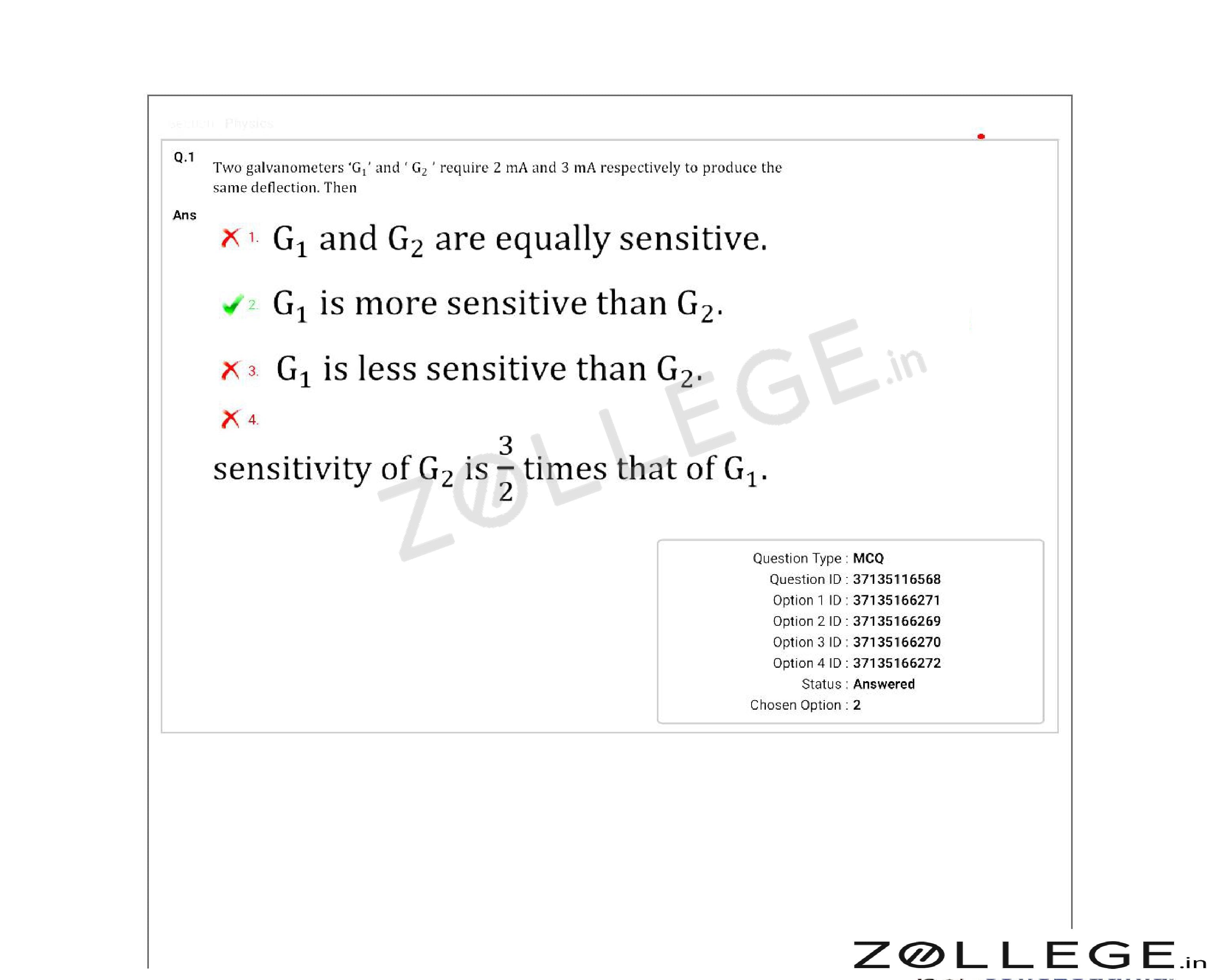
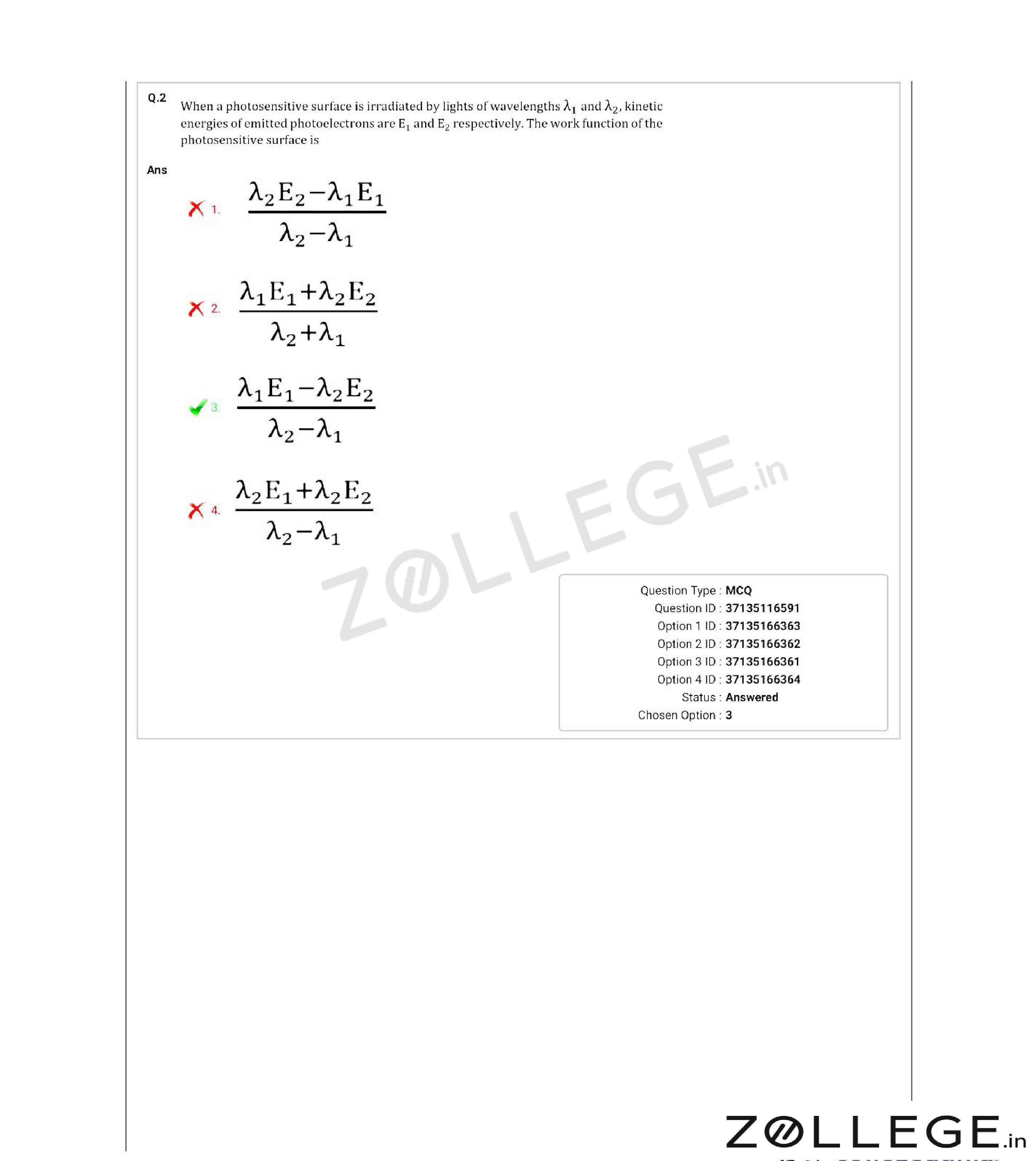
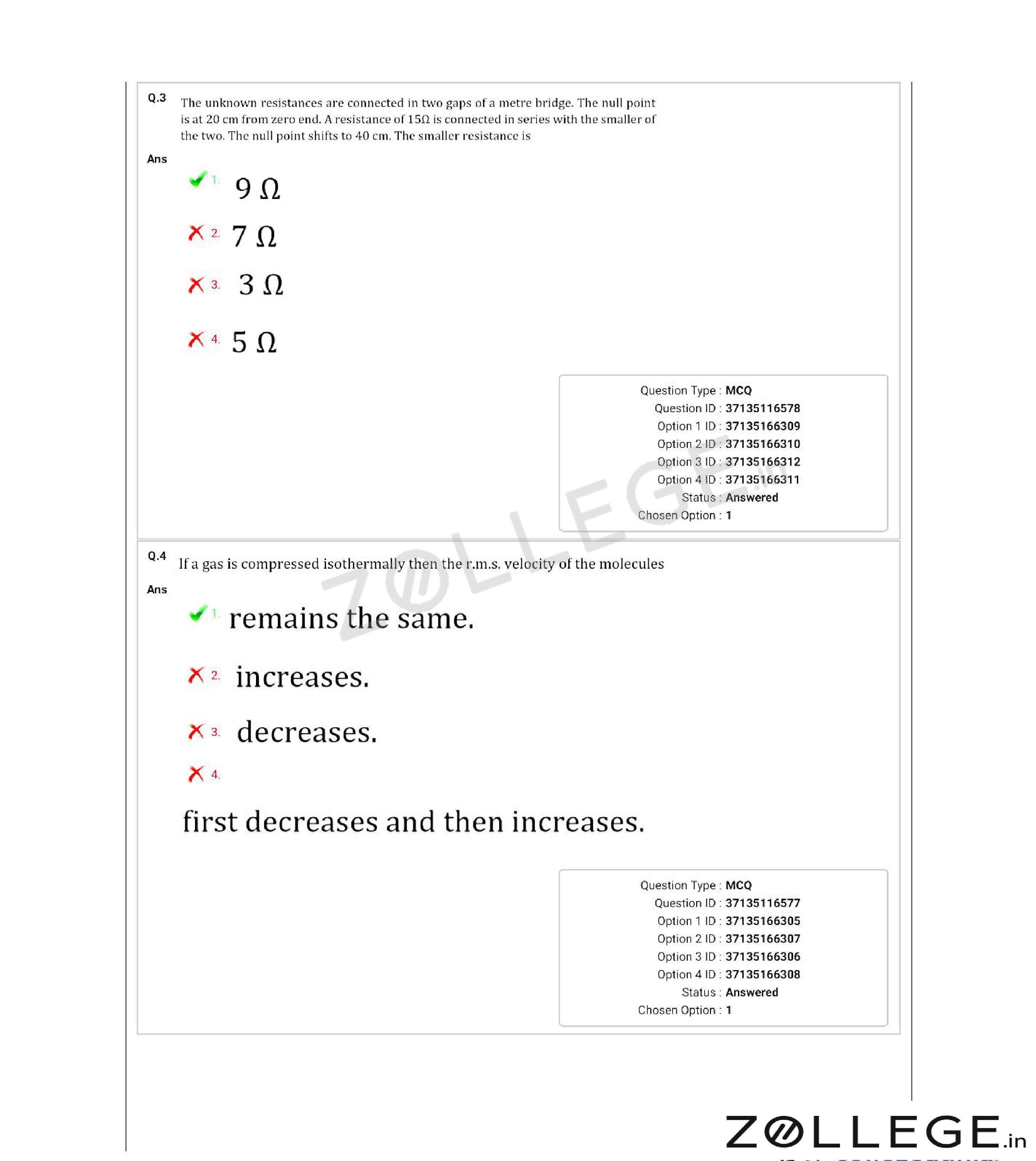
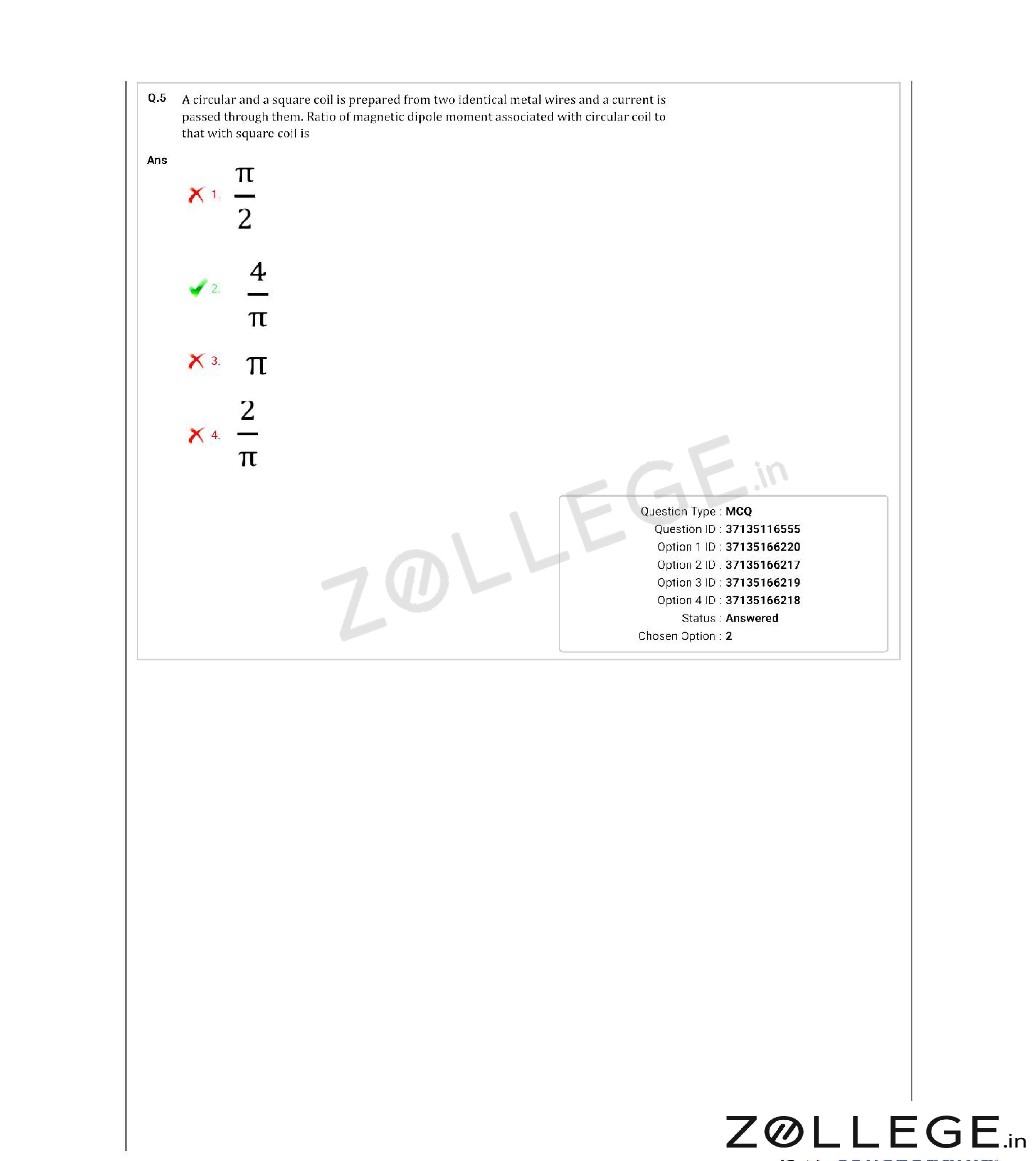
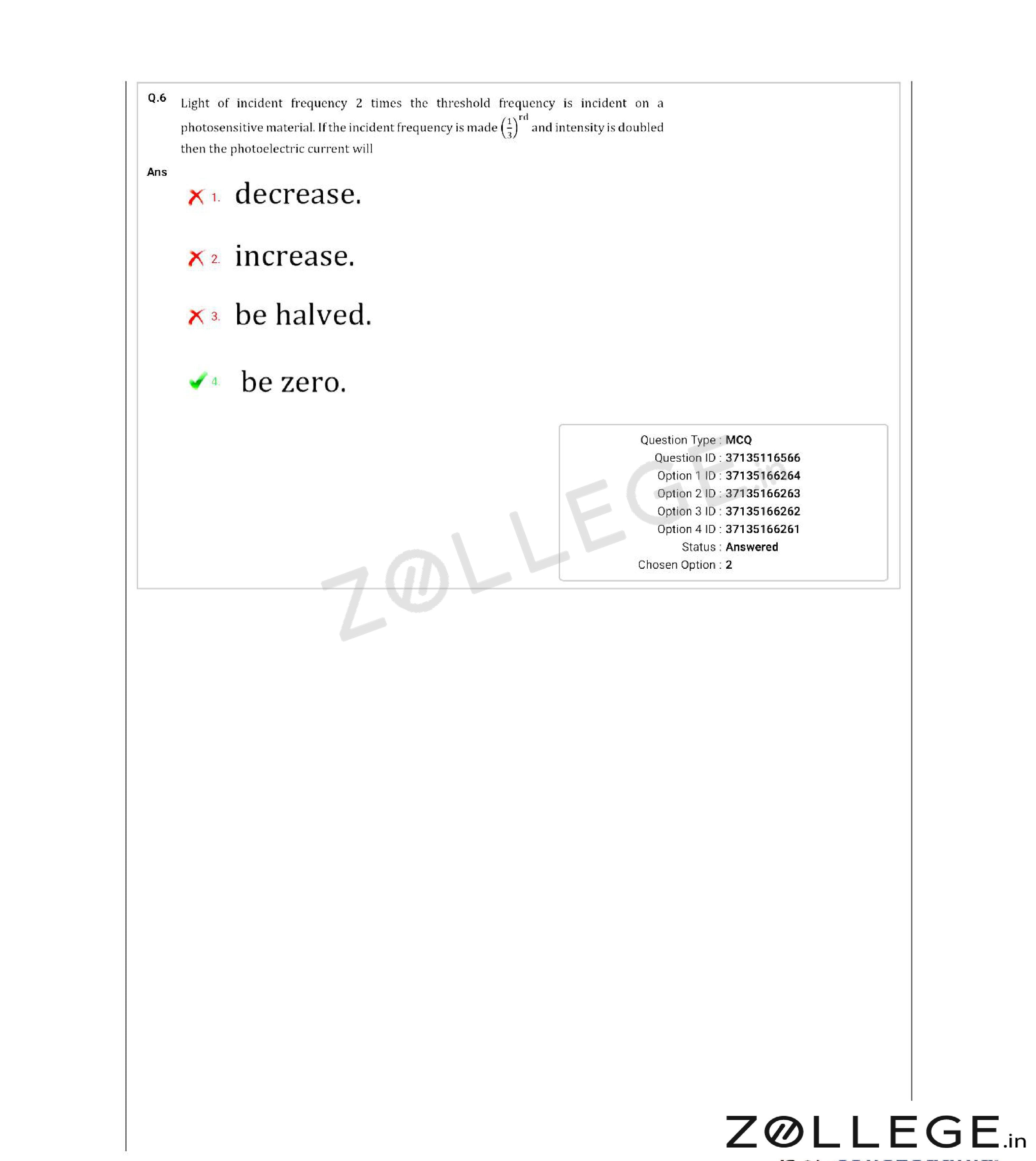
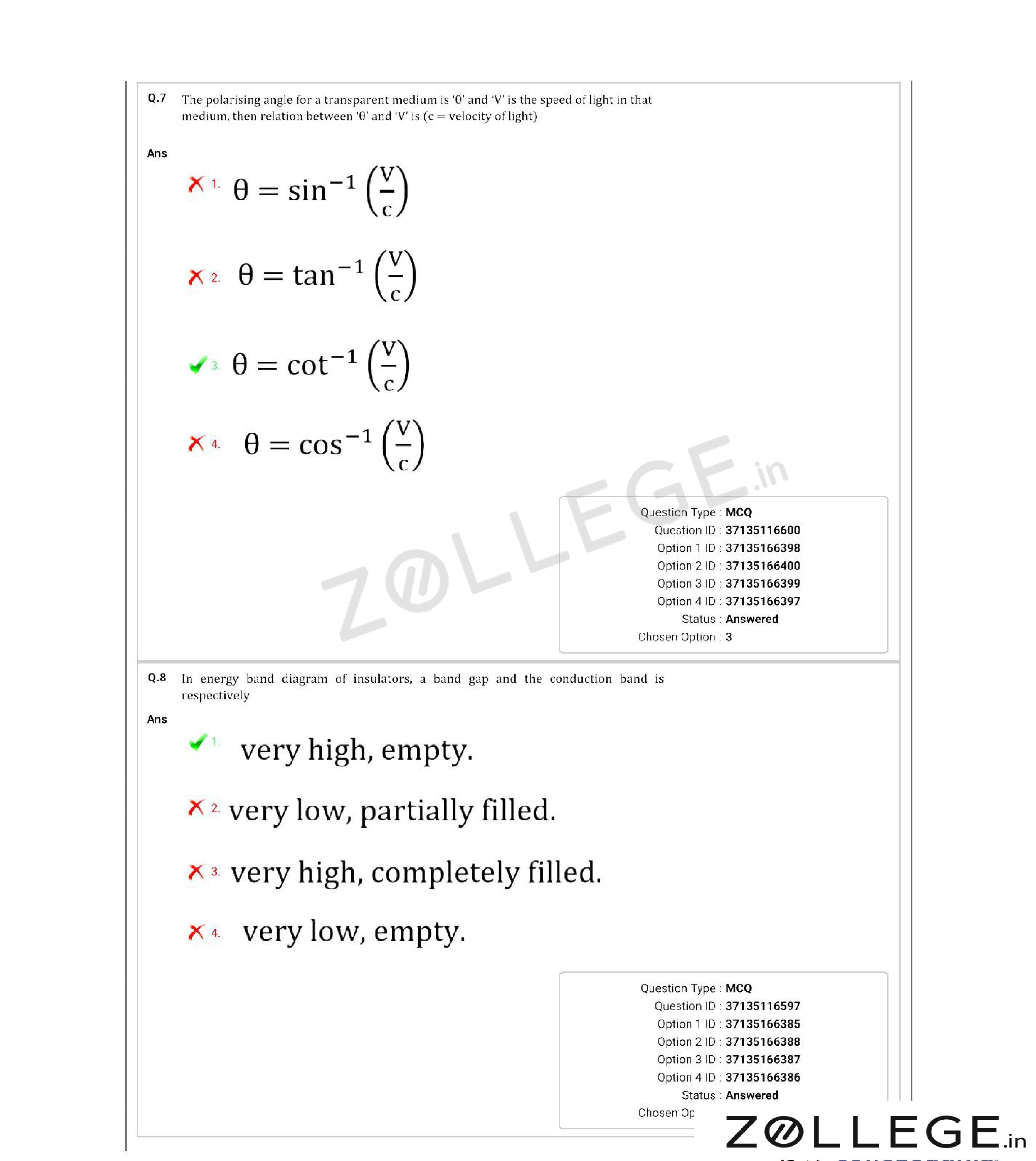
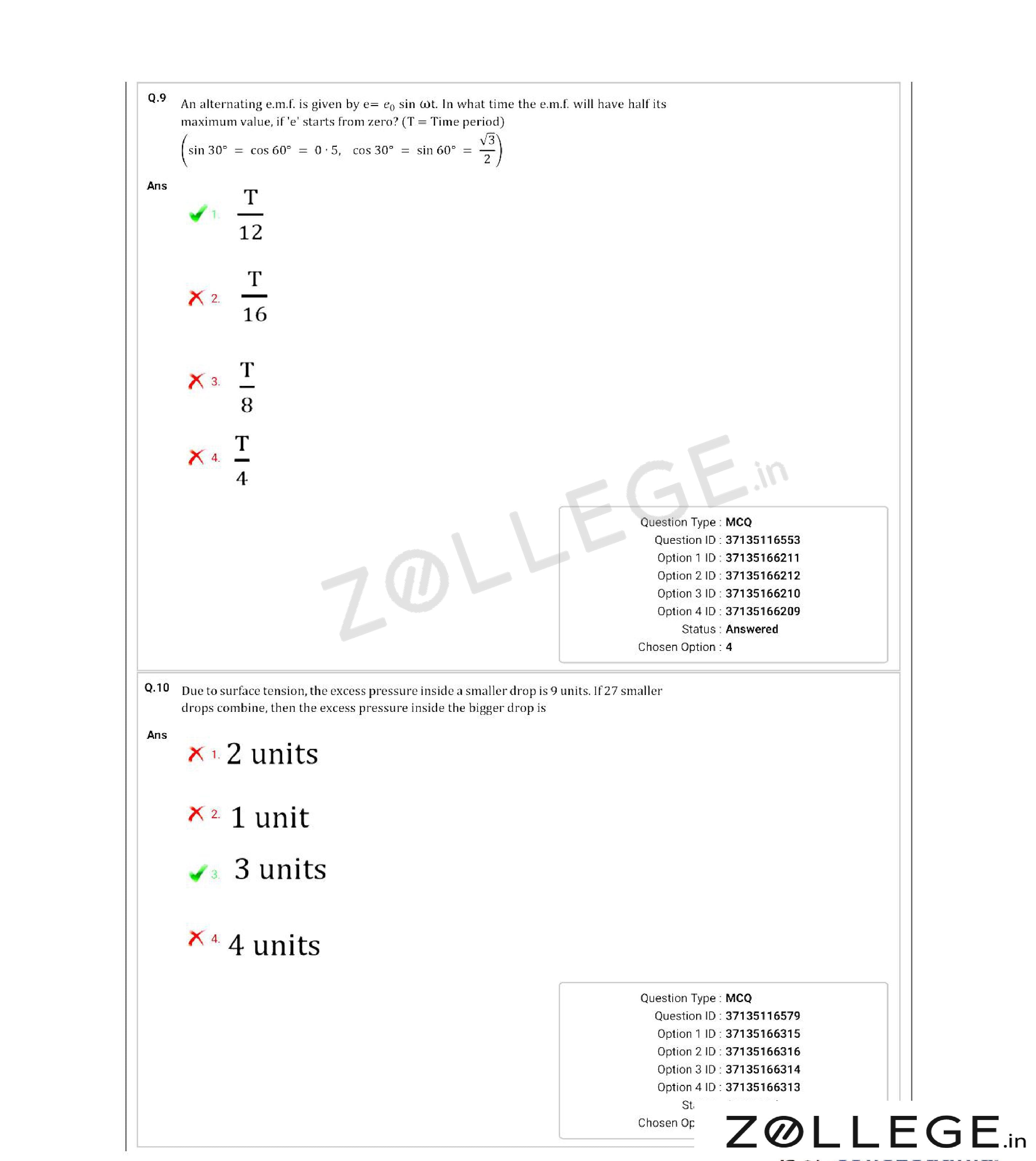
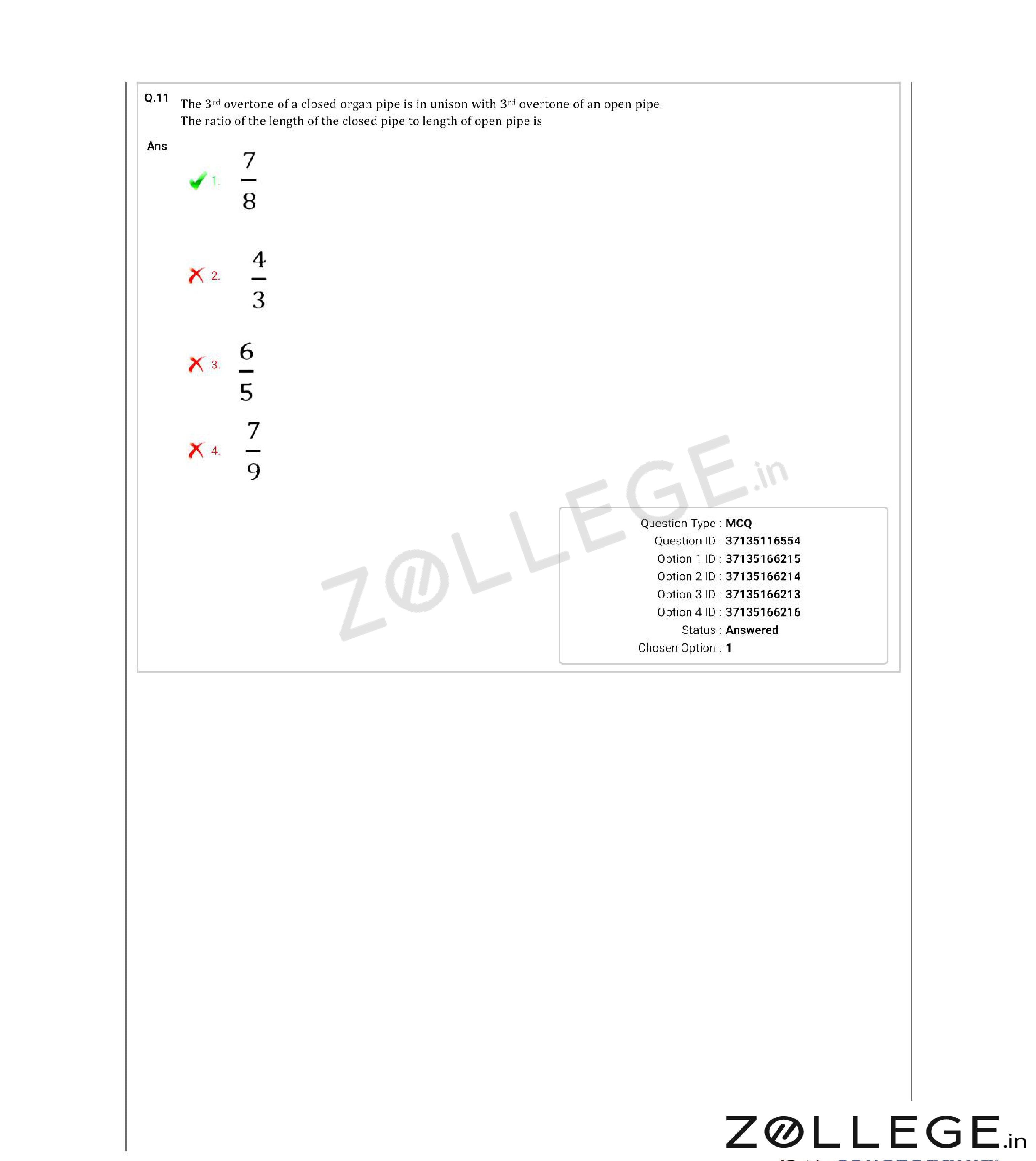
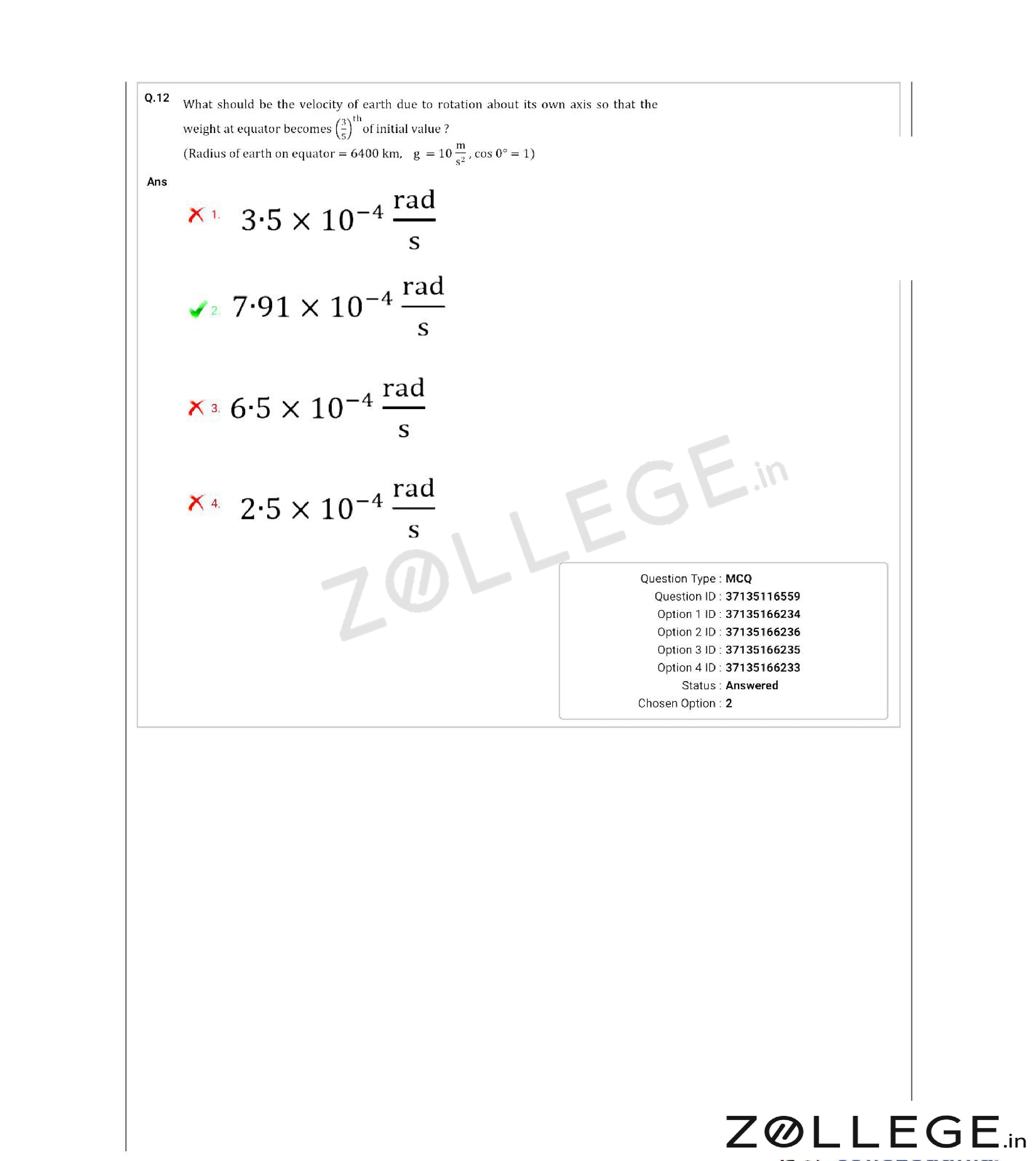
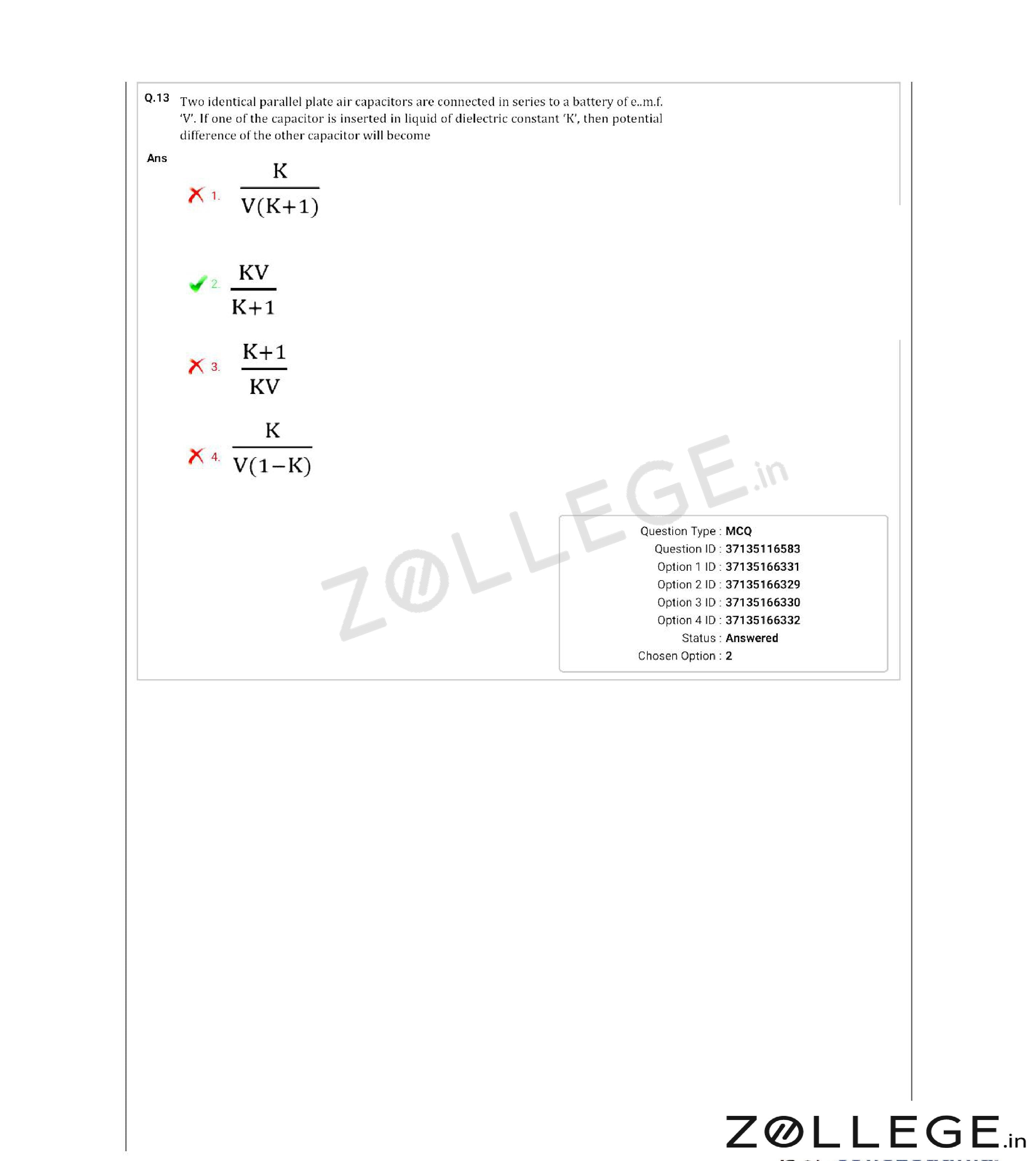
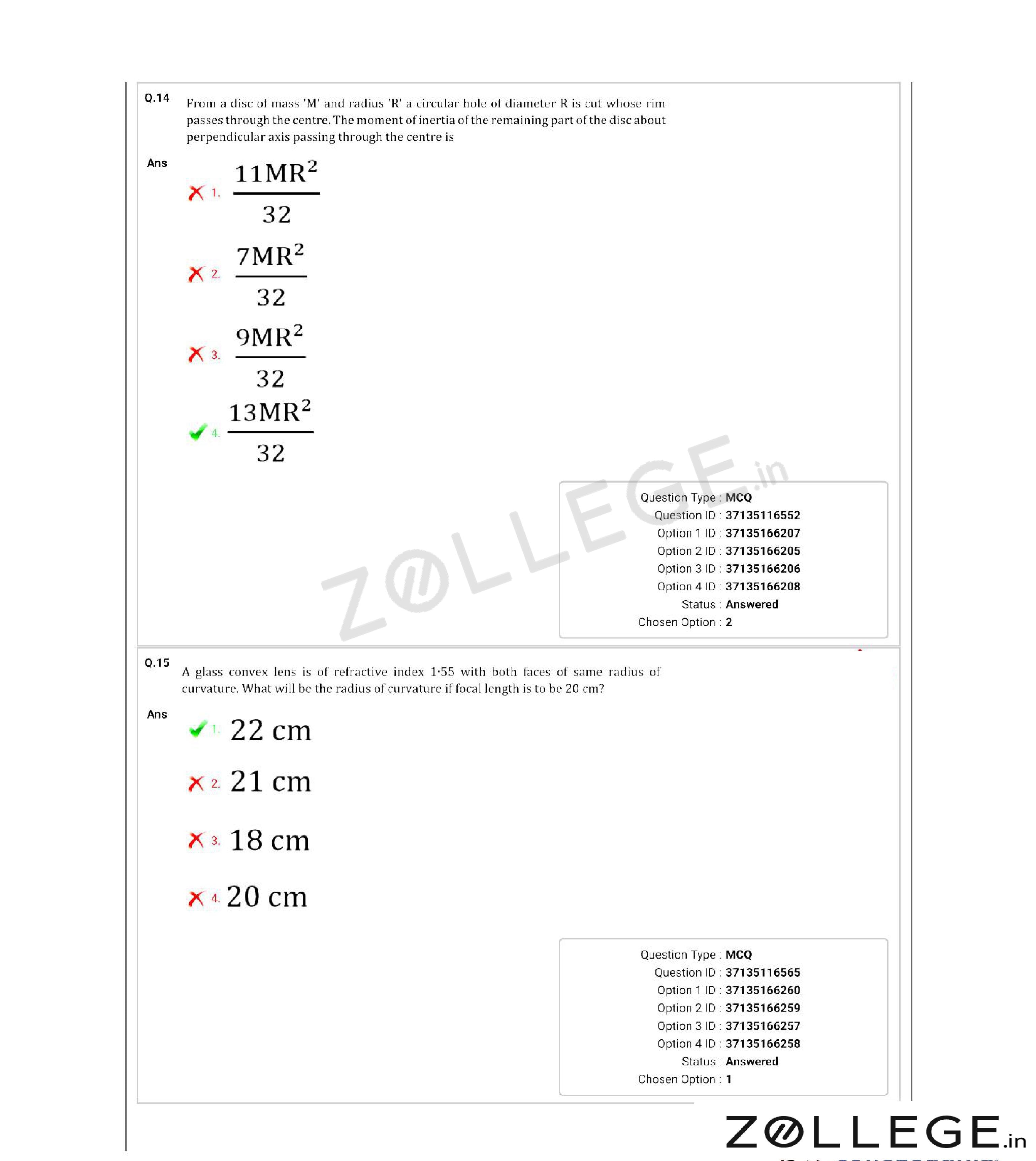
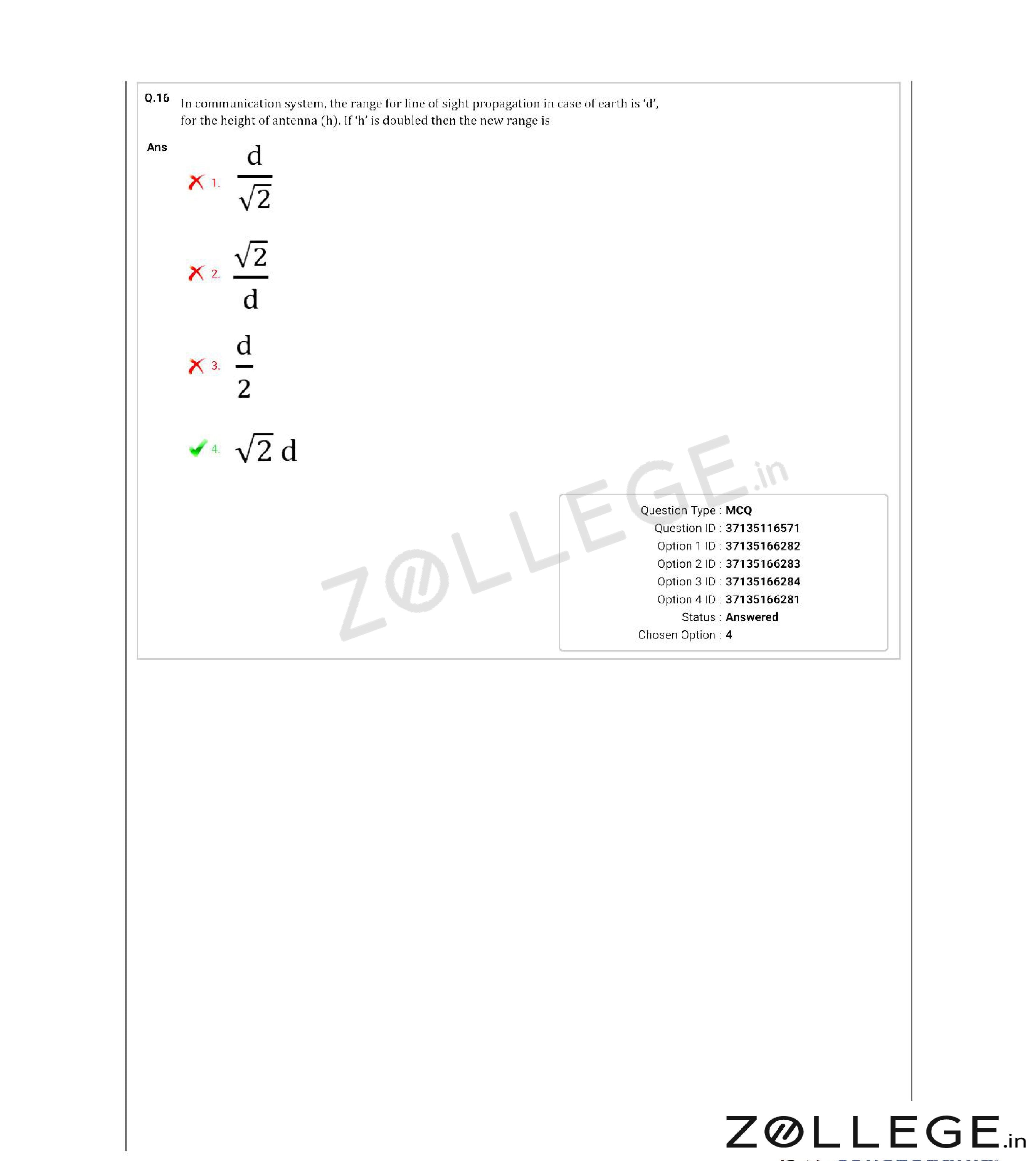
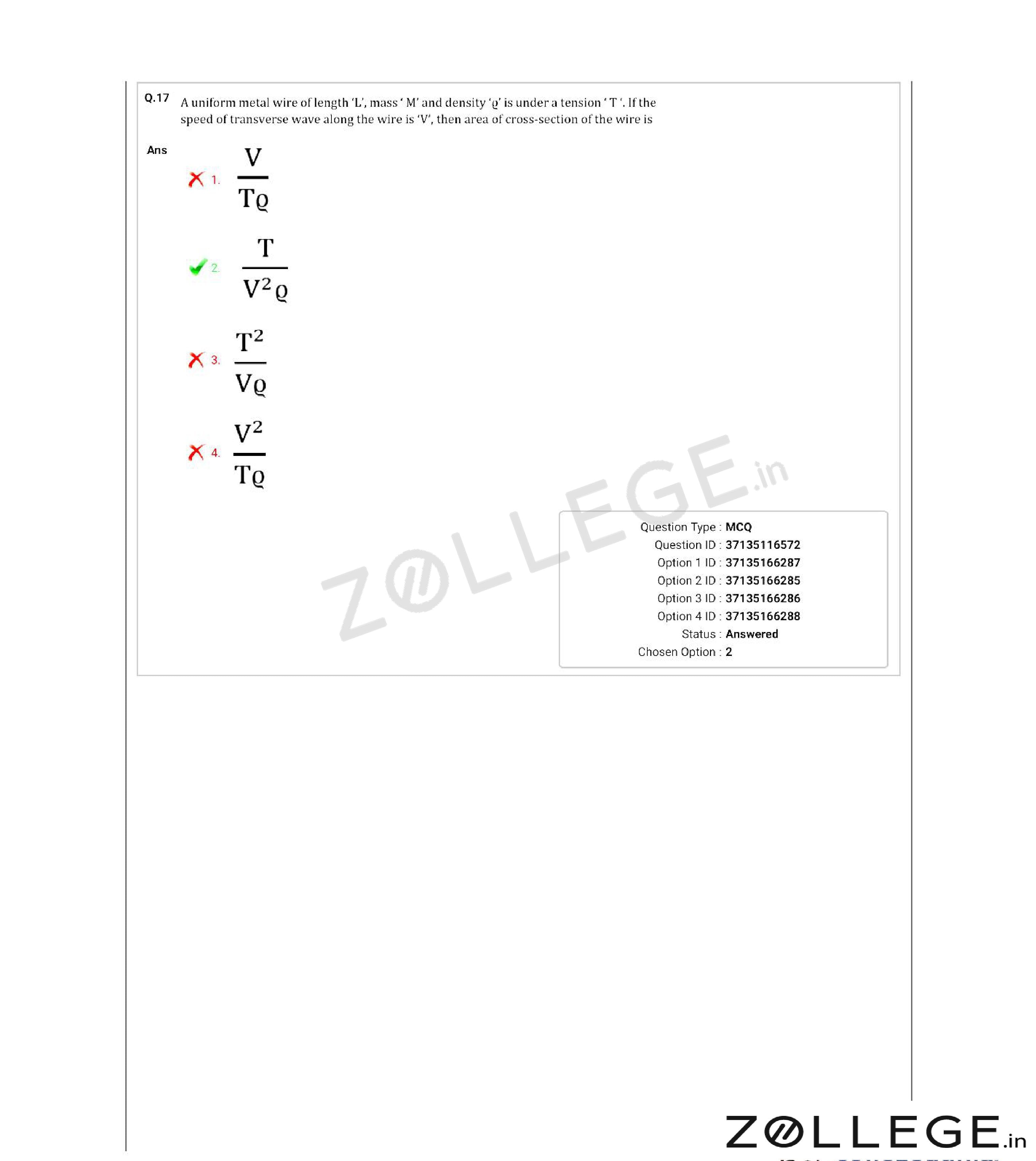
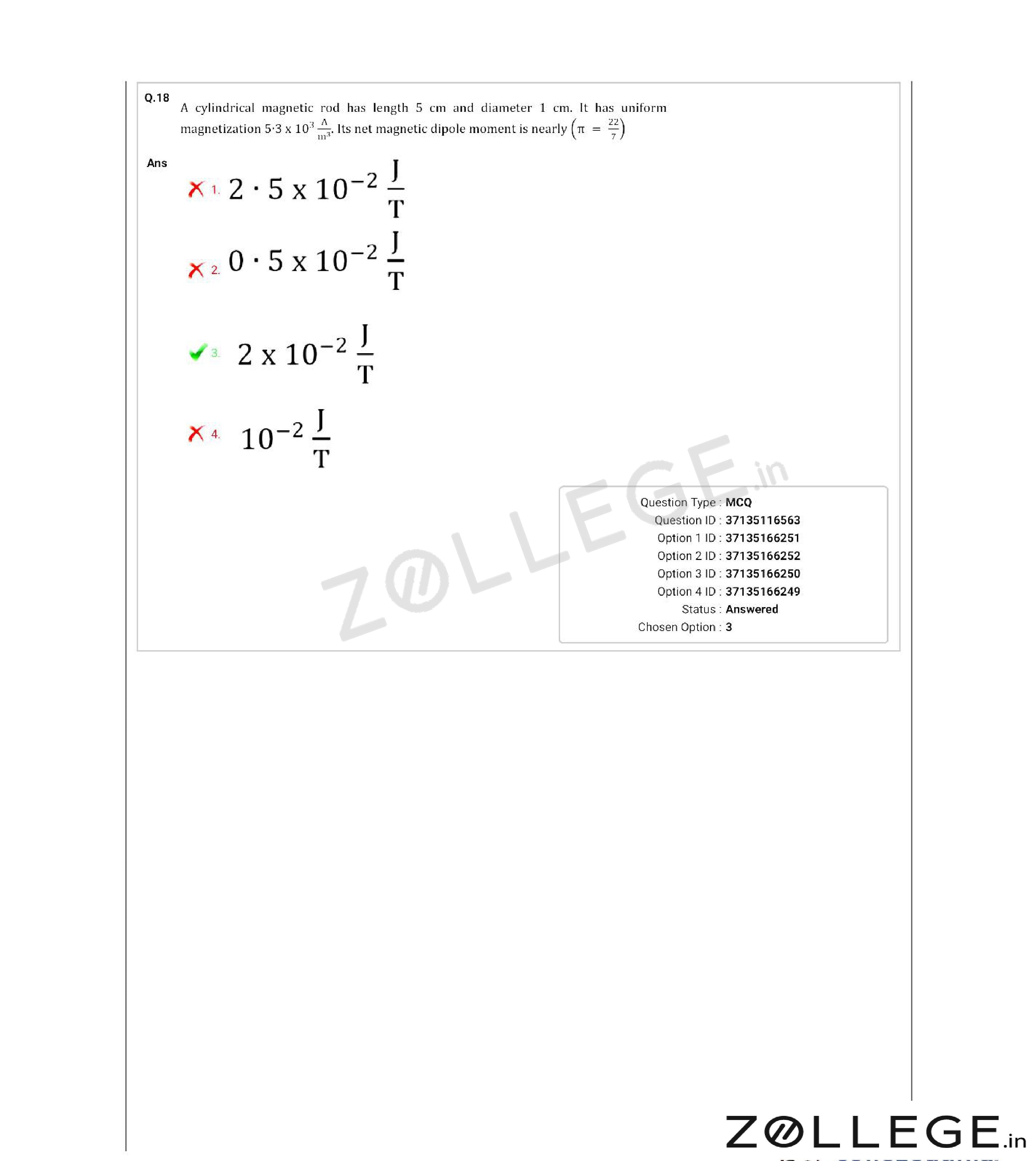
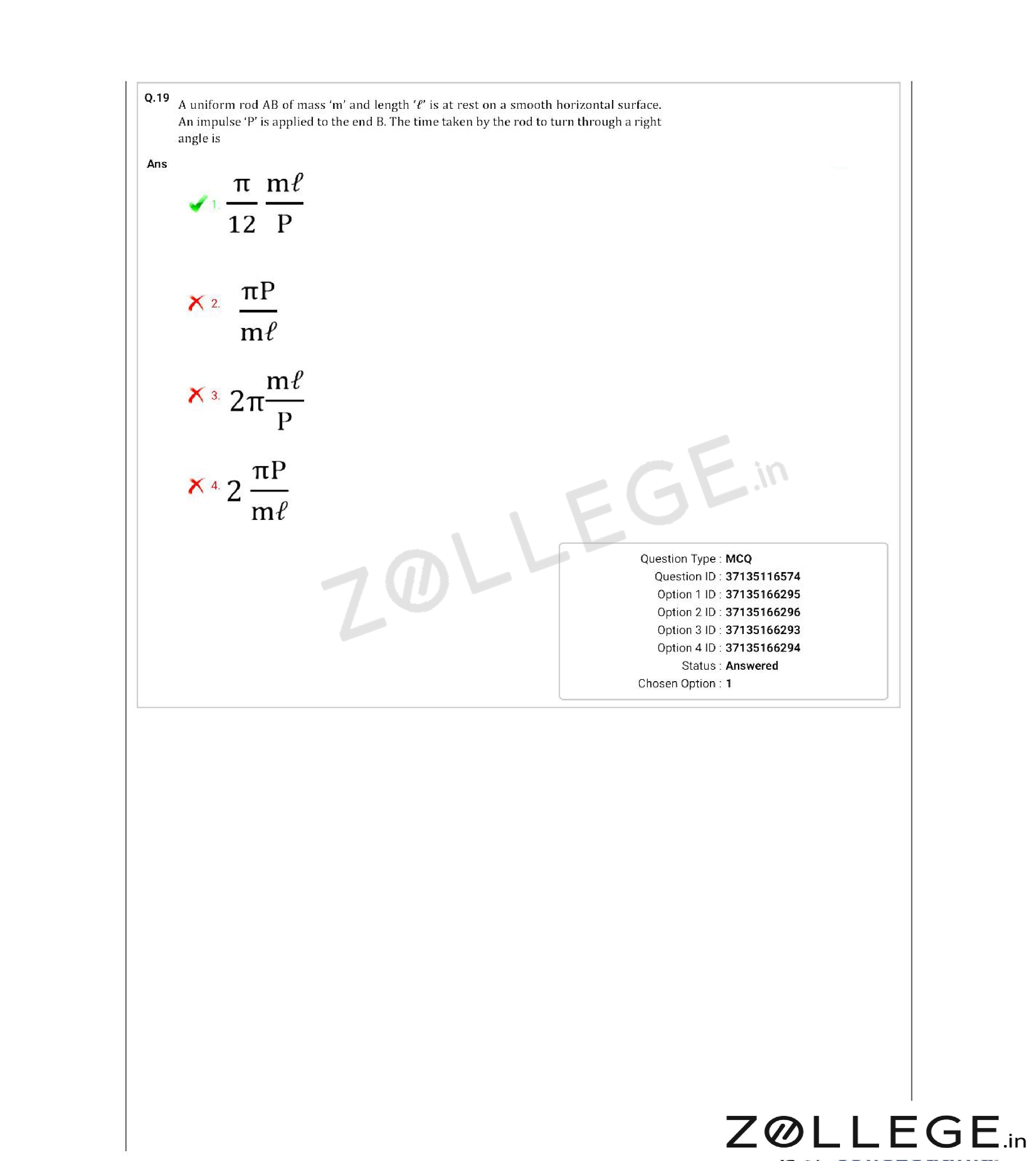
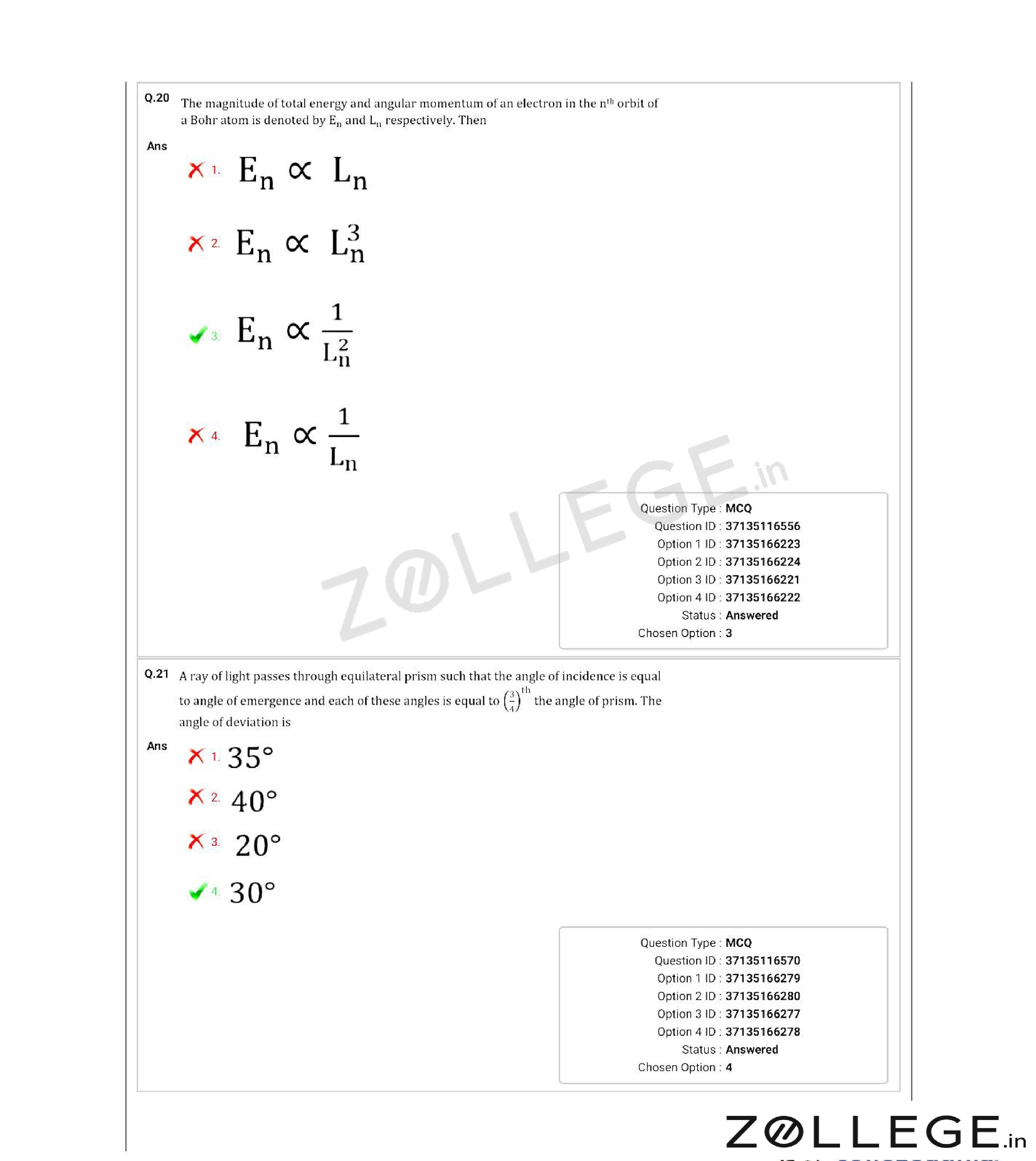
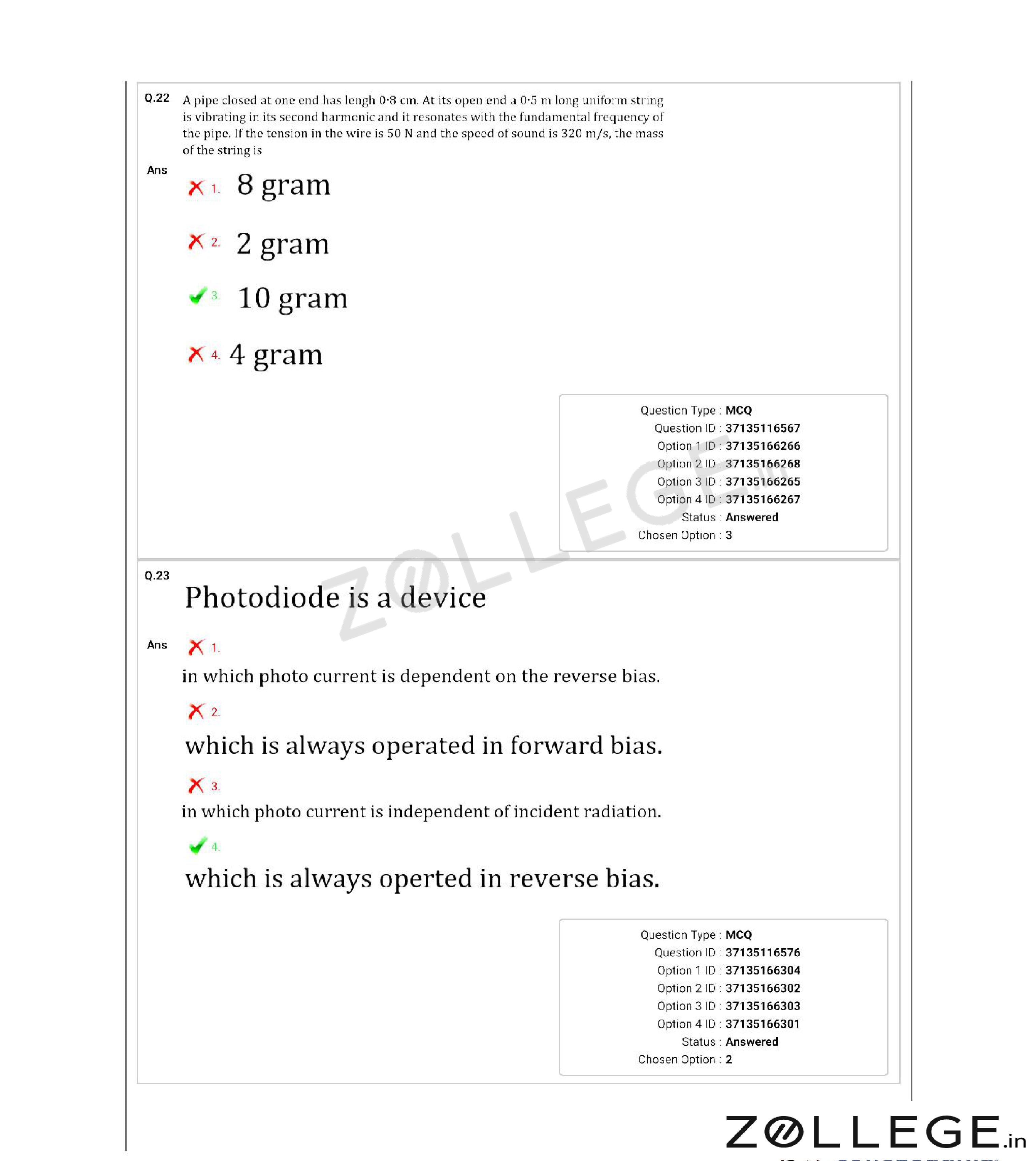
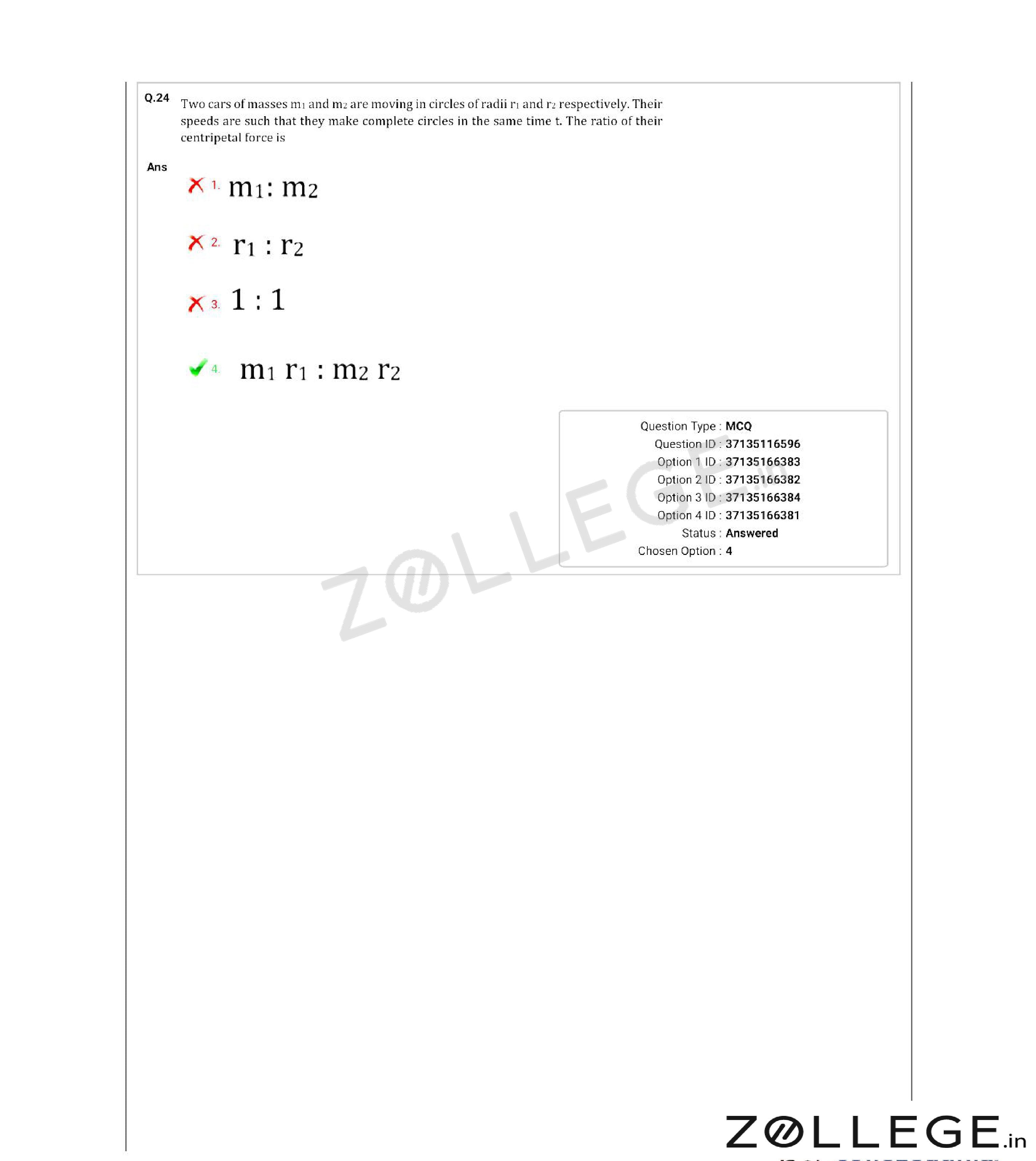
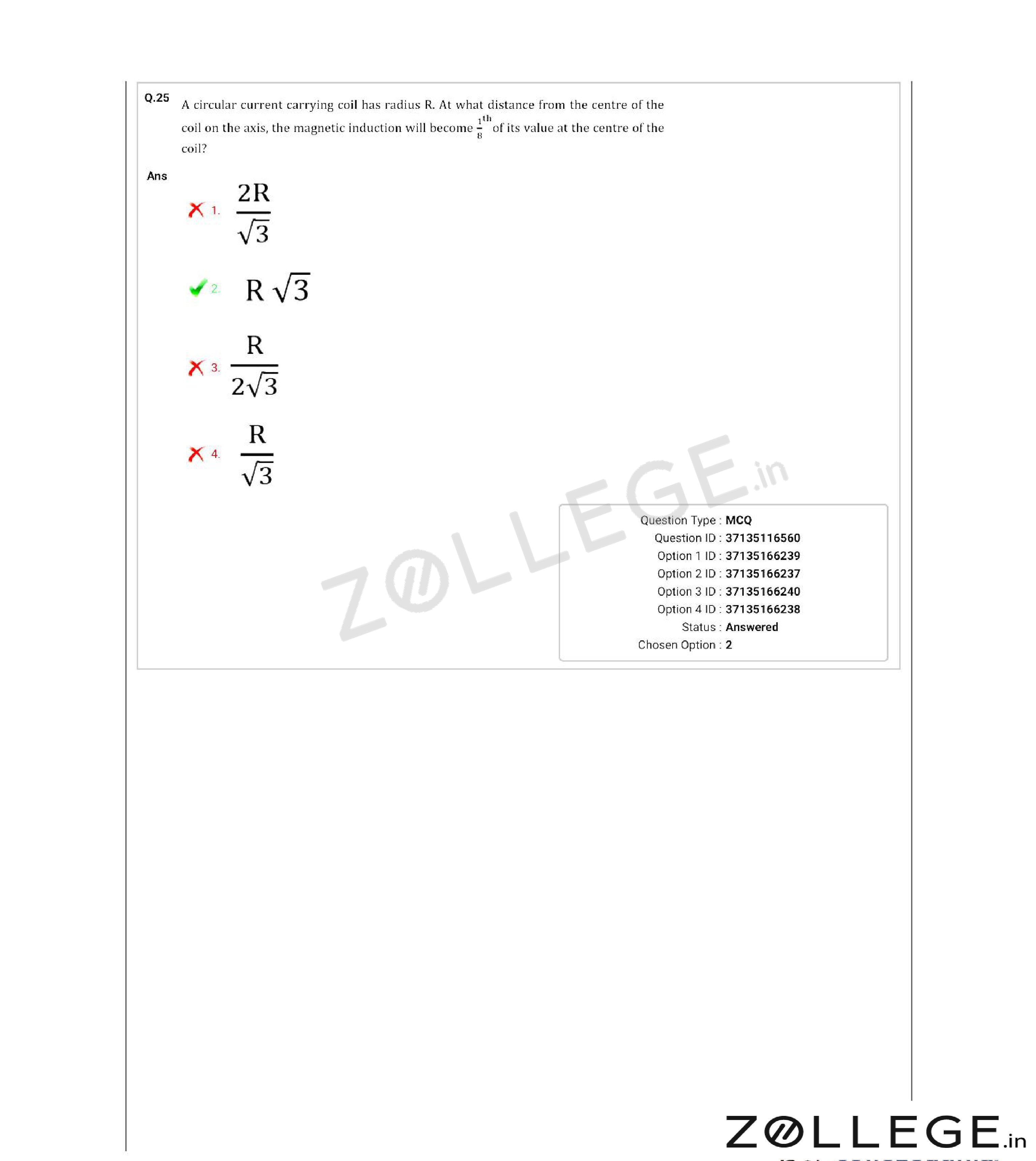
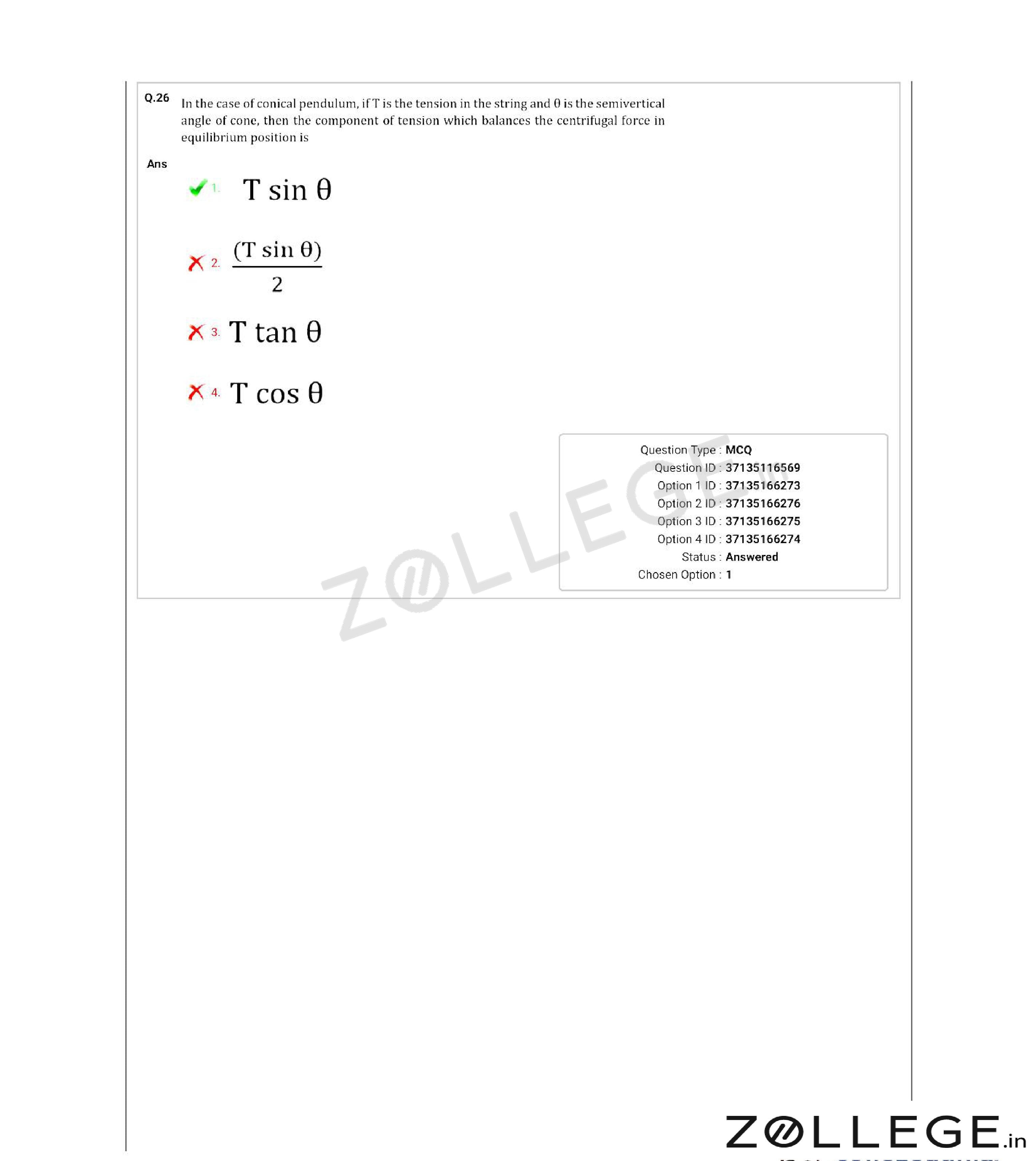
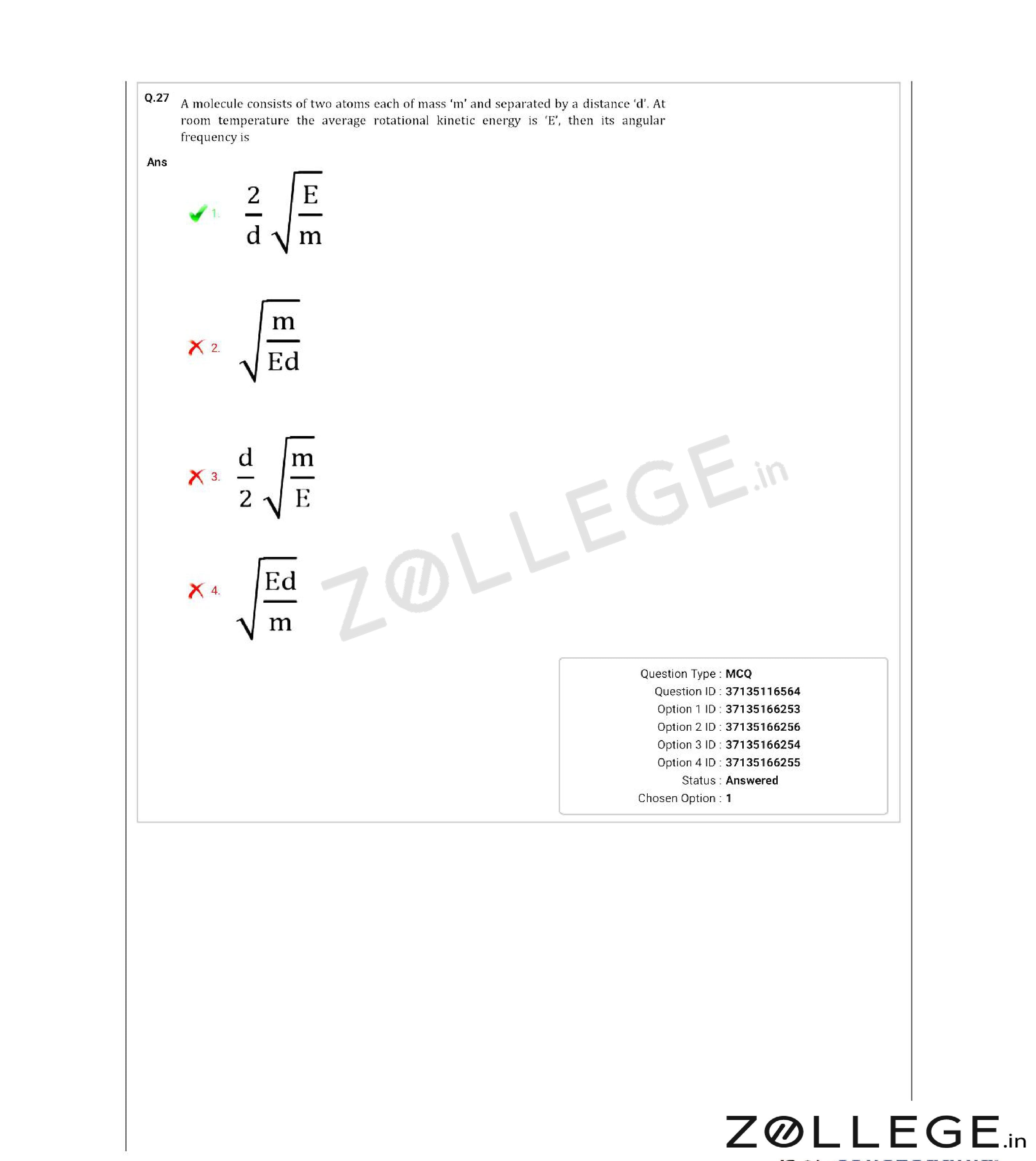
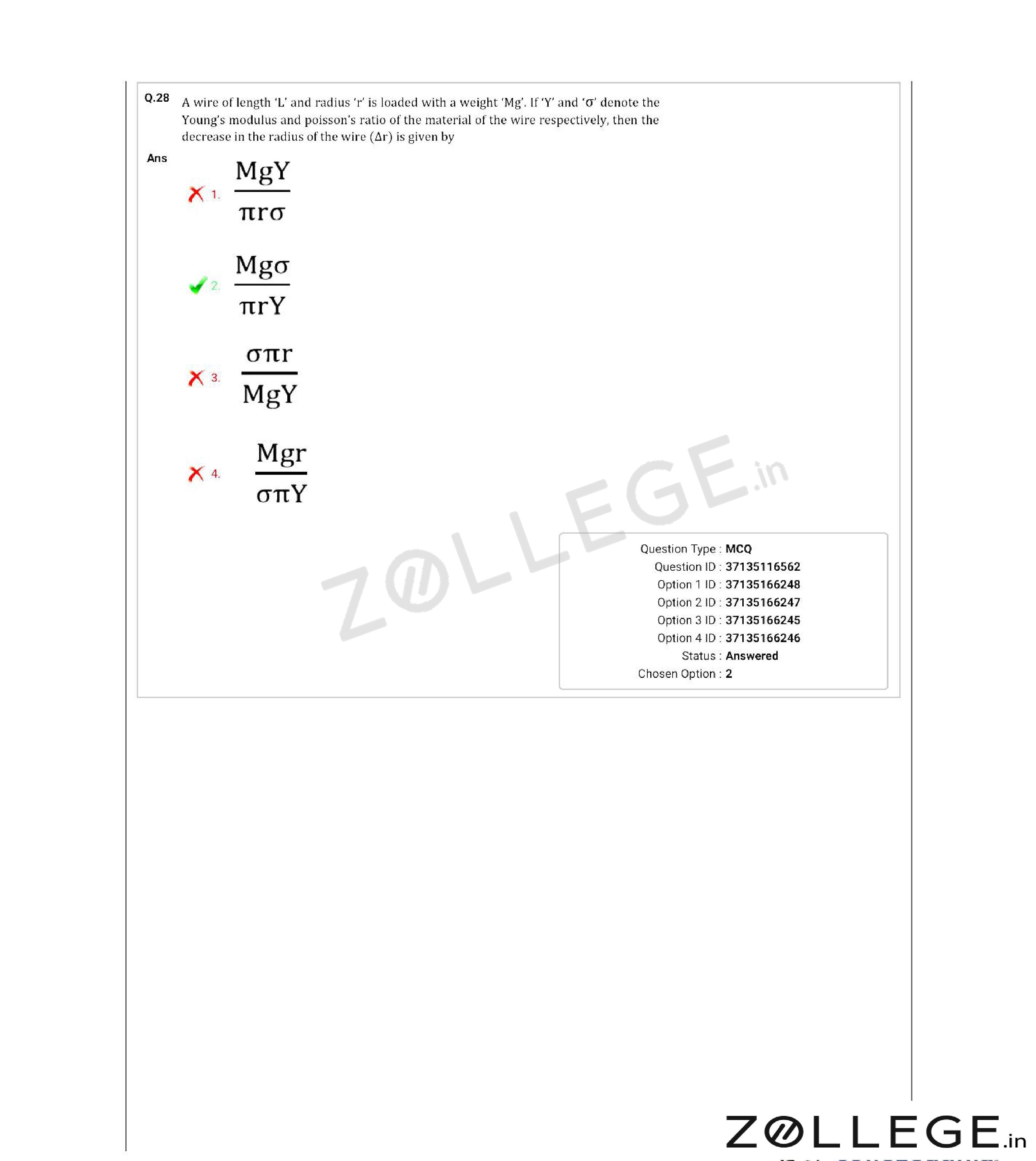
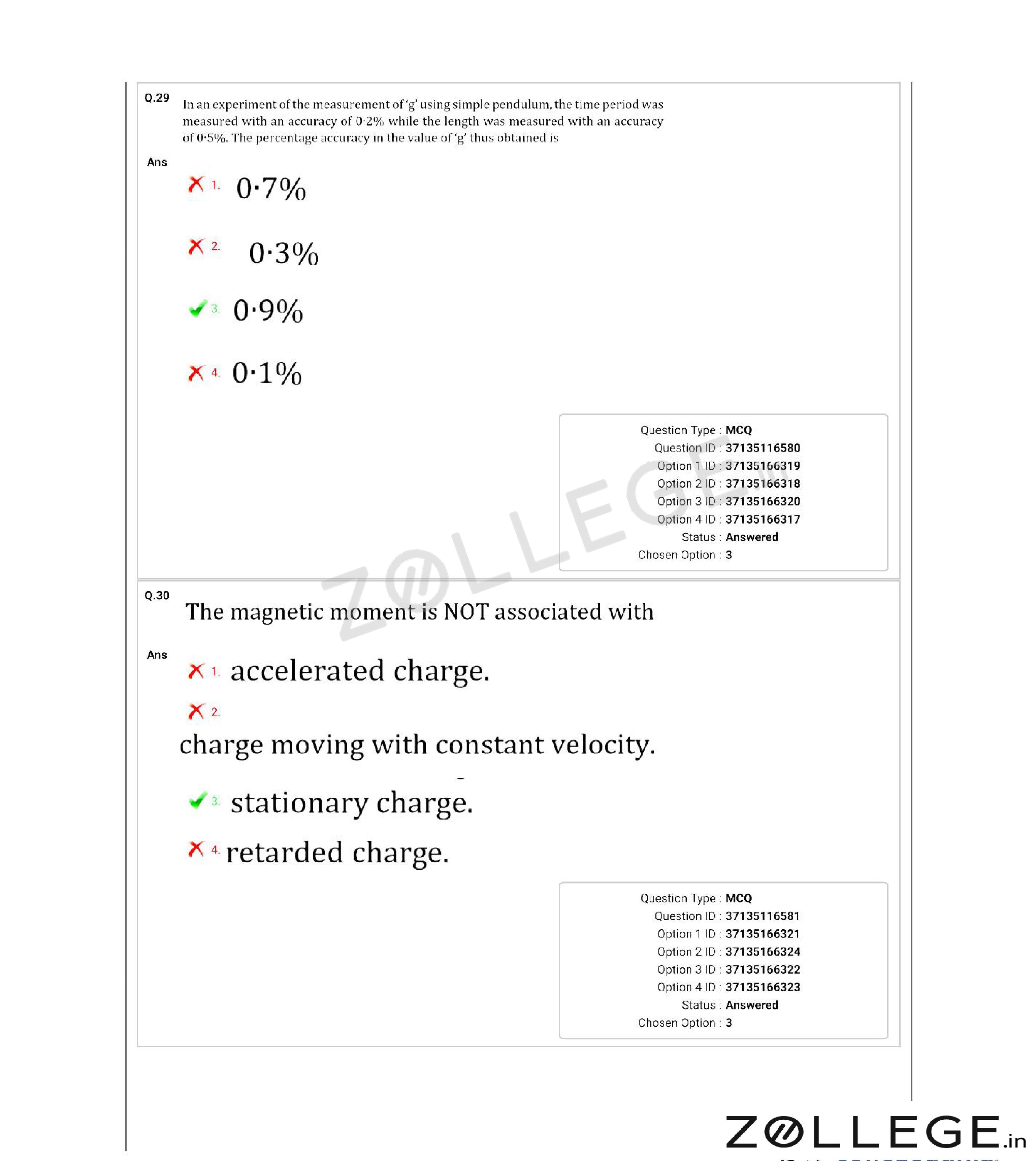
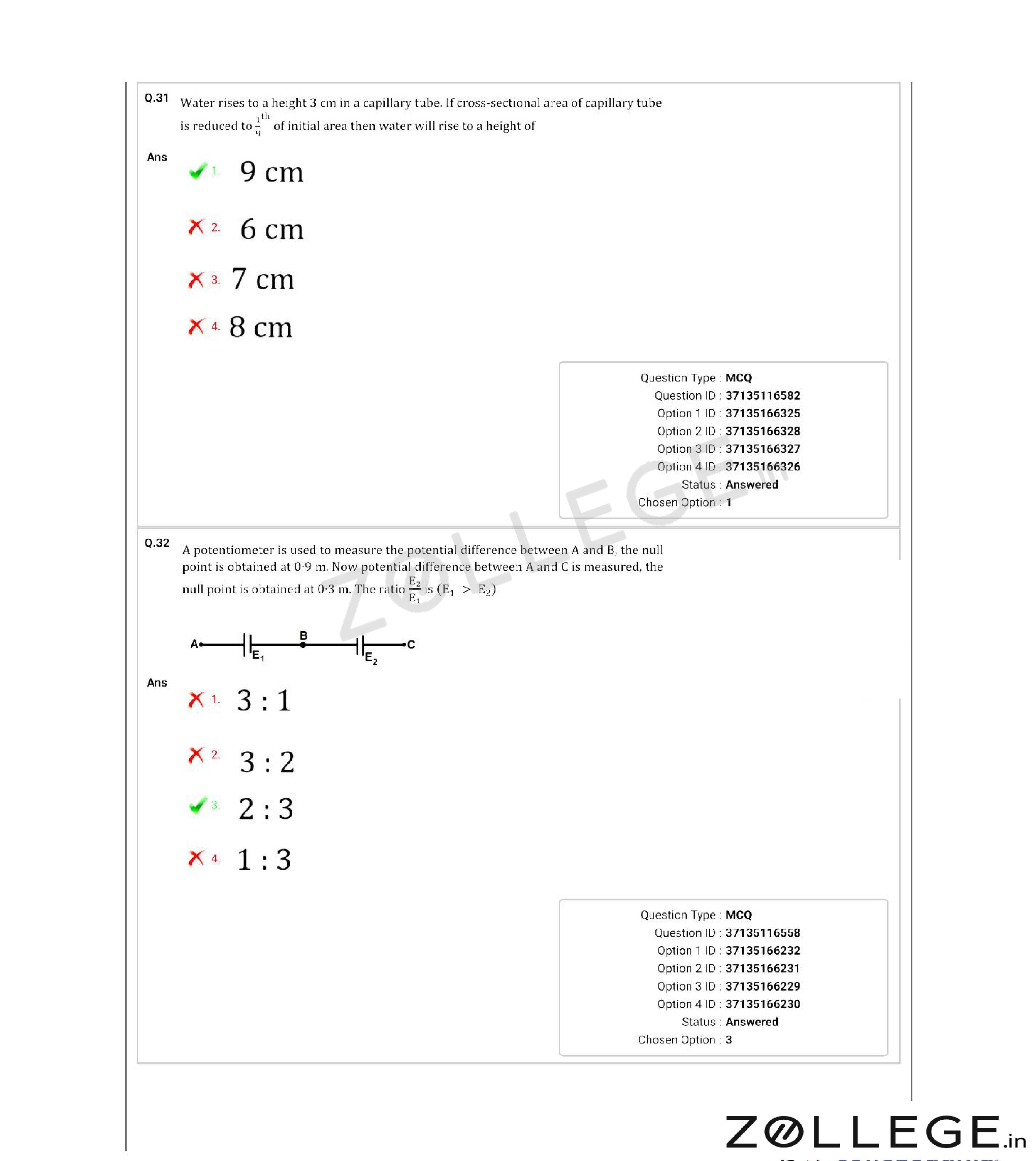
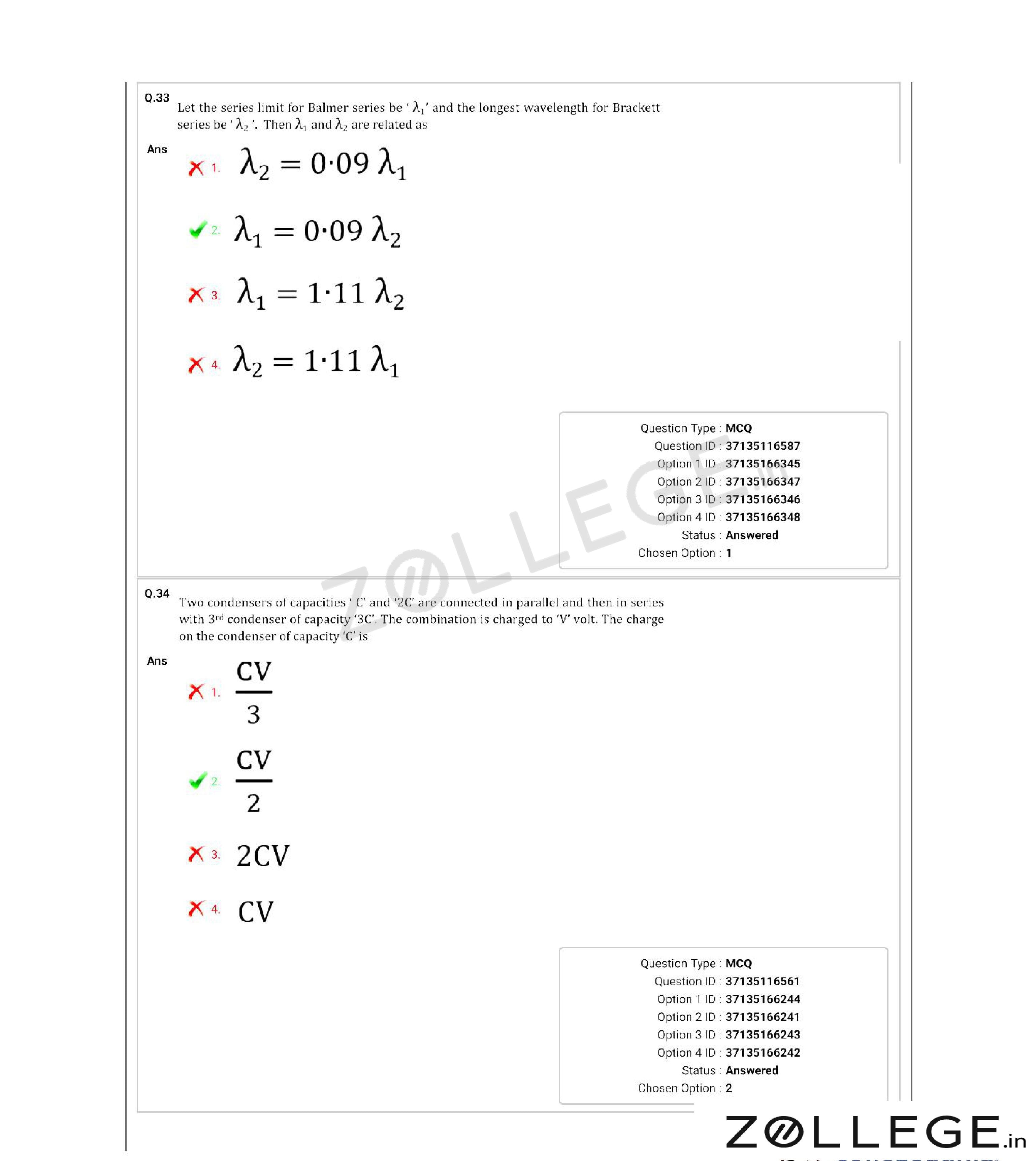
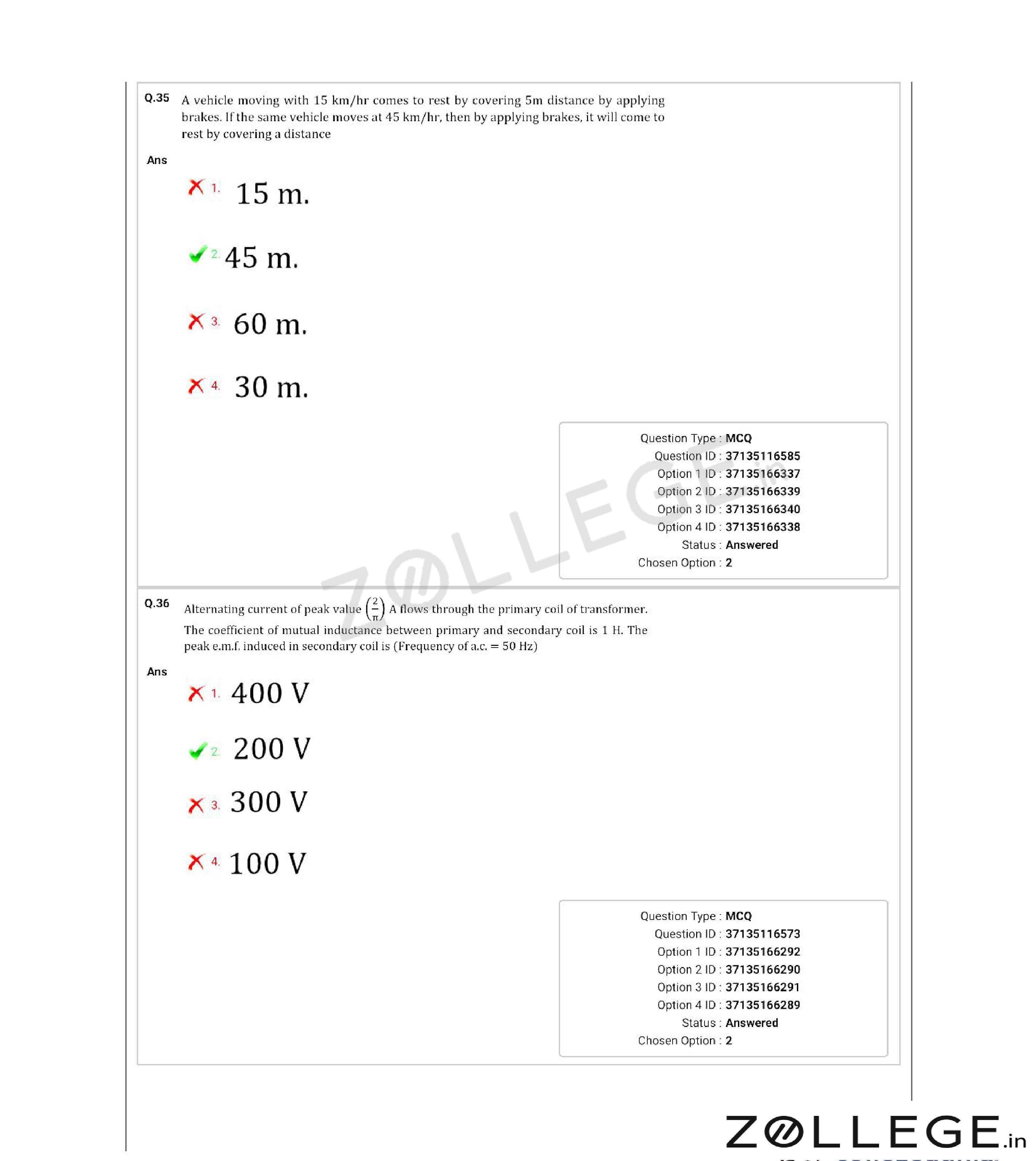
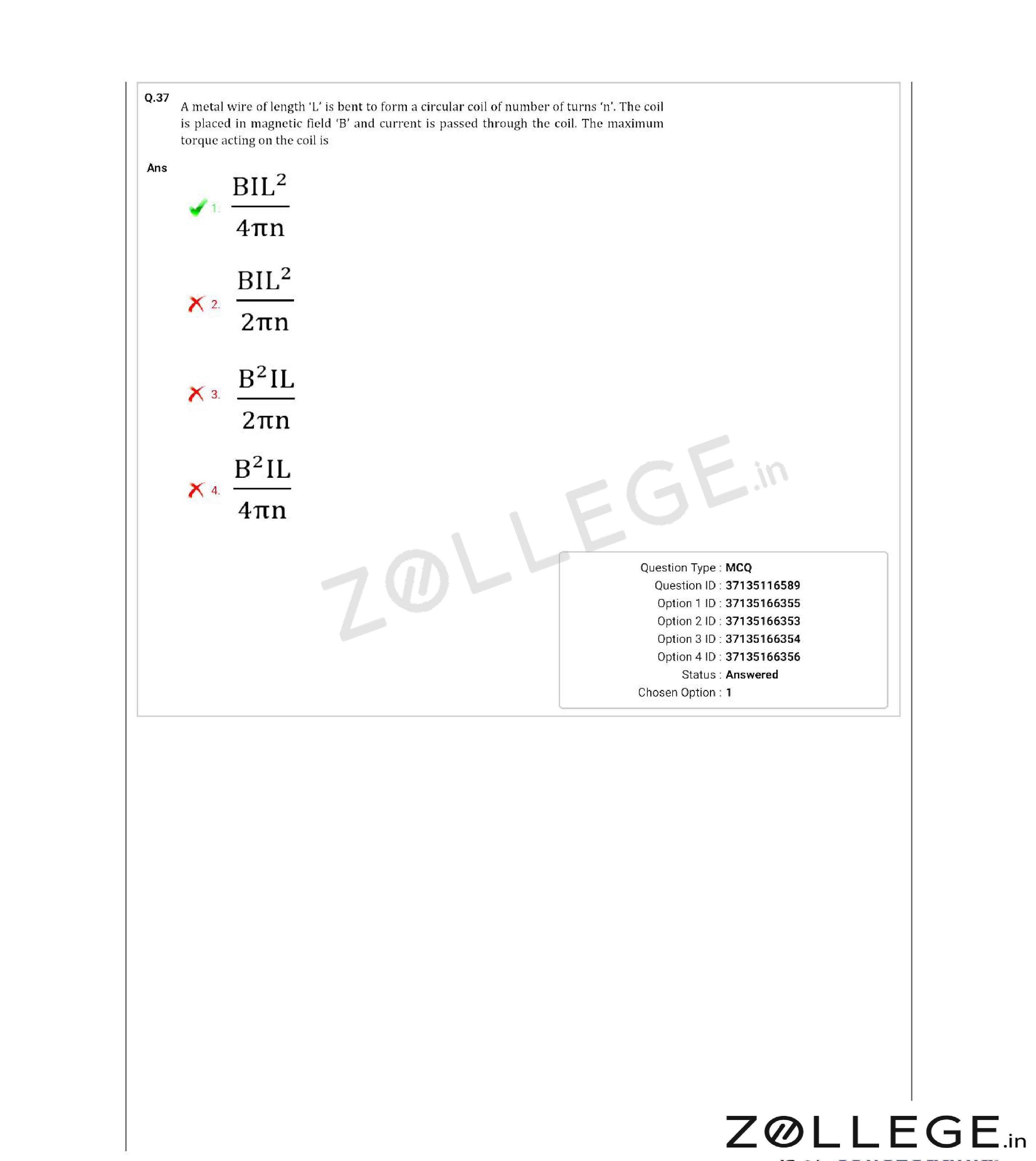
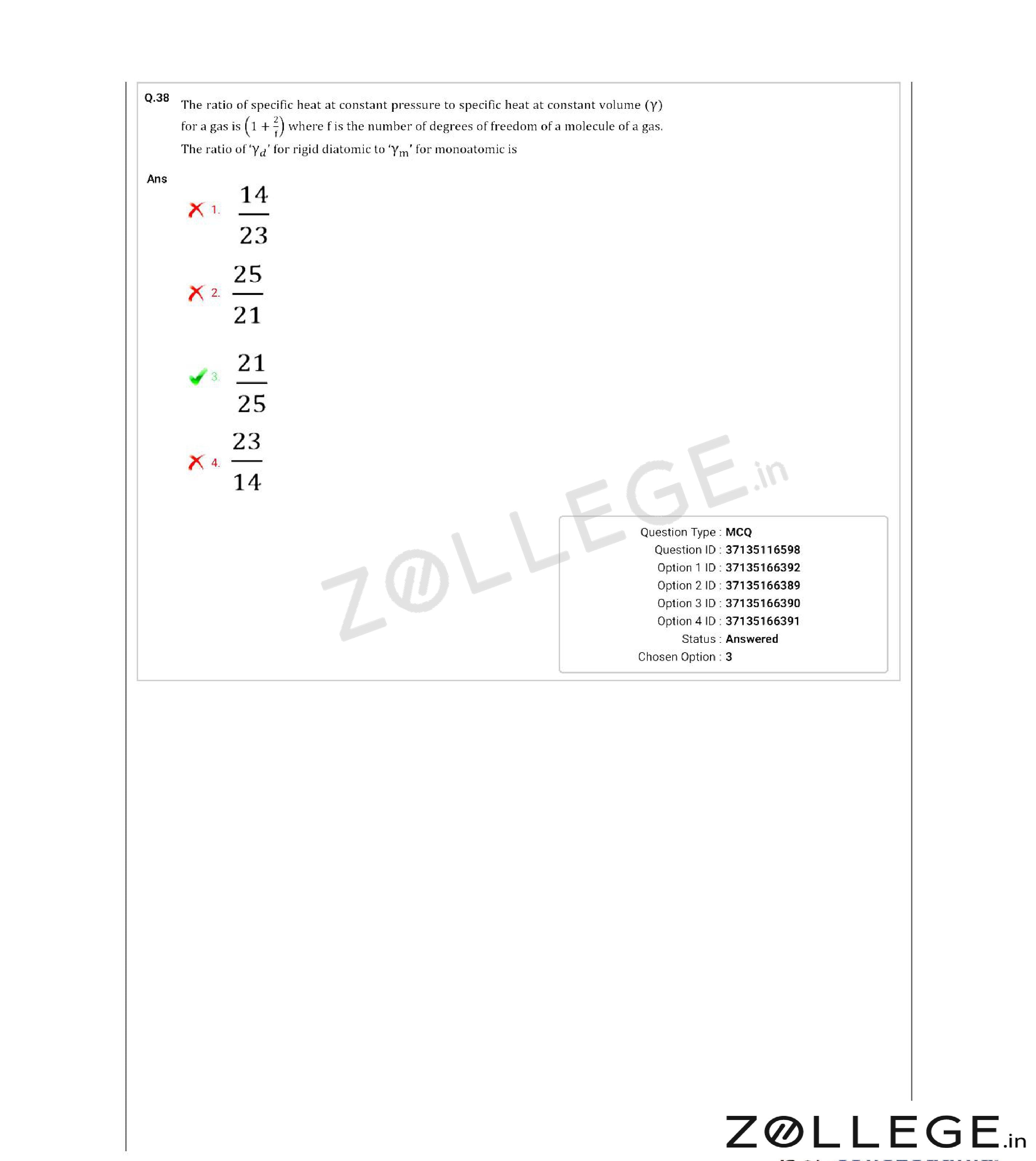
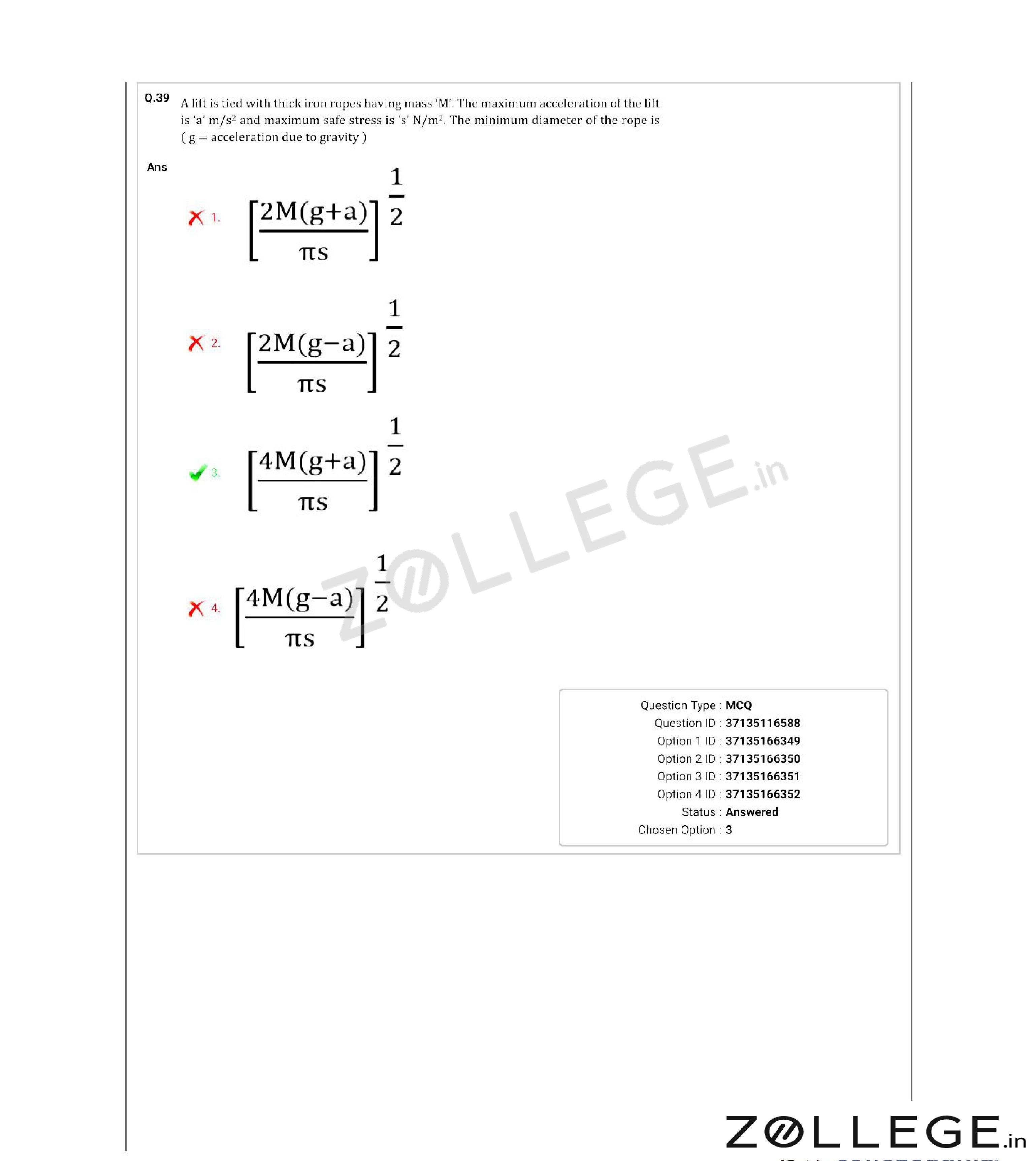
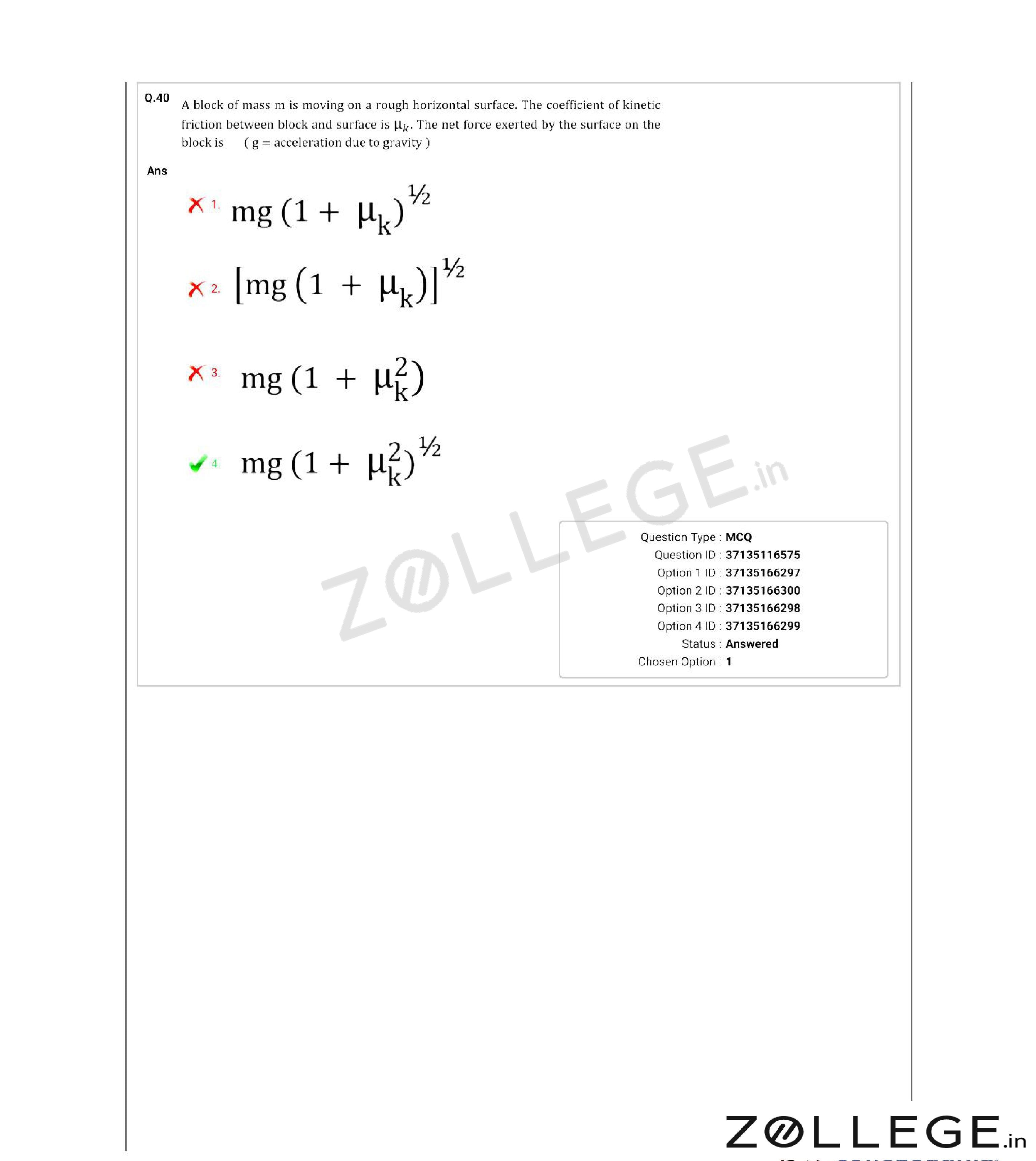
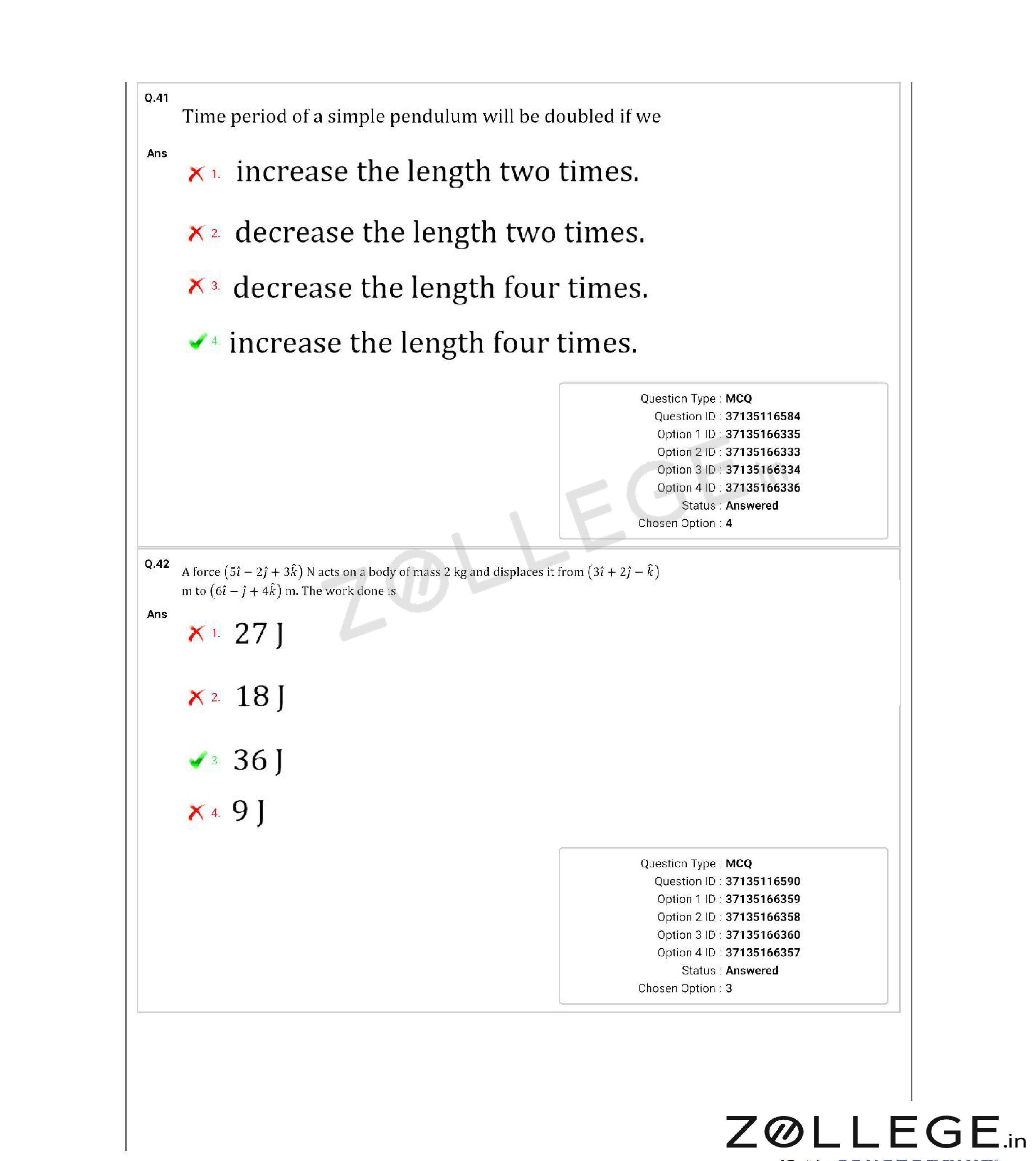
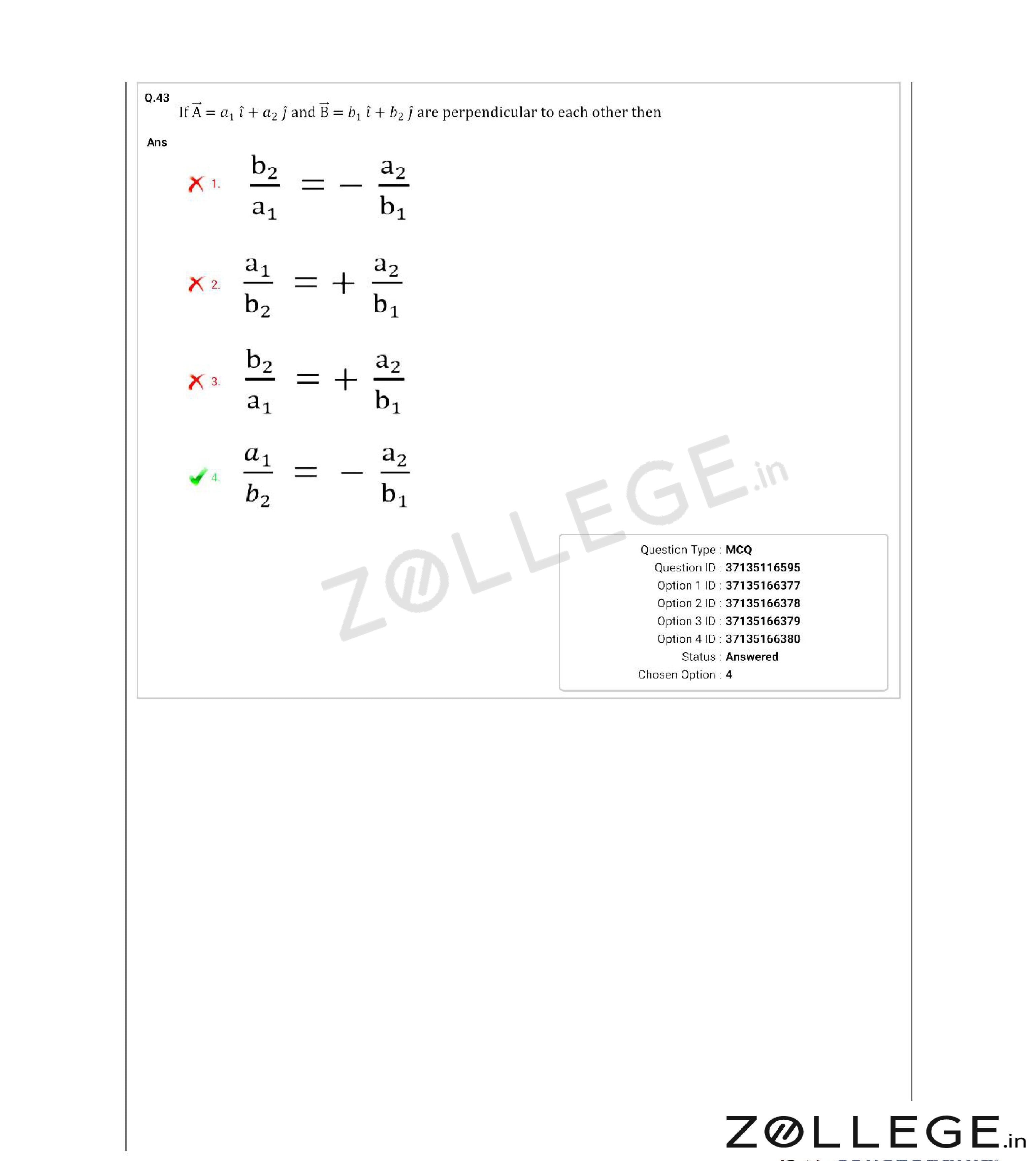
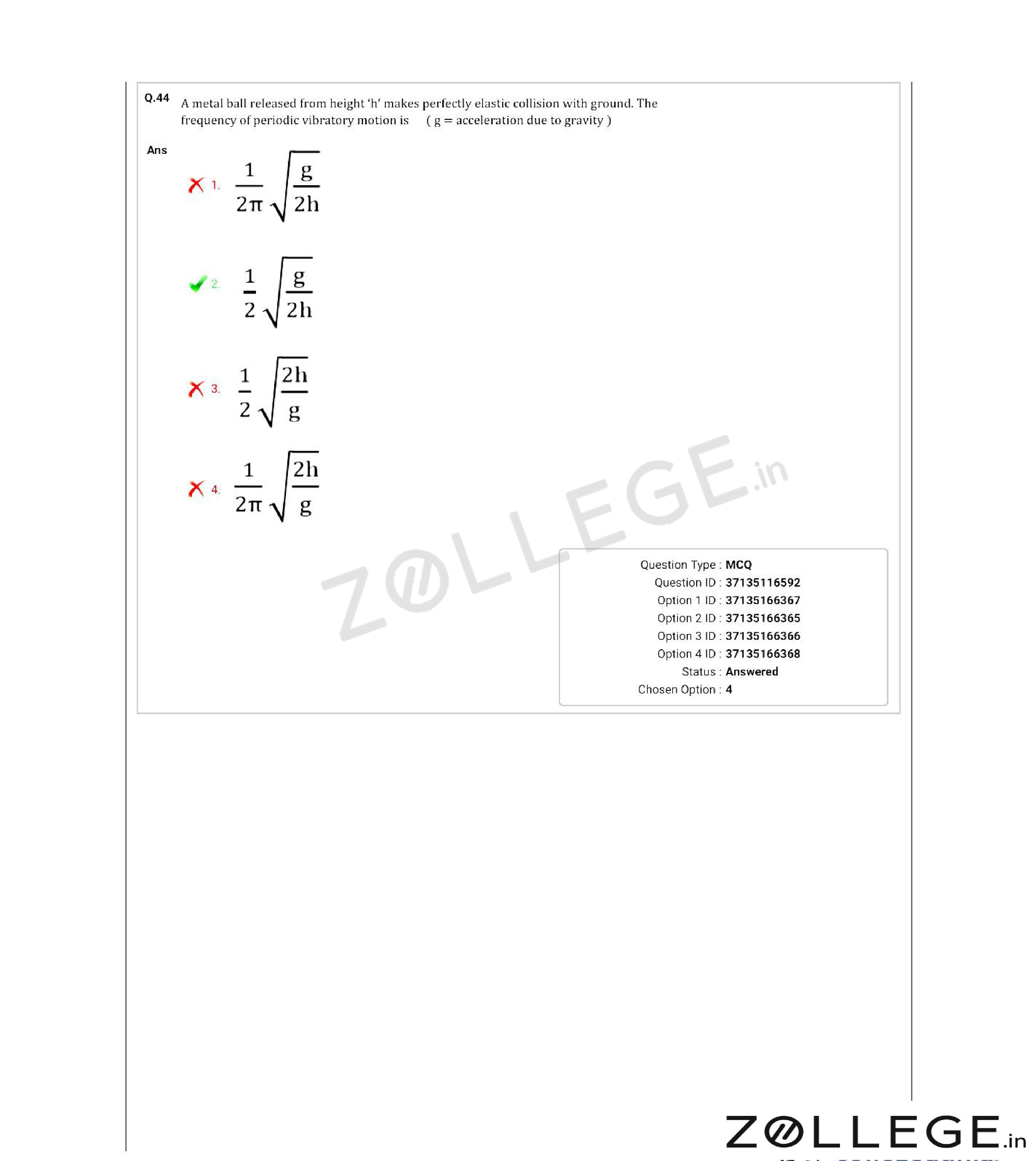
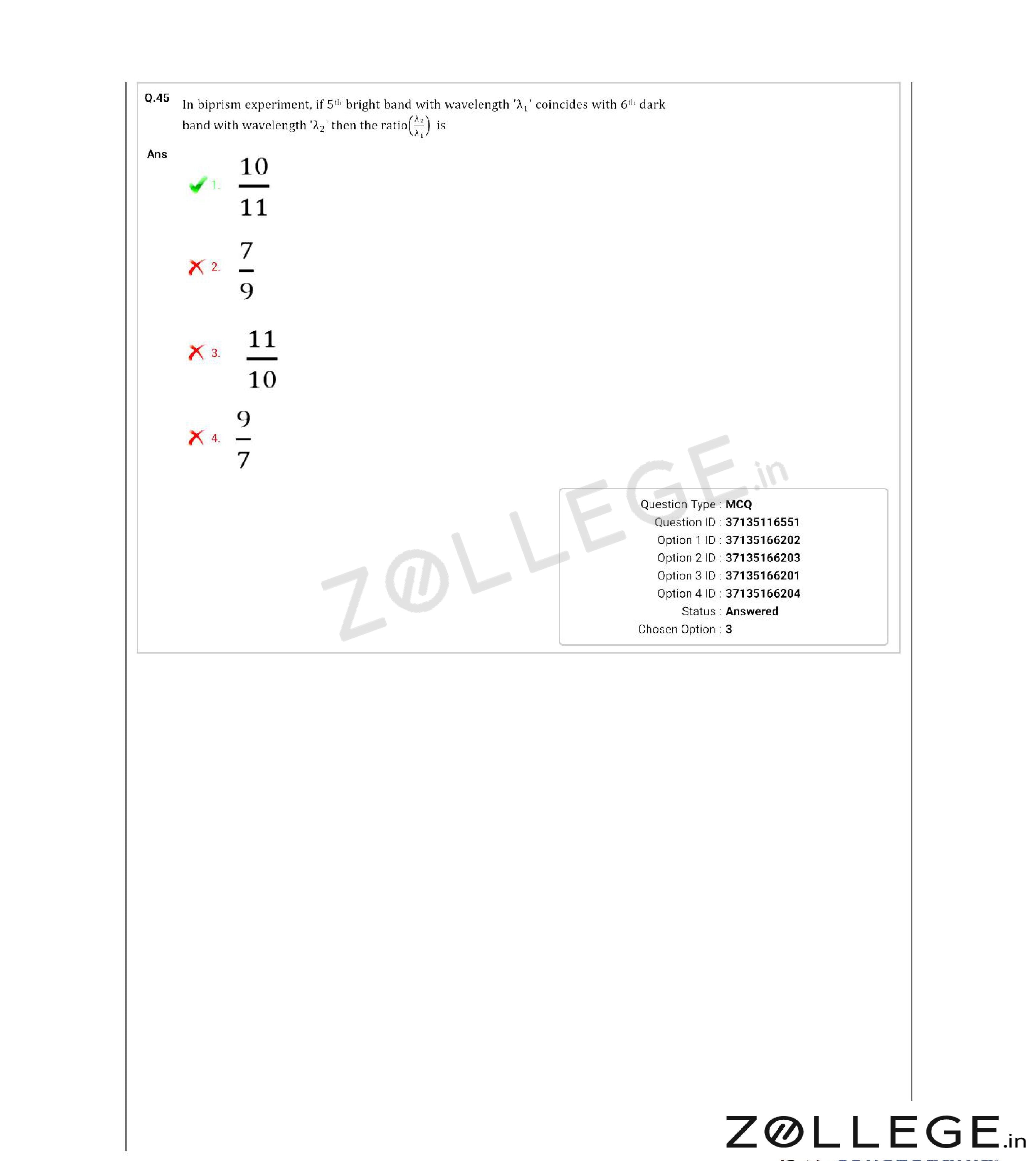
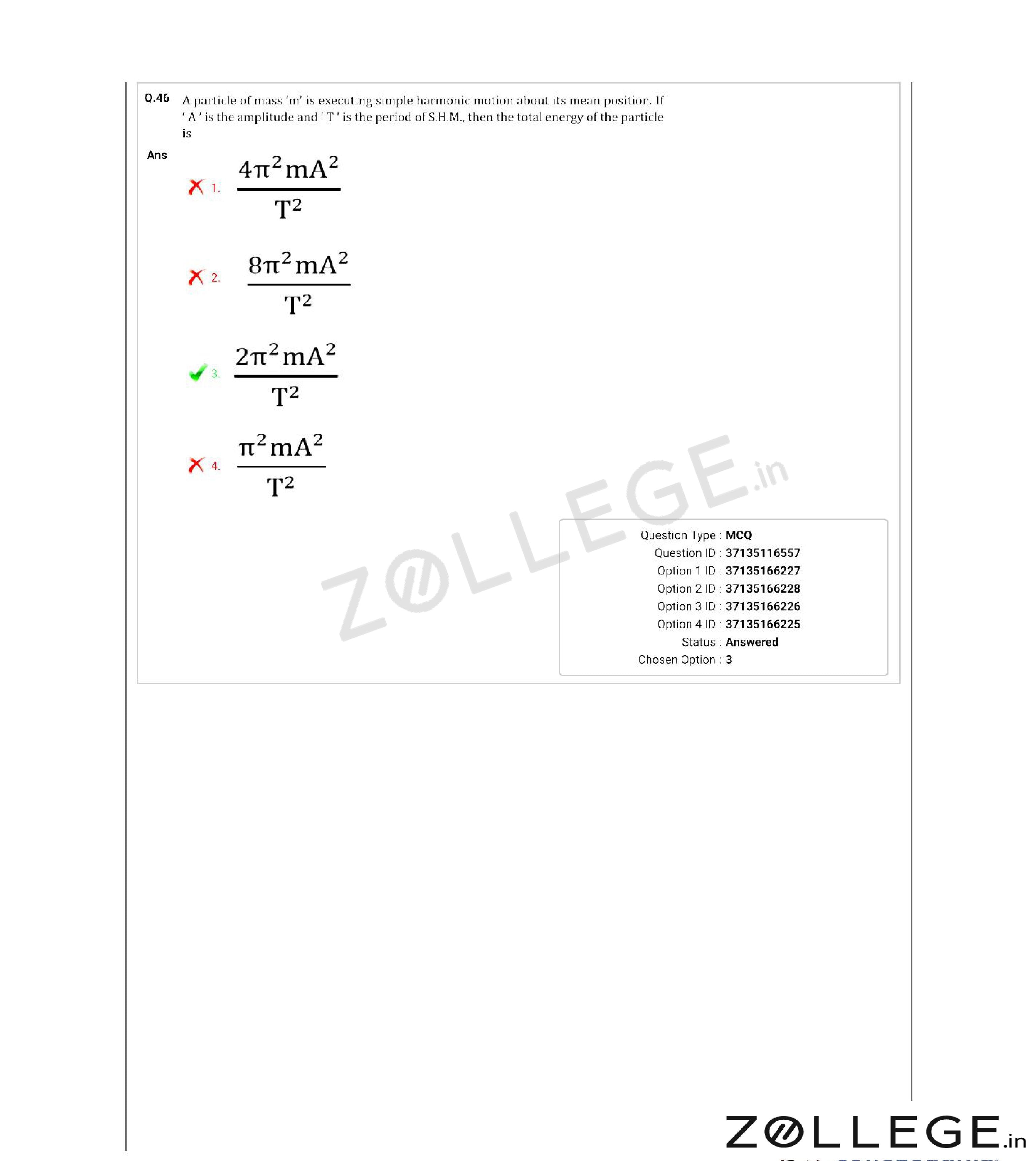
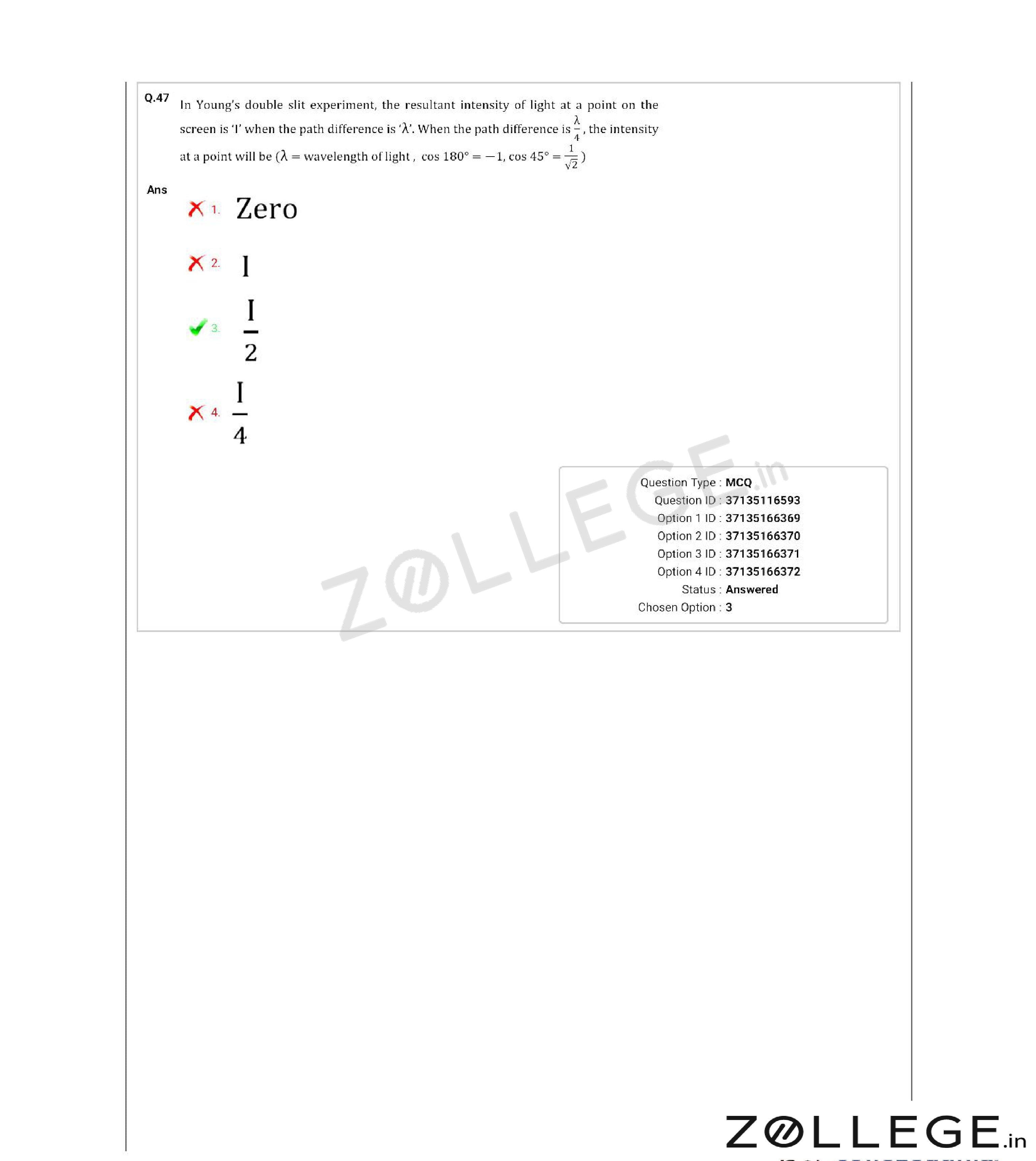
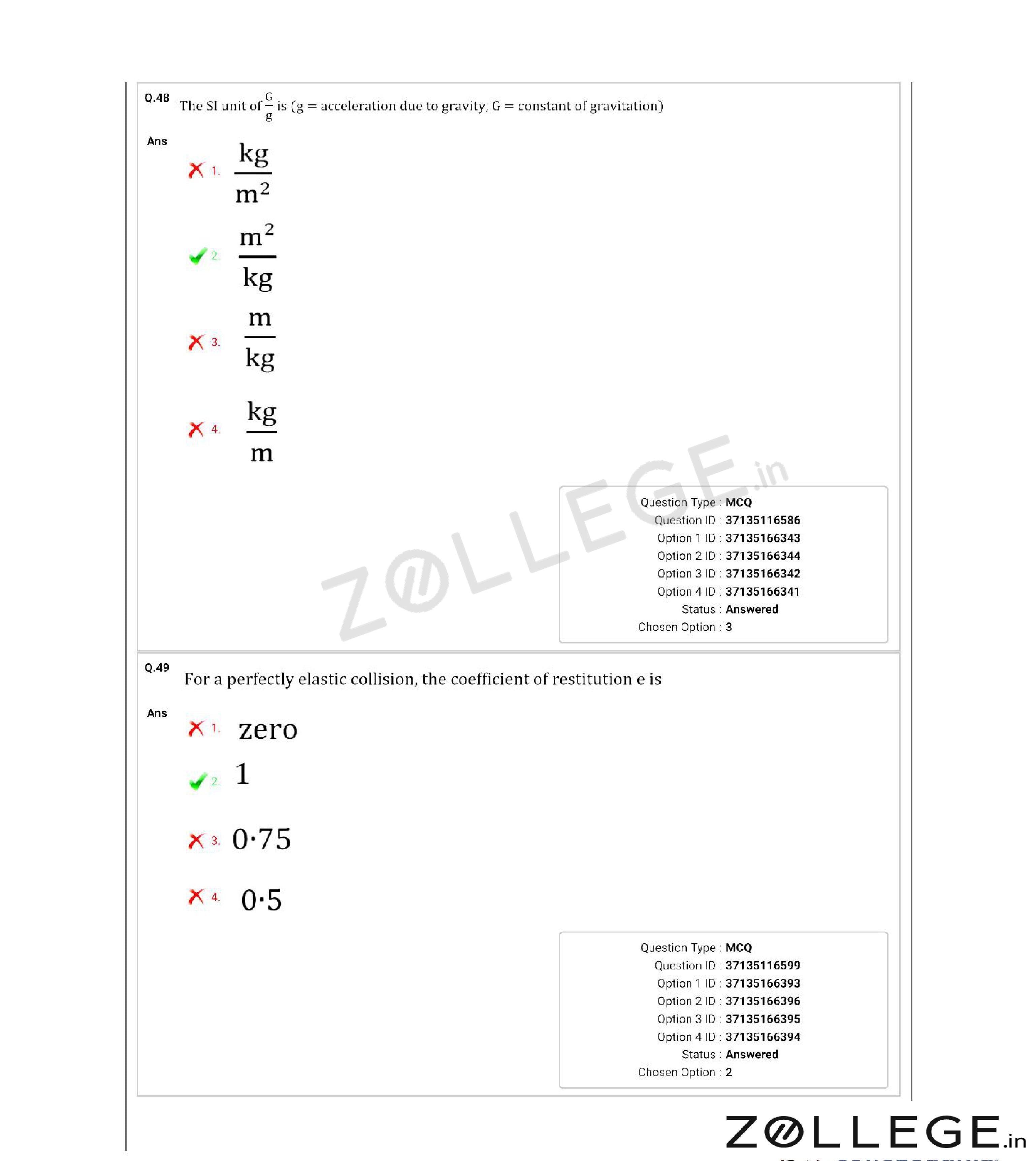
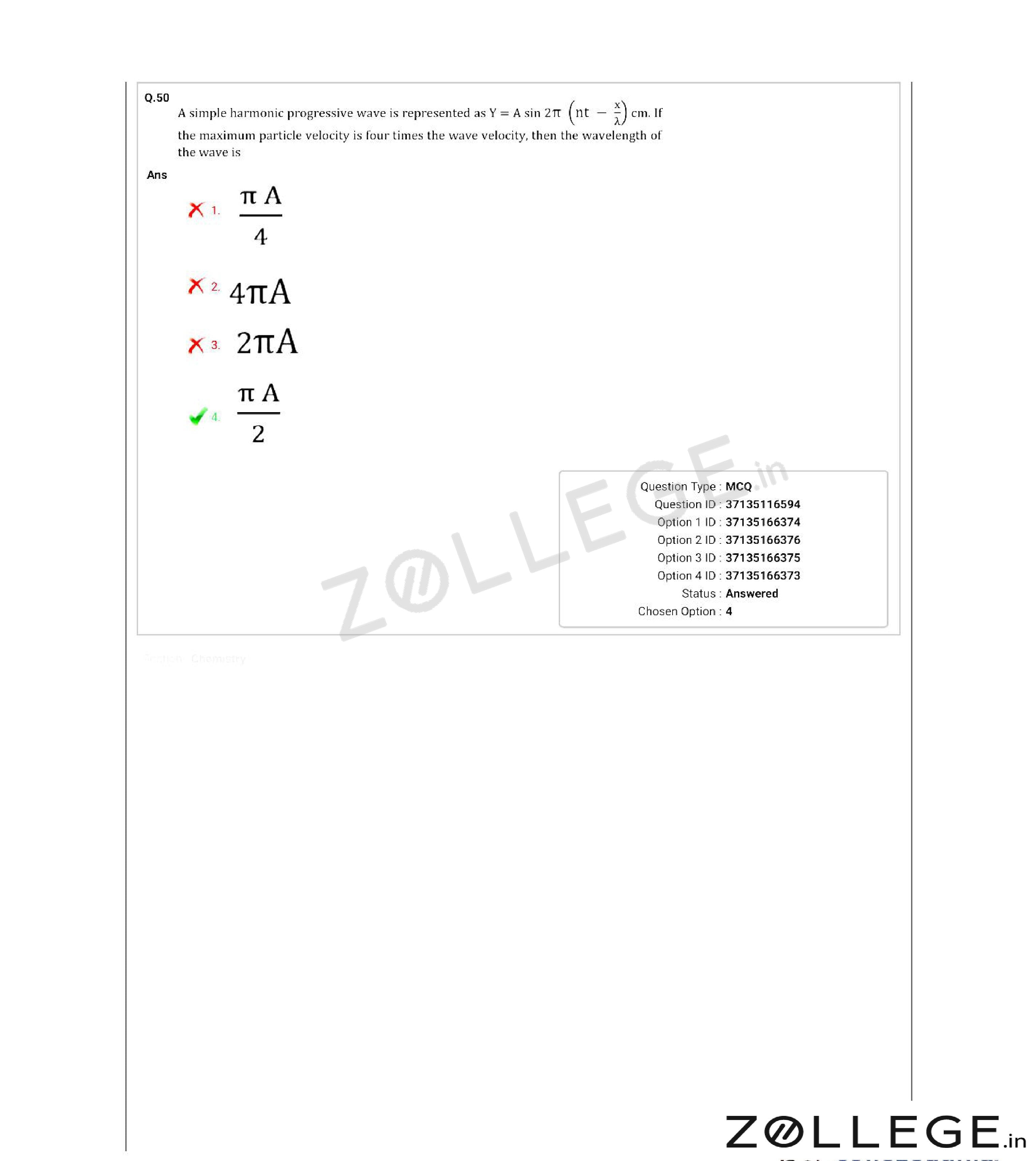
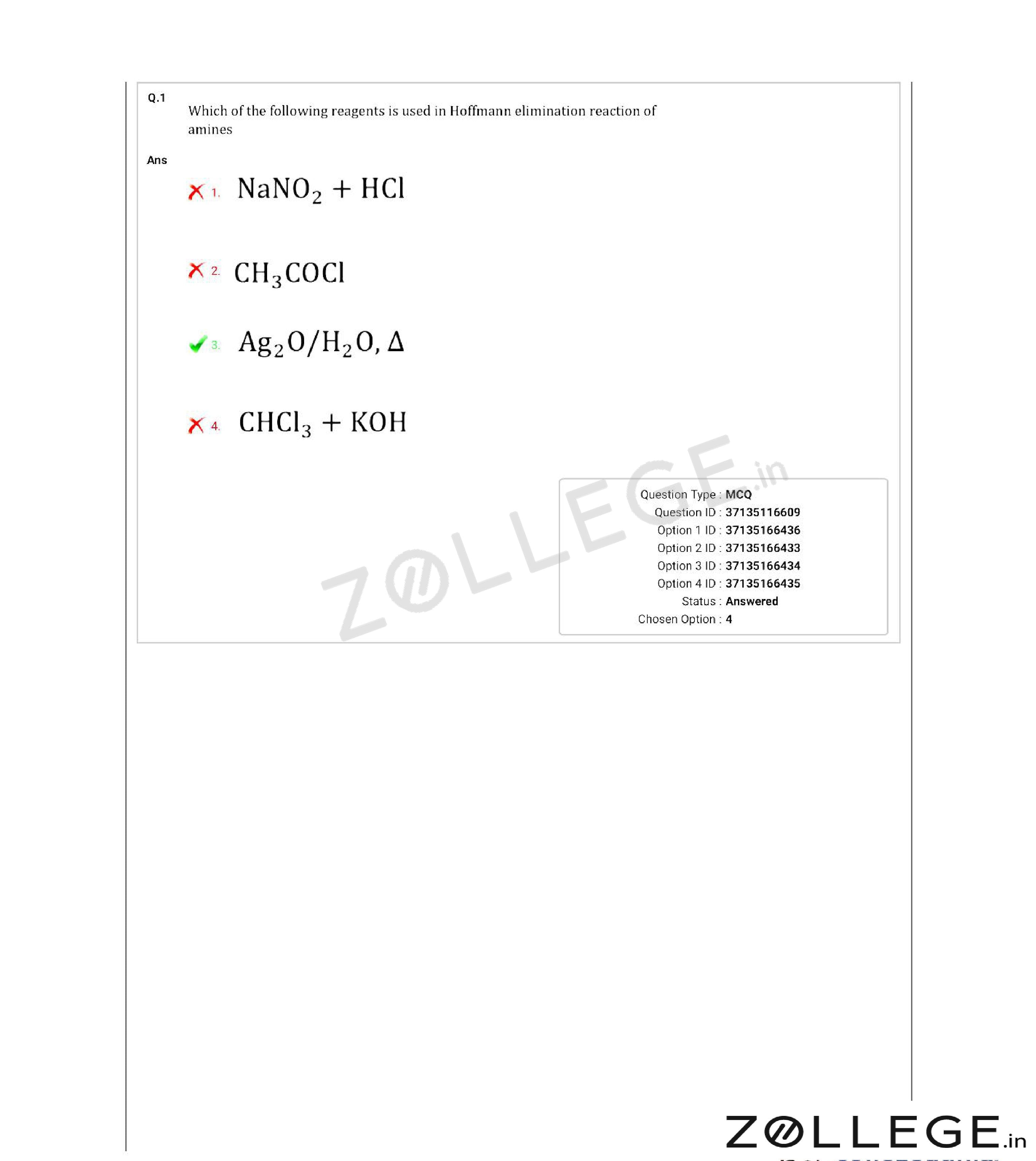
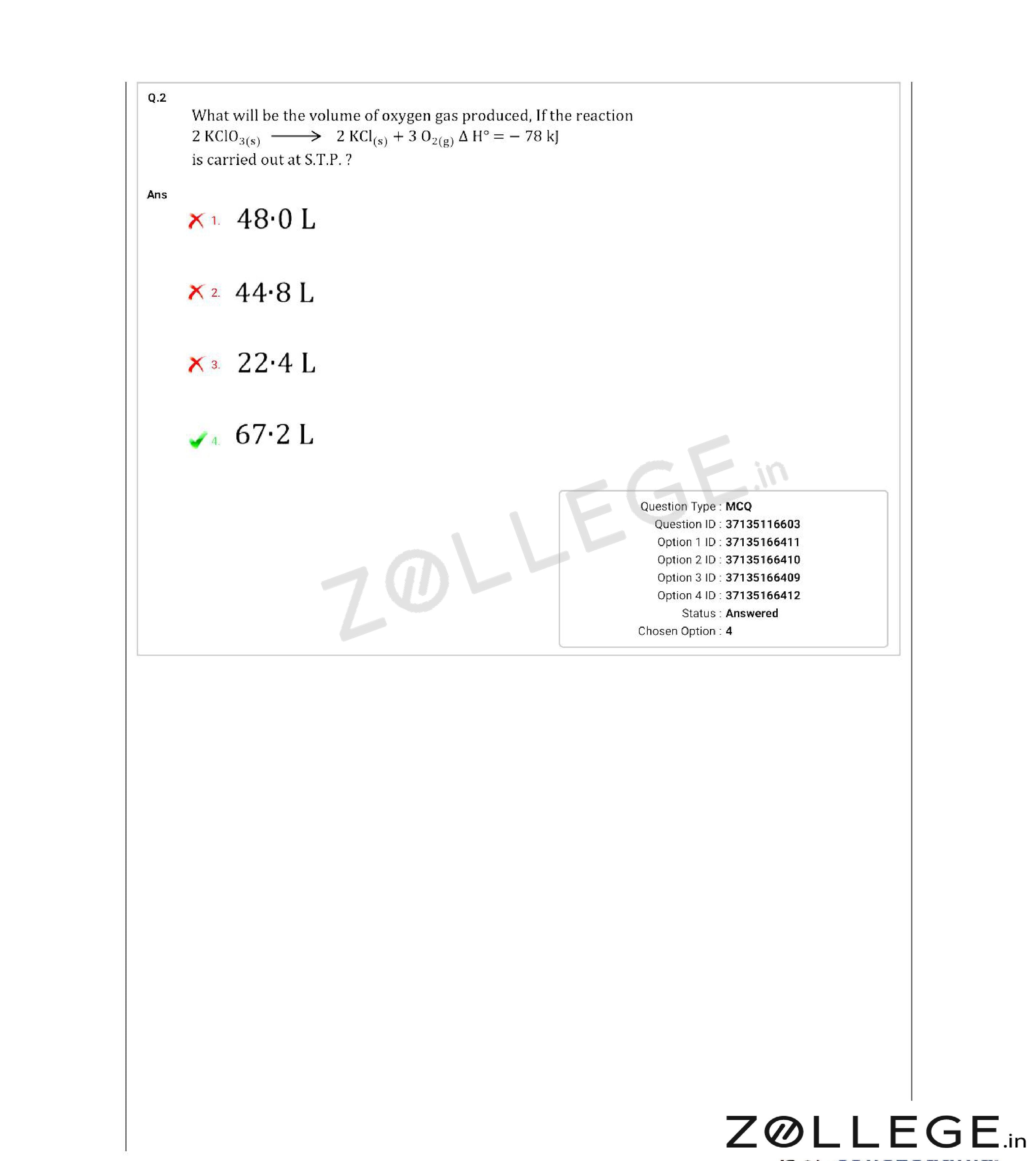
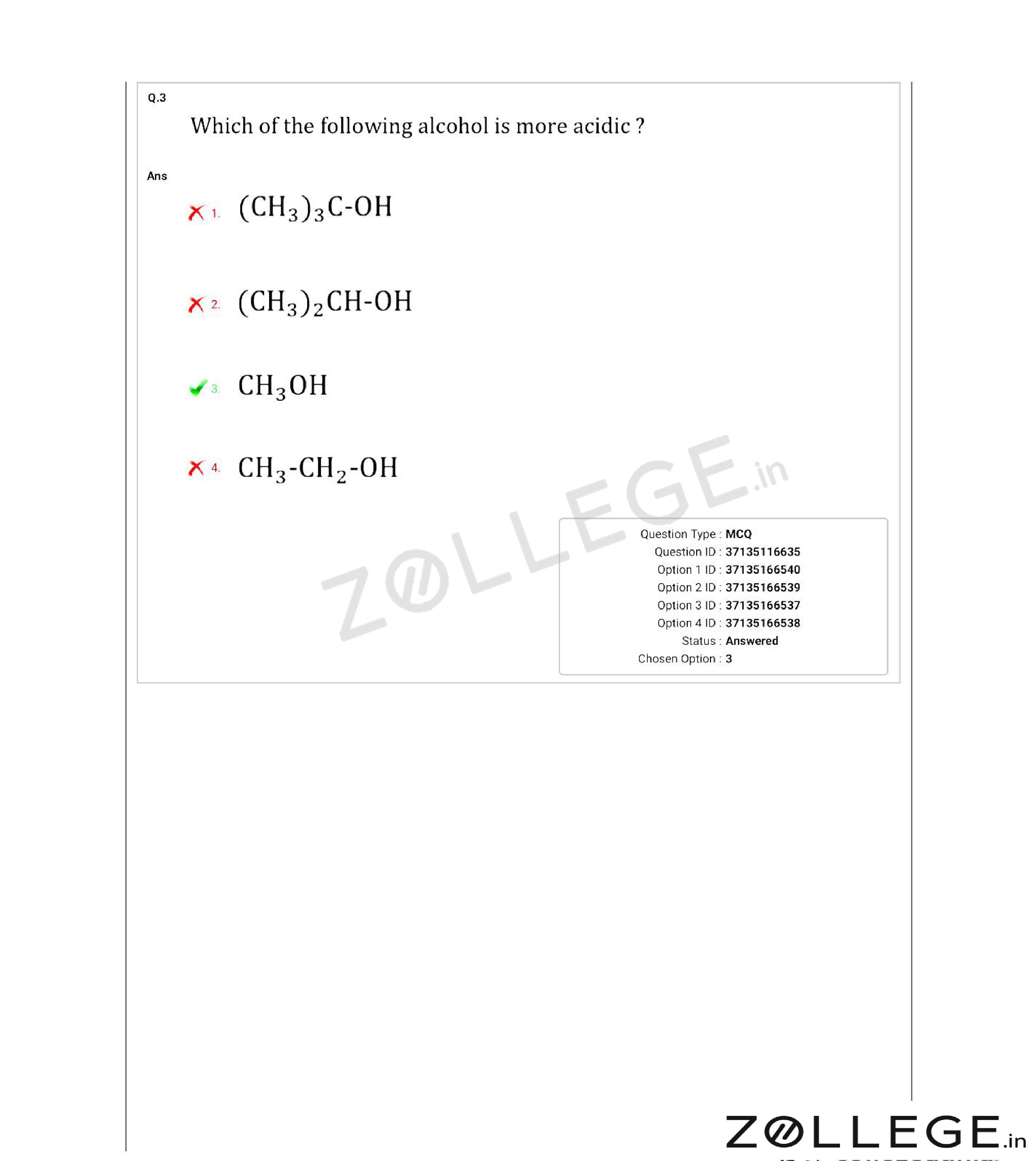
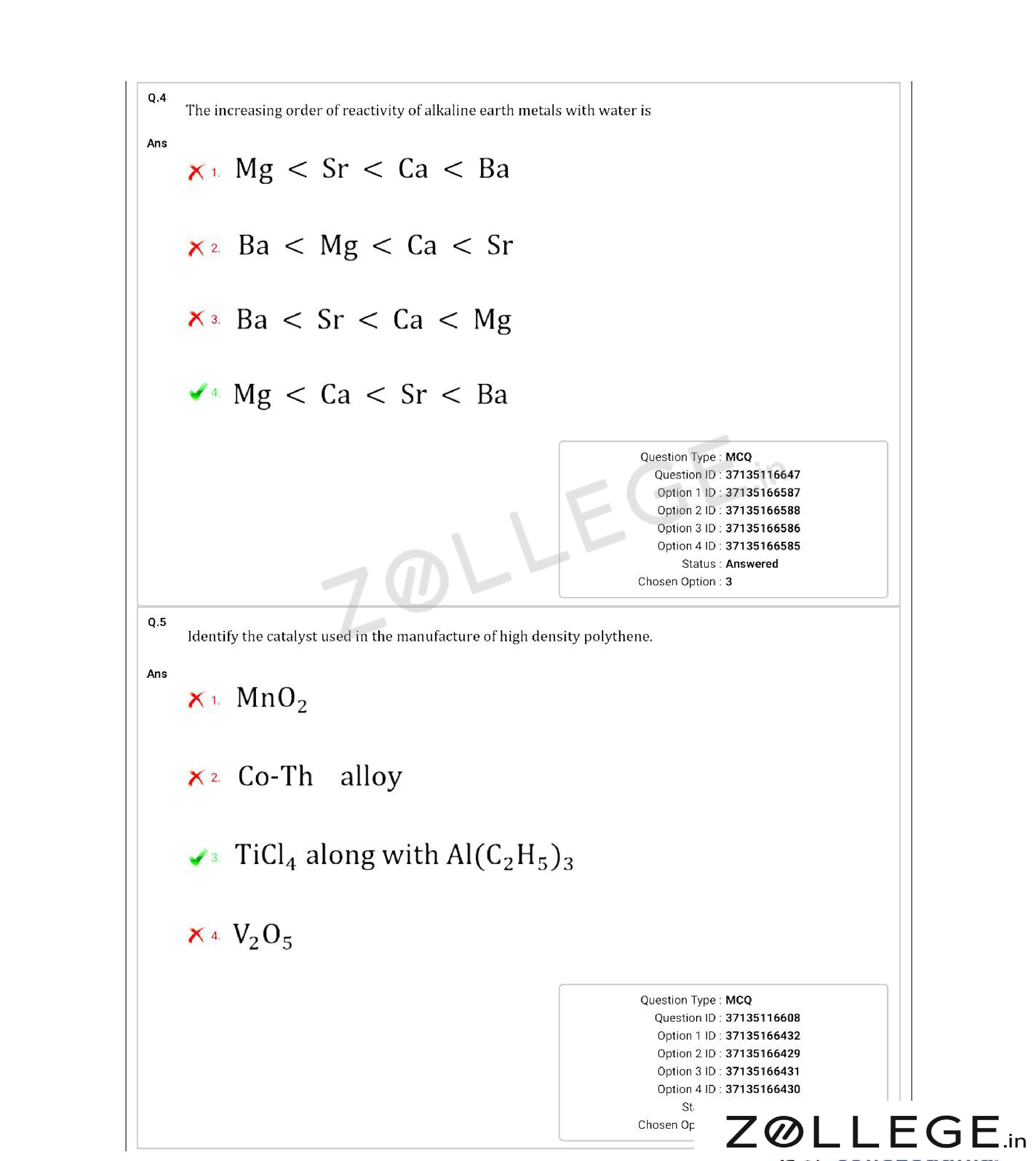
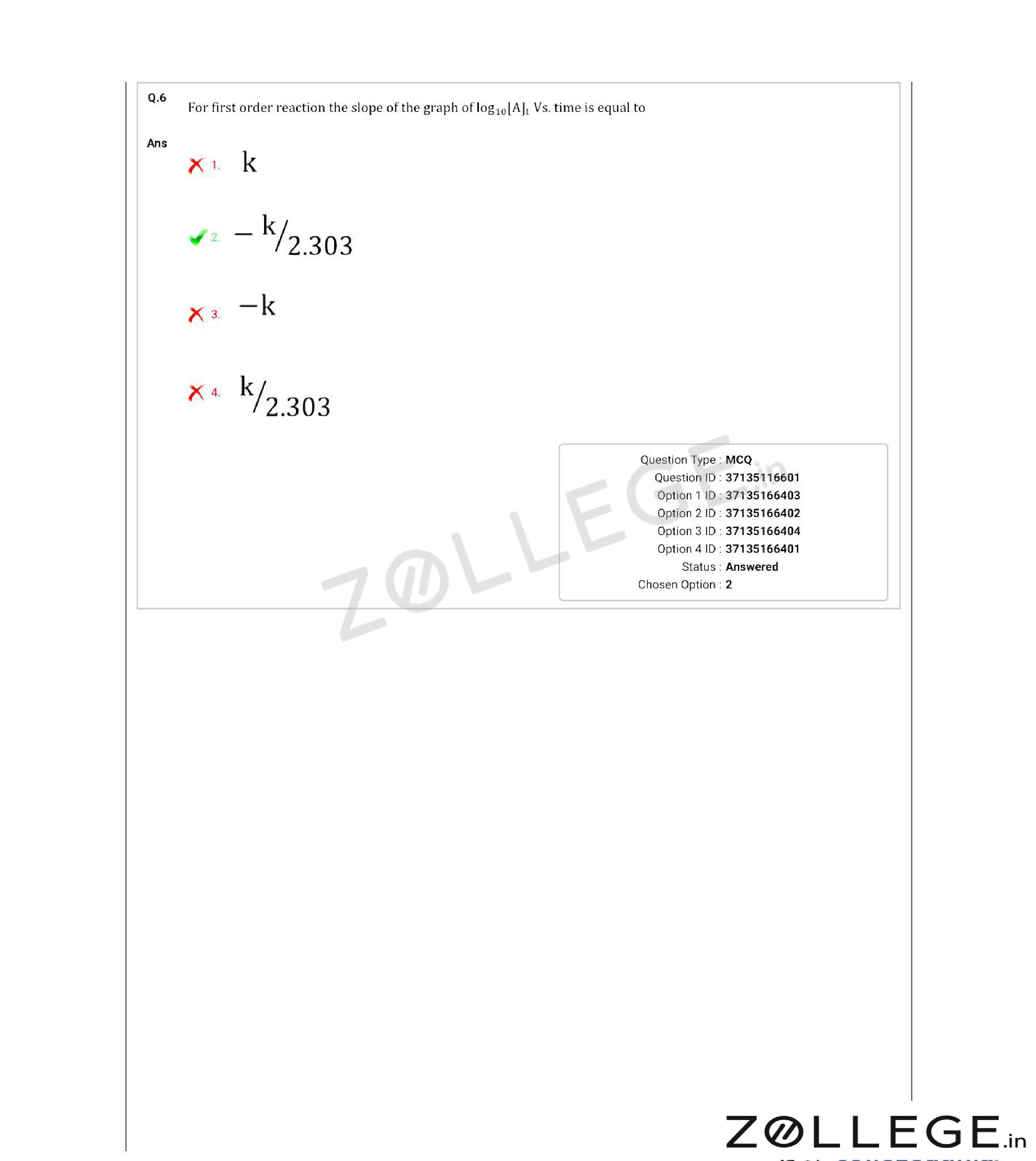
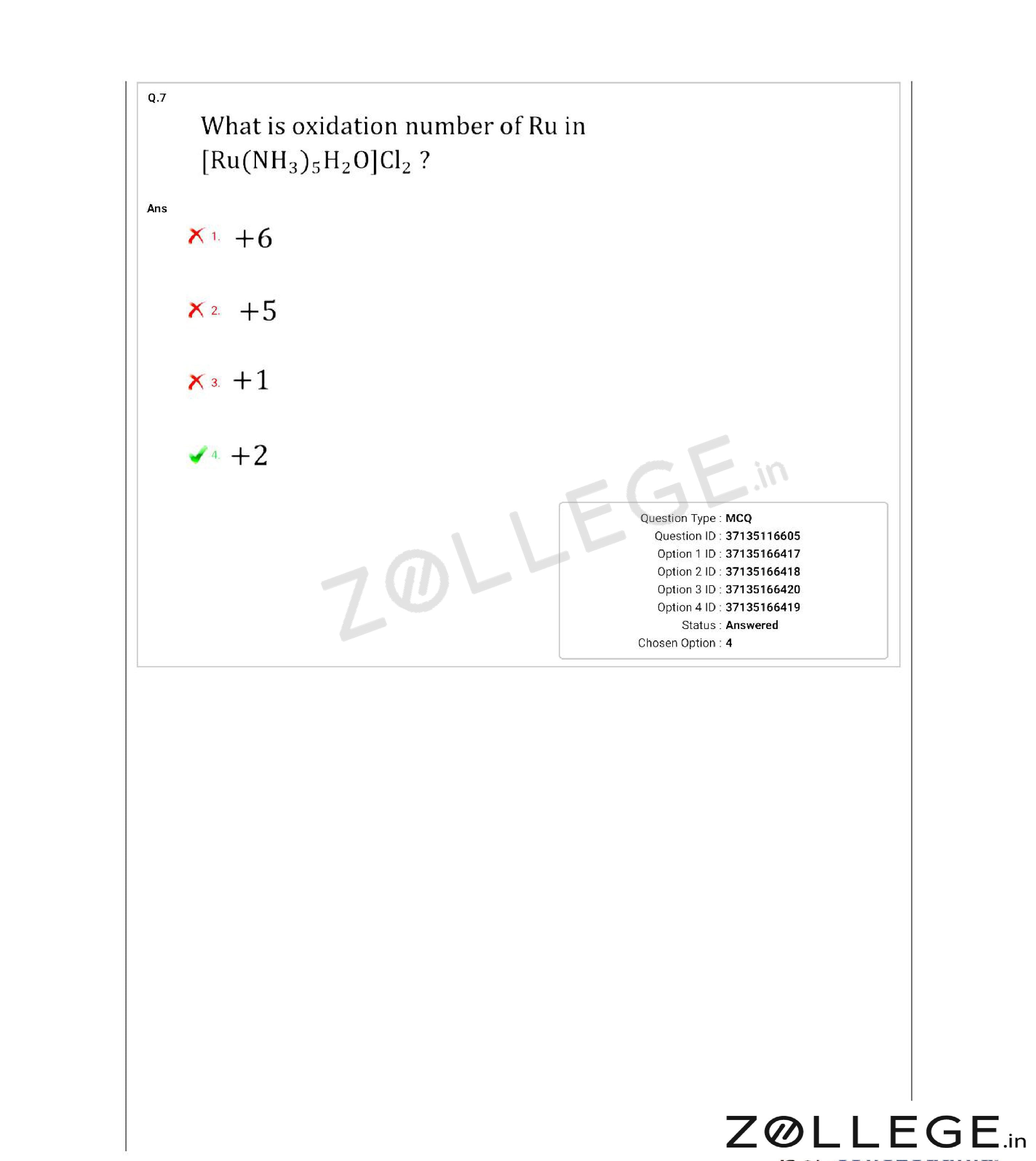
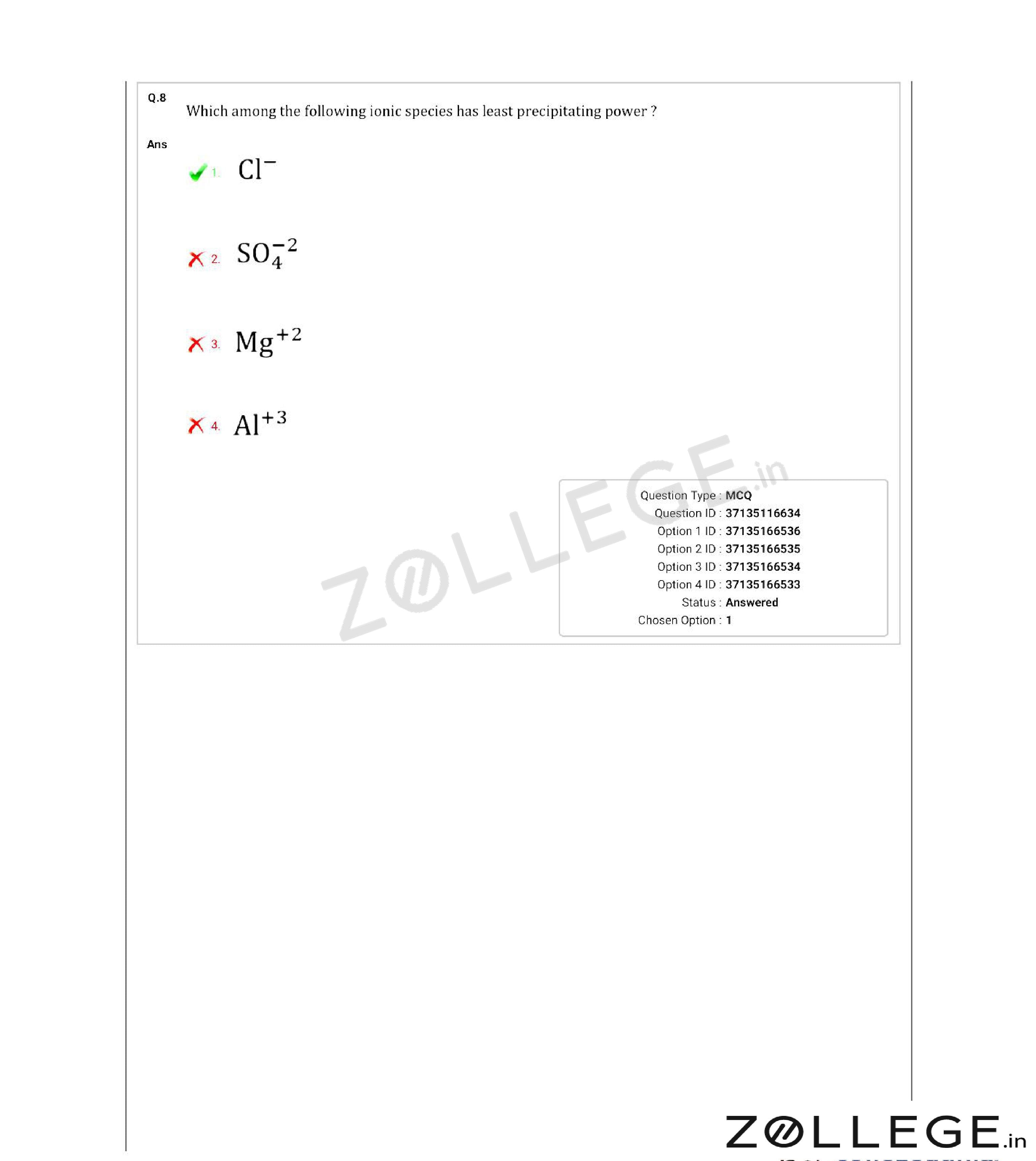
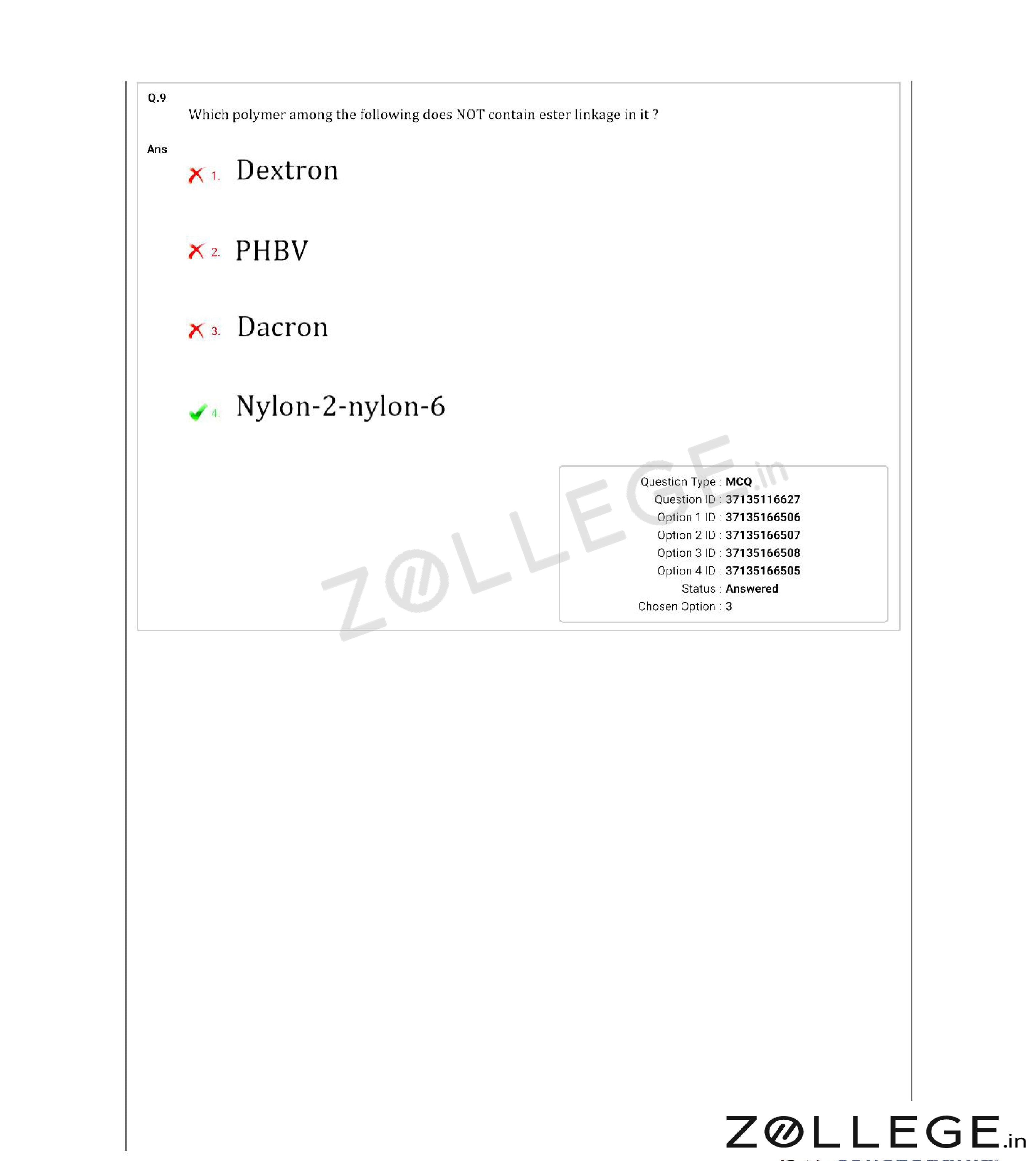
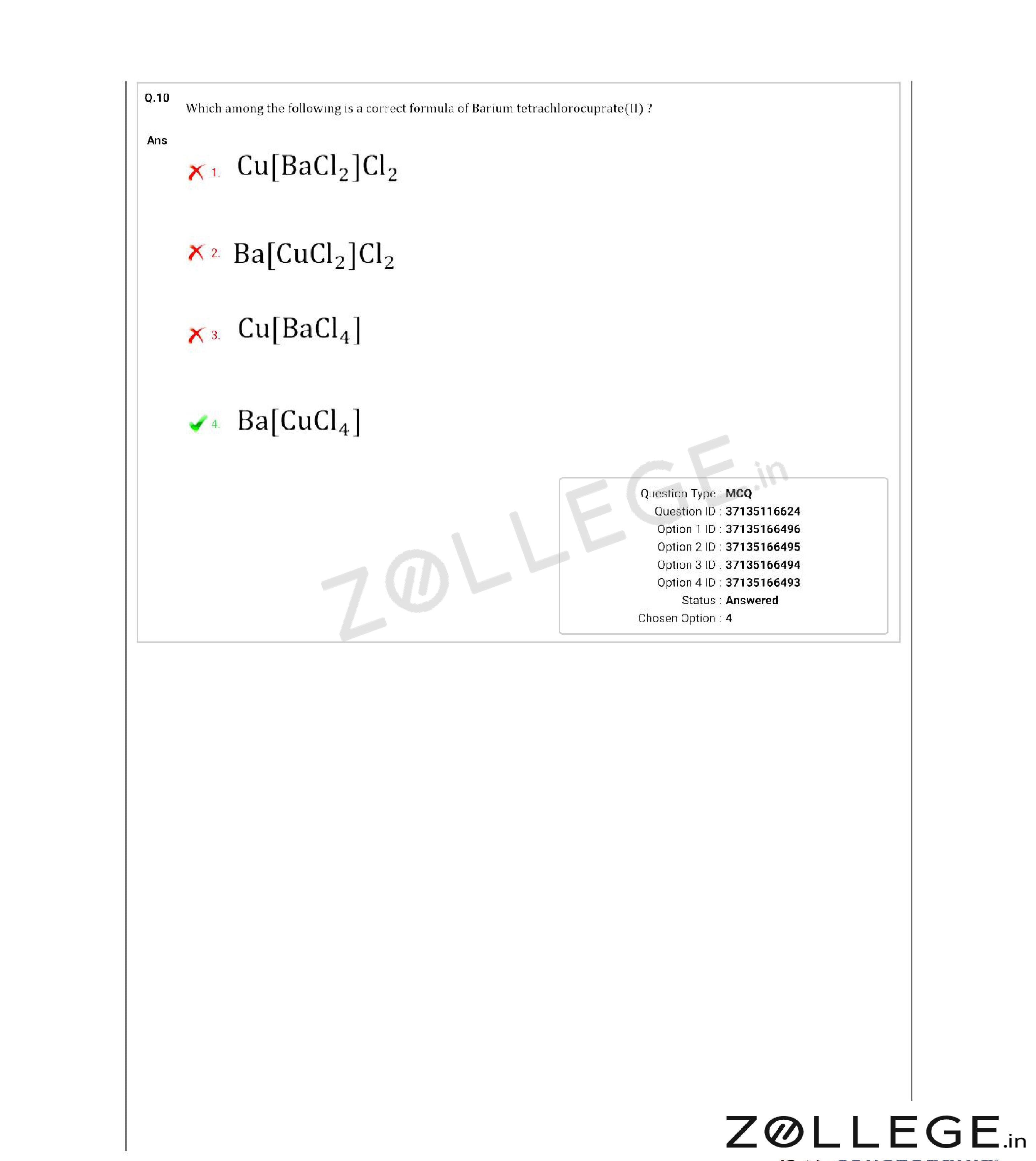
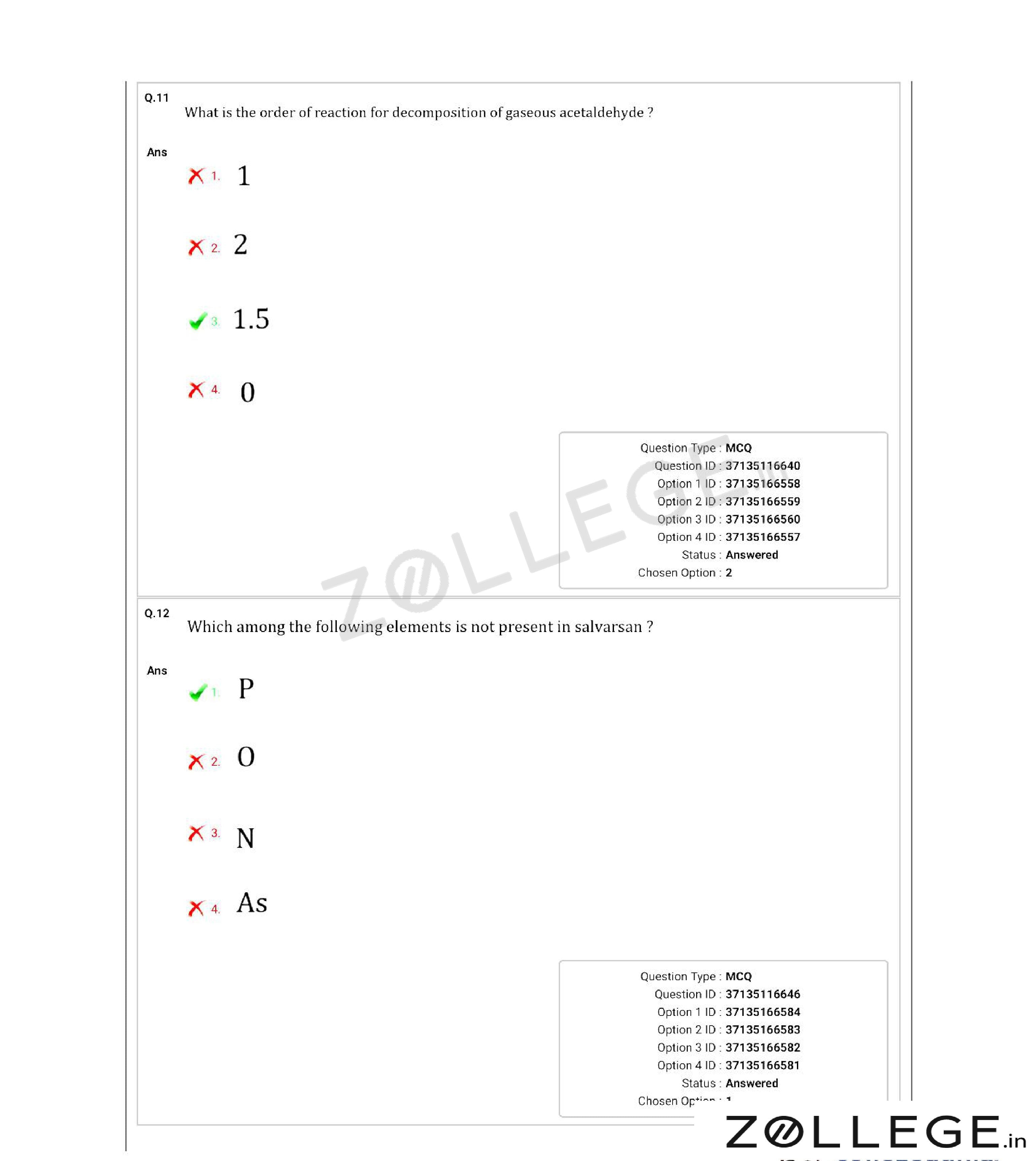
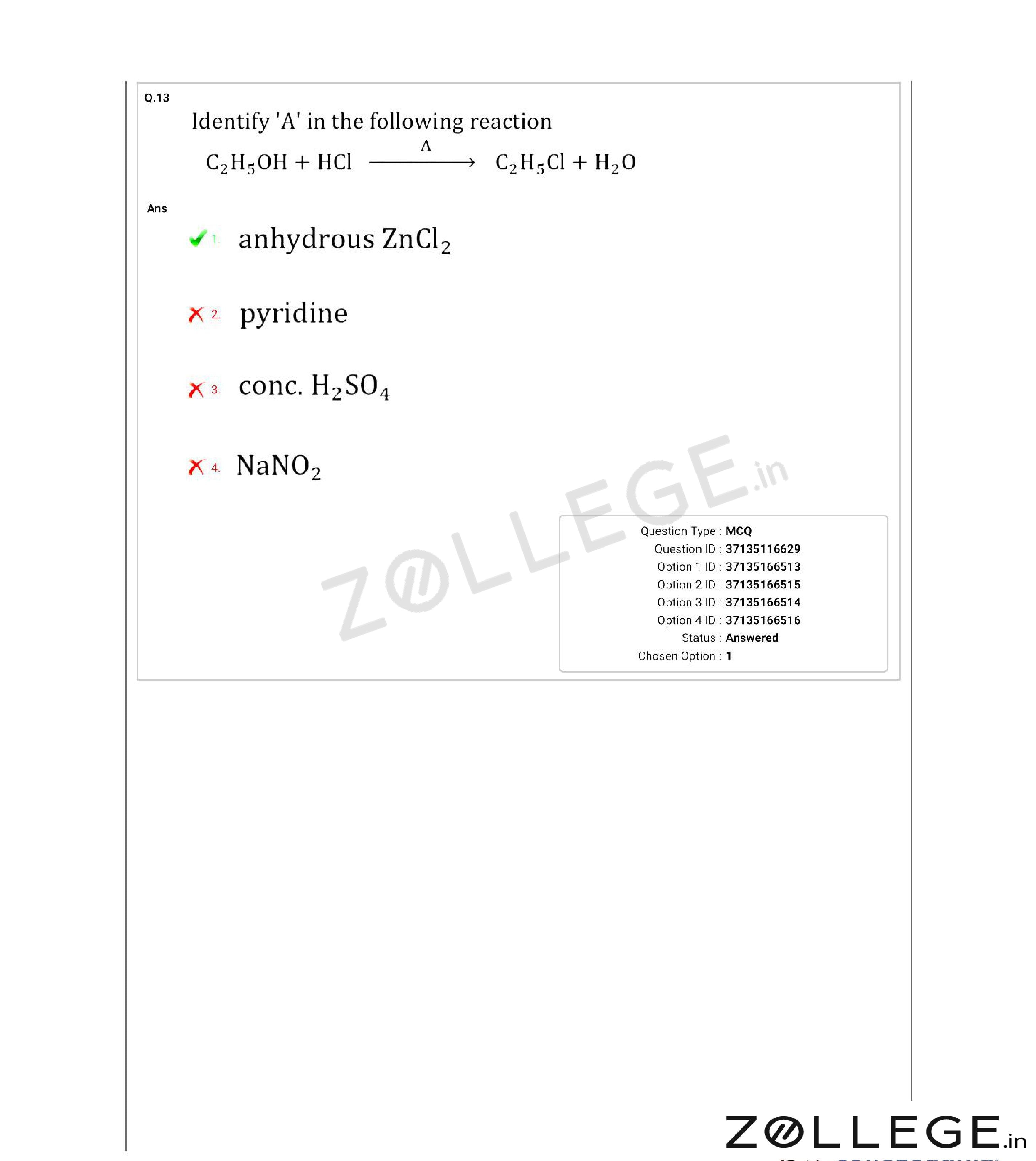
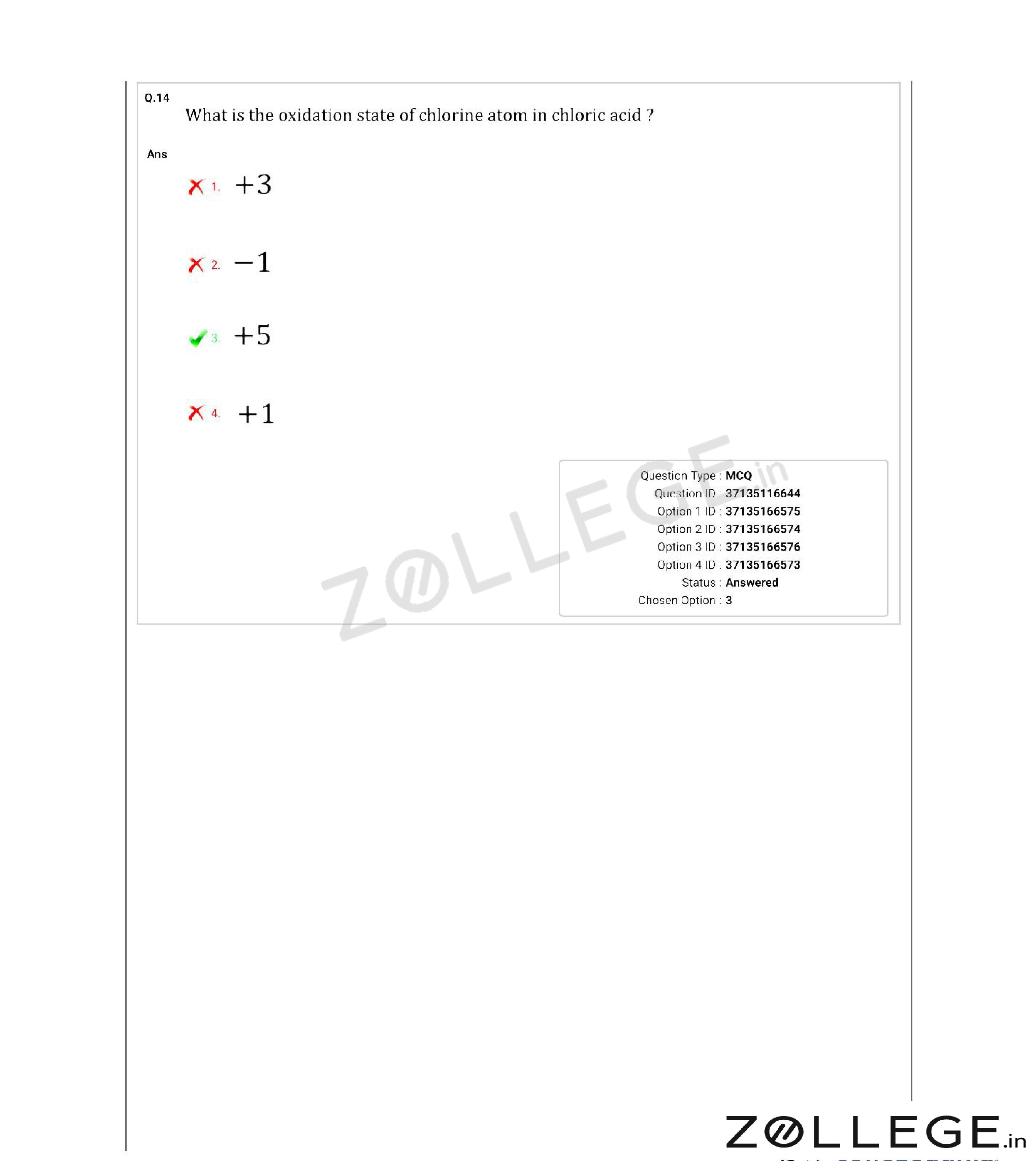
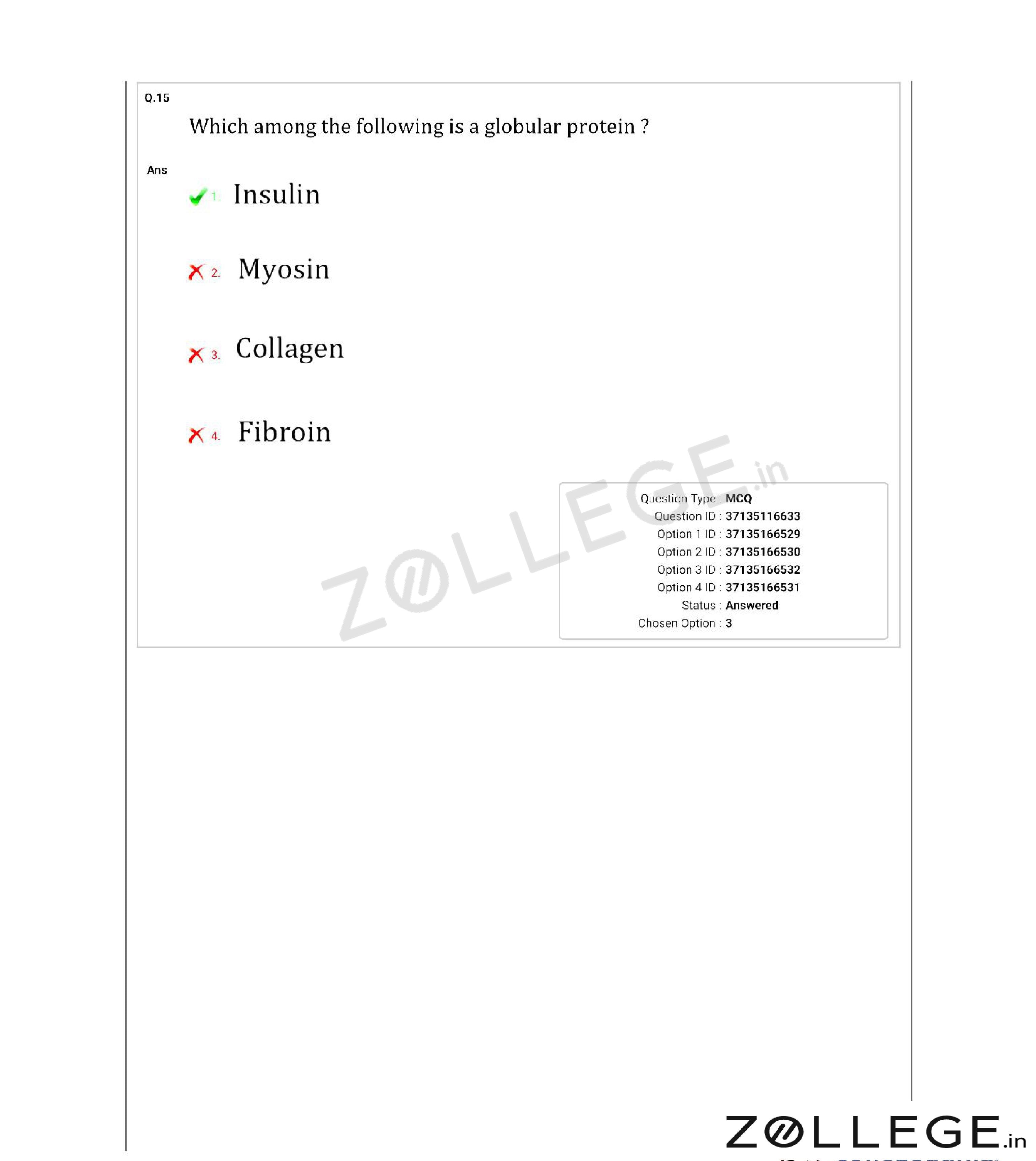
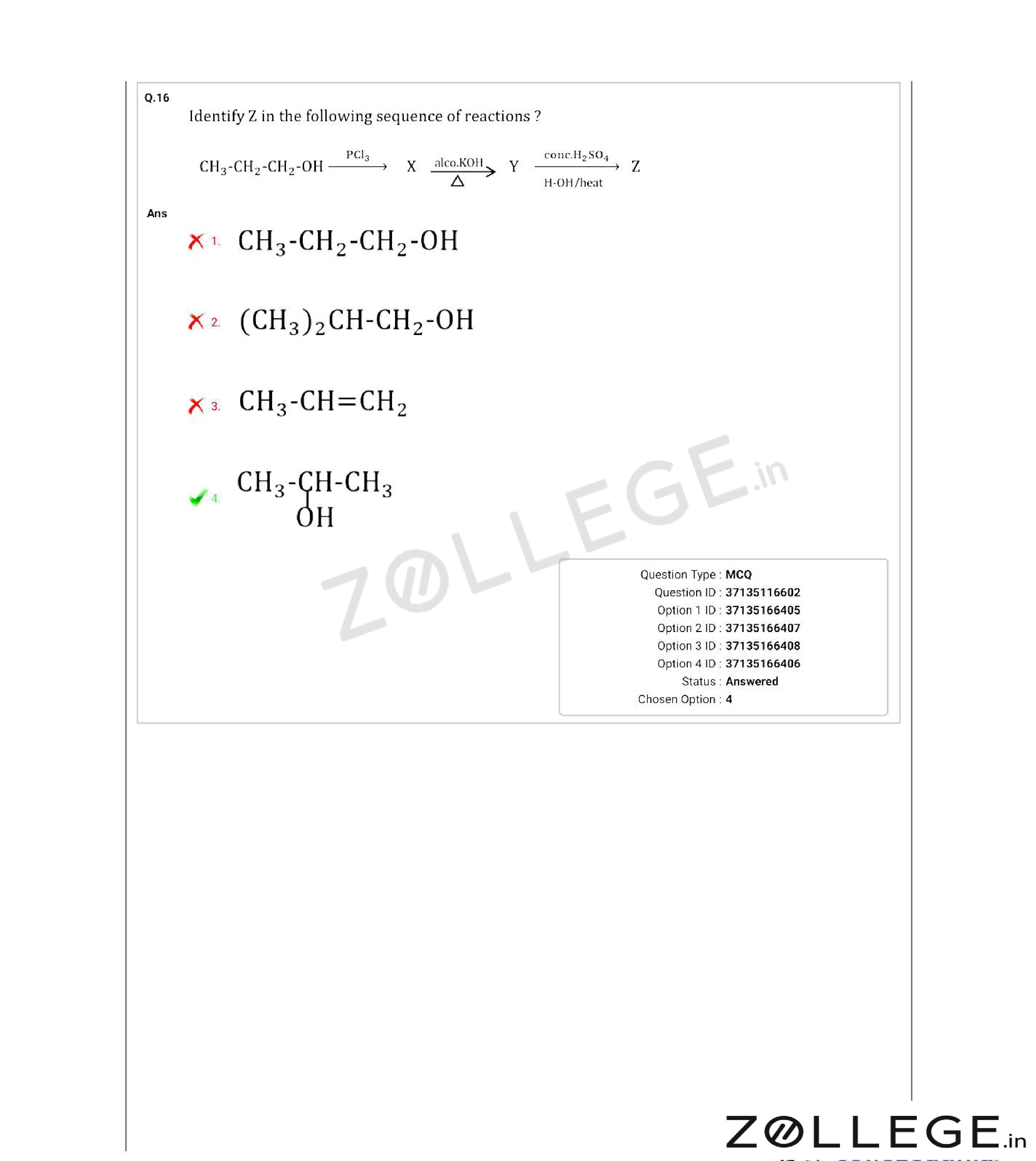
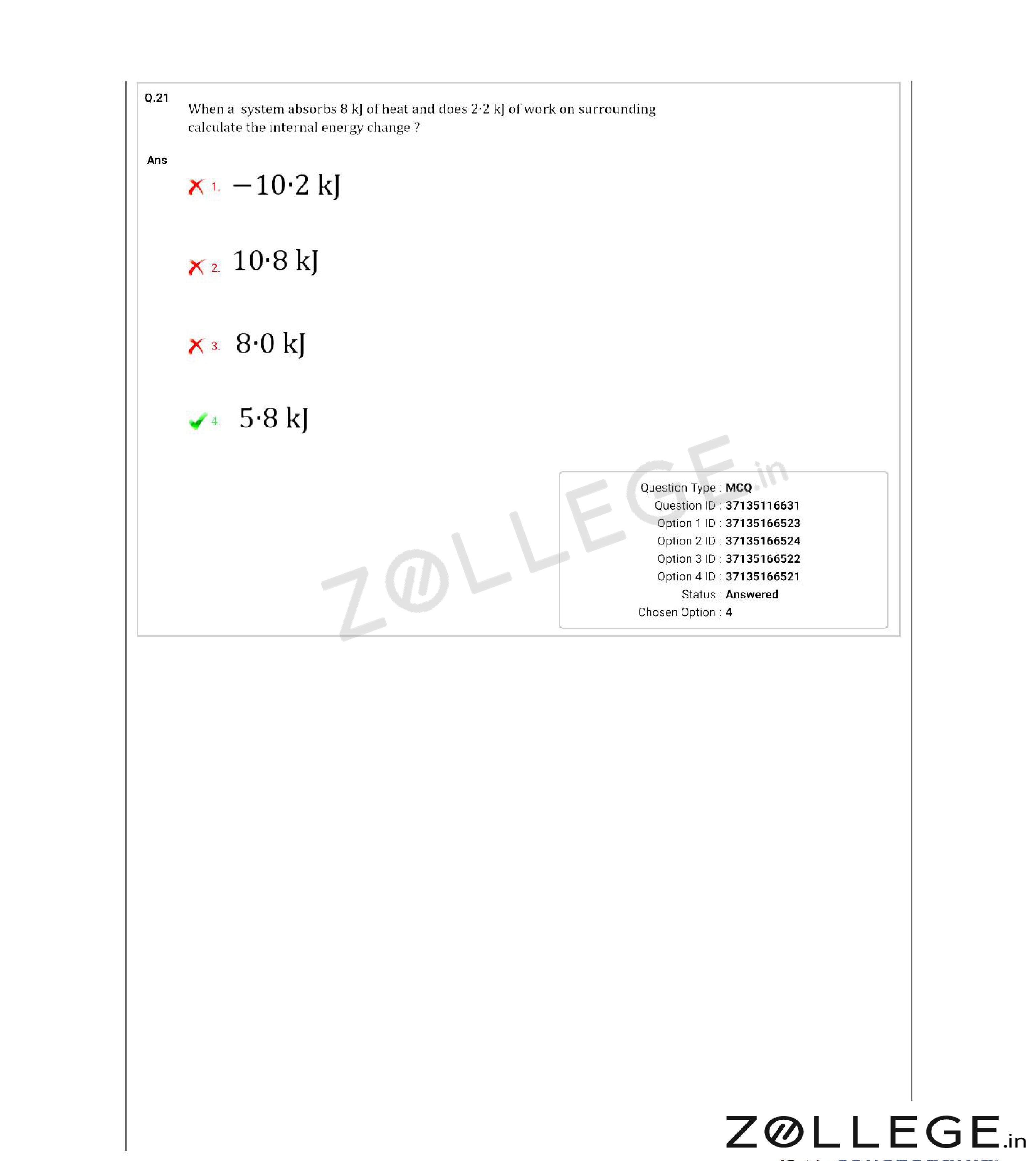
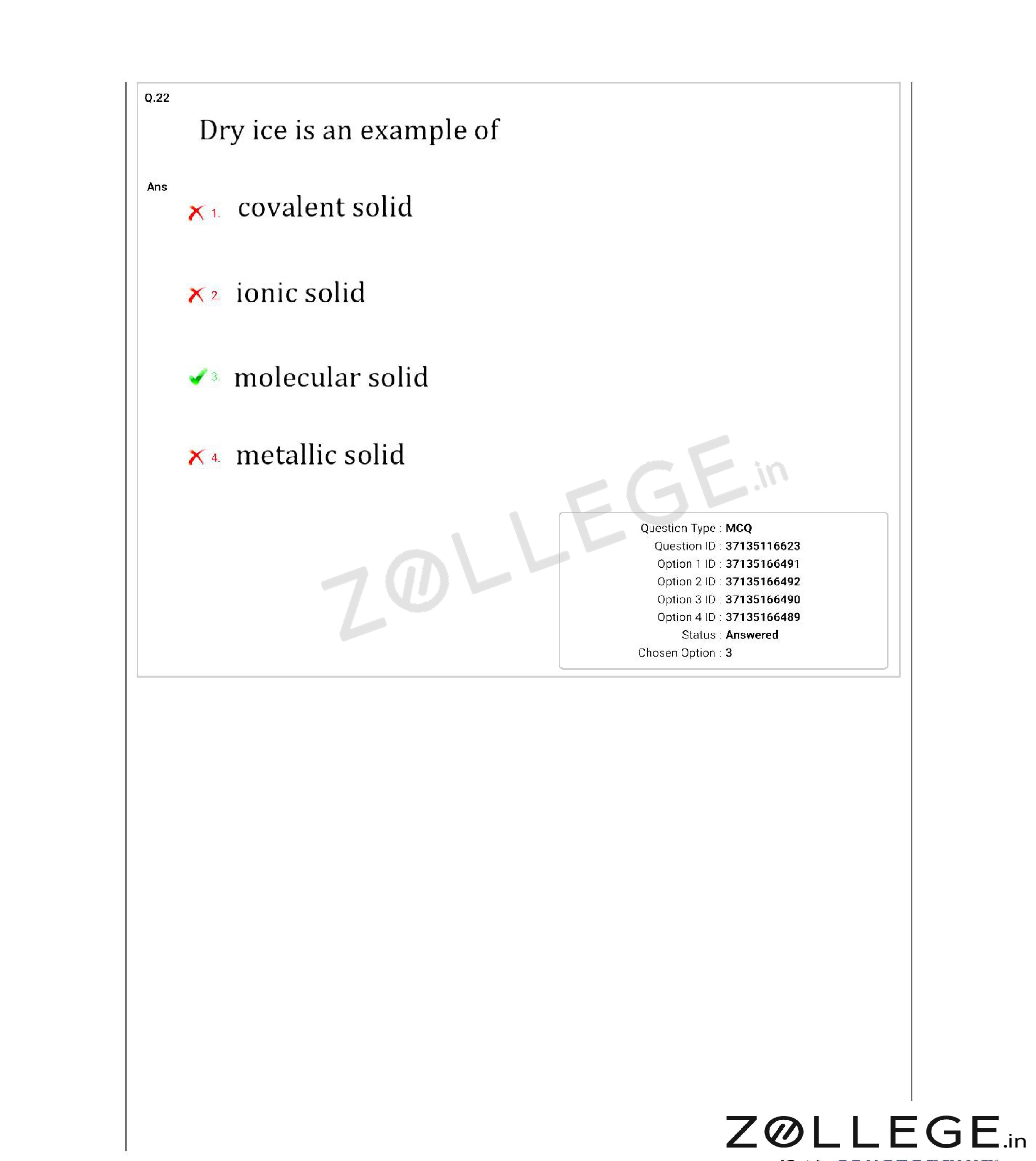
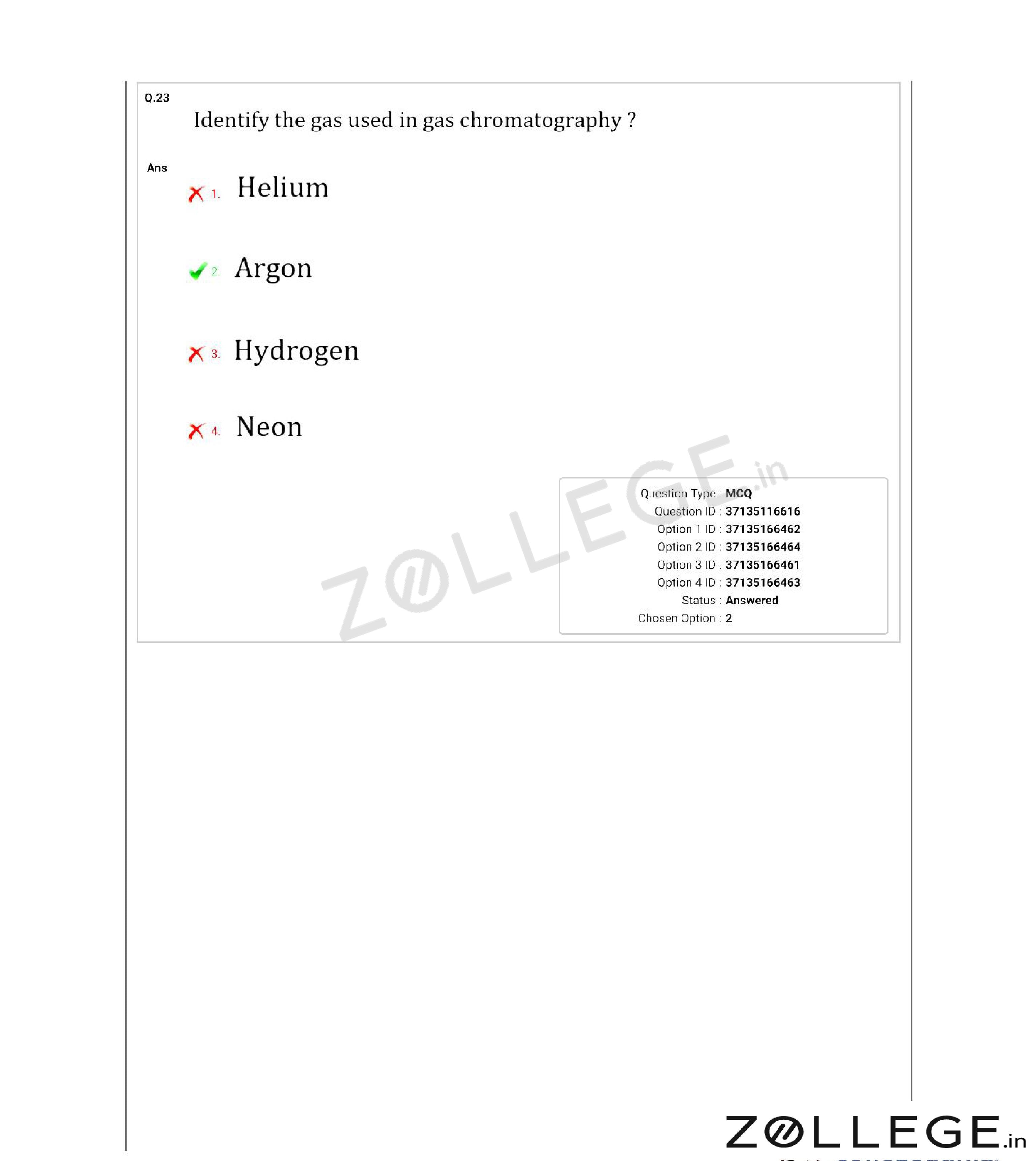
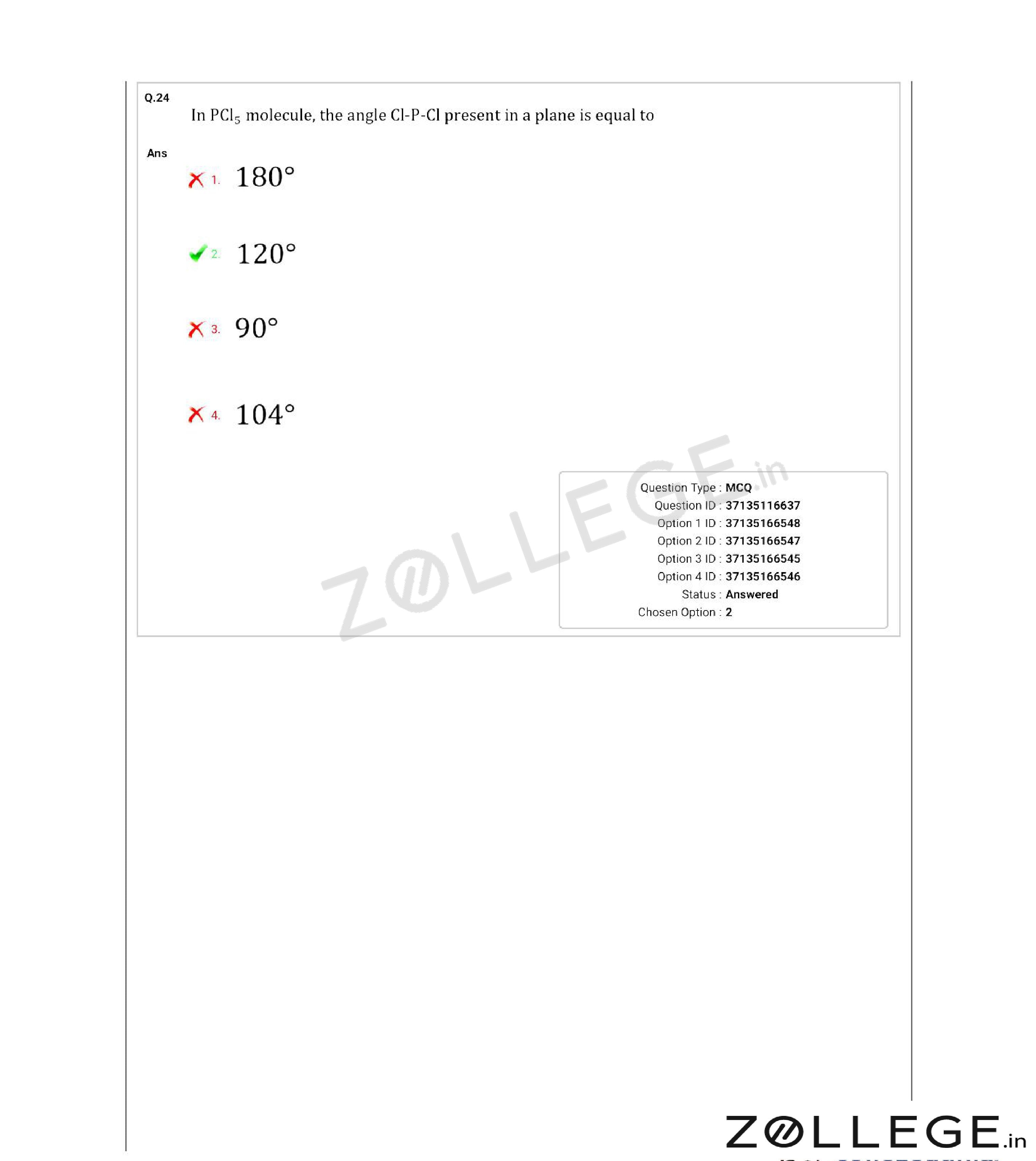
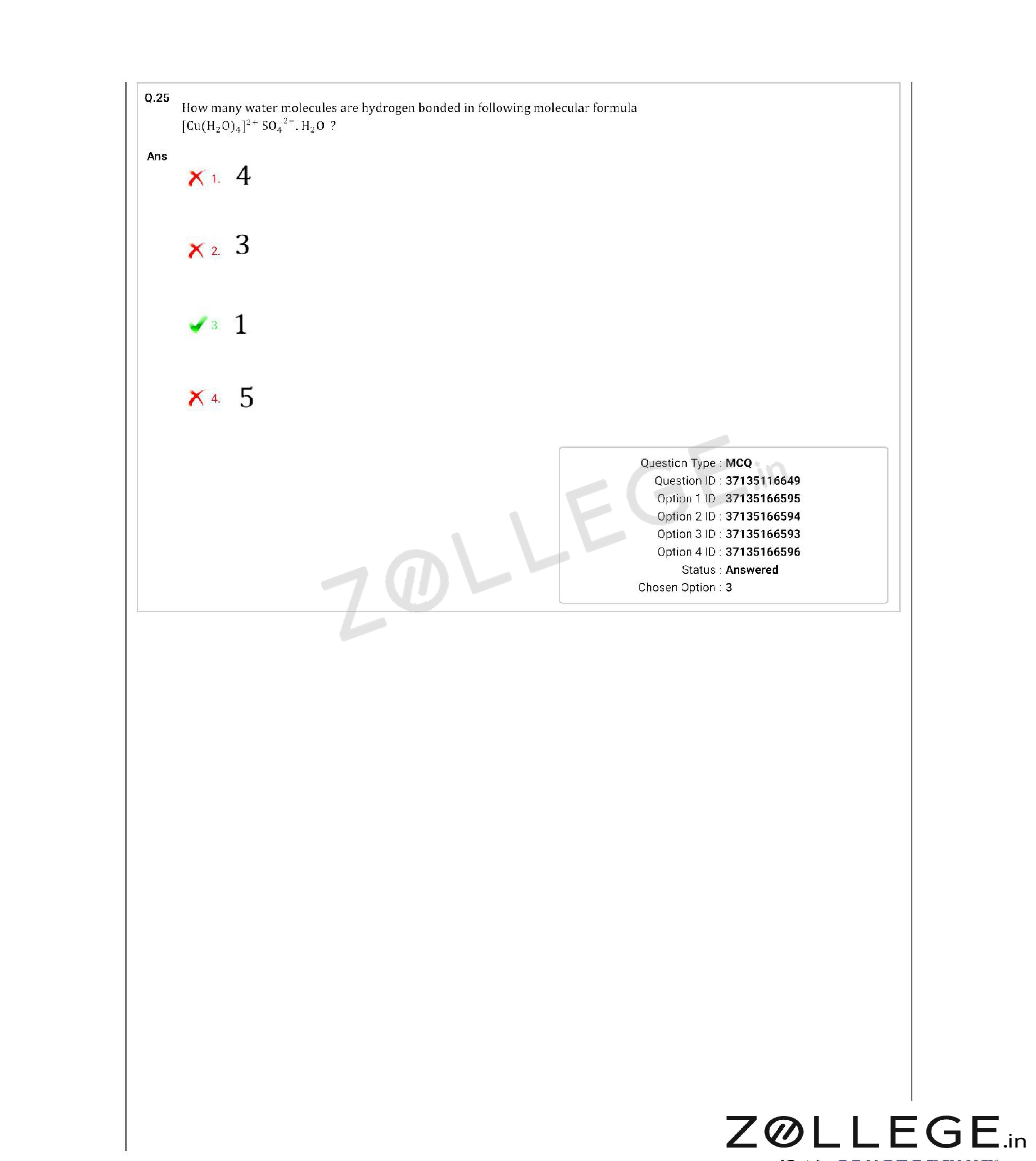
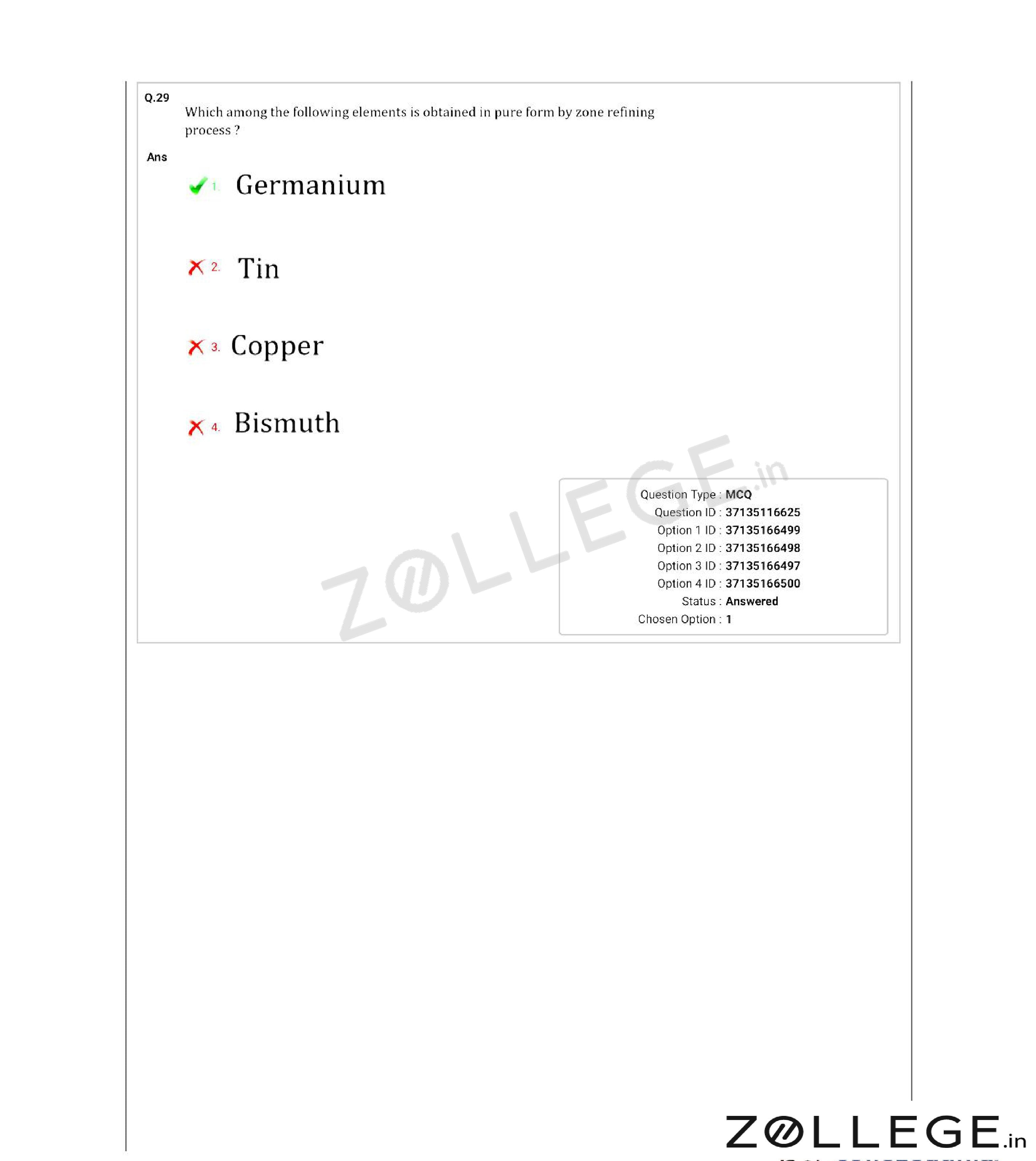
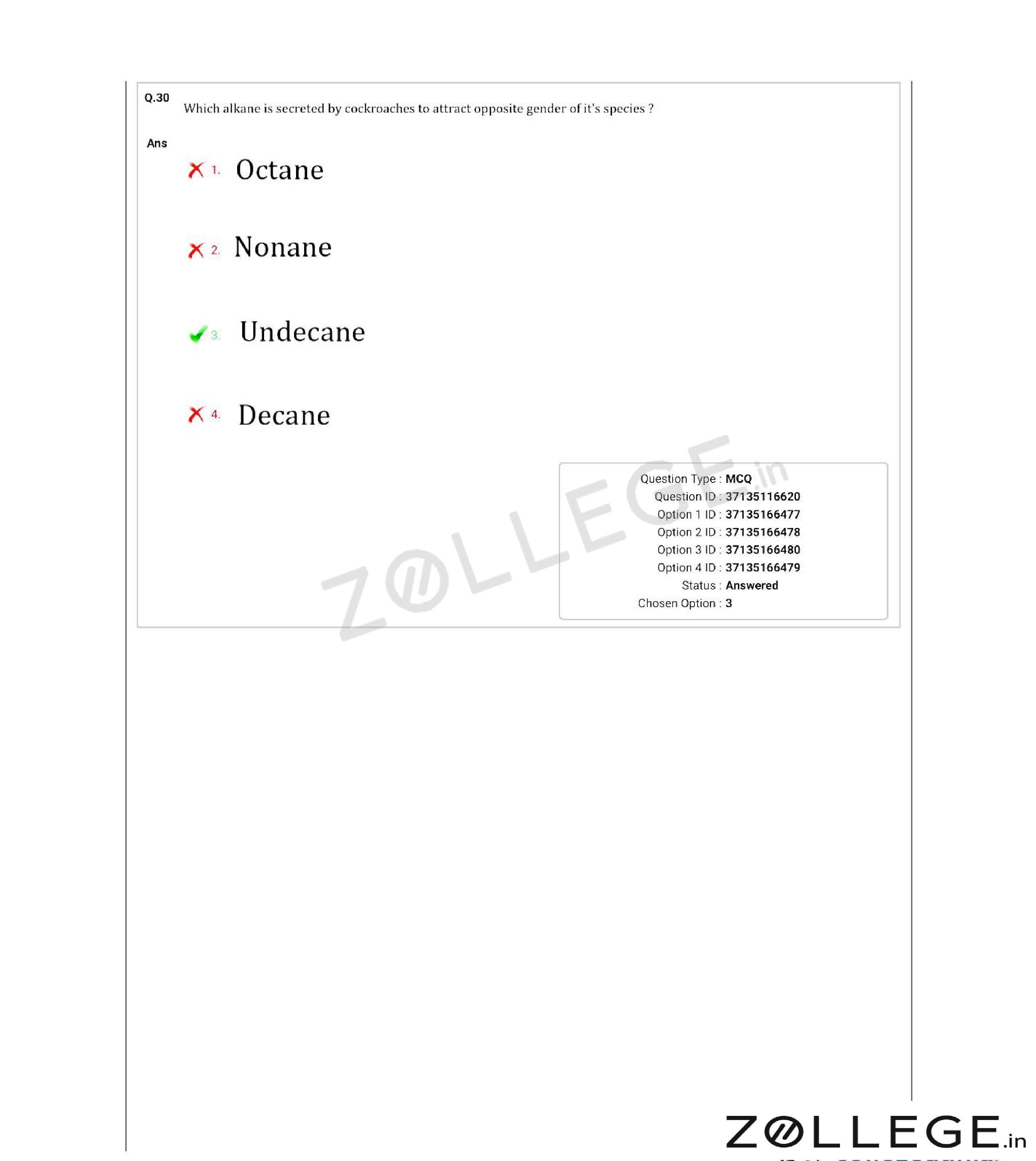
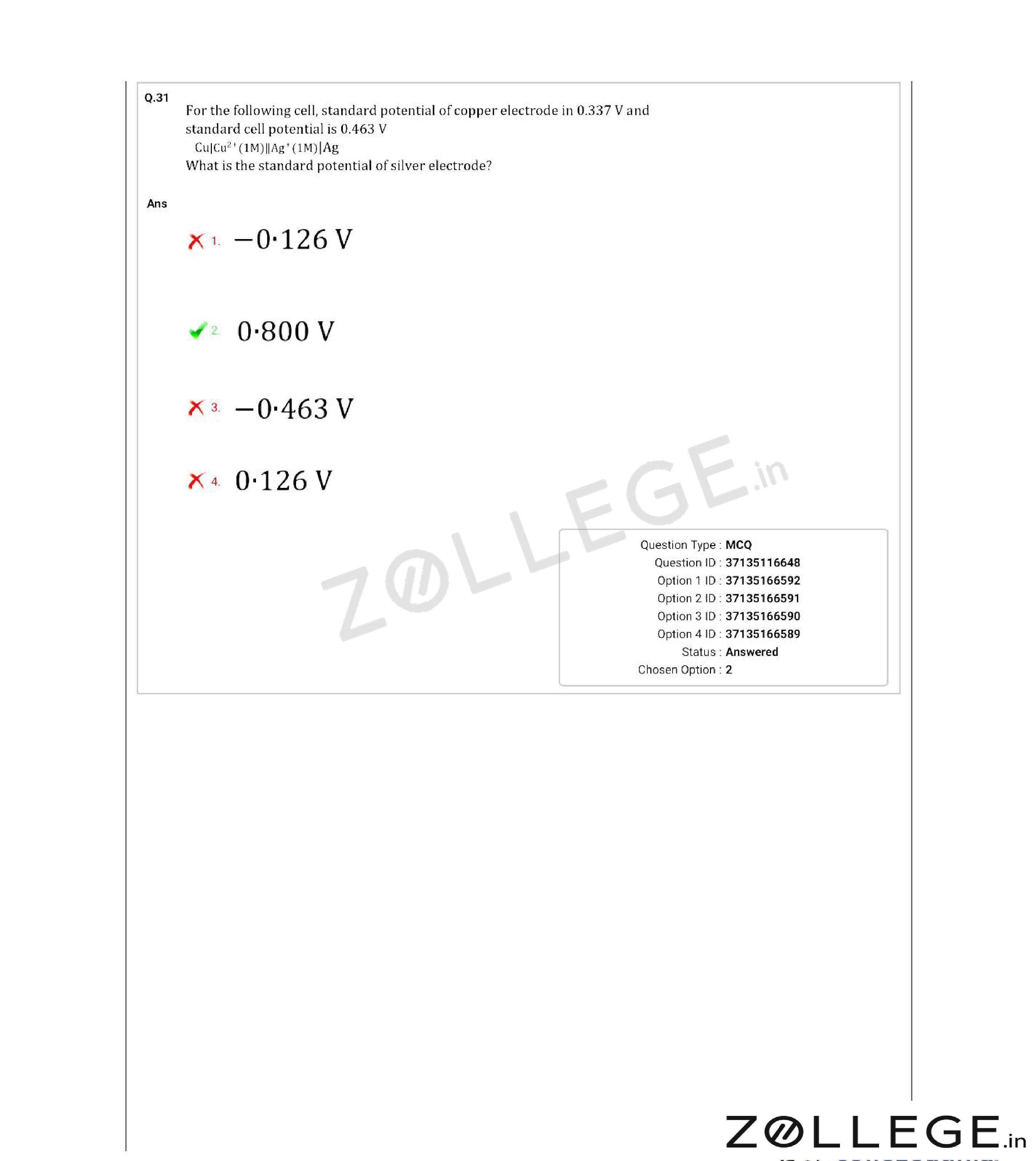
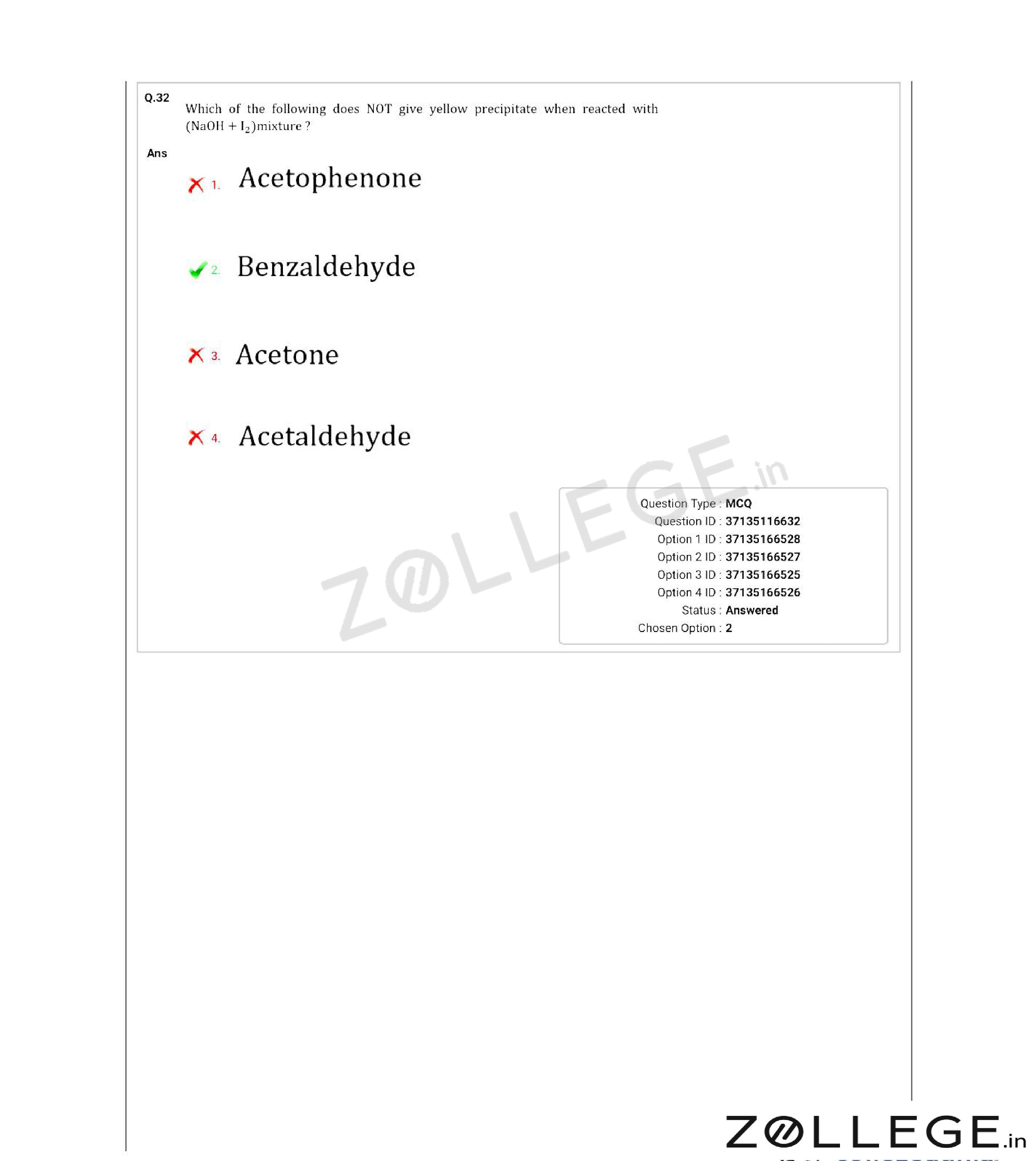
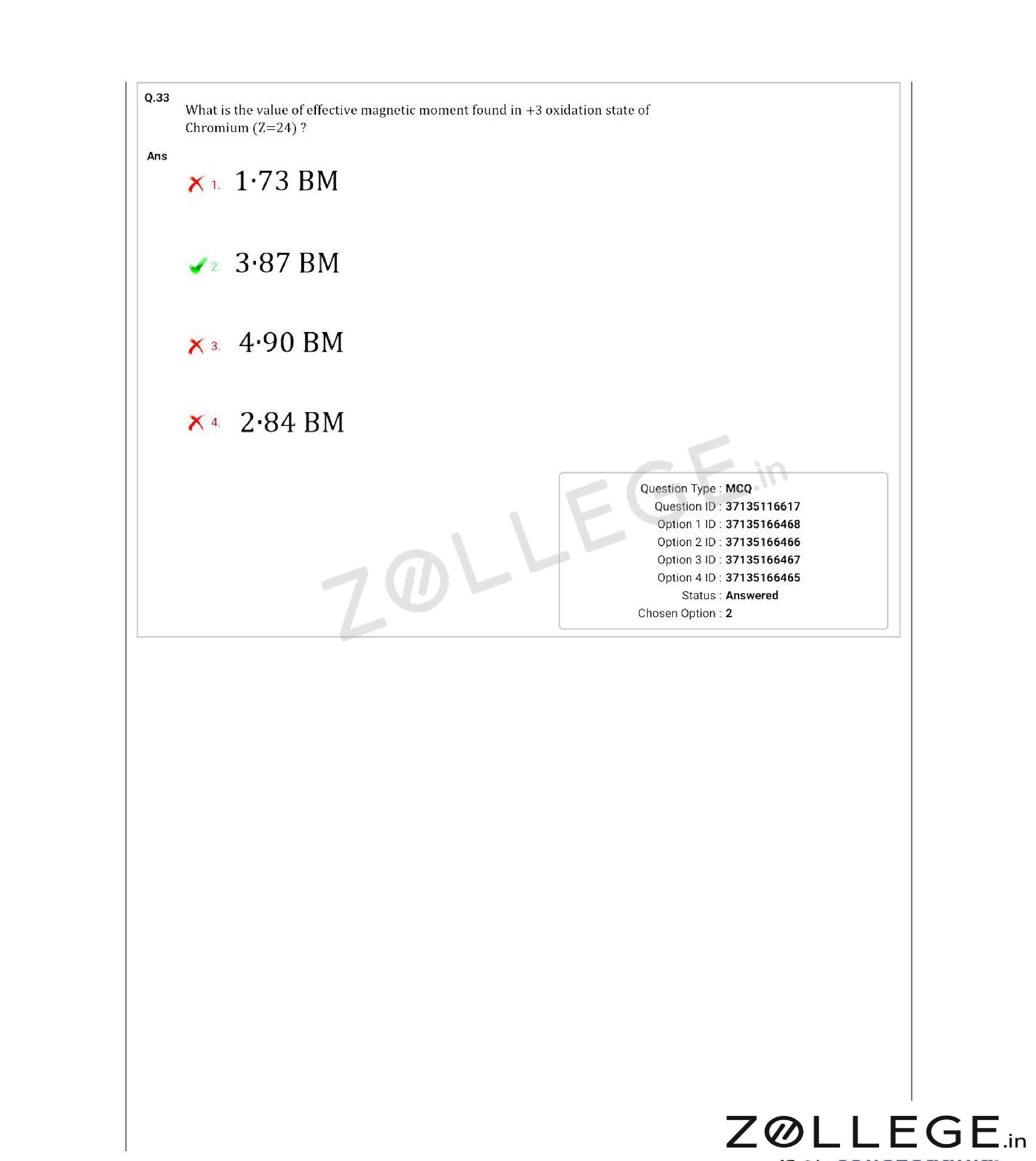
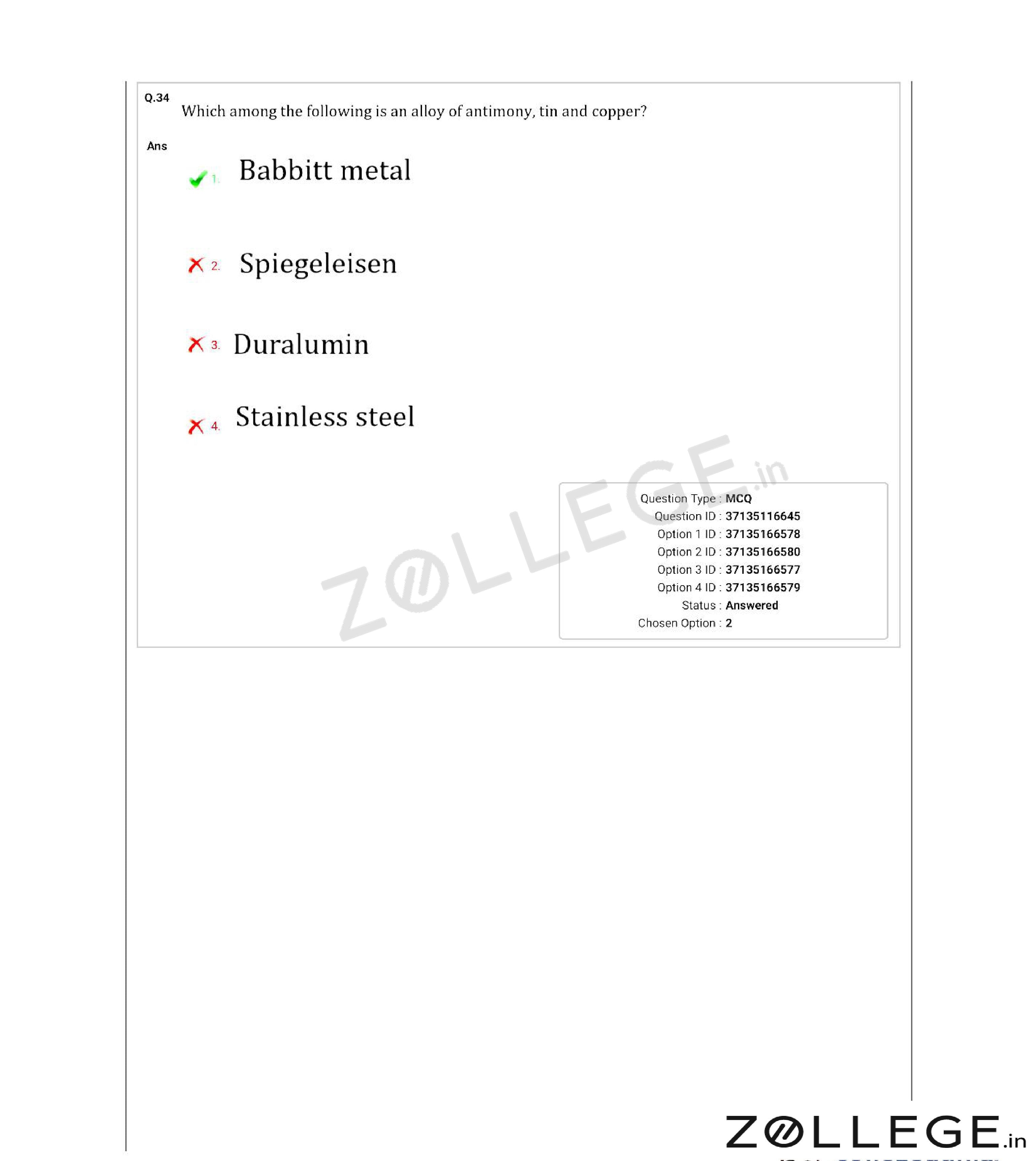
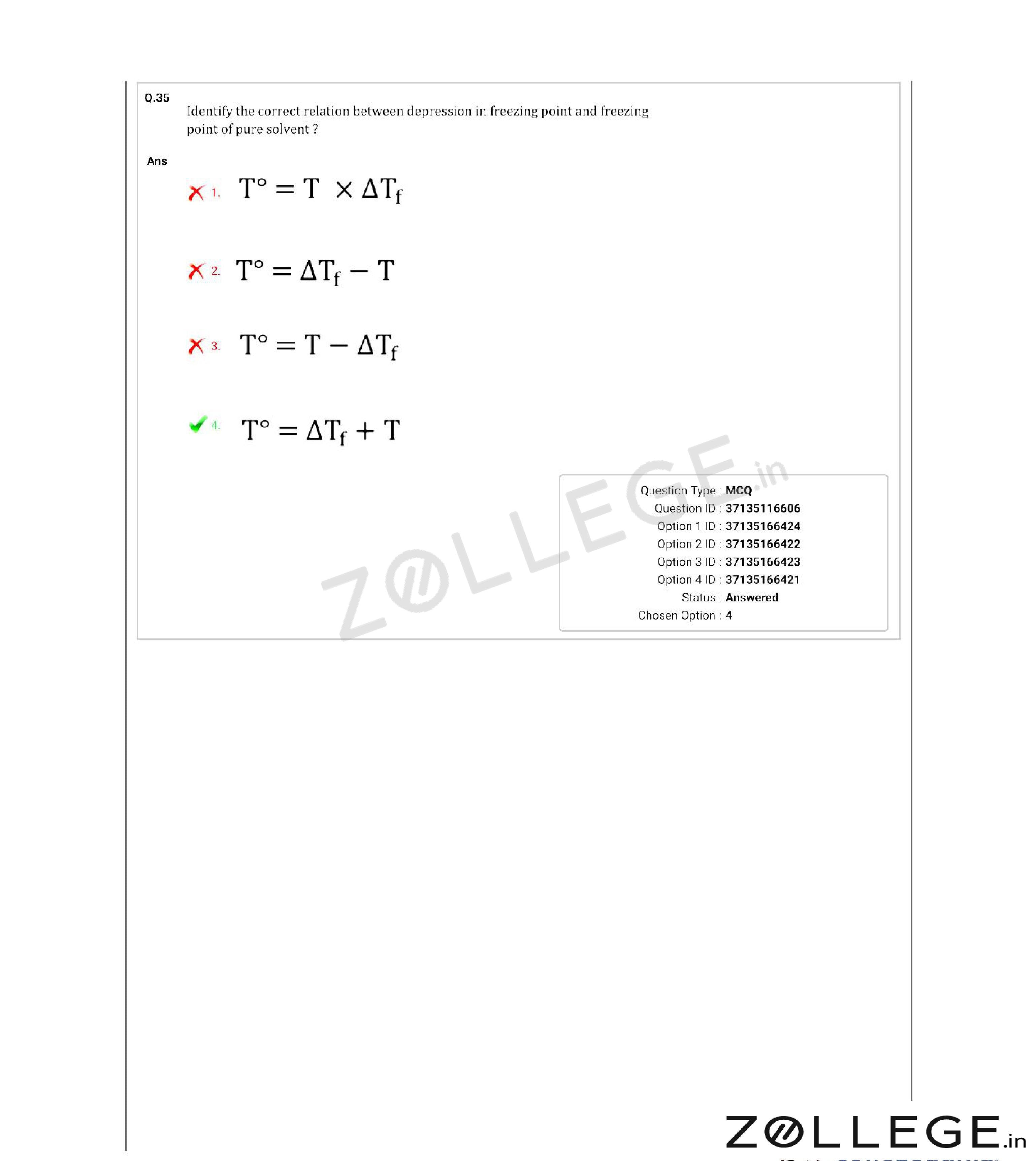
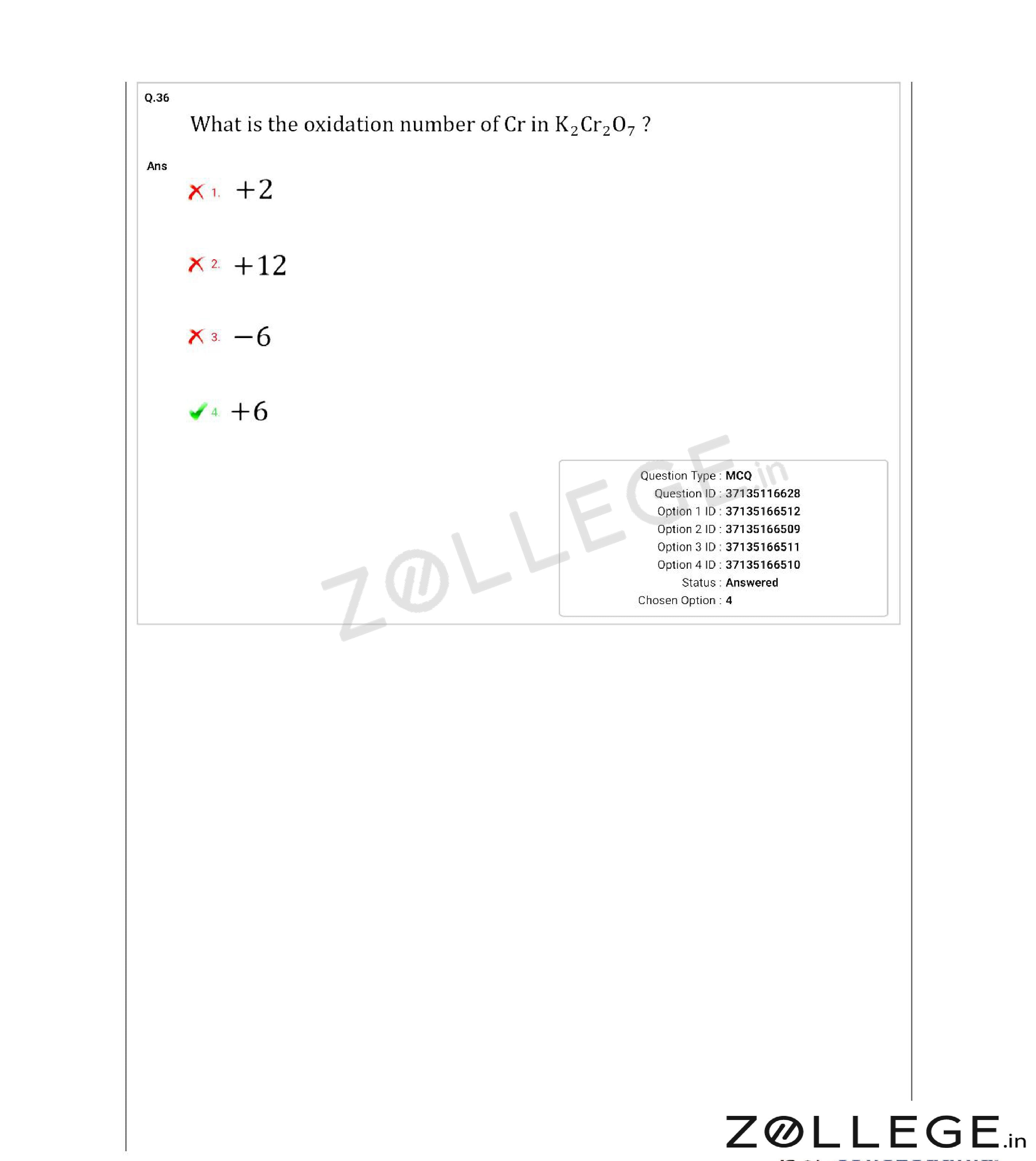
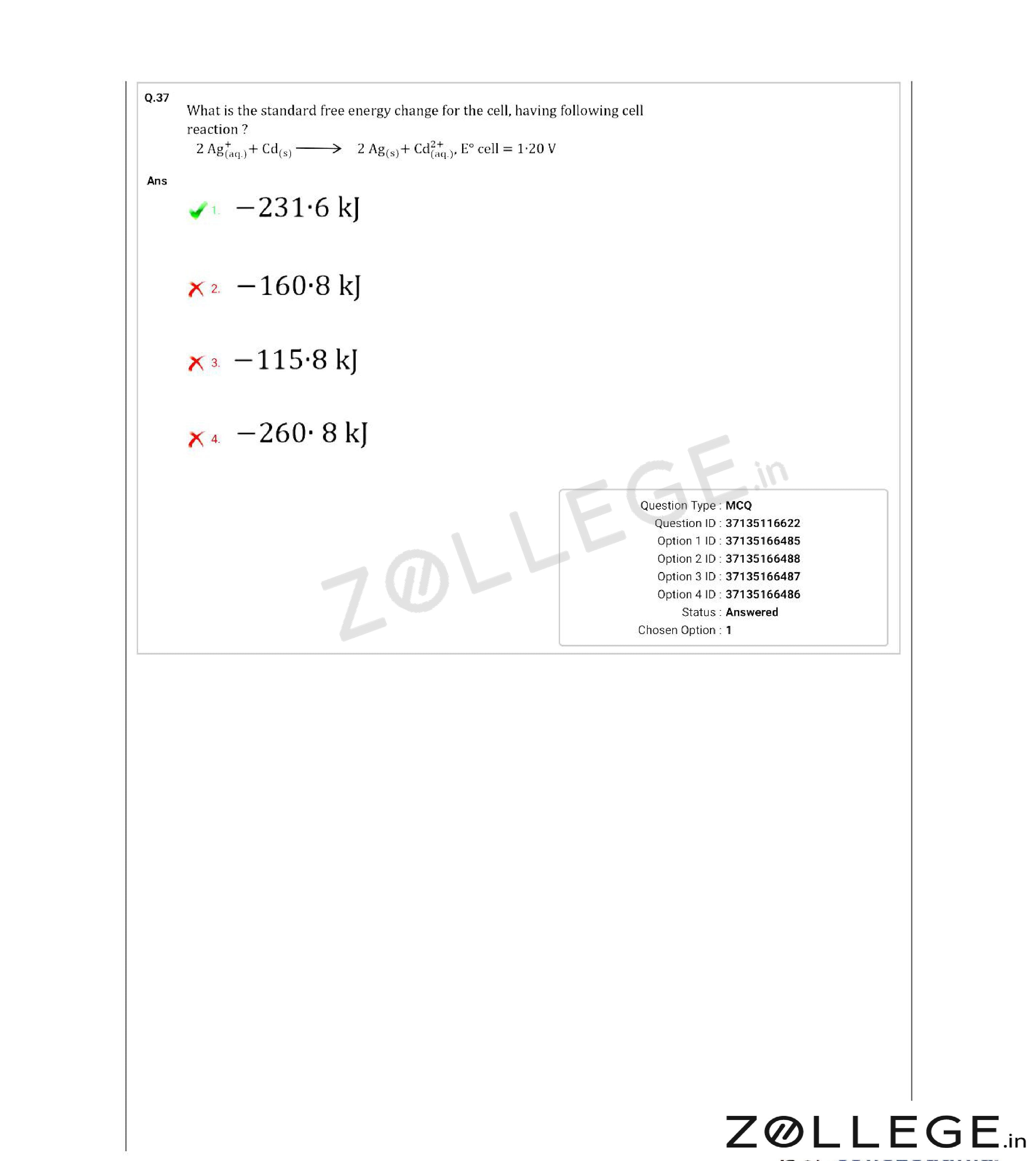
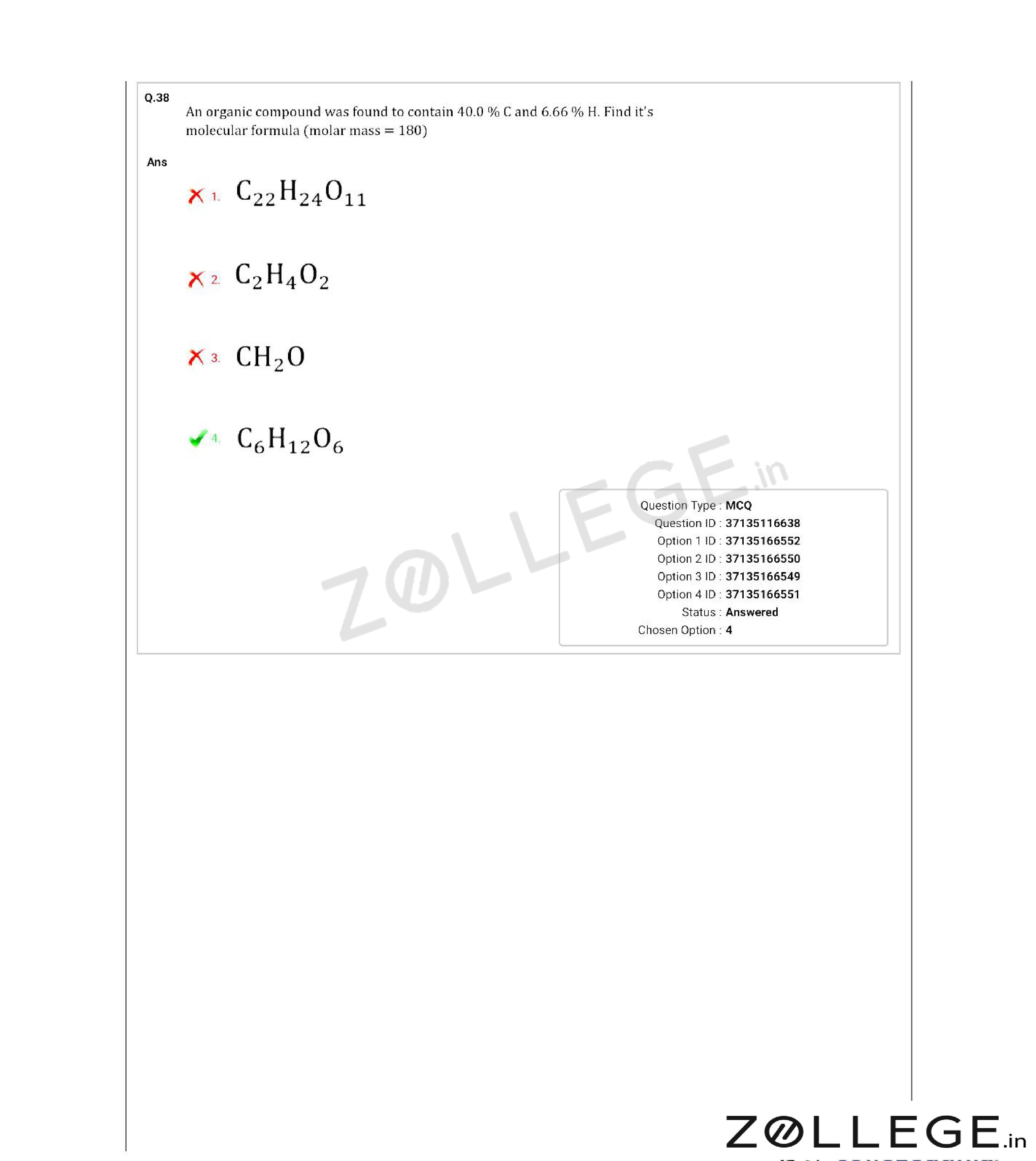
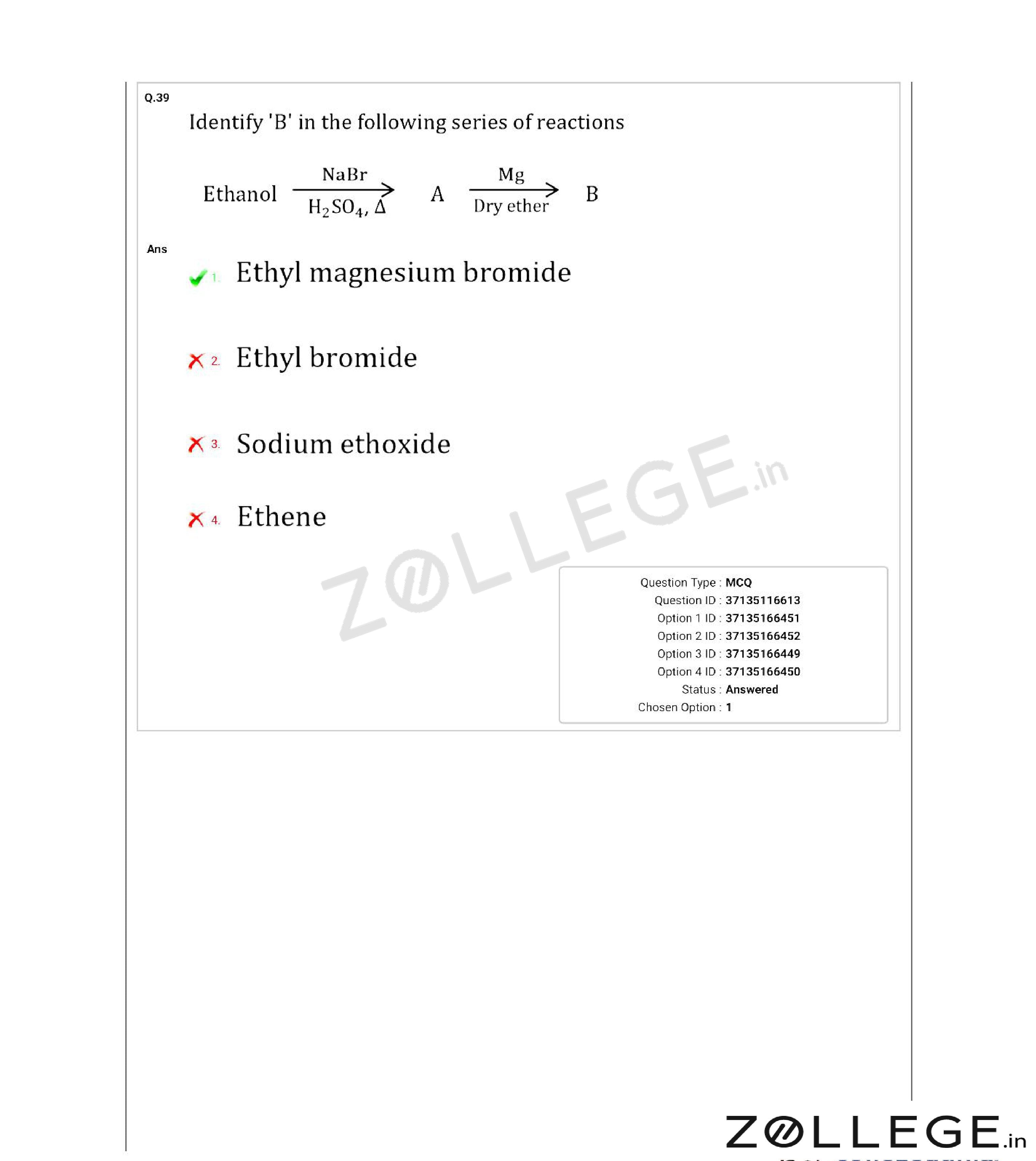
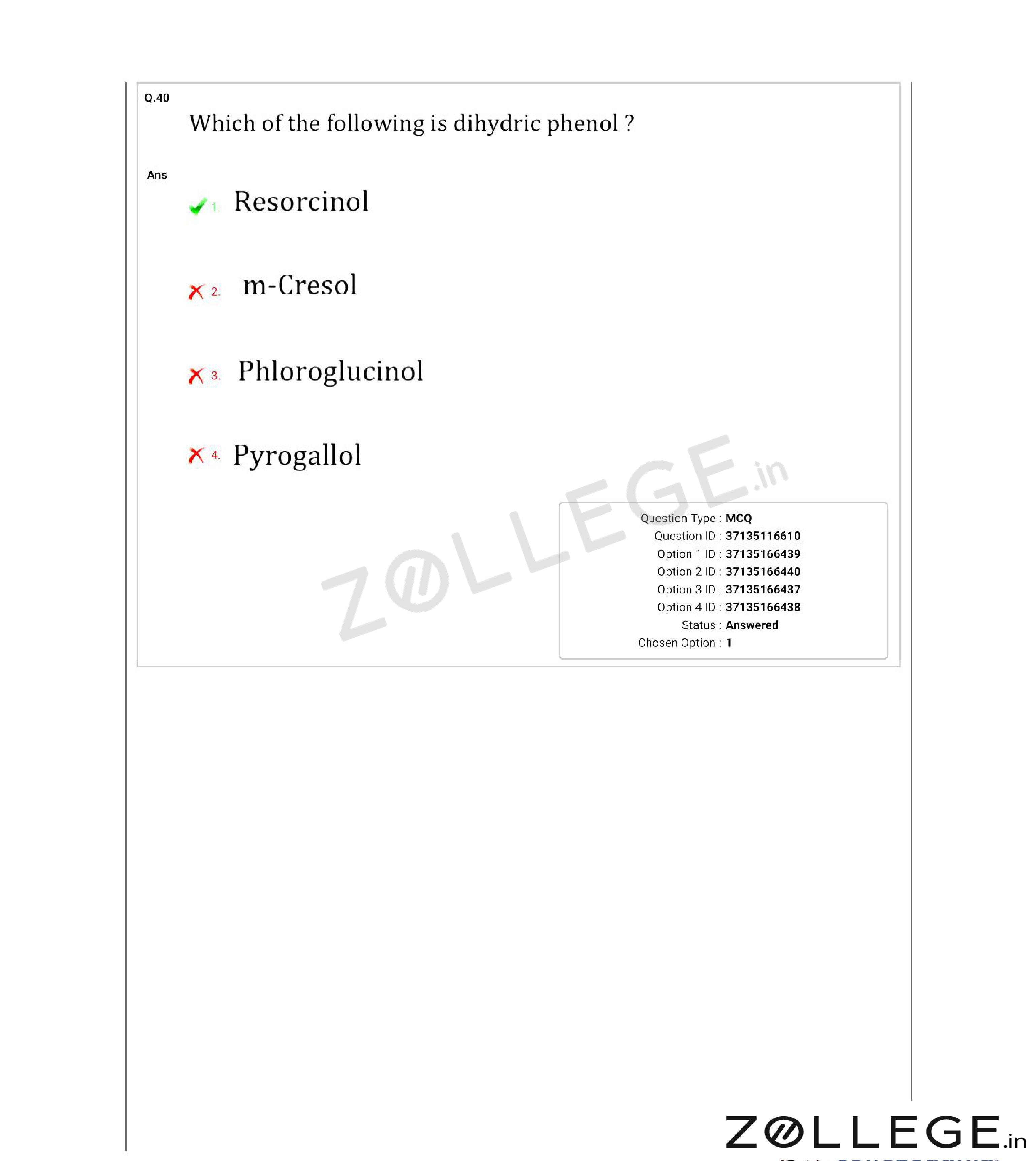
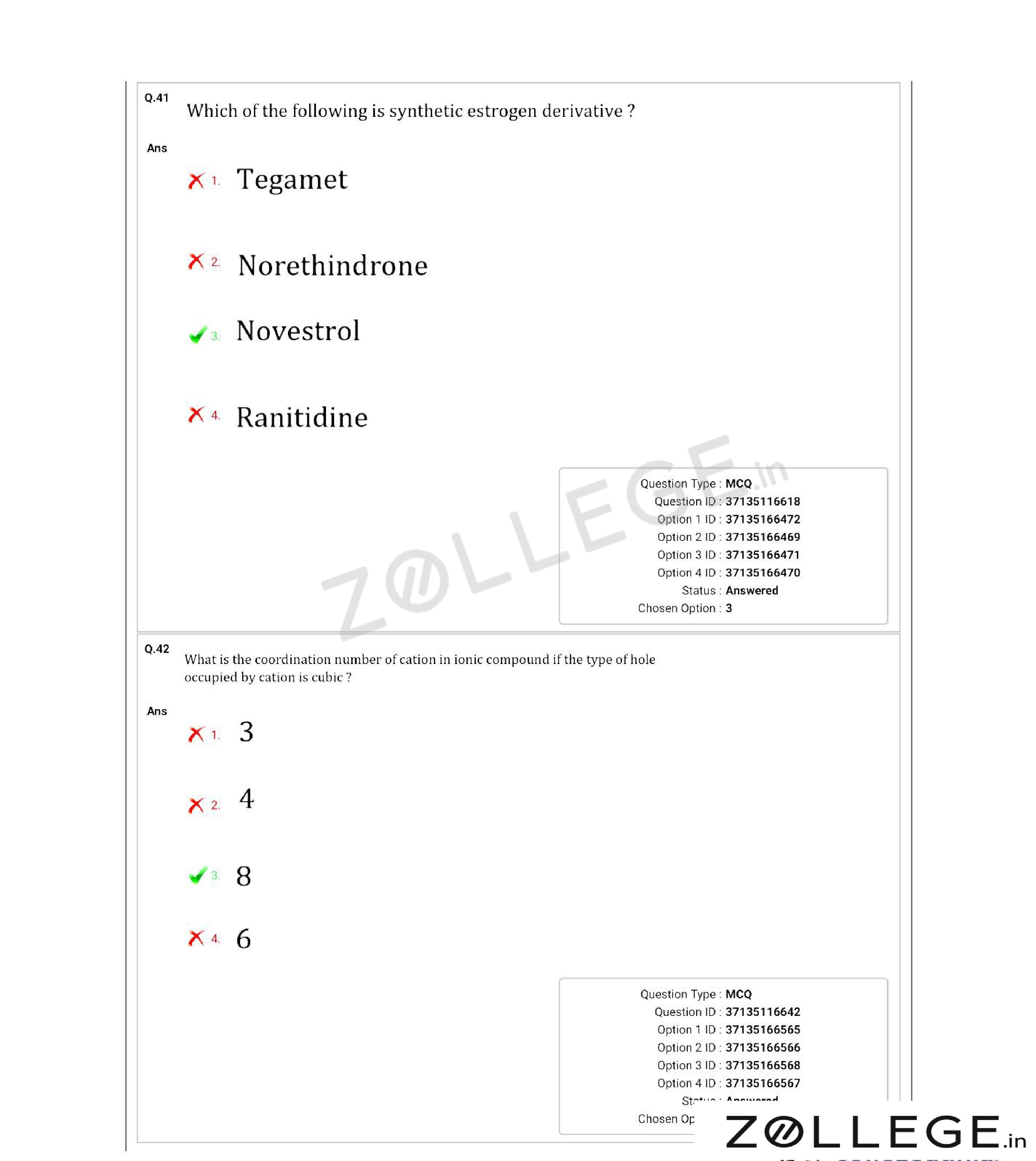
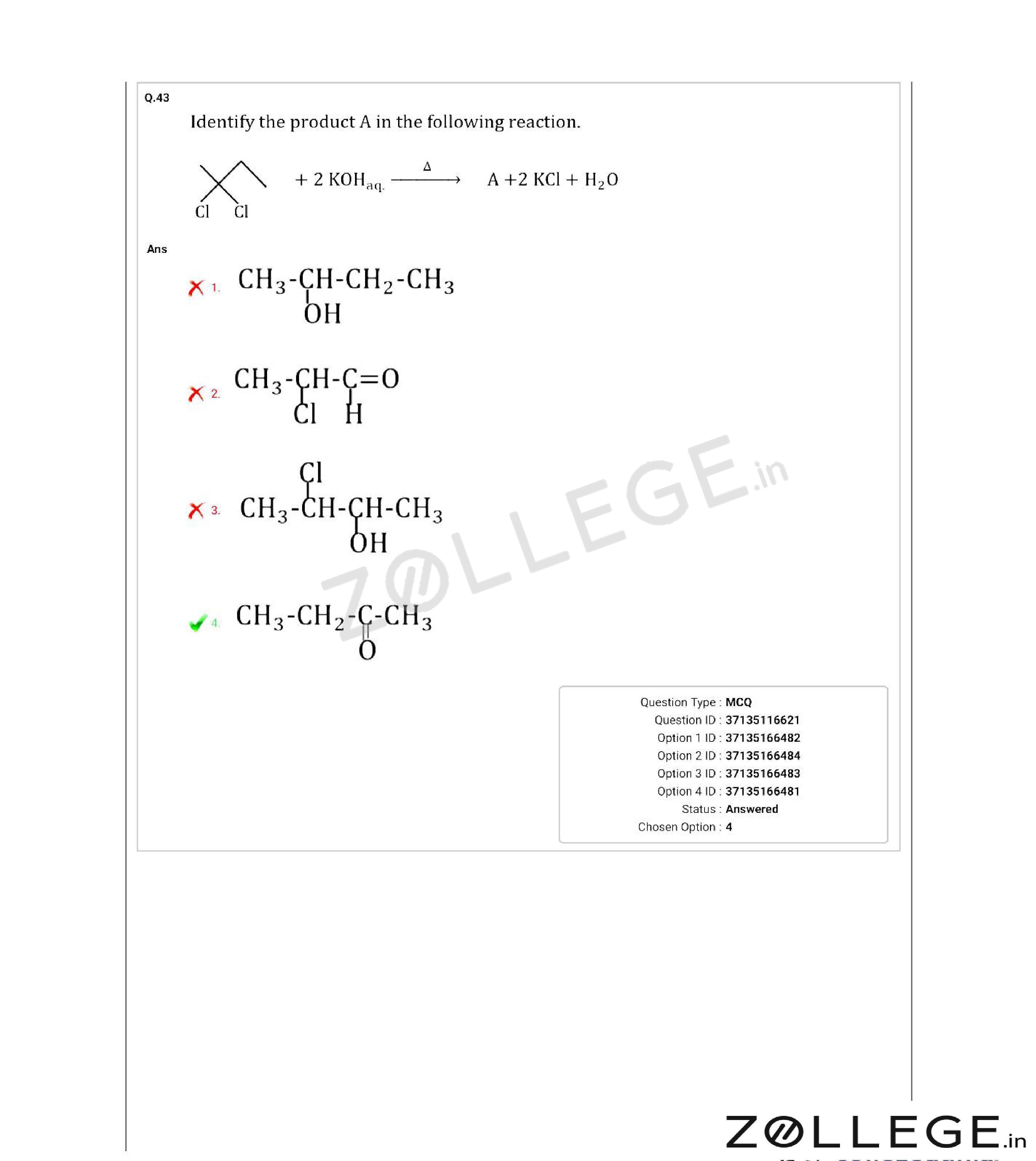
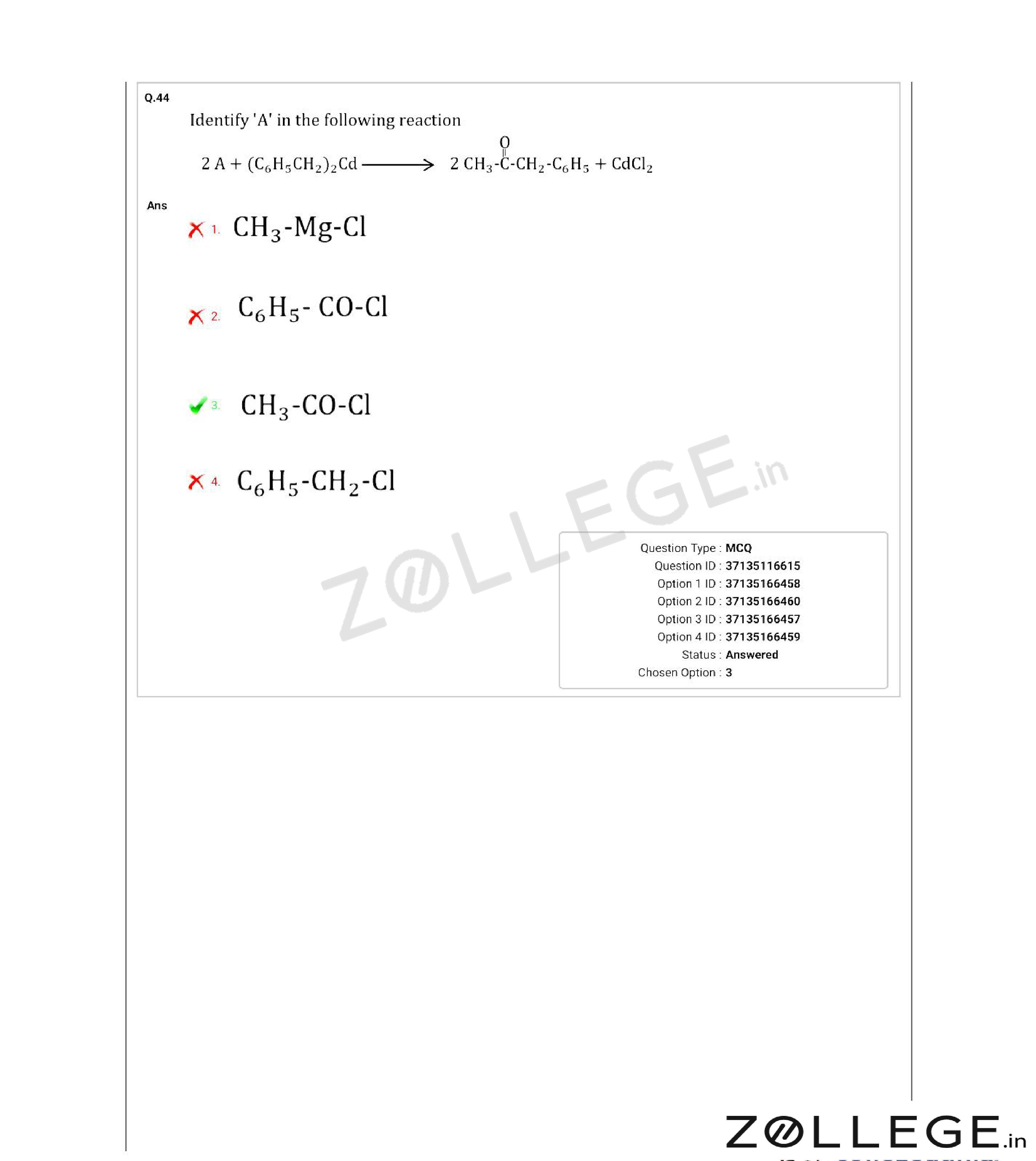
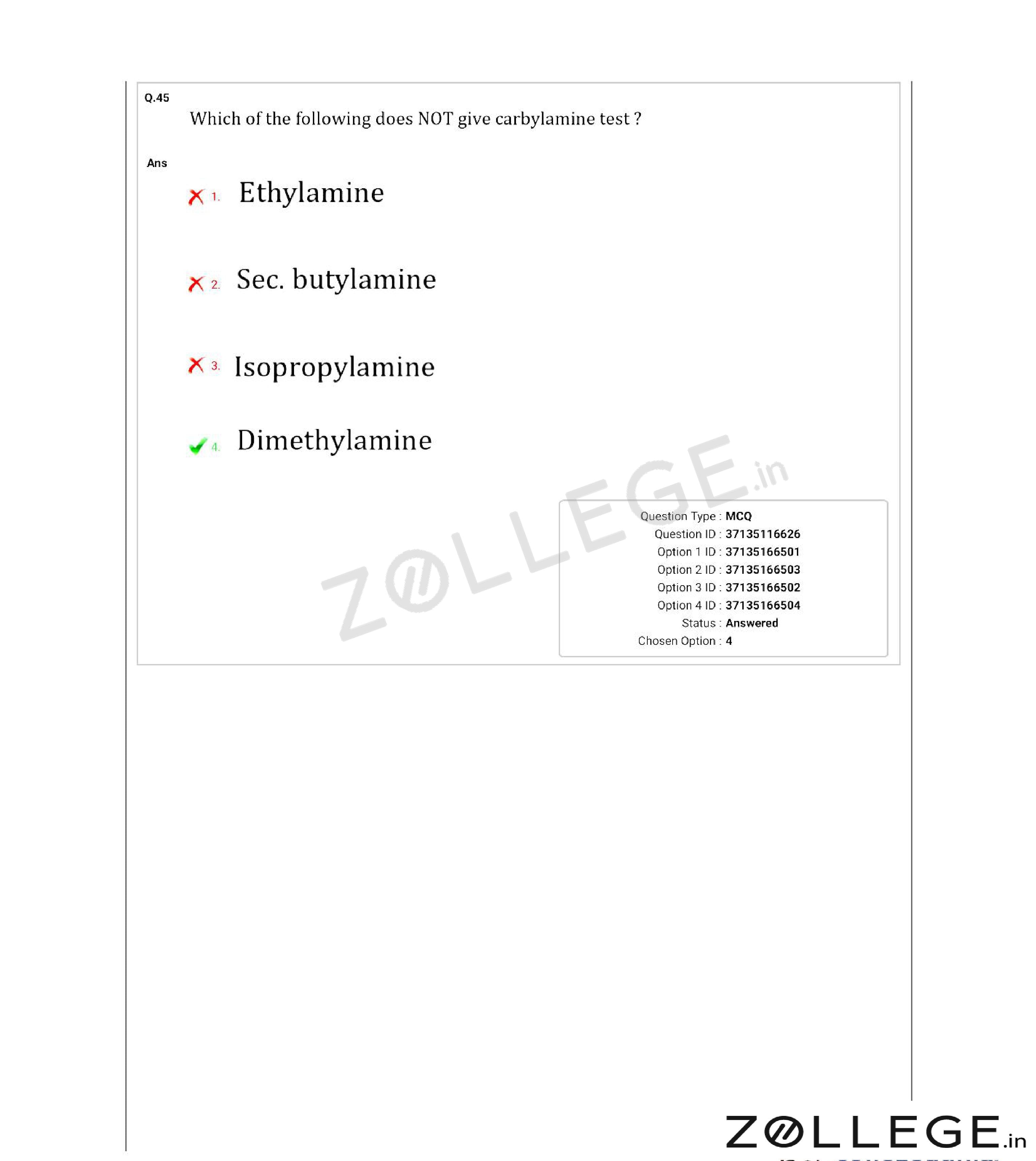
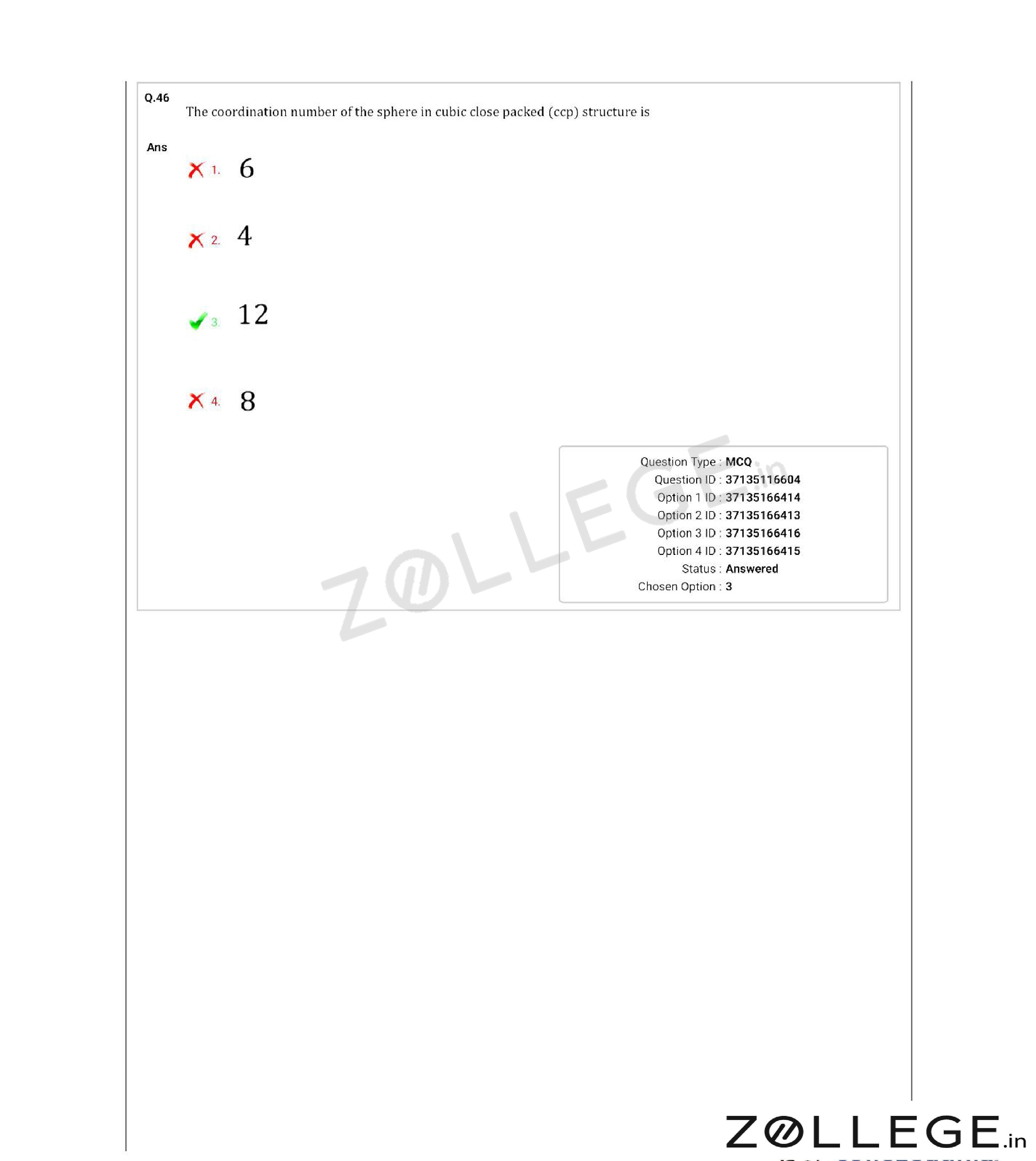
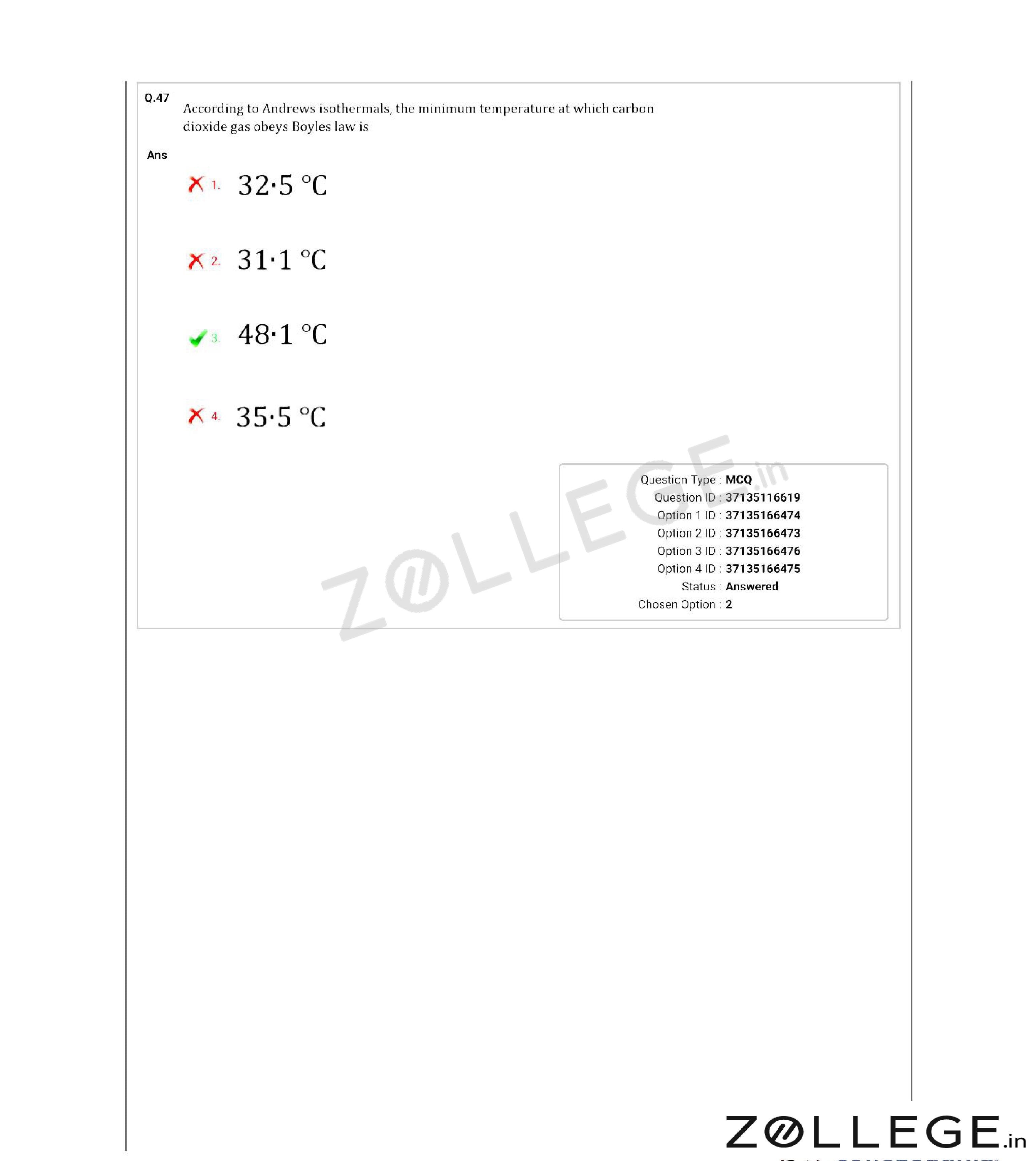
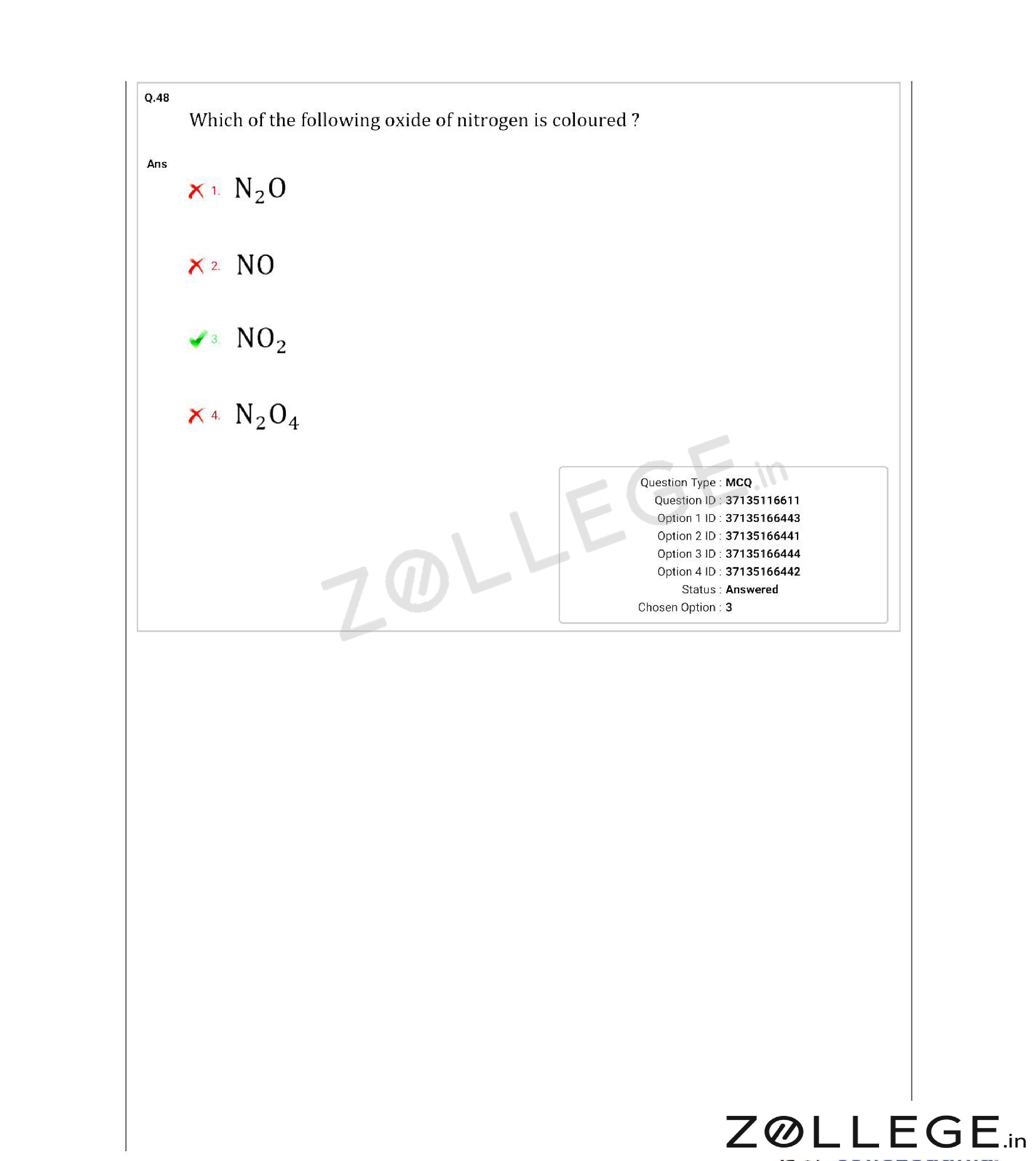
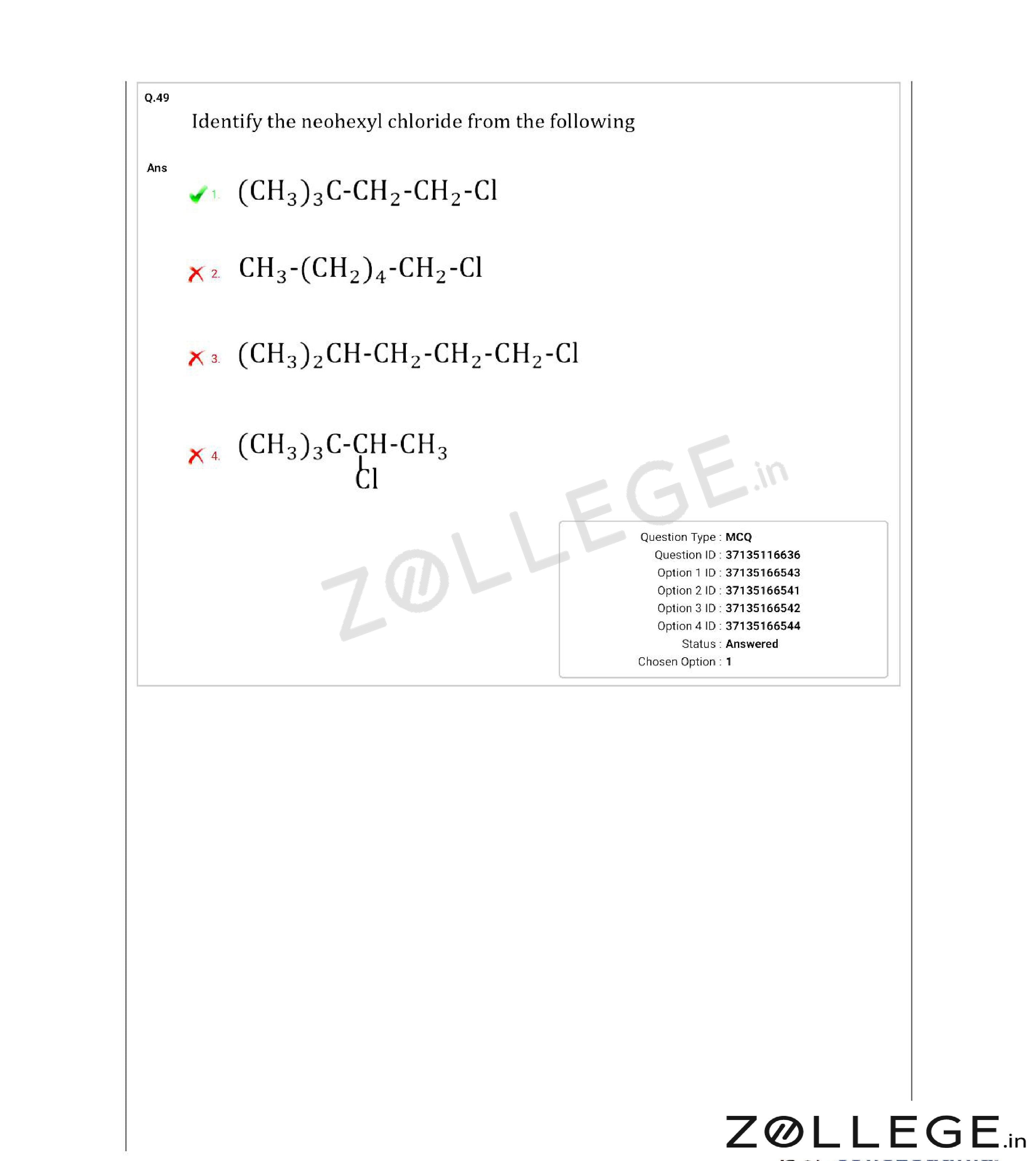
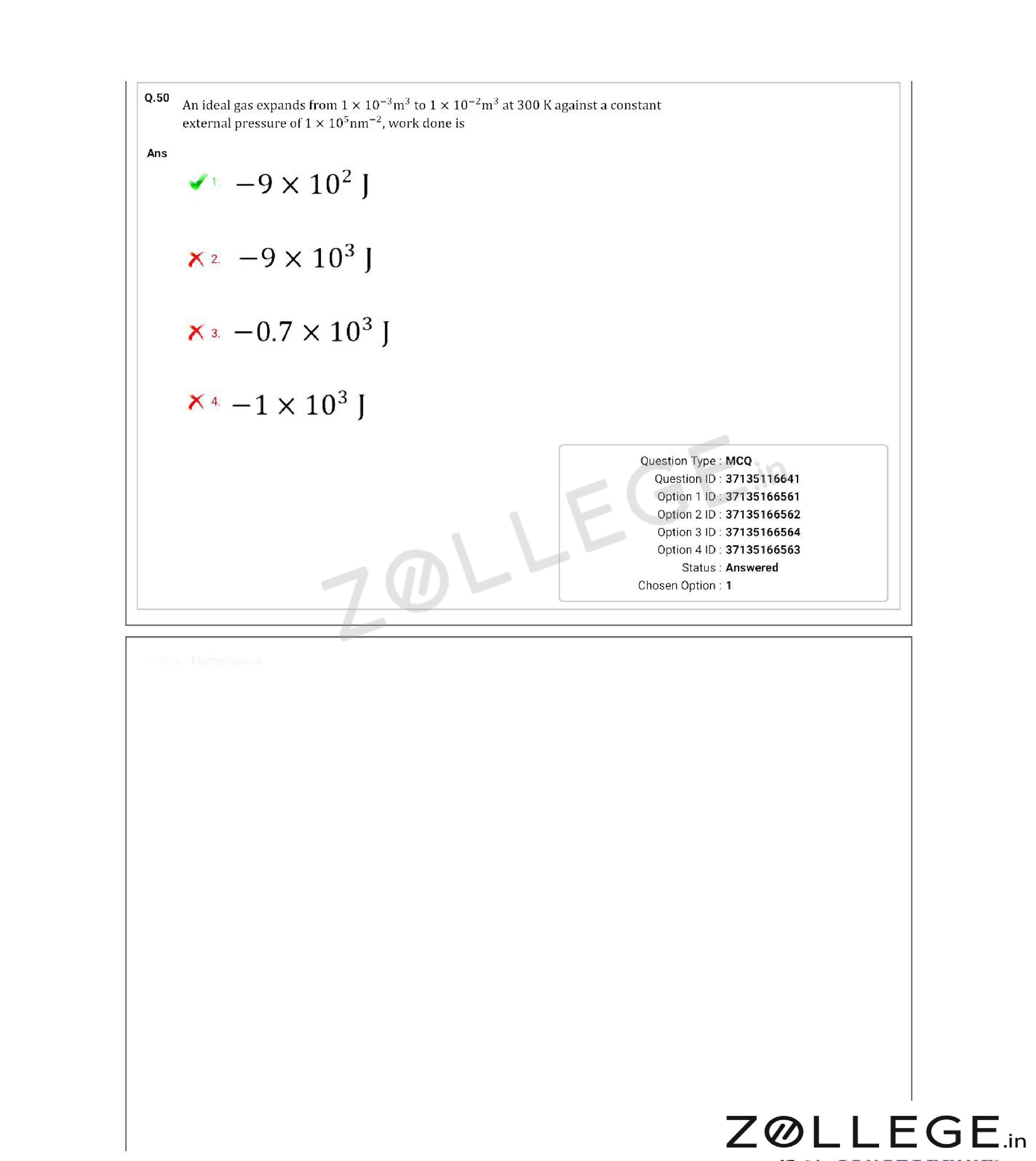
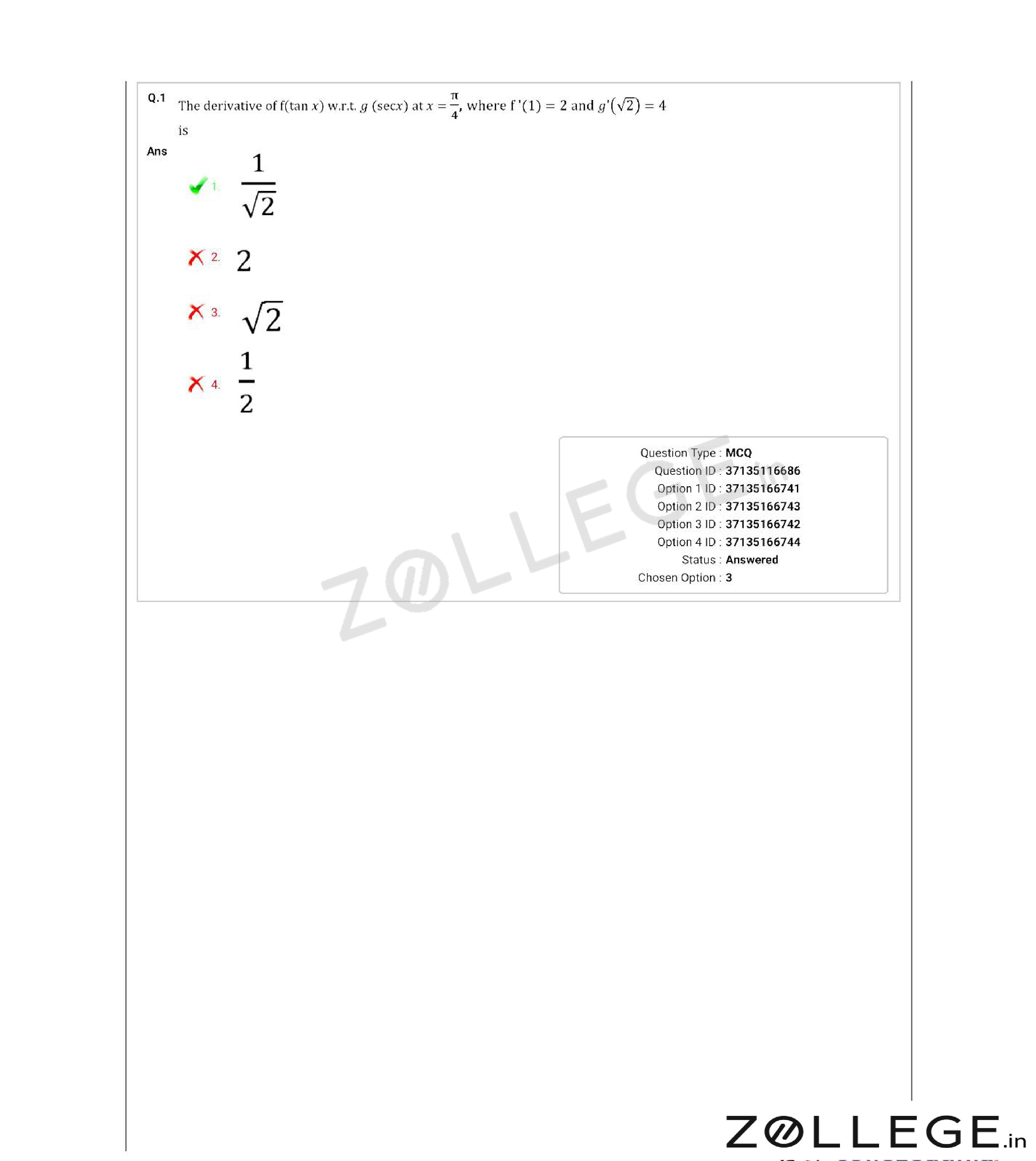
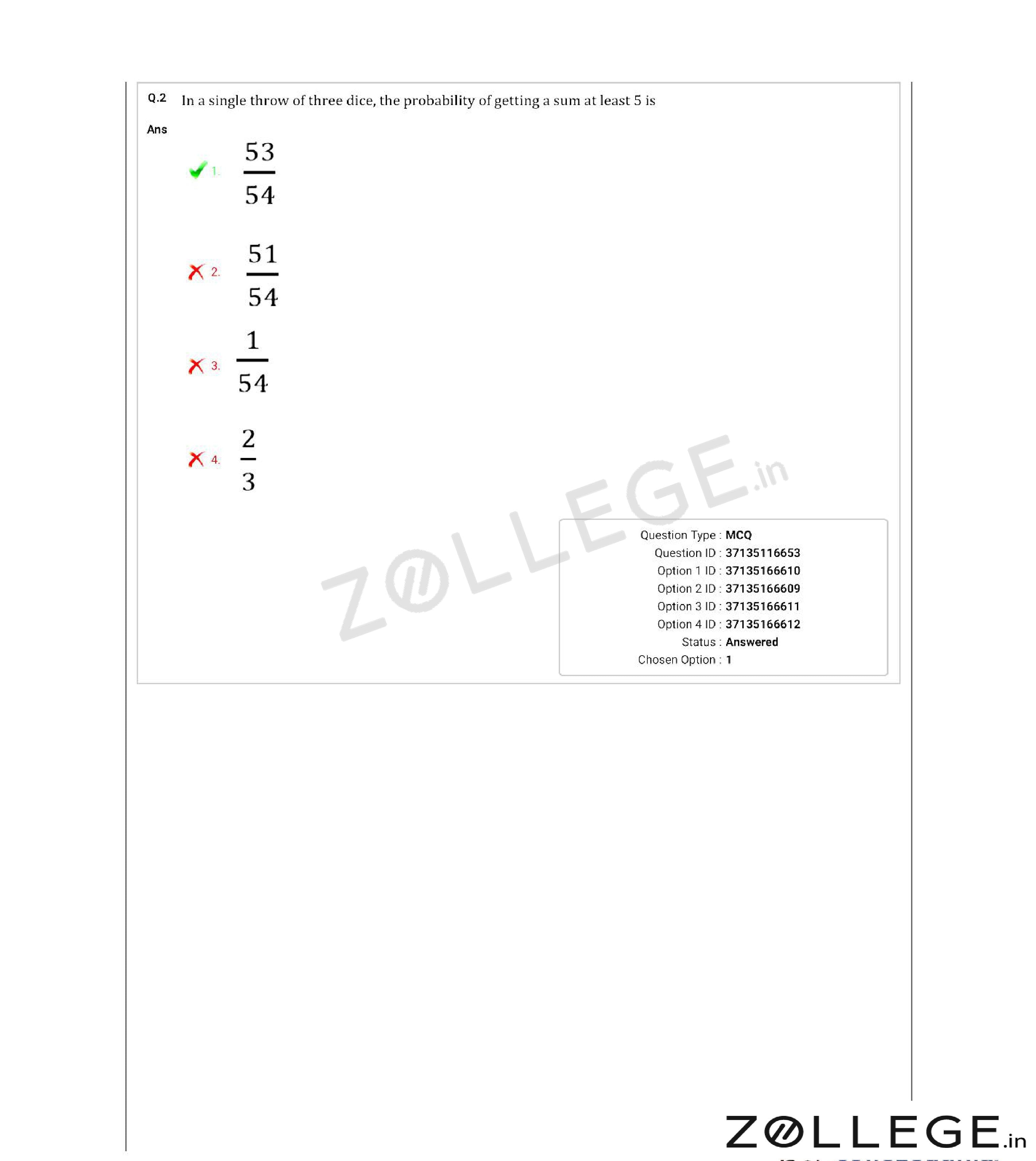
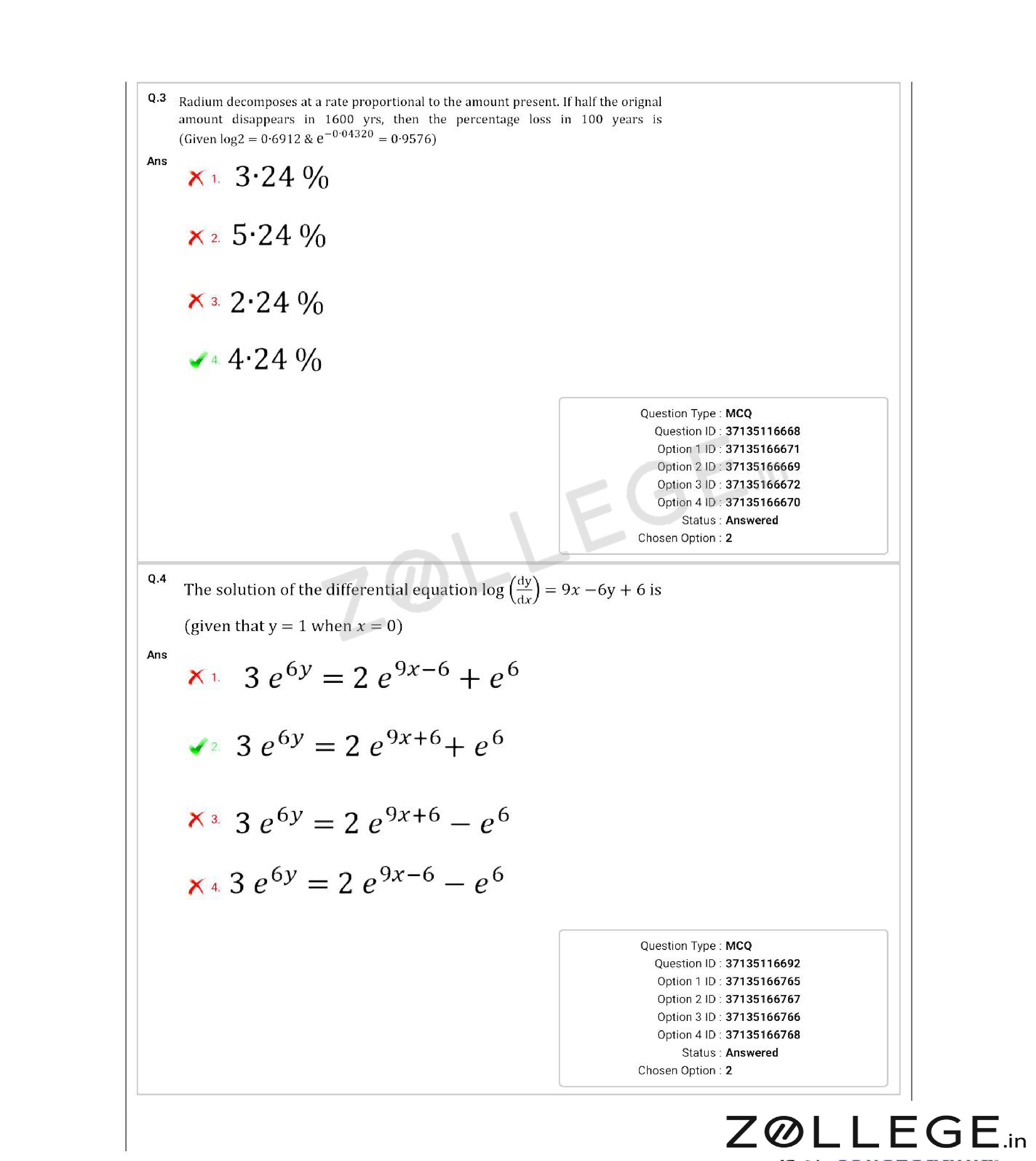
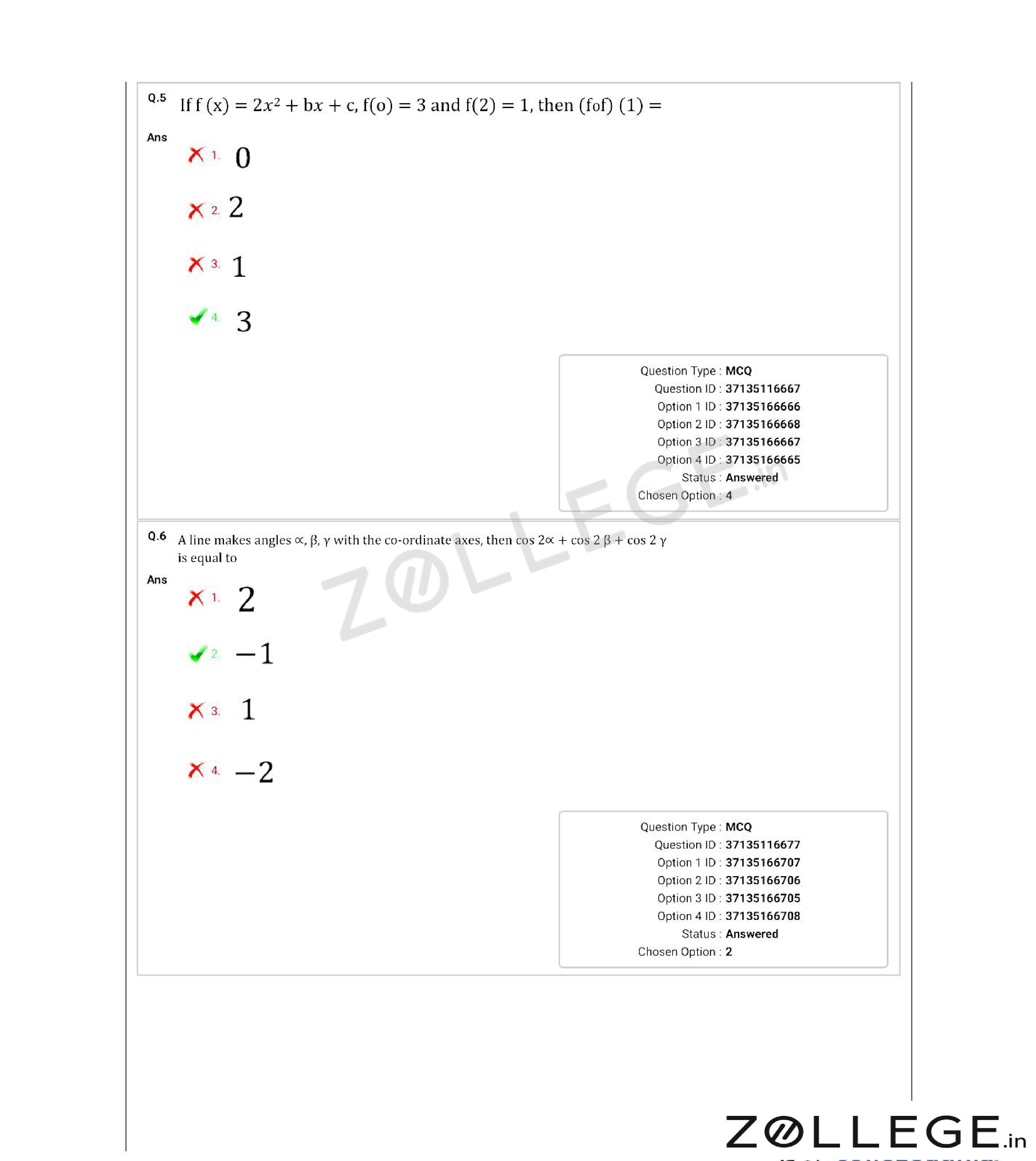
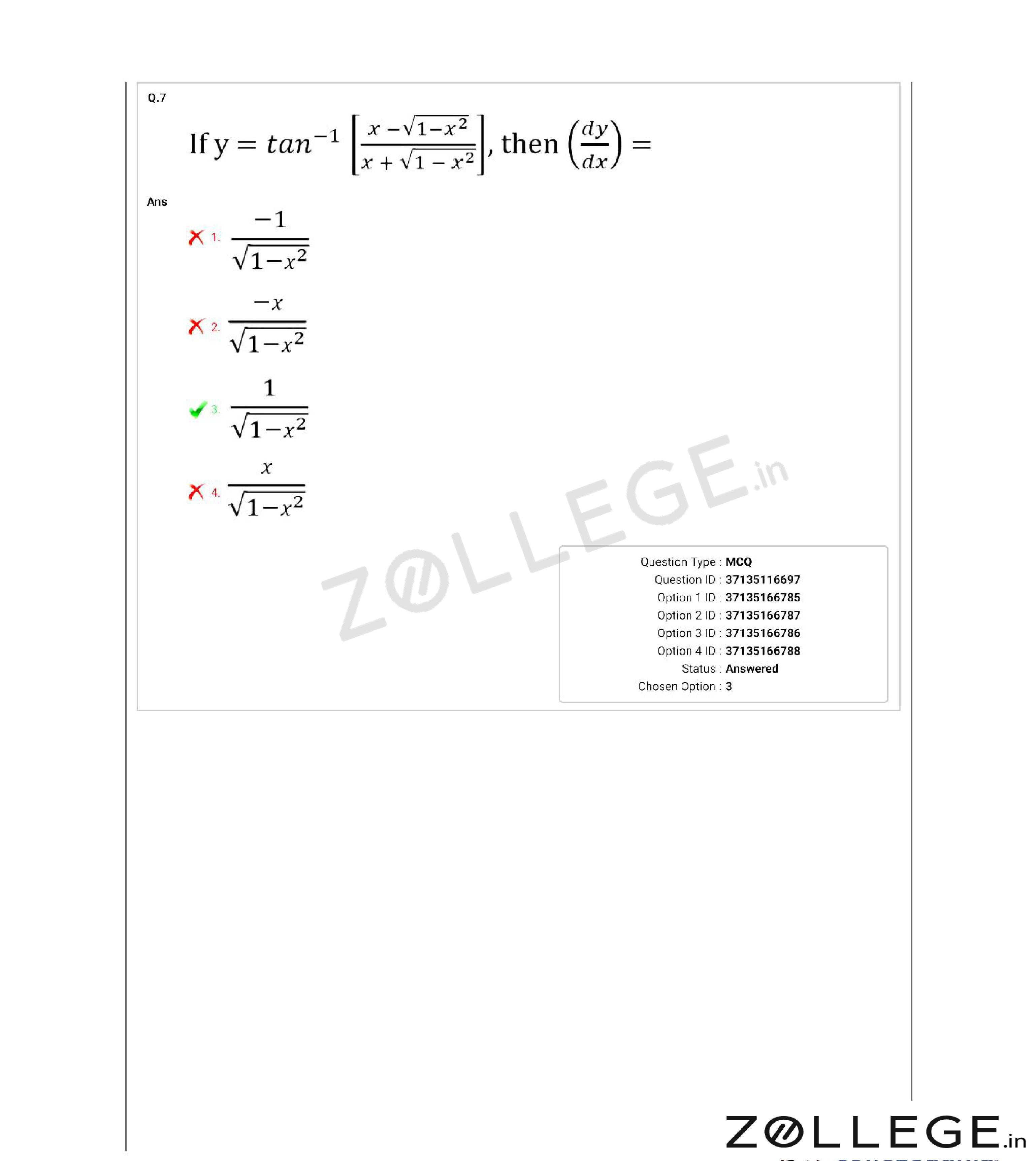
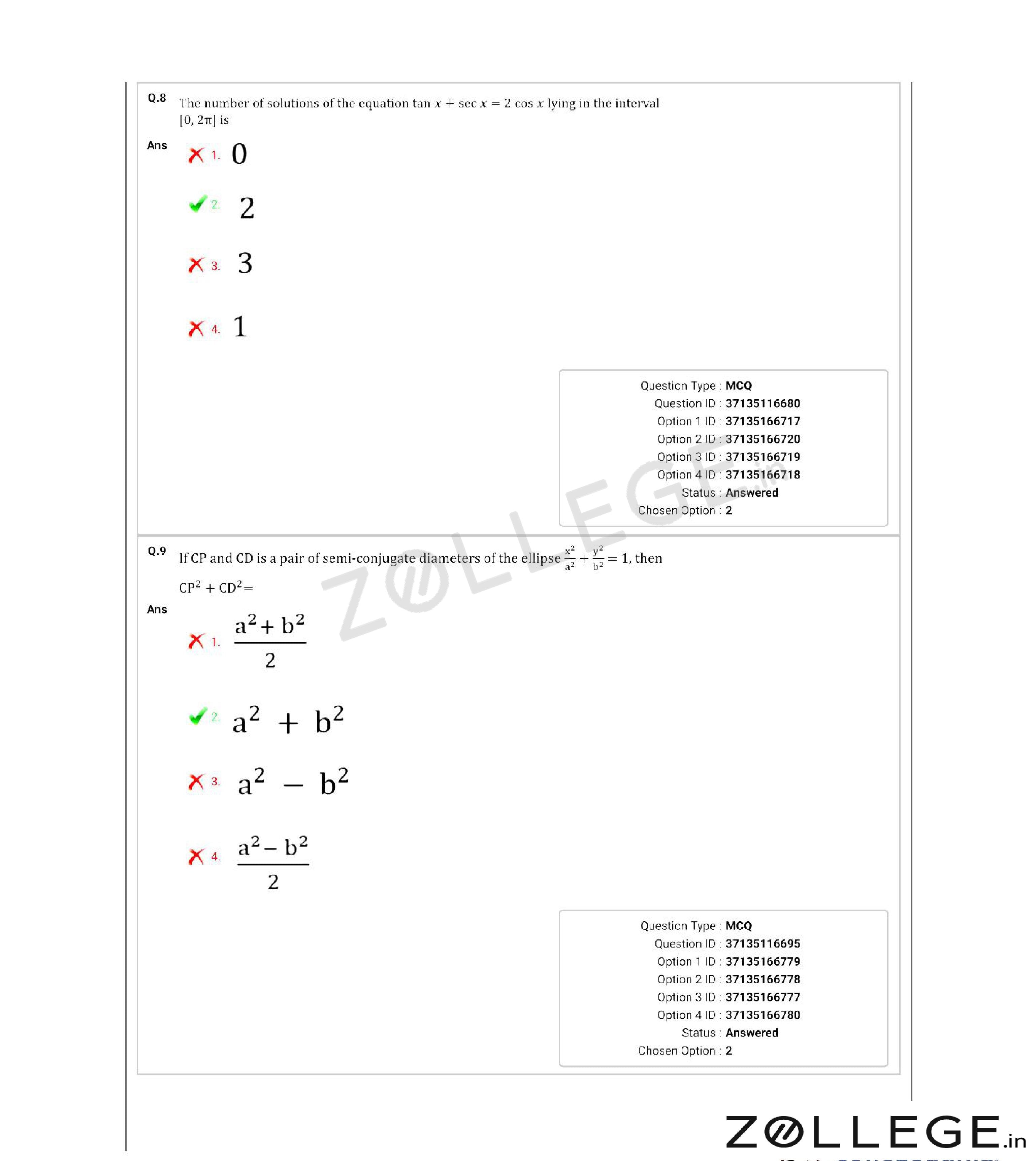
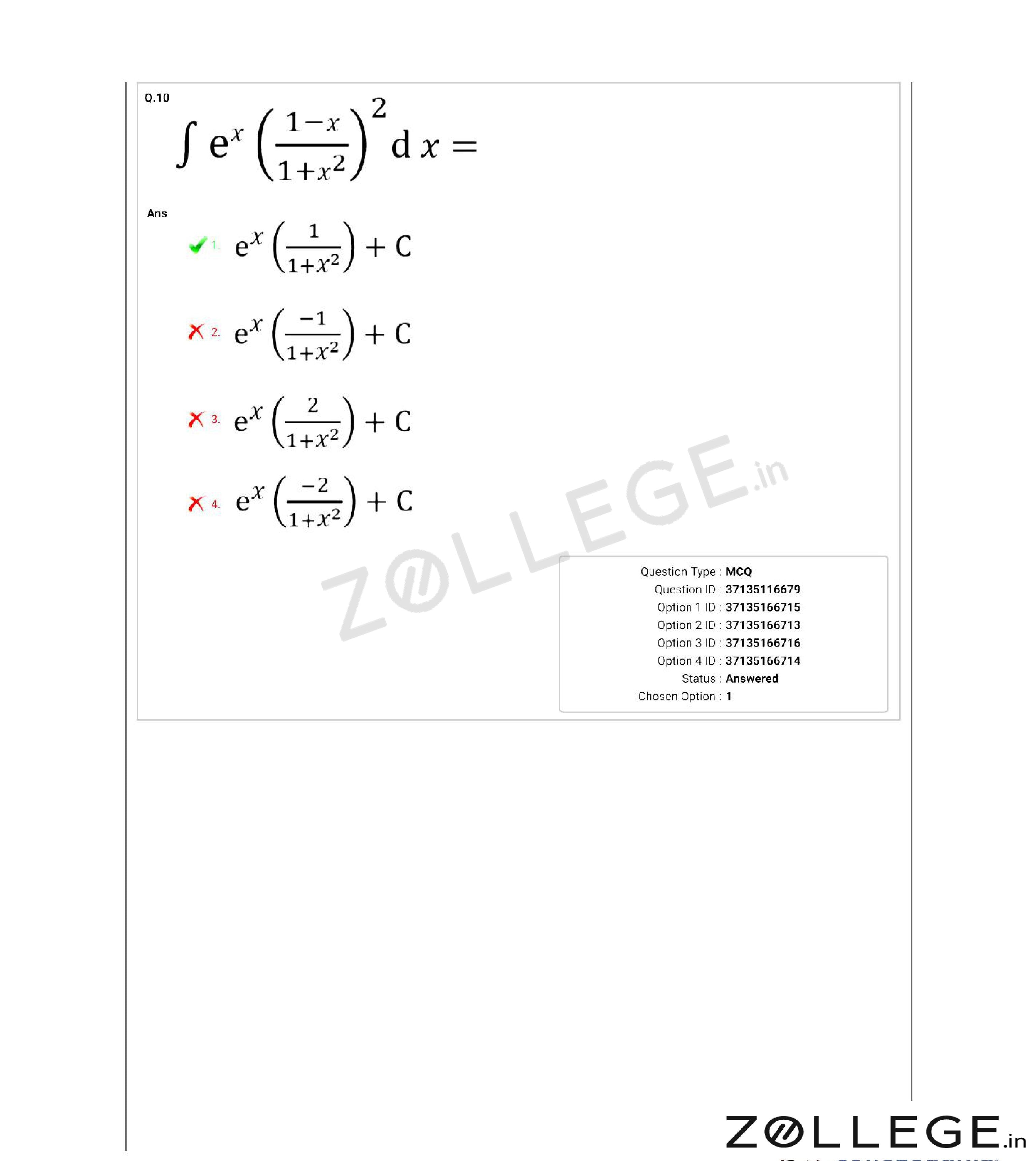
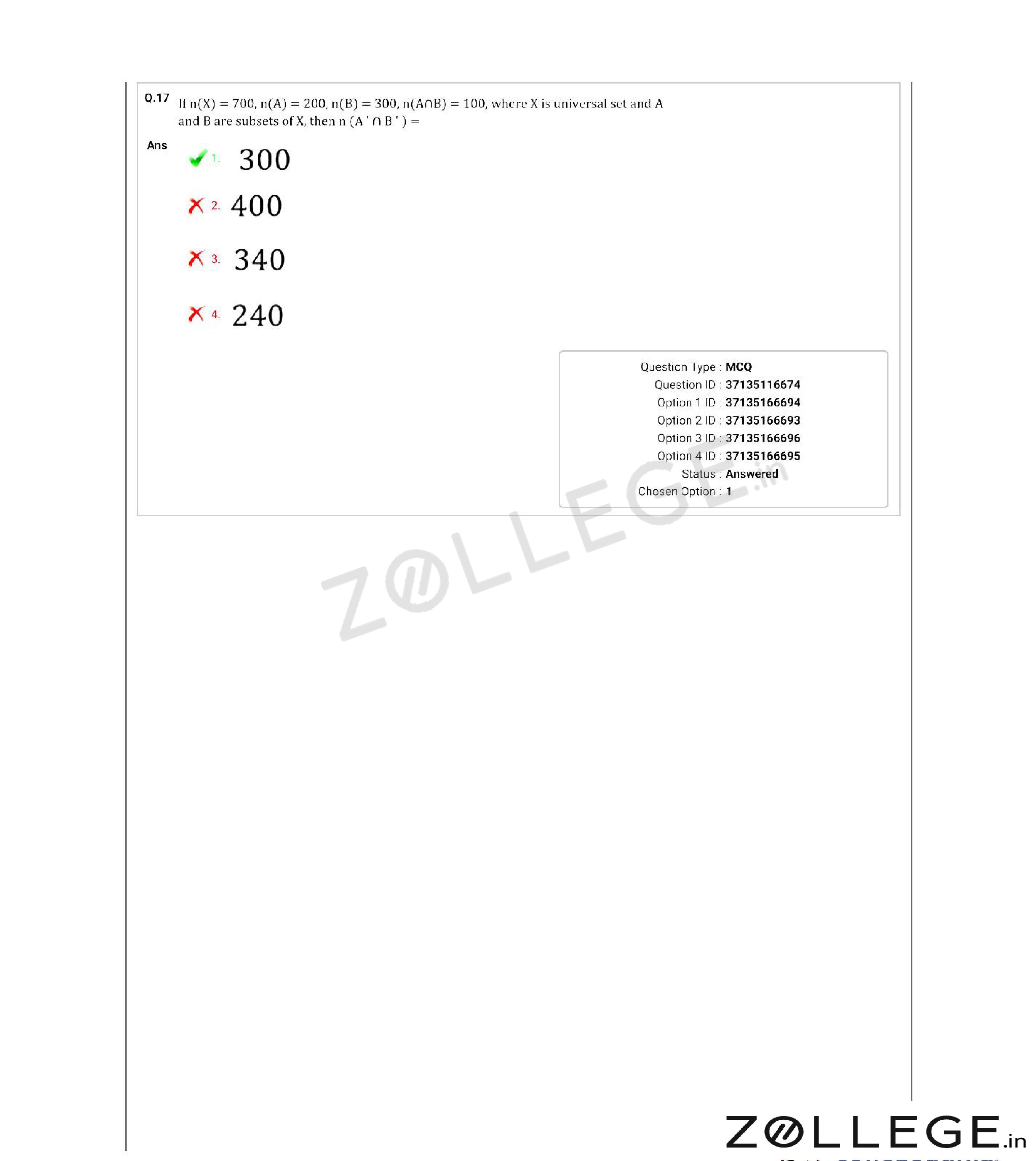
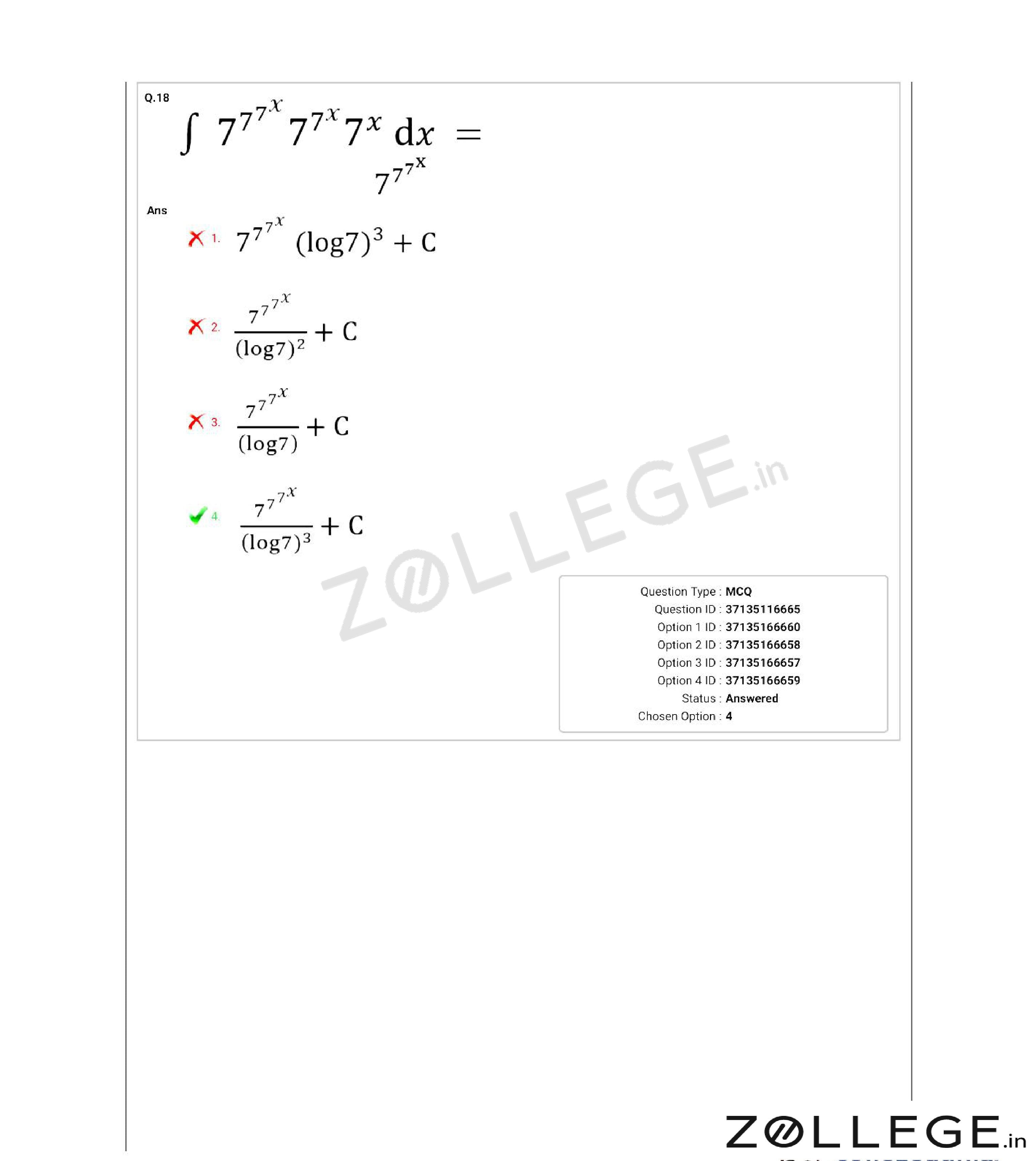
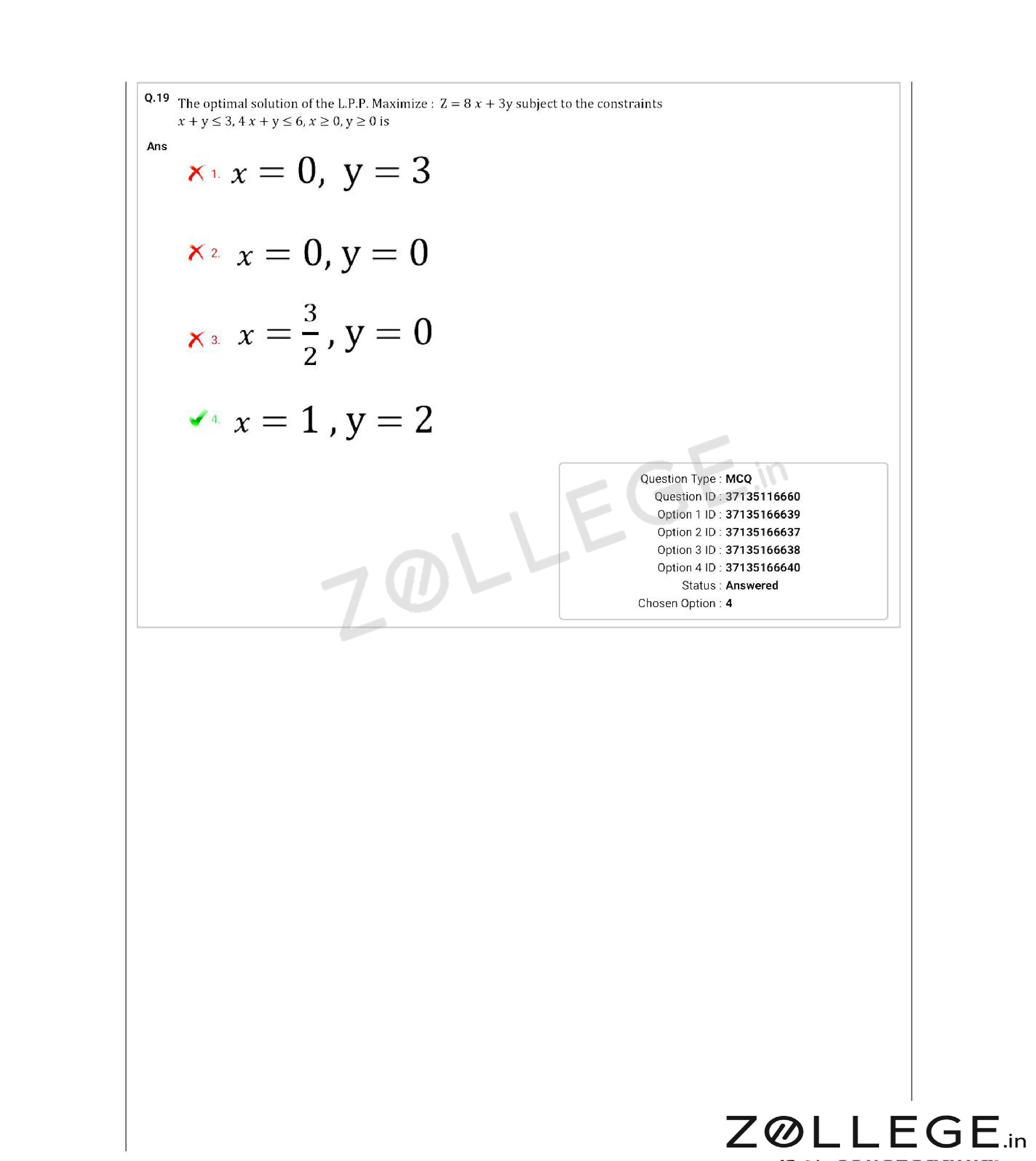
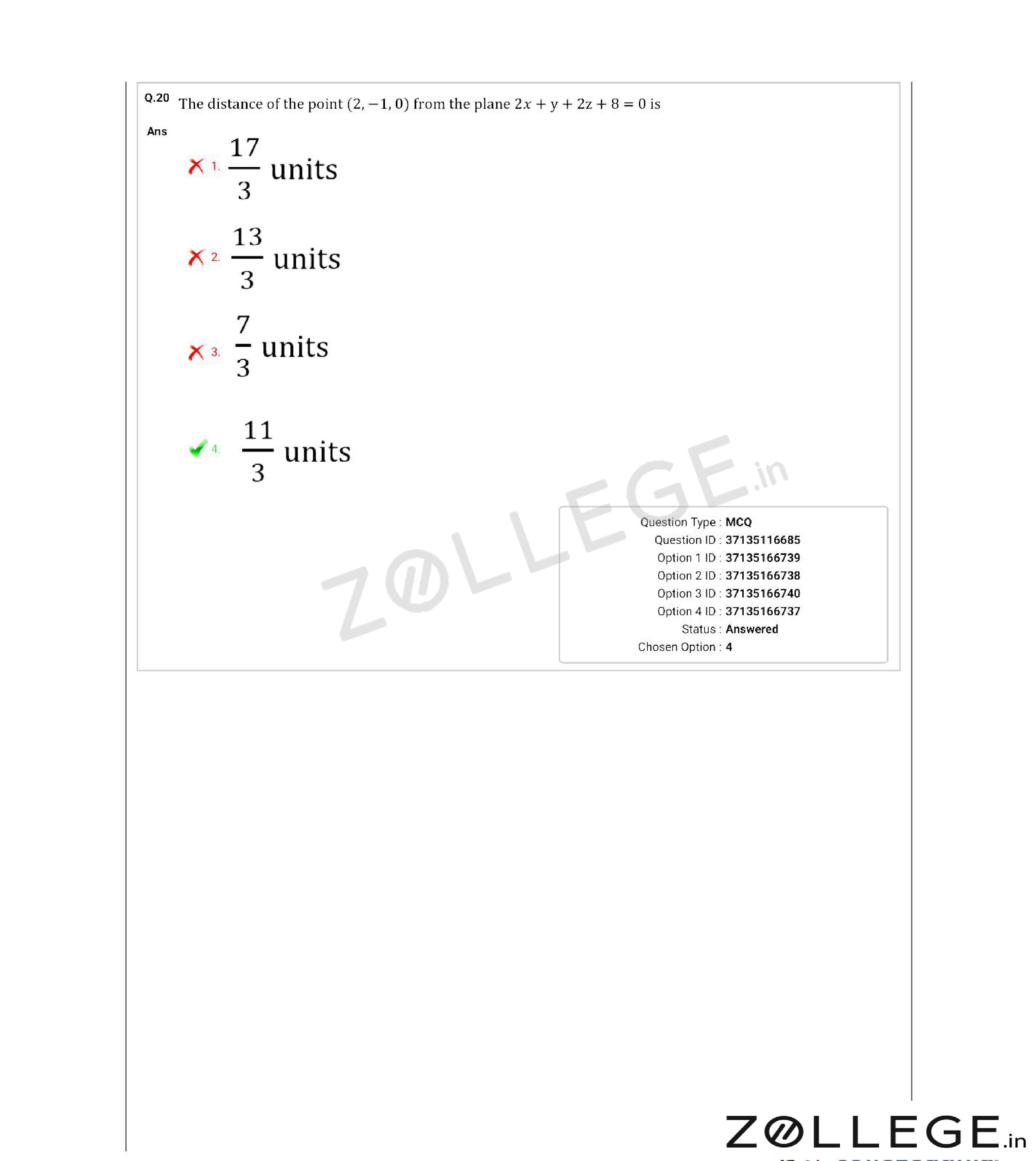
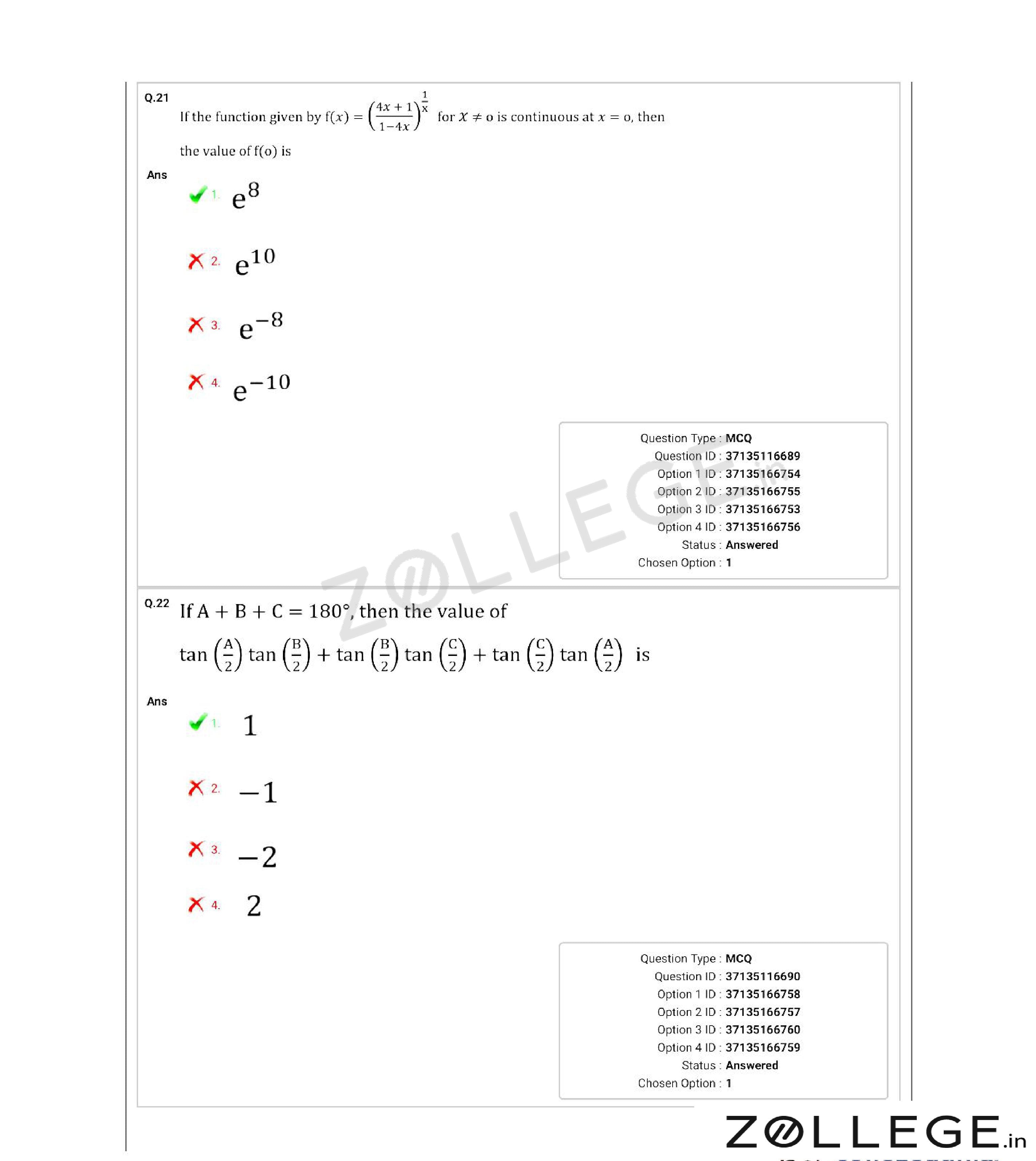
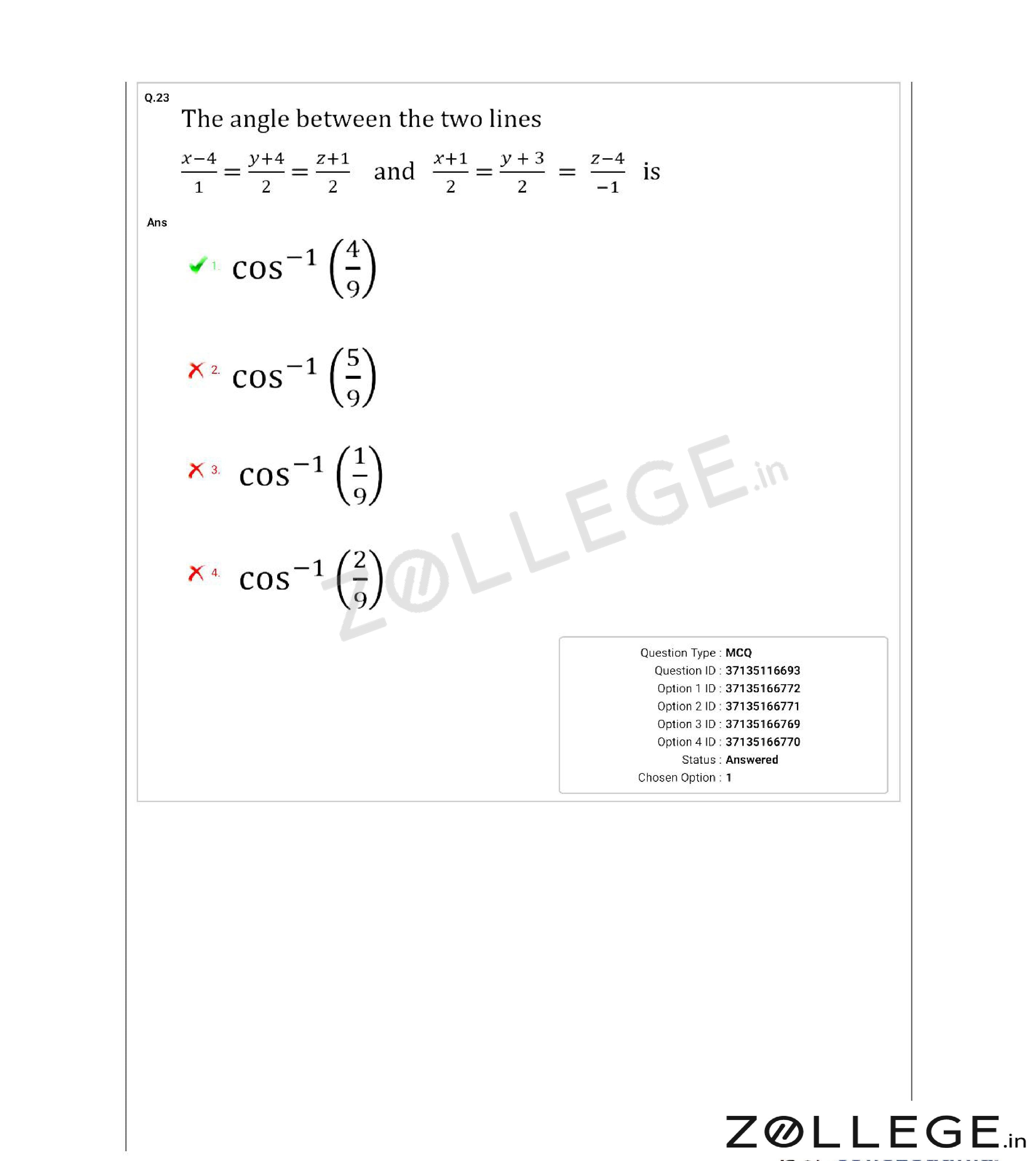
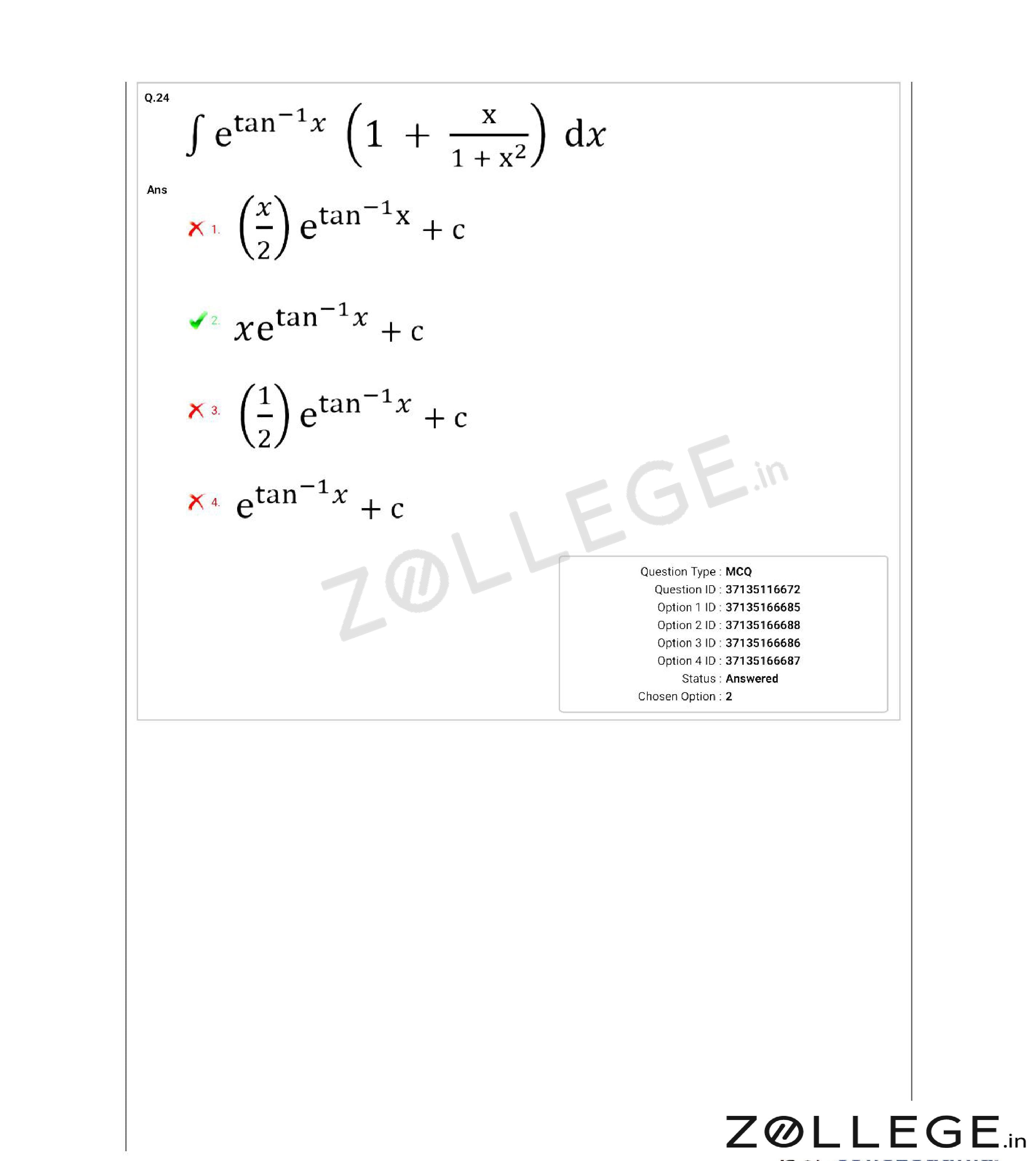
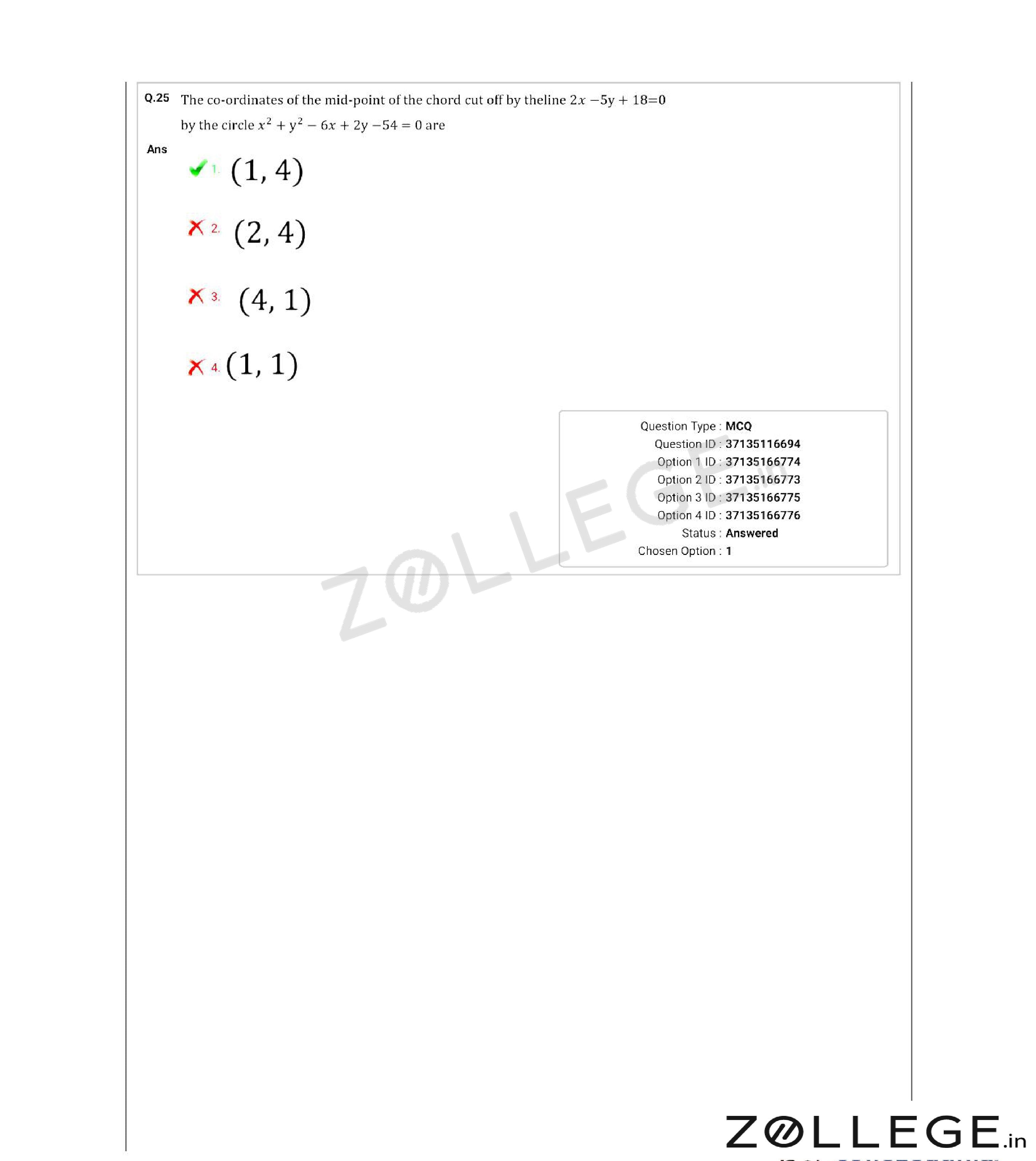
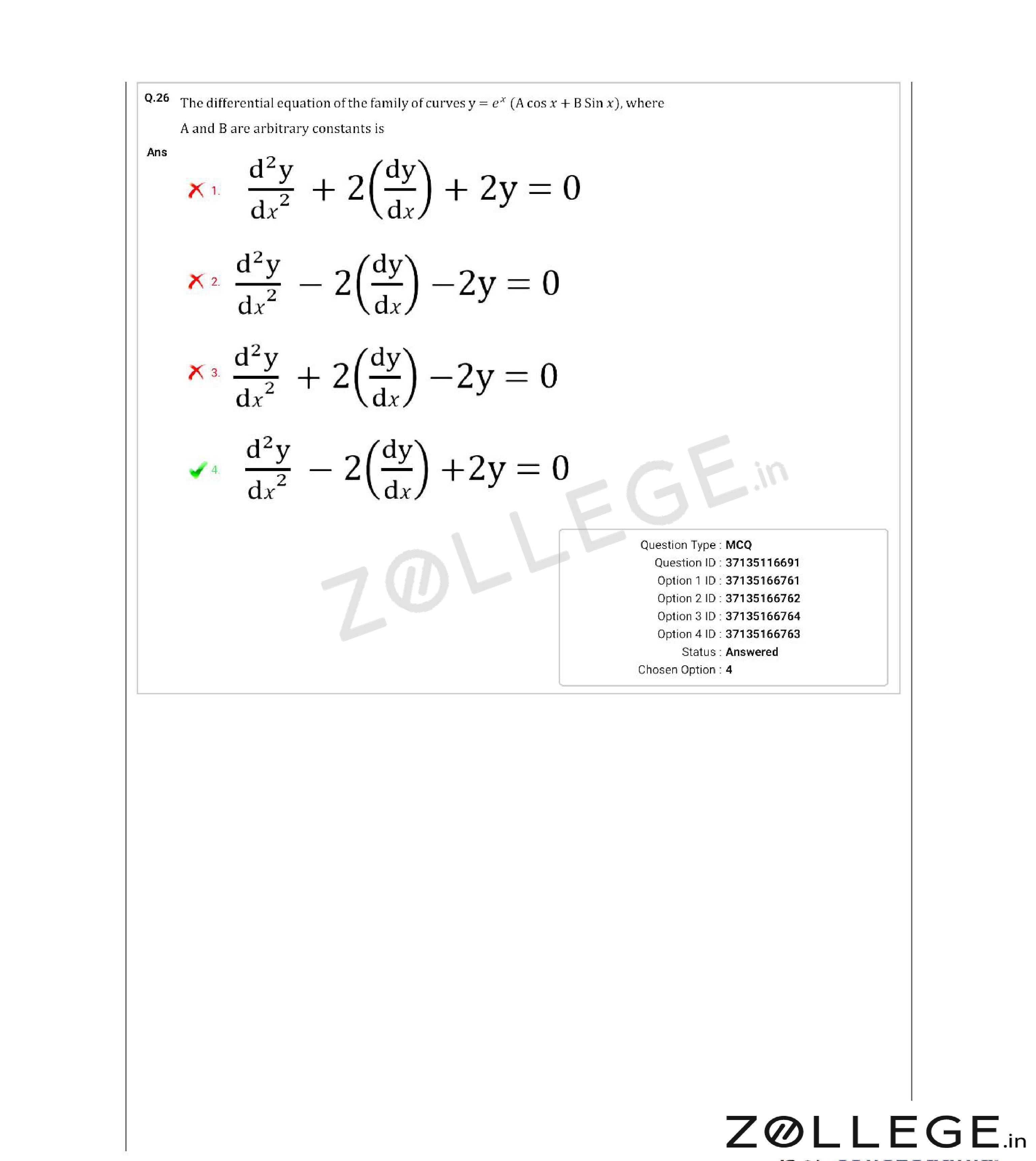
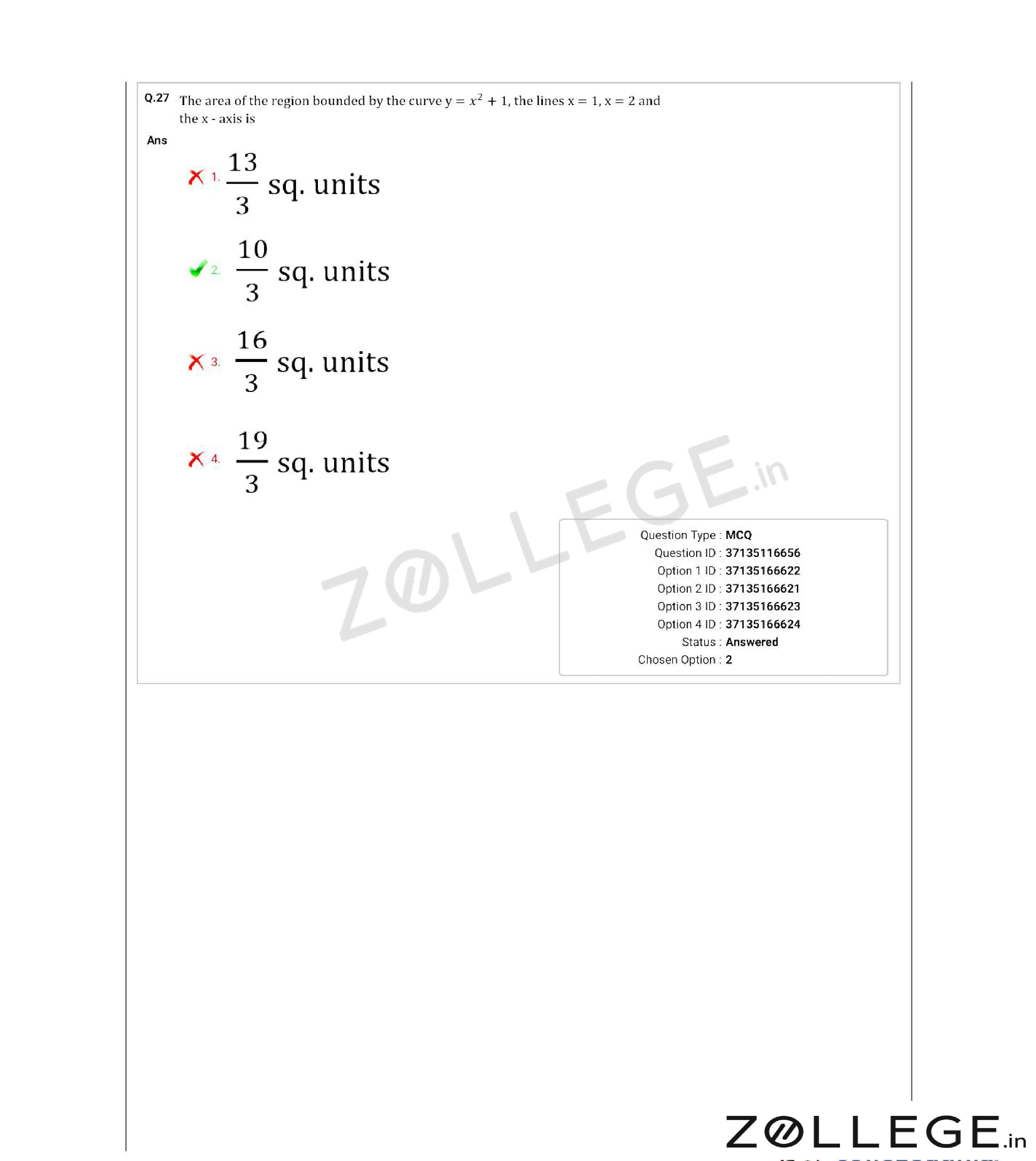
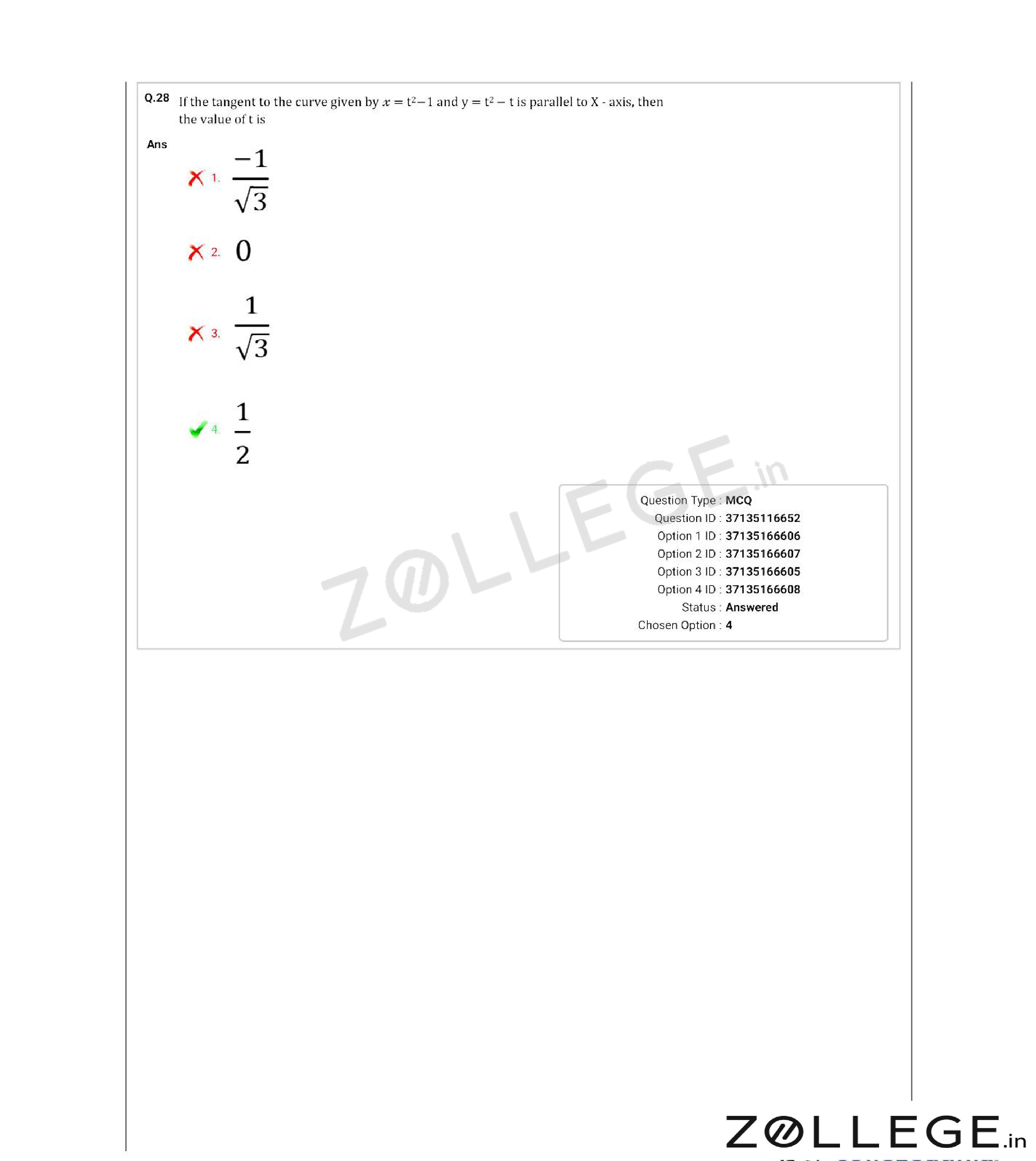
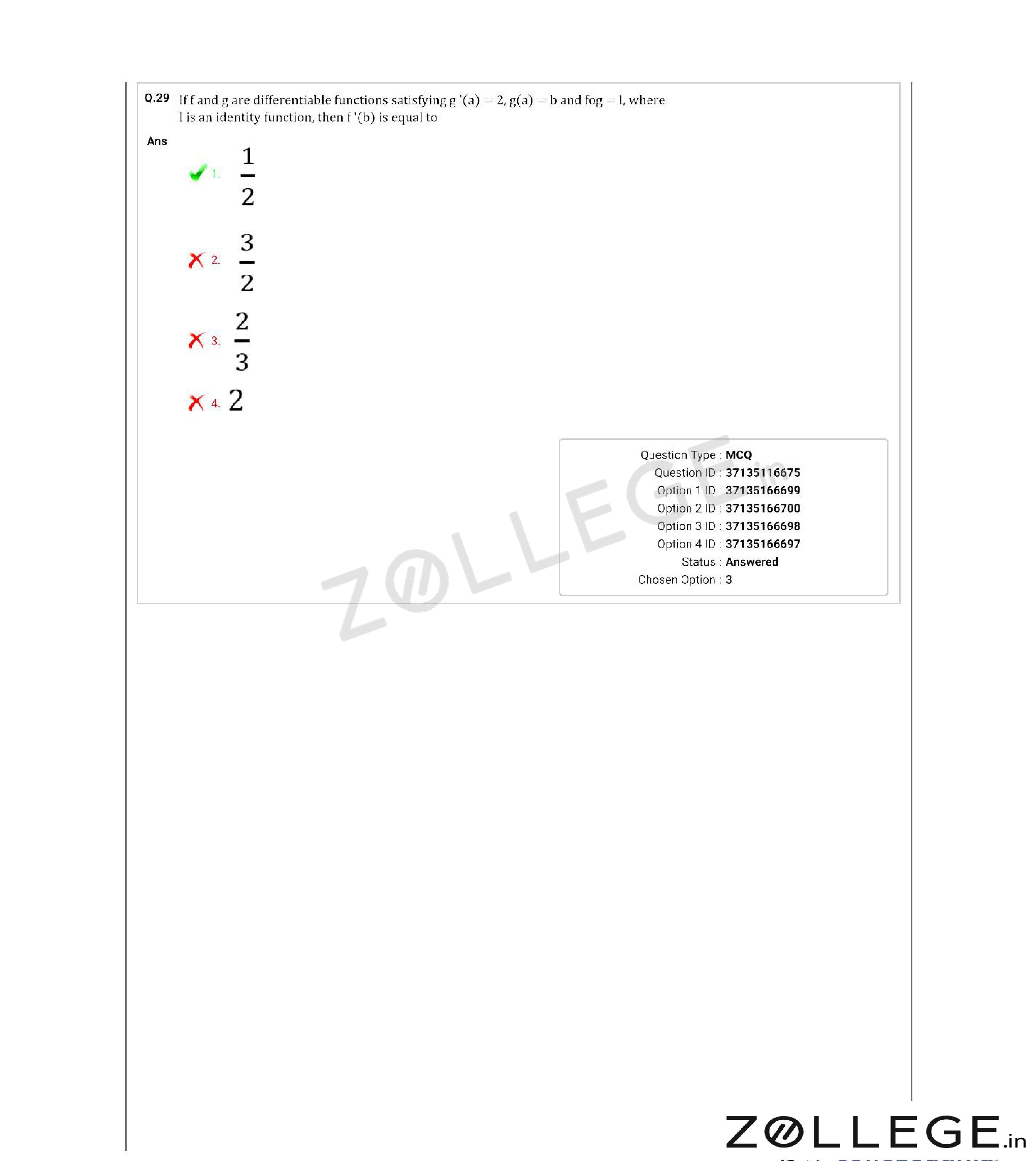
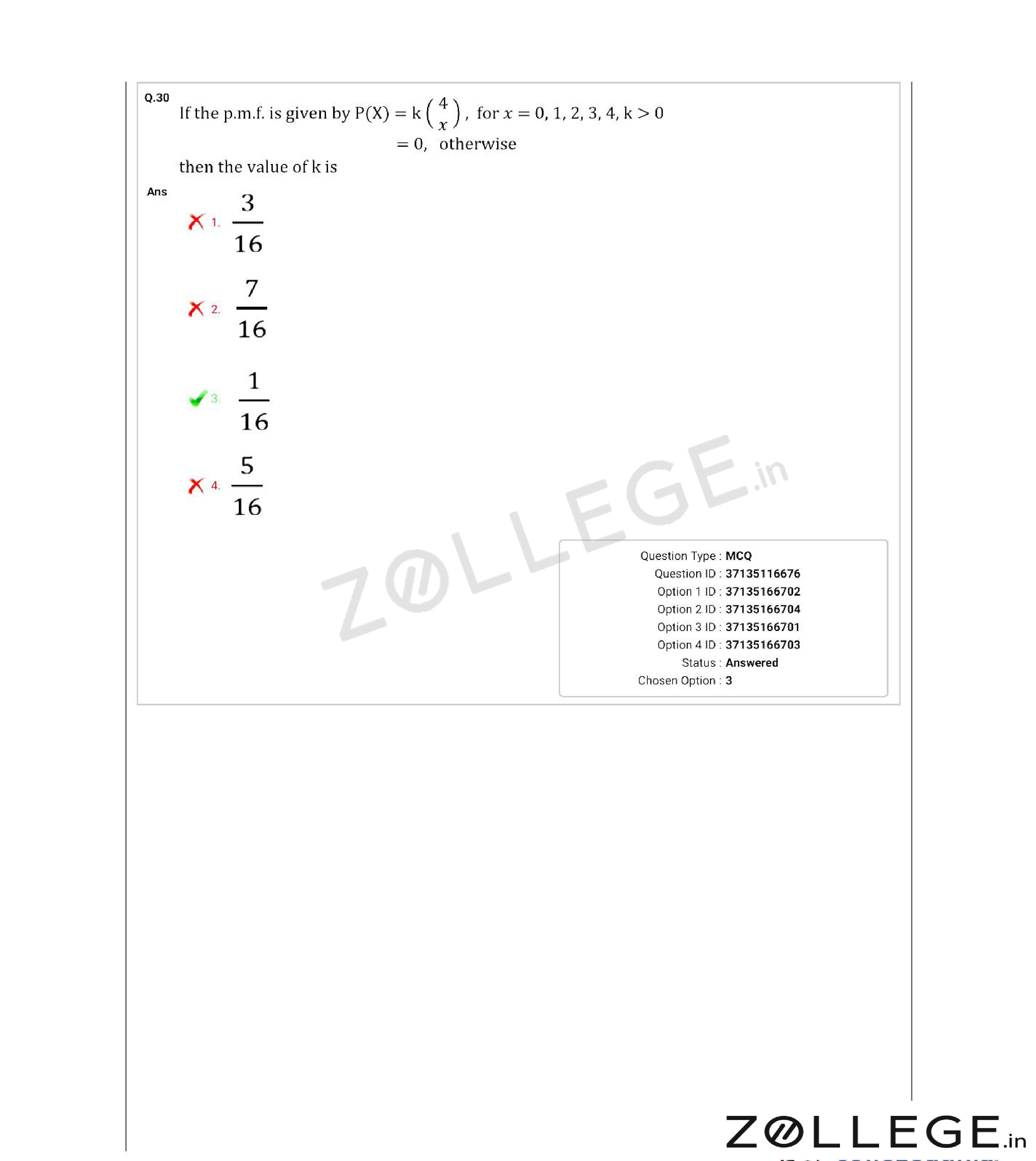
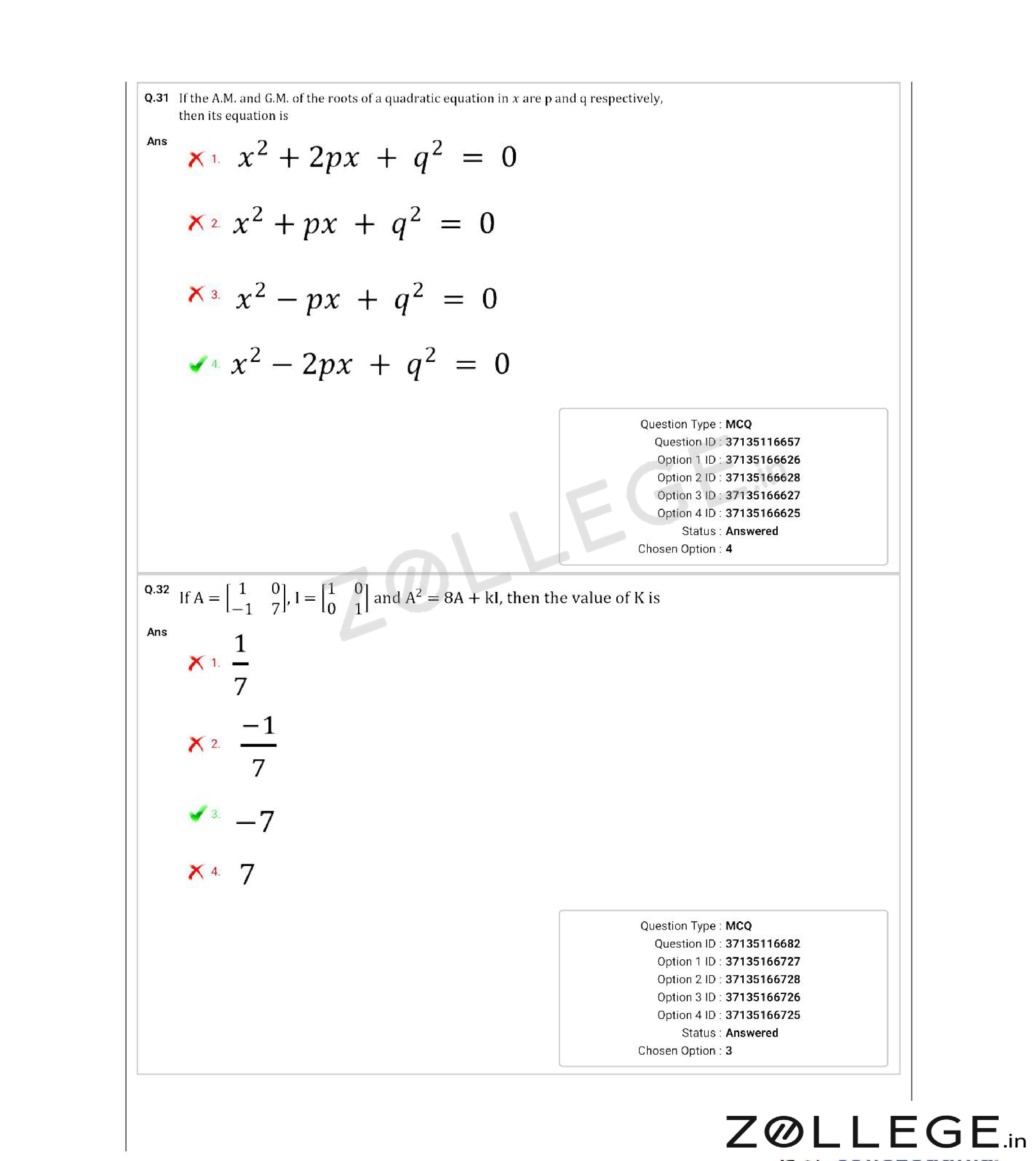
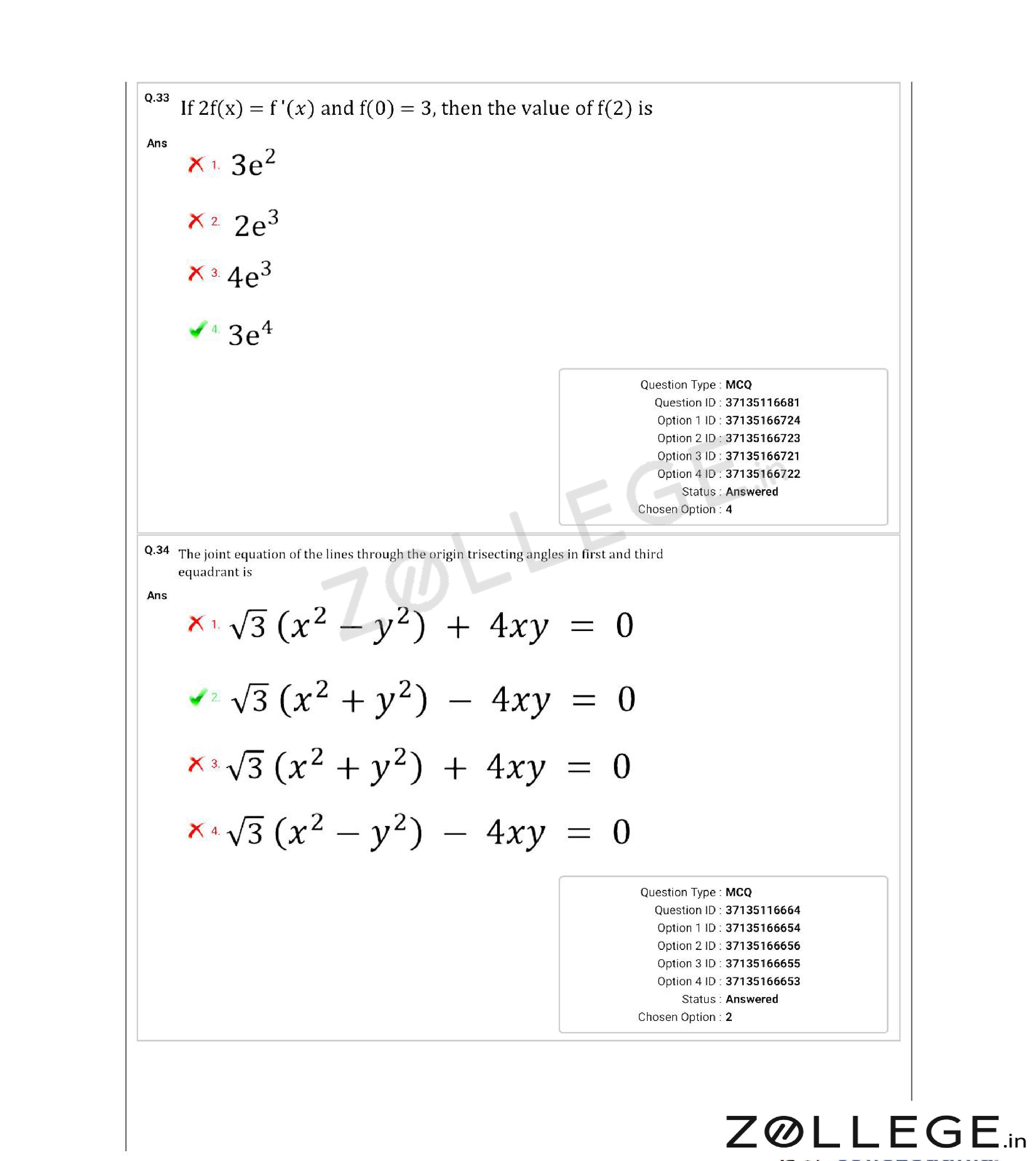
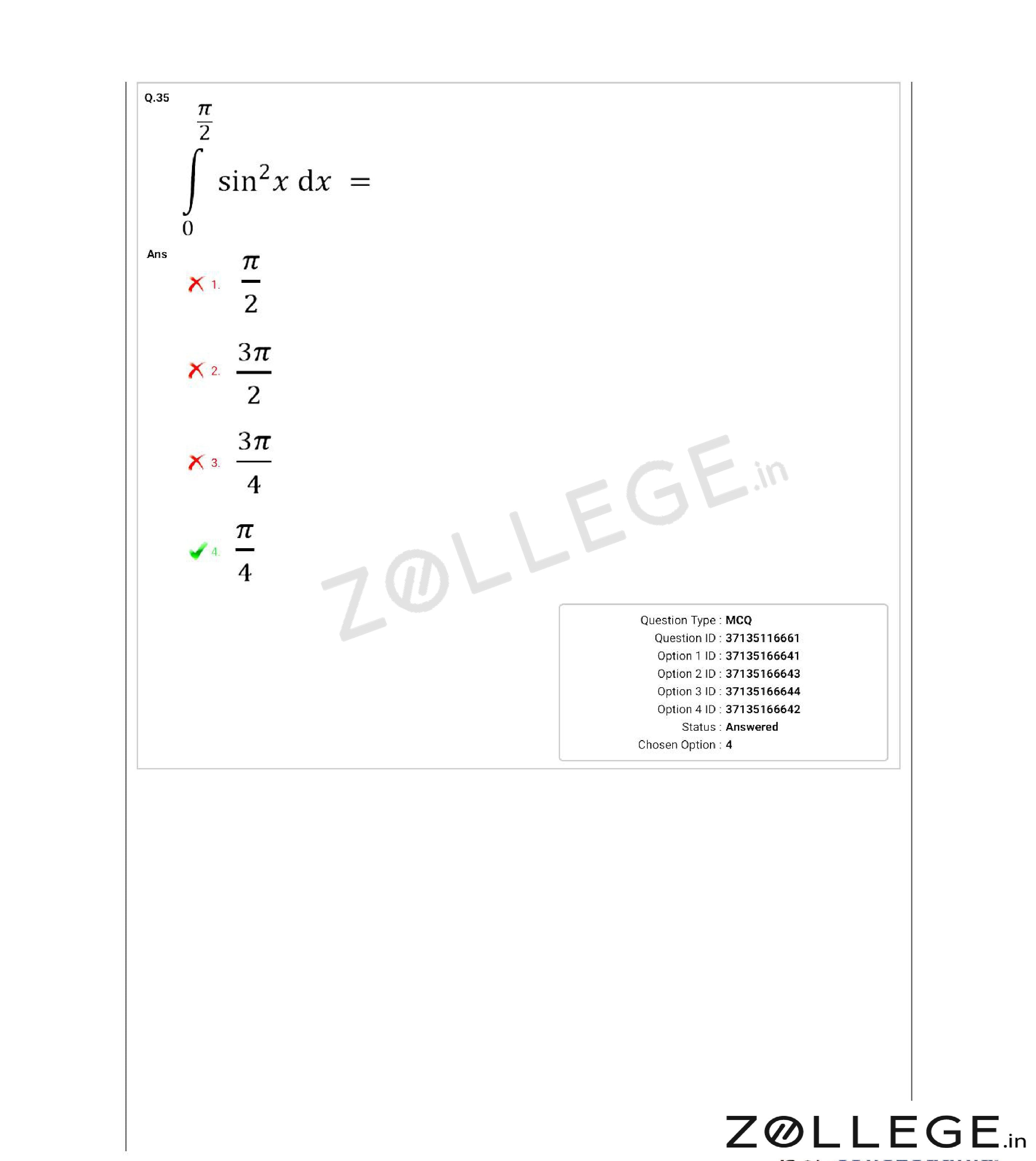
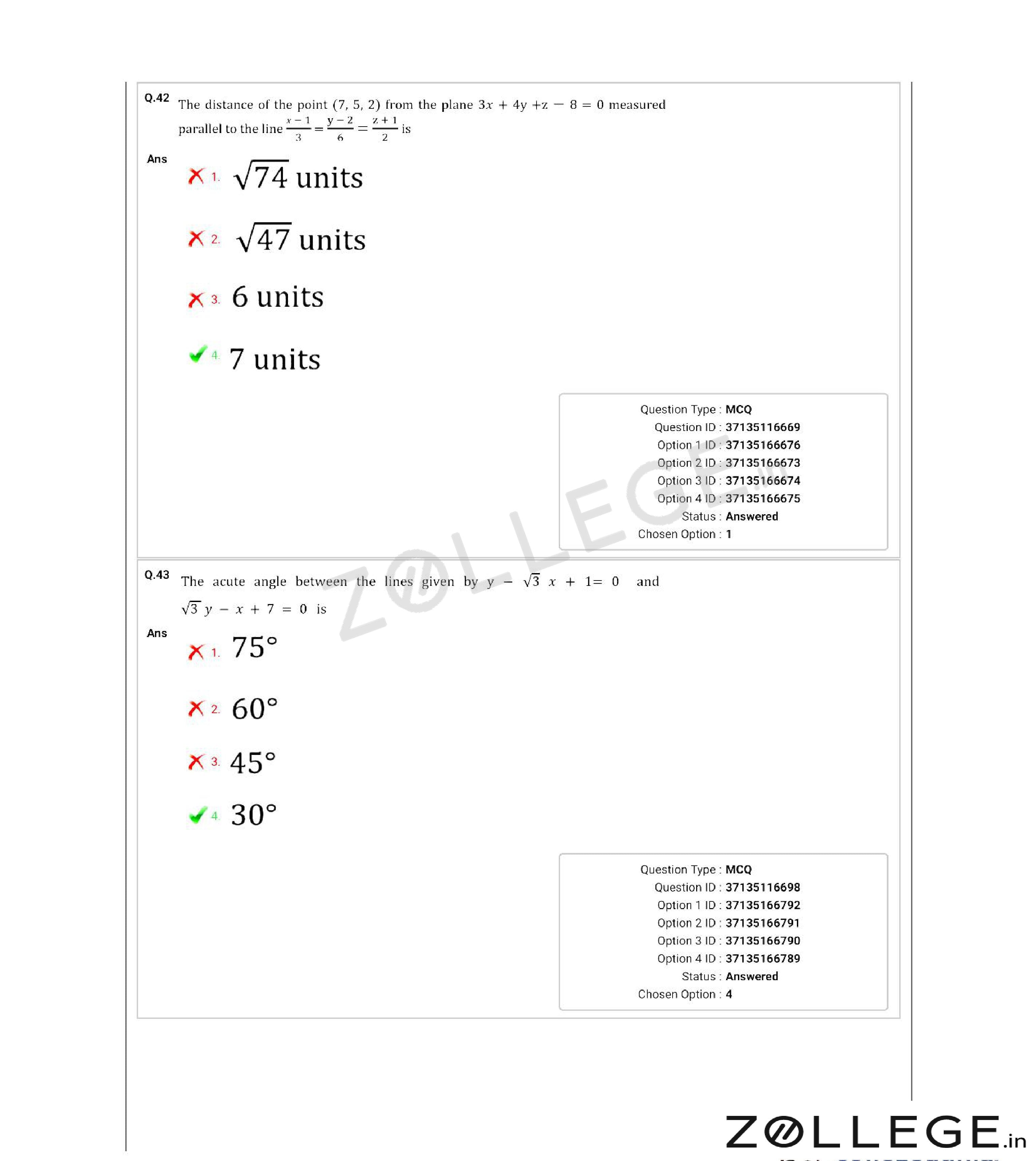
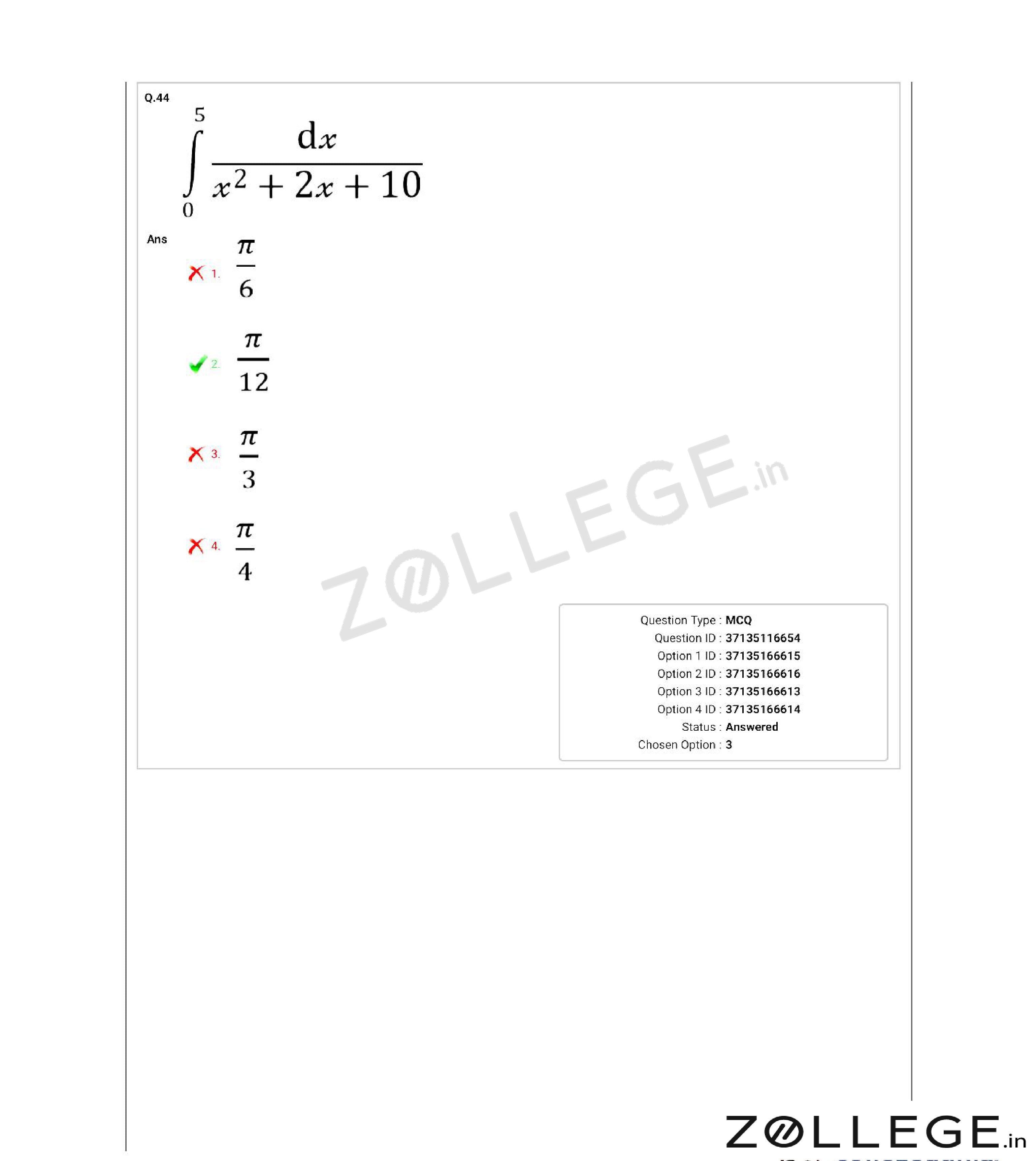
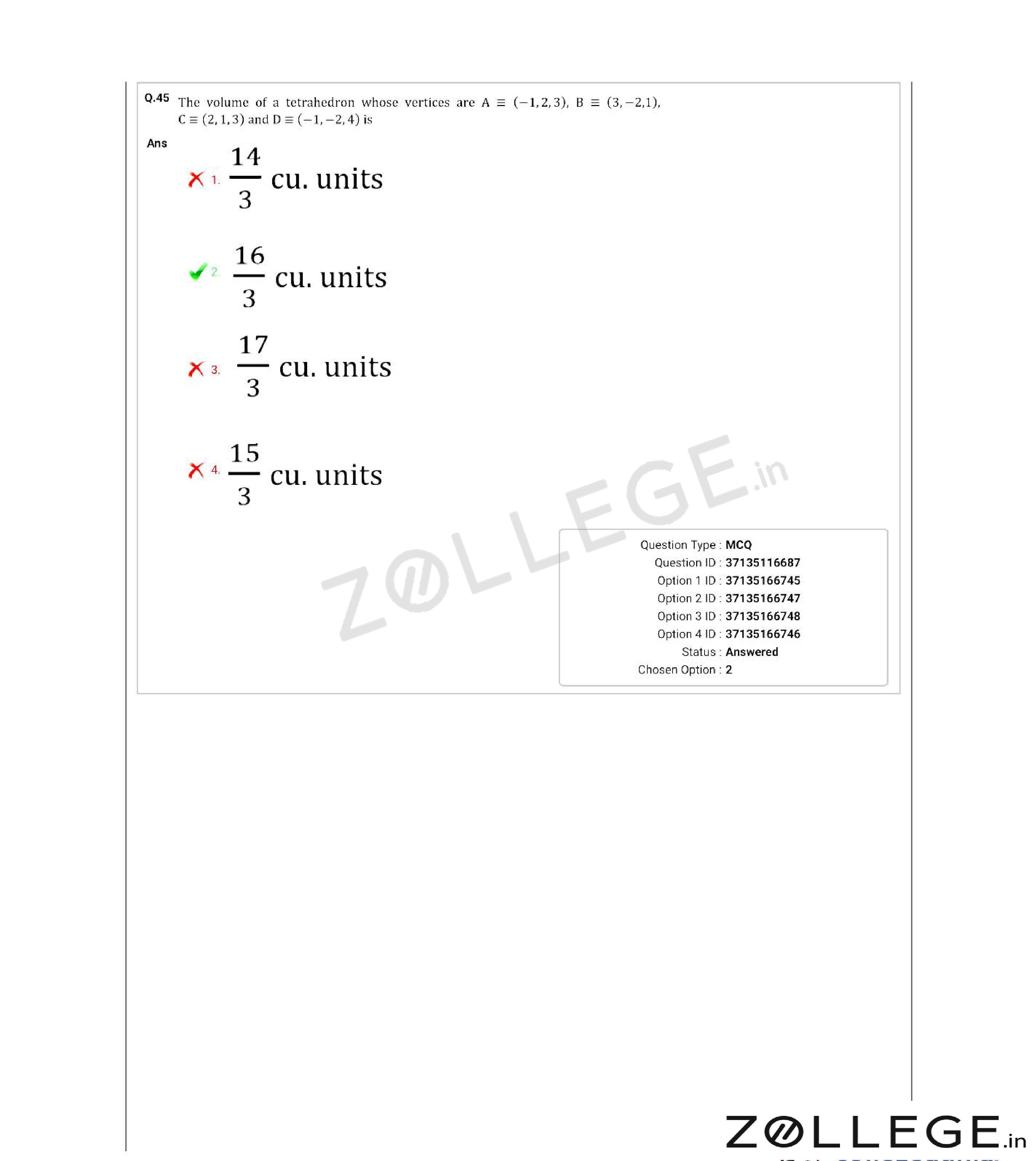
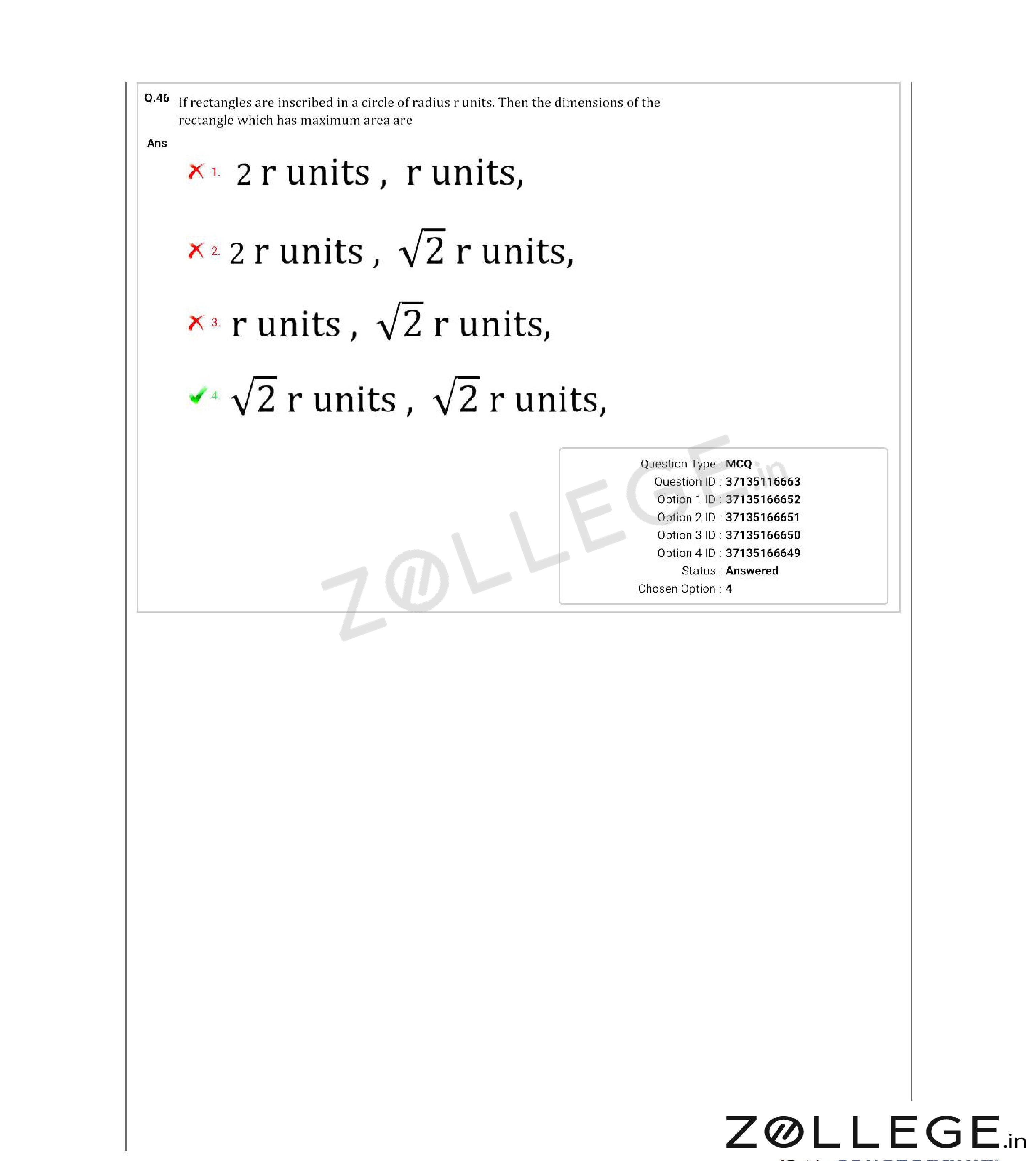
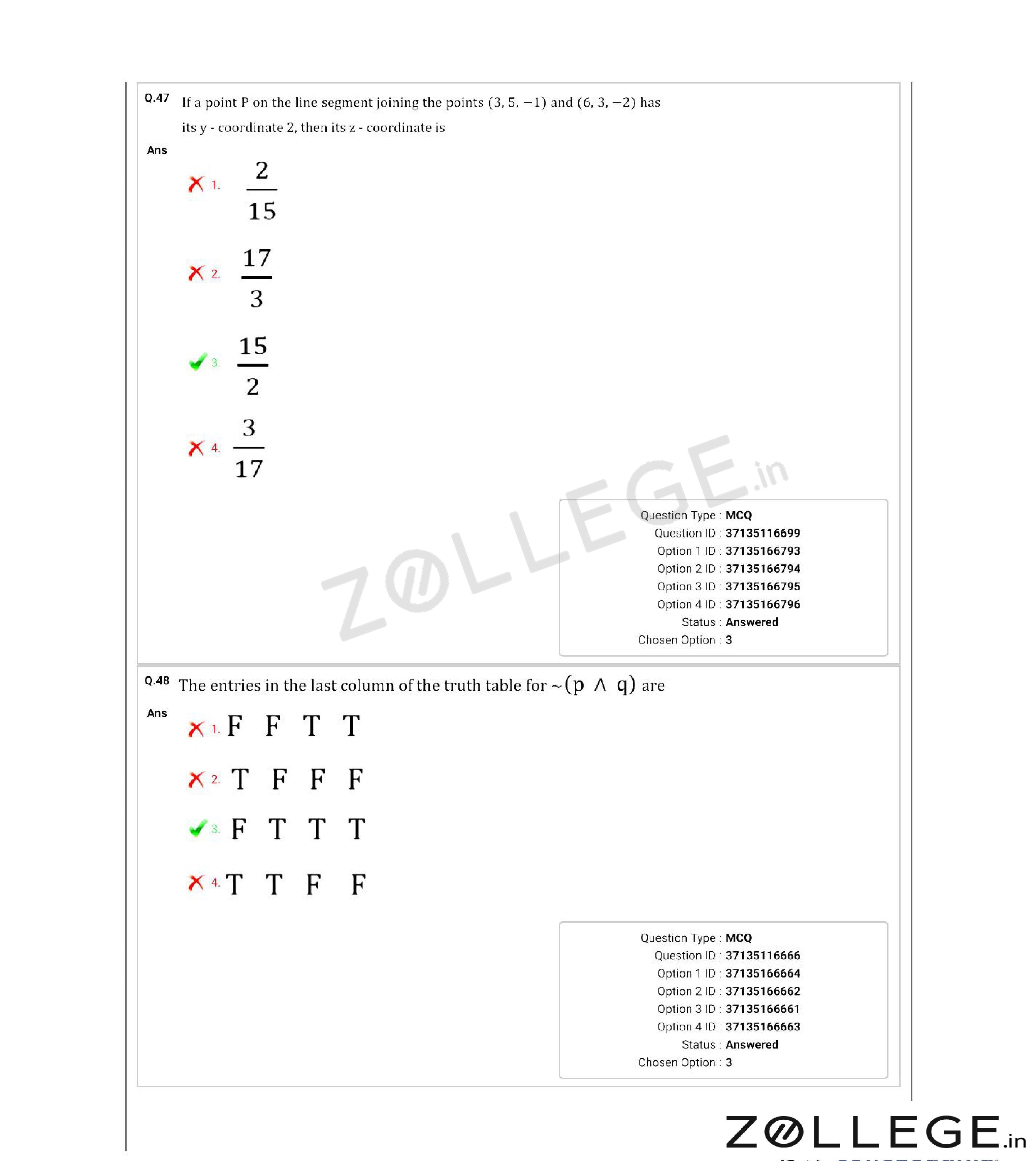
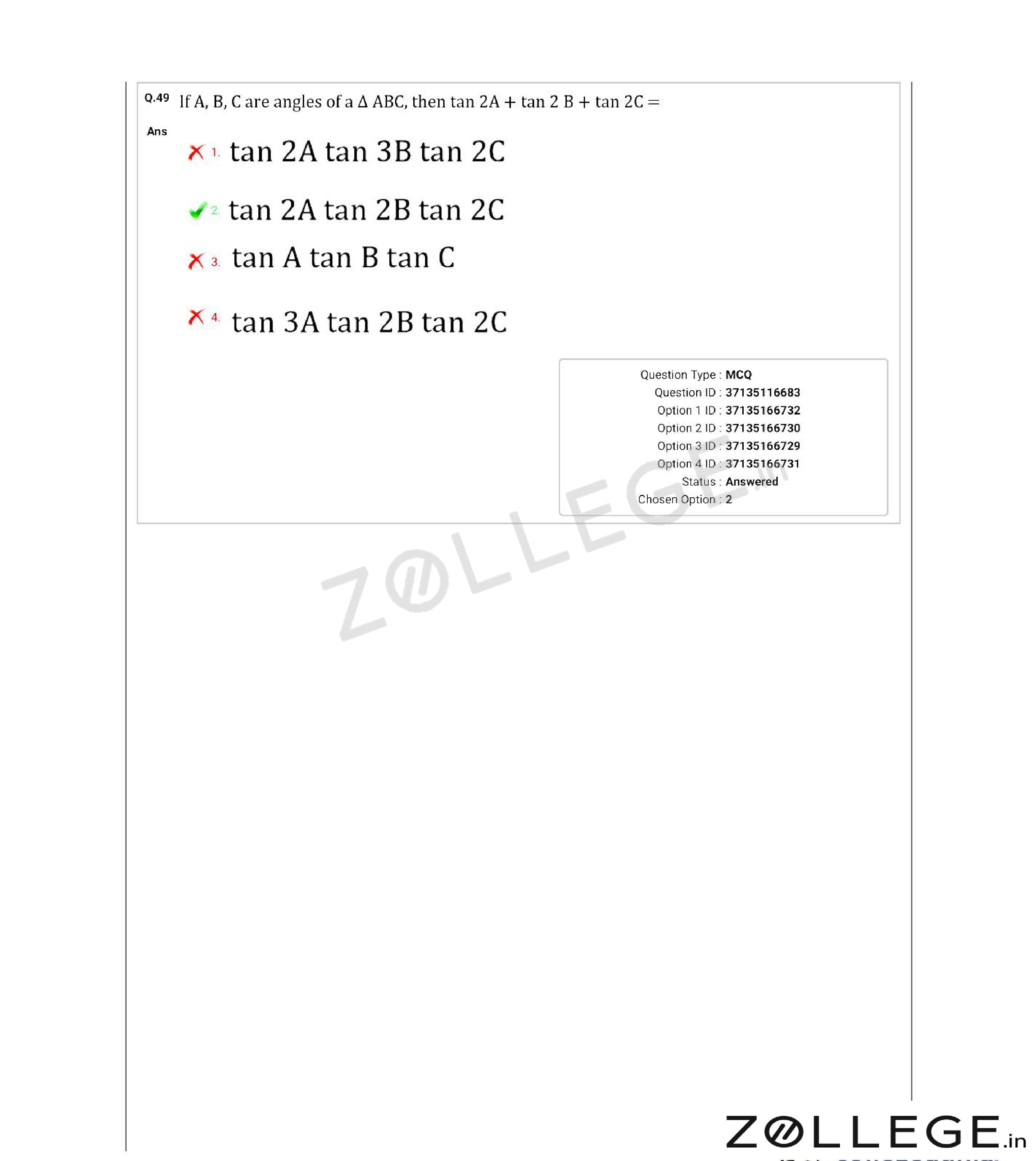
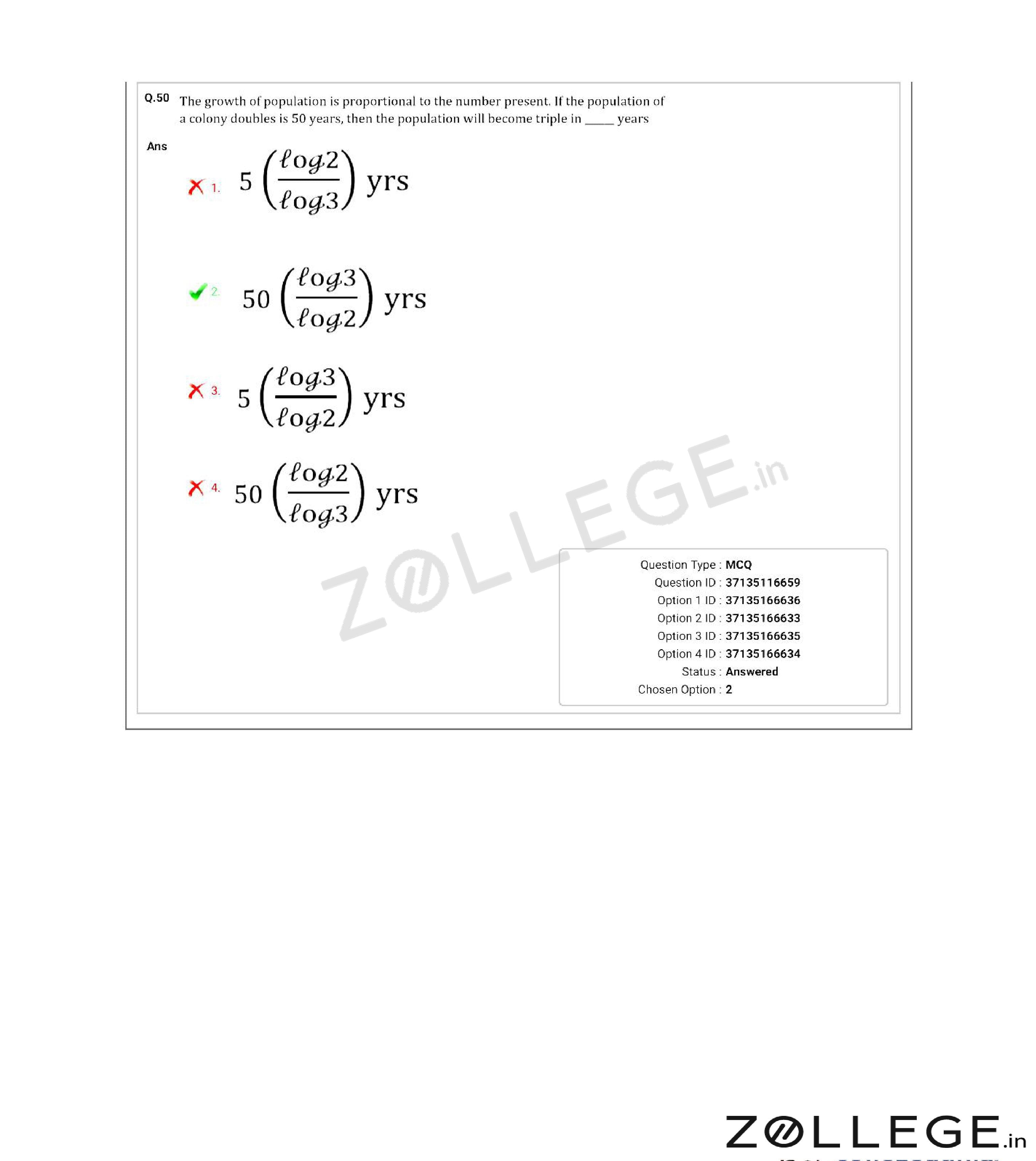
*The article might have information for the previous academic years, please refer the official website of the exam.