
MHT CET 2020 Question Paper with Solution PDF for PCM (October 20)


Content Writer | Updated On - Jan 20, 2026
MHT CET Question Papers are the most important study material for effective exam preparation. We at Zollege have provided all MHT CET Previous Year Papers with Solution PDFs here. MHT CET 2020 PCM exam was conducted successfully on October 20 by Shift 2.
Students can freely download the MHT CET previous year's question paper PDFs along with their solutions here.We strongly encourage MHT CET aspirants to scan through all the MHT CET Question Paper to know the overall difficulty level,MHT CET Syllabus and understand the changes in MHT CET Exam Pattern over the years.
MHT CET 2020 Oct 20 Shift 2 PCM Question Paper with Solution PDF
| MHT CET 2020 PCM Question Paper PDF | MHT CET 2020 PCM Solution PDF |
|---|---|
| Download PDF | Check Solutions |

The kinetic energy of a light body and a heavy body is same. Which one of the following statements is CORRECT?
View Solution
The relation between kinetic energy (\(K\)) and momentum (\(p\)) is given by \(K = \frac{p^2}{2m}\).
Rearranging for momentum, we get \(p = \sqrt{2mK}\).
Given that both bodies have the same kinetic energy \(K\), the momentum is directly proportional to the square root of the mass (\(p \propto \sqrt{m}\)).
Since the heavy body has a larger mass (\(m_{heavy} > m_{light}\)), it will have greater momentum.
Quick Tip: For constant Kinetic Energy, \(p \propto \sqrt{m}\). For constant Momentum, \(K \propto \frac{1}{m}\).
A simple pendulum has length 2m and a bob of mass 100 gram. It is whirled in a horizontal plane. If the string breaks under a tension of 10 N, the angle made by the string with vertical is (g = 10m/s\(^2\))
View Solution
This is a case of a conical pendulum. The vertical component of the tension balances the weight of the bob.
The equation for vertical equilibrium is \(T \cos \theta = mg\).
Given: Tension \(T = 10\) N, Mass \(m = 100 g = 0.1\) kg, \(g = 10 m/s^2\).
Substituting the values: \(10 \cdot \cos \theta = 0.1 \cdot 10\).
\(10 \cos \theta = 1\).
\(\cos \theta = \frac{1}{10} = 0.1\).
Therefore, \(\theta = \cos^{-1}(0.1)\).
Quick Tip: In a conical pendulum, the tension \(T\) is always greater than the weight \(mg\) because \(T = mg / \cos \theta\) and \(\cos \theta < 1\).
The current drawn from the battery in the given network is (Internal resistance of battery is neglected)

View Solution
The circuit represents a Wheatstone bridge. Let's check if it is balanced.
The ratio of resistors in the upper arms relative to the input is \(3\Omega / 3\Omega = 1\). (Assuming standard bridge configuration). Or more simply, the ratio of left side resistors is \(3/3 = 1\) and right side is \(2/2 = 1\).
Since the bridge is balanced, no current flows through the central \(5\Omega\) resistor. It can be removed.
The circuit simplifies to two parallel branches connected to the 6V source.
Top branch resistance: \(R_1 = 3 + 2 = 5 \Omega\).
Bottom branch resistance: \(R_2 = 3 + 2 = 5 \Omega\).
Equivalent resistance \(R_{eq}\) of two \(5\Omega\) resistors in parallel is \(2.5 \Omega\).
Total current \(I = \frac{V}{R_{eq}} = \frac{6}{2.5} = \frac{12}{5} = 2.4\) A.
Quick Tip: Always check for the balanced Wheatstone bridge condition (\(R_1/R_2 = R_3/R_4\)) in complex resistor networks. If balanced, remove the central component.
In the expression \(A = B + \frac{C}{D + E}\), the dimensions of physical quantities B and C are \([L^1M^0T^{-1}]\) and \([L^1M^0T^0]\) respectively. The dimensions of quantities A, D and E are
View Solution
By the principle of homogeneity, terms added together must have the same dimensions.
1. In the denominator \((D + E)\), \(D\) and \(E\) must have the same dimensions. So \([D] = [E]\).
2. The entire term \(\frac{C}{D+E}\) is added to \(B\), so it must have the same dimensions as \(B\).
\([B] = [L T^{-1}]\). Given \([C] = [L]\).
So, \(\frac{[L]}{[D]} = [L T^{-1}]\).
Solving for \([D]\): \([D] = \frac{[L]}{[L T^{-1}]} = [T^1]\).
Thus, \([D] = [T^1]\) and \([E] = [T^1]\).
3. Quantity \(A\) is the sum, so \([A] = [B] = [L^1 M^0 T^{-1}]\).
Comparing with options, (A) is the correct match.
Quick Tip: You can only add or subtract physical quantities if they have identical dimensions.
In the given circuit, current flowing through it is

View Solution
The circuit shows two batteries connected in opposition (positive terminal to positive terminal).
The net EMF is the difference between the larger and smaller voltage: \(V_{net} = 200 V - 10 V = 190 V\).
The total resistance is \(R = 38 \Omega\).
Using Ohm's Law, Current \(I = \frac{V_{net}}{R}\).
\(I = \frac{190}{38} = 5\) A.
Quick Tip: When batteries are connected with same polarity terminals facing each other, their EMFs subtract.
Two satellites of masses 'm' and '4m' are revolving in a same orbit around the earth. Which one of the following statements is correct?
View Solution
The time period of a satellite orbiting Earth is given by \(T = 2\pi \sqrt{\frac{r^3}{GM}}\), where \(M\) is the mass of Earth and \(r\) is the orbital radius.
This expression is independent of the mass of the satellite (\(m\)).
Since both satellites are in the same orbit, they have the same radius \(r\).
Therefore, they must have the same time period.
Note: Kinetic and Potential energies depend on the satellite's mass (\(m\)), so they would be different.
Quick Tip: Orbital parameters like speed, period, and height are independent of the satellite's mass. Energy depends on mass.
Choose the CORRECT statement from the following. Brewster's angle for a transparent medium is
View Solution
Brewster's angle (\(\theta_p\)) is given by the relation \(\tan \theta_p = \mu\), where \(\mu\) is the refractive index of the medium.
According to Cauchy's relationship, the refractive index \(\mu\) varies with wavelength (color) of light (\(\mu = A + B/\lambda^2\)).
Since different colors have different wavelengths, they have different refractive indices.
Consequently, the Brewster's angle will be different for different colors of light.
Quick Tip: Refractive index \(\mu\) is inversely proportional to wavelength. Violet light has a higher \(\mu\) and thus a larger Brewster angle than Red light.
A vector \(\vec{A}\) having magnitude 6 units is added to vector \(\vec{B}\), which is along x-axis. The resultant of \(\vec{A}\) and \(\vec{B}\) is along Y axis. If the magnitude of the resultant of \(\vec{A}\) and \(\vec{B}\) is three times that of \(\vec{B}\) then magnitude of \(\vec{B}\) is
View Solution
Let vector \(\vec{B} = B \hat{i}\).
The resultant vector \(\vec{R}\) is along the Y-axis, so \(\vec{R} = R \hat{j}\).
From vector addition, \(\vec{A} + \vec{B} = \vec{R} \implies \vec{A} = \vec{R} - \vec{B} = R \hat{j} - B \hat{i}\).
The magnitude of \(\vec{A}\) is given as 6. So, \(A^2 = B^2 + R^2 = 6^2 = 36\).
We are given that the magnitude of the resultant is three times that of B, i.e., \(R = 3B\).
Substitute \(R = 3B\) into the magnitude equation: \(B^2 + (3B)^2 = 36\).
\(B^2 + 9B^2 = 36 \implies 10B^2 = 36\).
\(B^2 = 3.6\).
\(B = \sqrt{3.6}\).
Quick Tip: When vectors form a right-angled triangle (as components often do), use Pythagoras theorem: \(Hypotenuse^2 = Base^2 + Perpendicular^2\).
Let a force \(\vec{F} = -F\hat{k}\) acts on the origin of cartesian frame of reference. The moment of force about a point \((1, -1)\) will be
View Solution
The moment of force (torque) \(\vec{\tau}\) about a pivot point \(P\) is given by \(\vec{\tau} = \vec{r} \times \vec{F}\).
Here, the force acts at the origin \(O(0,0,0)\) and the pivot is \(P(1, -1, 0)\).
The position vector \(\vec{r}\) is the vector from the pivot \(P\) to the point of application \(O\).
\(\vec{r} = \vec{r}_O - \vec{r}_P = (0 - 1)\hat{i} + (0 - (-1))\hat{j} = -\hat{i} + \hat{j}\).
The force is \(\vec{F} = -F\hat{k}\).
Calculating the cross product: \(\vec{\tau} = (-\hat{i} + \hat{j}) \times (-F\hat{k})\).
\(\vec{\tau} = (-\hat{i}) \times (-F\hat{k}) + (\hat{j}) \times (-F\hat{k})\).
\(\vec{\tau} = F(\hat{i} \times \hat{k}) - F(\hat{j} \times \hat{k})\).
Using \(\hat{i} \times \hat{k} = -\hat{j}\) and \(\hat{j} \times \hat{k} = \hat{i}\):
\(\vec{\tau} = F(-\hat{j}) - F(\hat{i}) = -F(\hat{i} + \hat{j})\).
Note: The calculated answer is \(-F(\hat{i} + \hat{j})\). However, the answer key provides \(F(\hat{i} + \hat{j})\). This suggests a potential sign convention difference in the question's definition of position vector (e.g., taking vector from force to pivot) or a typo in the question's force direction. Mathematically, the magnitude and vector components match the structure of option (D) if signs are inverted.
Quick Tip: Torque \(\vec{\tau} = \vec{r} \times \vec{F}\). Be careful with the direction of \(\vec{r}\), which points from the axis of rotation (pivot) to the point where the force is applied.
In an atom, electron of charge \((-e)\) performs U.C.M. around a stationary positively charged nucleus, with period of revolution 'T'. If 'r' is the radius of the orbit of the electron and 'v' is the orbital velocity, then the circulating current (I) is proportional to
View Solution
Current \(I\) is defined as the rate of flow of charge, \(I = q/T\).
Here, charge \(q = e\) and \(T\) is the time period of revolution.
The time period \(T\) is related to velocity and radius by \(T = \frac{2\pi r}{v}\).
Substituting \(T\) into the current equation: \(I = \frac{e}{(2\pi r / v)} = \frac{e v}{2\pi r}\).
Ignoring constants, the proportional relationship is \(I \propto e^1 v^1 r^{-1}\).
Quick Tip: For a revolving charge, the equivalent current is \(I = q f = \frac{q v}{2\pi r}\).
A body of mass 'm' moving with speed 3 m/s collides with a body of mass '2m' at rest. The coalesced mass will start to move with a speed of
View Solution
This is a perfectly inelastic collision where the bodies stick together. Conservation of linear momentum applies.
Initial Momentum \(P_i = m_1 v_1 + m_2 v_2 = m(3) + 2m(0) = 3m\).
Final Mass \(M = m + 2m = 3m\).
Let the final velocity be \(v'\). Final Momentum \(P_f = (3m)v'\).
By conservation of momentum, \(P_i = P_f \implies 3m = 3m v'\).
\(v' = 1\) m/s.
Quick Tip: In inelastic collisions, momentum is conserved (\(m_1 u_1 + m_2 u_2 = (m_1 + m_2)v\)), but kinetic energy is not.
We have a sample of gas characterised by P, V and T and another sample of gas characterised by 2P, V/4, and 2T. What is the ratio of the number of molecules in the first and second samples?
View Solution
Using the Ideal Gas Law \(PV = NkT\), the number of molecules is \(N = \frac{PV}{kT}\).
For the first sample: \(N_1 = \frac{PV}{kT}\).
For the second sample: \(N_2 = \frac{(2P)(V/4)}{k(2T)} = \frac{0.5 PV}{2kT} = \frac{1}{4} \frac{PV}{kT}\).
Substituting \(N_1\): \(N_2 = \frac{1}{4} N_1\).
The ratio \(N_1 : N_2 = 1 : (1/4) = 4 : 1\).
Quick Tip: Write the variables of the second state in terms of the first to easily find the ratio. \(N \propto \frac{PV}{T}\).
When a capacitor is connected in series LR circuit, the alternating current flowing in the circuit
View Solution
In a series LR circuit, the impedance is \(Z_{LR} = \sqrt{R^2 + X_L^2}\).
When a capacitor is added in series, it becomes an LCR circuit. The new impedance is \(Z_{LCR} = \sqrt{R^2 + (X_L - X_C)^2}\).
The term \((X_L - X_C)^2\) is generally smaller than \(X_L^2\) (assuming the circuit moves closer to resonance where \(X_L = X_C\)).
Since the impedance \(Z\) decreases, the current \(I = V/Z\) increases.
Quick Tip: Adding a capacitor to an inductive circuit partially cancels the inductive reactance, reducing total impedance and increasing current.
A black body radiates maximum energy at wavelength '\(\lambda\)' and its emissive power is 'E'. Now, due to change in temperature of that body, it radiates maximum energy at wavelength \(\frac{2\lambda}{3}\). At that temperature, emissive power is
View Solution
According to Wien's Displacement Law, \(\lambda_{max} T = constant\). Thus, \(T \propto \frac{1}{\lambda_{max}}\).
New wavelength \(\lambda' = \frac{2}{3}\lambda\). Therefore, new temperature \(T' = \frac{3}{2}T\).
According to Stefan-Boltzmann Law, Emissive Power \(E \propto T^4\).
New power \(E' \propto (T')^4 = (\frac{3}{2}T)^4\).
\(E' = (\frac{3}{2})^4 E = \frac{81}{16} E\).
Quick Tip: Combine Wien's Law (\(T \propto 1/\lambda\)) and Stefan's Law (\(E \propto T^4\)) to get \(E \propto 1/\lambda^4\).
The area of a coil is 'A'. The coil is placed in a magnetic field which changes from '\(B_0\)' to '\(4B_0\)' in time 't'. The magnitude of induced e.m.f. in the coil will be
View Solution
Faraday's Law of Induction states that induced EMF \(|\epsilon| = \frac{d\Phi}{dt}\).
Magnetic Flux \(\Phi = B \cdot A\).
Change in flux \(\Delta \Phi = A(B_{final} - B_{initial}) = A(4B_0 - B_0) = 3AB_0\).
The change occurs in time \(t\).
Induced EMF \(|\epsilon| = \frac{\Delta \Phi}{t} = \frac{3AB_0}{t}\).
Quick Tip: Induced EMF depends on the rate of change of magnetic flux (\(BA\)). If area A is constant, \(\epsilon = A \frac{dB}{dt}\).
A body is moving along the horizontal surface with a velocity of 4 m/s. If the coefficient of kinetic friction is 0.2, the distance travelled by body before coming to rest is (g = 10 m/s\(^2\))
View Solution
The retardation caused by friction is \(a = -\mu g\).
Given \(\mu = 0.2\) and \(g = 10\), magnitude \(|a| = 0.2 \times 10 = 2 m/s^2\).
Using the kinematic equation \(v^2 = u^2 + 2as\).
Final velocity \(v = 0\), Initial velocity \(u = 4\).
\(0 = 4^2 + 2(-2)s\).
\(16 = 4s \implies s = 4\) m.
Quick Tip: Stopping distance formula: \(s = \frac{u^2}{2\mu g}\).
The fundamental frequency of open pipe is 'n'. If it is closed from one end then frequency of the 2nd harmonic of closed pipe is higher by 200 Hz than 'n'. The value of 'n' is
View Solution
Fundamental frequency of open pipe: \(n = \frac{v}{2L}\).
When closed at one end, the fundamental frequency is \(n_c = \frac{v}{4L}\).
The "2nd harmonic" of a closed pipe usually refers to the next available mode (the 1st overtone), which is the 3rd harmonic: \(f_3 = 3 \frac{v}{4L}\).
We can relate this to \(n\): \(f_3 = 3 \frac{v}{4L} = 1.5 \frac{v}{2L} = 1.5 n\).
Given that this frequency is 200 Hz higher than \(n\):
\(1.5 n - n = 200\).
\(0.5 n = 200\).
\(n = 400\) Hz.
Quick Tip: Open pipe harmonics: \(f, 2f, 3f...\). Closed pipe harmonics: \(f, 3f, 5f...\) (only odd multiples).
Identify the 'INCORRECT' statement from the following.
View Solution
The modulation index \(\mu\) determines the quality of the AM signal.
To avoid distortion (overmodulation), \(\mu\) must be kept less than or equal to 1 (\(\mu \le 1\)).
If \(\mu > 1\), the signal is overmodulated, leading to distortion and loss of information.
Therefore, statement (A) is scientifically incorrect, which makes it the correct answer to the question.
Quick Tip: For Amplitude Modulation, \(0 < \mu \le 1\). \(\mu > 1\) causes overmodulation.
If two light waves reaching at a point produce destructive interference, then condition of phase difference is
View Solution
Destructive interference occurs when the crest of one wave meets the trough of another.
This requires the waves to be out of phase by an odd multiple of \(\pi\).
The condition for phase difference \(\Delta \phi\) is \(\Delta \phi = (2n + 1)\pi\), where \(n = 0, 1, 2...\).
This generates the sequence: \(\pi, 3\pi, 5\pi...\).
Option (A) corresponds to Constructive interference (even multiples of \(\pi\)).
Quick Tip: Constructive: \(\Delta \phi = 2n\pi\). Destructive: \(\Delta \phi = (2n+1)\pi\).
What would be the absolute pressure at depth 1km below the ocean? [Given: density of water \(= 10^3 kg/m^3, g = 10 m/s^2, 1 atmospheric pressure = 1.01 \times 10^5 N/m^2\)]
View Solution
Absolute Pressure \(P = P_{atm} + P_{gauge} = P_{atm} + h \rho g\).
Given \(h = 1 km = 1000\) m, \(\rho = 10^3\), \(g = 10\).
\(P_{gauge} = 1000 \times 10^3 \times 10 = 10^7 = 100 \times 10^5\) Pa.
\(P_{atm} = 1.01 \times 10^5\) Pa.
\(P_{total} = 1.01 \times 10^5 + 100 \times 10^5 = 101.01 \times 10^5\) Pa.
In scientific notation matching the answer: \(10.101 \times 10^6\) Pa.
This matches option (D) \(10 \cdot 101 \times 10^6 N/m^2\).
Quick Tip: Absolute pressure includes atmospheric pressure. Gauge pressure is just \(\rho g h\).
An alternating electric field of frequency '\(v\)' is applied across the dees of a cyclotron which is used to accelerate protons of mass 'm'. The radius of the dees is 'R'. The operating magnetic field used in cyclotron is 'B'. The kinetic energy of the proton beam is given by
View Solution
The velocity of the proton in the cyclotron is given by \(V = R \omega\), where \(\omega = 2\pi v\).
So, \(V = R (2\pi v) = 2\pi v R\).
The kinetic energy is \(K = \frac{1}{2} m V^2\).
Substituting the expression for velocity: \(K = \frac{1}{2} m (2\pi v R)^2\).
\(K = \frac{1}{2} m (4 \pi^2 v^2 R^2)\).
\(K = 2 m \pi^2 v^2 R^2\).
Quick Tip: Kinetic energy in a cyclotron in terms of frequency: \(K = 2 m \pi^2 v^2 R^2\). In terms of magnetic field: \(K = \frac{q^2 B^2 R^2}{2m}\).
What will be the resistance of the shunt when 5% of the main current is passed through a galvanometer of resistance G?
View Solution
Let \(I\) be the main current. The current through the galvanometer is \(I_g = 5%\) of \(I = 0.05 I\).
The remaining current flows through the shunt \(S\): \(I_s = I - I_g = I - 0.05 I = 0.95 I\).
Since the galvanometer and shunt are in parallel, the potential difference across them is the same: \(I_g G = I_s S\).
Substituting the currents: \((0.05 I) G = (0.95 I) S\).
\(0.05 G = 0.95 S\).
\(S = \frac{0.05}{0.95} G = \frac{1}{19} G = \frac{G}{19}\).
Quick Tip: Formula for shunt resistance: \(S = \frac{I_g}{I - I_g} G\). Here ratio \(I_g/I = 1/20\), so \(S = \frac{1}{19} G\).
An engine is moving on a circular path of radius 200 m with speed of 15 m/s. What will be the frequency heard by an observer who is at rest at the centre of the circular path, when engine blows the whistle with frequency 250 Hz?
View Solution
The observer is at the center of the circular path.
The velocity vector of the engine (source) is always tangential to the circle.
The line of sight from the source to the observer is along the radius.
The angle between the velocity vector and the line joining source and observer is always \(90^\circ\).
The component of source velocity along the line of sight is \(v_s \cos 90^\circ = 0\).
Since there is no relative velocity along the line joining them, there is no Doppler shift.
Frequency heard = Actual frequency = 250 Hz.
Quick Tip: Doppler effect only happens if there is a relative velocity component along the line joining the source and observer.
In an resonance tube experiment, a tuning fork resonates with air column of length 12 cm and again resonates when air column is 38 cm long. The end correction will be
View Solution
For a closed organ pipe (resonance tube), the resonance lengths are given by \(L_1 + e = \frac{\lambda}{4}\) and \(L_2 + e = \frac{3\lambda}{4}\).
Subtracting the two equations: \((L_2 + e) - (L_1 + e) = \frac{3\lambda}{4} - \frac{\lambda}{4} = \frac{\lambda}{2}\).
\(38 - 12 = 26\) cm \(= \frac{\lambda}{2}\). So \(\lambda = 52\) cm.
Now substitute \(\lambda\) back into the first equation: \(12 + e = \frac{52}{4} = 13\).
\(e = 13 - 12 = 1\) cm.
Quick Tip: End correction formula: \(e = \frac{L_2 - 3L_1}{2}\). Check: \((38 - 36)/2 = 1\).
When the electron orbiting in hydrogen atom in its ground state moves to third excited state, the de-Broglie wavelength associated with it
View Solution
The de-Broglie wavelength is given by \(\lambda = \frac{h}{p} = \frac{h}{mv}\).
In a hydrogen atom, the velocity of the electron in the \(n\)-th orbit is inversely proportional to \(n\) (\(v \propto \frac{1}{n}\)).
Therefore, the wavelength is proportional to \(n\) (\(\lambda \propto n\)).
Ground state corresponds to \(n=1\). Third excited state corresponds to \(n=4\).
As the electron moves from \(n=1\) to \(n=4\), the value of \(n\) increases, so the wavelength \(\lambda\) increases.
Quick Tip: Orbital velocity \(v_n \propto 1/n\). De-Broglie wavelength \(\lambda \propto 1/v \propto n\). Higher orbit \(\implies\) larger wavelength.
A particle is revolving in anticlockwise sense along the circumference of a circle of radius 'r' with linear velocity 'v', then the angle between 'v' and angular velocity '\(\omega\)' will be
View Solution
The linear velocity vector \(\vec{v}\) lies in the plane of the circle, tangential to the path.
The angular velocity vector \(\vec{\omega}\) is directed along the axis of rotation, perpendicular to the plane of the circle (by the right-hand rule).
Since \(\vec{v}\) is in the plane and \(\vec{\omega}\) is perpendicular to the plane, the angle between them is \(90^\circ\).
Quick Tip: Vectors in circular motion: \(\vec{r}\) (radial), \(\vec{v}\) (tangential), \(\vec{\omega}\) (axial). All three are mutually perpendicular.
If the spherical planet of mass 'M' and radius 'R' suddenly shrinks to half its size, its mass reduces to half. The new moment of inertia of the planet about its diameter is
View Solution
The moment of inertia of a solid sphere is \(I = \frac{2}{5} MR^2\).
New mass \(M' = M/2\).
New radius \(R' = R/2\).
New moment of inertia \(I' = \frac{2}{5} M' (R')^2\).
\(I' = \frac{2}{5} (\frac{M}{2}) (\frac{R}{2})^2 = \frac{2}{5} \cdot \frac{M}{2} \cdot \frac{R^2}{4}\).
\(I' = \frac{2}{5} M R^2 \cdot \frac{1}{8} = \frac{1}{8} (\frac{2}{5} MR^2)\).
Or simplifying directly: \(I' = \frac{2 M R^2}{5 \times 8} = \frac{M R^2}{20}\).
Quick Tip: Simply substitute the scaling factors into the formula: \(M \to 1/2, R \to 1/2 \implies I \propto (1/2)(1/2)^2 = 1/8\).
A particle starts from mean position and performs S.H.M. with period 6 second. At what time its kinetic energy is 50% of total energy? (\(\cos 45^\circ = \frac{1}{\sqrt{2}}\))
View Solution
Total Energy \(E\). Kinetic Energy \(K = 0.5 E\).
Potential Energy \(U = E - K = 0.5 E\). So \(K=U\).
Using \(U = \frac{1}{2} k x^2\) and \(E = \frac{1}{2} k A^2\), we have \(\frac{1}{2} k x^2 = \frac{1}{2} (\frac{1}{2} k A^2)\).
\(x^2 = A^2 / 2 \implies x = A/\sqrt{2}\).
Since particle starts from mean position, \(x = A \sin(\omega t)\).
\(A/\sqrt{2} = A \sin(\omega t) \implies \sin(\omega t) = 1/\sqrt{2}\).
\(\omega t = \pi / 4\).
Given \(T = 6\) s, \(\omega = 2\pi / T = \pi / 3\).
\((\pi/3) t = \pi / 4 \implies t = 3/4 = 0.75\) s.
Quick Tip: KE = PE at \(x = A/\sqrt{2}\). This occurs at phase angle \(\pi/4\) (or \(T/8\)).
The susceptibility of a magnetic material is positive and small. The material is
View Solution
Magnetic susceptibility (\(\chi\)) classifies magnetic materials:
Diamagnetic: \(\chi\) is small and negative.
Paramagnetic: \(\chi\) is small and positive.
Ferromagnetic: \(\chi\) is very large and positive.
Since the problem states \(\chi\) is positive and small, the material is paramagnetic.
Quick Tip: Remember the signs: Para (+, small), Ferro (++, large), Dia (-, small).
Photoelectrons are emitted from a photosensitive surface for the light of wavelengths \(\lambda_1 = 360\) nm and \(\lambda_2 = 600\) nm. What is the ratio of work functions for lights of wavelength '\(\lambda_1\)' to '\(\lambda_2\)'?
View Solution
The phrasing "ratio of work functions for lights" implies the energy corresponding to these wavelengths (or threshold work functions determined by them).
Energy of a photon is given by \(E = \frac{hc}{\lambda}\).
Therefore, Energy is inversely proportional to wavelength (\(E \propto \frac{1}{\lambda}\)).
Ratio \(E_1 : E_2 = \frac{1}{\lambda_1} : \frac{1}{\lambda_2} = \lambda_2 : \lambda_1\).
Substituting the values: \(600 : 360 = 60 : 36 = 10 : 6 = 5 : 3\).
Quick Tip: Energy is inversely proportional to wavelength. Shorter wavelength means higher energy.
Choose the correct relation between polarisation 'P' and electric susceptibility '\(\chi_e\)' of dielectric material. (E = electric field)
View Solution
The electric polarization \(\vec{P}\) is the dipole moment per unit volume.
For a linear isotropic dielectric, polarization is directly proportional to the electric field strength \(\vec{E}\).
The relationship is defined as \(\vec{P} = \epsilon_0 \chi_e \vec{E}\) (or simply proportional as \(P = \chi_e E\) in some conventions where constants are absorbed or implied).
Option (C) represents the correct linear relationship.
Quick Tip: Polarization is the induced response to an electric field, linearly related via susceptibility.
The radii of the first four Bohr orbits of hydrogen atom are related as
View Solution
The radius of the \(n\)-th Bohr orbit is given by \(r_n = 0.53 \frac{n^2}{Z}\) \AA.
For hydrogen (\(Z=1\)), \(r_n \propto n^2\).
For \(n = 1, 2, 3, 4\), the radii are proportional to \(1^2 : 2^2 : 3^2 : 4^2\).
Ratio = \(1 : 4 : 9 : 16\).
Quick Tip: Bohr radius scales with \(n^2\). Energy scales with \(1/n^2\).
For a ray of light, the critical angle is minimum when it travels from
View Solution
The critical angle \(C\) is given by \(\sin C = \frac{\mu_2}{\mu_1}\), where light travels from denser medium (\(\mu_1\)) to rarer medium (\(\mu_2\)).
To minimize \(C\), \(\sin C\) must be minimized. This requires the ratio \(\frac{\mu_2}{\mu_1}\) to be as small as possible.
(A) Air to glass: Rarer to denser. No critical angle.
(B) Glass (\(\mu=1.5\)) to Water (\(\mu=1.33\)): Ratio \(= 1.33/1.5 \approx 0.88\).
(C) Water to Glass: Rarer to denser. No critical angle.
(D) Glass (\(\mu=1.5\)) to Air (\(\mu=1.0\)): Ratio \(= 1.0/1.5 \approx 0.66\).
The ratio is smallest for Glass to Air, so the critical angle is minimum.
Quick Tip: Larger difference in refractive indices \(\implies\) Smaller critical angle.
The correct statement about stationary wave is that
View Solution
In a stationary (standing) wave, nodes are points of permanently zero displacement.
Antinodes are points where the displacement amplitude is maximum.
Therefore, statement (A) is correct.
Quick Tip: Node = No Displacement. Antinode = Max Amplitude.
Out of the following units, the WRONG unit of magnetic dipole moment is
View Solution
Magnetic Dipole Moment \(M\) has the standard unit Ampere-meter\(^2\) (\(Am^2\)). (Option B is correct).
From Torque \(\tau = MB \sin\theta\), \(M = \tau/B\). Unit: \(Nm/T\) or Joule/Tesla. (Option D is correct).
From Energy \(U = -M \cdot B\), \(M = U/B\). Unit: \(J/T\).
Option (A) is \(Nm^3 / Wb\). Since \(Wb = Tm^2\), this is \(Nm^3 / (Tm^2) = Nm/T = J/T\). (Option A is correct).
Option (C) is written as "\(J - T\)" which implies Joule-Tesla (product). The correct unit is Joule per Tesla.
Therefore, (C) is the wrong unit.
Quick Tip: Check dimensions: \(M = Energy / Field\). \(J \cdot T^{-1}\) is correct. \(J \cdot T\) is wrong.
The earth is assumed to be a charged conducting sphere having volume 'V' and surface area 'A'. The capacitance of the earth in free space is (\(\epsilon_0 =\) permittivity of free space)
View Solution
Capacitance of a sphere of radius \(R\) is \(C = 4\pi \epsilon_0 R\).
Volume of sphere \(V = \frac{4}{3} \pi R^3\). Surface area \(A = 4\pi R^2\).
Ratio \(\frac{V}{A} = \frac{(4/3)\pi R^3}{4\pi R^2} = \frac{R}{3}\).
This gives \(R = \frac{3V}{A}\).
Substitute \(R\) into the capacitance formula: \(C = 4\pi \epsilon_0 (\frac{3V}{A}) = \frac{12\pi \epsilon_0 V}{A}\).
Quick Tip: Relate geometry first: For a sphere, \(R = 3 \times (Volume/Area)\).
A mass \(2\sqrt{3}\) kg is acted upon by two forces which are inclined to each other at \(60^\circ\) and each of magnitude 1N. The acceleration of that mass in SI system is \([\sin 30^\circ = \cos 60^\circ = 0 \cdot 5]\)
View Solution
Resultant force \(F_R = \sqrt{F_1^2 + F_2^2 + 2F_1 F_2 \cos \theta}\).
Given \(F_1 = F_2 = 1\) N, \(\theta = 60^\circ\).
\(F_R = \sqrt{1^2 + 1^2 + 2(1)(1) \cos 60^\circ} = \sqrt{1 + 1 + 2(0.5)} = \sqrt{3}\) N.
Acceleration \(a = \frac{F_R}{m} = \frac{\sqrt{3}}{2\sqrt{3}}\).
\(a = \frac{1}{2} = 0.5 m/s^2\).
Quick Tip: Resultant of two equal forces \(F\) at \(60^\circ\) is \(F\sqrt{3}\).
Two incident radiations having energies two times and ten times of the work function of a metal surface, produce photoelectric effect. The ratio of maximum velocities of emitted photo electrons respectively is
View Solution
Let the work function be \(\Phi\).
Energy of first radiation \(E_1 = 2\Phi\). Kinetic Energy \(K_1 = E_1 - \Phi = 2\Phi - \Phi = \Phi\).
Energy of second radiation \(E_2 = 10\Phi\). Kinetic Energy \(K_2 = E_2 - \Phi = 10\Phi - \Phi = 9\Phi\).
Velocity \(v \propto \sqrt{K}\).
Ratio \(v_1 : v_2 = \sqrt{K_1} : \sqrt{K_2} = \sqrt{\Phi} : \sqrt{9\Phi} = 1 : 3\).
Quick Tip: Einstein's Photoelectric Equation: \(K_{max} = E - \Phi\). Determine K first, then ratio of velocities is square root of ratio of K.
A steel ring of radius 'r' is to be fitted over a wooden disc of radius 'R' (R > r). The force required to expand the ring so that it fits over the disc is [Y = Young's modulus of steel, A = area of cross section of wire]
View Solution
Initial circumference \(L = 2\pi r\). Final circumference \(L' = 2\pi R\).
Change in length \(\Delta L = 2\pi R - 2\pi r = 2\pi (R-r)\).
Strain = \(\frac{\Delta L}{L} = \frac{2\pi (R-r)}{2\pi r} = \frac{R-r}{r}\).
Young's Modulus \(Y = \frac{Stress}{Strain} = \frac{F/A}{Strain}\).
Force \(F = Y A \times Strain = Y A (\frac{R-r}{r})\).
Quick Tip: Strain is change in dimension over original dimension. Here original is the ring's radius \(r\).
To obtain a magnified image at distance of distinct vision (DDV) using a simple microscope, the object should be placed
View Solution
A simple microscope is a convex lens.
To produce a virtual, erect, and magnified image on the same side as the object (which can be formed at the near point D), the object must be placed within the focal length.
Thus, the object position is between the optical centre and the principal focus.
Quick Tip: Simple microscope: Object \(u < f\). Image is virtual. Max magnification when \(v = D\).
A straight horizontal conducting rod of length 'L' and mass 'M' is suspended by two vertical wires at its ends. If 'I' is the current passing through the rod, then in order that tension in the wire is zero, the magnetic field set up normal to the conductor is (Neglect the mass of wire, g = acceleration due to gravity)
View Solution
For the tension in the wires to be zero, the magnetic force must balance the weight of the rod.
Weight \(W = Mg\) acting downwards.
Magnetic Force \(F_m = BIL\) (since field is normal to conductor) acting upwards.
Equating forces: \(BIL = Mg\).
Solving for \(B\): \(B = \frac{Mg}{IL}\).
Quick Tip: For magnetic levitation, Magnetic Force = Gravitational Force (\(BIL = Mg\)).
When p-n junction diode is reverse biased, then the width of the barrier potential will
View Solution
In reverse bias, the positive terminal is connected to the n-side and negative to the p-side.
This pulls majority carriers away from the junction, increasing the width of the depletion layer.
The wider depletion layer represents a higher potential barrier and thus offers very high (ideally infinite) resistance to current flow.
Quick Tip: Reverse bias \(\to\) Depletion width increases \(\to\) Resistance increases. Forward bias \(\to\) Width decreases \(\to\) Resistance decreases.
Three liquids have same surface tension and densities \(\rho_1, \rho_2, and \rho_3 (\rho_1 > \rho_2 > \rho_3)\). In three identical capillaries, rise of liquid is same. The corresponding angles of contact \(\theta_1, \theta_2 and \theta_3\) are related as
View Solution
Capillary rise height is given by \(h = \frac{2T \cos \theta}{r \rho g}\).
Given \(h, T, r, g\) are constant (or same) for all three liquids.
Rearranging the formula: \(\frac{\cos \theta}{\rho} = \frac{hrg}{2T} = constant\).
So, \(\cos \theta \propto \rho\).
Given \(\rho_1 > \rho_2 > \rho_3\), it implies \(\cos \theta_1 > \cos \theta_2 > \cos \theta_3\).
Since the cosine function is decreasing in the range \((0, \pi/2)\), a larger cosine value means a smaller angle.
Therefore, \(\theta_1 < \theta_2 < \theta_3\).
Quick Tip: \(\cos \theta \propto \rho\). Higher density requires a smaller contact angle to maintain the same capillary rise.
The moment of inertia of a uniform square plate about an axis perpendicular to its plane and passing through the centre is \(\frac{Ma^2}{6}\) where M is the mass and 'a' is the side of square plate. Moment of inertia of this plate about an axis perpendicular to its plane and passing through one of its corner is
View Solution
Given \(I_{center} = \frac{Ma^2}{6}\).
We use the Theorem of Parallel Axes: \(I_{corner} = I_{center} + Md^2\).
Distance \(d\) from the center to a corner is half the diagonal: \(d = \frac{\sqrt{a^2 + a^2}}{2} = \frac{a\sqrt{2}}{2} = \frac{a}{\sqrt{2}}\).
\(I_{corner} = \frac{Ma^2}{6} + M (\frac{a}{\sqrt{2}})^2 = \frac{Ma^2}{6} + \frac{Ma^2}{2}\).
\(I_{corner} = \frac{Ma^2 + 3Ma^2}{6} = \frac{4Ma^2}{6} = \frac{2Ma^2}{3}\).
Quick Tip: Parallel Axis Theorem: \(I = I_{cm} + Md^2\). For square corner, \(d = a/\sqrt{2}\).
A particle executes simple harmonic motion with amplitude 'A' and period 'T'. If it is half way between mean position and extreme position, then its speed at that point is
View Solution
Position \(x = A/2\).
Velocity in SHM is \(v = \omega \sqrt{A^2 - x^2}\).
Substitute \(x = A/2\): \(v = \omega \sqrt{A^2 - \frac{A^2}{4}} = \omega \sqrt{\frac{3A^2}{4}} = \omega A \frac{\sqrt{3}}{2}\).
Substitute \(\omega = \frac{2\pi}{T}\): \(v = \frac{2\pi}{T} A \frac{\sqrt{3}}{2} = \frac{\pi A \sqrt{3}}{T}\).
Quick Tip: At half amplitude (\(x=A/2\)), speed is \(\frac{\sqrt{3}}{2} v_{max}\). Since \(v_{max} = \frac{2\pi A}{T}\), result follows.
A body is projected vertically upwards from earth's surface. If velocity of projection is \((\frac{1}{\sqrt{3}})^{rd}\) of escape velocity, then the height upto which a body rises is (R = radius of earth)
View Solution
Let escape velocity be \(v_e = \sqrt{\frac{2GM}{R}}\).
Given projection velocity \(v = \frac{v_e}{\sqrt{3}}\).
By Conservation of Energy: \(KE_i + PE_i = KE_f + PE_f\).
\(\frac{1}{2} m v^2 - \frac{GMm}{R} = 0 - \frac{GMm}{R+h}\).
Substitute \(v^2 = \frac{v_e^2}{3} = \frac{2GM}{3R}\).
\(\frac{1}{2} m (\frac{2GM}{3R}) - \frac{GMm}{R} = - \frac{GMm}{R+h}\).
\(\frac{GMm}{3R} - \frac{GMm}{R} = - \frac{GMm}{R+h}\).
\(GMm (\frac{1}{3R} - \frac{3}{3R}) = - \frac{GMm}{R+h}\).
\(-\frac{2}{3R} = -\frac{1}{R+h}\).
\(2(R+h) = 3R \implies 2R + 2h = 3R \implies 2h = R \implies h = R/2\).
Quick Tip: Energy conservation: \(v = k v_e \implies h = \frac{k^2}{1-k^2} R\). Here \(k = 1/\sqrt{3}\), so \(h = \frac{1/3}{2/3} R = R/2\).
In a study of transistor as an amplifier, the ratio of collector current to emitter current is \(0 \cdot 98\). The collector current is 3mA, then base current will be approximately
View Solution
Given \(\alpha = \frac{I_C}{I_E} = 0.98\).
Collector current \(I_C = 3\) mA.
Emitter current \(I_E = \frac{I_C}{\alpha} = \frac{3}{0.98} \approx 3.061\) mA.
Base current \(I_B = I_E - I_C = 3.061 - 3 = 0.061\) mA.
\(I_B = 0.061 \times 10^{-3}\) A \(= 61 \times 10^{-6}\) A \(= 61 \mu\)A.
Approximately \(60 \mu\)A.
Quick Tip: Base current is very small: \(I_B = I_C (\frac{1}{\alpha} - 1)\).
A body performs linear S.H.M. with amplitude 'a'. When it is at a distance \(\frac{2}{3}a\) from extreme position, the magnitude of velocity is \(\frac{1}{6}\) times the magnitude of acceleration. The period of S.H.M. is
View Solution
(Note: The question text in the image contains fractions that appear to be \(1/3\), but the mathematical consistency with the answer key implies the distance is from extreme and the factor is \(1/6\)).
Let the distance from the extreme position be \(d = a/3\) (or implies position \(x = 2a/3\)).
Displacement from mean position \(x = a - a/3 = 2a/3\).
Velocity \(v = \omega \sqrt{a^2 - x^2} = \omega \sqrt{a^2 - \frac{4a^2}{9}} = \omega a \frac{\sqrt{5}}{3}\).
Acceleration magnitude \(\alpha = \omega^2 x = \omega^2 \frac{2a}{3}\).
Given condition: \(v = \frac{1}{6} \alpha\) (based on answer derivation).
\(\omega a \frac{\sqrt{5}}{3} = \frac{1}{6} (\omega^2 \frac{2a}{3})\).
\(\frac{\sqrt{5}}{3} = \frac{1}{6} \cdot \frac{2}{3} \omega = \frac{1}{9} \omega\).
\(\omega = 3\sqrt{5}\).
Period \(T = \frac{2\pi}{\omega} = \frac{2\pi}{3\sqrt{5}}\) s.
Quick Tip: Use \(v = \omega \sqrt{A^2-x^2}\) and \(a = \omega^2 x\). The condition leads to \(\omega\), which gives T.
A wire of Young's modulus \(1 \cdot 6 \times 10^{12} N/m^2\) is stretched by a force so as to produce a strain of \(2 \times 10^{-4}\). The energy density of the wire is
View Solution
Energy density \(u\) is given by \(u = \frac{1}{2} \times Stress \times Strain = \frac{1}{2} Y (Strain)^2\).
Given \(Y = 1.6 \times 10^{12}\) and Strain \(= 2 \times 10^{-4}\).
\(u = \frac{1}{2} (1.6 \times 10^{12}) (2 \times 10^{-4})^2\).
\(u = 0.8 \times 10^{12} \times 4 \times 10^{-8}\).
\(u = 3.2 \times 10^{12-8} = 3.2 \times 10^4 J/m^3\).
Quick Tip: Energy density = \(\frac{1}{2} Y S^2\).
In Young's double slit experiment, the ratio of intensities at two points on a screen when waves from the two slits have a path difference of zero and \(\frac{\lambda}{4}\) is
View Solution
Intensity at a point is given by \(I = I_{max} \cos^2(\frac{\phi}{2})\).
Case 1: Path difference \(\Delta x = 0\). Phase difference \(\phi = 0\).
\(I_1 = I_{max} \cos^2(0) = I_{max}\).
Case 2: Path difference \(\Delta x = \frac{\lambda}{4}\). Phase difference \(\phi = \frac{2\pi}{\lambda} \cdot \frac{\lambda}{4} = \frac{\pi}{2}\).
\(I_2 = I_{max} \cos^2(\frac{\pi/2}{2}) = I_{max} \cos^2(\frac{\pi}{4})\).
\(I_2 = I_{max} (\frac{1}{\sqrt{2}})^2 = \frac{I_{max}}{2}\).
Ratio \(I_1 : I_2 = I_{max} : \frac{I_{max}}{2} = 2 : 1\).
Quick Tip: Intensity \(I \propto \cos^2(\phi/2)\). For path diff \(\lambda/4\), \(\phi = 90^\circ\), intensity becomes half of max.
Identify the inert gas used for filling balloons?
View Solution
Helium is a noble gas, which means it is chemically inert and non-reactive.
It has a very low density compared to air, which provides the necessary buoyancy to lift balloons.
Although hydrogen is lighter than helium, hydrogen is highly flammable.
Helium is preferred because it is safe (non-flammable) and provides good lifting power.
Therefore, helium is the inert gas used for filling balloons.
Quick Tip: Remember the trend in density of noble gases: He < Ne < Ar < Kr < Xe. Lighter gases provide better buoyancy.
Which among the following is biodegradable polymer?
View Solution
Biodegradable polymers are those which degrade by enzymatic hydrolysis and oxidation.
PHBV (Poly \(\beta\)-hydroxybutyrate-co-\(\beta\)-hydroxyvalerate) is a copolymer of 3-hydroxybutanoic acid and 3-hydroxypentanoic acid.
It is used in speciality packaging and orthopaedic devices and undergoes bacterial degradation in the environment.
Buna-N is a synthetic rubber (non-biodegradable).
PTFE (Polytetrafluoroethylene or Teflon) and PVC (Polyvinyl chloride) are synthetic addition polymers and are non-biodegradable.
Thus, PHBV is the correct answer.
Quick Tip: PHBV is a classic example of a biodegradable polyester found in NCERT textbooks. Another example is Nylon-2-nylon-6.
Conductivity of a conductor is
View Solution
Conductivity (represented by \(\kappa\)) is a measure of a material's ability to conduct an electric current.
Resistivity (represented by \(\rho\)) is a measure of the resisting power of a specified material to the flow of an electric current.
Mathematically, conductivity is defined as the reciprocal of resistivity: \(\kappa = \frac{1}{\rho}\).
Inverse of resistance (\(R\)) is called conductance (\(G = \frac{1}{R}\)).
Therefore, conductivity is the inverse of resistivity.
Quick Tip: Use the units to recall the relationship: Resistivity is in \(\Omega \cdot m\), while Conductivity is in \(S \cdot m^{-1}\) or \(\Omega^{-1} \cdot m^{-1}\).
If radius of anion is double that of cation, coordination number of cation and type of hole occupied respectively are
View Solution
Let the radius of the cation be \(r_+\) and the radius of the anion be \(r_-\).
The problem states that the radius of the anion is double that of the cation: \(r_- = 2r_+\).
We need to calculate the radius ratio \(\frac{r_+}{r_-}\).
Substituting the given relation: \(\frac{r_+}{r_-} = \frac{r_+}{2r_+} = 0.5\).
Now, we compare this value with the standard radius ratio limits for coordination numbers:
1. Range \(0.155 - 0.225\): Coordination Number 3 (Trigonal Planar).
2. Range \(0.225 - 0.414\): Coordination Number 4 (Tetrahedral).
3. Range \(0.414 - 0.732\): Coordination Number 6 (Octahedral).
4. Range \(0.732 - 1.000\): Coordination Number 8 (Cubic).
Since \(0.5\) falls in the range \(0.414 - 0.732\), the coordination number is 6 and the structure is octahedral.
Quick Tip: Memorize the critical limiting radius ratios: 0.155, 0.225, 0.414, and 0.732. These define the boundaries for stability of ionic crystals.
Which of the following is ferromagnetic in nature?
View Solution
Ferromagnetic substances are strongly attracted by magnetic fields and can be permanently magnetized. Typical examples include Iron (Fe), Cobalt (Co), Nickel (Ni), and Gadolinium (Gd).
Gadolinium (atomic number 64) is a lanthanide that exhibits ferromagnetism near room temperature.
Oxygen (\(O_2\)) is paramagnetic (weakly attracted by magnetic fields due to unpaired electrons).
Benzene and Water are diamagnetic (weakly repelled by magnetic fields with all paired electrons).
Therefore, Gadolinium is the ferromagnetic substance listed.
Quick Tip: Only a few elements are ferromagnetic at room temperature: Fe, Co, and Ni. Gd is ferromagnetic below roughly \(20^\circ\)C (its Curie point is approx 293 K).
Which products are obtained when methoxy ethane is heated with HI?
View Solution
The reaction involves the cleavage of an ether bond by hydrogen iodide (HI).
The reactant is methoxy ethane (\(CH_3-O-C_2H_5\)).
In the first step, the ether is protonated, and iodide ion attacks the less sterically hindered alkyl group (methyl) via an \(S_N2\) mechanism.
\(CH_3-O-C_2H_5 + HI \rightarrow CH_3I + C_2H_5OH\).
Since the question states the mixture is heated, and typically excess HI is used in such contexts, the alcohol formed (\(C_2H_5OH\)) reacts further with HI.
\(C_2H_5OH + HI \xrightarrow{\Delta} C_2H_5I + H_2O\).
Therefore, the final products are both alkyl iodides: Methyl iodide (\(CH_3I\)) and Ethyl iodide (\(C_2H_5I\)).
Quick Tip: When ethers with primary alkyl groups react with excess HI and heat, both alkyl groups are converted to their respective alkyl iodides.
What is the oxidation number of Carbon in \(K_2C_2O_4\)?
View Solution
The compound is Potassium Oxalate, \(K_2C_2O_4\).
Let the oxidation number of Carbon be \(x\).
The oxidation number of Potassium (K) is always \(+1\) (alkali metal).
The oxidation number of Oxygen (O) is typically \(-2\).
The sum of oxidation numbers in a neutral compound is zero.
\(2(+1) + 2(x) + 4(-2) = 0\).
\(2 + 2x - 8 = 0\).
\(2x - 6 = 0\).
\(2x = 6 \Rightarrow x = +3\).
Quick Tip: Alternatively, recognize the oxalate ion \(C_2O_4^{2-}\). \(2x + 4(-2) = -2 \Rightarrow 2x = 6 \Rightarrow x = +3\).
Which of the following compound is used as fire extinguisher?
View Solution
Sodium bicarbonate (\(NaHCO_3\)), also known as baking soda, is commonly used in dry chemical fire extinguishers.
When heated by the fire, it decomposes to release carbon dioxide (\(CO_2\)) gas.
\(2NaHCO_3 \xrightarrow{\Delta} Na_2CO_3 + H_2O + CO_2\).
The \(CO_2\) gas is heavier than oxygen and forms a blanket over the fire, cutting off the oxygen supply and extinguishing the flame.
Quick Tip: Soda-acid fire extinguishers historically used \(NaHCO_3\) and \(H_2SO_4\) to generate \(CO_2\).
Which of the following molecules contain 25 % S character of carbon atom in hybrid state?
View Solution
The percentage of s-character depends on the hybridization of the carbon atom.
In Methane (\(CH_4\)), the carbon forms 4 sigma bonds and is \(sp^3\) hybridized.
In \(sp^3\) hybridization, there is one s orbital and three p orbitals.
Percentage s-character = \(\frac{1}{1+3} \times 100% = \frac{1}{4} \times 100% = 25%\).
Ethylene (\(C_2H_4\)) has \(sp^2\) carbons (\(33.3%\) s-character).
Acetylene (\(C_2H_2\)) has \(sp\) carbons (\(50%\) s-character).
Benzene (\(C_6H_6\)) has \(sp^2\) carbons (\(33.3%\) s-character).
Quick Tip: Just count the sigma bonds (plus lone pairs) to find hybridization: 4 = \(sp^3\), 3 = \(sp^2\), 2 = \(sp\).
Which of the following is NOT an example of freons?
View Solution
Freons are chlorofluorocarbons (CFCs) or hydrochlorofluorocarbons (HCFCs) of methane and ethane.
Dichloro difluoromethane (\(CCl_2F_2\)) is Freon-12.
Trichloro fluoromethane (\(CCl_3F\)) is Freon-11.
Chloro difluoromethane (\(CHClF_2\)) is Freon-22.
Diphenyl (or Biphenyl, \(C_{12}H_{10}\)) is an aromatic organic hydrocarbon consisting of two benzene rings. It does not contain fluorine or chlorine and is not a freon.
Quick Tip: Freons always contain Halogens (F and Cl). Diphenyl is purely a hydrocarbon.
34.2g sugar dissolved in \(1 \cdot 8 \times 10^2\)g water to from sugar syrup, calculate mole fraction of sugar? (Molar mass sugar = 342, water =18)
View Solution
First, calculate the number of moles of solute (sugar) and solvent (water).
Moles of sugar (\(n_{sugar}\)) = \(\frac{Mass}{Molar Mass} = \frac{34.2}{342} = 0.1\) mol.
Mass of water = \(1.8 \times 10^2 g = 180 g\).
Moles of water (\(n_{water}\)) = \(\frac{180}{18} = 10\) mol.
Total moles = \(n_{sugar} + n_{water} = 0.1 + 10 = 10.1\) mol.
Mole fraction of sugar (\(X_{sugar}\)) = \(\frac{n_{sugar}}{Total Moles}\).
\(X_{sugar} = \frac{0.1}{10.1} \approx 0.0099\).
Rounding to the options provided, the closest value is \(0.009\).
Quick Tip: When the number of moles of solute is very small compared to the solvent (\(n_B \ll n_A\)), the denominator can sometimes be approximated as \(n_A\), but for mole fraction, precise calculation is better. Here \(0.1/10 = 0.01\), close to \(0.009\).
For the reaction \(2NOBr_{(g)} \to 2NO_{(g)} + Br_{2(g)}\), rate law is \(r = K [NOBr]^2\). If rate constant is \(1 \cdot 62 M^{-1}s^{-1}\) and concentration of NOBr is \(2 \cdot 00 \times 10^{-3}M\), What is the rate of reaction?
View Solution
Given rate law: \(Rate = k [NOBr]^2\).
Given values:
\(k = 1.62 \, M^{-1}s^{-1}\).
\([NOBr] = 2.00 \times 10^{-3} \, M\).
Substitute these values into the equation:
\(Rate = 1.62 \times (2.00 \times 10^{-3})^2\).
\(Rate = 1.62 \times (4.00 \times 10^{-6})\).
\(Rate = (1.62 \times 4) \times 10^{-6}\).
\(Rate = 6.48 \times 10^{-6} \, Ms^{-1}\).
Quick Tip: Be careful with the powers of 10. Square the coefficient (2) and multiply the exponent (-3) by 2 to get \(4 \times 10^{-6}\).
E\(^{\circ}\)cell is \(1 \cdot 049 V\) and involves transfer of 2 electrons, calculate equilibrium constant of cell?
View Solution
The relationship between standard cell potential (\(E^{\circ}_{cell}\)) and equilibrium constant (\(K_c\)) at 298K is given by the Nernst equation derived formula:
\(E^{\circ}_{cell} = \frac{0.059 V}{n} \log K_c\).
Given: \(E^{\circ}_{cell} = 1.049 V\) and \(n = 2\).
Substitute the values:
\(1.049 = \frac{0.059}{2} \log K_c\).
\(1.049 = 0.0295 \log K_c\).
\(\log K_c = \frac{1.049}{0.0295} \approx 35.56\).
Taking the antilog: \(K_c = 10^{35.56} = 10^{0.56} \times 10^{35}\).
\(10^{0.56}\) is approximately \(3.6\).
Comparing with options, the closest value with the order \(10^{35}\) is \(2.75 \times 10^{35}\) (Calculated using slightly different constants like \(\frac{RT}{F}\)).
Using standard Gibbs energy formula \(\Delta G^{\circ} = -nFE^{\circ} = -RT \ln K\) yields a result closer to Option A.
Quick Tip: For rapid estimation: \(\log K \approx \frac{nE^\circ}{0.06}\). Here \(2 \times 1.05 / 0.06 = 35\). So answer must be around \(10^{35}\).
Identify the alcohol that react immediately with Lucas reagent?
View Solution
Lucas reagent is a mixture of Concentrated \(HCl\) and anhydrous \(ZnCl_2\).
It is used to distinguish between primary, secondary, and tertiary alcohols based on the rate of reaction (turbidity formation).
Tertiary alcohols react immediately to form turbidity (alkyl halide).
Secondary alcohols react within 5 minutes.
Primary alcohols do not react appreciably at room temperature.
2-Methyl Propan-2-ol (\(CH_3-C(OH)(CH_3)-CH_3\)) is a tertiary alcohol.
Therefore, it reacts immediately.
Quick Tip: The reactivity order with halogen acids follows Carbocation stability: \(3^{\circ} > 2^{\circ} > 1^{\circ}\).
\(2 \cdot 5 kJ\) of work is done on the system and it releases \(1500 J\) of heat. What is the change in internal energy?
View Solution
According to the First Law of Thermodynamics: \(\Delta U = q + w\).
We must apply the correct sign convention.
Heat released by the system: \(q = -1500 J\).
Work done ON the system: \(w = +2.5 kJ = +2500 J\).
Substitute into the formula:
\(\Delta U = (-1500) + (+2500)\).
\(\Delta U = +1000 J\).
Quick Tip: Sign convention is crucial: Work ON system = Positive. Work BY system = Negative. Heat Absorbed = Positive. Heat Released = Negative.
Identify the correct decreasing order of reactivity of alkyl halide with ammonia?
View Solution
The reaction of alkyl halides with ammonia is a nucleophilic substitution reaction.
The reactivity depends on the strength of the carbon-halogen bond (leaving group ability).
The bond dissociation enthalpy decreases down the group: \(C-Cl > C-Br > C-I\).
A weaker bond is easier to break. Therefore, alkyl iodides (\(R-I\)) are the most reactive.
The order of reactivity is \(R-I > R-Br > R-Cl\).
Quick Tip: Better leaving groups make for faster SN reactions. \(I^-\) is a better leaving group than \(Br^-\) and \(Cl^-\) because it is a weaker base.
Mixture of sodium chloride and ammonium chloride is separated by
View Solution
This is a standard separation technique based on physical properties.
Ammonium chloride (\(NH_4Cl\)) is a sublime substance, meaning it converts directly from solid to gas upon heating.
Sodium chloride (\(NaCl\)) is a non-volatile salt and does not sublime.
When the mixture is heated, \(NH_4Cl\) vaporizes and collects on the cooler upper part of the funnel, while \(NaCl\) remains in the dish.
Therefore, sublimation is the correct method.
Quick Tip: Common sublimable substances: Ammonium chloride, Iodine, Camphor, Naphthalene, Anthracene.
Which among the following is basic amino acid?
View Solution
Amino acids are classified as acidic, basic, or neutral based on the number of amino and carboxyl groups in their side chains.
Lysine has an extra amino group (\(-NH_2\)) in its side chain, making it basic.
Glycine is a neutral amino acid (simplest).
Cysteine and Cystine are sulfur-containing neutral amino acids.
Therefore, Lysine is the basic amino acid.
Quick Tip: The three common basic amino acids are Histidine, Arginine, and Lysine. Remember "HAL" for Basic.
What is the molarity of solution containing \(0 \cdot 8 g\) of NaOH (Molar mass \(40 g mol^{-1}\)) in \(150 cm^3\) of water?
View Solution
Molarity (\(M\)) is defined as the number of moles of solute per liter of solution.
Step 1: Calculate moles of NaOH.
Moles = \(\frac{Given Mass}{Molar Mass} = \frac{0.8}{40} = 0.02\) mol.
Step 2: Convert volume to Liters (\(dm^3\)).
Volume = \(150 cm^3 = 150 mL = 0.150 L\).
Step 3: Calculate Molarity.
\(M = \frac{0.02}{0.150} = \frac{2}{15}\).
\(M \approx 0.1333 \dots\) mol/L (or mol \(dm^{-3}\)).
Quick Tip: \(1 cm^3 = 1 mL\). \(1 dm^3 = 1 L\). Always convert volume to Liters/dm\(^3\) for Molarity.
Identify 'A' in the following reaction
Salicylic acid \(\xrightarrow{Acetic anhydride}\) A
View Solution
The reaction of Salicylic acid (2-hydroxybenzoic acid) with Acetic anhydride in the presence of an acid catalyst is an acetylation reaction.
The phenolic \(-OH\) group of salicylic acid is acetylated to form \(-OCOCH_3\).
The product formed is Acetylsalicylic acid.
Common name for Acetylsalicylic acid is Aspirin.
Therefore, A is Aspirin.
Quick Tip: Aspirin is a famous analgesic and antipyretic drug synthesized by this acetylation of salicylic acid.
Which inert gas is used in chromatography?
View Solution
Gas chromatography requires a mobile phase carrier gas that is chemically inert.
Common carrier gases include Helium, Argon, Nitrogen, and Hydrogen.
Argon (Ar) is often used, particularly in specific ionization detectors or where Helium is not suitable or available.
The question identifies Argon as the correct choice among the options provided in the official key.
Thus, Argon is the inert gas used.
Quick Tip: While Helium is the most common carrier gas, Argon is preferred in Argon Ionization Detectors (AID) due to its specific ionization properties.
How many chlorine atoms are present in a molecule of D.D.T.?
View Solution
D.D.T. stands for p,p'-Dichlorodiphenyltrichloroethane.
The structure consists of two chlorophenyl rings attached to a central carbon atom, which is also bonded to a trichloromethyl group (\(-CCl_3\)).
There is 1 Chlorine atom on each of the two benzene rings (\(1 \times 2 = 2\) Cl atoms).
There are 3 Chlorine atoms on the methyl group (\(3\) Cl atoms).
Total Chlorine atoms = \(2 + 3 = 5\).
Quick Tip: Break down the name: "Di-chloro" (2) + "Tri-chloro" (3) = 5 Chlorine atoms.
Which of the following haloalkane is used as paint remover?
View Solution
Dichloromethane (\(CH_2Cl_2\)), also known as Methylene chloride, is a very strong organic solvent.
It has the ability to dissolve many organic compounds.
It is widely used commercially as a paint stripper and degreaser.
Therefore, Dichloromethane is the correct answer.
Quick Tip: Dichloromethane is also known for being a solvent in the manufacture of drugs and as a propellant in aerosols.
Which of the following pairs of inert gases is used in flash bulb?
View Solution
Flash bulbs used in photography need to produce a very intense burst of white light.
Krypton (Kr) and Xenon (Xe) are used in these high-intensity discharge tubes (flash tubes).
When an electric current is passed through these gases, they emit a bright white light approximating sunlight.
Thus, the pair Xe and Kr is used.
Quick Tip: Xenon is particularly famous for "Xenon flash lamps" used in cameras and strobe lights.
Which among the following is used as a monomer for the preparation of neoprene?
View Solution
Neoprene is a synthetic rubber also known as polychloroprene.
It is formed by the free-radical polymerization of chloroprene.
The IUPAC name for chloroprene is 2-chloro-1,3-butadiene.
Isoprene is the monomer for natural rubber.
Styrene is the monomer for Polystyrene.
Therefore, Chloroprene is the monomer for neoprene.
Quick Tip: Contrast this with Natural Rubber (Polyisoprene). The only difference is the Chlorine atom in Chloroprene replaces the Methyl group in Isoprene.
Molal elevation constant is the elevation in boiling point produced by
View Solution
The elevation in boiling point (\(\Delta T_b\)) is given by the equation \(\Delta T_b = K_b \times m\), where \(K_b\) is the Molal Elevation Constant and \(m\) is the molality.
Molality (\(m\)) is defined as moles of solute per kilogram of solvent.
If we take a solution with molality \(m = 1\) mol/kg (1 mole of solute in 1 kg of solvent), then \(\Delta T_b = K_b\).
Therefore, the molal elevation constant is numerically equal to the boiling point elevation produced by 1 mole of solute in 1 kg of solvent.
Quick Tip: The unit of \(K_b\) is \(K \cdot kg \cdot mol^{-1}\). The definition is directly derived from setting molality to 1 in the unit analysis.
How many gram of dihydrogen is required to react with dinitrogen to produce 34g of ammonia?
View Solution
The balanced chemical equation for the formation of ammonia is:
\(N_2(g) + 3H_2(g) \rightarrow 2NH_3(g)\).
First, calculate the moles of ammonia (\(NH_3\)) to be produced.
Molar mass of \(NH_3 = 14 + 3(1) = 17 g/mol\).
Moles of \(NH_3 = \frac{34 g}{17 g/mol} = 2 moles\).
From the stoichiometry, 2 moles of \(NH_3\) require 3 moles of \(H_2\).
Moles of \(H_2\) required = 3 moles.
Molar mass of dihydrogen (\(H_2\)) = \(2 g/mol\).
Mass of \(H_2\) required = \(3 moles \times 2 g/mol = 6 g\).
Quick Tip: Mole ratio is key: \(3 mol H_2 \leftrightarrow 2 mol NH_3\). Since we made exactly 2 moles of product, we need exactly 3 moles of reactant.
The symbol used for hydrogen in Dalton's atomic theory is
View Solution
John Dalton proposed specific symbols for elements in his atomic theory.
The symbol for Hydrogen was a circle with a central dot (\(\odot\)).
A plain circle represented Carbon (or was sometimes used for Oxygen in variations, but Dalton used a shaded circle for Carbon and a plain circle for Oxygen).
A circle with a cross represented Sulfur.
A circle with a vertical line represented Nitrogen.
Therefore, the circle with a dot is the correct symbol for Hydrogen.
Quick Tip: Dalton's symbols are archaic but often asked. Hydrogen = Dot in Circle. Oxygen = Empty Circle. Carbon = Filled/Shaded Circle.
Which among the following is a mineral of copper?
View Solution
Azurite is a basic copper carbonate mineral with the chemical formula \(Cu_3(CO_3)_2(OH)_2\). It is a blue mineral of copper.
Carnotite is a radioactive vanadium uranium mineral.
Pyrolusite is a mineral of manganese (\(MnO_2\)).
Chromite is a mineral of chromium (\(FeCr_2O_4\)).
Therefore, Azurite is the copper mineral.
Quick Tip: Azurite is often associated with Malachite (\(Cu_2CO_3(OH)_2\)). "Azure" means blue, helping you recall the color and the mineral.
An ideal gas expands isothermally and reversibly from \(10 m^3\) to \(20 m^3\) at 300K performing 5.187kJ of work on surrounding. Calculate number of moles of gas undergoing expansion? (\(R = 8 \cdot 314 JK^{-1}mol^{-1}\))
View Solution
The formula for work done (\(W_{rev}\)) in an isothermal reversible expansion is:
\(W_{rev} = -2.303 nRT \log \frac{V_2}{V_1}\) (or using natural log: \(-nRT \ln \frac{V_2}{V_1}\)).
Since work is done on the surroundings (expansion), the magnitude of work done by the gas is \(5.187 kJ = 5187 J\).
\(5187 = n \times 8.314 \times 300 \times \ln(\frac{20{10})\).
\(5187 = n \times 2494.2 \times \ln(2)\).
We know \(\ln(2) \approx 0.693\).
\(5187 = n \times 2494.2 \times 0.693\).
\(5187 = n \times 1728.5\).
\(n = \frac{5187}{1728.5} \approx 3.00\).
Therefore, the number of moles is 3.
Quick Tip: Ensure units are consistent. Convert kJ to J before dividing by the gas constant R (which is in J).
The reaction in which methyl group on benzene ring is converted to aldehydic group is called
View Solution
The Etard reaction involves the oxidation of the methyl group on a benzene ring (like Toluene) using Chromyl Chloride (\(CrO_2Cl_2\)).
This forms a chromium complex which on hydrolysis gives Benzaldehyde (\(Ph-CHO\)).
Friedel-Crafts is for alkylation/acylation.
Rosenmund is for reduction of acid chlorides.
Gatterman-Koch forms benzaldehyde from benzene using \(CO + HCl\).
Therefore, the specific conversion of methyl to aldehyde is Etard reaction.
Quick Tip: Etard = Chromyl Chloride (\(CrO_2Cl_2\)). It is a specific partial oxidation method.
Which of the following magnetic impurity is present in Cassiterite ore?
View Solution
Cassiterite is Tin stone (\(SnO_2\)), which is a non-magnetic ore of Tin.
It usually contains Wolframite as an impurity.
Wolframite is a tungstate of iron and manganese, represented as \(FeWO_4\) (Ferrous tungstate) or \((Fe,Mn)WO_4\).
Wolframite is magnetic in nature.
This difference in magnetic properties allows them to be separated by electromagnetic separation.
Quick Tip: Cassiterite (\(SnO_2\)) is non-magnetic. Wolframite (\(FeWO_4\)) is magnetic. Magnetic separation is the standard method for this pair.
Which of the following amines forms a clear solution when treated with benzene sulphonyl chloride and excess of potassium hydroxide?
View Solution
This reaction is the Hinsberg Test used to distinguish amines.
Primary amines (\(R-NH_2\)) react with Benzene sulphonyl chloride to form N-alkylbenzene sulphonamide.
This product contains an acidic hydrogen attached to the nitrogen, making it soluble in alkali (like KOH) to form a clear solution.
Secondary amines form N,N-dialkylbenzene sulphonamide, which has no acidic hydrogen and is insoluble in alkali.
Tertiary amines do not react with Benzene sulphonyl chloride.
\(CH_3NH_2\) is a primary amine, so it forms a clear solution.
Quick Tip: Primary Amine \(\rightarrow\) Soluble Product. Secondary Amine \(\rightarrow\) Insoluble Product. Tertiary Amine \(\rightarrow\) No Reaction.
On hydrolysis sucrose gives
View Solution
Sucrose (\(C_{12}H_{22}O_{11}\)) is a disaccharide held together by a glycosidic bond.
Upon hydrolysis (either by enzyme invertase or acid), the glycosidic bond breaks.
The reaction yields one molecule of \(\alpha\)-D-Glucose and one molecule of \(\beta\)-D-Fructose.
\(C_{12}H_{22}O_{11} + H_2O \rightarrow C_6H_{12}O_6 (Glucose) + C_6H_{12}O_6 (Fructose)\).
Thus, it gives an equimolar mixture.
Quick Tip: This mixture is often called "Invert Sugar" because the optical rotation changes from dextro (sucrose) to levo (mixture) due to fructose's high levorotation.
How many primary, secondary and tertiary carbon atoms repsectively are present in isobutane?
View Solution
Isobutane is 2-methylpropane with the structure \(CH_3-CH(CH_3)-CH_3\).
Primary carbon (\(1^{\circ}\)): Carbon bonded to only 1 other carbon. The 3 methyl (\(-CH_3\)) groups are all primary. Count = 3.
Secondary carbon (\(2^{\circ}\)): Carbon bonded to 2 other carbons. There are no such carbons in isobutane. Count = 0.
Tertiary carbon (\(3^{\circ}\)): Carbon bonded to 3 other carbons. The central \(CH\) is bonded to 3 methyl groups. Count = 1.
Therefore, the respective count is 3, 0, and 1.
Quick Tip: Draw the structure first. \(1^{\circ}\) are usually terminals (\(CH_3\)), \(2^{\circ}\) are links (\(CH_2\)), \(3^{\circ}\) are junctions (\(CH\)), and \(4^{\circ}\) are cross (\(C\)).
What is the bond order of Be\(_2\) molecule?
View Solution
The electronic configuration of Beryllium (Be, Z=4) is \(1s^2 2s^2\).
A \(Be_2\) molecule would have 8 electrons.
According to Molecular Orbital Theory (MOT), the configuration is:
\(\sigma 1s^2, \sigma^* 1s^2, \sigma 2s^2, \sigma^* 2s^2\).
Bond Order (B.O.) = \(\frac{1}{2} (N_b - N_a)\).
Number of bonding electrons (\(N_b\)) = 4 (\(1s^2 + 2s^2\)).
Number of antibonding electrons (\(N_a\)) = 4 (\(1s^{*2} + 2s^{*2}\)).
B.O. = \(\frac{1}{2} (4 - 4) = 0\).
A bond order of 0 means the molecule does not exist.
Quick Tip: Noble gases and Group 2 diatomics (like \(He_2, Be_2, Mg_2\)) theoretically have Bond Order = 0 and are unstable/do not exist.
Which of the following compounds is formed when tungsten adsorbs oxygen gas?
View Solution
When Tungsten (W) is heated in the presence of oxygen or adsorbs oxygen under specific conditions, it oxidizes.
The most stable and common oxide of tungsten formed is Tungsten(VI) oxide, \(WO_3\).
This compound is chemically named Tungsten trioxide.
It is a yellow solid often formed during the use of tungsten filaments if the vacuum seal is broken.
Quick Tip: Common stable oxidation state of Group 6 elements (Cr, Mo, W) is +6, leading to trioxides (\(MO_3\)).
Which among the following elements possesses one electron in 4s orbital in observed electronic configaration?
View Solution
We write the electronic configurations for the given elements.
Vanadium (Z=23): \([Ar] 3d^3 4s^2\). (2 electrons in 4s)
Nickel (Z=28): \([Ar] 3d^8 4s^2\). (2 electrons in 4s)
Manganese (Z=25): \([Ar] 3d^5 4s^2\). (2 electrons in 4s)
Copper (Z=29): Expected \([Ar] 3d^9 4s^2\). Observed \([Ar] 3d^{10} 4s^1\).
This anomalous configuration occurs because a fully filled d-orbital (\(3d^{10}\)) is extra stable.
Thus, Copper has only one electron in the 4s orbital.
Quick Tip: Remember the two main exceptions in the 3d series: Chromium (\(3d^5 4s^1\)) and Copper (\(3d^{10} 4s^1\)).
Consider the reaction 2A + 2B \(\rightarrow\) C + 2D. If the concentration of A is doubled at constant B, the rate increases by a factor 4. If the concentration of B is doubled at constant A, rate is doubled. What is the rate law?
View Solution
Let the rate law be \(r = k [A]^x [B]^y\).
Condition 1: [A] is doubled (\(2[A]\)), Rate becomes 4 times (\(4r\)).
\(4r = k (2[A])^x [B]^y\).
Comparing with original, \(4 = 2^x \Rightarrow x = 2\). The order with respect to A is 2.
Condition 2: [B] is doubled (\(2[B]\)), Rate becomes 2 times (\(2r\)).
\(2r = k [A]^x (2[B])^y\).
Comparing with original, \(2 = 2^y \Rightarrow y = 1\). The order with respect to B is 1.
Substitute x and y into the rate law: \(r = k [A]^2 [B]^1\).
Quick Tip: Doubling concentration \(\rightarrow\) Quadrupling rate implies 2nd Order. Doubling concentration \(\rightarrow\) Doubling rate implies 1st Order.
Which of the following catalyst is used in Rosenmund reaction?
View Solution
The Rosenmund reaction is the hydrogenation of an acyl chloride to an aldehyde.
The catalyst used is Palladium (Pd) supported on Barium Sulphate (BaSO\(_4\)).
The BaSO\(_4\) acts as a catalyst poison (often with sulphur or quinoline) to prevent further reduction of the aldehyde to a primary alcohol.
This specific catalyst system is known as Lindlar's catalyst in other contexts, but here specifically for Rosenmund reduction.
Quick Tip: "Rosenmund needs Poison": \(Pd/BaSO_4\) prevents over-reduction. Without \(BaSO_4\), you would get alcohol.
If radius ratio for an ionic solid is 0 \(\cdot\) 5248 and radius of cation is 0 \(\cdot\) 95 A\(^{\circ}\). What is the radius of anion?
View Solution
The radius ratio is defined as \(\frac{r_+}{r_-}\).
Given: Radius Ratio = \(0.5248\) and Radius of cation \(r_+ = 0.95 \AA\).
We need to find Radius of anion \(r_-\).
\(\frac{r_+}{r_-} = 0.5248 \Rightarrow r_- = \frac{r_+}{0.5248}\).
\(r_- = \frac{0.95}{0.5248}\).
\(r_- \approx 1.8102 \dots \AA\).
Rounding to two decimal places gives \(1.81 \AA\).
Quick Tip: Just a simple division problem. Ensure you divide cation radius by the ratio, not multiply.
Which among the following drugs is NOT a tranquilizer?
View Solution
Tranquilizers are drugs used for the treatment of stress, and mild or severe mental diseases.
Equanil (Meprobamate), Valium (Diazepam), and Veronal (Barbituric acid derivative) are all well-known tranquilizers.
Novestrol (Ethinylestradiol) is an estrogen derivative used as an antifertility drug (in birth control pills).
Therefore, Novestrol is not a tranquilizer.
Quick Tip: Novestrol sounds like "Estrogen". It belongs to the class of hormones/antifertility drugs, not psychotherapeutic drugs.
What is the final product obtained when benzonitrile react with phenyl magnesium bromide in equimolar proportion?
View Solution
The reaction is between a nitrile and a Grignard reagent followed by hydrolysis.
Reactants: Benzonitrile (\(Ph-CN\)) and Phenyl Magnesium Bromide (\(Ph-MgBr\)).
Step 1: The Grignard reagent attacks the nitrile carbon.
\(Ph-C\equiv N + Ph-MgBr \rightarrow Ph-C(Ph)=N-MgBr\) (Imine complex).
Step 2: Acid hydrolysis of the intermediate.
\(Ph-C(Ph)=N-MgBr + H_3O^+ \rightarrow Ph-C(=O)-Ph + NH_3 + Mg(OH)Br\).
The final product is Benzophenone (Diphenyl ketone).
Quick Tip: Nitriles + Grignard Reagent \(\xrightarrow{H_3O^+}\) Ketones. Since both groups are Phenyl, the ketone is Benzophenone.
Identify the type of intermolecular force present between benzene and ammonia
View Solution
Ammonia (\(NH_3\)) is a polar molecule with a permanent dipole moment.
Benzene (\(C_6H_6\)) is a non-polar molecule with zero dipole moment.
When a polar molecule (Ammonia) approaches a non-polar molecule (Benzene), the permanent dipole of ammonia distorts the electron cloud of benzene, inducing a temporary dipole.
This interaction is called Dipole - Induced Dipole interaction.
Quick Tip: Interaction logic: Polar + Polar = Dipole-Dipole. Polar + Non-Polar = Dipole-Induced Dipole. Non-Polar + Non-Polar = Dispersion (London) forces.
Identify the product formed when bauxite ore is treated with sodium hydroxide?
View Solution
This step corresponds to the leaching of bauxite ore in the Baeyer's process.
Bauxite (\(Al_2O_3 \cdot xH_2O\)) is treated with concentrated NaOH solution.
The amphoteric aluminum oxide reacts with the base to form a soluble complex.
\(Al_2O_3(s) + 2NaOH(aq) + 3H_2O(l) \rightarrow 2Na[Al(OH)_4](aq)\).
This soluble complex is Sodium aluminate (often referred to historically or simply as Sodium meta aluminate, \(NaAlO_2\)).
Quick Tip: Leaching separates the Al ore from insoluble impurities (Red Mud). Soluble product = Sodium Aluminate.
Which of the following is NOT a dihydric phenol?
View Solution
A dihydric phenol contains two hydroxyl (\(-OH\)) groups attached to the benzene ring.
Catechol is 1,2-dihydroxybenzene (Dihydric).
Resorcinol is 1,3-dihydroxybenzene (Dihydric).
Quinol (or Hydroquinone) is 1,4-dihydroxybenzene (Dihydric).
Hydroxyquinol is 1,2,4-trihydroxybenzene. It contains three hydroxyl groups, making it a trihydric phenol.
Therefore, Hydroxyquinol is not a dihydric phenol.
Quick Tip: The suffix "-diol" implies 2 OH groups. Hydroxyquinol has 3. Note: Don't confuse Quinol (2 OH) with Hydroxyquinol (3 OH).
Which of the following type of amines is obtained by alkylation of phthalimide?
View Solution
This reaction is known as the Gabriel Phthalimide Synthesis.
It involves the reaction of phthalimide with KOH, followed by an alkyl halide (\(R-X\)), and finally hydrolysis.
This method yields pure primary aliphatic amines (\(R-NH_2\)).
It cannot produce secondary or tertiary amines.
It also cannot produce aromatic primary amines (\(Ar-NH_2\)) because aryl halides do not undergo nucleophilic substitution with the phthalimide anion.
Thus, the product is \(R-NH_2\).
Quick Tip: Gabriel Synthesis = Pure Primary Aliphatic Amines ONLY.
How many donor groups are present in diethylene triamine?
View Solution
Diethylene triamine (often abbreviated as 'dien') has the structure:
\(NH_2 - CH_2 - CH_2 - NH - CH_2 - CH_2 - NH_2\).
Donor groups are the atoms with lone pairs capable of coordinating to a metal ion.
There are two terminal primary amino groups (\(-NH_2\)) and one central secondary amino group (\(-NH-\)).
Each nitrogen atom has one lone pair.
Total donor atoms = \(1 + 1 + 1 = 3\).
It acts as a tridentate ligand.
Quick Tip: Count the Nitrogens. "Triamine" in the name suggests 3 amine groups, hence 3 donor sites.
What is EAN of Cobalt in [Co(NH\(_3\))\(_6\)]Cl\(_3\) (At. No. of Co = 27)
View Solution
Effective Atomic Number (EAN) is calculated as: \(Z - Oxidation State + 2 \times (Coordination Number)\).
1. Identify Oxidation State of Co: Since \(NH_3\) is neutral and there are 3 \(Cl^-\) ions outside, the complex ion is \([Co(NH_3)_6]^{3+}\). So, Oxidation State = +3.
2. Electrons in Metal ion: \(Z = 27\). \(Co^{3+}\) has \(27 - 3 = 24\) electrons.
3. Electrons from Ligands: There are 6 \(NH_3\) ligands. Each donates 2 electrons. \(6 \times 2 = 12\) electrons.
4. EAN = \(24 + 12 = 36\).
This matches the atomic number of Krypton, a noble gas.
Quick Tip: EAN often equals the atomic number of the next noble gas (36 Kr, 54 Xe, 86 Rn) for stable complexes.
When will be the reaction becomes spontaneous at all temperatures?
View Solution
The spontaneity of a reaction is determined by the Gibbs Free Energy change equation: \(\Delta G = \Delta H - T\Delta S\).
For a reaction to be spontaneous, \(\Delta G\) must be negative.
If \(\Delta H\) is negative (exothermic) and \(\Delta S\) is positive (increase in entropy):
The term \(-T\Delta S\) will be negative (since T is always positive).
\(\Delta G = (Negative) + (Negative) = Always Negative\).
Therefore, the reaction is spontaneous at all temperatures.
Quick Tip: Exothermic + Disorder \(\rightarrow\) Always Spontaneous. Endothermic + Order \(\rightarrow\) Never Spontaneous.
If \(A\) and \(B\) are subsets of universal set \(X\) such that \(n(X)=200\), \(n(A)=90\), \(n(B)=80\), \(n(A' \cap B')=40\), then \(n(A \cap B')=\)
View Solution
Given values are \(n(X)=200\), \(n(A)=90\), \(n(B)=80\), and \(n(A' \cap B')=40\).
Using De Morgan's Law, \(A' \cap B' = (A \cup B)'\).
Therefore, \(n(A' \cap B') = n(X) - n(A \cup B)\).
Substituting the values, we get \(40 = 200 - n(A \cup B)\), which implies \(n(A \cup B) = 160\).
The formula for the union of two sets is \(n(A \cup B) = n(A) + n(B) - n(A \cap B)\).
Substitute the known values: \(160 = 90 + 80 - n(A \cap B)\).
\(160 = 170 - n(A \cap B) \Rightarrow n(A \cap B) = 10\).
We need to find \(n(A \cap B')\), which represents \(n(A - B)\).
The formula is \(n(A \cap B') = n(A) - n(A \cap B)\).
Substitute the values: \(n(A \cap B') = 90 - 10 = 80\).
Quick Tip: Recall that \(n(A \cap B') = n(A) - n(A \cap B)\). Also, use De Morgan's Law \(n(A' \cap B') = n(X) - n(A \cup B)\) to find the union size first.
The integrating factor of the differential equation \(\frac{dy}{dx}(x \log x) + y = 4 \log x\) is
View Solution
Write the equation in standard linear form \(\frac{dy}{dx} + Py = Q\) by dividing by \((x \log x)\).
The equation becomes \(\frac{dy}{dx} + \frac{1}{x \log x}y = \frac{4}{x}\).
Here, \(P = \frac{1}{x \log x}\).
The Integrating Factor (I.F.) is given by \(e^{\int P dx}\).
\(\int P dx = \int \frac{1}{x \log x} dx\). Let \(u = \log x\), then \(du = \frac{1}{x} dx\).
\(\int \frac{1}{u} du = \log |u| = \log (\log x)\).
Therefore, I.F. \(= e^{\log (\log x)}\).
Using the property \(e^{\log f(x)} = f(x)\), we get I.F. \(= \log x\).
Quick Tip: Always reduce the differential equation to the form \(\frac{dy}{dx} + Py = Q\) (coefficient of derivative must be 1) before identifying \(P\).
If P is a point on the segment AB of length 12cm, then the position of P for \(AP^2 + BP^2\) to be minimum is such that
View Solution
Let \(AP = x\), then \(BP = 12 - x\) (since total length is 12).
Let \(S = AP^2 + BP^2 = x^2 + (12-x)^2\).
To find the minimum, differentiate \(S\) with respect to \(x\): \(\frac{dS}{dx} = 2x + 2(12-x)(-1)\).
\(\frac{dS}{dx} = 2x - 24 + 2x = 4x - 24\).
Set \(\frac{dS}{dx} = 0\) to find the critical point: \(4x - 24 = 0 \Rightarrow x = 6\).
Check second derivative: \(\frac{d^2S}{dx^2} = 4 > 0\), so it is a minimum.
Since \(x=6\), P is exactly in the middle of AB (12cm).
Thus, P is the midpoint of segment AB.
Quick Tip: For a line segment connecting two points, the sum of squares of distances from the endpoints is minimized at the midpoint.
If the origin and the points \((1, 2, 3), (2, 3, 4)\) and \((x, y, z)\) are coplanar, then
View Solution
Let \(O(0,0,0)\), \(A(1,2,3)\), \(B(2,3,4)\), and \(C(x,y,z)\).
For coplanarity, the scalar triple product \([\vec{OA}, \vec{OB}, \vec{OC}]\) must be zero.
This is calculated via the determinant: \(\begin{vmatrix} x & y & z
1 & 2 & 3
2 & 3 & 4 \end{vmatrix} = 0\).
Expanding along the first row: \(x(8 - 9) - y(4 - 6) + z(3 - 4) = 0\).
\(x(-1) - y(-2) + z(-1) = 0\).
\(-x + 2y - z = 0\).
Multiplying by -1 gives \(x - 2y + z = 0\).
Quick Tip: Points are coplanar if the determinant of their position vectors (relative to a common point, here origin) is zero.
The probability distribution of a random variable X is given by ... then the variance of X is
View Solution
Given \(P(0) = 1/5\), \(P(1) = 2/5\), \(P(2) = 2/5\).
Mean \(E(X) = \sum x P(x) = 0(\frac{1}{5}) + 1(\frac{2}{5}) + 2(\frac{2}{5}) = \frac{6}{5}\).
\(E(X^2) = \sum x^2 P(x) = 0^2(\frac{1}{5}) + 1^2(\frac{2}{5}) + 2^2(\frac{2}{5}) = \frac{2}{5} + \frac{8}{5} = \frac{10}{5} = 2\).
Variance \(= E(X^2) - [E(X)]^2 = 2 - (\frac{6}{5})^2\).
\(= 2 - \frac{36}{25} = \frac{50 - 36}{25} = \frac{14}{25}\).
Quick Tip: Variance formula: \(Var(X) = E(X^2) - (\mu)^2\). Calculation is usually simpler using fractions.
The equation of a plane containing the line \(x-2=\frac{y-4}{4}=\frac{z-6}{7}\) and parallel to the line \(\vec{r}=(\hat{i}+3\hat{j}+5\hat{k}) + \lambda(3\hat{i}+5\hat{j}+7\hat{k})\) is
View Solution
The plane contains the line with direction vector \(\vec{d_1} = (1, 4, 7)\) and passes through point \(P(2, 4, 6)\).
The plane is parallel to the second line with direction vector \(\vec{d_2} = (3, 5, 7)\).
The normal vector \(\vec{n}\) to the plane is perpendicular to both \(\vec{d_1}\) and \(\vec{d_2}\), so \(\vec{n} = \vec{d_1} \times \vec{d_2}\).
\(\vec{n} = \begin{vmatrix} \hat{i} & \hat{j} & \hat{k}
1 & 4 & 7
3 & 5 & 7 \end{vmatrix} = \hat{i}(28-35) - \hat{j}(7-21) + \hat{k}(5-12)\).
\(\vec{n} = -7\hat{i} + 14\hat{j} - 7\hat{k}\). Simplifying (divide by -7), we get normal vector \((1, -2, 1)\).
The equation of the plane is \(1(x-2) - 2(y-4) + 1(z-6) = 0\).
\(x - 2 - 2y + 8 + z - 6 = 0 \Rightarrow x - 2y + z = 0\).
Quick Tip: If a plane contains a line and is parallel to another, its normal is the cross product of the two direction vectors.
It is known that a box of 8 batteries contains 3 defective pieces and a person randomly selects two batteries from the box. If X is the number of defective batteries selected, then \(P(X \le 1) =\)
View Solution
Total batteries = 8; Defective (D) = 3; Good (G) = 5. Total ways to select 2 is \(\binom{8}{2} = 28\).
We need \(P(X \le 1) = P(X=0) + P(X=1)\).
\(P(X=0)\) (0 defective, 2 good) \(= \frac{\binom{5}{2}}{\binom{8}{2}} = \frac{10}{28}\).
\(P(X=1)\) (1 defective, 1 good) \(= \frac{\binom{3}{1} \binom{5}{1}}{\binom{8}{2}} = \frac{3 \times 5}{28} = \frac{15}{28}\).
\(P(X \le 1) = \frac{10}{28} + \frac{15}{28} = \frac{25}{28}\).
Quick Tip: \(P(X \le k)\) is the sum of probabilities for \(X=0, 1, ..., k\). Alternatively, use \(1 - P(X > k)\).
If \(y = \log \left[ a^{3x} \left(\frac{5-x}{x+4}\right)^{\frac{3}{4}} \right]\), then \(\frac{dy}{dx} =\)
View Solution
Use log laws: \(\log(AB) = \log A + \log B\) and \(\log(A^n) = n \log A\).
\(y = \log(a^{3x}) + \log \left( \frac{5-x}{x+4} \right)^{\frac{3}{4}}\).
\(y = 3x \log a + \frac{3}{4} [\log(5-x) - \log(x+4)]\).
Differentiate with respect to \(x\): \(\frac{dy}{dx} = 3 \log a + \frac{3}{4} \left[ \frac{1}{5-x}(-1) - \frac{1}{x+4}(1) \right]\).
\(\frac{dy}{dx} = 3 \log a - \frac{3}{4(5-x)} - \frac{3}{4(x+4)}\).
Quick Tip: Simplify the logarithmic expression completely using log properties before differentiating.
The position vector of the point of intersection of the line \(\vec{r}=(2\hat{i}+\hat{j}-4\hat{k}) + \lambda(\hat{i}-2\hat{j}+2\hat{k})\) and XOY-Plane is
View Solution
The parametric coordinates of the line are \(x = 2+\lambda\), \(y = 1-2\lambda\), \(z = -4+2\lambda\).
The XOY-Plane corresponds to \(z = 0\).
Set the z-coordinate to zero: \(-4 + 2\lambda = 0 \Rightarrow 2\lambda = 4 \Rightarrow \lambda = 2\).
Substitute \(\lambda = 2\) into the position vector equation:
\(\vec{r} = (2+2)\hat{i} + (1-4)\hat{j} + (-4+4)\hat{k}\).
\(\vec{r} = 4\hat{i} - 3\hat{j}\).
Quick Tip: The XOY-plane is defined by \(z=0\). To find the intersection, equate the \(z\)-component of the line to 0.
If \(A = \begin{bmatrix} 2 & -3
5 & -7 \end{bmatrix}\), then \(2A - 3A^{-1} =\)
25 & -20 \end{bmatrix}\)
View Solution
First, find the determinant of \(A\): \(|A| = (2)(-7) - (-3)(5) = -14 + 15 = 1\).
The inverse \(A^{-1} = \frac{1}{|A|} \begin{bmatrix} -7 & 3
-5 & 2 \end{bmatrix} = \begin{bmatrix} -7 & 3
-5 & 2 \end{bmatrix}\).
Calculate \(3A^{-1} = \begin{bmatrix} -21 & 9
-15 & 6 \end{bmatrix}\).
Calculate \(2A = \begin{bmatrix} 4 & -6
10 & -14 \end{bmatrix}\).
Now, \(2A - 3A^{-1} = \begin{bmatrix} 4 - (-21) & -6 - 9
10 - (-15) & -14 - 6 \end{bmatrix}\).
\(= \begin{bmatrix} 25 & -15
25 & -20 \end{bmatrix}\).
Quick Tip: For a \(2 \times 2\) matrix \(\begin{bmatrix} a & b
c & d \end{bmatrix}\), the inverse is \(\frac{1}{ad-bc} \begin{bmatrix} d & -b
-c & a \end{bmatrix}\).
The logical expression \([p \land (q \lor r)] \lor [(\sim p \land q) \lor (\sim p \land r)]\) is equivalent to
View Solution
Simplify the second part: \((\sim p \land q) \lor (\sim p \land r)\).
By the distributive law, this is equivalent to \(\sim p \land (q \lor r)\).
The full expression becomes \([p \land (q \lor r)] \lor [\sim p \land (q \lor r)]\).
Factor out \((q \lor r)\) using the distributive law: \((p \lor \sim p) \land (q \lor r)\).
Since \(p \lor \sim p\) is a tautology (True, T), the expression becomes \(T \land (q \lor r)\).
Which simplifies to \(q \lor r\).
Quick Tip: Recognize common patterns like the Distributive Law: \((A \land B) \lor (A \land C) \equiv A \land (B \lor C)\).
\(\int_0^4 |x-2| dx =\)
View Solution
Since \(|x-2|\) changes definition at \(x=2\), split the integral: \(\int_0^2 -(x-2) dx + \int_2^4 (x-2) dx\).
\(\int_0^2 (2-x) dx = \left[ 2x - \frac{x^2}{2} \right]_0^2 = (4 - 2) - 0 = 2\).
\(\int_2^4 (x-2) dx = \left[ \frac{x^2}{2} - 2x \right]_2^4 = (8 - 8) - (2 - 4) = 0 - (-2) = 2\).
Total sum = \(2 + 2 = 4\).
Quick Tip: The integral of \(|x-a|\) from symmetrical limits around \(a\) represents the area of two identical triangles.
If \(p_1\) and \(p_2\) are the lengths of perpendiculars from the origin to the lines \(x \sin\theta + y \cos\theta = 5 \cos 2\theta\) and \(x \csc\theta + y \sec\theta = 5\) respectively, then \(p_1^2 + 4p_2^2 =\)
View Solution
For Line 1: \(x \sin\theta + y \cos\theta - 5 \cos 2\theta = 0\).
Perpendicular distance \(p_1 = \frac{|-5 \cos 2\theta|}{\sqrt{\sin^2\theta + \cos^2\theta}} = |5 \cos 2\theta|\).
\(p_1^2 = 25 \cos^2 2\theta\).
For Line 2: \(x \csc\theta + y \sec\theta - 5 = 0 \Rightarrow \frac{x}{\sin\theta} + \frac{y}{\cos\theta} - 5 = 0\).
Multiply by \(\sin\theta \cos\theta\): \(x \cos\theta + y \sin\theta - 5 \sin\theta \cos\theta = 0\).
Multiply by 2: \(2x \cos\theta + 2y \sin\theta - 5 \sin 2\theta = 0\).
Perpendicular distance \(p_2 = \frac{|-5 \sin 2\theta|}{\sqrt{(2\cos\theta)^2 + (2\sin\theta)^2}} = \frac{5 |\sin 2\theta|}{\sqrt{4}} = \frac{5}{2} |\sin 2\theta|\).
\(p_2^2 = \frac{25}{4} \sin^2 2\theta \Rightarrow 4p_2^2 = 25 \sin^2 2\theta\).
Sum: \(p_1^2 + 4p_2^2 = 25 \cos^2 2\theta + 25 \sin^2 2\theta = 25(1) = 25\).
Quick Tip: Distance of origin from \(Ax+By+C=0\) is \(|C|/\sqrt{A^2+B^2}\). Simplify the trigonometric equation first.
If A and B are two independent events and \(P(A) = \frac{3}{5}, P(B) = \frac{2}{3}\), then \(P(A' \cap B') =\)
View Solution
Since A and B are independent, their complements A' and B' are also independent.
\(P(A' \cap B') = P(A') \cdot P(B')\).
\(P(A') = 1 - P(A) = 1 - \frac{3}{5} = \frac{2}{5}\).
\(P(B') = 1 - P(B) = 1 - \frac{2}{3} = \frac{1}{3}\).
\(P(A' \cap B') = \frac{2}{5} \times \frac{1}{3} = \frac{2}{15}\).
Quick Tip: For independent events, \(P(A \cap B) = P(A)P(B)\). This factorization property holds for complements as well.
The population of a village increases at a rate proportional to the population at that time. In a period of 10 years the population grew from 20,000 to 40,000, then the population after another 20 years is
View Solution
Let population \(P(t) = P_0 e^{kt}\). Given \(P_0 = 20,000\).
At \(t=10\), \(P(10) = 40,000\). So, \(40000 = 20000 e^{10k} \Rightarrow e^{10k} = 2\).
We need the population after *another* 20 years, meaning at \(t = 10 + 20 = 30\) years.
\(P(30) = 20000 e^{30k} = 20000 (e^{10k})^3\).
Substitute \(e^{10k} = 2\): \(P(30) = 20000 (2)^3 = 20000 \times 8\).
\(P(30) = 1,60,000\).
Quick Tip: In exponential growth, if the quantity doubles in time \(T\), it becomes \(2^n\) times the initial amount in time \(nT\).
Bismath has half life of 5 days. If sample originally has a mass of 800 mg, then the mass remaining after 30 days will be
View Solution
The formula for remaining mass is \(M(t) = M_0 (\frac{1}{2})^{t/T}\), where \(T\) is the half-life.
Given \(M_0 = 800\) mg, \(T = 5\) days, \(t = 30\) days.
Number of half-lives \(n = 30/5 = 6\).
\(M(30) = 800 \times (\frac{1}{2})^6 = 800 \times \frac{1}{64}\).
\(M(30) = \frac{800}{64} = \frac{100}{8} = 12.5\) mg.
Quick Tip: Calculate the number of half-lives (\(n = t/T\)) and multiply the initial mass by \((1/2)^n\).
\(\frac{\sin A + \sin 7A + \sin 13A}{\cos A + \cos 7A + \cos 13A} =\)
View Solution
Group terms: \((\sin 13A + \sin A) + \sin 7A\).
Use formula \(\sin C + \sin D = 2 \sin(\frac{C+D}{2}) \cos(\frac{C-D}{2})\).
Numerator: \(2 \sin 7A \cos 6A + \sin 7A = \sin 7A (2 \cos 6A + 1)\).
Denominator: \((\cos 13A + \cos A) + \cos 7A\).
Use formula \(\cos C + \cos D = 2 \cos(\frac{C+D}{2}) \cos(\frac{C-D}{2})\).
Denominator: \(2 \cos 7A \cos 6A + \cos 7A = \cos 7A (2 \cos 6A + 1)\).
Ratio: \(\frac{\sin 7A (2 \cos 6A + 1)}{\cos 7A (2 \cos 6A + 1)} = \frac{\sin 7A}{\cos 7A} = \tan 7A\).
Quick Tip: When angles are in Arithmetic Progression (A, 7A, 13A), the result of such a fraction is usually \(\tan(middle angle)\).
The joint equation of pair of lines through the origin and making equilateral triangle with the line y = 4 is
View Solution
The lines pass through the origin \((0,0)\). The base of the equilateral triangle is \(y=4\).
The altitude from the origin is the y-axis. The angle of the equilateral triangle is \(60^\circ\), so the altitude bisects it into \(30^\circ\) and \(30^\circ\).
The lines make angles \(30^\circ\) with the y-axis, which means they make angles \(90^\circ - 30^\circ = 60^\circ\) and \(90^\circ + 30^\circ = 120^\circ\) with the positive x-axis.
Slopes are \(m_1 = \tan 60^\circ = \sqrt{3}\) and \(m_2 = \tan 120^\circ = -\sqrt{3}\).
The equations are \(y = \sqrt{3}x\) and \(y = -\sqrt{3}x\), i.e., \(y - \sqrt{3}x = 0\) and \(y + \sqrt{3}x = 0\).
Joint equation: \((y - \sqrt{3}x)(y + \sqrt{3}x) = 0 \Rightarrow y^2 - 3x^2 = 0\).
Multiplying by -1 gives \(3x^2 - y^2 = 0\).
Quick Tip: The slopes of lines forming an equilateral triangle with a horizontal line are \(\tan(60^\circ)\) and \(\tan(120^\circ)\).
If \(\tan^{-1}x + \tan^{-1}y + \tan^{-1}z = \frac{\pi}{2}, x,y,z > 0\), then the value of \(xy + yz + zx =\)
View Solution
The formula for the sum of three inverse tangents is \(\tan^{-1} \left( \frac{x+y+z-xyz}{1-(xy+yz+zx)} \right)\).
Given the sum is \(\frac{\pi}{2}\), the argument of the inverse tangent must approach infinity (\(\infty\)).
This implies the denominator must be zero.
\(1 - (xy + yz + zx) = 0\).
Therefore, \(xy + yz + zx = 1\).
Quick Tip: If \(\sum \tan^{-1} x = \pi/2\), then \(\sum xy = 1\). If \(\sum \tan^{-1} x = \pi\), then \(\sum x = xyz\).
The co-efficient of \(x^6\) in the series of \(e^{2x}\) is
View Solution
The expansion of \(e^u\) is \(1 + u + \frac{u^2}{2!} + \dots + \frac{u^n}{n!} + \dots\).
Here \(u = 2x\). The term containing \(x^6\) corresponds to \(\frac{(2x)^6}{6!}\).
Coefficient is \(\frac{2^6}{6!} = \frac{64}{720}\).
Simplify the fraction: \(\frac{64}{720} = \frac{8}{90} = \frac{4}{45}\).
Quick Tip: The coefficient of \(x^n\) in the expansion of \(e^{ax}\) is \(\frac{a^n}{n!}\).
If \(A = \begin{bmatrix} 1 & 2
3 & 4 \end{bmatrix}\) and X is a \(2 \times 2\) matrix such that \(AX = I\), then \(X =\)
\frac{3}{2} & -\frac{1}{2} \end{bmatrix}\)
View Solution
Given \(AX = I\), \(X\) is the inverse of matrix \(A\). \(X = A^{-1}\).
First, find the determinant of \(A\): \(|A| = (1)(4) - (2)(3) = 4 - 6 = -2\).
The inverse of a \(2 \times 2\) matrix \(\begin{bmatrix} a & b
c & d \end{bmatrix}\) is \(\frac{1}{|A|} \begin{bmatrix} d & -b
-c & a \end{bmatrix}\).
\(A^{-1} = \frac{1}{-2} \begin{bmatrix} 4 & -2
-3 & 1 \end{bmatrix}\).
Multiply the scalar \(\frac{-1}{2}\) into the matrix:
\(X = \begin{bmatrix} \frac{4}{-2} & \frac{-2}{-2}
\frac{-3}{-2} & \frac{1}{-2} \end{bmatrix} = \begin{bmatrix} -2 & 1
\frac{3}{2} & -\frac{1}{2} \end{bmatrix}\).
Quick Tip: To invert \(\begin{bmatrix} a & b
c & d \end{bmatrix}\), swap diagonal elements \(a, d\), change signs of \(b, c\), and divide by the determinant \(ad-bc\).
A line makes an angle of \(45^{\circ}\) with x-axis and congruent angles with y and z-axes, then the direction cosines of the line are
View Solution
Let the direction angles be \(\alpha, \beta, \gamma\). Given \(\alpha = 45^{\circ}\) and \(\beta = \gamma\).
The direction cosines are \(l = \cos \alpha, m = \cos \beta, n = \cos \gamma\).
We know that \(l^2 + m^2 + n^2 = 1\).
Substitute the values: \(\cos^2(45^{\circ}) + \cos^2 \beta + \cos^2 \beta = 1\).
\((\frac{1}{\sqrt{2}})^2 + 2\cos^2 \beta = 1 \Rightarrow \frac{1}{2} + 2\cos^2 \beta = 1\).
\(2\cos^2 \beta = \frac{1}{2} \Rightarrow \cos^2 \beta = \frac{1}{4} \Rightarrow \cos \beta = \pm \frac{1}{2}\).
The direction cosines are \(\frac{1}{\sqrt{2}}, \pm \frac{1}{2}, \pm \frac{1}{2}\).
Since \(\beta = \gamma\), the signs must match (\(m=n\)).
Possible sets are \((\frac{1}{\sqrt{2}}, \frac{1}{2}, \frac{1}{2})\) and \((\frac{1}{\sqrt{2}}, -\frac{1}{2}, -\frac{1}{2})\).
Quick Tip: The sum of squares of direction cosines is always 1: \(\cos^2\alpha + \cos^2\beta + \cos^2\gamma = 1\).
The area bonded by the curve \(y = \sin^2 x\), x-axis and the lines \(x = 0\) and \(x = \frac{\pi}{2}\) is
View Solution
Area \(A = \int_0^{\frac{\pi}{2}} y \, dx = \int_0^{\frac{\pi}{2}} \sin^2 x \, dx\).
Use the identity \(\sin^2 x = \frac{1 - \cos 2x}{2}\).
\(A = \frac{1}{2} \int_0^{\frac{\pi}{2}} (1 - \cos 2x) \, dx\).
\(A = \frac{1}{2} \left[ x - \frac{\sin 2x}{2} \right]_0^{\frac{\pi}{2}}\).
\(A = \frac{1}{2} \left[ (\frac{\pi}{2} - \frac{\sin \pi}{2}) - (0 - 0) \right]\).
\(A = \frac{1}{2} \left[ \frac{\pi}{2} - 0 \right] = \frac{\pi}{4}\).
Quick Tip: Wallis' Formula: \(\int_0^{\pi/2} \sin^n x dx\). For \(n=2\), value is \(\frac{1}{2} \cdot \frac{\pi}{2} = \frac{\pi}{4}\).
If \(e_1\) is the eccentricity of the ellipse \(\frac{x^2}{a^2} + \frac{y^2}{b^2} = 1, a > b\) and \(e_2\) is the eccentricity of the hyperbola \(\frac{x^2}{a^2} - \frac{y^2}{b^2} = 1\), then \(e_1^2 + e_2^2 =\)
View Solution
For the ellipse (\(a>b\)), eccentricity \(e_1 = \sqrt{1 - \frac{b^2}{a^2}} \Rightarrow e_1^2 = 1 - \frac{b^2}{a^2}\).
For the hyperbola, eccentricity \(e_2 = \sqrt{1 + \frac{b^2}{a^2}} \Rightarrow e_2^2 = 1 + \frac{b^2}{a^2}\).
Sum \(e_1^2 + e_2^2 = \left( 1 - \frac{b^2}{a^2} \right) + \left( 1 + \frac{b^2}{a^2} \right)\).
\(e_1^2 + e_2^2 = 1 + 1 = 2\).
Quick Tip: Ellipse eccentricity involves a minus sign (\(1 - b^2/a^2\)); Hyperbola eccentricity involves a plus sign (\(1 + b^2/a^2\)).
The approximate value of \((66)^{\frac{1}{3}}\) is
View Solution
Let \(f(x) = x^{1/3}\). We want to find \(f(66)\).
Choose \(x = 64\) because \(64^{1/3} = 4\). Then \(\Delta x = 2\).
Using the approximation \(f(x + \Delta x) \approx f(x) + f'(x)\Delta x\).
\(f'(x) = \frac{1}{3}x^{-2/3} = \frac{1}{3(x^{1/3})^2}\).
\(f'(64) = \frac{1}{3(4)^2} = \frac{1}{3(16)} = \frac{1}{48}\).
\(f(66) \approx 4 + \frac{1}{48} \cdot 2 = 4 + \frac{1}{24}\).
\(\frac{1}{24} \approx 0.04166\).
\(f(66) \approx 4.04166...\)
Quick Tip: Use differentials for approximation: \(y(x+\Delta x) \approx y(x) + \frac{dy}{dx} \Delta x\). Choose \(x\) as the nearest perfect power.
If \(y = x^{xe^x}, \frac{dy}{dx} = y \cdot g(x)\), then \(g(x) =\)
View Solution
Take natural logarithm: \(\ln y = \ln (x^{xe^x}) = x e^x \ln x\).
Differentiate with respect to \(x\): \(\frac{1}{y} \frac{dy}{dx} = \frac{d}{dx} (x e^x \ln x)\).
Apply product rule to \(u = x e^x\) and \(v = \ln x\):
\((x e^x)' = 1 \cdot e^x + x e^x = e^x(1+x)\).
So, \(\frac{d}{dx} (x e^x \ln x) = e^x(1+x) \ln x + x e^x \left(\frac{1}{x}\right)\).
\(= e^x(1+x)\ln x + e^x\).
Thus, \(\frac{dy}{dx} = y [ e^x + e^x(1+x)\ln x ]\).
Comparing with \(\frac{dy}{dx} = y \cdot g(x)\), we get \(g(x) = e^x + e^x(x+1)\log x\).
Quick Tip: Logarithmic differentiation is efficient for functions of the form \(y = f(x)^{g(x)}\).
\(\int \frac{(\sin^{-1} x)^{\frac{3}{2}}}{\sqrt{1-x^2}} dx =\)
View Solution
Let \(t = \sin^{-1} x\).
Then \(dt = \frac{1}{\sqrt{1-x^2}} dx\).
The integral becomes \(\int t^{\frac{3}{2}} dt\).
Using power rule: \(\frac{t^{\frac{3}{2} + 1}}{\frac{3}{2} + 1} = \frac{t^{\frac{5}{2}}}{\frac{5}{2}} = \frac{2}{5} t^{\frac{5}{2}}\).
Substitute back \(t\): \(\frac{2}{5} (\sin^{-1} x)^{\frac{5}{2}} + c\).
Quick Tip: Look for the function-derivative pair. Here \(\frac{d}{dx}(\sin^{-1}x) = \frac{1}{\sqrt{1-x^2}}\).
If \(\vec{a} = \hat{i} + \hat{j} + \hat{k}\), \(\vec{b} = 2\hat{i} - 2\hat{j} + 2\hat{k}\), \(\vec{c} = 2\hat{i} + 3\hat{j} + 2\hat{k}\) are any three co-planar vectors such that \(l\vec{a} + m\vec{b} + n\vec{c} = \vec{0}\), then values of \(l, m, n\) are respectively
View Solution
The equation \(l\vec{a} + m\vec{b} + n\vec{c} = \vec{0}\) yields the system:
i-comp: \(l + 2m + 2n = 0\) (1)
j-comp: \(l - 2m + 3n = 0\) (2)
k-comp: \(l + 2m + 2n = 0\) (Same as 1)
Subtract (2) from (1): \((l + 2m + 2n) - (l - 2m + 3n) = 0 \Rightarrow 4m - n = 0 \Rightarrow n = 4m\).
Substitute \(n = 4m\) into (1): \(l + 2m + 2(4m) = 0 \Rightarrow l + 10m = 0 \Rightarrow l = -10m\).
We have the ratio \(l : m : n = -10m : m : 4m = -10 : 1 : 4\).
Equivalent ratio is \(10 : -1 : -4\).
Matching option is \(10, -1, -4\).
Quick Tip: Set up the linear system from vector components and express variables in terms of one parameter.
If \(\vec{a}, \vec{b}, \vec{c}\) are the position vectors of the points A(1, 3, 0), B(2, 5, 0), C(4, 2, 0) respectively and \(\vec{c} = t_1 \vec{a} + t_2 \vec{b}\), then value of \(t_1 t_2 =\)
View Solution
The vector equation is \(\begin{bmatrix} 4
2
0 \end{bmatrix} = t_1 \begin{bmatrix} 1
3
0 \end{bmatrix} + t_2 \begin{bmatrix} 2
5
0 \end{bmatrix}\).
This gives two equations:
\(t_1 + 2t_2 = 4\) (1)
\(3t_1 + 5t_2 = 2\) (2)
Multiply (1) by 3: \(3t_1 + 6t_2 = 12\).
Subtract (2): \((3t_1 + 6t_2) - (3t_1 + 5t_2) = 12 - 2 \Rightarrow t_2 = 10\).
Substitute \(t_2 = 10\) into (1): \(t_1 + 2(10) = 4 \Rightarrow t_1 = 4 - 20 = -16\).
Calculate product: \(t_1 t_2 = (-16)(10) = -160\).
Quick Tip: Solve the simultaneous linear equations formed by equating coefficients of \(\hat{i}\) and \(\hat{j}\).
If the line \(\frac{x-1}{-3} = \frac{y-2}{2k} = \frac{z-3}{2}\) and \(\frac{x-1}{3k} = \frac{y-5}{1} = \frac{z-6}{-5}\) are perpendicular to each other, then k is
View Solution
Direction ratios of Line 1: \(\vec{d_1} = (-3, 2k, 2)\).
Direction ratios of Line 2: \(\vec{d_2} = (3k, 1, -5)\).
Since lines are perpendicular, dot product \(\vec{d_1} \cdot \vec{d_2} = 0\).
\((-3)(3k) + (2k)(1) + (2)(-5) = 0\).
\(-9k + 2k - 10 = 0\).
\(-7k = 10 \Rightarrow k = -\frac{10}{7}\).
Quick Tip: For perpendicular lines, sum of products of direction ratios is zero: \(a_1 a_2 + b_1 b_2 + c_1 c_2 = 0\).
The solution of the differential equation \(x \sin(\frac{y}{x}) dy = [y \sin(\frac{y}{x}) - x] dx\) is
View Solution
Rearrange to \(\frac{dy}{dx} = \frac{y \sin(y/x) - x}{x \sin(y/x)} = \frac{y}{x} - \frac{1}{\sin(y/x)}\).
Put \(y = vx \Rightarrow \frac{dy}{dx} = v + x \frac{dv}{dx}\).
\(v + x \frac{dv}{dx} = v - \frac{1}{\sin v}\).
\(x \frac{dv}{dx} = - \csc v\).
\(\sin v \, dv = - \frac{dx}{x}\).
Integrate both sides: \(\int \sin v \, dv = - \int \frac{dx}{x}\).
\(-\cos v = -\ln |x| - c\).
\(\cos v = \ln |x| + c\).
Substitute \(v = y/x\): \(\cos (y/x) = \log |x| + c\).
Quick Tip: For homogeneous differential equations involving terms like \(y/x\), use the substitution \(y=vx\).
If \(f(x) = ax^2 + bx + 2\) and \(f(1) = 4, f(3) = 38\), then \(a - b =\)
View Solution
\(f(1) = a(1)^2 + b(1) + 2 = 4 \Rightarrow a + b = 2\).
\(f(3) = a(3)^2 + b(3) + 2 = 38 \Rightarrow 9a + 3b = 36 \Rightarrow 3a + b = 12\).
Subtract first equation from simplified second: \((3a + b) - (a + b) = 12 - 2\).
\(2a = 10 \Rightarrow a = 5\).
Substitute \(a=5\) into \(a+b=2 \Rightarrow 5+b=2 \Rightarrow b=-3\).
We need \(a - b = 5 - (-3) = 5 + 3 = 8\).
Quick Tip: Set up a system of linear equations for coefficients \(a\) and \(b\) using the given function values.
If \(f(x) = \frac{(e^{3x}-1) \sin x^\circ}{x^2}\) if \(x \neq 0\) and \(= \frac{\pi}{60}\) if \(x=0\), then
View Solution
Note that \(x^\circ = \frac{\pi x}{180}\) radians.
Limit \(L = \lim_{x \to 0} \frac{(e^{3x}-1)}{x} \cdot \frac{\sin(x^\circ)}{x}\).
\(L = \left( \lim_{x \to 0} \frac{e^{3x}-1}{3x} \cdot 3 \right) \cdot \left( \lim_{x \to 0} \frac{\sin(\frac{\pi x}{180})}{\frac{\pi x}{180}} \cdot \frac{\pi}{180} \right)\).
Using standard limits, first part tends to \(1 \cdot 3 = 3\).
Second part tends to \(1 \cdot \frac{\pi}{180} = \frac{\pi}{180}\).
\(L = 3 \times \frac{\pi}{180} = \frac{\pi}{60}\).
Given \(f(0) = \frac{\pi}{60}\).
Since Limit = Value at point, \(f\) is continuous at \(x=0\).
Quick Tip: Pay close attention to degree symbols (\(x^\circ\)). Always convert to radians (\(\frac{\pi x}{180}\)) inside limits.
The angle between the lines \(y^2 \sin^2\theta - xy \sin^2\theta + x^2(\cos^2\theta - 1) = 0\) is
View Solution
Rewrite the equation by replacing \(\cos^2\theta - 1\) with \(-\sin^2\theta\).
\(-\sin^2\theta x^2 - \sin^2\theta xy + \sin^2\theta y^2 = 0\).
Assuming \(\sin\theta \neq 0\), divide by \(-\sin^2\theta\): \(x^2 + xy - y^2 = 0\).
This is of the form \(ax^2 + 2hxy + by^2 = 0\).
Here \(a = 1\) and \(b = -1\).
The condition for perpendicular lines is \(a + b = 0\).
Since \(1 + (-1) = 0\), the lines are perpendicular. Angle is \(\frac{\pi}{2}\).
Quick Tip: For the pair of lines \(ax^2+2hxy+by^2=0\), if \(a+b=0\), the angle between them is \(90^\circ\).
\(\int_{-8}^{8} \frac{x^5 + x^3}{4 - x^2} dx =\)
View Solution
Let \(f(x) = \frac{x^5 + x^3}{4 - x^2}\).
Check for symmetry: \(f(-x) = \frac{(-x)^5 + (-x)^3}{4 - (-x)^2} = \frac{-(x^5 + x^3)}{4 - x^2} = -f(x)\).
The function is an odd function.
For an odd function, \(\int_{-a}^{a} f(x) dx = 0\).
Therefore, the integral is 0.
Quick Tip: Always check if the integrand is odd (\(f(-x)=-f(x)\)) when the limits are symmetric (\(-a\) to \(a\)). If so, the answer is 0.
\(\int \frac{\sin x \cdot \cos x}{\sin^4 x + \cos^4 x} dx =\)
View Solution
Divide numerator and denominator by \(\cos^4 x\).
\(I = \int \frac{\tan x \sec^2 x}{\tan^4 x + 1} dx\).
Let \(t = \tan^2 x\). Then \(dt = 2 \tan x \sec^2 x dx \Rightarrow \frac{dt}{2} = \tan x \sec^2 x dx\).
\(I = \int \frac{1}{t^2 + 1} \frac{dt}{2} = \frac{1}{2} \int \frac{dt}{1+t^2}\).
\(I = \frac{1}{2} \tan^{-1} t + c\).
Substitute \(t = \tan^2 x\): \(I = \frac{1}{2} \tan^{-1}(\tan^2 x) + c\).
Quick Tip: Dividing by the highest power of cosine is a standard strategy for integrals involving powers of sine and cosine.
If \(\int_0^a \frac{dx}{1+4x^2} = \frac{\pi}{8}\), then \(a =\)
View Solution
Rewrite denominator: \(1 + (2x)^2\).
\(\int \frac{dx}{1+(2x)^2} = \frac{1}{2} \tan^{-1}(2x)\).
Apply limits: \(\left[ \frac{1}{2} \tan^{-1}(2x) \right]_0^a = \frac{\pi}{8}\).
\(\frac{1}{2} \tan^{-1}(2a) - 0 = \frac{\pi}{8}\).
\(\tan^{-1}(2a) = \frac{\pi}{4}\).
\(2a = \tan(\frac{\pi}{4}) = 1 \Rightarrow a = \frac{1}{2}\).
Quick Tip: Remember \(\int \frac{dx}{1 + (kx)^2} = \frac{1}{k} \tan^{-1}(kx)\). Don't forget the factor \(1/k\).
The cartesian equation of the curve \(x = 3 + 5\cos\theta, y = 2 + 5\sin\theta\) is
View Solution
Rearrange to isolate trig terms: \(x - 3 = 5 \cos\theta\) and \(y - 2 = 5 \sin\theta\).
Square and add both equations: \((x-3)^2 + (y-2)^2 = 25(\cos^2\theta + \sin^2\theta)\).
\((x^2 - 6x + 9) + (y^2 - 4y + 4) = 25\).
\(x^2 + y^2 - 6x - 4y + 13 - 25 = 0\).
\(x^2 + y^2 - 6x - 4y - 12 = 0\).
Quick Tip: Eliminate the parameter \(\theta\) using the identity \(\sin^2\theta + \cos^2\theta = 1\).
If \(X \sim B(8, \frac{1}{2})\), then \(P(|x-4| \le 2) =\)
View Solution
Inequality \(|x-4| \le 2\) implies \(-2 \le x-4 \le 2 \Rightarrow 2 \le x \le 6\).
This is the sum \(P(X=2) + P(X=3) + P(X=4) + P(X=5) + P(X=6)\).
Or \(1 - [P(X=0) + P(X=1) + P(X=7) + P(X=8)]\).
Given \(n=8, p=1/2\), the distribution is symmetric. \(P(k) = \binom{8}{k} (1/2)^8\).
Sum of tails: \(P(0)+P(1)+P(7)+P(8) = 2[P(0)+P(1)]\).
\(2 [\binom{8}{0} + \binom{8}{1}] \frac{1}{256} = 2 [1 + 8] \frac{1}{256} = \frac{18}{256}\).
Required Probability = \(1 - \frac{18}{256} = \frac{238}{256}\).
Simplify by dividing by 2: \(\frac{119}{128}\).
Quick Tip: For \(p=0.5\), the binomial distribution is symmetric. \(P(X=k) = P(X=n-k)\). This simplifies summing probabilities.
The value of \(\sin^2(\frac{\pi}{8}) =\)
View Solution
Use the half-angle identity: \(\sin^2\theta = \frac{1 - \cos 2\theta}{2}\).
Here \(\theta = \frac{\pi}{8}\), so \(2\theta = \frac{\pi}{4}\).
\(\sin^2(\frac{\pi}{8}) = \frac{1 - \cos(\frac{\pi}{4})}{2}\).
\(= \frac{1 - \frac{1}{\sqrt{2}}}{2} = \frac{\frac{\sqrt{2}-1}{\sqrt{2}}}{2}\).
\(= \frac{\sqrt{2}-1}{2\sqrt{2}}\).
Quick Tip: Recall \(\cos 2\theta = 1 - 2\sin^2\theta\). This connects \(\theta\) and \(2\theta\) directly.
If \(\sin x + cosec x = 3\), then value of \(\sin^4 x + cosec^4 x\) is
View Solution
Squaring the given equation: \((\sin x + \csc x)^2 = 3^2 = 9\).
\(\sin^2 x + \csc^2 x + 2\sin x \csc x = 9\). Since \(\sin x \csc x = 1\), we get \(\sin^2 x + \csc^2 x + 2 = 9 \Rightarrow \sin^2 x + \csc^2 x = 7\).
Square again: \((\sin^2 x + \csc^2 x)^2 = 7^2 = 49\).
\(\sin^4 x + \csc^4 x + 2 = 49\).
\(\sin^4 x + \csc^4 x = 47\).
Quick Tip: If \(x + 1/x = a\), then \(x^2 + 1/x^2 = a^2 - 2\) and \(x^4 + 1/x^4 = (a^2 - 2)^2 - 2\).
The function \(f(x) = 3x^4 + 16x^3 - 30x^2 + 10\) is increasing for
View Solution
Find \(f'(x) = 12x^3 + 48x^2 - 60x\).
Factorize \(f'(x) = 12x(x^2 + 4x - 5)\).
\(f'(x) = 12x(x+5)(x-1)\).
Critical points are \(x = -5, 0, 1\).
Check signs in intervals:
\((-\infty, -5)\): \(x=-6 \Rightarrow (-)(-)(-) < 0\) (Decreasing)
\((-5, 0)\): \(x=-1 \Rightarrow (-)(+)(-) > 0\) (Increasing)
\((0, 1)\): \(x=0.5 \Rightarrow (+)(+)(-) < 0\) (Decreasing)
\((1, \infty)\): \(x=2 \Rightarrow (+)(+)(+) > 0\) (Increasing)
Increasing intervals are \((-5, 0)\) and \((1, \infty)\).
Quick Tip: Find roots of \(f'(x)\) and use the wavy curve method (sign chart) to determine increasing/decreasing intervals.
The value of \(\tan [\cos^{-1}(\frac{4}{5}) + \tan^{-1}(\frac{2}{3})]\) is
View Solution
Let \(\alpha = \cos^{-1}(4/5)\). Then \(\cos \alpha = 4/5\), so \(\tan \alpha = 3/4\).
Let \(\beta = \tan^{-1}(2/3)\). Then \(\tan \beta = 2/3\).
We need \(\tan(\alpha + \beta) = \frac{\tan \alpha + \tan \beta}{1 - \tan \alpha \tan \beta}\).
\(= \frac{\frac{3}{4} + \frac{2}{3}}{1 - \frac{3}{4} \cdot \frac{2}{3}} = \frac{\frac{9+8}{12}}{1 - \frac{6}{12}}\).
\(= \frac{\frac{17}{12}}{\frac{6}{12}} = \frac{17}{6}\).
Quick Tip: Convert all inverse trigonometric functions to \(\tan^{-1}\) to easily apply the formula \(\tan(A+B)\).
If \(y = 2^{ax}\) and \((\frac{dy}{dx})_{x=1} = \log 256\), then \(a =\)
View Solution
\(\frac{dy}{dx} = a \cdot 2^{ax} \ln 2\).
At \(x=1\), value is \(a \cdot 2^a \ln 2\).
Given value is \(\log 256 = \ln (2^8) = 8 \ln 2\).
So, \(a \cdot 2^a \ln 2 = 8 \ln 2\).
\(a \cdot 2^a = 8\).
Checking integer values: If \(a=2\), \(2 \cdot 2^2 = 2 \cdot 4 = 8\).
Thus \(a=2\).
Quick Tip: Recall derivative of \(k^{f(x)}\) is \(k^{f(x)} \ln(k) f'(x)\). Express numbers as powers of the base to compare.
\(\int e^x \sec x (1 + \tan x) dx =\)
View Solution
Expand the integrand: \(\int e^x (\sec x + \sec x \tan x) dx\).
This matches the form \(\int e^x [f(x) + f'(x)] dx = e^x f(x) + c\).
Let \(f(x) = \sec x\), then \(f'(x) = \sec x \tan x\).
The integral is \(e^x \sec x + c\).
Quick Tip: Standard Form: \(\int e^x(f(x) + f'(x))dx = e^x f(x)\). Always identify \(f(x)\) first.
The unit vector perpendicular to the plane \(4x - 3y + 12z = 15\) is
View Solution
The normal vector to the plane \(ax+by+cz=d\) is \(\vec{n} = a\hat{i} + b\hat{j} + c\hat{k}\).
Here, \(\vec{n} = 4\hat{i} - 3\hat{j} + 12\hat{k}\).
Magnitude \(|\vec{n}| = \sqrt{4^2 + (-3)^2 + 12^2} = \sqrt{16 + 9 + 144} = \sqrt{169} = 13\).
Unit normal vector \(\hat{n} = \frac{\vec{n}}{|\vec{n}|} = \frac{4\hat{i} - 3\hat{j} + 12\hat{k}}{13}\).
Quick Tip: The coefficients of \(x, y, z\) in the plane equation form the normal vector.
If L.P.P. has optimum solutions at two consecutive corner points of feasible region, then L.P.P. has
View Solution
In Linear Programming, the objective function is linear (\(Z = Ax + By\)).
If the optimum value occurs at two corner points, it occurs at every point on the line segment joining these two points.
Since a line segment contains infinitely many points, there are infinite optimal solutions.
Quick Tip: If optimum occurs at points A and B, then any convex combination \(\lambda A + (1-\lambda)B\) is also an optimum solution.
The order and the degree of the differential equation \([1 + (\frac{dy}{dx})^3]^{\frac{7}{3}} = 7 (\frac{d^2y}{dx^2})\) are respectively
View Solution
To find the degree, the differential equation must be a polynomial in derivatives (no fractional powers).
Cube both sides to remove the exponent \(7/3\):
\([1 + (y')^3]^7 = 7^3 (y'')^3\).
The highest order derivative is \(y''\) (Order = 2).
The power of the highest order derivative (\(y''\)) in this polynomial form is 3 (Degree = 3).
Quick Tip: Always clear fractional powers and radicals from the equation before determining the degree.
If \(A = \{2, 3, 4, 5, 6\}\), then which of the following statement has truth value 'false'
View Solution
Let's check the options:
(A) Exists \(x\) such that \(x-2 \in N\). If \(x=4\), \(4-2=2 \in N\). True.
(B) For all \(x\), \(x+6\) is divisible by 2 (i.e., even). If \(x=3\) (which is in A), \(3+6=9\), which is odd. This statement is False.
(C) Exists \(x\) such that \(x+2\) is prime. If \(x=3\), \(3+2=5\) (prime). True.
(D) Exists \(x\) such that \(x^2+1\) is even. If \(x=3\), \(9+1=10\) (even). True.
Thus, statement (B) is the false one.
Quick Tip: For a "For all" (\(\forall\)) statement to be false, you only need to find one counter-example in the set.
The value of \(\cos^{-1}(\cos \frac{8\pi}{3})\) is
View Solution
The principal range of \(\cos^{-1} x\) is \([0, \pi]\).
\(\frac{8\pi}{3} = 2\pi + \frac{2\pi}{3}\).
\(\cos(\frac{8\pi}{3}) = \cos(2\pi + \frac{2\pi}{3}) = \cos(\frac{2\pi}{3})\).
Since \(\frac{2\pi}{3} \in [0, \pi]\), \(\cos^{-1}(\cos \frac{2\pi}{3}) = \frac{2\pi}{3}\).
Quick Tip: \(\cos^{-1}(\cos \theta) = \theta\) only if \(\theta \in [0, \pi]\). Otherwise, reduce \(\theta\) using periodicity.
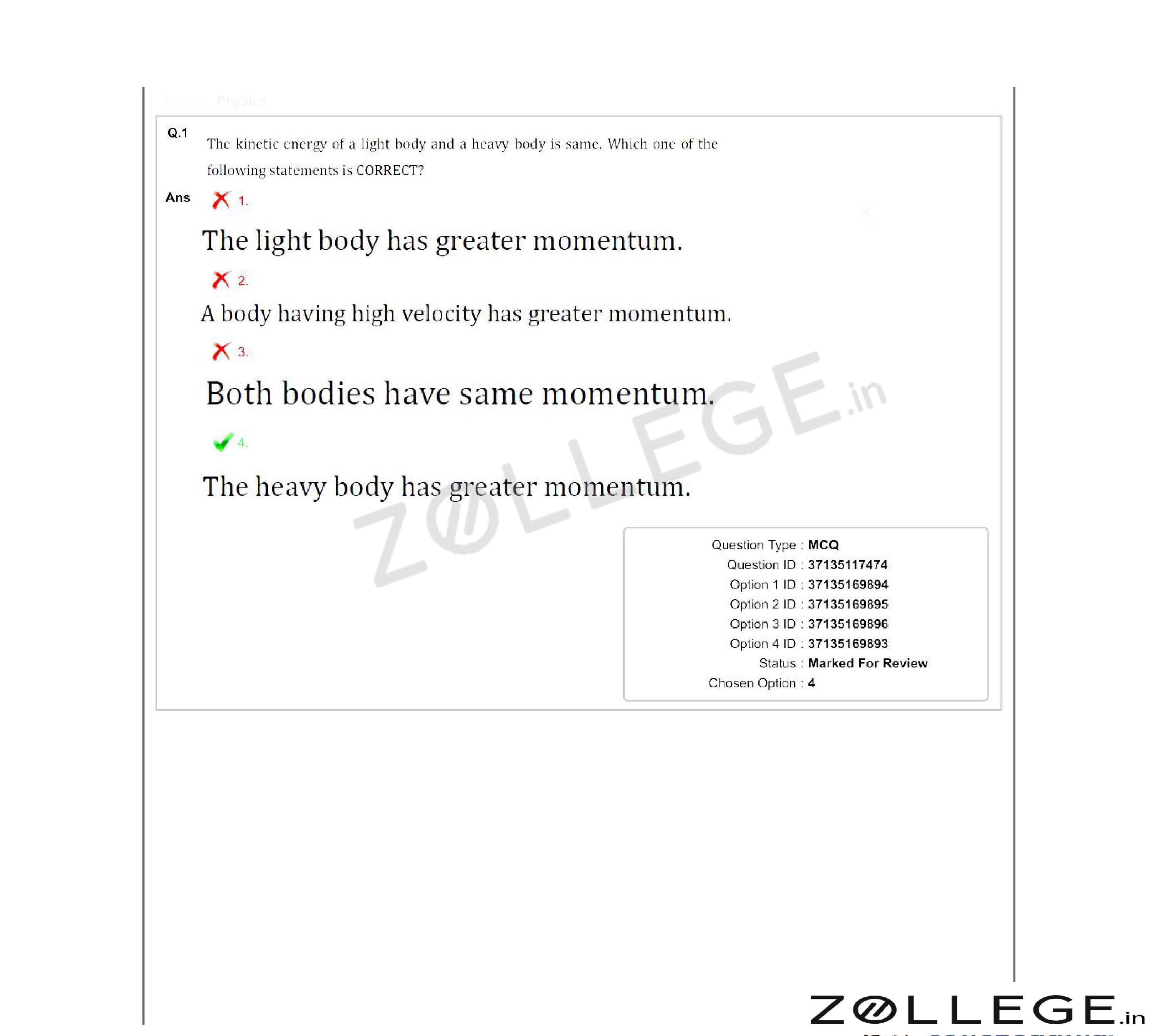
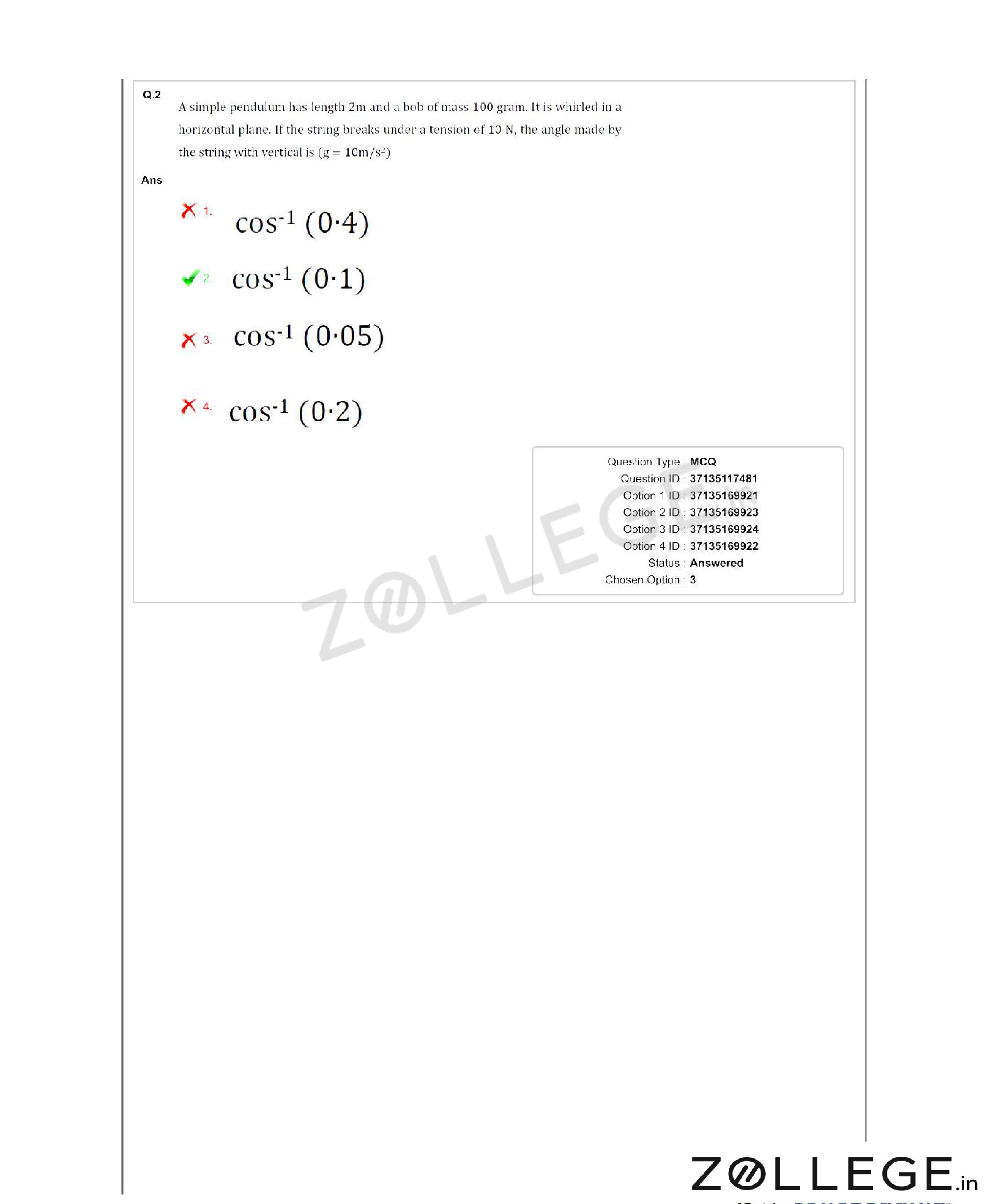
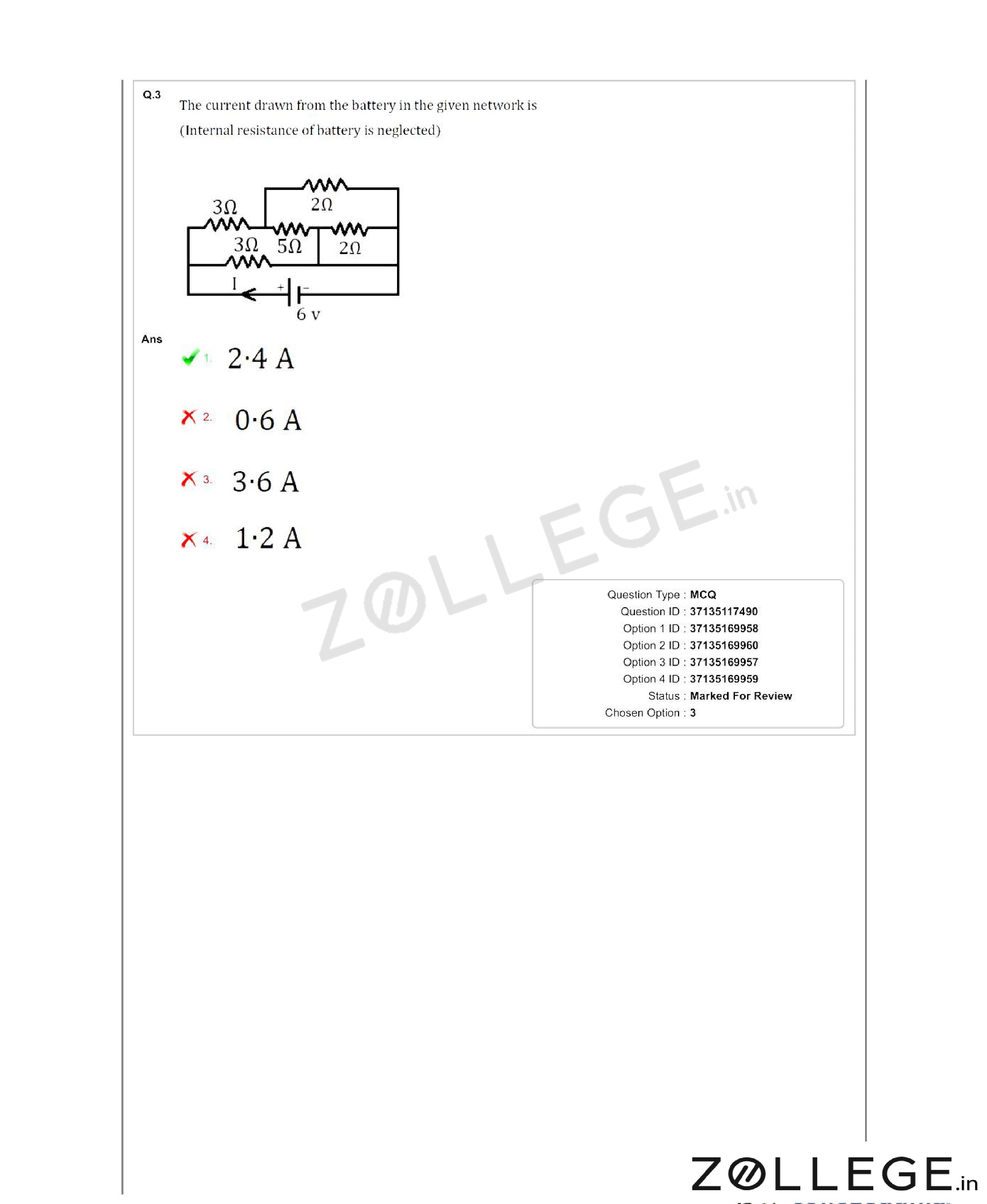
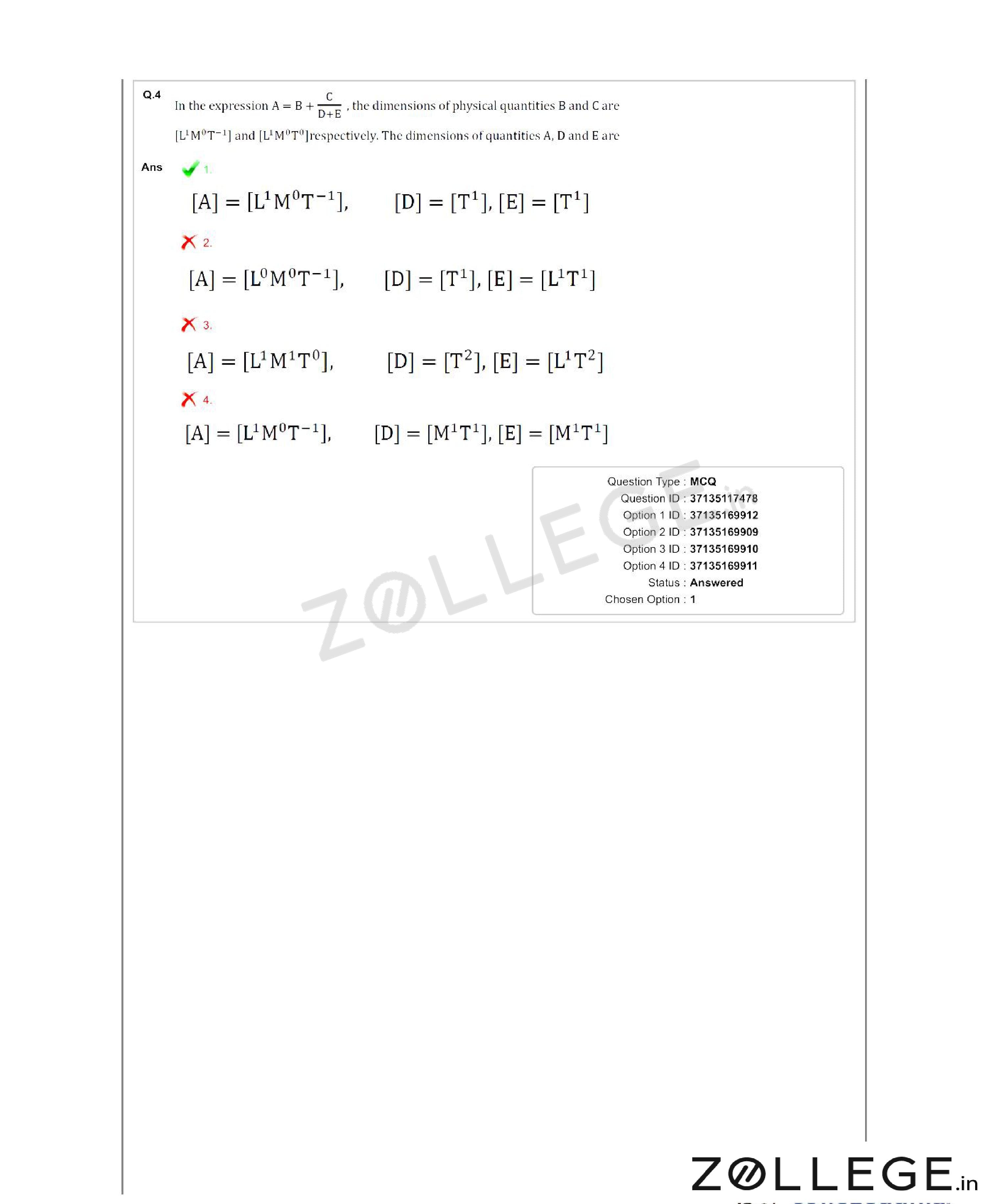
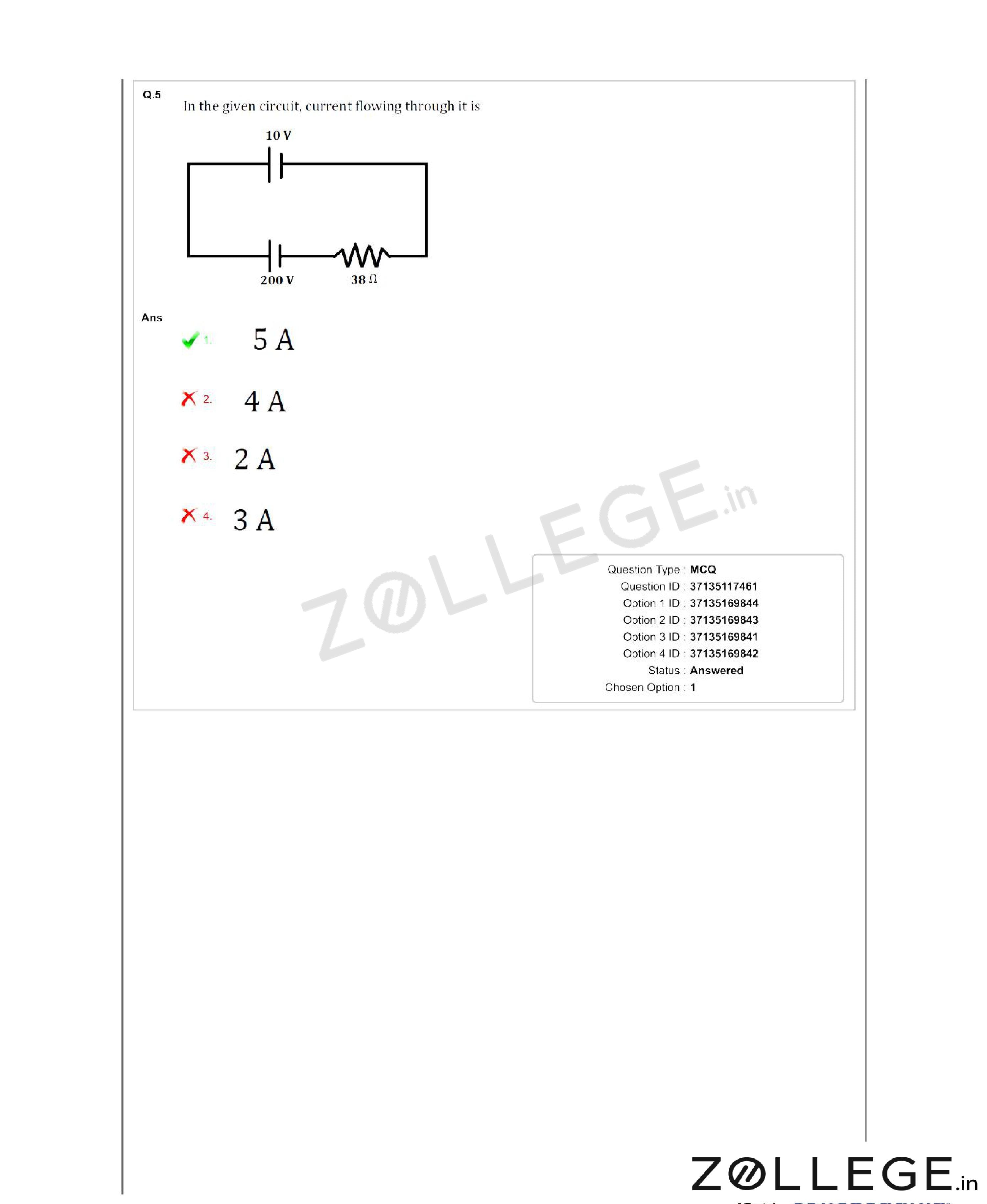
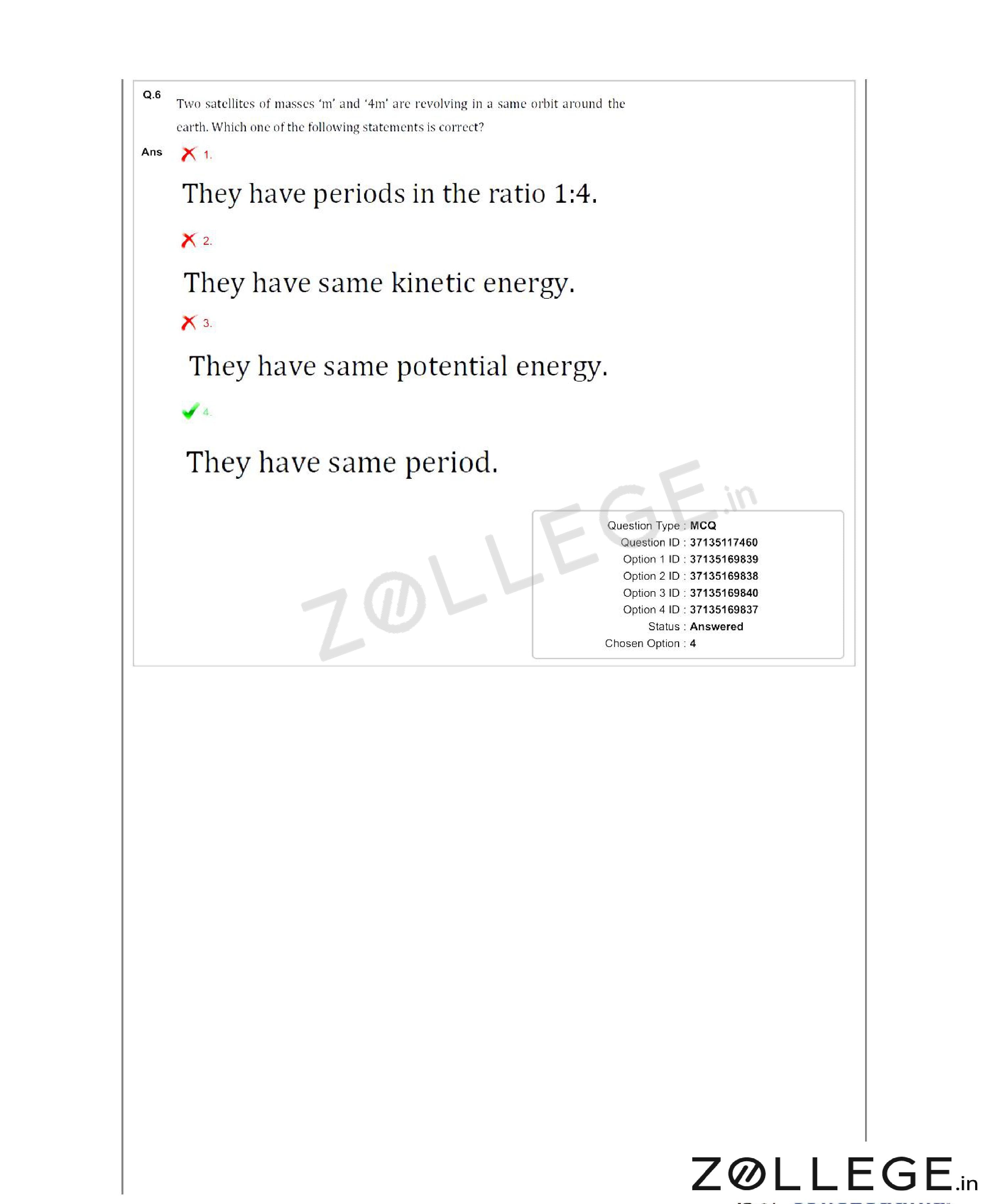
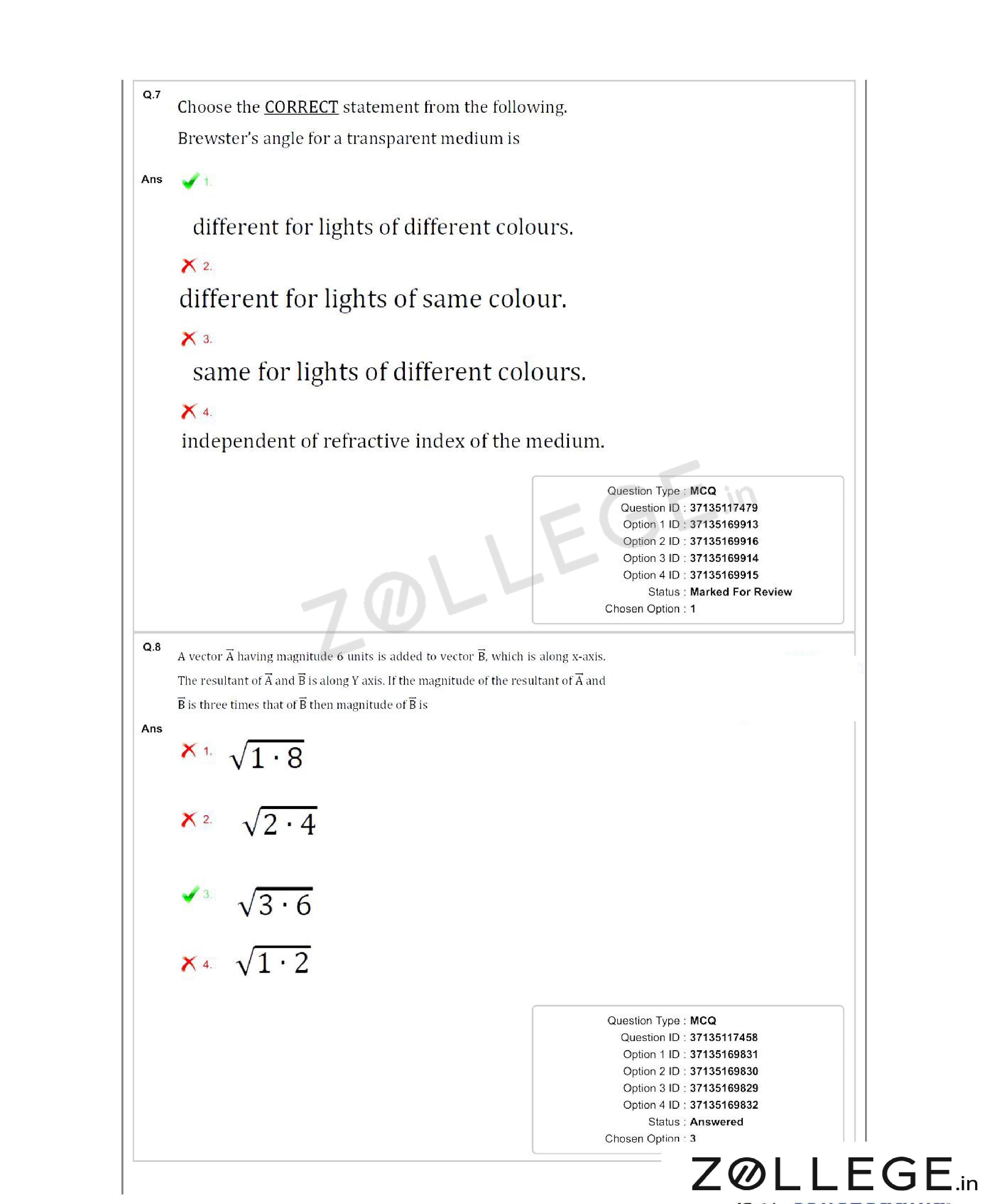
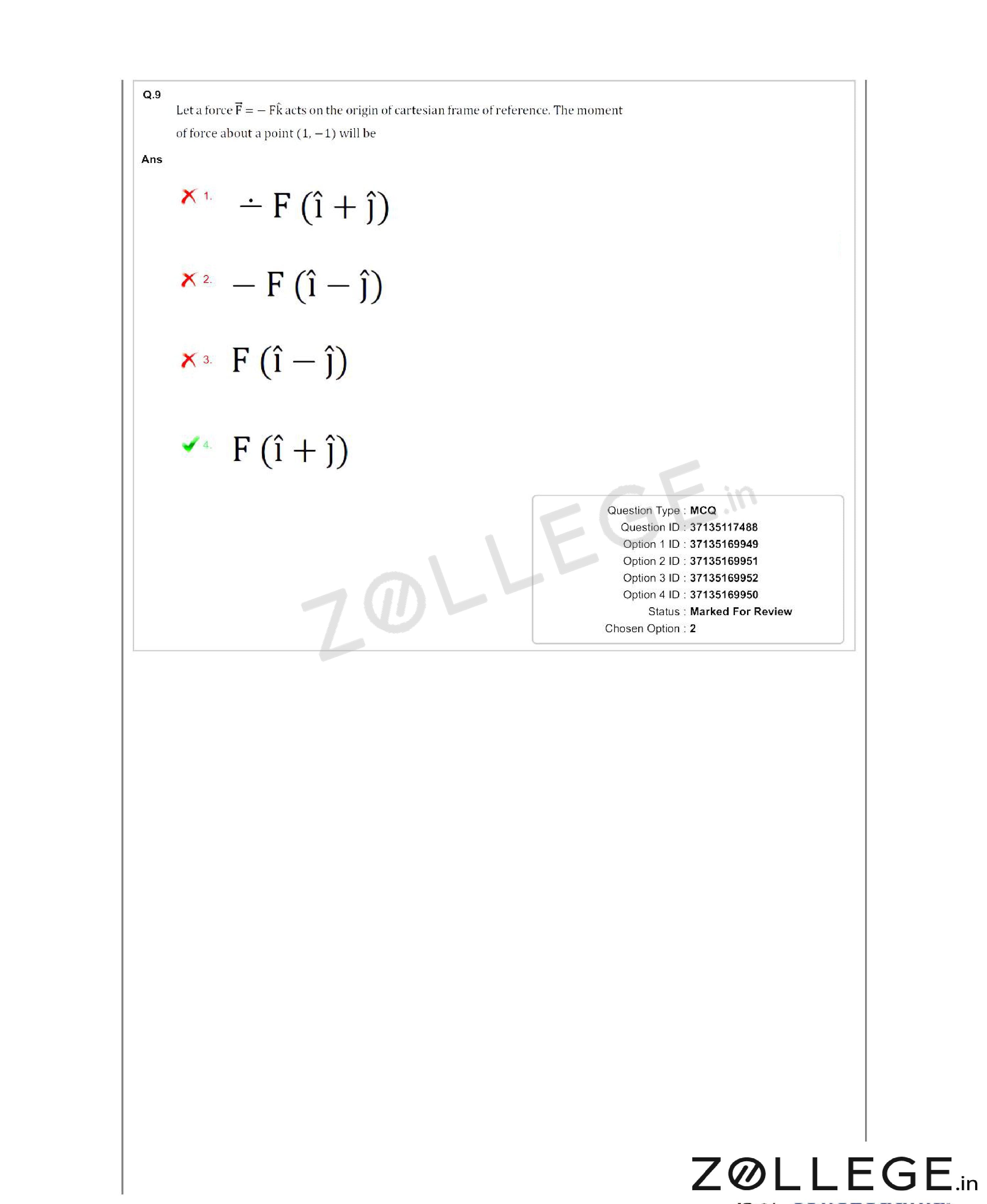
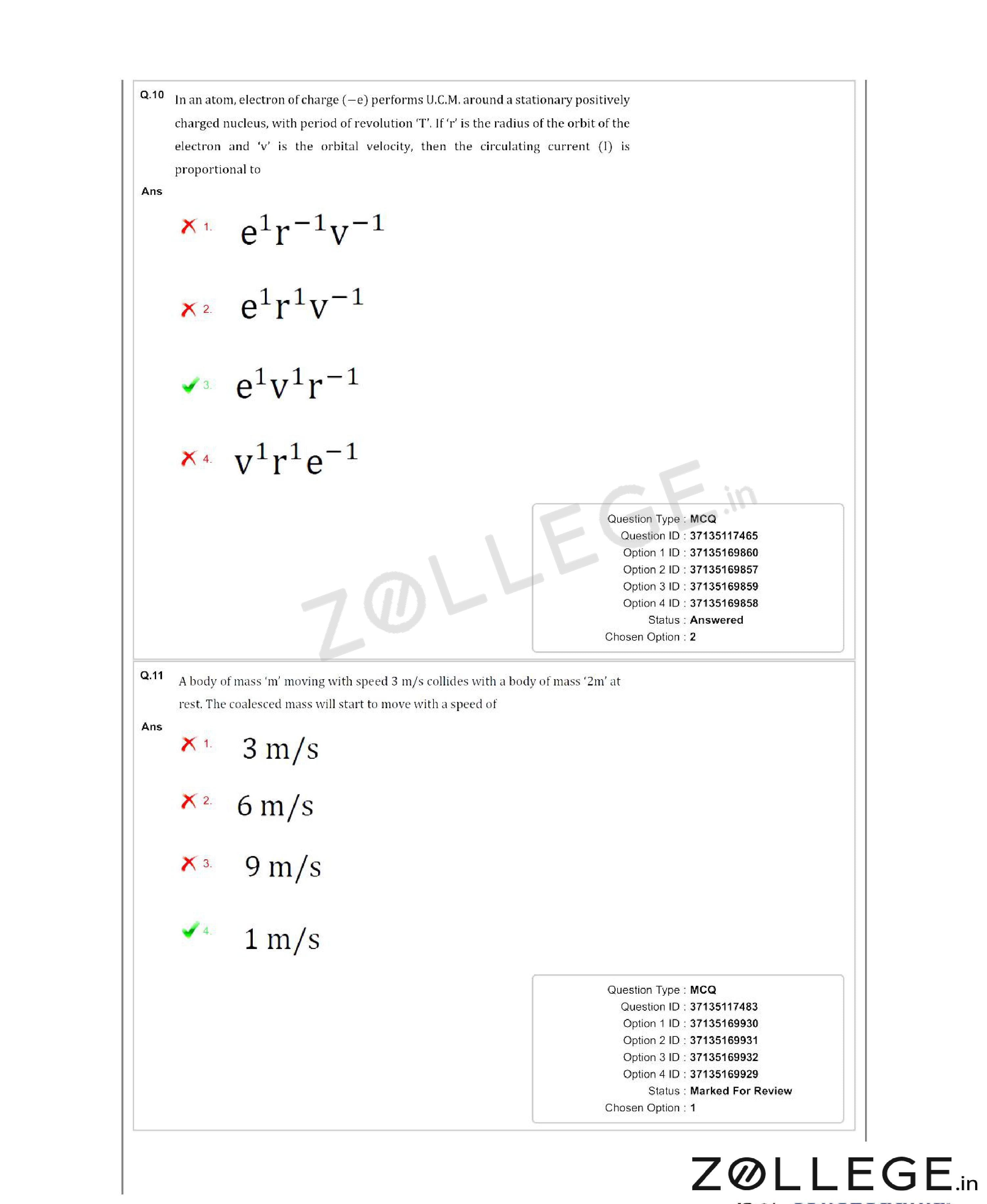
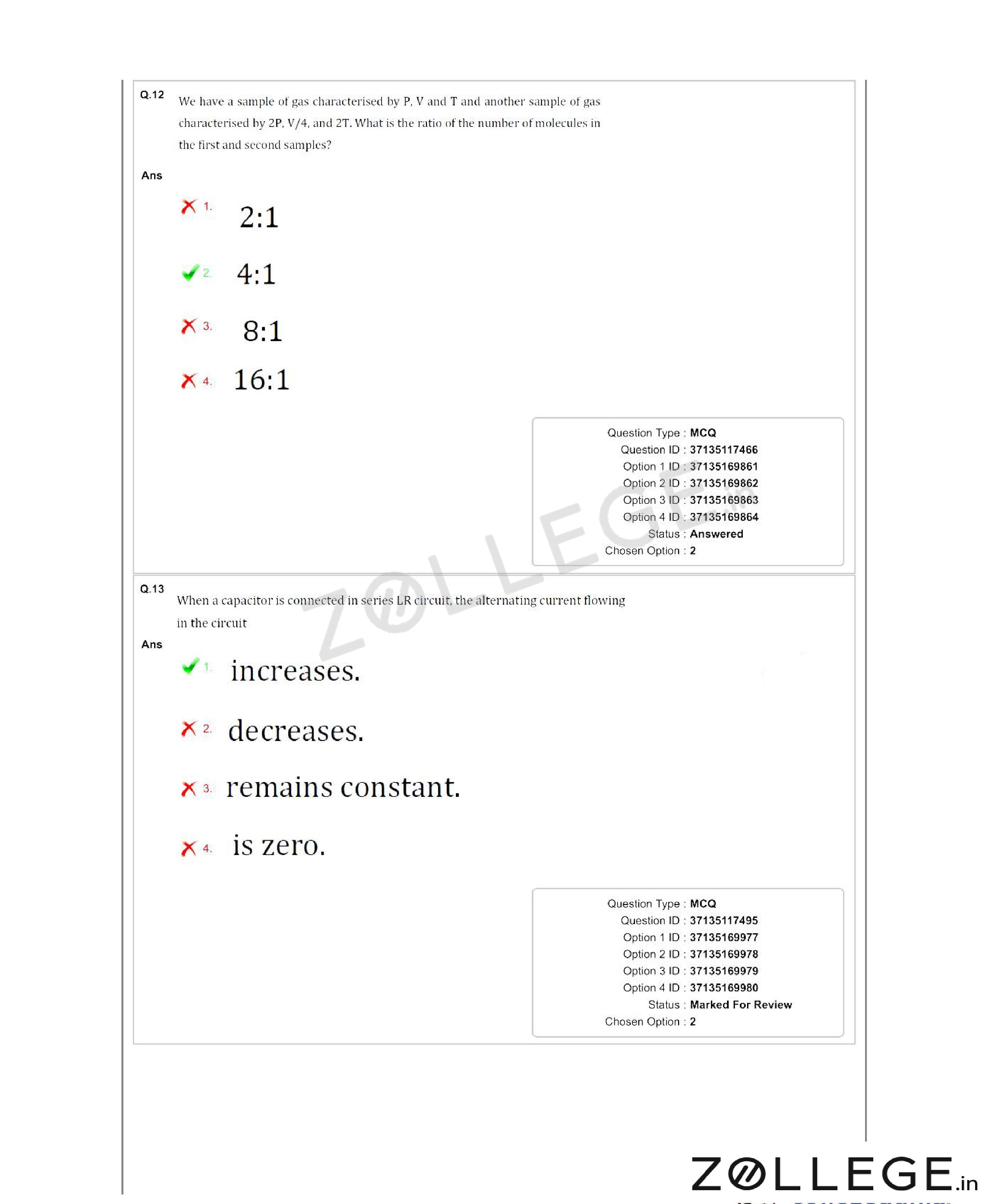
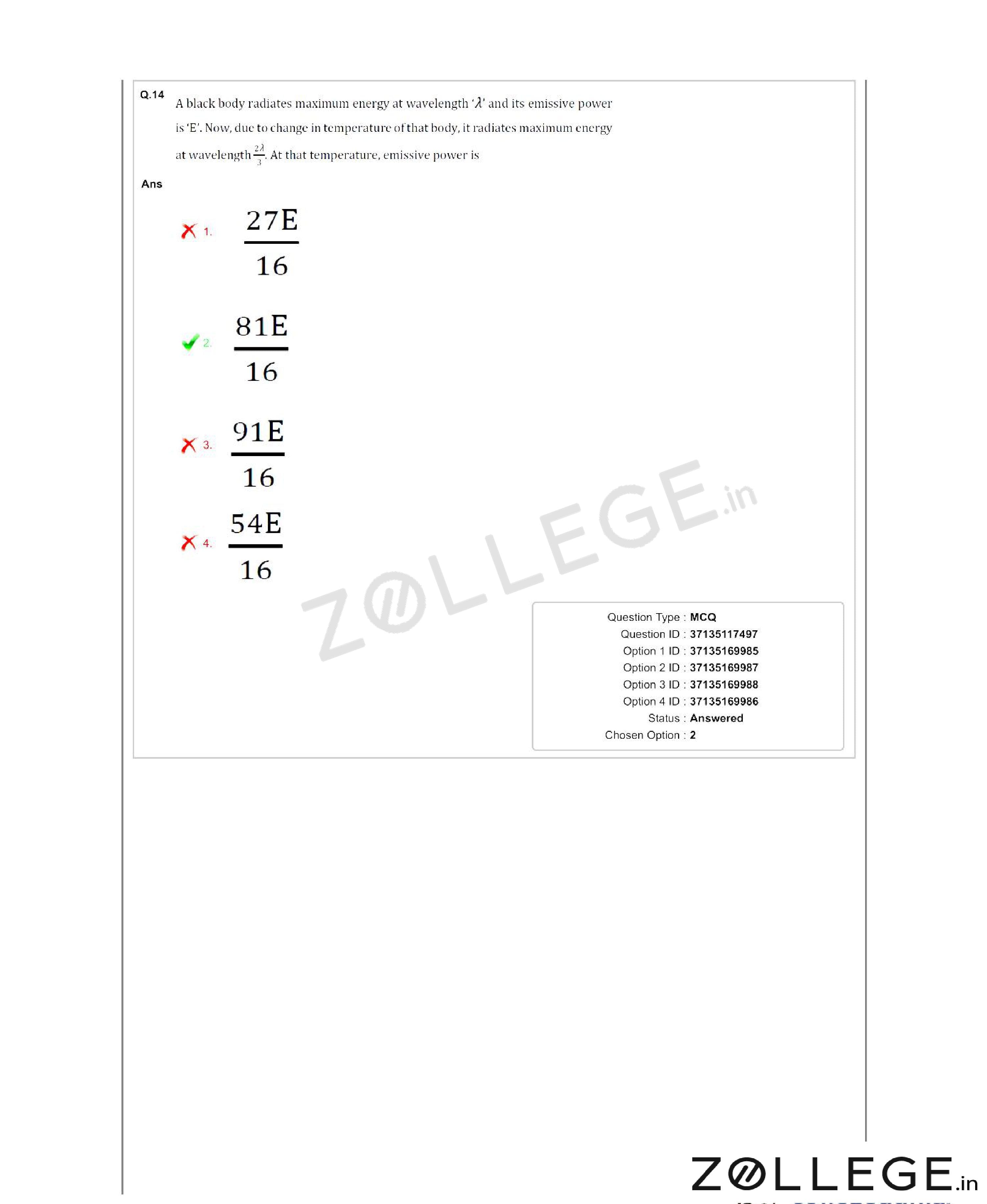
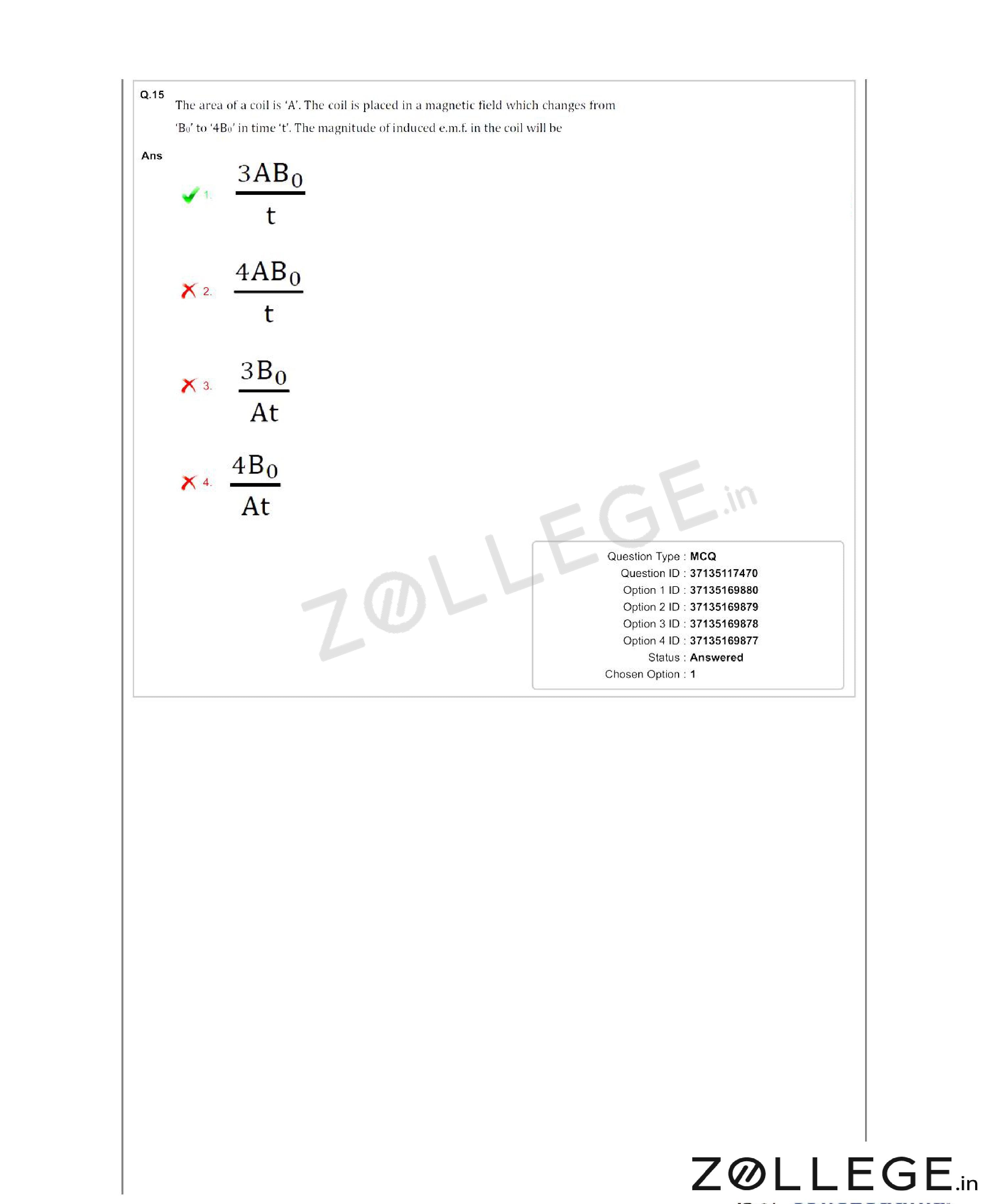
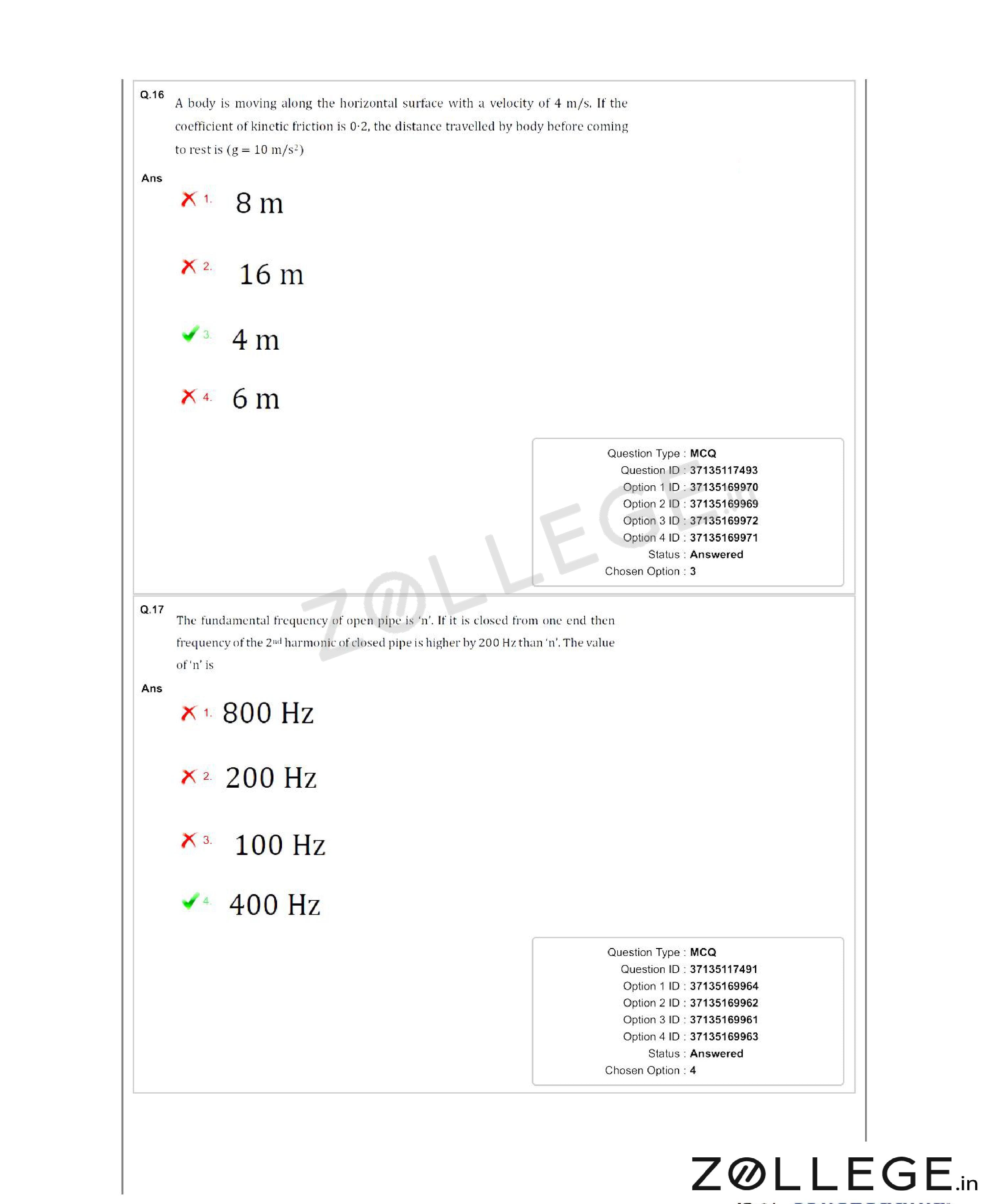
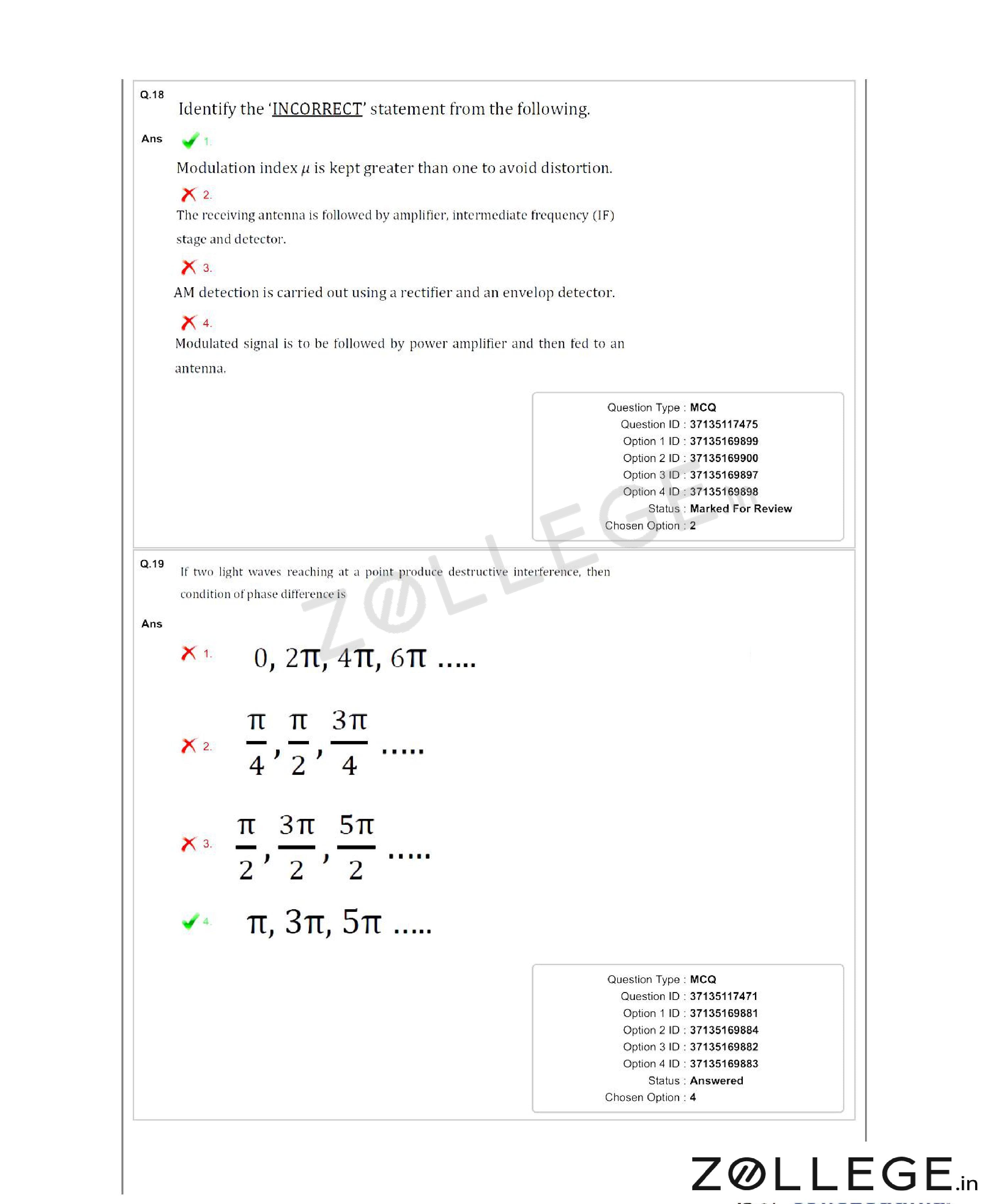
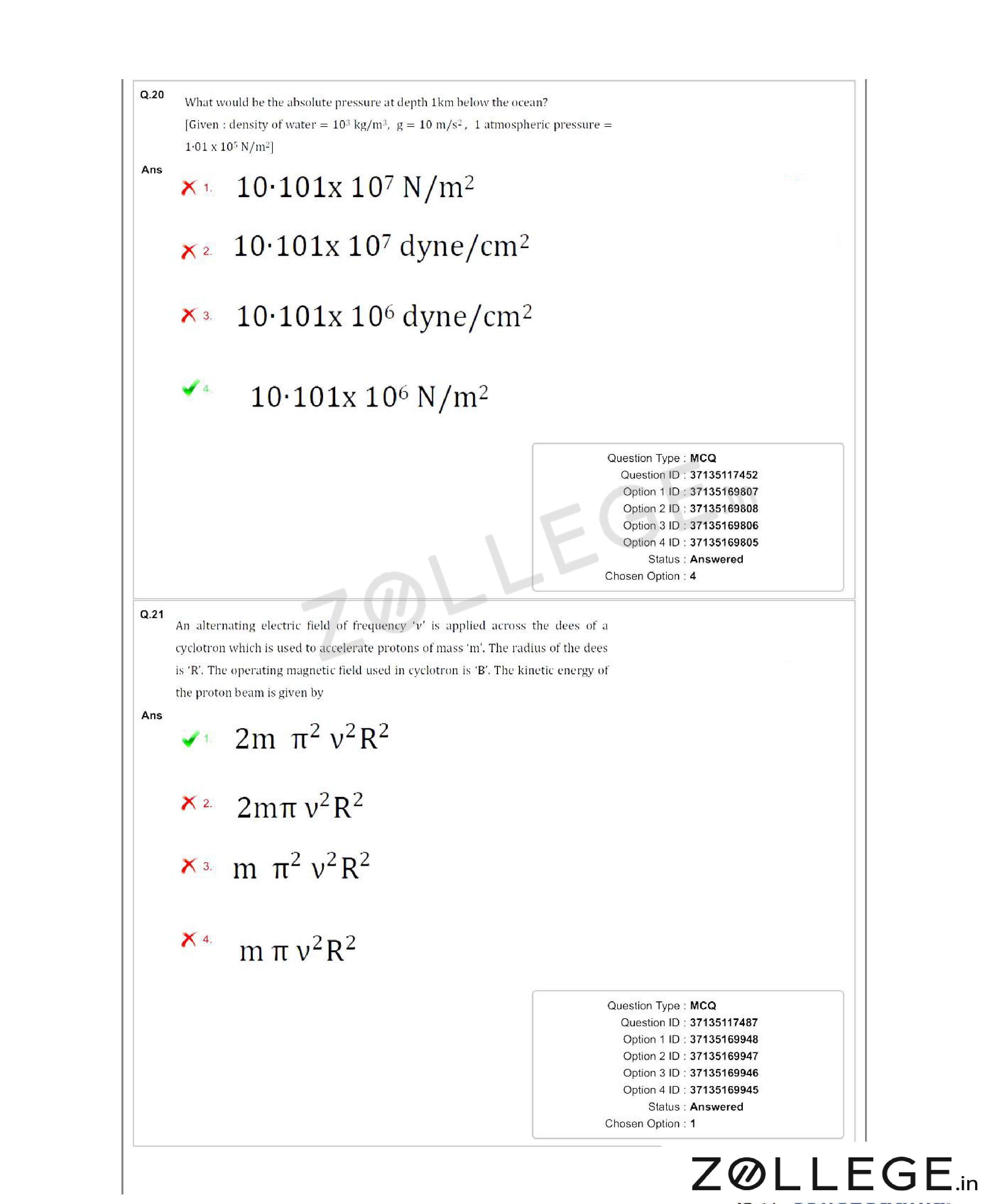
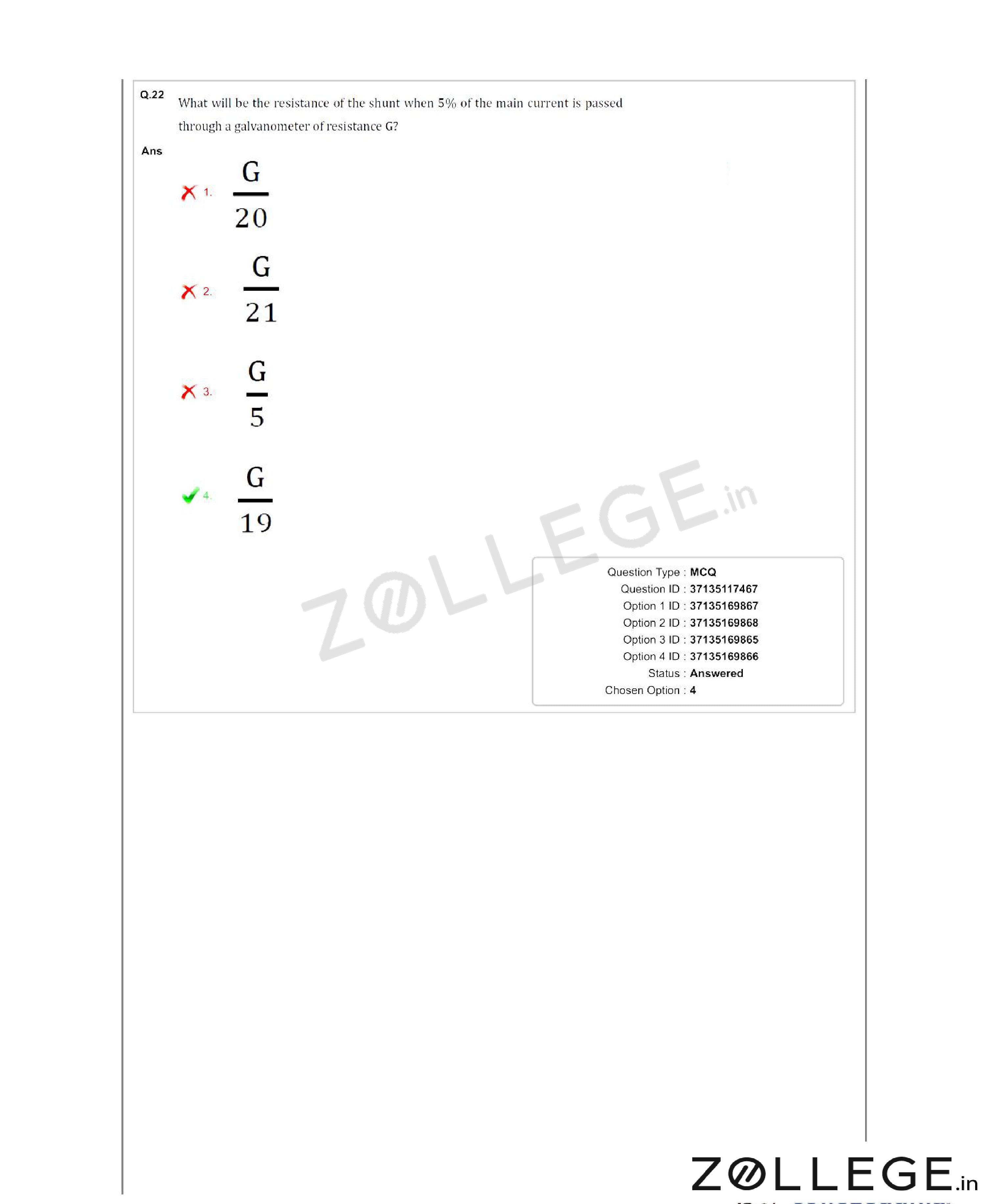
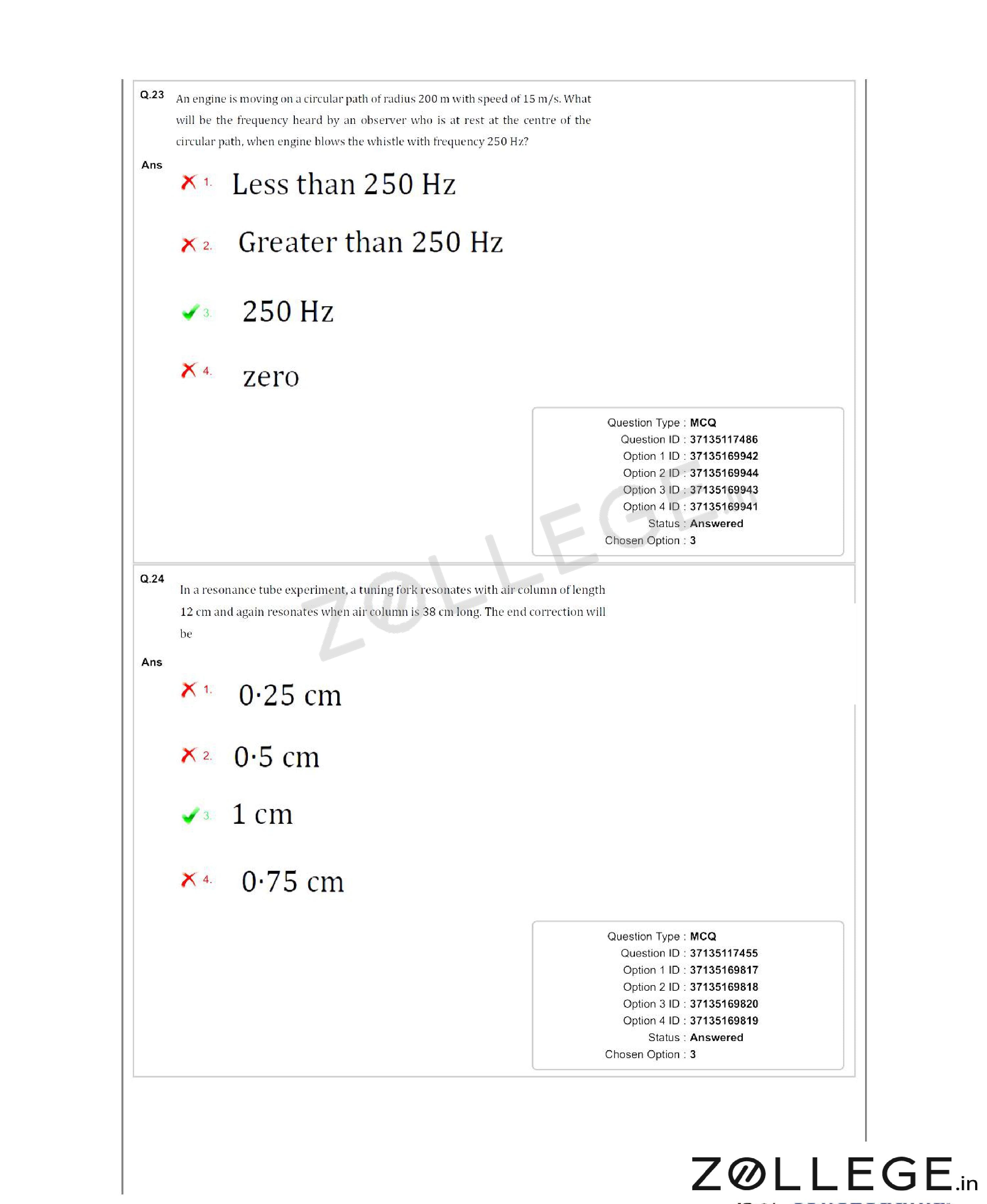
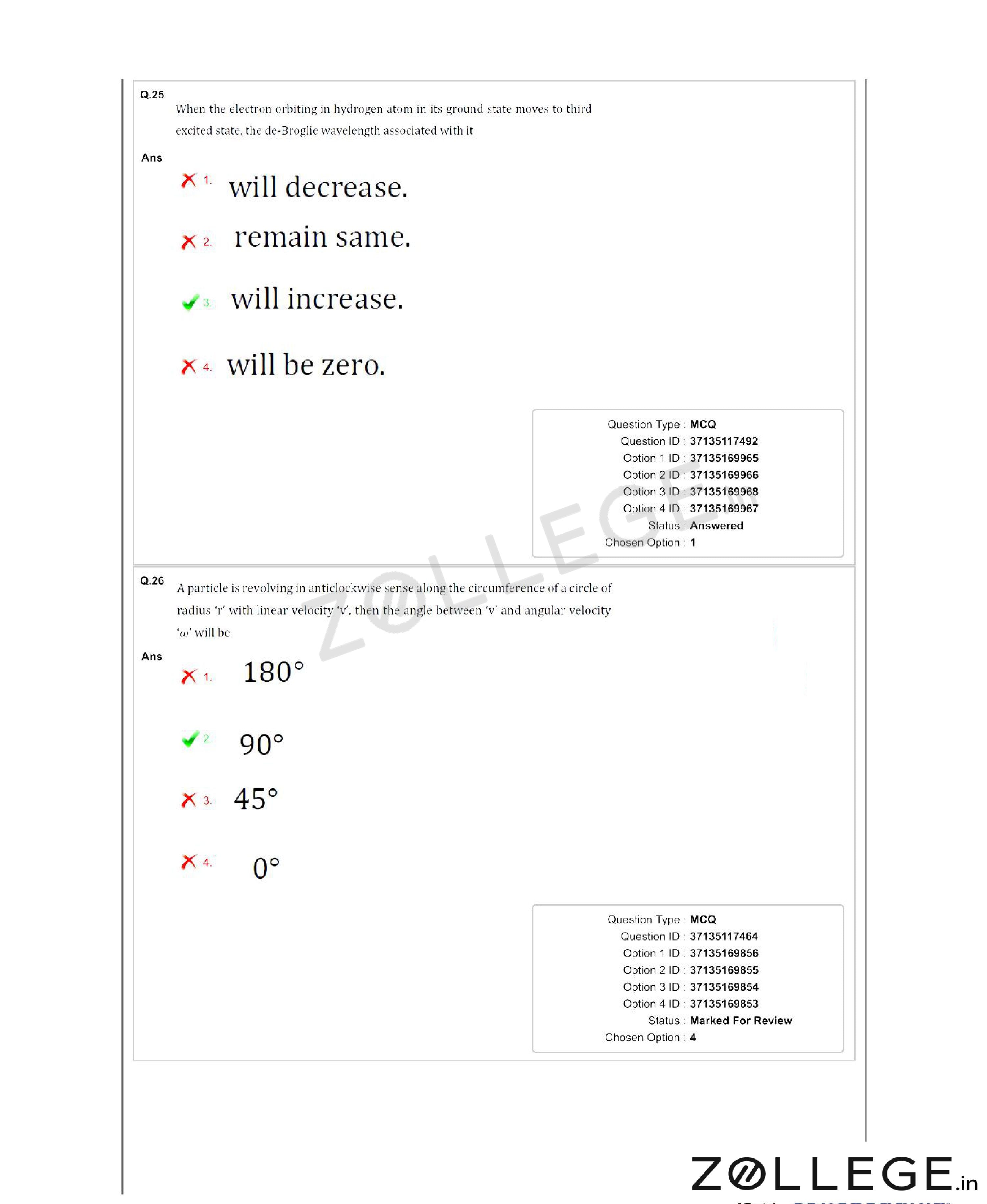
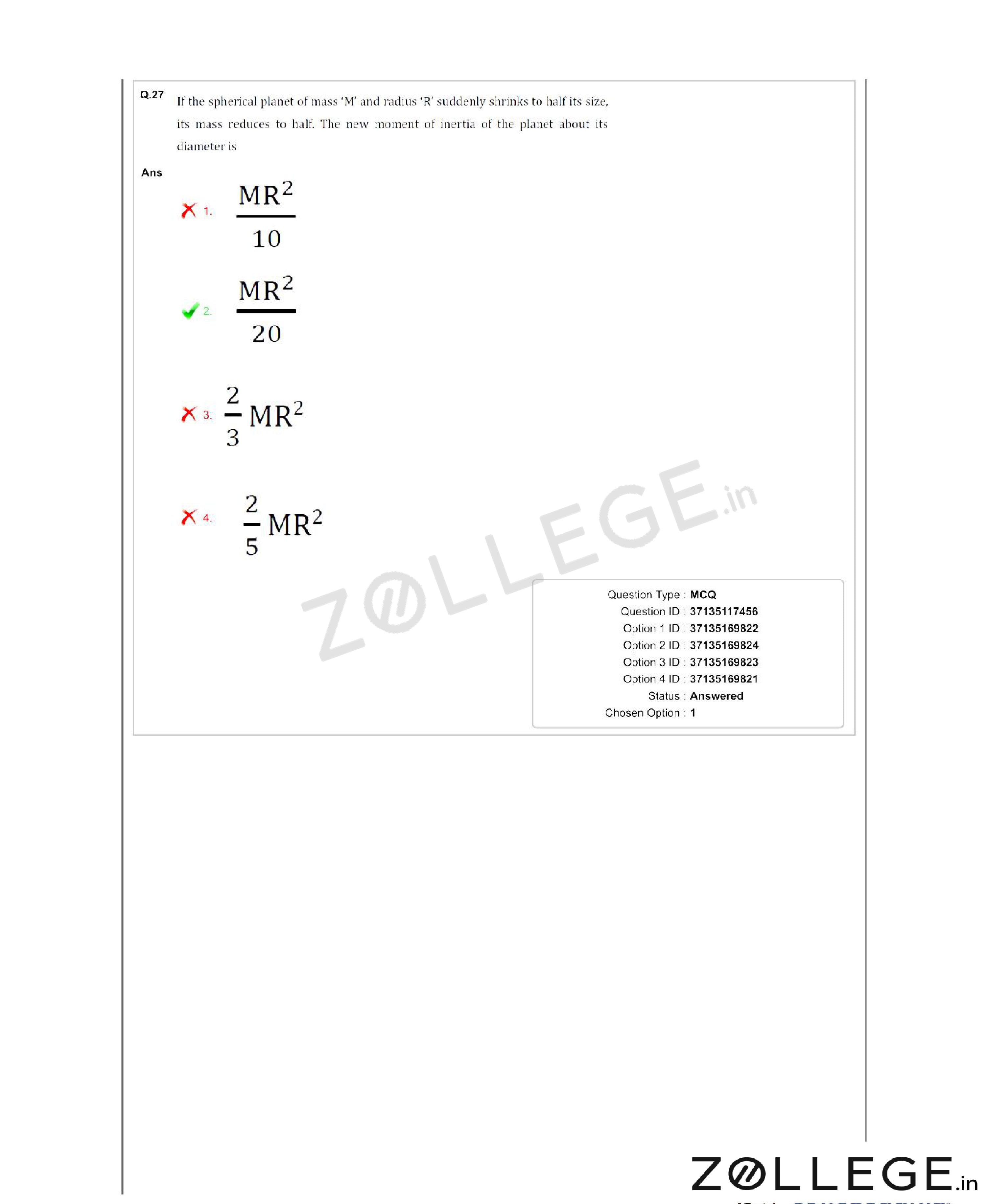
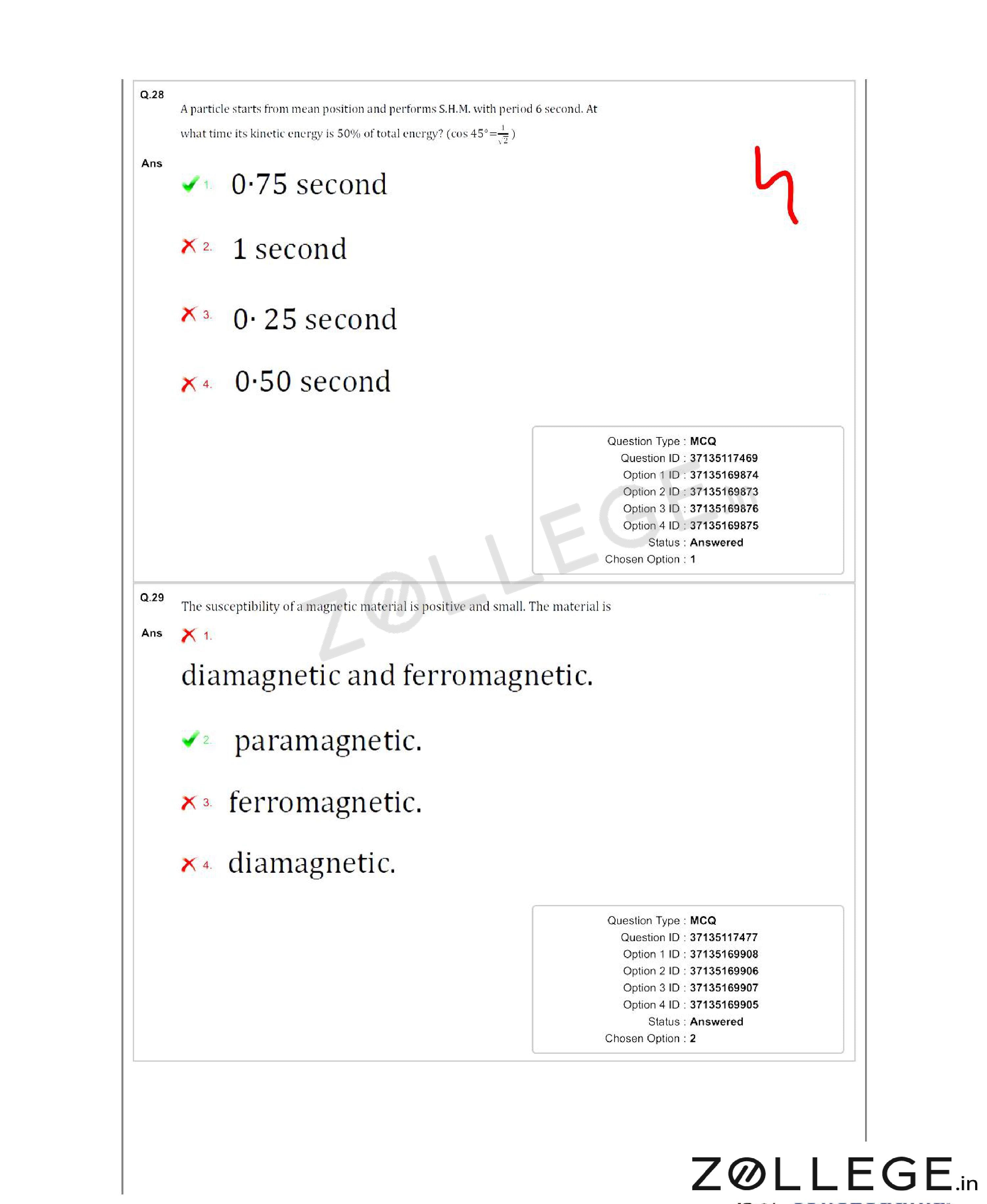
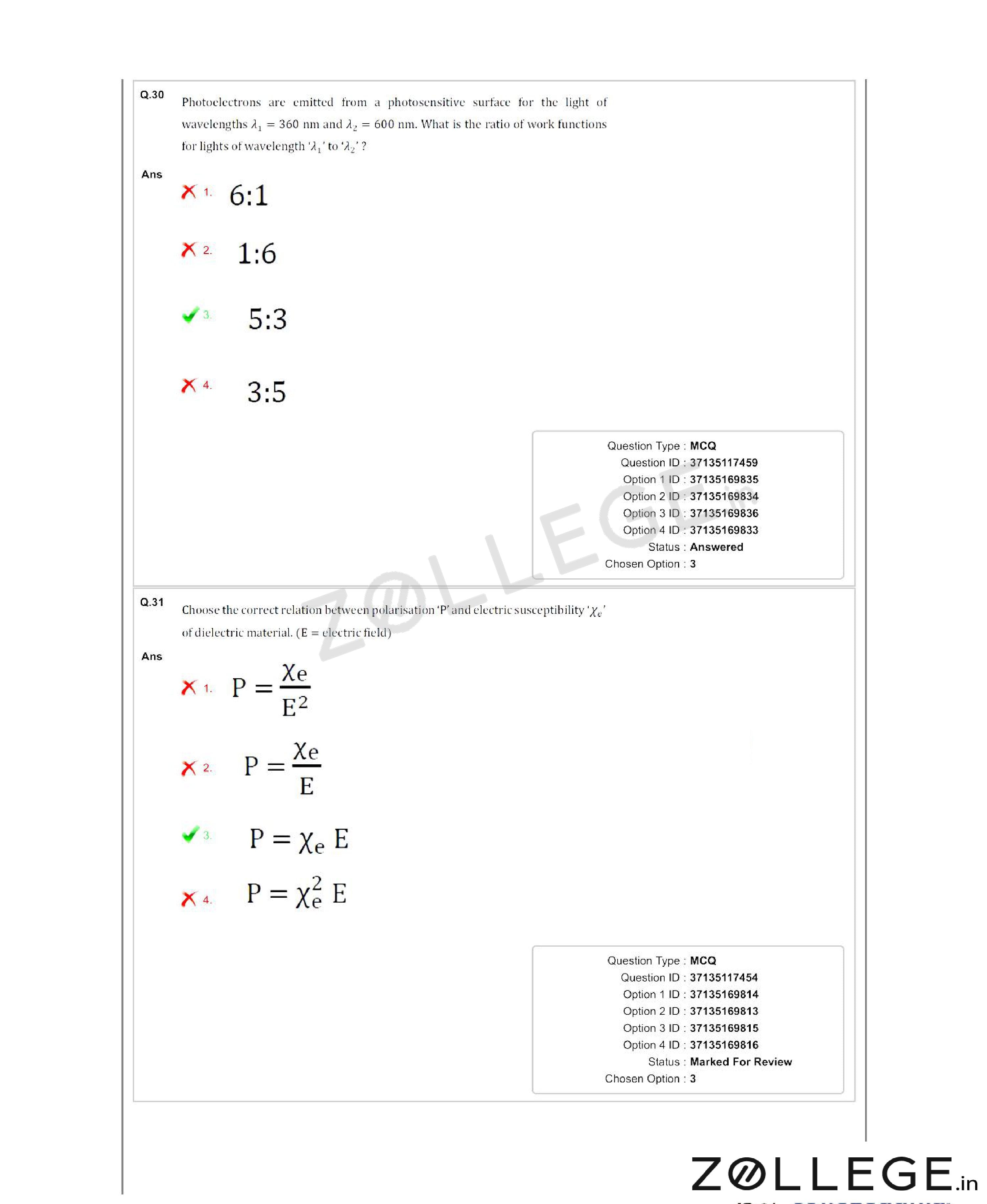
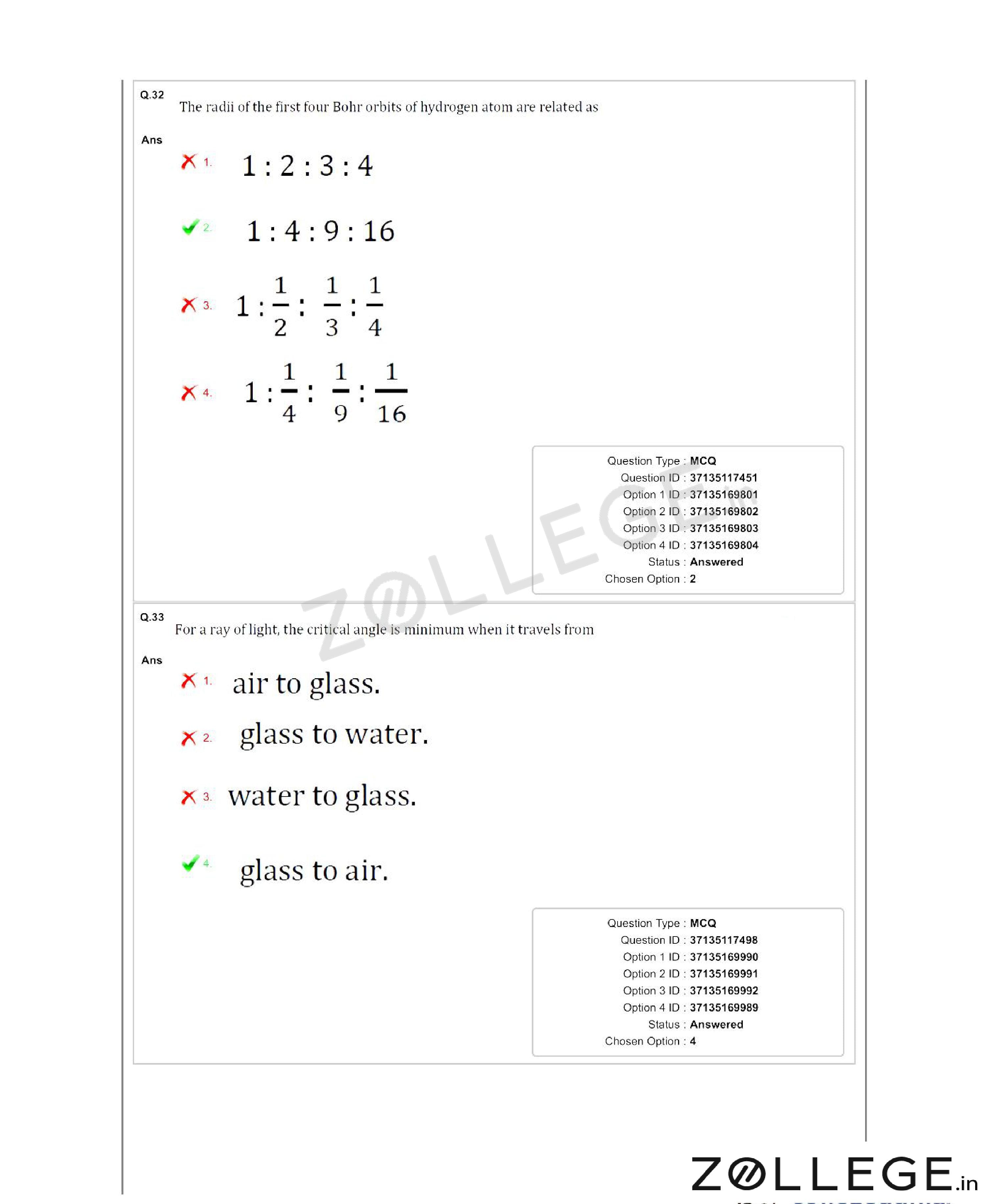
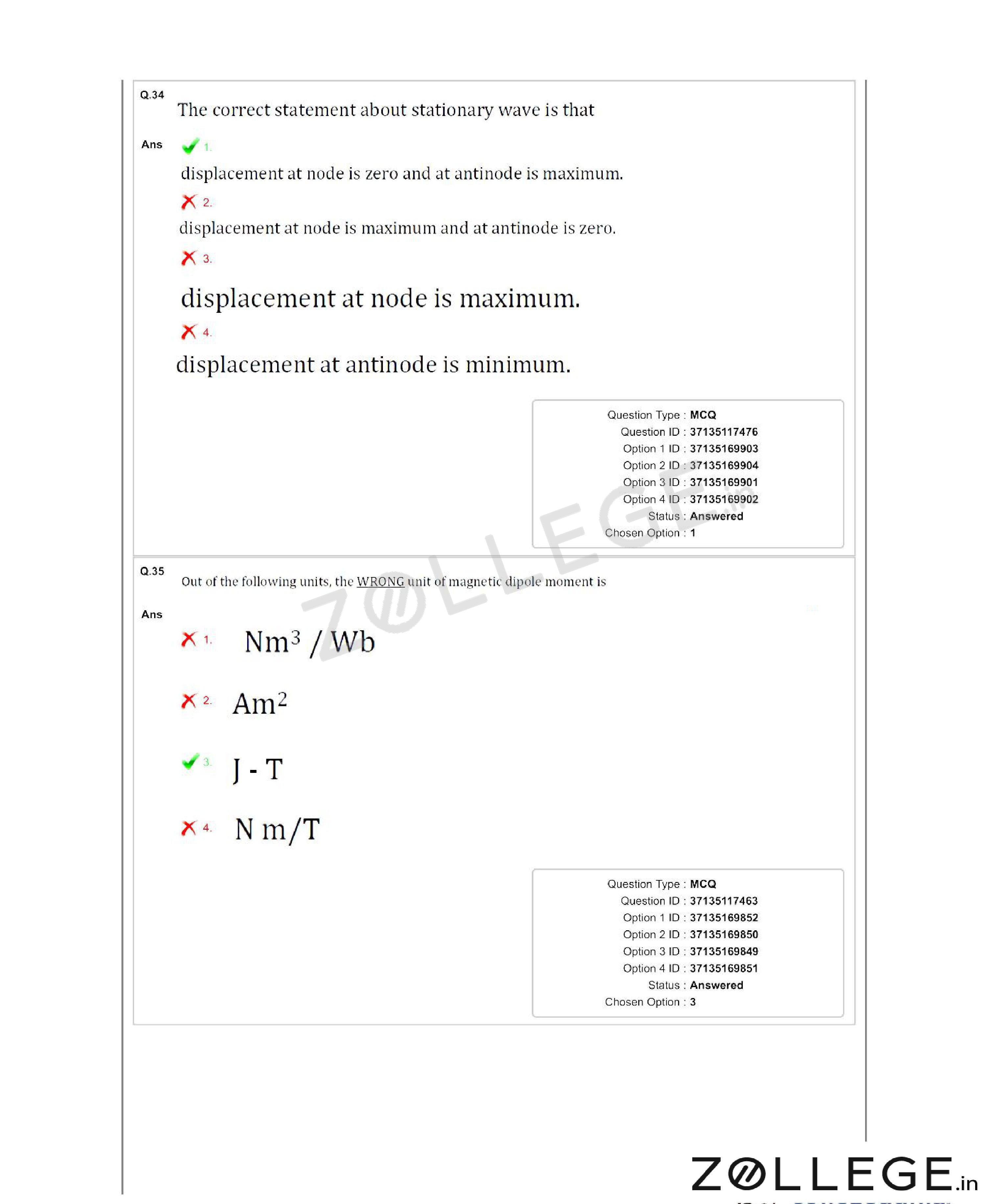
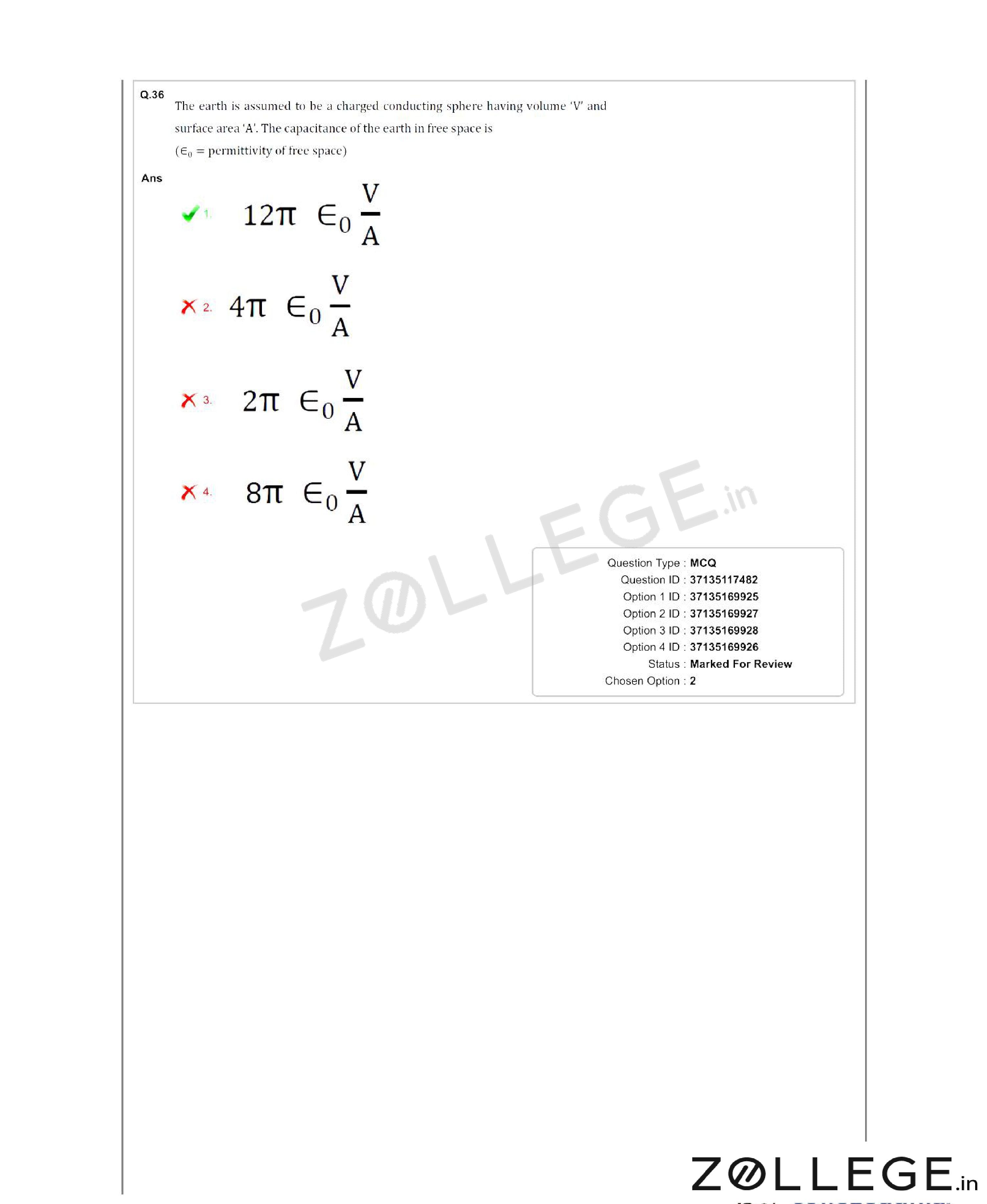
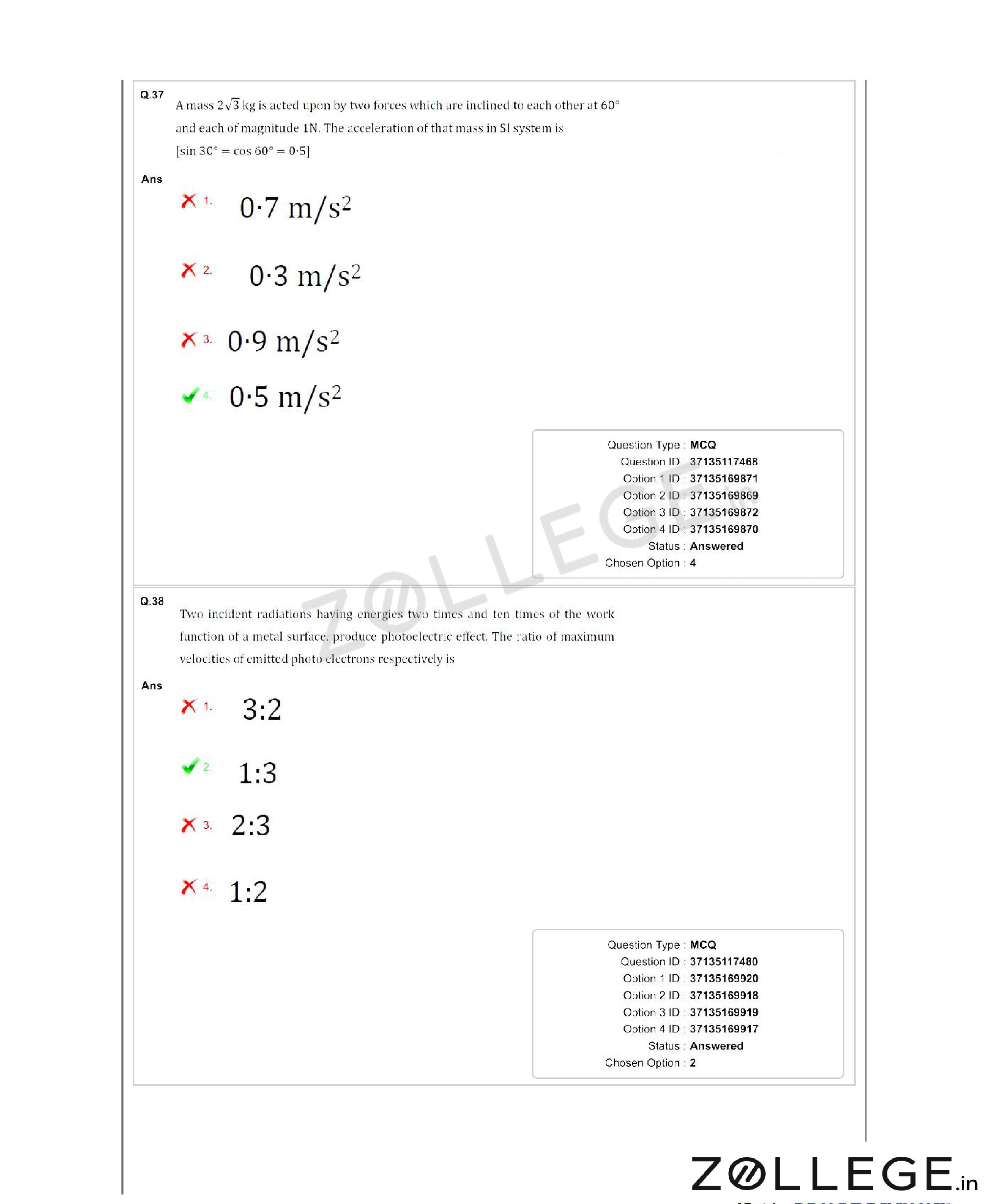
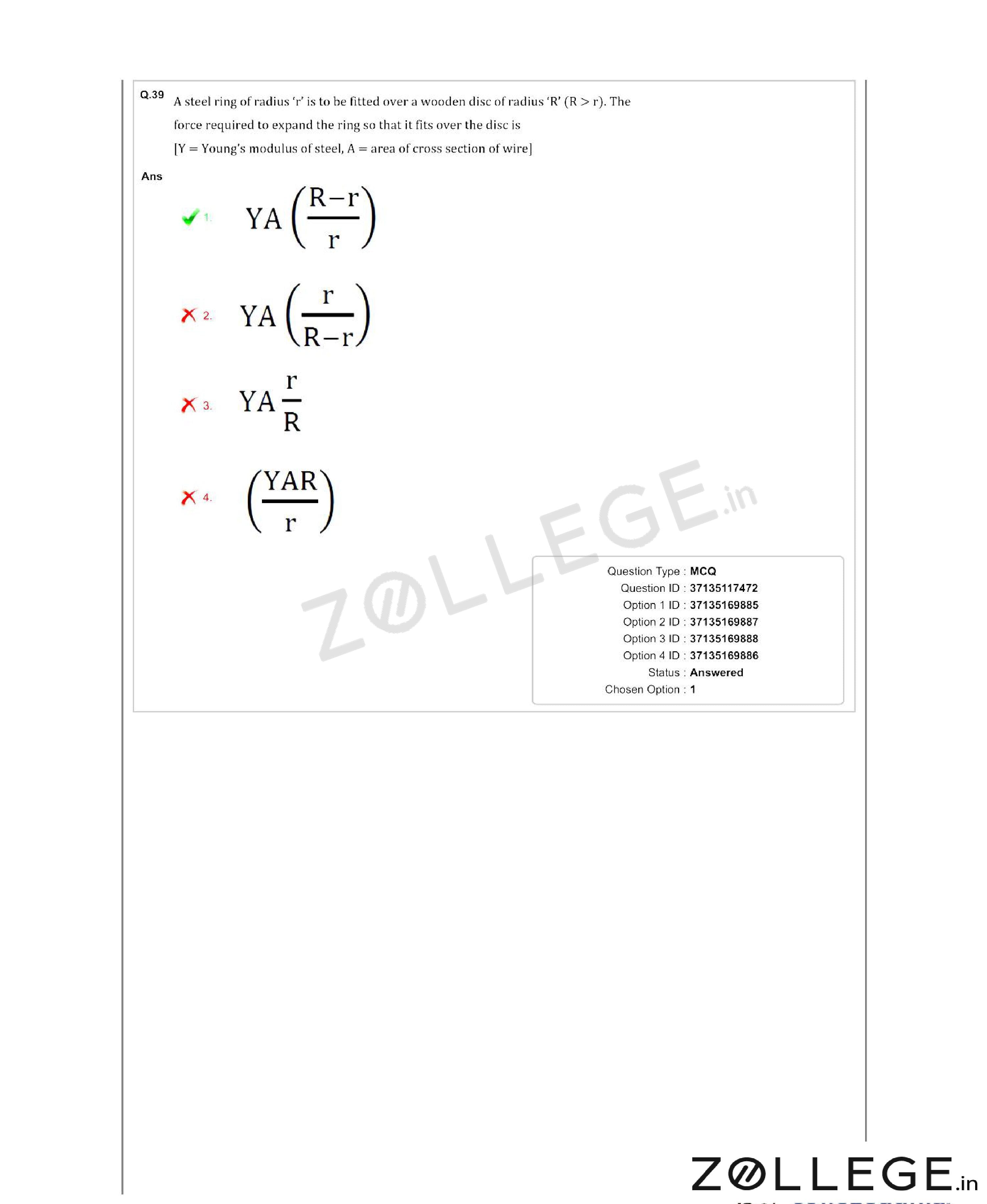
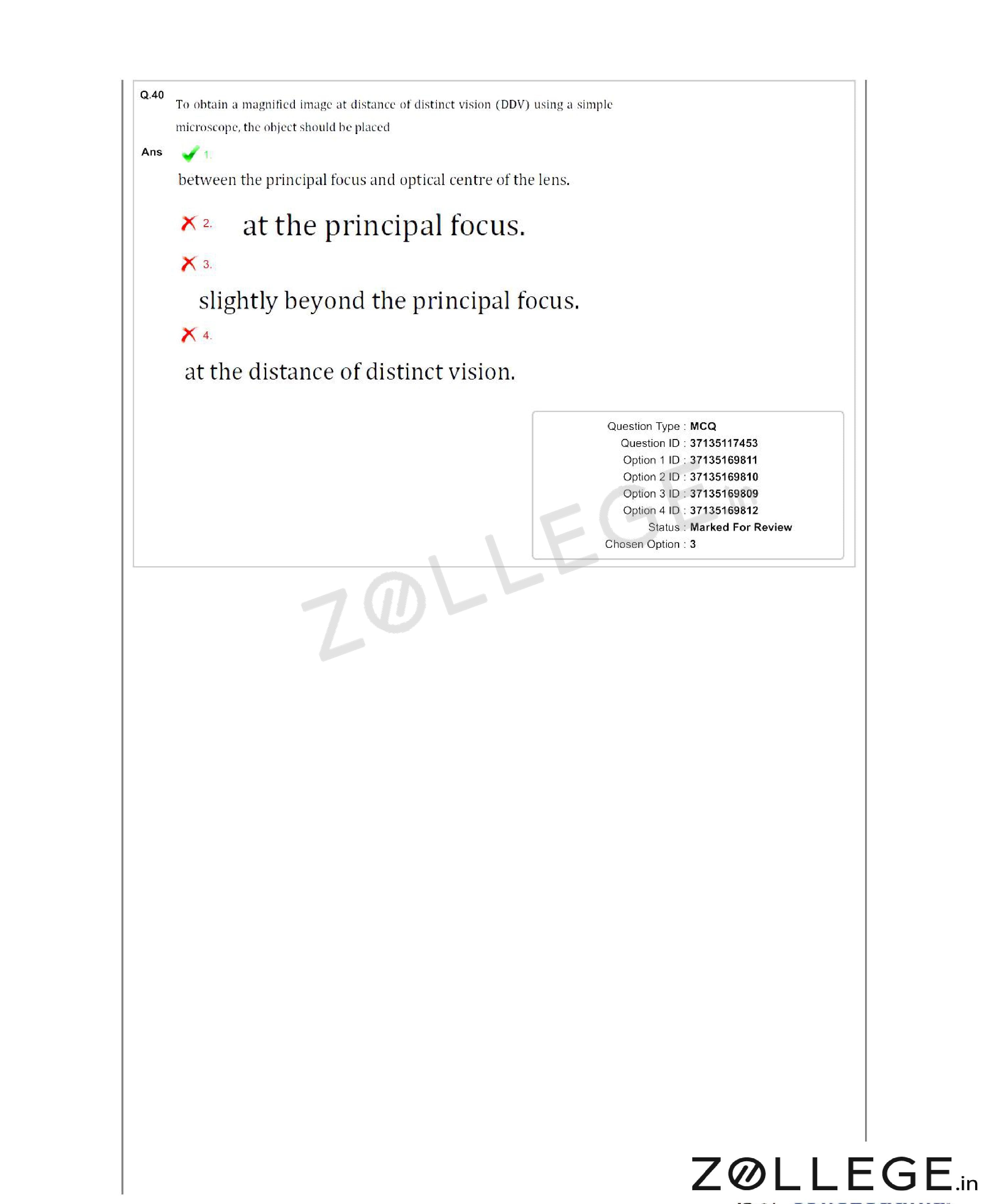
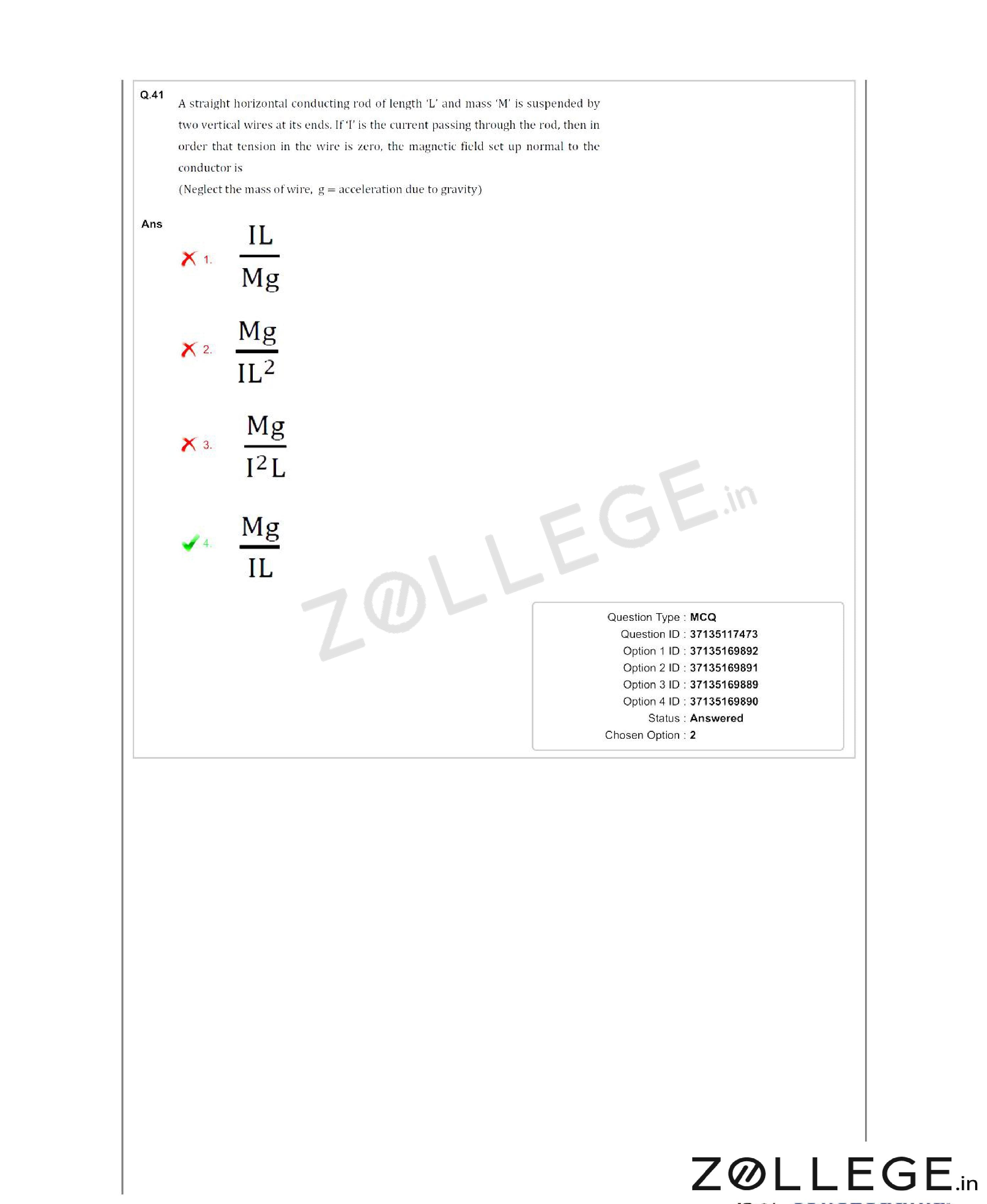
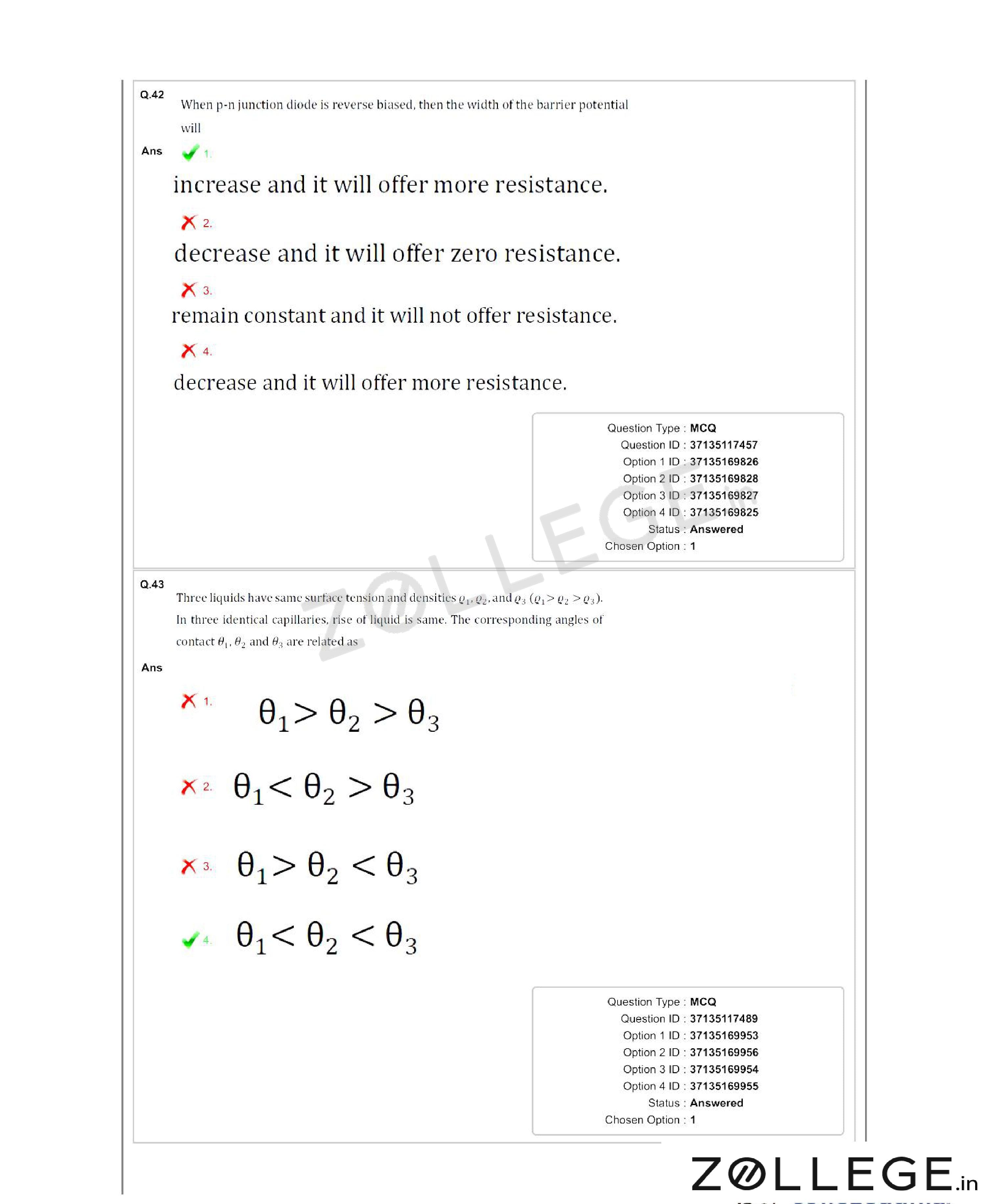
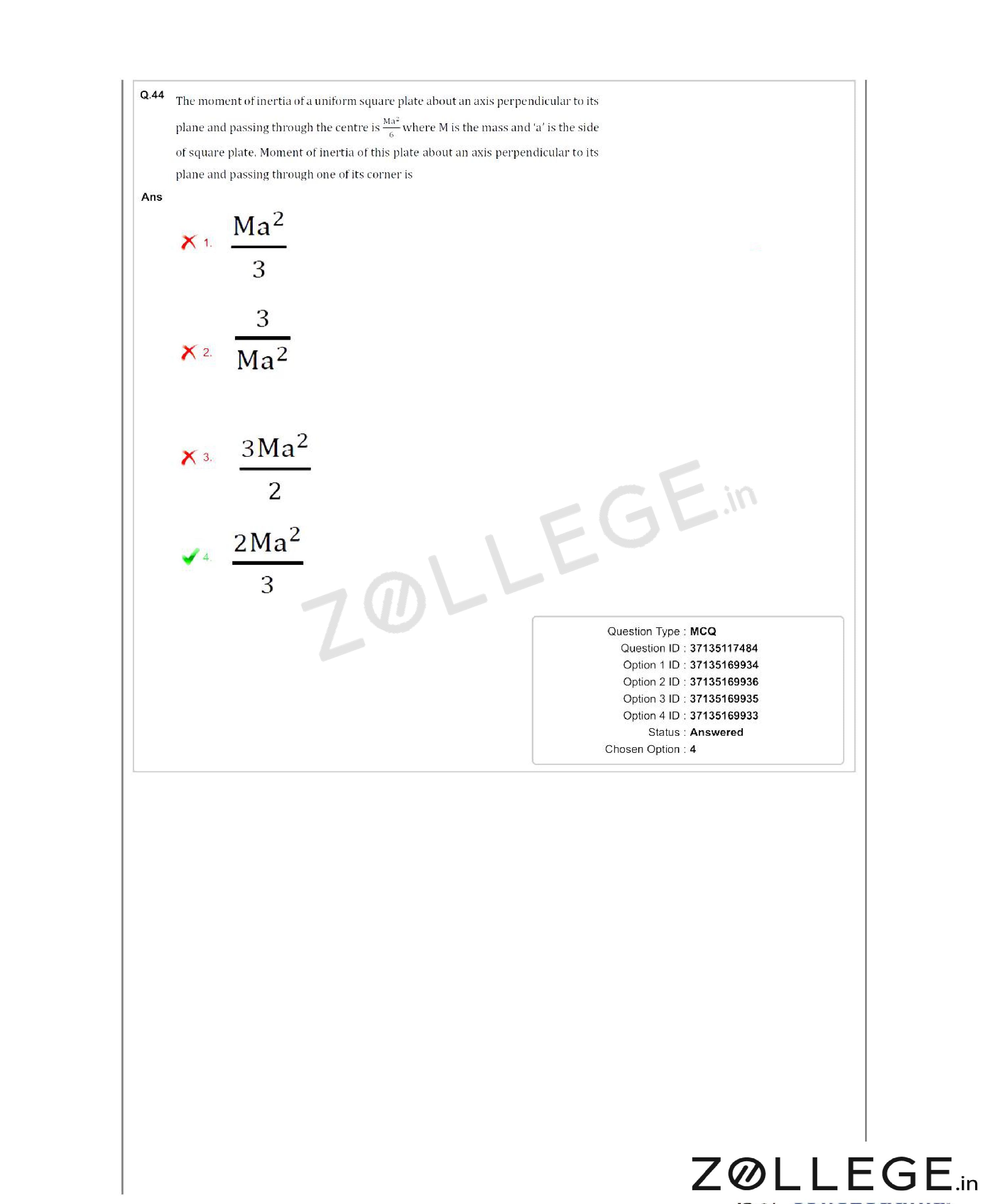
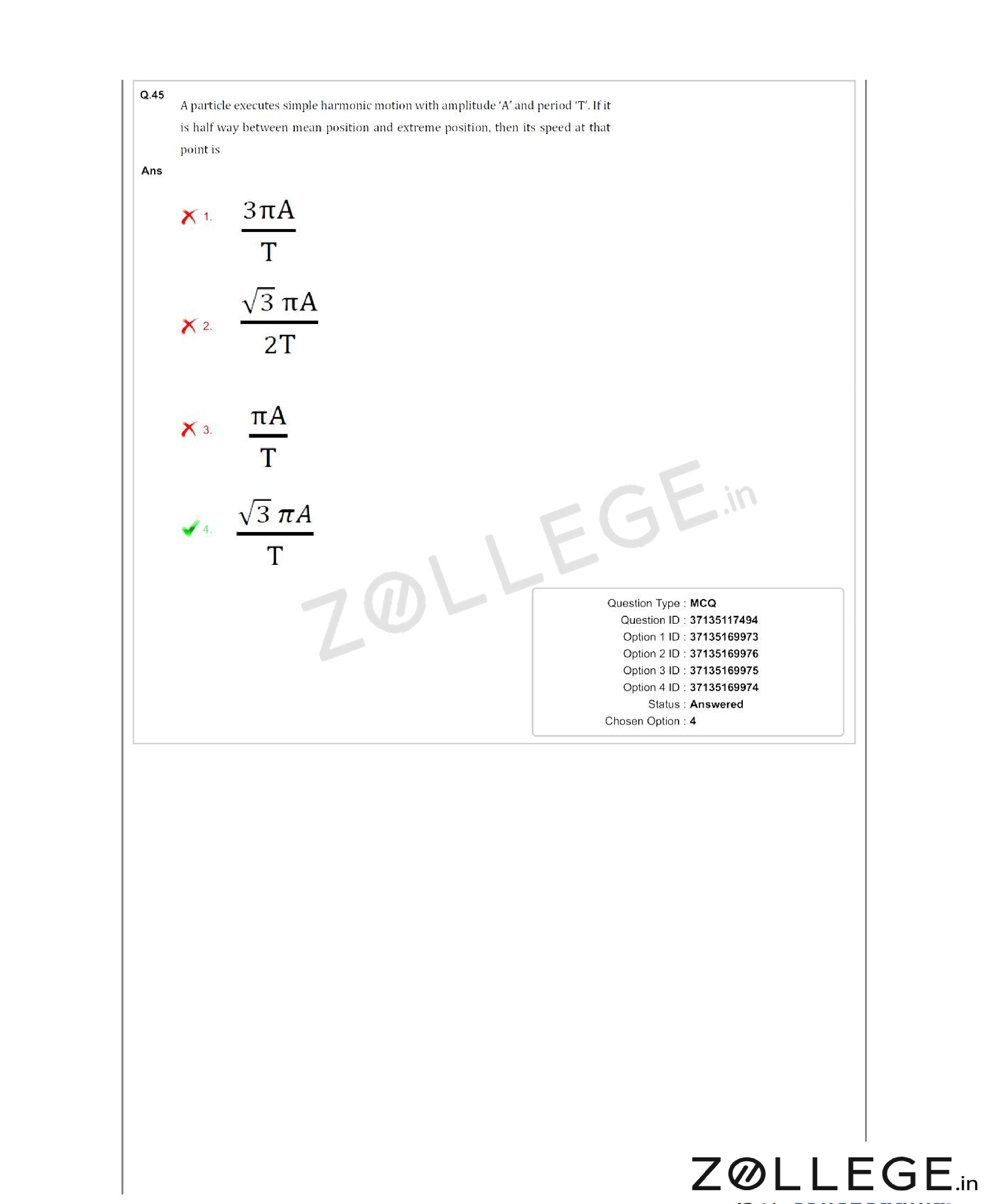
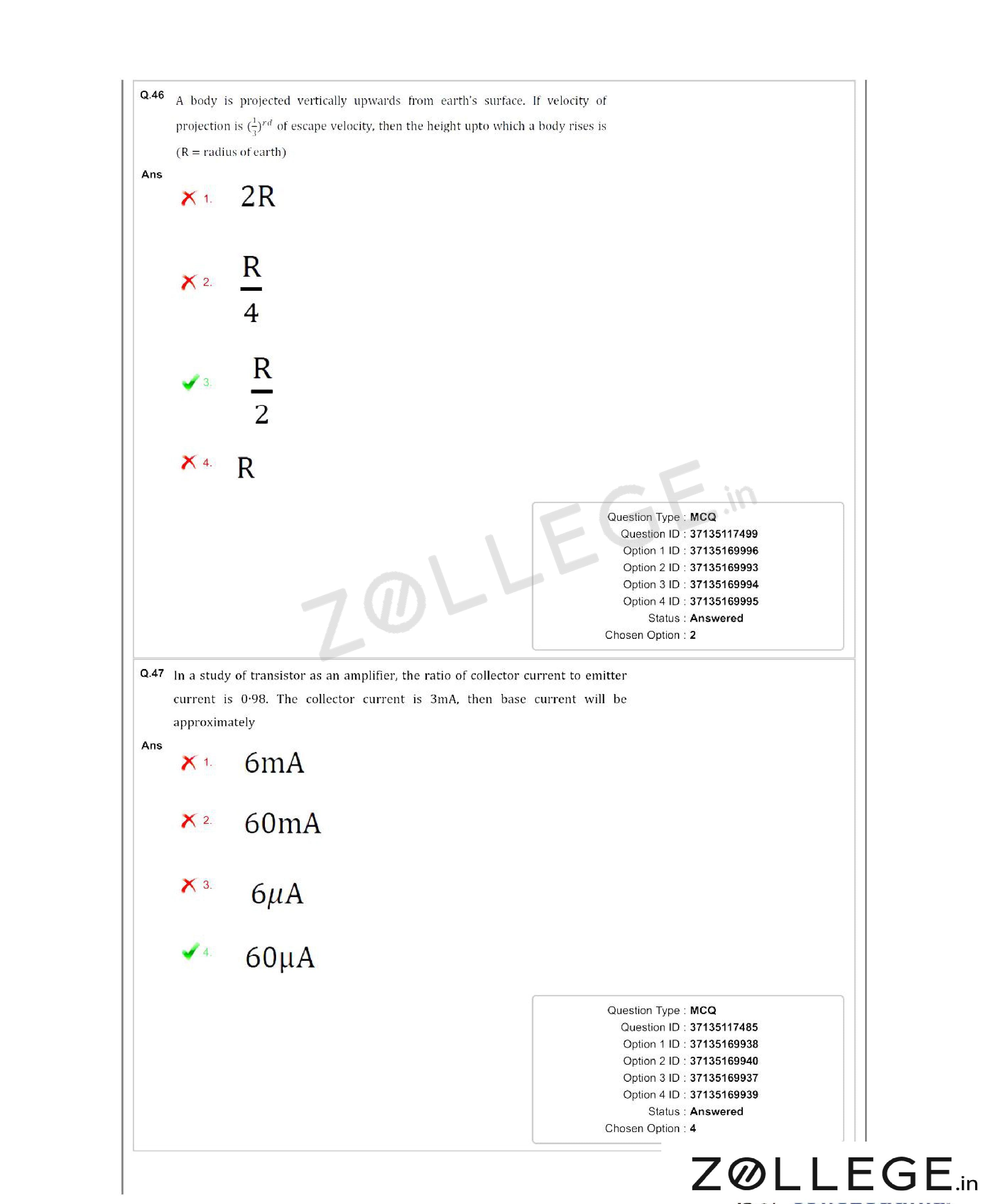
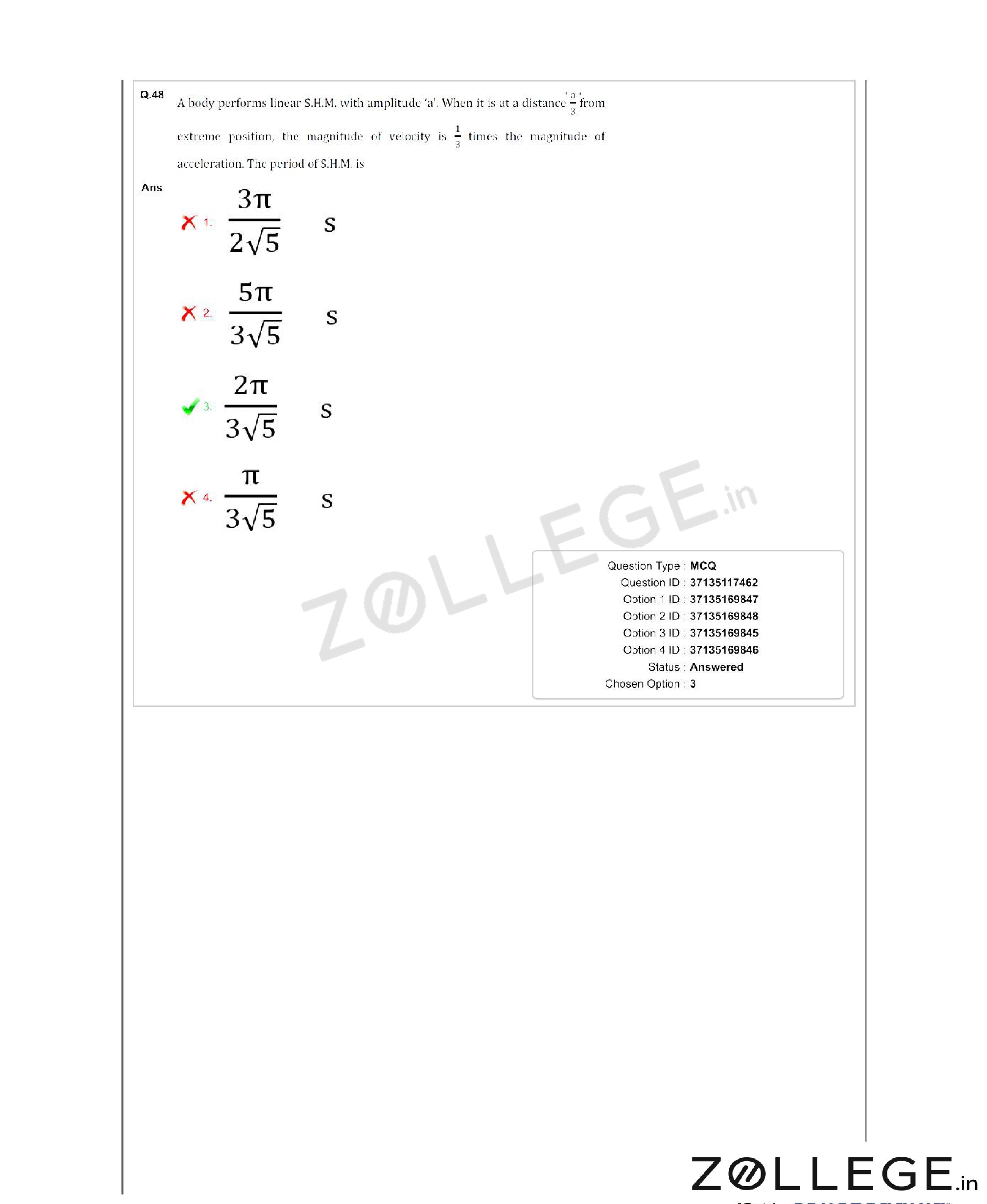
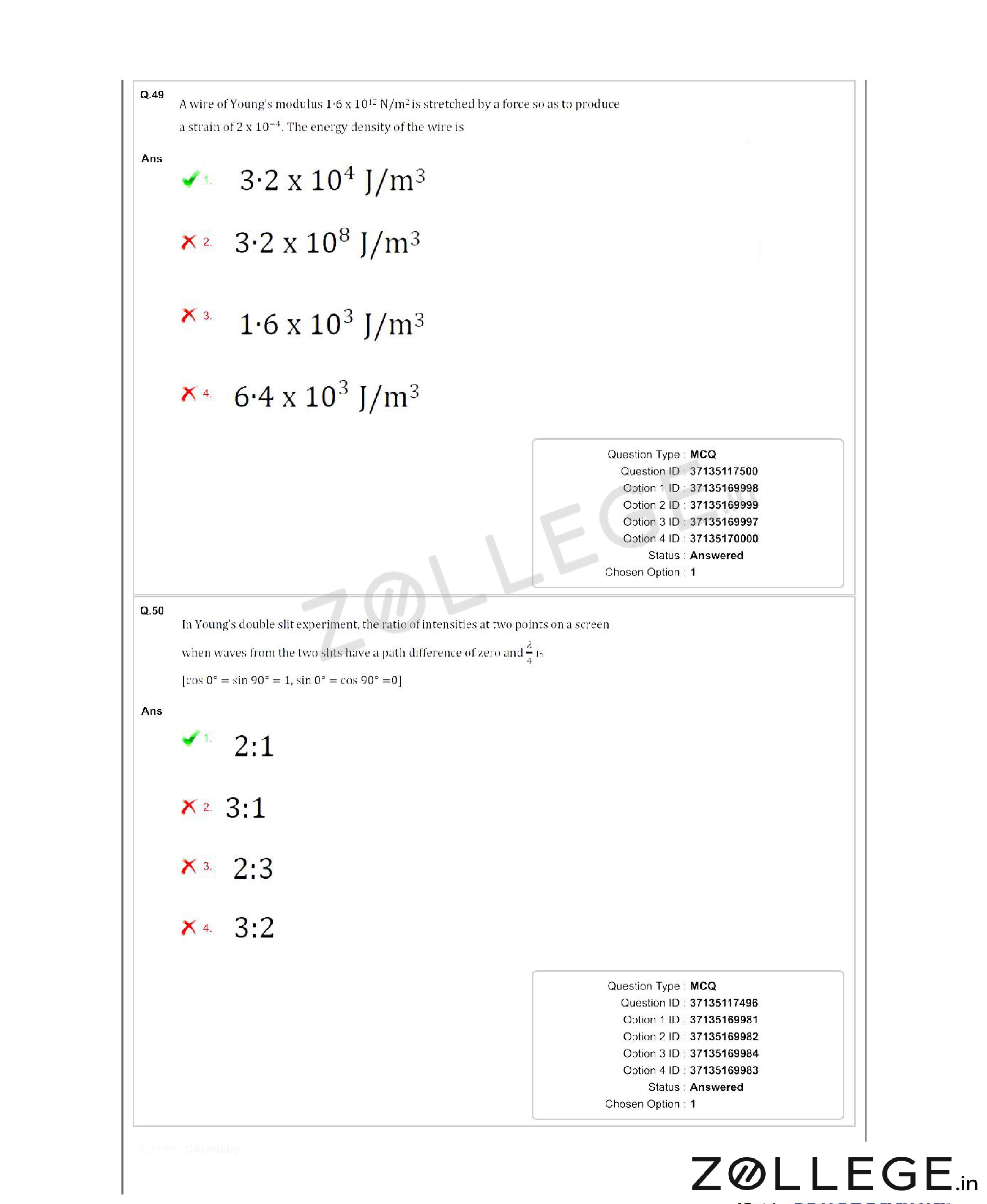
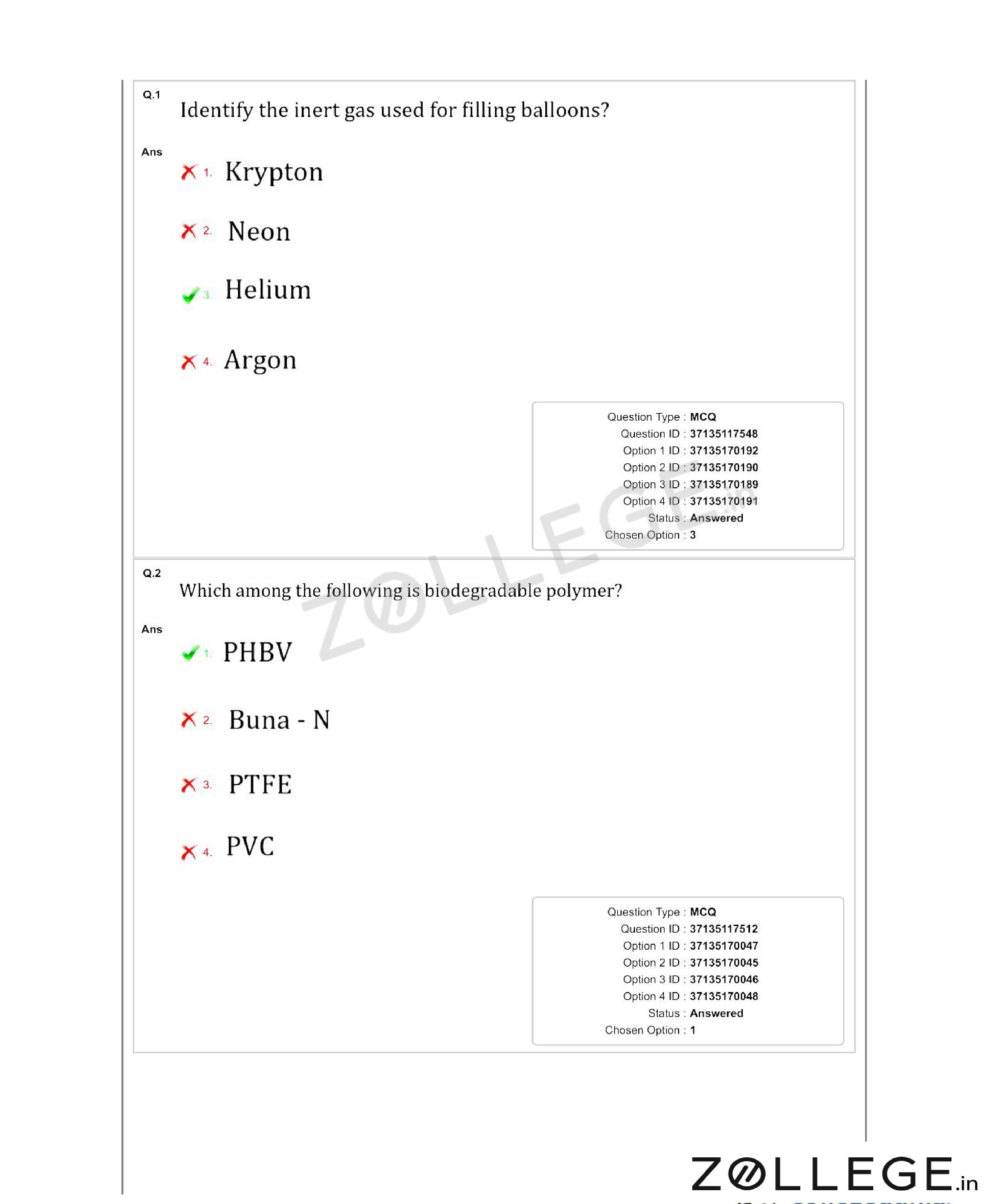
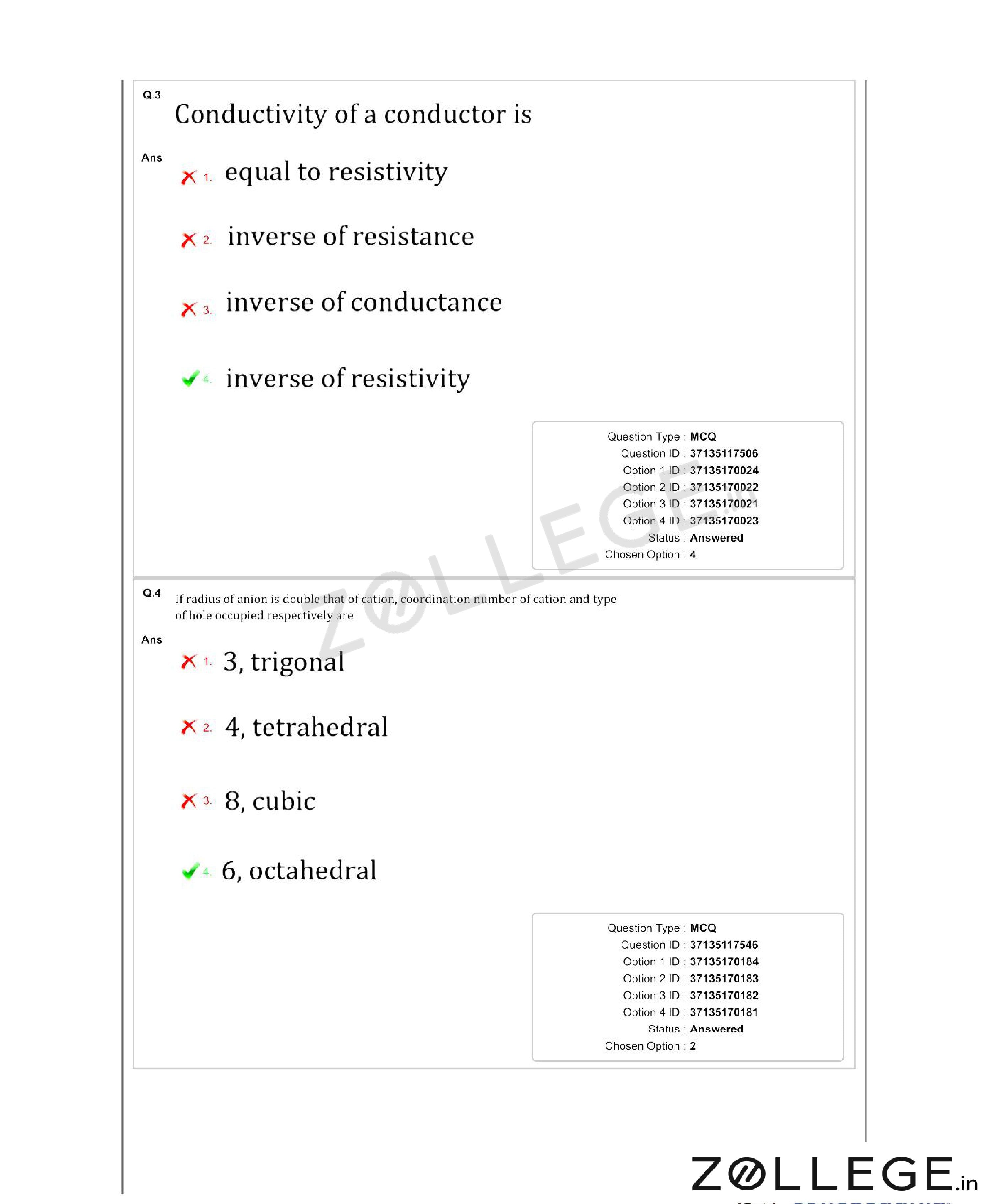
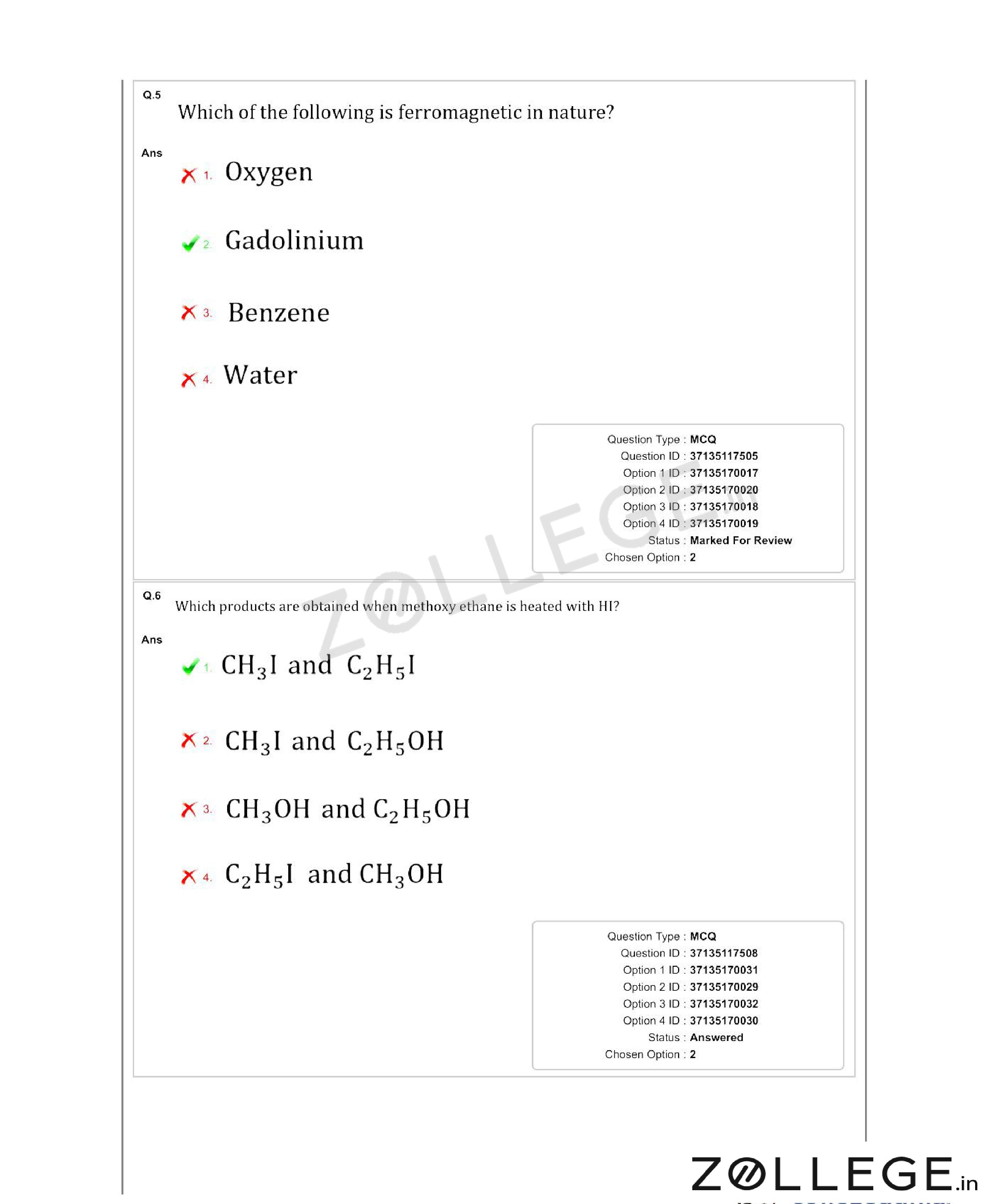
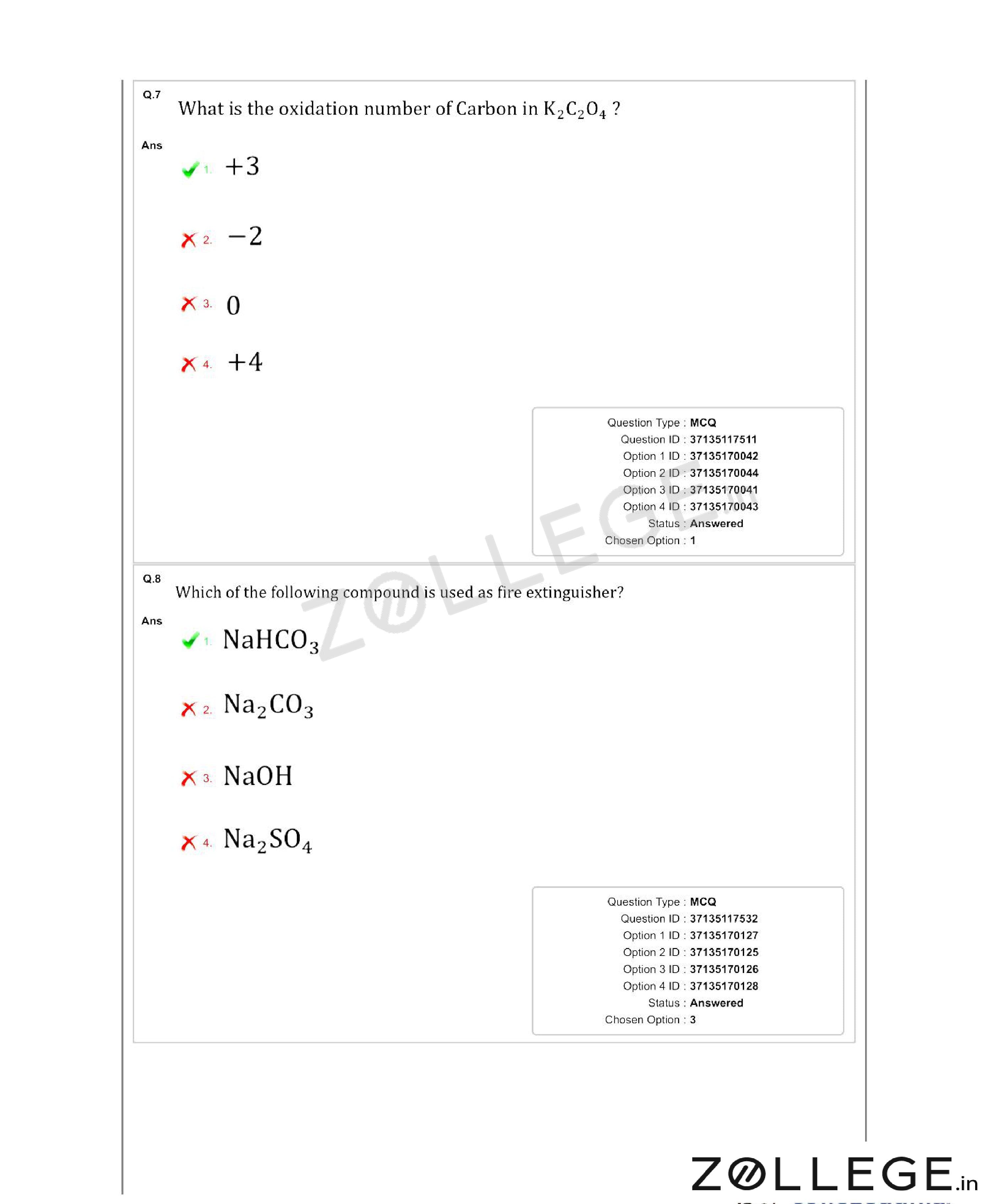
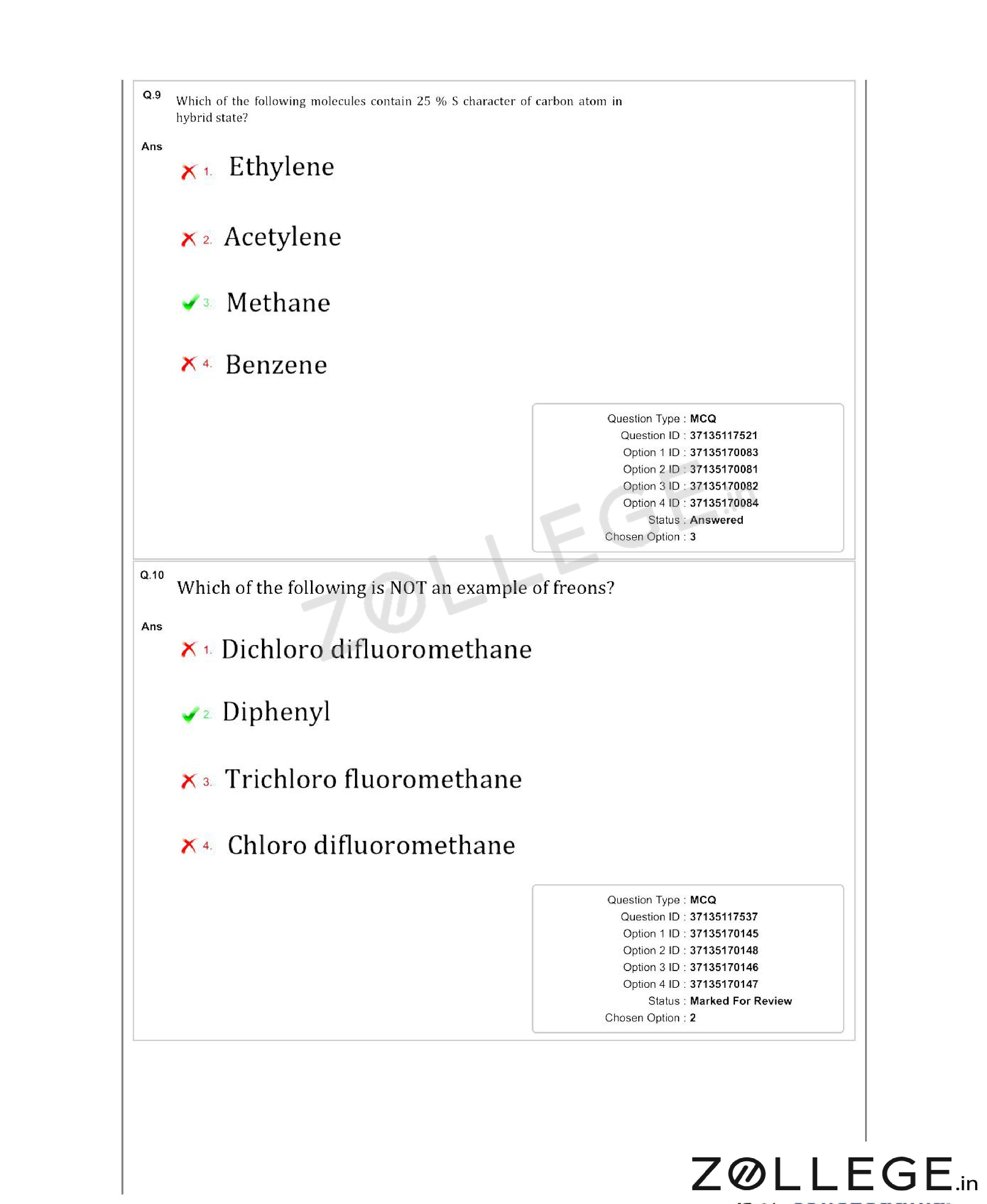
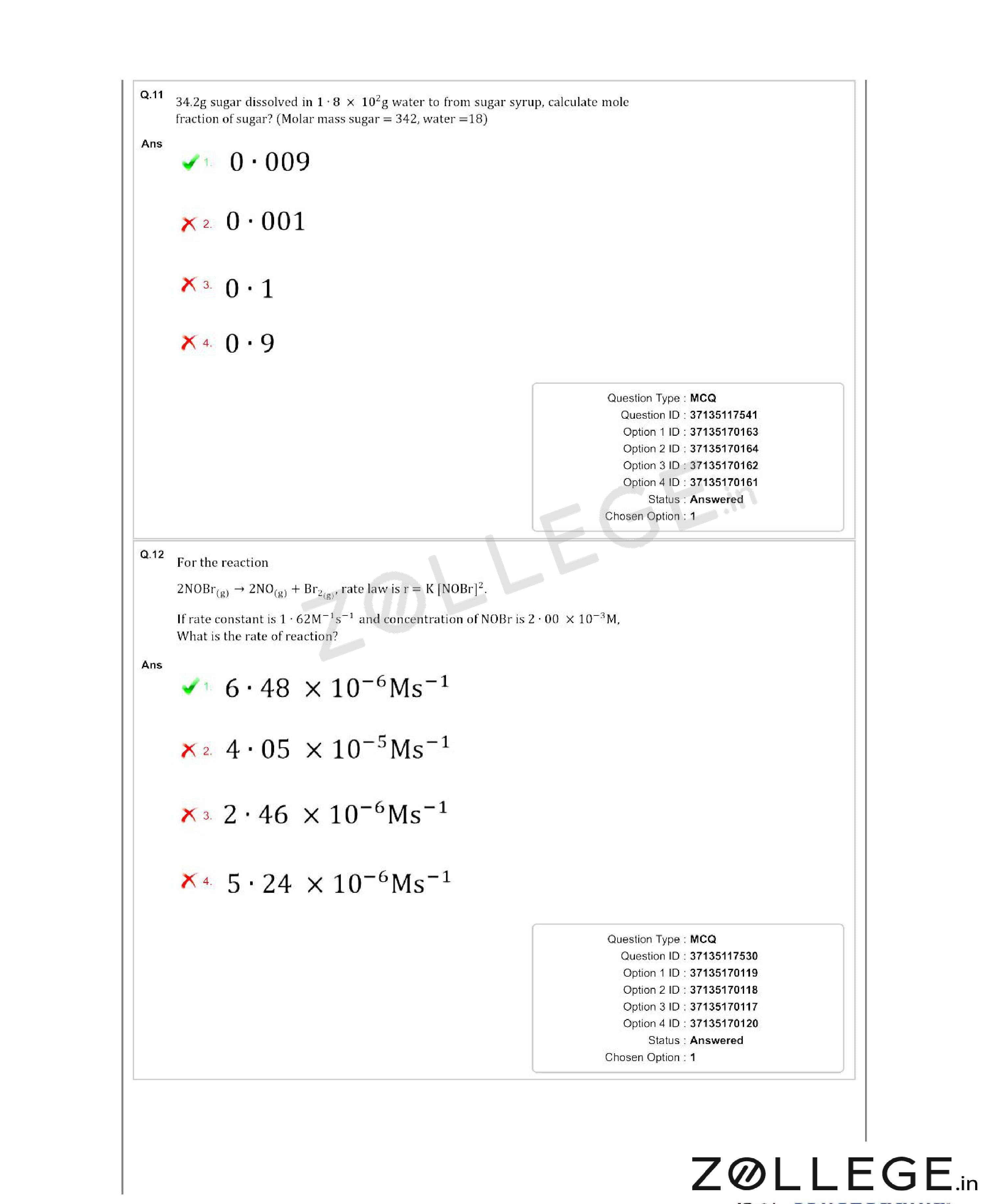
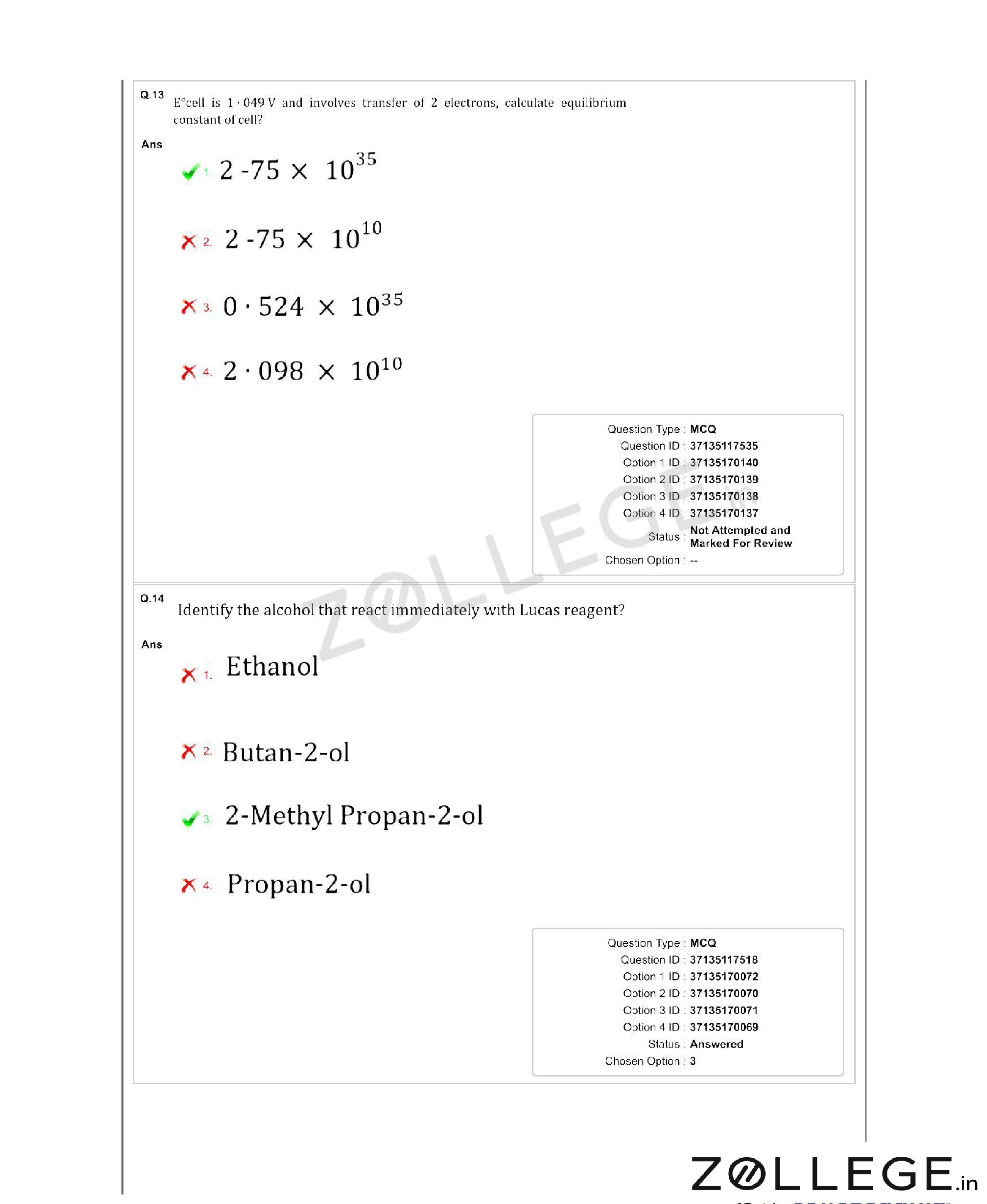
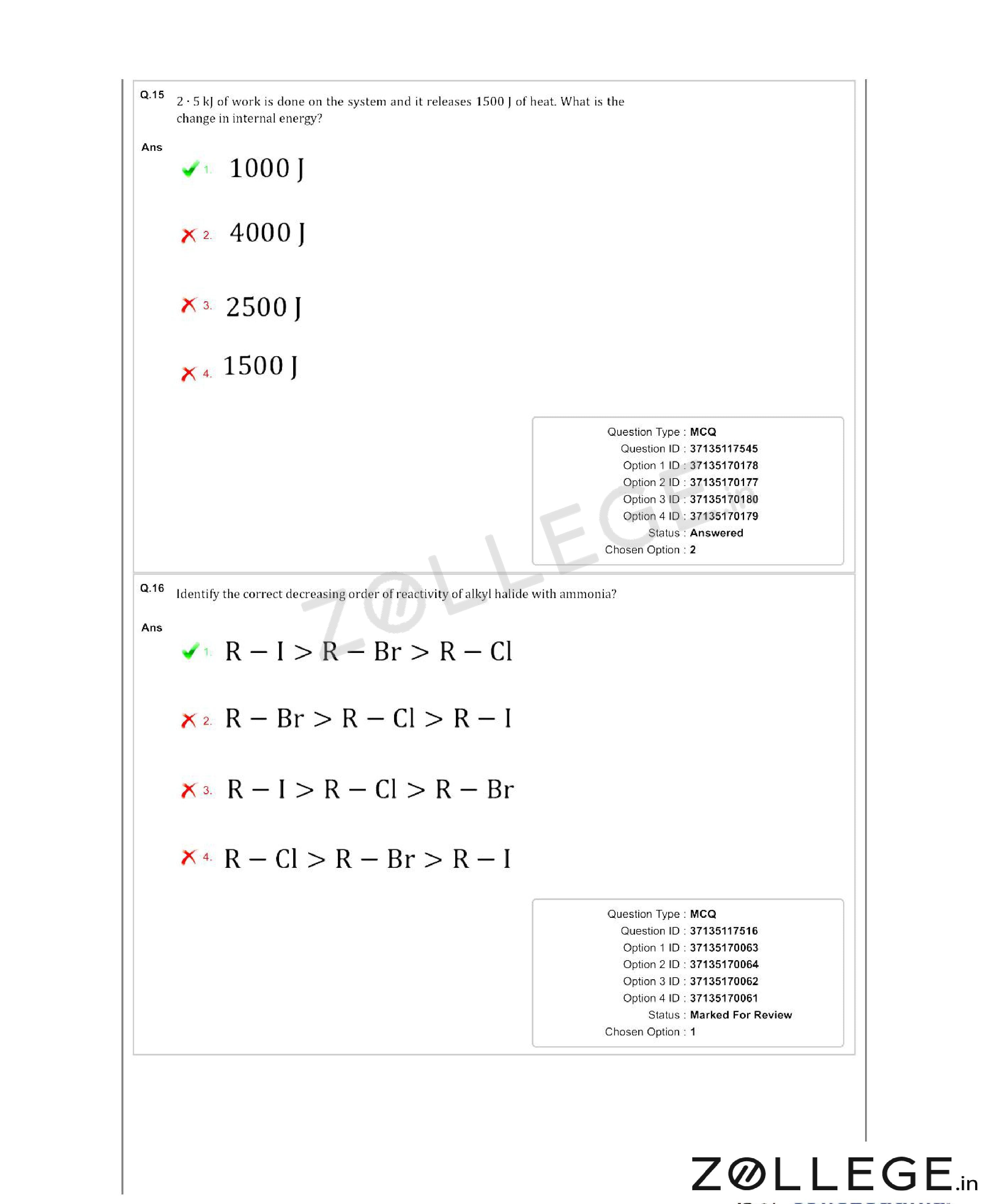
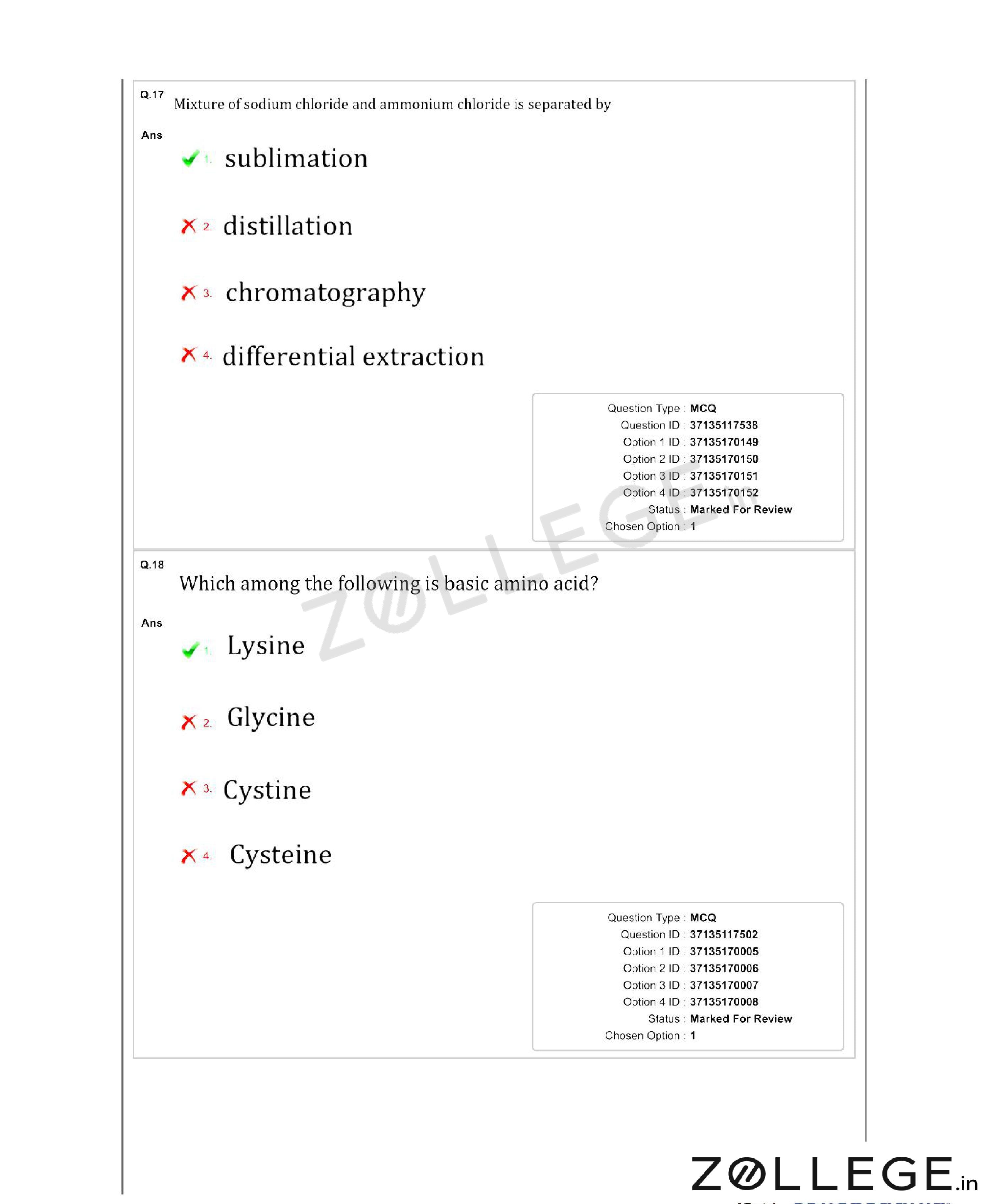
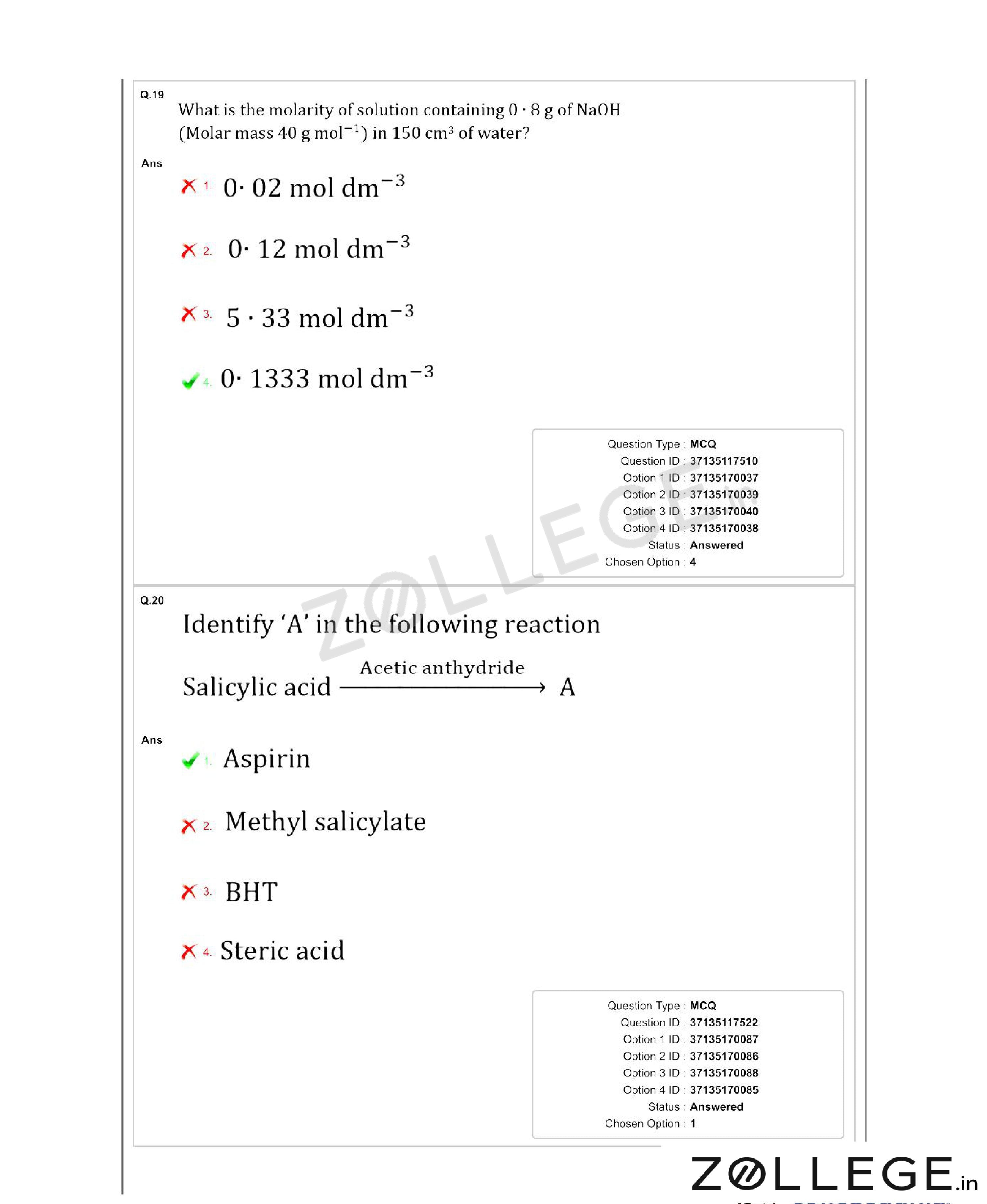
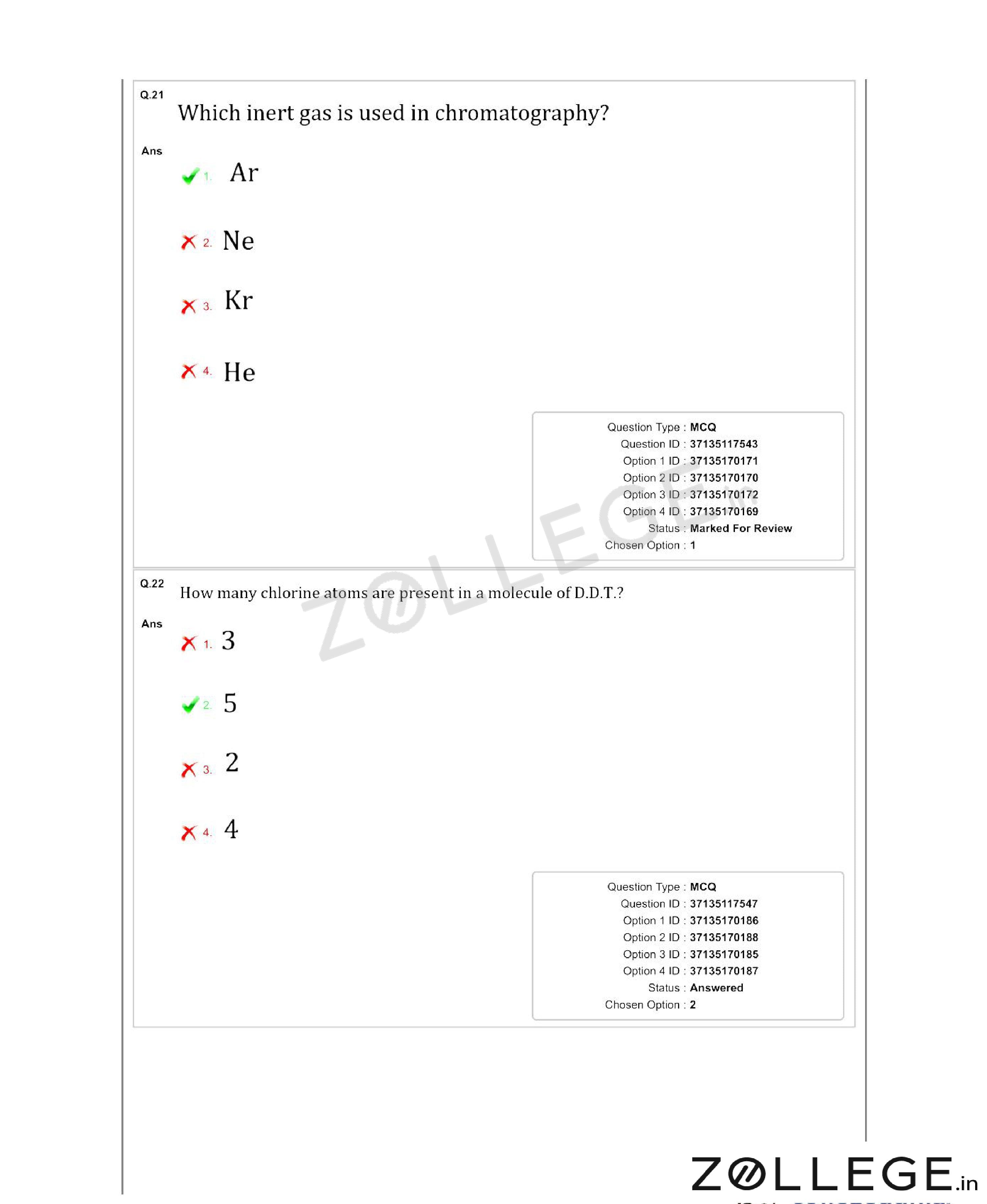
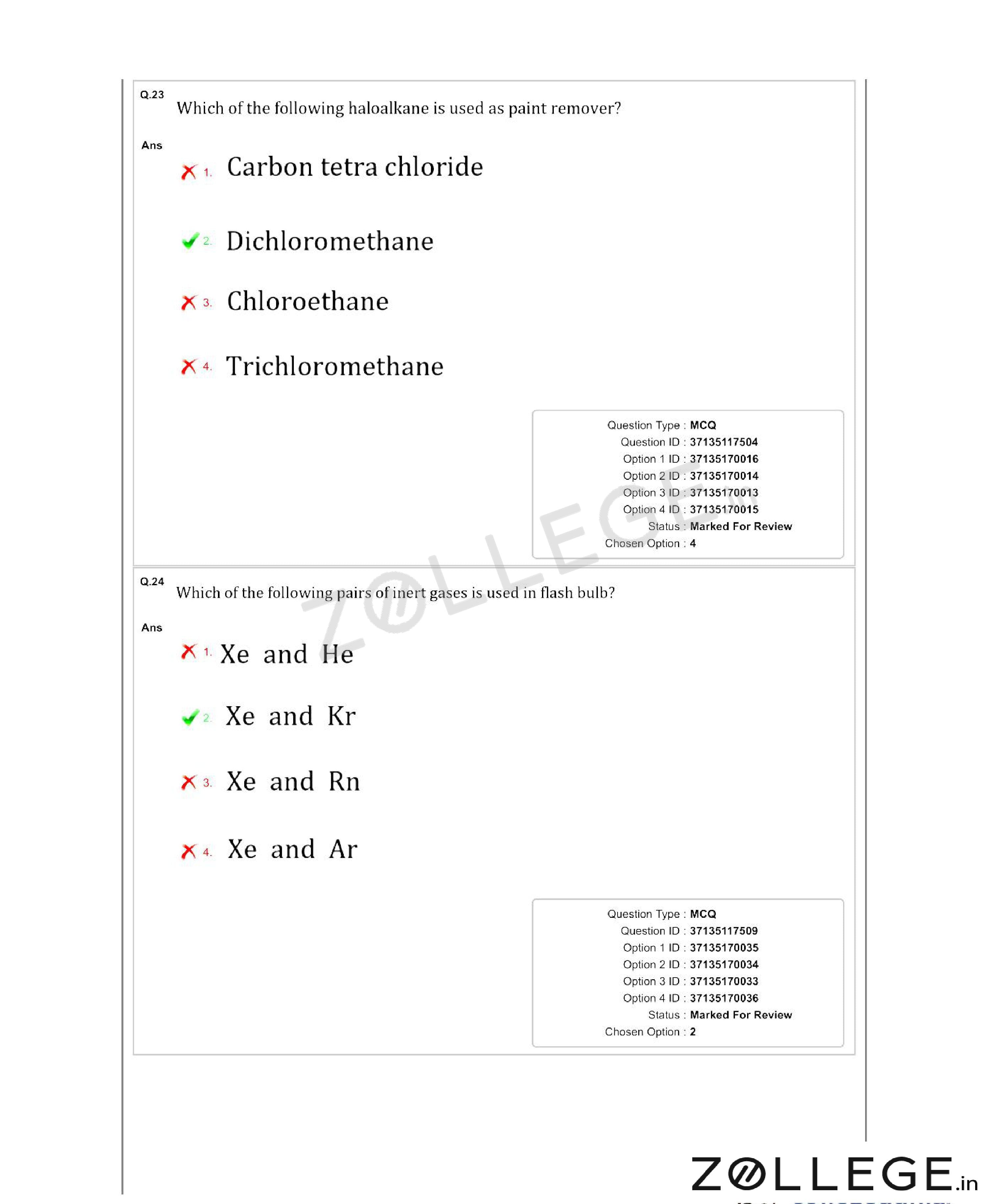
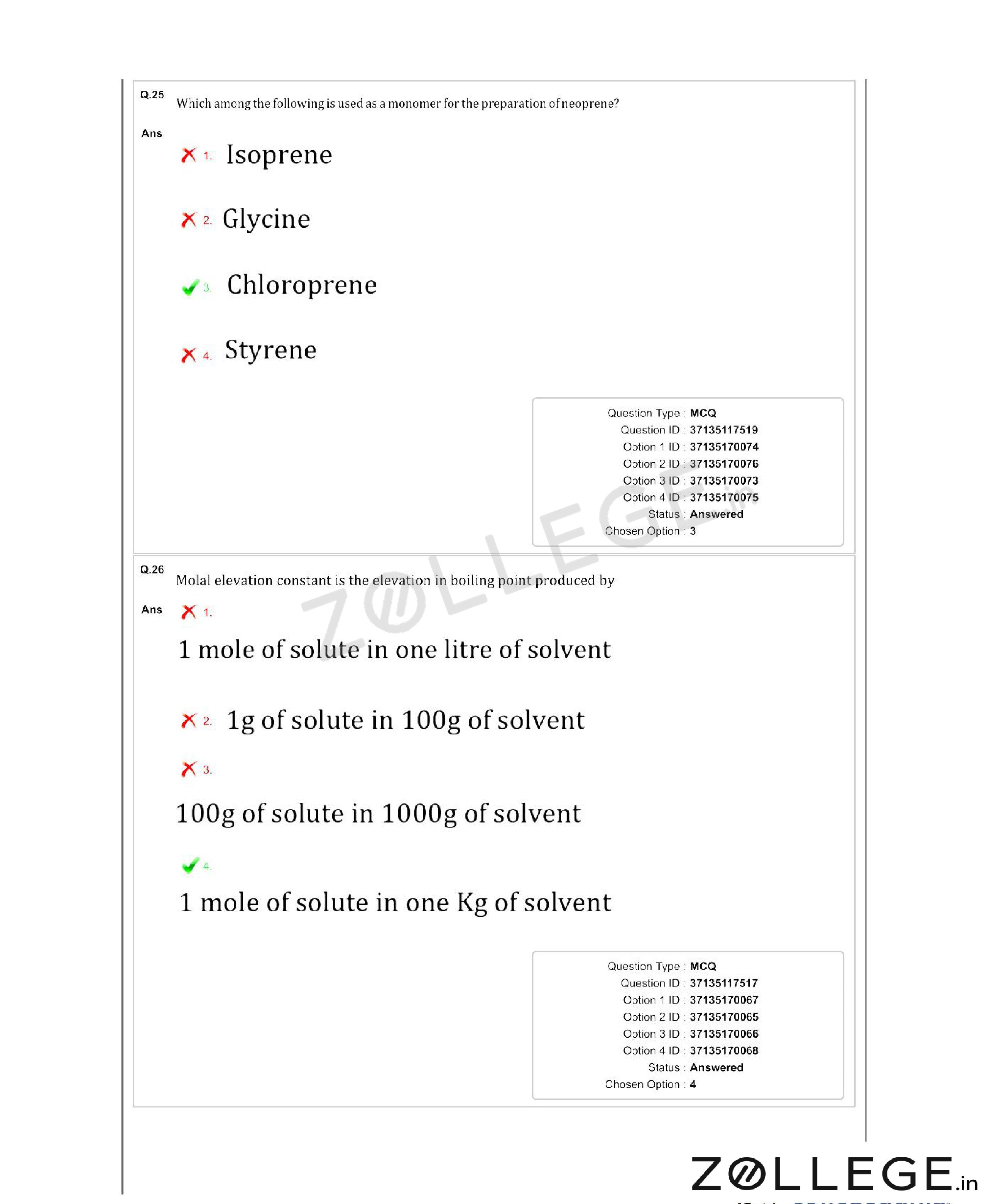
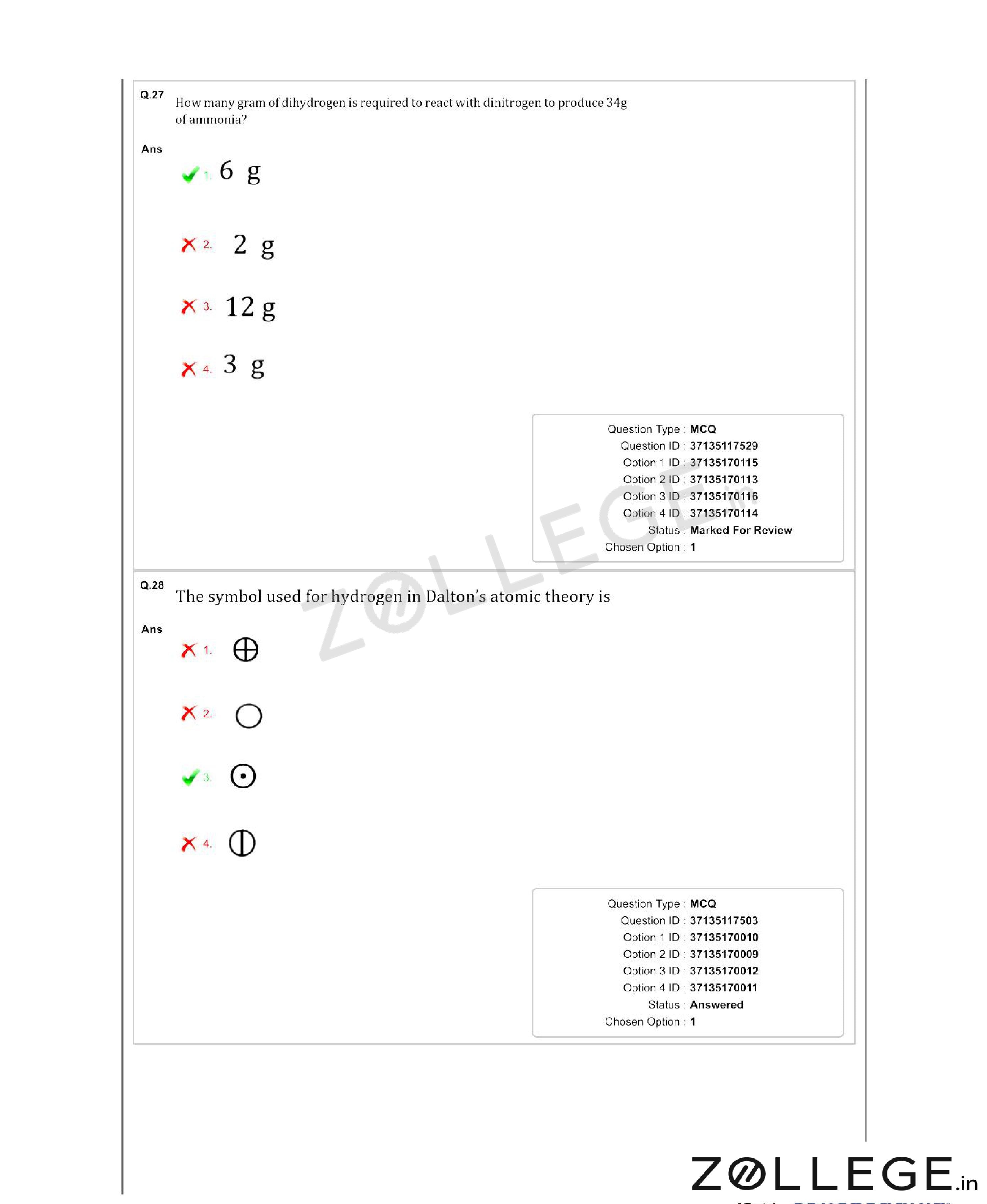
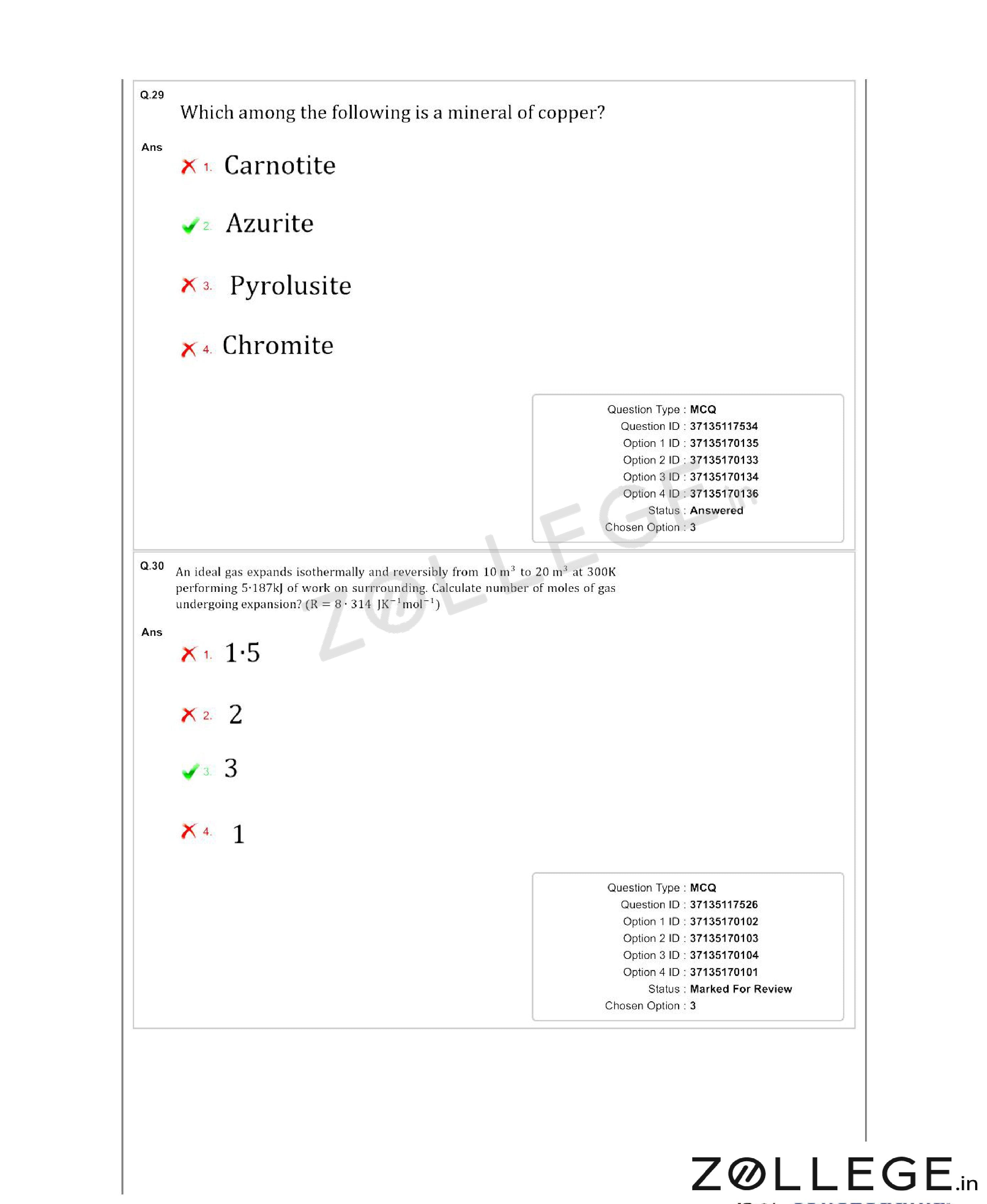
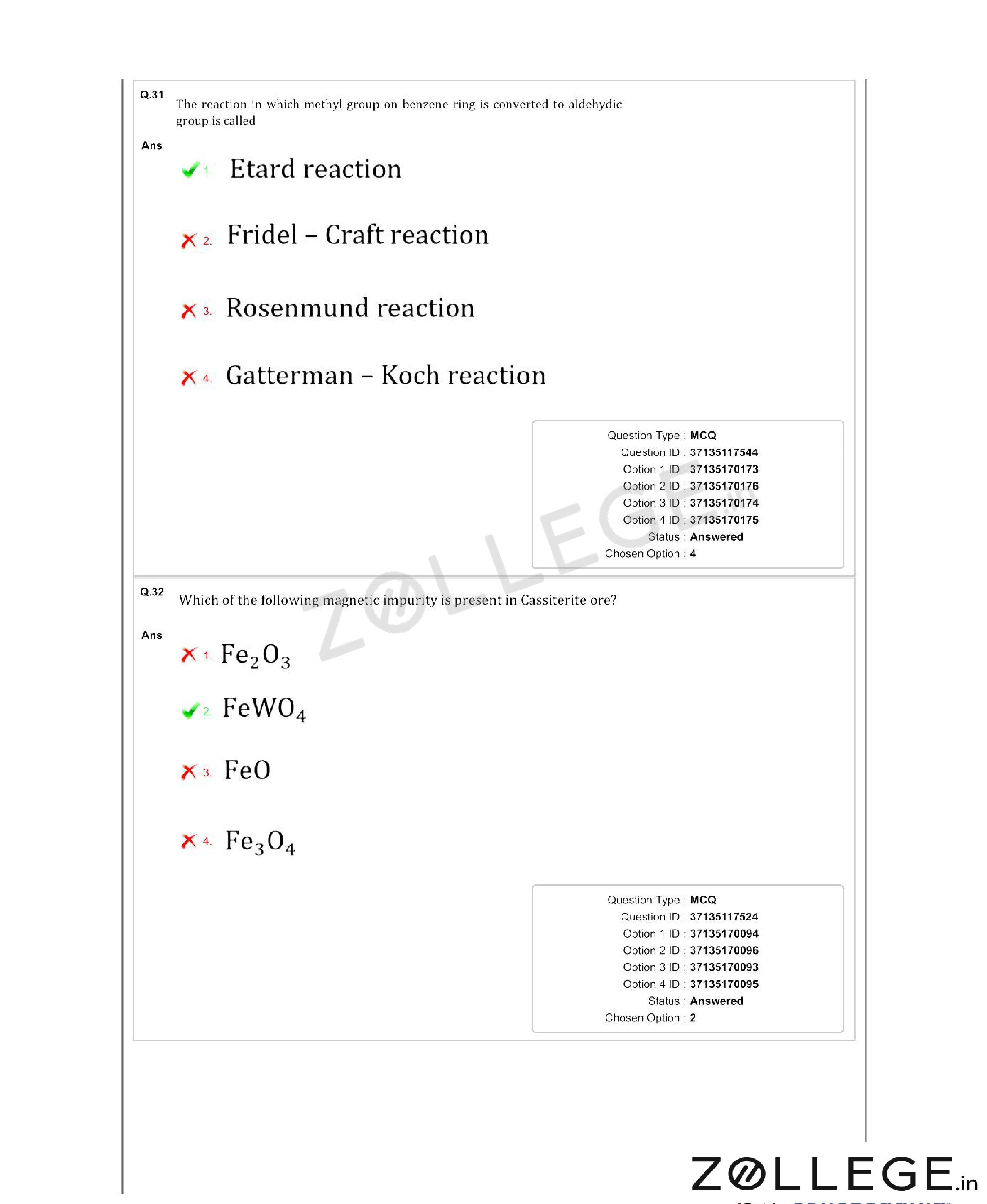
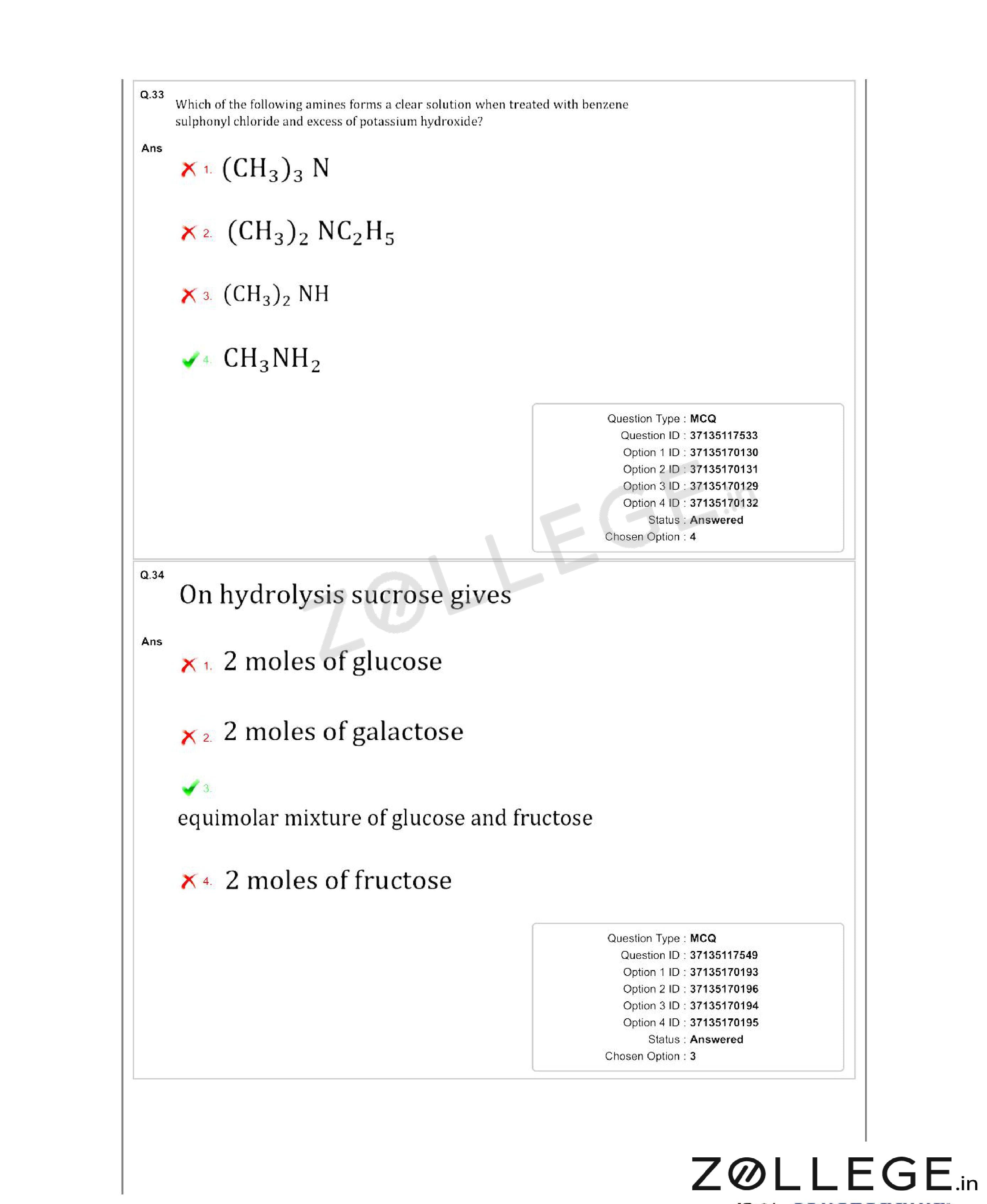
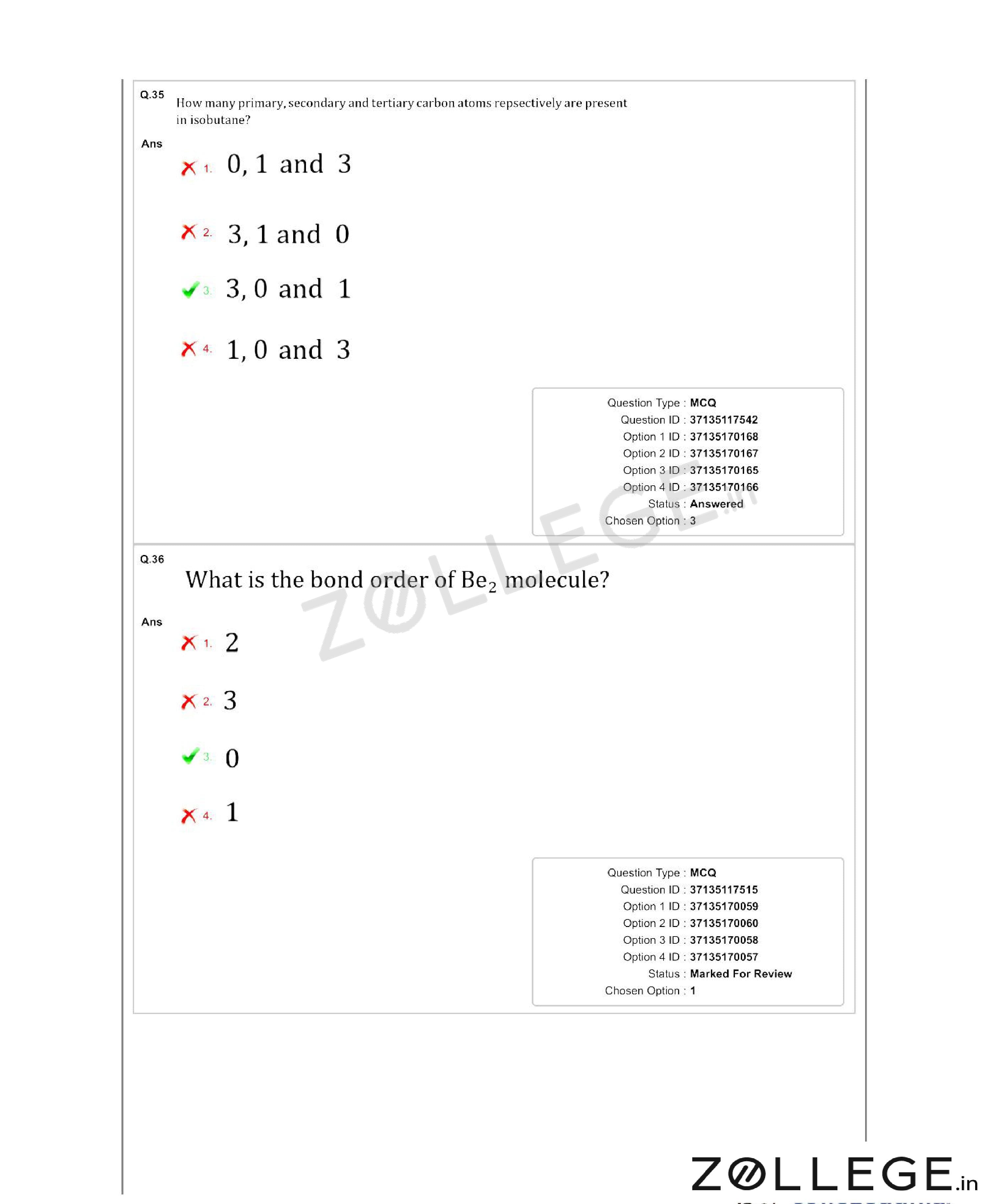
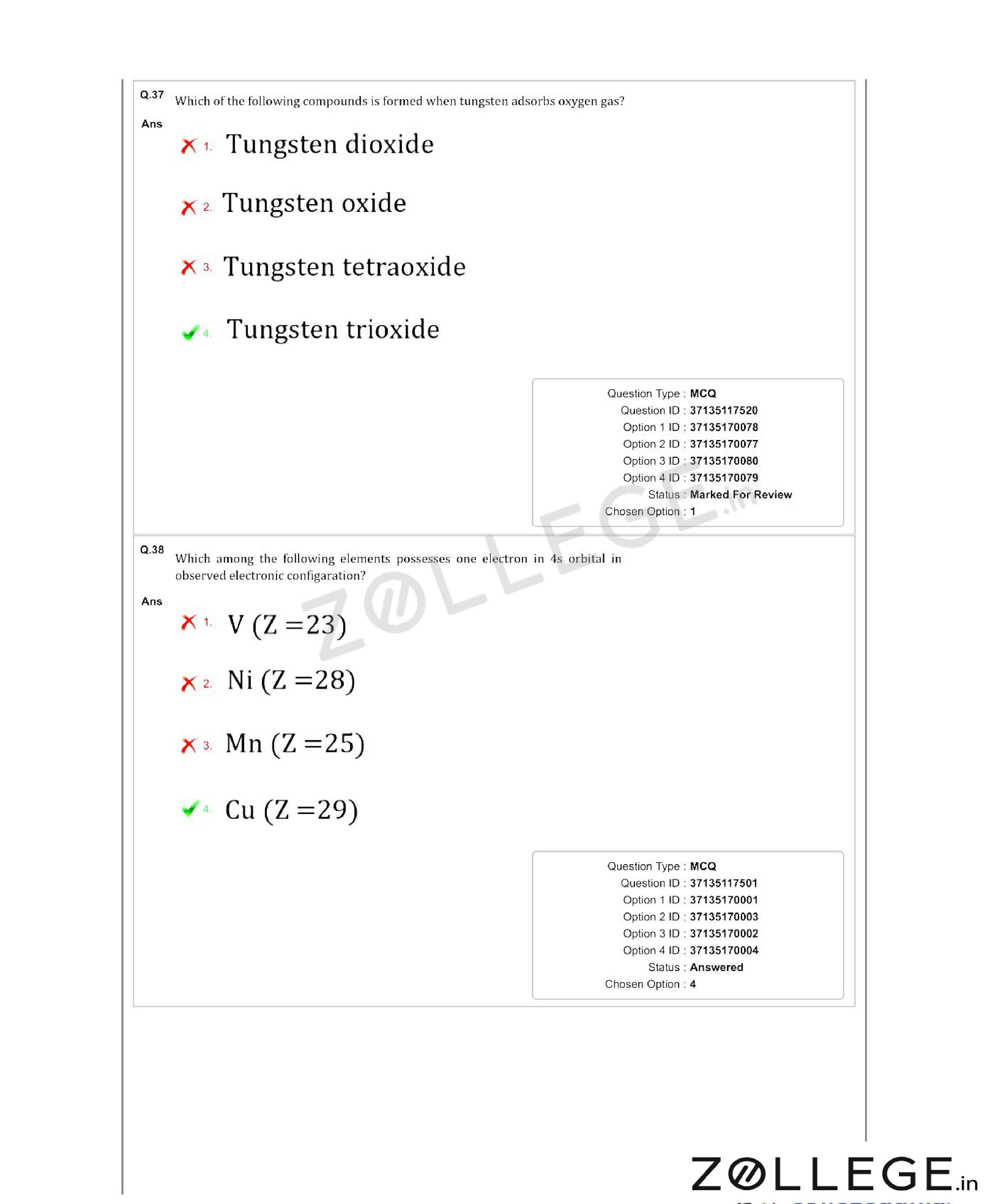
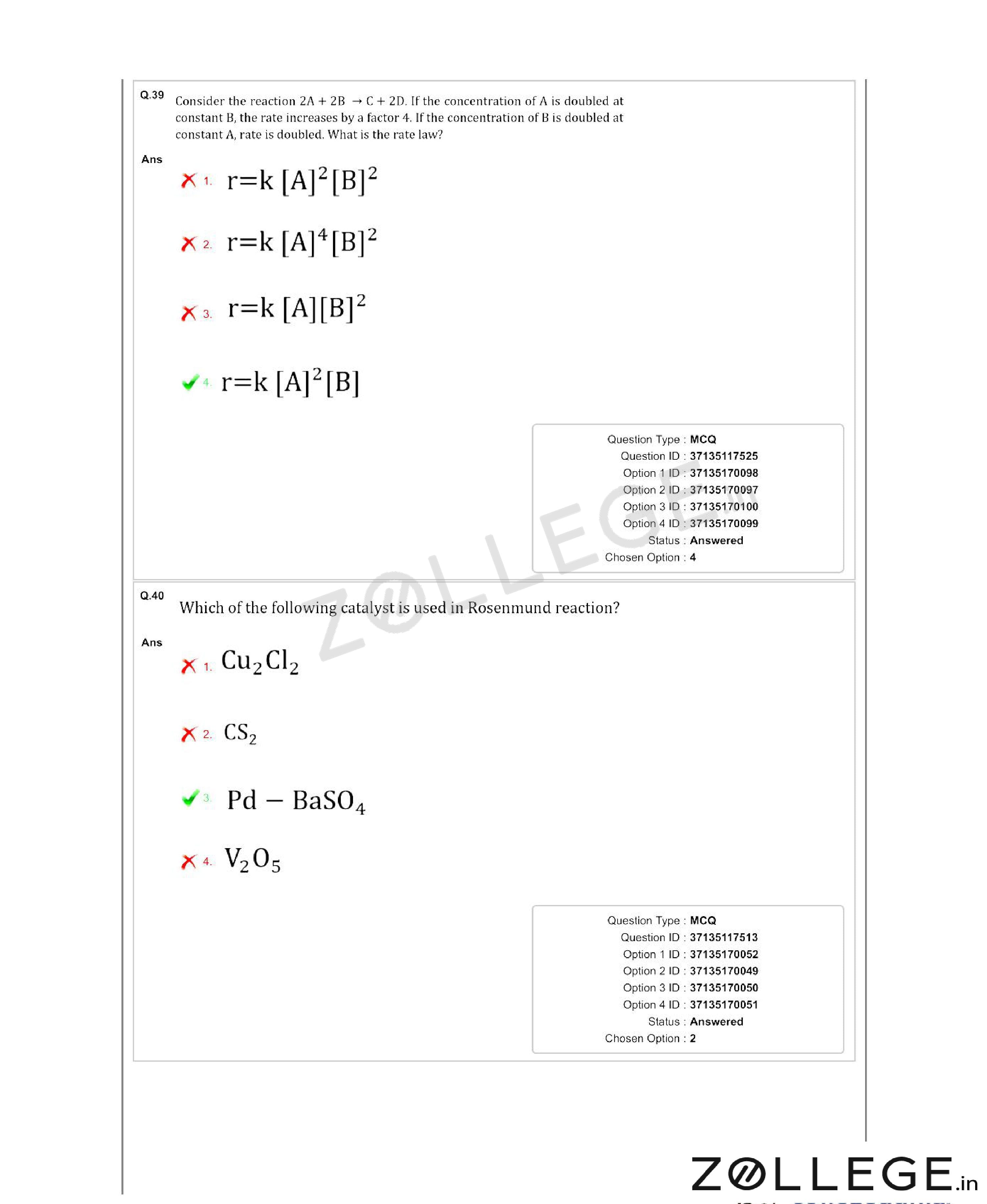
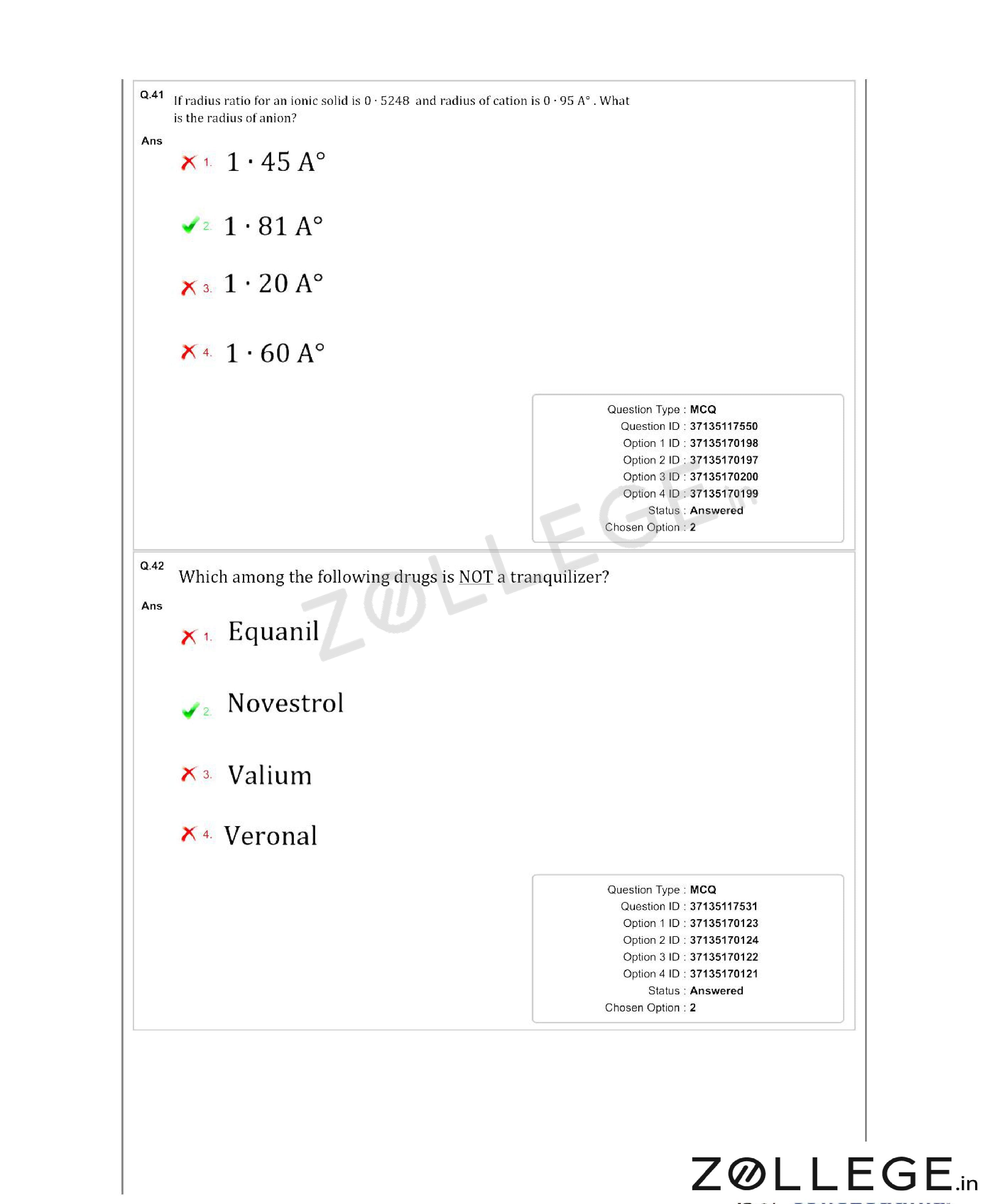
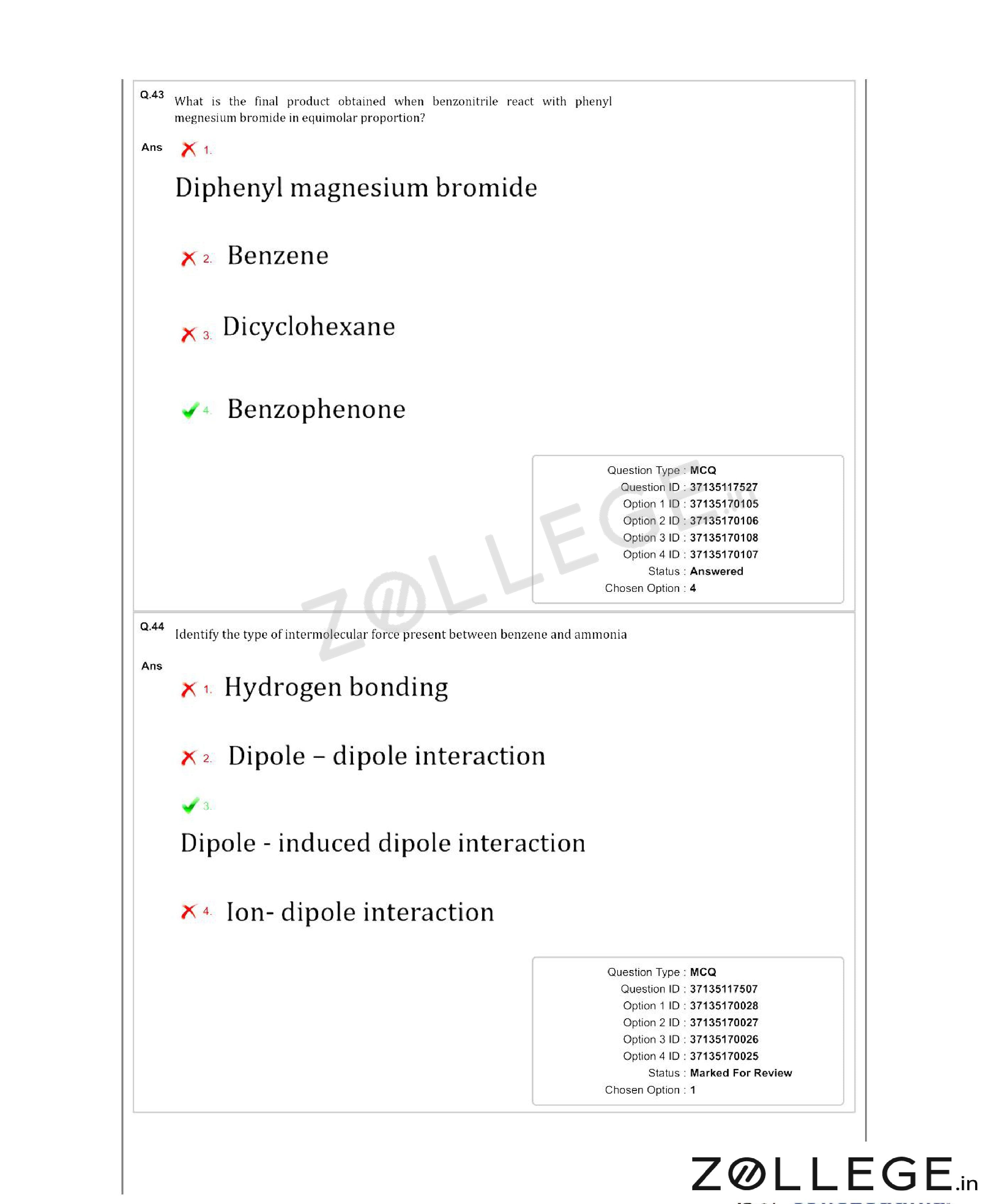
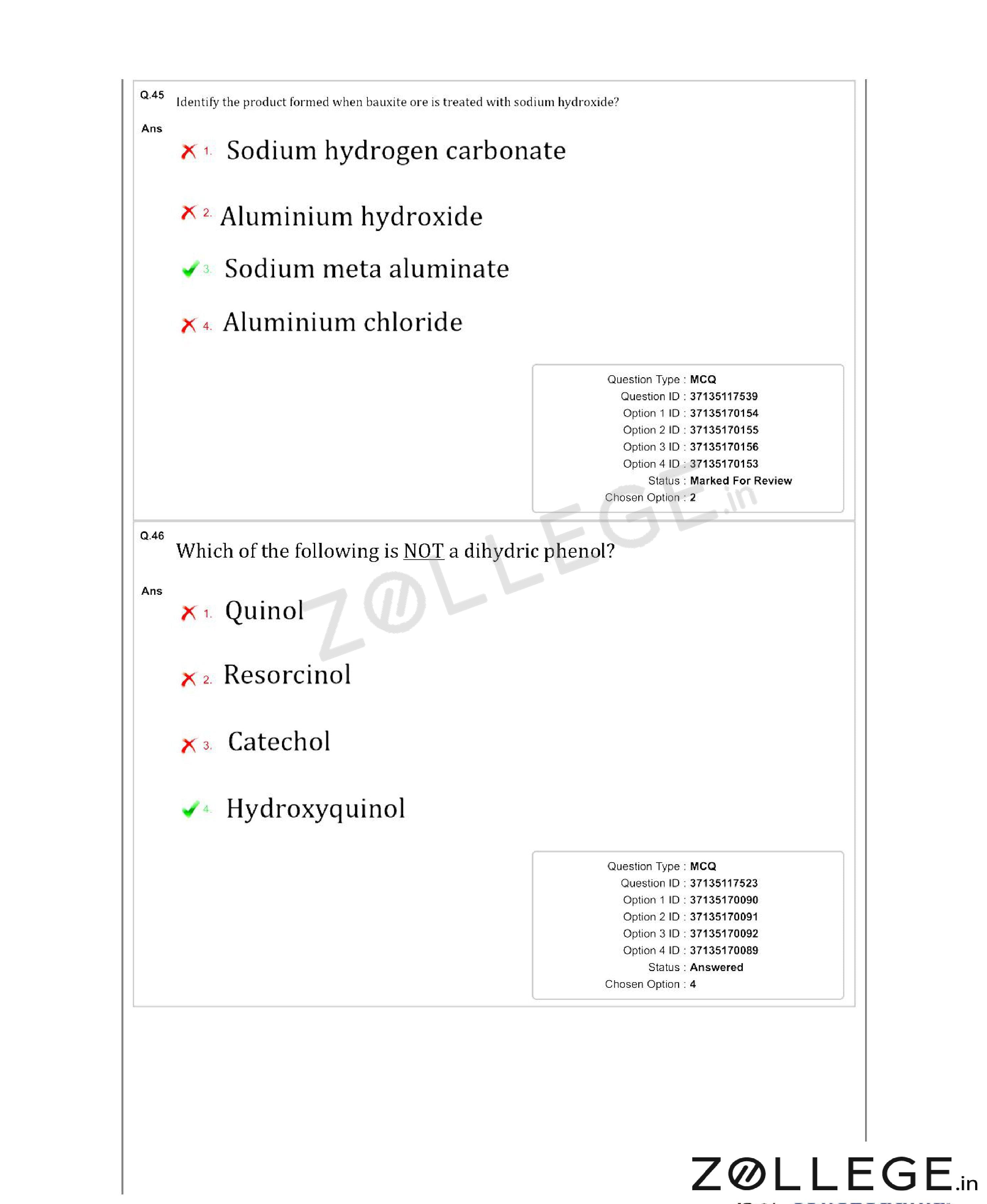
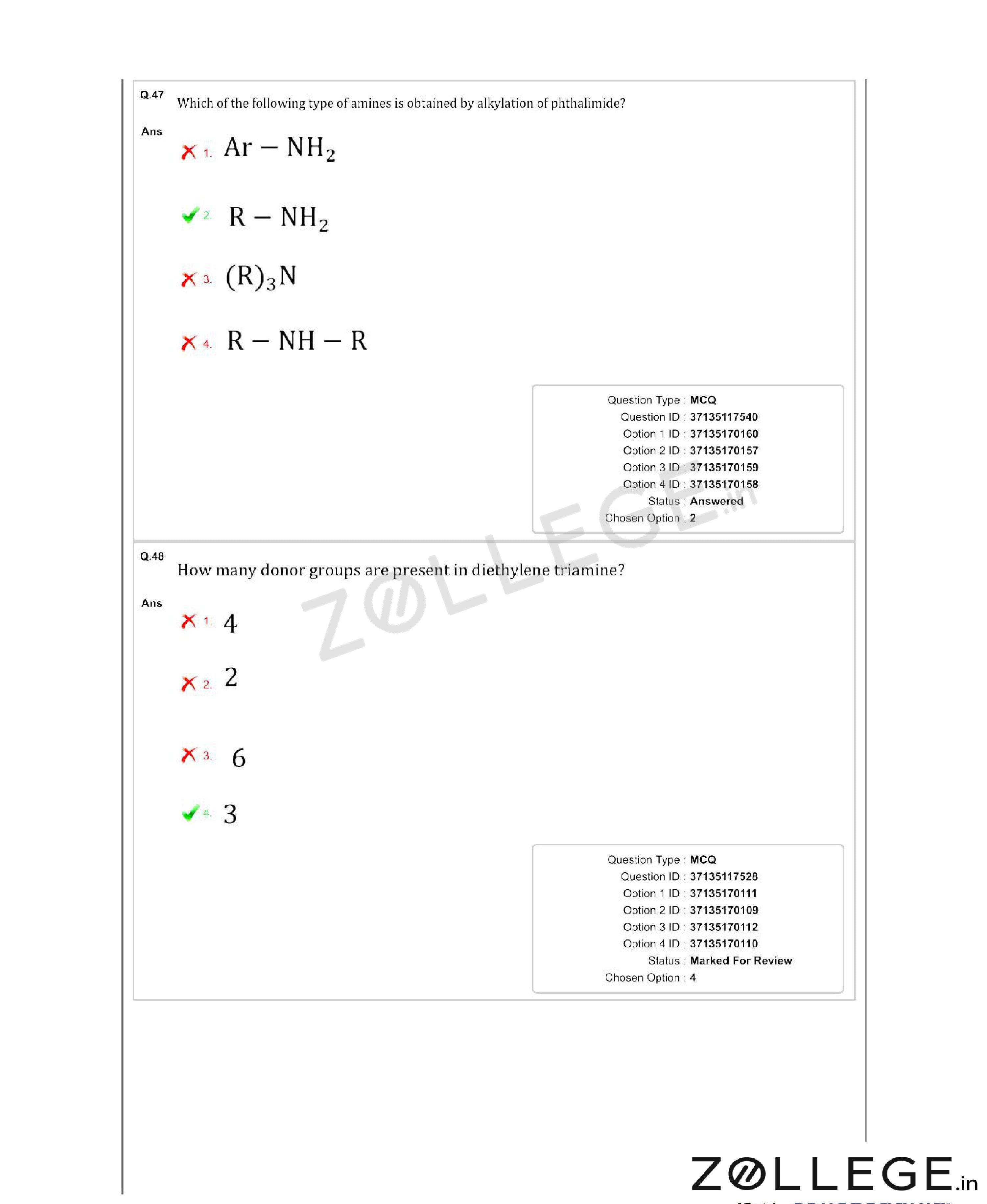
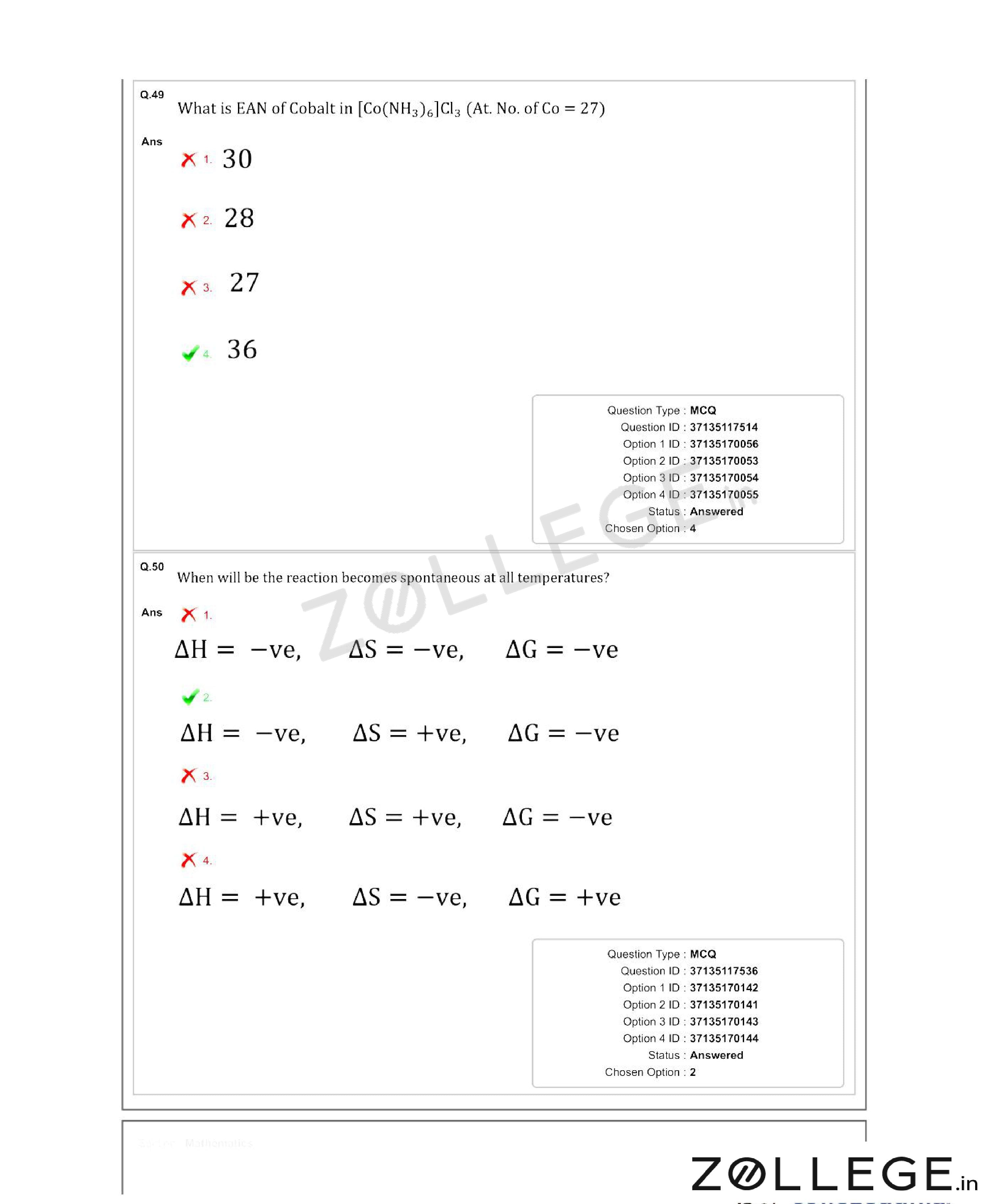
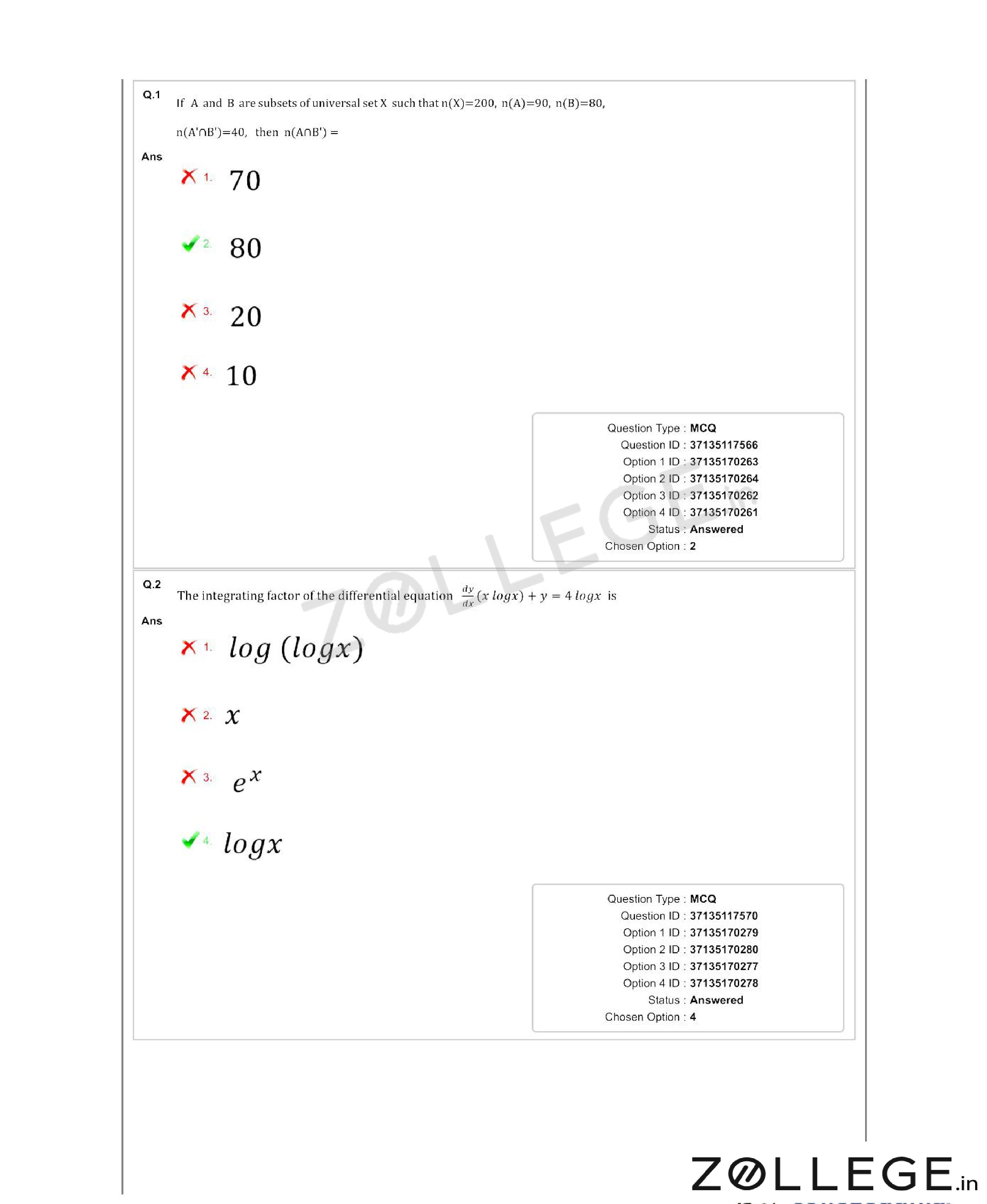
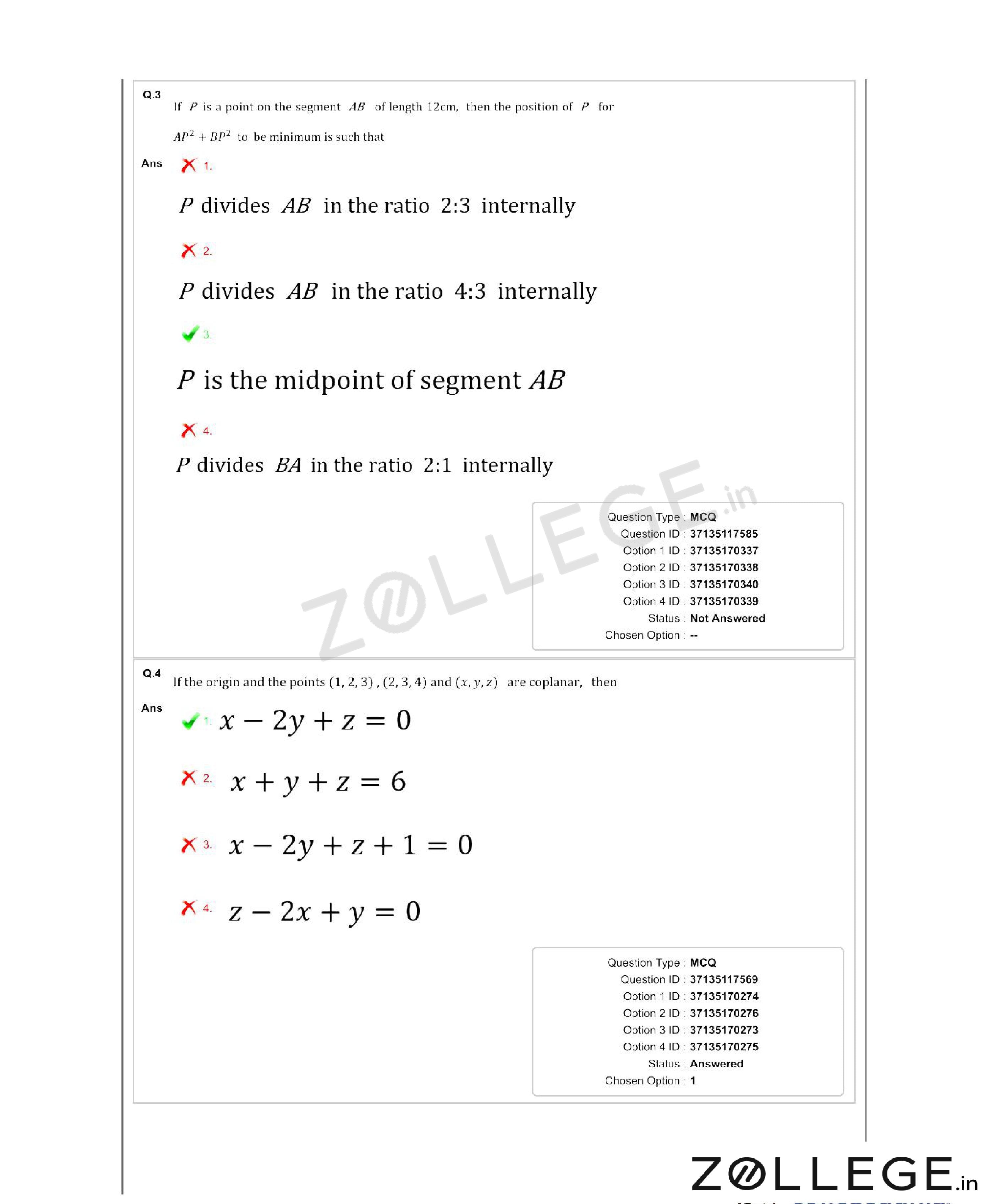
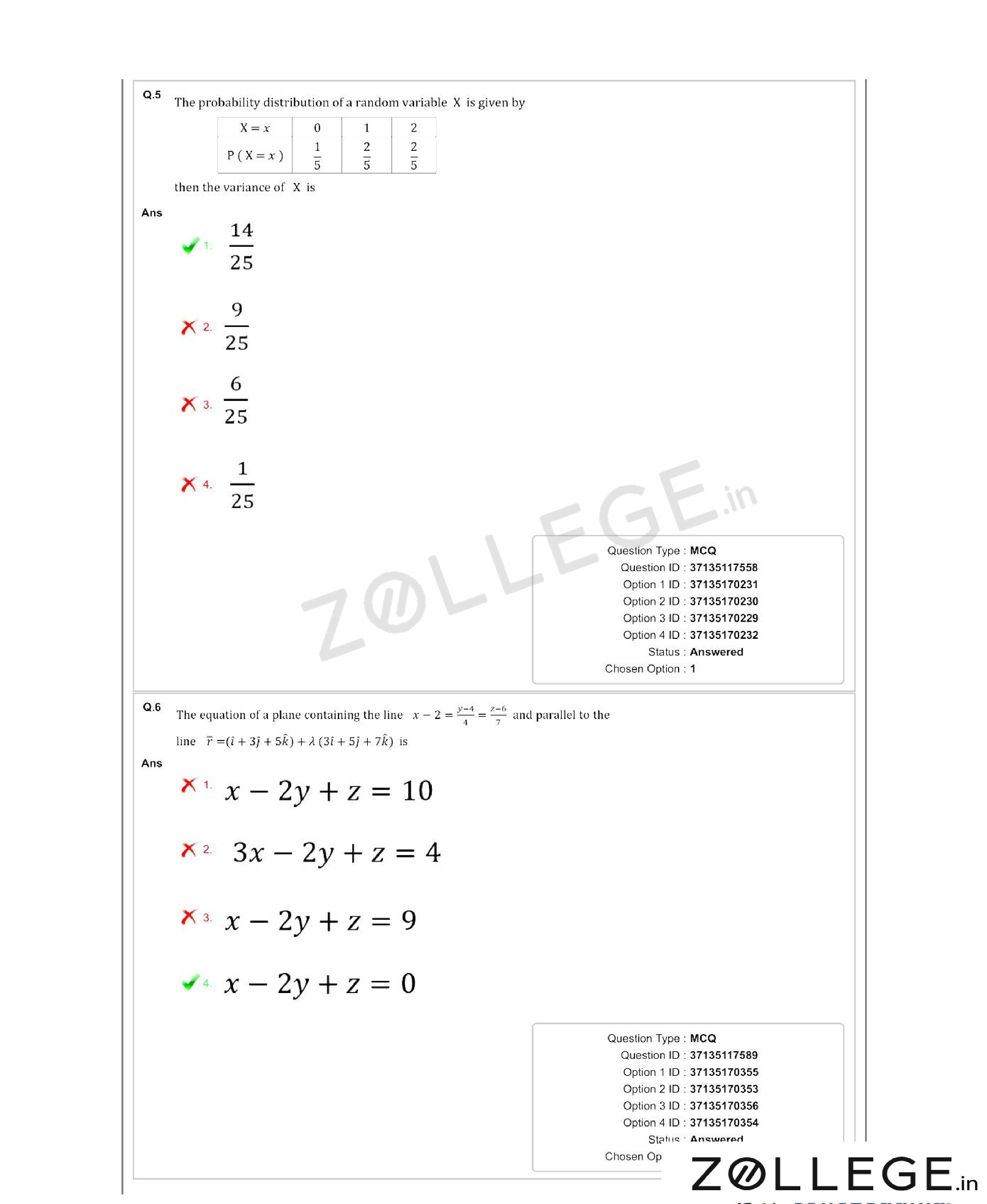
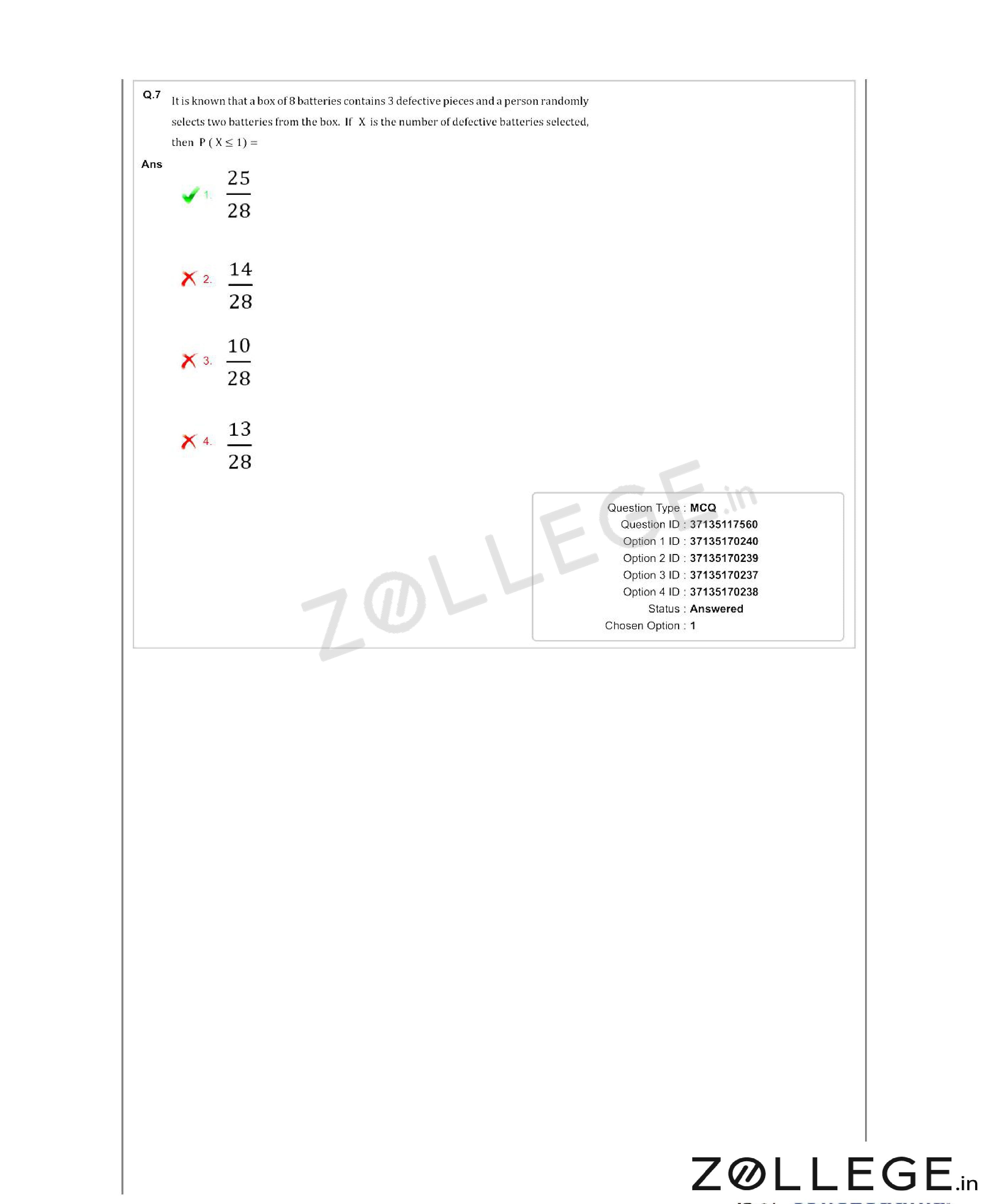
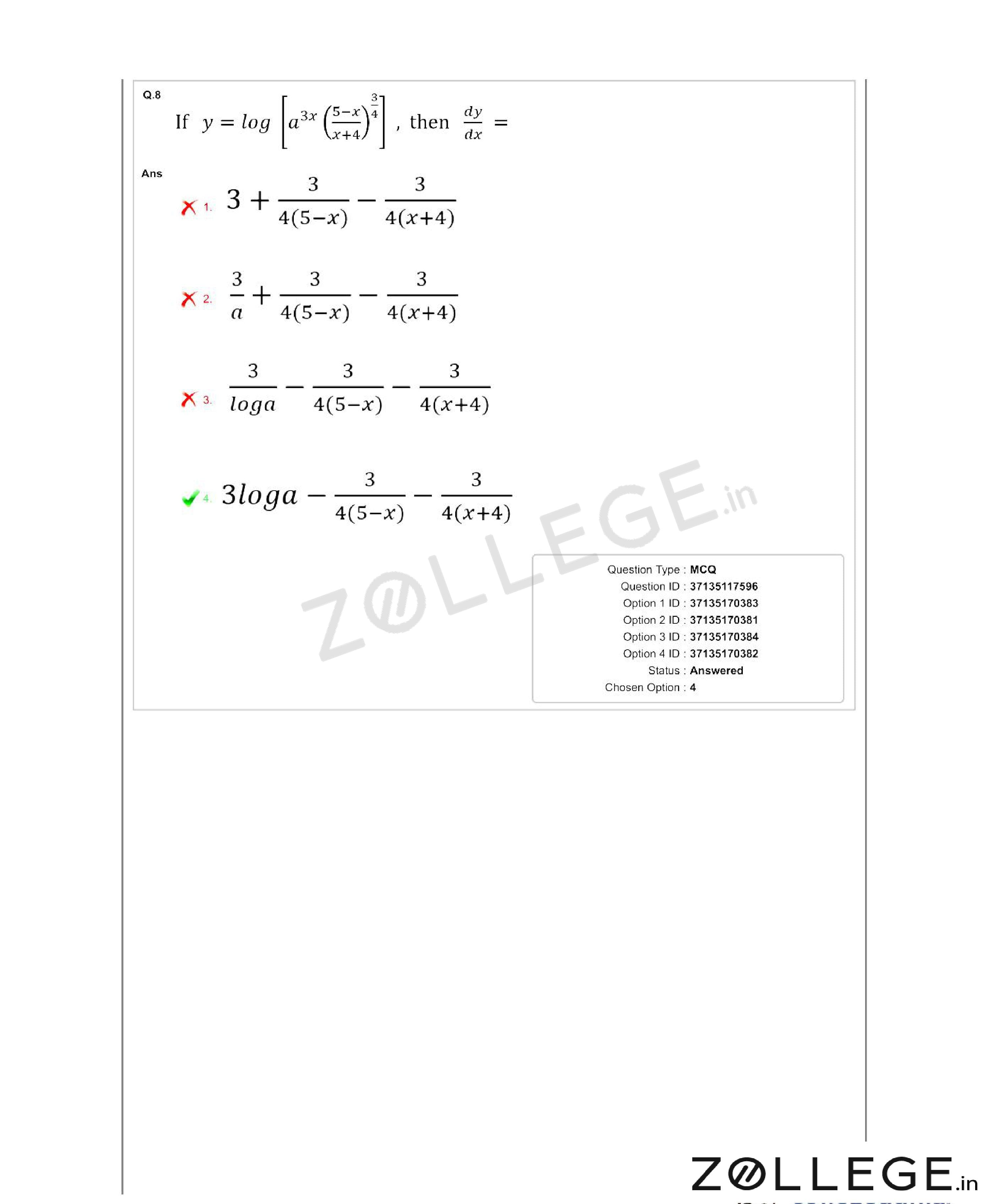
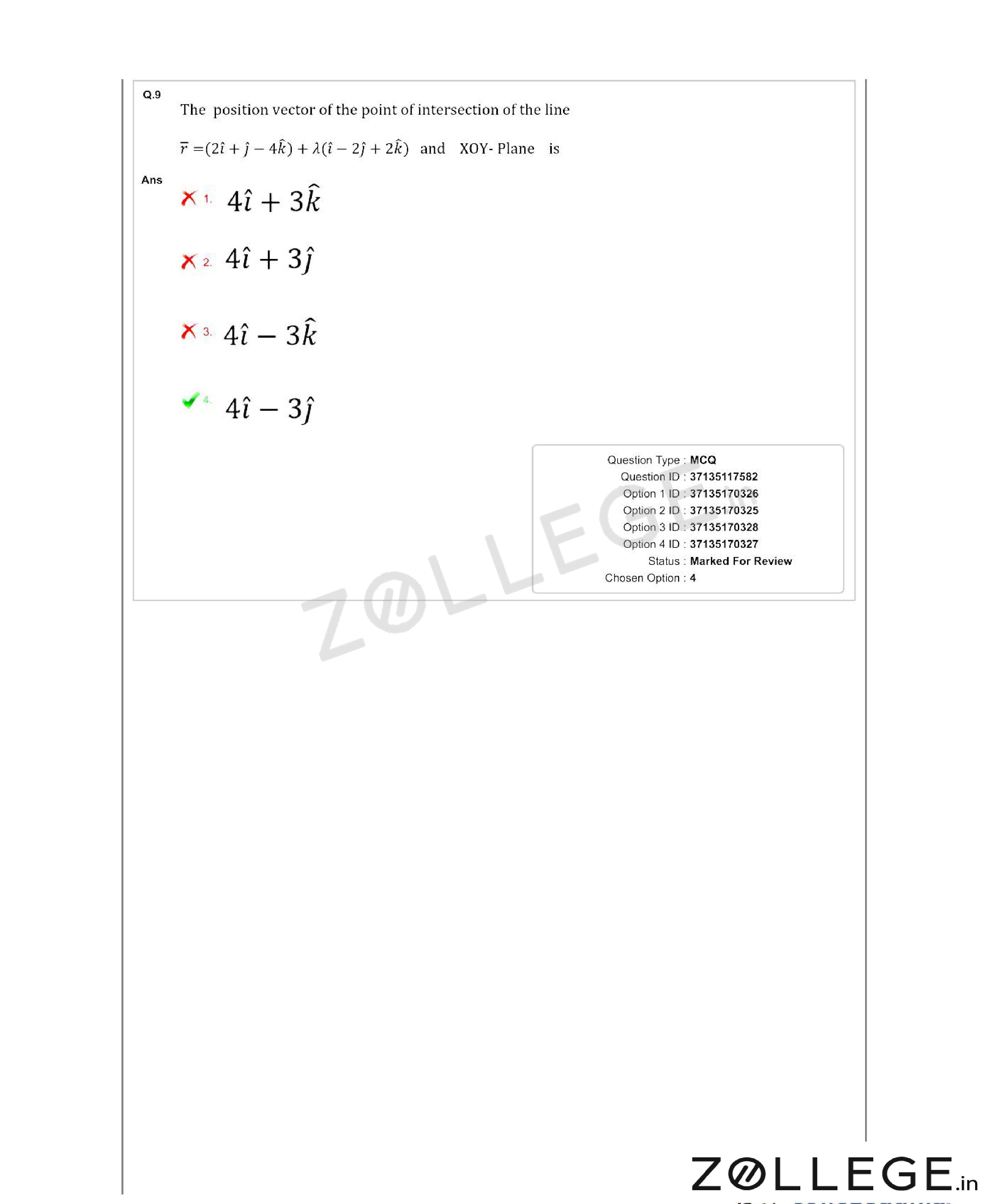
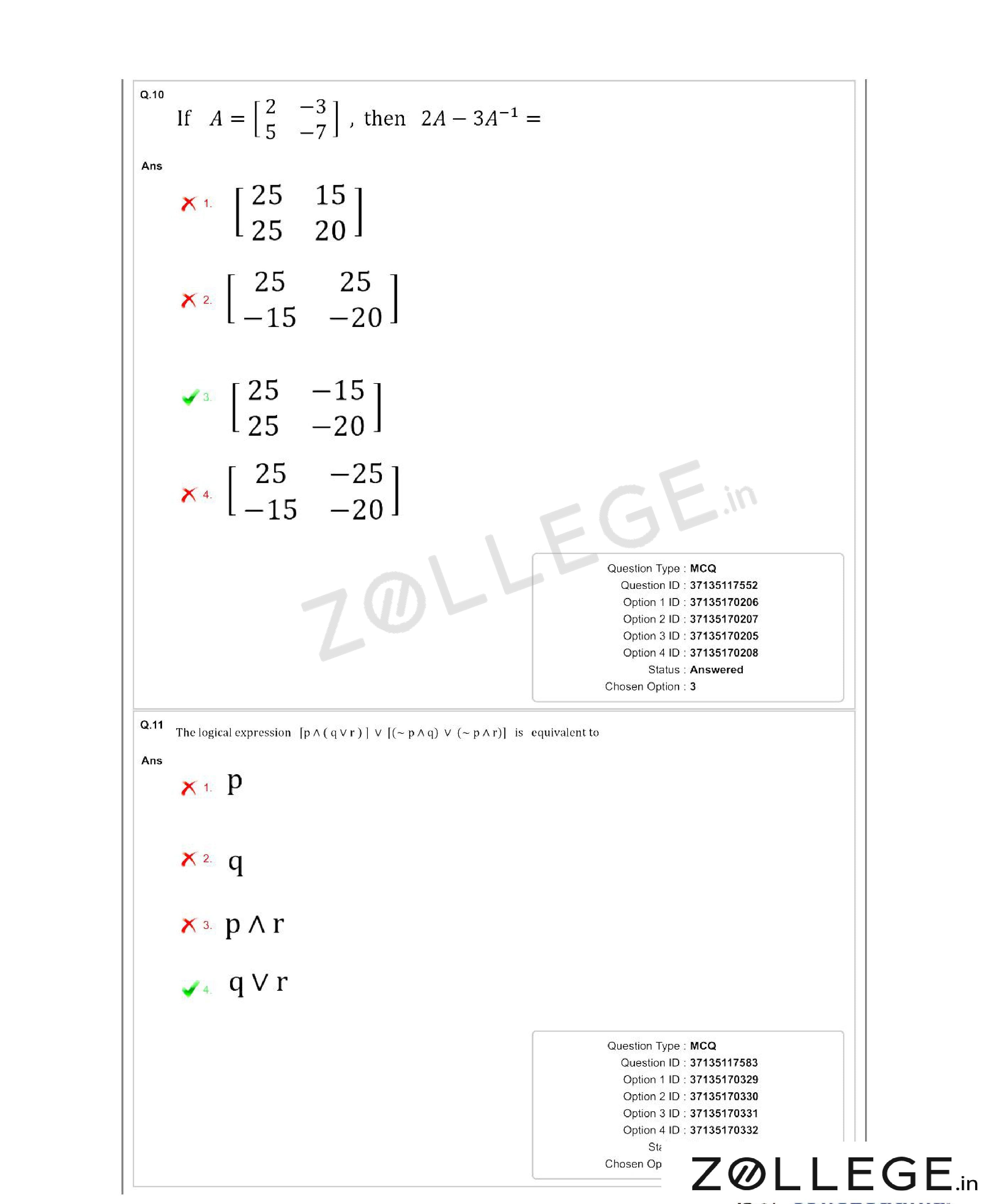
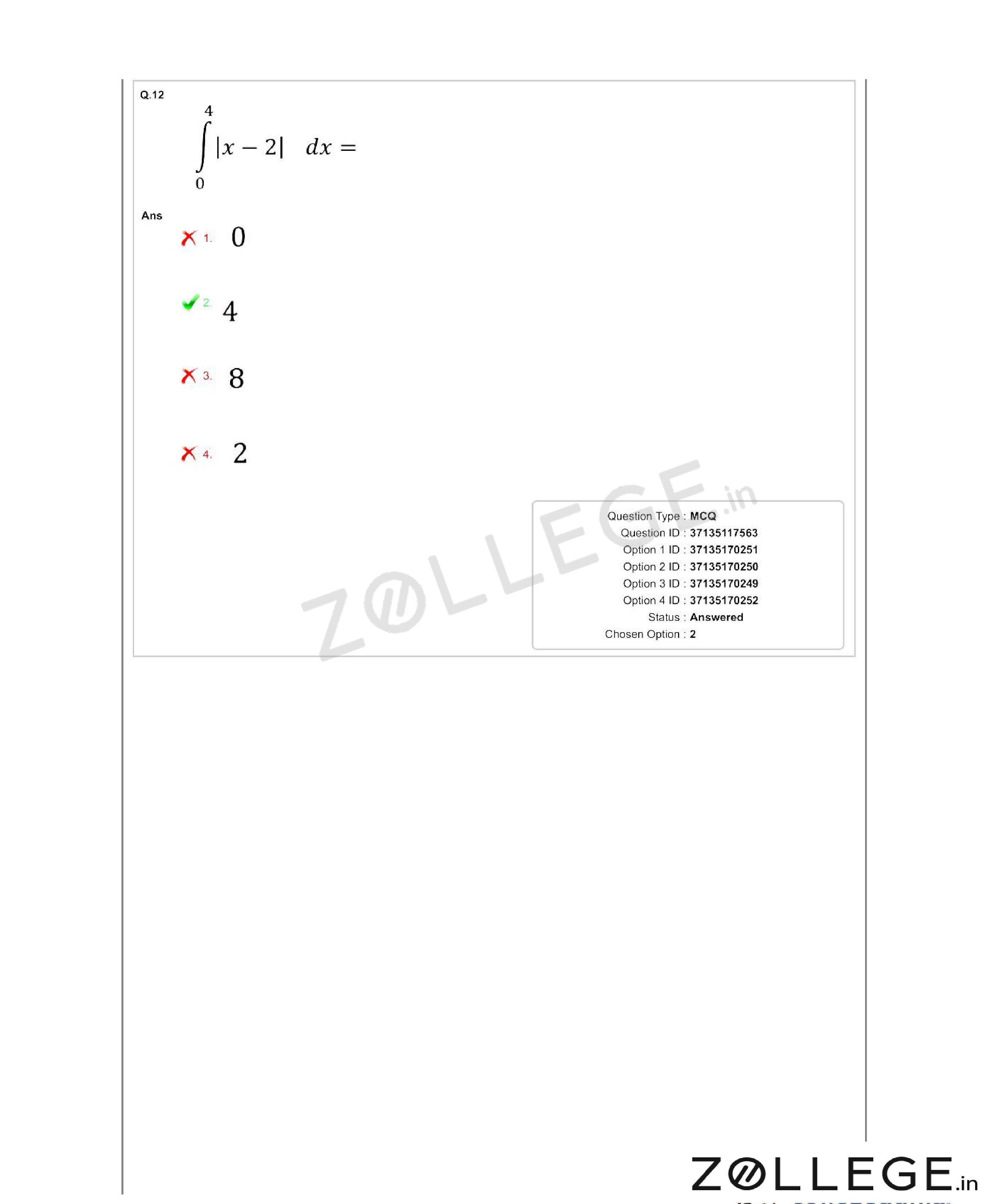
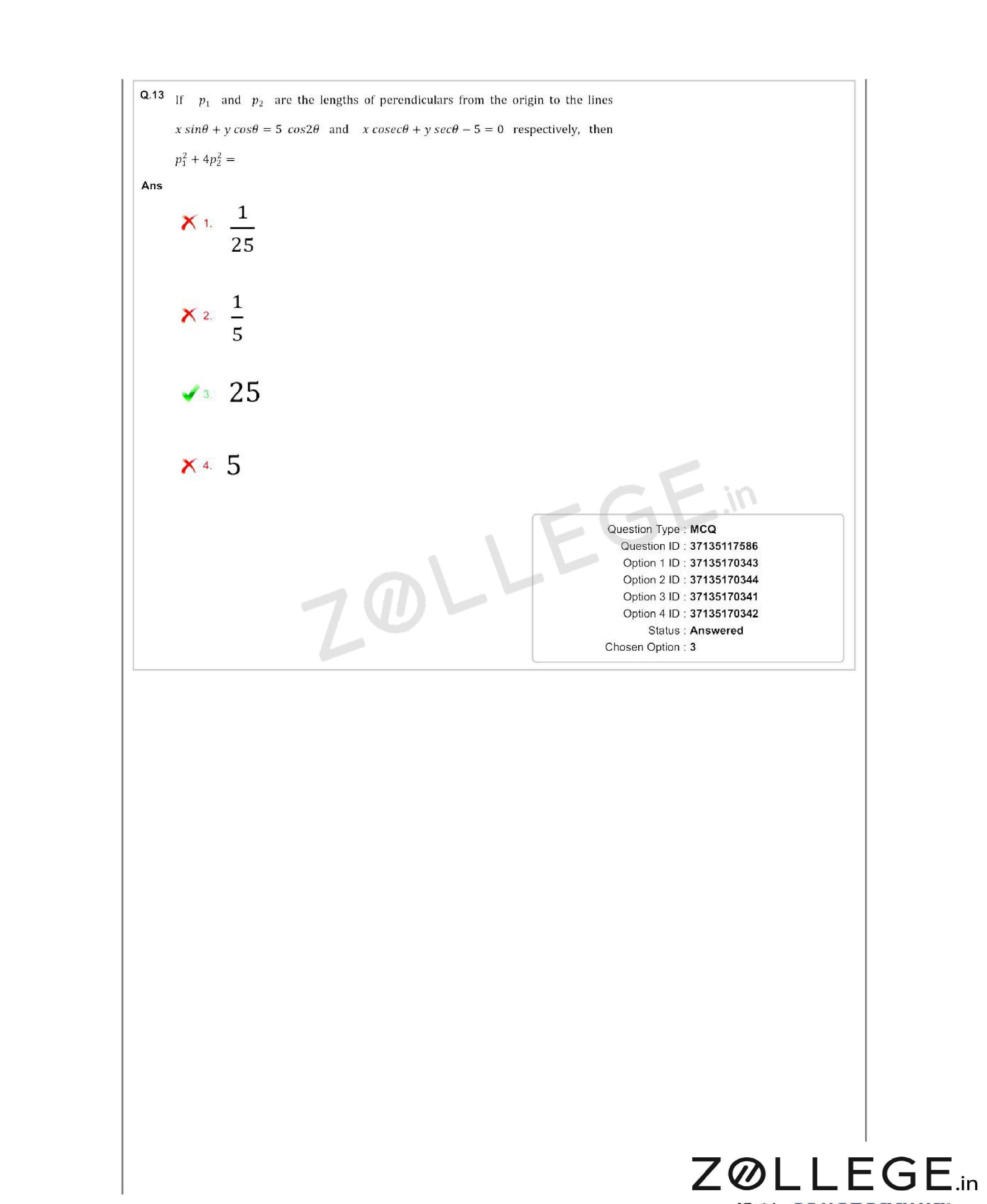
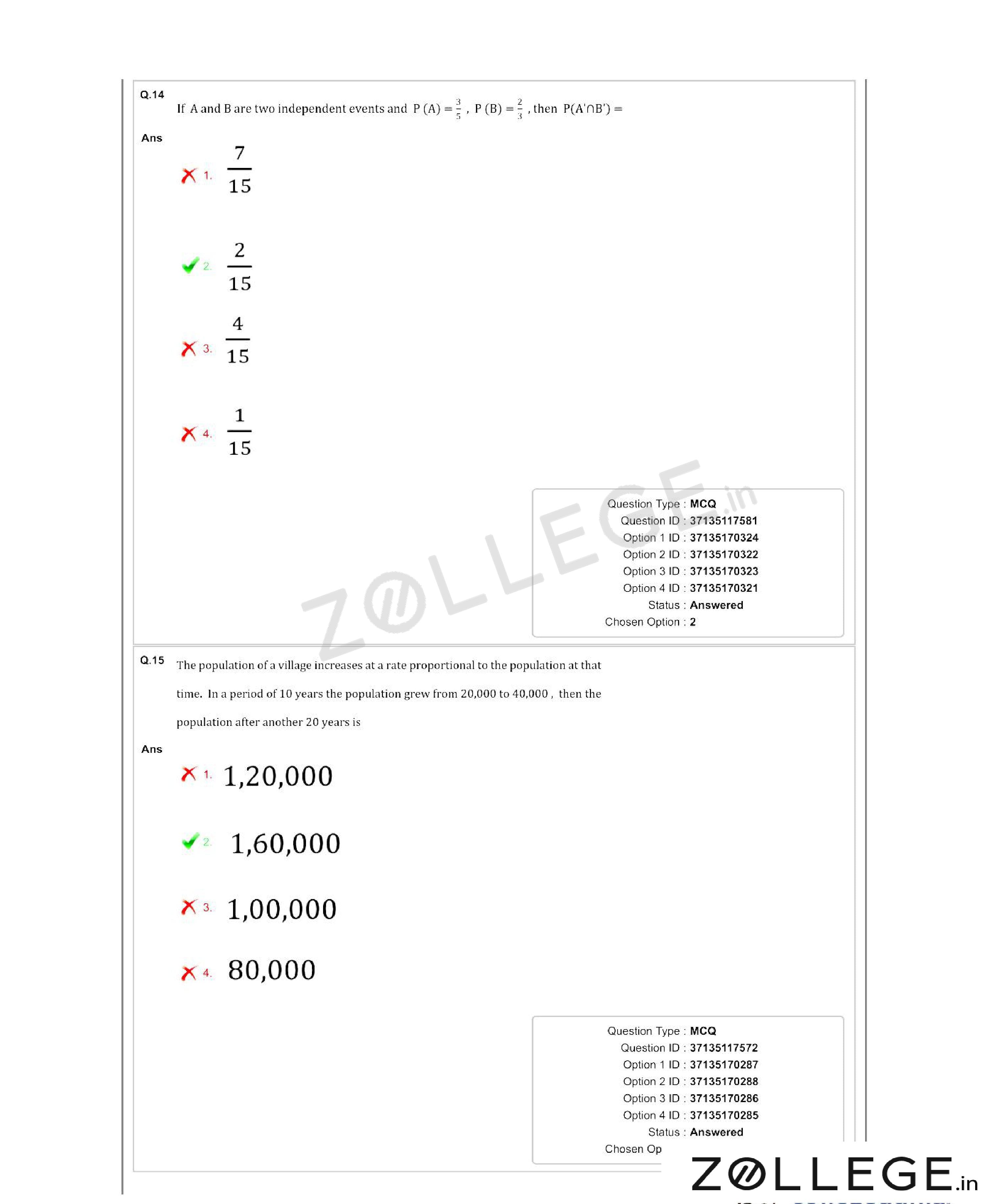
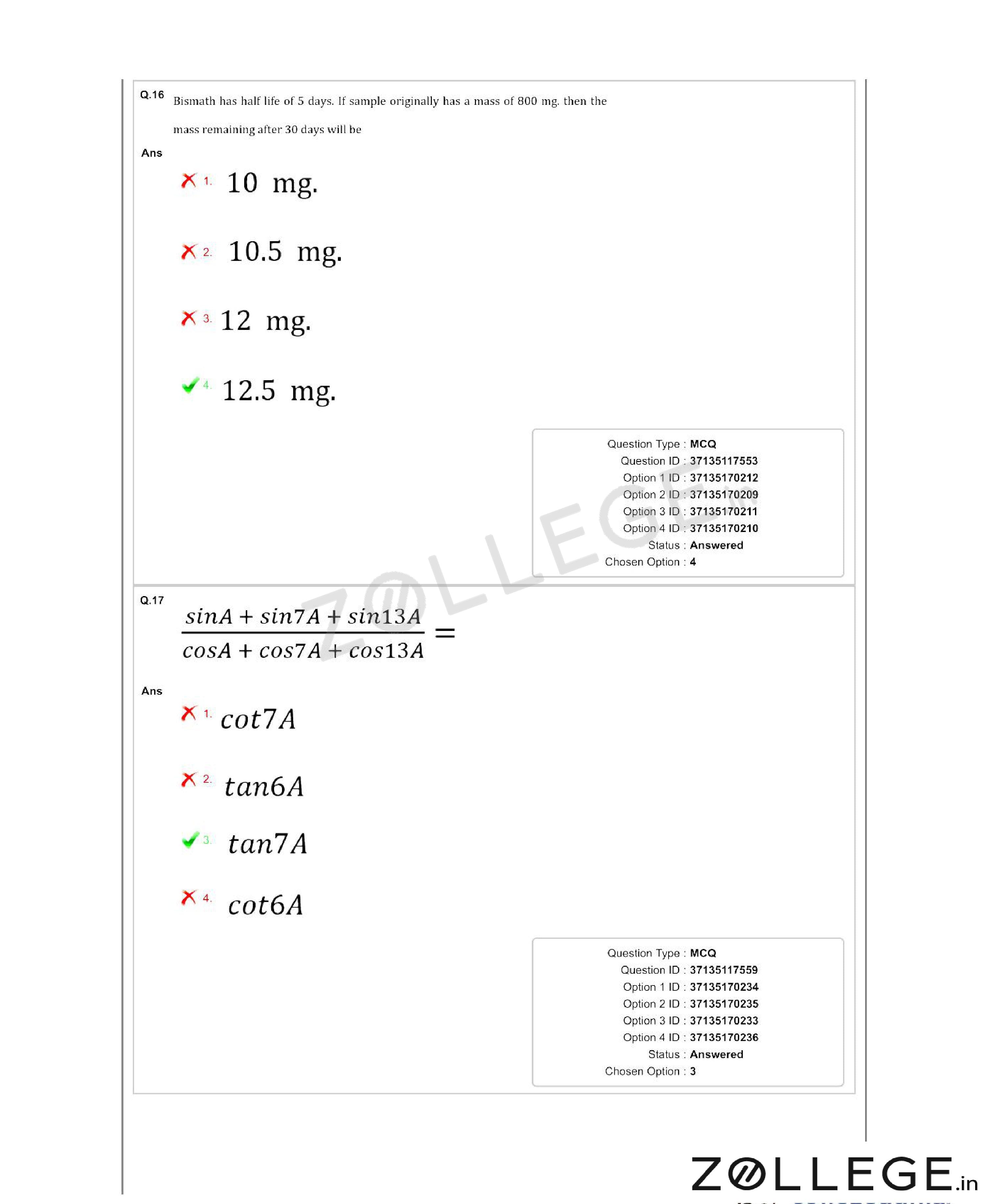
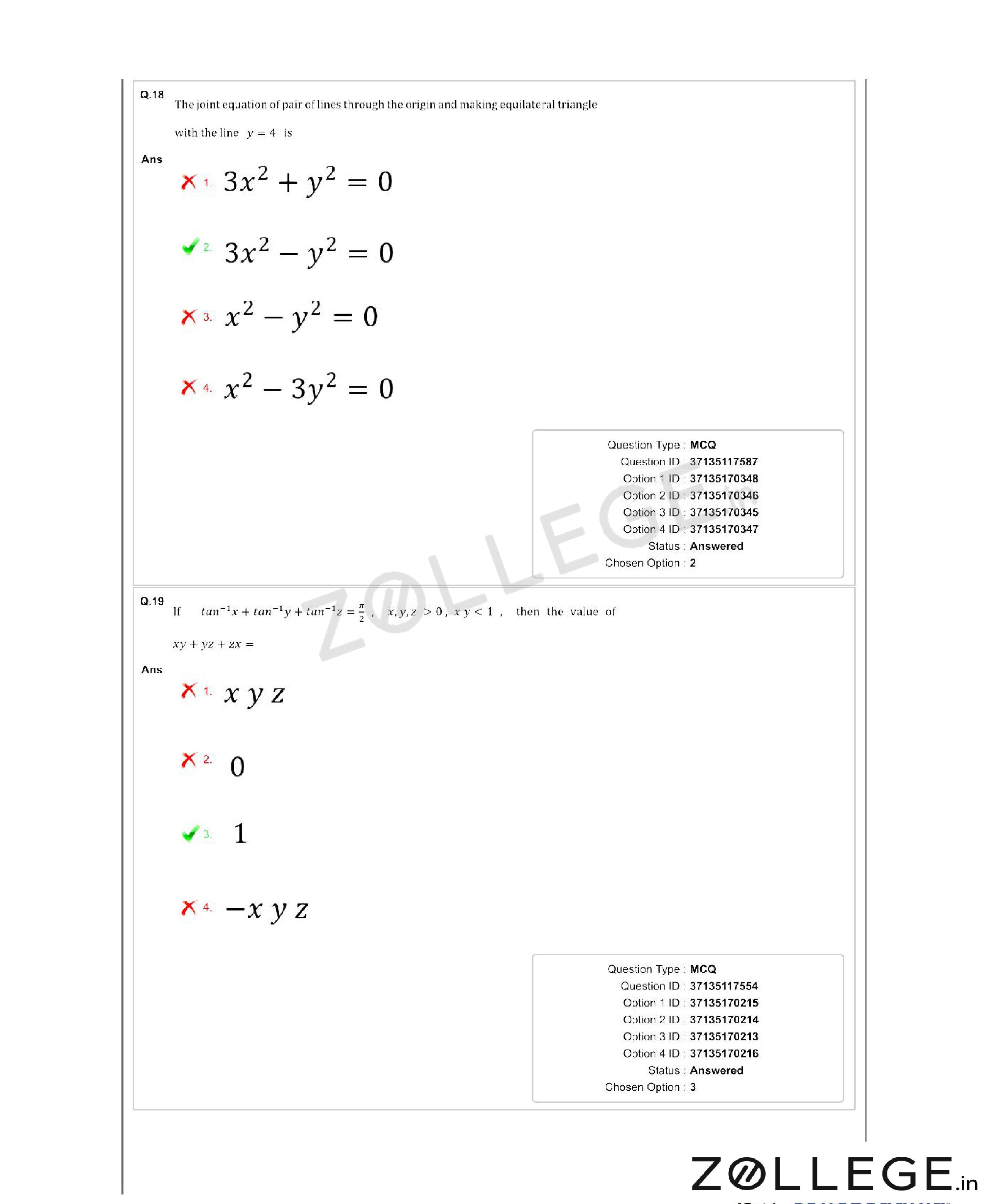
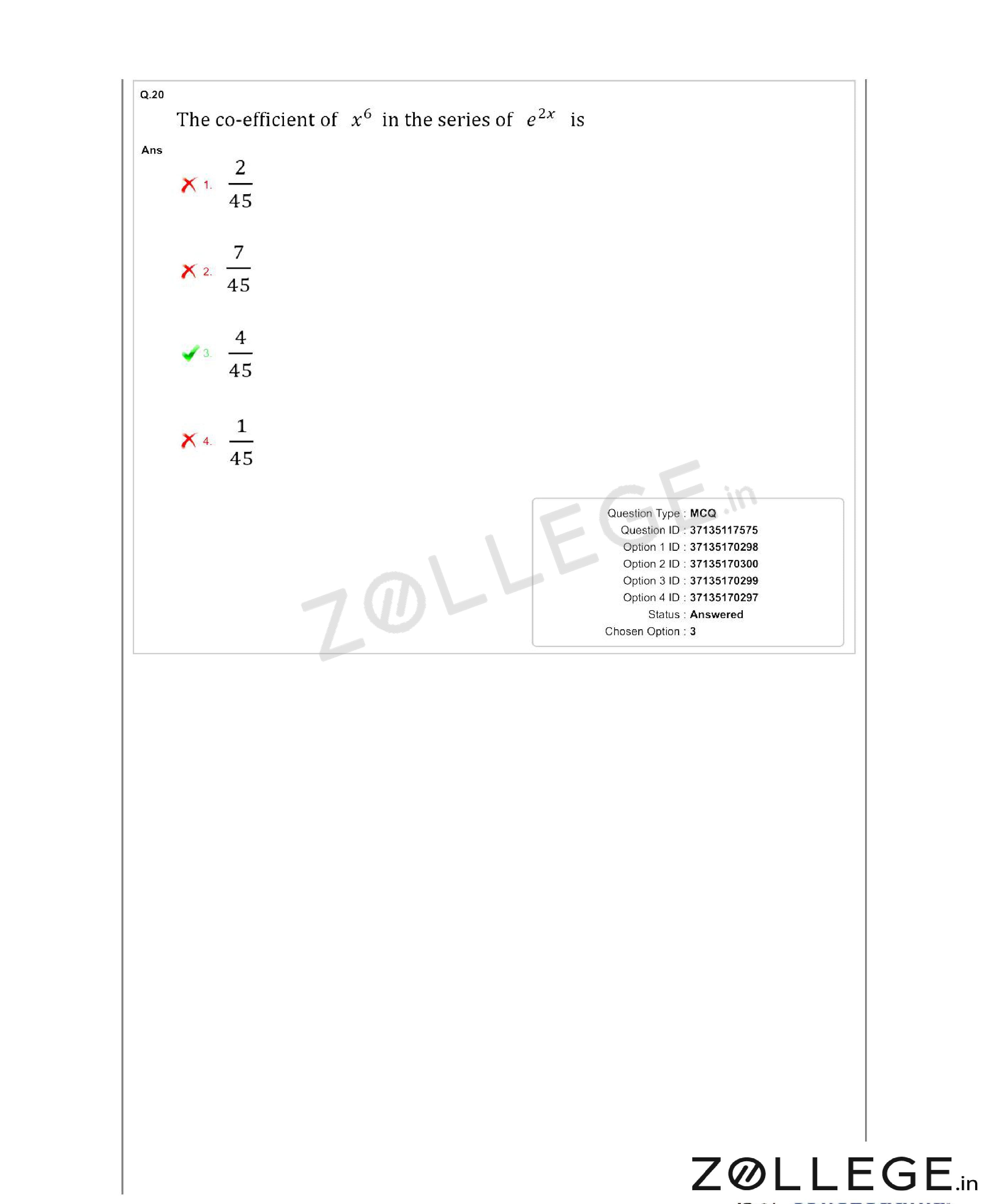
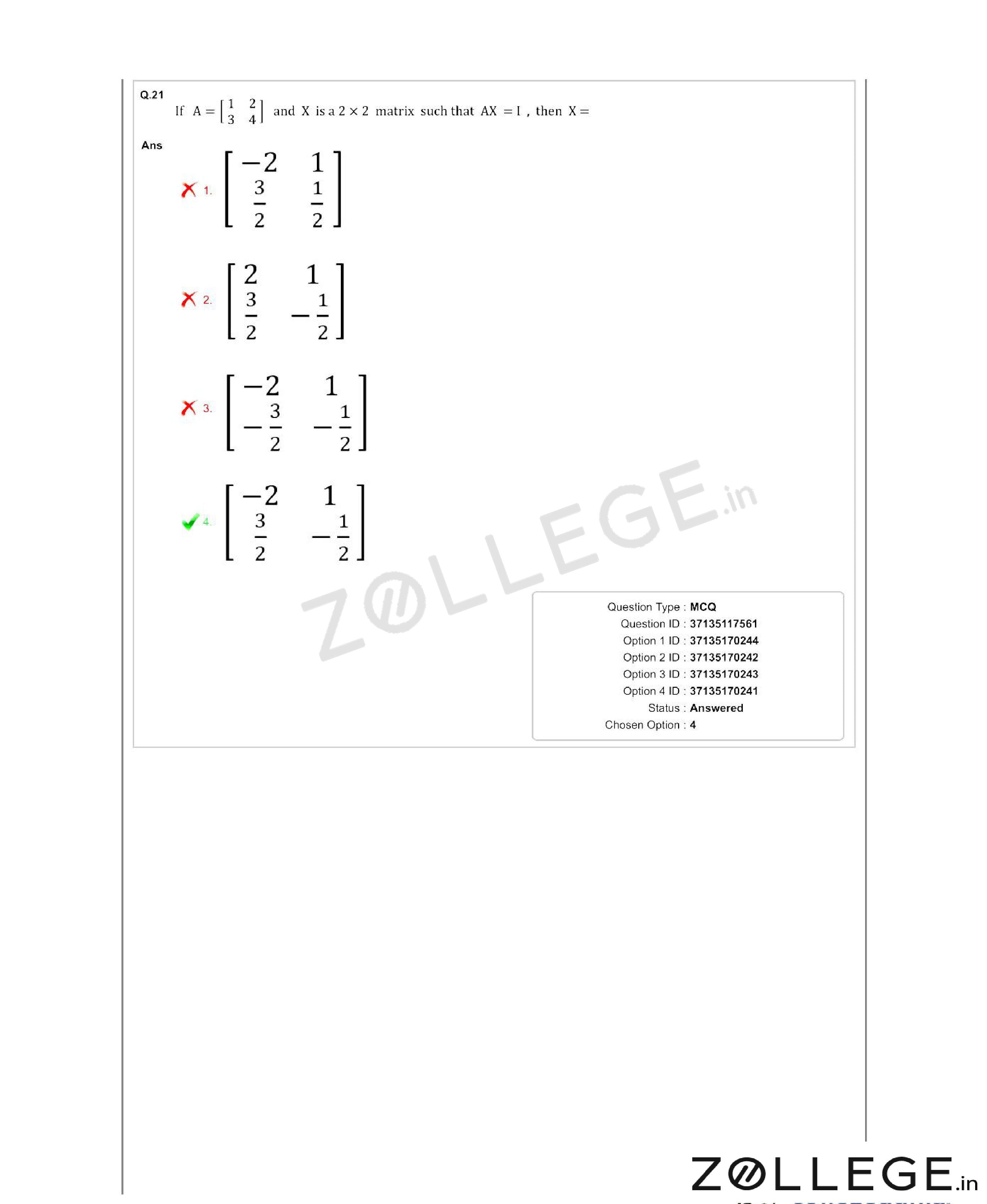
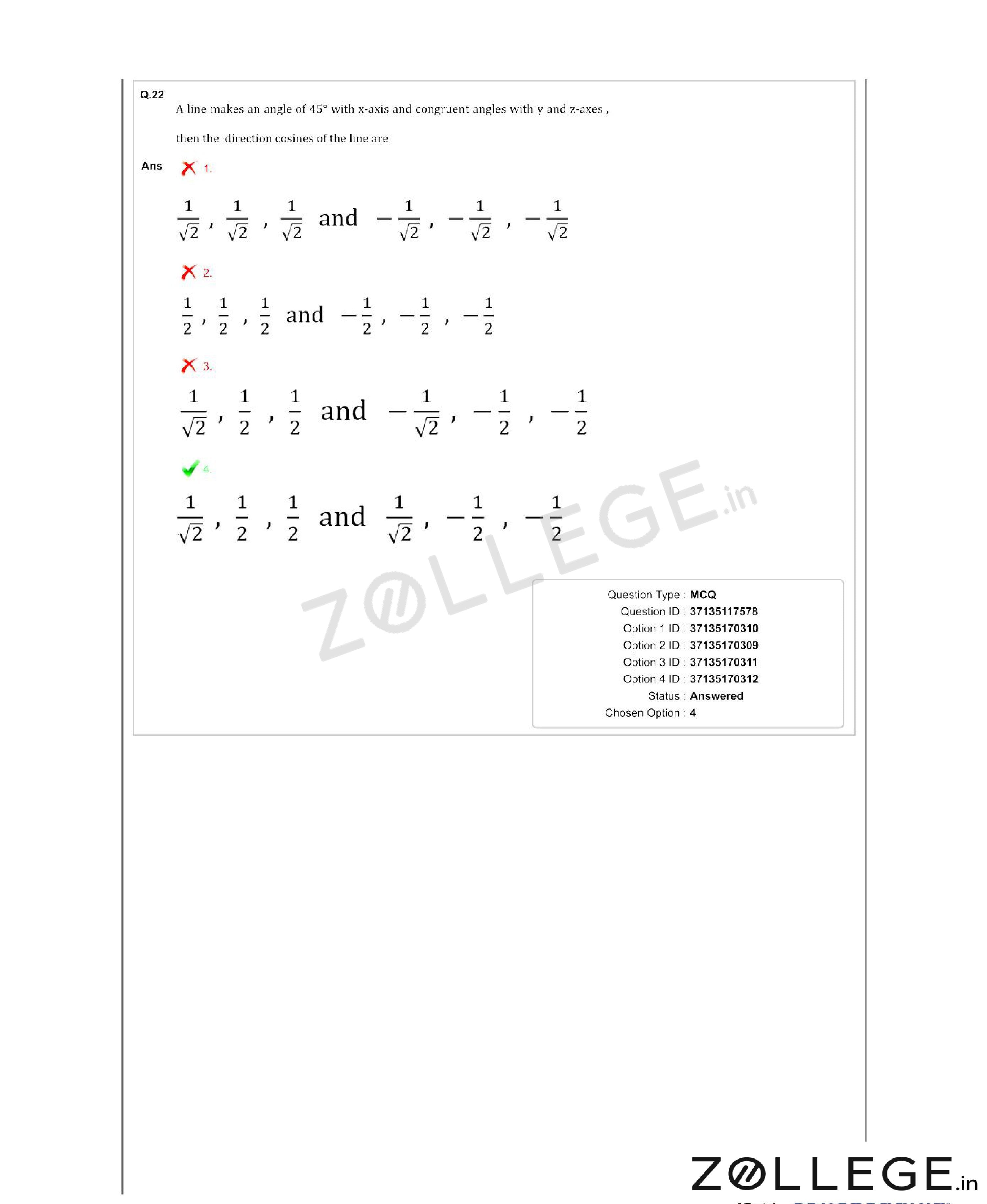
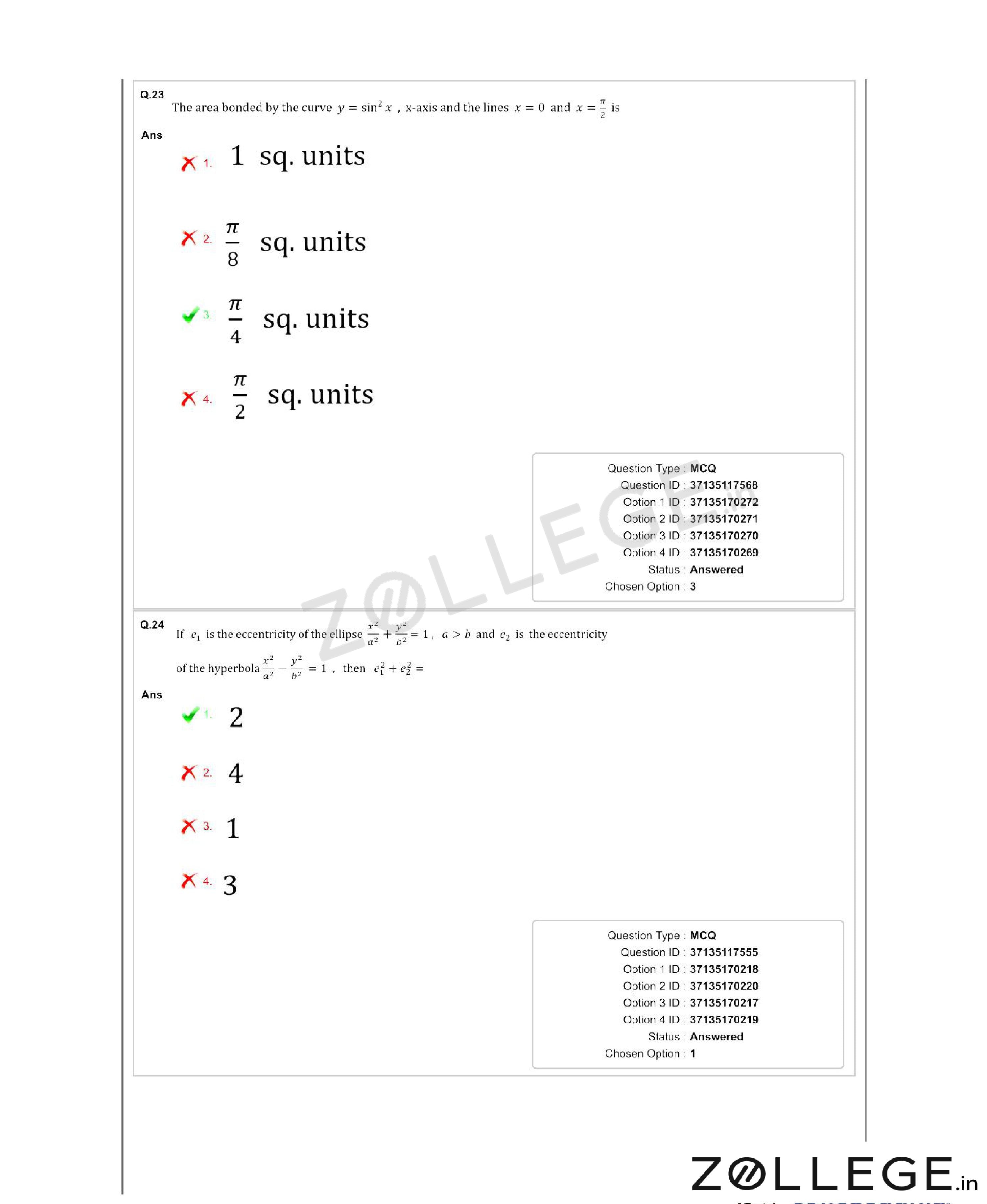
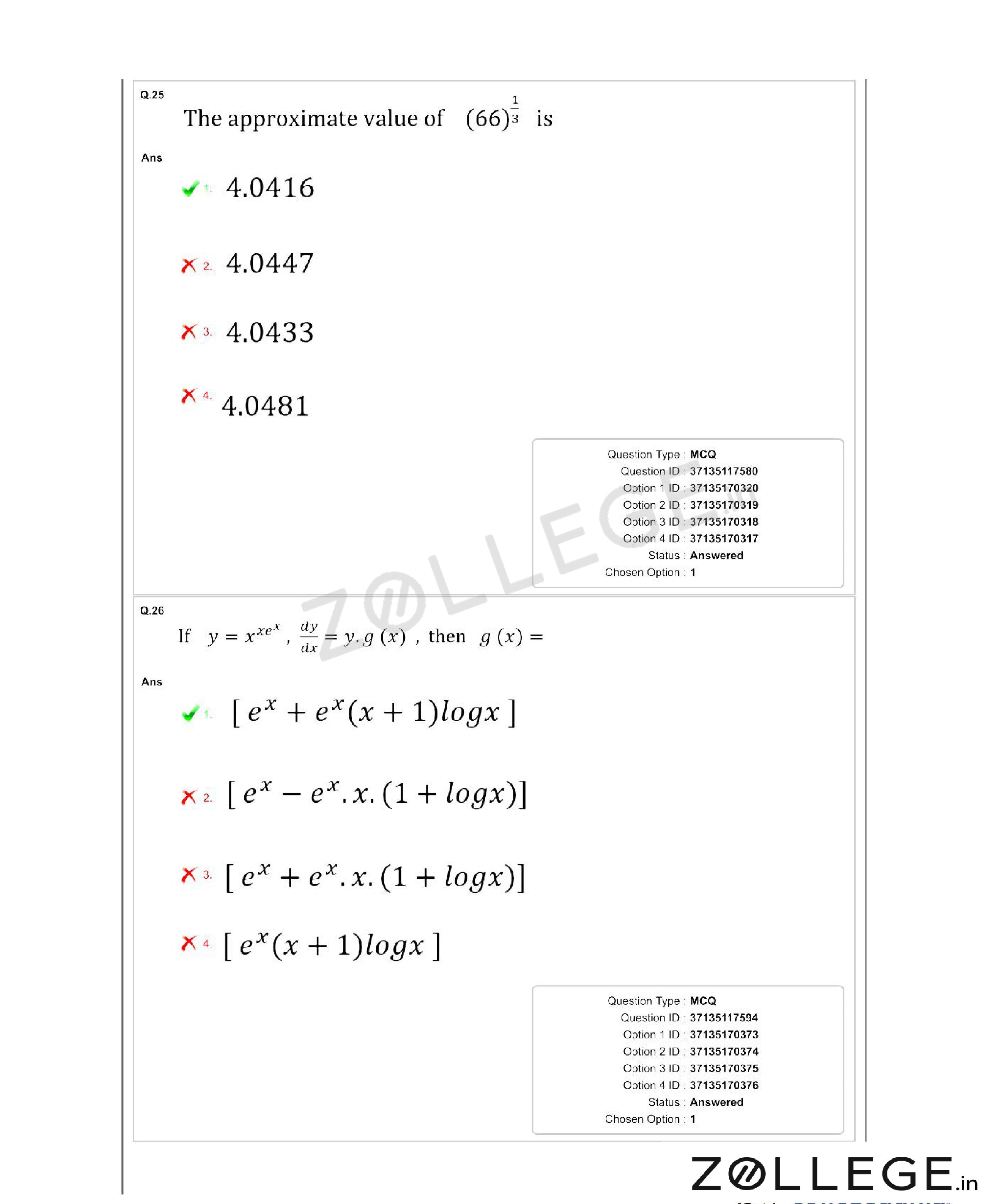
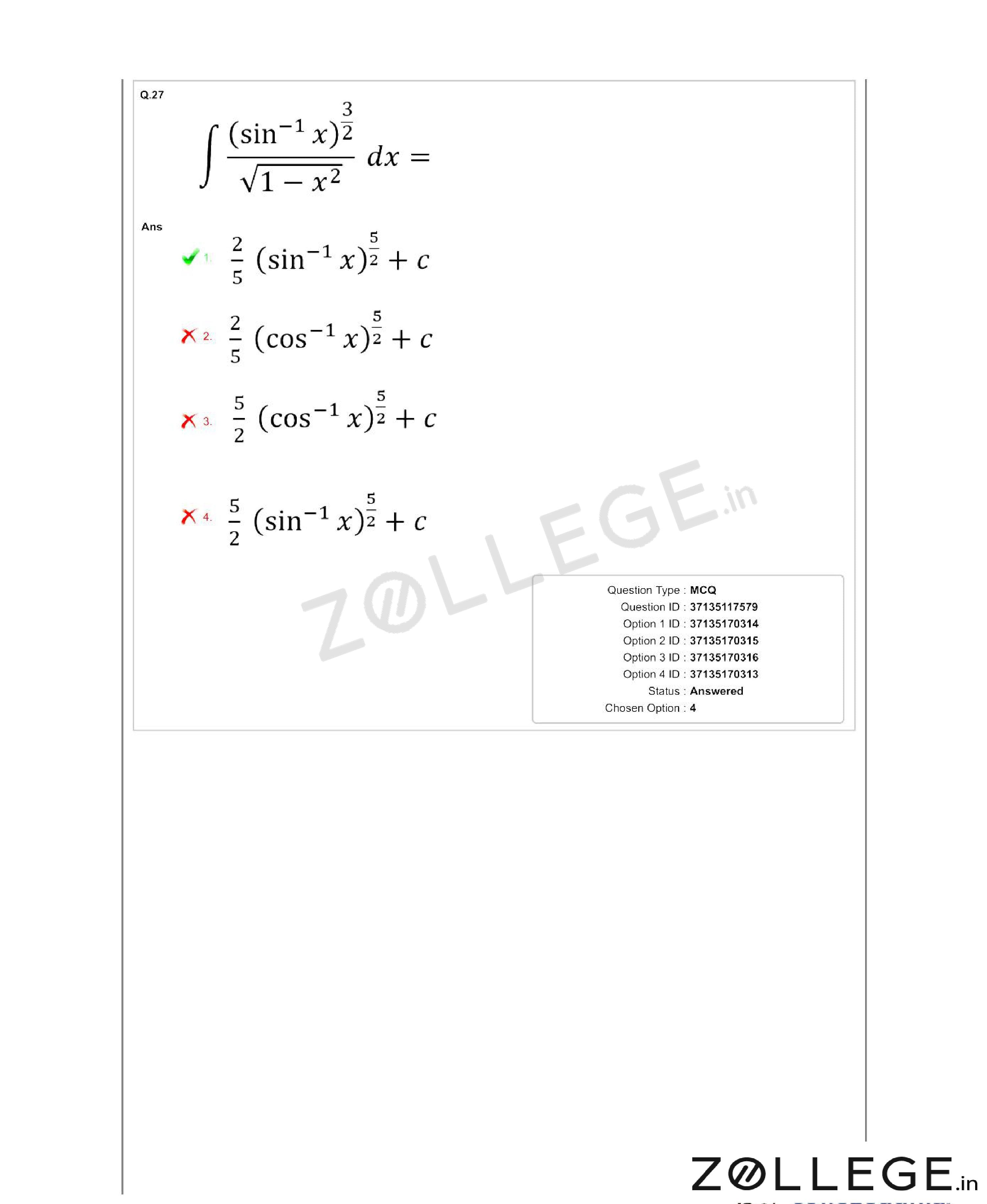
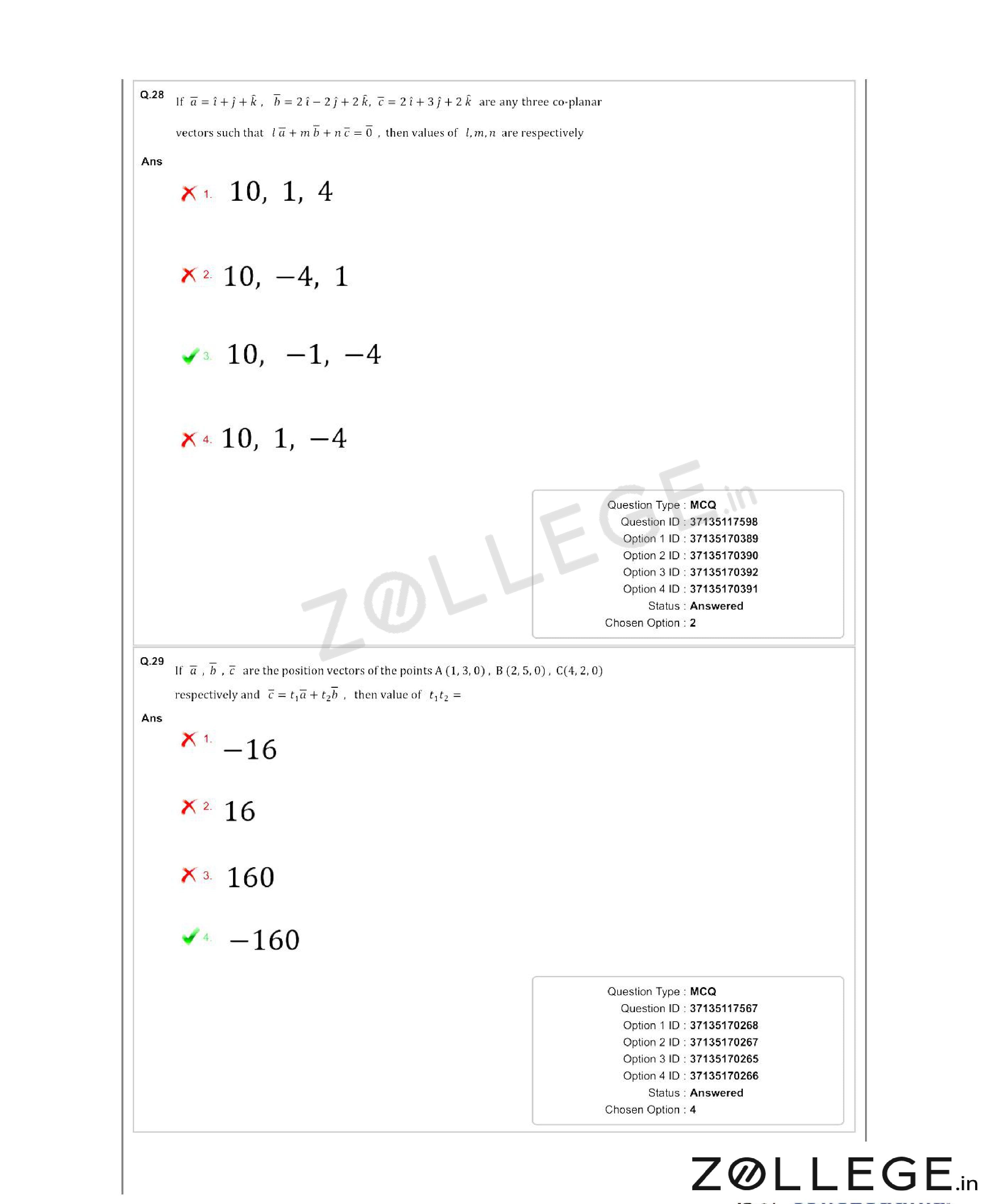
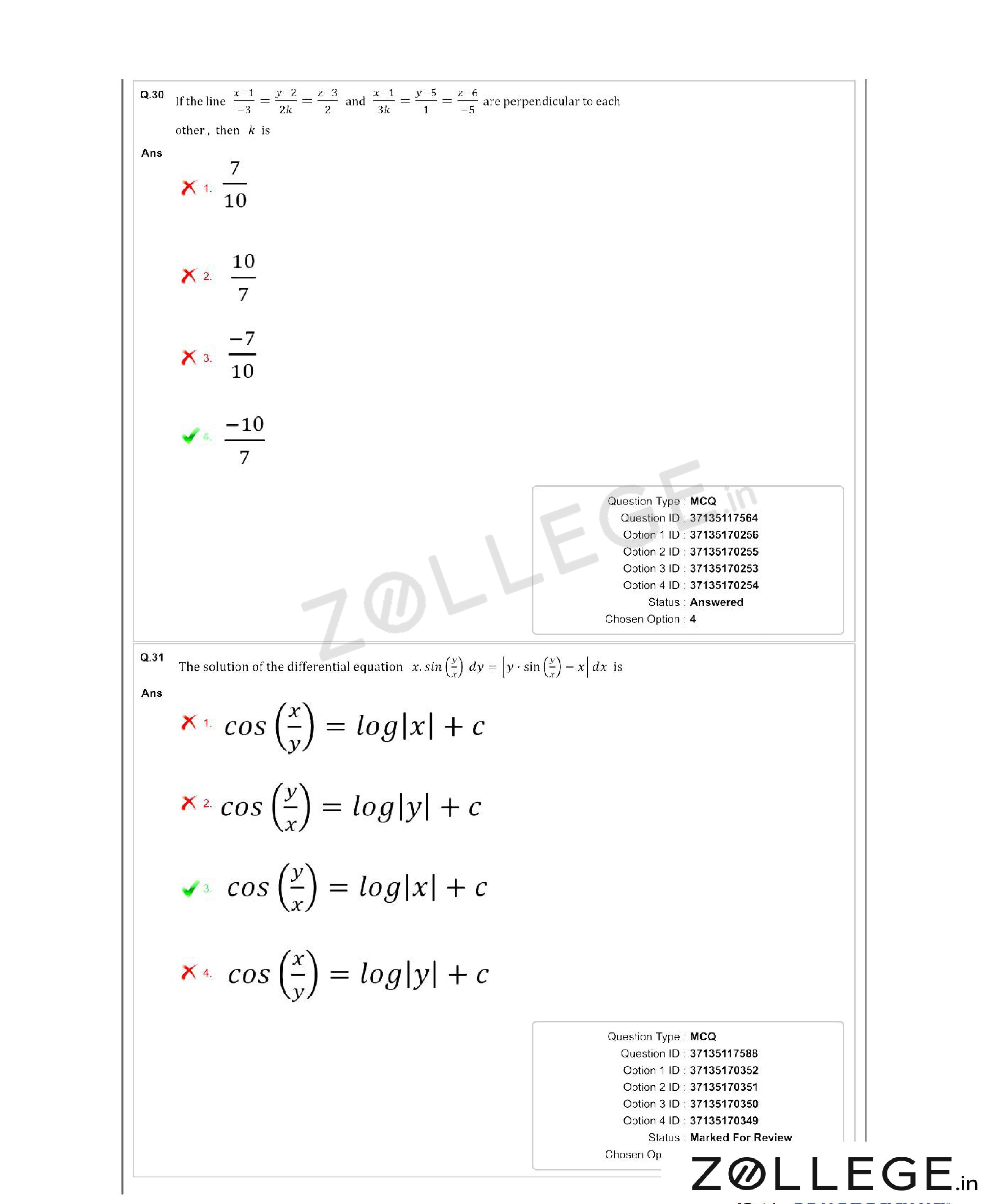
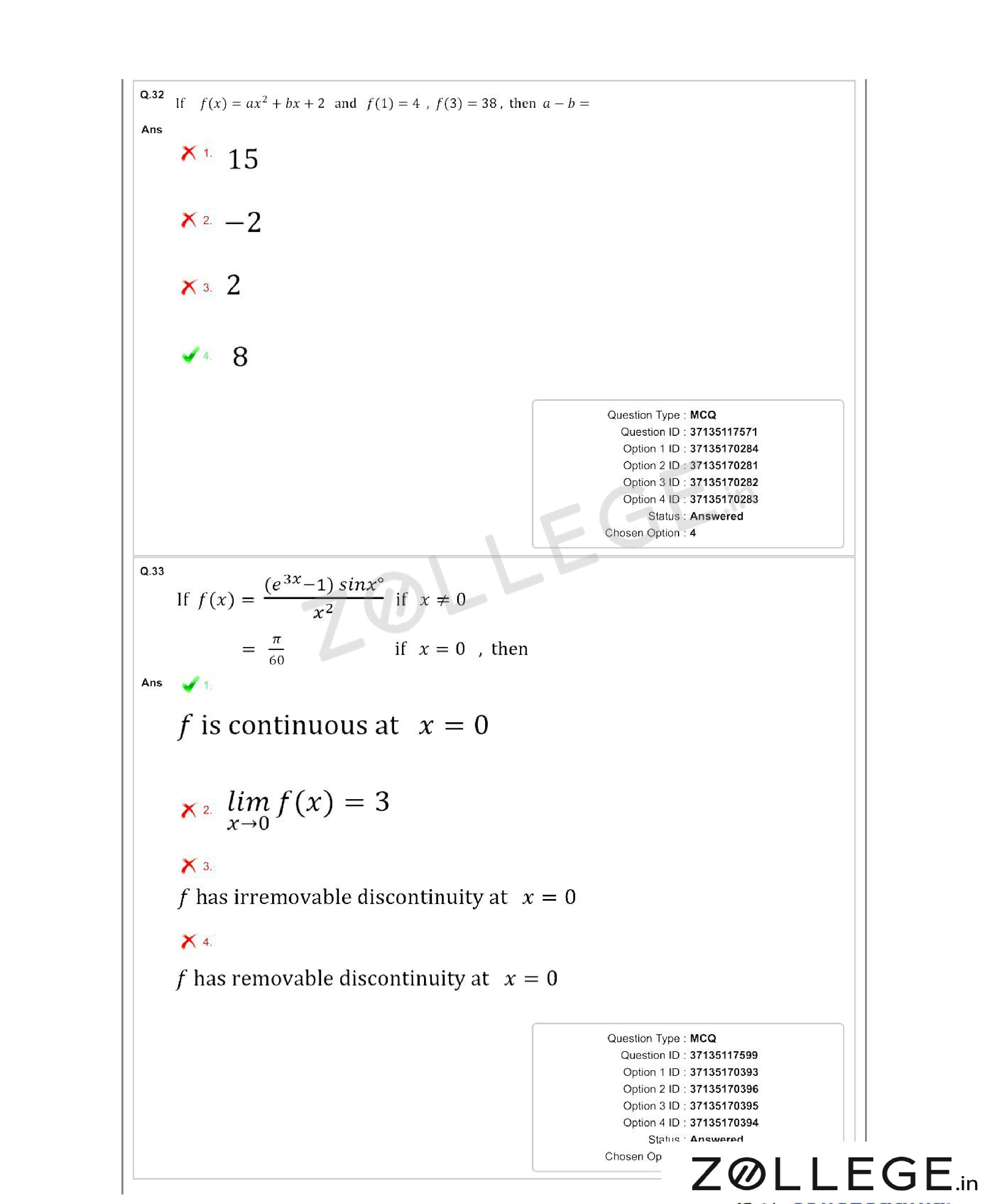
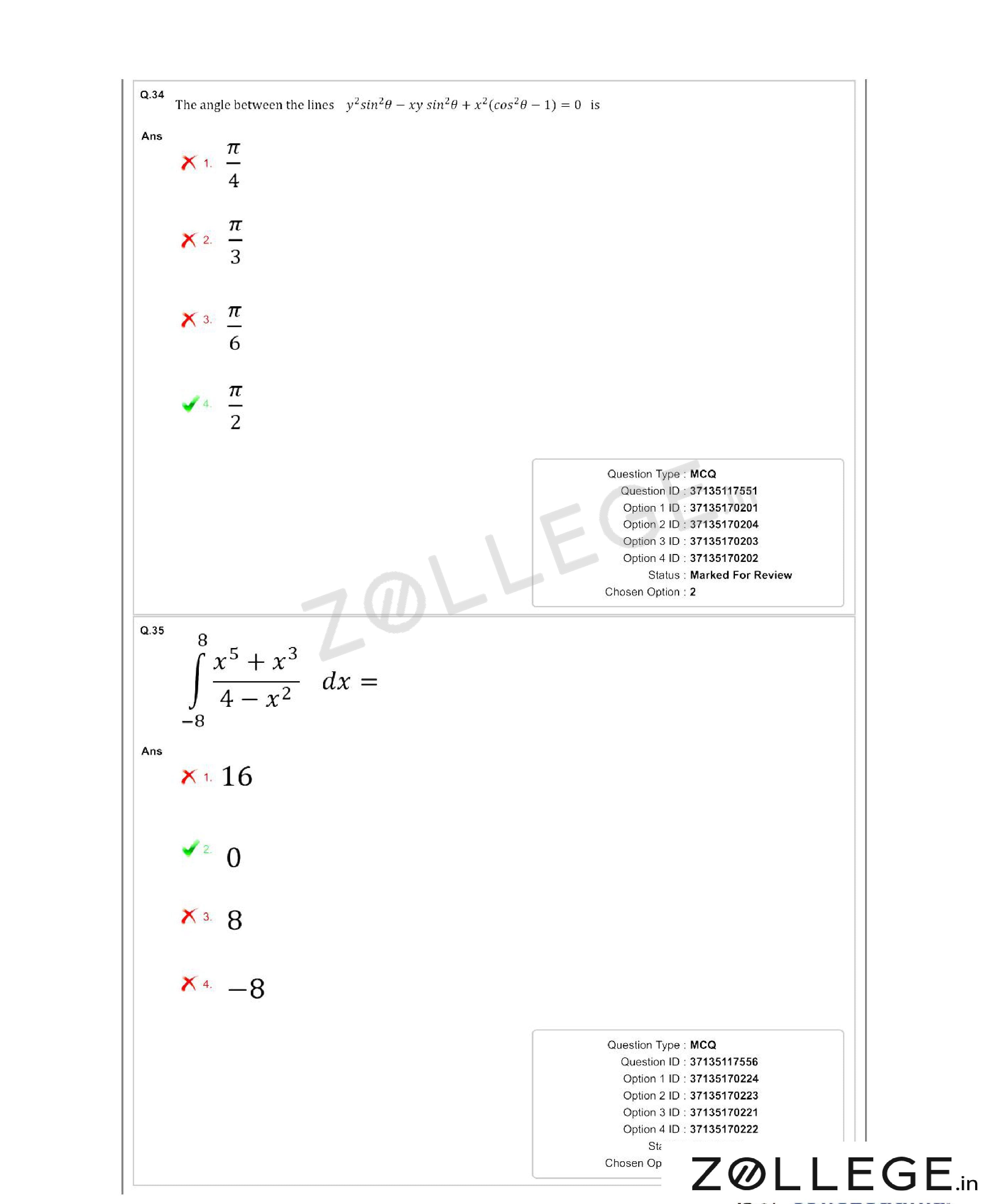
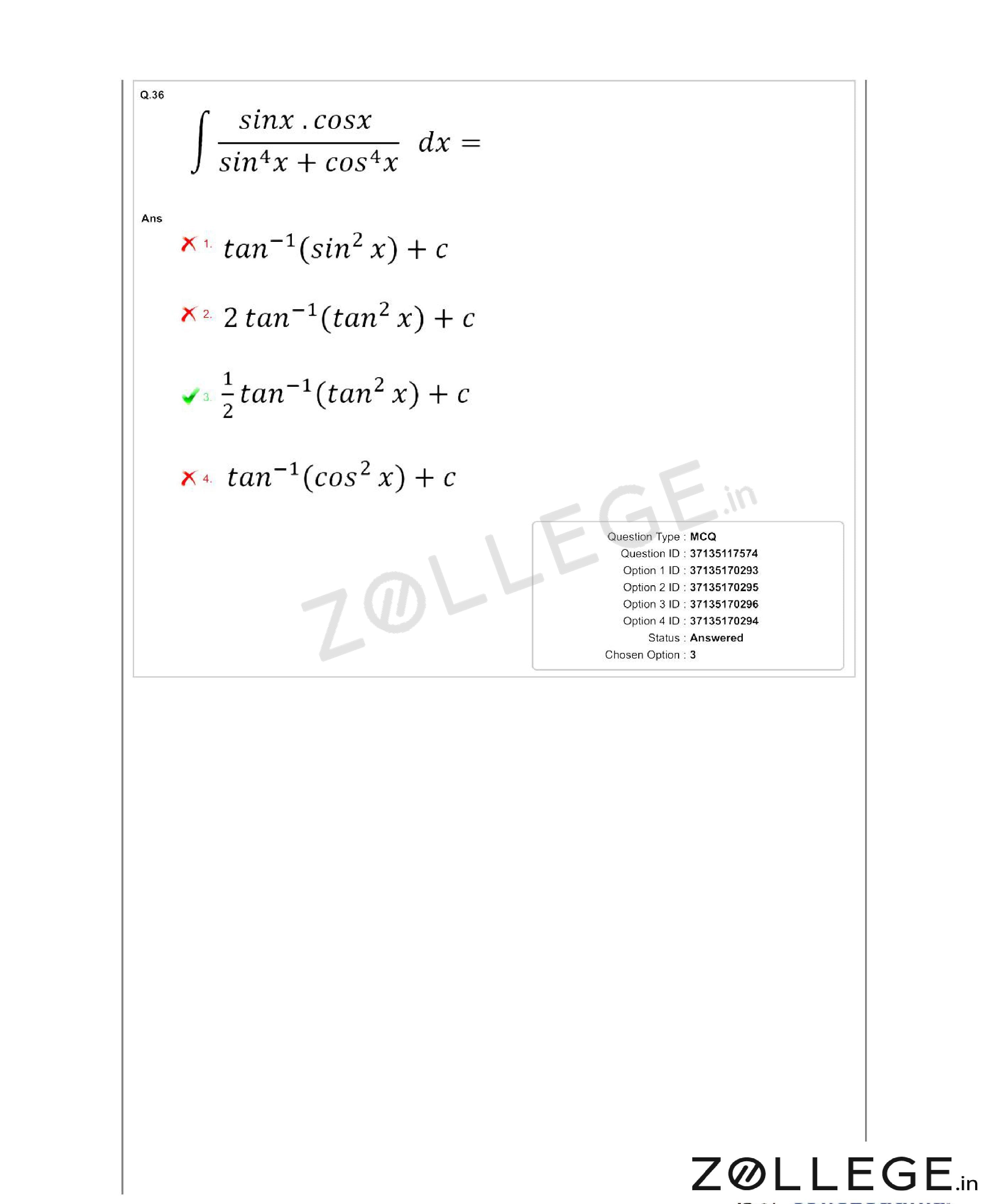
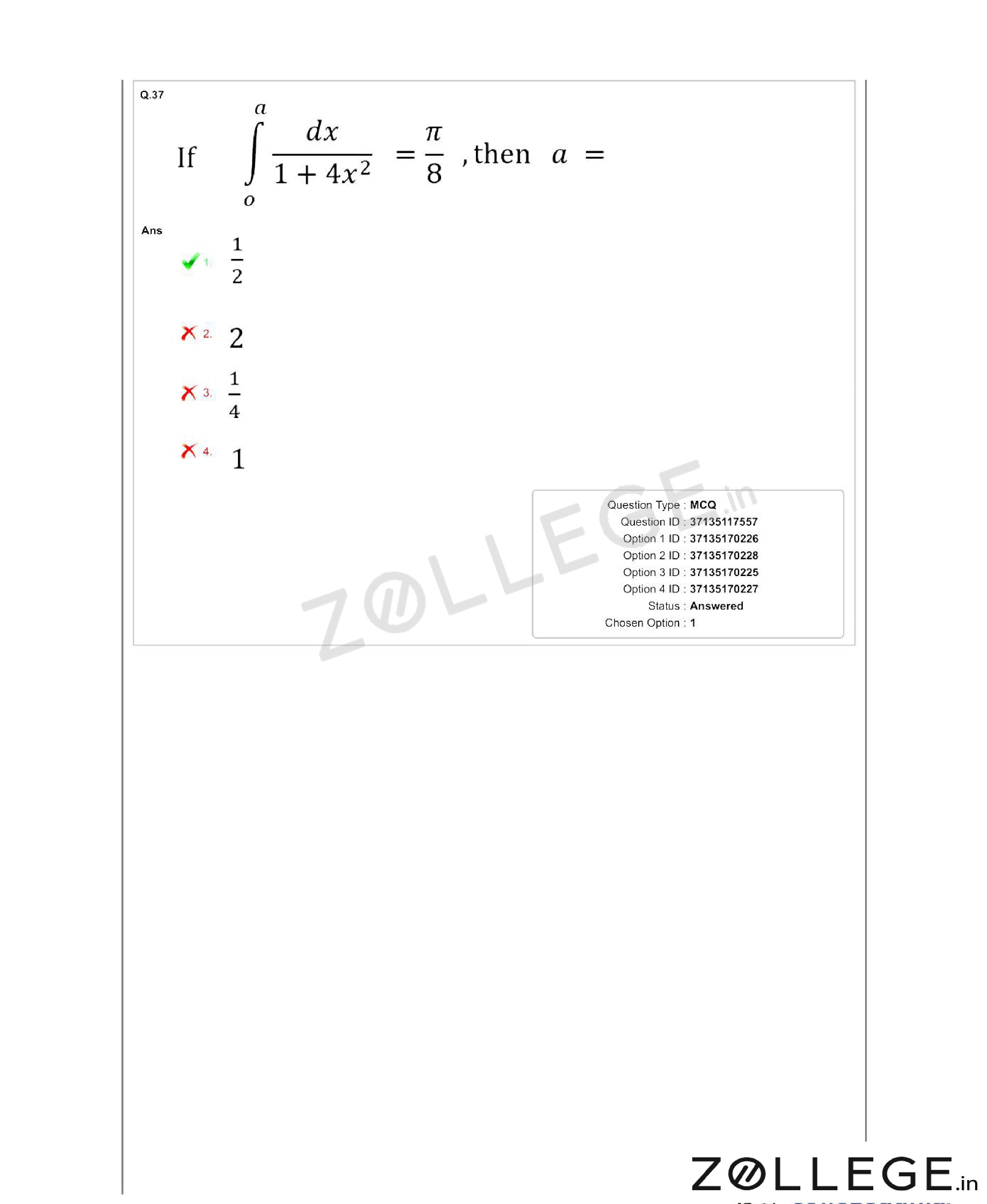
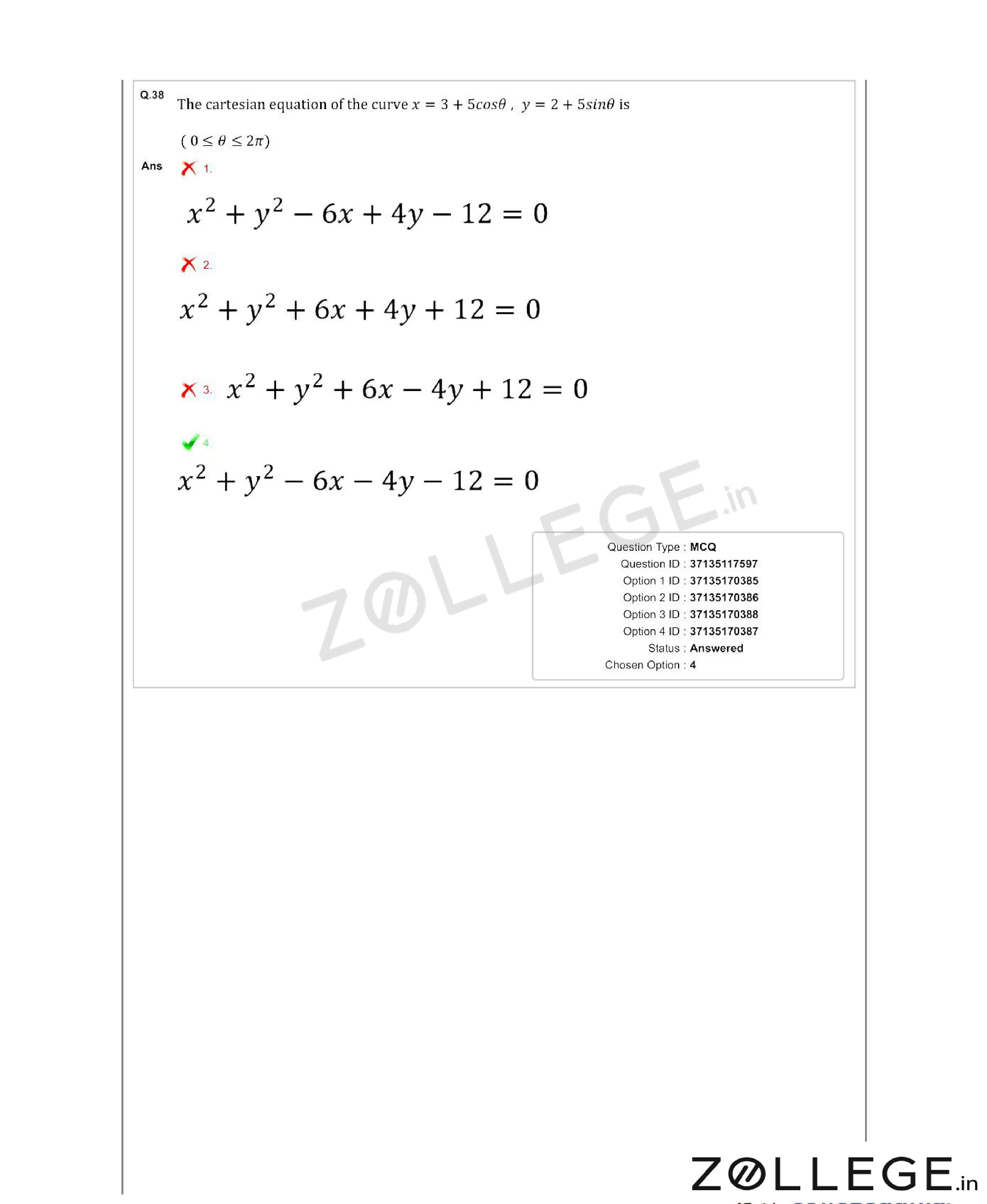
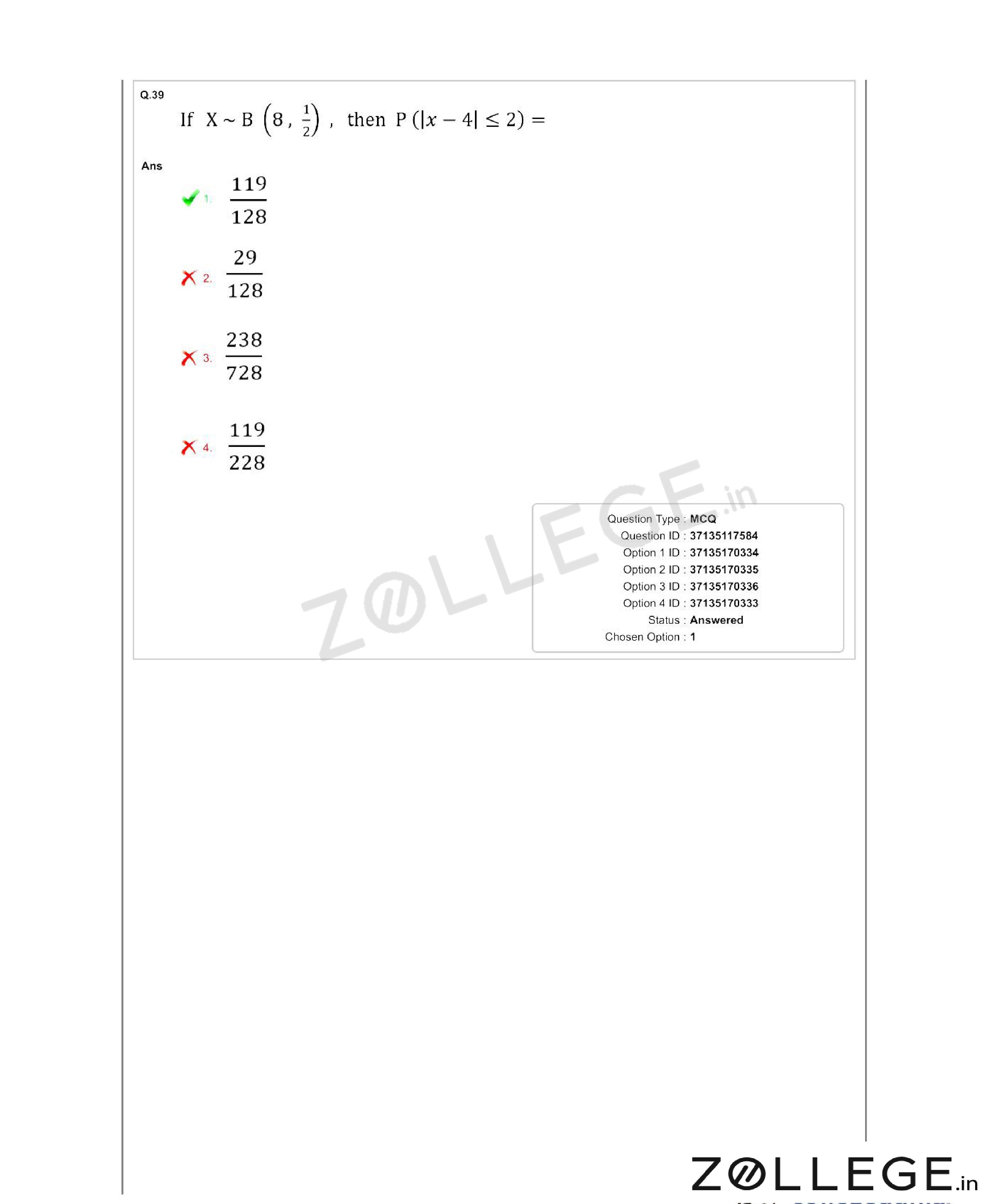
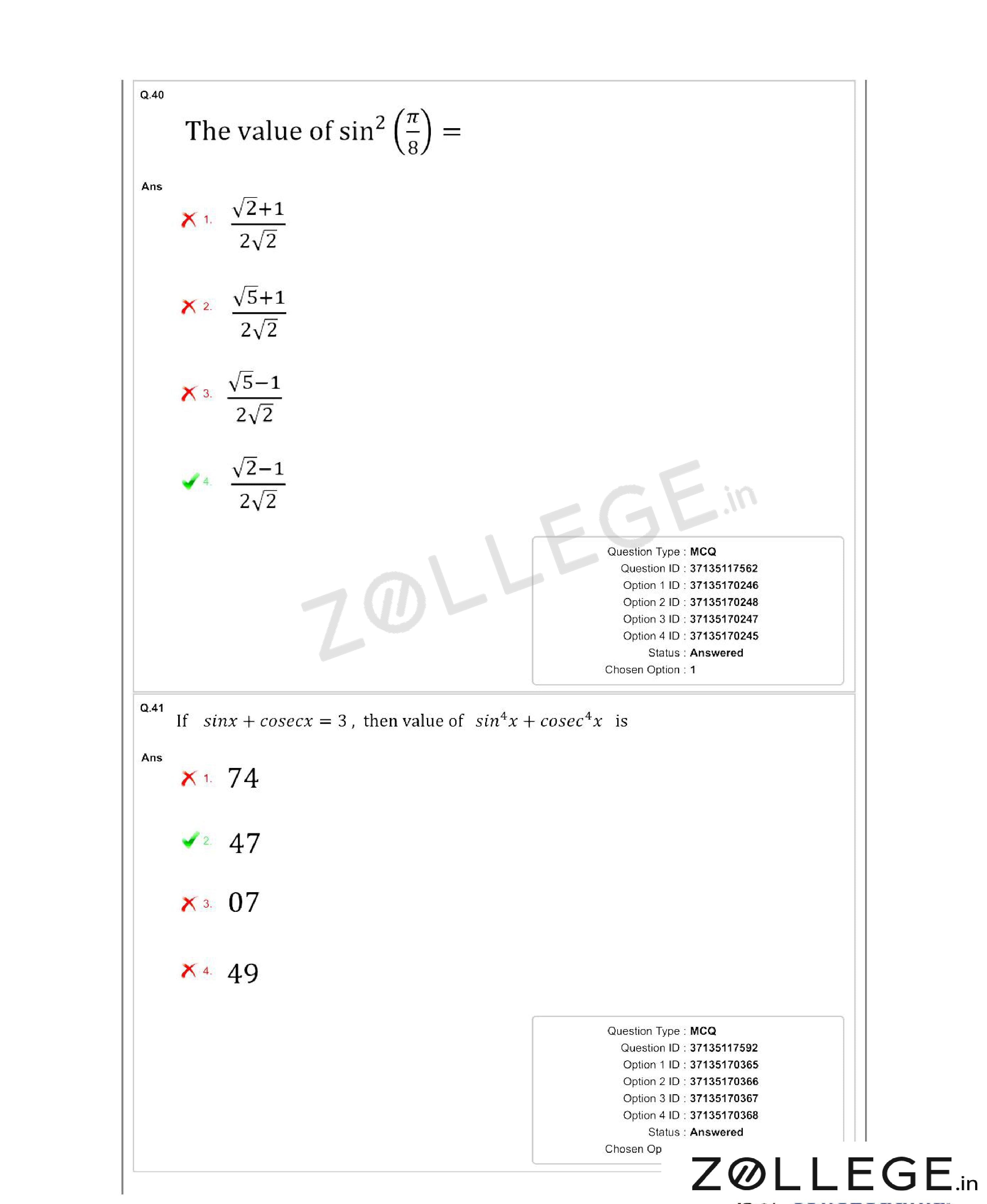
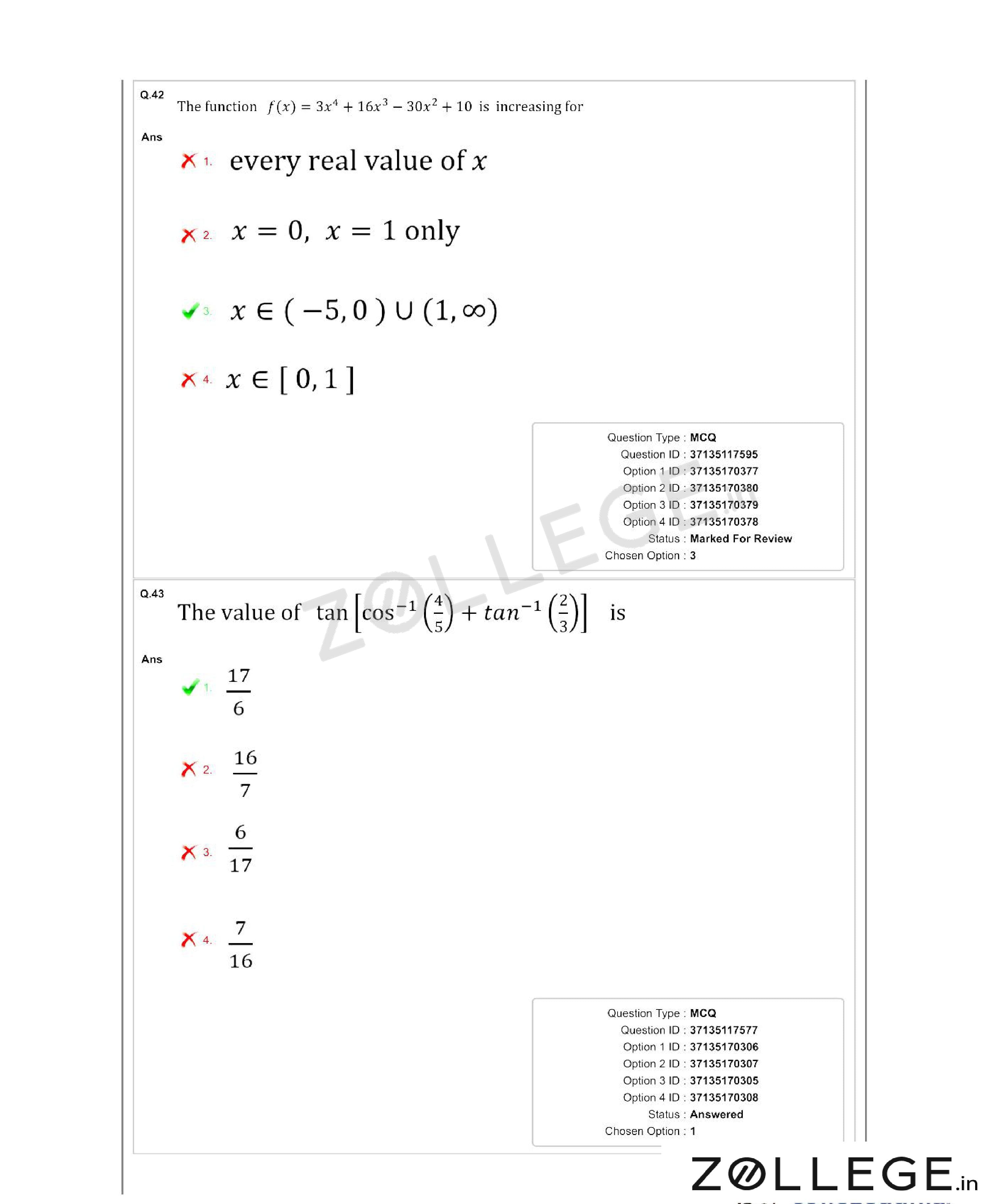
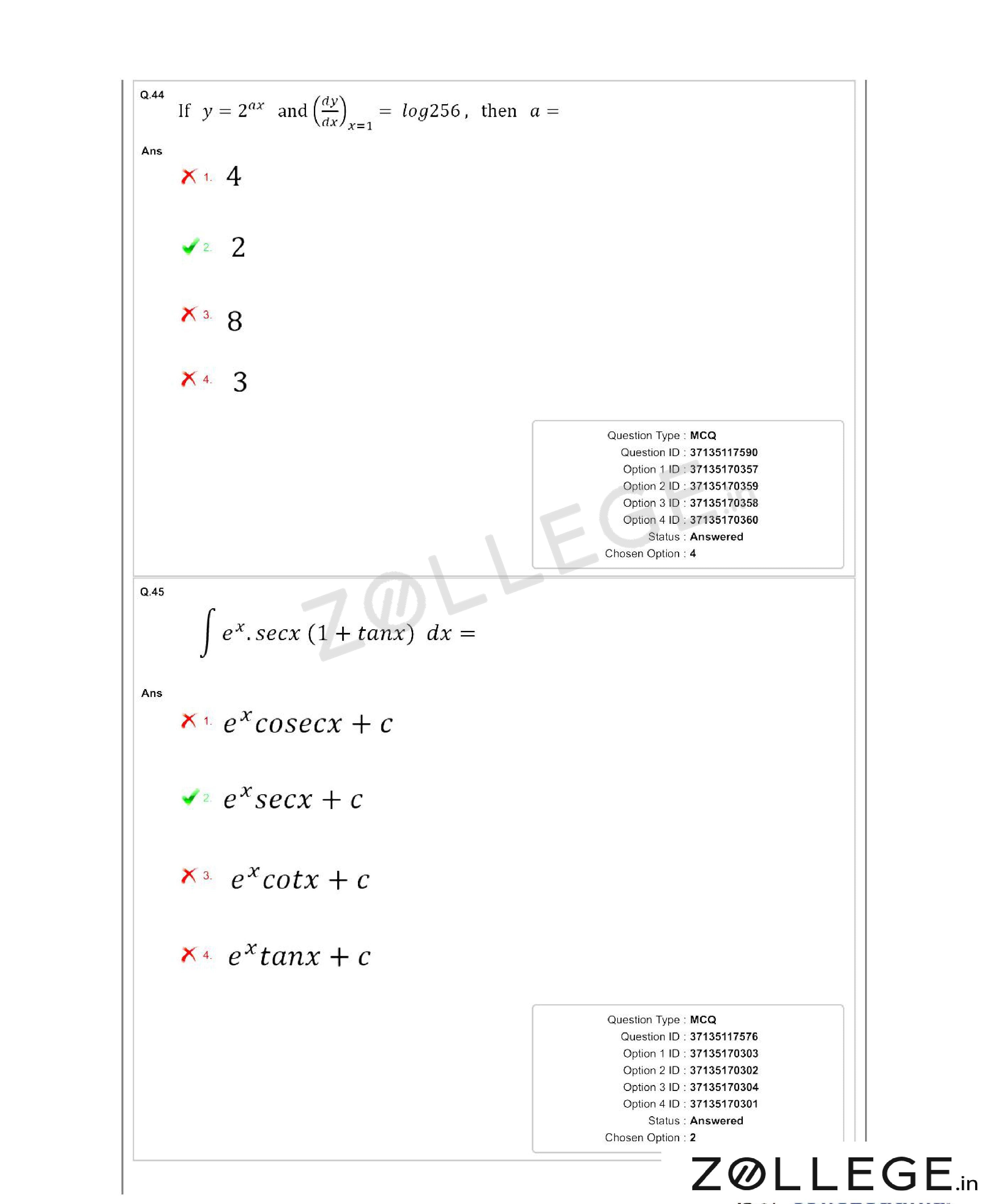
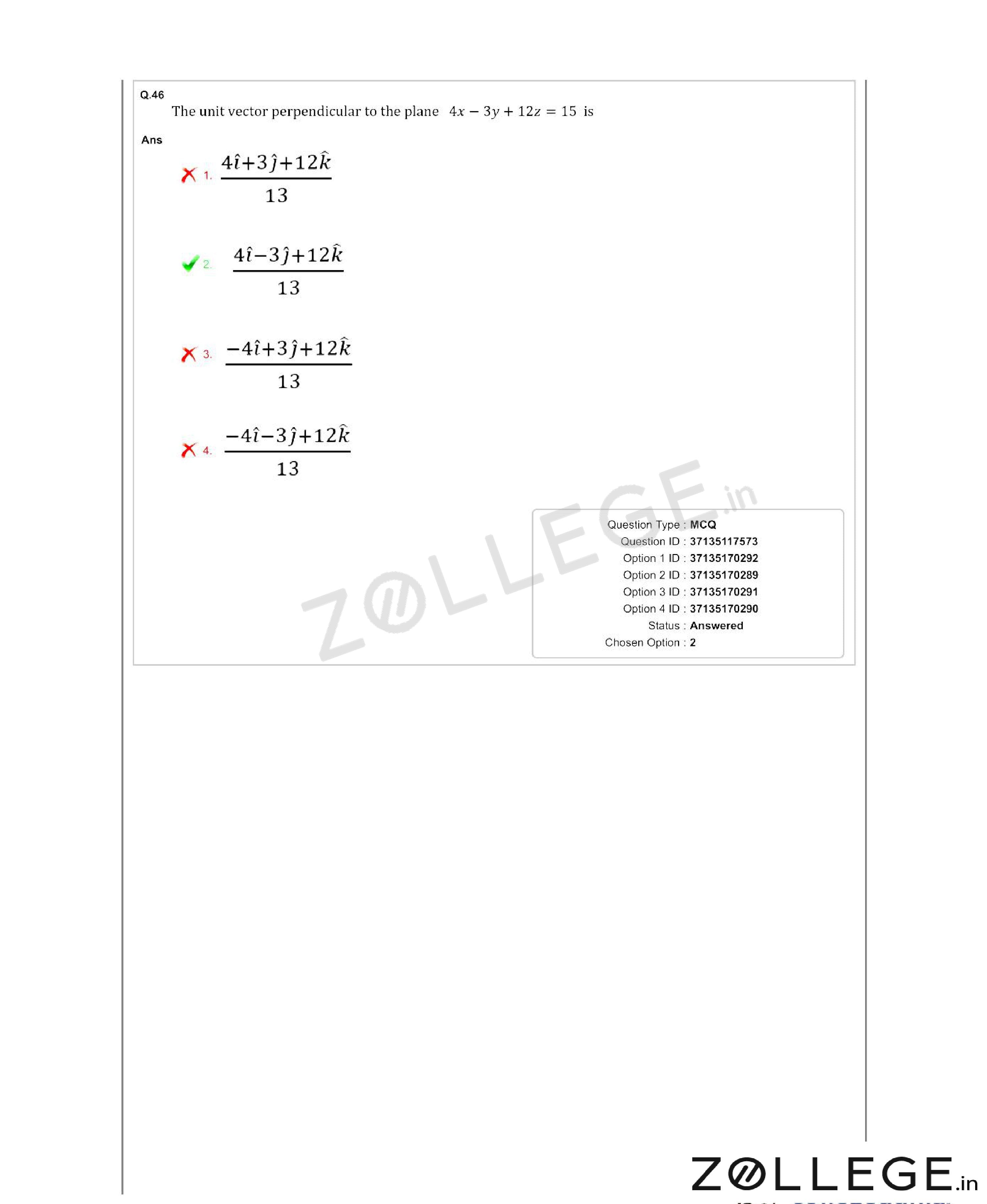
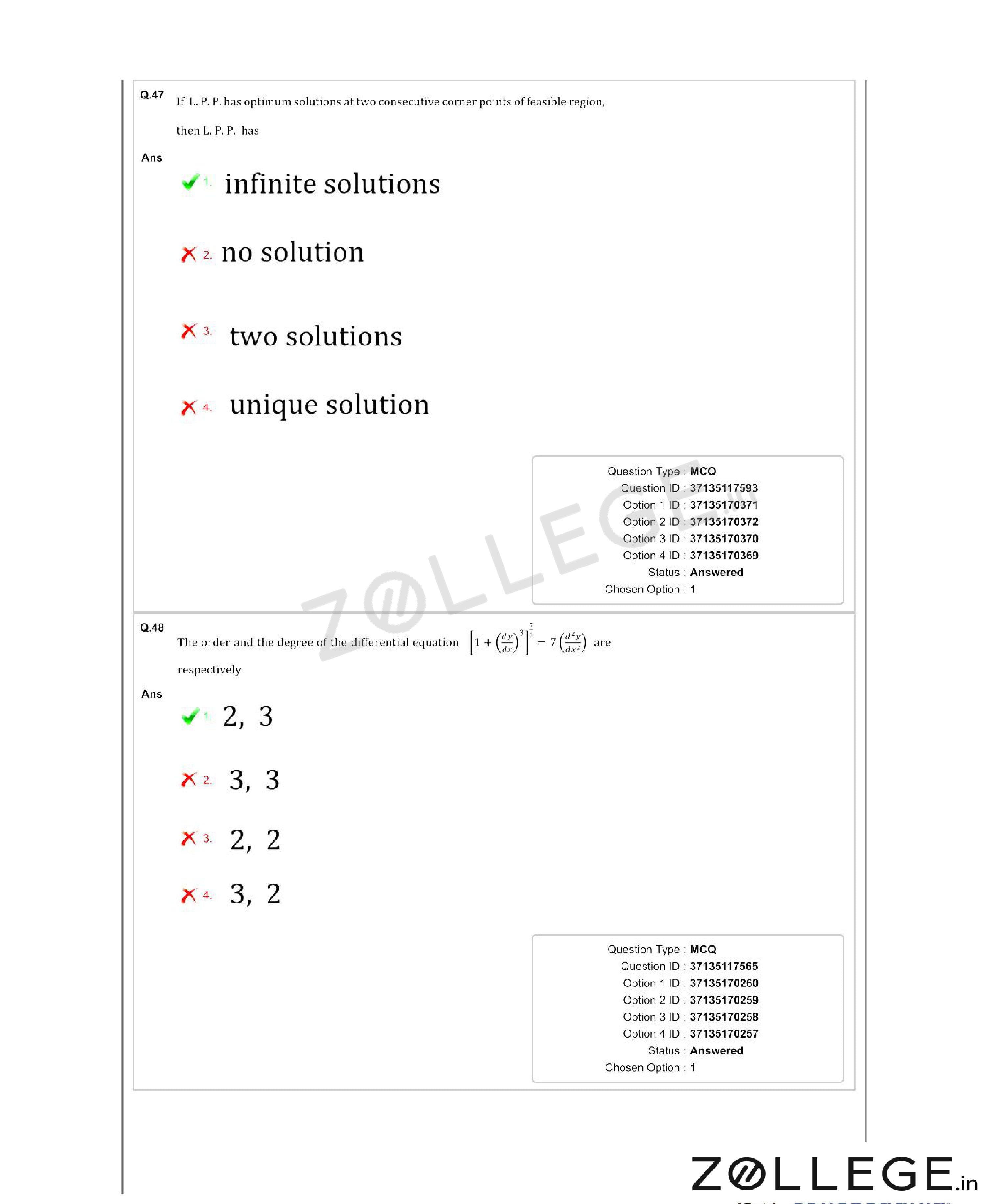
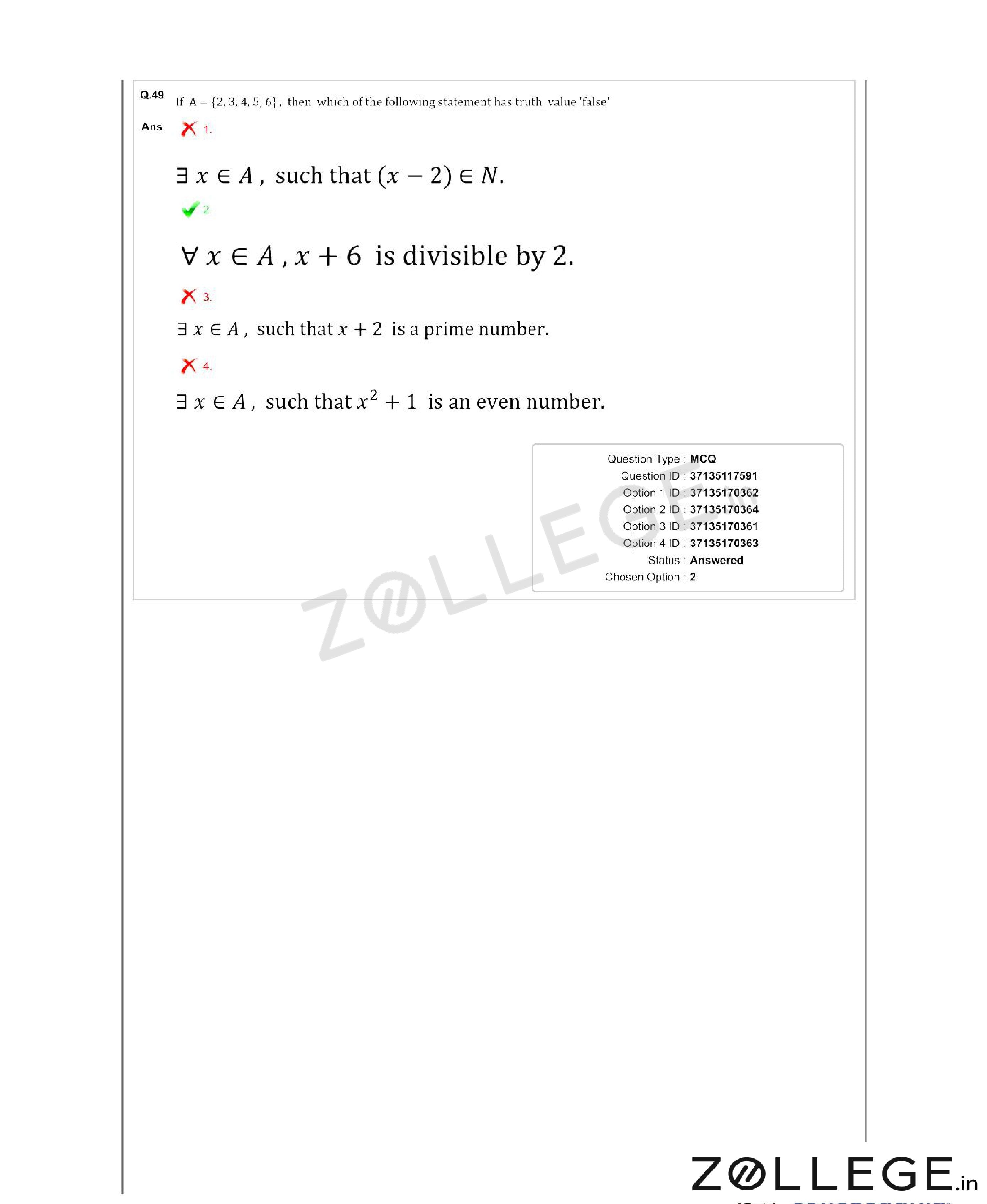
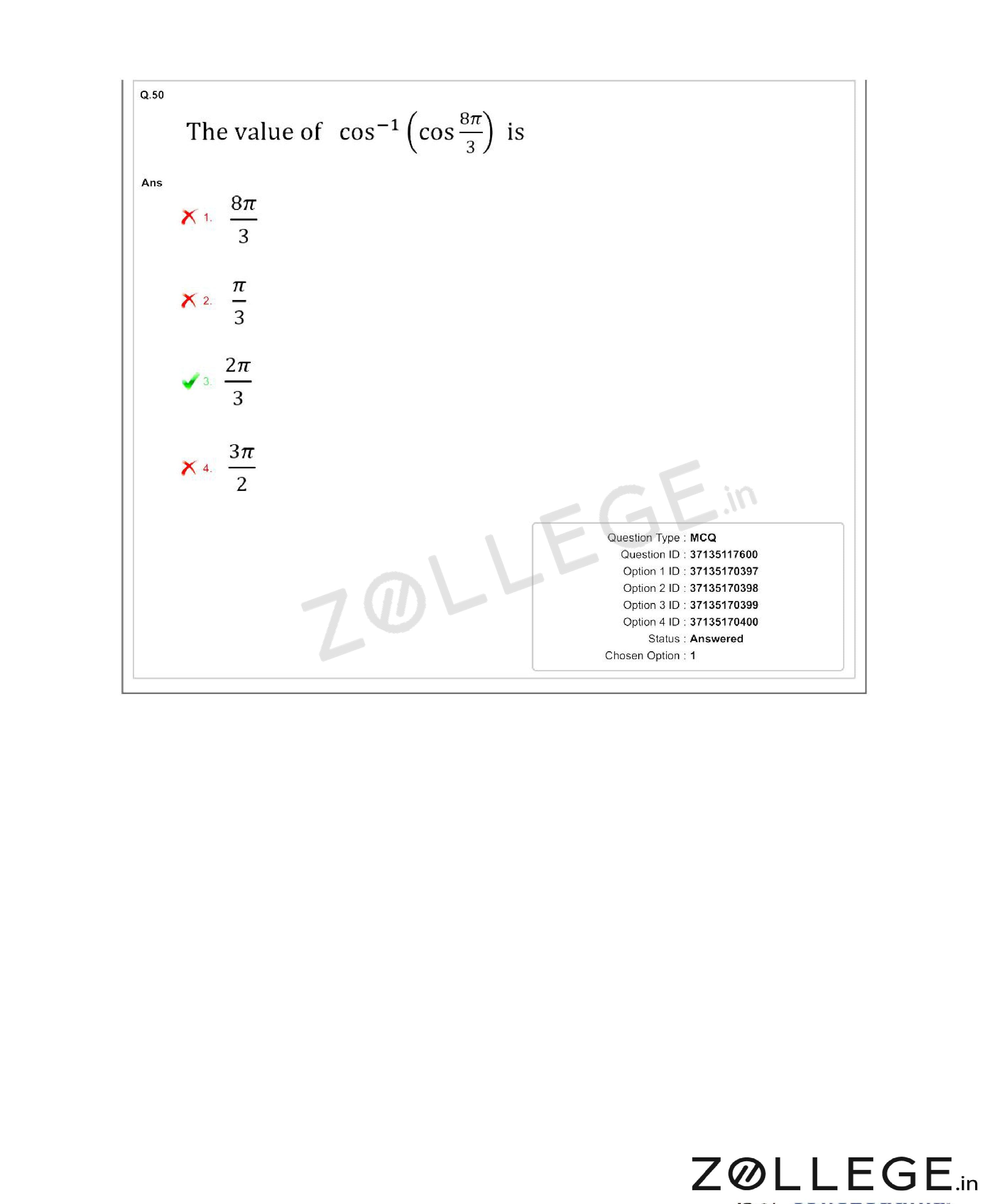
*The article might have information for the previous academic years, please refer the official website of the exam.