
MHT CET 2020 Question Paper with Solution PDF for PCM (October 19)


Content Writer | Updated On - Jan 20, 2026
MHT CET Question Papers are the most important study material for effective exam preparation. We at Zollege have provided all MHT CET Previous Year Papers with Solution PDFs here. MHT CET 2020 PCM exam was conducted successfully on October 19 by Shift 2.
Students can freely download the MHT CET previous year's question paper PDFs along with their solutions here.We strongly encourage MHT CET aspirants to scan through all the MHT CET Question Paper to know the overall difficulty level,MHT CET Syllabus and understand the changes in MHT CET Exam Pattern over the years.
MHT CET 2020 Oct 19 Shift 2 PCM Question Paper with Solution PDF
| MHT CET 2020 PCM Question Paper PDF | MHT CET 2020 PCM Solution PDF |
|---|---|
| Download PDF | Check Solutions |

An electron moves in a circular orbit with uniform speed 'v'. It produces a magnetic field 'B' at the centre of the circle. The radius of the circle is [\(\mu_0\) = permeability of free space, e = electronic charge]
View Solution
Step 1: Understanding the Question:
The question requires finding the radius of the circular path of an electron given its speed and the magnetic field it produces at the center.
Step 2: Key Formula or Approach:
The magnetic field at the center of a circular loop is \( B = \frac{\mu_0 I}{2R} \).
The current \( I \) produced by a revolving charge is \( I = \frac{e}{T} = \frac{e v}{2 \pi R} \).
Step 3: Detailed Explanation:
Substitute the expression for current into the magnetic field formula:
\[ B = \frac{\mu_0}{2R} \left( \frac{e v}{2 \pi R} \right) \]
\[ B = \frac{\mu_0 e v}{4 \pi R^2} \]
Rearrange the equation to solve for \( R^2 \):
\[ R^2 = \frac{\mu_0 e v}{4 \pi B} \]
Taking the square root of both sides:
\[ R = \left( \frac{\mu_0 e v}{4 \pi B} \right)^{1/2} \]
Step 4: Final Answer:
The radius of the circle is \( \left( \frac{\mu_0 e v}{4 \pi B} \right)^{1/2} \).
Quick Tip: Remember the direct relation \( B \propto 1/R^2 \) for a moving charge at the center of its orbit.
Two circular loops A and B of radii 'R' and 'NR' respectively are made from a uniform wire. Moment of inertia of B about its axis is 3 times that of A about its axis. The value of N is
View Solution
Step 1: Understanding the Question:
We need to find the scaling factor \( N \) for the radius of a loop, given the relationship between the moments of inertia of two loops made from the same uniform wire.
Step 2: Key Formula or Approach:
Moment of inertia of a ring about its axis is \( I = M R^2 \).
For a uniform wire, mass \( M \) is proportional to its length \( L \): \( M = \lambda L = \lambda (2 \pi R) \).
Step 3: Detailed Explanation:
Mass of loop A: \( M_A = \lambda (2 \pi R) \).
Mass of loop B: \( M_B = \lambda (2 \pi NR) = N M_A \).
Moment of inertia of A: \( I_A = M_A R^2 \).
Moment of inertia of B: \( I_B = M_B (NR)^2 = (N M_A) (N^2 R^2) = N^3 M_A R^2 \).
Thus, \( I_B = N^3 I_A \).
Given \( I_B = 3 I_A \), we have:
\[ N^3 = 3 \]
\[ N = 3^{1/3} \]
Step 4: Final Answer:
The value of N is \( [3]^{\frac{1}{3}} \).
Quick Tip: For objects made of uniform wire, \( I \propto R^3 \) because mass itself depends on the radius.
A uniform metal wire has length 'L', mass 'M' and density '\(\rho\)'. It is under tension 'T' and 'v' is the speed of transverse wave along the wire. The area of cross-section of the wire is
View Solution
Step 1: Understanding the Question:
The problem asks for the cross-sectional area of a wire based on the wave speed, tension, and density.
Step 2: Key Formula or Approach:
The speed of a transverse wave on a string is \( v = \sqrt{\frac{T}{\mu}} \), where \( \mu \) is the linear mass density (mass per unit length).
Step 3: Detailed Explanation:
Mass per unit length \( \mu = \frac{M}{L} \).
Since mass \( M = volume \times density = (A \times L) \times \rho \).
Substituting M: \( \mu = \frac{A L \rho}{L} = A \rho \).
Now, substituting \( \mu \) into the velocity formula:
\[ v = \sqrt{\frac{T}{A \rho}} \]
Squaring both sides:
\[ v^2 = \frac{T}{A \rho} \]
Solving for Area \( A \):
\[ A = \frac{T}{v^2 \rho} \]
Step 4: Final Answer:
The area of cross-section is \( \frac{T}{v^2 \rho} \).
Quick Tip: Always relate linear density \( \mu \) to volume density \( \rho \) using \( \mu = \rho A \).
Metal rings 'P' and 'Q' are lying in the same plane where current 'I' is increasing steadily. The induced current in metal rings is shown correctly in figure
(Image shows a wire with current I to the right, Ring P above, Ring Q below)

- (A)
![]()
- (B)
![]()
- (C)
![]()
- (D)
![]()


View Solution
Step 1: Understanding the Question:
The question uses Lenz's Law and Fleming's Right Hand Rule to determine the direction of induced current when the magnetic flux through the rings changes.
Step 2: Detailed Explanation:
The current \( I \) in the wire produces a magnetic field.
By the right-hand thumb rule, the magnetic field above the wire (at Ring P) is directed out of the page (\(\odot\)).
The magnetic field below the wire (at Ring Q) is directed into the page (\(\otimes\)).
As current \( I \) increases, the flux through both rings increases.
According to Lenz's Law, induced current opposes the increase in flux.
For Ring P: To oppose the increasing outwards flux, it creates an inwards flux (\(\otimes\)), which requires a clockwise current.
For Ring Q: To oppose the increasing inwards flux, it creates an outwards flux (\(\odot\)), which requires an anti-clockwise current.
Step 3: Final Answer:
The current is clockwise in P and anti-clockwise in Q.
Quick Tip: Lenz's Law: Induced current always creates a field to cancel out the change in external flux.
The fundamental frequency of a closed pipe is 400 Hz. If \( 1/3^{rd} \) pipe is filled with water, the frequency of \( 2^{nd} \) harmonic of the pipe will be (Neglect end correction)
View Solution
Step 1: Understanding the Question:
The length of the air column changes when water is added. We need to find a specific harmonic of the new air column.
Step 2: Key Formula or Approach:
Fundamental frequency of closed pipe: \( f = \frac{v}{4L} \).
Harmonics of a closed pipe are odd multiples: \( f, 3f, 5f... \).
Step 3: Detailed Explanation:
Initial fundamental frequency \( f_1 = \frac{v}{4L} = 400 \) Hz.
When \( 1/3 \) of the pipe is filled with water, the length of the air column becomes \( L' = L - \frac{L}{3} = \frac{2L}{3} \).
New fundamental frequency \( f' = \frac{v}{4L'} = \frac{v}{4(2L/3)} = \frac{3}{2} \left( \frac{v}{4L} \right) \).
\( f' = \frac{3}{2} \times 400 = 600 \) Hz.
For a closed pipe, the "2nd harmonic" as an overtone usually refers to the next resonant mode, which is the 3rd harmonic (\(3f'\)).
\( f_{3rd} = 3 \times 600 = 1800 \) Hz.
Step 4: Final Answer:
The frequency is 1800 Hz.
Quick Tip: Closed pipes only have odd harmonics (1st, 3rd, 5th...). The term "2nd harmonic" in competitive exams often implies the next available mode (1st overtone).
Two capacitors of capacities 2 \(\mu\)F and 4 \(\mu\)F are connected in parallel. A third capacitor of 6 \(\mu\)F capacity is connected in series with this combination. A battery of 12 V is connected across this combination. The charge on 2 \(\mu\)F capacitor is
View Solution
Step 1: Understanding the Question:
The problem involves calculating charge distribution in a series-parallel capacitor circuit.
Step 2: Key Formula or Approach:
Parallel capacitance: \( C_p = C_1 + C_2 \).
Series capacitance: \( \frac{1}{C_{eq}} = \frac{1}{C_p} + \frac{1}{C_3} \).
Charge: \( Q = CV \).
Step 3: Detailed Explanation:
Parallel combination of \( 2 \muF \) and \( 4 \muF \):
\( C_p = 2 + 4 = 6 \muF \).
This is in series with another \( 6 \muF \) capacitor.
Equivalent capacitance \( C_{eq} = \frac{6 \times 6}{6 + 6} = 3 \muF \).
Total charge from battery \( Q_{total} = C_{eq} \times V = 3 \muF \times 12 V = 36 \muC \).
In series, the total charge is the same on \( C_p \) and \( C_3 \). So, charge on \( C_p \) is \( 36 \muC \).
Potential across the parallel combination \( V_p = \frac{Q_p}{C_p} = \frac{36 \muC}{6 \muF} = 6 V \).
Charge on \( 2 \muF \) capacitor:
\( Q_1 = C_1 \times V_p = 2 \muF \times 6 V = 12 \muC \).
Step 4: Final Answer:
The charge on the 2 \(\mu\)F capacitor is 12 \(\mu\)C.
Quick Tip: When two identical capacitors are in series, the voltage divides equally between them. Here, \( C_p = 6 \mu F \) and \( C_3 = 6 \mu F \), so each gets 6V.
The compressibility of water is \( 5 \times 10^{-10} \) m\(^2\)/N. Pressure of \( 15 \times 10^6 \) Pa is applied on 100 ml volume of water. The change in the volume of water is
View Solution
Step 1: Understanding the Question:
We need to calculate the volume change of water under increased pressure using the given compressibility.
Step 2: Key Formula or Approach:
Compressibility (\( C \)) is the reciprocal of Bulk Modulus (\( B \)).
\( C = \frac{1}{B} = \frac{\Delta V / V}{\Delta P} \Rightarrow \Delta V = C \times V \times \Delta P \).
Step 3: Detailed Explanation:
Given: \( C = 5 \times 10^{-10} \) m\(^2\)/N.
\( \Delta P = 15 \times 10^6 \) Pa.
\( V = 100 \) ml.
\[ \Delta V = (5 \times 10^{-10}) \times (100) \times (15 \times 10^6) \]
\[ \Delta V = 5 \times 15 \times 100 \times 10^{-4} \]
\[ \Delta V = 75 \times 10^{-2} = 0.75 ml \]
Since pressure is applied (increased), the volume must decrease.
Step 4: Final Answer:
The change is a 0.75 ml decrease.
Quick Tip: Applying pressure always results in a decrease in volume for any real substance.
Let \( x = \pi R \left( \frac{P^2 - Q^2}{2} \right) \), where P, Q and R are lengths. The physical quantity 'x' is
View Solution
Step 1: Understanding the Question:
The question asks to identify the physical nature of 'x' using dimensional analysis.
Step 2: Detailed Explanation:
The expression is \( x = \pi R \left( \frac{P^2 - Q^2}{2} \right) \).
Dimensions of R = [L].
Dimensions of \( P^2 \) and \( Q^2 \) = [L\(^2\)].
Subtraction of two identical physical quantities (lengths squared) results in the same dimension: [L\(^2\)].
Multiplication: [L] \( \times \) [L\(^2\)] = [L\(^3\)].
[L\(^3\)] is the dimension of Volume.
Step 3: Final Answer:
The physical quantity 'x' is volume.
Quick Tip: Numerical constants like \( \pi \) and \( 2 \) are dimensionless and do not affect the result in dimensional analysis.
A milliammeter of resistance 40 \(\Omega\) has a range 0-30 mA. What will be the resistance used in series to convert it into voltmeter of range 0-15 V?
View Solution
Step 1: Understanding the Question:
We need to find the series resistance required to limit the current through the galvanometer to its full-scale value when a specific voltage is applied.
Step 2: Key Formula or Approach:
For a voltmeter: \( V = I_g (G + R) \), where \( G \) is galvanometer resistance and \( R \) is series resistance.
Step 3: Detailed Explanation:
Given: \( G = 40 \Omega \).
Full scale current \( I_g = 30 mA = 0.03 A \).
Desired range \( V = 15 V \).
\[ 15 = 0.03 (40 + R) \]
\[ \frac{15}{0.03} = 40 + R \]
\[ 500 = 40 + R \]
\[ R = 500 - 40 = 460 \Omega \]
Step 4: Final Answer:
The required resistance is 460 \(\Omega\).
Quick Tip: To convert an ammeter to a voltmeter, always connect a high resistance in \textbf{series}.
Two bodies 'A' and 'B' of equal mass are suspended from two separate massless springs of force constant '\(k_1\)' and '\(k_2\)' respectively. The bodies oscillate vertically such that their maximum velocities are equal. The ratio of the amplitudes of body A to that of body B is
View Solution
Step 1: Understanding the Question:
Compare the amplitudes of two oscillating systems with different spring constants but equal mass and equal maximum velocity.
Step 2: Key Formula or Approach:
Maximum velocity in SHM: \( v_{max} = A \omega \).
Angular frequency for a spring: \( \omega = \sqrt{\frac{k}{m}} \).
Step 3: Detailed Explanation:
For body A: \( v_{max, A} = A_1 \sqrt{\frac{k_1}{m}} \).
For body B: \( v_{max, B} = A_2 \sqrt{\frac{k_2}{m}} \).
Given \( v_{max, A} = v_{max, B} \):
\[ A_1 \sqrt{\frac{k_1}{m}} = A_2 \sqrt{\frac{k_2}{m}} \]
\[ A_1 \sqrt{k_1} = A_2 \sqrt{k_2} \]
\[ \frac{A_1}{A_2} = \sqrt{\frac{k_2}{k_1}} \]
Step 4: Final Answer:
The ratio is \( \sqrt{\frac{k_2}{k_1}} \).
Quick Tip: At constant energy or max velocity, amplitude is inversely proportional to the square root of the stiffness.
Three points masses, each of mass 'm' are placed at the corners of an equilateral triangle of side '\(l\)'. The moment of inertia of the system about an axis passing through one of the vertices and parallel to the side joining other two vertices, will be
View Solution
Step 1: Understanding the Question:
Calculate the moment of inertia of a discrete system of point masses relative to a specific axis of rotation.
Step 2: Key Formula or Approach:
\( I = \sum m_i r_i^2 \), where \( r_i \) is the perpendicular distance from the axis.
Step 3: Detailed Explanation:
Place the triangle with one vertex at the origin (axis). The other two vertices are at distance \( l \).
The axis passes through the first vertex and is parallel to the opposite side.
The perpendicular distance of the first mass is \( r_1 = 0 \).
The perpendicular distance of the other two masses from this axis is the height of the triangle:
\[ h = l \sin(60^\circ) = \frac{\sqrt{3}}{2} l \]
Total moment of inertia:
\[ I = m(0)^2 + m\left(\frac{\sqrt{3}}{2} l\right)^2 + m\left(\frac{\sqrt{3}}{2} l\right)^2 \]
\[ I = 0 + m \frac{3l^2}{4} + m \frac{3l^2}{4} \]
\[ I = \frac{6}{4} m l^2 = \frac{3}{2} m l^2 \]
Step 4: Final Answer:
The moment of inertia is \( \frac{3}{2} m l^2 \).
Quick Tip: Drawing a diagram helps identify the correct perpendicular distances for each mass point.
Two spherical rain drops reach the surface of the earth with terminal velocities having ratio 16:9. The ratio of their surface area is
View Solution
Step 1: Understanding the Question:
Relate the terminal velocity of falling drops to their geometric surface area.
Step 2: Key Formula or Approach:
Terminal velocity \( v_t \propto r^2 \).
Surface Area \( S \propto r^2 \).
Step 3: Detailed Explanation:
The ratio of terminal velocities is given as \( \frac{v_1}{v_2} = \frac{16}{9} \).
Since \( v_t \propto r^2 \), we have \( \frac{r_1^2}{r_2^2} = \frac{16}{9} \).
Surface area of a sphere is \( S = 4 \pi r^2 \).
Thus, the ratio of surface areas is:
\[ \frac{S_1}{S_2} = \frac{4 \pi r_1^2}{4 \pi r_2^2} = \frac{r_1^2}{r_2^2} \]
Since \( \frac{r_1^2}{r_2^2} \) is already known from the velocity ratio:
\[ \frac{S_1}{S_2} = \frac{16}{9} \]
Step 4: Final Answer:
The ratio of surface area is 16:9.
Quick Tip: Notice that both terminal velocity and surface area are proportional to \( r^2 \), so their ratios must be identical.
van de Graaff generator produces
View Solution
Step 1: Understanding the Question:
Identify the operational characteristics of a van de Graaff generator.
Step 2: Detailed Explanation:
A van de Graaff generator is an electrostatic machine which uses a moving belt to accumulate very high amounts of electrical charge on a hollow metal globe.
It produces potential differences in the order of millions of volts.
However, the actual flow of charge (current) is extremely small because the rate of charge accumulation is limited by the belt's speed and insulation.
Step 3: Final Answer:
It produces high voltage and low current.
Quick Tip: Van de Graaff generators are used primarily for particle acceleration, where high potential is needed more than high current.
A metal rod has length, cross-sectional area and Young's modulus as 'L', 'A' and 'Y' respectively. If the elongation in the rod produced is '\(l\)' then work done is proportional to
View Solution
Step 1: Understanding the Question:
Find the dependency of the work done (potential energy) stored in a stretched rod on its elongation.
Step 2: Key Formula or Approach:
Work done in stretching a wire: \( W = \frac{1}{2} \times Stress \times Strain \times Volume \).
Or \( W = \frac{1}{2} F l \).
Step 3: Detailed Explanation:
Force \( F = \frac{Y A l}{L} \).
Substituting into the work formula:
\[ W = \frac{1}{2} \left( \frac{Y A l}{L} \right) l \]
\[ W = \frac{Y A l^2}{2 L} \]
Since Y, A, and L are constants for a given rod:
\[ W \propto l^2 \]
Step 4: Final Answer:
Work done is proportional to \( l^2 \).
Quick Tip: Stretching a metal rod is analogous to stretching a spring (\( U = \frac{1}{2} k x^2 \)), where work is proportional to the square of displacement.
By increasing the aperture of the objective lens, wavelength of light, focal length of the objective lens and the resolving power of an astronomical telescope respectively
View Solution
Step 1: Understanding the Question:
Determine how changing telescope parameters (aperture and wavelength) affects its resolving power and objective focal length.
Step 2: Key Formula or Approach:
Resolving Power (\( RP \)) of a telescope = \( \frac{D}{1.22 \lambda} \), where \( D \) is the aperture.
Step 3: Detailed Explanation:
1. **Aperture (\( D \)) increases:** Since \( RP \propto D \), the resolving power increases.
2. **Wavelength (\( \lambda \)) increases:** Since \( RP \propto 1/\lambda \), the resolving power decreases.
3. **Focal Length (\( f_o \)):** Resolving power depends on aperture size, not on the focal length of the lens. Thus, it is not affected by changes in focal length itself (as per the specific list provided in the question).
Step 4: Final Answer:
The trends are: increases, decreases, is not affected.
Quick Tip: A larger aperture allows a telescope to distinguish between two closely spaced stars more clearly.
If the maximum kinetic energy of emitted electrons in photoelectric effect is \( 3.2 \times 10^{-19} \) J and the work function for metal is \( 6.63 \times 10^{-19} \) J, then stopping potential and threshold wavelength respectively are [h = \( 6.63 \times 10^{-34} \) Js, c = \( 3 \times 10^8 \) m/s, e = \( 1.6 \times 10^{-19} \) C]
View Solution
Step 1: Understanding the Question:
Calculate stopping potential from kinetic energy and threshold wavelength from work function.
Step 2: Key Formula or Approach:
1. \( KE_{max} = e V_s \)
2. \( \Phi = \frac{hc}{\lambda_0} \)
Step 3: Detailed Explanation:
1. **Stopping Potential:**
\[ V_s = \frac{KE_{max}}{e} = \frac{3.2 \times 10^{-19} J}{1.6 \times 10^{-19} C} = 2 V \]
2. **Threshold Wavelength:**
\[ \lambda_0 = \frac{hc}{\Phi} = \frac{6.63 \times 10^{-34} \times 3 \times 10^8}{6.63 \times 10^{-19}} \]
\[ \lambda_0 = 3 \times 10^{-7} m \]
Converting to Angstroms: \( 3 \times 10^{-7} m = 3000 \AA \).
Step 4: Final Answer:
Stopping potential is 2V and threshold wavelength is 3000\text{\AA.
Quick Tip: Stopping potential in volts is numerically equal to the maximum kinetic energy in electron-volts (eV).
For a paramagnetic substance, the magnetic susceptibility is
View Solution
Step 1: Understanding the Question:
Recall the properties of magnetic materials regarding susceptibility (\( \chi \)).
Step 2: Detailed Explanation:
Paramagnetic substances are weakly attracted by a magnetic field.
Their susceptibility (\( \chi \)) is positive because magnetization occurs in the direction of the field.
However, the effect is weak, so the value of \( \chi \) is very small (typically between \(10^{-5}\) to \(10^{-3}\)).
Ferromagnetic substances have large and positive susceptibility, while diamagnetic substances have small and negative susceptibility.
Step 3: Final Answer:
It is small and positive.
Quick Tip: Remember: Para = Small +, Ferro = Large +, Dia = Small -.
In an intrinsic semiconductor, at an ordinary temperature, the correct relation between the number of electrons '\(n_e\)' and number of holes '\(n_h\)' is
View Solution
Step 1: Understanding the Question:
Define the carrier concentration relationship in a pure (intrinsic) semiconductor.
Step 2: Detailed Explanation:
Intrinsic semiconductors are pure semiconductors without doping.
At any temperature above absolute zero, thermal energy breaks covalent bonds.
Every time an electron is freed from a bond and moves to the conduction band, it leaves behind a vacancy (hole) in the valence band.
Therefore, electrons and holes are always created in pairs.
This leads to the equality: \( n_e = n_h = n_i \).
Step 3: Final Answer:
The relation is \( n_e = n_h \).
Quick Tip: \(n_e \neq n_h\) only occurs in extrinsic (doped) semiconductors.
A ray of light is incident at an angle 'i' on one face of a thin angled prism. The ray emerges normally from the other face. Refractive index of the glass prism is 'n' and angle of prism is 'A'. The value of 'i' is
View Solution
Step 1: Understanding the Question:
Analyze the path of light through a prism where it enters at one face and leaves perpendicularly to the second face.
Step 2: Key Formula or Approach:
1. Prism equation: \( A = r_1 + r_2 \)
2. Snell's Law: \( n = \frac{\sin i}{\sin r_1} \)
Step 3: Detailed Explanation:
Since the ray emerges normally from the second face, the angle of emergence \( e = 0 \).
By Snell's law at the second face, \( n \sin r_2 = \sin e \Rightarrow \sin r_2 = 0 \), so \( r_2 = 0 \).
From the prism formula: \( A = r_1 + 0 \Rightarrow r_1 = A \).
Applying Snell's law at the first face:
\[ n = \frac{\sin i}{\sin r_1} = \frac{\sin i}{\sin A} \]
For a thin prism, the angles \( i \) and \( A \) are very small, so \( \sin i \approx i \) and \( \sin A \approx A \).
\[ n \approx \frac{i}{A} \Rightarrow i = n A \]
Step 4: Final Answer:
The value of \( i \) is \( An \).
Quick Tip: For any small angle problem in optics, always use the approximation \( \sin \theta \approx \theta \) (in radians).
A body of mass 64 g is made to oscillate turn by turn on two different springs A and B. Spring A and B has force constant 4 N/m and 16 N/m respectively. If \( T_1 \) and \( T_2 \) are period of oscillations of springs A and B respectively then \( \frac{T_1 + T_2}{T_1 - T_2} \) will be
View Solution
Step 1: Understanding the Question:
Calculate the time periods for a mass on two different springs and then find the value of a specific ratio.
Step 2: Key Formula or Approach:
Time period of a spring-mass system: \( T = 2\pi \sqrt{\frac{m}{k}} \).
Step 3: Detailed Explanation:
Mass \( m = 64 g = 0.064 kg \).
For spring A (\( k_1 = 4 \)): \( T_1 = 2\pi \sqrt{\frac{0.064}{4}} = 2\pi \sqrt{0.016} = 2\pi \times 0.4 \).
For spring B (\( k_2 = 16 \)): \( T_2 = 2\pi \sqrt{\frac{0.064}{16}} = 2\pi \sqrt{0.004} = 2\pi \times 0.2 \).
We need \( \frac{T_1 + T_2}{T_1 - T_2} \):
\[ \frac{2\pi(0.4) + 2\pi(0.2)}{2\pi(0.4) - 2\pi(0.2)} = \frac{0.6}{0.2} = \frac{3}{1} \]
Step 4: Final Answer:
The ratio is 3:1.
Quick Tip: Since \( T \propto 1/\sqrt{k} \), you can skip calculating \( 2\pi \) and mass entirely if you only need a ratio.
A child starts running from rest along a circular track of radius 'r' with constant tangential acceleration 'a'. After time 't' he feels that slipping of shoes on the ground has started. The coefficient of friction between shoes and the ground is [g = acceleration due to gravity]
View Solution
Step 1: Understanding the Question:
Slipping starts when the net acceleration required for the circular motion exceeds the maximum static friction available.
Step 2: Key Formula or Approach:
1. Tangential acceleration \( a_t = a \).
2. Centripetal acceleration \( a_c = \frac{v^2}{r} \).
3. Total acceleration \( a_{net} = \sqrt{a_t^2 + a_c^2} \).
4. Friction condition: \( \mu m g = m a_{net} \).
Step 3: Detailed Explanation:
Starting from rest with constant tangential acceleration \( a \), velocity after time \( t \) is \( v = at \).
The centripetal acceleration is:
\[ a_c = \frac{(at)^2}{r} = \frac{a^2 t^2}{r} \]
The total net acceleration is:
\[ a_{net} = \sqrt{a^2 + \left(\frac{a^2 t^2}{r}\right)^2} = \sqrt{a^2 + \frac{a^4 t^4}{r^2}} \]
\[ a_{net} = \sqrt{\frac{a^2 r^2 + a^4 t^4}{r^2}} = \frac{\sqrt{a^2 r^2 + a^4 t^4}}{r} \]
Equating to friction \( \mu g \):
\[ \mu = \frac{a_{net}}{g} = \frac{[a^2 r^2 + a^4 t^4]^{1/2}}{gr} \]
Step 4: Final Answer:
The coefficient of friction is \( \frac{[a^4 t^4 + a^2 r^2]^{1/2}}{gr} \).
Quick Tip: Remember that friction must provide BOTH the acceleration to turn AND the acceleration to speed up.
A steel wire of length '\(l\)' has a magnetic moment 'M'. It is then bent into a semi-circular arc. The new magnetic moment is
View Solution
Step 1: Understanding the Question:
Compare the magnetic moment of a straight bar magnet vs when it is bent into an arc.
Step 2: Key Formula or Approach:
Magnetic moment \( M = m \times d \), where \( m \) is pole strength and \( d \) is the shortest distance between poles.
Step 3: Detailed Explanation:
Initial state: Straight wire of length \( l \). Magnetic moment \( M = m \times l \).
Bending into semi-circle: The length \( l \) becomes the circumference of the semi-circle.
\[ l = \pi R \Rightarrow R = \frac{l}{\pi} \]
The new shortest distance between the poles (the diameter of the semi-circle) is:
\[ d' = 2R = \frac{2l}{\pi} \]
New magnetic moment:
\[ M' = m \times d' = m \times \frac{2l}{\pi} \]
Substituting \( m \times l = M \):
\[ M' = \frac{2M}{\pi} \]
Step 4: Final Answer:
The new magnetic moment is \( 2M / \pi \).
Quick Tip: The pole strength \( m \) of the material does not change when you bend the magnet; only the effective distance between poles changes.
The energy levels with transitions for the atom are shown. The transitions corresponding to emission of radiation of maximum and minimum wavelength are respectively
(Image shows Levels 0 eV, -2 eV, -4.5 eV, -10 eV. Transitions: A (0 to -2), B (-2 to -4.5), C (-2 to -4.5), D (-4.5 to -10))

View Solution
Step 1: Understanding the Question:
Link the energy difference of transitions to the wavelength of emitted photons.
Step 2: Key Formula or Approach:
Energy of photon \( E = \frac{hc}{\lambda} \). This implies \( \lambda \propto \frac{1}{\Delta E} \).
Step 3: Detailed Explanation:
Calculate energy differences for transitions:
1. Transition A: \( |0 - (-2)| = 2 eV \).
2. Transition B: \( |-2 - (-4.5)| = 2.5 eV \).
3. Transition C: \( |-2 - (-4.5)| = 2.5 eV \).
4. Transition D: \( |-4.5 - (-10)| = 5.5 eV \).
Maximum wavelength (\(\lambda_{max}\)) occurs for minimum energy transition: \( \Delta E = 2 eV \) (Transition A).
Minimum wavelength (\(\lambda_{min}\)) occurs for maximum energy transition: \( \Delta E = 5.5 eV \) (Transition D).
Step 4: Final Answer:
Maximum wavelength is A, Minimum is D.
Quick Tip: The shortest jump on the energy diagram corresponds to the longest wavelength.
In a system of two particles of masses '\(m_1\)' and '\(m_2\)', the first particle is moved by a distance 'd' towards the centre of mass. To keep the centre of mass unchanged, the second particle will have to be moved by a distance
View Solution
Step 1: Understanding the Question:
Determine the displacement of one mass required to compensate for the movement of another mass such that the center of mass remains stationary.
Step 2: Key Formula or Approach:
For center of mass to remain stationary: \( m_1 \Delta x_1 + m_2 \Delta x_2 = 0 \).
Step 3: Detailed Explanation:
Let the center of mass be at the origin.
Initial position: \( m_1 x_1 + m_2 x_2 = 0 \).
If mass 1 moves towards the center of mass by distance \( d \), its displacement is \( \Delta x_1 = d \).
To maintain the CM, mass 2 must move by \( \Delta x_2 \) such that:
\[ m_1 (d) + m_2 (\Delta x_2) = 0 \]
\[ m_2 \Delta x_2 = -m_1 d \]
\[ \Delta x_2 = -\frac{m_1}{m_2} d \]
The negative sign indicates that if mass 1 moves towards the CM, mass 2 must also move towards the CM to balance it.
Step 4: Final Answer:
The distance is \( \frac{m_1}{m_2} d \) towards the centre of mass.
Quick Tip: In a two-body system, to keep CM fixed, the moments of displacement (\( m \times \Delta x \)) must be equal and opposite.
An object is clearly seen through an astronomical telescope of length 50 cm. The focal lengths of its objective and eyepiece respectively, can be
View Solution
Step 1: Understanding the Question:
Match the telescope length to the standard properties of an astronomical telescope.
Step 2: Key Formula or Approach:
Length of astronomical telescope in normal adjustment: \( L = f_o + f_e \).
Step 3: Detailed Explanation:
1. In an astronomical telescope, both lenses are convex, so both focal lengths must be positive.
2. For better magnification and light gathering, the objective lens always has a much larger focal length than the eyepiece (\( f_o > f_e \)).
Check options for \( f_o + f_e = 50 \):
(A) 5 + 45 = 50, but \( f_o < f_e \).
(D) 45 + 5 = 50, and \( f_o > f_e \).
Step 4: Final Answer:
The focal lengths are 45 cm and 5 cm.
Quick Tip: Objective: Large \(f_o\) (to collect light). Eyepiece: Small \(f_e\) (to magnify).
'N' number of balls of mass 'm' kg moving along positive direction of x - axis, strike a wall per second and return elastically. The velocity of each ball is 'u' m/s. The force exerted on the wall by the balls in newton, is
View Solution
Step 1: Understanding the Question:
Calculate the average force based on the rate of change of momentum of multiple objects.
Step 2: Key Formula or Approach:
Newton's Second Law: \( F = \frac{\Delta P}{\Delta t} \).
Step 3: Detailed Explanation:
Change in momentum for one ball in an elastic collision:
\[ \Delta p = p_{final} - p_{initial} = (-mu) - (mu) = -2mu \]
Magnitude of momentum change per ball = \( 2mu \).
Number of balls striking per second = \( N \).
Total change in momentum per second (Force):
\[ F = N \times \Delta p = N \times 2mu = 2mNu \]
Step 4: Final Answer:
The force is 2mNu.
Quick Tip: For elastic collisions against a stationary wall, the momentum change is always twice the initial momentum.
What is the angle between resultant of \( \vec{A} + \vec{B} \) and \( \vec{A} \times \vec{B} \)?
View Solution
Step 1: Understanding the Question:
Use vector product and sum properties to determine relative orientation.
Step 2: Detailed Explanation:
1. The vector sum \( \vec{A} + \vec{B} \) lies in the plane containing vectors \( \vec{A} \) and \( \vec{B} \).
2. The cross product \( \vec{A} \times \vec{B} \) results in a vector that is perpendicular to the plane containing \( \vec{A} \) and \( \vec{B} \).
3. Since \( \vec{A} + \vec{B} \) is in the plane and \( \vec{A} \times \vec{B} \) is perpendicular to the plane, they must be perpendicular to each other.
The angle between any vector in a plane and a vector normal to that plane is \( 90^\circ \) or \( \pi/2 \) rad.
Step 3: Final Answer:
The angle is \( \frac{\pi}{2} \) rad.
Quick Tip: The cross product \( \vec{A} \times \vec{B} \) is always perpendicular to both \( \vec{A} \) and \( \vec{B} \), and thus any linear combination of them.
The angle subtended by the vector \( \vec{A} = 4\hat{i} + 3\hat{j} + 12\hat{k} \) with the x - axis is
View Solution
Step 1: Understanding the Question:
Find the direction cosine of the given vector with respect to the x-axis.
Step 2: Key Formula or Approach:
The angle \( \alpha \) with the x-axis is given by \( \cos \alpha = \frac{A_x}{|\vec{A}|} \).
Step 3: Detailed Explanation:
Identify components: \( A_x = 4 \), \( A_y = 3 \), \( A_z = 12 \).
Calculate magnitude:
\[ |\vec{A}| = \sqrt{4^2 + 3^2 + 12^2} = \sqrt{16 + 9 + 144} = \sqrt{169} = 13 \]
Calculate angle:
\[ \cos \alpha = \frac{4}{13} \]
\[ \alpha = \cos^{-1} \left( \frac{4}{13} \right) \]
Step 4: Final Answer:
The angle is \( \cos^{-1} \left( \frac{4}{13} \right) \).
Quick Tip: Direction cosines are usually represented as \( \cos \alpha, \cos \beta, \cos \gamma \) for x, y, z axes respectively.
Earth has mass '\(M_1\)' and Radius '\(R_1\)'. Moon has mass '\(M_2\)' and radius '\(R_2\)'. Distance between their centres is 'r'. A body of mass 'M' is placed on the line joining them at a distance \( \frac{r}{3} \) from centre of the earth. To project the mass 'M' to escape to infinity, the minimum speed required is
View Solution
Step 1: Understanding the Question:
Escape velocity is the speed required to make the total mechanical energy of the mass zero.
Step 2: Key Formula or Approach:
Conservation of Energy: \( KE + PE = 0 \) at escape.
Gravitational Potential Energy \( U = -\frac{GMm}{d} \).
Step 3: Detailed Explanation:
Distance of mass \( M \) from Earth = \( r/3 \).
Distance of mass \( M \) from Moon = \( r - r/3 = 2r/3 \).
Total Potential Energy at the start:
\[ U = -\frac{GM_1 M}{r/3} - \frac{GM_2 M}{2r/3} = -\frac{3GM_1 M}{r} - \frac{3GM_2 M}{2r} \]
\[ U = -\frac{3GM}{r} \left( M_1 + \frac{M_2}{2} \right) \]
Setting Total Energy to zero:
\[ \frac{1}{2} M v^2 + U = 0 \Rightarrow \frac{1}{2} M v^2 = \frac{3GM}{r} \left( M_1 + \frac{M_2}{2} \right) \]
\[ v^2 = \frac{6G}{r} \left( M_1 + \frac{M_2}{2} \right) \]
\[ v = \left[ \frac{6G}{r} \left( M_1 + \frac{M_2}{2} \right) \right]^{1/2} \]
Step 4: Final Answer:
The minimum speed is \( \left[ \frac{6G}{r} \left( M_1 + \frac{M_2}{2} \right) \right]^{1/2} \).
Quick Tip: Always consider the gravitational potential of \textbf{all} nearby large bodies when calculating escape energy.
A body is moving along a circular track of radius 100 m with velocity 20 m/s. Its tangential acceleration is 3 m/s\(^2\), then its resultant acceleration will be
View Solution
Step 1: Understanding the Question:
In non-uniform circular motion, the total acceleration is the vector sum of tangential and centripetal accelerations.
Step 2: Key Formula or Approach:
1. Centripetal acceleration \( a_c = \frac{v^2}{r} \).
2. Resultant acceleration \( a = \sqrt{a_t^2 + a_c^2} \).
Step 3: Detailed Explanation:
Given: \( v = 20 m/s \), \( r = 100 m \), \( a_t = 3 m/s^2 \).
First, calculate the centripetal acceleration:
\[ a_c = \frac{20^2}{100} = \frac{400}{100} = 4 m/s^2 \]
Now, calculate the resultant acceleration:
\[ a = \sqrt{3^2 + 4^2} = \sqrt{9 + 16} = \sqrt{25} = 5 m/s^2 \]
Step 4: Final Answer:
The resultant acceleration is 5 m/s\(^2\).
Quick Tip: Tangential and centripetal accelerations are always perpendicular to each other in circular motion.
The Brewster's angle for the glass-air interface is \( (54.74)^\circ \). If a ray of light passing from air to glass strikes at an angle of incidence 45\(^\circ\), then the angle of refraction is [\( \tan(54.74)^\circ = \sqrt{2} \), \( \sin 45^\circ = \frac{1}{\sqrt{2}} \)]
View Solution
Step 1: Understanding the Question:
Use Brewster's law to find the refractive index and then apply Snell's law.
Step 2: Key Formula or Approach:
1. Brewster's Law: \( n = \tan \theta_p \).
2. Snell's Law: \( n_1 \sin i = n_2 \sin r \).
Step 3: Detailed Explanation:
Calculate the refractive index of glass (\( n \)):
\[ n = \tan(54.74^\circ) = \sqrt{2} \]
Now apply Snell's Law for air (\( n=1 \)) to glass (\( n=\sqrt{2} \)) for \( i = 45^\circ \):
\[ 1 \times \sin 45^\circ = \sqrt{2} \times \sin r \]
\[ \frac{1}{\sqrt{2}} = \sqrt{2} \sin r \]
\[ \sin r = \frac{1}{\sqrt{2} \times \sqrt{2}} = \frac{1}{2} = 0.5 \]
\[ r = \sin^{-1} (0.5) \]
Step 4: Final Answer:
The angle of refraction is \( \sin^{-1} (0.5) \).
Quick Tip: Brewster's angle gives you the refractive index of the medium, which can then be used for any incidence angle.
A tuning fork 'A' produces 5 beats per second with a tuning fork of frequency 480 Hz. When a little wax is stuck to a prong of fork A, the number of beats heard per second becomes 2. What is the frequency of tuning fork A before the wax is stuck to it?
View Solution
Step 1: Understanding the Question:
Determine the original frequency based on the effect of loading (waxing) on the beat frequency.
Step 2: Detailed Explanation:
Let the unknown frequency be \( f_A \).
Beats = \( |f_A - 480| = 5 \).
So, \( f_A \) is either 485 Hz or 475 Hz.
When wax is added to fork A, its frequency decreases (\( f'_A < f_A \)).
Case 1: If \( f_A = 485 \) Hz, adding wax reduces it (e.g., to 482 Hz). New beats = \( |482 - 480| = 2 \). This matches the question.
Case 2: If \( f_A = 475 \) Hz, adding wax reduces it further (e.g., to 472 Hz). New beats = \( |472 - 480| = 8 \). This contradicts the question.
Step 3: Final Answer:
The original frequency is 485 Hz.
Quick Tip: Waxing/loading always \textbf{decreases} the frequency. Filing/thinning always \textbf{increases} it.
A transistor having \( \alpha = 0.8 \) is connected in common emitter configuration. When the base current changes by 6 mA, the change in collector current is
View Solution
Step 1: Understanding the Question:
Relate common base current gain (\( \alpha \)) to common emitter gain (\( \beta \)) to find the collector current change.
Step 2: Key Formula or Approach:
1. \( \beta = \frac{\alpha}{1 - \alpha} \)
2. \( \Delta I_c = \beta \times \Delta I_b \)
Step 3: Detailed Explanation:
Given: \( \alpha = 0.8 \) and \( \Delta I_b = 6 mA \).
Calculate \( \beta \):
\[ \beta = \frac{0.8}{1 - 0.8} = \frac{0.8}{0.2} = 4 \]
Calculate \( \Delta I_c \):
\[ \Delta I_c = 4 \times 6 mA = 24 mA \]
Step 4: Final Answer:
The change in collector current is 24 mA.
Quick Tip: Transistor current gain \( \beta \) is much larger than \( \alpha \). Ensure you use the correct gain for the CE configuration.
A 10 m long wire of resistance 20 \(\Omega\) is connected in series with a battery of e.m.f. 3 volt and a resistance of 10 \(\Omega\). The potential gradient along the wire in volt/meter is
View Solution
Step 1: Understanding the Question:
Calculate the voltage drop per unit length across the potentiometer wire.
Step 2: Key Formula or Approach:
1. \( I = \frac{E}{R_{total}} \)
2. Potential gradient \( k = \frac{I R_{wire}}{L_{wire}} \)
Step 3: Detailed Explanation:
Total resistance \( R_{total} = R_{wire} + R_{series} = 20 + 10 = 30 \Omega \).
Current in the circuit \( I = \frac{3 V}{30 \Omega} = 0.1 A \).
Voltage across the wire \( V_{wire} = I \times R_{wire} = 0.1 \times 20 = 2 V \).
Potential gradient:
\[ k = \frac{V_{wire}}{L_{wire}} = \frac{2 V}{10 m} = 0.20 V/m \]
Step 4: Final Answer:
The potential gradient is 0.20 V/m.
Quick Tip: Potential gradient is simply the electric field strength along the length of the resistance wire.
Water rises upto a height 'h' in a capillary tube on the surface of the earth. The value of 'h' will increase if the experimental setup is kept in [g = acceleration due to gravity]
View Solution
Step 1: Understanding the Question:
Determine the relationship between effective gravity and the height of capillary rise.
Step 2: Key Formula or Approach:
Capillary rise height: \( h = \frac{2T \cos \theta}{r \rho g_{eff}} \).
Step 3: Detailed Explanation:
From the formula, height \( h \) is inversely proportional to effective gravity (\( h \propto 1/g_{eff} \)).
To increase \( h \), \( g_{eff} \) must decrease.
- In a lift going up: \( g_{eff} = g + a \) (increases).
- In a lift going down (\( a < g \)): \( g_{eff} = g - a \) (decreases).
- In a rotating satellite: Technically \( g_{eff} \approx 0 \), and water would fill the entire tube, but "increase" in height usually refers to a finite change in a stable lab frame like a lift.
Step 4: Final Answer:
Height increases in a lift going down with acceleration \( a < g \).
Quick Tip: Remember: Apparent weight (and thus \( g_{eff} \)) decreases when accelerating downwards.
Let '\(\sigma\)' and 'b' be Stefan's constant and Wien's constant respectively, then dimensions of '\(\sigma b\)' are
View Solution
Step 1: Understanding the Question:
Derive dimensions for the product of two physical constants from thermal radiation laws.
Step 2: Detailed Explanation:
1. **Stefan's Constant (\(\sigma\)):** From \( P/A = \sigma T^4 \).
\( \sigma = \frac{Power}{Area \times Temp^4} = \frac{[ML^2 T^{-3}]}{[L^2][K^4]} = [M T^{-3} K^{-4}] \).
2. **Wien's Constant (b):** From \( \lambda_{max} T = b \).
\( b = [L][K] = [L^1 K^1] \).
3. **Product (\(\sigma b\)):**
\( [\sigma b] = [M T^{-3} K^{-4}] \times [L^1 K^1] \)
\( [\sigma b] = [L^1 M^1 T^{-3} K^{-3}] \).
Step 3: Final Answer:
The dimensions are \( [L^1 M^1 T^{-3} K^{-3}] \).
Quick Tip: Break down complex constants into basic power, area, temperature, and length units before combining.
The root mean square velocity of molecules of a gas is 200 m/s. What will be the root mean square velocity of the molecules, if the molecular weight is doubled and the absolute temperature is halved?
View Solution
Step 1: Understanding the Question:
Analyze how the RMS velocity of gas molecules changes with temperature and molecular mass.
Step 2: Key Formula or Approach:
\( v_{rms} = \sqrt{\frac{3RT}{M}} \).
Step 3: Detailed Explanation:
Let the initial velocity be \( v_1 = 200 m/s \).
New conditions: \( T' = T/2 \) and \( M' = 2M \).
New velocity:
\[ v' = \sqrt{\frac{3R(T/2)}{(2M)}} = \sqrt{\frac{3RT}{4M}} \]
\[ v' = \frac{1}{2} \sqrt{\frac{3RT}{M}} = \frac{1}{2} v_1 \]
\[ v' = \frac{200}{2} = 100 m/s \]
Step 4: Final Answer:
The new velocity is 100 m/s.
Quick Tip: \( v_{rms} \) is proportional to \( \sqrt{T} \) and inversely proportional to \( \sqrt{M} \). Combining both factors (\( 1/\sqrt{2} \times 1/\sqrt{2} \)) gives a factor of 1/2.
Two galvanometers 'A' and 'B' require currents of 4 mA and 7 mA, respectively to produce the same deflection of 20 divisions. If '\(S_A\)' and '\(S_B\)' are their sensitivities, respectively, then
View Solution
Step 1: Understanding the Question:
Define and compare current sensitivity for two different galvanometers.
Step 2: Key Formula or Approach:
Current Sensitivity \( S = \frac{\theta}{I} \).
Step 3: Detailed Explanation:
For a fixed deflection \( \theta = 20 \) divisions:
\( S_A = \frac{20}{4 mA} = 5 div/mA \).
\( S_B = \frac{20}{7 mA} \approx 2.86 div/mA \).
Comparing the values:
\( 5 > 2.86 \), so \( S_A > S_B \).
Step 4: Final Answer:
\( S_A > S_B \).
Quick Tip: Sensitivity is inversely proportional to the current required for a given deflection. Less current needed = Higher sensitivity.
A graph is plotted between the fringe-width (z) and the distance (D) between the slit and eye-piece, keeping other adjustment same. The correct graph is
(Image shows four graphs: (A) Curving up, (B) Reciprocal curve, (C) Straight line through origin, (D) Straight line with negative slope)

View Solution
Step 1: Understanding the Question:
Identify the mathematical relationship between fringe width and screen distance in interference.
Step 2: Key Formula or Approach:
Fringe width \( \beta = \frac{\lambda D}{d} \).
Step 3: Detailed Explanation:
In the formula, \( \lambda \) (wavelength) and \( d \) (slit separation) are constant.
This shows a direct proportionality: \( \beta \propto D \).
In coordinate geometry, the equation \( y = mx \) (where \( y = \beta \) and \( x = D \)) represents a straight line passing through the origin.
Therefore, Graph (C) is correct.
Step 4: Final Answer:
The correct graph is (C).
Quick Tip: Proportional relationships (\( y \propto x \)) always result in a linear graph passing through the origin.
Two cells having unknown e.m.f.s \( E_1 \) and \( E_2 \) (\( E_1 > E_2 \)) are connected in potentiometer circuit so as to assist each other. The null point obtained is at 490 cm from the higher potential end. When cell \( E_2 \) is connected so as to oppose cell \( E_1 \), the null point is obtained at 90 cm from the same end. The ratio of the e.m.f.s of two cells \( \left( \frac{E_1}{E_2} \right) \) is
View Solution
Step 1: Understanding the Question:
Apply the sum and difference method of a potentiometer to find the ratio of electromotive forces.
Step 2: Key Formula or Approach:
Potentiometer principle: \( \frac{E_1 + E_2}{E_1 - E_2} = \frac{l_1}{l_2} \).
Step 3: Detailed Explanation:
Given: \( l_1 = 490 \) cm and \( l_2 = 90 \) cm.
\[ \frac{E_1 + E_2}{E_1 - E_2} = \frac{490}{90} = \frac{49}{9} \]
Applying componendo and dividendo:
\[ \frac{(E_1 + E_2) + (E_1 - E_2)}{(E_1 + E_2) - (E_1 - E_2)} = \frac{49 + 9}{49 - 9} \]
\[ \frac{2 E_1}{2 E_2} = \frac{58}{40} \]
\[ \frac{E_1}{E_2} = 1.45 \]
Step 4: Final Answer:
The ratio is 1.45.
Quick Tip: Potentiometer balancing lengths are directly proportional to the total e.m.f. being measured.
If the surface tension of a soap solution is \( 3 \times 10^{-2} \) N/m, then the work done in forming a soap film of 20 cm x 5 cm will be
View Solution
Step 1: Understanding the Question:
Calculate the energy required to create the surface area of a soap film.
Step 2: Key Formula or Approach:
Work done \( W = T \times \Delta A \).
For a soap film, there are two surfaces: \( \Delta A = 2 \times (Length \times Breadth) \).
Step 3: Detailed Explanation:
Surface tension \( T = 3 \times 10^{-2} \) N/m.
Area of one side \( A = 20 cm \times 5 cm = 100 cm^2 = 100 \times 10^{-4} m^2 = 10^{-2} m^2 \).
Total surface area change \( \Delta A = 2 \times A = 2 \times 10^{-2} m^2 \).
Work done:
\[ W = (3 \times 10^{-2}) \times (2 \times 10^{-2}) \]
\[ W = 6 \times 10^{-4} J \]
Step 4: Final Answer:
The work done is \( 6 \times 10^{-4} \) J.
Quick Tip: Always multiply by 2 for soap \textbf{films} or \textbf{bubbles} because they have two surfaces (inner and outer).
An A.C. circuit contains resistance of 12 \(\Omega\) and inductive reactance 5 \(\Omega\). The phase angle between current and potential difference will be
View Solution
Step 1: Understanding the Question:
Find the phase difference in an RL series circuit using the impedance triangle.
Step 2: Key Formula or Approach:
Power factor \( \cos \phi = \frac{R}{Z} \), where \( Z = \sqrt{R^2 + X_L^2} \).
Step 3: Detailed Explanation:
Given: \( R = 12 \Omega \) and \( X_L = 5 \Omega \).
Calculate Impedance \( Z \):
\[ Z = \sqrt{12^2 + 5^2} = \sqrt{144 + 25} = \sqrt{169} = 13 \Omega \]
Calculate Phase Angle \( \phi \):
\[ \cos \phi = \frac{R}{Z} = \frac{12}{13} \]
\[ \phi = \cos^{-1} \left( \frac{12}{13} \right) \]
Step 4: Final Answer:
The phase angle is \( \cos^{-1} \left( \frac{12}{13} \right) \).
Quick Tip: The impedance triangle consists of \( R \) (base), \( X_L \) (perpendicular), and \( Z \) (hypotenuse).
The escape velocity of a body from any planet whose mass is six times the mass of earth and radius is twice the radius of earth will be [\( V_e \) = escape velocity of a body from the earth's surface]
View Solution
Step 1: Understanding the Question:
Compare escape velocities between Earth and another planet using scaling factors for mass and radius.
Step 2: Key Formula or Approach:
Escape velocity \( v_e = \sqrt{\frac{2GM}{R}} \).
Step 3: Detailed Explanation:
Let \( V_e = \sqrt{\frac{2GM_e}{R_e}} \).
For the new planet: \( M_p = 6 M_e \) and \( R_p = 2 R_e \).
\[ V_p = \sqrt{\frac{2G(6M_e)}{2R_e}} = \sqrt{\frac{6}{2} \times \frac{2GM_e}{R_e}} \]
\[ V_p = \sqrt{3} \times \sqrt{\frac{2GM_e}{R_e}} = \sqrt{3} V_e \]
Step 4: Final Answer:
The escape velocity is \( \sqrt{3} V_e \).
Quick Tip: \( v_e \propto \sqrt{\frac{M}{R}} \). If mass is multiplied by \(x\) and radius by \(y\), velocity is multiplied by \( \sqrt{x/y} \).
A carrier wave of peak voltage 16 volt is used to transmit a signal. If the modulation index is 75 %, the peak voltage of the modulating signal is
View Solution
Step 1: Understanding the Question:
Calculate the signal amplitude from the given carrier amplitude and modulation percentage.
Step 2: Key Formula or Approach:
Modulation Index \( \mu = \frac{A_m}{A_c} \).
Step 3: Detailed Explanation:
Given: \( A_c = 16 V \).
\( \mu = 75 % = 0.75 \).
Using the formula:
\[ 0.75 = \frac{A_m}{16} \]
\[ A_m = 0.75 \times 16 = 12 V \]
Step 4: Final Answer:
The peak voltage of the modulating signal is 12 volt.
Quick Tip: Modulation index represents how much the carrier amplitude is being varied by the signal.
A domain in a ferromagnetic substance is in the form of a cube of side 1 \(\mu\)m. If it contains \( 8 \times 10^{10} \) atoms and each atomic dipole has a dipole moment of \( 9 \times 10^{-24} \) Am\(^2\), then the magnetisation of the domain is
View Solution
Step 1: Understanding the Question:
Magnetization is defined as the total magnetic moment per unit volume.
Step 2: Key Formula or Approach:
\( M = \frac{Total Magnetic Moment}{Volume} = \frac{N \times m}{V} \).
Step 3: Detailed Explanation:
1. **Calculate Total Moment:**
\( \mu_{total} = (8 \times 10^{10}) \times (9 \times 10^{-24}) = 72 \times 10^{-14} Am^2 \).
2. **Calculate Volume:**
Side \( a = 1 \mum = 10^{-6} m \).
Volume \( V = a^3 = (10^{-6})^3 = 10^{-18} m^3 \).
3. **Calculate Magnetization:**
\[ M = \frac{72 \times 10^{-14}}{10^{-18}} = 72 \times 10^4 = 7.2 \times 10^5 Am^{-1} \]
Step 4: Final Answer:
The magnetisation is \( 7.2 \times 10^5 Am^{-1} \).
Quick Tip: Pay close attention to unit conversions for volume (\( 1 \mu m^3 \neq 10^{-6} m^3 \)).
A rope is wound around a solid cylinder of mass 1 kg and radius 0.4 m. What is the angular acceleration of cylinder, if the rope is pulled with a force of 25 N? (cylinder is rotating about its own axis)
View Solution
Step 1: Understanding the Question:
Determine the rotational response of a cylinder to an applied torque.
Step 2: Key Formula or Approach:
1. Torque \( \tau = F \times R \).
2. Newton's second law for rotation: \( \tau = I \alpha \).
3. Moment of inertia of solid cylinder: \( I = \frac{1}{2} M R^2 \).
Step 3: Detailed Explanation:
1. **Calculate Torque:**
\( \tau = 25 N \times 0.4 m = 10 N-m \).
2. **Calculate Moment of Inertia:**
\( I = \frac{1}{2} \times 1 kg \times (0.4 m)^2 = 0.5 \times 0.16 = 0.08 kg-m^2 \).
3. **Calculate Angular Acceleration:**
\[ \alpha = \frac{\tau}{I} = \frac{10}{0.08} = \frac{1000}{8} = 125 rad/s^2 \]
Step 4: Final Answer:
The angular acceleration is 125 rad/s\(^2\).
Quick Tip: For a rope pulled tangentially, the perpendicular distance from the axis is simply the radius of the cylinder.
Using Bohr's model, the orbital period of electron in hydrogen atom in n\(^{th}\) orbit is (\( \epsilon_0 \) = permittivity of free space, h = Planck's constant, m = mass of electron, e = electronic charge)
View Solution
Step 1: Understanding the Question:
Derive the time period of an electron in a Bohr orbit from the radius and velocity expressions.
Step 2: Key Formula or Approach:
Time period \( T = \frac{2 \pi r}{v} \).
Step 3: Detailed Explanation:
According to Bohr's theory for Hydrogen:
Radius \( r = \frac{n^2 h^2 \epsilon_0}{\pi m e^2} \).
Velocity \( v = \frac{e^2}{2 \epsilon_0 n h} \).
Substitute into time period formula:
\[ T = 2 \pi \left( \frac{n^2 h^2 \epsilon_0}{\pi m e^2} \right) \div \left( \frac{e^2}{2 \epsilon_0 n h} \right) \]
\[ T = \frac{2 n^2 h^2 \epsilon_0}{m e^2} \times \frac{2 \epsilon_0 n h}{e^2} \]
\[ T = \frac{4 \epsilon_0^2 n^3 h^3}{m e^4} \]
Step 4: Final Answer:
The orbital period is \( \frac{4 \epsilon_0^2 n^3 h^3}{m e^4} \).
Quick Tip: The orbital time period \( T \) is proportional to \( n^3 \). This is consistent with Kepler's law (\( T^2 \propto R^3 \)).
The graph of stopping potential (\( V_s \)) against frequency (\( \nu \)) of incident radiation is plotted for two different metals 'P' and 'Q' as shown in the graph. \( \Phi_p \) and \( \Phi_q \) are work functions of P and Q respectively, then
(Image shows two parallel lines where the x-intercept \( \nu_0' \) for Q is greater than \( \nu_0 \) for P)

View Solution
Step 1: Understanding the Question:
Relate the threshold frequency of a metal (the intercept on the frequency axis) to its work function.
Step 2: Detailed Explanation:
Einstein's photoelectric equation: \( e V_s = h \nu - \Phi \).
This can be written as \( V_s = \left(\frac{h}{e}\right)\nu - \frac{\Phi}{e} \).
At the threshold frequency (\( \nu = \nu_0 \)), the stopping potential \( V_s = 0 \).
From the graph, the line for metal Q intercepts the x-axis at a higher value (\( \nu_0' \)) compared to metal P (\( \nu_0 \)).
Therefore, \( \nu_0' > \nu_0 \).
Since work function \( \Phi = h \nu_0 \), a higher threshold frequency directly implies a higher work function.
Thus, \( \Phi_q > \Phi_p \), which is equivalent to \( \Phi_p < \Phi_q \).
Step 3: Final Answer:
\( \Phi_p < \Phi_q \).
Quick Tip: The further a line is to the right on the frequency axis, the higher the energy required to eject electrons from that metal.
At the poles, a stretched wire of a given length vibrates in unison with a tuning fork. At the equator, for same setting to produce resonance with same fork, the vibrating length of wire
View Solution
Step 1: Understanding the Question:
Determine how changing gravity (\( g \)) affects the resonant length of a wire under tension from a suspended mass.
Step 2: Key Formula or Approach:
Frequency of wire \( f = \frac{1}{2l} \sqrt{\frac{T}{\mu}} \).
Step 3: Detailed Explanation:
Assume the tension \( T \) is provided by a hanging mass \( M \), so \( T = Mg \).
Frequency \( f = \frac{1}{2l} \sqrt{\frac{Mg}{\mu}} \).
Since we use the same tuning fork, \( f \) must remain constant.
The acceleration due to gravity is higher at the poles and lower at the equator (\( g_e < g_p \)).
To keep \( f \) constant when \( g \) decreases, the length \( l \) must also decrease to maintain the ratio \( \sqrt{g}/l \).
Step 4: Final Answer:
The vibrating length should be decreased.
Quick Tip: Frequency is proportional to the speed of the wave, and wave speed decreases as gravity (tension) decreases.
A bob of a simple pendulum has mass 'm' and is oscillating with an amplitude 'a'. If the length of the pendulum is 'L' then the maximum tension in the string is [\( \cos 0^\circ = 1 \), g = acceleration due to gravity]
View Solution
Step 1: Understanding the Question:
Find the expression for tension at the bottom-most point of the swing where it is maximum.
Step 2: Key Formula or Approach:
1. \( T_{max} = mg + \frac{mv^2}{L} \).
2. Velocity at bottom (from energy): \( \frac{1}{2} mv^2 = mg(L - L \cos \theta) \).
Step 3: Detailed Explanation:
For small amplitude \( a \), the angle \( \theta \) is \( a/L \).
Using the approximation \( \cos \theta \approx 1 - \frac{\theta^2}{2} \):
\[ v^2 = 2gL(1 - \cos \theta) \approx 2gL \left[ 1 - \left(1 - \frac{\theta^2}{2}\right) \right] = 2gL \frac{\theta^2}{2} = gL \theta^2 \]
Substituting \( \theta = a/L \):
\[ v^2 = gL \left( \frac{a}{L} \right)^2 = \frac{ga^2}{L} \]
Substituting into the tension formula:
\[ T_{max} = mg + \frac{m}{L} \left( \frac{ga^2}{L} \right) = mg + \frac{mga^2}{L^2} \]
\[ T_{max} = mg \left[ 1 + \frac{a^2}{L^2} \right] = mg \left[ 1 + \left( \frac{a}{L} \right)^2 \right] \]
Step 4: Final Answer:
The maximum tension is \( mg \left[ 1 + \left( \frac{a}{L} \right)^2 \right] \).
Quick Tip: At the bottom, tension must balance weight AND provide centripetal force, so it is always greater than \( mg \).
A first order reaction is 25 % completed in 40 minutes. What is the rate constant k for the reaction?
View Solution
Step 1: Understanding the Question:
The question asks for the mathematical expression of the rate constant \( k \) for a first-order reaction based on its completion percentage and time.
Step 2: Key Formula or Approach:
For a first-order reaction, the rate constant is given by:
\[ k = \frac{2.303}{t} \log \frac{[A]_0}{[A]_t} \]
Step 3: Detailed Explanation:
Let the initial concentration \( [A]_0 = 100 \).
Since the reaction is 25 % complete, the amount reacted is 25.
The remaining concentration \( [A]_t = 100 - 25 = 75 \).
Given time \( t = 40 \) minutes.
Substituting the values into the formula:
\[ k = \frac{2.303}{40} \log \left( \frac{100}{75} \right) \]
\[ k = \frac{2.303}{40} \log (1.333...) \]
Approximating 1.333 as 1.33 for the expression.
Step 4: Final Answer:
The expression for the rate constant is \( \frac{2.303 \times \log 1.33}{40} \).
Quick Tip: In first-order kinetics, always remember that \( [A]_t \) is the concentration of the reactant \textbf{remaining} at time \( t \).
For first order reaction the concentration of reactant decreases from 0.2 to 0.1 M in 100 minutes. What is the rate constant of the reaction?
View Solution
Step 1: Understanding the Question:
The concentration is reduced to exactly half (from 0.2 M to 0.1 M), which means the given time (100 min) is the half-life (\( t_{1/2} \)) of the reaction.
Step 2: Key Formula or Approach:
For a first-order reaction:
\[ k = \frac{0.693}{t_{1/2}} \]
Step 3: Detailed Explanation:
Given \( t_{1/2} = 100 \) minutes.
\[ k = \frac{0.693}{100} \]
\[ k = 0.00693 min^{-1} \]
Converting to scientific notation:
\[ k = 6.93 \times 10^{-3} min^{-1} \]
Step 4: Final Answer:
The rate constant is \( 6.93 \times 10^{-3} min^{-1} \).
Quick Tip: If the concentration is exactly halved, use the half-life formula directly instead of the full integrated rate equation to save calculation time.
Which carbon atoms of \(\alpha\)-D-glucopyranose and \(\beta\)-D-Fructofuranose respectively are linked together to form glycosidic linkage in sucrose?
View Solution
Step 1: Understanding the Question:
Sucrose is a disaccharide made of glucose and fructose. We need to identify the specific carbon numbers involved in the glycosidic bond.
Step 2: Key Formula or Approach:
Recall the structural linkage of sucrose: it is a non-reducing sugar where the anomeric carbons of both units are linked.
Step 3: Detailed Explanation:
In sucrose, the C-1 anomeric carbon of \(\alpha\)-D-glucose links with the C-2 anomeric carbon of \(\beta\)-D-fructose.
Because both reducing groups (aldehydic in glucose and ketonic in fructose) are involved in the bond, sucrose does not show reducing properties.
Step 4: Final Answer:
The linkage involves C-1 of glucose and C-2 of fructose.
Quick Tip: Sucrose is 1-2 linkage, Maltose is 1-4 linkage, and Lactose is 1-4 linkage. Knowing this triad is essential for exam success.
Identify the enzyme 'X' in the following reaction.
\( H_2O_2 (aq) \xrightarrow{X} H_2O (l) + \frac{1}{2} O_2 (g) \)
View Solution
Step 1: Understanding the Question:
The reaction represents the decomposition of hydrogen peroxide into water and oxygen. We need to identify the biological catalyst for this reaction.
Step 2: Key Formula or Approach:
Recall the specific enzymes involved in the breakdown of toxic peroxides in biological systems.
Step 3: Detailed Explanation:
Hydrogen peroxide is a harmful byproduct of metabolism.
The enzyme Catalase (found in peroxisomes) facilitates the rapid decomposition of \( H_2O_2 \) to prevent cellular damage.
Amylase acts on starch, and carbonic anhydrase handles \( CO_2 \) hydration.
Step 4: Final Answer:
The enzyme X is Catalase.
Quick Tip: Catalase is one of the most efficient enzymes known; it can catalyze the decomposition of millions of hydrogen peroxide molecules every second.
Identify tranquilizer from the following?
View Solution
Step 1: Understanding the Question:
The question requires classification of drugs based on their therapeutic action.
Step 2: Key Formula or Approach:
Identify the category of each listed drug: Antiseptic, Analgesic, Tranquilizer, etc.
Step 3: Detailed Explanation:
1. Prontosil: Antibacterial agent.
2. Aspirin: Non-narcotic analgesic and antipyretic.
3. Meprobamate: A mild tranquilizer used to treat anxiety.
4. Salvarsan: Antimicrobial agent used for syphilis.
Step 4: Final Answer:
Meprobamate is the tranquilizer.
Quick Tip: Common tranquilizers mentioned in NCERT include Chlordiazepoxide, Meprobamate, Equanil, and Valium.
Which among the following is an ambidentate ligand?
View Solution
Step 1: Understanding the Question:
An ambidentate ligand is a unidentate ligand that can coordinate to a central metal atom through more than one donor site.
Step 2: Key Formula or Approach:
Evaluate the bonding sites of the given options.
Step 3: Detailed Explanation:
The nitrite ion (\( NO_2^- \)) can bond through the Nitrogen atom (forming nitrito-N) or through the Oxygen atom (forming nitrito-O).
Water (\( H_2O \)) and Ammonia (\( NH_3 \)) have only one available donor atom (O and N respectively).
Oxalate (\( C_2O_4^{2-} \)) is a didentate ligand, not an ambidentate one.
Step 4: Final Answer:
The ambidentate ligand is \( NO_2^- \).
Quick Tip: Other common ambidentate ligands include \( SCN^- \) (S or N bonding) and \( CN^- \) (C or N bonding).
Which of the following is correct decreasing order of the repulsive interaction of electron pairs in a molecule?
View Solution
Step 1: Understanding the Question:
This question pertains to the VSEPR (Valence Shell Electron Pair Repulsion) theory regarding the strengths of repulsion between different types of electron pairs.
Step 2: Key Formula or Approach:
Recall that lone pairs are attracted to only one nucleus and occupy more space, leading to higher repulsion.
Step 3: Detailed Explanation:
Repulsion is highest when the electron density is localized on the central atom (lone pairs).
The order is:
1. Lone pair - Lone pair (lp-lp) repulsion (Highest).
2. Lone pair - Bond pair (lp-bp) repulsion.
3. Bond pair - Bond pair (bp-bp) repulsion (Lowest).
Step 4: Final Answer:
The correct order is option (A).
Quick Tip: This repulsion order explains why bond angles in molecules like water (\( 104.5^\circ \)) are smaller than the ideal tetrahedral angle (\( 109.5^\circ \)).
If boiling point of urea solution is \( 100.18^\circ C \) and \( k_b \) for water is \( 0.512 K kg mol^{-1} \), molality of solution is? (Boiling point of water \( = 100^\circ C \))
View Solution
Step 1: Understanding the Question:
We need to find the molality using the elevation in boiling point formula.
Step 2: Key Formula or Approach:
\[ \Delta T_b = K_b \times m \]
Where \( \Delta T_b = T_b - T_b^\circ \).
Step 3: Detailed Explanation:
Elevation in boiling point \( \Delta T_b = 100.18^\circ C - 100^\circ C = 0.18^\circ C = 0.18 K \).
Given \( K_b = 0.512 K kg mol^{-1} \).
\[ 0.18 = 0.512 \times m \]
\[ m = \frac{0.18}{0.512} \]
\[ m \approx 0.351 mol kg^{-1} \]
Step 4: Final Answer:
The molality is \( 0.35 mol kg^{-1} \).
Quick Tip: Urea is a non-electrolyte, so the van't Hoff factor \( i = 1 \). If it were a salt like NaCl, you would have to include \( i \).
What is the unit of viscosity?
View Solution
Step 1: Understanding the Question:
The question asks for the standard SI derived unit for the coefficient of viscosity (\( \eta \)).
Step 2: Key Formula or Approach:
From Newton's formula for viscous force: \( F = \eta A \frac{dv}{dx} \).
Step 3: Detailed Explanation:
Rearranging the formula for \( \eta \):
\[ \eta = \frac{F}{A \left( \frac{dv}{dx} \right)} \]
Units: Force (N), Area (\( m^2 \)), Velocity gradient (\( \frac{m/s}{m} = s^{-1} \)).
\[ Unit of \eta = \frac{N}{m^2 \times s^{-1}} = N \cdot s \cdot m^{-2} \]
This is also known as Pascal-second (Pa \(\cdot\) s).
Step 4: Final Answer:
The unit is \( Nsm^{-2} \).
Quick Tip: The CGS unit of viscosity is 'poise'. Remember that \( 1 Pa\cdots = 10 poise \).
Which of the following \( 0.10 m \) aqueous solutions will have maximum \( \Delta T_f \) value?
View Solution
Step 1: Understanding the Question:
Freezing point depression (\( \Delta T_f \)) is a colligative property that depends on the total number of particles (ions or molecules) in the solution.
Step 2: Key Formula or Approach:
\[ \Delta T_f = i \times K_f \times m \]
For the same molality, the solution with the highest van't Hoff factor (\( i \)) has the highest \( \Delta T_f \).
Step 3: Detailed Explanation:
1. \( Al_2(SO_4)_3 \to 2Al^{3+} + 3SO_4^{2-} \); Total ions \( i = 5 \).
2. \( KI \to K^+ + I^- \); Total ions \( i = 2 \).
3. Sucrose and Urea are non-electrolytes; \( i = 1 \).
Since Aluminium sulphate produces the most particles, it has the highest depression.
Step 4: Final Answer:
\( Al_2(SO_4)_3 \) has the maximum \( \Delta T_f \) value.
Quick Tip: Always calculate the total number of ions produced by the salt to compare colligative properties quickly.
Which of the following molecules has a central atom with complete octet?
View Solution
Step 1: Understanding the Question:
A complete octet means the central atom is surrounded by exactly 8 electrons.
Step 2: Key Formula or Approach:
Examine the valence shell of the central atom in each molecule based on Lewis structures.
Step 3: Detailed Explanation:
1. Methane (\( CH_4 \)): Carbon has 4 valence electrons and forms 4 bonds with H. Total electrons = 8 (Complete octet).
2. \( SF_6 \): Sulphur has 6 valence electrons and forms 6 bonds. Total = 12 electrons (Expanded octet).
3. \( AlCl_3 \) and \( BF_3 \): Central atoms have 6 valence electrons in their monomeric state (Incomplete octet).
Step 4: Final Answer:
Methane has a complete octet.
Quick Tip: Elements from the 3rd period and below (like S, P) often expand their octet due to the presence of d-orbitals.
What is the percentage of unoccupied space in fcc unit cell?
View Solution
Step 1: Understanding the Question:
The question asks for the "void space" (unoccupied space) in a face-centered cubic (fcc) lattice.
Step 2: Key Formula or Approach:
Packing Efficiency \( + \) Void Space \( = 100 % \).
Step 3: Detailed Explanation:
For a face-centered cubic (fcc) unit cell, the packing efficiency is approximately 74 %.
Unoccupied space \( = 100 % - 74 % = 26 % \).
Step 4: Final Answer:
The unoccupied space is \( 26 % \).
Quick Tip: Packing Efficiency values: Simple Cubic = 52.4 %; BCC = 68 %; FCC = 74 %.
What is the range of number of carbon atoms in alkanes found in paraffin wax?
View Solution
Step 1: Understanding the Question:
The question relates to the composition of petroleum fractions, specifically the solid wax component.
Step 2: Key Formula or Approach:
Recall the physical states of alkanes based on their carbon chain length.
Step 3: Detailed Explanation:
Higher alkanes are solids at room temperature.
Paraffin wax is obtained from petroleum through refining and consists of a mixture of solid alkanes.
The standard carbon range for paraffin wax is roughly \( C_{20} \) to \( C_{40} \). Among the given options, \( C_{21} \) to \( C_{30} \) is the most appropriate.
Step 4: Final Answer:
The range is \( C_{21} to C_{30} \).
Quick Tip: Alkanes from \( C_1 - C_4 \) are gases, \( C_5 - C_{17} \) are liquids, and \( C_{18} \) onwards are solids.
Which of the following compounds does NOT react with bromine in alkaline medium?
- (A)
![]()
- (B)
![]()
- (C)
![]()
- (D)
![]()


View Solution
Step 1: Understanding the Question:
The reaction of nitroalkanes with bromine in a base (alkaline medium) involves the abstraction of an \(\alpha\)-hydrogen atom.
Step 2: Key Formula or Approach:
Identify which nitroalkane lacks an \(\alpha\)-hydrogen.
Step 3: Detailed Explanation:
Primary and secondary nitroalkanes have \(\alpha\)-hydrogens and can form salts with bases, which then react with halogens.
Option (B) is 2-Methyl-2-nitropropane: \( (CH_3)_3C-NO_2 \).
The \(\alpha\)-carbon is attached to three methyl groups and one nitro group; hence it has zero \(\alpha\)-hydrogen atoms.
Therefore, it cannot react with bromine in an alkaline medium.
Step 4: Final Answer:
\( (CH_3)_3CNO_2 \) does not react.
Quick Tip: Just like the aldol reaction or haloform reaction, this reaction requires an acidic \(\alpha\)-hydrogen to proceed.
Which of the following compounds is obtained when phenol react with bromine water?
View Solution
Step 1: Understanding the Question:
The bromination of phenol depends heavily on the solvent used.
Step 2: Key Formula or Approach:
Recall the behavior of phenol in polar vs non-polar solvents.
Step 3: Detailed Explanation:
In bromine water (a polar solvent), phenol is highly activated because it exists in equilibrium with the phenoxide ion, which is even more reactive.
This leads to poly-substitution at all ortho and para positions.
The resulting product is a white precipitate of 2,4,6-tribromophenol.
Step 4: Final Answer:
The product is 2,4,6-tribromophenol.
Quick Tip: To get monobrominated products (ortho or para), use non-polar solvents like \( CS_2 \) or \( CCl_4 \) at low temperatures.
Number of electrons involved in the reaction when 1 faraday of electricity is passed through an electrolytic solution is?
View Solution
Step 1: Understanding the Question:
The question asks for the number of electrons corresponding to one Faraday (1 F) of charge.
Step 2: Key Formula or Approach:
By definition, 1 Faraday is the charge of 1 mole of electrons.
Step 3: Detailed Explanation:
Charge of 1 electron \( \approx 1.6 \times 10^{-19} C \).
Charge of 1 mole of electrons \( = 6.022 \times 10^{23} \times 1.6 \times 10^{-19} \approx 96485 C \approx 1 F \).
Thus, 1 Faraday of electricity involves exactly \( 6.022 \times 10^{23} \) electrons.
Step 4: Final Answer:
The number of electrons is \( 6.022 \times 10^{23} \).
Quick Tip: 1 Faraday = Charge on 1 mole of electrons. This is the bridge between bulk current measurements and molecular stoichiometry.
What is the highest oxidation state possessed by phosphorus in it's oxyacids?
View Solution
Step 1: Understanding the Question:
Identify the maximum possible oxidation state for Phosphorus (Group 15) in oxygen-containing acids.
Step 2: Key Formula or Approach:
The maximum oxidation state of a p-block element is usually equal to its group number minus 10.
Step 3: Detailed Explanation:
Phosphorus belongs to Group 15 and has 5 valence electrons (\( 3s^2 3p^3 \)).
It can show oxidation states ranging from -3 to +5.
In oxyacids like \( H_3PO_4 \) (Orthophosphoric acid), the oxidation state of P is +5.
Step 4: Final Answer:
The highest oxidation state is +5.
Quick Tip: Always check the group number for elements to determine their maximum oxidation state limit quickly.
Identify the number of donor groups present in EDTA.
View Solution
Step 1: Understanding the Question:
EDTA (Ethylenediaminetetraacetate) is a well-known chelating ligand. We need to find its denticity.
Step 2: Key Formula or Approach:
Recall the structure of the EDTA anion and identify atoms with lone pairs that can bond to a metal.
Step 3: Detailed Explanation:
The EDTA anion has:
1. Two Nitrogen atoms with lone pairs.
2. Four Oxygen atoms from the four carboxylate (\( -COO^- \)) groups.
Total donor atoms \( = 2 + 4 = 6 \). It is a hexadentate ligand.
Step 4: Final Answer:
There are six donor groups in EDTA.
Quick Tip: EDTA is very stable because it can wrap around a metal ion at 6 points, forming multiple chelate rings.
How many hydrogen atoms are surrounding each oxygen atom in structure of ice?
View Solution
Step 1: Understanding the Question:
The question asks about the coordination environment of Oxygen in the hydrogen-bonded network of solid water (ice).
Step 2: Key Formula or Approach:
Consider the tetrahedral arrangement of water molecules in ice.
Step 3: Detailed Explanation:
In ice, each water molecule is tetrahedrally surrounded by four other water molecules.
Each oxygen atom is covalently bonded to 2 hydrogen atoms within its own molecule.
Additionally, it is hydrogen-bonded to 2 hydrogen atoms from neighboring molecules.
Total surrounding hydrogen atoms \( = 2 (covalent) + 2 (hydrogen bond) = 4 \).
Step 4: Final Answer:
There are 4 hydrogen atoms surrounding each oxygen atom.
Quick Tip: This "open" tetrahedral structure is why ice is less dense than liquid water and floats.
Which of the following amines is most basic in nature in aqueous phase?
View Solution
Step 1: Understanding the Question:
Basicity of amines in aqueous solution depends on +I effect, solvation (H-bonding), and steric hindrance.
Step 2: Key Formula or Approach:
Recall the experimental basicity order for methyl-substituted amines in water.
Step 3: Detailed Explanation:
For methylamines in water, the order is: \( 2^\circ > 1^\circ > 3^\circ > NH_3 \).
1. Dimethylamine (\( 2^\circ \)) has a balanced +I effect and solvation.
2. Methylamine (\( 1^\circ \)) has high solvation but lower +I effect.
3. Trimethylamine (\( 3^\circ \)) has high +I effect but poor solvation due to steric hindrance.
Step 4: Final Answer:
Dimethylamine is the most basic.
Quick Tip: Basicity order: Methyl series = 213; Ethyl series = 231. Use this shorthand to avoid confusion.
How many faradays of electricity is required to produce 4.8 g of Mg at cathode in the electrolysis of molten \( MgCl_2 \)? (Molar mass of Mg \( = 24 g/mol \))
View Solution
Step 1: Understanding the Question:
Find the amount of charge (in Faraday) needed to deposit a specific mass of magnesium.
Step 2: Key Formula or Approach:
Cathodic reaction: \( Mg^{2+} + 2e^- \to Mg(s) \).
1 mole of Mg requires 2 Faradays.
Step 3: Detailed Explanation:
Calculate moles of Mg:
\[ n = \frac{Given mass}{Molar mass} = \frac{4.8}{24} = 0.2 mol \]
Since 1 mol of Mg requires 2 F:
\[ Total Faraday = 0.2 \times 2 = 0.4 F \]
Step 4: Final Answer:
The electricity required is 0.4 F.
Quick Tip: Faraday's requirement \( = moles \times z \), where \( z \) is the absolute oxidation state of the metal ion.
What is the name of reaction involving replacement of diazonium group by chloride using cuprous (I) salt?
View Solution
Step 1: Understanding the Question:
The question describes a standard method for preparing aryl halides from diazonium salts using copper(I) catalysts.
Step 2: Key Formula or Approach:
Recall the specific reagents for named reactions of benzene diazonium salts.
Step 3: Detailed Explanation:
The reaction where \( ArN_2^+Cl^- \) reacts with \( Cu_2Cl_2/HCl \) to produce \( ArCl \) is called the Sandmeyer's reaction.
If copper powder is used instead of cuprous salt, it is called the Gattermann reaction.
Balz-Schiemann involves the preparation of aryl fluorides using \( HBF_4 \).
Step 4: Final Answer:
The reaction is Sandmeyer's reaction.
Quick Tip: Always associate Sandmeyer's with "Cuprous salts" and Gattermann's with "Copper powder".
Identify 'B' in the following reaction
\( C_2H_6 \xrightarrow[AlBr_3]{Br_2} A \xrightarrow[\Delta]{CH_3COOAg} B \)
View Solution
Step 1: Understanding the Question:
A two-step reaction starting with the bromination of ethane followed by reaction with a silver salt of a carboxylic acid.
Step 2: Key Formula or Approach:
1. Free radical substitution (halogenation).
2. Nucleophilic substitution to form an ester.
Step 3: Detailed Explanation:
Step 1: Ethane (\( C_2H_6 \)) reacts with \( Br_2/AlBr_3 \) to give Ethyl bromide (\( C_2H_5Br \)), which is product A.
Step 2: Ethyl bromide reacts with Silver acetate (\( CH_3COOAg \)). Silver halides precipitate out easily.
\[ CH_3COOAg + C_2H_5Br \to CH_3COOC_2H_5 + AgBr \]
The product B is Ethyl acetate.
Step 4: Final Answer:
Product B is \( CH_3COOC_2H_5 \).
Quick Tip: Silver salts of fatty acids react with alkyl halides to produce esters; this is essentially an \( S_N2 \) reaction driven by the precipitation of AgX.
Which of the following molecular formula represents Marshall's acid?
View Solution
Step 1: Understanding the Question:
Identify the chemical formula for peroxodisulphuric acid, commonly known as Marshall's acid.
Step 2: Key Formula or Approach:
Recall common trivial names of sulfur oxyacids.
Step 3: Detailed Explanation:
1. \( H_2SO_5 \): Peroxomonosulphuric acid (Caro's acid).
2. \( H_2S_2O_7 \): Pyrosulphuric acid (Oleum).
3. \( H_2S_2O_8 \): Peroxodisulphuric acid (Marshall's acid). It contains a peroxide linkage (\( -O-O- \)).
Step 4: Final Answer:
The formula is \( H_2S_2O_8 \).
Quick Tip: In Marshall's acid, sulfur has an oxidation state of +6. The peroxide linkage accounts for the extra oxygen atoms.
Which of the following compounds reacts with ammonia to form urotropine?
View Solution
Step 1: Understanding the Question:
Urotropine (Hexamethylenetetramine) is used as a medicine. We need to identify its synthetic precursors.
Step 2: Key Formula or Approach:
Recall the reaction: \( 6HCHO + 4NH_3 \to (CH_2)_6N_4 + 6H_2O \).
Step 3: Detailed Explanation:
Methanal (Formaldehyde, \( HCHO \)) reacts with ammonia to form a complex cyclic structure known as urotropine.
Other aldehydes like ethanal form addition polymers or complex mixtures with ammonia.
Step 4: Final Answer:
Methanal forms urotropine with ammonia.
Quick Tip: Urotropine is used in the treatment of urinary tract infections because it releases formaldehyde in acidic urine.
For the reaction, \( N_{2(g)} + 3 H_{2(g)} \to 2 NH_{3(g)} \), \( \Delta H \) is equal to
View Solution
Step 1: Understanding the Question:
The question asks for the relationship between enthalpy change (\( \Delta H \)) and internal energy change (\( \Delta U \)) for a gaseous reaction.
Step 2: Key Formula or Approach:
Use the formula: \( \Delta H = \Delta U + \Delta n_g RT \).
Step 3: Detailed Explanation:
For the reaction \( N_{2(g)} + 3 H_{2(g)} \to 2 NH_{3(g)} \):
Number of moles of gaseous products \( = 2 \).
Number of moles of gaseous reactants \( = 1 + 3 = 4 \).
\[ \Delta n_g = n_{products} - n_{reactants} = 2 - 4 = -2 \]
Substituting into the equation:
\[ \Delta H = \Delta U + (-2)RT \]
\[ \Delta H = \Delta U - 2RT \]
Step 4: Final Answer:
\( \Delta H = \Delta U - 2RT \).
Quick Tip: If the volume of gas decreases during a reaction (negative \( \Delta n_g \)), then \( \Delta H \) will be less than \( \Delta U \).
Which of the following compound is highly reactive towards HCN?
View Solution
Step 1: Understanding the Question:
The addition of HCN to carbonyls is a nucleophilic addition. Reactivity depends on steric hindrance and the magnitude of the positive charge on the carbonyl carbon.
Step 2: Key Formula or Approach:
Reactivity order: Aldehydes \( > \) Ketones. Among aldehydes, reactivity decreases with increasing alkyl chain length/bulk.
Step 3: Detailed Explanation:
1. H-CHO (Formaldehyde): Least steric hindrance and smallest +I effect from alkyl groups. Most reactive.
2. \( CH_3-CHO \): One methyl group provides some steric hindrance and +I effect.
3. \( CH_3-CO-CH_3 \): Two methyl groups (ketone) reduce reactivity further.
4. Benzaldehyde: Resonance stabilizes the carbonyl group, reducing its electrophilicity.
Step 4: Final Answer:
Formaldehyde (\( H-CHO \)) is the most reactive.
Quick Tip: Formaldehyde is the most reactive carbonyl compound towards nucleophiles in almost all standard organic reactions.
Which of the following pairs of monomers is used for the preparation of dextron?
View Solution
Step 1: Understanding the Question:
Dextron (often synonymous with Polyglycolide/Polylactide copolymers) is a biodegradable polyester.
Step 2: Key Formula or Approach:
Recall the monomer units of specific biodegradable polymers mentioned in medical applications.
Step 3: Detailed Explanation:
Dextron is a copolymer used in surgical sutures.
It is synthesized from Lactic acid and Glycollic acid.
Option (A) refers to PHBV. Option (B) refers to Nylon-2-nylon-6.
Step 4: Final Answer:
The monomers are Lactic acid and glycollic acid.
Quick Tip: Biodegradable polymers always have monomers with functional groups that can undergo hydrolysis (like esters or amides).
Identify A in the following reaction
\( A + CH_3MgBr \xrightarrow{ether} complex \xrightarrow{H_3O^+} (CH_3)_3C-OH \)
View Solution
Step 1: Understanding the Question:
The final product is 2-methylpropan-2-ol (tert-butyl alcohol), which is a tertiary (\( 3^\circ \)) alcohol.
Step 2: Key Formula or Approach:
Grignard reagent (\( RMgX \)) reacting with:
- Formaldehyde \( \to 1^\circ \) Alcohol.
- Aldehyde \( \to 2^\circ \) Alcohol.
- Ketone \( \to 3^\circ \) Alcohol.
Step 3: Detailed Explanation:
The product \( (CH_3)_3C-OH \) has four carbons in total.
One methyl group (\( CH_3 \)) comes from the Grignard reagent (\( CH_3MgBr \)).
The remaining part must have three carbons and a carbonyl group.
Acetone (\( CH_3-CO-CH_3 \)) is the three-carbon ketone that fits this requirement.
Step 4: Final Answer:
The reactant A is Acetone.
Quick Tip: To identify the carbonyl reactant, simply remove the R group provided by the Grignard and turn the alcohol carbon into a carbonyl carbon.
The vapour pressure of solvent decreases by 10 mm Hg if mole fraction of non volatile solute is 0.2 Calculate vapour pressure of solvent.
View Solution
Step 1: Understanding the Question:
We are given the lowering of vapour pressure (\( \Delta P \)) and the mole fraction of the solute (\( x_{solute} \)).
Step 2: Key Formula or Approach:
Raoult's Law for relative lowering of vapour pressure:
\[ \frac{\Delta P}{P^\circ} = x_{solute} \]
Step 3: Detailed Explanation:
Given \( \Delta P = 10 mm Hg \) and \( x_{solute} = 0.2 \).
\[ \frac{10}{P^\circ} = 0.2 \]
\[ P^\circ = \frac{10}{0.2} \]
\[ P^\circ = 50 mm Hg \]
Step 4: Final Answer:
The vapour pressure of the pure solvent is 50 mm Hg.
Quick Tip: The term "vapour pressure of solvent" in this context usually refers to the pure solvent (\( P^\circ \)).
The end product C of the following reaction is
\( C_2H_5NH_2 \xrightarrow{HNO_2} A \xrightarrow{PCl_5} B \xrightarrow{alcohol NH_3} C \)
View Solution
Step 1: Understanding the Question:
Follow the sequential transformation of a primary aliphatic amine.
Step 2: Key Formula or Approach:
Identify reactions: Amine to Alcohol, Alcohol to Halide, Halide back to Amine.
Step 3: Detailed Explanation:
1. \( C_2H_5NH_2 + HNO_2 \to C_2H_5OH \) (A: Ethanol).
2. \( C_2H_5OH + PCl_5 \to C_2H_5Cl \) (B: Chloroethane).
3. \( C_2H_5Cl + alcoholic NH_3 \to C_2H_5NH_2 \) (C: Ethanamine).
The reaction sequence effectively regenerates the starting material.
Step 4: Final Answer:
The end product is Ethanamine.
Quick Tip: Aliphatic primary amines react with nitrous acid to give alcohols quantitatively, with the evolution of nitrogen gas.
Which reagent among the following is used to confirm presence of aldehydic carbonyl group in glucose?
View Solution
Step 1: Understanding the Question:
We need to distinguish between reagents that test for the presence of "any" carbonyl group versus specifically an "aldehyde" group in glucose.
Step 2: Key Formula or Approach:
Recall the mild oxidation of glucose.
Step 3: Detailed Explanation:
1. Bromine water is a mild oxidizing agent that oxidizes the aldehyde group of glucose into a carboxyl group to form gluconic acid. This confirms the aldehyde group.
2. Nitric acid is a strong oxidant that oxidizes both the aldehyde and the primary alcohol group.
3. Hydroxylamine reacts with the carbonyl group to form an oxime but doesn't distinguish between aldehydes and ketones.
Step 4: Final Answer:
Bromine water is the specific test for the aldehyde group in glucose.
Quick Tip: Bromine water test results in the formation of Gluconic acid, whereas Nitric acid results in Saccharic acid.
Which of the following is a Stephen reaction?
- (A)
![]()
- (B)
![]()
- (C)
![]()
- (D)
![]()


View Solution
Step 1: Understanding the Question:
Identify the specific chemical equation representing the Stephen reduction of nitriles to aldehydes.
Step 2: Key Formula or Approach:
Stephen reaction uses \( SnCl_2 \) and \( HCl \) as reducing agents for nitriles.
Step 3: Detailed Explanation:
1. Option A: Clemmensen Reduction.
2. Option B: Wolff-Kishner Reduction.
3. Option C: Rosenmund Reduction.
4. Option D: Stephen Reaction. It involves the reduction of nitriles with stannous chloride and hydrochloric acid to an imine, which is then hydrolyzed to an aldehyde.
Step 4: Final Answer:
Option (D) represents the Stephen reaction.
Quick Tip: Nitriles can also be reduced selectively to aldehydes using DIBAL-H.
Which among the following sets of elements is present in chalcopyrite?
View Solution
Step 1: Understanding the Question:
Recall the chemical formula of common mineral ores.
Step 2: Key Formula or Approach:
Formula of Chalcopyrite is \( CuFeS_2 \).
Step 3: Detailed Explanation:
Chalcopyrite is a copper iron sulfide mineral.
By looking at its formula \( CuFeS_2 \), it is evident that it contains Copper (Cu), Iron (Fe), and Sulfur (S).
Step 4: Final Answer:
The elements present are Copper, Iron, and Sulfur.
Quick Tip: Copper ores to remember: Cuprite (\( Cu_2O \)), Copper Glance (\( Cu_2S \)), and Chalcopyrite (\( CuFeS_2 \)).
An element crystallises in fcc type of unit cell. The volume of one unit cell is \( 24.99 \times 10^{-24} cm^3 \) and density of the element \( 7.2 g cm^{-3} \). Calculate the number of unit cells in \( 36 g \) of pure sample of element?
View Solution
Step 1: Understanding the Question:
We need to find the total number of unit cells in a given mass of an element sample.
Step 2: Key Formula or Approach:
\[ Number of unit cells = \frac{Total volume of sample}{Volume of one unit cell} \]
\[ Total volume = \frac{Total mass}{Density} \]
Step 3: Detailed Explanation:
1. Calculate the total volume:
\[ V_{total} = \frac{36 g}{7.2 g/cm^3} = 5 cm^3 \]
2. Calculate the number of unit cells:
\[ n = \frac{5}{24.99 \times 10^{-24}} \approx \frac{5}{25 \times 10^{-24}} \]
\[ n = 0.2 \times 10^{24} = 2.0 \times 10^{23} \]
Step 4: Final Answer:
The number of unit cells is \( 2.0 \times 10^{23} \).
Quick Tip: Notice that in this type of problem, the "fcc" information is extra data; you only need mass, density, and unit cell volume.
What is the oxidation number of Mn in \( MnO_4^{2-} \) ion?
View Solution
Step 1: Understanding the Question:
We need to calculate the oxidation state of Manganese in the manganate ion.
Step 2: Key Formula or Approach:
The sum of oxidation numbers in a polyatomic ion equals its net charge.
Step 3: Detailed Explanation:
Let the oxidation state of Mn be \( x \).
Oxygen typically has an oxidation state of \( -2 \).
\[ x + 4(-2) = -2 \]
\[ x - 8 = -2 \]
\[ x = 8 - 2 = +6 \]
Step 4: Final Answer:
The oxidation number is +6.
Quick Tip: Do not confuse Manganate (\( MnO_4^{2-} \), +6) with Permanganate (\( MnO_4^- \), +7).
Identify the correct decreasing order of densities of d -block elements.
View Solution
Step 1: Understanding the Question:
In a transition series, density generally increases as we move from left to right due to increased nuclear charge and smaller atomic size.
Step 2: Key Formula or Approach:
Recall the trend of density in the 3d transition series.
Step 3: Detailed Explanation:
As we move from Titanium to Copper, mass increases significantly while atomic volume stays relatively constant or decreases.
The atomic numbers are V (23), Cr (24), Fe (26), and Ni (28).
Accordingly, Nickel is the densest among these, followed by Iron, then Chromium, and finally Vanadium.
Step 4: Final Answer:
The order is \( Ni > Fe > Cr > V \).
Quick Tip: Density increases across a period in the d-block. Always look for the element furthest to the right (higher atomic number) for the highest density.
When 6.0 g of graphite reacts with dihydrogen to give methane gas, 37.4 kJ of heat is liberated. What is standard enthalpy of formation of \( CH_{4(g)} \)?
View Solution
Step 1: Understanding the Question:
Enthalpy of formation is defined as the heat change when 1 mole of a substance is formed from its elements.
Step 2: Key Formula or Approach:
Calculate moles of carbon used and then normalize the heat liberated to 1 mole.
Step 3: Detailed Explanation:
Molar mass of Carbon (graphite) \( = 12 g/mol \).
Moles of C in 6.0 g \( = \frac{6.0}{12} = 0.5 mol \).
For 0.5 mol, heat liberated \( = 37.4 kJ \).
Since heat is liberated, \( \Delta H = -37.4 kJ \).
For 1 mole of Methane (\( CH_4 \)):
\[ \Delta_f H^\circ = \frac{-37.4}{0.5} = -74.8 kJ/mol \]
Step 4: Final Answer:
The standard enthalpy of formation is \( -74.8 kJ/mol \).
Quick Tip: The word "liberated" always implies an exothermic process, which requires a negative sign in the enthalpy value.
Which among the following polymers is used for making handles of cooker?
View Solution
Step 1: Understanding the Question:
Utensil handles require materials that are heat-resistant and poor conductors of heat (thermosetting plastics).
Step 2: Key Formula or Approach:
Identify the properties and common uses of phenol-formaldehyde resins.
Step 3: Detailed Explanation:
Bakelite is a thermosetting polymer made from phenol and formaldehyde.
It is resistant to heat and electricity, making it ideal for electrical switches and handles of pressure cookers.
Step 4: Final Answer:
Bakelite is the polymer used.
Quick Tip: Thermosetting polymers like Bakelite do not soften upon heating once they have been set.
Which of the following reagents is used for the following conversion?

View Solution
Step 1: Understanding the Question:
We need to reduce an aldehyde group (\( -CHO \)) to a primary alcohol group (\( -CH_2OH \)) while keeping the carbon-carbon double bond intact.
Step 2: Key Formula or Approach:
Find a selective reducing agent that reduces carbonyls but not isolated alkenes.
Step 3: Detailed Explanation:
1. \( H_2/Ni \) would reduce both the double bond and the aldehyde.
2. \( Zn-Hg/HCl \) (Clemmensen) would reduce the aldehyde group to a methyl group.
3. \( LiAlH_4 \) (and \( NaBH_4 \)) are selective reducing agents that reduce aldehydes and ketones to alcohols without affecting simple carbon-carbon double bonds.
Step 4: Final Answer:
The correct reagent is \( LiAlH_4 \).
Quick Tip: Both \( NaBH_4 \) and \( LiAlH_4 \) are chemoselective for carbonyl groups in the presence of alkenes.
Which of the following oxyacids of sulphur contain four S=O bonds?
View Solution
Step 1: Understanding the Question:
Calculate the number of double bonds between Sulfur and Oxygen in various sulfur oxyacids.
Step 2: Key Formula or Approach:
Draw the structural formulas for the given acids.
Step 3: Detailed Explanation:
1. \( H_2SO_4 \): Contains two S=O bonds.
2. \( H_2S_2O_6 \) (Dithionic acid): Contains a S-S bond, and each Sulfur is bonded to two Oxygen atoms via double bonds. Total S=O bonds \( = 2 \times 2 = 4 \).
3. \( H_2SO_5 \): Contains two S=O bonds and one peroxide linkage.
Step 4: Final Answer:
\( H_2S_2O_6 \) has four S=O bonds.
Quick Tip: Sulphur usually forms two double bonds with Oxygen in its +5 or +6 oxidation states in oxyacids.
Which of the following is least reactive towards \( SN^1 \) reactions?
View Solution
Step 1: Understanding the Question:
\( SN^1 \) reactivity depends on the stability of the carbocation formed in the rate-determining step.
Step 2: Key Formula or Approach:
Order of carbocation stability: Tertiary \( > \) Secondary \( > \) Primary \( > \) Methyl.
Step 3: Detailed Explanation:
1. \( (CH_3)_3C-Br \) forms a tertiary carbocation (Most stable).
2. \( CH_3-CH(Br)-CH_3 \) forms a secondary carbocation.
3. \( CH_3-Br \) forms a methyl carbocation, which is extremely unstable.
Consequently, methyl bromide is the least reactive towards \( SN^1 \) and actually favors \( SN^2 \).
Step 4: Final Answer:
\( CH_3-Br \) is the least reactive.
Quick Tip: For \( SN^1 \), look for the most substituted carbon. For \( SN^2 \), look for the least substituted carbon.
Which among the following crystal lattices occupies all of the cubic holes by cations?
View Solution
Step 1: Understanding the Question:
We need to identify the crystal structure where the cation fits into the cubic void (hole) created by anions.
Step 2: Key Formula or Approach:
Recall the arrangement of ions in standard ionic lattices.
Step 3: Detailed Explanation:
In the CsCl structure, chloride ions (\( Cl^- \)) occupy the corners of a simple cubic lattice.
The cesium cation (\( Cs^+ \)) occupies the cubic hole at the body center.
Since every unit cell has one such hole and one cation, all cubic holes are occupied.
Step 4: Final Answer:
The answer is CsCl.
Quick Tip: Cubic holes exist in simple cubic arrangements where the radius ratio is high (\( > 0.732 \)).
What is standard \( N \equiv N \) bond enthalpy from following reaction?
\( N_{2(g)} + 3 H_{2(g)} \to 2 NH_{3(g)} \), \( \Delta H^\circ = -83 KJ \)
(\( \Delta H^\circ (H-H) = 435 kJ \), \( \Delta H^\circ (N-H) = 389 kJ \))
View Solution
Step 1: Understanding the Question:
Calculate the bond dissociation enthalpy of the Nitrogen triple bond using the heat of reaction.
Step 2: Key Formula or Approach:
\[ \Delta H_{rxn} = \sum (Bonds broken) - \sum (Bonds formed) \]
Step 3: Detailed Explanation:
Bonds broken: \( 1 \times (N \equiv N) \) and \( 3 \times (H-H) \).
Bonds formed: \( 2 moles of NH_3 \) contains \( 6 \times (N-H) \).
\[ -83 = [B.E.(N \equiv N) + 3(435)] - [6(389)] \]
\[ -83 = [B.E.(N \equiv N) + 1305] - 2334 \]
\[ -83 = B.E.(N \equiv N) - 1029 \]
\[ B.E.(N \equiv N) = 1029 - 83 = 946 kJ \]
Step 4: Final Answer:
The bond enthalpy is 946 kJ.
Quick Tip: Remember that \( \Delta H_{rxn} = Reactants B.E. - Products B.E. \); don't reverse the subtraction.
What is the SI unit for electrochemical equivalent?
View Solution
Step 1: Understanding the Question:
Electrochemical equivalent (\( z \)) relates the mass of substance deposited to the charge passed during electrolysis.
Step 2: Key Formula or Approach:
From Faraday's First Law: \( w = z \times Q \).
Step 3: Detailed Explanation:
Rearrange for \( z \):
\[ z = \frac{w}{Q} \]
The SI unit of mass (\( w \)) is Kg.
The SI unit of charge (\( Q \)) is Coulomb (C).
Therefore, the unit of \( z \) is \( Kg/C \) or \( Kg C^{-1} \).
Step 4: Final Answer:
The SI unit is \( Kg C^{-1} \).
Quick Tip: In small-scale calculations, g/C is often used, but Kg/C is the pure SI unit.
How many moles of gaseous oxygen at one atmosphere is considered for the reaction with element for plotting a graph in Ellingham diagram?
View Solution
Step 1: Understanding the Question:
The Ellingham diagram plots Gibbs free energy versus temperature for the formation of oxides.
Step 2: Key Formula or Approach:
Recall the normalization standard for Ellingham diagrams.
Step 3: Detailed Explanation:
To make comparisons between different elements easy, the chemical equations are normalized such that they involve the consumption of exactly one mole of gaseous oxygen (\( O_2 \)).
For example: \( 2M + O_2 \to 2MO \) or \( \frac{4}{3}Al + O_2 \to \frac{2}{3}Al_2O_3 \).
Step 4: Final Answer:
1 mole of oxygen gas is used.
Quick Tip: This standard ensures that the slope of most lines (\( -\Delta S \)) is roughly similar since the gas is consumed in each case.
Which of the following is NOT an example of antiseptic drug?
View Solution
Step 1: Understanding the Question:
Antiseptics are chemicals applied to living tissue to kill or prevent the growth of microorganisms.
Step 2: Key Formula or Approach:
Differentiate between antiseptics, disinfectants, and preservatives.
Step 3: Detailed Explanation:
1. Hydrogen peroxide: A common mild antiseptic for wounds.
2. Bithional: Added to soaps to impart antiseptic properties.
3. Chloroxylenol: Active ingredient in Dettol.
4. Sulphur dioxide: Used as a disinfectant or a preservative/bleaching agent for food and industrial processes, but not applied directly to living tissue as an antiseptic.
Step 4: Final Answer:
Sulphur dioxide is not an antiseptic.
Quick Tip: Some substances like phenol act as antiseptics at low concentrations (0.2 %) and disinfectants at high concentrations (1 %).
Which mineral among the following contains Vanadium in it?
View Solution
Step 1: Understanding the Question:
Identify the specific mineral that is an ore of Vanadium.
Step 2: Key Formula or Approach:
Recall the formulas: Carnotite is \( K_2(UO_2)_2(VO_4)_2 \cdot 3H_2O \).
Step 3: Detailed Explanation:
1. Azurite and Malachite are ores of Copper.
2. Crocoisite is an ore of Lead/Chromium (\( PbCrO_4 \)).
3. Carnotite is a radioactive mineral that contains both Uranium and Vanadium.
Step 4: Final Answer:
Carnotite contains Vanadium.
Quick Tip: Ores of transition metals are frequently asked. Always associate "V" with Carnotite and "Cr" with Chromite.
The total number of electrons around the carbon atom of methyl free radical are
View Solution
Step 1: Understanding the Question:
Calculate the total electron count in the valence shell of the central carbon in a radical intermediate.
Step 2: Key Formula or Approach:
Count bond pairs and the single unpaired electron.
Step 3: Detailed Explanation:
In a methyl free radical (\( \cdot CH_3 \)), Carbon is \( sp^2 \) hybridized.
It forms 3 sigma bonds with Hydrogen atoms (\( 3 \times 2 = 6 \) electrons).
There is one lone, unpaired electron in an unhybridized p-orbital.
Total valence electrons \( = 6 + 1 = 7 \).
Step 4: Final Answer:
There are seven electrons.
Quick Tip: Carbocations have 6 electrons, Free Radicals have 7, and Carbanions have 8 electrons in their valence shell.
What is the formula of hydrolith?
View Solution
Step 1: Understanding the Question:
"Hydrolith" is a commercial name for a specific metal hydride.
Step 2: Key Formula or Approach:
Identify the compound used for producing hydrogen in the field.
Step 3: Detailed Explanation:
Calcium hydride (\( CaH_2 \)) is commonly known as hydrolith.
When it reacts with water, it produces hydrogen gas and calcium hydroxide.
\[ CaH_2 + 2H_2O \to Ca(OH)_2 + 2H_2 \]
Step 4: Final Answer:
The formula for hydrolith is \( CaH_2 \).
Quick Tip: Hydrolith is used as a portable source of hydrogen because it is solid and easy to transport compared to gas cylinders.
If A and B are supplementary angles, then \( \sin^{2} \frac{A}{2} + \sin^{2} \frac{B}{2} = \)
View Solution
Step 1: Understanding the Question:
We are given that angles A and B are supplementary, which means their sum is \( 180^{\circ} \). We need to find the value of the trigonometric expression involving their half-angles.
Step 2: Key Formula or Approach:
Supplementary angles: \( A + B = 180^{\circ} \).
Trigonometric identity: \( \sin(90^{\circ} - \theta) = \cos \theta \) and \( \sin^{2} \theta + \cos^{2} \theta = 1 \).
Step 3: Detailed Explanation:
Given \( A + B = 180^{\circ} \).
Dividing by 2, we get \( \frac{A}{2} + \frac{B}{2} = 90^{\circ} \).
Thus, \( \frac{B}{2} = 90^{\circ} - \frac{A}{2} \).
Substituting this into the required expression:
\[ \sin^{2} \frac{A}{2} + \sin^{2} \left( 90^{\circ} - \frac{A}{2} \right) \]
\[ = \sin^{2} \frac{A}{2} + \cos^{2} \frac{A}{2} \]
From the standard identity, this sum is equal to 1.
Step 4: Final Answer:
The value is 1.
Quick Tip: For any angles summing to \( 180^{\circ} \), the sum of the squares of the sines of their half-angles is always 1 because they become complementary half-angles.
\( \int_{0}^{\pi/2} \frac{\sqrt[7]{\sin x}}{\sqrt[7]{\sin x} + \sqrt[7]{\cos x}} dx = \)
View Solution
Step 1: Understanding the Question:
The question asks for the evaluation of a definite integral over the interval \( [0, \pi/2] \).
Step 2: Key Formula or Approach:
Use the property \( \int_{0}^{a} f(x) dx = \int_{0}^{a} f(a-x) dx \).
Step 3: Detailed Explanation:
Let \( I = \int_{0}^{\pi/2} \frac{\sqrt[7]{\sin x}}{\sqrt[7]{\sin x} + \sqrt[7]{\cos x}} dx \) ... (i)
Using the property, replace \( x \) with \( \pi/2 - x \):
\[ I = \int_{0}^{\pi/2} \frac{\sqrt[7]{\sin(\pi/2 - x)}}{\sqrt[7]{\sin(\pi/2 - x)} + \sqrt[7]{\cos(\pi/2 - x)}} dx \]
\[ I = \int_{0}^{\pi/2} \frac{\sqrt[7]{\cos x}}{\sqrt[7]{\cos x} + \sqrt[7]{\sin x}} dx \] ... (ii)
Adding (i) and (ii):
\[ 2I = \int_{0}^{\pi/2} \frac{\sqrt[7]{\sin x} + \sqrt[7]{\cos x}}{\sqrt[7]{\sin x} + \sqrt[7]{\cos x}} dx \]
\[ 2I = \int_{0}^{\pi/2} 1 dx = [x]_{0}^{\pi/2} = \frac{\pi}{2} \]
\[ I = \frac{\pi}{4} \]
Step 4: Final Answer:
The value of the integral is \( \frac{\pi}{4} \).
Quick Tip: For integrals of the form \( \int_{0}^{\pi/2} \frac{f(\sin x)}{f(\sin x) + f(\cos x)} dx \), the result is always half of the upper limit, i.e., \( \frac{\pi}{4} \).
The cofactors of the elements of the first column of the matrix \( A = \begin{bmatrix} 2 & 0 & -1
3 & 1 & 2
-1 & 1 & 2 \end{bmatrix} \) are
View Solution
Step 1: Understanding the Question:
We need to calculate the cofactors for the elements in the first column of matrix A. These elements are \( a_{11}=2, a_{21}=3, \) and \( a_{31}=-1 \).
Step 2: Key Formula or Approach:
Cofactor \( C_{ij} = (-1)^{i+j} M_{ij} \), where \( M_{ij} \) is the minor of the element at row \( i \) and column \( j \).
Step 3: Detailed Explanation:
For \( a_{11} \): \( C_{11} = (-1)^{1+1} \begin{vmatrix} 1 & 2
1 & 2 \end{vmatrix} = 1(2 - 2) = 0 \).
For \( a_{21} \): \( C_{21} = (-1)^{2+1} \begin{vmatrix} 0 & -1
1 & 2 \end{vmatrix} = -1(0 - (-1)) = -1(1) = -1 \).
For \( a_{31} \): \( C_{31} = (-1)^{3+1} \begin{vmatrix} 0 & -1
1 & 2 \end{vmatrix} = 1(0 - (-1)) = 1 \).
The cofactors are \( 0, -1, 1 \).
Step 4: Final Answer:
The cofactors of the first column are \( 0, -1, 1 \).
Quick Tip: Remember the checkerboard sign pattern for cofactors: \( \begin{bmatrix} + & - & +
- & + & -
+ & - & + \end{bmatrix} \).
The quadratic equation whose roots are the numbers having arithmetic mean 34 and geometric mean 16 is
View Solution
Step 1: Understanding the Question:
We need to find a quadratic equation where the roots \( \alpha \) and \( \beta \) satisfy given values for their Arithmetic Mean (AM) and Geometric Mean (GM).
Step 2: Key Formula or Approach:
AM \( = \frac{\alpha + \beta}{2} \) and GM \( = \sqrt{\alpha \beta} \).
Quadratic equation: \( x^{2} - (\alpha + \beta)x + \alpha \beta = 0 \).
Step 3: Detailed Explanation:
Given AM \( = 34 \implies \frac{\alpha + \beta}{2} = 34 \implies \alpha + \beta = 68 \).
Given GM \( = 16 \implies \sqrt{\alpha \beta} = 16 \implies \alpha \beta = (16)^{2} = 256 \).
The quadratic equation is:
\[ x^{2} - (68)x + 256 = 0 \]
\[ x^{2} - 68x + 256 = 0 \]
Step 4: Final Answer:
The equation is \( x^{2} - 68x + 256 = 0 \).
Quick Tip: Directly use the formula \( x^{2} - 2(AM)x + (GM)^{2} = 0 \) for these types of questions.
The area of the triangle ABC is \( 10\sqrt{3} cm^{2} \), angle B is \( 60^{\circ} \) and its perimeter is 20 cm, then \( l(AC) = \)
View Solution
Step 1: Understanding the Question:
We are given properties of a triangle: Area, one angle, and perimeter. We need to find the length of side \( AC \) (denoted by \( b \)).
Step 2: Key Formula or Approach:
Area \( = \frac{1}{2} ac \sin B \).
Perimeter \( = a + b + c = 20 \).
Cosine Rule: \( b^{2} = a^{2} + c^{2} - 2ac \cos B \).
Step 3: Detailed Explanation:
Area \( = 10\sqrt{3} = \frac{1}{2} ac \sin 60^{\circ} = \frac{1}{2} ac \left( \frac{\sqrt{3}}{2} \right) = \frac{ac\sqrt{3}}{4} \).
Thus, \( ac = 40 \).
Perimeter \( = 20 \implies a + c = 20 - b \). ... (i)
From the Cosine Rule:
\[ b^{2} = a^{2} + c^{2} - 2ac \cos 60^{\circ} \]
\[ b^{2} = a^{2} + c^{2} - 2ac \left( \frac{1}{2} \right) = a^{2} + c^{2} - ac \]
We can write \( a^{2} + c^{2} = (a+c)^{2} - 2ac \).
\[ b^{2} = (a+c)^{2} - 2ac - ac = (a+c)^{2} - 3ac \]
Substitute \( a+c = 20-b \) and \( ac = 40 \):
\[ b^{2} = (20 - b)^{2} - 3(40) \]
\[ b^{2} = 400 + b^{2} - 40b - 120 \]
\[ 0 = 280 - 40b \implies 40b = 280 \]
\[ b = 7 \]
Step 4: Final Answer:
Length of AC is 7 cm.
Quick Tip: Representing \( a^{2}+c^{2} \) as \( (a+c)^{2}-2ac \) allows you to use the perimeter and area data together efficiently.
The equation of the line passing through (1, 2, 3) and perpendicular to the lines \( \frac{x-1}{1} = \frac{y+2}{2} = \frac{z+4}{4} \) and \( \frac{x-1}{2} = \frac{y-2}{2} = \frac{z+3}{-3} \) is
View Solution
Step 1: Understanding the Question:
We need to find a line passing through \( P(1, 2, 3) \). Its direction vector \( \vec{d} \) must be perpendicular to the direction vectors of the two given lines.
Step 2: Key Formula or Approach:
Direction vectors of given lines are \( \vec{v}_1 = (1, 2, 4) \) and \( \vec{v}_2 = (2, 2, -3) \).
The required direction vector \( \vec{d} = \vec{v}_1 \times \vec{v}_2 \).
Step 3: Detailed Explanation:
\[ \vec{d} = \begin{vmatrix} \hat{i} & \hat{j} & \hat{k}
1 & 2 & 4
2 & 2 & -3 \end{vmatrix} \]
\[ = \hat{i}(-6 - 8) - \hat{j}(-3 - 8) + \hat{k}(2 - 4) \]
\[ = -14\hat{i} + 11\hat{j} - 2\hat{k} \]
Wait, looking at Option (A): direction vector is \( (6, -7, 2) \).
Let's check the dot products for the vector in Option A:
\( (6, -7, 2) \cdot (1, 2, 4) = 6 - 14 + 8 = 0 \) (Perpendicular).
\( (6, -7, 2) \cdot (2, 2, -3) = 12 - 14 - 6 \neq 0 \).
Check Line 2 direction again from the screenshot: it looks like \( \frac{x-1}{2} = \frac{y-2}{2} = z+3 \)? No, it is \( \frac{x-1}{2} = \frac{y-2}{2} = \frac{z+3}{-3} \).
Actually, Option (A) direction is \( (6, -7, 2) \). In symmetric form \( \frac{2-y}{7} \) means \( \frac{y-2}{-7} \). So vector is \( (6, -7, 2) \).
Step 4: Final Answer:
The equation is \( \frac{x-1}{6} = \frac{2-y}{7} = \frac{z-3}{2} \).
Quick Tip: Always check if the direction vector of the answer option is perpendicular to the given lines' vectors using the dot product \( a_{1}a_{2} + b_{1}b_{2} + c_{1}c_{2} = 0 \).
The area of the triangle formed by the lines joining vertex of the parabola \( x^{2} = 12y \) to the extremities of its latus rectum is
View Solution
Step 1: Understanding the Question:
Identify the coordinates of the vertex and the endpoints of the latus rectum for the parabola \( x^{2} = 12y \). Then calculate the area of the resulting triangle.
Step 2: Key Formula or Approach:
Parabola \( x^{2} = 4ay \): Vertex \( (0, 0) \), Focus \( (0, a) \).
Endpoints of latus rectum: \( (\pm 2a, a) \).
Area of triangle \( = \frac{1}{2} \times base \times height \).
Step 3: Detailed Explanation:
Given \( x^{2} = 12y \). Comparing with \( 4ay \), we get \( 4a = 12 \implies a = 3 \).
Vertex \( V = (0, 0) \).
Focus \( S = (0, 3) \).
Endpoints of latus rectum \( L = (6, 3) \) and \( L' = (-6, 3) \).
The base of the triangle is the latus rectum \( LL' = 2a + 2a = 4a = 12 \).
The height of the triangle (distance from vertex to focus) is \( a = 3 \).
Area \( = \frac{1}{2} \times 12 \times 3 = 18 sq. units \).
Step 4: Final Answer:
The area is 18 sq. units.
Quick Tip: For any parabola \( x^{2}=4ay \) or \( y^{2}=4ax \), the area of this specific triangle is always \( \frac{1}{2}(4a)(a) = 2a^{2} \).
If \( R = \{(a, b) / b = a - 1, a \in Z, 5 < a < 9\} \), then the range of R is
View Solution
Step 1: Understanding the Question:
We need to find the range of the relation R, which is the set of all second elements \( b \) in the ordered pairs \( (a, b) \).
Step 2: Detailed Explanation:
The domain elements \( a \) are integers such that \( 5 < a < 9 \).
So, \( a \in \{6, 7, 8\} \).
The rule is \( b = a - 1 \).
If \( a = 6, b = 6 - 1 = 5 \).
If \( a = 7, b = 7 - 1 = 6 \).
If \( a = 8, b = 8 - 1 = 7 \).
The set of \( b \) values is \( \{5, 6, 7\} \).
Step 3: Final Answer:
The range is \( \{5, 6, 7\} \).
Quick Tip: Range is always the set of values obtained for the dependent variable (the second component) from the allowed domain.
The odds in favour of getting sum multiple of 3, when pair of dice are thrown is
View Solution
Step 1: Understanding the Question:
We need to calculate the probability of getting a sum that is a multiple of 3 (3, 6, 9, 12) when two dice are rolled and express it as odds in favour.
Step 2: Key Formula or Approach:
Odds in favour \( = P(E) : P(E') \).
Total outcomes \( = 6 \times 6 = 36 \).
Step 3: Detailed Explanation:
Favorable outcomes for sum \( X \):
\( X = 3 \): (1,2), (2,1) \(\rightarrow\) 2
\( X = 6 \): (1,5), (2,4), (3,3), (4,2), (5,1) \(\rightarrow\) 5
\( X = 9 \): (3,6), (4,5), (5,4), (6,3) \(\rightarrow\) 4
\( X = 12 \): (6,6) \(\rightarrow\) 1
Total favorable outcomes \( = 2 + 5 + 4 + 1 = 12 \).
Unfavorable outcomes \( = 36 - 12 = 24 \).
Odds in favour \( = 12 : 24 = 1 : 2 \).
Step 4: Final Answer:
Odds in favour are \( 1:2 \).
Quick Tip: Remember: Odds in favour \( = a:b \) means Probability \( = \frac{a}{a+b} \).
\( \int \frac{dx}{x^{2} + 4x + 13} = \)
View Solution
Step 1: Understanding the Question:
Find the antiderivative of a rational function where the denominator is a quadratic expression.
Step 2: Key Formula or Approach:
Complete the square in the denominator and use \( \int \frac{dx}{x^{2} + a^{2}} = \frac{1}{a} \tan^{-1}\left(\frac{x}{a}\right) + c \).
Step 3: Detailed Explanation:
Denominator \( = x^{2} + 4x + 13 \).
Add and subtract 4: \( x^{2} + 4x + 4 + 9 = (x+2)^{2} + 3^{2} \).
The integral becomes:
\[ \int \frac{dx}{(x+2)^{2} + 3^{2}} \]
Applying the formula with \( a = 3 \):
\[ = \frac{1}{3} \tan^{-1} \left( \frac{x+2}{3} \right) + c \]
Step 4: Final Answer:
The integral is \( \frac{1}{3} \tan^{-1} \left( \frac{x+2}{3} \right) + c \).
Quick Tip: If the quadratic has no real roots (\( D < 0 \)), the integral will always involve a \( \tan^{-1} \) function.
If \( 2\cos^{2}\theta + 3\cos\theta = 2 \), then permissible value of \( \cos\theta \) is
View Solution
Step 1: Understanding the Question:
We are given a quadratic equation in terms of \( \cos\theta \). We need to solve it and find a value that lies within the range of the cosine function \( [-1, 1] \).
Step 2: Detailed Explanation:
Let \( \cos\theta = u \). The equation is \( 2u^{2} + 3u - 2 = 0 \).
Factoring the quadratic:
\[ 2u^{2} + 4u - u - 2 = 0 \]
\[ 2u(u + 2) - 1(u + 2) = 0 \]
\[ (2u - 1)(u + 2) = 0 \]
This gives \( u = \frac{1}{2} \) or \( u = -2 \).
Since the range of \( \cos\theta \) is \( [-1, 1] \), \( \cos\theta = -2 \) is impossible.
Thus, the only permissible value is \( \frac{1}{2} \).
Step 3: Final Answer:
The value is \( \frac{1}{2} \).
Quick Tip: Always check your algebraic solutions against the range constraints of trigonometric functions (sine and cosine are bounded by \( \pm 1 \)).
If \( A = \begin{bmatrix} 4 & 5
2 & 1 \end{bmatrix} \) and \( A^{2} - 5A - 6I = 0 \), then \( A^{-1} = \)
2 & -4 \end{bmatrix} \)
View Solution
Step 1: Understanding the Question:
We are given a matrix equation satisfied by A. We need to express \( A^{-1} \) using this equation.
Step 2: Key Formula or Approach:
Rearrange the equation \( A^{2} - 5A - 6I = 0 \) to isolate the Identity matrix term, then multiply by \( A^{-1} \).
Step 3: Detailed Explanation:
Given: \( A^{2} - 5A - 6I = 0 \).
Rearranging: \( 6I = A^{2} - 5A \).
Pre-multiplying by \( A^{-1} \):
\[ 6 A^{-1} I = A^{-1} A^{2} - 5 A^{-1} A \]
\[ 6 A^{-1} = A - 5I \]
\[ 6 A^{-1} = \begin{bmatrix} 4 & 5
2 & 1 \end{bmatrix} - 5 \begin{bmatrix} 1 & 0
0 & 1 \end{bmatrix} \]
\[ 6 A^{-1} = \begin{bmatrix} 4-5 & 5-0
2-0 & 1-5 \end{bmatrix} = \begin{bmatrix} -1 & 5
2 & -4 \end{bmatrix} \]
\[ A^{-1} = \frac{1}{6} \begin{bmatrix} -1 & 5
2 & -4 \end{bmatrix} \]
Step 4: Final Answer:
The inverse matrix is \( \frac{1}{6} \begin{bmatrix} -1 & 5
2 & -4 \end{bmatrix} \).
Quick Tip: Using the characteristic equation to find the inverse is often much faster than calculating the adjoint for larger matrices.
If \( \vec{a} = 3\hat{i} + \hat{j} - \hat{k} \), \( \vec{b} = 2\hat{i} - \hat{j} + 7\hat{k} \) and \( \vec{c} = 7\hat{i} - \hat{j} + 23\hat{k} \) are three vectors, then which of the following statement is true.
View Solution
Step 1: Understanding the Question:
We need to check the coplanarity of the three given vectors using the scalar triple product.
Step 2: Key Formula or Approach:
Vectors are coplanar if their scalar triple product \( [\vec{a} \vec{b} \vec{c}] = 0 \).
Step 3: Detailed Explanation:
Evaluate the determinant:
\[ [\vec{a} \vec{b} \vec{c}] = \begin{vmatrix} 3 & 1 & -1
2 & -1 & 7
7 & -1 & 23 \end{vmatrix} \]
\[ = 3(-23 - (-7)) - 1(46 - 49) + (-1)(-2 - (-7)) \]
\[ = 3(-16) - 1(-3) - 1(5) \]
\[ = -48 + 3 - 5 = -50 \]
Since \( [\vec{a} \vec{b} \vec{c}] \neq 0 \), the vectors are non-coplanar.
Step 4: Final Answer:
The vectors are non-coplanar.
Quick Tip: For mutually perpendicular vectors, all pairwise dot products must be zero. For collinearity, one must be a scalar multiple of another.
With usual notations, if the angles A, B, C of a \( \triangle ABC \) are in A.P. and \( b:c = \sqrt{3}:\sqrt{2} \), then \( \angle A = \)
View Solution
Step 1: Understanding the Question:
We are given that the angles are in AP and a ratio of two sides. We need to find angle A.
Step 2: Key Formula or Approach:
Angles in AP: \( B = 60^{\circ} \) for any triangle.
Sine Rule: \( \frac{b}{\sin B} = \frac{c}{\sin C} \).
Step 3: Detailed Explanation:
Since A, B, C are in AP, \( A+C = 2B \).
Also \( A+B+C = 180^{\circ} \implies 3B = 180^{\circ} \implies B = 60^{\circ} \).
From Sine Rule:
\[ \frac{\sin B}{\sin C} = \frac{b}{c} = \frac{\sqrt{3}}{\sqrt{2}} \]
\[ \frac{\sin 60^{\circ}}{\sin C} = \frac{\sqrt{3}}{\sqrt{2}} \]
\[ \frac{\sqrt{3}/2}{\sin C} = \frac{\sqrt{3}}{\sqrt{2}} \implies \sin C = \frac{1}{\sqrt{2}} \implies C = 45^{\circ} \]
Now, \( A = 180^{\circ} - (B+C) = 180^{\circ} - (60^{\circ} + 45^{\circ}) = 180^{\circ} - 105^{\circ} = 75^{\circ} \).
Step 4: Final Answer:
The measure of angle A is \( 75^{\circ} \).
Quick Tip: Whenever angles of a triangle are in A.P., the middle angle is always \( 60^{\circ} \).
The order and degree of the differential equation \( \left[ 1 + \left( \frac{dy}{dx} \right)^{2} \right]^{5/3} = 5 \frac{d^{2}y}{dx^{2}} \) are respectively
View Solution
Step 1: Understanding the Question:
Find the order (highest derivative) and degree (power of the highest derivative after removing radicals).
Step 2: Detailed Explanation:
The highest derivative present is \( \frac{d^{2}y}{dx^{2}} \), so the Order is 2.
To find the degree, we must eliminate the fractional power \( 5/3 \).
Cubing both sides:
\[ \left[ 1 + \left( \frac{dy}{dx} \right)^{2} \right]^{5} = 125 \left( \frac{d^{2}y}{dx^{2}} \right)^{3} \]
The power of the highest derivative \( \frac{d^{2}y}{dx^{2}} \) is 3.
So, the Degree is 3.
Step 3: Final Answer:
Order and degree are 2 and 3 respectively.
Quick Tip: Degree is defined only when the differential equation is a polynomial in its derivatives. Always eliminate denominators in exponents first.
The range of the function \( f(x) = \frac{x-3}{5-x} , x \neq 5 \) is
View Solution
Step 1: Understanding the Question:
We need to find the set of all possible values that \( f(x) \) can take.
Step 2: Key Formula or Approach:
Set \( y = f(x) \) and solve for \( x \) in terms of \( y \).
Step 3: Detailed Explanation:
\[ y = \frac{x-3}{5-x} \]
\[ y(5 - x) = x - 3 \]
\[ 5y - xy = x - 3 \]
\[ 5y + 3 = x + xy \]
\[ 5y + 3 = x(1 + y) \]
\[ x = \frac{5y + 3}{1 + y} \]
For \( x \) to be a real number, the denominator must not be zero.
\[ 1 + y \neq 0 \implies y \neq -1 \]
Therefore, the range is \( R - \{-1\} \).
Step 4: Final Answer:
The range is \( R - \{-1\} \).
Quick Tip: For linear fractional functions \( f(x) = \frac{ax+b}{cx+d} \), the range is always \( R - \{a/c\} \). Here, \( a=1, c=-1 \), so range is \( R - \{-1\} \).
If \( x = a \sin t - b \cos t, y = a \cos t + b \sin t \), then \( y^{3} \frac{d^{2}y}{dx^{2}} + x^{2} + y^{2} = \)
View Solution
Step 1: Understanding the Question:
This is a parametric differentiation problem. We need to find the second derivative and substitute it into the given expression.
Step 2: Detailed Explanation:
First, notice that:
\( x^{2} + y^{2} = (a \sin t - b \cos t)^{2} + (a \cos t + b \sin t)^{2} \)
\( = a^{2}(\sin^{2}t + \cos^{2}t) + b^{2}(\cos^{2}t + \sin^{2}t) = a^{2} + b^{2} \) (a constant).
Differentiating \( x^{2} + y^{2} = C \) with respect to \( x \):
\[ 2x + 2y \frac{dy}{dx} = 0 \implies \frac{dy}{dx} = \frac{-x}{y} \]
Differentiating again:
\[ \frac{d^{2}y}{dx^{2}} = \frac{d}{dx} \left( \frac{-x}{y} \right) = - \frac{y(1) - x(dy/dx)}{y^{2}} \]
Substitute \( dy/dx = -x/y \):
\[ \frac{d^{2}y}{dx^{2}} = - \frac{y - x(-x/y)}{y^{2}} = - \frac{y^{2} + x^{2}}{y^{3}} \]
Now, substitute this into the required expression:
\[ y^{3} \left( - \frac{x^{2} + y^{2}}{y^{3}} \right) + x^{2} + y^{2} = -(x^{2} + y^{2}) + x^{2} + y^{2} = 0 \]
Step 3: Final Answer:
The value is 0.
Quick Tip: Recognizing the constant radius equation \( x^{2} + y^{2} = r^{2} \) simplifies differentiation significantly.
The principal solutions of \( \cot x = \sqrt{3} \) are
View Solution
Step 1: Understanding the Question:
Find the values of \( x \) in the interval \( [0, 2\pi) \) that satisfy the equation.
Step 2: Detailed Explanation:
\( \cot x = \sqrt{3} \implies \tan x = \frac{1}{\sqrt{3}} \).
The tangent is positive in the 1st and 3rd quadrants.
In the 1st quadrant: \( x = \frac{\pi}{6} \).
In the 3rd quadrant: \( x = \pi + \frac{\pi}{6} = \frac{7\pi}{6} \).
Both values are in the principal range \( [0, 2\pi) \).
Step 3: Final Answer:
The principal solutions are \( \frac{\pi}{6} \) and \( \frac{7\pi}{6} \).
Quick Tip: Always remember: principal solutions must lie in the interval \( 0 \le x < 2\pi \).
The integrating factor of the differential equation \( x \frac{dy}{dx} + y \log x = x^{2} \) is
View Solution
Step 1: Understanding the Question:
To find the integrating factor, we first write the linear differential equation in standard form \( \frac{dy}{dx} + P(x)y = Q(x) \).
Step 2: Key Formula or Approach:
Integrating Factor (I.F.) \( = e^{\int P(x) dx} \).
Step 3: Detailed Explanation:
Divide the equation by \( x \):
\[ \frac{dy}{dx} + \left( \frac{\log x}{x} \right)y = x \]
Here, \( P(x) = \frac{\log x}{x} \).
I.F. \( = e^{\int \frac{\log x}{x} dx} \).
Substitute \( u = \log x \implies du = \frac{1}{x} dx \).
\[ \int \frac{\log x}{x} dx = \int u du = \frac{u^{2}}{2} = \frac{(\log x)^{2}}{2} \]
So, I.F. \( = e^{\frac{(\log x)^{2}}{2}} = (e^{\log x})^{\frac{1}{2} \log x} = x^{\frac{1}{2} \log x} \).
Using log properties: \( \frac{1}{2} \log x = \log(\sqrt{x}) \).
I.F. \( = x^{\log(\sqrt{x})} \).
Step 4: Final Answer:
The integrating factor is \( x^{\log(\sqrt{x})} \).
Quick Tip: Remember the identity \( e^{\log f(x)} = f(x) \). This is crucial for simplifying integrating factors.
If the population grows at the rate of 8 % per year, then the time taken for the population to be doubled, is (Given \( \log 2 = 0.6912 \))
View Solution
Step 1: Understanding the Question:
Population growth follows the law of natural growth: rate of change is proportional to current population.
Step 2: Key Formula or Approach:
\[ \frac{dP}{dt} = rP \implies P = P_{0}e^{rt} \]
Where \( r \) is the growth rate constant.
Step 3: Detailed Explanation:
Given growth rate \( = 8 % = 0.08 \).
For population to double, \( P = 2P_{0} \).
\[ 2P_{0} = P_{0}e^{0.08t} \implies 2 = e^{0.08t} \]
Taking natural log on both sides:
\[ \log_{e} 2 = 0.08t \]
\[ 0.6912 = 0.08t \]
\[ t = \frac{0.6912}{0.08} = 8.64 years \]
Step 4: Final Answer:
The time taken is 8.64 years.
Quick Tip: The doubling time formula for exponential growth is \( t = \frac{\ln 2}{r} \).
The area of the square increases at the rate of \( 0.5 cm^{2}/sec \). The rate at which its perimeter is increasing when the side of the square is 10 cm long, is
View Solution
Step 1: Understanding the Question:
This is a related rates problem. We are given the rate of change of area and need to find the rate of change of perimeter.
Step 2: Key Formula or Approach:
Area \( A = x^{2} \), Perimeter \( P = 4x \).
We are given \( \frac{dA}{dt} = 0.5 \).
Step 3: Detailed Explanation:
Differentiating \( A = x^{2} \) with respect to \( t \):
\[ \frac{dA}{dt} = 2x \frac{dx}{dt} \]
Substitute \( \frac{dA}{dt} = 0.5 \) and \( x = 10 \):
\[ 0.5 = 2(10) \frac{dx}{dt} \implies \frac{dx}{dt} = \frac{0.5}{20} = \frac{1}{40} cm/sec \]
Now, differentiating \( P = 4x \) with respect to \( t \):
\[ \frac{dP}{dt} = 4 \frac{dx}{dt} \]
Substitute \( \frac{dx}{dt} = \frac{1}{40} \):
\[ \frac{dP}{dt} = 4 \times \frac{1}{40} = 0.1 cm/sec \]
Step 4: Final Answer:
The perimeter increases at 0.1 cm/sec.
Quick Tip: Always relate the given rate to the side length first before calculating the desired rate.
The equation of a line passing through the point (7, -4) and perpendicular to the line passing through the points (2, 3) and (1, -2) is
View Solution
Step 1: Understanding the Question:
We need to find the equation of a line. We are given a point it passes through and the fact that it is perpendicular to another line.
Step 2: Detailed Explanation:
First, find the slope \( m_1 \) of the line through (2, 3) and (1, -2):
\[ m_1 = \frac{-2 - 3}{1 - 2} = \frac{-5}{-1} = 5 \]
Slope \( m_{2} \) of the perpendicular line:
\[ m_{2} = \frac{-1}{m_1} = -\frac{1}{5} \]
Using the point-slope form with point (7, -4):
\[ y - (-4) = -\frac{1}{5}(x - 7) \]
\[ 5(y + 4) = -(x - 7) \]
\[ 5y + 20 = -x + 7 \implies x + 5y + 13 = 0 \]
Step 3: Final Answer:
The equation is \( x + 5y + 13 = 0 \).
Quick Tip: If a line is perpendicular to the line joining \( (x_1, y_1) \) and \( (x_2, y_2) \), its direction vector is effectively the normal vector of the target line.
\( \int \sin^{-1}x dx = \)
View Solution
Step 1: Understanding the Question:
The question asks for the integral of the inverse sine function.
Step 2: Key Formula or Approach:
Use Integration by Parts: \( \int u dv = uv - \int v du \).
Let \( u = \sin^{-1}x \) and \( dv = dx \).
Step 3: Detailed Explanation:
Then \( du = \frac{1}{\sqrt{1-x^{2}}} dx \) and \( v = x \).
\[ \int \sin^{-1}x dx = x \sin^{-1}x - \int \frac{x}{\sqrt{1-x^{2}}} dx \]
For the second part, let \( 1-x^{2} = t \implies -2x dx = dt \implies x dx = -dt/2 \).
\[ \int \frac{x}{\sqrt{1-x^{2}}} dx = \int \frac{-dt/2}{\sqrt{t}} = -\frac{1}{2} \int t^{-1/2} dt = -t^{1/2} = -\sqrt{1-x^{2}} \]
Substituting back:
\[ = x \sin^{-1}x - (-\sqrt{1-x^{2}}) + c = x \sin^{-1}x + \sqrt{1-x^{2}} + c \]
Step 4: Final Answer:
The integral is \( x \sin^{-1}x + \sqrt{1-x^{2}} + c \).
Quick Tip: When integrating any inverse function or single log function, always try integration by parts by taking the second function as 1.
The equation of a plane containing the point (1, -1, 2) and perpendicular to the planes \( 2x + 3y - 2z = 5 \) and \( x + 2y - 3z = 8 \) is
View Solution
Step 1: Understanding the Question:
The normal vector of the target plane must be perpendicular to the normals of the two given planes.
Step 2: Key Formula or Approach:
Normals are \( \vec{n}_{1} = (2, 3, -2) \) and \( \vec{n}_{2} = (1, 2, -3) \).
Required normal \( \vec{n} = \vec{n}_{1} \times \vec{n}_{2} \).
Step 3: Detailed Explanation:
\[ \vec{n} = \begin{vmatrix} \hat{i} & \hat{j} & \hat{k}
2 & 3 & -2
1 & 2 & -3 \end{vmatrix} = \hat{i}(-9 - (-4)) - \hat{j}(-6 - (-2)) + \hat{k}(4 - 3) \]
\[ \vec{n} = -5\hat{i} + 4\hat{j} + \hat{k} \]
Equation passing through \( (1, -1, 2) \):
\[ -5(x - 1) + 4(y + 1) + 1(z - 2) = 0 \]
\[ -5x + 5 + 4y + 4 + z - 2 = 0 \]
\[ -5x + 4y + z + 7 = 0 \implies 5x - 4y - z = 7 \]
In vector form: \( \vec{r} \cdot (5\hat{i} - 4\hat{j} - \hat{k}) = 7 \).
Step 4: Final Answer:
The equation is \( \vec{r} \cdot (5\hat{i} - 4\hat{j} - \hat{k}) = 7 \).
Quick Tip: Quick check: plug the point (1, -1, 2) into the equation \( 5(1) - 4(-1) - 1(2) = 5+4-2 = 7 \). This confirms Choice (A) is correct.
The equation of the normal to the curve \( 2x^{2} + y^{2} = 12 \) at the point (2, 2) is
View Solution
Step 1: Understanding the Question:
We need the equation of the normal line to a curve at a specific point.
Step 2: Detailed Explanation:
Differentiate \( 2x^{2} + y^{2} = 12 \) with respect to \( x \):
\[ 4x + 2y \frac{dy}{dx} = 0 \implies \frac{dy}{dx} = -\frac{2x}{y} \]
At point (2, 2), slope of tangent \( m_{t} = -\frac{2(2)}{2} = -2 \).
Slope of normal \( m_{n} = \frac{-1}{m_{t}} = \frac{1}{2} \).
Equation of normal passing through (2, 2):
\[ y - 2 = \frac{1}{2}(x - 2) \implies 2y - 4 = x - 2 \implies x - 2y + 2 = 0 \]
Step 3: Final Answer:
The equation of the normal is \( x - 2y + 2 = 0 \).
Quick Tip: For an ellipse \( \frac{x^2}{a^2} + \frac{y^2}{b^2} = 1 \), the normal at \( (x_1, y_1) \) is \( \frac{a^2x}{x_1} - \frac{b^2y}{y_1} = a^2 - b^2 \).
If \( y = \sin^{-1} \left[ \frac{\sqrt{1+x} + \sqrt{1-x}}{2} \right] \), then \( \frac{dy}{dx} = \)
View Solution
Step 1: Understanding the Question:
We need to find the derivative of a function involving inverse sines and radicals. Substitution is the best approach.
Step 2: Detailed Explanation:
Let \( x = \cos 2\theta \implies \theta = \frac{1}{2} \cos^{-1}x \).
Then \( \sqrt{1+x} = \sqrt{2 \cos^{2}\theta} = \sqrt{2} \cos \theta \) and \( \sqrt{1-x} = \sqrt{2 \sin^{2}\theta} = \sqrt{2} \sin \theta \).
\[ y = \sin^{-1} \left[ \frac{\sqrt{2}(\cos\theta + \sin\theta)}{2} \right] = \sin^{-1} \left[ \frac{1}{\sqrt{2}}\cos\theta + \frac{1}{\sqrt{2}}\sin\theta \right] \]
\[ y = \sin^{-1} \left[ \sin\left(\frac{\pi}{4} + \theta\right) \right] = \frac{\pi}{4} + \theta \]
Substitute \( \theta \): \( y = \frac{\pi}{4} + \frac{1}{2} \cos^{-1}x \).
Differentiating with respect to \( x \):
\[ \frac{dy}{dx} = 0 + \frac{1}{2} \left( -\frac{1}{\sqrt{1-x^{2}}} \right) = -\frac{1}{2\sqrt{1-x^{2}}} \]
Step 3: Final Answer:
The derivative is \( -\frac{1}{2\sqrt{1-x^{2}}} \).
Quick Tip: Using trigonometric substitution simplifies complex expressions with \( \sqrt{1 \pm x} \) into simple linear functions of \( \theta \).
The c.d.f. \( F(x) \) associated with p.d.f. \( f(x) = 3(1 - 2x^{2}) \) if \( 0 < x < 1 \), \( = 0 \) otherwise, is \( k(x - \frac{2x^{3}}{k}) \), then value of \( k \) is
View Solution
Step 1: Understanding the Question:
Cumulative Distribution Function (c.d.f.) \( F(x) \) is the integral of the Probability Density Function (p.d.f.) \( f(x) \).
Step 2: Key Formula or Approach:
\( F(x) = \int_{0}^{x} f(t) dt \) for continuous random variables.
Step 3: Detailed Explanation:
\[ F(x) = \int_{0}^{x} 3(1 - 2t^{2}) dt \]
\[ F(x) = 3 [t - \frac{2t^{3}}{3}]_{0}^{x} = 3(x - \frac{2x^{3}}{3}) \]
Comparing this with the given form \( k(x - \frac{2x^{3}}{k}) \):
We can see that \( k = 3 \).
Step 4: Final Answer:
The value of \( k \) is 3.
Quick Tip: For any p.d.f., ensure \( \int_{-\infty}^{\infty} f(x) dx = 1 \). Here \( F(1) = 3(1 - 2/3) = 1 \), which verifies the p.d.f.
The area of the region bounded by the curve \( y = \sin x \) between \( x = -\pi \) and \( x = \frac{3\pi}{2} \) is
View Solution
Step 1: Understanding the Question:
The area bounded by a curve is the absolute integral. We must account for regions where the function is negative.
Step 2: Detailed Explanation:
Area \( = \int_{-\pi}^{3\pi/2} |\sin x| dx \).
The function changes sign at \( x=0 \) and \( x=\pi \).
\[ Area = \int_{-\pi}^{0} (-\sin x) dx + \int_{0}^{\pi} \sin x dx + \int_{\pi}^{3\pi/2} (-\sin x) dx \]
\[ = [\cos x]_{-\pi}^{0} + [-\cos x]_{0}^{\pi} + [\cos x]_{\pi}^{3\pi/2} \]
\[ = (\cos 0 - \cos(-\pi)) + (-\cos \pi - (-\cos 0)) + (\cos \frac{3\pi}{2} - \cos \pi) \]
\[ = (1 - (-1)) + (1 + 1) + (0 - (-1)) \]
\[ = 2 + 2 + 1 = 5 (unit)^{2} \]
Step 3: Final Answer:
The total area is 5 (unit)\(^{2}\).
Quick Tip: One full loop of a sine or cosine curve (e.g., from \( 0 \) to \( \pi \)) has an area of 2 square units. Use this to count quickly.
If the sum of the mean and the variance of a binomial distribution for 5 trials is 1.8, then p =
View Solution
Step 1: Understanding the Question:
In a binomial distribution \( B(n, p) \), the mean is \( np \) and the variance is \( npq \), where \( q = 1-p \).
Step 2: Detailed Explanation:
Given \( n = 5 \) and Mean + Variance \( = 1.8 \).
\[ np + npq = 1.8 \]
\[ 5p + 5p(1 - p) = 1.8 \]
\[ 5p + 5p - 5p^{2} = 1.8 \]
\[ 10p - 5p^{2} = 1.8 \implies 5p^{2} - 10p + 1.8 = 0 \]
Multiply by 10 to clear decimals: \( 50p^{2} - 100p + 18 = 0 \implies 25p^{2} - 50p + 9 = 0 \).
Solving the quadratic:
\[ p = \frac{50 \pm \sqrt{2500 - 900}}{50} = \frac{50 \pm 40}{50} \]
\[ p = \frac{90}{50} = 1.8 (not possible since p \le 1) or p = \frac{10}{50} = 0.2 \]
Step 3: Final Answer:
The probability of success is 0.2.
Quick Tip: Probability \( p \) must always be between 0 and 1. If you get two roots, discard the one greater than 1.
\( \frac{1 - \sin \theta + \cos \theta}{1 - \sin \theta - \cos \theta} = \)
View Solution
Step 1: Understanding the Question:
Simplify the trigonometric fraction using half-angle formulas.
Step 2: Detailed Explanation:
Group terms to use \( 1 + \cos \theta = 2 \cos^{2}(\theta/2) \) and \( 1 - \cos \theta = 2 \sin^{2}(\theta/2) \).
Numerator: \( (1 + \cos \theta) - \sin \theta = 2 \cos^{2}(\theta/2) - 2 \sin(\theta/2) \cos(\theta/2) \)
\( = 2 \cos(\theta/2) [\cos(\theta/2) - \sin(\theta/2)] \).
Denominator: \( (1 - \cos \theta) - \sin \theta = 2 \sin^{2}(\theta/2) - 2 \sin(\theta/2) \cos(\theta/2) \)
\( = 2 \sin(\theta/2) [\sin(\theta/2) - \cos(\theta/2)] \).
Dividing them:
\[ \frac{2 \cos(\theta/2) [\cos(\theta/2) - \sin(\theta/2)]}{-2 \sin(\theta/2) [\cos(\theta/2) - \sin(\theta/2)]} = -\frac{\cos(\theta/2)}{\sin(\theta/2)} = -\cot \frac{\theta}{2} \]
Step 3: Final Answer:
The simplified expression is \( -\cot \frac{\theta}{2} \).
Quick Tip: Grouping \( 1 \pm \cos \theta \) is almost always the first step in simplifying trigonometric fractions.
\( \int_{0}^{1} \tan^{-1} \left( \frac{2x - 1}{1 + x - x^{2}} \right) dx = \)
View Solution
Step 1: Understanding the Question:
The integral involves an inverse tangent of a rational function. We can use the identity for \( \tan^{-1} A - \tan^{-1} B \).
Step 2: Detailed Explanation:
The integrand is \( \tan^{-1} \left( \frac{x - (1-x)}{1 + x(1-x)} \right) = \tan^{-1}x - \tan^{-1}(1-x) \).
Let \( I = \int_{0}^{1} [\tan^{-1}x - \tan^{-1}(1-x)] dx \).
Using the property \( \int_{0}^{a} f(x) dx = \int_{0}^{a} f(a-x) dx \):
\( I = \int_{0}^{1} [\tan^{-1}(1-x) - \tan^{-1}(1-(1-x))] dx \)
\( I = \int_{0}^{1} [\tan^{-1}(1-x) - \tan^{-1}x] dx \)
Adding the two expressions for I:
\[ 2I = \int_{0}^{1} [(\tan^{-1}x - \tan^{-1}(1-x)) + (\tan^{-1}(1-x) - \tan^{-1}x)] dx \]
\[ 2I = \int_{0}^{1} 0 dx = 0 \implies I = 0 \]
Step 3: Final Answer:
The value of the integral is 0.
Quick Tip: Notice the symmetry \( f(x) = -f(1-x) \) in the decomposed form, which always results in an integral of 0 over \( [0, 1] \).
\( \int \log x \cdot (\log x + 2) dx = \)
View Solution
Step 1: Understanding the Question:
Evaluate the integral \( \int ((\log x)^{2} + 2 \log x) dx \).
Step 2: Detailed Explanation:
Let \( I = \int ((\log x)^{2} + 2 \log x) dx \).
Integrate \( (\log x)^{2} \) by parts: \( u = (\log x)^{2}, dv = dx \).
\( v = x \), \( du = 2(\log x) \cdot \frac{1}{x} dx \).
\[ \int (\log x)^{2} dx = x(\log x)^{2} - \int x \left[ \frac{2 \log x}{x} \right] dx \]
\[ \int (\log x)^{2} dx = x(\log x)^{2} - 2 \int \log x dx \]
Substituting this into the full expression:
\[ I = [x(\log x)^{2} - 2 \int \log x dx] + 2 \int \log x dx \]
\[ I = x(\log x)^{2} + c \]
Step 3: Final Answer:
The antiderivative is \( x(\log x)^{2} + c \).
Quick Tip: The expression \( \int [f(x) + xf'(x)] dx = xf(x) + c \). Here \( f(x) = (\log x)^{2} \) and its derivative multiplied by \( x \) is \( 2 \log x \).
A line makes angles \( \alpha, \beta, \gamma \) with the co-ordinate axes and \( \alpha + \beta = 90^{\circ} \), then \( \gamma = \)
View Solution
Step 1: Understanding the Question:
The direction cosines \( l = \cos \alpha, m = \cos \beta, n = \cos \gamma \) satisfy a fundamental identity.
Step 2: Key Formula or Approach:
Identity: \( \cos^{2}\alpha + \cos^{2}\beta + \cos^{2}\gamma = 1 \).
Step 3: Detailed Explanation:
Given \( \alpha + \beta = 90^{\circ} \implies \beta = 90^{\circ} - \alpha \).
Then \( \cos \beta = \cos(90^{\circ} - \alpha) = \sin \alpha \).
Substitute into the identity:
\[ \cos^{2}\alpha + \sin^{2}\alpha + \cos^{2}\gamma = 1 \]
\[ 1 + \cos^{2}\gamma = 1 \implies \cos^{2}\gamma = 0 \]
\[ \cos \gamma = 0 \implies \gamma = 90^{\circ} \]
Step 4: Final Answer:
The angle with the z-axis is \( 90^{\circ} \).
Quick Tip: If a line is equally inclined to two axes, or its inclinations are complementary, it must be perpendicular to the third axis or reside in a specific plane.
\( \int_{0}^{1} \left( 1 - \frac{x}{1!} + \frac{x^{2}}{2!} - \frac{x^{3}}{3!} + \dots upto \infty \right) e^{2x} dx = \)
View Solution
Step 1: Understanding the Question:
Recognize the infinite series in the parenthesis as the Maclaurin expansion of an exponential function.
Step 2: Detailed Explanation:
The series \( 1 - \frac{x}{1!} + \frac{x^{2}}{2!} - \frac{x^{3}}{3!} + \dots \) is the expansion for \( e^{-x} \).
The integral becomes:
\[ \int_{0}^{1} e^{-x} \cdot e^{2x} dx = \int_{0}^{1} e^{x} dx \]
\[ = [e^{x}]_{0}^{1} = e^{1} - e^{0} = e - 1 \]
Step 3: Final Answer:
The value is \( e - 1 \).
Quick Tip: Memorize basic series expansions like \( e^x, \sin x, \cos x \); they frequently appear inside integrals in competitive exams.
The equation of the directrix of the parabola \( 3x^{2} = 16y \) is
View Solution
Step 1: Understanding the Question:
Find the equation of the directrix for a standard upward-opening parabola.
Step 2: Key Formula or Approach:
Standard form: \( x^{2} = 4ay \). Directrix: \( y = -a \).
Step 3: Detailed Explanation:
Given \( 3x^{2} = 16y \implies x^{2} = \frac{16}{3}y \).
Comparing with \( x^{2} = 4ay \):
\[ 4a = \frac{16}{3} \implies a = \frac{4}{3} \]
Equation of directrix:
\[ y = -a \implies y = -\frac{4}{3} \implies 3y = -4 \]
\[ 3y + 4 = 0 \]
Step 4: Final Answer:
The directrix is \( 3y + 4 = 0 \).
Quick Tip: For \( x^{2}=4ay \), the focus is at \( (0, a) \) and the directrix is \( y = -a \). Both are equidistant from the vertex.
If \( x^{2}y^{2} = \sin^{-1} \sqrt{x^{2} + y^{2}} + \cos^{-1} \sqrt{x^{2} + y^{2}} \), then \( \frac{dy}{dx} = \)
View Solution
Step 1: Understanding the Question:
Simplify the right side using inverse trigonometric identities before differentiating.
Step 2: Key Formula or Approach:
Identity: \( \sin^{-1}\theta + \cos^{-1}\theta = \pi/2 \).
Step 3: Detailed Explanation:
The equation simplifies to:
\[ x^{2}y^{2} = \frac{\pi}{2} \]
Differentiating both sides with respect to \( x \) using the product rule:
\[ 2xy^{2} + x^{2}(2y \frac{dy}{dx}) = 0 \]
\[ 2x^{2}y \frac{dy}{dx} = -2xy^{2} \]
\[ \frac{dy}{dx} = -\frac{2xy^{2}}{2x^{2}y} = -\frac{y}{x} \]
Step 4: Final Answer:
The derivative is \( \frac{-y}{x} \).
Quick Tip: When you see \( \sin^{-1}u + \cos^{-1}u \), immediately replace it with \( \pi/2 \) to turn a complex derivative into a simple implicit differentiation.
If the equation \( 3x^{2} + 10xy + 3y^{2} + 16y + k = 0 \) represents a pair of lines, then the value of \( k \) is
View Solution
Step 1: Understanding the Question:
For a general second-degree equation to represent a pair of lines, the discriminant \( \Delta \) must be zero.
Step 2: Key Formula or Approach:
\( ax^{2} + 2hxy + by^{2} + 2gx + 2fy + c = 0 \).
Condition: \( \Delta = abc + 2fgh - af^{2} - bg^{2} - ch^{2} = 0 \).
Step 3: Detailed Explanation:
Compare coefficients: \( a=3, h=5, b=3, g=0, f=8, c=k \).
\[ \Delta = 3(3)(k) + 2(8)(0)(5) - 3(8)^{2} - 3(0)^{2} - k(5)^{2} = 0 \]
\[ 9k + 0 - 3(64) - 0 - 25k = 0 \]
\[ -16k - 192 = 0 \implies 16k = -192 \]
\[ k = -12 \]
Step 4: Final Answer:
The value of \( k \) is -12.
Quick Tip: If \( g=0 \), the formula simplifies to \( abk - af^{2} - kh^{2} = 0 \), which speeds up calculations.
The general solution of the differential equation \( (1 + y^{2}) + (x - e^{\tan^{-1}y}) \frac{dy}{dx} = 0 \) is
View Solution
Step 1: Understanding the Question:
The equation can be rearranged as a linear differential equation in terms of \( \frac{dx}{dy} \).
Step 2: Detailed Explanation:
\[ (1 + y^{2}) \frac{dx}{dy} + x = e^{\tan^{-1}y} \]
Divide by \( 1 + y^{2} \):
\[ \frac{dx}{dy} + \left( \frac{1}{1 + y^{2}} \right)x = \frac{e^{\tan^{-1}y}}{1 + y^{2}} \]
This is \( \frac{dx}{dy} + Px = Q \).
I.F. \( = e^{\int \frac{1}{1 + y^{2}} dy} = e^{\tan^{-1}y} \).
General solution: \( x \cdot (I.F.) = \int Q \cdot (I.F.) dy + c \).
\[ x e^{\tan^{-1}y} = \int \frac{e^{\tan^{-1}y}}{1 + y^{2}} \cdot e^{\tan^{-1}y} dy + c \]
\[ x e^{\tan^{-1}y} = \int \frac{(e^{\tan^{-1}y})^{2}}{1 + y^{2}} dy + c \]
Let \( t = e^{\tan^{-1}y} \implies dt = \frac{e^{\tan^{-1}y}}{1 + y^{2}} dy \). No, simpler:
Let \( u = \tan^{-1}y \implies du = \frac{dy}{1+y^{2}} \).
\[ \int e^{2u} du = \frac{e^{2u}}{2} = \frac{(e^{\tan^{-1}y})^{2}}{2} \]
\[ x e^{\tan^{-1}y} = \frac{(e^{\tan^{-1}y})^{2}}{2} + c \]
Step 3: Final Answer:
The solution is \( x \cdot e^{\tan^{-1}y} = \frac{(e^{\tan^{-1}y})^{2}}{2} + c \).
Quick Tip: If \( \frac{dy}{dx} \) results in a difficult integral, always check if the equation is linear in \( \frac{dx}{dy} \).
The maximum volume of a right circular cylinder if the sum of its radius and height is 6 m is
View Solution
Step 1: Understanding the Question:
Maximize volume \( V = \pi r^{2}h \) given the constraint \( r + h = 6 \).
Step 2: Detailed Explanation:
From constraint, \( h = 6 - r \).
\[ V(r) = \pi r^{2}(6 - r) = 6\pi r^{2} - \pi r^{3} \]
Differentiate for optimization: \( V'(r) = 12\pi r - 3\pi r^{2} \).
Set \( V'(r) = 0 \implies 3\pi r(4 - r) = 0 \).
Since \( r > 0 \), we have \( r = 4 \).
Then \( h = 6 - 4 = 2 \).
Maximum Volume \( V = \pi (4)^{2}(2) = 32\pi m^{3} \).
Step 3: Final Answer:
The maximum volume is \( 32\pi m^{3} \).
Quick Tip: For problems where \( r + h = K \), the volume of a cylinder is maximized when \( r = \frac{2}{3}K \) and \( h = \frac{1}{3}K \).
If the slopes of the lines given by the equation \( ax^{2} + 2hxy + by^{2} = 0 \) are in the ratio \( 5:3 \), then the ratio \( h^{2}:ab = \)
View Solution
Step 1: Understanding the Question:
For the homogeneous equation of pair of lines, the sum and product of slopes are given by standard formulas.
Step 2: Key Formula or Approach:
\( m_1 + m_2 = -\frac{2h}{b} \) and \( m_1 m_2 = \frac{a}{b} \).
Step 3: Detailed Explanation:
Let slopes be \( 5k \) and \( 3k \).
Sum: \( 8k = -\frac{2h}{b} \implies 4k = -\frac{h}{b} \implies 16k^{2} = \frac{h^{2}}{b^{2}} \).
Product: \( 15k^{2} = \frac{a}{b} \).
Divide the two equations:
\[ \frac{16k^{2}}{15k^{2}} = \frac{h^{2}/b^{2}}{a/b} \]
\[ \frac{16}{15} = \frac{h^{2}}{ab} \]
\[ h^{2} : ab = 16 : 15 \]
Step 4: Final Answer:
The ratio is 16:15.
Quick Tip: If ratio is \( m:n \), then \( \frac{h^2}{ab} = \frac{(m+n)^2}{4mn} \). Here \( (5+3)^2 / (4 \times 5 \times 3) = 64/60 = 16/15 \).
The L.P.P. to maximize \( Z = x + y \), subject to \( x + y \le 1, 2x + 2y \ge 6, x \ge 0, y \ge 0 \) has
View Solution
Step 1: Understanding the Question:
Analyze the constraints to find a feasible region.
Step 2: Detailed Explanation:
Constraint 1: \( x + y \le 1 \). This defines the region below the line \( x+y=1 \).
Constraint 2: \( 2x + 2y \ge 6 \implies x + y \ge 3 \). This defines the region above the line \( x+y=3 \).
Constraint 3: \( x, y \ge 0 \). (First quadrant).
The region \( x+y \le 1 \) and \( x+y \ge 3 \) are mutually exclusive (non-overlapping parallel regions).
Therefore, there is no common feasible region.
Step 3: Final Answer:
There is no solution.
Quick Tip: If constraints imply \( x+y \le k_1 \) and \( x+y \ge k_2 \) where \( k_1 < k_2 \), the feasible region is empty.
If \( \vec{a}, \vec{b}, \vec{c} \) are non-coplanar vectors and \( \vec{p} = \frac{\vec{b} \times \vec{c}}{[\vec{a} \vec{b} \vec{c}]}, \vec{q} = \frac{\vec{c} \times \vec{a}}{[\vec{a} \vec{b} \vec{c}]}, \vec{r} = \frac{\vec{a} \times \vec{b}}{[\vec{a} \vec{b} \vec{c}]} \), then \( \vec{a} \cdot \vec{p} + \vec{b} \cdot \vec{q} + \vec{c} \cdot \vec{r} = \)
View Solution
Step 1: Understanding the Question:
Calculate the sum of dot products of vectors with their reciprocal system components.
Step 2: Detailed Explanation:
\( \vec{a} \cdot \vec{p} = \vec{a} \cdot \frac{\vec{b} \times \vec{c}}{[\vec{a} \vec{b} \vec{c}]} = \frac{\vec{a} \cdot (\vec{b} \times \vec{c})}{[\vec{a} \vec{b} \vec{c}]} = \frac{[\vec{a} \vec{b} \vec{c}]}{[\vec{a} \vec{b} \vec{c}]} = 1 \).
Similarly:
\( \vec{b} \cdot \vec{q} = \frac{\vec{b} \cdot (\vec{c} \times \vec{a})}{[\vec{a} \vec{b} \vec{c}]} = \frac{[\vec{b} \vec{c} \vec{a}]}{[\vec{a} \vec{b} \vec{c}]} = 1 \).
\( \vec{c} \cdot \vec{r} = \frac{\vec{c} \cdot (\vec{a} \times \vec{b})}{[\vec{a} \vec{b} \vec{c}]} = \frac{[\vec{c} \vec{a} \vec{b}]}{[\vec{a} \vec{b} \vec{c}]} = 1 \).
Sum \( = 1 + 1 + 1 = 3 \).
Step 3: Final Answer:
The sum is 3.
Quick Tip: The vectors \( \vec{p}, \vec{q}, \vec{r} \) form a reciprocal system to \( \vec{a}, \vec{b}, \vec{c} \). The dot product of a vector with its own reciprocal is always 1.
The negation of the statement pattern \( \sim p \lor (q \to \sim r) \) is
View Solution
Step 1: Understanding the Question:
Find the logical negation using De Morgan's laws and implication rules.
Step 2: Detailed Explanation:
Let \( S = \sim p \lor (q \to \sim r) \).
Negation \( \sim S = \sim [\sim p \lor (q \to \sim r)] \).
Applying De Morgan's law: \( \sim S = \sim(\sim p) \land \sim(q \to \sim r) \).
\( \sim S = p \land \sim(q \to \sim r) \).
Recall that \( \sim(A \to B) = A \land \sim B \).
So, \( \sim(q \to \sim r) = q \land \sim(\sim r) = q \land r \).
Therefore, \( \sim S = p \land (q \land r) \).
Step 3: Final Answer:
The negation is \( p \land (q \land r) \).
Quick Tip: Always break down implications \( p \to q \) as \( \sim p \lor q \) before applying negations.
The statement pattern \( p \land (q \lor \sim p) \) is equivalent to
View Solution
Step 1: Understanding the Question:
Simplify the logical expression using distributive laws.
Step 2: Detailed Explanation:
\[ p \land (q \lor \sim p) = (p \land q) \lor (p \land \sim p) \]
Since \( p \land \sim p \) is a contradiction (False), the expression becomes:
\[ (p \land q) \lor F = p \land q \]
Step 3: Final Answer:
The expression is equivalent to \( p \land q \).
Quick Tip: Using basic logical laws (distributive, complement, identity) is faster than drawing truth tables for simple expressions.
If \( f(x) = \frac{1 - \sin x + \cos x}{1 + \sin x + \cos x} \), for \( x \neq \pi \) is continuous at \( x = \pi \), then \( f(\pi) = \)
View Solution
Step 1: Understanding the Question:
For a function to be continuous at \( x = \pi \), the value \( f(\pi) \) must equal the limit as \( x \to \pi \).
Step 2: Detailed Explanation:
Evaluate \( \lim_{x \to \pi} \frac{1 - \sin x + \cos x}{1 + \sin x + \cos x} \).
Substitution gives \( \frac{1 - 0 - 1}{1 + 0 - 1} = \frac{0}{0} \).
Using L'Hospital's Rule:
\[ \lim_{x \to \pi} \frac{-\cos x - \sin x}{\cos x - \sin x} = \frac{-(-1) - 0}{-1 - 0} = \frac{1}{-1} = -1 \]
Thus, \( f(\pi) = -1 \).
Step 3: Final Answer:
The value is -1.
Quick Tip: For trigonometric limits resulting in \( 0/0 \), L'Hospital's Rule is often the most direct path to the solution.
The point P lies on the line AB, where \( A \equiv (2, 4, 5) \) and \( B \equiv (1, 2, 3) \). If z co-ordinate of point P is 3, the its y co-ordinate is
View Solution
Step 1: Understanding the Question:
We need to find the y-coordinate of a point on a line segment when its z-coordinate is known.
Step 2: Detailed Explanation:
The line passes through A(2, 4, 5) and B(1, 2, 3).
Note that B itself has a z-coordinate of 3.
Since P lies on the line and its z-coordinate is 3, P must be the point B.
Therefore, its y-coordinate is the same as the y-coordinate of B, which is 2.
Step 3: Final Answer:
The y-coordinate is 2.
Quick Tip: If the target coordinate matches one of the given points' coordinates, checking the other points can save you from writing the full parametric equation of the line.
If X is a r. v. with c. d. f. \( F(x) \) and its probability distribution is given by \( X = \{-1.5, -0.5, 0.5, 1.5, 2.5\} \) and \( P(X=x) = \{0.05, 0.2, 0.15, 0.25, 0.35\} \), then \( F(1.5) - F(-0.5) = \)

View Solution
Step 1: Understanding the Question:
In a discrete distribution, \( F(b) - F(a) = P(a < X \le b) \).
Step 2: Detailed Explanation:
\[ F(1.5) - F(-0.5) = P(X \le 1.5) - P(X \le -0.5) \]
This equals the sum of probabilities for values of X that are \( > -0.5 \) and \( \le 1.5 \).
The values in this range are \( \{0.5, 1.5\} \).
\[ P(X=0.5) + P(X=1.5) = 0.15 + 0.25 = 0.40 \]
Step 3: Final Answer:
The result is 0.4.
Quick Tip: For a discrete random variable, always identify which exact values of X fall strictly within or at the bounds of the required interval.
The rate of disintegration of a radio active element at time t is proportional to its mass at that time. Then the time during which the original mass of 1.5gm. will disintegrate into its mass of 0.5gm. is proportional to
View Solution
Step 1: Understanding the Question:
Radioactive decay follows the first-order differential equation \( \frac{dm}{dt} = -km \).
Step 2: Detailed Explanation:
Solving \( \frac{dm}{dt} = -km \) gives \( m = m_{0}e^{-kt} \).
\[ \frac{m_{0}}{m} = e^{kt} \implies \log_{e} \left( \frac{m_{0}}{m} \right) = kt \]
\[ t = \frac{1}{k} \log \left( \frac{m_{0}}{m} \right) \]
Substituting \( m_{0} = 1.5 \) and \( m = 0.5 \):
\[ t \propto \log \left( \frac{1.5}{0.5} \right) = \log 3 \]
Step 3: Final Answer:
The time is proportional to \( \log 3 \).
Quick Tip: The decay time depends on the ratio of initial to final mass. \( t \propto \ln(Initial Mass / Final Mass) \).
\( \vec{a} \) and \( \vec{b} \) are non-collinear vectors. If \( \vec{p} = (2x + 1)\vec{a} - \vec{b} \) and \( \vec{q} = (x - 2)\vec{a} + \vec{b} \) are collinear vectors, then \( x = \)
View Solution
Step 1: Understanding the Question:
If two vectors expressed in terms of non-collinear basis vectors are collinear, their corresponding components must be proportional.
Step 2: Detailed Explanation:
Given \( \vec{p} \) and \( \vec{q} \) are collinear, \( \vec{p} = \lambda \vec{q} \).
\[ (2x + 1)\vec{a} - \vec{b} = \lambda [(x - 2)\vec{a} + \vec{b}] \]
Equating coefficients of \( \vec{a} \) and \( \vec{b} \):
For \( \vec{b} \): \( -1 = \lambda \).
For \( \vec{a} \): \( 2x + 1 = \lambda(x - 2) \).
Substituting \( \lambda = -1 \):
\[ 2x + 1 = -(x - 2) \implies 2x + 1 = -x + 2 \]
\[ 3x = 1 \implies x = \frac{1}{3} \]
Step 3: Final Answer:
The value of \( x \) is \( 1/3 \).
Quick Tip: For vectors \( a_{1}\vec{a} + b_{1}\vec{b} \) and \( a_{2}\vec{a} + b_{2}\vec{b} \) to be collinear, the ratio \( a_{1}/a_{2} = b_{1}/b_{2} \) must hold.
The equations of planes parallel to the plane \( x + 2y + 2z + 8 = 0 \), which are at a distance of 2 units from the point (1, 1, 2) are
View Solution
Step 1: Understanding the Question:
Parallel planes share the same normal vector. We need to find the constant term \( d \) using the point-to-plane distance formula.
Step 2: Detailed Explanation:
Let the required plane be \( x + 2y + 2z + d = 0 \).
Distance from \( (1, 1, 2) \) is 2:
\[ \frac{|1(1) + 2(1) + 2(2) + d|}{\sqrt{1^{2} + 2^{2} + 2^{2}}} = 2 \]
\[ \frac{|1 + 2 + 4 + d|}{3} = 2 \implies |7 + d| = 6 \]
Case 1: \( 7 + d = 6 \implies d = -1 \).
Case 2: \( 7 + d = -6 \implies d = -13 \).
The equations are \( x + 2y + 2z - 1 = 0 \) and \( x + 2y + 2z - 13 = 0 \).
Step 3: Final Answer:
The planes are \( x + 2y + 2z - 13 = 0 \) or \( x + 2y + 2z - 1 = 0 \).
Quick Tip: For any plane \( Ax+By+Cz+D=0 \), its distance from \( (x_1, y_1, z_1) \) is \( \frac{|Ax_1+By_1+Cz_1+D|}{\sqrt{A^2+B^2+C^2}} \).

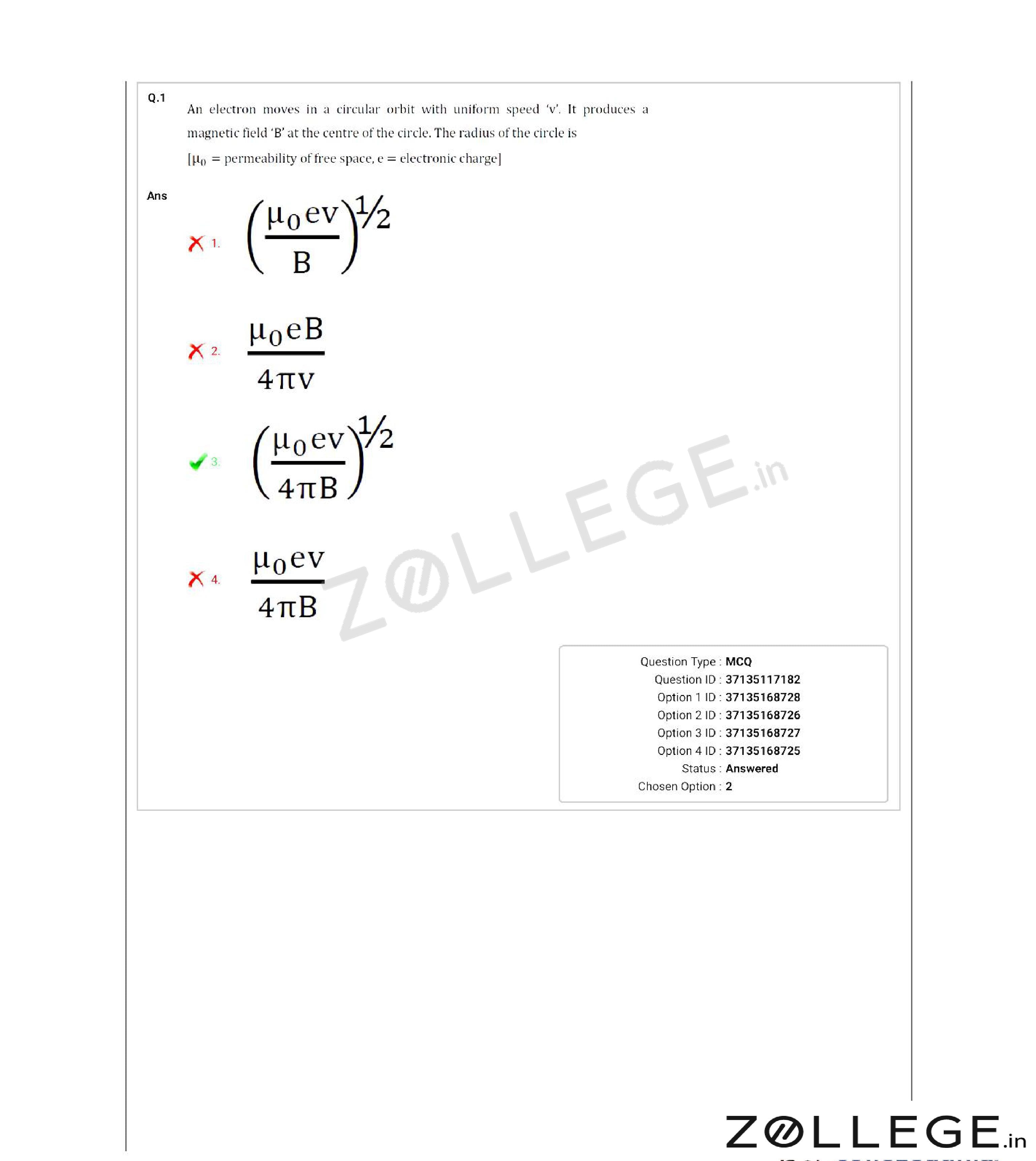
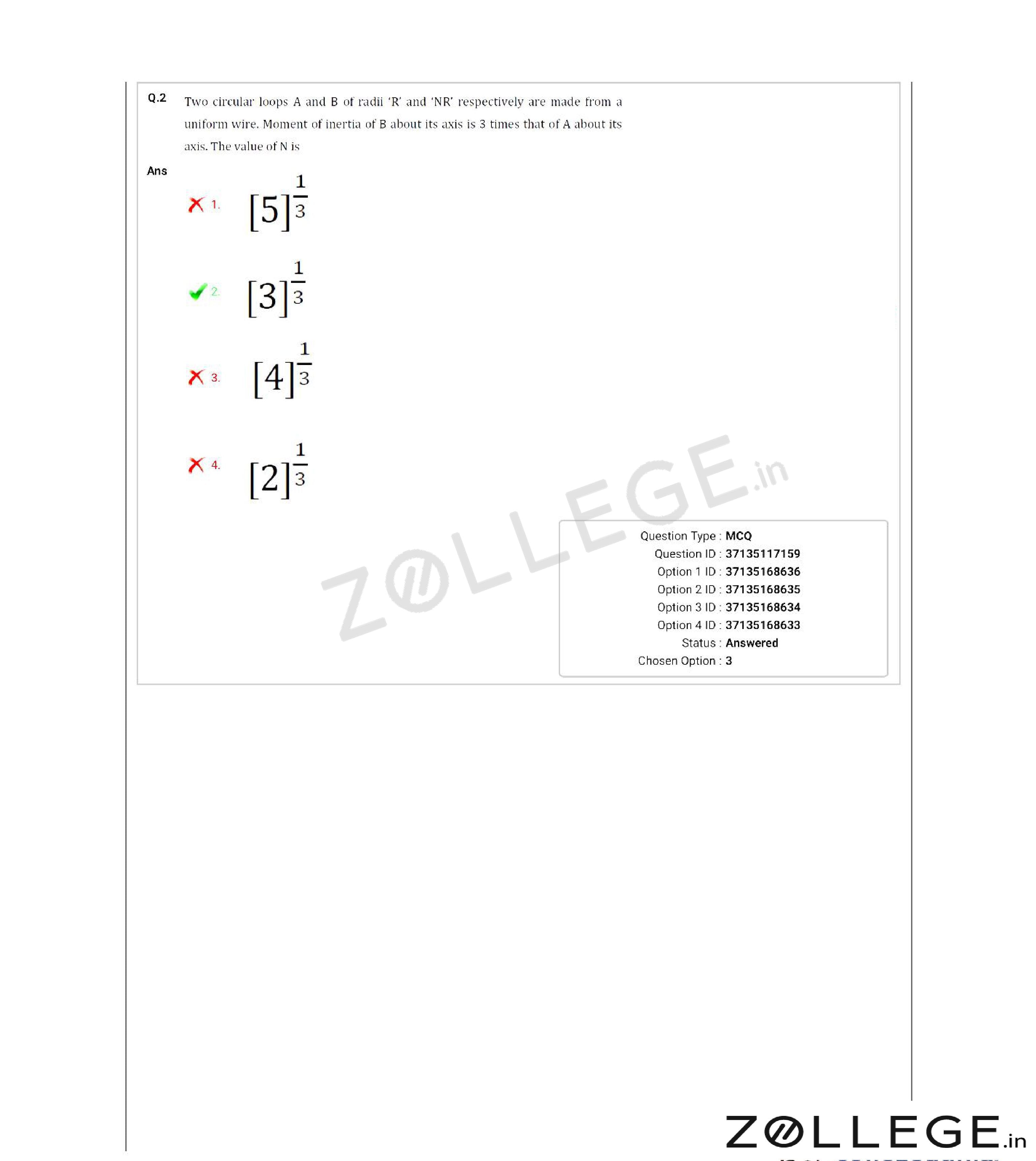
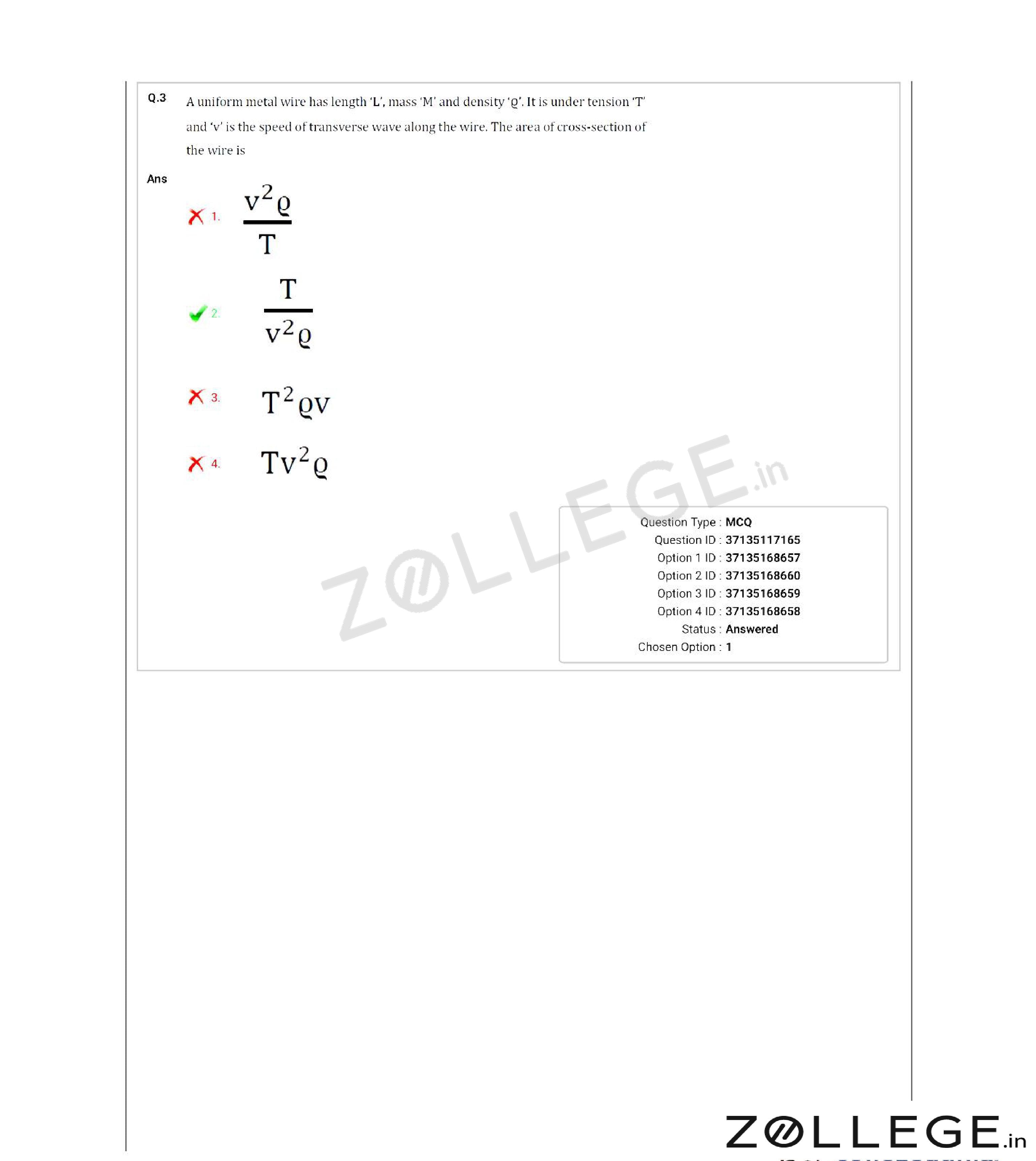
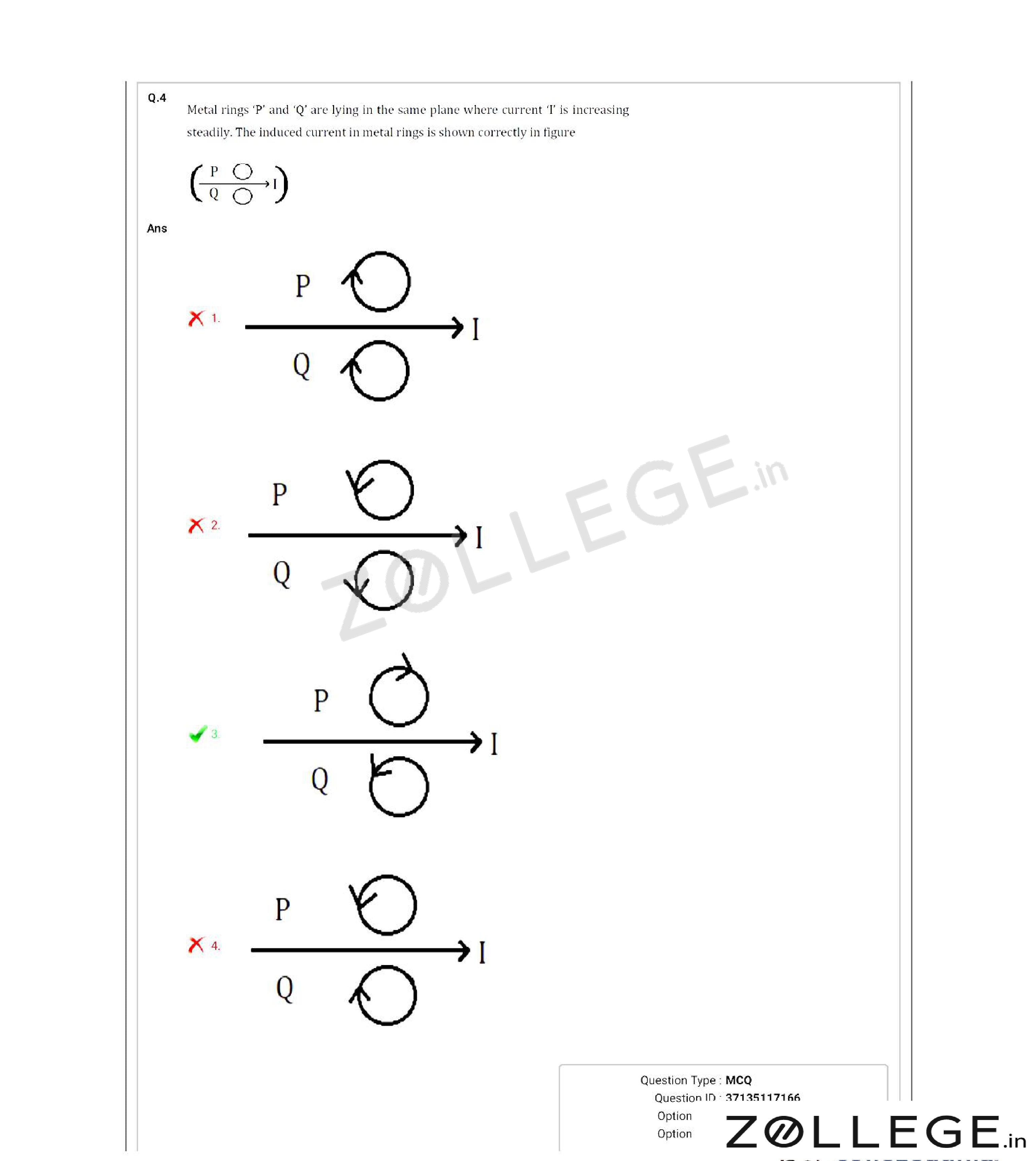
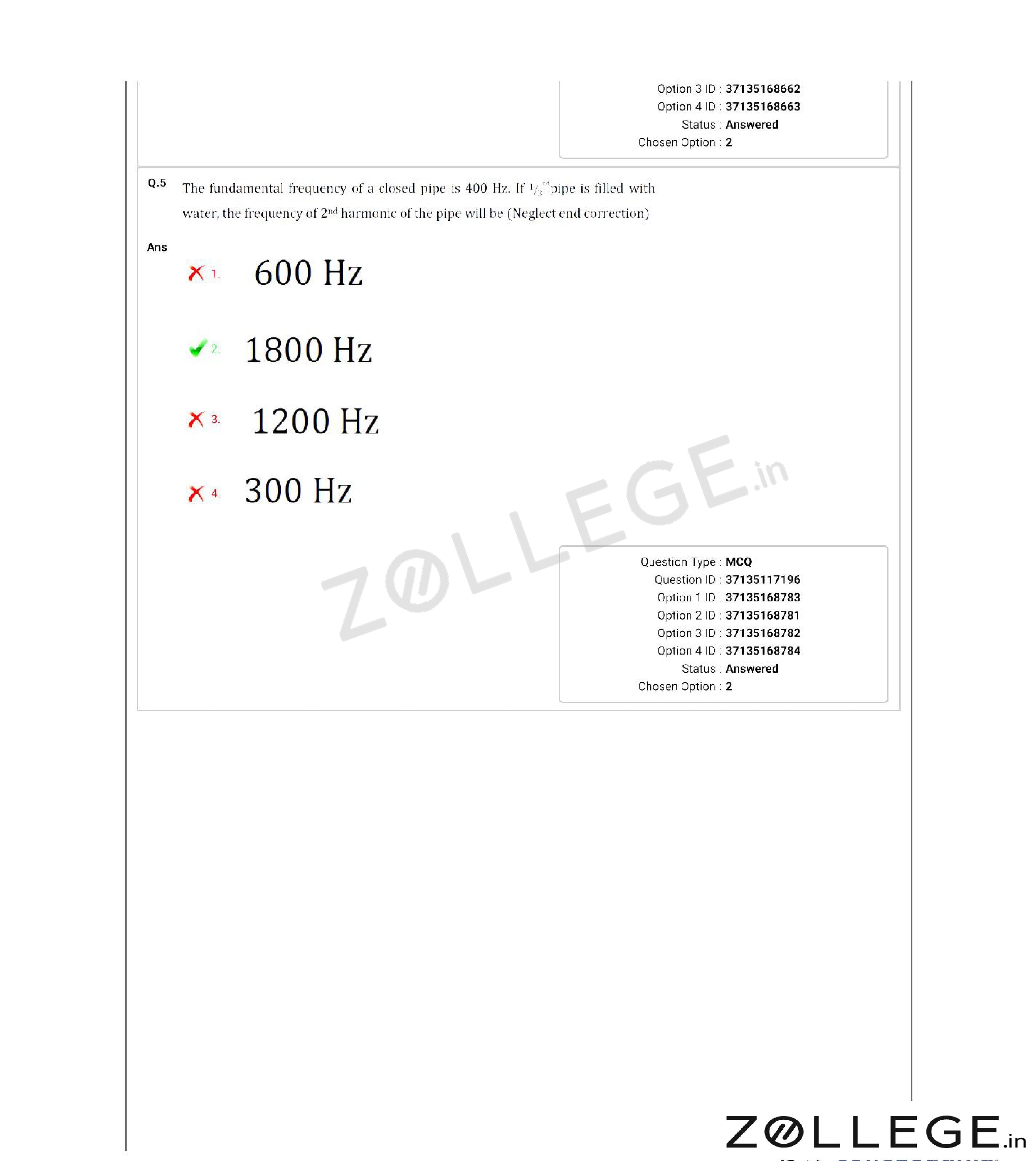
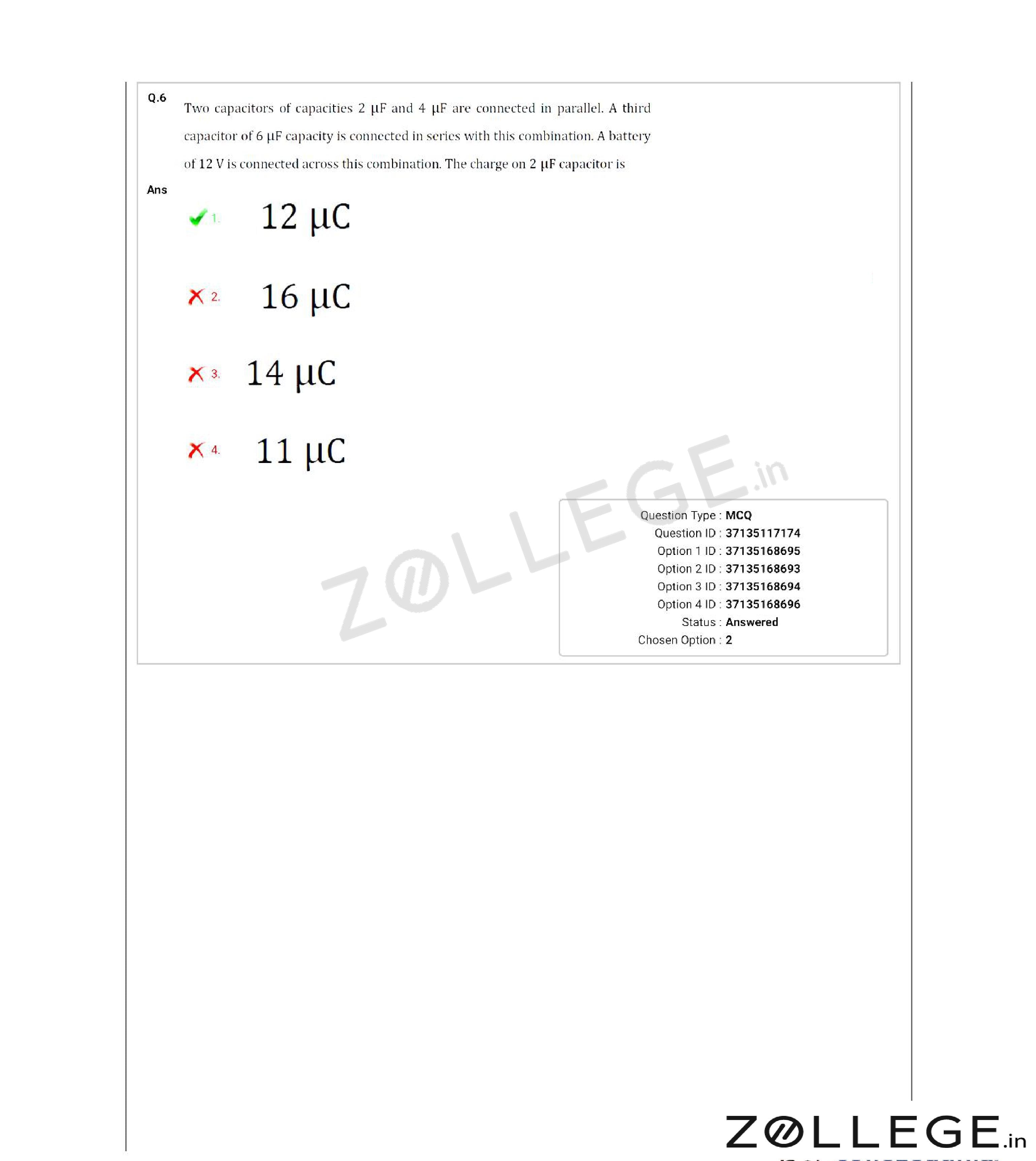
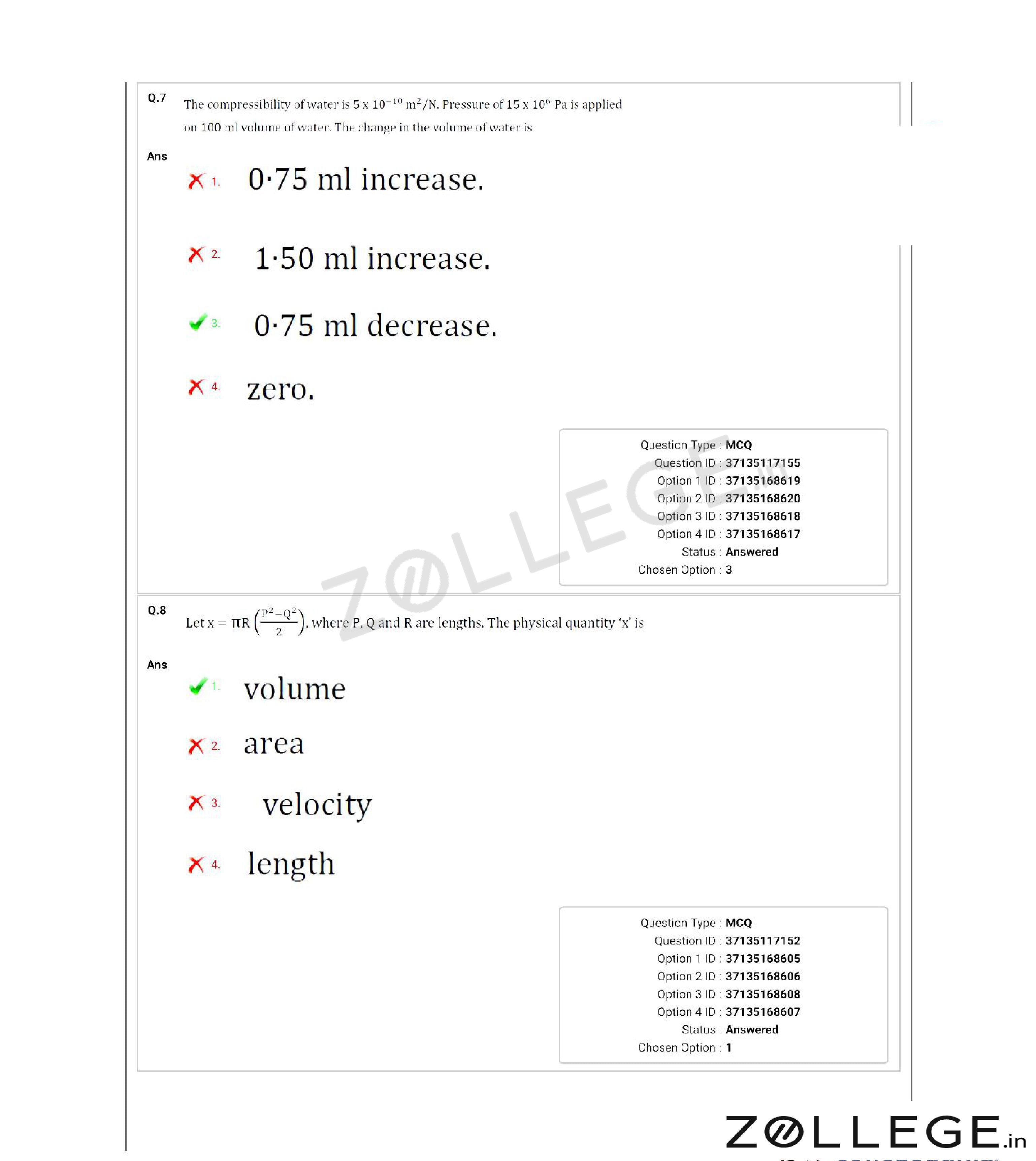
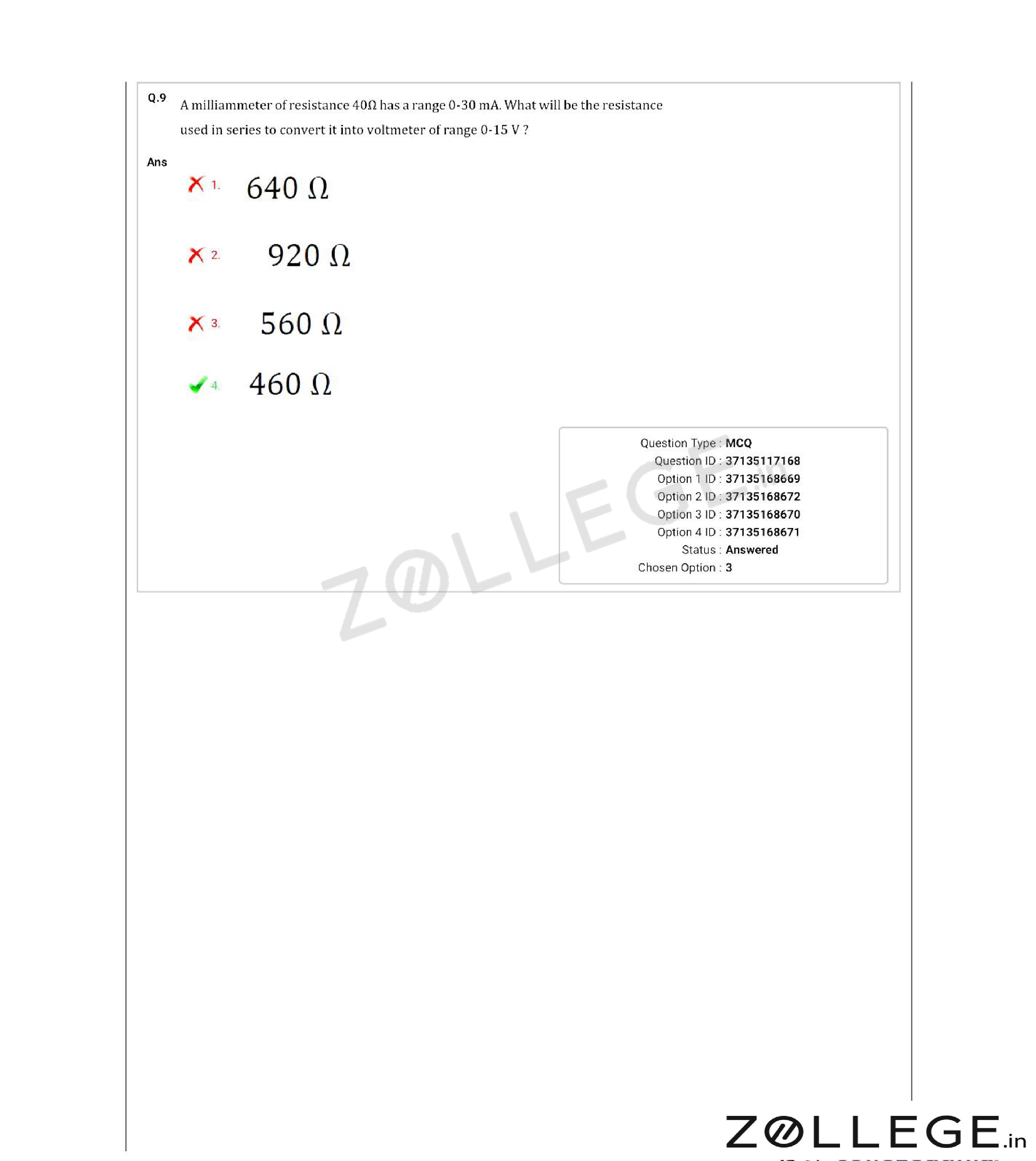
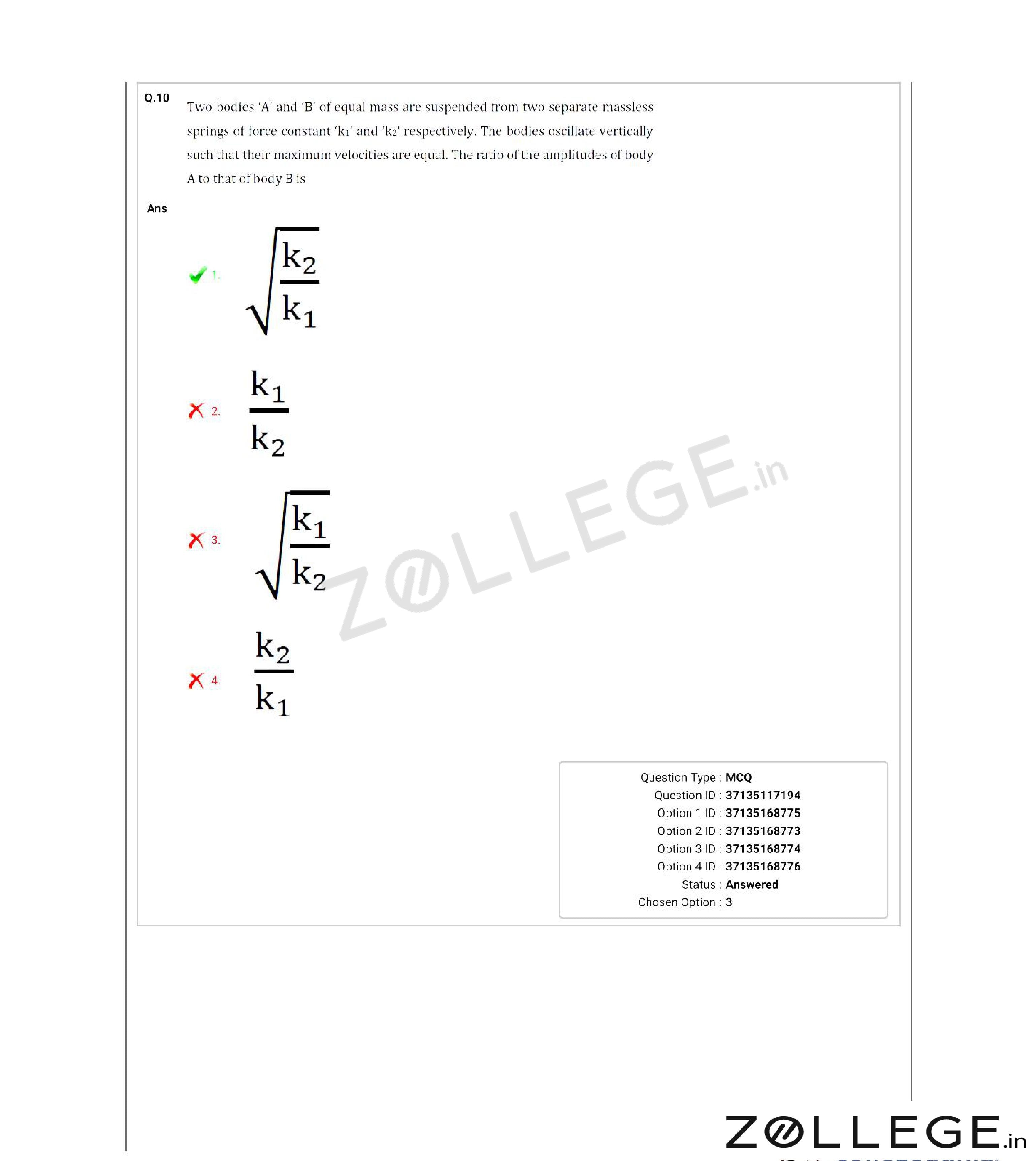
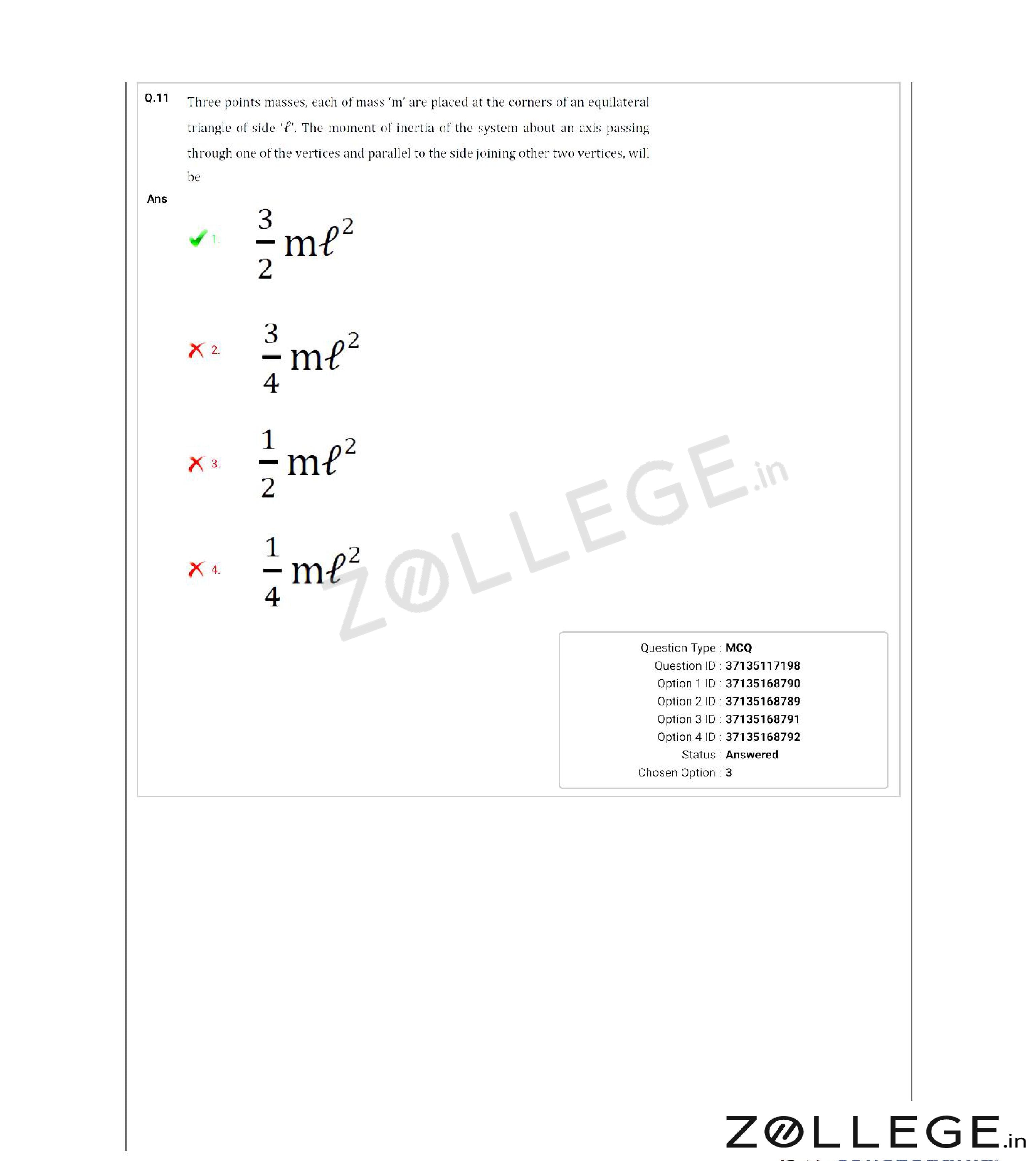
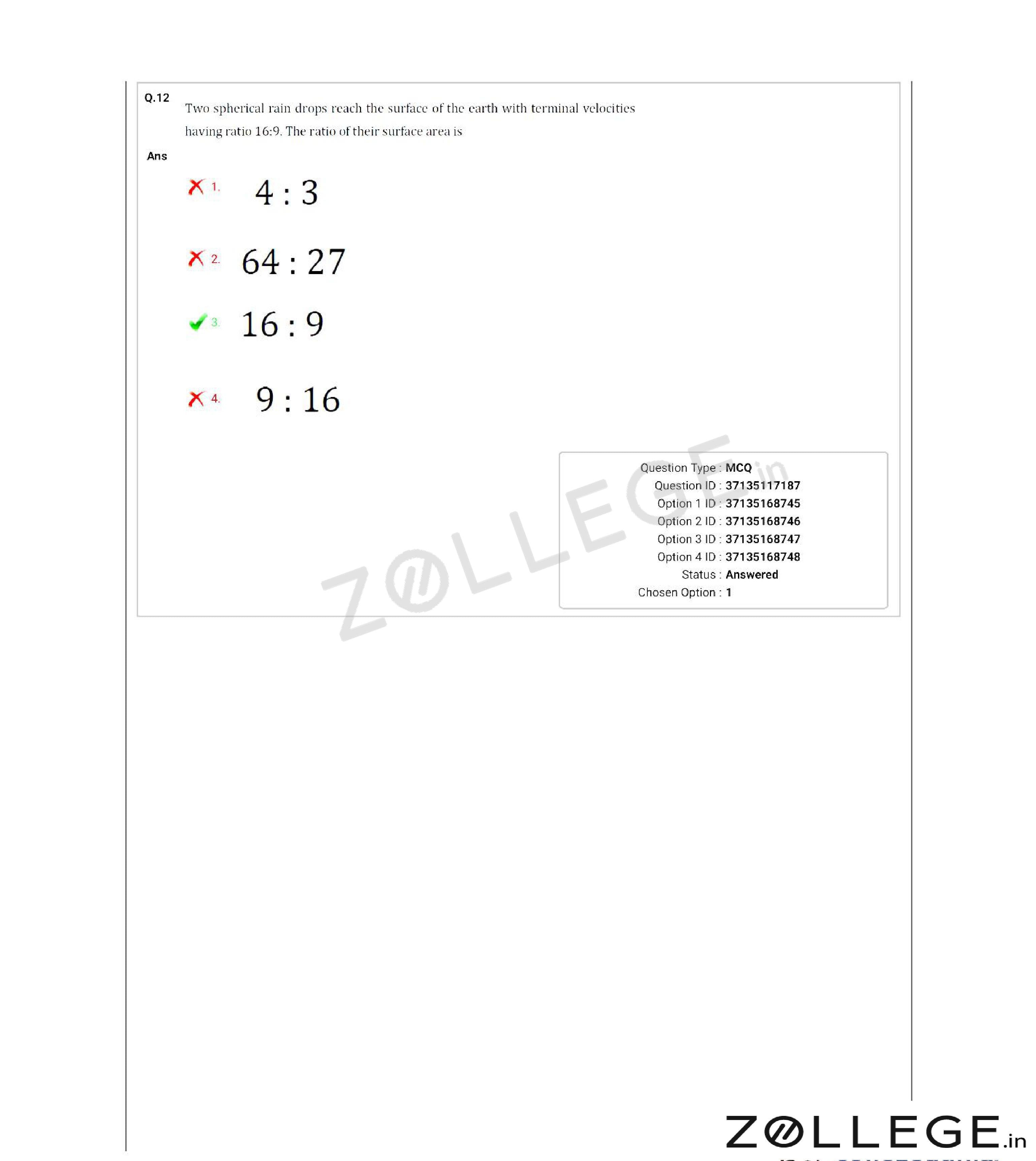
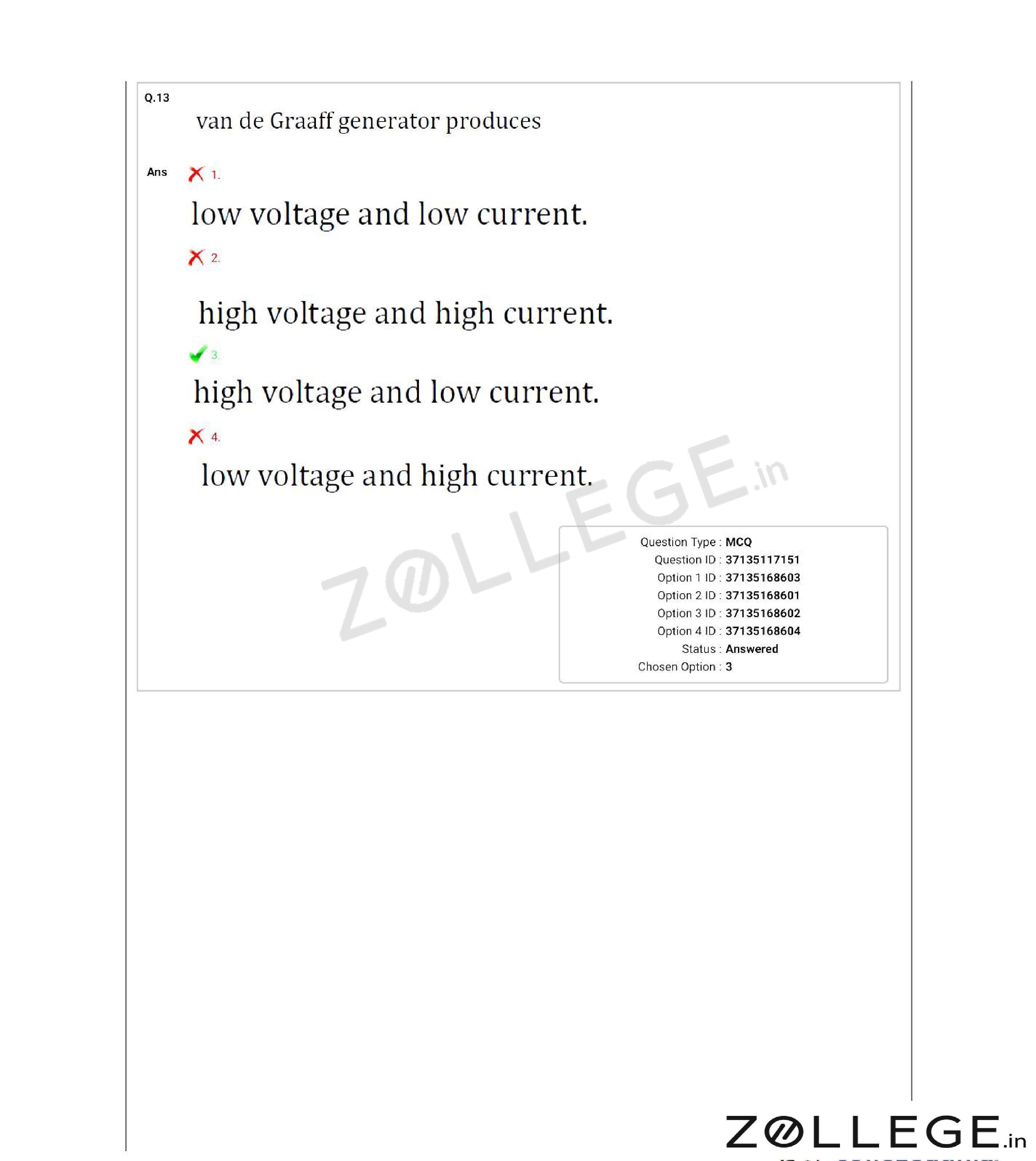
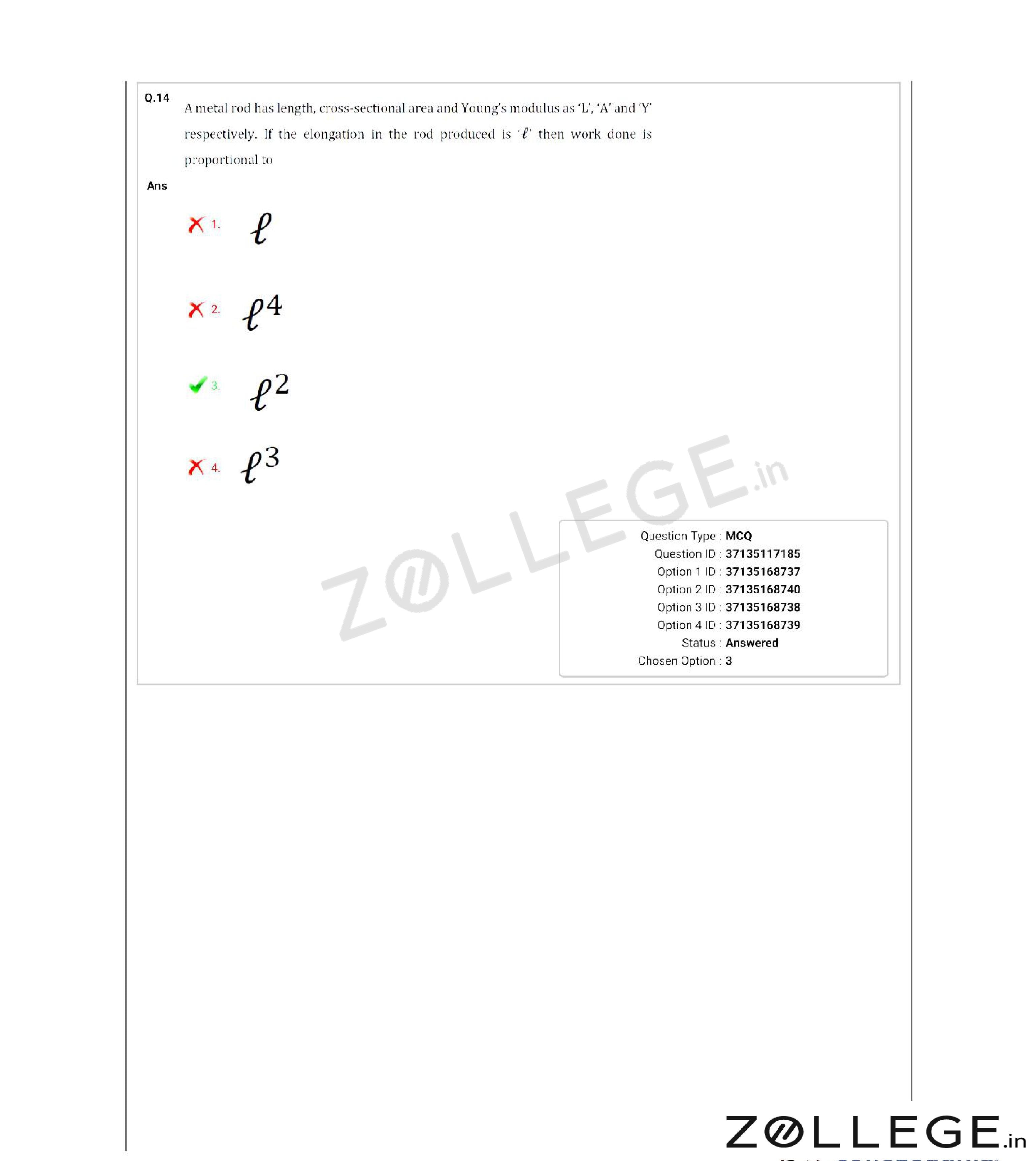
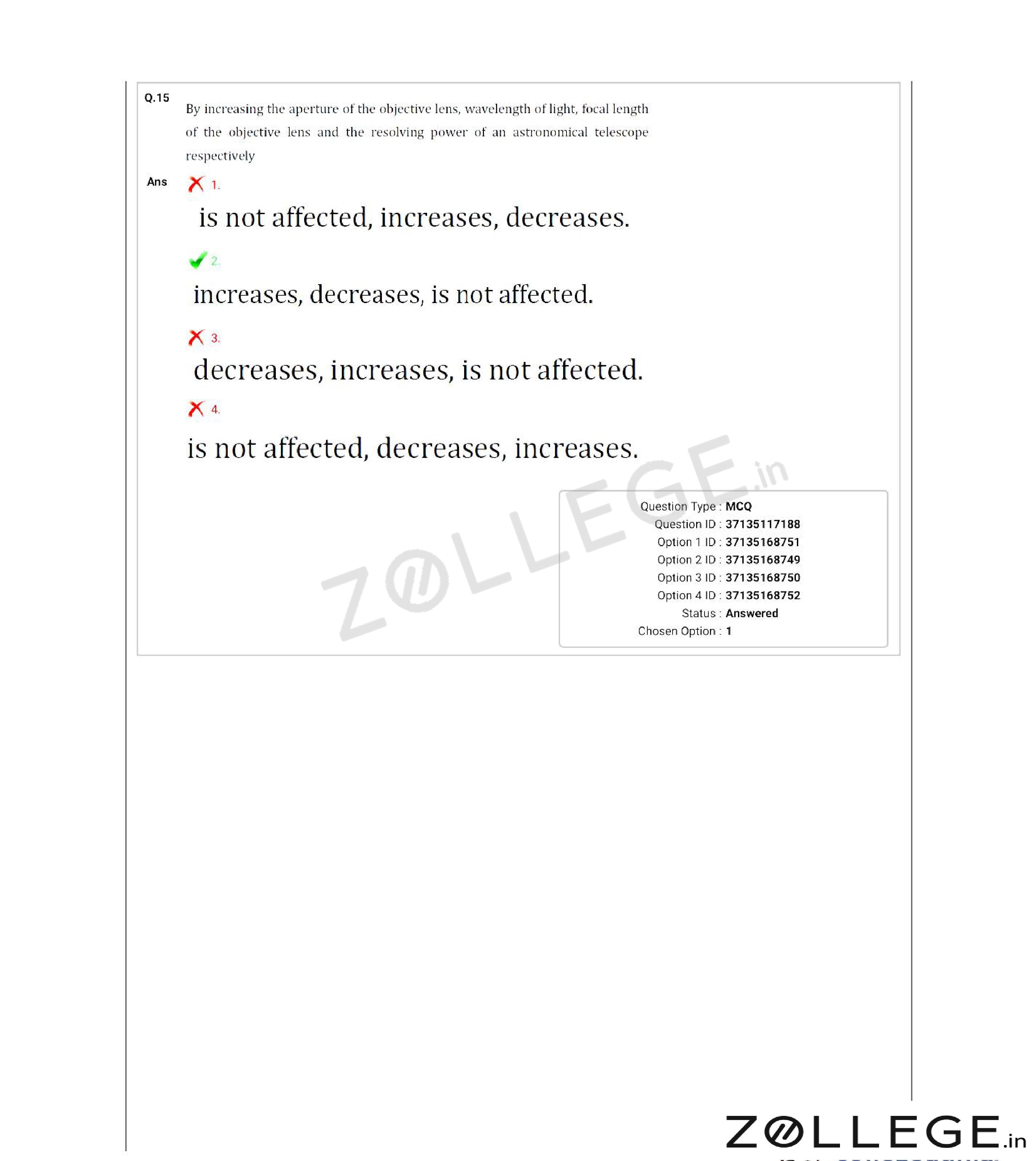
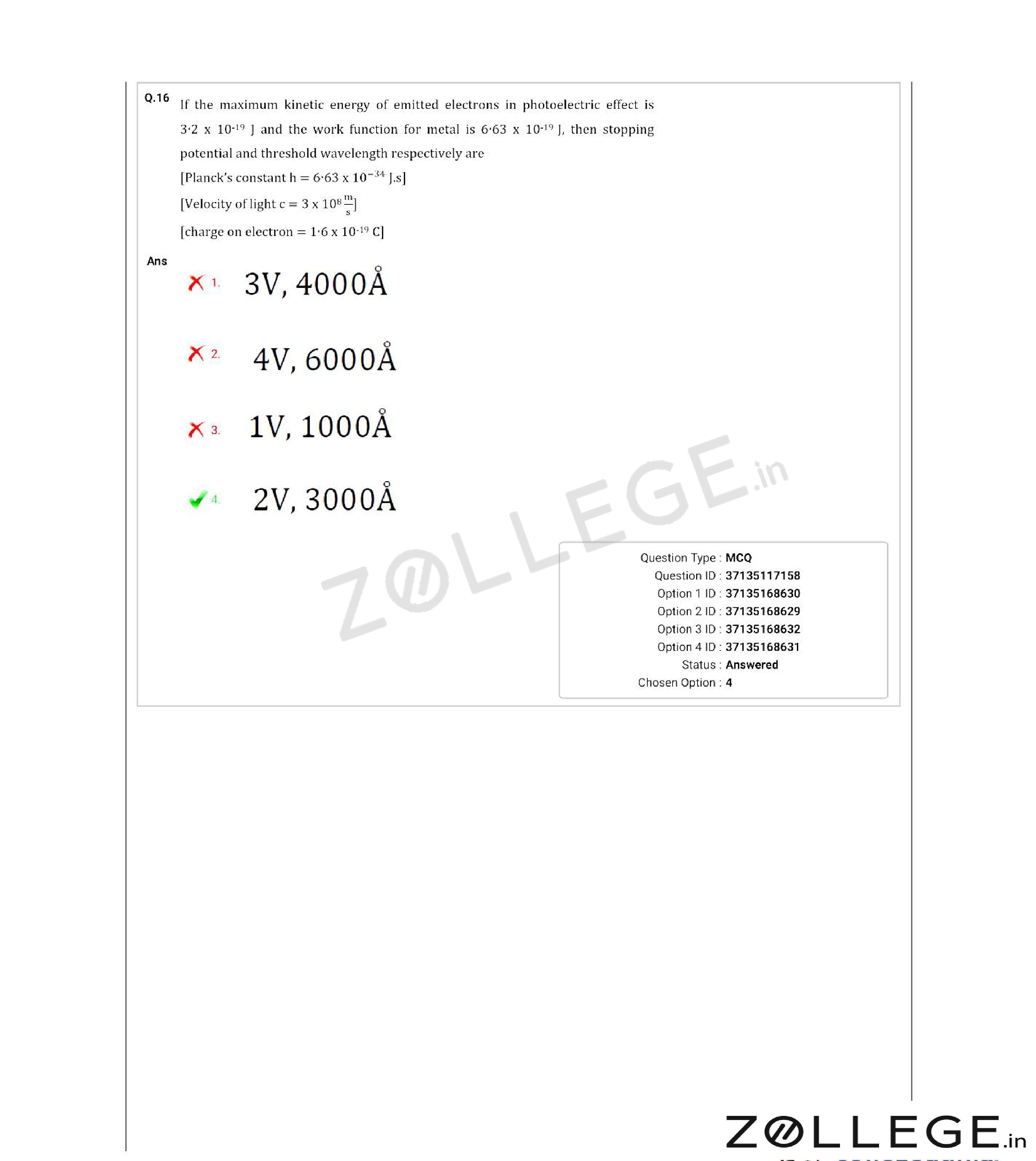
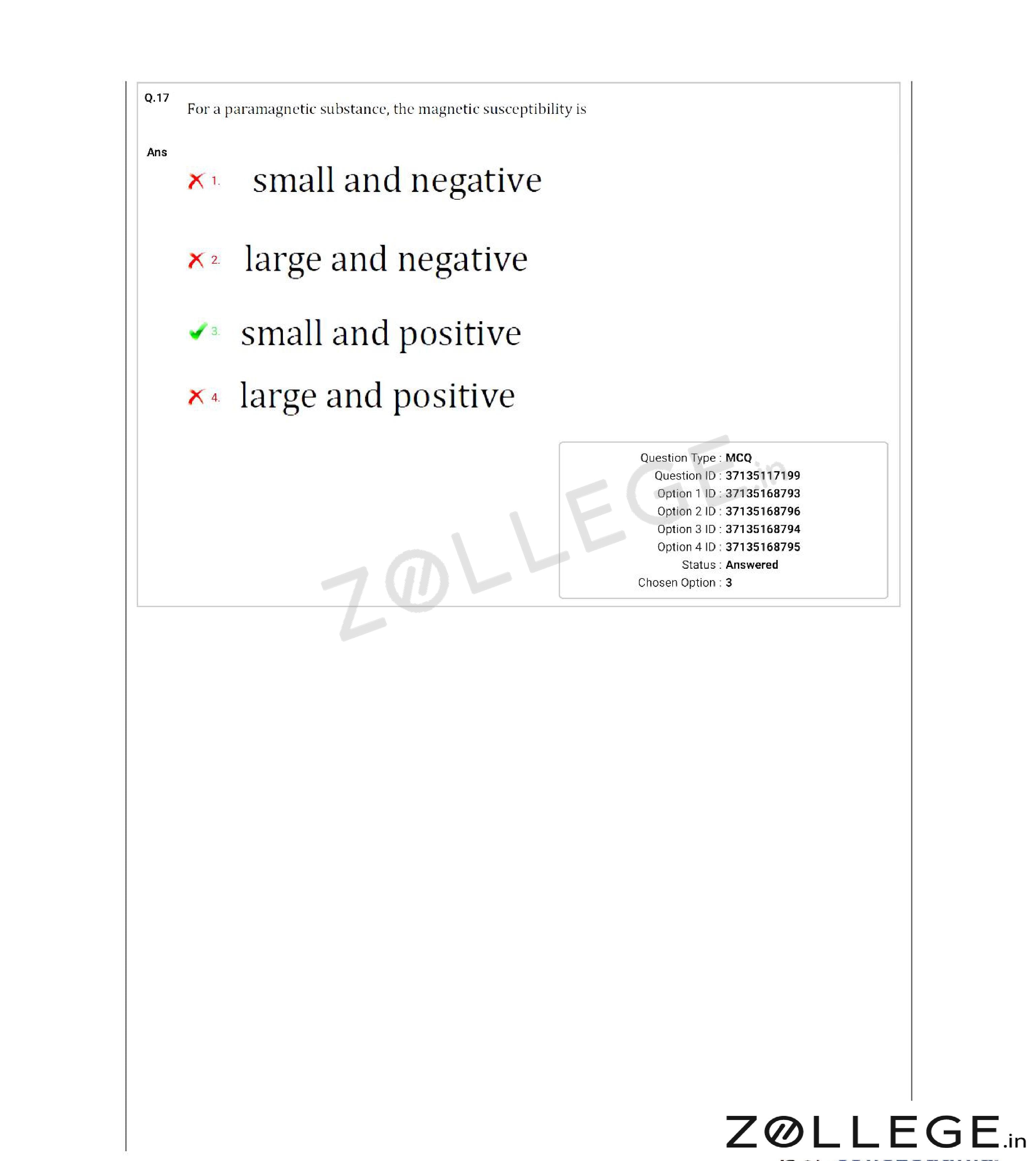
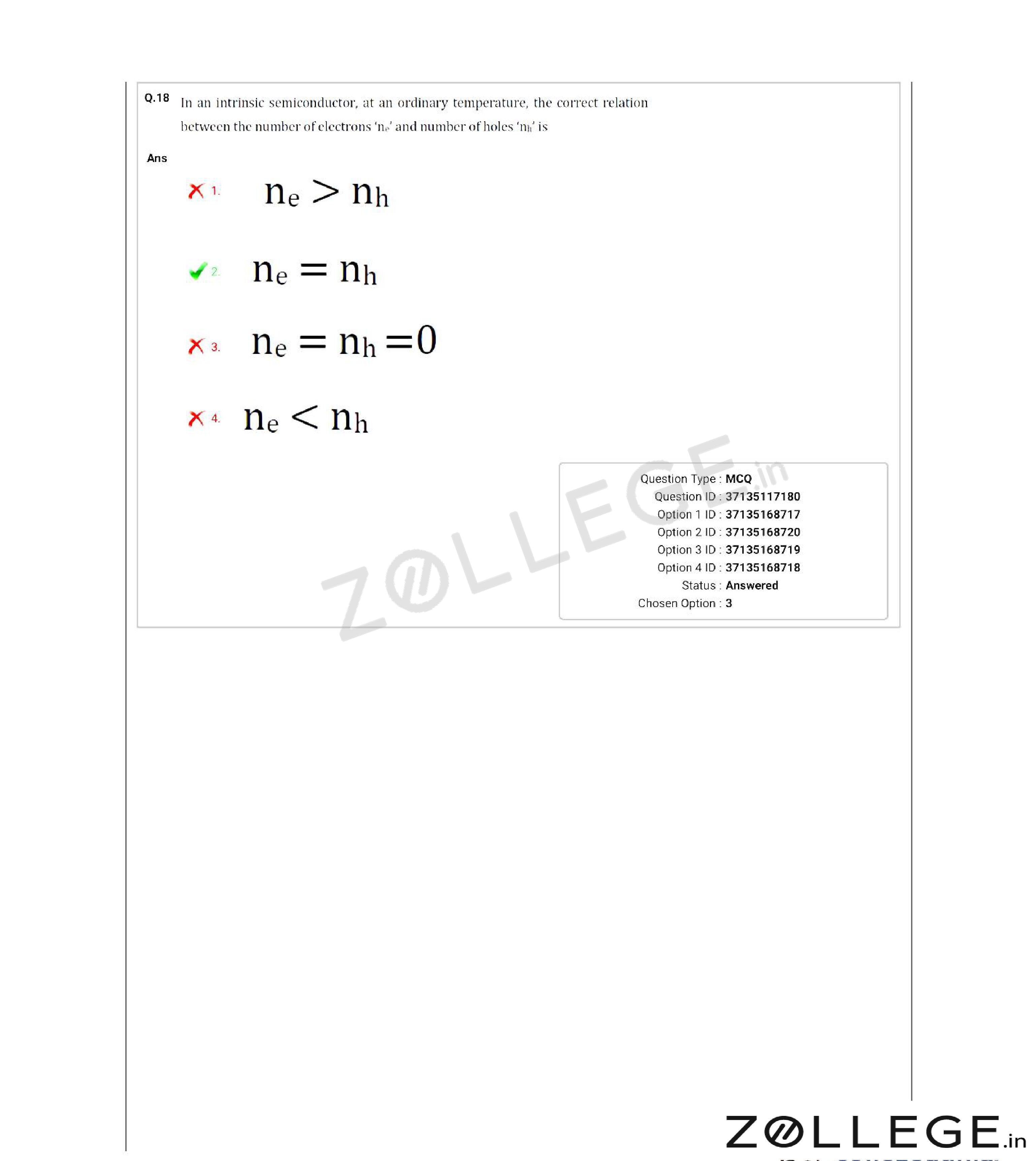
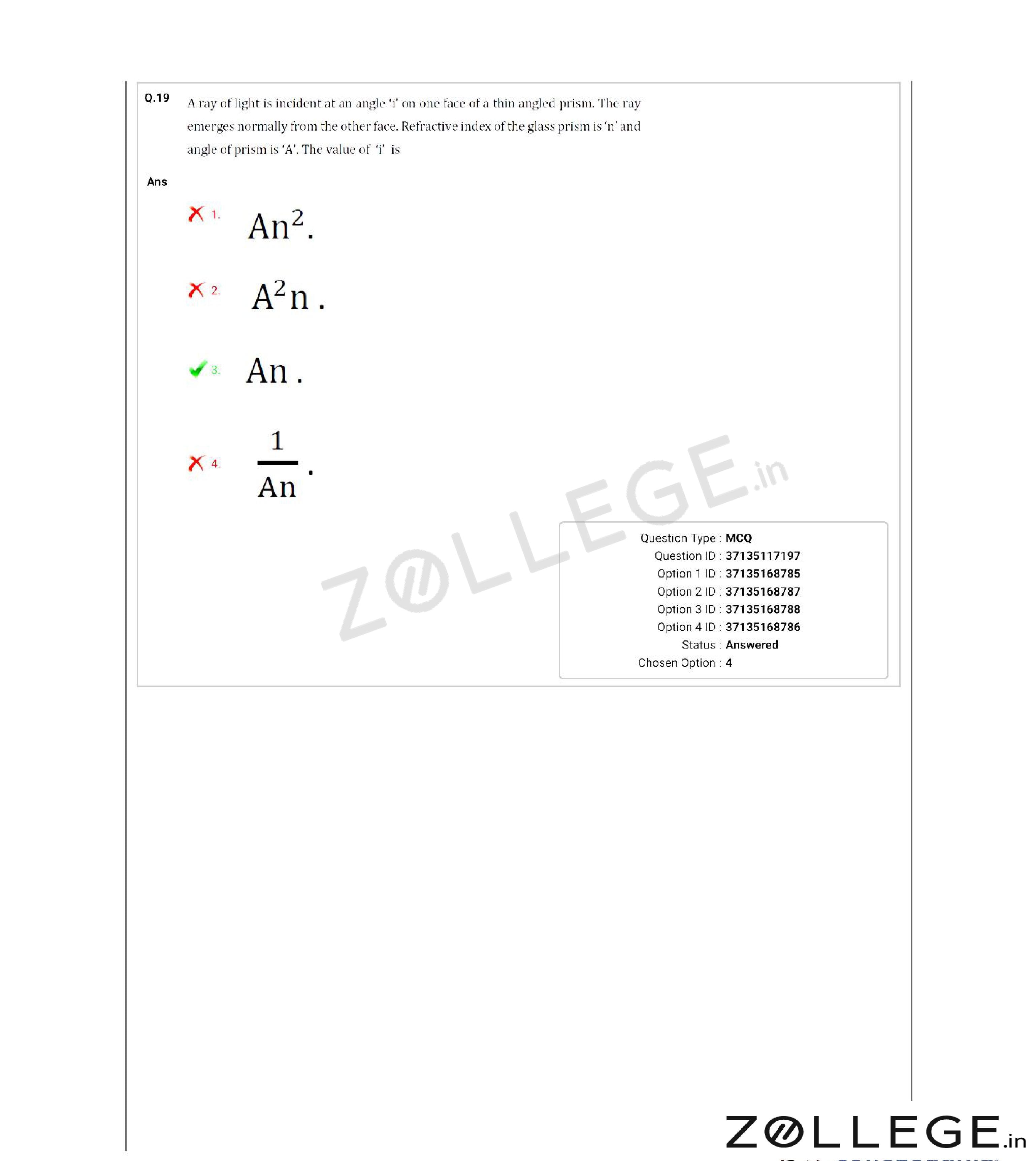
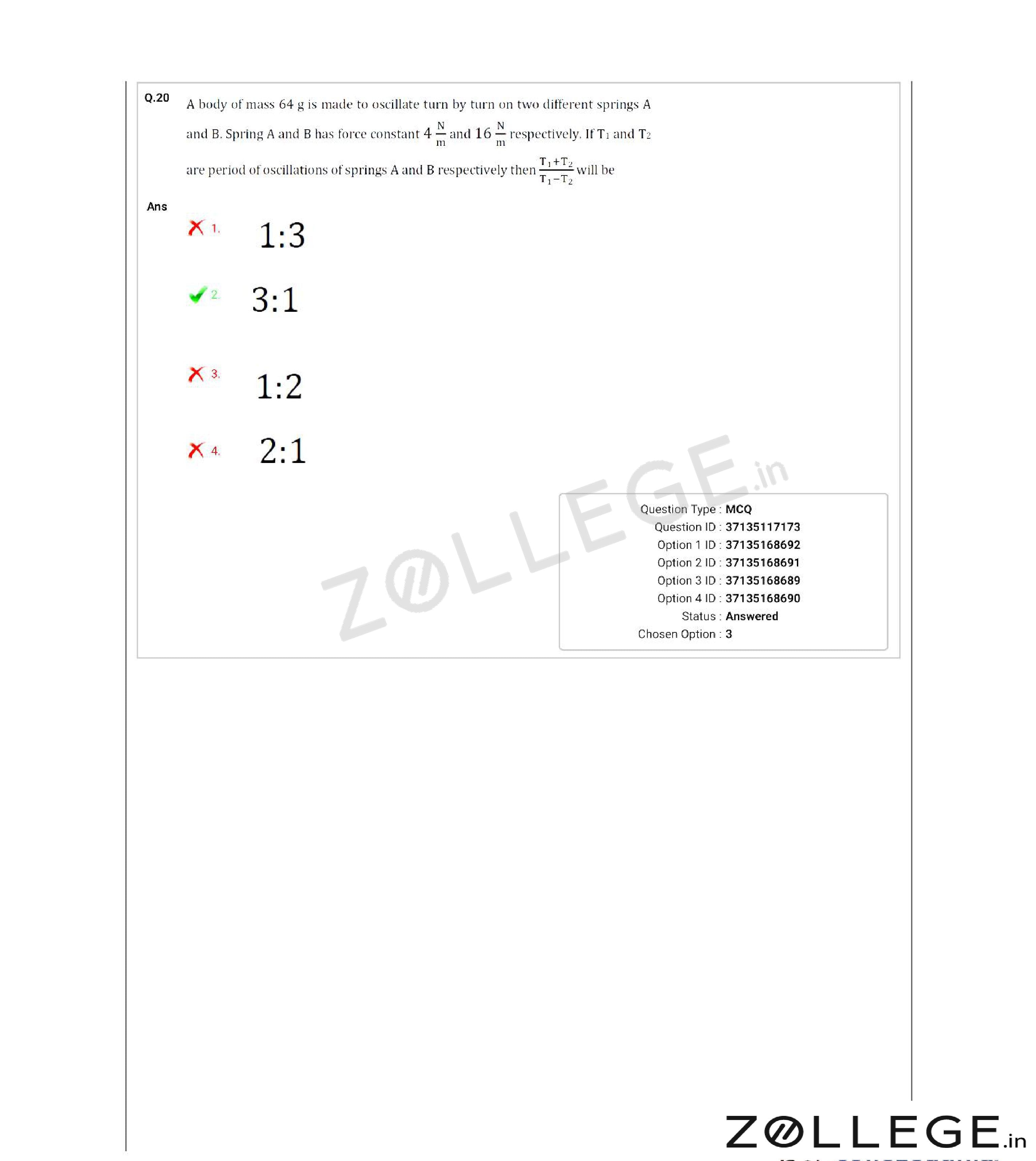
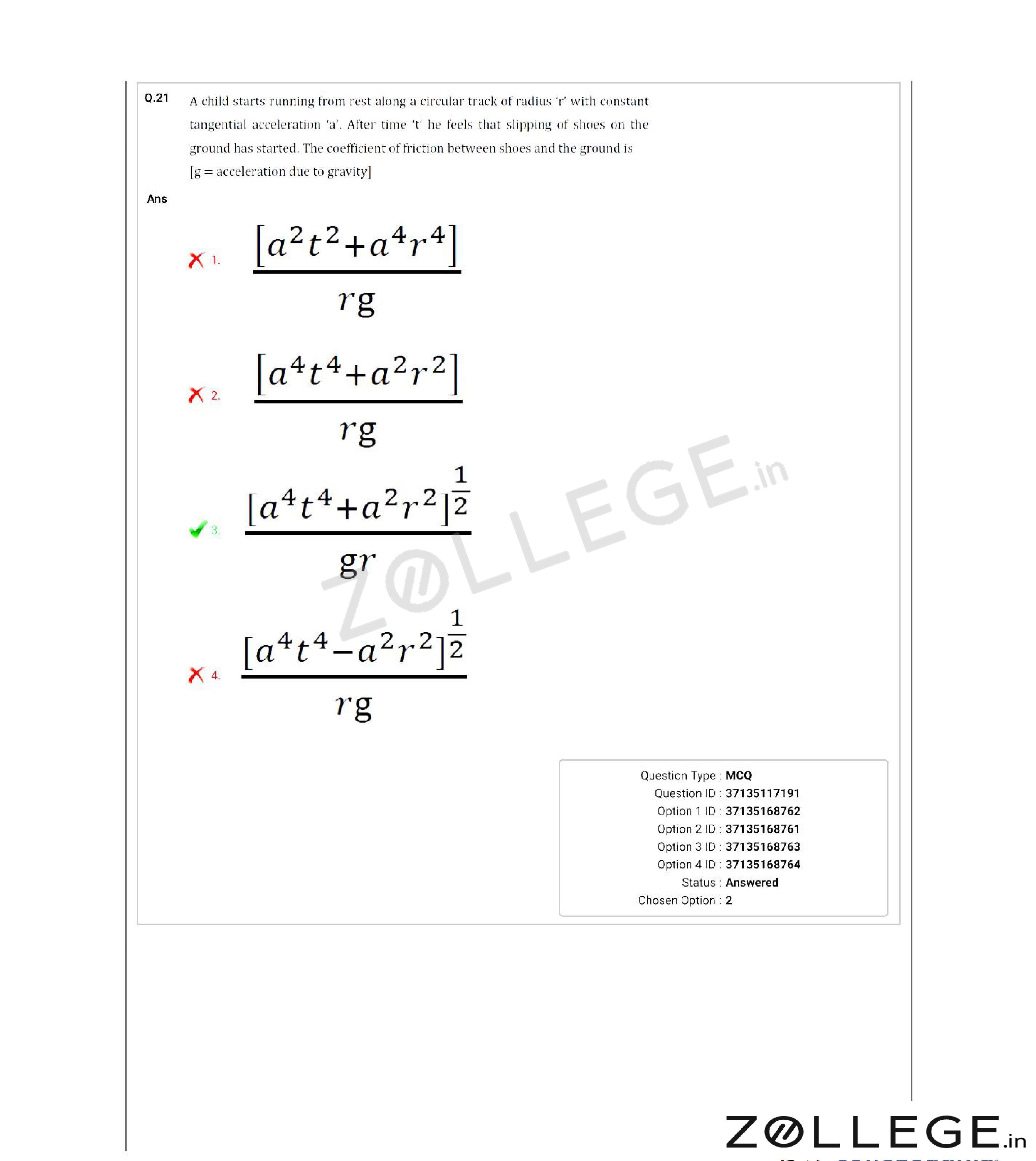
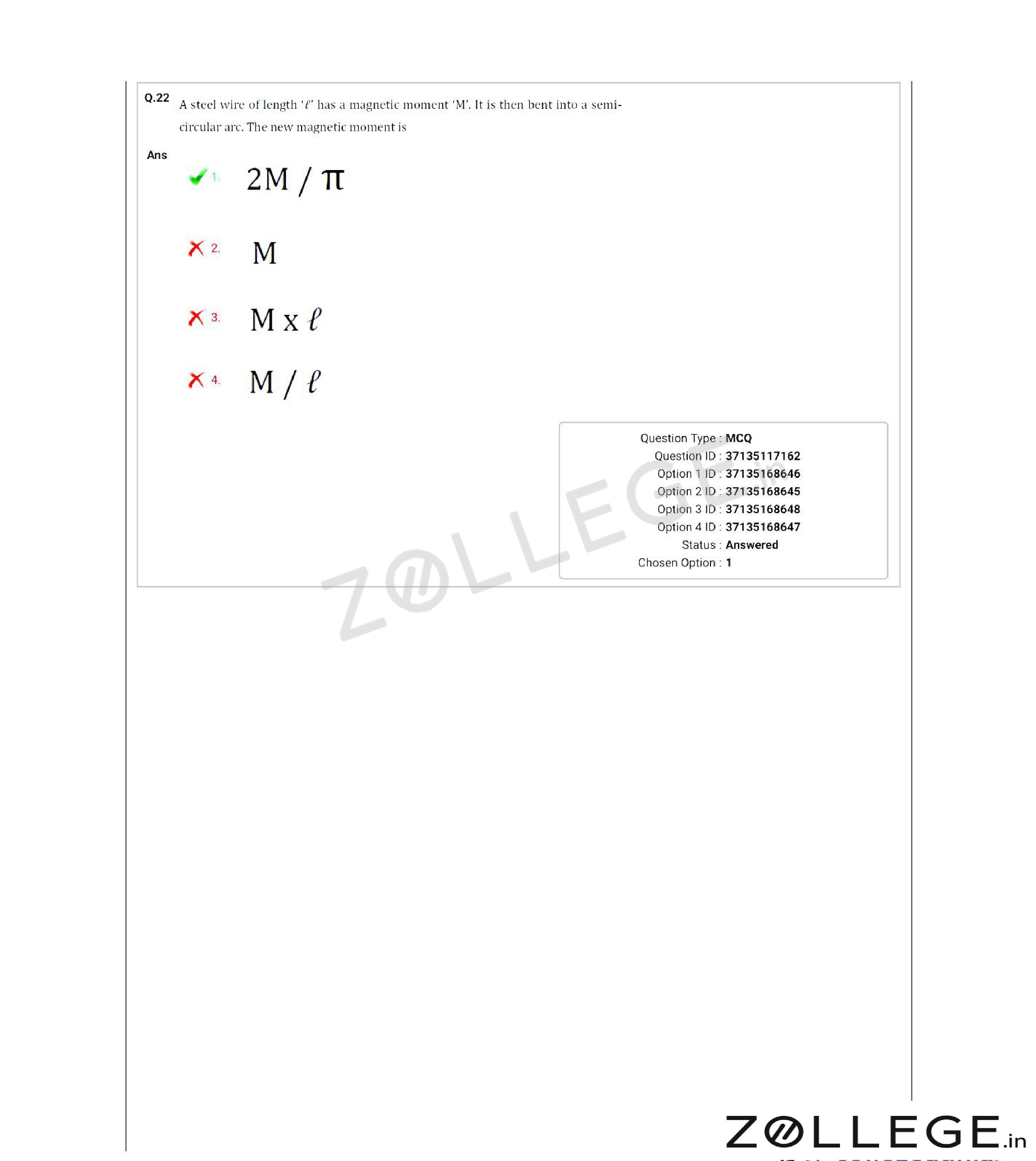
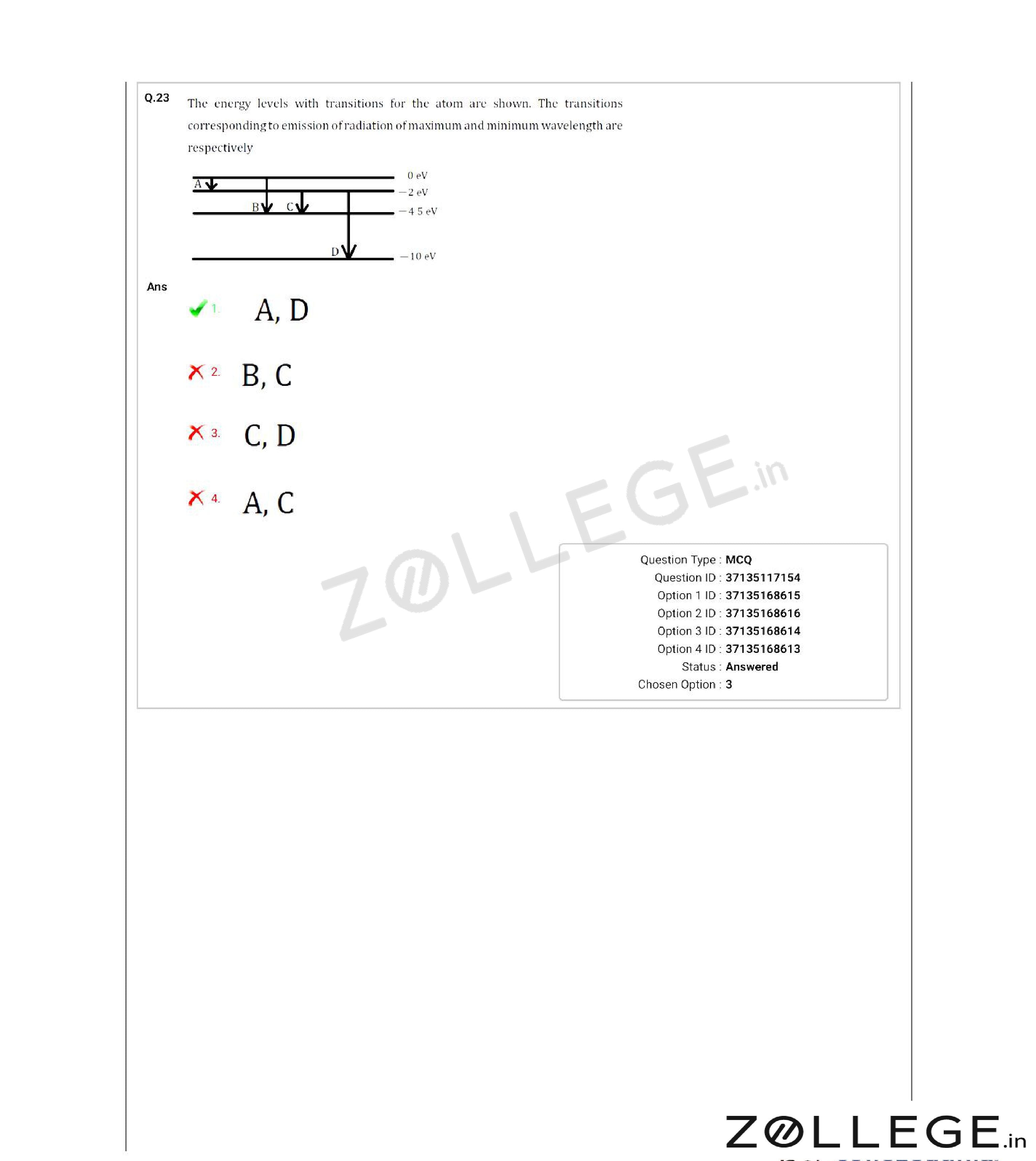
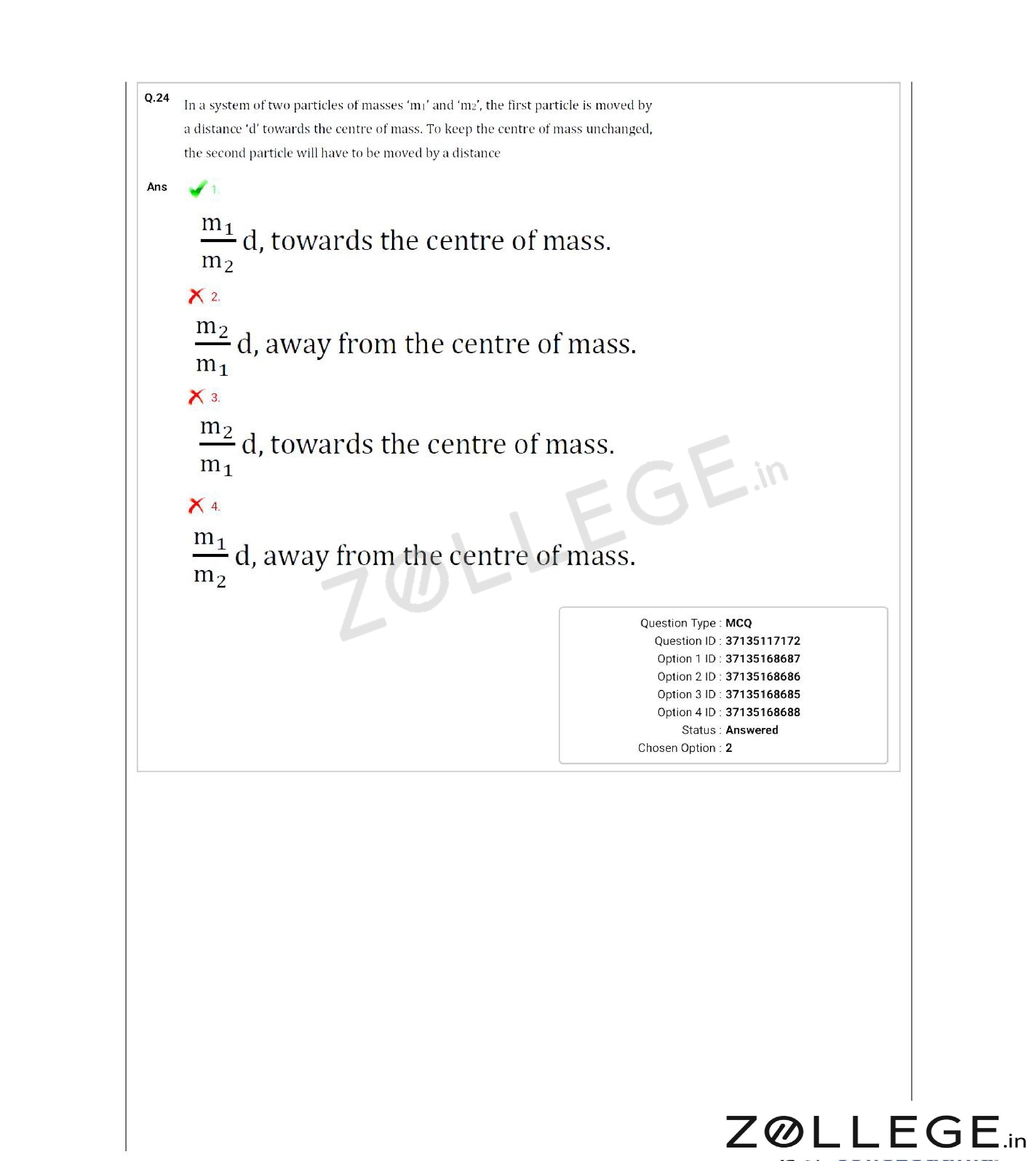
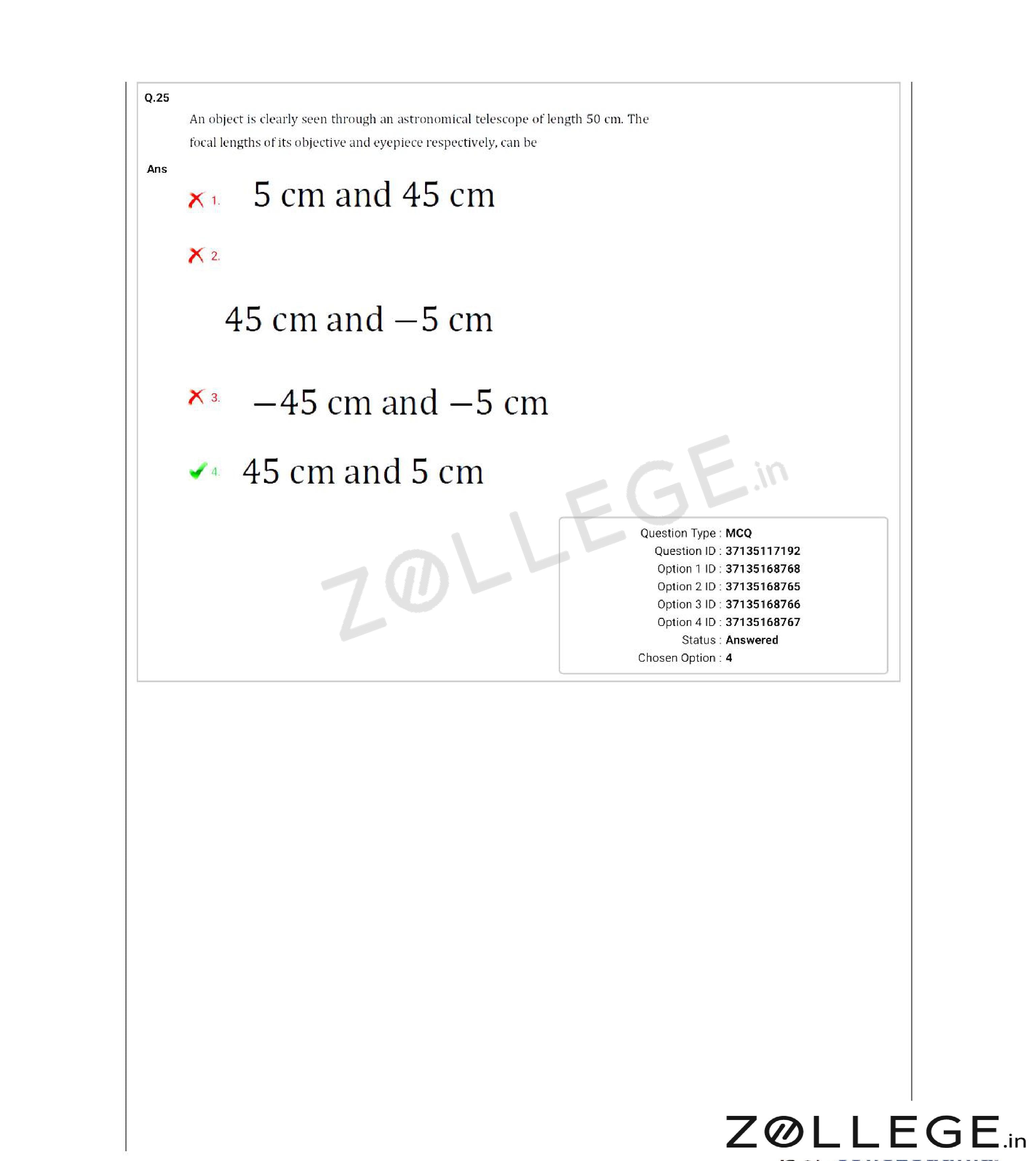
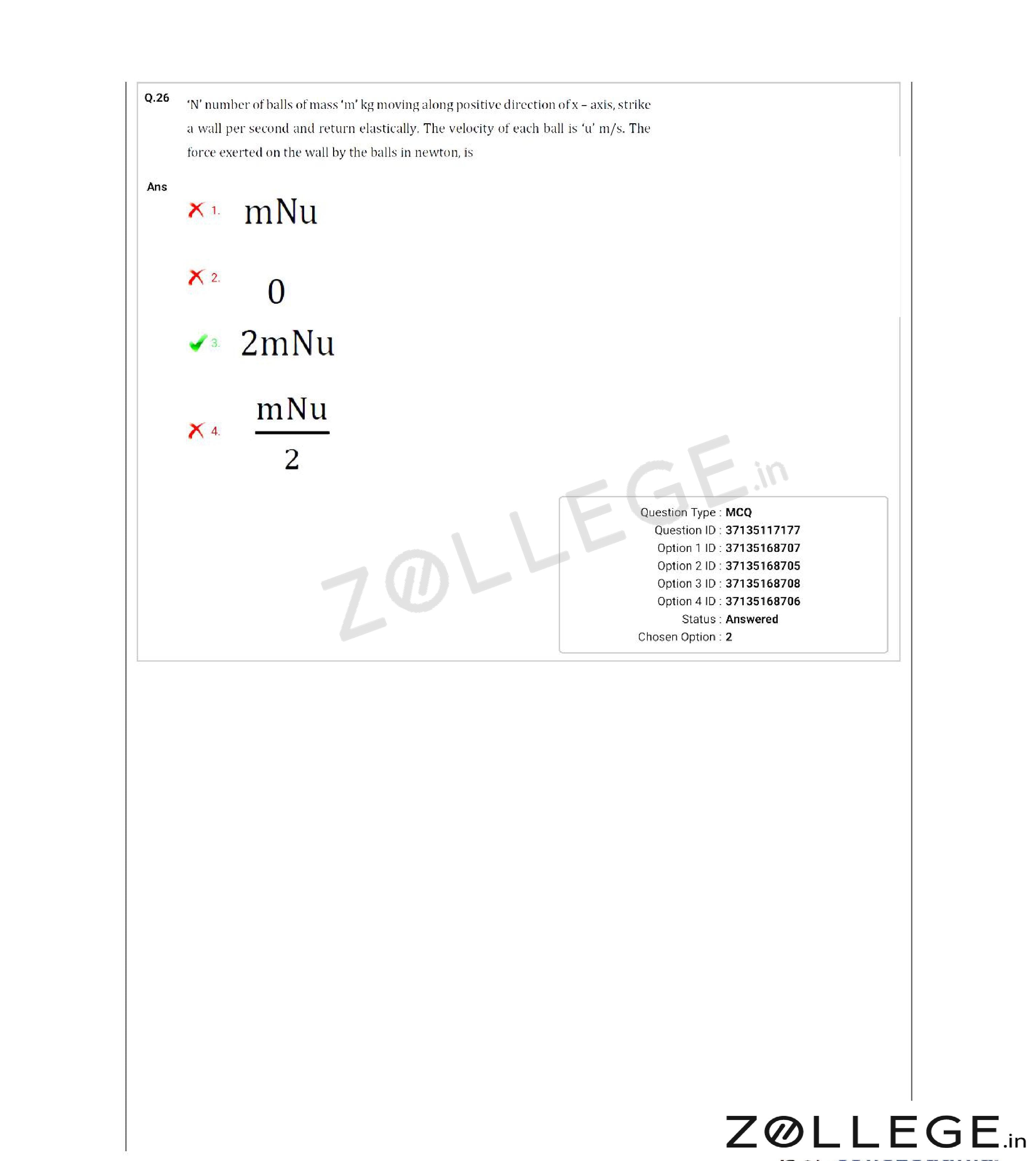
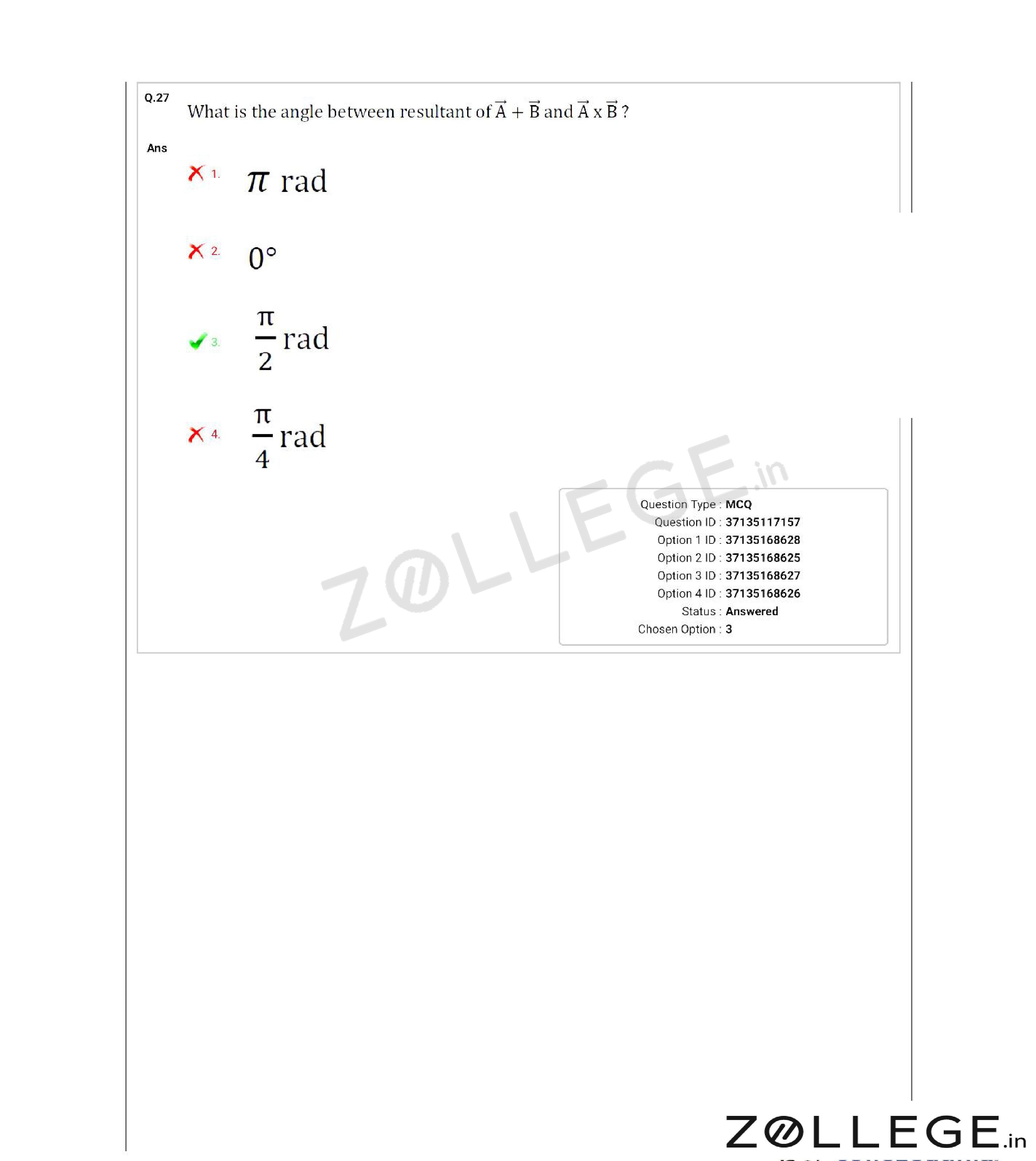
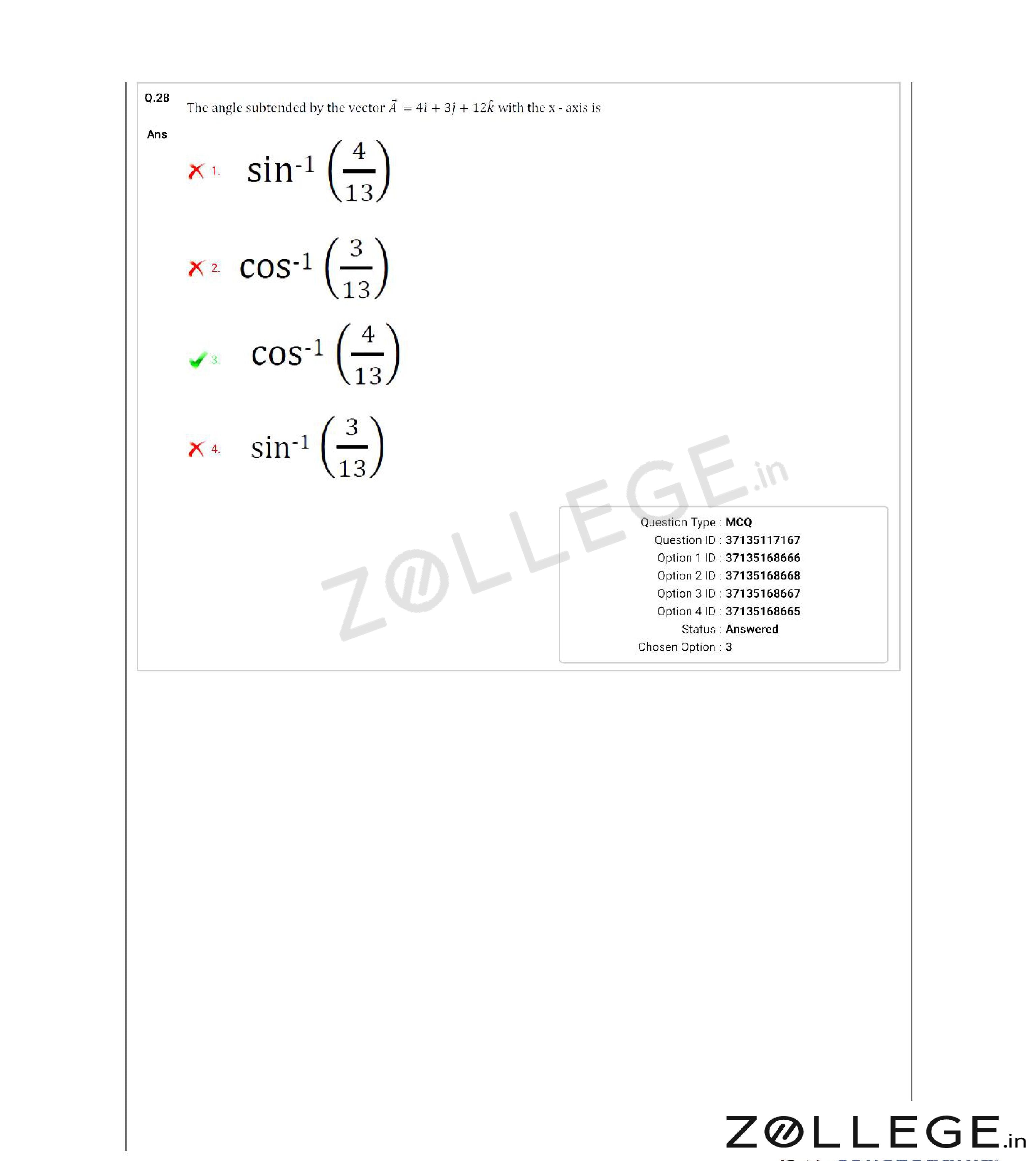
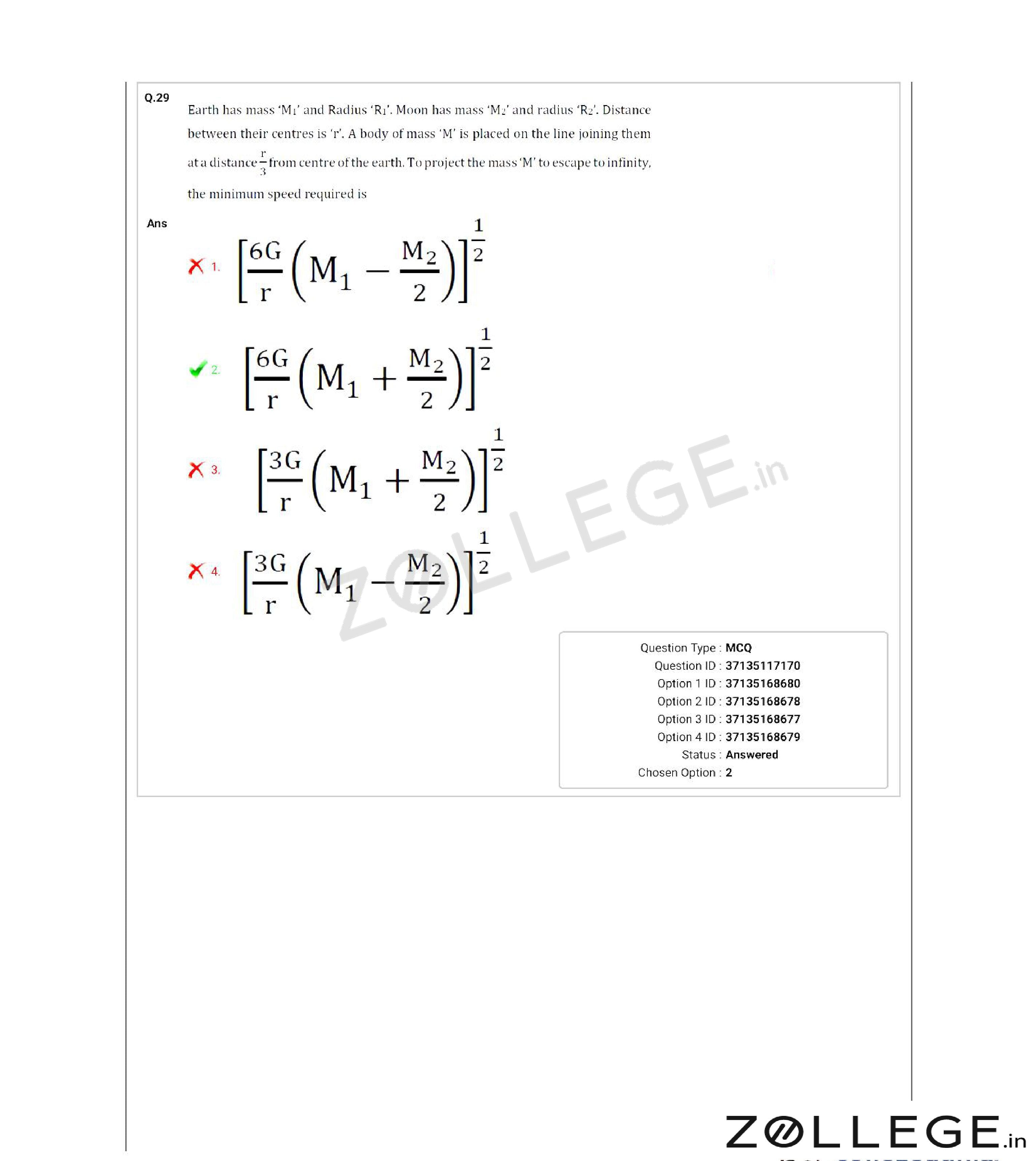
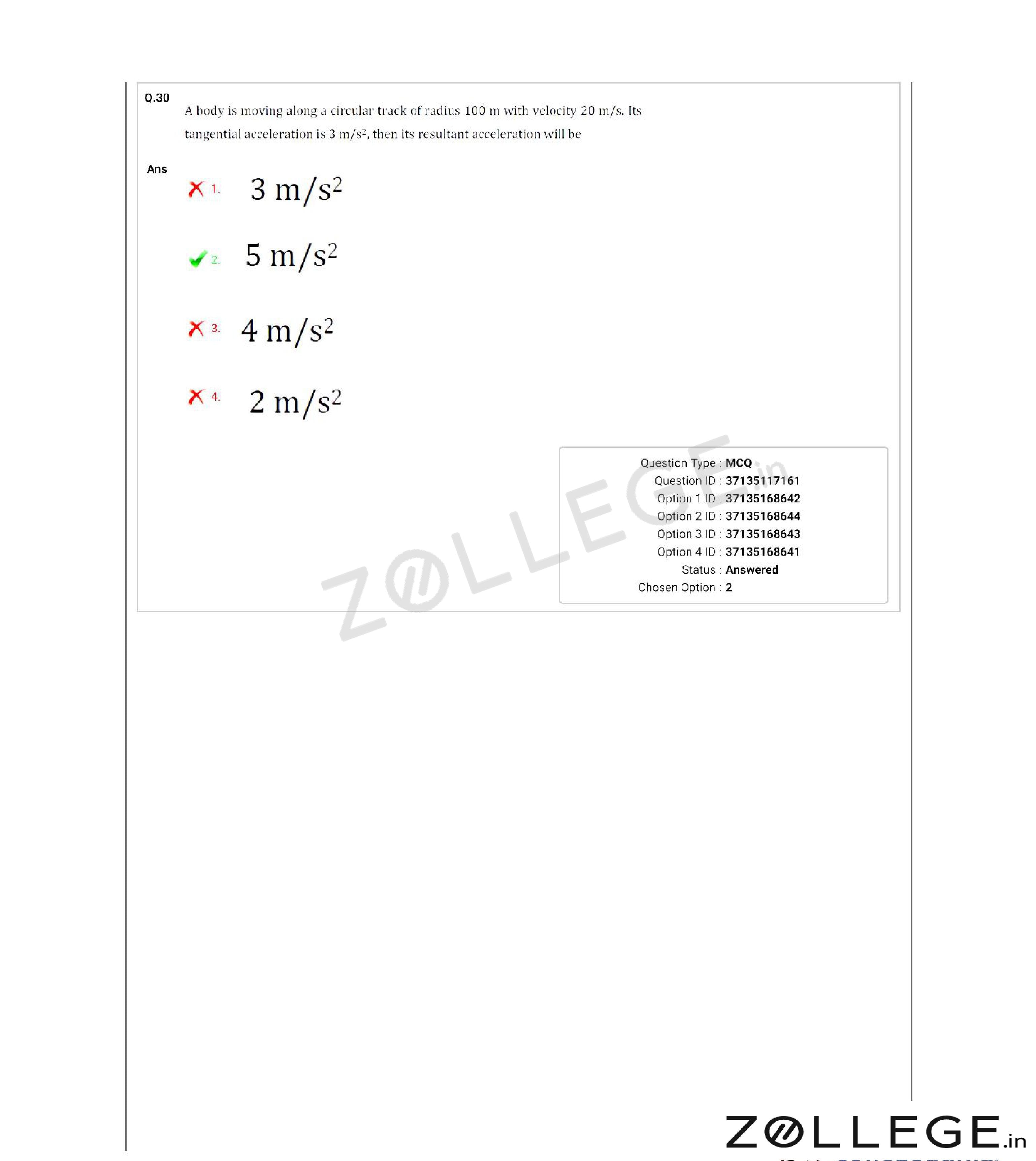
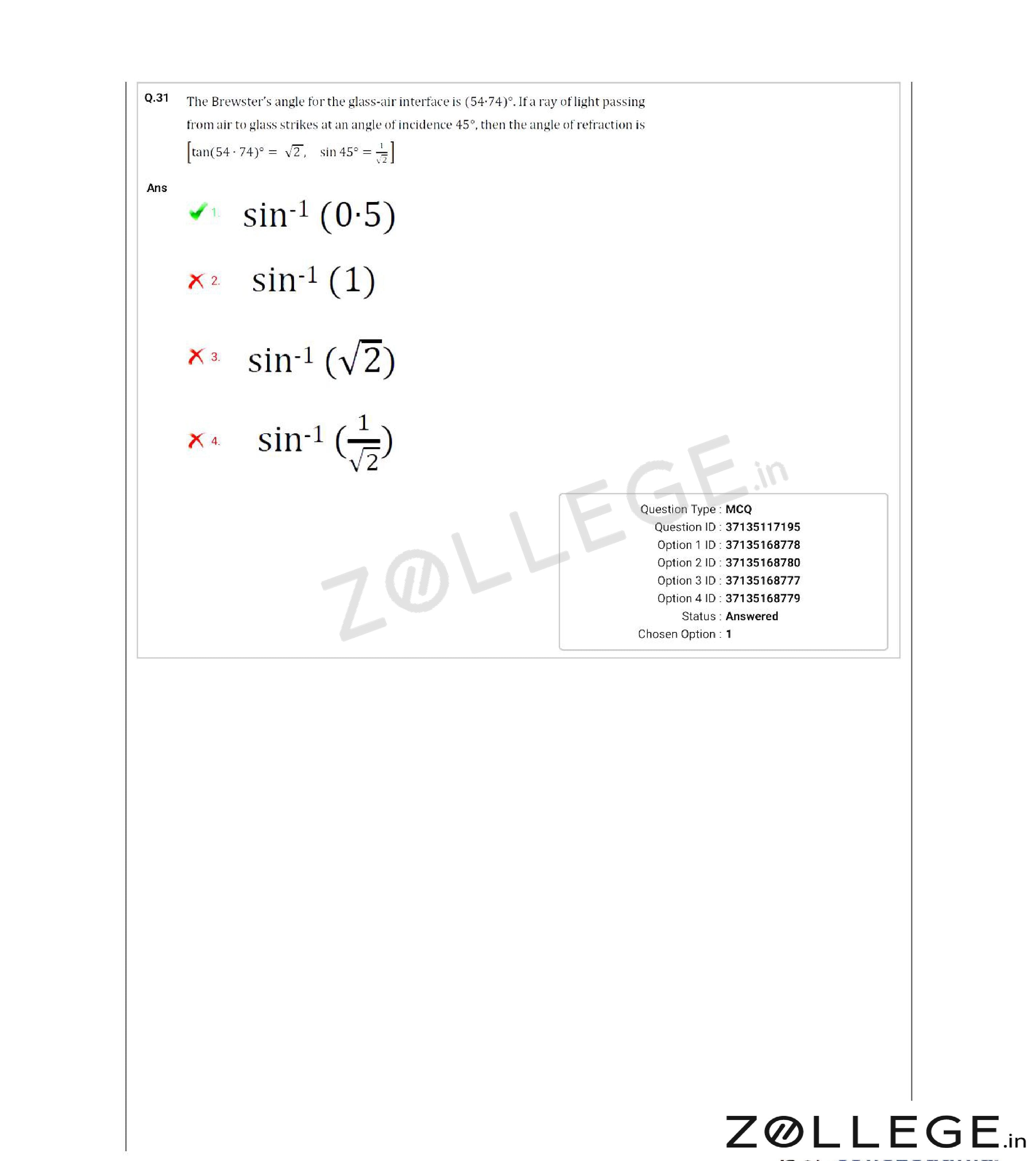
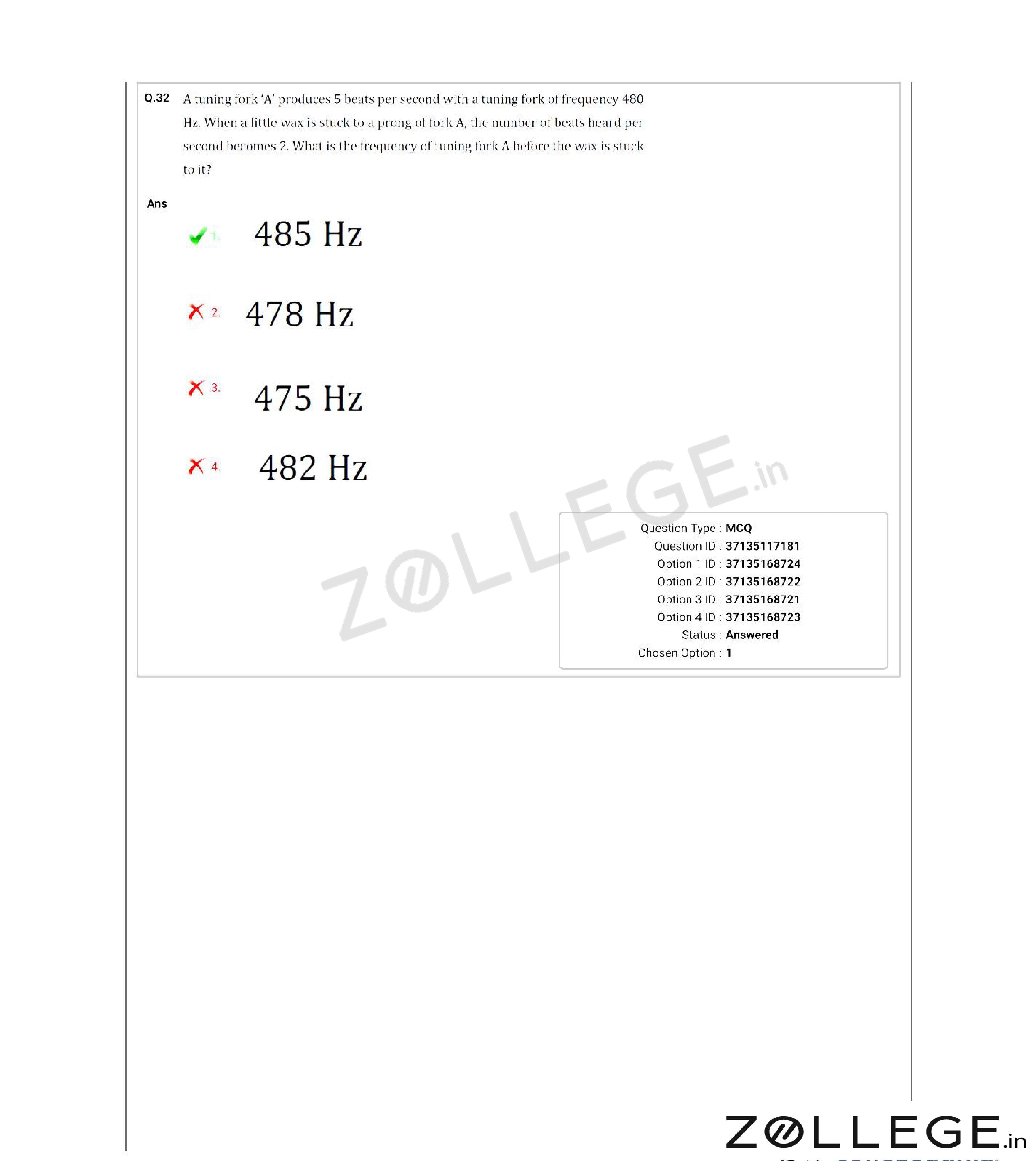
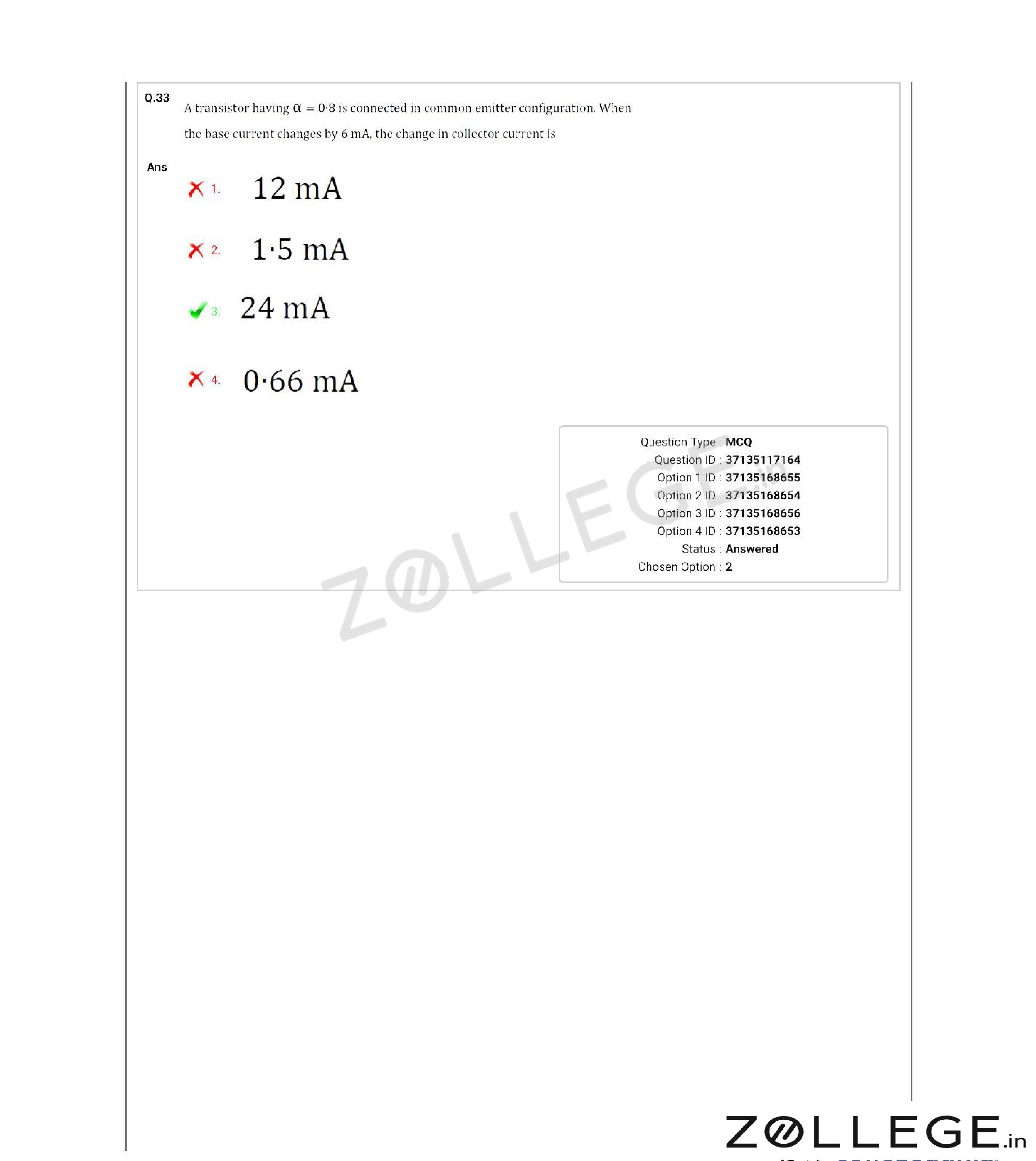
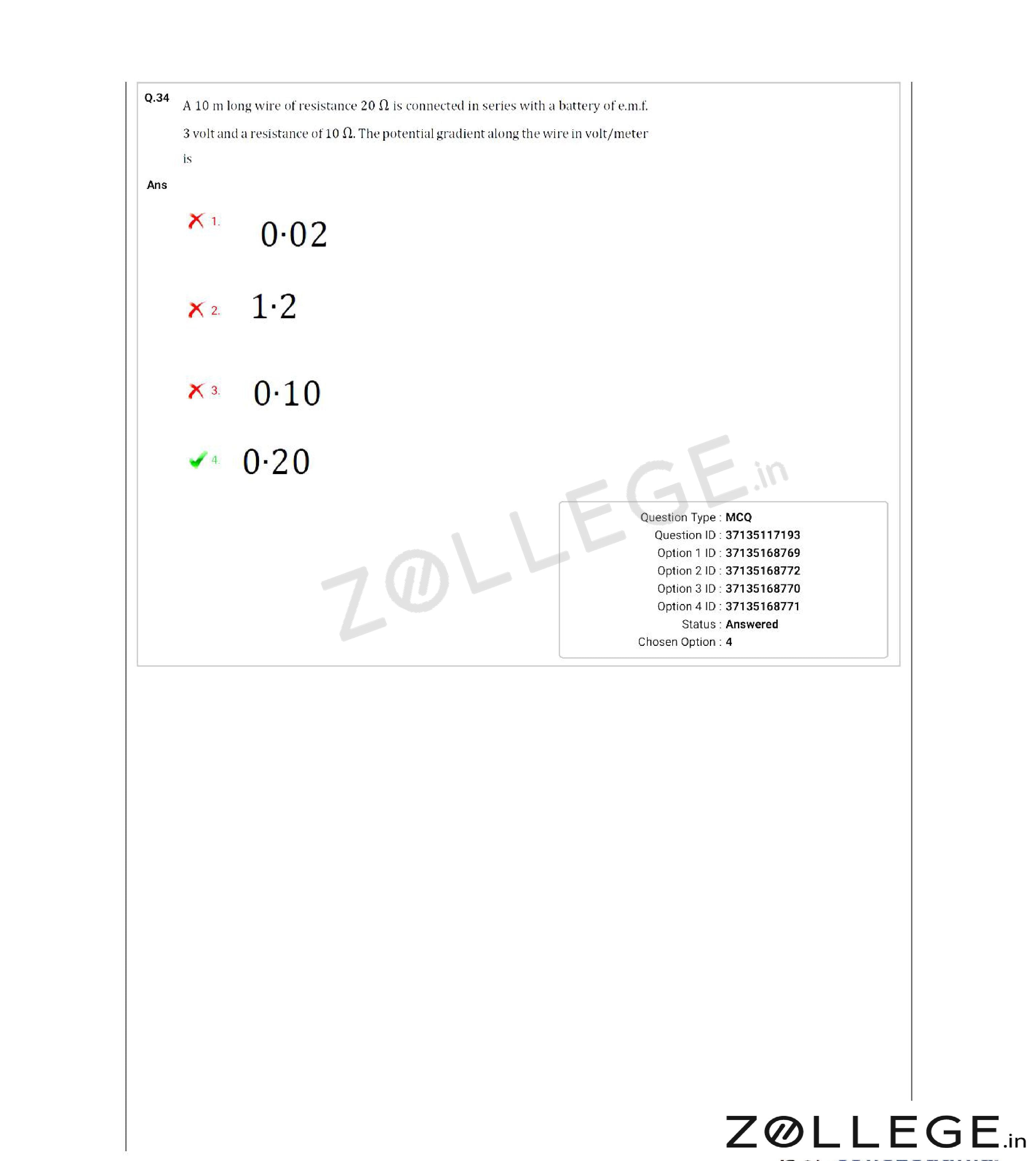
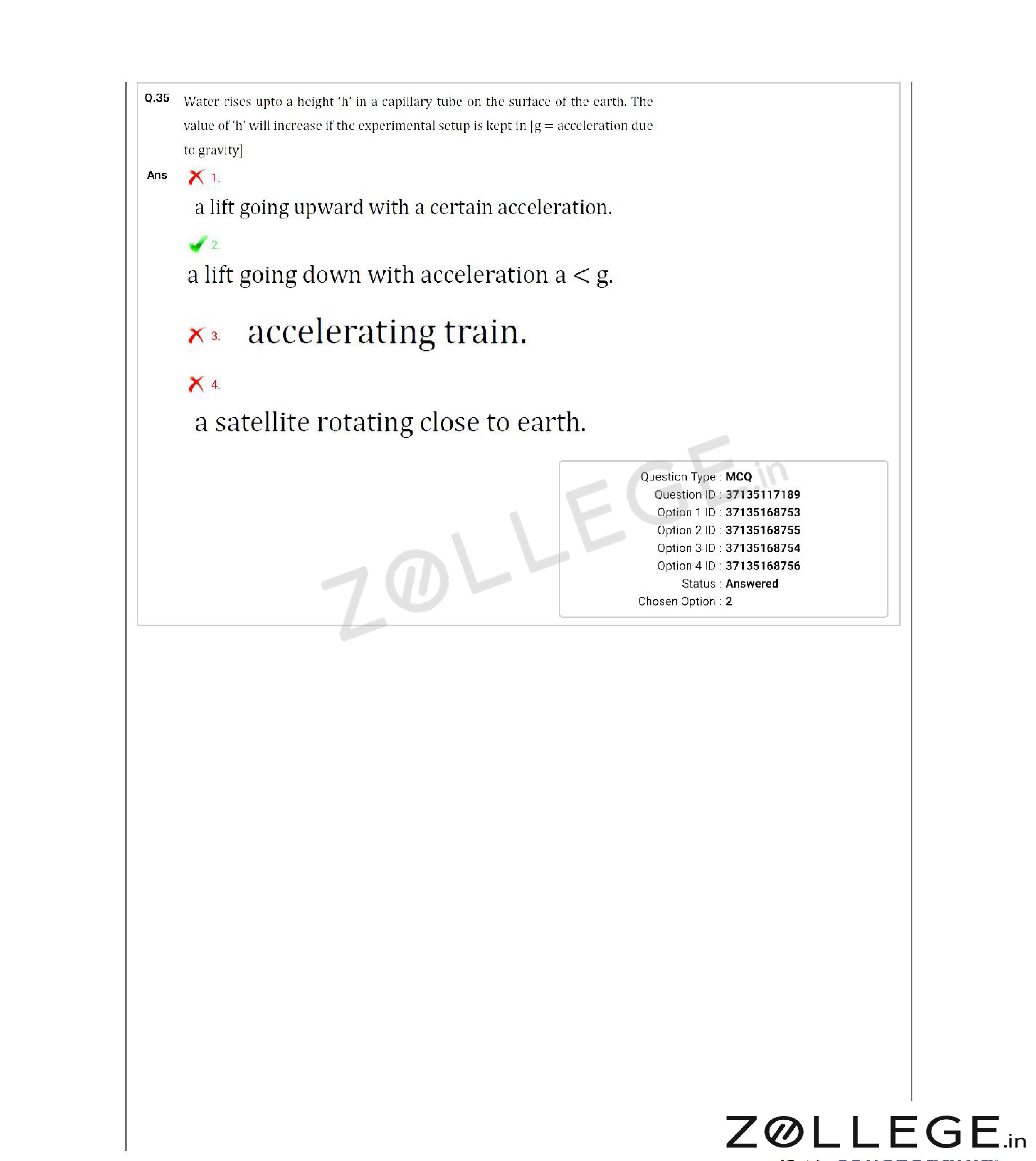
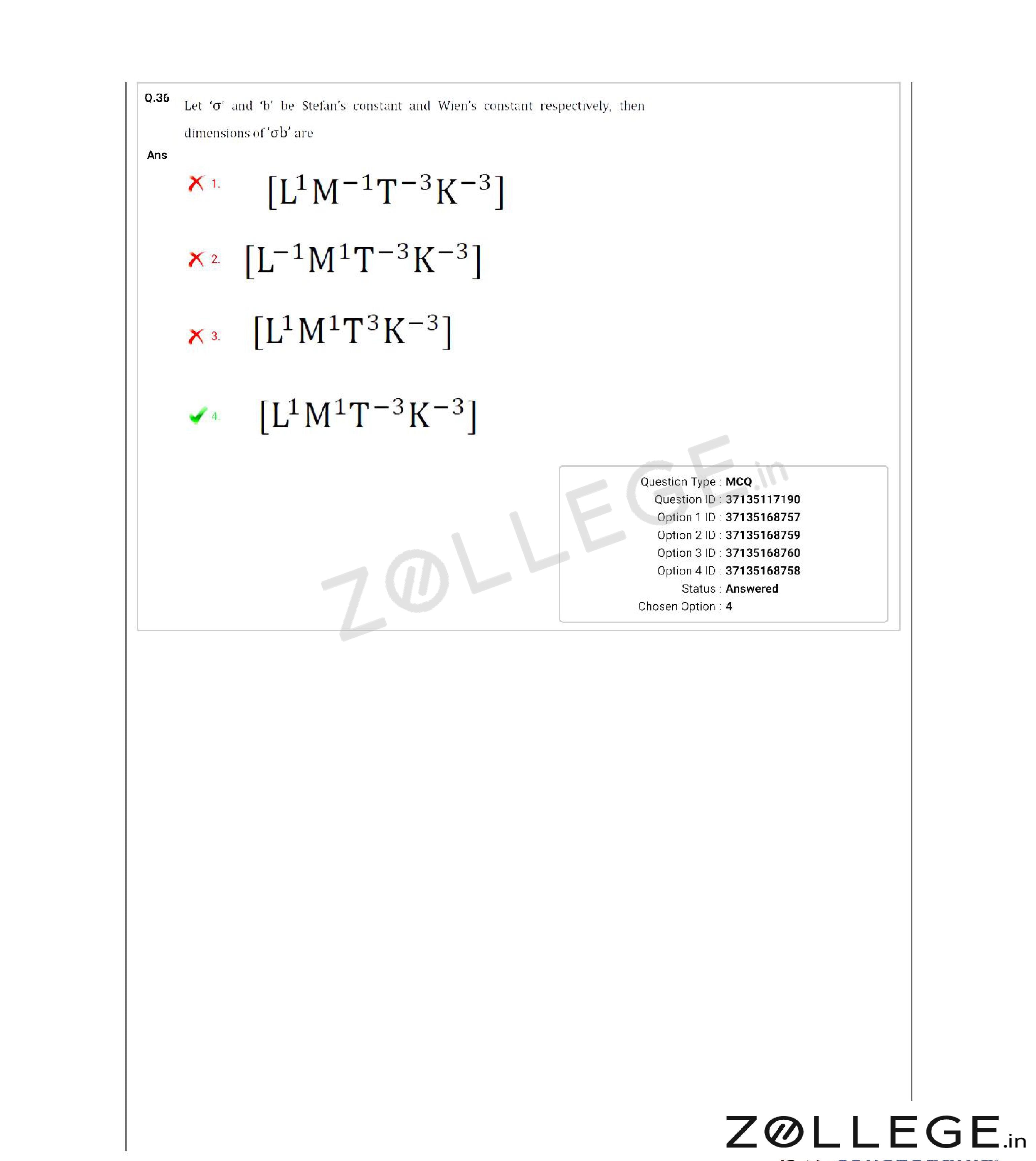
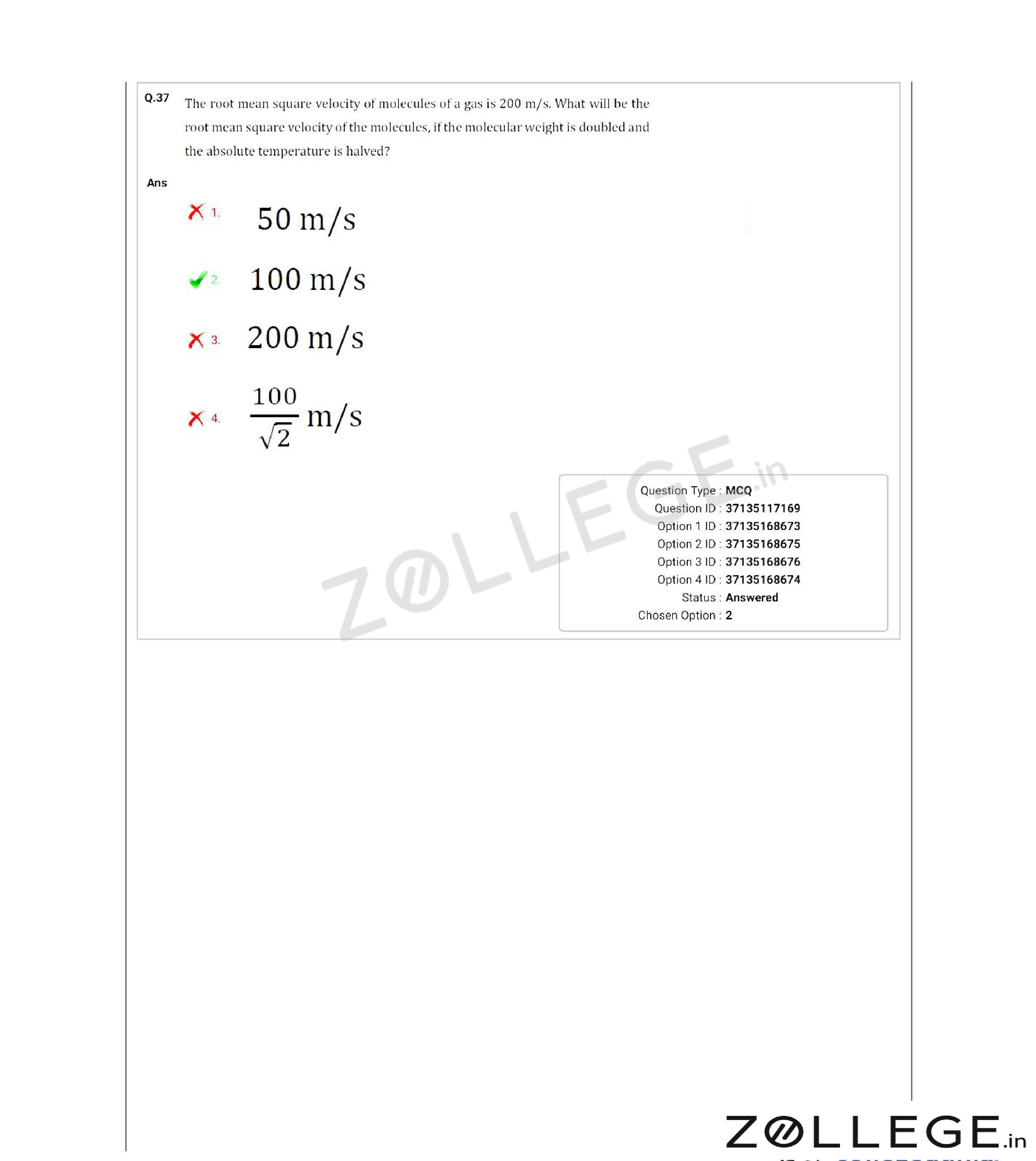
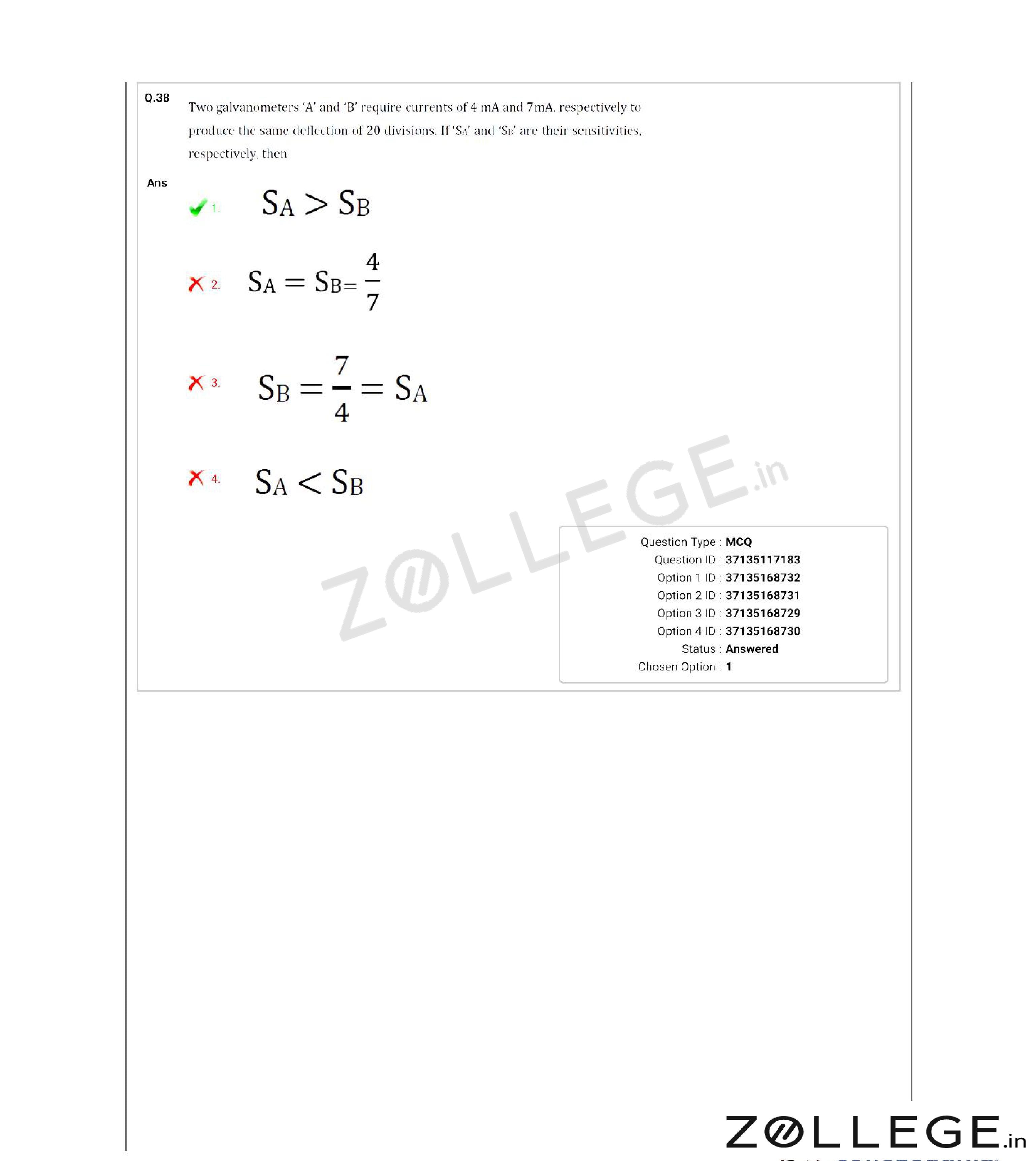
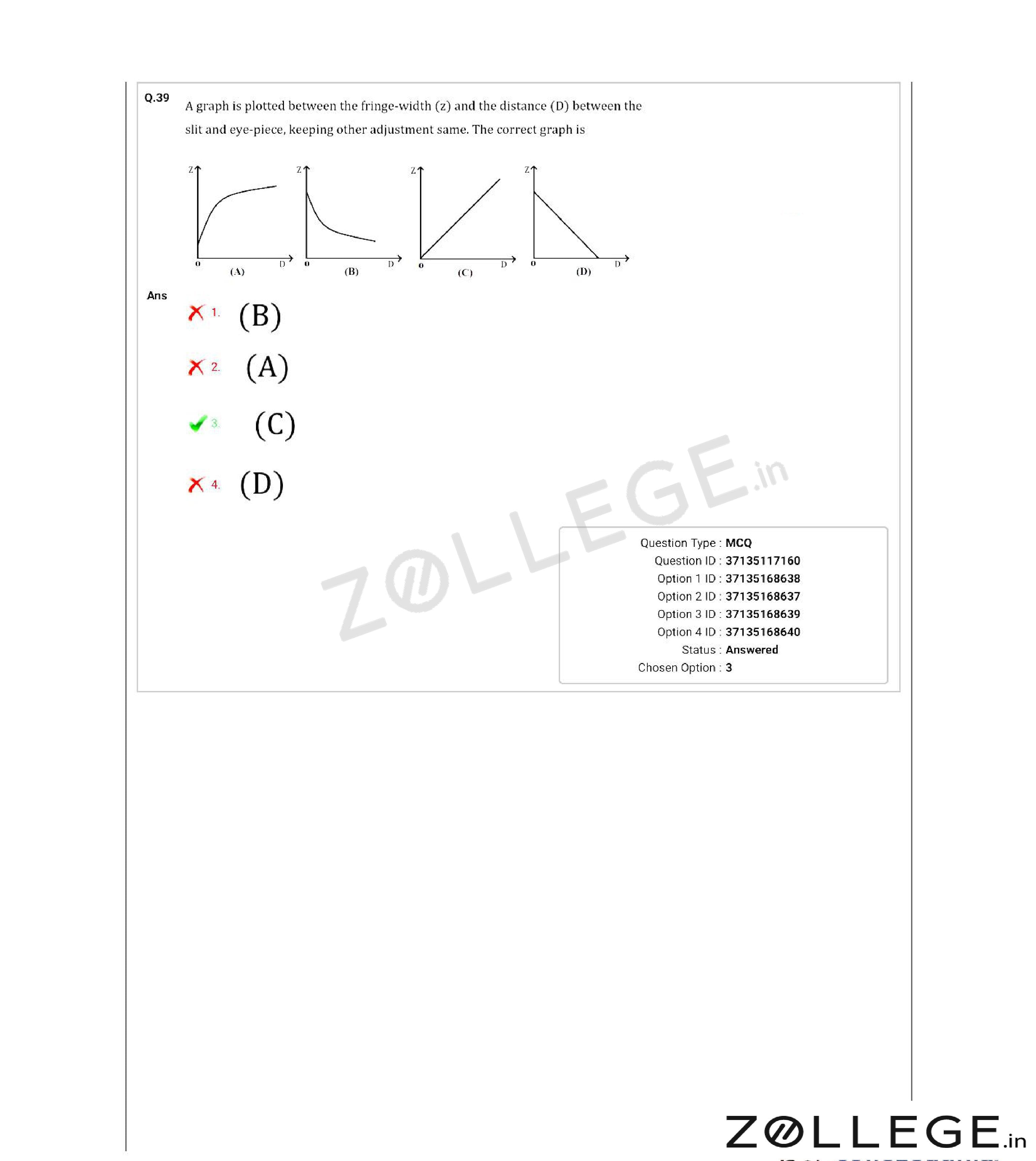
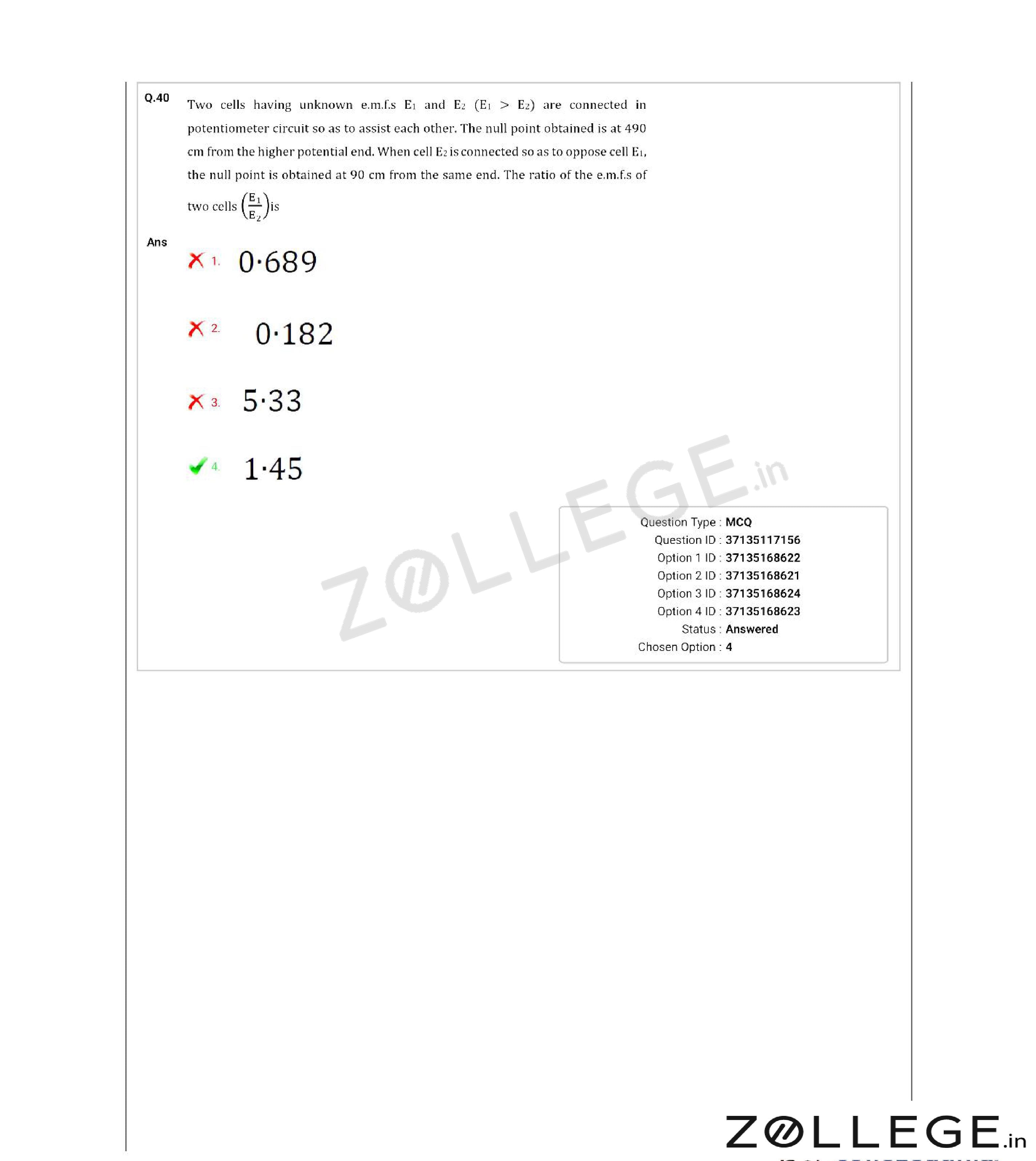
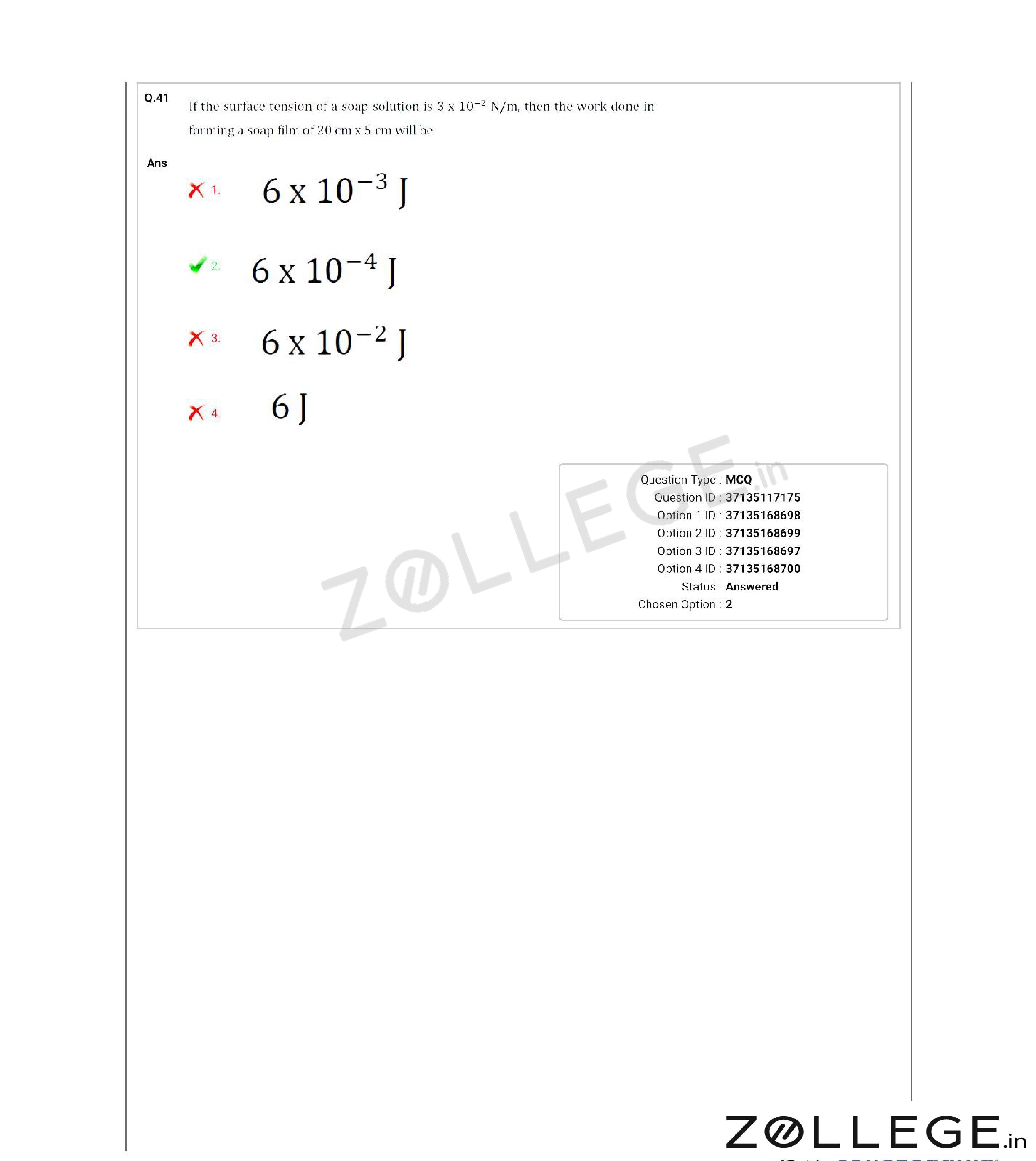
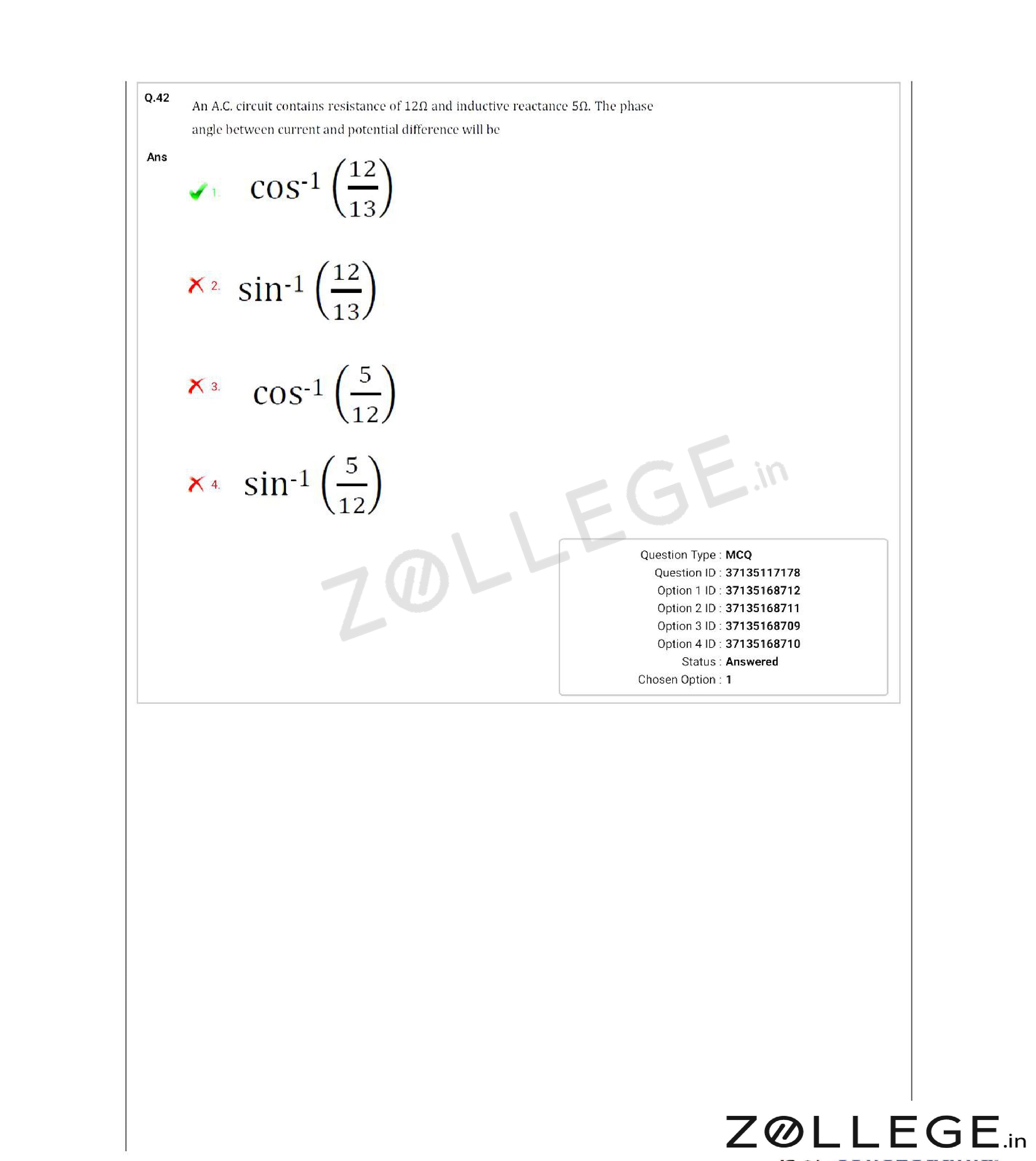
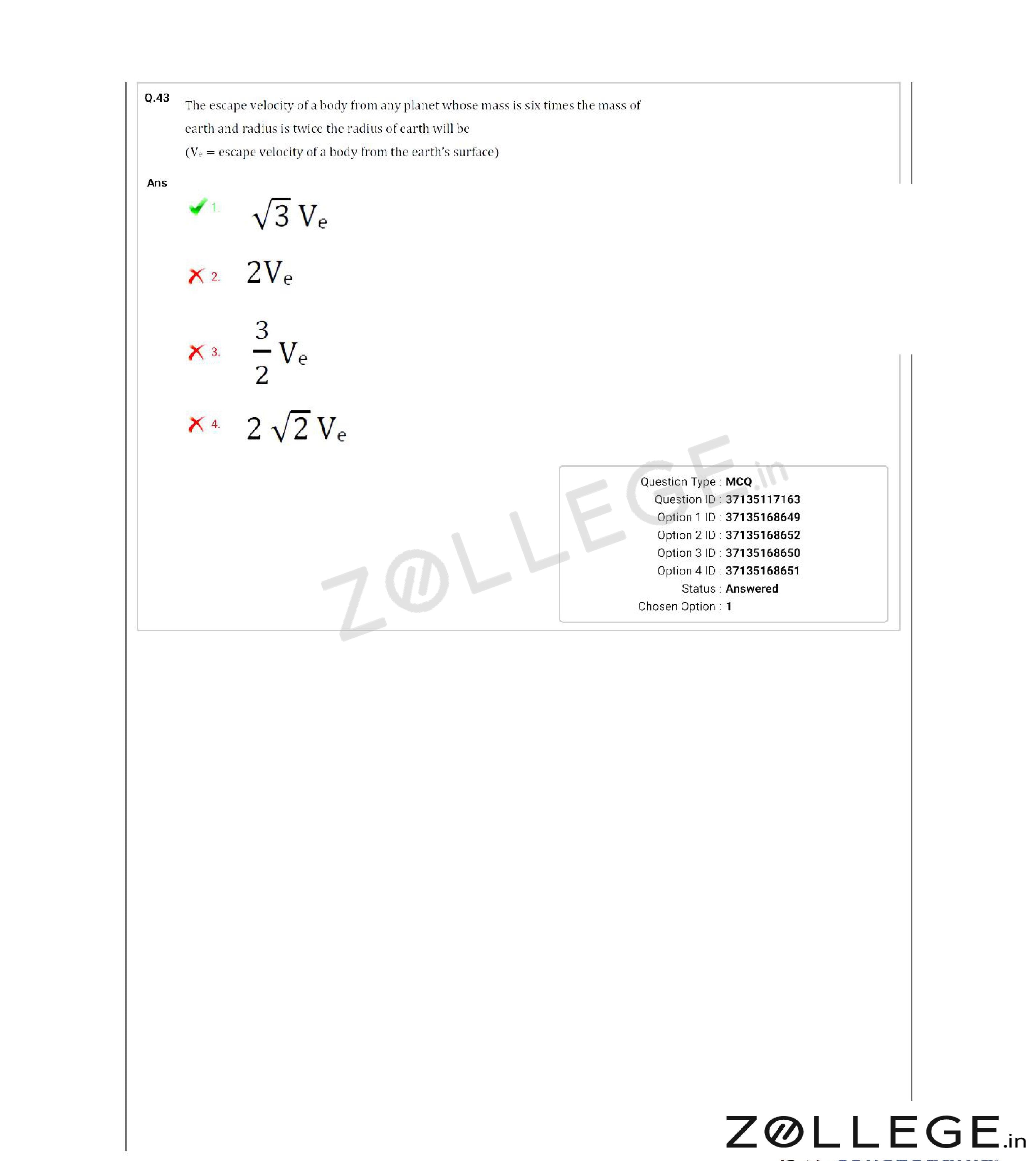
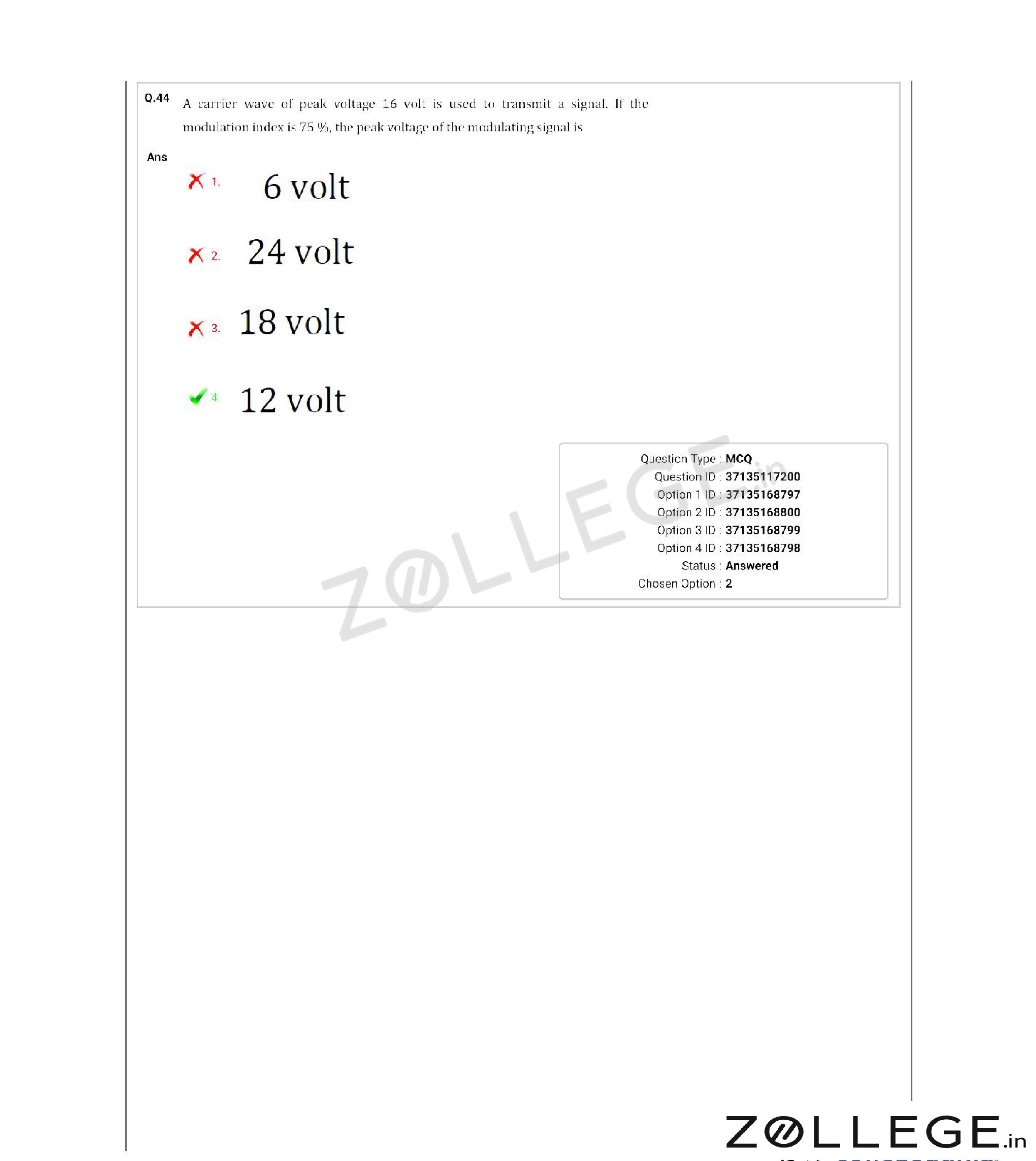
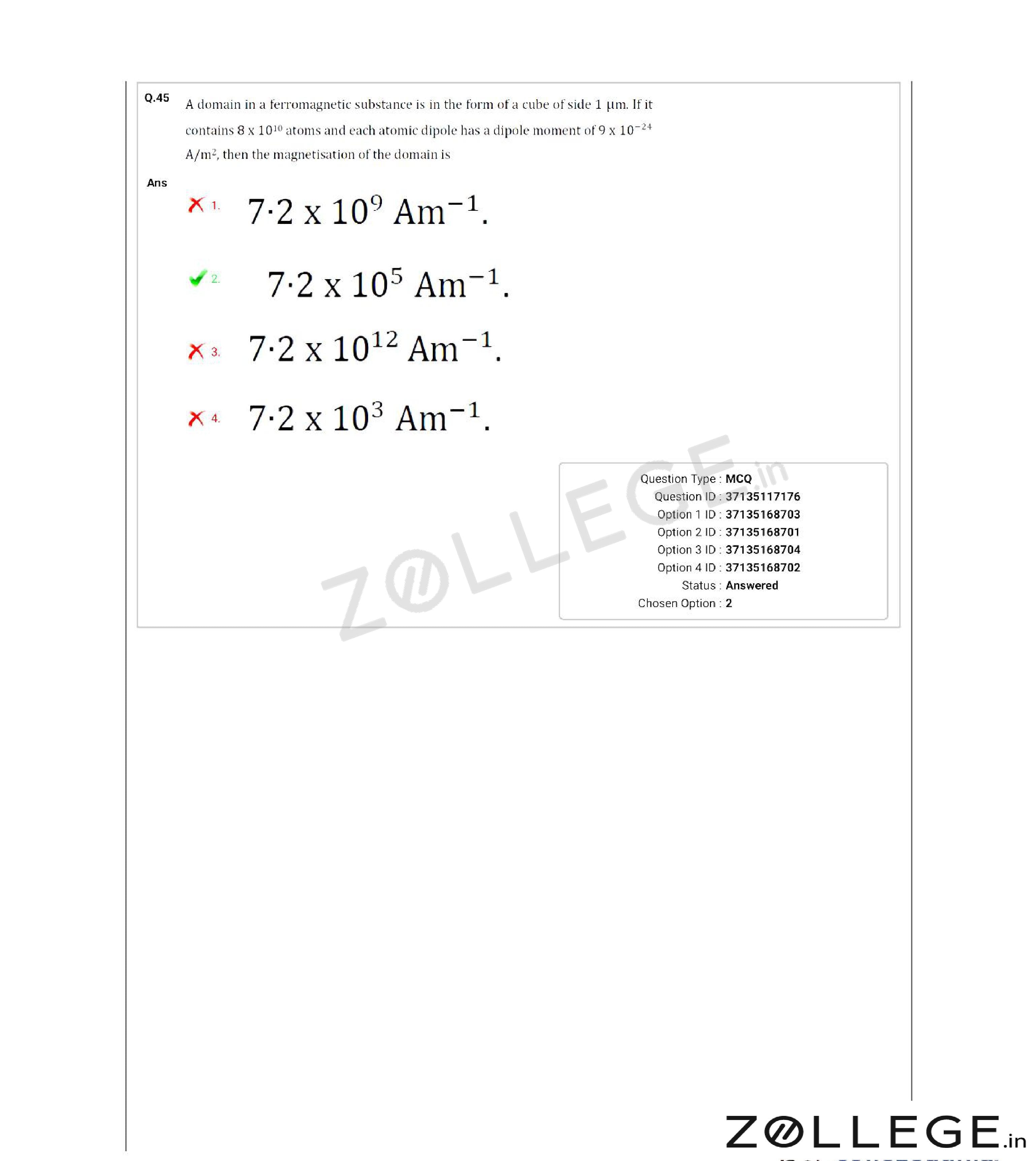
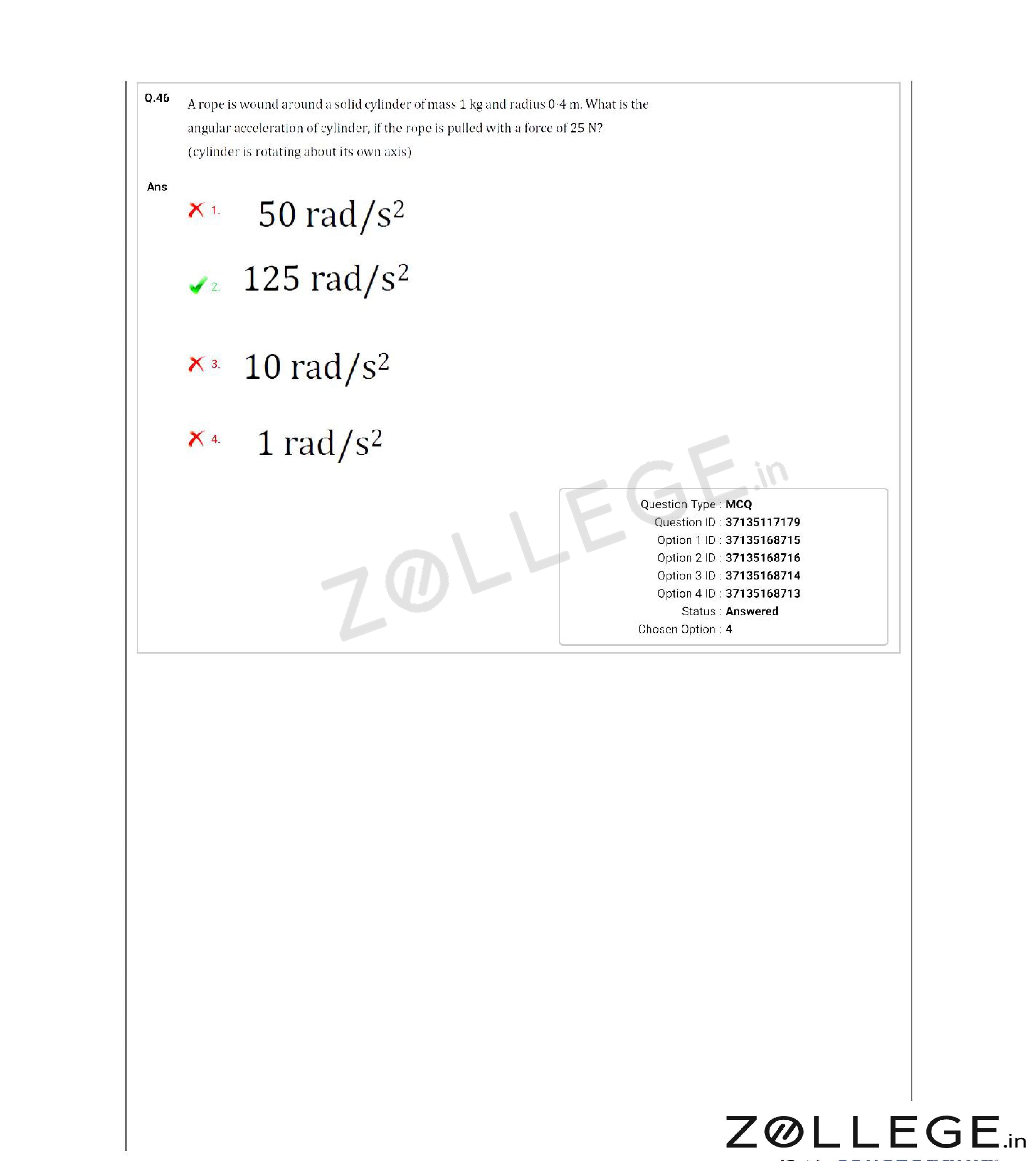
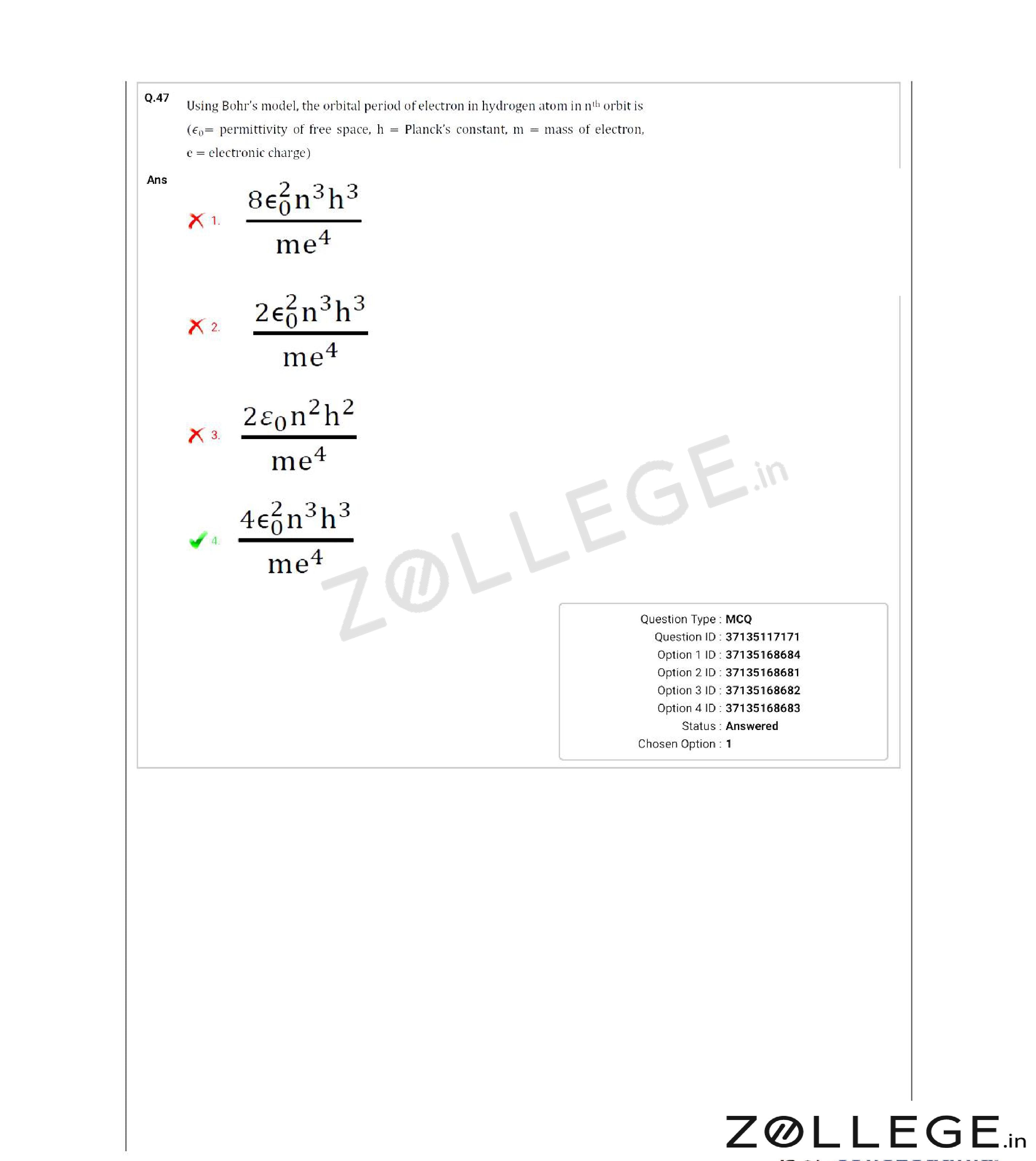
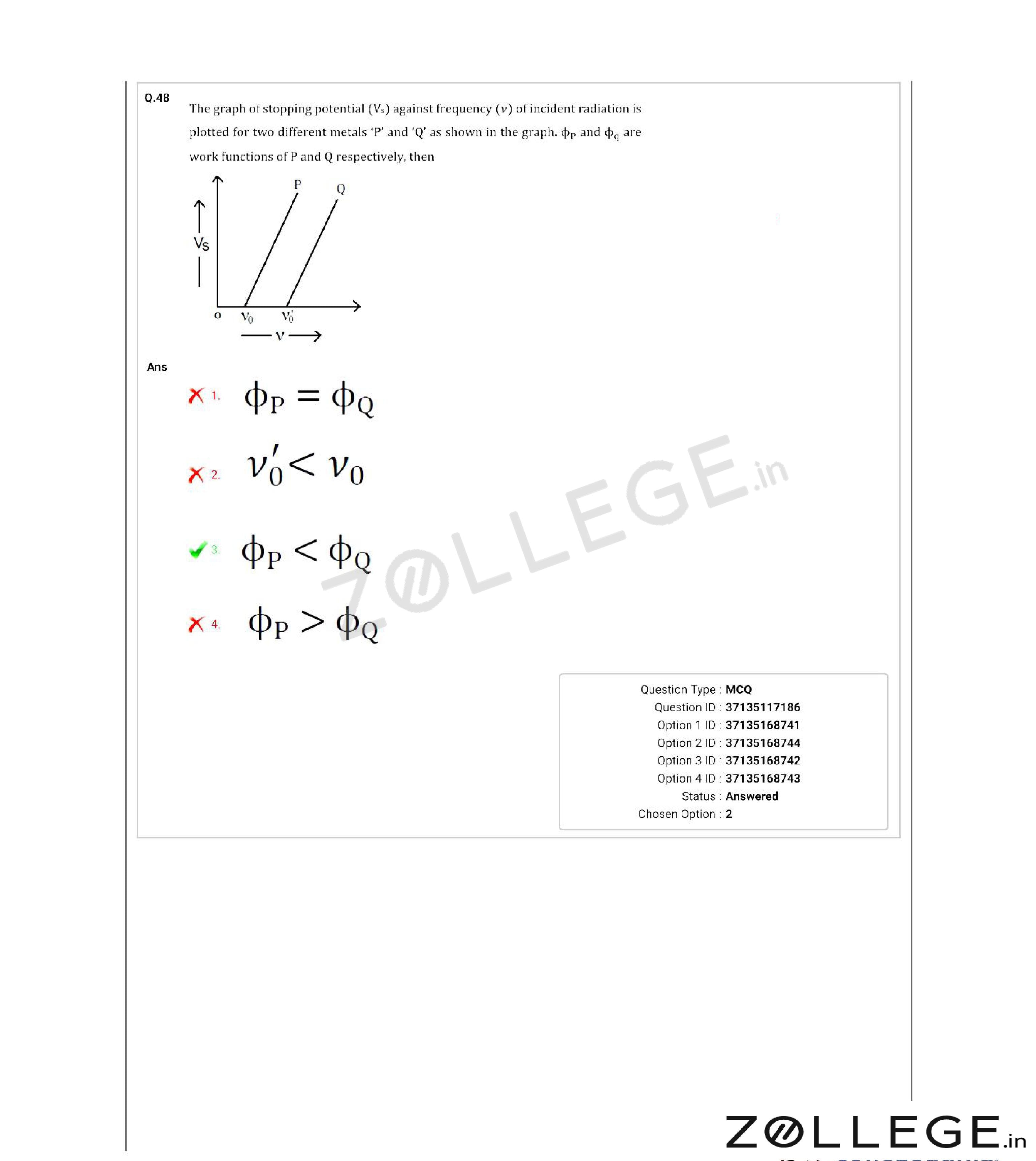
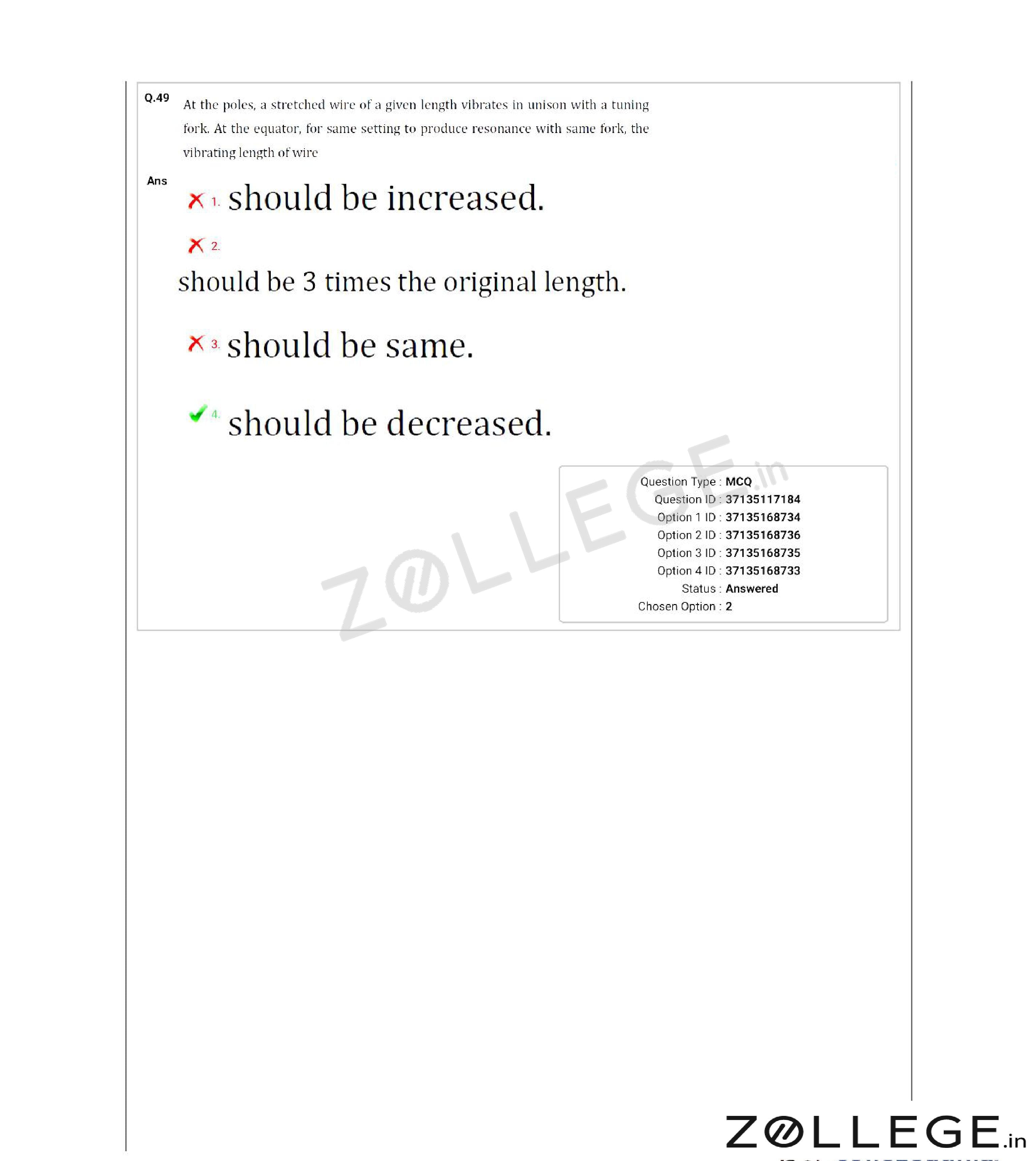
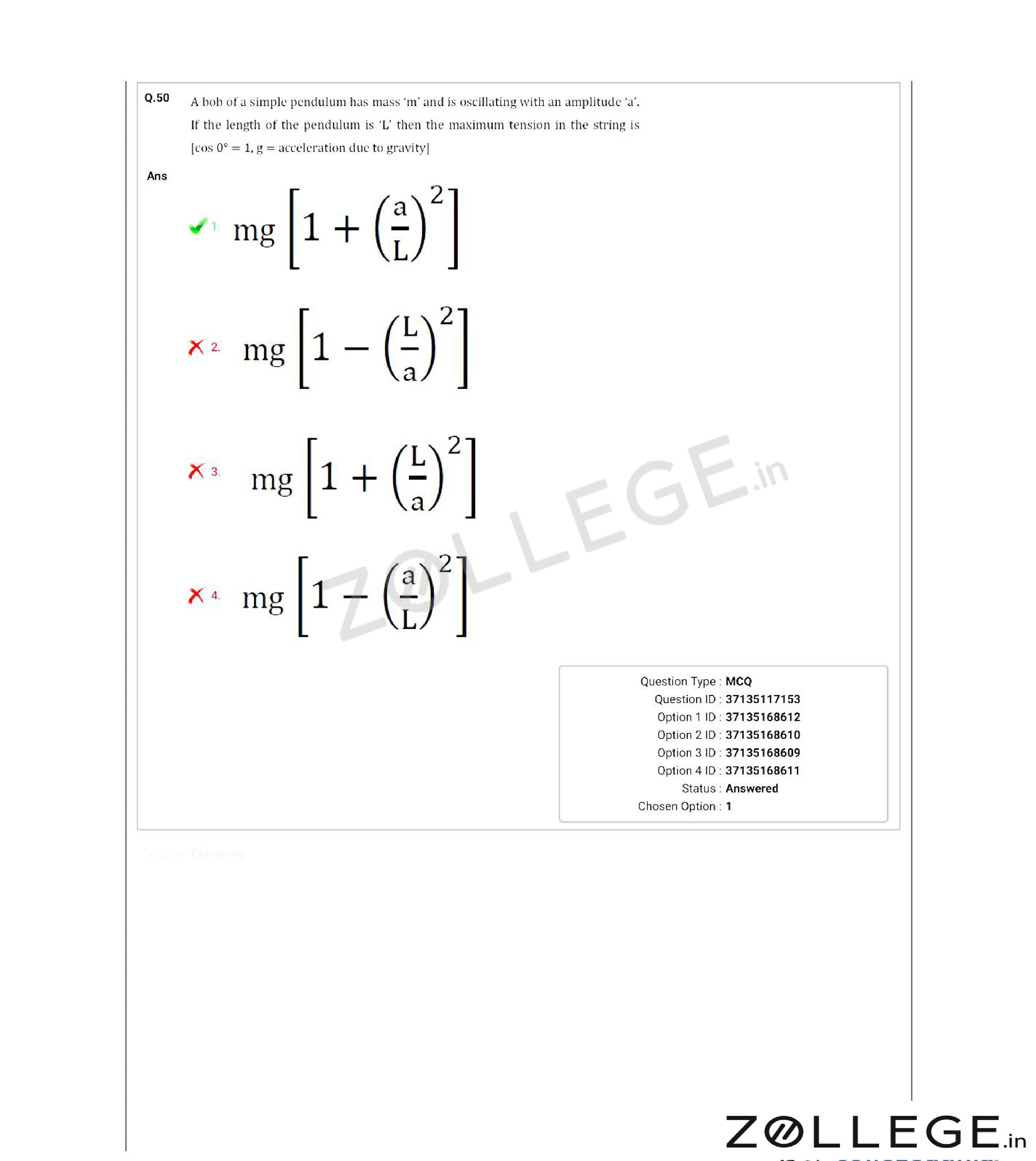
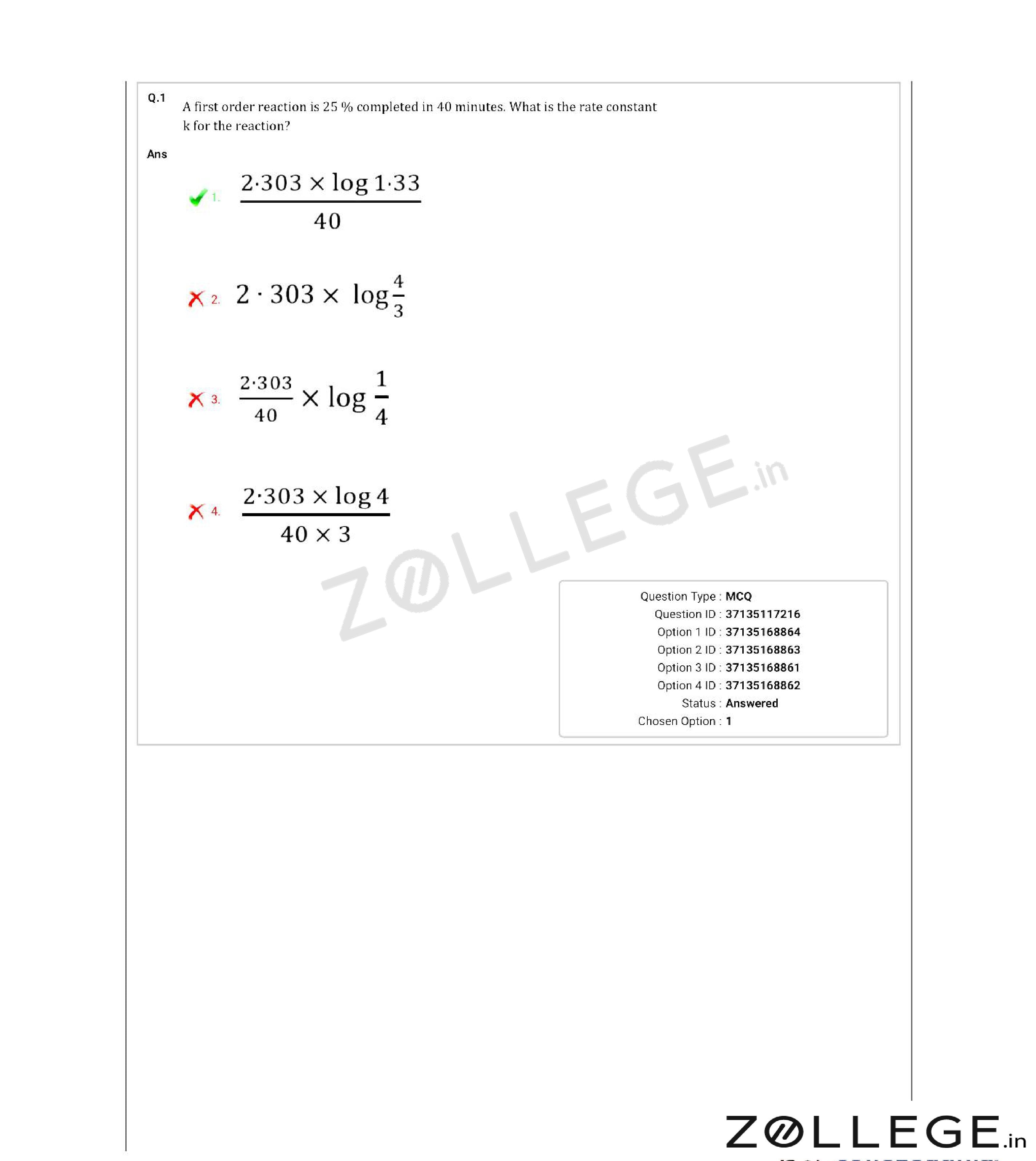
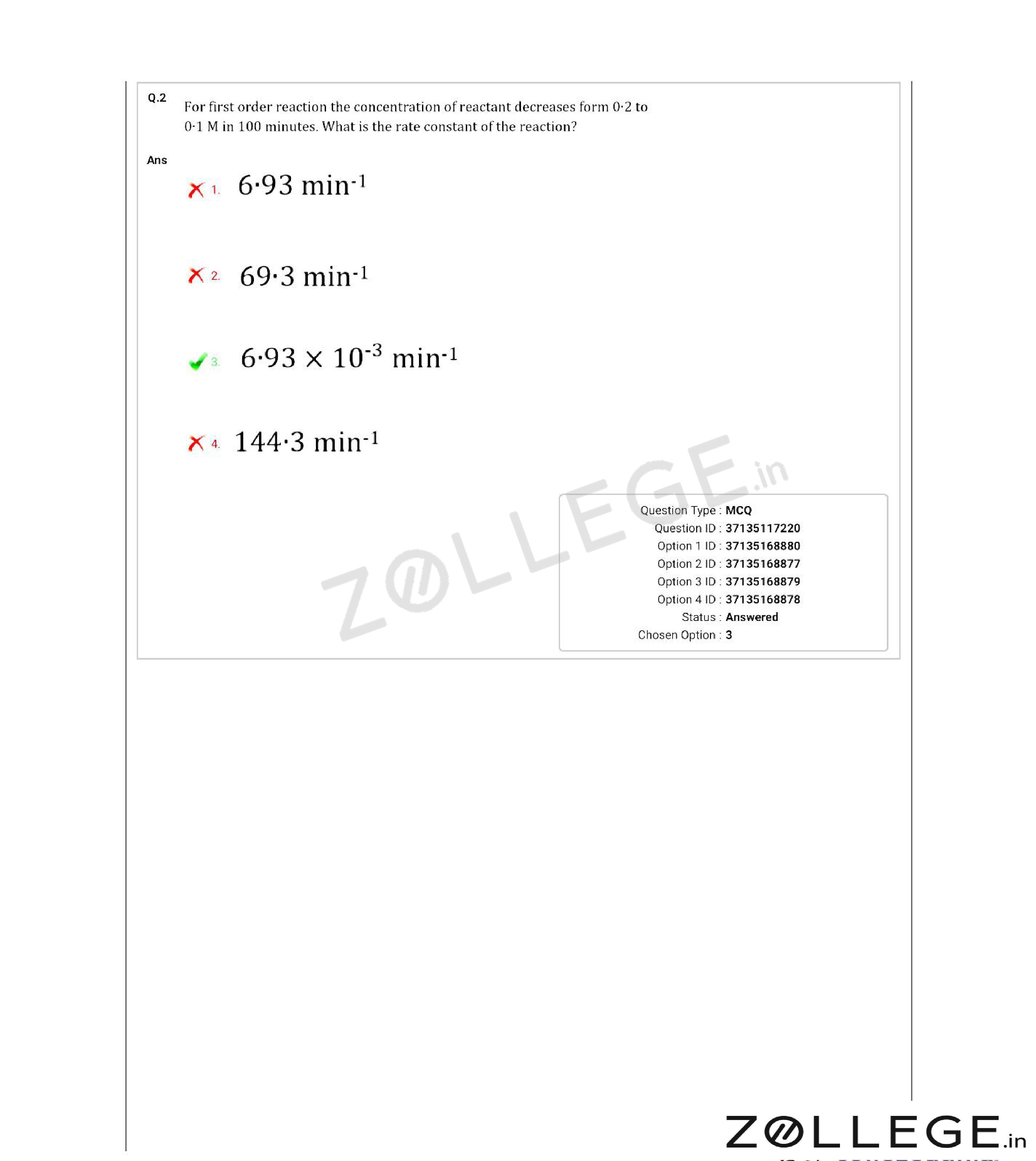
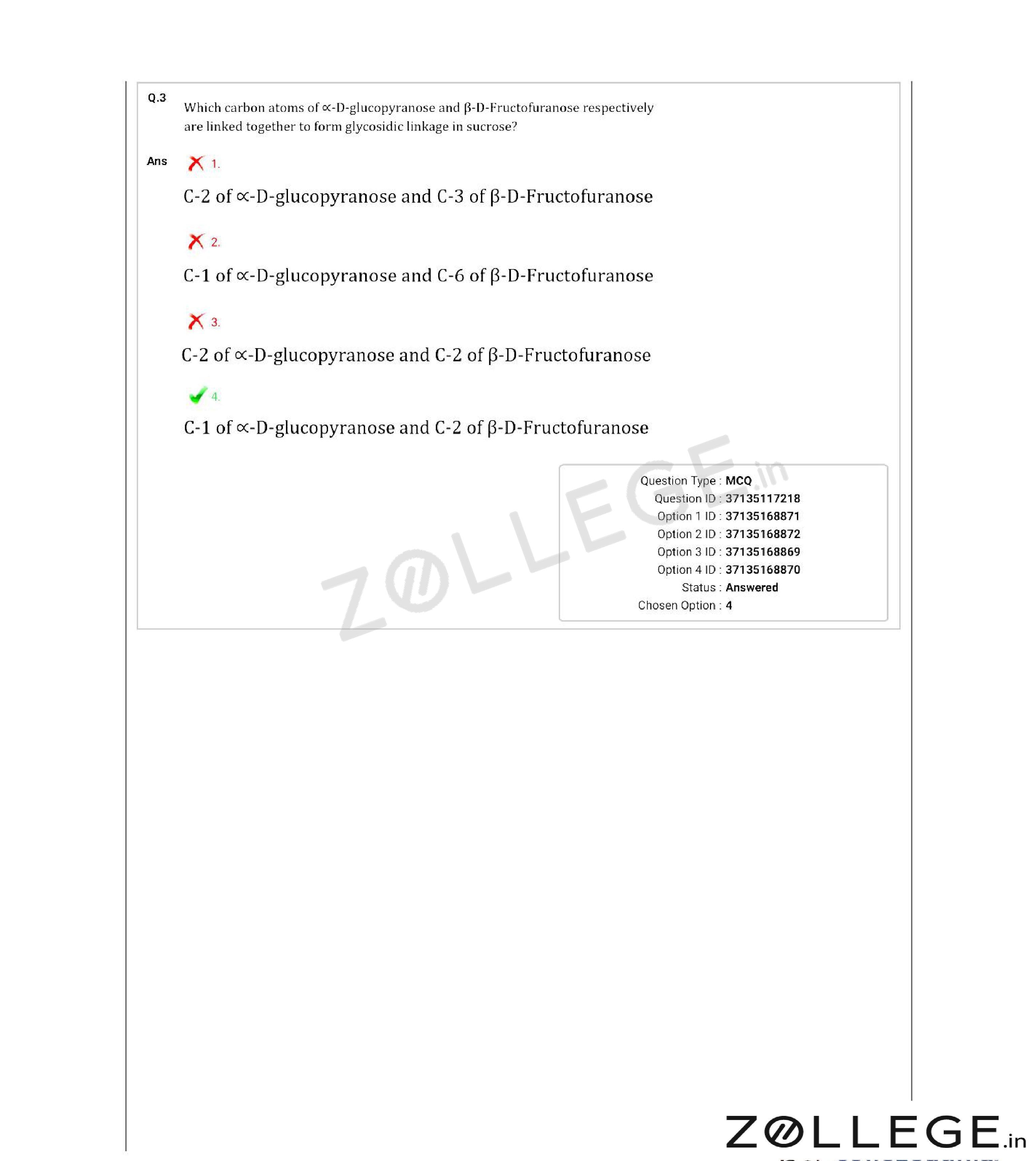
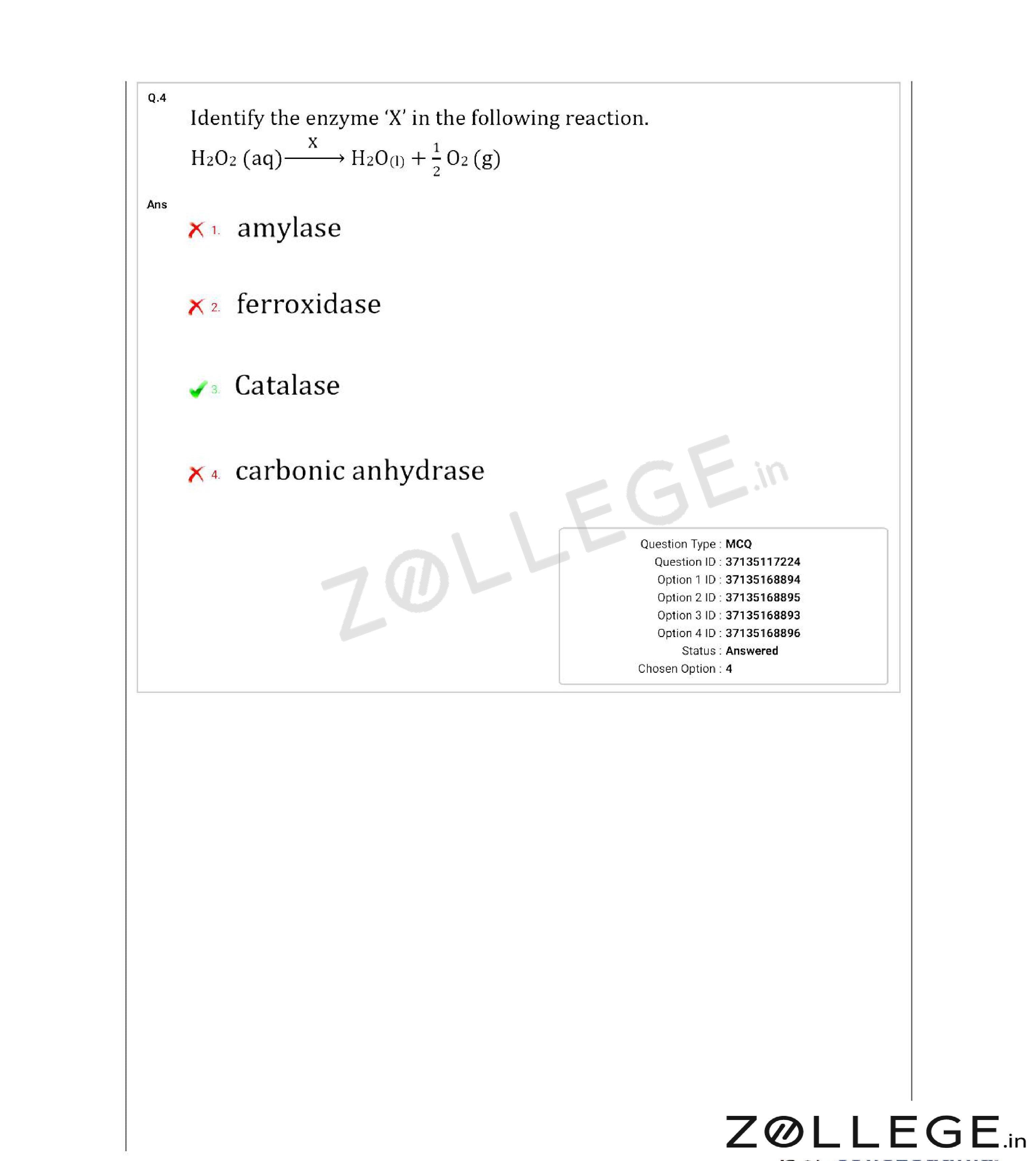
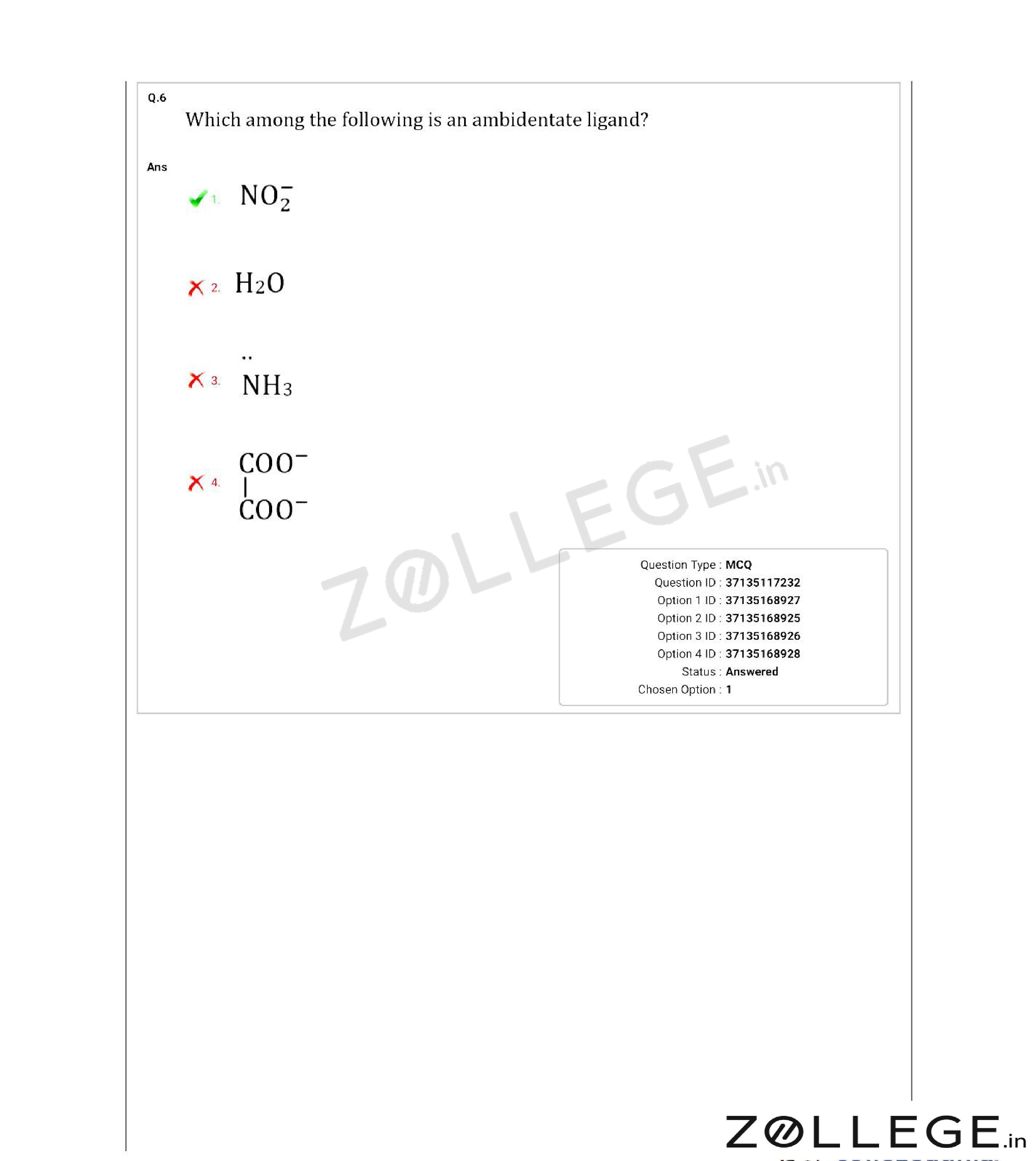
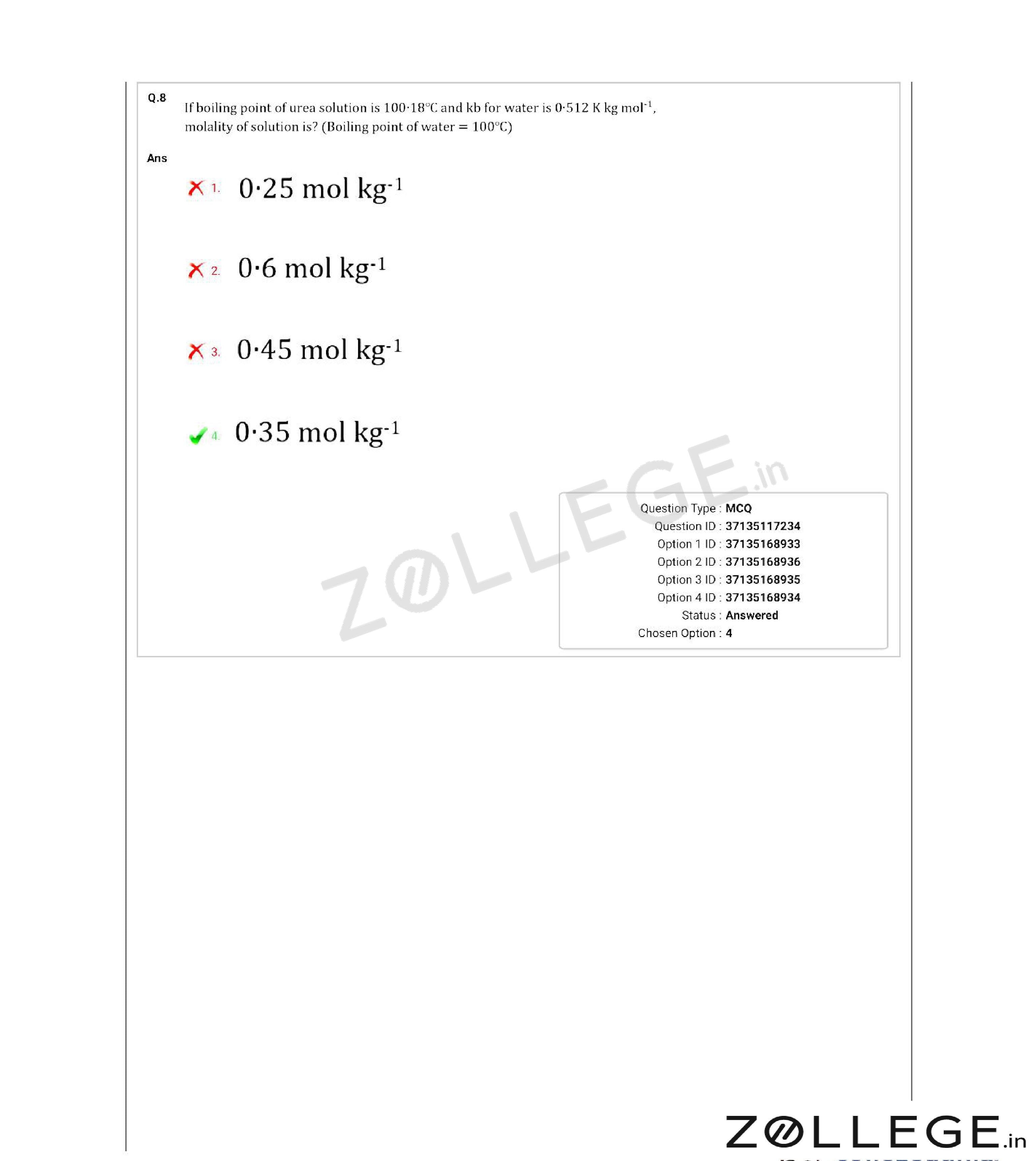
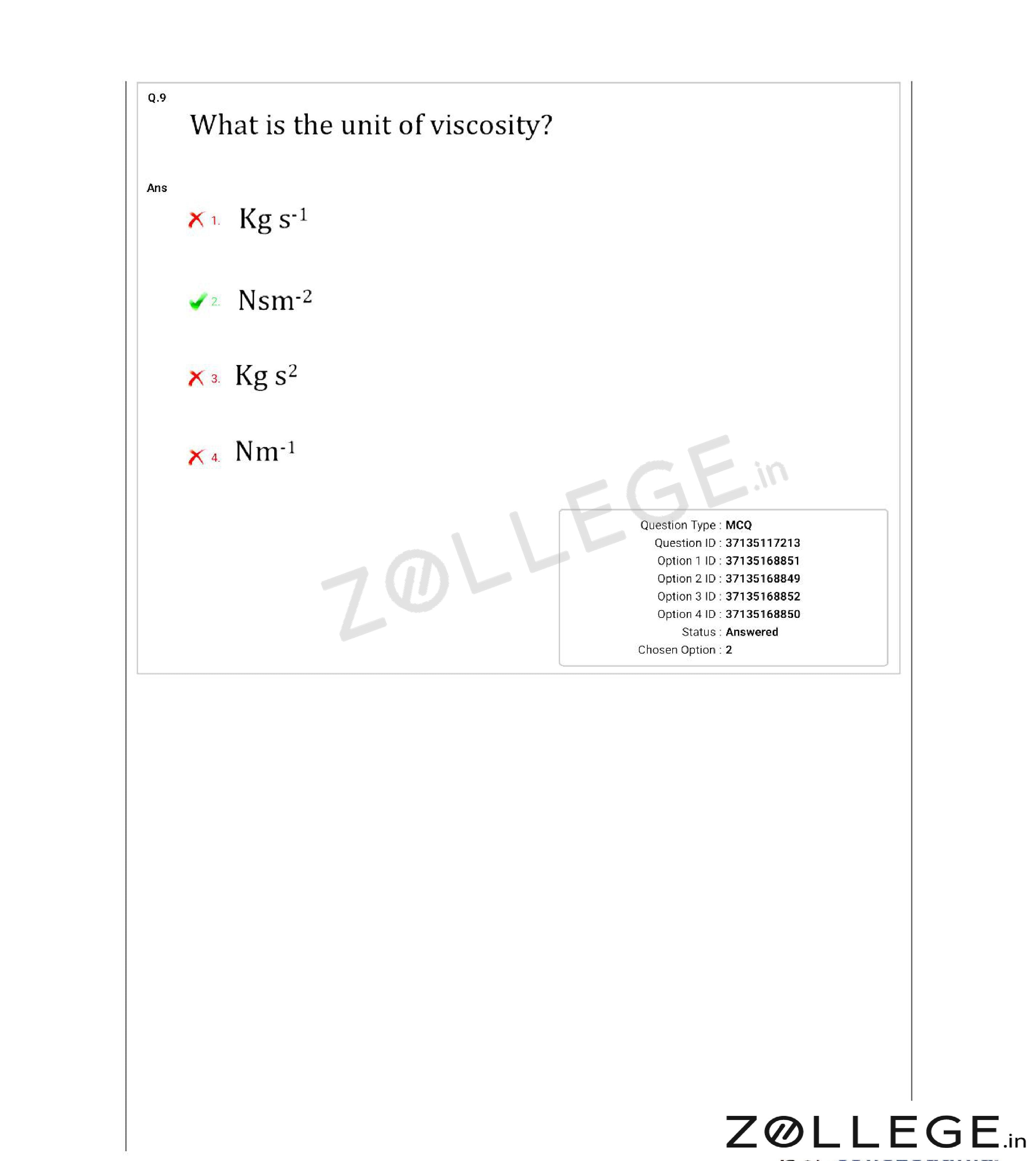
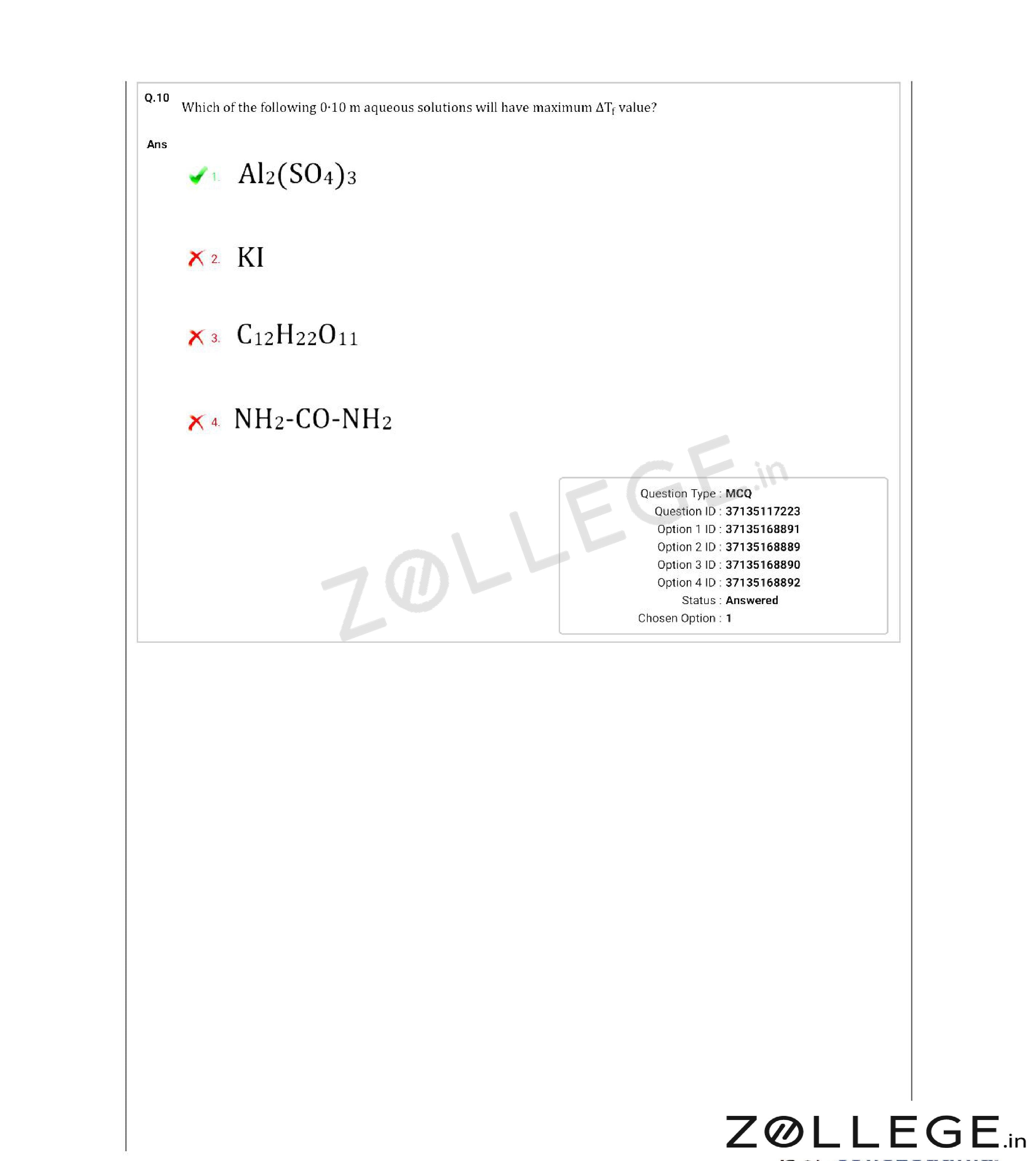
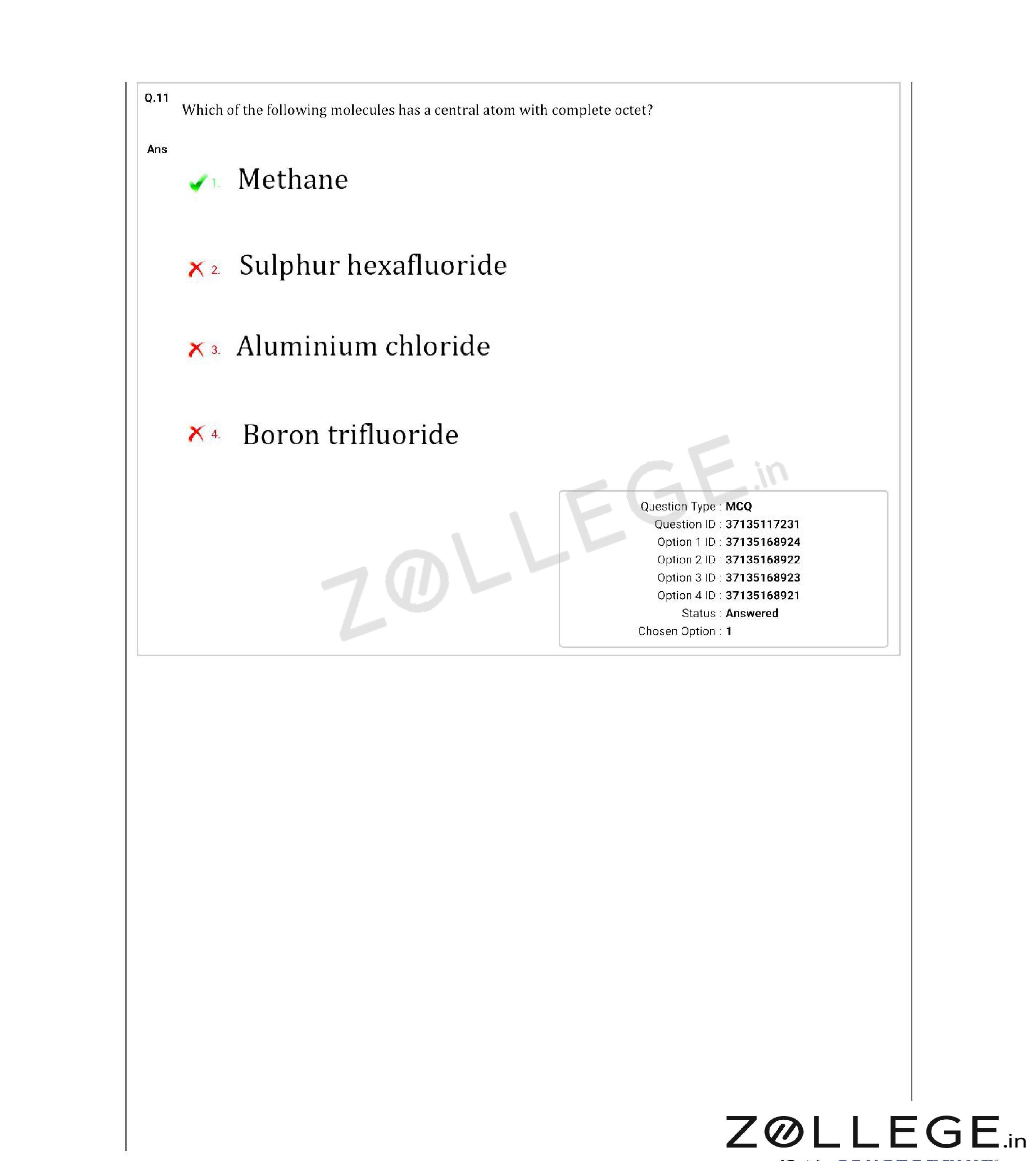
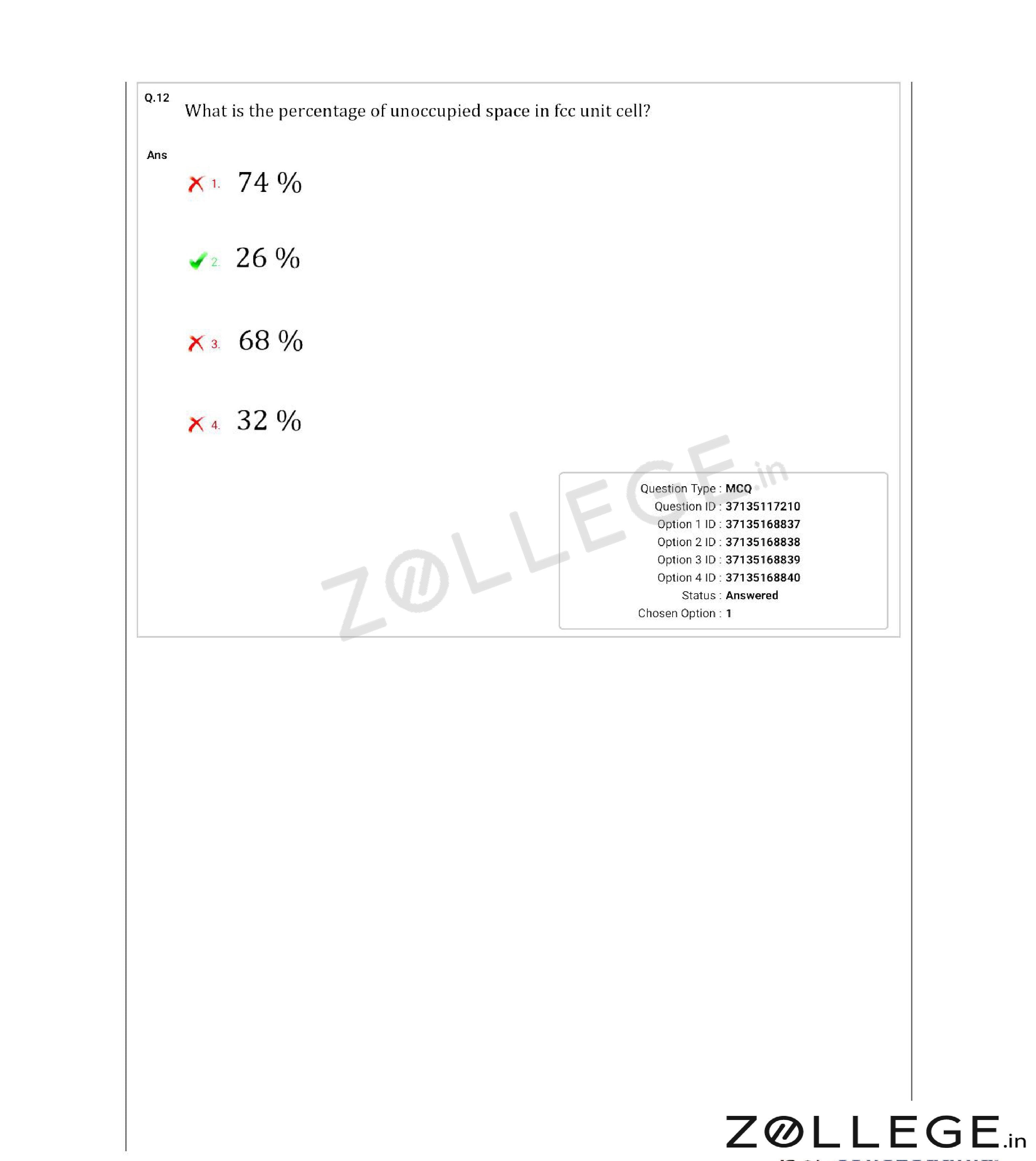
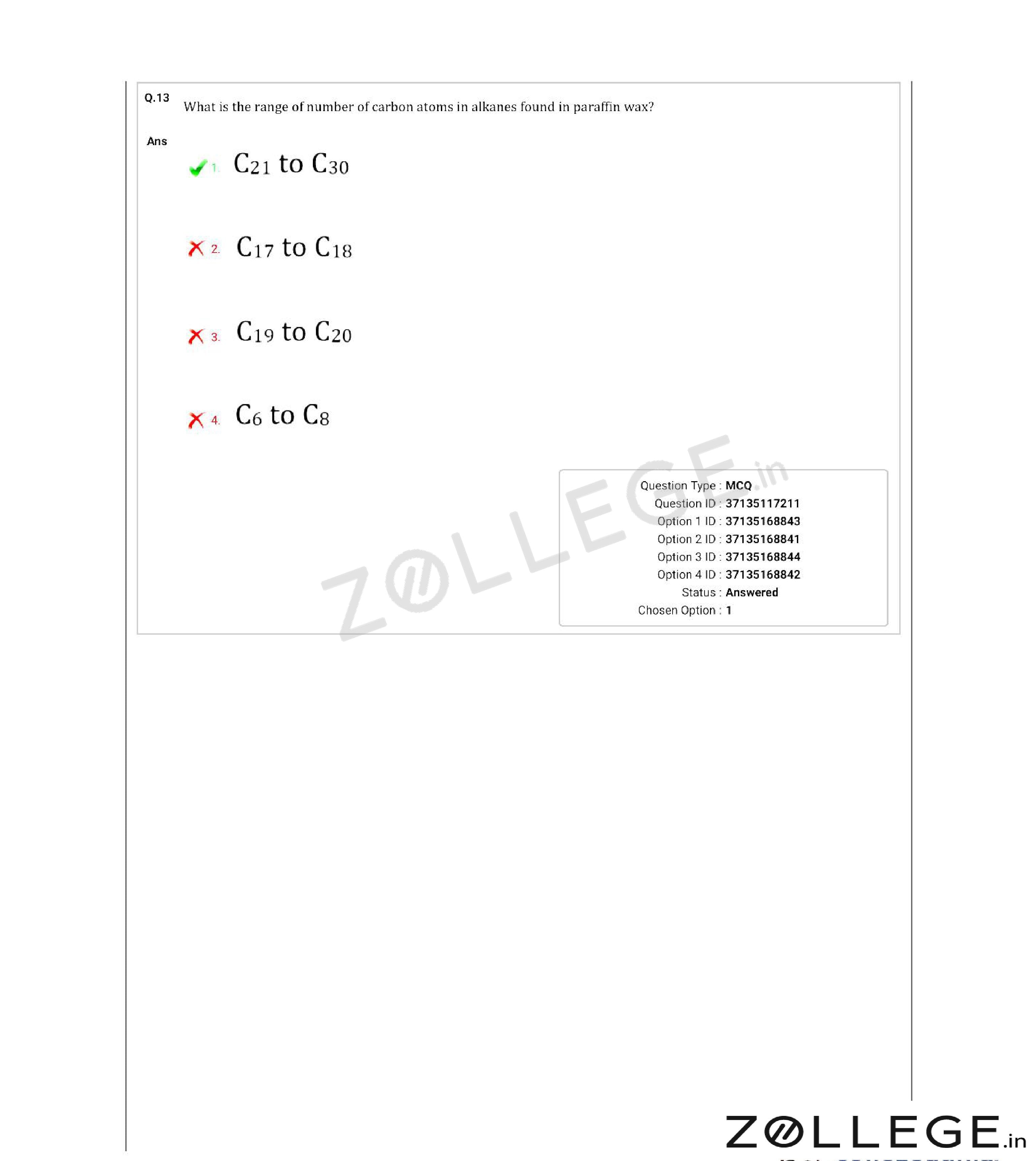
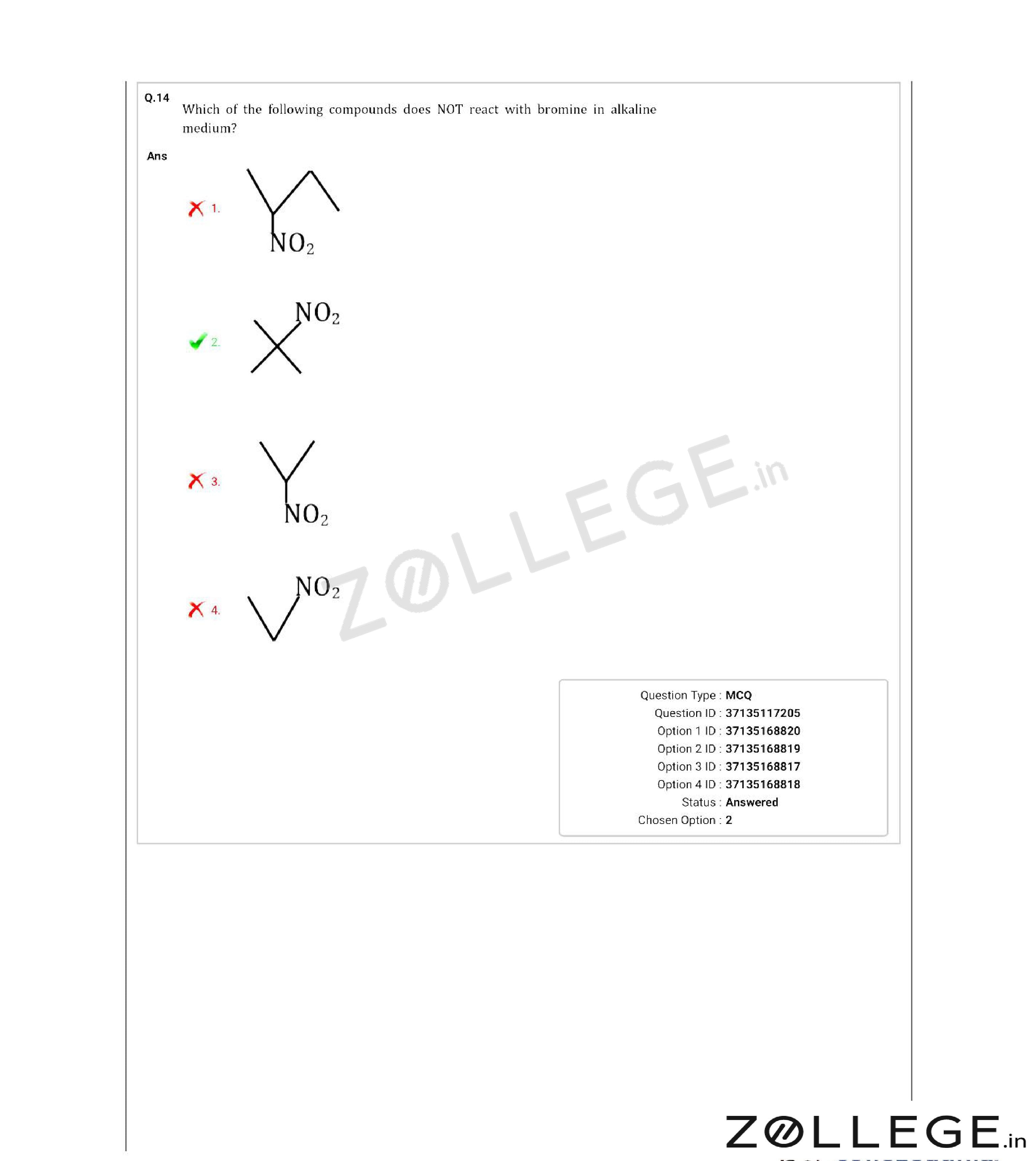
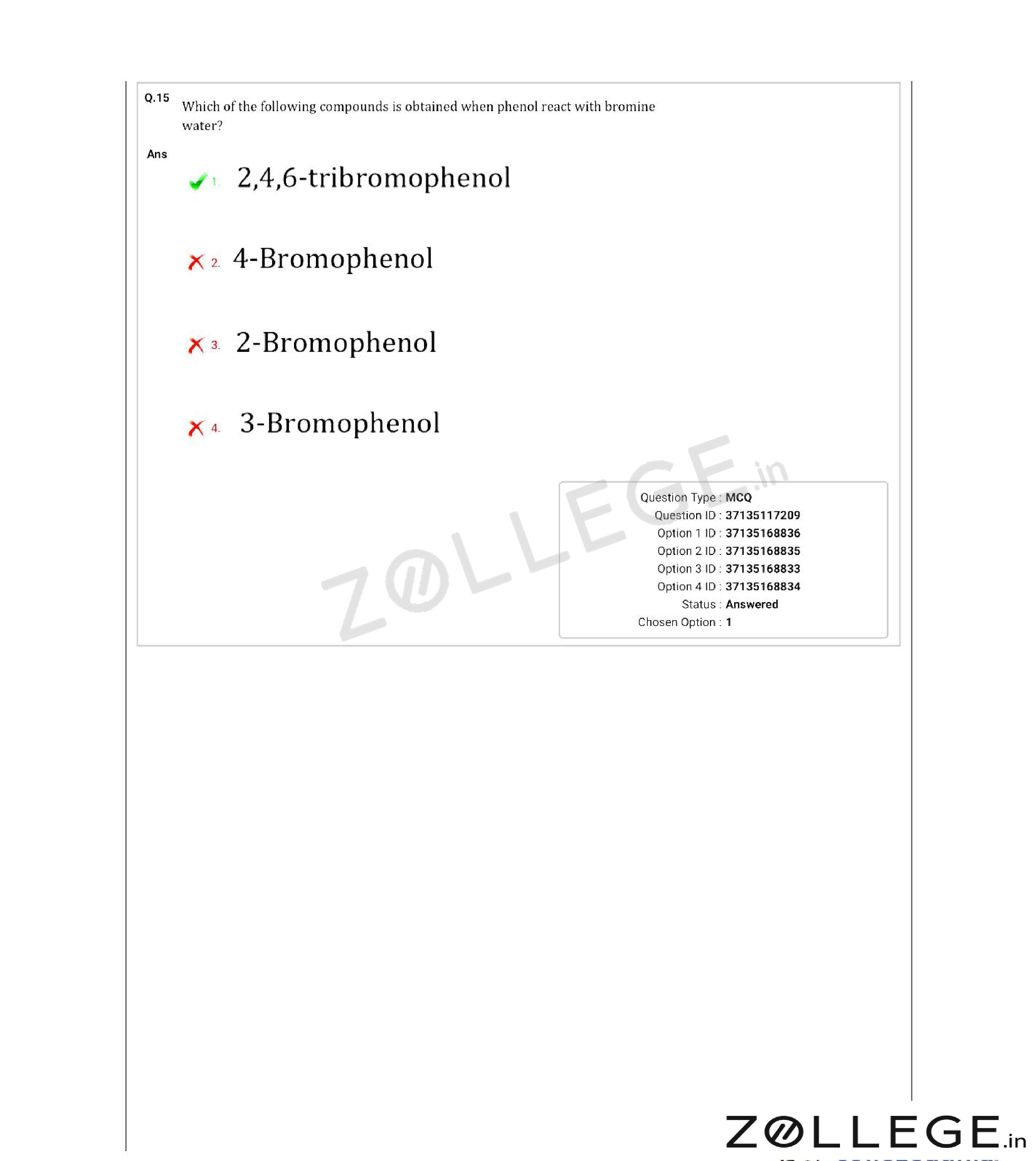
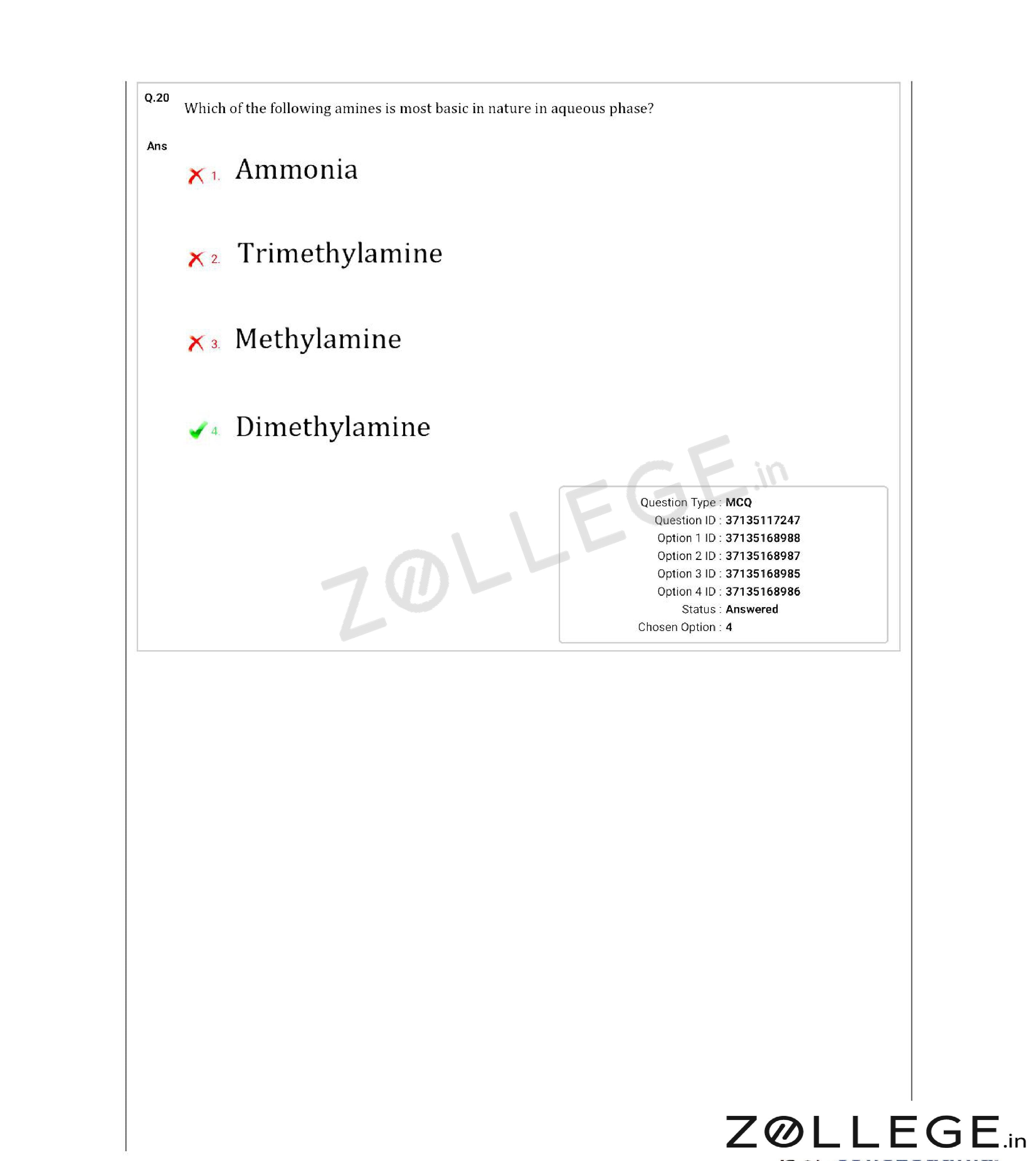
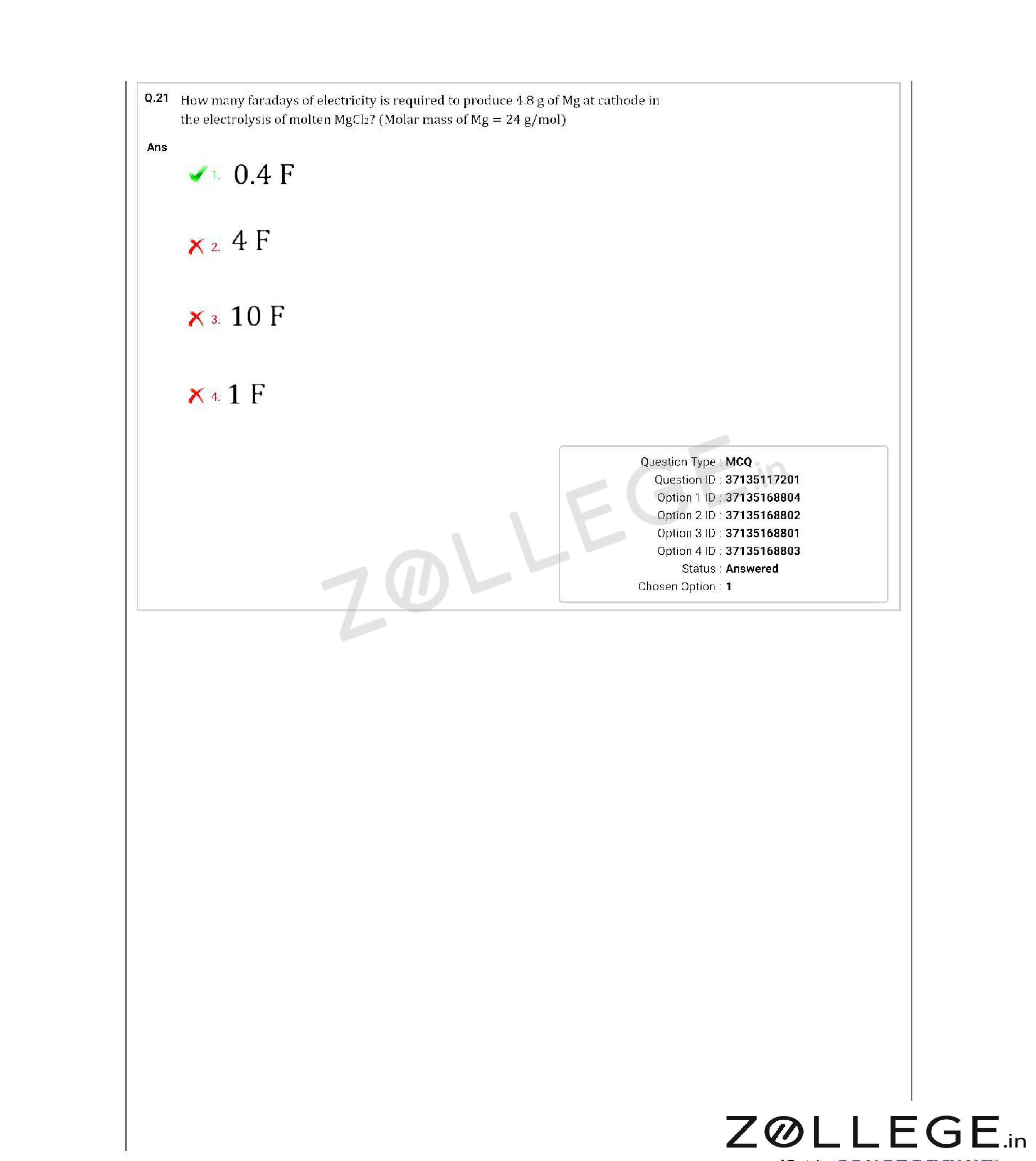
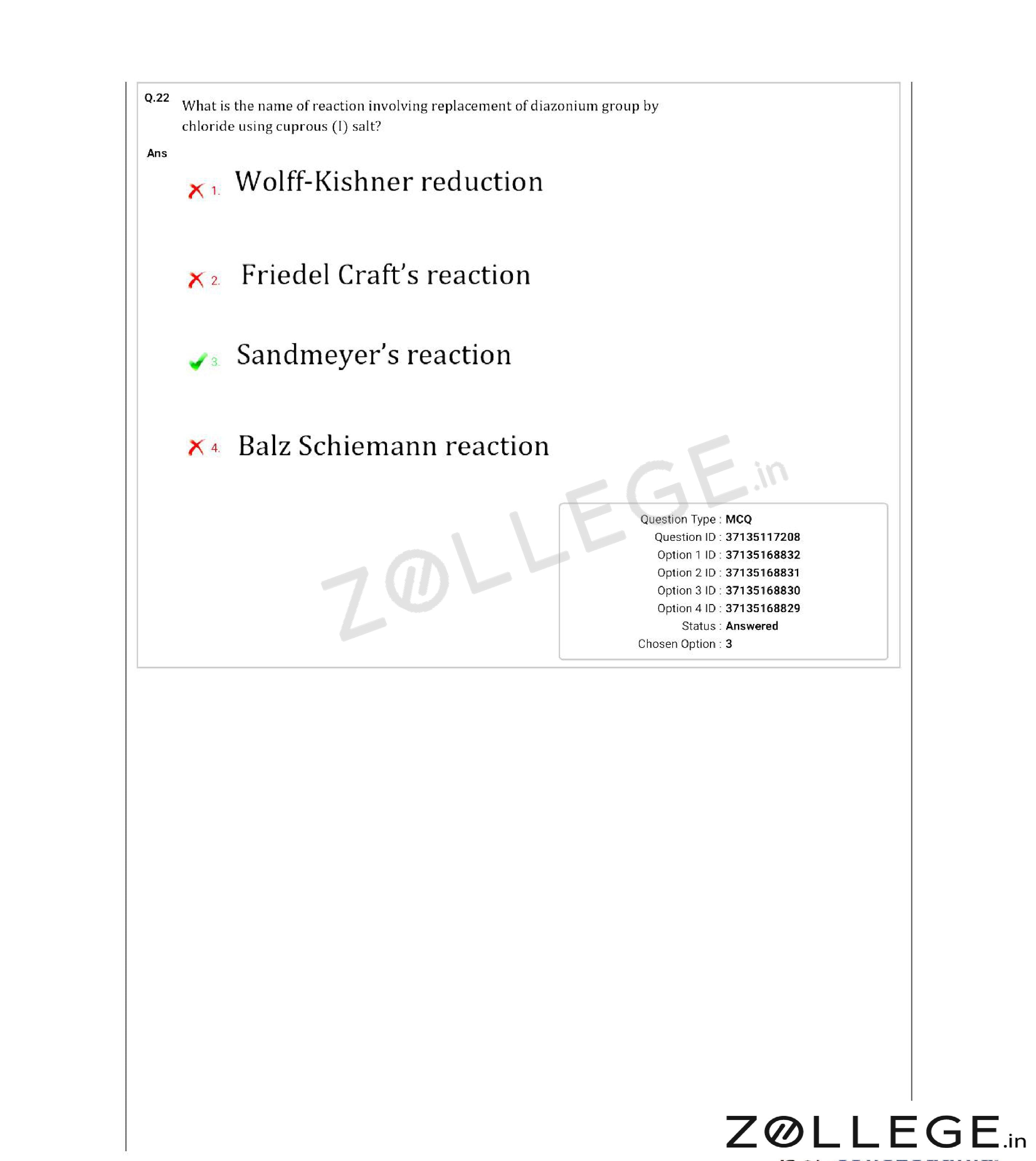
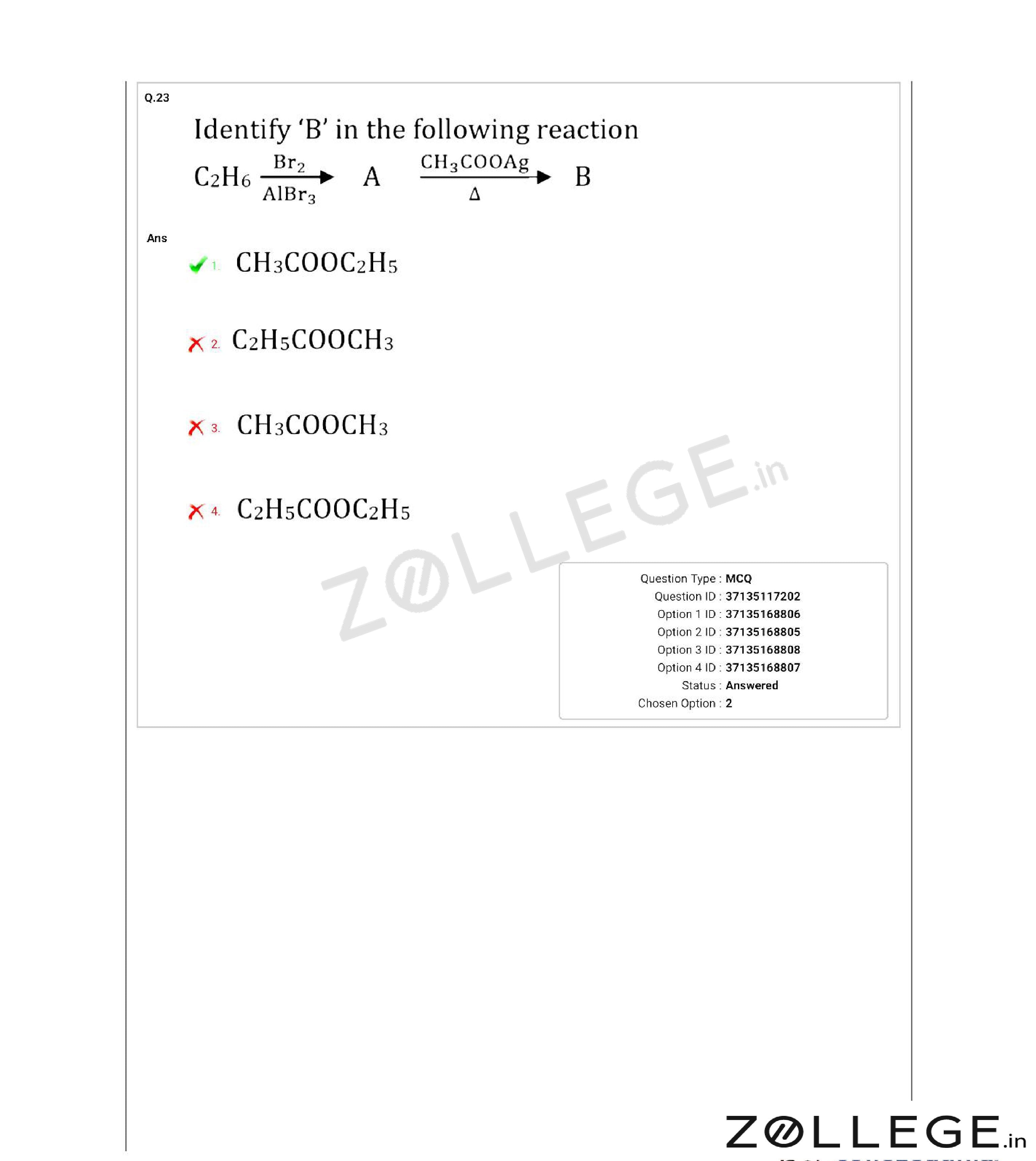
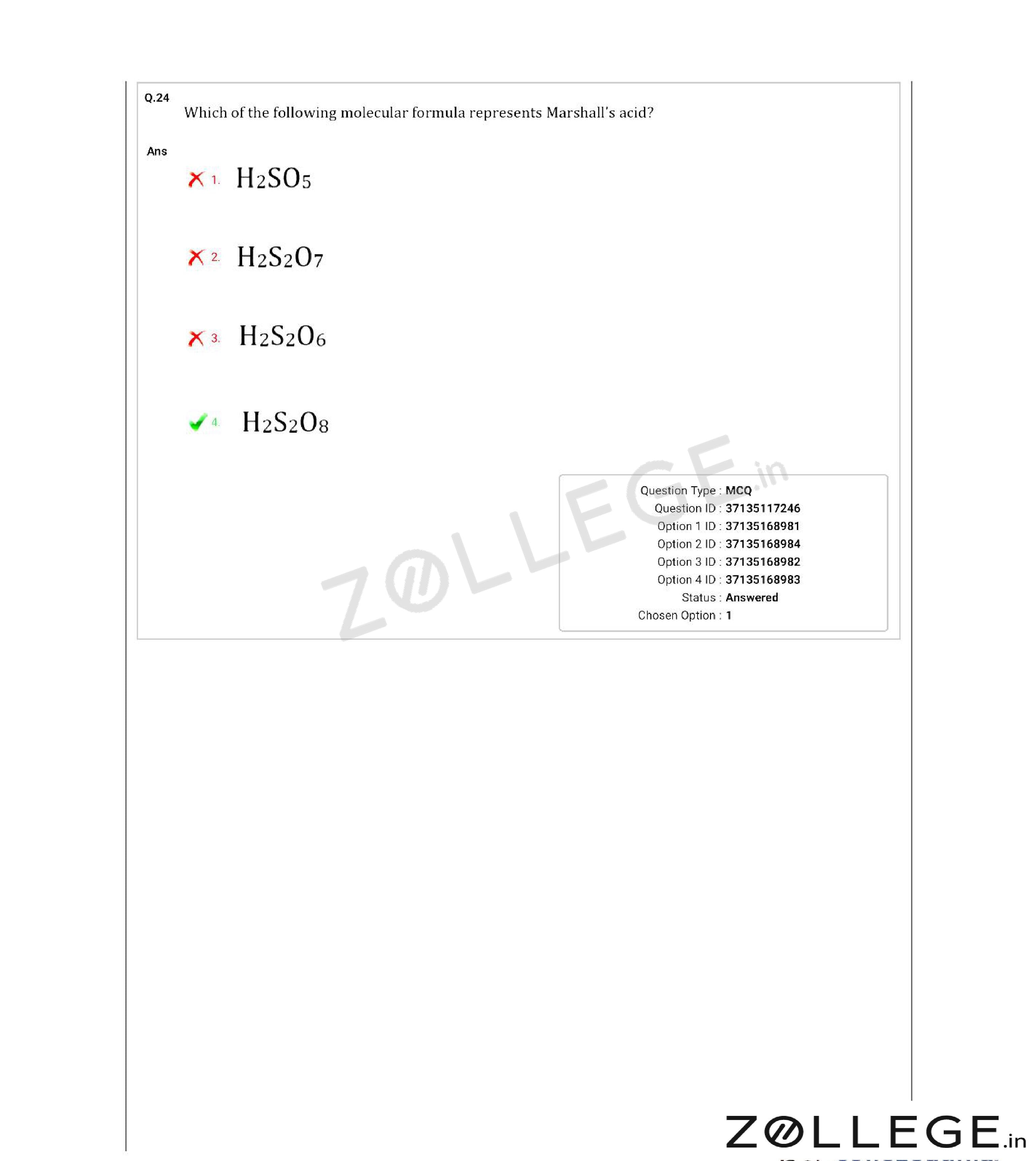
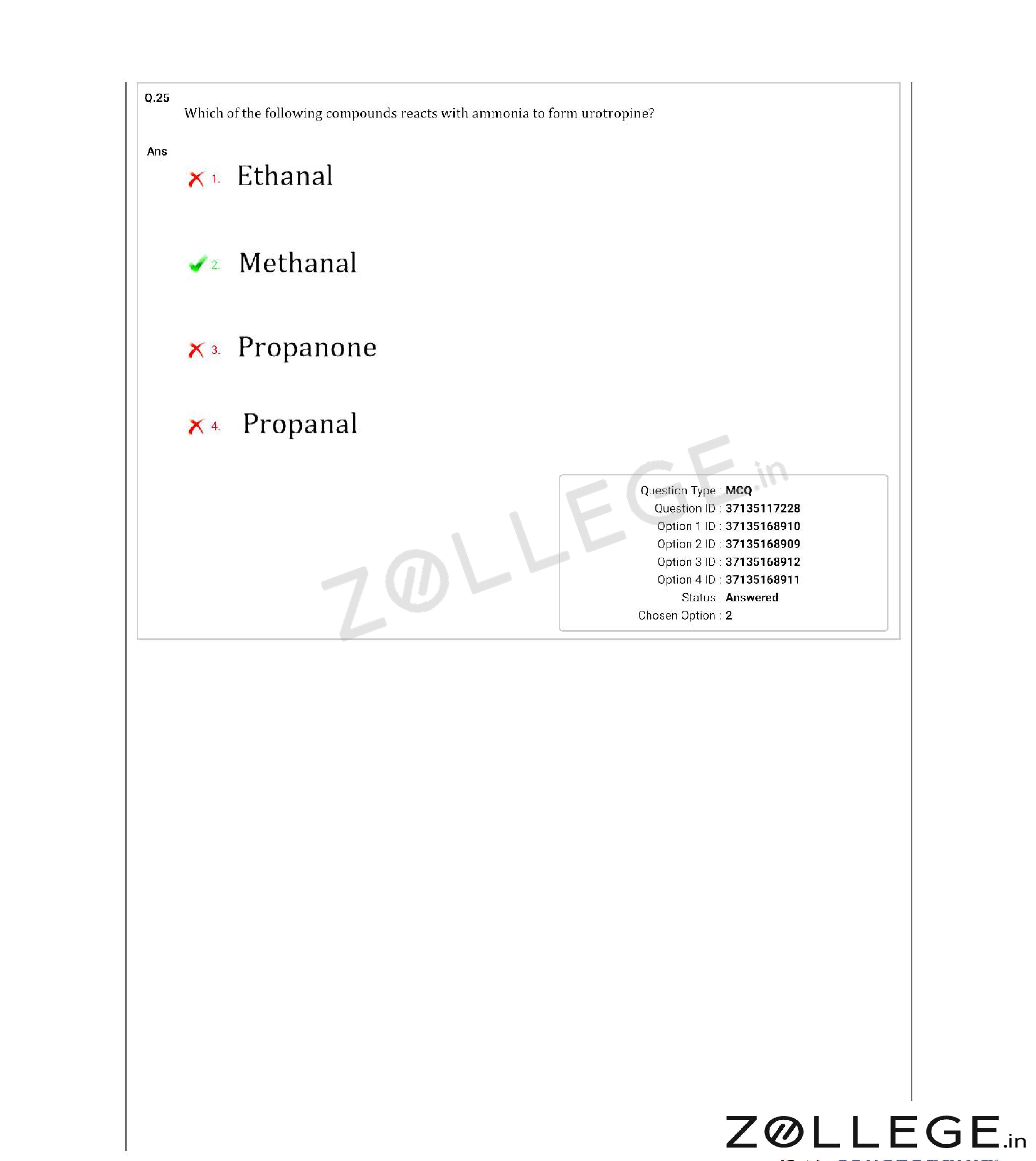
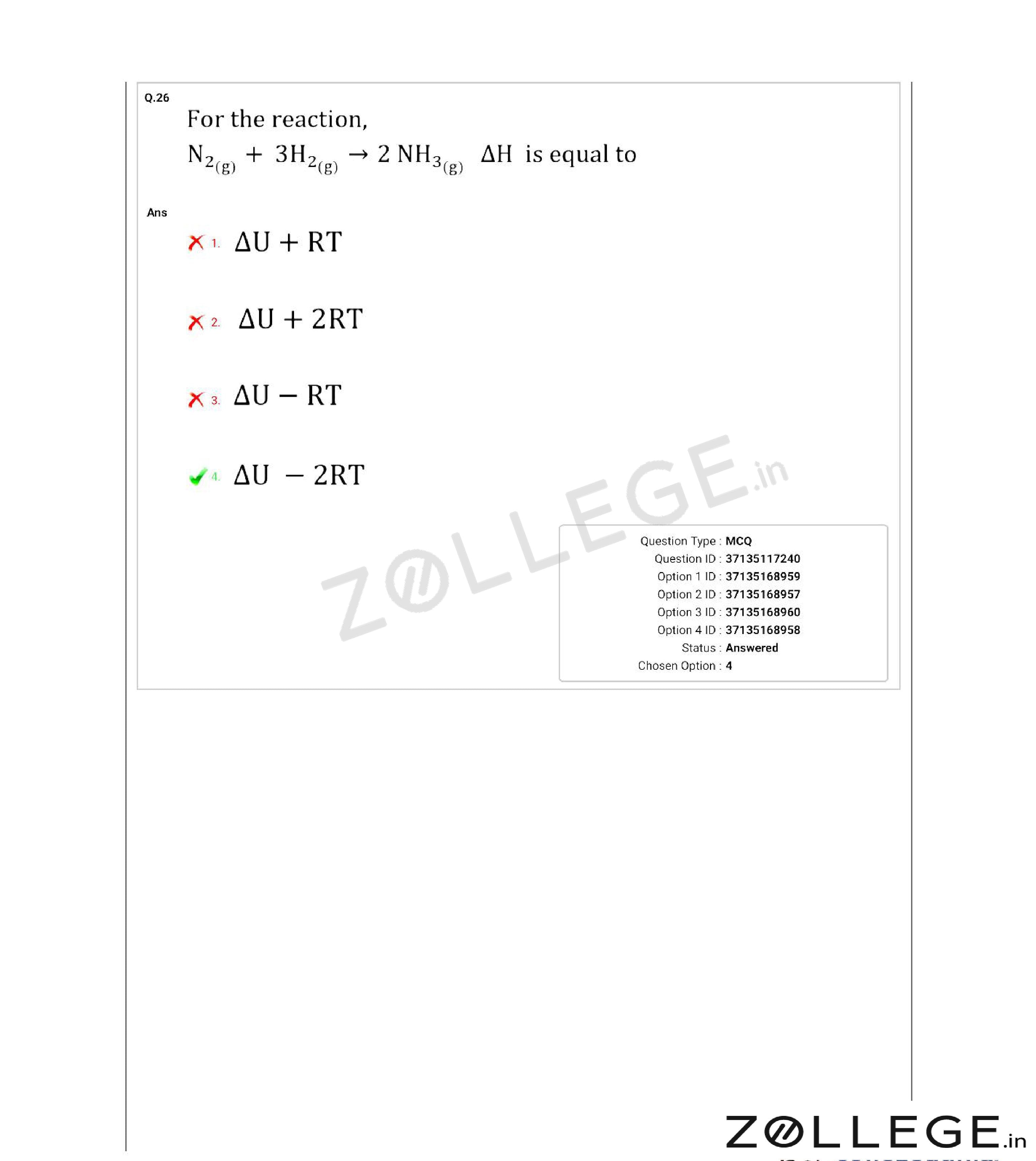
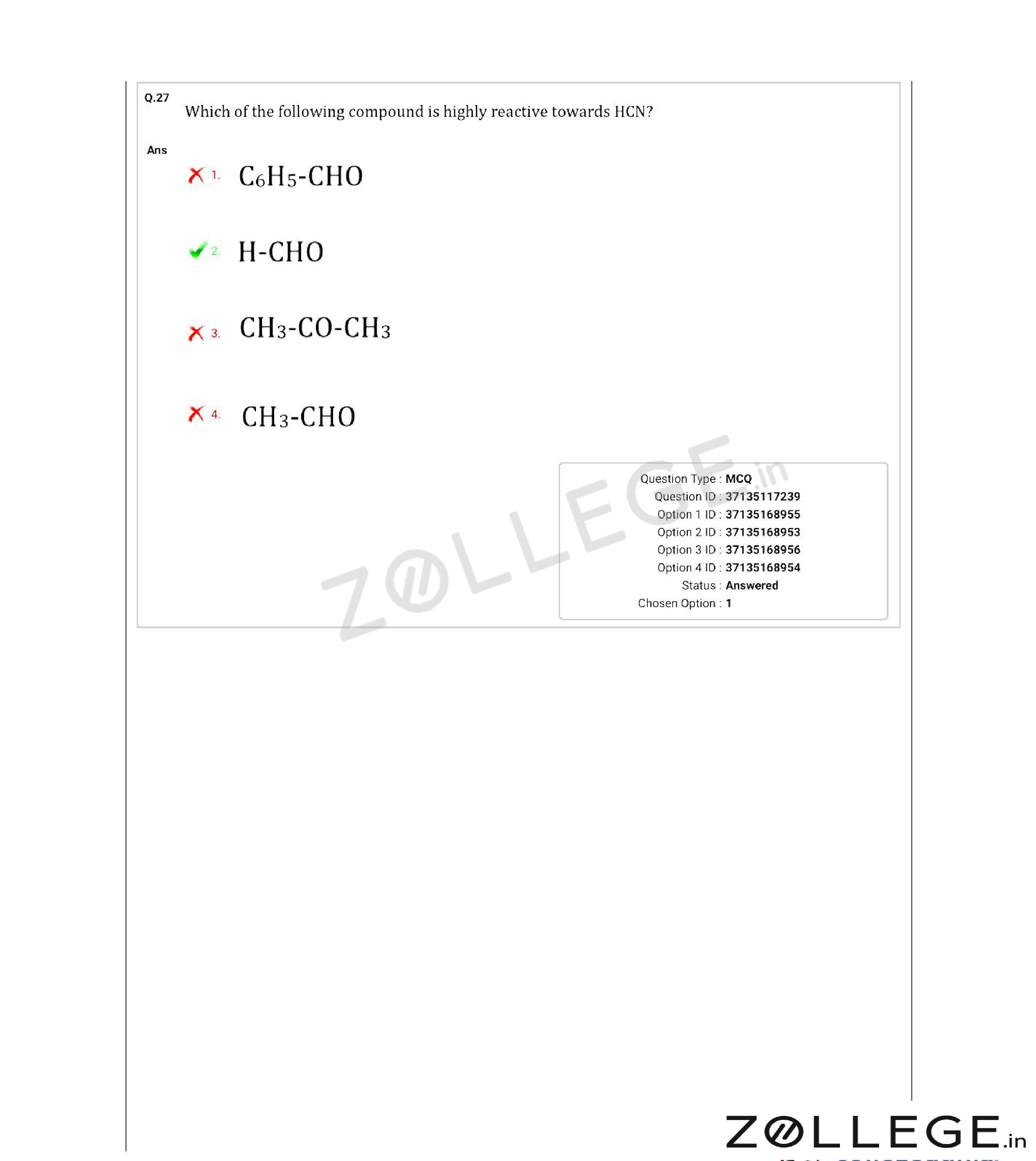
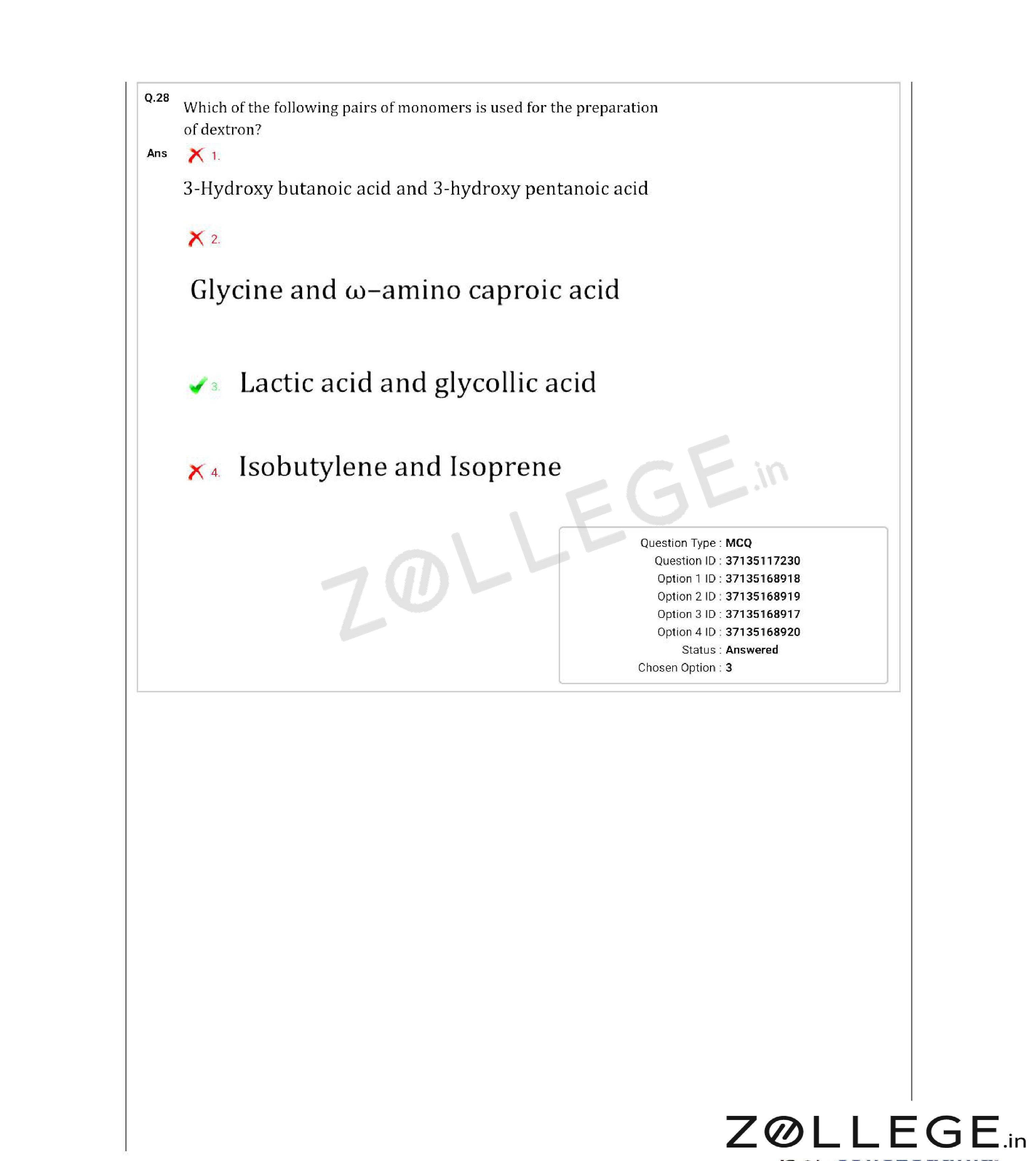
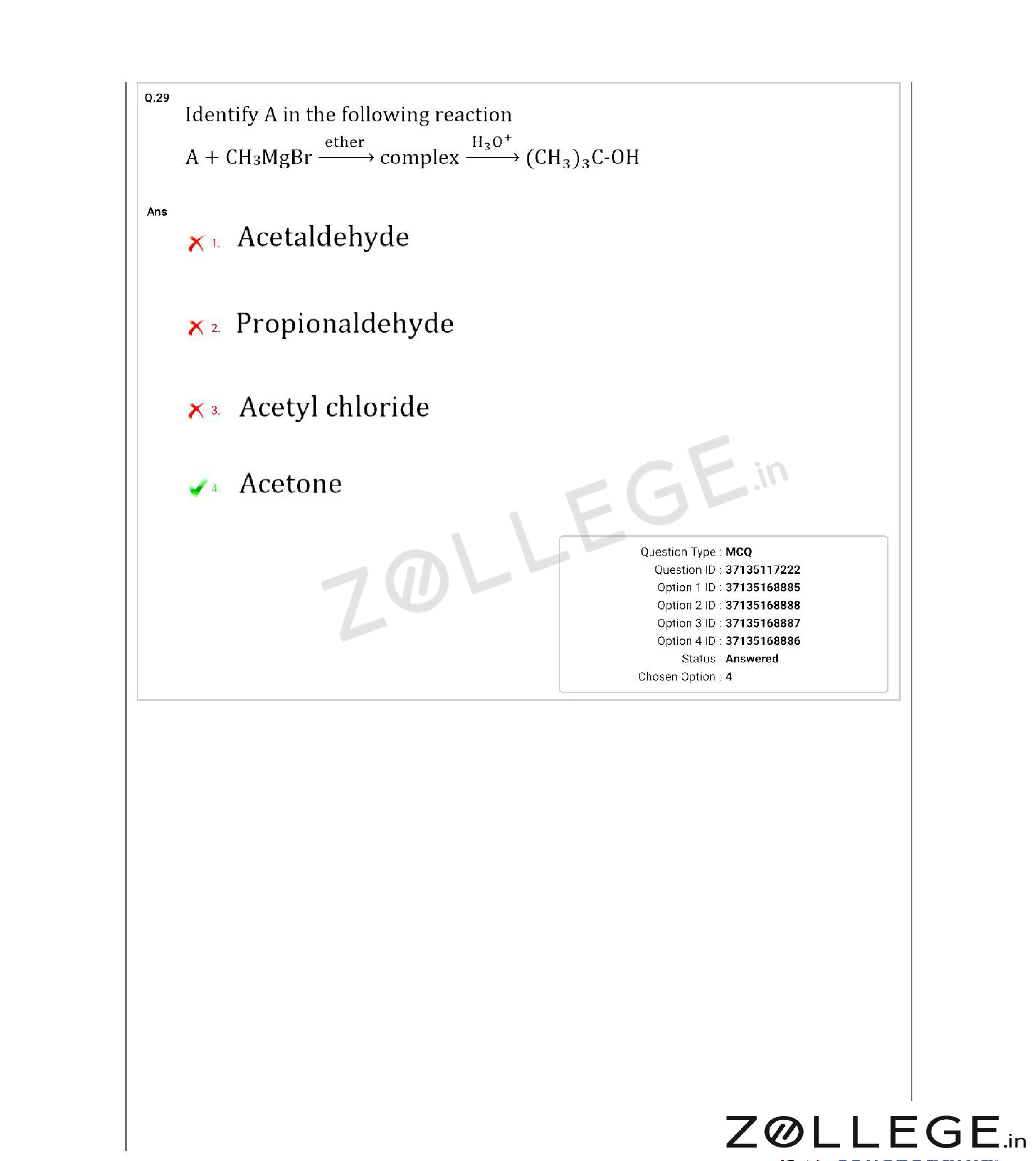
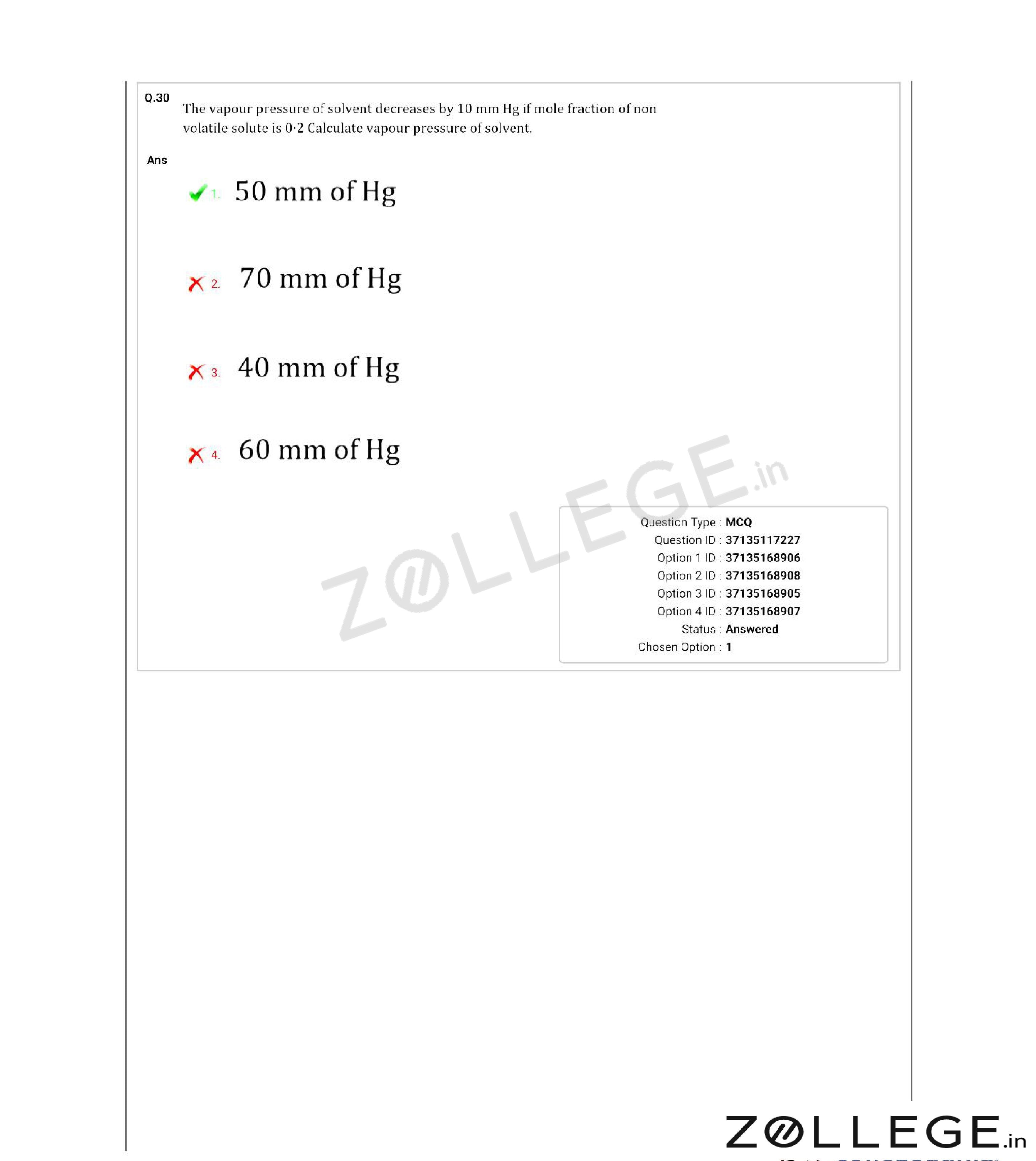
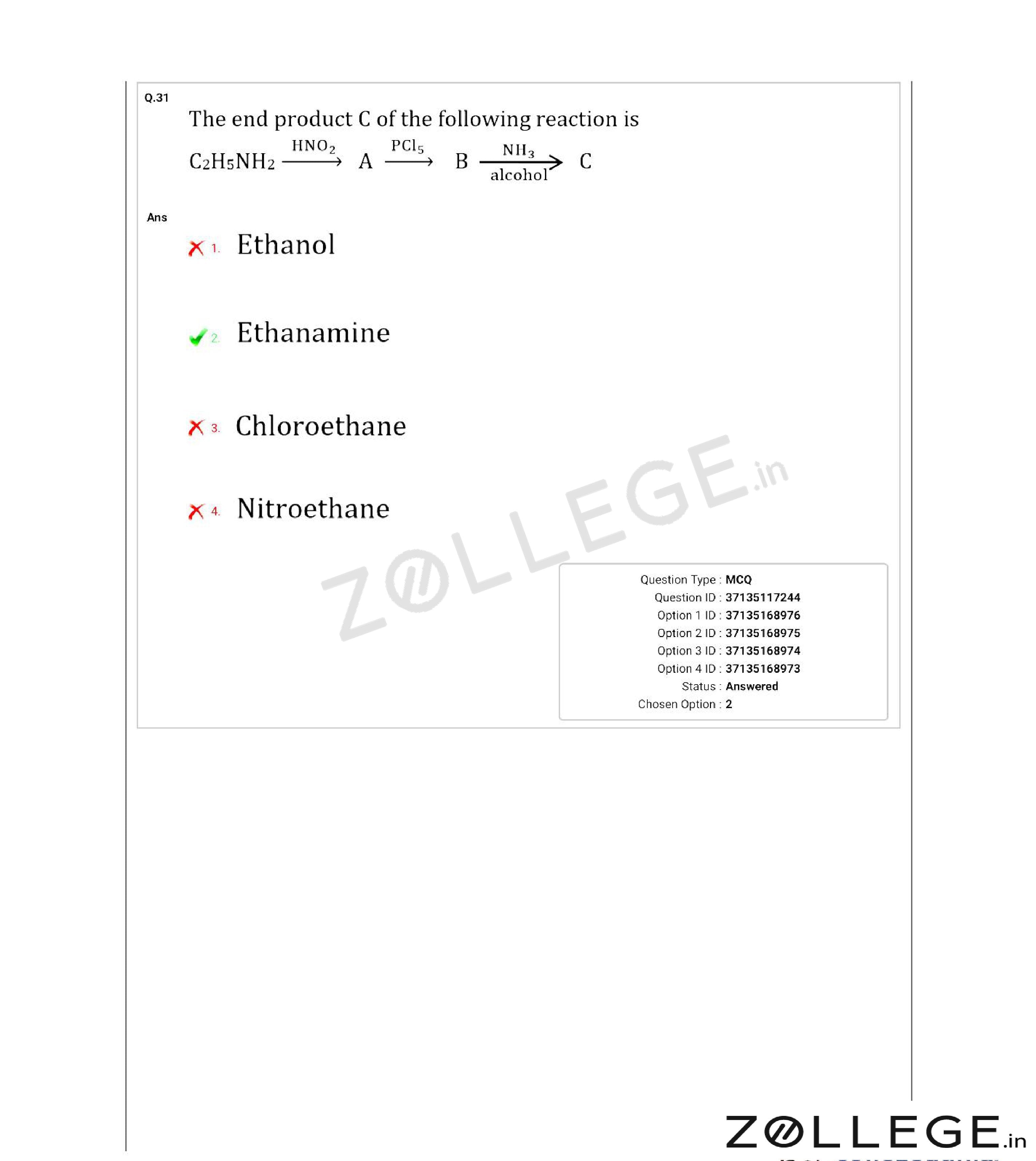
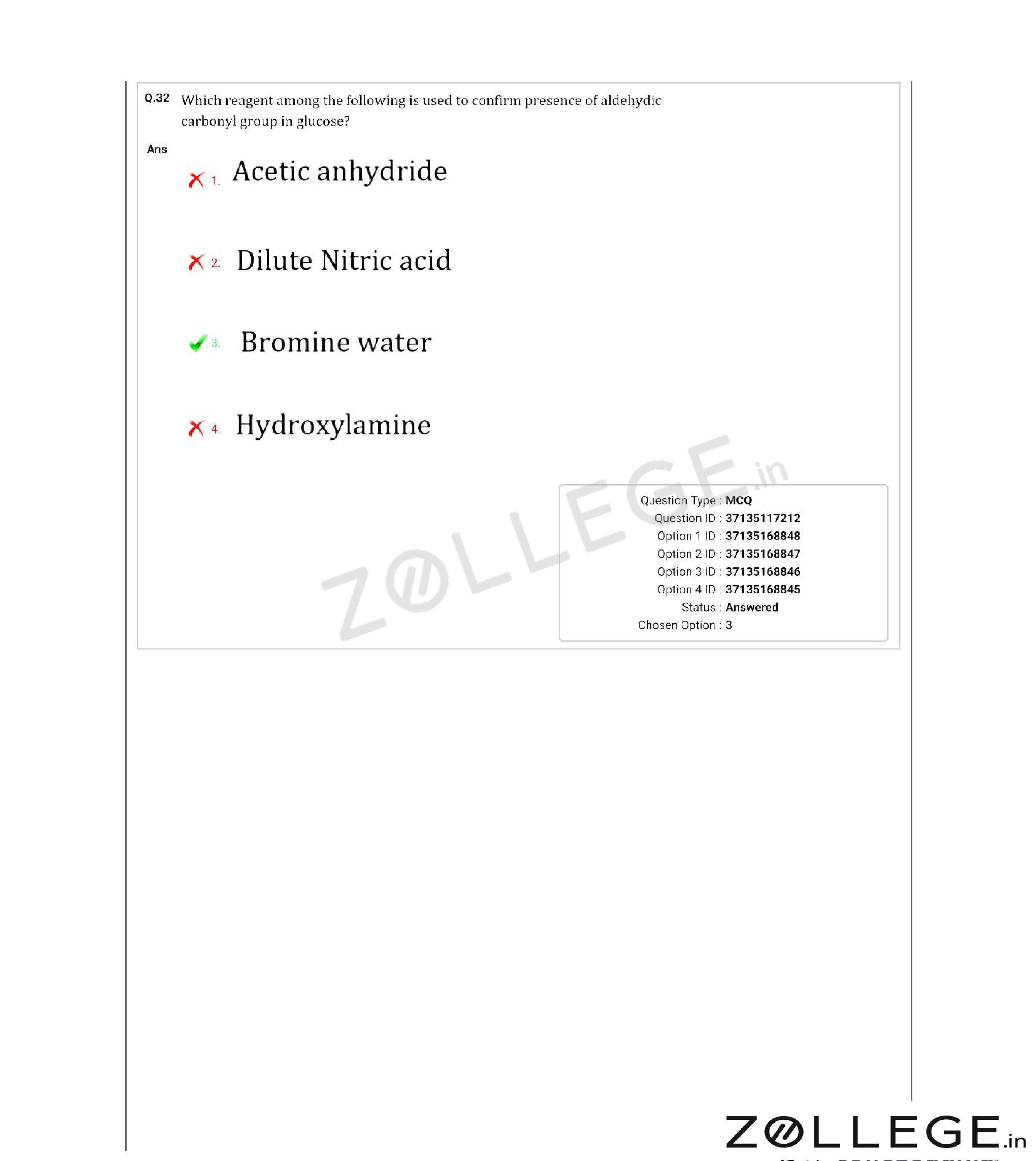
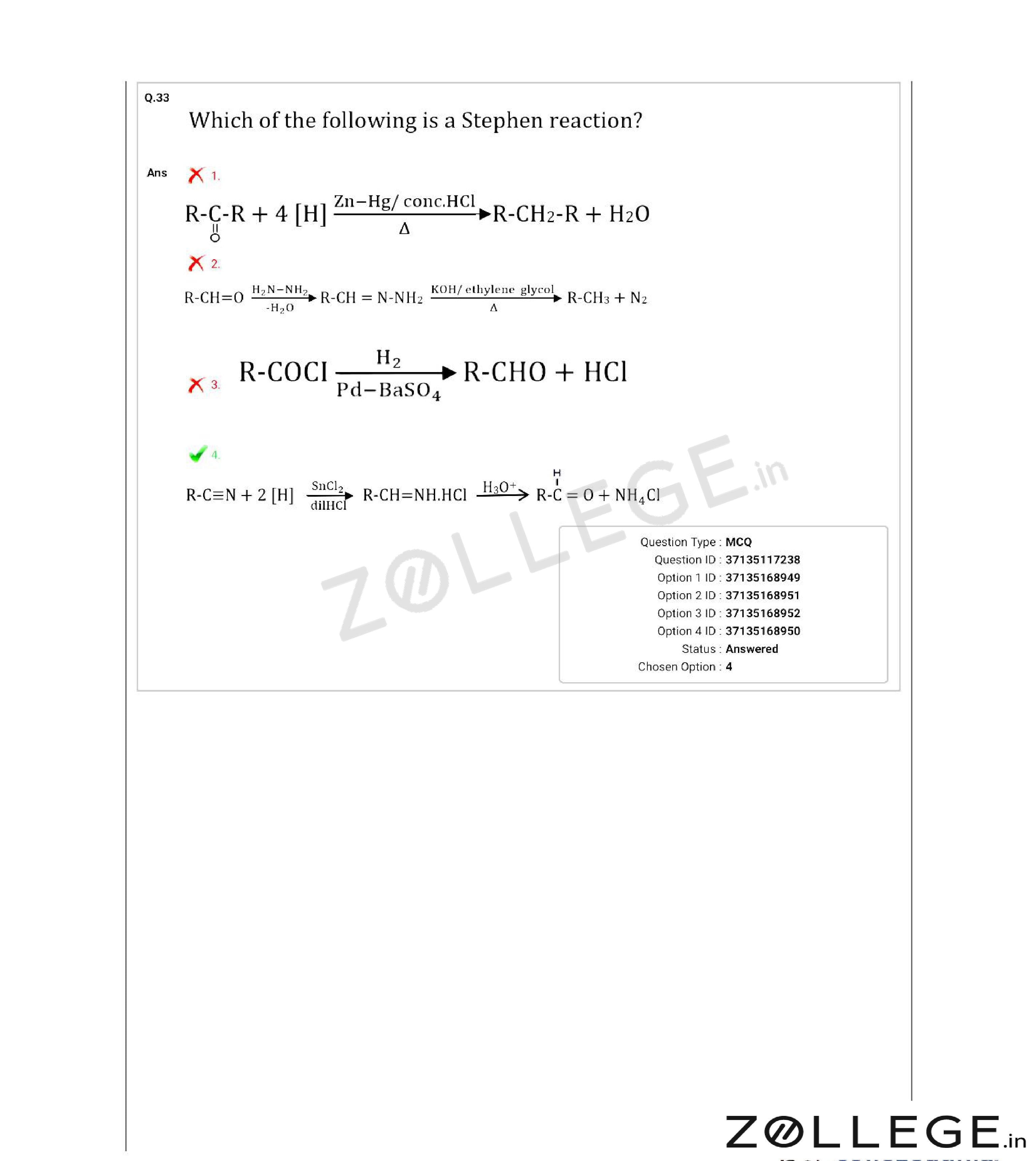
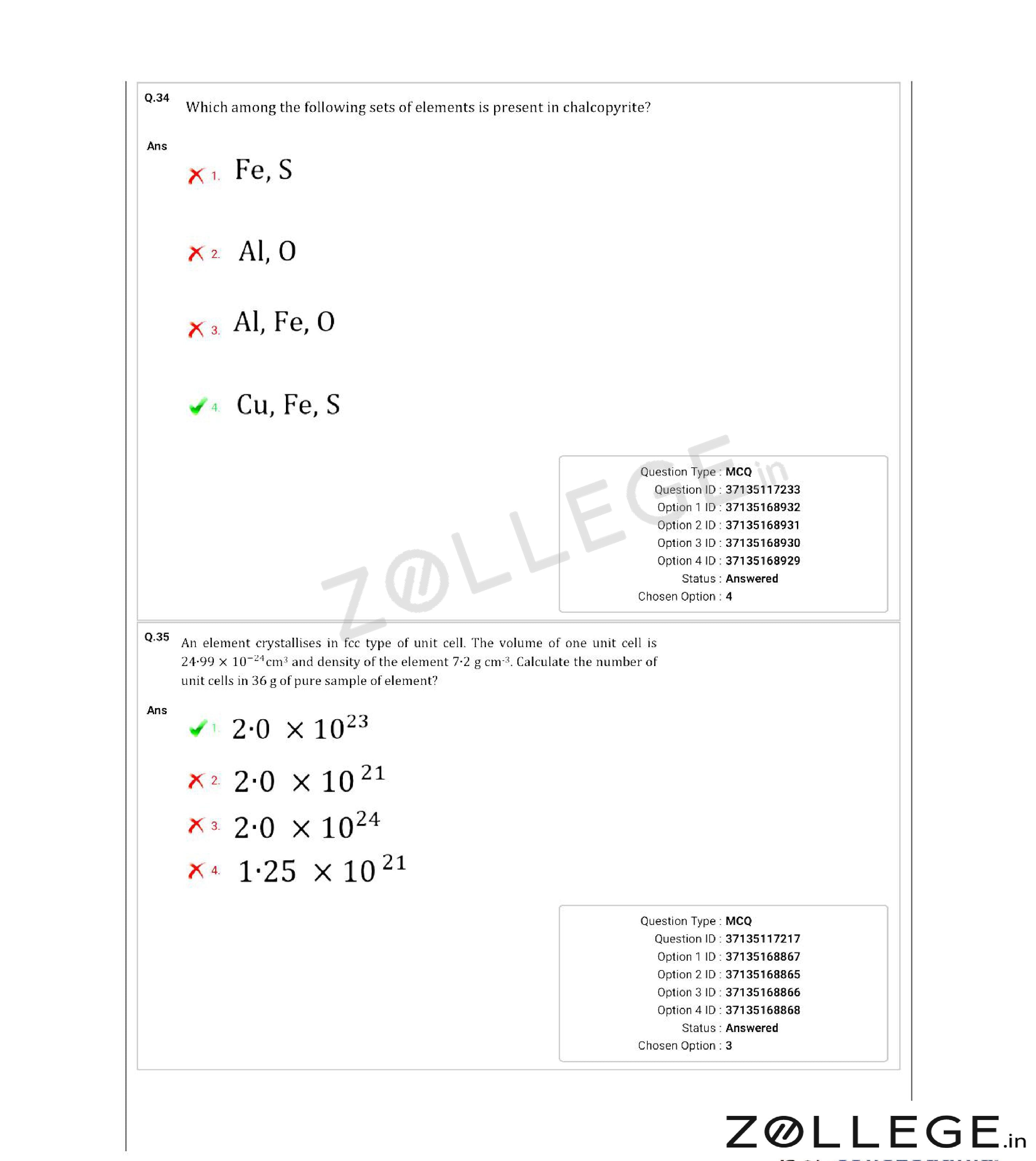
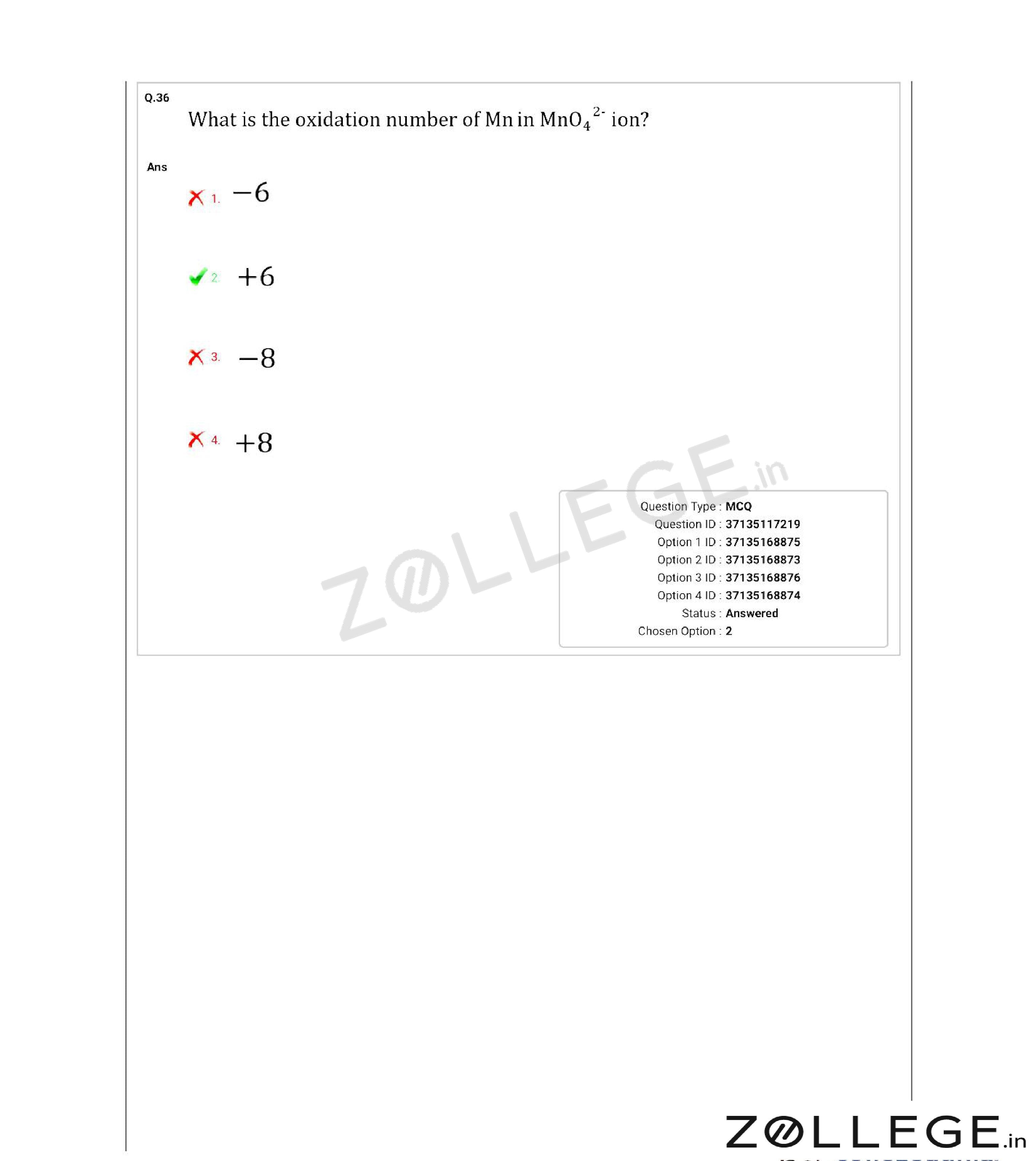
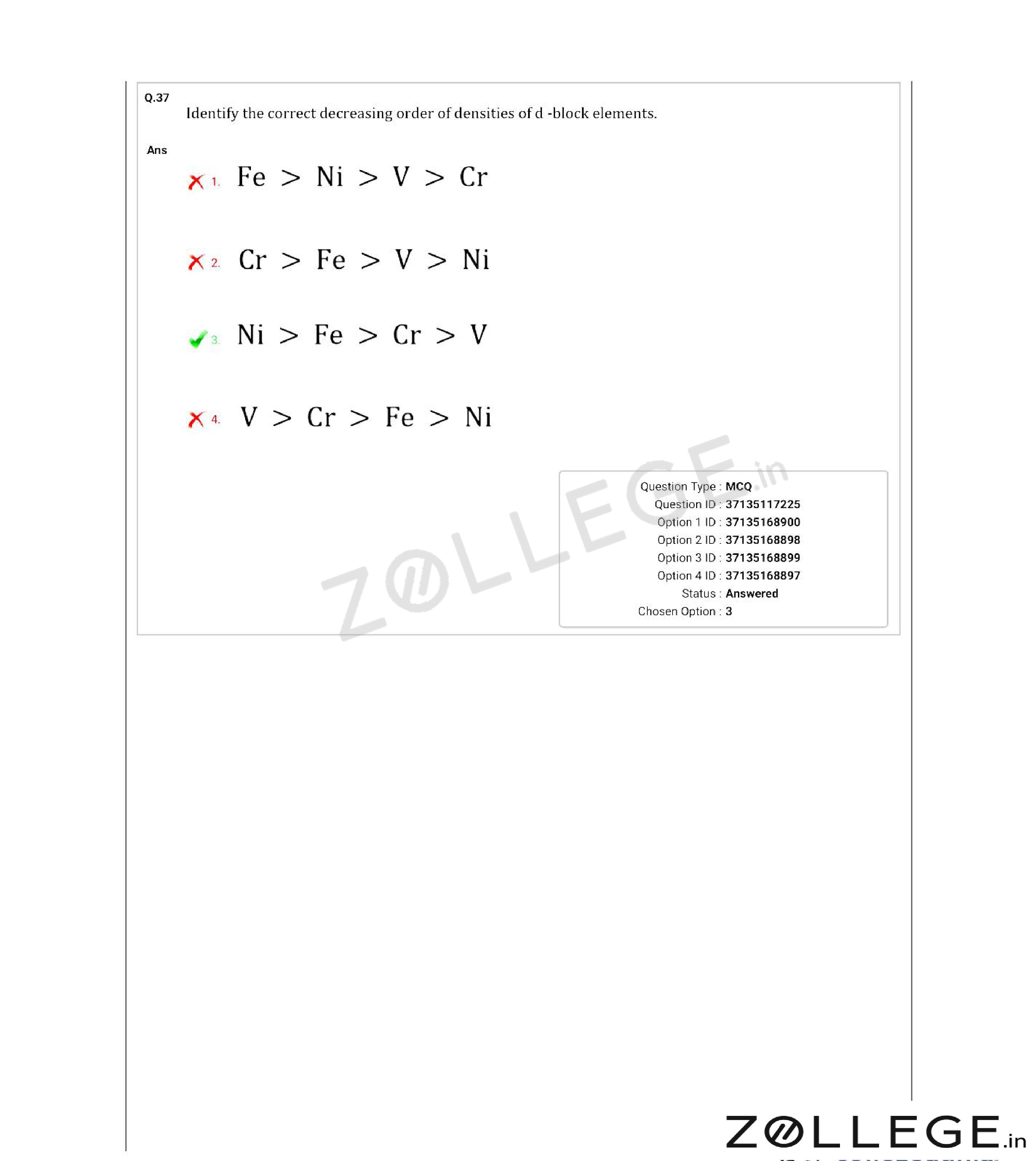
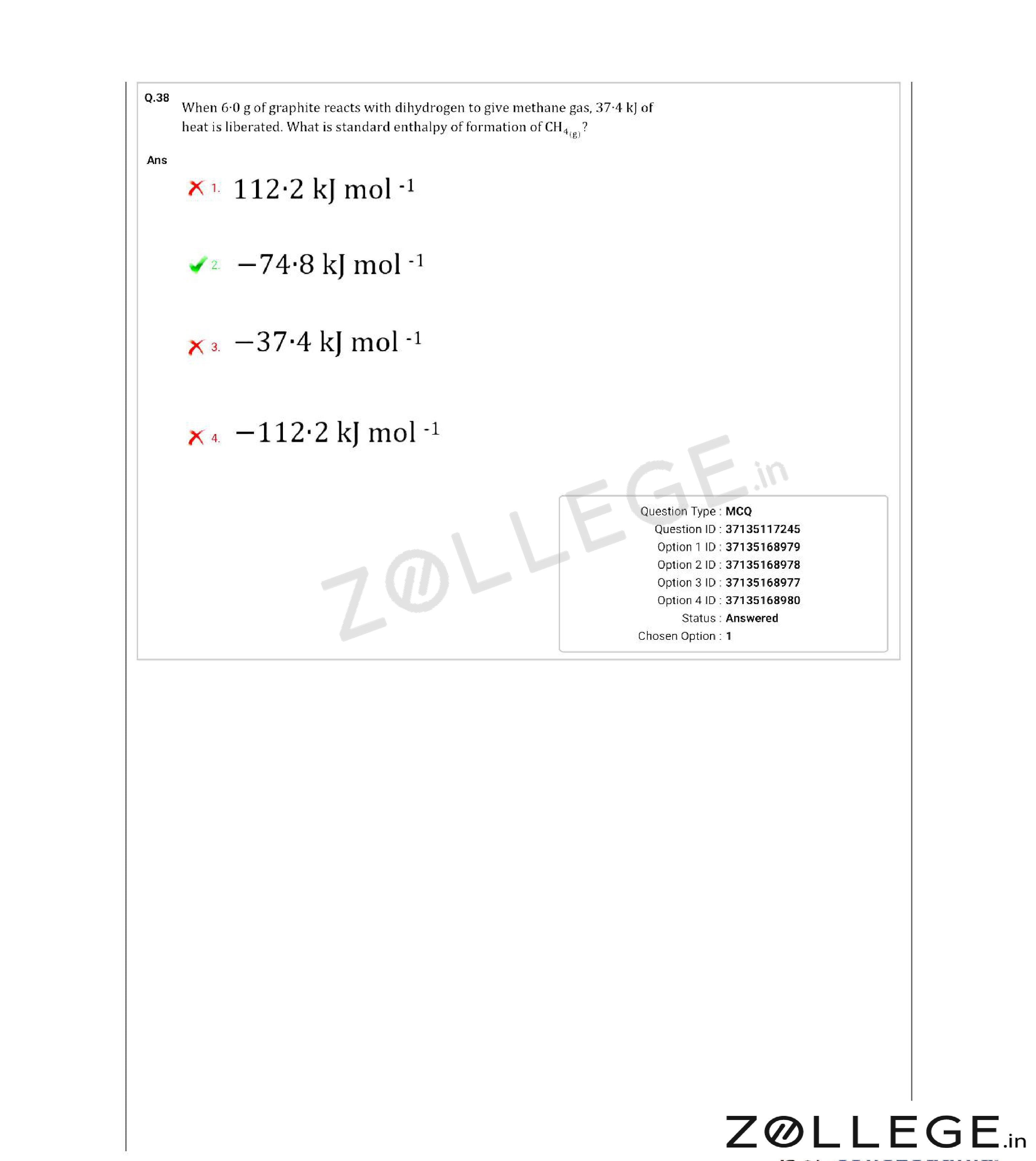
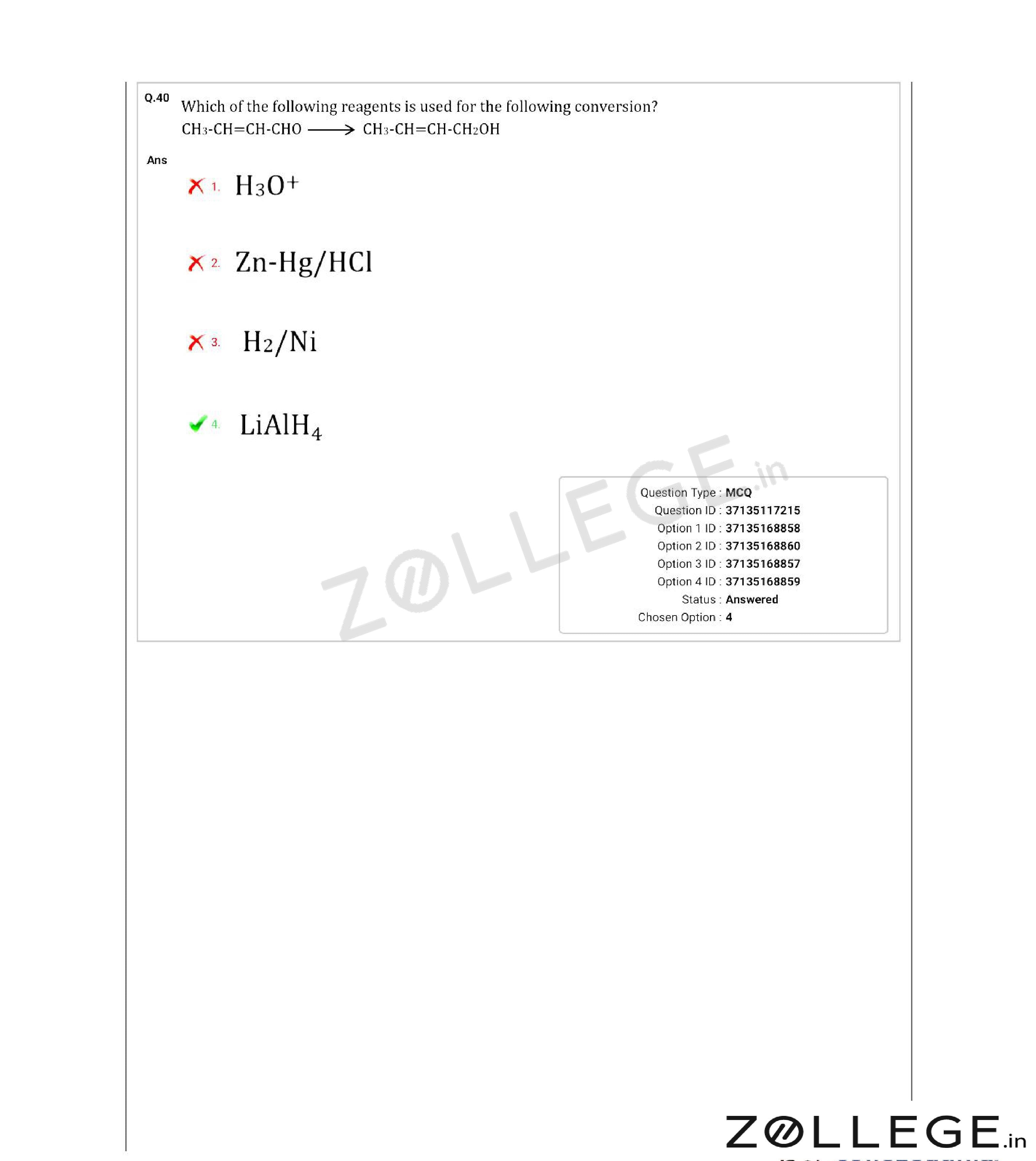
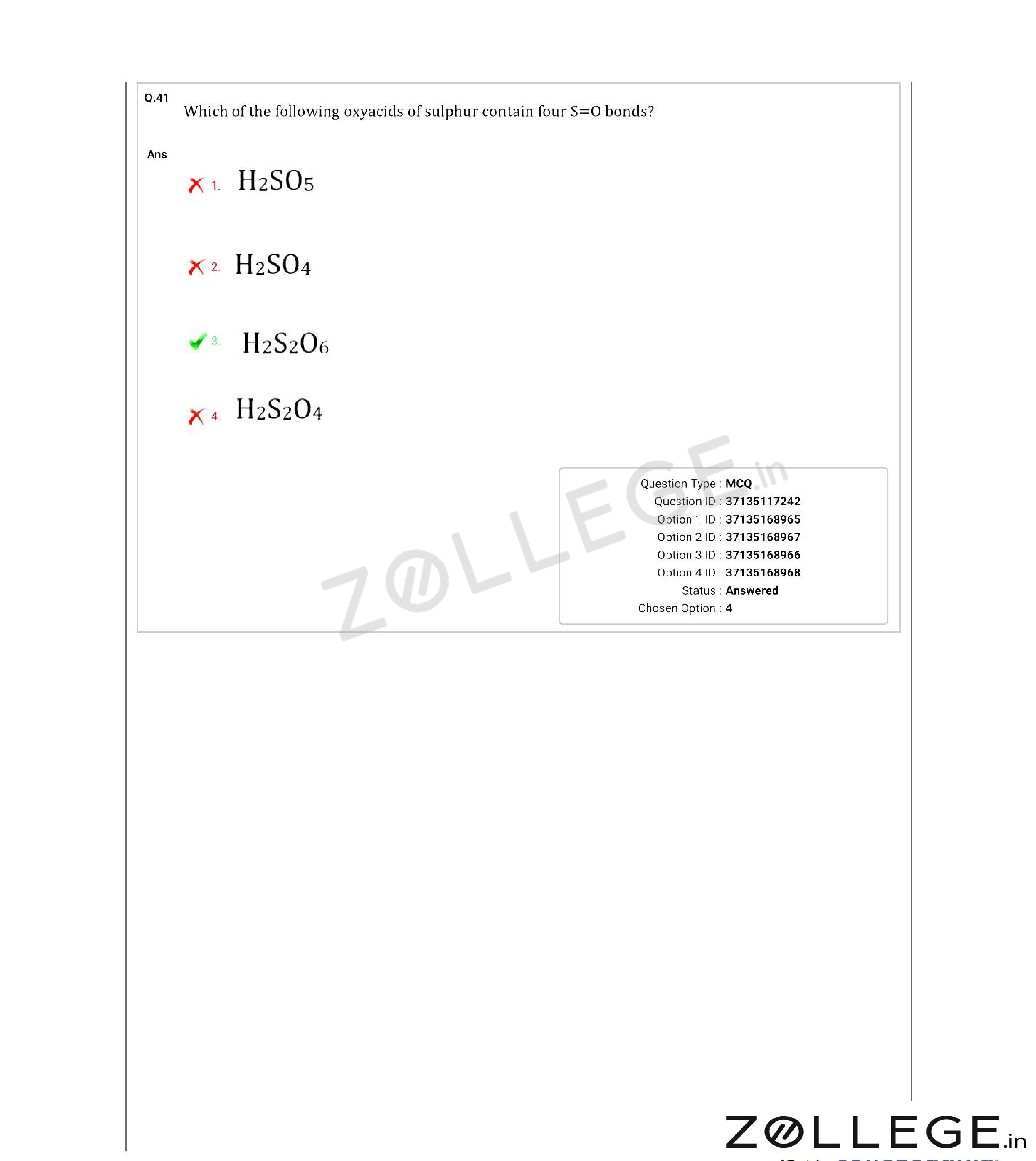
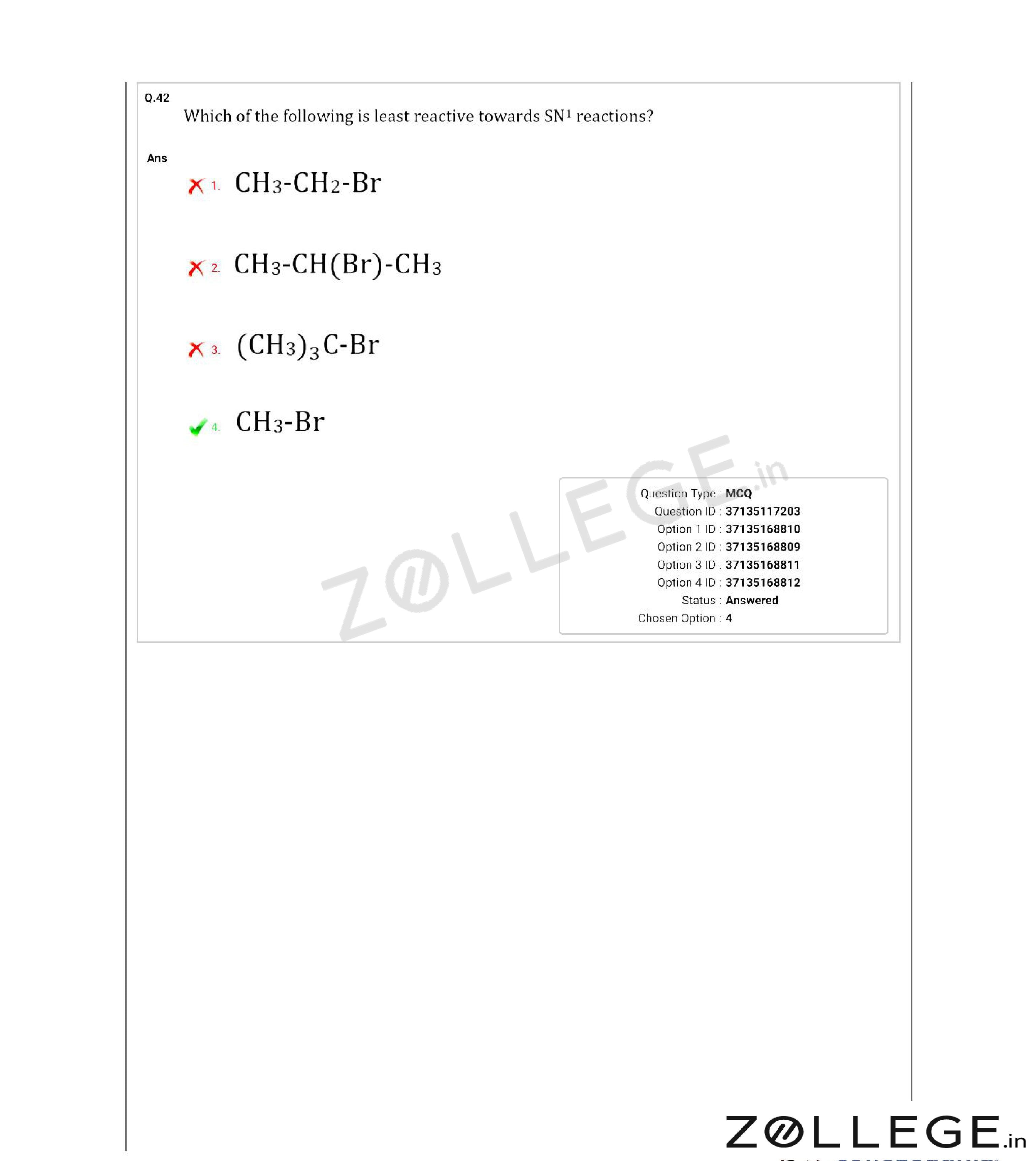
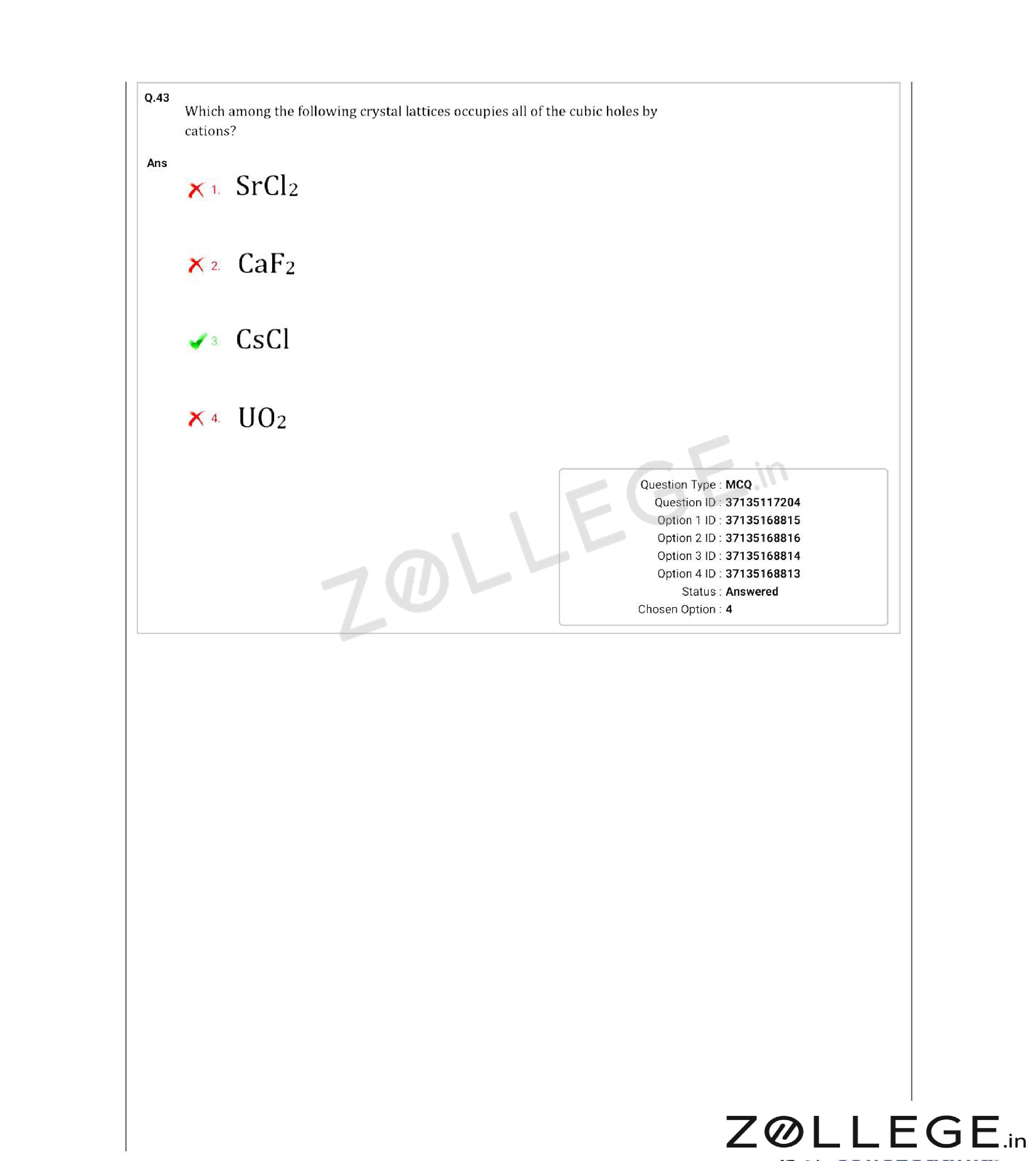
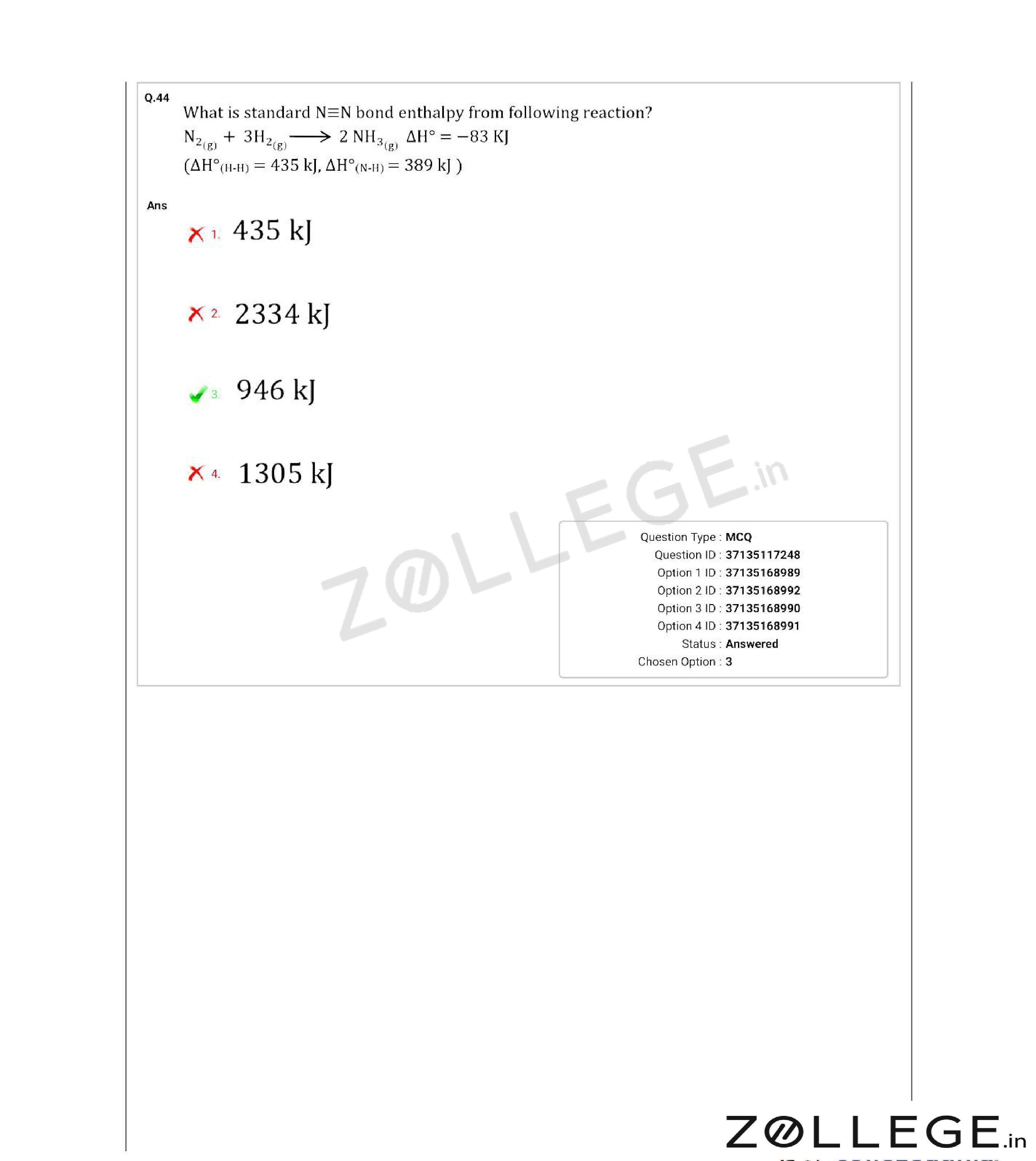
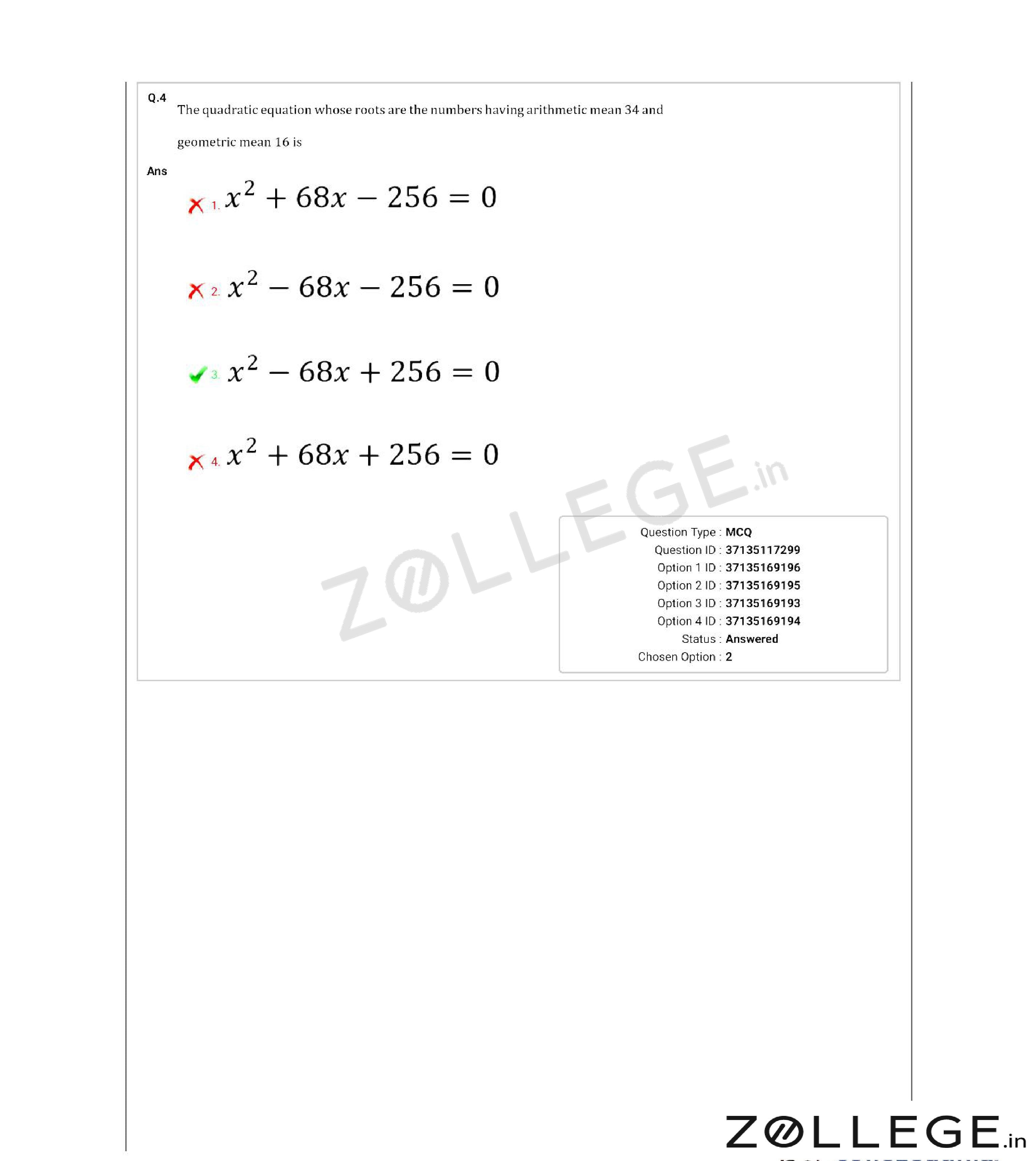
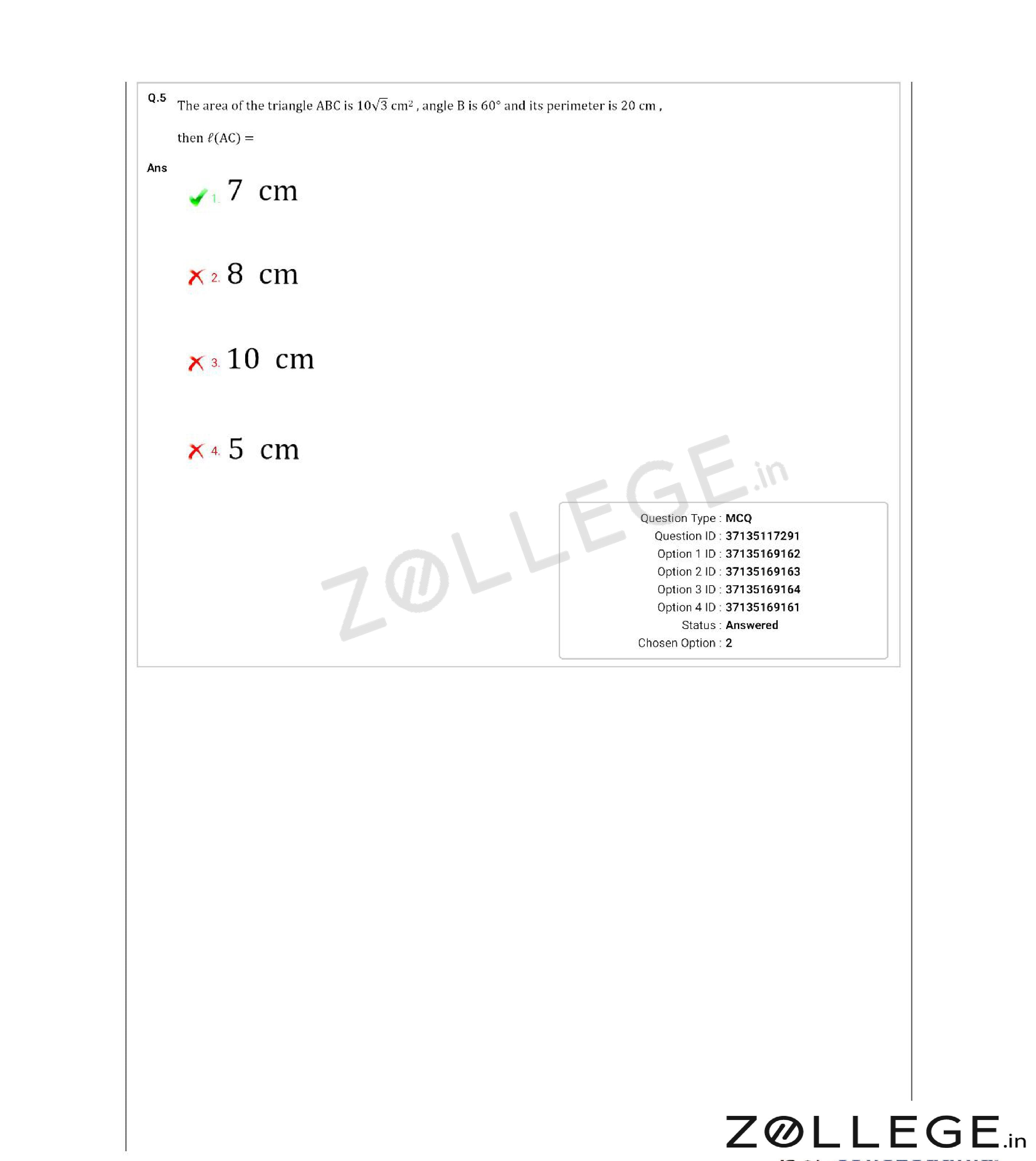
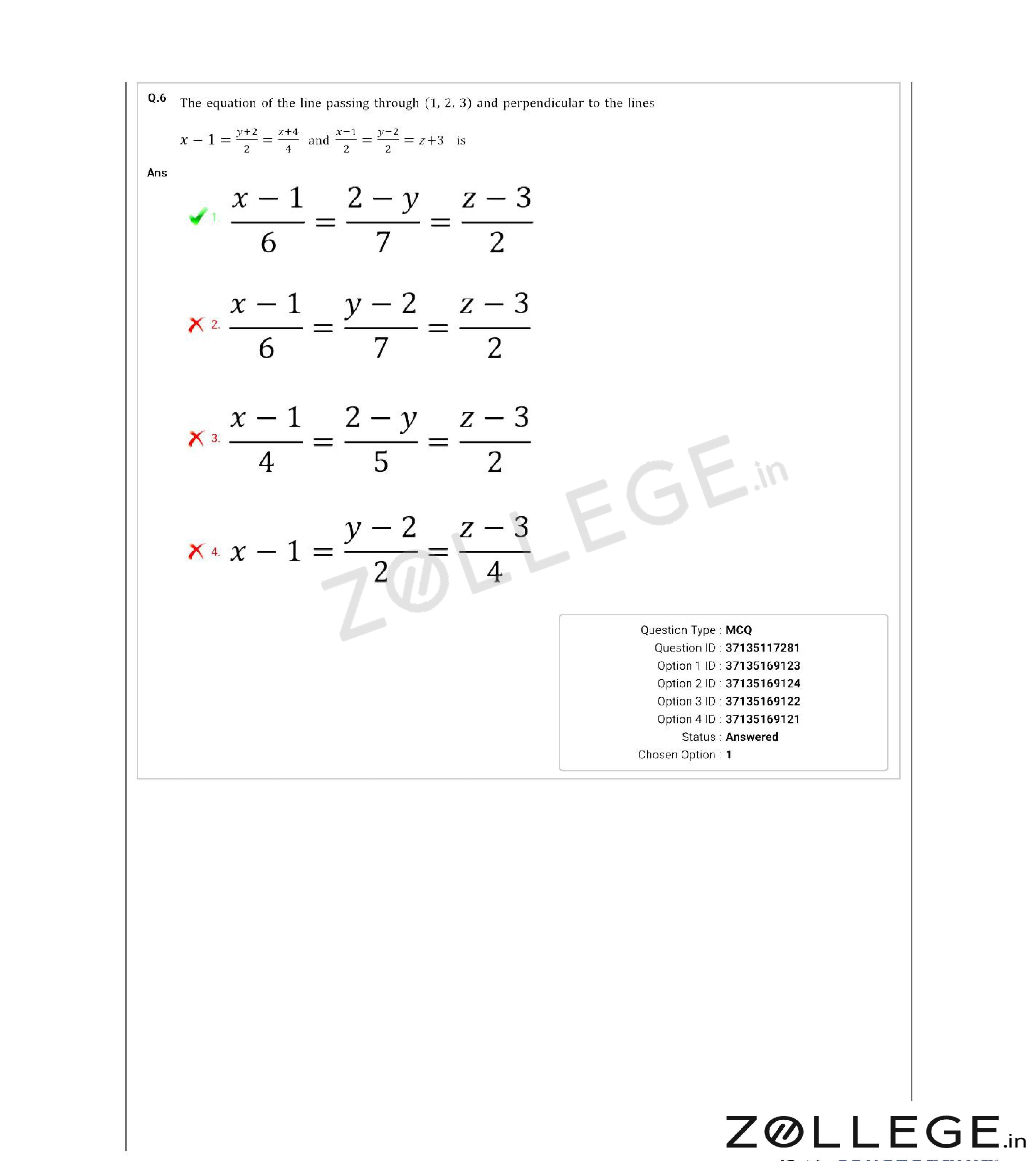
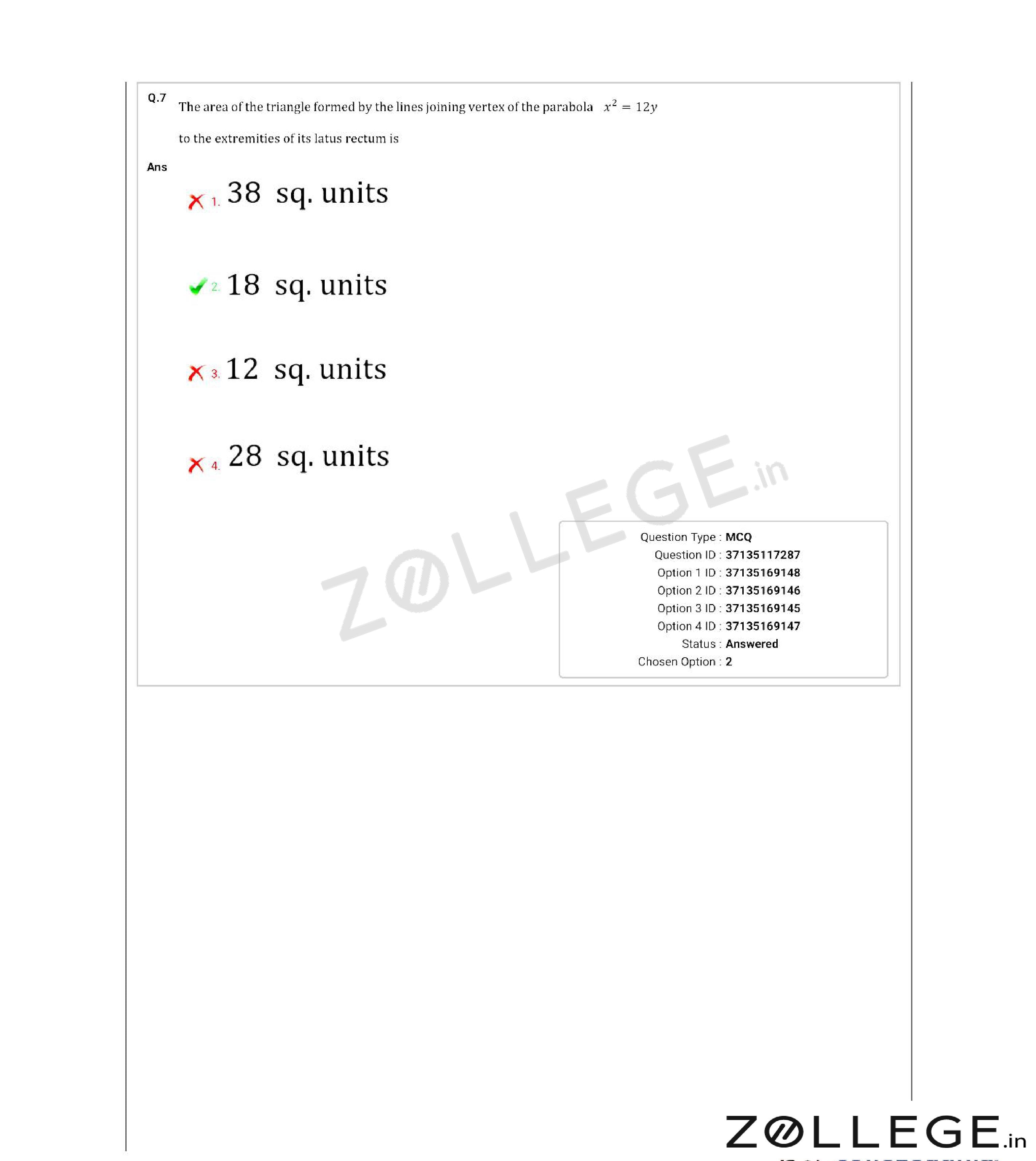
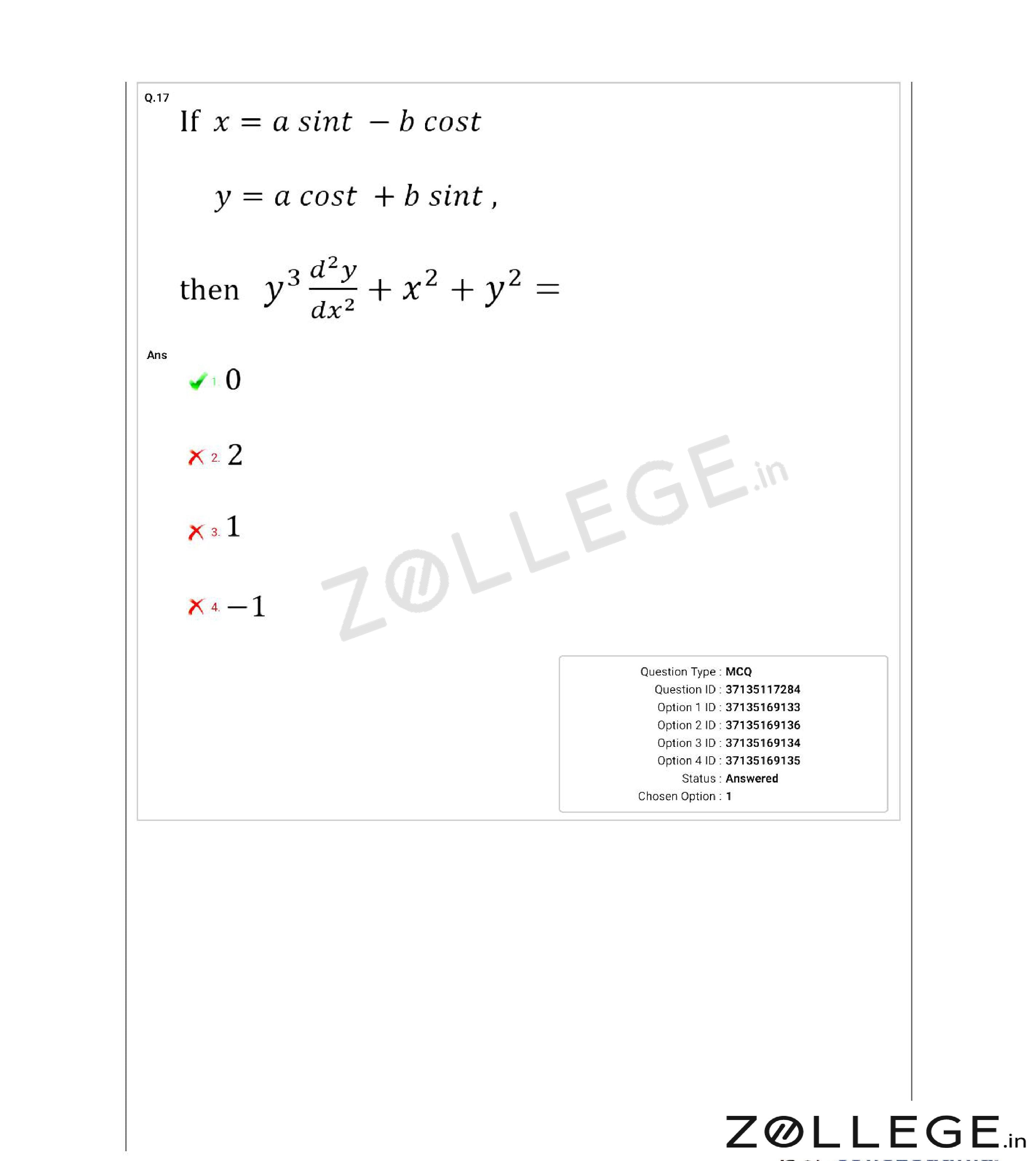
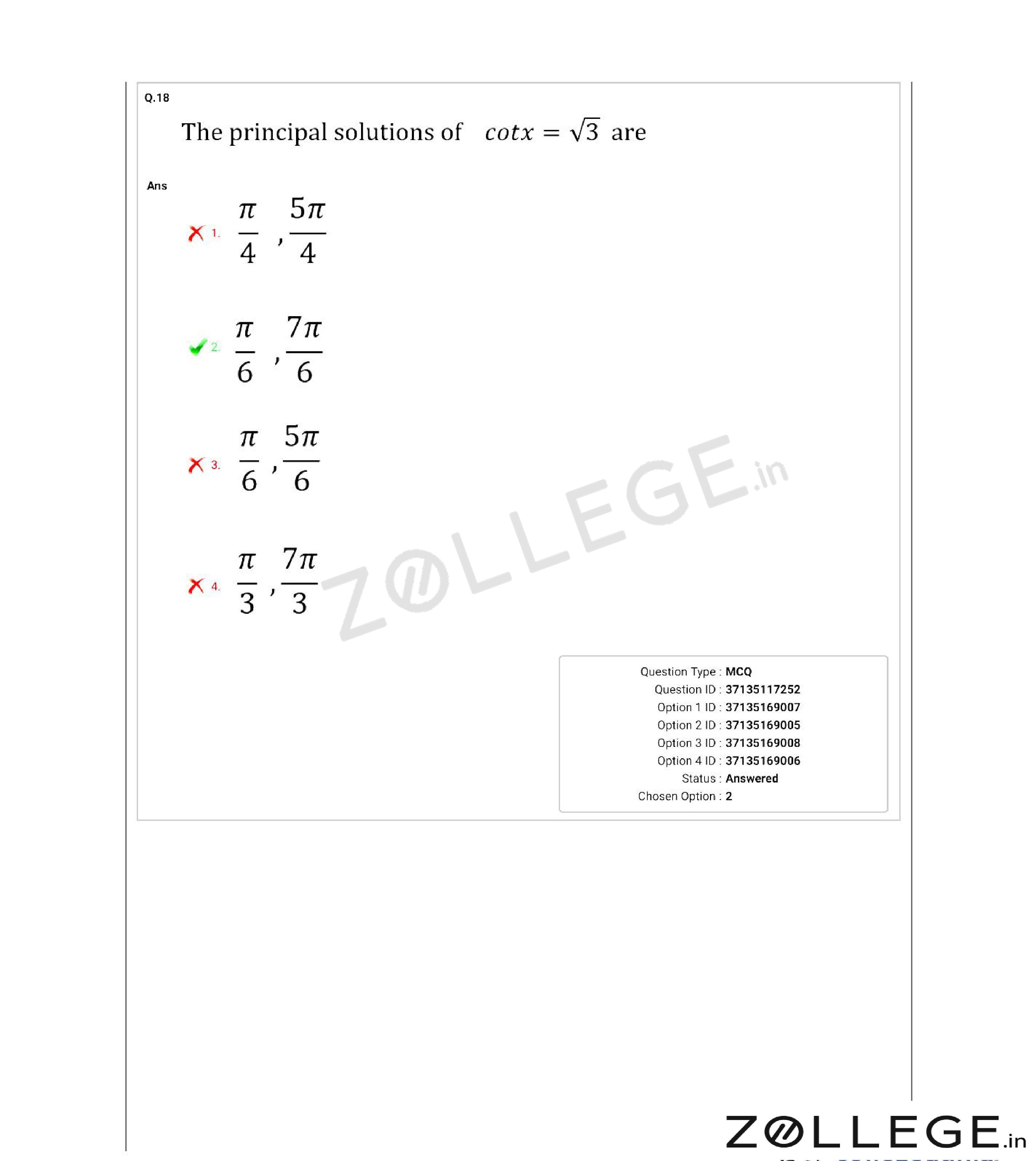
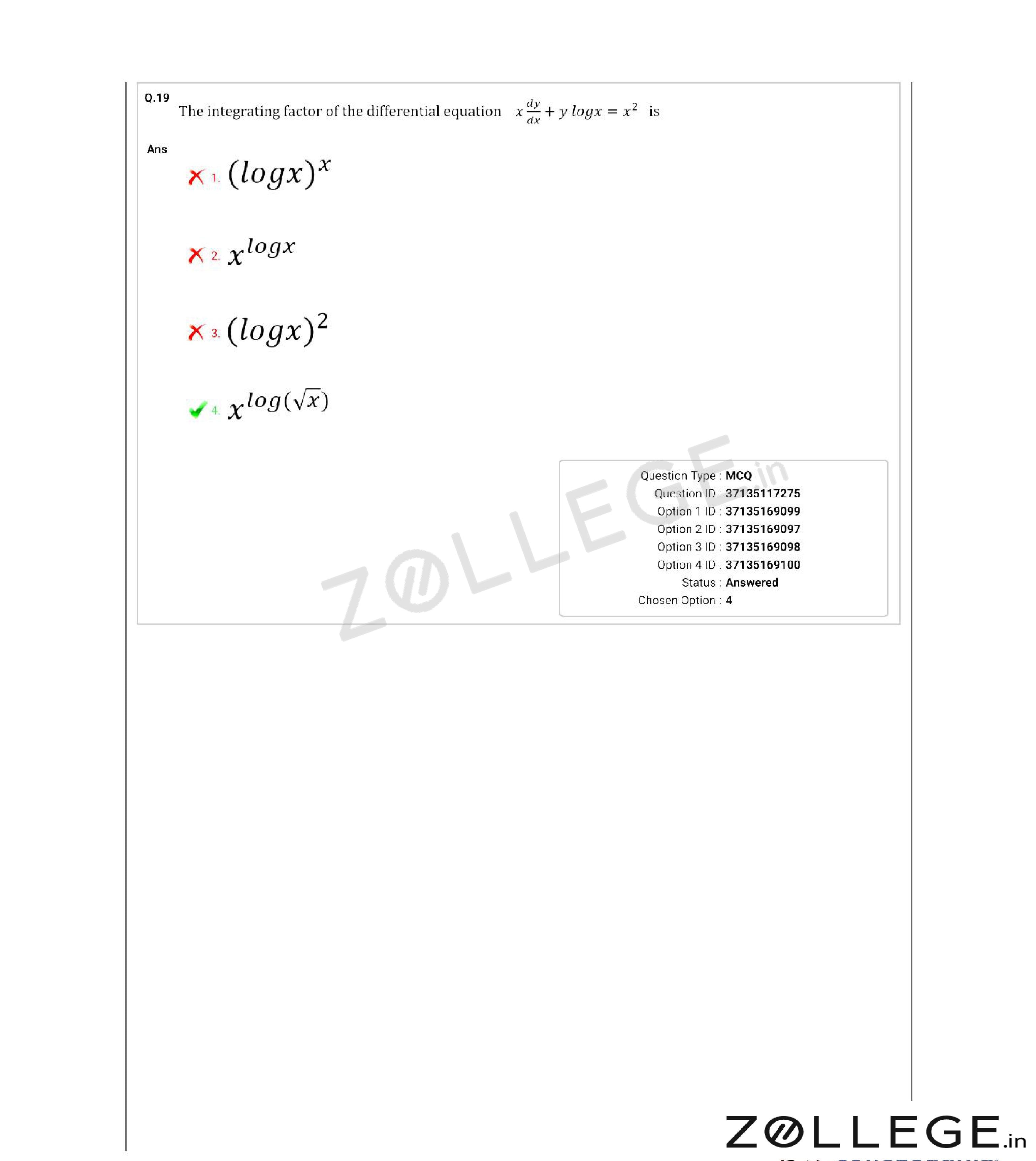
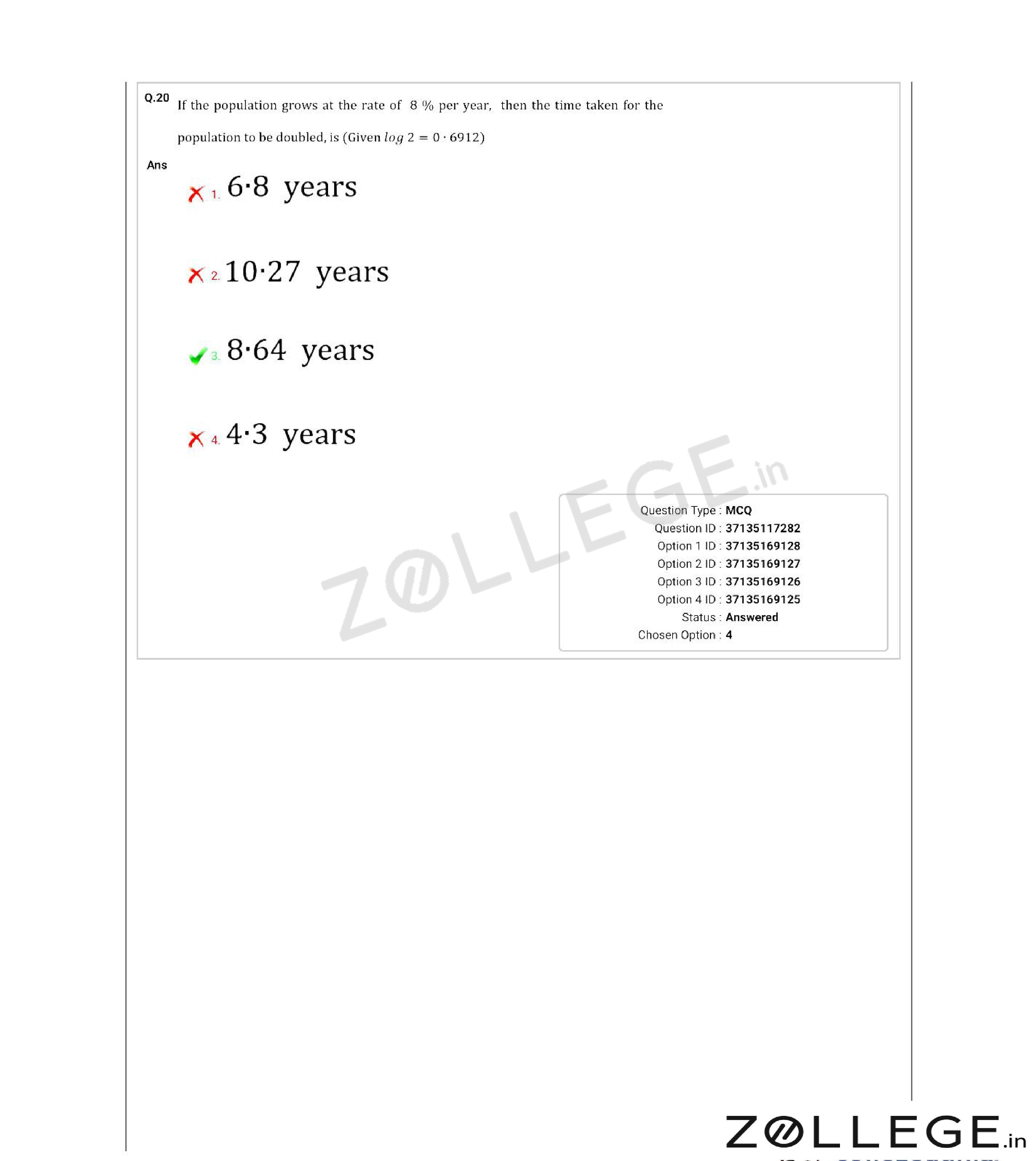
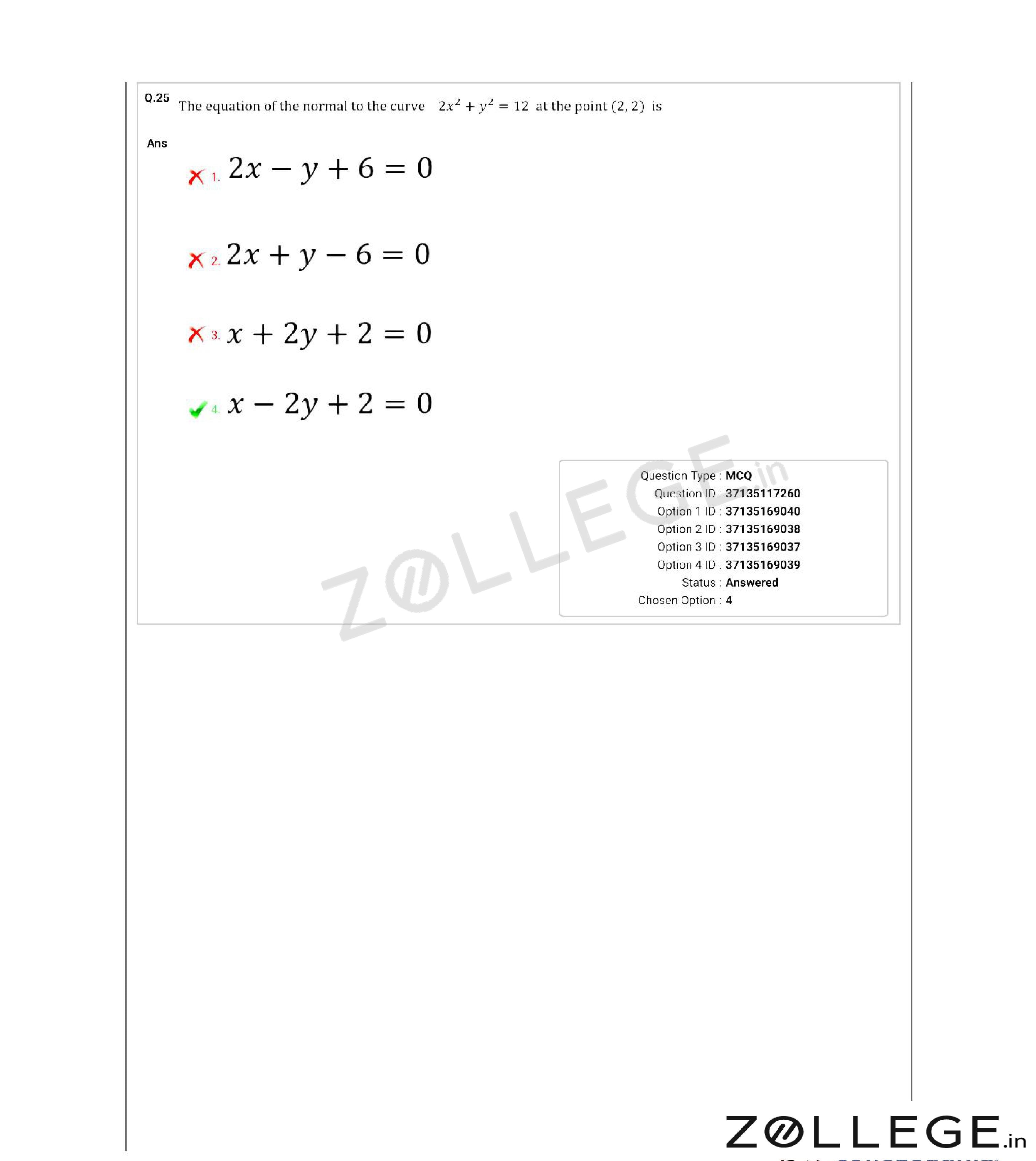
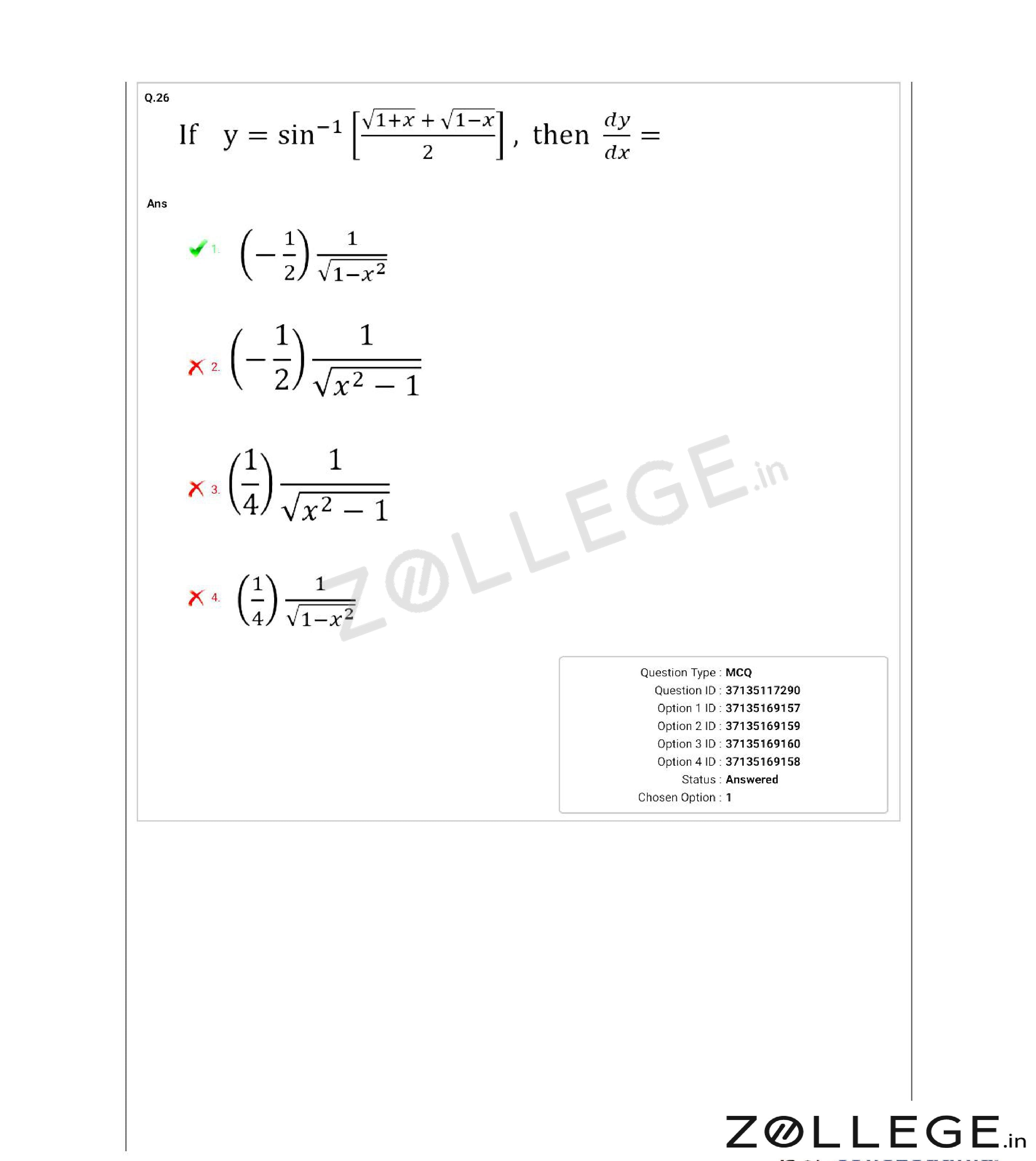
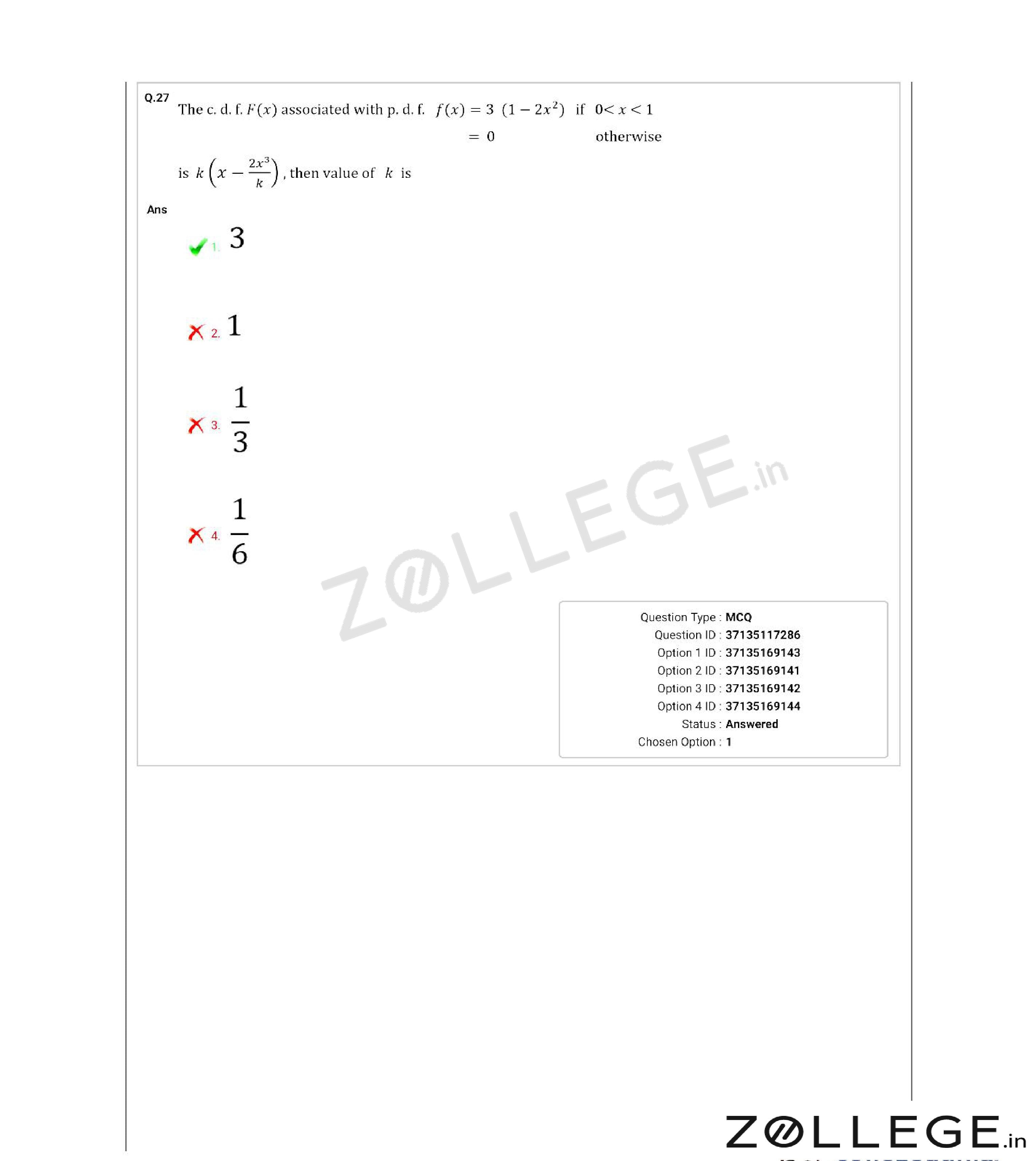
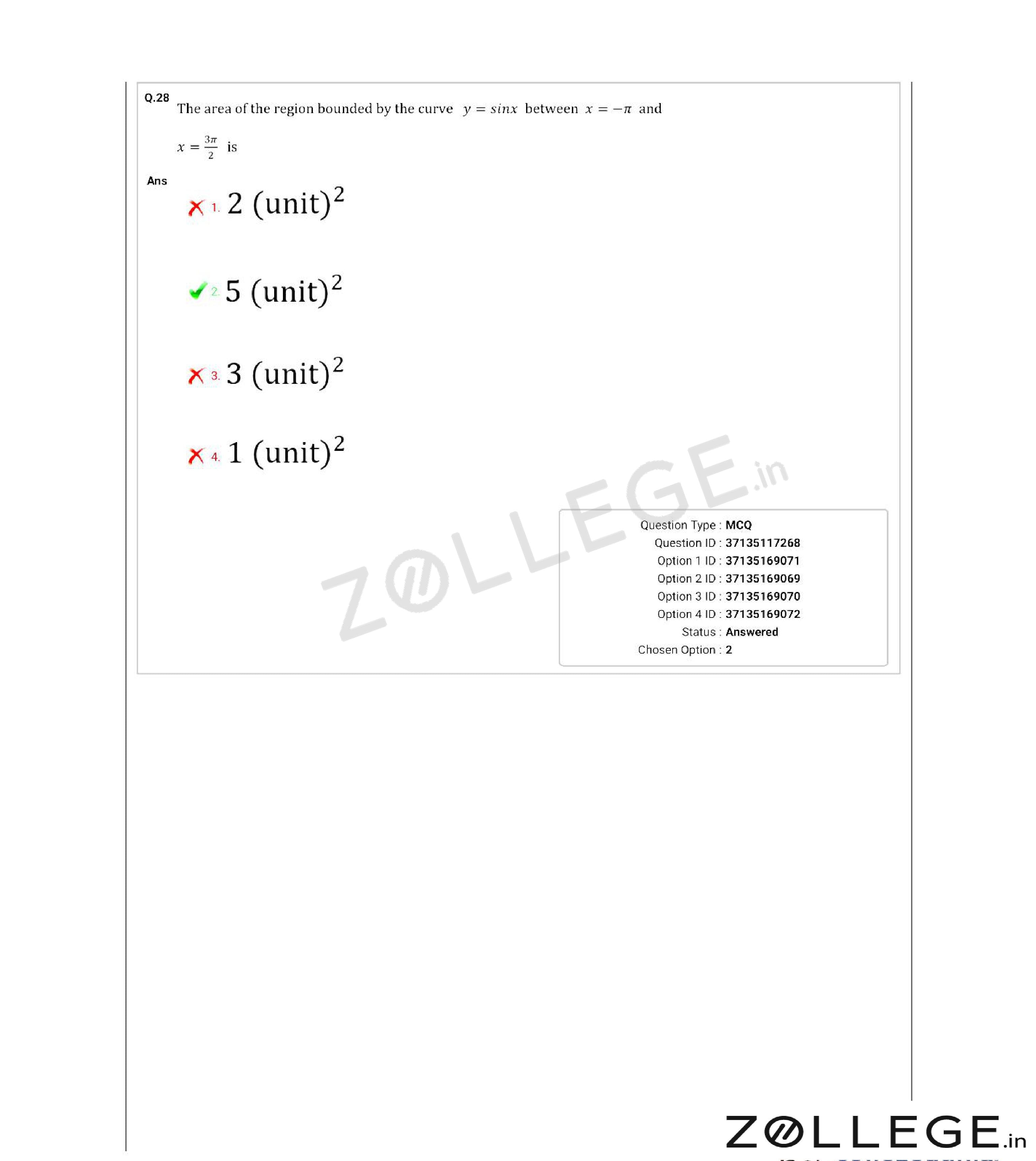
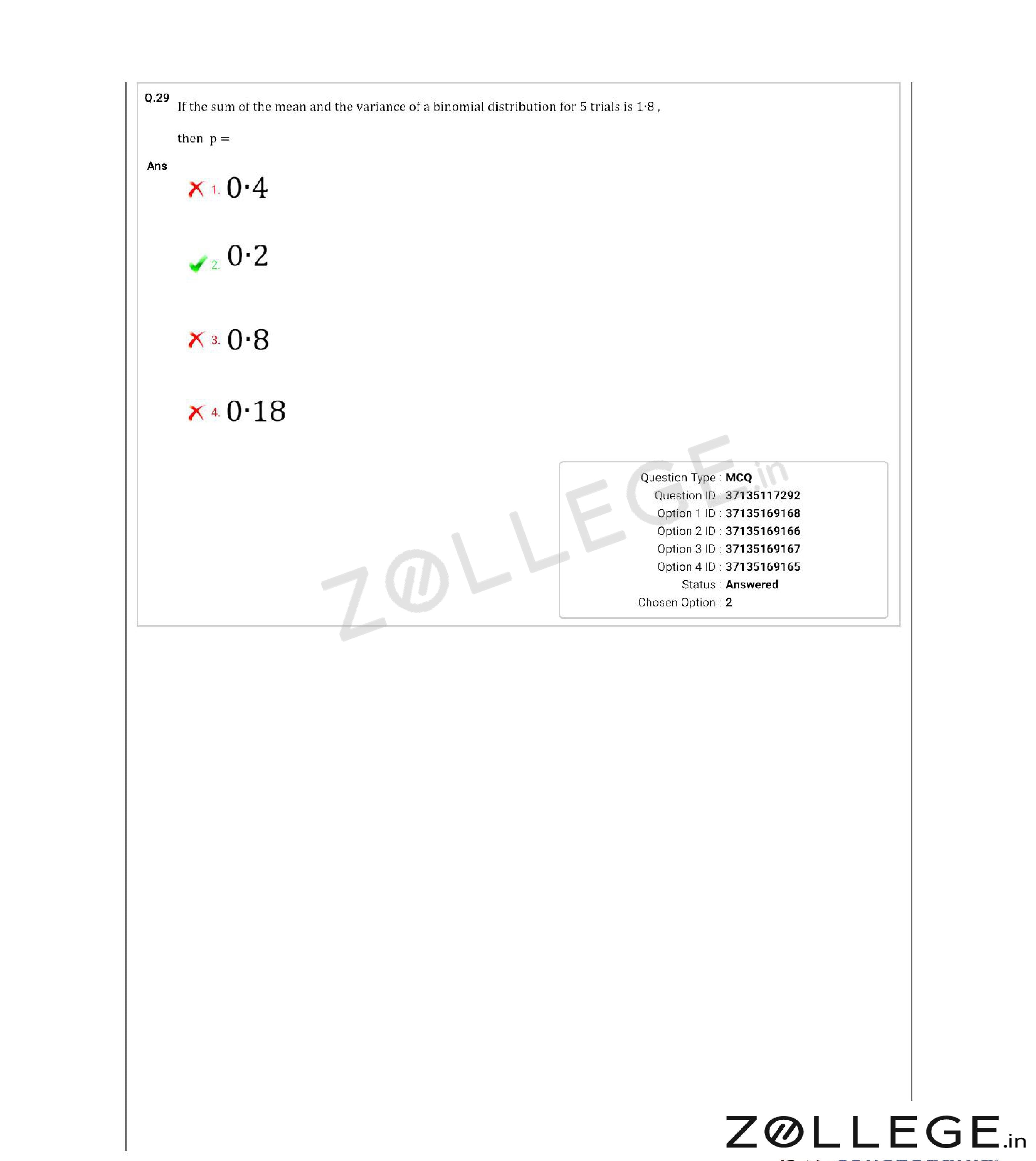
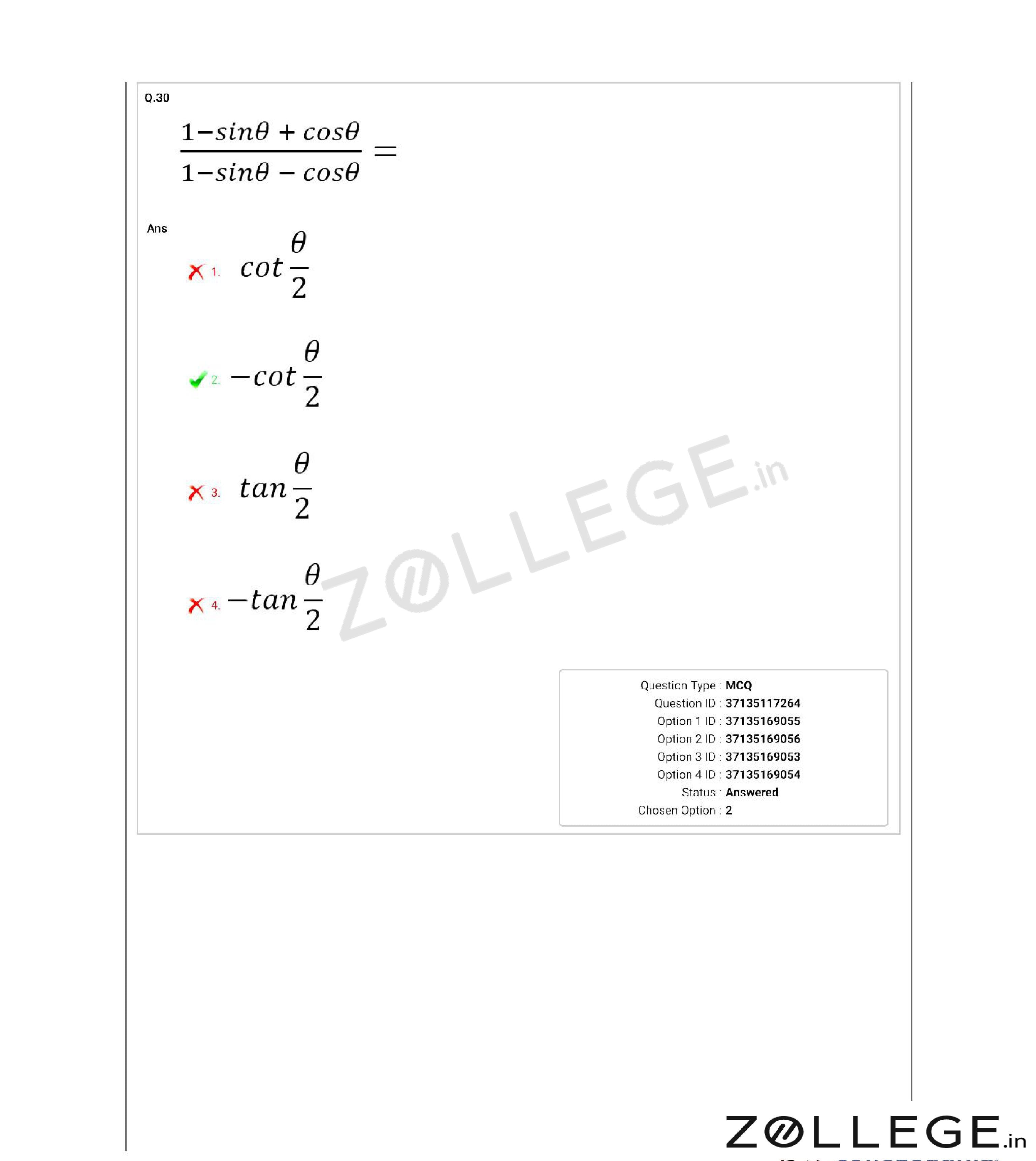
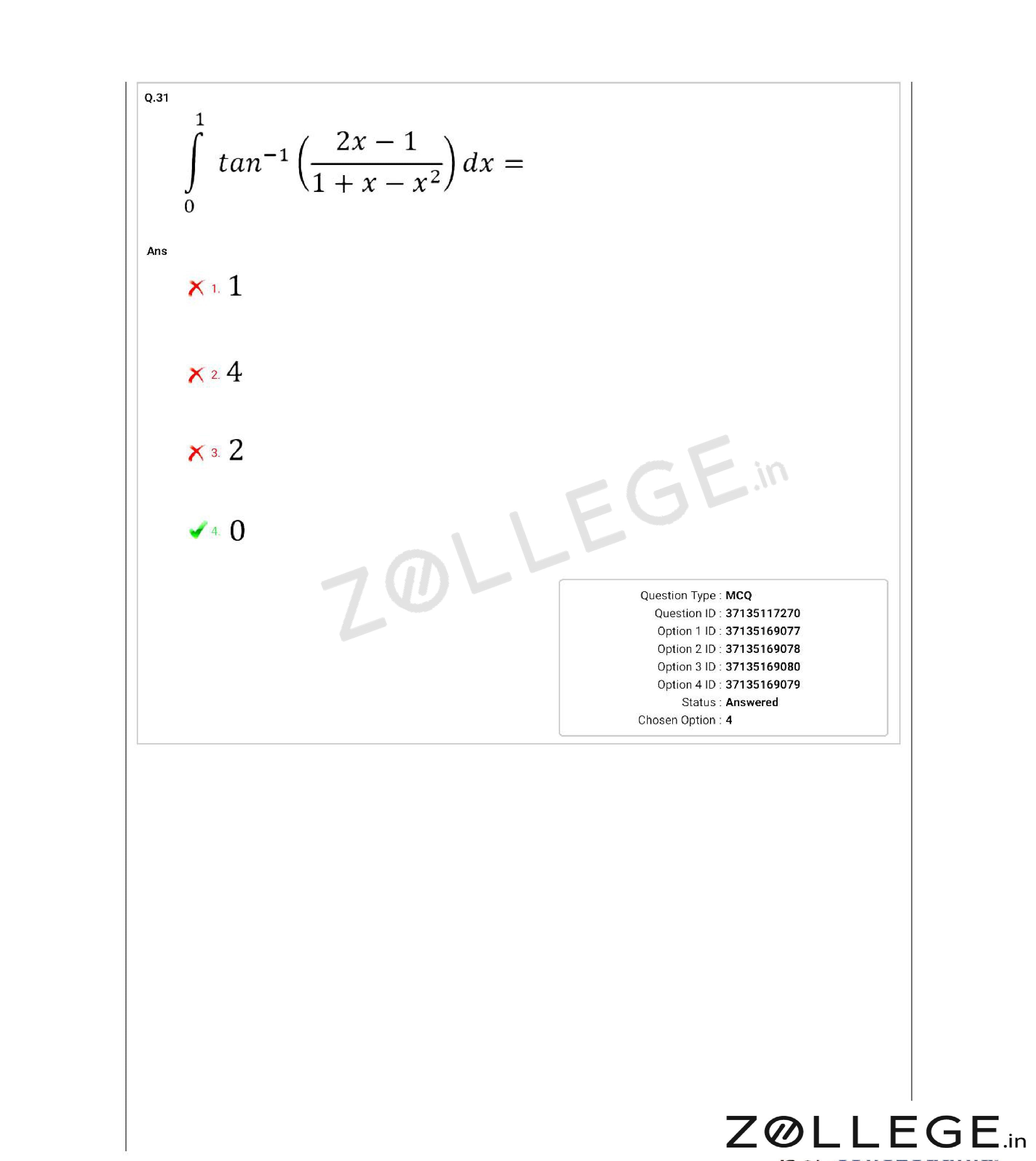
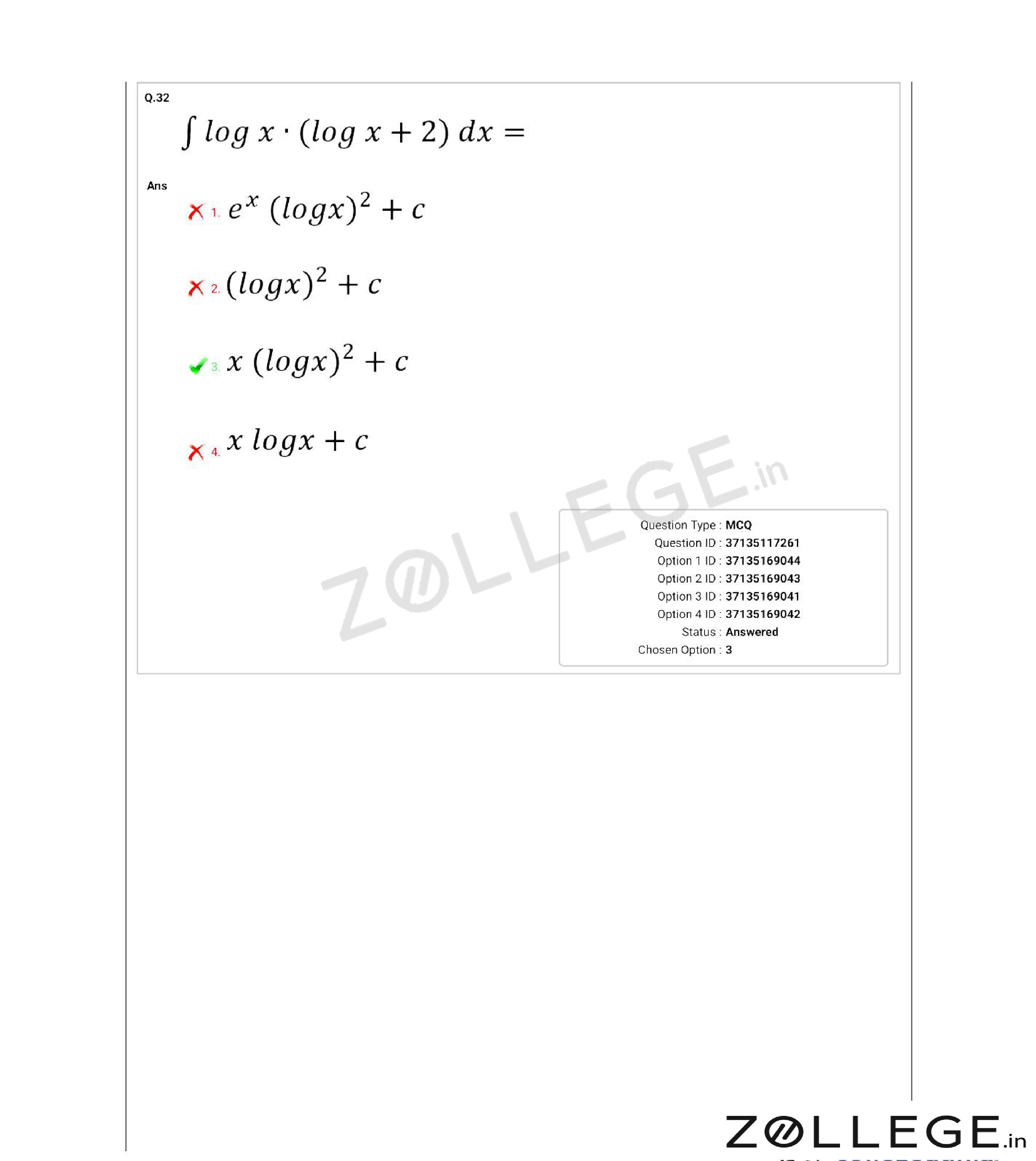
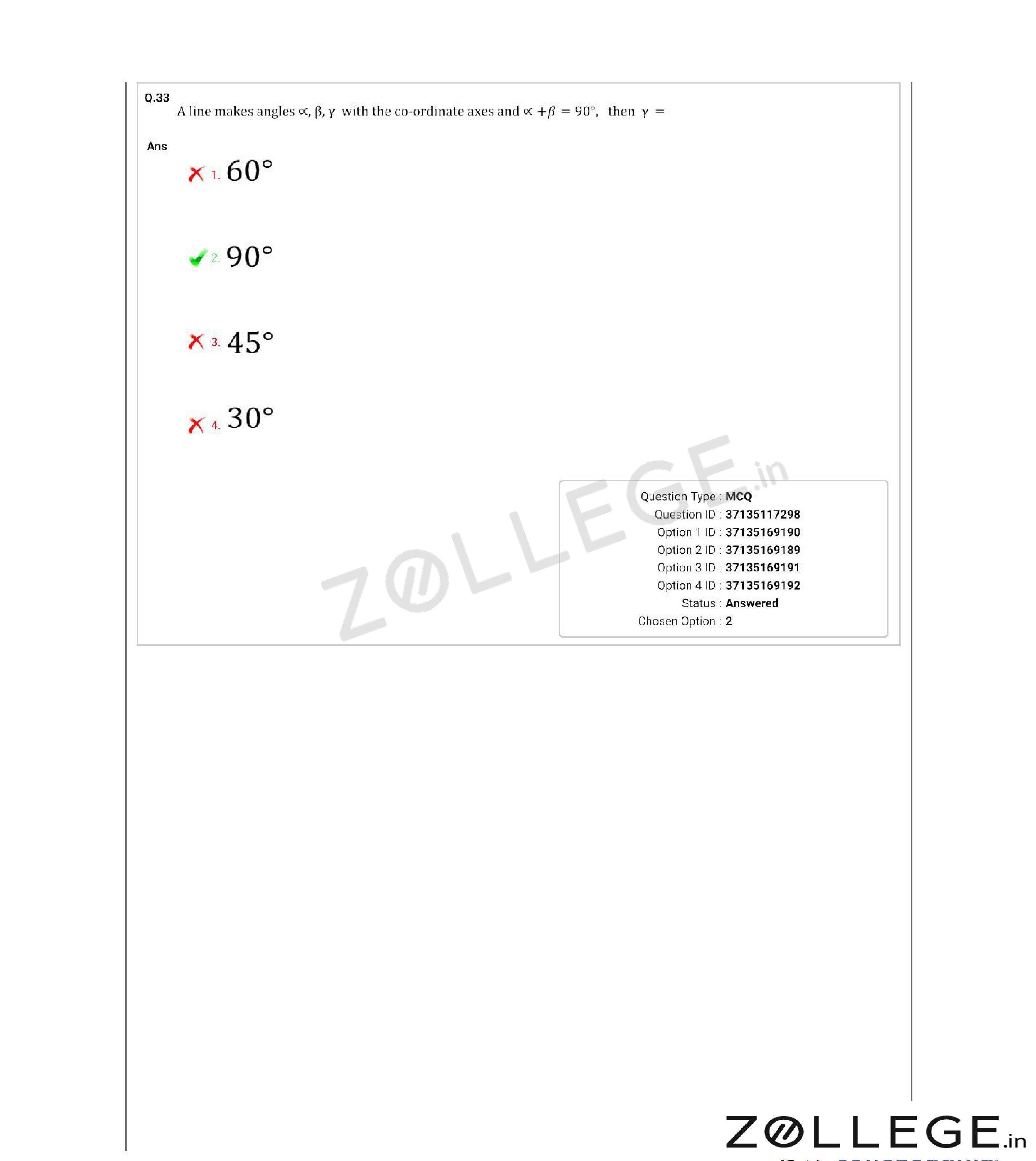
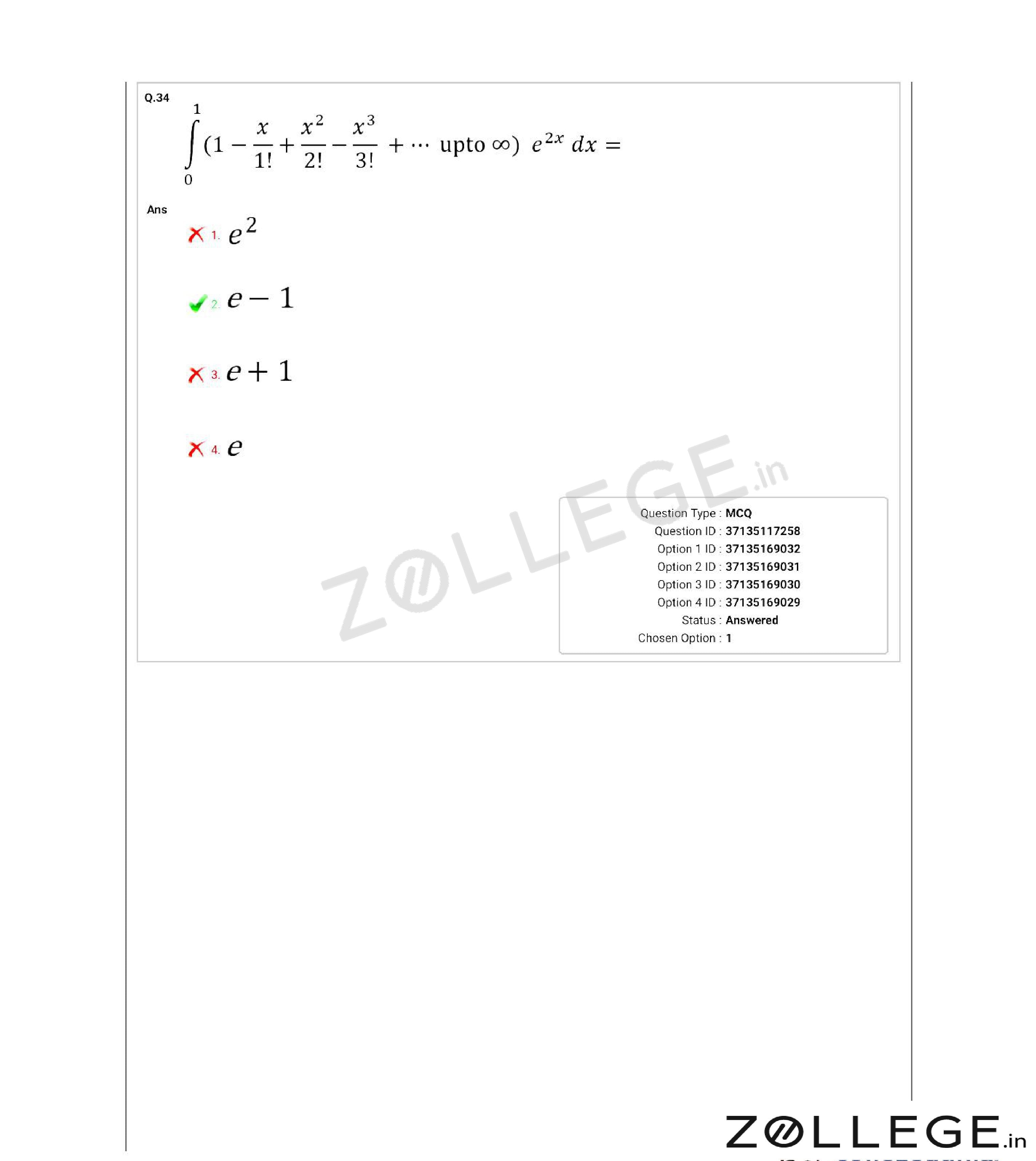
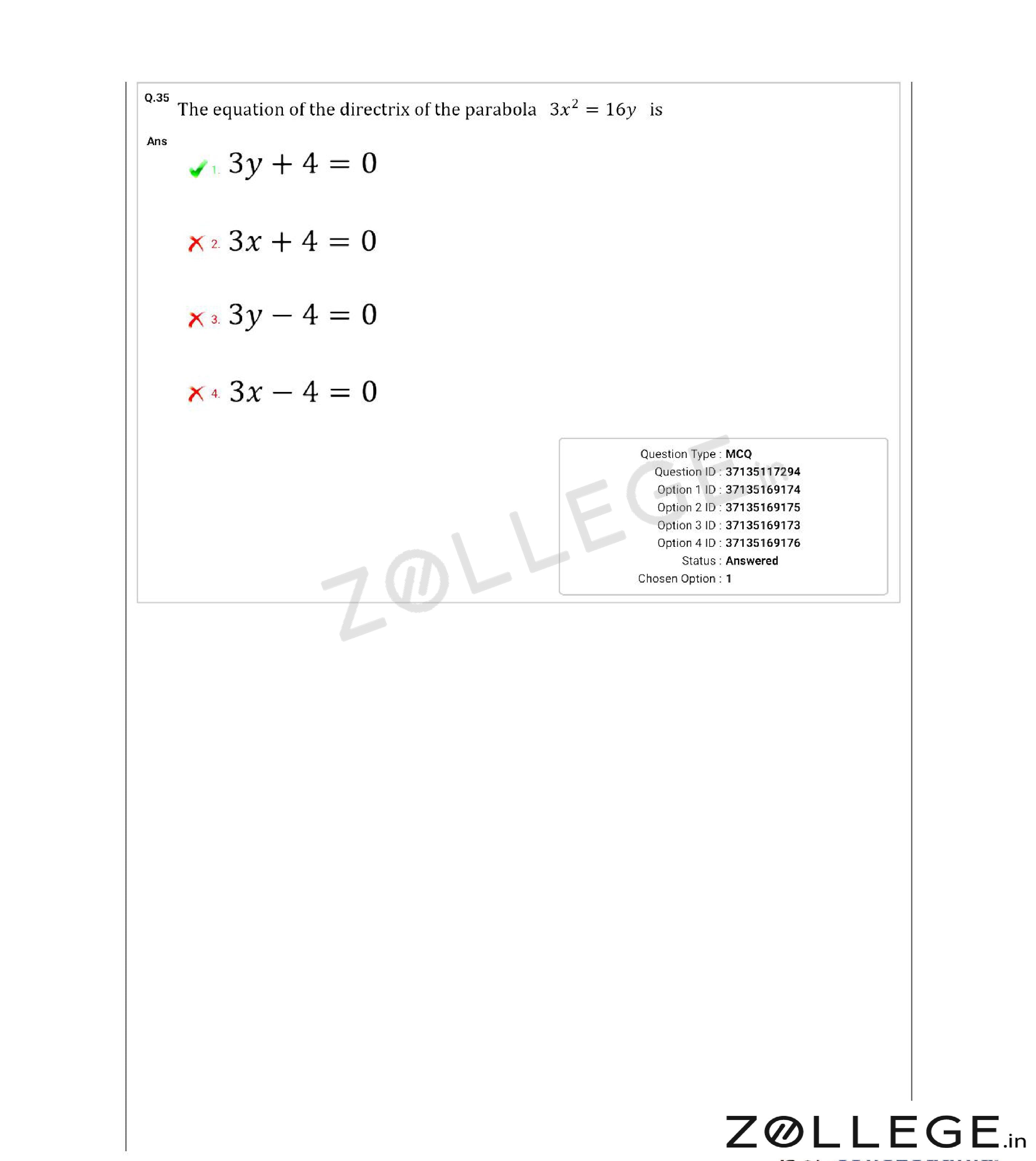
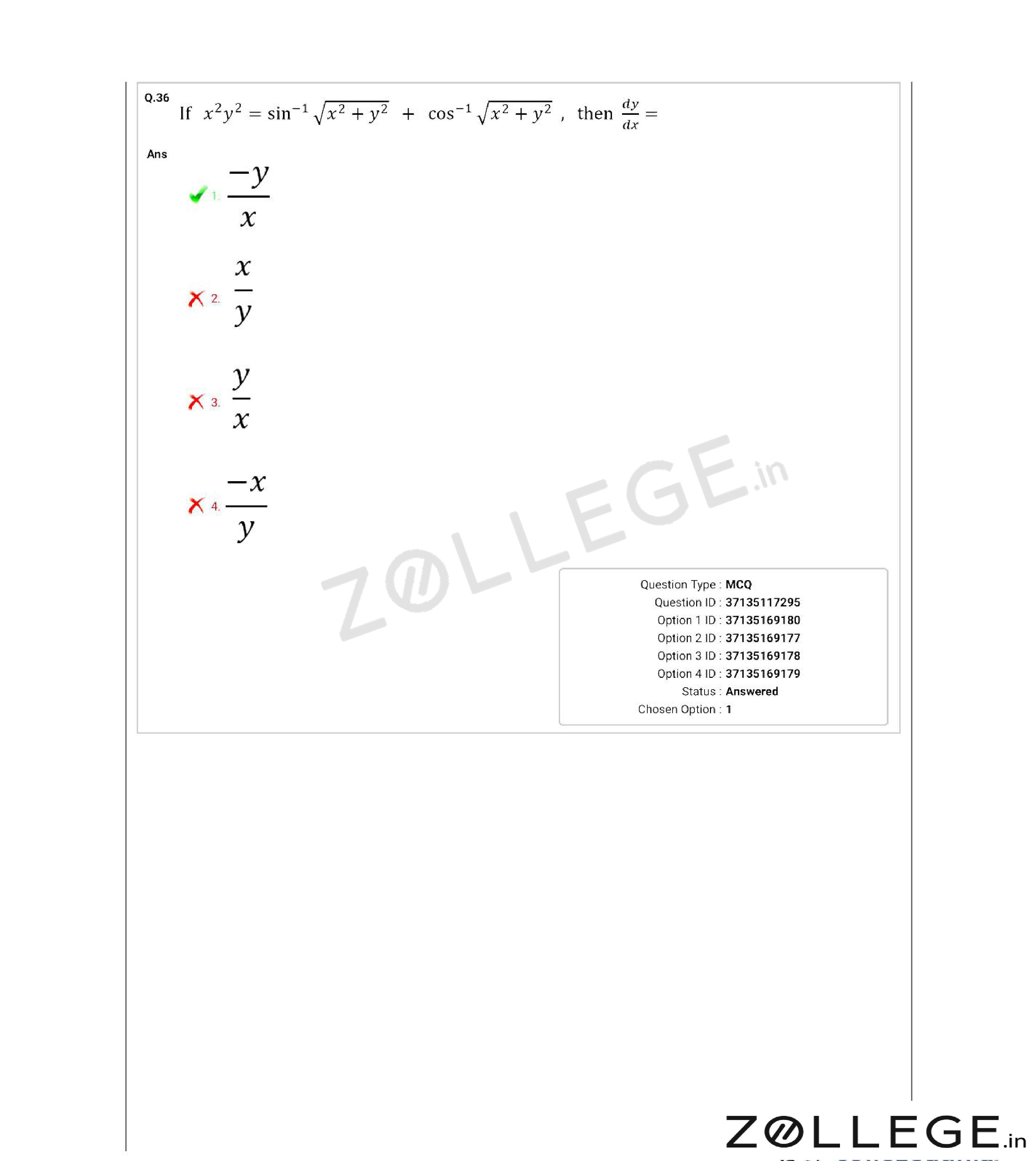
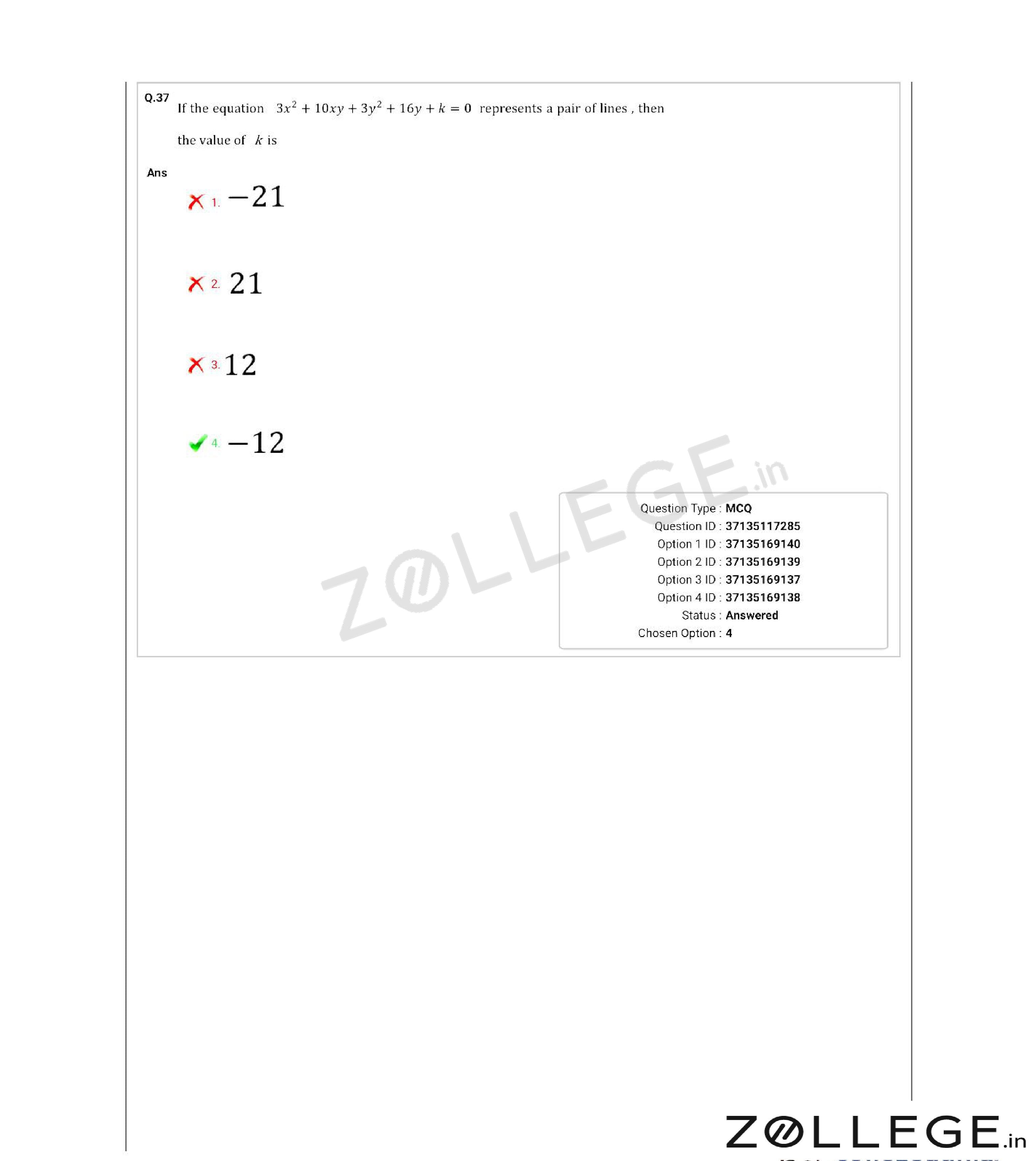
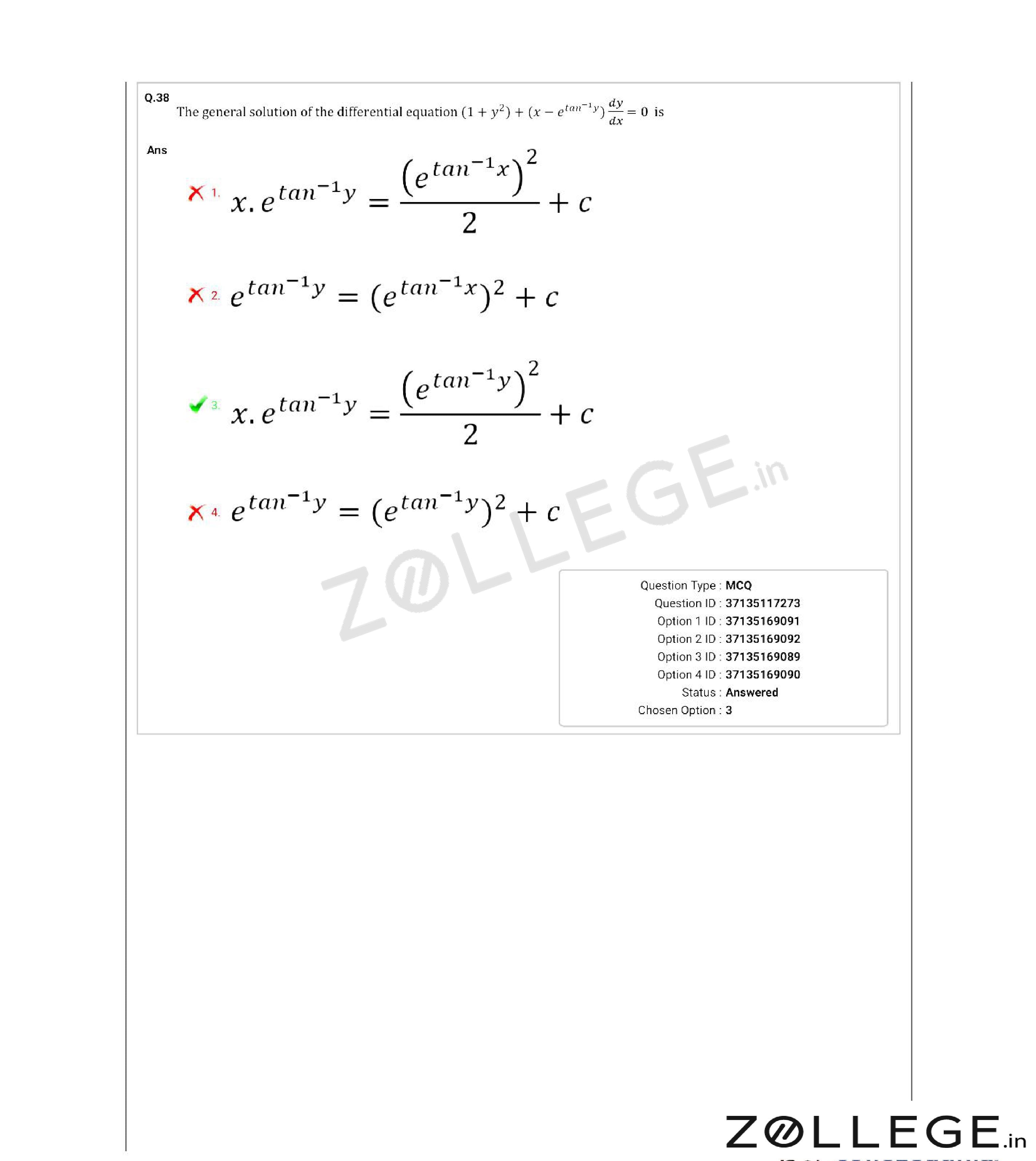
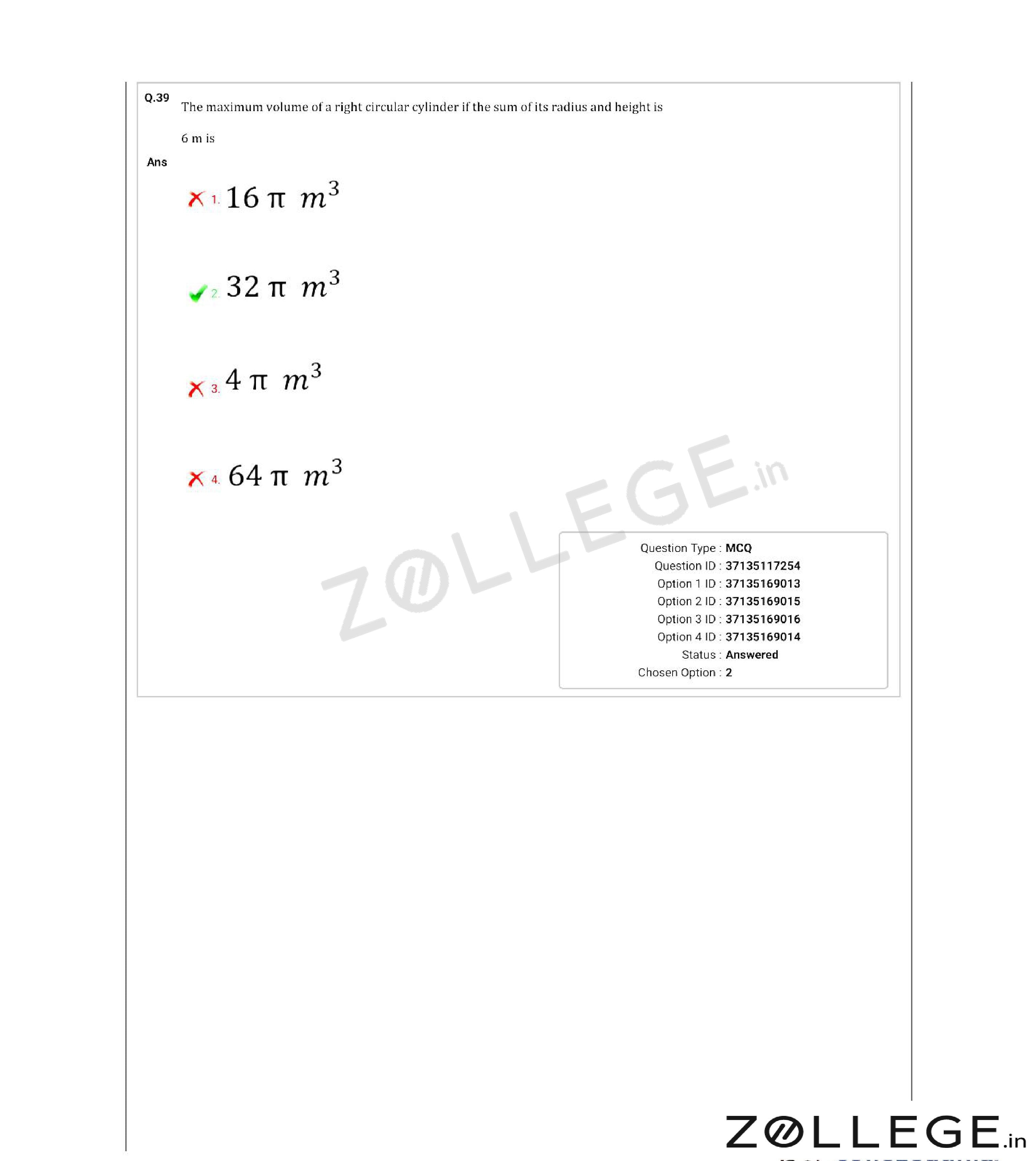
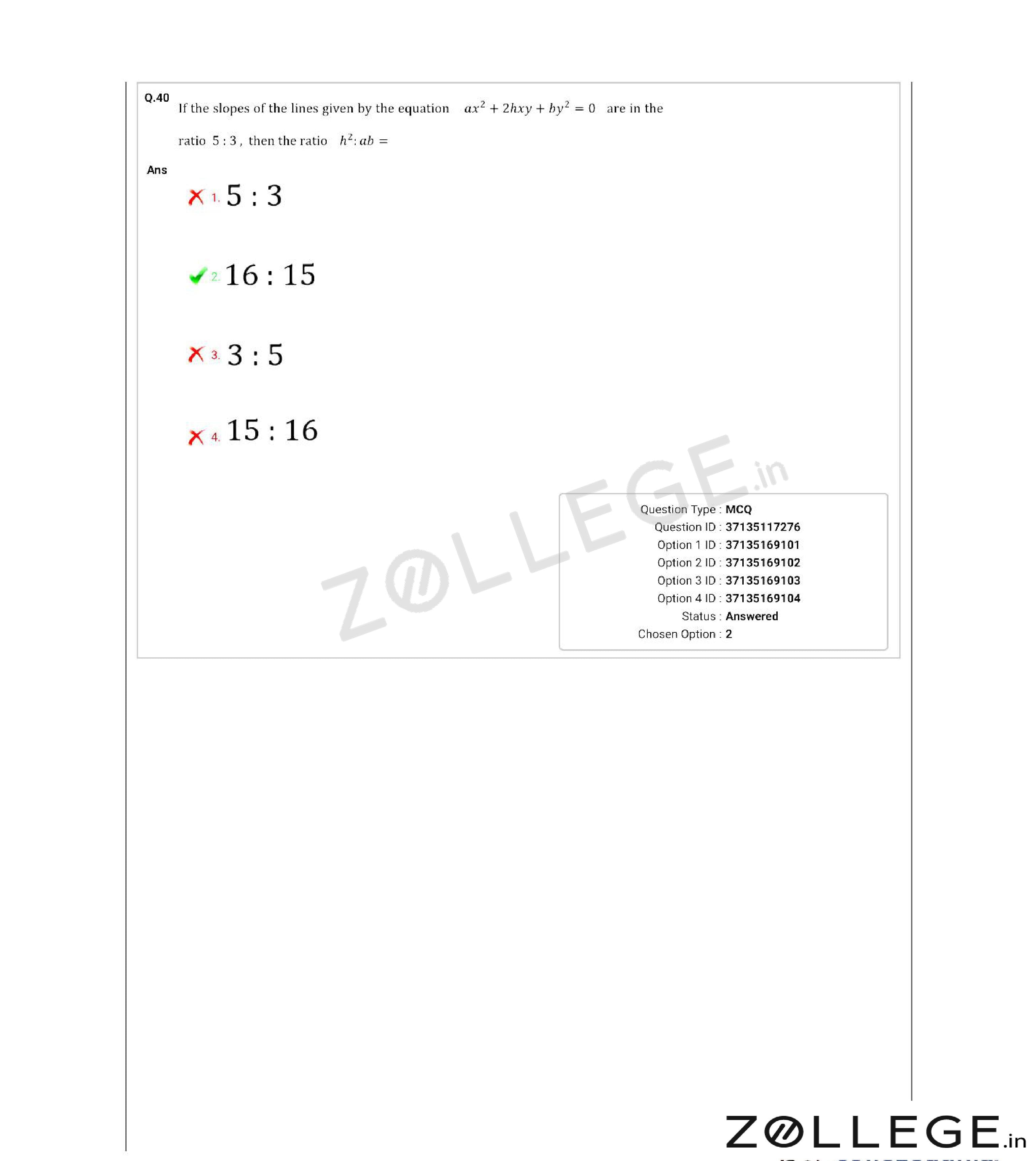
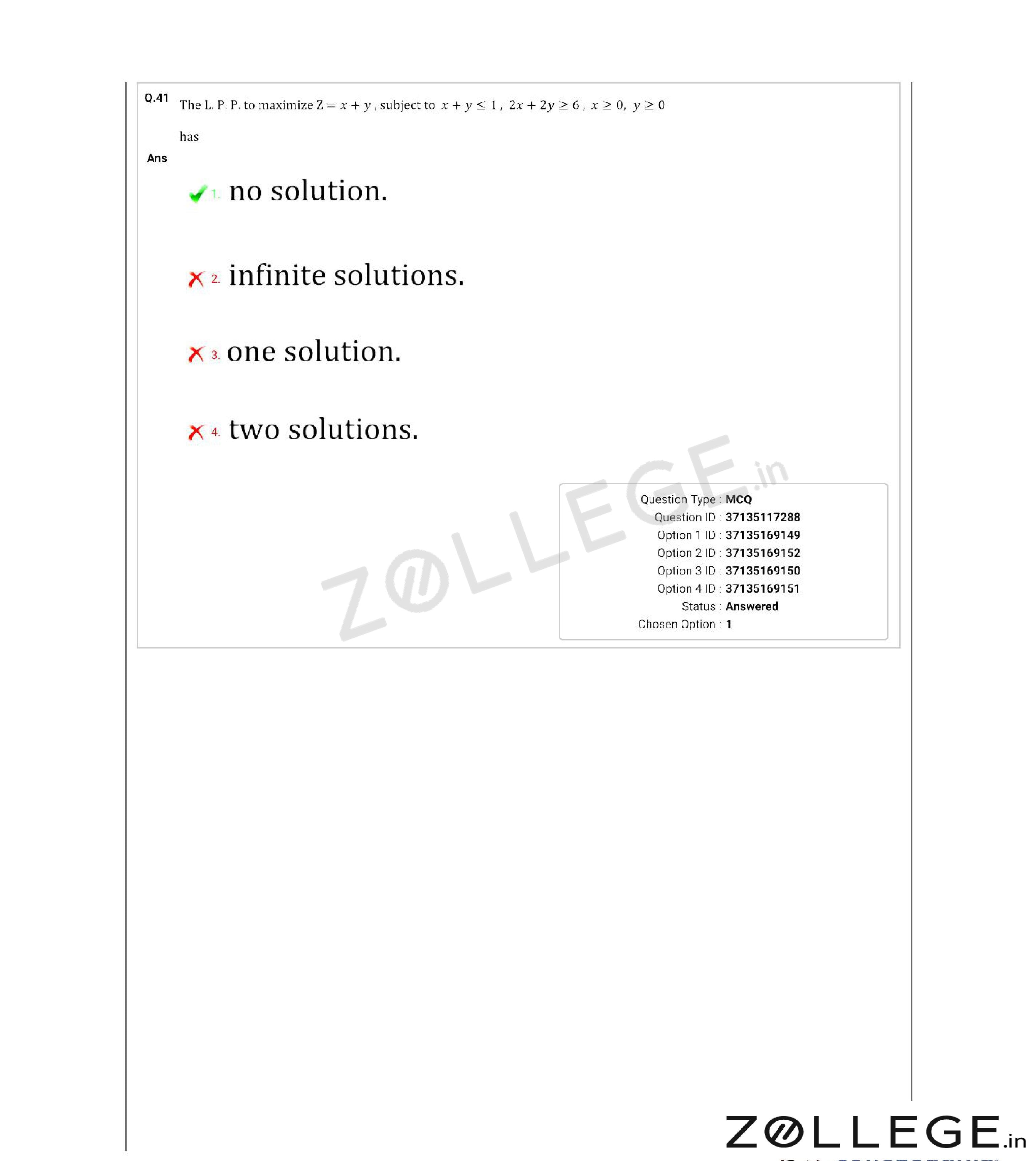
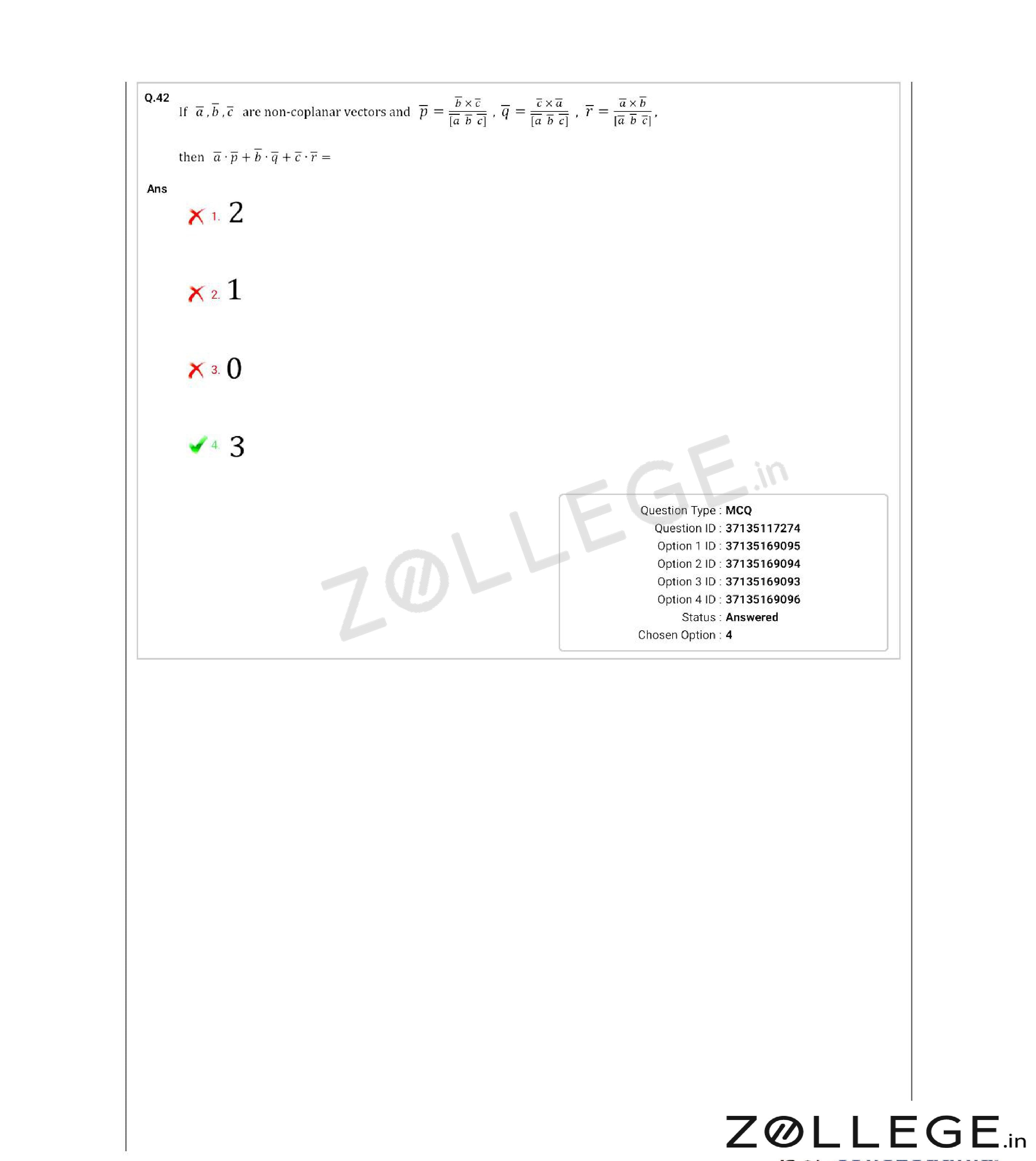
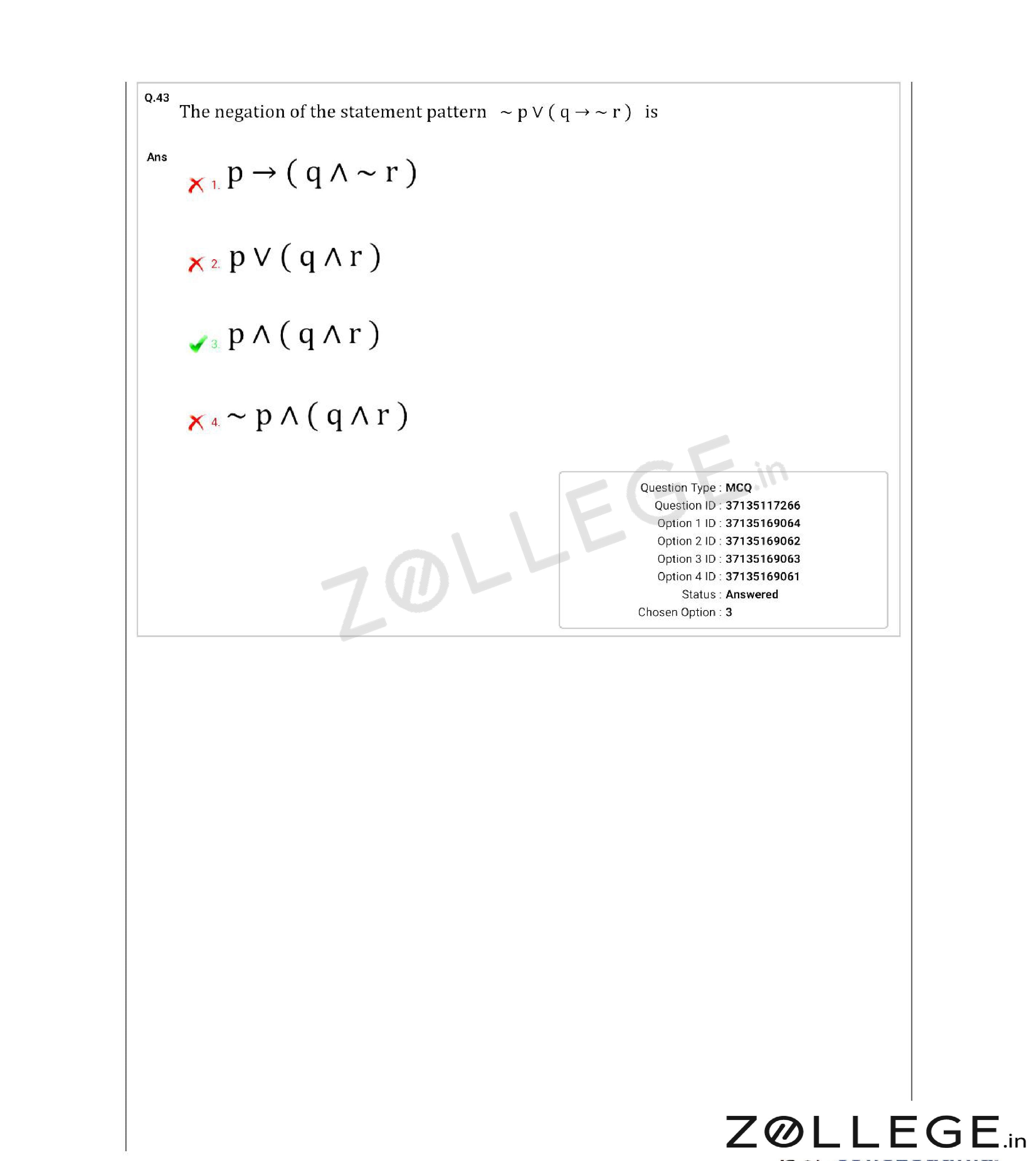
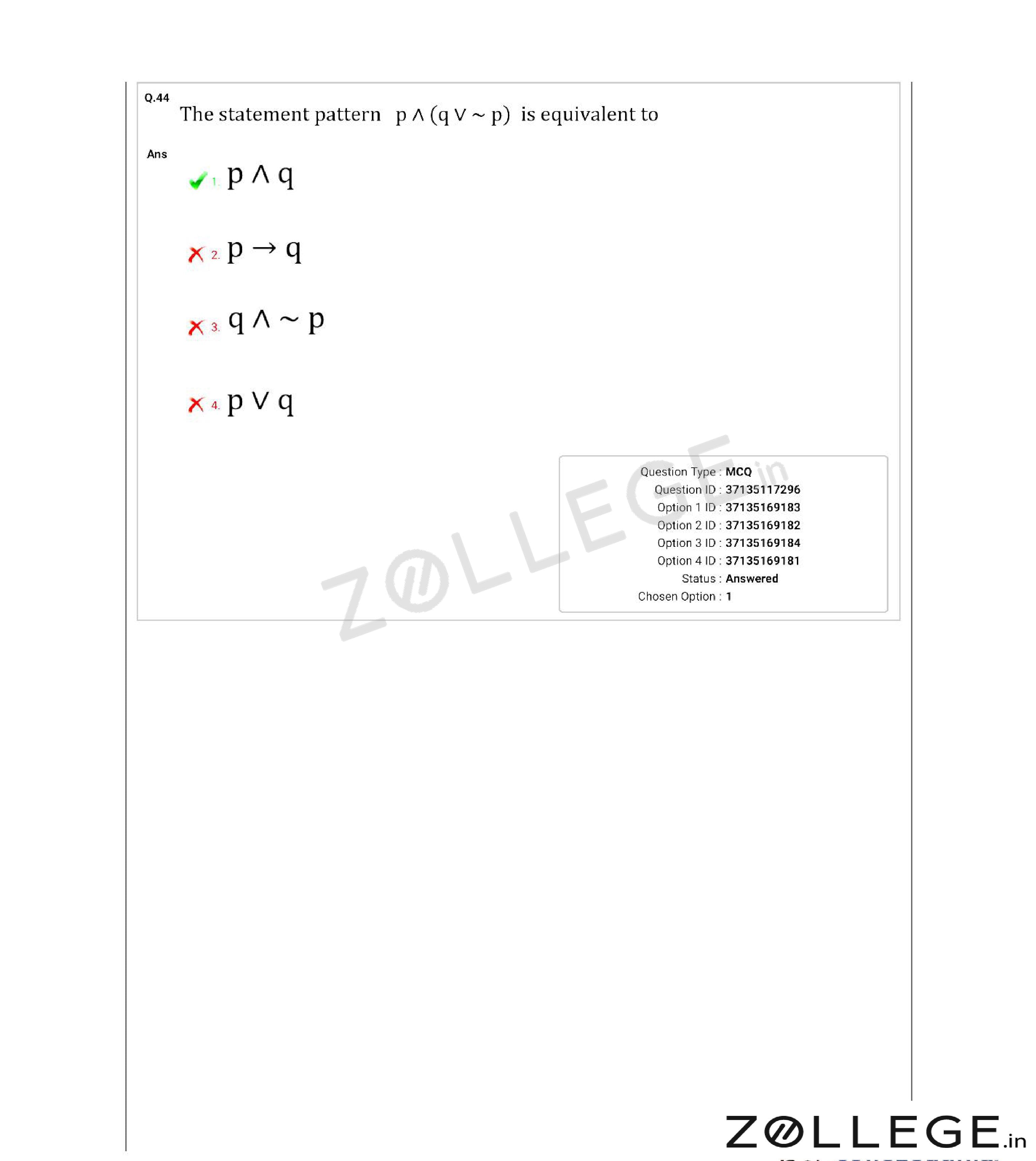
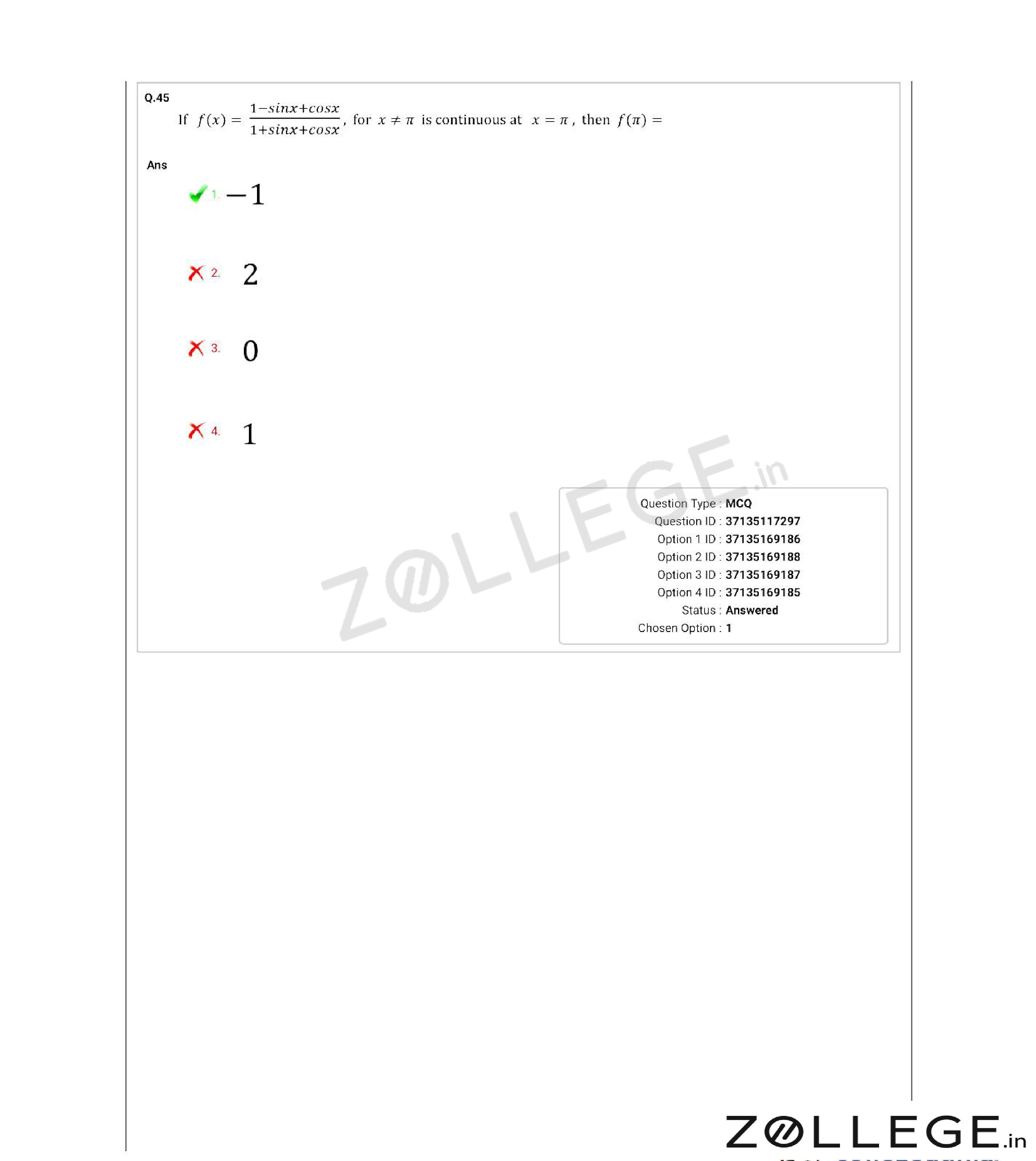
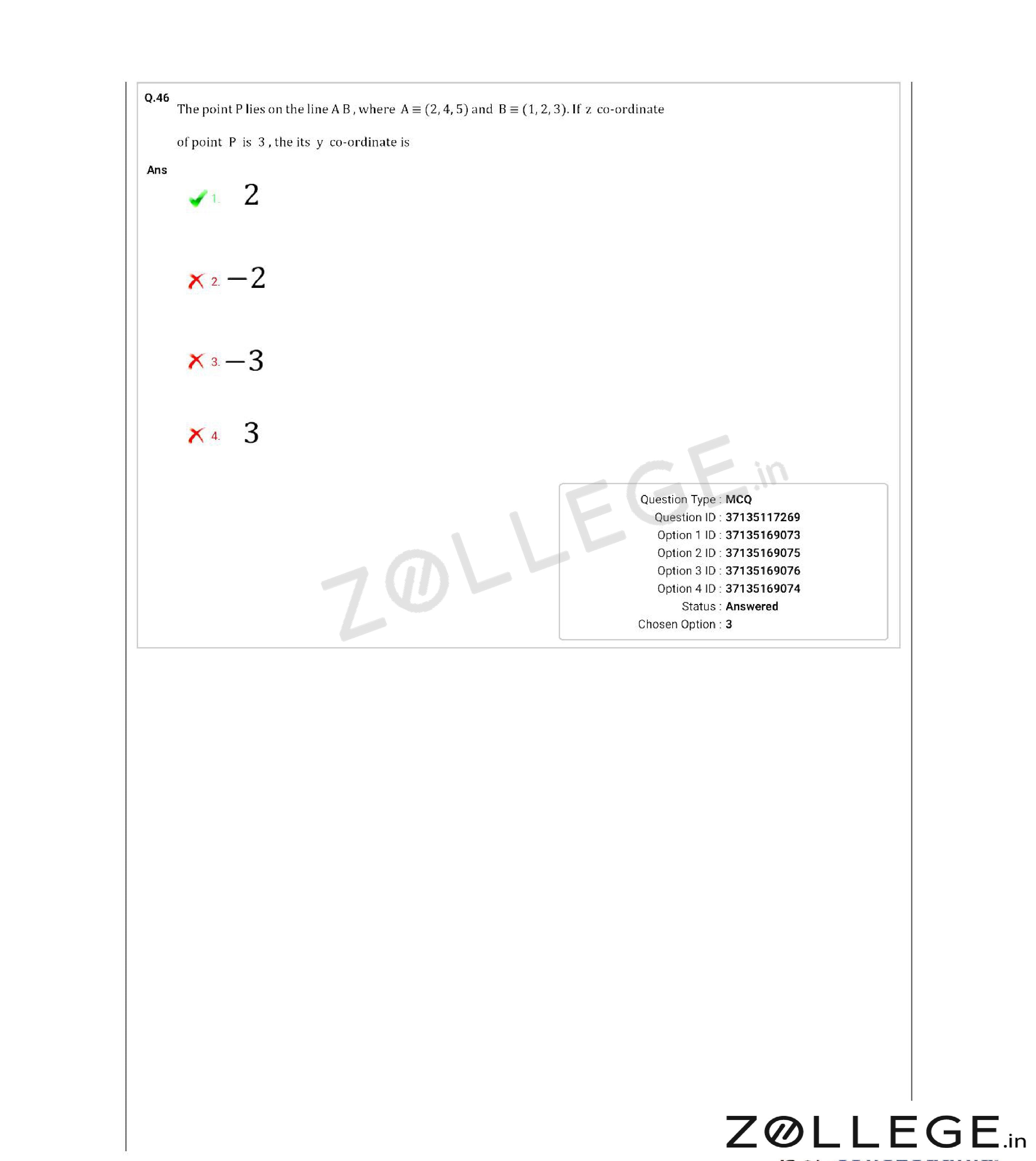
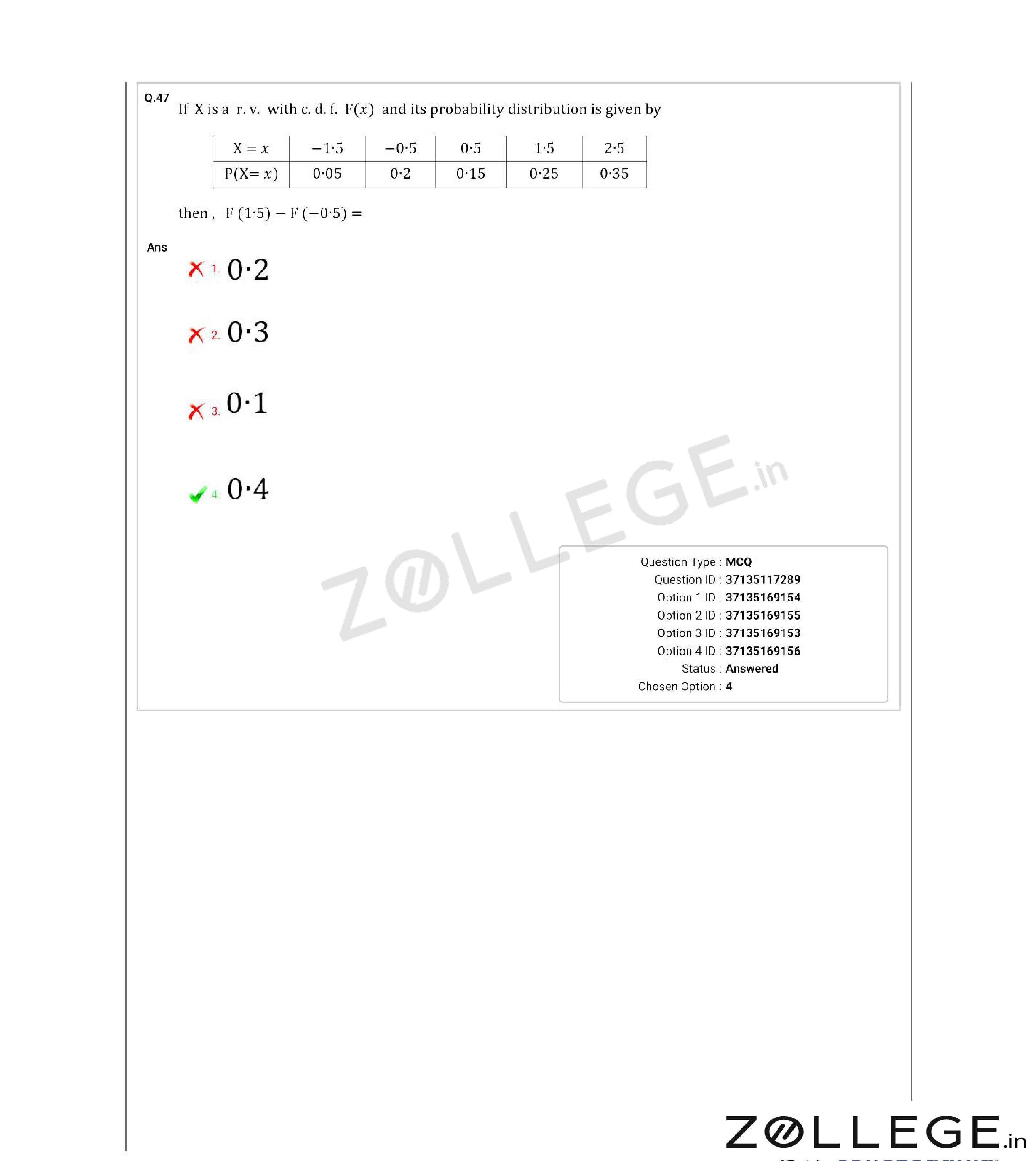
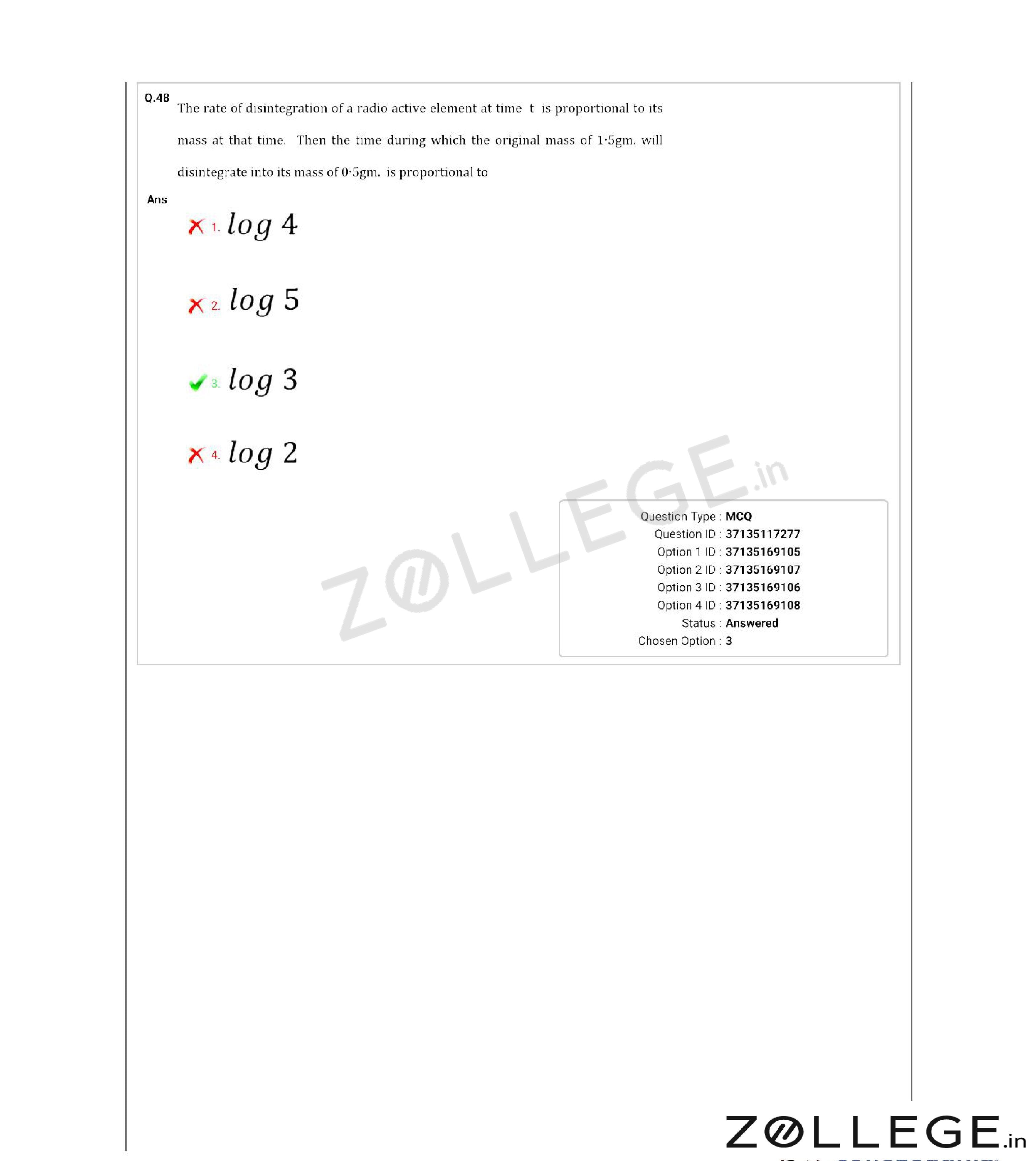
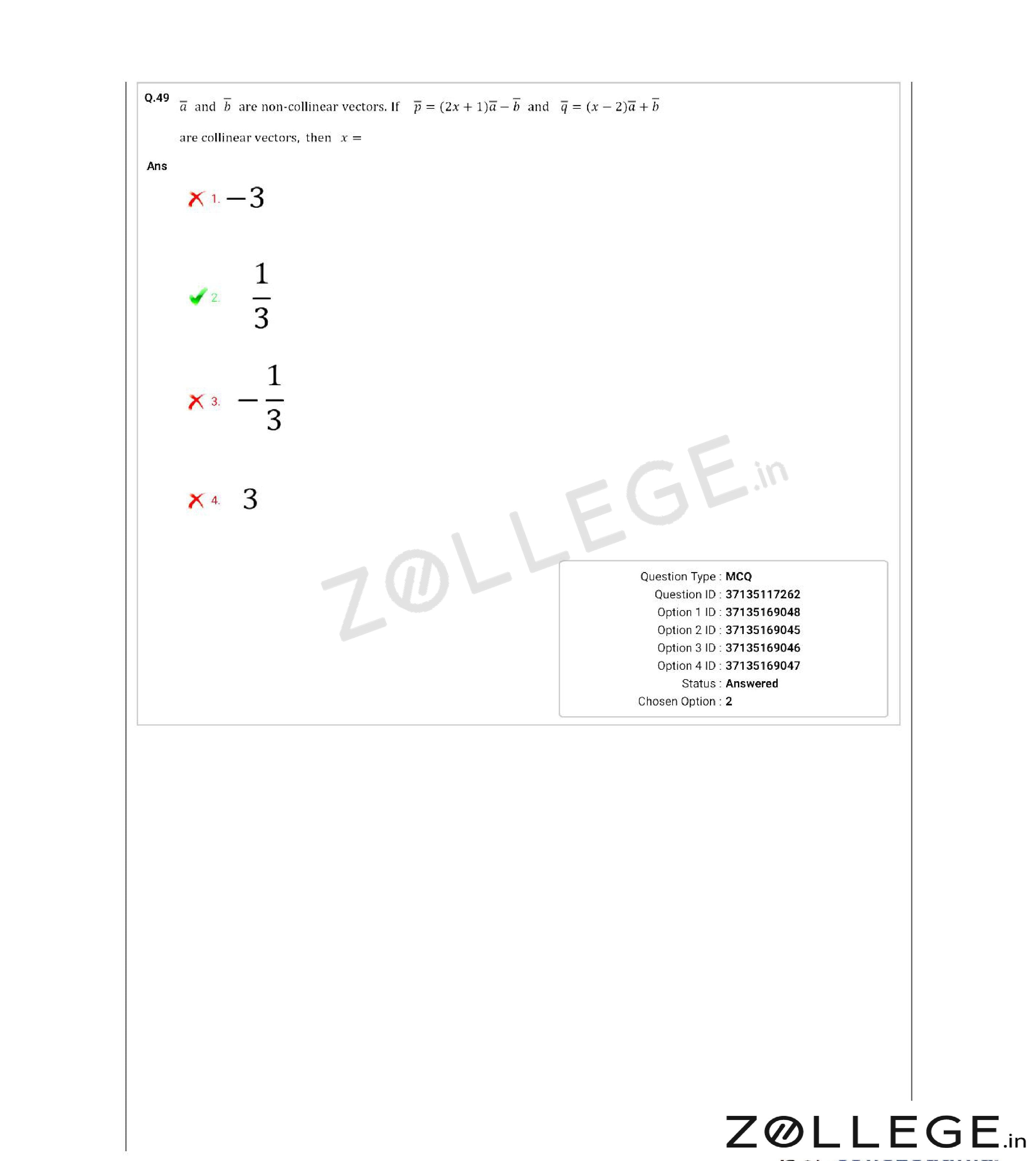
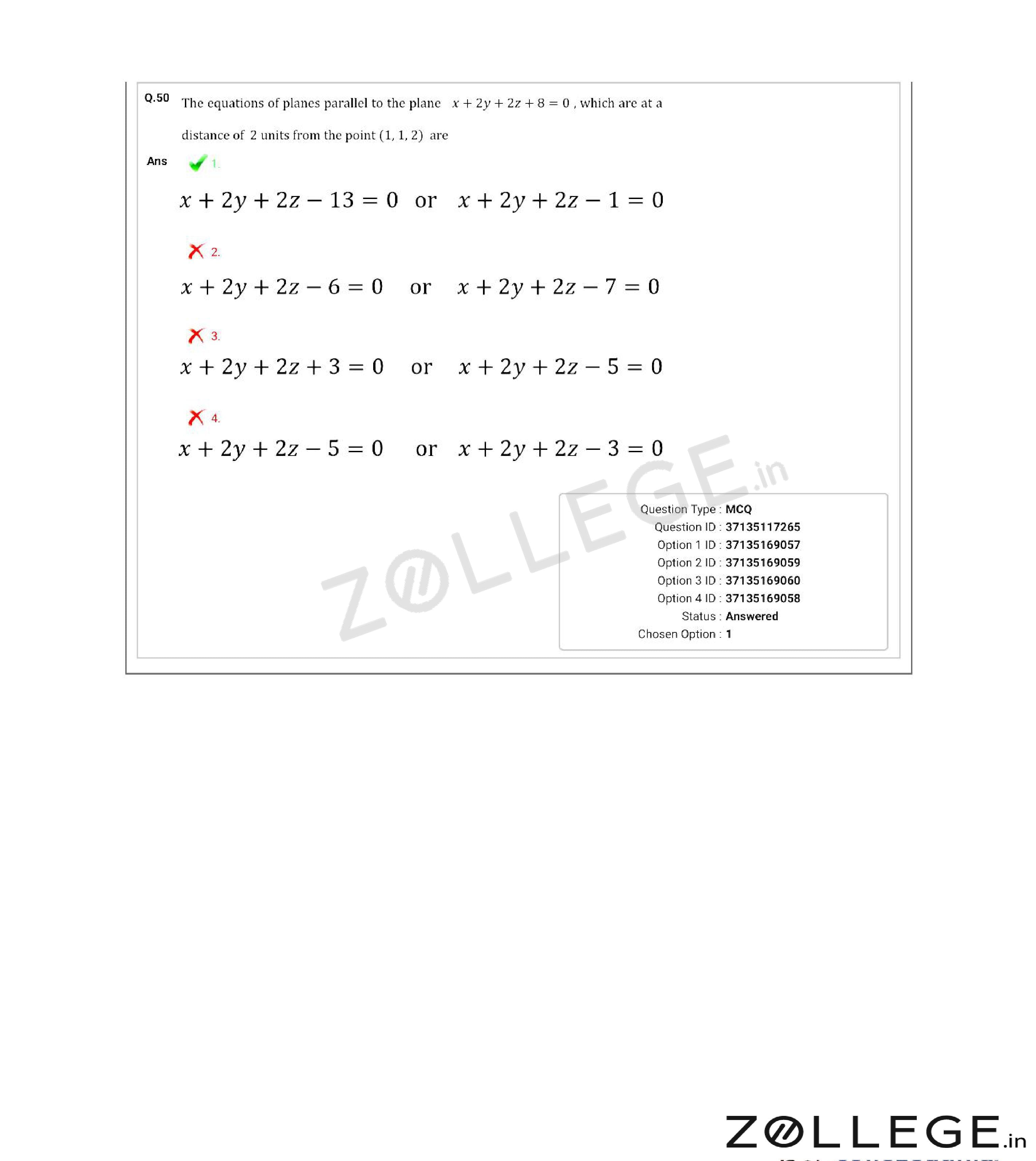
*The article might have information for the previous academic years, please refer the official website of the exam.