
MHT CET 2022 Question Paper with Solution PDF for PCM (August 7 - Shift 2)


Content Writer | Updated On - Jan 12, 2026
MHT CET Question Papers are the most important study material for effective exam preparation. We at Zollege have provided all MHT CET Previous Year Papers with Solution PDFs here. MHT CET 2022 PCM exam was conducted successfully on August 7 by State CET Cell.
Students can freely download the MHT CET previous year's question paper PDFs along with their solutions here. We strongly encourage MHT CET aspirants to scan through all the MHT CET Question Paper to know the overall difficulty level, MHT CET Syllabus and understand the changes in MHT CET Exam Pattern over the years.
MHT CET 2022 Aug 7 Shift 2 Question Paper with Solution PDF
| MHT CET 2022 Aug 7 Shift 2 Question Paper | Download PDF | Check Solutions |

How many carbon atoms present in n mole of citric acid (3n, 6n, 2n, 4n)
View Solution
Step 1: Identify the molecular formula of Citric Acid -
The chemical formula for citric acid is \(C_6H_8O_7\). Its systematic name is 2-hydroxypropane-1,2,3-tricarboxylic acid.
Step 2: Determine carbon atoms per molecule -
From the formula, one molecule of citric acid contains exactly 6 carbon atoms.
Step 3: Calculate for 'n' moles -
1 mole of any substance contains \(N_A\) (Avogadro's number) molecules.
Therefore, 1 mole of citric acid contains \(6 \times N_A\) carbon atoms.
For \(n\) moles, the total number of carbon atoms will be \(6 \times n \times N_A\).
Step 4: Conclusion -
In terms of the variable 'n' (representing moles relative to Avogadro's constant), the quantity of carbon atoms is 6n. Quick Tip: Always count the carbons in the main chain and the functional groups. In Citric Acid, there are 3 carbons in the propane chain and 3 in the carboxyl groups (\(3+3=6\)).
Which of the following compounds is likely to show both Frenkel and Schottky defects in its crystalline form?
View Solution
Step 1: Define the defects -
- Schottky Defect: Equal number of cations and anions are missing from the lattice. Common in highly ionic compounds with high coordination numbers.
- Frenkel Defect: An ion (usually the smaller cation) is dislocated from its lattice site to an interstitial site. Common when there is a large difference in ion sizes.
Step 2: Analyze AgBr -
Silver bromide (AgBr) is unique. The \(Ag^+\) ion is small enough to show Frenkel defects (by moving into interstitial spaces). However, it also has a lattice structure that allows for Schottky defects (vacancy pairs).
Step 3: Evaluate other options -
- CsCl/KBr: Show mainly Schottky defects due to similar sizes of ions and high coordination.
- ZnS: Shows mainly Frenkel defects because of the large size difference between \(Zn^{2+}\) and \(S^{2-}\).
Step 4: Conclusion -
AgBr is the classic example in solid-state chemistry that exhibits both types of stoichiometric defects. Quick Tip: AgBr shows Schottky defects due to its relatively low lattice energy and Frenkel defects because \(Ag^+\) is a transition metal ion with a high degree of polarizability.
Bond enthalpy of halogens
View Solution
Step 1: Understand the general trend -
Usually, bond enthalpy decreases down the group as atomic size increases, making the bonds longer and weaker (\(Cl_2 > Br_2 > I_2\)).
Step 2: The anomaly of Fluorine (\(F_2\)) -
Fluorine is expected to have the highest bond enthalpy because it is the smallest. However, it is actually lower than \(Cl_2\) and \(Br_2\).
Step 3: Reason for \(F_2\) anomaly -
The \(F-F\) bond is very short. Because the \(F\) atom is so small, the lone pairs of electrons on the two fluorine atoms are very close together and repel each other strongly. This inter-electronic repulsion weakens the \(F-F\) bond.
Step 4: Correct Decreasing Order -
The correct order of bond dissociation enthalpy is: \[ Cl_2 > Br_2 > F_2 > I_2 \] Quick Tip: \(Cl_2\) has the highest bond enthalpy among halogens. Don't let \(F_2\)'s high electronegativity fool you into thinking its bond is the strongest!
Polymer branched
View Solution
Step 1: Define Branched-Chain Polymers -
In these polymers, the monomers are joined to form long straight chains (linear), but these chains also have side chains or "branches" of different lengths.
Step 2: Effect of branching -
Because of the branches, the polymer chains cannot pack closely together in a regular manner. This results in lower density and lower melting points compared to linear polymers.
Step 3: Common Example (LDPE) -
Low-Density Polyethylene (LDPE) is the most common example. It is prepared by the high-pressure polymerization of ethene, which leads to significant branching.
Step 4: Uses -
Due to their flexibility and lower density, branched polymers like LDPE are used for making squeeze bottles, flexible pipes, and carry bags. Quick Tip: Think of linear polymers like neatly stacked bricks and branched polymers like a pile of tree branches; the "pile" is less dense and takes up more space.
Organic mendius
View Solution
Step 1: Identify the reaction -
The "Mendius Reaction" is a classic organic name reaction used for the synthesis of primary amines.
Step 2: Reactants and Reagents -
It involves the reduction of Alkyl Nitriles (Cyanides) using nascent hydrogen. The reagent used is Sodium in Ethyl Alcohol (\(Na / C_2H_5OH\)).
Step 3: The Chemical Reaction -
\[ R-C \equiv N + 4[H] \xrightarrow{Na / C_2H_5OH} R-CH_2-NH_2 \]
Step 4: Significance -
This reaction is very useful for "ascending the series" (increasing the carbon chain length) because the starting nitrile usually comes from an alkyl halide with one fewer carbon atom. Quick Tip: The Mendius reaction always yields a primary amine. It is essentially an alternative to using \(LiAlH_4\) for the reduction of nitriles.
Cryo (Cryogenics and Cryoscopic Constant)
View Solution
Step 1: Define Cryogenics -
Cryogenics is the branch of physics and engineering that involves the study of very low temperatures (typically below \(-150^\circ\)C or \(123\) K) and how materials behave at those temperatures.
Step 2: Cryoscopic Constant (\(K_f\)) -
In chemistry, the term "Cryo" often refers to the Cryoscopic Constant, which is the molal depression constant. It is defined as the depression in freezing point produced when 1 mole of a non-volatile solute is dissolved in 1 kg of a solvent. \[ \Delta T_f = K_f \times m \]
Step 3: Units -
The SI unit for the cryoscopic constant (\(K_f\)) is K kg mol\(^{-1}\).
Step 4: Applications -
Cryogenic liquids like liquid nitrogen and liquid helium are used in MRI machines, rocket propulsion (liquid oxygen/hydrogen), and preserving biological samples. Quick Tip: The word "Cryo" comes from the Greek word 'kryos', meaning icy cold. In solutions, \(K_f\) depends only on the nature of the solvent.
Solutions - freezing
View Solution
Step 1: Understand the Phenomenon -
When a non-volatile solute (like salt or sugar) is added to a pure solvent (like water), the freezing point of the resulting solution is always lower than that of the pure solvent. This is called Depression in Freezing Point.
Step 2: The Reason -
Freezing occurs when the vapor pressure of the liquid phase equals the vapor pressure of the solid phase. Adding a solute lowers the vapor pressure of the liquid, meaning it must be cooled to an even lower temperature to match the vapor pressure of the solid.
Step 3: Mathematical Relation -
\[ \Delta T_f = T_f^\circ - T_f \]
Where:
\(T_f^\circ\) = Freezing point of pure solvent.
\(T_f\) = Freezing point of solution.
\(\Delta T_f = K_f \times m\) (where \(m\) is molality).
Step 4: Real-world Example -
Spreading salt on icy roads in winter lowers the freezing point of water, causing the ice to melt even if the temperature is below \(0^\circ\)C. Quick Tip: Depression in freezing point is a colligative property, meaning it depends only on the number of solute particles, not their identity.
SI unit of molar conductivity
View Solution
Step 1: Define Molar Conductivity (\(\Lambda_m\)) -
Molar conductivity is defined as the conducting power of all the ions produced by dissolving one mole of an electrolyte in solution.
Step 2: Formula -
\[ \Lambda_m = \frac{\kappa}{C} \]
Where:
\(\kappa\) (Kappa) = Specific conductivity (in S m\(^{-1}\) or S cm\(^{-1}\)).
\(C\) = Molar concentration (in mol m\(^{-3}\) or mol L\(^{-1}\)).
Step 3: Deriving the SI Unit -
The SI unit is derived as: \[ \Lambda_m = \frac{S m^{-1}}{mol m^{-3}} = S m^2 mol^{-1} \]
Step 4: Commonly used unit -
In laboratory practice, it is often expressed as S cm\(^2\) mol\(^{-1}\).
(Note: \(1 S m^2 mol^{-1} = 10^4 S cm^2 mol^{-1}\)). Quick Tip: Remember: S (Siemens) is the unit of conductance (\(G\)), which is the reciprocal of Ohm (\(\Omega^{-1}\) or mho).
Find Density
View Solution
Step 1: Establish the variables -
To find the density (\(\rho\)) of a unit cell, we need:
\(Z\): Number of atoms per unit cell (e.g., BCC=2, FCC=4).
\(M\): Molar mass of the substance (\(g/mol\)).
\(a\): Edge length of the unit cell (\(cm\)).
\(N_A\): Avogadro's number (\(6.022 \times 10^{23} mol^{-1}\)).
Step 2: Mass of the unit cell -
Mass = \(\frac{Z \times M}{N_A}\)
Step 3: Volume of the unit cell -
Volume = \(a^3\)
Step 4: Final Formula -
\[ Density (\rho) = \frac{Mass}{Volume} = \frac{Z \times M}{a^3 \times N_A} \]
The result is usually expressed in g/cm\(^3\). Quick Tip: If \(a\) is given in picometers (\(pm\)), multiply by \(10^{-10}\) to convert to \(cm\) before cubing. \(1 pm = 10^{-10} cm\).
Solid State - polymorphism - 4 Choices. Asked which are incorrect?
View Solution
Step 1: Define Polymorphism -
Polymorphism is the ability of a solid material to exist in more than one form or crystal structure. For elements, this is called allotropy (e.g., Diamond and Graphite are polymorphs of Carbon).
Step 2: Characteristics of Polymorphs -
1. They have the same chemical composition.
2. They have different physical properties (density, melting point, color).
3. They have different lattice energies and stabilities.
Step 3: Identify likely 'Incorrect' statements -
In multiple-choice questions, "Incorrect" options often claim:
"Polymorphs have the same physical properties." (Incorrect)
"Polymorphs have different chemical compositions." (Incorrect)
"The internal arrangement of atoms is identical in all polymorphs." (Incorrect)
Step 4: Conclusion -
Since polymorphism specifically refers to different structural arrangements of the same substance, any statement suggesting they are physically identical or chemically different is wrong. Quick Tip: Calcium Carbonate (\(CaCO_3\)) is a classic polymorph; it can exist as Calcite (trigonal) or Aragonite (orthorhombic).
Which elements makes chlorophyll complex
View Solution
Step 1: Identify the central metal atom -
Chlorophyll is a coordination compound (complex) that contains Magnesium (\(Mg^{2+}\)) as its central metal ion.
Step 2: Understand the Ligand structure -
The magnesium ion is held in a large heterocyclic ring known as a porphyrin ring (specifically a substituted chlorin). This ring consists of four nitrogen atoms that coordinate to the Magnesium.
Step 3: Elements present -
Besides Magnesium, the complex consists of Carbon, Hydrogen, Oxygen, and Nitrogen.
Step 4: Biological Significance -
This complex is essential for photosynthesis, as it allows plants to absorb energy from light (primarily in the blue and red portions of the electromagnetic spectrum). Quick Tip: Just as Iron (\(Fe\)) is the central metal in Hemoglobin, Magnesium (\(Mg\)) is the central metal in Chlorophyll. They have very similar ring structures!
Natural Polymer
View Solution
Step 1: Definition -
Natural polymers are high molecular weight macromolecules found in nature (plants and animals). They are essential for life and biological processes.
Step 2: Classification with Examples -
Polysaccharides: Cellulose, Starch, and Glycogen (Monomer: Glucose).
Proteins: Silk, Wool, and Hair (Monomer: Amino acids).
Nucleic Acids: DNA and RNA (Monomer: Nucleotides).
Natural Rubber: Found in the latex of rubber trees (Monomer: Isoprene or 2-methyl-1,3-butadiene).
Step 3: Properties -
Natural polymers are generally biodegradable and biocompatible, unlike many synthetic polymers.
Step 4: Significance of Rubber -
Natural rubber is a linear polymer of isoprene with a *cis*-1,4-configuration. Quick Tip: Natural rubber is specifically *cis*-1,4-polyisoprene. The *trans*-isomer is also found in nature and is known as Gutta-percha, but it is non-elastic.
Level 3 of \(W_{max}\) (Maximum Work)
View Solution
Step 1: Concept of Maximum Work -
In thermodynamics, maximum work (\(W_{max}\)) is obtained when a process is carried out reversibly.
Step 2: Formula for Isothermal Reversible Expansion -
For an ideal gas undergoing isothermal reversible expansion from volume \(V_1\) to \(V_2\): \[ W_{max} = -2.303 \, nRT \log_{10} \frac{V_2}{V_1} \]
Or in terms of pressure (\(P_1\) to \(P_2\)): \[ W_{max} = -2.303 \, nRT \log_{10} \frac{P_1}{P_2} \]
Step 3: Interpreting "Level 3" -
In competitive exams, Level 3 usually refers to cases involving:
Non-ideal behavior (Van der Waals gas).
Multi-stage expansion.
Relation to Gibbs Free Energy (\(\Delta G = -W_{non-PV, max}\)).
Step 4: Significance -
The maximum work done by a system is equal to the decrease in its Gibbs Free Energy at constant temperature and pressure. Quick Tip: Work is a path function. Reversible work is always the area under the entire \(P-V\) curve, representing the theoretical maximum.
Find pH
View Solution
Step 1: Basic Definition -
pH is the negative logarithm (base 10) of the molar concentration of hydrogen ions \([H^+]\). \[ pH = -\log_{10} [H^+] \]
Step 2: Case 1 - Strong Acid -
For \(0.01\) M \(HCl\): \[ [H^+] = 10^{-2} M \implies pH = -\log(10^{-2}) = 2 \]
Step 3: Case 2 - Strong Base -
Find \(pOH\) first, then use \(pH + pOH = 14\) (at 298 K).
For \(0.001\) M \(NaOH\): \[ [OH^-] = 10^{-3} \implies pOH = 3 \implies pH = 14 - 3 = 11 \]
Step 4: Case 3 - Weak Acid (Ostwald Dilution) -
If \(\alpha\) is the degree of dissociation and \(C\) is concentration: \[ [H^+] = C\alpha \quad or \quad [H^+] = \sqrt{K_a \times C} \]
Then calculate pH using the log formula. Quick Tip: For very dilute acids (e.g., \(10^{-8}\) M \(HCl\)), you must include the \([H^+]\) from the auto-ionization of water (\(10^{-7}\) M). The pH will be slightly less than 7, never above 7!
Find delta u (from thermo)
View Solution
Step 1: State the First Law of Thermodynamics -
Change in internal energy (\(\Delta U\)) is the sum of heat (\(q\)) added to the system and work (\(w\)) done on the system. \[ \Delta U = q + w \]
Step 2: Constant Volume (Isochoric) -
If the volume is constant, \(\Delta V = 0\), so work done \(w = -P\Delta V = 0\).
In this case: \[ \Delta U = q_v \]
(Internal energy change equals heat exchanged at constant volume).
Step 3: For an Ideal Gas -
Internal energy depends only on temperature. \[ \Delta U = n C_v \Delta T \]
Where \(C_v\) is the molar heat capacity at constant volume.
Step 4: Relation with Enthalpy (\(\Delta H\)) -
\[ \Delta H = \Delta U + \Delta n_g RT \]
Where \(\Delta n_g\) is the change in the number of moles of gaseous products and reactants. Quick Tip: In a cyclic process or an isothermal process for an ideal gas, \(\Delta U\) is always \textbf{zero}.
3d series electronic configuration
View Solution
Step 1: Identify the 3d series elements -
The 3d series (First Transition Series) starts from Scandium (\(Z=21\)) and ends at Zinc (\(Z=30\)). These elements follow the Noble gas Argon (\(Z=18\)).
Step 2: General Configuration -
The general electronic configuration for these elements is \([Ar] 3d^{1-10} 4s^{1-2}\).
Step 3: List of Configurations -
Sc (21): \([Ar] 3d^1 4s^2\) \quad | \quad Ti (22): \([Ar] 3d^2 4s^2\)
V (23): \([Ar] 3d^3 4s^2\) \quad | \quad Cr (24): \([Ar] 3d^5 4s^1\) (Exceptional)
Mn (25): \([Ar] 3d^5 4s^2\) \quad | \quad Fe (26): \([Ar] 3d^6 4s^2\)
Co (27): \([Ar] 3d^7 4s^2\) \quad | \quad Ni (28): \([Ar] 3d^8 4s^2\)
Cu (29): \([Ar] 3d^{10} 4s^1\) (Exceptional) \quad | \quad Zn (30): \([Ar] 3d^{10} 4s^2\)
Step 4: Explain Exceptions -
Chromium and Copper show exceptional configurations. In Cr, a half-filled \(d^5\) subshell, and in Cu, a fully-filled \(d^{10}\) subshell, provide extra stability due to symmetry and exchange energy. Quick Tip: Always remember Cr and Cu. They move one electron from the \(4s\) orbital to the \(3d\) orbital to achieve half-filled or fully-filled stability.
Find rate constant in chem kinetics
View Solution
Step 1: Identify the order of the reaction -
The formula for the rate constant (\(k\)) depends on the order of the reaction (\(n\)).
Step 2: Use Integrated Rate Laws -
Zero Order: \( k = \frac{[A]_0 - [A]_t}{t} \)
First Order: \( k = \frac{2.303}{t} \log \frac{[A]_0}{[A]_t} \)
Second Order: \( k = \frac{1}{t} \left( \frac{1}{[A]_t} - \frac{1}{[A]_0} \right) \)
Step 3: Using Half-life (\(t_{1/2}\)) -
If the half-life is given, \(k\) can be found quickly:
For First Order: \( k = \frac{0.693}{t_{1/2}} \)
Step 4: Units of Rate Constant -
The general units for \(k\) are \( (mol L^{-1})^{1-n} s^{-1} \). Quick Tip: To find the order from units of \(k\): if it's \(s^{-1}\), it's first order. If it's \(mol\,L^{-1}s^{-1}\), it's zero order.
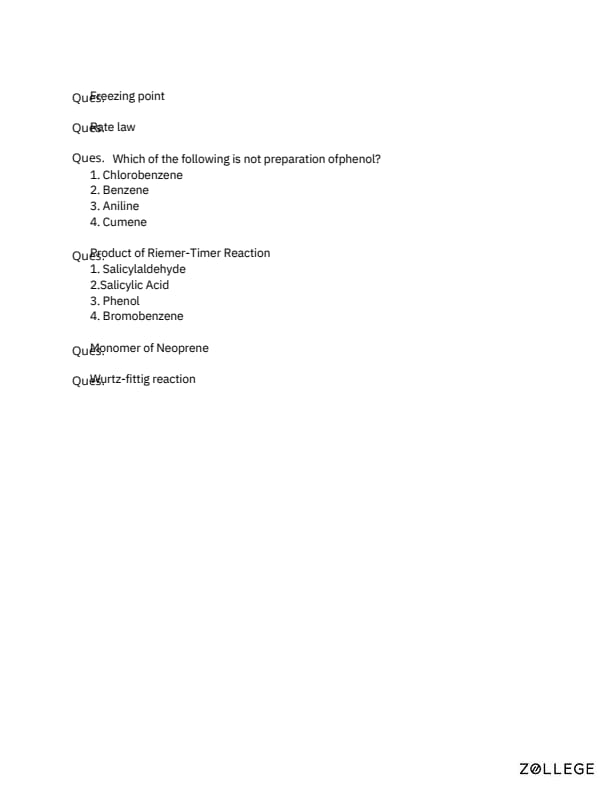
Freezing point
View Solution
Step 1: Define Freezing Point -
The freezing point is the temperature at which the liquid and solid phases of a substance have the same vapor pressure and exist in equilibrium.
Step 2: Depression in Freezing Point (\(\Delta T_f\)) -
When a non-volatile solute is added to a solvent, the freezing point decreases. This is a colligative property. \[ \Delta T_f = T_f^\circ - T_f \]
Where \(T_f^\circ\) is the pure solvent's freezing point and \(T_f\) is the solution's freezing point.
Step 3: Use Molality -
The depression is proportional to the molality (\(m\)): \[ \Delta T_f = i \cdot K_f \cdot m \]
Where \(i\) is the van't Hoff factor and \(K_f\) is the cryoscopic constant.
Step 4: Calculation -
To find the new freezing point: \( T_f = T_f^\circ - \Delta T_f \). Quick Tip: For water, \(T_f^\circ = 273.15\) K or \(0^\circ\)C. Adding salt always results in a value lower than this.
Rate law
View Solution
Step 1: Define Rate Law -
A rate law is an expression that relates the rate of a chemical reaction to the molar concentration of its reactants.
Step 2: General Form -
For a reaction \( aA + bB \to Products \): \[ Rate = k [A]^x [B]^y \]
Where:
\(k\) = Rate constant.
\(x, y\) = Orders with respect to reactants \(A\) and \(B\).
Step 3: Determining \(x\) and \(y\) -
The exponents (\(x\) and \(y\)) are experimentally determined and are not necessarily equal to the stoichiometric coefficients (\(a\) and \(b\)).
Step 4: Overall Order -
The sum of the exponents (\(x + y\)) gives the overall order of the reaction. Quick Tip: Only for "Elementary Reactions" (single-step) is the rate law predictable directly from the balanced chemical equation.
Which of the following is not preparation of phenol?
View Solution
Step 1: Check Chlorobenzene -
Used in Dow's Process. Reaction with NaOH at 623K and 300atm followed by acidification yields Phenol. (\textit{Valid method)
Step 2: Check Benzene -
Phenol cannot be prepared directly from Benzene in a single laboratory step. It usually requires conversion to Benzene Sulphonic acid or Chlorobenzene first. (\textit{Invalid direct method)
Step 3: Check Aniline -
Aniline is converted to Benzene Diazonium Chloride using \(NaNO_2/HCl\), which then produces Phenol when warmed with water. (\textit{Valid method)
Step 4: Check Cumene -
Cumene Process is the most common industrial method. Cumene is oxidized to Cumene hydroperoxide, which then decomposes to Phenol and Acetone. (\textit{Valid method) Quick Tip: Direct oxidation of Benzene to Phenol is difficult because Phenol is more reactive than Benzene and tends to oxidize further.
Product of Riemer-Timer Reaction
View Solution
Step 1: Identify the reactants -
The Reimer-Tiemann reaction involves the treatment of Phenol with Chloroform (\(CHCl_3\)) in the presence of an aqueous alkali (like \(NaOH\) or \(KOH\)).
Step 2: Formation of the intermediate -
The reaction proceeds through the formation of a reactive intermediate called Dichlorocarbene (\(:CCl_2\)). This intermediate attacks the ortho position of the phenoxide ion.
Step 3: Hydrolysis and Acidification -
The intermediate is hydrolyzed by the base and subsequently acidified to yield the final product.
Step 4: Identify the product -
An aldehyde group (\(-CHO\)) is introduced at the ortho position of the phenol ring. The resulting compound is Salicylaldehyde (2-Hydroxybenzaldehyde). Quick Tip: If Carbon Tetrachloride (\(CCl_4\)) is used instead of Chloroform, the major product will be \textbf{Salicylic Acid} instead of Salicylaldehyde.
Monomer of Neoprene
View Solution
Step 1: Define Neoprene -
Neoprene (also known as polychloroprene) is a synthetic rubber produced by the polymerization of a specific monomer.
Step 2: Identify the Monomer -
The monomer of Neoprene is Chloroprene.
Step 3: Chemical Structure -
The IUPAC name for chloroprene is 2-chloro-1,3-butadiene. Its chemical structure is: \[ CH_2 = C(Cl) - CH = CH_2 \]
Step 4: Polymerization Process -
Chloroprene undergoes free-radical addition polymerization to form Neoprene. \[ n [CH_2=C(Cl)-CH=CH_2] \to ---[CH_2-C(Cl)=CH-CH_2]---_n \] Quick Tip: Neoprene is highly resistant to oils, heat, and weathering, which is why it is used for making conveyor belts, gaskets, and diving suits.
Wurtz-fittig reaction
View Solution
Step 1: Definition -
The Wurtz-Fittig reaction is a variation of the Wurtz reaction used to synthesize Alkyl-substituted aromatic hydrocarbons.
Step 2: Identify the Reactants -
It involves the reaction of an Aryl halide (e.g., Chlorobenzene) and an Alkyl halide (e.g., Methyl chloride) with metallic Sodium in the presence of Dry Ether.
Step 3: Chemical Equation -
\[ C_6H_5X + 2Na + RX \xrightarrow{Dry Ether} C_6H_5 - R + 2NaX \]
Example (Synthesis of Toluene): \[ C_6H_5Cl + 2Na + CH_3Cl \xrightarrow{Dry Ether} C_6H_5 - CH_3 + 2NaCl \]
Step 4: Role of Dry Ether -
Dry ether is used as a solvent because sodium is highly reactive with moisture, and ether provides a non-polar environment that stabilizes the reaction intermediates. Quick Tip: To distinguish between the related reactions: 1. \textbf{Wurtz:} Alkyl halide + Alkyl halide. 2. \textbf{Fittig:} Aryl halide + Aryl halide. 3. \textbf{Wurtz-Fittig:} Alkyl halide + Aryl halide.

*The article might have information for the previous academic years, please refer the official website of the exam.