
MHT CET 2023 May 10 Shift 1 Question Paper with Solution PDF


Content Writer | Updated On - Jan 10, 2026
MHT CET 2023 May 10 Shift 1 Question Paper with Answer Key is now released and made available here for download. The exam was conducted from 9 AM to 12 Noon.
MHT CET 2023 exam paper consists of a total of 150 multiple choice questions, with a total weightage of 300 marks divided into three sections- Physics, Chemistry and Mathematics. Each section of the paper will comprise 50 questions, out of which 10 questions will be from Class 11 syllabus, while the remaining 40 questions will be from Class 12 syllabus.
Candidates who appeared for the exam on May 10 can use the MHT CET solutions to check the correct answers. Those who will take the test at a later date can use the paper for practice.
Also Check:
- MHT CET 2023 Exam Day Instructions and Important Guidelines
- MHT CET 2023 Paper Analysis (Out)
- MHT CET 2023 May 10 Shift 2 Question Paper with Answer Key (Out)
MHT CET 2023 May 10 Shift 1 Question Paper with Solution PDF
| MHT CET 2023 May 10 Shift 1 Question Paper | Download PDF | Check Solutions |

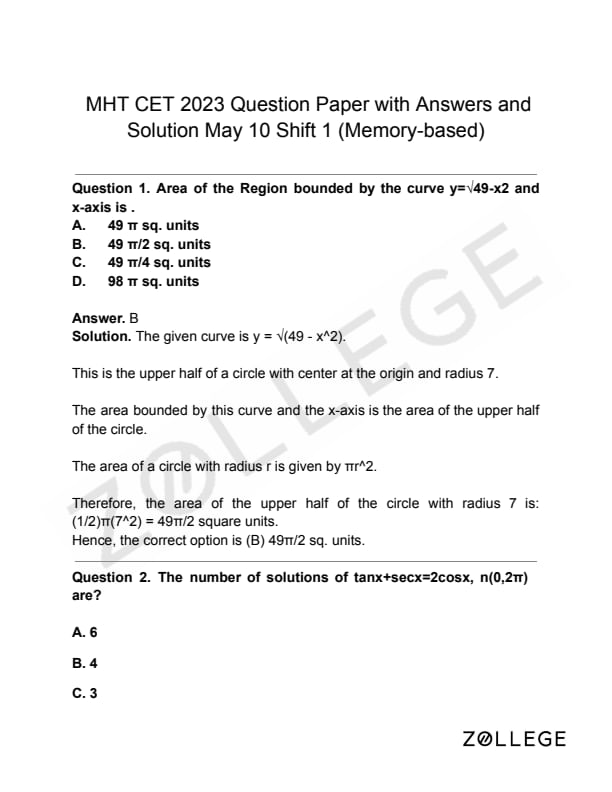
Area of the Region bounded by the curve \(y = \sqrt{49 - x^2}\) and x-axis is.
View Solution
Step 1: Understanding the Concept:
The given equation is \(y = \sqrt{49 - x^2}\).
Squaring both sides, we get \(y^2 = 49 - x^2\), which can be rewritten as \(x^2 + y^2 = 49\).
This is the equation of a circle centered at the origin \((0,0)\) with radius \(r = \sqrt{49} = 7\).
However, since \(y = \sqrt{49 - x^2}\) represents the principal (positive) square root, \(y \geq 0\).
Thus, the curve represents the upper semi-circle only.
Step 2: Key Formula or Approach:
The area of a full circle is \(\pi r^2\).
The area of a semi-circle is \(\frac{1}{2} \pi r^2\).
Step 3: Detailed Explanation:
Given radius \(r = 7\).
The region is bounded by the semi-circle and the x-axis.
\[ Area = \frac{1}{2} \pi r^2 \]
\[ Area = \frac{1}{2} \pi (7)^2 \]
\[ Area = \frac{49\pi}{2} sq. units \]
Step 4: Final Answer:
The area of the region is \(49 \pi/2\) sq. units.
Quick Tip: Whenever you see \(y = \sqrt{a^2 - x^2}\), recognize it immediately as the upper half of a circle. The area bounded by this curve and the x-axis is always half the area of the circle: \(\frac{\pi a^2}{2}\).
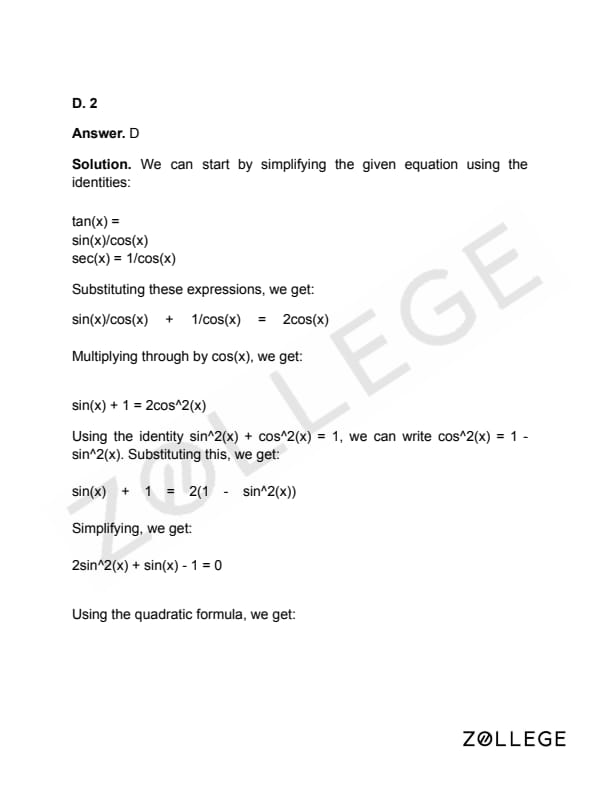
The number of solutions of \(\tan x + \sec x = 2 \cos x\), \(x \in (0, 2\pi)\) are?
View Solution
Step 1: Understanding the Concept:
This is a trigonometric equation. We need to convert all terms into sine and cosine to solve for \(x\) within the given interval \((0, 2\pi)\).
Step 2: Key Formula or Approach:
Convert \(\tan x\) and \(\sec x\) as:
\(\tan x = \frac{\sin x}{\cos x}\) and \(\sec x = \frac{1}{\cos x}\).
Step 3: Detailed Explanation:
The given equation is:
\[ \frac{\sin x}{\cos x} + \frac{1}{\cos x} = 2 \cos x \]
Assuming \(\cos x \neq 0\):
\[ \frac{\sin x + 1}{\cos x} = 2 \cos x \]
\[ \sin x + 1 = 2 \cos^2 x \]
Using the identity \(\cos^2 x = 1 - \sin^2 x\):
\[ \sin x + 1 = 2(1 - \sin^2 x) \]
\[ \sin x + 1 = 2 - 2 \sin^2 x \]
\[ 2 \sin^2 x + \sin x - 1 = 0 \]
Factorizing the quadratic in \(\sin x\):
\[ 2 \sin^2 x + 2 \sin x - \sin x - 1 = 0 \]
\[ 2 \sin x(\sin x + 1) - 1(\sin x + 1) = 0 \]
\[ (2 \sin x - 1)(\sin x + 1) = 0 \]
Case 1: \(2 \sin x - 1 = 0 \implies \sin x = 1/2\).
In \((0, 2\pi)\), \(x = \pi/6\) and \(x = 5\pi/6\).
Case 2: \(\sin x + 1 = 0 \implies \sin x = -1\).
In \((0, 2\pi)\), \(x = 3\pi/2\).
However, at \(x = 3\pi/2\), \(\cos x = 0\). This makes \(\tan x\) and \(\sec x\) undefined.
Therefore, \(x = 3\pi/2\) is not a valid solution.
Only \(x = \pi/6\) and \(x = 5\pi/6\) are valid.
Step 4: Final Answer:
There are 2 solutions.
Quick Tip: Always check the domain of the original equation. Trigonometric functions like \(\tan x\) and \(\sec x\) are undefined whenever the denominator (\(\cos x\)) is zero. Excluding these "extraneous" solutions is a common trap in competitive exams.
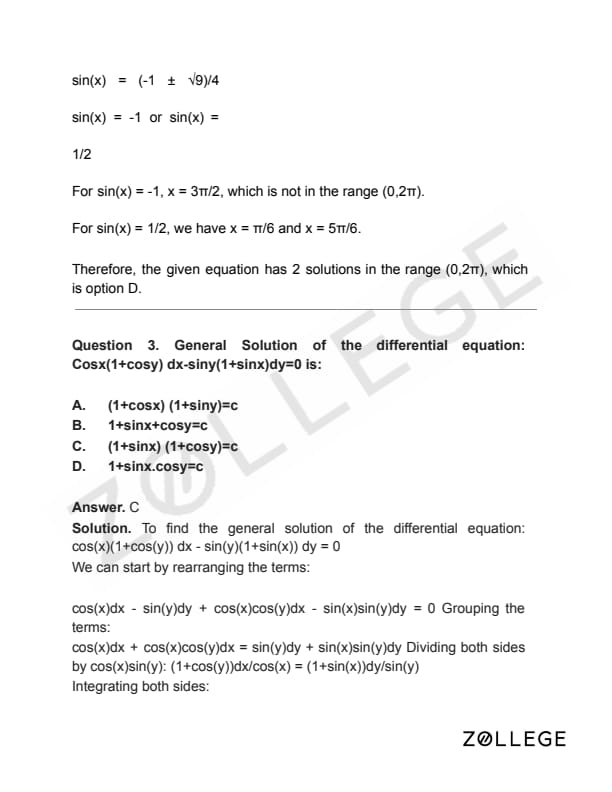
General Solution of the differential equation: \(\cos x (1 + \cos y) \, dx - \sin y (1 + \sin x) \, dy = 0\) is:
View Solution
Step 1: Understanding the Concept:
This is a first-order ordinary differential equation. We can solve it using the variable separable method, where we group all \(x\) terms with \(dx\) and \(y\) terms with \(dy\).
Step 2: Key Formula or Approach:
\[ \int \frac{f'(x)}{f(x)} \, dx = \ln|f(x)| + C \]
Step 3: Detailed Explanation:
The equation is:
\[ \cos x (1 + \cos y) \, dx = \sin y (1 + \sin x) \, dy \]
Separating the variables:
\[ \frac{\cos x}{1 + \sin x} \, dx = \frac{\sin y}{1 + \cos y} \, dy \]
Integrating both sides:
\[ \int \frac{\cos x}{1 + \sin x} \, dx = \int \frac{\sin y}{1 + \cos y} \, dy \]
For the left side, let \(u = 1 + \sin x \implies du = \cos x \, dx\).
For the right side, let \(v = 1 + \cos y \implies dv = -\sin y \, dy\).
\[ \ln |1 + \sin x| = -\int \frac{- \sin y}{1 + \cos y} \, dy \]
\[ \ln |1 + \sin x| = -\ln |1 + \cos y| + \ln c \]
\[ \ln |1 + \sin x| + \ln |1 + \cos y| = \ln c \]
Using logarithm properties (\(\ln A + \ln B = \ln AB\)):
\[ \ln |(1 + \sin x)(1 + \cos y)| = \ln c \] \[ (1 + \sin x)(1 + \cos y) = c \]
Step 4: Final Answer:
The general solution is \((1 + \sin x)(1 + \cos y) = c\).
Quick Tip: When the numerator is exactly the derivative (or a multiple of the derivative) of the denominator, the integral is always a logarithmic function. This pattern appears frequently in differential equation problems.
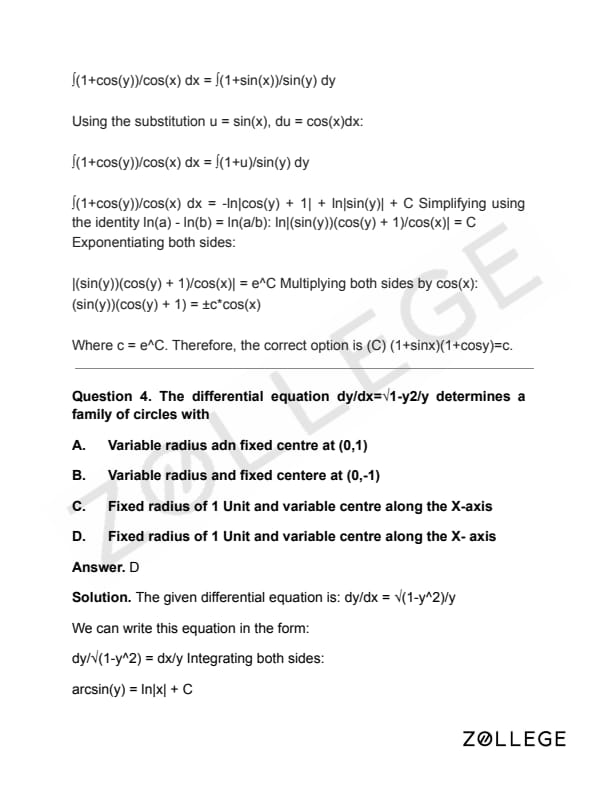
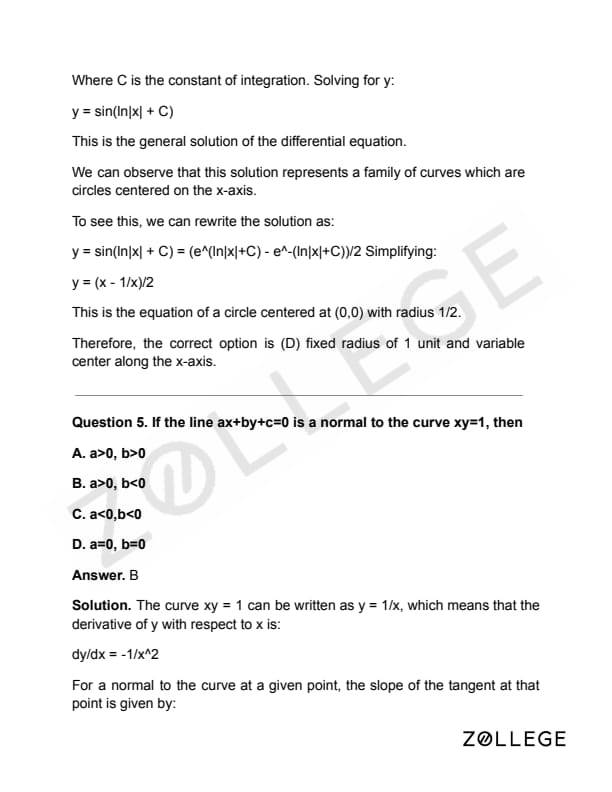
The differential equation \(dy/dx = \sqrt{1 - y^2}/y\) determines a family of circles with
View Solution
Step 1: Understanding the Concept:
We need to solve the given differential equation to find the equation of the family of curves and then interpret its geometric properties.
Step 2: Key Formula or Approach:
Variable Separable method:
\[ \frac{y}{\sqrt{1 - y^2}} \, dy = dx \]
Step 3: Detailed Explanation:
Integrating both sides:
\[ \int \frac{y}{\sqrt{1 - y^2}} \, dy = \int dx \]
To integrate the left side, let \(1 - y^2 = t \implies -2y \, dy = dt \implies y \, dy = -dt/2\).
\[ -\frac{1}{2} \int \frac{1}{\sqrt{t}} \, dt = x + c \]
\[ -\frac{1}{2} [2\sqrt{t}] = x + c \]
\[ -\sqrt{1 - y^2} = x + c \]
Squaring both sides:
\[ 1 - y^2 = (x + c)^2 \]
\[ (x + c)^2 + y^2 = 1 \]
This is the standard equation of a circle \((x - h)^2 + (y - k)^2 = r^2\).
Comparing the two:
- Center \((h, k) = (-c, 0)\). Since \(c\) is an arbitrary constant, the center moves along the x-axis.
- Radius \(r^2 = 1 \implies r = 1\). The radius is fixed at 1 unit.
Step 4: Final Answer:
The family consists of circles with a fixed radius of 1 unit and a variable center along the x-axis.
Quick Tip: If the final integrated equation is of the form \((x - a)^2 + (y - b)^2 = R^2\), and \(a\) or \(b\) contains the integration constant, that coordinate of the center is variable. If \(R\) is a constant, the radius is fixed.
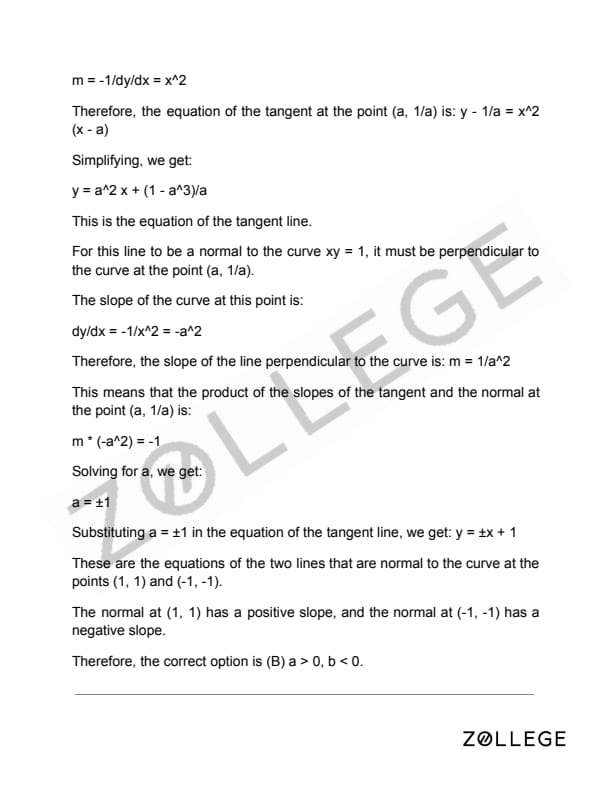
If the line \(ax + by + c = 0\) is a normal to the curve \(xy = 1\), then
View Solution
Step 1: Understanding the Concept:
For a line to be a normal to a curve at a point, its slope must be equal to the slope of the normal (\(-1 / slope of tangent\)) at that point.
Step 2: Key Formula or Approach:
Slope of tangent \(m_t = \frac{dy}{dx}\).
Slope of normal \(m_n = -\frac{1}{m_t}\).
Step 3: Detailed Explanation:
Curve: \(xy = 1 \implies y = 1/x\).
Differentiating with respect to \(x\):
\[ \frac{dy}{dx} = -\frac{1}{x^2} \]
Thus, the slope of the tangent at any point \((x, y)\) is \(m_t = -1/x^2\).
The slope of the normal at that point is:
\[ m_n = -\frac{1}{-1/x^2} = x^2 \]
Since \(x^2 > 0\) for all real \(x\) on the curve (where \(x \neq 0\)), the slope of any normal to this curve must be strictly positive.
The given line is \(ax + by + c = 0\), which can be rewritten in slope-intercept form as:
\[ y = \left(-\frac{a}{b}\right)x - \frac{c}{b} \]
The slope of this line is \(m = -a/b\).
For the line to be a normal, we must have \(m > 0\).
\[ -\frac{a}{b} > 0 \implies \frac{a}{b} < 0 \]
For the ratio \(a/b\) to be negative, \(a\) and \(b\) must have opposite signs.
- If \(a > 0\), then \(b < 0\). (Option B)
- If \(a < 0\), then \(b > 0\).
Checking the options, Option (B) matches the condition.
Step 4: Final Answer:
The condition is \(a > 0\) and \(b < 0\).
Quick Tip: For the hyperbola \(xy = c^2\), the slope of the tangent is always negative, so the slope of the normal is always positive. This means any line \(y = mx + c\) that is a normal must have \(m > 0\).
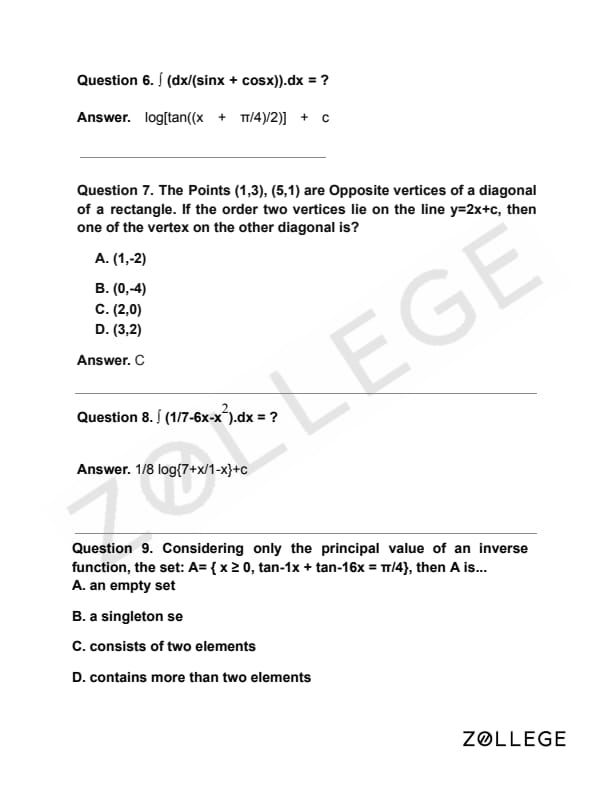
\(\int \frac{dx}{\sin x + \cos x} = ?\)
View Solution
Step 1: Understanding the Concept:
This integral involves a linear combination of sine and cosine in the denominator. We can simplify the denominator into a single trigonometric function using the compound angle formula.
Step 2: Key Formula or Approach:
Express \(A \sin x + B \cos x\) as \(R \sin(x + \alpha)\) where \(R = \sqrt{A^2 + B^2}\).
Standard integral: \(\int \csc \theta \, d\theta = \ln | \tan(\theta/2) | + C\).
Step 3: Detailed Explanation:
Divide and multiply the denominator by \(\sqrt{2}\):
\[ \int \frac{1}{\sqrt{2} \left( \frac{1}{\sqrt{2}}\sin x + \frac{1}{\sqrt{2}}\cos x \right)} \, dx \]
Using \(\cos(\pi/4) = 1/\sqrt{2}\) and \(\sin(\pi/4) = 1/\sqrt{2}\):
\[ \frac{1}{\sqrt{2}} \int \frac{1}{\sin x \cos(\pi/4) + \cos x \sin(\pi/4)} \, dx \]
\[ \frac{1}{\sqrt{2}} \int \frac{1}{\sin(x + \pi/4)} \, dx = \frac{1}{\sqrt{2}} \int \csc(x + \pi/4) \, dx \]
Using the formula \(\int \csc u \, du = \ln | \tan(u/2) | + c\):
\[ \frac{1}{\sqrt{2}} \ln \left| \tan \left( \frac{x + \pi/4}{2} \right) \right| + c \]
\[ \frac{1}{\sqrt{2}} \ln \left| \tan \left( \frac{x}{2} + \frac{\pi}{8} \right) \right| + c \]
Step 4: Final Answer:
The result is \(\frac{1}{\sqrt{2}} \ln | \tan(x/2 + \pi/8) | + c\).
Quick Tip: To quickly evaluate \(\int \frac{dx}{a \sin x + b \cos x}\), divide and multiply by \(\sqrt{a^2 + b^2}\) to turn the denominator into a single sine or cosine term. This transforms the integral into \(\csc\) or \(\sec\) form.
The Points (1,3), (5,1) are Opposite vertices of a diagonal of a rectangle. If the other two vertices lie on the line \(y = 2x + c\), then one of the vertex on the other diagonal is?
View Solution
Step 1: Understanding the Concept:
In a rectangle, the diagonals are equal and bisect each other. This means the midpoint of the diagonal joining \((1,3)\) and \((5,1)\) must also be the midpoint of the other diagonal.
Step 2: Key Formula or Approach:
Midpoint Formula: \((\frac{x_1 + x_2}{2}, \frac{y_1 + y_2}{2})\).
Distance Formula: \(\sqrt{(x_2 - x_1)^2 + (y_2 - y_1)^2}\).
Step 3: Detailed Explanation:
1. Find the midpoint \(M\) of the given diagonal:
\(M = \left( \frac{1 + 5}{2}, \frac{3 + 1}{2} \right) = (3, 2)\).
2. Since the other two vertices lie on \(y = 2x + c\) and their diagonal also bisects at \(M\), \(M(3,2)\) must satisfy the line equation:
\(2 = 2(3) + c \implies 2 = 6 + c \implies c = -4\).
So the equation of the other diagonal is \(y = 2x - 4\).
3. In a rectangle, the distance from the midpoint to any vertex is the same (half the diagonal length).
Half-diagonal length \(R = Distance(M, (1,3))\):
\(R = \sqrt{(3 - 1)^2 + (2 - 3)^2} = \sqrt{2^2 + (-1)^2} = \sqrt{5}\).
4. We need to find a point \((x, y)\) on the line \(y = 2x - 4\) such that its distance from \(M(3,2)\) is \(\sqrt{5}\):
\((x - 3)^2 + (y - 2)^2 = 5\)
Substitute \(y = 2x - 4\):
\((x - 3)^2 + (2x - 4 - 2)^2 = 5\)
\((x - 3)^2 + (2x - 6)^2 = 5\)
\((x - 3)^2 + 4(x - 3)^2 = 5\)
\(5(x - 3)^2 = 5 \implies (x - 3)^2 = 1 \implies x - 3 = \pm 1\).
So, \(x = 4\) or \(x = 2\).
If \(x = 2\), \(y = 2(2) - 4 = 0\). Point is \((2, 0)\).
If \(x = 4\), \(y = 2(4) - 4 = 4\). Point is \((4, 4)\).
Comparing with options, \((2,0)\) is Option (C).
Step 4: Final Answer:
One of the vertices is \((2,0)\).
Quick Tip: The midpoint of both diagonals in any parallelogram (including rectangles and squares) is the same. Use the property that all vertices of a rectangle are equidistant from the center of the rectangle to find coordinates efficiently.
\(\int \frac{1}{7 - 6x - x^2} \, dx = ?\)
View Solution
Step 1: Understanding the Concept:
This is an integral of a rational function with a quadratic denominator. We can solve it using the method of completing the square or by partial fractions.
Step 2: Key Formula or Approach:
Standard formula: \(\int \frac{dx}{a^2 - x^2} = \frac{1}{2a} \ln \left| \frac{a+x}{a-x} \right| + C\).
Step 3: Detailed Explanation:
Factor the denominator:
\(7 - 6x - x^2 = -(x^2 + 6x - 7)\)
\( = -(x^2 + 7x - x - 7)\)
\( = -[x(x+7) - 1(x+7)] = -(x-1)(x+7) = (1-x)(x+7)\).
Alternatively, complete the square:
\(7 - 6x - x^2 = 7 - (x^2 + 6x) = 7 - (x^2 + 6x + 9 - 9)\)
\( = 7 - [(x+3)^2 - 9] = 16 - (x+3)^2 = 4^2 - (x+3)^2\).
Now, evaluate the integral:
\[ \int \frac{dx}{4^2 - (x+3)^2} \]
Using the formula \(\int \frac{du}{a^2 - u^2} = \frac{1}{2a} \ln \left| \frac{a+u}{a-u} \right| + c\), with \(u = x+3\) and \(a = 4\):
\[ Integral = \frac{1}{2(4)} \ln \left| \frac{4 + (x+3)}{4 - (x+3)} \right| + c \]
\[ = \frac{1}{8} \ln \left| \frac{7+x}{1-x} \right| + c \]
Step 4: Final Answer:
The result is \(\frac{1}{8} \ln | \frac{7+x}{1-x} | + c\).
Quick Tip: For integrals of the type \(\int \frac{dx}{ax^2 + bx + c}\), always check if the denominator factors easily. If it does, partial fractions or the \(\ln |(a+x)/(a-x)|\) formula is usually faster than completing the square.
Considering only the principal value of an inverse function, the set: \(A = \{x \geq 0, \tan^{-1} x + \tan^{-1} 16x = \pi/4\}\), then A is...
View Solution
Step 1: Understanding the Concept:
We need to solve the trigonometric equation involving \(\tan^{-1}\) to find the number of valid solutions for \(x \geq 0\).
Step 2: Key Formula or Approach:
\[ \tan^{-1} A + \tan^{-1} B = \tan^{-1} \left( \frac{A+B}{1-AB} \right) \]
Step 3: Detailed Explanation:
The equation is \(\tan^{-1} x + \tan^{-1} 16x = \pi/4\).
Taking \(\tan\) on both sides:
\[ \frac{x + 16x}{1 - x(16x)} = \tan(\pi/4) \]
\[ \frac{17x}{1 - 16x^2} = 1 \]
\[ 17x = 1 - 16x^2 \]
\[ 16x^2 + 17x - 1 = 0 \]
Using the quadratic formula \(x = \frac{-b \pm \sqrt{b^2 - 4ac}}{2a}\):
\[ x = \frac{-17 \pm \sqrt{17^2 - 4(16)(-1)}}{2(16)} \]
\[ x = \frac{-17 \pm \sqrt{289 + 64}}{32} \]
\[ x = \frac{-17 \pm \sqrt{353}}{32} \]
We are given the condition \(x \geq 0\).
Since \(\sqrt{353} > \sqrt{289} = 17\), the value \(\frac{-17 + \sqrt{353}}{32}\) is positive.
The value \(\frac{-17 - \sqrt{353}}{32}\) is negative and must be discarded.
Thus, there is exactly one positive real value for \(x\).
Step 4: Final Answer:
The set \(A\) contains exactly one element, so it is a singleton set.
Quick Tip: When solving inverse trig equations, always plug your solutions back into the original equation (or check the constraints) to ensure the sum of principal values matches the given constant (like \(\pi/4\)). Here, the condition \(x \geq 0\) simplified the choice immediately.
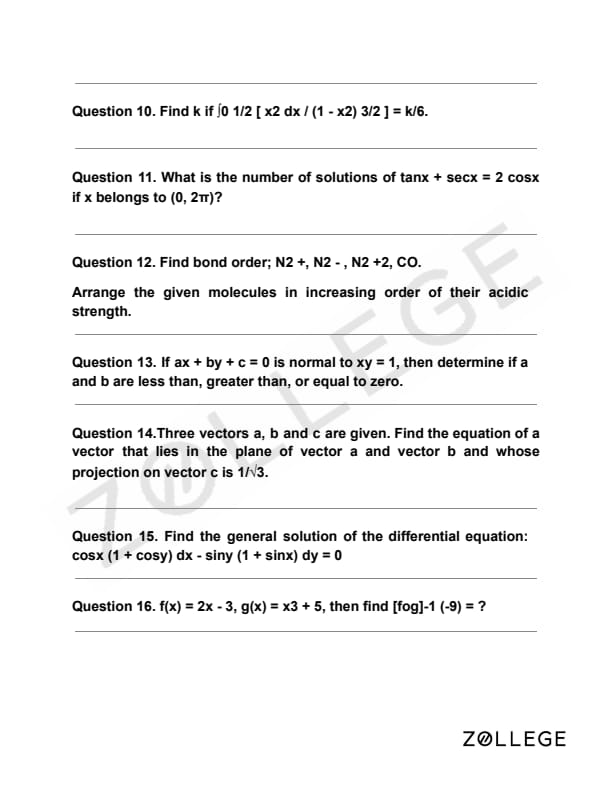
Find k if \(\int_0^{1/2} \frac{x^2 dx}{(1 - x^2)^{3/2}} = k/6\).
View Solution
Step 1: Understanding the Concept:
This is a definite integral involving an algebraic expression with a radical. Trigonometric substitution is the most effective method to simplify the denominator of the form \((a^2 - x^2)^{n}\).
Step 2: Key Formula or Approach:
Let \(x = \sin \theta\). Then \(dx = \cos \theta d\theta\).
The limits of integration change as follows:
When \(x = 0\), \(\sin \theta = 0 \implies \theta = 0\).
When \(x = 1/2\), \(\sin \theta = 1/2 \implies \theta = \pi/6\).
Step 3: Detailed Explanation:
Substitute these into the integral:
\[ I = \int_0^{\pi/6} \frac{\sin^2 \theta \cdot \cos \theta d\theta}{(1 - \sin^2 \theta)^{3/2}} \]
Using the identity \(1 - \sin^2 \theta = \cos^2 \theta\):
\[ I = \int_0^{\pi/6} \frac{\sin^2 \theta \cdot \cos \theta}{(\cos^2 \theta)^{3/2}} d\theta = \int_0^{\pi/6} \frac{\sin^2 \theta \cdot \cos \theta}{\cos^3 \theta} d\theta \]
\[ I = \int_0^{\pi/6} \tan^2 \theta d\theta \]
Using the identity \(\tan^2 \theta = \sec^2 \theta - 1\):
\[ I = \int_0^{\pi/6} (\sec^2 \theta - 1) d\theta = [\tan \theta - \theta]_0^{\pi/6} \]
\[ I = (\tan \frac{\pi}{6} - \frac{\pi}{6}) - (\tan 0 - 0) = \frac{1}{\sqrt{3}} - \frac{\pi}{6} \]
Given that the integral equals \(k/6\):
\[ \frac{k}{6} = \frac{1}{\sqrt{3}} - \frac{\pi}{6} \]
Multiply both sides by 6:
\[ k = \frac{6}{\sqrt{3}} - \pi = 2\sqrt{3} - \pi \]
Step 4: Final Answer:
The value of \(k\) is \(2\sqrt{3} - \pi\).
Quick Tip: Whenever you see a term like \((1 - x^2)\) in the denominator of an integral, think of substituting \(x = \sin \theta\) or \(x = \cos \theta\). It usually reduces the expression to a basic trigonometric integral.
What is the number of solutions of \(\tan x + \sec x = 2 \cos x\) if x belongs to \((0, 2\pi)\)?
View Solution
Step 1: Understanding the Concept:
To solve a trigonometric equation involving multiple functions, it is often best to convert everything into sine and cosine terms.
Step 2: Key Formula or Approach:
Use the definitions \(\tan x = \frac{\sin x}{\cos x}\) and \(\sec x = \frac{1}{\cos x}\).
Step 3: Detailed Explanation:
The equation becomes:
\[ \frac{\sin x}{\cos x} + \frac{1}{\cos x} = 2 \cos x \]
Multiply both sides by \(\cos x\) (assuming \(\cos x \neq 0\)):
\[ \sin x + 1 = 2 \cos^2 x \]
Substitute \(\cos^2 x = 1 - \sin^2 x\):
\[ \sin x + 1 = 2(1 - \sin^2 x) = 2 - 2 \sin^2 x \]
Rearrange into a quadratic equation in \(\sin x\):
\[ 2 \sin^2 x + \sin x - 1 = 0 \]
Factor the quadratic:
\[ (2 \sin x - 1)(\sin x + 1) = 0 \]
Possible solutions:
1. \(\sin x = 1/2 \implies x = \pi/6, 5\pi/6\).
2. \(\sin x = -1 \implies x = 3\pi/2\).
However, we must check for domain restrictions. At \(x = 3\pi/2\), \(\cos x = 0\), which makes \(\tan x\) and \(\sec x\) undefined. Thus, \(x = 3\pi/2\) is an extraneous solution.
The valid solutions are \(x = \pi/6\) and \(x = 5\pi/6\).
Step 4: Final Answer:
The number of solutions in \((0, 2\pi)\) is 2.
Quick Tip: Always check the domain of the original trigonometric functions! Solutions where the denominator of \(\tan x\) or \(\sec x\) (i.e., \(\cos x\)) is zero must be discarded.
Find bond order for \(N_2\), \(N_2^-\), \(N_2^{+2}\), and \(CO\).
View Solution
Step 1: Understanding the Concept:
Bond order represents the number of chemical bonds between a pair of atoms. According to Molecular Orbital (MO) Theory, Bond Order (B.O.) = \( \frac{1}{2}(N_b - N_a) \), where \(N_b\) is the number of bonding electrons and \(N_a\) is the number of anti-bonding electrons.
Step 2: Detailed Explanation:
1. \(N_2\): Total electrons = 14. Configuration: \(\sigma 1s^2 \sigma^* 1s^2 \sigma 2s^2 \sigma^* 2s^2 (\pi 2p_x^2 = \pi 2p_y^2) \sigma 2p_z^2\).
B.O. = \(\frac{1}{2}(10 - 4) = 3\).
2. \(N_2^-\): Total electrons = 15. The extra electron goes into the anti-bonding \(\pi^* 2p\) orbital.
B.O. = \(\frac{1}{2}(10 - 5) = 2.5\).
3. \(N_2^{+2}\): Total electrons = 12. Two electrons are removed from the bonding \(\sigma 2p_z\) orbital.
B.O. = \(\frac{1}{2}(8 - 4) = 2\).
4. \(CO\): Isoelectronic with \(N_2\) (14 electrons).
B.O. = 3.
Step 3: Final Answer:
The bond orders are 3, 2.5, 2, and 3 respectively.
Quick Tip: A quick shortcut for 14-electron species (like \(N_2\), \(CO\), \(CN^-\)) is that they always have a Bond Order of 3. Subtract 0.5 for every electron added to or removed from this 14-electron "peak".
Arrange the given molecules in increasing order of their acidic strength.
View Solution
Step 1: Understanding the Concept:
Acidic strength refers to the tendency of a molecule to donate a proton (\(H^+\)).
Step 2: Detailed Explanation:
Acidic strength depends on:
1. Bond Strength: As the size of the halogen increases (down the group), the \(H-X\) bond becomes weaker, and the acid becomes stronger. Order: \(HF < HCl < HBr < HI\).
2. Electronegativity/Inductive Effect: In oxoacids, higher electronegativity of the central atom increases acidity. Example: \(HOI < HOBr < HOCl\).
3. Oxidation State: Higher oxidation state of the central atom increases acidity. Example: \(HClO < HClO_2 < HClO_3 < HClO_4\).
Step 3: Final Answer:
For common binary acids, the order is \(HF < HCl < HBr < HI\).
Quick Tip: For hydrides of the same group, bond dissociation enthalpy is the dominant factor. For oxoacids of the same element, the oxidation state of the central atom is the deciding factor.
If \(ax + by + c = 0\) is normal to \(xy = 1\), then determine if a and b are less than, greater than, or equal to zero.
View Solution
Step 1: Understanding the Concept:
The normal to a curve at a point is a line perpendicular to the tangent at that point.
Step 2: Key Formula or Approach:
Slope of tangent \(m_t = \frac{dy}{dx}\).
Slope of normal \(m_n = -\frac{1}{m_t}\).
Step 3: Detailed Explanation:
The curve is \(xy = 1 \implies y = 1/x\).
Differentiating with respect to \(x\): \(\frac{dy}{dx} = -1/x^2\).
Therefore, the slope of the tangent is always negative (since \(x^2 > 0\)).
The slope of the normal is \(m_n = -1/(-1/x^2) = x^2\).
This means the slope of any normal to this curve must be positive (\(m_n > 0\)).
The given line is \(ax + by + c = 0 \implies y = (-\frac{a}{b})x - \frac{c}{b}\).
Its slope is \(m = -a/b\).
Since the normal slope must be positive:
\[ -\frac{a}{b} > 0 \implies \frac{a}{b} < 0 \]
For the ratio \(a/b\) to be negative, \(a\) and \(b\) must have opposite signs (one is positive and the other is negative).
Step 4: Final Answer:
\(a\) and \(b\) must have opposite signs (e.g., \(a > 0, b < 0\) or \(a < 0, b > 0\)).
Quick Tip: For the rectangular hyperbola \(xy = c^2\), all tangents have negative slopes, and consequently, all normals have positive slopes.
Three vectors a, b and c are given. Find the equation of a vector that lies in the plane of vector a and vector b and whose projection on vector c is \(1/\sqrt{3}\).
View Solution
Step 1: Understanding the Concept:
A vector \(\mathbf{r}\) coplanar with vectors \(\mathbf{a}\) and \(\mathbf{b}\) can be expressed as a linear combination: \(\mathbf{r} = \lambda \mathbf{a} + \mu \mathbf{b}\).
The scalar projection of \(\mathbf{r}\) on \(\mathbf{c}\) is given by \(\frac{\mathbf{r} \cdot \mathbf{c}}{|\mathbf{c}|}\).
Step 2: Key Formula or Approach:
1. \(\mathbf{r} = \lambda \mathbf{a} + \mu \mathbf{b}\)
2. \(Proj_{\mathbf{c}} \mathbf{r} = \frac{\mathbf{r} \cdot \mathbf{c}}{|\mathbf{c}|} = \frac{1}{\sqrt{3}}\)
Step 3: Detailed Explanation:
Substitute the expression for \(\mathbf{r}\) into the projection formula:
\[ \frac{(\lambda \mathbf{a} + \mu \mathbf{b}) \cdot \mathbf{c}}{|\mathbf{c}|} = \frac{1}{\sqrt{3}} \]
\[ \lambda(\mathbf{a} \cdot \mathbf{c}) + \mu(\mathbf{b} \cdot \mathbf{c}) = \frac{|\mathbf{c}|}{\sqrt{3}} \]
This gives a linear relationship between the scalars \(\lambda\) and \(\mu\). Once specific vectors \(\mathbf{a, b, c}\) are provided, we can solve for one variable in terms of the other and find the general form of the required vector.
Step 4: Final Answer:
The required vector is \(\mathbf{r} = \lambda \mathbf{a} + \mu \mathbf{b}\) where \(\lambda\) and \(\mu\) satisfy \(\lambda(\mathbf{a} \cdot \mathbf{c}) + \mu(\mathbf{b} \cdot \mathbf{c}) = \frac{|\mathbf{c}|}{\sqrt{3}}\).
Quick Tip: Remember: "In the plane of \(\mathbf{a}\) and \(\mathbf{b}\)" always implies \(\mathbf{r} = \lambda \mathbf{a} + \mu \mathbf{b}\). Projection is a scalar value; don't confuse it with the vector projection.
Find the general solution of the differential equation: \(\cos x (1 + \cos y) dx - \sin y (1 + \sin x) dy = 0\).
View Solution
Step 1: Understanding the Concept:
This is a first-order differential equation that can be solved using the variable separable method.
Step 2: Detailed Explanation:
The given equation is:
\[ \cos x (1 + \cos y) dx = \sin y (1 + \sin x) dy \]
Separate the variables by grouping terms of \(x\) with \(dx\) and terms of \(y\) with \(dy\):
\[ \frac{\cos x}{1 + \sin x} dx = \frac{\sin y}{1 + \cos y} dy \]
Integrate both sides:
\[ \int \frac{\cos x}{1 + \sin x} dx = \int \frac{\sin y}{1 + \cos y} dy \]
Let \(u = 1 + \sin x \implies du = \cos x dx\).
Let \(v = 1 + \cos y \implies dv = -\sin y dy \implies \sin y dy = -dv\).
The integrals become:
\[ \int \frac{1}{u} du = \int \frac{-1}{v} dv \]
\[ \ln |u| = -\ln |v| + \ln C \]
\[ \ln |1 + \sin x| + \ln |1 + \cos y| = \ln C \]
Using the property \(\ln A + \ln B = \ln(AB)\):
\[ \ln |(1 + \sin x)(1 + \cos y)| = \ln C \]
\[ (1 + \sin x)(1 + \cos y) = C \]
Step 3: Final Answer:
The general solution is \((1 + \sin x)(1 + \cos y) = C\).
Quick Tip: When performing variable separation, look for expressions where the numerator is the derivative of the denominator (logarithmic integration).
\(f(x) = 2x - 3\), \(g(x) = x^3 + 5\), then find \([f \circ g]^{-1}(-9) = ?\)
View Solution
Step 1: Understanding the Concept:
To find \([f \circ g]^{-1}(y)\), we first find the composite function \(h(x) = f(g(x))\) and then solve the equation \(h(x) = y\).
Step 2: Key Formula or Approach:
If \(h(x) = y\), then \(x = h^{-1}(y)\).
Step 3: Detailed Explanation:
1. Find the composite function \(f(g(x))\):
\[ f(g(x)) = 2(g(x)) - 3 \]
\[ f(g(x)) = 2(x^3 + 5) - 3 = 2x^3 + 10 - 3 \]
\[ h(x) = 2x^3 + 7 \]
2. To find \([f \circ g]^{-1}(-9)\), set \(h(x) = -9\):
\[ 2x^3 + 7 = -9 \]
\[ 2x^3 = -16 \]
\[ x^3 = -8 \]
\[ x = \sqrt[3]{-8} = -2 \]
Step 4: Final Answer:
The value is -2.
Quick Tip: Instead of finding the full inverse function algebraic expression, simply set the composite function equal to the target value and solve for \(x\). This saves significant time in exams.
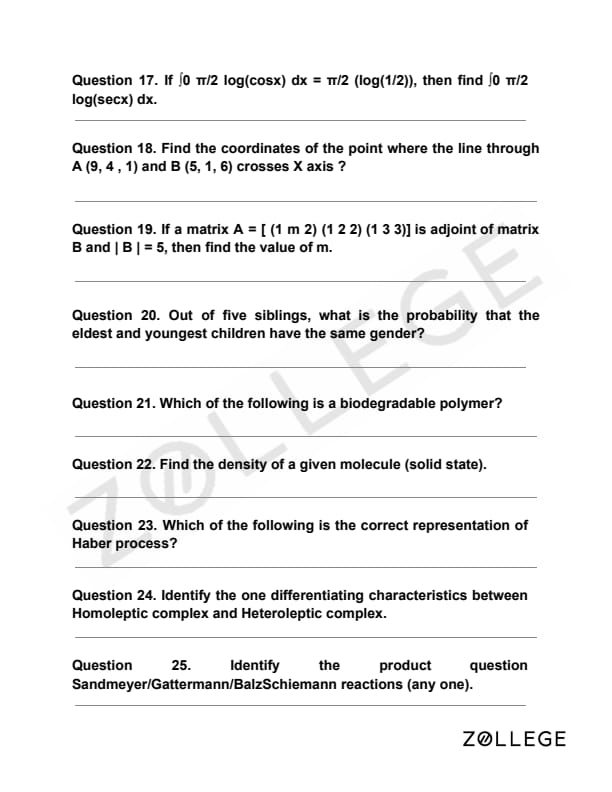
If \(\int_0^{\pi/2} \log(\cos x) dx = \pi/2 (\log(1/2))\), then find \(\int_0^{\pi/2} \log(\sec x) dx\).
View Solution
Step 1: Understanding the Concept:
Logarithmic trigonometric integrals often utilize the property \(\sec x = (\cos x)^{-1}\) and logarithmic properties like \(\log(a^n) = n \log a\).
Step 2: Detailed Explanation:
The target integral is:
\[ I = \int_0^{\pi/2} \log(\sec x) dx \]
Since \(\sec x = 1/\cos x = (\cos x)^{-1}\):
\[ I = \int_0^{\pi/2} \log((\cos x)^{-1}) dx \]
\[ I = - \int_0^{\pi/2} \log(\cos x) dx \]
Substitute the given value for the cosine integral:
\[ I = - [ \frac{\pi}{2} \log(\frac{1}{2}) ] \]
Using \(\log(1/2) = \log(2^{-1}) = -\log 2\):
\[ I = - [ \frac{\pi}{2} (-\log 2) ] = \frac{\pi}{2} \log 2 \]
Step 3: Final Answer:
The value of the integral is \(\frac{\pi}{2} \log 2\).
Quick Tip: Remember that \(\int_0^{\pi/2} \log(\sin x) dx = \int_0^{\pi/2} \log(\cos x) dx = -\frac{\pi}{2} \log 2\). This is a standard result in competitive math.
Find the coordinates of the point where the line through A(9, 4, 1) and B(5, 1, 6) crosses X axis?
View Solution
Step 1: Understanding the Concept:
The X-axis consists of all points where the y and z coordinates are zero, i.e., \((x, 0, 0)\). For a line to cross the X-axis, there must exist a point on the line that satisfies this condition.
Step 2: Key Formula or Approach:
Equation of a line through \((x_1, y_1, z_1)\) and \((x_2, y_2, z_2)\):
\[ \frac{x - x_1}{x_2 - x_1} = \frac{y - y_1}{y_2 - y_1} = \frac{z - z_1}{z_2 - z_1} = \lambda \]
Step 3: Detailed Explanation:
1. Find the equation of line AB:
\[ \frac{x - 9}{5 - 9} = \frac{y - 4}{1 - 4} = \frac{z - 1}{6 - 1} \]
\[ \frac{x - 9}{-4} = \frac{y - 4}{-3} = \frac{z - 1}{5} = \lambda \]
2. For a point on the X-axis, \(y = 0\) and \(z = 0\):
From the \(y\) part: \(\frac{0 - 4}{-3} = \lambda \implies \lambda = 4/3\).
From the \(z\) part: \(\frac{0 - 1}{5} = \lambda \implies \lambda = -1/5\).
Since the \(\lambda\) values are different (\(4/3 \neq -1/5\)), the line does not pass through any point where both \(y\) and \(z\) are zero simultaneously.
Step 4: Final Answer:
The given line does not cross the X-axis.
Quick Tip: A point \((x, 0, 0)\) on the X-axis only exists for a line if the ratios for \(y\) and \(z\) yield the same parameter \(\lambda\). If they differ, the line is skew or in a position that misses the axis entirely.
If a matrix \(A = \begin{bmatrix} 1 & m & 2
1 & 2 & 2
1 & 3 & 3 \end{bmatrix}\) is adjoint of matrix B and \(|B| = 5\), then find the value of m.
View Solution
Step 1: Understanding the Concept:
For a square matrix \(B\) of order \(n\), the relationship between the determinant of its adjoint (\(adj B\)) and the determinant of \(B\) itself is:
\[ |adj B| = |B|^{n-1} \]
Step 2: Detailed Explanation:
1. Given \(n = 3\) (since \(A\) is \(3 \times 3\)) and \(|B| = 5\).
\[ |A| = |B|^{3-1} = |B|^2 = 5^2 = 25 \]
2. Calculate the determinant of \(A\):
\[ |A| = 1(2 \cdot 3 - 3 \cdot 2) - m(1 \cdot 3 - 1 \cdot 2) + 2(1 \cdot 3 - 1 \cdot 2) \]
\[ |A| = 1(6 - 6) - m(3 - 2) + 2(3 - 2) \]
\[ |A| = 0 - m(1) + 2(1) = 2 - m \]
3. Equate the two values:
\[ 2 - m = 25 \]
\[ -m = 23 \implies m = -23 \]
Step 3: Final Answer:
The value of \(m\) is -23.
Quick Tip: The property \(|adj A| = |A|^{n-1}\) is a very frequent topic in matrix algebra. Remember the power is always one less than the order of the matrix.
Out of five siblings, what is the probability that the eldest and youngest children have the same gender?
View Solution
Step 1: Understanding the Concept:
Gender for each child is considered an independent event with two outcomes: Boy (B) or Girl (G), each with a probability of 1/2.
Step 2: Detailed Explanation:
1. Consider only the eldest and the youngest child. The middle three children do not affect this specific condition.
2. Let \(E\) be the gender of the eldest and \(Y\) be the gender of the youngest.
Possible pairs \((E, Y)\) are: \((B, B), (B, G), (G, B), (G, G)\).
Total outcomes = \(2 \times 2 = 4\).
3. Favorable outcomes for "same gender" are: \((B, B)\) and \((G, G)\).
Number of favorable outcomes = 2.
4. Probability = \(\frac{Favorable outcomes}{Total outcomes} = \frac{2}{4} = \frac{1}{2}\).
Step 3: Final Answer:
The probability is 1/2.
Quick Tip: In probability problems involving independent trials like coin tosses or genders, irrelevant information (like the number of middle siblings) should be ignored to simplify the sample space.
Which of the following is a biodegradable polymer?
View Solution
Step 1: Understanding the Concept:
Biodegradable polymers are polymers that can be broken down by microorganisms in the environment. Unlike traditional plastics, they do not cause long-term environmental pollution.
Step 2: Detailed Explanation:
Common examples include:
1. PHBV: Used in specialty packaging, orthopedic devices, and controlled release of drugs. It is a copolymer of 3-hydroxybutanoic acid and 3-hydroxypentanoic acid.
2. Nylon-2-nylon-6: An alternating polyamide copolymer of glycine and amino caproic acid.
Step 3: Final Answer:
PHBV is a widely recognized biodegradable polymer.
Quick Tip: Most natural polymers like cellulose, starch, and proteins are biodegradable. For synthetic ones, focus on PHBV and Nylon-2-nylon-6 for board and competitive exams.
Find the density of a given molecule (solid state).
View Solution
Step 1: Understanding the Concept:
The density (\(\rho\)) of a crystalline solid (unit cell) is the mass of the unit cell divided by its volume.
Step 2: Key Formula or Approach:
\[ \rho = \frac{Z \times M}{N_A \times V} = \frac{Z \times M}{N_A \times a^3} \]
Step 3: Detailed Explanation:
Where:
- \(Z\) = number of atoms/molecules per unit cell (1 for SC, 2 for BCC, 4 for FCC).
- \(M\) = Molar mass of the substance.
- \(N_A\) = Avogadro's number (\(6.022 \times 10^{23}\)).
- \(a\) = Edge length of the unit cell.
- \(a^3\) = Volume of the cubic unit cell.
Step 4: Final Answer:
Density is calculated using the formula \(\rho = \frac{Z \cdot M}{N_A \cdot a^3}\).
Quick Tip: Ensure that the units are consistent. Usually, \(a\) is converted from pm or \AA to cm so that density is obtained in \(g/cm^3\).
Which of the following is the correct representation of Haber process?
View Solution
Step 1: Understanding the Concept:
The Haber Process is the industrial method for the synthesis of ammonia from nitrogen and hydrogen.
Step 2: Detailed Explanation:
The chemical equation is:
\[ N_2(g) + 3H_2(g) \rightleftharpoons 2NH_3(g); \Delta H = -92.4 kJ/mol \]
Conditions for maximum yield (Le Chatelier's Principle):
1. High Pressure: approx 200 atm.
2. Low Temperature: approx 700 K (Optimum temperature used in practice to maintain rate).
3. Catalyst: Iron oxide with small amounts of \(K_2O\) and \(Al_2O_3\) as promoters.
Step 3: Final Answer:
The Haber process is represented by \(N_2 + 3H_2 \to 2NH_3\).
Quick Tip: The Haber process is an exothermic reaction. Although low temperature favors yield, an optimum temperature is used to ensure the reaction proceeds at a reasonable speed.
Identify the one differentiating characteristic between Homoleptic complex and Heteroleptic complex.
View Solution
Step 1: Understanding the Concept:
Coordination complexes are classified based on the diversity of the ligands coordinated to the metal center.
Step 2: Detailed Explanation:
1. Homoleptic Complexes: Complexes in which a metal is bound to only one kind of donor groups/ligands.
Example: \([Co(NH_3)_6]^{3+}\) (All 6 ligands are ammonia).
2. Heteroleptic Complexes: Complexes in which a metal is bound to more than one kind of donor groups/ligands.
Example: \([Co(NH_3)_4Cl_2]^+\) (Contains both ammonia and chloride ligands).
Step 3: Final Answer:
Homoleptic complexes have identical ligands, while heteroleptic complexes have different types of ligands.
Quick Tip: "Homo" means same, "Hetero" means different. This prefix logic helps distinguish ligand types in coordination chemistry.
Identify the product of Sandmeyer/Gattermann/Balz-Schiemann reactions (any one).
View Solution
Step 1: Understanding the Concept:
These are name reactions used to synthesize aryl halides from benzene diazonium salts.
Step 2: Detailed Explanation:
1. Sandmeyer Reaction: Treatment of benzene diazonium chloride with cuprous chloride (\(CuCl\)) or cuprous bromide (\(CuBr\)) dissolved in respective halogen acid results in chloro- or bromo- benzene.
\[ C_6H_5N_2^+Cl^- \xrightarrow{CuCl/HCl} C_6H_5Cl + N_2 \]
2. Gattermann Reaction: Uses copper powder in the presence of \(HCl\) or \(HBr\) instead of cuprous salts.
3. Balz-Schiemann Reaction: Used for fluorination.
\[ C_6H_5N_2^+Cl^- + HBF_4 \to C_6H_5N_2^+BF_4^- \xrightarrow{\Delta} C_6H_5F + BF_3 + N_2 \]
Step 3: Final Answer:
The product of the Sandmeyer reaction using \(CuCl\) is chlorobenzene.
Quick Tip: The Sandmeyer reaction generally gives better yields than the Gattermann reaction. It is the primary way to introduce \(Cl, Br\), or \(CN\) into a benzene ring via diazonium salts.
*The article might have information for the previous academic years, please refer the official website of the exam.