
MHT CET 2023 May 11 Shift 1 Question Paper with Solution PDF


Content Writer | Updated On - Jan 10, 2026
MHT CET 2023 May 11 Shift 1 Question Paper with Answer Key is now available here for download. The exam was held from 9 AM to 12 Noon.
MHT CET 2023 exam paper consists of a total of 150 multiple choice questions, with a total weightage of 300 marks divided into three sections- Physics, Chemistry and Mathematics. Each section of the paper will comprise 50 questions, out of which 10 questions will be from Class 11 syllabus, while the remaining 40 questions will be from Class 12 syllabus.
Candidates who appeared for the exam on May 11 can use the MHT CET solutions to check the correct answers. Those who will take the test on a later date can use the paper for practice.
Also Check: MHT CET 2023 Paper Analysis
MHT CET 2023 May 11 Shift 1 Question Paper with Solution PDF
| MHT CET 2023 May 9 Shift 1 Question Paper | Download PDF | Check Solutions |

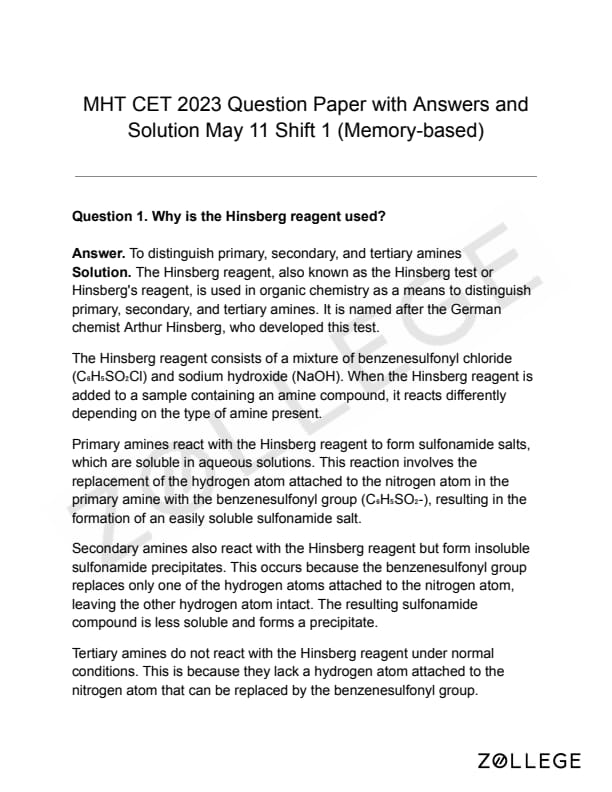
Why is the Hinsberg reagent used?
View Solution
Step 1: Understanding the Concept:
The Hinsberg reagent is Benzenesulfonyl chloride (\(C_6H_5SO_2Cl\)). It is a classic chemical test used in organic chemistry to differentiate between primary (\(1^\circ\)), secondary (\(2^\circ\)), and tertiary (\(3^\circ\)) amines based on their reaction with the reagent and the solubility of the resulting sulfonamide in alkali.
Step 2: Key Formula or Approach:
The reaction involves the nucleophilic attack of the amine on the sulfur atom of the sulfonyl chloride.
1. Primary Amine: Forms a sulfonamide that is soluble in aqueous \(KOH\) (due to acidic Hydrogen on Nitrogen).
2. Secondary Amine: Forms a sulfonamide that is insoluble in \(KOH\) (no acidic Hydrogen).
3. Tertiary Amine: Does not react with benzenesulfonyl chloride under standard conditions.
Step 3: Detailed Explanation:
- Primary amines: Reaction yields \(N\)-alkylbenzenesulfonamide. Since it contains an acidic hydrogen attached to Nitrogen, it reacts with \(KOH\) to form a soluble salt.
\[ R-NH_2 + C_6H_5SO_2Cl \rightarrow C_6H_5SO_2NHR + HCl \]
- Secondary amines: Reaction yields \(N,N\)-dialkylbenzenesulfonamide. It lacks an acidic hydrogen, so it remains insoluble in \(KOH\).
\[ R_2NH + C_6H_5SO_2Cl \rightarrow C_6H_5SO_2NR_2 + HCl \]
- Tertiary amines: They lack hydrogen atoms on the nitrogen to undergo the substitution, so no reaction occurs (or a salt forms which decomposes in water).
Step 4: Final Answer:
Therefore, the Hinsberg reagent is primarily used for the identification and separation of primary, secondary, and tertiary amines.
Quick Tip: Remember: "Primary is Soluble, Secondary is Insoluble, Tertiary is No Reaction." This simple mnemonic helps solve Hinsberg reagent questions instantly in competitive exams.
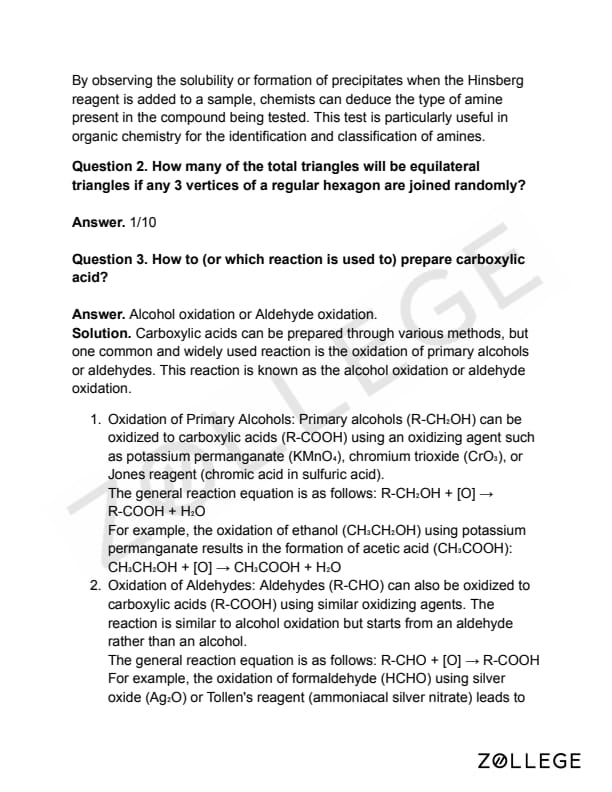
How many of the total triangles will be equilateral triangles if any 3 vertices of a regular hexagon are joined randomly?
View Solution
Step 1: Understanding the Concept:
A regular hexagon has 6 vertices. To form a triangle, we need to choose any 3 vertices out of these 6. The probability of forming an equilateral triangle is the ratio of the number of equilateral triangles to the total number of possible triangles.
Step 2: Key Formula or Approach:
Total number of triangles = \( \binom{n}{3} \), where \(n\) is the number of vertices.
For a hexagon, \(n = 6\).
Step 3: Detailed Explanation:
1. Calculate total triangles:
\[ Total Triangles = \binom{6}{3} = \frac{6 \times 5 \times 4}{3 \times 2 \times 1} = 20 \]
2. Identify equilateral triangles:
In a regular hexagon with vertices labeled 1, 2, 3, 4, 5, 6 in order:
- An equilateral triangle is formed by joining vertices that are equally spaced.
- If we skip one vertex each time, we get: (1, 3, 5) and (2, 4, 6).
- These are the only 2 equilateral triangles possible.
3. Calculate Probability:
\[ P(Equilateral) = \frac{Number of equilateral triangles}{Total triangles} \]
\[ P(Equilateral) = \frac{2}{20} = \frac{1}{10} \]
Step 4: Final Answer:
The number of equilateral triangles as a fraction of total triangles is \(1/10\).
Quick Tip: For any regular \(n\)-gon, the number of equilateral triangles is \(n/3\) (if \(n\) is a multiple of 3). Here, \(6/3 = 2\). Total triangles is always \(\binom{n}{3}\).
How to (or which reaction is used to) prepare carboxylic acid?
View Solution
Step 1: Understanding the Concept:
Carboxylic acids (\(R-COOH\)) can be synthesized via several functional group transformations in organic chemistry, primarily involving oxidation or carbonylation reactions.
Step 2: Detailed Explanation:
1. Oxidation of Primary Alcohols: Primary alcohols react with strong oxidizing agents like acidified \(KMnO_4\) or \(K_2Cr_2O_7\) to form carboxylic acids.
\[ R-CH_2OH \xrightarrow{[O]} R-CHO \xrightarrow{[O]} R-COOH \]
2. Hydrolysis of Nitriles: Nitriles (\(R-CN\)) can be hydrolyzed in the presence of dilute acid or base to yield carboxylic acids.
\[ R-CN \xrightarrow{H_3O^+} R-CONH_2 \xrightarrow{H_3O^+} R-COOH \]
3. Grignard Reagent Method: Grignard reagents (\(R-MgX\)) react with solid carbon dioxide (dry ice) followed by acidification to produce carboxylic acids with one additional carbon atom.
\[ R-MgX + CO_2 \rightarrow R-COOMgX \xrightarrow{H_2O/H^+} R-COOH \]
Step 3: Final Answer:
Since all listed methods are standard laboratory and industrial preparations for carboxylic acids, the correct choice is (D).
Quick Tip: To increase the carbon chain length by one, use the Grignard + \(CO_2\) or the Cyanide (\(CN^-\)) substitution followed by hydrolysis method.
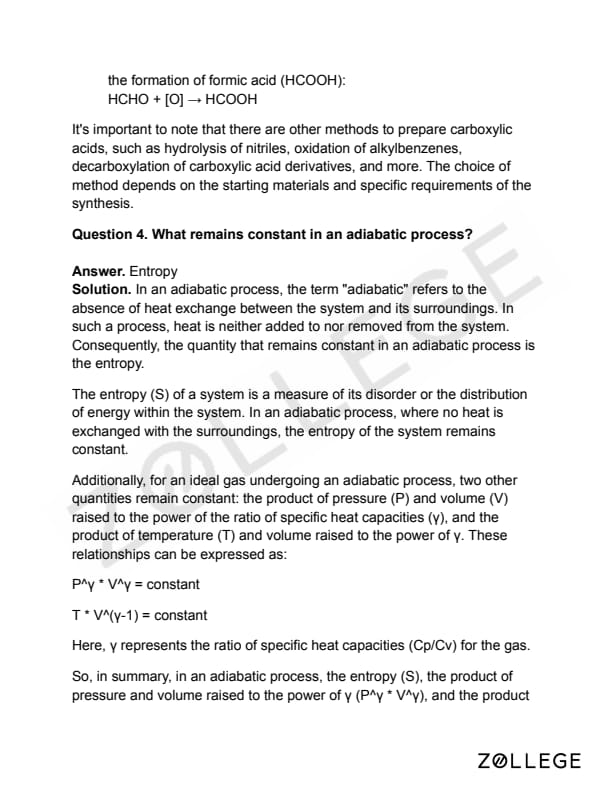
What remains constant in an adiabatic process?
View Solution
Step 1: Understanding the Concept:
An adiabatic process is a thermodynamic process in which there is no exchange of heat between the system and its surroundings (\(q = 0\)).
Step 2: Key Formula or Approach:
From the First Law of Thermodynamics:
\[ \Delta U = q + w \]
For an adiabatic process, \(q = 0\), so:
\[ \Delta U = w \]
Step 3: Detailed Explanation:
- By definition, "adiabatic" means heat does not enter or leave the system.
- If the process is also reversible, it is called an isentropic process, meaning entropy remains constant. However, the fundamental definition of an adiabatic process is the lack of heat transfer.
- Temperature, Pressure, and Volume all change in an adiabatic process according to the relation \(PV^\gamma = constant\).
Step 4: Final Answer:
In an adiabatic process, the heat exchange (\(q\)) is zero, meaning heat content (relative to surroundings) is effectively constant in terms of transfer.
Quick Tip: Do not confuse Adiabatic (\(q=0\)) with Isothermal (\(\Delta T=0\)). In an adiabatic expansion, the temperature of the gas always decreases.
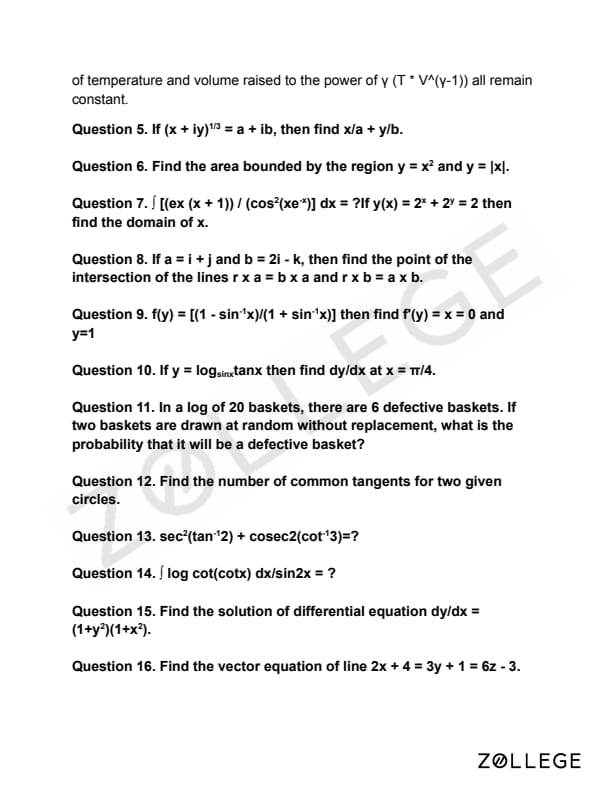
If \((x + iy)^{1/3} = a + ib\), then find \(x/a + y/b\).
View Solution
Step 1: Understanding the Concept:
This problem involves complex numbers and the expansion of a binomial cubed. We need to cube both sides to eliminate the fractional power and then equate real and imaginary parts.
Step 2: Key Formula or Approach:
\[ (x + iy) = (a + ib)^3 \]
Using the identity \((A+B)^3 = A^3 + 3A^2B + 3AB^2 + B^3\).
Step 3: Detailed Explanation:
1. Expand the right side:
\[ x + iy = a^3 + 3a^2(ib) + 3a(ib)^2 + (ib)^3 \]
\[ x + iy = a^3 + i(3a^2b) - 3ab^2 - i b^3 \]
\[ x + iy = (a^3 - 3ab^2) + i(3a^2b - b^3) \]
2. Equate Real and Imaginary parts:
- Real: \(x = a^3 - 3ab^2 = a(a^2 - 3b^2) \implies \frac{x}{a} = a^2 - 3b^2\)
- Imaginary: \(y = 3a^2b - b^3 = b(3a^2 - b^2) \implies \frac{y}{b} = 3a^2 - b^2\)
3. Calculate the required sum:
\[ \frac{x}{a} + \frac{y}{b} = (a^2 - 3b^2) + (3a^2 - b^2) \]
\[ \frac{x}{a} + \frac{y}{b} = 4a^2 - 4b^2 = 4(a^2 - b^2) \]
Step 4: Final Answer:
The value of \(x/a + y/b\) is \(4(a^2 - b^2)\).
Quick Tip: If the question asked for \(\frac{x}{a} - \frac{y}{b}\), the answer would be \(-2(a^2 + b^2)\). Always check the signs in the expansion of \((a+ib)^3\).
Find the area bounded by the region \(y = x^2\) and \(y = |x|\).
View Solution
Step 1: Understanding the Concept:
The area is bounded by a parabola opening upwards (\(y = x^2\)) and a V-shaped graph (\(y = |x|\)). Since both functions are symmetric about the y-axis, we can calculate the area in the first quadrant and multiply by 2.
Step 2: Key Formula or Approach:
\[ Area = 2 \int_{0}^{a} (y_{upper} - y_{lower}) dx \]
Step 3: Detailed Explanation:
1. Find intersection points in the first quadrant (\(x \geq 0\)):
Set \(x^2 = x \implies x(x - 1) = 0 \implies x = 0, 1\).
2. Set up the integral:
In the interval \([0, 1]\), \(x \geq x^2\).
\[ Area = 2 \int_{0}^{1} (x - x^2) dx \]
3. Evaluate the integral:
\[ Area = 2 \left[ \frac{x^2}{2} - \frac{x^3}{3} \right]_{0}^{1} \]
\[ Area = 2 \left( \left( \frac{1}{2} - \frac{1}{3} \right) - (0 - 0) \right) \]
\[ Area = 2 \left( \frac{3-2}{6} \right) = 2 \left( \frac{1}{6} \right) = \frac{1}{3} \]
Step 4: Final Answer:
The total area bounded is \(1/3\) square units.
Quick Tip: Standard result: The area bounded by \(y^2 = 4ax\) and \(x^2 = 4by\) is \(16ab/3\). For \(y=x^2\) and \(y=x\), the area is \(1/6\). Since this is symmetric for \(|x|\), just double it!
Evaluate \(\int \frac{e^x(x + 1)}{\cos^2(xe^x)} dx\). Also, if \(2^x + 2^y = 2\), find the domain of \(x\).
View Solution
Part 1: Integration
Step 1: Substitution:
Let \(u = xe^x\).
Differentiating both sides with respect to \(x\):
\[ du = (x \cdot e^x + 1 \cdot e^x) dx = e^x(x + 1) dx \]
Step 2: Solve the integral:
\[ \int \frac{1}{\cos^2 u} du = \int \sec^2 u du = \tan u + C \]
Substituting \(u\) back: \(\tan(xe^x) + C\).
Part 2: Domain of \(x\)
Step 1: Understanding the constraints:
Given \(2^x + 2^y = 2\).
We know that for any real \(y\), the exponential function \(2^y\) must always be strictly positive (\(2^y > 0\)).
Step 2: Solve for \(x\):
\[ 2^y = 2 - 2^x \]
Since \(2^y > 0\), we must have:
\[ 2 - 2^x > 0 \]
\[ 2^x < 2^1 \]
Taking logarithm base 2 (or by inspection since \(2^x\) is increasing):
\[ x < 1 \]
The domain is \(x \in (-\infty, 1)\).
Step 4: Final Answer:
Integral result is \(\tan(xe^x) + C\). The domain of \(x\) is \(x < 1\).
Quick Tip: For the integral, notice the derivative of \(xe^x\) is \(e^x(x+1)\). This is a common pattern in JEE/entrance exams. For the domain, always remember \(a^x > 0\) for \(a > 0\).
If \(\vec{a} = \hat{i} + \hat{j}\) and \(\vec{b} = 2\hat{i} - \hat{k}\), then find the point of the intersection of the lines \(\vec{r} \times \vec{a} = \vec{b} \times \vec{a}\) and \(\vec{r} \times \vec{b} = \vec{a} \times \vec{b}\).
View Solution
Step 1: Understanding the Concept:
The equation \(\vec{r} \times \vec{a} = \vec{b} \times \vec{a}\) can be rewritten as \((\vec{r} - \vec{b}) \times \vec{a} = \vec{0}\). This implies the vector \((\vec{r} - \vec{b})\) is parallel to \(\vec{a}\).
Step 2: Key Formula or Approach:
Line 1: \(\vec{r} = \vec{b} + \lambda \vec{a}\)
Line 2: \(\vec{r} = \vec{a} + \mu \vec{b}\)
Step 3: Detailed Explanation:
1. Express the lines:
Line 1: \(\vec{r} = (2\hat{i} - \hat{k}) + \lambda(\hat{i} + \hat{j}) = (2+\lambda)\hat{i} + \lambda\hat{j} - \hat{k}\)
Line 2: \(\vec{r} = (\hat{i} + \hat{j}) + \mu(2\hat{i} - \hat{k}) = (1+2\mu)\hat{i} + \hat{j} - \mu\hat{k}\)
2. Equate components for intersection:
- For \(\hat{j}\) component: \(\lambda = 1\)
- For \(\hat{k}\) component: \(-1 = -\mu \implies \mu = 1\)
- Check \(\hat{i}\) component: \(2+\lambda = 2+1 = 3\); \(1+2\mu = 1+2 = 3\). Consistent!
3. Calculate intersection point:
Substitute \(\lambda = 1\) in Line 1:
\(\vec{r} = (2+1)\hat{i} + (1)\hat{j} - \hat{k} = 3\hat{i} + \hat{j} - \hat{k}\).
Step 4: Final Answer:
The point of intersection is \((3, 1, -1)\) or \(3\hat{i} + \hat{j} - \hat{k}\).
Quick Tip: If \(\vec{r} \times \vec{A} = \vec{B} \times \vec{A}\), the line passes through \(\vec{B}\) and is parallel to \(\vec{A}\). The intersection of \(\vec{r} = \vec{b} + \lambda \vec{a}\) and \(\vec{r} = \vec{a} + \mu \vec{b}\) always occurs at \(\vec{a} + \vec{b}\).
Check: \(\vec{a} + \vec{b} = (\hat{i} + \hat{j}) + (2\hat{i} - \hat{k}) = 3\hat{i} + \hat{j} - \hat{k}\).
If \(f(x) = \frac{1 - \sin^{-1} x}{1 + \sin^{-1} x}\), find \(f'(0)\).
View Solution
Step 1: Understanding the Concept:
We need to find the derivative of a quotient of functions involving inverse trigonometric terms at a specific point.
Step 2: Key Formula or Approach:
Use the Quotient Rule: \(\left( \frac{u}{v} \right)' = \frac{v u' - u v'}{v^2}\).
Recall \(\frac{d}{dx}(\sin^{-1} x) = \frac{1}{\sqrt{1-x^2}}\).
Step 3: Detailed Explanation:
Let \(u = 1 - \sin^{-1} x \implies u' = \frac{-1}{\sqrt{1-x^2}}\)
Let \(v = 1 + \sin^{-1} x \implies v' = \frac{1}{\sqrt{1-x^2}}\)
At \(x = 0\):
- \(\sin^{-1} 0 = 0\)
- \(u(0) = 1, v(0) = 1\)
- \(u'(0) = -1, v'(0) = 1\)
Substitute into the quotient rule:
\[ f'(0) = \frac{v(0)u'(0) - u(0)v'(0)}{[v(0)]^2} \]
\[ f'(0) = \frac{(1)(-1) - (1)(1)}{1^2} = \frac{-1 - 1}{1} = -2 \]
Step 4: Final Answer:
The value of \(f'(0)\) is \(-2\).
Quick Tip: For functions of the form \(\frac{1-g(x)}{1+g(x)}\), the derivative at a point where \(g(x)=0\) is simply \(-2g'(x)\). Here \(g(x) = \sin^{-1}x\) and \(g'(0) = 1\), so \(-2(1) = -2\).
If \(y = \log_{\sin x} \tan x\), then find \(dy/dx\) at \(x = \pi/4\).
View Solution
Step 1: Understanding the Concept:
Use the base change formula for logarithms: \(\log_a b = \frac{\ln b}{\ln a}\).
Step 2: Key Formula or Approach:
\[ y = \frac{\ln(\tan x)}{\ln(\sin x)} \]
Step 3: Detailed Explanation:
Apply the quotient rule:
\[ \frac{dy}{dx} = \frac{\ln(\sin x) \cdot \frac{1}{\tan x} \cdot \sec^2 x - \ln(\tan x) \cdot \frac{1}{\sin x} \cdot \cos x}{(\ln \sin x)^2} \]
Evaluate at \(x = \pi/4\):
- \(\tan(\pi/4) = 1 \implies \ln(\tan(\pi/4)) = \ln(1) = 0\). This makes the second term in the numerator zero.
- \(\sin(\pi/4) = 1/\sqrt{2}\).
- \(\sec(\pi/4) = \sqrt{2} \implies \sec^2(\pi/4) = 2\).
- \(\tan(\pi/4) = 1\).
Substitute:
\[ \left. \frac{dy}{dx} \right|_{x=\pi/4} = \frac{\ln(1/\sqrt{2}) \cdot \frac{1}{1} \cdot 2 - 0}{(\ln(1/\sqrt{2}))^2} = \frac{2}{\ln(1/\sqrt{2})} \]
Since \(\ln(1/\sqrt{2}) = \ln(2^{-1/2}) = -\frac{1}{2} \ln 2\):
\[ \frac{dy}{dx} = \frac{2}{-\frac{1}{2} \ln 2} = -\frac{4}{\ln 2} \]
Step 4: Final Answer:
The derivative at \(x = \pi/4\) is \(-4/\ln 2\).
Quick Tip: When \(\ln(numerator) = 0\), the derivative simplify significantly because the second half of the quotient rule vanishes.
In a log of 20 baskets, there are 6 defective baskets. If two baskets are drawn at random without replacement, what is the probability that both will be defective baskets?
View Solution
Step 1: Understanding the Concept:
This problem involves calculating the probability of a compound event (drawing two defective items) without replacement.
The probability changes after the first draw because the total number of items and the number of defective items both decrease.
Step 2: Key Formula or Approach:
The probability of drawing two defective items is given by:
\[ P(D_1 \cap D_2) = P(D_1) \times P(D_2 | D_1) \]
Where \(D_1\) is the event that the first basket is defective and \(D_2\) is the event that the second basket is defective.
Step 3: Detailed Explanation:
1. Total number of baskets = \(20\).
2. Number of defective baskets = \(6\).
3. Probability of the first basket being defective:
\[ P(D_1) = \frac{6}{20} \]
4. Since the draw is without replacement, for the second draw:
- Remaining total baskets = \(19\).
- Remaining defective baskets = \(5\).
5. Probability of the second basket being defective:
\[ P(D_2 | D_1) = \frac{5}{19} \]
6. Total Probability:
\[ P = \frac{6}{20} \times \frac{5}{19} = \frac{30}{380} \]
Simplifying the fraction:
\[ P = \frac{3}{38} \]
Step 4: Final Answer:
The probability that both drawn baskets are defective is \(3/38\).
Quick Tip: For "without replacement" problems, always remember to reduce both the numerator and the denominator by 1 for subsequent draws of the same category.
Find the number of common tangents for two given circles.
View Solution
Step 1: Understanding the Concept:
The number of common tangents between two circles depends on their relative positions, which is determined by the distance between their centers (\(d\)) compared to the sum and difference of their radii (\(r_1\) and \(r_2\)).
Step 2: Key Formula or Approach:
- If \(d > r_1 + r_2\): Circles are separate; 4 common tangents (2 direct, 2 transverse).
- If \(d = r_1 + r_2\): Circles touch externally; 3 common tangents.
- If \(|r_1 - r_2| < d < r_1 + r_2\): Circles intersect at two points; 2 common tangents.
- If \(d = |r_1 - r_2|\): Circles touch internally; 1 common tangent.
- If \(d < |r_1 - r_2|\): One circle is inside another; 0 common tangents.
Step 3: Detailed Explanation:
In a standard problem where no equations are provided but the context implies separate circles:
Let Circle 1 have center \(C_1\) and radius \(r_1\).
Let Circle 2 have center \(C_2\) and radius \(r_2\).
If the centers are far apart such that the distance between them is greater than the sum of their radii, we can draw:
- Two Direct Common Tangents (they do not cross the line joining the centers).
- Two Transverse Common Tangents (they cross the line joining the centers).
Total = \(2 + 2 = 4\).
Step 4: Final Answer:
Assuming the circles are non-intersecting and non-touching (separate), the number of common tangents is 4.
Quick Tip: Always calculate \(d = \sqrt{(x_2-x_1)^2 + (y_2-y_1)^2}\) first and compare it with \(r_1 + r_2\). This immediately categorizes the problem.
Evaluate \(\sec^2(\tan^{-1} 2) + \csc^2(\cot^{-1} 3)\).
View Solution
Step 1: Understanding the Concept:
Use the trigonometric identities \(\sec^2 \theta = 1 + \tan^2 \theta\) and \(\csc^2 \phi = 1 + \cot^2 \phi\).
Step 2: Key Formula or Approach:
Substitute \(\theta = \tan^{-1} 2\) and \(\phi = \cot^{-1} 3\).
Step 3: Detailed Explanation:
1. First term:
\(\sec^2(\tan^{-1} 2) = 1 + \tan^2(\tan^{-1} 2)\)
Since \(\tan(\tan^{-1} x) = x\), we have:
\(1 + (2)^2 = 1 + 4 = 5\)
2. Second term:
\(\csc^2(\cot^{-1} 3) = 1 + \cot^2(\cot^{-1} 3)\)
Since \(\cot(\cot^{-1} x) = x\), we have:
\(1 + (3)^2 = 1 + 9 = 10\)
3. Sum:
\(5 + 10 = 15\)
Step 4: Final Answer:
The value is 15.
Quick Tip: Identify the identities immediately. This type of problem is designed to see if you can convert inverse trig functions into their base trig equivalents efficiently.
Evaluate the integral \(\int \frac{\log(\cot x)}{\sin 2x} dx\).
View Solution
Step 1: Understanding the Concept:
This integral can be solved using the method of substitution. We look for a function whose derivative is present in the integrand.
Step 2: Key Formula or Approach:
Notice that \(\sin 2x = 2 \sin x \cos x\).
Also, the derivative of \(\log(\cot x)\) involves \(\frac{1}{\sin x \cos x}\).
Step 3: Detailed Explanation:
Let \(u = \log(\cot x)\).
Differentiating with respect to \(x\):
\[ \frac{du}{dx} = \frac{1}{\cot x} \cdot (-\csc^2 x) \]
\[ \frac{du}{dx} = \frac{\sin x}{\cos x} \cdot \left( -\frac{1}{\sin^2 x} \right) \]
\[ \frac{du}{dx} = -\frac{1}{\sin x \cos x} \]
We know \(\sin 2x = 2 \sin x \cos x\), so \(\sin x \cos x = \frac{\sin 2x}{2}\).
\[ \frac{du}{dx} = -\frac{2}{\sin 2x} \implies \frac{dx}{\sin 2x} = -\frac{1}{2} du \]
Substitute these into the integral:
\[ I = \int u \left( -\frac{1}{2} du \right) \]
\[ I = -\frac{1}{2} \int u du = -\frac{1}{2} \cdot \frac{u^2}{2} + C \]
\[ I = -\frac{1}{4} u^2 + C \]
Substituting back \(u = \log(\cot x)\):
\[ I = -\frac{1}{4} (\log \cot x)^2 + C \]
Step 4: Final Answer:
The integral evaluates to \(-\frac{1}{4} (\log \cot x)^2 + C\).
Quick Tip: Whenever you see \(\sin 2x\) in the denominator and a logarithmic trig function in the numerator, try substituting the log term. The derivative of \(\log(\tan x)\) or \(\log(\cot x)\) is always \(\pm \frac{2}{\sin 2x}\).
Find the solution of the differential equation \(\frac{dy}{dx} = (1+y^2)(1+x^2)\).
View Solution
Step 1: Understanding the Concept:
This is a variable separable differential equation. We group all terms involving \(y\) with \(dy\) and all terms involving \(x\) with \(dx\).
Step 2: Key Formula or Approach:
\[ \int \frac{dy}{1+y^2} = \int (1+x^2) dx \]
Step 3: Detailed Explanation:
1. Separate variables:
\[ \frac{dy}{1+y^2} = (1+x^2) dx \]
2. Integrate both sides:
- Left side: \(\int \frac{1}{1+y^2} dy = \tan^{-1} y\)
- Right side: \(\int (1+x^2) dx = x + \frac{x^3}{3}\)
3. Combine:
\[ \tan^{-1} y = x + \frac{x^3}{3} + C \]
Step 4: Final Answer:
The general solution is \(\tan^{-1} y = x + \frac{x^3}{3} + C\).
Quick Tip: Always check if the equation is separable as your first step in solving first-order differential equations.
Find the vector equation of the line \(2x + 4 = 3y + 1 = 6z - 3\).
View Solution
Step 1: Understanding the Concept:
A line in 3D is usually represented in symmetric form as \(\frac{x-x_1}{a} = \frac{y-y_1}{b} = \frac{z-z_1}{c}\). We must convert the given Cartesian equation into this form to identify the passing point \((x_1, y_1, z_1)\) and the direction ratios \((a, b, c)\).
Step 2: Key Formula or Approach:
Divide the entire equation by the Least Common Multiple (LCM) of the coefficients of \(x, y, z\).
Step 3: Detailed Explanation:
1. Factor out coefficients:
\[ 2(x + 2) = 3(y + 1/3) = 6(z - 1/2) \]
2. Divide by LCM(2, 3, 6) = 6:
\[ \frac{2(x + 2)}{6} = \frac{3(y + 1/3)}{6} = \frac{6(z - 1/2)}{6} \]
\[ \frac{x + 2}{3} = \frac{y + 1/3}{2} = \frac{z - 1/2}{1} \]
3. Identify Vector parameters:
- Passing point \(\vec{a} = -2\hat{i} - \frac{1}{3}\hat{j} + \frac{1}{2}\hat{k}\)
- Direction vector \(\vec{v} = 3\hat{i} + 2\hat{j} + \hat{k}\)
Vector form: \(\vec{r} = \vec{a} + \lambda \vec{v}\).
Step 4: Final Answer:
The vector equation is \(\vec{r} = (-2\hat{i} - \frac{1}{3}\hat{j} + \frac{1}{2}\hat{k}) + \lambda(3\hat{i} + 2\hat{j} + \hat{k})\).
Quick Tip: Always ensure the coefficients of \(x, y, z\) in the numerator are exactly 1 before identifying the direction ratios.
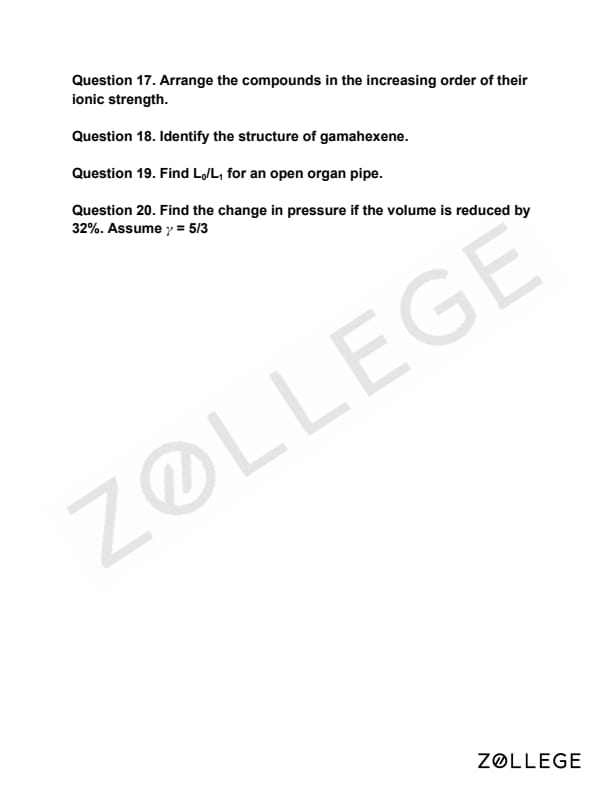
Arrange the following solutions in the increasing order of their ionic strength: \(0.1 M NaCl\), \(0.1 M MgCl_2\), \(0.1 M AlCl_3\).
View Solution
Step 1: Understanding the Concept:
Ionic strength (\(I\)) is a measure of the total concentration of ions in a solution, weighted by the square of their charges. It significantly affects the activity coefficients of electrolytes.
Step 2: Key Formula or Approach:
The formula for ionic strength is:
\[ I = \frac{1}{2} \sum_{i} c_i z_i^2 \]
where \(c_i\) is the molar concentration of ion \(i\) and \(z_i\) is the charge of that ion.
Step 3: Detailed Explanation:
1. For \(0.1 M NaCl\):
- Dissociates into \(0.1 M Na^+\) (\(z=1\)) and \(0.1 M Cl^-\) (\(z=-1\)).
- \(I = \frac{1}{2} [0.1(1)^2 + 0.1(-1)^2] = \frac{1}{2} [0.1 + 0.1] = 0.1 M\).
2. For \(0.1 M MgCl_2\):
- Dissociates into \(0.1 M Mg^{2+}\) (\(z=2\)) and \(0.2 M Cl^-\) (\(z=-1\)).
- \(I = \frac{1}{2} [0.1(2)^2 + 0.2(-1)^2] = \frac{1}{2} [0.4 + 0.2] = 0.3 M\).
3. For \(0.1 M AlCl_3\):
- Dissociates into \(0.1 M Al^{3+}\) (\(z=3\)) and \(0.3 M Cl^-\) (\(z=-1\)).
- \(I = \frac{1}{2} [0.1(3)^2 + 0.3(-1)^2] = \frac{1}{2} [0.9 + 0.3] = 0.6 M\).
Comparing values: \(0.1 < 0.3 < 0.6\).
Step 4: Final Answer:
The increasing order of ionic strength is \(NaCl < MgCl_2 < AlCl_3\).
Quick Tip: For the same molarity of salts, the ionic strength increases rapidly with the charge of the multivalent ion because the charge term is squared (\(z^2\)).
Identify the structure of gamahexene.
View Solution
Step 1: Understanding the Concept:
Gamahexene, also known as Gammexane, Lindane, or 666, is an organic compound used as an insecticide.
Step 2: Detailed Explanation:
- It is chemically named 1,2,3,4,5,6-hexachlorocyclohexane.
- It is prepared by the addition of chlorine to benzene in the presence of UV light.
- Note that despite the name "Benzene Hexachloride", it is actually a saturated cyclohexane ring, not an aromatic benzene ring.
- The formula is \(C_6H_6Cl_6\).
Step 3: Final Answer:
Gamahexene is Benzene Hexachloride (BHC), specifically the \(\gamma\)-isomer.
Quick Tip: Don't confuse Benzene Hexachloride (\(C_6H_6Cl_6\)) with Hexachlorobenzene (\(C_6Cl_6\)). The former is an addition product (saturated), while the latter is a substitution product (aromatic).
Find the ratio of the frequency of the fundamental mode (\(f_0\)) to the first overtone (\(f_1\)) for an open organ pipe.
View Solution
Step 1: Understanding the Concept:
In an open organ pipe (open at both ends), antinodes are formed at the open ends. This setup supports all harmonics (integer multiples of the fundamental frequency).
Step 2: Key Formula or Approach:
The frequency of the \(n^{th}\) harmonic for an open pipe is:
\[ f_n = \frac{nv}{2L} \]
where \(n = 1, 2, 3, \dots\)
- \(n=1\) corresponds to the Fundamental Frequency.
- \(n=2\) corresponds to the First Overtone (Second Harmonic).
Step 3: Detailed Explanation:
1. Fundamental Frequency (\(f_0\)):
Here \(n = 1\).
\[ f_0 = \frac{v}{2L} \]
2. First Overtone (\(f_1\)):
In an open pipe, the first overtone is the next possible resonance state, which is the 2nd harmonic (\(n = 2\)).
\[ f_1 = \frac{2v}{2L} = 2 f_0 \]
3. Calculating the Ratio:
\[ \frac{f_0}{f_1} = \frac{f_0}{2f_0} = \frac{1}{2} \]
Step 4: Final Answer:
The ratio of the fundamental frequency to the first overtone for an open organ pipe is \(1:2\).
Quick Tip: Remember: Open pipes have both even and odd harmonics (\(1, 2, 3 \dots\)), while closed pipes only have odd harmonics (\(1, 3, 5 \dots\)). For a closed pipe, the ratio would be \(1:3\).
Find the change in pressure if the volume is reduced by 32%. Assume \(\gamma = 5/3\) and the process is adiabatic.
View Solution
Step 1: Understanding the Concept:
In an adiabatic process, the relationship between pressure (\(P\)) and volume (\(V\)) is given by \(PV^\gamma = constant\).
Step 2: Key Formula or Approach:
\[ P_1 V_1^\gamma = P_2 V_2^\gamma \implies \frac{P_2}{P_1} = \left( \frac{V_1}{V_2} \right)^\gamma \]
Step 3: Detailed Explanation:
1. Define initial and final volumes:
If \(V_1\) is the initial volume, then volume reduced by 32% means:
\(V_2 = V_1 - 0.32V_1 = 0.68V_1\)
2. Calculate the pressure ratio:
\[ \frac{P_2}{P_1} = \left( \frac{V_1}{0.68 V_1} \right)^{5/3} = \left( \frac{100}{68} \right)^{5/3} = \left( \frac{25}{17} \right)^{5/3} \]
3. Numerical Approximation:
\(\frac{25}{17} \approx 1.47\)
\(P_2/P_1 \approx (1.47)^{1.67} \approx 1.90\)
4. Calculate percentage change:
\(% change = \frac{P_2 - P_1}{P_1} \times 100 = (1.90 - 1) \times 100 = 90%\)
Step 4: Final Answer:
The pressure increases by approximately 90%.
Quick Tip: For adiabatic compression, a small decrease in volume leads to a significantly larger increase in pressure because \(\gamma > 1\). If \(\gamma = 1\) (isothermal), the increase would only have been approx 47%.
*The article might have information for the previous academic years, please refer the official website of the exam.