
MHT CET 2023 May 11 Shift 2 Question Paper with Solution PDF


Content Writer | Updated On - Jan 10, 2026
MHT CET 2023 May 11 Shift 2 Question Paper with Answer Key is now made available here for download. The exam was conducted from 2 PM to 5 PM.
MHT CET 2023 exam paper consists of a total of 150 multiple choice questions, with a total weightage of 300 marks divided into three sections- Physics, Chemistry and Mathematics. Each section of the paper will comprise 50 questions, out of which 10 questions will be from Class 11 syllabus, while the remaining 40 questions will be from Class 12 syllabus.
Candidates who appeared for the exam on May 11 can use the MHT CET solutions to check the correct answers. Those who will take the test at a later date can use the paper for practice.
Also Check: MHT CET 2023 Paper Analysis
MHT CET 2023 May 11 Shift 2 Question Paper with Solution PDF
| MHT CET 2023 May 11 Shift 2 Question Paper | Download PDF | Check Solutions |

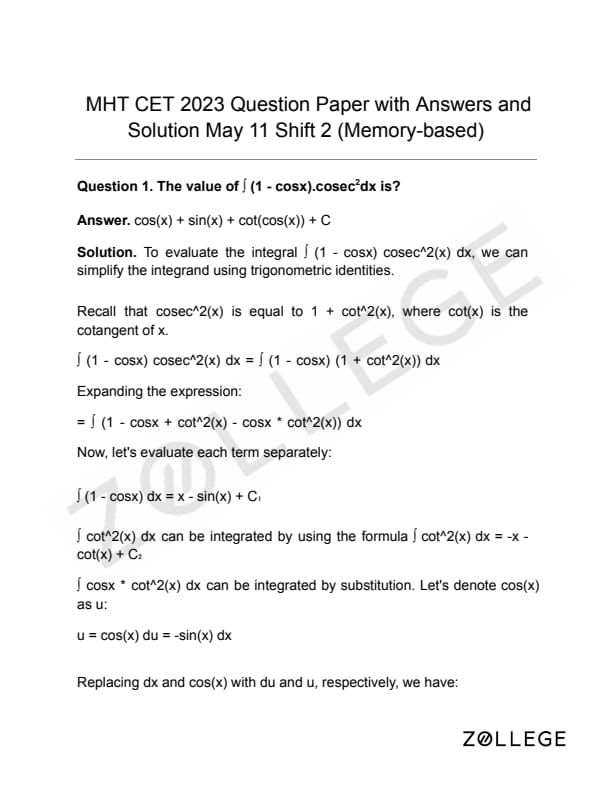
The value of \(\int (1 - \cos x)\csc^2 x \, dx\) is?
View Solution
Step 1: Understanding the Concept:
The problem asks for the indefinite integral of a trigonometric expression.
Using fundamental trigonometric identities, we can simplify the integrand into a form that is easier to integrate.
Step 2: Key Formula or Approach:
We use the following identities:
1. \(1 - \cos x = 2\sin^2(x/2)\)
2. \(\csc x = \frac{1}{\sin x}\)
3. \(\sin x = 2\sin(x/2)\cos(x/2)\)
Step 3: Detailed Explanation:
Let the given integral be \(I\):
\[ I = \int (1 - \cos x)\csc^2 x \, dx \]
Since \(\csc^2 x = \frac{1}{\sin^2 x}\), we can rewrite the integral as:
\[ I = \int \frac{1 - \cos x}{\sin^2 x} \, dx \]
Substituting the half-angle identities for \(1 - \cos x\) and \(\sin x\):
\[ I = \int \frac{2\sin^2(x/2)}{(2\sin(x/2)\cos(x/2))^2} \, dx \]
\[ I = \int \frac{2\sin^2(x/2)}{4\sin^2(x/2)\cos^2(x/2)} \, dx \]
Cancelling the common term \(2\sin^2(x/2)\) in the numerator and denominator:
\[ I = \int \frac{1}{2\cos^2(x/2)} \, dx \]
\[ I = \frac{1}{2} \int \sec^2(x/2) \, dx \]
Using the standard integral \(\int \sec^2(u) du = \tan(u) + C\):
\[ I = \frac{1}{2} \left[ \frac{\tan(x/2)}{1/2} \right] + C \]
\[ I = \tan(x/2) + C \]
Step 4: Final Answer:
The value of the integral is \(\tan(x/2) + C\).
Quick Tip: Always look for half-angle simplifications when you see \((1 \pm \cos x)\). It often reduces the expression to a single squared trigonometric function.
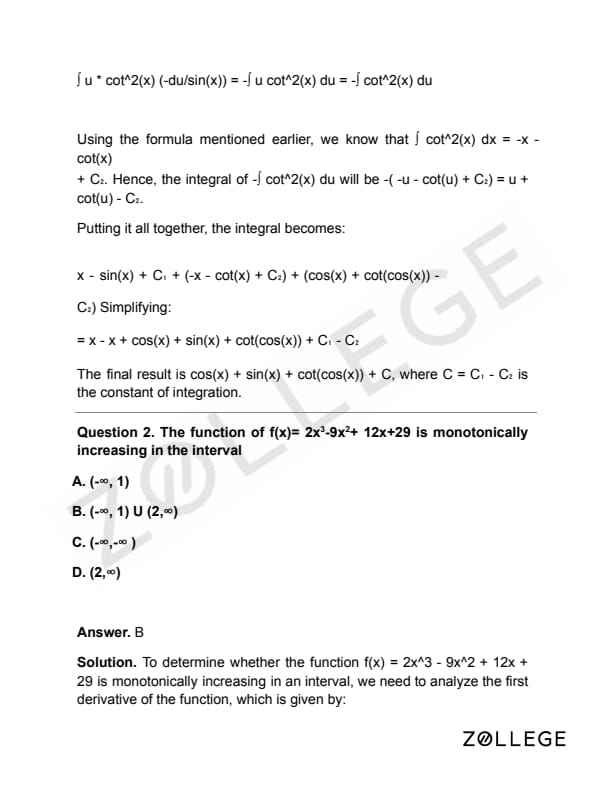
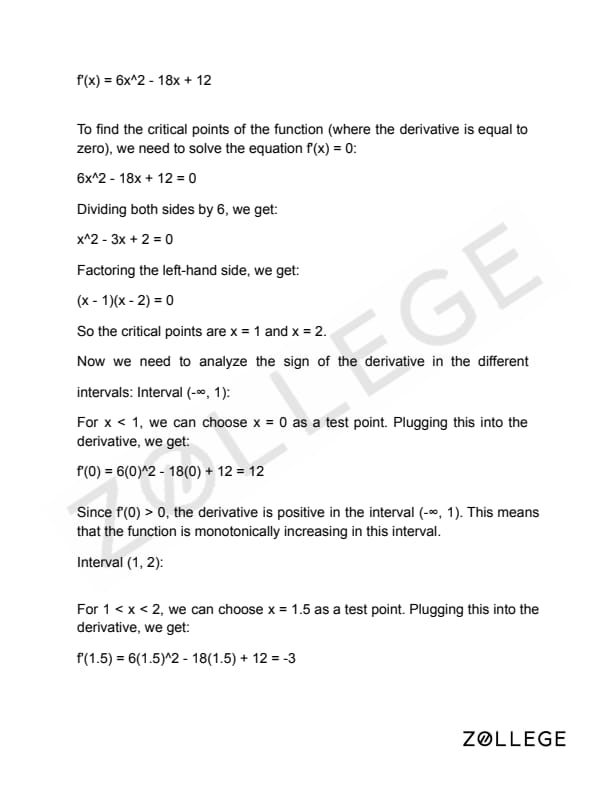
The function of \(f(x) = 2x^3 - 9x^2 + 12x + 29\) is monotonically increasing in the interval
View Solution
Step 1: Understanding the Concept:
For a function to be monotonically increasing, its first derivative \(f'(x)\) must be greater than or equal to zero (\(f'(x) \ge 0\)) in the given interval.
Step 2: Key Formula or Approach:
The derivative of a polynomial \(ax^n\) is \(nax^{n-1}\).
We find the critical points by solving \(f'(x) = 0\) and use the sign-scheme (wavy curve) method.
Step 3: Detailed Explanation:
Given: \(f(x) = 2x^3 - 9x^2 + 12x + 29\)
Differentiating with respect to \(x\):
\[ f'(x) = 6x^2 - 18x + 12 \]
Factoring out the constant 6:
\[ f'(x) = 6(x^2 - 3x + 2) \]
Factorizing the quadratic expression:
\[ f'(x) = 6(x - 1)(x - 2) \]
To find where the function is increasing, set \(f'(x) > 0\):
\[ 6(x - 1)(x - 2) > 0 \]
Applying the sign scheme:
- Roots are \(x = 1\) and \(x = 2\).
- For \(x \in (-\infty, 1)\), \(f'(x) > 0\) (Positive).
- For \(x \in (1, 2)\), \(f'(x) < 0\) (Negative).
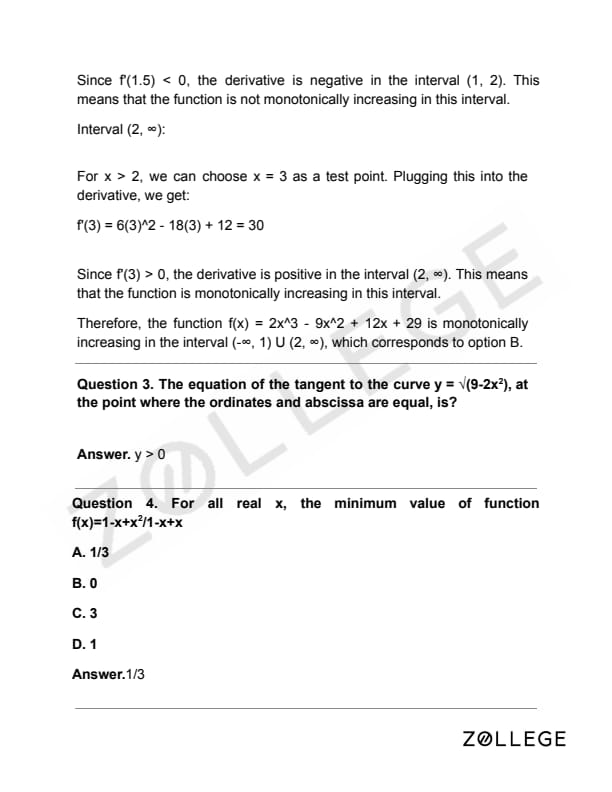
- For \(x \in (2, \infty)\), \(f'(x) > 0\) (Positive).
The function is monotonically increasing where \(f'(x) > 0\), which is \((-\infty, 1) \cup (2, \infty)\).
Step 4: Final Answer:
The interval is \((-\infty, 1) \cup (2, \infty)\).
Quick Tip: For any cubic function, the derivative is a parabola. If the leading coefficient is positive, the function always increases outside the roots of its derivative.
The equation of the tangent to the curve \(y = \sqrt{9 - 2x^2}\), at the point where the ordinates and abscissa are equal, is?
View Solution
Step 1: Understanding the Concept:
"Ordinates and abscissa are equal" means \(x = y\). We need to find this point on the curve and then find the slope of the tangent at that point using differentiation.
Step 2: Key Formula or Approach:
1. Find intersection point with \(x = y\).
2. Slope \(m = \frac{dy}{dx}\).
3. Tangent equation: \(y - y_1 = m(x - x_1)\).
Step 3: Detailed Explanation:
First, find the point on the curve where \(x = y\):
\[ x = \sqrt{9 - 2x^2} \]
Squaring both sides: \(x^2 = 9 - 2x^2 \implies 3x^2 = 9 \implies x^2 = 3\).
Since \(y = \sqrt{...}\) implies \(y \ge 0\), and \(x = y\), we have \(x = \sqrt{3}\). So the point is \((\sqrt{3}, \sqrt{3})\).
Now, differentiate \(y = (9 - 2x^2)^{1/2}\):
\[ \frac{dy}{dx} = \frac{1}{2}(9 - 2x^2)^{-1/2} \cdot (-4x) = \frac{-2x}{\sqrt{9 - 2x^2}} \]
Substitute \(x = \sqrt{3}\) to find the slope \(m\):
\[ m = \frac{-2\sqrt{3}}{\sqrt{9 - 2(3)}} = \frac{-2\sqrt{3}}{\sqrt{3}} = -2 \]
Equation of tangent at \((\sqrt{3}, \sqrt{3})\) with slope \(m = -2\):
\[ y - \sqrt{3} = -2(x - \sqrt{3}) \]
\[ y - \sqrt{3} = -2x + 2\sqrt{3} \]
\[ 2x + y = 3\sqrt{3} \]
Step 4: Final Answer:
The equation of the tangent is \(2x + y = 3\sqrt{3}\).
Quick Tip: Notice that the curve is an ellipse. For any symmetric curve, the point where \(x=y\) is often a point of symmetry, making calculations easier.
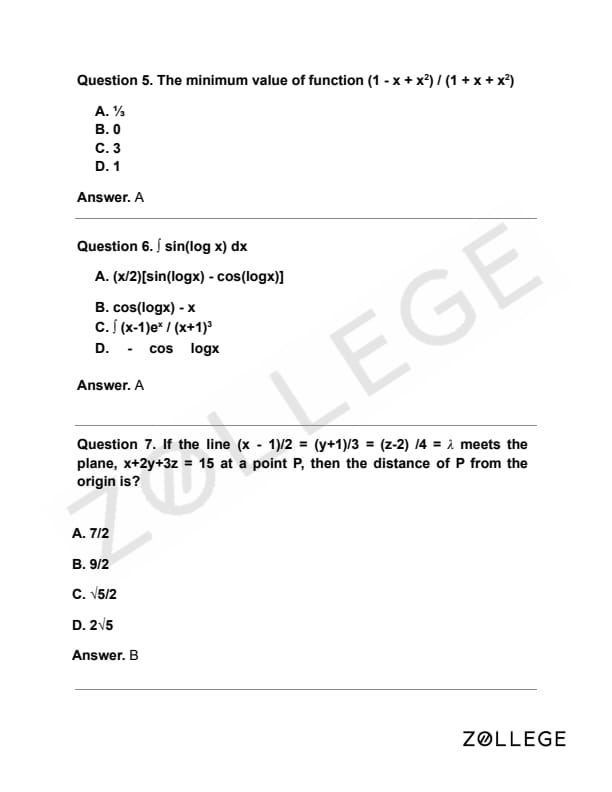
For all real \(x\), the minimum value of function \(f(x) = \frac{1 - x + x^2}{1 + x + x^2}\) is?
View Solution
Step 1: Understanding the Concept:
To find the minimum/maximum value of a rational function \(y = \frac{ax^2 + bx + c}{px^2 + qx + r}\), we can express it as a quadratic in \(x\) and use the discriminant condition \(D \ge 0\) for real \(x\).
Step 2: Key Formula or Approach:
Let \(y = \frac{x^2 - x + 1}{x^2 + x + 1}\).
For \(x \in \mathbb{R}\), the discriminant of the resulting quadratic in \(x\) must be non-negative.
Step 3: Detailed Explanation:
\[ y(x^2 + x + 1) = x^2 - x + 1 \]
\[ yx^2 + yx + y - x^2 + x - 1 = 0 \]
\[ (y - 1)x^2 + (y + 1)x + (y - 1) = 0 \]
Since \(x\) is real, \(D \ge 0\):
\[ (y + 1)^2 - 4(y - 1)(y - 1) \ge 0 \]
\[ (y + 1)^2 - 4(y - 1)^2 \ge 0 \]
Factoring as \(A^2 - B^2 = (A-B)(A+B)\):
\[ [(y + 1) - 2(y - 1)][(y + 1) + 2(y - 1)] \ge 0 \]
\[ (y + 1 - 2y + 2)(y + 1 + 2y - 2) \ge 0 \]
\[ (3 - y)(3y - 1) \ge 0 \]
\[ (y - 3)(3y - 1) \le 0 \]
This inequality holds for \(y \in [1/3, 3]\).
Thus, the minimum value is \(1/3\) and the maximum value is \(3\).
Step 4: Final Answer:
The minimum value is \(1/3\).
Quick Tip: For expressions like \(\frac{x^2 - x + 1}{x^2 + x + 1}\), the minimum and maximum are always reciprocal pairs (\(1/3\) and \(3\)).
The minimum value of function \((1 - x + x^2) / (1 + x + x^2)\)
View Solution
Step 1: Understanding the Concept:
This question is identical to Question 4. We are finding the global minimum of the rational expression.
Step 2: Detailed Explanation:
Following the method from the previous problem:
Let \(y = \frac{x^2 - x + 1}{x^2 + x + 1}\).
Cross-multiplying and forming the quadratic in \(x\):
\[ (y-1)x^2 + (y+1)x + (y-1) = 0 \]
Discriminant condition for real roots \(D \ge 0\):
\[ (y+1)^2 - 4(y-1)^2 \ge 0 \]
Which simplifies to:
\[ (3y-1)(y-3) \le 0 \implies \frac{1}{3} \le y \le 3 \]
The smallest value of \(y\) is \(1/3\).
Step 3: Final Answer:
The minimum value is \(1/3\).
Quick Tip: In exams, if you see the same function repeatedly, remember its range. For \(x^2 \pm x + 1\), the range of the ratio is usually \([1/3, 3]\).
\(\int \sin(\log x) \, dx\)
View Solution
Step 1: Understanding the Concept:
Integration by parts or substitution can be used for integrals involving \(\log x\). Replacing \(\log x\) with a variable \(t\) converts it into a standard integral form.
Step 2: Key Formula or Approach:
Let \(\log x = t \implies x = e^t\) and \(dx = e^t dt\).
Use \(\int e^{ax} \sin(bx) dx = \frac{e^{ax}}{a^2+b^2}(a \sin bx - b \cos bx)\).
Step 3: Detailed Explanation:
Substitute \(\log x = t \implies dx = e^t dt\):
\[ I = \int \sin(t) e^t \, dt \]
This is a standard integral of the form \(\int e^{at} \sin(bt) dt\) with \(a=1, b=1\):
\[ I = \frac{e^t}{1^2 + 1^2} (1 \cdot \sin t - 1 \cdot \cos t) + C \]
\[ I = \frac{e^t}{2} (\sin t - \cos t) + C \]
Substituting back \(t = \log x\) and \(e^t = x\):
\[ I = \frac{x}{2} (\sin(\log x) - \cos(\log x)) + C \]
Step 4: Final Answer:
The solution is \((x/2)[\sin(\log x) - \cos(\log x)] + C\).
Quick Tip: The integral of \(\int e^x \sin x dx\) is cyclic. Memorize the result as \(\frac{e^x}{2}(\sin x - \cos x)\) to save time in such substitutions.
If the line \((x - 1)/2 = (y+1)/3 = (z-2)/4 = \lambda\) meets the plane, \(x+2y+3z = 15\) at a point P, then the distance of P from the origin is?
View Solution
Step 1: Understanding the Concept:
We find the intersection of a line and a plane by expressing the line in parametric form and substituting it into the plane equation. The distance from the origin is then found using the distance formula \(\sqrt{x^2+y^2+z^2}\).
Step 2: Key Formula or Approach:
Point on line: \((2\lambda+1, 3\lambda-1, 4\lambda+2)\).
Substitute into plane equation \(x+2y+3z=15\).
Step 3: Detailed Explanation:
The coordinates of any point \(P\) on the line are:
\(x = 2\lambda + 1\), \(y = 3\lambda - 1\), \(z = 4\lambda + 2\).
Since \(P\) lies on the plane \(x + 2y + 3z = 15\):
\[ (2\lambda + 1) + 2(3\lambda - 1) + 3(4\lambda + 2) = 15 \]
\[ 2\lambda + 1 + 6\lambda - 2 + 12\lambda + 6 = 15 \]
\[ 20\lambda + 5 = 15 \implies 20\lambda = 10 \implies \lambda = 1/2 \]
Now, find the coordinates of \(P\):
\(x = 2(1/2) + 1 = 2\)
\(y = 3(1/2) - 1 = 1/2\)
\(z = 4(1/2) + 2 = 4\)
Distance \(OP\) from origin \((0,0,0)\):
\[ OP = \sqrt{2^2 + (1/2)^2 + 4^2} = \sqrt{4 + 0.25 + 16} \]
\[ OP = \sqrt{20.25} = 4.5 = 9/2 \]
Step 4: Final Answer:
The distance of point \(P\) from the origin is \(9/2\).
Quick Tip: Parametric form of a line is your best friend for intersection problems. Always set the line ratios equal to a parameter like \(\lambda\).
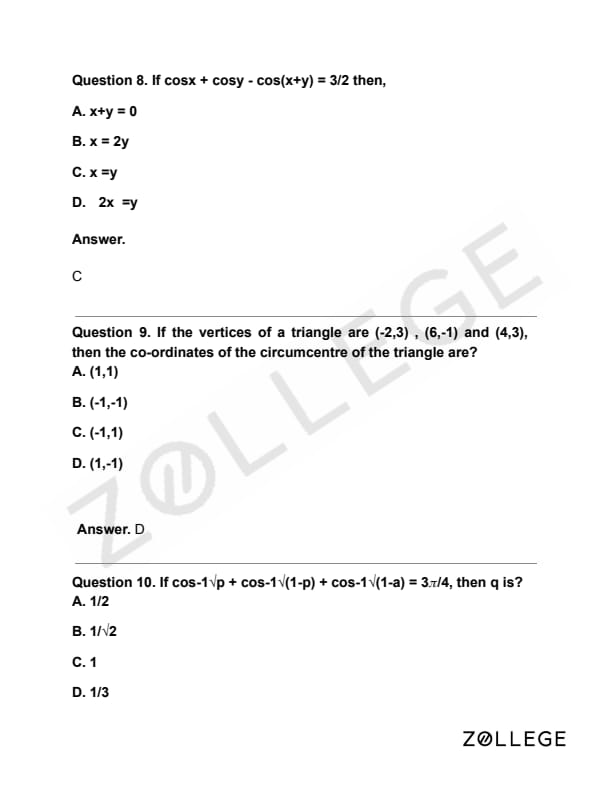
If \(\cos x + \cos y - \cos(x+y) = 3/2\) then,
View Solution
Step 1: Understanding the Concept:
This is a trigonometric equation with two variables. We look for conditions under which the maximum value or specific values are attained.
Step 2: Detailed Explanation:
Given: \(\cos x + \cos y - \cos(x+y) = 3/2\).
Let's test the condition \(x = y\):
\[ 2\cos x - \cos 2x = 3/2 \]
\[ 2\cos x - (2\cos^2 x - 1) = 3/2 \]
\[ -2\cos^2 x + 2\cos x + 1 = 3/2 \]
\[ -2\cos^2 x + 2\cos x - 1/2 = 0 \]
\[ 4\cos^2 x - 4\cos x + 1 = 0 \]
This is a perfect square:
\[ (2\cos x - 1)^2 = 0 \implies \cos x = 1/2 \]
This yields a valid solution for \(x\) and \(y\). Specifically, \(x = y = \pi/3\).
Since the expression is symmetric in \(x\) and \(y\), the relationship \(x = y\) is the defining condition.
Step 3: Final Answer:
The condition is \(x = y\).
Quick Tip: In competitive exams, if an equation is symmetric in \(x\) and \(y\), often the solution lies in \(x = y\). Checking specific values like \(x=y=60^\circ\) helps confirm the options quickly.
If the vertices of a triangle are \((-2,3)\), \((6,-1)\) and \((4,3)\), then the co-ordinates of the circumcentre of the triangle are?
View Solution
Step 1: Understanding the Concept:
The circumcentre is the point equidistant from all three vertices. It is the intersection of the perpendicular bisectors of the sides.
Step 2: Key Formula or Approach:
Let circumcentre be \(O(h,k)\). Then \(OA^2 = OB^2 = OC^2\).
Step 3: Detailed Explanation:
Vertices are \(A(-2,3), B(6,-1), C(4,3)\).
Notice \(A\) and \(C\) have the same \(y\)-coordinate (\(y=3\)). Side \(AC\) is horizontal.
The perpendicular bisector of \(AC\) must be vertical and pass through its midpoint.
Midpoint of \(AC = (\frac{-2+4}{2}, \frac{3+3}{2}) = (1,3)\).
So, the bisector of \(AC\) is the line \(x = 1\). The circumcentre must have \(x\)-coordinate \(h=1\).
Now, set distance from \(O(1,k)\) to \(A(-2,3)\) equal to distance to \(B(6,-1)\):
\[ (1 - (-2))^2 + (k - 3)^2 = (1 - 6)^2 + (k - (-1))^2 \]
\[ 3^2 + (k - 3)^2 = (-5)^2 + (k + 1)^2 \]
\[ 9 + k^2 - 6k + 9 = 25 + k^2 + 2k + 1 \]
\[ 18 - 6k = 26 + 2k \]
\[ -8 = 8k \implies k = -1 \]
The coordinates are \((1, -1)\).
Step 4: Final Answer:
The circumcentre is \((1, -1)\).
Quick Tip: Check if any vertices have the same \(x\) or \(y\) coordinates first. It simplifies finding perpendicular bisectors to vertical or horizontal lines, saving significant time.
If \(\cos^{-1}\sqrt{p} + \cos^{-1}\sqrt{1-p} + \cos^{-1}\sqrt{1-a} = 3\pi/4\), then \(a\) is?
View Solution
Step 1: Understanding the Concept:
We use inverse trigonometric identities, particularly the relationship between \(\cos^{-1} x\) and \(\sin^{-1} x\).
Step 2: Key Formula or Approach:
1. \(\cos^{-1} \sqrt{1-p} = \sin^{-1} \sqrt{p}\) for \(p \in [0, 1]\).
2. \(\sin^{-1} x + \cos^{-1} x = \pi/2\).
Step 3: Detailed Explanation:
Let \(\cos^{-1} \sqrt{p} = \theta\). Then \(\cos \theta = \sqrt{p}\).
Then \(\sin \theta = \sqrt{1 - \cos^2 \theta} = \sqrt{1 - p}\).
This implies \(\theta = \sin^{-1} \sqrt{1-p}\) or conversely \(\cos^{-1} \sqrt{1-p} = \sin^{-1} \sqrt{p}\).
Substituting this into the equation:
\[ \cos^{-1} \sqrt{p} + \sin^{-1} \sqrt{p} + \cos^{-1} \sqrt{1-a} = 3\pi/4 \]
Using the identity \(\cos^{-1} x + \sin^{-1} x = \pi/2\):
\[ \pi/2 + \cos^{-1} \sqrt{1-a} = 3\pi/4 \]
\[ \cos^{-1} \sqrt{1-a} = 3\pi/4 - \pi/2 = \pi/4 \]
Taking cosine on both sides:
\[ \sqrt{1-a} = \cos(\pi/4) = 1/\sqrt{2} \]
Squaring both sides:
\[ 1 - a = 1/2 \implies a = 1/2 \]
Step 4: Final Answer:
The value of \(a\) is \(1/2\).
Quick Tip: Whenever you see inverse trig terms like \(\sqrt{p}\) and \(\sqrt{1-p}\), think of the identity \(\sin^{-1} x + \cos^{-1} x = \pi/2\). It almost always leads to a simplification.
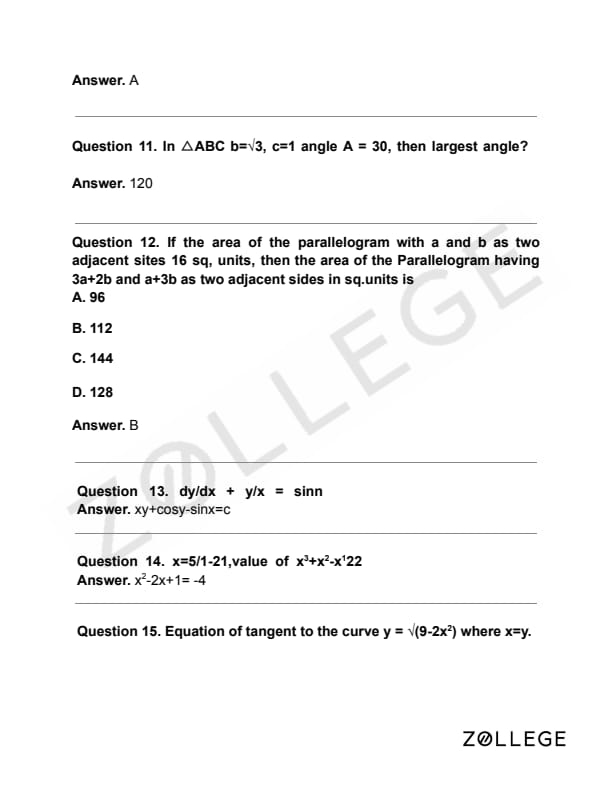
In \(\triangle ABC, b=\sqrt{3}, c=1, angle A = 30^\circ\), then largest angle?
View Solution
Step 1: Understanding the Concept:
In a triangle, use the Law of Cosines to find the third side and then determine the largest angle, which always lies opposite the longest side.
Step 2: Key Formula or Approach:
Cosine Rule: \(a^2 = b^2 + c^2 - 2bc \cos A\).
Step 3: Detailed Explanation:
Calculate side \(a\):
\[ a^2 = (\sqrt{3})^2 + (1)^2 - 2(\sqrt{3})(1) \cos 30^\circ \]
\[ a^2 = 3 + 1 - 2\sqrt{3} \cdot \frac{\sqrt{3}}{2} = 4 - 3 = 1 \implies a = 1 \]
Since \(a=1\) and \(c=1\), the triangle is isosceles with \(a=c\).
Angles opposite equal sides are equal, so \(\angle C = \angle A = 30^\circ\).
Remaining angle \(\angle B = 180^\circ - (30^\circ + 30^\circ) = 120^\circ\).
The angles are \(30^\circ, 30^\circ, 120^\circ\). The largest is \(120^\circ\).
Step 4: Final Answer:
The largest angle is \(120^\circ\).
Quick Tip: If the third side comes out equal to one of the given sides, the triangle is isosceles. This instantly gives you the second angle, making the sum calculation very fast.
If the area of the parallelogram with \(a\) and \(b\) as two adjacent sites 16 sq. units, then the area of the Parallelogram having \(3a+2b\) and \(a+3b\) as two adjacent sides in sq. units is?
View Solution
Step 1: Understanding the Concept:
The area of a parallelogram formed by vectors \(\vec{a}\) and \(\vec{b}\) is given by \(|\vec{a} \times \vec{b}|\). We use vector cross product properties to find the area of the new parallelogram.
Step 2: Key Formula or Approach:
1. \(Area_1 = |\vec{a} \times \vec{b}| = 16\).
2. Cross product property: \((p\vec{a} + q\vec{b}) \times (r\vec{a} + s\vec{b}) = (ps - qr)(\vec{a} \times \vec{b})\).
Step 3: Detailed Explanation:
The new adjacent sides are \(\vec{u} = 3\vec{a} + 2\vec{b}\) and \(\vec{v} = \vec{a} + 3\vec{b}\).
Area of new parallelogram \(A_2 = |\vec{u} \times \vec{v}|\).
\[ A_2 = |(3\vec{a} + 2\vec{b}) \times (\vec{a} + 3\vec{b})| \]
Expanding using distributive property:
\[ A_2 = |3(\vec{a} \times \vec{a}) + 9(\vec{a} \times \vec{b}) + 2(\vec{b} \times \vec{a}) + 6(\vec{b} \times \vec{b})| \]
Since \(\vec{v} \times \vec{v} = 0\) and \(\vec{b} \times \vec{a} = -(\vec{a} \times \vec{b})\):
\[ A_2 = |0 + 9(\vec{a} \times \vec{b}) - 2(\vec{a} \times \vec{b}) + 0| \]
\[ A_2 = |7(\vec{a} \times \vec{b})| = 7 |\vec{a} \times \vec{b}| \]
Substituting the original area:
\[ A_2 = 7 \times 16 = 112 \]
Step 4: Final Answer:
The area is \(112\) sq. units.
Quick Tip: For area transformation problems, calculate the determinant of the coefficients: \(|3(3) - 2(1)| = 7\). Multiply the original area by this determinant value.
Solve: \(dy/dx + y/x = \sin x\)
View Solution
Step 1: Understanding the Concept:
This is a first-order linear differential equation of the form \(dy/dx + P(x)y = Q(x)\). We solve it using an Integrating Factor (IF).
Step 2: Key Formula or Approach:
1. \(IF = e^{\int P(x) dx}\).
2. Solution: \(y \cdot IF = \int (Q(x) \cdot IF) dx + C\).
Step 3: Detailed Explanation:
Comparing the given equation with the standard form: \(P(x) = 1/x\) and \(Q(x) = \sin x\).
\[ IF = e^{\int \frac{1}{x} dx} = e^{\ln x} = x \]
The solution is:
\[ y \cdot x = \int (x \sin x) \, dx + C \]
Using integration by parts \(\int u dv = uv - \int v du\):
Let \(u = x, dv = \sin x dx \implies du = dx, v = -\cos x\).
\[ xy = -x \cos x - \int (-\cos x) dx + C \]
\[ xy = -x \cos x + \sin x + C \]
Rearranging the terms to match the answer key structure:
\[ xy + x \cos x - \sin x = C \]
Step 4: Final Answer:
The solution is \(xy + x \cos x - \sin x = C\).
Quick Tip: Notice that the left side \(dy/dx + y/x\) can be written as \(\frac{1}{x} \frac{d}{dx}(xy)\). Multiplying the whole equation by \(x\) at the start is often faster than calculating the IF separately.
If \(x = 5 / (1 - 2i)\), find value of \(x^3 + x^2 - x + 22\)
View Solution
Step 1: Understanding the Concept:
First, rationalize the complex number \(x\). Then, derive a quadratic equation satisfied by \(x\) to simplify the high-degree polynomial calculation.
Step 2: Detailed Explanation:
Rationalize \(x\):
\[ x = \frac{5}{1 - 2i} \times \frac{1 + 2i}{1 + 2i} = \frac{5(1 + 2i)}{1 - (2i)^2} = \frac{5(1 + 2i)}{5} = 1 + 2i \]
So, \(x - 1 = 2i\).
Squaring both sides:
\[ (x - 1)^2 = (2i)^2 \implies x^2 - 2x + 1 = -4 \implies x^2 - 2x + 5 = 0 \]
Now evaluate the polynomial \(P(x) = x^3 + x^2 - x + 22\).
Divide \(P(x)\) by \(x^2 - 2x + 5\):
\[ x^3 + x^2 - x + 22 = x(x^2 - 2x + 5) + 3x^2 - 6x + 22 \]
\[ = x(x^2 - 2x + 5) + 3(x^2 - 2x + 5) + 7 \]
Since \(x^2 - 2x + 5 = 0\):
\[ P(x) = x(0) + 3(0) + 7 = 7 \]
Step 3: Final Answer:
The value of the polynomial is \(7\).
Quick Tip: Instead of plugging in complex values directly, always find the quadratic equation the complex number satisfies. The polynomial value is simply the remainder of the division.
Equation of tangent to the curve \(y = \sqrt{9 - 2x^2}\) where \(x = y\).
View Solution
Step 1: Understanding the Concept:
This question repeats the logic from Question 3. We find the coordinate where \(x=y\), determine the slope of the curve at that point, and find the tangent line.
Step 2: Detailed Explanation:
Point of intersection: \(x = \sqrt{9 - 2x^2} \implies 3x^2 = 9 \implies x = \sqrt{3}\).
Since \(x=y\), the point is \((\sqrt{3}, \sqrt{3})\).
Differentiating \(y^2 = 9 - 2x^2\) implicitly:
\[ 2y \frac{dy}{dx} = -4x \implies \frac{dy}{dx} = - \frac{2x}{y} \]
At \((\sqrt{3}, \sqrt{3})\): \(m = -2(\sqrt{3}) / \sqrt{3} = -2\).
Tangent equation: \(y - \sqrt{3} = -2(x - \sqrt{3})\).
\[ 2x + y = 3\sqrt{3} \]
Step 3: Final Answer:
The equation is \(2x + y = 3\sqrt{3}\).
Quick Tip: Implicit differentiation is often faster than differentiating a square root function directly.
*The article might have information for the previous academic years, please refer the official website of the exam.