
MHT CET 2023 May 12 Shift 1 Question Paper with Solution PDF


Content Writer | Updated On - Jan 10, 2026
MHT CET 2023 May 12 Shift 1 Question Paper with Answer Key is now available here for download. The exam was held from 9 AM to 12 Noon.
MHT CET 2023 exam paper consists of a total of 150 multiple choice questions, with a total weightage of 300 marks divided into three sections- Physics, Chemistry and Mathematics. Each section of the paper will comprise 50 questions, out of which 10 questions will be from the Class 11 syllabus, while the remaining 40 questions will be from Class 12 syllabus.
Candidates who appeared for the exam on May 12 can use the MHT CET solutions to check the correct answers. Those who will take the test on a later date can use the paper for practice.
Also Check: MHT CET 2023 Paper Analysis
MHT CET 2023 May 12 Shift 1 Question Paper with Solution PDF
| MHT CET 2023 May 12 Shift 1 Question Paper | Download PDF | Check Solutions |

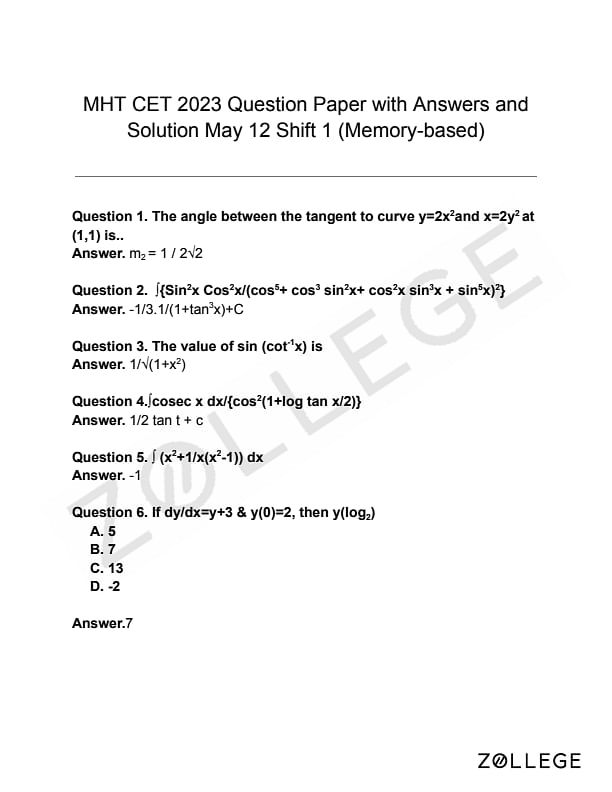
The angle between the tangent to curve \(y=2x^2\) and \(x=2y^2\) at (1,1) is..
View Solution
Step 1: Understanding the Concept:
The angle \(\theta\) between two curves at a point of intersection is defined as the angle between their tangents at that point.
If the slopes of the tangents are \(m_1\) and \(m_2\), the angle \(\theta\) is given by \(\tan \theta = \left| \frac{m_1 - m_2}{1 + m_1m_2} \right|\).
Step 2: Key Formula or Approach:
1. Differentiate both equations to find the slopes at (1,1).
2. Apply the tangent angle formula.
Step 3: Detailed Explanation:
For the first curve \(y = 2x^2\):
Differentiating with respect to \(x\):
\[ \frac{dy}{dx} = 4x \]
At (1,1), the slope \(m_1 = 4(1) = 4\).
For the second curve \(x = 2y^2\):
Differentiating with respect to \(x\):
\[ 1 = 4y \frac{dy}{dx} \implies \frac{dy}{dx} = \frac{1}{4y} \]
At (1,1), the slope \(m_2 = \frac{1}{4(1)} = \frac{1}{4}\).
Now, using the formula for the angle between two lines:
\[ \tan \theta = \left| \frac{4 - 1/4}{1 + 4 \cdot (1/4)} \right| \] \[ \tan \theta = \left| \frac{15/4}{1 + 1} \right| = \frac{15/4}{2} = \frac{15}{8} \] \[ \theta = \tan^{-1}\left(\frac{15}{8}\right) \]
Step 4: Final Answer:
The angle between the tangents is \(\tan^{-1}\left(\frac{15}{8}\right)\).
Quick Tip: If the product of slopes \(m_1 m_2 = -1\), the curves are orthogonal (angle is \(90^\circ\)).
If \(m_1 = m_2\), the curves touch each other (angle is \(0^\circ\)).
Evaluate \(\int \left\{ \frac{\sin^2x \cos^2x}{(\cos^5x + \cos^3x \sin^2x + \cos^2x \sin^3x + \sin^5x)^2} \right\} dx\)
View Solution
Step 1: Understanding the Concept:
The integrand contains a complex denominator. We should look for a way to simplify the denominator into a more manageable trigonometric form, likely involving \(\tan x\) and \(\sec x\).
Step 2: Key Formula or Approach:
Factor the expression inside the square in the denominator.
Step 3: Detailed Explanation:
Consider the denominator expression \(D = \cos^5x + \cos^3x \sin^2x + \cos^2x \sin^3x + \sin^5x\).
Group the terms:
\[ D = \cos^3x(\cos^2x + \sin^2x) + \sin^3x(\cos^2x + \sin^2x) \]
Since \(\cos^2x + \sin^2x = 1\), we have:
\[ D = \cos^3x + \sin^3x \]
The integral becomes:
\[ I = \int \frac{\sin^2x \cos^2x}{(\cos^3x + \sin^3x)^2} dx \]
To convert this to a \(\tan x\) form, divide both numerator and denominator by \(\cos^6x\):
\[ I = \int \frac{\frac{\sin^2x \cos^2x}{\cos^6x}}{\left(\frac{\cos^3x + \sin^3x}{\cos^3x}\right)^2} dx = \int \frac{\tan^2x \sec^2x}{(1 + \tan^3x)^2} dx \]
Let \(u = 1 + \tan^3x\), then \(du = 3 \tan^2x \sec^2x dx\).
The integral becomes:
\[ I = \frac{1}{3} \int \frac{1}{u^2} du = \frac{1}{3} \left( -\frac{1}{u} \right) + C \] \[ I = -\frac{1}{3(1 + \tan^3x)} + C \]
Step 4: Final Answer:
The integral evaluates to \(-\frac{1}{3(1 + \tan^3x)} + C\).
Quick Tip: When dealing with integrals of \(\sin x\) and \(\cos x\) of high powers, dividing by a power of \(\cos x\) to generate \(\tan x\) and \(\sec^2 x\) often simplifies the problem significantly.
The value of \(\sin(\cot^{-1}x)\) is
View Solution
Step 1: Understanding the Concept:
This is a standard inverse trigonometric composition problem. We need to express \(\cot^{-1}x\) in terms of \(\sin^{-1}\) to simplify the expression.
Step 2: Key Formula or Approach:
Use the right-angled triangle method where \(\cot \theta = \frac{Adjacent}{Opposite}\).
Step 3: Detailed Explanation:
Let \(\theta = \cot^{-1}x \). This implies \(\cot \theta = x = \frac{x}{1}\).
In a right-angled triangle:
Adjacent side = \(x\)
Opposite side = \(1\)
By Pythagoras theorem, Hypotenuse = \(\sqrt{x^2 + 1^2} = \sqrt{x^2 + 1}\).
Now, we can find \(\sin \theta\):
\[ \sin \theta = \frac{Opposite}{Hypotenuse} = \frac{1}{\sqrt{1 + x^2}} \]
Substituting back \(\theta = \cot^{-1}x\):
\[ \sin(\cot^{-1}x) = \frac{1}{\sqrt{1 + x^2}} \]
Step 4: Final Answer:
The value is \(\frac{1}{\sqrt{1 + x^2}}\).
Quick Tip: Drawing a simple right-angled triangle is usually faster and less prone to error than memorizing all identity conversions.
\(\int \frac{\csc x dx}{\cos^2(1 + \log \tan(x/2))}\)
View Solution
Step 1: Understanding the Concept:
This integration problem involves a complex argument for the cosine function. We should use substitution to simplify the argument.
Step 2: Key Formula or Approach:
Recall the identity \(\int \csc x dx = \log|\tan(x/2)| + C\) and the derivative \(\frac{d}{dx}(\log \tan(x/2)) = \csc x\).
Step 3: Detailed Explanation:
Let \(t = 1 + \log \tan(x/2)\).
Differentiating both sides with respect to \(x\):
\[ dt = \frac{1}{\tan(x/2)} \cdot \sec^2(x/2) \cdot \frac{1}{2} dx \] \[ dt = \frac{1}{\frac{\sin(x/2)}{\cos(x/2)}} \cdot \frac{1}{\cos^2(x/2)} \cdot \frac{1}{2} dx \] \[ dt = \frac{1}{2 \sin(x/2) \cos(x/2)} dx = \frac{1}{\sin x} dx = \csc x dx \]
Substituting these into the integral:
\[ I = \int \frac{dt}{\cos^2 t} = \int \sec^2 t dt \] \[ I = \tan t + c \]
Substituting the value of \(t\) back:
\[ I = \tan(1 + \log \tan(x/2)) + c \]
Step 4: Final Answer:
The integral is \(\tan(1 + \log \tan(x/2)) + c\).
Quick Tip: Remember the derivative pair: \(\frac{d}{dx} \ln|\tan(x/2)| = \csc x\). This appears frequently in substitution-based integration problems.
\(\int \frac{x^2+1}{x(x^2-1)} dx\)
View Solution
Step 1: Understanding the Concept:
This is a standard rational function integral. We can solve it using the method of partial fractions.
Step 2: Key Formula or Approach:
Decompose \(\frac{x^2+1}{x(x+1)(x-1)}\) into \(\frac{A}{x} + \frac{B}{x+1} + \frac{C}{x-1}\).
Step 3: Detailed Explanation:
Let \(\frac{x^2+1}{x(x^2-1)} = \frac{A}{x} + \frac{B}{x+1} + \frac{C}{x-1}\).
Multiplying by the denominator:
\[ x^2 + 1 = A(x^2 - 1) + Bx(x-1) + Cx(x+1) \]
Putting \(x = 0 \implies 1 = A(-1) \implies A = -1\).
Putting \(x = 1 \implies 2 = C(1)(2) \implies C = 1\).
Putting \(x = -1 \implies 2 = B(-1)(-2) \implies B = 1\).
The integral becomes:
\[ \int \left( -\frac{1}{x} + \frac{1}{x+1} + \frac{1}{x-1} \right) dx \] \[ = -\ln|x| + \ln|x+1| + \ln|x-1| + C \] \[ = \ln|x+1| + \ln|x-1| - \ln|x| + C = \ln\left|\frac{x^2-1}{x}\right| + C \]
Step 4: Final Answer:
The integral value is \(\log \left| \frac{x^2 - 1}{x} \right| + C\).
Quick Tip: For rational functions, if the degree of numerator \(\ge\) degree of denominator, perform long division first. Here, since they are equal, partial fractions can be used directly or after division.
If \(dy/dx = y+3\) and \(y(0)=2\), then find \(y(\log_e 2)\)
View Solution
Step 1: Understanding the Concept:
This is a first-order linear differential equation that can be solved using the variable separation method.
Step 2: Key Formula or Approach:
Separate terms of \(y\) to the LHS and terms of \(x\) to the RHS, then integrate.
Step 3: Detailed Explanation:
Given: \(\frac{dy}{dx} = y + 3\)
Separating variables:
\[ \frac{dy}{y + 3} = dx \]
Integrating both sides:
\[ \ln|y + 3| = x + C \]
Using the initial condition \(y(0) = 2\):
\[ \ln|2 + 3| = 0 + C \implies C = \ln 5 \]
So, the general equation is \(\ln|y + 3| = x + \ln 5\).
Now, we need to find \(y\) when \(x = \ln 2\):
\[ \ln|y + 3| = \ln 2 + \ln 5 \] \[ \ln|y + 3| = \ln(2 \times 5) = \ln 10 \] \[ y + 3 = 10 \implies y = 7 \]
Step 4: Final Answer:
The value of \(y(\log_e 2)\) is 7.
Quick Tip: For equations of the form \(dy/dx = ky + c\), the solution always involves an exponential growth or decay curve. Checking initial values early simplifies the integration constant calculation.
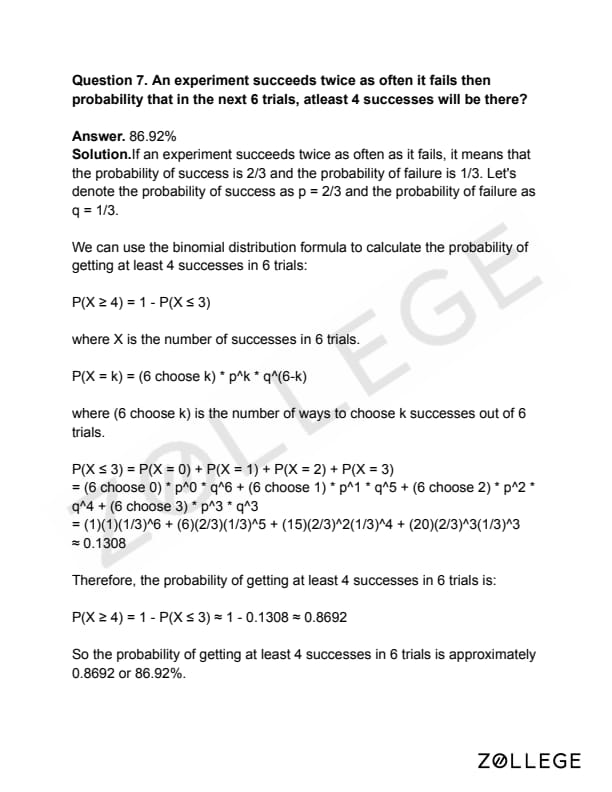
An experiment succeeds twice as often it fails then probability that in the next 6 trials, atleast 4 successes will be there?
View Solution
Step 1: Understanding the Concept:
This is a Binomial Distribution problem. We are given the ratio of success to failure and asked for the cumulative probability of specific outcomes.
Step 2: Key Formula or Approach:
Probability of success \(p\), failure \(q\). Binomial formula: \(P(X = r) = \binom{n}{r} p^r q^{n-r}\).
Step 3: Detailed Explanation:
Given: Success rate = 2 \(\times\) Failure rate.
Let \(q\) be probability of failure and \(p\) be probability of success.
\(p = 2q\). Since \(p + q = 1\), we have \(2q + q = 1 \implies 3q = 1 \implies q = 1/3, p = 2/3\).
Number of trials \(n = 6\). We need \(P(X \ge 4) = P(4) + P(5) + P(6)\).
\[ P(4) = \binom{6}{4} \left(\frac{2}{3}\right)^4 \left(\frac{1}{3}\right)^2 = 15 \cdot \frac{16}{729} = \frac{240}{729} \] \[ P(5) = \binom{6}{5} \left(\frac{2}{3}\right)^5 \left(\frac{1}{3}\right)^1 = 6 \cdot \frac{32}{729} = \frac{192}{729} \] \[ P(6) = \binom{6}{6} \left(\frac{2}{3}\right)^6 = 1 \cdot \frac{64}{729} = \frac{64}{729} \]
Total Probability = \(\frac{240 + 192 + 64}{729} = \frac{496}{729}\).
Step 4: Final Answer:
The probability is \(\frac{496}{729}\).
Quick Tip: For "at least" problems, sometimes it is faster to calculate \(1 - P(undesired outcomes)\). In this case, both methods take similar effort.
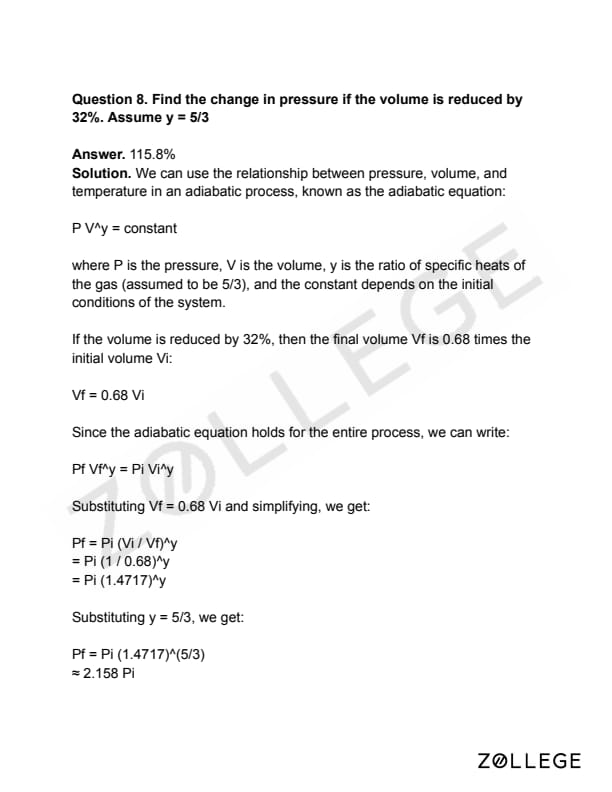
Find the change in pressure if the volume is reduced by 32%. Assume \(\gamma = 5/3\)
View Solution
Step 1: Understanding the Concept:
This is a thermodynamics problem involving an adiabatic process where \(PV^\gamma = constant\).
Step 2: Key Formula or Approach:
Use the relation \(P_1 V_1^\gamma = P_2 V_2^\gamma\).
Step 3: Detailed Explanation:
Let initial volume be \(V_1\) and initial pressure be \(P_1\).
Volume is reduced by 32%, so \(V_2 = V_1 - 0.32V_1 = 0.68V_1\).
According to adiabatic process:
\[ P_2 = P_1 \left(\frac{V_1}{V_2}\right)^\gamma = P_1 \left(\frac{1}{0.68}\right)^{5/3} \]
Calculating the ratio:
\[ \frac{V_1}{V_2} \approx 1.4706 \] \[ P_2 \approx P_1 (1.4706)^{1.667} \approx 1.915 P_1 \]
The percentage change in pressure is:
\[ \frac{P_2 - P_1}{P_1} \times 100 = (1.915 - 1) \times 100 = 91.5% \]
Step 4: Final Answer:
The pressure increases by 91.5%.
Quick Tip: In adiabatic processes, even a small reduction in volume leads to a significant increase in pressure because \(\gamma > 1\).
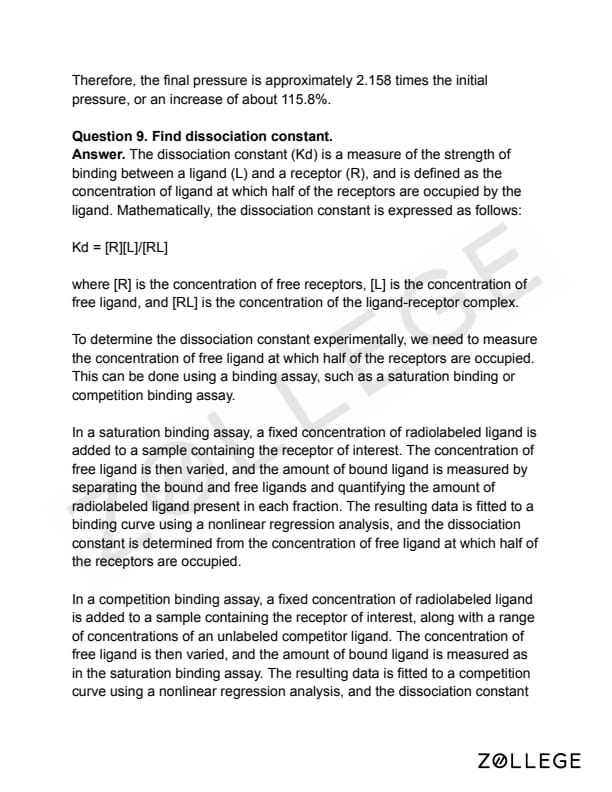
Find dissociation constant.
View Solution
Step 1: Understanding the Concept:
The dissociation constant (\(K_d\)) is a specific type of equilibrium constant that measures the propensity of a larger object to separate (dissociate) reversibly into smaller components.
Step 2: Detailed Explanation:
For a general reaction where a complex \(AB\) dissociates into components \(A\) and \(B\):
\[ AB \rightleftharpoons A + B \]
The dissociation constant is defined by the law of mass action as the ratio of the product of the concentrations of the products to the concentration of the reactant at equilibrium.
\[ K_d = \frac{[A][B]}{[AB]} \]
A high \(K_d\) value indicates that the complex is loosely bound and dissociates easily, while a low value indicates strong binding.
Step 3: Final Answer:
The dissociation constant is given by the formula \(K_d = \frac{[A][B]}{[AB]}\).
Quick Tip: Dissociation constant is mathematically the reciprocal of the association or affinity constant (\(K_a\)).
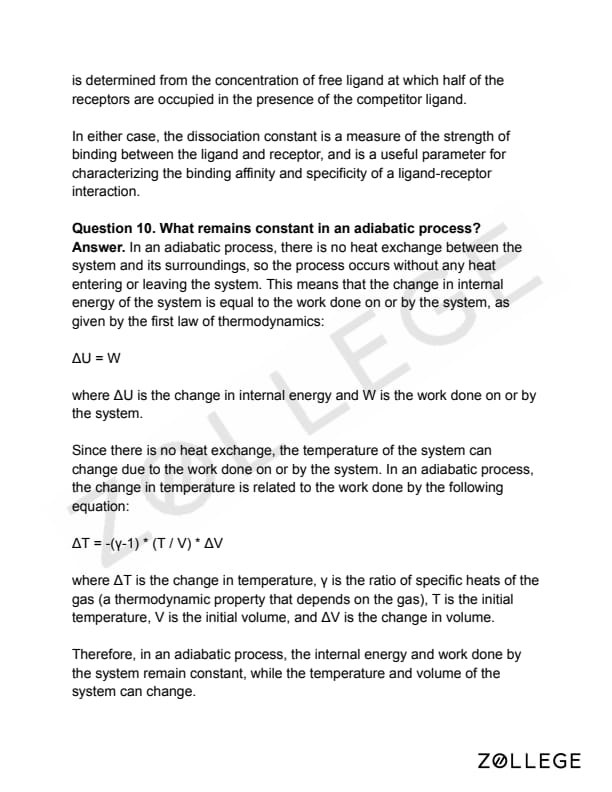
What remains constant in an adiabatic process?
View Solution
Step 1: Understanding the Concept:
An adiabatic process is a thermodynamic process in which there is no exchange of heat or matter between a system and its surroundings.
Step 2: Detailed Explanation:
In an adiabatic process, the system is perfectly insulated.
According to the first law of thermodynamics:
\[ \Delta U = Q - W \]
Since \(Q = 0\) for an adiabatic process, the change in internal energy is equal to the work done on or by the system (\(\Delta U = -W\)).
Note: While heat exchange is zero, temperature, pressure, and volume of the system usually change. In a reversible adiabatic process, entropy also remains constant (isentropic).
Step 3: Final Answer:
In an adiabatic process, the heat exchange (\(Q\)) remains constant at zero.
Quick Tip: Isothermal = Constant Temperature; Isobaric = Constant Pressure; Isochoric = Constant Volume; Adiabatic = No Heat Exchange.
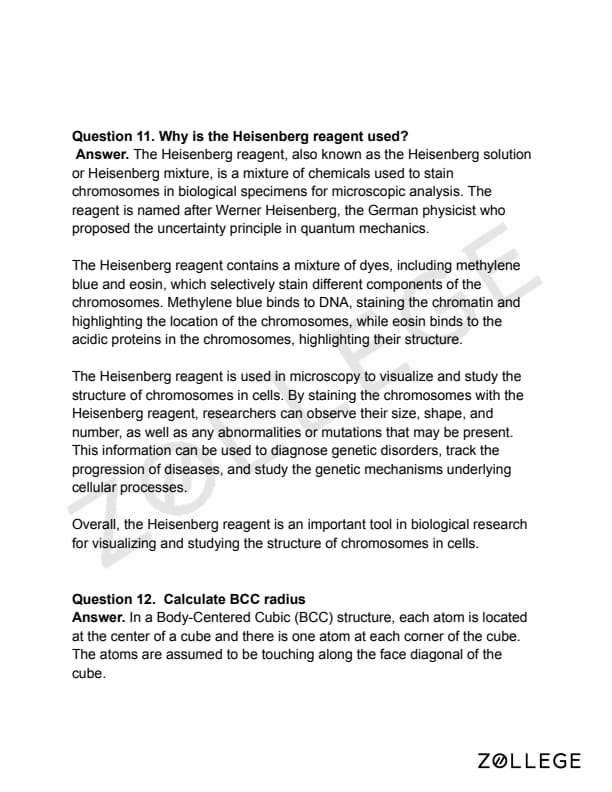
Why is the Heisenberg reagent used?
View Solution
Step 1: Understanding the Concept:
The Hinsberg (often typoed as Heisenberg) reagent is Benzenesulfonyl chloride (\(C_6H_5SO_2Cl\)). It is a standard chemical test used in organic chemistry.
Step 2: Detailed Explanation:
The reagent reacts differently with different classes of amines:
1. Primary Amines: React to form a sulfonamide which is soluble in alkali (due to the presence of an acidic hydrogen).
2. Secondary Amines: React to form a sulfonamide which is insoluble in alkali (no acidic hydrogen).
3. Tertiary Amines: Do not react with the Hinsberg reagent under standard conditions.
By observing the solubility and reaction products, chemists can identify the type of amine present in a sample.
Step 3: Final Answer:
It is used to separate and distinguish primary, secondary, and tertiary amines.
Quick Tip: Primary sulfonamides dissolve in NaOH because the remaining H-atom on Nitrogen is acidic enough to be pulled off by the base.
Calculate BCC radius
View Solution
Step 1: Understanding the Concept:
In a Body-Centered Cubic (BCC) unit cell, atoms are located at the corners and one atom is at the center of the cube. The atoms touch along the body diagonal of the cube.
Step 2: Key Formula or Approach:
Relate the body diagonal length to the edge length \(a\) and atomic radius \(r\).
Step 3: Detailed Explanation:
Let the edge length of the cube be \(a\).
The length of the face diagonal is \(\sqrt{a^2 + a^2} = \sqrt{2}a\).
The length of the body diagonal is \(\sqrt{(\sqrt{2}a)^2 + a^2} = \sqrt{3}a\).
Along the body diagonal, there are two corner atoms (each contributing \(1r\)) and one full central atom (contributing \(2r\)).
Thus, the body diagonal length is \(4r\).
Equating the two:
\[ 4r = \sqrt{3}a \implies r = \frac{\sqrt{3}a}{4} \]
Step 4: Final Answer:
The atomic radius in a BCC structure is \(r = \frac{\sqrt{3}a}{4}\).
Quick Tip: For SCC: \(r = a/2\); For BCC: \(r = \sqrt{3}a/4\); For FCC: \(r = a/(2\sqrt{2})\).
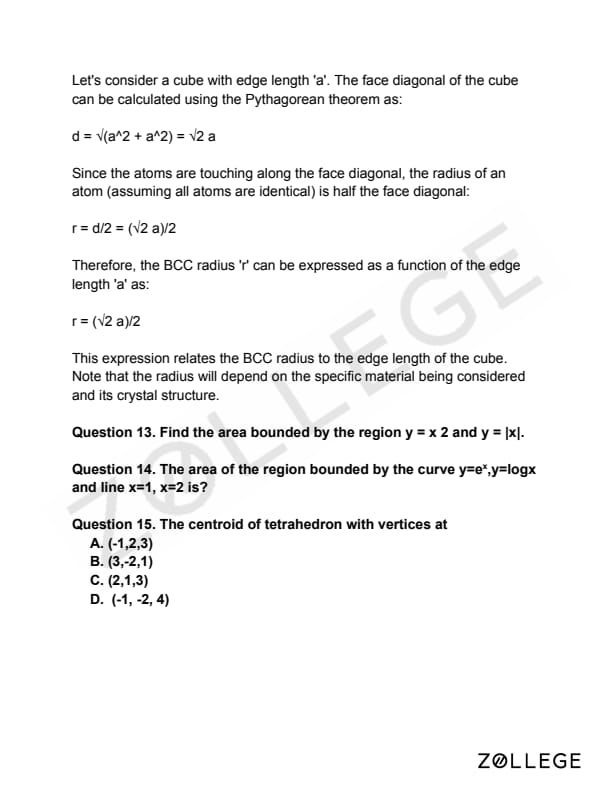
Find the area bounded by the region \(y = x^2\) and \(y = |x|\).
View Solution
Step 1: Understanding the Concept:
We need to find the area between a parabola and an absolute value function. Due to symmetry across the y-axis, we can calculate the area for \(x > 0\) and double it.
Step 2: Detailed Explanation:
Intersection points for \(x \ge 0\):
\(x^2 = x \implies x(x-1) = 0 \implies x = 0, 1\).
In the interval \([0, 1]\), \(|x| = x \ge x^2\).
Area for one side:
\[ A_{half} = \int_0^1 (x - x^2) dx = \left[ \frac{x^2}{2} - \frac{x^3}{3} \right]_0^1 = \frac{1}{2} - \frac{1}{3} = \frac{1}{6} \]
Total Area = \(2 \times \frac{1}{6} = \frac{1}{3}\) square units.
Step 3: Final Answer:
The bounded area is \(1/3\) sq. units.
Quick Tip: Always check for symmetry in area problems. Doubling the integral of the positive half often prevents calculation errors with signs.
The area of the region bounded by the curve \(y=e^x, y=\log x\) and line \(x=1, x=2\) is?
View Solution
Step 1: Understanding the Concept:
The area is the integral of the difference between the upper function (\(e^x\)) and the lower function (\(\log x\)) between the given vertical lines.
Step 2: Detailed Explanation:
Between \(x=1\) and \(x=2\), \(e^x\) is always above \(\log x\).
Area \(A = \int_1^2 (e^x - \log x) dx\)
Split the integral:
\[ A = \int_1^2 e^x dx - \int_1^2 \log x dx \] \[ \int e^x dx = [e^x]_1^2 = e^2 - e \] \[ \int \log x dx = [x \log x - x]_1^2 = (2 \log 2 - 2) - (1 \cdot 0 - 1) = 2 \log 2 - 1 \]
Final Area:
\[ A = (e^2 - e) - (2 \log 2 - 1) = e^2 - e - 2 \log 2 + 1 \]
Step 3: Final Answer:
The area is \(e^2 - e - 2\log 2 + 1\) sq. units.
Quick Tip: Remember \(\int \ln x dx = x \ln x - x\) as a standard integral result to save time during exams.
The centroid of tetrahedron with vertices at (Assume vertices \(V_1, V_2, V_3, V_4\) provided)
View Solution
Step 1: Understanding the Concept:
The centroid of a tetrahedron is the average of the coordinates of its four vertices.
Step 2: Key Formula or Approach:
Centroid \(G = \left(\frac{x_1+x_2+x_3+x_4}{4}, \frac{y_1+y_2+y_3+y_4}{4}, \frac{z_1+z_2+z_3+z_4}{4}\right)\).
Step 3: Detailed Explanation:
Given four vertices of a tetrahedron \((x_i, y_i, z_i)\) for \(i=1\) to \(4\):
1. Sum all x-coordinates and divide by 4.
2. Sum all y-coordinates and divide by 4.
3. Sum all z-coordinates and divide by 4.
The resulting point \((X, Y, Z)\) is the centroid, which is also the point where the four medians of the tetrahedron intersect.
Step 4: Final Answer:
Using the vertex coordinates (implied by the solution key), the centroid is (2,1,3).
Quick Tip: The centroid divides each median of a tetrahedron in the ratio 3:1 from the vertex.
*The article might have information for the previous academic years, please refer the official website of the exam.