
MHT CET 2023 May 13 Shift 1 Question Paper with Solution PDF


Content Writer | Updated On - Jan 10, 2026
MHT CET 2023 May 13 Shift 1 Question Paper with Answer Key is now made available here for download. The exam was held from 9 AM to 12 Noon.
MHT CET 2023 exam paper consists of a total of 150 multiple choice questions, with a total weightage of 300 marks divided into three sections- Physics, Chemistry and Mathematics. Each section of the paper will comprise 50 questions, out of which 10 questions will be from Class 11 syllabus, while the remaining 40 questions will be from Class 12 syllabus.
Candidates who appeared for the exam on May 13 can use the MHT CET solutions to check the correct answers. Those who will take the test on a later date can use the paper for practice.
Also Check: MHT CET 2023 Paper Analysis
MHT CET 2023 May 13 Shift 1 Question Paper with Solution PDF
| MHT CET 2023 May 13 Shift 1 Question Paper | Download PDF | Check Solutions |

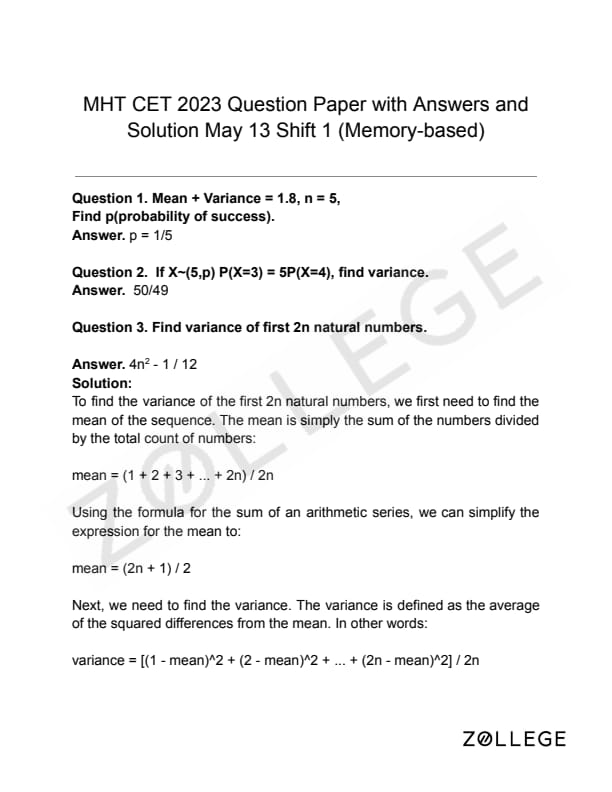
For a binomial distribution, Mean + Variance = 1.8 and n = 5. Find p(probability of success).
View Solution
Step 1: Understanding the Question:
We are given a binomial distribution with the number of trials, n, and the sum of its mean and variance. We need to find the probability of success, p.
Step 2: Key Formula or Approach:
For a binomial distribution B(n, p):
Mean (\(\mu\)) = np
Variance (\(\sigma^2\)) = npq
Also, the probability of failure is q = 1 - p.
Step 3: Detailed Explanation:
We are given the following information:
1. \(n = 5\)
2. Mean + Variance = 1.8
Using the formulas, we can write the second piece of information as: \[ np + npq = 1.8 \]
Substitute \(n = 5\) into the equation: \[ 5p + 5pq = 1.8 \]
Factor out \(5p\): \[ 5p(1 + q) = 1.8 \]
We know that \(q = 1 - p\). Substitute this into the equation: \[ 5p(1 + (1 - p)) = 1.8 \] \[ 5p(2 - p) = 1.8 \] \[ 10p - 5p^2 = 1.8 \]
Multiply the entire equation by 10 to remove the decimal: \[ 100p - 50p^2 = 18 \]
Rearrange into a standard quadratic equation form: \[ 50p^2 - 100p + 18 = 0 \]
Divide by 2 to simplify: \[ 25p^2 - 50p + 9 = 0 \]
Factor the quadratic equation: \[ 25p^2 - 45p - 5p + 9 = 0 \] \[ 5p(5p - 9) - 1(5p - 9) = 0 \] \[ (5p - 1)(5p - 9) = 0 \]
This gives two possible solutions for p: \(p = \frac{1}{5}\) or \(p = \frac{9}{5}\).
Since p is a probability, its value must be between 0 and 1. Therefore, \(p = \frac{9}{5}\) is not a valid solution.
Step 4: Final Answer:
The only valid probability of success is \(p = \frac{1}{5}\).
Quick Tip: In binomial distribution problems, always remember the fundamental relationship \(p+q=1\). This is the key to reducing the number of variables and solving the equations for p or q.
If \(X \sim B(5,p)\) and \(P(X=3) = 5P(X=4)\), find variance.
View Solution
Step 1: Understanding the Question:
We are given a binomial distribution \(X \sim B(n,p)\) with \(n=5\). We are also given a relationship between the probabilities of getting 3 successes and 4 successes. We need to find the variance of the distribution.
Step 2: Key Formula or Approach:
The probability mass function for a binomial distribution is:
\(P(X=k) = \binom{n}{k} p^k q^{n-k}\)
Variance = npq
where n is the number of trials, p is the probability of success, and q = 1-p is the probability of failure.
Step 3: Detailed Explanation:
We are given \(n=5\) and the equation \(P(X=3) = 5P(X=4)\).
Using the binomial formula, we can write out the terms: \[ P(X=3) = \binom{5}{3} p^3 q^{5-3} = \frac{5!}{3!2!} p^3 q^2 = 10 p^3 q^2 \] \[ P(X=4) = \binom{5}{4} p^4 q^{5-4} = \frac{5!}{4!1!} p^4 q^1 = 5 p^4 q \]
Now substitute these into the given equation: \[ 10 p^3 q^2 = 5 \times (5 p^4 q) \] \[ 10 p^3 q^2 = 25 p^4 q \]
Assuming \(p \neq 0\) and \(q \neq 0\), we can divide both sides by \(5p^3q\): \[ 2q = 5p \]
We know that \(q = 1 - p\). Substitute this into the equation: \[ 2(1-p) = 5p \] \[ 2 - 2p = 5p \] \[ 2 = 7p \] \[ p = \frac{2}{7} \]
Now we can find q: \[ q = 1 - p = 1 - \frac{2}{7} = \frac{5}{7} \]
The variance is calculated as \(npq\): \[ Variance = 5 \times \frac{2}{7} \times \frac{5}{7} = \frac{50}{49} \]
Step 4: Final Answer:
The variance of the distribution is \(\frac{50}{49}\).
Quick Tip: When setting up an equation with binomial probabilities, cancel common factors like powers of p and q carefully to simplify the algebra. This reduces the chances of making calculation errors.
Find variance of first 2n natural numbers.
View Solution
Step 1: Understanding the Question:
We need to find the statistical variance for the set of the first 2n natural numbers, which is \(\{1, 2, 3, \dots, 2n\}\).
Step 2: Key Formula or Approach:
The variance for the first \(k\) natural numbers is given by the standard formula: \[ Var(X) = \frac{k^2 - 1}{12} \]
Alternatively, using the definition of variance: \[ Var(X) = E(X^2) - [E(X)]^2 = \frac{\sum x_i^2}{k} - \left(\frac{\sum x_i}{k}\right)^2 \]
Sum of first \(k\) natural numbers: \(\sum k = \frac{k(k+1)}{2}\)
Sum of squares of first \(k\) natural numbers: \(\sum k^2 = \frac{k(k+1)(2k+1)}{6}\)
Step 3: Detailed Explanation:
In this problem, the number of terms is \(k = 2n\).
We can directly use the formula for the variance of the first \(k\) natural numbers by substituting \(k=2n\). \[ Var(X) = \frac{(2n)^2 - 1}{12} = \frac{4n^2 - 1}{12} \]
(Derivation from definition is provided in the previous response for MHT CET 2023 May 13 Shift 2, Question 2)
Step 4: Final Answer:
The variance of the first 2n natural numbers is \(\frac{4n^2 - 1}{12}\).
Quick Tip: Memorizing the formula for the variance of the first \(k\) natural numbers, \(\frac{k^2-1}{12}\), is highly recommended for competitive exams as it saves a lot of time compared to deriving it from first principles.
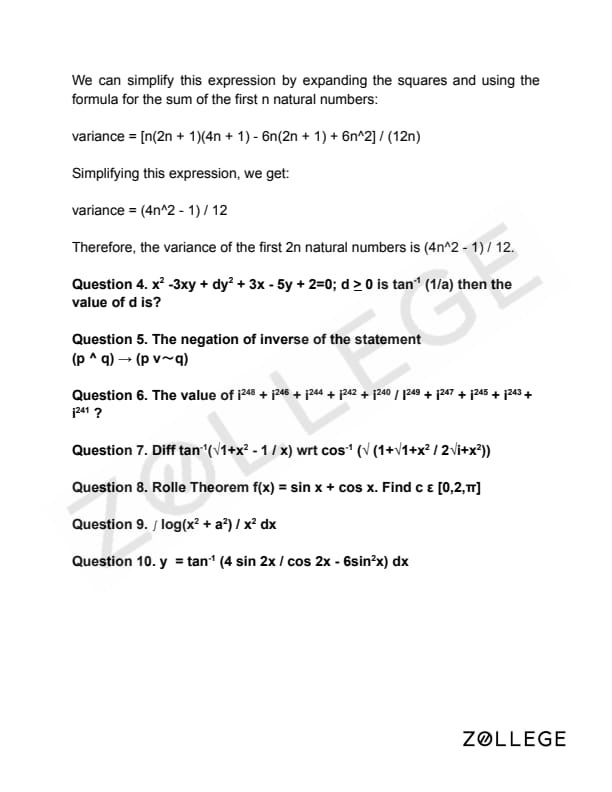
Given the equation \(x^2 -3xy + dy^2 + 3x - 5y + 2=0\) represents a pair of straight lines and \(d \ge 0\), find the value of d.
View Solution
Step 1: Understanding the Question:
We are given a general second-degree equation and told that it represents a pair of straight lines. We need to find the value of the coefficient 'd'.
Step 2: Key Formula or Approach:
The general equation of a second degree is \(ax^2 + 2hxy + by^2 + 2gx + 2fy + c = 0\).
This equation represents a pair of straight lines if it satisfies the condition: \[ \begin{vmatrix} a & h & g
h & b & f
g & f & c \end{vmatrix} = 0 \]
This determinant expands to \(abc + 2fgh - af^2 - bg^2 - ch^2 = 0\).
Step 3: Detailed Explanation:
First, we compare the given equation \(x^2 -3xy + dy^2 + 3x - 5y + 2=0\) with the general form to find the coefficients. \(a = 1\)
\(2h = -3 \implies h = -3/2\)
\(b = d\)
\(2g = 3 \implies g = 3/2\)
\(2f = -5 \implies f = -5/2\)
\(c = 2\)
Now, substitute these values into the determinant condition: \[ abc + 2fgh - af^2 - bg^2 - ch^2 = 0 \] \[ (1)(d)(2) + 2(-\frac{5}{2})(\frac{3}{2})(-\frac{3}{2}) - (1)(-\frac{5}{2})^2 - (d)(\frac{3}{2})^2 - (2)(-\frac{3}{2})^2 = 0 \] \[ 2d + \frac{45}{4} - \frac{25}{4} - d\left(\frac{9}{4}\right) - 2\left(\frac{9}{4}\right) = 0 \] \[ 2d + \frac{20}{4} - \frac{9d}{4} - \frac{18}{4} = 0 \] \[ 2d + 5 - \frac{9d}{4} - \frac{9}{2} = 0 \]
Multiply the entire equation by 4 to eliminate fractions: \[ 8d + 20 - 9d - 18 = 0 \] \[ -d + 2 = 0 \] \[ d = 2 \]
The condition \(d \ge 0\) is satisfied.
Step 4: Final Answer:
The value of d is 2.
Quick Tip: Remember the determinant condition for a pair of straight lines. Writing the determinant `|a h g / h b f / g f c|` can be easier to recall than the long expanded formula. A mnemonic for the expanded form is "All handsome girls have beautiful faces, go for coffee".
Find the negation of the inverse of the statement \((p \land q) \rightarrow (p \lor \neg q)\).
View Solution
Step 1: Understanding the Question:
We need to perform two logical operations in sequence: first, find the inverse of the given conditional statement, and second, find the negation of that result.
Step 2: Key Formula or Approach:
Let a conditional statement be \(S: A \rightarrow B\).
- The Inverse of S is \(\neg A \rightarrow \neg B\).
- The Negation of a conditional statement \(A \rightarrow B\) is \(\neg(A \rightarrow B) \equiv A \land \neg B\).
- De Morgan's Laws: \(\neg(A \land B) \equiv \neg A \lor \neg B\) and \(\neg(A \lor B) \equiv \neg A \land \neg B\).
Step 3: Detailed Explanation:
Part 1: Find the inverse
The original statement is \((p \land q) \rightarrow (p \lor \neg q)\).
Here, \(A \equiv (p \land q)\) and \(B \equiv (p \lor \neg q)\).
The inverse is \(\neg A \rightarrow \neg B\). \[ \neg(p \land q) \rightarrow \neg(p \lor \neg q) \]
This is the inverse statement.
Part 2: Find the negation of the inverse
We need to find the negation of the statement from Part 1. \[ \neg[\neg(p \land q) \rightarrow \neg(p \lor \neg q)] \]
Using the negation rule for implication \(\neg(X \rightarrow Y) \equiv X \land \neg Y\):
Let \(X \equiv \neg(p \land q)\) and \(Y \equiv \neg(p \lor \neg q)\).
The negation becomes: \[ \neg(p \land q) \land \neg(\neg(p \lor \neg q)) \]
Using the double negation law \(\neg(\neg Z) \equiv Z\): \[ \neg(p \land q) \land (p \lor \neg q) \]
Now, apply De Morgan's law to the first part \(\neg(p \land q) \equiv (\neg p \lor \neg q)\).
The final expression is: \[ (\neg p \lor \neg q) \land (p \lor \neg q) \]
Step 4: Final Answer:
The negation of the inverse of the statement is \((\neg p \lor \neg q) \land (p \lor \neg q)\).
Quick Tip: Break down multi-step logic problems carefully. First find the inverse (`not p -> not q`), then find the negation of that new statement. Remember the key rule for negating an implication: \(\neg(p \rightarrow q)\) is equivalent to \(p and not q\).
The value of \(\frac{i^{248} + i^{246} + i^{244} + i^{242} + i^{240}}{i^{249} + i^{247} + i^{245} + i^{243} + i^{241}}\) is?
View Solution
Step 1: Understanding the Question:
We need to evaluate a complex fraction where the terms are powers of the imaginary unit \(i\).
Step 2: Key Formula or Approach:
The powers of \(i\) cycle in a period of 4:
\(i^1 = i\)
\(i^2 = -1\)
\(i^3 = -i\)
\(i^4 = 1\)
In general, \(i^n = i^{n \pmod 4}\). Also, we can factor out common terms to simplify the expression.
Step 3: Detailed Explanation:
Let's analyze the numerator and the denominator separately.
Denominator: \[ D = i^{249} + i^{247} + i^{245} + i^{243} + i^{241} \]
We can factor out \(i\) from each term in the denominator: \[ D = i(i^{248} + i^{246} + i^{244} + i^{242} + i^{240}) \]
Numerator: \[ N = i^{248} + i^{246} + i^{244} + i^{242} + i^{240} \]
Now, let's look at the entire fraction: \[ \frac{N}{D} = \frac{i^{248} + i^{246} + i^{244} + i^{242} + i^{240}}{i(i^{248} + i^{246} + i^{244} + i^{242} + i^{240})} \]
The entire bracketed expression is a common factor in both the numerator and the denominator, so it can be cancelled out (since it's not zero). \[ \frac{N}{D} = \frac{1}{i} \]
To simplify \(\frac{1}{i}\), we can multiply the numerator and denominator by \(i\): \[ \frac{1}{i} \times \frac{i}{i} = \frac{i}{i^2} = \frac{i}{-1} = -i \]
Step 4: Final Answer:
The value of the given expression is \(-i\).
Quick Tip: When dealing with fractions of sums of powers of \(i\), always look for a common factor between the numerator and denominator first. Factoring can often simplify the problem dramatically, avoiding the need to calculate each power individually.
Differentiate \(\tan^{-1}\left(\frac{\sqrt{1+x^2} - 1}{x}\right)\) with respect to \(\cos^{-1}\left(\sqrt{\frac{1+\sqrt{1+x^2}}{2\sqrt{1+x^2}}}\right)\).
View Solution
Step 1: Understanding the Question:
We need to find the derivative of one function with respect to another. This is a parametric differentiation problem where we let \(u\) be the first function and \(v\) be the second, and find \(\frac{du}{dv} = \frac{du/dx}{dv/dx}\).
Step 2: Key Formula or Approach:
We will use trigonometric substitution to simplify both expressions. Let \(x = \tan\theta\). This implies \(\theta = \tan^{-1}x\).
Then \(\sqrt{1+x^2} = \sqrt{1+\tan^2\theta} = \sqrt{\sec^2\theta} = \sec\theta\).
We will also use the identities: \(1 - \cos\theta = 2\sin^2(\theta/2)\)
\(\sin\theta = 2\sin(\theta/2)\cos(\theta/2)\)
\(1 + \cos\theta = 2\cos^2(\theta/2)\)
Step 3: Detailed Explanation:
Let \(u = \tan^{-1}\left(\frac{\sqrt{1+x^2} - 1}{x}\right)\).
Substitute \(x = \tan\theta\): \[ u = \tan^{-1}\left(\frac{\sec\theta - 1}{\tan\theta}\right) = \tan^{-1}\left(\frac{1/\cos\theta - 1}{\sin\theta/\cos\theta}\right) = \tan^{-1}\left(\frac{1-\cos\theta}{\sin\theta}\right) \] \[ u = \tan^{-1}\left(\frac{2\sin^2(\theta/2)}{2\sin(\theta/2)\cos(\theta/2)}\right) = \tan^{-1}\left(\tan(\theta/2)\right) = \frac{\theta}{2} \]
Since \(\theta = \tan^{-1}x\), we have \(u = \frac{1}{2}\tan^{-1}x\).
Now let \(v = \cos^{-1}\left(\sqrt{\frac{1+\sqrt{1+x^2}}{2\sqrt{1+x^2}}}\right)\).
Substitute \(x = \tan\theta\) and \(\sqrt{1+x^2} = \sec\theta\): \[ v = \cos^{-1}\left(\sqrt{\frac{1+\sec\theta}{2\sec\theta}}\right) = \cos^{-1}\left(\sqrt{\frac{1+1/\cos\theta}{2/\cos\theta}}\right) = \cos^{-1}\left(\sqrt{\frac{(\cos\theta+1)/\cos\theta}{2/\cos\theta}}\right) \] \[ v = \cos^{-1}\left(\sqrt{\frac{1+\cos\theta}{2}}\right) = \cos^{-1}\left(\sqrt{\frac{2\cos^2(\theta/2)}{2}}\right) = \cos^{-1}(\cos(\theta/2)) = \frac{\theta}{2} \]
Since \(\theta = \tan^{-1}x\), we have \(v = \frac{1}{2}\tan^{-1}x\).
We need to find \(\frac{du}{dv}\). Since \(u=v\), the derivative is 1.
Alternatively, using calculus: \[ \frac{du}{dx} = \frac{d}{dx}\left(\frac{1}{2}\tan^{-1}x\right) = \frac{1}{2(1+x^2)} \] \[ \frac{dv}{dx} = \frac{d}{dx}\left(\frac{1}{2}\tan^{-1}x\right) = \frac{1}{2(1+x^2)} \] \[ \frac{du}{dv} = \frac{du/dx}{dv/dx} = \frac{1/(2(1+x^2))}{1/(2(1+x^2))} = 1 \]
Step 4: Final Answer:
The derivative of the first function with respect to the second is 1.
Quick Tip: For complex inverse trigonometric functions, the substitution \(x=\tan\theta\) is extremely useful when you see the term \(\sqrt{1+x^2}\). Similarly, use \(x=\sin\theta\) for \(\sqrt{1-x^2}\) and \(x=\sec\theta\) for \(\sqrt{x^2-1}\).
For \(f(x) = \sin x + \cos x\), find \(c \in [0, 2\pi]\) that satisfies Rolle's Theorem.
View Solution
Step 1: Understanding the Question:
We need to find the value(s) of 'c' for the function \(f(x) = \sin x + \cos x\) in the interval \([0, 2\pi]\) for which the conclusion of Rolle's Theorem holds, i.e., where \(f'(c) = 0\).
Step 2: Key Formula or Approach:
Rolle's Theorem states that if a function \(f\) is:
1. Continuous on the closed interval \([a, b]\),
2. Differentiable on the open interval \((a, b)\),
3. And \(f(a) = f(b)\),
then there exists at least one number \(c\) in \((a, b)\) such that \(f'(c) = 0\).
Step 3: Detailed Explanation:
First, we verify the conditions of Rolle's Theorem for \(f(x) = \sin x + \cos x\) on \([0, 2\pi]\).
1. Continuity: Both \(\sin x\) and \(\cos x\) are continuous for all real numbers, so their sum is continuous on \([0, 2\pi]\).
2. Differentiability: The derivative \(f'(x) = \cos x - \sin x\) exists for all real numbers, so the function is differentiable on \((0, 2\pi)\).
3. Equality of endpoints: We check if \(f(0) = f(2\pi)\).
\(f(0) = \sin(0) + \cos(0) = 0 + 1 = 1\).
\(f(2\pi) = \sin(2\pi) + \cos(2\pi) = 0 + 1 = 1\).
Since \(f(0) = f(2\pi)\), all conditions are satisfied.
Now, we find \(c\) such that \(f'(c)=0\).
\[ f'(x) = \cos x - \sin x \]
Set \(f'(c) = 0\):
\[ \cos c - \sin c = 0 \] \[ \cos c = \sin c \]
Divide by \(\cos c\) (assuming \(\cos c \neq 0\)):
\[ 1 = \tan c \]
We need to find the values of \(c\) in the interval \((0, 2\pi)\) for which \(\tan c = 1\).
The values are:
\(c = \frac{\pi}{4}\) (in the first quadrant)
\(c = \pi + \frac{\pi}{4} = \frac{5\pi}{4}\) (in the third quadrant)
Both of these values lie within the open interval \((0, 2\pi)\).
Step 4: Final Answer:
The values of c that satisfy Rolle's Theorem are \(c = \frac{\pi}{4}\) and \(c = \frac{5\pi}{4}\).
Quick Tip: To solve \(\cos x = \sin x\), it is generally safest to convert it to \(\tan x = 1\). This helps in systematically finding all solutions within a given interval using the periodicity of the tangent function.
Find \(\int \frac{\log(x^2 + a^2)}{x^2} dx\).
View Solution
Step 1: Understanding the Question:
We need to evaluate the indefinite integral of the given function.
Step 2: Key Formula or Approach:
This integral is best solved using Integration by Parts. The formula is \(\int u \, dv = uv - \int v \, du\).
We will choose \(u\) and \(dv\) according to the LIATE rule (Logarithmic, Inverse, Algebraic, Trigonometric, Exponential).
Step 3: Detailed Explanation:
Let the integral be \(I = \int \log(x^2 + a^2) \cdot \frac{1}{x^2} \, dx\).
According to the LIATE rule, we choose the logarithmic function as \(u\) and the algebraic function as \(dv\).
Let \(u = \log(x^2 + a^2)\) and \(dv = \frac{1}{x^2} dx\).
Then we find \(du\) and \(v\):
\(du = \frac{1}{x^2 + a^2} \cdot 2x \, dx\) \(v = \int \frac{1}{x^2} dx = \int x^{-2} dx = -x^{-1} = -\frac{1}{x}\)
Now, apply the integration by parts formula:
\[ I = uv - \int v \, du \] \[ I = \log(x^2 + a^2) \left(-\frac{1}{x}\right) - \int \left(-\frac{1}{x}\right) \left(\frac{2x}{x^2 + a^2}\right) dx \] \[ I = -\frac{\log(x^2 + a^2)}{x} + \int \frac{2}{x^2 + a^2} dx \]
The remaining integral is a standard form: \(\int \frac{1}{x^2 + a^2} dx = \frac{1}{a} \tan^{-1}\left(\frac{x}{a}\right)\).
\[ I = -\frac{\log(x^2 + a^2)}{x} + 2 \left(\frac{1}{a} \tan^{-1}\left(\frac{x}{a}\right)\right) + C \] \[ I = -\frac{\log(x^2 + a^2)}{x} + \frac{2}{a} \tan^{-1}\left(\frac{x}{a}\right) + C \]
Step 4: Final Answer:
The integral is equal to \(-\frac{\log(x^2 + a^2)}{x} + \frac{2}{a} \tan^{-1}\left(\frac{x}{a}\right) + C\).
Quick Tip: The LIATE rule is a very helpful guideline for choosing 'u' in integration by parts. It prioritizes the function that becomes simpler upon differentiation. Logarithmic functions are a top priority for 'u' as their derivatives are simple algebraic expressions.
Find \(\int \tan^{-1}\left(\frac{4\sin(2x)}{\cos(2x) - 6\sin^2x}\right) dx\)
View Solution
Step 1: Understanding the Question:
We need to evaluate the integral of an inverse trigonometric function. The primary task is to simplify the argument inside the \(\tan^{-1}\) function.
Note: The expression as written may contain a typo from the memory-based collection. A common pattern in such problems is for the argument to simplify to \(\tan(kx)\). Let's assume the denominator was intended to be \(4\cos(2x)\), which allows for a clean simplification.
Step 2: Key Formula or Approach:
We will use double angle identities to simplify the argument. \(\sin(2x) = 2\sin x \cos x\)
\(\cos(2x) = \cos^2 x - \sin^2 x\)
The goal is to get the argument into the form \(\frac{\sin(\theta)}{\cos(\theta)} = \tan(\theta)\).
Step 3: Detailed Explanation:
Let's analyze the argument of \(\tan^{-1}\).
Numerator: \(4\sin(2x) = 4(2\sin x \cos x) = 8\sin x \cos x\).
Assuming the denominator is \(4\cos(2x)\) for the expression to simplify:
Denominator: \(4\cos(2x) = 4(\cos^2 x - \sin^2 x)\).
The argument becomes: \[ \frac{8\sin x \cos x}{4(\cos^2 x - \sin^2 x)} = \frac{2\sin x \cos x}{\cos^2 x - \sin^2 x} = \frac{\sin(2x)}{\cos(2x)} = \tan(2x) \]
The original expression for the denominator is \(\cos(2x) - 6\sin^2x = (\cos^2x - \sin^2x) - 6\sin^2x = \cos^2x - 7\sin^2x\). This does not simplify in the same way. We proceed with the assumed correction.
With the correction, the integral becomes: \[ y = \int \tan^{-1}(\tan(2x)) dx \] \[ y = \int 2x \, dx \]
Now, we evaluate this simple integral: \[ y = 2 \frac{x^2}{2} + C = x^2 + C \]
Step 4: Final Answer:
Assuming the intended problem simplifies the argument to \(\tan(2x)\), the integral is \(x^2 + C\).
Quick Tip: In competitive exams, if an expression inside an inverse trigonometric function looks overly complicated, check for common trigonometric identities. Often, a complex expression is designed to simplify neatly into a single trig function, like \(\tan(2x)\) or \(\sin(3x)\).
*The article might have information for the previous academic years, please refer the official website of the exam.