
MHT CET 2023 May 13 Shift 2 Question Paper with Solution PDF


Content Writer | Updated On - Jan 10, 2026
MHT CET 2023 May 13 Shift 2 Question Paper with Answer Key is now made available here for download. The exam was held from 2 PM to 5 PM.
MHT CET 2023 exam paper consists of a total of 150 multiple choice questions, with a total weightage of 300 marks divided into three sections- Physics, Chemistry and Mathematics. Each section of the paper will comprise 50 questions, out of which 10 questions will be from Class 11 syllabus, while the remaining 40 questions will be from Class 12 syllabus.
Candidates who appeared for the exam on May 13 can use the MHT CET solutions to check the correct answers. Those who will take the test on a later date can use the paper for practice.
Also Check: MHT CET 2023 Paper Analysis
MHT CET 2023 May 13 Shift 2 Question Paper with Solution PDF
| MHT CET 2023 May 13 Shift 2 Question Paper | Download PDF | Check Solutions |

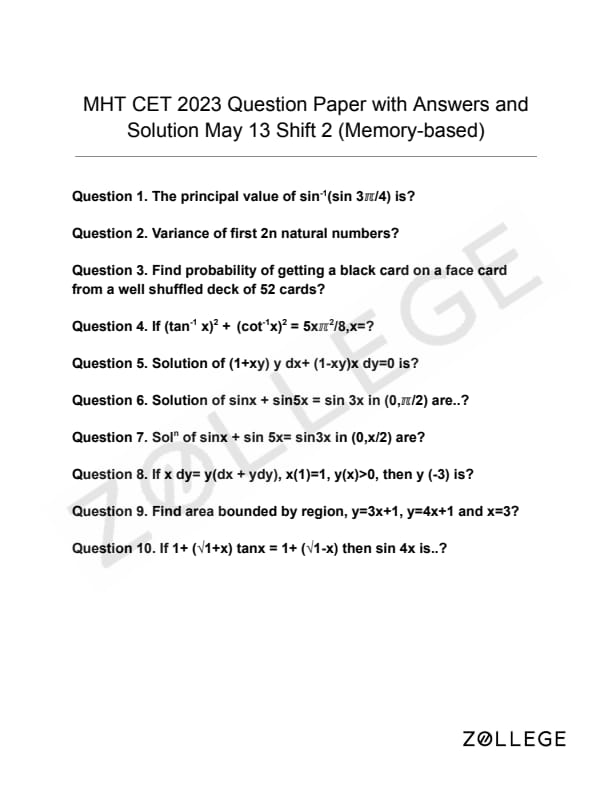
The principal value of \(\sin^{-1}(\sin \frac{3\pi}{4})\) is?
View Solution
Step 1: Understanding the Question:
We need to find the principal value of the given inverse trigonometric expression. The principal value branch for \(\sin^{-1}(x)\) is \([-\frac{\pi}{2}, \frac{\pi}{2}]\).
Step 2: Key Formula or Approach:
The property \(\sin^{-1}(\sin \theta) = \theta\) is only valid if \(\theta\) is in the principal value range \([-\frac{\pi}{2}, \frac{\pi}{2}]\).
If \(\theta\) is not in this range, we must first convert \(\sin \theta\) to \(\sin \alpha\), where \(\alpha\) is in the principal range. We can use the identity \(\sin(\pi - x) = \sin(x)\).
Step 3: Detailed Explanation:
The given angle is \(\theta = \frac{3\pi}{4}\).
This angle is not in the principal value range of \(\sin^{-1}\), which is \([-\frac{\pi}{2}, \frac{\pi}{2}]\).
We first evaluate \(\sin(\frac{3\pi}{4})\).
We can write \(\frac{3\pi}{4}\) as \(\pi - \frac{\pi}{4}\).
\[ \sin\left(\frac{3\pi}{4}\right) = \sin\left(\pi - \frac{\pi}{4}\right) = \sin\left(\frac{\pi}{4}\right) \]
Now, the expression becomes: \[ \sin^{-1}\left(\sin \frac{3\pi}{4}\right) = \sin^{-1}\left(\sin \frac{\pi}{4}\right) \]
Since \(\frac{\pi}{4}\) lies in the principal value range \([-\frac{\pi}{2}, \frac{\pi}{2}]\), we can use the property \(\sin^{-1}(\sin \theta) = \theta\).
\[ \sin^{-1}\left(\sin \frac{\pi}{4}\right) = \frac{\pi}{4} \]
Step 4: Final Answer:
The principal value of \(\sin^{-1}(\sin \frac{3\pi}{4})\) is \(\frac{\pi}{4}\).
Quick Tip: Always check if the angle inside the sine function is within the principal value range of \(\sin^{-1}(x)\), which is \([-\frac{\pi}{2}, \frac{\pi}{2}]\). If not, use trigonometric identities to find an equivalent angle that falls within this range.
Variance of first 2n natural numbers?
View Solution
Step 1: Understanding the Question:
We need to find the variance of the set of the first 2n natural numbers, which is \(\{1, 2, 3, \dots, 2n\}\).
Step 2: Key Formula or Approach:
The variance of a set of numbers \(\{x_1, x_2, \dots, x_k\}\) is given by the formula: \[ Var(X) = \sigma^2 = \frac{\sum x_i^2}{k} - \left(\frac{\sum x_i}{k}\right)^2 \]
For the first \(k\) natural numbers: \[ \sum_{i=1}^{k} i = \frac{k(k+1)}{2} \] \[ \sum_{i=1}^{k} i^2 = \frac{k(k+1)(2k+1)}{6} \]
In this problem, the total number of terms is \(k = 2n\).
Step 3: Detailed Explanation:
First, we find the mean (average) of the first 2n natural numbers.
\[ Mean = \frac{\sum_{i=1}^{2n} i}{2n} = \frac{\frac{2n(2n+1)}{2}}{2n} = \frac{2n+1}{2} \]
Next, we find the mean of the squares of the first 2n natural numbers.
\[ \frac{\sum_{i=1}^{2n} i^2}{2n} = \frac{\frac{2n(2n+1)(2(2n)+1)}{6}}{2n} = \frac{(2n+1)(4n+1)}{6} \]
Now, we apply the variance formula: \[ Var(X) = \frac{\sum x_i^2}{k} - \left(Mean\right)^2 \] \[ Var(X) = \frac{(2n+1)(4n+1)}{6} - \left(\frac{2n+1}{2}\right)^2 \] \[ = \frac{(2n+1)(4n+1)}{6} - \frac{(2n+1)^2}{4} \] \[ = (2n+1) \left[ \frac{4n+1}{6} - \frac{2n+1}{4} \right] \] \[ = (2n+1) \left[ \frac{2(4n+1) - 3(2n+1)}{12} \right] \] \[ = (2n+1) \left[ \frac{8n+2 - 6n-3}{12} \right] \] \[ = (2n+1) \left[ \frac{2n-1}{12} \right] \] \[ = \frac{(2n+1)(2n-1)}{12} = \frac{4n^2 - 1}{12} \]
Step 4: Final Answer:
The variance of the first 2n natural numbers is \(\frac{4n^2 - 1}{12}\).
Quick Tip: Memorize the formula for the variance of the first \(k\) natural numbers: \(Var = \frac{k^2 - 1}{12}\). In this case, \(k = 2n\), so substituting gives \(\frac{(2n)^2 - 1}{12} = \frac{4n^2 - 1}{12}\). This is a much faster way to solve the problem.
Find the probability of getting a black card, given that it is a face card, from a well-shuffled deck of 52 cards?
View Solution
Step 1: Understanding the Question:
The question asks for a conditional probability. We need to find the probability that a drawn card is black, under the condition that we already know the card is a face card.
Let A be the event that the card is black.
Let B be the event that the card is a face card.
We need to find P(A|B).
Step 2: Key Formula or Approach:
The formula for conditional probability is: \[ P(A|B) = \frac{P(A \cap B)}{P(B)} \]
Alternatively, we can solve this by considering the reduced sample space. The sample space is now only the set of face cards.
Step 3: Detailed Explanation:
Method 1: Using the formula
Total number of cards = 52.
Number of face cards (Kings, Queens, Jacks) = \(3 \times 4 = 12\). So, \(P(B) = \frac{12}{52}\).
Number of black face cards (K, Q, J of Spades and Clubs) = \(3 \times 2 = 6\). So, \(P(A \cap B) = \frac{6}{52}\).
Using the formula: \[ P(A|B) = \frac{6/52}{12/52} = \frac{6}{12} = \frac{1}{2} \]
Method 2: Using the reduced sample space
The condition is that the card drawn is a face card. So, our new sample space consists of only the face cards.
Total number of possible outcomes (total face cards) = 12.
The number of favorable outcomes is the number of black cards within this new sample space.
Number of black face cards = 6 (Jack, Queen, King of Spades and Clubs).
The required probability is: \[ P = \frac{Number of black face cards}{Total number of face cards} = \frac{6}{12} = \frac{1}{2} \]
Step 4: Final Answer:
The probability of getting a black card given that it is a face card is \(\frac{1}{2}\).
Quick Tip: For conditional probability questions, it's often simpler to think about the "reduced sample space". The condition given (e.g., "it is a face card") defines your new universe of possibilities. Then, just count the favorable outcomes within that new universe.
If \((\tan^{-1} x)^2 + (\cot^{-1}x)^2 = \frac{5\pi^2}{8}\), find x.
View Solution
Step 1: Understanding the Question:
We are given an equation involving inverse trigonometric functions and need to solve for the value of x.
Step 2: Key Formula or Approach:
We use the identity: \(\tan^{-1}x + \cot^{-1}x = \frac{\pi}{2}\).
From this, we can write \(\cot^{-1}x = \frac{\pi}{2} - \tan^{-1}x\).
We will substitute this into the given equation to form a quadratic equation in terms of \(\tan^{-1}x\).
Step 3: Detailed Explanation:
Let \(y = \tan^{-1}x\). The given equation is: \[ y^2 + \left(\frac{\pi}{2} - y\right)^2 = \frac{5\pi^2}{8} \]
Expand the equation: \[ y^2 + \left(\frac{\pi^2}{4} - \pi y + y^2\right) = \frac{5\pi^2}{8} \] \[ 2y^2 - \pi y + \frac{\pi^2}{4} - \frac{5\pi^2}{8} = 0 \] \[ 2y^2 - \pi y - \frac{3\pi^2}{8} = 0 \]
Multiply the entire equation by 8 to clear the fraction: \[ 16y^2 - 8\pi y - 3\pi^2 = 0 \]
This is a quadratic equation in \(y\). We can solve it by factorization or the quadratic formula. \[ 16y^2 - 12\pi y + 4\pi y - 3\pi^2 = 0 \] \[ 4y(4y - 3\pi) + \pi(4y - 3\pi) = 0 \] \[ (4y + \pi)(4y - 3\pi) = 0 \]
This gives two possible solutions for \(y\): \[ y = -\frac{\pi}{4} \quad or \quad y = \frac{3\pi}{4} \]
Since \(y = \tan^{-1}x\), its range is \((-\frac{\pi}{2}, \frac{\pi}{2})\).
The value \(y = \frac{3\pi}{4}\) is outside this range, so we discard it.
The only valid solution is \(y = -\frac{\pi}{4}\). \[ \tan^{-1}x = -\frac{\pi}{4} \] \[ x = \tan\left(-\frac{\pi}{4}\right) = -1 \]
Step 4: Final Answer:
The value of x that satisfies the equation is -1.
Quick Tip: Whenever you see a combination of \(\tan^{-1}x\) and \(\cot^{-1}x\) in an equation, immediately think of using the identity \(\tan^{-1}x + \cot^{-1}x = \frac{\pi}{2}\). This substitution usually simplifies the problem into a solvable algebraic equation.
The solution of \((1+xy) y dx+ (1-xy)x dy=0\) is?
View Solution
Step 1: Understanding the Question:
We need to solve the given first-order differential equation.
Step 2: Key Formula or Approach:
The equation is not exact, linear, or homogeneous in its current form. We will try to rearrange the terms to group them into exact differentials. The presence of terms like \(y\,dx\) and \(x\,dy\) suggests looking for combinations like \(d(xy) = x\,dy + y\,dx\) or \(d(x/y) = \frac{y\,dx - x\,dy}{y^2}\).
Step 3: Detailed Explanation:
The given equation is: \[ (1+xy) y\,dx + (1-xy)x\,dy = 0 \]
Expand the terms: \[ y\,dx + xy^2\,dx + x\,dy - x^2y\,dy = 0 \]
Rearrange to group familiar differentials: \[ (y\,dx + x\,dy) + (xy^2\,dx - x^2y\,dy) = 0 \]
The first group is the differential of \(xy\): \(d(xy) = y\,dx + x\,dy\). \[ d(xy) + xy(y\,dx - x\,dy) = 0 \]
This is still not easily integrable. Let's try another arrangement by dividing the entire equation by a suitable term. Let's divide by \((xy)^2\).
Original equation: \(y\,dx + xy^2\,dx + x\,dy - x^2y\,dy = 0\)
Divide by \((xy)^2 = x^2y^2\): \[ \frac{y\,dx}{x^2y^2} + \frac{xy^2\,dx}{x^2y^2} + \frac{x\,dy}{x^2y^2} - \frac{x^2y\,dy}{x^2y^2} = 0 \] \[ \frac{dx}{x^2y} + \frac{dx}{x} + \frac{dy}{xy^2} - \frac{dy}{y} = 0 \]
Rearranging this: \[ \left(\frac{dx}{x} - \frac{dy}{y}\right) + \left(\frac{dx}{x^2y} + \frac{dy}{xy^2}\right) = 0 \] \[ \left(\frac{dx}{x} - \frac{dy}{y}\right) + \frac{y\,dx + x\,dy}{x^2y^2} = 0 \] \[ \left(\frac{dx}{x} - \frac{dy}{y}\right) + \frac{d(xy)}{(xy)^2} = 0 \]
Now, we can integrate each term: \[ \int \frac{dx}{x} - \int \frac{dy}{y} + \int \frac{d(xy)}{(xy)^2} = \int 0 \] \[ \log|x| - \log|y| - \frac{1}{xy} = C \] \[ \log\left|\frac{x}{y}\right| - \frac{1}{xy} = C \]
Step 4: Final Answer:
The general solution of the differential equation is \(\log|\frac{x}{y}| - \frac{1}{xy} = C\).
Quick Tip: When solving differential equations that are not in a standard form, look for ways to rearrange terms. Expressions like \((y\,dx + x\,dy)\) should immediately make you think of \(d(xy)\). Regrouping terms is a key strategy for solving such problems.
The solutions of \(\sin x + \sin 5x = \sin 3x\) in \((0, \frac{\pi}{2})\) are?
View Solution
Step 1: Understanding the Question:
We need to solve the trigonometric equation for \(x\) within the specified interval \((0, \frac{\pi}{2})\).
Step 2: Key Formula or Approach:
We will use the sum-to-product trigonometric identity: \[ \sin A + \sin B = 2 \sin\left(\frac{A+B}{2}\right) \cos\left(\frac{A-B}{2}\right) \]
Step 3: Detailed Explanation:
The given equation is \(\sin x + \sin 5x = \sin 3x\).
Apply the sum-to-product formula to the left side with \(A=5x\) and \(B=x\): \[ 2 \sin\left(\frac{5x+x}{2}\right) \cos\left(\frac{5x-x}{2}\right) = \sin 3x \] \[ 2 \sin(3x) \cos(2x) = \sin 3x \]
Rearrange the equation to one side: \[ 2 \sin(3x) \cos(2x) - \sin 3x = 0 \]
Factor out \(\sin 3x\): \[ \sin 3x (2 \cos(2x) - 1) = 0 \]
This gives two possibilities:
Case 1: \(\sin 3x = 0\)
The general solution is \(3x = n\pi\), where \(n\) is an integer.
So, \(x = \frac{n\pi}{3}\).
We need to find values of \(n\) for which \(x \in (0, \frac{\pi}{2})\). \(0 < \frac{n\pi}{3} < \frac{\pi}{2}\) \(0 < \frac{n}{3} < \frac{1}{2}\) \(0 < n < \frac{3}{2}\)
The only integer value for \(n\) is \(n=1\).
This gives the solution \(x = \frac{\pi}{3}\).
Case 2: \(2 \cos(2x) - 1 = 0\) \(\cos(2x) = \frac{1}{2}\)
The general solution for \(\cos \theta = \cos \alpha\) is \(\theta = 2n\pi \pm \alpha\). Here \(\alpha = \frac{\pi}{3}\).
\(2x = 2n\pi \pm \frac{\pi}{3}\)
\(x = n\pi \pm \frac{\pi}{6}\)
We need to find values of \(n\) for which \(x \in (0, \frac{\pi}{2})\).
- If \(n=0\), \(x = \pm \frac{\pi}{6}\). Since \(x>0\), we get \(x = \frac{\pi}{6}\).
- If \(n=1\), \(x = \pi + \frac{\pi}{6} = \frac{7\pi}{6}\) (too large) or \(x = \pi - \frac{\pi}{6} = \frac{5\pi}{6}\) (too large).
The only solution from this case in the given interval is \(x = \frac{\pi}{6}\).
Step 4: Final Answer:
Combining the solutions from both cases, the solutions in the interval \((0, \frac{\pi}{2})\) are \(x = \frac{\pi}{6}\) and \(x = \frac{\pi}{3}\).
Quick Tip: When solving trigonometric equations, always try to use sum-to-product or product-to-sum formulas to simplify the expression. After factoring, solve each factor separately and then check which of the general solutions fall within the specified interval.
If \(x\,dy= y(dx + y\,dy)\), with conditions \(x(1)=1\), \(y(x)>0\), then find \(y(-3)\).
View Solution
Step 1: Understanding the Question:
We are given a first-order differential equation with an initial condition. We need to find the particular solution and then evaluate it at \(x=-3\).
Step 2: Key Formula or Approach:
The equation needs to be rearranged into a recognizable form. The terms \(x\,dy\) and \(y\,dx\) suggest rearranging it into the form of an exact differential, possibly for \(d(x/y)\). The differential of \(x/y\) is \(d\left(\frac{x}{y}\right) = \frac{y\,dx - x\,dy}{y^2}\).
Step 3: Detailed Explanation:
The given differential equation is: \[ x\,dy = y\,dx + y^2\,dy \]
Rearrange the terms to isolate the \(x\,dy\) and \(y\,dx\) components: \[ x\,dy - y\,dx = y^2\,dy \]
To match the form of \(d(x/y)\), we can divide by \(-y^2\): \[ \frac{y\,dx - x\,dy}{y^2} = -dy \]
The left side is the exact differential of \(\frac{x}{y}\). \[ d\left(\frac{x}{y}\right) = -dy \]
Now, integrate both sides: \[ \int d\left(\frac{x}{y}\right) = \int -dy \] \[ \frac{x}{y} = -y + C \]
Here, C is the constant of integration. We use the initial condition \(x(1)=1\) (which means \(y=1\) when \(x=1\)) to find C. \[ \frac{1}{1} = -1 + C \] \[ 1 = -1 + C \implies C = 2 \]
The particular solution is: \[ \frac{x}{y} = -y + 2 \]
Rearrange this to solve for y: \[ x = -y^2 + 2y \] \[ y^2 - 2y + x = 0 \]
Now we need to find the value of \(y\) when \(x=-3\). Substitute \(x=-3\) into the equation: \[ y^2 - 2y - 3 = 0 \]
Factor the quadratic equation: \[ (y-3)(y+1) = 0 \]
The possible values for y are \(y=3\) or \(y=-1\).
The problem states the condition \(y(x) > 0\). Therefore, we must choose the positive value. \[ y(-3) = 3 \]
Step 4: Final Answer:
The value of \(y(-3)\) is 3.
Quick Tip: When you see a differential equation with a mix of \(x\,dy\) and \(y\,dx\) terms, always check if it can be rearranged to form an exact differential like \(d(xy) = x\,dy+y\,dx\) or \(d(x/y) = \frac{y\,dx-x\,dy}{y^2}\). This can simplify the integration process significantly.
Find the area bounded by the region, \(y=3x+1\), \(y=4x+1\) and \(x=3\).
View Solution
Step 1: Understanding the Question:
We need to find the area of the region enclosed by two lines and a vertical line. This region forms a triangle.
Step 2: Key Formula or Approach:
The area between two curves \(f(x)\) and \(g(x)\) from \(x=a\) to \(x=b\), where \(f(x) \ge g(x)\) in the interval, is given by the definite integral: \[ A = \int_{a}^{b} [f(x) - g(x)] \,dx \]
Step 3: Detailed Explanation:
First, let's identify the boundaries of the region.
The curves are \(y = 4x+1\) and \(y = 3x+1\). The vertical boundary is \(x=3\).
To find the lower limit of integration, we find the intersection point of the two lines:
\[ 4x+1 = 3x+1 \] \[ x = 0 \]
So, the region is bounded by \(x=0\) on the left and \(x=3\) on the right.
Next, we determine which function is the "upper" function and which is the "lower" function in the interval \([0, 3]\).
Let's pick a test point, say \(x=1\).
For \(y=4x+1\), \(y = 4(1)+1 = 5\).
For \(y=3x+1\), \(y = 3(1)+1 = 4\).
Since \(5 > 4\), the function \(y=4x+1\) is the upper function, and \(y=3x+1\) is the lower function.
Now we can set up the integral for the area:
\[ A = \int_{0}^{3} [(4x+1) - (3x+1)] \,dx \] \[ A = \int_{0}^{3} (4x+1 - 3x-1) \,dx \] \[ A = \int_{0}^{3} x \,dx \]
Now, we evaluate the integral:
\[ A = \left[ \frac{x^2}{2} \right]_{0}^{3} \] \[ A = \frac{3^2}{2} - \frac{0^2}{2} \] \[ A = \frac{9}{2} - 0 = \frac{9}{2} \]
Step 4: Final Answer:
The area of the bounded region is \(\frac{9}{2}\) square units.
Quick Tip: For simple regions bounded by straight lines, you can also use geometry. The vertices of the triangle are \((0,1)\), \((3,10)\), and \((3,13)\). The base of the triangle is the vertical segment at \(x=3\), with length \(13-10=3\). The height is the horizontal distance from the y-axis to \(x=3\), which is \(3\). The area is \(\frac{1}{2} \times base \times height = \frac{1}{2} \times 3 \times 3 = \frac{9}{2}\).
If \(1 + (\sqrt{1+x}) \tan x = 1 + (\sqrt{1-x})\), then what is \(\sin(4x)\)?
View Solution
Step 1: Understanding the Question:
We are given a trigonometric equation involving square roots and need to find an expression for \(\sin(4x)\).
Step 2: Key Formula or Approach:
First, simplify the given equation. Then, use trigonometric identities to relate the resulting expression to a form from which \(\sin(4x)\) can be derived. The key identities will be \(cos(2\theta) = \frac{1-\tan^2\theta}{1+\tan^2\theta}\) and \(\sin(2\alpha) = 2\sin\alpha\cos\alpha\).
Step 3: Detailed Explanation:
The given equation is: \[ 1 + \sqrt{1+x} \tan x = 1 + \sqrt{1-x} \]
Subtracting 1 from both sides gives: \[ \sqrt{1+x} \tan x = \sqrt{1-x} \]
Assuming \(\sqrt{1+x} \neq 0\), we can rearrange to get: \[ \tan x = \frac{\sqrt{1-x}}{\sqrt{1+x}} = \sqrt{\frac{1-x}{1+x}} \]
Square both sides of the equation:
\[ \tan^2 x = \frac{1-x}{1+x} \]
Now, we can use the double angle formula for cosine in terms of tangent:
\[ \cos(2x) = \frac{1 - \tan^2 x}{1 + \tan^2 x} \]
Substitute the expression for \(\tan^2 x\):
\[ \cos(2x) = \frac{1 - \frac{1-x}{1+x}}{1 + \frac{1-x}{1+x}} \]
To simplify, multiply the numerator and denominator by \((1+x)\):
\[ \cos(2x) = \frac{(1+x) - (1-x)}{(1+x) + (1-x)} \] \[ \cos(2x) = \frac{1+x - 1+x}{1+x + 1-x} = \frac{2x}{2} = x \]
So we have the relationship \(\cos(2x) = x\).
(Note: This is a transcendental equation, and \(x\) cannot be solved for algebraically. However, we can still find an expression for \(\sin(4x)\) in terms of \(x\).)
We need to find \(\sin(4x)\). Using the double angle formula for sine:
\[ \sin(4x) = 2 \sin(2x) \cos(2x) \]
We already know \(\cos(2x) = x\).
We can find \(\sin(2x)\) using the identity \(\sin^2\theta + \cos^2\theta = 1\):
\[ \sin(2x) = \pm\sqrt{1 - \cos^2(2x)} = \pm\sqrt{1-x^2} \]
Substituting these back into the formula for \(\sin(4x)\):
\[ \sin(4x) = 2 (\pm\sqrt{1-x^2}) (x) = \pm 2x\sqrt{1-x^2} \]
Step 4: Final Answer:
The expression for \(\sin(4x)\) is \(\pm 2x\sqrt{1-x^2}\), where \(x\) is the specific value that satisfies \(x=\cos(2x)\).
Quick Tip: If you arrive at a non-algebraic equation like \(x = \cos(2x)\), don't panic. Often, the final question asks for an expression in terms of \(x\), not the numerical value of \(x\) itself. Proceed by using the relationship you found to express the required quantity.
*The article might have information for the previous academic years, please refer the official website of the exam.