
MHT CET 2023 May 15 Shift 1 Question Paper with Solution PDF


Content Writer | Updated On - Jan 10, 2026
MHT CET 2023 May 15 Shift 1 Question Paper with Answer Key is now made available here for download. The exam was held from 9 AM to 12 Noon.
MHT CET 2023 15 May Shift 1 Question Paper for PCB was divided into three sections – Physics, Chemistry, and Biology. The Physics and Chemistry sections of the paper consist of 50 questions, with 10 questions from the Class 11 syllabus and 40 questions from the Class 12 syllabus. On the other hand, the Biology section of the question paper will consist of 100 questions, including 20 questions from the Class 11 syllabus and 80 questions from the Class 12 syllabus.
Also Check: MHT CET 2023 Paper Analysis
MHT CET 2023 May 15 Shift 1 Question Paper with Solution PDF
| MHT CET 2023 May 15 Shift 1 Question Paper | Download PDF | Check Solutions |

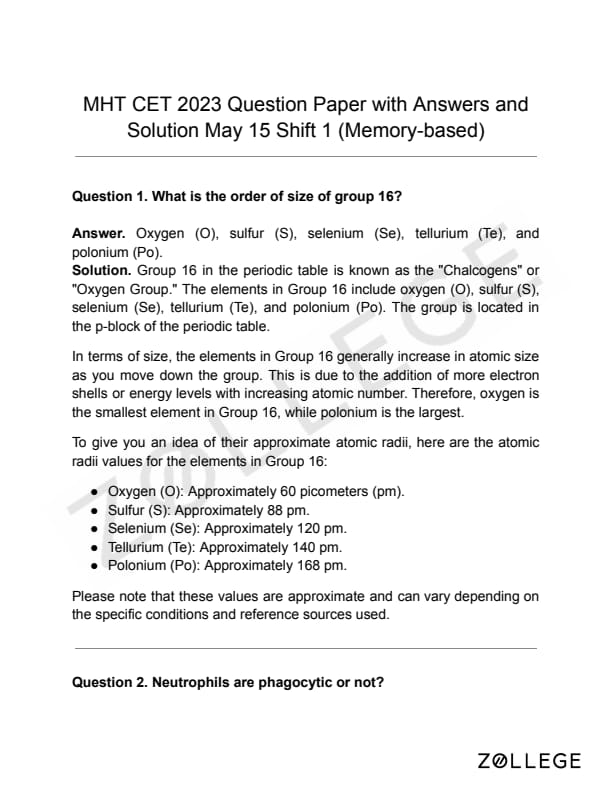
What is the correct order of atomic size for the elements of Group 16?
View Solution
Step 1: Understanding the Question:
The question asks for the correct trend of atomic size (atomic radius) for the elements in Group 16 of the periodic table, which is also known as the oxygen family or chalcogens.
Step 2: Key Concept (Periodic Trends):
The atomic radius is a measure of the size of an atom. In the periodic table, there are two main trends for atomic radius:
1. Across a Period (Left to Right): Atomic size generally decreases due to an increase in nuclear charge, which pulls the electron shells closer to the nucleus.
2. Down a Group (Top to Bottom): Atomic size generally increases. This is because with each element down a group, a new principal energy level (electron shell) is added. This new shell is farther from the nucleus, and the shielding effect of the inner electrons reduces the effective nuclear charge felt by the outermost electrons, causing the atom to be larger.
Step 3: Detailed Explanation:
Group 16 consists of the elements Oxygen (O), Sulfur (S), Selenium (Se), Tellurium (Te), and Polonium (Po).
Following the periodic trend for groups, as we move down from Oxygen to Tellurium:
- Oxygen (Period 2) has 2 electron shells.
- Sulfur (Period 3) has 3 electron shells.
- Selenium (Period 4) has 4 electron shells.
- Tellurium (Period 5) has 5 electron shells.
With the addition of a new electron shell for each successive element, the atomic radius increases.
Therefore, the order of increasing atomic size is: Oxygen \(<\) Sulfur \(<\) Selenium \(<\) Tellurium.
Step 4: Final Answer:
The atomic size increases down Group 16. The correct order is O \(<\) S \(<\) Se \(<\) Te. Thus, option (B) is the correct answer.
Quick Tip: A simple mnemonic to remember periodic trends: "Size increases as you go DOWN and to the LEFT" on the periodic table. For elements in the same group, you only need to consider the downward trend.
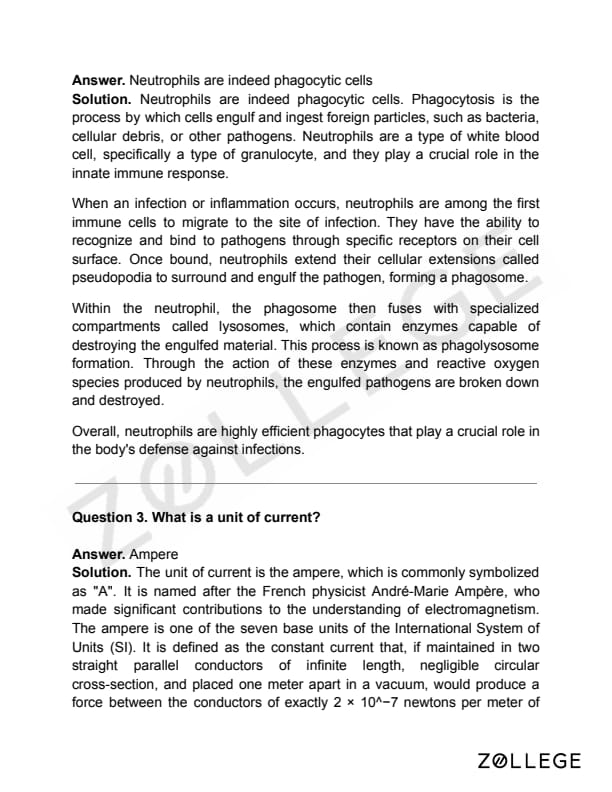
Are neutrophils phagocytic?
View Solution
Step 1: Understanding the Question:
The question asks to determine whether neutrophils, a specific type of white blood cell, have the ability to perform phagocytosis.
Step 2: Detailed Explanation:
Neutrophils are the most abundant type of leukocyte (white blood cell) in the human body and are a fundamental component of the innate immune system.
Their primary function is to act as the first line of defense against infection, particularly bacterial and fungal infections.
Phagocytosis is the process by which a cell engulfs and digests foreign particles, cellular debris, or pathogens.
Neutrophils are professional phagocytes. When they detect a site of infection, they migrate to it, recognize the pathogens, and engulf them.
The engulfed pathogen is enclosed within a vesicle called a phagosome. This phagosome then fuses with lysosomes (granules inside the neutrophil) to form a phagolysosome.
The lysosomes release potent enzymes and reactive oxygen species that destroy the pathogen.
Step 3: Final Answer:
Based on their biological role, neutrophils are correctly identified as highly phagocytic cells. Therefore, option (A) is the correct answer.
Quick Tip: Think of neutrophils as the "first responders" or "infantry" of the immune system. Their main job is to quickly arrive at the scene of an infection and "eat" the invaders. This process of eating is phagocytosis.
What is the SI unit of electric current?
View Solution
Step 1: Understanding the Question:
The question asks for the standard international (SI) base unit used to measure electric current.
Step 2: Detailed Explanation:
Electric current is defined as the rate of flow of electric charge through a conductor.
The International System of Units (SI) has established seven base units for fundamental physical quantities.
- The SI unit for electric current is the Ampere, symbolized by A.
- It is named after the French physicist André-Marie Ampère.
- In practical terms, one ampere is equivalent to the flow of one coulomb of charge per second (1 A = 1 C/s).
Let's analyze the other options:
- Volt (V) is the unit of electric potential difference or voltage.
- Ohm (\(\Omega\)) is the unit of electrical resistance.
- Coulomb (C) is the unit of electric charge.
Step 3: Final Answer:
The correct SI unit for electric current is the Ampere (A). Therefore, option (C) is the correct answer.
Quick Tip: To remember the relationship between fundamental electrical units, use Ohm's Law: Voltage (V) = Current (I) \(\times\) Resistance (R). The units are Volts = Amperes \(\times\) Ohms. This helps keep track of what each unit measures.
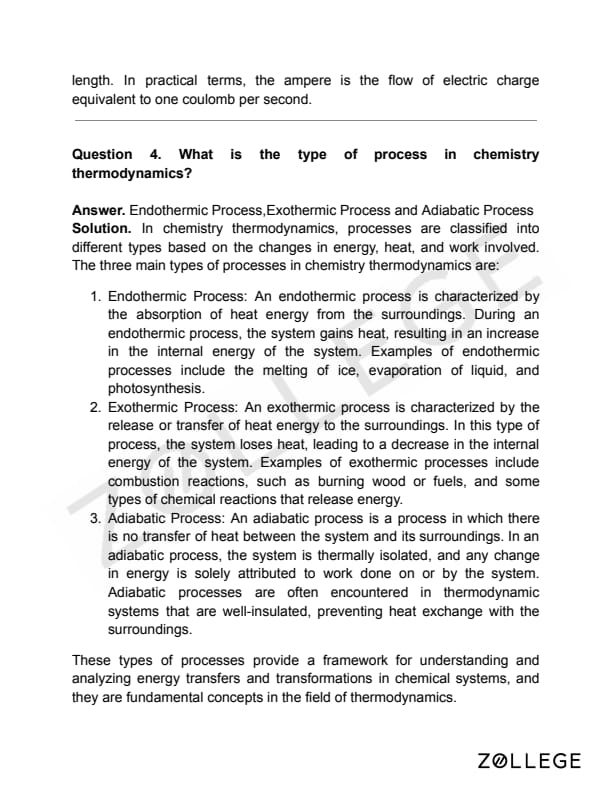
A chemical process that is characterized by the absorption of heat from the surroundings is known as?
View Solution
Step 1: Understanding the Question:
The question asks for the name of a thermodynamic process where the system absorbs heat from its surroundings.
Step 2: Detailed Explanation:
In thermodynamics, processes are classified based on heat exchange between a system and its surroundings.
- Endothermic Process: A process in which the system absorbs heat from the surroundings. This results in an increase in the enthalpy of the system (\(\Delta H > 0\)). Examples include melting ice, evaporating water, and photosynthesis. The surroundings get colder.
- Exothermic Process: A process in which the system releases heat into the surroundings. This results in a decrease in the enthalpy of the system (\(\Delta H < 0\)). Examples include combustion (burning) reactions and the freezing of water. The surroundings get hotter.
- Adiabatic Process: A process where there is no transfer of heat between the system and its surroundings (\(q = 0\)). The system is perfectly insulated.
- Isothermal Process: A process that occurs at a constant temperature (\(\Delta T = 0\)).
Step 3: Final Answer:
The process defined by the absorption of heat from the surroundings is an endothermic process. Therefore, option (D) is the correct answer.
Quick Tip: Remember the prefixes:
- \textbf{Endo-} means "into" or "within" (heat goes \textbf{into} the system).
- \textbf{Exo-} means "out of" or "external" (heat \textbf{exits} the system).
This makes it easy to distinguish between endothermic and exothermic reactions.
*The article might have information for the previous academic years, please refer the official website of the exam.