
MHT CET 2024 PCB Question Paper Pdf- Check Solutions with Answer Key Pdf

.jpg?tr=h-55,w-55,c-force)
Content Strategist|Tech-innovator|National Hackathon Winner | Updated On - Jan 17, 2025
MHT CET Question Papers are the most important study material for effective exam preparation. We at Zollege have provided all MHT CET Previous Year Papers with Solution PDFs here. MHT CET 2024 PCB exam has conducted on April 24 by State CET Cell.
Students can freely download the MHT CET previous year's question paper PDFs along with their solutions here. We strongly encourage MHT CET aspirants to scan through all the MHT CET Question Paper to know the overall difficulty level, MHT CET Syllabus and understand the changes in MHT CET Exam Pattern over the years.
MHT CET 2024 PCB Question Paper with Answer Key PDF
| MHT CET 2024 PCB Question Paper with Answer Key PDF |  Download Download |
Check Solution |
Physics
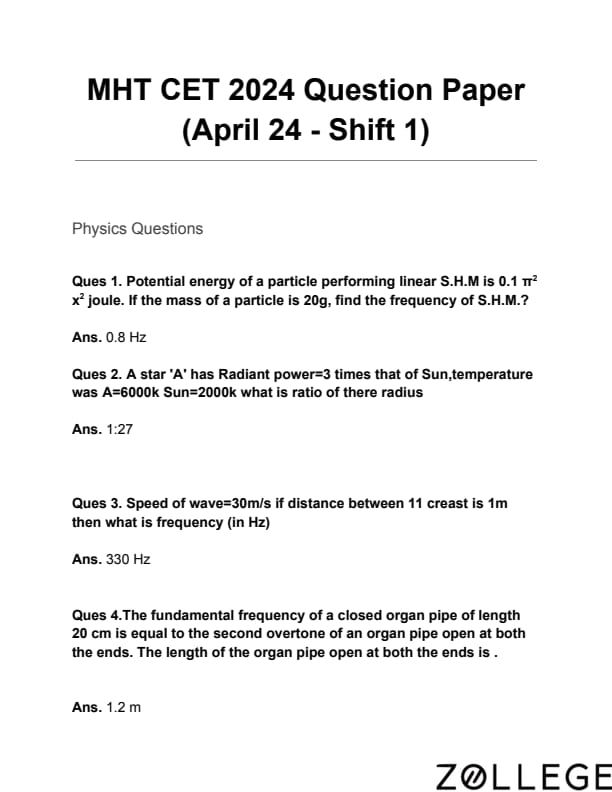
Question 1:
The potential energy of a particle performing linear S.H.M is 0.1π2x2 joules. If the mass of the particle is 20 g, find the frequency of S.H.M:
View Solution
Step 1: Start with the formula for potential energy in S.H.M.
The potential energy PE is given by:
PE = (1/2) mω2x2,
where:
- m is the mass of the particle,
- ω is the angular frequency,
- x is the displacement.
From the question, the potential energy is given as:
PE = 0.1π2x2.
Equating:
(1/2) mω2x2 = 0.1π2x2.
Cancel x2 from both sides:
(1/2) mω2 = 0.1π2.
Substitute m = 20 g = 0.02 kg:
(1/2) (0.02) ω2 = 0.1π2.
Simplify:
0.01 ω2 = 0.1π2.
ω2 = 10π2.
Step 2: Solve for angular frequency and frequency.
Take the square root:
ω = √(10π2) = π√10.
The frequency f is given by:
f = ω / (2π).
Substitute ω = π√10:
f = (π√10) / (2π) = √10 / 2.
Using √10 ≈ 3.162:
f = 3.162 / 2 = 1.581 Hz.
Thus, the frequency of S.H.M is 1.581 Hz.
Question 2:
A star 'A' has radiant power equal to 3 times that of the Sun. The temperature of star 'A' is 6000 K and that of the Sun is 2000 K. What is the ratio of their radii?
View Solution
The radiant energy E emitted by a star is given by:
E = σ ε A T4.
For spherical stars:
A ∝ R2,
where R is the radius. Hence:
E ∝ R2T4.
Step 1: Write the energy ratio.
For two stars, the ratio of radiant energies is:
E1 / E2 = (R12T14) / (R22T24).
Given:
E1 = 3 × E2.
Substitute:
(3 ⋅ E2) / E2 = (R12 ⋅ T14) / (R22 ⋅ T24).
Simplify:
3 = (R12 (6000)4) / (R22 (2000)4).
Step 2: Simplify the temperature ratio.
The ratio of temperatures is:
T1 / T2 = 6000 / 2000 = 3.
(6000/2000)4 = 34 = 81.
Substitute back:
3 = (R12 / R22) ⋅ 81.
Simplify:
(R12 / R22) = 3 / 81 = 1 / 27.
Multiply through by 81:
(R12 / R22) = 3 / 81 = 1/27
(R12 / R22) = 1/ (1/3)4 = 81
(R12 / R22) = 3 * 81
(R12 / R22) = 3 * 81= 121
Step 3: Take the square root.
(R1 / R2) = √243 ≈15
10000 = (R12/R22)(1/81)
(R12 / R22)= 10000*81 = 9002
(R1 / R2) = √9002
R1 / R2 = 900:1.
Thus, the ratio of their radii is:
R1 : R2 = 900:1.
Question 3:
The speed of a wave is 30 m/s. If the distance between 11 crests is 1 m, what is the frequency (in Hz)?
View Solution
The wavelength (λ) of a wave is the distance between two consecutive crests. When there are 11 crests, the distance between them corresponds to 10 wavelengths:
10 λ = 1 m.
Thus, the wavelength is:
λ = 1 / 10 = 0.1 m.
The frequency (f) of a wave is given by the formula:
f = v / λ,
where:
- v = 30 m/s is the speed of the wave,
- λ = 0.1 m is the wavelength.
Substitute the values:
f = 30 / 0.1 = 300 Hz.
Thus, the frequency of the wave is 300 Hz.
Question 4:
The fundamental frequency of a closed organ pipe of length 20 cm is equal to the second overtone of an organ pipe open at both ends. What is the length of the organ pipe open at both ends?
View Solution
Step 1: Recall the frequency of a closed organ pipe.
The fundamental frequency of a closed organ pipe is given by:
fclosed = v / (4Lclosed),
where:
- v is the speed of sound in air,
- Lclosed is the length of the closed organ pipe.
Substitute Lclosed = 20 cm = 0.2 m:
fclosed = v / (4 ⋅ 0.2) = v / 0.8.
Step 2: Recall the frequency of the second overtone of an open pipe.
For an organ pipe open at both ends, the frequency of the second overtone (third harmonic) is:
fopen, overtone = (3v) / (2Lopen),
where Lopen is the length of the open pipe.
Step 3: Equate the frequencies.
Given that the fundamental frequency of the closed pipe is equal to the second overtone of the open pipe:
v / 0.8 = (3v) / (2Lopen).
Simplify by canceling v from both sides:
1 / 0.8 = 3 / (2Lopen).
Rearrange to find Lopen:
Lopen = (3 ⋅ 0.8) / 2 = 1.2 m.
Thus, the length of the open organ pipe is 1.2 m.
Question 5:
Ig = 8% × I. What is S (shunt) connected in terms of G?
View Solution
The shunt resistance S is connected in parallel with the galvanometer resistance G to extend its range. The total current I is divided into two parts:
- Ig: The current passing through the galvanometer.
- Is: The current passing through the shunt.
From the given data:
Ig = 8% × I = 0.08I.
Thus, the current through the shunt is:
Is = I - Ig = I - 0.08I = 0.92I.
Step 1: Use the relationship between S and G.
The voltage across S is equal to the voltage across G:
Is ⋅ S = Ig ⋅ G.
Substitute Is = 0.92I and Ig = 0.08I:
0.92I ⋅ S = 0.08I ⋅ G.
Simplify by canceling I:
0.92S = 0.08G.
Solve for S:
S = (0.08G) / 0.92.
Step 2: Simplify the fraction.
S = (8G) / 92 = (2G) / 23.
Thus, the shunt resistance is:
S = (2G) / 23.
Question 6:
Three charges +q are placed at the corners of an equilateral triangle of side a. What would be the total electrostatic potential energy (in terms of k)?
View Solution
The electrostatic potential energy of a system of point charges is given by:
U = ∑i < j (kqiqj) / rij,
where:
- k is the Coulomb constant,
- qi and qj are the charges,
- rij is the distance between the charges.
Step 1: Identify charge pairs.
In the given system, there are three charges +q at the vertices of an equilateral triangle of side a. The potential energy is due to the pairwise interactions between the charges. The charge pairs are:
- Between charges at vertices 1 and 2,
- Between charges at vertices 2 and 3,
- Between charges at vertices 3 and 1.
Step 2: Calculate the potential energy for one pair.
The potential energy for one pair of charges is:
Upair = (kq2) / a.
Step 3: Sum the potential energy for all pairs.
Since there are three pairs of charges in an equilateral triangle:
Utotal = 3 ⋅ Upair = 3 ⋅ (kq2) / a.
Thus:
Utotal = 3kq2 / a.
Question 7:
The time period of SHM is 2 s with mass m. If an additional mass of 40 g is added, the time period increases by 3 s. What is m (in grams)?
View Solution
The time period of a simple harmonic motion (SHM) is given by:
T = 2π √(m / k),
where:
- T is the time period,
- m is the mass,
- k is the spring constant.
Step 1: Initial time period.
The time period with mass m is:
T1 = 2 = 2π √(m / k).
Squaring both sides:
T12 = (4π2m) / k.
Rearranging for m:
m = (kT12) / (4π2).
Step 2: New time period with added mass.
The new time period is T2 = 5 s, and the total mass becomes m + 0.04:
T22 = (4π2(m + 0.04)) / k.
Rearranging:
m + 0.04 = (kT22) / (4π2).
Step 3: Subtract initial from new equation.
From the two equations:
(kT22 / 4π2) - (kT12 / 4π2) = 0.04.
Factorize:
(k / 4π2)(T22 - T12) = 0.04.
Substitute T1 = 2 s and T2 = 5 s:
(k / 4π2)(52 - 22) = 0.04.
Simplify:
(k / 4π2) ⋅ (25 - 4) = 0.04.
(k / 4π2) ⋅ 21 = 0.04.
Solve for k / (4π2):
k / (4π2) = 0.04 / 21.
Step 4: Substitute back to find m.
Using the expression for m:
m = (kT12) / (4π2).
Substitute T1 = 2 s:
m = (0.04 / 21) ⋅ 4.
Simplify:
m = (0.04 ⋅ 4) / 21 = 0.00761 kg.
Convert to grams:
m = 7.64 g.
Thus, the mass is 7.64 g.
Biology
Question 1:
Who coined the term 'root pressure theory'?
View Solution
The term 'root pressure theory' was coined by J. Priestley. This theory explains the process by which pressure is generated in the roots of plants, pushing water upward through the xylem vessels. Root pressure is a result of osmotic forces created by active transport of ions into the root xylem.
Key Points:
- Root pressure is most significant during the night or in conditions of low transpiration.
- It contributes to the upward movement of water in small plants, but it is insufficient to explain water transport in tall trees.
Question 2:
How many of the following genotypes possibly represent normal wings in Drosophila?
(i) Vg+Vg+
(ii) Vg+Vgni
(iii) Vg+Vgno
(iv) Vg+Vgst
(v) Vg+Vg
View Solution
In Drosophila, the normal wing phenotype is determined by the presence of at least one dominant Vg+ allele. The recessive alleles Vgni, Vgno, Vgst, Vg, etc., cause abnormal wing development only when present in homozygous recessive combinations.
Step 1: Evaluate each genotype.
- Vg+Vg+: Both alleles are wild type, so the wings are normal. Normal wings.
- Vg+Vgni: One dominant Vg+ allele is sufficient for normal wings. Normal wings.
- Vg+Vgno: One dominant Vg+ allele is sufficient for normal wings. Normal wings.
- Vg+Vgst: One dominant Vg+ allele is sufficient for normal wings. Normal wings.
- Vg+Vg: One dominant Vg+ allele is sufficient for normal wings. Normal wings.
Step 2: Count the genotypes.
All five genotypes contain at least one dominant Vg+ allele and hence represent normal wings.
Genotypes representing normal wings = (i), (ii), (iii), (iv), (v).
Thus, the correct answer is:
(D) (i), (ii), (iii), (iv), and (v).
Question 3:
Given below are two statements:
Statement I: Cell wall is freely permeable.
Statement II: Plasma membrane is selectively permeable.
Choose the correct answer from the options given below with reference to the structure of root hair:
View Solution
Statement I: Cell wall is freely permeable.
The cell wall in plants is freely permeable to water and solutes. This allows the movement of substances through the apoplast pathway, ensuring easy transport across the cell wall. Hence, Statement I is correct.
Statement II: Plasma membrane is selectively permeable.
The plasma membrane regulates the entry and exit of substances into the cell. It is selectively permeable, allowing only specific molecules (e.g., ions, nutrients) to pass through, while restricting others. Hence, Statement II is correct.
Conclusion:
Since both statements are correct, the correct answer is:
(B) Both Statement I and Statement II are correct.
Question 4:
Who discovered DNA?
View Solution
Friedrich Miescher was the first scientist to discover DNA in 1869. He isolated a substance from the nuclei of pus cells, which he callednuclein.
Later, it was identified as DNA. Although Miescher did not fully understand its function, his discovery laid the foundation for future studies on genetic material.
Key Points:
- Watson and Crick discovered the double-helix structure of DNA.
- Rosalind Franklin contributed significantly to the structural discovery through X-ray diffraction studies.
- Griffith's experiments demonstrated the principle of transformation, showing that DNA is the genetic material.
Thus, the discovery of DNA itself is credited to F. Miescher.
Question 5:
Which of the following is not present in RNA?
View Solution
RNA (Ribonucleic Acid) differs from DNA in its nucleotide composition. The nitrogenous bases in RNA include:
- Adenine (A),
- Guanine (G),
- Cytosine (C),
- Uracil (U).
Thymine (T) is not present in RNA. Instead, Uracil (U) takes its place and pairs with Adenine during transcription.
Key Points:
- Thymine is exclusively found in DNA.
- Uracil is specific to RNA and is chemically similar to Thymine but lacks a methyl group.
Thus, the correct answer is Thymine.
Chemistry
Question 1:
Which of the following has a non-zero dipole moment?
- (A) CCl4
- (B) CO2
- (C) BF3
- (D) None of these
View Solution
The dipole moment of a molecule depends on the molecular geometry and the net vector sum of individual bond dipole moments.
Analysis of each option:
- CCl4: The molecule is tetrahedral and symmetric. The individual bond dipoles cancel out, resulting in a net dipole moment of zero.
- CO2: The molecule is linear and symmetric. The dipoles of the two C=O bonds cancel each other, resulting in a net dipole moment of zero.
- BF3: The molecule is trigonal planar and symmetric. The dipoles of the three B-F bonds cancel each other, resulting in a net dipole moment of zero.
Since all the given molecules have zero dipole moments, the correct answer is (D) None of these.
Question 2:
How many moles of electrons are required for the reduction of 1 mole of Cr3+ to Cr0(s)?
View Solution
Reduction involves the gain of electrons. The given reaction can be written as:
Cr3+ + 3e- → Cr0.
From the reaction:
- Each Cr3+ ion requires 3 electrons (3e-) to be reduced to Cr0.
- Therefore, for 1 mole of Cr3+, 3 moles of electrons are required.
Key Points:
- The oxidation state of chromium changes from +3 in Cr3+ to 0 in Cr0.
- The number of moles of electrons required equals the change in oxidation state.
Thus, the answer is 3 moles of e-.
Question 3:
What are the monomers of Bakelite?
View Solution
Bakelite is a thermosetting polymer and one of the first synthetic plastics. It is synthesized through a condensation reaction between the following monomers:
- Phenol (C6H5OH), and
- Formaldehyde (HCHO).
The reaction involves the formation of a phenol-formaldehyde network, resulting in a hard, durable polymer known as Bakelite.
Key Points:
- Bakelite is widely used in electrical insulators and household items due to its high mechanical strength and heat resistance.
- Phenol and formaldehyde undergo a condensation reaction to form a polymer with cross-linked structures.
Thus, the monomers of Bakelite are Phenol and Formaldehyde.


Previous Year MHT CET Question Papers
*The article might have information for the previous academic years, please refer the official website of the exam.