
MHT CET 2024 PCB Question Paper Pdf- Check Solutions with Answer Key Pdf

.jpg?tr=h-55,w-55,c-force)
Content Strategist|Tech-innovator|National Hackathon Winner | Updated On - Jan 18, 2025
MHT CET Question Papers are the most important study material for effective exam preparation. We at Zollege have provided all MHT CET Previous Year Papers with Solution PDFs here. MHT CET 2024 PCB exam will be conducted on April 24 by State CET Cell.
Students can freely download the MHT CET previous year's question paper PDFs along with their solutions here. We strongly encourage MHT CET aspirants to scan through all the MHT CET Question Paper to know the overall difficulty level, MHT CET Syllabus and understand the changes in MHT CET Exam Pattern over the years.
MHT CET 2024 PCB Question Paper Pdf- Check Solutions with Answer Key Pdf
| MHT CET 2024 PCB Question Paper with Answer Key PDF |  Download Download |
Check Solution |
Biology
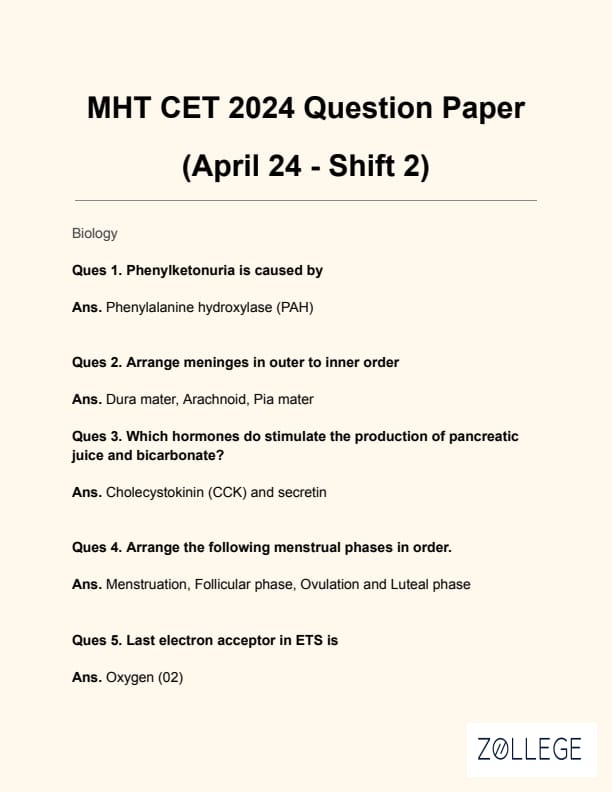
Question 1:
Phenylketonuria is caused by:
View Solution
Phenylketonuria (PKU) is a genetic disorder caused by a deficiency of the enzyme phenylalanine hydroxylase (PAH). This enzyme is responsible for converting the amino acid phenylalanine into tyrosine. Without functional PAH:
- Phenylalanine accumulates in the body, leading to toxic levels.
- This causes severe intellectual disabilities, delayed development, and other neurological problems if untreated.
PKU is typically managed through a diet low in phenylalanine.
Question 2:
Arrange the meninges in order from outer to inner:
View Solution
The meninges are the protective layers that surround the brain and spinal cord. They are arranged in the following order from outermost to innermost:
- Dura mater: The thick, tough outermost layer that provides strong protection.
- Arachnoid mater: The middle layer with a web-like structure.
- Pia mater: The thin, delicate innermost layer that closely adheres to the surface of the brain and spinal cord.
This arrangement ensures proper protection and cushioning for the central nervous system.
Question 3:
Which hormones stimulate the production of pancreatic juice and bicarbonate?
View Solution
Two key hormones stimulate the production of pancreatic juice and bicarbonate:
- Cholecystokinin (CCK): This hormone is released by the small intestine in response to the presence of fats and proteins. It stimulates the pancreas to secrete enzyme-rich pancreatic juice that aids in digestion.
- Secretin: This hormone is released in response to acidic chyme entering the small intestine. It stimulates the pancreas to produce bicarbonate-rich pancreatic juice to neutralize the acid.
Together, these hormones ensure the proper breakdown of food in the digestive system.
Question 4:
Arrange the following menstrual phases in order:
View Solution
The menstrual cycle is divided into four distinct phases in the following order:
- Menstruation: The shedding of the uterine lining (endometrium).
- Follicular phase: The development of ovarian follicles stimulated by follicle-stimulating hormone (FSH).
- Ovulation: The release of a mature egg from the ovary, triggered by a surge in luteinizing hormone (LH).
- Luteal phase: The corpus luteum forms and secretes progesterone to prepare the uterus for possible implantation.
Thus, the correct order is Menstruation, Follicular phase, Ovulation, Luteal phase.
Question 5:
The last electron acceptor in ETS (Electron Transport System) is:
View Solution
In the Electron Transport System (ETS), oxygen (O2) serves as the final electron acceptor. The process is as follows:
- Electrons are transferred through a series of complexes in the inner mitochondrial membrane.
- At the end of the chain, electrons combine with O2 and protons (H+) to form water (H2O).
- This reaction maintains the proton gradient essential for ATP synthesis.
Thus, oxygen is crucial for the efficient production of ATP in aerobic respiration.
Question 6:
Which of the following reverses the apical dominance?
View Solution
Apical dominance is the phenomenon where the apical bud inhibits the growth of lateral buds. It is primarily regulated by the hormone auxin, which is produced at the shoot tip. Cytokinin, however, acts in opposition to auxin and promotes the growth of lateral buds, thereby reversing apical dominance.
- Auxin maintains the dominance of the apical bud by suppressing the lateral bud growth.
- Cytokinin encourages cell division in the lateral buds, effectively overcoming the inhibitory effect of auxin.
Thus, the hormone that reverses apical dominance is cytokinin.
Question 7:
From where does the female gametophyte not develop?
View Solution
The female gametophyte (also known as the embryo sac in angiosperms) develops from the following:
- Megaspore mother cell: Undergoes meiosis to produce megaspores, one of which develops into the female gametophyte.
- Nucellus: Provides nutrition to the developing female gametophyte.
- Megaspore: Directly develops into the female gametophyte through mitosis.
However, the microspore mother cell is responsible for producing microspores, which develop into the male gametophyte (pollen grains). It is not involved in the development of the female gametophyte.
Thus, the female gametophyte does not develop from the microspore mother cell.
Question 8:
Inorganic phosphate is involved in which step of respiration?
View Solution
Inorganic phosphate (\( \mathrm{P_i} \)) plays a crucial role in the process of glycolysis, particularly during the following steps:
- Step: Conversion of glyceraldehyde-3-phosphate (G3P) to 1,3-bisphosphoglycerate: In this reaction, an inorganic phosphate (\( \mathrm{P_i} \)) is added to G3P, catalyzed by the enzyme glyceraldehyde-3-phosphate dehydrogenase.
- This step is essential for producing high-energy intermediates, which eventually lead to ATP generation.
Although inorganic phosphate is involved in other stages like the Krebs cycle and ETS indirectly, its direct involvement in adding to metabolic intermediates is specific to glycolysis.
Physics
Question 1:
A vessel completely filled with water has holes A and B at depths h and 3h from the top, respectively. Hole A is a square of side L, and B is a circle of radius r. The water flowing out per second from both the holes is the same. Then L is equal to:
View Solution
Step 1: Apply Torricelli’s theorem for efflux velocity.
The velocity of efflux for a hole at depth h is given by:
v = √(2 × g × h)
where g is the acceleration due to gravity.
For hole A at depth h:
vA = √(2 × g × h)
For hole B at depth 3h:
vB = √(2 × g × 3h) = √(6 × g × h)
Step 2: Relating the flow rates.
The rate of flow (Q) is given by:
Q = Area × Velocity
For hole A (square of side L):
QA = L2 × vA = L2 × √(2 × g × h)
For hole B (circle of radius r):
QB = π × r2 × vB = π × r2 × √(6 × g × h)
Given that the flow rates are equal (QA = QB):
L2 × √(2 × g × h) = π × r2 × √(6 × g × h)
Step 3: Simplify the equation.
Cancel √(g × h) from both sides:
L2 × √2 = π × r2 × √6
Divide both sides by √2:
L2 = π × r2 × √(6 / 2) = π × r2 × √3
Take the square root of both sides:
L = √(π × r2 × √3) = r × √(π) × 31/4
Thus, L = 31/4 × √(π) × r.
Question 2:
A cylinder of fixed capacity 67.2 L contains helium gas at STP. The amount of heat needed to raise the temperature of the gas in the cylinder by 20°C is:
View Solution
Step 1: Recall the formula for heat capacity at constant volume.
The heat required to raise the temperature of a gas is given by:
Q = n × Cv × ΔT
where:
- n is the number of moles of gas,
- Cv is the molar heat capacity at constant volume for helium,
- ΔT is the temperature change.
Step 2: Calculate the number of moles.
At STP (Standard Temperature and Pressure), the molar volume of an ideal gas is 22.4 L. The number of moles is:
n = Volume of gas / Molar volume = 67.2 / 22.4 = 3.0 mol
Step 3: Substitute the known values.
For helium, Cv = (3/2) × R, where R = 8.314 J/mol·K:
Cv = (3/2) × 8.314 = 12.471 J/mol·K
The temperature change is ΔT = 20 K.
Substitute these into the formula:
Q = n × Cv × ΔT = 3.0 × 12.471 × 20
Step 4: Calculate the result.
Q = 3.0 × 249.42 = 747.9 J
Thus, the heat required is 747.9 J.
Chemistry
Question 1:
Arrange the affinity of hemoglobin (Hb) towards CO, CO2, and O2 in increasing order.
View Solution
The affinity of hemoglobin (Hb) for different gases is determined by their chemical interactions with the heme group. Here is the order of affinity:
- Carbon monoxide (CO): Hemoglobin has the highest affinity for CO, which is about 200-300 times greater than its affinity for O2. This strong binding significantly reduces oxygen transport when CO is present.
- Carbon dioxide (CO2): Hemoglobin binds CO2 to form carbaminohemoglobin, but the affinity is much lower compared to CO.
- Oxygen (O2): Hemoglobin has a lower affinity for O2 compared to CO2 and CO.
Thus, the order of affinity is:
CO > CO2 > O2.
Question 2:
Boron has two isotopes with atomic masses 10 and 11. If its average atomic mass is 10.81, the abundance of the lighter isotope is:
View Solution
Let the percentage abundance of the lighter isotope (10B) be x%. Then the percentage abundance of the heavier isotope (11B) will be (100 - x)%.
The average atomic mass of boron is given by:
Average atomic mass = [(x × 10) + ((100 - x) × 11)] / 100
Substitute the given average atomic mass (10.81):
10.81 = [(x × 10) + ((100 - x) × 11)] / 100
Simplify:
10.81 = (10x + 1100 - 11x) / 100
Combine like terms:
10.81 = (1100 - x) / 100
Multiply through by 100:
1081 = 1100 - x
Solve for x:
x = 1100 - 1081 = 19
Thus, the abundance of the lighter isotope is 19%.


*The article might have information for the previous academic years, please refer the official website of the exam.