
MHT CET 2024 PCB Question Paper Pdf- Check Solutions with Answer Key Pdf

.jpg?tr=h-55,w-55,c-force)
Content Strategist|Tech-innovator|National Hackathon Winner | Updated On - Jan 24, 2025
MHT CET Question Papers are the most important study material for effective exam preparation. We at Zollege have provided all MHT CET Previous Year Papers with Solution PDFs here. MHT CET 2024 PCB exam will be conducted on April 24 by State CET Cell.
Students can freely download the MHT CET previous year's question paper PDFs along with their solutions here. We strongly encourage MHT CET aspirants to scan through all the MHT CET Question Paper to know the overall difficulty level, MHT CET Syllabus and understand the changes in MHT CET Exam Pattern over the years.
MHT CET 2024 PCB Question Paper Pdf- Check Solutions with Answer Key Pdf
| MHT CET 2024 PCB Question Paper with Answer Key PDF |  Download Download |
Check Solution |
Biology
Question 1:
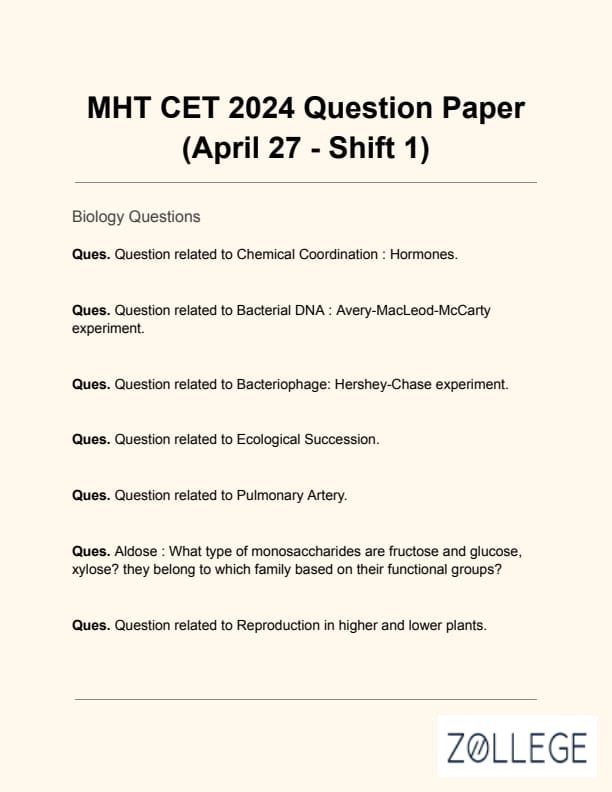
Which hormone is responsible for regulating the basal metabolic rate (BMR) in the human body?
View Solution
The basal metabolic rate (BMR) is the rate at which the body uses energy to maintain vital physiological functions, such as breathing, circulation, and temperature regulation, while at rest. Thyroxine (T4), a hormone secreted by the thyroid gland, plays a critical role in regulating BMR.
Step 1: Function of thyroxine.
Thyroxine (T4) and triiodothyronine (T3) are thyroid hormones that influence:
- Metabolic activity by increasing oxygen consumption,
- Energy production by promoting glucose and fat metabolism,
- Protein synthesis for tissue growth and repair.
Step 2: BMR regulation by thyroxine.
Thyroxine directly impacts the basal metabolic rate by:
- Enhancing the rate of cellular respiration,
- Stimulating mitochondrial activity for energy production.
Step 3: Comparison with other hormones.
- Insulin regulates blood sugar levels but does not control BMR.
- Adrenaline prepares the body for stress responses, not BMR.
- Cortisol manages metabolism during long-term stress but does not influence BMR directly.
Thus, the hormone primarily responsible for regulating BMR is Thyroxine (T4).
Question 2:
Which of the following conclusions was drawn from the Avery-MacLeod-McCarty experiment related to bacterial DNA?
View Solution
The Avery-MacLeod-McCarty experiment, conducted in 1944, was pivotal in identifying DNA as the genetic material. Their work extended upon Griffith's transformation experiments.
Step 1: Key findings of Griffith's experiment.
Griffith demonstrated the phenomenon of transformation in bacteria, where non-virulent R-strain bacteria became virulent S-strain bacteria when mixed with heat-killed S-strain bacteria. However, the identity of the transforming principle was unknown.
Step 2: Avery-MacLeod-McCarty experiment.
The experiment aimed to identify the transforming principle by isolating macromolecules (DNA, RNA, and proteins) from heat-killed S-strain bacteria:
- They treated the samples with protease (to destroy proteins), RNase (to destroy RNA), and DNase (to destroy DNA).
- Transformation occurred when proteins and RNA were destroyed but was inhibited when DNA was destroyed.
Step 3: Conclusion.
The experiment concluded that DNA is the genetic material responsible for heredity and transformation in bacteria. This finding was a crucial step in molecular biology.
Thus, the correct answer is DNA is the genetic material in bacteria.
Question 3:
What conclusion was derived from the Hershey-Chase experiment involving bacteriophages?
View Solution
The Hershey-Chase experiment, conducted in 1952, confirmed that DNA is the genetic material, not protein. It used bacteriophages (viruses that infect bacteria) to demonstrate the role of DNA in heredity.
Step 1: Experimental design.
Hershey and Chase used two sets of bacteriophages labeled with radioactive isotopes:
- 32P to label DNA (since phosphorus is present in DNA but not in protein),
- 35S to label proteins (since sulfur is present in proteins but not in DNA).
The labeled bacteriophages were allowed to infect E. coli bacteria.
Step 2: Separation of viral components.
After infection:
- The bacterial cells were agitated in a blender to separate the phage protein coats from the bacterial cells.
- The mixture was centrifuged to separate the heavier bacterial cells from the lighter protein coats.
Step 3: Observations and conclusion.
- 32P (DNA) was found inside the bacterial cells, indicating that DNA entered the bacteria.
- 35S (protein) remained in the supernatant, indicating that proteins did not enter the bacteria.
The experiment demonstrated that DNA, not protein, is the hereditary material passed on during phage reproduction.
Thus, the correct answer is DNA is the genetic material in bacteriophages.
Question 4:
What is the correct sequence of ecological succession in a terrestrial ecosystem?
View Solution
Ecological succession refers to the sequential process of change in the structure and composition of a community over time. It occurs in a predictable pattern from simpler to more complex ecosystems.
Step 1: Pioneer species.
Pioneer species are the first organisms to colonize a barren or disturbed environment. They are typically hardy and capable of surviving harsh conditions. Examples include:
- Lichens and mosses on bare rocks,
- Algae in aquatic ecosystems.
Step 2: Intermediate species.
As the pioneer species alter the environment (e.g., by breaking down rocks into soil), intermediate species such as grasses, shrubs, and small plants establish themselves. These species further modify the environment, making it suitable for more complex organisms.
Step 3: Climax community.
The final stage of succession is the climax community, characterized by a stable and mature ecosystem. In a terrestrial ecosystem, this often includes large trees, diverse plants, and animals.
The correct sequence of ecological succession is:
Pioneer species → Intermediate species → Climax community.
Thus, the correct answer is (1).
Question 5:
Which of the following is true about the pulmonary artery in the human circulatory system?
View Solution
The pulmonary artery is a vital component of the human circulatory system and plays a unique role compared to other arteries in the body.
Step 1: General function of arteries.
Typically, arteries carry oxygenated blood away from the heart to various parts of the body. However, the pulmonary artery is an exception.
Step 2: Specific function of the pulmonary artery.
The pulmonary artery originates from the right ventricle of the heart and carries deoxygenated blood to the lungs for oxygenation. After receiving oxygen in the lungs, blood is transported back to the heart via the pulmonary veins.
Step 3: Comparison with other blood vessels.
- Most arteries carry oxygenated blood, but the pulmonary artery carries deoxygenated blood.
- Conversely, the pulmonary veins carry oxygenated blood, unlike other veins that carry deoxygenated blood.
Thus, the correct statement is It carries deoxygenated blood to the lungs.
Question 6:
What type of monosaccharides are fructose, glucose, and xylose? To which family do they belong based on their functional groups?
View Solution
Monosaccharides are classified as aldoses or ketoses based on the functional group present:
- Aldoses: Contain an aldehyde group (-CHO).
- Ketoses: Contain a ketone group (-C=O).
Step 1: Functional group identification.
- Fructose contains a ketone group at the second carbon, making it a ketose.
- Glucose and xylose contain an aldehyde group at the first carbon, classifying them as aldoses.
Step 2: Family classification.
- Fructose: Ketohexose (6 carbons, ketone group).
- Glucose: Aldohexose (6 carbons, aldehyde group).
- Xylose: Aldopentose (5 carbons, aldehyde group).
Step 3: Conclusion.
Fructose is a member of the ketose family, while glucose and xylose belong to the aldose family. Thus:
Fructose is a ketose, glucose and xylose are aldoses.
The correct answer is (1).
Question 7:
Which of the following statements correctly differentiates reproduction in higher plants from lower plants?
View Solution
Reproduction in plants varies based on their evolutionary complexity. Higher and lower plants employ different reproductive strategies.
Step 1: Reproduction in lower plants.
Lower plants, such as algae, mosses, and ferns, primarily reproduce through spores. Spores are:
- Single-celled reproductive units,
- Produced in large quantities for dispersal,
- Adapted for asexual reproduction in moist environments.
Step 2: Reproduction in higher plants.
Higher plants, such as gymnosperms and angiosperms, reproduce through seeds. Seeds are:
- Multicellular structures containing an embryo,
- Produced following sexual reproduction,
- Adapted for survival in diverse environments.
Step 3: Comparison.
- Lower plants: Spore-based reproduction (asexual).
- Higher plants: Seed-based reproduction (sexual).
Thus, the correct statement is Lower plants reproduce through spores, while higher plants reproduce through seeds.
Physics
Question 1:
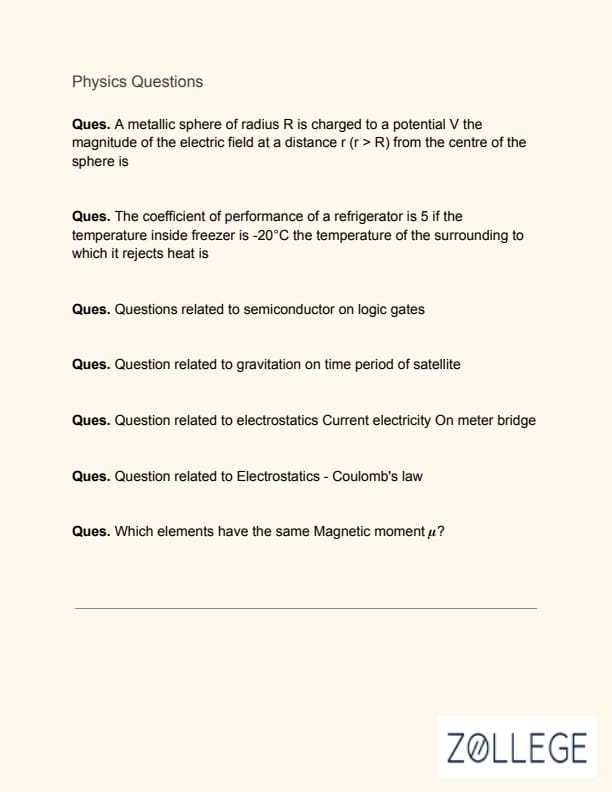
A metallic sphere of radius R is charged to a potential V. The magnitude of the electric field at a distance r (r > R) from the center of the sphere is:
View Solution
For a metallic sphere of radius R charged to a potential V, the electric field at a point outside the sphere (r > R) behaves as if all the charge is concentrated at the center. The potential V on the surface of the sphere is given by:
V = (1 / (4πε0)) ⋅ (Q / R),
where:
- Q is the total charge on the sphere,
- R is the radius of the sphere,
- ε0 is the permittivity of free space.
Rearranging for Q:
Q = 4πε0 ⋅ VR.
The electric field E at a distance r (r > R) is given by Coulomb’s law:
E = (1 / (4πε0)) ⋅ (Q / r2).
Substitute Q = 4πε0 ⋅ VR:
E = (1 / (4πε0)) ⋅ ((4πε0 ⋅ VR) / r2).
Simplify:
E = VR2 / r2.
Thus, the magnitude of the electric field at a distance r (r > R) is:
E = VR2 / r2.
Question 2:
The coefficient of performance of a refrigerator is 5. If the temperature inside the freezer is -20°C, what is the temperature of the surroundings to which it rejects heat?
View Solution
The coefficient of performance (COP) of a refrigerator is defined as:
COP = TC / (TH - TC),
where:
- TC = temperature of the freezer (cold reservoir) in Kelvin,
- TH = temperature of the surroundings (hot reservoir) in Kelvin.
Step 1: Convert temperatures to Kelvin.
The given temperature inside the freezer is:
TC = -20°C = -20 + 273 = 253 K.
The COP is provided as 5:
COP = 5.
Step 2: Rearrange the formula to solve for TH.
Using the formula:
COP = TC / (TH - TC).
Rearranging for TH:
TH - TC = TC / COP.
Substitute TC = 253 K and COP = 5:
TH - 253 = 253 / 5.
Simplify:
TH - 253 = 50.6.
Add 253 to both sides:
TH = 253 + 50.6 = 303.6 K.
Step 3: Convert TH back to Celsius.
TH = 303.6 - 273 = 30.6°C.
Rounding to the nearest whole number:
TH = 31°C.
Thus, the temperature of the surroundings is 31°C.
Question 3:
What is the output of a NAND gate when both inputs are HIGH?
View Solution
A NAND gate (NOT AND gate) is a fundamental logic gate that gives an output opposite to the AND gate. The truth table for a NAND gate is as follows:
| Input A | Input B | Output Y (NAND) |
|---|---|---|
| 0 | 0 | 1 |
| 0 | 1 | 1 |
| 1 | 0 | 1 |
| 1 | 1 | 0 |
Step 1: Analyze the given inputs.
Both inputs A and B are HIGH (1):
Y = NOT (A ⋅ B).
Step 2: Apply the AND operation.
A ⋅ B = 1 ⋅ 1 = 1.
Step 3: Apply the NOT operation.
Y = NOT(1) = 0.
Conclusion:
The output of the NAND gate is LOW (0) when both inputs are HIGH.
Question 4:
What is the expression for the time period of a satellite orbiting Earth at a height h above the Earth's surface?
View Solution
The time period of a satellite is derived using Kepler's Third Law and the concept of centripetal force balancing gravitational force.
Step 1: Gravitational force provides the centripetal force.
For a satellite of mass m orbiting Earth:
Fgravity = (GMm) / (R + h)2,
where:
- G is the gravitational constant,
- M is the mass of Earth,
- R is the radius of Earth,
- h is the height of the satellite above Earth's surface.
This force provides the centripetal force required for circular motion:
Fcentripetal = mv2 / (R + h).
Equating the two forces:
(GMm) / (R + h)2 = mv2 / (R + h).
Cancel m and simplify:
v2 = GM / (R + h).
Step 2: Relate orbital velocity to time period.
The orbital velocity v is given by:
v = (2π(R + h)) / T.
Substitute v2 = GM / (R + h):
((2π(R + h)) / T)2 = GM / (R + h).
Simplify:
(4π2(R + h)2) / T2 = GM / (R + h).
Rearrange for T2:
T2 = (4π2(R + h)3) / GM.
Take the square root:
T = 2π √ ((R + h)3/GM).
Conclusion:
The time period of the satellite is:
T = 2π √ ((R + h)3/GM).
Question 5:
In a meter bridge experiment, a resistance of 10 Ω is balanced by a resistance X with a balance point at 40 cm. What is the value of X?
View Solution
The meter bridge is based on the principle of a balanced Wheatstone bridge, where:
R1 / R2 = l1 / l2,
where:
- R1 = 10 Ω is the known resistance,
- R2 = X Ω is the unknown resistance,
- l1 = 40 cm is the length of the wire on one side,
- l2 = 100 - l1 = 60 cm is the length of the wire on the other side.
Step 1: Use the balanced condition.
Substitute the values into the balanced condition:
R1 / X = l1 / l2.
Rearrange for X:
X = R1 ⋅ (l2 / l1).
Step 2: Substitute the values.
X = 10 ⋅ (60 / 40).
Simplify:
X = 10 ⋅ 1.5 = 15.00 Ω.
Conclusion:
The value of the unknown resistance X is 15.00 Ω.
Question 6:
Two charges q1 = 2 μC and q2 = -3 μC are placed 10 cm apart in a vacuum. What is the magnitude and direction of the force between them?
View Solution
Coulomb's law states that the force between two point charges is given by:
F = (1 / (4πε0)) ⋅ (|q1q2| / r2),
where:
- q1 and q2 are the charges,
- r is the distance between the charges,
- 1 / (4πε0) = 9 × 10⁹ N m2 C-2.
Step 1: Substitute the given values.
q1 = 2 × 10⁻⁶ C, q2 = -3 × 10⁻⁶ C, r = 10 cm = 0.1 m.
Substitute into the formula:
F = 9 × 10⁹ ⋅ (| (2 × 10⁻⁶)(-3 × 10⁻⁶) | / (0.1)2).
Step 2: Simplify the calculations.
F = 9 × 109 ⋅ (6 × 10-12 / 0.01).
F = 9 ⋅ 6 ⋅ 10-3 = 54 × 10-3 = 5.4 N.
Step 3: Determine the direction.
Since q1 and q2 have opposite signs (+ and -), the force is attractive.
Conclusion:
The magnitude of the force is 5.4 N and the direction is Attractive.
Question 7:
Which elements have the same magnetic moment μ?
View Solution
The magnetic moment (μ) of an ion is calculated using the formula:
μ = √ (n(n+2)) μB,
where:
- n is the number of unpaired electrons,
- μB is the Bohr magneton.
Step 1: Determine the electronic configuration and unpaired electrons.
- Mn2+: Atomic number of Mn is 25. The configuration of Mn2+ is [Ar] 3d5, with n = 5 unpaired electrons.
- Fe3+: Atomic number of Fe is 26. The configuration of Fe3+ is [Ar] 3d5, with n = 5 unpaired electrons.
Step 2: Calculate the magnetic moment.
For both Mn2+ and Fe3+:
μ = √ (5(5+2)) = √35 ≈ 5.92 μB.
Step 3: Conclusion.
The elements Mn2+ and Fe3+ have the same magnetic moment of approximately 5.92 μB.
Chemistry
Question 1:
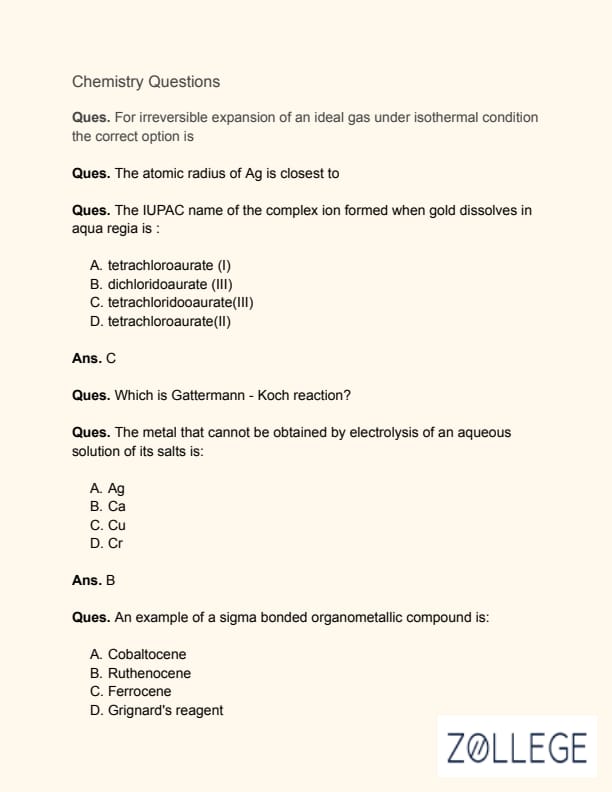
For irreversible expansion of an ideal gas under isothermal conditions, which of the following is correct?
View Solution
In an isothermal process for an ideal gas, the temperature remains constant throughout the process. Therefore, the internal energy (ΔU) of the gas is zero because ΔU is a function of temperature for an ideal gas.
Step 1: First law of thermodynamics.
The first law of thermodynamics is given by:
ΔU = q + w,
where:
- ΔU is the change in internal energy,
- q is the heat exchange,
- w is the work done by the system.
Since ΔU = 0 in an isothermal process, the equation becomes:
0 = q + w.
Rearrange:
q = -w.
Step 2: Direction of heat and work.
- During expansion, work (w) is done by the gas and is positive.
- To maintain constant temperature, the system absorbs an equivalent amount of heat (q) such that q = -w.
Conclusion:
For irreversible isothermal expansion of an ideal gas:
ΔU = 0, q = -w.
Thus, the correct answer is (2).
Question 2:
The atomic radius of silver (Ag) is closest to which of the following values?
View Solution
The atomic radius of an element is a measure of the size of its atoms, typically measured in picometers (pm) or angstroms (Å).
Step 1: Define the atomic radius of silver.
Silver (Ag) is a transition metal with atomic number 47. It has a single 5s1 electron in its outermost shell, and its atomic radius is influenced by:
- Its metallic bonding,
- The shielding effect from inner electrons.
Step 2: Reference values for atomic radius.
From experimental data and periodic trends:
Atomic radius of Ag = 144 pm.
Step 3: Comparison with options.
The value 144 pm closely matches option (1).
Conclusion:
The atomic radius of silver (Ag) is 144 pm.
Question 3:
The IUPAC name of the complex ion formed when gold dissolves in aqua regia is:
View Solution
When gold dissolves in aqua regia (a mixture of concentrated nitric acid and hydrochloric acid), the following reactions occur:
Au + 4 HCl + HNO3 → H[AuCl4] + 2 H2O + NO.
The complex ion formed is [AuCl4]-, which is a coordination compound. The oxidation state of gold in this complex ion is +3.
Step 1: Identify the oxidation state of gold.
The oxidation state of gold (Au) in [AuCl4]- can be calculated as:
Let the oxidation state of Au be x.
x + 4(-1) = -1 ⇒ x - 4 = -1 ⇒ x = +3.
Step 2: Determine the IUPAC name.
The IUPAC name of [AuCl4]- is:
Tetrachloridoaurate (III).
Conclusion:
The correct name of the complex ion formed is Tetrachloridoaurate (III).
Question 4:
Which of the following represents the Gattermann-Koch reaction?
View Solution
The Gattermann-Koch reaction is a chemical method for introducing a formyl group (-CHO) into an aromatic ring. The reaction proceeds as follows:
Aromatic compound + CO + HCl → Aromatic aldehyde.
Step 1: Reaction mechanism.
In the presence of AlCl3 or CuCl, carbon monoxide (CO) reacts with hydrogen chloride (HCl) to produce the electrophilic species COCl+. This electrophile attacks the aromatic ring, forming an aromatic aldehyde.
Step 2: Example reaction.
Benzene reacts with CO and HCl in the presence of AlCl3 to form benzaldehyde:
C6H6 + CO + HCl → C6H5CHO.
Conclusion:
The Gattermann-Koch reaction specifically introduces a formyl group (-CHO) to an aromatic compound, which is accurately described by option (A).
Question 5:
The metal that cannot be obtained by electrolysis of an aqueous solution of its salts is:
View Solution
The feasibility of obtaining a metal by electrolysis of its aqueous salt solution depends on its reduction potential relative to the reduction of water (H2O).
Step 1: Compare reduction potentials.
Calcium (Ca) is an alkali earth metal with a highly negative standard reduction potential:
Ca2+ + 2e- → Ca, E° = -2.87 V.
Water has a less negative reduction potential:
2H2O + 2e- → H2 + 2OH-, E° = -0.83 V.
Since the reduction of water (H2O) is thermodynamically more favorable than the reduction of Ca2+, calcium cannot be obtained by electrolysis of its aqueous salt solution. Instead, hydrogen gas will be liberated at the cathode.
Step 2: Other metals in the options.
- Ag and Cu have positive reduction potentials, making their reduction favorable in aqueous solutions.
- Cr can also be reduced electrochemically but requires specific conditions.
Conclusion:
The metal Ca cannot be obtained by electrolysis of its aqueous salt solution because water is preferentially reduced.
Question 6:
An example of a sigma-bonded organometallic compound is:
View Solution
Organometallic compounds are those that contain a direct bond between a metal atom and a carbon atom of an organic group. These compounds can have either σ-bonds, π-bonds, or both.
Step 1: Analyze the bonding in the options.
- Cobaltocene, Ruthenocene, and Ferrocene are sandwich compounds where the metal atom forms π-bonds with aromatic cyclopentadienyl ligands.
- Grignard's reagent (RMgX) contains a metal-carbon σ-bond. This is an example of a sigma-bonded organometallic compound.
Step 2: Example of Grignard's reagent.
In a Grignard reagent such as CH3MgBr, the magnesium atom forms a direct σ-bond with the carbon atom of the methyl group.
Conclusion:
Grignard's reagent is a classic example of a σ-bonded organometallic compound, making (D) the correct answer.
Question 7:
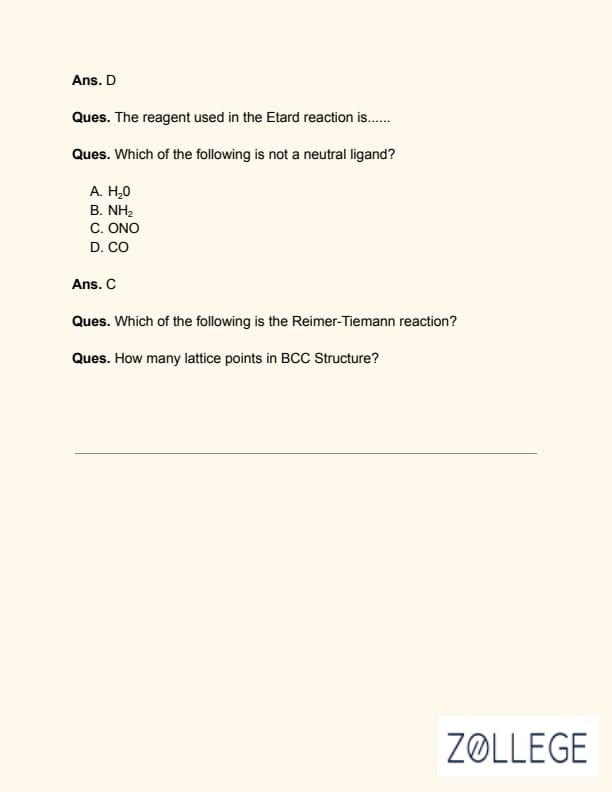
The reagent used in the Etard reaction is:
View Solution
The Etard reaction is used to oxidize aromatic methyl groups (-CH3) to aldehydes (-CHO) using a specific oxidizing agent.
Step 1: Key Reagent in the Etard Reaction.
The reagent used in the Etard reaction is Chromyl chloride (CrO2Cl2). It selectively oxidizes the methyl group of an aromatic compound, such as toluene, to form the corresponding benzaldehyde.
Step 2: Example Reaction.
When toluene reacts with chromyl chloride in carbon tetrachloride (CCl4), the methyl group is oxidized to form benzaldehyde:
C6H5CH3 + CrO2Cl2 → C6H5CHO.
Conclusion:
The correct reagent used in the Etard reaction is Chromyl chloride (CrO2Cl2).
Question 8:
Which of the following is not a neutral ligand?
View Solution
Ligands are classified as neutral or charged based on their overall charge. A neutral ligand has no net charge.
Step 1: Analyze each option.
- H2O: Water is a neutral ligand as it has no net charge.
- NH3: Ammonia is a neutral ligand with no net charge.
- CO: Carbon monoxide is a neutral ligand with no net charge.
- ONO: The nitrito group (ONO-) is negatively charged, making it a non-neutral ligand.
Step 2: Identify the non-neutral ligand.
Among the given options, ONO- is not a neutral ligand because it carries a negative charge.
Conclusion:
The ligand ONO- is not a neutral ligand, making (C) the correct answer.
Question 9:
Which of the following is the Reimer-Tiemann reaction?
View Solution
The Reimer-Tiemann reaction is a chemical reaction used to introduce a formyl group (-CHO) at the ortho position of a phenol. This reaction specifically occurs under basic conditions with chloroform (CHCl3) as the reagent.
Step 1: Reaction mechanism.
- Chloroform reacts with a strong base (such as NaOH or KOH) to produce the electrophilic dichlorocarbene intermediate (:CCl2).
- The dichlorocarbene intermediate attacks the ortho position of the phenol, leading to the formation of an intermediate compound.
- Hydrolysis of the intermediate produces ortho-hydroxybenzaldehyde.
Step 2: Example reaction.
When phenol (C6H5OH) reacts with chloroform and alkali, the following reaction occurs:
C6H5OH + CHCl3 + 3NaOH → o-HO-C6H4CHO + 3NaCl + 2H2O.
Conclusion:
The Reimer-Tiemann reaction is the formylation of phenols using chloroform and alkali to form ortho-hydroxybenzaldehyde, making (A) the correct answer.
Question 10:
How many lattice points are there in a Body-Centered Cubic (BCC) structure?
View Solution
A Body-Centered Cubic (BCC) structure is a type of crystal lattice arrangement where atoms are positioned at specific points within a cubic unit cell.
Step 1: Lattice points in a BCC structure.
- The BCC structure has one atom at each of the eight corners of the cube.
- There is one atom at the center of the cube.
Step 2: Contribution of each lattice point.
- Each corner atom contributes 1/8 to the unit cell because it is shared by 8 adjacent unit cells.
- The center atom contributes entirely (1) to the unit cell since it is not shared.
Step 3: Calculate the total number of lattice points.
Total number of lattice points = 8 ⋅ (1/8) + 1 = 1 + 1 = 2.
Conclusion:
The BCC structure contains 2 lattice points per unit cell.
*The article might have information for the previous academic years, please refer the official website of the exam.