
MHT CET 2024 PCB Question Paper Pdf- Check Solutions with Answer Key Pdf

.jpg?tr=h-55,w-55,c-force)
Content Strategist|Tech-innovator|National Hackathon Winner | Updated On - Jan 18, 2025
MHT CET 2024 PCB Question Paper for April 29 - Shift 1 is available for download. The exam was successfully conducted by the authorities from 9:00 AM to 12:00 PM. As per the student’s initial reactions, MHT CET 2024 PCB Question Paper for April 29 - Shift 1 was reported as Moderate. The Biology section in MHT CET 2024 April 29 - Shift 1 Question Paper was reported as Challenging, Physics as Moderate, and Chemistry as Easy.
MHT CET 2024 PCB April 29 Shift 1 Question Paper with Answer Key PDF
Candidates can download the MHT CET 2024 PCB Question Paper with Solution and Answer Key PDFs for April 29 - Shift 1 using the link below.
| MHT CET 2024 PCB Question Paper with Answer Key PDF |  Download Download |
Check Solution |
Biology
Question 1:
Which part of a plant is grafted onto a stock that is rooted?
- Root
- Scion
- Stem
- Leaf
View Solution
In grafting, the stock provides the root system, while the scion is grafted onto it to form the upper part of the plant responsible for producing flowers and fruits. The grafting process includes:
- Choosing a compatible stock and scion pair.
- Aligning the vascular tissues of both components to enable efficient transport of nutrients and water.
This method is extensively used in horticulture to improve plant productivity and quality.
Question 2:
Which are the pioneer species in aquatic habitats?
- Fungi
- Algae
- Bryophytes
- Lichens
View Solution
Pioneer species are the initial organisms that colonize uninhabited or barren environments. In aquatic ecosystems:
- Algae, particularly cyanobacteria, serve as the primary colonizers. They carry out photosynthesis and thrive in extreme conditions.
- These organisms contribute to the formation of soil by releasing organic matter and oxygen, creating a habitat suitable for other species.
Question 3:
How many heartbeats does a person have in 1 minute on average?
- 50
- 72
- 100
- 120
View Solution
The average heart rate of a healthy adult is approximately 72 beats per minute. It is influenced by:
- Physical activity: Heart rate increases during exercise or stressful situations.
- Age: Children typically have higher heart rates compared to adults.
- Health conditions: Bradycardia refers to an unusually slow heart rate, while tachycardia indicates an abnormally fast heart rate.
Question 4:
What is the role of heme in hemoglobin?
- Transport of oxygen
- Transport of carbon dioxide
- Structural stability
- Enzyme activity
View Solution
Heme is a prosthetic group in hemoglobin, consisting of an iron atom coordinated with a porphyrin ring. Its primary roles are:
- Capturing oxygen molecules in the lungs.
- Delivering oxygen to tissues for cellular respiration.
Question 5:
How much ATP is produced by aerobic respiration?
- 2 ATP
- 32 ATP
- 36 ATP
- 38 ATP
View Solution
Aerobic respiration is the process of fully oxidizing glucose in the presence of oxygen. It involves the following steps:
- Glycolysis: Generates 2 ATP.
- Krebs cycle: Produces 2 ATP.
- Electron transport chain: Yields 32 ATP.
The total ATP production is:
2 + 2 + 32 = 36 ATP.
Question 6:
Statement 1: Avery, McLeod, and McCarty discovered the semi-conservative nature of DNA.
Statement 2: Meselson and Stahl used E. coli to demonstrate the semi-conservative nature of DNA.
- Statement 1 is correct, Statement 2 is incorrect
- Statement 2 is correct, Statement 1 is incorrect
- Both statements are correct
- Both statements are incorrect
View Solution
Avery, McLeod, and McCarty established that DNA is the genetic material but did not provide evidence for its semi-conservative replication. Meselson and Stahl, using E. coli and N15-labeled DNA in their experiment, conclusively demonstrated the semi-conservative nature of DNA replication.
Question 7:
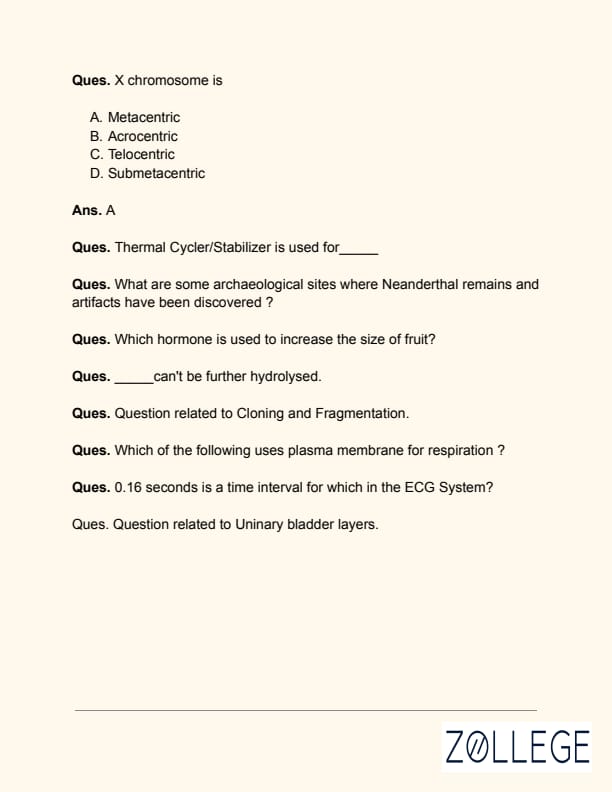
A Thermal Cycler/Stabilizer is used for _______?
- Maintaining temperature
- DNA amplification (PCR)
- Protein synthesis
- RNA transcription
View Solution
A thermal cycler, commonly referred to as a PCR machine, is a crucial tool in molecular biology used for amplifying DNA through the Polymerase Chain Reaction (PCR). The process involves three key steps:
- Denaturation: Heating the DNA to 94-96°C to separate its strands.
- Annealing: Cooling to 50-65°C to enable primers to attach to their complementary sequences.
- Extension: Raising the temperature to 72°C to allow DNA polymerase to synthesize new strands of DNA.
This cycle is repeated multiple times to achieve exponential DNA amplification.
Question 8:
What are some archaeological sites where Neanderthal remains and artifacts have been discovered?
- Lascaux Cave, France
- Altamira Cave, Spain
- Shanidar Cave, Iraq
- All of the above
View Solution
Neanderthal remains and cultural artifacts have been uncovered at various archaeological sites, shedding light on their distribution and lifestyle:
- Lascaux Cave, France: Renowned for its cave paintings, though Neanderthal involvement remains uncertain.
- Altamira Cave, Spain: Famous for prehistoric art, with potential Neanderthal artifacts.
- Shanidar Cave, Iraq: Contains Neanderthal skeletal remains and evidence of burial rituals.
These discoveries provide critical insights into Neanderthal life and their evolutionary significance.
Question 9:
Which hormone is used to increase the size of fruit?
- Auxin
- Gibberellin
- Cytokinin
- Ethylene
View Solution
Gibberellins are plant hormones that stimulate cell elongation and division, resulting in larger fruit size. Their applications include:
- Increasing the size of fruits like grapes and apples.
- Supporting stem elongation and aiding seed germination.
While auxins and cytokinins play roles in plant growth, they are not primarily used for enhancing fruit size.
Question 10:
________ can't be further hydrolyzed.
- Polysaccharides
- Disaccharides
- Monosaccharides
- Oligosaccharides
View Solution
Monosaccharides are the most basic carbohydrates and cannot be further hydrolyzed. Examples include:
- Glucose
- Fructose
- Galactose
In contrast:
- Polysaccharides (e.g., starch) and disaccharides (e.g., sucrose) can be broken down into smaller sugar units.
- Oligosaccharides consist of a small number of monosaccharide units.
Question 11:
Which of the following uses plasma membrane for respiration?
- Prokaryotes
- Eukaryotes
- Viruses
- Fungi
View Solution
Prokaryotes, like bacteria, do not possess membrane-bound organelles such as mitochondria. Instead, they utilize their plasma membrane for:
- Housing enzymes involved in the electron transport chain.
- Producing ATP through oxidative phosphorylation.
In contrast, eukaryotes carry out respiration in mitochondria, while viruses lack any metabolic activities.
Question 12:
0.16 seconds is a time interval for which event in the ECG system?
- P wave
- QRS complex
- PR interval
- T wave
View Solution
The PR interval on an ECG represents the duration required for the electrical impulse to travel from the sinoatrial (SA) node through the atria, the atrioventricular (AV) node, and into the ventricles. This interval typically ranges from 0.12 s to 0.20 s. Key functions include:
- Showing the conduction time through the AV node.
- Highlighting the delay that allows the ventricles to properly fill with blood.
Question 13:
Which hormone is used to increase the size of fruit?
- Auxin
- Gibberellin
- Cytokinin
- Ethylene
View Solution
Gibberellins are plant hormones that stimulate cell elongation and division, leading to larger fruit size. Their applications include:
- Enhancing the size of fruits like grapes and apples.
- Promoting seed germination and stem elongation.
While auxins and cytokinins contribute to plant growth, they are less directly involved in increasing fruit size.
Question 14:
Question related to urinary bladder layers.
View Solution
The urinary bladder consists of the following layers:
- Mucosa: Contains transitional epithelium and lamina propria, allowing the bladder to stretch and accommodate urine.
- Submucosa: Provides additional structural support to the bladder wall.
- Muscularis: Composed of the detrusor muscle, enabling contraction and relaxation during urination.
- Serosa/Adventitia: The outermost layer that protects the bladder from external damage.
Physics
Question 15:
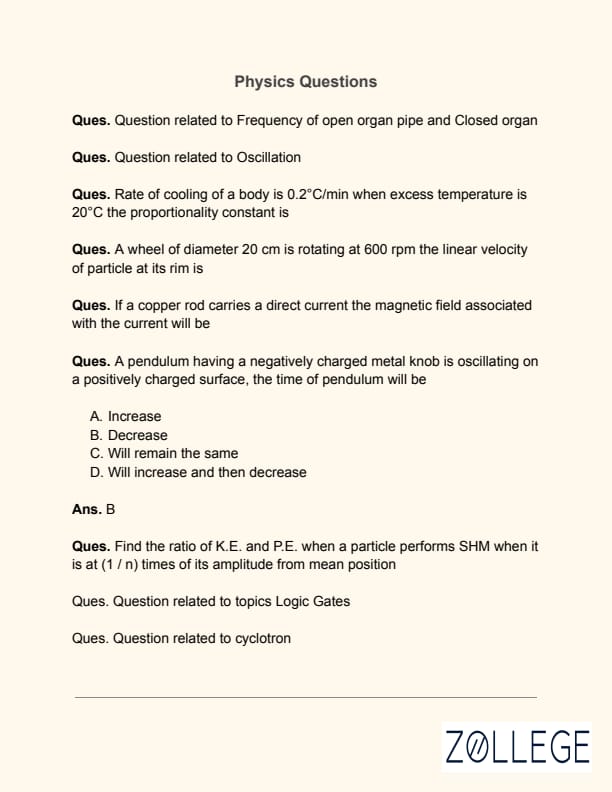
What is the fundamental frequency of an open organ pipe with length L and speed of sound v?
- v/2L
- v/L
- 2v/L
- vL/2
View Solution
The fundamental frequency of an open organ pipe can be calculated using the formula:
f = v / λ,
where v represents the speed of sound and λ is the wavelength. For the fundamental mode of vibration in an open pipe:
λ = 2L (as the pipe supports a full wave).
Substituting λ = 2L into the equation:
f = v / (2L).
Key points:
- In an open pipe, standing waves are formed with antinodes at both open ends.
- The fundamental frequency corresponds to a single node in the center and two antinodes at the ends.
Question 16:
What is the angular frequency ω of a simple harmonic oscillator with mass m and spring constant k?
- √k/m
- √m/k
- k/m
- m/k
View Solution
The angular frequency of a simple harmonic oscillator is given by:
ω = √ (k / m),
where:
- k is the spring constant, indicating the stiffness of the spring.
- m is the mass of the oscillating object.
Derivation:
mẍ + kx = 0.
ω = √ (k / m).
- The restoring force in SHM is expressed as F = -kx, where x is the displacement.
- Applying Newton’s second law F = ma, and substituting a = ẍ, we get:
- This second-order differential equation describes simple harmonic motion, leading to the solution:
Question 17:
Rate of cooling of a body is 0.2°C/min when excess temperature is 20°C. The proportionality constant k is:
- 0.005 min-1
- 0.01 min-1
- 0.05 min-1
- 0.2 min-1
View Solution
According to Newton's Law of Cooling:
Rate of cooling = k (ΔT),
where k is the cooling constant, and ΔT is the temperature difference between the object and its surroundings.
Given:
Rate of cooling = 0.2 °C/min, ΔT = 20°C.
To calculate k:
k = (Rate of cooling) / ΔT = 0.2 / 20 = 0.01 min-1.
Question 18:
A wheel of diameter 20 cm is rotating at 600 rpm. The linear velocity of a particle at its rim is:
- 6.28 m/s
- 12.56 m/s
- 18.84 m/s
- 3.14 m/s
View Solution
The linear velocity v can be calculated using the formula:
v = r ⋅ ω,
where r is the radius and ω is the angular velocity.
Given:
Diameter = 20 cm ⇒ r = Diameter / 2 = 20 / 2 = 10 cm = 0.1 m.
The angular velocity ω is:
ω = 2πf, f = rpm / 60 = 600 / 60 = 10 rps.
Substituting the values:
v = 0.1 ⋅ (2π ⋅ 10) = 0.1 ⋅ 20π ≈ 6.28 m/s.
Question 19:
If a copper rod carries a direct current, the magnetic field associated with the current will be?
- Parallel to the rod
- Perpendicular to the rod
- Circular around the rod
- No magnetic field
View Solution
When a current passes through a straight conductor, such as a copper rod, it generates a magnetic field around it. This phenomenon is governed by Ampere’s Circuital Law, which states:
∮ B ⋅ dl = μ0I,
where:
- B represents the magnetic field,
- μ0 is the permeability of free space,
- I is the current flowing through the conductor.
The magnetic field lines form concentric circles around the conductor, and their direction can be determined using the right-hand rule:
- Align your thumb with the direction of the current.
- The curl of your fingers indicates the direction of the magnetic field.
Question 20:
A pendulum having a negatively charged metal knob is oscillating on a positively charged surface. The time of the pendulum will be:
- Increase
- Decrease
- Will remain the same
- Will increase and then decrease
View Solution
When a charged pendulum swings over a charged surface, the attractive force between the opposite charges enhances the effective restoring force. This causes:
- An increase in the restoring force, leading to a higher angular frequency ω = √(g/L),
- A reduction in the time period T = 2π / ω.
As a result, the pendulum oscillates more rapidly, decreasing its time period.
Question 21:
Find the ratio of K.E. and P.E. when a particle performs SHM and is at 1/n times its amplitude from the mean position.
- n2 - 1:1
- 1:n2 - 1
- 1:n
- n:1
View Solution
The total energy in simple harmonic motion (SHM) is expressed as:
E = K.E. + P.E.,
where K.E. (kinetic energy) and P.E. (potential energy) depend on the displacement x. Let A represent the amplitude and x = A / n. Then:
P.E. = (1/2) kx2, K.E. = E - P.E. = (1/2)kA2 - (1/2)kx2.
Simplify:
K.E. = (1/2)k(A2 - x2).
Substituting x = A / n:
P.E. = (1/2)k(A/n)2 = (1/2)k(A2/n2),
K.E. = (1/2)k(A2 - A2/n2) = (1/2)kA2(1 - 1/n2).
The ratio K.E. / P.E. is:
K.E. / P.E. = (1 - 1/n2) / (1/n2) = n2 - 1 : 1.
Question 22:
Which of the following correctly represents the AND logic gate?
- Output = 1 if at least one input is 1
- Output = 1 only if all inputs are 1
- Output = 0 if all inputs are 0
- Output = 1 if all inputs are 0
View Solution
An AND gate performs a logical operation that corresponds to multiplication. The output Y of an AND gate is defined as:
Y = A ⋅ B,
where A and B are the inputs. The truth table for the AND gate is as follows:
| A | B | Y |
|---|---|---|
| 0 | 0 | 0 |
| 0 | 1 | 0 |
| 1 | 0 | 0 |
| 1 | 1 | 1 |
Question 23:
What is the working principle of a cyclotron?
- Conservation of energy
- Lorentz force
- Electromagnetic induction
- Coulomb’s law
View Solution
A cyclotron accelerates charged particles by utilizing a perpendicular magnetic field and an alternating electric field. The working principle is based on the Lorentz force:
F = q(v × B),
where:
- q is the charge of the particle,
- v is its velocity,
- B is the magnetic field strength.
The magnetic field causes the charged particles to follow a circular path, while the electric field accelerates them each time they pass through the gap between the dees.
Chemistry
Question 24:
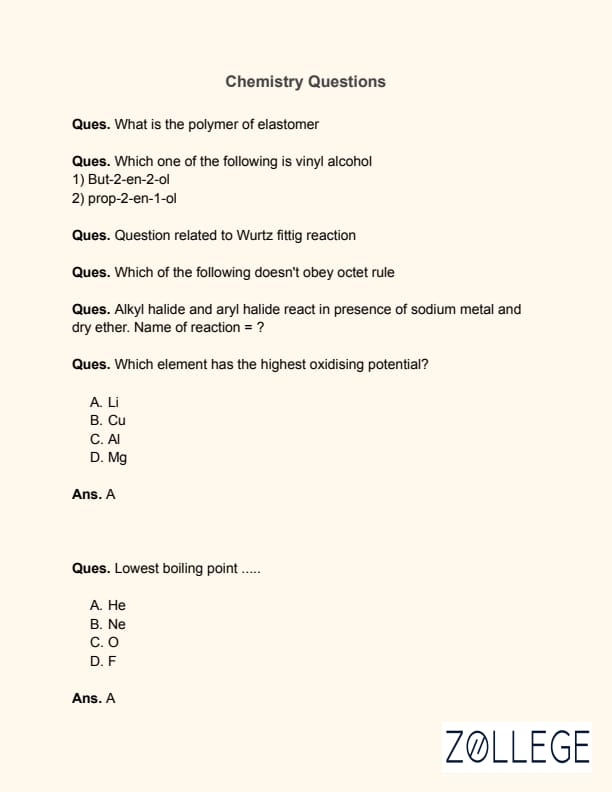
What is the polymer of elastomer?
- Neoprene
- Polyvinyl chloride
- Nylon-6
- Teflon
View Solution
Elastomers are polymers known for their elastic properties. Neoprene, an example of an elastomer, is produced by the polymerization of chloroprene. It possesses:
- Excellent elasticity,
- Resistance to ozone and weathering,
- Applications in wetsuits, industrial belts, and hoses.
Other substances, such as polyvinyl chloride and nylon-6, are not elastomers; they are classified as thermoplastics or synthetic fibers.
Question 25:
Which one of the following is vinyl alcohol?
- But-2-en-2-ol
- Prop-2-en-1-ol
- Ethanol
- Methanol
View Solution
Vinyl alcohol (CH2=CH-OH) is an unstable tautomer of acetaldehyde. Its IUPAC name is Prop-2-en-1-ol:
CH3-CHOH-CH2 → CH2=CH-OH.
Explanation:
- But-2-en-2-ol does not correspond to the structure of vinyl alcohol.
- Prop-2-en-1-ol accurately represents the structure and properties of vinyl alcohol.
Question 26:
Which of the following does not obey the octet rule?
- SF6
- H2O
- CO2
- CH4
View Solution
The octet rule states that atoms gain, lose, or share electrons to achieve a full valence shell of 8 electrons. In SF6, sulfur forms six bonds, expanding its valence shell to hold 12 electrons:
Valence electrons of S = 6 + 6(1) = 12.
Explanation:
- Molecules like H2O, CO2, and CH4 comply with the octet rule.
- SF6 violates the octet rule as sulfur utilizes an expanded valence shell.
Question 27:
Alkyl halide and aryl halide react in the presence of sodium metal and dry ether. The name of the reaction is?
- Wurtz Reaction
- Wurtz-Fittig Reaction
- Fittig Reaction
- Williamson Ether Synthesis
View Solution
In the Wurtz-Fittig reaction, alkyl halides and aryl halides undergo a reaction with sodium metal in dry ether, leading to the formation of alkyl aryl compounds:
C6H5Cl + CH3Cl + 2Na → C6H5CH3 + 2NaCl.
Explanation:
- The Wurtz Reaction is concerned with alkyl halides only.
- The Fittig Reaction is restricted to aryl halides.
- The Williamson Ether Synthesis does not pertain to this reaction.
Question 28:
Which element has the highest oxidizing potential?
- Li
- Cu
- Al
- Mg
View Solution
Lithium (Li) exhibits the highest standard reduction potential, which makes it the most powerful oxidizing agent:
E°Li = -3.04 V.
Explanation:
- Li readily loses its lone valence electron, making it highly reactive.
- Other elements such as Cu, Al, and Mg possess lower oxidizing potentials.
Question 29:
Which of the following has the lowest boiling point?
- He
- Ne
- O
- F
View Solution
Helium (He) has the lowest boiling point of all elements, at -269°C or 4 K. This can be attributed to:
- Its extremely weak intermolecular forces (London dispersion forces).
- Its noble gas configuration, which makes it chemically stable and inert.
Question 30:
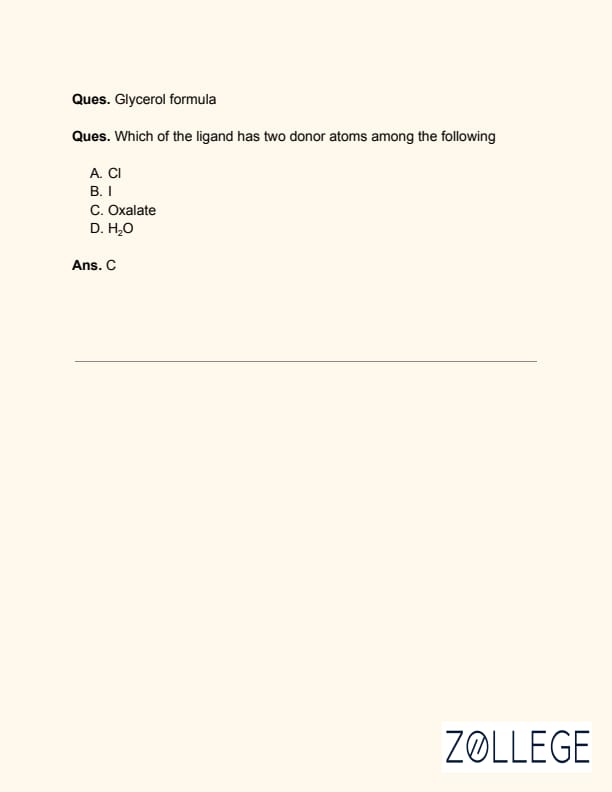
What is the chemical formula of glycerol?
- C3H8O3
- C2H6O2
- C3H6O2
- C4H10O3
View Solution
Glycerol, commonly referred to as glycerine, is a simple polyol compound with the molecular formula:
C3H8O3.
Key properties include:
- A backbone of three carbon atoms,
- Presence of three hydroxyl (-OH) groups, which contribute to its strong hydrophilic nature and water solubility.
Molecular structure:
CH2OH - CHOH - CH2OH.
Applications:
- Serves as a sweetener in various food products,
- Plays a critical role in pharmaceutical formulations.
Question 31:
Which of the following ligands has two donor atoms?
- Cl-
- I-
- Oxalate (C2O42-)
- H2O
View Solution
Oxalate (C2O42-) acts as a bidentate ligand, as it possesses two donor atoms that can simultaneously coordinate with a central metal ion. These donor atoms are the oxygen atoms in the carboxylate groups (-COO). Its structural representation is:
[O-C=O] - [O-C=O].
Explanation:
- Cl- and I- are examples of monodentate ligands, each having a single donor atom.
- H2O is another monodentate ligand with its oxygen atom serving as the donor site.
Applications:
- Oxalate is frequently encountered in complexes such as potassium ferrioxalate (K3[Fe(C2O4)3]).
-


*The article might have information for the previous academic years, please refer the official website of the exam.