
MHT CET 2024 PCB April 30 Shift 1 Question Paper Pdf - Check Solutions with Answer Key Pdf

.jpg?tr=h-55,w-55,c-force)
Content Strategist|Tech-innovator|National Hackathon Winner | Updated On - Jan 18, 2025
MHT CET 2024 PCB Question Paper for April 30 - Shift 1 is available for download. The exam was successfully conducted by the State CET cell from 9:00 AM to 12:00 PM. As per the student’s initial reactions, MHT CET 2024 PCB Question Paper for April 30 - Shift 1 was reported as Moderate. The Physics section in MHT CET 2024 April 30 - Shift 1 Question Paper was reported as Moderate, Chemistry as Very Easy, and Biology as Moderate.
MHT CET 2024 PCB April 30 Shift 1 Question Paper with Answer Key PDF
Candidates can download the MHT CET 2024 PCB Question Paper with Solution and Answer Key PDFs for April 30 - Shift 1 using the link below.
| MHT CET 2024 PCB 30 April Shift 1 Question Paper with Answer Key |  Download Download |
Check Solution |
MHT CET PCB 2024 April 30 Shift 1 Questions with Solutions
Biology
Question 1:
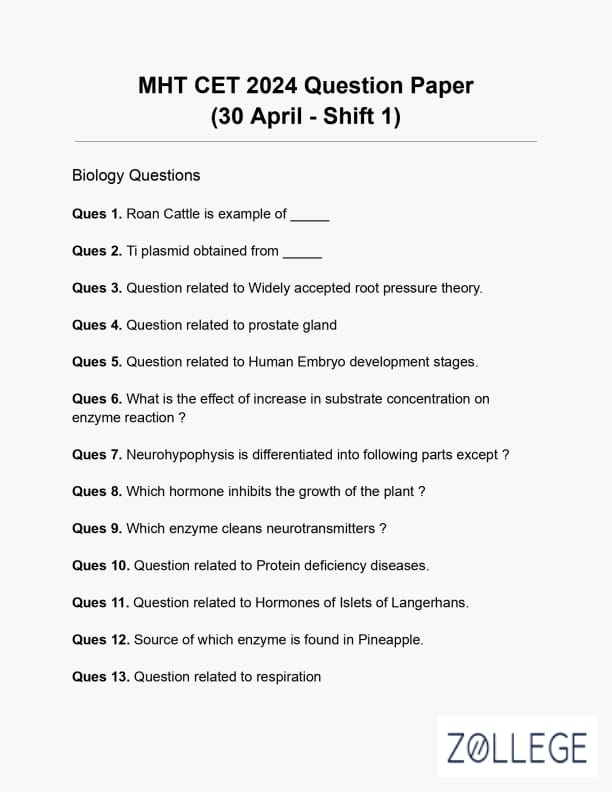
Roan Cattle is an example of -----
View Solution
Solution:
Roan cattle exhibit a coat color where both red and white hairs are present and visibly expressed simultaneously. This pattern is a classic example of codominance, where both alleles in a heterozygous organism are fully expressed without blending.
In codominance, neither allele is recessive or dominant over the other. Instead, both alleles contribute to the phenotype, resulting in a distinct appearance that shows both traits equally. In the case of roan cattle, the presence of both red and white coat colors is due to the expression of both alleles simultaneously.
Question 2:
Ti plasmid is obtained from -----
View Solution
Solution:
The Ti (tumor-inducing) plasmid is a large plasmid found in the bacterium Agrobacterium tumefaciens. This plasmid is responsible for transferring a segment of its DNA into plant cells, causing the formation of crown gall tumors. The Ti plasmid is widely utilized in plant genetic engineering to introduce new genes into plants.
Researchers exploit the Ti plasmid's natural ability to transfer DNA to manipulate plant genomes. By replacing the tumor-inducing genes with desired genes, scientists can create genetically modified plants with beneficial traits, such as pest resistance or increased yield.
Question 3:
Which of the following best describes the widely accepted root pressure theory in plants?
View Solution
Solution:
The root pressure theory explains how plants can transport water from the roots to the shoots without relying solely on transpiration pull. Root pressure is generated when ions are actively transported into the root xylem, lowering the water potential and causing water to enter the xylem from the soil by osmosis. This influx of water creates a positive pressure that pushes water upwards through the xylem vessels.
Mechanism of Root Pressure:
Transport of Ions → Lowered Water Potential → Water Uptake by Osmosis → Positive Pressure
Conclusion: Root pressure is a vital mechanism that assists in the upward movement of water, especially during times when transpiration is low, such as at night.
Question 4:
Which of the following statements about the prostate gland is correct?
View Solution
Solution:
The prostate gland is a vital component of the male reproductive system. It produces a seminal fluid that constitutes a significant portion of semen. This fluid contains enzymes, such as prostate-specific antigen (PSA), which help to liquefy semen after ejaculation, aiding in the nourishment and transport of sperm.
Functions of the Prostate Gland:
- Secretion of prostate fluid: Provides nutrients for sperm.
- Production of PSA: Helps in semen liquefaction.
- Muscle contractions: Facilitate the expulsion of semen during ejaculation.
Conclusion: The prostate gland plays a crucial role in male fertility by producing fluids that support and transport sperm.
Question 5:
Which of the following correctly lists the stages of human embryo development in order?
View Solution
Solution:
Human embryonic development progresses through several well-defined stages:
- Morula: A solid ball of cells resulting from the division of a fertilized egg.
- Blastocyst: The morula develops a fluid-filled cavity, differentiating into the inner cell mass and the trophoblast.
- Gastrulation: Formation of the three germ layers (ectoderm, mesoderm, endoderm) begins.
- Neurulation: Development of the neural tube, which will eventually form the central nervous system.
Sequence of Stages:
Morula → Blastocyst → Gastrulation → Neurulation
Conclusion: The correct order of human embryo development stages is Morula, Blastocyst, Gastrulation, and Neurulation.
Question 6:
What is the effect of an increase in substrate concentration on an enzyme-catalyzed reaction?
View Solution
Solution:
Increasing the substrate concentration in an enzyme-catalyzed reaction generally leads to an increase in the reaction rate. This is because more substrate molecules are available to bind to the active sites of the enzyme, resulting in the formation of more enzyme-substrate complexes.
However, this increase continues only up to a certain point known as the maximum velocity (Vmax). Beyond Vmax, the rate of reaction plateaus as all active sites of the enzyme molecules are occupied, and adding more substrate does not further increase the reaction rate.
Michaelis-Menten Kinetics:
Rate = (Vmax [S]) / (Km + [S])
As [S] increases, the rate approaches Vmax.
Conclusion: An increase in substrate concentration enhances the reaction rate until the enzyme becomes saturated, after which the rate no longer increases.
Question 7:
Neurohypophysis is differentiated into the following parts except:
View Solution
Solution:
The neurohypophysis, or posterior pituitary, consists of the pars nervosa, median eminence, and infundibular stalk. The pars distalis, however, is a part of the adenohypophysis (anterior pituitary) and is not a component of the neurohypophysis. Therefore, the pars distalis is the part that does not belong to the neurohypophysis.
Components of Neurohypophysis:
- Pars nervosa: Stores and releases hormones produced by the hypothalamus.
- Median eminence: Connects the neurohypophysis to the hypothalamus.
- Infundibular stalk: Acts as a conduit for hormone transportation.
Conclusion: Pars distalis is part of the anterior pituitary and not the neurohypophysis.
Question 8:
Which hormone inhibits the growth of plants?
View Solution
Solution:
Abscisic acid is a plant hormone that plays a crucial role in inhibiting growth. It is involved in various plant developmental processes and stress responses, including seed dormancy, stomatal closure, and inhibition of bud growth. Unlike hormones like auxin and gibberellin, which promote growth, abscisic acid acts as a growth inhibitor, especially under stress conditions such as drought.
Functions of Abscisic Acid:
- Induces seed dormancy to prevent germination during unfavorable conditions.
- Promotes stomatal closure to reduce water loss during drought.
- Inhibits shoot and root growth under stress conditions.
Conclusion: Abscisic acid serves as a key hormone in managing plant growth and responses to environmental stresses by acting as a growth inhibitor.
Question 9:
Which enzyme is responsible for cleaning neurotransmitters in the synaptic cleft?
View Solution
Solution:
Acetylcholinesterase is the enzyme responsible for breaking down the neurotransmitter acetylcholine in the synaptic cleft. By hydrolyzing acetylcholine into acetate and choline, acetylcholinesterase terminates the signal transmission between neurons, ensuring that neurotransmitters do not remain in the synaptic cleft longer than necessary. This rapid degradation is essential for the proper functioning of synaptic transmission and prevents continuous stimulation of the post-synaptic neuron.
Role of Acetylcholinesterase:
Acetylcholine → Acetate + Choline
Importance in Neural Function:
- Preventing overstimulation of neurons.
- Ensuring precise control of muscle contractions.
- Maintaining the speed and accuracy of nerve signal transmission.
Conclusion: Acetylcholinesterase plays a critical role in terminating neurotransmitter signals, thereby maintaining the efficiency and regulation of neural communication.
Question 10:
Which of the following diseases is a result of protein deficiency?
View Solution
Solution:
Kwashiorkor is a severe form of protein malnutrition characterized by adequate calorie intake but insufficient protein consumption. It commonly affects children in regions experiencing famine or food scarcity. Symptoms include edema, irritability, an enlarged liver, and skin conditions. Unlike marasmus, which results from overall calorie deficiency, kwashiorkor specifically arises from a lack of protein, leading to impaired growth and development.
Characteristics of Kwashiorkor:
- Edema (swelling) due to low plasma protein levels.
- Fatty liver (hepatomegaly).
- Dermatitis and hair discoloration.
- Irritability and lethargy.
Conclusion: Kwashiorkor is directly caused by protein deficiency, distinguishing it from other malnutrition-related diseases that involve deficiencies in vitamins or overall calories.
Question 11:
Which hormone is NOT produced by the Islets of Langerhans in the pancreas?
View Solution
Solution:
The Islets of Langerhans are clusters of endocrine cells in the pancreas responsible for producing several key hormones that regulate blood glucose levels. The primary hormones produced are:
- Insulin: Lowers blood glucose levels by facilitating cellular uptake of glucose.
- Glucagon: Raises blood glucose levels by stimulating glycogenolysis and gluconeogenesis.
- Somatostatin: Inhibits the release of both insulin and glucagon, regulating their secretion.
Adrenaline, also known as epinephrine, is produced by the adrenal glands, not the Islets of Langerhans. It plays a role in the "fight or flight" response, increasing heart rate and blood glucose levels, among other functions.
Conclusion: Adrenaline is not produced by the Islets of Langerhans; it is synthesized in the adrenal medulla.
Question 12:
The enzyme bromelain, found in pineapples, is primarily used for:
View Solution
Solution:
Bromelain is a mixture of proteolytic enzymes extracted from pineapples, particularly from the stem and fruit. These enzymes facilitate the breakdown of proteins into amino acids and peptides, aiding in protein digestion. Due to its proteolytic activity, bromelain is utilized in various applications, including meat tenderizing, dietary supplements, and as an anti-inflammatory agent in medical treatments.
Functions of Bromelain:
- Breaks down proteins during digestion.
- Acts as a meat tenderizer by degrading tough muscle fibers.
- Exhibits anti-inflammatory properties, reducing swelling and pain.
Conclusion: Bromelain's primary role is in protein digestion, making it a valuable enzyme both in culinary and medical fields.
Question 13:
Which of the following processes is NOT part of cellular respiration?
View Solution
Solution:
Cellular respiration encompasses the metabolic pathways that cells use to convert biochemical energy from nutrients into adenosine triphosphate (ATP), and then release waste products. The main stages include:
- Glycolysis: The breakdown of glucose into pyruvate, producing a small amount of ATP and NADH.
- Krebs Cycle (Citric Acid Cycle): Processes pyruvate into carbon dioxide, generating ATP, NADH, and FADH2.
- Electron Transport Chain: Utilizes electrons from NADH and FADH2 to create a proton gradient that drives ATP synthesis.
The Calvin Cycle, however, is part of photosynthesis in plants, where it fixes carbon dioxide into glucose. It is not involved in cellular respiration.
Conclusion: The Calvin Cycle is not a component of cellular respiration.
Question 14:
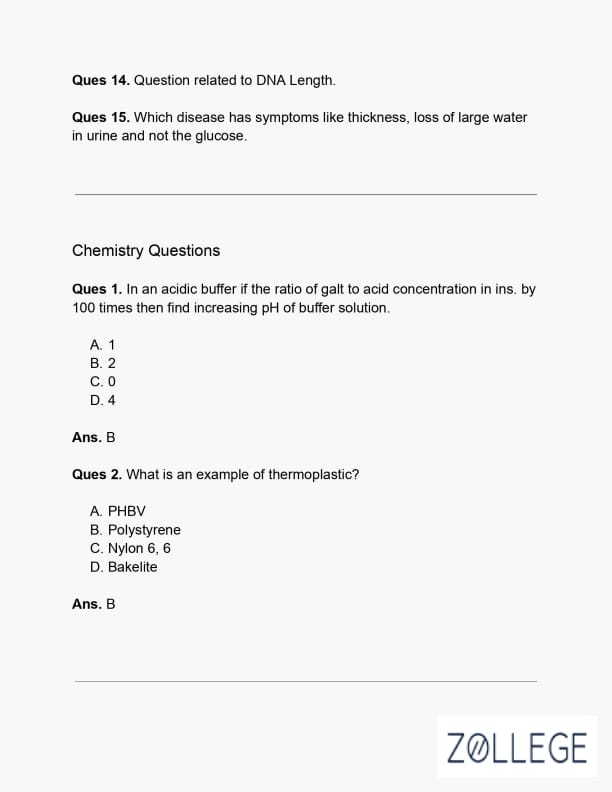
Approximately how long is the DNA molecule in a single human cell if stretched out?
View Solution
Solution:
A single human cell contains approximately 2 meters of DNA when fully stretched out. This extensive length is compacted and organized within the cell nucleus through a complex structure involving histones and higher-order chromatin folding. Despite the long length, DNA is efficiently packaged to fit inside the microscopic nucleus of the cell.
DNA Packaging:
2 m → Wrapped into histones → Forming nucleosomes → Folding chromatin fibers → Chromosomes
Conclusion: The DNA in a single human cell, if stretched out, measures approximately 2 meters in length.
Question 15:
Which disease is characterized by symptoms such as dehydration, excessive loss of water in urine, and absence of glucose in the urine?
View Solution
Solution:
Diabetes Insipidus (DI) is a condition characterized by intense thirst and the excretion of large amounts of severely diluted urine, which contains little to no glucose. Unlike Diabetes Mellitus, which involves high blood glucose levels and the presence of glucose in the urine, DI is related to the body's inability to regulate water balance due to issues with antidiuretic hormone (ADH) or the kidneys' response to ADH. This leads to excessive water loss, dehydration, and electrolyte imbalances.
Types of Diabetes Insipidus:
- Central DI: Caused by insufficient production of ADH from the pituitary gland.
- Nephrogenic DI: Results from the kidneys' insensitivity to ADH.
Conclusion: Diabetes Insipidus is identified by dehydration, excessive water loss in urine, and the absence of glucose in the urine.
Chemistry
Question 1:
In an acidic buffer, if the ratio of base to acid concentration is increased by 100 times, then find the increase in pH of the buffer solution.
View Solution
Solution:
Using the Henderson-Hasselbalch equation:
pH = pKa + log([A⁻]/[HA])
If the ratio ([A⁻]/[HA]) increases by 100 times, then:
ΔpH = log(100) = 2
Therefore, the pH increases by 2 units.
Conclusion: Increasing the base to acid concentration ratio by 100 times results in a pH increase of 2 units in the buffer solution.
Question 2:
What is an example of a thermoplastic?
View Solution
Solution:
Polystyrene is a common example of a thermoplastic polymer. Thermoplastics are materials that become pliable or moldable above a specific temperature and solidify upon cooling. Polystyrene can be melted and reformed multiple times, making it suitable for various applications such as packaging, insulation, and disposable cutlery.
In contrast, Bakelite is a thermosetting polymer, which undergoes a chemical change when cured and cannot be remelted or reshaped after the initial formation.
Conclusion: Polystyrene exemplifies thermoplastics due to its ability to be repeatedly melted and molded without undergoing irreversible chemical changes.
*The article might have information for the previous academic years, please refer the official website of the exam.