
MHT CET 2024 PCB April 30 Shift 2 Question Paper Pdf - Check Solutions with Answer Key Pdf

.jpg?tr=h-55,w-55,c-force)
Content Strategist|Tech-innovator|National Hackathon Winner | Updated On - Jan 18, 2025
MHT CET 2024 PCB Question Paper for April 30 - Shift 2 is available for download. The exam was successfully conducted by the State CET cell from 2:00 PM to 5:00 PM. As per the student’s initial reactions, MHT CET 2024 PCB Question Paper for April 30 - Shift 2 was reported as Moderate. The Physics section in MHT CET 2024 April 30 - Shift 2 Question Paper was reported as Moderate, Chemistry as Very Easy, and Biology as Moderate.
MHT CET 2024 PCB April 30 Shift 2 Question Paper with Answer Key PDF
Candidates can download the MHT CET 2024 PCB Question Paper with Solution and Answer Key PDFs for April 30 - Shift 2 using the link below.
| MHT CET 2024 PCB 30 April Shift 2 Question Paper with Answer Key |  Download Download |
Check Solution |
MHT CET PCB 2024 April 30 Shift 2 Questions with Solutions
Question 1:
Which enzyme converts trypsinogen into trypsin?
View Solution
1. Trypsinogen is an inactive precursor (zymogen) of the enzyme trypsin, which plays a crucial role in the digestion of proteins.
2. Enterokinase, also known as enteropeptidase, is an enzyme secreted by the cells of the duodenum. It specifically cleaves trypsinogen to activate it into trypsin.
Conclusion: Therefore, the enzyme responsible for converting trypsinogen into its active form, trypsin, is enterokinase.
Question 2:
How many DNA copies are produced after five cycles of PCR (Polymerase Chain Reaction)?
View Solution
Step 1: PCR amplification is an exponential process where the number of DNA copies doubles with each cycle.
Step 2: The formula to calculate the number of copies after n cycles is:
Number of copies = 2^n
Calculation:
2^5 = 32
Conclusion: After five cycles of PCR, 2^5 = 32 DNA copies are produced.
Question 3:
Which of the following is a function of the hypothalamus?
View Solution
The hypothalamus is a crucial part of the brain involved in various autonomic and endocrine functions.
Among the listed options:
- Homeostasis: The hypothalamus regulates body temperature, hunger, thirst, and other homeostatic processes.
- Memory Formation: This function is primarily associated with the hippocampus.
- Visual Processing: This is managed by the occipital lobe.
- Motor Coordination: The cerebellum and motor cortex are responsible for this function.
Conclusion: Therefore, the primary function of the hypothalamus among the options provided is homeostasis.
Question 4:
Cerebrospinal fluid (CSF) uses were given below. Identify the incorrect use by eliminating it:
View Solution
Evaluating each option:
- Cushioning the brain and spinal cord: CSF acts as a shock absorber, protecting the central nervous system.
- Removing metabolic waste: CSF helps in the removal of waste products from the brain.
- Transporting nutrients to the brain: CSF delivers essential nutrients to neural tissues.
- Transmitting nerve impulses: Nerve impulses are transmitted by neurons through electrical and chemical signals, not by CSF.
Conclusion: The incorrect use of CSF among the options is transmitting nerve impulses.
Question 5:
What type of relationship exists between sea anemones and clownfish?
View Solution
Analyzing the nature of the relationship between sea anemones and clownfish:
- Predation: This implies one organism preys on the other, which is not the case here.
- Mutualism: Both species benefit from the relationship. Clownfish receive protection from predators by living among the sea anemone's stinging tentacles, while sea anemones benefit from the nutrients provided by the clownfish through their waste.
- Parasitism: This involves one organism benefiting at the expense of the other, which does not describe their interaction.
- Competition: This would involve both species vying for the same resources, which is not applicable here.
Conclusion: The relationship between sea anemones and clownfish is mutualistic, as both species benefit from each other.
Question 6:
What was the historical use of cellophane tubes in hemodialysis?
View Solution
Examine the role of cellophane tubes:
- Providing structural support to dialysis machines: Cellophane tubes are not used for structural purposes.
- Acting as semipermeable membranes: Historically, cellophane was utilized in hemodialysis machines for its semipermeable properties, allowing selective passage of substances like toxins and excess salts from the blood while retaining blood cells and essential proteins.
- Delivering medication to patients: Cellophane tubes are not used for medication delivery.
- Filtering blood cells directly: While cellophane membranes allow for filtration, their primary role was to act as semipermeable barriers rather than directly filtering blood cells.
Conclusion: The historical use of cellophane tubes in hemodialysis was primarily due to their semipermeable properties, enabling effective dialysis by filtering waste products from the blood.
Question 7:
Which of the following statements about the pharynx and larynx is/are correct?
Choose the correct options from the given below:
View Solution
The pharynx is a muscular tube that serves as a pathway for both food (ingested through the mouth) and air (inhaled through the nose). The larynx, commonly known as the voice box, is responsible for sound production and also functions to prevent food and liquid from entering the trachea during swallowing. The vocal cords are located within the larynx, not the pharynx, making statement 3 incorrect.
Question 8:
Arrange the following steps of the action potential mechanism in the correct order:
Choose the correct options from the given below:
View Solution
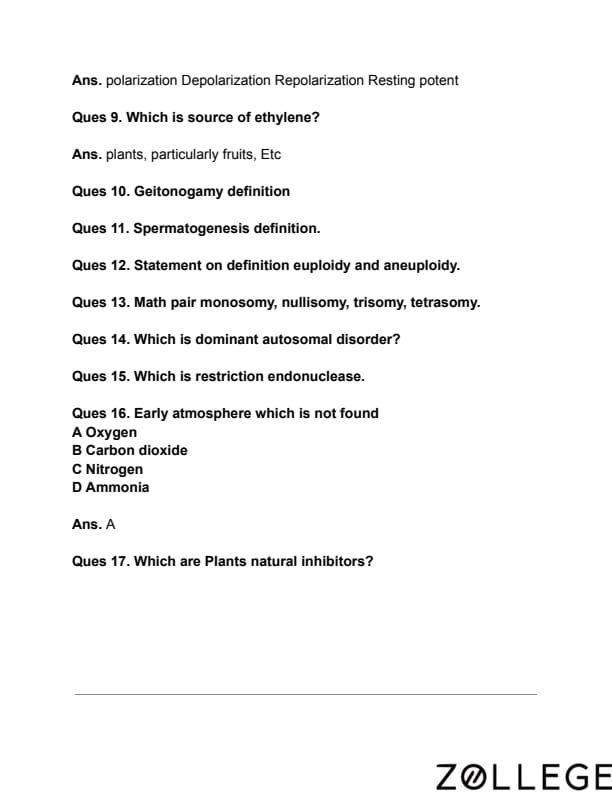
The correct sequence of events during an action potential starts with polarization, where the neuron is at its resting potential. Upon stimulation, depolarization occurs as sodium ions enter the cell, followed by repolarization where potassium ions exit the cell to restore the negative internal environment. Finally, the neuron returns to its resting potential.
Question 9:
Which of the following is a primary source of ethylene?
View Solution
Ethylene is a plant hormone involved in the regulation of various physiological processes, including fruit ripening, flower wilting, and leaf fall. It is primarily produced by plants, especially ripening fruits, making option 2 the correct source.
Question 10:
What is the definition of geitonogamy?
View Solution
Geitonogamy refers to a form of self-pollination where pollen is transferred between different flowers of the same plant. This is distinct from autogamy, where pollen fertilizes ovules within the same flower, and from allogamy, which involves pollination between different plants.
Question 11:
What is the definition of spermatogenesis?
View Solution
Spermatogenesis is the biological process through which spermatozoa are produced from male primordial germ cells in the testes. This process involves mitotic and meiotic divisions, ultimately resulting in the formation of mature sperm cells capable of fertilizing an ovum.
Question 12:
Which of the following statements correctly define euploidy and aneuploidy?
View Solution
Euploidy is the condition of having a complete set of chromosomes, which is essential for normal development and functioning. Aneuploidy, on the other hand, involves the presence of an abnormal number of chromosomes, which can lead to various genetic disorders and developmental issues.
Question 13:
Match the following chromosomal abnormalities with their correct definitions:
| Chromosomal Abnormality | Definition |
|---|---|
| 1. Monosomy | A. Presence of three copies of a particular chromosome. |
| 2. Nullisomy | B. Absence of both homologous chromosomes. |
| 3. Trisomy | C. Presence of four copies of a particular chromosome. |
| 4. Tetrasomy | D. Presence of only one copy of a particular chromosome. |
- Monosomy - D. Presence of only one copy of a particular chromosome.
- Nullisomy - B. Absence of both homologous chromosomes.
- Trisomy - A. Presence of three copies of a particular chromosome.
- Tetrasomy - C. Presence of four copies of a particular chromosome.
View Solution
Monosomy refers to the presence of only one copy of a particular chromosome instead of the usual pair. Nullisomy is the complete absence of both homologous chromosomes. Trisomy denotes having three copies of a specific chromosome, and tetrasomy indicates four copies of a particular chromosome.
Question 14:
Which of the following is a dominant autosomal disorder?
View Solution
Huntington's Disease is a dominant autosomal disorder, meaning only one copy of the mutated gene is sufficient to cause the disease. In contrast, disorders like Cystic Fibrosis and Sickle Cell Anemia are recessive, requiring two copies of the mutated gene. Hemophilia is typically an X-linked recessive disorder.
Question 15:
Which of the following is a restriction endonuclease?
View Solution
EcoRI is a well-known restriction endonuclease that recognizes specific DNA sequences and cleaves the DNA at or near these sites. DNA polymerase and RNA polymerase are involved in DNA and RNA synthesis, respectively, while ligase is an enzyme that joins DNA fragments together.
Question 16:
Which component was not found in the early Earth's atmosphere?
View Solution
The early Earth's atmosphere was primarily composed of gases like carbon dioxide, nitrogen, and ammonia. Oxygen was not a significant component and only became abundant later due to the photosynthetic activity of organisms.
Question 17:
Which of the following are natural inhibitors produced by plants?
View Solution
Plants produce a variety of natural inhibitors as defense mechanisms against herbivores and pathogens. Alkaloids, terpenoids, and glycosides are all classes of compounds that serve as natural inhibitors in plants.

*The article might have information for the previous academic years, please refer the official website of the exam.