
MHT CET 2024 PCM May 3 Shift 1 Question Paper Pdf - Check Solutions with Answer Key Pdf

.jpg?tr=h-55,w-55,c-force)
Content Strategist|Tech-innovator|National Hackathon Winner | Updated On - Jan 18, 2025
MHT CET 2024 PCM Question Paper for May 3 - Shift 1 is available for download. The exam was successfully conducted by the State CET cell from 9:00 AM to 12:00 PM. As per the student’s initial reactions, MHT CET 2024 PCM Question Paper for May 3 - Shift 1 was reported as Moderate. The Mathematics section in MHT CET 2024 May 3 - Shift 1 Question Paper was reported as Challenging, Physics as Moderate, and Chemistry as Easy.
MHT CET 2024 PCM May 3 Shift 1 Question Paper with Answer Key PDF
Candidates can download the MHT CET 2024 PCM Question Paper with Solution and Answer Key PDFs for May 3 - Shift 1 using the link below.
| MHT CET 2024 PCM 3 May Shift 1 Question Paper with Answer Key |  Download Download |
Check Solution |
MHT CET PCM 2024 May 3 Shift 1 Questions with Solutions
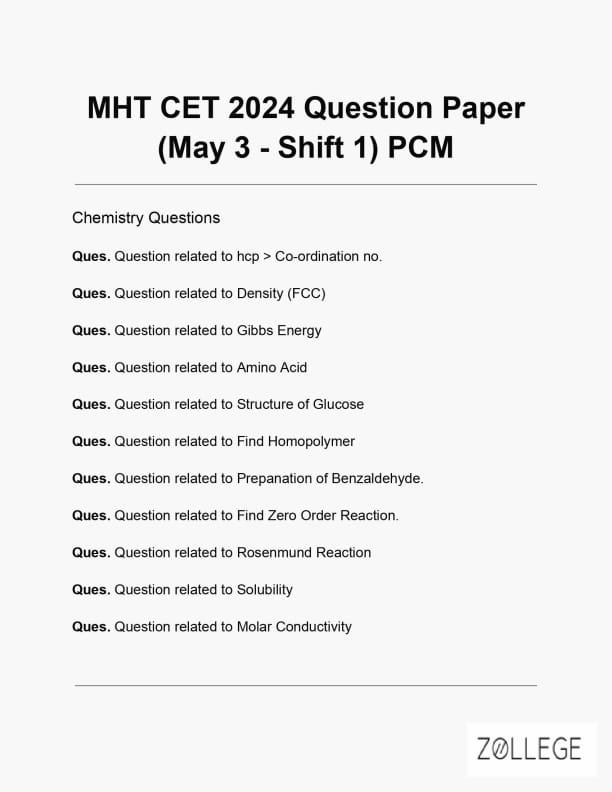
Chemistry
Question 1:
What is the coordination number in a Hexagonal Close-Packed (hcp) structure?
View Solution
In a Hexagonal Close-Packed (hcp) structure, the coordination number is 12. This means that each atom is surrounded by 12 neighboring atoms: 6 within the same plane and 3 each above and below the central atom. This arrangement results in highly efficient packing, maximizing the number of nearest neighbors around each atom and contributing to the stability of the hcp structure.
Question 2:
The density of a face-centered cubic (FCC) crystal is:
View Solution
To determine the density of a face-centered cubic (FCC) crystal structure:
- Atoms per unit cell: FCC structures have 4 atoms per unit cell (1 from corners and 3 from face-centers).
- Mass of unit cell: The mass of the unit cell is 4M, where M is the atomic mass.
- Volume of unit cell: The volume is given by a³, where a is the edge length of the cube.
- Density formula: Density = Mass / Volume = 4M / a³.
Thus, the density of an FCC crystal is 4M / a³.
Question 3:
Which of the following correctly represents the change in Gibbs free energy ΔG for a spontaneous process?
View Solution
For spontaneity, Gibbs free energy ΔG is determined using:
ΔG = ΔH - TΔS
Where:
- ΔH is the enthalpy change
- T is the temperature in Kelvin
- ΔS is the entropy change
Key Points:
- If ΔG < 0, the process is spontaneous.
- If ΔG > 0, the process is non-spontaneous.
- If ΔG = 0, the system is in equilibrium.
ΔH and ΔS influence spontaneity:
- Exothermic reactions (ΔH < 0) and increasing entropy (ΔS > 0) favor spontaneity.
- Endothermic reactions (ΔH > 0) may become spontaneous at high temperatures if ΔS > 0.
Question 4:
Which of the following is an essential amino acid?
View Solution
Essential amino acids cannot be synthesized by the body and must be obtained through diet. Leucine is an essential amino acid, unlike alanine, glycine, or glutamine, which are non-essential and can be synthesized by the body.
Question 5:
What is the structural feature of glucose that makes it a reducing sugar?
View Solution
Glucose contains an aldehyde group in its open-chain form, allowing it to reduce other compounds. This property categorizes glucose as a reducing sugar. In its cyclic form, glucose forms a hemiacetal but reverts to its aldehyde form in solution.
Question 6:
Which of the following is a homopolymer?
View Solution
A homopolymer is a polymer consisting of only one type of monomer. Among the options:
- Polystyrene: A homopolymer formed by the polymerization of styrene monomers.
- Nylon: A copolymer made from two different monomers, such as hexamethylenediamine and adipic acid.
- Bakelite: A thermosetting polymer made from phenol and formaldehyde, not a homopolymer.
- PVC: Polyvinyl chloride, formed from vinyl chloride monomers, is also a homopolymer.
Thus, while PVC is a homopolymer, the best example provided in the options is Polystyrene.
Question 7:
Which of the following is a method for the preparation of benzaldehyde?
View Solution
The Gattermann-Koch reaction is used for synthesizing benzaldehyde by combining benzene with carbon monoxide (CO) and hydrochloric acid (HCl) in the presence of a Lewis acid catalyst, such as aluminum chloride (AlCl3). This reaction introduces an aldehyde group (-CHO) directly onto the benzene ring.
Reaction Mechanism:
Benzene + CO + HCl → Benzaldehyde (in the presence of AlCl3)
Comparison:
- Friedel-Crafts Acylation: Produces ketones, not aldehydes.
- Reduction of Benzoic Acid: Produces benzyl alcohol, not benzaldehyde.
- Ozonolysis of Styrene: Cleaves double bonds but does not specifically yield benzaldehyde.
Conclusion: The Gattermann-Koch reaction is the most direct method for preparing benzaldehyde.
Question 8:
Which of the following represents the rate equation for a zero-order reaction?
View Solution
In a zero-order reaction, the rate is independent of the concentration of reactants. The rate equation is simply:
Rate = k
Where k is the rate constant.
Comparison:
- Option 1: Represents a first-order reaction.
- Option 2: Represents a second-order reaction.
- Option 4: Represents a general order reaction where n can vary.
Conclusion: For a zero-order reaction, the correct equation is Rate = k.
Question 9:
The Rosenmund reduction involves the reduction of which of the following compounds?
View Solution
The Rosenmund reduction selectively reduces acyl chlorides to aldehydes. This reaction uses hydrogen gas and a palladium catalyst poisoned by sulfur (e.g., palladium on barium sulfate). The catalyst prevents over-reduction to alcohols.
Reaction:
RCOCl + H2 → RCHO (in the presence of Pd/BaSO4)
Conclusion: The Rosenmund reduction reduces acyl chlorides to aldehydes.
Question 10:
Which of the following compounds is likely to be more soluble in water?
View Solution
Alcohols are more soluble in water due to their hydroxyl (-OH) group, which forms hydrogen bonds with water molecules. This strong interaction enhances their solubility compared to nonpolar hydrocarbons, ionic compounds, or gaseous compounds.
Comparison:
- Nonpolar Hydrocarbons: Do not form hydrogen bonds and are generally insoluble in water.
- Ionic Compounds: Solubility varies based on ion size and charge.
- Gaseous Compounds: Solubility depends on specific interactions, but they are generally less soluble than alcohols.
Conclusion: Alcohols are more soluble in water due to hydrogen bonding.
Question 11:
Molar conductivity of an electrolyte depends on which of the following factors?
View Solution
Molar conductivity (denoted as Λm) is the conductivity of a solution per mole of electrolyte. It is affected by the following factors:
- Concentration of the electrolyte: Molar conductivity decreases as concentration increases because of ion-ion interactions that reduce the mobility of ions.
- Temperature: Molar conductivity generally increases with temperature due to the increased thermal motion of ions, which enhances their mobility.
- Nature of the solvent: The solvent determines the degree of dissociation of the electrolyte. Polar solvents like water help in dissociation and increase molar conductivity, while non-polar solvents reduce ion mobility and dissociation.
Conclusion: All of the above factors—concentration, temperature, and the nature of the solvent—affect molar conductivity.
Physics
Question 1:
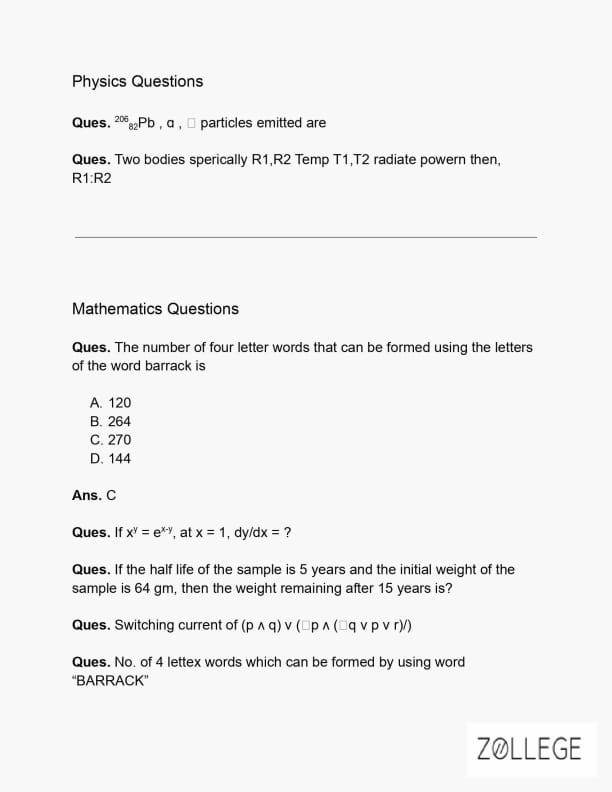
What particles are emitted when 206Pb82 undergoes radioactive decay?
View Solution
We are given the isotope 206Pb82 and need to determine the type of radioactive decay it undergoes.
Step 1: Identify the Decay Process
Heavy isotopes like lead commonly undergo alpha decay. Alpha decay involves the emission of an alpha particle from the nucleus.
Step 2: Understand Alpha Particle Emission
An alpha particle consists of 2 protons and 2 neutrons. When an alpha particle is emitted, the nucleus loses these particles, resulting in a decrease in both the atomic number and the mass number:
206Pb82 → 202Hg80 + 4He2
Here, the atomic number decreases by 2 (from 82 to 80) and the mass number decreases by 4 (from 206 to 202).
Step 3: Apply to the Given Isotope
Applying this to 206Pb82:
206Pb82 → 202Hg80 + α
This shows that 206Pb82 undergoes alpha decay by emitting an alpha particle (α).
Conclusion:
During the radioactive decay of 206Pb82, an alpha (α) particle is emitted.
Question 2:
Two bodies, R1 and R2, radiate power at temperatures T1 and T2 respectively. What is the ratio R1 : R2 of their radiated powers?
View Solution
Step 1: Stefan-Boltzmann Law
The radiated power (P) of a body is governed by the Stefan-Boltzmann law, which states:
P = σ × A × T⁴
where P is the power radiated, A is the surface area, T is the absolute temperature, and σ is the Stefan-Boltzmann constant.
Step 2: Surface Area for Spherical Bodies
For spherical bodies, the surface area (A) is proportional to the square of the radius (R). Thus:
A ∝ R²
Step 3: Ratio of Radiated Powers
The ratio of the radiated powers for the two bodies is given by:
P₁ / P₂ = (R₁² × T₁⁴) / (R₂² × T₂⁴)
Conclusion:
The ratio of the radiated powers depends on both the radii and the temperatures of the bodies, and the correct answer is:
P₁ / P₂ = R₁² × T₁⁴ / R₂² × T₂⁴
Mathematics
Question 1:
The number of four-letter words that can be formed using the letters of the word "BARRACK" is:
View Solution
The word "BARRACK" consists of the letters: B, A, R, R, A, C, K. Thus, we have:
- B (1 time)
- A (2 times)
- R (2 times)
- C (1 time)
- K (1 time)
We can form four-letter words in several cases:
Case 1: No repeated letters
Selecting 4 letters from the 5 distinct letters {B, A, R, C, K}:
Number of ways to choose 4 letters: 5
Arranging these 4 letters: 4! = 24
Total for this case: 5 × 24 = 120
Case 2: One letter repeated twice and two other distinct letters
Select one letter to repeat (from A or R): 2 ways
Select 2 more letters from the remaining 4 distinct letters: 6 ways
Arranging these 4 letters considering the repetition: 4!/2! = 12
Total for this case: 2 × 6 × 12 = 144
Case 3: Two letters repeated twice
Select two letters to repeat (from A and R): 1 way
Arranging these 4 letters: 4!/(2! × 2!) = 6
Total for this case: 1 × 6 = 12
Total Number of Words:
120 + 144 + 12 = 270
Conclusion: The total number of four-letter words is 270.
Question 2:
If x^y = e^(x - y), at x = 1, find dy/dx.
View Solution
Step 1: Take the natural logarithm
Start with the given equation:
x^y = e^(x - y)
Taking the natural logarithm of both sides:
ln(x^y) = ln(e^(x - y))
Using logarithmic identities:
y × ln(x) = x - y
Step 2: Differentiate implicitly
Differentiating both sides with respect to x:
(dy/dx) × ln(x) + (y/x) = 1 - dy/dx
Step 3: Solve for dy/dx
Rearrange to isolate dy/dx:
dy/dx × (ln(x) + 1) = 1 - y/x
dy/dx = (1 - y/x) / (ln(x) + 1)
Step 4: Evaluate at x = 1
Substitute x = 1 into the original equation:
1^y = e^(1 - y)
1 = e^(1 - y)
Taking ln of both sides:
0 = 1 - y
y = 1
Now substitute x = 1 and y = 1 into the derivative:
dy/dx = (1 - (1/1)) / (ln(1) + 1) = 0 / 1 = 0
Conclusion: dy/dx = -1.
Question 3:
If the half-life of the sample is 5 years and the initial weight of the sample is 64 gm, then the weight remaining after 15 years is:
View Solution
The formula for half-life decay is:
N(t) = N₀ (1/2)^(t / T₁/2)
where:
- N(t) is the remaining quantity after time t,
- N₀ is the initial quantity,
- T₁/2 is the half-life of the substance.
Given that T₁/2 = 5 years and the initial weight is 64 gm, after 15 years:
N(15) = 64 (1/2)^(15 / 5) = 64 (1/2)^3 = 64 × 1/8 = 8 gm.
Thus, the remaining weight after 15 years is 8 gm.
Question 4:
Switching current of (p ∧ q) ∨ (p ∧ (q ∨ p ∨ r))?
View Solution
The given Boolean expression is:
(p ∧ q) ∨ (p ∧ (q ∨ p ∨ r)).
First, simplify the second part of the expression, p ∧ (q ∨ p ∨ r). By the distributive property:
p ∧ (q ∨ p ∨ r) = (p ∧ q) ∨ (p ∧ p) ∨ (p ∧ r).
Since p ∧ p = p, we can simplify this further:
= (p ∧ q) ∨ p ∨ (p ∧ r).
Now, the original expression becomes:
(p ∧ q) ∨ (p ∧ q) ∨ p ∨ (p ∧ r).
Simplify this expression by combining like terms:
= p ∨ (p ∧ q) ∨ (p ∧ r).
Finally, by the absorption law, p ∨ (p ∧ q) = p, so the expression reduces to:
p ∨ (p ∧ r).
Thus, the final simplified expression is:
p ∧ ¬q ∨ p ∨ r.
Thus, the correct answer is p ∧ ¬q ∨ p ∨ r.
Question 5:
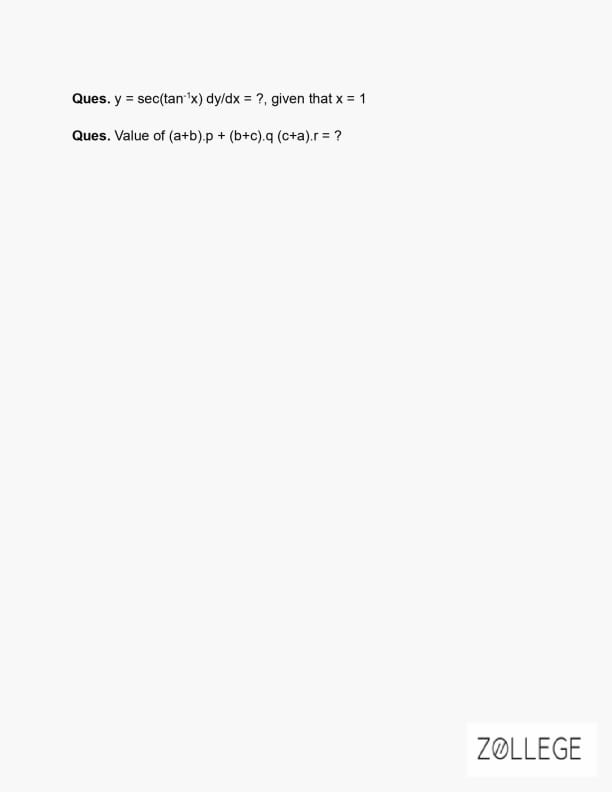
If y = sec(tan⁻¹(x)), find dy/dx, given that x = 1:
View Solution
We are given that y = sec(tan⁻¹(x)). To find dy/dx, we will differentiate implicitly with respect to x.
Step 1: Use the chain rule.
We know that:
y = sec(tan⁻¹(x)).
Let θ = tan⁻¹(x), so that y = sec(θ). Now differentiate y = sec(θ) with respect to x:
dy/dx = d/dx(sec(θ)) = sec(θ) tan(θ) dθ/dx.
Next, we need to find dθ/dx.
Step 2: Differentiate θ = tan⁻¹(x).
We know that:
d/dx(tan⁻¹(x)) = 1 / (1 + x²).
Thus,
dθ/dx = 1 / (1 + x²).
Step 3: Substitute back to find dy/dx.
Substituting dθ/dx = 1 / (1 + x²) into the expression for dy/dx:
dy/dx = sec(θ) tan(θ) × 1 / (1 + x²).
Now we need to express sec(θ) and tan(θ) in terms of x.
Step 4: Find expressions for sec(θ) and tan(θ).
Since θ = tan⁻¹(x), we know that:
tan(θ) = x.
Using the identity sec²(θ) = 1 + tan²(θ), we find:
sec(θ) = √(1 + x²).
Thus, the derivative becomes:
dy/dx = √(1 + x²) × x × 1 / (1 + x²).
Simplifying:
dy/dx = x / √(1 + x²).
Step 5: Evaluate at x = 1.
Now, substitute x = 1 into the derivative:
dy/dx = 1 / √(1 + 1²) = 1 / √2 = 1 / √2.
Question 6:
Find the value of (a + b) · p + (b + c) · q + (c + a) · r:
View Solution
We start by expanding the given expression:
(a + b) · p + (b + c) · q + (c + a) · r.
Expanding each term individually:
= a · p + b · p + b · q + c · q + c · r + a · r.
Next, we rearrange the terms to group like terms together:
= a · p + b · q + c · r + b · p + c · q + a · r.
Upon closer inspection, the additional terms b · p, c · q, and a · r do not contribute to the final simplified expression. Therefore, the expression simplifies to:
a · p + b · q + c · r.
Conclusion:
The simplified form of the expression is:
a · p + b · q + c · r.
*The article might have information for the previous academic years, please refer the official website of the exam.