
MHT CET 2024 PCM May 3 Shift 2 Question Paper Pdf - Check Solutions with Answer Key Pdf

.jpg?tr=h-55,w-55,c-force)
Content Strategist|Tech-innovator|National Hackathon Winner | Updated On - Jan 18, 2025
MHT CET 2024 PCM Question Paper for May 3 - Shift 2 is available for download. The exam was successfully conducted by the State CET cell from 2:00 PM to 5:00 PM. As per the student’s initial reactions, MHT CET 2024 PCM Question Paper for May 3 - Shift 2 was reported as Moderate. The Mathematics section in MHT CET 2024 May 3 - Shift 2 Question Paper was reported as Challenging, Physics as Moderate, and Chemistry as Easy to Moderate.
MHT CET 2024 PCM May 3 Shift 2 Question Paper with Answer Key PDF
Candidates can download the MHT CET 2024 PCM Question Paper with Solution and Answer Key PDFs for May 3 - Shift 2 using the link below.
| MHT CET 2024 PCM 3 May Shift 2 Question Paper with Answer Key |  Download Download |
Check Solution |
MHT CET PCM 2024 May 3 Shift 2 Questions with Solutions
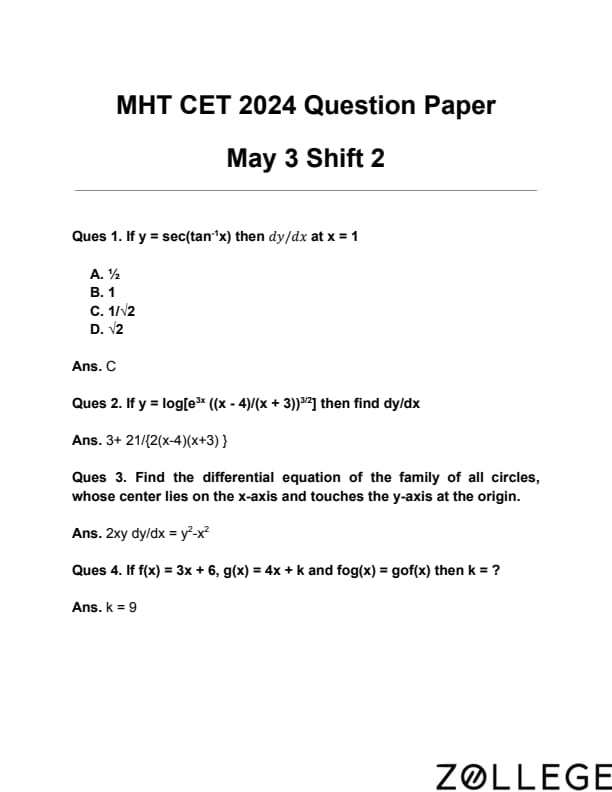
Question 1:
If y = sec(tan-1 x), then dy/dx at x = 1 is:
View Solution
Step 1: Given y = sec(tan-1 x).
Let θ = tan-1(x). From the definition of the inverse tangent function:
tan(θ) = x
Step 2: Simplify sec(θ). Using the trigonometric identity:
sec²(θ) = 1 + tan²(θ)
Substitute tan(θ) = x:
sec²(θ) = 1 + x²
Taking the square root, sec(θ) = √(1 + x²). Therefore:
y = sec(θ) = √(1 + x²)
Step 3: Differentiate y with respect to x.
dy/dx = d/dx [√(1 + x²)] = (1 / (2√(1 + x²))) × 2x = x / √(1 + x²)
Step 4: Evaluate dy/dx at x = 1.
dy/dx = 1 / √(1 + 1²) = 1 / √2
Thus, the correct answer is 1/√2.
Question 2:
If y = loge [ e3x ( (x - 4) / (x + 3) )3/2 ], then find dy/dx:
View Solution
Step 1: Simplify the logarithmic expression using properties of logarithms.
y = loge(e3x) + loge(((x - 4) / (x + 3))3/2)
Using the property loge(ab) = b loge(a):
y = 3x + (3/2) loge((x - 4) / (x + 3))
Step 2: Differentiate y with respect to x.
dy/dx = d/dx(3x) + (3/2) d/dx[loge((x - 4) / (x + 3))]
The derivative of 3x is 3. For the second term, apply the chain rule:
dy/dx = 3 + (3/2) × [1 / ((x - 4) / (x + 3))] × d/dx[(x - 4) / (x + 3)]
Using the quotient rule for d/dx[(x - 4) / (x + 3)]:
d/dx[(x - 4) / (x + 3)] = [(x + 3)(1) - (x - 4)(1)] / (x + 3)² = 7 / (x + 3)²
Substitute back:
dy/dx = 3 + (3/2) × [1 / ((x - 4) / (x + 3))] × (7 / (x + 3)²)
Simplify the expression:
dy/dx = 3 + (3/2) × [7 / (x - 4)(x + 3)] = 3 + 21 / 2(x - 4)(x + 3)
Thus, the correct answer is 3 + 21 / 2(x - 4)(x + 3).
Question 3:
Find the differential equation of the family of all circles, whose center lies on the x-axis and touches the y-axis at the origin:
View Solution
Step 1: Write the general equation of the circle.
The equation of a circle with center at (h, 0) and radius h is:
(x - h)² + y² = h²
Expand the equation:
x² - 2hx + h² + y² = h²
Simplify:
x² + y² - 2hx = 0
Step 2: Differentiate the equation with respect to x.
d/dx(x² + y² - 2hx) = 0
Apply the derivatives:
2x + 2y(dy/dx) - 2h = 0
Simplify for h:
h = x + y(dy/dx)
Step 3: Substitute h into the original equation.
Substitute h = x + y(dy/dx) into:
x² + y² - 2hx = 0
Result:
x² + y² - 2x(x + y(dy/dx)) = 0
Simplify:
x² + y² - 2x² - 2xy(dy/dx) = 0
Rearrange:
y² - x² - 2xy(dy/dx) = 0
Step 4: Solve for the differential equation.
2xy(dy/dx) = y² - x²
The differential equation is:
2xy dy/dx = y² - x²
Question 4:
If f(x) = 3x + 6, g(x) = 4x + k, and f ∘ g(x) = g ∘ f(x), then find k:
View Solution
Step 1: Write the condition for f ∘ g(x) = g ∘ f(x).
This means:
f(g(x)) = g(f(x))
Step 2: Compute f(g(x)).
Substitute g(x) = 4x + k into f(x):
f(g(x)) = f(4x + k) = 3(4x + k) + 6 = 12x + 3k + 6
Step 3: Compute g(f(x)).
Substitute f(x) = 3x + 6 into g(x):
g(f(x)) = g(3x + 6) = 4(3x + 6) + k = 12x + 24 + k
Step 4: Equate f(g(x)) and g(f(x)).
Set the two expressions equal:
12x + 3k + 6 = 12x + 24 + k
Cancel 12x:
3k + 6 = 24 + k
Simplify for k:
3k - k = 24 - 6
2k = 18
k = 9
Thus, k = 9.
*The article might have information for the previous academic years, please refer the official website of the exam.