
MHT CET 2024 Question Paper with Answer Key PDF for PCM (May 4 - Shift 1)


Content Writer | Updated On - Mar 7, 2025
MHT CET Question Papers are the most important study material for effective exam preparation. We at Zollege have provided all MHT CET Previous Year Papers with Solution PDFs here. MHT CET 2024 PCM exam is conducted on May 4 by State CET Cell.
Students can freely download the MHT CET previous year's question paper PDFs along with their solutions here. We strongly encourage MHT CET aspirants to scan through all the MHT CET Question Paper to know the overall difficulty level, MHT CET Syllabus and understand the changes in MHT CET Exam Pattern over the years.
MHT CET 2024 4 May Shift 1 Question Paper PDF Download
| MHT CET 2024 4 May Shift 1 Question Paper With Answer Key |  Download Download |
Check Solution |
MHT CET 2024 4 May Shift 1 Question Paper Solution
(Mathematics)
Question 1:
Maximize z = x + y subject to:
- x + y ≤ 10
- 3y - 2x ≤ 15
- x ≤ 6
- x, y ≥ 0
Find the maximum value.
View Solution
Step 1: Analyze the constraints.
We are given the following inequalities for \( x \) and \( y \): \[ x + y \leq 10, \quad 3y - 2x \leq 15, \quad x \leq 6, \quad x, y \geq 0. \]
These inequalities define the feasible region in the coordinate plane.
Step 2: Find the vertices of the feasible region.
To determine the feasible region, we plot the constraints on a graph. The points where the constraints intersect are the vertices of the feasible region: \( (0, 0), (0, 5), (6, 4), (6, 0) \).
Step 3: Evaluate the objective function at each vertex.
The objective function is \( z = x + y \). Let's calculate the value of \( z \) at each vertex:
- At \( (0, 0), z = 0 + 0 = 0 \).
- At \( (0, 5), z = 0 + 5 = 5 \).
- At \( (6, 4), z = 6 + 4 = 10 \).
- At \( (6, 0), z = 6 + 0 = 6 \).
Step 4: Conclusion.
The maximum value of \( z \) is 10, which occurs at the point \( (6, 4) \).
Quick Tip: When maximizing or minimizing a linear objective function subject to linear constraints, the optimal value occurs at one of the vertices of the feasible region.
The equation \( (\cos p - 1)x^2 + (\cos p)x + \sin p = 0 \), where \( x \) is a variable with real roots. Then the interval of \( p \) may be any one of the following:
View Solution
Step 1: Determine the discriminant condition for real roots.
For a quadratic equation \( ax^2 + bx + c = 0 \) to have real roots, the discriminant must be non-negative. \[ b^2 - 4ac \geq 0. \]
Step 2: Apply the discriminant condition to the given equation.
The given equation is \( (\cos p - 1)x^2 + (\cos p)x + \sin p = 0 \), where
- \( a = (\cos p - 1), b = \cos p, c = \sin p \).
Thus, the discriminant condition becomes: \[ (\cos p)^2 - 4(\cos p - 1)(\sin p) \geq 0. \]
Simplifying this expression gives: \[ (\cos p)^2 \geq 4(\cos p - 1)(\sin p). \]
Step 3: Evaluate the inequality.
For \( p \in (0, \pi) \), both \( \cos p \) and \( \sin p \) are positive, making the inequality valid in this interval. For other intervals, \( \cos p \) and/or \( \sin p \) may become negative, causing the inequality to no longer hold.
Step 4:
Hence, the valid interval for \( p \) is \( (0, \pi) \). Quick Tip: For a quadratic equation to have real roots, the discriminant (i.e., \( b^2 - 4ac \)) must be non-negative.
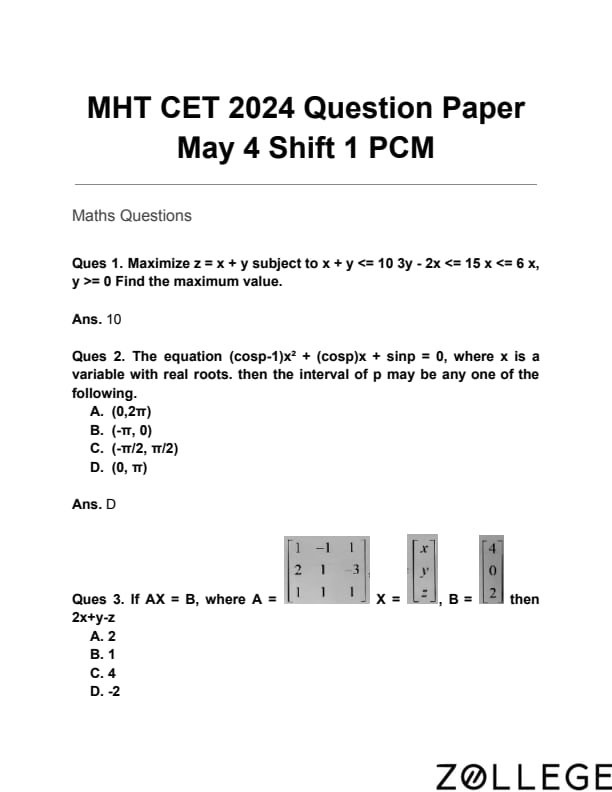
If AX = B, where:
- A = [[1, -1, 1], [2, 1, -3], [1, 1, 1]]
- X = [x, y, z]
- B = [4, 0, 2]
Then 2x + y - z is:
View Solution
We are provided with the matrix equation \( AX = B \), which corresponds to the following system of equations: \[ x - y + z = 4 \quad (Equation 1) \] \[ 2x + y - 3z = 0 \quad (Equation 2) \] \[ x + y + z = 2 \quad (Equation 3). \]
Step 1: Solve for \( y \) in terms of \( x \) and \( z \)
From Equation (3), we can solve for \( y \): \[ x + y + z = 2 \quad \Rightarrow \quad y = 2 - x - z \quad (Equation 4). \]
Step 2: Substitute \( y = 2 - x - z \) into Equation (1)
Substitute Equation (4) into Equation (1): \[ x - (2 - x - z) + z = 4 \]
Simplifying: \[ x - 2 + x + z + z = 4 \quad \Rightarrow \quad 2x + 2z - 2 = 4 \quad \Rightarrow \quad 2x + 2z = 6 \quad \Rightarrow \quad x + z = 3 \quad (Equation 5). \]
Step 3: Substitute \( y = 2 - x - z \) into Equation (2)
Substitute Equation (4) into Equation (2): \[ 2x + (2 - x - z) - 3z = 0 \]
Simplifying: \[ 2x + 2 - x - z - 3z = 0 \quad \Rightarrow \quad x - 4z + 2 = 0 \quad \Rightarrow \quad x = 4z - 2 \quad (Equation 6). \]
Step 4: Substitute \( x = 4z - 2 \) into Equation (5)
Now substitute Equation (6) into Equation (5): \[ (4z - 2) + z = 3 \]
Simplifying: \[ 4z - 2 + z = 3 \quad \Rightarrow \quad 5z = 5 \quad \Rightarrow \quad z = 1. \]
Step 5: Solve for \( x \) and \( y \)
Now, substitute \( z = 1 \) into Equation (6) to find \( x \): \[ x = 4(1) - 2 = 4 - 2 = 2. \]
Next, substitute \( x = 2 \) and \( z = 1 \) into Equation (4) to find \( y \): \[ y = 2 - 2 - 1 = -1. \]
Substitute these values into the expression \( 2x + y - z \): \[ 2x + y - z = 2 \times 2 + (-1) - 1 = 4 - 1 - 1 = 2. \]
Thus, we find that \( 2x + y - z = 2 \).
Step 6: Conclusion.
Therefore, the final value of \( 2x + y - z = 2 \). Quick Tip: To solve a system of linear equations, use substitution or elimination methods to simplify and solve for the unknowns.
The equation of the plane passing through the point \( (1, 1, 1) \) and perpendicular to the planes \( 2x + y - 2z = 5 \) and \( 3x - 6y - 2z = 7 \) is:
View Solution
Step 1: Understand the problem.
We are required to find the equation of a plane that passes through the point \( (1, 1, 1) \) and is perpendicular to the planes \( 2x + y - 2z = 5 \) and \( 3x - 6y - 2z = 7 \).
Step 2: Identify the normal vectors.
The normal vectors of the given planes are:
- \( \langle 2, 1, -2 \rangle \) for the plane \( 2x + y - 2z = 5 \),
- \( \langle 3, -6, -2 \rangle \) for the plane \( 3x - 6y - 2z = 7 \).
Step 3: Compute the cross product of the normal vectors.
To find the normal vector of the required plane, we take the cross product of the normal vectors of the given planes: \[ \langle 2, 1, -2 \rangle \times \langle 3, -6, -2 \rangle = \langle 14, 2, 15 \rangle. \]
Step 4: Write the equation of the plane.
The equation of the plane is given by: \[ 14(x - 1) + 2(y - 1) + 15(z - 1) = 0. \]
Simplifying this equation, we obtain: \[ 14x + 2y + 15z = 31. \]
Step 5: Conclusion.
Therefore, the equation of the required plane is \( 14x + 2y + 15z = 31 \). Quick Tip: The normal vector to a plane is perpendicular to every vector lying within the plane. The cross product of two normal vectors gives a vector perpendicular to both.
Using the rules in logic, write the negation of the following: \[ (p q) \land (q \lor \sim r) \]
View Solution
To negate \( (p q) \land (q \lor \sim r) \), we will use De Morgan's laws.
1. Begin by applying the negation to the entire expression: \[ \sim \left( (p q) \land (q \lor \sim r) \right) \]
According to De Morgan's law, the negation of a conjunction is the disjunction of the negations: \[ \sim (p q) \lor \sim (q \lor \sim r). \]
2. Next, apply De Morgan’s law to each part:
- \( \sim (p q) = \sim p \lor \sim q \)
- \( \sim (q \lor \sim r) = \sim q \land r \)
So, the negation of the original expression becomes: \[ (\sim p \lor \sim q) \lor (\sim q \land r). \]
3. Finally, simplify the expression to get the result: \[ \sim q \land (\sim p \lor r). \] Quick Tip: Use De Morgan's laws when negating conjunctions or disjunctions: \[ \sim (A \land B) = \sim A \lor \sim B \quad and \quad \sim (A \lor B) = \sim A \land \sim B. \]
A student scores the following marks in five tests: 45, 54, 41, 57, 43. His score is not known for the sixth test. If the mean score is 48 in the six tests, then the standard deviation of the marks in six tests is:
View Solution
Step 1: Find the sum of the five provided marks.
The marks given are 45, 54, 41, 57, and 43. Their total sum is: \[ 45 + 54 + 41 + 57 + 43 = 240. \]
Step 2: Calculate the sixth test score using the mean.
The mean score for all six tests is 48. Therefore, the total sum of the six marks is: \[ Sum of six marks = 48 \times 6 = 288. \]
To find the sixth test score, subtract the sum of the first five marks from the total sum: \[ x_6 = 288 - 240 = 48. \]
Step 3: Compute the variance.
The six marks are 45, 54, 41, 57, 43, and 48, with the mean \( \mu = 48 \). The variance is given by the formula: \[ Variance = \frac{1}{6} \sum_{i=1}^{6} (x_i - \mu)^2 \]
Now, calculate \( (x_i - 48)^2 \) for each mark:
- \( (45 - 48)^2 = 9 \)
- \( (54 - 48)^2 = 36 \)
- \( (41 - 48)^2 = 49 \)
- \( (57 - 48)^2 = 81 \)
- \( (43 - 48)^2 = 25 \)
- \( (48 - 48)^2 = 0 \)
The total of these squared differences is: \[ Variance = \frac{9 + 36 + 49 + 81 + 25 + 0}{6} = \frac{200}{6} = \frac{100}{3}. \]
Step 4: Determine the standard deviation.
The standard deviation is the square root of the variance: \[ Standard Deviation = \sqrt{\frac{100}{3}} = \frac{10}{\sqrt{3}}. \] Quick Tip: To calculate the standard deviation, first find the variance using \( \frac{1}{n} \sum_{i=1}^{n} (x_i - \mu)^2 \), then take the square root of the variance.
A committee of 11 members is to be formed out of 8 males and 5 females. If \( m \) is the number of ways the committee is formed with at least 6 males and \( n \) is the number of ways with at least 3 females, then:
View Solution
We are tasked with finding the values of \( m \) and \( n \).
Step 1: Calculate the number of ways to form a committee with at least 6 males.
The possible cases are as follows:
- 6 males and 5 females: \[ \binom{8}{6} \times \binom{5}{5} = 28 \times 1 = 28 \]
- 7 males and 4 females: \[ \binom{8}{7} \times \binom{5}{4} = 8 \times 5 = 40 \]
- 8 males and 3 females: \[ \binom{8}{8} \times \binom{5}{3} = 1 \times 10 = 10 \]
The total number of ways to form a committee with at least 6 males is: \[ m = 28 + 40 + 10 = 78. \]
Step 2: Calculate the number of ways to form a committee with at least 3 females.
The possible cases are:
- 8 males and 3 females: \[ \binom{8}{8} \times \binom{5}{3} = 1 \times 10 = 10 \]
- 7 males and 4 females: \[ \binom{8}{7} \times \binom{5}{4} = 8 \times 5 = 40 \]
- 6 males and 5 females: \[ \binom{8}{6} \times \binom{5}{5} = 28 \times 1 = 28 \]
The total number of ways to form a committee with at least 3 females is: \[ n = 10 + 40 + 28 = 78. \]
Step 3: Conclusion.
Since both \( m \) and \( n \) are equal to 78, the correct answer is \( m = n = 78 \). Quick Tip: For combinatorics problems involving committees, break down the problem by considering all possible cases and apply the binomial coefficient to calculate the number of ways.
The integral \( \int \frac{\csc x}{\cos^2(1 + \log \tan \frac{x}{2})} \, dx \) is equal to:
View Solution
Step 1: Substitution.
Let \( u = 1 + \log \left( \tan \frac{x}{2} \right) \).
Differentiating both sides with respect to \( x \), we get: \[ \frac{du}{dx} = \frac{1}{\tan \frac{x}{2}} \cdot \sec^2 \frac{x}{2} \cdot \frac{1}{2}. \]
Thus, we can express \( du \) as: \[ du = \frac{\csc x}{2} \, dx \quad \Rightarrow \quad 2 du = \frac{\csc x}{\cos^2 u} \, dx. \]
Step 2: Substituting into the integral.
The integral now becomes: \[ I = 2 \int \sec^2 u \, du. \]
Step 3: Solving the integral.
The integral of \( \sec^2 u \) is \( \tan u \), so we obtain: \[ I = 2 \tan u + C. \]
Step 4: Substituting back the value of \( u \).
Now, substitute \( u = 1 + \log \left( \tan \frac{x}{2} \right) \) back into the equation: \[ I = 2 \tan \left( 1 + \log \left( \tan \frac{x}{2} \right) \right) + C. \]
Finally, simplifying the constant factor of 2, the final result is: \[ I = \tan \left( 1 + \log \left( \tan \frac{x}{2} \right) \right) + C. \] Quick Tip: When dealing with complex trigonometric integrals, substitution and trigonometric identities can simplify the integrand and make the problem easier to solve.
The value of \( \sqrt{3} \csc 20^\circ - \sec 20^\circ \) is:
View Solution
We are given the expression \( \sqrt{3} \csc 20^\circ - \sec 20^\circ \), and our goal is to simplify it step by step.
Step 1: Rewrite the terms using basic trigonometric identities.
We begin by recalling the following fundamental trigonometric identities: \[ \csc \theta = \frac{1}{\sin \theta}, \quad \sec \theta = \frac{1}{\cos \theta}. \]
Thus, we have: \[ \csc 20^\circ = \frac{1}{\sin 20^\circ}, \quad \sec 20^\circ = \frac{1}{\cos 20^\circ}. \]
Substituting these into the original expression results in: \[ \sqrt{3} \csc 20^\circ - \sec 20^\circ = \sqrt{3} \times \frac{1}{\sin 20^\circ} - \frac{1}{\cos 20^\circ}. \]
Step 2: Approximate the values of \( \sin 20^\circ \) and \( \cos 20^\circ \).
Using either known values or a calculator, we approximate: \[ \sin 20^\circ \approx 0.3420, \quad \cos 20^\circ \approx 0.9397. \]
Now, substitute these approximations into the expression: \[ \sqrt{3} \times \frac{1}{0.3420} - \frac{1}{0.9397}. \]
Step 3: Simplify the expression.
We now calculate each term: \[ \sqrt{3} \approx 1.732, \] \[ \frac{1.732}{0.3420} \approx 5.06, \quad \frac{1}{0.9397} \approx 1.064. \]
Thus, the expression simplifies to: \[ 5.06 - 1.064 = 4. \]
Step 4: Conclusion.
Therefore, the value of \( \sqrt{3} \csc 20^\circ - \sec 20^\circ \) is approximately 4. Quick Tip: When solving trigonometric expressions, it's often useful to approximate the values of sine and cosine, then simplify the expression step by step.
(Chemistry)
Question 1:
Which has the highest first ionization energy?
View Solution
Ionization energy is the energy needed to remove one mole of electrons from one mole of atoms in the gaseous state. It is influenced by nuclear charge, the distance of electrons from the nucleus, and shielding by inner electrons.
- Across a period (left to right), ionization energy increases as the nuclear charge grows, pulling electrons closer and making them harder to remove.
- Down a group (top to bottom), ionization energy decreases due to increased atomic size and greater shielding, which makes it easier to remove outer electrons.
For the elements:
- Lithium (Li), Group 1, Period 2, has low ionization energy as its single outer electron is far from the nucleus.
- Sodium (Na), Group 1, Period 3, has lower ionization energy than lithium because its outer electron is farther from the nucleus.
- Neon (Ne), Group 18, Period 2, has the highest ionization energy due to its stable electron configuration and tight electron binding.
- Magnesium (Mg), Group 2, Period 3, has higher ionization energy than sodium but lower than neon because of an additional proton.
Therefore, Neon (Ne) has the highest first ionization energy. Quick Tip: Ionization energy increases across a period and decreases down a group. This is due to the combined effect of nuclear charge and atomic size. Noble gases have the highest ionization energy in their periods because they are stable and have a full outer electron shell.
The half-life of a 1st order reaction is 1 hr. What is the fraction of the reactant remaining after 3 hours?
View Solution
In a first-order reaction, the rate is directly proportional to the concentration of the reactant. The half-life (\( t_{1/2} \)) is constant and independent of the initial concentration. The fraction of reactant remaining at any time \( t \) is given by:
\[ \frac{[A]_t}{[A]_0} = e^{-kt} \]
where:
- \( [A]_t \) is the concentration at time \( t \),
- \( [A]_0 \) is the initial concentration,
- \( k \) is the rate constant, and
- \( t \) is time.
The relationship between the half-life and the rate constant is: \[ t_{1/2} = \frac{0.693}{k}. \]
Given \( t_{1/2} = 1 \, hr \), we can calculate \( k \): \[ k = \frac{0.693}{1} = 0.693 \, hr^{-1}. \]
To find the fraction remaining after 3 hours, we substitute into the equation: \[ \frac{[A]_t}{[A]_0} = e^{-0.693 \times 3} = e^{-2.079} \approx \frac{1}{8}. \]
Therefore, the fraction remaining after 3 hours is \( \frac{1}{8} \). Quick Tip: For a first-order reaction, the fraction remaining after time \( t \) is given by the equation \( \frac{[A]_t}{[A]_0} = e^{-kt} \), where \( k \) is the rate constant and \( t \) is the time. The half-life for a first-order reaction is constant and is independent of the initial concentration.
Which of the following represents the Stephan Reaction?
View Solution
The Stephan reaction involves the replacement of a halogen (typically chlorine) in an aromatic compound with a hydroxyl group. This reaction is usually carried out using a strong base such as sodium hydroxide (NaOH).
The general equation for the Stephan reaction is:
\[ C_6H_5Cl + NaOH \rightarrow C_6H_5OH + NaCl. \]
In this reaction, chlorobenzene reacts with sodium hydroxide to produce phenol (C6H5OH) and sodium chloride (NaCl). It is a classic example of a nucleophilic substitution, where the hydroxide ion from NaOH displaces the chlorine atom in chlorobenzene.
Thus, option (2) correctly represents the reaction. Quick Tip: The Stephan Reaction is a type of nucleophilic substitution, where a halide group (Cl) is replaced by a hydroxyl group (OH) using a strong base like NaOH. This is an important reaction in organic synthesis for preparing phenolic compounds.
What is the maximum oxidation state of an element in the periodic table?
View Solution
The maximum oxidation state of an element is determined by its group number and the number of valence electrons available for bonding. The oxidation state corresponds to the highest positive charge an element can attain in a compound.
For example, manganese (Mn), which belongs to Group 7 of the periodic table, has 7 valence electrons. In the compound \( MnO_4^- \) (permanganate ion), manganese achieves an oxidation state of \( +7 \). This is the maximum oxidation state that manganese can attain, as it involves the utilization of all 7 of its valence electrons in bonding.
Therefore, the maximum oxidation state of manganese is \( +7 \). Quick Tip: The maximum oxidation state of an element typically corresponds to its group number for elements in the s and p blocks. However, transition metals can exhibit higher oxidation states.
In a BCC (Body-Centered Cubic) structure, the radius of the atoms is:
View Solution
In a body-centered cubic (BCC) structure, the atoms at the corners of the unit cell are in contact with the atom at the center. This arrangement leads to a relationship between the atomic radius \( r \) and the edge length \( a \) of the unit cell.
In the BCC structure, the distance between two opposite corner atoms is equal to the body diagonal of the unit cell. This body diagonal also passes through the center atom, and the length of the body diagonal is \( 4r \) (since it contains two radii of corner atoms and one radius of the central atom).
The body diagonal can also be expressed in terms of the edge length \( a \) using the Pythagorean theorem for a cube. The length of the body diagonal is \( \sqrt{3}a \), where \( a \) is the edge length of the unit cell.
Thus, we have the equation: \[ 4r = \sqrt{3}a. \]
Solving for \( r \), we get: \[ r = \frac{\sqrt{3}}{4}a. \]
Therefore, the atomic radius \( r \) is \( \frac{\sqrt{3}}{4}a \). Quick Tip: For a BCC structure, the diagonal of the cube is equal to four times the radius of the atoms. Use this to derive the relationship between atomic radius and edge length.
What is the depression in the freezing point?
View Solution
The depression in freezing point (\( \Delta T_f \)) is related to the molality of the solution through the formula: \[ \Delta T_f = K_f \times m \]
where:
- \( K_f \) is the cryoscopic constant, also known as the freezing point depression constant, which is a property of the solvent. It depends on the nature of the solvent and is constant for a particular solvent.
- \( m \) is the molality of the solution, defined as the number of moles of solute per kilogram of solvent.
This formula indicates that the depression in the freezing point is directly proportional to the molality of the solution, meaning that as the molality increases, the freezing point of the solvent decreases. The depression occurs because the presence of solute particles disrupts the formation of the solvent's solid structure, lowering the freezing point. This is a colligative property, which means it depends on the number of solute particles rather than their identity. Quick Tip: The depression in freezing point is a colligative property, meaning it depends on the number of solute particles in the solution, not their identity.
Arrange the following substances in decreasing order of their boiling points:
View Solution
The boiling point of a substance is influenced by the strength of the intermolecular forces between its molecules. The stronger the intermolecular forces, the higher the boiling point.
- Water (H2O) experiences hydrogen bonding, a particularly strong intermolecular force, which gives it the highest boiling point.
- Ethanol (C2H5OH) also exhibits hydrogen bonding but it is weaker than water due to its larger molecular size and reduced polarity.
- Acetone (CH3COCH3) has dipole-dipole interactions, which are weaker compared to hydrogen bonding.
Therefore, the boiling points decrease in the following order:
Water > Ethanol > Acetone. Quick Tip: Boiling point is influenced by the nature of intermolecular forces: hydrogen bonding leads to higher boiling points, while weaker forces like dipole-dipole interactions result in lower boiling points.
(Physics)
Question 1:
The root mean square velocity (\(v_{rms}\)) of a gas is given by:
View Solution
The root mean square (rms) velocity of a gas can be determined using the following formula: \[ v_{rms} = \sqrt{\frac{3kT}{m}} \]
and represents:
- \( k \) is the Boltzmann constant,
- \( T \) is the absolute temperature in Kelvin,
- \( m \) is the mass of a single gas molecule.
This formula calculates the square root of the mean of the squared velocities of the gas molecules. It is derived from the principles of the kinetic theory of gases, which relates the macroscopic properties of gases to the microscopic behavior of molecules. Quick Tip: The rms velocity provides an average measure of the speed of gas molecules, and it increases with temperature and decreases with molecular mass.
The ideal gas equation is given by \( PV = nRT \). Which of the following statements is correct for an ideal gas?
View Solution
The ideal gas law, \( PV = nRT \), is a simplified model that assumes gas molecules neither interact with each other nor occupy a significant volume compared to the container.
This equation provides a good approximation under conditions of high temperature and low pressure, where the gas molecules are widely spaced, and intermolecular forces (such as attraction or repulsion) are minimal. However, at low temperatures and high pressures, real gases diverge from ideal behavior because intermolecular forces become significant and the finite volume of gas molecules cannot be ignored. Quick Tip: The ideal gas law is an approximation. It works best at high temperatures and low pressures, where intermolecular forces are less significant.
What is the ratio \( \frac{C_p}{C_v} \) for a monatomic and diatomic gas?
View Solution
Step 1: Definition of the ratio of specific heats.
The ratio of specific heats, denoted as \( \gamma \), is the ratio of the heat capacity at constant pressure \( C_p \) to the heat capacity at constant volume \( C_v \): \[ \gamma = \frac{C_p}{C_v}. \]
Step 2: Value of \( \gamma \) for a monatomic ideal gas.
For a monatomic ideal gas, only translational degrees of freedom are present. The value of \( \gamma \) for such a gas is: \[ \gamma = \frac{5}{3}. \]
Step 3: Value of \( \gamma \) for a diatomic ideal gas.
For a diatomic ideal gas, there are translational and rotational degrees of freedom. At high temperatures, it may also have vibrational degrees of freedom. However, assuming a simple diatomic molecule, the value of \( \gamma \) is: \[ \gamma = \frac{7}{5}. \]
Thus, the ratio \( \frac{C_p}{C_v} \) is:
- \( \frac{C_p}{C_v} = \frac{5}{3} \) for monatomic gases,
- \( \frac{C_p}{C_v} = \frac{7}{5} \) for diatomic gases. Quick Tip: The value of \( \gamma = \frac{C_p}{C_v} \) depends on the number of degrees of freedom of the gas molecules. For monatomic gases, it is higher than for diatomic gases.
How do you find the amplitude of a simple harmonic oscillator?
View Solution
The amplitude \( A \) of a simple harmonic oscillator can be found using the total mechanical energy of the system. The total energy \( E \) is the sum of potential and kinetic energy: \[ E = \frac{1}{2} k A^2. \]
Solving for \( A \), we get: \[ A = \sqrt{\frac{2E}{k}}. \]
Thus, the amplitude \( A \) is related to the total energy \( E \) and the spring constant \( k \). Quick Tip: The amplitude of simple harmonic oscillator is maximum displacement from equilibrium position and can be found using the energy equation \( A = \sqrt{\frac{2E}{k}} \).
What is the overtone of a vibrating string?
View Solution
In a vibrating string, the main frequency is the first harmonic. The overtones are higher frequency modes of vibration that occur at integer multiples of the main frequency.
- The first harmonic is the main frequency.
- The second harmonic is the first overtone, which has twice the frequency of the main.
- The third harmonic is the second overtone, which has three times the frequency of the main.
Thus, the overtone refers to the second harmonic. Quick Tip: The overtone of a vibrating string refers to the higher-frequency modes of vibration that are integer multiples of the fundamental frequency. The second harmonic is the first overtone.
Which of the following is a logic gate that gives an output of 1 when the inputs are different?
View Solution
The XOR (exclusive OR) gate produces an output of 1 when the inputs are different, meaning one input is 0 and the other is 1. If both inputs are the same, the output is 0.
- AND Gate: The output is 1 only when both inputs are 1.
- OR Gate: The output is 1 if at least one input is 1.
- XOR Gate: The output is 1 if the inputs are different.
- NOT Gate: This gate inverts a single input.
Therefore, the correct answer is the XOR Gate. Quick Tip: The XOR gate gives an output of 1 only when the inputs are different. It is often used in digital circuits where condition of difference is needed.


*The article might have information for the previous academic years, please refer the official website of the exam.