
MHT CET 2024 PCM May 4 Shift 2 Question Paper Pdf - Check Solutions with Answer Key Pdf

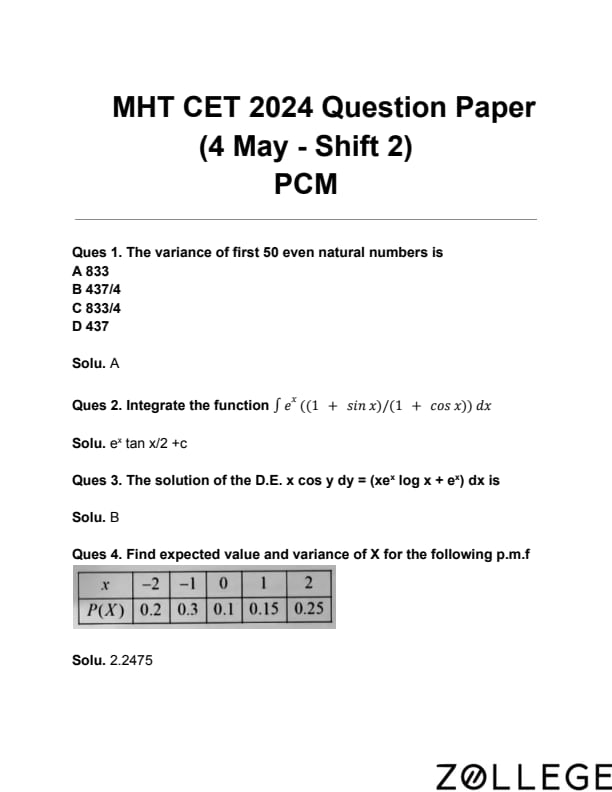
.jpg?tr=h-55,w-55,c-force)
Content Strategist|Tech-innovator|National Hackathon Winner | Updated On - Jan 17, 2025
MHT CET 2024 PCM May 4 Shift 2 Question Paper with Solution PDF is available for download here. Students found the Physics section moderate, with questions covering various topics.
Chemistry was considered easy, featuring straightforward and direct questions. Mathematics was difficult, with a lengthy paper that included challenging problems and several questions similar to previous years but with altered values. The overall difficulty level of the paper was moderate.
MHT CET 2024 PCM Question Paper with Answer Key PDF
| MHT CET 2024 PCM 4 May Shift 2 Question Paper with Answer Key |  Download Download |
Check Solution |
MHT CET May 4 Shift 2 2024 PCM Questions with Solutions
Question 1:
The variance of the first 50 even natural numbers is:
View Solution
Step 1: Determine the first 50 even natural numbers.
The sequence of the first 50 even natural numbers is:
2, 4, 6, ..., 100.
This sequence forms an arithmetic progression characterized by:
- First term a = 2
- Common difference d = 2
- Number of terms n = 50
Step 2: Calculate the sum and the mean of the sequence.
The sum S of an arithmetic progression can be calculated using the formula:
S = (n/2) × (2a + (n-1)d)
Substituting the known values:
S = (50/2) × (2 × 2 + (50 - 1) × 2) = 25 × (4 + 98) = 25 × 102 = 2550
The mean (μ) is then:
μ = S/n = 2550/50 = 51
Step 3: Compute the sum of squares of the sequence.
The sum of squares of the first n even natural numbers is given by:
Sum of squares = 4 × (n(n + 1)(2n + 1)) / 6
Plugging in n = 50:
Sum of squares = 4 × (50 × 51 × 101) / 6 = 4 × 257550 / 6 = 4 × 42925 = 171700
Step 4: Determine the variance of the sequence.
First, find the expected value of X^2:
E(X^2) = Sum of squares / n = 171700 / 50 = 3434
Then, calculate the variance (σ^2):
Variance = E(X^2) - (μ)^2 = 3434 - (51)^2 = 3434 - 2601 = 833
Conclusion: The variance of the first 50 even natural numbers is 833.
Question 2:
Integrate the function: e^x × ((1 + sin(x)) / (1 + cos(x))) dx
View Solution
Step 1: Simplify the given trigonometric expression.
We utilize the identity:
(1 + sin(x)) / (1 + cos(x)) = tan(x/2)
Step 2: Substitute the identity into the integral.
Applying this substitution, the integral becomes:
I = ∫ e^x × tan(x/2) dx
Step 3: Apply substitution method.
Let u = x/2, which implies du = (1/2) dx, and therefore dx = 2 du.
Substituting these into the integral:
I = 2 ∫ e^(2u) × tan(u) du
Step 4: Integrate the expression.
This integral is standard, and its solution is:
I = e^(2u) × tan(u) + C
Step 5: Revert the substitution to the original variable.
Substituting back u = x/2 into the result:
I = e^x × tan(x/2) + C
Conclusion: The integral simplifies to:
∫ e^x × tan(x/2) dx = e^x × tan(x/2) + C
Question 3:
The solution of the differential equation x cos(y) dy = (x e^x log(x) + e^x) dx is:
View Solution
We are given the differential equation:
x cos(y) dy = (x e^x log(x) + e^x) dx
This equation can be rearranged to separate the variables:
cos(y) dy = (e^x log(x) + (e^x / x)) dx
Step 1: Integrate both sides.
Integrate the left side with respect to y and the right side with respect to x:
∫ cos(y) dy = ∫ (e^x log(x) + (e^x / x)) dx
sin(y) = ∫ e^x log(x) dx + ∫ (e^x / x) dx + C
Step 2: Evaluate the integrals on the right-hand side.
For the first integral, use integration by parts:
Let u = log(x), so du = (1 / x) dx, and dv = e^x dx, so v = e^x.
Applying the integration by parts formula ∫ u dv = uv - ∫ v du, we get:
∫ e^x log(x) dx = e^x log(x) - ∫ (e^x / x) dx
Therefore, the right side becomes:
sin(y) = e^x log(x) - ∫ (e^x / x) dx + ∫ (e^x / x) dx + C
The integrals ∫ (e^x / x) dx cancel out:
sin(y) = e^x log(x) + C
Conclusion: The solution to the differential equation is:
sin(y) = e^x log(x) + C
Question 4:
Find the expected value and variance of X for the following p.m.f:
| x | -2 | -1 | 0 | 1 | 2 |
|---|---|---|---|---|---|
| P(X) | 0.2 | 0.3 | 0.1 | 0.15 | 0.25 |
View Solution
The expected value E(X) is given by:
E(X) = Σ (x × P(X = x)) = (-2)(0.2) + (-1)(0.3) + (0)(0.1) + (1)(0.15) + (2)(0.25)
E(X) = -0.4 - 0.3 + 0 + 0.15 + 0.5 = -0.05
The expected value of X^2 is:
E(X^2) = Σ (x^2 × P(X = x)) = (-2)^2(0.2) + (-1)^2(0.3) + (0)^2(0.1) + (1)^2(0.15) + (2)^2(0.25)
E(X^2) = 0.8 + 0.3 + 0 + 0.15 + 1 = 2.25
The variance Var(X) is given by:
Variance = E(X^2) - (E(X))^2 = 2.25 - (-0.05)^2 = 2.25 - 0.0025 = 2.2475
Thus, the variance is 2.2475
Question 5:
If the statement p ↔ (q → p) is false, then the true statement is:
View Solution
We are given the logical statement p ↔ (q → p). This biconditional expression is false only when one part is true and the other is false.
Case 1: Let p = True and q = False
- q → p evaluates to False → True = True
- Therefore, p ↔ (q → p) becomes True ↔ True = True
This case does not make the statement false.
Case 2: Let p = False and q = True
- q → p evaluates to True → False = False
- Therefore, p ↔ (q → p) becomes False ↔ False = True
This case also does not make the statement false.
Case 3: Let p = False and q = False
- q → p evaluates to False → False = True
- Therefore, p ↔ (q → p) becomes False ↔ True = False
This case satisfies the condition where the biconditional statement is false.
Next, we evaluate the provided options under the scenario p = False and q = False:
False → (False ∨ True) = False → True = True
False ∧ (True ∧ False) = False ∧ False = False
(False ∨ True) → False = True → False = False
- Option 1: p is false.
- Option 2: p → (p ∨ ~q). Substituting the values:
- Option 3: p ∧ (~p ∧ q). Substituting the values:
- Option 4: (p ∨ ~q) → p. Substituting the values:
Among these options, Option 2 is the only statement that evaluates to true when p = False and q = False.
Question 6:
The statement [(p → q) ∧ ~q] → r is a tautology when r is equivalent to:
View Solution
A tautology is a logical statement that is always true, irrespective of the truth values of its individual components.
Consider the statement [(p → q) ∧ ~q] → r. For this statement to be a tautology, it must hold true under all possible truth assignments of p, q, and r.
Analyzing the Antecedent:
The antecedent of the implication is (p → q) ∧ ~q. This conjunction is true only when both p → q is true and ~q (not q) is true.
- ~q being true implies that q is false.
- For p → q to be true while q is false, p must also be false. (Recall that p → q is only false when p is true and q is false.)
Therefore, the antecedent (p → q) ∧ ~q is true exclusively when both p and q are false.
Implications for r:
The entire statement [(p → q) ∧ ~q] → r is a conditional statement that evaluates to false only when the antecedent is true and the consequent r is false. To ensure that the entire statement is always true (i.e., a tautology), r must be true in every scenario where the antecedent is true.
Since the antecedent is true only when ~q is true, r must also be true whenever ~q is true. This relationship implies that r must logically follow ~q, meaning r should be equivalent to ~q.
Conclusion: For the statement [(p → q) ∧ ~q] → r to be a tautology, r must be equivalent to ~q.
Question 7:
A lot of 100 bulbs contains 10 defective bulbs. Five bulbs are selected at random from the lot and are sent to the retail store. Then the probability that the store will receive at most one defective bulb is:
View Solution
We are given:
- Total number of bulbs, N = 100
- Defective bulbs, K = 10
- Non-defective bulbs, N - K = 90
- Bulbs selected, n = 5
We need to find the probability of selecting at most one defective bulb, i.e., P(X ≤ 1).
Step 1: Probability of selecting 0 defective bulbs
Selecting all 5 bulbs from the 90 non-defective ones:
P(X = 0) = (C(90, 5)) / (C(100, 5)) ≈ 0.5837
Step 2: Probability of selecting 1 defective bulb
Selecting 1 defective bulb from 10 and 4 non-defective bulbs from 90:
P(X = 1) = (C(10, 1) × C(90, 4)) / (C(100, 5)) ≈ 0.31
Step 3: Total probability
Summing the probabilities for 0 and 1 defective bulbs:
P(X ≤ 1) = P(X = 0) + P(X = 1) = 0.5837 + 0.31 = 0.8937
Using Hypergeometric Distribution:
The hypergeometric distribution formula is:
P(X = k) = (C(K, k) × C(N - K, n - k)) / C(N, n)
Thus,
P(X ≤ 1) = (C(10, 0) × C(90, 5)) / C(100, 5) + (C(10, 1) × C(90, 4)) / C(100, 5) ≈ 0.8937
Conclusion: The probability of selecting at most one defective bulb out of five is approximately 0.8937.

*The article might have information for the previous academic years, please refer the official website of the exam.