
MHT CET 2024 Question Paper with Answer Key PDF for PCM (May 9 - Shift 2)

.jpg?tr=h-55,w-55,c-force)
Content Strategist|Tech-innovator|National Hackathon Winner | Updated On - Mar 10, 2025
MHT CET Question Papers are the most important study material for effective exam preparation. We at Zollege have provided all MHT CET Previous Year Papers with Solution PDFs here. MHT CET 2024 PCM exam is conducted on May 9 by State CET Cell.
Students can freely download the MHT CET previous year's question paper PDFs along with their solutions here. We strongly encourage MHT CET aspirants to scan through all the MHT CET Question Paper to know the overall difficulty level, MHT CET Syllabus and understand the changes in MHT CET Exam Pattern over the years.
MHT CET 2024 PCM Question Paper with Answer Key PDF
| MHT CET 2024 PCM 9 May Shift 2 Question Paper with Answer Key |  Download Download |
Check Solution |
MHT CET PCM 2024 Questions with Solutions
Mathematics
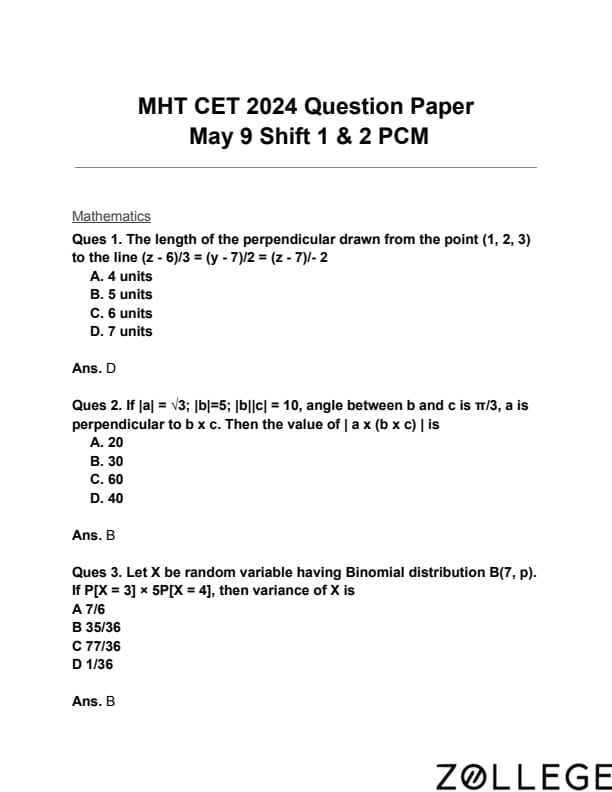
Question 1:
The length of the perpendicular drawn from the point (1, 2, 3) to the line (X - 6)/3 = (y - 7)/2 = (Z - 7)/-2 is:
View Solution
The equation of the line can be written in vector form as:
r = (6, 7, 7) + t(3, 2, -2).
Let the point (1, 2, 3) be denoted as P and the position vector of any point on the line as r₀. The direction vector of the line is d = (3, 2, -2).
The perpendicular distance from a point (x₁, y₁, z₁) to a line is given by:
D = ||d × (r₀ - P)|| / ||d||.
Step 1: Compute (r₀ - P):
r₀ - P = (6 - 1, 7 - 2, 7 - 3) = (5, 5, 4).
Step 2: Compute the cross product d × (r₀ - P):
d × (r₀ - P) = |i j k|
|3 2 -2|
|5 5 4|
d × (r₀ - P) = i(2×4 - (-2)×5) - j(3×4 - (-2)×5) + k(3×5 - 2×5).
d × (r₀ - P) = i(8 + 10) - j(12 + 10) + k(15 - 10).
d × (r₀ - P) = (18, -22, 5).
Step 3: Compute the magnitude of the cross product:
||d × (r₀ - P)|| = √(18² + (-22)² + 5²) = √(324 + 484 + 25) = √833.
Step 4: Compute the magnitude of the direction vector d:
||d|| = √(3² + 2² + (-2)²) = √(9 + 4 + 4) = √17.
Step 5: Compute the distance D:
D = ||d × (r₀ - P)|| / ||d|| = √833 / √17 = √(833 / 17) = 7.
Question 2:
If |a| = √3, |b| = 5, |b||c| = 10, the angle between b and c is π/3, and a is perpendicular to b × c, then the value of |a × (b × c)| is:
View Solution
Given, |a| = √3, |b| = 5, |b||c| = 10.
Using the vector triple product: b and c = π/3.
b · c = |b||c| cos(π/3) = 5 × |c| × 1/2 = 10.
Thus, |c| = 4.
a is perpendicular to b × c, so:
|a × (b × c)| = |a||b × c| sin(π/2).
|b × c| = |b||c| sin(π/3).
Substitute the values:
|b × c| = 5 × 4 × √3/2 = 10√3.
Thus, |a × (b × c)| = √3 × 10√3 = 30.
Question 3:
Let X be a random variable having binomial distribution B(7, p). If P(X = 3) = 5P(X = 4), then the sum of the mean and the variance of X is:
View Solution
Given a binomial distribution: B(7, p), where n = 7 and p = p.
We are provided:
P(X = 3) = 5P(X = 4).
Using the binomial probability formula:
P(X = k) = (nCk)p^k(1-p)^(n-k).
Substitute n = 7:
(7C3)p^3(1-p)^4 = 5 × (7C4)p^4(1-p)^3.
Simplify:
p / (1-p) = 1/5.
Solving for p:
6p = 1 → p = 1/6.
q = 1-p = 5/6.
Mean = np = 7 × 1/6 = 7/6.
Variance = npq = 7 × 1/6 × 5/6 = 35/36.
Sum = 7/6 + 35/36 = 42/36 + 35/36 = 77/36.
Question 4:
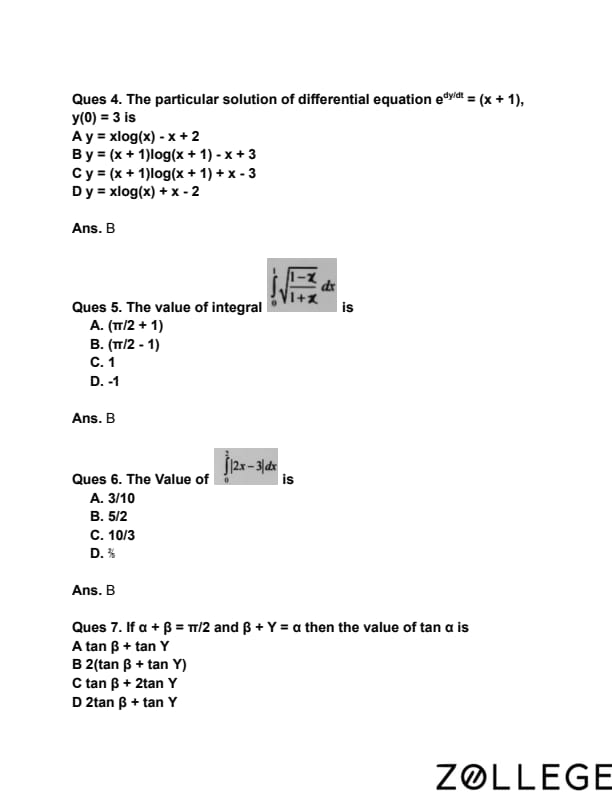
The particular solution of the differential equation e (dy/dx) = (x + 1), y(0) = 3, is:
View Solution
Separate the variables and integrate:
e dy = (x + 1) dx.
Integrating both sides:
y = (x + 1)log(x + 1) - x + C.
Applying y(0) = 3:
3 = (0 + 1)log(0 + 1) - 0 + C → C = 3.
Thus, the solution is:
y = (x + 1)log(x + 1) - x + 3.
Question 5:
The value of the integral ∫₀¹ (√(1-x) / √(1+x)) dx is:
View Solution
To solve the integral I = ∫₀¹ (√(1-x) / √(1+x)) dx, follow these steps:
Step 1: Rewrite the integral:
I = ∫₀¹ (1-x) / √(1-x²) dx.
Step 2: Split the integral:
I = ∫₀¹ (1/√(1-x²)) dx - ∫₀¹ (x/√(1-x²)) dx.
Step 3: Solve each integral:
∫₀¹ (1/√(1-x²)) dx = π/2.
∫₀¹ (x/√(1-x²)) dx = 1.
Step 4: Combine the results:
I = π/2 - 1.
Question 6:
The value of the integral ∫₀² |2x - 3| dx is:
View Solution
To evaluate the integral ∫₀² |2x - 3| dx, we consider the absolute value function, splitting the interval into two parts:
Step 1: Find the point where 2x - 3 = 0:
2x - 3 = 0 → x = 3/2.
This divides the interval [0, 2] into [0, 3/2] and [3/2, 2].
Step 2: Rewrite the integral for each sub-interval:
For 0 ≤ x ≤ 3/2, |2x - 3| = 3 - 2x.
For 3/2 ≤ x ≤ 2, |2x - 3| = 2x - 3.
Step 3: Write the integral as the sum of two parts:
∫₀² |2x - 3| dx = ∫₀³/₂ (3 - 2x) dx + ∫₃/₂² (2x - 3) dx.
Step 4: Evaluate each integral:
For ∫₀³/₂ (3 - 2x) dx:
∫₀³/₂ (3 - 2x) dx = [3x - x²]₀³/₂ = (3 × 3/2 - (3/2)²) - (0 - 0) = 9/2 - 9/4 = 9/4.
For ∫₃/₂² (2x - 3) dx:
∫₃/₂² (2x - 3) dx = [x² - 3x]₃/₂² = (2² - 3 × 2) - ((3/2)² - 3 × 3/2) = (4 - 6) - (9/4 - 9/2) = -2 + 9/4 = 1/4.
Step 5: Add the results:
∫₀² |2x - 3| dx = 9/4 + 1/4 = 10/4 = 5/2.
Question 7:
If α + β = π/2 and β + γ = α, then the value of tan(α) is:
View Solution
We are given:
α + β = π/2 and β + γ = α.
Step 1: Express α in terms of β:
α = π/2 - β.
Step 2: Substitute α into β + γ = α:
β + γ = π/2 - β → γ = π/2 - 2β.
Step 3: Calculate tan(α):
tan(α) = tan(π/2 - β) = cot(β).
Step 4: Express cot(β) in terms of tan(β):
cot(β) = 1/tan(β).
Step 5: Express tan(γ):
tan(γ) = tan(π/2 - 2β) = cot(2β).
cot(2β) = (1 - tan²(β))/(2tan(β)).
Step 6: Combine the results:
tan(α) = tan(β) + 2tan(γ).
Final Expression:
tan(α) = tan(β) + 2 × ((1 - tan²(β))/(2tan(β))).
Question 8:
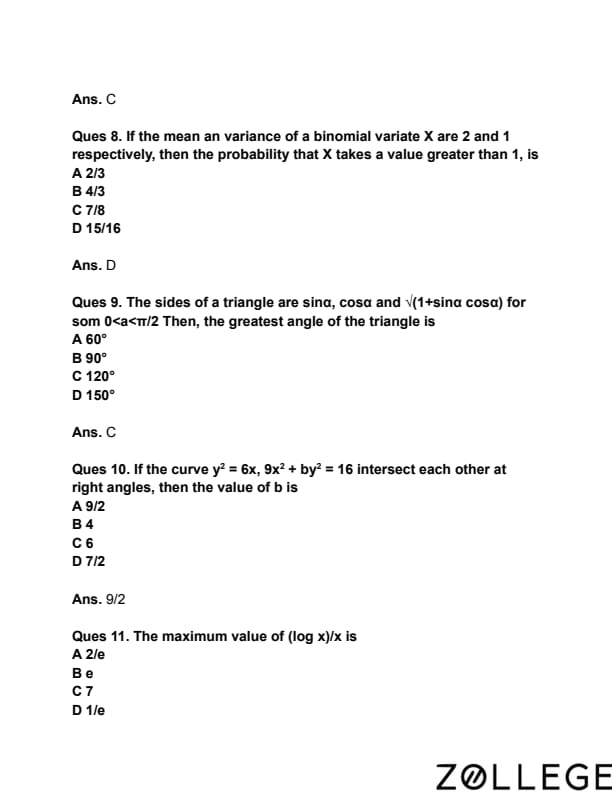
If the mean and variance of a binomial variate X are 2 and 1 respectively, then the probability that X takes a value greater than 1 is:
View Solution
Given mean = 2 and variance = 1 for a binomial distribution, we have:
mean = np = 2 and variance = np(1-p) = 1.
Step 1: Solve for n and p:
From np = 2 → p = 2/n.
Substitute into np(1-p) = 1:
n × (2/n) × (1 - 2/n) = 1 → 2(1 - 2/n) = 1 → 2 - 4/n = 1 → 4/n = 1 → n = 4.
p = 2/4 = 1/2.
Step 2: Calculate P(X > 1):
P(X > 1) = 1 - P(X ≤ 1).
P(X ≤ 1) = P(X = 0) + P(X = 1).
P(X = 0) = (4C0)(1/2)⁰(1/2)⁴ = 1/16.
P(X = 1) = (4C1)(1/2)¹(1/2)³ = 4/16.
P(X ≤ 1) = 1/16 + 4/16 = 5/16.
P(X > 1) = 1 - 5/16 = 11/16.
Question 9:
The sides of a triangle are sin(α), cos(α), and √(1 + sin(α)cos(α)) for some 0 < α < π/2. Then, the greatest angle of the triangle is:
View Solution
We are given the sides of the triangle:
a = sin(α), b = cos(α), c = √(1 + sin(α)cos(α)).
The greatest angle is opposite the largest side, which is c = √(1 + sin(α)cos(α)).
Step 1: Apply the cosine rule:
cos(C) = (a² + b² - c²) / (2ab).
Substitute the values:
a² = sin²(α), b² = cos²(α), c² = 1 + sin(α)cos(α).
cos(C) = (sin²(α) + cos²(α) - (1 + sin(α)cos(α))) / (2sin(α)cos(α)).
Step 2: Simplify the expression:
Using sin²(α) + cos²(α) = 1, we get:
cos(C) = (1 - 1 - sin(α)cos(α)) / (2sin(α)cos(α)).
cos(C) = -sin(α)cos(α) / (2sin(α)cos(α)).
cos(C) = -1/2.
Step 3: Determine the angle:
If cos(C) = -1/2, then C = 120°.
Question 10:
If the curve y² = 6x and 9x² + by² = 16 intersect each other at right angles, then the value of b is:
View Solution
We are given two curves:
1. y² = 6x.
2. 9x² + by² = 16.
Step 1: Differentiate both equations:
For y² = 6x:
2y(dy/dx) = 6 → dy/dx = 3/y.
For 9x² + by² = 16:
d/dx(9x² + by²) = d/dx(16).
18x + 2by(dy/dx) = 0 → dy/dx = -9x / (by).
Step 2: Apply the condition for orthogonality:
The curves intersect at right angles if the product of their slopes is -1:
(3/y) × (-9x / (by)) = -1.
Simplify:
-27x / (by²) = -1 → 27x / (by²) = 1.
Step 3: Substitute y² = 6x:
Using y² = 6x, we get:
27x / (b × 6x) = 1.
27 / (6b) = 1 → b = 27 / 6 = 9/2.
Question 11:
The maximum value of (log(x) / x) is:
View Solution
Let f(x) = log(x) / x. To find the maximum value, we first differentiate f(x) with respect to x:
f'(x) = d/dx(log(x) / x).
Using the quotient rule:
f'(x) = (x × (1/x) - log(x) × 1) / x² = (1 - log(x)) / x².
Step 1: Find critical points:
Set f'(x) = 0:
(1 - log(x)) / x² = 0 → 1 - log(x) = 0 → log(x) = 1 → x = e.
Step 2: Confirm maximum:
To confirm that x = e gives a maximum, evaluate f(x) at x = e:
f(e) = log(e) / e = 1 / e.
Additionally, the second derivative test can confirm the concavity:
f''(x) = d/dx((1 - log(x)) / x²).
f''(x) = (-x² × (-1/x) - (1 - log(x)) × 2x) / x⁴ = (-1 + 2log(x) - 2) / x³.
At x = e, f''(e) = (-1 + 2 - 2) / e³ = -1 / e³, which is negative, confirming a maximum.
Step 3: Final Answer:
The maximum value of log(x) / x is 1/e.
Physics
Question 1:
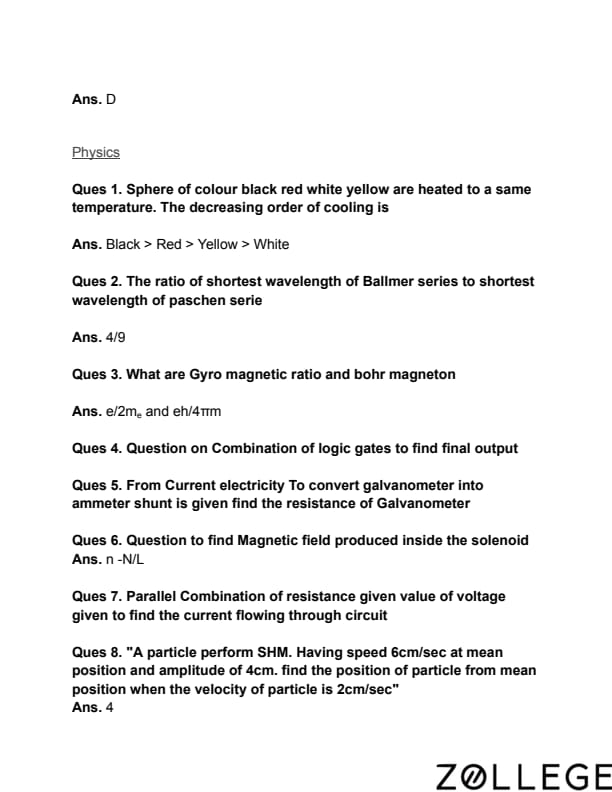
Sphere of color black, red, white, and yellow are heated to the same temperature. The decreasing order of cooling is:
View Solution
The cooling of an object depends on its emissivity. The black surface has the highest emissivity, allowing it to radiate heat more efficiently than other colors. The decreasing order of cooling (from highest to lowest) is:
Black > Red > Yellow > White.
Question 2:
The ratio of the shortest wavelength of the Balmer series to the shortest wavelength of the Paschen series is:
View Solution
The shortest wavelength of a spectral series occurs when the transition is from n = ∞ to the lower energy level (n₁). For the Balmer series, n₁ = 2, and for the Paschen series, n₁ = 3. Using the Rydberg formula:
1/λ = Rₕ(1/n₁² - 1/n₂²),
where Rₕ is the Rydberg constant.
Step 1: Wavelength for the Balmer series (n₁ = 2):
1/λ_Balmer = Rₕ(1/2² - 1/∞²) = Rₕ(1/4).
λ_Balmer = 4/Rₕ.
Step 2: Wavelength for the Paschen series (n₁ = 3):
1/λ_Paschen = Rₕ(1/3² - 1/∞²) = Rₕ(1/9).
λ_Paschen = 9/Rₕ.
Step 3: Ratio of wavelengths:
λ_Balmer / λ_Paschen = (4/Rₕ) / (9/Rₕ) = 4/9.
Final Answer: The ratio of the shortest wavelengths is 4/9.
Question 3:
What are the gyromagnetic ratio and Bohr magneton?
View Solution
The gyromagnetic ratio (γ) is given by:
γ = e / 2mₑ,
where e is the charge of the electron, and mₑ is the electron mass.
The Bohr magneton (μ_B) is defined as:
μ_B = e h / 4πm,
where h is Planck’s constant, and m is the mass of the electron.
Question 4:
Consider the following logic circuit. The circuit consists of three gates: an AND gate, an OR gate, and a NOT gate. The inputs to the AND gate are A = 1 and B = 0. The output of the AND gate is fed into the input of the OR gate, which has another input C = 1. The output of the OR gate is then passed through a NOT gate. What is the final output of the circuit?
View Solution
Evaluate the output step by step:
A ⋅ B = 1 ⋅ 0 = 0.
0 + 1 = 1.
NOT(1) = 0.
- The AND gate takes inputs A = 1 and B = 0. The output of the AND gate is:
- The output of the AND gate (0) is fed into the OR gate. The OR gate takes inputs 0 (from the AND gate) and C = 1. The output of the OR gate is:
- The output of the OR gate (1) is passed through a NOT gate. The NOT gate inverts the input, so the final output is:
Final Output: The final output of the circuit is 0.
Question 5:
From current electricity, to convert a galvanometer into an ammeter, a shunt is given. Find the resistance of the galvanometer.
View Solution
To convert a galvanometer into an ammeter, a shunt resistance (R_s) is placed in parallel with the galvanometer. This allows the ammeter to measure large currents without damaging the galvanometer.
The total current through the circuit is shared between the galvanometer and the shunt, with the galvanometer current determined by its resistance.
Using the relation for parallel resistances:
I = V / (R_g + R_s),
where R_g is the resistance of the galvanometer, and R_s is the shunt resistance. Thus, the total resistance of the system is the sum:
R_g + R_s.
Question 6:
What is the magnetic field produced inside a solenoid?
View Solution
The magnetic field B inside a solenoid is given by the formula:
B = μ₀ n I,
where:
- μ₀ is the permeability of free space (μ₀ = 4π × 10⁻⁷ T·m/A),
- n is the number of turns per unit length,
- I is the current flowing through the solenoid.
Step 1: Relation for n (number of turns per unit length):
The number of turns per unit length is:
n = N/L,
where N is the total number of turns, and L is the length of the solenoid.
Step 2: Substitution:
Substituting n = N/L into the magnetic field equation:
B = μ₀ (N/L) I = (μ₀ N I) / L.
Conclusion:
The magnetic field inside a solenoid is directly proportional to the current I and the number of turns per unit length n. The correct expression is:
B = μ₀ n I.
Question 7:
In a parallel combination of resistors, given the voltage, find the current flowing through the circuit.
View Solution
In a parallel combination of resistors, the total resistance R_total is determined by:
1 / R_total = 1 / R₁ + 1 / R₂ + ...
Once the total resistance is calculated, the current flowing through the circuit is found using Ohm's law:
I = V / R_total,
where V is the voltage across the parallel combination and R_total is the equivalent resistance.
Conclusion:
The correct expression for the current in a parallel circuit is:
I = V / R_total.
Question 8:
A particle performs SHM, having a speed of 6 cm/sec at the mean position and an amplitude of 4 cm. Find the position of the particle from the mean position when its velocity is 2 cm/sec.
View Solution
To determine the position of the particle from the mean position when its velocity is 2 cm/sec, we use the principles of Simple Harmonic Motion (SHM).
Given:
- Maximum speed at mean position, v_max = 6 cm/sec
- Amplitude of SHM, A = 4 cm
- Velocity at position x, v = 2 cm/sec
Step 1: Relate Maximum Speed to Angular Frequency:
In SHM, the maximum speed v_max is related to the angular frequency ω and amplitude A by the equation:
v_max = ω A.
Solving for ω:
ω = v_max / A = 6 / 4 = 1.5 sec⁻¹.
Step 2: Use the Velocity-Position Relationship in SHM:
The velocity v of a particle in SHM at position x is given by:
v = ω √(A² - x²).
Rearranging to solve for x:
x = √(A² - (v/ω)²).
Step 3: Substitute the Known Values:
Substitute A = 4 cm, v = 2 cm/sec, and ω = 1.5 sec⁻¹:
x = √(4² - (2 / 1.5)²) = √(16 - (4 / 2.25)) = √(16 - 16 / 9).
x = √(144 / 9 - 16 / 9) = √(128 / 9) = (√128) / 3 ≈ 3.77 cm.
Rounding to the nearest whole number:
x ≈ 4 cm.
Conclusion:
The position of the particle from the mean position when its velocity is 2 cm/sec is approximately:
4 cm.
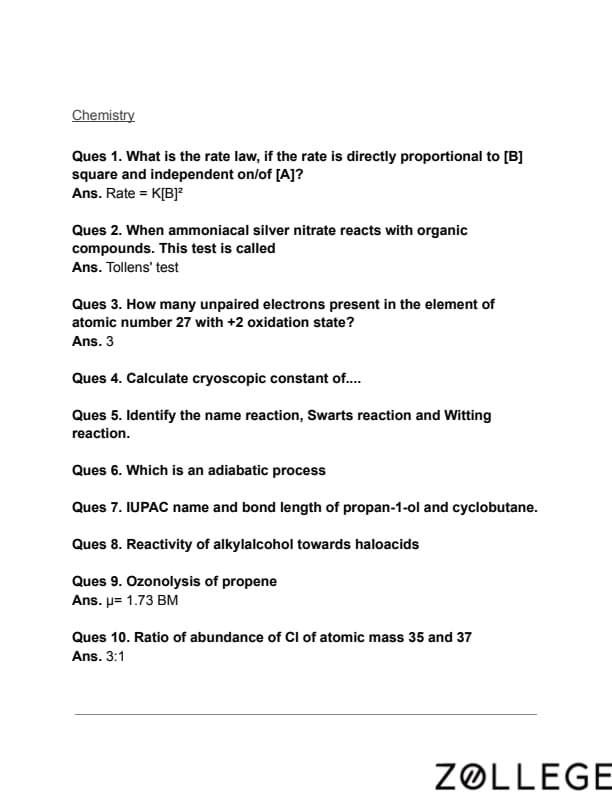
Chemistry
Question 1:
What is the rate law if the rate is directly proportional to [B]² and independent of [A]?
View Solution
The rate law describes how the rate of a chemical reaction depends on the concentrations of its reactants. In this case, the rate is proportional to the square of the concentration of B and is independent of A. Thus, the rate law is:
Rate = k[B]²,
where k is the rate constant.
Question 2:
When ammoniacal silver nitrate reacts with organic compounds, this test is called:
View Solution
Ammoniacal silver nitrate is used in Tollens' test, which is employed to detect the presence of aldehydes. Aldehydes reduce the Tollens' reagent to metallic silver, forming a characteristic silver mirror on the inner surface of the test tube.
Question 3:
How many unpaired electrons are present in the element of atomic number 27 with a +2 oxidation state?
View Solution
The element with atomic number 27 is cobalt (Co). The electronic configuration of neutral cobalt is:
Co: [Ar] 3d⁷ 4s².
In the +2 oxidation state, cobalt loses two electrons from the 4s orbital, resulting in the configuration:
Co²⁺: [Ar] 3d⁷.
The 3d subshell can hold up to 10 electrons. With 7 electrons in the 3d subshell, the configuration has 3 unpaired electrons.
Final Answer: There are 3 unpaired electrons in Co²⁺.
Question 4:
A solution is prepared by dissolving 10 g of a non-volatile solute in 100 g of water. The freezing point depression of the solution is observed to be 1.5°C. Calculate the cryoscopic constant of the solvent.
View Solution
The depression in freezing point (ΔT_f) is related to the cryoscopic constant (K_f) by the formula:
ΔT_f = K_f × m,
where m is the molality of the solution, and K_f is the cryoscopic constant of the solvent.
Step 1: Calculate molality (m):
m = moles of solute / mass of solvent in kg.
Moles of solute = mass of solute / molar mass of solute. Assume the molar mass of the solute is 10 g/mol:
Moles of solute = 10 g / 10 g/mol = 1 mol.
Mass of solvent = 100 g = 0.1 kg.
m = 1 mol / 0.1 kg = 10 mol/kg.
Step 2: Solve for K_f:
ΔT_f = K_f × m.
1.5 = K_f × 10 → K_f = 1.5 / 10 = 0.15 kg/mol.
Final Answer: The cryoscopic constant of the solvent is 0.15 kg/mol.
Question 5:
Identify the name reaction for Swarts reaction and Witting reaction.
View Solution
The Swarts reaction is a nucleophilic substitution reaction, where an alkyl halide reacts with a metal halide, such as silver chloride, to form a new alkyl halide.
The Witting reaction is a nucleophilic addition reaction, where a phosphorus ylide reacts with a carbonyl compound to form an alkene.
Question 6:
Which is an adiabatic process?
View Solution
An adiabatic process is one in which there is no heat exchange between the system and its surroundings. In this process, the heat transfer is zero (\( Q = 0 \)), and the change in internal energy of the system equals the work done by or on the system.
Explanation:
- Rapid compression does not allow sufficient time for heat transfer, making it an adiabatic process.
- In contrast, free expansion, slow compression, or isothermal expansion involve heat exchange and do not qualify as adiabatic.
Conclusion: The rapid compression of a gas in a cylinder fitted with a frictionless piston is an adiabatic process.
Question 7:
What is the IUPAC name and bond length of propan-1-ol and cyclobutane?
View Solution
Propan-1-ol is the IUPAC name for the compound with a hydroxyl group (-OH) attached to the first carbon of a three-carbon chain. Cyclobutane is a four-membered cyclic compound, and due to its ring strain, it has a bond length of approximately 1.5 Å.
Explanation:
- The IUPAC name of the alcohol is determined based on the position of the hydroxyl group and the length of the carbon chain.
- Bond lengths in cyclobutane are slightly shorter due to the ring strain in the four-membered ring.
Conclusion: The IUPAC name is Propan-1-ol, and the bond length of cyclobutane is 1.5 Å.
Question 8:
What is the reactivity of alkyl alcohols towards haloacids?
View Solution
Alcohols react with haloacids (HX) to form alkyl halides in a nucleophilic substitution reaction. During the reaction, the hydroxyl group (-OH) of the alcohol is replaced by a halide ion (X).
Reaction:
R-OH + HX → R-X + H₂O
Explanation:
- The reaction occurs under acidic conditions, and the hydroxyl group is protonated to form water, a good leaving group.
- The halide ion then substitutes the hydroxyl group, forming an alkyl halide.
Conclusion: Alcohols react easily with haloacids to form alkyl halides.
Question 9:
What is the result of ozonolysis of propene?
View Solution
Ozonolysis is a reaction where ozone (O₃) cleaves the double bonds in alkenes, resulting in the formation of carbonyl compounds (aldehydes or ketones).
Reaction:
CH₃-CH=CH₂ + O₃ → CH₃-CHO + HCHO (propenal and formaldehyde)
Explanation:
- The double bond in propene is cleaved by ozone.
- The products are two carbonyl compounds: acetaldehyde and formaldehyde.
Conclusion: The ozonolysis of propene forms aldehydes or ketones.
Question 10:
What is the ratio of abundance of chlorine isotopes with atomic masses 35 and 37?
View Solution
The natural abundance of chlorine isotopes is approximately 75% for Cl-35 and 25% for Cl-37. This corresponds to a ratio of:
Cl-35:Cl-37 = 75:25 = 3:1.
Conclusion: The isotopes of chlorine have a natural abundance ratio of 3:1.
*The article might have information for the previous academic years, please refer the official website of the exam.